Cambridge IGCSE History 0470 — 2011 Oct/Nov Paper 4 · Variant 2
0470/42/O/N/11 · 40 marks · ≈45 min
The question paper and its mark scheme, free to read here and free to download. This is Cambridge’s own paper, exactly as it was sat.
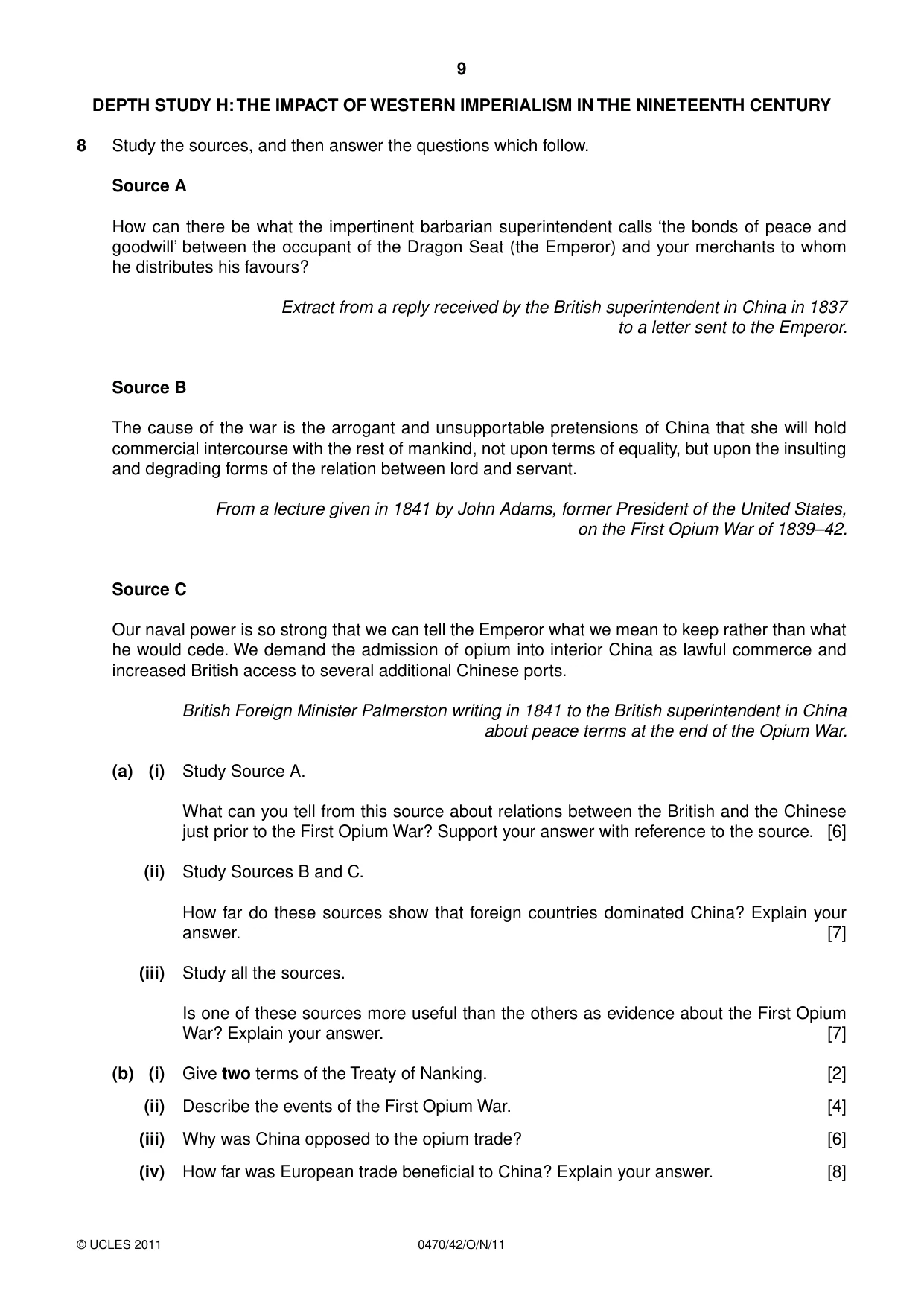
Question paper12 pages


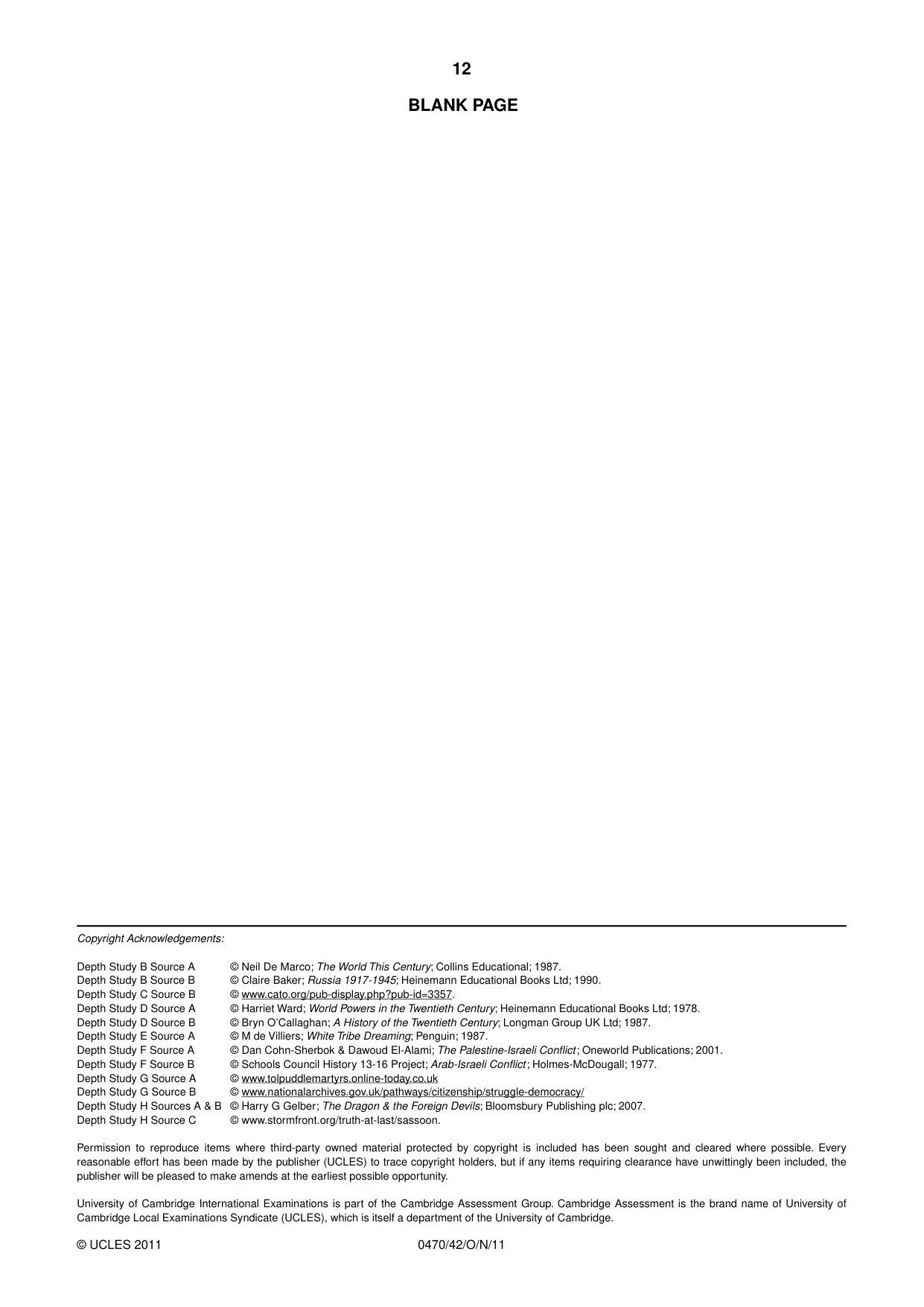
Mark scheme17 pages
Answers below. Sit the paper first if you are practising.
Paper as text
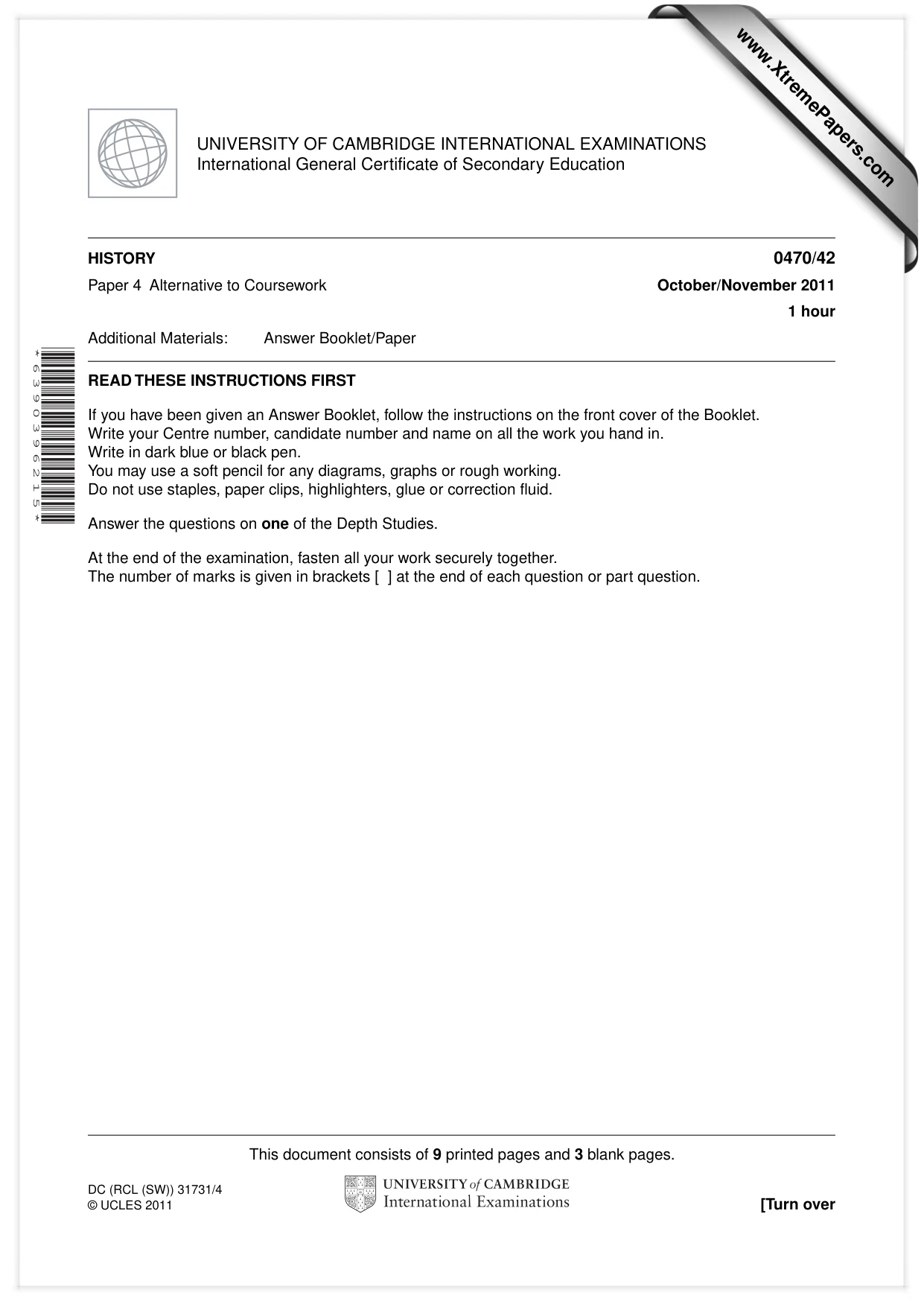
Question paper, page 1
This document consists of 9 printed pages and 3 blank pages. DC (RCL (SW)) 31731/4 © UCLES 2011 [Turn over UNIVERSITY OF CAMBRIDGE INTERNATIONAL EXAMINATIONS International General Certificate of Secondary Education * 6 3 9 0 3 9 6 2 1 5 * HISTORY 0470/42 Paper 4 Alternative to Coursework October/November 2011 1 hour Additional Materials: Answer Booklet/Paper READ THESE INSTRUCTIONS FIRST If you have been given an Answer Booklet, follow the instructions on the front cover of the Booklet. Write your Centre number, candidate number and name on all the work you hand in. Write in dark blue or black pen. You may use a soft pencil for any diagrams, graphs or rough working. Do not use staples, paper clips, highlighters, glue or correction fluid. Answer the questions on one of the Depth Studies. At the end of the examination, fasten all your work securely together. The number of marks is given in brackets [ ] at the end of each question or part question. www.XtremePapers.com
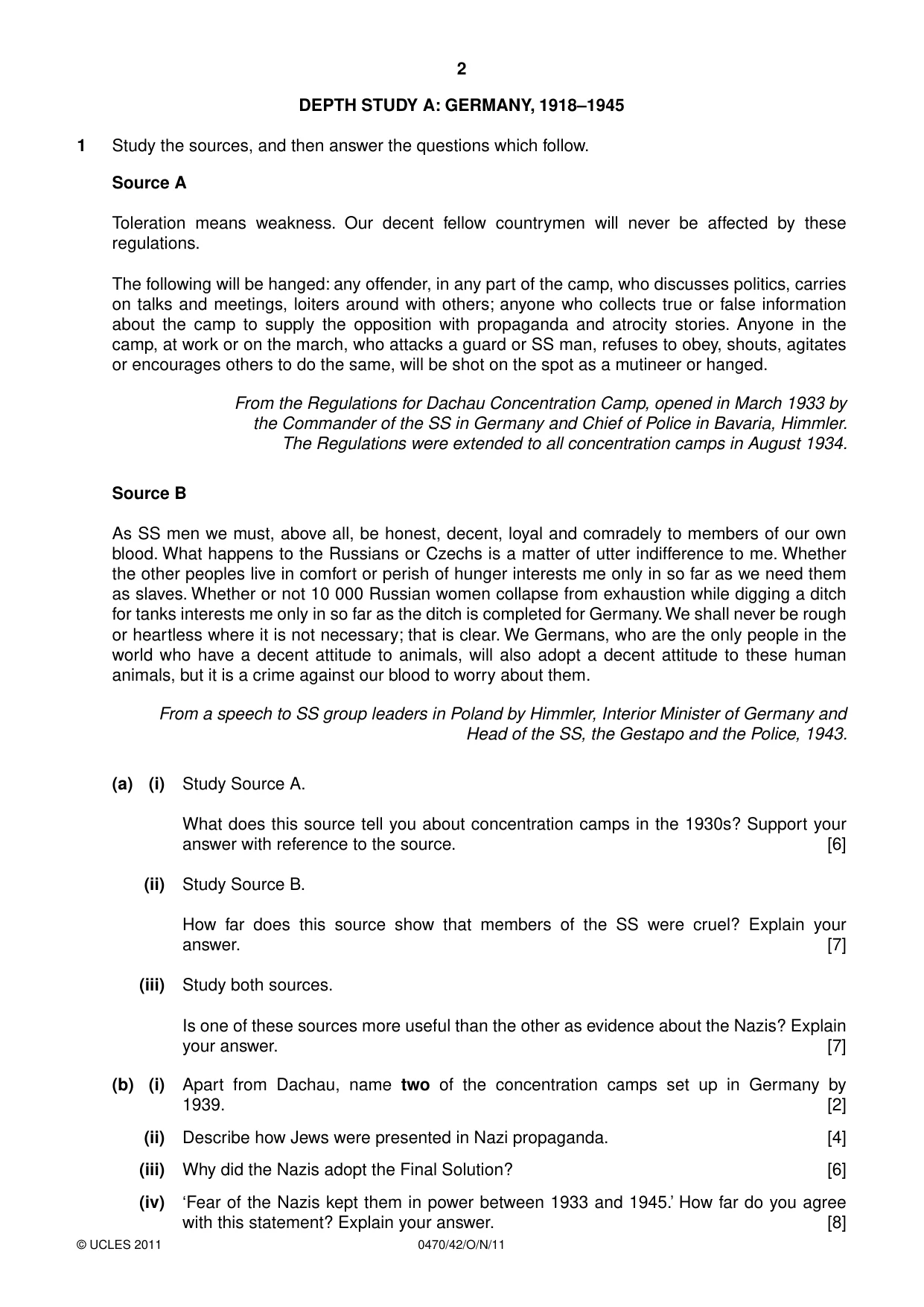
Question paper, page 2
2 0470/42/O/N/11 © UCLES 2011 DEPTH STUDY A: GERMANY, 1918–1945 1 Study the sources, and then answer the questions which follow. Source A Toleration means weakness. Our decent fellow countrymen will never be affected by these regulations. The following will be hanged: any offender, in any part of the camp, who discusses politics, carries on talks and meetings, loiters around with others; anyone who collects true or false information about the camp to supply the opposition with propaganda and atrocity stories. Anyone in the camp, at work or on the march, who attacks a guard or SS man, refuses to obey, shouts, agitates or encourages others to do the same, will be shot on the spot as a mutineer or hanged. From the Regulations for Dachau Concentration Camp, opened in March 1933 by the Commander of the SS in Germany and Chief of Police in Bavaria, Himmler. The Regulations were extended to all concentration camps in August 1934. Source B As SS men we must, above all, be honest, decent, loyal and comradely to members of our own blood. What happens to the Russians or Czechs is a matter of utter indifference to me. Whether the other peoples live in comfort or perish of hunger interests me only in so far as we need them as slaves. Whether or not 10 000 Russian women collapse from exhaustion while digging a ditch for tanks interests me only in so far as the ditch is completed for Germany. We shall never be rough or heartless where it is not necessary; that is clear. We Germans, who are the only people in the world who have a decent attitude to animals, will also adopt a decent attitude to these human animals, but it is a crime against our blood to worry about them. From a speech to SS group leaders in Poland by Himmler, Interior Minister of Germany and Head of the SS, the Gestapo and the Police, 1943. (a) (i) Study Source A. What does this source tell you about concentration camps in the 1930s? Support your answer with reference to the source. [6] (ii) Study Source B. How far does this source show that members of the SS were cruel? Explain your answer. [7] (iii) Study both sources. Is one of these sources more useful than the other as evidence about the Nazis? Explain your answer. [7] (b) (i) Apart from Dachau, name two of the concentration camps set up in Germany by 1939. [2] (ii) Describe how Jews were presented in Nazi propaganda. [4] (iii) Why did the Nazis adopt the Final Solution? [6] (iv) ‘Fear of the Nazis kept them in power between 1933 and 1945.’ How far do you agree with this statement? Explain your answer. [8]
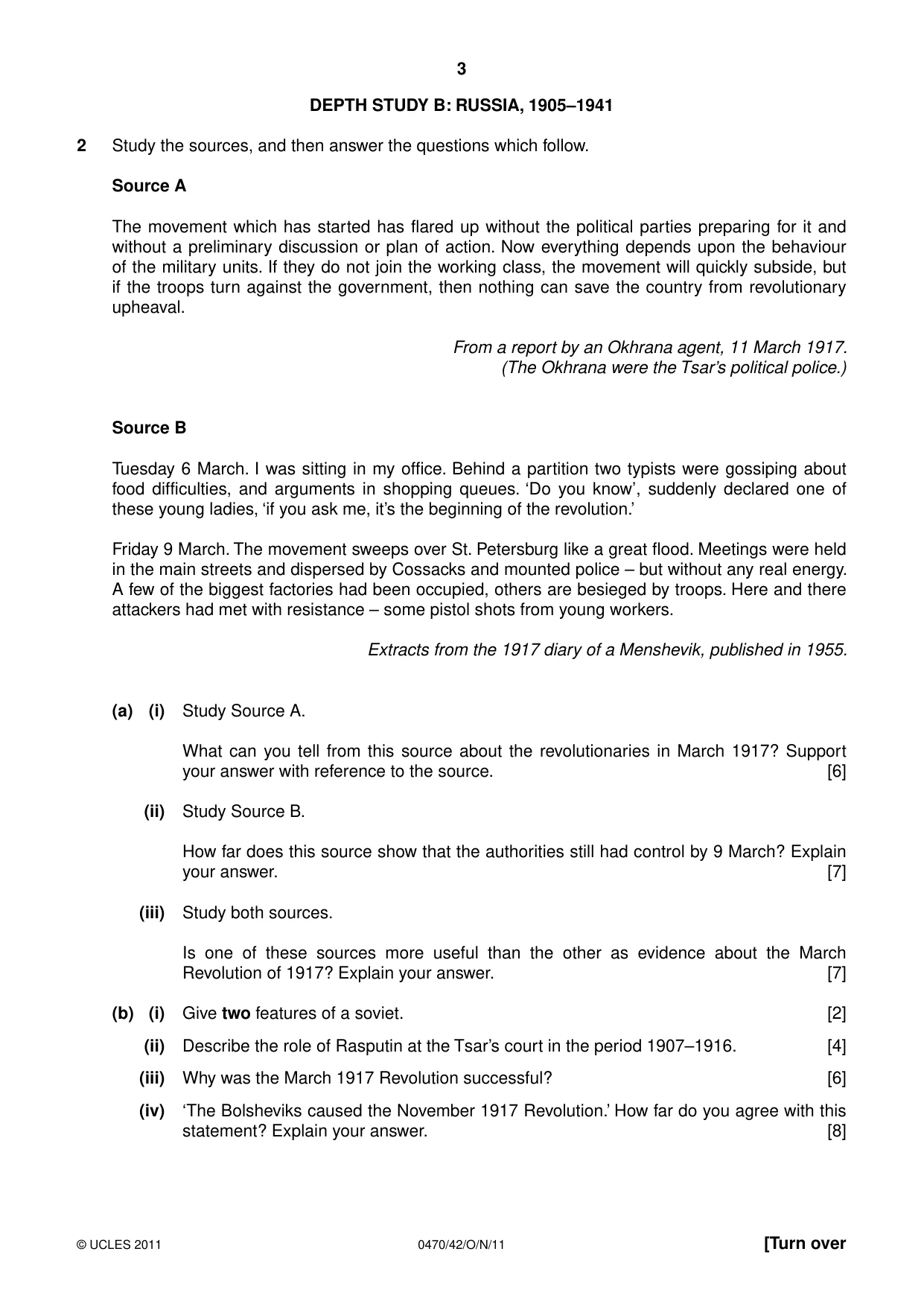
Question paper, page 3
3 0470/42/O/N/11 © UCLES 2011 [Turn over DEPTH STUDY B: RUSSIA, 1905–1941 2 Study the sources, and then answer the questions which follow. Source A The movement which has started has flared up without the political parties preparing for it and without a preliminary discussion or plan of action. Now everything depends upon the behaviour of the military units. If they do not join the working class, the movement will quickly subside, but if the troops turn against the government, then nothing can save the country from revolutionary upheaval. From a report by an Okhrana agent, 11 March 1917. (The Okhrana were the Tsar’s political police.) Source B Tuesday 6 March. I was sitting in my office. Behind a partition two typists were gossiping about food difficulties, and arguments in shopping queues. ‘Do you know’, suddenly declared one of these young ladies, ‘if you ask me, it’s the beginning of the revolution.’ Friday 9 March. The movement sweeps over St. Petersburg like a great flood. Meetings were held in the main streets and dispersed by Cossacks and mounted police – but without any real energy. A few of the biggest factories had been occupied, others are besieged by troops. Here and there attackers had met with resistance – some pistol shots from young workers. Extracts from the 1917 diary of a Menshevik, published in 1955. (a) (i) Study Source A. What can you tell from this source about the revolutionaries in March 1917? Support your answer with reference to the source. [6] (ii) Study Source B. How far does this source show that the authorities still had control by 9 March? Explain your answer. [7] (iii) Study both sources. Is one of these sources more useful than the other as evidence about the March Revolution of 1917? Explain your answer. [7] (b) (i) Give two features of a soviet. [2] (ii) Describe the role of Rasputin at the Tsar’s court in the period 1907–1916. [4] (iii) Why was the March 1917 Revolution successful? [6] (iv) ‘The Bolsheviks caused the November 1917 Revolution.’ How far do you agree with this statement? Explain your answer. [8]
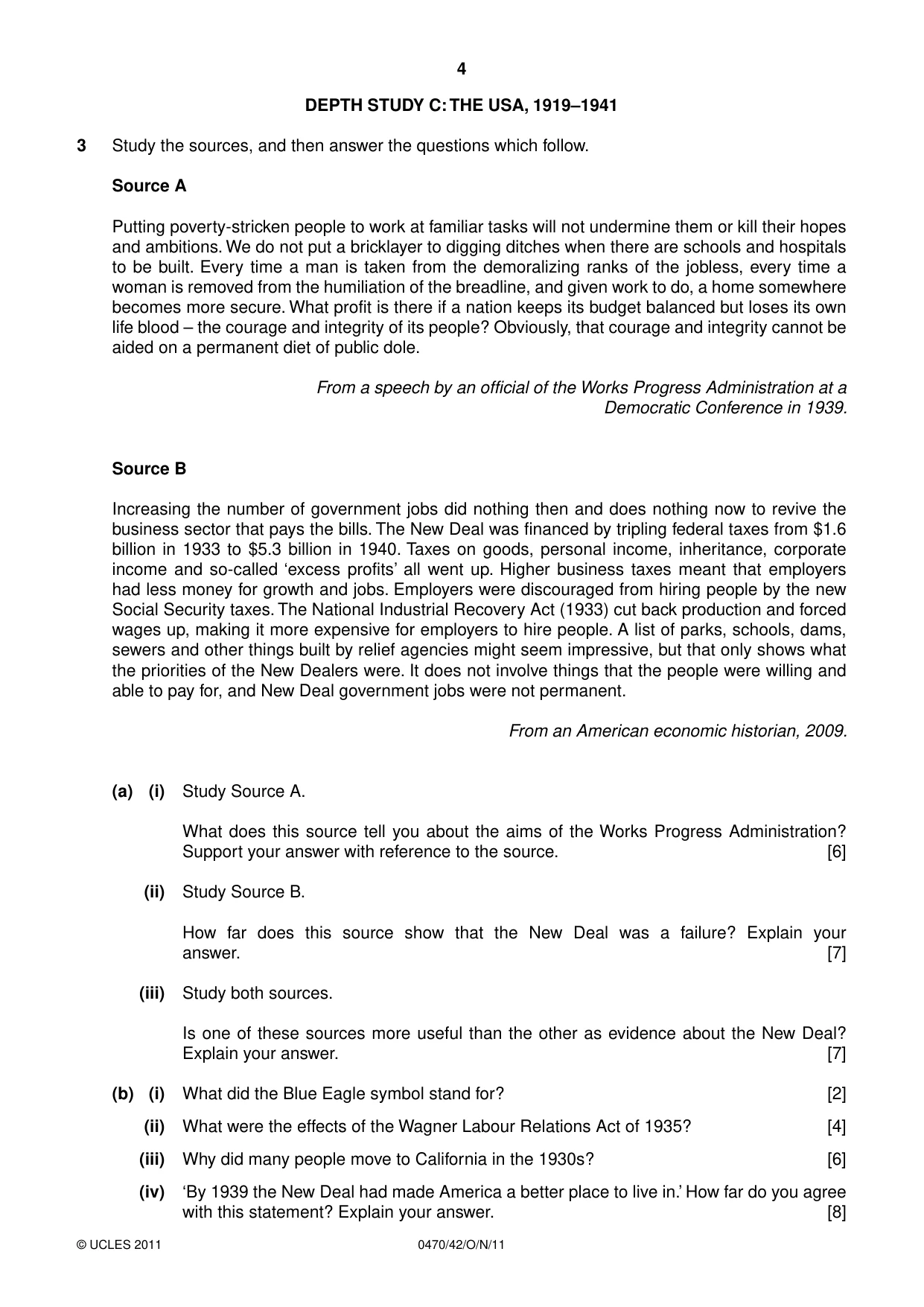
Question paper, page 4
4 0470/42/O/N/11 © UCLES 2011 DEPTH STUDY C: THE USA, 1919–1941 3 Study the sources, and then answer the questions which follow. Source A Putting poverty-stricken people to work at familiar tasks will not undermine them or kill their hopes and ambitions. We do not put a bricklayer to digging ditches when there are schools and hospitals to be built. Every time a man is taken from the demoralizing ranks of the jobless, every time a woman is removed from the humiliation of the breadline, and given work to do, a home somewhere becomes more secure. What profit is there if a nation keeps its budget balanced but loses its own life blood – the courage and integrity of its people? Obviously, that courage and integrity cannot be aided on a permanent diet of public dole. From a speech by an official of the Works Progress Administration at a Democratic Conference in 1939. Source B Increasing the number of government jobs did nothing then and does nothing now to revive the business sector that pays the bills. The New Deal was financed by tripling federal taxes from $1.6 billion in 1933 to $5.3 billion in 1940. Taxes on goods, personal income, inheritance, corporate income and so-called ‘excess profits’ all went up. Higher business taxes meant that employers had less money for growth and jobs. Employers were discouraged from hiring people by the new Social Security taxes. The National Industrial Recovery Act (1933) cut back production and forced wages up, making it more expensive for employers to hire people. A list of parks, schools, dams, sewers and other things built by relief agencies might seem impressive, but that only shows what the priorities of the New Dealers were. It does not involve things that the people were willing and able to pay for, and New Deal government jobs were not permanent. From an American economic historian, 2009. (a) (i) Study Source A. What does this source tell you about the aims of the Works Progress Administration? Support your answer with reference to the source. [6] (ii) Study Source B. How far does this source show that the New Deal was a failure? Explain your answer. [7] (iii) Study both sources. Is one of these sources more useful than the other as evidence about the New Deal? Explain your answer. [7] (b) (i) What did the Blue Eagle symbol stand for? [2] (ii) What were the effects of the Wagner Labour Relations Act of 1935? [4] (iii) Why did many people move to California in the 1930s? [6] (iv) ‘By 1939 the New Deal had made America a better place to live in.’ How far do you agree with this statement? Explain your answer. [8]
Question paper, page 5
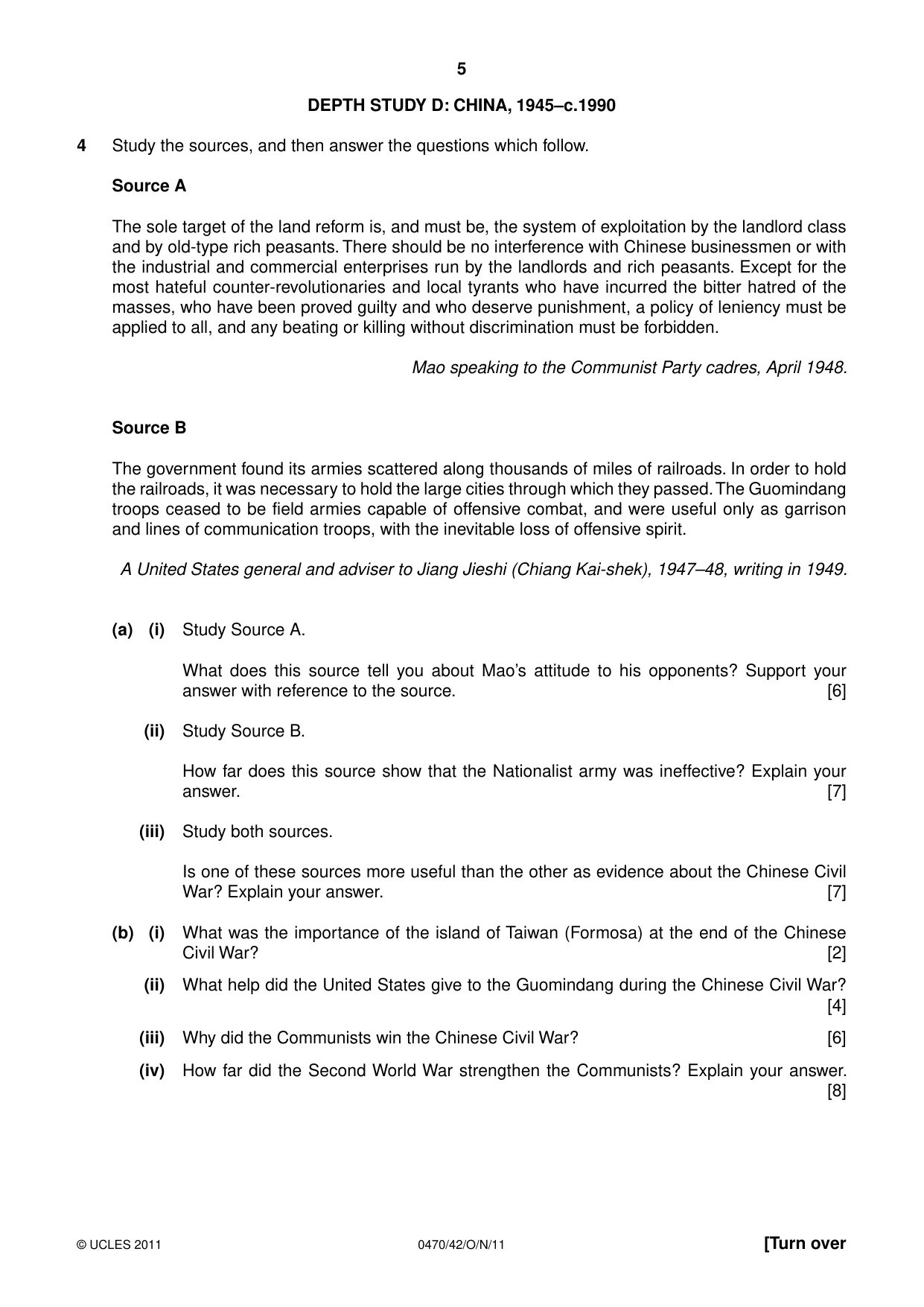
5 0470/42/O/N/11 © UCLES 2011 [Turn over DEPTH STUDY D: CHINA, 1945–c.1990 4 Study the sources, and then answer the questions which follow. Source A The sole target of the land reform is, and must be, the system of exploitation by the landlord class and by old-type rich peasants. There should be no interference with Chinese businessmen or with the industrial and commercial enterprises run by the landlords and rich peasants. Except for the most hateful counter-revolutionaries and local tyrants who have incurred the bitter hatred of the masses, who have been proved guilty and who deserve punishment, a policy of leniency must be applied to all, and any beating or killing without discrimination must be forbidden. Mao speaking to the Communist Party cadres, April 1948. Source B The government found its armies scattered along thousands of miles of railroads. In order to hold the railroads, it was necessary to hold the large cities through which they passed. The Guomindang troops ceased to be field armies capable of offensive combat, and were useful only as garrison and lines of communication troops, with the inevitable loss of offensive spirit. A United States general and adviser to Jiang Jieshi (Chiang Kai-shek), 1947–48, writing in 1949. (a) (i) Study Source A. What does this source tell you about Mao’s attitude to his opponents? Support your answer with reference to the source. [6] (ii) Study Source B. How far does this source show that the Nationalist army was ineffective? Explain your answer. [7] (iii) Study both sources. Is one of these sources more useful than the other as evidence about the Chinese Civil War? Explain your answer. [7] (b) (i) What was the importance of the island of Taiwan (Formosa) at the end of the Chinese Civil War? [2] (ii) What help did the United States give to the Guomindang during the Chinese Civil War? [4] (iii) Why did the Communists win the Chinese Civil War? [6] (iv) How far did the Second World War strengthen the Communists? Explain your answer. [8]
Question paper, page 6
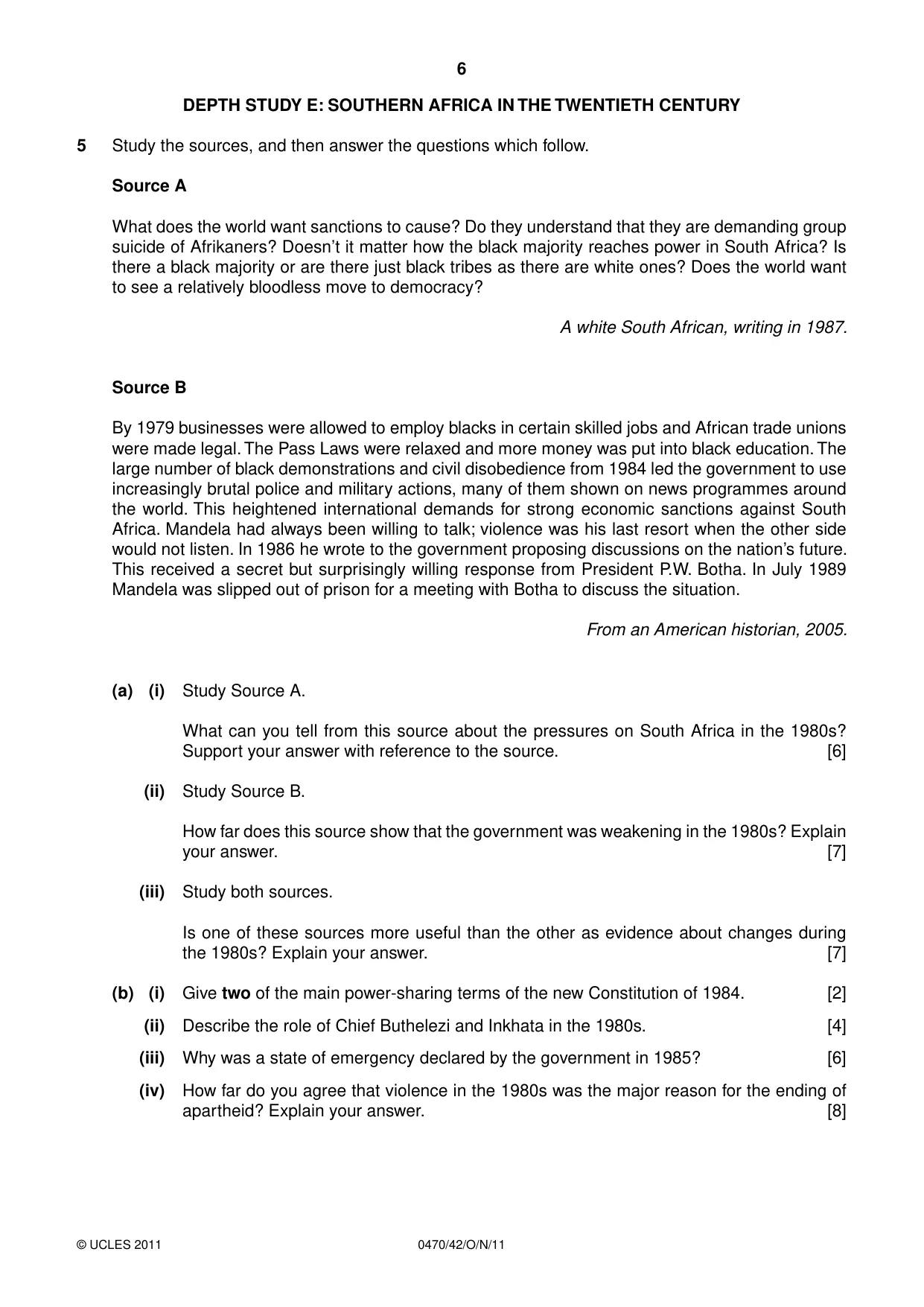
6 0470/42/O/N/11 © UCLES 2011 DEPTH STUDY E: SOUTHERN AFRICA IN THE TWENTIETH CENTURY 5 Study the sources, and then answer the questions which follow. Source A What does the world want sanctions to cause? Do they understand that they are demanding group suicide of Afrikaners? Doesn’t it matter how the black majority reaches power in South Africa? Is there a black majority or are there just black tribes as there are white ones? Does the world want to see a relatively bloodless move to democracy? A white South African, writing in 1987. Source B By 1979 businesses were allowed to employ blacks in certain skilled jobs and African trade unions were made legal. The Pass Laws were relaxed and more money was put into black education. The large number of black demonstrations and civil disobedience from 1984 led the government to use increasingly brutal police and military actions, many of them shown on news programmes around the world. This heightened international demands for strong economic sanctions against South Africa. Mandela had always been willing to talk; violence was his last resort when the other side would not listen. In 1986 he wrote to the government proposing discussions on the nation’s future. This received a secret but surprisingly willing response from President P.W. Botha. In July 1989 Mandela was slipped out of prison for a meeting with Botha to discuss the situation. From an American historian, 2005. (a) (i) Study Source A. What can you tell from this source about the pressures on South Africa in the 1980s? Support your answer with reference to the source. [6] (ii) Study Source B. How far does this source show that the government was weakening in the 1980s? Explain your answer. [7] (iii) Study both sources. Is one of these sources more useful than the other as evidence about changes during the 1980s? Explain your answer. [7] (b) (i) Give two of the main power-sharing terms of the new Constitution of 1984. [2] (ii) Describe the role of Chief Buthelezi and Inkhata in the 1980s. [4] (iii) Why was a state of emergency declared by the government in 1985? [6] (iv) How far do you agree that violence in the 1980s was the major reason for the ending of apartheid? Explain your answer. [8]
Question paper, page 7
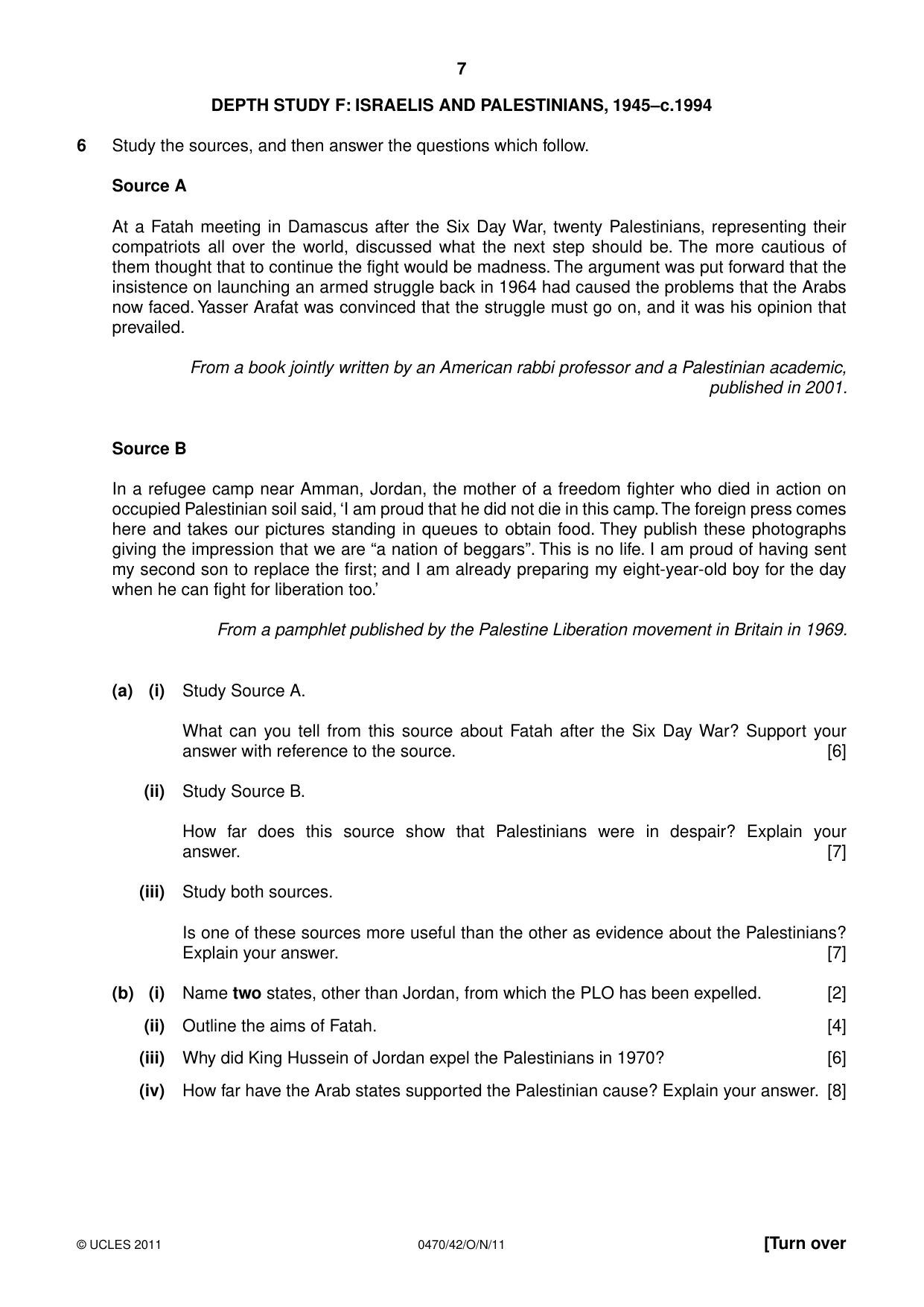
7 0470/42/O/N/11 © UCLES 2011 [Turn over DEPTH STUDY F: ISRAELIS AND PALESTINIANS, 1945–c.1994 6 Study the sources, and then answer the questions which follow. Source A At a Fatah meeting in Damascus after the Six Day War, twenty Palestinians, representing their compatriots all over the world, discussed what the next step should be. The more cautious of them thought that to continue the fight would be madness. The argument was put forward that the insistence on launching an armed struggle back in 1964 had caused the problems that the Arabs now faced. Yasser Arafat was convinced that the struggle must go on, and it was his opinion that prevailed. From a book jointly written by an American rabbi professor and a Palestinian academic, published in 2001. Source B In a refugee camp near Amman, Jordan, the mother of a freedom fighter who died in action on occupied Palestinian soil said, ‘I am proud that he did not die in this camp. The foreign press comes here and takes our pictures standing in queues to obtain food. They publish these photographs giving the impression that we are “a nation of beggars”. This is no life. I am proud of having sent my second son to replace the first; and I am already preparing my eight-year-old boy for the day when he can fight for liberation too.’ From a pamphlet published by the Palestine Liberation movement in Britain in 1969. (a) (i) Study Source A. What can you tell from this source about Fatah after the Six Day War? Support your answer with reference to the source. [6] (ii) Study Source B. How far does this source show that Palestinians were in despair? Explain your answer. [7] (iii) Study both sources. Is one of these sources more useful than the other as evidence about the Palestinians? Explain your answer. [7] (b) (i) Name two states, other than Jordan, from which the PLO has been expelled. [2] (ii) Outline the aims of Fatah. [4] (iii) Why did King Hussein of Jordan expel the Palestinians in 1970? [6] (iv) How far have the Arab states supported the Palestinian cause? Explain your answer. [8]
Question paper, page 8
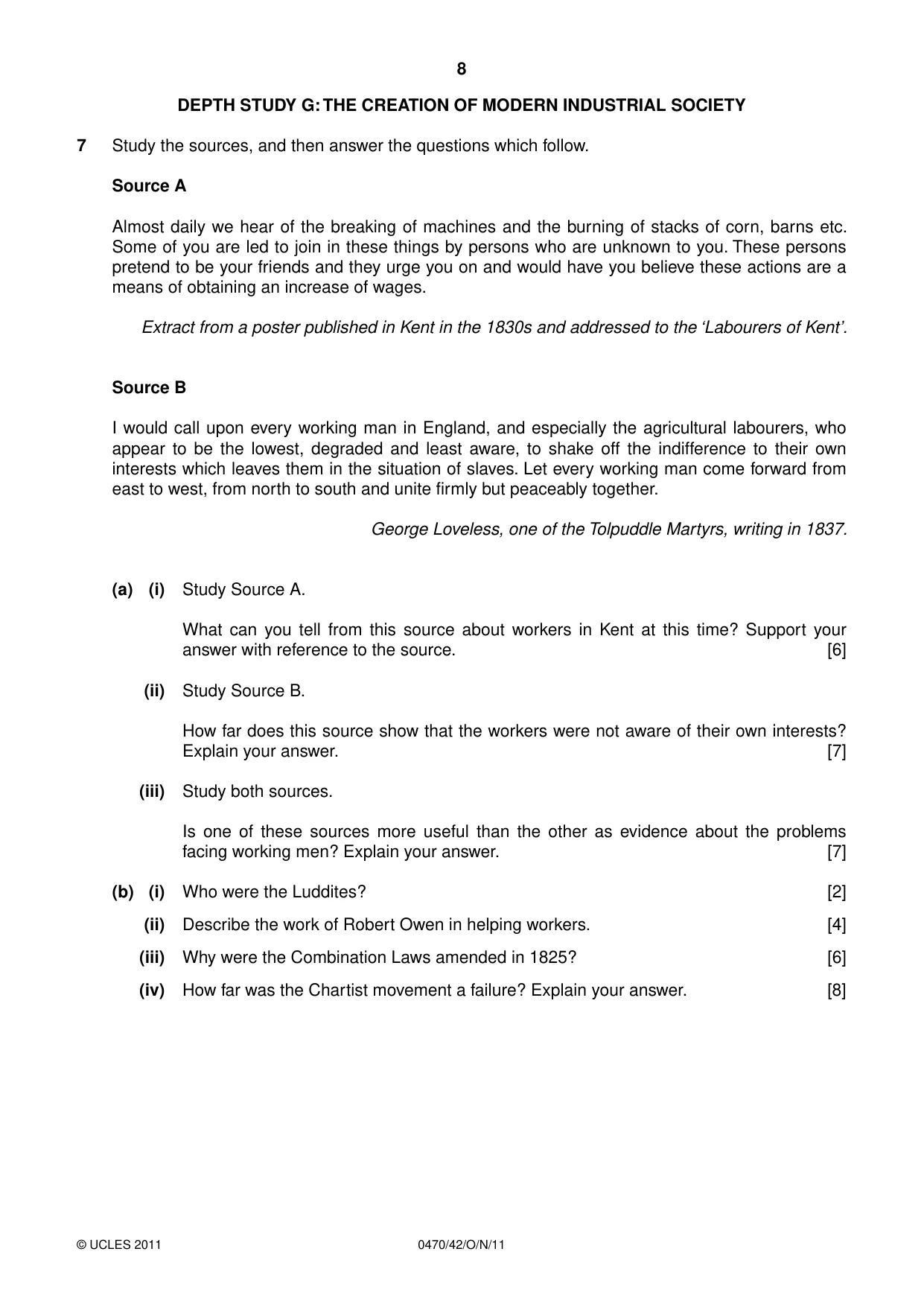
8 0470/42/O/N/11 © UCLES 2011 DEPTH STUDY G: THE CREATION OF MODERN INDUSTRIAL SOCIETY 7 Study the sources, and then answer the questions which follow. Source A Almost daily we hear of the breaking of machines and the burning of stacks of corn, barns etc. Some of you are led to join in these things by persons who are unknown to you. These persons pretend to be your friends and they urge you on and would have you believe these actions are a means of obtaining an increase of wages. Extract from a poster published in Kent in the 1830s and addressed to the ‘Labourers of Kent’. Source B I would call upon every working man in England, and especially the agricultural labourers, who appear to be the lowest, degraded and least aware, to shake off the indifference to their own interests which leaves them in the situation of slaves. Let every working man come forward from east to west, from north to south and unite firmly but peaceably together. George Loveless, one of the Tolpuddle Martyrs, writing in 1837. (a) (i) Study Source A. What can you tell from this source about workers in Kent at this time? Support your answer with reference to the source. [6] (ii) Study Source B. How far does this source show that the workers were not aware of their own interests? Explain your answer. [7] (iii) Study both sources. Is one of these sources more useful than the other as evidence about the problems facing working men? Explain your answer. [7] (b) (i) Who were the Luddites? [2] (ii) Describe the work of Robert Owen in helping workers. [4] (iii) Why were the Combination Laws amended in 1825? [6] (iv) How far was the Chartist movement a failure? Explain your answer. [8]
Question paper, page 9
9 0470/42/O/N/11 © UCLES 2011 DEPTH STUDY H: THE IMPACT OF WESTERN IMPERIALISM IN THE NINETEENTH CENTURY 8 Study the sources, and then answer the questions which follow. Source A How can there be what the impertinent barbarian superintendent calls ‘the bonds of peace and goodwill’ between the occupant of the Dragon Seat (the Emperor) and your merchants to whom he distributes his favours? Extract from a reply received by the British superintendent in China in 1837 to a letter sent to the Emperor. Source B The cause of the war is the arrogant and unsupportable pretensions of China that she will hold commercial intercourse with the rest of mankind, not upon terms of equality, but upon the insulting and degrading forms of the relation between lord and servant. From a lecture given in 1841 by John Adams, former President of the United States, on the First Opium War of 1839–42. Source C Our naval power is so strong that we can tell the Emperor what we mean to keep rather than what he would cede. We demand the admission of opium into interior China as lawful commerce and increased British access to several additional Chinese ports. British Foreign Minister Palmerston writing in 1841 to the British superintendent in China about peace terms at the end of the Opium War. (a) (i) Study Source A. What can you tell from this source about relations between the British and the Chinese just prior to the First Opium War? Support your answer with reference to the source. [6] (ii) Study Sources B and C. How far do these sources show that foreign countries dominated China? Explain your answer. [7] (iii) Study all the sources. Is one of these sources more useful than the others as evidence about the First Opium War? Explain your answer. [7] (b) (i) Give two terms of the Treaty of Nanking. [2] (ii) Describe the events of the First Opium War. [4] (iii) Why was China opposed to the opium trade? [6] (iv) How far was European trade beneficial to China? Explain your answer. [8]
Question paper, page 10
10 0470/42/O/N/11 © UCLES 2011 BLANK PAGE
Question paper, page 11
11 0470/42/O/N/11 © UCLES 2011 BLANK PAGE
Question paper, page 12
12 0470/42/O/N/11 © UCLES 2011 Copyright Acknowledgements: Depth Study B Source A © Neil De Marco; The World This Century; Collins Educational; 1987. Depth Study B Source B © Claire Baker; Russia 1917-1945; Heinemann Educational Books Ltd; 1990. Depth Study C Source B © www.cato.org/pub-display.php?pub-id=3357. Depth Study D Source A © Harriet Ward; World Powers in the Twentieth Century; Heinemann Educational Books Ltd; 1978. Depth Study D Source B © Bryn O’Callaghan; A History of the Twentieth Century; Longman Group UK Ltd; 1987. Depth Study E Source A © M de Villiers; White Tribe Dreaming; Penguin; 1987. Depth Study F Source A © Dan Cohn-Sherbok & Dawoud El-Alami; The Palestine-Israeli Conflict ; Oneworld Publications; 2001. Depth Study F Source B © Schools Council History 13-16 Project; Arab-Israeli Conflict ; Holmes-McDougall; 1977. Depth Study G Source A © www.tolpuddlemartyrs.online-today.co.uk Depth Study G Source B © www.nationalarchives.gov.uk/pathways/citizenship/struggle-democracy/ Depth Study H Sources A & B © Harry G Gelber; The Dragon & the Foreign Devils; Bloomsbury Publishing plc; 2007. Depth Study H Source C © www.stormfront.org/truth-at-last/sassoon. Permission to reproduce items where third-party owned material protected by copyright is included has been sought and cleared where possible. Every reasonable effort has been made by the publisher (UCLES) to trace copyright holders, but if any items requiring clearance have unwittingly been included, the publisher will be pleased to make amends at the earliest possible opportunity. University of Cambridge International Examinations is part of the Cambridge Assessment Group. Cambridge Assessment is the brand name of University of Cambridge Local Examinations Syndicate (UCLES), which is itself a department of the University of Cambridge. BLANK PAGE
Mark scheme, page 1
UNIVERSITY OF CAMBRIDGE INTERNATIONAL EXAMINATIONS International General Certificate of Secondary Education MARK SCHEME for the October/November 2011 question paper for the guidance of teachers 0470 HISTORY 0470/42 Paper 4 (Alternative to Coursework), maximum raw mark 40 This mark scheme is published as an aid to teachers and candidates, to indicate the requirements of the examination. It shows the basis on which Examiners were instructed to award marks. It does not indicate the details of the discussions that took place at an Examiners’ meeting before marking began, which would have considered the acceptability of alternative answers. Mark schemes must be read in conjunction with the question papers and the report on the examination. • Cambridge will not enter into discussions or correspondence in connection with these mark schemes. Cambridge is publishing the mark schemes for the October/November 2011 question papers for most IGCSE, GCE Advanced Level and Advanced Subsidiary Level syllabuses and some Ordinary Level syllabuses. www.XtremePapers.com
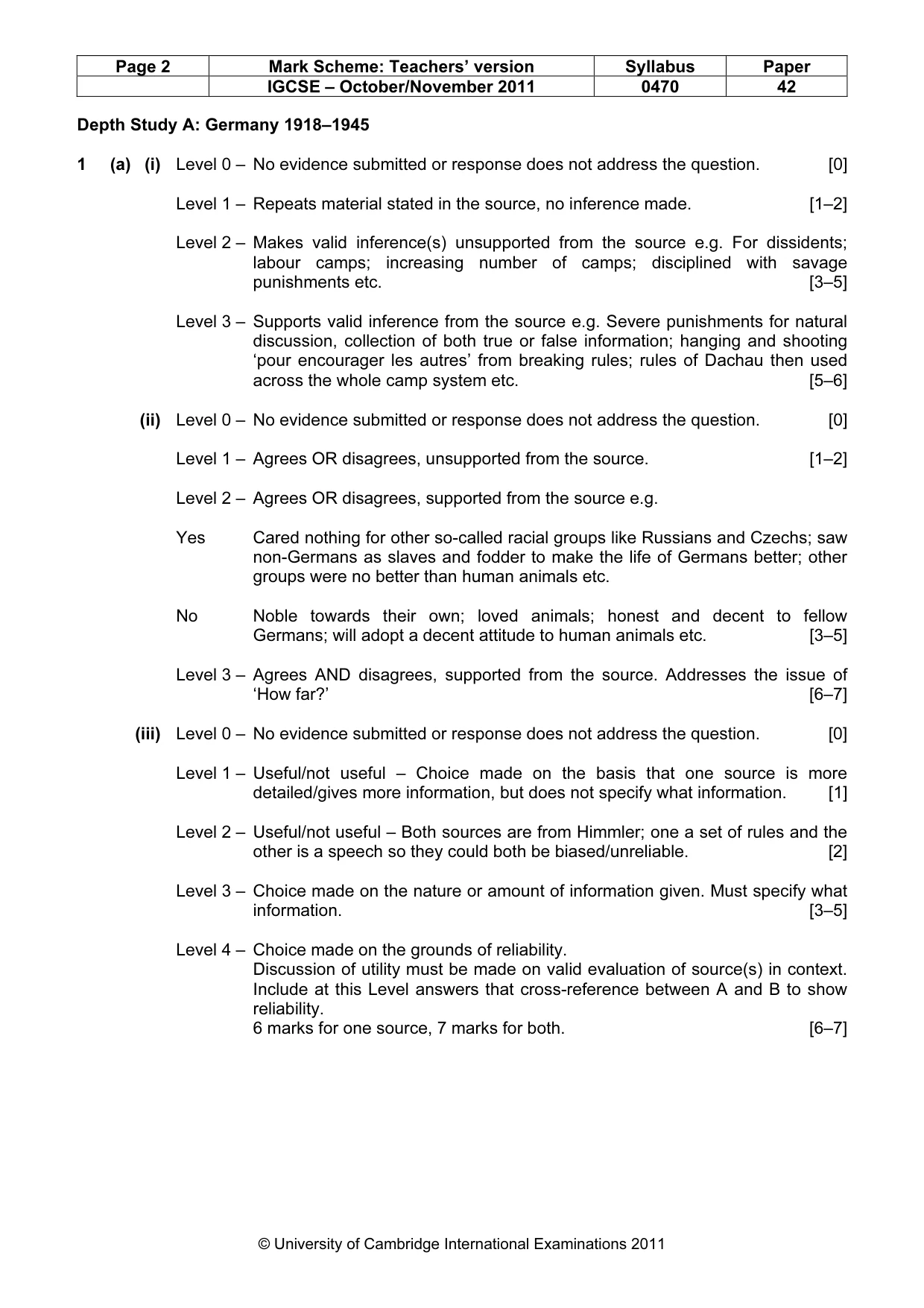
Mark scheme, page 2
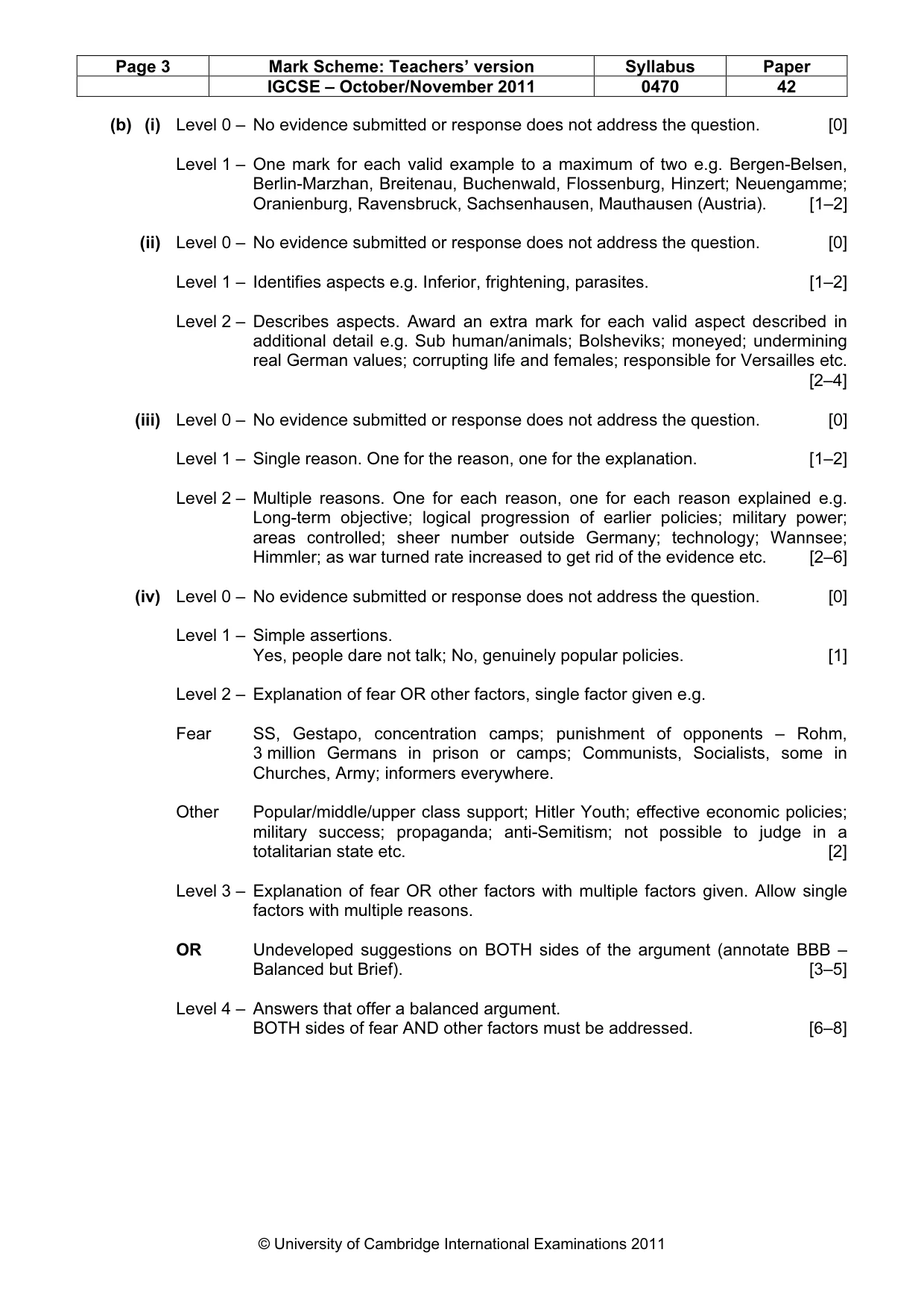
Page 2 Mark Scheme: Teachers’ version Syllabus Paper IGCSE – October/November 2011 0470 42 © University of Cambridge International Examinations 2011 Depth Study A: Germany 1918–1945 1 (a) (i) Level 0 – No evidence submitted or response does not address the question. [0] Level 1 – Repeats material stated in the source, no inference made. [1–2] Level 2 – Makes valid inference(s) unsupported from the source e.g. For dissidents; labour camps; increasing number of camps; disciplined with savage punishments etc. [3–5] Level 3 – Supports valid inference from the source e.g. Severe punishments for natural discussion, collection of both true or false information; hanging and shooting ‘pour encourager les autres’ from breaking rules; rules of Dachau then used across the whole camp system etc. [5–6] (ii) Level 0 – No evidence submitted or response does not address the question. [0] Level 1 – Agrees OR disagrees, unsupported from the source. [1–2] Level 2 – Agrees OR disagrees, supported from the source e.g. Yes Cared nothing for other so-called racial groups like Russians and Czechs; saw non-Germans as slaves and fodder to make the life of Germans better; other groups were no better than human animals etc. No Noble towards their own; loved animals; honest and decent to fellow Germans; will adopt a decent attitude to human animals etc. [3–5] Level 3 – Agrees AND disagrees, supported from the source. Addresses the issue of ‘How far?’ [6–7] (iii) Level 0 – No evidence submitted or response does not address the question. [0] Level 1 – Useful/not useful – Choice made on the basis that one source is more detailed/gives more information, but does not specify what information. [1] Level 2 – Useful/not useful – Both sources are from Himmler; one a set of rules and the other is a speech so they could both be biased/unreliable. [2] Level 3 – Choice made on the nature or amount of information given. Must specify what information. [3–5] Level 4 – Choice made on the grounds of reliability. Discussion of utility must be made on valid evaluation of source(s) in context. Include at this Level answers that cross-reference between A and B to show reliability. 6 marks for one source, 7 marks for both. [6–7]
Mark scheme, page 3
Page 3 Mark Scheme: Teachers’ version Syllabus Paper IGCSE – October/November 2011 0470 42 © University of Cambridge International Examinations 2011 (b) (i) Level 0 – No evidence submitted or response does not address the question. [0] Level 1 – One mark for each valid example to a maximum of two e.g. Bergen-Belsen, Berlin-Marzhan, Breitenau, Buchenwald, Flossenburg, Hinzert; Neuengamme; Oranienburg, Ravensbruck, Sachsenhausen, Mauthausen (Austria). [1–2] (ii) Level 0 – No evidence submitted or response does not address the question. [0] Level 1 – Identifies aspects e.g. Inferior, frightening, parasites. [1–2] Level 2 – Describes aspects. Award an extra mark for each valid aspect described in additional detail e.g. Sub human/animals; Bolsheviks; moneyed; undermining real German values; corrupting life and females; responsible for Versailles etc. [2–4] (iii) Level 0 – No evidence submitted or response does not address the question. [0] Level 1 – Single reason. One for the reason, one for the explanation. [1–2] Level 2 – Multiple reasons. One for each reason, one for each reason explained e.g. Long-term objective; logical progression of earlier policies; military power; areas controlled; sheer number outside Germany; technology; Wannsee; Himmler; as war turned rate increased to get rid of the evidence etc. [2–6] (iv) Level 0 – No evidence submitted or response does not address the question. [0] Level 1 – Simple assertions. Yes, people dare not talk; No, genuinely popular policies. [1] Level 2 – Explanation of fear OR other factors, single factor given e.g. Fear SS, Gestapo, concentration camps; punishment of opponents – Rohm, 3 million Germans in prison or camps; Communists, Socialists, some in Churches, Army; informers everywhere. Other Popular/middle/upper class support; Hitler Youth; effective economic policies; military success; propaganda; anti-Semitism; not possible to judge in a totalitarian state etc. [2] Level 3 – Explanation of fear OR other factors with multiple factors given. Allow single factors with multiple reasons. OR Undeveloped suggestions on BOTH sides of the argument (annotate BBB – Balanced but Brief). [3–5] Level 4 – Answers that offer a balanced argument. BOTH sides of fear AND other factors must be addressed. [6–8]
Mark scheme, page 4
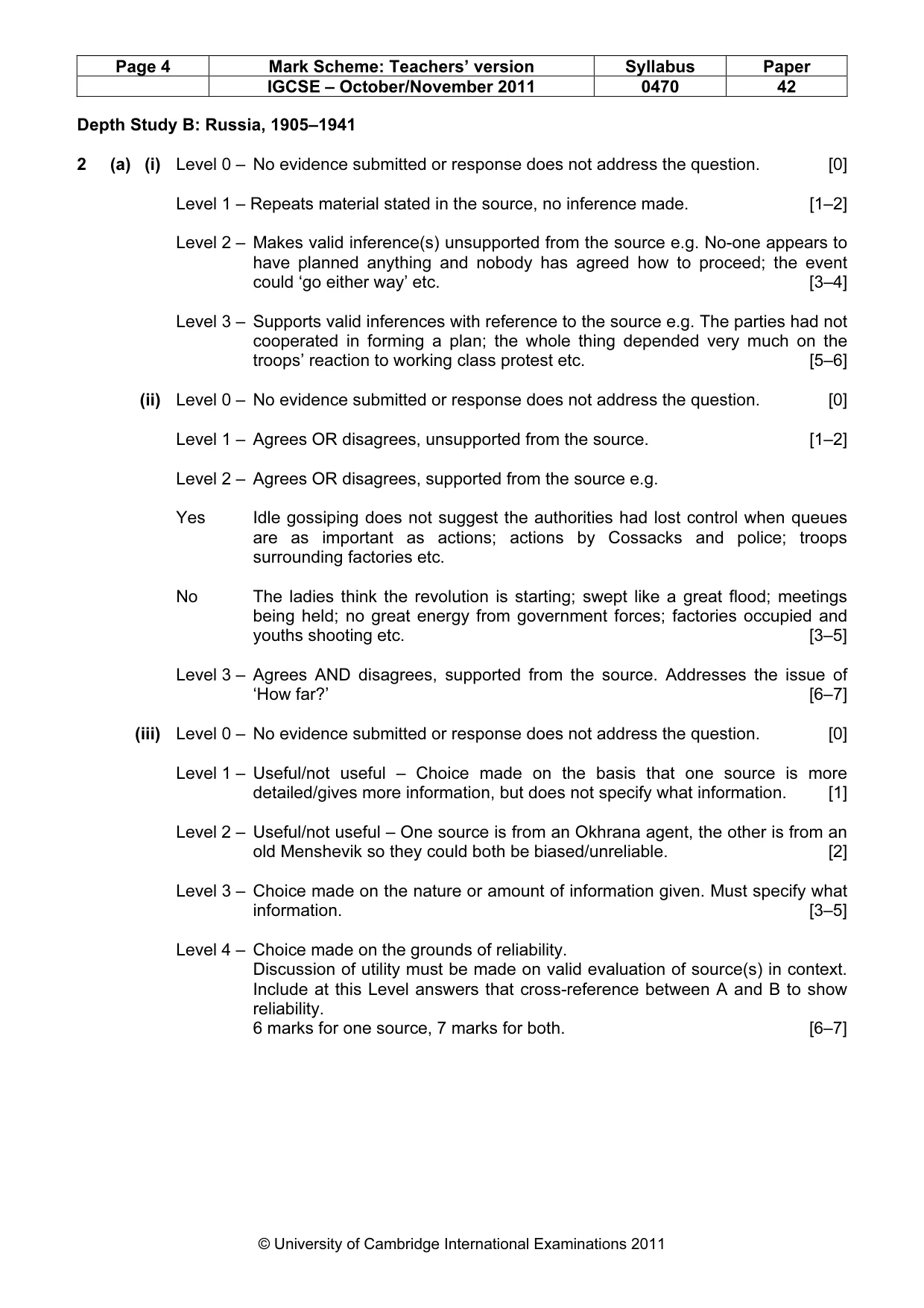
Page 4 Mark Scheme: Teachers’ version Syllabus Paper IGCSE – October/November 2011 0470 42 © University of Cambridge International Examinations 2011 Depth Study B: Russia, 1905–1941 2 (a) (i) Level 0 – No evidence submitted or response does not address the question. [0] Level 1 – Repeats material stated in the source, no inference made. [1–2] Level 2 – Makes valid inference(s) unsupported from the source e.g. No-one appears to have planned anything and nobody has agreed how to proceed; the event could ‘go either way’ etc. [3–4] Level 3 – Supports valid inferences with reference to the source e.g. The parties had not cooperated in forming a plan; the whole thing depended very much on the troops’ reaction to working class protest etc. [5–6] (ii) Level 0 – No evidence submitted or response does not address the question. [0] Level 1 – Agrees OR disagrees, unsupported from the source. [1–2] Level 2 – Agrees OR disagrees, supported from the source e.g. Yes Idle gossiping does not suggest the authorities had lost control when queues are as important as actions; actions by Cossacks and police; troops surrounding factories etc. No The ladies think the revolution is starting; swept like a great flood; meetings being held; no great energy from government forces; factories occupied and youths shooting etc. [3–5] Level 3 – Agrees AND disagrees, supported from the source. Addresses the issue of ‘How far?’ [6–7] (iii) Level 0 – No evidence submitted or response does not address the question. [0] Level 1 – Useful/not useful – Choice made on the basis that one source is more detailed/gives more information, but does not specify what information. [1] Level 2 – Useful/not useful – One source is from an Okhrana agent, the other is from an old Menshevik so they could both be biased/unreliable. [2] Level 3 – Choice made on the nature or amount of information given. Must specify what information. [3–5] Level 4 – Choice made on the grounds of reliability. Discussion of utility must be made on valid evaluation of source(s) in context. Include at this Level answers that cross-reference between A and B to show reliability. 6 marks for one source, 7 marks for both. [6–7]
Mark scheme, page 5
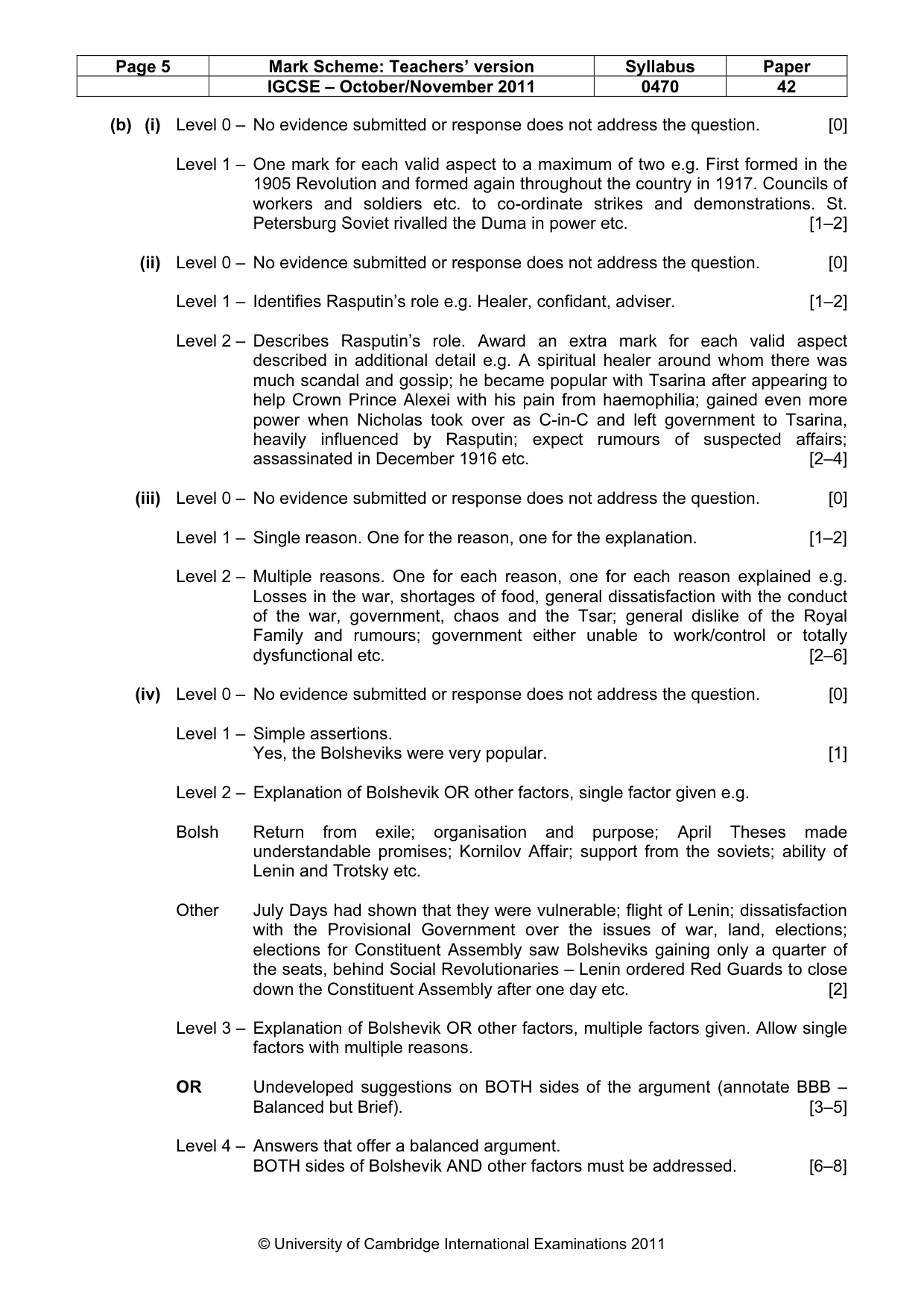
Page 5 Mark Scheme: Teachers’ version Syllabus Paper IGCSE – October/November 2011 0470 42 © University of Cambridge International Examinations 2011 (b) (i) Level 0 – No evidence submitted or response does not address the question. [0] Level 1 – One mark for each valid aspect to a maximum of two e.g. First formed in the 1905 Revolution and formed again throughout the country in 1917. Councils of workers and soldiers etc. to co-ordinate strikes and demonstrations. St. Petersburg Soviet rivalled the Duma in power etc. [1–2] (ii) Level 0 – No evidence submitted or response does not address the question. [0] Level 1 – Identifies Rasputin’s role e.g. Healer, confidant, adviser. [1–2] Level 2 – Describes Rasputin’s role. Award an extra mark for each valid aspect described in additional detail e.g. A spiritual healer around whom there was much scandal and gossip; he became popular with Tsarina after appearing to help Crown Prince Alexei with his pain from haemophilia; gained even more power when Nicholas took over as C-in-C and left government to Tsarina, heavily influenced by Rasputin; expect rumours of suspected affairs; assassinated in December 1916 etc. [2–4] (iii) Level 0 – No evidence submitted or response does not address the question. [0] Level 1 – Single reason. One for the reason, one for the explanation. [1–2] Level 2 – Multiple reasons. One for each reason, one for each reason explained e.g. Losses in the war, shortages of food, general dissatisfaction with the conduct of the war, government, chaos and the Tsar; general dislike of the Royal Family and rumours; government either unable to work/control or totally dysfunctional etc. [2–6] (iv) Level 0 – No evidence submitted or response does not address the question. [0] Level 1 – Simple assertions. Yes, the Bolsheviks were very popular. [1] Level 2 – Explanation of Bolshevik OR other factors, single factor given e.g. Bolsh Return from exile; organisation and purpose; April Theses made understandable promises; Kornilov Affair; support from the soviets; ability of Lenin and Trotsky etc. Other July Days had shown that they were vulnerable; flight of Lenin; dissatisfaction with the Provisional Government over the issues of war, land, elections; elections for Constituent Assembly saw Bolsheviks gaining only a quarter of the seats, behind Social Revolutionaries – Lenin ordered Red Guards to close down the Constituent Assembly after one day etc. [2] Level 3 – Explanation of Bolshevik OR other factors, multiple factors given. Allow single factors with multiple reasons. OR Undeveloped suggestions on BOTH sides of the argument (annotate BBB – Balanced but Brief). [3–5] Level 4 – Answers that offer a balanced argument. BOTH sides of Bolshevik AND other factors must be addressed. [6–8]
Mark scheme, page 6
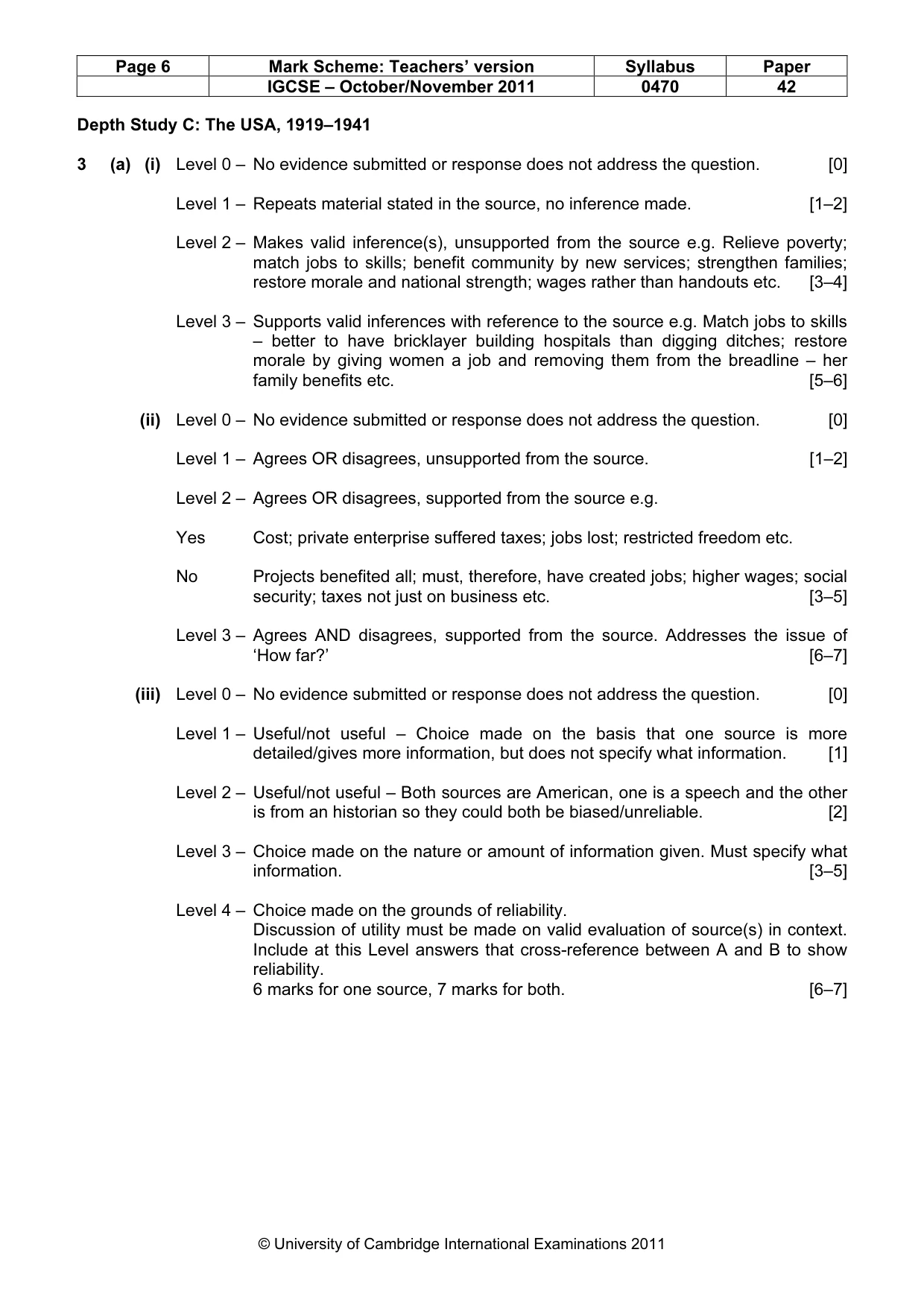
Page 6 Mark Scheme: Teachers’ version Syllabus Paper IGCSE – October/November 2011 0470 42 © University of Cambridge International Examinations 2011 Depth Study C: The USA, 1919–1941 3 (a) (i) Level 0 – No evidence submitted or response does not address the question. [0] Level 1 – Repeats material stated in the source, no inference made. [1–2] Level 2 – Makes valid inference(s), unsupported from the source e.g. Relieve poverty; match jobs to skills; benefit community by new services; strengthen families; restore morale and national strength; wages rather than handouts etc. [3–4] Level 3 – Supports valid inferences with reference to the source e.g. Match jobs to skills – better to have bricklayer building hospitals than digging ditches; restore morale by giving women a job and removing them from the breadline – her family benefits etc. [5–6] (ii) Level 0 – No evidence submitted or response does not address the question. [0] Level 1 – Agrees OR disagrees, unsupported from the source. [1–2] Level 2 – Agrees OR disagrees, supported from the source e.g. Yes Cost; private enterprise suffered taxes; jobs lost; restricted freedom etc. No Projects benefited all; must, therefore, have created jobs; higher wages; social security; taxes not just on business etc. [3–5] Level 3 – Agrees AND disagrees, supported from the source. Addresses the issue of ‘How far?’ [6–7] (iii) Level 0 – No evidence submitted or response does not address the question. [0] Level 1 – Useful/not useful – Choice made on the basis that one source is more detailed/gives more information, but does not specify what information. [1] Level 2 – Useful/not useful – Both sources are American, one is a speech and the other is from an historian so they could both be biased/unreliable. [2] Level 3 – Choice made on the nature or amount of information given. Must specify what information. [3–5] Level 4 – Choice made on the grounds of reliability. Discussion of utility must be made on valid evaluation of source(s) in context. Include at this Level answers that cross-reference between A and B to show reliability. 6 marks for one source, 7 marks for both. [6–7]
Mark scheme, page 7
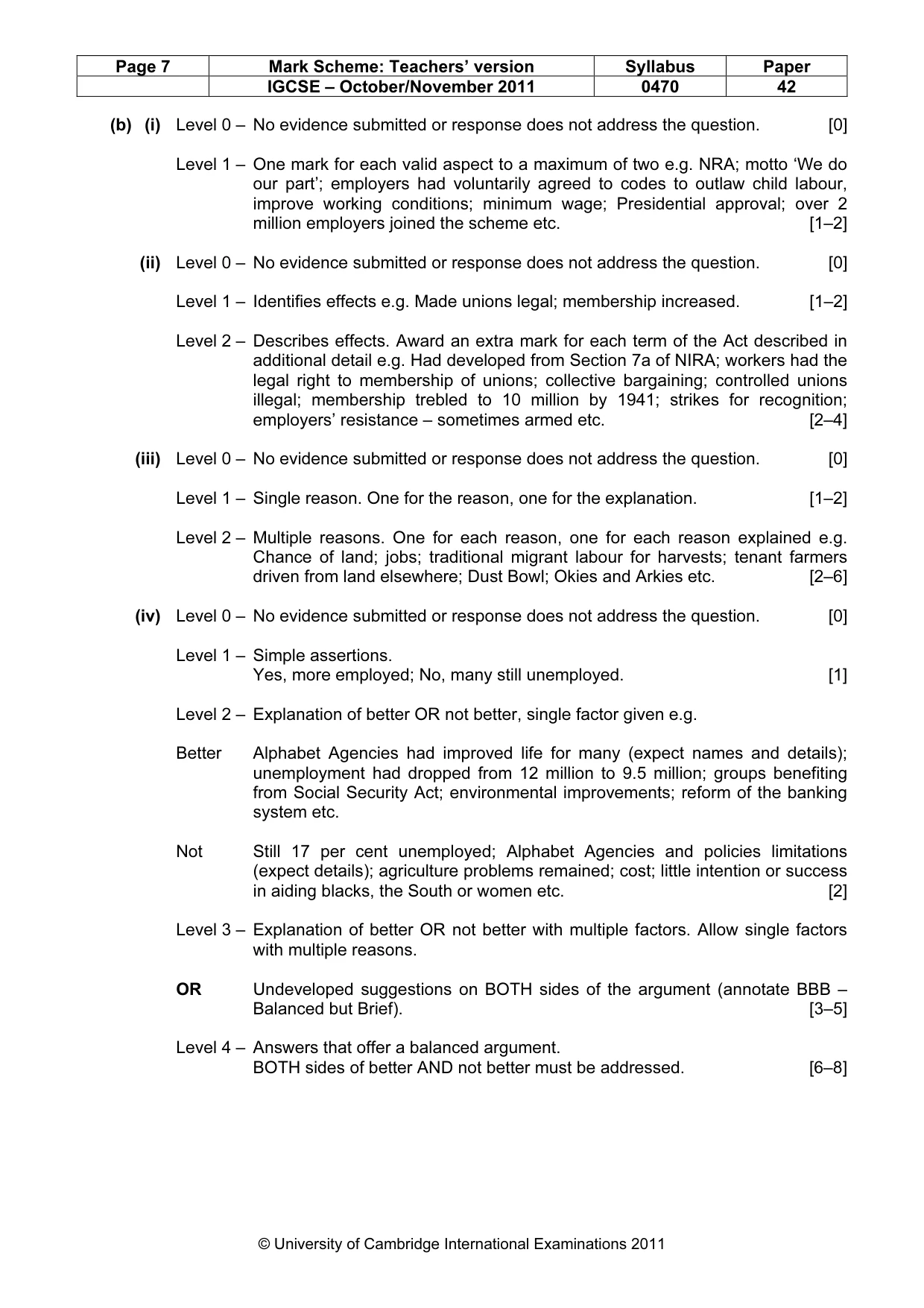
Page 7 Mark Scheme: Teachers’ version Syllabus Paper IGCSE – October/November 2011 0470 42 © University of Cambridge International Examinations 2011 (b) (i) Level 0 – No evidence submitted or response does not address the question. [0] Level 1 – One mark for each valid aspect to a maximum of two e.g. NRA; motto ‘We do our part’; employers had voluntarily agreed to codes to outlaw child labour, improve working conditions; minimum wage; Presidential approval; over 2 million employers joined the scheme etc. [1–2] (ii) Level 0 – No evidence submitted or response does not address the question. [0] Level 1 – Identifies effects e.g. Made unions legal; membership increased. [1–2] Level 2 – Describes effects. Award an extra mark for each term of the Act described in additional detail e.g. Had developed from Section 7a of NIRA; workers had the legal right to membership of unions; collective bargaining; controlled unions illegal; membership trebled to 10 million by 1941; strikes for recognition; employers’ resistance – sometimes armed etc. [2–4] (iii) Level 0 – No evidence submitted or response does not address the question. [0] Level 1 – Single reason. One for the reason, one for the explanation. [1–2] Level 2 – Multiple reasons. One for each reason, one for each reason explained e.g. Chance of land; jobs; traditional migrant labour for harvests; tenant farmers driven from land elsewhere; Dust Bowl; Okies and Arkies etc. [2–6] (iv) Level 0 – No evidence submitted or response does not address the question. [0] Level 1 – Simple assertions. Yes, more employed; No, many still unemployed. [1] Level 2 – Explanation of better OR not better, single factor given e.g. Better Alphabet Agencies had improved life for many (expect names and details); unemployment had dropped from 12 million to 9.5 million; groups benefiting from Social Security Act; environmental improvements; reform of the banking system etc. Not Still 17 per cent unemployed; Alphabet Agencies and policies limitations (expect details); agriculture problems remained; cost; little intention or success in aiding blacks, the South or women etc. [2] Level 3 – Explanation of better OR not better with multiple factors. Allow single factors with multiple reasons. OR Undeveloped suggestions on BOTH sides of the argument (annotate BBB – Balanced but Brief). [3–5] Level 4 – Answers that offer a balanced argument. BOTH sides of better AND not better must be addressed. [6–8]
Mark scheme, page 8
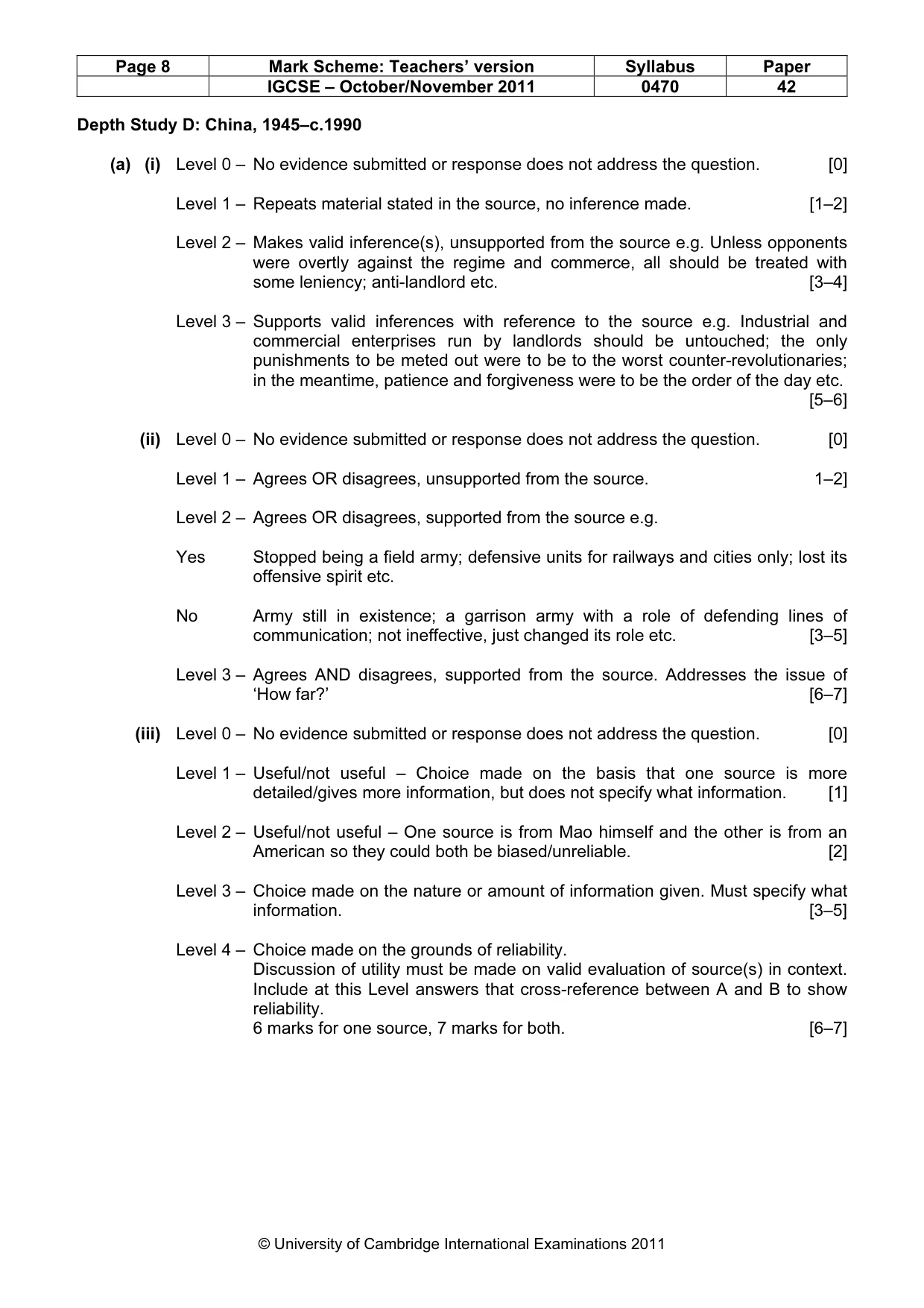
Page 8 Mark Scheme: Teachers’ version Syllabus Paper IGCSE – October/November 2011 0470 42 © University of Cambridge International Examinations 2011 Depth Study D: China, 1945–c.1990 (a) (i) Level 0 – No evidence submitted or response does not address the question. [0] Level 1 – Repeats material stated in the source, no inference made. [1–2] Level 2 – Makes valid inference(s), unsupported from the source e.g. Unless opponents were overtly against the regime and commerce, all should be treated with some leniency; anti-landlord etc. [3–4] Level 3 – Supports valid inferences with reference to the source e.g. Industrial and commercial enterprises run by landlords should be untouched; the only punishments to be meted out were to be to the worst counter-revolutionaries; in the meantime, patience and forgiveness were to be the order of the day etc. [5–6] (ii) Level 0 – No evidence submitted or response does not address the question. [0] Level 1 – Agrees OR disagrees, unsupported from the source. 1–2] Level 2 – Agrees OR disagrees, supported from the source e.g. Yes Stopped being a field army; defensive units for railways and cities only; lost its offensive spirit etc. No Army still in existence; a garrison army with a role of defending lines of communication; not ineffective, just changed its role etc. [3–5] Level 3 – Agrees AND disagrees, supported from the source. Addresses the issue of ‘How far?’ [6–7] (iii) Level 0 – No evidence submitted or response does not address the question. [0] Level 1 – Useful/not useful – Choice made on the basis that one source is more detailed/gives more information, but does not specify what information. [1] Level 2 – Useful/not useful – One source is from Mao himself and the other is from an American so they could both be biased/unreliable. [2] Level 3 – Choice made on the nature or amount of information given. Must specify what information. [3–5] Level 4 – Choice made on the grounds of reliability. Discussion of utility must be made on valid evaluation of source(s) in context. Include at this Level answers that cross-reference between A and B to show reliability. 6 marks for one source, 7 marks for both. [6–7]
Mark scheme, page 9
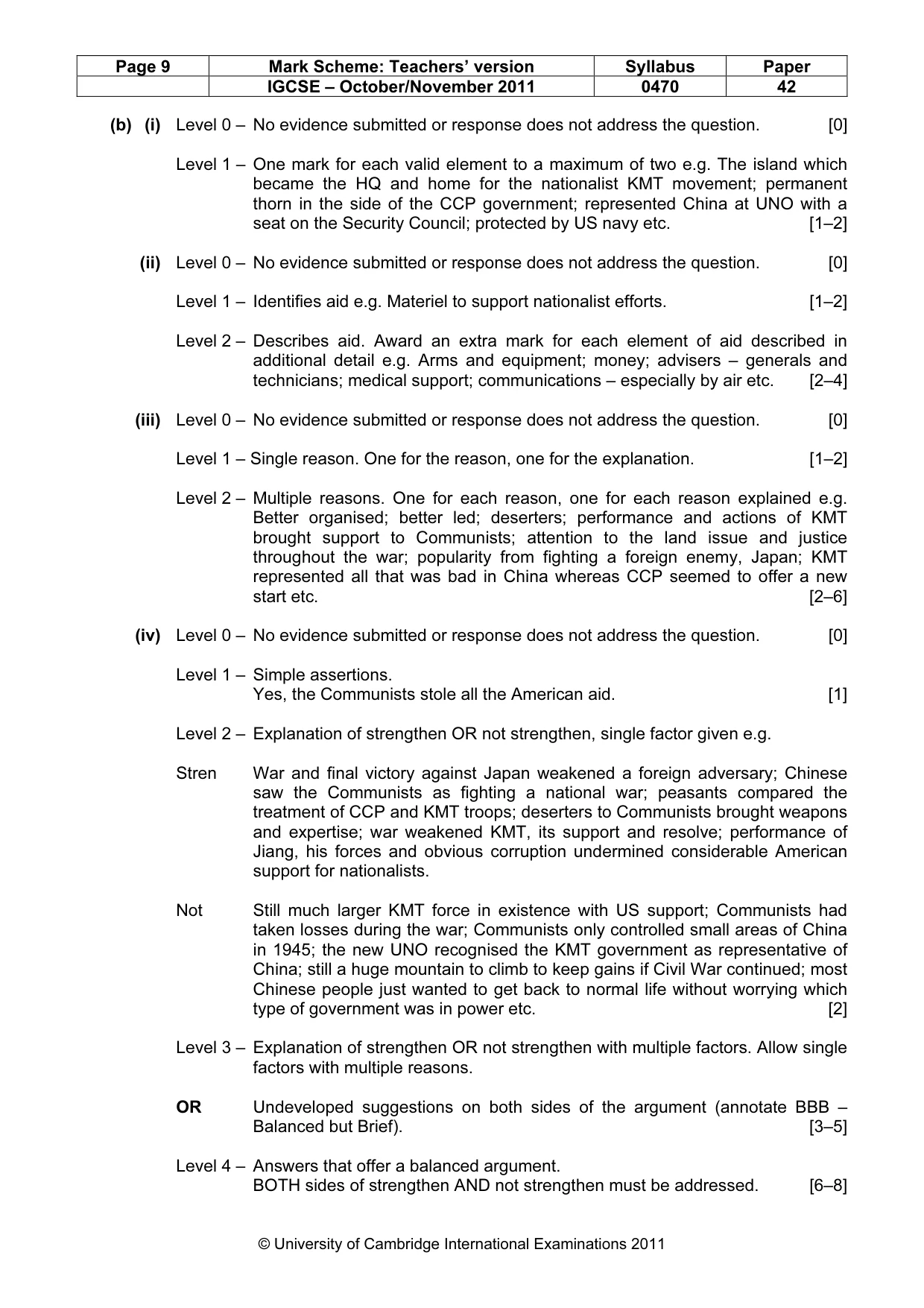
Page 9 Mark Scheme: Teachers’ version Syllabus Paper IGCSE – October/November 2011 0470 42 © University of Cambridge International Examinations 2011 (b) (i) Level 0 – No evidence submitted or response does not address the question. [0] Level 1 – One mark for each valid element to a maximum of two e.g. The island which became the HQ and home for the nationalist KMT movement; permanent thorn in the side of the CCP government; represented China at UNO with a seat on the Security Council; protected by US navy etc. [1–2] (ii) Level 0 – No evidence submitted or response does not address the question. [0] Level 1 – Identifies aid e.g. Materiel to support nationalist efforts. [1–2] Level 2 – Describes aid. Award an extra mark for each element of aid described in additional detail e.g. Arms and equipment; money; advisers – generals and technicians; medical support; communications – especially by air etc. [2–4] (iii) Level 0 – No evidence submitted or response does not address the question. [0] Level 1 – Single reason. One for the reason, one for the explanation. [1–2] Level 2 – Multiple reasons. One for each reason, one for each reason explained e.g. Better organised; better led; deserters; performance and actions of KMT brought support to Communists; attention to the land issue and justice throughout the war; popularity from fighting a foreign enemy, Japan; KMT represented all that was bad in China whereas CCP seemed to offer a new start etc. [2–6] (iv) Level 0 – No evidence submitted or response does not address the question. [0] Level 1 – Simple assertions. Yes, the Communists stole all the American aid. [1] Level 2 – Explanation of strengthen OR not strengthen, single factor given e.g. Stren War and final victory against Japan weakened a foreign adversary; Chinese saw the Communists as fighting a national war; peasants compared the treatment of CCP and KMT troops; deserters to Communists brought weapons and expertise; war weakened KMT, its support and resolve; performance of Jiang, his forces and obvious corruption undermined considerable American support for nationalists. Not Still much larger KMT force in existence with US support; Communists had taken losses during the war; Communists only controlled small areas of China in 1945; the new UNO recognised the KMT government as representative of China; still a huge mountain to climb to keep gains if Civil War continued; most Chinese people just wanted to get back to normal life without worrying which type of government was in power etc. [2] Level 3 – Explanation of strengthen OR not strengthen with multiple factors. Allow single factors with multiple reasons. OR Undeveloped suggestions on both sides of the argument (annotate BBB – Balanced but Brief). [3–5] Level 4 – Answers that offer a balanced argument. BOTH sides of strengthen AND not strengthen must be addressed. [6–8]
Mark scheme, page 10
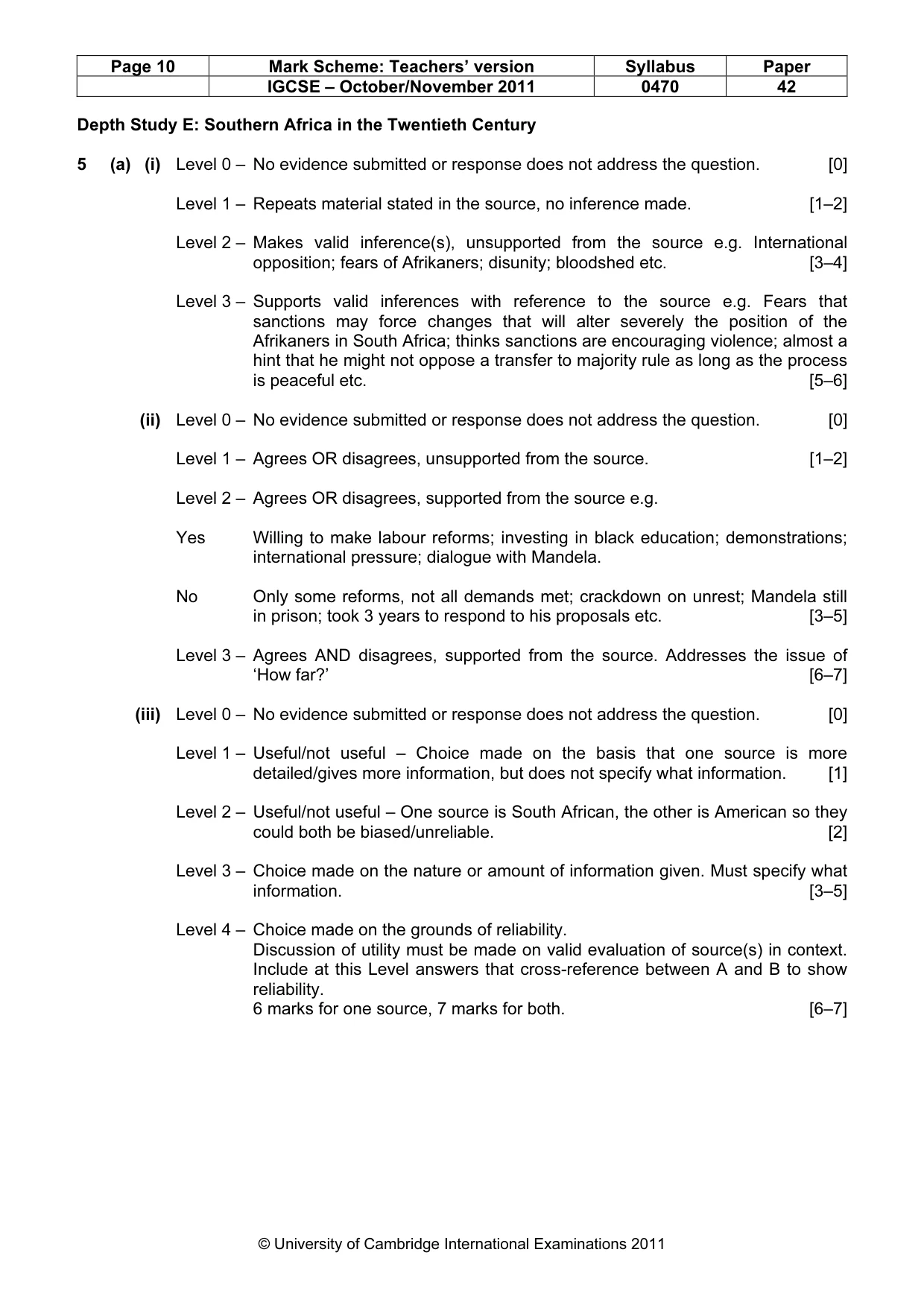
Page 10 Mark Scheme: Teachers’ version Syllabus Paper IGCSE – October/November 2011 0470 42 © University of Cambridge International Examinations 2011 Depth Study E: Southern Africa in the Twentieth Century 5 (a) (i) Level 0 – No evidence submitted or response does not address the question. [0] Level 1 – Repeats material stated in the source, no inference made. [1–2] Level 2 – Makes valid inference(s), unsupported from the source e.g. International opposition; fears of Afrikaners; disunity; bloodshed etc. [3–4] Level 3 – Supports valid inferences with reference to the source e.g. Fears that sanctions may force changes that will alter severely the position of the Afrikaners in South Africa; thinks sanctions are encouraging violence; almost a hint that he might not oppose a transfer to majority rule as long as the process is peaceful etc. [5–6] (ii) Level 0 – No evidence submitted or response does not address the question. [0] Level 1 – Agrees OR disagrees, unsupported from the source. [1–2] Level 2 – Agrees OR disagrees, supported from the source e.g. Yes Willing to make labour reforms; investing in black education; demonstrations; international pressure; dialogue with Mandela. No Only some reforms, not all demands met; crackdown on unrest; Mandela still in prison; took 3 years to respond to his proposals etc. [3–5] Level 3 – Agrees AND disagrees, supported from the source. Addresses the issue of ‘How far?’ [6–7] (iii) Level 0 – No evidence submitted or response does not address the question. [0] Level 1 – Useful/not useful – Choice made on the basis that one source is more detailed/gives more information, but does not specify what information. [1] Level 2 – Useful/not useful – One source is South African, the other is American so they could both be biased/unreliable. [2] Level 3 – Choice made on the nature or amount of information given. Must specify what information. [3–5] Level 4 – Choice made on the grounds of reliability. Discussion of utility must be made on valid evaluation of source(s) in context. Include at this Level answers that cross-reference between A and B to show reliability. 6 marks for one source, 7 marks for both. [6–7]
Mark scheme, page 11
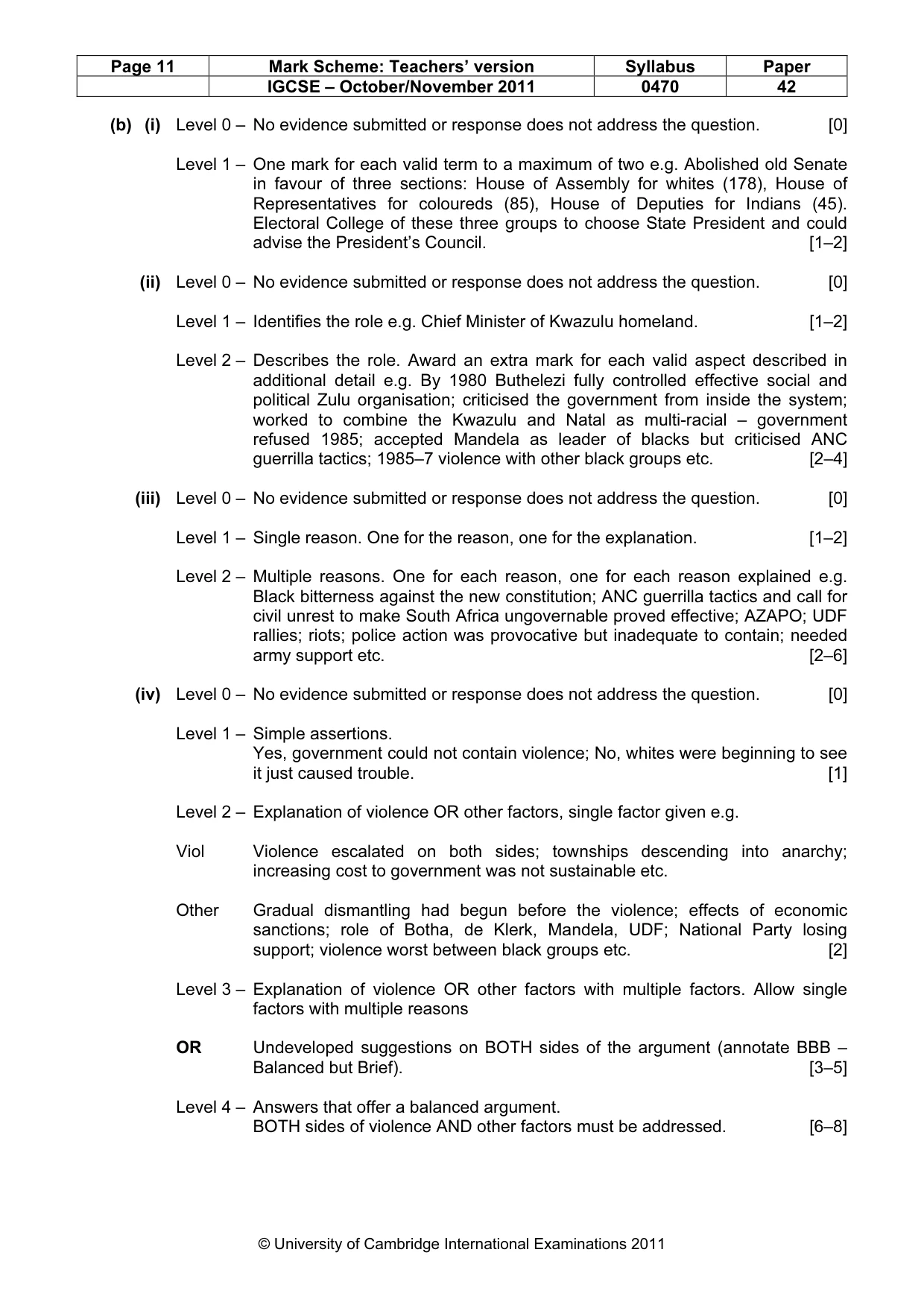
Page 11 Mark Scheme: Teachers’ version Syllabus Paper IGCSE – October/November 2011 0470 42 © University of Cambridge International Examinations 2011 (b) (i) Level 0 – No evidence submitted or response does not address the question. [0] Level 1 – One mark for each valid term to a maximum of two e.g. Abolished old Senate in favour of three sections: House of Assembly for whites (178), House of Representatives for coloureds (85), House of Deputies for Indians (45). Electoral College of these three groups to choose State President and could advise the President’s Council. [1–2] (ii) Level 0 – No evidence submitted or response does not address the question. [0] Level 1 – Identifies the role e.g. Chief Minister of Kwazulu homeland. [1–2] Level 2 – Describes the role. Award an extra mark for each valid aspect described in additional detail e.g. By 1980 Buthelezi fully controlled effective social and political Zulu organisation; criticised the government from inside the system; worked to combine the Kwazulu and Natal as multi-racial – government refused 1985; accepted Mandela as leader of blacks but criticised ANC guerrilla tactics; 1985–7 violence with other black groups etc. [2–4] (iii) Level 0 – No evidence submitted or response does not address the question. [0] Level 1 – Single reason. One for the reason, one for the explanation. [1–2] Level 2 – Multiple reasons. One for each reason, one for each reason explained e.g. Black bitterness against the new constitution; ANC guerrilla tactics and call for civil unrest to make South Africa ungovernable proved effective; AZAPO; UDF rallies; riots; police action was provocative but inadequate to contain; needed army support etc. [2–6] (iv) Level 0 – No evidence submitted or response does not address the question. [0] Level 1 – Simple assertions. Yes, government could not contain violence; No, whites were beginning to see it just caused trouble. [1] Level 2 – Explanation of violence OR other factors, single factor given e.g. Viol Violence escalated on both sides; townships descending into anarchy; increasing cost to government was not sustainable etc. Other Gradual dismantling had begun before the violence; effects of economic sanctions; role of Botha, de Klerk, Mandela, UDF; National Party losing support; violence worst between black groups etc. [2] Level 3 – Explanation of violence OR other factors with multiple factors. Allow single factors with multiple reasons OR Undeveloped suggestions on BOTH sides of the argument (annotate BBB – Balanced but Brief). [3–5] Level 4 – Answers that offer a balanced argument. BOTH sides of violence AND other factors must be addressed. [6–8]
Mark scheme, page 12
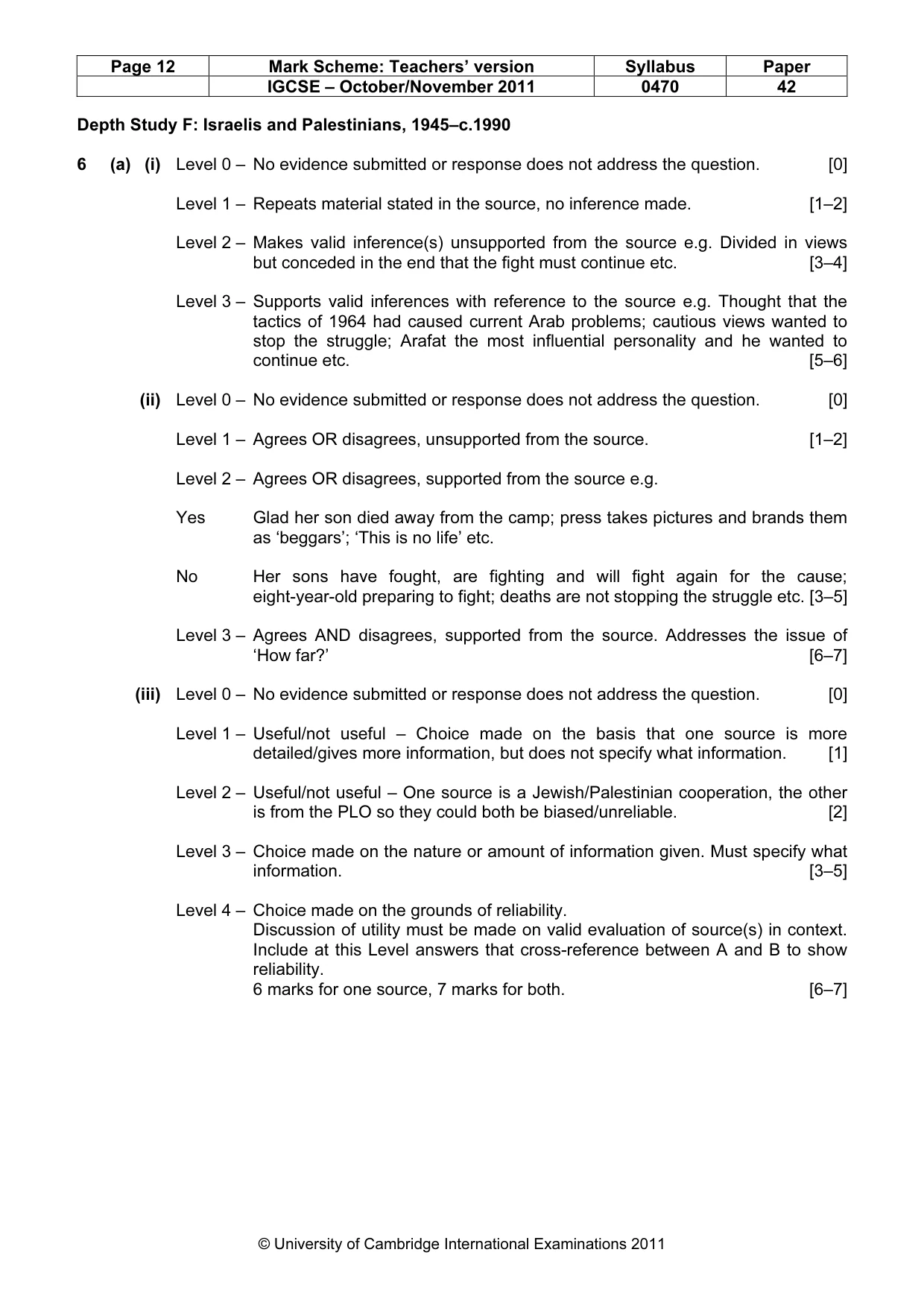
Page 12 Mark Scheme: Teachers’ version Syllabus Paper IGCSE – October/November 2011 0470 42 © University of Cambridge International Examinations 2011 Depth Study F: Israelis and Palestinians, 1945–c.1990 6 (a) (i) Level 0 – No evidence submitted or response does not address the question. [0] Level 1 – Repeats material stated in the source, no inference made. [1–2] Level 2 – Makes valid inference(s) unsupported from the source e.g. Divided in views but conceded in the end that the fight must continue etc. [3–4] Level 3 – Supports valid inferences with reference to the source e.g. Thought that the tactics of 1964 had caused current Arab problems; cautious views wanted to stop the struggle; Arafat the most influential personality and he wanted to continue etc. [5–6] (ii) Level 0 – No evidence submitted or response does not address the question. [0] Level 1 – Agrees OR disagrees, unsupported from the source. [1–2] Level 2 – Agrees OR disagrees, supported from the source e.g. Yes Glad her son died away from the camp; press takes pictures and brands them as ‘beggars’; ‘This is no life’ etc. No Her sons have fought, are fighting and will fight again for the cause; eight-year-old preparing to fight; deaths are not stopping the struggle etc. [3–5] Level 3 – Agrees AND disagrees, supported from the source. Addresses the issue of ‘How far?’ [6–7] (iii) Level 0 – No evidence submitted or response does not address the question. [0] Level 1 – Useful/not useful – Choice made on the basis that one source is more detailed/gives more information, but does not specify what information. [1] Level 2 – Useful/not useful – One source is a Jewish/Palestinian cooperation, the other is from the PLO so they could both be biased/unreliable. [2] Level 3 – Choice made on the nature or amount of information given. Must specify what information. [3–5] Level 4 – Choice made on the grounds of reliability. Discussion of utility must be made on valid evaluation of source(s) in context. Include at this Level answers that cross-reference between A and B to show reliability. 6 marks for one source, 7 marks for both. [6–7]
Mark scheme, page 13
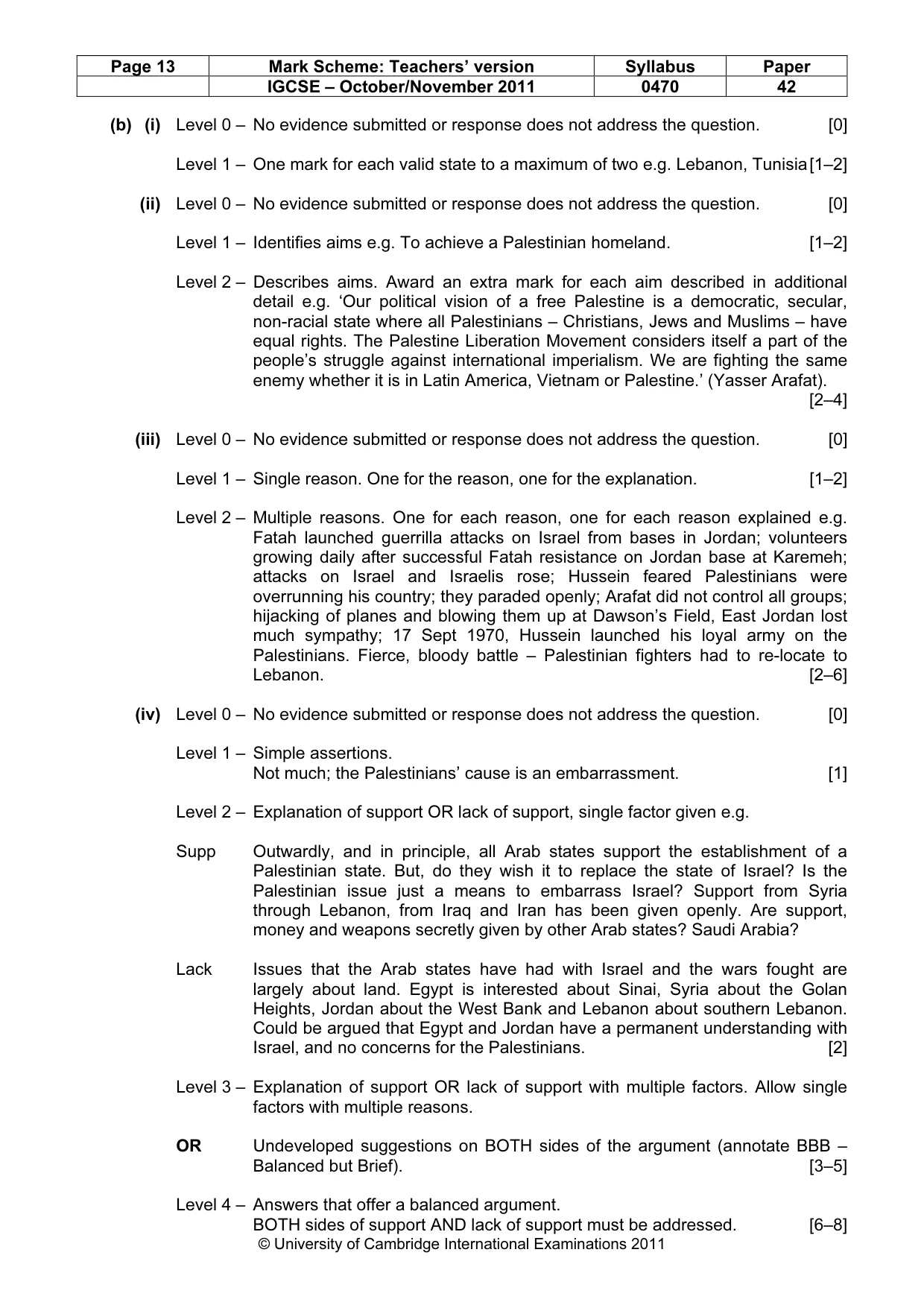
Page 13 Mark Scheme: Teachers’ version Syllabus Paper IGCSE – October/November 2011 0470 42 © University of Cambridge International Examinations 2011 (b) (i) Level 0 – No evidence submitted or response does not address the question. [0] Level 1 – One mark for each valid state to a maximum of two e.g. Lebanon, Tunisia [1–2] (ii) Level 0 – No evidence submitted or response does not address the question. [0] Level 1 – Identifies aims e.g. To achieve a Palestinian homeland. [1–2] Level 2 – Describes aims. Award an extra mark for each aim described in additional detail e.g. ‘Our political vision of a free Palestine is a democratic, secular, non-racial state where all Palestinians – Christians, Jews and Muslims – have equal rights. The Palestine Liberation Movement considers itself a part of the people’s struggle against international imperialism. We are fighting the same enemy whether it is in Latin America, Vietnam or Palestine.’ (Yasser Arafat). [2–4] (iii) Level 0 – No evidence submitted or response does not address the question. [0] Level 1 – Single reason. One for the reason, one for the explanation. [1–2] Level 2 – Multiple reasons. One for each reason, one for each reason explained e.g. Fatah launched guerrilla attacks on Israel from bases in Jordan; volunteers growing daily after successful Fatah resistance on Jordan base at Karemeh; attacks on Israel and Israelis rose; Hussein feared Palestinians were overrunning his country; they paraded openly; Arafat did not control all groups; hijacking of planes and blowing them up at Dawson’s Field, East Jordan lost much sympathy; 17 Sept 1970, Hussein launched his loyal army on the Palestinians. Fierce, bloody battle – Palestinian fighters had to re-locate to Lebanon. [2–6] (iv) Level 0 – No evidence submitted or response does not address the question. [0] Level 1 – Simple assertions. Not much; the Palestinians’ cause is an embarrassment. [1] Level 2 – Explanation of support OR lack of support, single factor given e.g. Supp Outwardly, and in principle, all Arab states support the establishment of a Palestinian state. But, do they wish it to replace the state of Israel? Is the Palestinian issue just a means to embarrass Israel? Support from Syria through Lebanon, from Iraq and Iran has been given openly. Are support, money and weapons secretly given by other Arab states? Saudi Arabia? Lack Issues that the Arab states have had with Israel and the wars fought are largely about land. Egypt is interested about Sinai, Syria about the Golan Heights, Jordan about the West Bank and Lebanon about southern Lebanon. Could be argued that Egypt and Jordan have a permanent understanding with Israel, and no concerns for the Palestinians. [2] Level 3 – Explanation of support OR lack of support with multiple factors. Allow single factors with multiple reasons. OR Undeveloped suggestions on BOTH sides of the argument (annotate BBB – Balanced but Brief). [3–5] Level 4 – Answers that offer a balanced argument. BOTH sides of support AND lack of support must be addressed. [6–8]
Mark scheme, page 14
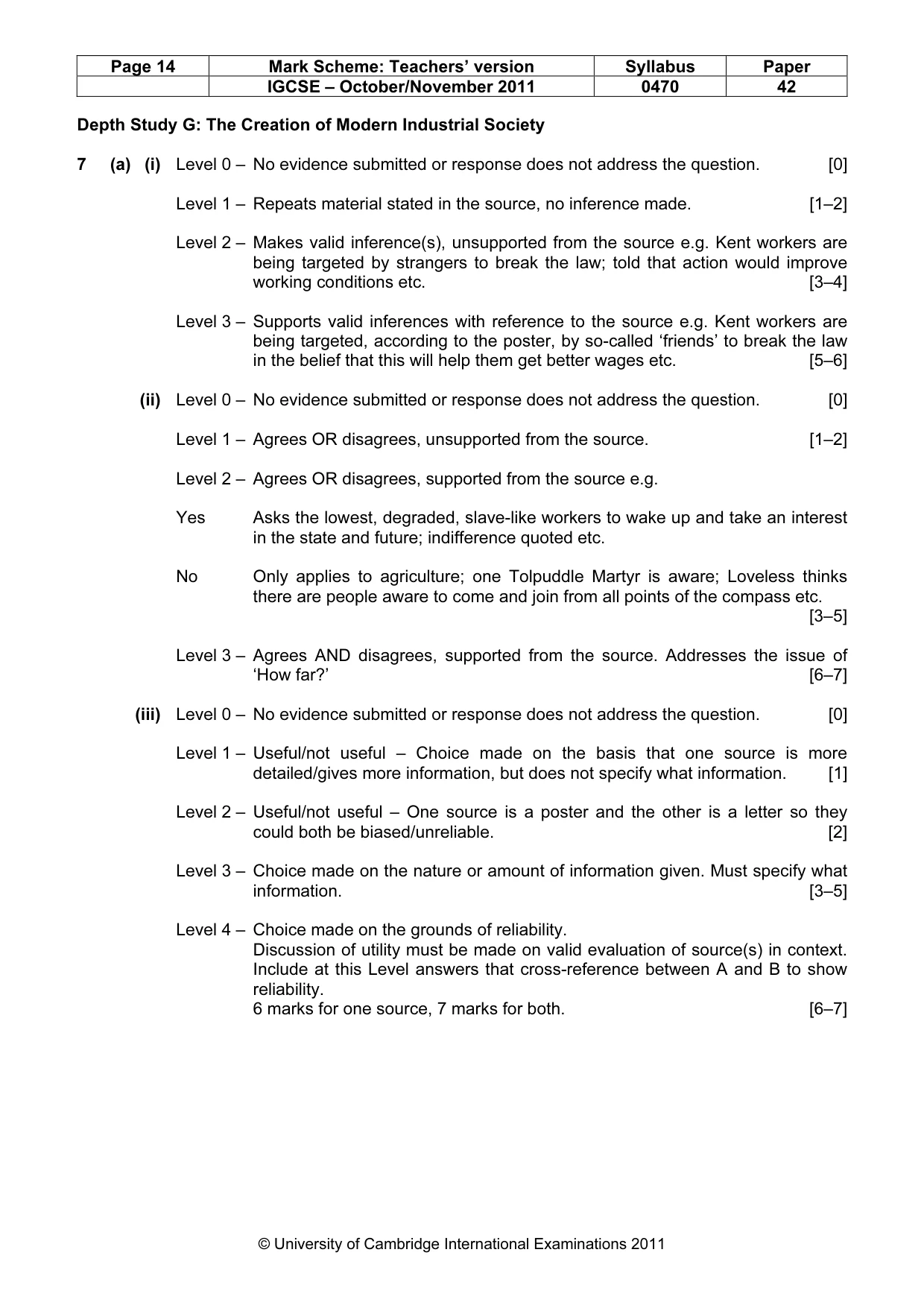
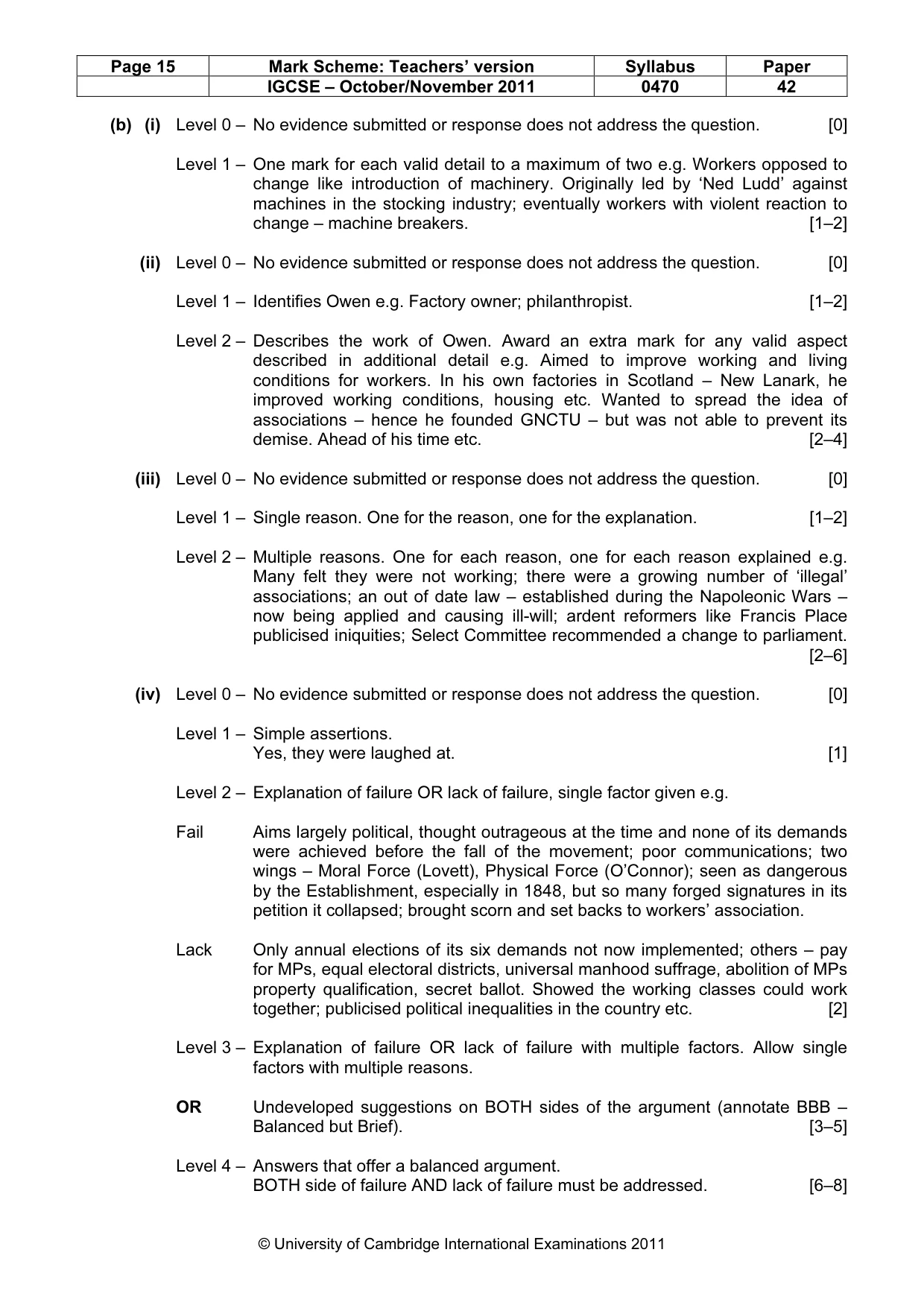
Page 14 Mark Scheme: Teachers’ version Syllabus Paper IGCSE – October/November 2011 0470 42 © University of Cambridge International Examinations 2011 Depth Study G: The Creation of Modern Industrial Society 7 (a) (i) Level 0 – No evidence submitted or response does not address the question. [0] Level 1 – Repeats material stated in the source, no inference made. [1–2] Level 2 – Makes valid inference(s), unsupported from the source e.g. Kent workers are being targeted by strangers to break the law; told that action would improve working conditions etc. [3–4] Level 3 – Supports valid inferences with reference to the source e.g. Kent workers are being targeted, according to the poster, by so-called ‘friends’ to break the law in the belief that this will help them get better wages etc. [5–6] (ii) Level 0 – No evidence submitted or response does not address the question. [0] Level 1 – Agrees OR disagrees, unsupported from the source. [1–2] Level 2 – Agrees OR disagrees, supported from the source e.g. Yes Asks the lowest, degraded, slave-like workers to wake up and take an interest in the state and future; indifference quoted etc. No Only applies to agriculture; one Tolpuddle Martyr is aware; Loveless thinks there are people aware to come and join from all points of the compass etc. [3–5] Level 3 – Agrees AND disagrees, supported from the source. Addresses the issue of ‘How far?’ [6–7] (iii) Level 0 – No evidence submitted or response does not address the question. [0] Level 1 – Useful/not useful – Choice made on the basis that one source is more detailed/gives more information, but does not specify what information. [1] Level 2 – Useful/not useful – One source is a poster and the other is a letter so they could both be biased/unreliable. [2] Level 3 – Choice made on the nature or amount of information given. Must specify what information. [3–5] Level 4 – Choice made on the grounds of reliability. Discussion of utility must be made on valid evaluation of source(s) in context. Include at this Level answers that cross-reference between A and B to show reliability. 6 marks for one source, 7 marks for both. [6–7]
Mark scheme, page 15
Page 15 Mark Scheme: Teachers’ version Syllabus Paper IGCSE – October/November 2011 0470 42 © University of Cambridge International Examinations 2011 (b) (i) Level 0 – No evidence submitted or response does not address the question. [0] Level 1 – One mark for each valid detail to a maximum of two e.g. Workers opposed to change like introduction of machinery. Originally led by ‘Ned Ludd’ against machines in the stocking industry; eventually workers with violent reaction to change – machine breakers. [1–2] (ii) Level 0 – No evidence submitted or response does not address the question. [0] Level 1 – Identifies Owen e.g. Factory owner; philanthropist. [1–2] Level 2 – Describes the work of Owen. Award an extra mark for any valid aspect described in additional detail e.g. Aimed to improve working and living conditions for workers. In his own factories in Scotland – New Lanark, he improved working conditions, housing etc. Wanted to spread the idea of associations – hence he founded GNCTU – but was not able to prevent its demise. Ahead of his time etc. [2–4] (iii) Level 0 – No evidence submitted or response does not address the question. [0] Level 1 – Single reason. One for the reason, one for the explanation. [1–2] Level 2 – Multiple reasons. One for each reason, one for each reason explained e.g. Many felt they were not working; there were a growing number of ‘illegal’ associations; an out of date law – established during the Napoleonic Wars – now being applied and causing ill-will; ardent reformers like Francis Place publicised iniquities; Select Committee recommended a change to parliament. [2–6] (iv) Level 0 – No evidence submitted or response does not address the question. [0] Level 1 – Simple assertions. Yes, they were laughed at. [1] Level 2 – Explanation of failure OR lack of failure, single factor given e.g. Fail Aims largely political, thought outrageous at the time and none of its demands were achieved before the fall of the movement; poor communications; two wings – Moral Force (Lovett), Physical Force (O’Connor); seen as dangerous by the Establishment, especially in 1848, but so many forged signatures in its petition it collapsed; brought scorn and set backs to workers’ association. Lack Only annual elections of its six demands not now implemented; others – pay for MPs, equal electoral districts, universal manhood suffrage, abolition of MPs property qualification, secret ballot. Showed the working classes could work together; publicised political inequalities in the country etc. [2] Level 3 – Explanation of failure OR lack of failure with multiple factors. Allow single factors with multiple reasons. OR Undeveloped suggestions on BOTH sides of the argument (annotate BBB – Balanced but Brief). [3–5] Level 4 – Answers that offer a balanced argument. BOTH side of failure AND lack of failure must be addressed. [6–8]
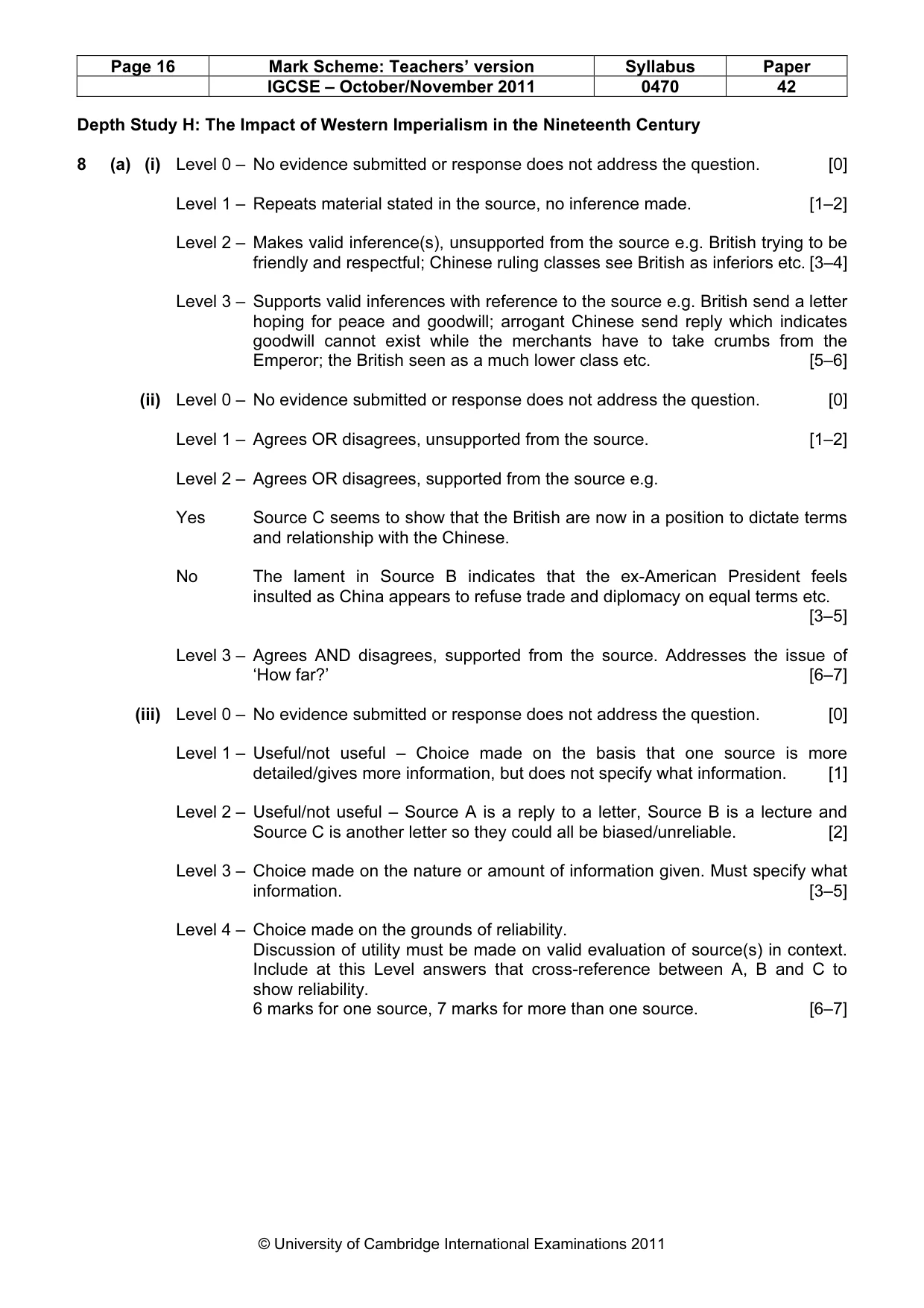
Mark scheme, page 16
Page 16 Mark Scheme: Teachers’ version Syllabus Paper IGCSE – October/November 2011 0470 42 © University of Cambridge International Examinations 2011 Depth Study H: The Impact of Western Imperialism in the Nineteenth Century 8 (a) (i) Level 0 – No evidence submitted or response does not address the question. [0] Level 1 – Repeats material stated in the source, no inference made. [1–2] Level 2 – Makes valid inference(s), unsupported from the source e.g. British trying to be friendly and respectful; Chinese ruling classes see British as inferiors etc. [3–4] Level 3 – Supports valid inferences with reference to the source e.g. British send a letter hoping for peace and goodwill; arrogant Chinese send reply which indicates goodwill cannot exist while the merchants have to take crumbs from the Emperor; the British seen as a much lower class etc. [5–6] (ii) Level 0 – No evidence submitted or response does not address the question. [0] Level 1 – Agrees OR disagrees, unsupported from the source. [1–2] Level 2 – Agrees OR disagrees, supported from the source e.g. Yes Source C seems to show that the British are now in a position to dictate terms and relationship with the Chinese. No The lament in Source B indicates that the ex-American President feels insulted as China appears to refuse trade and diplomacy on equal terms etc. [3–5] Level 3 – Agrees AND disagrees, supported from the source. Addresses the issue of ‘How far?’ [6–7] (iii) Level 0 – No evidence submitted or response does not address the question. [0] Level 1 – Useful/not useful – Choice made on the basis that one source is more detailed/gives more information, but does not specify what information. [1] Level 2 – Useful/not useful – Source A is a reply to a letter, Source B is a lecture and Source C is another letter so they could all be biased/unreliable. [2] Level 3 – Choice made on the nature or amount of information given. Must specify what information. [3–5] Level 4 – Choice made on the grounds of reliability. Discussion of utility must be made on valid evaluation of source(s) in context. Include at this Level answers that cross-reference between A, B and C to show reliability. 6 marks for one source, 7 marks for more than one source. [6–7]
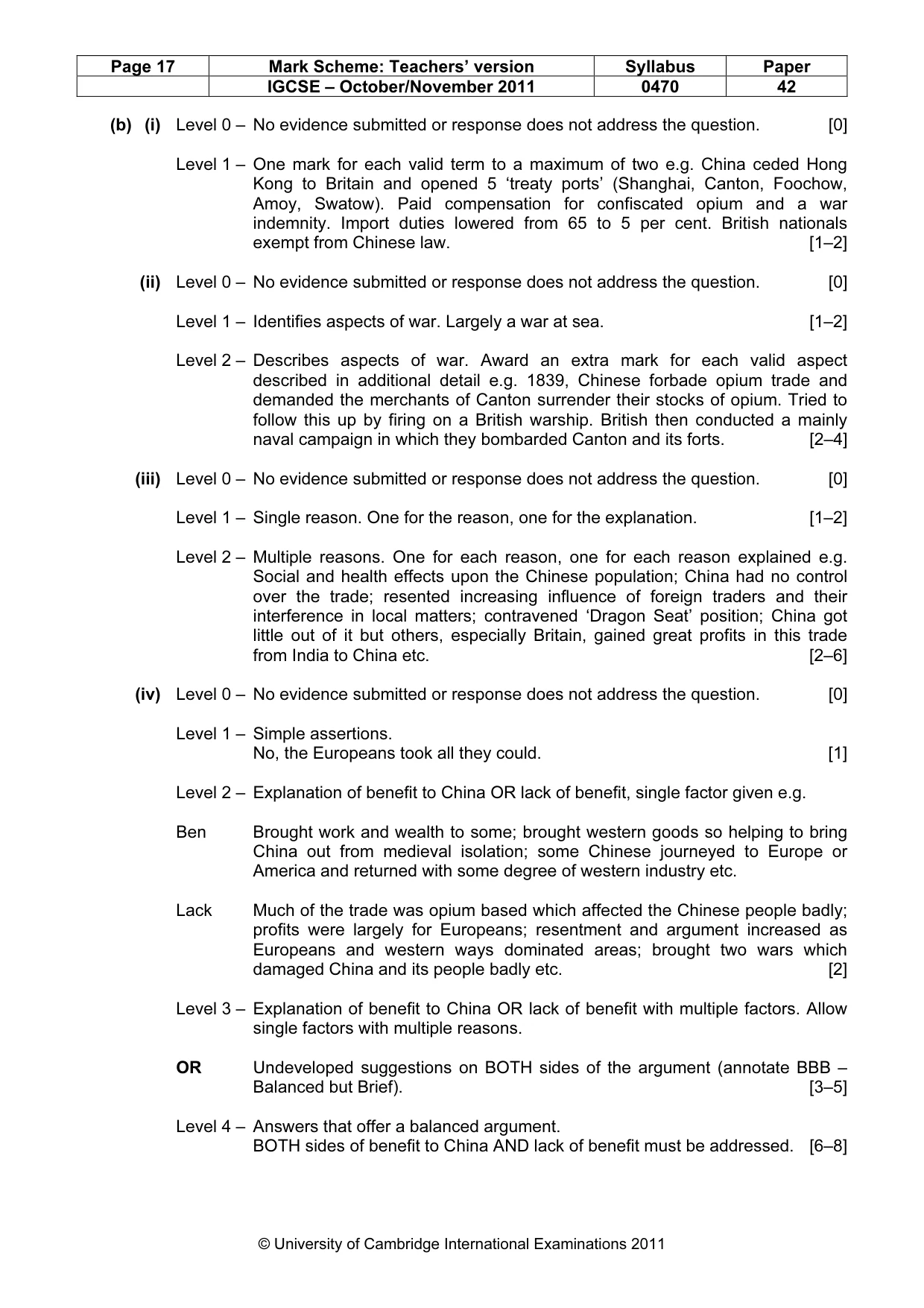
Mark scheme, page 17
Page 17 Mark Scheme: Teachers’ version Syllabus Paper IGCSE – October/November 2011 0470 42 © University of Cambridge International Examinations 2011 (b) (i) Level 0 – No evidence submitted or response does not address the question. [0] Level 1 – One mark for each valid term to a maximum of two e.g. China ceded Hong Kong to Britain and opened 5 ‘treaty ports’ (Shanghai, Canton, Foochow, Amoy, Swatow). Paid compensation for confiscated opium and a war indemnity. Import duties lowered from 65 to 5 per cent. British nationals exempt from Chinese law. [1–2] (ii) Level 0 – No evidence submitted or response does not address the question. [0] Level 1 – Identifies aspects of war. Largely a war at sea. [1–2] Level 2 – Describes aspects of war. Award an extra mark for each valid aspect described in additional detail e.g. 1839, Chinese forbade opium trade and demanded the merchants of Canton surrender their stocks of opium. Tried to follow this up by firing on a British warship. British then conducted a mainly naval campaign in which they bombarded Canton and its forts. [2–4] (iii) Level 0 – No evidence submitted or response does not address the question. [0] Level 1 – Single reason. One for the reason, one for the explanation. [1–2] Level 2 – Multiple reasons. One for each reason, one for each reason explained e.g. Social and health effects upon the Chinese population; China had no control over the trade; resented increasing influence of foreign traders and their interference in local matters; contravened ‘Dragon Seat’ position; China got little out of it but others, especially Britain, gained great profits in this trade from India to China etc. [2–6] (iv) Level 0 – No evidence submitted or response does not address the question. [0] Level 1 – Simple assertions. No, the Europeans took all they could. [1] Level 2 – Explanation of benefit to China OR lack of benefit, single factor given e.g. Ben Brought work and wealth to some; brought western goods so helping to bring China out from medieval isolation; some Chinese journeyed to Europe or America and returned with some degree of western industry etc. Lack Much of the trade was opium based which affected the Chinese people badly; profits were largely for Europeans; resentment and argument increased as Europeans and western ways dominated areas; brought two wars which damaged China and its people badly etc. [2] Level 3 – Explanation of benefit to China OR lack of benefit with multiple factors. Allow single factors with multiple reasons. OR Undeveloped suggestions on BOTH sides of the argument (annotate BBB – Balanced but Brief). [3–5] Level 4 – Answers that offer a balanced argument. BOTH sides of benefit to China AND lack of benefit must be addressed. [6–8]
What you needed in this session
Cambridge’s own grade thresholds for 2011 Oct/Nov, Paper 4 · Variant 2. A higher threshold means an easier paper — the bar moves with how the cohort did.