Cambridge IGCSE History 0470 — 2011 Oct/Nov Paper 4 · Variant 1
0470/41/O/N/11 · 40 marks · ≈45 min
The question paper and its mark scheme, free to read here and free to download. This is Cambridge’s own paper, exactly as it was sat.
Question paper12 pages


Mark scheme17 pages
Answers below. Sit the paper first if you are practising.
Paper as text
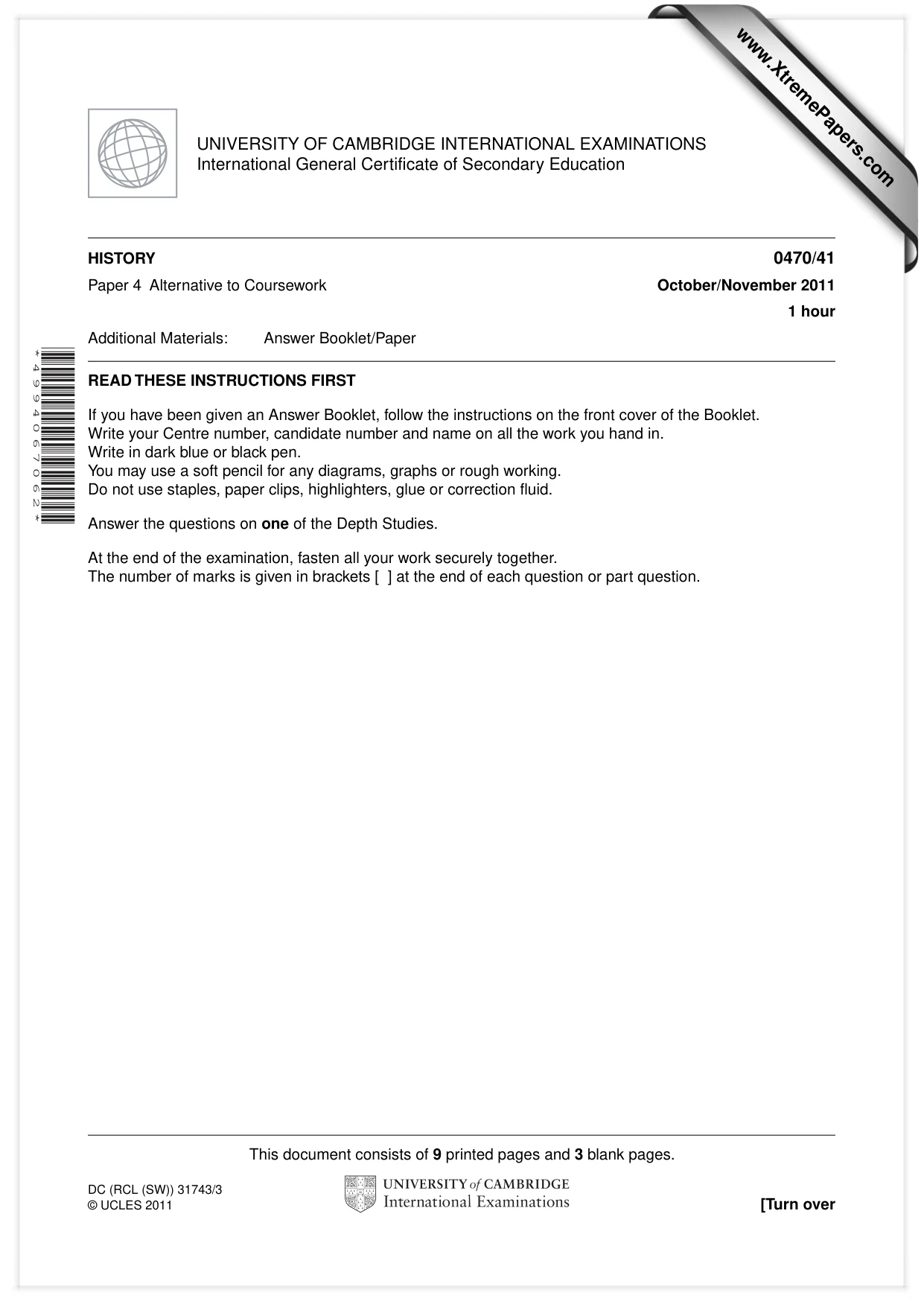
Question paper, page 1
This document consists of 9 printed pages and 3 blank pages. DC (RCL (SW)) 31743/3 © UCLES 2011 [Turn over UNIVERSITY OF CAMBRIDGE INTERNATIONAL EXAMINATIONS International General Certificate of Secondary Education * 4 9 9 4 0 6 7 0 6 2 * HISTORY 0470/41 Paper 4 Alternative to Coursework October/November 2011 1 hour Additional Materials: Answer Booklet/Paper READ THESE INSTRUCTIONS FIRST If you have been given an Answer Booklet, follow the instructions on the front cover of the Booklet. Write your Centre number, candidate number and name on all the work you hand in. Write in dark blue or black pen. You may use a soft pencil for any diagrams, graphs or rough working. Do not use staples, paper clips, highlighters, glue or correction fluid. Answer the questions on one of the Depth Studies. At the end of the examination, fasten all your work securely together. The number of marks is given in brackets [ ] at the end of each question or part question. www.XtremePapers.com
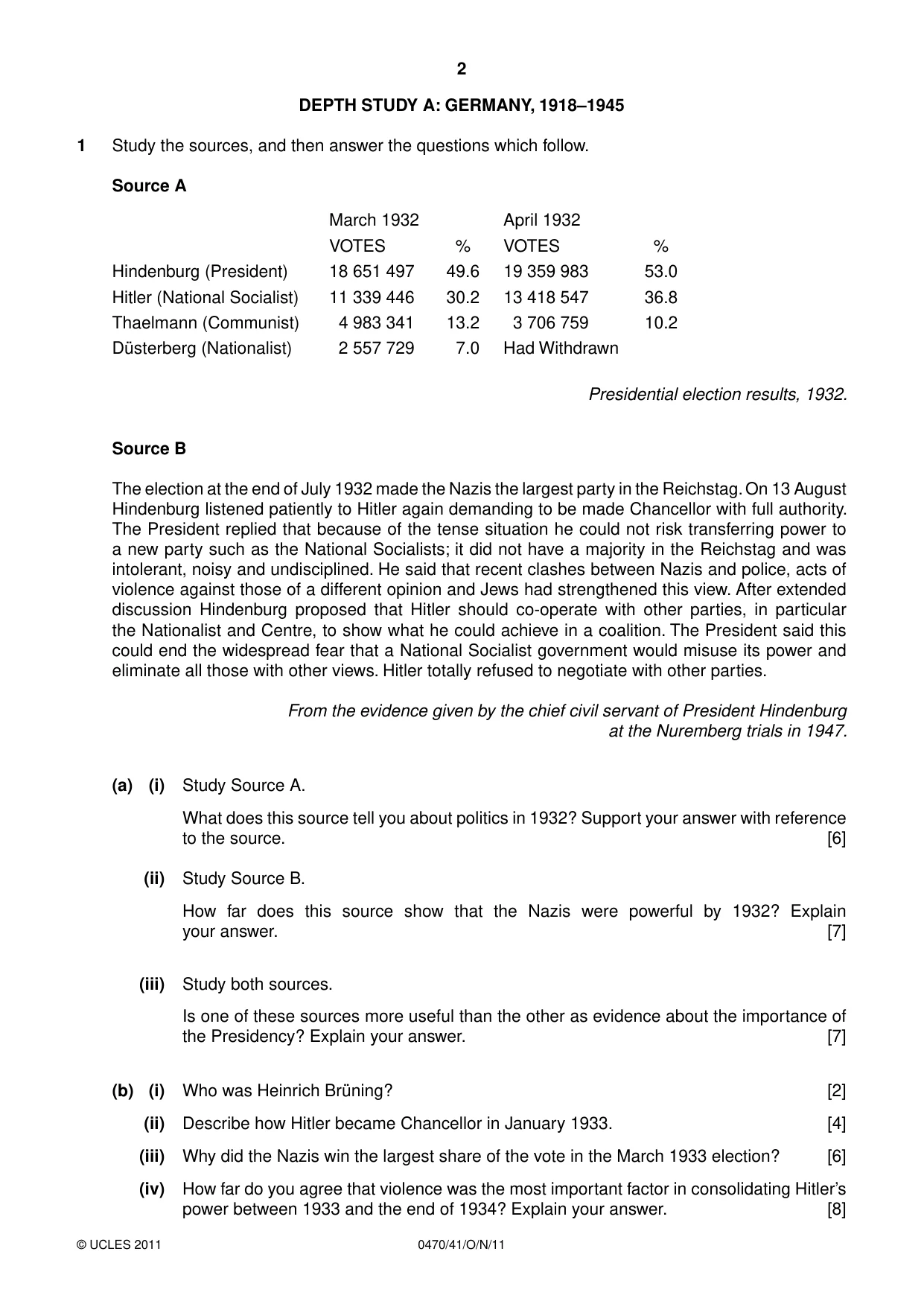
Question paper, page 2
2 0470/41/O/N/11 © UCLES 2011 DEPTH STUDY A: GERMANY, 1918–1945 1 Study the sources, and then answer the questions which follow. Source A March 1932 April 1932 VOTES % VOTES % Hindenburg (President) 18 651 497 49.6 19 359 983 53.0 Hitler (National Socialist) 11 339 446 30.2 13 418 547 36.8 Thaelmann (Communist) 4 983 341 13.2 3 706 759 10.2 Düsterberg (Nationalist) 2 557 729 7.0 Had Withdrawn Presidential election results, 1932. Source B The election at the end of July 1932 made the Nazis the largest party in the Reichstag. On 13 August Hindenburg listened patiently to Hitler again demanding to be made Chancellor with full authority. The President replied that because of the tense situation he could not risk transferring power to a new party such as the National Socialists; it did not have a majority in the Reichstag and was intolerant, noisy and undisciplined. He said that recent clashes between Nazis and police, acts of violence against those of a different opinion and Jews had strengthened this view. After extended discussion Hindenburg proposed that Hitler should co-operate with other parties, in particular the Nationalist and Centre, to show what he could achieve in a coalition. The President said this could end the widespread fear that a National Socialist government would misuse its power and eliminate all those with other views. Hitler totally refused to negotiate with other parties. From the evidence given by the chief civil servant of President Hindenburg at the Nuremberg trials in 1947. (a) (i) Study Source A. What does this source tell you about politics in 1932? Support your answer with reference to the source. [6] (ii) Study Source B. How far does this source show that the Nazis were powerful by 1932? Explain your answer. [7] (iii) Study both sources. Is one of these sources more useful than the other as evidence about the importance of the Presidency? Explain your answer. [7] (b) (i) Who was Heinrich Brüning? [2] (ii) Describe how Hitler became Chancellor in January 1933. [4] (iii) Why did the Nazis win the largest share of the vote in the March 1933 election? [6] (iv) How far do you agree that violence was the most important factor in consolidating Hitler’s power between 1933 and the end of 1934? Explain your answer. [8]
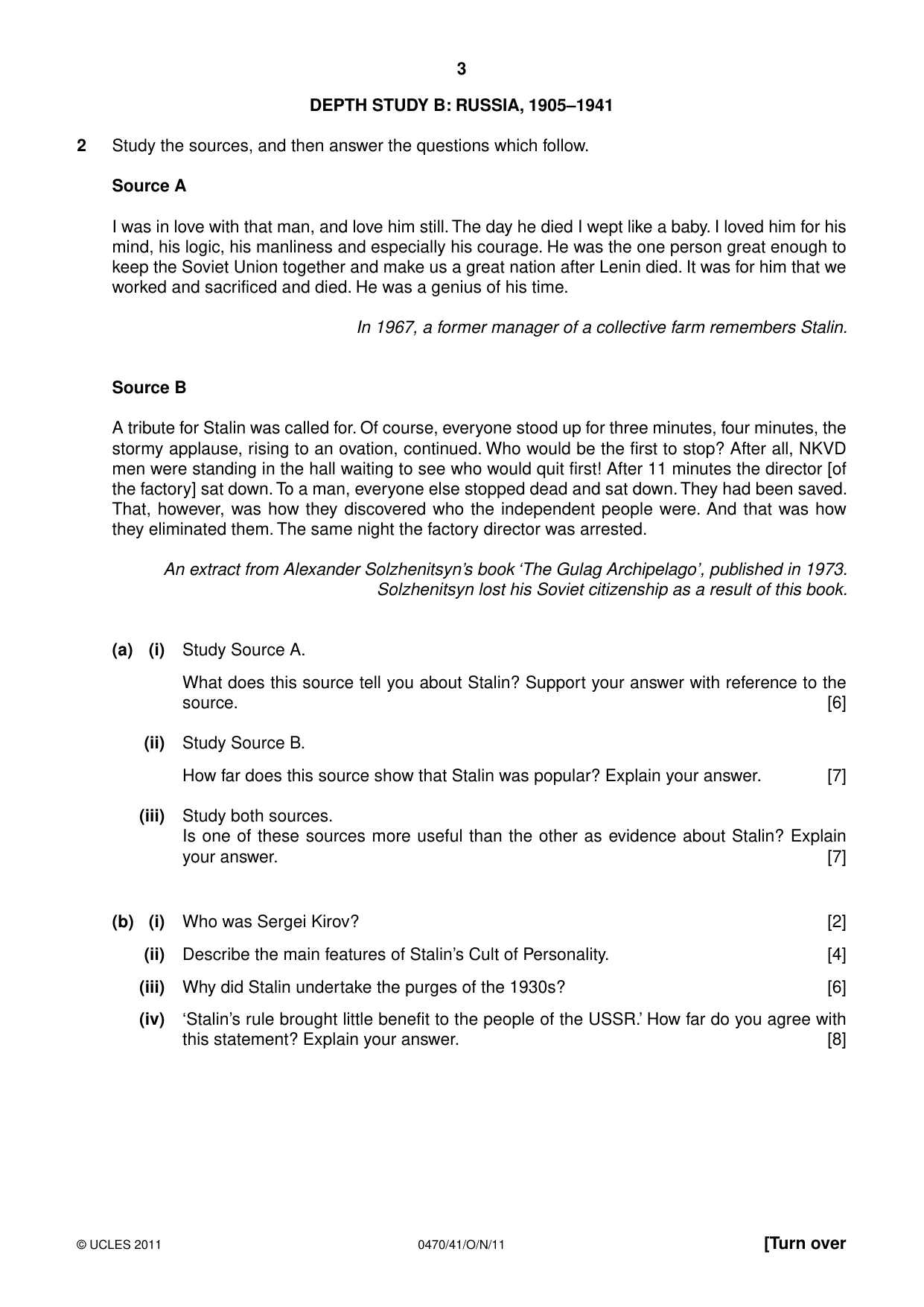
Question paper, page 3
3 0470/41/O/N/11 © UCLES 2011 [Turn over DEPTH STUDY B: RUSSIA, 1905–1941 2 Study the sources, and then answer the questions which follow. Source A I was in love with that man, and love him still. The day he died I wept like a baby. I loved him for his mind, his logic, his manliness and especially his courage. He was the one person great enough to keep the Soviet Union together and make us a great nation after Lenin died. It was for him that we worked and sacrificed and died. He was a genius of his time. In 1967, a former manager of a collective farm remembers Stalin. Source B A tribute for Stalin was called for. Of course, everyone stood up for three minutes, four minutes, the stormy applause, rising to an ovation, continued. Who would be the first to stop? After all, NKVD men were standing in the hall waiting to see who would quit first! After 11 minutes the director [of the factory] sat down. To a man, everyone else stopped dead and sat down. They had been saved. That, however, was how they discovered who the independent people were. And that was how they eliminated them. The same night the factory director was arrested. An extract from Alexander Solzhenitsyn’s book ‘The Gulag Archipelago’, published in 1973. Solzhenitsyn lost his Soviet citizenship as a result of this book. (a) (i) Study Source A. What does this source tell you about Stalin? Support your answer with reference to the source. [6] (ii) Study Source B. How far does this source show that Stalin was popular? Explain your answer. [7] (iii) Study both sources. Is one of these sources more useful than the other as evidence about Stalin? Explain your answer. [7] (b) (i) Who was Sergei Kirov? [2] (ii) Describe the main features of Stalin’s Cult of Personality. [4] (iii) Why did Stalin undertake the purges of the 1930s? [6] (iv) ‘Stalin’s rule brought little benefit to the people of the USSR.’ How far do you agree with this statement? Explain your answer. [8]
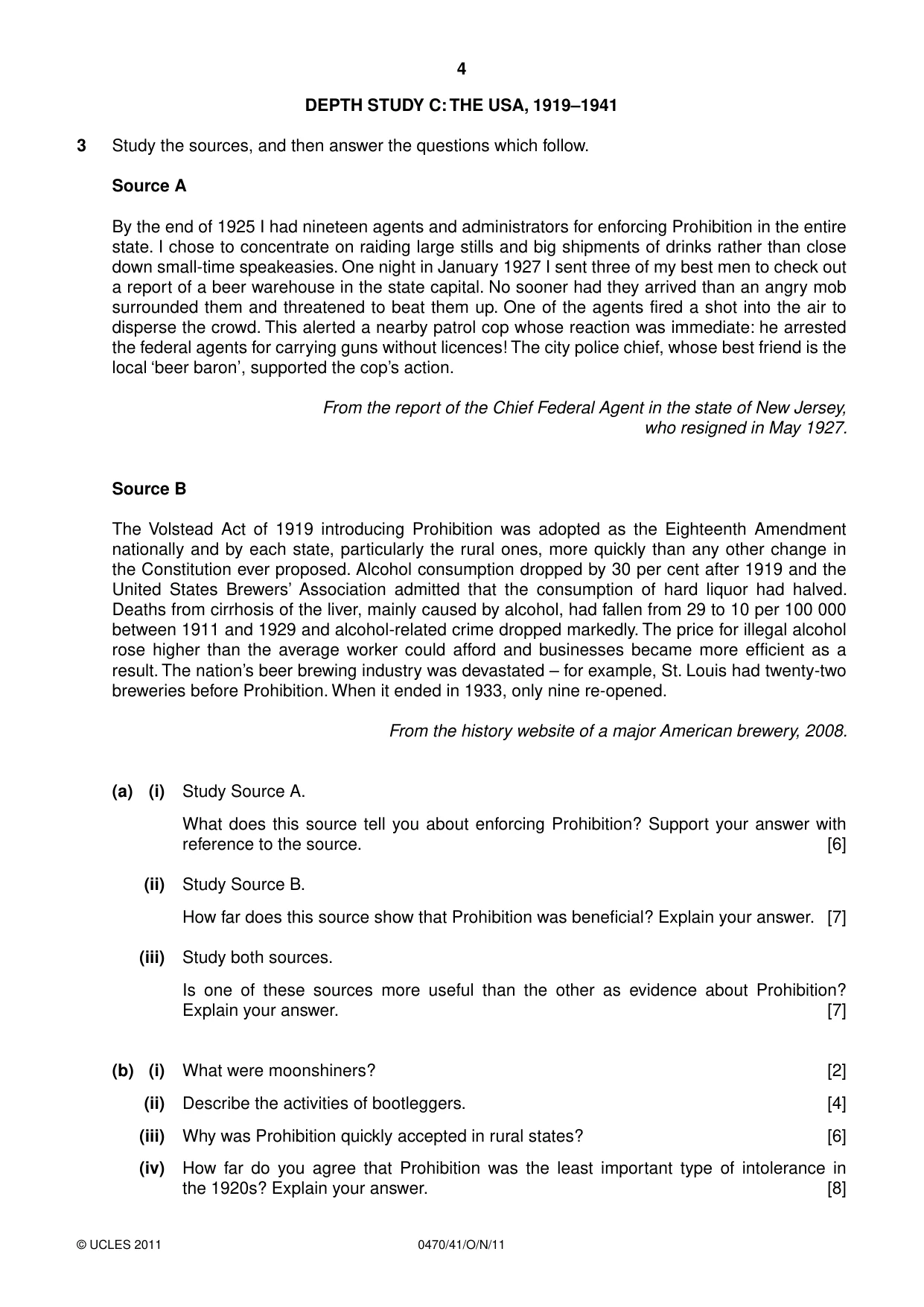
Question paper, page 4
4 0470/41/O/N/11 © UCLES 2011 DEPTH STUDY C: THE USA, 1919–1941 3 Study the sources, and then answer the questions which follow. Source A By the end of 1925 I had nineteen agents and administrators for enforcing Prohibition in the entire state. I chose to concentrate on raiding large stills and big shipments of drinks rather than close down small-time speakeasies. One night in January 1927 I sent three of my best men to check out a report of a beer warehouse in the state capital. No sooner had they arrived than an angry mob surrounded them and threatened to beat them up. One of the agents fired a shot into the air to disperse the crowd. This alerted a nearby patrol cop whose reaction was immediate: he arrested the federal agents for carrying guns without licences! The city police chief, whose best friend is the local ‘beer baron’, supported the cop’s action. From the report of the Chief Federal Agent in the state of New Jersey, who resigned in May 1927. Source B The Volstead Act of 1919 introducing Prohibition was adopted as the Eighteenth Amendment nationally and by each state, particularly the rural ones, more quickly than any other change in the Constitution ever proposed. Alcohol consumption dropped by 30 per cent after 1919 and the United States Brewers’ Association admitted that the consumption of hard liquor had halved. Deaths from cirrhosis of the liver, mainly caused by alcohol, had fallen from 29 to 10 per 100 000 between 1911 and 1929 and alcohol-related crime dropped markedly. The price for illegal alcohol rose higher than the average worker could afford and businesses became more efficient as a result. The nation’s beer brewing industry was devastated – for example, St. Louis had twenty-two breweries before Prohibition. When it ended in 1933, only nine re-opened. From the history website of a major American brewery, 2008. (a) (i) Study Source A. What does this source tell you about enforcing Prohibition? Support your answer with reference to the source. [6] (ii) Study Source B. How far does this source show that Prohibition was beneficial? Explain your answer. [7] (iii) Study both sources. Is one of these sources more useful than the other as evidence about Prohibition? Explain your answer. [7] (b) (i) What were moonshiners? [2] (ii) Describe the activities of bootleggers. [4] (iii) Why was Prohibition quickly accepted in rural states? [6] (iv) How far do you agree that Prohibition was the least important type of intolerance in the 1920s? Explain your answer. [8]
Question paper, page 5
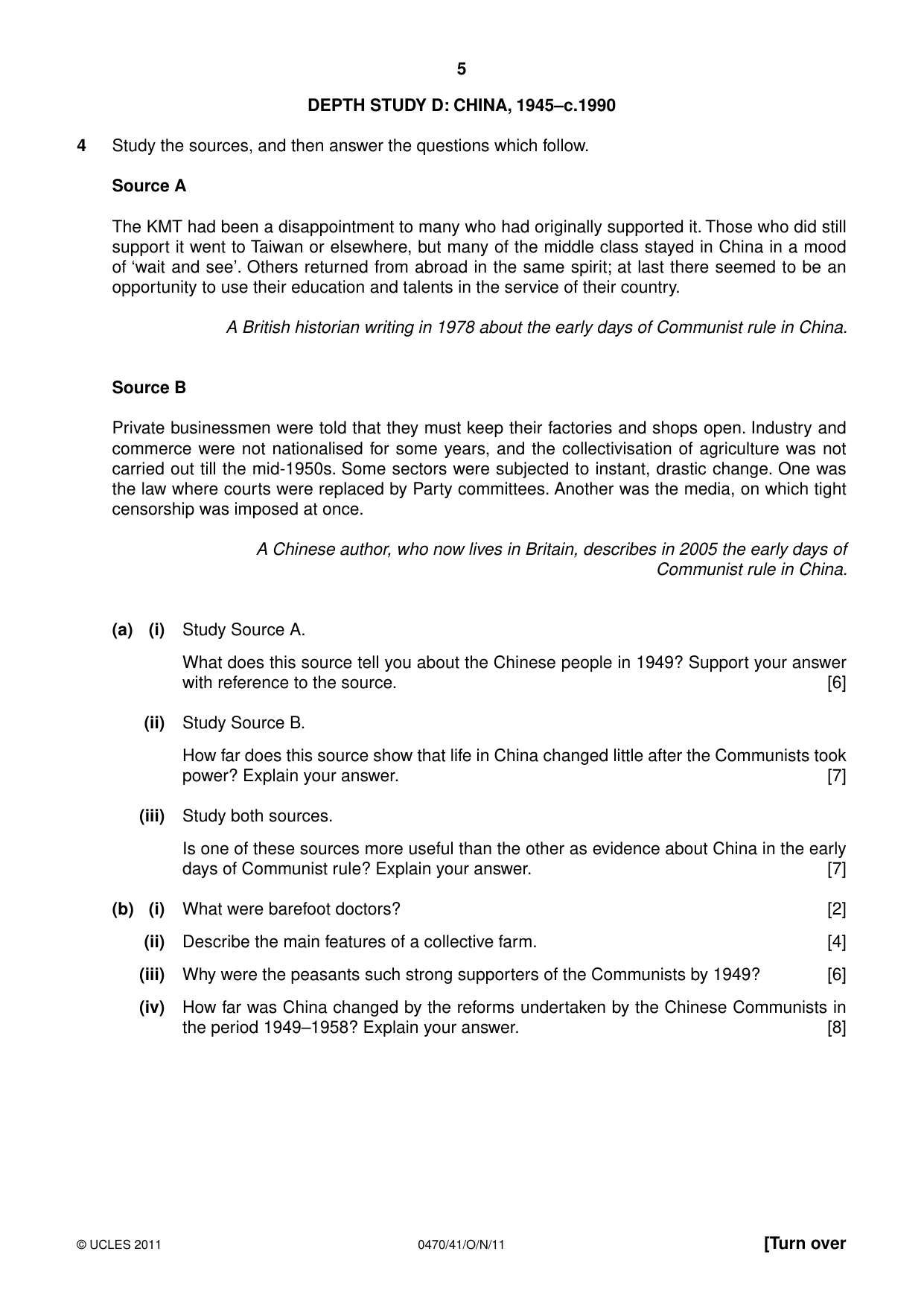
5 0470/41/O/N/11 © UCLES 2011 [Turn over DEPTH STUDY D: CHINA, 1945–c.1990 4 Study the sources, and then answer the questions which follow. Source A The KMT had been a disappointment to many who had originally supported it. Those who did still support it went to Taiwan or elsewhere, but many of the middle class stayed in China in a mood of ‘wait and see’. Others returned from abroad in the same spirit; at last there seemed to be an opportunity to use their education and talents in the service of their country. A British historian writing in 1978 about the early days of Communist rule in China. Source B Private businessmen were told that they must keep their factories and shops open. Industry and commerce were not nationalised for some years, and the collectivisation of agriculture was not carried out till the mid-1950s. Some sectors were subjected to instant, drastic change. One was the law where courts were replaced by Party committees. Another was the media, on which tight censorship was imposed at once. A Chinese author, who now lives in Britain, describes in 2005 the early days of Communist rule in China. (a) (i) Study Source A. What does this source tell you about the Chinese people in 1949? Support your answer with reference to the source. [6] (ii) Study Source B. How far does this source show that life in China changed little after the Communists took power? Explain your answer. [7] (iii) Study both sources. Is one of these sources more useful than the other as evidence about China in the early days of Communist rule? Explain your answer. [7] (b) (i) What were barefoot doctors? [2] (ii) Describe the main features of a collective farm. [4] (iii) Why were the peasants such strong supporters of the Communists by 1949? [6] (iv) How far was China changed by the reforms undertaken by the Chinese Communists in the period 1949–1958? Explain your answer. [8]
Question paper, page 6
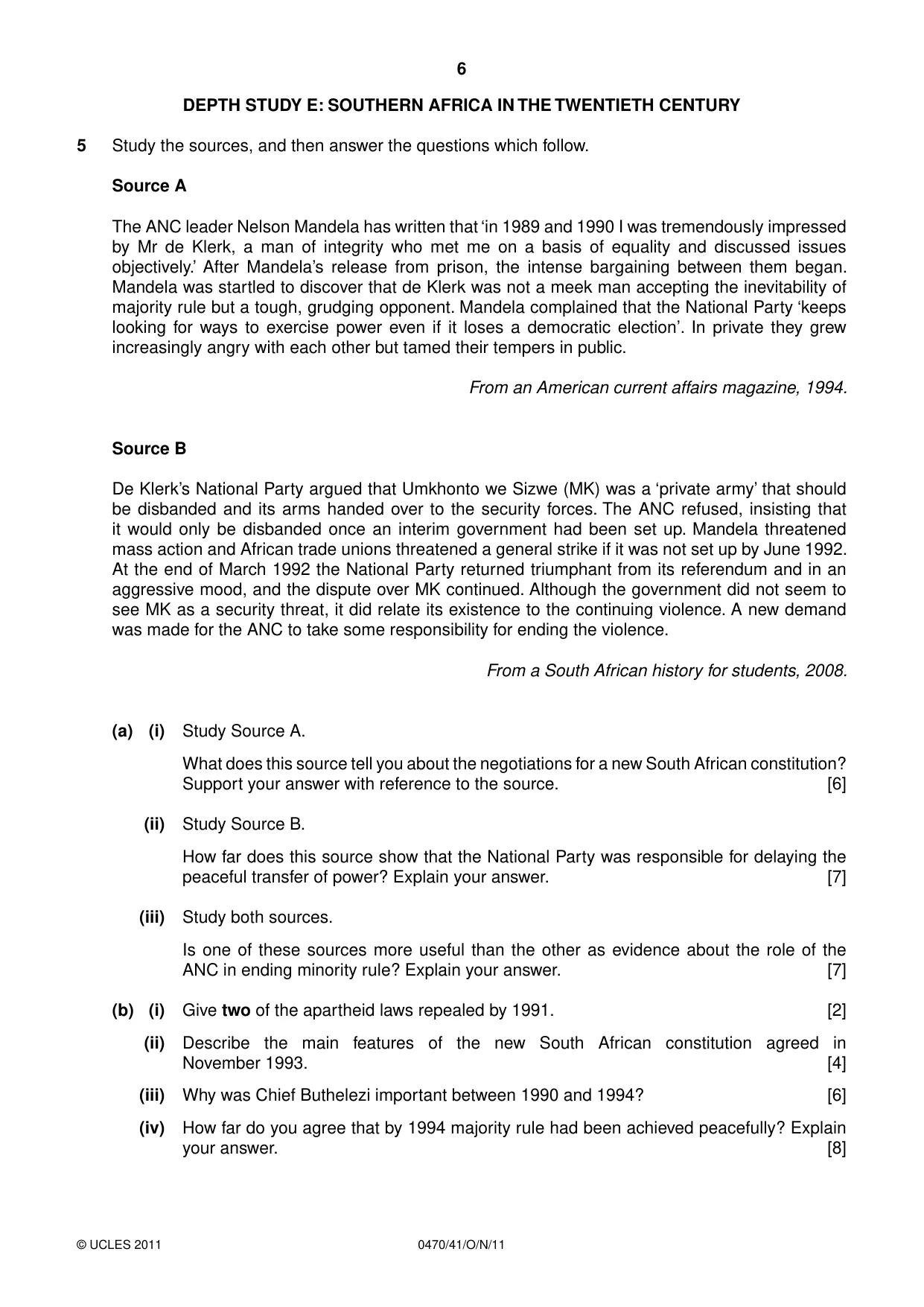
6 0470/41/O/N/11 © UCLES 2011 DEPTH STUDY E: SOUTHERN AFRICA IN THE TWENTIETH CENTURY 5 Study the sources, and then answer the questions which follow. Source A The ANC leader Nelson Mandela has written that ‘in 1989 and 1990 I was tremendously impressed by Mr de Klerk, a man of integrity who met me on a basis of equality and discussed issues objectively.’ After Mandela’s release from prison, the intense bargaining between them began. Mandela was startled to discover that de Klerk was not a meek man accepting the inevitability of majority rule but a tough, grudging opponent. Mandela complained that the National Party ‘keeps looking for ways to exercise power even if it loses a democratic election’. In private they grew increasingly angry with each other but tamed their tempers in public. From an American current affairs magazine, 1994. Source B De Klerk’s National Party argued that Umkhonto we Sizwe (MK) was a ‘private army’ that should be disbanded and its arms handed over to the security forces. The ANC refused, insisting that it would only be disbanded once an interim government had been set up. Mandela threatened mass action and African trade unions threatened a general strike if it was not set up by June 1992. At the end of March 1992 the National Party returned triumphant from its referendum and in an aggressive mood, and the dispute over MK continued. Although the government did not seem to see MK as a security threat, it did relate its existence to the continuing violence. A new demand was made for the ANC to take some responsibility for ending the violence. From a South African history for students, 2008. (a) (i) Study Source A. What does this source tell you about the negotiations for a new South African constitution? Support your answer with reference to the source. [6] (ii) Study Source B. How far does this source show that the National Party was responsible for delaying the peaceful transfer of power? Explain your answer. [7] (iii) Study both sources. Is one of these sources more useful than the other as evidence about the role of the ANC in ending minority rule? Explain your answer. [7] (b) (i) Give two of the apartheid laws repealed by 1991. [2] (ii) Describe the main features of the new South African constitution agreed in November 1993. [4] (iii) Why was Chief Buthelezi important between 1990 and 1994? [6] (iv) How far do you agree that by 1994 majority rule had been achieved peacefully? Explain your answer. [8]
Question paper, page 7
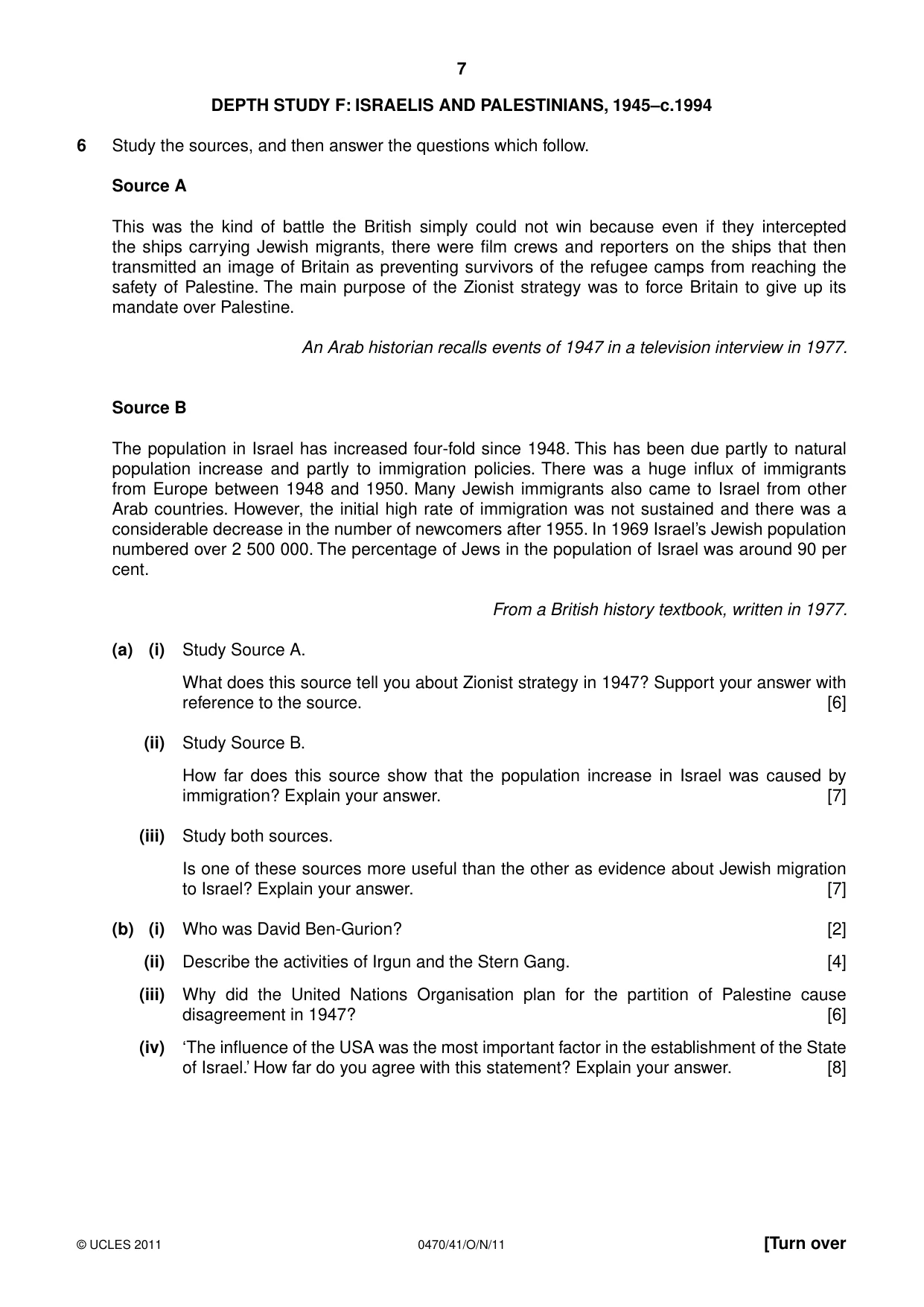
7 0470/41/O/N/11 © UCLES 2011 [Turn over DEPTH STUDY F: ISRAELIS AND PALESTINIANS, 1945–c.1994 6 Study the sources, and then answer the questions which follow. Source A This was the kind of battle the British simply could not win because even if they intercepted the ships carrying Jewish migrants, there were film crews and reporters on the ships that then transmitted an image of Britain as preventing survivors of the refugee camps from reaching the safety of Palestine. The main purpose of the Zionist strategy was to force Britain to give up its mandate over Palestine. An Arab historian recalls events of 1947 in a television interview in 1977. Source B The population in Israel has increased four-fold since 1948. This has been due partly to natural population increase and partly to immigration policies. There was a huge influx of immigrants from Europe between 1948 and 1950. Many Jewish immigrants also came to Israel from other Arab countries. However, the initial high rate of immigration was not sustained and there was a considerable decrease in the number of newcomers after 1955. In 1969 Israel’s Jewish population numbered over 2 500 000. The percentage of Jews in the population of Israel was around 90 per cent. From a British history textbook, written in 1977. (a) (i) Study Source A. What does this source tell you about Zionist strategy in 1947? Support your answer with reference to the source. [6] (ii) Study Source B. How far does this source show that the population increase in Israel was caused by immigration? Explain your answer. [7] (iii) Study both sources. Is one of these sources more useful than the other as evidence about Jewish migration to Israel? Explain your answer. [7] (b) (i) Who was David Ben-Gurion? [2] (ii) Describe the activities of Irgun and the Stern Gang. [4] (iii) Why did the United Nations Organisation plan for the partition of Palestine cause disagreement in 1947? [6] (iv) ‘The influence of the USA was the most important factor in the establishment of the State of Israel.’ How far do you agree with this statement? Explain your answer. [8]
Question paper, page 8
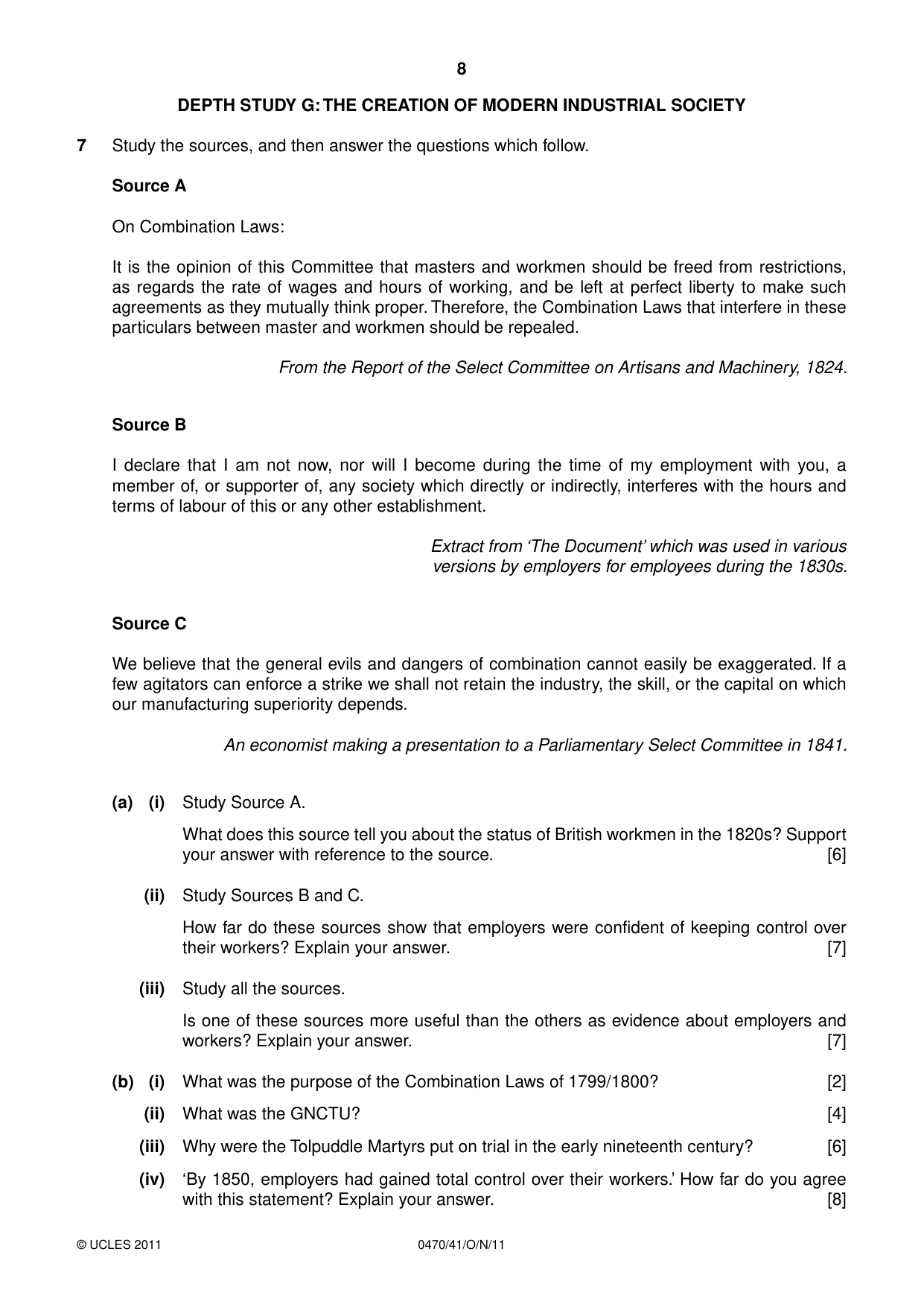
8 0470/41/O/N/11 © UCLES 2011 DEPTH STUDY G: THE CREATION OF MODERN INDUSTRIAL SOCIETY 7 Study the sources, and then answer the questions which follow. Source A On Combination Laws: It is the opinion of this Committee that masters and workmen should be freed from restrictions, as regards the rate of wages and hours of working, and be left at perfect liberty to make such agreements as they mutually think proper. Therefore, the Combination Laws that interfere in these particulars between master and workmen should be repealed. From the Report of the Select Committee on Artisans and Machinery, 1824. Source B I declare that I am not now, nor will I become during the time of my employment with you, a member of, or supporter of, any society which directly or indirectly, interferes with the hours and terms of labour of this or any other establishment. Extract from ‘The Document’ which was used in various versions by employers for employees during the 1830s. Source C We believe that the general evils and dangers of combination cannot easily be exaggerated. If a few agitators can enforce a strike we shall not retain the industry, the skill, or the capital on which our manufacturing superiority depends. An economist making a presentation to a Parliamentary Select Committee in 1841. (a) (i) Study Source A. What does this source tell you about the status of British workmen in the 1820s? Support your answer with reference to the source. [6] (ii) Study Sources B and C. How far do these sources show that employers were confident of keeping control over their workers? Explain your answer. [7] (iii) Study all the sources. Is one of these sources more useful than the others as evidence about employers and workers? Explain your answer. [7] (b) (i) What was the purpose of the Combination Laws of 1799/1800? [2] (ii) What was the GNCTU? [4] (iii) Why were the Tolpuddle Martyrs put on trial in the early nineteenth century? [6] (iv) ‘By 1850, employers had gained total control over their workers.’ How far do you agree with this statement? Explain your answer. [8]
Question paper, page 9
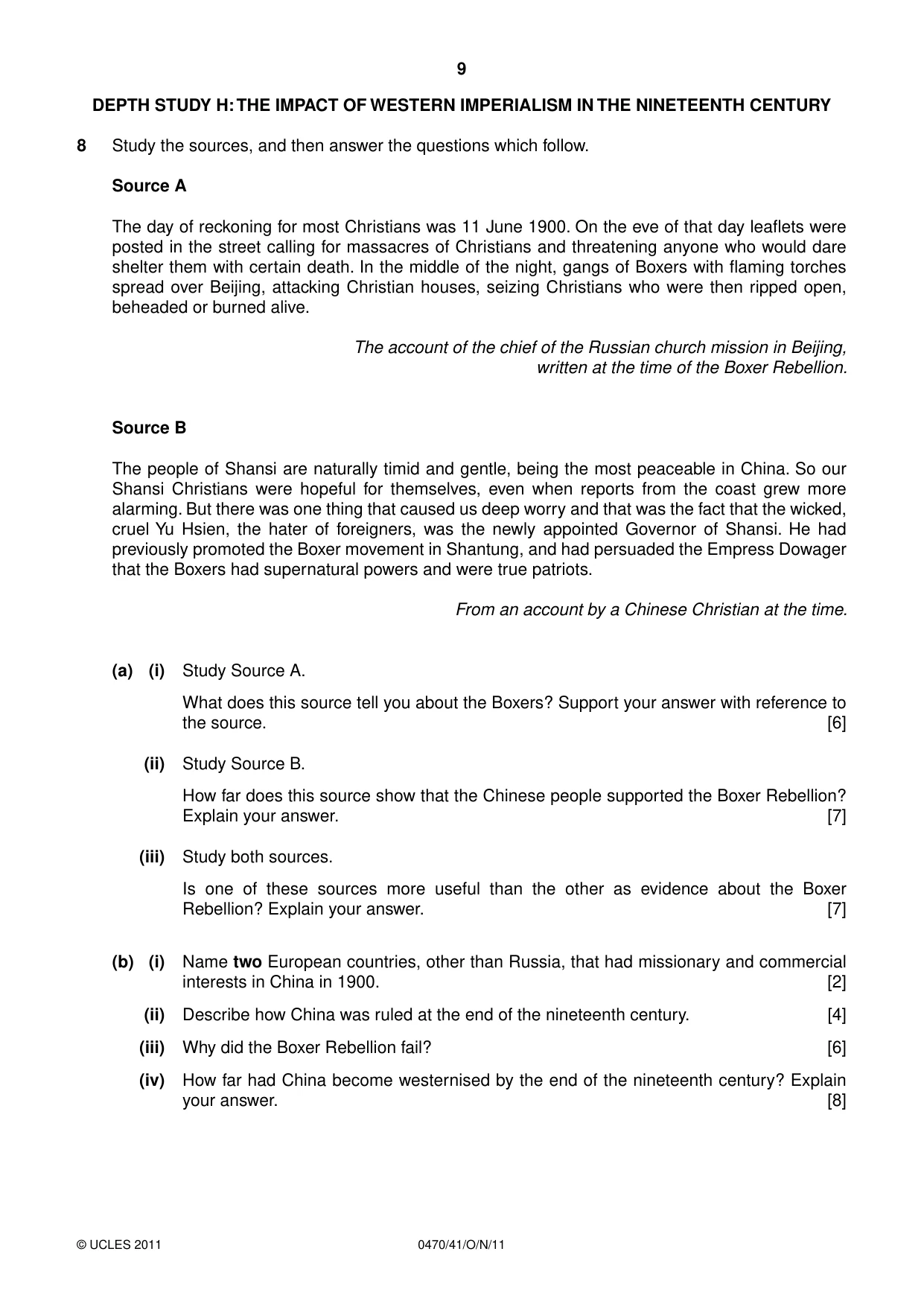
9 0470/41/O/N/11 © UCLES 2011 DEPTH STUDY H: THE IMPACT OF WESTERN IMPERIALISM IN THE NINETEENTH CENTURY 8 Study the sources, and then answer the questions which follow. Source A The day of reckoning for most Christians was 11 June 1900. On the eve of that day leaflets were posted in the street calling for massacres of Christians and threatening anyone who would dare shelter them with certain death. In the middle of the night, gangs of Boxers with flaming torches spread over Beijing, attacking Christian houses, seizing Christians who were then ripped open, beheaded or burned alive. The account of the chief of the Russian church mission in Beijing, written at the time of the Boxer Rebellion. Source B The people of Shansi are naturally timid and gentle, being the most peaceable in China. So our Shansi Christians were hopeful for themselves, even when reports from the coast grew more alarming. But there was one thing that caused us deep worry and that was the fact that the wicked, cruel Yu Hsien, the hater of foreigners, was the newly appointed Governor of Shansi. He had previously promoted the Boxer movement in Shantung, and had persuaded the Empress Dowager that the Boxers had supernatural powers and were true patriots. From an account by a Chinese Christian at the time. (a) (i) Study Source A. What does this source tell you about the Boxers? Support your answer with reference to the source. [6] (ii) Study Source B. How far does this source show that the Chinese people supported the Boxer Rebellion? Explain your answer. [7] (iii) Study both sources. Is one of these sources more useful than the other as evidence about the Boxer Rebellion? Explain your answer. [7] (b) (i) Name two European countries, other than Russia, that had missionary and commercial interests in China in 1900. [2] (ii) Describe how China was ruled at the end of the nineteenth century. [4] (iii) Why did the Boxer Rebellion fail? [6] (iv) How far had China become westernised by the end of the nineteenth century? Explain your answer. [8]
Question paper, page 10
10 0470/41/O/N/11 © UCLES 2011 BLANK PAGE
Question paper, page 11
11 0470/41/O/N/11 © UCLES 2011 BLANK PAGE
Question paper, page 12
12 0470/41/O/N/11 © UCLES 2011 Copyright Acknowledgements: Depth Study B Source A © Philip Ingram; Russia and the USSR 1905 – 1991; Cambridge University Press; 1997. Depth Study B Source B © Ben Walsh; Modern World History; John Murray Ltd; 1991. Depth Study D Source A © Harriet Ward; World Powers in the Twentieth Century; Heinemann Educational Books Ltd; 1978. Depth Study D Source B © Jung Chang & Jon Halliday; Mao, the Unknown Story; Jonathan Cape; 2005. Depth Study F Source A © S J Perkins; Arab-Israeli Conflict; Macmillan Education Ltd; 1987. Depth Study F Source B © Schools Council History 13-16 Project; Arab-Israeli Conflict ; Holmes-McDougall; 1977. Depth Study G Source A © P Wall and K Dawson; Trade Unions; Oxford University Press; 1968. Depth Study G Source B © H Pelling; History of British & Trade Unionism; Penguin; 1963. Depth Study G Source C © Lloyd Evans; British Trade Unionism 1850-1914; Edward Arnold; 1970. Depth Study H Source A © Harry G Gelber; The Dragon & the Foreign Devils; Bloomsbury Publishing plc; 2007. Depth Study H Source B © fordham.edu/halsall/??????/1900 fei-boxers. Permission to reproduce items where third-party owned material protected by copyright is included has been sought and cleared where possible. Every reasonable effort has been made by the publisher (UCLES) to trace copyright holders, but if any items requiring clearance have unwittingly been included, the publisher will be pleased to make amends at the earliest possible opportunity. University of Cambridge International Examinations is part of the Cambridge Assessment Group. Cambridge Assessment is the brand name of University of Cambridge Local Examinations Syndicate (UCLES), which is itself a department of the University of Cambridge. BLANK PAGE
Mark scheme, page 1
UNIVERSITY OF CAMBRIDGE INTERNATIONAL EXAMINATIONS International General Certificate of Secondary Education MARK SCHEME for the October/November 2011 question paper for the guidance of teachers 0470 HISTORY 0470/41 Paper 4 (Alternative to Coursework), maximum raw mark 40 This mark scheme is published as an aid to teachers and candidates, to indicate the requirements of the examination. It shows the basis on which Examiners were instructed to award marks. It does not indicate the details of the discussions that took place at an Examiners’ meeting before marking began, which would have considered the acceptability of alternative answers. Mark schemes must be read in conjunction with the question papers and the report on the examination. • Cambridge will not enter into discussions or correspondence in connection with these mark schemes. Cambridge is publishing the mark schemes for the October/November 2011 question papers for most IGCSE, GCE Advanced Level and Advanced Subsidiary Level syllabuses and some Ordinary Level syllabuses. www.XtremePapers.com
Mark scheme, page 2
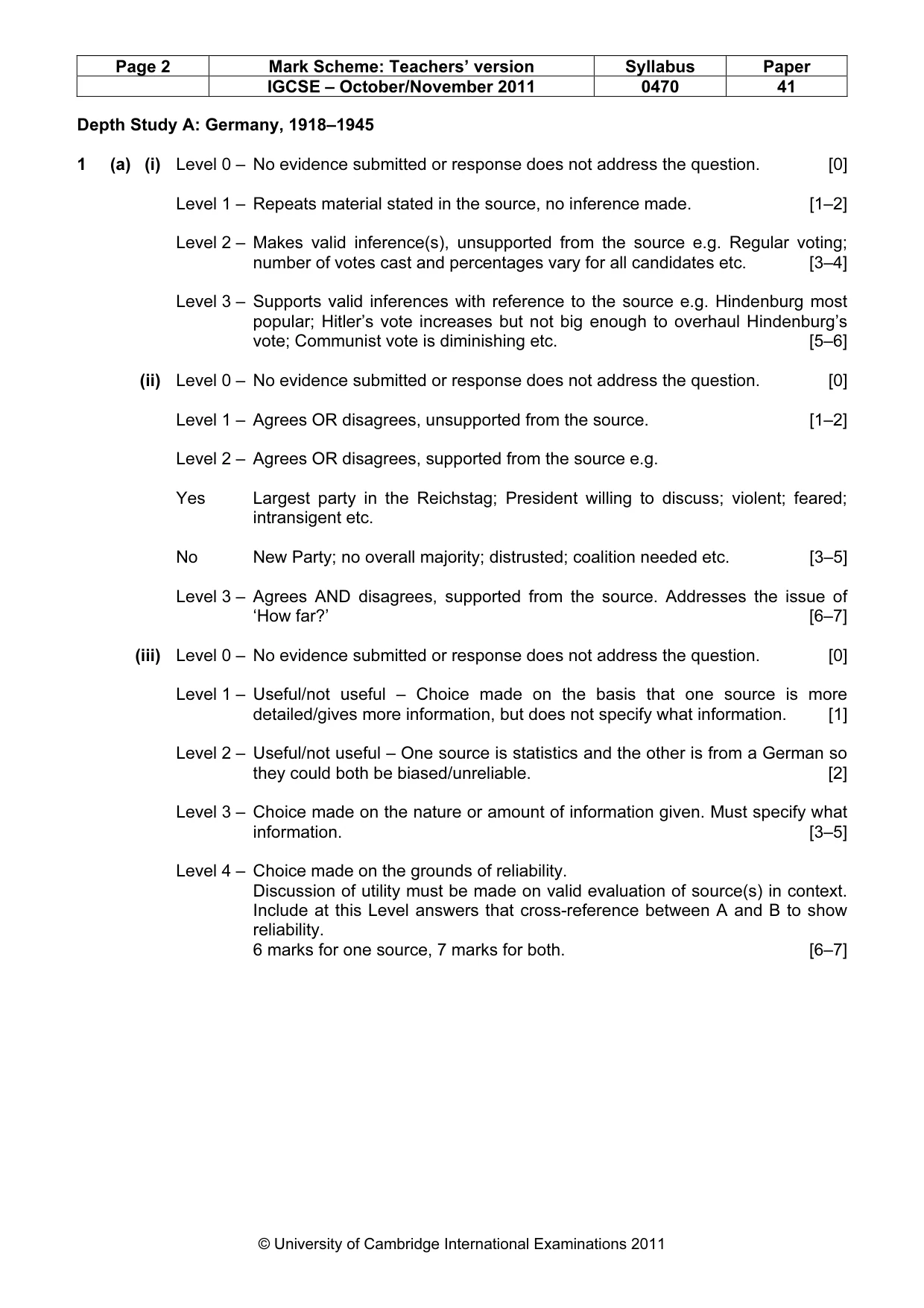
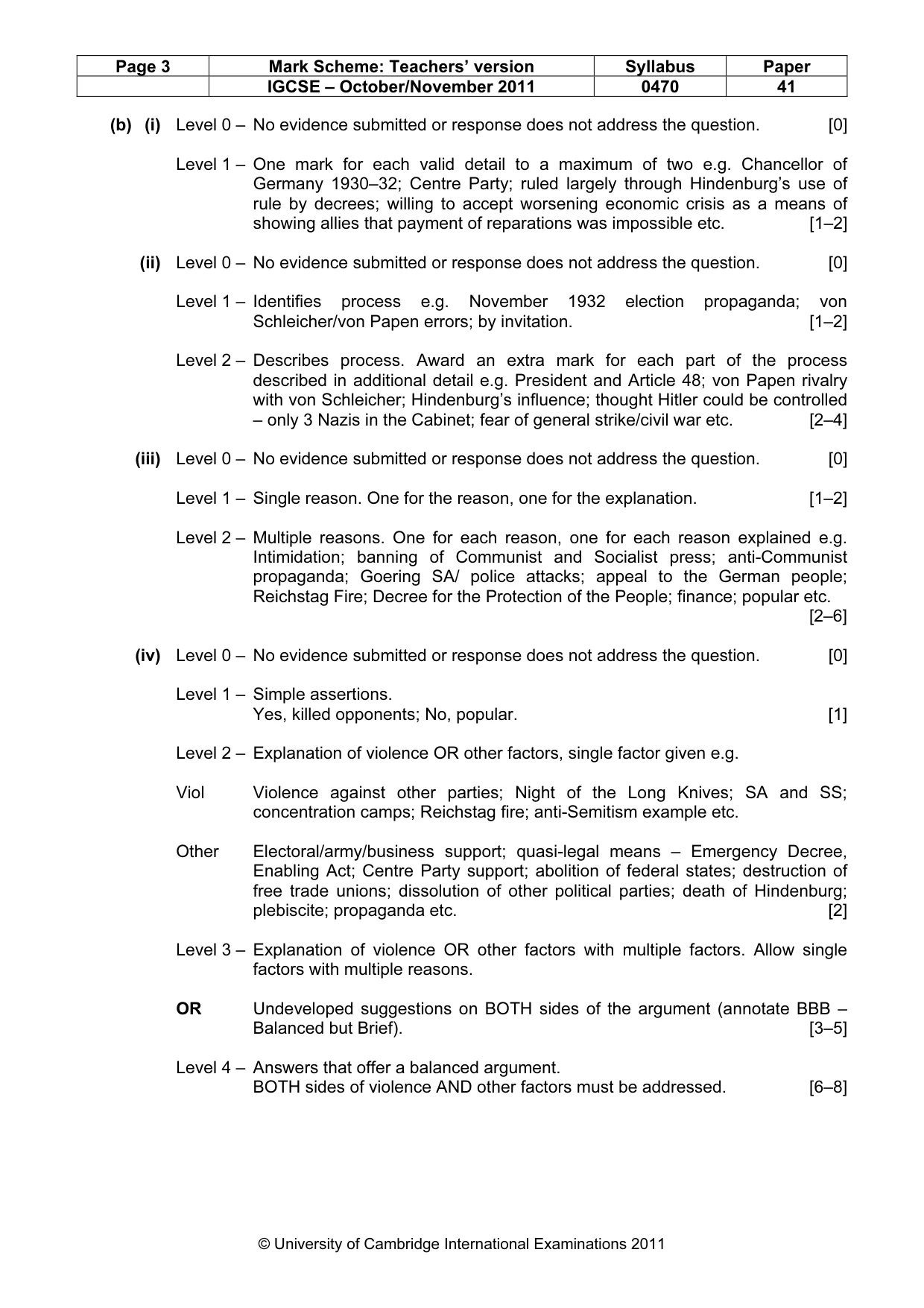
Page 2 Mark Scheme: Teachers’ version Syllabus Paper IGCSE – October/November 2011 0470 41 © University of Cambridge International Examinations 2011 Depth Study A: Germany, 1918–1945 1 (a) (i) Level 0 – No evidence submitted or response does not address the question. [0] Level 1 – Repeats material stated in the source, no inference made. [1–2] Level 2 – Makes valid inference(s), unsupported from the source e.g. Regular voting; number of votes cast and percentages vary for all candidates etc. [3–4] Level 3 – Supports valid inferences with reference to the source e.g. Hindenburg most popular; Hitler’s vote increases but not big enough to overhaul Hindenburg’s vote; Communist vote is diminishing etc. [5–6] (ii) Level 0 – No evidence submitted or response does not address the question. [0] Level 1 – Agrees OR disagrees, unsupported from the source. [1–2] Level 2 – Agrees OR disagrees, supported from the source e.g. Yes Largest party in the Reichstag; President willing to discuss; violent; feared; intransigent etc. No New Party; no overall majority; distrusted; coalition needed etc. [3–5] Level 3 – Agrees AND disagrees, supported from the source. Addresses the issue of ‘How far?’ [6–7] (iii) Level 0 – No evidence submitted or response does not address the question. [0] Level 1 – Useful/not useful – Choice made on the basis that one source is more detailed/gives more information, but does not specify what information. [1] Level 2 – Useful/not useful – One source is statistics and the other is from a German so they could both be biased/unreliable. [2] Level 3 – Choice made on the nature or amount of information given. Must specify what information. [3–5] Level 4 – Choice made on the grounds of reliability. Discussion of utility must be made on valid evaluation of source(s) in context. Include at this Level answers that cross-reference between A and B to show reliability. 6 marks for one source, 7 marks for both. [6–7]
Mark scheme, page 3
Page 3 Mark Scheme: Teachers’ version Syllabus Paper IGCSE – October/November 2011 0470 41 © University of Cambridge International Examinations 2011 (b) (i) Level 0 – No evidence submitted or response does not address the question. [0] Level 1 – One mark for each valid detail to a maximum of two e.g. Chancellor of Germany 1930–32; Centre Party; ruled largely through Hindenburg’s use of rule by decrees; willing to accept worsening economic crisis as a means of showing allies that payment of reparations was impossible etc. [1–2] (ii) Level 0 – No evidence submitted or response does not address the question. [0] Level 1 – Identifies process e.g. November 1932 election propaganda; von Schleicher/von Papen errors; by invitation. [1–2] Level 2 – Describes process. Award an extra mark for each part of the process described in additional detail e.g. President and Article 48; von Papen rivalry with von Schleicher; Hindenburg’s influence; thought Hitler could be controlled – only 3 Nazis in the Cabinet; fear of general strike/civil war etc. [2–4] (iii) Level 0 – No evidence submitted or response does not address the question. [0] Level 1 – Single reason. One for the reason, one for the explanation. [1–2] Level 2 – Multiple reasons. One for each reason, one for each reason explained e.g. Intimidation; banning of Communist and Socialist press; anti-Communist propaganda; Goering SA/ police attacks; appeal to the German people; Reichstag Fire; Decree for the Protection of the People; finance; popular etc. [2–6] (iv) Level 0 – No evidence submitted or response does not address the question. [0] Level 1 – Simple assertions. Yes, killed opponents; No, popular. [1] Level 2 – Explanation of violence OR other factors, single factor given e.g. Viol Violence against other parties; Night of the Long Knives; SA and SS; concentration camps; Reichstag fire; anti-Semitism example etc. Other Electoral/army/business support; quasi-legal means – Emergency Decree, Enabling Act; Centre Party support; abolition of federal states; destruction of free trade unions; dissolution of other political parties; death of Hindenburg; plebiscite; propaganda etc. [2] Level 3 – Explanation of violence OR other factors with multiple factors. Allow single factors with multiple reasons. OR Undeveloped suggestions on BOTH sides of the argument (annotate BBB – Balanced but Brief). [3–5] Level 4 – Answers that offer a balanced argument. BOTH sides of violence AND other factors must be addressed. [6–8]
Mark scheme, page 4
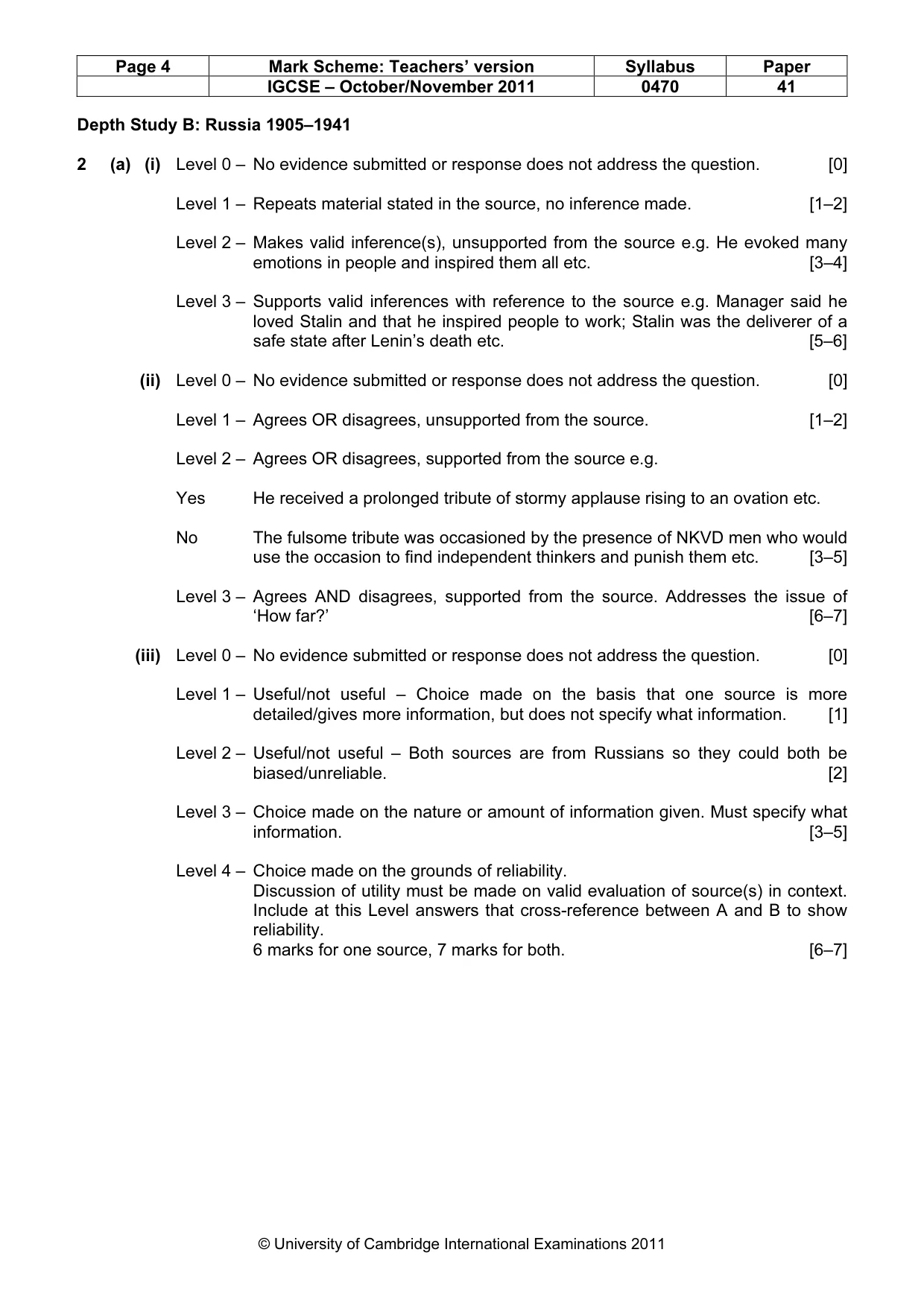
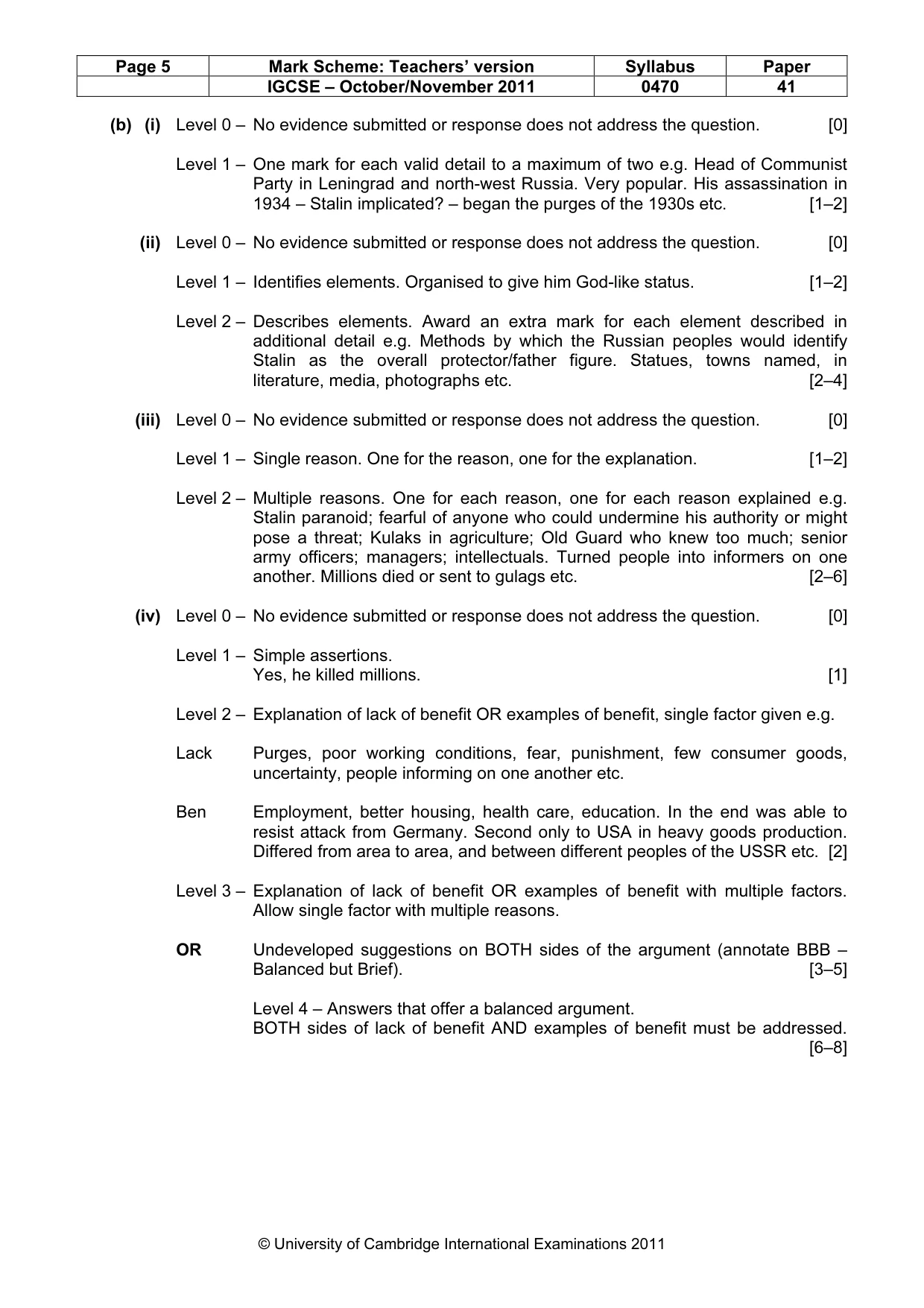
Page 4 Mark Scheme: Teachers’ version Syllabus Paper IGCSE – October/November 2011 0470 41 © University of Cambridge International Examinations 2011 Depth Study B: Russia 1905–1941 2 (a) (i) Level 0 – No evidence submitted or response does not address the question. [0] Level 1 – Repeats material stated in the source, no inference made. [1–2] Level 2 – Makes valid inference(s), unsupported from the source e.g. He evoked many emotions in people and inspired them all etc. [3–4] Level 3 – Supports valid inferences with reference to the source e.g. Manager said he loved Stalin and that he inspired people to work; Stalin was the deliverer of a safe state after Lenin’s death etc. [5–6] (ii) Level 0 – No evidence submitted or response does not address the question. [0] Level 1 – Agrees OR disagrees, unsupported from the source. [1–2] Level 2 – Agrees OR disagrees, supported from the source e.g. Yes He received a prolonged tribute of stormy applause rising to an ovation etc. No The fulsome tribute was occasioned by the presence of NKVD men who would use the occasion to find independent thinkers and punish them etc. [3–5] Level 3 – Agrees AND disagrees, supported from the source. Addresses the issue of ‘How far?’ [6–7] (iii) Level 0 – No evidence submitted or response does not address the question. [0] Level 1 – Useful/not useful – Choice made on the basis that one source is more detailed/gives more information, but does not specify what information. [1] Level 2 – Useful/not useful – Both sources are from Russians so they could both be biased/unreliable. [2] Level 3 – Choice made on the nature or amount of information given. Must specify what information. [3–5] Level 4 – Choice made on the grounds of reliability. Discussion of utility must be made on valid evaluation of source(s) in context. Include at this Level answers that cross-reference between A and B to show reliability. 6 marks for one source, 7 marks for both. [6–7]
Mark scheme, page 5
Page 5 Mark Scheme: Teachers’ version Syllabus Paper IGCSE – October/November 2011 0470 41 © University of Cambridge International Examinations 2011 (b) (i) Level 0 – No evidence submitted or response does not address the question. [0] Level 1 – One mark for each valid detail to a maximum of two e.g. Head of Communist Party in Leningrad and north-west Russia. Very popular. His assassination in 1934 – Stalin implicated? – began the purges of the 1930s etc. [1–2] (ii) Level 0 – No evidence submitted or response does not address the question. [0] Level 1 – Identifies elements. Organised to give him God-like status. [1–2] Level 2 – Describes elements. Award an extra mark for each element described in additional detail e.g. Methods by which the Russian peoples would identify Stalin as the overall protector/father figure. Statues, towns named, in literature, media, photographs etc. [2–4] (iii) Level 0 – No evidence submitted or response does not address the question. [0] Level 1 – Single reason. One for the reason, one for the explanation. [1–2] Level 2 – Multiple reasons. One for each reason, one for each reason explained e.g. Stalin paranoid; fearful of anyone who could undermine his authority or might pose a threat; Kulaks in agriculture; Old Guard who knew too much; senior army officers; managers; intellectuals. Turned people into informers on one another. Millions died or sent to gulags etc. [2–6] (iv) Level 0 – No evidence submitted or response does not address the question. [0] Level 1 – Simple assertions. Yes, he killed millions. [1] Level 2 – Explanation of lack of benefit OR examples of benefit, single factor given e.g. Lack Purges, poor working conditions, fear, punishment, few consumer goods, uncertainty, people informing on one another etc. Ben Employment, better housing, health care, education. In the end was able to resist attack from Germany. Second only to USA in heavy goods production. Differed from area to area, and between different peoples of the USSR etc. [2] Level 3 – Explanation of lack of benefit OR examples of benefit with multiple factors. Allow single factor with multiple reasons. OR Undeveloped suggestions on BOTH sides of the argument (annotate BBB – Balanced but Brief). [3–5] Level 4 – Answers that offer a balanced argument. BOTH sides of lack of benefit AND examples of benefit must be addressed. [6–8]
Mark scheme, page 6
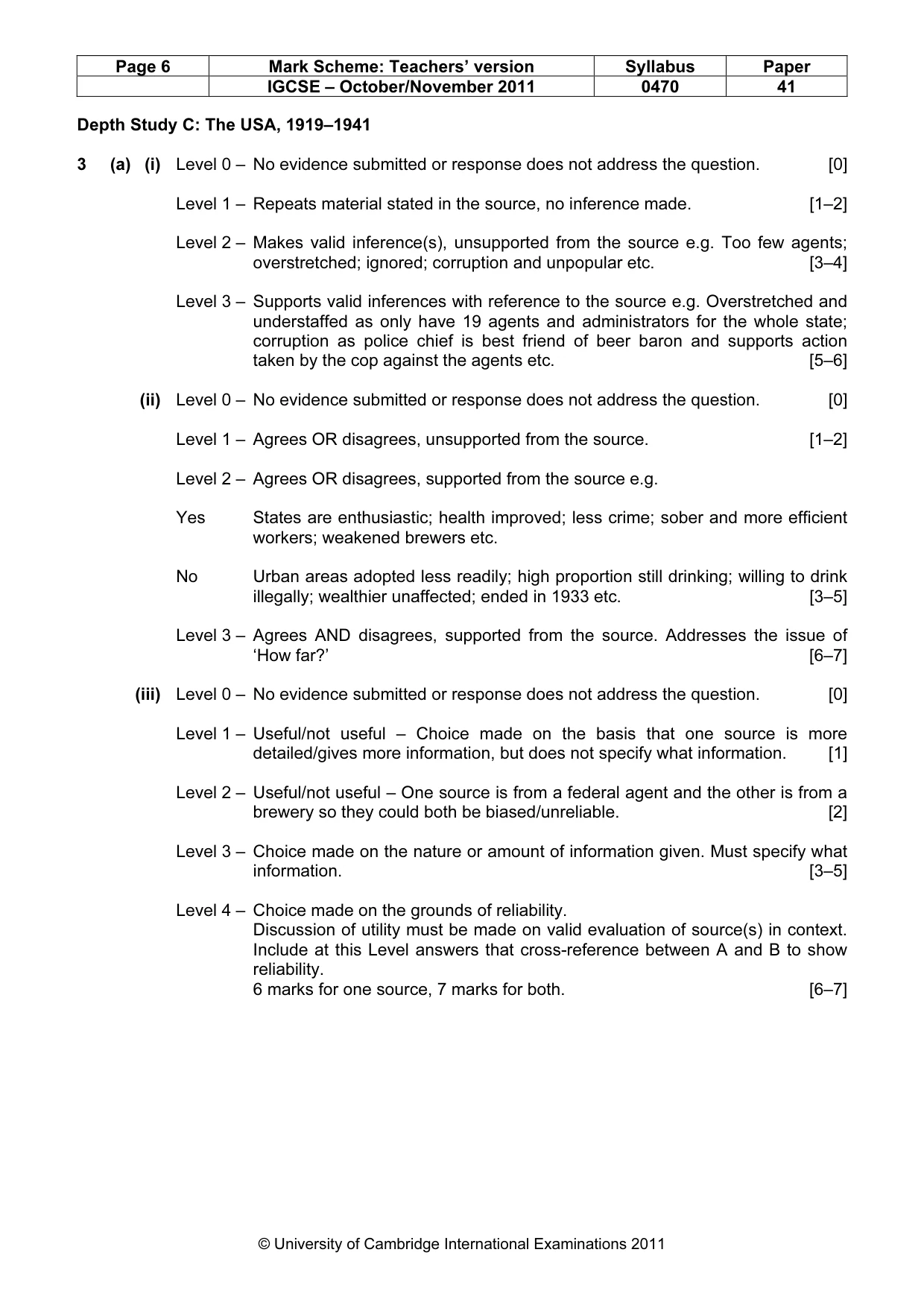
Page 6 Mark Scheme: Teachers’ version Syllabus Paper IGCSE – October/November 2011 0470 41 © University of Cambridge International Examinations 2011 Depth Study C: The USA, 1919–1941 3 (a) (i) Level 0 – No evidence submitted or response does not address the question. [0] Level 1 – Repeats material stated in the source, no inference made. [1–2] Level 2 – Makes valid inference(s), unsupported from the source e.g. Too few agents; overstretched; ignored; corruption and unpopular etc. [3–4] Level 3 – Supports valid inferences with reference to the source e.g. Overstretched and understaffed as only have 19 agents and administrators for the whole state; corruption as police chief is best friend of beer baron and supports action taken by the cop against the agents etc. [5–6] (ii) Level 0 – No evidence submitted or response does not address the question. [0] Level 1 – Agrees OR disagrees, unsupported from the source. [1–2] Level 2 – Agrees OR disagrees, supported from the source e.g. Yes States are enthusiastic; health improved; less crime; sober and more efficient workers; weakened brewers etc. No Urban areas adopted less readily; high proportion still drinking; willing to drink illegally; wealthier unaffected; ended in 1933 etc. [3–5] Level 3 – Agrees AND disagrees, supported from the source. Addresses the issue of ‘How far?’ [6–7] (iii) Level 0 – No evidence submitted or response does not address the question. [0] Level 1 – Useful/not useful – Choice made on the basis that one source is more detailed/gives more information, but does not specify what information. [1] Level 2 – Useful/not useful – One source is from a federal agent and the other is from a brewery so they could both be biased/unreliable. [2] Level 3 – Choice made on the nature or amount of information given. Must specify what information. [3–5] Level 4 – Choice made on the grounds of reliability. Discussion of utility must be made on valid evaluation of source(s) in context. Include at this Level answers that cross-reference between A and B to show reliability. 6 marks for one source, 7 marks for both. [6–7]
Mark scheme, page 7
Page 7 Mark Scheme: Teachers’ version Syllabus Paper IGCSE – October/November 2011 0470 41 © University of Cambridge International Examinations 2011 (b) (i) Level 0 – No evidence submitted or response does not address the question. [0] Level 1 – One mark for each valid detail to a maximum of two e.g. illegal distillers; small scale; usually remote rural; victims of revenuers; suppliers of gangsters etc. [1–2] (ii) Level 0 – No evidence submitted or response does not address the question. [0] Level 1 – Identifies activities e.g. Movers of illegal alcohol. [1–2] Level 2 – Describes activities. Award an extra mark for each valid aspect described in additional detail e.g. Large scale smugglers across national borders or delivered from the sea; small scale movements from brewers/distillers to local clients/markets etc. [2–4] (iii) Level 0 – No evidence submitted or response does not address the question. [0] Level 1 – Single reason. One for the reason, one for the explanation. [1–2] Level 2 – Multiple reasons. One for each reason, one for each reason explained e.g. Anti-Saloon League and Women’s Christian Temperance Union well established; many states already dry; influence of churches; politicians saw votes in it; country versus city; moral and anti-immigrant conservatism etc. [2–6] (iv) Level 0 – No evidence submitted or response does not address the question. [0] Level 1 – Simple assertions. Yes, it was ignored; No, anti-immigrant feelings were less damaging. [1] Level 2 – Explanation of Prohibition OR another form of intolerance, single factor given e.g. Candidates may argue both sides of Prohibition or Prohibition against another form of intolerance – Accept both. Proh Easily flouted; popular disobedience; everyone was abusing the law and being ‘criminal’; government did not really like the loss of tax revenue so was soft on enforcement etc. Other Was the law in 47 states; Federal enforcement; defeat of ‘wet’ Presidential candidate in 1928; Other forms of intolerance – anti-black, anti-left, anti- unions, anti-immigrant, anti-Darwinism etc. [2] Level 3 – Explanation of Prohibition OR another form of intolerance with multiple factors. Allow single factors with multiple reasons. OR Undeveloped suggestions on BOTH sides of the argument (annotate BBB – Balanced but Brief). [3–5] Level 4 – Answers that offer a balanced argument. BOTH sides of Prohibition AND another form of intolerance must be addressed. [6–8]
Mark scheme, page 8
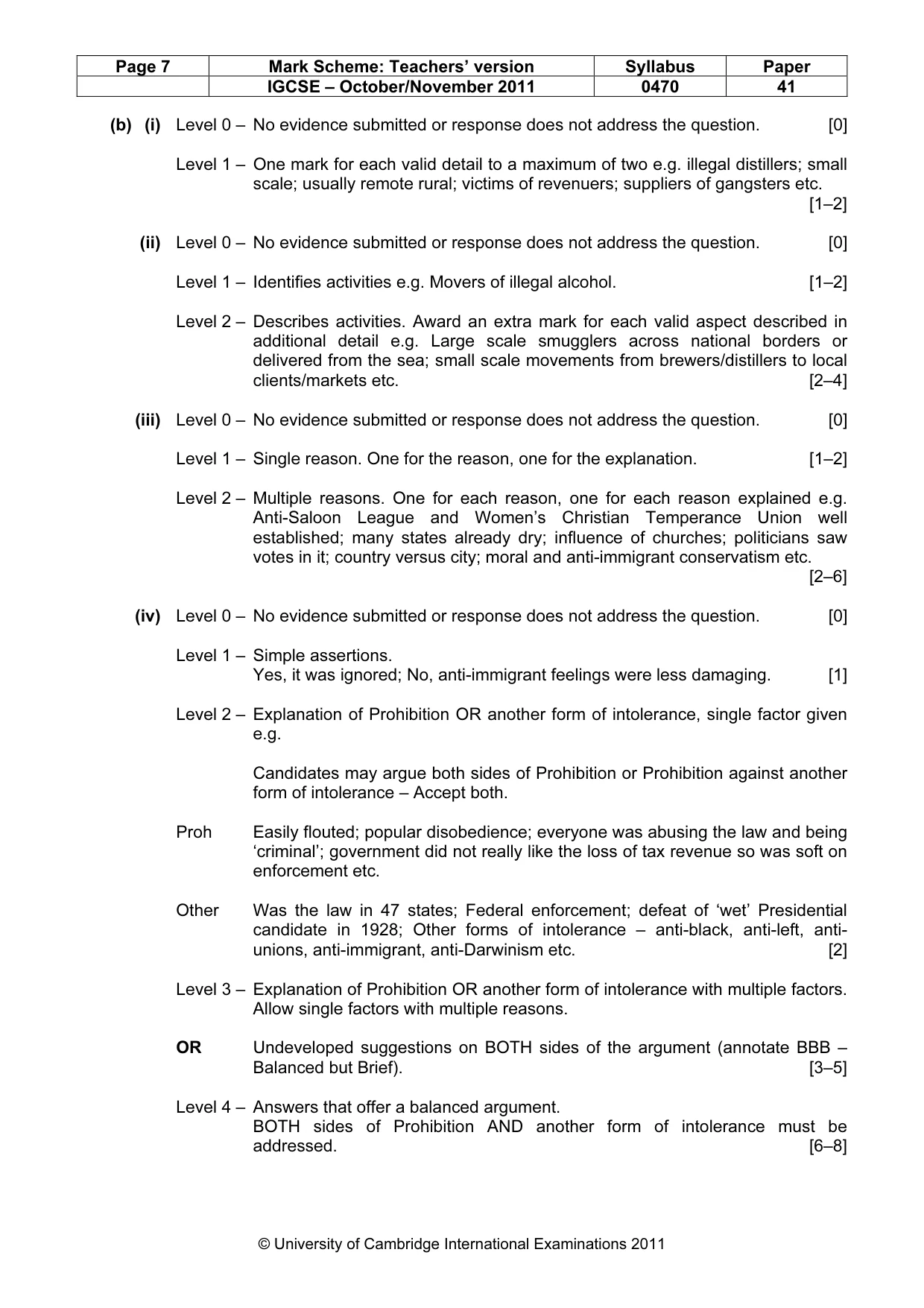
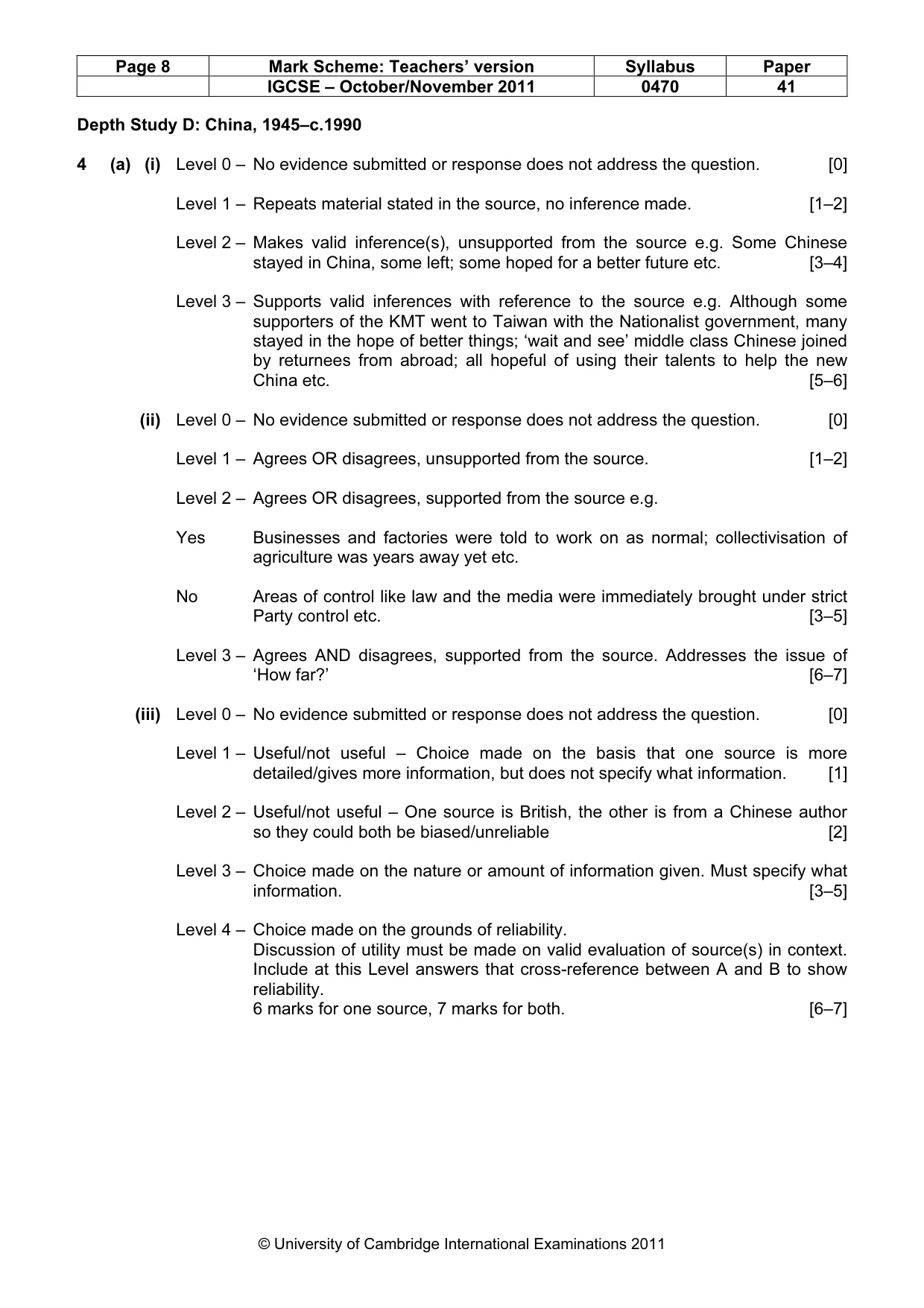
Page 8 Mark Scheme: Teachers’ version Syllabus Paper IGCSE – October/November 2011 0470 41 © University of Cambridge International Examinations 2011 Depth Study D: China, 1945–c.1990 4 (a) (i) Level 0 – No evidence submitted or response does not address the question. [0] Level 1 – Repeats material stated in the source, no inference made. [1–2] Level 2 – Makes valid inference(s), unsupported from the source e.g. Some Chinese stayed in China, some left; some hoped for a better future etc. [3–4] Level 3 – Supports valid inferences with reference to the source e.g. Although some supporters of the KMT went to Taiwan with the Nationalist government, many stayed in the hope of better things; ‘wait and see’ middle class Chinese joined by returnees from abroad; all hopeful of using their talents to help the new China etc. [5–6] (ii) Level 0 – No evidence submitted or response does not address the question. [0] Level 1 – Agrees OR disagrees, unsupported from the source. [1–2] Level 2 – Agrees OR disagrees, supported from the source e.g. Yes Businesses and factories were told to work on as normal; collectivisation of agriculture was years away yet etc. No Areas of control like law and the media were immediately brought under strict Party control etc. [3–5] Level 3 – Agrees AND disagrees, supported from the source. Addresses the issue of ‘How far?’ [6–7] (iii) Level 0 – No evidence submitted or response does not address the question. [0] Level 1 – Useful/not useful – Choice made on the basis that one source is more detailed/gives more information, but does not specify what information. [1] Level 2 – Useful/not useful – One source is British, the other is from a Chinese author so they could both be biased/unreliable [2] Level 3 – Choice made on the nature or amount of information given. Must specify what information. [3–5] Level 4 – Choice made on the grounds of reliability. Discussion of utility must be made on valid evaluation of source(s) in context. Include at this Level answers that cross-reference between A and B to show reliability. 6 marks for one source, 7 marks for both. [6–7]
Mark scheme, page 9
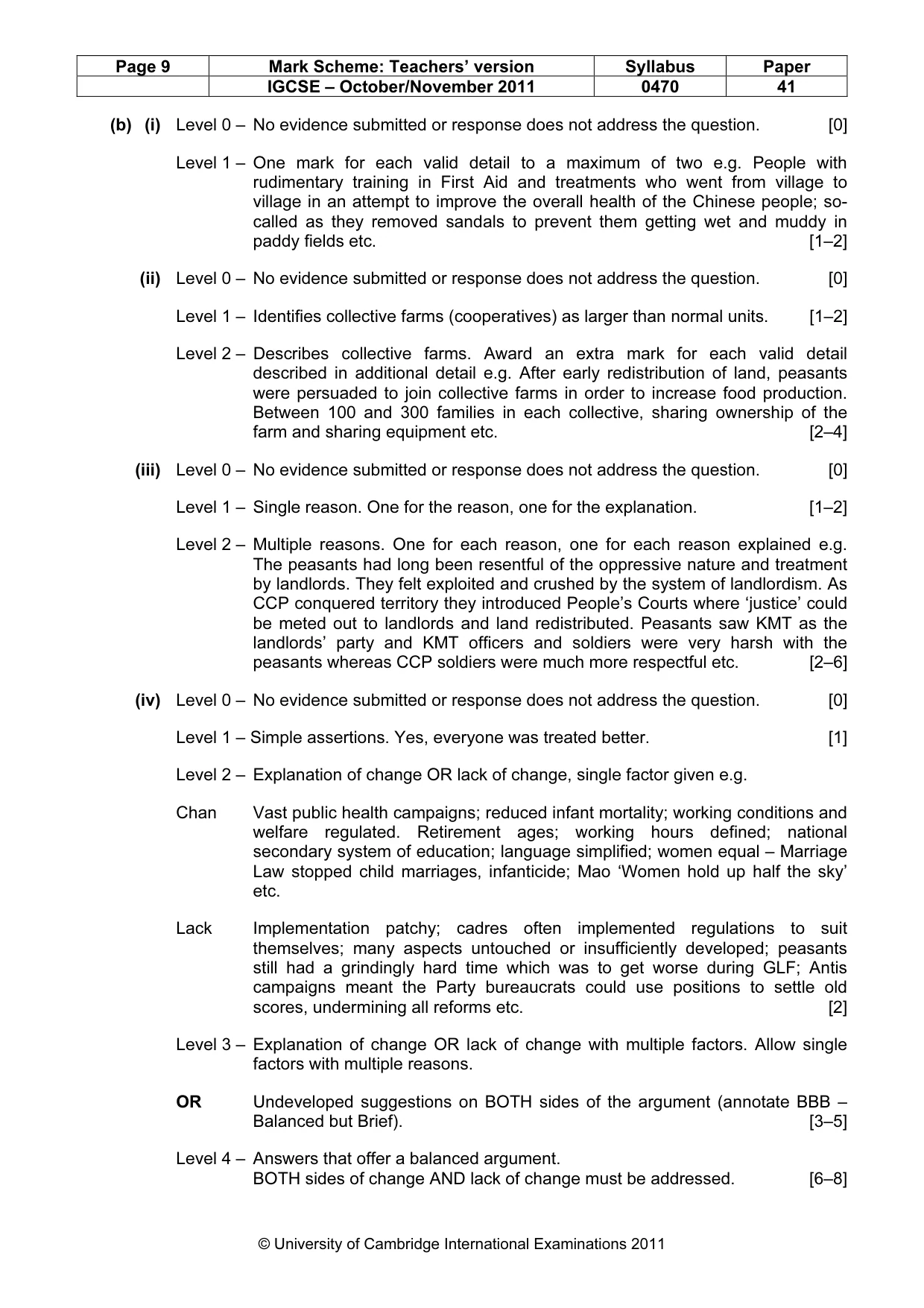
Page 9 Mark Scheme: Teachers’ version Syllabus Paper IGCSE – October/November 2011 0470 41 © University of Cambridge International Examinations 2011 (b) (i) Level 0 – No evidence submitted or response does not address the question. [0] Level 1 – One mark for each valid detail to a maximum of two e.g. People with rudimentary training in First Aid and treatments who went from village to village in an attempt to improve the overall health of the Chinese people; so- called as they removed sandals to prevent them getting wet and muddy in paddy fields etc. [1–2] (ii) Level 0 – No evidence submitted or response does not address the question. [0] Level 1 – Identifies collective farms (cooperatives) as larger than normal units. [1–2] Level 2 – Describes collective farms. Award an extra mark for each valid detail described in additional detail e.g. After early redistribution of land, peasants were persuaded to join collective farms in order to increase food production. Between 100 and 300 families in each collective, sharing ownership of the farm and sharing equipment etc. [2–4] (iii) Level 0 – No evidence submitted or response does not address the question. [0] Level 1 – Single reason. One for the reason, one for the explanation. [1–2] Level 2 – Multiple reasons. One for each reason, one for each reason explained e.g. The peasants had long been resentful of the oppressive nature and treatment by landlords. They felt exploited and crushed by the system of landlordism. As CCP conquered territory they introduced People’s Courts where ‘justice’ could be meted out to landlords and land redistributed. Peasants saw KMT as the landlords’ party and KMT officers and soldiers were very harsh with the peasants whereas CCP soldiers were much more respectful etc. [2–6] (iv) Level 0 – No evidence submitted or response does not address the question. [0] Level 1 – Simple assertions. Yes, everyone was treated better. [1] Level 2 – Explanation of change OR lack of change, single factor given e.g. Chan Vast public health campaigns; reduced infant mortality; working conditions and welfare regulated. Retirement ages; working hours defined; national secondary system of education; language simplified; women equal – Marriage Law stopped child marriages, infanticide; Mao ‘Women hold up half the sky’ etc. Lack Implementation patchy; cadres often implemented regulations to suit themselves; many aspects untouched or insufficiently developed; peasants still had a grindingly hard time which was to get worse during GLF; Antis campaigns meant the Party bureaucrats could use positions to settle old scores, undermining all reforms etc. [2] Level 3 – Explanation of change OR lack of change with multiple factors. Allow single factors with multiple reasons. OR Undeveloped suggestions on BOTH sides of the argument (annotate BBB – Balanced but Brief). [3–5] Level 4 – Answers that offer a balanced argument. BOTH sides of change AND lack of change must be addressed. [6–8]
Mark scheme, page 10
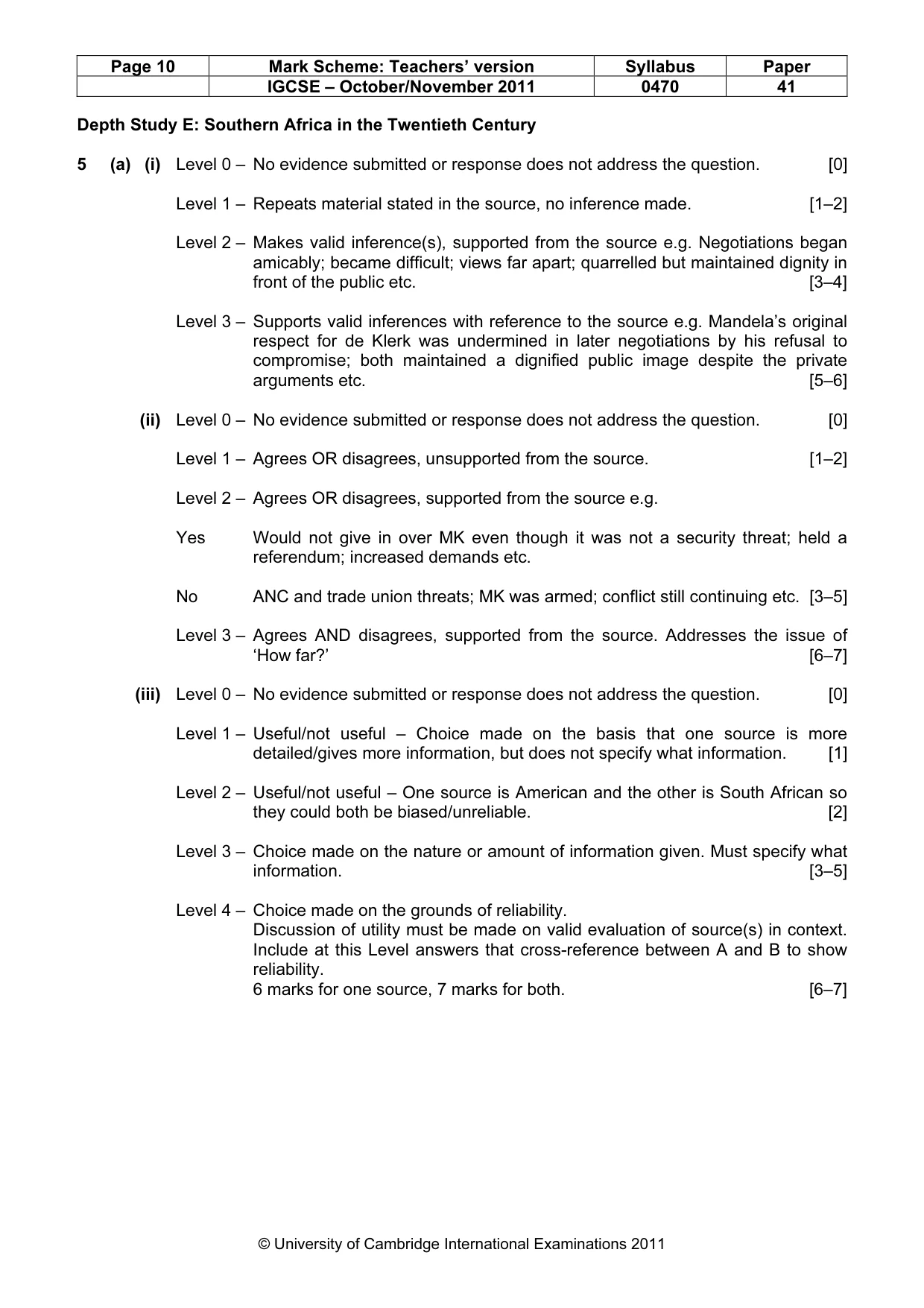
Page 10 Mark Scheme: Teachers’ version Syllabus Paper IGCSE – October/November 2011 0470 41 © University of Cambridge International Examinations 2011 Depth Study E: Southern Africa in the Twentieth Century 5 (a) (i) Level 0 – No evidence submitted or response does not address the question. [0] Level 1 – Repeats material stated in the source, no inference made. [1–2] Level 2 – Makes valid inference(s), supported from the source e.g. Negotiations began amicably; became difficult; views far apart; quarrelled but maintained dignity in front of the public etc. [3–4] Level 3 – Supports valid inferences with reference to the source e.g. Mandela’s original respect for de Klerk was undermined in later negotiations by his refusal to compromise; both maintained a dignified public image despite the private arguments etc. [5–6] (ii) Level 0 – No evidence submitted or response does not address the question. [0] Level 1 – Agrees OR disagrees, unsupported from the source. [1–2] Level 2 – Agrees OR disagrees, supported from the source e.g. Yes Would not give in over MK even though it was not a security threat; held a referendum; increased demands etc. No ANC and trade union threats; MK was armed; conflict still continuing etc. [3–5] Level 3 – Agrees AND disagrees, supported from the source. Addresses the issue of ‘How far?’ [6–7] (iii) Level 0 – No evidence submitted or response does not address the question. [0] Level 1 – Useful/not useful – Choice made on the basis that one source is more detailed/gives more information, but does not specify what information. [1] Level 2 – Useful/not useful – One source is American and the other is South African so they could both be biased/unreliable. [2] Level 3 – Choice made on the nature or amount of information given. Must specify what information. [3–5] Level 4 – Choice made on the grounds of reliability. Discussion of utility must be made on valid evaluation of source(s) in context. Include at this Level answers that cross-reference between A and B to show reliability. 6 marks for one source, 7 marks for both. [6–7]
Mark scheme, page 11
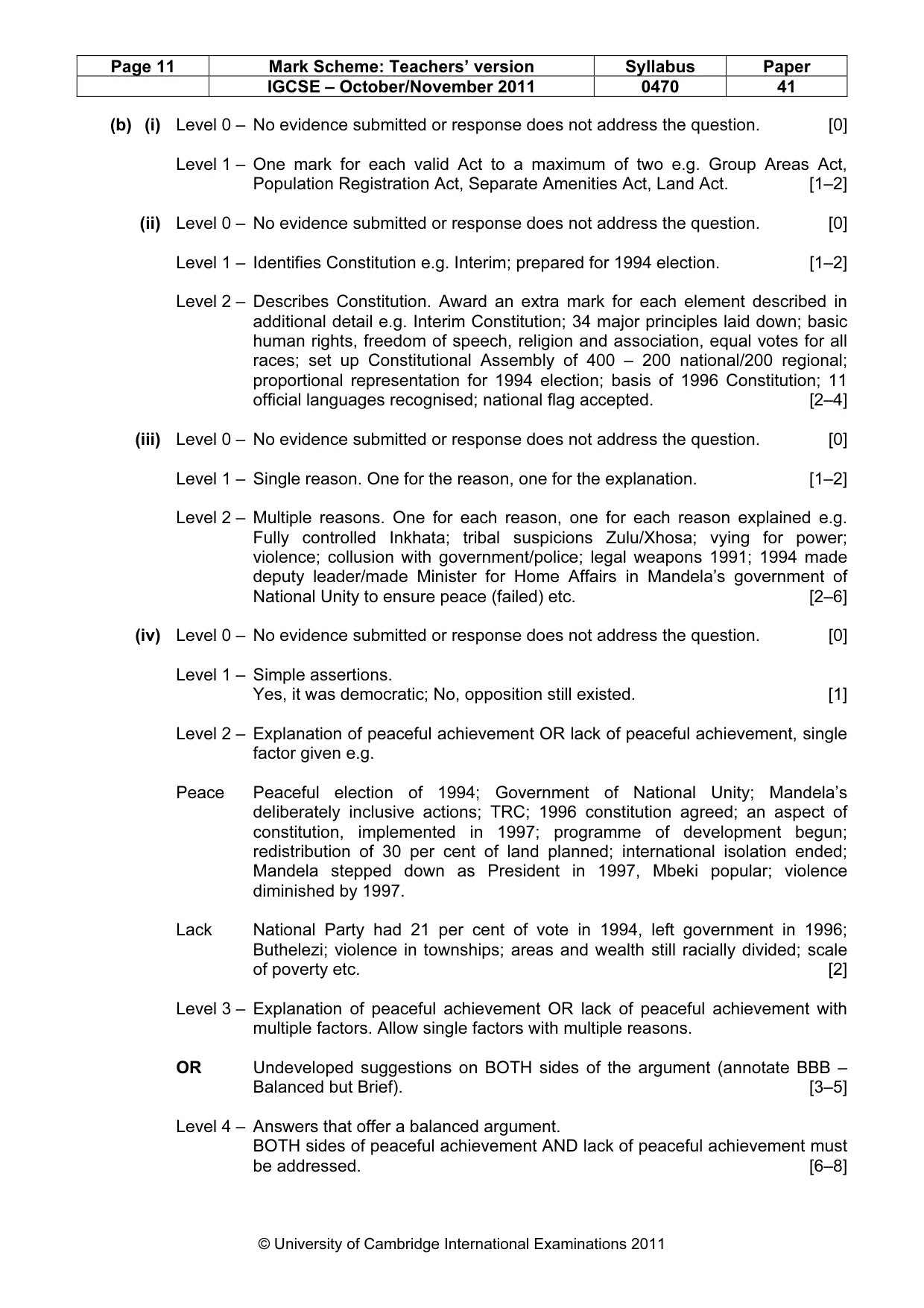
Page 11 Mark Scheme: Teachers’ version Syllabus Paper IGCSE – October/November 2011 0470 41 © University of Cambridge International Examinations 2011 (b) (i) Level 0 – No evidence submitted or response does not address the question. [0] Level 1 – One mark for each valid Act to a maximum of two e.g. Group Areas Act, Population Registration Act, Separate Amenities Act, Land Act. [1–2] (ii) Level 0 – No evidence submitted or response does not address the question. [0] Level 1 – Identifies Constitution e.g. Interim; prepared for 1994 election. [1–2] Level 2 – Describes Constitution. Award an extra mark for each element described in additional detail e.g. Interim Constitution; 34 major principles laid down; basic human rights, freedom of speech, religion and association, equal votes for all races; set up Constitutional Assembly of 400 – 200 national/200 regional; proportional representation for 1994 election; basis of 1996 Constitution; 11 official languages recognised; national flag accepted. [2–4] (iii) Level 0 – No evidence submitted or response does not address the question. [0] Level 1 – Single reason. One for the reason, one for the explanation. [1–2] Level 2 – Multiple reasons. One for each reason, one for each reason explained e.g. Fully controlled Inkhata; tribal suspicions Zulu/Xhosa; vying for power; violence; collusion with government/police; legal weapons 1991; 1994 made deputy leader/made Minister for Home Affairs in Mandela’s government of National Unity to ensure peace (failed) etc. [2–6] (iv) Level 0 – No evidence submitted or response does not address the question. [0] Level 1 – Simple assertions. Yes, it was democratic; No, opposition still existed. [1] Level 2 – Explanation of peaceful achievement OR lack of peaceful achievement, single factor given e.g. Peace Peaceful election of 1994; Government of National Unity; Mandela’s deliberately inclusive actions; TRC; 1996 constitution agreed; an aspect of constitution, implemented in 1997; programme of development begun; redistribution of 30 per cent of land planned; international isolation ended; Mandela stepped down as President in 1997, Mbeki popular; violence diminished by 1997. Lack National Party had 21 per cent of vote in 1994, left government in 1996; Buthelezi; violence in townships; areas and wealth still racially divided; scale of poverty etc. [2] Level 3 – Explanation of peaceful achievement OR lack of peaceful achievement with multiple factors. Allow single factors with multiple reasons. OR Undeveloped suggestions on BOTH sides of the argument (annotate BBB – Balanced but Brief). [3–5] Level 4 – Answers that offer a balanced argument. BOTH sides of peaceful achievement AND lack of peaceful achievement must be addressed. [6–8]
Mark scheme, page 12
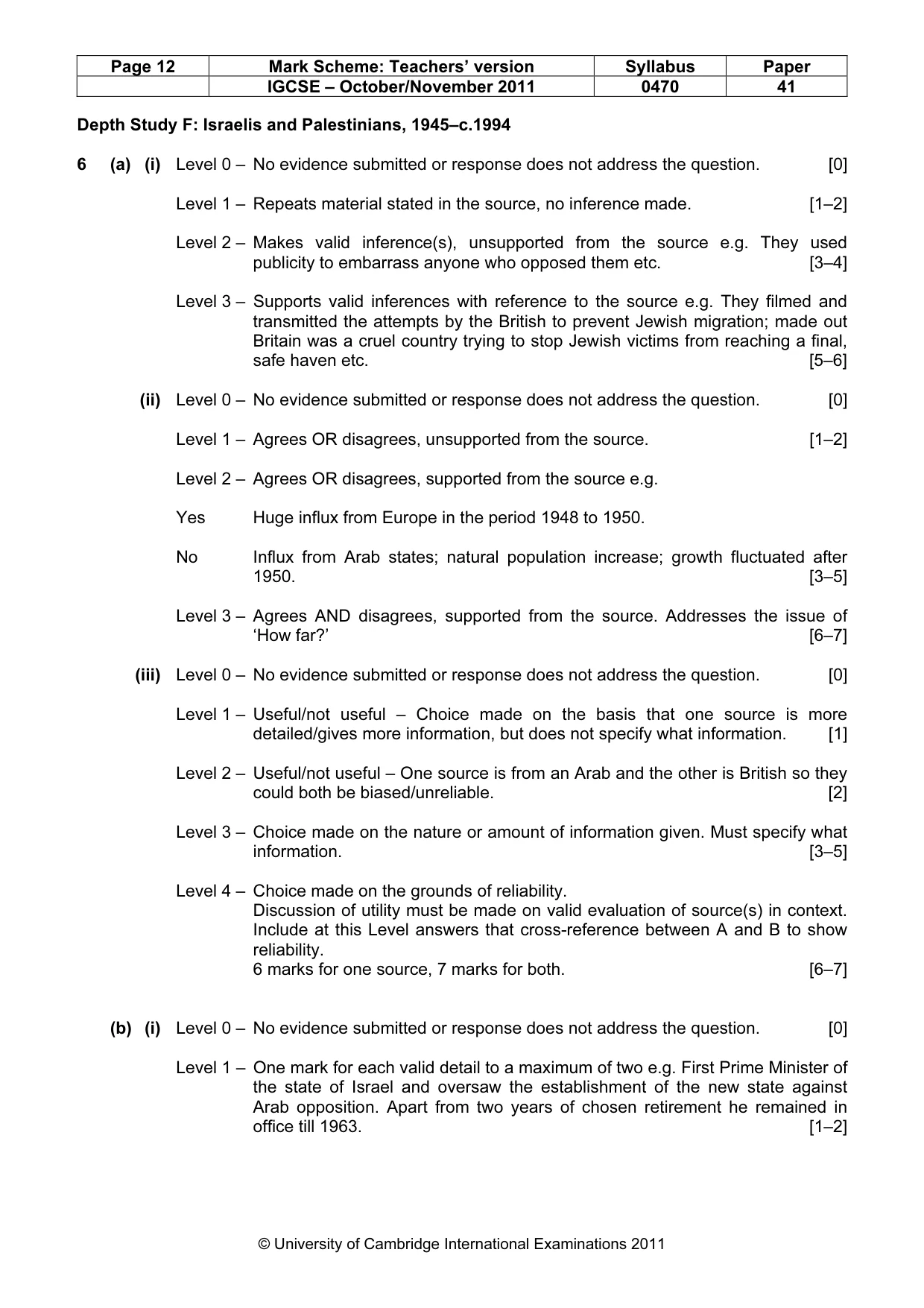
Page 12 Mark Scheme: Teachers’ version Syllabus Paper IGCSE – October/November 2011 0470 41 © University of Cambridge International Examinations 2011 Depth Study F: Israelis and Palestinians, 1945–c.1994 6 (a) (i) Level 0 – No evidence submitted or response does not address the question. [0] Level 1 – Repeats material stated in the source, no inference made. [1–2] Level 2 – Makes valid inference(s), unsupported from the source e.g. They used publicity to embarrass anyone who opposed them etc. [3–4] Level 3 – Supports valid inferences with reference to the source e.g. They filmed and transmitted the attempts by the British to prevent Jewish migration; made out Britain was a cruel country trying to stop Jewish victims from reaching a final, safe haven etc. [5–6] (ii) Level 0 – No evidence submitted or response does not address the question. [0] Level 1 – Agrees OR disagrees, unsupported from the source. [1–2] Level 2 – Agrees OR disagrees, supported from the source e.g. Yes Huge influx from Europe in the period 1948 to 1950. No Influx from Arab states; natural population increase; growth fluctuated after 1950. [3–5] Level 3 – Agrees AND disagrees, supported from the source. Addresses the issue of ‘How far?’ [6–7] (iii) Level 0 – No evidence submitted or response does not address the question. [0] Level 1 – Useful/not useful – Choice made on the basis that one source is more detailed/gives more information, but does not specify what information. [1] Level 2 – Useful/not useful – One source is from an Arab and the other is British so they could both be biased/unreliable. [2] Level 3 – Choice made on the nature or amount of information given. Must specify what information. [3–5] Level 4 – Choice made on the grounds of reliability. Discussion of utility must be made on valid evaluation of source(s) in context. Include at this Level answers that cross-reference between A and B to show reliability. 6 marks for one source, 7 marks for both. [6–7] (b) (i) Level 0 – No evidence submitted or response does not address the question. [0] Level 1 – One mark for each valid detail to a maximum of two e.g. First Prime Minister of the state of Israel and oversaw the establishment of the new state against Arab opposition. Apart from two years of chosen retirement he remained in office till 1963. [1–2]
Mark scheme, page 13
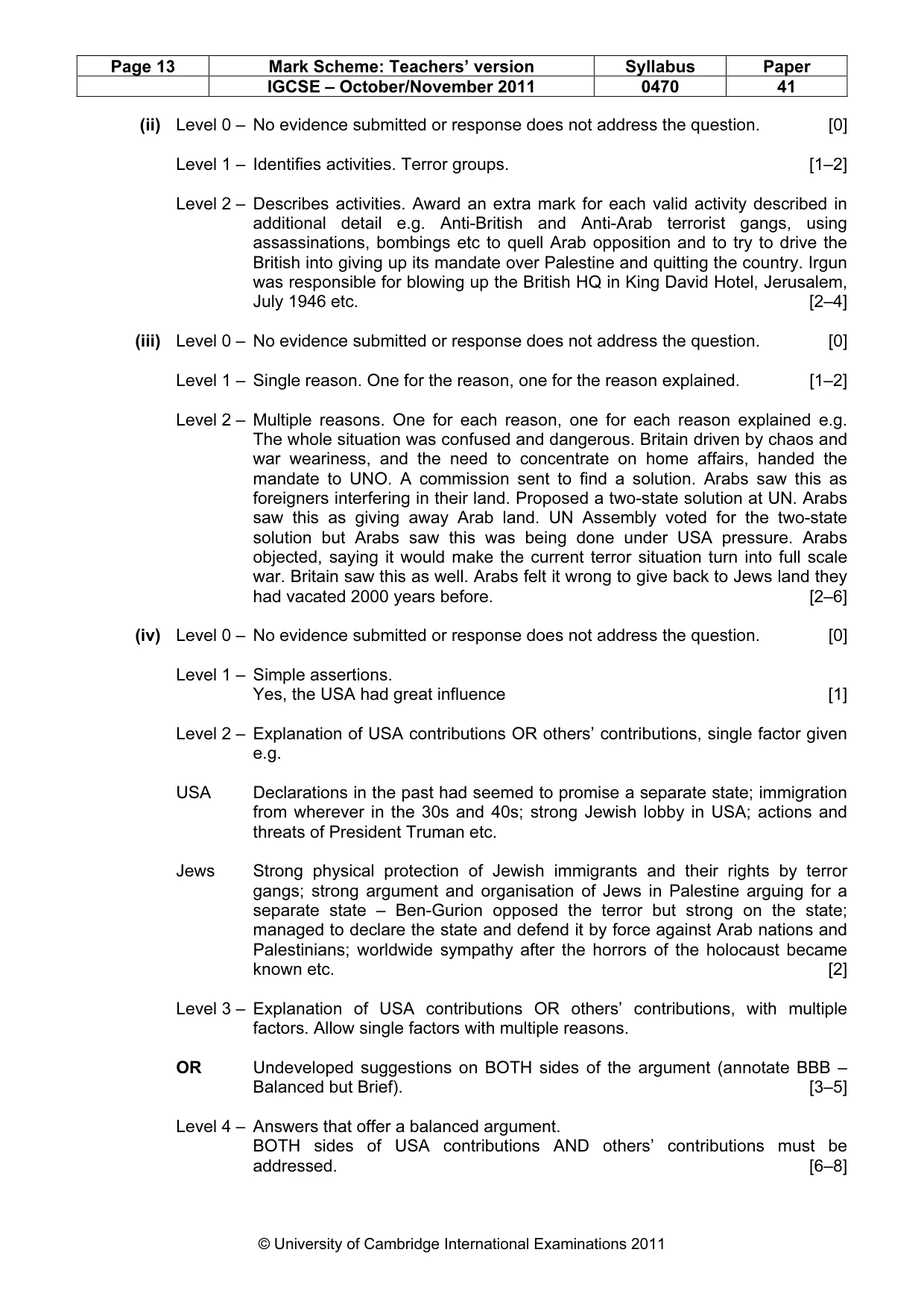
Page 13 Mark Scheme: Teachers’ version Syllabus Paper IGCSE – October/November 2011 0470 41 © University of Cambridge International Examinations 2011 (ii) Level 0 – No evidence submitted or response does not address the question. [0] Level 1 – Identifies activities. Terror groups. [1–2] Level 2 – Describes activities. Award an extra mark for each valid activity described in additional detail e.g. Anti-British and Anti-Arab terrorist gangs, using assassinations, bombings etc to quell Arab opposition and to try to drive the British into giving up its mandate over Palestine and quitting the country. Irgun was responsible for blowing up the British HQ in King David Hotel, Jerusalem, July 1946 etc. [2–4] (iii) Level 0 – No evidence submitted or response does not address the question. [0] Level 1 – Single reason. One for the reason, one for the reason explained. [1–2] Level 2 – Multiple reasons. One for each reason, one for each reason explained e.g. The whole situation was confused and dangerous. Britain driven by chaos and war weariness, and the need to concentrate on home affairs, handed the mandate to UNO. A commission sent to find a solution. Arabs saw this as foreigners interfering in their land. Proposed a two-state solution at UN. Arabs saw this as giving away Arab land. UN Assembly voted for the two-state solution but Arabs saw this was being done under USA pressure. Arabs objected, saying it would make the current terror situation turn into full scale war. Britain saw this as well. Arabs felt it wrong to give back to Jews land they had vacated 2000 years before. [2–6] (iv) Level 0 – No evidence submitted or response does not address the question. [0] Level 1 – Simple assertions. Yes, the USA had great influence [1] Level 2 – Explanation of USA contributions OR others’ contributions, single factor given e.g. USA Declarations in the past had seemed to promise a separate state; immigration from wherever in the 30s and 40s; strong Jewish lobby in USA; actions and threats of President Truman etc. Jews Strong physical protection of Jewish immigrants and their rights by terror gangs; strong argument and organisation of Jews in Palestine arguing for a separate state – Ben-Gurion opposed the terror but strong on the state; managed to declare the state and defend it by force against Arab nations and Palestinians; worldwide sympathy after the horrors of the holocaust became known etc. [2] Level 3 – Explanation of USA contributions OR others’ contributions, with multiple factors. Allow single factors with multiple reasons. OR Undeveloped suggestions on BOTH sides of the argument (annotate BBB – Balanced but Brief). [3–5] Level 4 – Answers that offer a balanced argument. BOTH sides of USA contributions AND others’ contributions must be addressed. [6–8]
Mark scheme, page 14
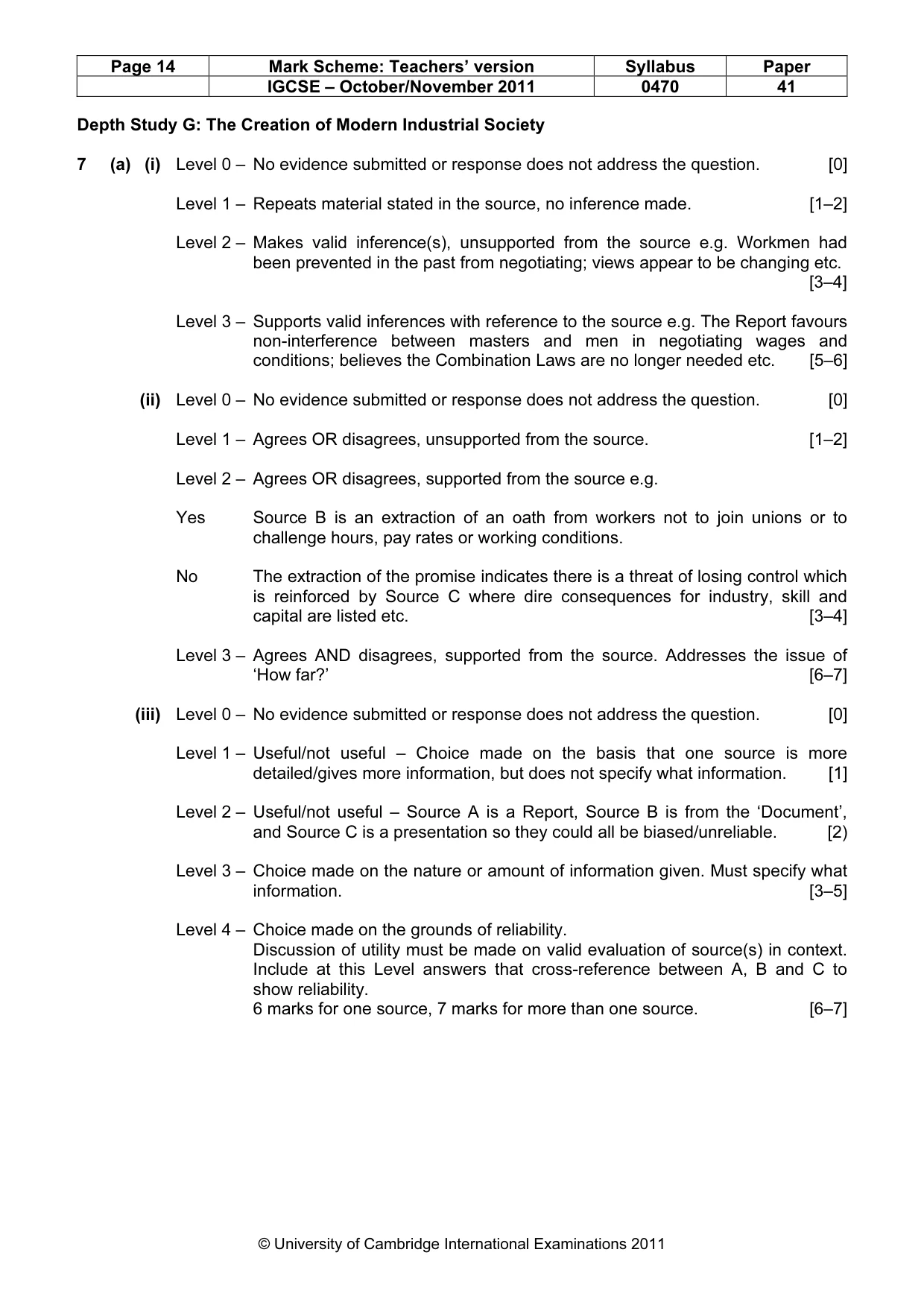
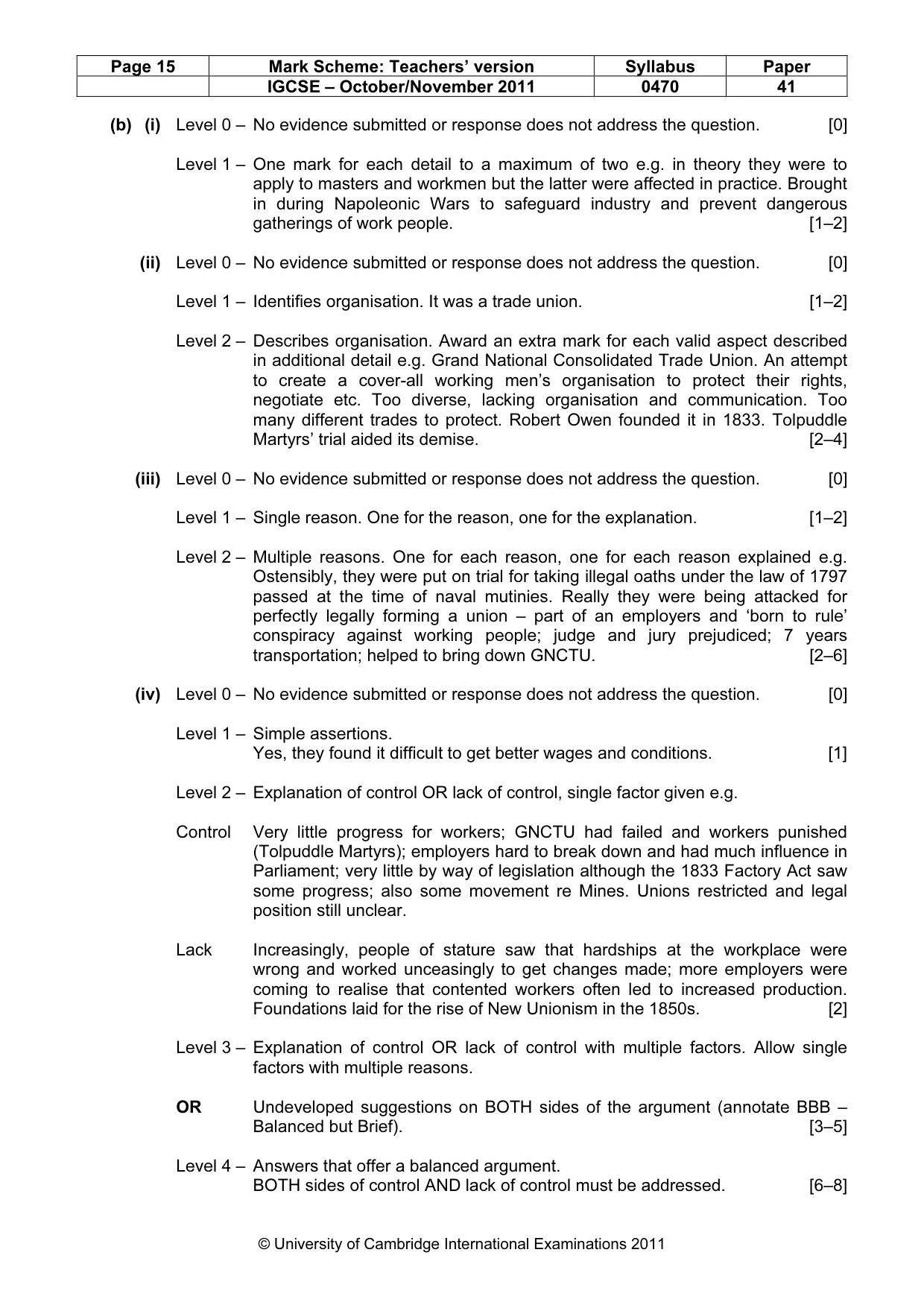
Page 14 Mark Scheme: Teachers’ version Syllabus Paper IGCSE – October/November 2011 0470 41 © University of Cambridge International Examinations 2011 Depth Study G: The Creation of Modern Industrial Society 7 (a) (i) Level 0 – No evidence submitted or response does not address the question. [0] Level 1 – Repeats material stated in the source, no inference made. [1–2] Level 2 – Makes valid inference(s), unsupported from the source e.g. Workmen had been prevented in the past from negotiating; views appear to be changing etc. [3–4] Level 3 – Supports valid inferences with reference to the source e.g. The Report favours non-interference between masters and men in negotiating wages and conditions; believes the Combination Laws are no longer needed etc. [5–6] (ii) Level 0 – No evidence submitted or response does not address the question. [0] Level 1 – Agrees OR disagrees, unsupported from the source. [1–2] Level 2 – Agrees OR disagrees, supported from the source e.g. Yes Source B is an extraction of an oath from workers not to join unions or to challenge hours, pay rates or working conditions. No The extraction of the promise indicates there is a threat of losing control which is reinforced by Source C where dire consequences for industry, skill and capital are listed etc. [3–4] Level 3 – Agrees AND disagrees, supported from the source. Addresses the issue of ‘How far?’ [6–7] (iii) Level 0 – No evidence submitted or response does not address the question. [0] Level 1 – Useful/not useful – Choice made on the basis that one source is more detailed/gives more information, but does not specify what information. [1] Level 2 – Useful/not useful – Source A is a Report, Source B is from the ‘Document’, and Source C is a presentation so they could all be biased/unreliable. [2) Level 3 – Choice made on the nature or amount of information given. Must specify what information. [3–5] Level 4 – Choice made on the grounds of reliability. Discussion of utility must be made on valid evaluation of source(s) in context. Include at this Level answers that cross-reference between A, B and C to show reliability. 6 marks for one source, 7 marks for more than one source. [6–7]
Mark scheme, page 15
Page 15 Mark Scheme: Teachers’ version Syllabus Paper IGCSE – October/November 2011 0470 41 © University of Cambridge International Examinations 2011 (b) (i) Level 0 – No evidence submitted or response does not address the question. [0] Level 1 – One mark for each detail to a maximum of two e.g. in theory they were to apply to masters and workmen but the latter were affected in practice. Brought in during Napoleonic Wars to safeguard industry and prevent dangerous gatherings of work people. [1–2] (ii) Level 0 – No evidence submitted or response does not address the question. [0] Level 1 – Identifies organisation. It was a trade union. [1–2] Level 2 – Describes organisation. Award an extra mark for each valid aspect described in additional detail e.g. Grand National Consolidated Trade Union. An attempt to create a cover-all working men’s organisation to protect their rights, negotiate etc. Too diverse, lacking organisation and communication. Too many different trades to protect. Robert Owen founded it in 1833. Tolpuddle Martyrs’ trial aided its demise. [2–4] (iii) Level 0 – No evidence submitted or response does not address the question. [0] Level 1 – Single reason. One for the reason, one for the explanation. [1–2] Level 2 – Multiple reasons. One for each reason, one for each reason explained e.g. Ostensibly, they were put on trial for taking illegal oaths under the law of 1797 passed at the time of naval mutinies. Really they were being attacked for perfectly legally forming a union – part of an employers and ‘born to rule’ conspiracy against working people; judge and jury prejudiced; 7 years transportation; helped to bring down GNCTU. [2–6] (iv) Level 0 – No evidence submitted or response does not address the question. [0] Level 1 – Simple assertions. Yes, they found it difficult to get better wages and conditions. [1] Level 2 – Explanation of control OR lack of control, single factor given e.g. Control Very little progress for workers; GNCTU had failed and workers punished (Tolpuddle Martyrs); employers hard to break down and had much influence in Parliament; very little by way of legislation although the 1833 Factory Act saw some progress; also some movement re Mines. Unions restricted and legal position still unclear. Lack Increasingly, people of stature saw that hardships at the workplace were wrong and worked unceasingly to get changes made; more employers were coming to realise that contented workers often led to increased production. Foundations laid for the rise of New Unionism in the 1850s. [2] Level 3 – Explanation of control OR lack of control with multiple factors. Allow single factors with multiple reasons. OR Undeveloped suggestions on BOTH sides of the argument (annotate BBB – Balanced but Brief). [3–5] Level 4 – Answers that offer a balanced argument. BOTH sides of control AND lack of control must be addressed. [6–8]
Mark scheme, page 16
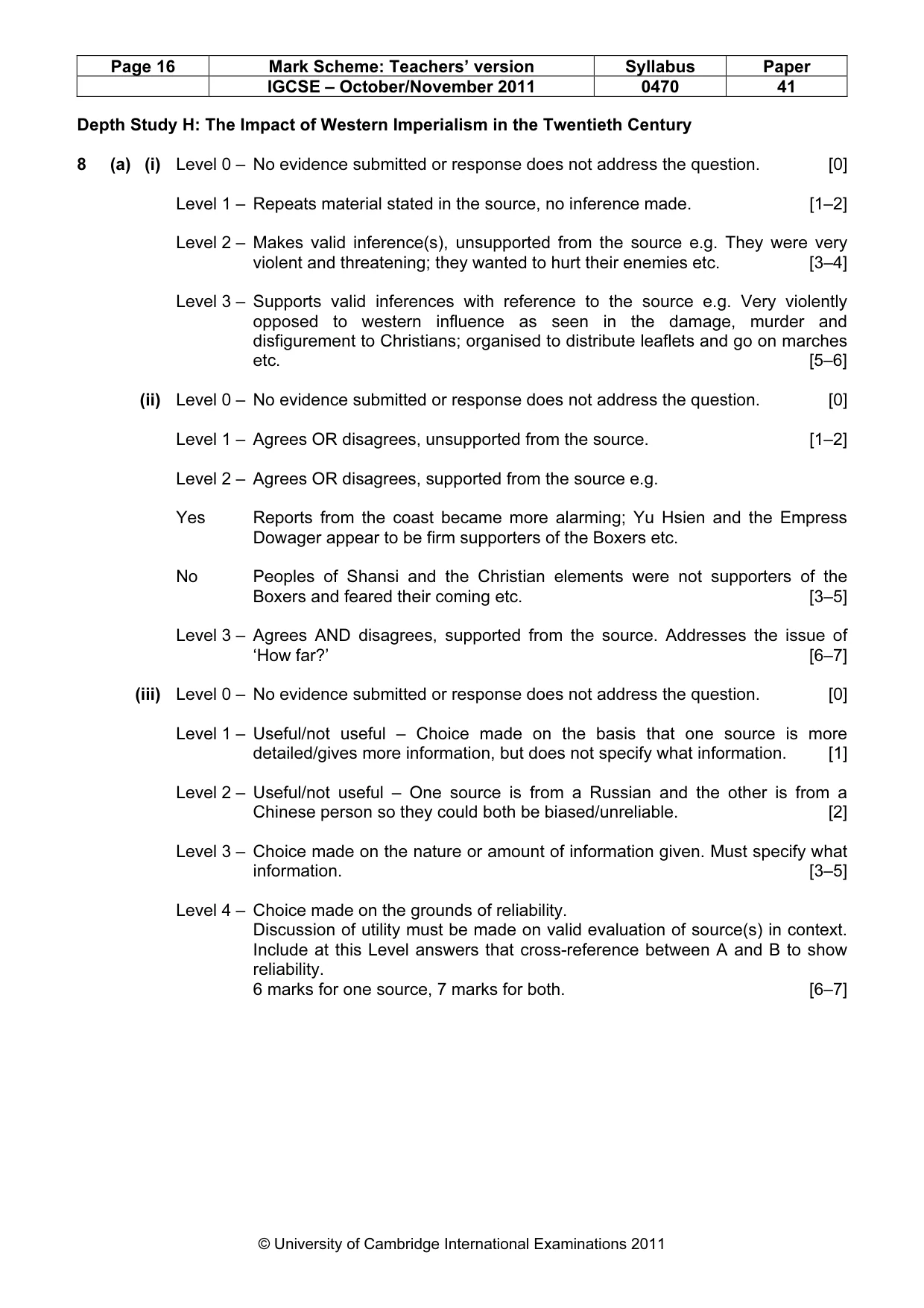
Page 16 Mark Scheme: Teachers’ version Syllabus Paper IGCSE – October/November 2011 0470 41 © University of Cambridge International Examinations 2011 Depth Study H: The Impact of Western Imperialism in the Twentieth Century 8 (a) (i) Level 0 – No evidence submitted or response does not address the question. [0] Level 1 – Repeats material stated in the source, no inference made. [1–2] Level 2 – Makes valid inference(s), unsupported from the source e.g. They were very violent and threatening; they wanted to hurt their enemies etc. [3–4] Level 3 – Supports valid inferences with reference to the source e.g. Very violently opposed to western influence as seen in the damage, murder and disfigurement to Christians; organised to distribute leaflets and go on marches etc. [5–6] (ii) Level 0 – No evidence submitted or response does not address the question. [0] Level 1 – Agrees OR disagrees, unsupported from the source. [1–2] Level 2 – Agrees OR disagrees, supported from the source e.g. Yes Reports from the coast became more alarming; Yu Hsien and the Empress Dowager appear to be firm supporters of the Boxers etc. No Peoples of Shansi and the Christian elements were not supporters of the Boxers and feared their coming etc. [3–5] Level 3 – Agrees AND disagrees, supported from the source. Addresses the issue of ‘How far?’ [6–7] (iii) Level 0 – No evidence submitted or response does not address the question. [0] Level 1 – Useful/not useful – Choice made on the basis that one source is more detailed/gives more information, but does not specify what information. [1] Level 2 – Useful/not useful – One source is from a Russian and the other is from a Chinese person so they could both be biased/unreliable. [2] Level 3 – Choice made on the nature or amount of information given. Must specify what information. [3–5] Level 4 – Choice made on the grounds of reliability. Discussion of utility must be made on valid evaluation of source(s) in context. Include at this Level answers that cross-reference between A and B to show reliability. 6 marks for one source, 7 marks for both. [6–7]
Mark scheme, page 17
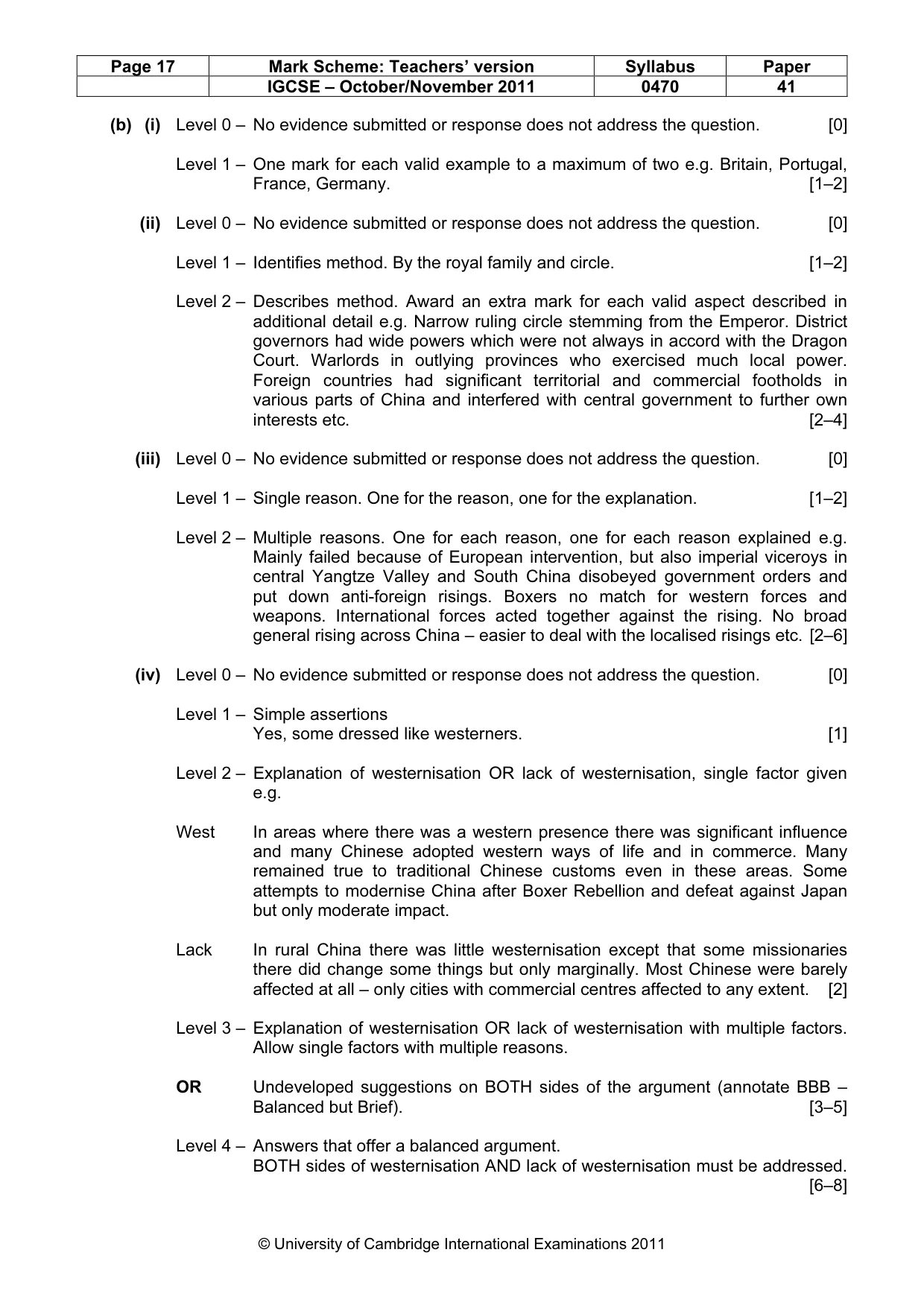
Page 17 Mark Scheme: Teachers’ version Syllabus Paper IGCSE – October/November 2011 0470 41 © University of Cambridge International Examinations 2011 (b) (i) Level 0 – No evidence submitted or response does not address the question. [0] Level 1 – One mark for each valid example to a maximum of two e.g. Britain, Portugal, France, Germany. [1–2] (ii) Level 0 – No evidence submitted or response does not address the question. [0] Level 1 – Identifies method. By the royal family and circle. [1–2] Level 2 – Describes method. Award an extra mark for each valid aspect described in additional detail e.g. Narrow ruling circle stemming from the Emperor. District governors had wide powers which were not always in accord with the Dragon Court. Warlords in outlying provinces who exercised much local power. Foreign countries had significant territorial and commercial footholds in various parts of China and interfered with central government to further own interests etc. [2–4] (iii) Level 0 – No evidence submitted or response does not address the question. [0] Level 1 – Single reason. One for the reason, one for the explanation. [1–2] Level 2 – Multiple reasons. One for each reason, one for each reason explained e.g. Mainly failed because of European intervention, but also imperial viceroys in central Yangtze Valley and South China disobeyed government orders and put down anti-foreign risings. Boxers no match for western forces and weapons. International forces acted together against the rising. No broad general rising across China – easier to deal with the localised risings etc. [2–6] (iv) Level 0 – No evidence submitted or response does not address the question. [0] Level 1 – Simple assertions Yes, some dressed like westerners. [1] Level 2 – Explanation of westernisation OR lack of westernisation, single factor given e.g. West In areas where there was a western presence there was significant influence and many Chinese adopted western ways of life and in commerce. Many remained true to traditional Chinese customs even in these areas. Some attempts to modernise China after Boxer Rebellion and defeat against Japan but only moderate impact. Lack In rural China there was little westernisation except that some missionaries there did change some things but only marginally. Most Chinese were barely affected at all – only cities with commercial centres affected to any extent. [2] Level 3 – Explanation of westernisation OR lack of westernisation with multiple factors. Allow single factors with multiple reasons. OR Undeveloped suggestions on BOTH sides of the argument (annotate BBB – Balanced but Brief). [3–5] Level 4 – Answers that offer a balanced argument. BOTH sides of westernisation AND lack of westernisation must be addressed. [6–8]
What you needed in this session
Cambridge’s own grade thresholds for 2011 Oct/Nov, Paper 4 · Variant 1. A higher threshold means an easier paper — the bar moves with how the cohort did.