Cambridge IGCSE History 0470 — 2011 May/June Paper 4 · Variant 3
0470/43/M/J/11 · 40 marks · ≈45 min
The question paper and its mark scheme, free to read here and free to download. This is Cambridge’s own paper, exactly as it was sat.
Question paper12 pages

Mark scheme17 pages
Answers below. Sit the paper first if you are practising.
Paper as text
Question paper, page 1
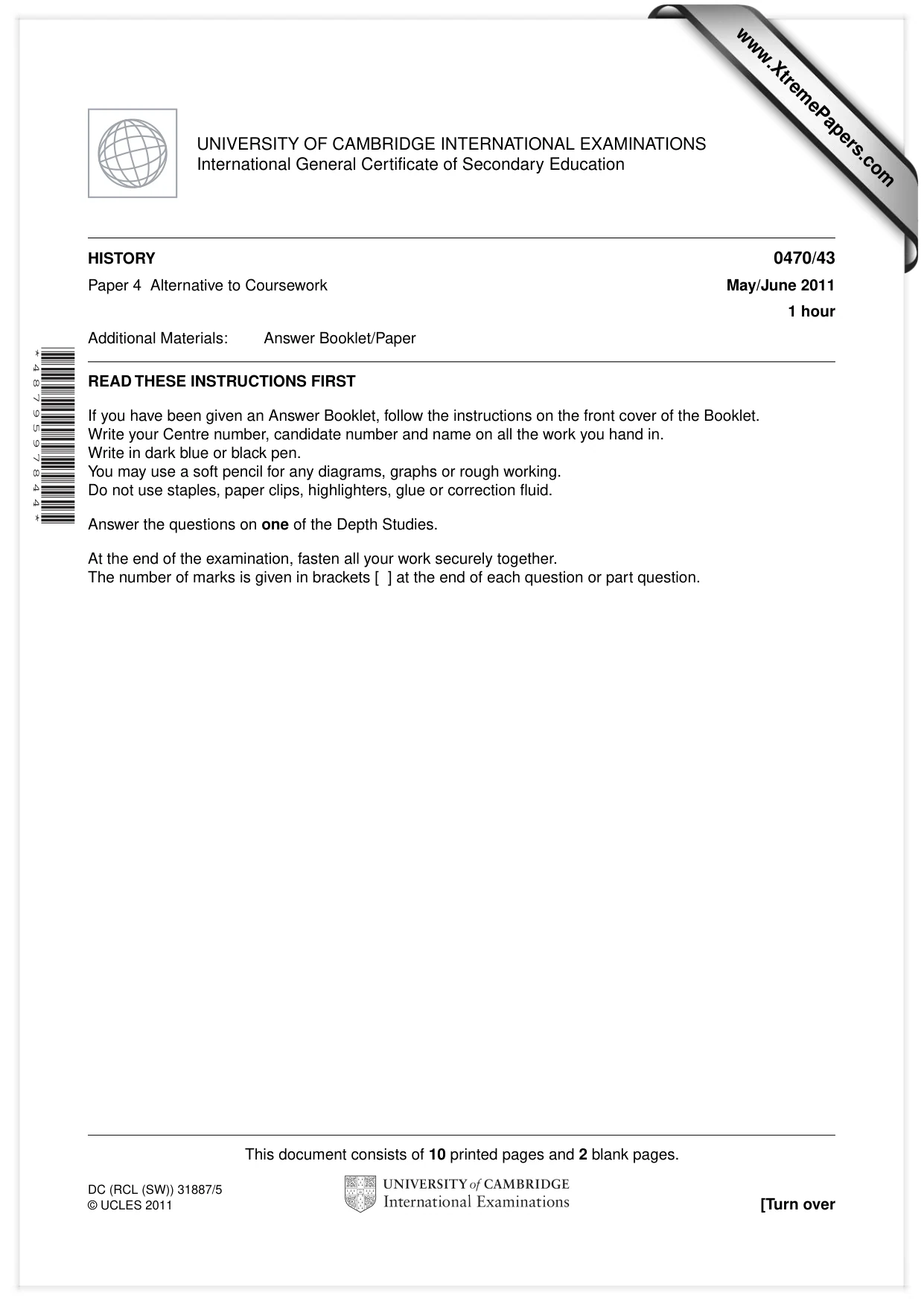
This document consists of 10 printed pages and 2 blank pages. DC (RCL (SW)) 31887/5 © UCLES 2011 [Turn over UNIVERSITY OF CAMBRIDGE INTERNATIONAL EXAMINATIONS International General Certificate of Secondary Education READ THESE INSTRUCTIONS FIRST If you have been given an Answer Booklet, follow the instructions on the front cover of the Booklet. Write your Centre number, candidate number and name on all the work you hand in. Write in dark blue or black pen. You may use a soft pencil for any diagrams, graphs or rough working. Do not use staples, paper clips, highlighters, glue or correction fluid. Answer the questions on one of the Depth Studies. At the end of the examination, fasten all your work securely together. The number of marks is given in brackets [ ] at the end of each question or part question. HISTORY 0470/43 Paper 4 Alternative to Coursework May/June 2011 1 hour Additional Materials: Answer Booklet/Paper * 4 8 7 9 5 9 7 8 4 4 * www.XtremePapers.com
Question paper, page 2
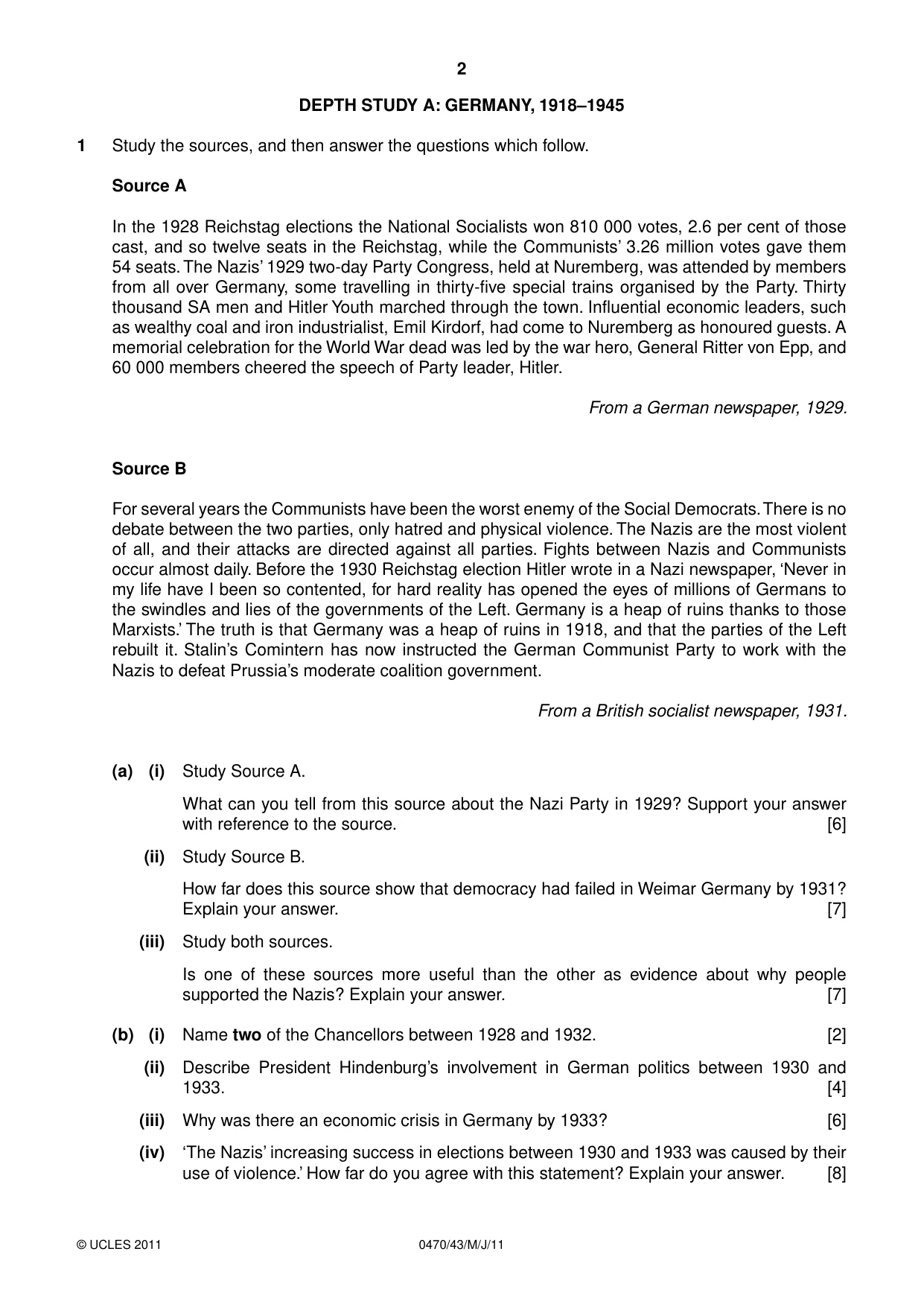
2 0470/43/M/J/11 © UCLES 2011 DEPTH STUDY A: GERMANY, 1918–1945 1 Study the sources, and then answer the questions which follow. Source A In the 1928 Reichstag elections the National Socialists won 810 000 votes, 2.6 per cent of those cast, and so twelve seats in the Reichstag, while the Communists’ 3.26 million votes gave them 54 seats. The Nazis’ 1929 two-day Party Congress, held at Nuremberg, was attended by members from all over Germany, some travelling in thirty-five special trains organised by the Party. Thirty thousand SA men and Hitler Youth marched through the town. Influential economic leaders, such as wealthy coal and iron industrialist, Emil Kirdorf, had come to Nuremberg as honoured guests. A memorial celebration for the World War dead was led by the war hero, General Ritter von Epp, and 60 000 members cheered the speech of Party leader, Hitler. From a German newspaper, 1929. Source B For several years the Communists have been the worst enemy of the Social Democrats. There is no debate between the two parties, only hatred and physical violence. The Nazis are the most violent of all, and their attacks are directed against all parties. Fights between Nazis and Communists occur almost daily. Before the 1930 Reichstag election Hitler wrote in a Nazi newspaper, ‘Never in my life have I been so contented, for hard reality has opened the eyes of millions of Germans to the swindles and lies of the governments of the Left. Germany is a heap of ruins thanks to those Marxists.’ The truth is that Germany was a heap of ruins in 1918, and that the parties of the Left rebuilt it. Stalin’s Comintern has now instructed the German Communist Party to work with the Nazis to defeat Prussia’s moderate coalition government. From a British socialist newspaper, 1931. (a) (i) Study Source A. What can you tell from this source about the Nazi Party in 1929? Support your answer with reference to the source. [6] (ii) Study Source B. How far does this source show that democracy had failed in Weimar Germany by 1931? Explain your answer. [7] (iii) Study both sources. Is one of these sources more useful than the other as evidence about why people supported the Nazis? Explain your answer. [7] (b) (i) Name two of the Chancellors between 1928 and 1932. [2] (ii) Describe President Hindenburg’s involvement in German politics between 1930 and 1933. [4] (iii) Why was there an economic crisis in Germany by 1933? [6] (iv) ‘The Nazis’ increasing success in elections between 1930 and 1933 was caused by their use of violence.’ How far do you agree with this statement? Explain your answer. [8]
Question paper, page 3
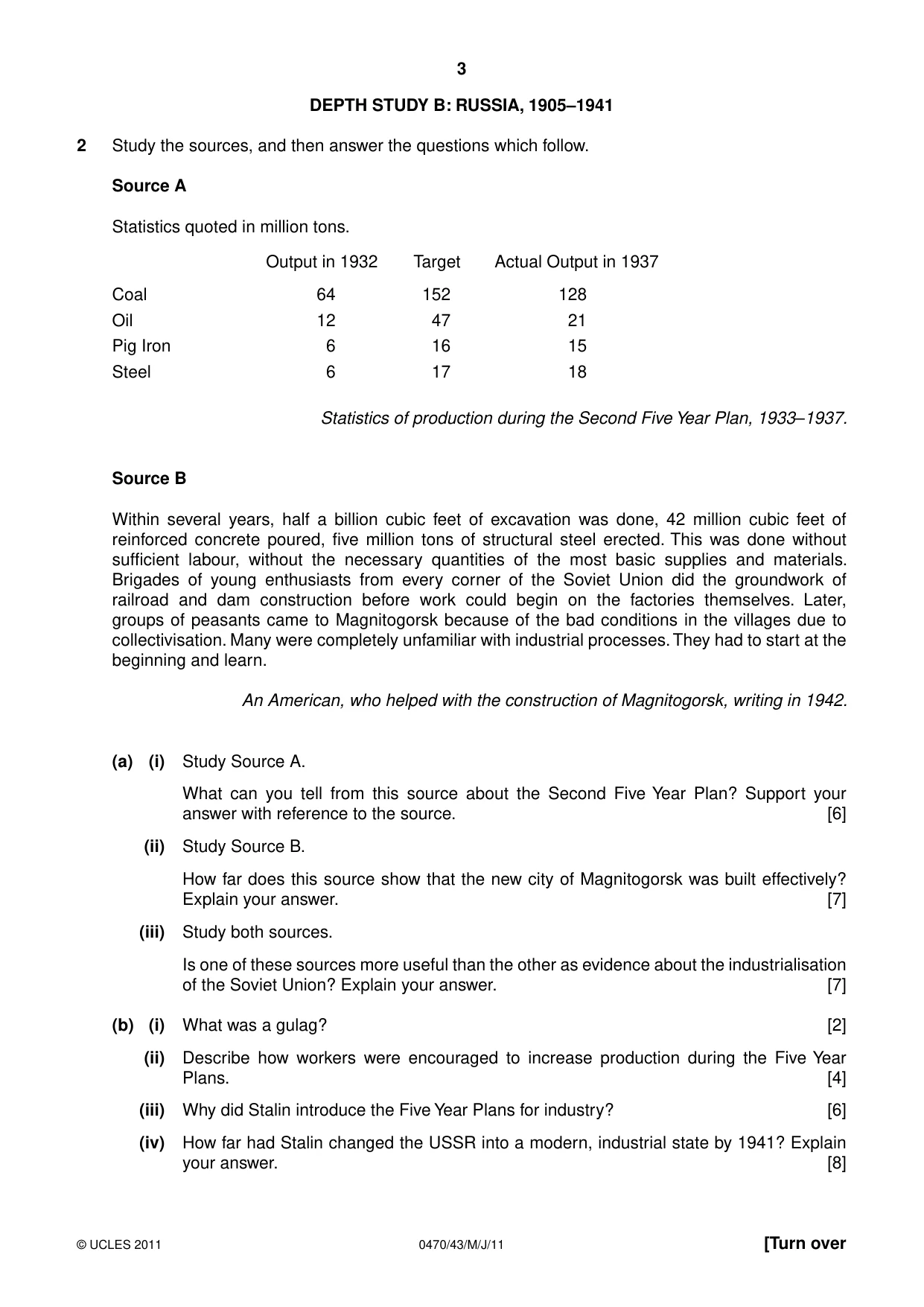
3 0470/43/M/J/11 © UCLES 2011 [Turn over DEPTH STUDY B: RUSSIA, 1905–1941 2 Study the sources, and then answer the questions which follow. Source A Statistics quoted in million tons. Output in 1932 Target Actual Output in 1937 Coal 64 152 128 Oil 12 47 21 Pig Iron 6 16 15 Steel 6 17 18 Statistics of production during the Second Five Year Plan, 1933–1937. Source B Within several years, half a billion cubic feet of excavation was done, 42 million cubic feet of reinforced concrete poured, five million tons of structural steel erected. This was done without sufficient labour, without the necessary quantities of the most basic supplies and materials. Brigades of young enthusiasts from every corner of the Soviet Union did the groundwork of railroad and dam construction before work could begin on the factories themselves. Later, groups of peasants came to Magnitogorsk because of the bad conditions in the villages due to collectivisation. Many were completely unfamiliar with industrial processes. They had to start at the beginning and learn. An American, who helped with the construction of Magnitogorsk, writing in 1942. (a) (i) Study Source A. What can you tell from this source about the Second Five Year Plan? Support your answer with reference to the source. [6] (ii) Study Source B. How far does this source show that the new city of Magnitogorsk was built effectively? Explain your answer. [7] (iii) Study both sources. Is one of these sources more useful than the other as evidence about the industrialisation of the Soviet Union? Explain your answer. [7] (b) (i) What was a gulag? [2] (ii) Describe how workers were encouraged to increase production during the Five Year Plans. [4] (iii) Why did Stalin introduce the Five Year Plans for industry? [6] (iv) How far had Stalin changed the USSR into a modern, industrial state by 1941? Explain your answer. [8]
Question paper, page 4
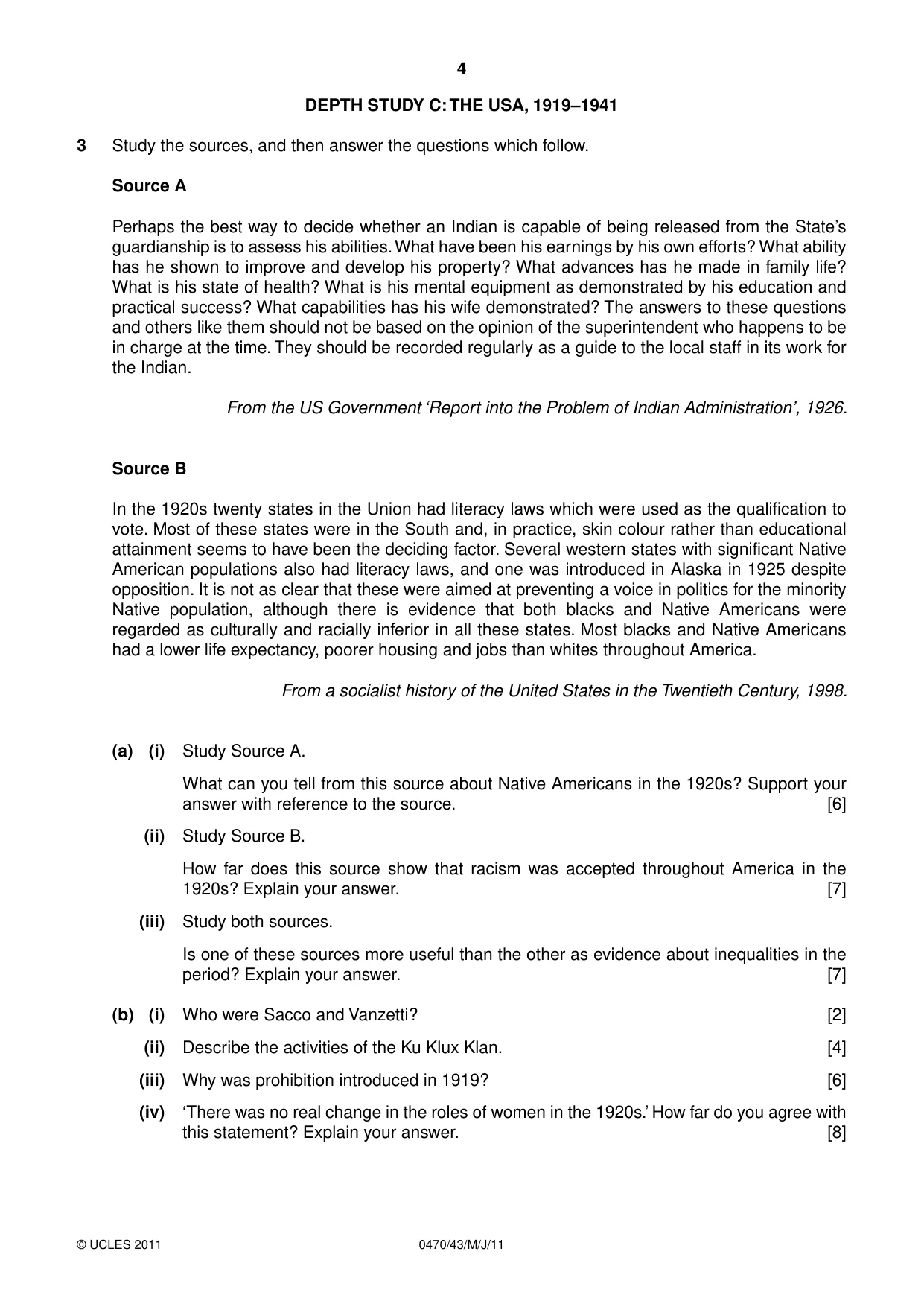
4 0470/43/M/J/11 © UCLES 2011 DEPTH STUDY C: THE USA, 1919–1941 3 Study the sources, and then answer the questions which follow. Source A Perhaps the best way to decide whether an Indian is capable of being released from the State’s guardianship is to assess his abilities. What have been his earnings by his own efforts? What ability has he shown to improve and develop his property? What advances has he made in family life? What is his state of health? What is his mental equipment as demonstrated by his education and practical success? What capabilities has his wife demonstrated? The answers to these questions and others like them should not be based on the opinion of the superintendent who happens to be in charge at the time. They should be recorded regularly as a guide to the local staff in its work for the Indian. From the US Government ‘Report into the Problem of Indian Administration’, 1926. Source B In the 1920s twenty states in the Union had literacy laws which were used as the qualification to vote. Most of these states were in the South and, in practice, skin colour rather than educational attainment seems to have been the deciding factor. Several western states with significant Native American populations also had literacy laws, and one was introduced in Alaska in 1925 despite opposition. It is not as clear that these were aimed at preventing a voice in politics for the minority Native population, although there is evidence that both blacks and Native Americans were regarded as culturally and racially inferior in all these states. Most blacks and Native Americans had a lower life expectancy, poorer housing and jobs than whites throughout America. From a socialist history of the United States in the Twentieth Century, 1998. (a) (i) Study Source A. What can you tell from this source about Native Americans in the 1920s? Support your answer with reference to the source. [6] (ii) Study Source B. How far does this source show that racism was accepted throughout America in the 1920s? Explain your answer. [7] (iii) Study both sources. Is one of these sources more useful than the other as evidence about inequalities in the period? Explain your answer. [7] (b) (i) Who were Sacco and Vanzetti? [2] (ii) Describe the activities of the Ku Klux Klan. [4] (iii) Why was prohibition introduced in 1919? [6] (iv) ‘There was no real change in the roles of women in the 1920s.’ How far do you agree with this statement? Explain your answer. [8]
Question paper, page 5
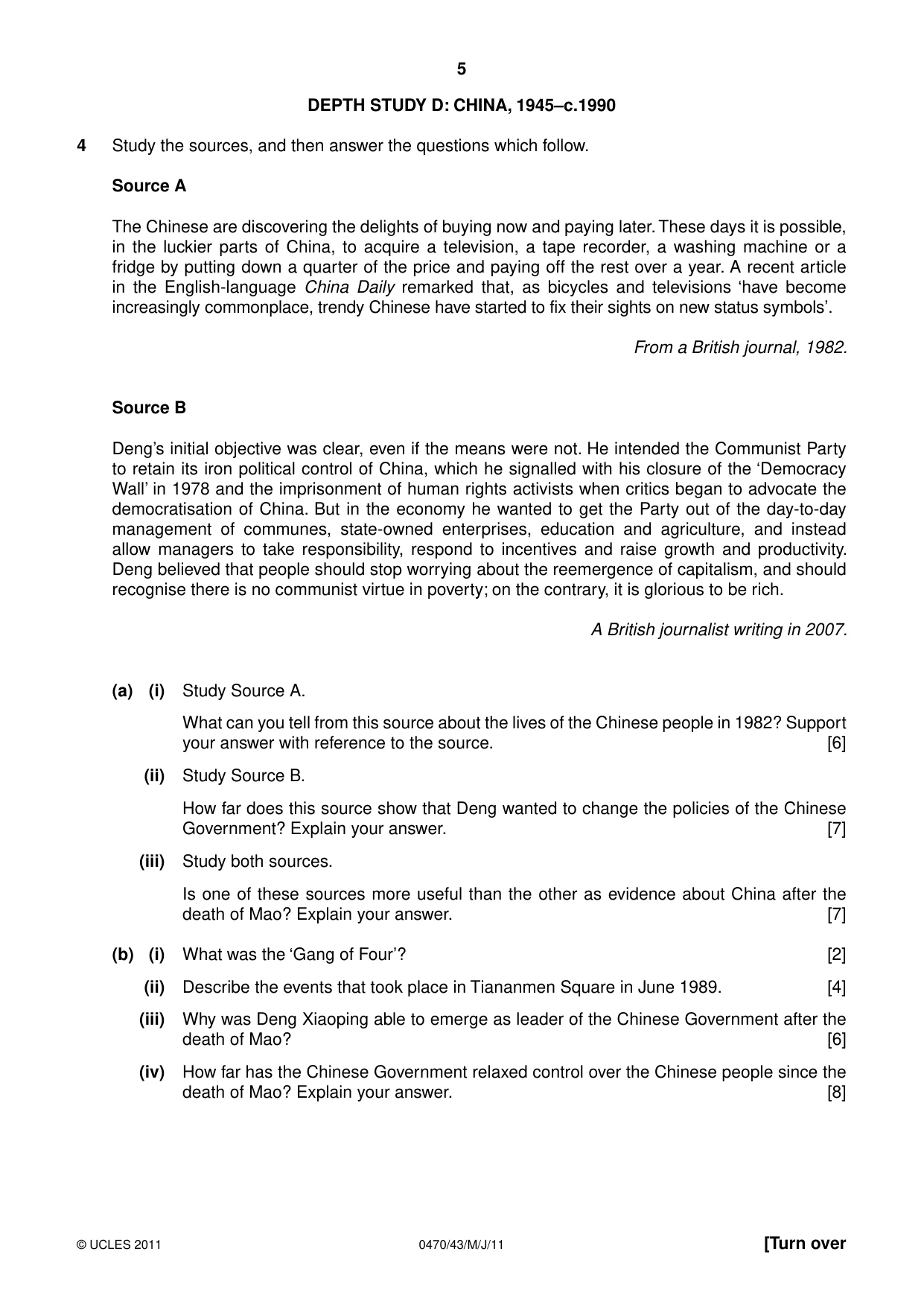
5 0470/43/M/J/11 © UCLES 2011 [Turn over DEPTH STUDY D: CHINA, 1945–c.1990 4 Study the sources, and then answer the questions which follow. Source A The Chinese are discovering the delights of buying now and paying later. These days it is possible, in the luckier parts of China, to acquire a television, a tape recorder, a washing machine or a fridge by putting down a quarter of the price and paying off the rest over a year. A recent article in the English-language China Daily remarked that, as bicycles and televisions ‘have become increasingly commonplace, trendy Chinese have started to fix their sights on new status symbols’. From a British journal, 1982. Source B Deng’s initial objective was clear, even if the means were not. He intended the Communist Party to retain its iron political control of China, which he signalled with his closure of the ‘Democracy Wall’ in 1978 and the imprisonment of human rights activists when critics began to advocate the democratisation of China. But in the economy he wanted to get the Party out of the day-to-day management of communes, state-owned enterprises, education and agriculture, and instead allow managers to take responsibility, respond to incentives and raise growth and productivity. Deng believed that people should stop worrying about the re emergence of capitalism, and should recognise there is no communist virtue in poverty; on the contrary, it is glorious to be rich. A British journalist writing in 2007. (a) (i) Study Source A. What can you tell from this source about the lives of the Chinese people in 1982? Support your answer with reference to the source. [6] (ii) Study Source B. How far does this source show that Deng wanted to change the policies of the Chinese Government? Explain your answer. [7] (iii) Study both sources. Is one of these sources more useful than the other as evidence about China after the death of Mao? Explain your answer. [7] (b) (i) What was the ‘Gang of Four’? [2] (ii) Describe the events that took place in Tiananmen Square in June 1989. [4] (iii) Why was Deng Xiaoping able to emerge as leader of the Chinese Government after the death of Mao? [6] (iv) How far has the Chinese Government relaxed control over the Chinese people since the death of Mao? Explain your answer. [8]
Question paper, page 6
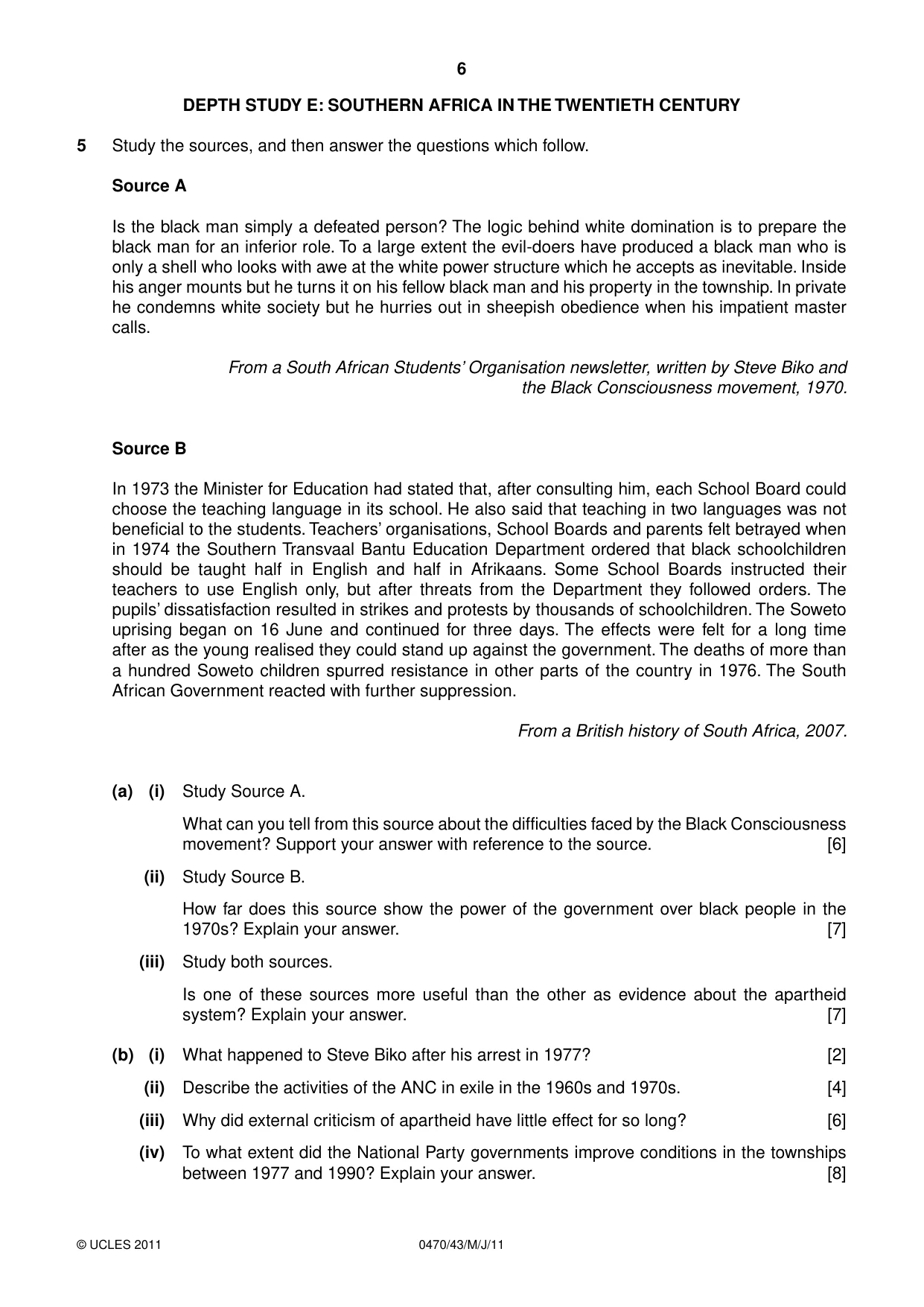
6 0470/43/M/J/11 © UCLES 2011 DEPTH STUDY E: SOUTHERN AFRICA IN THE TWENTIETH CENTURY 5 Study the sources, and then answer the questions which follow. Source A Is the black man simply a defeated person? The logic behind white domination is to prepare the black man for an inferior role. To a large extent the evil-doers have produced a black man who is only a shell who looks with awe at the white power structure which he accepts as inevitable. Inside his anger mounts but he turns it on his fellow black man and his property in the township. In private he condemns white society but he hurries out in sheepish obedience when his impatient master calls. From a South African Students’ Organisation newsletter, written by Steve Biko and the Black Consciousness movement, 1970. Source B In 1973 the Minister for Education had stated that, after consulting him, each School Board could choose the teaching language in its school. He also said that teaching in two languages was not beneficial to the students. Teachers’ organisations, School Boards and parents felt betrayed when in 1974 the Southern Transvaal Bantu Education Department ordered that black schoolchildren should be taught half in English and half in Afrikaans. Some School Boards instructed their teachers to use English only, but after threats from the Department they followed orders. The pupils’ dissatisfaction resulted in strikes and protests by thousands of schoolchildren. The Soweto uprising began on 16 June and continued for three days. The effects were felt for a long time after as the young realised they could stand up against the government. The deaths of more than a hundred Soweto children spurred resistance in other parts of the country in 1976. The South African Government reacted with further suppression. From a British history of South Africa, 2007. (a) (i) Study Source A. What can you tell from this source about the difficulties faced by the Black Consciousness movement? Support your answer with reference to the source. [6] (ii) Study Source B. How far does this source show the power of the government over black people in the 1970s? Explain your answer. [7] (iii) Study both sources. Is one of these sources more useful than the other as evidence about the apartheid system? Explain your answer. [7] (b) (i) What happened to Steve Biko after his arrest in 1977? [2] (ii) Describe the activities of the ANC in exile in the 1960s and 1970s. [4] (iii) Why did external criticism of apartheid have little effect for so long? [6] (iv) To what extent did the National Party governments improve conditions in the townships between 1977 and 1990? Explain your answer. [8]
Question paper, page 7
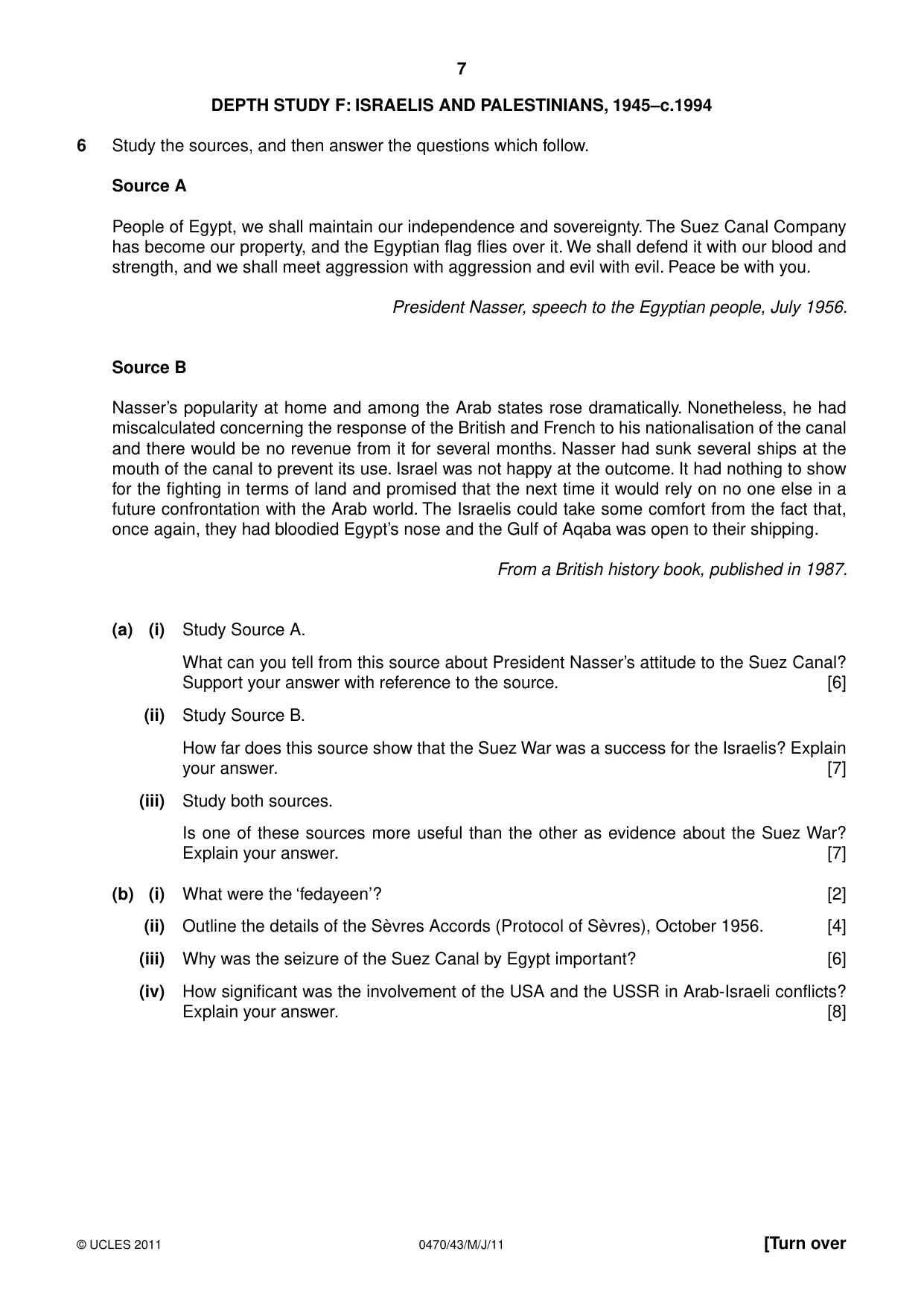
7 0470/43/M/J/11 © UCLES 2011 [Turn over DEPTH STUDY F: ISRAELIS AND PALESTINIANS, 1945–c.1994 6 Study the sources, and then answer the questions which follow. Source A People of Egypt, we shall maintain our independence and sovereignty. The Suez Canal Company has become our property, and the Egyptian flag flies over it. We shall defend it with our blood and strength, and we shall meet aggression with aggression and evil with evil. Peace be with you. President Nasser, speech to the Egyptian people, July 1956. Source B Nasser’s popularity at home and among the Arab states rose dramatically. Nonetheless, he had miscalculated concerning the response of the British and French to his nationalisation of the canal and there would be no revenue from it for several months. Nasser had sunk several ships at the mouth of the canal to prevent its use. Israel was not happy at the outcome. It had nothing to show for the fighting in terms of land and promised that the next time it would rely on no one else in a future confrontation with the Arab world. The Israelis could take some comfort from the fact that, once again, they had bloodied Egypt’s nose and the Gulf of Aqaba was open to their shipping. From a British history book, published in 1987. (a) (i) Study Source A. What can you tell from this source about President Nasser’s attitude to the Suez Canal? Support your answer with reference to the source. [6] (ii) Study Source B. How far does this source show that the Suez War was a success for the Israelis? Explain your answer. [7] (iii) Study both sources. Is one of these sources more useful than the other as evidence about the Suez War? Explain your answer. [7] (b) (i) What were the ‘fedayeen’? [2] (ii) Outline the details of the Sèvres Accords (Protocol of Sèvres), October 1956. [4] (iii) Why was the seizure of the Suez Canal by Egypt important? [6] (iv) How significant was the involvement of the USA and the USSR in Arab-Israeli conflicts? Explain your answer. [8]
Question paper, page 8
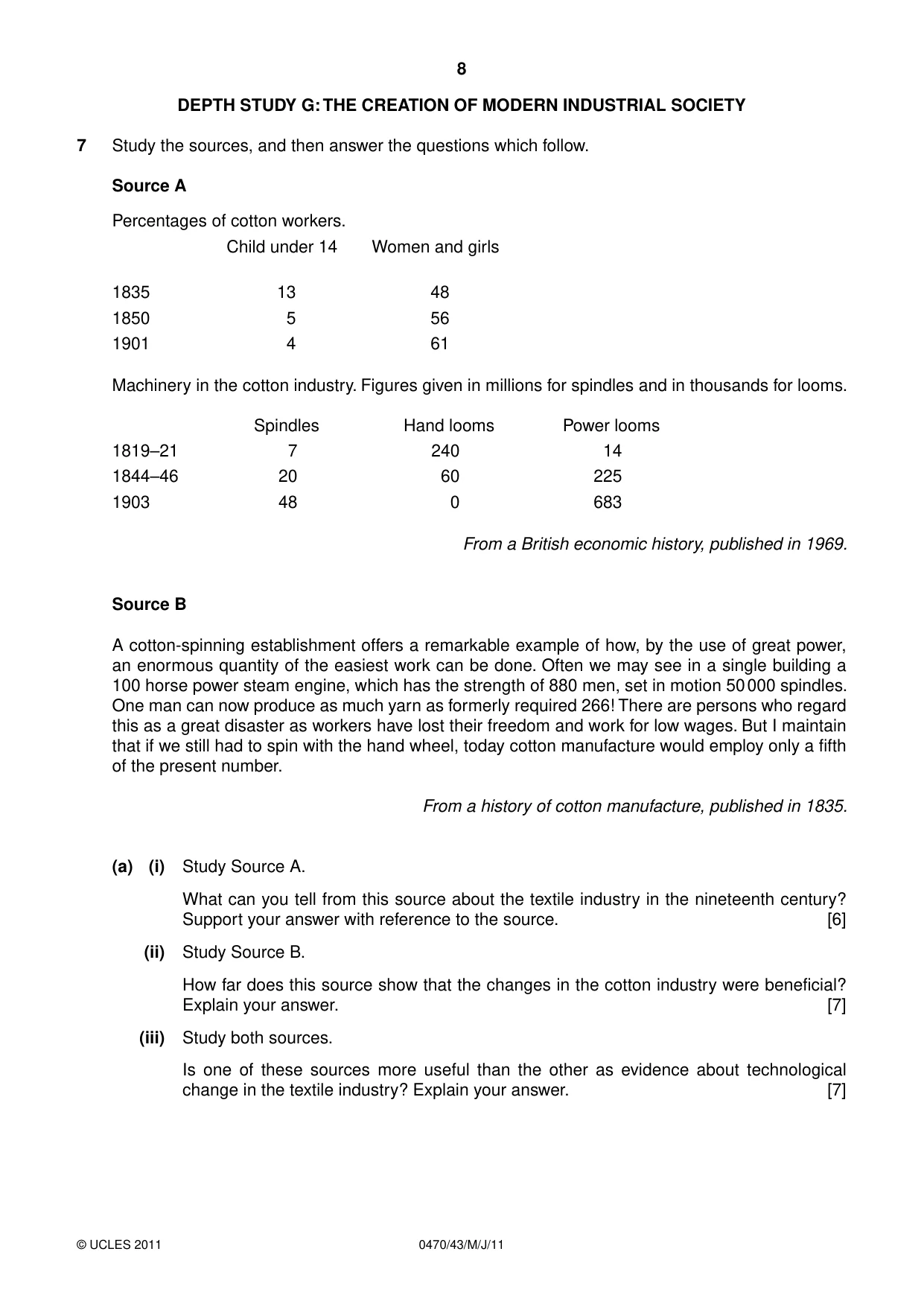
8 0470/43/M/J/11 © UCLES 2011 DEPTH STUDY G: THE CREATION OF MODERN INDUSTRIAL SOCIETY 7 Study the sources, and then answer the questions which follow. Source A Percentages of cotton workers. Child under 14 Women and girls 1835 13 48 1850 5 56 1901 4 61 Machinery in the cotton industry. Figures given in millions for spindles and in thousands for looms. Spindles Hand looms Power looms 1819–21 7 240 14 1844–46 20 60 225 1903 48 0 683 From a British economic history, published in 1969. Source B A cotton-spinning establishment offers a remarkable example of how, by the use of great power, an enormous quantity of the easiest work can be done. Often we may see in a single building a 100 horse power steam engine, which has the strength of 880 men, set in motion 50 000 spindles. One man can now produce as much yarn as formerly required 266! There are persons who regard this as a great disaster as workers have lost their freedom and work for low wages. But I maintain that if we still had to spin with the hand wheel, today cotton manufacture would employ only a fifth of the present number. From a history of cotton manufacture, published in 1835. (a) (i) Study Source A. What can you tell from this source about the textile industry in the nineteenth century? Support your answer with reference to the source. [6] (ii) Study Source B. How far does this source show that the changes in the cotton industry were beneficial? Explain your answer. [7] (iii) Study both sources. Is one of these sources more useful than the other as evidence about technological change in the textile industry? Explain your answer. [7]
Question paper, page 9
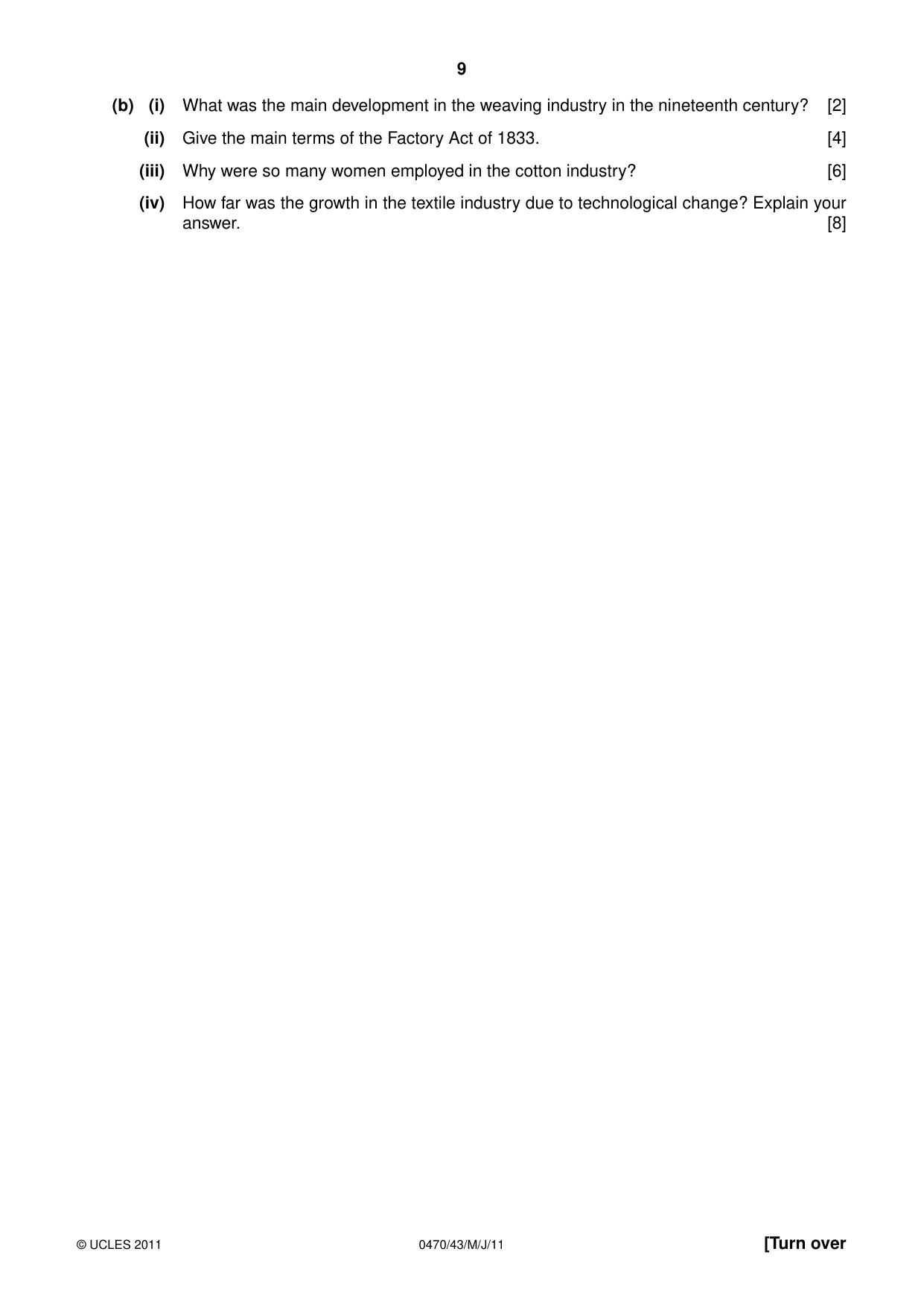
9 0470/43/M/J/11 © UCLES 2011 [Turn over (b) (i) What was the main development in the weaving industry in the nineteenth century? [2] (ii) Give the main terms of the Factory Act of 1833. [4] (iii) Why were so many women employed in the cotton industry? [6] (iv) How far was the growth in the textile industry due to technological change? Explain your answer. [8]
Question paper, page 10
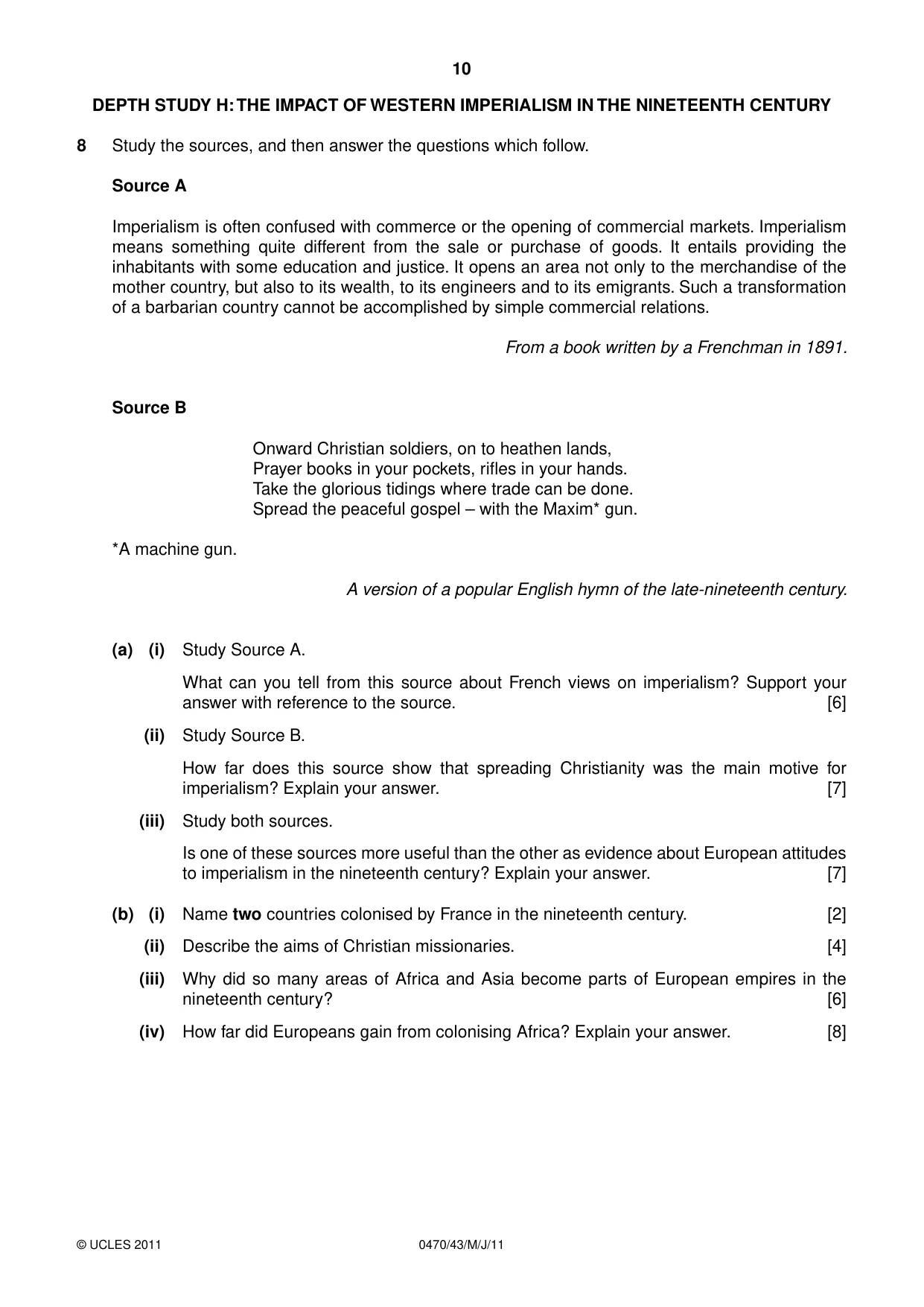
10 0470/43/M/J/11 © UCLES 2011 DEPTH STUDY H: THE IMPACT OF WESTERN IMPERIALISM IN THE NINETEENTH CENTURY 8 Study the sources, and then answer the questions which follow. Source A Imperialism is often confused with commerce or the opening of commercial markets. Imperialism means something quite different from the sale or purchase of goods. It entails providing the inhabitants with some education and justice. It opens an area not only to the merchandise of the mother country, but also to its wealth, to its engineers and to its emigrants. Such a transformation of a barbarian country cannot be accomplished by simple commercial relations. From a book written by a Frenchman in 1891. Source B Onward Christian soldiers, on to heathen lands, Prayer books in your pockets, rifles in your hands. Take the glorious tidings where trade can be done. Spread the peaceful gospel – with the Maxim* gun. *A machine gun. A version of a popular English hymn of the late-nineteenth century. (a) (i) Study Source A. What can you tell from this source about French views on imperialism? Support your answer with reference to the source. [6] (ii) Study Source B. How far does this source show that spreading Christianity was the main motive for imperialism? Explain your answer. [7] (iii) Study both sources. Is one of these sources more useful than the other as evidence about European attitudes to imperialism in the nineteenth century? Explain your answer. [7] (b) (i) Name two countries colonised by France in the nineteenth century. [2] (ii) Describe the aims of Christian missionaries. [4] (iii) Why did so many areas of Africa and Asia become parts of European empires in the nineteenth century? [6] (iv) How far did Europeans gain from colonising Africa? Explain your answer. [8]
Question paper, page 11
11 0470/43/M/J/11 © UCLES 2011 BLANK PAGE
Question paper, page 12
12 0470/43/M/J/11 © UCLES 2011 BLANK PAGE Copyright Acknowledgements: Question 2 Depth Study B Source A © Neil DeMarco; The World This Century ; Collins Educational; 1987. Question 2 Depth Study B Source B © Clare Baker; Russia 1917–1945 ; Heinemann Educational; 1990. Question 3 Depth Study C Source B © www.alaskool.org/native_ed/articles/literacy_act/LiteracyTxt.html. Question 4 Depth Study D Source A © Bryn O’Callaghan; A History of the Twentieth Century ; Longman UK; 1987. Question 4 Depth Study D Source B © Will Hutton; The Writing on the Wall ; Little, Brown Book Group; 2007. Question 5 Depth Study E Source A © Steve Biko; I Write What I Like ; Penguin; 1988. Question 6 Depth Study F Source A © T Rea & J Wright; The Arab-Israeli Conflict ; Oxford; 1997. Question 6 Depth Study F Source B © N DeMarco; The World This Century ; Bell & Hyman; 1987. Question 7 Depth Study G Source A © P Deane & W A Cole; British Economic Growth 1688–1659 ; Cambridge University Press; 1969. Permission to reproduce items where third-party owned material protected by copyright is included has been sought and cleared where possible. Every reasonable effort has been made by the publisher (UCLES) to trace copyright holders, but if any items requiring clearance have unwittingly been included, the publisher will be pleased to make amends at the earliest possible opportunity. University of Cambridge International Examinations is part of the Cambridge Assessment Group. Cambridge Assessment is the brand name of University of Cambridge Local Examinations Syndicate (UCLES), which is itself a department of the University of Cambridge.
Mark scheme, page 1
UNIVERSITY OF CAMBRIDGE INTERNATIONAL EXAMINATIONS International General Certificate of Secondary Education MARK SCHEME for the May/June 2011 question paper for the guidance of teachers 0470 HISTORY 0470/43 Paper 4 (Alternative to Coursework), maximum raw mark 40 This mark scheme is published as an aid to teachers and candidates, to indicate the requirements of the examination. It shows the basis on which Examiners were instructed to award marks. It does not indicate the details of the discussions that took place at an Examiners’ meeting before marking began, which would have considered the acceptability of alternative answers. Mark schemes must be read in conjunction with the question papers and the report on the examination. • Cambridge will not enter into discussions or correspondence in connection with these mark schemes. Cambridge is publishing the mark schemes for the May/June 2011 question papers for most IGCSE, GCE Advanced Level and Advanced Subsidiary Level syllabuses and some Ordinary Level syllabuses. www.XtremePapers.com
Mark scheme, page 2
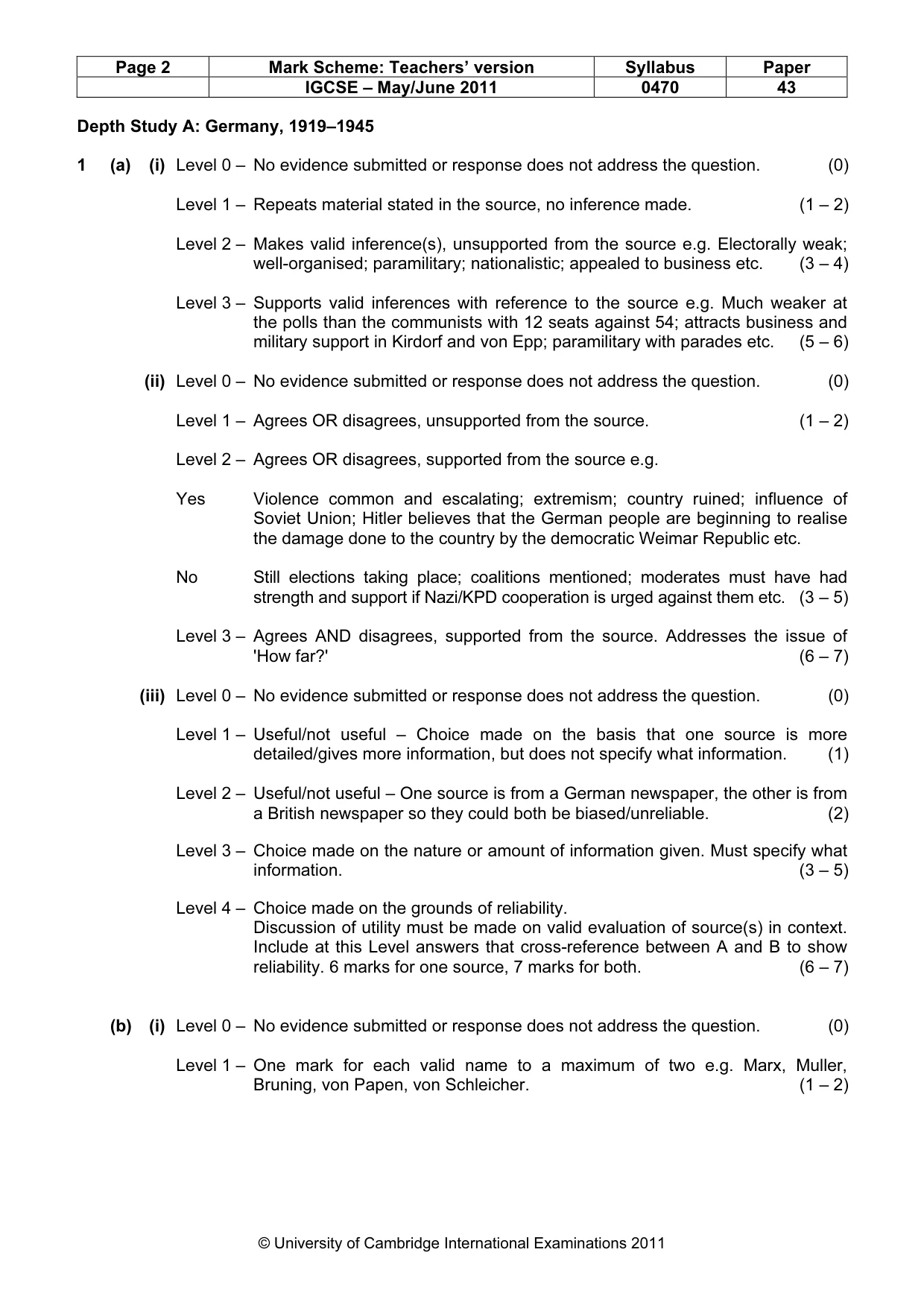
Page 2 Mark Scheme: Teachers’ version Syllabus Paper IGCSE – May/June 2011 0470 43 © University of Cambridge International Examinations 2011 Depth Study A: Germany, 1919–1945 1 (a) (i) Level 0 – No evidence submitted or response does not address the question. (0) Level 1 – Repeats material stated in the source, no inference made. (1 – 2) Level 2 – Makes valid inference(s), unsupported from the source e.g. Electorally weak; well-organised; paramilitary; nationalistic; appealed to business etc. (3 – 4) Level 3 – Supports valid inferences with reference to the source e.g. Much weaker at the polls than the communists with 12 seats against 54; attracts business and military support in Kirdorf and von Epp; paramilitary with parades etc. (5 – 6) (ii) Level 0 – No evidence submitted or response does not address the question. (0) Level 1 – Agrees OR disagrees, unsupported from the source. (1 – 2) Level 2 – Agrees OR disagrees, supported from the source e.g. Yes Violence common and escalating; extremism; country ruined; influence of Soviet Union; Hitler believes that the German people are beginning to realise the damage done to the country by the democratic Weimar Republic etc. No Still elections taking place; coalitions mentioned; moderates must have had strength and support if Nazi/KPD cooperation is urged against them etc. (3 – 5) Level 3 – Agrees AND disagrees, supported from the source. Addresses the issue of 'How far?' (6 – 7) (iii) Level 0 – No evidence submitted or response does not address the question. (0) Level 1 – Useful/not useful – Choice made on the basis that one source is more detailed/gives more information, but does not specify what information. (1) Level 2 – Useful/not useful – One source is from a German newspaper, the other is from a British newspaper so they could both be biased/unreliable. (2) Level 3 – Choice made on the nature or amount of information given. Must specify what information. (3 – 5) Level 4 – Choice made on the grounds of reliability. Discussion of utility must be made on valid evaluation of source(s) in context. Include at this Level answers that cross-reference between A and B to show reliability. 6 marks for one source, 7 marks for both. (6 – 7) (b) (i) Level 0 – No evidence submitted or response does not address the question. (0) Level 1 – One mark for each valid name to a maximum of two e.g. Marx, Muller, Bruning, von Papen, von Schleicher. (1 – 2)
Mark scheme, page 3
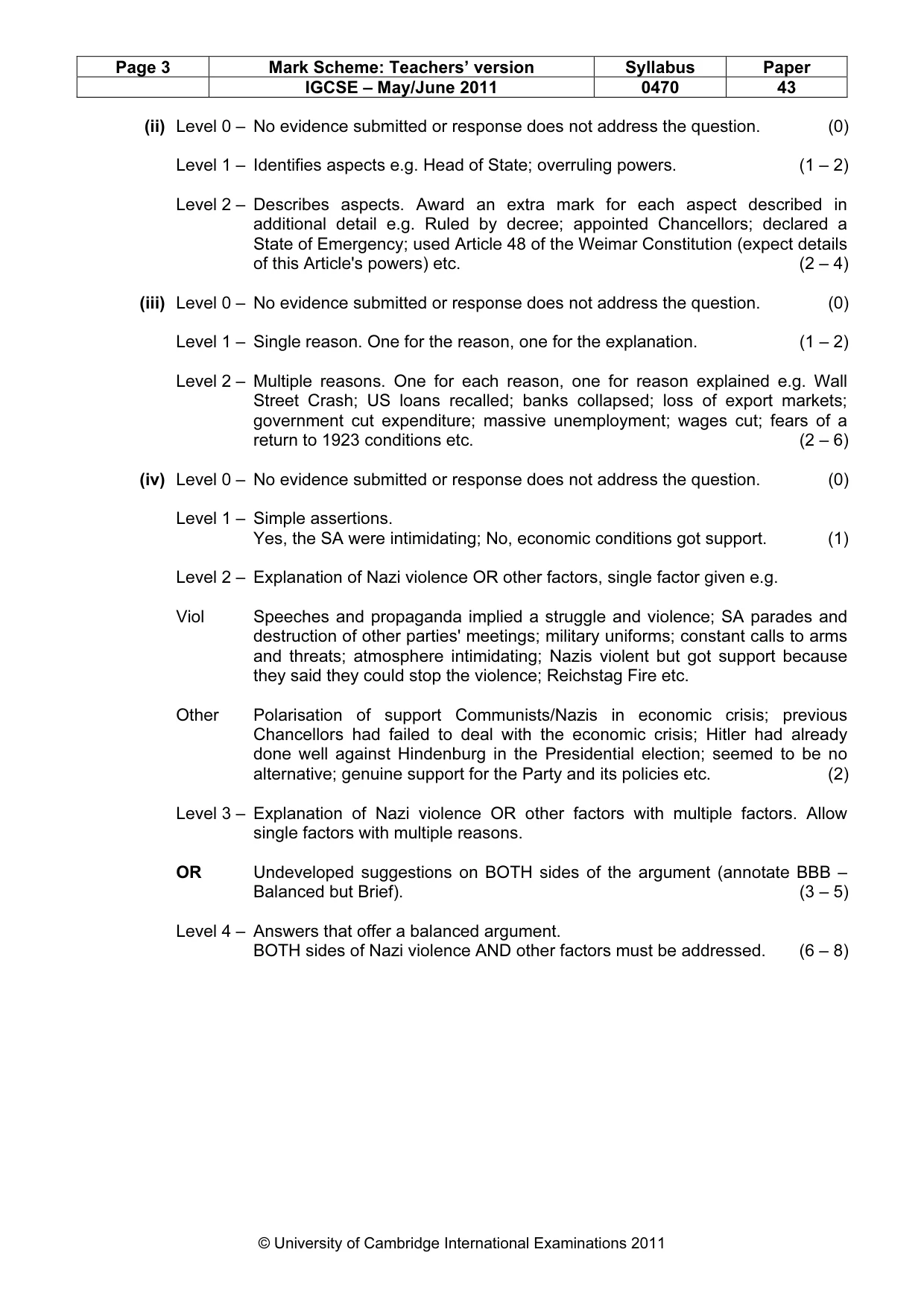
Page 3 Mark Scheme: Teachers’ version Syllabus Paper IGCSE – May/June 2011 0470 43 © University of Cambridge International Examinations 2011 (ii) Level 0 – No evidence submitted or response does not address the question. (0) Level 1 – Identifies aspects e.g. Head of State; overruling powers. (1 – 2) Level 2 – Describes aspects. Award an extra mark for each aspect described in additional detail e.g. Ruled by decree; appointed Chancellors; declared a State of Emergency; used Article 48 of the Weimar Constitution (expect details of this Article's powers) etc. (2 – 4) (iii) Level 0 – No evidence submitted or response does not address the question. (0) Level 1 – Single reason. One for the reason, one for the explanation. (1 – 2) Level 2 – Multiple reasons. One for each reason, one for reason explained e.g. Wall Street Crash; US loans recalled; banks collapsed; loss of export markets; government cut expenditure; massive unemployment; wages cut; fears of a return to 1923 conditions etc. (2 – 6) (iv) Level 0 – No evidence submitted or response does not address the question. (0) Level 1 – Simple assertions. Yes, the SA were intimidating; No, economic conditions got support. (1) Level 2 – Explanation of Nazi violence OR other factors, single factor given e.g. Viol Speeches and propaganda implied a struggle and violence; SA parades and destruction of other parties' meetings; military uniforms; constant calls to arms and threats; atmosphere intimidating; Nazis violent but got support because they said they could stop the violence; Reichstag Fire etc. Other Polarisation of support Communists/Nazis in economic crisis; previous Chancellors had failed to deal with the economic crisis; Hitler had already done well against Hindenburg in the Presidential election; seemed to be no alternative; genuine support for the Party and its policies etc. (2) Level 3 – Explanation of Nazi violence OR other factors with multiple factors. Allow single factors with multiple reasons. OR Undeveloped suggestions on BOTH sides of the argument (annotate BBB – Balanced but Brief). (3 – 5) Level 4 – Answers that offer a balanced argument. BOTH sides of Nazi violence AND other factors must be addressed. (6 – 8)
Mark scheme, page 4
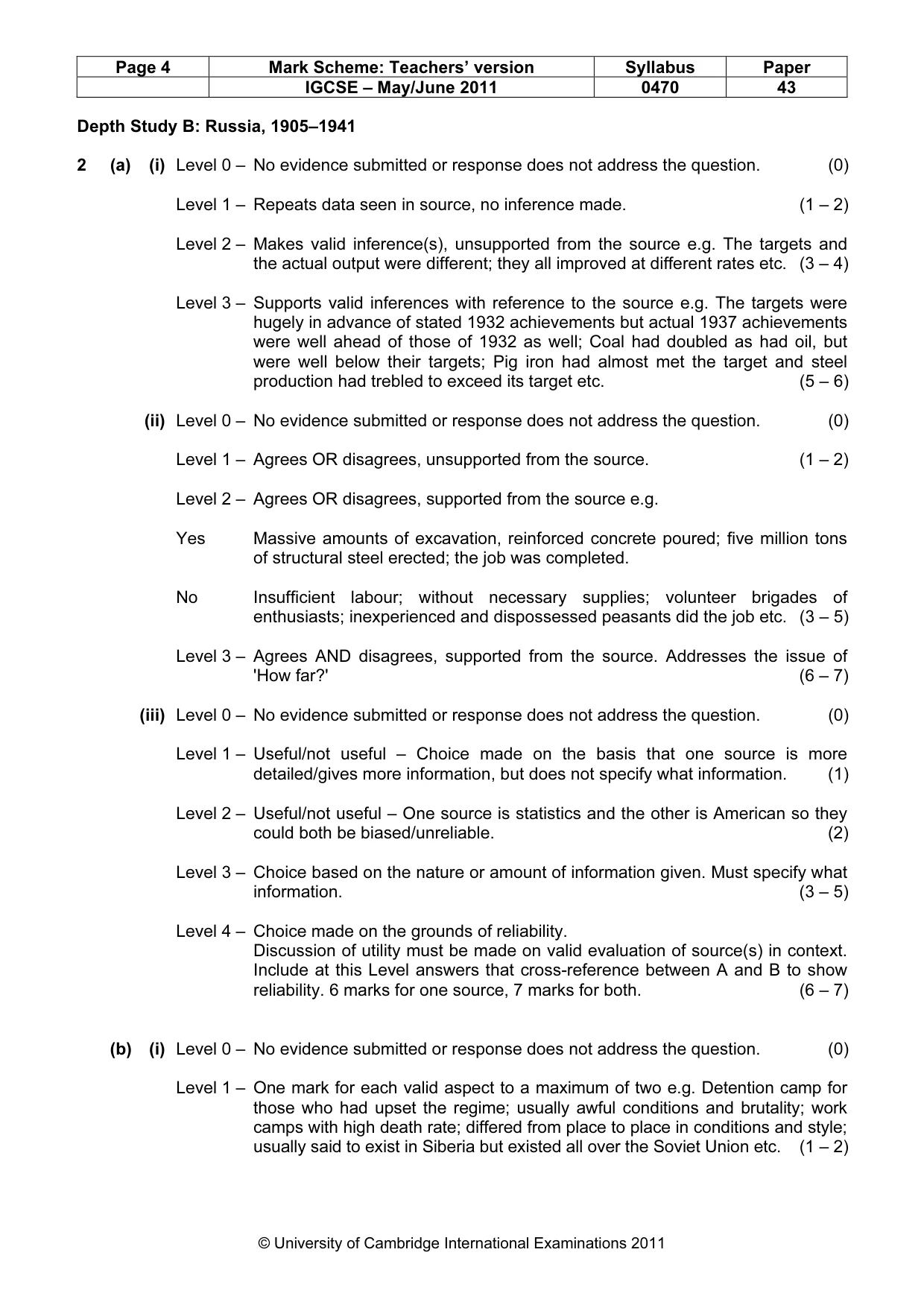
Page 4 Mark Scheme: Teachers’ version Syllabus Paper IGCSE – May/June 2011 0470 43 © University of Cambridge International Examinations 2011 Depth Study B: Russia, 1905–1941 2 (a) (i) Level 0 – No evidence submitted or response does not address the question. (0) Level 1 – Repeats data seen in source, no inference made. (1 – 2) Level 2 – Makes valid inference(s), unsupported from the source e.g. The targets and the actual output were different; they all improved at different rates etc. (3 – 4) Level 3 – Supports valid inferences with reference to the source e.g. The targets were hugely in advance of stated 1932 achievements but actual 1937 achievements were well ahead of those of 1932 as well; Coal had doubled as had oil, but were well below their targets; Pig iron had almost met the target and steel production had trebled to exceed its target etc. (5 – 6) (ii) Level 0 – No evidence submitted or response does not address the question. (0) Level 1 – Agrees OR disagrees, unsupported from the source. (1 – 2) Level 2 – Agrees OR disagrees, supported from the source e.g. Yes Massive amounts of excavation, reinforced concrete poured; five million tons of structural steel erected; the job was completed. No Insufficient labour; without necessary supplies; volunteer brigades of enthusiasts; inexperienced and dispossessed peasants did the job etc. (3 – 5) Level 3 – Agrees AND disagrees, supported from the source. Addresses the issue of 'How far?' (6 – 7) (iii) Level 0 – No evidence submitted or response does not address the question. (0) Level 1 – Useful/not useful – Choice made on the basis that one source is more detailed/gives more information, but does not specify what information. (1) Level 2 – Useful/not useful – One source is statistics and the other is American so they could both be biased/unreliable. (2) Level 3 – Choice based on the nature or amount of information given. Must specify what information. (3 – 5) Level 4 – Choice made on the grounds of reliability. Discussion of utility must be made on valid evaluation of source(s) in context. Include at this Level answers that cross-reference between A and B to show reliability. 6 marks for one source, 7 marks for both. (6 – 7) (b) (i) Level 0 – No evidence submitted or response does not address the question. (0) Level 1 – One mark for each valid aspect to a maximum of two e.g. Detention camp for those who had upset the regime; usually awful conditions and brutality; work camps with high death rate; differed from place to place in conditions and style; usually said to exist in Siberia but existed all over the Soviet Union etc. (1 – 2)
Mark scheme, page 5
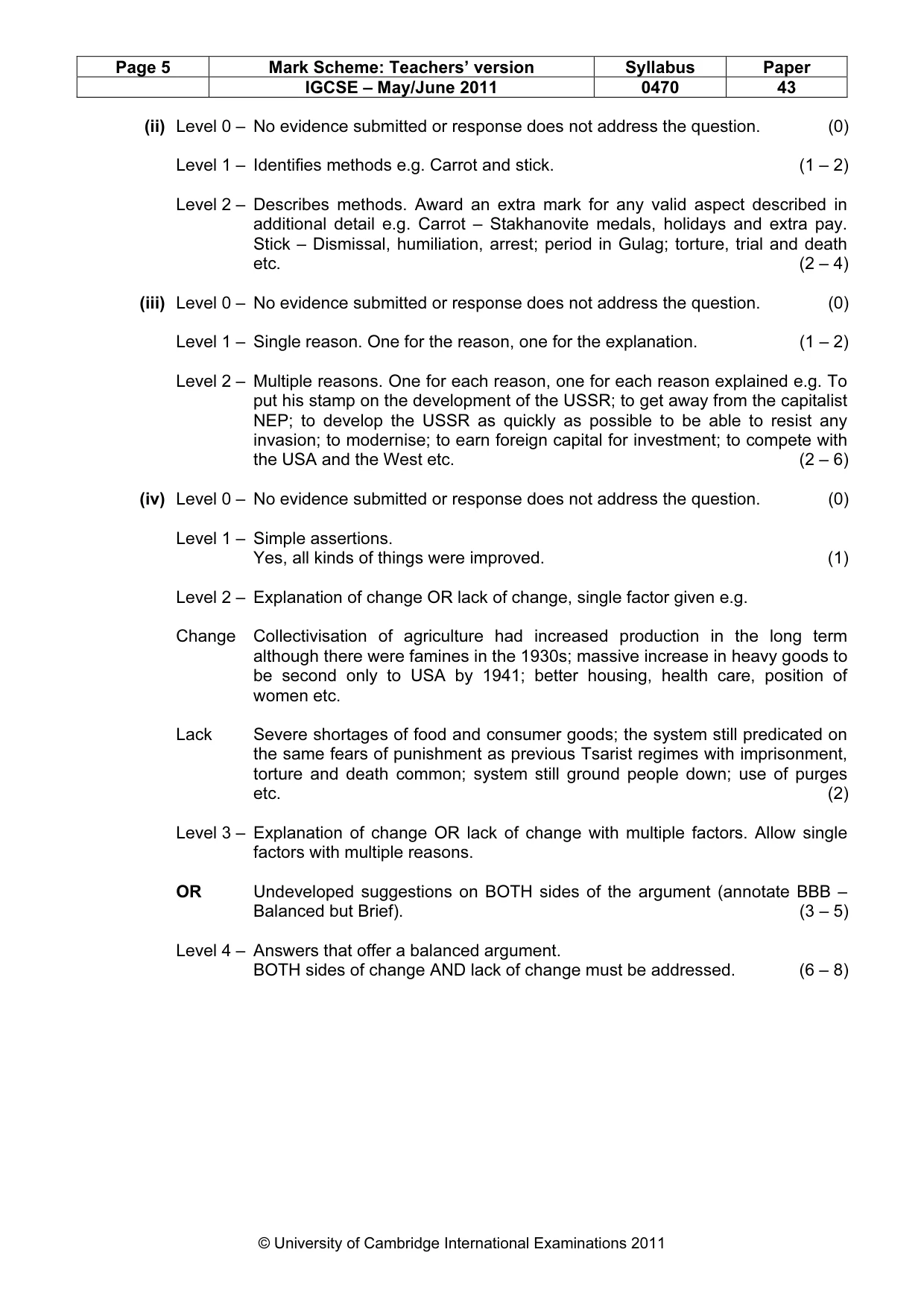
Page 5 Mark Scheme: Teachers’ version Syllabus Paper IGCSE – May/June 2011 0470 43 © University of Cambridge International Examinations 2011 (ii) Level 0 – No evidence submitted or response does not address the question. (0) Level 1 – Identifies methods e.g. Carrot and stick. (1 – 2) Level 2 – Describes methods. Award an extra mark for any valid aspect described in additional detail e.g. Carrot – Stakhanovite medals, holidays and extra pay. Stick – Dismissal, humiliation, arrest; period in Gulag; torture, trial and death etc. (2 – 4) (iii) Level 0 – No evidence submitted or response does not address the question. (0) Level 1 – Single reason. One for the reason, one for the explanation. (1 – 2) Level 2 – Multiple reasons. One for each reason, one for each reason explained e.g. To put his stamp on the development of the USSR; to get away from the capitalist NEP; to develop the USSR as quickly as possible to be able to resist any invasion; to modernise; to earn foreign capital for investment; to compete with the USA and the West etc. (2 – 6) (iv) Level 0 – No evidence submitted or response does not address the question. (0) Level 1 – Simple assertions. Yes, all kinds of things were improved. (1) Level 2 – Explanation of change OR lack of change, single factor given e.g. Change Collectivisation of agriculture had increased production in the long term although there were famines in the 1930s; massive increase in heavy goods to be second only to USA by 1941; better housing, health care, position of women etc. Lack Severe shortages of food and consumer goods; the system still predicated on the same fears of punishment as previous Tsarist regimes with imprisonment, torture and death common; system still ground people down; use of purges etc. (2) Level 3 – Explanation of change OR lack of change with multiple factors. Allow single factors with multiple reasons. OR Undeveloped suggestions on BOTH sides of the argument (annotate BBB – Balanced but Brief). (3 – 5) Level 4 – Answers that offer a balanced argument. BOTH sides of change AND lack of change must be addressed. (6 – 8)
Mark scheme, page 6
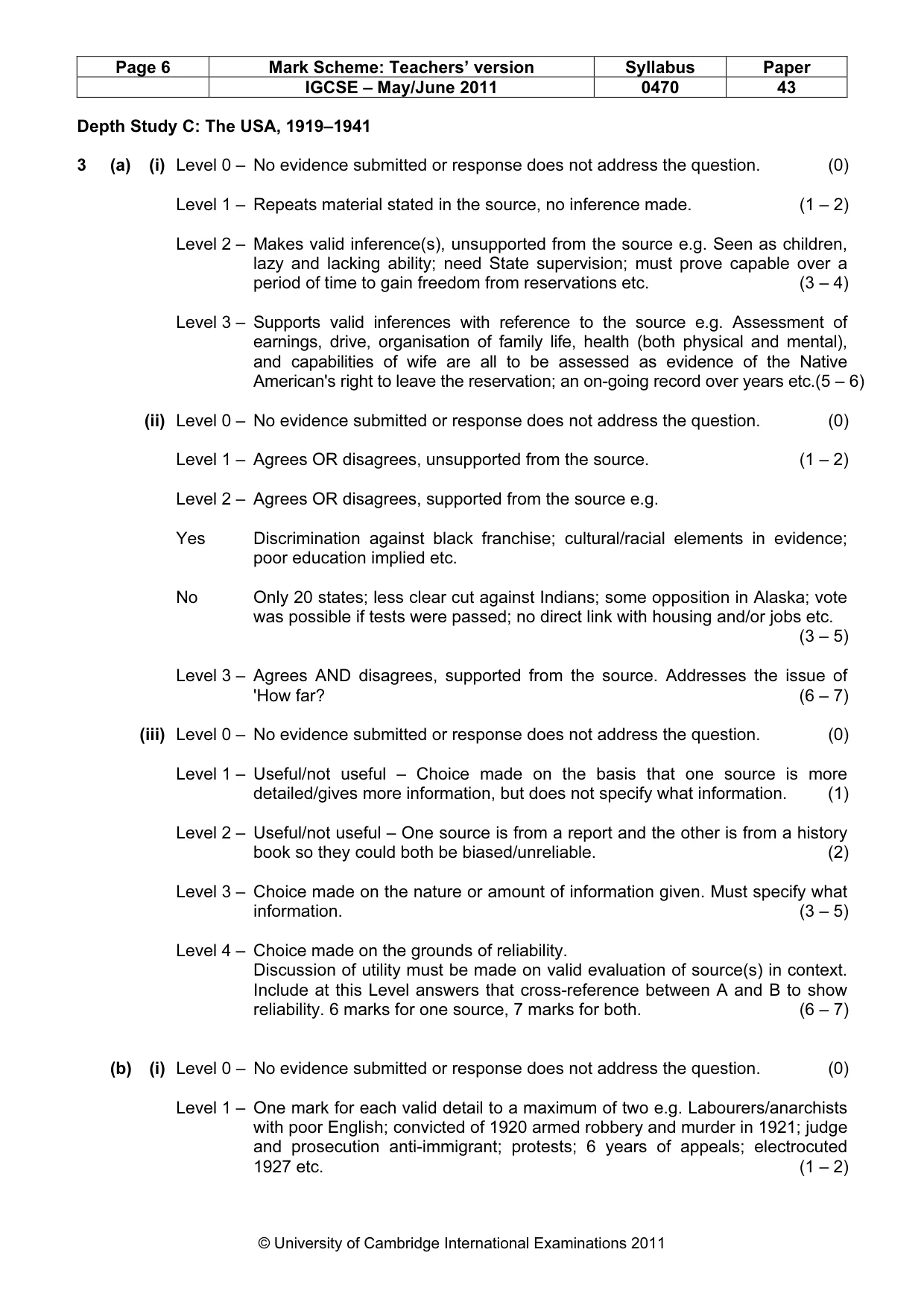
Page 6 Mark Scheme: Teachers’ version Syllabus Paper IGCSE – May/June 2011 0470 43 © University of Cambridge International Examinations 2011 Depth Study C: The USA, 1919–1941 3 (a) (i) Level 0 – No evidence submitted or response does not address the question. (0) Level 1 – Repeats material stated in the source, no inference made. (1 – 2) Level 2 – Makes valid inference(s), unsupported from the source e.g. Seen as children, lazy and lacking ability; need State supervision; must prove capable over a period of time to gain freedom from reservations etc. (3 – 4) Level 3 – Supports valid inferences with reference to the source e.g. Assessment of earnings, drive, organisation of family life, health (both physical and mental), and capabilities of wife are all to be assessed as evidence of the Native American's right to leave the reservation; an on-going record over years etc.(5 – 6) (ii) Level 0 – No evidence submitted or response does not address the question. (0) Level 1 – Agrees OR disagrees, unsupported from the source. (1 – 2) Level 2 – Agrees OR disagrees, supported from the source e.g. Yes Discrimination against black franchise; cultural/racial elements in evidence; poor education implied etc. No Only 20 states; less clear cut against Indians; some opposition in Alaska; vote was possible if tests were passed; no direct link with housing and/or jobs etc. (3 – 5) Level 3 – Agrees AND disagrees, supported from the source. Addresses the issue of 'How far? (6 – 7) (iii) Level 0 – No evidence submitted or response does not address the question. (0) Level 1 – Useful/not useful – Choice made on the basis that one source is more detailed/gives more information, but does not specify what information. (1) Level 2 – Useful/not useful – One source is from a report and the other is from a history book so they could both be biased/unreliable. (2) Level 3 – Choice made on the nature or amount of information given. Must specify what information. (3 – 5) Level 4 – Choice made on the grounds of reliability. Discussion of utility must be made on valid evaluation of source(s) in context. Include at this Level answers that cross-reference between A and B to show reliability. 6 marks for one source, 7 marks for both. (6 – 7) (b) (i) Level 0 – No evidence submitted or response does not address the question. (0) Level 1 – One mark for each valid detail to a maximum of two e.g. Labourers/anarchists with poor English; convicted of 1920 armed robbery and murder in 1921; judge and prosecution anti-immigrant; protests; 6 years of appeals; electrocuted 1927 etc. (1 – 2)
Mark scheme, page 7
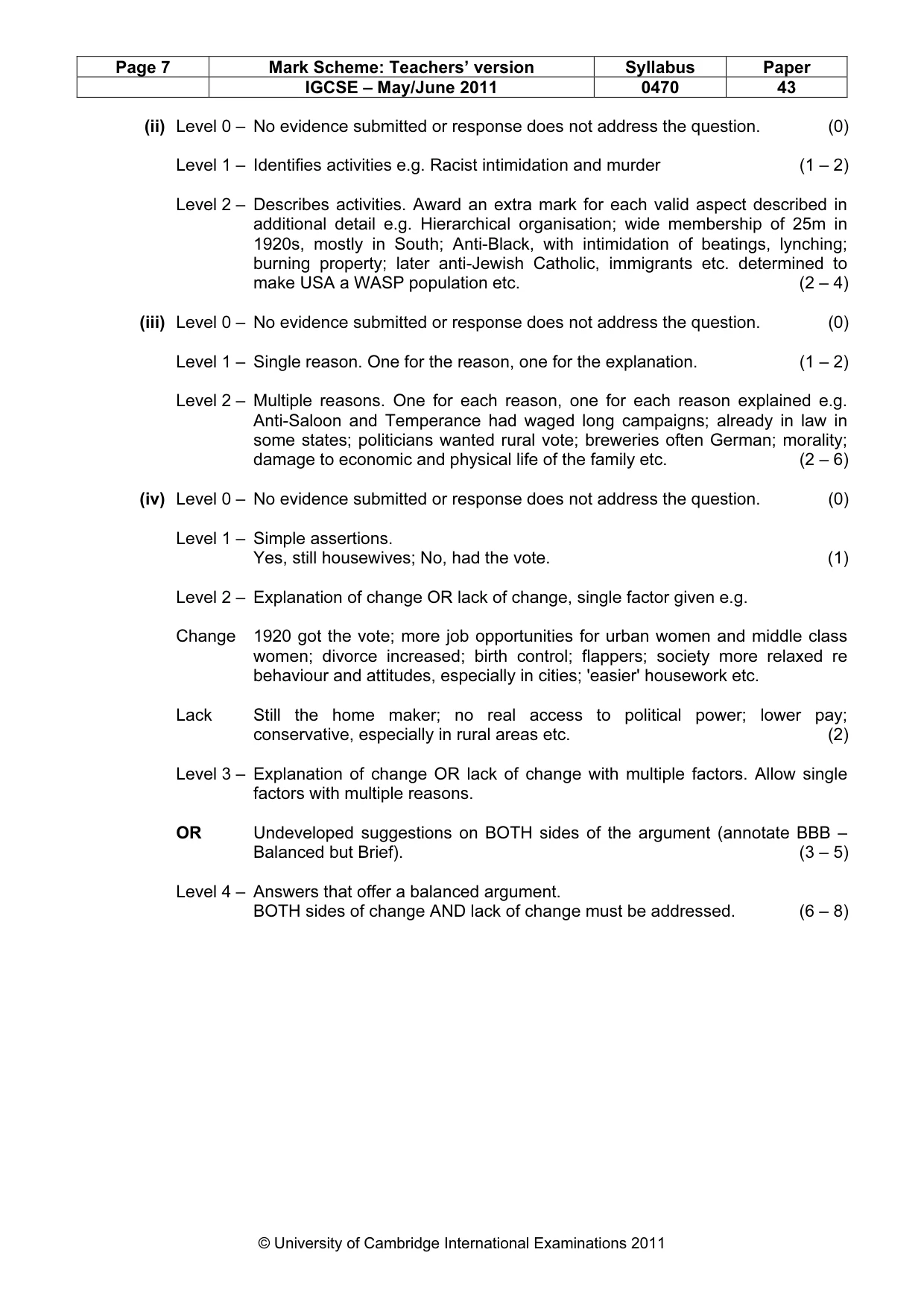
Page 7 Mark Scheme: Teachers’ version Syllabus Paper IGCSE – May/June 2011 0470 43 © University of Cambridge International Examinations 2011 (ii) Level 0 – No evidence submitted or response does not address the question. (0) Level 1 – Identifies activities e.g. Racist intimidation and murder (1 – 2) Level 2 – Describes activities. Award an extra mark for each valid aspect described in additional detail e.g. Hierarchical organisation; wide membership of 25m in 1920s, mostly in South; Anti-Black, with intimidation of beatings, lynching; burning property; later anti-Jewish Catholic, immigrants etc. determined to make USA a WASP population etc. (2 – 4) (iii) Level 0 – No evidence submitted or response does not address the question. (0) Level 1 – Single reason. One for the reason, one for the explanation. (1 – 2) Level 2 – Multiple reasons. One for each reason, one for each reason explained e.g. Anti-Saloon and Temperance had waged long campaigns; already in law in some states; politicians wanted rural vote; breweries often German; morality; damage to economic and physical life of the family etc. (2 – 6) (iv) Level 0 – No evidence submitted or response does not address the question. (0) Level 1 – Simple assertions. Yes, still housewives; No, had the vote. (1) Level 2 – Explanation of change OR lack of change, single factor given e.g. Change 1920 got the vote; more job opportunities for urban women and middle class women; divorce increased; birth control; flappers; society more relaxed re behaviour and attitudes, especially in cities; 'easier' housework etc. Lack Still the home maker; no real access to political power; lower pay; conservative, especially in rural areas etc. (2) Level 3 – Explanation of change OR lack of change with multiple factors. Allow single factors with multiple reasons. OR Undeveloped suggestions on BOTH sides of the argument (annotate BBB – Balanced but Brief). (3 – 5) Level 4 – Answers that offer a balanced argument. BOTH sides of change AND lack of change must be addressed. (6 – 8)
Mark scheme, page 8
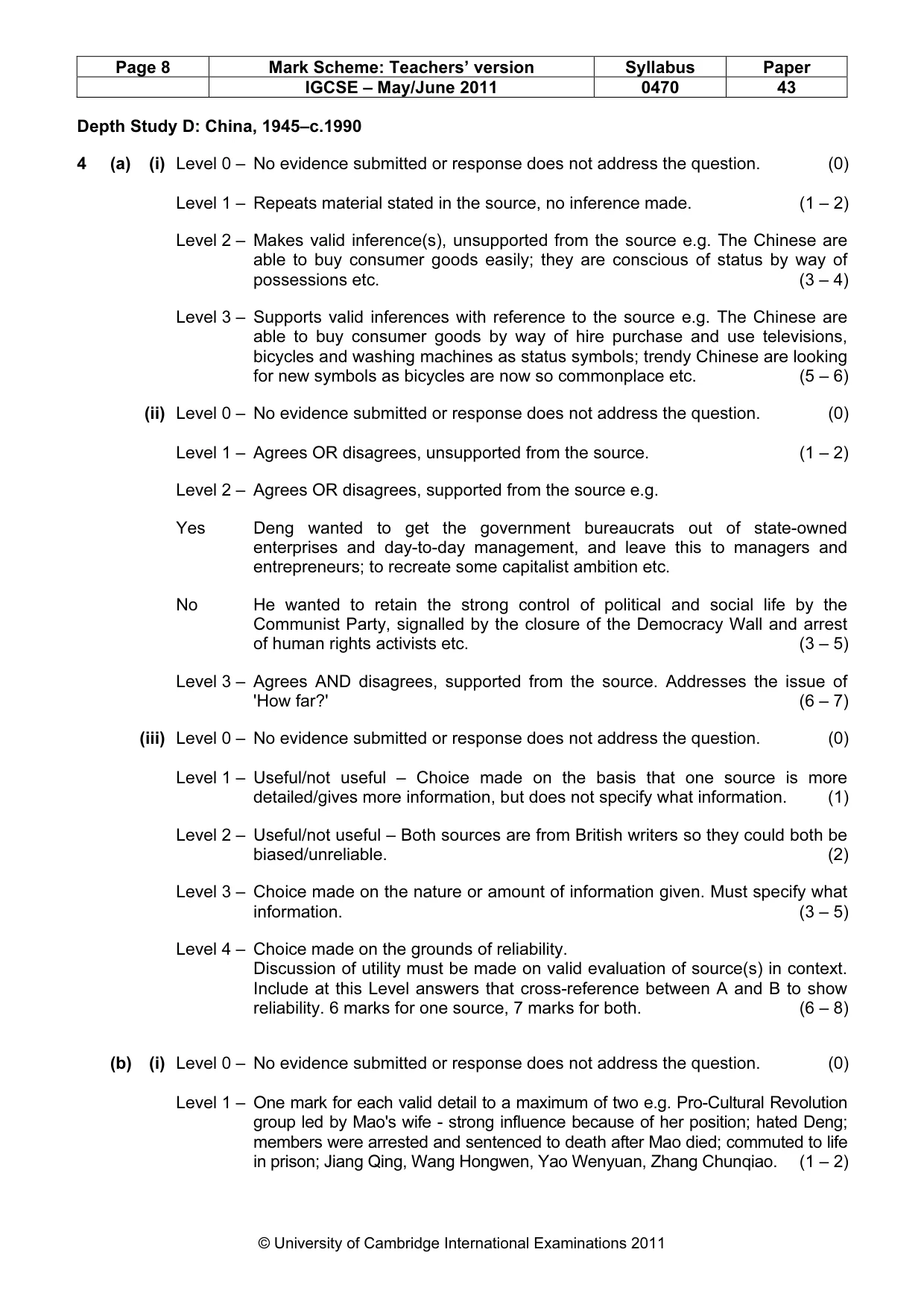
Page 8 Mark Scheme: Teachers’ version Syllabus Paper IGCSE – May/June 2011 0470 43 © University of Cambridge International Examinations 2011 Depth Study D: China, 1945–c.1990 4 (a) (i) Level 0 – No evidence submitted or response does not address the question. (0) Level 1 – Repeats material stated in the source, no inference made. (1 – 2) Level 2 – Makes valid inference(s), unsupported from the source e.g. The Chinese are able to buy consumer goods easily; they are conscious of status by way of possessions etc. (3 – 4) Level 3 – Supports valid inferences with reference to the source e.g. The Chinese are able to buy consumer goods by way of hire purchase and use televisions, bicycles and washing machines as status symbols; trendy Chinese are looking for new symbols as bicycles are now so commonplace etc. (5 – 6) (ii) Level 0 – No evidence submitted or response does not address the question. (0) Level 1 – Agrees OR disagrees, unsupported from the source. (1 – 2) Level 2 – Agrees OR disagrees, supported from the source e.g. Yes Deng wanted to get the government bureaucrats out of state-owned enterprises and day-to-day management, and leave this to managers and entrepreneurs; to recreate some capitalist ambition etc. No He wanted to retain the strong control of political and social life by the Communist Party, signalled by the closure of the Democracy Wall and arrest of human rights activists etc. (3 – 5) Level 3 – Agrees AND disagrees, supported from the source. Addresses the issue of 'How far?' (6 – 7) (iii) Level 0 – No evidence submitted or response does not address the question. (0) Level 1 – Useful/not useful – Choice made on the basis that one source is more detailed/gives more information, but does not specify what information. (1) Level 2 – Useful/not useful – Both sources are from British writers so they could both be biased/unreliable. (2) Level 3 – Choice made on the nature or amount of information given. Must specify what information. (3 – 5) Level 4 – Choice made on the grounds of reliability. Discussion of utility must be made on valid evaluation of source(s) in context. Include at this Level answers that cross-reference between A and B to show reliability. 6 marks for one source, 7 marks for both. (6 – 8) (b) (i) Level 0 – No evidence submitted or response does not address the question. (0) Level 1 – One mark for each valid detail to a maximum of two e.g. Pro-Cultural Revolution group led by Mao's wife - strong influence because of her position; hated Deng; members were arrested and sentenced to death after Mao died; commuted to life in prison; Jiang Qing, Wang Hongwen, Yao Wenyuan, Zhang Chunqiao. (1 – 2)
Mark scheme, page 9
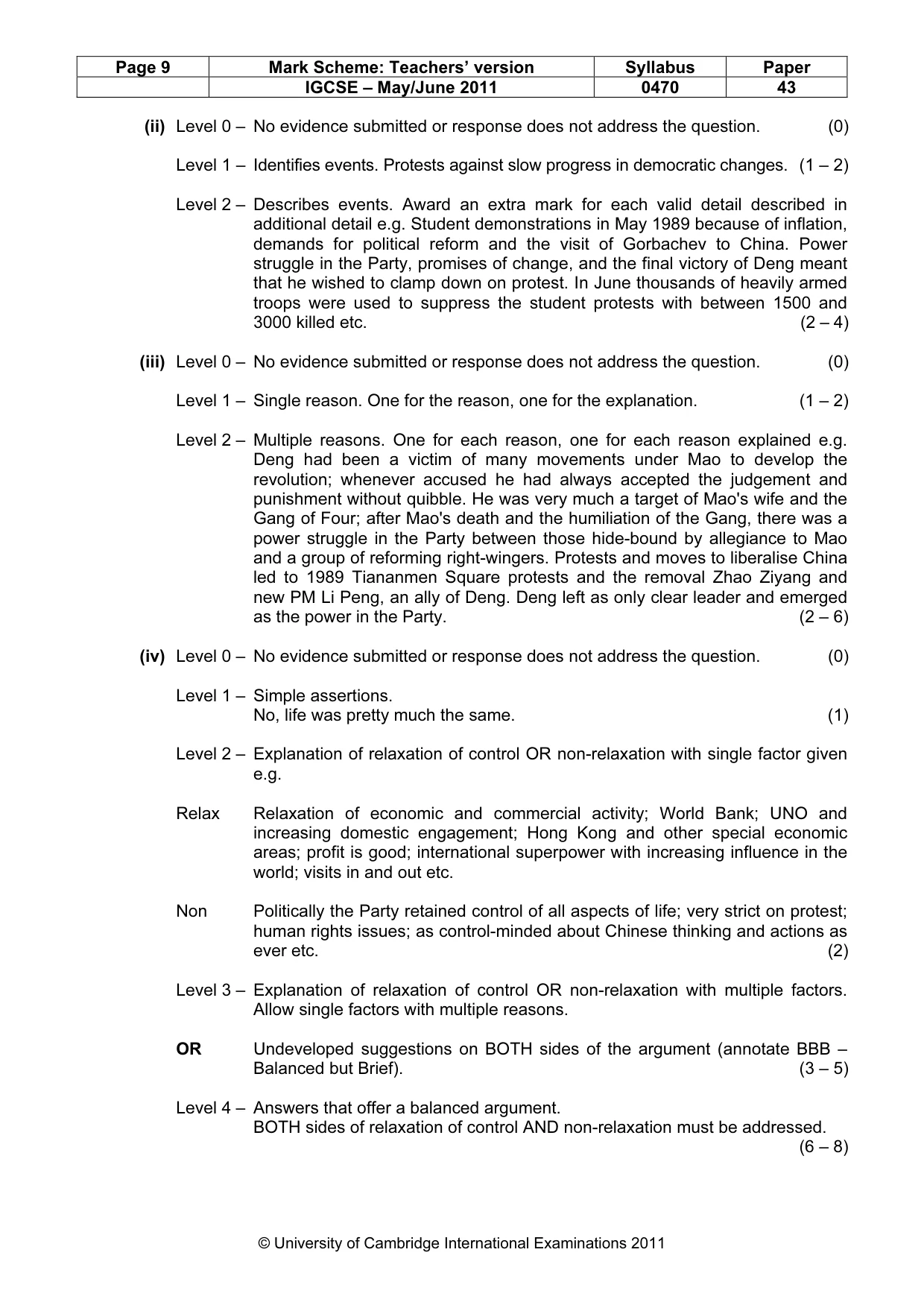
Page 9 Mark Scheme: Teachers’ version Syllabus Paper IGCSE – May/June 2011 0470 43 © University of Cambridge International Examinations 2011 (ii) Level 0 – No evidence submitted or response does not address the question. (0) Level 1 – Identifies events. Protests against slow progress in democratic changes. (1 – 2) Level 2 – Describes events. Award an extra mark for each valid detail described in additional detail e.g. Student demonstrations in May 1989 because of inflation, demands for political reform and the visit of Gorbachev to China. Power struggle in the Party, promises of change, and the final victory of Deng meant that he wished to clamp down on protest. In June thousands of heavily armed troops were used to suppress the student protests with between 1500 and 3000 killed etc. (2 – 4) (iii) Level 0 – No evidence submitted or response does not address the question. (0) Level 1 – Single reason. One for the reason, one for the explanation. (1 – 2) Level 2 – Multiple reasons. One for each reason, one for each reason explained e.g. Deng had been a victim of many movements under Mao to develop the revolution; whenever accused he had always accepted the judgement and punishment without quibble. He was very much a target of Mao's wife and the Gang of Four; after Mao's death and the humiliation of the Gang, there was a power struggle in the Party between those hide-bound by allegiance to Mao and a group of reforming right-wingers. Protests and moves to liberalise China led to 1989 Tiananmen Square protests and the removal Zhao Ziyang and new PM Li Peng, an ally of Deng. Deng left as only clear leader and emerged as the power in the Party. (2 – 6) (iv) Level 0 – No evidence submitted or response does not address the question. (0) Level 1 – Simple assertions. No, life was pretty much the same. (1) Level 2 – Explanation of relaxation of control OR non-relaxation with single factor given e.g. Relax Relaxation of economic and commercial activity; World Bank; UNO and increasing domestic engagement; Hong Kong and other special economic areas; profit is good; international superpower with increasing influence in the world; visits in and out etc. Non Politically the Party retained control of all aspects of life; very strict on protest; human rights issues; as control-minded about Chinese thinking and actions as ever etc. (2) Level 3 – Explanation of relaxation of control OR non-relaxation with multiple factors. Allow single factors with multiple reasons. OR Undeveloped suggestions on BOTH sides of the argument (annotate BBB – Balanced but Brief). (3 – 5) Level 4 – Answers that offer a balanced argument. BOTH sides of relaxation of control AND non-relaxation must be addressed. (6 – 8)
Mark scheme, page 10
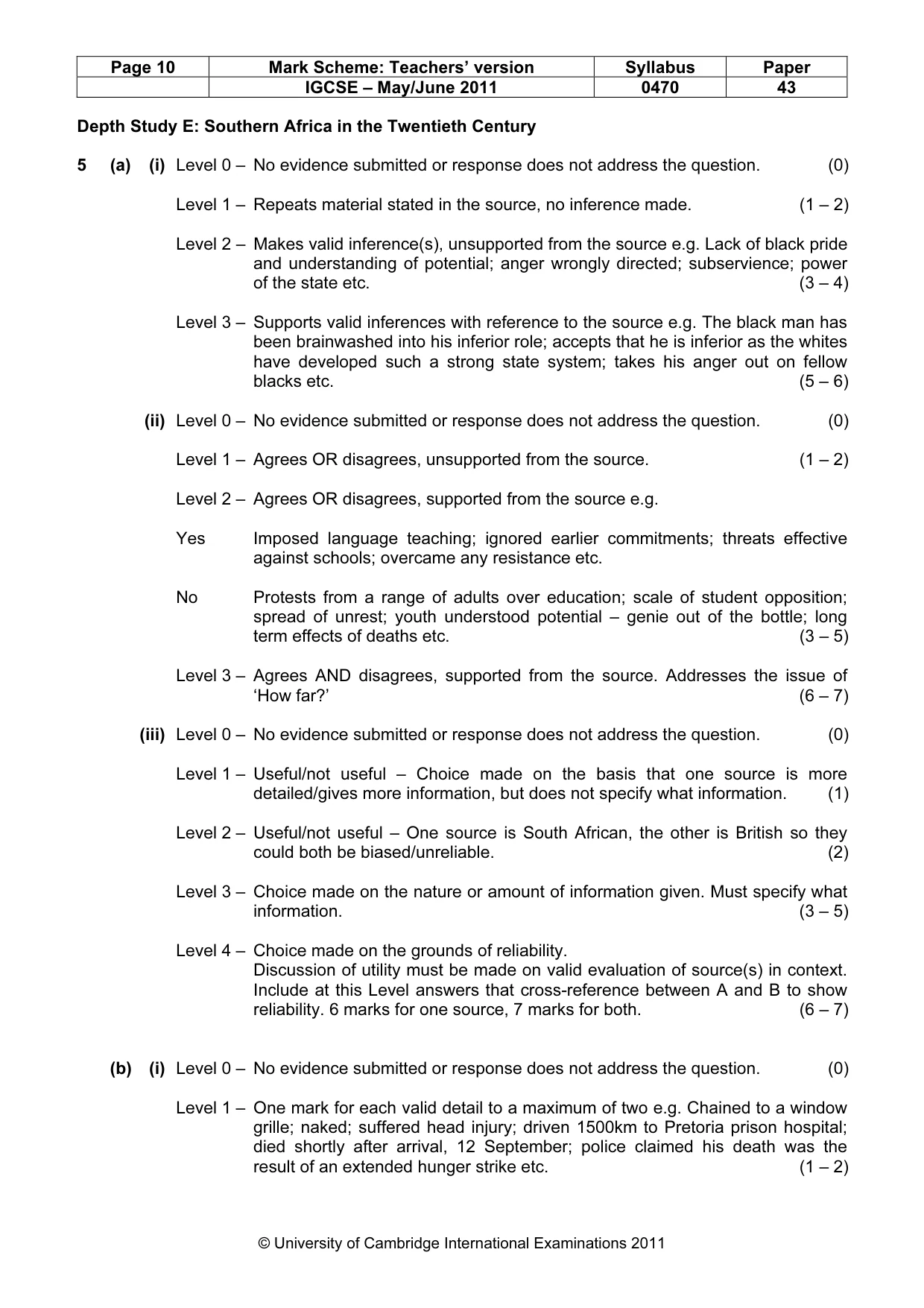
Page 10 Mark Scheme: Teachers’ version Syllabus Paper IGCSE – May/June 2011 0470 43 © University of Cambridge International Examinations 2011 Depth Study E: Southern Africa in the Twentieth Century 5 (a) (i) Level 0 – No evidence submitted or response does not address the question. (0) Level 1 – Repeats material stated in the source, no inference made. (1 – 2) Level 2 – Makes valid inference(s), unsupported from the source e.g. Lack of black pride and understanding of potential; anger wrongly directed; subservience; power of the state etc. (3 – 4) Level 3 – Supports valid inferences with reference to the source e.g. The black man has been brainwashed into his inferior role; accepts that he is inferior as the whites have developed such a strong state system; takes his anger out on fellow blacks etc. (5 – 6) (ii) Level 0 – No evidence submitted or response does not address the question. (0) Level 1 – Agrees OR disagrees, unsupported from the source. (1 – 2) Level 2 – Agrees OR disagrees, supported from the source e.g. Yes Imposed language teaching; ignored earlier commitments; threats effective against schools; overcame any resistance etc. No Protests from a range of adults over education; scale of student opposition; spread of unrest; youth understood potential – genie out of the bottle; long term effects of deaths etc. (3 – 5) Level 3 – Agrees AND disagrees, supported from the source. Addresses the issue of ‘How far?’ (6 – 7) (iii) Level 0 – No evidence submitted or response does not address the question. (0) Level 1 – Useful/not useful – Choice made on the basis that one source is more detailed/gives more information, but does not specify what information. (1) Level 2 – Useful/not useful – One source is South African, the other is British so they could both be biased/unreliable. (2) Level 3 – Choice made on the nature or amount of information given. Must specify what information. (3 – 5) Level 4 – Choice made on the grounds of reliability. Discussion of utility must be made on valid evaluation of source(s) in context. Include at this Level answers that cross-reference between A and B to show reliability. 6 marks for one source, 7 marks for both. (6 – 7) (b) (i) Level 0 – No evidence submitted or response does not address the question. (0) Level 1 – One mark for each valid detail to a maximum of two e.g. Chained to a window grille; naked; suffered head injury; driven 1500km to Pretoria prison hospital; died shortly after arrival, 12 September; police claimed his death was the result of an extended hunger strike etc. (1 – 2)
Mark scheme, page 11
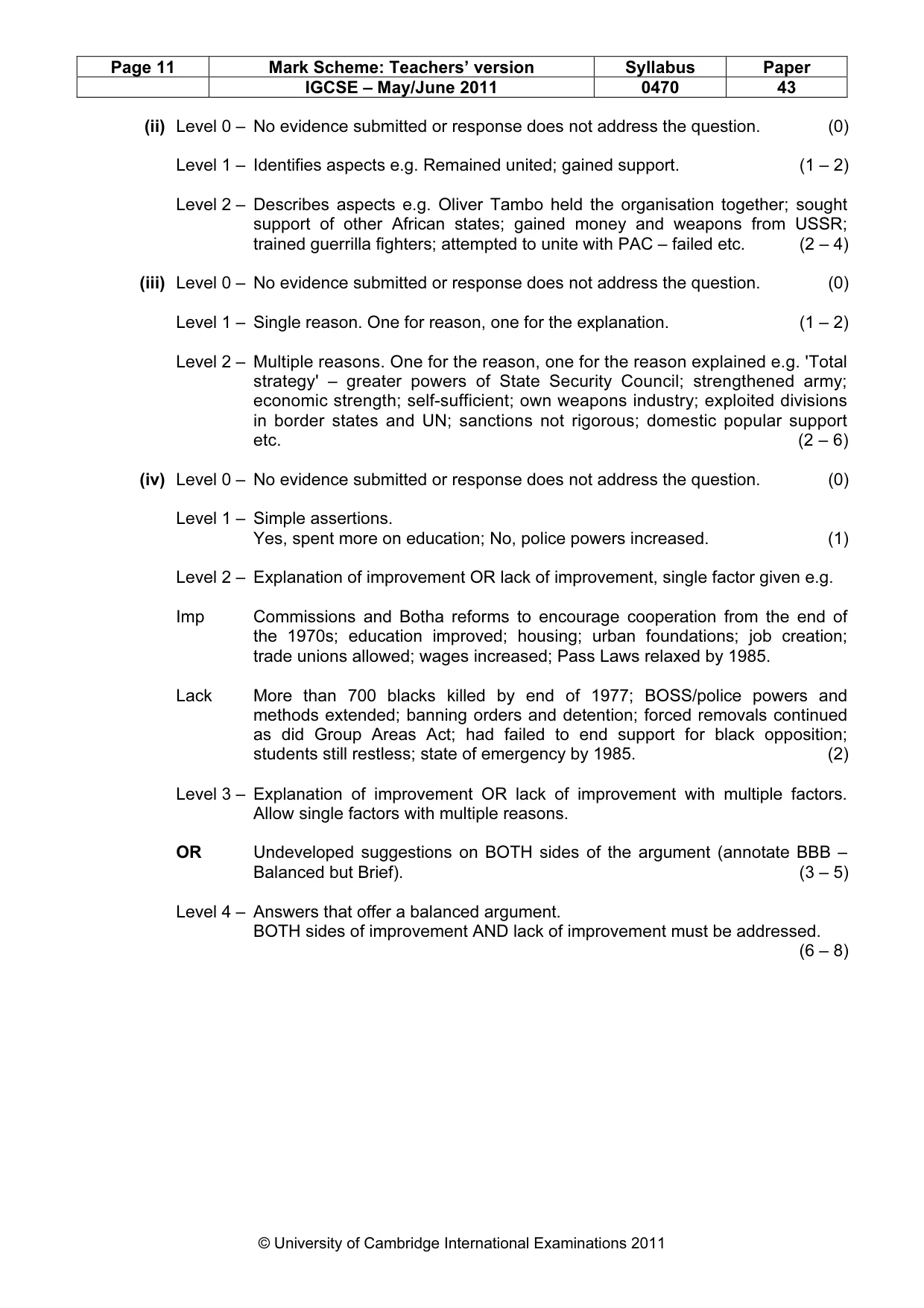
Page 11 Mark Scheme: Teachers’ version Syllabus Paper IGCSE – May/June 2011 0470 43 © University of Cambridge International Examinations 2011 (ii) Level 0 – No evidence submitted or response does not address the question. (0) Level 1 – Identifies aspects e.g. Remained united; gained support. (1 – 2) Level 2 – Describes aspects e.g. Oliver Tambo held the organisation together; sought support of other African states; gained money and weapons from USSR; trained guerrilla fighters; attempted to unite with PAC – failed etc. (2 – 4) (iii) Level 0 – No evidence submitted or response does not address the question. (0) Level 1 – Single reason. One for reason, one for the explanation. (1 – 2) Level 2 – Multiple reasons. One for the reason, one for the reason explained e.g. 'Total strategy' – greater powers of State Security Council; strengthened army; economic strength; self-sufficient; own weapons industry; exploited divisions in border states and UN; sanctions not rigorous; domestic popular support etc. (2 – 6) (iv) Level 0 – No evidence submitted or response does not address the question. (0) Level 1 – Simple assertions. Yes, spent more on education; No, police powers increased. (1) Level 2 – Explanation of improvement OR lack of improvement, single factor given e.g. Imp Commissions and Botha reforms to encourage cooperation from the end of the 1970s; education improved; housing; urban foundations; job creation; trade unions allowed; wages increased; Pass Laws relaxed by 1985. Lack More than 700 blacks killed by end of 1977; BOSS/police powers and methods extended; banning orders and detention; forced removals continued as did Group Areas Act; had failed to end support for black opposition; students still restless; state of emergency by 1985. (2) Level 3 – Explanation of improvement OR lack of improvement with multiple factors. Allow single factors with multiple reasons. OR Undeveloped suggestions on BOTH sides of the argument (annotate BBB – Balanced but Brief). (3 – 5) Level 4 – Answers that offer a balanced argument. BOTH sides of improvement AND lack of improvement must be addressed. (6 – 8)
Mark scheme, page 12
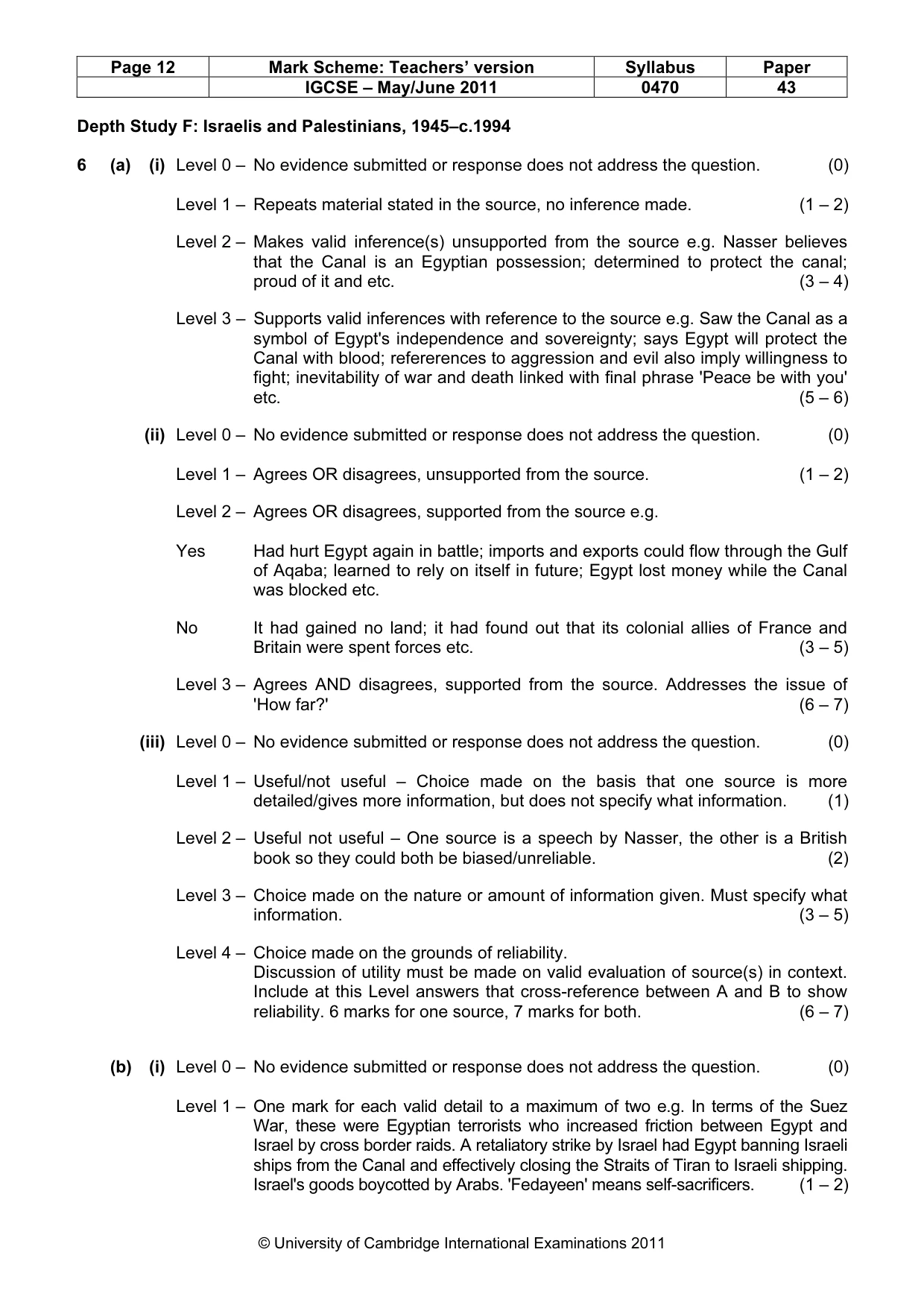
Page 12 Mark Scheme: Teachers’ version Syllabus Paper IGCSE – May/June 2011 0470 43 © University of Cambridge International Examinations 2011 Depth Study F: Israelis and Palestinians, 1945–c.1994 6 (a) (i) Level 0 – No evidence submitted or response does not address the question. (0) Level 1 – Repeats material stated in the source, no inference made. (1 – 2) Level 2 – Makes valid inference(s) unsupported from the source e.g. Nasser believes that the Canal is an Egyptian possession; determined to protect the canal; proud of it and etc. (3 – 4) Level 3 – Supports valid inferences with reference to the source e.g. Saw the Canal as a symbol of Egypt's independence and sovereignty; says Egypt will protect the Canal with blood; refererences to aggression and evil also imply willingness to fight; inevitability of war and death linked with final phrase 'Peace be with you' etc. (5 – 6) (ii) Level 0 – No evidence submitted or response does not address the question. (0) Level 1 – Agrees OR disagrees, unsupported from the source. (1 – 2) Level 2 – Agrees OR disagrees, supported from the source e.g. Yes Had hurt Egypt again in battle; imports and exports could flow through the Gulf of Aqaba; learned to rely on itself in future; Egypt lost money while the Canal was blocked etc. No It had gained no land; it had found out that its colonial allies of France and Britain were spent forces etc. (3 – 5) Level 3 – Agrees AND disagrees, supported from the source. Addresses the issue of 'How far?' (6 – 7) (iii) Level 0 – No evidence submitted or response does not address the question. (0) Level 1 – Useful/not useful – Choice made on the basis that one source is more detailed/gives more information, but does not specify what information. (1) Level 2 – Useful not useful – One source is a speech by Nasser, the other is a British book so they could both be biased/unreliable. (2) Level 3 – Choice made on the nature or amount of information given. Must specify what information. (3 – 5) Level 4 – Choice made on the grounds of reliability. Discussion of utility must be made on valid evaluation of source(s) in context. Include at this Level answers that cross-reference between A and B to show reliability. 6 marks for one source, 7 marks for both. (6 – 7) (b) (i) Level 0 – No evidence submitted or response does not address the question. (0) Level 1 – One mark for each valid detail to a maximum of two e.g. In terms of the Suez War, these were Egyptian terrorists who increased friction between Egypt and Israel by cross border raids. A retaliatory strike by Israel had Egypt banning Israeli ships from the Canal and effectively closing the Straits of Tiran to Israeli shipping. Israel's goods boycotted by Arabs. 'Fedayeen' means self-sacrificers. (1 – 2)
Mark scheme, page 13
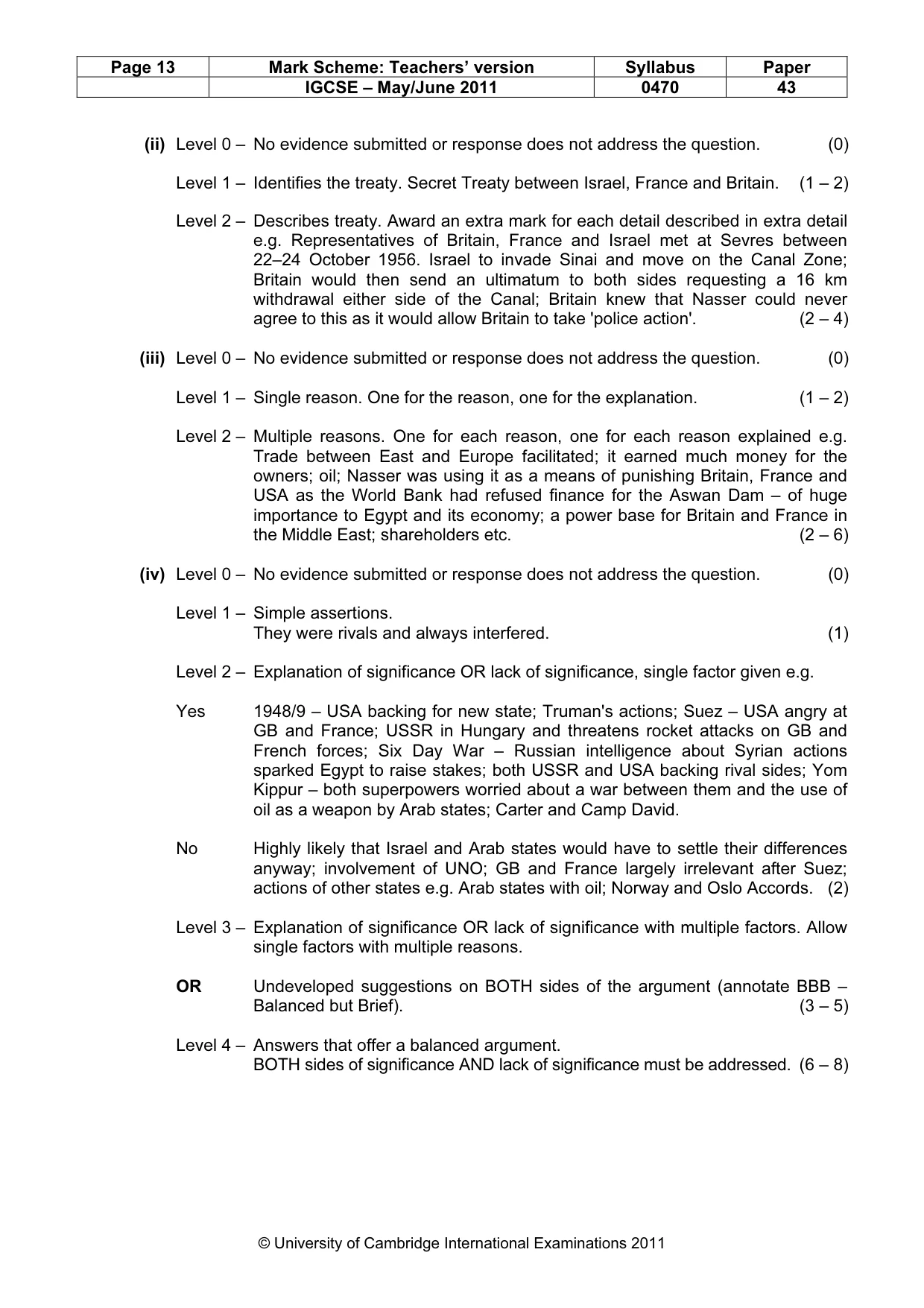
Page 13 Mark Scheme: Teachers’ version Syllabus Paper IGCSE – May/June 2011 0470 43 © University of Cambridge International Examinations 2011 (ii) Level 0 – No evidence submitted or response does not address the question. (0) Level 1 – Identifies the treaty. Secret Treaty between Israel, France and Britain. (1 – 2) Level 2 – Describes treaty. Award an extra mark for each detail described in extra detail e.g. Representatives of Britain, France and Israel met at Sevres between 22–24 October 1956. Israel to invade Sinai and move on the Canal Zone; Britain would then send an ultimatum to both sides requesting a 16 km withdrawal either side of the Canal; Britain knew that Nasser could never agree to this as it would allow Britain to take 'police action'. (2 – 4) (iii) Level 0 – No evidence submitted or response does not address the question. (0) Level 1 – Single reason. One for the reason, one for the explanation. (1 – 2) Level 2 – Multiple reasons. One for each reason, one for each reason explained e.g. Trade between East and Europe facilitated; it earned much money for the owners; oil; Nasser was using it as a means of punishing Britain, France and USA as the World Bank had refused finance for the Aswan Dam – of huge importance to Egypt and its economy; a power base for Britain and France in the Middle East; shareholders etc. (2 – 6) (iv) Level 0 – No evidence submitted or response does not address the question. (0) Level 1 – Simple assertions. They were rivals and always interfered. (1) Level 2 – Explanation of significance OR lack of significance, single factor given e.g. Yes 1948/9 – USA backing for new state; Truman's actions; Suez – USA angry at GB and France; USSR in Hungary and threatens rocket attacks on GB and French forces; Six Day War – Russian intelligence about Syrian actions sparked Egypt to raise stakes; both USSR and USA backing rival sides; Yom Kippur – both superpowers worried about a war between them and the use of oil as a weapon by Arab states; Carter and Camp David. No Highly likely that Israel and Arab states would have to settle their differences anyway; involvement of UNO; GB and France largely irrelevant after Suez; actions of other states e.g. Arab states with oil; Norway and Oslo Accords. (2) Level 3 – Explanation of significance OR lack of significance with multiple factors. Allow single factors with multiple reasons. OR Undeveloped suggestions on BOTH sides of the argument (annotate BBB – Balanced but Brief). (3 – 5) Level 4 – Answers that offer a balanced argument. BOTH sides of significance AND lack of significance must be addressed. (6 – 8)
Mark scheme, page 14
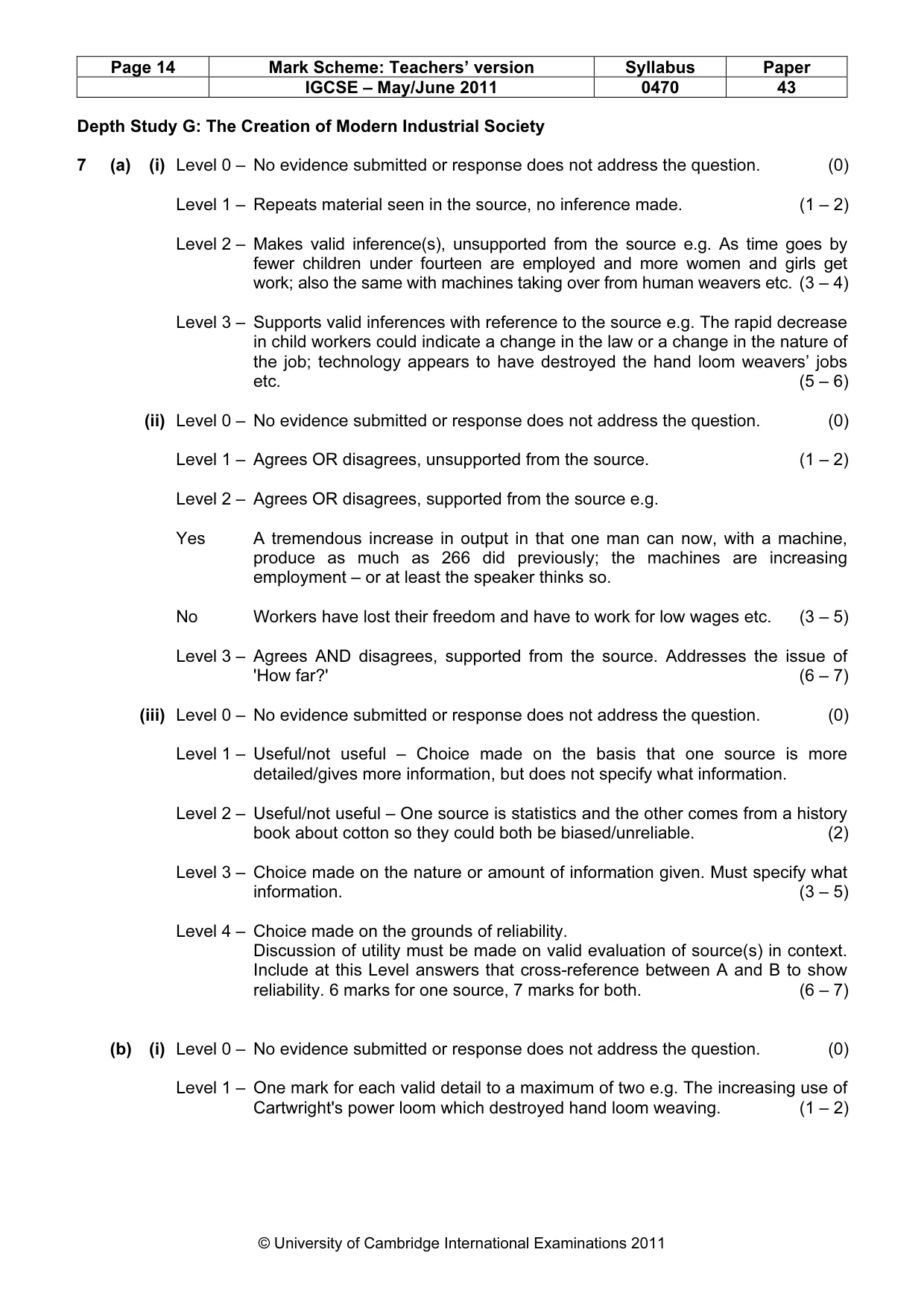
Page 14 Mark Scheme: Teachers’ version Syllabus Paper IGCSE – May/June 2011 0470 43 © University of Cambridge International Examinations 2011 Depth Study G: The Creation of Modern Industrial Society 7 (a) (i) Level 0 – No evidence submitted or response does not address the question. (0) Level 1 – Repeats material seen in the source, no inference made. (1 – 2) Level 2 – Makes valid inference(s), unsupported from the source e.g. As time goes by fewer children under fourteen are employed and more women and girls get work; also the same with machines taking over from human weavers etc. (3 – 4) Level 3 – Supports valid inferences with reference to the source e.g. The rapid decrease in child workers could indicate a change in the law or a change in the nature of the job; technology appears to have destroyed the hand loom weavers’ jobs etc. (5 – 6) (ii) Level 0 – No evidence submitted or response does not address the question. (0) Level 1 – Agrees OR disagrees, unsupported from the source. (1 – 2) Level 2 – Agrees OR disagrees, supported from the source e.g. Yes A tremendous increase in output in that one man can now, with a machine, produce as much as 266 did previously; the machines are increasing employment – or at least the speaker thinks so. No Workers have lost their freedom and have to work for low wages etc. (3 – 5) Level 3 – Agrees AND disagrees, supported from the source. Addresses the issue of 'How far?' (6 – 7) (iii) Level 0 – No evidence submitted or response does not address the question. (0) Level 1 – Useful/not useful – Choice made on the basis that one source is more detailed/gives more information, but does not specify what information. Level 2 – Useful/not useful – One source is statistics and the other comes from a history book about cotton so they could both be biased/unreliable. (2) Level 3 – Choice made on the nature or amount of information given. Must specify what information. (3 – 5) Level 4 – Choice made on the grounds of reliability. Discussion of utility must be made on valid evaluation of source(s) in context. Include at this Level answers that cross-reference between A and B to show reliability. 6 marks for one source, 7 marks for both. (6 – 7) (b) (i) Level 0 – No evidence submitted or response does not address the question. (0) Level 1 – One mark for each valid detail to a maximum of two e.g. The increasing use of Cartwright's power loom which destroyed hand loom weaving. (1 – 2)
Mark scheme, page 15
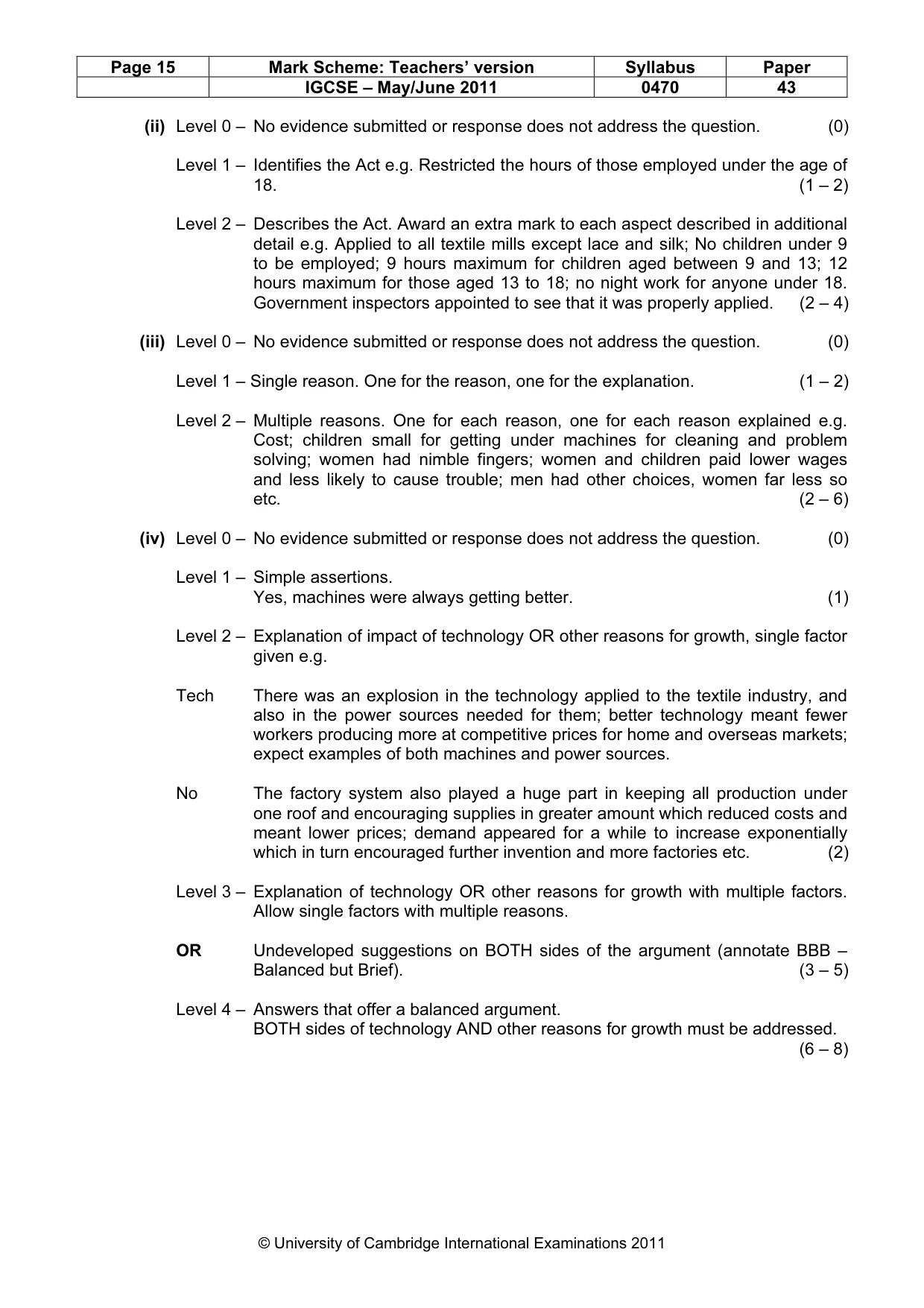
Page 15 Mark Scheme: Teachers’ version Syllabus Paper IGCSE – May/June 2011 0470 43 © University of Cambridge International Examinations 2011 (ii) Level 0 – No evidence submitted or response does not address the question. (0) Level 1 – Identifies the Act e.g. Restricted the hours of those employed under the age of 18. (1 – 2) Level 2 – Describes the Act. Award an extra mark to each aspect described in additional detail e.g. Applied to all textile mills except lace and silk; No children under 9 to be employed; 9 hours maximum for children aged between 9 and 13; 12 hours maximum for those aged 13 to 18; no night work for anyone under 18. Government inspectors appointed to see that it was properly applied. (2 – 4) (iii) Level 0 – No evidence submitted or response does not address the question. (0) Level 1 – Single reason. One for the reason, one for the explanation. (1 – 2) Level 2 – Multiple reasons. One for each reason, one for each reason explained e.g. Cost; children small for getting under machines for cleaning and problem solving; women had nimble fingers; women and children paid lower wages and less likely to cause trouble; men had other choices, women far less so etc. (2 – 6) (iv) Level 0 – No evidence submitted or response does not address the question. (0) Level 1 – Simple assertions. Yes, machines were always getting better. (1) Level 2 – Explanation of impact of technology OR other reasons for growth, single factor given e.g. Tech There was an explosion in the technology applied to the textile industry, and also in the power sources needed for them; better technology meant fewer workers producing more at competitive prices for home and overseas markets; expect examples of both machines and power sources. No The factory system also played a huge part in keeping all production under one roof and encouraging supplies in greater amount which reduced costs and meant lower prices; demand appeared for a while to increase exponentially which in turn encouraged further invention and more factories etc. (2) Level 3 – Explanation of technology OR other reasons for growth with multiple factors. Allow single factors with multiple reasons. OR Undeveloped suggestions on BOTH sides of the argument (annotate BBB – Balanced but Brief). (3 – 5) Level 4 – Answers that offer a balanced argument. BOTH sides of technology AND other reasons for growth must be addressed. (6 – 8)
Mark scheme, page 16
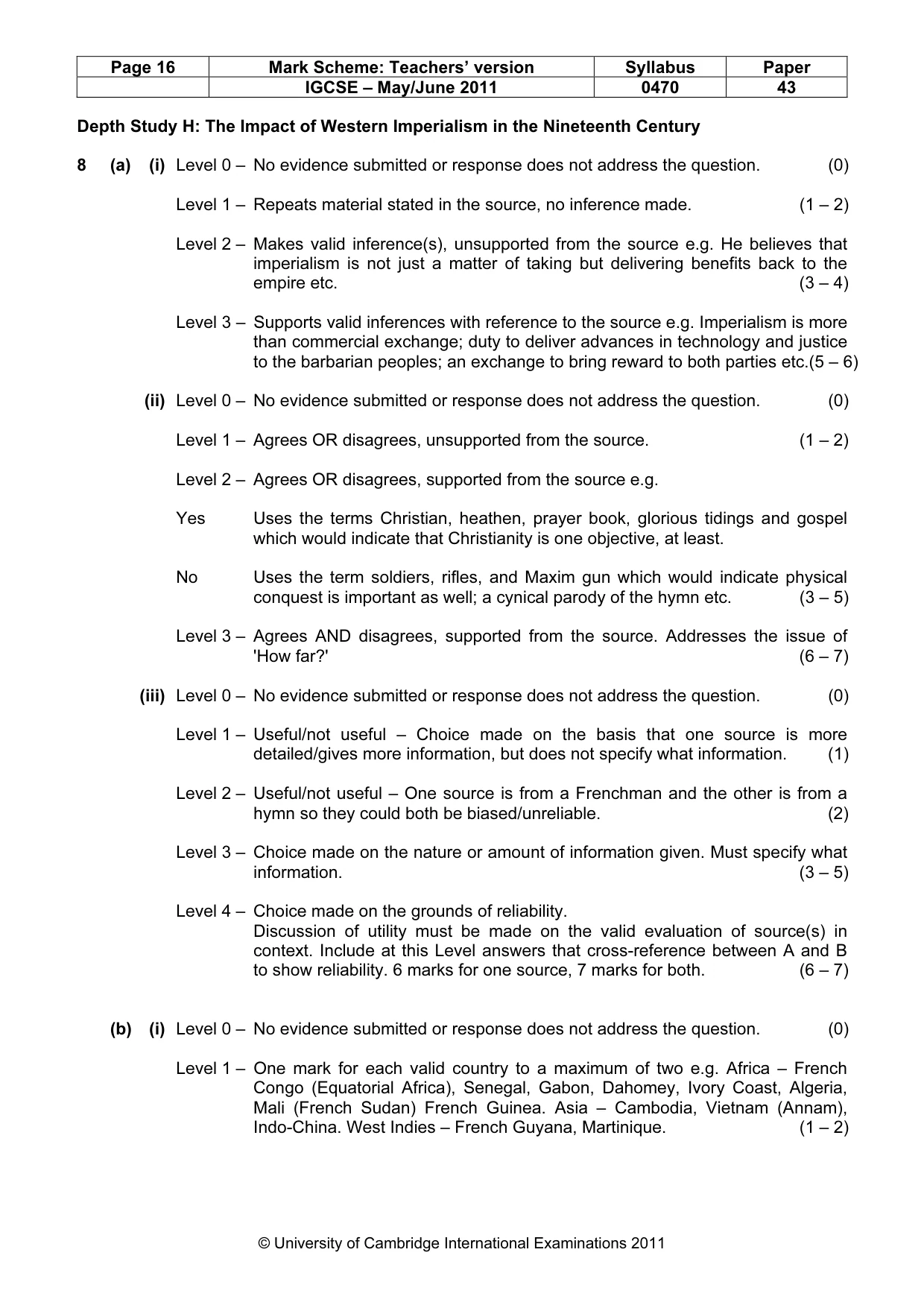
Page 16 Mark Scheme: Teachers’ version Syllabus Paper IGCSE – May/June 2011 0470 43 © University of Cambridge International Examinations 2011 Depth Study H: The Impact of Western Imperialism in the Nineteenth Century 8 (a) (i) Level 0 – No evidence submitted or response does not address the question. (0) Level 1 – Repeats material stated in the source, no inference made. (1 – 2) Level 2 – Makes valid inference(s), unsupported from the source e.g. He believes that imperialism is not just a matter of taking but delivering benefits back to the empire etc. (3 – 4) Level 3 – Supports valid inferences with reference to the source e.g. Imperialism is more than commercial exchange; duty to deliver advances in technology and justice to the barbarian peoples; an exchange to bring reward to both parties etc.(5 – 6) (ii) Level 0 – No evidence submitted or response does not address the question. (0) Level 1 – Agrees OR disagrees, unsupported from the source. (1 – 2) Level 2 – Agrees OR disagrees, supported from the source e.g. Yes Uses the terms Christian, heathen, prayer book, glorious tidings and gospel which would indicate that Christianity is one objective, at least. No Uses the term soldiers, rifles, and Maxim gun which would indicate physical conquest is important as well; a cynical parody of the hymn etc. (3 – 5) Level 3 – Agrees AND disagrees, supported from the source. Addresses the issue of 'How far?' (6 – 7) (iii) Level 0 – No evidence submitted or response does not address the question. (0) Level 1 – Useful/not useful – Choice made on the basis that one source is more detailed/gives more information, but does not specify what information. (1) Level 2 – Useful/not useful – One source is from a Frenchman and the other is from a hymn so they could both be biased/unreliable. (2) Level 3 – Choice made on the nature or amount of information given. Must specify what information. (3 – 5) Level 4 – Choice made on the grounds of reliability. Discussion of utility must be made on the valid evaluation of source(s) in context. Include at this Level answers that cross-reference between A and B to show reliability. 6 marks for one source, 7 marks for both. (6 – 7) (b) (i) Level 0 – No evidence submitted or response does not address the question. (0) Level 1 – One mark for each valid country to a maximum of two e.g. Africa – French Congo (Equatorial Africa), Senegal, Gabon, Dahomey, Ivory Coast, Algeria, Mali (French Sudan) French Guinea. Asia – Cambodia, Vietnam (Annam), Indo-China. West Indies – French Guyana, Martinique. (1 – 2)
Mark scheme, page 17
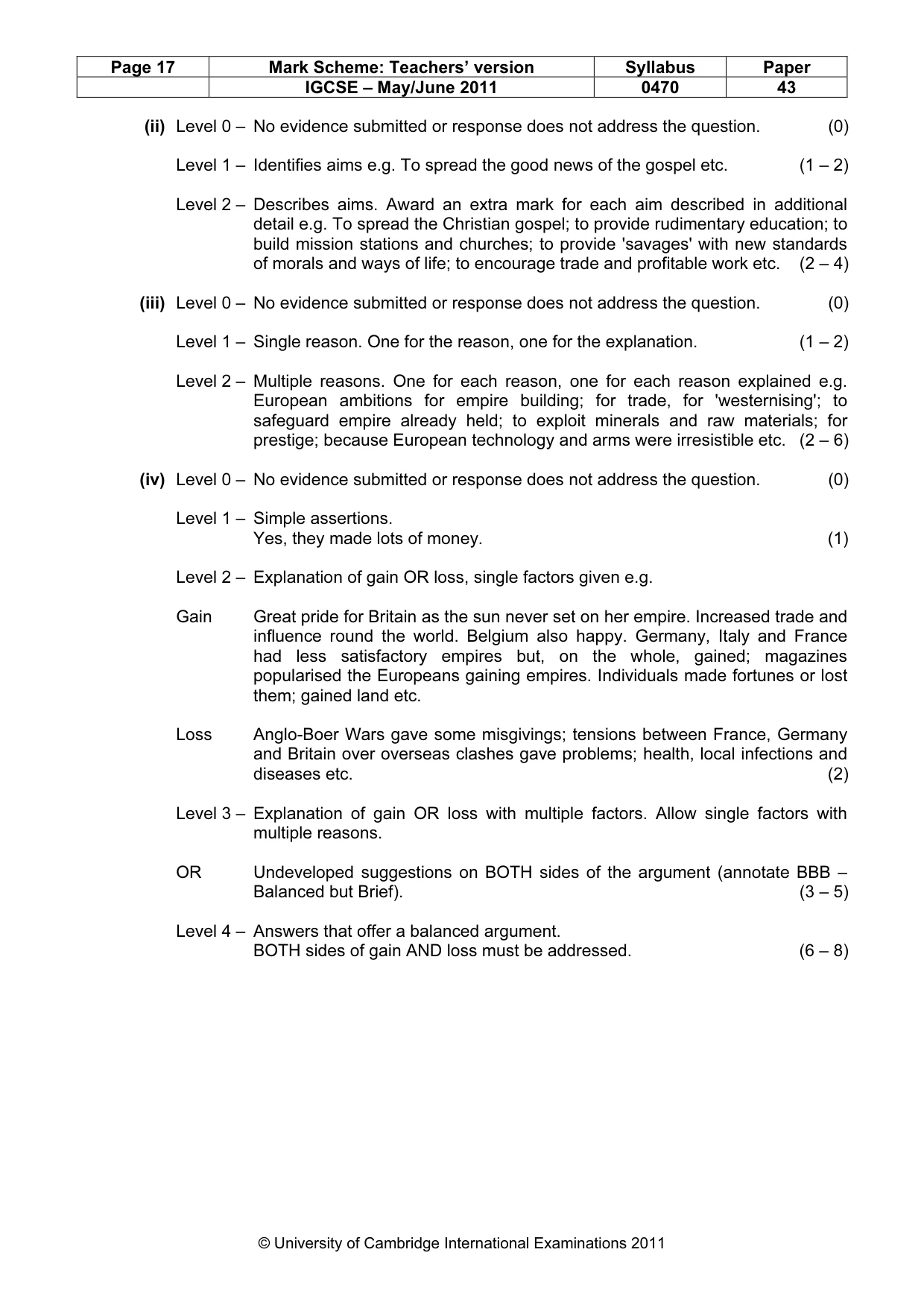
Page 17 Mark Scheme: Teachers’ version Syllabus Paper IGCSE – May/June 2011 0470 43 © University of Cambridge International Examinations 2011 (ii) Level 0 – No evidence submitted or response does not address the question. (0) Level 1 – Identifies aims e.g. To spread the good news of the gospel etc. (1 – 2) Level 2 – Describes aims. Award an extra mark for each aim described in additional detail e.g. To spread the Christian gospel; to provide rudimentary education; to build mission stations and churches; to provide 'savages' with new standards of morals and ways of life; to encourage trade and profitable work etc. (2 – 4) (iii) Level 0 – No evidence submitted or response does not address the question. (0) Level 1 – Single reason. One for the reason, one for the explanation. (1 – 2) Level 2 – Multiple reasons. One for each reason, one for each reason explained e.g. European ambitions for empire building; for trade, for 'westernising'; to safeguard empire already held; to exploit minerals and raw materials; for prestige; because European technology and arms were irresistible etc. (2 – 6) (iv) Level 0 – No evidence submitted or response does not address the question. (0) Level 1 – Simple assertions. Yes, they made lots of money. (1) Level 2 – Explanation of gain OR loss, single factors given e.g. Gain Great pride for Britain as the sun never set on her empire. Increased trade and influence round the world. Belgium also happy. Germany, Italy and France had less satisfactory empires but, on the whole, gained; magazines popularised the Europeans gaining empires. Individuals made fortunes or lost them; gained land etc. Loss Anglo-Boer Wars gave some misgivings; tensions between France, Germany and Britain over overseas clashes gave problems; health, local infections and diseases etc. (2) Level 3 – Explanation of gain OR loss with multiple factors. Allow single factors with multiple reasons. OR Undeveloped suggestions on BOTH sides of the argument (annotate BBB – Balanced but Brief). (3 – 5) Level 4 – Answers that offer a balanced argument. BOTH sides of gain AND loss must be addressed. (6 – 8)
What you needed in this session
Cambridge’s own grade thresholds for 2011 May/June, Paper 4 · Variant 3. A higher threshold means an easier paper — the bar moves with how the cohort did.