Cambridge IGCSE History 0470 — 2011 May/June Paper 4 · Variant 1
0470/41/M/J/11 · 40 marks · ≈45 min
The question paper and its mark scheme, free to read here and free to download. This is Cambridge’s own paper, exactly as it was sat.
Question paper12 pages


Mark scheme17 pages
Answers below. Sit the paper first if you are practising.
Paper as text
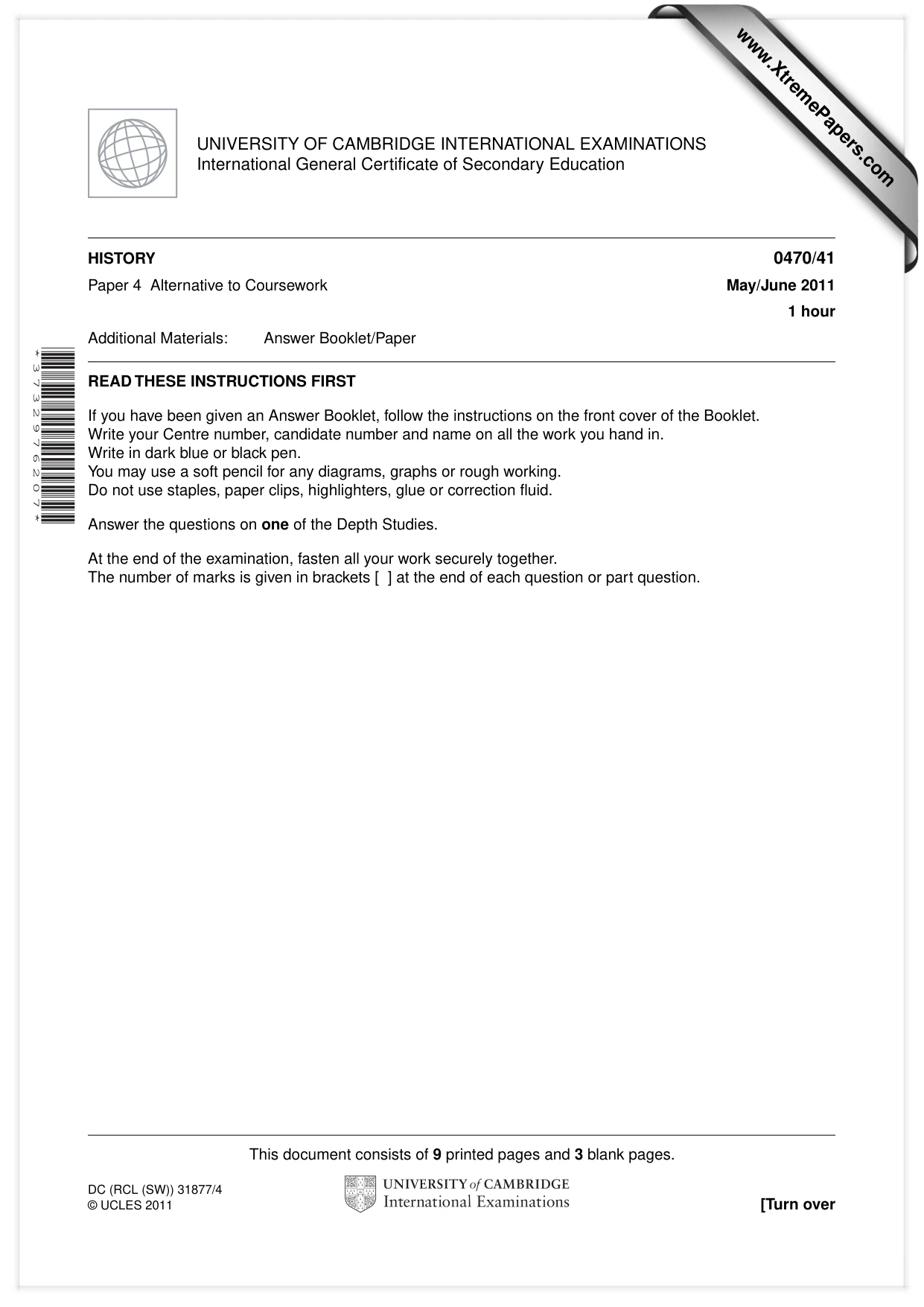
Question paper, page 1
This document consists of 9 printed pages and 3 blank pages. DC (RCL (SW)) 31877/4 © UCLES 2011 [Turn over UNIVERSITY OF CAMBRIDGE INTERNATIONAL EXAMINATIONS International General Certificate of Secondary Education READ THESE INSTRUCTIONS FIRST If you have been given an Answer Booklet, follow the instructions on the front cover of the Booklet. Write your Centre number, candidate number and name on all the work you hand in. Write in dark blue or black pen. You may use a soft pencil for any diagrams, graphs or rough working. Do not use staples, paper clips, highlighters, glue or correction fluid. Answer the questions on one of the Depth Studies. At the end of the examination, fasten all your work securely together. The number of marks is given in brackets [ ] at the end of each question or part question. * 3 7 3 2 9 7 6 2 0 7 * HISTORY 0470/41 Paper 4 Alternative to Coursework May/June 2011 1 hour Additional Materials: Answer Booklet/Paper www.XtremePapers.com
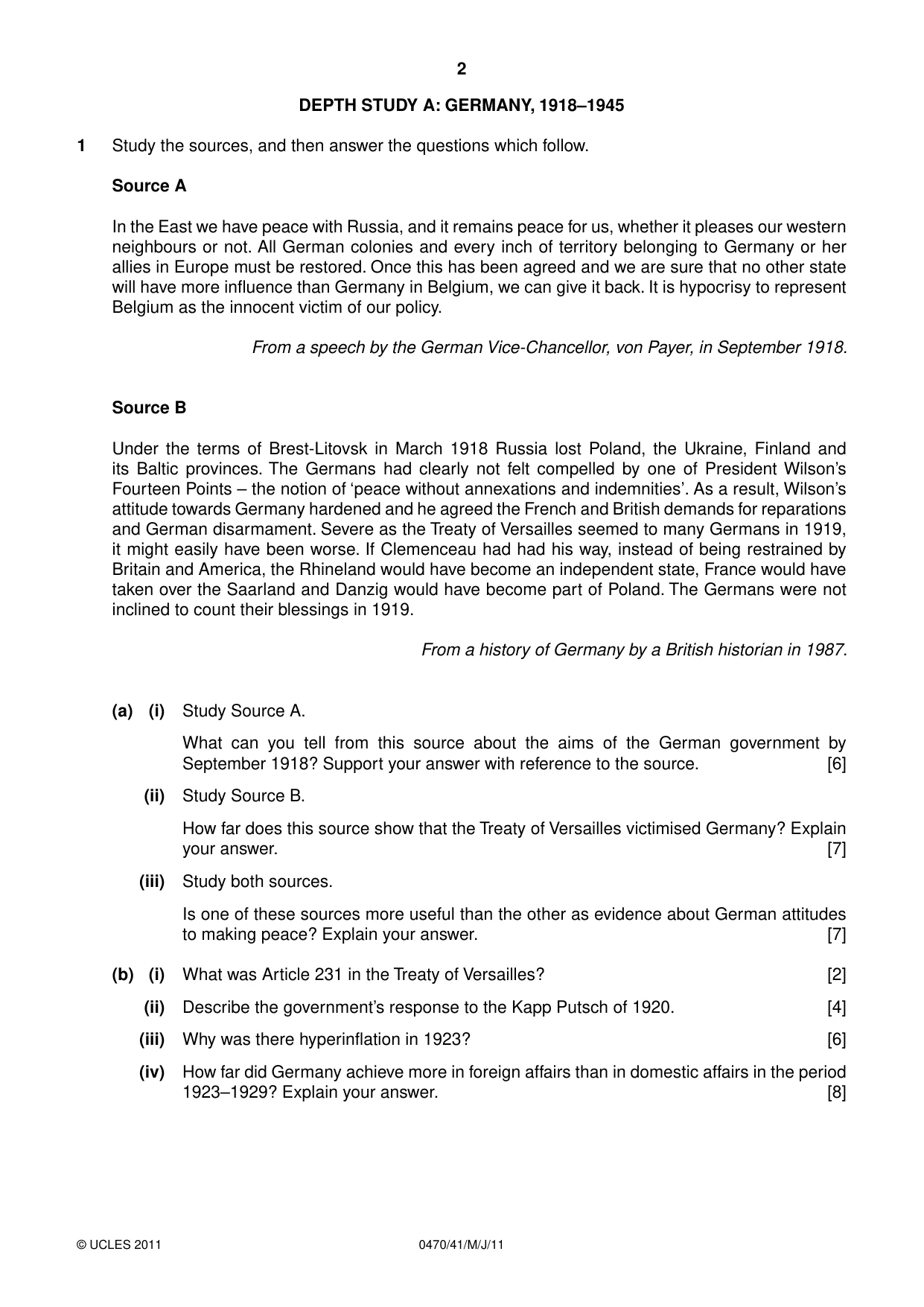
Question paper, page 2
2 0470/41/M/J/11 © UCLES 2011 DEPTH STUDY A: GERMANY, 1918–1945 1 Study the sources, and then answer the questions which follow. Source A In the East we have peace with Russia, and it remains peace for us, whether it pleases our western neighbours or not. All German colonies and every inch of territory belonging to Germany or her allies in Europe must be restored. Once this has been agreed and we are sure that no other state will have more influence than Germany in Belgium, we can give it back. It is hypocrisy to represent Belgium as the innocent victim of our policy. From a speech by the German Vice-Chancellor, von Payer, in September 1918. Source B Under the terms of Brest-Litovsk in March 1918 Russia lost Poland, the Ukraine, Finland and its Baltic provinces. The Germans had clearly not felt compelled by one of President Wilson’s Fourteen Points – the notion of ‘peace without annexations and indemnities’. As a result, Wilson’s attitude towards Germany hardened and he agreed the French and British demands for reparations and German disarmament. Severe as the Treaty of Versailles seemed to many Germans in 1919, it might easily have been worse. If Clemenceau had had his way, instead of being restrained by Britain and America, the Rhineland would have become an independent state, France would have taken over the Saarland and Danzig would have become part of Poland. The Germans were not inclined to count their blessings in 1919. From a history of Germany by a British historian in 1987. (a) (i) Study Source A. What can you tell from this source about the aims of the German government by September 1918? Support your answer with reference to the source. [6] (ii) Study Source B. How far does this source show that the Treaty of Versailles victimised Germany? Explain your answer. [7] (iii) Study both sources. Is one of these sources more useful than the other as evidence about German attitudes to making peace? Explain your answer. [7] (b) (i) What was Article 231 in the Treaty of Versailles? [2] (ii) Describe the government’s response to the Kapp Putsch of 1920. [4] (iii) Why was there hyperinflation in 1923? [6] (iv) How far did Germany achieve more in foreign affairs than in domestic affairs in the period 1923–1929? Explain your answer. [8]
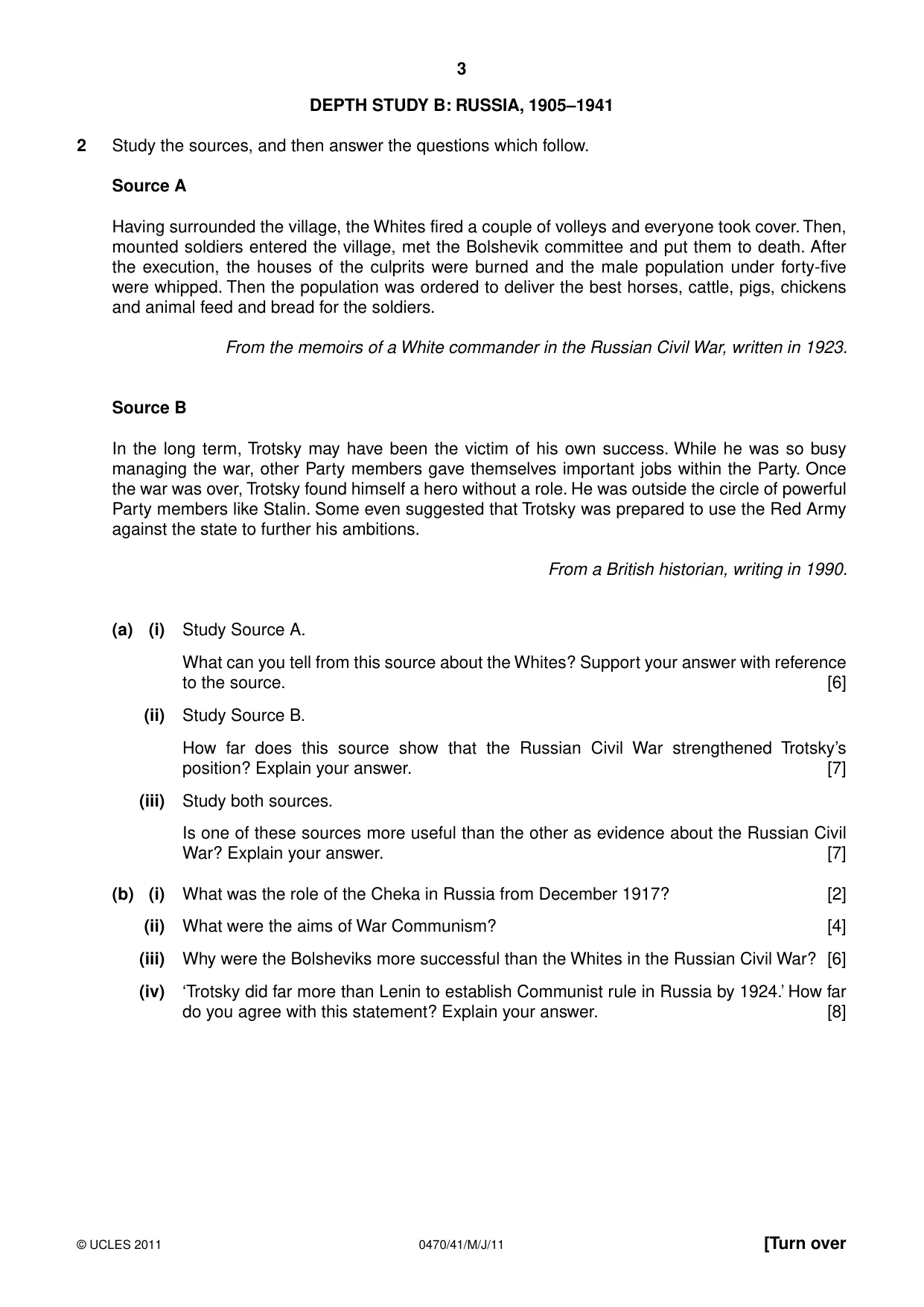
Question paper, page 3
3 0470/41/M/J/11 © UCLES 2011 [Turn over DEPTH STUDY B: RUSSIA, 1905–1941 2 Study the sources, and then answer the questions which follow. Source A Having surrounded the village, the Whites fired a couple of volleys and everyone took cover. Then, mounted soldiers entered the village, met the Bolshevik committee and put them to death. After the execution, the houses of the culprits were burned and the male population under forty-five were whipped. Then the population was ordered to deliver the best horses, cattle, pigs, chickens and animal feed and bread for the soldiers. From the memoirs of a White commander in the Russian Civil War, written in 1923. Source B In the long term, Trotsky may have been the victim of his own success. While he was so busy managing the war, other Party members gave themselves important jobs within the Party. Once the war was over, Trotsky found himself a hero without a role. He was outside the circle of powerful Party members like Stalin. Some even suggested that Trotsky was prepared to use the Red Army against the state to further his ambitions. From a British historian, writing in 1990. (a) (i) Study Source A. What can you tell from this source about the Whites? Support your answer with reference to the source. [6] (ii) Study Source B. How far does this source show that the Russian Civil War strengthened Trotsky’s position? Explain your answer. [7] (iii) Study both sources. Is one of these sources more useful than the other as evidence about the Russian Civil War? Explain your answer. [7] (b) (i) What was the role of the Cheka in Russia from December 1917? [2] (ii) What were the aims of War Communism? [4] (iii) Why were the Bolsheviks more successful than the Whites in the Russian Civil War? [6] (iv) ‘Trotsky did far more than Lenin to establish Communist rule in Russia by 1924.’ How far do you agree with this statement? Explain your answer. [8]
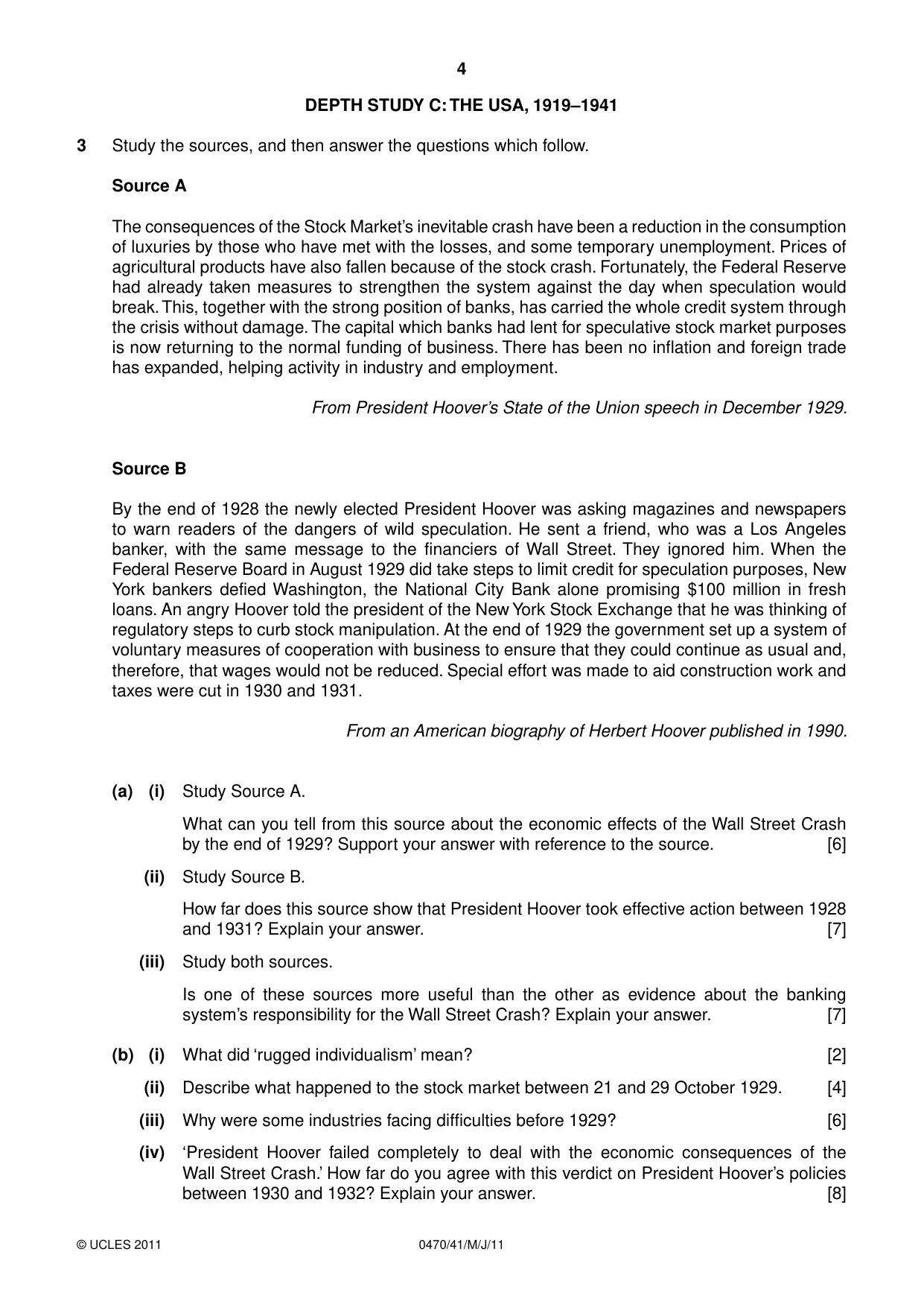
Question paper, page 4
4 0470/41/M/J/11 © UCLES 2011 DEPTH STUDY C: THE USA, 1919–1941 3 Study the sources, and then answer the questions which follow. Source A The consequences of the Stock Market’s inevitable crash have been a reduction in the consumption of luxuries by those who have met with the losses, and some temporary unemployment. Prices of agricultural products have also fallen because of the stock crash. Fortunately, the Federal Reserve had already taken measures to strengthen the system against the day when speculation would break. This, together with the strong position of banks, has carried the whole credit system through the crisis without damage. The capital which banks had lent for speculative stock market purposes is now returning to the normal funding of business. There has been no inflation and foreign trade has expanded, helping activity in industry and employment. From President Hoover’s State of the Union speech in December 1929. Source B By the end of 1928 the newly elected President Hoover was asking magazines and newspapers to warn readers of the dangers of wild speculation. He sent a friend, who was a Los Angeles banker, with the same message to the financiers of Wall Street. They ignored him. When the Federal Reserve Board in August 1929 did take steps to limit credit for speculation purposes, New York bankers defied Washington, the National City Bank alone promising $100 million in fresh loans. An angry Hoover told the president of the New York Stock Exchange that he was thinking of regulatory steps to curb stock manipulation. At the end of 1929 the government set up a system of voluntary measures of cooperation with business to ensure that they could continue as usual and, therefore, that wages would not be reduced. Special effort was made to aid construction work and taxes were cut in 1930 and 1931. From an American biography of Herbert Hoover published in 1990. (a) (i) Study Source A. What can you tell from this source about the economic effects of the Wall Street Crash by the end of 1929? Support your answer with reference to the source. [6] (ii) Study Source B. How far does this source show that President Hoover took effective action between 1928 and 1931? Explain your answer. [7] (iii) Study both sources. Is one of these sources more useful than the other as evidence about the banking system’s responsibility for the Wall Street Crash? Explain your answer. [7] (b) (i) What did ‘rugged individualism’ mean? [2] (ii) Describe what happened to the stock market between 21 and 29 October 1929. [4] (iii) Why were some industries facing difficulties before 1929? [6] (iv) ‘President Hoover failed completely to deal with the economic consequences of the Wall Street Crash.’ How far do you agree with this verdict on President Hoover’s policies between 1930 and 1932? Explain your answer. [8]
Question paper, page 5
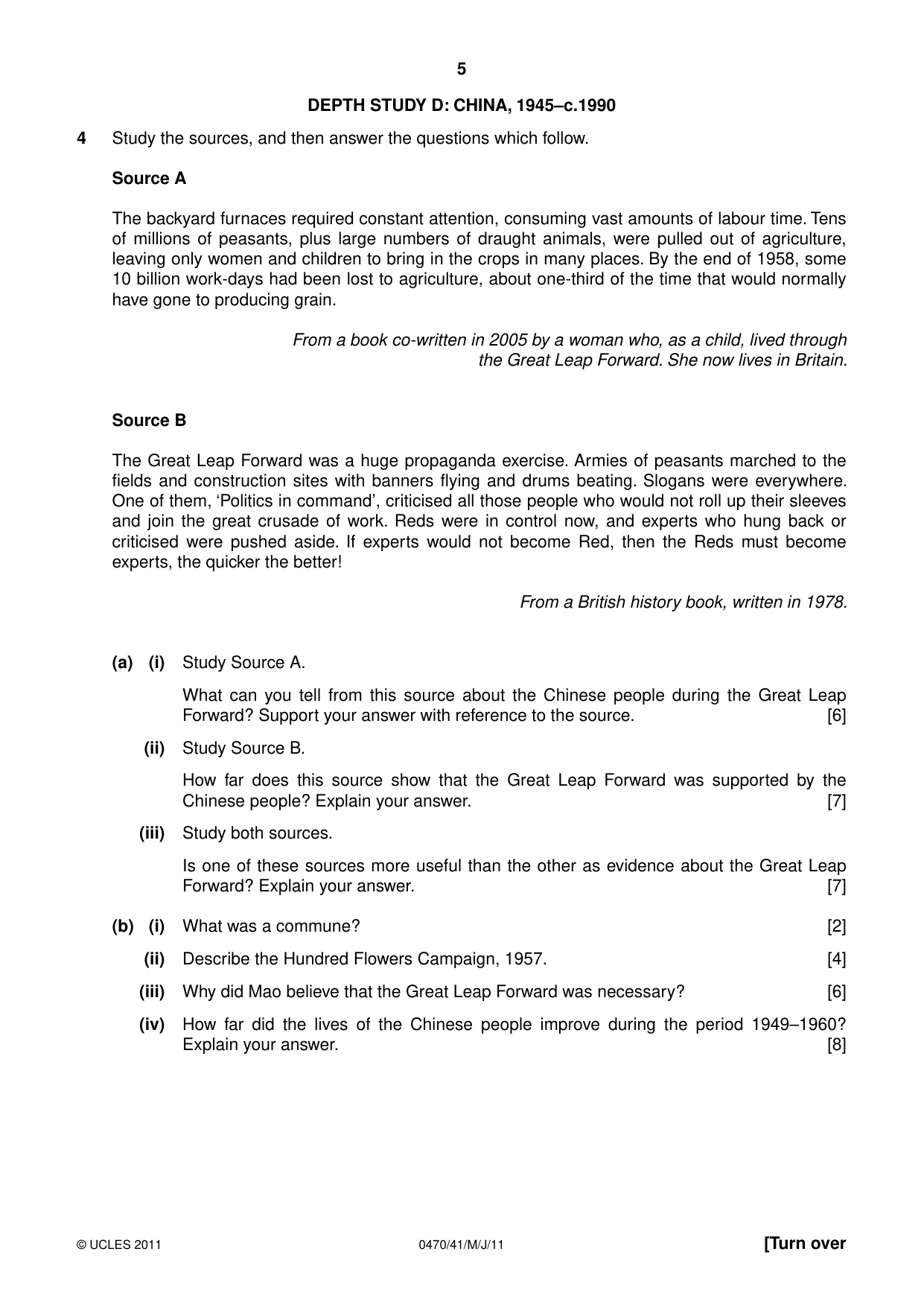
5 0470/41/M/J/11 © UCLES 2011 [Turn over DEPTH STUDY D: CHINA, 1945–c.1990 4 Study the sources, and then answer the questions which follow. Source A The backyard furnaces required constant attention, consuming vast amounts of labour time. Tens of millions of peasants, plus large numbers of draught animals, were pulled out of agriculture, leaving only women and children to bring in the crops in many places. By the end of 1958, some 10 billion work-days had been lost to agriculture, about one-third of the time that would normally have gone to producing grain. From a book co-written in 2005 by a woman who, as a child, lived through the Great Leap Forward. She now lives in Britain. Source B The Great Leap Forward was a huge propaganda exercise. Armies of peasants marched to the fields and construction sites with banners flying and drums beating. Slogans were everywhere. One of them, ‘Politics in command’, criticised all those people who would not roll up their sleeves and join the great crusade of work. Reds were in control now, and experts who hung back or criticised were pushed aside. If experts would not become Red, then the Reds must become experts, the quicker the better! From a British history book, written in 1978. (a) (i) Study Source A. What can you tell from this source about the Chinese people during the Great Leap Forward? Support your answer with reference to the source. [6] (ii) Study Source B. How far does this source show that the Great Leap Forward was supported by the Chinese people? Explain your answer. [7] (iii) Study both sources. Is one of these sources more useful than the other as evidence about the Great Leap Forward? Explain your answer. [7] (b) (i) What was a commune? [2] (ii) Describe the Hundred Flowers Campaign, 1957. [4] (iii) Why did Mao believe that the Great Leap Forward was necessary? [6] (iv) How far did the lives of the Chinese people improve during the period 1949–1960? Explain your answer. [8]
Question paper, page 6
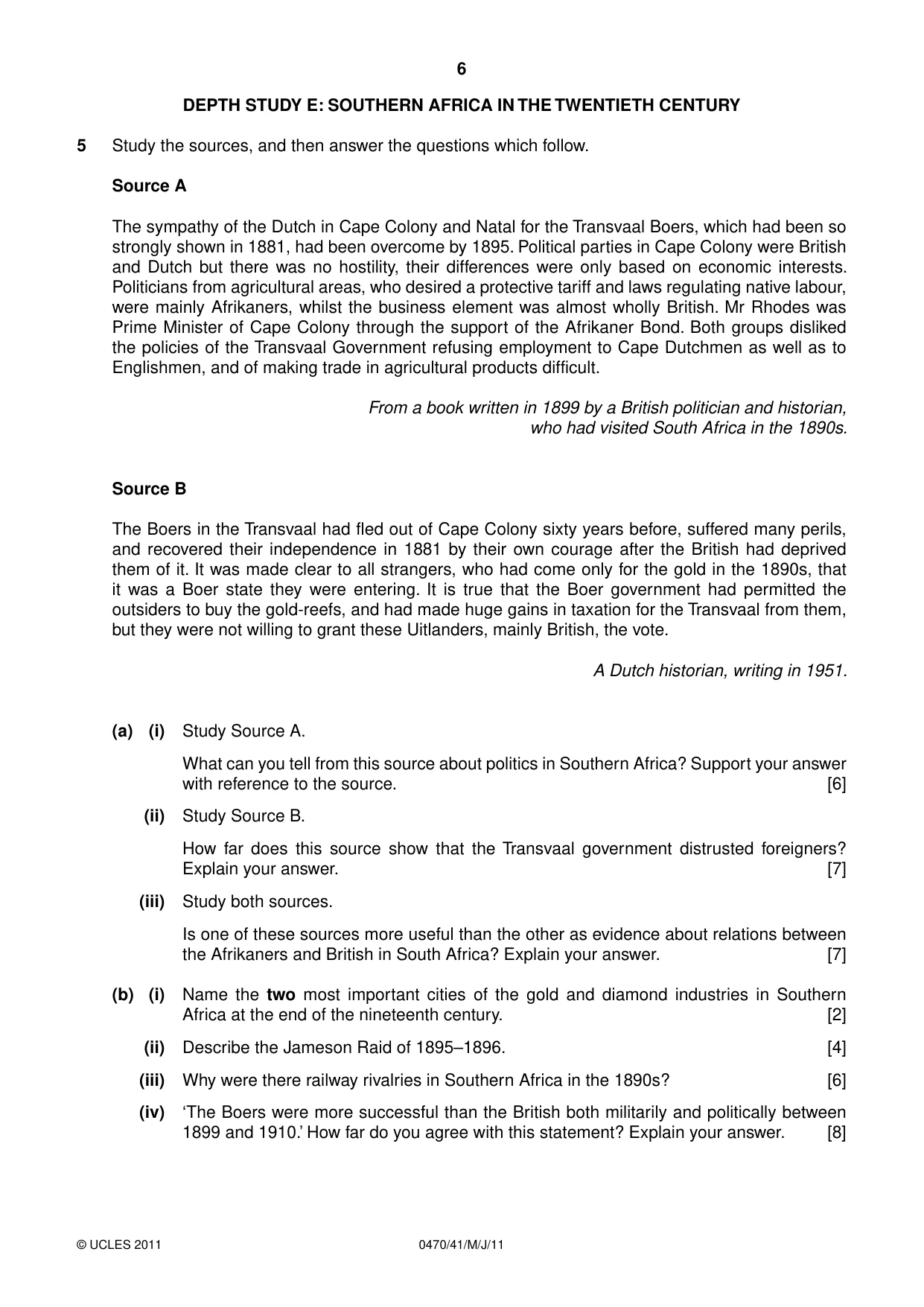
6 0470/41/M/J/11 © UCLES 2011 DEPTH STUDY E: SOUTHERN AFRICA IN THE TWENTIETH CENTURY 5 Study the sources, and then answer the questions which follow. Source A The sympathy of the Dutch in Cape Colony and Natal for the Transvaal Boers, which had been so strongly shown in 1881, had been overcome by 1895. Political parties in Cape Colony were British and Dutch but there was no hostility, their differences were only based on economic interests. Politicians from agricultural areas, who desired a protective tariff and laws regulating native labour, were mainly Afrikaners, whilst the business element was almost wholly British. Mr Rhodes was Prime Minister of Cape Colony through the support of the Afrikaner Bond. Both groups disliked the policies of the Transvaal Government refusing employment to Cape Dutchmen as well as to Englishmen, and of making trade in agricultural products difficult. From a book written in 1899 by a British politician and historian, who had visited South Africa in the 1890s. Source B The Boers in the Transvaal had fled out of Cape Colony sixty years before, suffered many perils, and recovered their independence in 1881 by their own courage after the British had deprived them of it. It was made clear to all strangers, who had come only for the gold in the 1890s, that it was a Boer state they were entering. It is true that the Boer government had permitted the outsiders to buy the gold-reefs, and had made huge gains in taxation for the Transvaal from them, but they were not willing to grant these Uitlanders, mainly British, the vote. A Dutch historian, writing in 1951. (a) (i) Study Source A. What can you tell from this source about politics in Southern Africa? Support your answer with reference to the source. [6] (ii) Study Source B. How far does this source show that the Transvaal government distrusted foreigners? Explain your answer. [7] (iii) Study both sources. Is one of these sources more useful than the other as evidence about relations between the Afrikaners and British in South Africa? Explain your answer. [7] (b) (i) Name the two most important cities of the gold and diamond industries in Southern Africa at the end of the nineteenth century. [2] (ii) Describe the Jameson Raid of 1895–1896. [4] (iii) Why were there railway rivalries in Southern Africa in the 1890s? [6] (iv) ‘The Boers were more successful than the British both militarily and politically between 1899 and 1910.’ How far do you agree with this statement? Explain your answer. [8]
Question paper, page 7
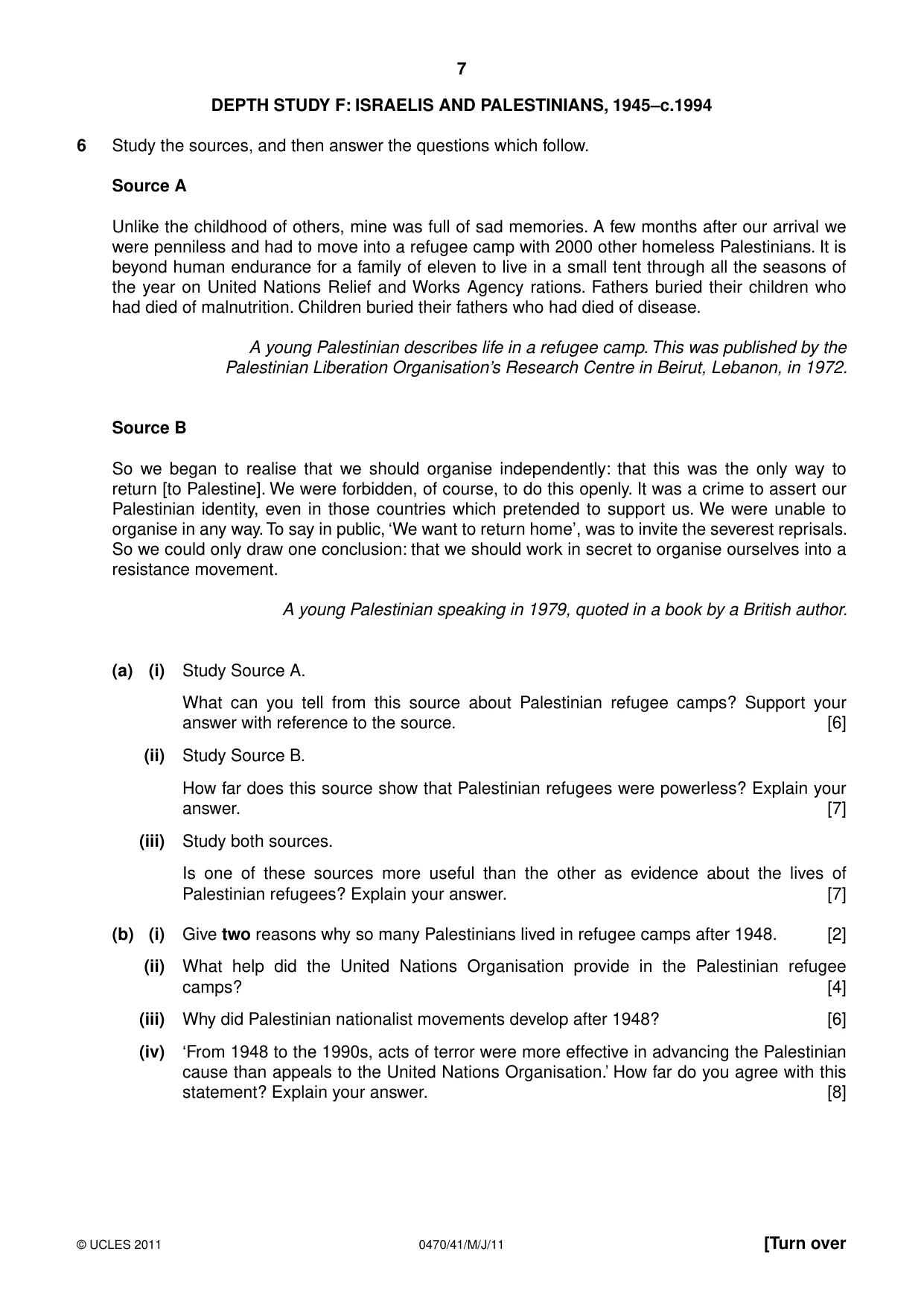
7 0470/41/M/J/11 © UCLES 2011 [Turn over DEPTH STUDY F: ISRAELIS AND PALESTINIANS, 1945–c.1994 6 Study the sources, and then answer the questions which follow. Source A Unlike the childhood of others, mine was full of sad memories. A few months after our arrival we were penniless and had to move into a refugee camp with 2000 other homeless Palestinians. It is beyond human endurance for a family of eleven to live in a small tent through all the seasons of the year on United Nations Relief and Works Agency rations. Fathers buried their children who had died of malnutrition. Children buried their fathers who had died of disease. A young Palestinian describes life in a refugee camp. This was published by the Palestinian Liberation Organisation’s Research Centre in Beirut, Lebanon, in 1972. Source B So we began to realise that we should organise independently: that this was the only way to return [to Palestine]. We were forbidden, of course, to do this openly. It was a crime to assert our Palestinian identity, even in those countries which pretended to support us. We were unable to organise in any way. To say in public, ‘We want to return home’, was to invite the severest reprisals. So we could only draw one conclusion: that we should work in secret to organise ourselves into a resistance movement. A young Palestinian speaking in 1979, quoted in a book by a British author. (a) (i) Study Source A. What can you tell from this source about Palestinian refugee camps? Support your answer with reference to the source. [6] (ii) Study Source B. How far does this source show that Palestinian refugees were powerless? Explain your answer. [7] (iii) Study both sources. Is one of these sources more useful than the other as evidence about the lives of Palestinian refugees? Explain your answer. [7] (b) (i) Give two reasons why so many Palestinians lived in refugee camps after 1948. [2] (ii) What help did the United Nations Organisation provide in the Palestinian refugee camps? [4] (iii) Why did Palestinian nationalist movements develop after 1948? [6] (iv) ‘From 1948 to the 1990s, acts of terror were more effective in advancing the Palestinian cause than appeals to the United Nations Organisation.’ How far do you agree with this statement? Explain your answer. [8]
Question paper, page 8
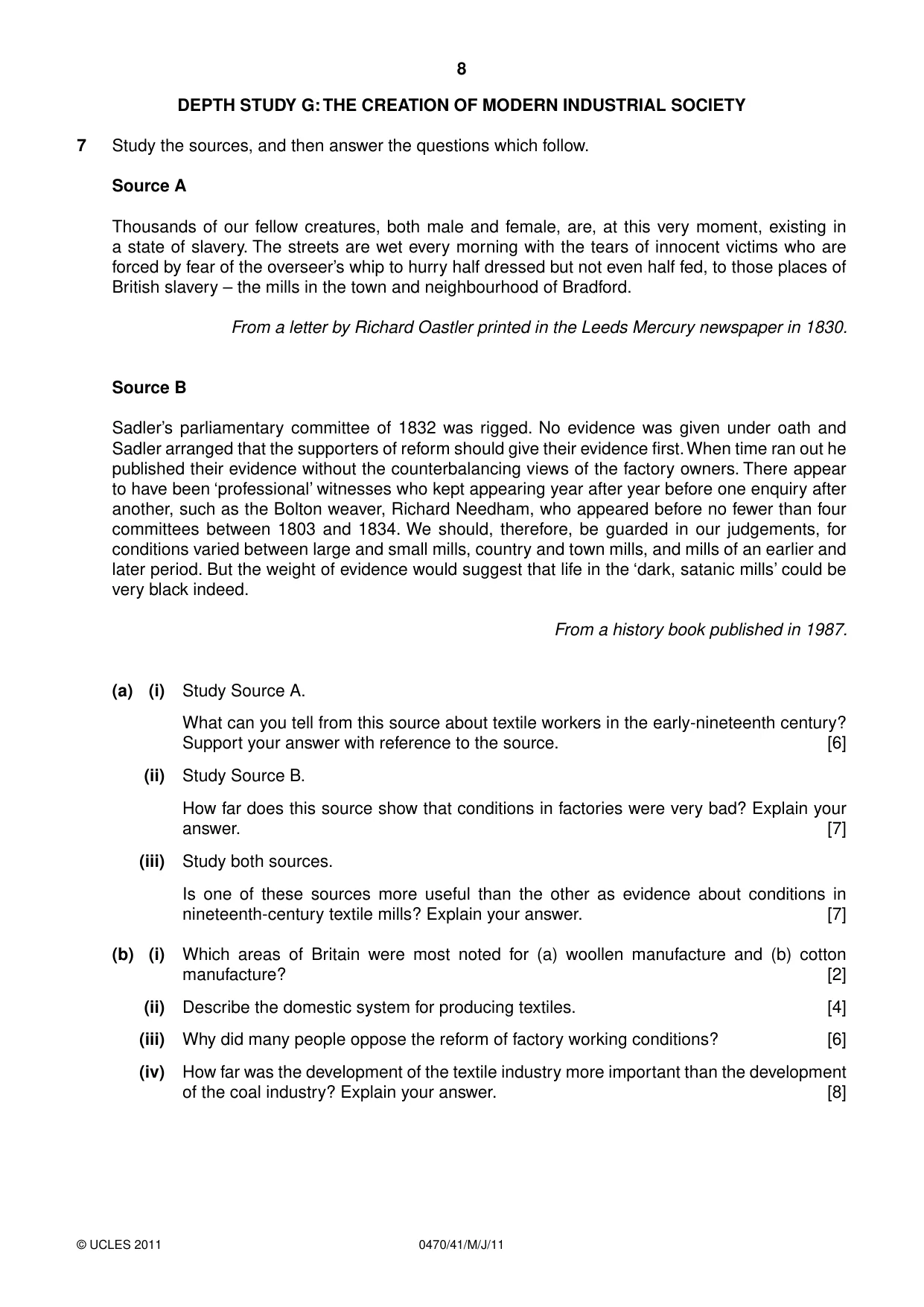
8 0470/41/M/J/11 © UCLES 2011 DEPTH STUDY G: THE CREATION OF MODERN INDUSTRIAL SOCIETY 7 Study the sources, and then answer the questions which follow. Source A Thousands of our fellow creatures, both male and female, are, at this very moment, existing in a state of slavery. The streets are wet every morning with the tears of innocent victims who are forced by fear of the overseer’s whip to hurry half dressed but not even half fed, to those places of British slavery – the mills in the town and neighbourhood of Bradford. From a letter by Richard Oastler printed in the Leeds Mercury newspaper in 1830. Source B Sadler’s parliamentary committee of 1832 was rigged. No evidence was given under oath and Sadler arranged that the supporters of reform should give their evidence first. When time ran out he published their evidence without the counterbalancing views of the factory owners. There appear to have been ‘professional’ witnesses who kept appearing year after year before one enquiry after another, such as the Bolton weaver, Richard Needham, who appeared before no fewer than four committees between 1803 and 1834. We should, therefore, be guarded in our judgements, for conditions varied between large and small mills, country and town mills, and mills of an earlier and later period. But the weight of evidence would suggest that life in the ‘dark, satanic mills’ could be very black indeed. From a history book published in 1987. (a) (i) Study Source A. What can you tell from this source about textile workers in the early-nineteenth century? Support your answer with reference to the source. [6] (ii) Study Source B. How far does this source show that conditions in factories were very bad? Explain your answer. [7] (iii) Study both sources. Is one of these sources more useful than the other as evidence about conditions in nineteenth-century textile mills? Explain your answer. [7] (b) (i) Which areas of Britain were most noted for (a) woollen manufacture and (b) cotton manufacture? [2] (ii) Describe the domestic system for producing textiles. [4] (iii) Why did many people oppose the reform of factory working conditions? [6] (iv) How far was the development of the textile industry more important than the development of the coal industry? Explain your answer. [8]
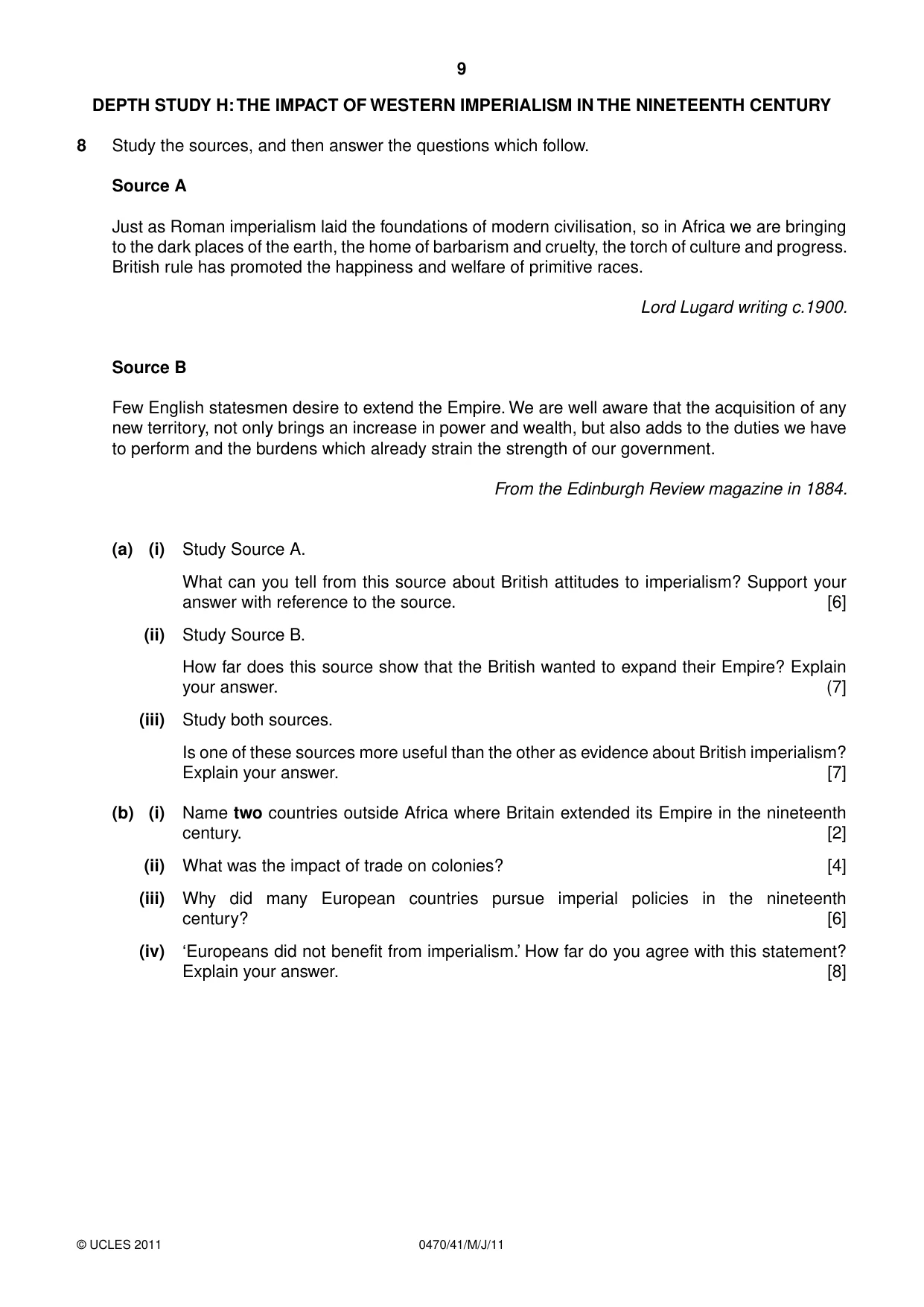
Question paper, page 9
9 0470/41/M/J/11 © UCLES 2011 DEPTH STUDY H: THE IMPACT OF WESTERN IMPERIALISM IN THE NINETEENTH CENTURY 8 Study the sources, and then answer the questions which follow. Source A Just as Roman imperialism laid the foundations of modern civilisation, so in Africa we are bringing to the dark places of the earth, the home of barbarism and cruelty, the torch of culture and progress. British rule has promoted the happiness and welfare of primitive races. Lord Lugard writing c.1900. Source B Few English statesmen desire to extend the Empire. We are well aware that the acquisition of any new territory, not only brings an increase in power and wealth, but also adds to the duties we have to perform and the burdens which already strain the strength of our government. From the Edinburgh Review magazine in 1884. (a) (i) Study Source A. What can you tell from this source about British attitudes to imperialism? Support your answer with reference to the source. [6] (ii) Study Source B. How far does this source show that the British wanted to expand their Empire? Explain your answer. (7] (iii) Study both sources. Is one of these sources more useful than the other as evidence about British imperialism? Explain your answer. [7] (b) (i) Name two countries outside Africa where Britain extended its Empire in the nineteenth century. [2] (ii) What was the impact of trade on colonies? [4] (iii) Why did many European countries pursue imperial policies in the nineteenth century? [6] (iv) ‘Europeans did not benefit from imperialism.’ How far do you agree with this statement? Explain your answer. [8]
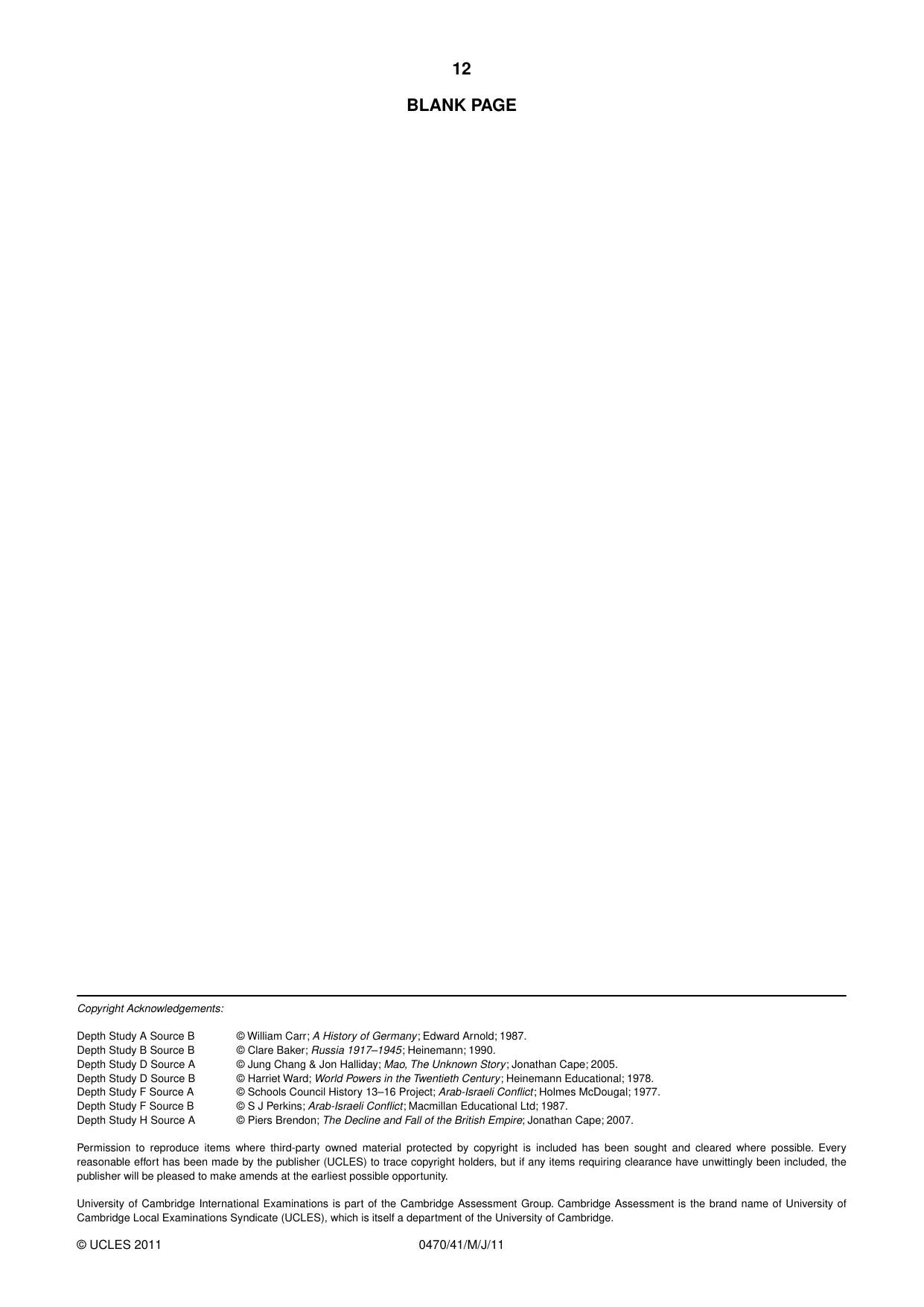
Question paper, page 10
10 0470/41/M/J/11 © UCLES 2011 BLANK PAGE
Question paper, page 11
11 0470/41/M/J/11 © UCLES 2011 BLANK PAGE
Question paper, page 12
12 0470/41/M/J/11 © UCLES 2011 BLANK PAGE Copyright Acknowledgements: Depth Study A Source B © William Carr; A History of Germany ; Edward Arnold; 1987. Depth Study B Source B © Clare Baker; Russia 1917–1945 ; Heinemann; 1990. Depth Study D Source A © Jung Chang & Jon Halliday; Mao, The Unknown Story ; Jonathan Cape; 2005. Depth Study D Source B © Harriet Ward; World Powers in the Twentieth Century ; Heinemann Educational; 1978. Depth Study F Source A © Schools Council History 13–16 Project; Arab-Israeli Conflict ; Holmes McDougal; 1977. Depth Study F Source B © S J Perkins; Arab-Israeli Conflict ; Macmillan Educational Ltd; 1987. Depth Study H Source A © Piers Brendon; The Decline and Fall of the British Empire; Jonathan Cape; 2007. Permission to reproduce items where third-party owned material protected by copyright is included has been sought and cleared where possible. Every reasonable effort has been made by the publisher (UCLES) to trace copyright holders, but if any items requiring clearance have unwittingly been included, the publisher will be pleased to make amends at the earliest possible opportunity. University of Cambridge International Examinations is part of the Cambridge Assessment Group. Cambridge Assessment is the brand name of University of Cambridge Local Examinations Syndicate (UCLES), which is itself a department of the University of Cambridge.
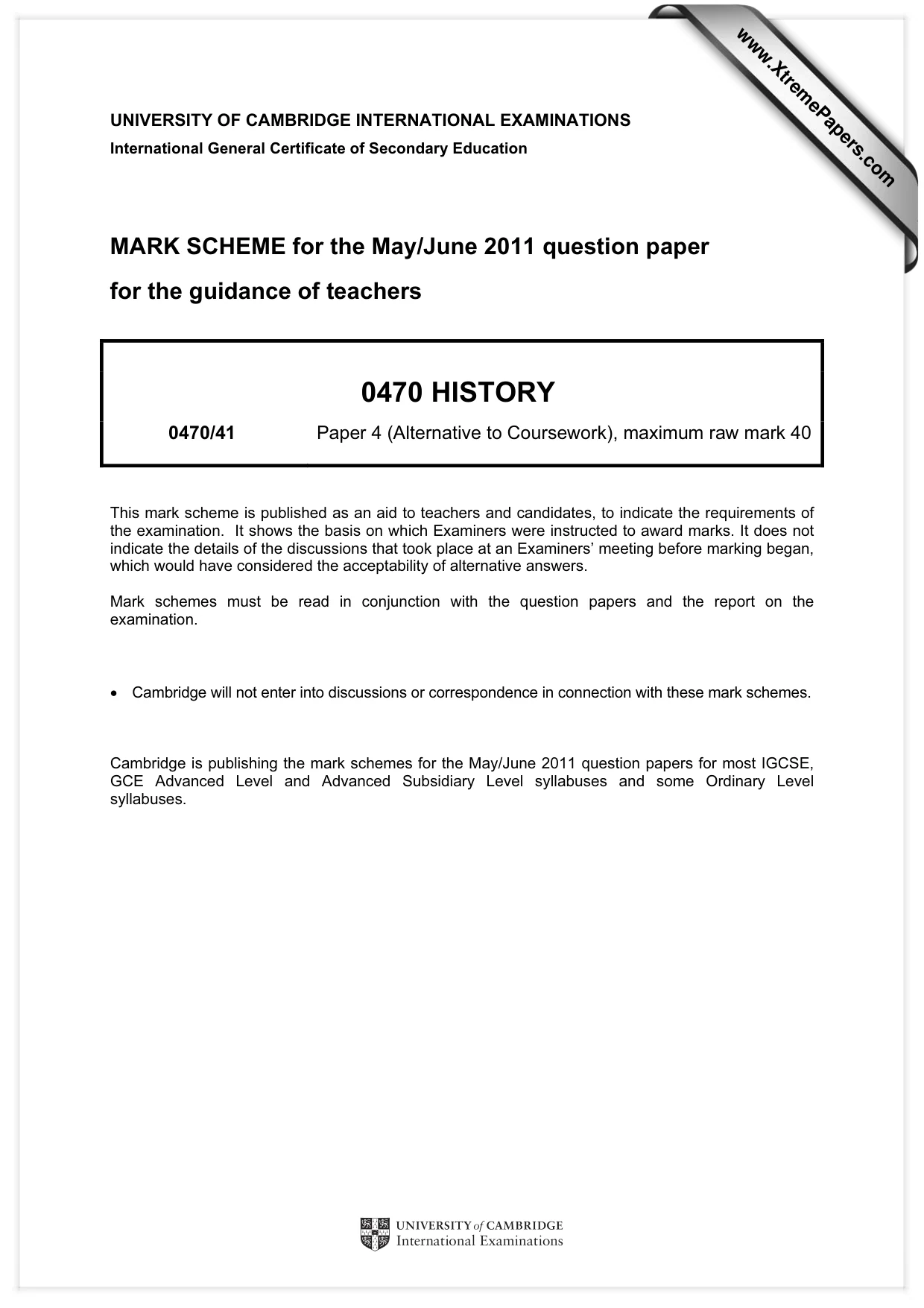
Mark scheme, page 1
UNIVERSITY OF CAMBRIDGE INTERNATIONAL EXAMINATIONS International General Certificate of Secondary Education MARK SCHEME for the May/June 2011 question paper for the guidance of teachers 0470 HISTORY 0470/41 Paper 4 (Alternative to Coursework), maximum raw mark 40 This mark scheme is published as an aid to teachers and candidates, to indicate the requirements of the examination. It shows the basis on which Examiners were instructed to award marks. It does not indicate the details of the discussions that took place at an Examiners’ meeting before marking began, which would have considered the acceptability of alternative answers. Mark schemes must be read in conjunction with the question papers and the report on the examination. • Cambridge will not enter into discussions or correspondence in connection with these mark schemes. Cambridge is publishing the mark schemes for the May/June 2011 question papers for most IGCSE, GCE Advanced Level and Advanced Subsidiary Level syllabuses and some Ordinary Level syllabuses. www.XtremePapers.com
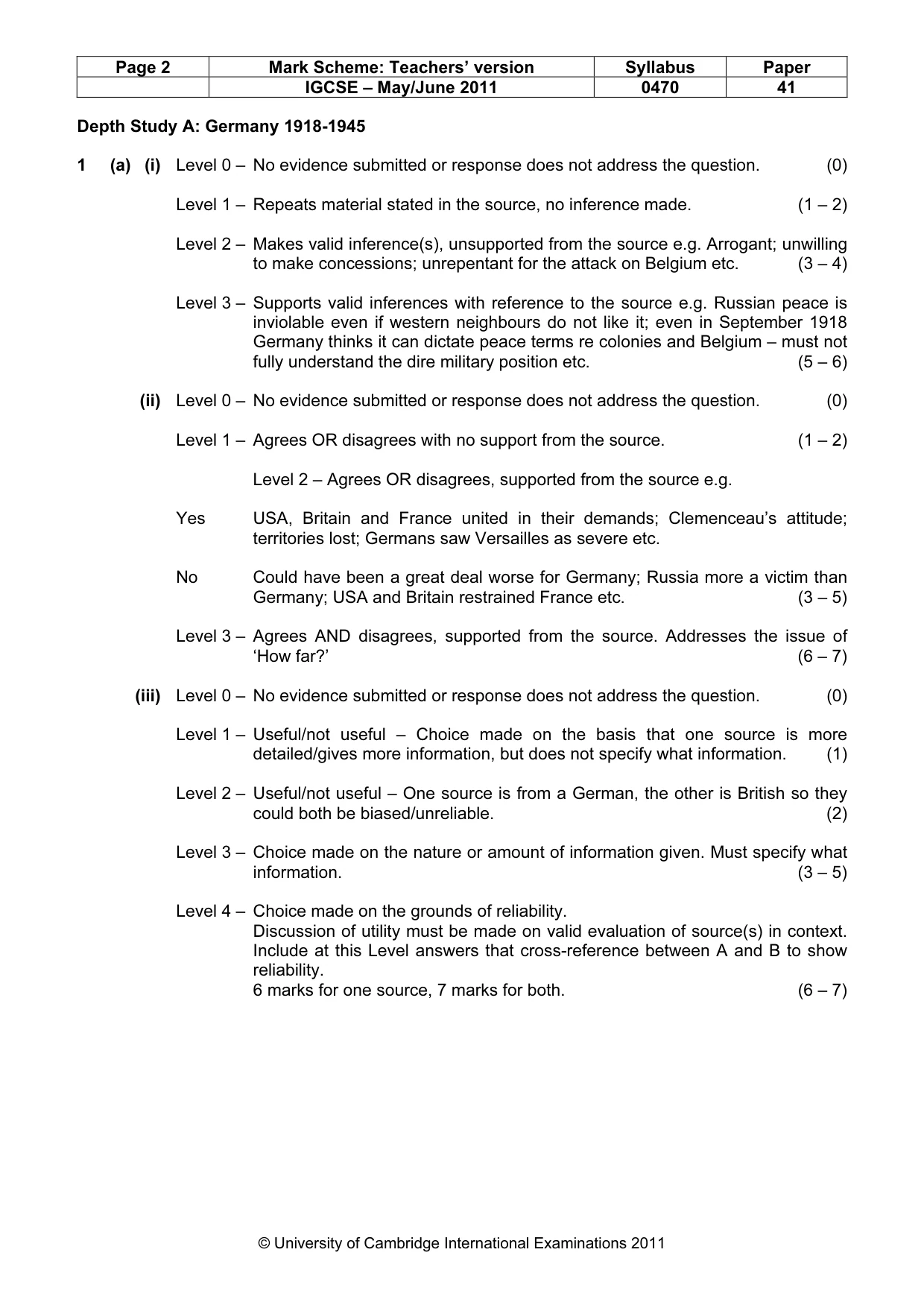
Mark scheme, page 2
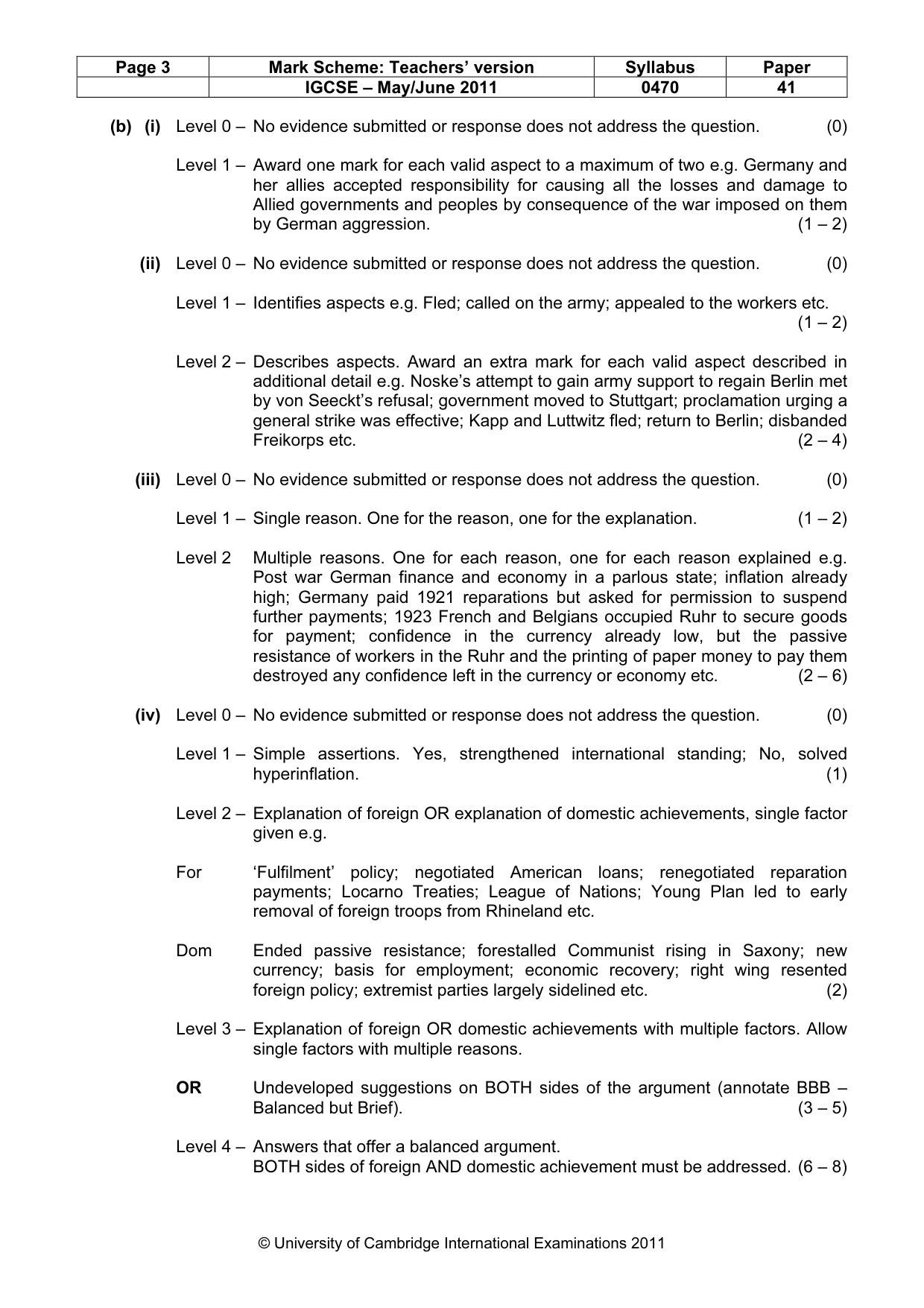
Page 2 Mark Scheme: Teachers’ version Syllabus Paper IGCSE – May/June 2011 0470 41 © University of Cambridge International Examinations 2011 Depth Study A: Germany 1918-1945 1 (a) (i) Level 0 – No evidence submitted or response does not address the question. (0) Level 1 – Repeats material stated in the source, no inference made. (1 – 2) Level 2 – Makes valid inference(s), unsupported from the source e.g. Arrogant; unwilling to make concessions; unrepentant for the attack on Belgium etc. (3 – 4) Level 3 – Supports valid inferences with reference to the source e.g. Russian peace is inviolable even if western neighbours do not like it; even in September 1918 Germany thinks it can dictate peace terms re colonies and Belgium – must not fully understand the dire military position etc. (5 – 6) (ii) Level 0 – No evidence submitted or response does not address the question. (0) Level 1 – Agrees OR disagrees with no support from the source. (1 – 2) Level 2 – Agrees OR disagrees, supported from the source e.g. Yes USA, Britain and France united in their demands; Clemenceau’s attitude; territories lost; Germans saw Versailles as severe etc. No Could have been a great deal worse for Germany; Russia more a victim than Germany; USA and Britain restrained France etc. (3 – 5) Level 3 – Agrees AND disagrees, supported from the source. Addresses the issue of ‘How far?’ (6 – 7) (iii) Level 0 – No evidence submitted or response does not address the question. (0) Level 1 – Useful/not useful – Choice made on the basis that one source is more detailed/gives more information, but does not specify what information. (1) Level 2 – Useful/not useful – One source is from a German, the other is British so they could both be biased/unreliable. (2) Level 3 – Choice made on the nature or amount of information given. Must specify what information. (3 – 5) Level 4 – Choice made on the grounds of reliability. Discussion of utility must be made on valid evaluation of source(s) in context. Include at this Level answers that cross-reference between A and B to show reliability. 6 marks for one source, 7 marks for both. (6 – 7)
Mark scheme, page 3
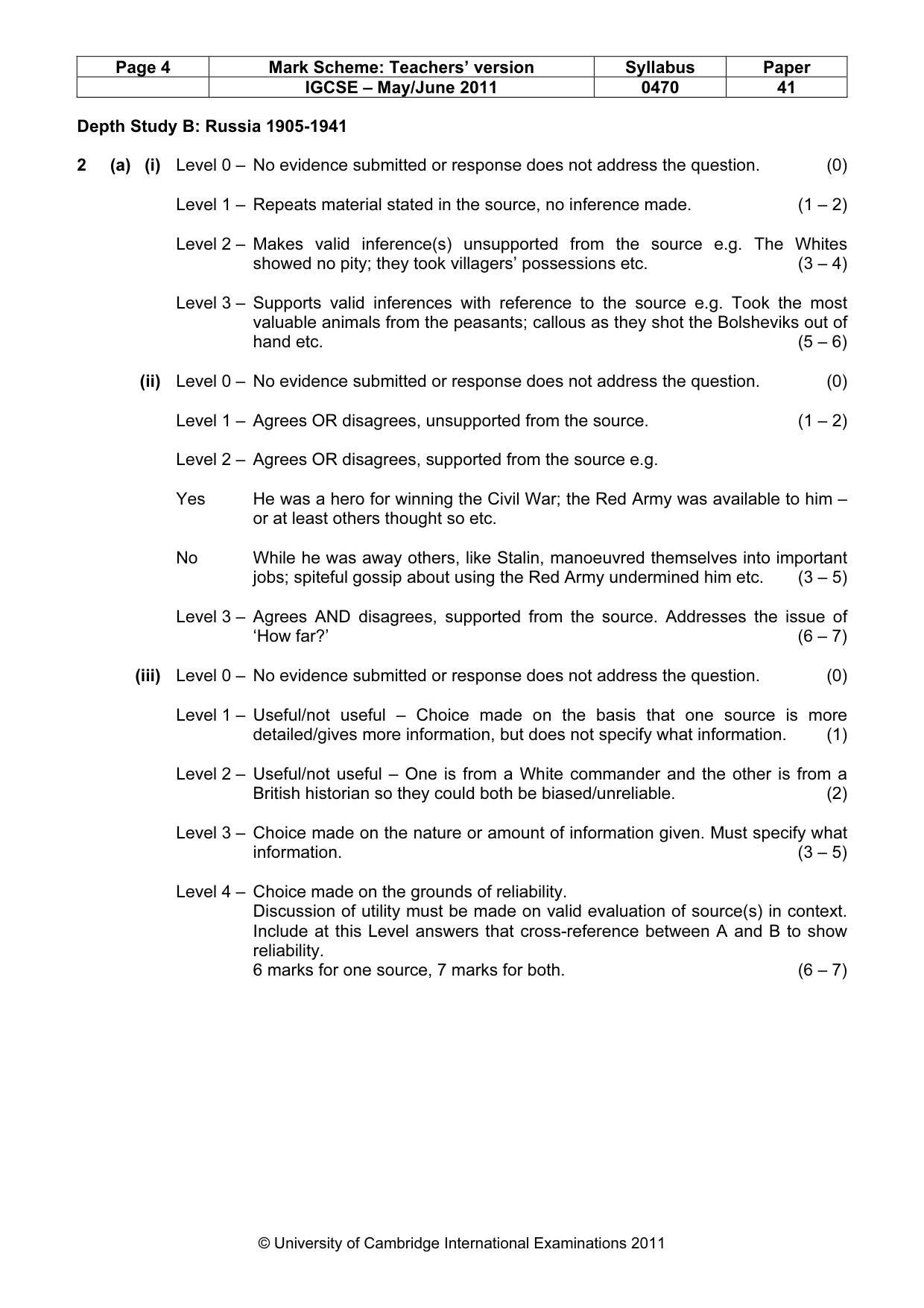
Page 3 Mark Scheme: Teachers’ version Syllabus Paper IGCSE – May/June 2011 0470 41 © University of Cambridge International Examinations 2011 (b) (i) Level 0 – No evidence submitted or response does not address the question. (0) Level 1 – Award one mark for each valid aspect to a maximum of two e.g. Germany and her allies accepted responsibility for causing all the losses and damage to Allied governments and peoples by consequence of the war imposed on them by German aggression. (1 – 2) (ii) Level 0 – No evidence submitted or response does not address the question. (0) Level 1 – Identifies aspects e.g. Fled; called on the army; appealed to the workers etc. (1 – 2) Level 2 – Describes aspects. Award an extra mark for each valid aspect described in additional detail e.g. Noske’s attempt to gain army support to regain Berlin met by von Seeckt’s refusal; government moved to Stuttgart; proclamation urging a general strike was effective; Kapp and Luttwitz fled; return to Berlin; disbanded Freikorps etc. (2 – 4) (iii) Level 0 – No evidence submitted or response does not address the question. (0) Level 1 – Single reason. One for the reason, one for the explanation. (1 – 2) Level 2 Multiple reasons. One for each reason, one for each reason explained e.g. Post war German finance and economy in a parlous state; inflation already high; Germany paid 1921 reparations but asked for permission to suspend further payments; 1923 French and Belgians occupied Ruhr to secure goods for payment; confidence in the currency already low, but the passive resistance of workers in the Ruhr and the printing of paper money to pay them destroyed any confidence left in the currency or economy etc. (2 – 6) (iv) Level 0 – No evidence submitted or response does not address the question. (0) Level 1 – Simple assertions. Yes, strengthened international standing; No, solved hyperinflation. (1) Level 2 – Explanation of foreign OR explanation of domestic achievements, single factor given e.g. For ‘Fulfilment’ policy; negotiated American loans; renegotiated reparation payments; Locarno Treaties; League of Nations; Young Plan led to early removal of foreign troops from Rhineland etc. Dom Ended passive resistance; forestalled Communist rising in Saxony; new currency; basis for employment; economic recovery; right wing resented foreign policy; extremist parties largely sidelined etc. (2) Level 3 – Explanation of foreign OR domestic achievements with multiple factors. Allow single factors with multiple reasons. OR Undeveloped suggestions on BOTH sides of the argument (annotate BBB – Balanced but Brief). (3 – 5) Level 4 – Answers that offer a balanced argument. BOTH sides of foreign AND domestic achievement must be addressed. (6 – 8)
Mark scheme, page 4
Page 4 Mark Scheme: Teachers’ version Syllabus Paper IGCSE – May/June 2011 0470 41 © University of Cambridge International Examinations 2011 Depth Study B: Russia 1905-1941 2 (a) (i) Level 0 – No evidence submitted or response does not address the question. (0) Level 1 – Repeats material stated in the source, no inference made. (1 – 2) Level 2 – Makes valid inference(s) unsupported from the source e.g. The Whites showed no pity; they took villagers’ possessions etc. (3 – 4) Level 3 – Supports valid inferences with reference to the source e.g. Took the most valuable animals from the peasants; callous as they shot the Bolsheviks out of hand etc. (5 – 6) (ii) Level 0 – No evidence submitted or response does not address the question. (0) Level 1 – Agrees OR disagrees, unsupported from the source. (1 – 2) Level 2 – Agrees OR disagrees, supported from the source e.g. Yes He was a hero for winning the Civil War; the Red Army was available to him – or at least others thought so etc. No While he was away others, like Stalin, manoeuvred themselves into important jobs; spiteful gossip about using the Red Army undermined him etc. (3 – 5) Level 3 – Agrees AND disagrees, supported from the source. Addresses the issue of ‘How far?’ (6 – 7) (iii) Level 0 – No evidence submitted or response does not address the question. (0) Level 1 – Useful/not useful – Choice made on the basis that one source is more detailed/gives more information, but does not specify what information. (1) Level 2 – Useful/not useful – One is from a White commander and the other is from a British historian so they could both be biased/unreliable. (2) Level 3 – Choice made on the nature or amount of information given. Must specify what information. (3 – 5) Level 4 – Choice made on the grounds of reliability. Discussion of utility must be made on valid evaluation of source(s) in context. Include at this Level answers that cross-reference between A and B to show reliability. 6 marks for one source, 7 marks for both. (6 – 7)
Mark scheme, page 5
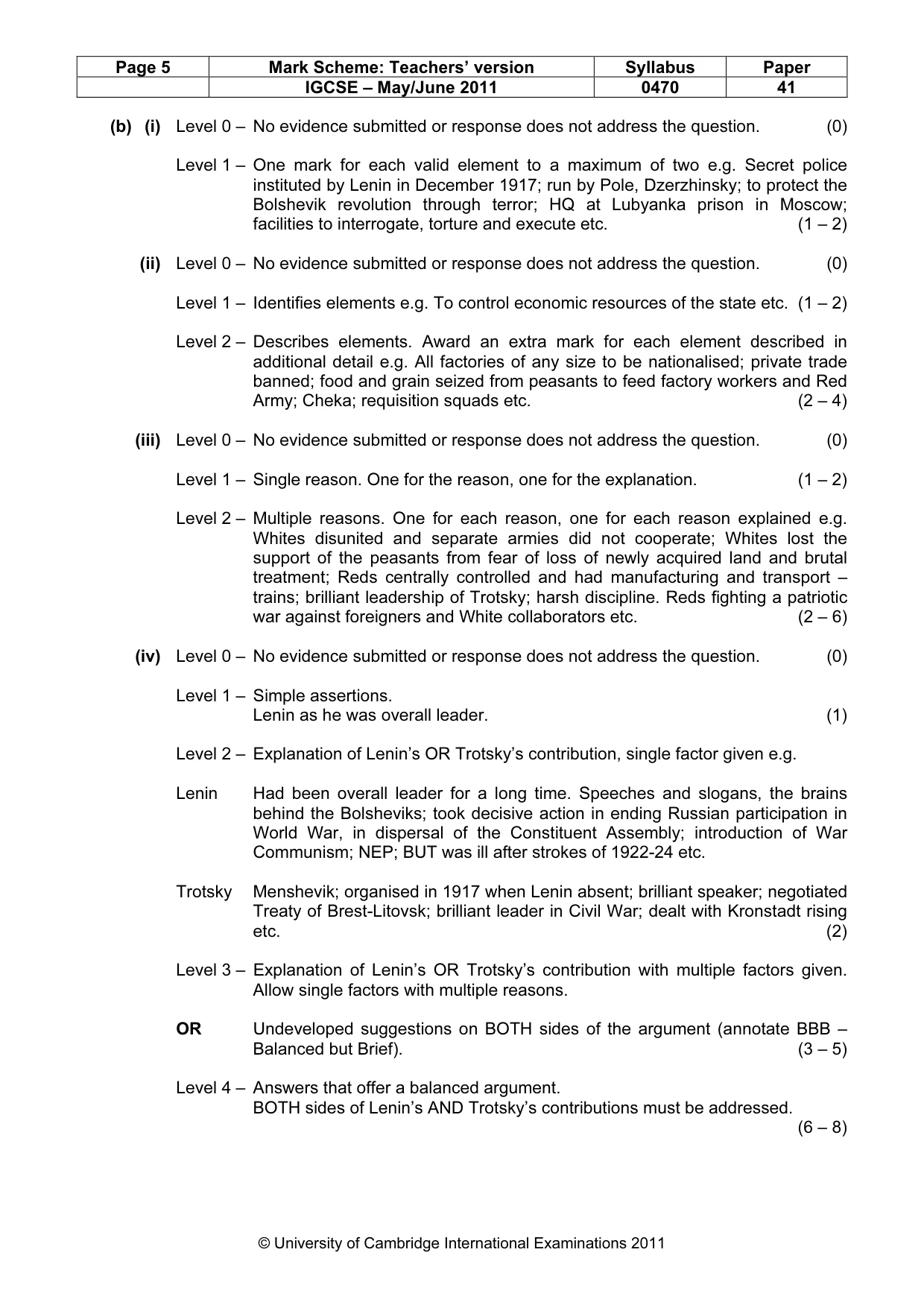
Page 5 Mark Scheme: Teachers’ version Syllabus Paper IGCSE – May/June 2011 0470 41 © University of Cambridge International Examinations 2011 (b) (i) Level 0 – No evidence submitted or response does not address the question. (0) Level 1 – One mark for each valid element to a maximum of two e.g. Secret police instituted by Lenin in December 1917; run by Pole, Dzerzhinsky; to protect the Bolshevik revolution through terror; HQ at Lubyanka prison in Moscow; facilities to interrogate, torture and execute etc. (1 – 2) (ii) Level 0 – No evidence submitted or response does not address the question. (0) Level 1 – Identifies elements e.g. To control economic resources of the state etc. (1 – 2) Level 2 – Describes elements. Award an extra mark for each element described in additional detail e.g. All factories of any size to be nationalised; private trade banned; food and grain seized from peasants to feed factory workers and Red Army; Cheka; requisition squads etc. (2 – 4) (iii) Level 0 – No evidence submitted or response does not address the question. (0) Level 1 – Single reason. One for the reason, one for the explanation. (1 – 2) Level 2 – Multiple reasons. One for each reason, one for each reason explained e.g. Whites disunited and separate armies did not cooperate; Whites lost the support of the peasants from fear of loss of newly acquired land and brutal treatment; Reds centrally controlled and had manufacturing and transport – trains; brilliant leadership of Trotsky; harsh discipline. Reds fighting a patriotic war against foreigners and White collaborators etc. (2 – 6) (iv) Level 0 – No evidence submitted or response does not address the question. (0) Level 1 – Simple assertions. Lenin as he was overall leader. (1) Level 2 – Explanation of Lenin’s OR Trotsky’s contribution, single factor given e.g. Lenin Had been overall leader for a long time. Speeches and slogans, the brains behind the Bolsheviks; took decisive action in ending Russian participation in World War, in dispersal of the Constituent Assembly; introduction of War Communism; NEP; BUT was ill after strokes of 1922-24 etc. Trotsky Menshevik; organised in 1917 when Lenin absent; brilliant speaker; negotiated Treaty of Brest-Litovsk; brilliant leader in Civil War; dealt with Kronstadt rising etc. (2) Level 3 – Explanation of Lenin’s OR Trotsky’s contribution with multiple factors given. Allow single factors with multiple reasons. OR Undeveloped suggestions on BOTH sides of the argument (annotate BBB – Balanced but Brief). (3 – 5) Level 4 – Answers that offer a balanced argument. BOTH sides of Lenin’s AND Trotsky’s contributions must be addressed. (6 – 8)
Mark scheme, page 6
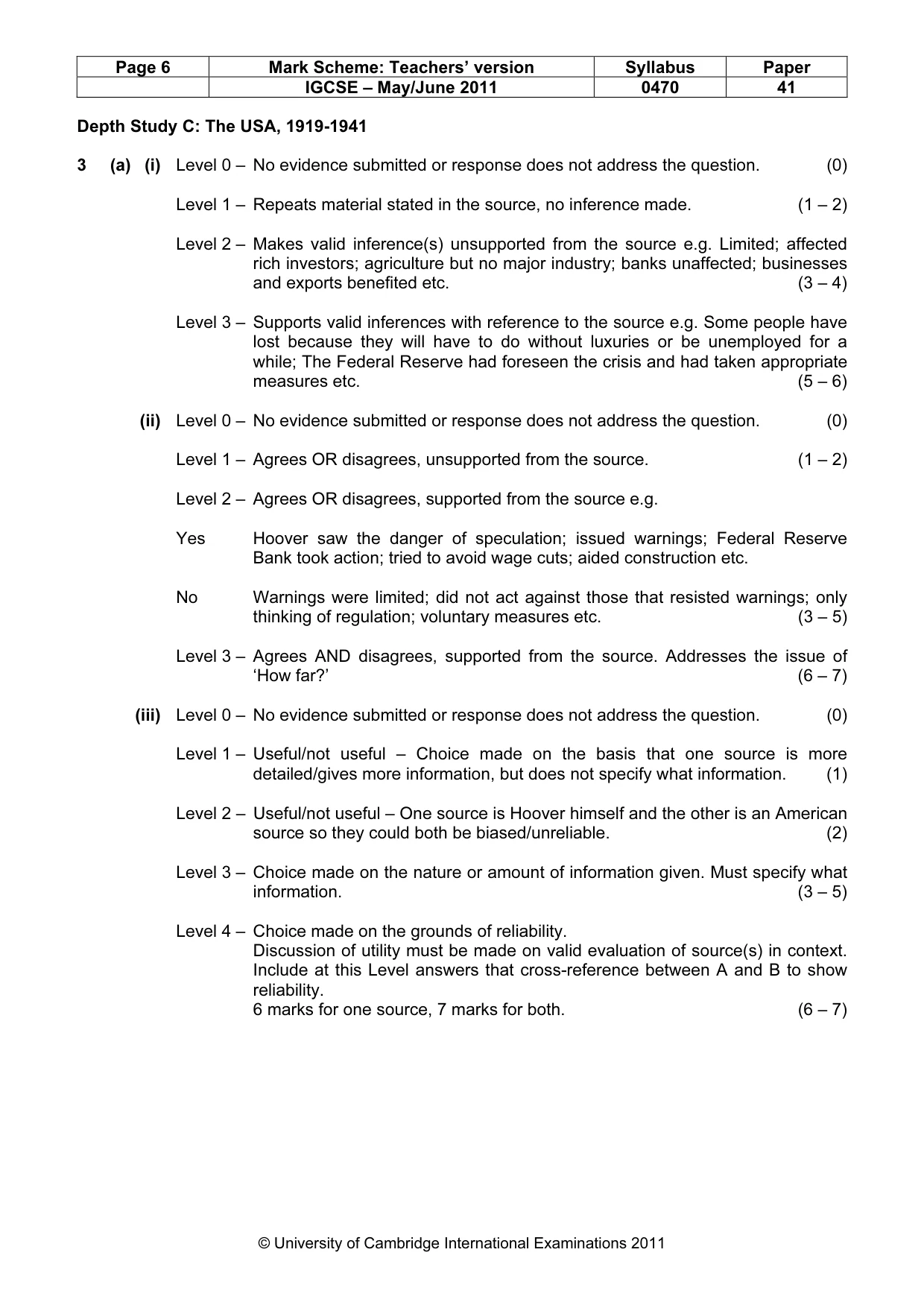
Page 6 Mark Scheme: Teachers’ version Syllabus Paper IGCSE – May/June 2011 0470 41 © University of Cambridge International Examinations 2011 Depth Study C: The USA, 1919-1941 3 (a) (i) Level 0 – No evidence submitted or response does not address the question. (0) Level 1 – Repeats material stated in the source, no inference made. (1 – 2) Level 2 – Makes valid inference(s) unsupported from the source e.g. Limited; affected rich investors; agriculture but no major industry; banks unaffected; businesses and exports benefited etc. (3 – 4) Level 3 – Supports valid inferences with reference to the source e.g. Some people have lost because they will have to do without luxuries or be unemployed for a while; The Federal Reserve had foreseen the crisis and had taken appropriate measures etc. (5 – 6) (ii) Level 0 – No evidence submitted or response does not address the question. (0) Level 1 – Agrees OR disagrees, unsupported from the source. (1 – 2) Level 2 – Agrees OR disagrees, supported from the source e.g. Yes Hoover saw the danger of speculation; issued warnings; Federal Reserve Bank took action; tried to avoid wage cuts; aided construction etc. No Warnings were limited; did not act against those that resisted warnings; only thinking of regulation; voluntary measures etc. (3 – 5) Level 3 – Agrees AND disagrees, supported from the source. Addresses the issue of ‘How far?’ (6 – 7) (iii) Level 0 – No evidence submitted or response does not address the question. (0) Level 1 – Useful/not useful – Choice made on the basis that one source is more detailed/gives more information, but does not specify what information. (1) Level 2 – Useful/not useful – One source is Hoover himself and the other is an American source so they could both be biased/unreliable. (2) Level 3 – Choice made on the nature or amount of information given. Must specify what information. (3 – 5) Level 4 – Choice made on the grounds of reliability. Discussion of utility must be made on valid evaluation of source(s) in context. Include at this Level answers that cross-reference between A and B to show reliability. 6 marks for one source, 7 marks for both. (6 – 7)
Mark scheme, page 7
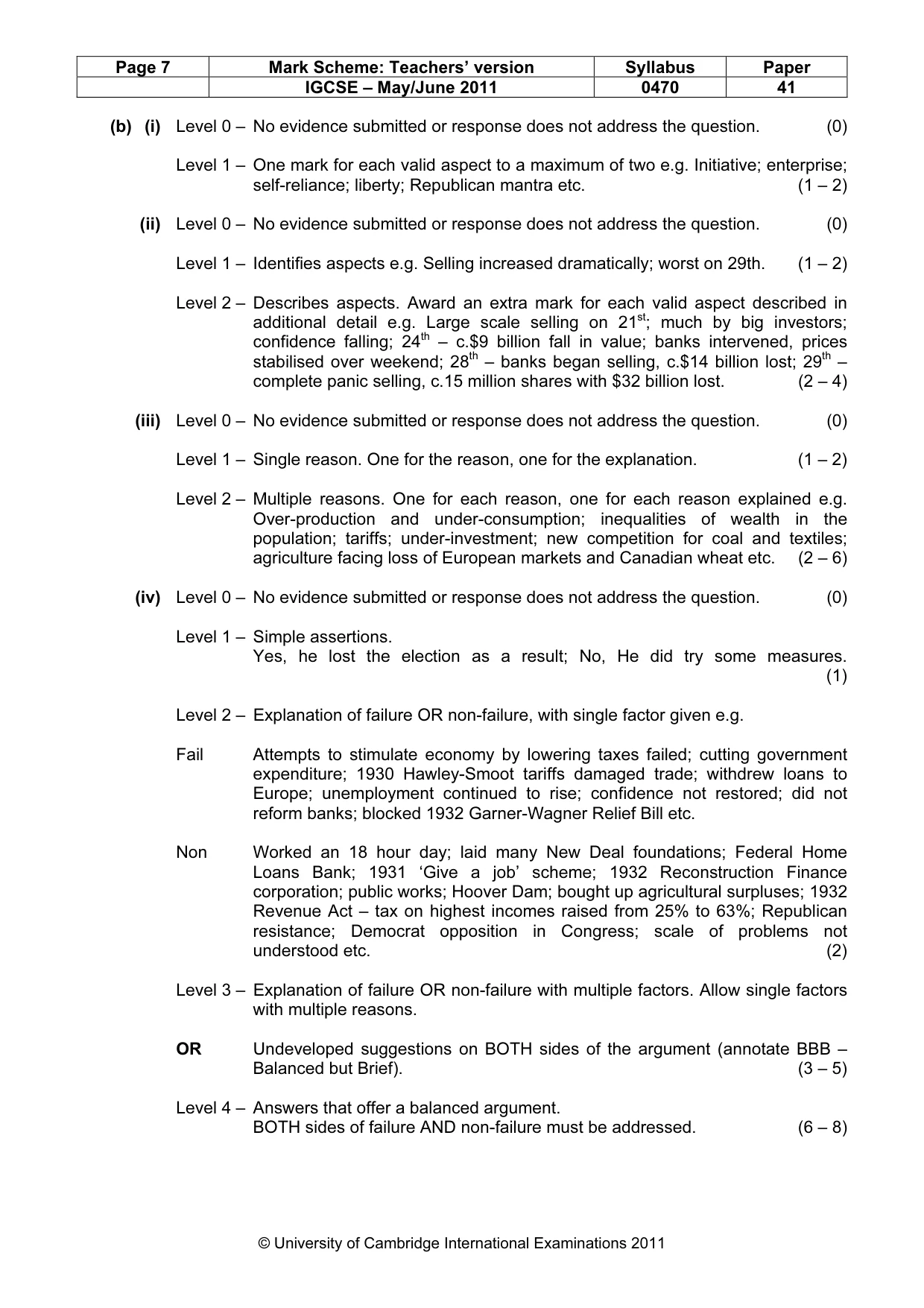
Page 7 Mark Scheme: Teachers’ version Syllabus Paper IGCSE – May/June 2011 0470 41 © University of Cambridge International Examinations 2011 (b) (i) Level 0 – No evidence submitted or response does not address the question. (0) Level 1 – One mark for each valid aspect to a maximum of two e.g. Initiative; enterprise; self-reliance; liberty; Republican mantra etc. (1 – 2) (ii) Level 0 – No evidence submitted or response does not address the question. (0) Level 1 – Identifies aspects e.g. Selling increased dramatically; worst on 29th. (1 – 2) Level 2 – Describes aspects. Award an extra mark for each valid aspect described in additional detail e.g. Large scale selling on 21st; much by big investors; confidence falling; 24th – c.$9 billion fall in value; banks intervened, prices stabilised over weekend; 28th – banks began selling, c.$14 billion lost; 29th – complete panic selling, c.15 million shares with $32 billion lost. (2 – 4) (iii) Level 0 – No evidence submitted or response does not address the question. (0) Level 1 – Single reason. One for the reason, one for the explanation. (1 – 2) Level 2 – Multiple reasons. One for each reason, one for each reason explained e.g. Over-production and under-consumption; inequalities of wealth in the population; tariffs; under-investment; new competition for coal and textiles; agriculture facing loss of European markets and Canadian wheat etc. (2 – 6) (iv) Level 0 – No evidence submitted or response does not address the question. (0) Level 1 – Simple assertions. Yes, he lost the election as a result; No, He did try some measures. (1) Level 2 – Explanation of failure OR non-failure, with single factor given e.g. Fail Attempts to stimulate economy by lowering taxes failed; cutting government expenditure; 1930 Hawley-Smoot tariffs damaged trade; withdrew loans to Europe; unemployment continued to rise; confidence not restored; did not reform banks; blocked 1932 Garner-Wagner Relief Bill etc. Non Worked an 18 hour day; laid many New Deal foundations; Federal Home Loans Bank; 1931 ‘Give a job’ scheme; 1932 Reconstruction Finance corporation; public works; Hoover Dam; bought up agricultural surpluses; 1932 Revenue Act – tax on highest incomes raised from 25% to 63%; Republican resistance; Democrat opposition in Congress; scale of problems not understood etc. (2) Level 3 – Explanation of failure OR non-failure with multiple factors. Allow single factors with multiple reasons. OR Undeveloped suggestions on BOTH sides of the argument (annotate BBB – Balanced but Brief). (3 – 5) Level 4 – Answers that offer a balanced argument. BOTH sides of failure AND non-failure must be addressed. (6 – 8)
Mark scheme, page 8
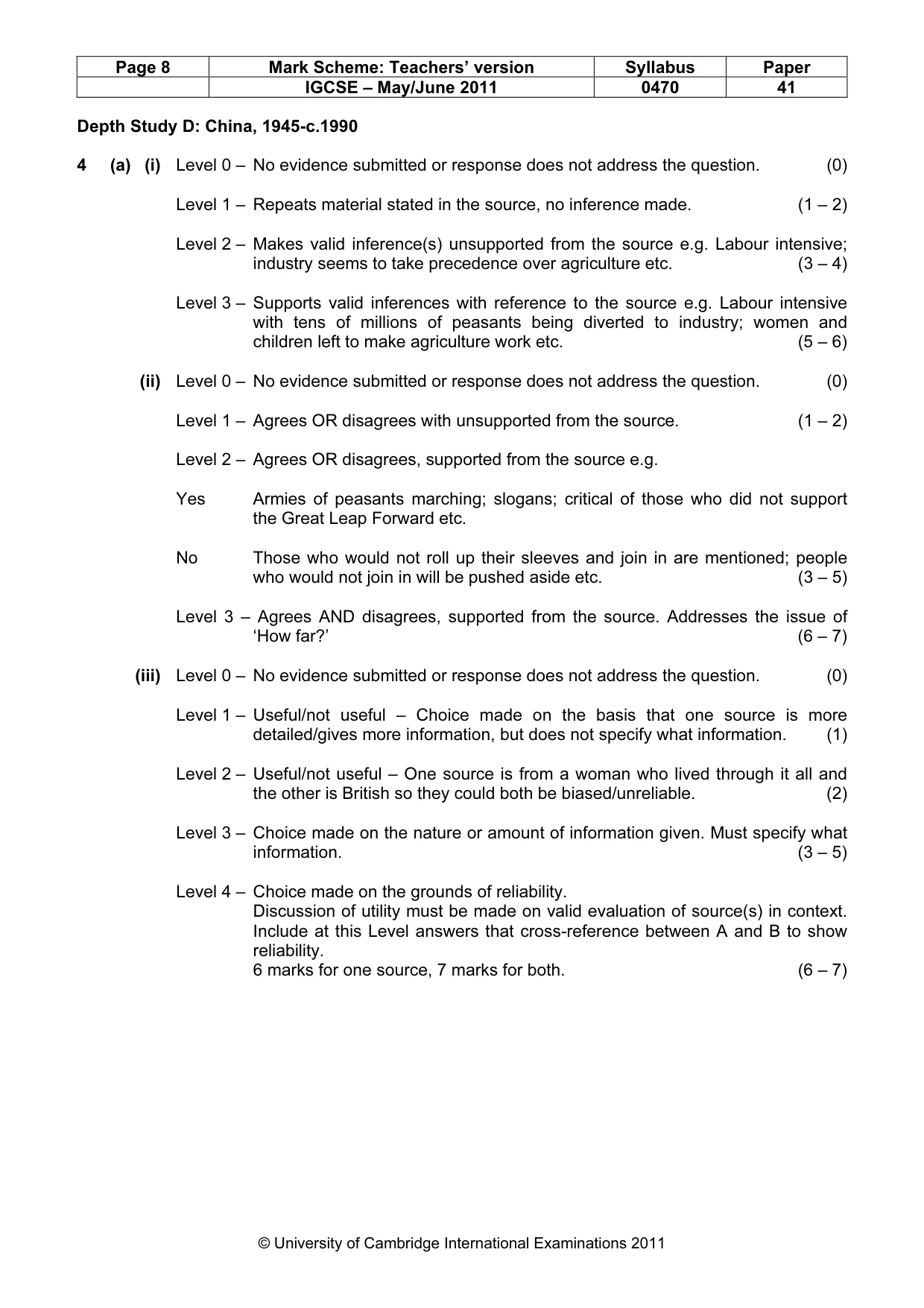
Page 8 Mark Scheme: Teachers’ version Syllabus Paper IGCSE – May/June 2011 0470 41 © University of Cambridge International Examinations 2011 Depth Study D: China, 1945-c.1990 4 (a) (i) Level 0 – No evidence submitted or response does not address the question. (0) Level 1 – Repeats material stated in the source, no inference made. (1 – 2) Level 2 – Makes valid inference(s) unsupported from the source e.g. Labour intensive; industry seems to take precedence over agriculture etc. (3 – 4) Level 3 – Supports valid inferences with reference to the source e.g. Labour intensive with tens of millions of peasants being diverted to industry; women and children left to make agriculture work etc. (5 – 6) (ii) Level 0 – No evidence submitted or response does not address the question. (0) Level 1 – Agrees OR disagrees with unsupported from the source. (1 – 2) Level 2 – Agrees OR disagrees, supported from the source e.g. Yes Armies of peasants marching; slogans; critical of those who did not support the Great Leap Forward etc. No Those who would not roll up their sleeves and join in are mentioned; people who would not join in will be pushed aside etc. (3 – 5) Level 3 – Agrees AND disagrees, supported from the source. Addresses the issue of ‘How far?’ (6 – 7) (iii) Level 0 – No evidence submitted or response does not address the question. (0) Level 1 – Useful/not useful – Choice made on the basis that one source is more detailed/gives more information, but does not specify what information. (1) Level 2 – Useful/not useful – One source is from a woman who lived through it all and the other is British so they could both be biased/unreliable. (2) Level 3 – Choice made on the nature or amount of information given. Must specify what information. (3 – 5) Level 4 – Choice made on the grounds of reliability. Discussion of utility must be made on valid evaluation of source(s) in context. Include at this Level answers that cross-reference between A and B to show reliability. 6 marks for one source, 7 marks for both. (6 – 7)
Mark scheme, page 9
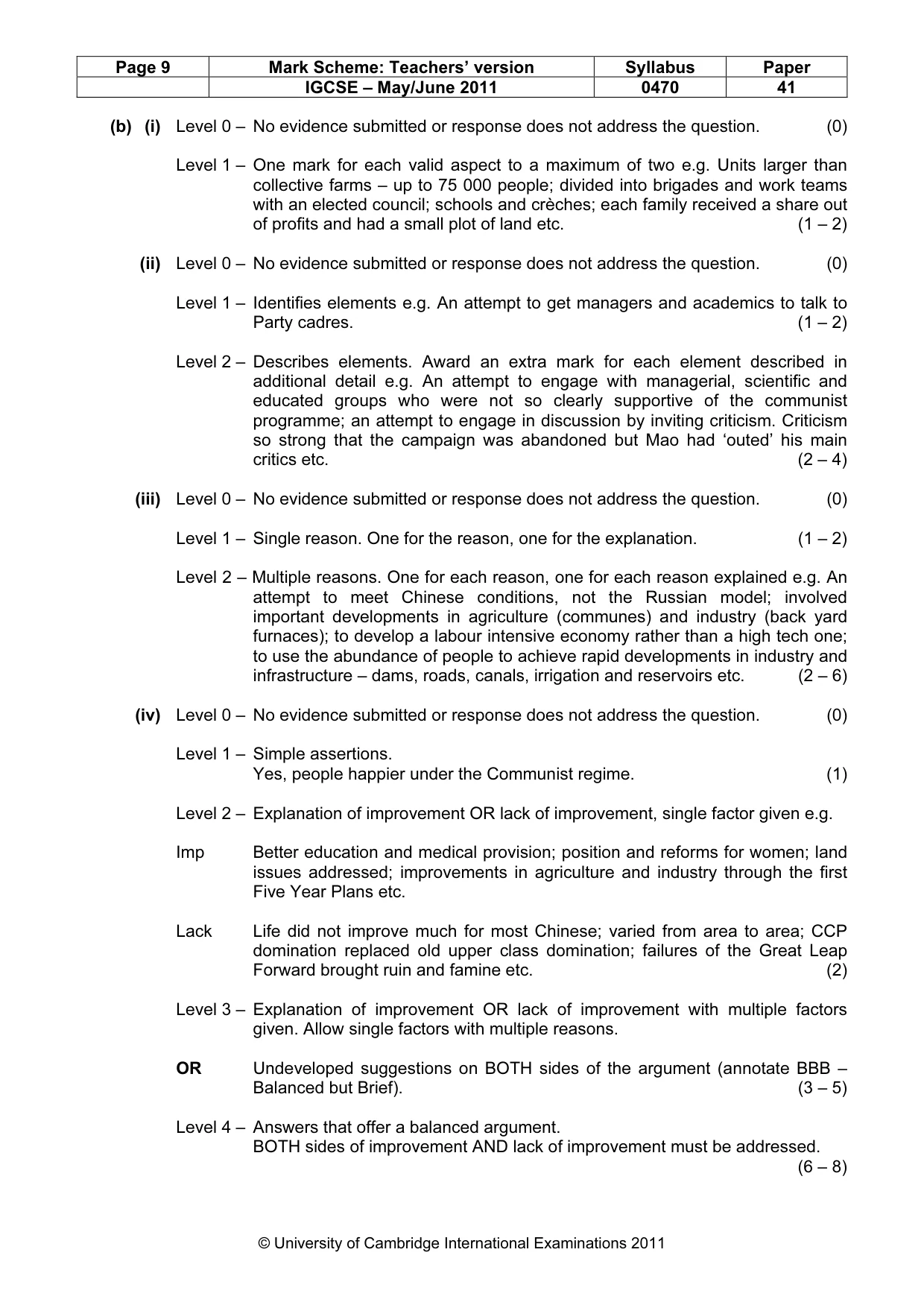
Page 9 Mark Scheme: Teachers’ version Syllabus Paper IGCSE – May/June 2011 0470 41 © University of Cambridge International Examinations 2011 (b) (i) Level 0 – No evidence submitted or response does not address the question. (0) Level 1 – One mark for each valid aspect to a maximum of two e.g. Units larger than collective farms – up to 75 000 people; divided into brigades and work teams with an elected council; schools and crèches; each family received a share out of profits and had a small plot of land etc. (1 – 2) (ii) Level 0 – No evidence submitted or response does not address the question. (0) Level 1 – Identifies elements e.g. An attempt to get managers and academics to talk to Party cadres. (1 – 2) Level 2 – Describes elements. Award an extra mark for each element described in additional detail e.g. An attempt to engage with managerial, scientific and educated groups who were not so clearly supportive of the communist programme; an attempt to engage in discussion by inviting criticism. Criticism so strong that the campaign was abandoned but Mao had ‘outed’ his main critics etc. (2 – 4) (iii) Level 0 – No evidence submitted or response does not address the question. (0) Level 1 – Single reason. One for the reason, one for the explanation. (1 – 2) Level 2 – Multiple reasons. One for each reason, one for each reason explained e.g. An attempt to meet Chinese conditions, not the Russian model; involved important developments in agriculture (communes) and industry (back yard furnaces); to develop a labour intensive economy rather than a high tech one; to use the abundance of people to achieve rapid developments in industry and infrastructure – dams, roads, canals, irrigation and reservoirs etc. (2 – 6) (iv) Level 0 – No evidence submitted or response does not address the question. (0) Level 1 – Simple assertions. Yes, people happier under the Communist regime. (1) Level 2 – Explanation of improvement OR lack of improvement, single factor given e.g. Imp Better education and medical provision; position and reforms for women; land issues addressed; improvements in agriculture and industry through the first Five Year Plans etc. Lack Life did not improve much for most Chinese; varied from area to area; CCP domination replaced old upper class domination; failures of the Great Leap Forward brought ruin and famine etc. (2) Level 3 – Explanation of improvement OR lack of improvement with multiple factors given. Allow single factors with multiple reasons. OR Undeveloped suggestions on BOTH sides of the argument (annotate BBB – Balanced but Brief). (3 – 5) Level 4 – Answers that offer a balanced argument. BOTH sides of improvement AND lack of improvement must be addressed. (6 – 8)
Mark scheme, page 10
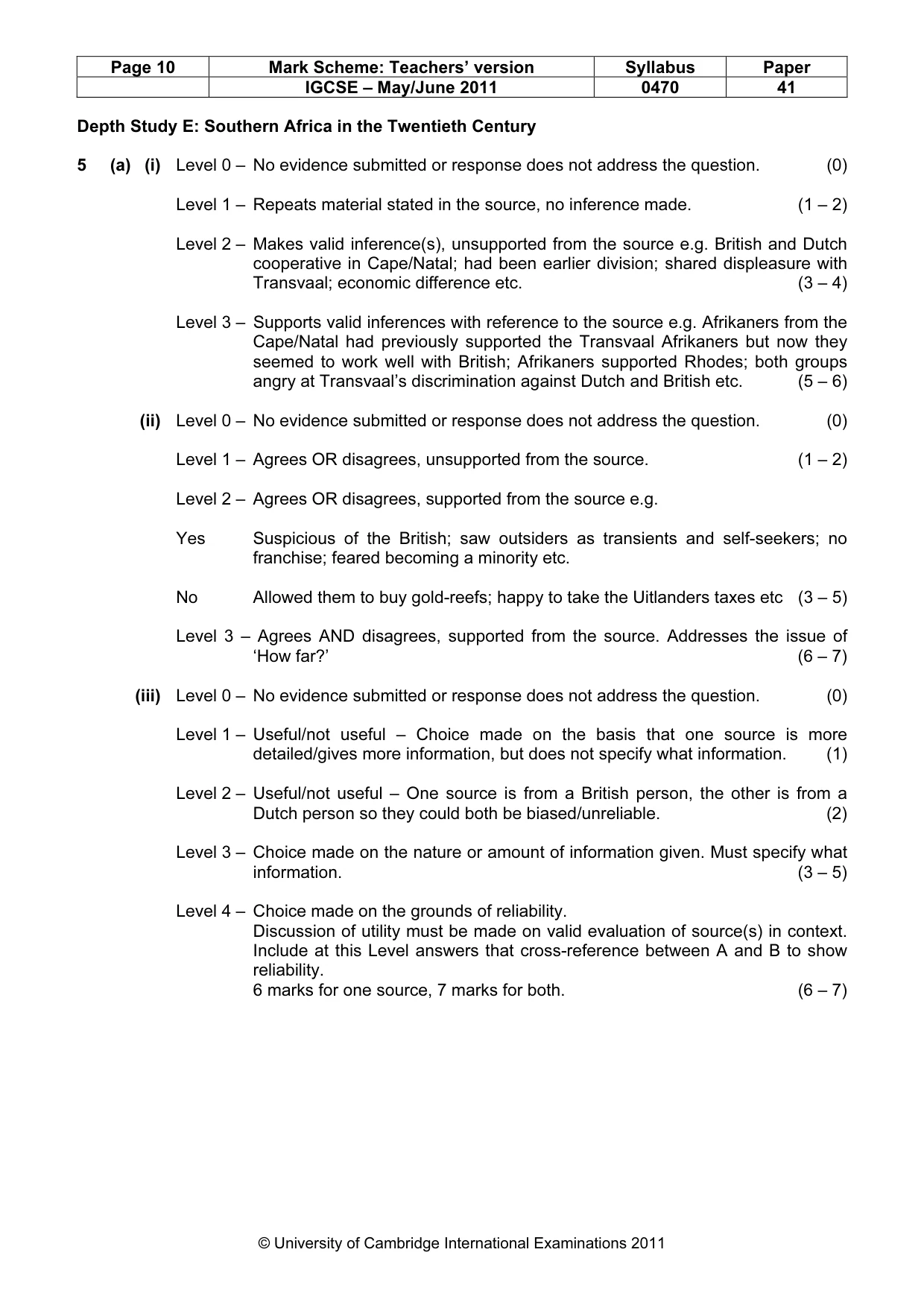
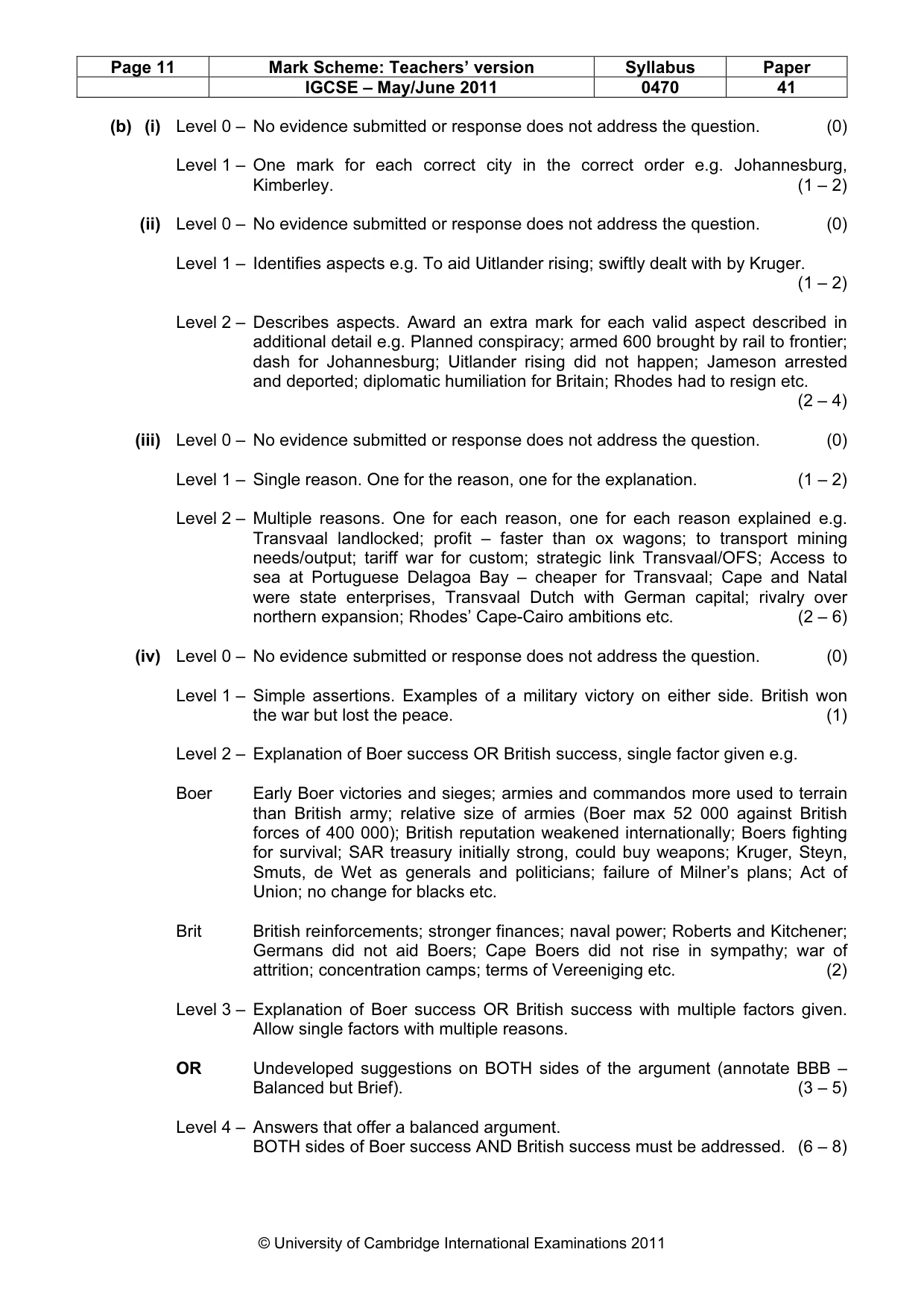
Page 10 Mark Scheme: Teachers’ version Syllabus Paper IGCSE – May/June 2011 0470 41 © University of Cambridge International Examinations 2011 Depth Study E: Southern Africa in the Twentieth Century 5 (a) (i) Level 0 – No evidence submitted or response does not address the question. (0) Level 1 – Repeats material stated in the source, no inference made. (1 – 2) Level 2 – Makes valid inference(s), unsupported from the source e.g. British and Dutch cooperative in Cape/Natal; had been earlier division; shared displeasure with Transvaal; economic difference etc. (3 – 4) Level 3 – Supports valid inferences with reference to the source e.g. Afrikaners from the Cape/Natal had previously supported the Transvaal Afrikaners but now they seemed to work well with British; Afrikaners supported Rhodes; both groups angry at Transvaal’s discrimination against Dutch and British etc. (5 – 6) (ii) Level 0 – No evidence submitted or response does not address the question. (0) Level 1 – Agrees OR disagrees, unsupported from the source. (1 – 2) Level 2 – Agrees OR disagrees, supported from the source e.g. Yes Suspicious of the British; saw outsiders as transients and self-seekers; no franchise; feared becoming a minority etc. No Allowed them to buy gold-reefs; happy to take the Uitlanders taxes etc (3 – 5) Level 3 – Agrees AND disagrees, supported from the source. Addresses the issue of ‘How far?’ (6 – 7) (iii) Level 0 – No evidence submitted or response does not address the question. (0) Level 1 – Useful/not useful – Choice made on the basis that one source is more detailed/gives more information, but does not specify what information. (1) Level 2 – Useful/not useful – One source is from a British person, the other is from a Dutch person so they could both be biased/unreliable. (2) Level 3 – Choice made on the nature or amount of information given. Must specify what information. (3 – 5) Level 4 – Choice made on the grounds of reliability. Discussion of utility must be made on valid evaluation of source(s) in context. Include at this Level answers that cross-reference between A and B to show reliability. 6 marks for one source, 7 marks for both. (6 – 7)
Mark scheme, page 11
Page 11 Mark Scheme: Teachers’ version Syllabus Paper IGCSE – May/June 2011 0470 41 © University of Cambridge International Examinations 2011 (b) (i) Level 0 – No evidence submitted or response does not address the question. (0) Level 1 – One mark for each correct city in the correct order e.g. Johannesburg, Kimberley. (1 – 2) (ii) Level 0 – No evidence submitted or response does not address the question. (0) Level 1 – Identifies aspects e.g. To aid Uitlander rising; swiftly dealt with by Kruger. (1 – 2) Level 2 – Describes aspects. Award an extra mark for each valid aspect described in additional detail e.g. Planned conspiracy; armed 600 brought by rail to frontier; dash for Johannesburg; Uitlander rising did not happen; Jameson arrested and deported; diplomatic humiliation for Britain; Rhodes had to resign etc. (2 – 4) (iii) Level 0 – No evidence submitted or response does not address the question. (0) Level 1 – Single reason. One for the reason, one for the explanation. (1 – 2) Level 2 – Multiple reasons. One for each reason, one for each reason explained e.g. Transvaal landlocked; profit – faster than ox wagons; to transport mining needs/output; tariff war for custom; strategic link Transvaal/OFS; Access to sea at Portuguese Delagoa Bay – cheaper for Transvaal; Cape and Natal were state enterprises, Transvaal Dutch with German capital; rivalry over northern expansion; Rhodes’ Cape-Cairo ambitions etc. (2 – 6) (iv) Level 0 – No evidence submitted or response does not address the question. (0) Level 1 – Simple assertions. Examples of a military victory on either side. British won the war but lost the peace. (1) Level 2 – Explanation of Boer success OR British success, single factor given e.g. Boer Early Boer victories and sieges; armies and commandos more used to terrain than British army; relative size of armies (Boer max 52 000 against British forces of 400 000); British reputation weakened internationally; Boers fighting for survival; SAR treasury initially strong, could buy weapons; Kruger, Steyn, Smuts, de Wet as generals and politicians; failure of Milner’s plans; Act of Union; no change for blacks etc. Brit British reinforcements; stronger finances; naval power; Roberts and Kitchener; Germans did not aid Boers; Cape Boers did not rise in sympathy; war of attrition; concentration camps; terms of Vereeniging etc. (2) Level 3 – Explanation of Boer success OR British success with multiple factors given. Allow single factors with multiple reasons. OR Undeveloped suggestions on BOTH sides of the argument (annotate BBB – Balanced but Brief). (3 – 5) Level 4 – Answers that offer a balanced argument. BOTH sides of Boer success AND British success must be addressed. (6 – 8)
Mark scheme, page 12
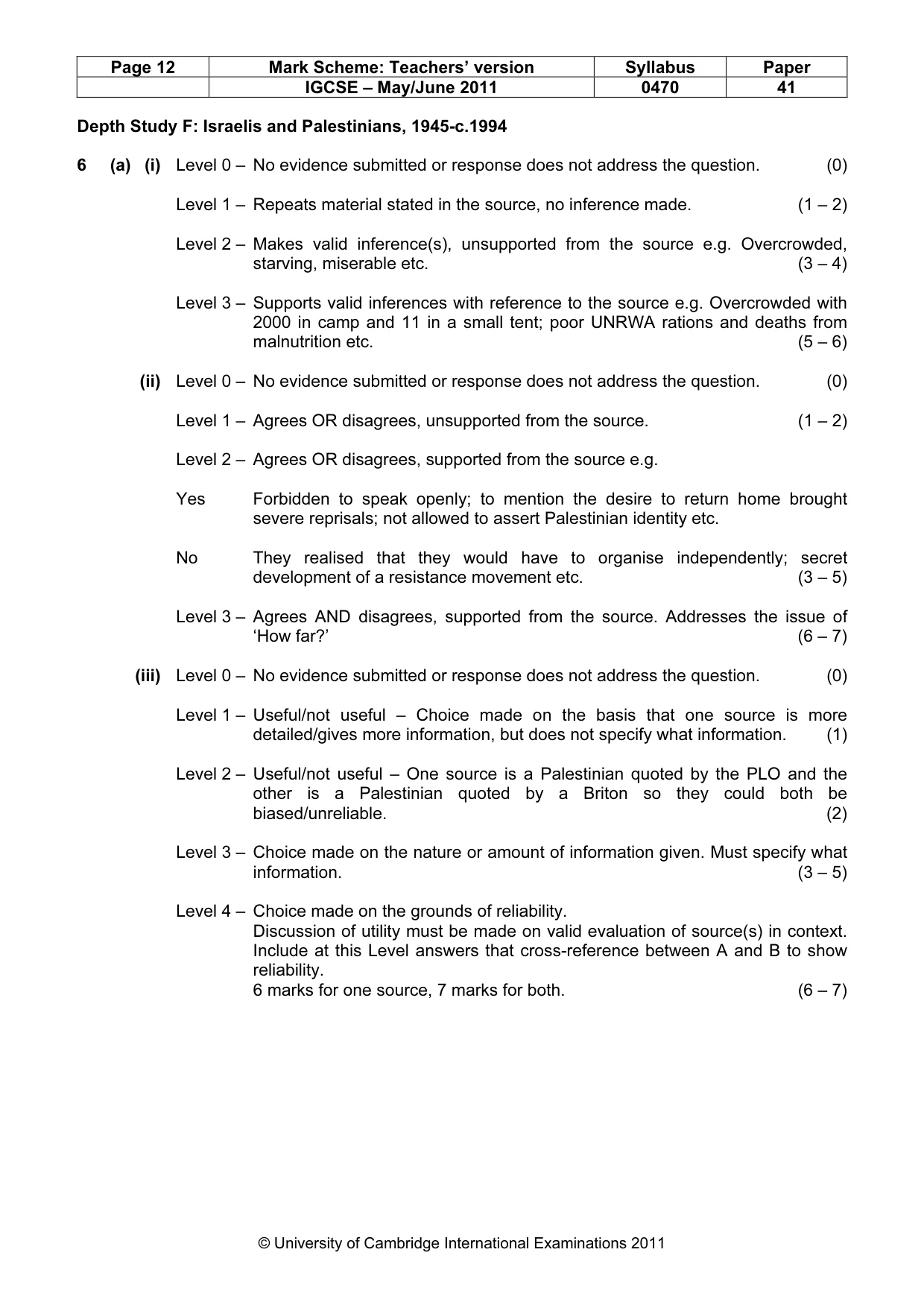
Page 12 Mark Scheme: Teachers’ version Syllabus Paper IGCSE – May/June 2011 0470 41 © University of Cambridge International Examinations 2011 Depth Study F: Israelis and Palestinians, 1945-c.1994 6 (a) (i) Level 0 – No evidence submitted or response does not address the question. (0) Level 1 – Repeats material stated in the source, no inference made. (1 – 2) Level 2 – Makes valid inference(s), unsupported from the source e.g. Overcrowded, starving, miserable etc. (3 – 4) Level 3 – Supports valid inferences with reference to the source e.g. Overcrowded with 2000 in camp and 11 in a small tent; poor UNRWA rations and deaths from malnutrition etc. (5 – 6) (ii) Level 0 – No evidence submitted or response does not address the question. (0) Level 1 – Agrees OR disagrees, unsupported from the source. (1 – 2) Level 2 – Agrees OR disagrees, supported from the source e.g. Yes Forbidden to speak openly; to mention the desire to return home brought severe reprisals; not allowed to assert Palestinian identity etc. No They realised that they would have to organise independently; secret development of a resistance movement etc. (3 – 5) Level 3 – Agrees AND disagrees, supported from the source. Addresses the issue of ‘How far?’ (6 – 7) (iii) Level 0 – No evidence submitted or response does not address the question. (0) Level 1 – Useful/not useful – Choice made on the basis that one source is more detailed/gives more information, but does not specify what information. (1) Level 2 – Useful/not useful – One source is a Palestinian quoted by the PLO and the other is a Palestinian quoted by a Briton so they could both be biased/unreliable. (2) Level 3 – Choice made on the nature or amount of information given. Must specify what information. (3 – 5) Level 4 – Choice made on the grounds of reliability. Discussion of utility must be made on valid evaluation of source(s) in context. Include at this Level answers that cross-reference between A and B to show reliability. 6 marks for one source, 7 marks for both. (6 – 7)
Mark scheme, page 13
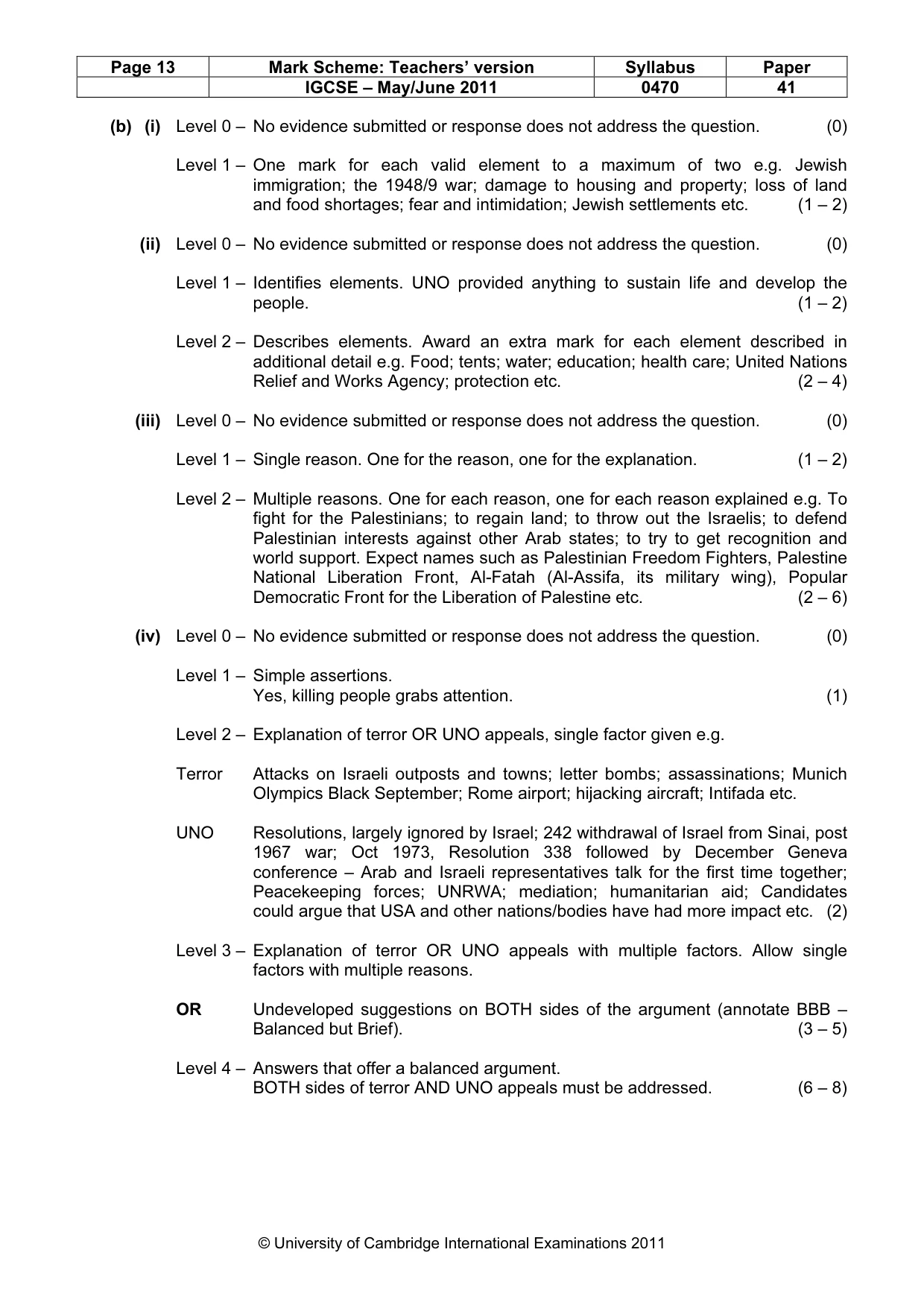
Page 13 Mark Scheme: Teachers’ version Syllabus Paper IGCSE – May/June 2011 0470 41 © University of Cambridge International Examinations 2011 (b) (i) Level 0 – No evidence submitted or response does not address the question. (0) Level 1 – One mark for each valid element to a maximum of two e.g. Jewish immigration; the 1948/9 war; damage to housing and property; loss of land and food shortages; fear and intimidation; Jewish settlements etc. (1 – 2) (ii) Level 0 – No evidence submitted or response does not address the question. (0) Level 1 – Identifies elements. UNO provided anything to sustain life and develop the people. (1 – 2) Level 2 – Describes elements. Award an extra mark for each element described in additional detail e.g. Food; tents; water; education; health care; United Nations Relief and Works Agency; protection etc. (2 – 4) (iii) Level 0 – No evidence submitted or response does not address the question. (0) Level 1 – Single reason. One for the reason, one for the explanation. (1 – 2) Level 2 – Multiple reasons. One for each reason, one for each reason explained e.g. To fight for the Palestinians; to regain land; to throw out the Israelis; to defend Palestinian interests against other Arab states; to try to get recognition and world support. Expect names such as Palestinian Freedom Fighters, Palestine National Liberation Front, Al-Fatah (Al-Assifa, its military wing), Popular Democratic Front for the Liberation of Palestine etc. (2 – 6) (iv) Level 0 – No evidence submitted or response does not address the question. (0) Level 1 – Simple assertions. Yes, killing people grabs attention. (1) Level 2 – Explanation of terror OR UNO appeals, single factor given e.g. Terror Attacks on Israeli outposts and towns; letter bombs; assassinations; Munich Olympics Black September; Rome airport; hijacking aircraft; Intifada etc. UNO Resolutions, largely ignored by Israel; 242 withdrawal of Israel from Sinai, post 1967 war; Oct 1973, Resolution 338 followed by December Geneva conference – Arab and Israeli representatives talk for the first time together; Peacekeeping forces; UNRWA; mediation; humanitarian aid; Candidates could argue that USA and other nations/bodies have had more impact etc. (2) Level 3 – Explanation of terror OR UNO appeals with multiple factors. Allow single factors with multiple reasons. OR Undeveloped suggestions on BOTH sides of the argument (annotate BBB – Balanced but Brief). (3 – 5) Level 4 – Answers that offer a balanced argument. BOTH sides of terror AND UNO appeals must be addressed. (6 – 8)
Mark scheme, page 14
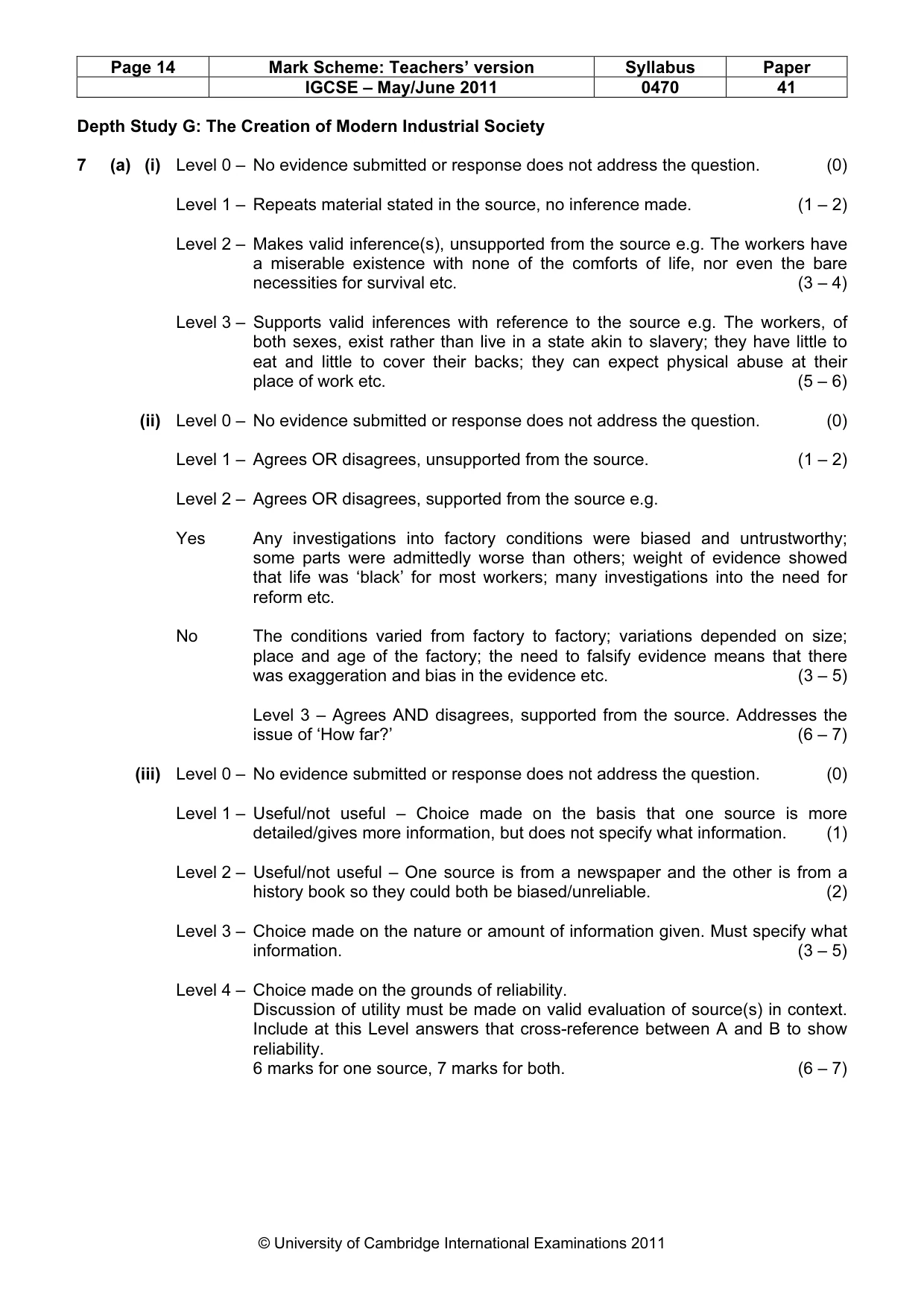
Page 14 Mark Scheme: Teachers’ version Syllabus Paper IGCSE – May/June 2011 0470 41 © University of Cambridge International Examinations 2011 Depth Study G: The Creation of Modern Industrial Society 7 (a) (i) Level 0 – No evidence submitted or response does not address the question. (0) Level 1 – Repeats material stated in the source, no inference made. (1 – 2) Level 2 – Makes valid inference(s), unsupported from the source e.g. The workers have a miserable existence with none of the comforts of life, nor even the bare necessities for survival etc. (3 – 4) Level 3 – Supports valid inferences with reference to the source e.g. The workers, of both sexes, exist rather than live in a state akin to slavery; they have little to eat and little to cover their backs; they can expect physical abuse at their place of work etc. (5 – 6) (ii) Level 0 – No evidence submitted or response does not address the question. (0) Level 1 – Agrees OR disagrees, unsupported from the source. (1 – 2) Level 2 – Agrees OR disagrees, supported from the source e.g. Yes Any investigations into factory conditions were biased and untrustworthy; some parts were admittedly worse than others; weight of evidence showed that life was ‘black’ for most workers; many investigations into the need for reform etc. No The conditions varied from factory to factory; variations depended on size; place and age of the factory; the need to falsify evidence means that there was exaggeration and bias in the evidence etc. (3 – 5) Level 3 – Agrees AND disagrees, supported from the source. Addresses the issue of ‘How far?’ (6 – 7) (iii) Level 0 – No evidence submitted or response does not address the question. (0) Level 1 – Useful/not useful – Choice made on the basis that one source is more detailed/gives more information, but does not specify what information. (1) Level 2 – Useful/not useful – One source is from a newspaper and the other is from a history book so they could both be biased/unreliable. (2) Level 3 – Choice made on the nature or amount of information given. Must specify what information. (3 – 5) Level 4 – Choice made on the grounds of reliability. Discussion of utility must be made on valid evaluation of source(s) in context. Include at this Level answers that cross-reference between A and B to show reliability. 6 marks for one source, 7 marks for both. (6 – 7)
Mark scheme, page 15
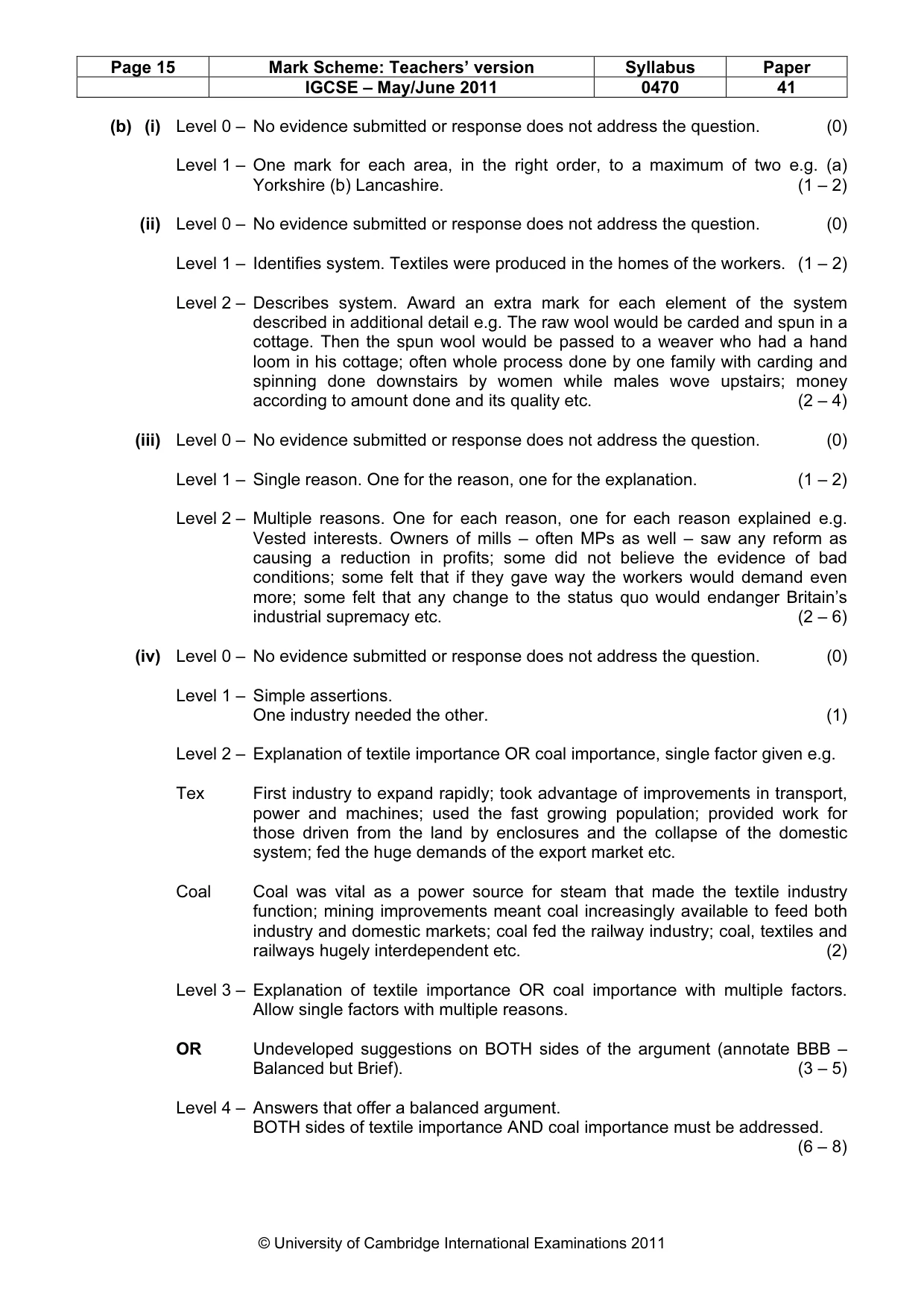
Page 15 Mark Scheme: Teachers’ version Syllabus Paper IGCSE – May/June 2011 0470 41 © University of Cambridge International Examinations 2011 (b) (i) Level 0 – No evidence submitted or response does not address the question. (0) Level 1 – One mark for each area, in the right order, to a maximum of two e.g. (a) Yorkshire (b) Lancashire. (1 – 2) (ii) Level 0 – No evidence submitted or response does not address the question. (0) Level 1 – Identifies system. Textiles were produced in the homes of the workers. (1 – 2) Level 2 – Describes system. Award an extra mark for each element of the system described in additional detail e.g. The raw wool would be carded and spun in a cottage. Then the spun wool would be passed to a weaver who had a hand loom in his cottage; often whole process done by one family with carding and spinning done downstairs by women while males wove upstairs; money according to amount done and its quality etc. (2 – 4) (iii) Level 0 – No evidence submitted or response does not address the question. (0) Level 1 – Single reason. One for the reason, one for the explanation. (1 – 2) Level 2 – Multiple reasons. One for each reason, one for each reason explained e.g. Vested interests. Owners of mills – often MPs as well – saw any reform as causing a reduction in profits; some did not believe the evidence of bad conditions; some felt that if they gave way the workers would demand even more; some felt that any change to the status quo would endanger Britain’s industrial supremacy etc. (2 – 6) (iv) Level 0 – No evidence submitted or response does not address the question. (0) Level 1 – Simple assertions. One industry needed the other. (1) Level 2 – Explanation of textile importance OR coal importance, single factor given e.g. Tex First industry to expand rapidly; took advantage of improvements in transport, power and machines; used the fast growing population; provided work for those driven from the land by enclosures and the collapse of the domestic system; fed the huge demands of the export market etc. Coal Coal was vital as a power source for steam that made the textile industry function; mining improvements meant coal increasingly available to feed both industry and domestic markets; coal fed the railway industry; coal, textiles and railways hugely interdependent etc. (2) Level 3 – Explanation of textile importance OR coal importance with multiple factors. Allow single factors with multiple reasons. OR Undeveloped suggestions on BOTH sides of the argument (annotate BBB – Balanced but Brief). (3 – 5) Level 4 – Answers that offer a balanced argument. BOTH sides of textile importance AND coal importance must be addressed. (6 – 8)
Mark scheme, page 16
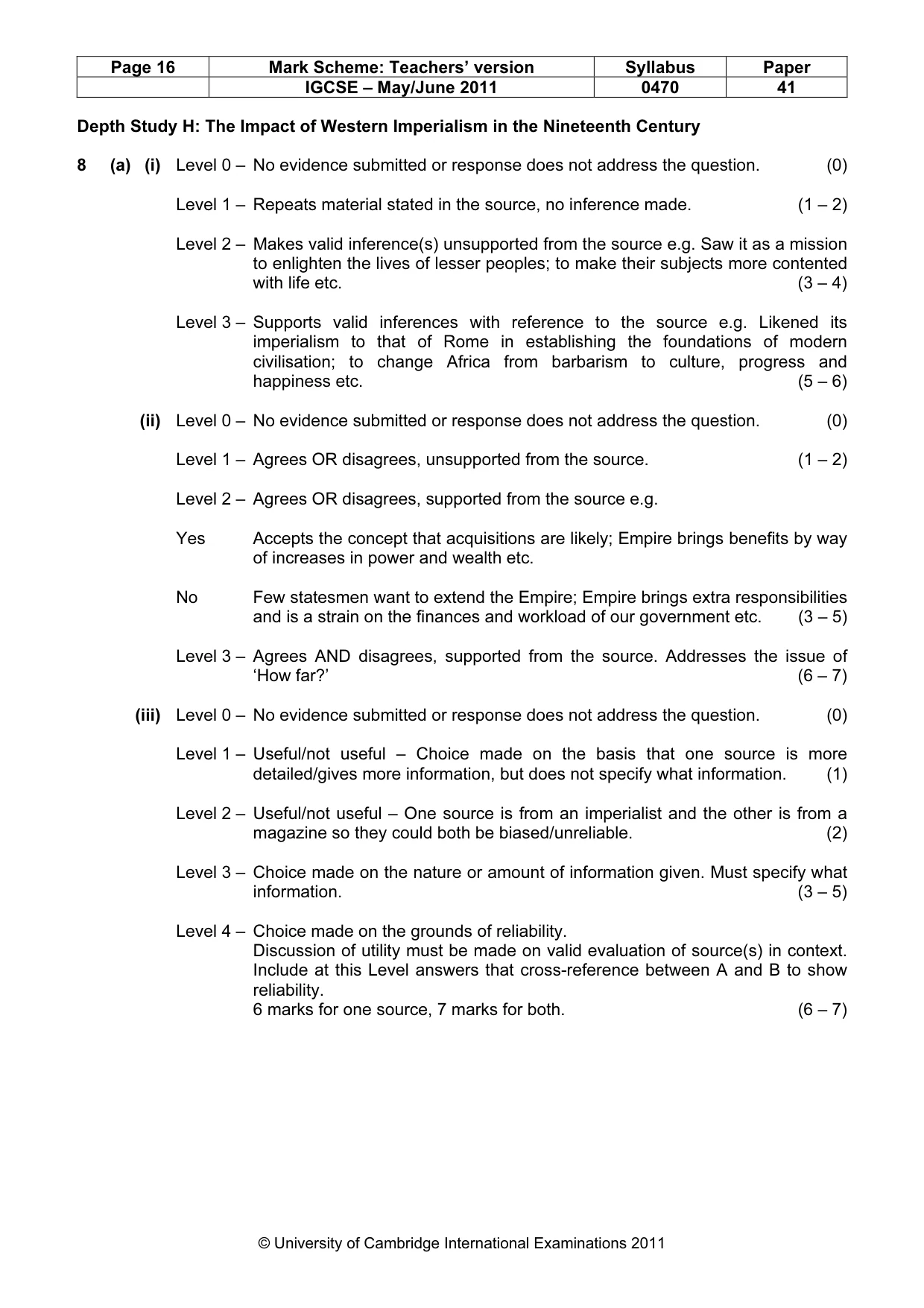
Page 16 Mark Scheme: Teachers’ version Syllabus Paper IGCSE – May/June 2011 0470 41 © University of Cambridge International Examinations 2011 Depth Study H: The Impact of Western Imperialism in the Nineteenth Century 8 (a) (i) Level 0 – No evidence submitted or response does not address the question. (0) Level 1 – Repeats material stated in the source, no inference made. (1 – 2) Level 2 – Makes valid inference(s) unsupported from the source e.g. Saw it as a mission to enlighten the lives of lesser peoples; to make their subjects more contented with life etc. (3 – 4) Level 3 – Supports valid inferences with reference to the source e.g. Likened its imperialism to that of Rome in establishing the foundations of modern civilisation; to change Africa from barbarism to culture, progress and happiness etc. (5 – 6) (ii) Level 0 – No evidence submitted or response does not address the question. (0) Level 1 – Agrees OR disagrees, unsupported from the source. (1 – 2) Level 2 – Agrees OR disagrees, supported from the source e.g. Yes Accepts the concept that acquisitions are likely; Empire brings benefits by way of increases in power and wealth etc. No Few statesmen want to extend the Empire; Empire brings extra responsibilities and is a strain on the finances and workload of our government etc. (3 – 5) Level 3 – Agrees AND disagrees, supported from the source. Addresses the issue of ‘How far?’ (6 – 7) (iii) Level 0 – No evidence submitted or response does not address the question. (0) Level 1 – Useful/not useful – Choice made on the basis that one source is more detailed/gives more information, but does not specify what information. (1) Level 2 – Useful/not useful – One source is from an imperialist and the other is from a magazine so they could both be biased/unreliable. (2) Level 3 – Choice made on the nature or amount of information given. Must specify what information. (3 – 5) Level 4 – Choice made on the grounds of reliability. Discussion of utility must be made on valid evaluation of source(s) in context. Include at this Level answers that cross-reference between A and B to show reliability. 6 marks for one source, 7 marks for both. (6 – 7)
Mark scheme, page 17
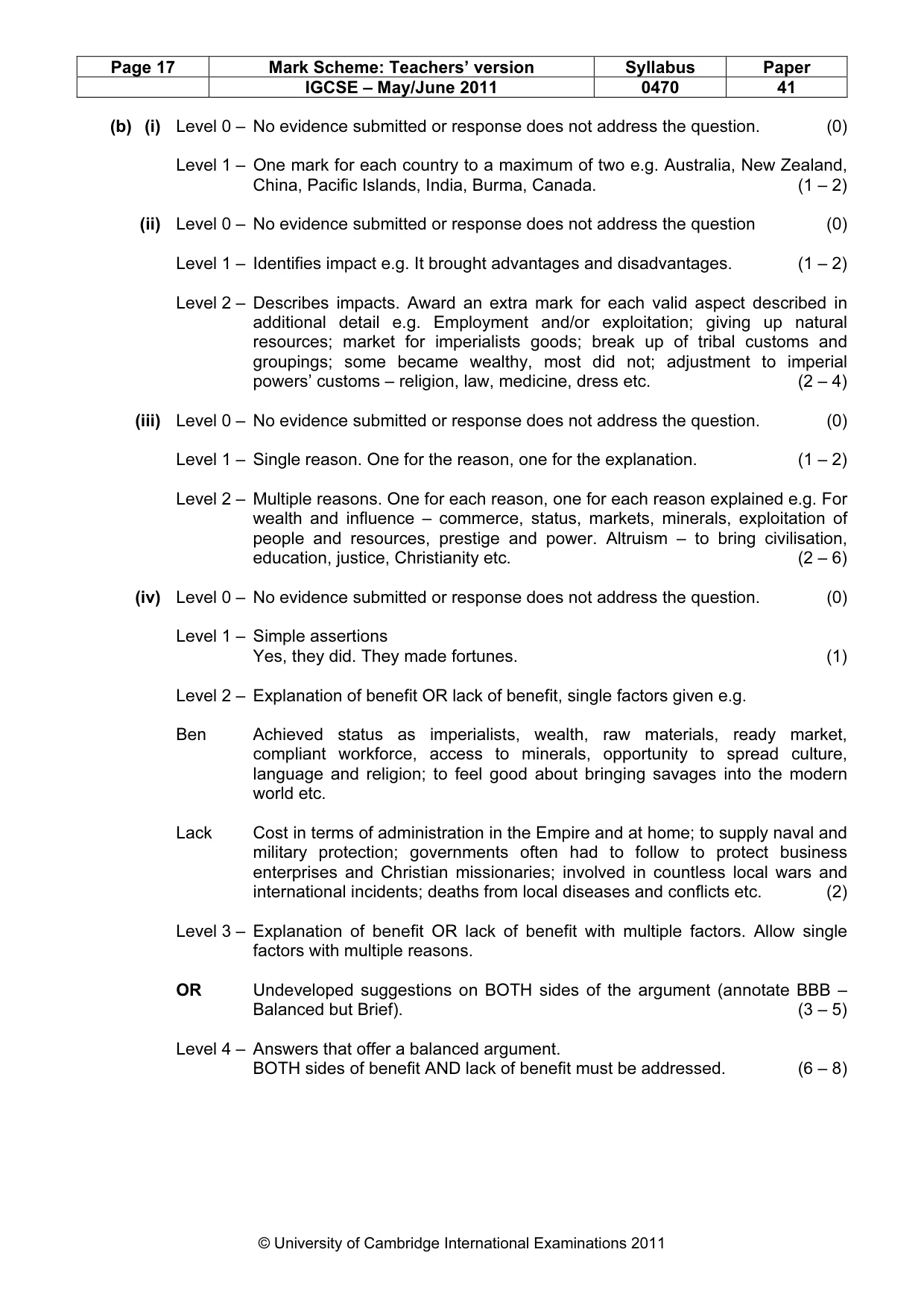
Page 17 Mark Scheme: Teachers’ version Syllabus Paper IGCSE – May/June 2011 0470 41 © University of Cambridge International Examinations 2011 (b) (i) Level 0 – No evidence submitted or response does not address the question. (0) Level 1 – One mark for each country to a maximum of two e.g. Australia, New Zealand, China, Pacific Islands, India, Burma, Canada. (1 – 2) (ii) Level 0 – No evidence submitted or response does not address the question (0) Level 1 – Identifies impact e.g. It brought advantages and disadvantages. (1 – 2) Level 2 – Describes impacts. Award an extra mark for each valid aspect described in additional detail e.g. Employment and/or exploitation; giving up natural resources; market for imperialists goods; break up of tribal customs and groupings; some became wealthy, most did not; adjustment to imperial powers’ customs – religion, law, medicine, dress etc. (2 – 4) (iii) Level 0 – No evidence submitted or response does not address the question. (0) Level 1 – Single reason. One for the reason, one for the explanation. (1 – 2) Level 2 – Multiple reasons. One for each reason, one for each reason explained e.g. For wealth and influence – commerce, status, markets, minerals, exploitation of people and resources, prestige and power. Altruism – to bring civilisation, education, justice, Christianity etc. (2 – 6) (iv) Level 0 – No evidence submitted or response does not address the question. (0) Level 1 – Simple assertions Yes, they did. They made fortunes. (1) Level 2 – Explanation of benefit OR lack of benefit, single factors given e.g. Ben Achieved status as imperialists, wealth, raw materials, ready market, compliant workforce, access to minerals, opportunity to spread culture, language and religion; to feel good about bringing savages into the modern world etc. Lack Cost in terms of administration in the Empire and at home; to supply naval and military protection; governments often had to follow to protect business enterprises and Christian missionaries; involved in countless local wars and international incidents; deaths from local diseases and conflicts etc. (2) Level 3 – Explanation of benefit OR lack of benefit with multiple factors. Allow single factors with multiple reasons. OR Undeveloped suggestions on BOTH sides of the argument (annotate BBB – Balanced but Brief). (3 – 5) Level 4 – Answers that offer a balanced argument. BOTH sides of benefit AND lack of benefit must be addressed. (6 – 8)
What you needed in this session
Cambridge’s own grade thresholds for 2011 May/June, Paper 4 · Variant 1. A higher threshold means an easier paper — the bar moves with how the cohort did.