Cambridge IGCSE History 0470 — 2011 May/June Paper 4 · Variant 2
0470/42/M/J/11 · 40 marks · ≈45 min
The question paper and its mark scheme, free to read here and free to download. This is Cambridge’s own paper, exactly as it was sat.
Question paper12 pages


Mark scheme17 pages
Answers below. Sit the paper first if you are practising.
Paper as text
Question paper, page 1
This document consists of 9 printed pages and 3 blank pages. DC (RCL (SW)) 31878/6 © UCLES 2011 [Turn over UNIVERSITY OF CAMBRIDGE INTERNATIONAL EXAMINATIONS International General Certificate of Secondary Education READ THESE INSTRUCTIONS FIRST If you have been given an Answer Booklet, follow the instructions on the front cover of the Booklet. Write your Centre number, candidate number and name on all the work you hand in. Write in dark blue or black pen. You may use a soft pencil for any diagrams, graphs or rough working. Do not use staples, paper clips, highlighters, glue or correction fluid. Answer the questions on one of the Depth Studies. At the end of the examination, fasten all your work securely together. The number of marks is given in brackets [ ] at the end of each question or part question. * 6 6 7 8 4 5 5 2 6 2 * HISTORY 0470/42 Paper 4 Alternative to Coursework May/June 2011 1 hour Additional Materials: Answer Booklet/Paper www.XtremePapers.com
Question paper, page 2
2 0470/42/M/J/11 © UCLES 2011 DEPTH STUDY A: GERMANY, 1918–1945 1 Study the sources, and then answer the questions which follow. Source A The new National Socialist nation acquires a firm base because we have gained the trust of millions of women as fanatical fellow-fighters. Women who have fought to aid in the shared task of preserving life did not seek the ‘rights’ which Jewish intellectuals put before their eyes. Our programme has in reality only one point – which is the child, that tiny creature which must be born and grow strong and alone gives meaning to the whole of life. From a speech made by Hitler to the National Socialist Women’s Section, September 1934. Source B Although they claimed that women had an equal but different role to men, their natural inferiority was as obvious to the Nazis as the inferiority of non-Germans, non-Caucasians and non-Christians. Clearly, politics was not a suitable field for women and from 1921 women were excluded from any senior Party position. Once in power, the first Nazi step in the effort to create jobs was to ease women out of work and between 1932 and 1937 the percentage of women in work fell from 37 to 32 per cent. From 1936 voluntarily, and from 1939 by compulsion, women under twenty-five had to work for one year to ease the labour shortage on the land and in the factories. This increased still further during the war years and extended to married women. Women’s opportunities for more than manual work remained limited and they continued to be paid less than men throughout the period. From a British schoolbook about the Nazis, 1991. (a) (i) Study Source A. What can you tell from this source about National Socialist attitudes towards women? Support your answer with reference to the source. [6] (ii) Study Source B. How far does this source show that Nazi policy towards women changed? Explain your answer. [7] (iii) Study both sources. Is one of these sources more useful than the other as evidence about the role of women in Nazi Germany? Explain your answer. [7] (b) (i) Give two groups forcibly sterilised in Nazi Germany. [2] (ii) Describe the changes made by the Nazis in education. [4] (iii) Why was education so important to the Nazis? [6] (iv) ‘The Hitler Youth was the most successful Nazi organisation.’ How far do you agree with this statement? Explain your answer. [8]
Question paper, page 3
3 0470/42/M/J/11 © UCLES 2011 [Turn over DEPTH STUDY B: RUSSIA, 1905–1941 2 Study the sources, and then answer the questions which follow. Source A Almost all cottages have thatched roofs which leak, and in winter the walls are generally covered with dung to keep the place warm. Earth floors are the rule because in cold weather lambs, calves, pigs and even cows are brought into the cottage. The terrible overcrowding makes the air heavy and unhealthy. In localities that have no forests, the peasants use straw for fuel. The peasants wash in the cottages, spreading the dirt on their bodies with very little hot water. They almost never use soap. Skin diseases spread at a terrible rate. From an official Russian government report describing conditions in one of the Russian Empire’s richest farming areas, published about 1900. Source B Before 1905 political parties were illegal in Russia. Opponents to Tsarism had to meet in secret. When political parties were made legal in 1905, those opponents of the Tsar who did not believe in the use of force were able to come out into the open. Revolutionaries who were ready to overthrow Tsarism by force could not. Some revolutionaries lived in Russia on the run from the authorities while others lived in exile abroad. A British historian writing in 1995. (a) (i) Study Source A. What can you tell from this source about peasants in Russia at the beginning of the twentieth century? Support your answer with reference to the source. [6] (ii) Study Source B. How far does this source show that Russia was safer for political parties after 1905? Explain your answer. [7] (iii) Study both sources. Is one of these sources more useful than the other as evidence about Russia in the early 1900s? Explain your answer. [7] (b) (i) What was the Okhrana? [2] (ii) Describe the part played by Father Gapon in the events of Bloody Sunday, 22 January 1905. [4] (iii) Why was Tsar Nicholas II able to maintain control over Russia after the 1905 Revolution? [6] (iv) ‘The military defeats in the First World War were the main reason for the overthrow of Tsar Nicholas II in 1917.’ How far do you agree with this statement? Explain your answer. [8]
Question paper, page 4
4 0470/42/M/J/11 © UCLES 2011 DEPTH STUDY C: THE USA, 1919–1941 3 Study the sources, and then answer the questions which follow. Source A By 1927 the Ford Motor Company in Michigan was the world’s largest industrial complex. Railroads and ships brought in coal and iron ore for the foundries, a steel mill and a glass factory to transform them into car bodies and engines for the automobile assembly line. In May 1927, Ford abruptly announced the end of production for the Model T, and soon after closed down for six months. Henry Ford sent the workers home so that he could start to design his next model. Fortunately, his son, Edsel, and the company designers had been producing plans for the new car called the Model A. Production began in December 1927, and put the company on a secure base again. By 1929 only forty-four US carmakers remained of the hundreds earlier in the century and eighty per cent of sales went to Ford, General Motors, and the newly formed Chrysler Corporation. From the Ford Motor company’s own history, 1998. Source B By 1930 the highest-ever tariffs on foreign-made goods were in place. Congress had repealed the excess profits tax and reduced business and personal income tax rates. Mellon, America’s second richest man and Secretary to the Treasury from 1921 to 1932, had provided business leaders with a list of ways to avoid tax. The Federal Highways Act of 1921 funded fifty per cent of the construction of new major highways. The Federal Trade Commission, which had been set up to regulate big business and to look into unfair trade practices, did less and less of this in the 1920s. Herbert Hoover, as Secretary of Commerce and as President, encouraged price-fixing. From the official United States Information Agency. Published in 1986. (a) (i) Study Source A. What can you tell from this source about the Ford Motor Company in the 1920s? Support your answer with reference to the source. [6] (ii) Study Source B. How far does this source show that US governments in the 1920s supported economic freedom? Explain your answer. [7] (iii) Study both sources. Is one of these sources more useful than the other as evidence about the economic boom of the 1920s? Explain your answer. [7] (b) (i) Give two examples of new devices in homes in the 1920s. [2] (ii) Describe how trade unions were dealt with in the 1920s. [4] (iii) Why did many workers from minority groups not benefit economically in the 1920s? [6] (iv) ‘The greatest weaknesses of the 1920s economy were in banking and the credit industry.’ How far do you agree with this statement? Explain your answer. [8]
Question paper, page 5
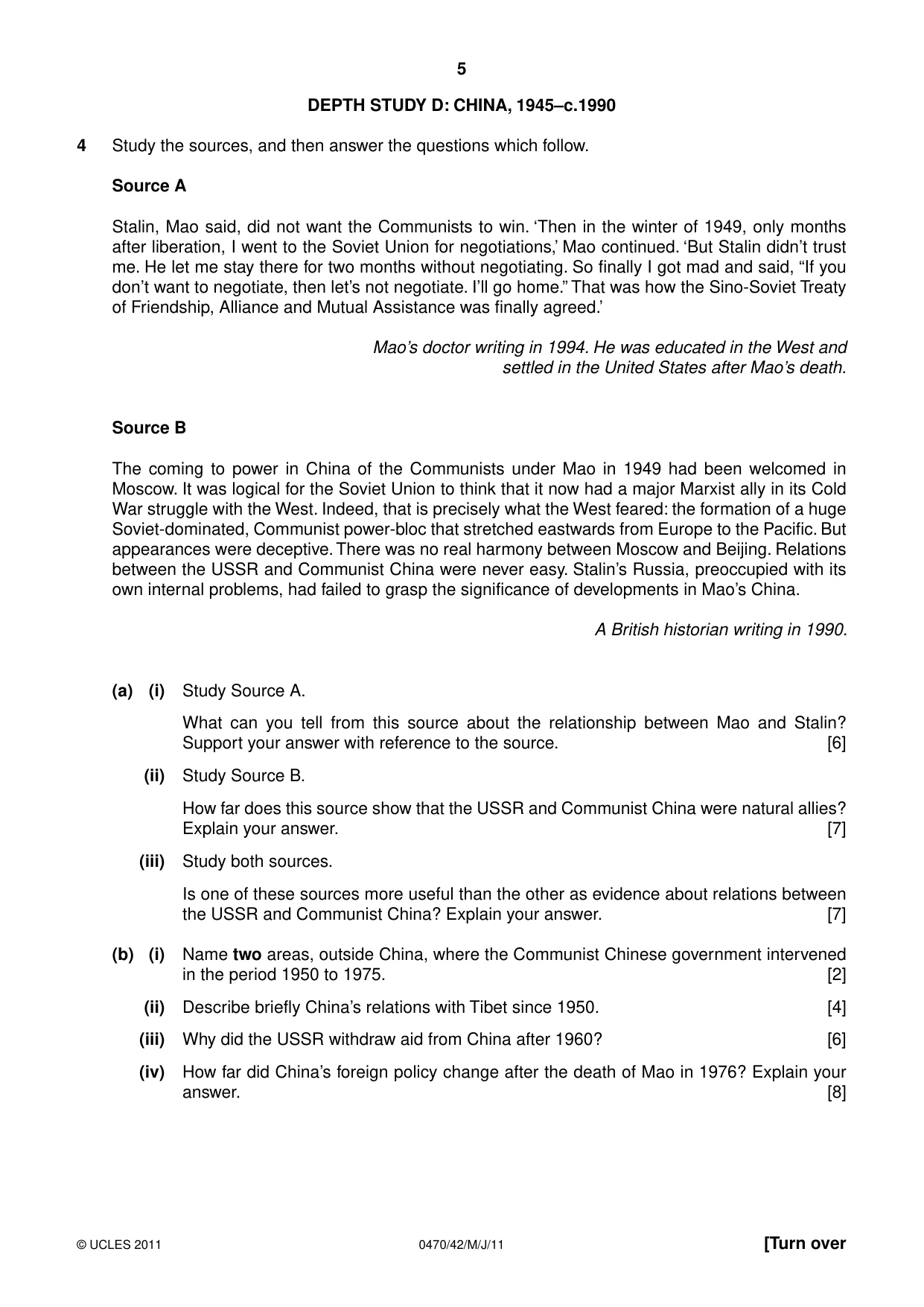
5 0470/42/M/J/11 © UCLES 2011 [Turn over DEPTH STUDY D: CHINA, 1945–c.1990 4 Study the sources, and then answer the questions which follow. Source A Stalin, Mao said, did not want the Communists to win. ‘Then in the winter of 1949, only months after liberation, I went to the Soviet Union for negotiations,’ Mao continued. ‘But Stalin didn’t trust me. He let me stay there for two months without negotiating. So finally I got mad and said, “If you don’t want to negotiate, then let’s not negotiate. I’ll go home.” That was how the Sino-Soviet Treaty of Friendship, Alliance and Mutual Assistance was finally agreed.’ Mao’s doctor writing in 1994. He was educated in the West and settled in the United States after Mao’s death. Source B The coming to power in China of the Communists under Mao in 1949 had been welcomed in Moscow. It was logical for the Soviet Union to think that it now had a major Marxist ally in its Cold War struggle with the West. Indeed, that is precisely what the West feared: the formation of a huge Soviet-dominated, Communist power-bloc that stretched eastwards from Europe to the Pacific. But appearances were deceptive. There was no real harmony between Moscow and Beijing. Relations between the USSR and Communist China were never easy. Stalin’s Russia, preoccupied with its own internal problems, had failed to grasp the significance of developments in Mao’s China. A British historian writing in 1990. (a) (i) Study Source A. What can you tell from this source about the relationship between Mao and Stalin? Support your answer with reference to the source. [6] (ii) Study Source B. How far does this source show that the USSR and Communist China were natural allies? Explain your answer. [7] (iii) Study both sources. Is one of these sources more useful than the other as evidence about relations between the USSR and Communist China? Explain your answer. [7] (b) (i) Name two areas, outside China, where the Communist Chinese government intervened in the period 1950 to 1975. [2] (ii) Describe briefly China’s relations with Tibet since 1950. [4] (iii) Why did the USSR withdraw aid from China after 1960? [6] (iv) How far did China’s foreign policy change after the death of Mao in 1976? Explain your answer. [8]
Question paper, page 6
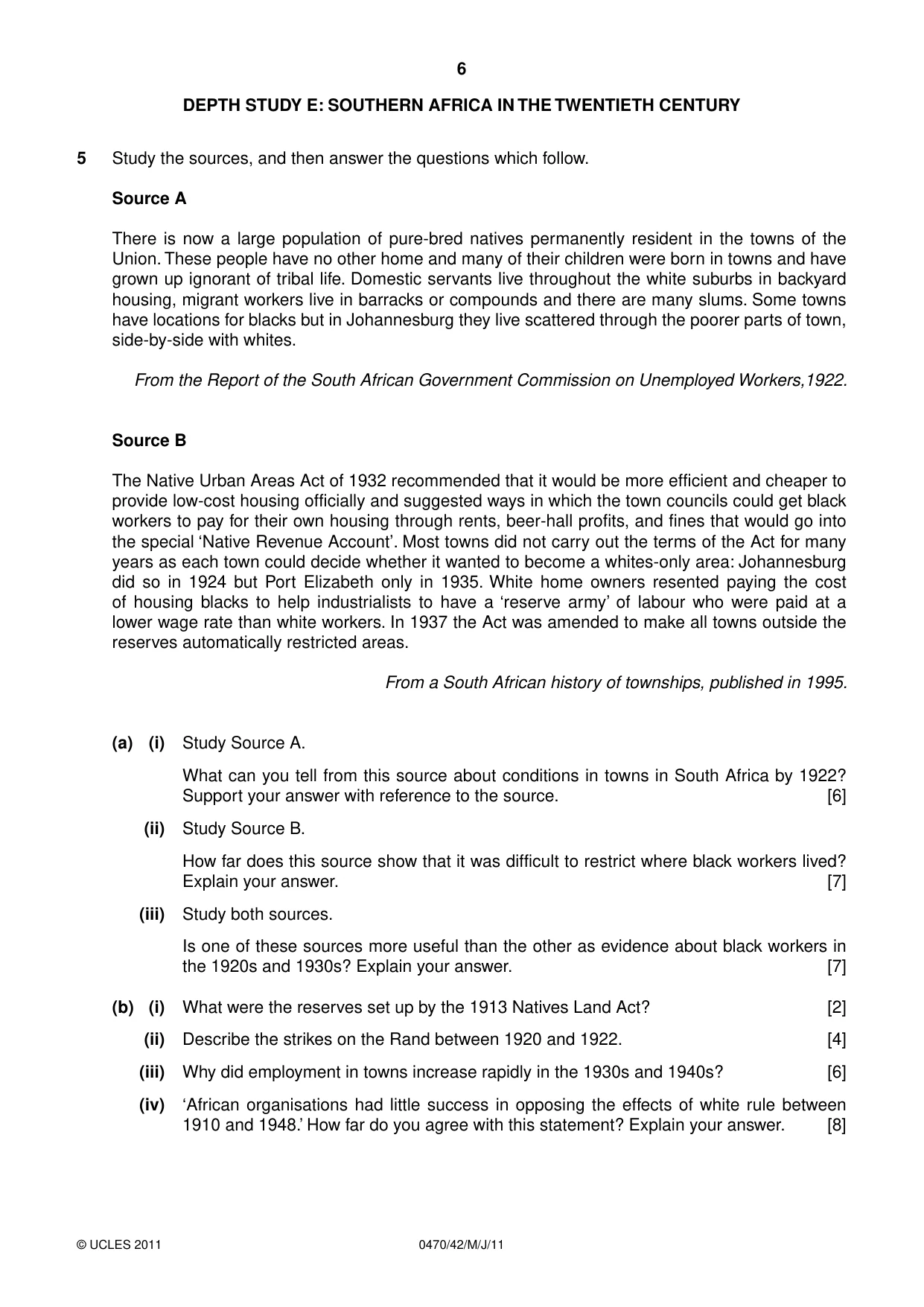
6 0470/42/M/J/11 © UCLES 2011 DEPTH STUDY E: SOUTHERN AFRICA IN THE TWENTIETH CENTURY 5 Study the sources, and then answer the questions which follow. Source A There is now a large population of pure-bred natives permanently resident in the towns of the Union. These people have no other home and many of their children were born in towns and have grown up ignorant of tribal life. Domestic servants live throughout the white suburbs in backyard housing, migrant workers live in barracks or compounds and there are many slums. Some towns have locations for blacks but in Johannesburg they live scattered through the poorer parts of town, side-by-side with whites. From the Report of the South African Government Commission on Unemployed Workers,1922. Source B The Native Urban Areas Act of 1932 recommended that it would be more efficient and cheaper to provide low-cost housing officially and suggested ways in which the town councils could get black workers to pay for their own housing through rents, beer-hall profits, and fines that would go into the special ‘Native Revenue Account’. Most towns did not carry out the terms of the Act for many years as each town could decide whether it wanted to become a whites-only area: Johannesburg did so in 1924 but Port Elizabeth only in 1935. White home owners resented paying the cost of housing blacks to help industrialists to have a ‘reserve army’ of labour who were paid at a lower wage rate than white workers. In 1937 the Act was amended to make all towns outside the reserves automatically restricted areas. From a South African history of townships, published in 1995. (a) (i) Study Source A. What can you tell from this source about conditions in towns in South Africa by 1922? Support your answer with reference to the source. [6] (ii) Study Source B. How far does this source show that it was difficult to restrict where black workers lived? Explain your answer. [7] (iii) Study both sources. Is one of these sources more useful than the other as evidence about black workers in the 1920s and 1930s? Explain your answer. [7] (b) (i) What were the reserves set up by the 1913 Natives Land Act? [2] (ii) Describe the strikes on the Rand between 1920 and 1922. [4] (iii) Why did employment in towns increase rapidly in the 1930s and 1940s? [6] (iv) ‘African organisations had little success in opposing the effects of white rule between 1910 and 1948.’ How far do you agree with this statement? Explain your answer. [8]
Question paper, page 7
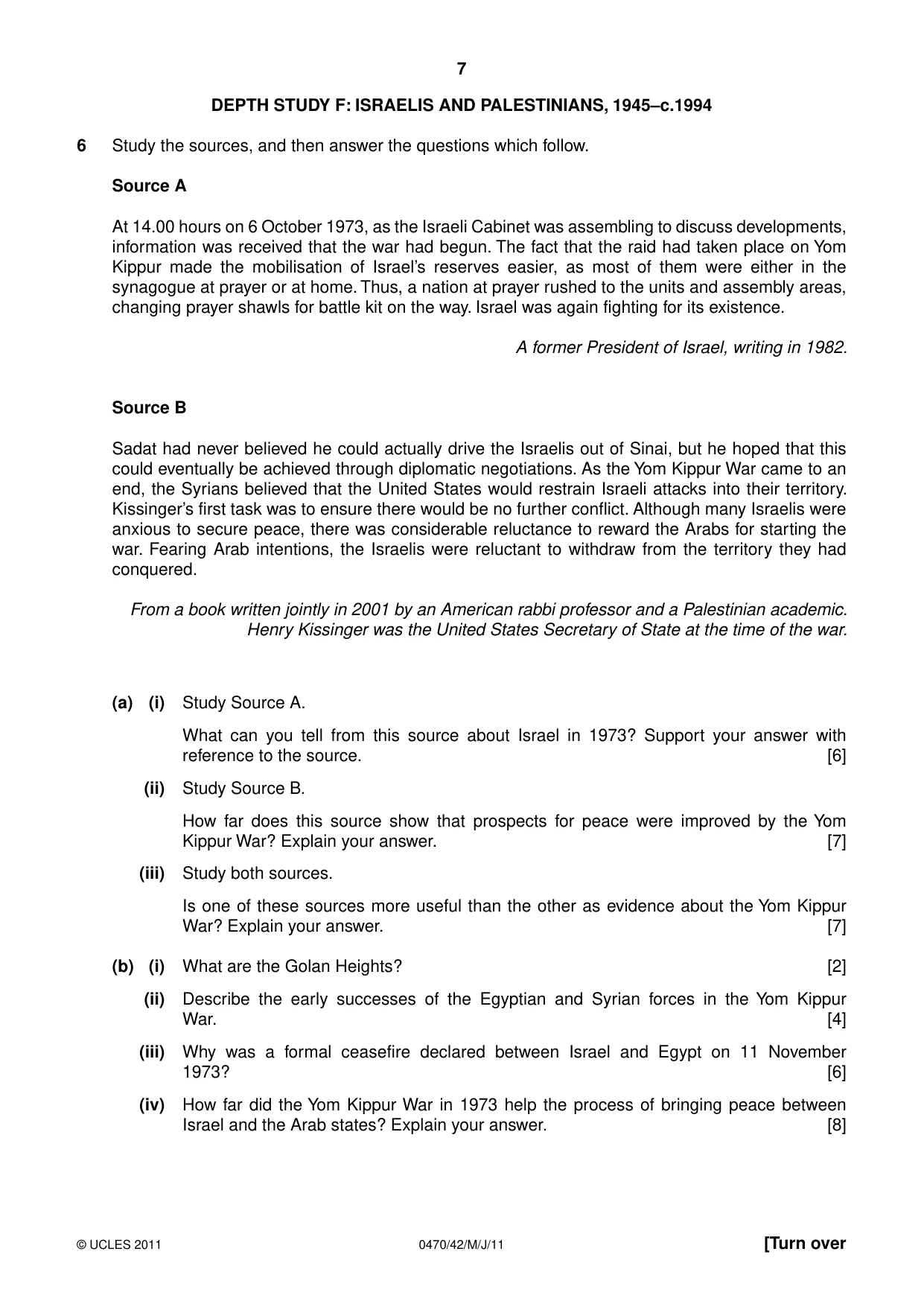
7 0470/42/M/J/11 © UCLES 2011 [Turn over DEPTH STUDY F: ISRAELIS AND PALESTINIANS, 1945–c.1994 6 Study the sources, and then answer the questions which follow. Source A At 14.00 hours on 6 October 1973, as the Israeli Cabinet was assembling to discuss developments, information was received that the war had begun. The fact that the raid had taken place on Yom Kippur made the mobilisation of Israel’s reserves easier, as most of them were either in the synagogue at prayer or at home. Thus, a nation at prayer rushed to the units and assembly areas, changing prayer shawls for battle kit on the way. Israel was again fighting for its existence. A former President of Israel, writing in 1982. Source B Sadat had never believed he could actually drive the Israelis out of Sinai, but he hoped that this could eventually be achieved through diplomatic negotiations. As the Yom Kippur War came to an end, the Syrians believed that the United States would restrain Israeli attacks into their territory. Kissinger’s first task was to ensure there would be no further conflict. Although many Israelis were anxious to secure peace, there was considerable reluctance to reward the Arabs for starting the war. Fearing Arab intentions, the Israelis were reluctant to withdraw from the territory they had conquered. From a book written jointly in 2001 by an American rabbi professor and a Palestinian academic. Henry Kissinger was the United States Secretary of State at the time of the war. (a) (i) Study Source A. What can you tell from this source about Israel in 1973? Support your answer with reference to the source. [6] (ii) Study Source B. How far does this source show that prospects for peace were improved by the Yom Kippur War? Explain your answer. [7] (iii) Study both sources. Is one of these sources more useful than the other as evidence about the Yom Kippur War? Explain your answer. [7] (b) (i) What are the Golan Heights? [2] (ii) Describe the early successes of the Egyptian and Syrian forces in the Yom Kippur War. [4] (iii) Why was a formal ceasefire declared between Israel and Egypt on 11 November 1973? [6] (iv) How far did the Yom Kippur War in 1973 help the process of bringing peace between Israel and the Arab states? Explain your answer. [8]
Question paper, page 8
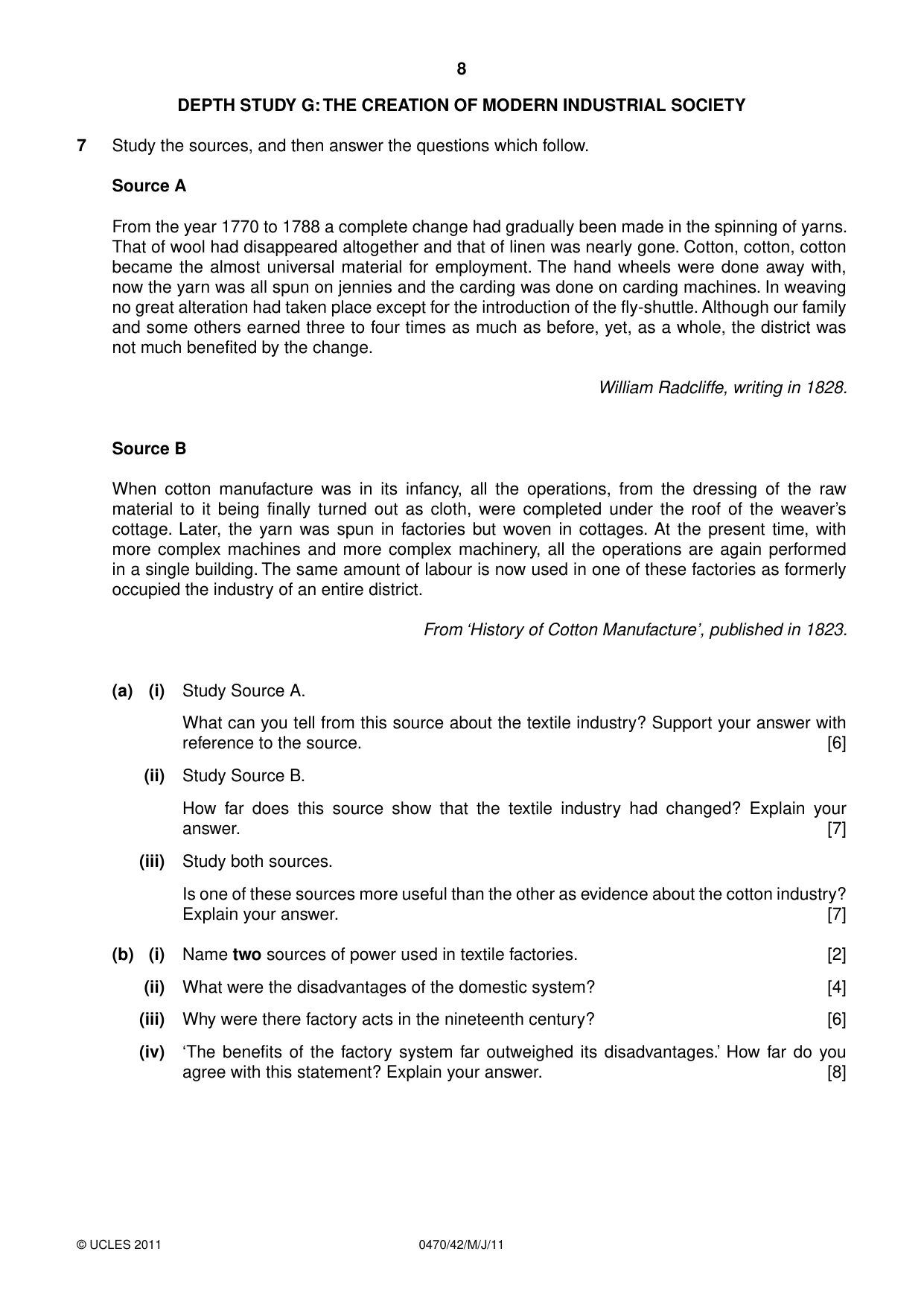
8 0470/42/M/J/11 © UCLES 2011 DEPTH STUDY G: THE CREATION OF MODERN INDUSTRIAL SOCIETY 7 Study the sources, and then answer the questions which follow. Source A From the year 1770 to 1788 a complete change had gradually been made in the spinning of yarns. That of wool had disappeared altogether and that of linen was nearly gone. Cotton, cotton, cotton became the almost universal material for employment. The hand wheels were done away with, now the yarn was all spun on jennies and the carding was done on carding machines. In weaving no great alteration had taken place except for the introduction of the fly-shuttle. Although our family and some others earned three to four times as much as before, yet, as a whole, the district was not much benefited by the change. William Radcliffe, writing in 1828. Source B When cotton manufacture was in its infancy, all the operations, from the dressing of the raw material to it being finally turned out as cloth, were completed under the roof of the weaver’s cottage. Later, the yarn was spun in factories but woven in cottages. At the present time, with more complex machines and more complex machinery, all the operations are again performed in a single building. The same amount of labour is now used in one of these factories as formerly occupied the industry of an entire district. From ‘History of Cotton Manufacture’, published in 1823. (a) (i) Study Source A. What can you tell from this source about the textile industry? Support your answer with reference to the source. [6] (ii) Study Source B. How far does this source show that the textile industry had changed? Explain your answer. [7] (iii) Study both sources. Is one of these sources more useful than the other as evidence about the cotton industry? Explain your answer. [7] (b) (i) Name two sources of power used in textile factories. [2] (ii) What were the disadvantages of the domestic system? [4] (iii) Why were there factory acts in the nineteenth century? [6] (iv) ‘The benefits of the factory system far outweighed its disadvantages.’ How far do you agree with this statement? Explain your answer. [8]
Question paper, page 9
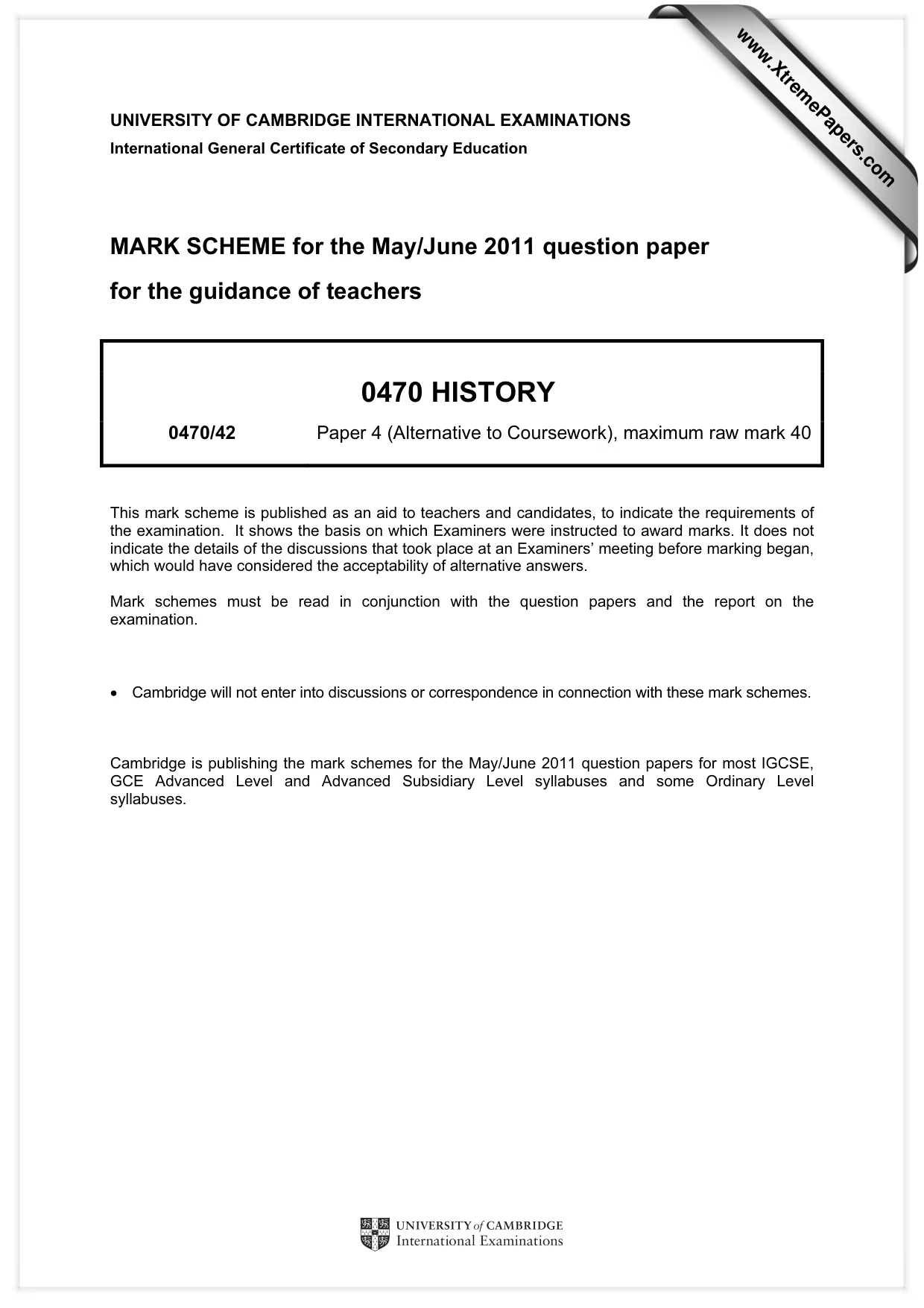
9 0470/42/M/J/11 © UCLES 2011 DEPTH STUDY H: THE IMPACT OF WESTERN IMPERIALISM IN THE NINETEENTH CENTURY 8 Study the sources, and then answer the questions which follow. Source A Even the primitive tribes may benefit not only from being taught mechanical and tradesmen’s work, such as the carpenter and blacksmith, but also agriculture. They learn of the sinking of wells, the system of irrigation, the introduction and planting of useful trees, and using domestic animals for agricultural purposes. All these, while improving the status of the native, will make his land more productive and will enable him to purchase cloth and household goods from traders. Lord Lugard, writing in 1893. Source B Imperialism has, in fact, already devastated tropical Africa, but it has brought great benefit to our commerce and provided raw materials. Although the Africans of the tropics are capable of tremendous physical labours, they cannot fit into the European system of monotonous, uninterrupted labour with its long and regular hours. Climatic conditions forbid it. When that European system is forced upon them, tropical Africans droop and die. A British journalist in the Congo, writing in 1903. (a) (i) Study Source A. What can you tell from this source about imperialism? Support your answer with reference to the source. [6] (ii) Study Source B. How far does this source show that imperialism was not working in Africa? Explain your answer. [7] (iii) Study both sources. Is one of these sources more useful than the other as evidence about the nature of imperialism in the nineteenth century? Explain your answer. [7] (b) (i) Which countries controlled (a) the Congo and (b) South West Africa (Namibia) by the end of the nineteenth century? [2] (ii) Describe the main features of ‘indirect rule’. [4] (iii) Why did many European countries want empires? [6] (iv) ‘Imperialism only benefited Europeans.’ How far do you agree with this statement? Explain your answer. [8]
Question paper, page 10
10 0470/42/M/J/11 © UCLES 2011 BLANK PAGE
Question paper, page 11
11 0470/42/M/J/11 © UCLES 2011 BLANK PAGE
Question paper, page 12
12 0470/42/M/J/11 © UCLES 2011 BLANK PAGE Copyright Acknowledgements: Depth Study A Source B © Karl Bracher; The German Dictatorship ; Penguin; 1991. Depth Study B Source A © Bryn O’Callaghan; A History of the Twentieth Century ; Longman; 1987. Depth Study B Source B © Alan White; Russia and the USSR 1905–1991; Collins Educational; 1995. Depth Study C Source B © http://inventors.about.com/gi/dynamic/offsite.htm?site=http://www.wiley.com/product/subject/business/forbes/ford.html. Depth Study D Source A © Zhisui Li; The Private Life of Chairman Mao; Arrow Books; 1996. Depth Study D Source B © Michael Lynch; Stalin and Khrushchev – The USSR 1924–64 ; Hodder & Stoughton; 1990. Depth Study E Source B © http://www.sahistory.org.za/pages/governance-projects/liberation-struggle/1920s_legislation.htm Depth Study F Source A © Chaim Herzog; The Arab-Israeli Wars; Greenhill Books Ltd; 2005. Depth Study F Source B © Dan Cohn-Sherbok & Dawoud El-Alami; The Palestine-Israeli Conflict ; Oneworld Publications; 2001. Permission to reproduce items where third-party owned material protected by copyright is included has been sought and cleared where possible. Every reasonable effort has been made by the publisher (UCLES) to trace copyright holders, but if any items requiring clearance have unwittingly been included, the publisher will be pleased to make amends at the earliest possible opportunity. University of Cambridge International Examinations is part of the Cambridge Assessment Group. Cambridge Assessment is the brand name of University of Cambridge Local Examinations Syndicate (UCLES), which is itself a department of the University of Cambridge.
Mark scheme, page 1
UNIVERSITY OF CAMBRIDGE INTERNATIONAL EXAMINATIONS International General Certificate of Secondary Education MARK SCHEME for the May/June 2011 question paper for the guidance of teachers 0470 HISTORY 0470/42 Paper 4 (Alternative to Coursework), maximum raw mark 40 This mark scheme is published as an aid to teachers and candidates, to indicate the requirements of the examination. It shows the basis on which Examiners were instructed to award marks. It does not indicate the details of the discussions that took place at an Examiners’ meeting before marking began, which would have considered the acceptability of alternative answers. Mark schemes must be read in conjunction with the question papers and the report on the examination. • Cambridge will not enter into discussions or correspondence in connection with these mark schemes. Cambridge is publishing the mark schemes for the May/June 2011 question papers for most IGCSE, GCE Advanced Level and Advanced Subsidiary Level syllabuses and some Ordinary Level syllabuses. www.XtremePapers.com
Mark scheme, page 2
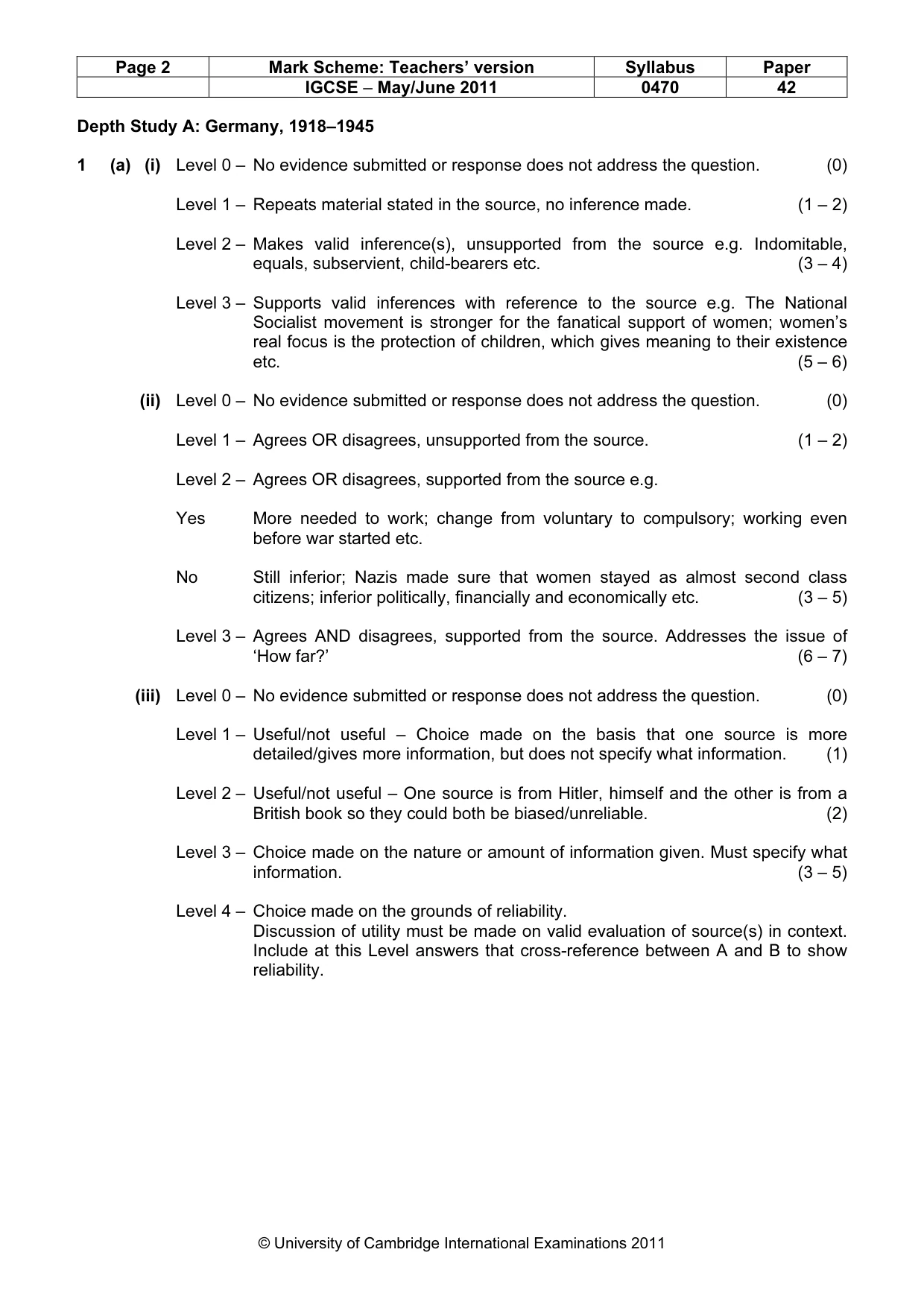
Page 2 Mark Scheme: Teachers’ version Syllabus Paper IGCSE – May/June 2011 0470 42 © University of Cambridge International Examinations 2011 Depth Study A: Germany, 1918–1945 1 (a) (i) Level 0 – No evidence submitted or response does not address the question. (0) Level 1 – Repeats material stated in the source, no inference made. (1 – 2) Level 2 – Makes valid inference(s), unsupported from the source e.g. Indomitable, equals, subservient, child-bearers etc. (3 – 4) Level 3 – Supports valid inferences with reference to the source e.g. The National Socialist movement is stronger for the fanatical support of women; women’s real focus is the protection of children, which gives meaning to their existence etc. (5 – 6) (ii) Level 0 – No evidence submitted or response does not address the question. (0) Level 1 – Agrees OR disagrees, unsupported from the source. (1 – 2) Level 2 – Agrees OR disagrees, supported from the source e.g. Yes More needed to work; change from voluntary to compulsory; working even before war started etc. No Still inferior; Nazis made sure that women stayed as almost second class citizens; inferior politically, financially and economically etc. (3 – 5) Level 3 – Agrees AND disagrees, supported from the source. Addresses the issue of ‘How far?’ (6 – 7) (iii) Level 0 – No evidence submitted or response does not address the question. (0) Level 1 – Useful/not useful – Choice made on the basis that one source is more detailed/gives more information, but does not specify what information. (1) Level 2 – Useful/not useful – One source is from Hitler, himself and the other is from a British book so they could both be biased/unreliable. (2) Level 3 – Choice made on the nature or amount of information given. Must specify what information. (3 – 5) Level 4 – Choice made on the grounds of reliability. Discussion of utility must be made on valid evaluation of source(s) in context. Include at this Level answers that cross-reference between A and B to show reliability.
Mark scheme, page 3
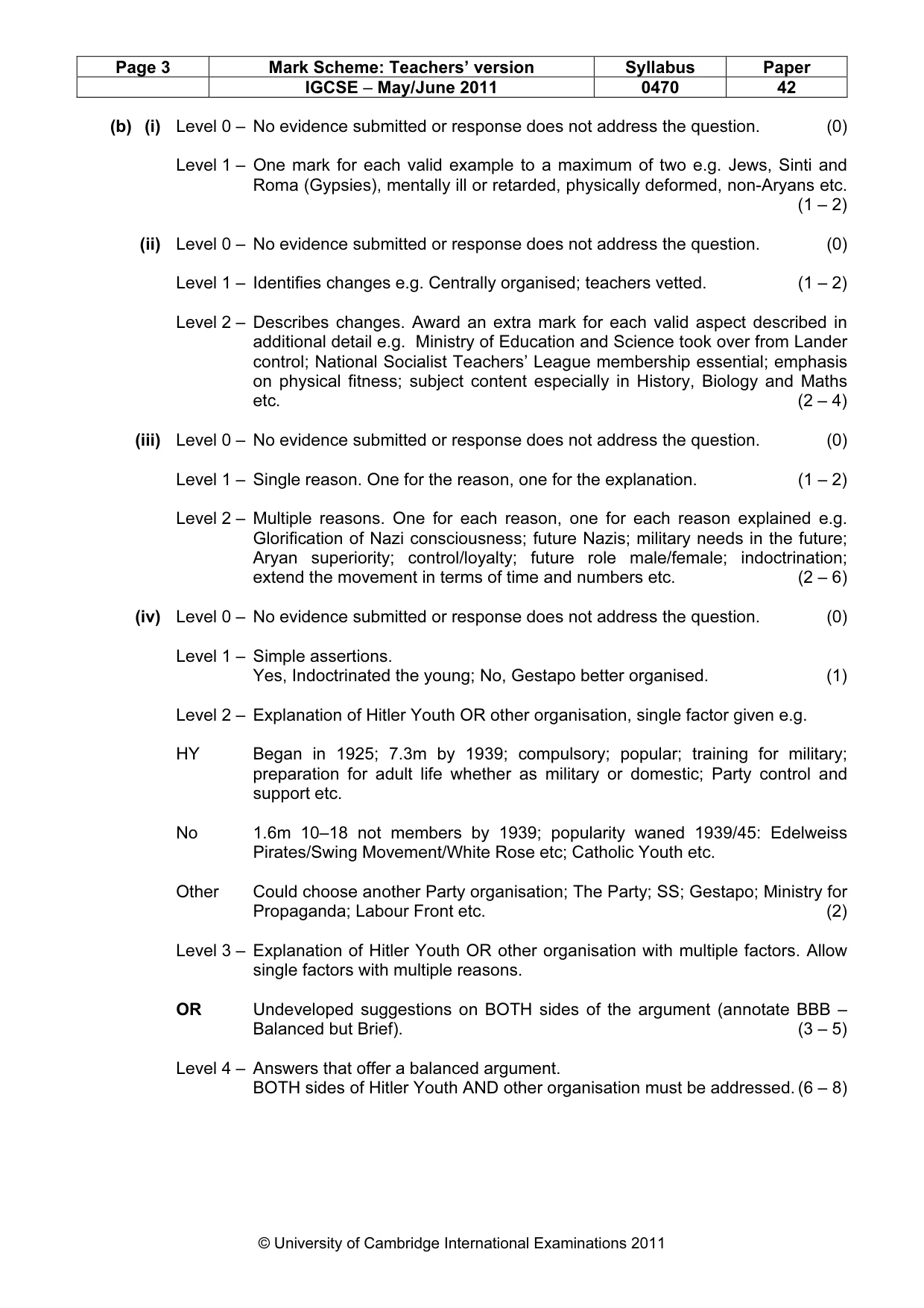
Page 3 Mark Scheme: Teachers’ version Syllabus Paper IGCSE – May/June 2011 0470 42 © University of Cambridge International Examinations 2011 (b) (i) Level 0 – No evidence submitted or response does not address the question. (0) Level 1 – One mark for each valid example to a maximum of two e.g. Jews, Sinti and Roma (Gypsies), mentally ill or retarded, physically deformed, non-Aryans etc. (1 – 2) (ii) Level 0 – No evidence submitted or response does not address the question. (0) Level 1 – Identifies changes e.g. Centrally organised; teachers vetted. (1 – 2) Level 2 – Describes changes. Award an extra mark for each valid aspect described in additional detail e.g. Ministry of Education and Science took over from Lander control; National Socialist Teachers’ League membership essential; emphasis on physical fitness; subject content especially in History, Biology and Maths etc. (2 – 4) (iii) Level 0 – No evidence submitted or response does not address the question. (0) Level 1 – Single reason. One for the reason, one for the explanation. (1 – 2) Level 2 – Multiple reasons. One for each reason, one for each reason explained e.g. Glorification of Nazi consciousness; future Nazis; military needs in the future; Aryan superiority; control/loyalty; future role male/female; indoctrination; extend the movement in terms of time and numbers etc. (2 – 6) (iv) Level 0 – No evidence submitted or response does not address the question. (0) Level 1 – Simple assertions. Yes, Indoctrinated the young; No, Gestapo better organised. (1) Level 2 – Explanation of Hitler Youth OR other organisation, single factor given e.g. HY Began in 1925; 7.3m by 1939; compulsory; popular; training for military; preparation for adult life whether as military or domestic; Party control and support etc. No 1.6m 10–18 not members by 1939; popularity waned 1939/45: Edelweiss Pirates/Swing Movement/White Rose etc; Catholic Youth etc. Other Could choose another Party organisation; The Party; SS; Gestapo; Ministry for Propaganda; Labour Front etc. (2) Level 3 – Explanation of Hitler Youth OR other organisation with multiple factors. Allow single factors with multiple reasons. OR Undeveloped suggestions on BOTH sides of the argument (annotate BBB – Balanced but Brief). (3 – 5) Level 4 – Answers that offer a balanced argument. BOTH sides of Hitler Youth AND other organisation must be addressed. (6 – 8)
Mark scheme, page 4
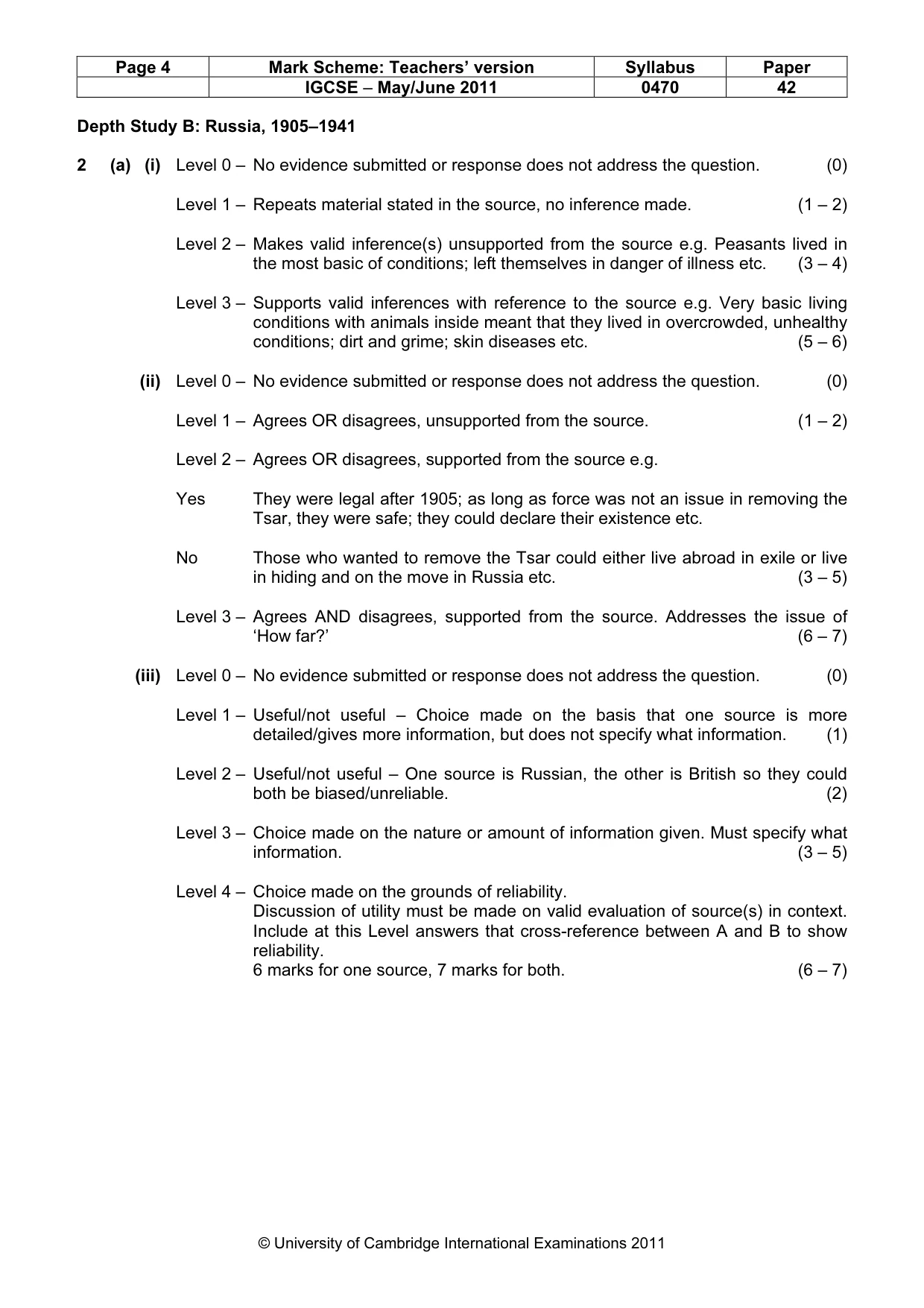
Page 4 Mark Scheme: Teachers’ version Syllabus Paper IGCSE – May/June 2011 0470 42 © University of Cambridge International Examinations 2011 Depth Study B: Russia, 1905–1941 2 (a) (i) Level 0 – No evidence submitted or response does not address the question. (0) Level 1 – Repeats material stated in the source, no inference made. (1 – 2) Level 2 – Makes valid inference(s) unsupported from the source e.g. Peasants lived in the most basic of conditions; left themselves in danger of illness etc. (3 – 4) Level 3 – Supports valid inferences with reference to the source e.g. Very basic living conditions with animals inside meant that they lived in overcrowded, unhealthy conditions; dirt and grime; skin diseases etc. (5 – 6) (ii) Level 0 – No evidence submitted or response does not address the question. (0) Level 1 – Agrees OR disagrees, unsupported from the source. (1 – 2) Level 2 – Agrees OR disagrees, supported from the source e.g. Yes They were legal after 1905; as long as force was not an issue in removing the Tsar, they were safe; they could declare their existence etc. No Those who wanted to remove the Tsar could either live abroad in exile or live in hiding and on the move in Russia etc. (3 – 5) Level 3 – Agrees AND disagrees, supported from the source. Addresses the issue of ‘How far?’ (6 – 7) (iii) Level 0 – No evidence submitted or response does not address the question. (0) Level 1 – Useful/not useful – Choice made on the basis that one source is more detailed/gives more information, but does not specify what information. (1) Level 2 – Useful/not useful – One source is Russian, the other is British so they could both be biased/unreliable. (2) Level 3 – Choice made on the nature or amount of information given. Must specify what information. (3 – 5) Level 4 – Choice made on the grounds of reliability. Discussion of utility must be made on valid evaluation of source(s) in context. Include at this Level answers that cross-reference between A and B to show reliability. 6 marks for one source, 7 marks for both. (6 – 7)
Mark scheme, page 5
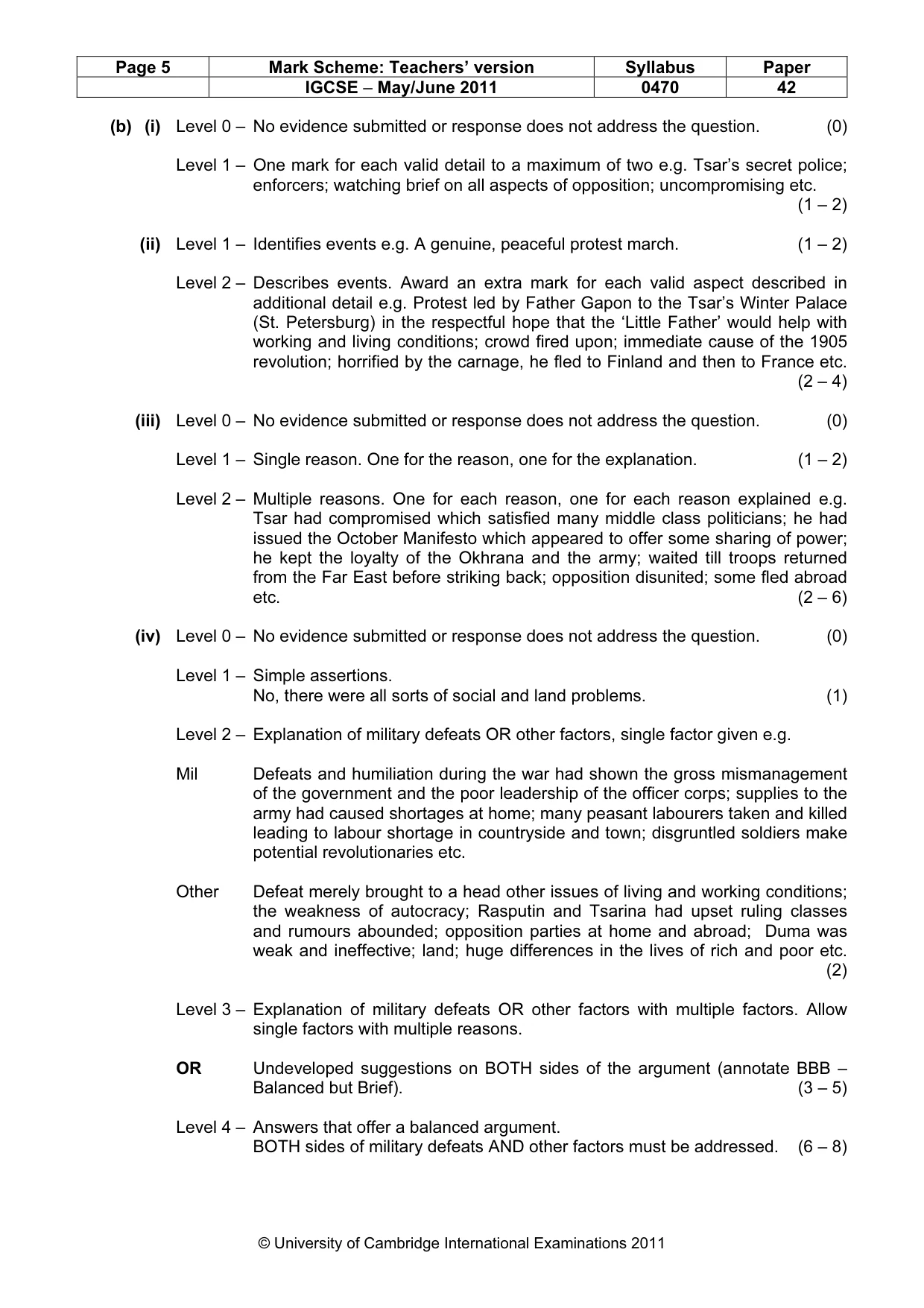
Page 5 Mark Scheme: Teachers’ version Syllabus Paper IGCSE – May/June 2011 0470 42 © University of Cambridge International Examinations 2011 (b) (i) Level 0 – No evidence submitted or response does not address the question. (0) Level 1 – One mark for each valid detail to a maximum of two e.g. Tsar’s secret police; enforcers; watching brief on all aspects of opposition; uncompromising etc. (1 – 2) (ii) Level 1 – Identifies events e.g. A genuine, peaceful protest march. (1 – 2) Level 2 – Describes events. Award an extra mark for each valid aspect described in additional detail e.g. Protest led by Father Gapon to the Tsar’s Winter Palace (St. Petersburg) in the respectful hope that the ‘Little Father’ would help with working and living conditions; crowd fired upon; immediate cause of the 1905 revolution; horrified by the carnage, he fled to Finland and then to France etc. (2 – 4) (iii) Level 0 – No evidence submitted or response does not address the question. (0) Level 1 – Single reason. One for the reason, one for the explanation. (1 – 2) Level 2 – Multiple reasons. One for each reason, one for each reason explained e.g. Tsar had compromised which satisfied many middle class politicians; he had issued the October Manifesto which appeared to offer some sharing of power; he kept the loyalty of the Okhrana and the army; waited till troops returned from the Far East before striking back; opposition disunited; some fled abroad etc. (2 – 6) (iv) Level 0 – No evidence submitted or response does not address the question. (0) Level 1 – Simple assertions. No, there were all sorts of social and land problems. (1) Level 2 – Explanation of military defeats OR other factors, single factor given e.g. Mil Defeats and humiliation during the war had shown the gross mismanagement of the government and the poor leadership of the officer corps; supplies to the army had caused shortages at home; many peasant labourers taken and killed leading to labour shortage in countryside and town; disgruntled soldiers make potential revolutionaries etc. Other Defeat merely brought to a head other issues of living and working conditions; the weakness of autocracy; Rasputin and Tsarina had upset ruling classes and rumours abounded; opposition parties at home and abroad; Duma was weak and ineffective; land; huge differences in the lives of rich and poor etc. (2) Level 3 – Explanation of military defeats OR other factors with multiple factors. Allow single factors with multiple reasons. OR Undeveloped suggestions on BOTH sides of the argument (annotate BBB – Balanced but Brief). (3 – 5) Level 4 – Answers that offer a balanced argument. BOTH sides of military defeats AND other factors must be addressed. (6 – 8)
Mark scheme, page 6
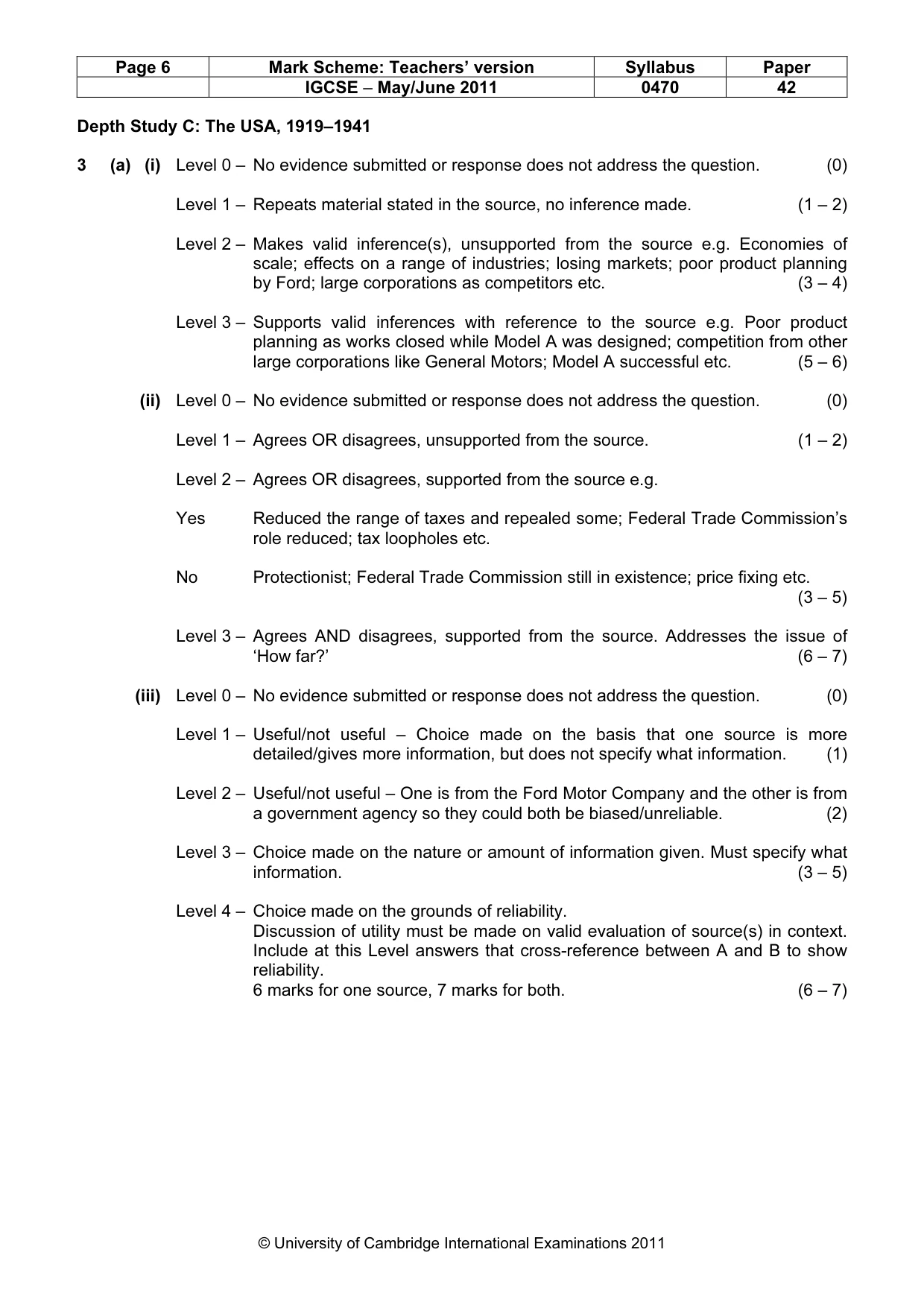
Page 6 Mark Scheme: Teachers’ version Syllabus Paper IGCSE – May/June 2011 0470 42 © University of Cambridge International Examinations 2011 Depth Study C: The USA, 1919–1941 3 (a) (i) Level 0 – No evidence submitted or response does not address the question. (0) Level 1 – Repeats material stated in the source, no inference made. (1 – 2) Level 2 – Makes valid inference(s), unsupported from the source e.g. Economies of scale; effects on a range of industries; losing markets; poor product planning by Ford; large corporations as competitors etc. (3 – 4) Level 3 – Supports valid inferences with reference to the source e.g. Poor product planning as works closed while Model A was designed; competition from other large corporations like General Motors; Model A successful etc. (5 – 6) (ii) Level 0 – No evidence submitted or response does not address the question. (0) Level 1 – Agrees OR disagrees, unsupported from the source. (1 – 2) Level 2 – Agrees OR disagrees, supported from the source e.g. Yes Reduced the range of taxes and repealed some; Federal Trade Commission’s role reduced; tax loopholes etc. No Protectionist; Federal Trade Commission still in existence; price fixing etc. (3 – 5) Level 3 – Agrees AND disagrees, supported from the source. Addresses the issue of ‘How far?’ (6 – 7) (iii) Level 0 – No evidence submitted or response does not address the question. (0) Level 1 – Useful/not useful – Choice made on the basis that one source is more detailed/gives more information, but does not specify what information. (1) Level 2 – Useful/not useful – One is from the Ford Motor Company and the other is from a government agency so they could both be biased/unreliable. (2) Level 3 – Choice made on the nature or amount of information given. Must specify what information. (3 – 5) Level 4 – Choice made on the grounds of reliability. Discussion of utility must be made on valid evaluation of source(s) in context. Include at this Level answers that cross-reference between A and B to show reliability. 6 marks for one source, 7 marks for both. (6 – 7)
Mark scheme, page 7
Page 7 Mark Scheme: Teachers’ version Syllabus Paper IGCSE – May/June 2011 0470 42 © University of Cambridge International Examinations 2011 (b) (i) Level 0 – No evidence submitted or response does not address the question. (0) Level 1 – One mark for each valid example to a maximum of two e.g. Radio, fridge, washing machine, vacuum cleaners, telephone etc. (1 – 2) (ii) Level 1 – Identifies treatment e.g. Business tried to break unions. (1 – 2) Level 2 – Describes treatment. Award an extra mark for each valid aspect described in additional detail e.g. Blacklists; branding unions as Bolsheviks; use of state and federal troops; Supreme Court outlawed picketing; sacked employees; refused to recognise collective bargaining etc. (2 – 4) (iii) Level 0 – No evidence submitted or response does not address the question. (0) Level 1 – Single reason. One for the reason, one for the explanation. (1 – 2) Level 2 – Multiple reasons. One for each reason, one for each reason explained e.g. Usually least skilled; low paid; least organised; racial/ethnic prejudices; blacks in South/agriculture; Native Americans had the poorest land etc. (2 – 6) (iv) Level 0 – No evidence submitted or response does not address the question. (0) Level 1 – Simple assertions. Yes, too many; under regulated; No, suggests another industry. (1) Level 2 – Explanation banks or credit companies OR other industries, single factor given e.g. Bank Unregulated; involved in speculation; corruption; too many small banks were under funded and over stretched – 600 p.a. collapsed even in the Coolidge years; credit made hire purchase and buying on the margin too easy. Other Credit essential to fund business expansion; mortgages aided building industry; another industry weaker e.g. agriculture, textiles; exports and tariffs; stockbrokers, distribution of wealth; under-consumption and overproduction etc. (2) Level 3 – Explanation of banks and credit companies OR other industries with multiple factors. Allow single factors with multiple reasons. OR Undeveloped suggestions on BOTH sides of the argument (annotate BBB – Balanced but Brief). (3 – 5) Level 4 – Answers that offer a balanced argument. BOTH sides of banks and credit companies AND other industries must be addressed. (6 – 8)
Mark scheme, page 8
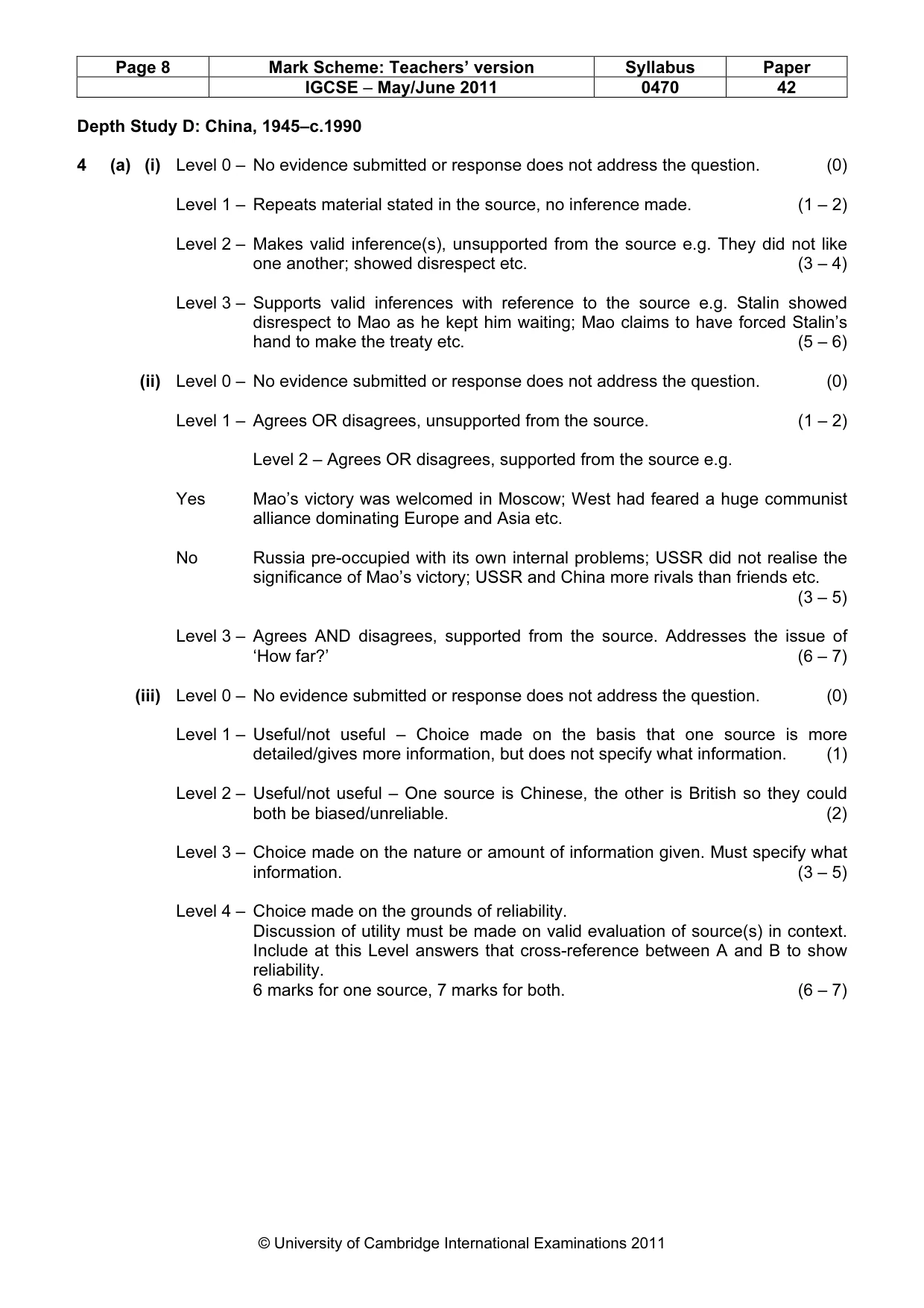
Page 8 Mark Scheme: Teachers’ version Syllabus Paper IGCSE – May/June 2011 0470 42 © University of Cambridge International Examinations 2011 Depth Study D: China, 1945–c.1990 4 (a) (i) Level 0 – No evidence submitted or response does not address the question. (0) Level 1 – Repeats material stated in the source, no inference made. (1 – 2) Level 2 – Makes valid inference(s), unsupported from the source e.g. They did not like one another; showed disrespect etc. (3 – 4) Level 3 – Supports valid inferences with reference to the source e.g. Stalin showed disrespect to Mao as he kept him waiting; Mao claims to have forced Stalin’s hand to make the treaty etc. (5 – 6) (ii) Level 0 – No evidence submitted or response does not address the question. (0) Level 1 – Agrees OR disagrees, unsupported from the source. (1 – 2) Level 2 – Agrees OR disagrees, supported from the source e.g. Yes Mao’s victory was welcomed in Moscow; West had feared a huge communist alliance dominating Europe and Asia etc. No Russia pre-occupied with its own internal problems; USSR did not realise the significance of Mao’s victory; USSR and China more rivals than friends etc. (3 – 5) Level 3 – Agrees AND disagrees, supported from the source. Addresses the issue of ‘How far?’ (6 – 7) (iii) Level 0 – No evidence submitted or response does not address the question. (0) Level 1 – Useful/not useful – Choice made on the basis that one source is more detailed/gives more information, but does not specify what information. (1) Level 2 – Useful/not useful – One source is Chinese, the other is British so they could both be biased/unreliable. (2) Level 3 – Choice made on the nature or amount of information given. Must specify what information. (3 – 5) Level 4 – Choice made on the grounds of reliability. Discussion of utility must be made on valid evaluation of source(s) in context. Include at this Level answers that cross-reference between A and B to show reliability. 6 marks for one source, 7 marks for both. (6 – 7)
Mark scheme, page 9
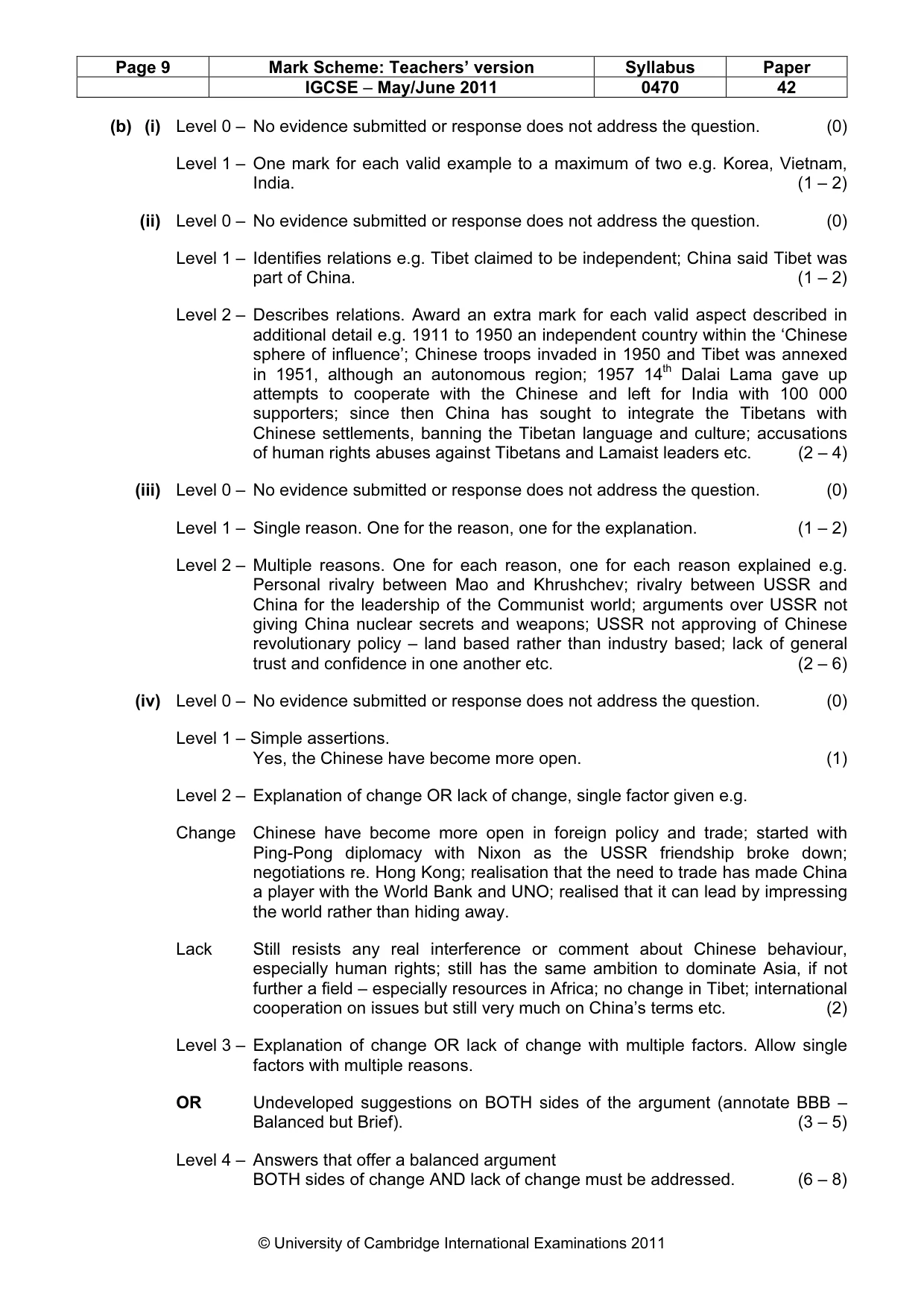
Page 9 Mark Scheme: Teachers’ version Syllabus Paper IGCSE – May/June 2011 0470 42 © University of Cambridge International Examinations 2011 (b) (i) Level 0 – No evidence submitted or response does not address the question. (0) Level 1 – One mark for each valid example to a maximum of two e.g. Korea, Vietnam, India. (1 – 2) (ii) Level 0 – No evidence submitted or response does not address the question. (0) Level 1 – Identifies relations e.g. Tibet claimed to be independent; China said Tibet was part of China. (1 – 2) Level 2 – Describes relations. Award an extra mark for each valid aspect described in additional detail e.g. 1911 to 1950 an independent country within the ‘Chinese sphere of influence’; Chinese troops invaded in 1950 and Tibet was annexed in 1951, although an autonomous region; 1957 14th Dalai Lama gave up attempts to cooperate with the Chinese and left for India with 100 000 supporters; since then China has sought to integrate the Tibetans with Chinese settlements, banning the Tibetan language and culture; accusations of human rights abuses against Tibetans and Lamaist leaders etc. (2 – 4) (iii) Level 0 – No evidence submitted or response does not address the question. (0) Level 1 – Single reason. One for the reason, one for the explanation. (1 – 2) Level 2 – Multiple reasons. One for each reason, one for each reason explained e.g. Personal rivalry between Mao and Khrushchev; rivalry between USSR and China for the leadership of the Communist world; arguments over USSR not giving China nuclear secrets and weapons; USSR not approving of Chinese revolutionary policy – land based rather than industry based; lack of general trust and confidence in one another etc. (2 – 6) (iv) Level 0 – No evidence submitted or response does not address the question. (0) Level 1 – Simple assertions. Yes, the Chinese have become more open. (1) Level 2 – Explanation of change OR lack of change, single factor given e.g. Change Chinese have become more open in foreign policy and trade; started with Ping-Pong diplomacy with Nixon as the USSR friendship broke down; negotiations re. Hong Kong; realisation that the need to trade has made China a player with the World Bank and UNO; realised that it can lead by impressing the world rather than hiding away. Lack Still resists any real interference or comment about Chinese behaviour, especially human rights; still has the same ambition to dominate Asia, if not further a field – especially resources in Africa; no change in Tibet; international cooperation on issues but still very much on China’s terms etc. (2) Level 3 – Explanation of change OR lack of change with multiple factors. Allow single factors with multiple reasons. OR Undeveloped suggestions on BOTH sides of the argument (annotate BBB – Balanced but Brief). (3 – 5) Level 4 – Answers that offer a balanced argument BOTH sides of change AND lack of change must be addressed. (6 – 8)
Mark scheme, page 10
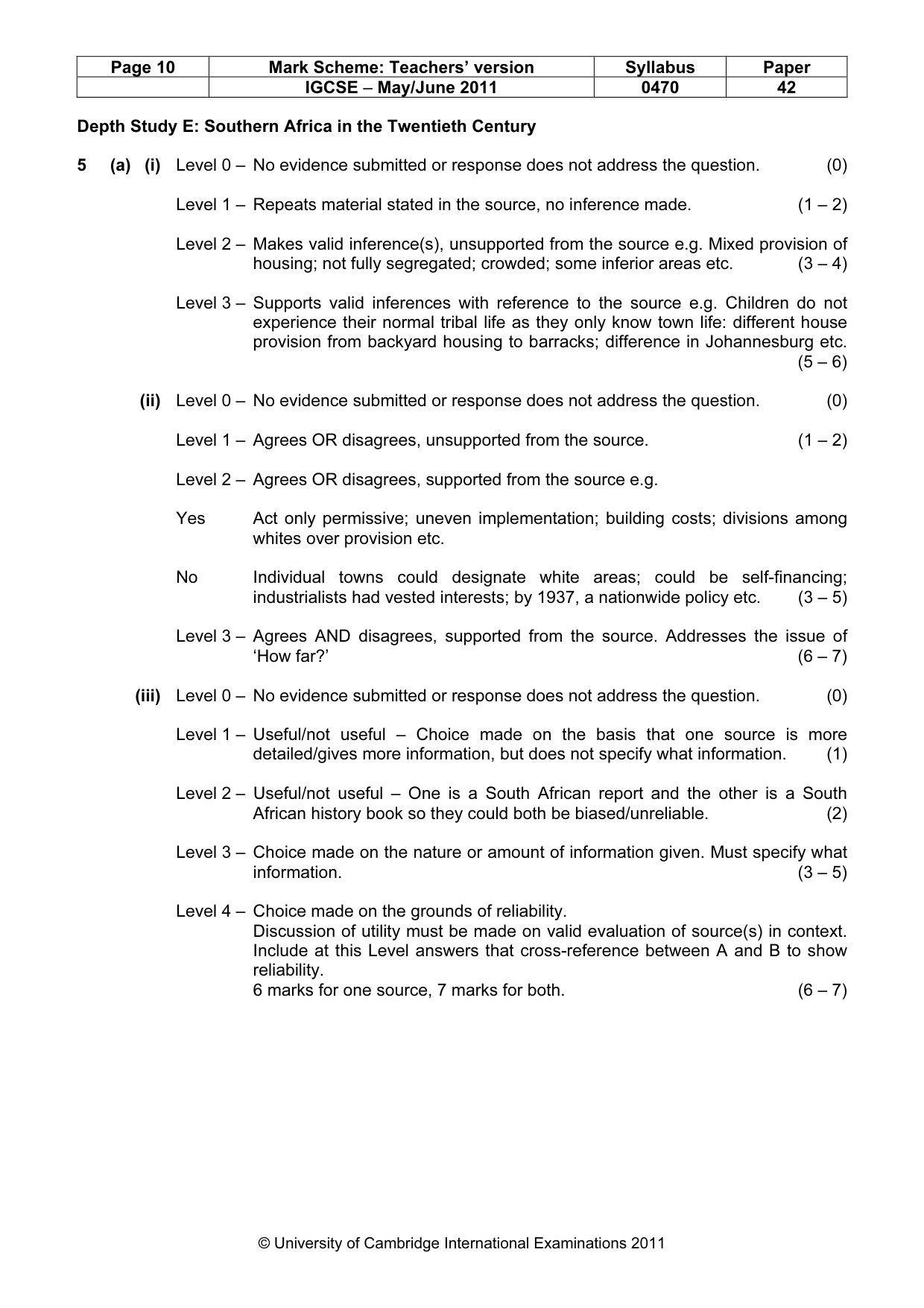
Page 10 Mark Scheme: Teachers’ version Syllabus Paper IGCSE – May/June 2011 0470 42 © University of Cambridge International Examinations 2011 Depth Study E: Southern Africa in the Twentieth Century 5 (a) (i) Level 0 – No evidence submitted or response does not address the question. (0) Level 1 – Repeats material stated in the source, no inference made. (1 – 2) Level 2 – Makes valid inference(s), unsupported from the source e.g. Mixed provision of housing; not fully segregated; crowded; some inferior areas etc. (3 – 4) Level 3 – Supports valid inferences with reference to the source e.g. Children do not experience their normal tribal life as they only know town life: different house provision from backyard housing to barracks; difference in Johannesburg etc. (5 – 6) (ii) Level 0 – No evidence submitted or response does not address the question. (0) Level 1 – Agrees OR disagrees, unsupported from the source. (1 – 2) Level 2 – Agrees OR disagrees, supported from the source e.g. Yes Act only permissive; uneven implementation; building costs; divisions among whites over provision etc. No Individual towns could designate white areas; could be self-financing; industrialists had vested interests; by 1937, a nationwide policy etc. (3 – 5) Level 3 – Agrees AND disagrees, supported from the source. Addresses the issue of ‘How far?’ (6 – 7) (iii) Level 0 – No evidence submitted or response does not address the question. (0) Level 1 – Useful/not useful – Choice made on the basis that one source is more detailed/gives more information, but does not specify what information. (1) Level 2 – Useful/not useful – One is a South African report and the other is a South African history book so they could both be biased/unreliable. (2) Level 3 – Choice made on the nature or amount of information given. Must specify what information. (3 – 5) Level 4 – Choice made on the grounds of reliability. Discussion of utility must be made on valid evaluation of source(s) in context. Include at this Level answers that cross-reference between A and B to show reliability. 6 marks for one source, 7 marks for both. (6 – 7)
Mark scheme, page 11
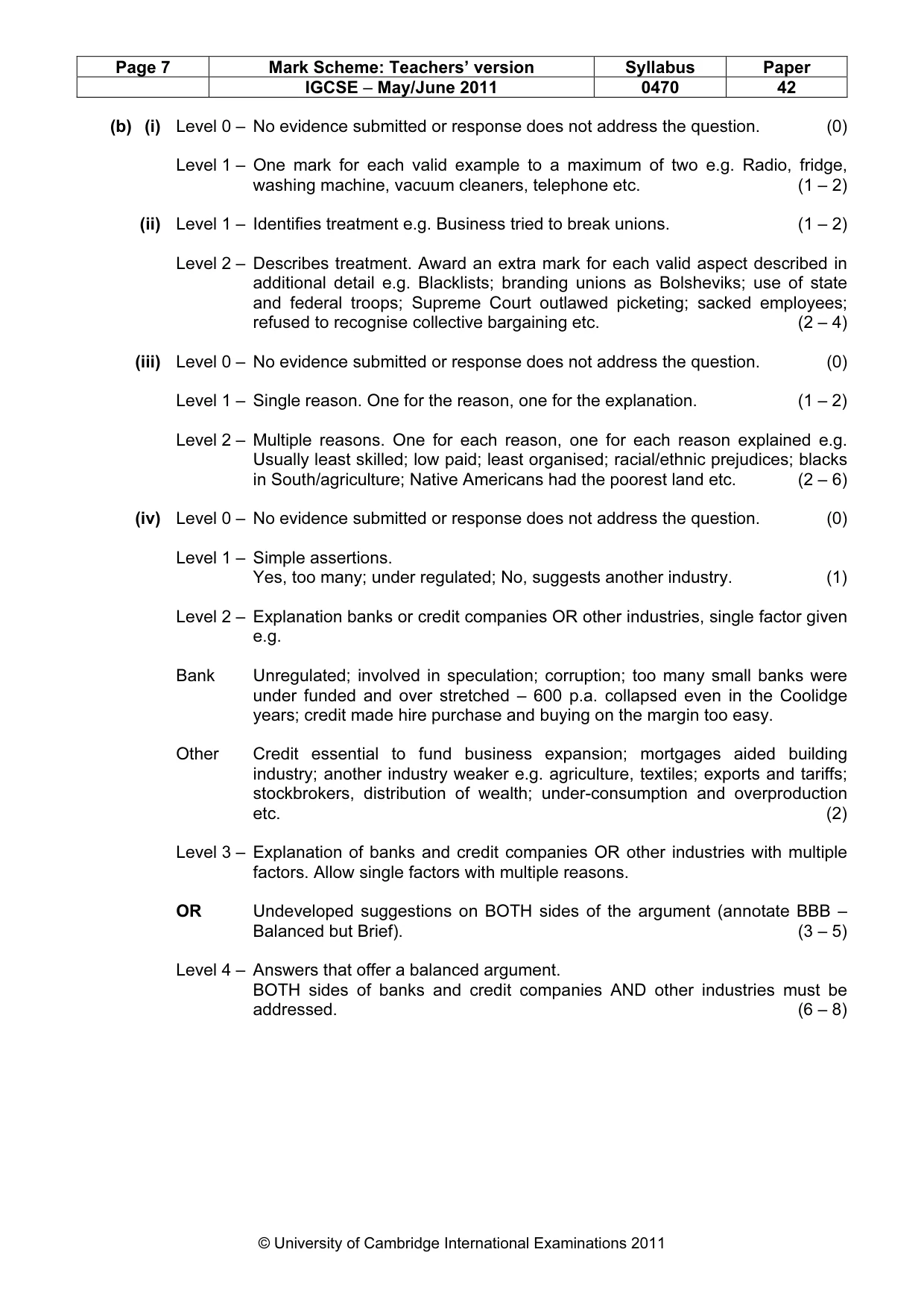
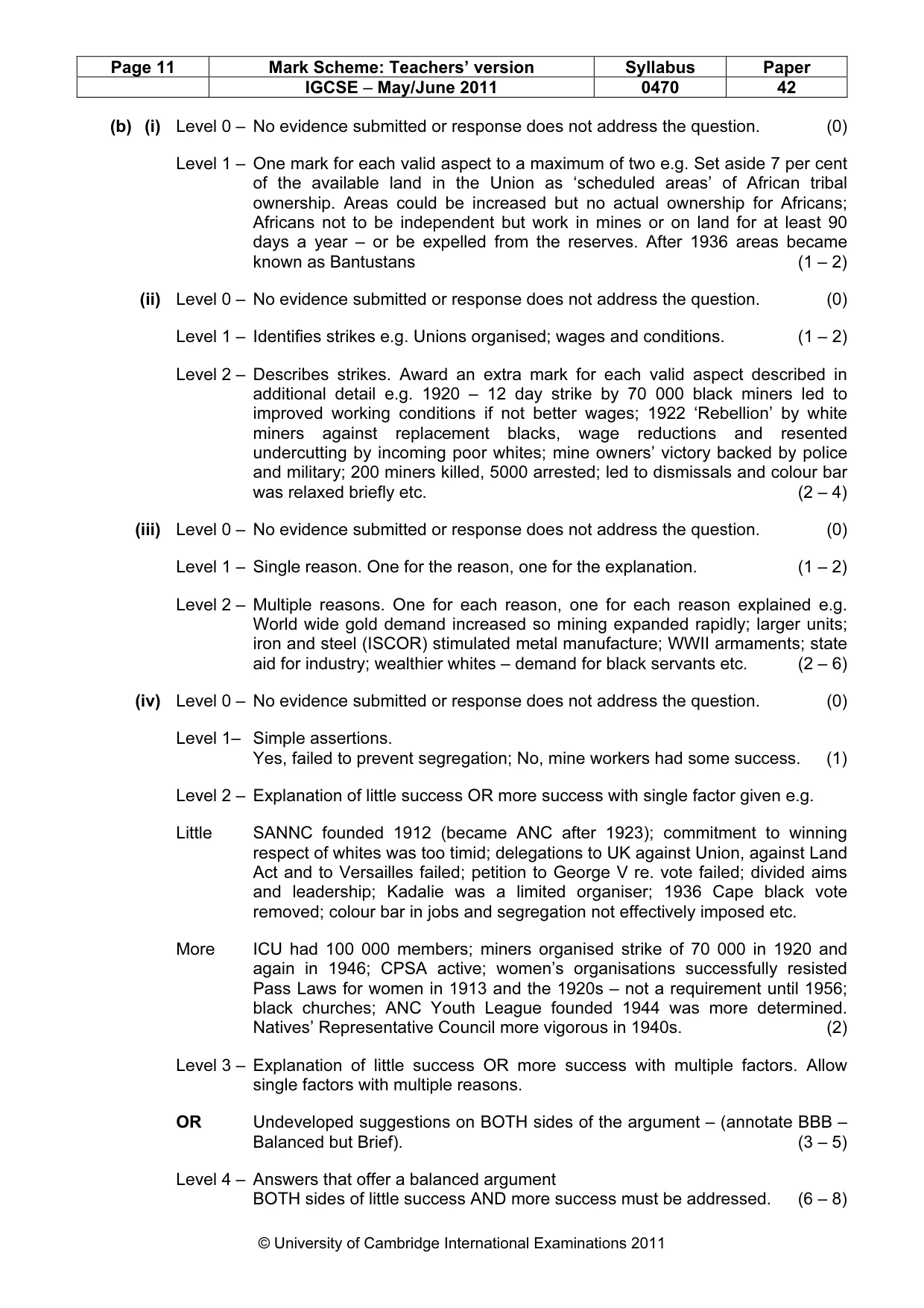
Page 11 Mark Scheme: Teachers’ version Syllabus Paper IGCSE – May/June 2011 0470 42 © University of Cambridge International Examinations 2011 (b) (i) Level 0 – No evidence submitted or response does not address the question. (0) Level 1 – One mark for each valid aspect to a maximum of two e.g. Set aside 7 per cent of the available land in the Union as ‘scheduled areas’ of African tribal ownership. Areas could be increased but no actual ownership for Africans; Africans not to be independent but work in mines or on land for at least 90 days a year – or be expelled from the reserves. After 1936 areas became known as Bantustans (1 – 2) (ii) Level 0 – No evidence submitted or response does not address the question. (0) Level 1 – Identifies strikes e.g. Unions organised; wages and conditions. (1 – 2) Level 2 – Describes strikes. Award an extra mark for each valid aspect described in additional detail e.g. 1920 – 12 day strike by 70 000 black miners led to improved working conditions if not better wages; 1922 ‘Rebellion’ by white miners against replacement blacks, wage reductions and resented undercutting by incoming poor whites; mine owners’ victory backed by police and military; 200 miners killed, 5000 arrested; led to dismissals and colour bar was relaxed briefly etc. (2 – 4) (iii) Level 0 – No evidence submitted or response does not address the question. (0) Level 1 – Single reason. One for the reason, one for the explanation. (1 – 2) Level 2 – Multiple reasons. One for each reason, one for each reason explained e.g. World wide gold demand increased so mining expanded rapidly; larger units; iron and steel (ISCOR) stimulated metal manufacture; WWII armaments; state aid for industry; wealthier whites – demand for black servants etc. (2 – 6) (iv) Level 0 – No evidence submitted or response does not address the question. (0) Level 1– Simple assertions. Yes, failed to prevent segregation; No, mine workers had some success. (1) Level 2 – Explanation of little success OR more success with single factor given e.g. Little SANNC founded 1912 (became ANC after 1923); commitment to winning respect of whites was too timid; delegations to UK against Union, against Land Act and to Versailles failed; petition to George V re. vote failed; divided aims and leadership; Kadalie was a limited organiser; 1936 Cape black vote removed; colour bar in jobs and segregation not effectively imposed etc. More ICU had 100 000 members; miners organised strike of 70 000 in 1920 and again in 1946; CPSA active; women’s organisations successfully resisted Pass Laws for women in 1913 and the 1920s – not a requirement until 1956; black churches; ANC Youth League founded 1944 was more determined. Natives’ Representative Council more vigorous in 1940s. (2) Level 3 – Explanation of little success OR more success with multiple factors. Allow single factors with multiple reasons. OR Undeveloped suggestions on BOTH sides of the argument – (annotate BBB – Balanced but Brief). (3 – 5) Level 4 – Answers that offer a balanced argument BOTH sides of little success AND more success must be addressed. (6 – 8)
Mark scheme, page 12
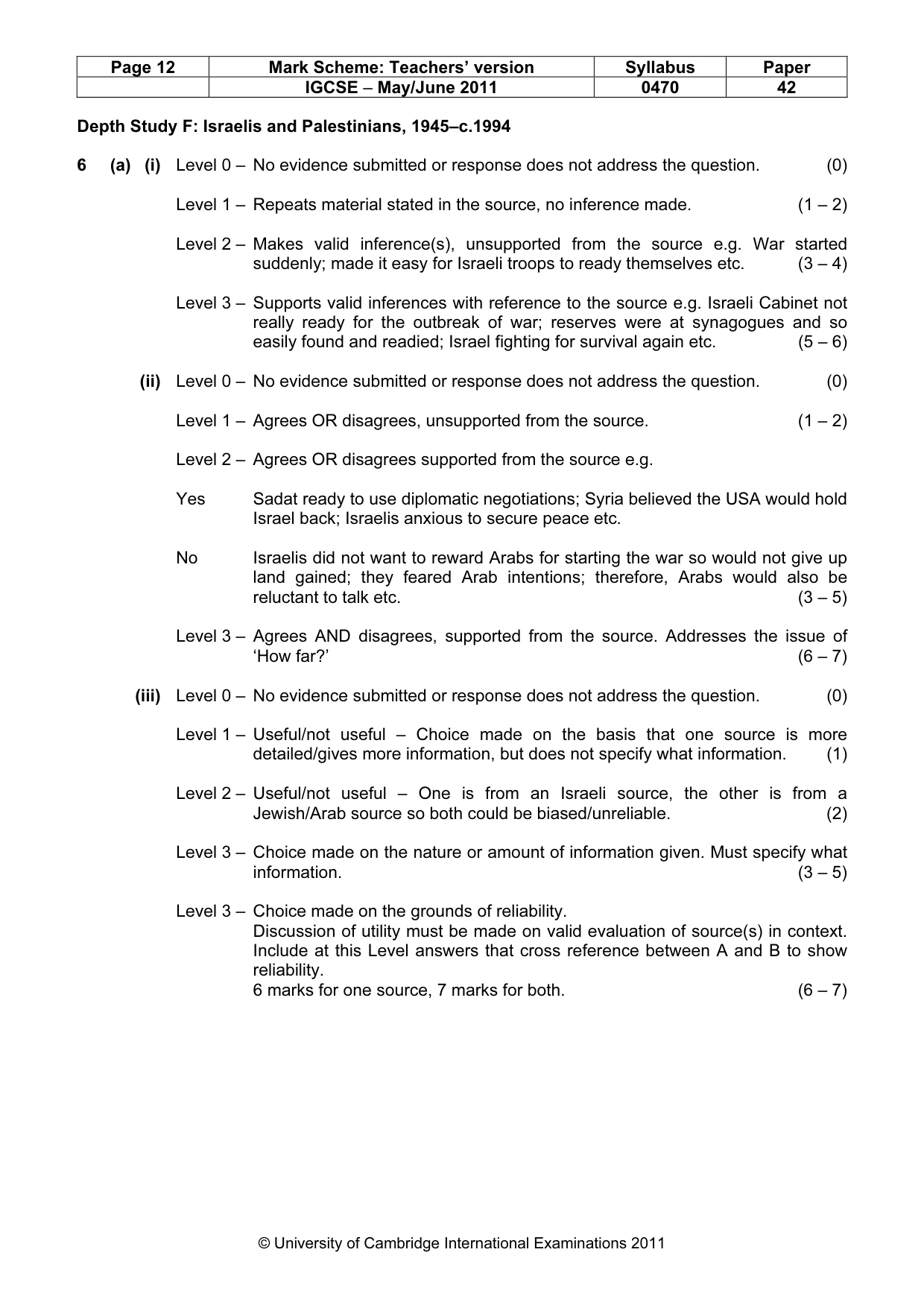
Page 12 Mark Scheme: Teachers’ version Syllabus Paper IGCSE – May/June 2011 0470 42 © University of Cambridge International Examinations 2011 Depth Study F: Israelis and Palestinians, 1945–c.1994 6 (a) (i) Level 0 – No evidence submitted or response does not address the question. (0) Level 1 – Repeats material stated in the source, no inference made. (1 – 2) Level 2 – Makes valid inference(s), unsupported from the source e.g. War started suddenly; made it easy for Israeli troops to ready themselves etc. (3 – 4) Level 3 – Supports valid inferences with reference to the source e.g. Israeli Cabinet not really ready for the outbreak of war; reserves were at synagogues and so easily found and readied; Israel fighting for survival again etc. (5 – 6) (ii) Level 0 – No evidence submitted or response does not address the question. (0) Level 1 – Agrees OR disagrees, unsupported from the source. (1 – 2) Level 2 – Agrees OR disagrees supported from the source e.g. Yes Sadat ready to use diplomatic negotiations; Syria believed the USA would hold Israel back; Israelis anxious to secure peace etc. No Israelis did not want to reward Arabs for starting the war so would not give up land gained; they feared Arab intentions; therefore, Arabs would also be reluctant to talk etc. (3 – 5) Level 3 – Agrees AND disagrees, supported from the source. Addresses the issue of ‘How far?’ (6 – 7) (iii) Level 0 – No evidence submitted or response does not address the question. (0) Level 1 – Useful/not useful – Choice made on the basis that one source is more detailed/gives more information, but does not specify what information. (1) Level 2 – Useful/not useful – One is from an Israeli source, the other is from a Jewish/Arab source so both could be biased/unreliable. (2) Level 3 – Choice made on the nature or amount of information given. Must specify what information. (3 – 5) Level 3 – Choice made on the grounds of reliability. Discussion of utility must be made on valid evaluation of source(s) in context. Include at this Level answers that cross reference between A and B to show reliability. 6 marks for one source, 7 marks for both. (6 – 7)
Mark scheme, page 13
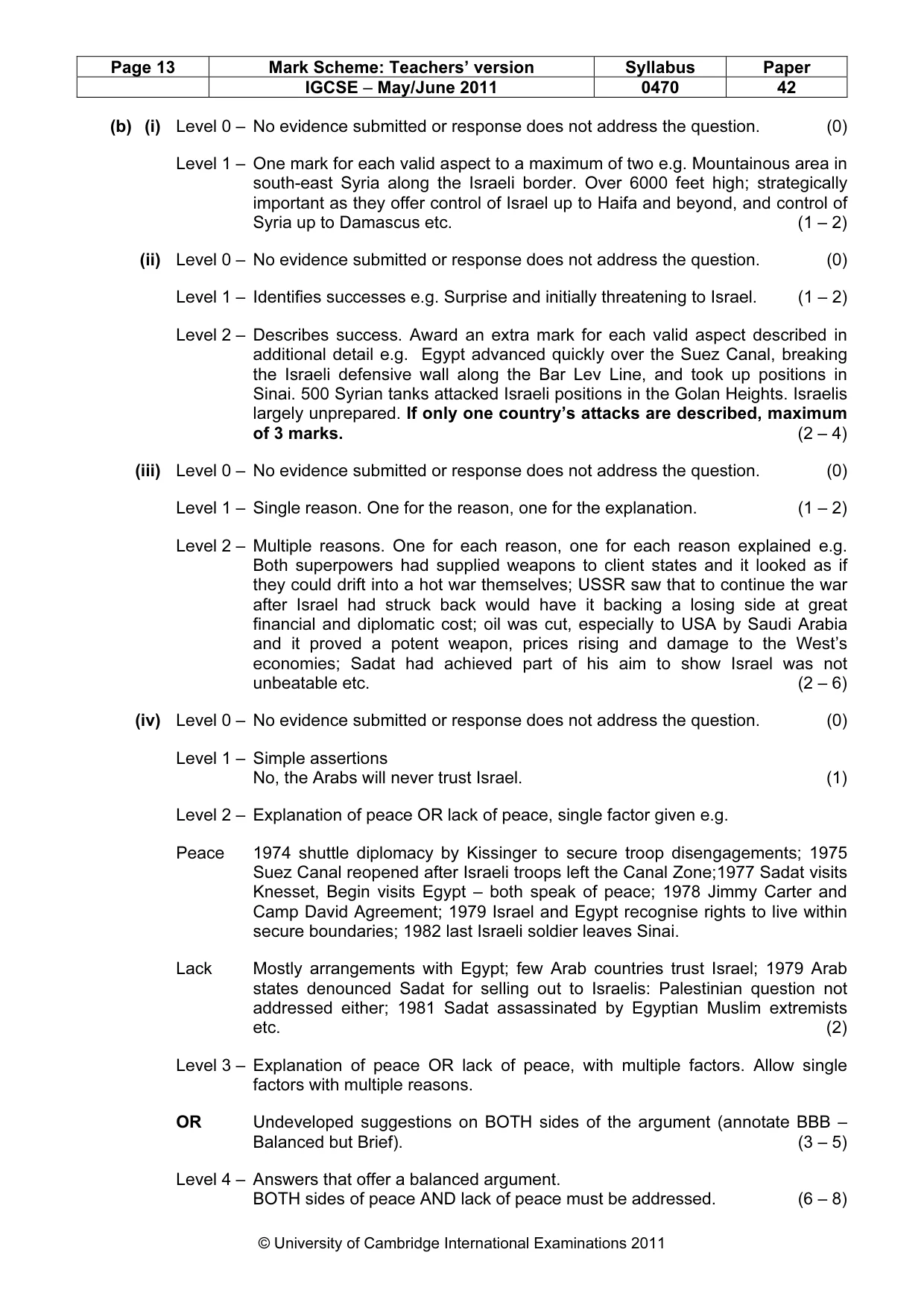
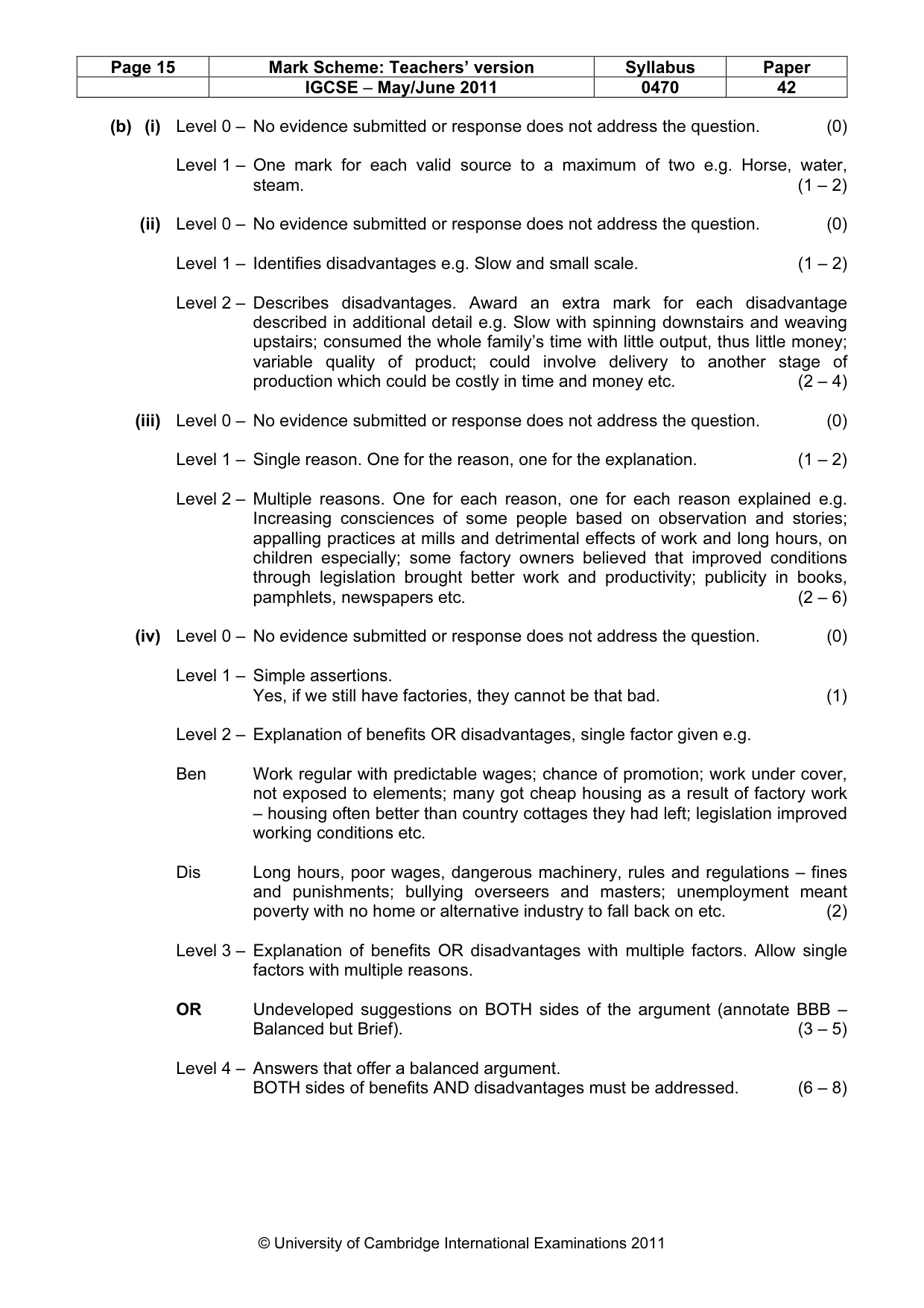
Page 13 Mark Scheme: Teachers’ version Syllabus Paper IGCSE – May/June 2011 0470 42 © University of Cambridge International Examinations 2011 (b) (i) Level 0 – No evidence submitted or response does not address the question. (0) Level 1 – One mark for each valid aspect to a maximum of two e.g. Mountainous area in south-east Syria along the Israeli border. Over 6000 feet high; strategically important as they offer control of Israel up to Haifa and beyond, and control of Syria up to Damascus etc. (1 – 2) (ii) Level 0 – No evidence submitted or response does not address the question. (0) Level 1 – Identifies successes e.g. Surprise and initially threatening to Israel. (1 – 2) Level 2 – Describes success. Award an extra mark for each valid aspect described in additional detail e.g. Egypt advanced quickly over the Suez Canal, breaking the Israeli defensive wall along the Bar Lev Line, and took up positions in Sinai. 500 Syrian tanks attacked Israeli positions in the Golan Heights. Israelis largely unprepared. If only one country’s attacks are described, maximum of 3 marks. (2 – 4) (iii) Level 0 – No evidence submitted or response does not address the question. (0) Level 1 – Single reason. One for the reason, one for the explanation. (1 – 2) Level 2 – Multiple reasons. One for each reason, one for each reason explained e.g. Both superpowers had supplied weapons to client states and it looked as if they could drift into a hot war themselves; USSR saw that to continue the war after Israel had struck back would have it backing a losing side at great financial and diplomatic cost; oil was cut, especially to USA by Saudi Arabia and it proved a potent weapon, prices rising and damage to the West’s economies; Sadat had achieved part of his aim to show Israel was not unbeatable etc. (2 – 6) (iv) Level 0 – No evidence submitted or response does not address the question. (0) Level 1 – Simple assertions No, the Arabs will never trust Israel. (1) Level 2 – Explanation of peace OR lack of peace, single factor given e.g. Peace 1974 shuttle diplomacy by Kissinger to secure troop disengagements; 1975 Suez Canal reopened after Israeli troops left the Canal Zone;1977 Sadat visits Knesset, Begin visits Egypt – both speak of peace; 1978 Jimmy Carter and Camp David Agreement; 1979 Israel and Egypt recognise rights to live within secure boundaries; 1982 last Israeli soldier leaves Sinai. Lack Mostly arrangements with Egypt; few Arab countries trust Israel; 1979 Arab states denounced Sadat for selling out to Israelis: Palestinian question not addressed either; 1981 Sadat assassinated by Egyptian Muslim extremists etc. (2) Level 3 – Explanation of peace OR lack of peace, with multiple factors. Allow single factors with multiple reasons. OR Undeveloped suggestions on BOTH sides of the argument (annotate BBB – Balanced but Brief). (3 – 5) Level 4 – Answers that offer a balanced argument. BOTH sides of peace AND lack of peace must be addressed. (6 – 8)
Mark scheme, page 14
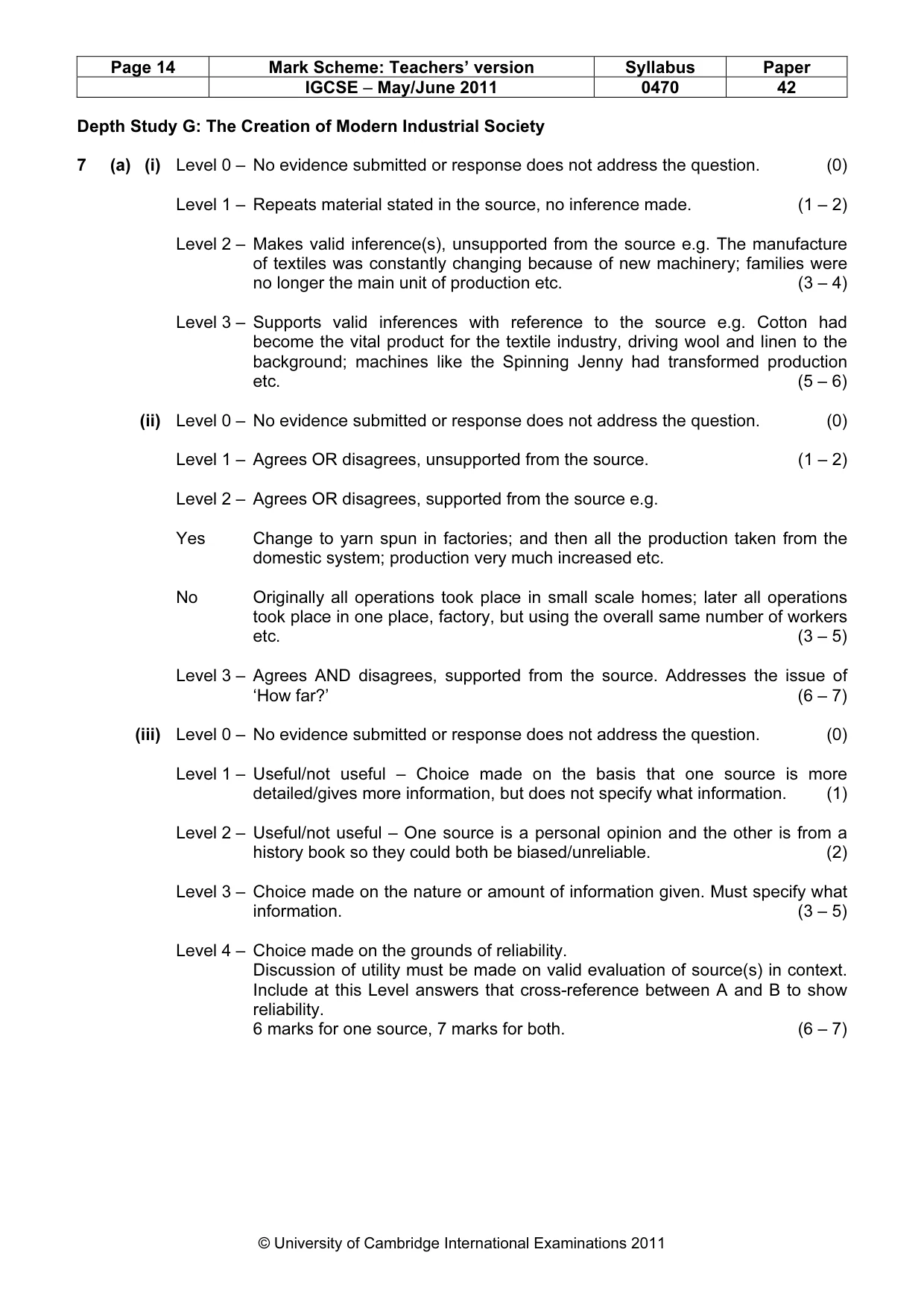
Page 14 Mark Scheme: Teachers’ version Syllabus Paper IGCSE – May/June 2011 0470 42 © University of Cambridge International Examinations 2011 Depth Study G: The Creation of Modern Industrial Society 7 (a) (i) Level 0 – No evidence submitted or response does not address the question. (0) Level 1 – Repeats material stated in the source, no inference made. (1 – 2) Level 2 – Makes valid inference(s), unsupported from the source e.g. The manufacture of textiles was constantly changing because of new machinery; families were no longer the main unit of production etc. (3 – 4) Level 3 – Supports valid inferences with reference to the source e.g. Cotton had become the vital product for the textile industry, driving wool and linen to the background; machines like the Spinning Jenny had transformed production etc. (5 – 6) (ii) Level 0 – No evidence submitted or response does not address the question. (0) Level 1 – Agrees OR disagrees, unsupported from the source. (1 – 2) Level 2 – Agrees OR disagrees, supported from the source e.g. Yes Change to yarn spun in factories; and then all the production taken from the domestic system; production very much increased etc. No Originally all operations took place in small scale homes; later all operations took place in one place, factory, but using the overall same number of workers etc. (3 – 5) Level 3 – Agrees AND disagrees, supported from the source. Addresses the issue of ‘How far?’ (6 – 7) (iii) Level 0 – No evidence submitted or response does not address the question. (0) Level 1 – Useful/not useful – Choice made on the basis that one source is more detailed/gives more information, but does not specify what information. (1) Level 2 – Useful/not useful – One source is a personal opinion and the other is from a history book so they could both be biased/unreliable. (2) Level 3 – Choice made on the nature or amount of information given. Must specify what information. (3 – 5) Level 4 – Choice made on the grounds of reliability. Discussion of utility must be made on valid evaluation of source(s) in context. Include at this Level answers that cross-reference between A and B to show reliability. 6 marks for one source, 7 marks for both. (6 – 7)
Mark scheme, page 15
Page 15 Mark Scheme: Teachers’ version Syllabus Paper IGCSE – May/June 2011 0470 42 © University of Cambridge International Examinations 2011 (b) (i) Level 0 – No evidence submitted or response does not address the question. (0) Level 1 – One mark for each valid source to a maximum of two e.g. Horse, water, steam. (1 – 2) (ii) Level 0 – No evidence submitted or response does not address the question. (0) Level 1 – Identifies disadvantages e.g. Slow and small scale. (1 – 2) Level 2 – Describes disadvantages. Award an extra mark for each disadvantage described in additional detail e.g. Slow with spinning downstairs and weaving upstairs; consumed the whole family’s time with little output, thus little money; variable quality of product; could involve delivery to another stage of production which could be costly in time and money etc. (2 – 4) (iii) Level 0 – No evidence submitted or response does not address the question. (0) Level 1 – Single reason. One for the reason, one for the explanation. (1 – 2) Level 2 – Multiple reasons. One for each reason, one for each reason explained e.g. Increasing consciences of some people based on observation and stories; appalling practices at mills and detrimental effects of work and long hours, on children especially; some factory owners believed that improved conditions through legislation brought better work and productivity; publicity in books, pamphlets, newspapers etc. (2 – 6) (iv) Level 0 – No evidence submitted or response does not address the question. (0) Level 1 – Simple assertions. Yes, if we still have factories, they cannot be that bad. (1) Level 2 – Explanation of benefits OR disadvantages, single factor given e.g. Ben Work regular with predictable wages; chance of promotion; work under cover, not exposed to elements; many got cheap housing as a result of factory work – housing often better than country cottages they had left; legislation improved working conditions etc. Dis Long hours, poor wages, dangerous machinery, rules and regulations – fines and punishments; bullying overseers and masters; unemployment meant poverty with no home or alternative industry to fall back on etc. (2) Level 3 – Explanation of benefits OR disadvantages with multiple factors. Allow single factors with multiple reasons. OR Undeveloped suggestions on BOTH sides of the argument (annotate BBB – Balanced but Brief). (3 – 5) Level 4 – Answers that offer a balanced argument. BOTH sides of benefits AND disadvantages must be addressed. (6 – 8)
Mark scheme, page 16
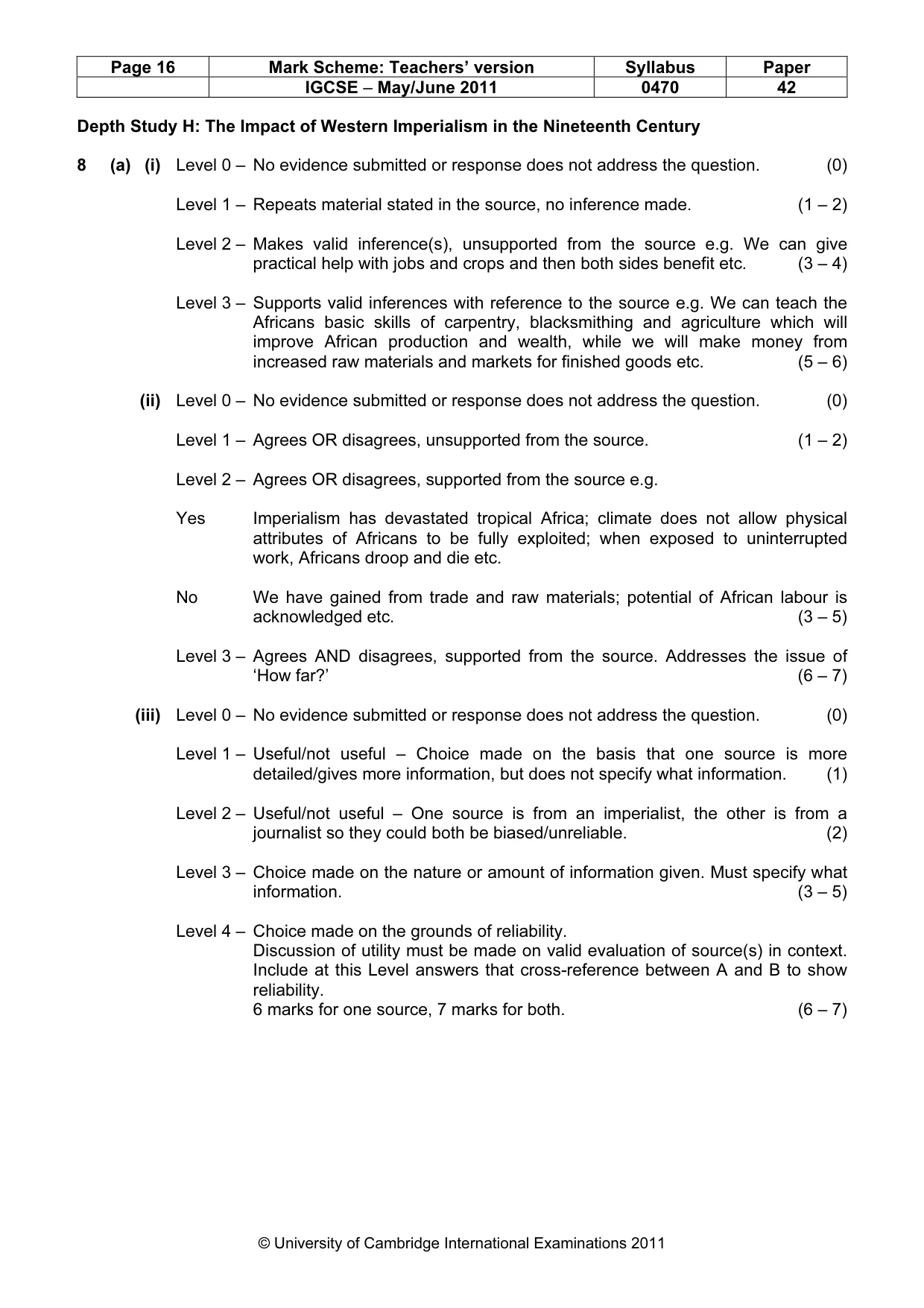
Page 16 Mark Scheme: Teachers’ version Syllabus Paper IGCSE – May/June 2011 0470 42 © University of Cambridge International Examinations 2011 Depth Study H: The Impact of Western Imperialism in the Nineteenth Century 8 (a) (i) Level 0 – No evidence submitted or response does not address the question. (0) Level 1 – Repeats material stated in the source, no inference made. (1 – 2) Level 2 – Makes valid inference(s), unsupported from the source e.g. We can give practical help with jobs and crops and then both sides benefit etc. (3 – 4) Level 3 – Supports valid inferences with reference to the source e.g. We can teach the Africans basic skills of carpentry, blacksmithing and agriculture which will improve African production and wealth, while we will make money from increased raw materials and markets for finished goods etc. (5 – 6) (ii) Level 0 – No evidence submitted or response does not address the question. (0) Level 1 – Agrees OR disagrees, unsupported from the source. (1 – 2) Level 2 – Agrees OR disagrees, supported from the source e.g. Yes Imperialism has devastated tropical Africa; climate does not allow physical attributes of Africans to be fully exploited; when exposed to uninterrupted work, Africans droop and die etc. No We have gained from trade and raw materials; potential of African labour is acknowledged etc. (3 – 5) Level 3 – Agrees AND disagrees, supported from the source. Addresses the issue of ‘How far?’ (6 – 7) (iii) Level 0 – No evidence submitted or response does not address the question. (0) Level 1 – Useful/not useful – Choice made on the basis that one source is more detailed/gives more information, but does not specify what information. (1) Level 2 – Useful/not useful – One source is from an imperialist, the other is from a journalist so they could both be biased/unreliable. (2) Level 3 – Choice made on the nature or amount of information given. Must specify what information. (3 – 5) Level 4 – Choice made on the grounds of reliability. Discussion of utility must be made on valid evaluation of source(s) in context. Include at this Level answers that cross-reference between A and B to show reliability. 6 marks for one source, 7 marks for both. (6 – 7)
Mark scheme, page 17
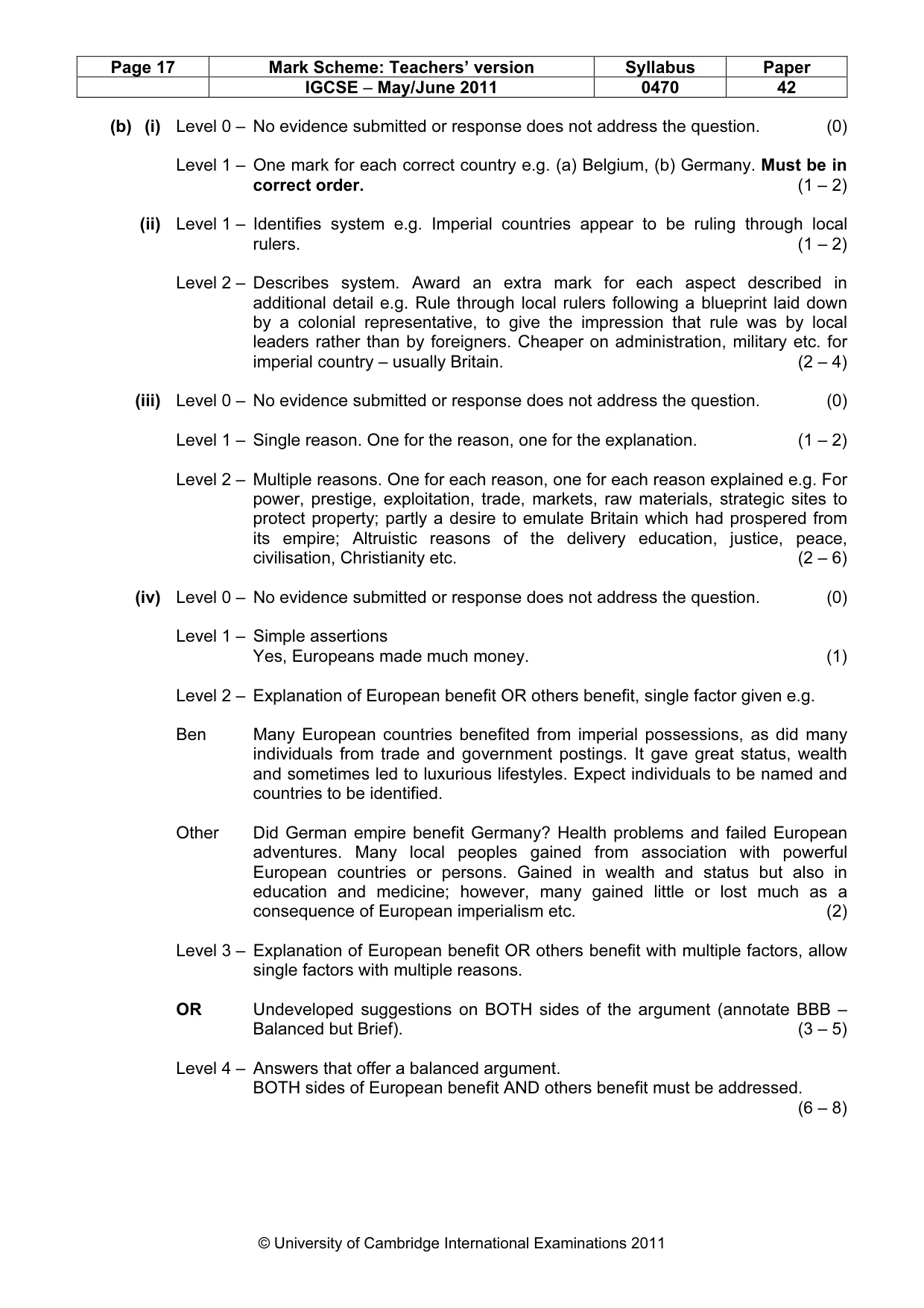
Page 17 Mark Scheme: Teachers’ version Syllabus Paper IGCSE – May/June 2011 0470 42 © University of Cambridge International Examinations 2011 (b) (i) Level 0 – No evidence submitted or response does not address the question. (0) Level 1 – One mark for each correct country e.g. (a) Belgium, (b) Germany. Must be in correct order. (1 – 2) (ii) Level 1 – Identifies system e.g. Imperial countries appear to be ruling through local rulers. (1 – 2) Level 2 – Describes system. Award an extra mark for each aspect described in additional detail e.g. Rule through local rulers following a blueprint laid down by a colonial representative, to give the impression that rule was by local leaders rather than by foreigners. Cheaper on administration, military etc. for imperial country – usually Britain. (2 – 4) (iii) Level 0 – No evidence submitted or response does not address the question. (0) Level 1 – Single reason. One for the reason, one for the explanation. (1 – 2) Level 2 – Multiple reasons. One for each reason, one for each reason explained e.g. For power, prestige, exploitation, trade, markets, raw materials, strategic sites to protect property; partly a desire to emulate Britain which had prospered from its empire; Altruistic reasons of the delivery education, justice, peace, civilisation, Christianity etc. (2 – 6) (iv) Level 0 – No evidence submitted or response does not address the question. (0) Level 1 – Simple assertions Yes, Europeans made much money. (1) Level 2 – Explanation of European benefit OR others benefit, single factor given e.g. Ben Many European countries benefited from imperial possessions, as did many individuals from trade and government postings. It gave great status, wealth and sometimes led to luxurious lifestyles. Expect individuals to be named and countries to be identified. Other Did German empire benefit Germany? Health problems and failed European adventures. Many local peoples gained from association with powerful European countries or persons. Gained in wealth and status but also in education and medicine; however, many gained little or lost much as a consequence of European imperialism etc. (2) Level 3 – Explanation of European benefit OR others benefit with multiple factors, allow single factors with multiple reasons. OR Undeveloped suggestions on BOTH sides of the argument (annotate BBB – Balanced but Brief). (3 – 5) Level 4 – Answers that offer a balanced argument. BOTH sides of European benefit AND others benefit must be addressed. (6 – 8)
What you needed in this session
Cambridge’s own grade thresholds for 2011 May/June, Paper 4 · Variant 2. A higher threshold means an easier paper — the bar moves with how the cohort did.