Cambridge IGCSE History 0470 — 2010 Oct/Nov Paper 4 · Variant 3
0470/43/O/N/10 · 40 marks · ≈45 min
The question paper and its mark scheme, free to read here and free to download. This is Cambridge’s own paper, exactly as it was sat.
Question paper12 pages
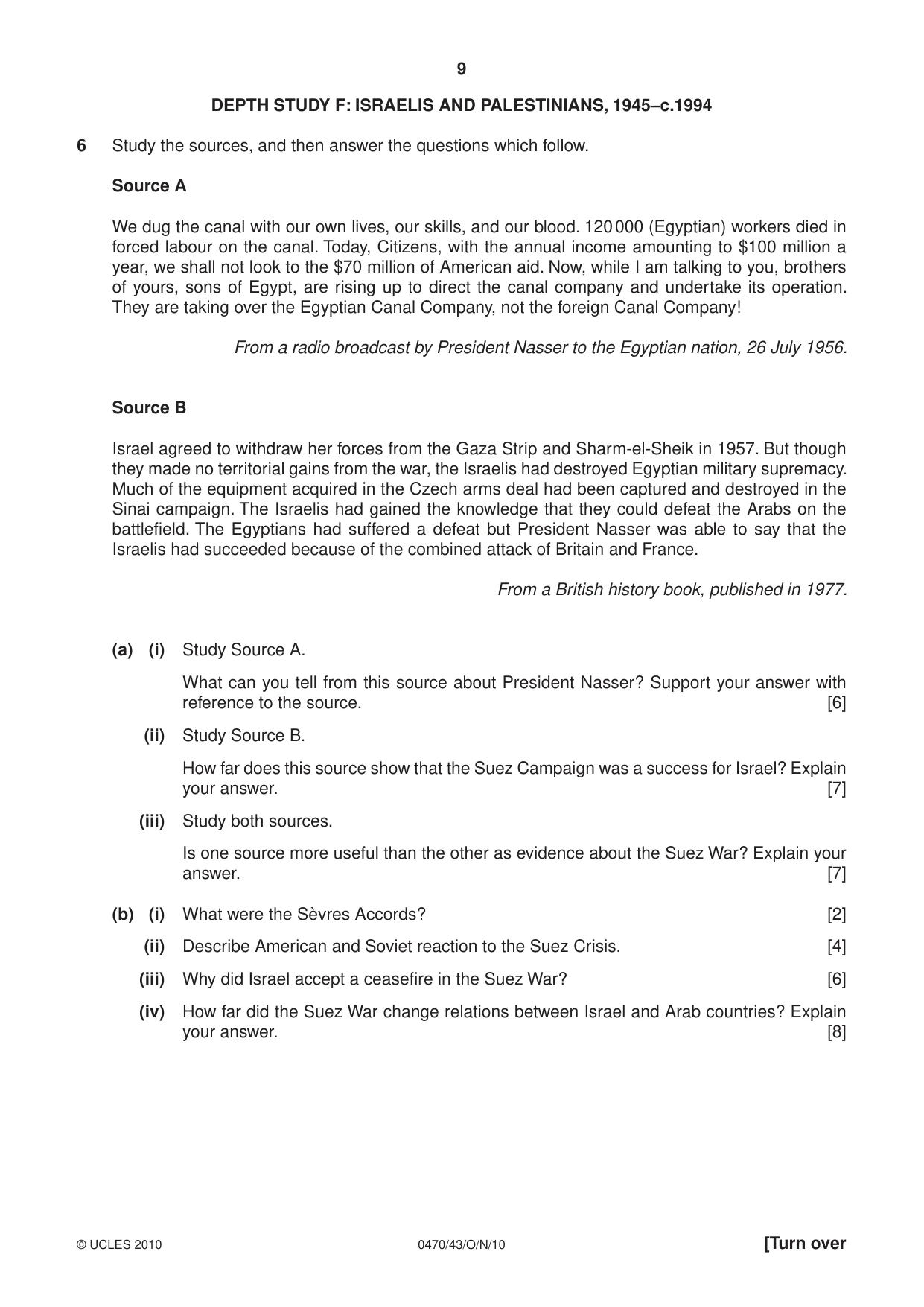
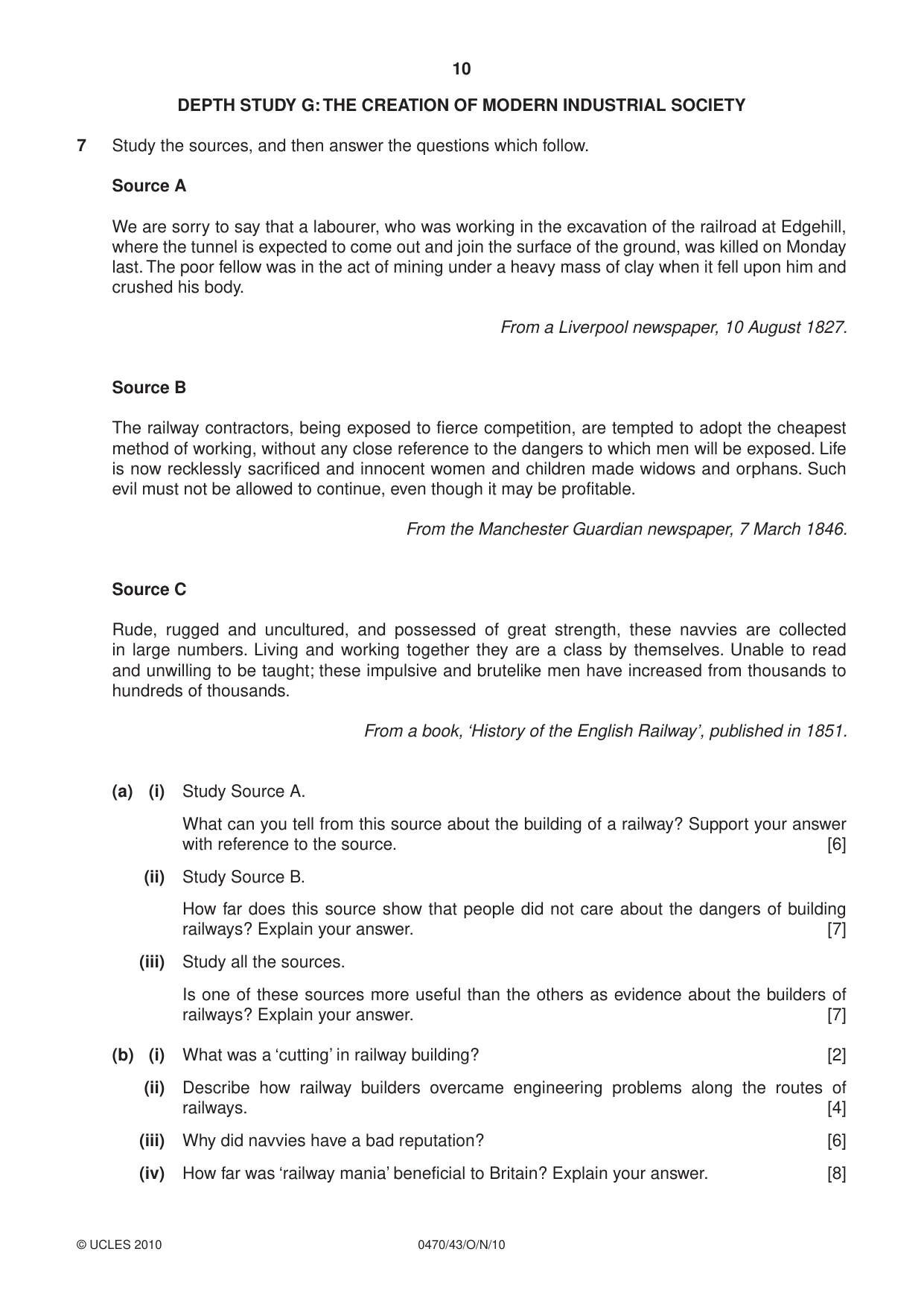
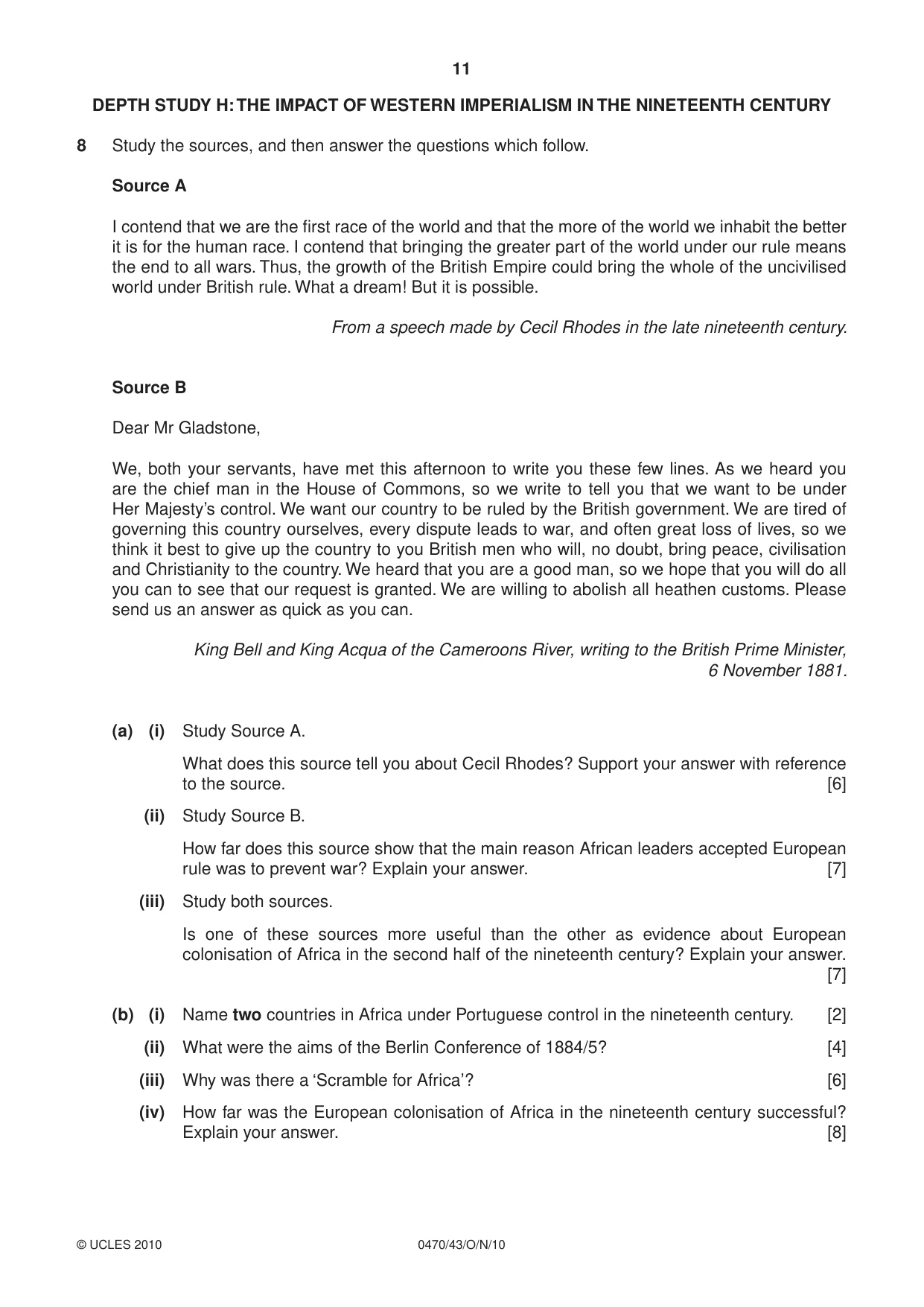
Mark scheme17 pages
Answers below. Sit the paper first if you are practising.
Paper as text
Question paper, page 1
This document consists of 11 printed pages and 1 blank page. DC (CW/CGW) 24184/4 © UCLES 2010 [Turn over UNIVERSITY OF CAMBRIDGE INTERNATIONAL EXAMINATIONS International General Certificate of Secondary Education READ THESE INSTRUCTIONS FIRST If you have been given an Answer Booklet, follow the instructions on the front cover of the Booklet. Write your Centre number, candidate number and name on all the work you hand in. Write in dark blue or black pen. You may use a soft pencil for any diagrams, graphs or rough working. Do not use staples, paper clips, highlighters, glue or correction fluid. Answer the questions on one of the Depth Studies. At the end of the examination, fasten all your work securely together. The number of marks is given in brackets [ ] at the end of each question or part question. * 2 5 9 3 9 7 5 3 6 1 * HISTORY 0470/43 Paper 4 Alternative to Coursework October/November 2010 1 hour Additional Materials: Answer Booklet/Paper www.XtremePapers.com
Question paper, page 2
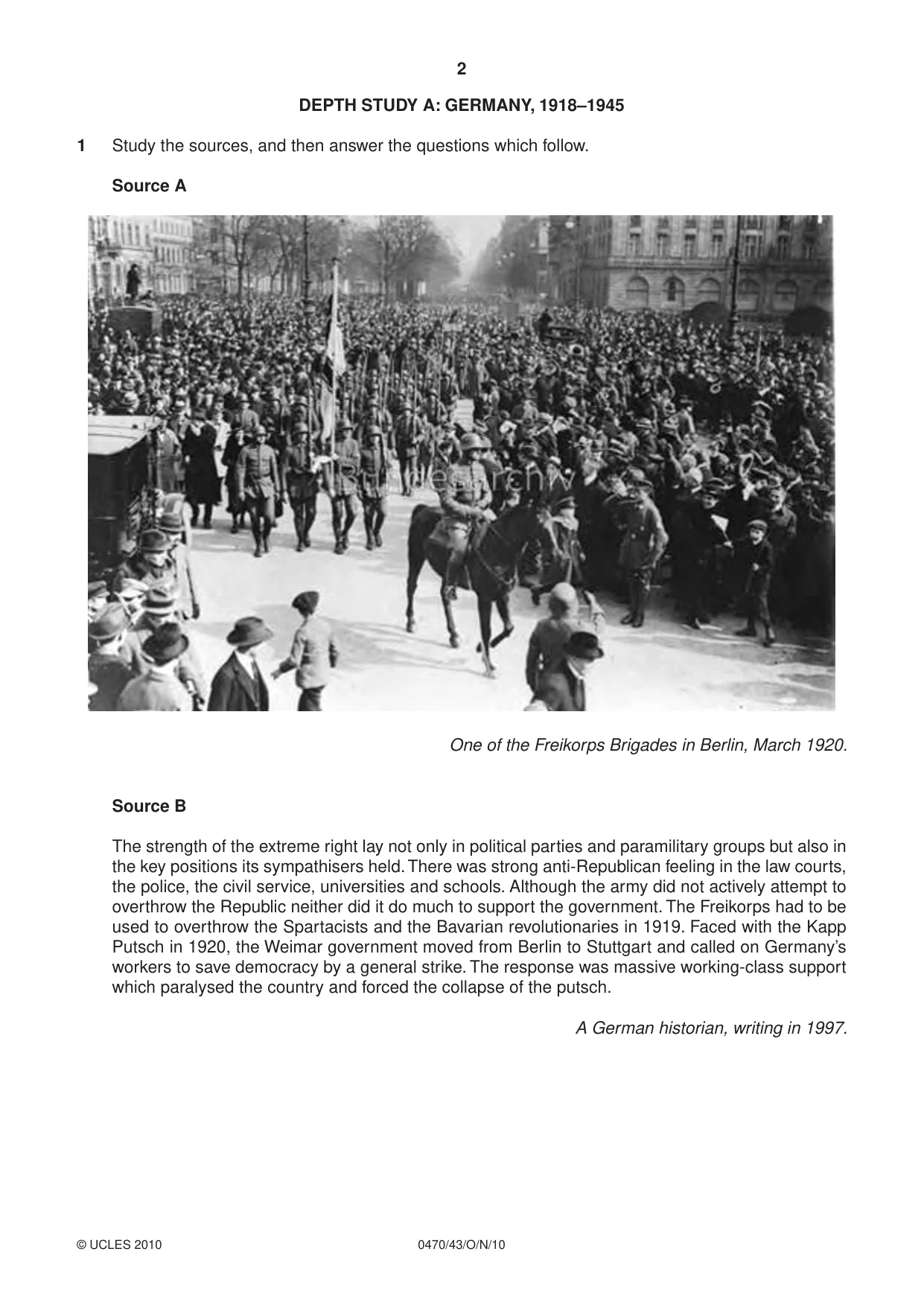
2 0470/43/O/N/10 © UCLES 2010 DEPTH STUDY A: GERMANY, 1918–1945 1 Study the sources, and then answer the questions which follow. Source A One of the Freikorps Brigades in Berlin, March 1920. Source B The strength of the extreme right lay not only in political parties and paramilitary groups but also in the key positions its sympathisers held. There was strong anti-Republican feeling in the law courts, the police, the civil service, universities and schools. Although the army did not actively attempt to overthrow the Republic neither did it do much to support the government. The Freikorps had to be used to overthrow the Spartacists and the Bavarian revolutionaries in 1919. Faced with the Kapp Putsch in 1920, the Weimar government moved from Berlin to Stuttgart and called on Germany’s workers to save democracy by a general strike. The response was massive working-class support which paralysed the country and forced the collapse of the putsch. A German historian, writing in 1997.
Question paper, page 3
3 0470/43/O/N/10 © UCLES 2010 [Turn over (a) (i) Study Source A. What can you tell from this source about the Freikorps? Support your answer with reference to the source. [6] (ii) Study Source B. How far does this source show that the Weimar government was weak? Explain your answer. [7] (iii) Study both sources. Is one of these sources more useful than the other as evidence about the early years of the Weimar government? Explain your answer. [7] (b) (i) Name the two main leaders of the Spartacists. [2] (ii) Describe the weaknesses of the Weimar Constitution. [4] (iii) Why was there resentment in the army of the Weimar Government? [6] (iv) ‘Hyperinflation was a disaster for Germany and its people.’ How far do you agree with this statement? Explain your answer. [8]
Question paper, page 4
4 0470/43/O/N/10 © UCLES 2010 DEPTH STUDY B: RUSSIA, 1905–1941 2 Study the sources, and then answer the questions which follow. Source A Source B Most of the people on the streets were not ‘revolutionaries’ at all but simply spectators or in-between types who wavered between acting and spectating. They would cheer the mutinous soldiers, or when police snipers were thrown from the rooftops. They would gather round the dead bodies and horses. They would wear red ribbons, wave red flags and declare their sympathy for the ‘revolution’. But they rarely took part in the fighting themselves, and would usually scatter when the fighting began. A British historian writing in the 1990s about the days leading to the March 1917 Revolution. (a) (i) Study Source A. What can you tell from this source about Kerensky in March 1917? Support your answer with reference to the source. [6] (ii) Study Source B. How far does this source show that the March Revolution was supported by the Russian public? Explain your answer. [7] (iii) Study both sources. Is one of these sources more useful than the other as evidence about Russia in the early months of 1917? Explain your answer. [7] (b) (i) Name two political parties which were represented in the Duma in March 1917. [2] (ii) What was the Kornilov Affair of August 1917? [4] (iii) Why was there a second revolution in Russia in 1917? [6] (iv) How far was it the First World War that caused the fall of Tsar Nicholas II in 1917? Explain your answer. [8] Content removed due to copyright restrictions
Question paper, page 5
5 0470/43/O/N/10 © UCLES 2010 [Turn over DEPTH STUDY C: THE USA, 1919–1941 3 Study the sources, and then answer the questions which follow. Source A The city’s annual Beauty Pageant has attracted seventy-four lovely contestants from every part of the United States. ‘Marriage Versus the Movies’ was discussed last night, as the beauties, tired with the strain of showing how lovely they could look in evening clothes, relaxed backstage at the theatre. All seventy-four long to be in the movies and are eager to leave ‘the normal things of life’. Several of them have already signed contracts with studios, and the others only crave the same opportunity. Hollywood’s population will soon be increased! From an American east coast newspaper, 1923. Source B As moving pictures became available to mass audiences in the 1920s, several states set up censorship boards to control the amount of nudity, sexuality, drunkenness, crime and violence portrayed in films. These controls varied between states and were often on a voluntary basis. Worried that it might be shut down, the film industry set up the Motion Pictures Producers and Distributors of America in 1922 to make some efforts to censor its own productions. The studios accepted a blacklist of ‘Don’ts’ and ‘Be Carefuls’ in 1927. The eleven ‘Don’ts’ included swearing, use of illegal drugs and ridicule of the clergy. The twenty-six ‘Be Carefuls’ applied to the depiction of criminality, brutality, murder and sex. In practice, studios knew that film-going audiences wanted to see the kind of things that were being blacklisted and some of these behaviours could be exhibited – as long as they were later punished in the film. From a history of the cinema, 2007. (a) (i) Study Source A. What can you tell from this source about the influence of the film industry? Support your answer with reference to the source. [6] (ii) Study Source B. How far does this source show that censorship was effective? Explain your answer. [7] (iii) Study both sources. Is one of these sources more useful than the other as evidence about life in the USA in the 1920s? Explain your answer. [7] (b) (i) What was the title of the first talking movie and the name of its main star? [2] (ii) What was the St. Valentine’s Day Massacre? [4] (iii) Why did organised crime increase in the 1920s? [6] (iv) How far do you agree that the 1920s were only ‘Roaring’ for the young? Explain your answer. [8]
Question paper, page 6
6 0470/43/O/N/10 © UCLES 2010 DEPTH STUDY D: CHINA, 1945–c.1990 4 Study the sources, and then answer the questions which follow. Source A Red Guards read the teachings of Mao during the Cultural Revolution, beneath a poster of the Chinese leader. Source B In the destruction of culture Madame Mao played a key role as her husband’s police chief. And she made sure that there was no resurrection of culture for the rest of Mao’s life. Partly thanks to her, for a decade, until Mao’s death in 1976, old books remained banned, and among the new books of general interest that were published, all of them sported Mao’s quotations, in bold, one on every other page. There were a few paintings and some songs around, but they all served a propaganda purpose. Virtually the only performing arts allowed were eight revolutionary shows and a few films that Madame Mao had a hand in producing. China became a cultural desert. From a book by a Chinese woman and her British husband, published in 2005. The woman came to Britain in 1978.
Question paper, page 7
7 0470/43/O/N/10 © UCLES 2010 [Turn over (a) (i) Study Source A. What can you tell from this source about the Red Guards? Support your answer with reference to the source. [6] (ii) Study Source B. How far does this source show that the creative arts had disappeared in China during the Cultural Revolution? Explain your answer. [7] (iii) Study both sources. Is one of these sources more useful than the other as evidence about the Cultural Revolution? Explain your answer. [7] (b) (i) Name two aspects of Mao’s ‘Little Red Book’. [2] (ii) Describe the campaigns undertaken by the Red Guards. [4] (iii) Why was the Cultural Revolution important to Mao? [6] (iv) How far had the Chinese people benefited from Communist rule in the period 1949 to Mao’s death in 1976? Explain your answer. [8]
Question paper, page 8
8 0470/43/O/N/10 © UCLES 2010 DEPTH STUDY E: SOUTHERN AFRICA IN THE TWENTIETH CENTURY 5 Study the sources, and then answer the questions which follow. Source A By Monday 21 March 1960 Sharpeville PAC members had visited almost every house and the men’s hostel to gain support for the protest. On that Monday not a single bus moved out of the township to take passengers to work. By dawn PAC task force members had lined up some 10 000 men, women and children in street after street. On the Party leadership’s instruction they all then marched to the local police station chanting ‘Down with passes’ and PAC slogans such as ‘Our land’ and ‘Forward to Independence’. A South African writing in 1963. Source B By mid-day the station’s usual twelve policemen had been increased to nearly 300 armed police with five armoured vehicles. Claims that squads of police went out into the crowd to arrest PAC officials are incorrect and no direct action was taken by the police until 1.15 in the afternoon. The PAC had responded to the police request that the crowds should move away from the police compound’s fence and only some 300 protesters were still nearby when the shooting started. The police claim this was in response to stone throwing by the crowd. It does seem that the first shots were fired by inexperienced officers aware that nine policemen had been killed by a mob in a Durban township only a few weeks before. The crowd was not ordered to disperse before the firing began. Sixty-nine people were killed and more than three hundred injured, many shot in the back. From the decisions of the Truth and Reconciliation Commission, 1998. (a) (i) Study Source A. What can you tell from this source about the Sharpeville protest? Support your answer with reference to the source. [6] (ii) Study Source B. How far does this source show that the police in Sharpeville were cautious in their actions? Explain your answer. [7] (iii) Study both sources. Is one of these sources more useful than the other as evidence about the PAC? Explain your answer. [7] (b) (i) What was meant by ‘separate amenities’ in the Act of 1953? [2] (ii) Describe the system of banning orders. [4] (iii) Why did the separation of races become more strict after 1948? [6] (iv) ‘Of all the apartheid measures, the Pass Laws had the greatest impact on the peoples of South Africa.’ How far do you agree with this statement? Explain your answer. [8]
Question paper, page 9
9 0470/43/O/N/10 © UCLES 2010 [Turn over DEPTH STUDY F: ISRAELIS AND PALESTINIANS, 1945–c.1994 6 Study the sources, and then answer the questions which follow. Source A We dug the canal with our own lives, our skills, and our blood. 120 000 (Egyptian) workers died in forced labour on the canal. Today, Citizens, with the annual income amounting to $100 million a year, we shall not look to the $70 million of American aid. Now, while I am talking to you, brothers of yours, sons of Egypt, are rising up to direct the canal company and undertake its operation. They are taking over the Egyptian Canal Company, not the foreign Canal Company! From a radio broadcast by President Nasser to the Egyptian nation, 26 July 1956. Source B Israel agreed to withdraw her forces from the Gaza Strip and Sharm-el-Sheik in 1957. But though they made no territorial gains from the war, the Israelis had destroyed Egyptian military supremacy. Much of the equipment acquired in the Czech arms deal had been captured and destroyed in the Sinai campaign. The Israelis had gained the knowledge that they could defeat the Arabs on the battlefield. The Egyptians had suffered a defeat but President Nasser was able to say that the Israelis had succeeded because of the combined attack of Britain and France. From a British history book, published in 1977. (a) (i) Study Source A. What can you tell from this source about President Nasser? Support your answer with reference to the source. [6] (ii) Study Source B. How far does this source show that the Suez Campaign was a success for Israel? Explain your answer. [7] (iii) Study both sources. Is one source more useful than the other as evidence about the Suez War? Explain your answer. [7] (b) (i) What were the Sèvres Accords? [2] (ii) Describe American and Soviet reaction to the Suez Crisis. [4] (iii) Why did Israel accept a ceasefire in the Suez War? [6] (iv) How far did the Suez War change relations between Israel and Arab countries? Explain your answer. [8]
Question paper, page 10
10 0470/43/O/N/10 © UCLES 2010 DEPTH STUDY G: THE CREATION OF MODERN INDUSTRIAL SOCIETY 7 Study the sources, and then answer the questions which follow. Source A We are sorry to say that a labourer, who was working in the excavation of the railroad at Edgehill, where the tunnel is expected to come out and join the surface of the ground, was killed on Monday last. The poor fellow was in the act of mining under a heavy mass of clay when it fell upon him and crushed his body. From a Liverpool newspaper, 10 August 1827. Source B The railway contractors, being exposed to fierce competition, are tempted to adopt the cheapest method of working, without any close reference to the dangers to which men will be exposed. Life is now recklessly sacrificed and innocent women and children made widows and orphans. Such evil must not be allowed to continue, even though it may be profitable. From the Manchester Guardian newspaper, 7 March 1846. Source C Rude, rugged and uncultured, and possessed of great strength, these navvies are collected in large numbers. Living and working together they are a class by themselves. Unable to read and unwilling to be taught; these impulsive and brutelike men have increased from thousands to hundreds of thousands. From a book, ‘History of the English Railway’, published in 1851. (a) (i) Study Source A. What can you tell from this source about the building of a railway? Support your answer with reference to the source. [6] (ii) Study Source B. How far does this source show that people did not care about the dangers of building railways? Explain your answer. [7] (iii) Study all the sources. Is one of these sources more useful than the others as evidence about the builders of railways? Explain your answer. [7] (b) (i) What was a ‘cutting’ in railway building? [2] (ii) Describe how railway builders overcame engineering problems along the routes of railways. [4] (iii) Why did navvies have a bad reputation? [6] (iv) How far was ‘railway mania’ beneficial to Britain? Explain your answer. [8]
Question paper, page 11
11 0470/43/O/N/10 © UCLES 2010 DEPTH STUDY H: THE IMPACT OF WESTERN IMPERIALISM IN THE NINETEENTH CENTURY 8 Study the sources, and then answer the questions which follow. Source A I contend that we are the first race of the world and that the more of the world we inhabit the better it is for the human race. I contend that bringing the greater part of the world under our rule means the end to all wars. Thus, the growth of the British Empire could bring the whole of the uncivilised world under British rule. What a dream! But it is possible. From a speech made by Cecil Rhodes in the late nineteenth century. Source B Dear Mr Gladstone, We, both your servants, have met this afternoon to write you these few lines. As we heard you are the chief man in the House of Commons, so we write to tell you that we want to be under Her Majesty’s control. We want our country to be ruled by the British government. We are tired of governing this country ourselves, every dispute leads to war, and often great loss of lives, so we think it best to give up the country to you British men who will, no doubt, bring peace, civilisation and Christianity to the country. We heard that you are a good man, so we hope that you will do all you can to see that our request is granted. We are willing to abolish all heathen customs. Please send us an answer as quick as you can. King Bell and King Acqua of the Cameroons River, writing to the British Prime Minister, 6 November 1881. (a) (i) Study Source A. What does this source tell you about Cecil Rhodes? Support your answer with reference to the source. [6] (ii) Study Source B. How far does this source show that the main reason African leaders accepted European rule was to prevent war? Explain your answer. [7] (iii) Study both sources. Is one of these sources more useful than the other as evidence about European colonisation of Africa in the second half of the nineteenth century? Explain your answer. [7] (b) (i) Name two countries in Africa under Portuguese control in the nineteenth century. [2] (ii) What were the aims of the Berlin Conference of 1884/5? [4] (iii) Why was there a ‘Scramble for Africa’? [6] (iv) How far was the European colonisation of Africa in the nineteenth century successful? Explain your answer. [8]
Question paper, page 12
12 0470/43/O/N/10 © UCLES 2010 BLANK PAGE Copyright Acknowledgements: Depth Study A Source A © www.bild.bundesarchiv.de/cross-search/search/_1241268488/?search[view]=detail&search[focus]=14. Depth Study B Source A © A People’s Tragedy by Orlando Figes, published by Jonathan Cape. Reprinted by permission of The Random House Group Ltd. Depth Study B Source B © Philip Ingram, Russia and the USSR 1905–1991; Cambridge University Press, 1997. Depth Study D Source A © Tony McAleavy, IGCSE History, International Relations since 1919 ; Cambridge University Press, 1996. Depth Study D Source B © Mao, The Unknown Story, by Jung Chang and John Halliday, published by Jonathan Cape. Reprinted by permission of The Random House Group Ltd. Depth Study F Source B © S J. Perkins, The Arab-Israeli Conflict ; Macmillan Education; 1987. Depth Study F Source B © Schools Council History 13-16 Project, Homes McDougall; 1977. Permission to reproduce items where third-party owned material protected by copyright is included has been sought and cleared where possible. Every reasonable effort has been made by the publisher (UCLES) to trace copyright holders, but if any items requiring clearance have unwittingly been included, the publisher will be pleased to make amends at the earliest possible opportunity. University of Cambridge International Examinations is part of the Cambridge Assessment Group. Cambridge Assessment is the brand name of University of Cambridge Local Examinations Syndicate (UCLES), which is itself a department of the University of Cambridge.
Mark scheme, page 1
UNIVERSITY OF CAMBRIDGE INTERNATIONAL EXAMINATIONS International General Certificate of Secondary Education MARK SCHEME for the October/November 2010 question paper for the guidance of teachers 0470 HISTORY 0470/43 Paper 4 (Alternative to Coursework), maximum raw mark 40 This mark scheme is published as an aid to teachers and candidates, to indicate the requirements of the examination. It shows the basis on which Examiners were instructed to award marks. It does not indicate the details of the discussions that took place at an Examiners’ meeting before marking began, which would have considered the acceptability of alternative answers. Mark schemes must be read in conjunction with the question papers and the report on the examination. • CIE will not enter into discussions or correspondence in connection with these mark schemes. CIE is publishing the mark schemes for the October/November 2010 question papers for most IGCSE, GCE Advanced Level and Advanced Subsidiary Level syllabuses and some Ordinary Level syllabuses. www.XtremePapers.com
Mark scheme, page 2
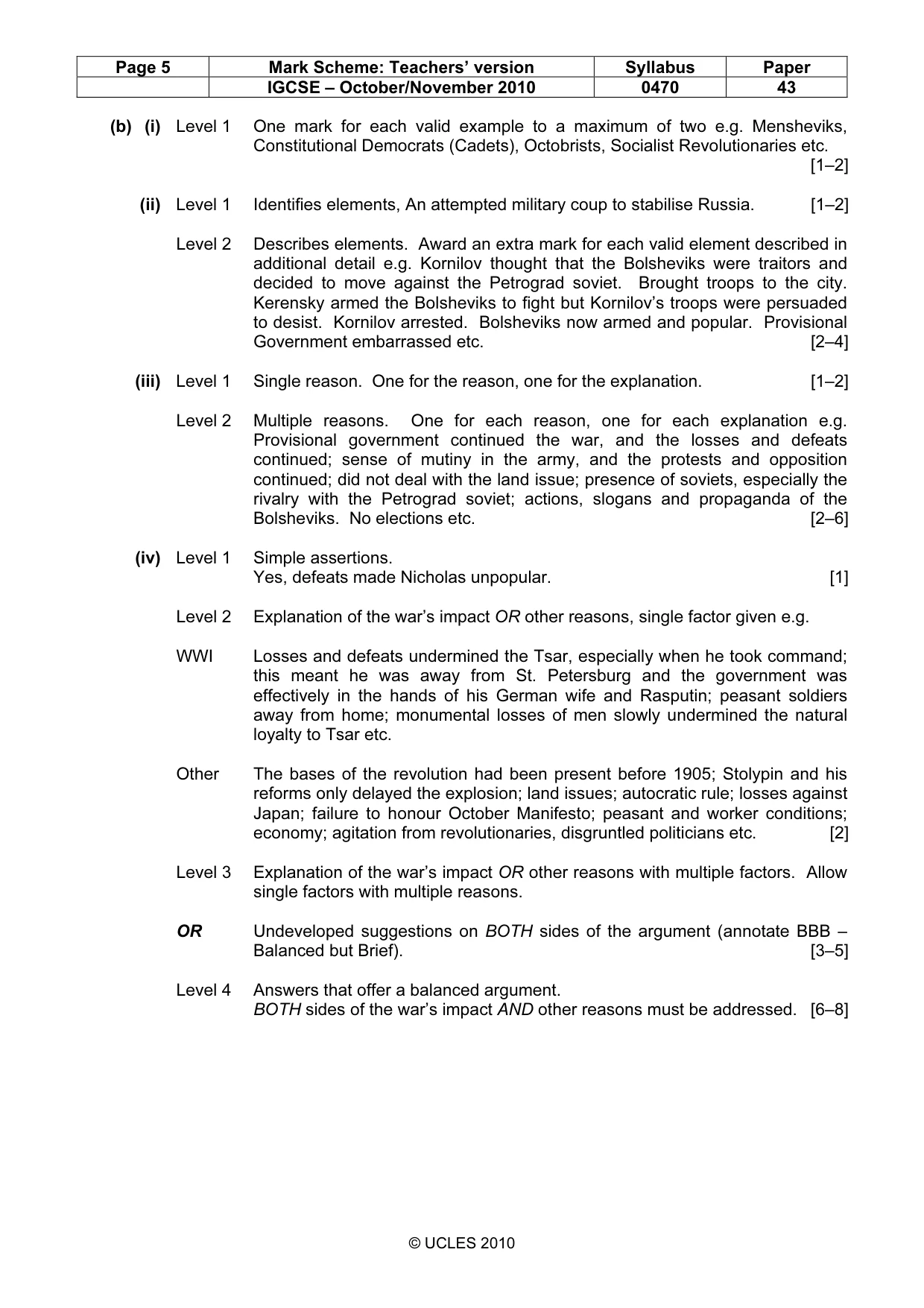
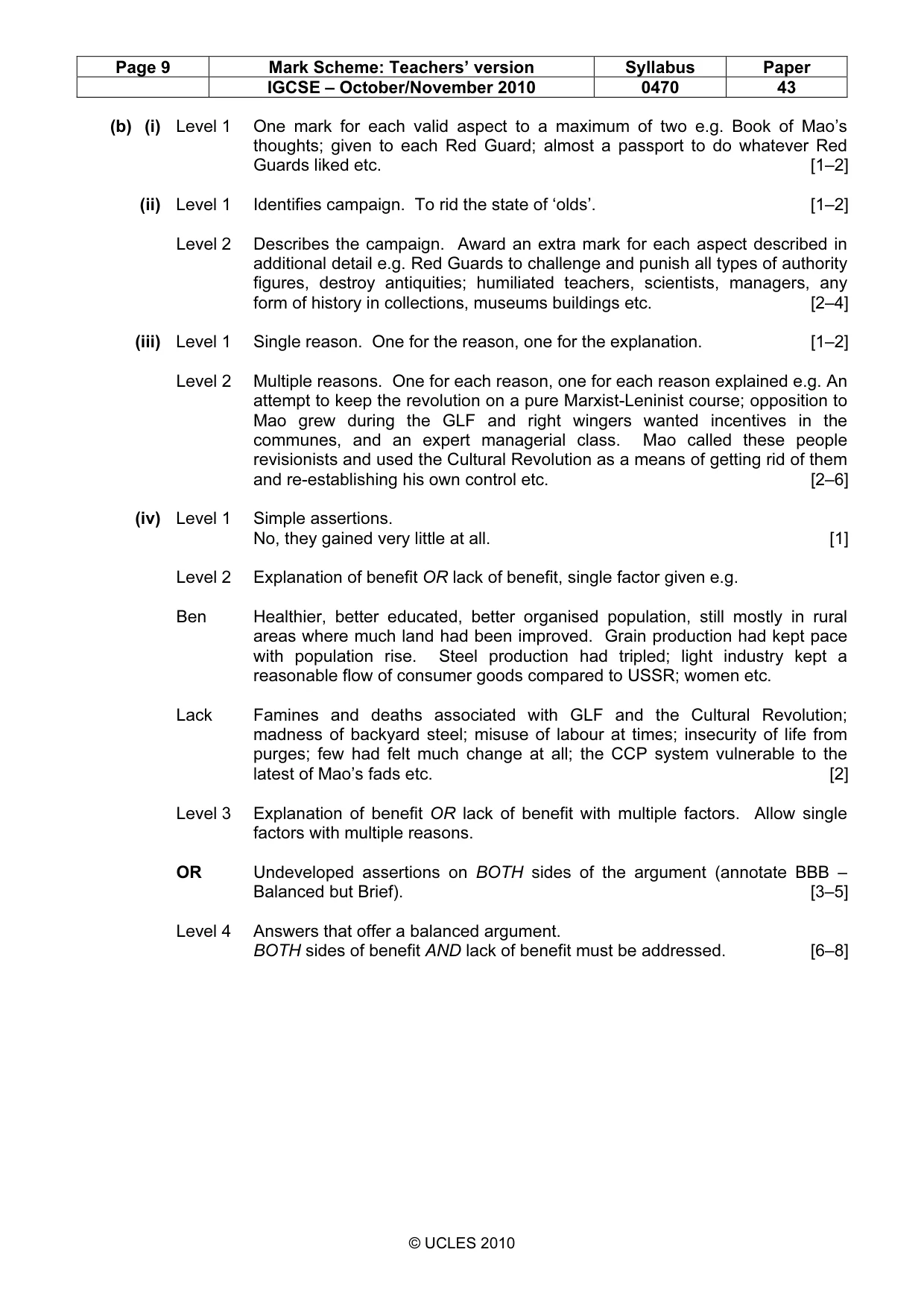
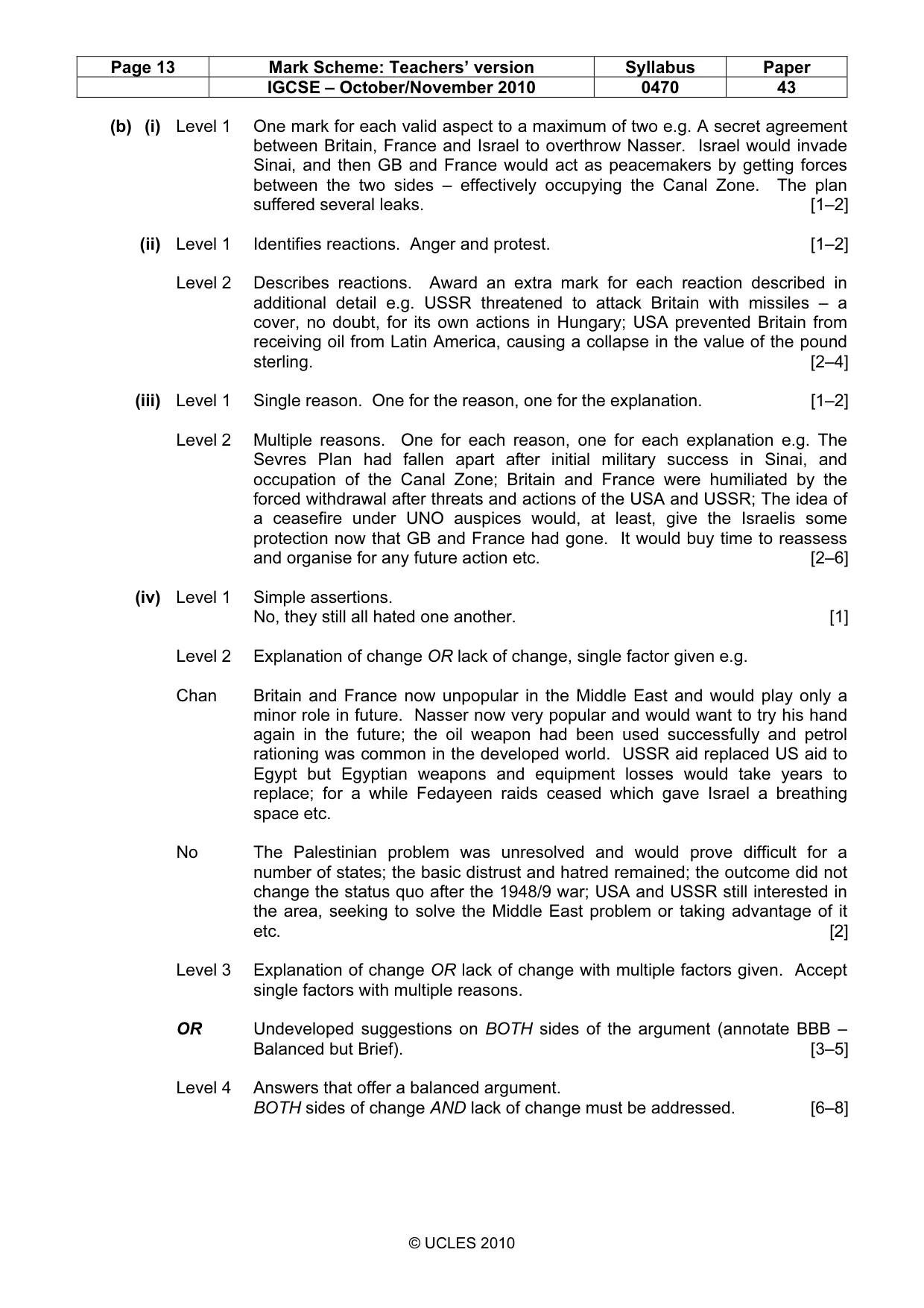
Page 2 Mark Scheme: Teachers’ version Syllabus Paper IGCSE – October/November 2010 0470 43 © UCLES 2010 Depth Study A: Germany 1918–1945. 1 (a) (i) Level 1 Repeats material seen in the source, no inference made. [1–2] Level 2 Makes valid inferences, unsupported from the source e.g. Disciplined; threatening and had public support etc. [3–4] Level 3 Makes valid inferences with reference to the source e.g. The photo shows the Freikorps marching in disciplined fashion; they are frightening as they have weapons; they have drawn huge crowds to see them which implies support etc. [5–6] (ii) Level 1 Agrees OR disagrees, unsupported from the source. [1–2] Level 2 Agrees OR disagrees, supported from the source e.g. Yes Range and significance of opponents; faced a number of revolts; needed to call on paramilitaries; left capital etc. No Working class rallied; no direct opposition from the army; survived etc. [3–5] Level 3 Agrees AND disagrees, supported from the source. Addresses the issue of ‘How far?’ [6–7] (iii) Level 1 Useful/not useful – Choice made on the basis that one is more detailed/gives more information, but does not specify what information. [1] Level 2 Useful/not useful – One is a picture and the other is by a German so they could both be biased/unreliable. [2] Level 3 Choice made on the nature or amount of information given. Must specify what information. [3–5] Level 4 Choice made on the grounds of reliability. Discussion of utility must be made on valid evaluation of source(s) in context. Include at this Level answers that cross-reference between A and B to show reliability. 6 marks for one source, 7 marks for both. [6–7]
Mark scheme, page 3
Page 3 Mark Scheme: Teachers’ version Syllabus Paper IGCSE – October/November 2010 0470 43 © UCLES 2010 (b) (i) Level 1 One mark for each correct name to a maximum of two e.g. Rosa Luxemburg; Karl Liebknecht. [1–2] (ii) Level 1 Identifies weaknesses. [1–2] Level 2 Describes weakness. Award an extra mark for each weakness described in additional detail e.g. Proportional representation meant many parties, coalition government and very slow progress; under Article 54 the Chancellor and ministers had to resign if they lost a vote of confidence in the House of Legislature – easily engineered with so many parties; under Article 48 the President could rule by decree etc. [2–4] (iii) Level 1 Single reason. One for the reason, one for the explanation. [1–2] Level 2 Multiple reasons. One for each reason, one for each reason explained e.g. Terms of Versailles treaty; myth that they had not been defeated; reduction in size; monarchists; elitists; suspicious of any socialist tendency; distrusted Weimar and sympathised with the Freikorps etc. [2–6] (iv) Level 1 Simple assertions. Yes, savings were worthless; No, Dawes Plan. [1] Level 2 Explanation of hyperinflation OR other disasters, single factor given e.g. Hyp. Increased resentment towards the government; strengthened the right-wing; greater disaster bitterness towards Versailles and the French; bartering; food shortages; savings worthless etc. Not Made paying reparations cheaper; led to American aid; brought Stresemann to power; Rentenmark helped economic recovery; those in debt could pay off; at first, workers protected by union wage agreements; industrialists benefited because of one union wage agreements collapsed etc. OR one greater ‘disaster’ – e.g. Treaty Versailles; weakness Constitution etc. [2] Level 3 Explanation of hyperinflation OR other disasters with multiple factors. Allow single factors with multiple reasons. OR Undeveloped suggestions on BOTH sides of the argument (annotate BBB – Balanced but Brief). [3–5] Level 4 Answers that offer a balanced argument. BOTH sides of hyperinflation AND other disasters must be addressed. [6–8]
Mark scheme, page 4
Page 4 Mark Scheme: Teachers’ version Syllabus Paper IGCSE – October/November 2010 0470 43 © UCLES 2010 Depth Study B: Russia, 1905–1941. 2 (a) (i) Level 1 Repeats material stated in the source, no inference made. [1–2] Level 2 Makes valid inferences, unsupported from the source e.g. Not especially bright; lucky with his timing; passionate etc. [3–4] Level 3 Makes valid inferences with reference to the source e.g. ‘Right man in the right place’; not the cleverest lawyer; emotional speaker who could sway the public etc. [5–6] (ii) Level 1 Agrees OR disagrees, unsupported from the source. [1–2] Level 2 Agrees OR disagrees, supported from the source e.g. Yes Cheer mutinous soldiers; wore the red ribbons and carry the red flags of the revolution; declared their sympathy for the revolution etc. No Not ‘revolutionaries, more spectators or in-between types’; rarely took part in the fighting; usually scattered when the firing began etc. [3–5] Level 3 Agrees AND disagrees, supported from the source. Addresses the issue of ‘How far?’ [6–7] (iii) Level 1 Useful/not useful – Choice made on the basis that one is more detailed/gives more information, but does not specify what information. [1] Level 2 Useful/not useful – Both A and B are from British historians of the 1990s so they could both be biased/unreliable. [2] Level 3 Choice made on the nature or amount of information given. Must specify what information. [3–5] Level 4 Choice made on the grounds of reliability. Discussion of utility must be made on valid evaluation of source(s) in context. Include at this Level answers that cross-reference between A and B to show reliability. 6 marks for one source, 7 marks for both. [6–7]
Mark scheme, page 5
Page 5 Mark Scheme: Teachers’ version Syllabus Paper IGCSE – October/November 2010 0470 43 © UCLES 2010 (b) (i) Level 1 One mark for each valid example to a maximum of two e.g. Mensheviks, Constitutional Democrats (Cadets), Octobrists, Socialist Revolutionaries etc. [1–2] (ii) Level 1 Identifies elements, An attempted military coup to stabilise Russia. [1–2] Level 2 Describes elements. Award an extra mark for each valid element described in additional detail e.g. Kornilov thought that the Bolsheviks were traitors and decided to move against the Petrograd soviet. Brought troops to the city. Kerensky armed the Bolsheviks to fight but Kornilov’s troops were persuaded to desist. Kornilov arrested. Bolsheviks now armed and popular. Provisional Government embarrassed etc. [2–4] (iii) Level 1 Single reason. One for the reason, one for the explanation. [1–2] Level 2 Multiple reasons. One for each reason, one for each explanation e.g. Provisional government continued the war, and the losses and defeats continued; sense of mutiny in the army, and the protests and opposition continued; did not deal with the land issue; presence of soviets, especially the rivalry with the Petrograd soviet; actions, slogans and propaganda of the Bolsheviks. No elections etc. [2–6] (iv) Level 1 Simple assertions. Yes, defeats made Nicholas unpopular. [1] Level 2 Explanation of the war’s impact OR other reasons, single factor given e.g. WWI Losses and defeats undermined the Tsar, especially when he took command; this meant he was away from St. Petersburg and the government was effectively in the hands of his German wife and Rasputin; peasant soldiers away from home; monumental losses of men slowly undermined the natural loyalty to Tsar etc. Other The bases of the revolution had been present before 1905; Stolypin and his reforms only delayed the explosion; land issues; autocratic rule; losses against Japan; failure to honour October Manifesto; peasant and worker conditions; economy; agitation from revolutionaries, disgruntled politicians etc. [2] Level 3 Explanation of the war’s impact OR other reasons with multiple factors. Allow single factors with multiple reasons. OR Undeveloped suggestions on BOTH sides of the argument (annotate BBB – Balanced but Brief). [3–5] Level 4 Answers that offer a balanced argument. BOTH sides of the war’s impact AND other reasons must be addressed. [6–8]
Mark scheme, page 6
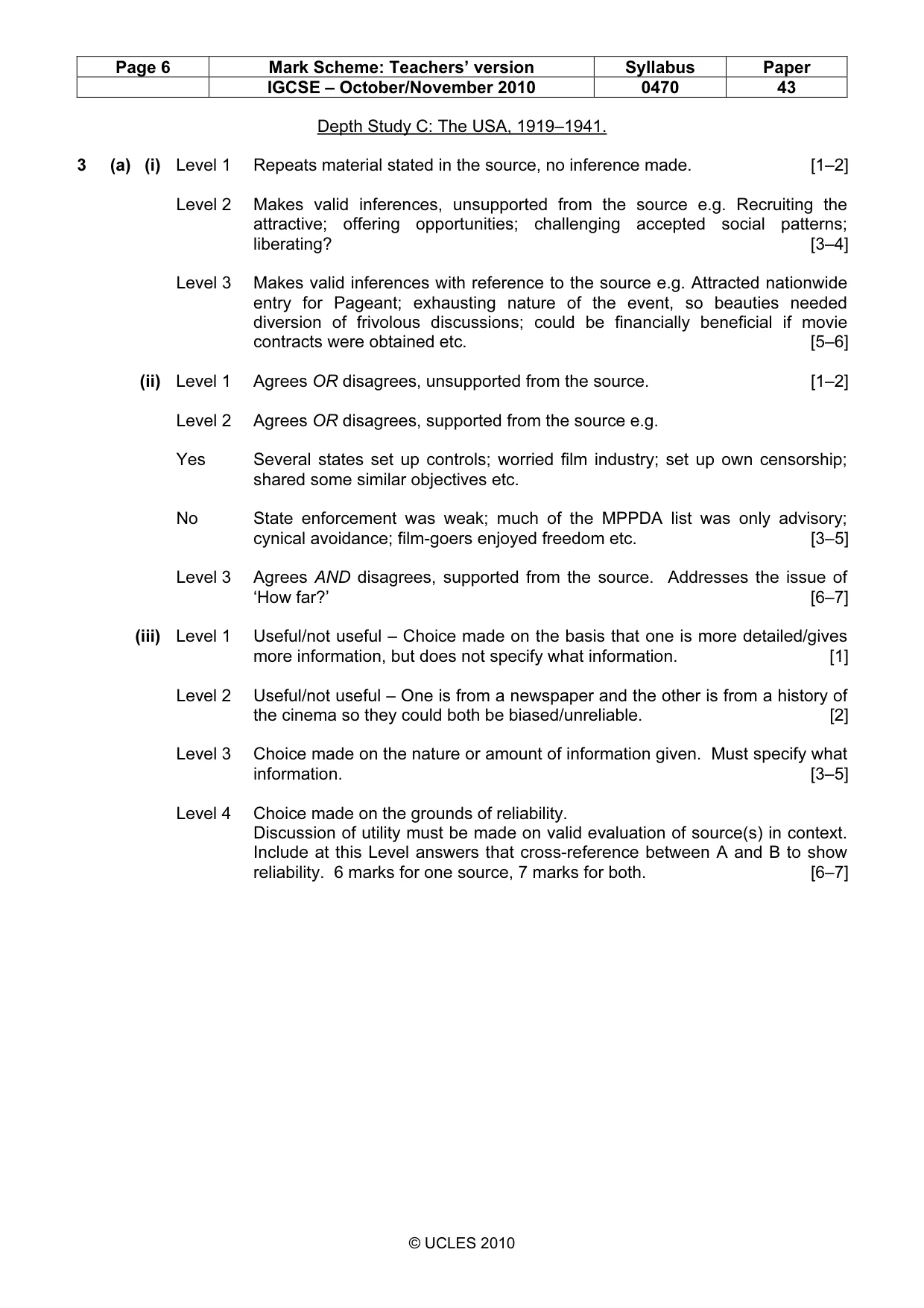
Page 6 Mark Scheme: Teachers’ version Syllabus Paper IGCSE – October/November 2010 0470 43 © UCLES 2010 Depth Study C: The USA, 1919–1941. 3 (a) (i) Level 1 Repeats material stated in the source, no inference made. [1–2] Level 2 Makes valid inferences, unsupported from the source e.g. Recruiting the attractive; offering opportunities; challenging accepted social patterns; liberating? [3–4] Level 3 Makes valid inferences with reference to the source e.g. Attracted nationwide entry for Pageant; exhausting nature of the event, so beauties needed diversion of frivolous discussions; could be financially beneficial if movie contracts were obtained etc. [5–6] (ii) Level 1 Agrees OR disagrees, unsupported from the source. [1–2] Level 2 Agrees OR disagrees, supported from the source e.g. Yes Several states set up controls; worried film industry; set up own censorship; shared some similar objectives etc. No State enforcement was weak; much of the MPPDA list was only advisory; cynical avoidance; film-goers enjoyed freedom etc. [3–5] Level 3 Agrees AND disagrees, supported from the source. Addresses the issue of ‘How far?’ [6–7] (iii) Level 1 Useful/not useful – Choice made on the basis that one is more detailed/gives more information, but does not specify what information. [1] Level 2 Useful/not useful – One is from a newspaper and the other is from a history of the cinema so they could both be biased/unreliable. [2] Level 3 Choice made on the nature or amount of information given. Must specify what information. [3–5] Level 4 Choice made on the grounds of reliability. Discussion of utility must be made on valid evaluation of source(s) in context. Include at this Level answers that cross-reference between A and B to show reliability. 6 marks for one source, 7 marks for both. [6–7]
Mark scheme, page 7
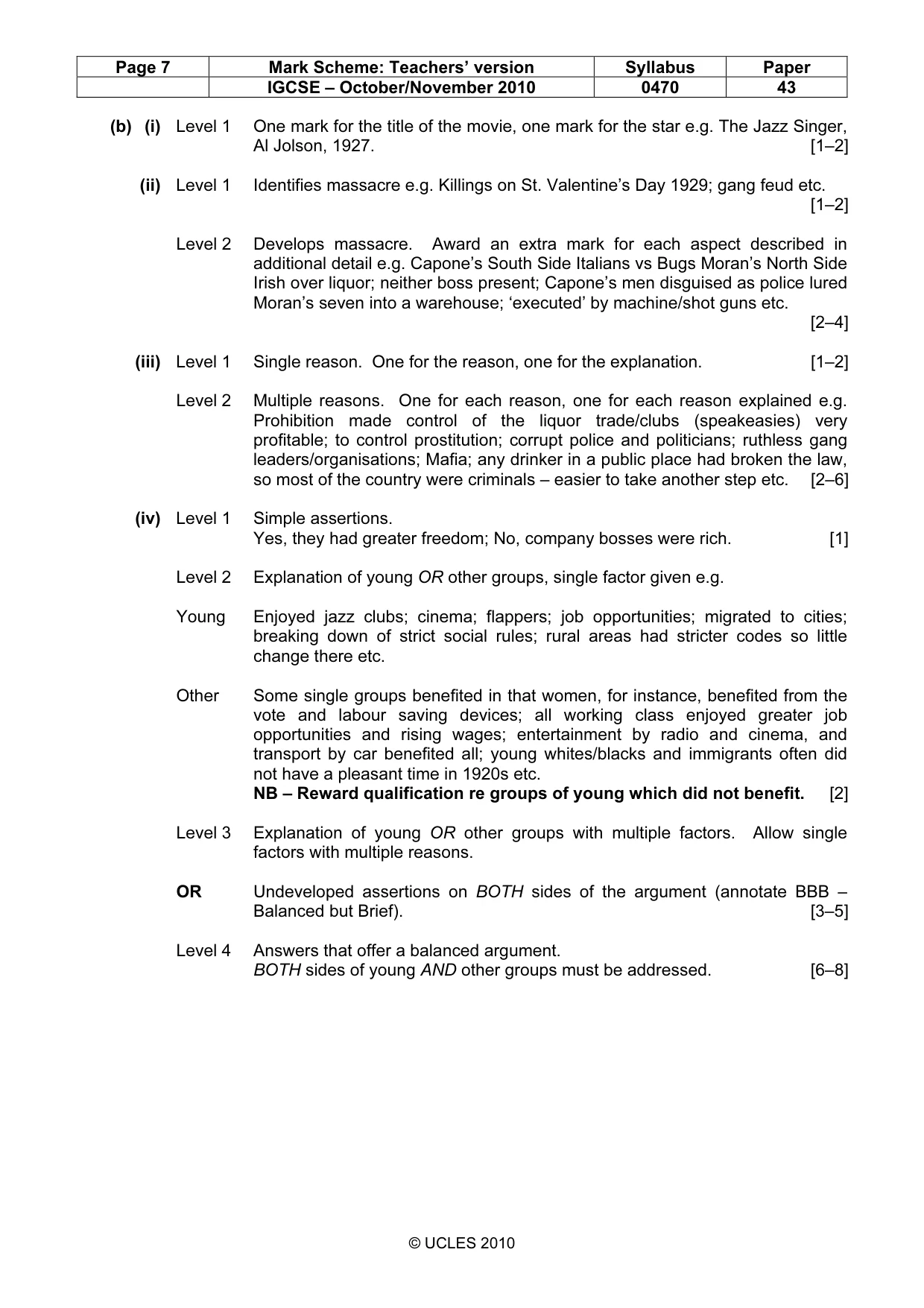
Page 7 Mark Scheme: Teachers’ version Syllabus Paper IGCSE – October/November 2010 0470 43 © UCLES 2010 (b) (i) Level 1 One mark for the title of the movie, one mark for the star e.g. The Jazz Singer, Al Jolson, 1927. [1–2] (ii) Level 1 Identifies massacre e.g. Killings on St. Valentine’s Day 1929; gang feud etc. [1–2] Level 2 Develops massacre. Award an extra mark for each aspect described in additional detail e.g. Capone’s South Side Italians vs Bugs Moran’s North Side Irish over liquor; neither boss present; Capone’s men disguised as police lured Moran’s seven into a warehouse; ‘executed’ by machine/shot guns etc. [2–4] (iii) Level 1 Single reason. One for the reason, one for the explanation. [1–2] Level 2 Multiple reasons. One for each reason, one for each reason explained e.g. Prohibition made control of the liquor trade/clubs (speakeasies) very profitable; to control prostitution; corrupt police and politicians; ruthless gang leaders/organisations; Mafia; any drinker in a public place had broken the law, so most of the country were criminals – easier to take another step etc. [2–6] (iv) Level 1 Simple assertions. Yes, they had greater freedom; No, company bosses were rich. [1] Level 2 Explanation of young OR other groups, single factor given e.g. Young Enjoyed jazz clubs; cinema; flappers; job opportunities; migrated to cities; breaking down of strict social rules; rural areas had stricter codes so little change there etc. Other Some single groups benefited in that women, for instance, benefited from the vote and labour saving devices; all working class enjoyed greater job opportunities and rising wages; entertainment by radio and cinema, and transport by car benefited all; young whites/blacks and immigrants often did not have a pleasant time in 1920s etc. NB – Reward qualification re groups of young which did not benefit. [2] Level 3 Explanation of young OR other groups with multiple factors. Allow single factors with multiple reasons. OR Undeveloped assertions on BOTH sides of the argument (annotate BBB – Balanced but Brief). [3–5] Level 4 Answers that offer a balanced argument. BOTH sides of young AND other groups must be addressed. [6–8]
Mark scheme, page 8
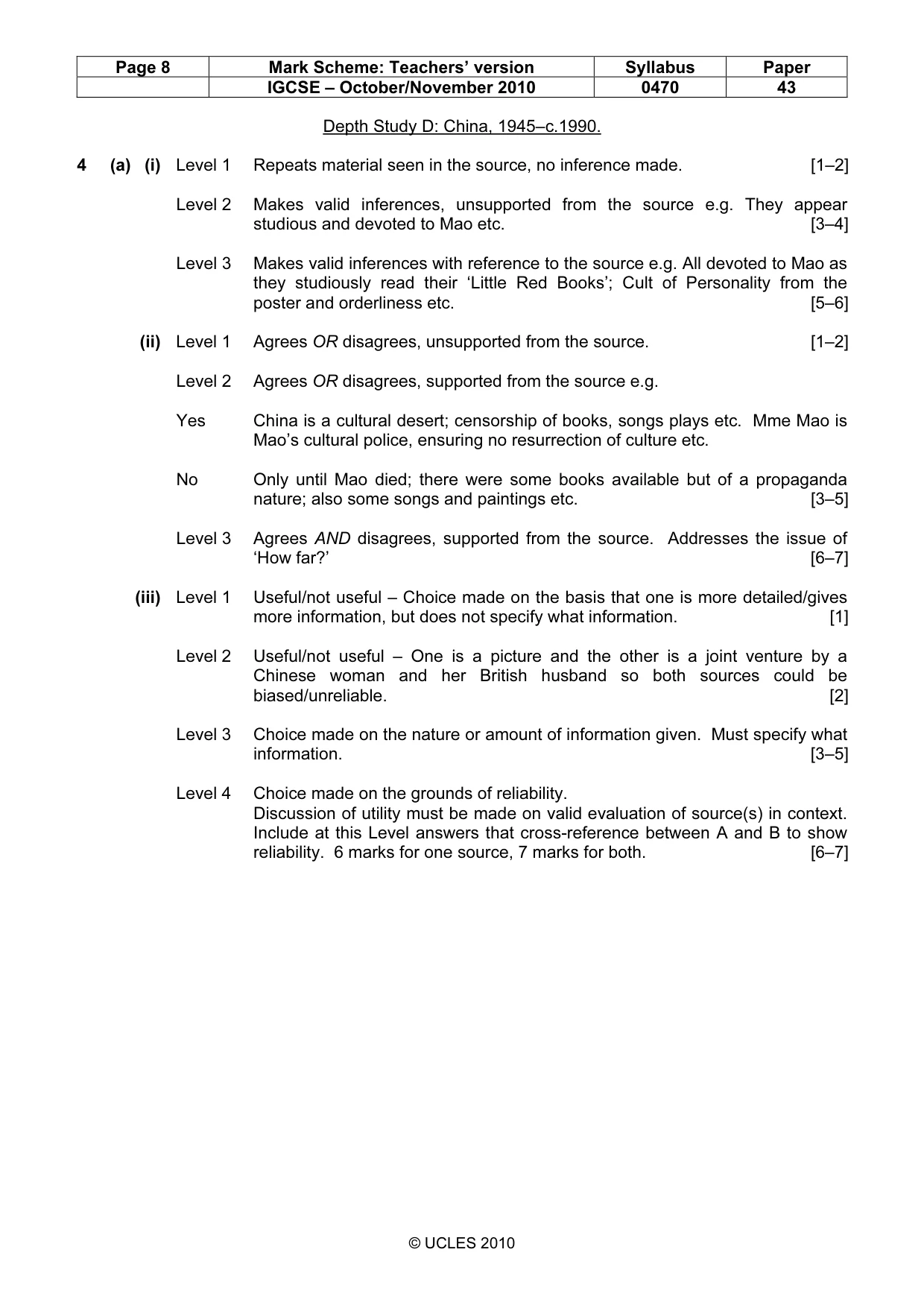
Page 8 Mark Scheme: Teachers’ version Syllabus Paper IGCSE – October/November 2010 0470 43 © UCLES 2010 Depth Study D: China, 1945–c.1990. 4 (a) (i) Level 1 Repeats material seen in the source, no inference made. [1–2] Level 2 Makes valid inferences, unsupported from the source e.g. They appear studious and devoted to Mao etc. [3–4] Level 3 Makes valid inferences with reference to the source e.g. All devoted to Mao as they studiously read their ‘Little Red Books’; Cult of Personality from the poster and orderliness etc. [5–6] (ii) Level 1 Agrees OR disagrees, unsupported from the source. [1–2] Level 2 Agrees OR disagrees, supported from the source e.g. Yes China is a cultural desert; censorship of books, songs plays etc. Mme Mao is Mao’s cultural police, ensuring no resurrection of culture etc. No Only until Mao died; there were some books available but of a propaganda nature; also some songs and paintings etc. [3–5] Level 3 Agrees AND disagrees, supported from the source. Addresses the issue of ‘How far?’ [6–7] (iii) Level 1 Useful/not useful – Choice made on the basis that one is more detailed/gives more information, but does not specify what information. [1] Level 2 Useful/not useful – One is a picture and the other is a joint venture by a Chinese woman and her British husband so both sources could be biased/unreliable. [2] Level 3 Choice made on the nature or amount of information given. Must specify what information. [3–5] Level 4 Choice made on the grounds of reliability. Discussion of utility must be made on valid evaluation of source(s) in context. Include at this Level answers that cross-reference between A and B to show reliability. 6 marks for one source, 7 marks for both. [6–7]
Mark scheme, page 9
Page 9 Mark Scheme: Teachers’ version Syllabus Paper IGCSE – October/November 2010 0470 43 © UCLES 2010 (b) (i) Level 1 One mark for each valid aspect to a maximum of two e.g. Book of Mao’s thoughts; given to each Red Guard; almost a passport to do whatever Red Guards liked etc. [1–2] (ii) Level 1 Identifies campaign. To rid the state of ‘olds’. [1–2] Level 2 Describes the campaign. Award an extra mark for each aspect described in additional detail e.g. Red Guards to challenge and punish all types of authority figures, destroy antiquities; humiliated teachers, scientists, managers, any form of history in collections, museums buildings etc. [2–4] (iii) Level 1 Single reason. One for the reason, one for the explanation. [1–2] Level 2 Multiple reasons. One for each reason, one for each reason explained e.g. An attempt to keep the revolution on a pure Marxist-Leninist course; opposition to Mao grew during the GLF and right wingers wanted incentives in the communes, and an expert managerial class. Mao called these people revisionists and used the Cultural Revolution as a means of getting rid of them and re-establishing his own control etc. [2–6] (iv) Level 1 Simple assertions. No, they gained very little at all. [1] Level 2 Explanation of benefit OR lack of benefit, single factor given e.g. Ben Healthier, better educated, better organised population, still mostly in rural areas where much land had been improved. Grain production had kept pace with population rise. Steel production had tripled; light industry kept a reasonable flow of consumer goods compared to USSR; women etc. Lack Famines and deaths associated with GLF and the Cultural Revolution; madness of backyard steel; misuse of labour at times; insecurity of life from purges; few had felt much change at all; the CCP system vulnerable to the latest of Mao’s fads etc. [2] Level 3 Explanation of benefit OR lack of benefit with multiple factors. Allow single factors with multiple reasons. OR Undeveloped assertions on BOTH sides of the argument (annotate BBB – Balanced but Brief). [3–5] Level 4 Answers that offer a balanced argument. BOTH sides of benefit AND lack of benefit must be addressed. [6–8]
Mark scheme, page 10
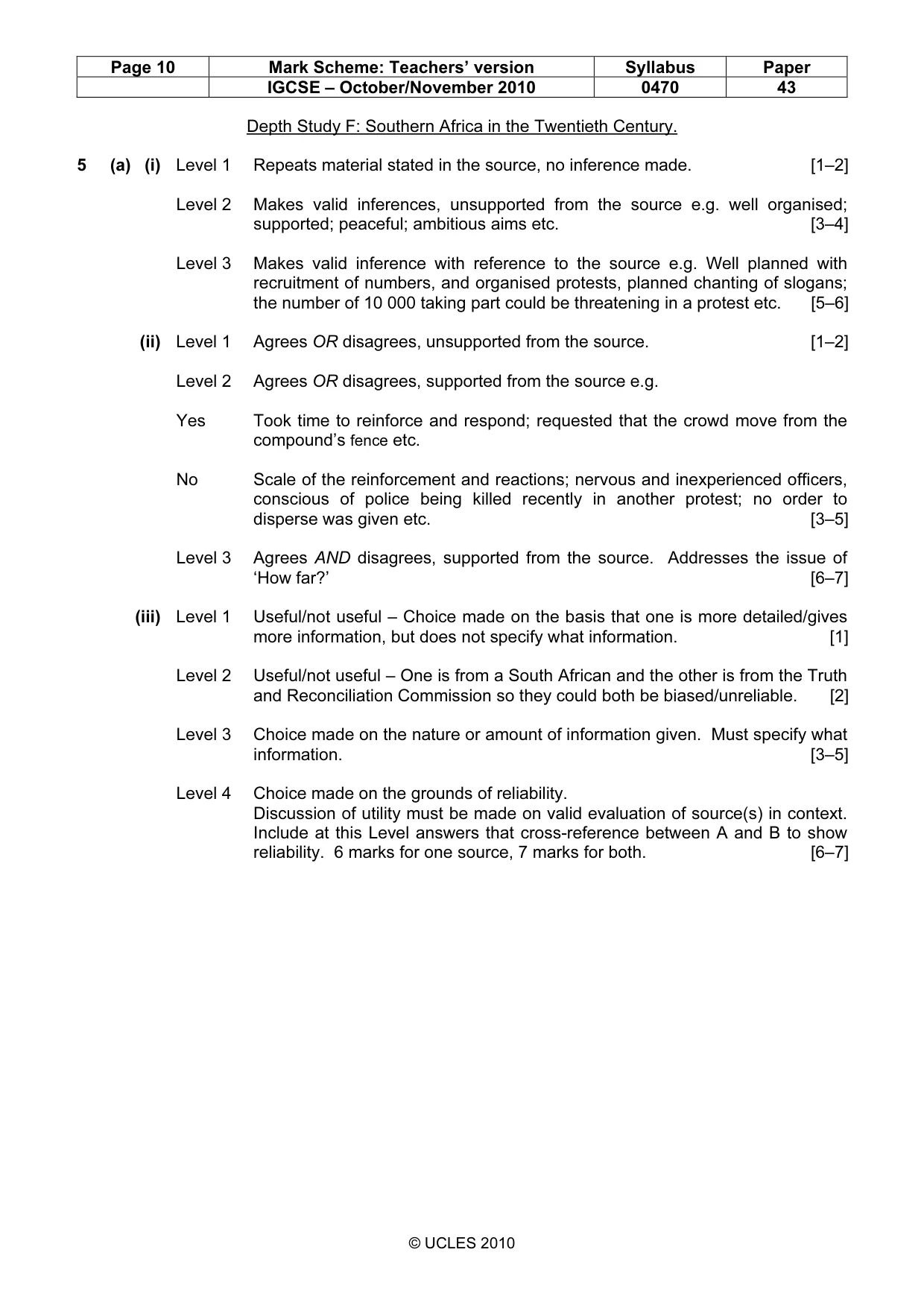
Page 10 Mark Scheme: Teachers’ version Syllabus Paper IGCSE – October/November 2010 0470 43 © UCLES 2010 Depth Study F: Southern Africa in the Twentieth Century. 5 (a) (i) Level 1 Repeats material stated in the source, no inference made. [1–2] Level 2 Makes valid inferences, unsupported from the source e.g. well organised; supported; peaceful; ambitious aims etc. [3–4] Level 3 Makes valid inference with reference to the source e.g. Well planned with recruitment of numbers, and organised protests, planned chanting of slogans; the number of 10 000 taking part could be threatening in a protest etc. [5–6] (ii) Level 1 Agrees OR disagrees, unsupported from the source. [1–2] Level 2 Agrees OR disagrees, supported from the source e.g. Yes Took time to reinforce and respond; requested that the crowd move from the compound’s fence etc. No Scale of the reinforcement and reactions; nervous and inexperienced officers, conscious of police being killed recently in another protest; no order to disperse was given etc. [3–5] Level 3 Agrees AND disagrees, supported from the source. Addresses the issue of ‘How far?’ [6–7] (iii) Level 1 Useful/not useful – Choice made on the basis that one is more detailed/gives more information, but does not specify what information. [1] Level 2 Useful/not useful – One is from a South African and the other is from the Truth and Reconciliation Commission so they could both be biased/unreliable. [2] Level 3 Choice made on the nature or amount of information given. Must specify what information. [3–5] Level 4 Choice made on the grounds of reliability. Discussion of utility must be made on valid evaluation of source(s) in context. Include at this Level answers that cross-reference between A and B to show reliability. 6 marks for one source, 7 marks for both. [6–7]
Mark scheme, page 11
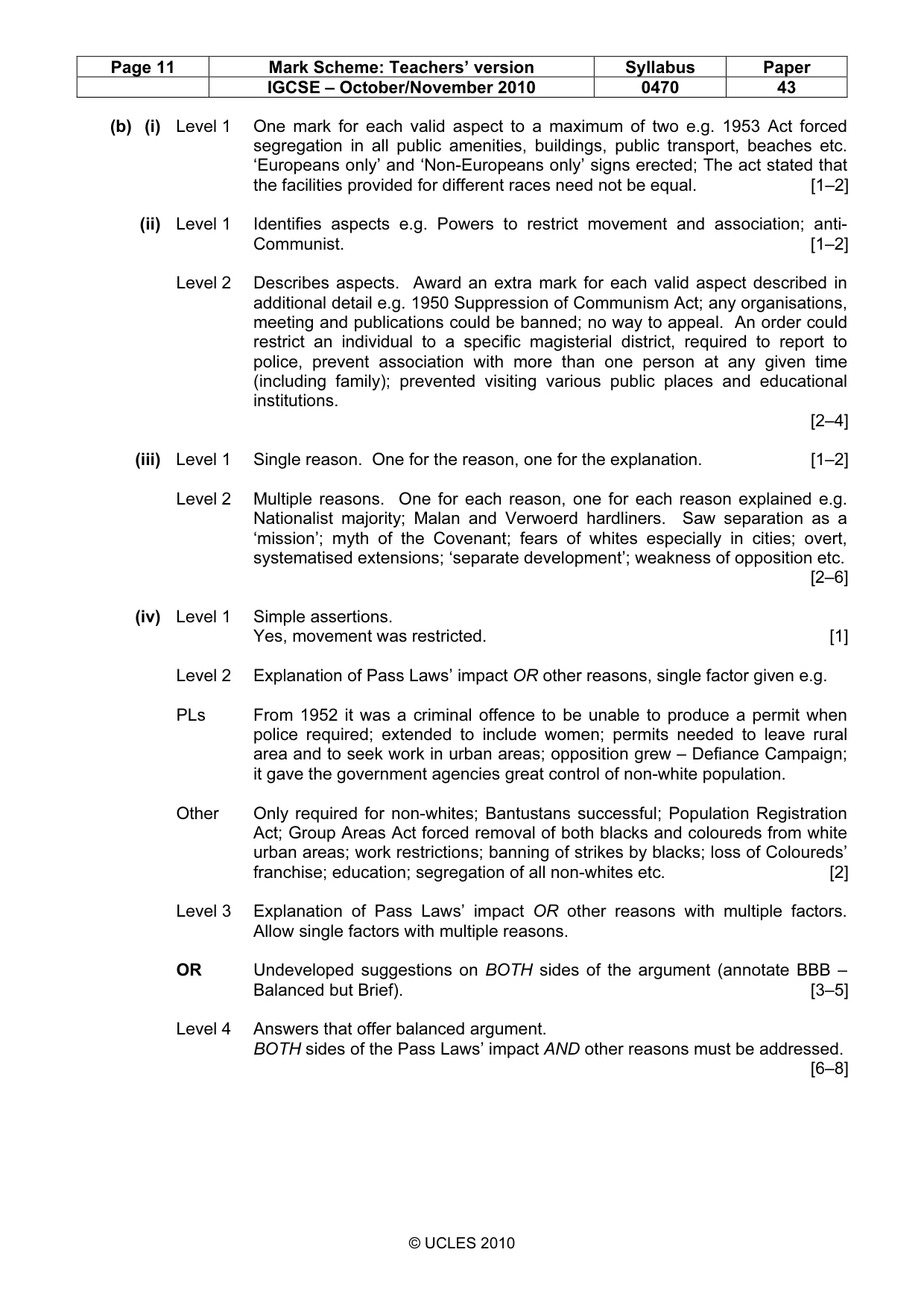
Page 11 Mark Scheme: Teachers’ version Syllabus Paper IGCSE – October/November 2010 0470 43 © UCLES 2010 (b) (i) Level 1 One mark for each valid aspect to a maximum of two e.g. 1953 Act forced segregation in all public amenities, buildings, public transport, beaches etc. ‘Europeans only’ and ‘Non-Europeans only’ signs erected; The act stated that the facilities provided for different races need not be equal. [1–2] (ii) Level 1 Identifies aspects e.g. Powers to restrict movement and association; anti- Communist. [1–2] Level 2 Describes aspects. Award an extra mark for each valid aspect described in additional detail e.g. 1950 Suppression of Communism Act; any organisations, meeting and publications could be banned; no way to appeal. An order could restrict an individual to a specific magisterial district, required to report to police, prevent association with more than one person at any given time (including family); prevented visiting various public places and educational institutions. [2–4] (iii) Level 1 Single reason. One for the reason, one for the explanation. [1–2] Level 2 Multiple reasons. One for each reason, one for each reason explained e.g. Nationalist majority; Malan and Verwoerd hardliners. Saw separation as a ‘mission’; myth of the Covenant; fears of whites especially in cities; overt, systematised extensions; ‘separate development’; weakness of opposition etc. [2–6] (iv) Level 1 Simple assertions. Yes, movement was restricted. [1] Level 2 Explanation of Pass Laws’ impact OR other reasons, single factor given e.g. PLs From 1952 it was a criminal offence to be unable to produce a permit when police required; extended to include women; permits needed to leave rural area and to seek work in urban areas; opposition grew – Defiance Campaign; it gave the government agencies great control of non-white population. Other Only required for non-whites; Bantustans successful; Population Registration Act; Group Areas Act forced removal of both blacks and coloureds from white urban areas; work restrictions; banning of strikes by blacks; loss of Coloureds’ franchise; education; segregation of all non-whites etc. [2] Level 3 Explanation of Pass Laws’ impact OR other reasons with multiple factors. Allow single factors with multiple reasons. OR Undeveloped suggestions on BOTH sides of the argument (annotate BBB – Balanced but Brief). [3–5] Level 4 Answers that offer balanced argument. BOTH sides of the Pass Laws’ impact AND other reasons must be addressed. [6–8]
Mark scheme, page 12
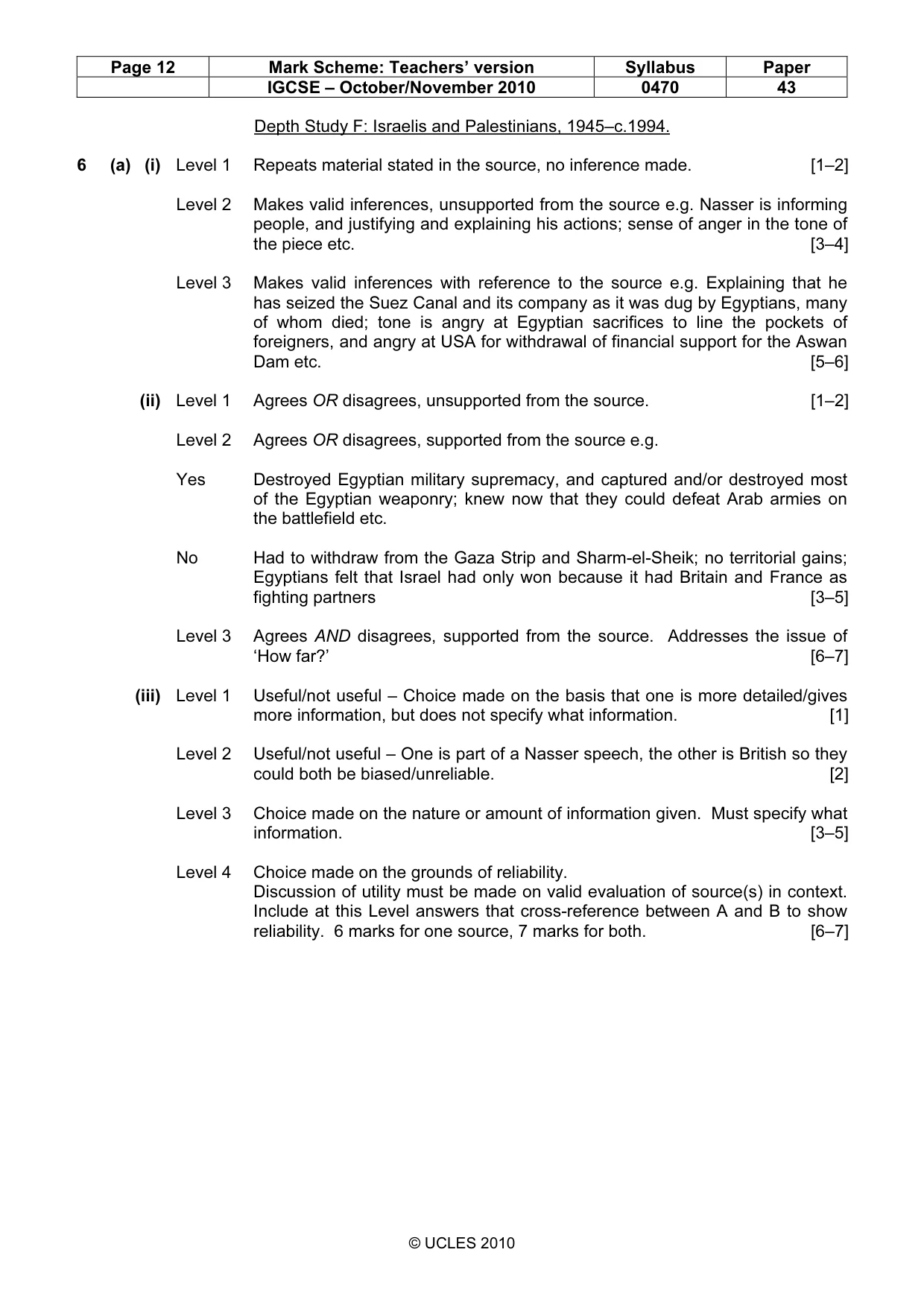
Page 12 Mark Scheme: Teachers’ version Syllabus Paper IGCSE – October/November 2010 0470 43 © UCLES 2010 Depth Study F: Israelis and Palestinians, 1945–c.1994. 6 (a) (i) Level 1 Repeats material stated in the source, no inference made. [1–2] Level 2 Makes valid inferences, unsupported from the source e.g. Nasser is informing people, and justifying and explaining his actions; sense of anger in the tone of the piece etc. [3–4] Level 3 Makes valid inferences with reference to the source e.g. Explaining that he has seized the Suez Canal and its company as it was dug by Egyptians, many of whom died; tone is angry at Egyptian sacrifices to line the pockets of foreigners, and angry at USA for withdrawal of financial support for the Aswan Dam etc. [5–6] (ii) Level 1 Agrees OR disagrees, unsupported from the source. [1–2] Level 2 Agrees OR disagrees, supported from the source e.g. Yes Destroyed Egyptian military supremacy, and captured and/or destroyed most of the Egyptian weaponry; knew now that they could defeat Arab armies on the battlefield etc. No Had to withdraw from the Gaza Strip and Sharm-el-Sheik; no territorial gains; Egyptians felt that Israel had only won because it had Britain and France as fighting partners [3–5] Level 3 Agrees AND disagrees, supported from the source. Addresses the issue of ‘How far?’ [6–7] (iii) Level 1 Useful/not useful – Choice made on the basis that one is more detailed/gives more information, but does not specify what information. [1] Level 2 Useful/not useful – One is part of a Nasser speech, the other is British so they could both be biased/unreliable. [2] Level 3 Choice made on the nature or amount of information given. Must specify what information. [3–5] Level 4 Choice made on the grounds of reliability. Discussion of utility must be made on valid evaluation of source(s) in context. Include at this Level answers that cross-reference between A and B to show reliability. 6 marks for one source, 7 marks for both. [6–7]
Mark scheme, page 13
Page 13 Mark Scheme: Teachers’ version Syllabus Paper IGCSE – October/November 2010 0470 43 © UCLES 2010 (b) (i) Level 1 One mark for each valid aspect to a maximum of two e.g. A secret agreement between Britain, France and Israel to overthrow Nasser. Israel would invade Sinai, and then GB and France would act as peacemakers by getting forces between the two sides – effectively occupying the Canal Zone. The plan suffered several leaks. [1–2] (ii) Level 1 Identifies reactions. Anger and protest. [1–2] Level 2 Describes reactions. Award an extra mark for each reaction described in additional detail e.g. USSR threatened to attack Britain with missiles – a cover, no doubt, for its own actions in Hungary; USA prevented Britain from receiving oil from Latin America, causing a collapse in the value of the pound sterling. [2–4] (iii) Level 1 Single reason. One for the reason, one for the explanation. [1–2] Level 2 Multiple reasons. One for each reason, one for each explanation e.g. The Sevres Plan had fallen apart after initial military success in Sinai, and occupation of the Canal Zone; Britain and France were humiliated by the forced withdrawal after threats and actions of the USA and USSR; The idea of a ceasefire under UNO auspices would, at least, give the Israelis some protection now that GB and France had gone. It would buy time to reassess and organise for any future action etc. [2–6] (iv) Level 1 Simple assertions. No, they still all hated one another. [1] Level 2 Explanation of change OR lack of change, single factor given e.g. Chan Britain and France now unpopular in the Middle East and would play only a minor role in future. Nasser now very popular and would want to try his hand again in the future; the oil weapon had been used successfully and petrol rationing was common in the developed world. USSR aid replaced US aid to Egypt but Egyptian weapons and equipment losses would take years to replace; for a while Fedayeen raids ceased which gave Israel a breathing space etc. No The Palestinian problem was unresolved and would prove difficult for a number of states; the basic distrust and hatred remained; the outcome did not change the status quo after the 1948/9 war; USA and USSR still interested in the area, seeking to solve the Middle East problem or taking advantage of it etc. [2] Level 3 Explanation of change OR lack of change with multiple factors given. Accept single factors with multiple reasons. OR Undeveloped suggestions on BOTH sides of the argument (annotate BBB – Balanced but Brief). [3–5] Level 4 Answers that offer a balanced argument. BOTH sides of change AND lack of change must be addressed. [6–8]
Mark scheme, page 14
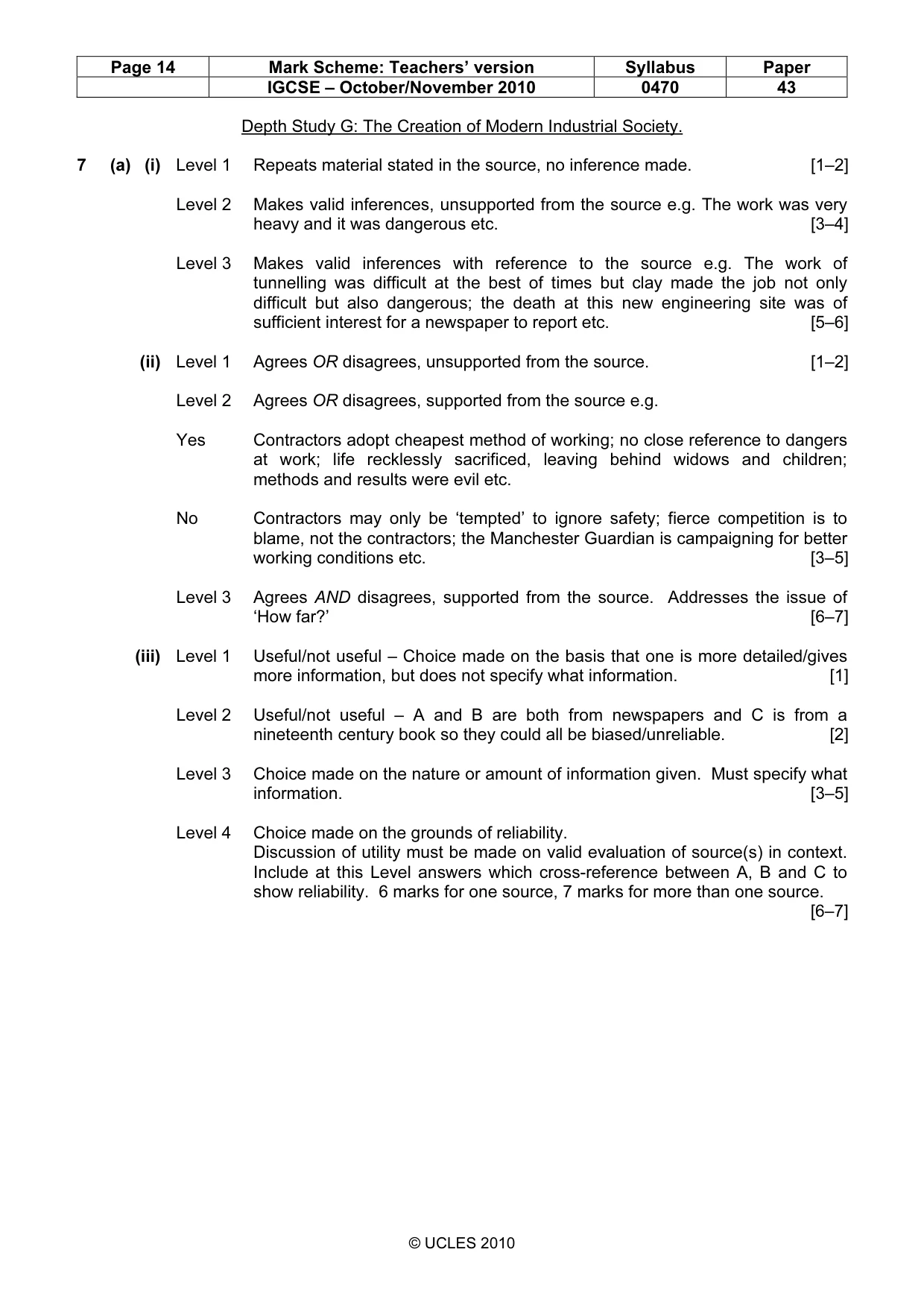
Page 14 Mark Scheme: Teachers’ version Syllabus Paper IGCSE – October/November 2010 0470 43 © UCLES 2010 Depth Study G: The Creation of Modern Industrial Society. 7 (a) (i) Level 1 Repeats material stated in the source, no inference made. [1–2] Level 2 Makes valid inferences, unsupported from the source e.g. The work was very heavy and it was dangerous etc. [3–4] Level 3 Makes valid inferences with reference to the source e.g. The work of tunnelling was difficult at the best of times but clay made the job not only difficult but also dangerous; the death at this new engineering site was of sufficient interest for a newspaper to report etc. [5–6] (ii) Level 1 Agrees OR disagrees, unsupported from the source. [1–2] Level 2 Agrees OR disagrees, supported from the source e.g. Yes Contractors adopt cheapest method of working; no close reference to dangers at work; life recklessly sacrificed, leaving behind widows and children; methods and results were evil etc. No Contractors may only be ‘tempted’ to ignore safety; fierce competition is to blame, not the contractors; the Manchester Guardian is campaigning for better working conditions etc. [3–5] Level 3 Agrees AND disagrees, supported from the source. Addresses the issue of ‘How far?’ [6–7] (iii) Level 1 Useful/not useful – Choice made on the basis that one is more detailed/gives more information, but does not specify what information. [1] Level 2 Useful/not useful – A and B are both from newspapers and C is from a nineteenth century book so they could all be biased/unreliable. [2] Level 3 Choice made on the nature or amount of information given. Must specify what information. [3–5] Level 4 Choice made on the grounds of reliability. Discussion of utility must be made on valid evaluation of source(s) in context. Include at this Level answers which cross-reference between A, B and C to show reliability. 6 marks for one source, 7 marks for more than one source. [6–7]
Mark scheme, page 15
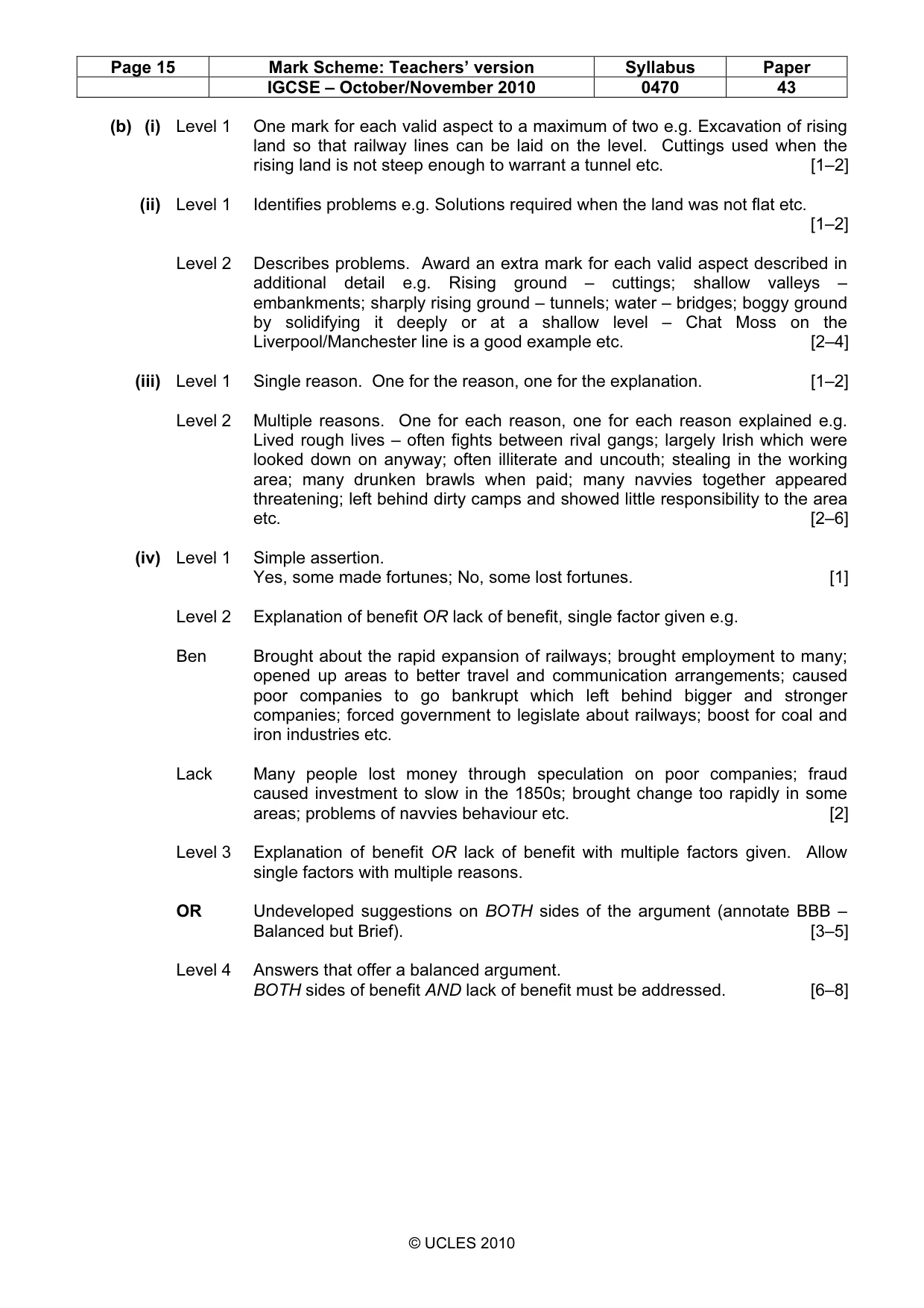
Page 15 Mark Scheme: Teachers’ version Syllabus Paper IGCSE – October/November 2010 0470 43 © UCLES 2010 (b) (i) Level 1 One mark for each valid aspect to a maximum of two e.g. Excavation of rising land so that railway lines can be laid on the level. Cuttings used when the rising land is not steep enough to warrant a tunnel etc. [1–2] (ii) Level 1 Identifies problems e.g. Solutions required when the land was not flat etc. [1–2] Level 2 Describes problems. Award an extra mark for each valid aspect described in additional detail e.g. Rising ground – cuttings; shallow valleys – embankments; sharply rising ground – tunnels; water – bridges; boggy ground by solidifying it deeply or at a shallow level – Chat Moss on the Liverpool/Manchester line is a good example etc. [2–4] (iii) Level 1 Single reason. One for the reason, one for the explanation. [1–2] Level 2 Multiple reasons. One for each reason, one for each reason explained e.g. Lived rough lives – often fights between rival gangs; largely Irish which were looked down on anyway; often illiterate and uncouth; stealing in the working area; many drunken brawls when paid; many navvies together appeared threatening; left behind dirty camps and showed little responsibility to the area etc. [2–6] (iv) Level 1 Simple assertion. Yes, some made fortunes; No, some lost fortunes. [1] Level 2 Explanation of benefit OR lack of benefit, single factor given e.g. Ben Brought about the rapid expansion of railways; brought employment to many; opened up areas to better travel and communication arrangements; caused poor companies to go bankrupt which left behind bigger and stronger companies; forced government to legislate about railways; boost for coal and iron industries etc. Lack Many people lost money through speculation on poor companies; fraud caused investment to slow in the 1850s; brought change too rapidly in some areas; problems of navvies behaviour etc. [2] Level 3 Explanation of benefit OR lack of benefit with multiple factors given. Allow single factors with multiple reasons. OR Undeveloped suggestions on BOTH sides of the argument (annotate BBB – Balanced but Brief). [3–5] Level 4 Answers that offer a balanced argument. BOTH sides of benefit AND lack of benefit must be addressed. [6–8]
Mark scheme, page 16
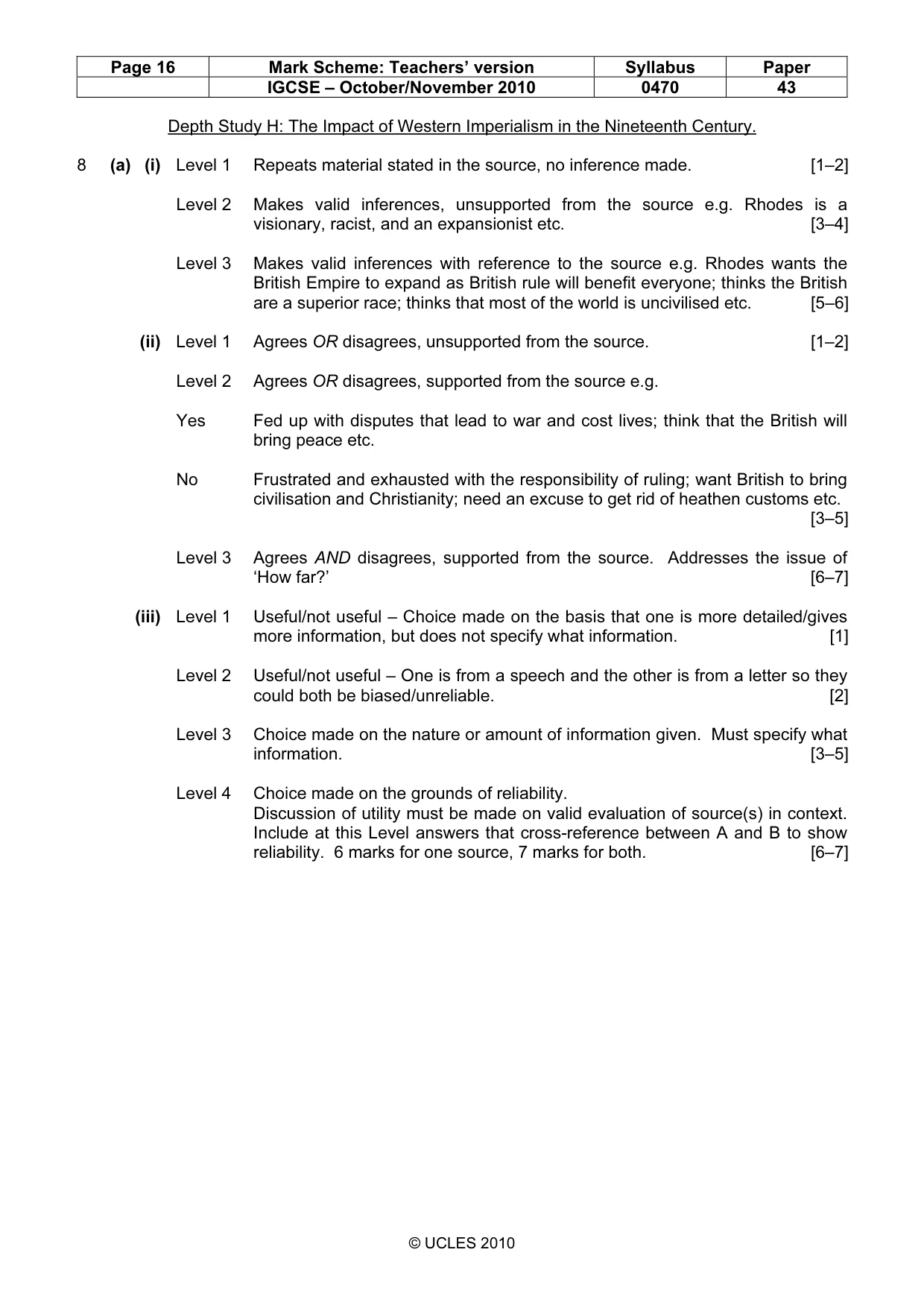
Page 16 Mark Scheme: Teachers’ version Syllabus Paper IGCSE – October/November 2010 0470 43 © UCLES 2010 Depth Study H: The Impact of Western Imperialism in the Nineteenth Century. 8 (a) (i) Level 1 Repeats material stated in the source, no inference made. [1–2] Level 2 Makes valid inferences, unsupported from the source e.g. Rhodes is a visionary, racist, and an expansionist etc. [3–4] Level 3 Makes valid inferences with reference to the source e.g. Rhodes wants the British Empire to expand as British rule will benefit everyone; thinks the British are a superior race; thinks that most of the world is uncivilised etc. [5–6] (ii) Level 1 Agrees OR disagrees, unsupported from the source. [1–2] Level 2 Agrees OR disagrees, supported from the source e.g. Yes Fed up with disputes that lead to war and cost lives; think that the British will bring peace etc. No Frustrated and exhausted with the responsibility of ruling; want British to bring civilisation and Christianity; need an excuse to get rid of heathen customs etc. [3–5] Level 3 Agrees AND disagrees, supported from the source. Addresses the issue of ‘How far?’ [6–7] (iii) Level 1 Useful/not useful – Choice made on the basis that one is more detailed/gives more information, but does not specify what information. [1] Level 2 Useful/not useful – One is from a speech and the other is from a letter so they could both be biased/unreliable. [2] Level 3 Choice made on the nature or amount of information given. Must specify what information. [3–5] Level 4 Choice made on the grounds of reliability. Discussion of utility must be made on valid evaluation of source(s) in context. Include at this Level answers that cross-reference between A and B to show reliability. 6 marks for one source, 7 marks for both. [6–7]
Mark scheme, page 17
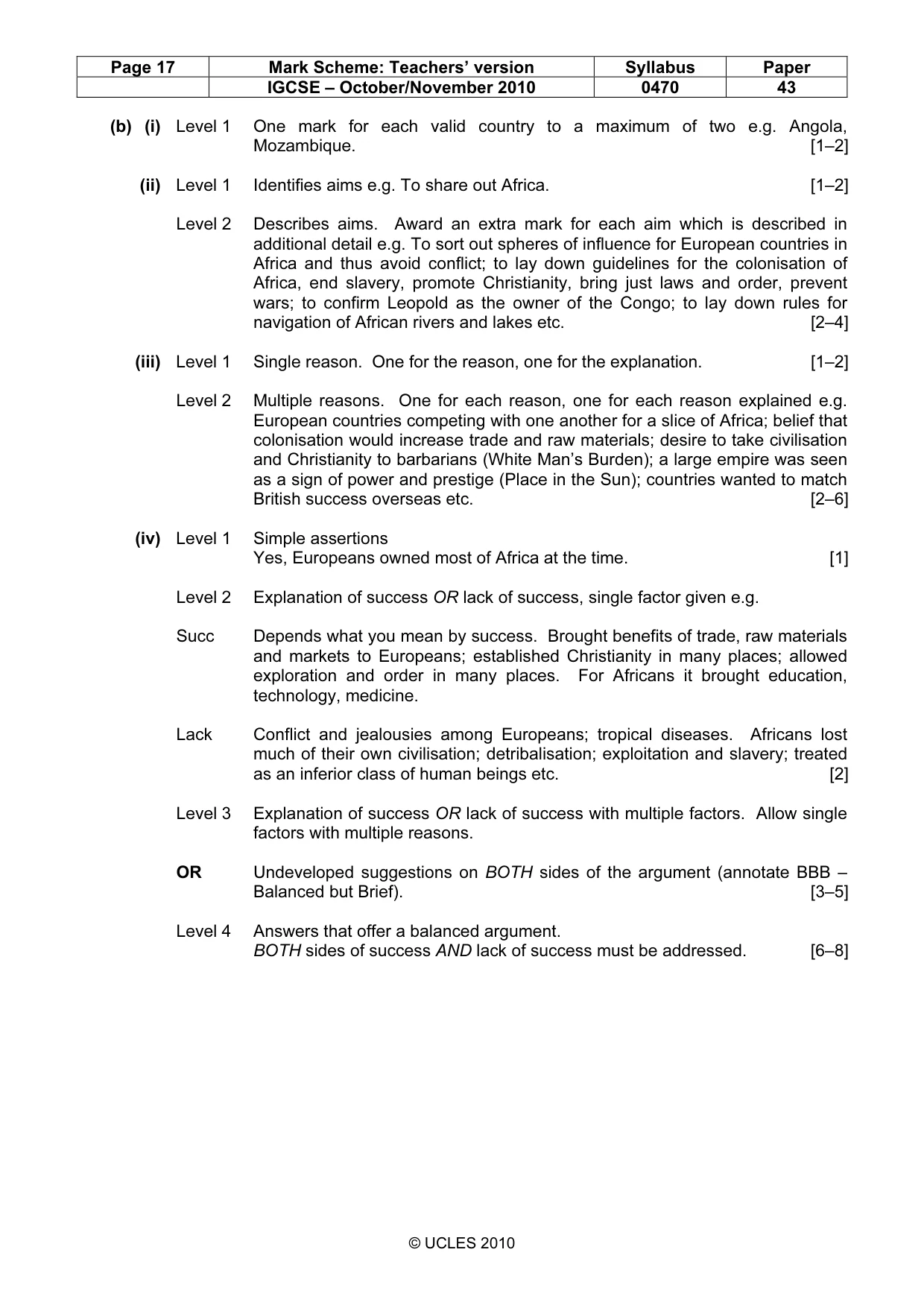
Page 17 Mark Scheme: Teachers’ version Syllabus Paper IGCSE – October/November 2010 0470 43 © UCLES 2010 (b) (i) Level 1 One mark for each valid country to a maximum of two e.g. Angola, Mozambique. [1–2] (ii) Level 1 Identifies aims e.g. To share out Africa. [1–2] Level 2 Describes aims. Award an extra mark for each aim which is described in additional detail e.g. To sort out spheres of influence for European countries in Africa and thus avoid conflict; to lay down guidelines for the colonisation of Africa, end slavery, promote Christianity, bring just laws and order, prevent wars; to confirm Leopold as the owner of the Congo; to lay down rules for navigation of African rivers and lakes etc. [2–4] (iii) Level 1 Single reason. One for the reason, one for the explanation. [1–2] Level 2 Multiple reasons. One for each reason, one for each reason explained e.g. European countries competing with one another for a slice of Africa; belief that colonisation would increase trade and raw materials; desire to take civilisation and Christianity to barbarians (White Man’s Burden); a large empire was seen as a sign of power and prestige (Place in the Sun); countries wanted to match British success overseas etc. [2–6] (iv) Level 1 Simple assertions Yes, Europeans owned most of Africa at the time. [1] Level 2 Explanation of success OR lack of success, single factor given e.g. Succ Depends what you mean by success. Brought benefits of trade, raw materials and markets to Europeans; established Christianity in many places; allowed exploration and order in many places. For Africans it brought education, technology, medicine. Lack Conflict and jealousies among Europeans; tropical diseases. Africans lost much of their own civilisation; detribalisation; exploitation and slavery; treated as an inferior class of human beings etc. [2] Level 3 Explanation of success OR lack of success with multiple factors. Allow single factors with multiple reasons. OR Undeveloped suggestions on BOTH sides of the argument (annotate BBB – Balanced but Brief). [3–5] Level 4 Answers that offer a balanced argument. BOTH sides of success AND lack of success must be addressed. [6–8]
What you needed in this session
Cambridge’s own grade thresholds for 2010 Oct/Nov, Paper 4 · Variant 3. A higher threshold means an easier paper — the bar moves with how the cohort did.