Cambridge IGCSE History 0470 — 2010 Oct/Nov Paper 4 · Variant 2
0470/42/O/N/10 · 40 marks · ≈45 min
The question paper and its mark scheme, free to read here and free to download. This is Cambridge’s own paper, exactly as it was sat.
Question paper12 pages

Mark scheme17 pages
Answers below. Sit the paper first if you are practising.
Paper as text
Question paper, page 1
This document consists of 10 printed pages and 2 blank pages. DC (AC/KN) 23691/5 © UCLES 2010 [Turn over UNIVERSITY OF CAMBRIDGE INTERNATIONAL EXAMINATIONS International General Certificate of Secondary Education READ THESE INSTRUCTIONS FIRST If you have been given an Answer Booklet, follow the instructions on the front cover of the Booklet. Write your Centre number, candidate number and name on all the work you hand in. Write in dark blue or black pen. You may use a soft pencil for any diagrams, graphs or rough working. Do not use staples, paper clips, highlighters, glue or correction fluid. Answer the questions on one of the Depth Studies. At the end of the examination, fasten all your work securely together. The number of marks is given in brackets [ ] at the end of each question or part question. * 0 0 5 5 2 2 2 5 6 7 * HISTORY 0470/42 Paper 4 Alternative to Coursework October/November 2010 1 hour Additional Materials: Answer Booklet/Paper www.XtremePapers.com
Question paper, page 2
2 0470/42/O/N/10 © UCLES 2010 DEPTH STUDY A: GERMANY, 1918–1945 1 Study the sources, and then answer the questions which follow. Source A 1 We demand the union of all Germans into a greater Germany. 4 Only fellow Germans can have the right of citizenship. A fellow German can only be so if born to German parents. This excludes Jews. 14 We demand that large industries share their profits with the workers. 15 We demand generous improvements in the old age pension system. 25 To achieve this programme the party demands the setting up of a strong national government with complete authority for parliament over the whole country. Extracts from the Twenty-Five Point Programme of the National Socialist German Workers’ Party (NSDAP), 1920. Source B Hitler never stood as a candidate for the Reichstag as he was not a German citizen until 1932. By 1928 Hitler was little known outside southern Germany and even there was seen as part of the lunatic fringe of Bavarian politics. In the 1928 elections the Nazis won only twelve of the 491 Reichstag seats. It would have been all too easy for the Nazi Party to disintegrate. Faced with indifference and half-amused contempt from voters, these were the years of waiting for Hitler. He had made progress in rebuilding the Party from its 1924-5 low and was its unchallenged leader. The one quality of his leadership was the fact that he never let go, never lost faith in himself and, having dealt with earlier rivals, kept the loyalty of the men around him. From ‘Hitler, A Study in Tyranny’, by a British professor of history, 1962. (a) (i) Study Source A. What can you tell from this source about the aims of the NSDAP? Support your answer with reference to the source. [6] (ii) Study Source B. How far does this source show that Hitler was an effective leader in the 1920s? Explain your answer. [7] (iii) Study both sources. Is one of these sources more useful than the other as evidence about the Nazis in the 1920s? Explain your answer. [7] (b) (i) Name two of the main political parties, other than the Nazis, in Weimar Germany. [2] (ii) What powers did the President have under the Weimar Constitution? [4] (iii) Why was Ernst Röhm important to the Nazis before 1934? [6] (iv) ‘The Enabling Act was the most important factor leading to Hitler becoming the Führer in 1934.’ How far do you agree with this statement? Explain your answer. [8]
Question paper, page 3
3 0470/42/O/N/10 © UCLES 2010 [Turn over DEPTH STUDY B: RUSSIA, 1905–1941 2 Study the sources, and then answer the questions which follow. Source A As the Civil War got worse the government controlled the peasants and took their crops. Officials encouraged the peasants to work harder still, and uncooperative peasants were disciplined. By 1921 the economy was again at breaking point. There was not enough food for the towns and some peasants began to hide any surpluses for their own benefit. More people died of hunger during the Civil War than from the fighting. A British historian writing in 1990. Source B The Bolshevik supporters may not number more than 10 per cent of the population but their worst enemies cannot deny their energy and party discipline. Unfortunately, no other party can claim even half as large a percentage of supporters. In Russia the aristocracy and middle class do not number more than 15 per cent of the entire population and this small percentage is divided against itself into monarchists, liberals and socialists. Some 70 per cent of the population – the majority of the peasantry – remain inactive. This inactivity is an advantage to the Bolsheviks. A British secret agent in Russia during the Civil War, writing in November 1918. (a) (i) Study Source A. What does this source tell you about peasant life during the Civil War? Support your answer with reference to the source. [6] (ii) Study Source B. How far does this source show that the ineffectiveness of the opposition was the key to Bolshevik success? Explain your answer. [7] (iii) Study both sources. Is one of these sources more useful than the other as evidence about Bolshevik rule during the Civil War? Explain your answer. [7] (b) (i) What was the Cheka? [2] (ii) Describe the main elements of War Communism. [4] (iii) Why did the Bolsheviks win the Russian Civil War? [6] (iv) How far was the New Economic Policy (NEP) a success? Explain your answer. [8]
Question paper, page 4
4 0470/42/O/N/10 © UCLES 2010 DEPTH STUDY C: THE USA, 1919–1941 3 Study the sources, and then answer the questions which follow. Source A Men in smart suits and polka dot neckties talked seriously and convincingly of ‘sound investments’, ‘gilt-edged securities’, and ‘attractive yields’. Rich, creamy words. Enchanted we have listened: enchanted we have handed over our savings, confident that the affairs of the nation were in the wisest of hands. We were even assured on the highest authority that the Republic was entering a whole new era of secure value, solid as rock. With such all-seeing experts in charge of the dials and switches of the credit structure, how could anything go wrong? An American study of the 1920s economy, published in December 1929. Source B America of the 1920s believed in a free market, regulation was a dirty word, especially as far as the stock market was concerned. As a result people in banks and on Wall Street engaged in activity that would be considered criminal today using insider knowledge, manipulating shares and information, and it was legal. Not that there wasn’t any law, just its loopholes were enormous. By 1929, the New York Stock Exchange Index had increased in value from 100 points to 350 points in four years, fueled by speculative credit. Even in 1930 a Wall Street trader commented that the public liking for shares was not only as strong as ever, but also the prompt return of huge speculation indicated that it would be difficult to hold back the stock market enthusiasm for long. From an American stock market analyst, 2002. (a) (i) Study Source A. What can you tell from this source about stock market investors in the 1920s? Support your answer with reference to the source. [6] (ii) Study Source B. How far does this source show that over-confidence was responsible for the problems of the stock market? Explain your answer. [7] (iii) Study both sources. Is one of these sources more useful than the other as evidence about the Wall Street Crash? Explain your answer. [7] (b) (i) What was ‘buying on the margin’? [2] (ii) Describe the measures taken by President Hoover’s government to deal with the Wall Street Crash. [4] (iii) Why did Hoover’s policies have limited effect on the economy by 1932? [6] (iv) ‘The banking crisis was the most serious consequence of the Wall Street Crash.’ How far do you agree with this statement? Explain your answer. [8]
Question paper, page 5
5 0470/42/O/N/10 © UCLES 2010 [Turn over DEPTH STUDY D: CHINA, 1945–c.1990 4 Study the sources, and then answer the questions which follow. Source A There was a new spirit of courage and daring. There was a sense of liberation, that just to be in the Square was a statement in itself. People smiled and shook my hand. The gentleness, the smiles and the headbands reminded me of the big rock concerts and the anti-Vietnam protests of the 1960s in the West. There was the same certainty that because the protesters were young and peaceful the government must give in. A British journalist recounts his Tiananmen Square experiences in a book written in 1990. Source B In 1983 China had as many as 44 000 markets where farmers could sell their produce privately with the result that the income of agricultural workers tripled between 1977 and 1983. Private businesses were encouraged on a small scale and by 1983 there were three million private companies. A television set cost two years’ wages and a bicycle a month’s pay. Unemployment, according to Western estimates, stood at 12 per cent in 1983, and this modernisation along Western capitalist lines had also brought Western-style problems such as a rising crime rate and football hooliganism. A British historian writing in 1987. (a) (i) Study Source A. What can you tell from this source about the demonstrators in Tiananmen Square? Support your answer with reference to the source. [6] (ii) Study Source B. How far does this source show that life in China improved after the death of Mao? Explain your answer. [7] (iii) Study both sources. Is one of these sources more useful than the other as evidence about China after the death of Mao? Explain your answer. [7] (b) (i) Name two areas of China still held by imperialist powers at the time of Mao’s death. [2] (ii) Describe the fall of the Gang of Four. [4] (iii) Why did the events of June 1989 in Tiananmen Square occur? [6] (iv) By the 1990s, how far had China moved away from Communist policies since the death of Mao? Explain your answer. [8]
Question paper, page 6
6 0470/42/O/N/10 © UCLES 2010 DEPTH STUDY E: SOUTHERN AFRICA IN THE TWENTIETH CENTURY 5 Study the sources, and then answer the questions which follow. Source A • The South African Native Trust (SANT) will be set up to purchase 6 million hectares of land to add to the 9 million already set aside for ‘native reserves’ under the 1913 Land Act. The finance is to be from the poll tax, rent and profit made from all black-owned land. • SANT will have the authority to administer African reserve areas, to provide systems of control over livestock and to introduce the division of arable and grazing land. It will have the power to enforce betterment through residential planning and new villages. • A system of registering and controlling the distribution of labour tenants and squatters is to be introduced. Major terms of the 1936 Native Trust and Land Act. Source B The Industrial and Commercial Workers’ Union (ICU) led strikes of black workers against poor wages and working conditions in the gold mines. The ICU organised sharecroppers and tenant farmers all over the countryside. The women’s fellowship of the Methodist Church helped organize the schools and trading store boycotts of 1922 to 1926 in the Transkei. After the ICU ended in the late 1920s, resistance in the agricultural areas became more focused on local problems. Harsh conditions of repression combined with extreme poverty, underdevelopment and low levels of literacy made any national rural protest difficult. The continuous flow of migrant labour to urban areas did ensure that rural struggles continued to feed into national campaigns. South African website for students, 2008. (a) (i) Study Source A. What can you tell from this source about the 1936 Native Trust and Land Act? Support your answer with reference to the source. [6] (ii) Study Source B. How far does this source show that Africans were not successful in organising themselves against the effects of white rule between 1920 and 1948? Explain your answer. [7] (iii) Study both sources. Is one of these sources more useful than the other as evidence about life in agricultural areas? Explain your answer. [7] (b) (i) What was ISCOR? [2] (ii) Describe the effect on South Africans of the 1930s Gold Boom. [4] (iii) Why were there political divisions in the white minority between 1910 and 1939? [6] (iv) ‘Dealing with the land issue was the greatest success for the South African governments between 1910 and 1940.’ How far do you agree with this statement? Explain your answer. [8]
Question paper, page 7
7 0470/42/O/N/10 © UCLES 2010 [Turn over DEPTH STUDY F: ISRAELIS AND PALESTINIANS, 1945–c.1994 6 Study the sources, and then answer the questions which follow. Source A The conclusion of the Six Day War, with its resultant shock for the Arab world, created an atmosphere, particularly in Israel, indicating that an end had been reached in the wars with various Arab countries. Indeed, the imminent opening of peace negotiations was expected. From a military point of view, Israel was now in a much stronger position than it had ever been and, in the eyes of most Israelis, this fact enhanced the prospects for peace negotiations. This time Israel would be negotiating from strength. From a book written by a former President of Israel. Source B Following the shattering defeat in the Six Day War, the Arab states met at Khartoum in August 1967. Here they decided there would be ‘no peace, no recognition, and no negotiation’ with Israel. The Arab struggle would continue. The situation improved somewhat when the United Nations passed Resolution 242 which called for: 1 The withdrawal of Israel from occupied territories. 2 All Middle East states to live in peace with secure and recognised boundaries. 3 A just settlement to the refugee problem. From a British history book written in 1987. (a) (i) Study Source A. What can you tell from this source about the Israeli victory in the Six Day War? Support your answer with reference to the source. [6] (ii) Study Source B. How far does this source show that prospects for peace were good in late 1967? Explain your answer. [7] (iii) Study both sources. Is one of these sources more useful than the other as evidence about the impact of the Six Day War? Explain your answer. [7] (b) (i) Name two areas occupied by Israel during the Six Day War. [2] (ii) Describe the part played by the Israeli air force during the Six Day War. [4] (iii) Why did President Nasser increase the threat to Israel in May 1967? [6] (iv) How far did the Israeli victory in 1967 change the attitudes of the Arab states and Palestinians? Explain your answer. [8]
Question paper, page 8
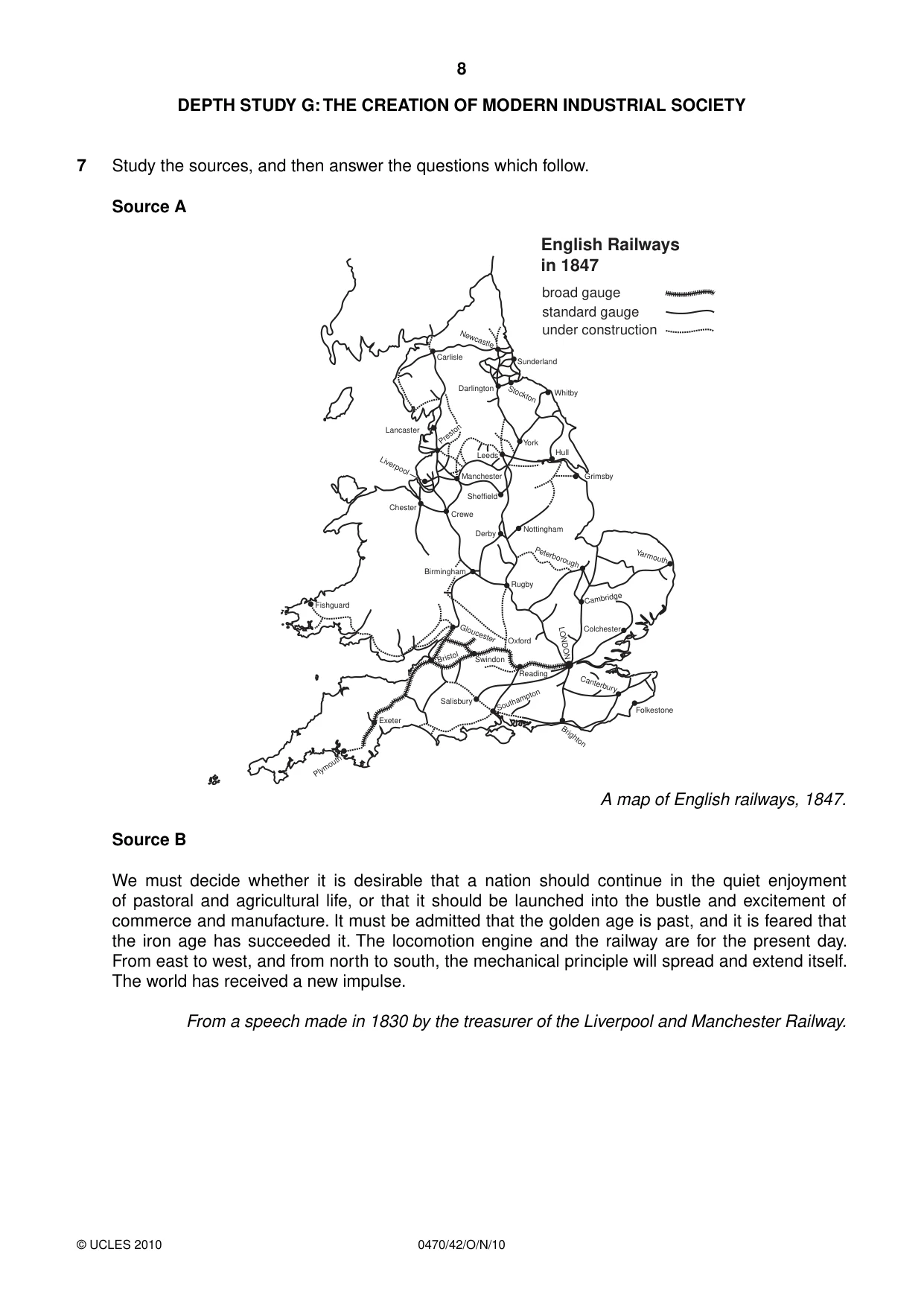
8 0470/42/O/N/10 © UCLES 2010 DEPTH STUDY G: THE CREATION OF MODERN INDUSTRIAL SOCIETY 7 Study the sources, and then answer the questions which follow. Source A Chester Liverpool Lancaster Plymouth Exeter Salisbury Southampton Swindon Reading Oxford Gloucester Fishguard Bristol Brighton Folkestone Canterbury LONDON Colchester Cambridge Yarmouth Nottingham Peterborough Birmingham Rugby Derby Crewe Sunderland Newcastle Carlisle Darlington Whitby Stockton York Hull Leeds Preston Manchester Grimsby Sheffield English Railways in 1847 broad gauge standard gauge under construction A map of English railways, 1847. Source B We must decide whether it is desirable that a nation should continue in the quiet enjoyment of pastoral and agricultural life, or that it should be launched into the bustle and excitement of commerce and manufacture. It must be admitted that the golden age is past, and it is feared that the iron age has succeeded it. The locomotion engine and the railway are for the present day. From east to west, and from north to south, the mechanical principle will spread and extend itself. The world has received a new impulse. From a speech made in 1830 by the treasurer of the Liverpool and Manchester Railway.
Question paper, page 9
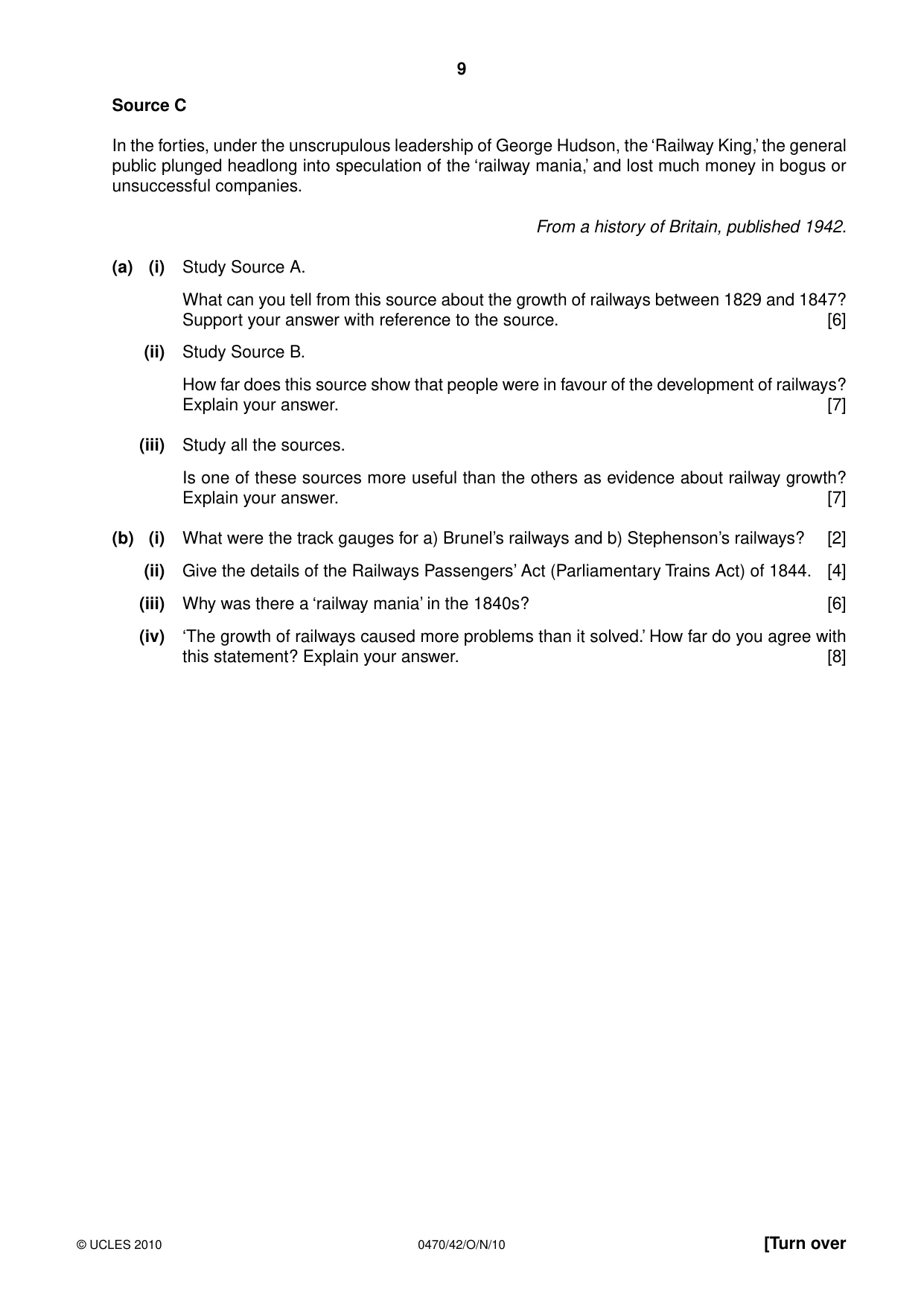
9 0470/42/O/N/10 © UCLES 2010 Source C In the forties, under the unscrupulous leadership of George Hudson, the ‘Railway King,’ the general public plunged headlong into speculation of the ‘railway mania,’ and lost much money in bogus or unsuccessful companies. From a history of Britain, published 1942. (a) (i) Study Source A. What can you tell from this source about the growth of railways between 1829 and 1847? Support your answer with reference to the source. [6] (ii) Study Source B. How far does this source show that people were in favour of the development of railways? Explain your answer. [7] (iii) Study all the sources. Is one of these sources more useful than the others as evidence about railway growth? Explain your answer. [7] (b) (i) What were the track gauges for a) Brunel’s railways and b) Stephenson’s railways? [2] (ii) Give the details of the Railways Passengers’ Act (Parliamentary Trains Act) of 1844. [4] (iii) Why was there a ‘railway mania’ in the 1840s? [6] (iv) ‘The growth of railways caused more problems than it solved.’ How far do you agree with this statement? Explain your answer. [8] [Turn over
Question paper, page 10
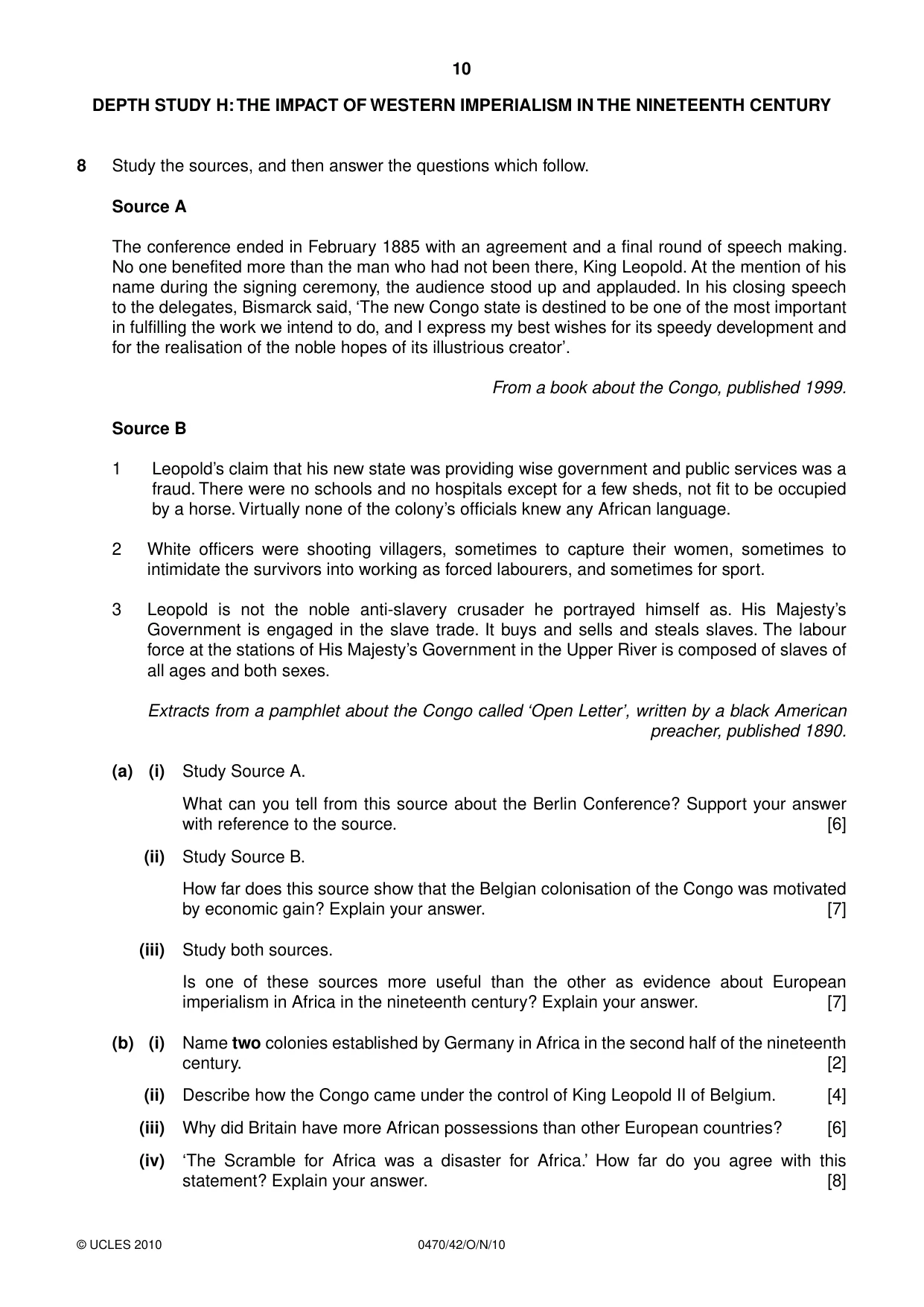
10 0470/42/O/N/10 DEPTH STUDY H: THE IMPACT OF WESTERN IMPERIALISM IN THE NINETEENTH CENTURY 8 Study the sources, and then answer the questions which follow. Source A The conference ended in February 1885 with an agreement and a final round of speech making. No one benefited more than the man who had not been there, King Leopold. At the mention of his name during the signing ceremony, the audience stood up and applauded. In his closing speech to the delegates, Bismarck said, ‘The new Congo state is destined to be one of the most important in fulfilling the work we intend to do, and I express my best wishes for its speedy development and for the realisation of the noble hopes of its illustrious creator’. From a book about the Congo, published 1999. Source B 1 Leopold’s claim that his new state was providing wise government and public services was a fraud. There were no schools and no hospitals except for a few sheds, not fit to be occupied by a horse. Virtually none of the colony’s officials knew any African language. 2 White officers were shooting villagers, sometimes to capture their women, sometimes to intimidate the survivors into working as forced labourers, and sometimes for sport. 3 Leopold is not the noble anti-slavery crusader he portrayed himself as. His Majesty’s Government is engaged in the slave trade. It buys and sells and steals slaves. The labour force at the stations of His Majesty’s Government in the Upper River is composed of slaves of all ages and both sexes. Extracts from a pamphlet about the Congo called ‘Open Letter’, written by a black American preacher, published 1890. (a) (i) Study Source A. What can you tell from this source about the Berlin Conference? Support your answer with reference to the source. [6] (ii) Study Source B. How far does this source show that the Belgian colonisation of the Congo was motivated by economic gain? Explain your answer. [7] (iii) Study both sources. Is one of these sources more useful than the other as evidence about European imperialism in Africa in the nineteenth century? Explain your answer. [7] (b) (i) Name two colonies established by Germany in Africa in the second half of the nineteenth century. [2] (ii) Describe how the Congo came under the control of King Leopold II of Belgium. [4] (iii) Why did Britain have more African possessions than other European countries? [6] (iv) ‘The Scramble for Africa was a disaster for Africa.’ How far do you agree with this statement? Explain your answer. [8] © UCLES 2010
Question paper, page 11
11 0470/42/O/N/10 BLANK PAGE © UCLES 2010
Question paper, page 12
12 0470/42/O/N/10 © UCLES 2010 BLANK PAGE Copyright Acknowledgements: Depth Study A Source B © Alan Bullock, Hitler, A Study In Tyranny; Penguin, 1986. Depth Study B Source A © Clare Baker, Russia 1917–1948 ; Heinemann Educational, 1990. Depth Study B Source B © Alan White, Russia and the USSR, 1905–1991; Collins Educational, 1995. Depth Study D Source A © Norman Lowe, Understanding Modern World History ; Macmillan Press Ltd, 1997. Depth Study D Source B © Neil De Marco, The World This Century; Collins Educational, 1987. Depth Study E Source B © www.sahistory.org.za/pages/governance-projects/land; 2008. Depth Study F Source A © ed. Shlomo Gazit, Chaim Herzog, The Arab Israeli Wars – War & Peace in the Middle East ; Greenhill Books/Levanthal Ltd; 2005. Depth Study F Source B © S J Perkins, Arab Israeli Conflict ; Macmillan Educational, 1987. Depth Study G Source A © Terry Coleman, The Railway Navvies ; Penguin, 1965. Depth Study G Source B © A J Hogland, The Age of Industrial Expansion ; Nelson, 1968. Depth Study G Source C © G M Trevelyan, English Social History ; Longmans, 1942. Depth Study H Source A © Extract from King Leopold’s Ghost by Adam Hochschild, published by Pan Macmillan. Copyright (c) Adam Hochschild 1999. Reproduced by permission of Georges Borchardt Inc. Depth Study H Source B © Extract from King Leopold’s Ghost by Adam Hochschild, published by Pan Macmillan. Copyright (c) Adam Hochschild 1999. Reproduced by permission of Georges Borchardt Inc. Permission to reproduce items where third-party owned material protected by copyright is included has been sought and cleared where possible. Every reasonable effort has been made by the publisher (UCLES) to trace copyright holders, but if any items requiring clearance have unwittingly been included, the publisher will be pleased to make amends at the earliest possible opportunity. University of Cambridge International Examinations is part of the Cambridge Assessment Group. Cambridge Assessment is the brand name of University of Cambridge Local Examinations Syndicate (UCLES), which is itself a department of the University of Cambridge.
Mark scheme, page 1
UNIVERSITY OF CAMBRIDGE INTERNATIONAL EXAMINATIONS International General Certificate of Secondary Education MARK SCHEME for the October/November 2010 question paper for the guidance of teachers 0470 HISTORY 0470/42 Paper 4 (Alternative to Coursework), maximum raw mark 40 This mark scheme is published as an aid to teachers and candidates, to indicate the requirements of the examination. It shows the basis on which Examiners were instructed to award marks. It does not indicate the details of the discussions that took place at an Examiners’ meeting before marking began, which would have considered the acceptability of alternative answers. Mark schemes must be read in conjunction with the question papers and the report on the examination. • CIE will not enter into discussions or correspondence in connection with these mark schemes. CIE is publishing the mark schemes for the October/November 2010 question papers for most IGCSE, GCE Advanced Level and Advanced Subsidiary Level syllabuses and some Ordinary Level syllabuses. www.XtremePapers.com
Mark scheme, page 2
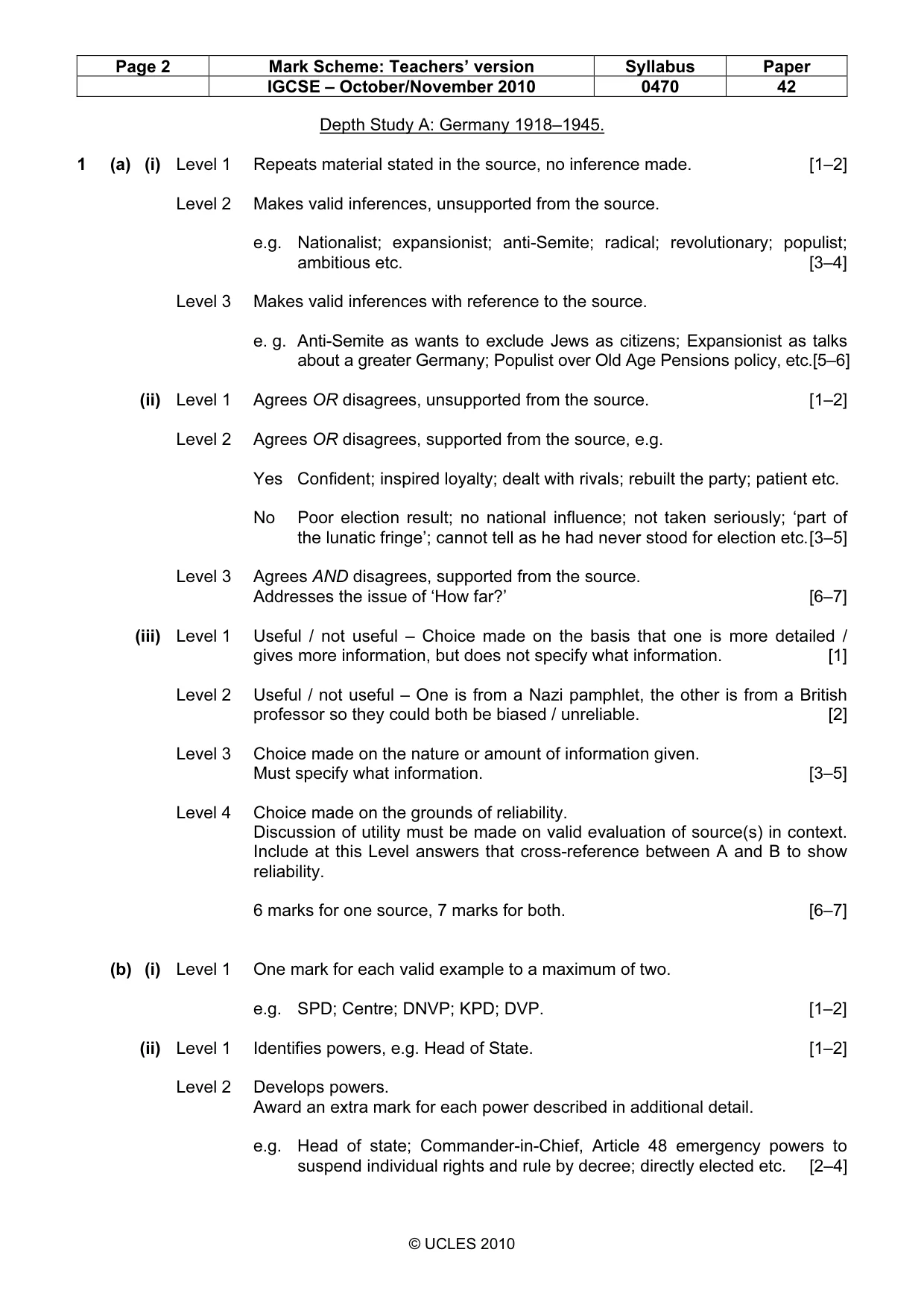
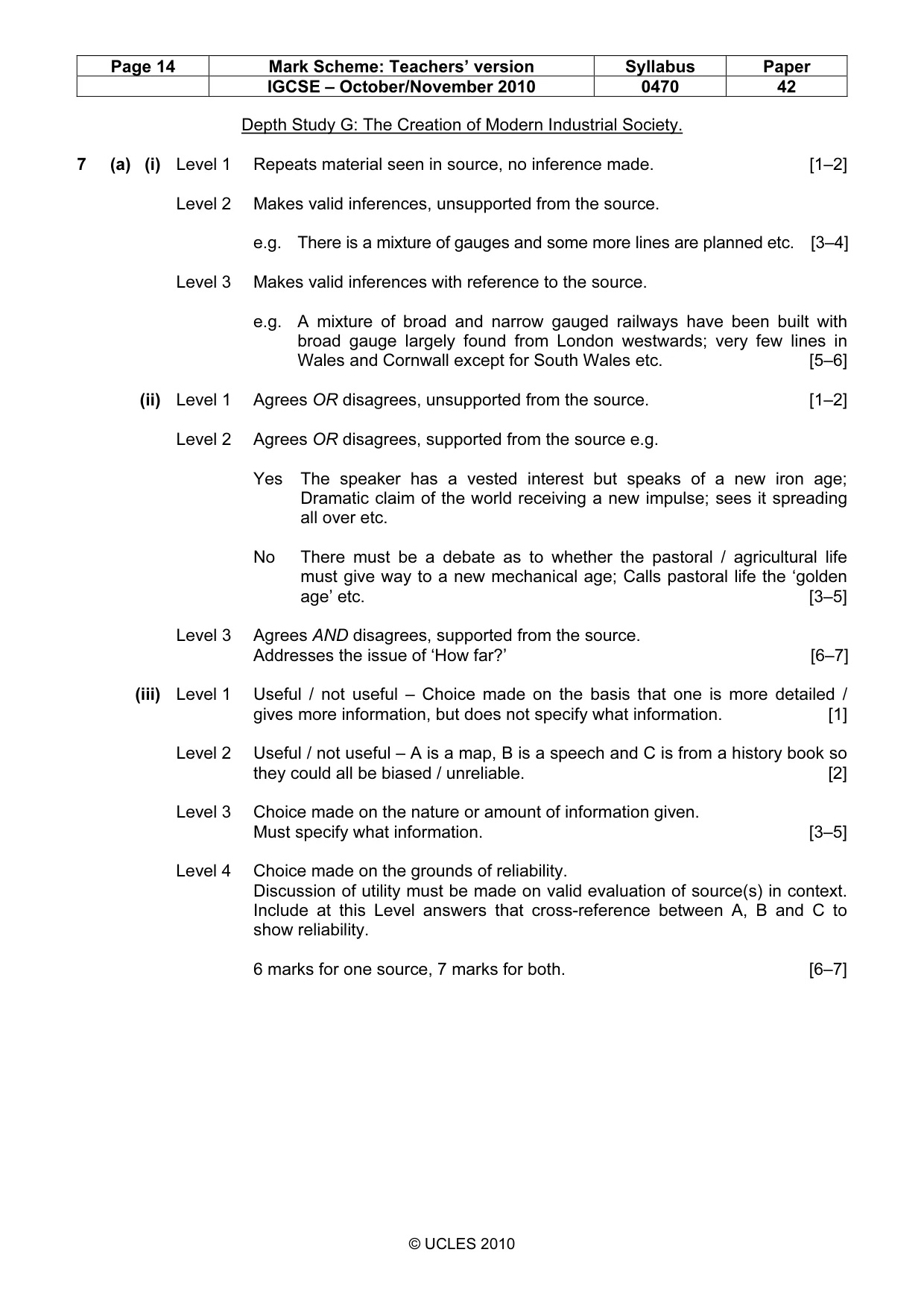
Page 2 Mark Scheme: Teachers’ version Syllabus Paper IGCSE – October/November 2010 0470 42 © UCLES 2010 Depth Study A: Germany 1918–1945. 1 (a) (i) Level 1 Repeats material stated in the source, no inference made. [1–2] Level 2 Makes valid inferences, unsupported from the source. e.g. Nationalist; expansionist; anti-Semite; radical; revolutionary; populist; ambitious etc. [3–4] Level 3 Makes valid inferences with reference to the source. e. g. Anti-Semite as wants to exclude Jews as citizens; Expansionist as talks about a greater Germany; Populist over Old Age Pensions policy, etc.[5–6] (ii) Level 1 Agrees OR disagrees, unsupported from the source. [1–2] Level 2 Agrees OR disagrees, supported from the source, e.g. Yes Confident; inspired loyalty; dealt with rivals; rebuilt the party; patient etc. No Poor election result; no national influence; not taken seriously; ‘part of the lunatic fringe’; cannot tell as he had never stood for election etc. [3–5] Level 3 Agrees AND disagrees, supported from the source. Addresses the issue of ‘How far?’ [6–7] (iii) Level 1 Useful / not useful – Choice made on the basis that one is more detailed / gives more information, but does not specify what information. [1] Level 2 Useful / not useful – One is from a Nazi pamphlet, the other is from a British professor so they could both be biased / unreliable. [2] Level 3 Choice made on the nature or amount of information given. Must specify what information. [3–5] Level 4 Choice made on the grounds of reliability. Discussion of utility must be made on valid evaluation of source(s) in context. Include at this Level answers that cross-reference between A and B to show reliability. 6 marks for one source, 7 marks for both. [6–7] (b) (i) Level 1 One mark for each valid example to a maximum of two. e.g. SPD; Centre; DNVP; KPD; DVP. [1–2] (ii) Level 1 Identifies powers, e.g. Head of State. [1–2] Level 2 Develops powers. Award an extra mark for each power described in additional detail. e.g. Head of state; Commander-in-Chief, Article 48 emergency powers to suspend individual rights and rule by decree; directly elected etc. [2–4]
Mark scheme, page 3
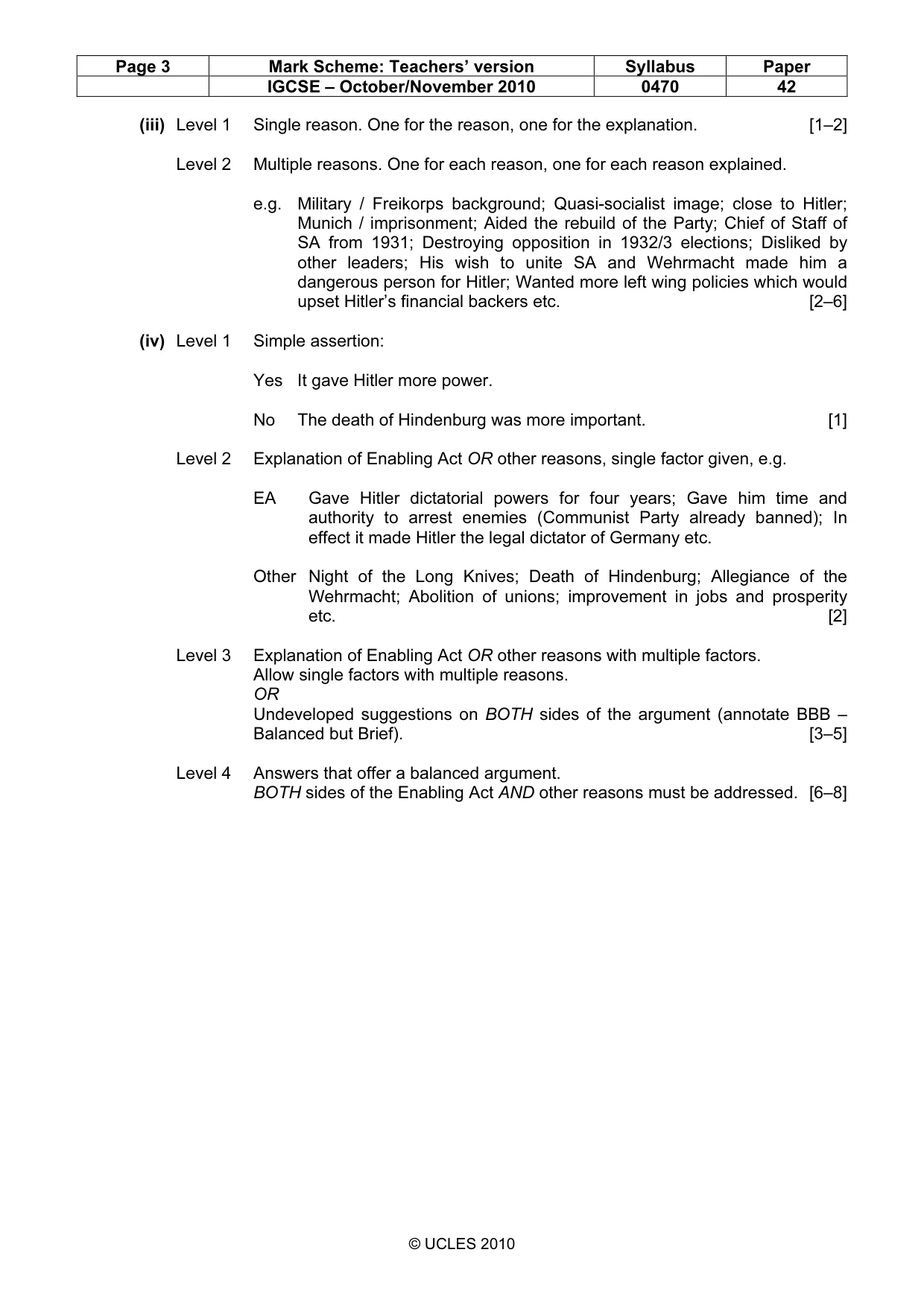
Page 3 Mark Scheme: Teachers’ version Syllabus Paper IGCSE – October/November 2010 0470 42 © UCLES 2010 (iii) Level 1 Single reason. One for the reason, one for the explanation. [1–2] Level 2 Multiple reasons. One for each reason, one for each reason explained. e.g. Military / Freikorps background; Quasi-socialist image; close to Hitler; Munich / imprisonment; Aided the rebuild of the Party; Chief of Staff of SA from 1931; Destroying opposition in 1932/3 elections; Disliked by other leaders; His wish to unite SA and Wehrmacht made him a dangerous person for Hitler; Wanted more left wing policies which would upset Hitler’s financial backers etc. [2–6] (iv) Level 1 Simple assertion: Yes It gave Hitler more power. No The death of Hindenburg was more important. [1] Level 2 Explanation of Enabling Act OR other reasons, single factor given, e.g. EA Gave Hitler dictatorial powers for four years; Gave him time and authority to arrest enemies (Communist Party already banned); In effect it made Hitler the legal dictator of Germany etc. Other Night of the Long Knives; Death of Hindenburg; Allegiance of the Wehrmacht; Abolition of unions; improvement in jobs and prosperity etc. [2] Level 3 Explanation of Enabling Act OR other reasons with multiple factors. Allow single factors with multiple reasons. OR Undeveloped suggestions on BOTH sides of the argument (annotate BBB – Balanced but Brief). [3–5] Level 4 Answers that offer a balanced argument. BOTH sides of the Enabling Act AND other reasons must be addressed. [6–8]
Mark scheme, page 4
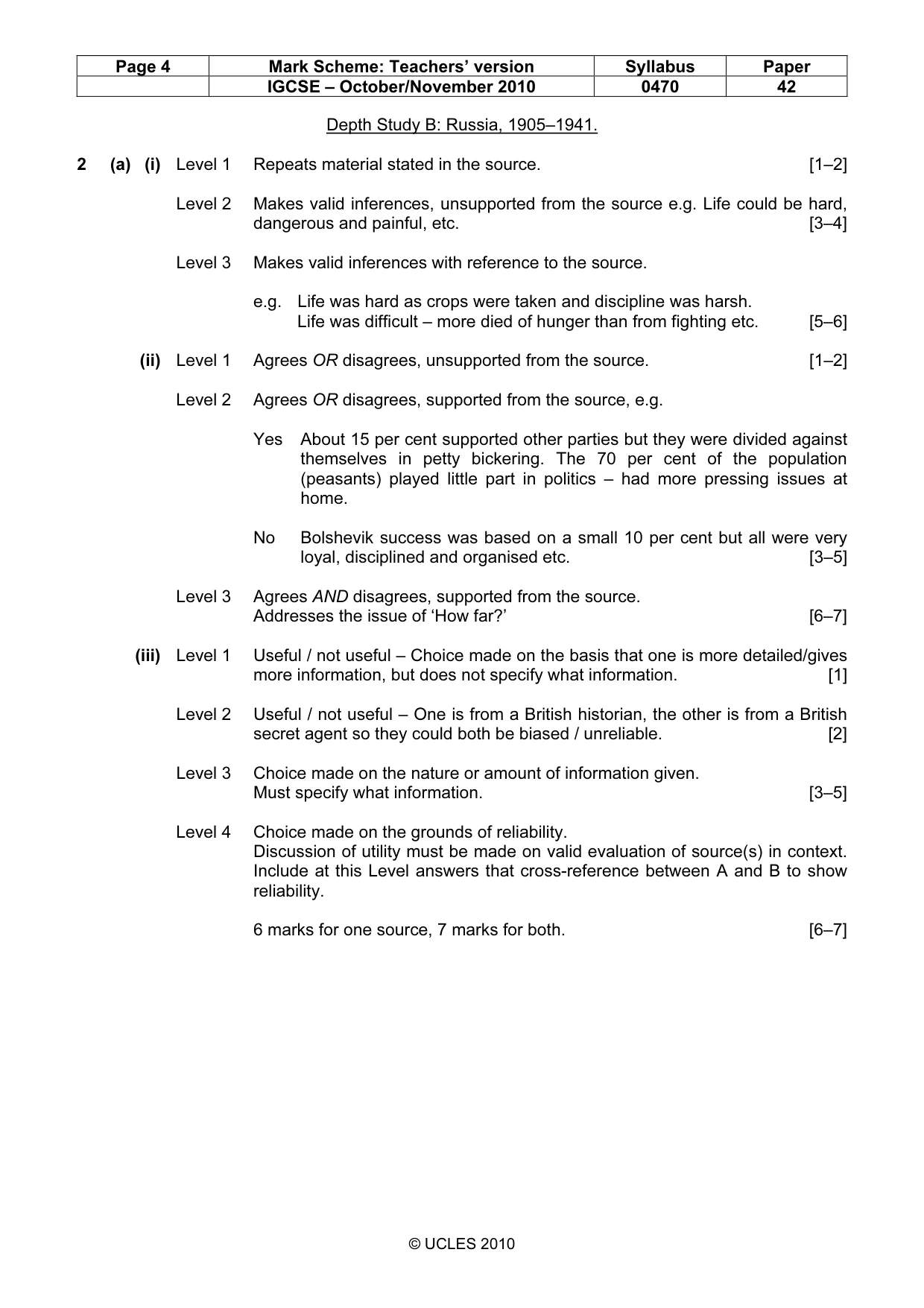
Page 4 Mark Scheme: Teachers’ version Syllabus Paper IGCSE – October/November 2010 0470 42 © UCLES 2010 Depth Study B: Russia, 1905–1941. 2 (a) (i) Level 1 Repeats material stated in the source. [1–2] Level 2 Makes valid inferences, unsupported from the source e.g. Life could be hard, dangerous and painful, etc. [3–4] Level 3 Makes valid inferences with reference to the source. e.g. Life was hard as crops were taken and discipline was harsh. Life was difficult – more died of hunger than from fighting etc. [5–6] (ii) Level 1 Agrees OR disagrees, unsupported from the source. [1–2] Level 2 Agrees OR disagrees, supported from the source, e.g. Yes About 15 per cent supported other parties but they were divided against themselves in petty bickering. The 70 per cent of the population (peasants) played little part in politics – had more pressing issues at home. No Bolshevik success was based on a small 10 per cent but all were very loyal, disciplined and organised etc. [3–5] Level 3 Agrees AND disagrees, supported from the source. Addresses the issue of ‘How far?’ [6–7] (iii) Level 1 Useful / not useful – Choice made on the basis that one is more detailed/gives more information, but does not specify what information. [1] Level 2 Useful / not useful – One is from a British historian, the other is from a British secret agent so they could both be biased / unreliable. [2] Level 3 Choice made on the nature or amount of information given. Must specify what information. [3–5] Level 4 Choice made on the grounds of reliability. Discussion of utility must be made on valid evaluation of source(s) in context. Include at this Level answers that cross-reference between A and B to show reliability. 6 marks for one source, 7 marks for both. [6–7]
Mark scheme, page 5
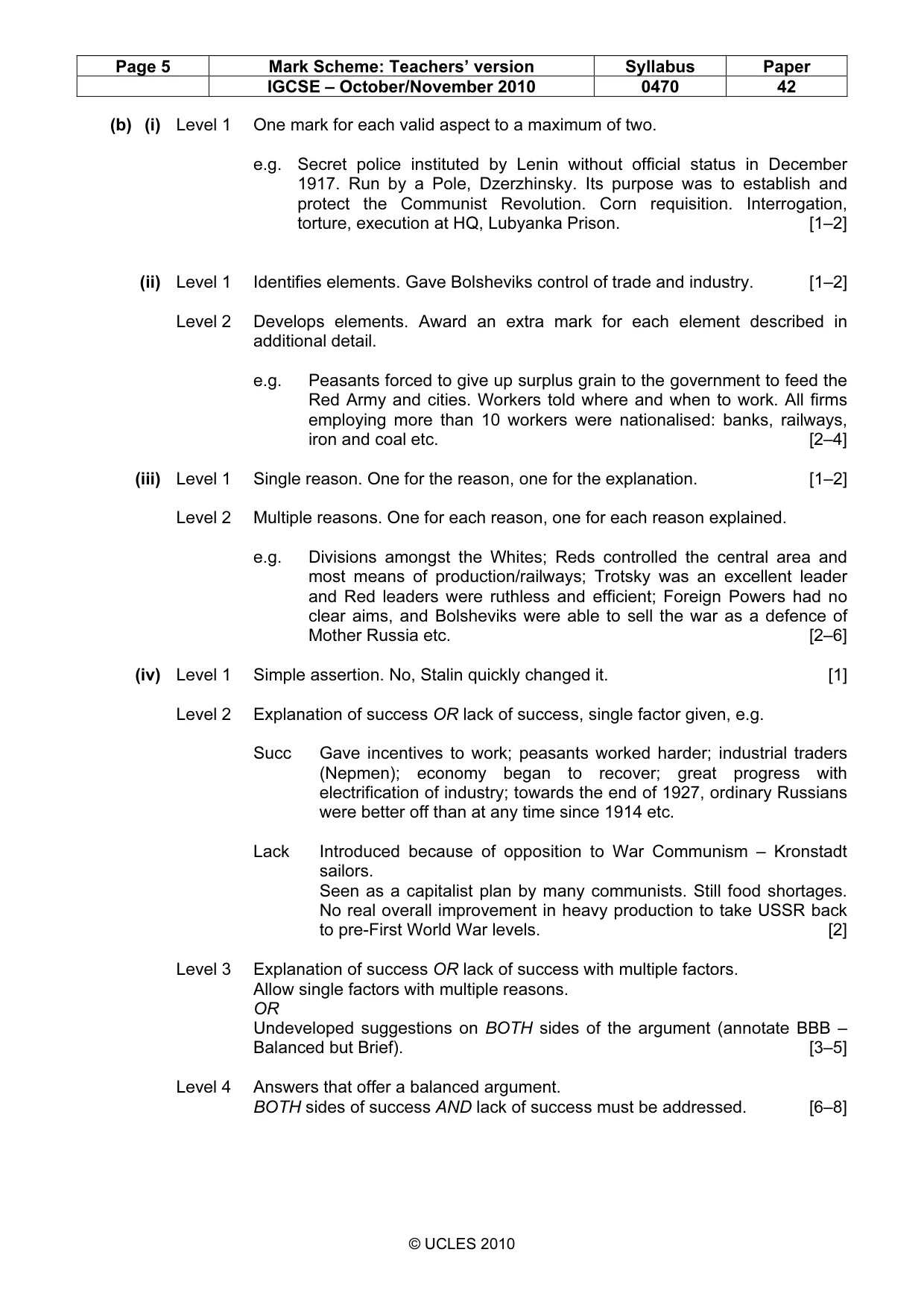
Page 5 Mark Scheme: Teachers’ version Syllabus Paper IGCSE – October/November 2010 0470 42 © UCLES 2010 (b) (i) Level 1 One mark for each valid aspect to a maximum of two. e.g. Secret police instituted by Lenin without official status in December 1917. Run by a Pole, Dzerzhinsky. Its purpose was to establish and protect the Communist Revolution. Corn requisition. Interrogation, torture, execution at HQ, Lubyanka Prison. [1–2] (ii) Level 1 Identifies elements. Gave Bolsheviks control of trade and industry. [1–2] Level 2 Develops elements. Award an extra mark for each element described in additional detail. e.g. Peasants forced to give up surplus grain to the government to feed the Red Army and cities. Workers told where and when to work. All firms employing more than 10 workers were nationalised: banks, railways, iron and coal etc. [2–4] (iii) Level 1 Single reason. One for the reason, one for the explanation. [1–2] Level 2 Multiple reasons. One for each reason, one for each reason explained. e.g. Divisions amongst the Whites; Reds controlled the central area and most means of production/railways; Trotsky was an excellent leader and Red leaders were ruthless and efficient; Foreign Powers had no clear aims, and Bolsheviks were able to sell the war as a defence of Mother Russia etc. [2–6] (iv) Level 1 Simple assertion. No, Stalin quickly changed it. [1] Level 2 Explanation of success OR lack of success, single factor given, e.g. Succ Gave incentives to work; peasants worked harder; industrial traders (Nepmen); economy began to recover; great progress with electrification of industry; towards the end of 1927, ordinary Russians were better off than at any time since 1914 etc. Lack Introduced because of opposition to War Communism – Kronstadt sailors. Seen as a capitalist plan by many communists. Still food shortages. No real overall improvement in heavy production to take USSR back to pre-First World War levels. [2] Level 3 Explanation of success OR lack of success with multiple factors. Allow single factors with multiple reasons. OR Undeveloped suggestions on BOTH sides of the argument (annotate BBB – Balanced but Brief). [3–5] Level 4 Answers that offer a balanced argument. BOTH sides of success AND lack of success must be addressed. [6–8]
Mark scheme, page 6
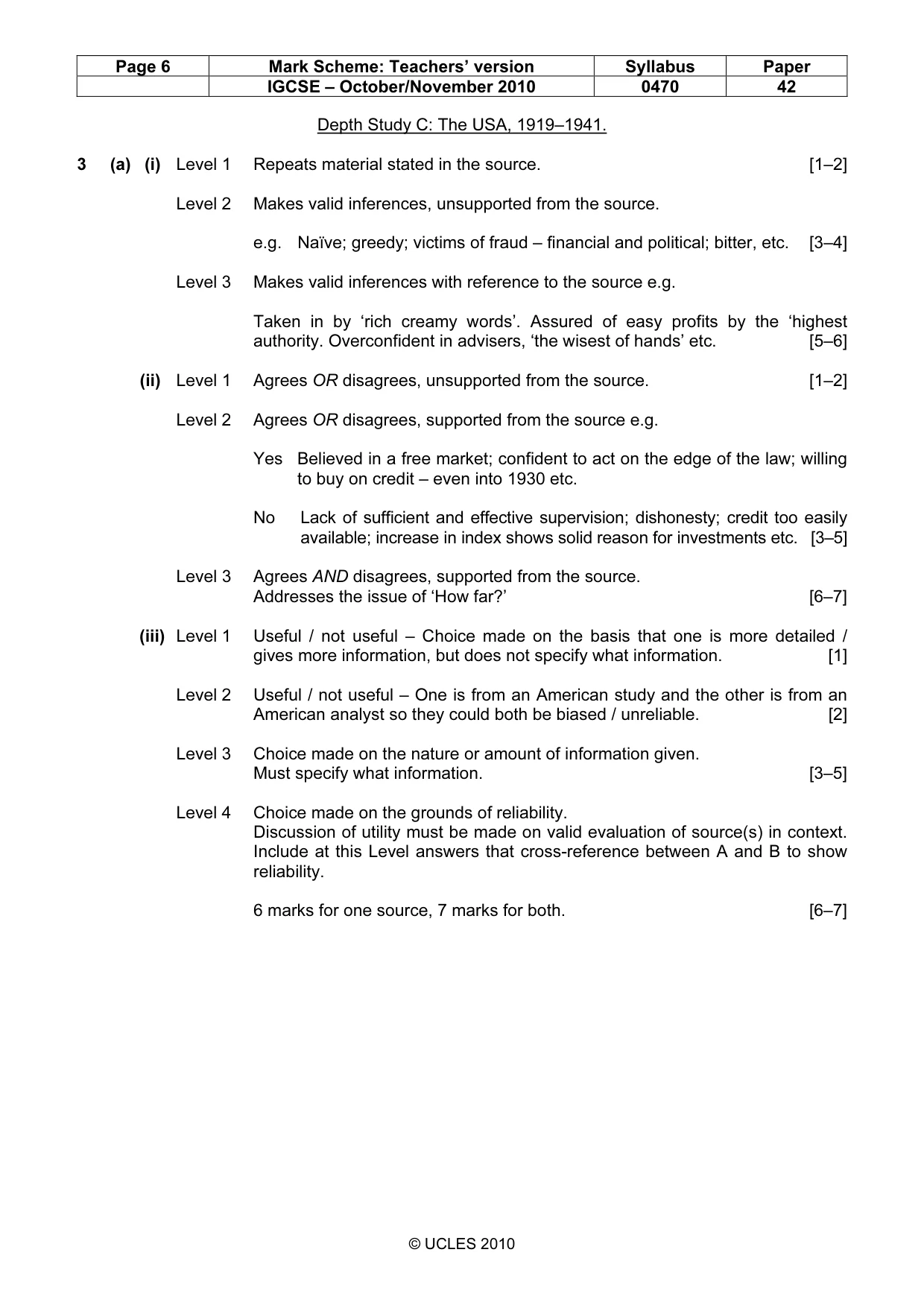
Page 6 Mark Scheme: Teachers’ version Syllabus Paper IGCSE – October/November 2010 0470 42 © UCLES 2010 Depth Study C: The USA, 1919–1941. 3 (a) (i) Level 1 Repeats material stated in the source. [1–2] Level 2 Makes valid inferences, unsupported from the source. e.g. Naïve; greedy; victims of fraud – financial and political; bitter, etc. [3–4] Level 3 Makes valid inferences with reference to the source e.g. Taken in by ‘rich creamy words’. Assured of easy profits by the ‘highest authority. Overconfident in advisers, ‘the wisest of hands’ etc. [5–6] (ii) Level 1 Agrees OR disagrees, unsupported from the source. [1–2] Level 2 Agrees OR disagrees, supported from the source e.g. Yes Believed in a free market; confident to act on the edge of the law; willing to buy on credit – even into 1930 etc. No Lack of sufficient and effective supervision; dishonesty; credit too easily available; increase in index shows solid reason for investments etc. [3–5] Level 3 Agrees AND disagrees, supported from the source. Addresses the issue of ‘How far?’ [6–7] (iii) Level 1 Useful / not useful – Choice made on the basis that one is more detailed / gives more information, but does not specify what information. [1] Level 2 Useful / not useful – One is from an American study and the other is from an American analyst so they could both be biased / unreliable. [2] Level 3 Choice made on the nature or amount of information given. Must specify what information. [3–5] Level 4 Choice made on the grounds of reliability. Discussion of utility must be made on valid evaluation of source(s) in context. Include at this Level answers that cross-reference between A and B to show reliability. 6 marks for one source, 7 marks for both. [6–7]
Mark scheme, page 7
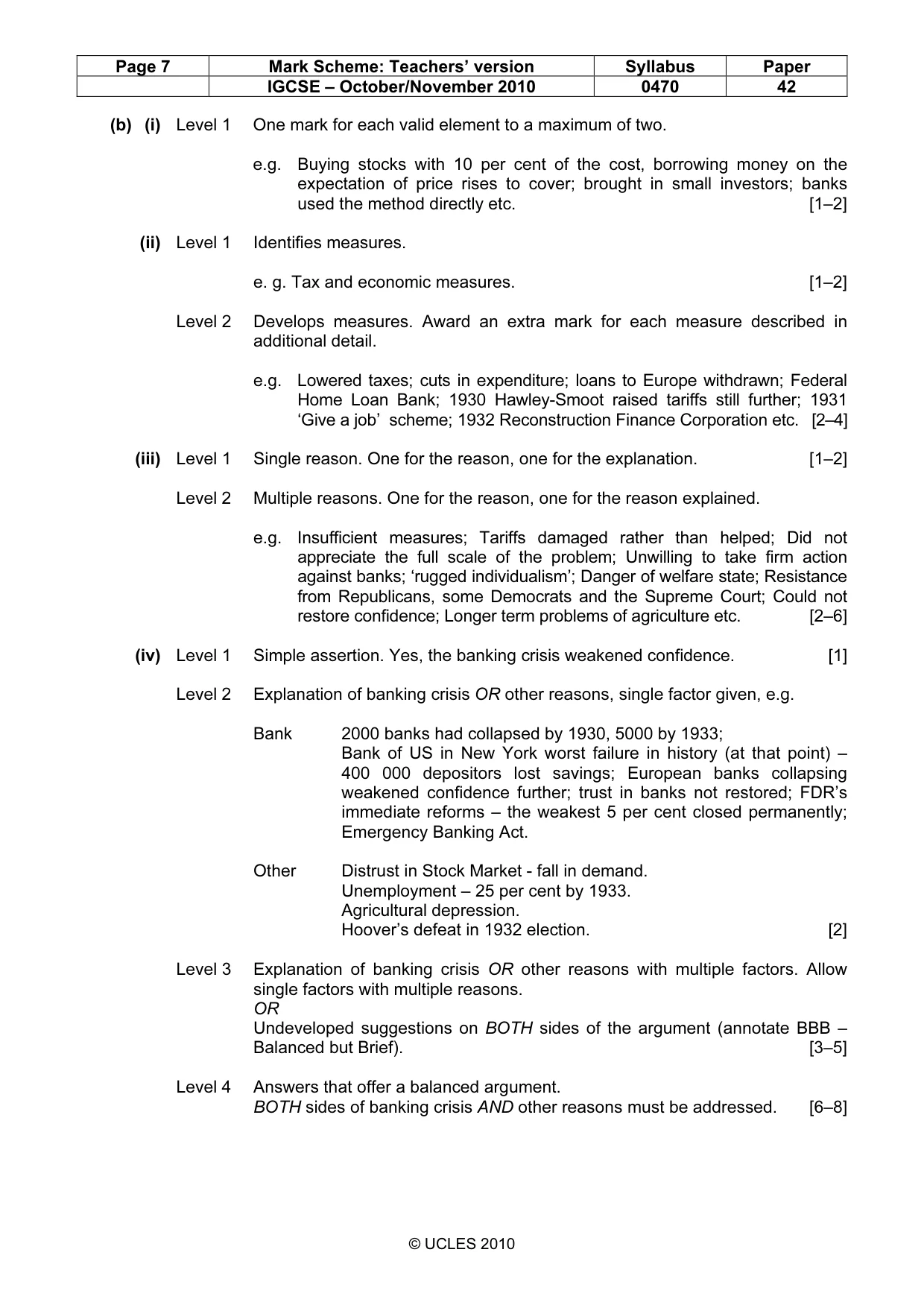
Page 7 Mark Scheme: Teachers’ version Syllabus Paper IGCSE – October/November 2010 0470 42 © UCLES 2010 (b) (i) Level 1 One mark for each valid element to a maximum of two. e.g. Buying stocks with 10 per cent of the cost, borrowing money on the expectation of price rises to cover; brought in small investors; banks used the method directly etc. [1–2] (ii) Level 1 Identifies measures. e. g. Tax and economic measures. [1–2] Level 2 Develops measures. Award an extra mark for each measure described in additional detail. e.g. Lowered taxes; cuts in expenditure; loans to Europe withdrawn; Federal Home Loan Bank; 1930 Hawley-Smoot raised tariffs still further; 1931 ‘Give a job’ scheme; 1932 Reconstruction Finance Corporation etc. [2–4] (iii) Level 1 Single reason. One for the reason, one for the explanation. [1–2] Level 2 Multiple reasons. One for the reason, one for the reason explained. e.g. Insufficient measures; Tariffs damaged rather than helped; Did not appreciate the full scale of the problem; Unwilling to take firm action against banks; ‘rugged individualism’; Danger of welfare state; Resistance from Republicans, some Democrats and the Supreme Court; Could not restore confidence; Longer term problems of agriculture etc. [2–6] (iv) Level 1 Simple assertion. Yes, the banking crisis weakened confidence. [1] Level 2 Explanation of banking crisis OR other reasons, single factor given, e.g. Bank 2000 banks had collapsed by 1930, 5000 by 1933; Bank of US in New York worst failure in history (at that point) – 400 000 depositors lost savings; European banks collapsing weakened confidence further; trust in banks not restored; FDR’s immediate reforms – the weakest 5 per cent closed permanently; Emergency Banking Act. Other Distrust in Stock Market - fall in demand. Unemployment – 25 per cent by 1933. Agricultural depression. Hoover’s defeat in 1932 election. [2] Level 3 Explanation of banking crisis OR other reasons with multiple factors. Allow single factors with multiple reasons. OR Undeveloped suggestions on BOTH sides of the argument (annotate BBB – Balanced but Brief). [3–5] Level 4 Answers that offer a balanced argument. BOTH sides of banking crisis AND other reasons must be addressed. [6–8]
Mark scheme, page 8
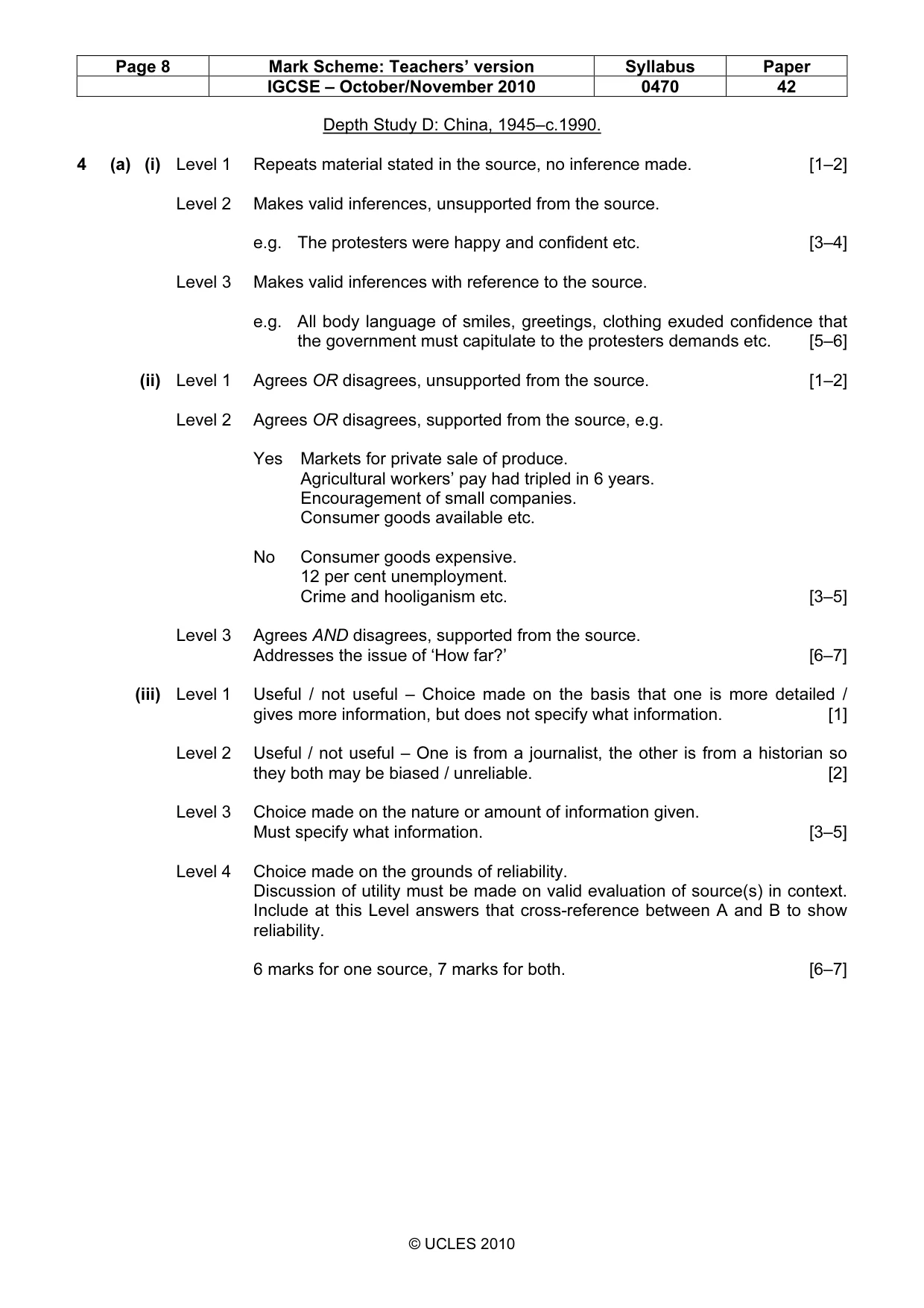
Page 8 Mark Scheme: Teachers’ version Syllabus Paper IGCSE – October/November 2010 0470 42 © UCLES 2010 Depth Study D: China, 1945–c.1990. 4 (a) (i) Level 1 Repeats material stated in the source, no inference made. [1–2] Level 2 Makes valid inferences, unsupported from the source. e.g. The protesters were happy and confident etc. [3–4] Level 3 Makes valid inferences with reference to the source. e.g. All body language of smiles, greetings, clothing exuded confidence that the government must capitulate to the protesters demands etc. [5–6] (ii) Level 1 Agrees OR disagrees, unsupported from the source. [1–2] Level 2 Agrees OR disagrees, supported from the source, e.g. Yes Markets for private sale of produce. Agricultural workers’ pay had tripled in 6 years. Encouragement of small companies. Consumer goods available etc. No Consumer goods expensive. 12 per cent unemployment. Crime and hooliganism etc. [3–5] Level 3 Agrees AND disagrees, supported from the source. Addresses the issue of ‘How far?’ [6–7] (iii) Level 1 Useful / not useful – Choice made on the basis that one is more detailed / gives more information, but does not specify what information. [1] Level 2 Useful / not useful – One is from a journalist, the other is from a historian so they both may be biased / unreliable. [2] Level 3 Choice made on the nature or amount of information given. Must specify what information. [3–5] Level 4 Choice made on the grounds of reliability. Discussion of utility must be made on valid evaluation of source(s) in context. Include at this Level answers that cross-reference between A and B to show reliability. 6 marks for one source, 7 marks for both. [6–7]
Mark scheme, page 9
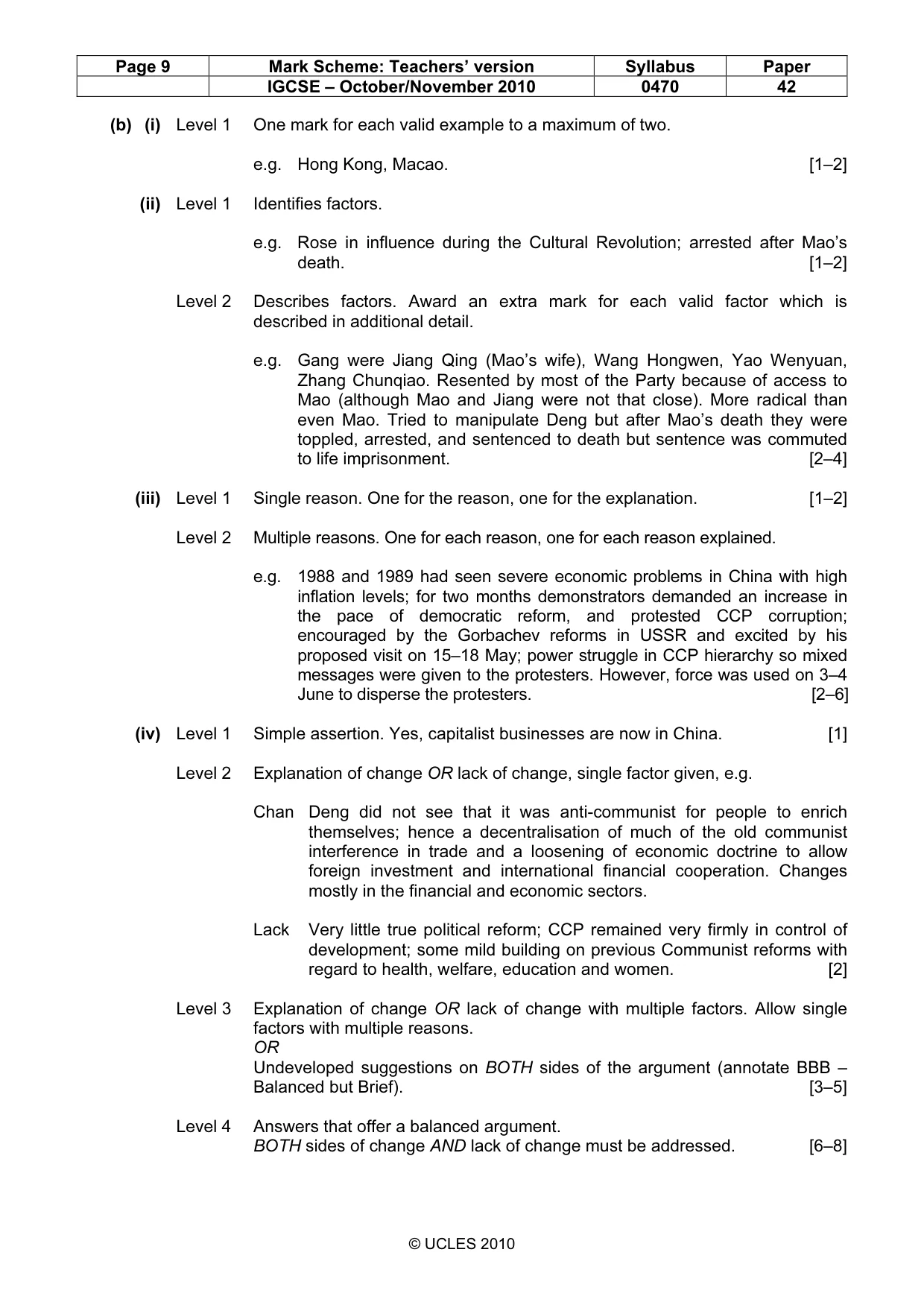
Page 9 Mark Scheme: Teachers’ version Syllabus Paper IGCSE – October/November 2010 0470 42 © UCLES 2010 (b) (i) Level 1 One mark for each valid example to a maximum of two. e.g. Hong Kong, Macao. [1–2] (ii) Level 1 Identifies factors. e.g. Rose in influence during the Cultural Revolution; arrested after Mao’s death. [1–2] Level 2 Describes factors. Award an extra mark for each valid factor which is described in additional detail. e.g. Gang were Jiang Qing (Mao’s wife), Wang Hongwen, Yao Wenyuan, Zhang Chunqiao. Resented by most of the Party because of access to Mao (although Mao and Jiang were not that close). More radical than even Mao. Tried to manipulate Deng but after Mao’s death they were toppled, arrested, and sentenced to death but sentence was commuted to life imprisonment. [2–4] (iii) Level 1 Single reason. One for the reason, one for the explanation. [1–2] Level 2 Multiple reasons. One for each reason, one for each reason explained. e.g. 1988 and 1989 had seen severe economic problems in China with high inflation levels; for two months demonstrators demanded an increase in the pace of democratic reform, and protested CCP corruption; encouraged by the Gorbachev reforms in USSR and excited by his proposed visit on 15–18 May; power struggle in CCP hierarchy so mixed messages were given to the protesters. However, force was used on 3–4 June to disperse the protesters. [2–6] (iv) Level 1 Simple assertion. Yes, capitalist businesses are now in China. [1] Level 2 Explanation of change OR lack of change, single factor given, e.g. Chan Deng did not see that it was anti-communist for people to enrich themselves; hence a decentralisation of much of the old communist interference in trade and a loosening of economic doctrine to allow foreign investment and international financial cooperation. Changes mostly in the financial and economic sectors. Lack Very little true political reform; CCP remained very firmly in control of development; some mild building on previous Communist reforms with regard to health, welfare, education and women. [2] Level 3 Explanation of change OR lack of change with multiple factors. Allow single factors with multiple reasons. OR Undeveloped suggestions on BOTH sides of the argument (annotate BBB – Balanced but Brief). [3–5] Level 4 Answers that offer a balanced argument. BOTH sides of change AND lack of change must be addressed. [6–8]
Mark scheme, page 10
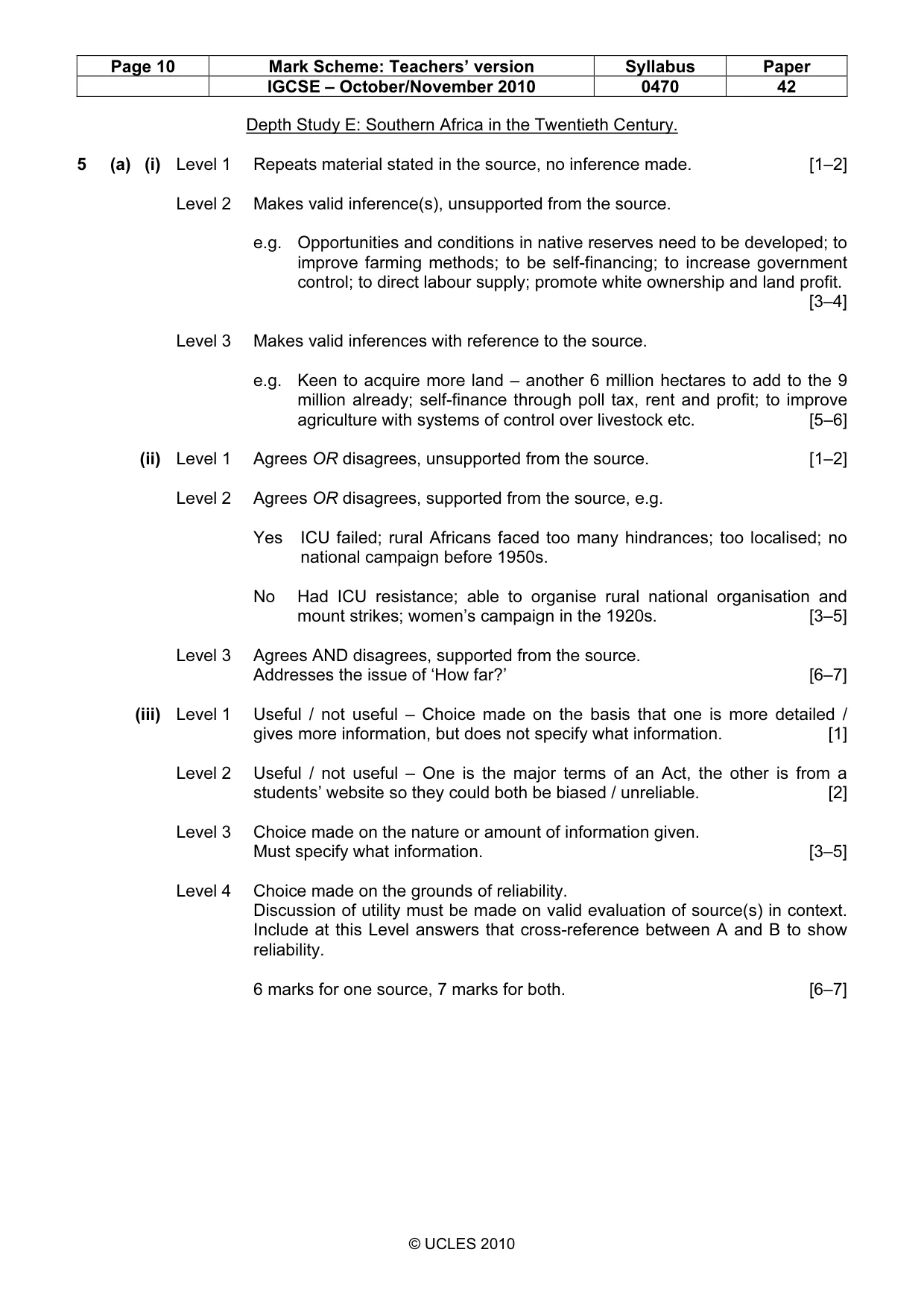
Page 10 Mark Scheme: Teachers’ version Syllabus Paper IGCSE – October/November 2010 0470 42 © UCLES 2010 Depth Study E: Southern Africa in the Twentieth Century. 5 (a) (i) Level 1 Repeats material stated in the source, no inference made. [1–2] Level 2 Makes valid inference(s), unsupported from the source. e.g. Opportunities and conditions in native reserves need to be developed; to improve farming methods; to be self-financing; to increase government control; to direct labour supply; promote white ownership and land profit. [3–4] Level 3 Makes valid inferences with reference to the source. e.g. Keen to acquire more land – another 6 million hectares to add to the 9 million already; self-finance through poll tax, rent and profit; to improve agriculture with systems of control over livestock etc. [5–6] (ii) Level 1 Agrees OR disagrees, unsupported from the source. [1–2] Level 2 Agrees OR disagrees, supported from the source, e.g. Yes ICU failed; rural Africans faced too many hindrances; too localised; no national campaign before 1950s. No Had ICU resistance; able to organise rural national organisation and mount strikes; women’s campaign in the 1920s. [3–5] Level 3 Agrees AND disagrees, supported from the source. Addresses the issue of ‘How far?’ [6–7] (iii) Level 1 Useful / not useful – Choice made on the basis that one is more detailed / gives more information, but does not specify what information. [1] Level 2 Useful / not useful – One is the major terms of an Act, the other is from a students’ website so they could both be biased / unreliable. [2] Level 3 Choice made on the nature or amount of information given. Must specify what information. [3–5] Level 4 Choice made on the grounds of reliability. Discussion of utility must be made on valid evaluation of source(s) in context. Include at this Level answers that cross-reference between A and B to show reliability. 6 marks for one source, 7 marks for both. [6–7]
Mark scheme, page 11
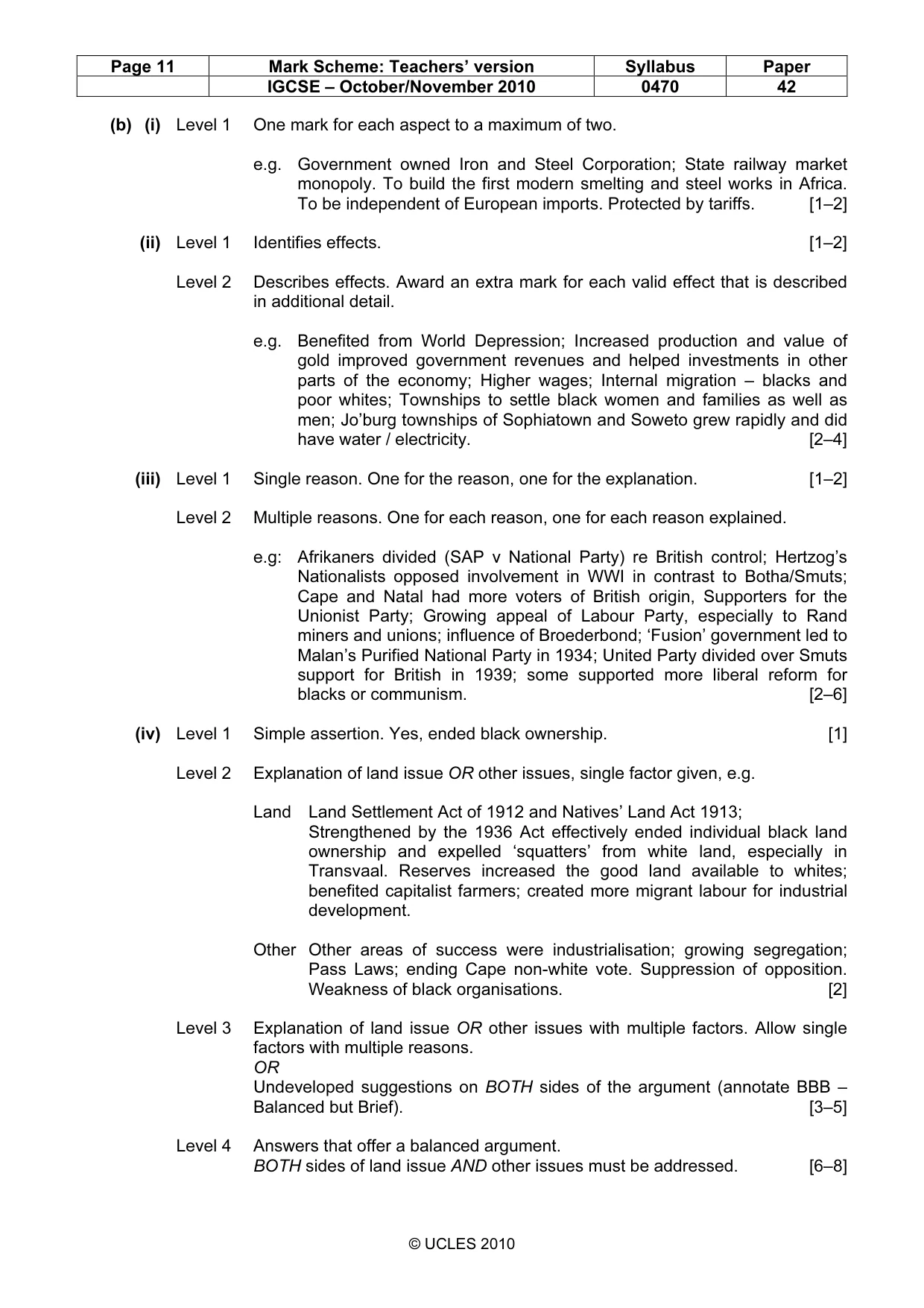
Page 11 Mark Scheme: Teachers’ version Syllabus Paper IGCSE – October/November 2010 0470 42 © UCLES 2010 (b) (i) Level 1 One mark for each aspect to a maximum of two. e.g. Government owned Iron and Steel Corporation; State railway market monopoly. To build the first modern smelting and steel works in Africa. To be independent of European imports. Protected by tariffs. [1–2] (ii) Level 1 Identifies effects. [1–2] Level 2 Describes effects. Award an extra mark for each valid effect that is described in additional detail. e.g. Benefited from World Depression; Increased production and value of gold improved government revenues and helped investments in other parts of the economy; Higher wages; Internal migration – blacks and poor whites; Townships to settle black women and families as well as men; Jo’burg townships of Sophiatown and Soweto grew rapidly and did have water / electricity. [2–4] (iii) Level 1 Single reason. One for the reason, one for the explanation. [1–2] Level 2 Multiple reasons. One for each reason, one for each reason explained. e.g: Afrikaners divided (SAP v National Party) re British control; Hertzog’s Nationalists opposed involvement in WWI in contrast to Botha/Smuts; Cape and Natal had more voters of British origin, Supporters for the Unionist Party; Growing appeal of Labour Party, especially to Rand miners and unions; influence of Broederbond; ‘Fusion’ government led to Malan’s Purified National Party in 1934; United Party divided over Smuts support for British in 1939; some supported more liberal reform for blacks or communism. [2–6] (iv) Level 1 Simple assertion. Yes, ended black ownership. [1] Level 2 Explanation of land issue OR other issues, single factor given, e.g. Land Land Settlement Act of 1912 and Natives’ Land Act 1913; Strengthened by the 1936 Act effectively ended individual black land ownership and expelled ‘squatters’ from white land, especially in Transvaal. Reserves increased the good land available to whites; benefited capitalist farmers; created more migrant labour for industrial development. Other Other areas of success were industrialisation; growing segregation; Pass Laws; ending Cape non-white vote. Suppression of opposition. Weakness of black organisations. [2] Level 3 Explanation of land issue OR other issues with multiple factors. Allow single factors with multiple reasons. OR Undeveloped suggestions on BOTH sides of the argument (annotate BBB – Balanced but Brief). [3–5] Level 4 Answers that offer a balanced argument. BOTH sides of land issue AND other issues must be addressed. [6–8]
Mark scheme, page 12
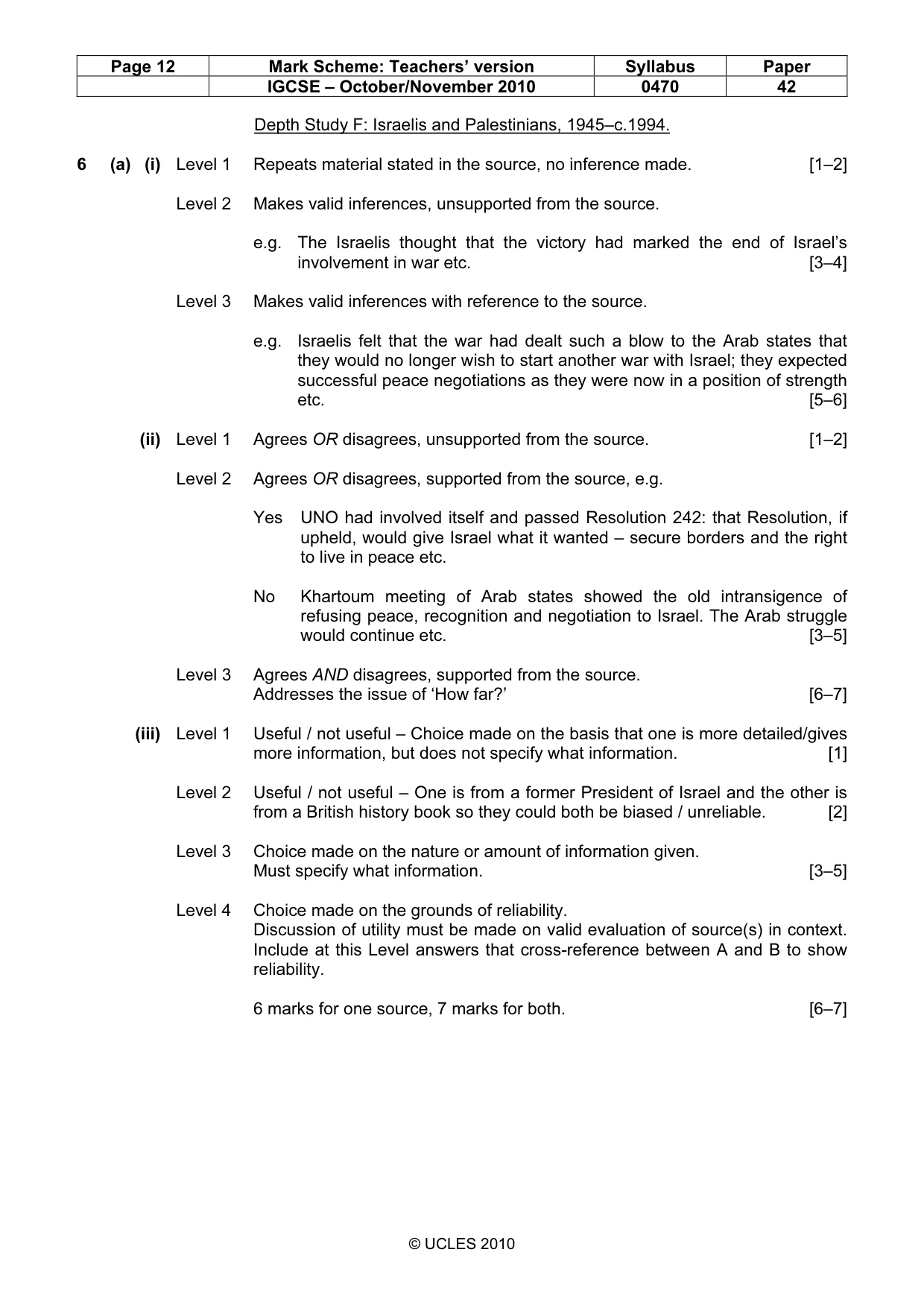
Page 12 Mark Scheme: Teachers’ version Syllabus Paper IGCSE – October/November 2010 0470 42 © UCLES 2010 Depth Study F: Israelis and Palestinians, 1945–c.1994. 6 (a) (i) Level 1 Repeats material stated in the source, no inference made. [1–2] Level 2 Makes valid inferences, unsupported from the source. e.g. The Israelis thought that the victory had marked the end of Israel’s involvement in war etc. [3–4] Level 3 Makes valid inferences with reference to the source. e.g. Israelis felt that the war had dealt such a blow to the Arab states that they would no longer wish to start another war with Israel; they expected successful peace negotiations as they were now in a position of strength etc. [5–6] (ii) Level 1 Agrees OR disagrees, unsupported from the source. [1–2] Level 2 Agrees OR disagrees, supported from the source, e.g. Yes UNO had involved itself and passed Resolution 242: that Resolution, if upheld, would give Israel what it wanted – secure borders and the right to live in peace etc. No Khartoum meeting of Arab states showed the old intransigence of refusing peace, recognition and negotiation to Israel. The Arab struggle would continue etc. [3–5] Level 3 Agrees AND disagrees, supported from the source. Addresses the issue of ‘How far?’ [6–7] (iii) Level 1 Useful / not useful – Choice made on the basis that one is more detailed/gives more information, but does not specify what information. [1] Level 2 Useful / not useful – One is from a former President of Israel and the other is from a British history book so they could both be biased / unreliable. [2] Level 3 Choice made on the nature or amount of information given. Must specify what information. [3–5] Level 4 Choice made on the grounds of reliability. Discussion of utility must be made on valid evaluation of source(s) in context. Include at this Level answers that cross-reference between A and B to show reliability. 6 marks for one source, 7 marks for both. [6–7]
Mark scheme, page 13
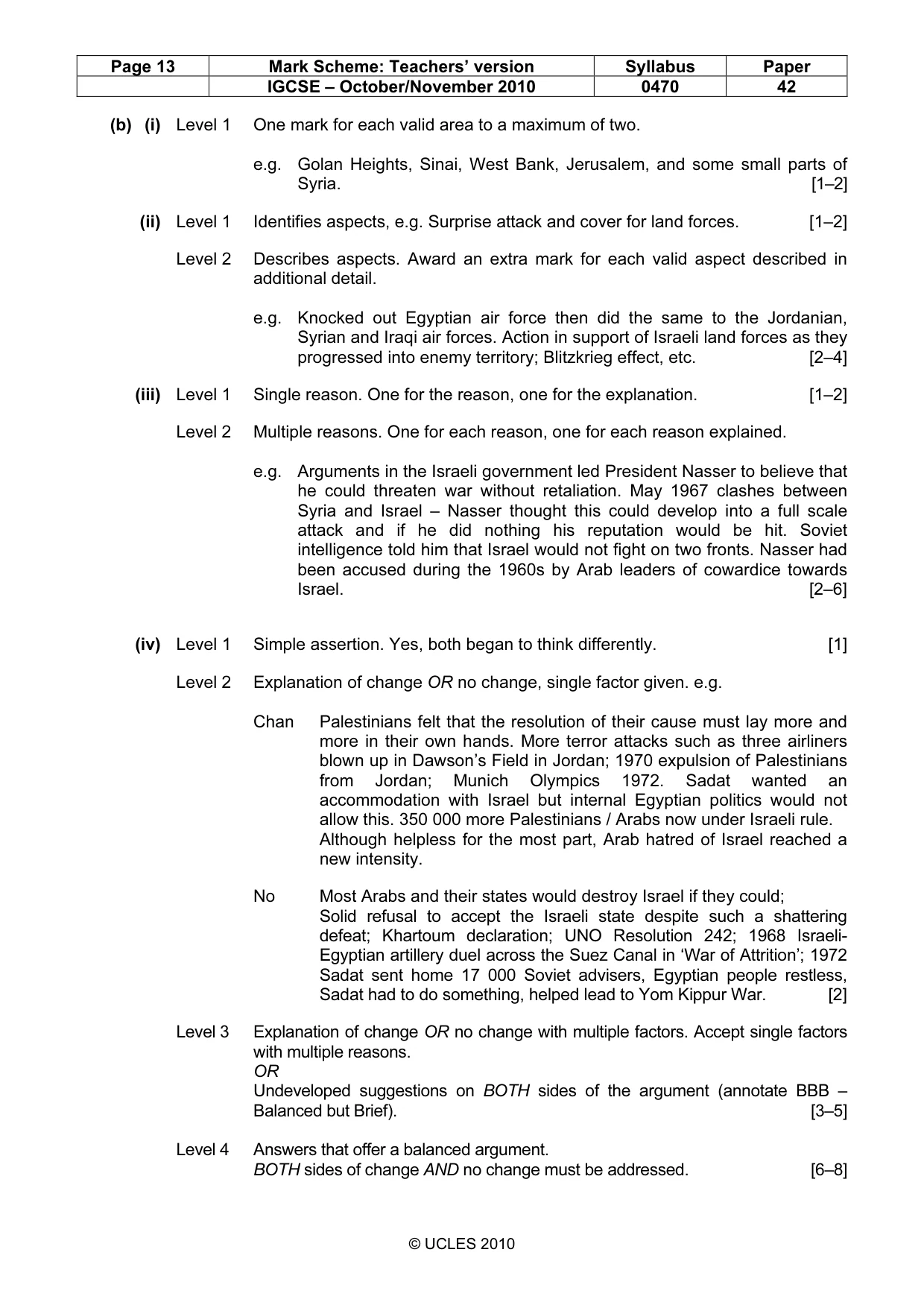
Page 13 Mark Scheme: Teachers’ version Syllabus Paper IGCSE – October/November 2010 0470 42 © UCLES 2010 (b) (i) Level 1 One mark for each valid area to a maximum of two. e.g. Golan Heights, Sinai, West Bank, Jerusalem, and some small parts of Syria. [1–2] (ii) Level 1 Identifies aspects, e.g. Surprise attack and cover for land forces. [1–2] Level 2 Describes aspects. Award an extra mark for each valid aspect described in additional detail. e.g. Knocked out Egyptian air force then did the same to the Jordanian, Syrian and Iraqi air forces. Action in support of Israeli land forces as they progressed into enemy territory; Blitzkrieg effect, etc. [2–4] (iii) Level 1 Single reason. One for the reason, one for the explanation. [1–2] Level 2 Multiple reasons. One for each reason, one for each reason explained. e.g. Arguments in the Israeli government led President Nasser to believe that he could threaten war without retaliation. May 1967 clashes between Syria and Israel – Nasser thought this could develop into a full scale attack and if he did nothing his reputation would be hit. Soviet intelligence told him that Israel would not fight on two fronts. Nasser had been accused during the 1960s by Arab leaders of cowardice towards Israel. [2–6] (iv) Level 1 Simple assertion. Yes, both began to think differently. [1] Level 2 Explanation of change OR no change, single factor given. e.g. Chan Palestinians felt that the resolution of their cause must lay more and more in their own hands. More terror attacks such as three airliners blown up in Dawson’s Field in Jordan; 1970 expulsion of Palestinians from Jordan; Munich Olympics 1972. Sadat wanted an accommodation with Israel but internal Egyptian politics would not allow this. 350 000 more Palestinians / Arabs now under Israeli rule. Although helpless for the most part, Arab hatred of Israel reached a new intensity. No Most Arabs and their states would destroy Israel if they could; Solid refusal to accept the Israeli state despite such a shattering defeat; Khartoum declaration; UNO Resolution 242; 1968 Israeli- Egyptian artillery duel across the Suez Canal in ‘War of Attrition’; 1972 Sadat sent home 17 000 Soviet advisers, Egyptian people restless, Sadat had to do something, helped lead to Yom Kippur War. [2] Level 3 Explanation of change OR no change with multiple factors. Accept single factors with multiple reasons. OR Undeveloped suggestions on BOTH sides of the argument (annotate BBB – Balanced but Brief). [3–5] Level 4 Answers that offer a balanced argument. BOTH sides of change AND no change must be addressed. [6–8]
Mark scheme, page 14
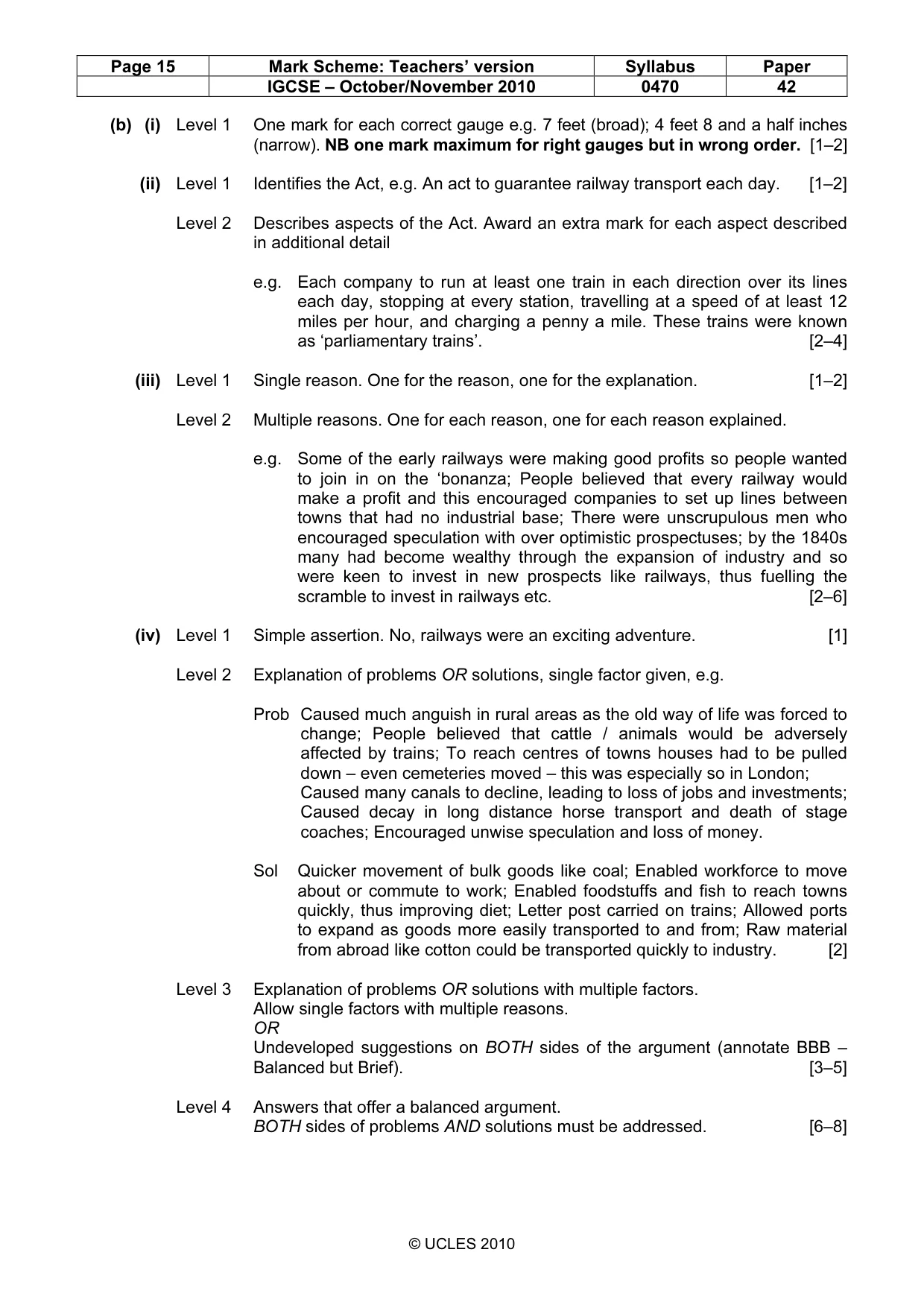
Page 14 Mark Scheme: Teachers’ version Syllabus Paper IGCSE – October/November 2010 0470 42 © UCLES 2010 Depth Study G: The Creation of Modern Industrial Society. 7 (a) (i) Level 1 Repeats material seen in source, no inference made. [1–2] Level 2 Makes valid inferences, unsupported from the source. e.g. There is a mixture of gauges and some more lines are planned etc. [3–4] Level 3 Makes valid inferences with reference to the source. e.g. A mixture of broad and narrow gauged railways have been built with broad gauge largely found from London westwards; very few lines in Wales and Cornwall except for South Wales etc. [5–6] (ii) Level 1 Agrees OR disagrees, unsupported from the source. [1–2] Level 2 Agrees OR disagrees, supported from the source e.g. Yes The speaker has a vested interest but speaks of a new iron age; Dramatic claim of the world receiving a new impulse; sees it spreading all over etc. No There must be a debate as to whether the pastoral / agricultural life must give way to a new mechanical age; Calls pastoral life the ‘golden age’ etc. [3–5] Level 3 Agrees AND disagrees, supported from the source. Addresses the issue of ‘How far?’ [6–7] (iii) Level 1 Useful / not useful – Choice made on the basis that one is more detailed / gives more information, but does not specify what information. [1] Level 2 Useful / not useful – A is a map, B is a speech and C is from a history book so they could all be biased / unreliable. [2] Level 3 Choice made on the nature or amount of information given. Must specify what information. [3–5] Level 4 Choice made on the grounds of reliability. Discussion of utility must be made on valid evaluation of source(s) in context. Include at this Level answers that cross-reference between A, B and C to show reliability. 6 marks for one source, 7 marks for both. [6–7]
Mark scheme, page 15
Page 15 Mark Scheme: Teachers’ version Syllabus Paper IGCSE – October/November 2010 0470 42 © UCLES 2010 (b) (i) Level 1 One mark for each correct gauge e.g. 7 feet (broad); 4 feet 8 and a half inches (narrow). NB one mark maximum for right gauges but in wrong order. [1–2] (ii) Level 1 Identifies the Act, e.g. An act to guarantee railway transport each day. [1–2] Level 2 Describes aspects of the Act. Award an extra mark for each aspect described in additional detail e.g. Each company to run at least one train in each direction over its lines each day, stopping at every station, travelling at a speed of at least 12 miles per hour, and charging a penny a mile. These trains were known as ‘parliamentary trains’. [2–4] (iii) Level 1 Single reason. One for the reason, one for the explanation. [1–2] Level 2 Multiple reasons. One for each reason, one for each reason explained. e.g. Some of the early railways were making good profits so people wanted to join in on the ‘bonanza; People believed that every railway would make a profit and this encouraged companies to set up lines between towns that had no industrial base; There were unscrupulous men who encouraged speculation with over optimistic prospectuses; by the 1840s many had become wealthy through the expansion of industry and so were keen to invest in new prospects like railways, thus fuelling the scramble to invest in railways etc. [2–6] (iv) Level 1 Simple assertion. No, railways were an exciting adventure. [1] Level 2 Explanation of problems OR solutions, single factor given, e.g. Prob Caused much anguish in rural areas as the old way of life was forced to change; People believed that cattle / animals would be adversely affected by trains; To reach centres of towns houses had to be pulled down – even cemeteries moved – this was especially so in London; Caused many canals to decline, leading to loss of jobs and investments; Caused decay in long distance horse transport and death of stage coaches; Encouraged unwise speculation and loss of money. Sol Quicker movement of bulk goods like coal; Enabled workforce to move about or commute to work; Enabled foodstuffs and fish to reach towns quickly, thus improving diet; Letter post carried on trains; Allowed ports to expand as goods more easily transported to and from; Raw material from abroad like cotton could be transported quickly to industry. [2] Level 3 Explanation of problems OR solutions with multiple factors. Allow single factors with multiple reasons. OR Undeveloped suggestions on BOTH sides of the argument (annotate BBB – Balanced but Brief). [3–5] Level 4 Answers that offer a balanced argument. BOTH sides of problems AND solutions must be addressed. [6–8]
Mark scheme, page 16
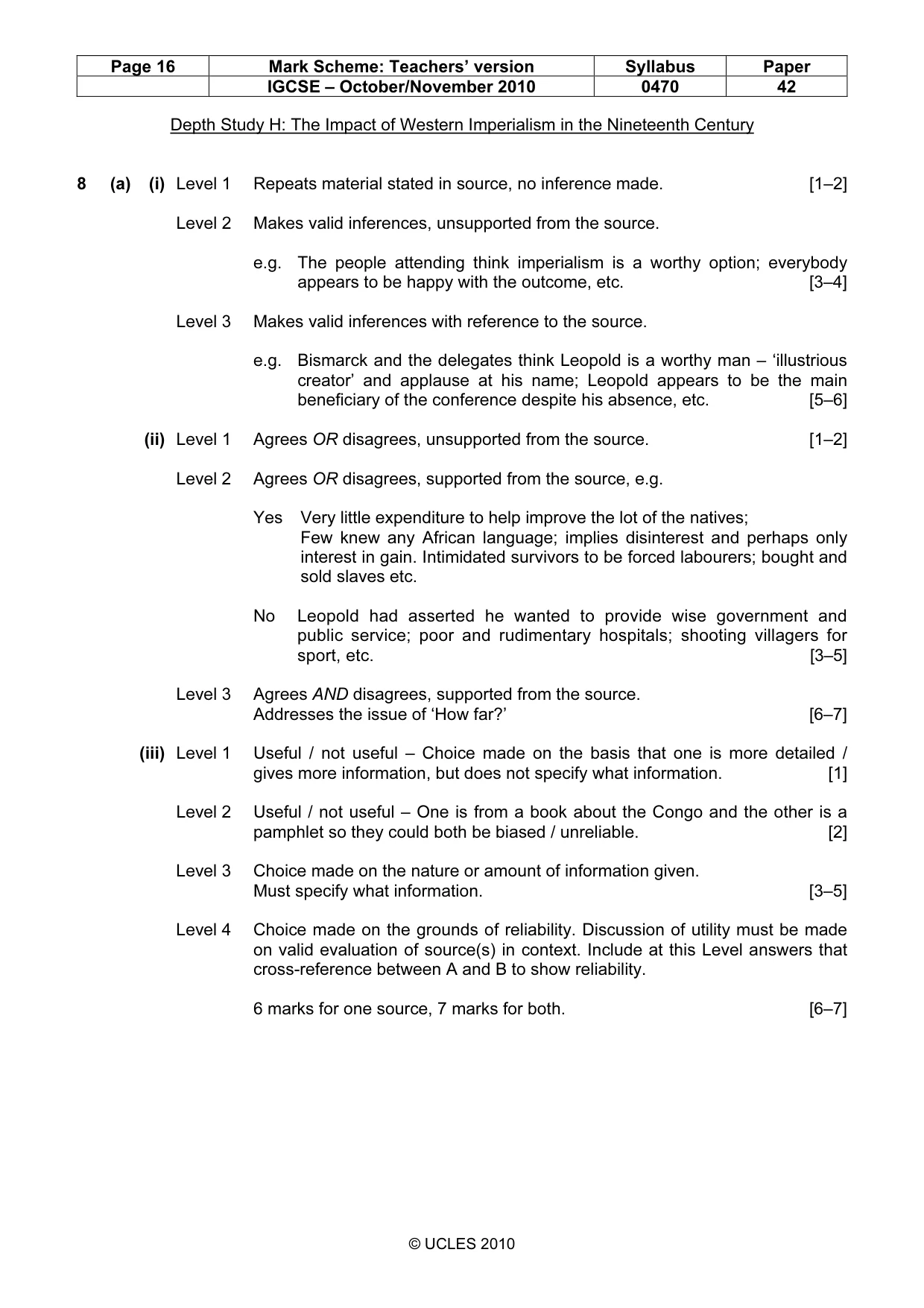
Page 16 Mark Scheme: Teachers’ version Syllabus Paper IGCSE – October/November 2010 0470 42 © UCLES 2010 Depth Study H: The Impact of Western Imperialism in the Nineteenth Century 8 (a) (i) Level 1 Repeats material stated in source, no inference made. [1–2] Level 2 Makes valid inferences, unsupported from the source. e.g. The people attending think imperialism is a worthy option; everybody appears to be happy with the outcome, etc. [3–4] Level 3 Makes valid inferences with reference to the source. e.g. Bismarck and the delegates think Leopold is a worthy man – ‘illustrious creator’ and applause at his name; Leopold appears to be the main beneficiary of the conference despite his absence, etc. [5–6] (ii) Level 1 Agrees OR disagrees, unsupported from the source. [1–2] Level 2 Agrees OR disagrees, supported from the source, e.g. Yes Very little expenditure to help improve the lot of the natives; Few knew any African language; implies disinterest and perhaps only interest in gain. Intimidated survivors to be forced labourers; bought and sold slaves etc. No Leopold had asserted he wanted to provide wise government and public service; poor and rudimentary hospitals; shooting villagers for sport, etc. [3–5] Level 3 Agrees AND disagrees, supported from the source. Addresses the issue of ‘How far?’ [6–7] (iii) Level 1 Useful / not useful – Choice made on the basis that one is more detailed / gives more information, but does not specify what information. [1] Level 2 Useful / not useful – One is from a book about the Congo and the other is a pamphlet so they could both be biased / unreliable. [2] Level 3 Choice made on the nature or amount of information given. Must specify what information. [3–5] Level 4 Choice made on the grounds of reliability. Discussion of utility must be made on valid evaluation of source(s) in context. Include at this Level answers that cross-reference between A and B to show reliability. 6 marks for one source, 7 marks for both. [6–7]
Mark scheme, page 17
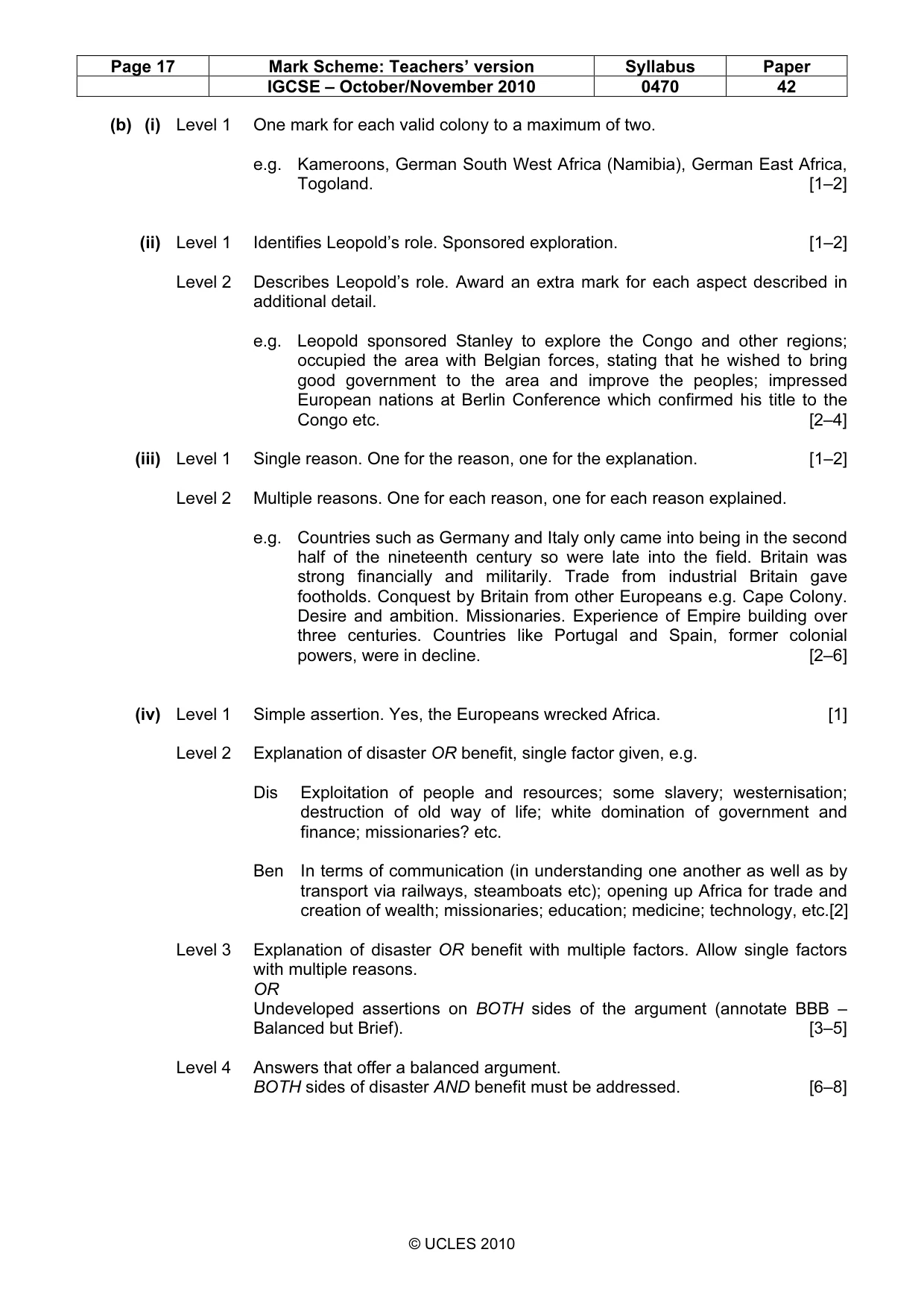
Page 17 Mark Scheme: Teachers’ version Syllabus Paper IGCSE – October/November 2010 0470 42 © UCLES 2010 (b) (i) Level 1 One mark for each valid colony to a maximum of two. e.g. Kameroons, German South West Africa (Namibia), German East Africa, Togoland. [1–2] (ii) Level 1 Identifies Leopold’s role. Sponsored exploration. [1–2] Level 2 Describes Leopold’s role. Award an extra mark for each aspect described in additional detail. e.g. Leopold sponsored Stanley to explore the Congo and other regions; occupied the area with Belgian forces, stating that he wished to bring good government to the area and improve the peoples; impressed European nations at Berlin Conference which confirmed his title to the Congo etc. [2–4] (iii) Level 1 Single reason. One for the reason, one for the explanation. [1–2] Level 2 Multiple reasons. One for each reason, one for each reason explained. e.g. Countries such as Germany and Italy only came into being in the second half of the nineteenth century so were late into the field. Britain was strong financially and militarily. Trade from industrial Britain gave footholds. Conquest by Britain from other Europeans e.g. Cape Colony. Desire and ambition. Missionaries. Experience of Empire building over three centuries. Countries like Portugal and Spain, former colonial powers, were in decline. [2–6] (iv) Level 1 Simple assertion. Yes, the Europeans wrecked Africa. [1] Level 2 Explanation of disaster OR benefit, single factor given, e.g. Dis Exploitation of people and resources; some slavery; westernisation; destruction of old way of life; white domination of government and finance; missionaries? etc. Ben In terms of communication (in understanding one another as well as by transport via railways, steamboats etc); opening up Africa for trade and creation of wealth; missionaries; education; medicine; technology, etc.[2] Level 3 Explanation of disaster OR benefit with multiple factors. Allow single factors with multiple reasons. OR Undeveloped assertions on BOTH sides of the argument (annotate BBB – Balanced but Brief). [3–5] Level 4 Answers that offer a balanced argument. BOTH sides of disaster AND benefit must be addressed. [6–8]
What you needed in this session
Cambridge’s own grade thresholds for 2010 Oct/Nov, Paper 4 · Variant 2. A higher threshold means an easier paper — the bar moves with how the cohort did.