Cambridge IGCSE History 0470 — 2010 Oct/Nov Paper 4 · Variant 1
0470/41/O/N/10 · 40 marks · ≈45 min
The question paper and its mark scheme, free to read here and free to download. This is Cambridge’s own paper, exactly as it was sat.
Question paper16 pages


Mark scheme17 pages
Answers below. Sit the paper first if you are practising.
Paper as text
Question paper, page 1
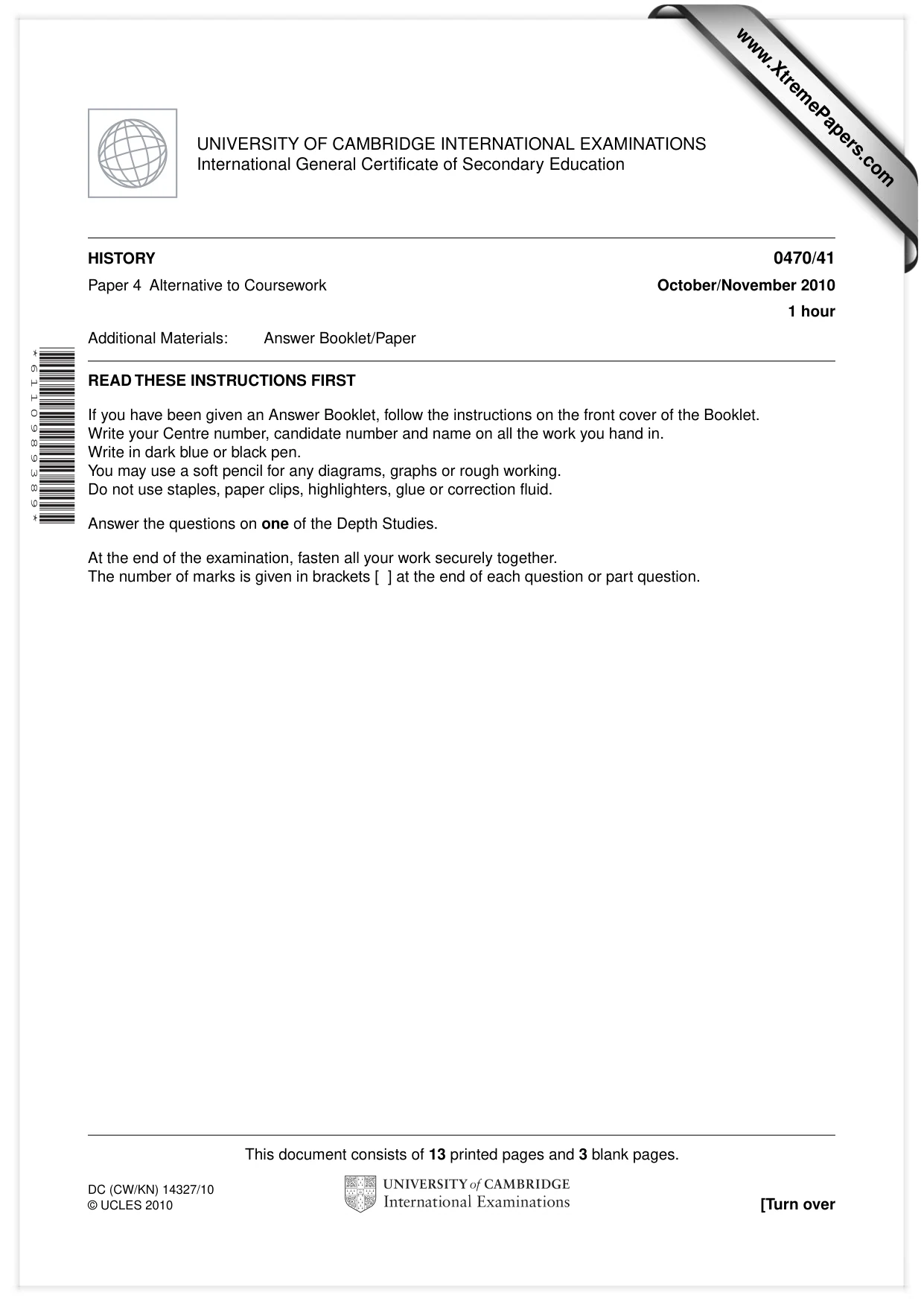
This document consists of 13 printed pages and 3 blank pages. DC (CW/KN) 14327/10 © UCLES 2010 [Turn over UNIVERSITY OF CAMBRIDGE INTERNATIONAL EXAMINATIONS International General Certificate of Secondary Education READ THESE INSTRUCTIONS FIRST If you have been given an Answer Booklet, follow the instructions on the front cover of the Booklet. Write your Centre number, candidate number and name on all the work you hand in. Write in dark blue or black pen. You may use a soft pencil for any diagrams, graphs or rough working. Do not use staples, paper clips, highlighters, glue or correction fluid. Answer the questions on one of the Depth Studies. At the end of the examination, fasten all your work securely together. The number of marks is given in brackets [ ] at the end of each question or part question. * 6 1 1 0 9 8 9 3 8 9 * HISTORY 0470/41 Paper 4 Alternative to Coursework October/November 2010 1 hour Additional Materials: Answer Booklet/Paper www.XtremePapers.com
Question paper, page 2
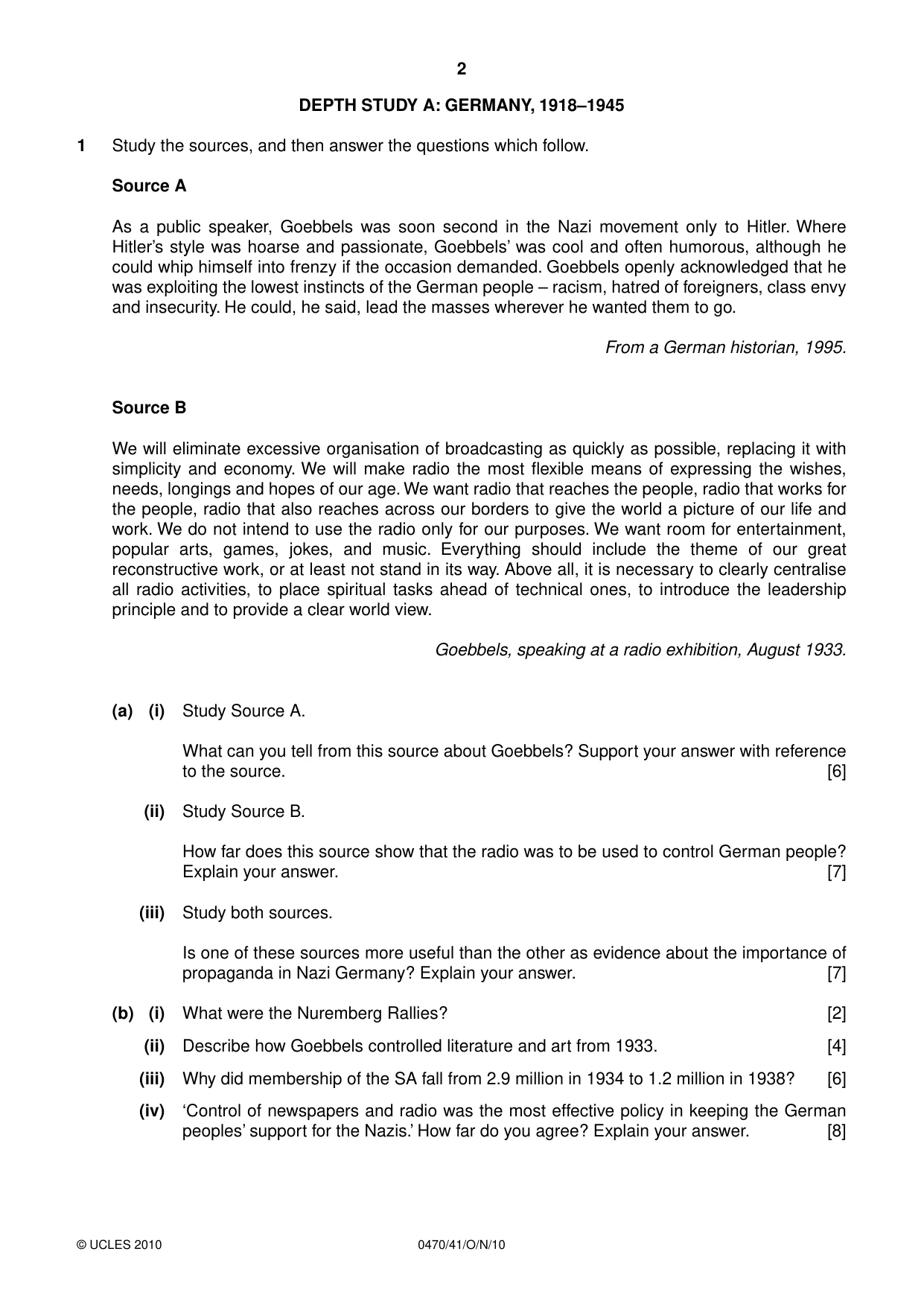
2 0470/41/O/N/10 © UCLES 2010 DEPTH STUDY A: GERMANY, 1918–1945 1 Study the sources, and then answer the questions which follow. Source A As a public speaker, Goebbels was soon second in the Nazi movement only to Hitler. Where Hitler’s style was hoarse and passionate, Goebbels’ was cool and often humorous, although he could whip himself into frenzy if the occasion demanded. Goebbels openly acknowledged that he was exploiting the lowest instincts of the German people – racism, hatred of foreigners, class envy and insecurity. He could, he said, lead the masses wherever he wanted them to go. From a German historian, 1995. Source B We will eliminate excessive organisation of broadcasting as quickly as possible, replacing it with simplicity and economy. We will make radio the most flexible means of expressing the wishes, needs, longings and hopes of our age. We want radio that reaches the people, radio that works for the people, radio that also reaches across our borders to give the world a picture of our life and work. We do not intend to use the radio only for our purposes. We want room for entertainment, popular arts, games, jokes, and music. Everything should include the theme of our great reconstructive work, or at least not stand in its way. Above all, it is necessary to clearly centralise all radio activities, to place spiritual tasks ahead of technical ones, to introduce the leadership principle and to provide a clear world view. Goebbels, speaking at a radio exhibition, August 1933. (a) (i) Study Source A. What can you tell from this source about Goebbels? Support your answer with reference to the source. [6] (ii) Study Source B. How far does this source show that the radio was to be used to control German people? Explain your answer. [7] (iii) Study both sources. Is one of these sources more useful than the other as evidence about the importance of propaganda in Nazi Germany? Explain your answer. [7] (b) (i) What were the Nuremberg Rallies? [2] (ii) Describe how Goebbels controlled literature and art from 1933. [4] (iii) Why did membership of the SA fall from 2.9 million in 1934 to 1.2 million in 1938? [6] (iv) ‘Control of newspapers and radio was the most effective policy in keeping the German peoples’ support for the Nazis.’ How far do you agree? Explain your answer. [8]
Question paper, page 3
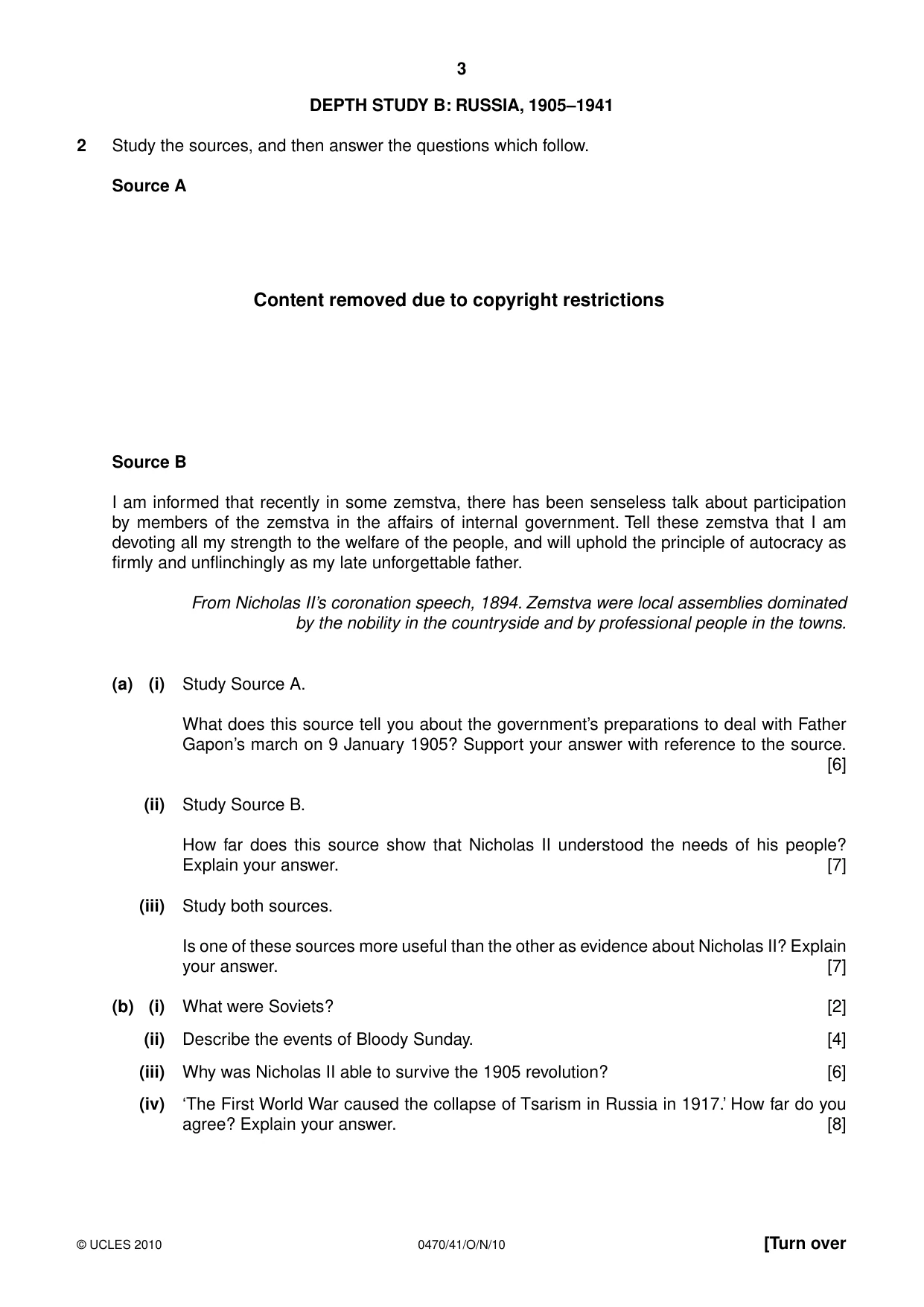
3 0470/41/O/N/10 © UCLES 2010 [Turn over DEPTH STUDY B: RUSSIA, 1905–1941 2 Study the sources, and then answer the questions which follow. Source A Source B I am informed that recently in some zemstva, there has been senseless talk about participation by members of the zemstva in the affairs of internal government. Tell these zemstva that I am devoting all my strength to the welfare of the people, and will uphold the principle of autocracy as firmly and unflinchingly as my late unforgettable father. From Nicholas II’s coronation speech, 1894. Zemstva were local assemblies dominated by the nobility in the countryside and by professional people in the towns. (a) (i) Study Source A. What does this source tell you about the government’s preparations to deal with Father Gapon’s march on 9 January 1905? Support your answer with reference to the source. [6] (ii) Study Source B. How far does this source show that Nicholas II understood the needs of his people? Explain your answer. [7] (iii) Study both sources. Is one of these sources more useful than the other as evidence about Nicholas II? Explain your answer. [7] (b) (i) What were Soviets? [2] (ii) Describe the events of Bloody Sunday. [4] (iii) Why was Nicholas II able to survive the 1905 revolution? [6] (iv) ‘The First World War caused the collapse of Tsarism in Russia in 1917.’ How far do you agree? Explain your answer. [8] Content removed due to copyright restrictions
Question paper, page 4
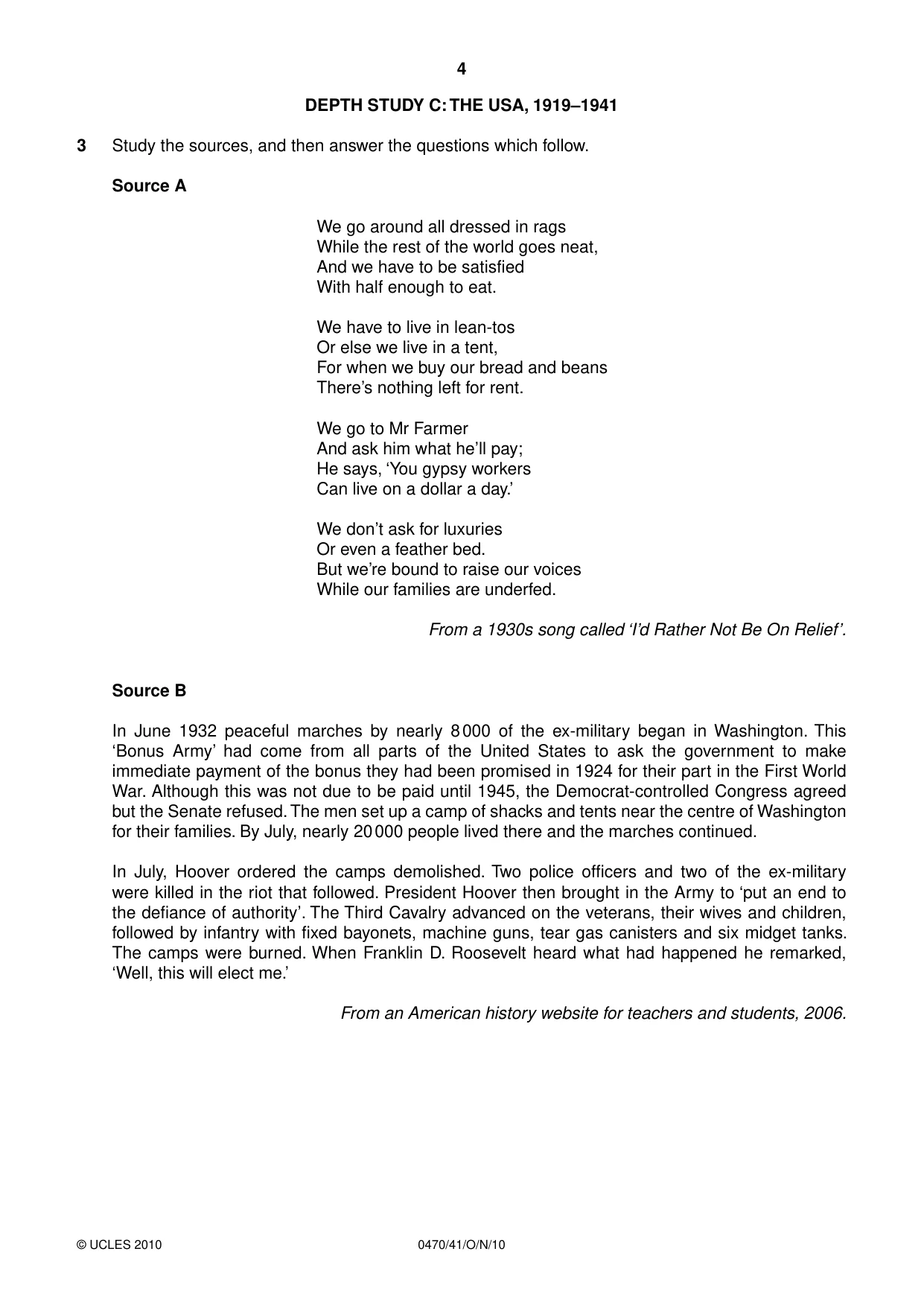
4 0470/41/O/N/10 © UCLES 2010 DEPTH STUDY C: THE USA, 1919–1941 3 Study the sources, and then answer the questions which follow. Source A We go around all dressed in rags While the rest of the world goes neat, And we have to be satisfied With half enough to eat. We have to live in lean-tos Or else we live in a tent, For when we buy our bread and beans There’s nothing left for rent. We go to Mr Farmer And ask him what he’ll pay; He says, ‘You gypsy workers Can live on a dollar a day.’ We don’t ask for luxuries Or even a feather bed. But we’re bound to raise our voices While our families are underfed. From a 1930s song called ‘I’d Rather Not Be On Relief’. Source B In June 1932 peaceful marches by nearly 8 000 of the ex-military began in Washington. This ‘Bonus Army’ had come from all parts of the United States to ask the government to make immediate payment of the bonus they had been promised in 1924 for their part in the First World War. Although this was not due to be paid until 1945, the Democrat-controlled Congress agreed but the Senate refused. The men set up a camp of shacks and tents near the centre of Washington for their families. By July, nearly 20 000 people lived there and the marches continued. In July, Hoover ordered the camps demolished. Two police officers and two of the ex-military were killed in the riot that followed. President Hoover then brought in the Army to ‘put an end to the defiance of authority’. The Third Cavalry advanced on the veterans, their wives and children, followed by infantry with fixed bayonets, machine guns, tear gas canisters and six midget tanks. The camps were burned. When Franklin D. Roosevelt heard what had happened he remarked, ‘Well, this will elect me.’ From an American history website for teachers and students, 2006.
Question paper, page 5
5 0470/41/O/N/10 © UCLES 2010 [Turn over (a) (i) Study Source A. What can you tell from this source about the unemployed in the 1930s? Support your answer with reference to the source. [6] (ii) Study Source B. How far does this source show that the Bonus Army was a threat to Hoover’s government? Explain your answer. [7] (iii) Study both sources. Is one of these sources more useful than the other as evidence about poverty in the 1930s? Explain your answer. [7] (b) (i) What were ‘Fireside Chats’? [2] (ii) What was done in 1933 about the banking crisis? [4] (iii) Why did most New Deal Agencies last only a short time? [6] (iv) ‘Reducing the problem of unemployment was the main success of the New Deal.’ How far do you agree? Explain your answer. [8]
Question paper, page 6
6 0470/41/O/N/10 © UCLES 2010 DEPTH STUDY D: CHINA, 1945–c.1990 4 Study the sources, and then answer the questions which follow. Source A In their meetings in 1949, Mao presented Stalin with the difficult problem of trying to understand someone from a completely different civilisation, culture and way of thinking. The philosophical conversations conducted by the Chinese were in riddles, obscure and unfamiliar to Stalin. He noticed Mao’s tendency to speak using proverbs and to refer to ancient philosophers, while Stalin was generally content to quote himself as the only required authority on any subject. From a Russian writer, 1995. Source B In June 1958, Chou En-lai wrote to ask Khrushchev for the technology and equipment to manufacture nuclear submarines, as well as aircraft carriers and other large warships. But this time Khrushchev did not just hand over what Mao asked for. Instead, he tried to make a deal to use China’s long coastline, which gave easy access to the high seas, unlike Russia’s. Khrushchev suggested that China could crew ships jointly with the Russians in return for these ships using Chinese ports. From a British book, written in 2005 by a British man and his wife who left China in 1978. (a) (i) Study Source A. What does this source tell you about the relationship between Mao and Stalin? Support your answer with reference to the source. [6] (ii) Study Source B. How far does this source show that there was co-operation between China and the USSR in 1958? Explain your answer. [7] (iii) Study both sources. Is one of these sources more useful than the other as evidence about relations between China and the USSR? Explain your answer. [7] (b) (i) Name two territories that have been restored to China by old imperial powers since 1945. [2] (ii) Describe briefly the relations between Communist China and Tibet in the period 1945–1990. [4] (iii) Why did the relationship between the Soviet Union and China deteriorate by 1960? [6] (iv) How far did relations between China and the USA improve in the period 1949–1990? Explain your answer. [8]
Question paper, page 7
7 0470/41/O/N/10 © UCLES 2010 [Turn over DEPTH STUDY E: SOUTHERN AFRICA IN THE TWENTIETH CENTURY 5 Study the sources, and then answer the questions which follow. Source A Weep Afrikaners! Here lies your flesh and blood! Martyred in the most brutal fashion. They were guilty says the earthly judge But what will the Heavenly Judge have to say? But come, it grows darker, If we sit here too long we shall be regarded as conspirators! Come, another day will dawn, Then we shall see their graves in another light. A poem to remember the 1816 Boer revolt against the British, taken from the first Afrikaans history published in 1877, the year the British annexed the Transvaal. Source B The first Anglo-Boer War ended with the Transvaal regaining its independence of the British in 1881. With the 1886 discovery of gold in the Transvaal, British, Boers, blacks and foreigners poured in and set up an overcrowded squatter settlement of tents and iron shacks called Ferreira’s Camp. Kruger’s government set limits on its area in a desperate attempt to slow down this flood of workers and fortune-seeking adventurers. So Johannesburg was born. In less than forty years it was the biggest city in South Africa with a population of more than 300 000. From an American history of South Africa, 1990. (a) (i) Study Source A. What impressions does this source give you of the Boers in the 1870s? Support your answer with reference to the source. [6] (ii) Study Source B. How far does this source show that the discovery of gold benefited the Transvaal? Explain your answer. [7] (iii) Study both sources. Is one of these sources more useful than the other as evidence about relations between the British and the Boers? Explain your answer. [7] (b) (i) What was De Beers? [2] (ii) Describe the development of the mining industry by the end of the nineteenth century. [4] (iii) Why was Cecil Rhodes important in South Africa by 1890? [6] (iv) ‘Britain caused the Second Boer War in 1899.’ How far do you agree? Explain your answer. [8]
Question paper, page 8
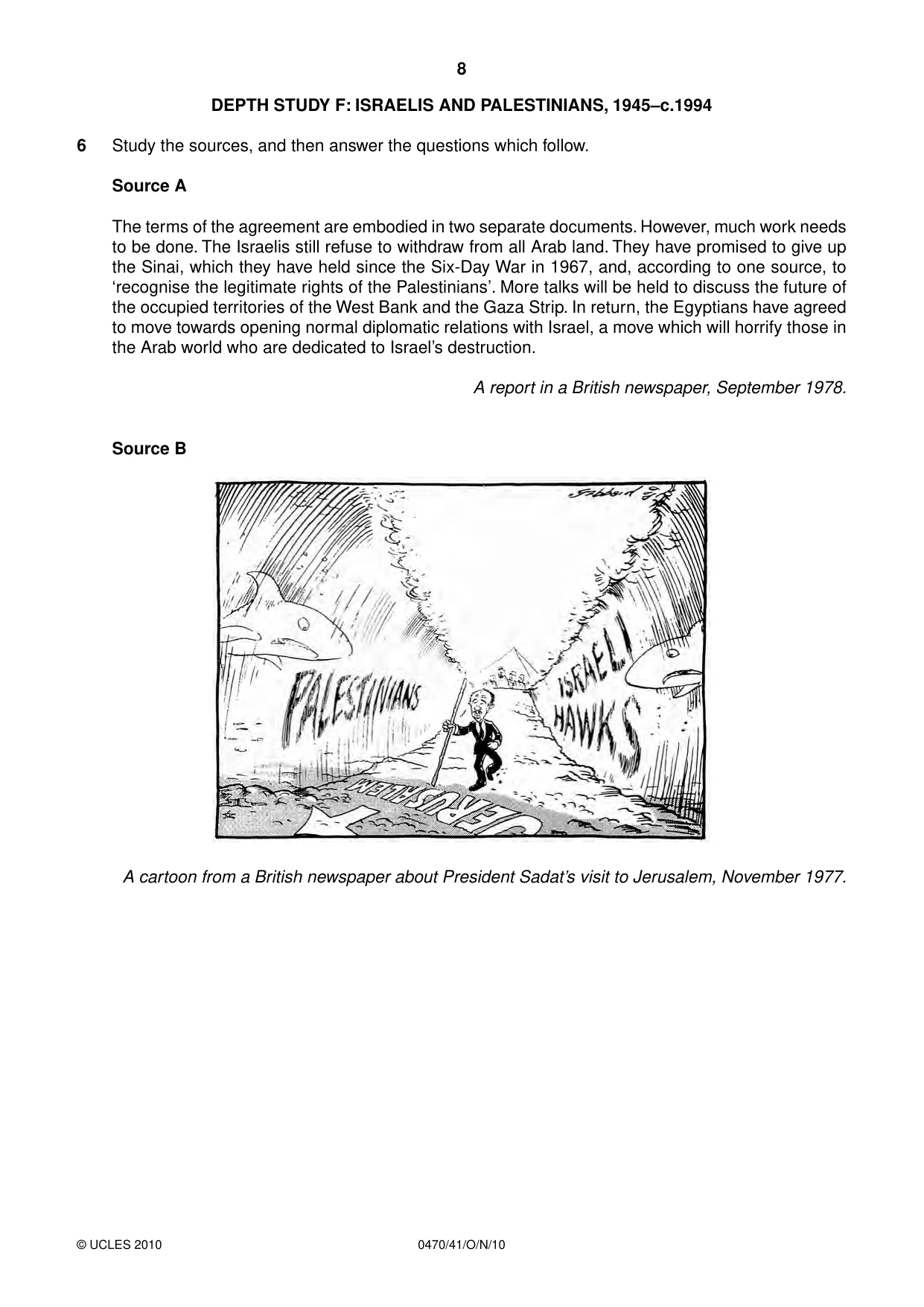
8 0470/41/O/N/10 © UCLES 2010 DEPTH STUDY F: ISRAELIS AND PALESTINIANS, 1945–c.1994 6 Study the sources, and then answer the questions which follow. Source A The terms of the agreement are embodied in two separate documents. However, much work needs to be done. The Israelis still refuse to withdraw from all Arab land. They have promised to give up the Sinai, which they have held since the Six-Day War in 1967, and, according to one source, to ‘recognise the legitimate rights of the Palestinians’. More talks will be held to discuss the future of the occupied territories of the West Bank and the Gaza Strip. In return, the Egyptians have agreed to move towards opening normal diplomatic relations with Israel, a move which will horrify those in the Arab world who are dedicated to Israel’s destruction. A report in a British newspaper, September 1978. Source B A cartoon from a British newspaper about President Sadat’s visit to Jerusalem, November 1977.
Question paper, page 9
9 0470/41/O/N/10 © UCLES 2010 [Turn over (a) (i) Study Source A. What does this source tell you about the efforts to make peace between Arabs and Israelis? Support your answer with reference to the source. [6] (ii) Study Source B. How far does this source show that Sadat’s efforts to make peace would be successful? Explain your answer. [7] (iii) Study both sources. Is one of these sources more useful than the other as evidence about relations between Israel and Egypt in the 1970s? Explain your answer. [7] (b) (i) What is Camp David? [2] (ii) Describe the role of President Carter at the Camp David negotiations in September 1978. [4] (iii) Why, by the late 1970s, was President Sadat ready to recognise the right of Israel to exist? [6] (iv) How far had the problems between Israel and its neighbours been settled by 1990? Explain your answer. [8]
Question paper, page 10
10 0470/41/O/N/10 © UCLES 2010 DEPTH STUDY G: THE CREATION OF MODERN INDUSTRIAL SOCIETY 7 Study the sources, and then answer the questions which follow. Source A The successful establishment of the Liverpool and Manchester Railway, with locomotive engines for passenger traffic, settled the question as to the value of this way of travelling. Great credit is due to the enterprising spirit of Lancashire capitalists for their perseverance against scientific doubts and opposition from powerful and interested parties. One engineer said, ‘No man in his right mind would attempt a railroad over Chat Moss.’ The bold and comprehensive genius of George Stephenson, backed by the capital of our Lancashire merchants and manufacturers, overcame the difficulty and it cost only £40 000. The number of passengers travelling this line by 1832 was 356 945 a year. Now the passenger traffic in the United Kingdom numbers about 60 million a year. From ‘Railways Past, Present and Prospective’, published in 1849. Source B The title page of a paper of evidence about railways put before the House of Commons in 1882.
Question paper, page 11
11 0470/41/O/N/10 © UCLES 2010 [Turn over (a) (i) Study Source A. What does this source tell you about the importance of the Liverpool and Manchester Railway? Support your answer with reference to the source. [6] (ii) Study Source B. How far does this source show that people opposed railways? Explain your answer. [7] (iii) Study both sources. Is one of these sources more useful than the other as evidence about the impact of railway development? Explain your answer. [7] (b) (i) Name two railway engineers or developers other than George Stephenson. [2] (ii) What difficulties did railway engineers have to overcome in building railways? [4] (iii) Why was there a great expansion of railway building in the 1840s and 1850s? [6] (iv) ‘Railways brought more disadvantages than benefits to working-class people.’ How far do you agree? Explain your answer. [8]
Question paper, page 12
12 0470/41/O/N/10 © UCLES 2010 DEPTH STUDY H: THE IMPACT OF WESTERN IMPERIALISM IN THE NINETEENTH CENTURY 8 Study the sources, and then answer the questions which follow. Source A Pile on the Brown Man’s burden And if you rouse his hate Meet his old-fashioned reasons With Maxims* – up to date With shells and Dum-Dum bullets A hundred times make plain The Brown Man’s loss must never Imply the White Man’s gain. * type of machine gun. From an English satirical poem called ‘Truth’, written in the 1880s. Source B I cannot repeat it often enough that to prepare a country for colonisation is a work needing time and patience. This is not the work of a day, or one for inexperienced men, however great their intelligence and good will. Quite apart from force being a bad method it is impossible to employ it in the interior of the country. What we have to avoid at all costs, is overthrowing in one day the work of ten years, for intervention by force in a work of patience and gentleness could lose everything at one go. From a speech given by the explorer Brazza in January 1886 about French colonisation of the Congo. Source C Bismarck began with a declaration that the aim of the conference was to promote the civilisation of the African natives by opening the interior of the continent to commerce and Christianity. Report on Bismarck opening the Berlin Conference in November 1884.
Question paper, page 13
13 0470/41/O/N/10 © UCLES 2010 (a) (i) Study Source A. What does this source tell you about how Europeans treated people in the colonies? Support your answer with reference to the source. [6] (ii) Study Source B. How far does this source show that the French treated their colonies well? Explain your answer. [7] (iii) Study all the sources. Is one of these sources more useful than the others as evidence about European imperialism in Africa in the late nineteenth century? Explain your answer. [7] (b) (i) Who was Lord Lugard? [2] (ii) Describe the advantages of ‘indirect rule’ for Britain. [4] (iii) Why was the Berlin Conference of 1884–5 called? [6] (iv) ‘European motives for imperialism were good, but in practice imperialism was bad.’ How far do you agree? Explain your answer. [8]
Question paper, page 14
14 0470/41/O/N/10 © UCLES 2010 BLANK PAGE
Question paper, page 15
15 0470/41/O/N/10 © UCLES 2010 BLANK PAGE
Question paper, page 16
16 0470/41/O/N/10 © UCLES 2010 BLANK PAGE Copyright Acknowledgements: Depth Study B Question 2 Source A © The People’s Tragedy by Orlando Figes, published by Jonathan Cape. Reprinted by permission of The Random House Group Ltd. Depth Study D Question 4 Source A © Dmitri Volkogonov, The Rise and Fall of the Soviet Empire; Harper Collins, 1998. Depth Study D Question 4 Source B © Jung Chang & Jon Halliday, Mao, The Unknown Story; Jonathan Cape, 2005. Depth Study F Question 6 Source A © ed Derrik Mercer, The Chronicle of the Twentieth Century; Newspaper Report, Dorling Kindersley, 1995. Depth Study F Question 6 Source B © Neil De Marco, The World this Century; 1987; Cartoon – Guardian News & Media Ltd, 1977. Permission to reproduce items where third-party owned material protected by copyright is included has been sought and cleared where possible. Every reasonable effort has been made by the publisher (UCLES) to trace copyright holders, but if any items requiring clearance have unwittingly been included, the publisher will be pleased to make amends at the earliest possible opportunity. University of Cambridge International Examinations is part of the Cambridge Assessment Group. Cambridge Assessment is the brand name of University of Cambridge Local Examinations Syndicate (UCLES), which is itself a department of the University of Cambridge.
Mark scheme, page 1
UNIVERSITY OF CAMBRIDGE INTERNATIONAL EXAMINATIONS International General Certificate of Secondary Education MARK SCHEME for the October/November 2010 question paper for the guidance of teachers 0470 HISTORY 0470/41 Paper 4 (Alternative to Coursework), maximum raw mark 40 This mark scheme is published as an aid to teachers and candidates, to indicate the requirements of the examination. It shows the basis on which Examiners were instructed to award marks. It does not indicate the details of the discussions that took place at an Examiners’ meeting before marking began, which would have considered the acceptability of alternative answers. Mark schemes must be read in conjunction with the question papers and the report on the examination. • CIE will not enter into discussions or correspondence in connection with these mark schemes. CIE is publishing the mark schemes for the October/November 2010 question papers for most IGCSE, GCE Advanced Level and Advanced Subsidiary Level syllabuses and some Ordinary Level syllabuses. www.XtremePapers.com
Mark scheme, page 2
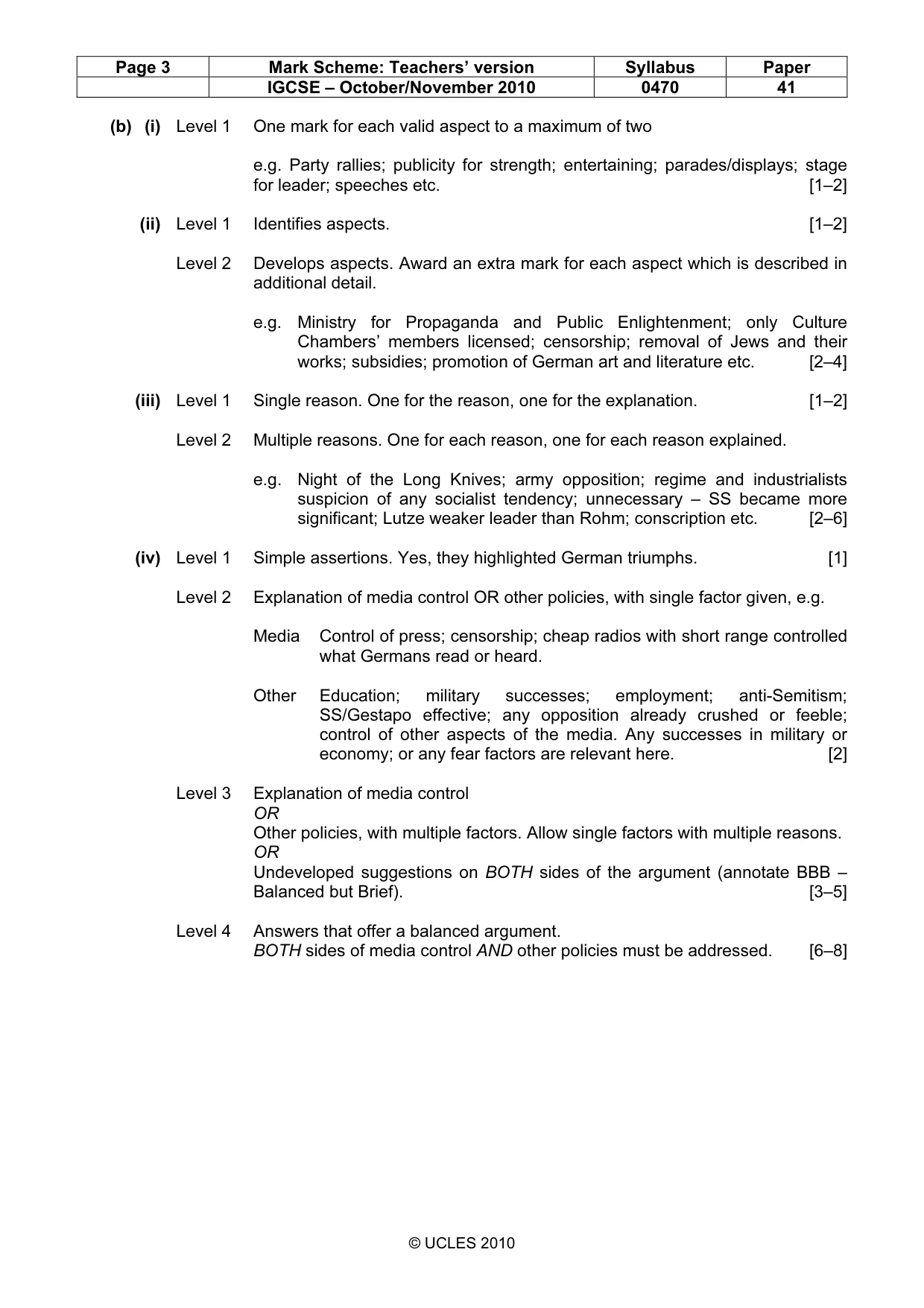
Page 2 Mark Scheme: Teachers’ version Syllabus Paper IGCSE – October/November 2010 0470 41 © UCLES 2010 Depth Study A: Germany, 1918–1945. 1 (a) (i) Level 1 Repeats material stated in source, no inference made. [1–2] Level 2 Makes valid inferences unsupported from the source. e.g. He was arrogant, calculating low view of the German people. Well up in Nazi hierarchy etc. [3–4] Level 3 Supports valid inference(s) with reference to the source. e.g. Second only to Hitler as a speaker, cool, calculating and sometimes funny; appealed to the basest of German instincts etc. [5–6] (ii) Level 1 Agrees OR disagrees, no support from the source. [1–2] Level 2 Agrees OR disagrees, supported from the source, e.g. Yes Everything to promote Nazi ideas and leadership; centralised control of radio etc. No To entertain; to reflect the concerns of the German people; to enlighten; not to be tightly organised; to promote Nazism’s image internationally etc. [3–5] Level 3 Agrees AND disagrees, supported from the source. Addresses the issue of ‘How far?’ [6–7] (iii) Level 1 Useful / not useful – Choice made on the basis that one is more detailed / gives more information, but does not specify what information. [1] Level 2 Useful / not useful – One is from a German historian and the other is from Goebbels himself so they could both be biased / unreliable. [2] Level 3 Choice made on the nature or amount of information given. Must specify what information. [3–5] Level 4 Choice made on the grounds of reliability. Discussion of utility must be made on valid evaluation of source(s) in context. Include at this Level answers that cross-reference between A and B to show reliability. 6 marks for one source, 7 marks for both. [6–7]
Mark scheme, page 3
Page 3 Mark Scheme: Teachers’ version Syllabus Paper IGCSE – October/November 2010 0470 41 © UCLES 2010 (b) (i) Level 1 One mark for each valid aspect to a maximum of two e.g. Party rallies; publicity for strength; entertaining; parades/displays; stage for leader; speeches etc. [1–2] (ii) Level 1 Identifies aspects. [1–2] Level 2 Develops aspects. Award an extra mark for each aspect which is described in additional detail. e.g. Ministry for Propaganda and Public Enlightenment; only Culture Chambers’ members licensed; censorship; removal of Jews and their works; subsidies; promotion of German art and literature etc. [2–4] (iii) Level 1 Single reason. One for the reason, one for the explanation. [1–2] Level 2 Multiple reasons. One for each reason, one for each reason explained. e.g. Night of the Long Knives; army opposition; regime and industrialists suspicion of any socialist tendency; unnecessary – SS became more significant; Lutze weaker leader than Rohm; conscription etc. [2–6] (iv) Level 1 Simple assertions. Yes, they highlighted German triumphs. [1] Level 2 Explanation of media control OR other policies, with single factor given, e.g. Media Control of press; censorship; cheap radios with short range controlled what Germans read or heard. Other Education; military successes; employment; anti-Semitism; SS/Gestapo effective; any opposition already crushed or feeble; control of other aspects of the media. Any successes in military or economy; or any fear factors are relevant here. [2] Level 3 Explanation of media control OR Other policies, with multiple factors. Allow single factors with multiple reasons. OR Undeveloped suggestions on BOTH sides of the argument (annotate BBB – Balanced but Brief). [3–5] Level 4 Answers that offer a balanced argument. BOTH sides of media control AND other policies must be addressed. [6–8]
Mark scheme, page 4
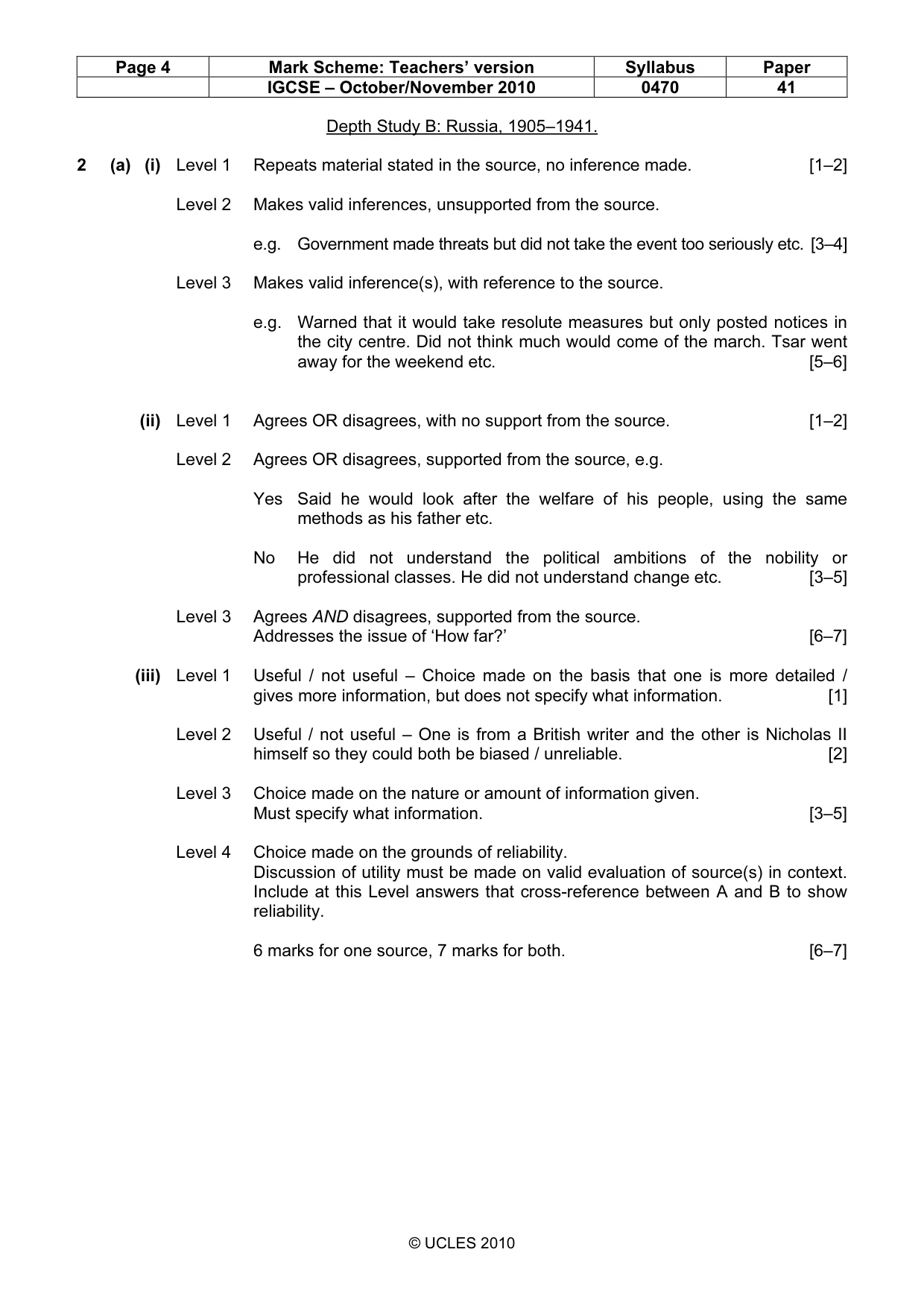
Page 4 Mark Scheme: Teachers’ version Syllabus Paper IGCSE – October/November 2010 0470 41 © UCLES 2010 Depth Study B: Russia, 1905–1941. 2 (a) (i) Level 1 Repeats material stated in the source, no inference made. [1–2] Level 2 Makes valid inferences, unsupported from the source. e.g. Government made threats but did not take the event too seriously etc. [3–4] Level 3 Makes valid inference(s), with reference to the source. e.g. Warned that it would take resolute measures but only posted notices in the city centre. Did not think much would come of the march. Tsar went away for the weekend etc. [5–6] (ii) Level 1 Agrees OR disagrees, with no support from the source. [1–2] Level 2 Agrees OR disagrees, supported from the source, e.g. Yes Said he would look after the welfare of his people, using the same methods as his father etc. No He did not understand the political ambitions of the nobility or professional classes. He did not understand change etc. [3–5] Level 3 Agrees AND disagrees, supported from the source. Addresses the issue of ‘How far?’ [6–7] (iii) Level 1 Useful / not useful – Choice made on the basis that one is more detailed / gives more information, but does not specify what information. [1] Level 2 Useful / not useful – One is from a British writer and the other is Nicholas II himself so they could both be biased / unreliable. [2] Level 3 Choice made on the nature or amount of information given. Must specify what information. [3–5] Level 4 Choice made on the grounds of reliability. Discussion of utility must be made on valid evaluation of source(s) in context. Include at this Level answers that cross-reference between A and B to show reliability. 6 marks for one source, 7 marks for both. [6–7]
Mark scheme, page 5
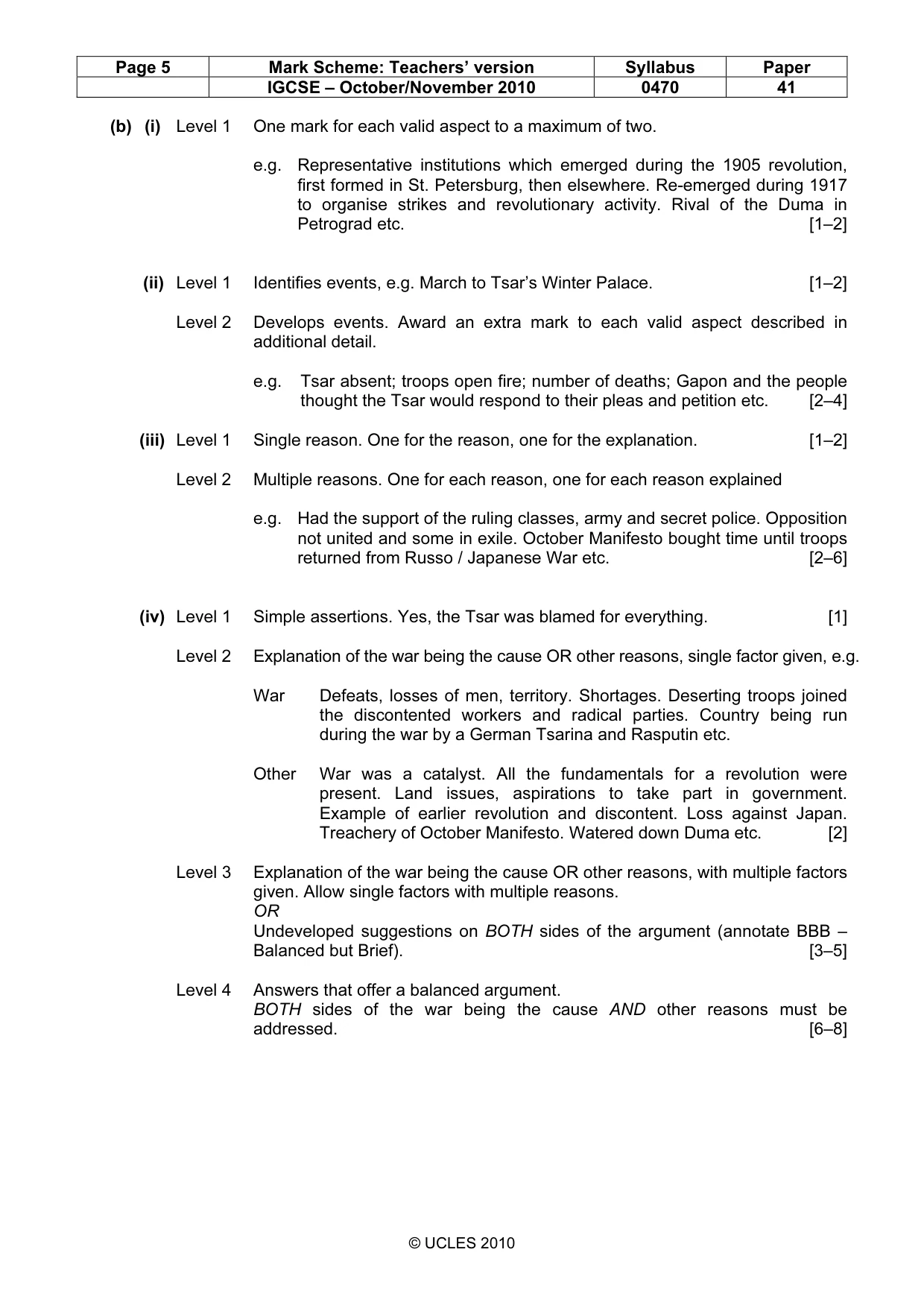
Page 5 Mark Scheme: Teachers’ version Syllabus Paper IGCSE – October/November 2010 0470 41 © UCLES 2010 (b) (i) Level 1 One mark for each valid aspect to a maximum of two. e.g. Representative institutions which emerged during the 1905 revolution, first formed in St. Petersburg, then elsewhere. Re-emerged during 1917 to organise strikes and revolutionary activity. Rival of the Duma in Petrograd etc. [1–2] (ii) Level 1 Identifies events, e.g. March to Tsar’s Winter Palace. [1–2] Level 2 Develops events. Award an extra mark to each valid aspect described in additional detail. e.g. Tsar absent; troops open fire; number of deaths; Gapon and the people thought the Tsar would respond to their pleas and petition etc. [2–4] (iii) Level 1 Single reason. One for the reason, one for the explanation. [1–2] Level 2 Multiple reasons. One for each reason, one for each reason explained e.g. Had the support of the ruling classes, army and secret police. Opposition not united and some in exile. October Manifesto bought time until troops returned from Russo / Japanese War etc. [2–6] (iv) Level 1 Simple assertions. Yes, the Tsar was blamed for everything. [1] Level 2 Explanation of the war being the cause OR other reasons, single factor given, e.g. War Defeats, losses of men, territory. Shortages. Deserting troops joined the discontented workers and radical parties. Country being run during the war by a German Tsarina and Rasputin etc. Other War was a catalyst. All the fundamentals for a revolution were present. Land issues, aspirations to take part in government. Example of earlier revolution and discontent. Loss against Japan. Treachery of October Manifesto. Watered down Duma etc. [2] Level 3 Explanation of the war being the cause OR other reasons, with multiple factors given. Allow single factors with multiple reasons. OR Undeveloped suggestions on BOTH sides of the argument (annotate BBB – Balanced but Brief). [3–5] Level 4 Answers that offer a balanced argument. BOTH sides of the war being the cause AND other reasons must be addressed. [6–8]
Mark scheme, page 6
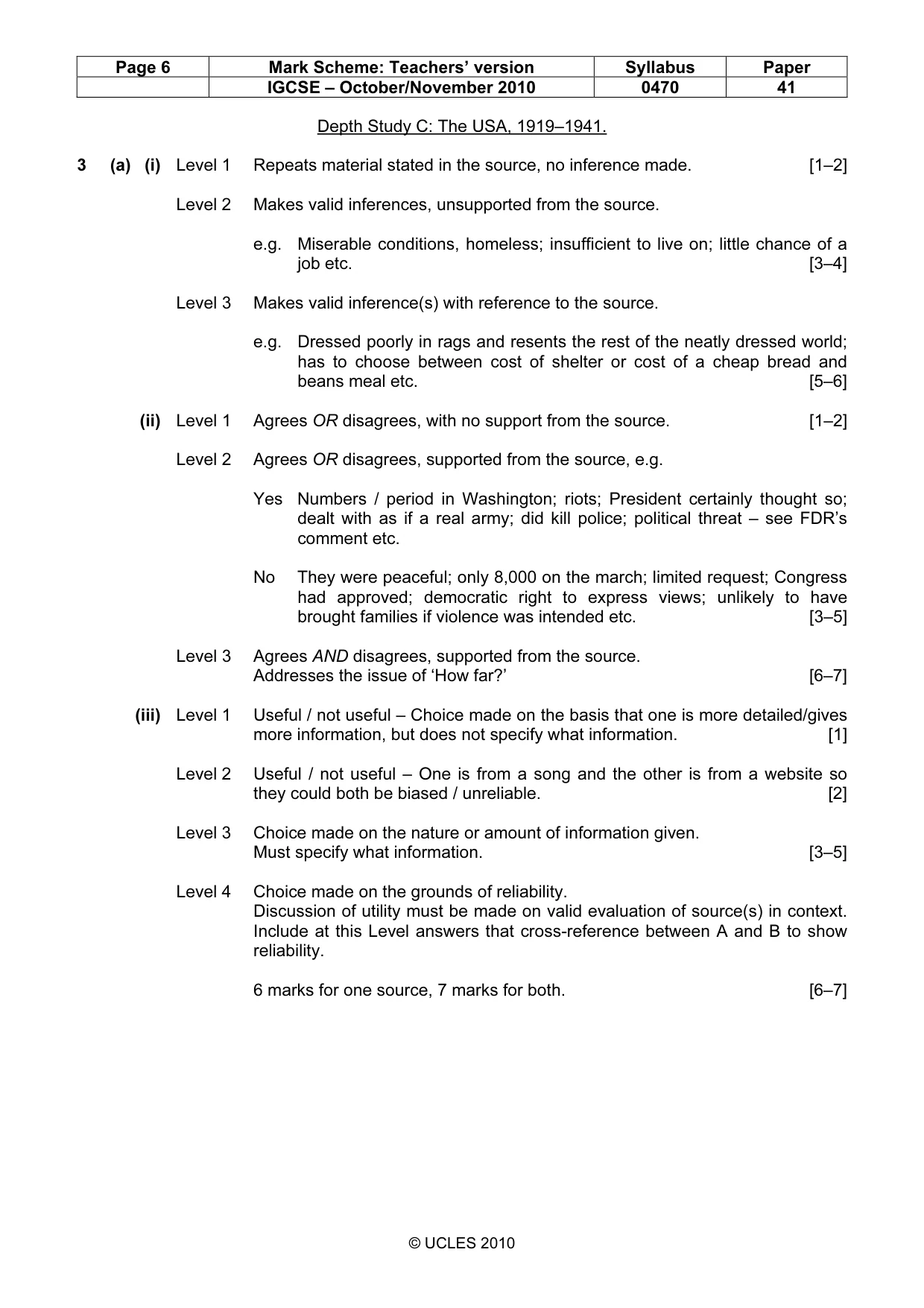
Page 6 Mark Scheme: Teachers’ version Syllabus Paper IGCSE – October/November 2010 0470 41 © UCLES 2010 Depth Study C: The USA, 1919–1941. 3 (a) (i) Level 1 Repeats material stated in the source, no inference made. [1–2] Level 2 Makes valid inferences, unsupported from the source. e.g. Miserable conditions, homeless; insufficient to live on; little chance of a job etc. [3–4] Level 3 Makes valid inference(s) with reference to the source. e.g. Dressed poorly in rags and resents the rest of the neatly dressed world; has to choose between cost of shelter or cost of a cheap bread and beans meal etc. [5–6] (ii) Level 1 Agrees OR disagrees, with no support from the source. [1–2] Level 2 Agrees OR disagrees, supported from the source, e.g. Yes Numbers / period in Washington; riots; President certainly thought so; dealt with as if a real army; did kill police; political threat – see FDR’s comment etc. No They were peaceful; only 8,000 on the march; limited request; Congress had approved; democratic right to express views; unlikely to have brought families if violence was intended etc. [3–5] Level 3 Agrees AND disagrees, supported from the source. Addresses the issue of ‘How far?’ [6–7] (iii) Level 1 Useful / not useful – Choice made on the basis that one is more detailed/gives more information, but does not specify what information. [1] Level 2 Useful / not useful – One is from a song and the other is from a website so they could both be biased / unreliable. [2] Level 3 Choice made on the nature or amount of information given. Must specify what information. [3–5] Level 4 Choice made on the grounds of reliability. Discussion of utility must be made on valid evaluation of source(s) in context. Include at this Level answers that cross-reference between A and B to show reliability. 6 marks for one source, 7 marks for both. [6–7]
Mark scheme, page 7
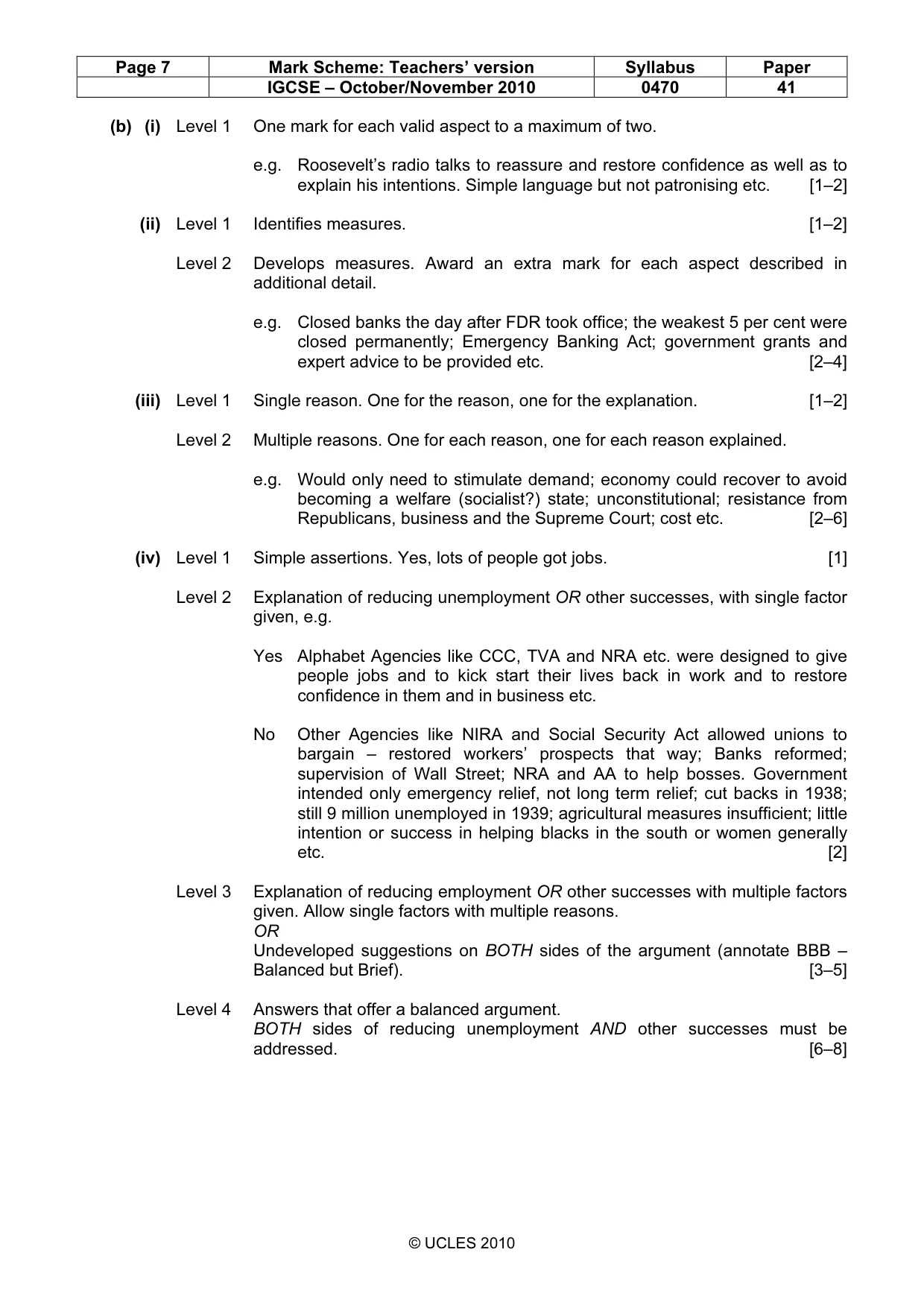
Page 7 Mark Scheme: Teachers’ version Syllabus Paper IGCSE – October/November 2010 0470 41 © UCLES 2010 (b) (i) Level 1 One mark for each valid aspect to a maximum of two. e.g. Roosevelt’s radio talks to reassure and restore confidence as well as to explain his intentions. Simple language but not patronising etc. [1–2] (ii) Level 1 Identifies measures. [1–2] Level 2 Develops measures. Award an extra mark for each aspect described in additional detail. e.g. Closed banks the day after FDR took office; the weakest 5 per cent were closed permanently; Emergency Banking Act; government grants and expert advice to be provided etc. [2–4] (iii) Level 1 Single reason. One for the reason, one for the explanation. [1–2] Level 2 Multiple reasons. One for each reason, one for each reason explained. e.g. Would only need to stimulate demand; economy could recover to avoid becoming a welfare (socialist?) state; unconstitutional; resistance from Republicans, business and the Supreme Court; cost etc. [2–6] (iv) Level 1 Simple assertions. Yes, lots of people got jobs. [1] Level 2 Explanation of reducing unemployment OR other successes, with single factor given, e.g. Yes Alphabet Agencies like CCC, TVA and NRA etc. were designed to give people jobs and to kick start their lives back in work and to restore confidence in them and in business etc. No Other Agencies like NIRA and Social Security Act allowed unions to bargain – restored workers’ prospects that way; Banks reformed; supervision of Wall Street; NRA and AA to help bosses. Government intended only emergency relief, not long term relief; cut backs in 1938; still 9 million unemployed in 1939; agricultural measures insufficient; little intention or success in helping blacks in the south or women generally etc. [2] Level 3 Explanation of reducing employment OR other successes with multiple factors given. Allow single factors with multiple reasons. OR Undeveloped suggestions on BOTH sides of the argument (annotate BBB – Balanced but Brief). [3–5] Level 4 Answers that offer a balanced argument. BOTH sides of reducing unemployment AND other successes must be addressed. [6–8]
Mark scheme, page 8
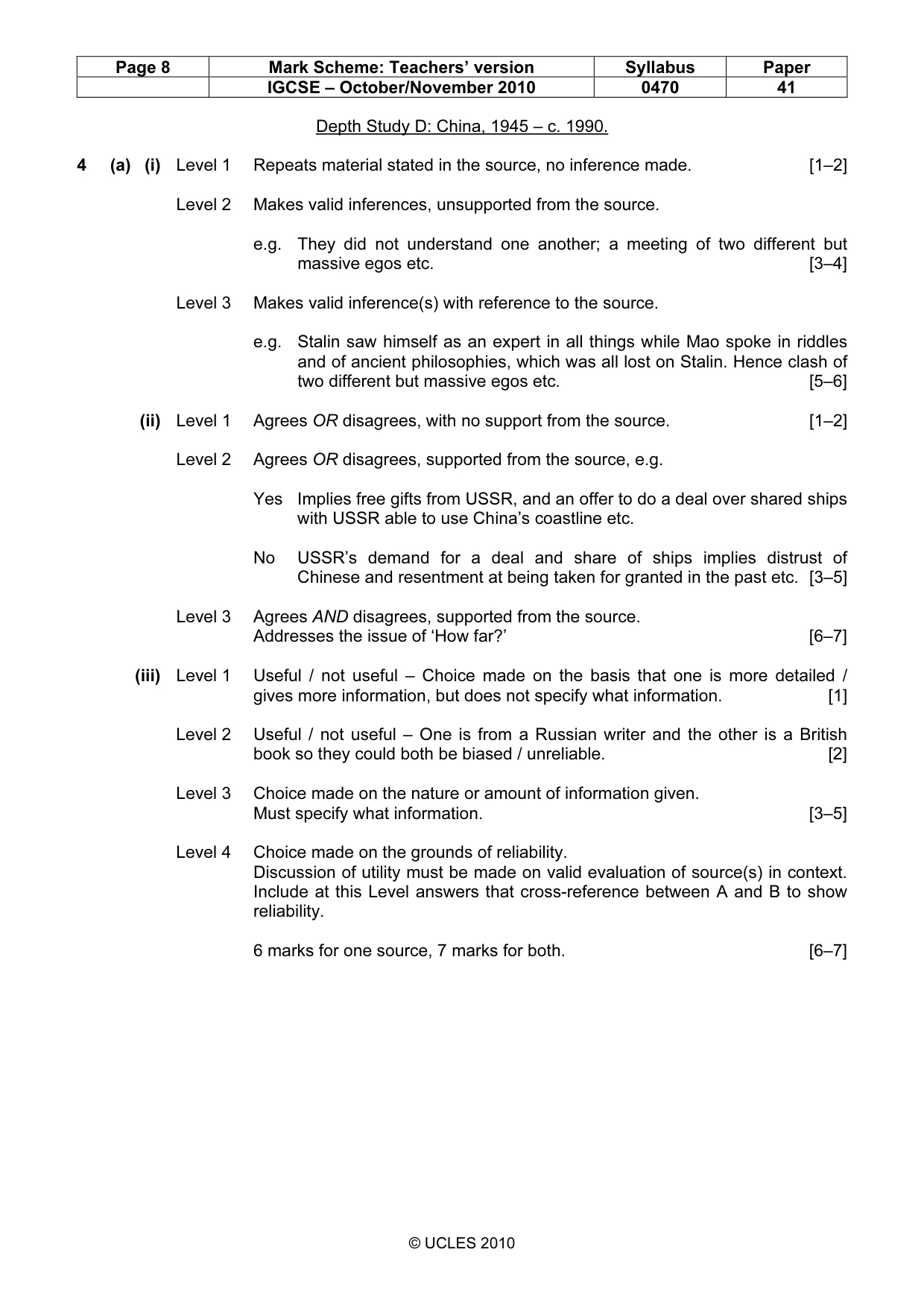
Page 8 Mark Scheme: Teachers’ version Syllabus Paper IGCSE – October/November 2010 0470 41 © UCLES 2010 Depth Study D: China, 1945 – c. 1990. 4 (a) (i) Level 1 Repeats material stated in the source, no inference made. [1–2] Level 2 Makes valid inferences, unsupported from the source. e.g. They did not understand one another; a meeting of two different but massive egos etc. [3–4] Level 3 Makes valid inference(s) with reference to the source. e.g. Stalin saw himself as an expert in all things while Mao spoke in riddles and of ancient philosophies, which was all lost on Stalin. Hence clash of two different but massive egos etc. [5–6] (ii) Level 1 Agrees OR disagrees, with no support from the source. [1–2] Level 2 Agrees OR disagrees, supported from the source, e.g. Yes Implies free gifts from USSR, and an offer to do a deal over shared ships with USSR able to use China’s coastline etc. No USSR’s demand for a deal and share of ships implies distrust of Chinese and resentment at being taken for granted in the past etc. [3–5] Level 3 Agrees AND disagrees, supported from the source. Addresses the issue of ‘How far?’ [6–7] (iii) Level 1 Useful / not useful – Choice made on the basis that one is more detailed / gives more information, but does not specify what information. [1] Level 2 Useful / not useful – One is from a Russian writer and the other is a British book so they could both be biased / unreliable. [2] Level 3 Choice made on the nature or amount of information given. Must specify what information. [3–5] Level 4 Choice made on the grounds of reliability. Discussion of utility must be made on valid evaluation of source(s) in context. Include at this Level answers that cross-reference between A and B to show reliability. 6 marks for one source, 7 marks for both. [6–7]
Mark scheme, page 9
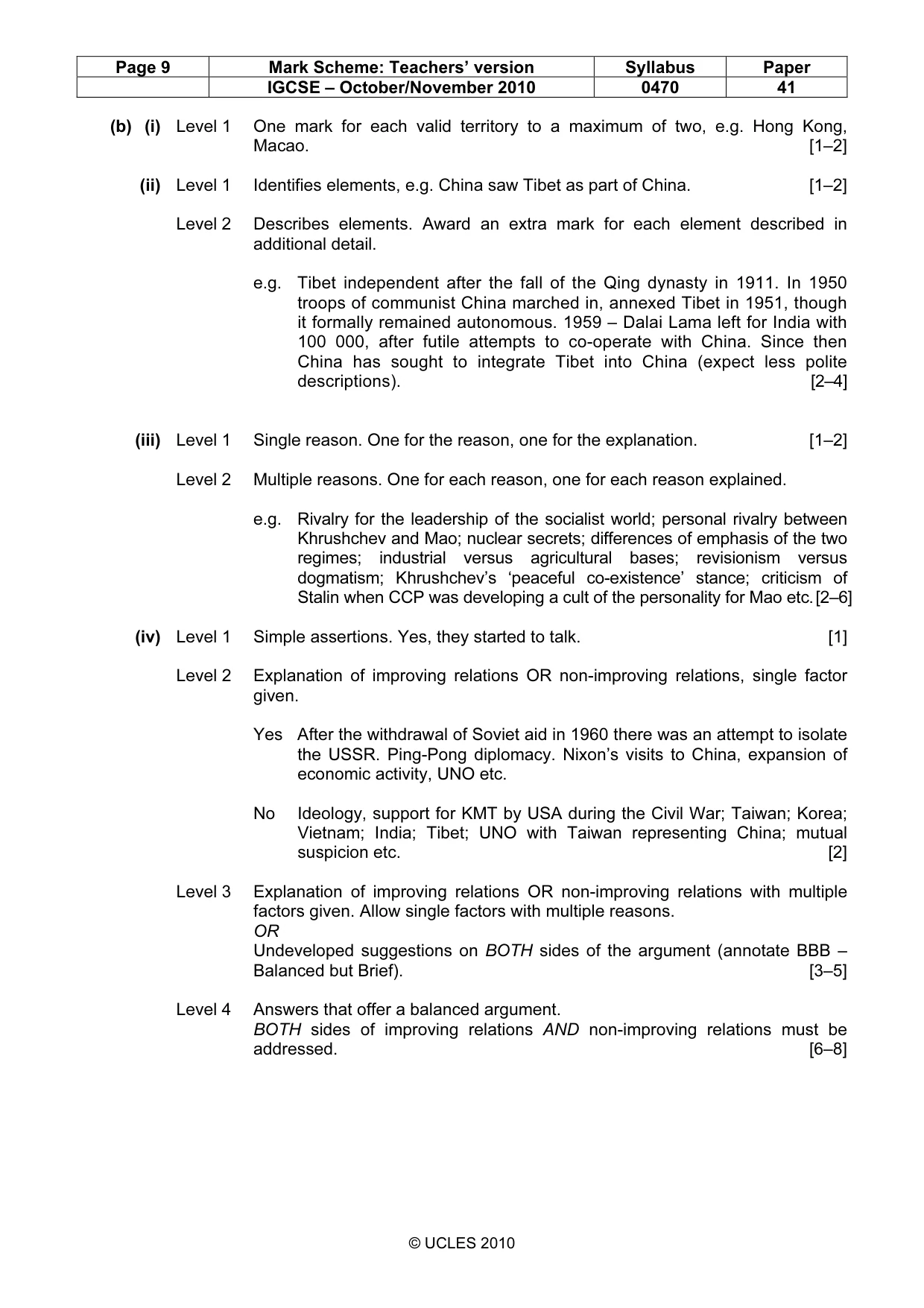
Page 9 Mark Scheme: Teachers’ version Syllabus Paper IGCSE – October/November 2010 0470 41 © UCLES 2010 (b) (i) Level 1 One mark for each valid territory to a maximum of two, e.g. Hong Kong, Macao. [1–2] (ii) Level 1 Identifies elements, e.g. China saw Tibet as part of China. [1–2] Level 2 Describes elements. Award an extra mark for each element described in additional detail. e.g. Tibet independent after the fall of the Qing dynasty in 1911. In 1950 troops of communist China marched in, annexed Tibet in 1951, though it formally remained autonomous. 1959 – Dalai Lama left for India with 100 000, after futile attempts to co-operate with China. Since then China has sought to integrate Tibet into China (expect less polite descriptions). [2–4] (iii) Level 1 Single reason. One for the reason, one for the explanation. [1–2] Level 2 Multiple reasons. One for each reason, one for each reason explained. e.g. Rivalry for the leadership of the socialist world; personal rivalry between Khrushchev and Mao; nuclear secrets; differences of emphasis of the two regimes; industrial versus agricultural bases; revisionism versus dogmatism; Khrushchev’s ‘peaceful co-existence’ stance; criticism of Stalin when CCP was developing a cult of the personality for Mao etc. [2–6] (iv) Level 1 Simple assertions. Yes, they started to talk. [1] Level 2 Explanation of improving relations OR non-improving relations, single factor given. Yes After the withdrawal of Soviet aid in 1960 there was an attempt to isolate the USSR. Ping-Pong diplomacy. Nixon’s visits to China, expansion of economic activity, UNO etc. No Ideology, support for KMT by USA during the Civil War; Taiwan; Korea; Vietnam; India; Tibet; UNO with Taiwan representing China; mutual suspicion etc. [2] Level 3 Explanation of improving relations OR non-improving relations with multiple factors given. Allow single factors with multiple reasons. OR Undeveloped suggestions on BOTH sides of the argument (annotate BBB – Balanced but Brief). [3–5] Level 4 Answers that offer a balanced argument. BOTH sides of improving relations AND non-improving relations must be addressed. [6–8]
Mark scheme, page 10
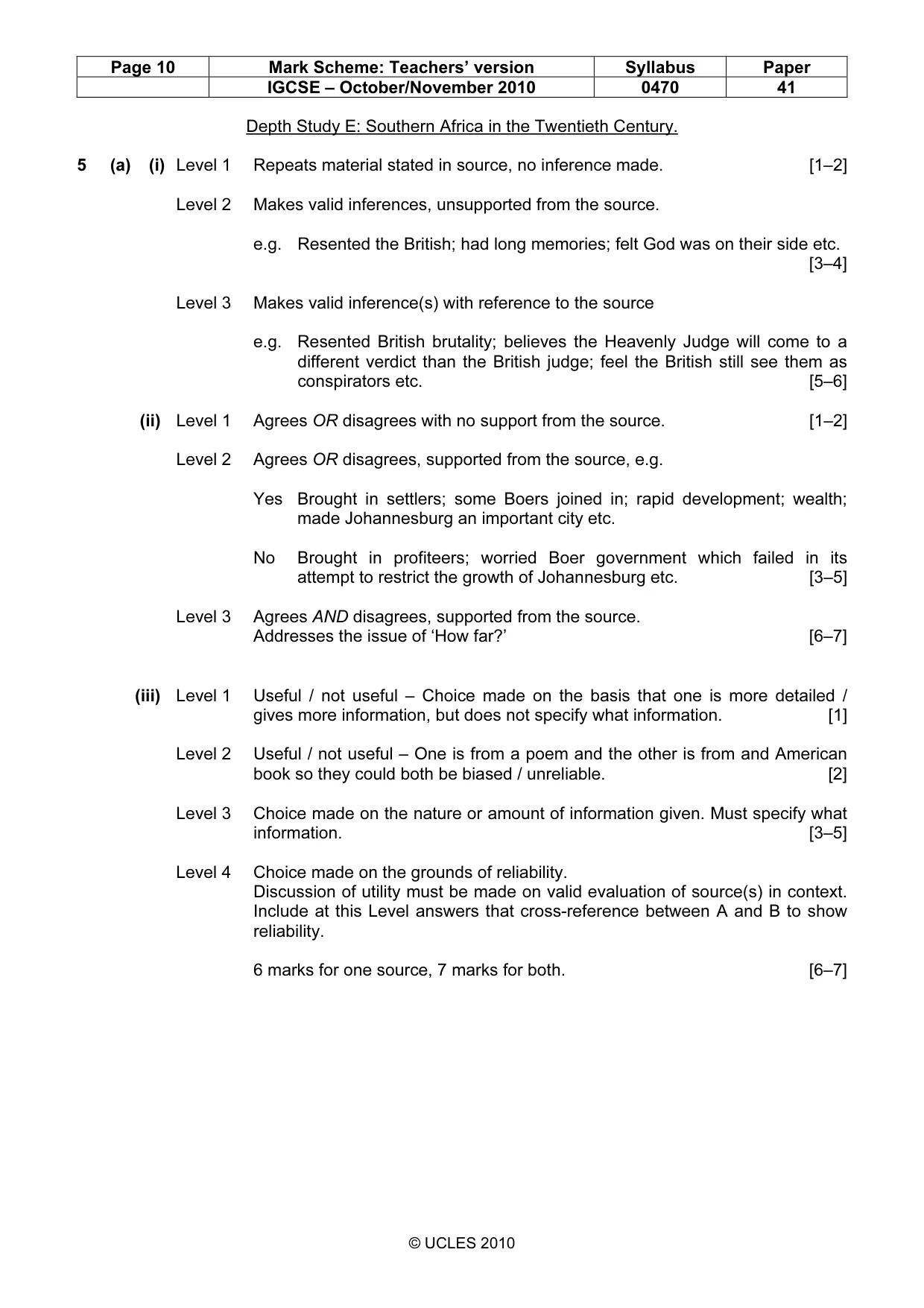
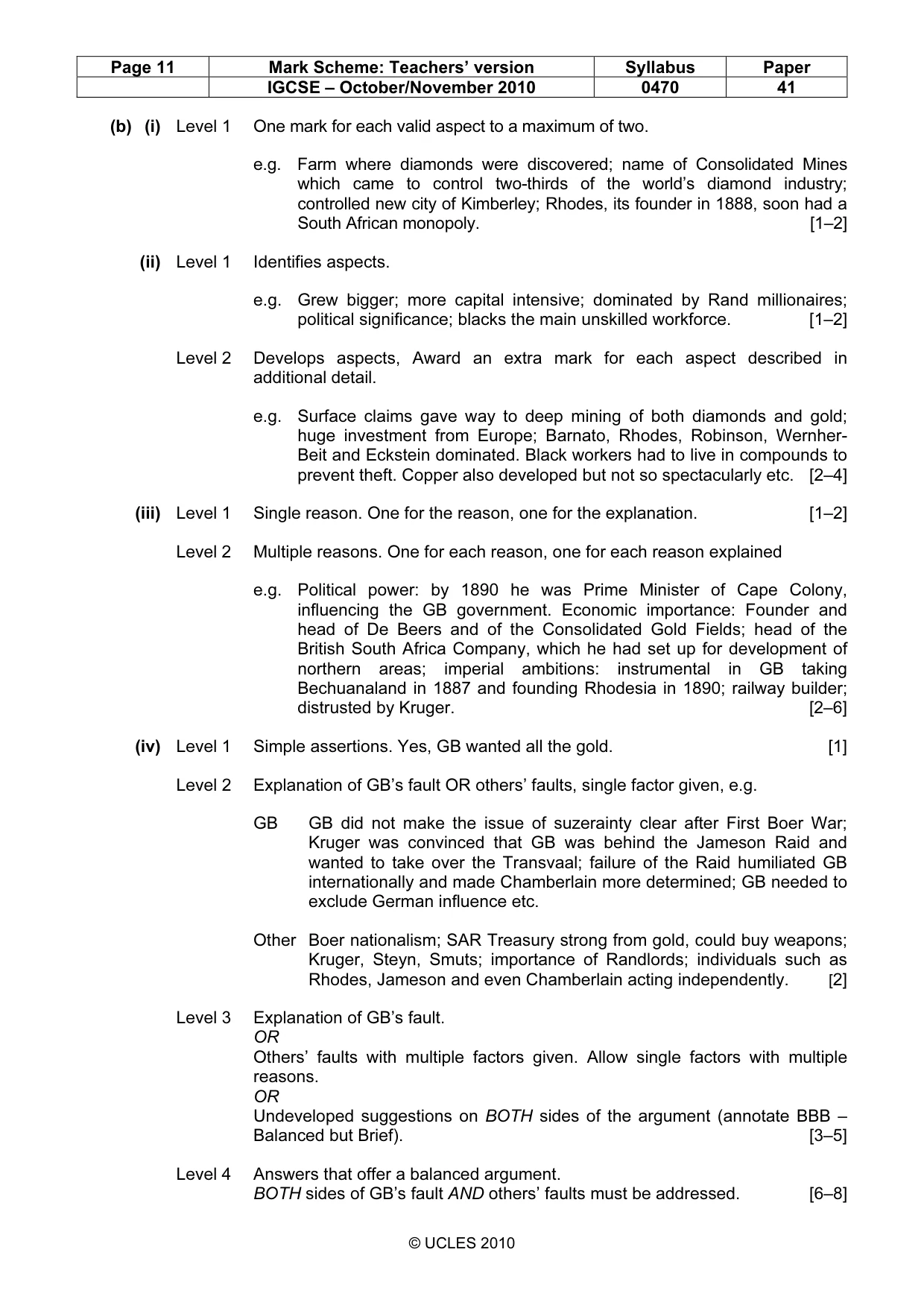
Page 10 Mark Scheme: Teachers’ version Syllabus Paper IGCSE – October/November 2010 0470 41 © UCLES 2010 Depth Study E: Southern Africa in the Twentieth Century. 5 (a) (i) Level 1 Repeats material stated in source, no inference made. [1–2] Level 2 Makes valid inferences, unsupported from the source. e.g. Resented the British; had long memories; felt God was on their side etc. [3–4] Level 3 Makes valid inference(s) with reference to the source e.g. Resented British brutality; believes the Heavenly Judge will come to a different verdict than the British judge; feel the British still see them as conspirators etc. [5–6] (ii) Level 1 Agrees OR disagrees with no support from the source. [1–2] Level 2 Agrees OR disagrees, supported from the source, e.g. Yes Brought in settlers; some Boers joined in; rapid development; wealth; made Johannesburg an important city etc. No Brought in profiteers; worried Boer government which failed in its attempt to restrict the growth of Johannesburg etc. [3–5] Level 3 Agrees AND disagrees, supported from the source. Addresses the issue of ‘How far?’ [6–7] (iii) Level 1 Useful / not useful – Choice made on the basis that one is more detailed / gives more information, but does not specify what information. [1] Level 2 Useful / not useful – One is from a poem and the other is from and American book so they could both be biased / unreliable. [2] Level 3 Choice made on the nature or amount of information given. Must specify what information. [3–5] Level 4 Choice made on the grounds of reliability. Discussion of utility must be made on valid evaluation of source(s) in context. Include at this Level answers that cross-reference between A and B to show reliability. 6 marks for one source, 7 marks for both. [6–7]
Mark scheme, page 11
Page 11 Mark Scheme: Teachers’ version Syllabus Paper IGCSE – October/November 2010 0470 41 © UCLES 2010 (b) (i) Level 1 One mark for each valid aspect to a maximum of two. e.g. Farm where diamonds were discovered; name of Consolidated Mines which came to control two-thirds of the world’s diamond industry; controlled new city of Kimberley; Rhodes, its founder in 1888, soon had a South African monopoly. [1–2] (ii) Level 1 Identifies aspects. e.g. Grew bigger; more capital intensive; dominated by Rand millionaires; political significance; blacks the main unskilled workforce. [1–2] Level 2 Develops aspects, Award an extra mark for each aspect described in additional detail. e.g. Surface claims gave way to deep mining of both diamonds and gold; huge investment from Europe; Barnato, Rhodes, Robinson, Wernher- Beit and Eckstein dominated. Black workers had to live in compounds to prevent theft. Copper also developed but not so spectacularly etc. [2–4] (iii) Level 1 Single reason. One for the reason, one for the explanation. [1–2] Level 2 Multiple reasons. One for each reason, one for each reason explained e.g. Political power: by 1890 he was Prime Minister of Cape Colony, influencing the GB government. Economic importance: Founder and head of De Beers and of the Consolidated Gold Fields; head of the British South Africa Company, which he had set up for development of northern areas; imperial ambitions: instrumental in GB taking Bechuanaland in 1887 and founding Rhodesia in 1890; railway builder; distrusted by Kruger. [2–6] (iv) Level 1 Simple assertions. Yes, GB wanted all the gold. [1] Level 2 Explanation of GB’s fault OR others’ faults, single factor given, e.g. GB GB did not make the issue of suzerainty clear after First Boer War; Kruger was convinced that GB was behind the Jameson Raid and wanted to take over the Transvaal; failure of the Raid humiliated GB internationally and made Chamberlain more determined; GB needed to exclude German influence etc. Other Boer nationalism; SAR Treasury strong from gold, could buy weapons; Kruger, Steyn, Smuts; importance of Randlords; individuals such as Rhodes, Jameson and even Chamberlain acting independently. [2] Level 3 Explanation of GB’s fault. OR Others’ faults with multiple factors given. Allow single factors with multiple reasons. OR Undeveloped suggestions on BOTH sides of the argument (annotate BBB – Balanced but Brief). [3–5] Level 4 Answers that offer a balanced argument. BOTH sides of GB’s fault AND others’ faults must be addressed. [6–8]
Mark scheme, page 12
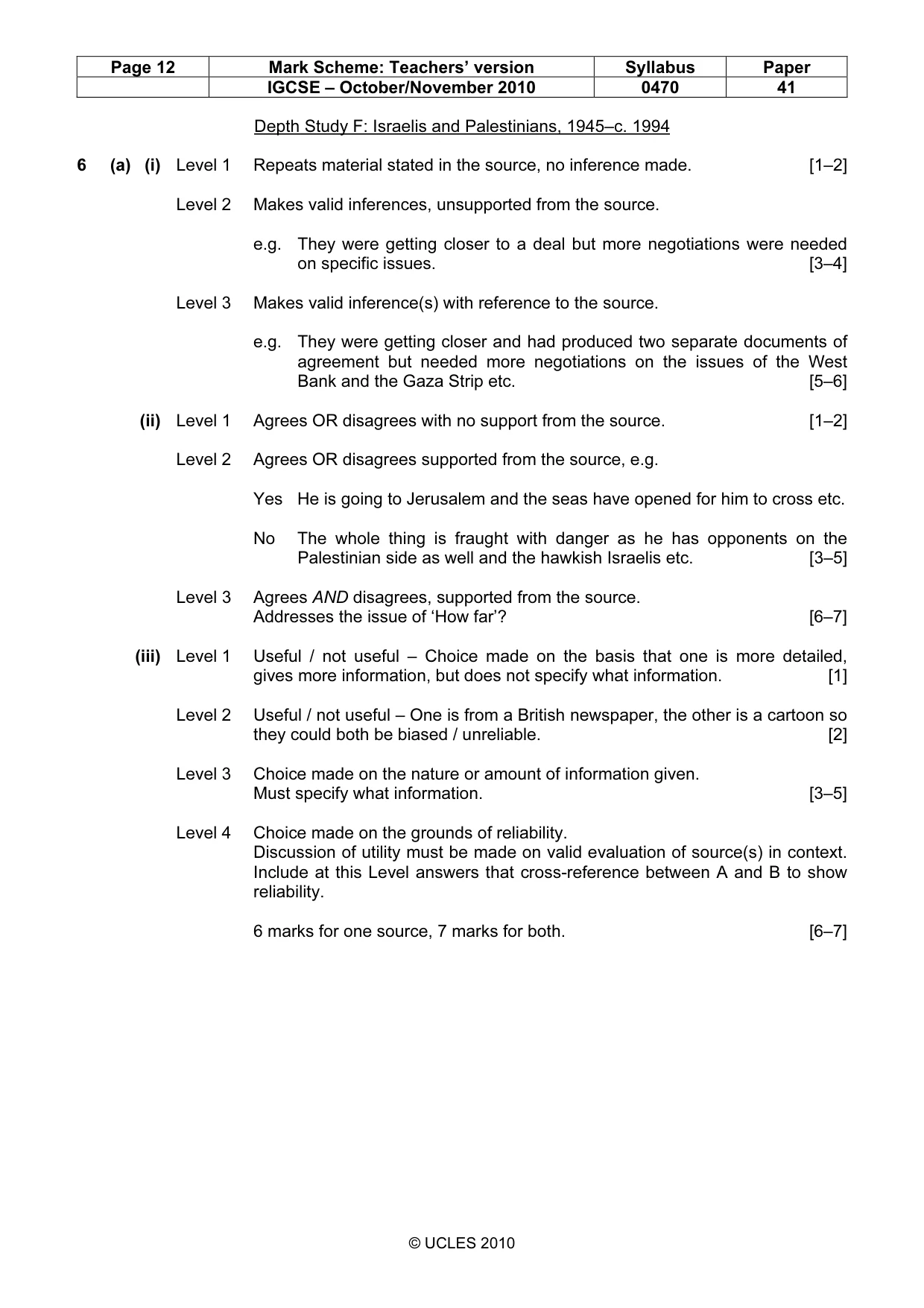
Page 12 Mark Scheme: Teachers’ version Syllabus Paper IGCSE – October/November 2010 0470 41 © UCLES 2010 Depth Study F: Israelis and Palestinians, 1945–c. 1994 6 (a) (i) Level 1 Repeats material stated in the source, no inference made. [1–2] Level 2 Makes valid inferences, unsupported from the source. e.g. They were getting closer to a deal but more negotiations were needed on specific issues. [3–4] Level 3 Makes valid inference(s) with reference to the source. e.g. They were getting closer and had produced two separate documents of agreement but needed more negotiations on the issues of the West Bank and the Gaza Strip etc. [5–6] (ii) Level 1 Agrees OR disagrees with no support from the source. [1–2] Level 2 Agrees OR disagrees supported from the source, e.g. Yes He is going to Jerusalem and the seas have opened for him to cross etc. No The whole thing is fraught with danger as he has opponents on the Palestinian side as well and the hawkish Israelis etc. [3–5] Level 3 Agrees AND disagrees, supported from the source. Addresses the issue of ‘How far’? [6–7] (iii) Level 1 Useful / not useful – Choice made on the basis that one is more detailed, gives more information, but does not specify what information. [1] Level 2 Useful / not useful – One is from a British newspaper, the other is a cartoon so they could both be biased / unreliable. [2] Level 3 Choice made on the nature or amount of information given. Must specify what information. [3–5] Level 4 Choice made on the grounds of reliability. Discussion of utility must be made on valid evaluation of source(s) in context. Include at this Level answers that cross-reference between A and B to show reliability. 6 marks for one source, 7 marks for both. [6–7]
Mark scheme, page 13
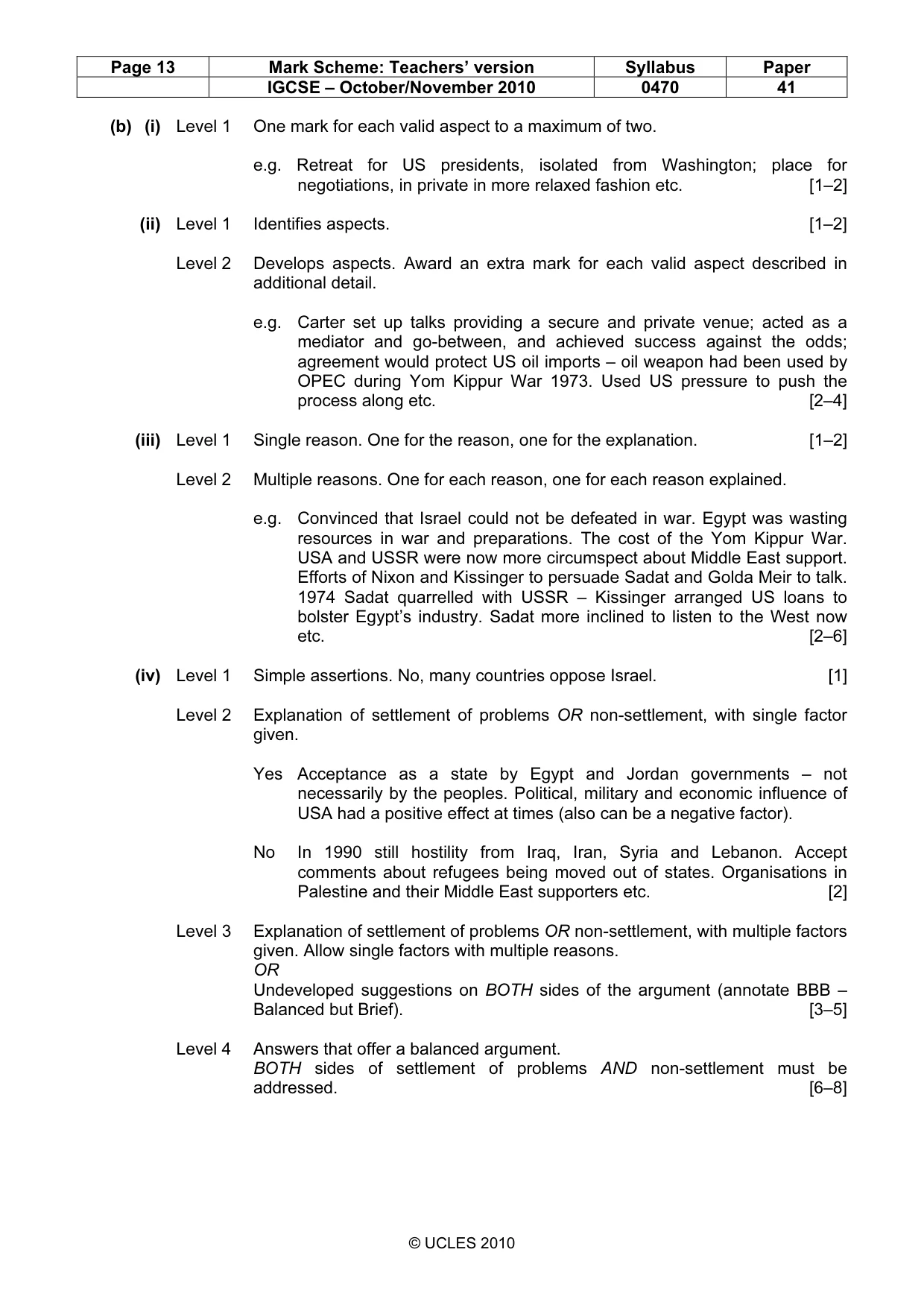
Page 13 Mark Scheme: Teachers’ version Syllabus Paper IGCSE – October/November 2010 0470 41 © UCLES 2010 (b) (i) Level 1 One mark for each valid aspect to a maximum of two. e.g. Retreat for US presidents, isolated from Washington; place for negotiations, in private in more relaxed fashion etc. [1–2] (ii) Level 1 Identifies aspects. [1–2] Level 2 Develops aspects. Award an extra mark for each valid aspect described in additional detail. e.g. Carter set up talks providing a secure and private venue; acted as a mediator and go-between, and achieved success against the odds; agreement would protect US oil imports – oil weapon had been used by OPEC during Yom Kippur War 1973. Used US pressure to push the process along etc. [2–4] (iii) Level 1 Single reason. One for the reason, one for the explanation. [1–2] Level 2 Multiple reasons. One for each reason, one for each reason explained. e.g. Convinced that Israel could not be defeated in war. Egypt was wasting resources in war and preparations. The cost of the Yom Kippur War. USA and USSR were now more circumspect about Middle East support. Efforts of Nixon and Kissinger to persuade Sadat and Golda Meir to talk. 1974 Sadat quarrelled with USSR – Kissinger arranged US loans to bolster Egypt’s industry. Sadat more inclined to listen to the West now etc. [2–6] (iv) Level 1 Simple assertions. No, many countries oppose Israel. [1] Level 2 Explanation of settlement of problems OR non-settlement, with single factor given. Yes Acceptance as a state by Egypt and Jordan governments – not necessarily by the peoples. Political, military and economic influence of USA had a positive effect at times (also can be a negative factor). No In 1990 still hostility from Iraq, Iran, Syria and Lebanon. Accept comments about refugees being moved out of states. Organisations in Palestine and their Middle East supporters etc. [2] Level 3 Explanation of settlement of problems OR non-settlement, with multiple factors given. Allow single factors with multiple reasons. OR Undeveloped suggestions on BOTH sides of the argument (annotate BBB – Balanced but Brief). [3–5] Level 4 Answers that offer a balanced argument. BOTH sides of settlement of problems AND non-settlement must be addressed. [6–8]
Mark scheme, page 14
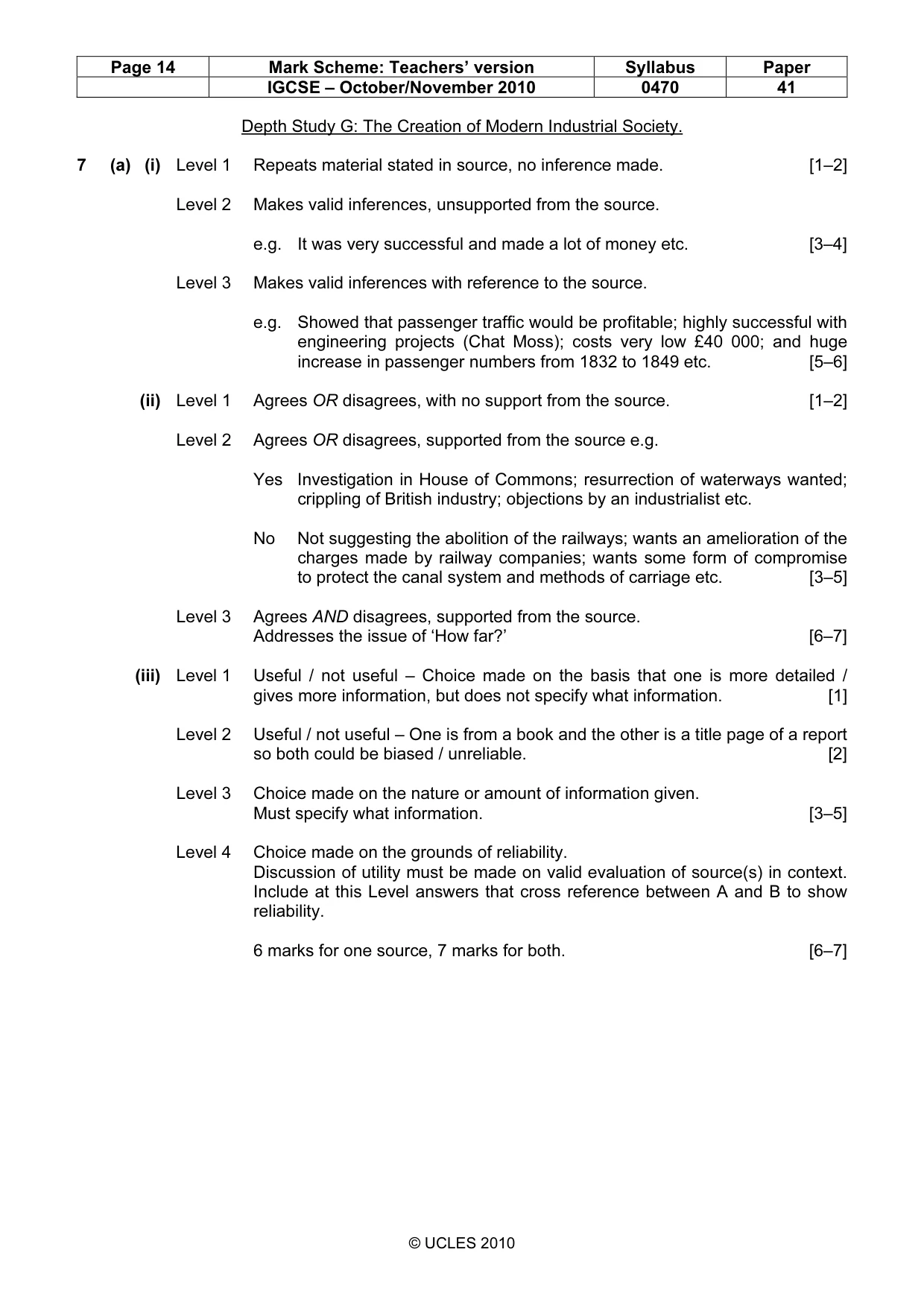
Page 14 Mark Scheme: Teachers’ version Syllabus Paper IGCSE – October/November 2010 0470 41 © UCLES 2010 Depth Study G: The Creation of Modern Industrial Society. 7 (a) (i) Level 1 Repeats material stated in source, no inference made. [1–2] Level 2 Makes valid inferences, unsupported from the source. e.g. It was very successful and made a lot of money etc. [3–4] Level 3 Makes valid inferences with reference to the source. e.g. Showed that passenger traffic would be profitable; highly successful with engineering projects (Chat Moss); costs very low £40 000; and huge increase in passenger numbers from 1832 to 1849 etc. [5–6] (ii) Level 1 Agrees OR disagrees, with no support from the source. [1–2] Level 2 Agrees OR disagrees, supported from the source e.g. Yes Investigation in House of Commons; resurrection of waterways wanted; crippling of British industry; objections by an industrialist etc. No Not suggesting the abolition of the railways; wants an amelioration of the charges made by railway companies; wants some form of compromise to protect the canal system and methods of carriage etc. [3–5] Level 3 Agrees AND disagrees, supported from the source. Addresses the issue of ‘How far?’ [6–7] (iii) Level 1 Useful / not useful – Choice made on the basis that one is more detailed / gives more information, but does not specify what information. [1] Level 2 Useful / not useful – One is from a book and the other is a title page of a report so both could be biased / unreliable. [2] Level 3 Choice made on the nature or amount of information given. Must specify what information. [3–5] Level 4 Choice made on the grounds of reliability. Discussion of utility must be made on valid evaluation of source(s) in context. Include at this Level answers that cross reference between A and B to show reliability. 6 marks for one source, 7 marks for both. [6–7]
Mark scheme, page 15
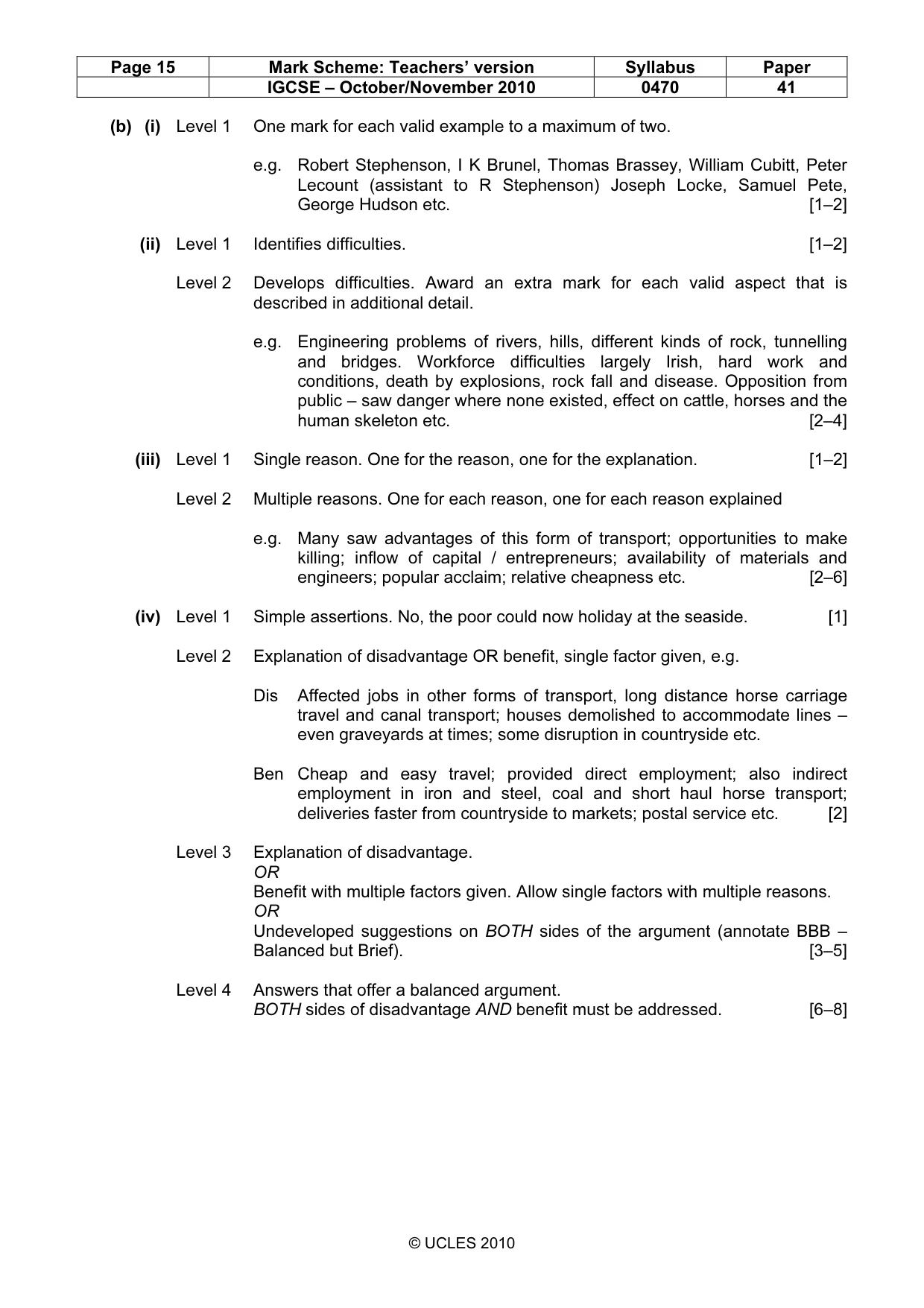
Page 15 Mark Scheme: Teachers’ version Syllabus Paper IGCSE – October/November 2010 0470 41 © UCLES 2010 (b) (i) Level 1 One mark for each valid example to a maximum of two. e.g. Robert Stephenson, I K Brunel, Thomas Brassey, William Cubitt, Peter Lecount (assistant to R Stephenson) Joseph Locke, Samuel Pete, George Hudson etc. [1–2] (ii) Level 1 Identifies difficulties. [1–2] Level 2 Develops difficulties. Award an extra mark for each valid aspect that is described in additional detail. e.g. Engineering problems of rivers, hills, different kinds of rock, tunnelling and bridges. Workforce difficulties largely Irish, hard work and conditions, death by explosions, rock fall and disease. Opposition from public – saw danger where none existed, effect on cattle, horses and the human skeleton etc. [2–4] (iii) Level 1 Single reason. One for the reason, one for the explanation. [1–2] Level 2 Multiple reasons. One for each reason, one for each reason explained e.g. Many saw advantages of this form of transport; opportunities to make killing; inflow of capital / entrepreneurs; availability of materials and engineers; popular acclaim; relative cheapness etc. [2–6] (iv) Level 1 Simple assertions. No, the poor could now holiday at the seaside. [1] Level 2 Explanation of disadvantage OR benefit, single factor given, e.g. Dis Affected jobs in other forms of transport, long distance horse carriage travel and canal transport; houses demolished to accommodate lines – even graveyards at times; some disruption in countryside etc. Ben Cheap and easy travel; provided direct employment; also indirect employment in iron and steel, coal and short haul horse transport; deliveries faster from countryside to markets; postal service etc. [2] Level 3 Explanation of disadvantage. OR Benefit with multiple factors given. Allow single factors with multiple reasons. OR Undeveloped suggestions on BOTH sides of the argument (annotate BBB – Balanced but Brief). [3–5] Level 4 Answers that offer a balanced argument. BOTH sides of disadvantage AND benefit must be addressed. [6–8]
Mark scheme, page 16
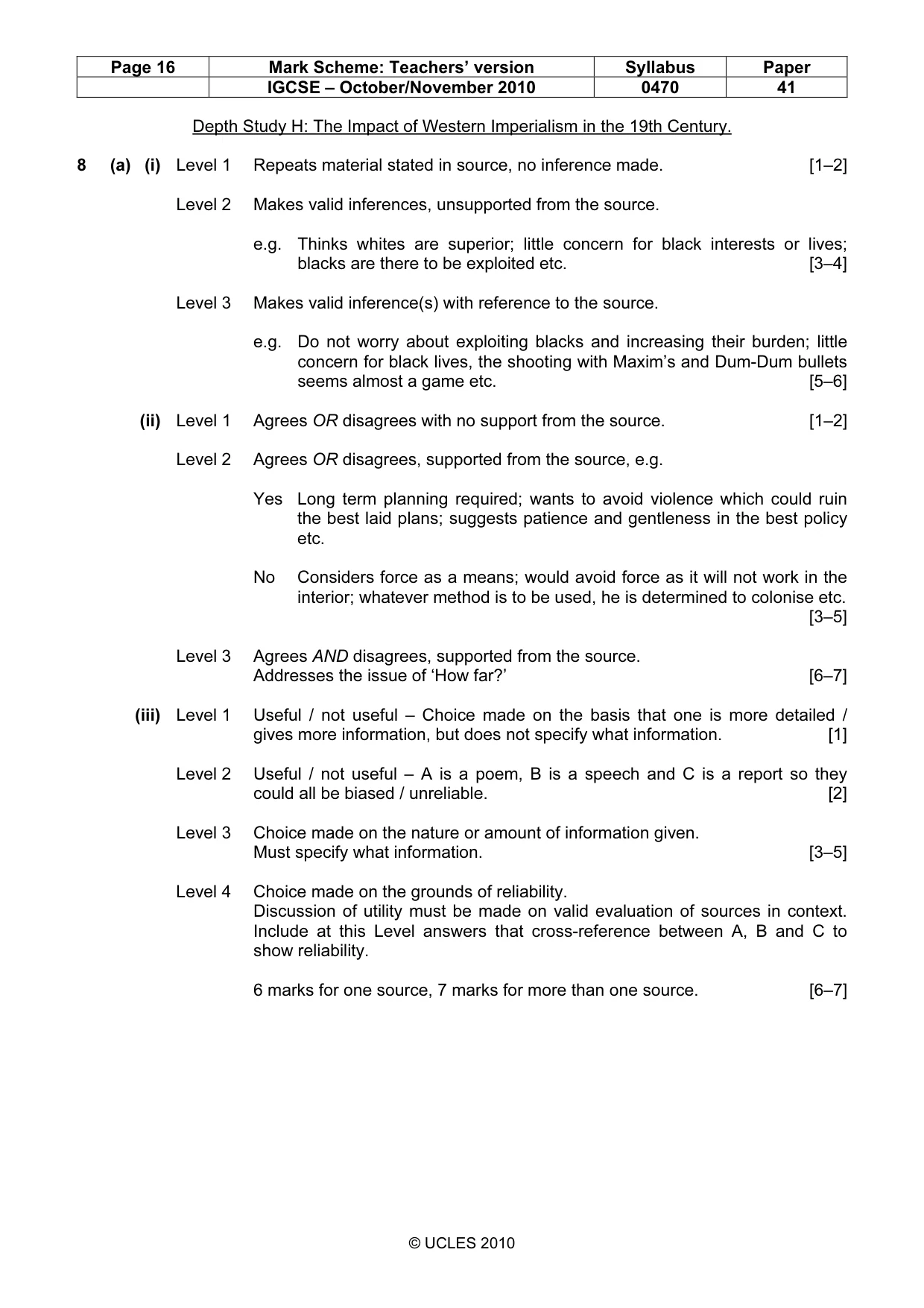
Page 16 Mark Scheme: Teachers’ version Syllabus Paper IGCSE – October/November 2010 0470 41 © UCLES 2010 Depth Study H: The Impact of Western Imperialism in the 19th Century. 8 (a) (i) Level 1 Repeats material stated in source, no inference made. [1–2] Level 2 Makes valid inferences, unsupported from the source. e.g. Thinks whites are superior; little concern for black interests or lives; blacks are there to be exploited etc. [3–4] Level 3 Makes valid inference(s) with reference to the source. e.g. Do not worry about exploiting blacks and increasing their burden; little concern for black lives, the shooting with Maxim’s and Dum-Dum bullets seems almost a game etc. [5–6] (ii) Level 1 Agrees OR disagrees with no support from the source. [1–2] Level 2 Agrees OR disagrees, supported from the source, e.g. Yes Long term planning required; wants to avoid violence which could ruin the best laid plans; suggests patience and gentleness in the best policy etc. No Considers force as a means; would avoid force as it will not work in the interior; whatever method is to be used, he is determined to colonise etc. [3–5] Level 3 Agrees AND disagrees, supported from the source. Addresses the issue of ‘How far?’ [6–7] (iii) Level 1 Useful / not useful – Choice made on the basis that one is more detailed / gives more information, but does not specify what information. [1] Level 2 Useful / not useful – A is a poem, B is a speech and C is a report so they could all be biased / unreliable. [2] Level 3 Choice made on the nature or amount of information given. Must specify what information. [3–5] Level 4 Choice made on the grounds of reliability. Discussion of utility must be made on valid evaluation of sources in context. Include at this Level answers that cross-reference between A, B and C to show reliability. 6 marks for one source, 7 marks for more than one source. [6–7]
Mark scheme, page 17
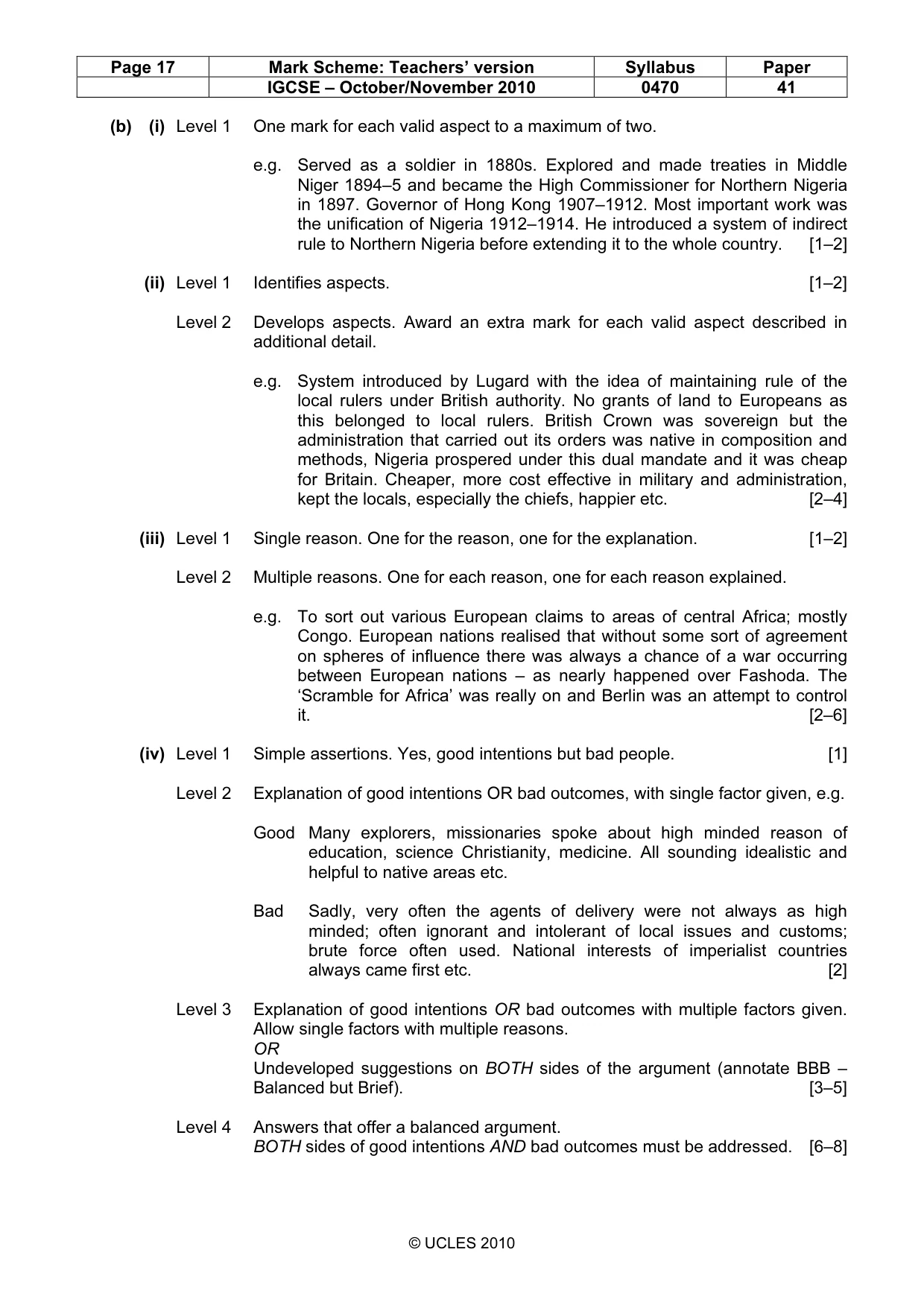
Page 17 Mark Scheme: Teachers’ version Syllabus Paper IGCSE – October/November 2010 0470 41 © UCLES 2010 (b) (i) Level 1 One mark for each valid aspect to a maximum of two. e.g. Served as a soldier in 1880s. Explored and made treaties in Middle Niger 1894–5 and became the High Commissioner for Northern Nigeria in 1897. Governor of Hong Kong 1907–1912. Most important work was the unification of Nigeria 1912–1914. He introduced a system of indirect rule to Northern Nigeria before extending it to the whole country. [1–2] (ii) Level 1 Identifies aspects. [1–2] Level 2 Develops aspects. Award an extra mark for each valid aspect described in additional detail. e.g. System introduced by Lugard with the idea of maintaining rule of the local rulers under British authority. No grants of land to Europeans as this belonged to local rulers. British Crown was sovereign but the administration that carried out its orders was native in composition and methods, Nigeria prospered under this dual mandate and it was cheap for Britain. Cheaper, more cost effective in military and administration, kept the locals, especially the chiefs, happier etc. [2–4] (iii) Level 1 Single reason. One for the reason, one for the explanation. [1–2] Level 2 Multiple reasons. One for each reason, one for each reason explained. e.g. To sort out various European claims to areas of central Africa; mostly Congo. European nations realised that without some sort of agreement on spheres of influence there was always a chance of a war occurring between European nations – as nearly happened over Fashoda. The ‘Scramble for Africa’ was really on and Berlin was an attempt to control it. [2–6] (iv) Level 1 Simple assertions. Yes, good intentions but bad people. [1] Level 2 Explanation of good intentions OR bad outcomes, with single factor given, e.g. Good Many explorers, missionaries spoke about high minded reason of education, science Christianity, medicine. All sounding idealistic and helpful to native areas etc. Bad Sadly, very often the agents of delivery were not always as high minded; often ignorant and intolerant of local issues and customs; brute force often used. National interests of imperialist countries always came first etc. [2] Level 3 Explanation of good intentions OR bad outcomes with multiple factors given. Allow single factors with multiple reasons. OR Undeveloped suggestions on BOTH sides of the argument (annotate BBB – Balanced but Brief). [3–5] Level 4 Answers that offer a balanced argument. BOTH sides of good intentions AND bad outcomes must be addressed. [6–8]
What you needed in this session
Cambridge’s own grade thresholds for 2010 Oct/Nov, Paper 4 · Variant 1. A higher threshold means an easier paper — the bar moves with how the cohort did.