Cambridge IGCSE History 0470 — 2010 May/June Paper 4 · Variant 3
0470/43/M/J/10 · 40 marks · ≈45 min
The question paper and its mark scheme, free to read here and free to download. This is Cambridge’s own paper, exactly as it was sat.
Question paper12 pages

Mark scheme17 pages
Answers below. Sit the paper first if you are practising.
Paper as text
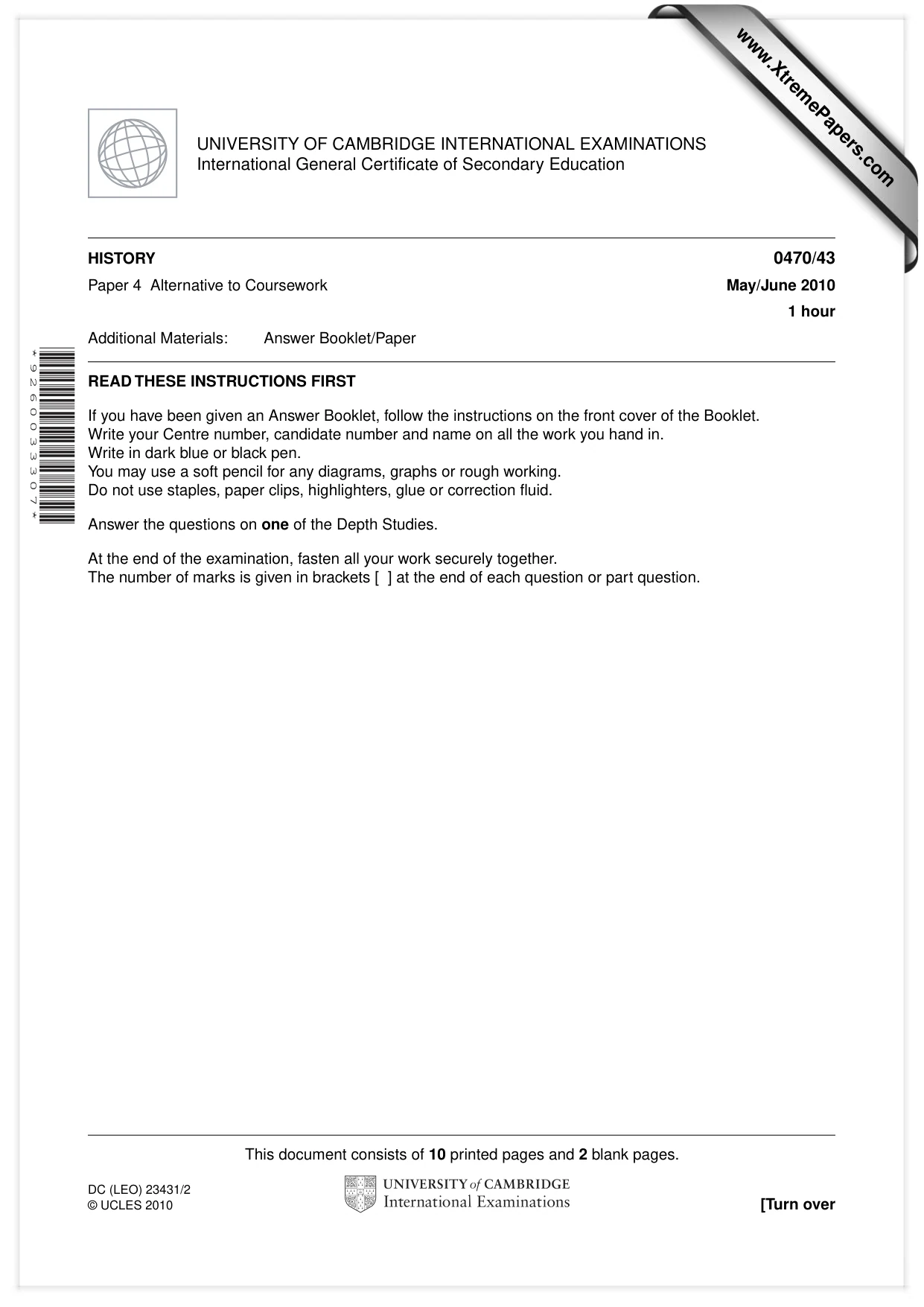
Question paper, page 1
This document consists of 10 printed pages and 2 blank pages. DC (LEO) 23431/2 © UCLES 2010 [Turn over UNIVERSITY OF CAMBRIDGE INTERNATIONAL EXAMINATIONS International General Certificate of Secondary Education READ THESE INSTRUCTIONS FIRST If you have been given an Answer Booklet, follow the instructions on the front cover of the Booklet. Write your Centre number, candidate number and name on all the work you hand in. Write in dark blue or black pen. You may use a soft pencil for any diagrams, graphs or rough working. Do not use staples, paper clips, highlighters, glue or correction fluid. Answer the questions on one of the Depth Studies. At the end of the examination, fasten all your work securely together. The number of marks is given in brackets [ ] at the end of each question or part question. * 9 2 6 0 0 3 3 3 0 7 * HISTORY 0470/43 Paper 4 Alternative to Coursework May/June 2010 1 hour Additional Materials: Answer Booklet/Paper www.XtremePapers.com
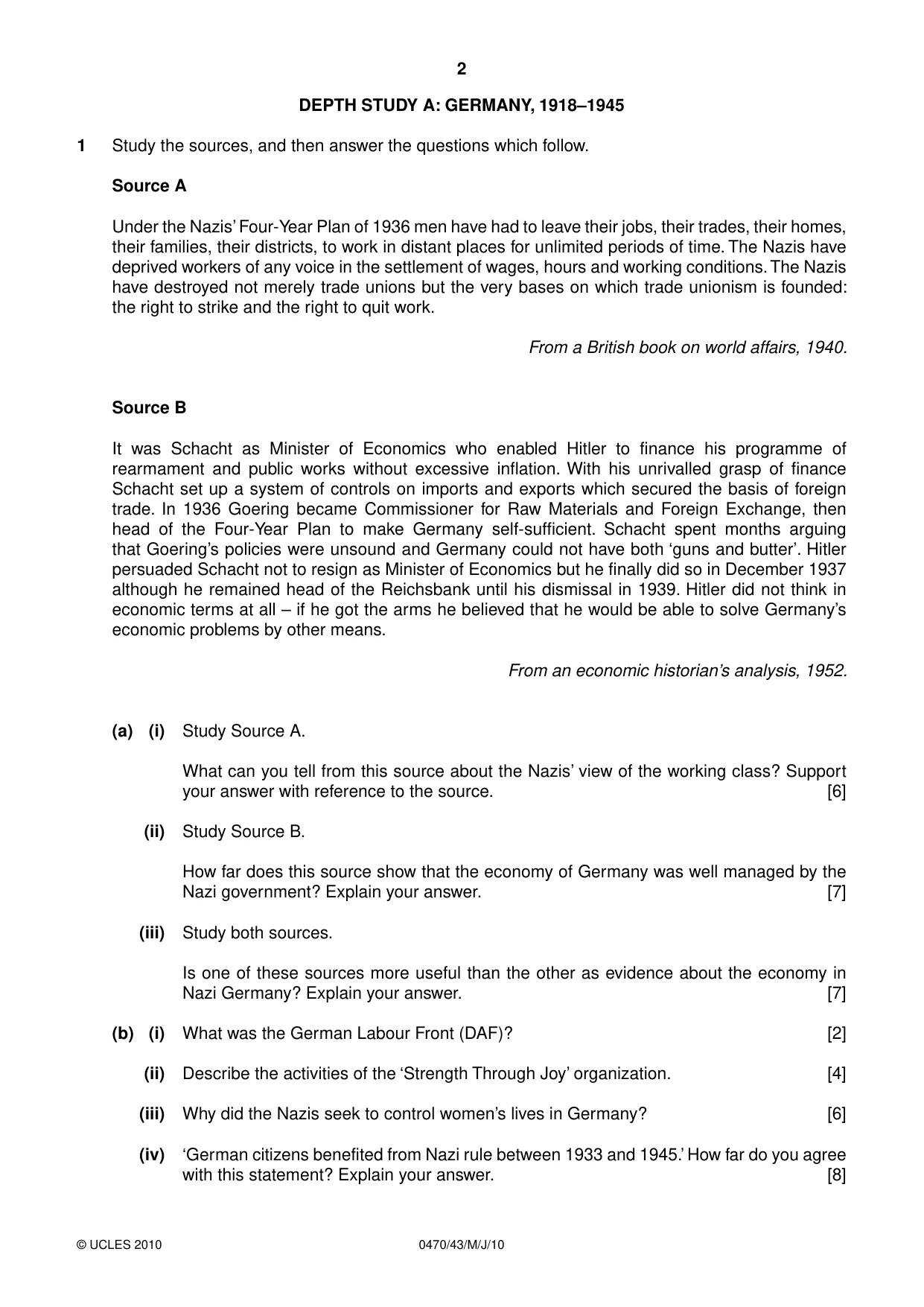
Question paper, page 2
2 0470/43/M/J/10 © UCLES 2010 DEPTH STUDY A: GERMANY, 1918–1945 1 Study the sources, and then answer the questions which follow. Source A Under the Nazis’ Four-Year Plan of 1936 men have had to leave their jobs, their trades, their homes, their families, their districts, to work in distant places for unlimited periods of time. The Nazis have deprived workers of any voice in the settlement of wages, hours and working conditions. The Nazis have destroyed not merely trade unions but the very bases on which trade unionism is founded: the right to strike and the right to quit work. From a British book on world affairs, 1940. Source B It was Schacht as Minister of Economics who enabled Hitler to finance his programme of rearmament and public works without excessive inflation. With his unrivalled grasp of finance Schacht set up a system of controls on imports and exports which secured the basis of foreign trade. In 1936 Goering became Commissioner for Raw Materials and Foreign Exchange, then head of the Four-Year Plan to make Germany self-sufficient. Schacht spent months arguing that Goering’s policies were unsound and Germany could not have both ‘guns and butter’. Hitler persuaded Schacht not to resign as Minister of Economics but he finally did so in December 1937 although he remained head of the Reichsbank until his dismissal in 1939. Hitler did not think in economic terms at all – if he got the arms he believed that he would be able to solve Germany’s economic problems by other means. From an economic historian’s analysis, 1952. (a) (i) Study Source A. What can you tell from this source about the Nazis’ view of the working class? Support your answer with reference to the source. [6] (ii) Study Source B. How far does this source show that the economy of Germany was well managed by the Nazi government? Explain your answer. [7] (iii) Study both sources. Is one of these sources more useful than the other as evidence about the economy in Nazi Germany? Explain your answer. [7] (b) (i) What was the German Labour Front (DAF)? [2] (ii) Describe the activities of the ‘Strength Through Joy’ organization. [4] (iii) Why did the Nazis seek to control women’s lives in Germany? [6] (iv) ‘German citizens benefited from Nazi rule between 1933 and 1945.’ How far do you agree with this statement? Explain your answer. [8]
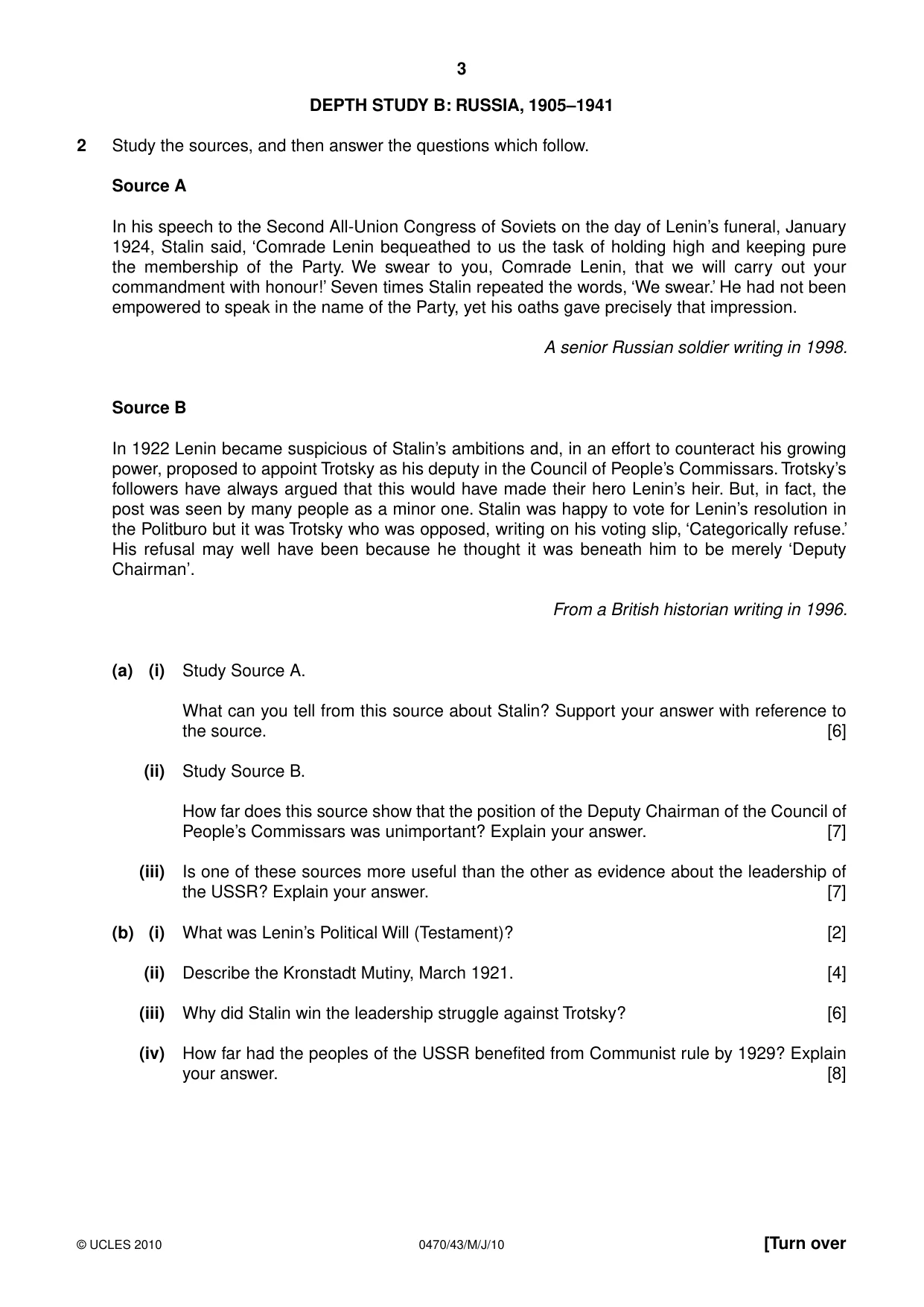
Question paper, page 3
3 0470/43/M/J/10 © UCLES 2010 [Turn over DEPTH STUDY B: RUSSIA, 1905–1941 2 Study the sources, and then answer the questions which follow. Source A In his speech to the Second All-Union Congress of Soviets on the day of Lenin’s funeral, January 1924, Stalin said, ‘Comrade Lenin bequeathed to us the task of holding high and keeping pure the membership of the Party. We swear to you, Comrade Lenin, that we will carry out your commandment with honour!’ Seven times Stalin repeated the words, ‘We swear.’ He had not been empowered to speak in the name of the Party, yet his oaths gave precisely that impression. A senior Russian soldier writing in 1998. Source B In 1922 Lenin became suspicious of Stalin’s ambitions and, in an effort to counteract his growing power, proposed to appoint Trotsky as his deputy in the Council of People’s Commissars. Trotsky’s followers have always argued that this would have made their hero Lenin’s heir. But, in fact, the post was seen by many people as a minor one. Stalin was happy to vote for Lenin’s resolution in the Politburo but it was Trotsky who was opposed, writing on his voting slip, ‘Categorically refuse.’ His refusal may well have been because he thought it was beneath him to be merely ‘Deputy Chairman’. From a British historian writing in 1996. (a) (i) Study Source A. What can you tell from this source about Stalin? Support your answer with reference to the source. [6] (ii) Study Source B. How far does this source show that the position of the Deputy Chairman of the Council of People’s Commissars was unimportant? Explain your answer. [7] (iii) Is one of these sources more useful than the other as evidence about the leadership of the USSR? Explain your answer. [7] (b) (i) What was Lenin’s Political Will (Testament)? [2] (ii) Describe the Kronstadt Mutiny, March 1921. [4] (iii) Why did Stalin win the leadership struggle against Trotsky? [6] (iv) How far had the peoples of the USSR benefited from Communist rule by 1929? Explain your answer. [8]
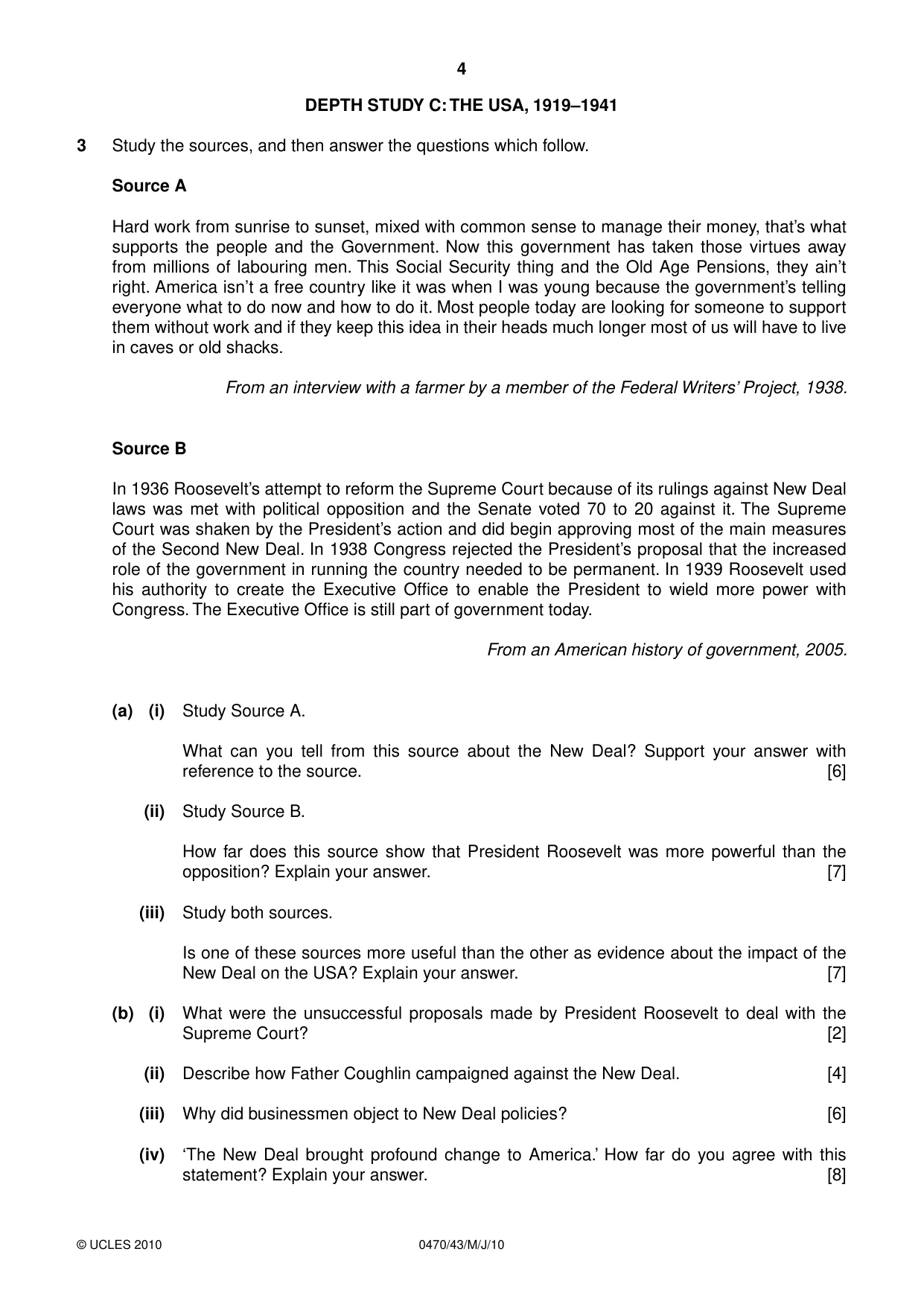
Question paper, page 4
4 0470/43/M/J/10 © UCLES 2010 DEPTH STUDY C: THE USA, 1919–1941 3 Study the sources, and then answer the questions which follow. Source A Hard work from sunrise to sunset, mixed with common sense to manage their money, that’s what supports the people and the Government. Now this government has taken those virtues away from millions of labouring men. This Social Security thing and the Old Age Pensions, they ain’t right. America isn’t a free country like it was when I was young because the government’s telling everyone what to do now and how to do it. Most people today are looking for someone to support them without work and if they keep this idea in their heads much longer most of us will have to live in caves or old shacks. From an interview with a farmer by a member of the Federal Writers’ Project, 1938. Source B In 1936 Roosevelt’s attempt to reform the Supreme Court because of its rulings against New Deal laws was met with political opposition and the Senate voted 70 to 20 against it. The Supreme Court was shaken by the President’s action and did begin approving most of the main measures of the Second New Deal. In 1938 Congress rejected the President’s proposal that the increased role of the government in running the country needed to be permanent. In 1939 Roosevelt used his authority to create the Executive Office to enable the President to wield more power with Congress. The Executive Office is still part of government today. From an American history of government, 2005. (a) (i) Study Source A. What can you tell from this source about the New Deal? Support your answer with reference to the source. [6] (ii) Study Source B. How far does this source show that President Roosevelt was more powerful than the opposition? Explain your answer. [7] (iii) Study both sources. Is one of these sources more useful than the other as evidence about the impact of the New Deal on the USA? Explain your answer. [7] (b) (i) What were the unsuccessful proposals made by President Roosevelt to deal with the Supreme Court? [2] (ii) Describe how Father Coughlin campaigned against the New Deal. [4] (iii) Why did businessmen object to New Deal policies? [6] (iv) ‘The New Deal brought profound change to America.’ How far do you agree with this statement? Explain your answer. [8]
Question paper, page 5
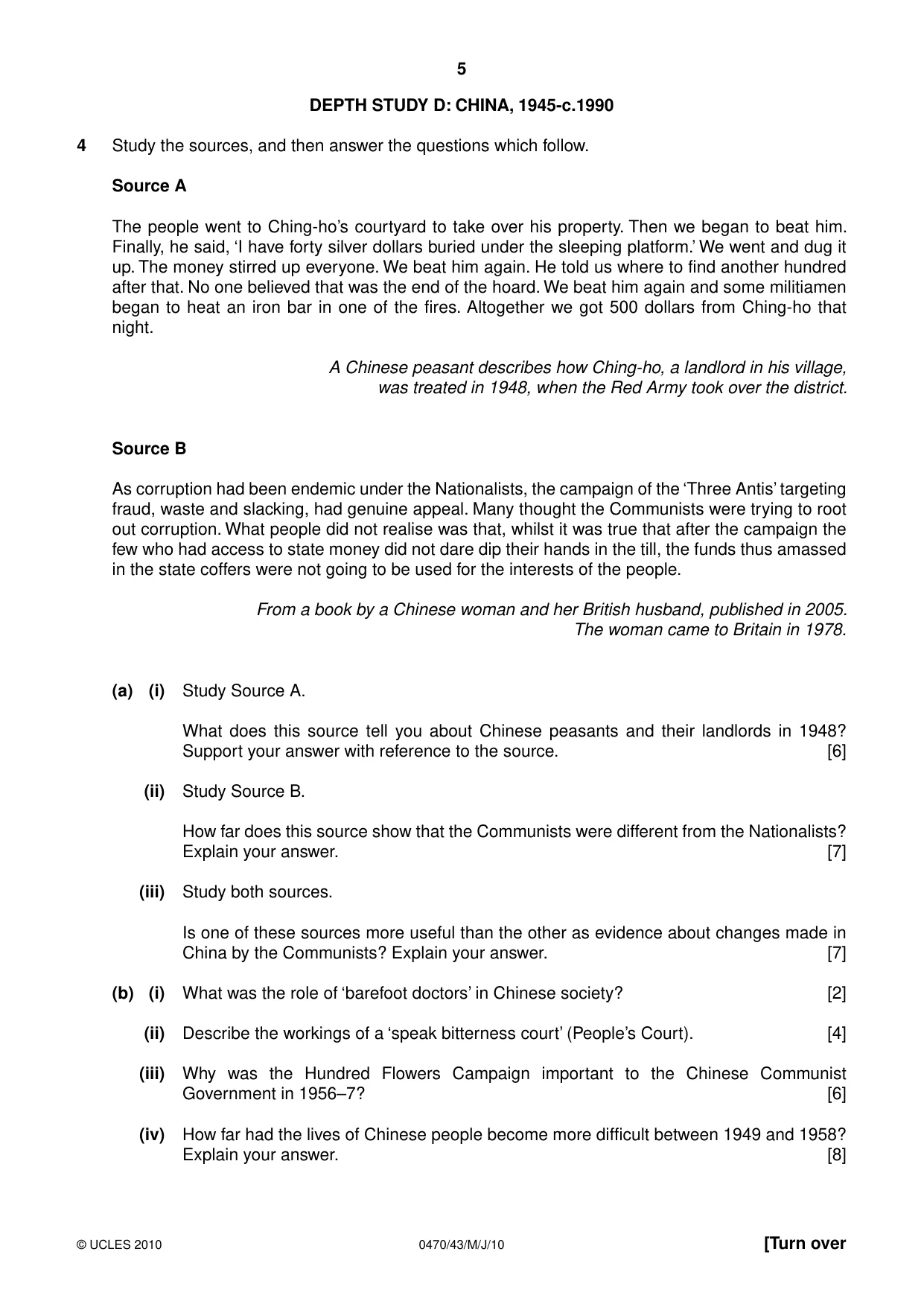
5 0470/43/M/J/10 © UCLES 2010 [Turn over DEPTH STUDY D: CHINA, 1945-c.1990 4 Study the sources, and then answer the questions which follow. Source A The people went to Ching-ho’s courtyard to take over his property. Then we began to beat him. Finally, he said, ‘I have forty silver dollars buried under the sleeping platform.’ We went and dug it up. The money stirred up everyone. We beat him again. He told us where to find another hundred after that. No one believed that was the end of the hoard. We beat him again and some militiamen began to heat an iron bar in one of the fires. Altogether we got 500 dollars from Ching-ho that night. A Chinese peasant describes how Ching-ho, a landlord in his village, was treated in 1948, when the Red Army took over the district. Source B As corruption had been endemic under the Nationalists, the campaign of the ‘Three Antis’ targeting fraud, waste and slacking, had genuine appeal. Many thought the Communists were trying to root out corruption. What people did not realise was that, whilst it was true that after the campaign the few who had access to state money did not dare dip their hands in the till, the funds thus amassed in the state coffers were not going to be used for the interests of the people. From a book by a Chinese woman and her British husband, published in 2005. The woman came to Britain in 1978. (a) (i) Study Source A. What does this source tell you about Chinese peasants and their landlords in 1948? Support your answer with reference to the source. [6] (ii) Study Source B. How far does this source show that the Communists were different from the Nationalists? Explain your answer. [7] (iii) Study both sources. Is one of these sources more useful than the other as evidence about changes made in China by the Communists? Explain your answer. [7] (b) (i) What was the role of ‘barefoot doctors’ in Chinese society? [2] (ii) Describe the workings of a ‘speak bitterness court’ (People’s Court). [4] (iii) Why was the Hundred Flowers Campaign important to the Chinese Communist Government in 1956–7? [6] (iv) How far had the lives of Chinese people become more difficult between 1949 and 1958? Explain your answer. [8]
Question paper, page 6
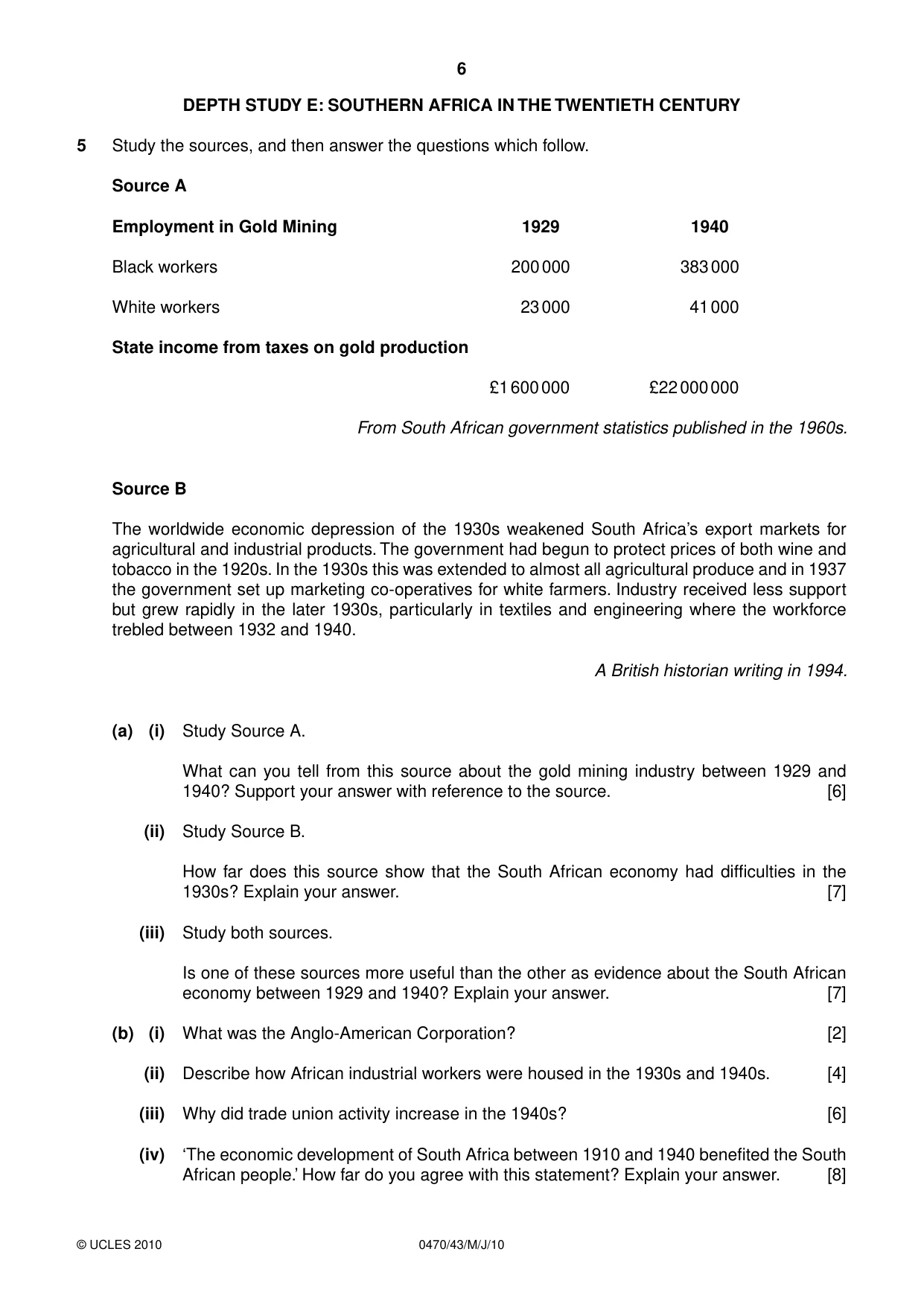
6 0470/43/M/J/10 © UCLES 2010 DEPTH STUDY E: SOUTHERN AFRICA IN THE TWENTIETH CENTURY 5 Study the sources, and then answer the questions which follow. Source A Employment in Gold Mining 1929 1940 Black workers 200 000 383 000 White workers 23 000 41 000 State income from taxes on gold production £1 600 000 £22 000 000 From South African government statistics published in the 1960s. Source B The worldwide economic depression of the 1930s weakened South Africa’s export markets for agricultural and industrial products. The government had begun to protect prices of both wine and tobacco in the 1920s. In the 1930s this was extended to almost all agricultural produce and in 1937 the government set up marketing co-operatives for white farmers. Industry received less support but grew rapidly in the later 1930s, particularly in textiles and engineering where the workforce trebled between 1932 and 1940. A British historian writing in 1994. (a) (i) Study Source A. What can you tell from this source about the gold mining industry between 1929 and 1940? Support your answer with reference to the source. [6] (ii) Study Source B. How far does this source show that the South African economy had difficulties in the 1930s? Explain your answer. [7] (iii) Study both sources. Is one of these sources more useful than the other as evidence about the South African economy between 1929 and 1940? Explain your answer. [7] (b) (i) What was the Anglo-American Corporation? [2] (ii) Describe how African industrial workers were housed in the 1930s and 1940s. [4] (iii) Why did trade union activity increase in the 1940s? [6] (iv) ‘The economic development of South Africa between 1910 and 1940 benefited the South African people.’ How far do you agree with this statement? Explain your answer. [8]
Question paper, page 7
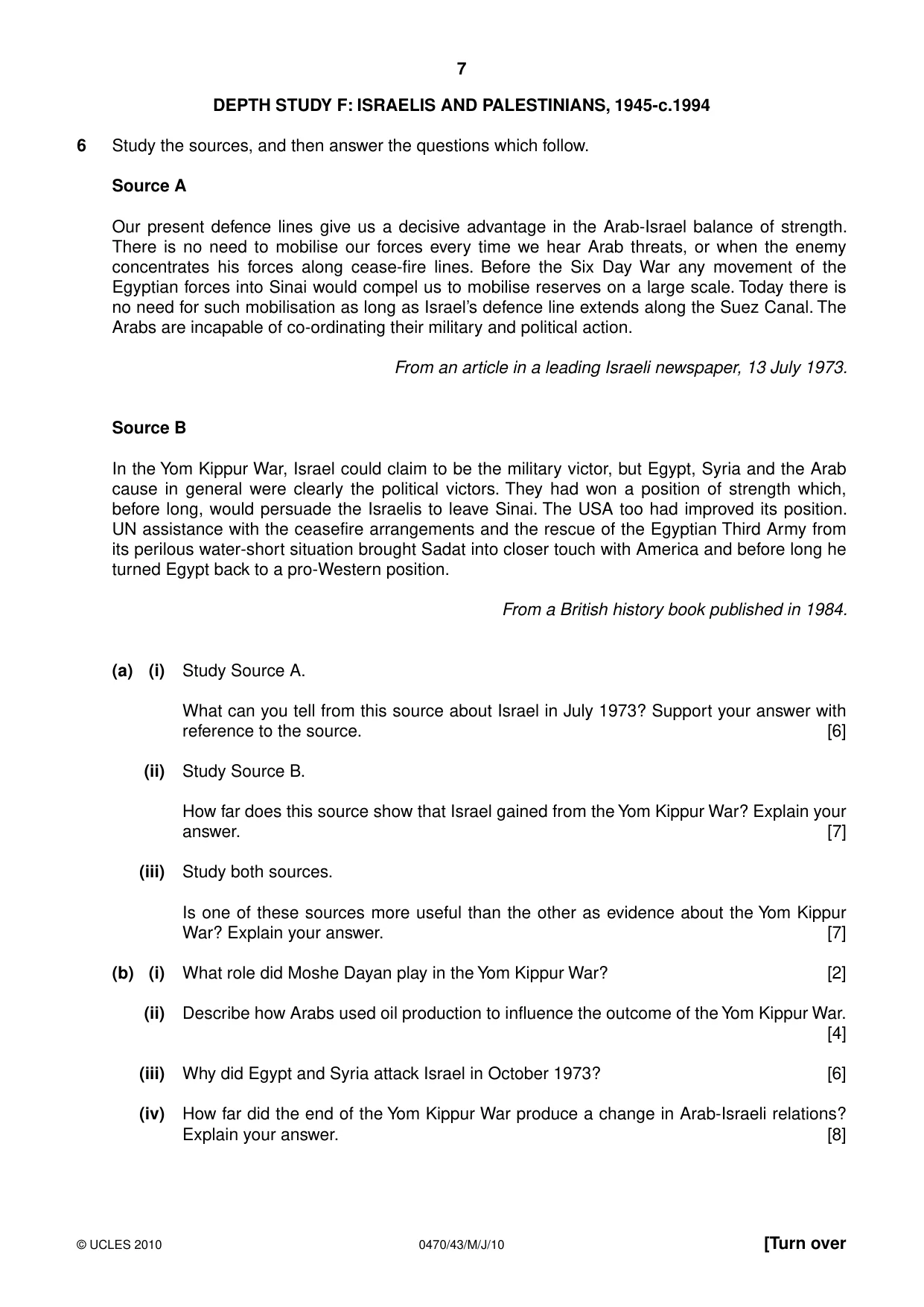
7 0470/43/M/J/10 © UCLES 2010 [Turn over DEPTH STUDY F: ISRAELIS AND PALESTINIANS, 1945-c.1994 6 Study the sources, and then answer the questions which follow. Source A Our present defence lines give us a decisive advantage in the Arab-Israel balance of strength. There is no need to mobilise our forces every time we hear Arab threats, or when the enemy concentrates his forces along cease-fire lines. Before the Six Day War any movement of the Egyptian forces into Sinai would compel us to mobilise reserves on a large scale. Today there is no need for such mobilisation as long as Israel’s defence line extends along the Suez Canal. The Arabs are incapable of co-ordinating their military and political action. From an article in a leading Israeli newspaper, 13 July 1973. Source B In the Yom Kippur War, Israel could claim to be the military victor, but Egypt, Syria and the Arab cause in general were clearly the political victors. They had won a position of strength which, before long, would persuade the Israelis to leave Sinai. The USA too had improved its position. UN assistance with the ceasefire arrangements and the rescue of the Egyptian Third Army from its perilous water-short situation brought Sadat into closer touch with America and before long he turned Egypt back to a pro-Western position. From a British history book published in 1984. (a) (i) Study Source A. What can you tell from this source about Israel in July 1973? Support your answer with reference to the source. [6] (ii) Study Source B. How far does this source show that Israel gained from the Yom Kippur War? Explain your answer. [7] (iii) Study both sources. Is one of these sources more useful than the other as evidence about the Yom Kippur War? Explain your answer. [7] (b) (i) What role did Moshe Dayan play in the Yom Kippur War? [2] (ii) Describe how Arabs used oil production to influence the outcome of the Yom Kippur War. [4] (iii) Why did Egypt and Syria attack Israel in October 1973? [6] (iv) How far did the end of the Yom Kippur War produce a change in Arab-Israeli relations? Explain your answer. [8]
Question paper, page 8
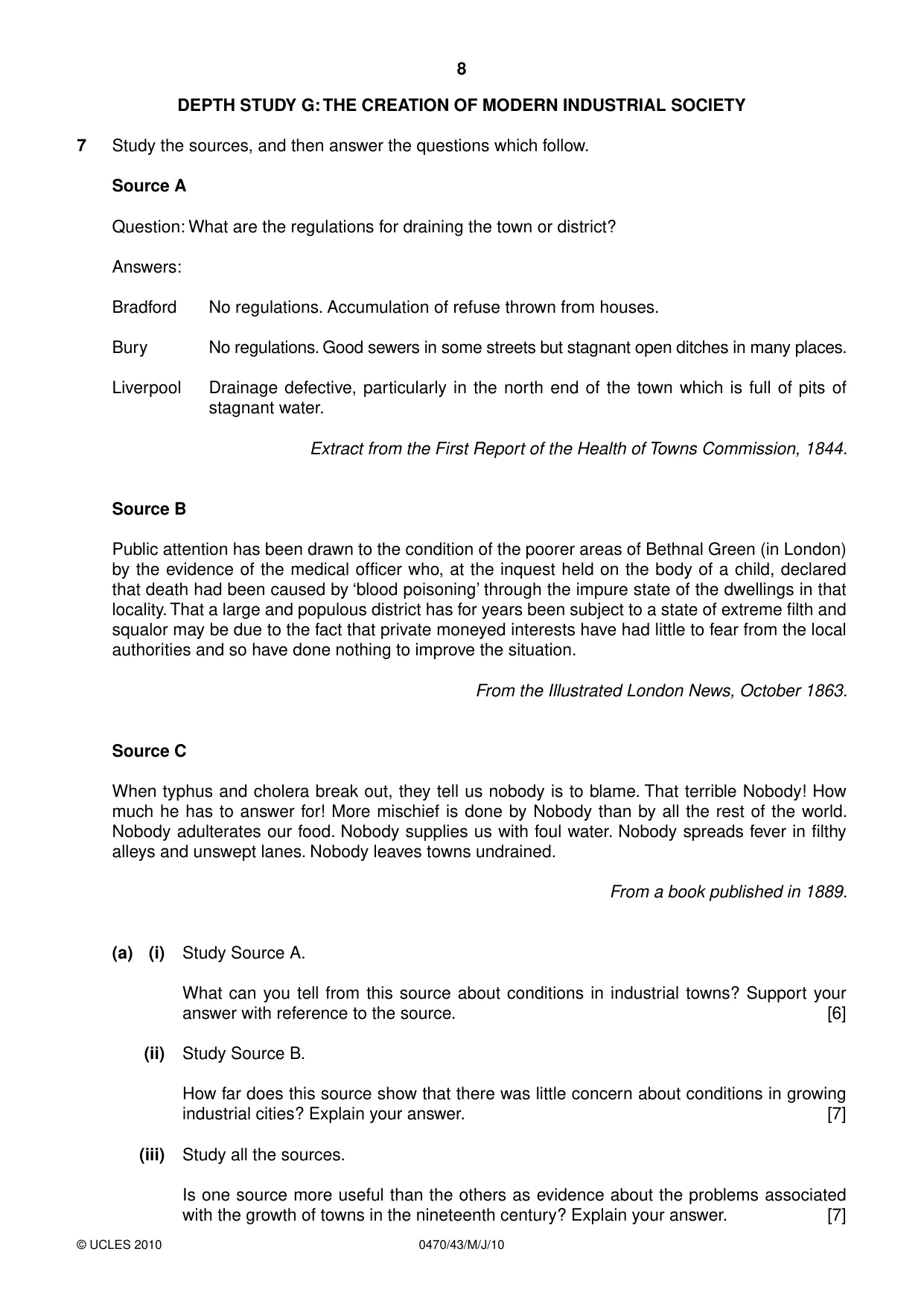
8 0470/43/M/J/10 © UCLES 2010 DEPTH STUDY G: THE CREATION OF MODERN INDUSTRIAL SOCIETY 7 Study the sources, and then answer the questions which follow. Source A Question: What are the regulations for draining the town or district? Answers: Bradford No regulations. Accumulation of refuse thrown from houses. Bury No regulations. Good sewers in some streets but stagnant open ditches in many places. Liverpool Drainage defective, particularly in the north end of the town which is full of pits of stagnant water. Extract from the First Report of the Health of Towns Commission, 1844. Source B Public attention has been drawn to the condition of the poorer areas of Bethnal Green (in London) by the evidence of the medical officer who, at the inquest held on the body of a child, declared that death had been caused by ‘blood poisoning’ through the impure state of the dwellings in that locality. That a large and populous district has for years been subject to a state of extreme filth and squalor may be due to the fact that private moneyed interests have had little to fear from the local authorities and so have done nothing to improve the situation. From the Illustrated London News, October 1863. Source C When typhus and cholera break out, they tell us nobody is to blame. That terrible Nobody! How much he has to answer for! More mischief is done by Nobody than by all the rest of the world. Nobody adulterates our food. Nobody supplies us with foul water. Nobody spreads fever in filthy alleys and unswept lanes. Nobody leaves towns undrained. From a book published in 1889. (a) (i) Study Source A. What can you tell from this source about conditions in industrial towns? Support your answer with reference to the source. [6] (ii) Study Source B. How far does this source show that there was little concern about conditions in growing industrial cities? Explain your answer. [7] (iii) Study all the sources. Is one source more useful than the others as evidence about the problems associated with the growth of towns in the nineteenth century? Explain your answer. [7]
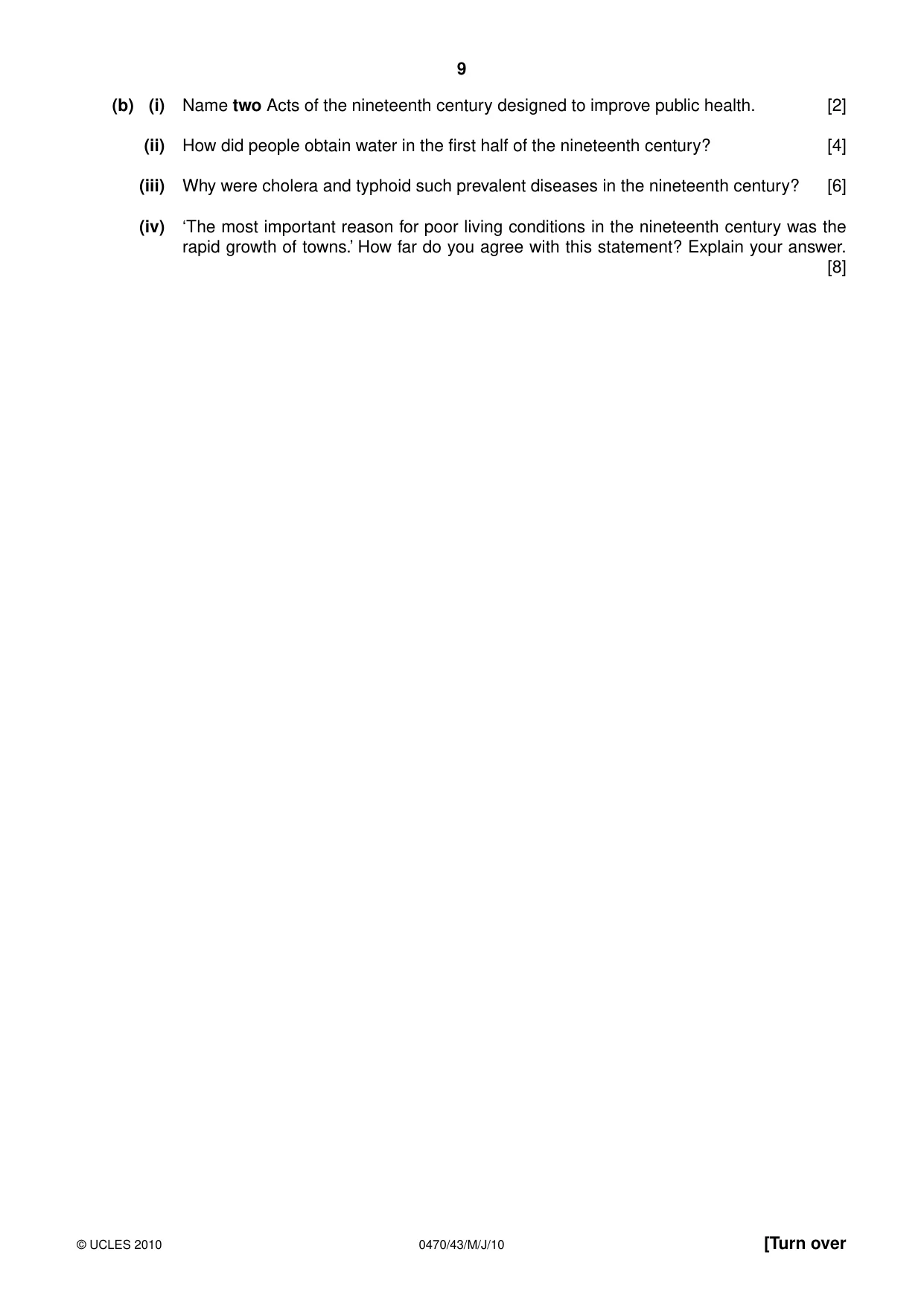
Question paper, page 9
9 0470/43/M/J/10 © UCLES 2010 [Turn over (b) (i) Name two Acts of the nineteenth century designed to improve public health. [2] (ii) How did people obtain water in the first half of the nineteenth century? [4] (iii) Why were cholera and typhoid such prevalent diseases in the nineteenth century? [6] (iv) ‘The most important reason for poor living conditions in the nineteenth century was the rapid growth of towns.’ How far do you agree with this statement? Explain your answer. [8]
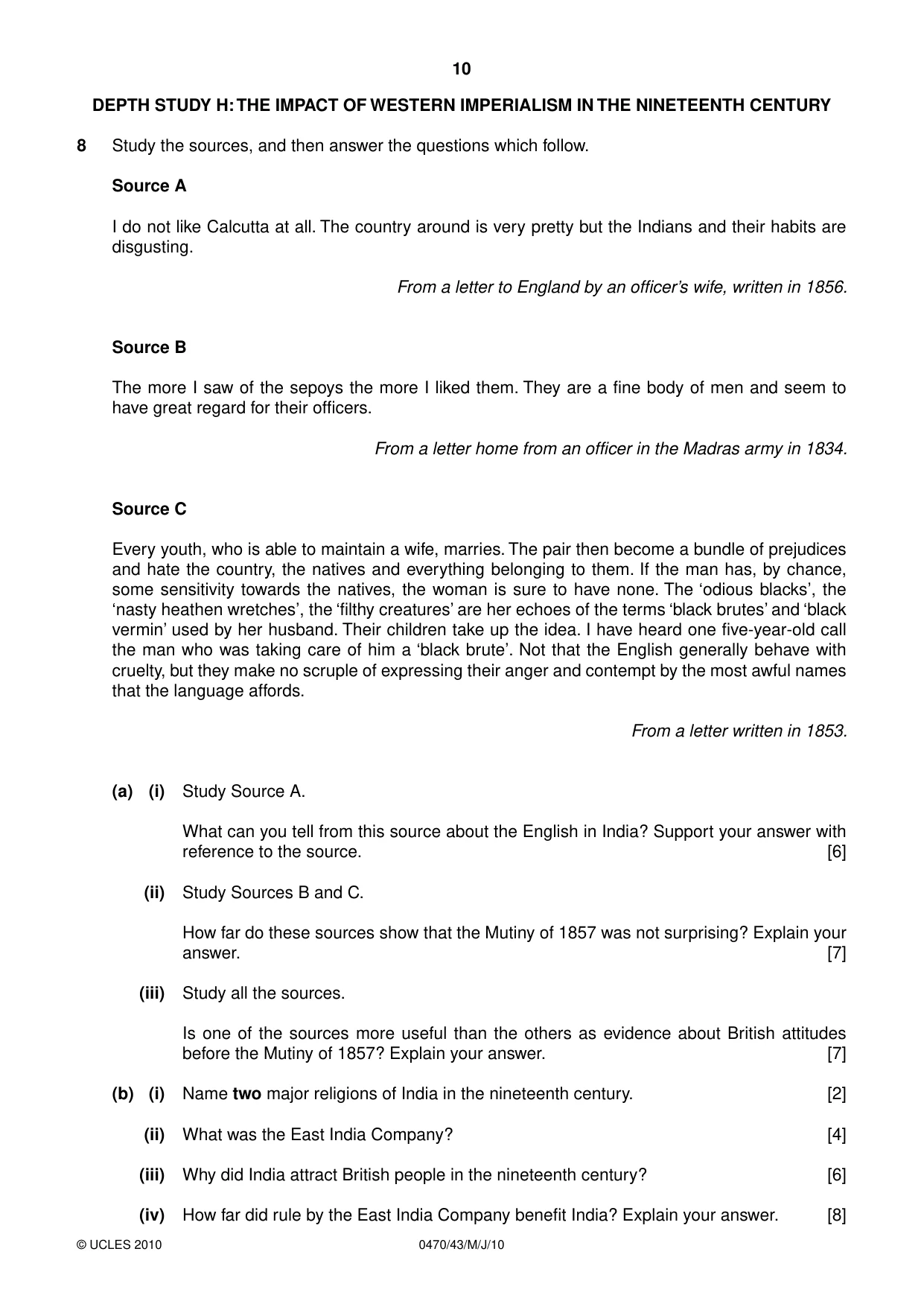
Question paper, page 10
10 0470/43/M/J/10 © UCLES 2010 DEPTH STUDY H: THE IMPACT OF WESTERN IMPERIALISM IN THE NINETEENTH CENTURY 8 Study the sources, and then answer the questions which follow. Source A I do not like Calcutta at all. The country around is very pretty but the Indians and their habits are disgusting. From a letter to England by an officer’s wife, written in 1856. Source B The more I saw of the sepoys the more I liked them. They are a fine body of men and seem to have great regard for their officers. From a letter home from an officer in the Madras army in 1834. Source C Every youth, who is able to maintain a wife, marries. The pair then become a bundle of prejudices and hate the country, the natives and everything belonging to them. If the man has, by chance, some sensitivity towards the natives, the woman is sure to have none. The ‘odious blacks’, the ‘nasty heathen wretches’, the ‘filthy creatures’ are her echoes of the terms ‘black brutes’ and ‘black vermin’ used by her husband. Their children take up the idea. I have heard one five-year-old call the man who was taking care of him a ‘black brute’. Not that the English generally behave with cruelty, but they make no scruple of expressing their anger and contempt by the most awful names that the language affords. From a letter written in 1853. (a) (i) Study Source A. What can you tell from this source about the English in India? Support your answer with reference to the source. [6] (ii) Study Sources B and C. How far do these sources show that the Mutiny of 1857 was not surprising? Explain your answer. [7] (iii) Study all the sources. Is one of the sources more useful than the others as evidence about British attitudes before the Mutiny of 1857? Explain your answer. [7] (b) (i) Name two major religions of India in the nineteenth century. [2] (ii) What was the East India Company? [4] (iii) Why did India attract British people in the nineteenth century? [6] (iv) How far did rule by the East India Company benefit India? Explain your answer. [8]
Question paper, page 11
11 0470/43/M/J/10 © UCLES 2010 BLANK PAGE
Question paper, page 12
12 0470/43/M/J/10 © UCLES 2010 BLANK PAGE Copyright Acknowledgements: Depth Study B Source A © Dmitri Volkogonov, The Rise and Fall of the Soviet Empire ; Harper Collins, 1998. Depth Study B Source B © Orlando Figes, The People’s Tragedy; Jonathan Cape, 1996. Depth Study D Source A © Bryn O’Callahan, A History of the Twentieth Century ; Longman UK, 1987. Depth Study D Source B © Jung Chang and John Halliday, Mao, the unknown story ; Jonathan Cape, 2005. Depth Study E Source A © W Beinart, Twentieth Century South Africa; Oxford University Press, 1994. Depth Study E Source B © W Beinart, Twentieth Century South Africa; Oxford University Press, 1994. Depth Study F Source A © Tom McAleavy, The Arab-Israeli Conflict ; Cambridge University Press, 1998. Depth Study F Source B © J N Westwood, The History of Middle East Wars; Bison Books Ltd, 1984. Depth Study G Source A © Eric Hopkins, A Social History of the English Working Classes 1815–1945; Edward Arnold, 1979. Permission to reproduce items where third-party owned material protected by copyright is included has been sought and cleared where possible. Every reasonable effort has been made by the publisher (UCLES) to trace copyright holders, but if any items requiring clearance have unwittingly been included, the publisher will be pleased to make amends at the earliest possible opportunity. University of Cambridge International Examinations is part of the Cambridge Assessment Group. Cambridge Assessment is the brand name of University of Cambridge Local Examinations Syndicate (UCLES), which is itself a department of the University of Cambridge.
Mark scheme, page 1
UNIVERSITY OF CAMBRIDGE INTERNATIONAL EXAMINATIONS International General Certificate of Secondary Education MARK SCHEME for the May/June 2010 question paper for the guidance of teachers 0470 HISTORY 0470/43 Paper 43 (Alternative to Coursework), maximum raw mark 40 This mark scheme is published as an aid to teachers and candidates, to indicate the requirements of the examination. It shows the basis on which Examiners were instructed to award marks. It does not indicate the details of the discussions that took place at an Examiners’ meeting before marking began, which would have considered the acceptability of alternative answers. Mark schemes must be read in conjunction with the question papers and the report on the examination. • CIE will not enter into discussions or correspondence in connection with these mark schemes. CIE is publishing the mark schemes for the May/June 2010 question papers for most IGCSE, GCE Advanced Level and Advanced Subsidiary Level syllabuses and some Ordinary Level syllabuses. www.XtremePapers.com
Mark scheme, page 2
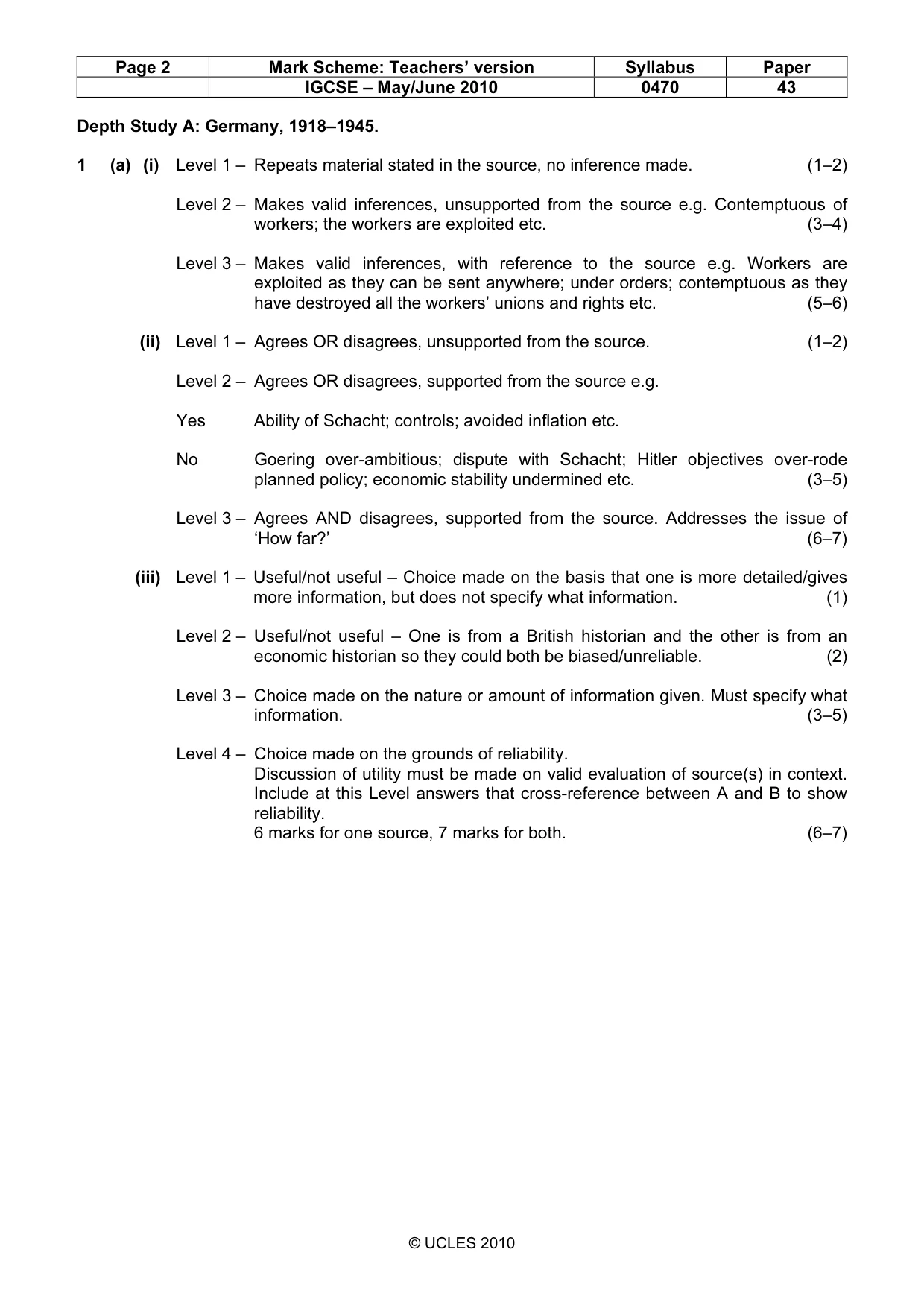
Page 2 Mark Scheme: Teachers’ version Syllabus Paper IGCSE – May/June 2010 0470 43 © UCLES 2010 Depth Study A: Germany, 1918–1945. 1 (a) (i) Level 1 – Repeats material stated in the source, no inference made. (1–2) Level 2 – Makes valid inferences, unsupported from the source e.g. Contemptuous of workers; the workers are exploited etc. (3–4) Level 3 – Makes valid inferences, with reference to the source e.g. Workers are exploited as they can be sent anywhere; under orders; contemptuous as they have destroyed all the workers’ unions and rights etc. (5–6) (ii) Level 1 – Agrees OR disagrees, unsupported from the source. (1–2) Level 2 – Agrees OR disagrees, supported from the source e.g. Yes Ability of Schacht; controls; avoided inflation etc. No Goering over-ambitious; dispute with Schacht; Hitler objectives over-rode planned policy; economic stability undermined etc. (3–5) Level 3 – Agrees AND disagrees, supported from the source. Addresses the issue of ‘How far?’ (6–7) (iii) Level 1 – Useful/not useful – Choice made on the basis that one is more detailed/gives more information, but does not specify what information. (1) Level 2 – Useful/not useful – One is from a British historian and the other is from an economic historian so they could both be biased/unreliable. (2) Level 3 – Choice made on the nature or amount of information given. Must specify what information. (3–5) Level 4 – Choice made on the grounds of reliability. Discussion of utility must be made on valid evaluation of source(s) in context. Include at this Level answers that cross-reference between A and B to show reliability. 6 marks for one source, 7 marks for both. (6–7)
Mark scheme, page 3
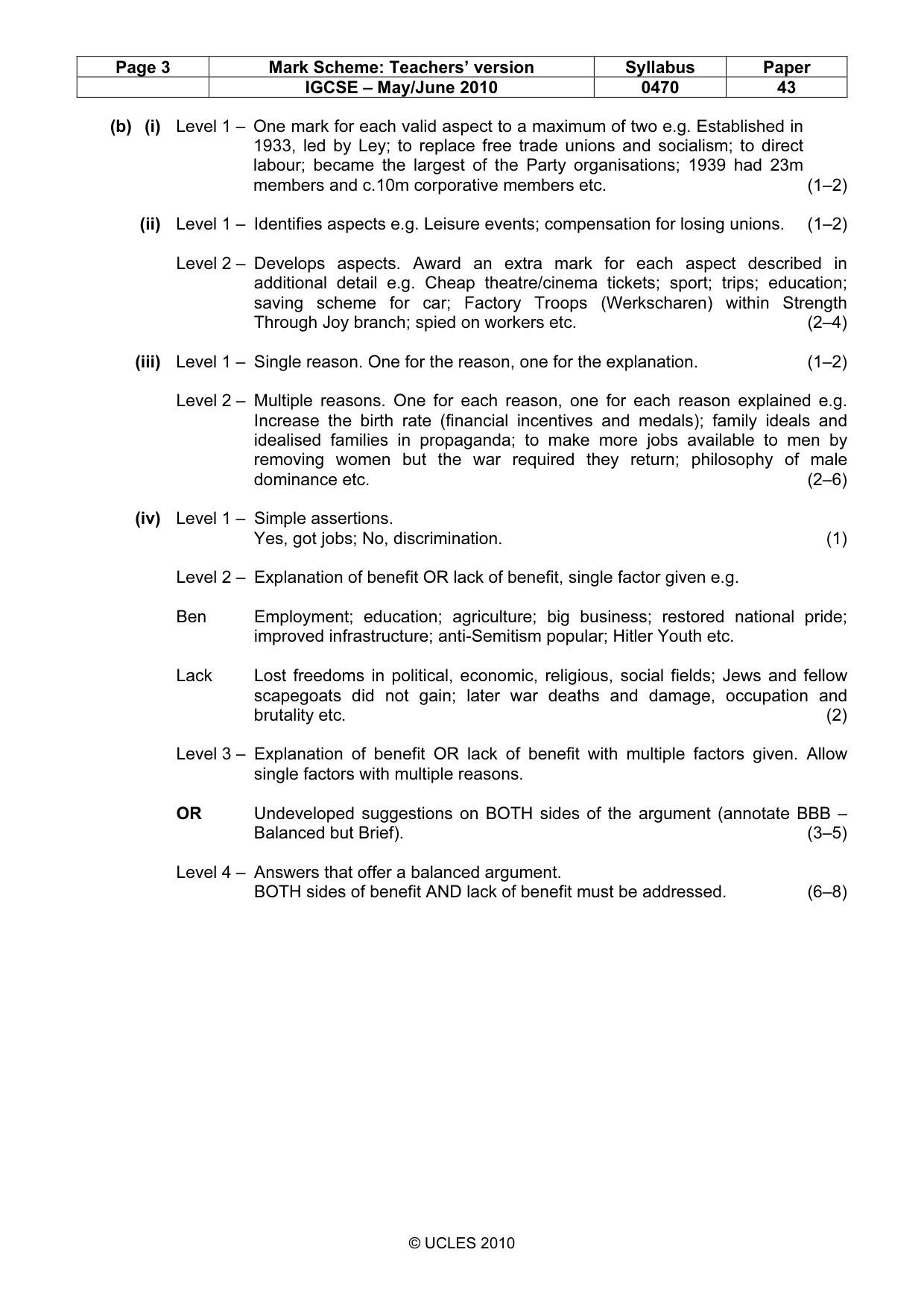
Page 3 Mark Scheme: Teachers’ version Syllabus Paper IGCSE – May/June 2010 0470 43 © UCLES 2010 (b) (i) Level 1 – One mark for each valid aspect to a maximum of two e.g. Established in 1933, led by Ley; to replace free trade unions and socialism; to direct labour; became the largest of the Party organisations; 1939 had 23m members and c.10m corporative members etc. (1–2) (ii) Level 1 – Identifies aspects e.g. Leisure events; compensation for losing unions. (1–2) Level 2 – Develops aspects. Award an extra mark for each aspect described in additional detail e.g. Cheap theatre/cinema tickets; sport; trips; education; saving scheme for car; Factory Troops (Werkscharen) within Strength Through Joy branch; spied on workers etc. (2–4) (iii) Level 1 – Single reason. One for the reason, one for the explanation. (1–2) Level 2 – Multiple reasons. One for each reason, one for each reason explained e.g. Increase the birth rate (financial incentives and medals); family ideals and idealised families in propaganda; to make more jobs available to men by removing women but the war required they return; philosophy of male dominance etc. (2–6) (iv) Level 1 – Simple assertions. Yes, got jobs; No, discrimination. (1) Level 2 – Explanation of benefit OR lack of benefit, single factor given e.g. Ben Employment; education; agriculture; big business; restored national pride; improved infrastructure; anti-Semitism popular; Hitler Youth etc. Lack Lost freedoms in political, economic, religious, social fields; Jews and fellow scapegoats did not gain; later war deaths and damage, occupation and brutality etc. (2) Level 3 – Explanation of benefit OR lack of benefit with multiple factors given. Allow single factors with multiple reasons. OR Undeveloped suggestions on BOTH sides of the argument (annotate BBB – Balanced but Brief). (3–5) Level 4 – Answers that offer a balanced argument. BOTH sides of benefit AND lack of benefit must be addressed. (6–8)
Mark scheme, page 4
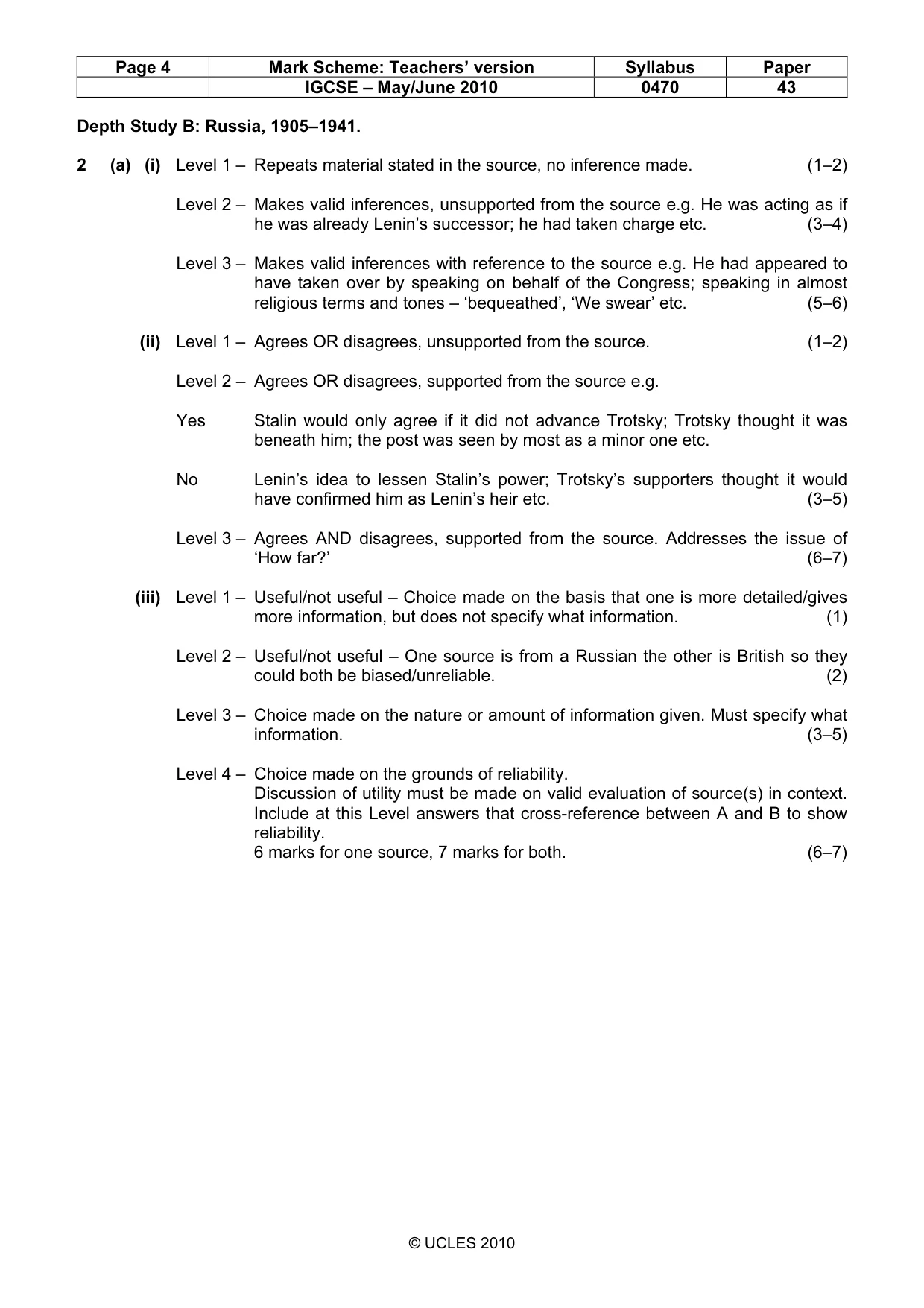
Page 4 Mark Scheme: Teachers’ version Syllabus Paper IGCSE – May/June 2010 0470 43 © UCLES 2010 Depth Study B: Russia, 1905–1941. 2 (a) (i) Level 1 – Repeats material stated in the source, no inference made. (1–2) Level 2 – Makes valid inferences, unsupported from the source e.g. He was acting as if he was already Lenin’s successor; he had taken charge etc. (3–4) Level 3 – Makes valid inferences with reference to the source e.g. He had appeared to have taken over by speaking on behalf of the Congress; speaking in almost religious terms and tones – ‘bequeathed’, ‘We swear’ etc. (5–6) (ii) Level 1 – Agrees OR disagrees, unsupported from the source. (1–2) Level 2 – Agrees OR disagrees, supported from the source e.g. Yes Stalin would only agree if it did not advance Trotsky; Trotsky thought it was beneath him; the post was seen by most as a minor one etc. No Lenin’s idea to lessen Stalin’s power; Trotsky’s supporters thought it would have confirmed him as Lenin’s heir etc. (3–5) Level 3 – Agrees AND disagrees, supported from the source. Addresses the issue of ‘How far?’ (6–7) (iii) Level 1 – Useful/not useful – Choice made on the basis that one is more detailed/gives more information, but does not specify what information. (1) Level 2 – Useful/not useful – One source is from a Russian the other is British so they could both be biased/unreliable. (2) Level 3 – Choice made on the nature or amount of information given. Must specify what information. (3–5) Level 4 – Choice made on the grounds of reliability. Discussion of utility must be made on valid evaluation of source(s) in context. Include at this Level answers that cross-reference between A and B to show reliability. 6 marks for one source, 7 marks for both. (6–7)
Mark scheme, page 5
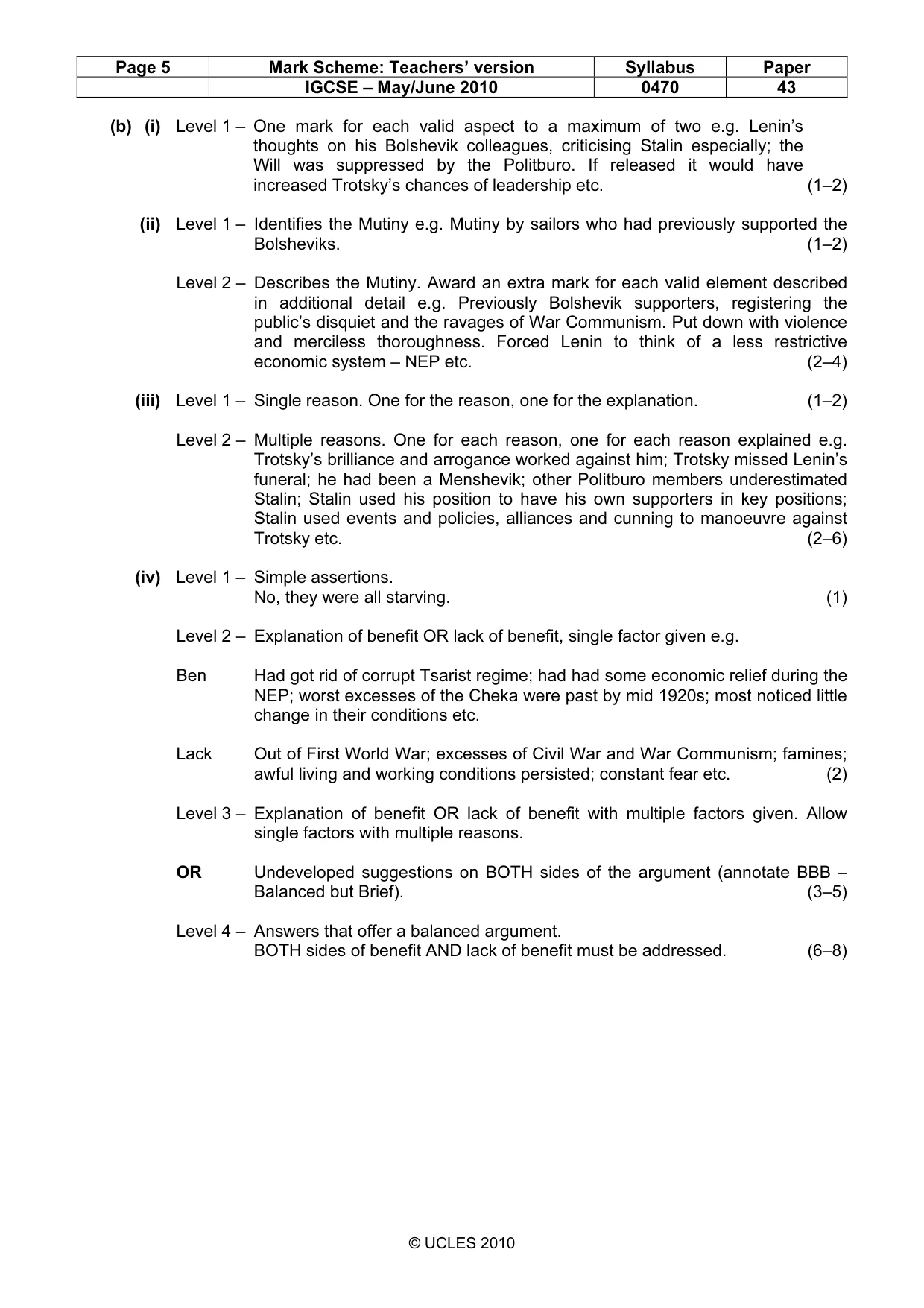
Page 5 Mark Scheme: Teachers’ version Syllabus Paper IGCSE – May/June 2010 0470 43 © UCLES 2010 (b) (i) Level 1 – One mark for each valid aspect to a maximum of two e.g. Lenin’s thoughts on his Bolshevik colleagues, criticising Stalin especially; the Will was suppressed by the Politburo. If released it would have increased Trotsky’s chances of leadership etc. (1–2) (ii) Level 1 – Identifies the Mutiny e.g. Mutiny by sailors who had previously supported the Bolsheviks. (1–2) Level 2 – Describes the Mutiny. Award an extra mark for each valid element described in additional detail e.g. Previously Bolshevik supporters, registering the public’s disquiet and the ravages of War Communism. Put down with violence and merciless thoroughness. Forced Lenin to think of a less restrictive economic system – NEP etc. (2–4) (iii) Level 1 – Single reason. One for the reason, one for the explanation. (1–2) Level 2 – Multiple reasons. One for each reason, one for each reason explained e.g. Trotsky’s brilliance and arrogance worked against him; Trotsky missed Lenin’s funeral; he had been a Menshevik; other Politburo members underestimated Stalin; Stalin used his position to have his own supporters in key positions; Stalin used events and policies, alliances and cunning to manoeuvre against Trotsky etc. (2–6) (iv) Level 1 – Simple assertions. No, they were all starving. (1) Level 2 – Explanation of benefit OR lack of benefit, single factor given e.g. Ben Had got rid of corrupt Tsarist regime; had had some economic relief during the NEP; worst excesses of the Cheka were past by mid 1920s; most noticed little change in their conditions etc. Lack Out of First World War; excesses of Civil War and War Communism; famines; awful living and working conditions persisted; constant fear etc. (2) Level 3 – Explanation of benefit OR lack of benefit with multiple factors given. Allow single factors with multiple reasons. OR Undeveloped suggestions on BOTH sides of the argument (annotate BBB – Balanced but Brief). (3–5) Level 4 – Answers that offer a balanced argument. BOTH sides of benefit AND lack of benefit must be addressed. (6–8)
Mark scheme, page 6
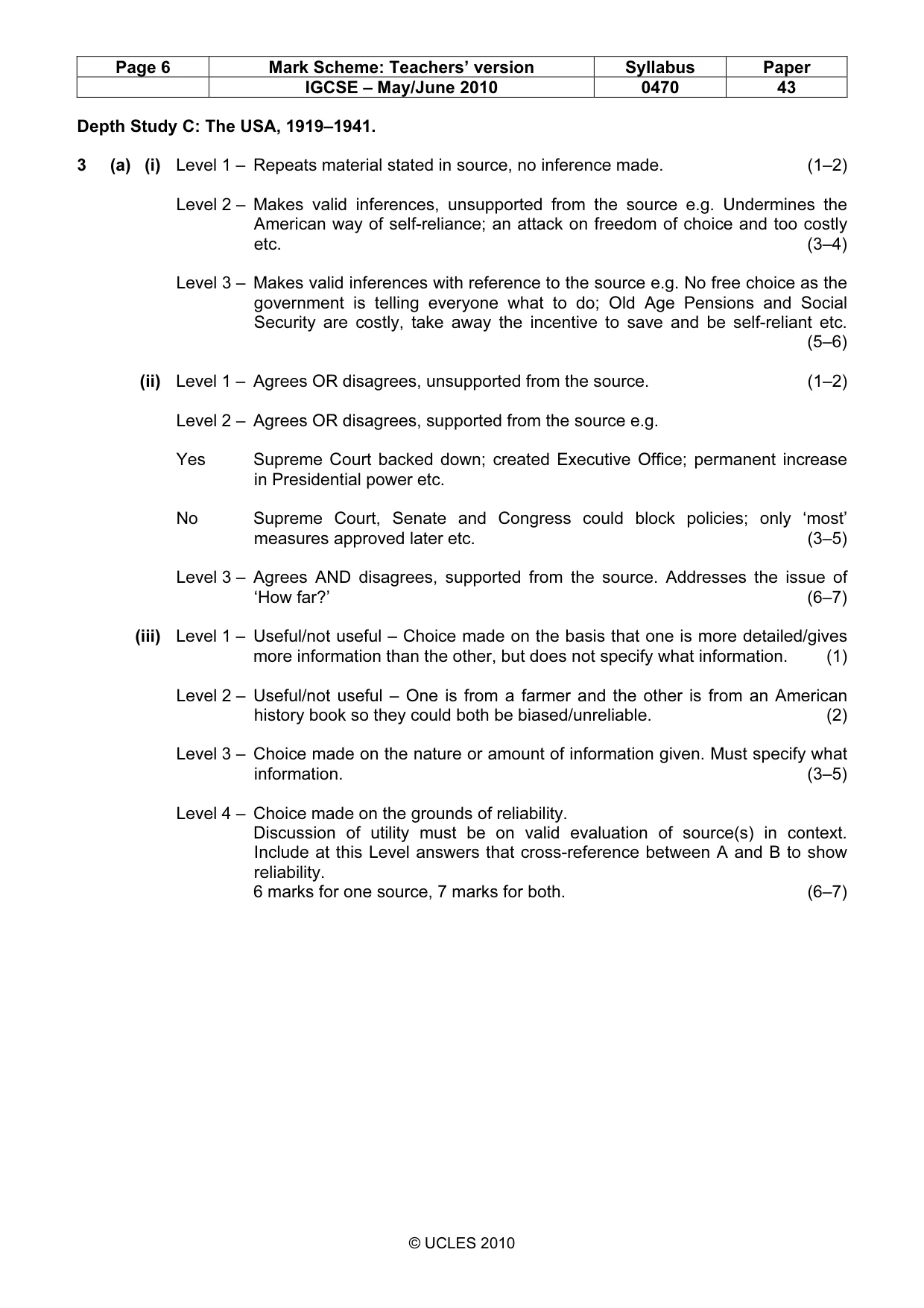
Page 6 Mark Scheme: Teachers’ version Syllabus Paper IGCSE – May/June 2010 0470 43 © UCLES 2010 Depth Study C: The USA, 1919–1941. 3 (a) (i) Level 1 – Repeats material stated in source, no inference made. (1–2) Level 2 – Makes valid inferences, unsupported from the source e.g. Undermines the American way of self-reliance; an attack on freedom of choice and too costly etc. (3–4) Level 3 – Makes valid inferences with reference to the source e.g. No free choice as the government is telling everyone what to do; Old Age Pensions and Social Security are costly, take away the incentive to save and be self-reliant etc. (5–6) (ii) Level 1 – Agrees OR disagrees, unsupported from the source. (1–2) Level 2 – Agrees OR disagrees, supported from the source e.g. Yes Supreme Court backed down; created Executive Office; permanent increase in Presidential power etc. No Supreme Court, Senate and Congress could block policies; only ‘most’ measures approved later etc. (3–5) Level 3 – Agrees AND disagrees, supported from the source. Addresses the issue of ‘How far?’ (6–7) (iii) Level 1 – Useful/not useful – Choice made on the basis that one is more detailed/gives more information than the other, but does not specify what information. (1) Level 2 – Useful/not useful – One is from a farmer and the other is from an American history book so they could both be biased/unreliable. (2) Level 3 – Choice made on the nature or amount of information given. Must specify what information. (3–5) Level 4 – Choice made on the grounds of reliability. Discussion of utility must be on valid evaluation of source(s) in context. Include at this Level answers that cross-reference between A and B to show reliability. 6 marks for one source, 7 marks for both. (6–7)
Mark scheme, page 7
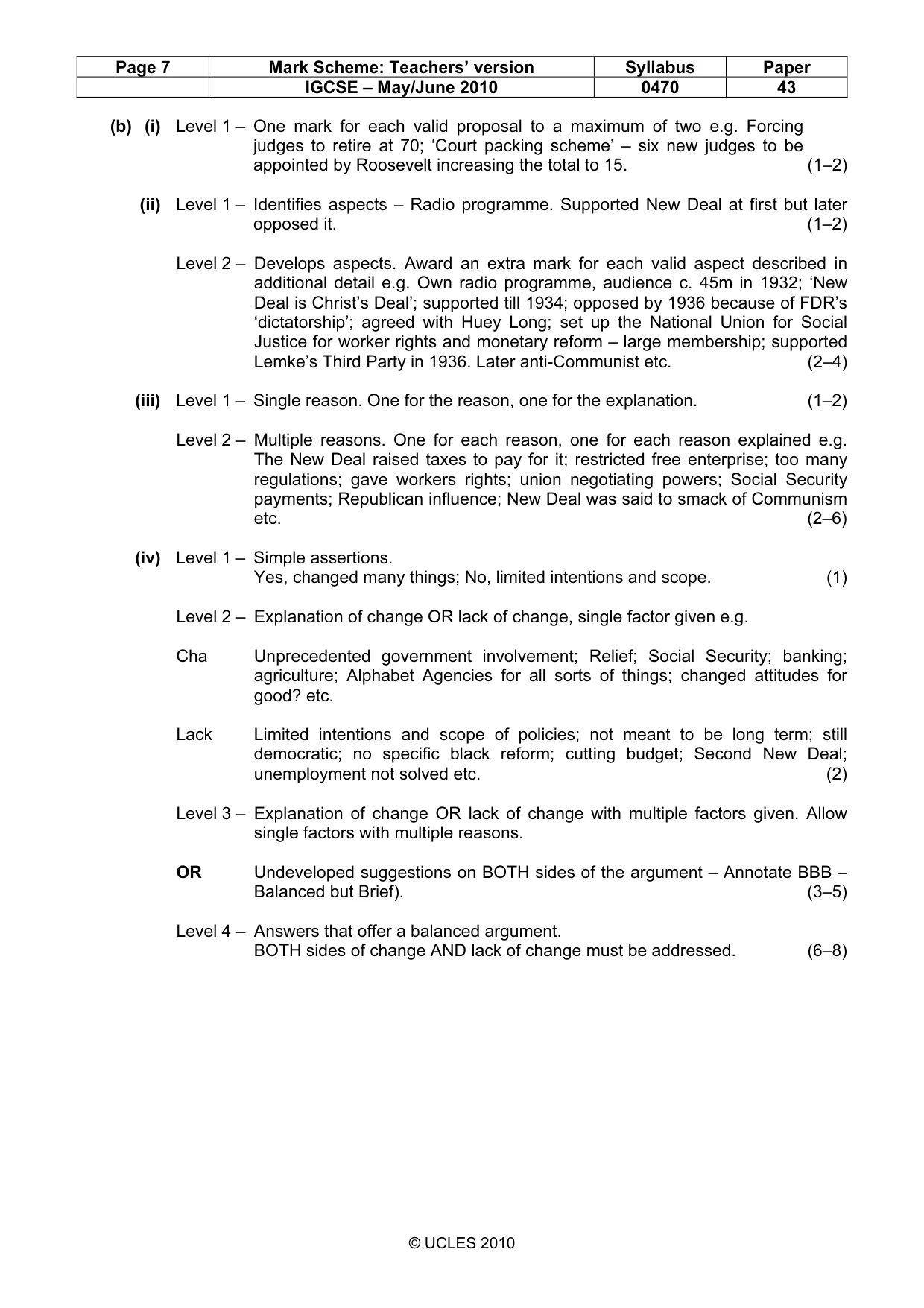
Page 7 Mark Scheme: Teachers’ version Syllabus Paper IGCSE – May/June 2010 0470 43 © UCLES 2010 (b) (i) Level 1 – One mark for each valid proposal to a maximum of two e.g. Forcing judges to retire at 70; ‘Court packing scheme’ – six new judges to be appointed by Roosevelt increasing the total to 15. (1–2) (ii) Level 1 – Identifies aspects – Radio programme. Supported New Deal at first but later opposed it. (1–2) Level 2 – Develops aspects. Award an extra mark for each valid aspect described in additional detail e.g. Own radio programme, audience c. 45m in 1932; ‘New Deal is Christ’s Deal’; supported till 1934; opposed by 1936 because of FDR’s ‘dictatorship’; agreed with Huey Long; set up the National Union for Social Justice for worker rights and monetary reform – large membership; supported Lemke’s Third Party in 1936. Later anti-Communist etc. (2–4) (iii) Level 1 – Single reason. One for the reason, one for the explanation. (1–2) Level 2 – Multiple reasons. One for each reason, one for each reason explained e.g. The New Deal raised taxes to pay for it; restricted free enterprise; too many regulations; gave workers rights; union negotiating powers; Social Security payments; Republican influence; New Deal was said to smack of Communism etc. (2–6) (iv) Level 1 – Simple assertions. Yes, changed many things; No, limited intentions and scope. (1) Level 2 – Explanation of change OR lack of change, single factor given e.g. Cha Unprecedented government involvement; Relief; Social Security; banking; agriculture; Alphabet Agencies for all sorts of things; changed attitudes for good? etc. Lack Limited intentions and scope of policies; not meant to be long term; still democratic; no specific black reform; cutting budget; Second New Deal; unemployment not solved etc. (2) Level 3 – Explanation of change OR lack of change with multiple factors given. Allow single factors with multiple reasons. OR Undeveloped suggestions on BOTH sides of the argument – Annotate BBB – Balanced but Brief). (3–5) Level 4 – Answers that offer a balanced argument. BOTH sides of change AND lack of change must be addressed. (6–8)
Mark scheme, page 8
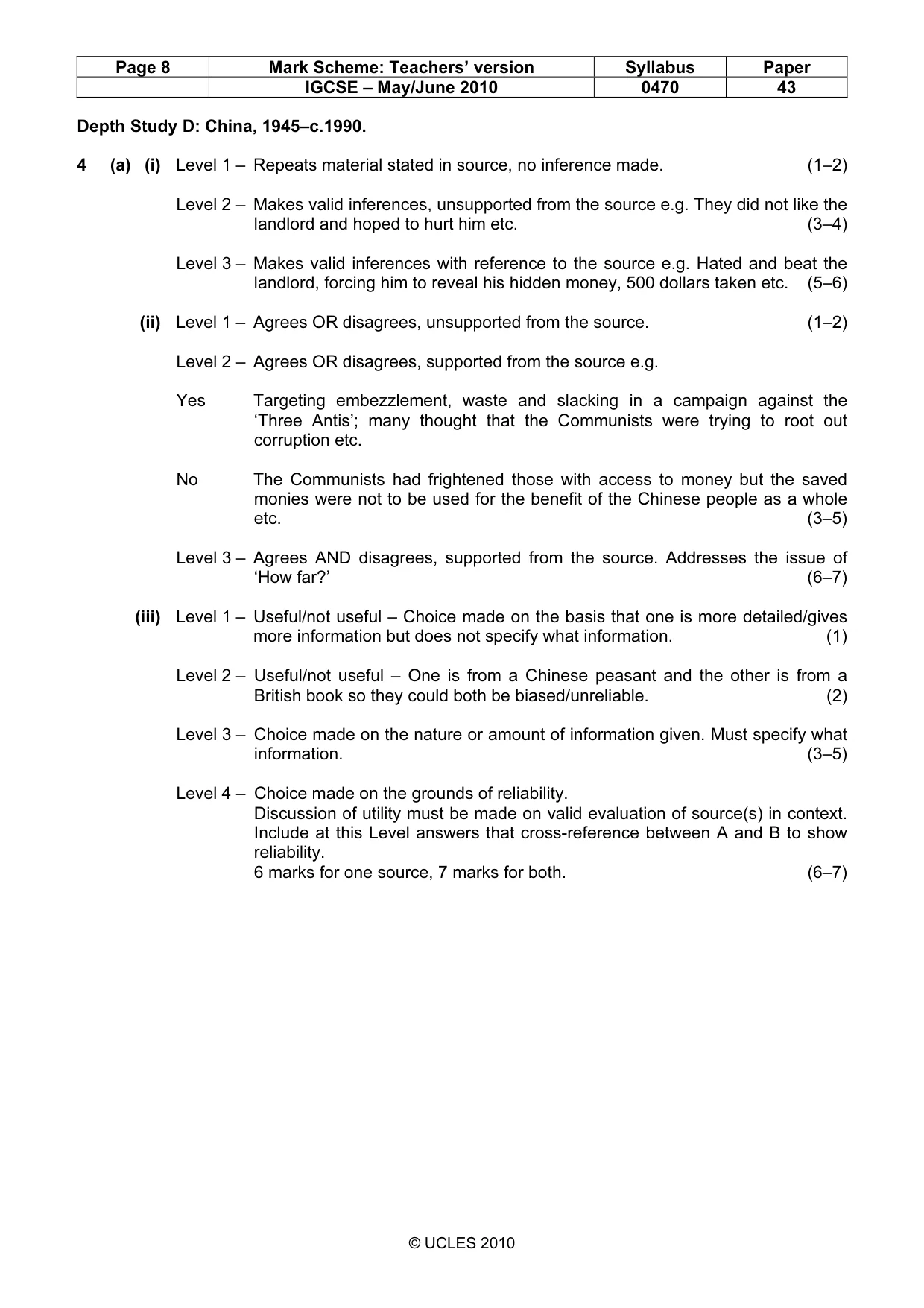
Page 8 Mark Scheme: Teachers’ version Syllabus Paper IGCSE – May/June 2010 0470 43 © UCLES 2010 Depth Study D: China, 1945–c.1990. 4 (a) (i) Level 1 – Repeats material stated in source, no inference made. (1–2) Level 2 – Makes valid inferences, unsupported from the source e.g. They did not like the landlord and hoped to hurt him etc. (3–4) Level 3 – Makes valid inferences with reference to the source e.g. Hated and beat the landlord, forcing him to reveal his hidden money, 500 dollars taken etc. (5–6) (ii) Level 1 – Agrees OR disagrees, unsupported from the source. (1–2) Level 2 – Agrees OR disagrees, supported from the source e.g. Yes Targeting embezzlement, waste and slacking in a campaign against the ‘Three Antis’; many thought that the Communists were trying to root out corruption etc. No The Communists had frightened those with access to money but the saved monies were not to be used for the benefit of the Chinese people as a whole etc. (3–5) Level 3 – Agrees AND disagrees, supported from the source. Addresses the issue of ‘How far?’ (6–7) (iii) Level 1 – Useful/not useful – Choice made on the basis that one is more detailed/gives more information but does not specify what information. (1) Level 2 – Useful/not useful – One is from a Chinese peasant and the other is from a British book so they could both be biased/unreliable. (2) Level 3 – Choice made on the nature or amount of information given. Must specify what information. (3–5) Level 4 – Choice made on the grounds of reliability. Discussion of utility must be made on valid evaluation of source(s) in context. Include at this Level answers that cross-reference between A and B to show reliability. 6 marks for one source, 7 marks for both. (6–7)
Mark scheme, page 9
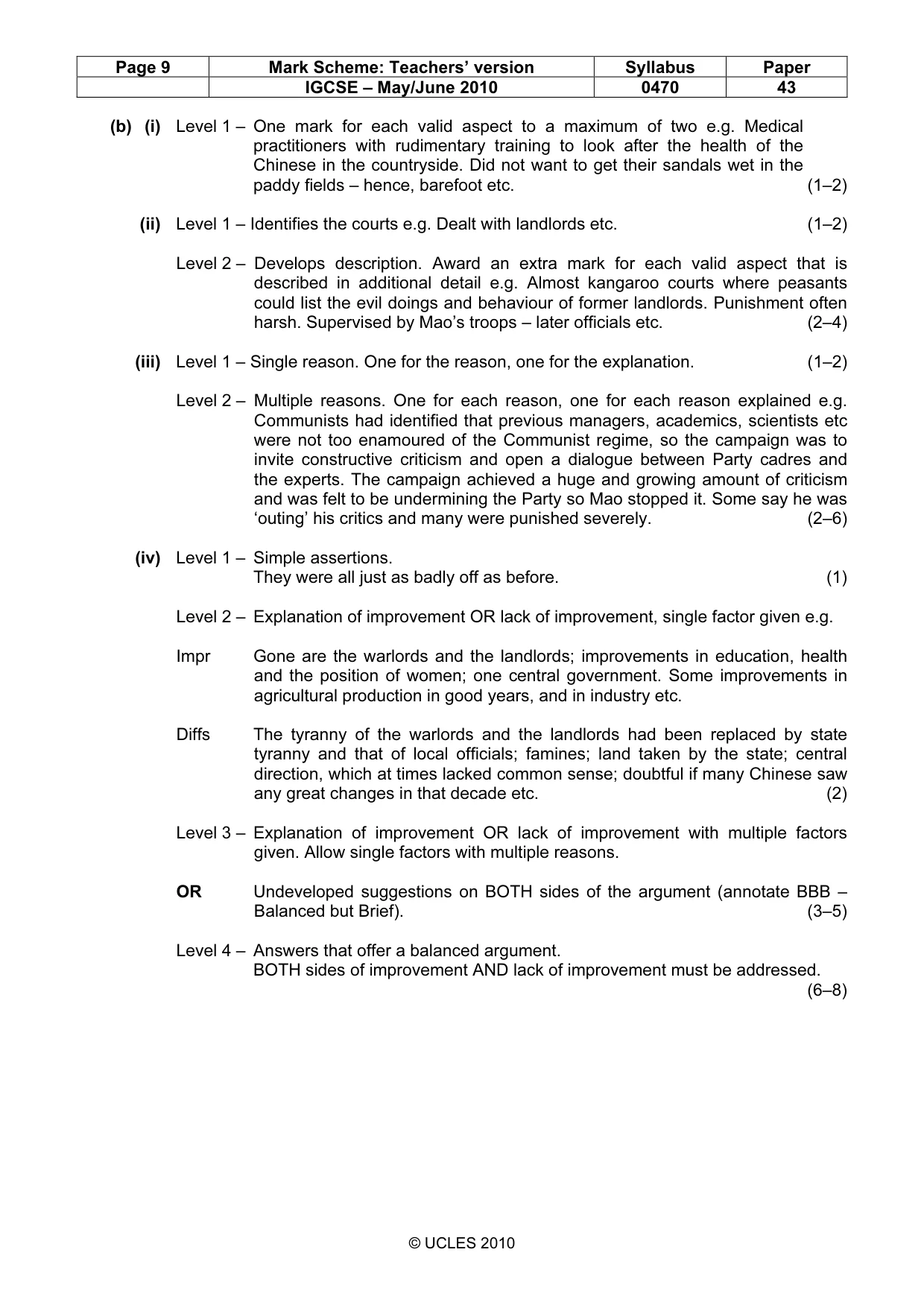
Page 9 Mark Scheme: Teachers’ version Syllabus Paper IGCSE – May/June 2010 0470 43 © UCLES 2010 (b) (i) Level 1 – One mark for each valid aspect to a maximum of two e.g. Medical practitioners with rudimentary training to look after the health of the Chinese in the countryside. Did not want to get their sandals wet in the paddy fields – hence, barefoot etc. (1–2) (ii) Level 1 – Identifies the courts e.g. Dealt with landlords etc. (1–2) Level 2 – Develops description. Award an extra mark for each valid aspect that is described in additional detail e.g. Almost kangaroo courts where peasants could list the evil doings and behaviour of former landlords. Punishment often harsh. Supervised by Mao’s troops – later officials etc. (2–4) (iii) Level 1 – Single reason. One for the reason, one for the explanation. (1–2) Level 2 – Multiple reasons. One for each reason, one for each reason explained e.g. Communists had identified that previous managers, academics, scientists etc were not too enamoured of the Communist regime, so the campaign was to invite constructive criticism and open a dialogue between Party cadres and the experts. The campaign achieved a huge and growing amount of criticism and was felt to be undermining the Party so Mao stopped it. Some say he was ‘outing’ his critics and many were punished severely. (2–6) (iv) Level 1 – Simple assertions. They were all just as badly off as before. (1) Level 2 – Explanation of improvement OR lack of improvement, single factor given e.g. Impr Gone are the warlords and the landlords; improvements in education, health and the position of women; one central government. Some improvements in agricultural production in good years, and in industry etc. Diffs The tyranny of the warlords and the landlords had been replaced by state tyranny and that of local officials; famines; land taken by the state; central direction, which at times lacked common sense; doubtful if many Chinese saw any great changes in that decade etc. (2) Level 3 – Explanation of improvement OR lack of improvement with multiple factors given. Allow single factors with multiple reasons. OR Undeveloped suggestions on BOTH sides of the argument (annotate BBB – Balanced but Brief). (3–5) Level 4 – Answers that offer a balanced argument. BOTH sides of improvement AND lack of improvement must be addressed. (6–8)
Mark scheme, page 10
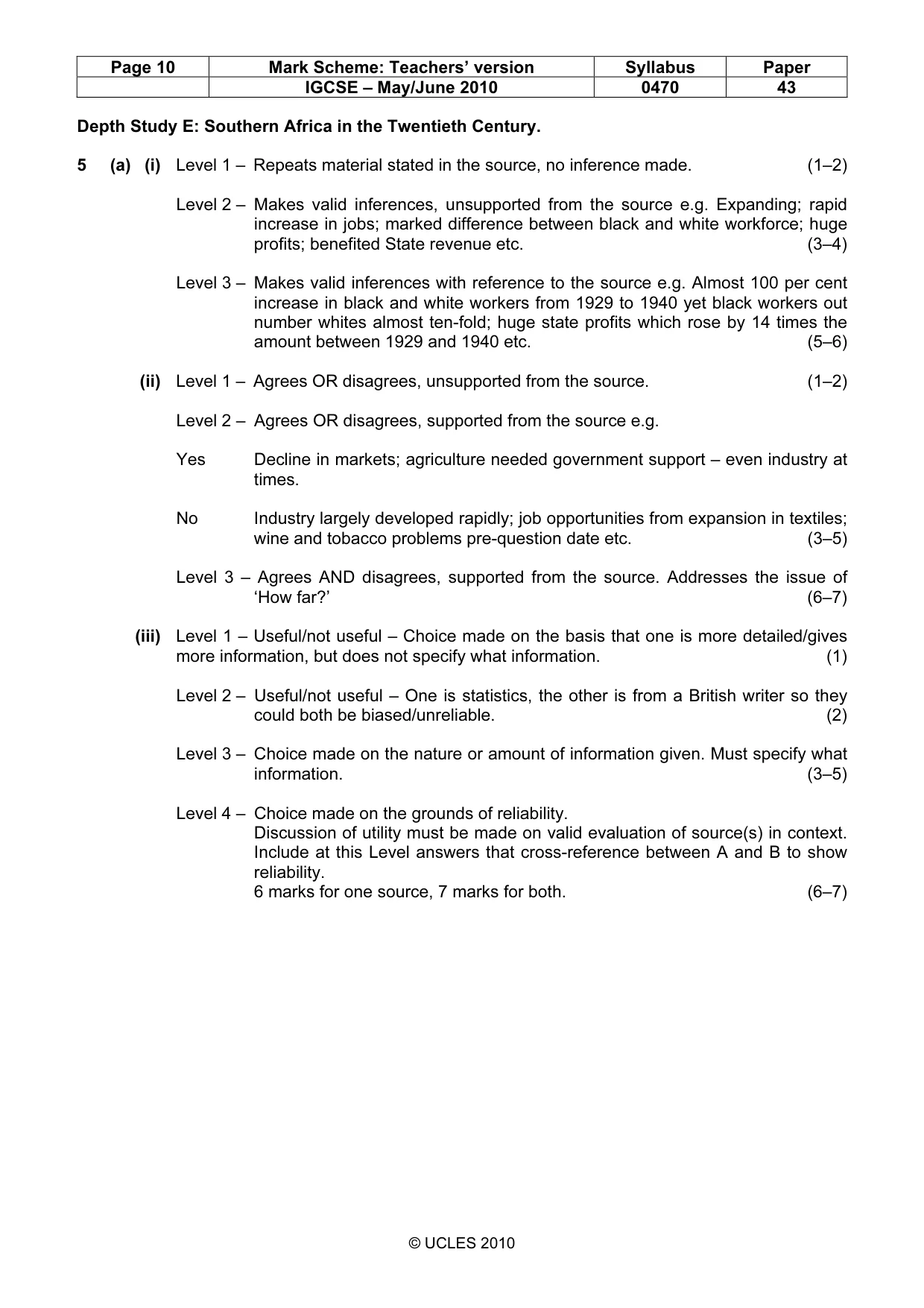
Page 10 Mark Scheme: Teachers’ version Syllabus Paper IGCSE – May/June 2010 0470 43 © UCLES 2010 Depth Study E: Southern Africa in the Twentieth Century. 5 (a) (i) Level 1 – Repeats material stated in the source, no inference made. (1–2) Level 2 – Makes valid inferences, unsupported from the source e.g. Expanding; rapid increase in jobs; marked difference between black and white workforce; huge profits; benefited State revenue etc. (3–4) Level 3 – Makes valid inferences with reference to the source e.g. Almost 100 per cent increase in black and white workers from 1929 to 1940 yet black workers out number whites almost ten-fold; huge state profits which rose by 14 times the amount between 1929 and 1940 etc. (5–6) (ii) Level 1 – Agrees OR disagrees, unsupported from the source. (1–2) Level 2 – Agrees OR disagrees, supported from the source e.g. Yes Decline in markets; agriculture needed government support – even industry at times. No Industry largely developed rapidly; job opportunities from expansion in textiles; wine and tobacco problems pre-question date etc. (3–5) Level 3 – Agrees AND disagrees, supported from the source. Addresses the issue of ‘How far?’ (6–7) (iii) Level 1 – Useful/not useful – Choice made on the basis that one is more detailed/gives more information, but does not specify what information. (1) Level 2 – Useful/not useful – One is statistics, the other is from a British writer so they could both be biased/unreliable. (2) Level 3 – Choice made on the nature or amount of information given. Must specify what information. (3–5) Level 4 – Choice made on the grounds of reliability. Discussion of utility must be made on valid evaluation of source(s) in context. Include at this Level answers that cross-reference between A and B to show reliability. 6 marks for one source, 7 marks for both. (6–7)
Mark scheme, page 11
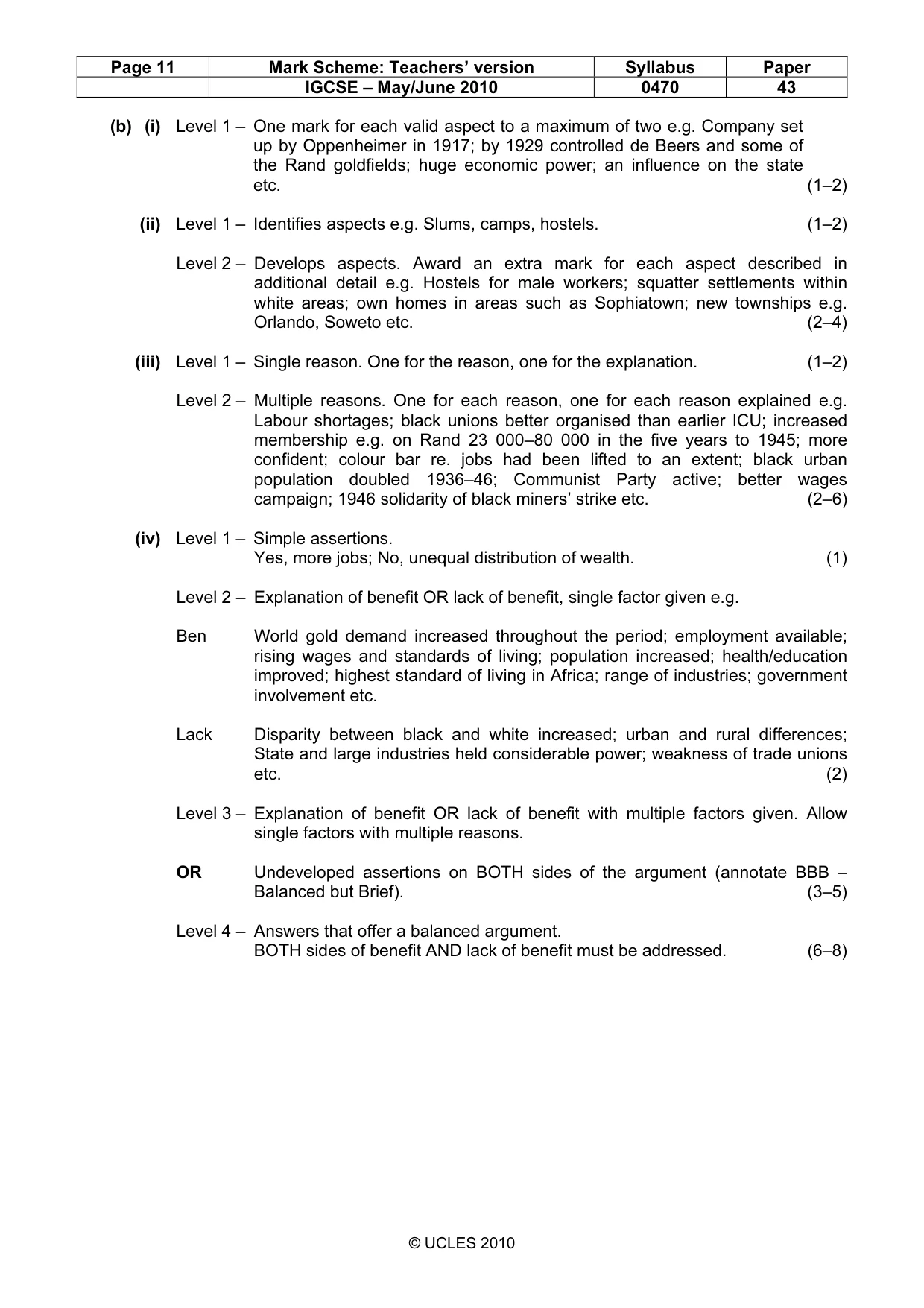
Page 11 Mark Scheme: Teachers’ version Syllabus Paper IGCSE – May/June 2010 0470 43 © UCLES 2010 (b) (i) Level 1 – One mark for each valid aspect to a maximum of two e.g. Company set up by Oppenheimer in 1917; by 1929 controlled de Beers and some of the Rand goldfields; huge economic power; an influence on the state etc. (1–2) (ii) Level 1 – Identifies aspects e.g. Slums, camps, hostels. (1–2) Level 2 – Develops aspects. Award an extra mark for each aspect described in additional detail e.g. Hostels for male workers; squatter settlements within white areas; own homes in areas such as Sophiatown; new townships e.g. Orlando, Soweto etc. (2–4) (iii) Level 1 – Single reason. One for the reason, one for the explanation. (1–2) Level 2 – Multiple reasons. One for each reason, one for each reason explained e.g. Labour shortages; black unions better organised than earlier ICU; increased membership e.g. on Rand 23 000–80 000 in the five years to 1945; more confident; colour bar re. jobs had been lifted to an extent; black urban population doubled 1936–46; Communist Party active; better wages campaign; 1946 solidarity of black miners’ strike etc. (2–6) (iv) Level 1 – Simple assertions. Yes, more jobs; No, unequal distribution of wealth. (1) Level 2 – Explanation of benefit OR lack of benefit, single factor given e.g. Ben World gold demand increased throughout the period; employment available; rising wages and standards of living; population increased; health/education improved; highest standard of living in Africa; range of industries; government involvement etc. Lack Disparity between black and white increased; urban and rural differences; State and large industries held considerable power; weakness of trade unions etc. (2) Level 3 – Explanation of benefit OR lack of benefit with multiple factors given. Allow single factors with multiple reasons. OR Undeveloped assertions on BOTH sides of the argument (annotate BBB – Balanced but Brief). (3–5) Level 4 – Answers that offer a balanced argument. BOTH sides of benefit AND lack of benefit must be addressed. (6–8)
Mark scheme, page 12
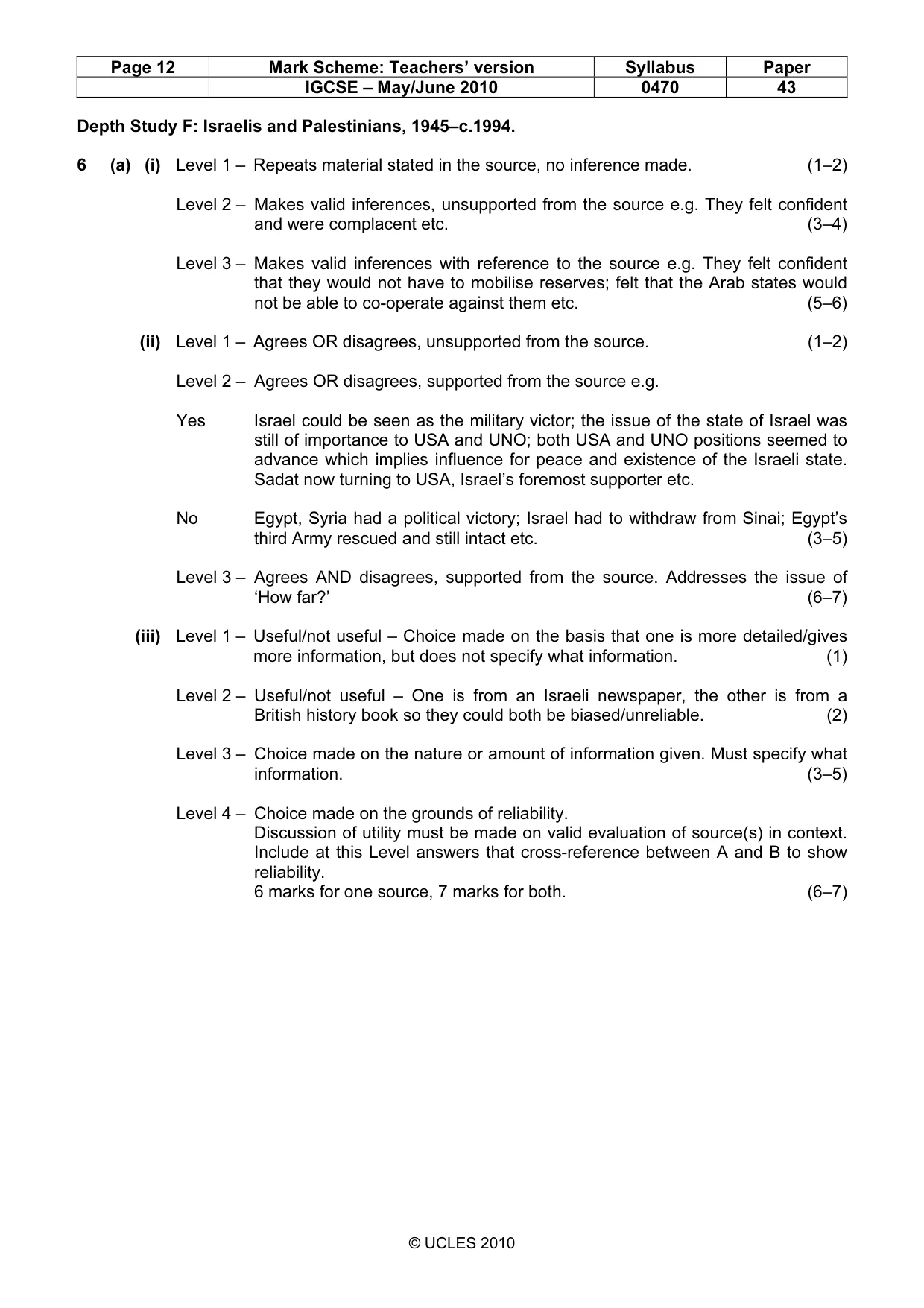
Page 12 Mark Scheme: Teachers’ version Syllabus Paper IGCSE – May/June 2010 0470 43 © UCLES 2010 Depth Study F: Israelis and Palestinians, 1945–c.1994. 6 (a) (i) Level 1 – Repeats material stated in the source, no inference made. (1–2) Level 2 – Makes valid inferences, unsupported from the source e.g. They felt confident and were complacent etc. (3–4) Level 3 – Makes valid inferences with reference to the source e.g. They felt confident that they would not have to mobilise reserves; felt that the Arab states would not be able to co-operate against them etc. (5–6) (ii) Level 1 – Agrees OR disagrees, unsupported from the source. (1–2) Level 2 – Agrees OR disagrees, supported from the source e.g. Yes Israel could be seen as the military victor; the issue of the state of Israel was still of importance to USA and UNO; both USA and UNO positions seemed to advance which implies influence for peace and existence of the Israeli state. Sadat now turning to USA, Israel’s foremost supporter etc. No Egypt, Syria had a political victory; Israel had to withdraw from Sinai; Egypt’s third Army rescued and still intact etc. (3–5) Level 3 – Agrees AND disagrees, supported from the source. Addresses the issue of ‘How far?’ (6–7) (iii) Level 1 – Useful/not useful – Choice made on the basis that one is more detailed/gives more information, but does not specify what information. (1) Level 2 – Useful/not useful – One is from an Israeli newspaper, the other is from a British history book so they could both be biased/unreliable. (2) Level 3 – Choice made on the nature or amount of information given. Must specify what information. (3–5) Level 4 – Choice made on the grounds of reliability. Discussion of utility must be made on valid evaluation of source(s) in context. Include at this Level answers that cross-reference between A and B to show reliability. 6 marks for one source, 7 marks for both. (6–7)
Mark scheme, page 13
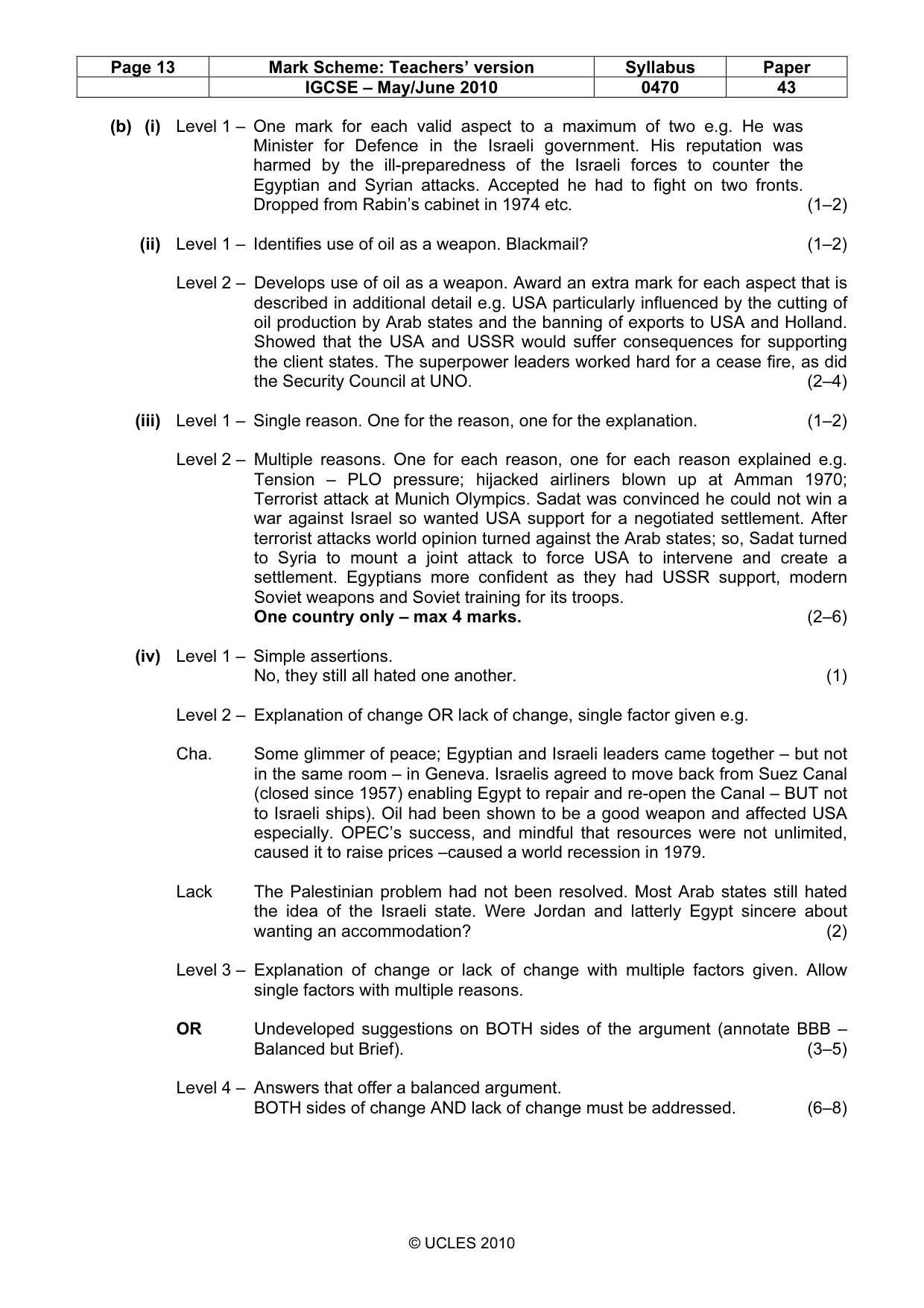
Page 13 Mark Scheme: Teachers’ version Syllabus Paper IGCSE – May/June 2010 0470 43 © UCLES 2010 (b) (i) Level 1 – One mark for each valid aspect to a maximum of two e.g. He was Minister for Defence in the Israeli government. His reputation was harmed by the ill-preparedness of the Israeli forces to counter the Egyptian and Syrian attacks. Accepted he had to fight on two fronts. Dropped from Rabin’s cabinet in 1974 etc. (1–2) (ii) Level 1 – Identifies use of oil as a weapon. Blackmail? (1–2) Level 2 – Develops use of oil as a weapon. Award an extra mark for each aspect that is described in additional detail e.g. USA particularly influenced by the cutting of oil production by Arab states and the banning of exports to USA and Holland. Showed that the USA and USSR would suffer consequences for supporting the client states. The superpower leaders worked hard for a cease fire, as did the Security Council at UNO. (2–4) (iii) Level 1 – Single reason. One for the reason, one for the explanation. (1–2) Level 2 – Multiple reasons. One for each reason, one for each reason explained e.g. Tension – PLO pressure; hijacked airliners blown up at Amman 1970; Terrorist attack at Munich Olympics. Sadat was convinced he could not win a war against Israel so wanted USA support for a negotiated settlement. After terrorist attacks world opinion turned against the Arab states; so, Sadat turned to Syria to mount a joint attack to force USA to intervene and create a settlement. Egyptians more confident as they had USSR support, modern Soviet weapons and Soviet training for its troops. One country only – max 4 marks. (2–6) (iv) Level 1 – Simple assertions. No, they still all hated one another. (1) Level 2 – Explanation of change OR lack of change, single factor given e.g. Cha. Some glimmer of peace; Egyptian and Israeli leaders came together – but not in the same room – in Geneva. Israelis agreed to move back from Suez Canal (closed since 1957) enabling Egypt to repair and re-open the Canal – BUT not to Israeli ships). Oil had been shown to be a good weapon and affected USA especially. OPEC’s success, and mindful that resources were not unlimited, caused it to raise prices –caused a world recession in 1979. Lack The Palestinian problem had not been resolved. Most Arab states still hated the idea of the Israeli state. Were Jordan and latterly Egypt sincere about wanting an accommodation? (2) Level 3 – Explanation of change or lack of change with multiple factors given. Allow single factors with multiple reasons. OR Undeveloped suggestions on BOTH sides of the argument (annotate BBB – Balanced but Brief). (3–5) Level 4 – Answers that offer a balanced argument. BOTH sides of change AND lack of change must be addressed. (6–8)
Mark scheme, page 14
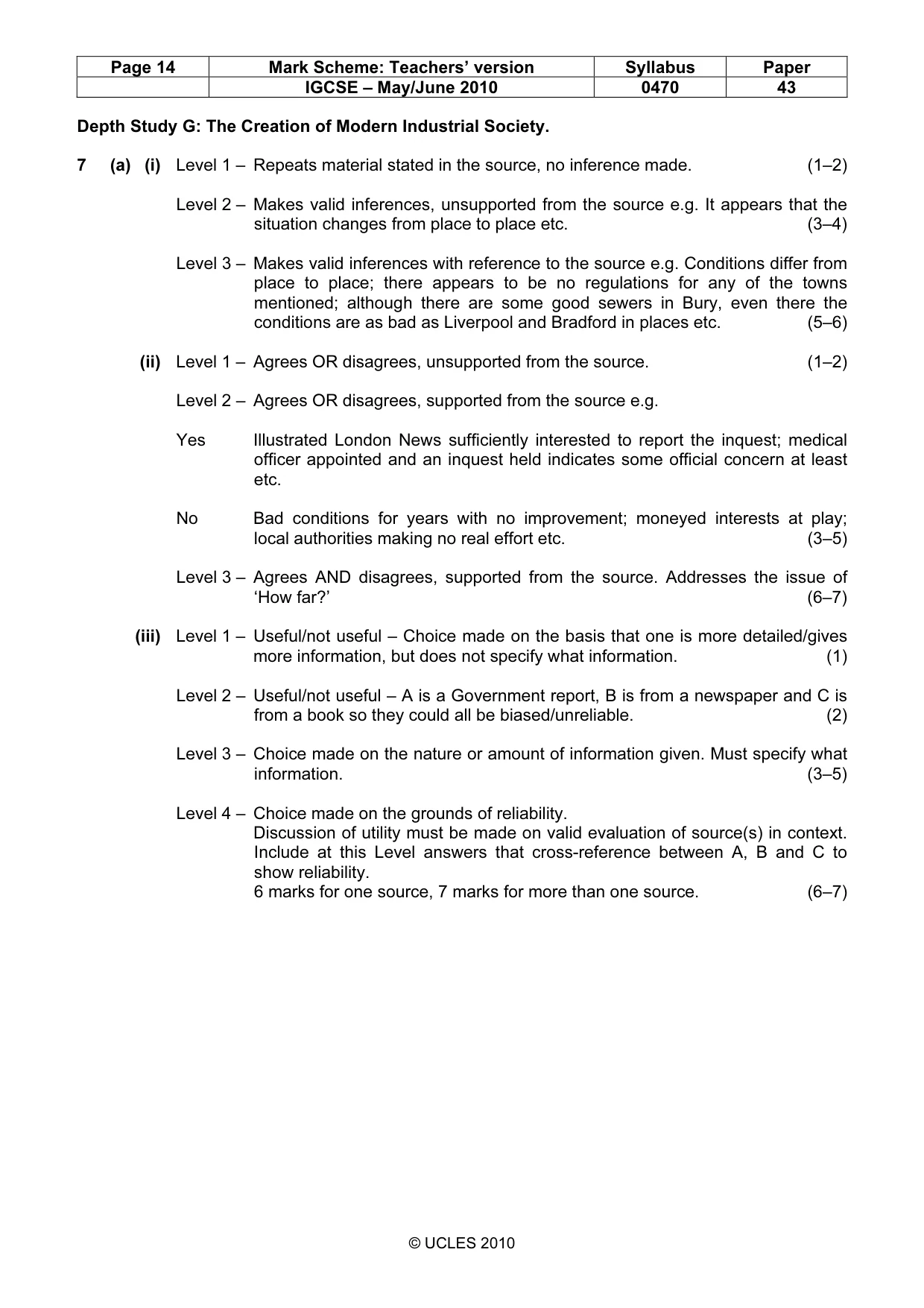
Page 14 Mark Scheme: Teachers’ version Syllabus Paper IGCSE – May/June 2010 0470 43 © UCLES 2010 Depth Study G: The Creation of Modern Industrial Society. 7 (a) (i) Level 1 – Repeats material stated in the source, no inference made. (1–2) Level 2 – Makes valid inferences, unsupported from the source e.g. It appears that the situation changes from place to place etc. (3–4) Level 3 – Makes valid inferences with reference to the source e.g. Conditions differ from place to place; there appears to be no regulations for any of the towns mentioned; although there are some good sewers in Bury, even there the conditions are as bad as Liverpool and Bradford in places etc. (5–6) (ii) Level 1 – Agrees OR disagrees, unsupported from the source. (1–2) Level 2 – Agrees OR disagrees, supported from the source e.g. Yes Illustrated London News sufficiently interested to report the inquest; medical officer appointed and an inquest held indicates some official concern at least etc. No Bad conditions for years with no improvement; moneyed interests at play; local authorities making no real effort etc. (3–5) Level 3 – Agrees AND disagrees, supported from the source. Addresses the issue of ‘How far?’ (6–7) (iii) Level 1 – Useful/not useful – Choice made on the basis that one is more detailed/gives more information, but does not specify what information. (1) Level 2 – Useful/not useful – A is a Government report, B is from a newspaper and C is from a book so they could all be biased/unreliable. (2) Level 3 – Choice made on the nature or amount of information given. Must specify what information. (3–5) Level 4 – Choice made on the grounds of reliability. Discussion of utility must be made on valid evaluation of source(s) in context. Include at this Level answers that cross-reference between A, B and C to show reliability. 6 marks for one source, 7 marks for more than one source. (6–7)
Mark scheme, page 15
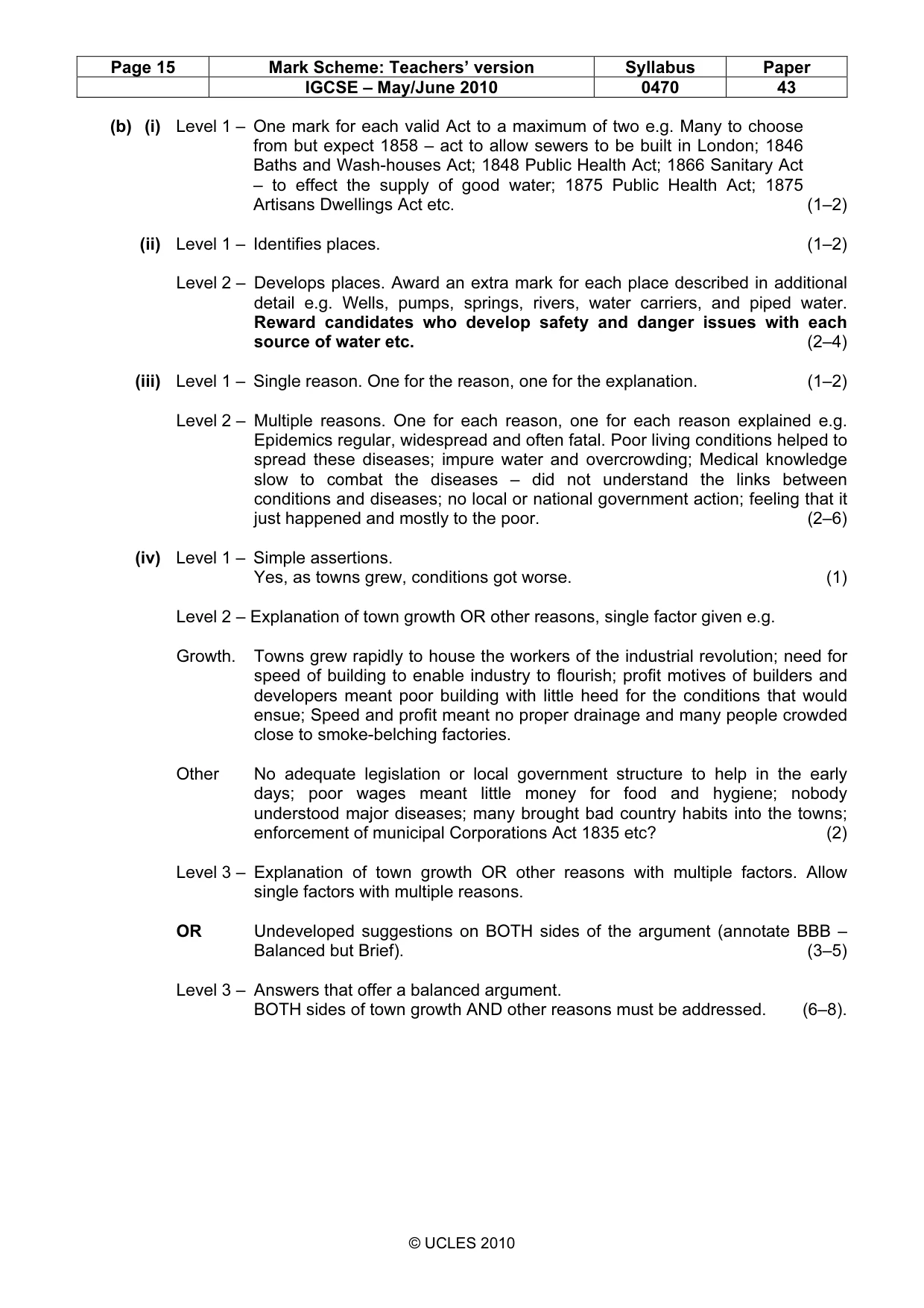
Page 15 Mark Scheme: Teachers’ version Syllabus Paper IGCSE – May/June 2010 0470 43 © UCLES 2010 (b) (i) Level 1 – One mark for each valid Act to a maximum of two e.g. Many to choose from but expect 1858 – act to allow sewers to be built in London; 1846 Baths and Wash-houses Act; 1848 Public Health Act; 1866 Sanitary Act – to effect the supply of good water; 1875 Public Health Act; 1875 Artisans Dwellings Act etc. (1–2) (ii) Level 1 – Identifies places. (1–2) Level 2 – Develops places. Award an extra mark for each place described in additional detail e.g. Wells, pumps, springs, rivers, water carriers, and piped water. Reward candidates who develop safety and danger issues with each source of water etc. (2–4) (iii) Level 1 – Single reason. One for the reason, one for the explanation. (1–2) Level 2 – Multiple reasons. One for each reason, one for each reason explained e.g. Epidemics regular, widespread and often fatal. Poor living conditions helped to spread these diseases; impure water and overcrowding; Medical knowledge slow to combat the diseases – did not understand the links between conditions and diseases; no local or national government action; feeling that it just happened and mostly to the poor. (2–6) (iv) Level 1 – Simple assertions. Yes, as towns grew, conditions got worse. (1) Level 2 – Explanation of town growth OR other reasons, single factor given e.g. Growth. Towns grew rapidly to house the workers of the industrial revolution; need for speed of building to enable industry to flourish; profit motives of builders and developers meant poor building with little heed for the conditions that would ensue; Speed and profit meant no proper drainage and many people crowded close to smoke-belching factories. Other No adequate legislation or local government structure to help in the early days; poor wages meant little money for food and hygiene; nobody understood major diseases; many brought bad country habits into the towns; enforcement of municipal Corporations Act 1835 etc? (2) Level 3 – Explanation of town growth OR other reasons with multiple factors. Allow single factors with multiple reasons. OR Undeveloped suggestions on BOTH sides of the argument (annotate BBB – Balanced but Brief). (3–5) Level 3 – Answers that offer a balanced argument. BOTH sides of town growth AND other reasons must be addressed. (6–8).
Mark scheme, page 16
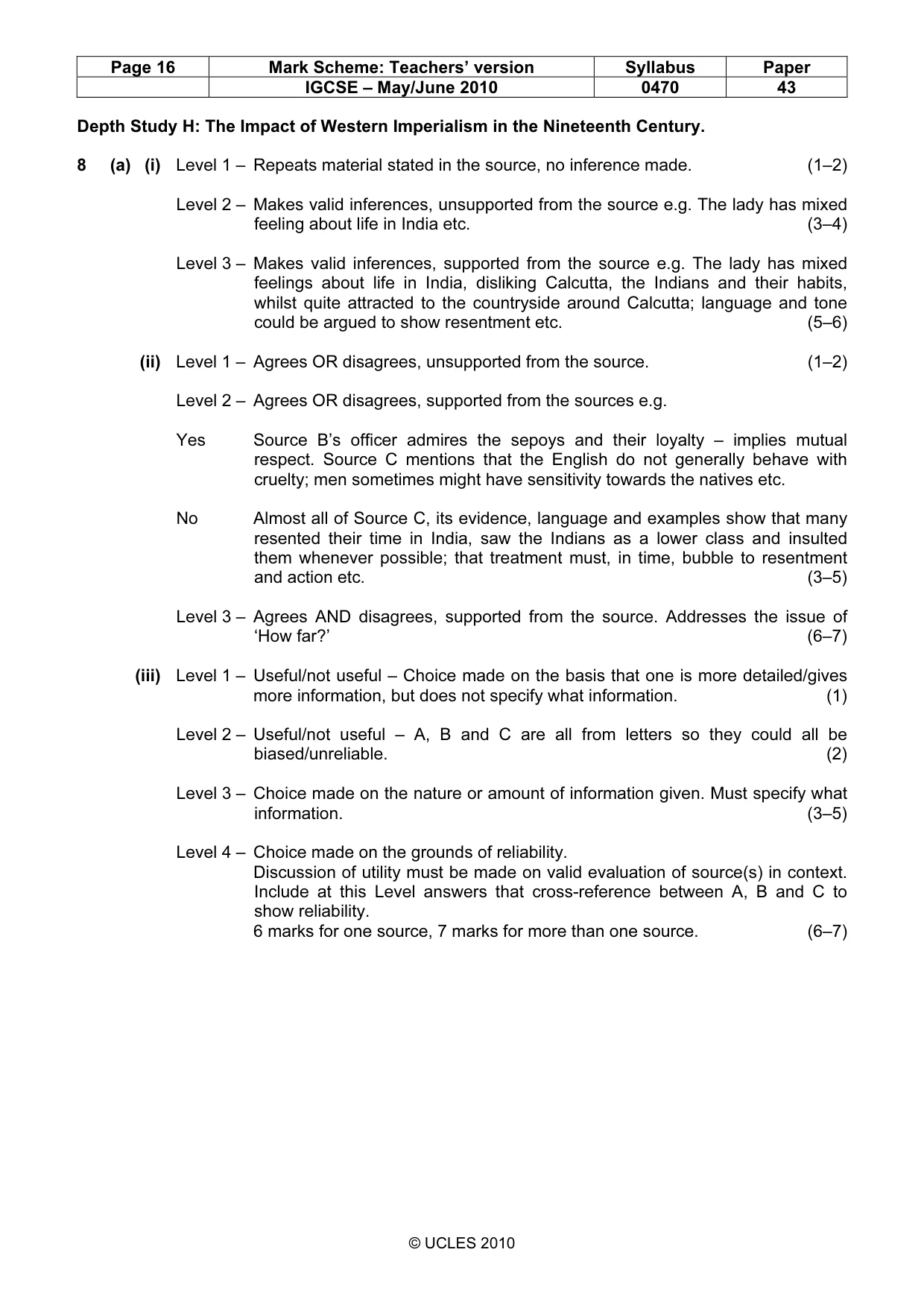
Page 16 Mark Scheme: Teachers’ version Syllabus Paper IGCSE – May/June 2010 0470 43 © UCLES 2010 Depth Study H: The Impact of Western Imperialism in the Nineteenth Century. 8 (a) (i) Level 1 – Repeats material stated in the source, no inference made. (1–2) Level 2 – Makes valid inferences, unsupported from the source e.g. The lady has mixed feeling about life in India etc. (3–4) Level 3 – Makes valid inferences, supported from the source e.g. The lady has mixed feelings about life in India, disliking Calcutta, the Indians and their habits, whilst quite attracted to the countryside around Calcutta; language and tone could be argued to show resentment etc. (5–6) (ii) Level 1 – Agrees OR disagrees, unsupported from the source. (1–2) Level 2 – Agrees OR disagrees, supported from the sources e.g. Yes Source B’s officer admires the sepoys and their loyalty – implies mutual respect. Source C mentions that the English do not generally behave with cruelty; men sometimes might have sensitivity towards the natives etc. No Almost all of Source C, its evidence, language and examples show that many resented their time in India, saw the Indians as a lower class and insulted them whenever possible; that treatment must, in time, bubble to resentment and action etc. (3–5) Level 3 – Agrees AND disagrees, supported from the source. Addresses the issue of ‘How far?’ (6–7) (iii) Level 1 – Useful/not useful – Choice made on the basis that one is more detailed/gives more information, but does not specify what information. (1) Level 2 – Useful/not useful – A, B and C are all from letters so they could all be biased/unreliable. (2) Level 3 – Choice made on the nature or amount of information given. Must specify what information. (3–5) Level 4 – Choice made on the grounds of reliability. Discussion of utility must be made on valid evaluation of source(s) in context. Include at this Level answers that cross-reference between A, B and C to show reliability. 6 marks for one source, 7 marks for more than one source. (6–7)
Mark scheme, page 17
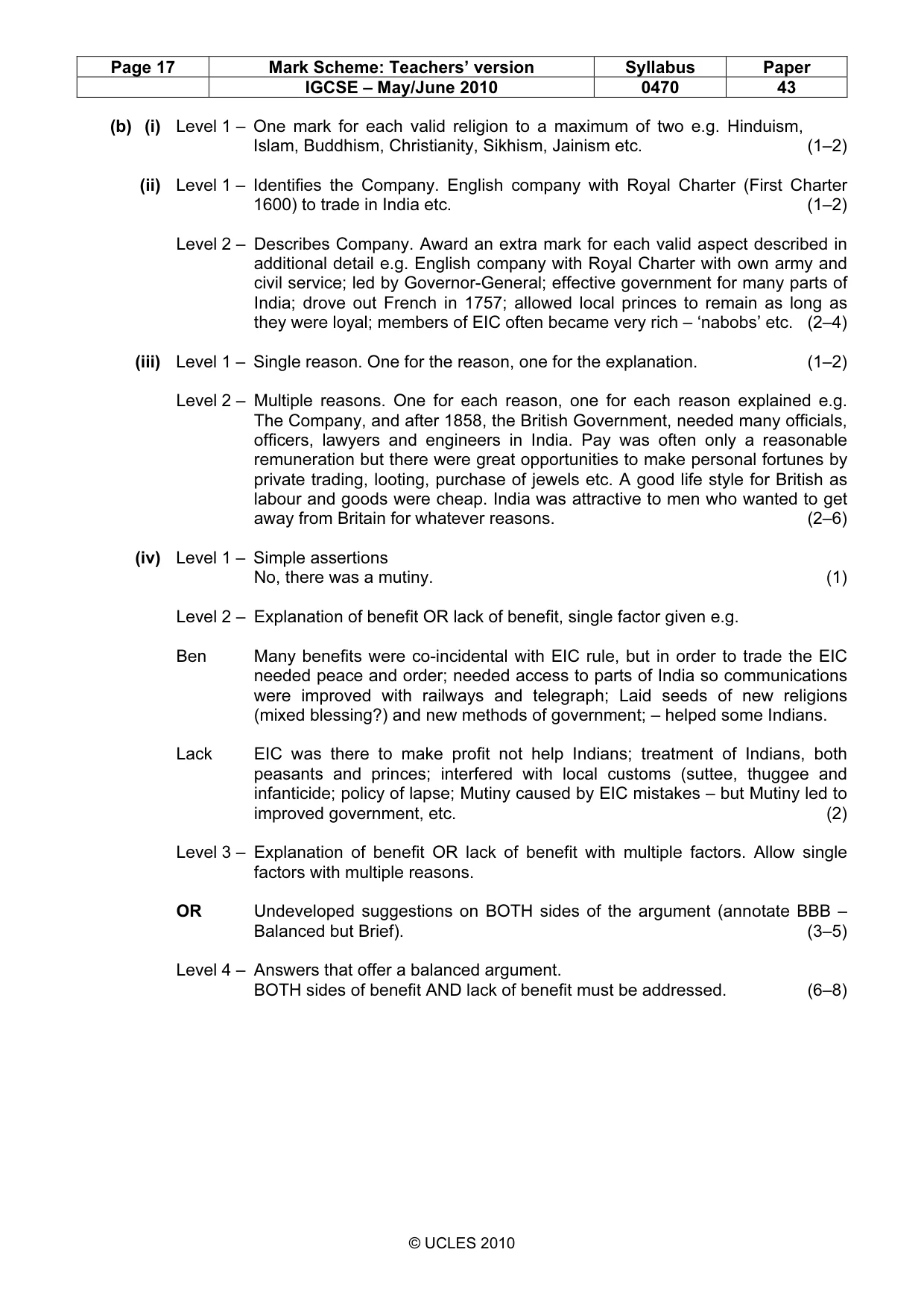
Page 17 Mark Scheme: Teachers’ version Syllabus Paper IGCSE – May/June 2010 0470 43 © UCLES 2010 (b) (i) Level 1 – One mark for each valid religion to a maximum of two e.g. Hinduism, Islam, Buddhism, Christianity, Sikhism, Jainism etc. (1–2) (ii) Level 1 – Identifies the Company. English company with Royal Charter (First Charter 1600) to trade in India etc. (1–2) Level 2 – Describes Company. Award an extra mark for each valid aspect described in additional detail e.g. English company with Royal Charter with own army and civil service; led by Governor-General; effective government for many parts of India; drove out French in 1757; allowed local princes to remain as long as they were loyal; members of EIC often became very rich – ‘nabobs’ etc. (2–4) (iii) Level 1 – Single reason. One for the reason, one for the explanation. (1–2) Level 2 – Multiple reasons. One for each reason, one for each reason explained e.g. The Company, and after 1858, the British Government, needed many officials, officers, lawyers and engineers in India. Pay was often only a reasonable remuneration but there were great opportunities to make personal fortunes by private trading, looting, purchase of jewels etc. A good life style for British as labour and goods were cheap. India was attractive to men who wanted to get away from Britain for whatever reasons. (2–6) (iv) Level 1 – Simple assertions No, there was a mutiny. (1) Level 2 – Explanation of benefit OR lack of benefit, single factor given e.g. Ben Many benefits were co-incidental with EIC rule, but in order to trade the EIC needed peace and order; needed access to parts of India so communications were improved with railways and telegraph; Laid seeds of new religions (mixed blessing?) and new methods of government; – helped some Indians. Lack EIC was there to make profit not help Indians; treatment of Indians, both peasants and princes; interfered with local customs (suttee, thuggee and infanticide; policy of lapse; Mutiny caused by EIC mistakes – but Mutiny led to improved government, etc. (2) Level 3 – Explanation of benefit OR lack of benefit with multiple factors. Allow single factors with multiple reasons. OR Undeveloped suggestions on BOTH sides of the argument (annotate BBB – Balanced but Brief). (3–5) Level 4 – Answers that offer a balanced argument. BOTH sides of benefit AND lack of benefit must be addressed. (6–8)
What you needed in this session
Cambridge’s own grade thresholds for 2010 May/June, Paper 4 · Variant 3. A higher threshold means an easier paper — the bar moves with how the cohort did.