Cambridge IGCSE History 0470 — 2010 May/June Paper 4 · Variant 2
0470/42/M/J/10 · 40 marks · ≈45 min
The question paper and its mark scheme, free to read here and free to download. This is Cambridge’s own paper, exactly as it was sat.
Question paper12 pages
Mark scheme17 pages
Answers below. Sit the paper first if you are practising.
Paper as text
Question paper, page 1
This document consists of 11 printed pages and 1 blank page. DC (CW/JG) 23432/2 © UCLES 2010 [Turn over UNIVERSITY OF CAMBRIDGE INTERNATIONAL EXAMINATIONS International General Certificate of Secondary Education READ THESE INSTRUCTIONS FIRST If you have been given an Answer Booklet, follow the instructions on the front cover of the Booklet. Write your Centre number, candidate number and name on all the work you hand in. Write in dark blue or black pen. You may use a soft pencil for any diagrams, graphs or rough working. Do not use staples, paper clips, highlighters, glue or correction fluid. Answer the questions on one of the Depth Studies. At the end of the examination, fasten all your work securely together. The number of marks is given in brackets [ ] at the end of each question or part question. * 7 6 9 0 3 6 3 4 8 9 * HISTORY 0470/42 Paper 4 Alternative to Coursework May/June 2010 1 hour Additional Materials: Answer Booklet/Paper www.XtremePapers.com
Question paper, page 2
2 0470/42/M/J/10 © UCLES 2010 DEPTH STUDY A: GERMANY, 1918–1941 1 Study the sources, and then answer the questions which follow. Source A I have asked His Majesty to bring those people into the government who are largely responsible for things having turned out as they have. We shall, therefore, see these gentlemen enter the ministries, and they must now make the peace that has to be made. They must now eat the soup that they have served us! Ludendorff speaking to the Army High Command, October 1918. Source B In late September 1918 Germany’s army chiefs advised the Kaiser to negotiate for peace. By the end of October a ‘revolution from above’ had taken place in Germany. The monarchy had become a constitutional one, losing any real power. This change was not a result of pressure from the German people but solely in the interests of the High Command. On 2 November what might have been a successful ‘revolution from below’ began in Kiel when a mass meeting of twenty thousand workers and sailors, who had refused to obey naval officers’ orders, agreed to set up their own council or soviet. Within seven days the whole country was effectively in the hands of workers’ and soldiers’ councils calling for Germany to become a republic. 9 November was an eventful day: the Kaiser fled to Holland; the five week old multi-party government ended when Prince Max of Baden handed over power to a six-man moderate socialist government headed by the SPD’s leader, Ebert; thirdly, Germany was declared a republic. Two days later an armistice was agreed. From a British history of the Weimar Republic, 1997. (a) (i) Study Source A. What can you tell from this source about Germany’s military leaders? Support your answer with reference to the source. [6] (ii) Study Source B. How far does this source show that Germany’s government had collapsed in November 1918? Explain your answer. [7] (iii) Study both sources. Is one of these sources more useful than the other as evidence about the challenges faced by the government of the new Republic? Explain your answer. [7] (b) (i) Name two European territories that Germany lost in the Treaty of Versailles. [2] (ii) Describe the Spartacist Revolt of 1919. [4] (iii) Why were the Freikorps important? [6] (iv) ‘Weimar governments were remarkably successful in their handling of Germany’s difficulties up to 1929.’ How far do you agree with this statement? Explain your answer. [8]
Question paper, page 3
3 0470/42/M/J/10 © UCLES 2010 [Turn over DEPTH STUDY B: RUSSIA, 1905–1941 2 Study the sources, and then answer the questions which follow. Source A The economic condition of the masses is worse than terrible. The impossibility of buying many food products and necessities and the increasing incidence of disease due to malnutrition and terrible living conditions – cold and dampness because of lack of coal and wood – have made the workers ready for a hunger riot. From a secret police report about Petrograd, 1916. Source B The First World War played a crucial part in the fall of the Tsar. Russia’s shattering defeats, and the enormous loss of life among soldiers, were blamed on the Tsar, who had made himself Commander-in-Chief in 1915. The Tsar lost the confidence and support of the army. The middle classes were disgusted by the defeats and the incompetence of the Tsarina. The workers were tired of shortages and angry at the enormous price rises that threatened them with starvation. A British historian writing in 1997. (a) (i) Study Source A. What can you tell from this source about living conditions in Petrograd in 1916? Support your answer with reference to the source. [6] (ii) Study Source B. How far does this source show that military defeats were the cause of the fall of Tsar Nicholas II in 1917? Explain your answer. [7] (iii) Study both sources. Is one source more useful than the other as evidence about the fall of Tsar Nicholas II in 1917? Explain your answer. [7] (b) (i) Give two features of the July Days. [2] (ii) Who was Rasputin? [4] (iii) Why did the Kornilov Affair damage the Provisional Government? [6] (iv) How far were the issues of ‘Land and Bread’ responsible for the overthrow of the Provisional Government in November 1917? Explain your answer. [8]
Question paper, page 4
4 0470/42/M/J/10 © UCLES 2010 DEPTH STUDY C: THE USA, 1919–1941 3 Study the sources, and then answer the questions which follow. Source A In my youth I knew women who hid their college degrees as if they were one of the seven deadly sins. The men at the head of business or controlling politics are for the most part middle-aged. Their wives accept that men discuss politics over their wine or cigars, and on joining the ladies, talk of music, or the theatre or the latest scandal. Can you blame either the men or the women if the adjustment to modern conditions is somewhat difficult? Eleanor Roosevelt talking about women and politics, 1929. Source B Most of the leaders who carried the fight for the vote to success in 1920 then dropped out of politics. This was unfortunate as they were exceptional women, idealists with no idea of personal advancement or gain. In fact, attaining the vote was only part of the programme for equal rights – toward economic independence, and social and spiritual equality with men. When the franchise was finally achieved, their interest was not held by any ambition for political office or honours. Some now help finance and support the campaign for world peace. The trouble with many women is that they won’t work. They won’t take up their jobs as men do and put in seven or eight real working hours a day. They lack knowledge, and many won’t make the effort to study history, economics, political methods or get out among human beings. If they take a volunteer practical job, it is a thing of constant interruptions, with no sense of concentration, business efficiency or order. A leading American politician in a campaign speech, 1938. (a) (i) Study Source A. What can you tell from this source about women in the 1920s? Support your answer with reference to the source. [6] (ii) Study Source B. How far does this source show that women had made political progress in the 1920s and 1930s? Explain your answer. [7] (iii) Study both sources. Is one of these sources more useful than the other as evidence about changes in attitudes towards women in this period? Explain your answer. [7] (b) (i) Give two types of people who were not allowed to migrate to the United States by the 1920s. [2] (ii) What were the aims of the Ku Klux Klan? [4] (iii) Why were immigration quotas set in the 1920s? [6] (iv) ‘It was black Americans who suffered most from the intolerance of American society in the 1920s.’ How far do you agree with this statement? Explain your answer. [8]
Question paper, page 5
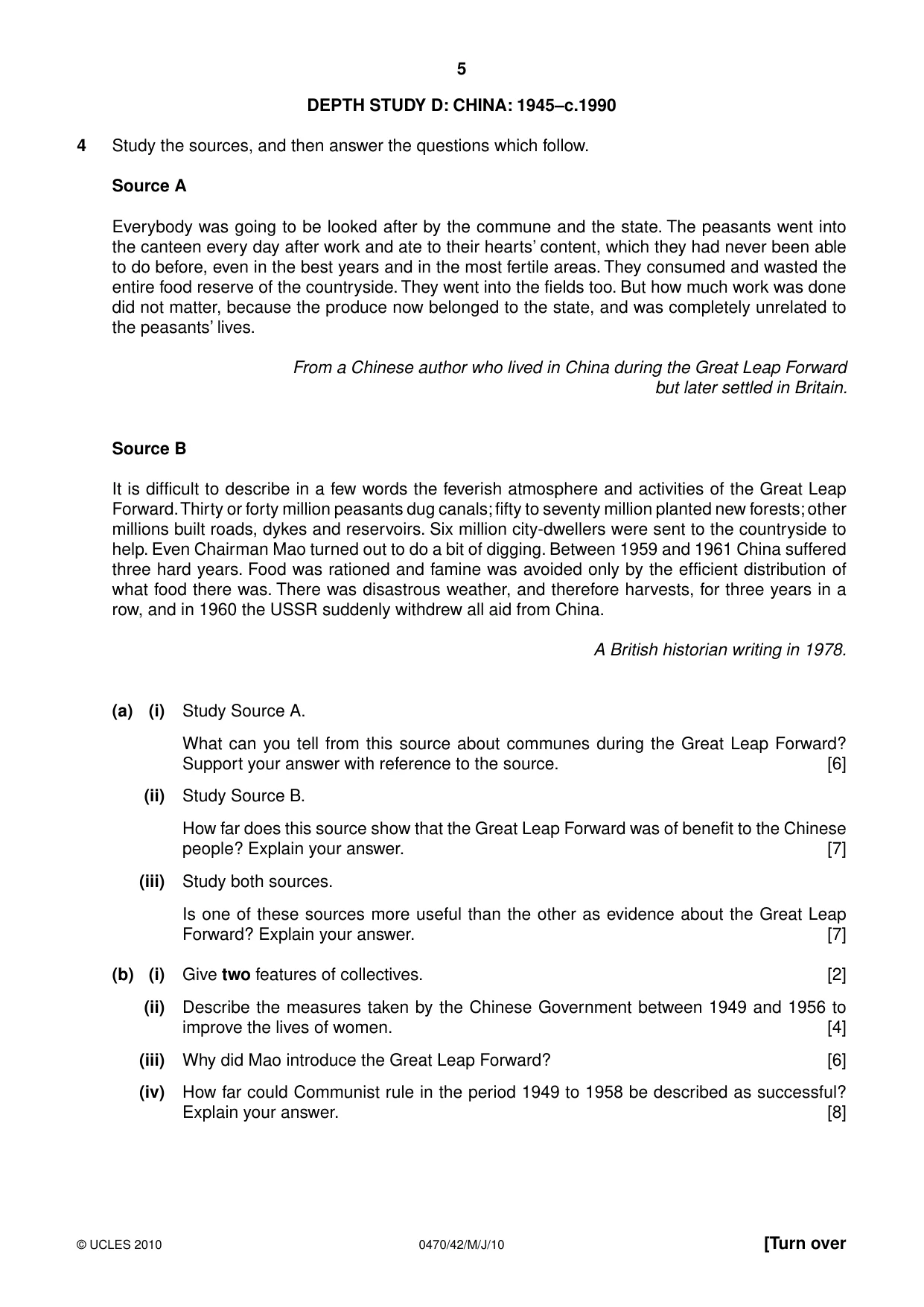
5 0470/42/M/J/10 © UCLES 2010 [Turn over DEPTH STUDY D: CHINA: 1945–c.1990 4 Study the sources, and then answer the questions which follow. Source A Everybody was going to be looked after by the commune and the state. The peasants went into the canteen every day after work and ate to their hearts’ content, which they had never been able to do before, even in the best years and in the most fertile areas. They consumed and wasted the entire food reserve of the countryside. They went into the fields too. But how much work was done did not matter, because the produce now belonged to the state, and was completely unrelated to the peasants’ lives. From a Chinese author who lived in China during the Great Leap Forward but later settled in Britain. Source B It is difficult to describe in a few words the feverish atmosphere and activities of the Great Leap Forward. Thirty or forty million peasants dug canals; fifty to seventy million planted new forests; other millions built roads, dykes and reservoirs. Six million city-dwellers were sent to the countryside to help. Even Chairman Mao turned out to do a bit of digging. Between 1959 and 1961 China suffered three hard years. Food was rationed and famine was avoided only by the efficient distribution of what food there was. There was disastrous weather, and therefore harvests, for three years in a row, and in 1960 the USSR suddenly withdrew all aid from China. A British historian writing in 1978. (a) (i) Study Source A. What can you tell from this source about communes during the Great Leap Forward? Support your answer with reference to the source. [6] (ii) Study Source B. How far does this source show that the Great Leap Forward was of benefit to the Chinese people? Explain your answer. [7] (iii) Study both sources. Is one of these sources more useful than the other as evidence about the Great Leap Forward? Explain your answer. [7] (b) (i) Give two features of collectives. [2] (ii) Describe the measures taken by the Chinese Government between 1949 and 1956 to improve the lives of women. [4] (iii) Why did Mao introduce the Great Leap Forward? [6] (iv) How far could Communist rule in the period 1949 to 1958 be described as successful? Explain your answer. [8]
Question paper, page 6
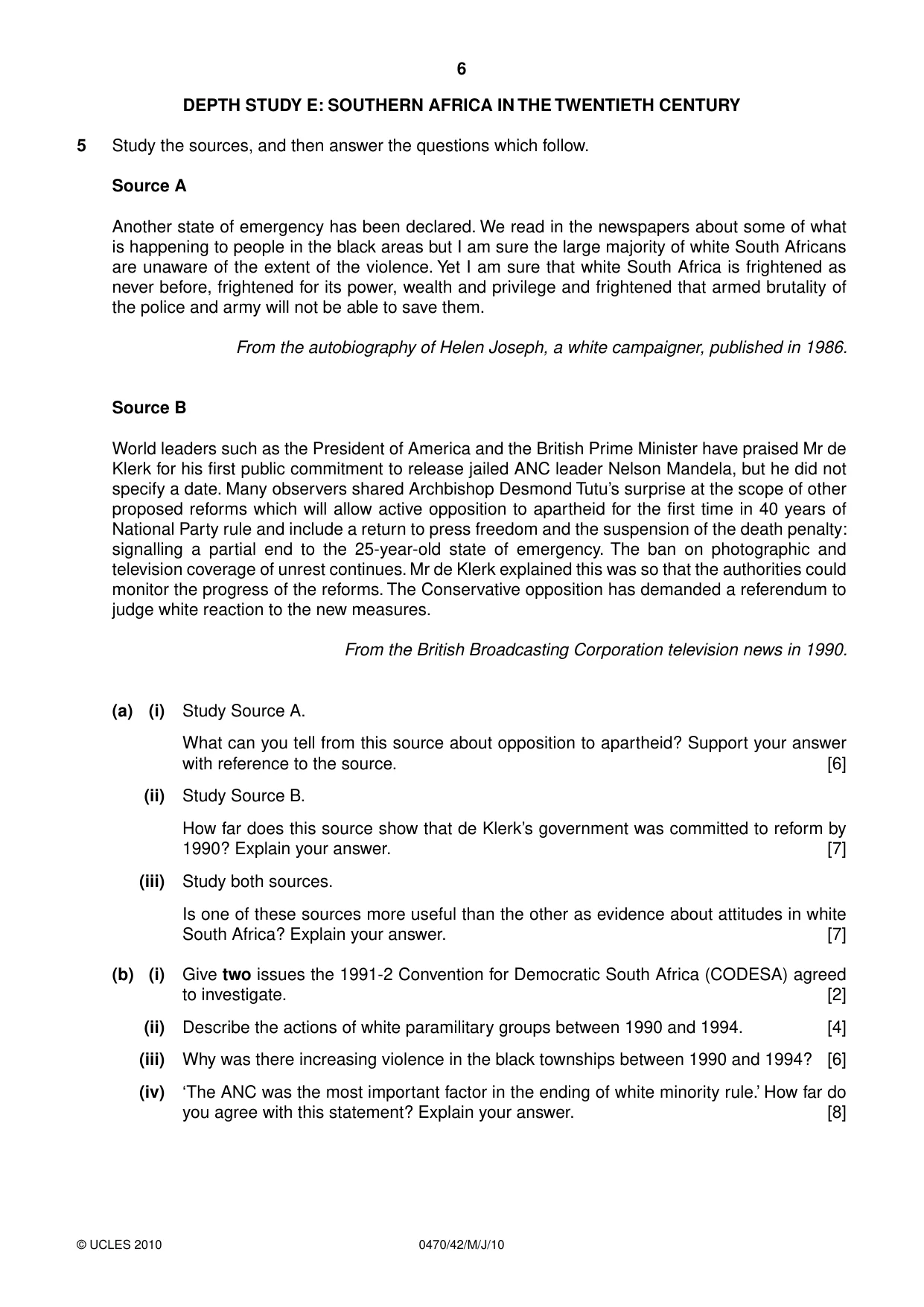
6 0470/42/M/J/10 © UCLES 2010 DEPTH STUDY E: SOUTHERN AFRICA IN THE TWENTIETH CENTURY 5 Study the sources, and then answer the questions which follow. Source A Another state of emergency has been declared. We read in the newspapers about some of what is happening to people in the black areas but I am sure the large majority of white South Africans are unaware of the extent of the violence. Yet I am sure that white South Africa is frightened as never before, frightened for its power, wealth and privilege and frightened that armed brutality of the police and army will not be able to save them. From the autobiography of Helen Joseph, a white campaigner, published in 1986. Source B World leaders such as the President of America and the British Prime Minister have praised Mr de Klerk for his first public commitment to release jailed ANC leader Nelson Mandela, but he did not specify a date. Many observers shared Archbishop Desmond Tutu’s surprise at the scope of other proposed reforms which will allow active opposition to apartheid for the first time in 40 years of National Party rule and include a return to press freedom and the suspension of the death penalty: signalling a partial end to the 25-year-old state of emergency. The ban on photographic and television coverage of unrest continues. Mr de Klerk explained this was so that the authorities could monitor the progress of the reforms. The Conservative opposition has demanded a referendum to judge white reaction to the new measures. From the British Broadcasting Corporation television news in 1990. (a) (i) Study Source A. What can you tell from this source about opposition to apartheid? Support your answer with reference to the source. [6] (ii) Study Source B. How far does this source show that de Klerk’s government was committed to reform by 1990? Explain your answer. [7] (iii) Study both sources. Is one of these sources more useful than the other as evidence about attitudes in white South Africa? Explain your answer. [7] (b) (i) Give two issues the 1991-2 Convention for Democratic South Africa (CODESA) agreed to investigate. [2] (ii) Describe the actions of white paramilitary groups between 1990 and 1994. [4] (iii) Why was there increasing violence in the black townships between 1990 and 1994? [6] (iv) ‘The ANC was the most important factor in the ending of white minority rule.’ How far do you agree with this statement? Explain your answer. [8]
Question paper, page 7
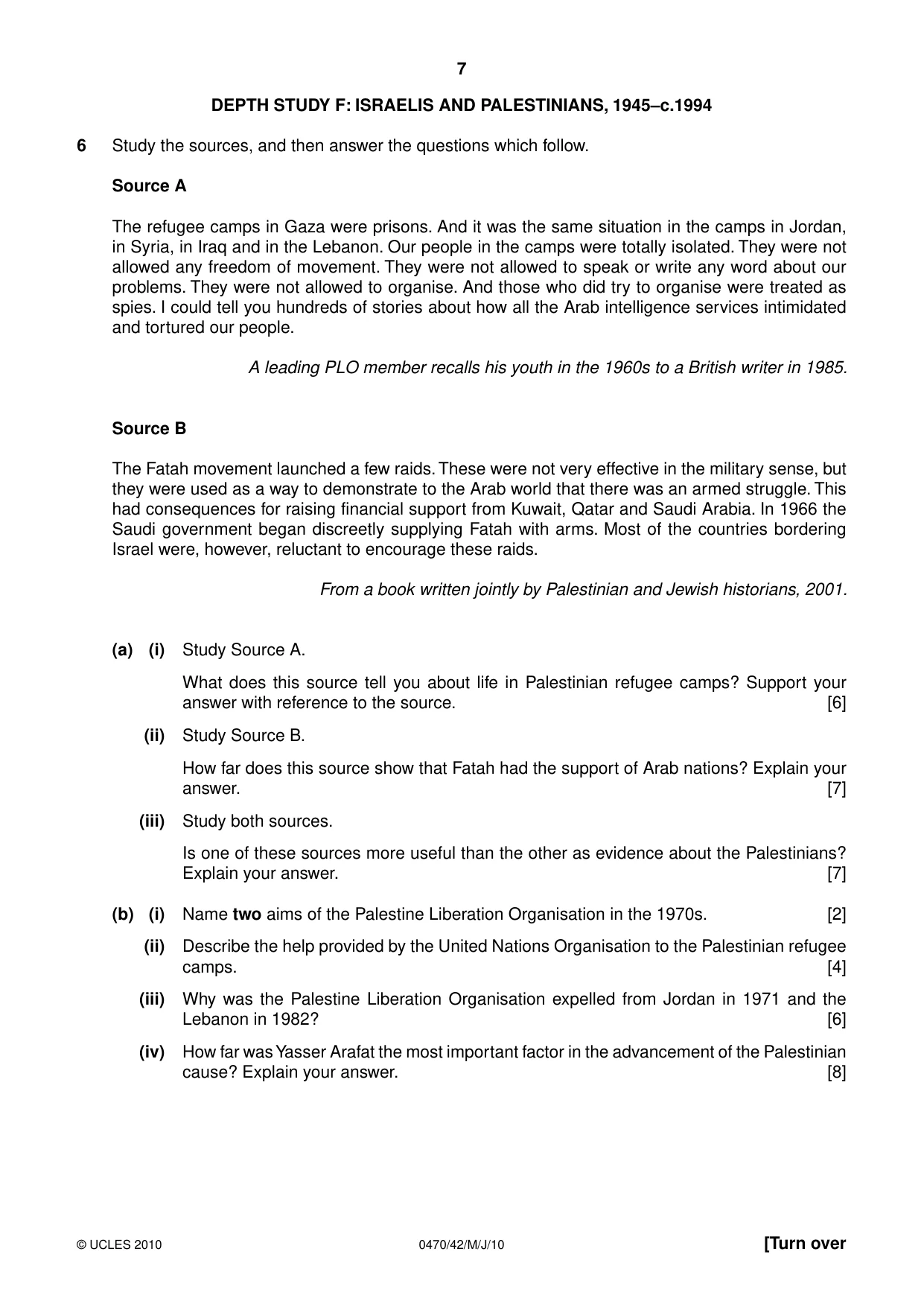
7 0470/42/M/J/10 © UCLES 2010 [Turn over DEPTH STUDY F: ISRAELIS AND PALESTINIANS, 1945–c.1994 6 Study the sources, and then answer the questions which follow. Source A The refugee camps in Gaza were prisons. And it was the same situation in the camps in Jordan, in Syria, in Iraq and in the Lebanon. Our people in the camps were totally isolated. They were not allowed any freedom of movement. They were not allowed to speak or write any word about our problems. They were not allowed to organise. And those who did try to organise were treated as spies. I could tell you hundreds of stories about how all the Arab intelligence services intimidated and tortured our people. A leading PLO member recalls his youth in the 1960s to a British writer in 1985. Source B The Fatah movement launched a few raids. These were not very effective in the military sense, but they were used as a way to demonstrate to the Arab world that there was an armed struggle. This had consequences for raising financial support from Kuwait, Qatar and Saudi Arabia. In 1966 the Saudi government began discreetly supplying Fatah with arms. Most of the countries bordering Israel were, however, reluctant to encourage these raids. From a book written jointly by Palestinian and Jewish historians, 2001. (a) (i) Study Source A. What does this source tell you about life in Palestinian refugee camps? Support your answer with reference to the source. [6] (ii) Study Source B. How far does this source show that Fatah had the support of Arab nations? Explain your answer. [7] (iii) Study both sources. Is one of these sources more useful than the other as evidence about the Palestinians? Explain your answer. [7] (b) (i) Name two aims of the Palestine Liberation Organisation in the 1970s. [2] (ii) Describe the help provided by the United Nations Organisation to the Palestinian refugee camps. [4] (iii) Why was the Palestine Liberation Organisation expelled from Jordan in 1971 and the Lebanon in 1982? [6] (iv) How far was Yasser Arafat the most important factor in the advancement of the Palestinian cause? Explain your answer. [8]
Question paper, page 8
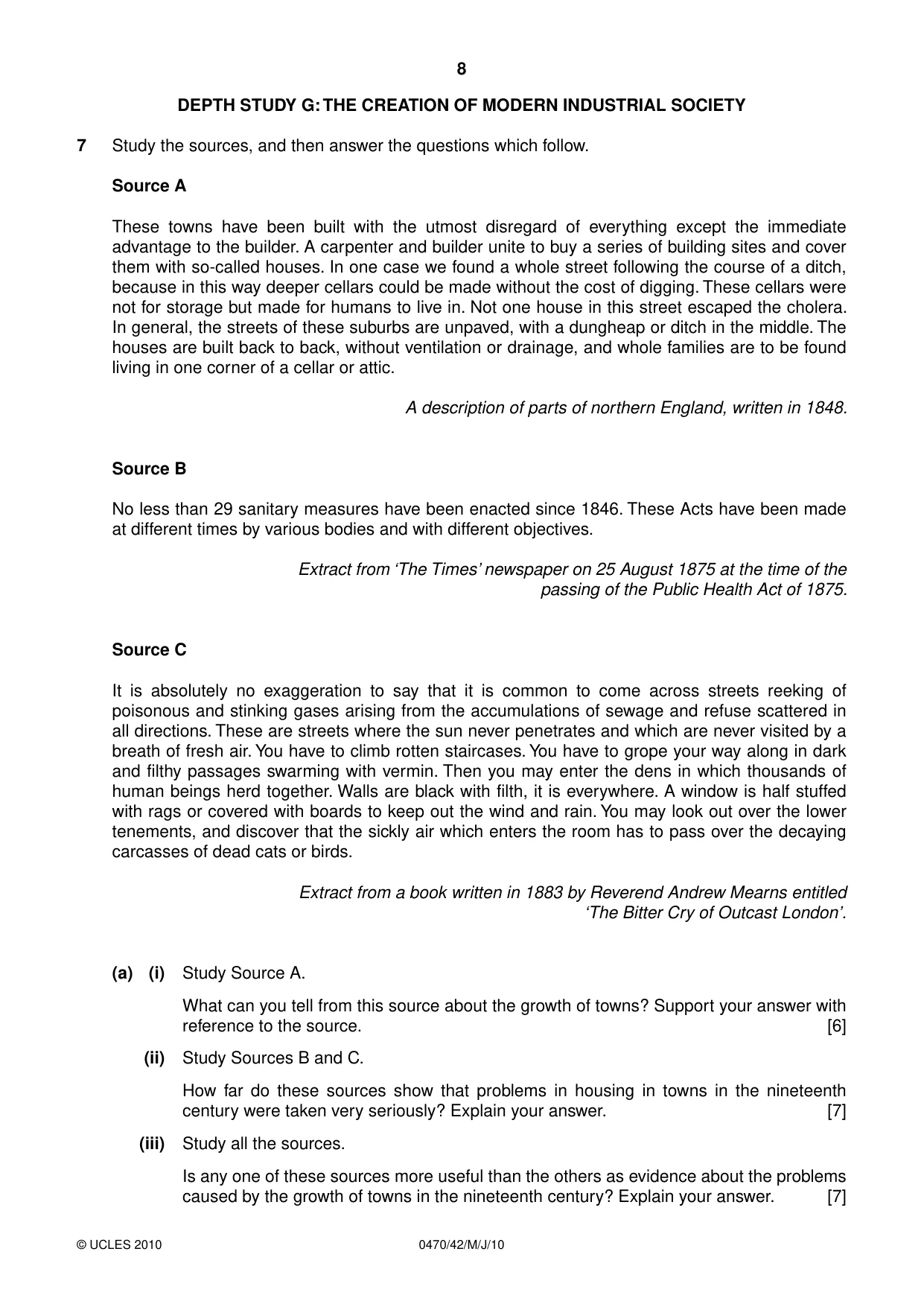
8 0470/42/M/J/10 © UCLES 2010 DEPTH STUDY G: THE CREATION OF MODERN INDUSTRIAL SOCIETY 7 Study the sources, and then answer the questions which follow. Source A These towns have been built with the utmost disregard of everything except the immediate advantage to the builder. A carpenter and builder unite to buy a series of building sites and cover them with so-called houses. In one case we found a whole street following the course of a ditch, because in this way deeper cellars could be made without the cost of digging. These cellars were not for storage but made for humans to live in. Not one house in this street escaped the cholera. In general, the streets of these suburbs are unpaved, with a dungheap or ditch in the middle. The houses are built back to back, without ventilation or drainage, and whole families are to be found living in one corner of a cellar or attic. A description of parts of northern England, written in 1848. Source B No less than 29 sanitary measures have been enacted since 1846. These Acts have been made at different times by various bodies and with different objectives. Extract from ‘The Times’ newspaper on 25 August 1875 at the time of the passing of the Public Health Act of 1875. Source C It is absolutely no exaggeration to say that it is common to come across streets reeking of poisonous and stinking gases arising from the accumulations of sewage and refuse scattered in all directions. These are streets where the sun never penetrates and which are never visited by a breath of fresh air. You have to climb rotten staircases. You have to grope your way along in dark and filthy passages swarming with vermin. Then you may enter the dens in which thousands of human beings herd together. Walls are black with filth, it is everywhere. A window is half stuffed with rags or covered with boards to keep out the wind and rain. You may look out over the lower tenements, and discover that the sickly air which enters the room has to pass over the decaying carcasses of dead cats or birds. Extract from a book written in 1883 by Reverend Andrew Mearns entitled ‘The Bitter Cry of Outcast London’. (a) (i) Study Source A. What can you tell from this source about the growth of towns? Support your answer with reference to the source. [6] (ii) Study Sources B and C. How far do these sources show that problems in housing in towns in the nineteenth century were taken very seriously? Explain your answer. [7] (iii) Study all the sources. Is any one of these sources more useful than the others as evidence about the problems caused by the growth of towns in the nineteenth century? Explain your answer. [7]
Question paper, page 9
9 0470/42/M/J/10 © UCLES 2010 [Turn over (b) (i) Name two towns, other than London, which grew rapidly in the nineteenth century. [2] (ii) What were the main sources of water and methods of sewage disposal in the early nineteenth century? [4] (iii) Why were there devastating outbreaks of cholera in the nineteenth century? [6] (iv) How far had the problems of public health in the growing towns been resolved by the end of the nineteenth century? Explain your answer. [8]
Question paper, page 10
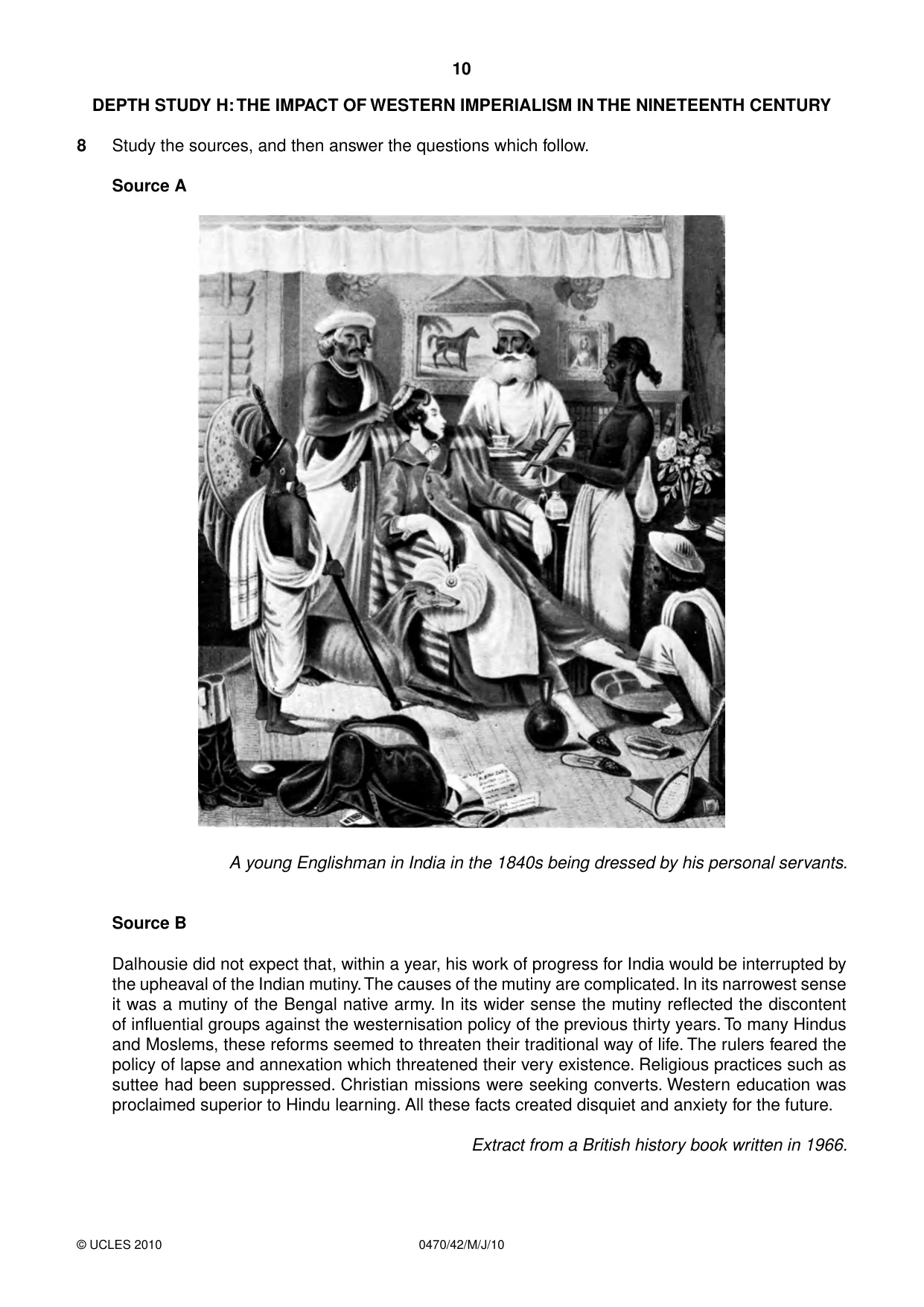
10 0470/42/M/J/10 © UCLES 2010 DEPTH STUDY H: THE IMPACT OF WESTERN IMPERIALISM IN THE NINETEENTH CENTURY 8 Study the sources, and then answer the questions which follow. Source A A young Englishman in India in the 1840s being dressed by his personal servants. Source B Dalhousie did not expect that, within a year, his work of progress for India would be interrupted by the upheaval of the Indian mutiny. The causes of the mutiny are complicated. In its narrowest sense it was a mutiny of the Bengal native army. In its wider sense the mutiny reflected the discontent of influential groups against the westernisation policy of the previous thirty years. To many Hindus and Moslems, these reforms seemed to threaten their traditional way of life. The rulers feared the policy of lapse and annexation which threatened their very existence. Religious practices such as suttee had been suppressed. Christian missions were seeking converts. Western education was proclaimed superior to Hindu learning. All these facts created disquiet and anxiety for the future. Extract from a British history book written in 1966.
Question paper, page 11
11 0470/42/M/J/10 © UCLES 2010 (a) (i) Study Source A. What does this source tell you about the lives of Englishmen in pre-mutiny India? Support your answer with reference to the source. [6] (ii) Study Source B. How far does this source show that the reforms of Dalhousie were the cause of the Indian mutiny? Explain your answer. [7] (iii) Study both sources. Is one source more useful than the other as evidence about life in India before the mutiny? Explain your answer. [7] (b) (i) What was thuggee? [2] (ii) Describe the ‘westernising benefits’ to India of Dalhousie’s reforms. [4] (iii) Why was the mutiny begun by the Bengal native army? [6] (iv) How far did the mutiny change British rule in India? Explain your answer. [8]
Question paper, page 12
12 0470/42/M/J/10 © UCLES 2010 BLANK PAGE Copyright Acknowledgements: Depth Study A Source B © Alan White, The Weimar Republic ; HarperCollins, 1997. Depth Study B Source B © Philip Ingram, Russia and the USSR 1905–1991; Cambridge University Press, 1997. Depth Study D Source A © Jung Chang, Wild Swans ; Flamingo, 1991. Depth Study D Source B © Harriet Ward, World Powers in the Twentieth Century ; BBC Publications, 1978. Depth Study E Source A © Helen Joseph, Side By Side; Zed Books Ltd, 1986. Depth Study E Source B © BBC News Report; news.bbc.co.uk/1/hi/world/africa/203174.stm Depth Study F Source A © S J Perkins, The Arab-Israeli Conflict ; ‘Arafat’, terrorist or peacemaker? Macmillan Educational Ltd; 1987. Depth Study F Source B © Dan Cohn-Sherbok and Dawoud El-Alami, The Palestine-Israeli Conflict ; 2001. Depth Study H Source A © M Edwardes, Bound to Exile, Picture 5 ; Sedgwick and Jackson, 1969. Depth Study H Source B © W D Hussey, The British Empire and Commonwealth 1500–1961; Cambridge University Press, 1968. Permission to reproduce items where third-party owned material protected by copyright is included has been sought and cleared where possible. Every reasonable effort has been made by the publisher (UCLES) to trace copyright holders, but if any items requiring clearance have unwittingly been included, the publisher will be pleased to make amends at the earliest possible opportunity. University of Cambridge International Examinations is part of the Cambridge Assessment Group. Cambridge Assessment is the brand name of University of Cambridge Local Examinations Syndicate (UCLES), which is itself a department of the University of Cambridge.
Mark scheme, page 1
UNIVERSITY OF CAMBRIDGE INTERNATIONAL EXAMINATIONS International General Certificate of Secondary Education MARK SCHEME for the May/June 2010 question paper for the guidance of teachers 0470 HISTORY 0470/42 Paper 42 (Alternative to Coursework), maximum raw mark 40 This mark scheme is published as an aid to teachers and candidates, to indicate the requirements of the examination. It shows the basis on which Examiners were instructed to award marks. It does not indicate the details of the discussions that took place at an Examiners’ meeting before marking began, which would have considered the acceptability of alternative answers. Mark schemes must be read in conjunction with the question papers and the report on the examination. • CIE will not enter into discussions or correspondence in connection with these mark schemes. CIE is publishing the mark schemes for the May/June 2010 question papers for most IGCSE, GCE Advanced Level and Advanced Subsidiary Level syllabuses and some Ordinary Level syllabuses. www.XtremePapers.com
Mark scheme, page 2
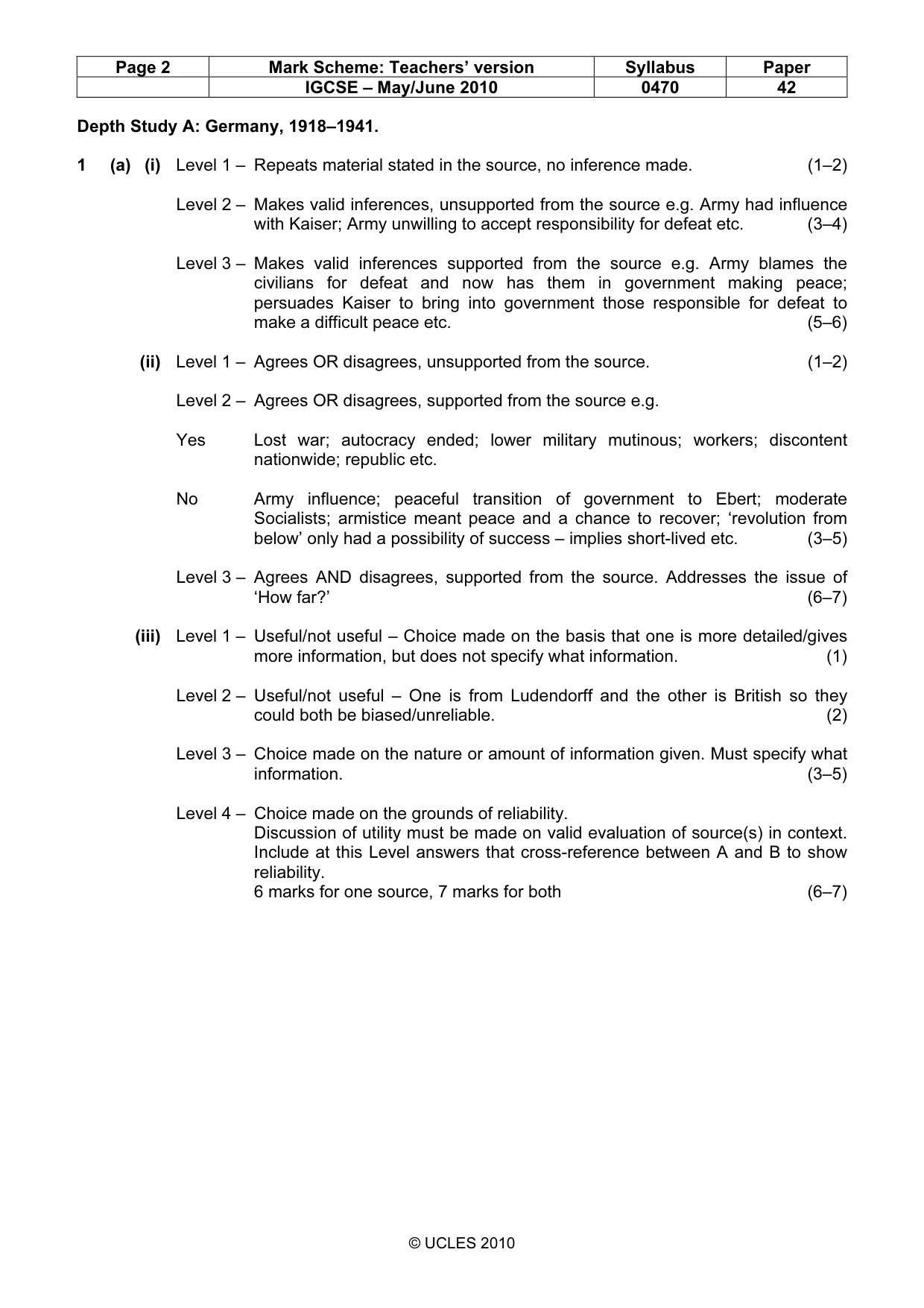
Page 2 Mark Scheme: Teachers’ version Syllabus Paper IGCSE – May/June 2010 0470 42 © UCLES 2010 Depth Study A: Germany, 1918–1941. 1 (a) (i) Level 1 – Repeats material stated in the source, no inference made. (1–2) Level 2 – Makes valid inferences, unsupported from the source e.g. Army had influence with Kaiser; Army unwilling to accept responsibility for defeat etc. (3–4) Level 3 – Makes valid inferences supported from the source e.g. Army blames the civilians for defeat and now has them in government making peace; persuades Kaiser to bring into government those responsible for defeat to make a difficult peace etc. (5–6) (ii) Level 1 – Agrees OR disagrees, unsupported from the source. (1–2) Level 2 – Agrees OR disagrees, supported from the source e.g. Yes Lost war; autocracy ended; lower military mutinous; workers; discontent nationwide; republic etc. No Army influence; peaceful transition of government to Ebert; moderate Socialists; armistice meant peace and a chance to recover; ‘revolution from below’ only had a possibility of success – implies short-lived etc. (3–5) Level 3 – Agrees AND disagrees, supported from the source. Addresses the issue of ‘How far?’ (6–7) (iii) Level 1 – Useful/not useful – Choice made on the basis that one is more detailed/gives more information, but does not specify what information. (1) Level 2 – Useful/not useful – One is from Ludendorff and the other is British so they could both be biased/unreliable. (2) Level 3 – Choice made on the nature or amount of information given. Must specify what information. (3–5) Level 4 – Choice made on the grounds of reliability. Discussion of utility must be made on valid evaluation of source(s) in context. Include at this Level answers that cross-reference between A and B to show reliability. 6 marks for one source, 7 marks for both (6–7)
Mark scheme, page 3
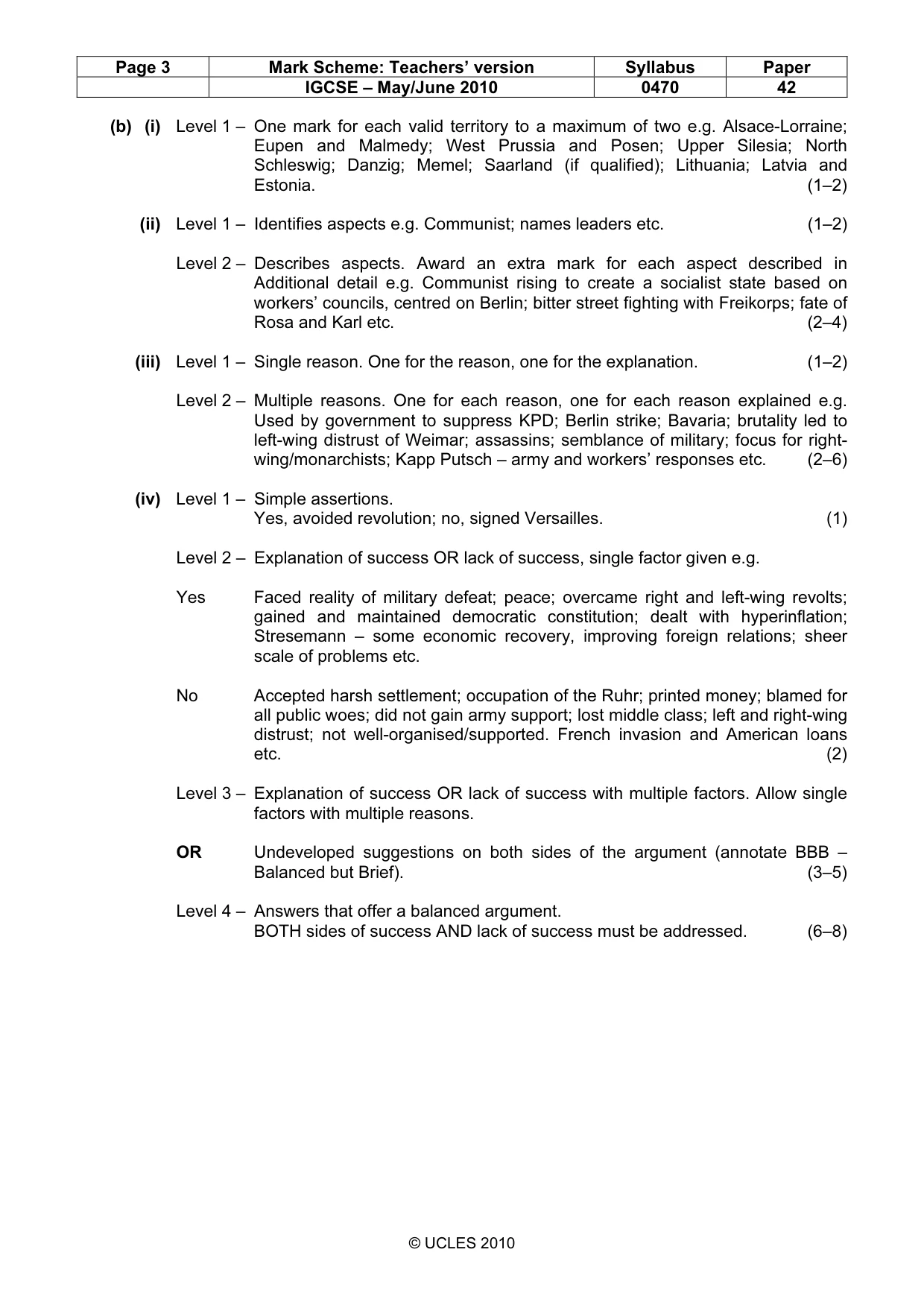
Page 3 Mark Scheme: Teachers’ version Syllabus Paper IGCSE – May/June 2010 0470 42 © UCLES 2010 (b) (i) Level 1 – One mark for each valid territory to a maximum of two e.g. Alsace-Lorraine; Eupen and Malmedy; West Prussia and Posen; Upper Silesia; North Schleswig; Danzig; Memel; Saarland (if qualified); Lithuania; Latvia and Estonia. (1–2) (ii) Level 1 – Identifies aspects e.g. Communist; names leaders etc. (1–2) Level 2 – Describes aspects. Award an extra mark for each aspect described in Additional detail e.g. Communist rising to create a socialist state based on workers’ councils, centred on Berlin; bitter street fighting with Freikorps; fate of Rosa and Karl etc. (2–4) (iii) Level 1 – Single reason. One for the reason, one for the explanation. (1–2) Level 2 – Multiple reasons. One for each reason, one for each reason explained e.g. Used by government to suppress KPD; Berlin strike; Bavaria; brutality led to left-wing distrust of Weimar; assassins; semblance of military; focus for right- wing/monarchists; Kapp Putsch – army and workers’ responses etc. (2–6) (iv) Level 1 – Simple assertions. Yes, avoided revolution; no, signed Versailles. (1) Level 2 – Explanation of success OR lack of success, single factor given e.g. Yes Faced reality of military defeat; peace; overcame right and left-wing revolts; gained and maintained democratic constitution; dealt with hyperinflation; Stresemann – some economic recovery, improving foreign relations; sheer scale of problems etc. No Accepted harsh settlement; occupation of the Ruhr; printed money; blamed for all public woes; did not gain army support; lost middle class; left and right-wing distrust; not well-organised/supported. French invasion and American loans etc. (2) Level 3 – Explanation of success OR lack of success with multiple factors. Allow single factors with multiple reasons. OR Undeveloped suggestions on both sides of the argument (annotate BBB – Balanced but Brief). (3–5) Level 4 – Answers that offer a balanced argument. BOTH sides of success AND lack of success must be addressed. (6–8)
Mark scheme, page 4
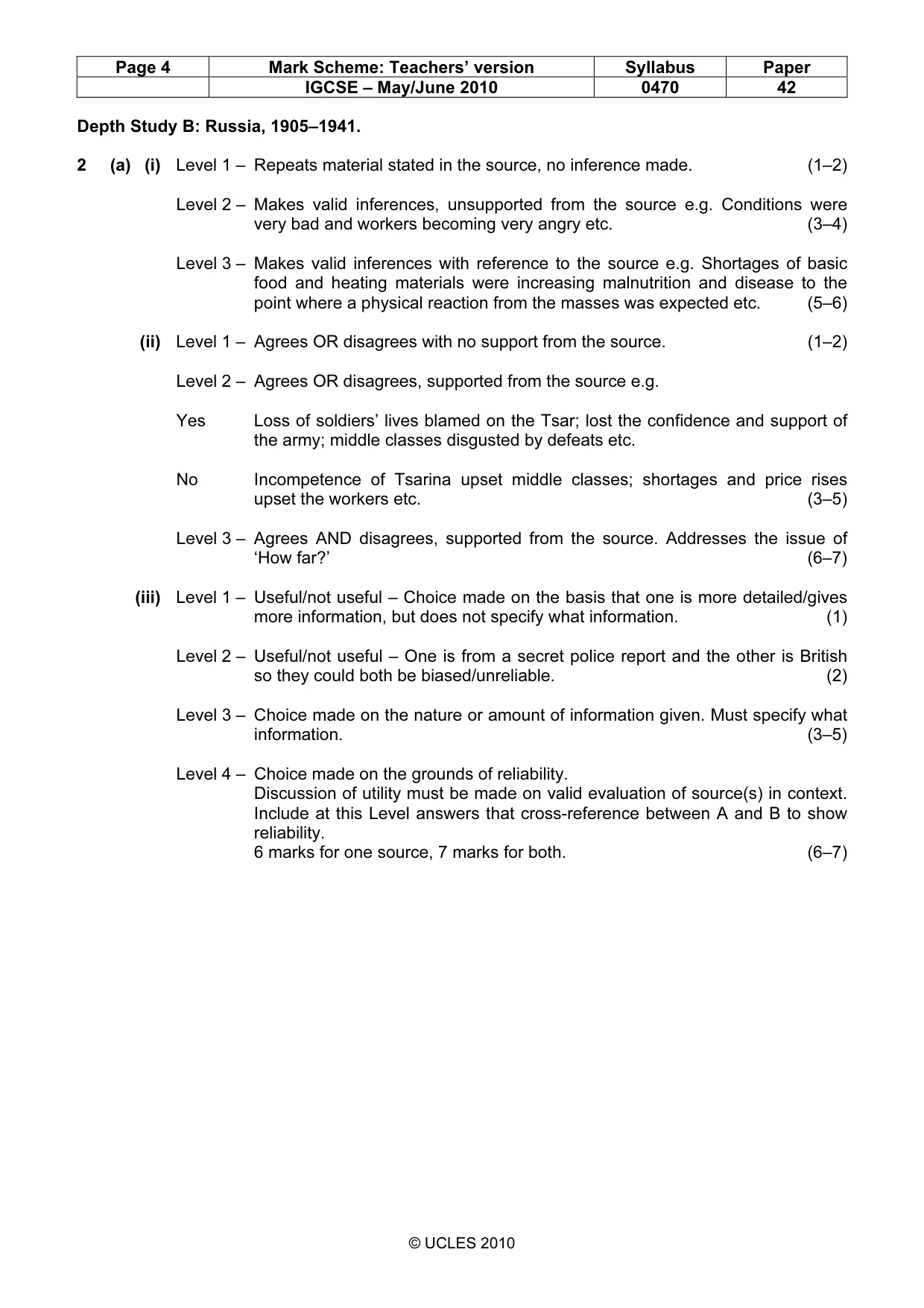
Page 4 Mark Scheme: Teachers’ version Syllabus Paper IGCSE – May/June 2010 0470 42 © UCLES 2010 Depth Study B: Russia, 1905–1941. 2 (a) (i) Level 1 – Repeats material stated in the source, no inference made. (1–2) Level 2 – Makes valid inferences, unsupported from the source e.g. Conditions were very bad and workers becoming very angry etc. (3–4) Level 3 – Makes valid inferences with reference to the source e.g. Shortages of basic food and heating materials were increasing malnutrition and disease to the point where a physical reaction from the masses was expected etc. (5–6) (ii) Level 1 – Agrees OR disagrees with no support from the source. (1–2) Level 2 – Agrees OR disagrees, supported from the source e.g. Yes Loss of soldiers’ lives blamed on the Tsar; lost the confidence and support of the army; middle classes disgusted by defeats etc. No Incompetence of Tsarina upset middle classes; shortages and price rises upset the workers etc. (3–5) Level 3 – Agrees AND disagrees, supported from the source. Addresses the issue of ‘How far?’ (6–7) (iii) Level 1 – Useful/not useful – Choice made on the basis that one is more detailed/gives more information, but does not specify what information. (1) Level 2 – Useful/not useful – One is from a secret police report and the other is British so they could both be biased/unreliable. (2) Level 3 – Choice made on the nature or amount of information given. Must specify what information. (3–5) Level 4 – Choice made on the grounds of reliability. Discussion of utility must be made on valid evaluation of source(s) in context. Include at this Level answers that cross-reference between A and B to show reliability. 6 marks for one source, 7 marks for both. (6–7)
Mark scheme, page 5
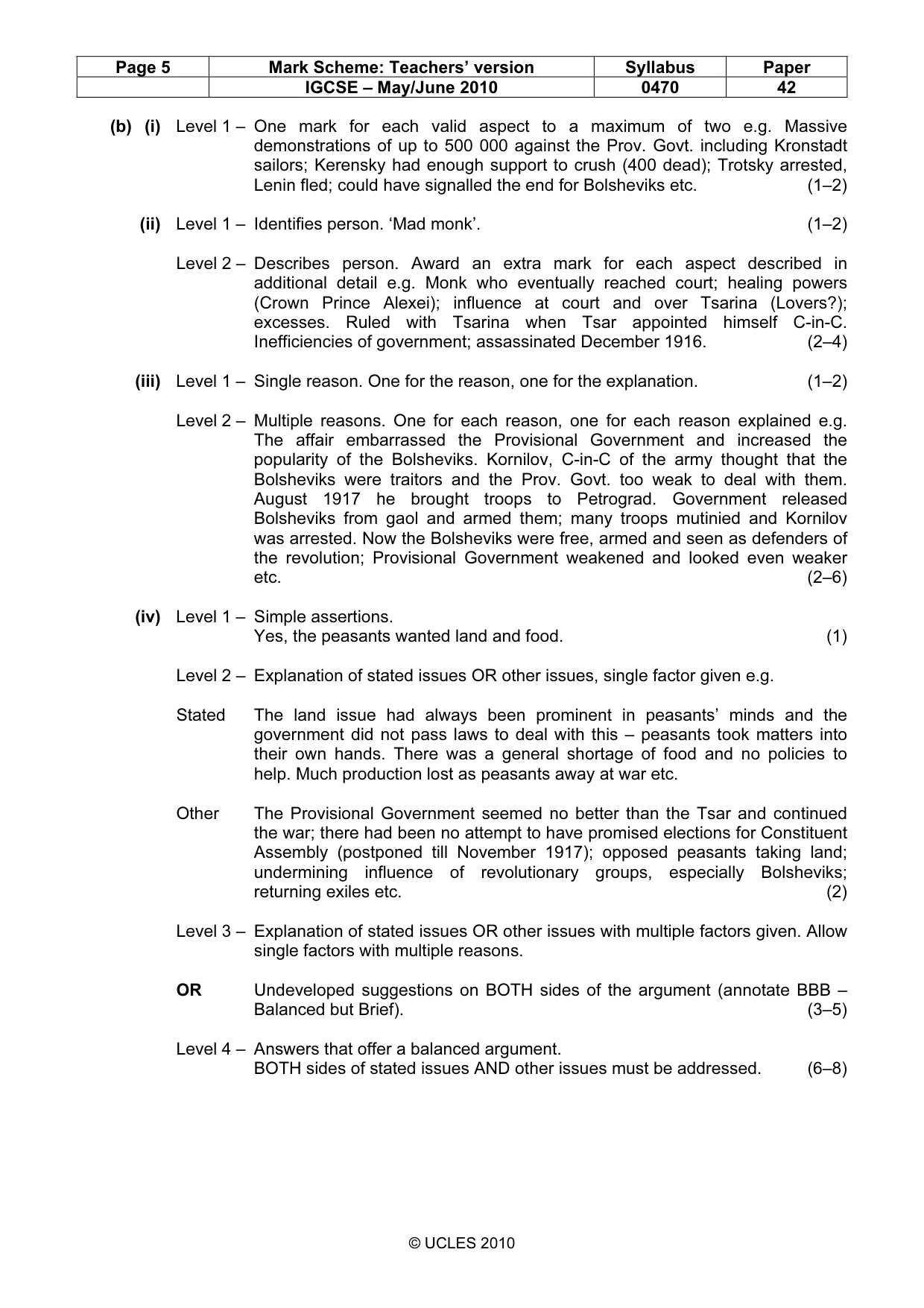
Page 5 Mark Scheme: Teachers’ version Syllabus Paper IGCSE – May/June 2010 0470 42 © UCLES 2010 (b) (i) Level 1 – One mark for each valid aspect to a maximum of two e.g. Massive demonstrations of up to 500 000 against the Prov. Govt. including Kronstadt sailors; Kerensky had enough support to crush (400 dead); Trotsky arrested, Lenin fled; could have signalled the end for Bolsheviks etc. (1–2) (ii) Level 1 – Identifies person. ‘Mad monk’. (1–2) Level 2 – Describes person. Award an extra mark for each aspect described in additional detail e.g. Monk who eventually reached court; healing powers (Crown Prince Alexei); influence at court and over Tsarina (Lovers?); excesses. Ruled with Tsarina when Tsar appointed himself C-in-C. Inefficiencies of government; assassinated December 1916. (2–4) (iii) Level 1 – Single reason. One for the reason, one for the explanation. (1–2) Level 2 – Multiple reasons. One for each reason, one for each reason explained e.g. The affair embarrassed the Provisional Government and increased the popularity of the Bolsheviks. Kornilov, C-in-C of the army thought that the Bolsheviks were traitors and the Prov. Govt. too weak to deal with them. August 1917 he brought troops to Petrograd. Government released Bolsheviks from gaol and armed them; many troops mutinied and Kornilov was arrested. Now the Bolsheviks were free, armed and seen as defenders of the revolution; Provisional Government weakened and looked even weaker etc. (2–6) (iv) Level 1 – Simple assertions. Yes, the peasants wanted land and food. (1) Level 2 – Explanation of stated issues OR other issues, single factor given e.g. Stated The land issue had always been prominent in peasants’ minds and the government did not pass laws to deal with this – peasants took matters into their own hands. There was a general shortage of food and no policies to help. Much production lost as peasants away at war etc. Other The Provisional Government seemed no better than the Tsar and continued the war; there had been no attempt to have promised elections for Constituent Assembly (postponed till November 1917); opposed peasants taking land; undermining influence of revolutionary groups, especially Bolsheviks; returning exiles etc. (2) Level 3 – Explanation of stated issues OR other issues with multiple factors given. Allow single factors with multiple reasons. OR Undeveloped suggestions on BOTH sides of the argument (annotate BBB – Balanced but Brief). (3–5) Level 4 – Answers that offer a balanced argument. BOTH sides of stated issues AND other issues must be addressed. (6–8)
Mark scheme, page 6
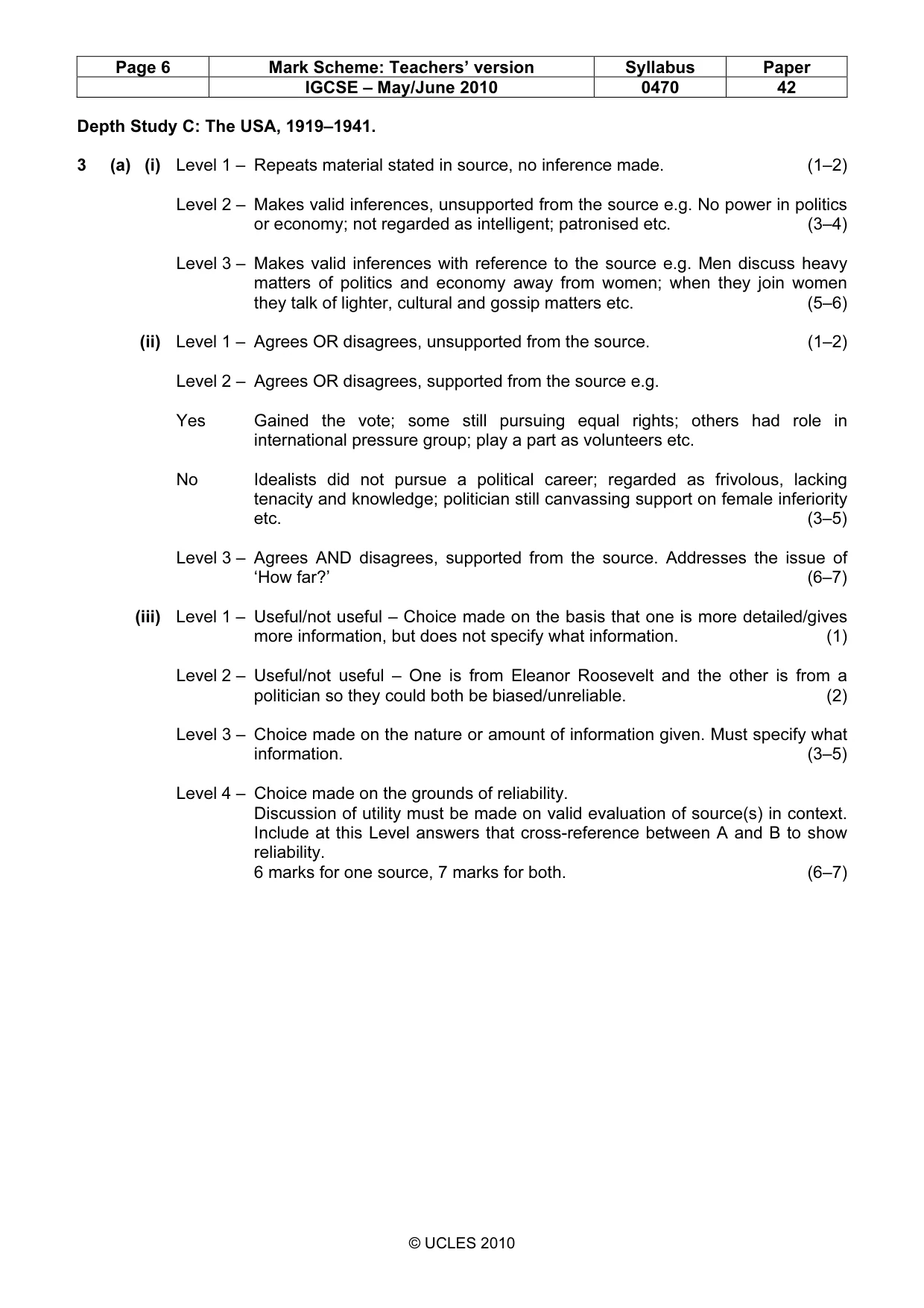
Page 6 Mark Scheme: Teachers’ version Syllabus Paper IGCSE – May/June 2010 0470 42 © UCLES 2010 Depth Study C: The USA, 1919–1941. 3 (a) (i) Level 1 – Repeats material stated in source, no inference made. (1–2) Level 2 – Makes valid inferences, unsupported from the source e.g. No power in politics or economy; not regarded as intelligent; patronised etc. (3–4) Level 3 – Makes valid inferences with reference to the source e.g. Men discuss heavy matters of politics and economy away from women; when they join women they talk of lighter, cultural and gossip matters etc. (5–6) (ii) Level 1 – Agrees OR disagrees, unsupported from the source. (1–2) Level 2 – Agrees OR disagrees, supported from the source e.g. Yes Gained the vote; some still pursuing equal rights; others had role in international pressure group; play a part as volunteers etc. No Idealists did not pursue a political career; regarded as frivolous, lacking tenacity and knowledge; politician still canvassing support on female inferiority etc. (3–5) Level 3 – Agrees AND disagrees, supported from the source. Addresses the issue of ‘How far?’ (6–7) (iii) Level 1 – Useful/not useful – Choice made on the basis that one is more detailed/gives more information, but does not specify what information. (1) Level 2 – Useful/not useful – One is from Eleanor Roosevelt and the other is from a politician so they could both be biased/unreliable. (2) Level 3 – Choice made on the nature or amount of information given. Must specify what information. (3–5) Level 4 – Choice made on the grounds of reliability. Discussion of utility must be made on valid evaluation of source(s) in context. Include at this Level answers that cross-reference between A and B to show reliability. 6 marks for one source, 7 marks for both. (6–7)
Mark scheme, page 7
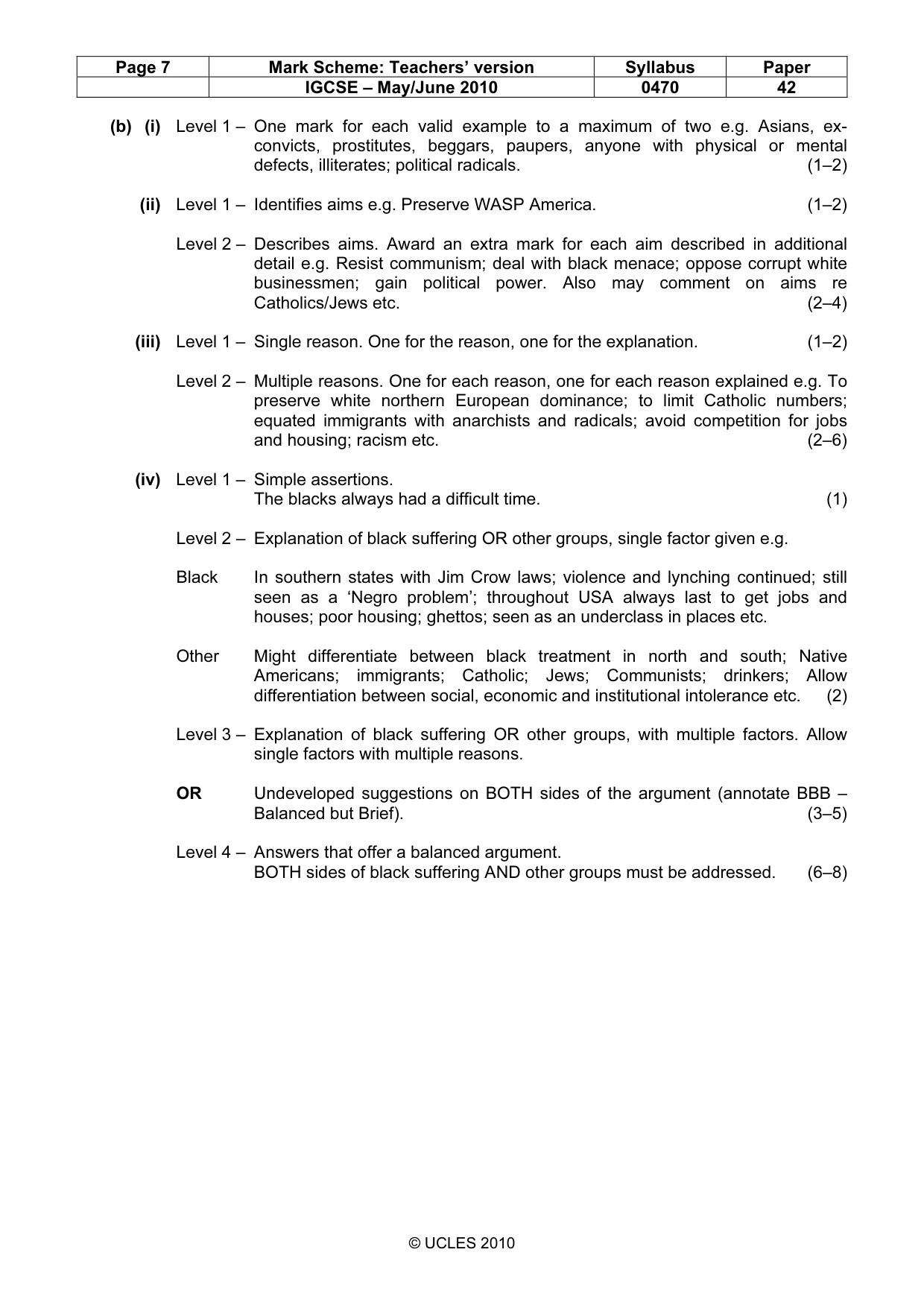
Page 7 Mark Scheme: Teachers’ version Syllabus Paper IGCSE – May/June 2010 0470 42 © UCLES 2010 (b) (i) Level 1 – One mark for each valid example to a maximum of two e.g. Asians, ex- convicts, prostitutes, beggars, paupers, anyone with physical or mental defects, illiterates; political radicals. (1–2) (ii) Level 1 – Identifies aims e.g. Preserve WASP America. (1–2) Level 2 – Describes aims. Award an extra mark for each aim described in additional detail e.g. Resist communism; deal with black menace; oppose corrupt white businessmen; gain political power. Also may comment on aims re Catholics/Jews etc. (2–4) (iii) Level 1 – Single reason. One for the reason, one for the explanation. (1–2) Level 2 – Multiple reasons. One for each reason, one for each reason explained e.g. To preserve white northern European dominance; to limit Catholic numbers; equated immigrants with anarchists and radicals; avoid competition for jobs and housing; racism etc. (2–6) (iv) Level 1 – Simple assertions. The blacks always had a difficult time. (1) Level 2 – Explanation of black suffering OR other groups, single factor given e.g. Black In southern states with Jim Crow laws; violence and lynching continued; still seen as a ‘Negro problem’; throughout USA always last to get jobs and houses; poor housing; ghettos; seen as an underclass in places etc. Other Might differentiate between black treatment in north and south; Native Americans; immigrants; Catholic; Jews; Communists; drinkers; Allow differentiation between social, economic and institutional intolerance etc. (2) Level 3 – Explanation of black suffering OR other groups, with multiple factors. Allow single factors with multiple reasons. OR Undeveloped suggestions on BOTH sides of the argument (annotate BBB – Balanced but Brief). (3–5) Level 4 – Answers that offer a balanced argument. BOTH sides of black suffering AND other groups must be addressed. (6–8)
Mark scheme, page 8
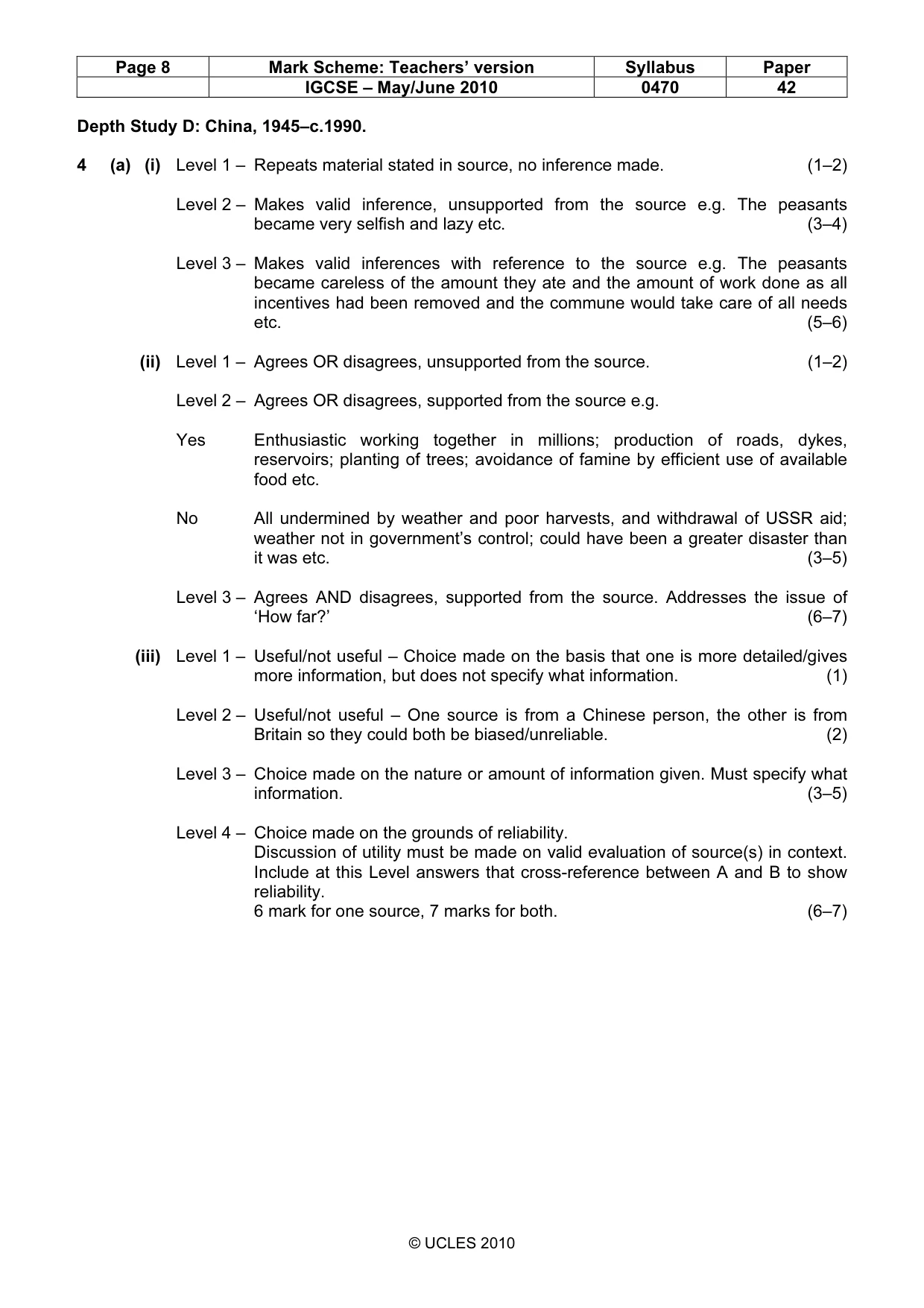
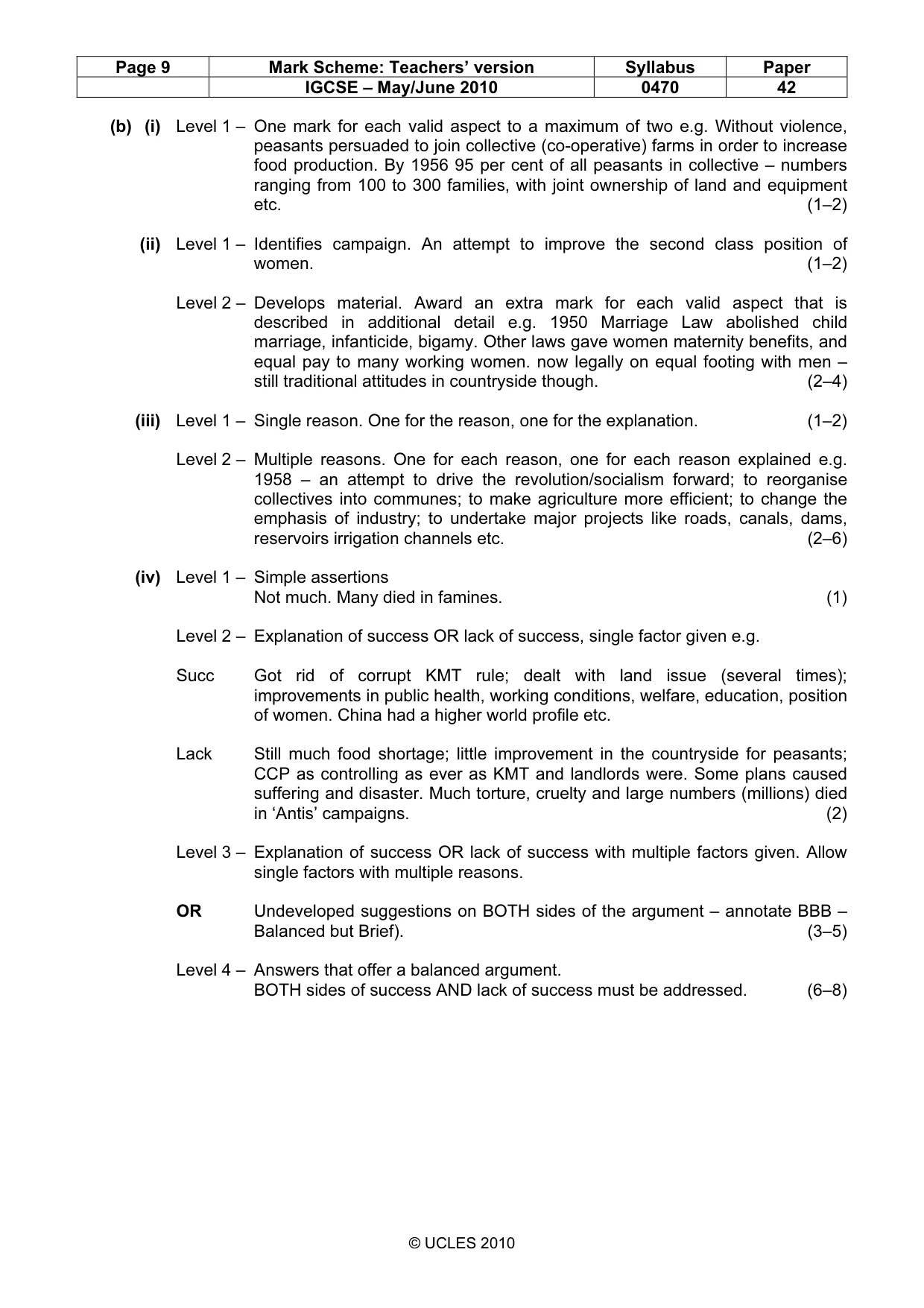
Page 8 Mark Scheme: Teachers’ version Syllabus Paper IGCSE – May/June 2010 0470 42 © UCLES 2010 Depth Study D: China, 1945–c.1990. 4 (a) (i) Level 1 – Repeats material stated in source, no inference made. (1–2) Level 2 – Makes valid inference, unsupported from the source e.g. The peasants became very selfish and lazy etc. (3–4) Level 3 – Makes valid inferences with reference to the source e.g. The peasants became careless of the amount they ate and the amount of work done as all incentives had been removed and the commune would take care of all needs etc. (5–6) (ii) Level 1 – Agrees OR disagrees, unsupported from the source. (1–2) Level 2 – Agrees OR disagrees, supported from the source e.g. Yes Enthusiastic working together in millions; production of roads, dykes, reservoirs; planting of trees; avoidance of famine by efficient use of available food etc. No All undermined by weather and poor harvests, and withdrawal of USSR aid; weather not in government’s control; could have been a greater disaster than it was etc. (3–5) Level 3 – Agrees AND disagrees, supported from the source. Addresses the issue of ‘How far?’ (6–7) (iii) Level 1 – Useful/not useful – Choice made on the basis that one is more detailed/gives more information, but does not specify what information. (1) Level 2 – Useful/not useful – One source is from a Chinese person, the other is from Britain so they could both be biased/unreliable. (2) Level 3 – Choice made on the nature or amount of information given. Must specify what information. (3–5) Level 4 – Choice made on the grounds of reliability. Discussion of utility must be made on valid evaluation of source(s) in context. Include at this Level answers that cross-reference between A and B to show reliability. 6 mark for one source, 7 marks for both. (6–7)
Mark scheme, page 9
Page 9 Mark Scheme: Teachers’ version Syllabus Paper IGCSE – May/June 2010 0470 42 © UCLES 2010 (b) (i) Level 1 – One mark for each valid aspect to a maximum of two e.g. Without violence, peasants persuaded to join collective (co-operative) farms in order to increase food production. By 1956 95 per cent of all peasants in collective – numbers ranging from 100 to 300 families, with joint ownership of land and equipment etc. (1–2) (ii) Level 1 – Identifies campaign. An attempt to improve the second class position of women. (1–2) Level 2 – Develops material. Award an extra mark for each valid aspect that is described in additional detail e.g. 1950 Marriage Law abolished child marriage, infanticide, bigamy. Other laws gave women maternity benefits, and equal pay to many working women. now legally on equal footing with men – still traditional attitudes in countryside though. (2–4) (iii) Level 1 – Single reason. One for the reason, one for the explanation. (1–2) Level 2 – Multiple reasons. One for each reason, one for each reason explained e.g. 1958 – an attempt to drive the revolution/socialism forward; to reorganise collectives into communes; to make agriculture more efficient; to change the emphasis of industry; to undertake major projects like roads, canals, dams, reservoirs irrigation channels etc. (2–6) (iv) Level 1 – Simple assertions Not much. Many died in famines. (1) Level 2 – Explanation of success OR lack of success, single factor given e.g. Succ Got rid of corrupt KMT rule; dealt with land issue (several times); improvements in public health, working conditions, welfare, education, position of women. China had a higher world profile etc. Lack Still much food shortage; little improvement in the countryside for peasants; CCP as controlling as ever as KMT and landlords were. Some plans caused suffering and disaster. Much torture, cruelty and large numbers (millions) died in ‘Antis’ campaigns. (2) Level 3 – Explanation of success OR lack of success with multiple factors given. Allow single factors with multiple reasons. OR Undeveloped suggestions on BOTH sides of the argument – annotate BBB – Balanced but Brief). (3–5) Level 4 – Answers that offer a balanced argument. BOTH sides of success AND lack of success must be addressed. (6–8)
Mark scheme, page 10
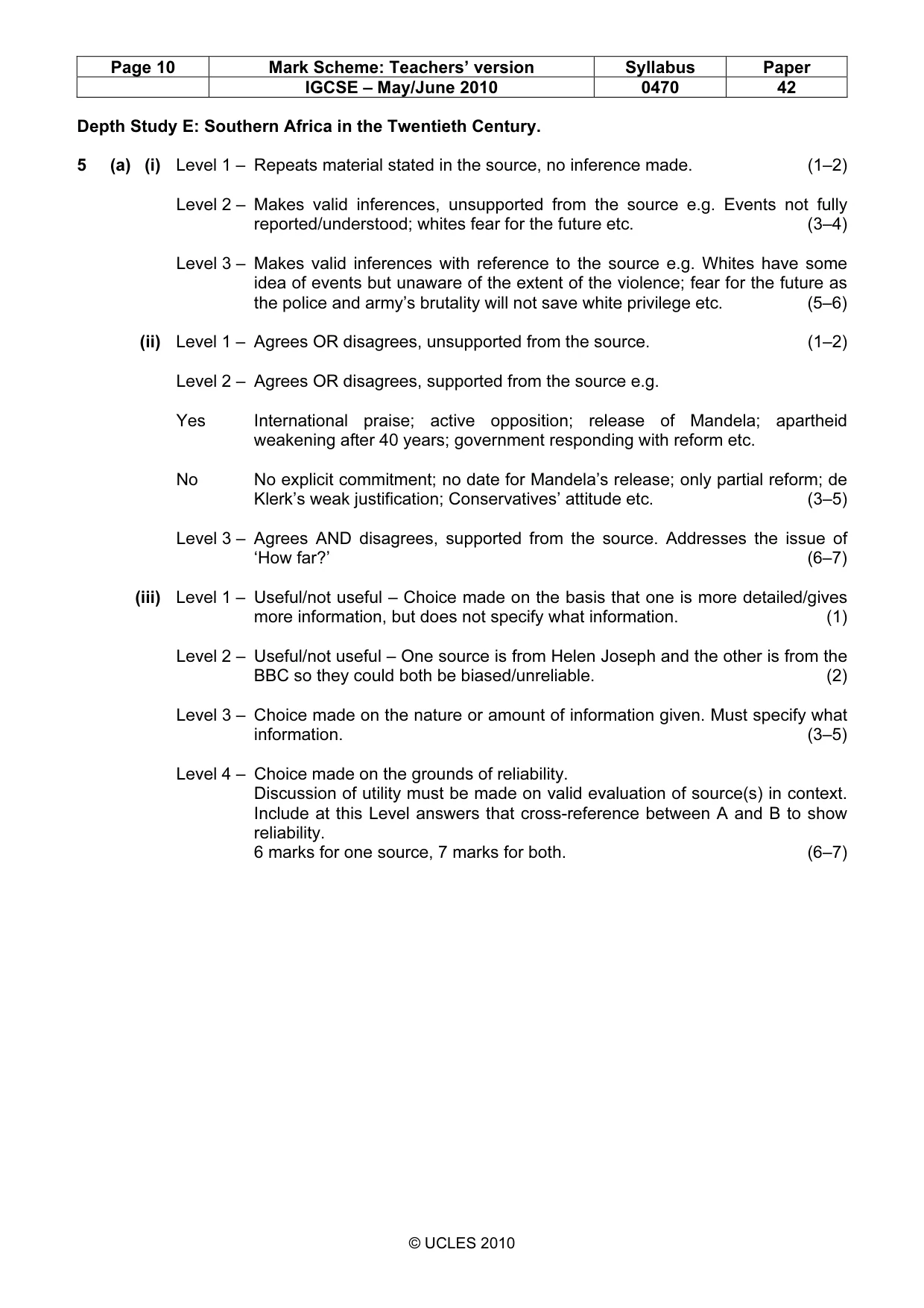
Page 10 Mark Scheme: Teachers’ version Syllabus Paper IGCSE – May/June 2010 0470 42 © UCLES 2010 Depth Study E: Southern Africa in the Twentieth Century. 5 (a) (i) Level 1 – Repeats material stated in the source, no inference made. (1–2) Level 2 – Makes valid inferences, unsupported from the source e.g. Events not fully reported/understood; whites fear for the future etc. (3–4) Level 3 – Makes valid inferences with reference to the source e.g. Whites have some idea of events but unaware of the extent of the violence; fear for the future as the police and army’s brutality will not save white privilege etc. (5–6) (ii) Level 1 – Agrees OR disagrees, unsupported from the source. (1–2) Level 2 – Agrees OR disagrees, supported from the source e.g. Yes International praise; active opposition; release of Mandela; apartheid weakening after 40 years; government responding with reform etc. No No explicit commitment; no date for Mandela’s release; only partial reform; de Klerk’s weak justification; Conservatives’ attitude etc. (3–5) Level 3 – Agrees AND disagrees, supported from the source. Addresses the issue of ‘How far?’ (6–7) (iii) Level 1 – Useful/not useful – Choice made on the basis that one is more detailed/gives more information, but does not specify what information. (1) Level 2 – Useful/not useful – One source is from Helen Joseph and the other is from the BBC so they could both be biased/unreliable. (2) Level 3 – Choice made on the nature or amount of information given. Must specify what information. (3–5) Level 4 – Choice made on the grounds of reliability. Discussion of utility must be made on valid evaluation of source(s) in context. Include at this Level answers that cross-reference between A and B to show reliability. 6 marks for one source, 7 marks for both. (6–7)
Mark scheme, page 11
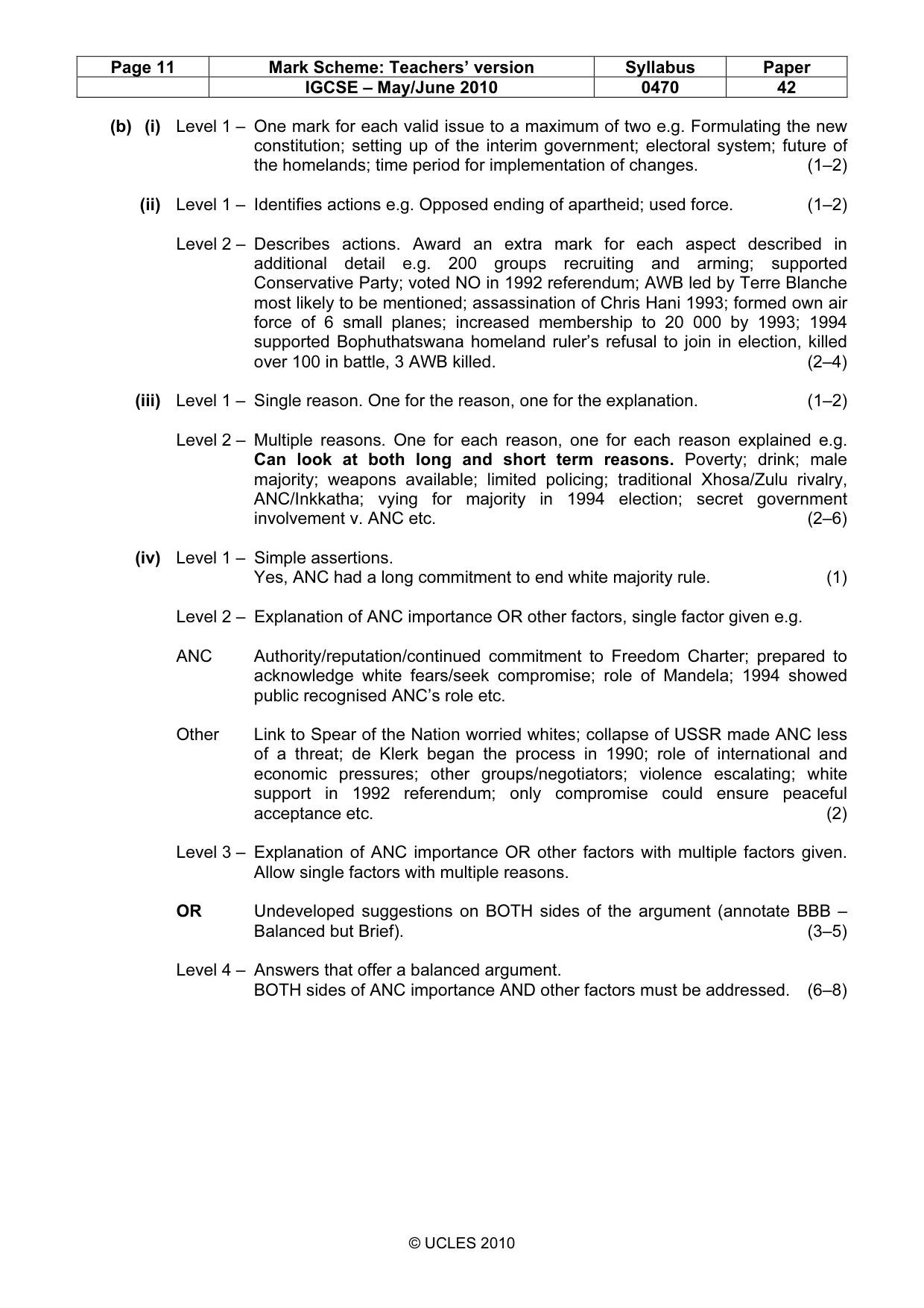
Page 11 Mark Scheme: Teachers’ version Syllabus Paper IGCSE – May/June 2010 0470 42 © UCLES 2010 (b) (i) Level 1 – One mark for each valid issue to a maximum of two e.g. Formulating the new constitution; setting up of the interim government; electoral system; future of the homelands; time period for implementation of changes. (1–2) (ii) Level 1 – Identifies actions e.g. Opposed ending of apartheid; used force. (1–2) Level 2 – Describes actions. Award an extra mark for each aspect described in additional detail e.g. 200 groups recruiting and arming; supported Conservative Party; voted NO in 1992 referendum; AWB led by Terre Blanche most likely to be mentioned; assassination of Chris Hani 1993; formed own air force of 6 small planes; increased membership to 20 000 by 1993; 1994 supported Bophuthatswana homeland ruler’s refusal to join in election, killed over 100 in battle, 3 AWB killed. (2–4) (iii) Level 1 – Single reason. One for the reason, one for the explanation. (1–2) Level 2 – Multiple reasons. One for each reason, one for each reason explained e.g. Can look at both long and short term reasons. Poverty; drink; male majority; weapons available; limited policing; traditional Xhosa/Zulu rivalry, ANC/Inkkatha; vying for majority in 1994 election; secret government involvement v. ANC etc. (2–6) (iv) Level 1 – Simple assertions. Yes, ANC had a long commitment to end white majority rule. (1) Level 2 – Explanation of ANC importance OR other factors, single factor given e.g. ANC Authority/reputation/continued commitment to Freedom Charter; prepared to acknowledge white fears/seek compromise; role of Mandela; 1994 showed public recognised ANC’s role etc. Other Link to Spear of the Nation worried whites; collapse of USSR made ANC less of a threat; de Klerk began the process in 1990; role of international and economic pressures; other groups/negotiators; violence escalating; white support in 1992 referendum; only compromise could ensure peaceful acceptance etc. (2) Level 3 – Explanation of ANC importance OR other factors with multiple factors given. Allow single factors with multiple reasons. OR Undeveloped suggestions on BOTH sides of the argument (annotate BBB – Balanced but Brief). (3–5) Level 4 – Answers that offer a balanced argument. BOTH sides of ANC importance AND other factors must be addressed. (6–8)
Mark scheme, page 12
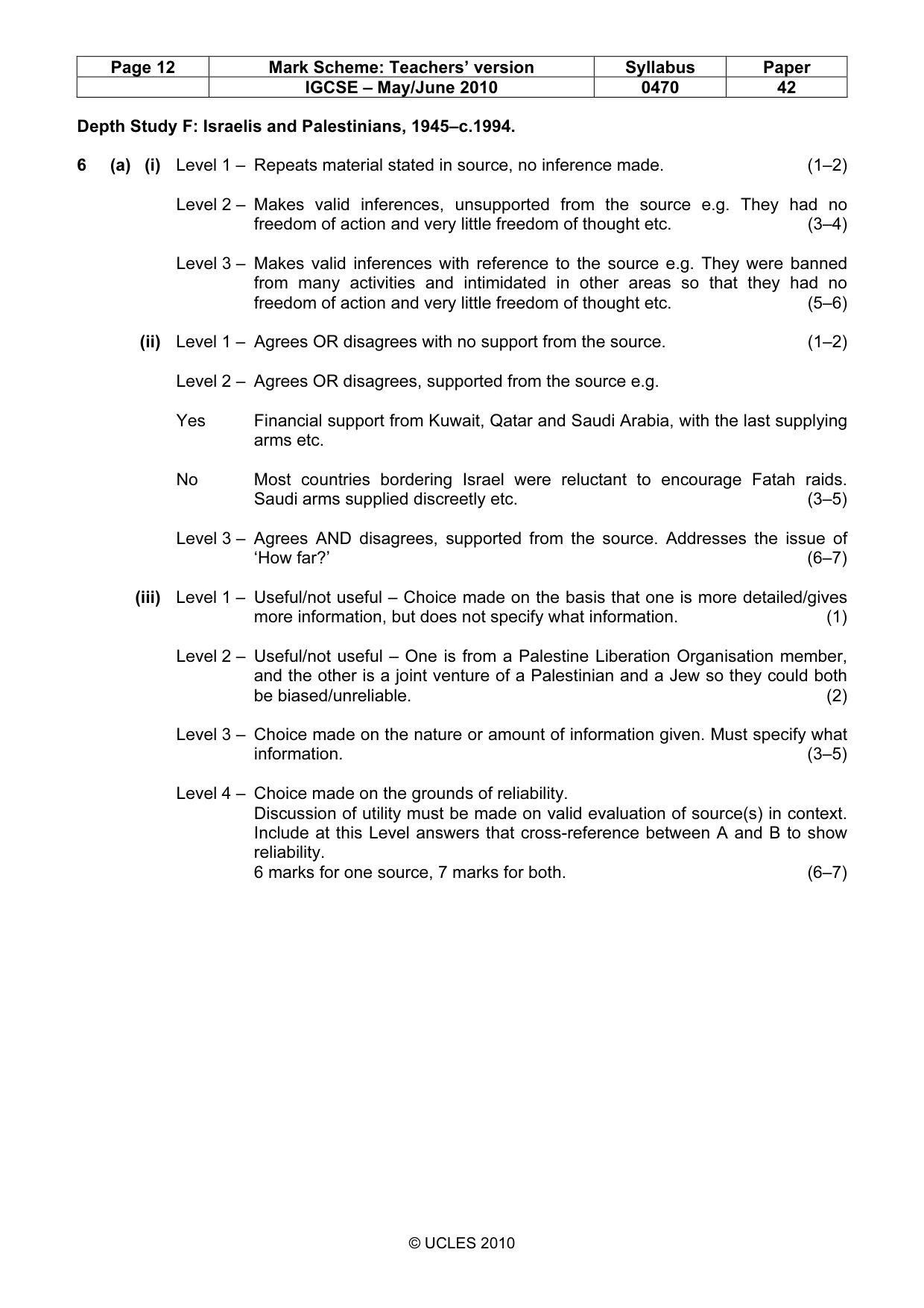
Page 12 Mark Scheme: Teachers’ version Syllabus Paper IGCSE – May/June 2010 0470 42 © UCLES 2010 Depth Study F: Israelis and Palestinians, 1945–c.1994. 6 (a) (i) Level 1 – Repeats material stated in source, no inference made. (1–2) Level 2 – Makes valid inferences, unsupported from the source e.g. They had no freedom of action and very little freedom of thought etc. (3–4) Level 3 – Makes valid inferences with reference to the source e.g. They were banned from many activities and intimidated in other areas so that they had no freedom of action and very little freedom of thought etc. (5–6) (ii) Level 1 – Agrees OR disagrees with no support from the source. (1–2) Level 2 – Agrees OR disagrees, supported from the source e.g. Yes Financial support from Kuwait, Qatar and Saudi Arabia, with the last supplying arms etc. No Most countries bordering Israel were reluctant to encourage Fatah raids. Saudi arms supplied discreetly etc. (3–5) Level 3 – Agrees AND disagrees, supported from the source. Addresses the issue of ‘How far?’ (6–7) (iii) Level 1 – Useful/not useful – Choice made on the basis that one is more detailed/gives more information, but does not specify what information. (1) Level 2 – Useful/not useful – One is from a Palestine Liberation Organisation member, and the other is a joint venture of a Palestinian and a Jew so they could both be biased/unreliable. (2) Level 3 – Choice made on the nature or amount of information given. Must specify what information. (3–5) Level 4 – Choice made on the grounds of reliability. Discussion of utility must be made on valid evaluation of source(s) in context. Include at this Level answers that cross-reference between A and B to show reliability. 6 marks for one source, 7 marks for both. (6–7)
Mark scheme, page 13
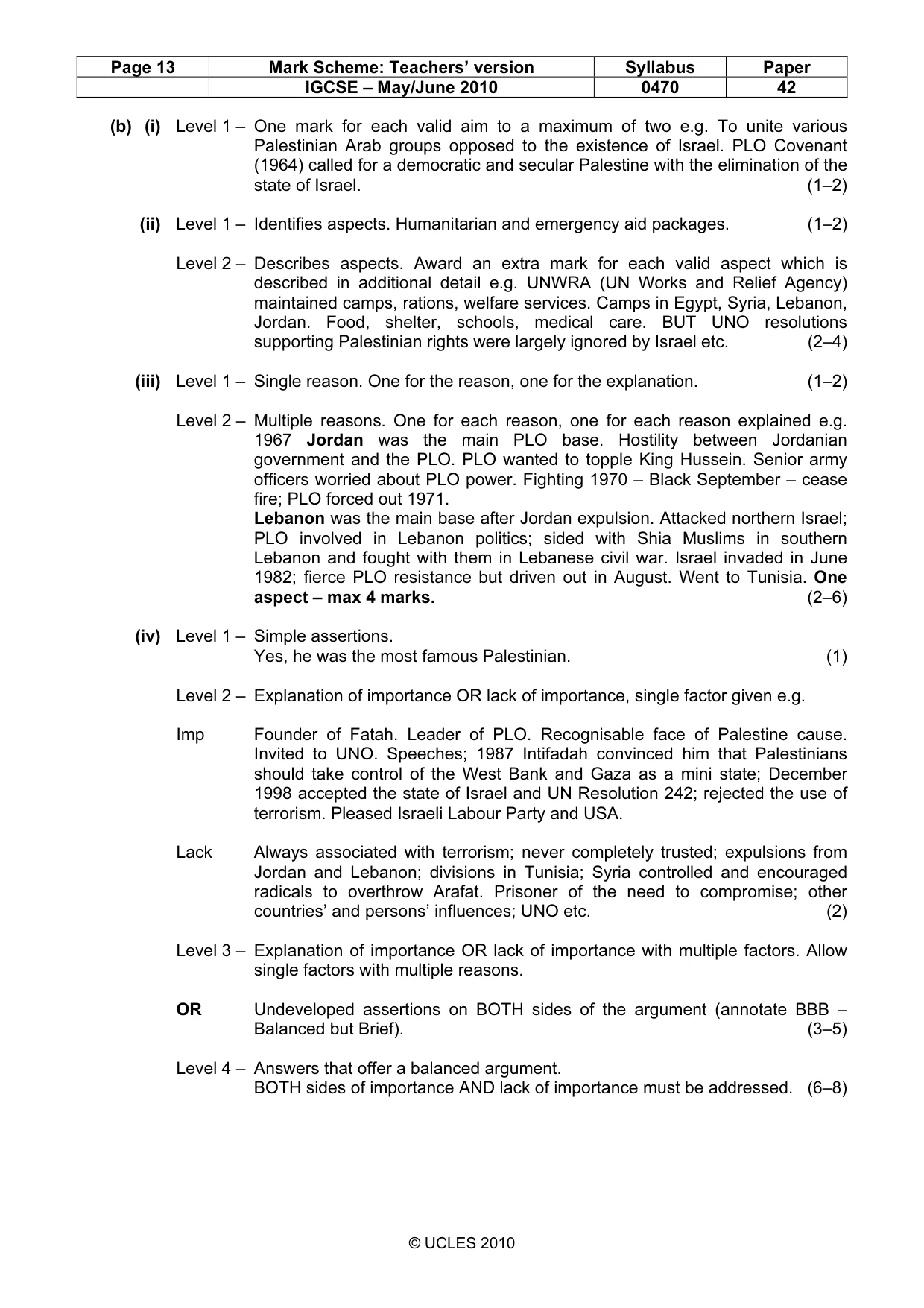
Page 13 Mark Scheme: Teachers’ version Syllabus Paper IGCSE – May/June 2010 0470 42 © UCLES 2010 (b) (i) Level 1 – One mark for each valid aim to a maximum of two e.g. To unite various Palestinian Arab groups opposed to the existence of Israel. PLO Covenant (1964) called for a democratic and secular Palestine with the elimination of the state of Israel. (1–2) (ii) Level 1 – Identifies aspects. Humanitarian and emergency aid packages. (1–2) Level 2 – Describes aspects. Award an extra mark for each valid aspect which is described in additional detail e.g. UNWRA (UN Works and Relief Agency) maintained camps, rations, welfare services. Camps in Egypt, Syria, Lebanon, Jordan. Food, shelter, schools, medical care. BUT UNO resolutions supporting Palestinian rights were largely ignored by Israel etc. (2–4) (iii) Level 1 – Single reason. One for the reason, one for the explanation. (1–2) Level 2 – Multiple reasons. One for each reason, one for each reason explained e.g. 1967 Jordan was the main PLO base. Hostility between Jordanian government and the PLO. PLO wanted to topple King Hussein. Senior army officers worried about PLO power. Fighting 1970 – Black September – cease fire; PLO forced out 1971. Lebanon was the main base after Jordan expulsion. Attacked northern Israel; PLO involved in Lebanon politics; sided with Shia Muslims in southern Lebanon and fought with them in Lebanese civil war. Israel invaded in June 1982; fierce PLO resistance but driven out in August. Went to Tunisia. One aspect – max 4 marks. (2–6) (iv) Level 1 – Simple assertions. Yes, he was the most famous Palestinian. (1) Level 2 – Explanation of importance OR lack of importance, single factor given e.g. Imp Founder of Fatah. Leader of PLO. Recognisable face of Palestine cause. Invited to UNO. Speeches; 1987 Intifadah convinced him that Palestinians should take control of the West Bank and Gaza as a mini state; December 1998 accepted the state of Israel and UN Resolution 242; rejected the use of terrorism. Pleased Israeli Labour Party and USA. Lack Always associated with terrorism; never completely trusted; expulsions from Jordan and Lebanon; divisions in Tunisia; Syria controlled and encouraged radicals to overthrow Arafat. Prisoner of the need to compromise; other countries’ and persons’ influences; UNO etc. (2) Level 3 – Explanation of importance OR lack of importance with multiple factors. Allow single factors with multiple reasons. OR Undeveloped assertions on BOTH sides of the argument (annotate BBB – Balanced but Brief). (3–5) Level 4 – Answers that offer a balanced argument. BOTH sides of importance AND lack of importance must be addressed. (6–8)
Mark scheme, page 14
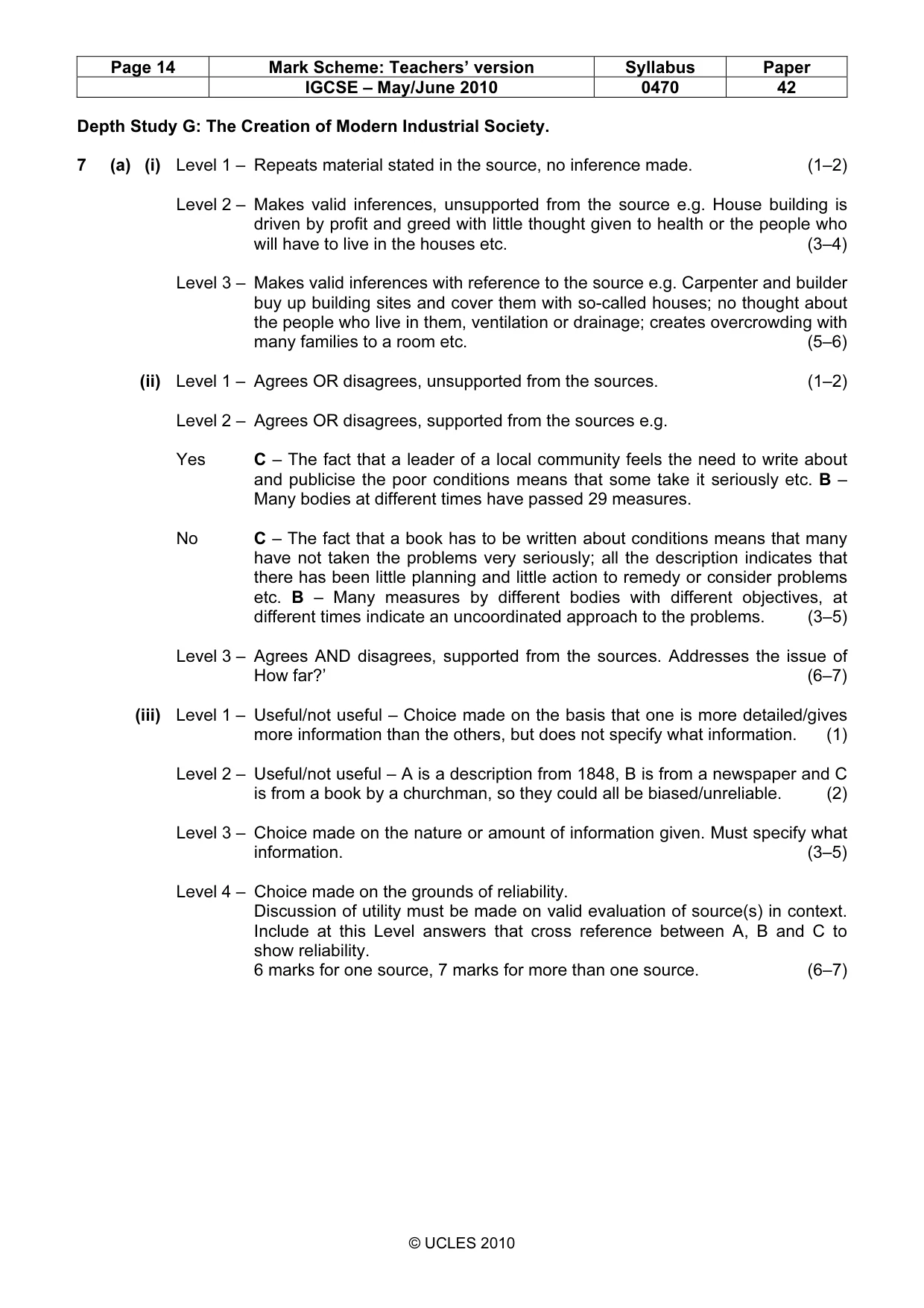
Page 14 Mark Scheme: Teachers’ version Syllabus Paper IGCSE – May/June 2010 0470 42 © UCLES 2010 Depth Study G: The Creation of Modern Industrial Society. 7 (a) (i) Level 1 – Repeats material stated in the source, no inference made. (1–2) Level 2 – Makes valid inferences, unsupported from the source e.g. House building is driven by profit and greed with little thought given to health or the people who will have to live in the houses etc. (3–4) Level 3 – Makes valid inferences with reference to the source e.g. Carpenter and builder buy up building sites and cover them with so-called houses; no thought about the people who live in them, ventilation or drainage; creates overcrowding with many families to a room etc. (5–6) (ii) Level 1 – Agrees OR disagrees, unsupported from the sources. (1–2) Level 2 – Agrees OR disagrees, supported from the sources e.g. Yes C – The fact that a leader of a local community feels the need to write about and publicise the poor conditions means that some take it seriously etc. B – Many bodies at different times have passed 29 measures. No C – The fact that a book has to be written about conditions means that many have not taken the problems very seriously; all the description indicates that there has been little planning and little action to remedy or consider problems etc. B – Many measures by different bodies with different objectives, at different times indicate an uncoordinated approach to the problems. (3–5) Level 3 – Agrees AND disagrees, supported from the sources. Addresses the issue of How far?’ (6–7) (iii) Level 1 – Useful/not useful – Choice made on the basis that one is more detailed/gives more information than the others, but does not specify what information. (1) Level 2 – Useful/not useful – A is a description from 1848, B is from a newspaper and C is from a book by a churchman, so they could all be biased/unreliable. (2) Level 3 – Choice made on the nature or amount of information given. Must specify what information. (3–5) Level 4 – Choice made on the grounds of reliability. Discussion of utility must be made on valid evaluation of source(s) in context. Include at this Level answers that cross reference between A, B and C to show reliability. 6 marks for one source, 7 marks for more than one source. (6–7)
Mark scheme, page 15
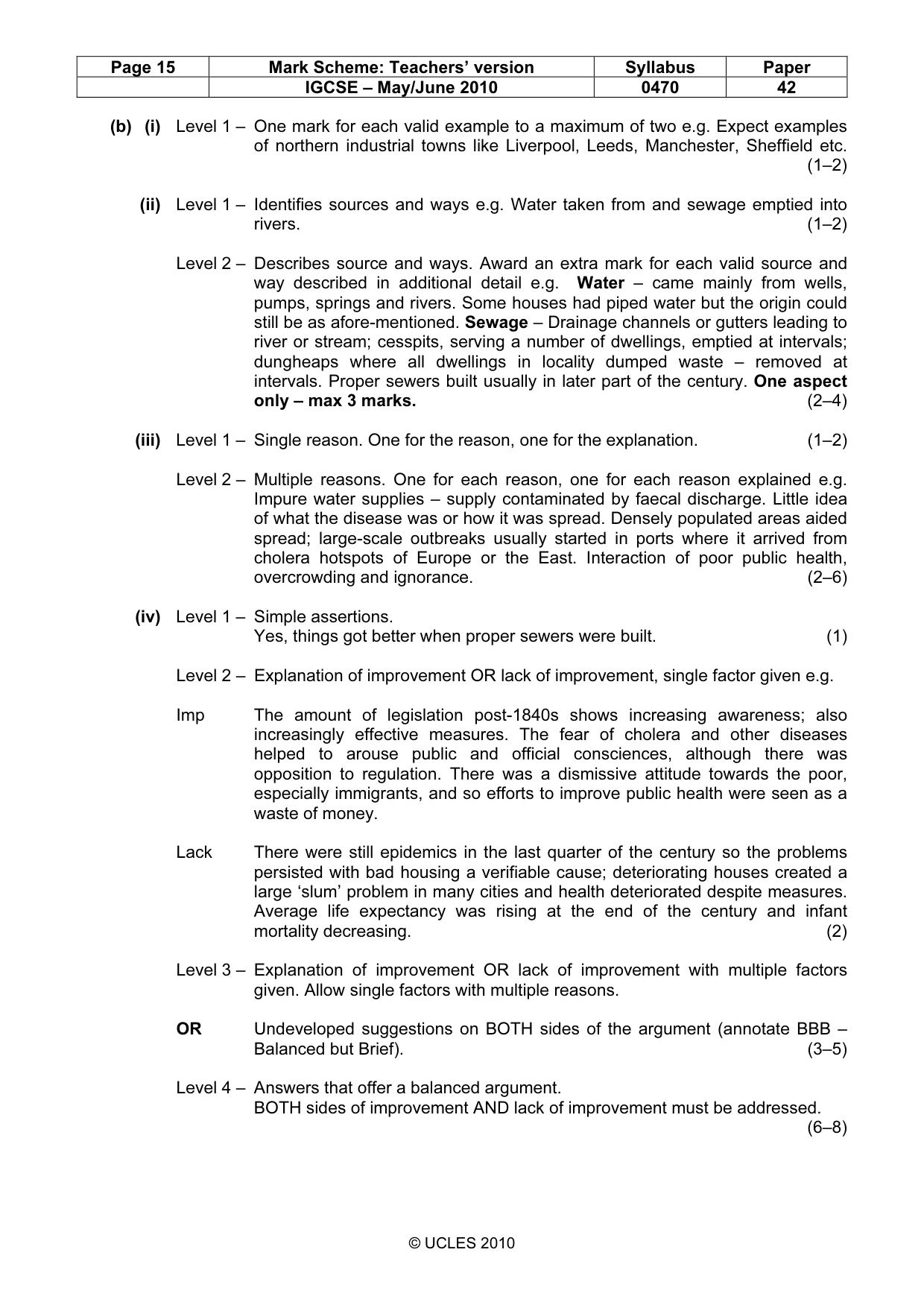
Page 15 Mark Scheme: Teachers’ version Syllabus Paper IGCSE – May/June 2010 0470 42 © UCLES 2010 (b) (i) Level 1 – One mark for each valid example to a maximum of two e.g. Expect examples of northern industrial towns like Liverpool, Leeds, Manchester, Sheffield etc. (1–2) (ii) Level 1 – Identifies sources and ways e.g. Water taken from and sewage emptied into rivers. (1–2) Level 2 – Describes source and ways. Award an extra mark for each valid source and way described in additional detail e.g. Water – came mainly from wells, pumps, springs and rivers. Some houses had piped water but the origin could still be as afore-mentioned. Sewage – Drainage channels or gutters leading to river or stream; cesspits, serving a number of dwellings, emptied at intervals; dungheaps where all dwellings in locality dumped waste – removed at intervals. Proper sewers built usually in later part of the century. One aspect only – max 3 marks. (2–4) (iii) Level 1 – Single reason. One for the reason, one for the explanation. (1–2) Level 2 – Multiple reasons. One for each reason, one for each reason explained e.g. Impure water supplies – supply contaminated by faecal discharge. Little idea of what the disease was or how it was spread. Densely populated areas aided spread; large-scale outbreaks usually started in ports where it arrived from cholera hotspots of Europe or the East. Interaction of poor public health, overcrowding and ignorance. (2–6) (iv) Level 1 – Simple assertions. Yes, things got better when proper sewers were built. (1) Level 2 – Explanation of improvement OR lack of improvement, single factor given e.g. Imp The amount of legislation post-1840s shows increasing awareness; also increasingly effective measures. The fear of cholera and other diseases helped to arouse public and official consciences, although there was opposition to regulation. There was a dismissive attitude towards the poor, especially immigrants, and so efforts to improve public health were seen as a waste of money. Lack There were still epidemics in the last quarter of the century so the problems persisted with bad housing a verifiable cause; deteriorating houses created a large ‘slum’ problem in many cities and health deteriorated despite measures. Average life expectancy was rising at the end of the century and infant mortality decreasing. (2) Level 3 – Explanation of improvement OR lack of improvement with multiple factors given. Allow single factors with multiple reasons. OR Undeveloped suggestions on BOTH sides of the argument (annotate BBB – Balanced but Brief). (3–5) Level 4 – Answers that offer a balanced argument. BOTH sides of improvement AND lack of improvement must be addressed. (6–8)
Mark scheme, page 16
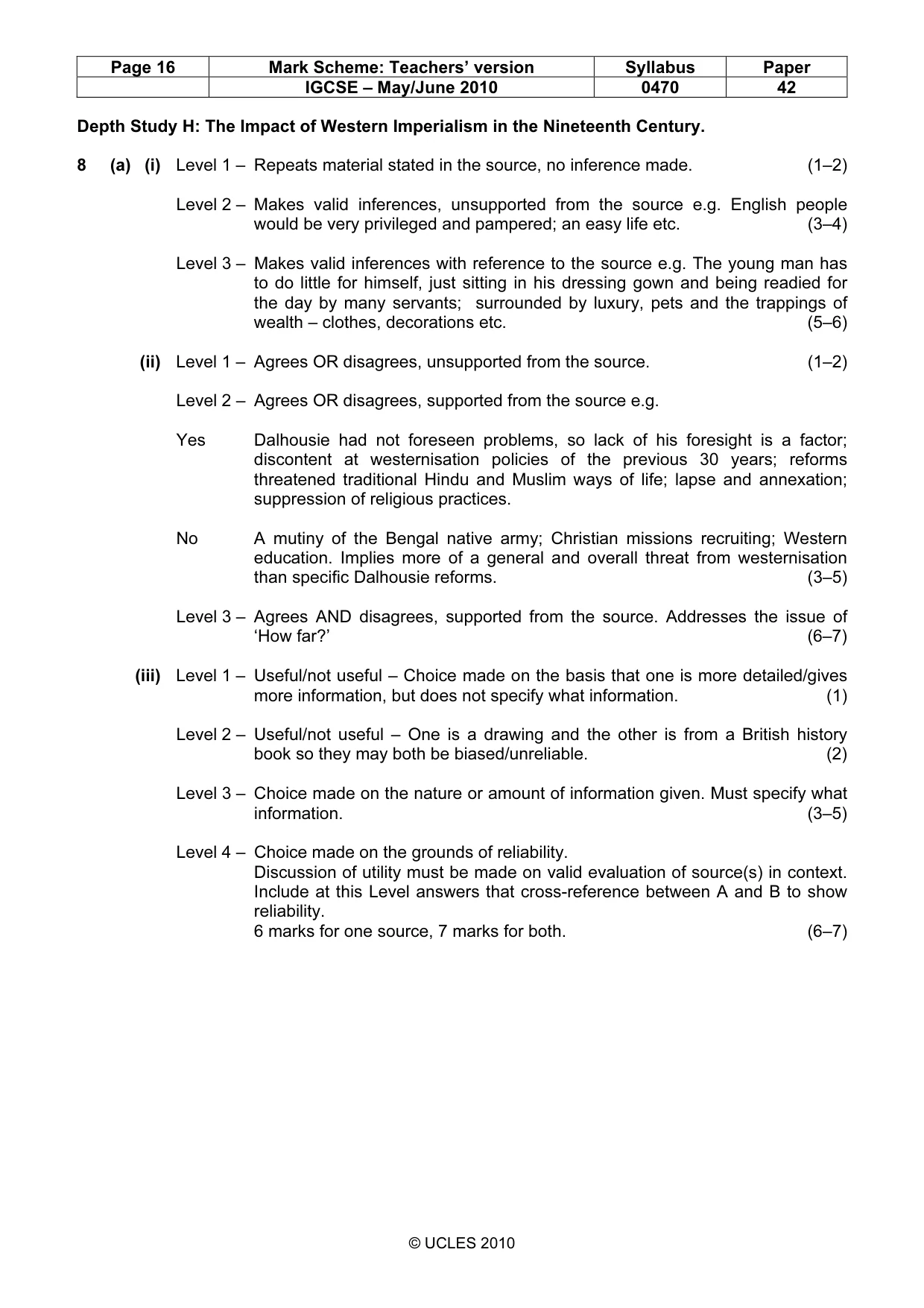
Page 16 Mark Scheme: Teachers’ version Syllabus Paper IGCSE – May/June 2010 0470 42 © UCLES 2010 Depth Study H: The Impact of Western Imperialism in the Nineteenth Century. 8 (a) (i) Level 1 – Repeats material stated in the source, no inference made. (1–2) Level 2 – Makes valid inferences, unsupported from the source e.g. English people would be very privileged and pampered; an easy life etc. (3–4) Level 3 – Makes valid inferences with reference to the source e.g. The young man has to do little for himself, just sitting in his dressing gown and being readied for the day by many servants; surrounded by luxury, pets and the trappings of wealth – clothes, decorations etc. (5–6) (ii) Level 1 – Agrees OR disagrees, unsupported from the source. (1–2) Level 2 – Agrees OR disagrees, supported from the source e.g. Yes Dalhousie had not foreseen problems, so lack of his foresight is a factor; discontent at westernisation policies of the previous 30 years; reforms threatened traditional Hindu and Muslim ways of life; lapse and annexation; suppression of religious practices. No A mutiny of the Bengal native army; Christian missions recruiting; Western education. Implies more of a general and overall threat from westernisation than specific Dalhousie reforms. (3–5) Level 3 – Agrees AND disagrees, supported from the source. Addresses the issue of ‘How far?’ (6–7) (iii) Level 1 – Useful/not useful – Choice made on the basis that one is more detailed/gives more information, but does not specify what information. (1) Level 2 – Useful/not useful – One is a drawing and the other is from a British history book so they may both be biased/unreliable. (2) Level 3 – Choice made on the nature or amount of information given. Must specify what information. (3–5) Level 4 – Choice made on the grounds of reliability. Discussion of utility must be made on valid evaluation of source(s) in context. Include at this Level answers that cross-reference between A and B to show reliability. 6 marks for one source, 7 marks for both. (6–7)
Mark scheme, page 17
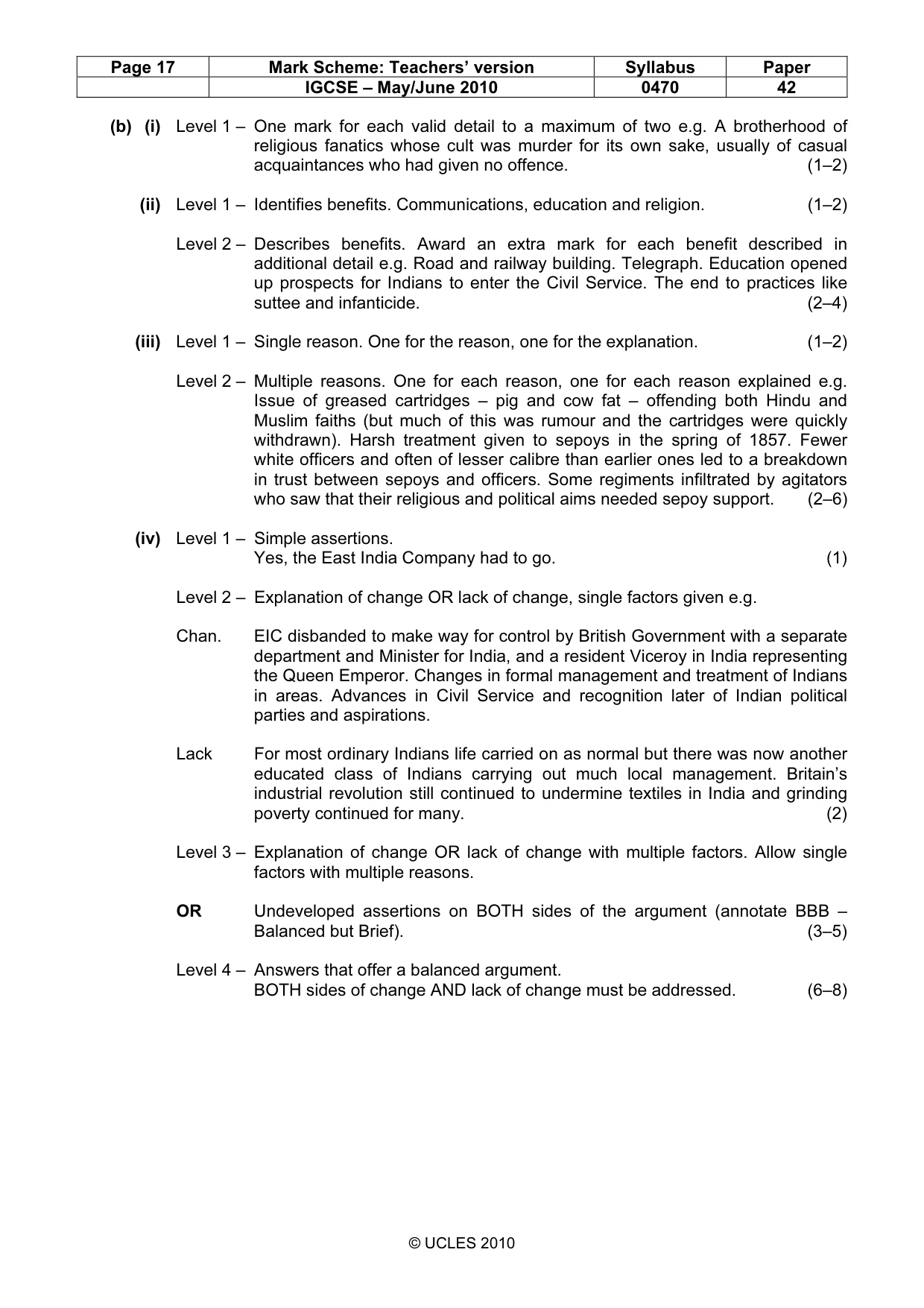
Page 17 Mark Scheme: Teachers’ version Syllabus Paper IGCSE – May/June 2010 0470 42 © UCLES 2010 (b) (i) Level 1 – One mark for each valid detail to a maximum of two e.g. A brotherhood of religious fanatics whose cult was murder for its own sake, usually of casual acquaintances who had given no offence. (1–2) (ii) Level 1 – Identifies benefits. Communications, education and religion. (1–2) Level 2 – Describes benefits. Award an extra mark for each benefit described in additional detail e.g. Road and railway building. Telegraph. Education opened up prospects for Indians to enter the Civil Service. The end to practices like suttee and infanticide. (2–4) (iii) Level 1 – Single reason. One for the reason, one for the explanation. (1–2) Level 2 – Multiple reasons. One for each reason, one for each reason explained e.g. Issue of greased cartridges – pig and cow fat – offending both Hindu and Muslim faiths (but much of this was rumour and the cartridges were quickly withdrawn). Harsh treatment given to sepoys in the spring of 1857. Fewer white officers and often of lesser calibre than earlier ones led to a breakdown in trust between sepoys and officers. Some regiments infiltrated by agitators who saw that their religious and political aims needed sepoy support. (2–6) (iv) Level 1 – Simple assertions. Yes, the East India Company had to go. (1) Level 2 – Explanation of change OR lack of change, single factors given e.g. Chan. EIC disbanded to make way for control by British Government with a separate department and Minister for India, and a resident Viceroy in India representing the Queen Emperor. Changes in formal management and treatment of Indians in areas. Advances in Civil Service and recognition later of Indian political parties and aspirations. Lack For most ordinary Indians life carried on as normal but there was now another educated class of Indians carrying out much local management. Britain’s industrial revolution still continued to undermine textiles in India and grinding poverty continued for many. (2) Level 3 – Explanation of change OR lack of change with multiple factors. Allow single factors with multiple reasons. OR Undeveloped assertions on BOTH sides of the argument (annotate BBB – Balanced but Brief). (3–5) Level 4 – Answers that offer a balanced argument. BOTH sides of change AND lack of change must be addressed. (6–8)
What you needed in this session
Cambridge’s own grade thresholds for 2010 May/June, Paper 4 · Variant 2. A higher threshold means an easier paper — the bar moves with how the cohort did.