Cambridge IGCSE History 0470 — 2010 May/June Paper 4 · Variant 1
0470/41/M/J/10 · 40 marks · ≈45 min
The question paper and its mark scheme, free to read here and free to download. This is Cambridge’s own paper, exactly as it was sat.
Question paper12 pages

Mark scheme17 pages
Answers below. Sit the paper first if you are practising.
Paper as text
Question paper, page 1
This document consists of 10 printed pages and 2 blank pages. DC (NH) 14325/6 © UCLES 2010 [Turn over UNIVERSITY OF CAMBRIDGE INTERNATIONAL EXAMINATIONS International General Certificate of Secondary Education READ THESE INSTRUCTIONS FIRST If you have been given an Answer Booklet, follow the instructions on the front cover of the Booklet. Write your Centre number, candidate number and name on all the work you hand in. Write in dark blue or black pen. You may use a soft pencil for any diagrams, graphs or rough working. Do not use staples, paper clips, highlighters, glue or correction fluid. Answer the questions on one of the Depth Studies. At the end of the examination, fasten all your work securely together. The number of marks is given in brackets [ ] at the end of each question or part question. HISTORY 0470/41 Paper 4 Alternative to Coursework May/June 2010 1 hour Additional Materials: Answer Booklet/Paper * 6 3 9 3 7 7 1 7 1 9 * www.XtremePapers.com
Question paper, page 2
2 0470/41/M/J/10 © UCLES 2010 DEPTH STUDY A: GERMANY, 1918–1945 1 Study the sources, and then answer the questions which follow. Source A On 9 November 1938 we stood at the window of our house and watched while they burned down the big synagogue across the street. The area was crowded with thousands of spectators; they made a circus out of it. We saw it all. Suddenly people burst into our rooms with axes and bars and smashed everything up. We ran to the local police station for help. They looked at us and just laughed. We fled from them to find shelter with a family my father knew. A Jewish man writing in 1980 about his memories of Kristallnacht in a German city. Source B a) Only such measures should be taken which do not involve danger to German life and property. b) Businesses and private apartments of Jews may be destroyed but not looted. c) The demonstrations which are going to take place should not be hindered by the police. d) Foreign nationals – even if they are Jews – should not be molested. Directly after the events of this night, as many Jews as possible – especially the well-off ones – are to be arrested. Above all only healthy, male Jews, not too old, are to be arrested. The appropriate concentration camp should be contacted immediately in order to confine them in these camps. Special care is to be taken that the Jews arrested on this order are not maltreated. From the message sent to all police headquarters by the head of the security service (SD) and Gestapo, 1.20 am on 10 November 1938. (a) (i) Study Source A. What can you tell from this source about attitudes towards Jews in Nazi Germany? Support your answer with reference to the source. [6] (ii) Study Source B. How far does this source show that the government approved of the mistreatment of the Jews by 1938? Explain your answer. [7] (iii) Study both sources. Is one of these sources more useful than the other as evidence about Kristallnacht? Explain your answer. [7] (b) (i) What was the SS? [2] (ii) Describe how the physically and mentally handicapped were treated in Hitler’s Germany. [4] (iii) Why did many racial groups suffer under the Nazi regime? [6] (iv) ‘The Final Solution was Hitler’s major aim throughout his leadership of the Nazi Party.’ How far do you agree? Explain your answer. [8]
Question paper, page 3
3 0470/41/M/J/10 © UCLES 2010 [Turn over DEPTH STUDY B: RUSSIA, 1905–1941 2 Study the sources, and then answer the questions which follow. Source A Russia could never become a superpower without a repressive regime. Its manpower was unsuited to production-line labour. When it comes to industrial discipline, Russians are free spirits, incapable of creating their own work ethic. Stalin’s labour regulations were essential if his country was to become an industrial power. A British historian, writing in 1968. Source B The period saw losses. People began to believe in the universal effectiveness of rigid centralisation. Nor were excesses avoided in the struggle against the kulaks. The basically correct policy of fighting the kulaks was often interpreted so broadly that it had a dire effect on the country’s social and political development. Mikhail Gorbachev commenting in 1987 on Stalin’s collectivisation and industrialisation policies. (a) (i) Study Source A. What can you tell from this source about the workers in Soviet Russia? Support your answer with reference to the source. [6] (ii) Study Source B. How far does this source show that Stalin’s policies were unsuccessful? Explain your answer. [7] (iii) Study both sources. Is one of these sources more useful than the other as evidence about developments in Soviet Russia during Stalin’s rule? Explain your answer. [7] (b) (i) Give two ways in which the Kulaks reacted to collectivisation. [2] (ii) Describe the process of Show Trials. [4] (iii) Why did Stalin modernise agriculture in the Soviet Union? [6] (iv) ‘The Five Year Plans brought great benefit to the Soviet Union.’ How far do you agree? Explain your answer. [8]
Question paper, page 4
4 0470/41/M/J/10 © UCLES 2010 DEPTH STUDY C: THE USA, 1919–1941 3 Study the sources, and then answer the questions which follow. Source A We seek to participate in world trade because that is our way to wider influence and the rewards of peace and because we know full well we cannot sell where we do not buy. We are calling not only for the restoration of production but for a new era of production, transportation and trade. We shall achieve it by meeting the demand of a growing home market and promoting self-reliance in production. From President Harding’s inaugural speech, 1921. Source B By 1929, seventy per cent of American families earned less than $2 500 a year, placing them at or near the poverty line for a family of four. Eighty per cent of the population had no savings and most of them were in debt for having purchased goods on easy instalment terms. Many of the very rich and upper-middle classes had invested their surplus, untaxed wealth in speculative stocks rather than into savings or productive enterprises. Giant corporations controlled more than fifty per cent of the nation’s wealth and few of them were willing to lower prices. The European market was dependent on American loans so there was little room for selling surplus production overseas. From an American economic history textbook, 2001. (a) (i) Study Source A. What can you tell from this source about President Harding’s aims? Support your answer with reference to the source. [6] (ii) Study Source B. How far does this source show the weaknesses of the American economy in the 1920s? Explain your answer. [7] (iii) Study both sources. Is one of these sources more useful than the other as evidence about the American economy in the 1920s? Explain your answer. [7] (b) (i) Name two American Presidents, other than Harding, in the 1920s. [2] (ii) Describe the effects of mass production on American workers. [4] (iii) Why did some regions of America not share in the prosperity of the 1920s? [6] (iv) How far do you agree that government policies were responsible for the economic boom of the 1920s? Explain your answer. [8]
Question paper, page 5
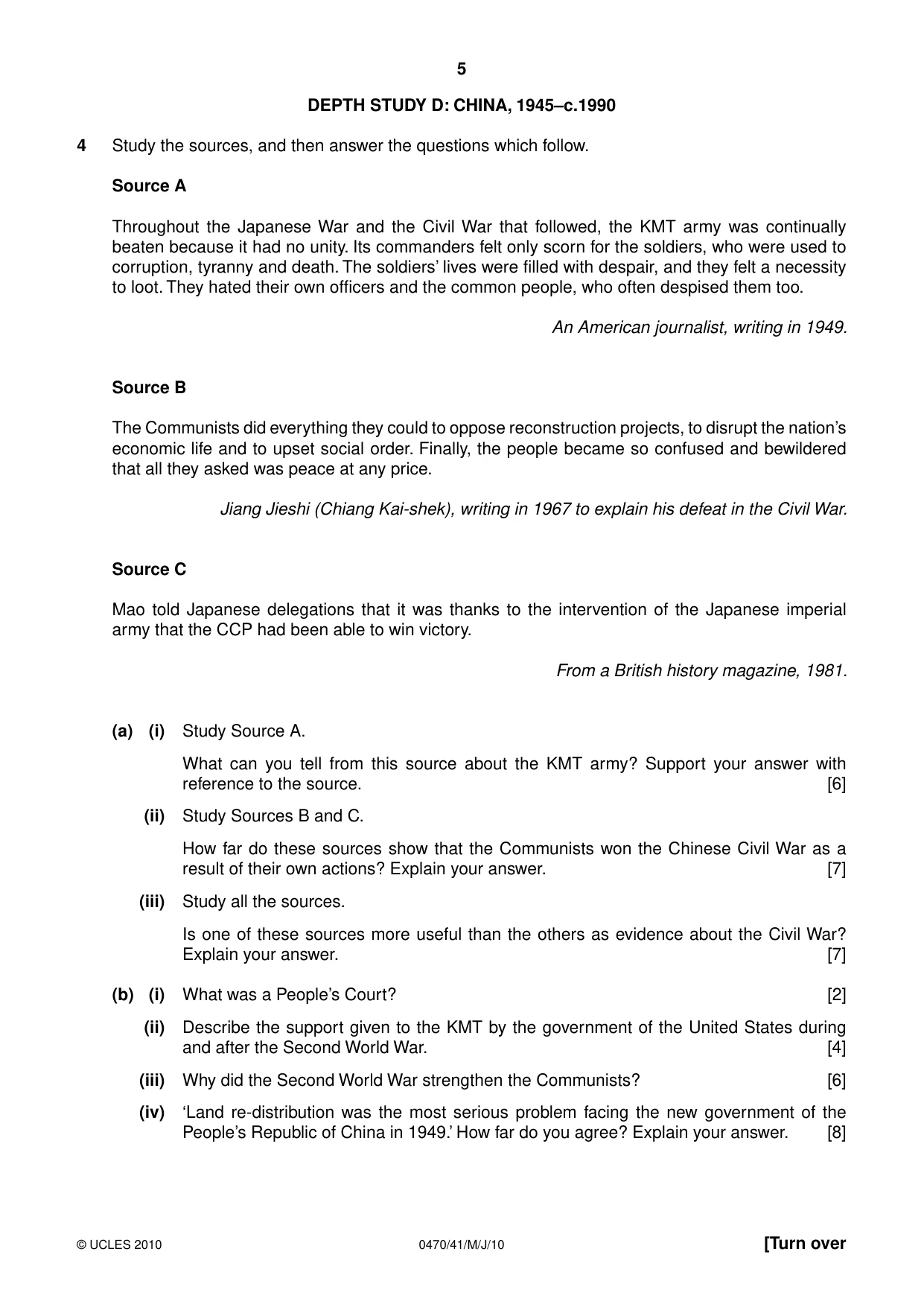
5 0470/41/M/J/10 © UCLES 2010 [Turn over DEPTH STUDY D: CHINA, 1945–c.1990 4 Study the sources, and then answer the questions which follow. Source A Throughout the Japanese War and the Civil War that followed, the KMT army was continually beaten because it had no unity. Its commanders felt only scorn for the soldiers, who were used to corruption, tyranny and death. The soldiers’ lives were filled with despair, and they felt a necessity to loot. They hated their own officers and the common people, who often despised them too. An American journalist, writing in 1949. Source B The Communists did everything they could to oppose reconstruction projects, to disrupt the nation’s economic life and to upset social order. Finally, the people became so confused and bewildered that all they asked was peace at any price. Jiang Jieshi (Chiang Kai-shek), writing in 1967 to explain his defeat in the Civil War. Source C Mao told Japanese delegations that it was thanks to the intervention of the Japanese imperial army that the CCP had been able to win victory. From a British history magazine, 1981. (a) (i) Study Source A. What can you tell from this source about the KMT army? Support your answer with reference to the source. [6] (ii) Study Sources B and C. How far do these sources show that the Communists won the Chinese Civil War as a result of their own actions? Explain your answer. [7] (iii) Study all the sources. Is one of these sources more useful than the others as evidence about the Civil War? Explain your answer. [7] (b) (i) What was a People’s Court? [2] (ii) Describe the support given to the KMT by the government of the United States during and after the Second World War. [4] (iii) Why did the Second World War strengthen the Communists? [6] (iv) ‘Land re-distribution was the most serious problem facing the new government of the People’s Republic of China in 1949.’ How far do you agree? Explain your answer. [8]
Question paper, page 6
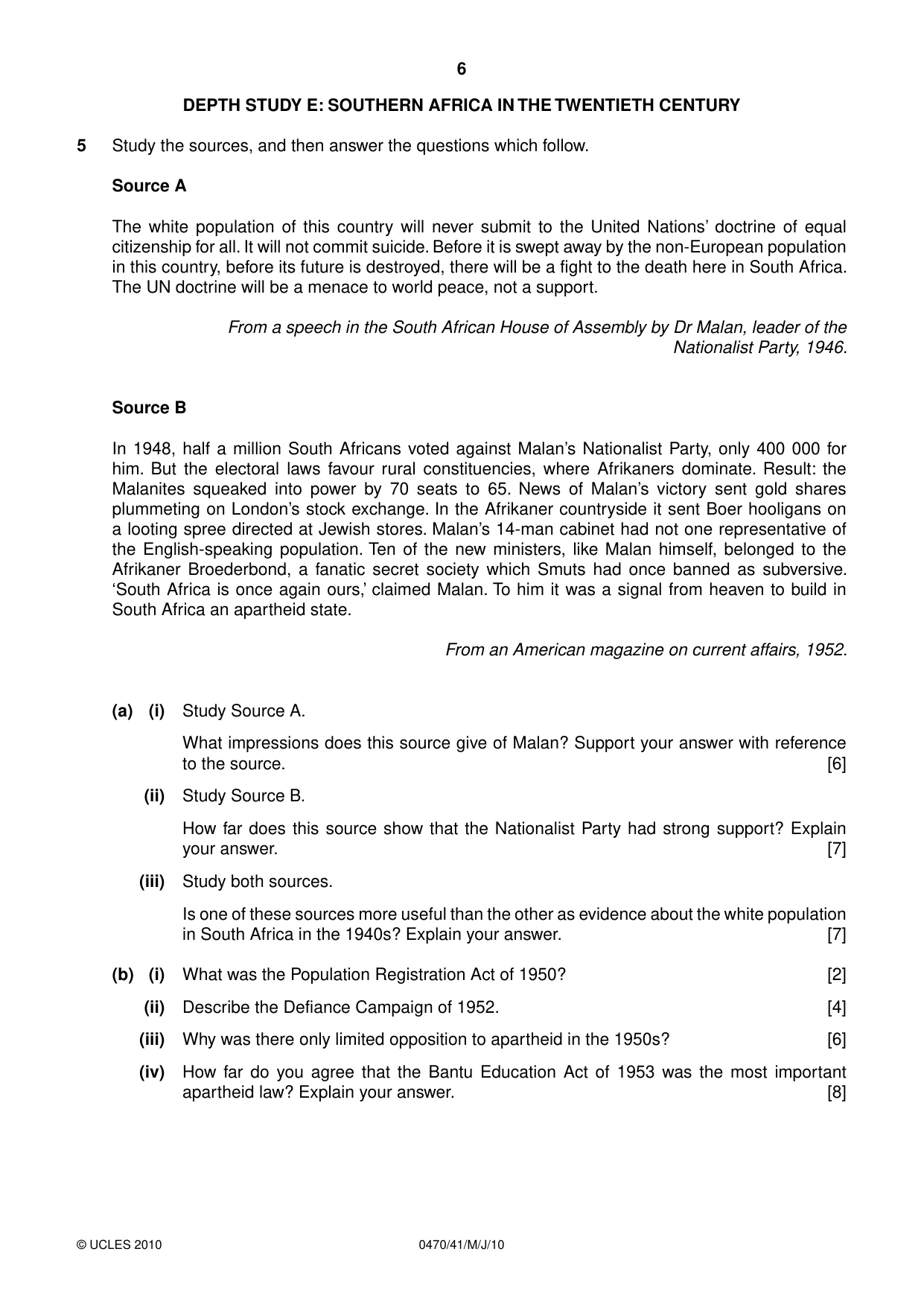
6 0470/41/M/J/10 © UCLES 2010 DEPTH STUDY E: SOUTHERN AFRICA IN THE TWENTIETH CENTURY 5 Study the sources, and then answer the questions which follow. Source A The white population of this country will never submit to the United Nations’ doctrine of equal citizenship for all. It will not commit suicide. Before it is swept away by the non-European population in this country, before its future is destroyed, there will be a fight to the death here in South Africa. The UN doctrine will be a menace to world peace, not a support. From a speech in the South African House of Assembly by Dr Malan, leader of the Nationalist Party, 1946. Source B In 1948, half a million South Africans voted against Malan’s Nationalist Party, only 400 000 for him. But the electoral laws favour rural constituencies, where Afrikaners dominate. Result: the Malanites squeaked into power by 70 seats to 65. News of Malan’s victory sent gold shares plummeting on London’s stock exchange. In the Afrikaner countryside it sent Boer hooligans on a looting spree directed at Jewish stores. Malan’s 14-man cabinet had not one representative of the English-speaking population. Ten of the new ministers, like Malan himself, belonged to the Afrikaner Broederbond, a fanatic secret society which Smuts had once banned as subversive. ‘South Africa is once again ours,’ claimed Malan. To him it was a signal from heaven to build in South Africa an apartheid state. From an American magazine on current affairs, 1952. (a) (i) Study Source A. What impressions does this source give of Malan? Support your answer with reference to the source. [6] (ii) Study Source B. How far does this source show that the Nationalist Party had strong support? Explain your answer. [7] (iii) Study both sources. Is one of these sources more useful than the other as evidence about the white population in South Africa in the 1940s? Explain your answer. [7] (b) (i) What was the Population Registration Act of 1950? [2] (ii) Describe the Defiance Campaign of 1952. [4] (iii) Why was there only limited opposition to apartheid in the 1950s? [6] (iv) How far do you agree that the Bantu Education Act of 1953 was the most important apartheid law? Explain your answer. [8]
Question paper, page 7
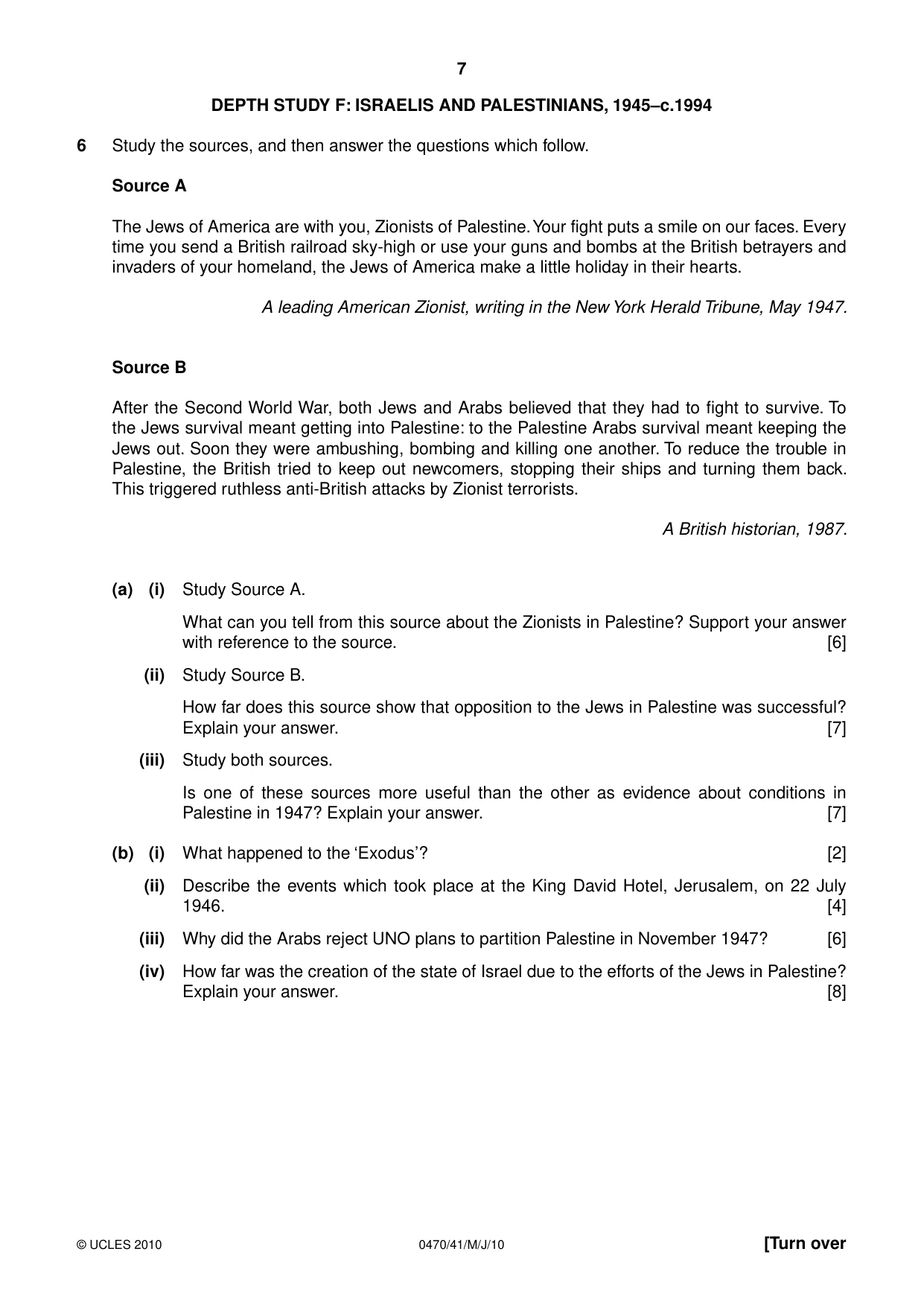
7 0470/41/M/J/10 © UCLES 2010 [Turn over DEPTH STUDY F: ISRAELIS AND PALESTINIANS, 1945–c.1994 6 Study the sources, and then answer the questions which follow. Source A The Jews of America are with you, Zionists of Palestine. Your fight puts a smile on our faces. Every time you send a British railroad sky-high or use your guns and bombs at the British betrayers and invaders of your homeland, the Jews of America make a little holiday in their hearts. A leading American Zionist, writing in the New York Herald Tribune, May 1947. Source B After the Second World War, both Jews and Arabs believed that they had to fight to survive. To the Jews survival meant getting into Palestine: to the Palestine Arabs survival meant keeping the Jews out. Soon they were ambushing, bombing and killing one another. To reduce the trouble in Palestine, the British tried to keep out newcomers, stopping their ships and turning them back. This triggered ruthless anti-British attacks by Zionist terrorists. A British historian, 1987. (a) (i) Study Source A. What can you tell from this source about the Zionists in Palestine? Support your answer with reference to the source. [6] (ii) Study Source B. How far does this source show that opposition to the Jews in Palestine was successful? Explain your answer. [7] (iii) Study both sources. Is one of these sources more useful than the other as evidence about conditions in Palestine in 1947? Explain your answer. [7] (b) (i) What happened to the ‘Exodus’? [2] (ii) Describe the events which took place at the King David Hotel, Jerusalem, on 22 July 1946. [4] (iii) Why did the Arabs reject UNO plans to partition Palestine in November 1947? [6] (iv) How far was the creation of the state of Israel due to the efforts of the Jews in Palestine? Explain your answer. [8]
Question paper, page 8
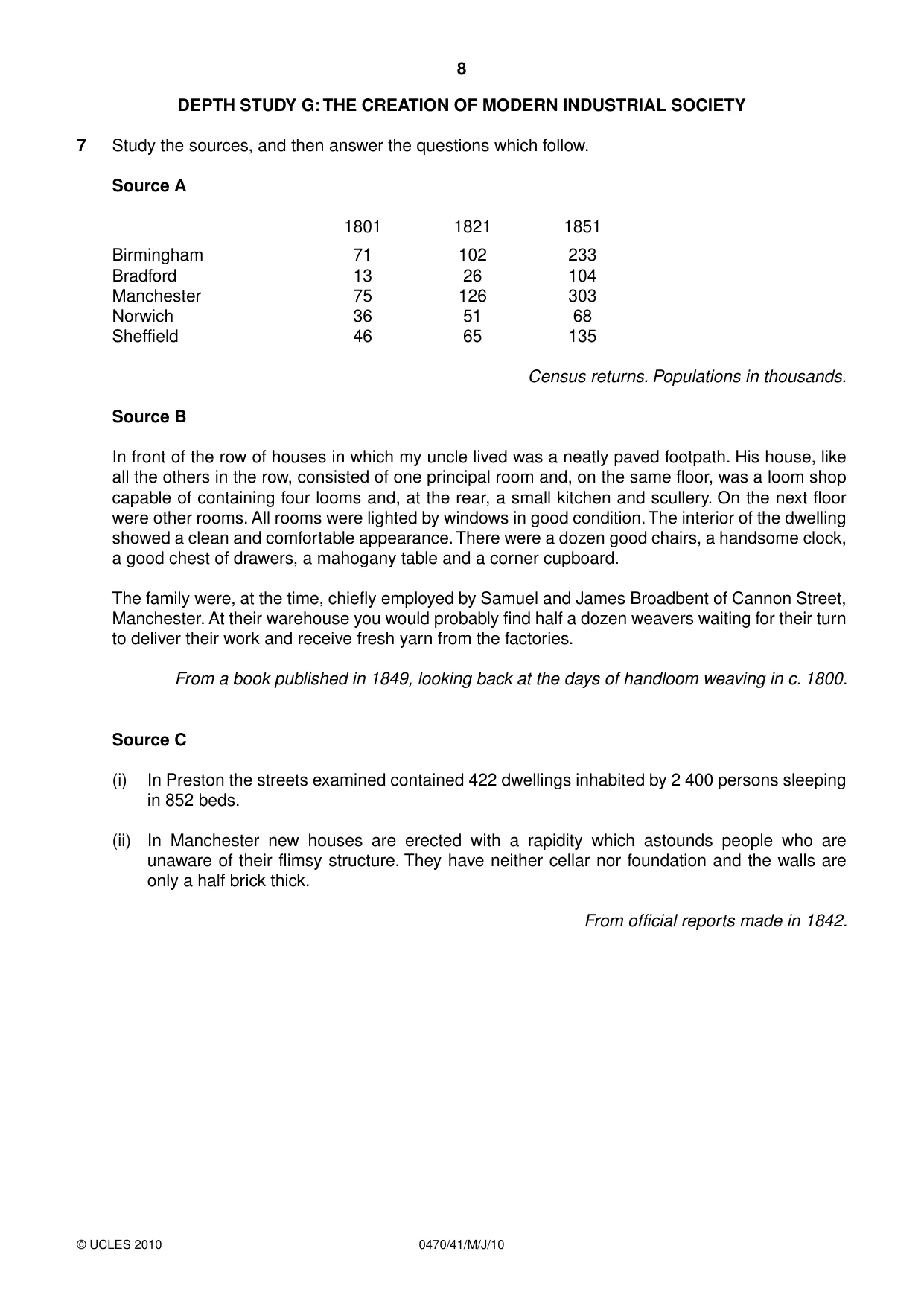
8 0470/41/M/J/10 © UCLES 2010 DEPTH STUDY G: THE CREATION OF MODERN INDUSTRIAL SOCIETY 7 Study the sources, and then answer the questions which follow. Source A 1801 1821 1851 Birmingham 71 102 233 Bradford 13 26 104 Manchester 75 126 303 Norwich 36 51 68 Sheffield 46 65 135 Census returns. Populations in thousands. Source B In front of the row of houses in which my uncle lived was a neatly paved footpath. His house, like all the others in the row, consisted of one principal room and, on the same floor, was a loom shop capable of containing four looms and, at the rear, a small kitchen and scullery. On the next floor were other rooms. All rooms were lighted by windows in good condition. The interior of the dwelling showed a clean and comfortable appearance. There were a dozen good chairs, a handsome clock, a good chest of drawers, a mahogany table and a corner cupboard. The family were, at the time, chiefly employed by Samuel and James Broadbent of Cannon Street, Manchester. At their warehouse you would probably find half a dozen weavers waiting for their turn to deliver their work and receive fresh yarn from the factories. From a book published in 1849, looking back at the days of handloom weaving in c. 1800. Source C (i) In Preston the streets examined contained 422 dwellings inhabited by 2 400 persons sleeping in 852 beds. (ii) In Manchester new houses are erected with a rapidity which astounds people who are unaware of their flimsy structure. They have neither cellar nor foundation and the walls are only a half brick thick. From official reports made in 1842.
Question paper, page 9
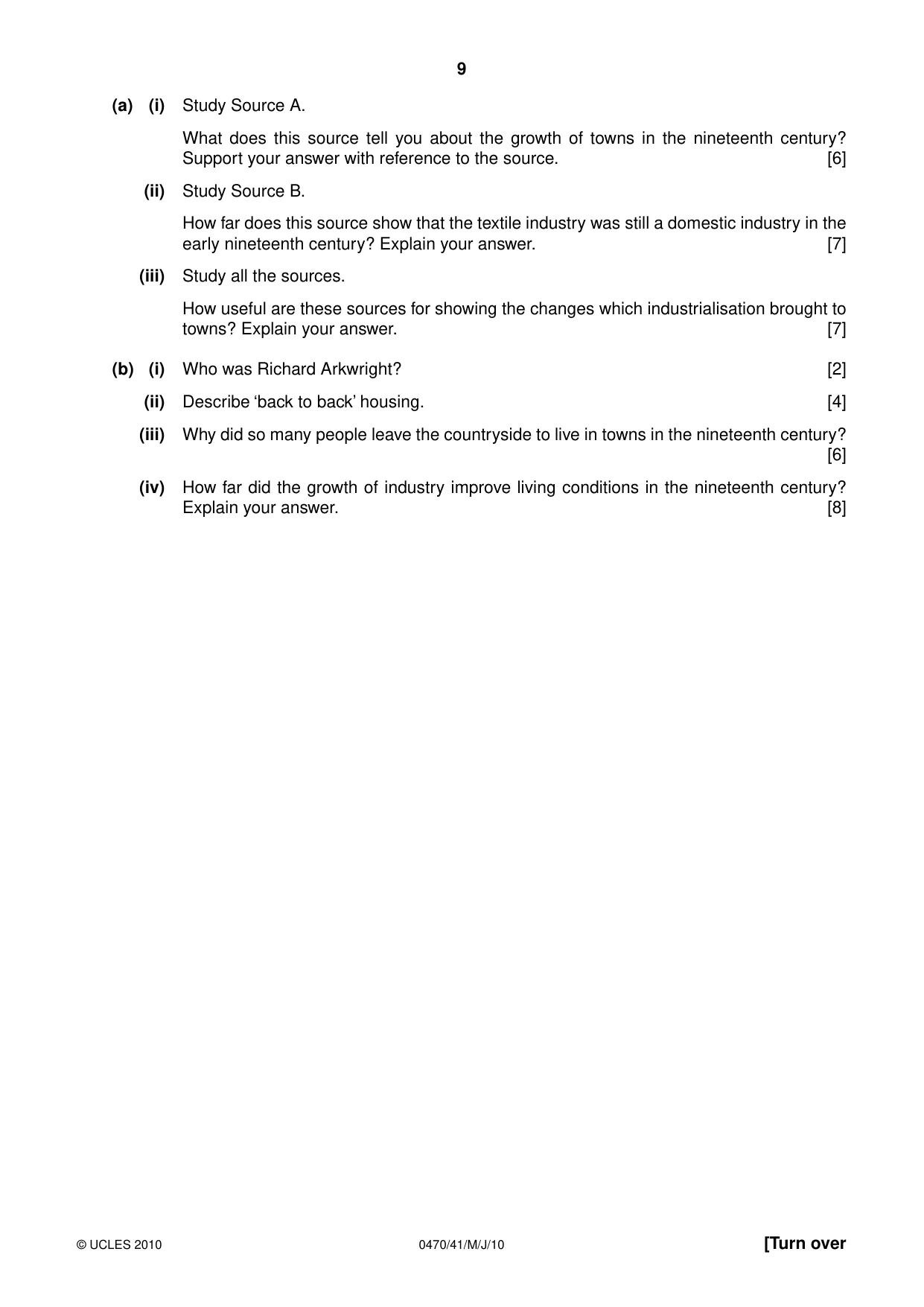
9 0470/41/M/J/10 © UCLES 2010 [Turn over (a) (i) Study Source A. What does this source tell you about the growth of towns in the nineteenth century? Support your answer with reference to the source. [6] (ii) Study Source B. How far does this source show that the textile industry was still a domestic industry in the early nineteenth century? Explain your answer. [7] (iii) Study all the sources. How useful are these sources for showing the changes which industrialisation brought to towns? Explain your answer. [7] (b) (i) Who was Richard Arkwright? [2] (ii) Describe ‘back to back’ housing. [4] (iii) Why did so many people leave the countryside to live in towns in the nineteenth century? [6] (iv) How far did the growth of industry improve living conditions in the nineteenth century? Explain your answer. [8]
Question paper, page 10
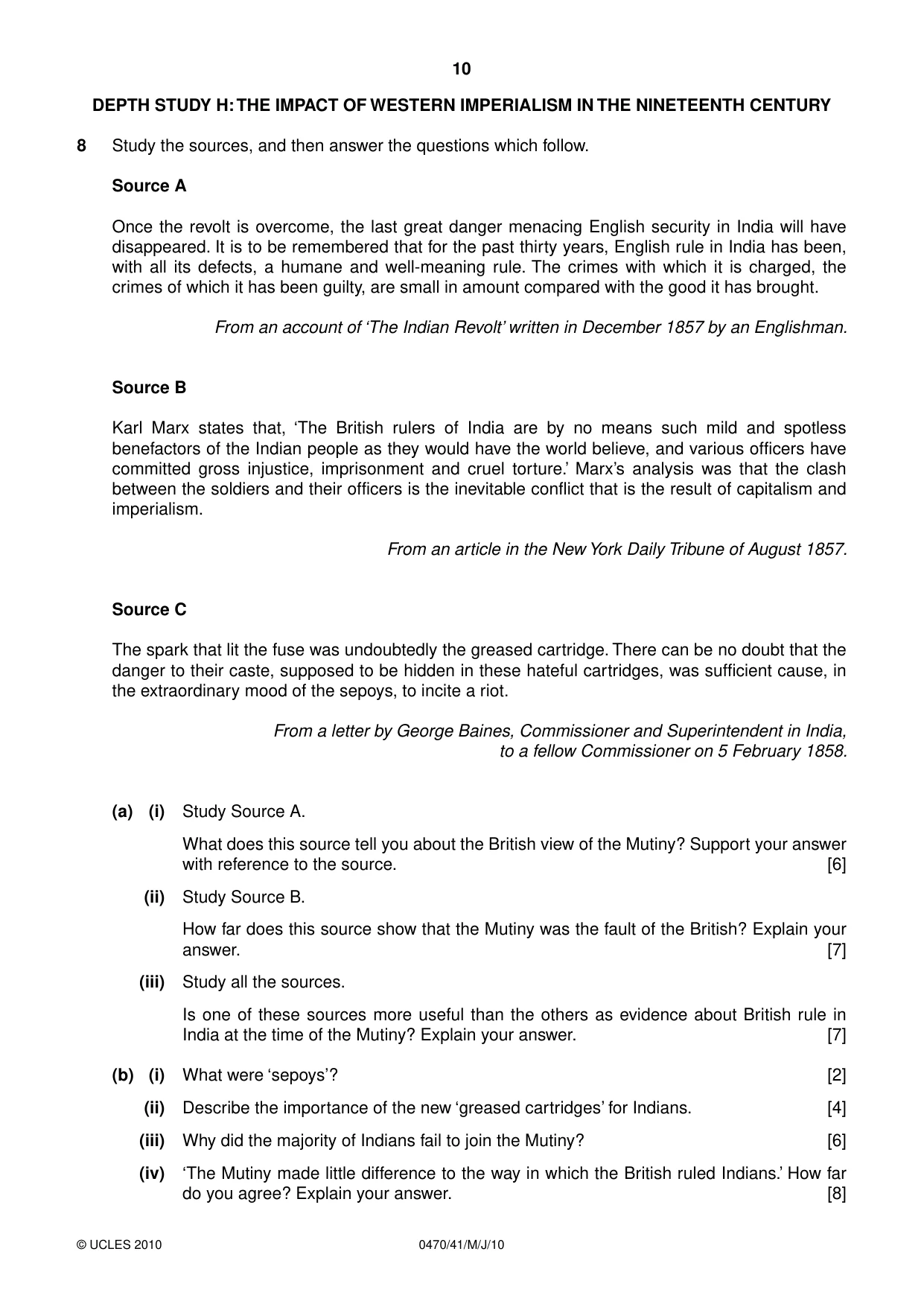
10 0470/41/M/J/10 © UCLES 2010 DEPTH STUDY H: THE IMPACT OF WESTERN IMPERIALISM IN THE NINETEENTH CENTURY 8 Study the sources, and then answer the questions which follow. Source A Once the revolt is overcome, the last great danger menacing English security in India will have disappeared. It is to be remembered that for the past thirty years, English rule in India has been, with all its defects, a humane and well-meaning rule. The crimes with which it is charged, the crimes of which it has been guilty, are small in amount compared with the good it has brought. From an account of ‘The Indian Revolt’ written in December 1857 by an Englishman. Source B Karl Marx states that, ‘The British rulers of India are by no means such mild and spotless benefactors of the Indian people as they would have the world believe, and various officers have committed gross injustice, imprisonment and cruel torture.’ Marx’s analysis was that the clash between the soldiers and their officers is the inevitable conflict that is the result of capitalism and imperialism. From an article in the New York Daily Tribune of August 1857. Source C The spark that lit the fuse was undoubtedly the greased cartridge. There can be no doubt that the danger to their caste, supposed to be hidden in these hateful cartridges, was sufficient cause, in the extraordinary mood of the sepoys, to incite a riot. From a letter by George Baines, Commissioner and Superintendent in India, to a fellow Commissioner on 5 February 1858. (a) (i) Study Source A. What does this source tell you about the British view of the Mutiny? Support your answer with reference to the source. [6] (ii) Study Source B. How far does this source show that the Mutiny was the fault of the British? Explain your answer. [7] (iii) Study all the sources. Is one of these sources more useful than the others as evidence about British rule in India at the time of the Mutiny? Explain your answer. [7] (b) (i) What were ‘sepoys’? [2] (ii) Describe the importance of the new ‘greased cartridges’ for Indians. [4] (iii) Why did the majority of Indians fail to join the Mutiny? [6] (iv) ‘The Mutiny made little difference to the way in which the British ruled Indians.’ How far do you agree? Explain your answer. [8]
Question paper, page 11
11 0470/41/M/J/10 © UCLES 2010 BLANK PAGE
Question paper, page 12
12 0470/41/M/J/10 © UCLES 2010 BLANK PAGE Copyright Acknowledgements: Depth Study B Source A © T. Wilson ed, Alan White, Stalin and the shaping of the Soviet Union; Russia and the USSR, 1905-1991; Collins Educational, 1995. Depth Study B Source B © T. Wilson ed, Alan White, Stalin and the shaping of the Soviet Union; Russia and the USSR, 1905-1991; Collins Educational, 1995. Depth Study D Source A © Neil De Marco, The World this Century; Collins Educational, 1987. Depth Study D Source B © Bryn O’Callaghan, A History of the Twentieth Century; Longman; 1987, Quote from Soviet Russia in China; A Summing Up At Seventy; Harrap, 1967. Depth Study D Source C © Bryn O’Callaghan, A History of the Twentieth Century; Longman; 1987, Quote by Stuart Schram from History Today 1981. Depth Study E Source B © www.time.com/time/magazine/article/0,9171,820762-4,00.html Depth Study F Source A © New York Herald Tribune; May 1947. Depth Study F Source B © Bryn O’Callaghan, A History of the Twentieth Century; Longman; 1987. Depth Study G Source A © Longman’s Secondary History Packs, Urbanisation, Pack 7; SGS Associates Ltd/Headley Bros. Ltd. Depth Study G Source B © E Hopkins, A Social History of the English Working Classes; Edward Arnold, 1980. Depth Study G Source C © E Hopkins, A Social History of the English Working Classes; Edward Arnold, 1980. Permission to reproduce items where third-party owned material protected by copyright is included has been sought and cleared where possible. Every reasonable effort has been made by the publisher (UCLES) to trace copyright holders, but if any items requiring clearance have unwittingly been included, the publisher will be pleased to make amends at the earliest possible opportunity. University of Cambridge International Examinations is part of the Cambridge Assessment Group. Cambridge Assessment is the brand name of University of Cambridge Local Examinations Syndicate (UCLES), which is itself a department of the University of Cambridge.
Mark scheme, page 1
UNIVERSITY OF CAMBRIDGE INTERNATIONAL EXAMINATIONS International General Certificate of Secondary Education MARK SCHEME for the May/June 2010 question paper for the guidance of teachers 0470 HISTORY 0470/41 Paper 41 (Alternative to Coursework), maximum raw mark 40 This mark scheme is published as an aid to teachers and candidates, to indicate the requirements of the examination. It shows the basis on which Examiners were instructed to award marks. It does not indicate the details of the discussions that took place at an Examiners’ meeting before marking began, which would have considered the acceptability of alternative answers. Mark schemes must be read in conjunction with the question papers and the report on the examination. • CIE will not enter into discussions or correspondence in connection with these mark schemes. CIE is publishing the mark schemes for the May/June 2010 question papers for most IGCSE, GCE Advanced Level and Advanced Subsidiary Level syllabuses and some Ordinary Level syllabuses. www.XtremePapers.com
Mark scheme, page 2
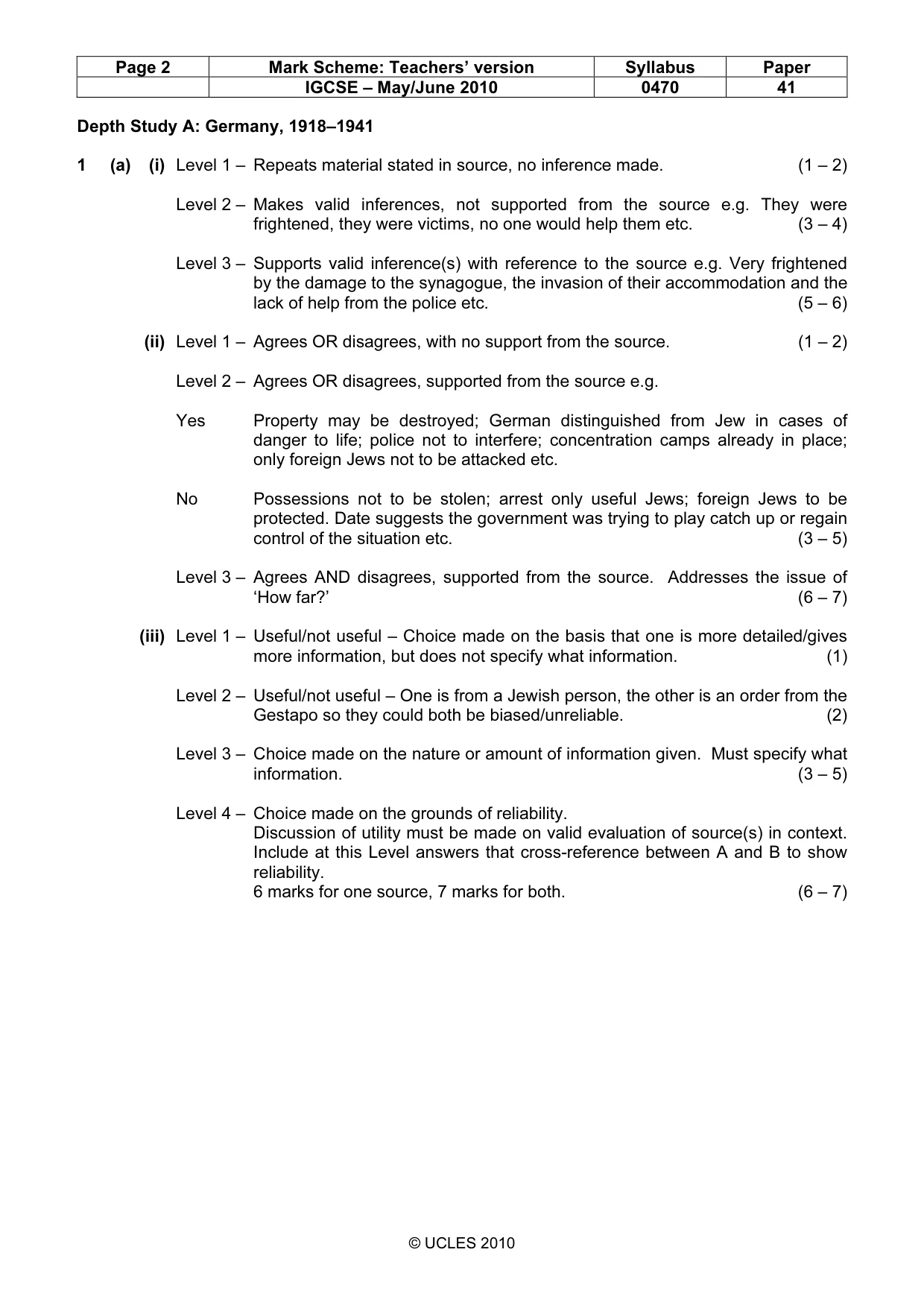
Page 2 Mark Scheme: Teachers’ version Syllabus Paper IGCSE – May/June 2010 0470 41 © UCLES 2010 Depth Study A: Germany, 1918–1941 1 (a) (i) Level 1 – Repeats material stated in source, no inference made. (1 – 2) Level 2 – Makes valid inferences, not supported from the source e.g. They were frightened, they were victims, no one would help them etc. (3 – 4) Level 3 – Supports valid inference(s) with reference to the source e.g. Very frightened by the damage to the synagogue, the invasion of their accommodation and the lack of help from the police etc. (5 – 6) (ii) Level 1 – Agrees OR disagrees, with no support from the source. (1 – 2) Level 2 – Agrees OR disagrees, supported from the source e.g. Yes Property may be destroyed; German distinguished from Jew in cases of danger to life; police not to interfere; concentration camps already in place; only foreign Jews not to be attacked etc. No Possessions not to be stolen; arrest only useful Jews; foreign Jews to be protected. Date suggests the government was trying to play catch up or regain control of the situation etc. (3 – 5) Level 3 – Agrees AND disagrees, supported from the source. Addresses the issue of ‘How far?’ (6 – 7) (iii) Level 1 – Useful/not useful – Choice made on the basis that one is more detailed/gives more information, but does not specify what information. (1) Level 2 – Useful/not useful – One is from a Jewish person, the other is an order from the Gestapo so they could both be biased/unreliable. (2) Level 3 – Choice made on the nature or amount of information given. Must specify what information. (3 – 5) Level 4 – Choice made on the grounds of reliability. Discussion of utility must be made on valid evaluation of source(s) in context. Include at this Level answers that cross-reference between A and B to show reliability. 6 marks for one source, 7 marks for both. (6 – 7)
Mark scheme, page 3
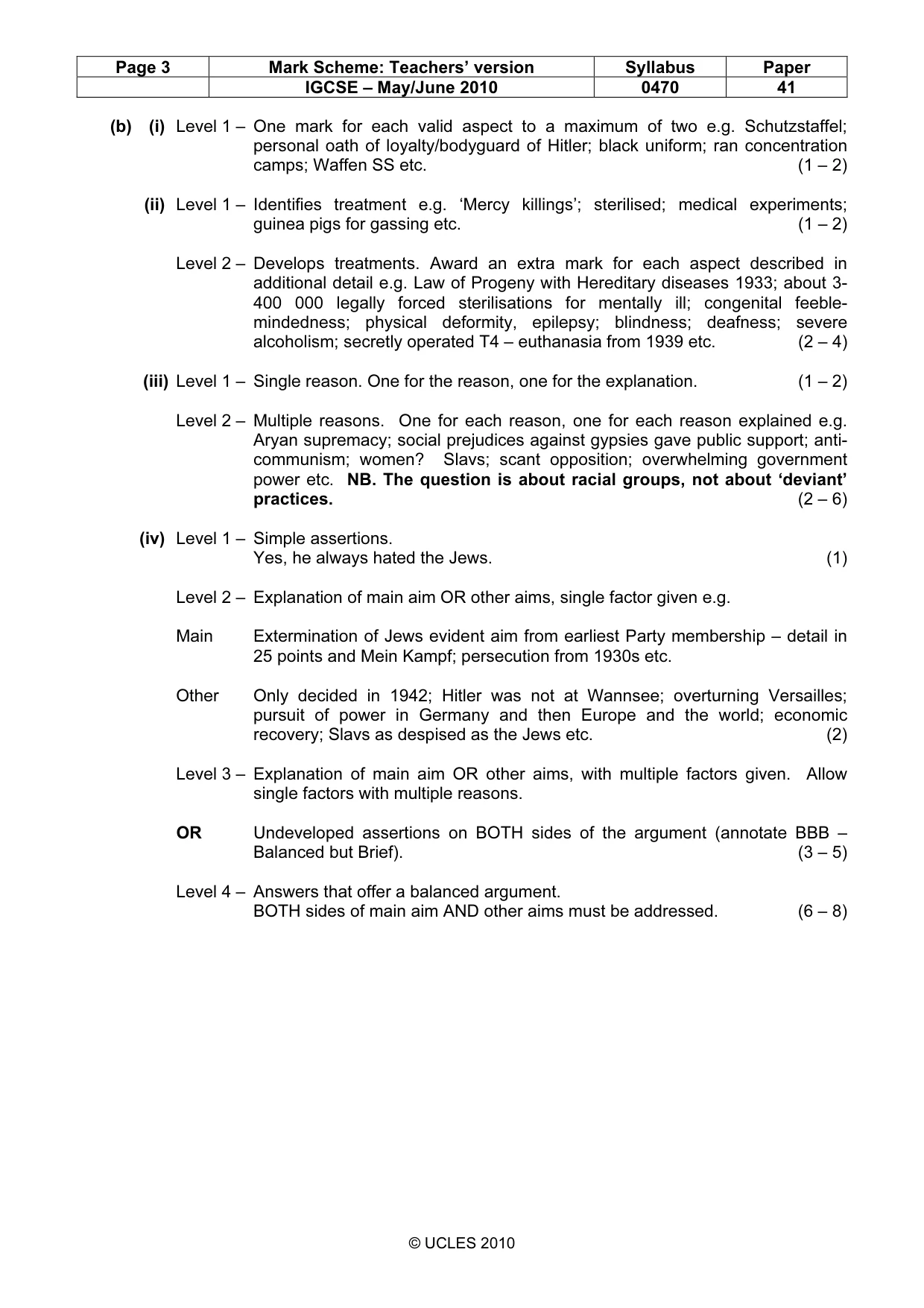
Page 3 Mark Scheme: Teachers’ version Syllabus Paper IGCSE – May/June 2010 0470 41 © UCLES 2010 (b) (i) Level 1 – One mark for each valid aspect to a maximum of two e.g. Schutzstaffel; personal oath of loyalty/bodyguard of Hitler; black uniform; ran concentration camps; Waffen SS etc. (1 – 2) (ii) Level 1 – Identifies treatment e.g. ‘Mercy killings’; sterilised; medical experiments; guinea pigs for gassing etc. (1 – 2) Level 2 – Develops treatments. Award an extra mark for each aspect described in additional detail e.g. Law of Progeny with Hereditary diseases 1933; about 3- 400 000 legally forced sterilisations for mentally ill; congenital feeble- mindedness; physical deformity, epilepsy; blindness; deafness; severe alcoholism; secretly operated T4 – euthanasia from 1939 etc. (2 – 4) (iii) Level 1 – Single reason. One for the reason, one for the explanation. (1 – 2) Level 2 – Multiple reasons. One for each reason, one for each reason explained e.g. Aryan supremacy; social prejudices against gypsies gave public support; anti- communism; women? Slavs; scant opposition; overwhelming government power etc. NB. The question is about racial groups, not about ‘deviant’ practices. (2 – 6) (iv) Level 1 – Simple assertions. Yes, he always hated the Jews. (1) Level 2 – Explanation of main aim OR other aims, single factor given e.g. Main Extermination of Jews evident aim from earliest Party membership – detail in 25 points and Mein Kampf; persecution from 1930s etc. Other Only decided in 1942; Hitler was not at Wannsee; overturning Versailles; pursuit of power in Germany and then Europe and the world; economic recovery; Slavs as despised as the Jews etc. (2) Level 3 – Explanation of main aim OR other aims, with multiple factors given. Allow single factors with multiple reasons. OR Undeveloped assertions on BOTH sides of the argument (annotate BBB – Balanced but Brief). (3 – 5) Level 4 – Answers that offer a balanced argument. BOTH sides of main aim AND other aims must be addressed. (6 – 8)
Mark scheme, page 4
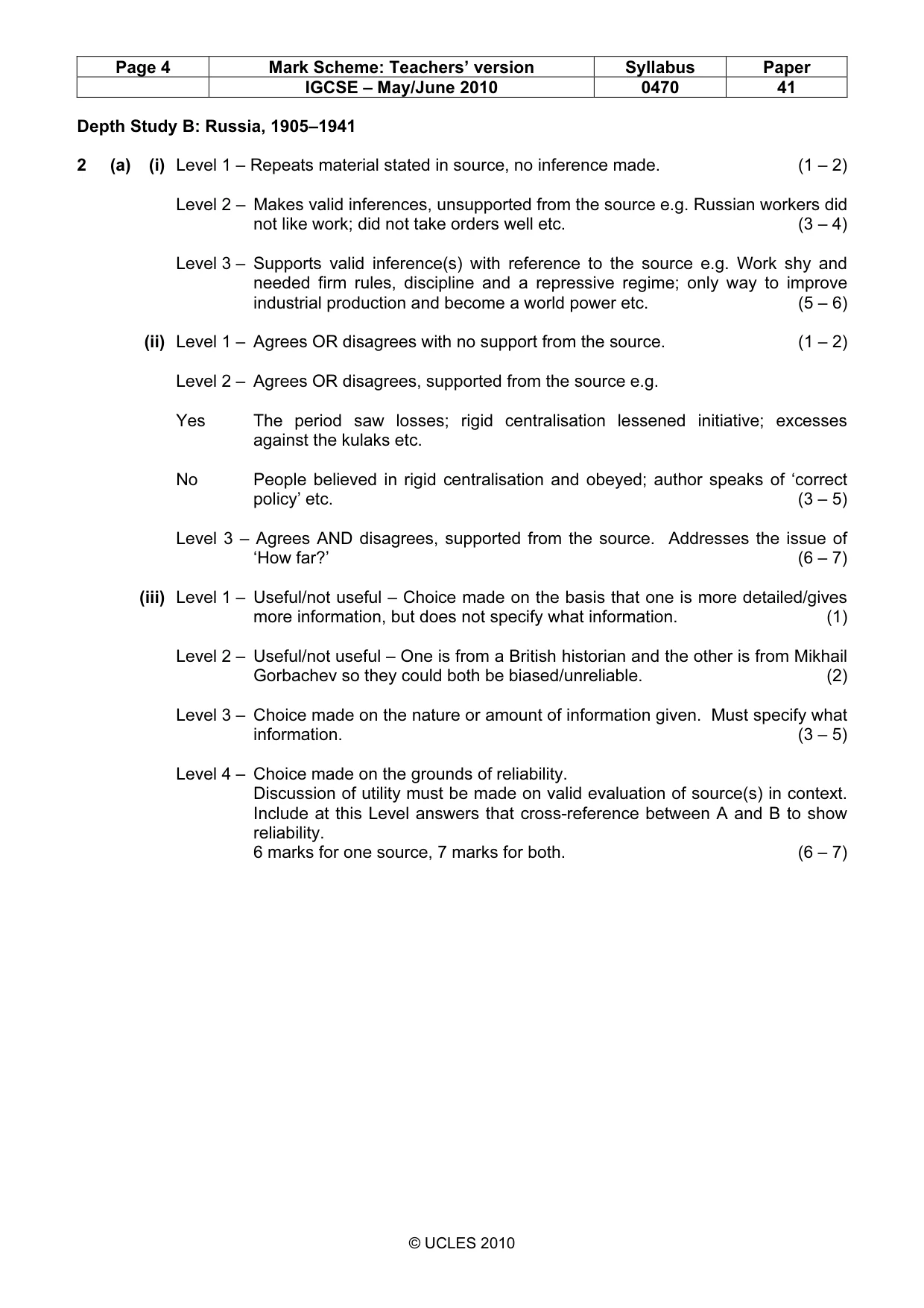
Page 4 Mark Scheme: Teachers’ version Syllabus Paper IGCSE – May/June 2010 0470 41 © UCLES 2010 Depth Study B: Russia, 1905–1941 2 (a) (i) Level 1 – Repeats material stated in source, no inference made. (1 – 2) Level 2 – Makes valid inferences, unsupported from the source e.g. Russian workers did not like work; did not take orders well etc. (3 – 4) Level 3 – Supports valid inference(s) with reference to the source e.g. Work shy and needed firm rules, discipline and a repressive regime; only way to improve industrial production and become a world power etc. (5 – 6) (ii) Level 1 – Agrees OR disagrees with no support from the source. (1 – 2) Level 2 – Agrees OR disagrees, supported from the source e.g. Yes The period saw losses; rigid centralisation lessened initiative; excesses against the kulaks etc. No People believed in rigid centralisation and obeyed; author speaks of ‘correct policy’ etc. (3 – 5) Level 3 – Agrees AND disagrees, supported from the source. Addresses the issue of ‘How far?’ (6 – 7) (iii) Level 1 – Useful/not useful – Choice made on the basis that one is more detailed/gives more information, but does not specify what information. (1) Level 2 – Useful/not useful – One is from a British historian and the other is from Mikhail Gorbachev so they could both be biased/unreliable. (2) Level 3 – Choice made on the nature or amount of information given. Must specify what information. (3 – 5) Level 4 – Choice made on the grounds of reliability. Discussion of utility must be made on valid evaluation of source(s) in context. Include at this Level answers that cross-reference between A and B to show reliability. 6 marks for one source, 7 marks for both. (6 – 7)
Mark scheme, page 5
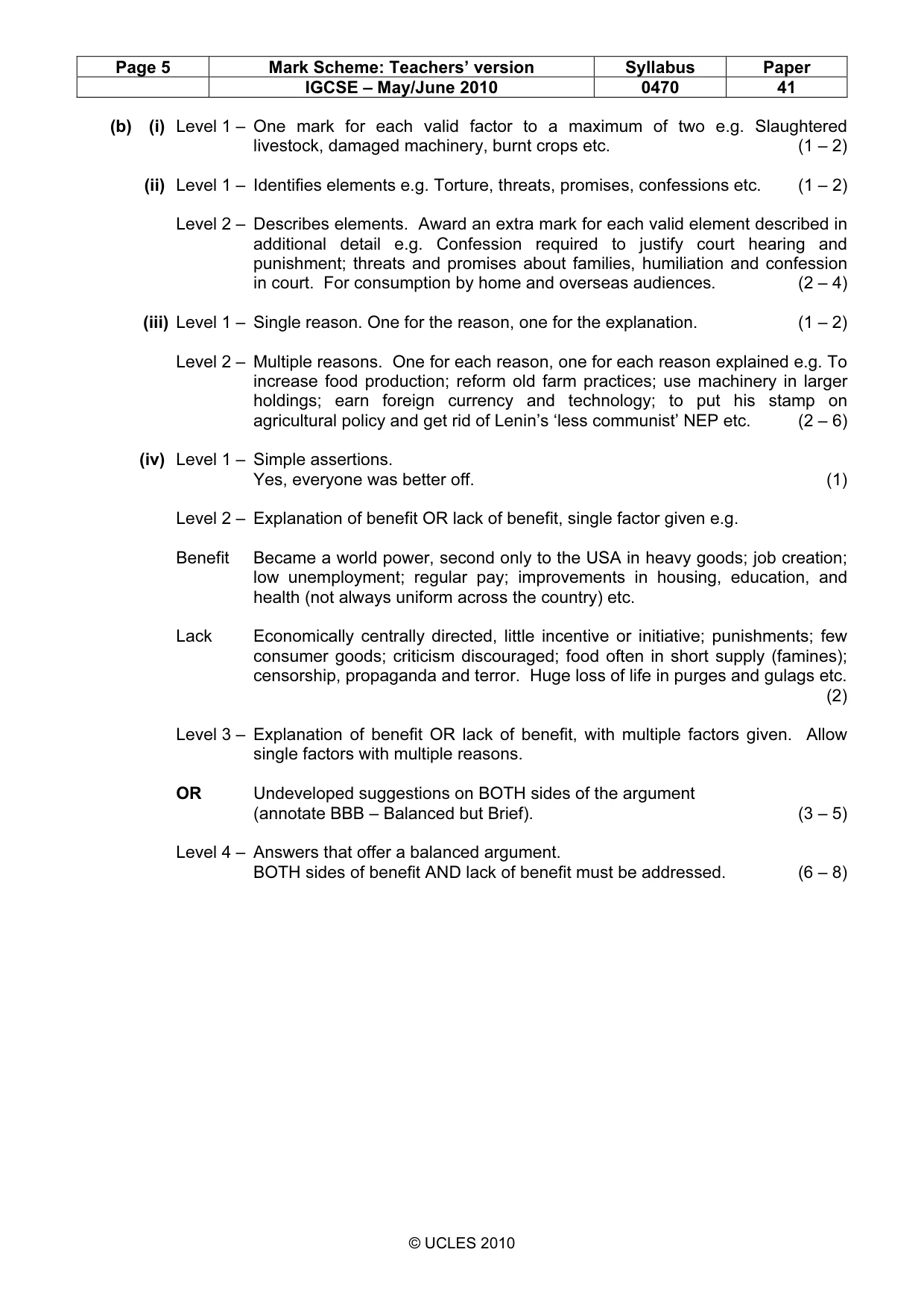
Page 5 Mark Scheme: Teachers’ version Syllabus Paper IGCSE – May/June 2010 0470 41 © UCLES 2010 (b) (i) Level 1 – One mark for each valid factor to a maximum of two e.g. Slaughtered livestock, damaged machinery, burnt crops etc. (1 – 2) (ii) Level 1 – Identifies elements e.g. Torture, threats, promises, confessions etc. (1 – 2) Level 2 – Describes elements. Award an extra mark for each valid element described in additional detail e.g. Confession required to justify court hearing and punishment; threats and promises about families, humiliation and confession in court. For consumption by home and overseas audiences. (2 – 4) (iii) Level 1 – Single reason. One for the reason, one for the explanation. (1 – 2) Level 2 – Multiple reasons. One for each reason, one for each reason explained e.g. To increase food production; reform old farm practices; use machinery in larger holdings; earn foreign currency and technology; to put his stamp on agricultural policy and get rid of Lenin’s ‘less communist’ NEP etc. (2 – 6) (iv) Level 1 – Simple assertions. Yes, everyone was better off. (1) Level 2 – Explanation of benefit OR lack of benefit, single factor given e.g. Benefit Became a world power, second only to the USA in heavy goods; job creation; low unemployment; regular pay; improvements in housing, education, and health (not always uniform across the country) etc. Lack Economically centrally directed, little incentive or initiative; punishments; few consumer goods; criticism discouraged; food often in short supply (famines); censorship, propaganda and terror. Huge loss of life in purges and gulags etc. (2) Level 3 – Explanation of benefit OR lack of benefit, with multiple factors given. Allow single factors with multiple reasons. OR Undeveloped suggestions on BOTH sides of the argument (annotate BBB – Balanced but Brief). (3 – 5) Level 4 – Answers that offer a balanced argument. BOTH sides of benefit AND lack of benefit must be addressed. (6 – 8)
Mark scheme, page 6
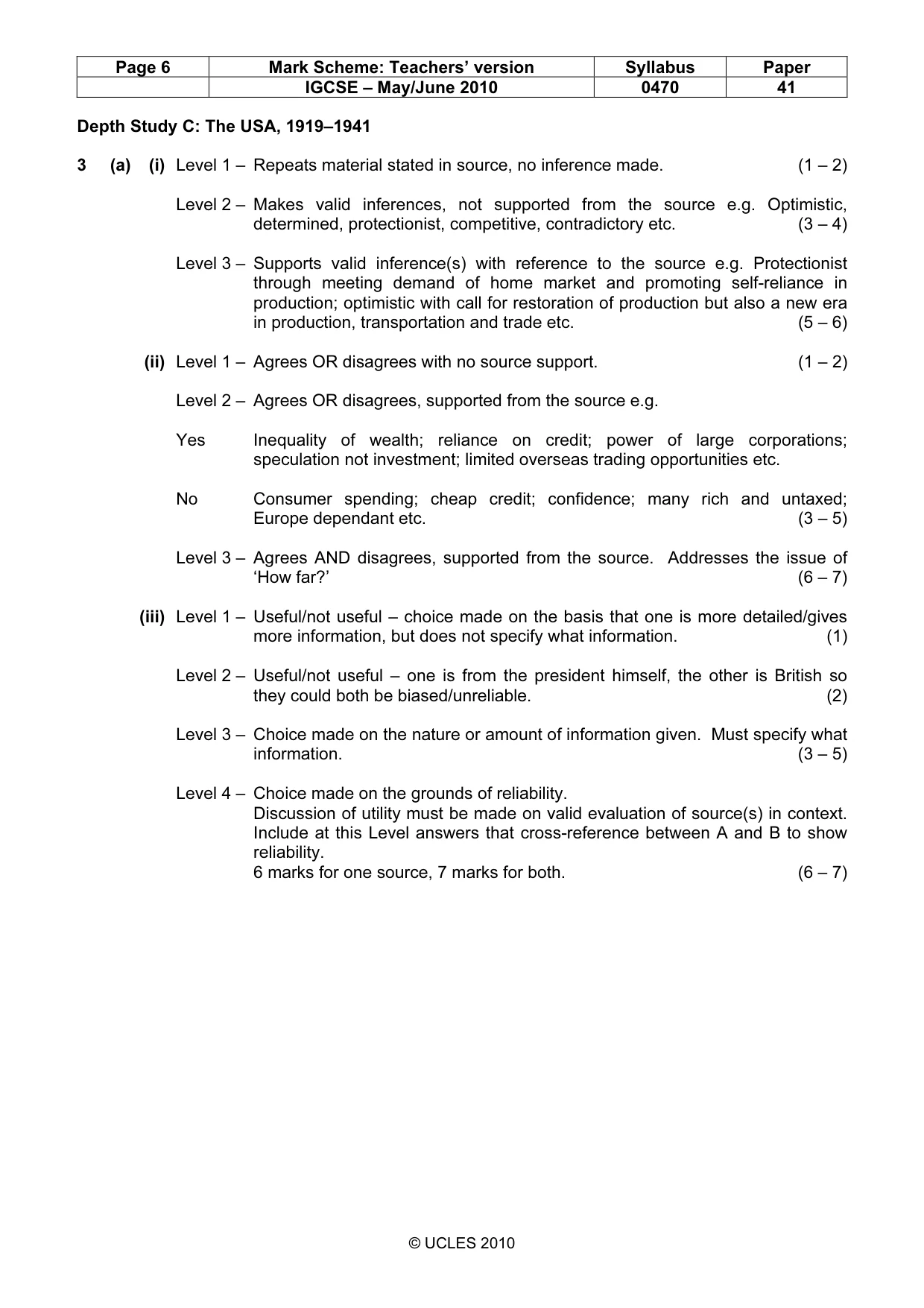
Page 6 Mark Scheme: Teachers’ version Syllabus Paper IGCSE – May/June 2010 0470 41 © UCLES 2010 Depth Study C: The USA, 1919–1941 3 (a) (i) Level 1 – Repeats material stated in source, no inference made. (1 – 2) Level 2 – Makes valid inferences, not supported from the source e.g. Optimistic, determined, protectionist, competitive, contradictory etc. (3 – 4) Level 3 – Supports valid inference(s) with reference to the source e.g. Protectionist through meeting demand of home market and promoting self-reliance in production; optimistic with call for restoration of production but also a new era in production, transportation and trade etc. (5 – 6) (ii) Level 1 – Agrees OR disagrees with no source support. (1 – 2) Level 2 – Agrees OR disagrees, supported from the source e.g. Yes Inequality of wealth; reliance on credit; power of large corporations; speculation not investment; limited overseas trading opportunities etc. No Consumer spending; cheap credit; confidence; many rich and untaxed; Europe dependant etc. (3 – 5) Level 3 – Agrees AND disagrees, supported from the source. Addresses the issue of ‘How far?’ (6 – 7) (iii) Level 1 – Useful/not useful – choice made on the basis that one is more detailed/gives more information, but does not specify what information. (1) Level 2 – Useful/not useful – one is from the president himself, the other is British so they could both be biased/unreliable. (2) Level 3 – Choice made on the nature or amount of information given. Must specify what information. (3 – 5) Level 4 – Choice made on the grounds of reliability. Discussion of utility must be made on valid evaluation of source(s) in context. Include at this Level answers that cross-reference between A and B to show reliability. 6 marks for one source, 7 marks for both. (6 – 7)
Mark scheme, page 7
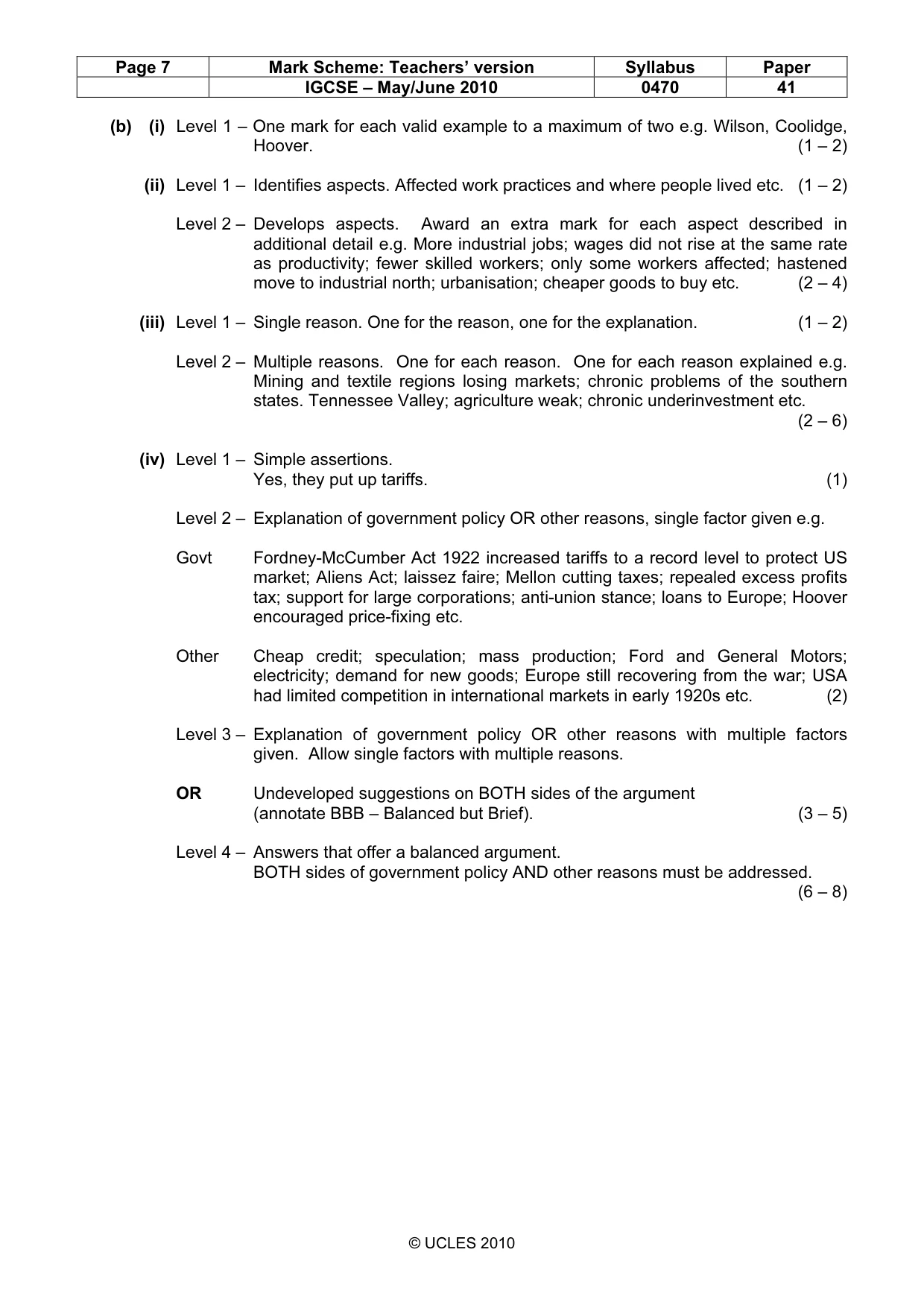
Page 7 Mark Scheme: Teachers’ version Syllabus Paper IGCSE – May/June 2010 0470 41 © UCLES 2010 (b) (i) Level 1 – One mark for each valid example to a maximum of two e.g. Wilson, Coolidge, Hoover. (1 – 2) (ii) Level 1 – Identifies aspects. Affected work practices and where people lived etc. (1 – 2) Level 2 – Develops aspects. Award an extra mark for each aspect described in additional detail e.g. More industrial jobs; wages did not rise at the same rate as productivity; fewer skilled workers; only some workers affected; hastened move to industrial north; urbanisation; cheaper goods to buy etc. (2 – 4) (iii) Level 1 – Single reason. One for the reason, one for the explanation. (1 – 2) Level 2 – Multiple reasons. One for each reason. One for each reason explained e.g. Mining and textile regions losing markets; chronic problems of the southern states. Tennessee Valley; agriculture weak; chronic underinvestment etc. (2 – 6) (iv) Level 1 – Simple assertions. Yes, they put up tariffs. (1) Level 2 – Explanation of government policy OR other reasons, single factor given e.g. Govt Fordney-McCumber Act 1922 increased tariffs to a record level to protect US market; Aliens Act; laissez faire; Mellon cutting taxes; repealed excess profits tax; support for large corporations; anti-union stance; loans to Europe; Hoover encouraged price-fixing etc. Other Cheap credit; speculation; mass production; Ford and General Motors; electricity; demand for new goods; Europe still recovering from the war; USA had limited competition in international markets in early 1920s etc. (2) Level 3 – Explanation of government policy OR other reasons with multiple factors given. Allow single factors with multiple reasons. OR Undeveloped suggestions on BOTH sides of the argument (annotate BBB – Balanced but Brief). (3 – 5) Level 4 – Answers that offer a balanced argument. BOTH sides of government policy AND other reasons must be addressed. (6 – 8)
Mark scheme, page 8
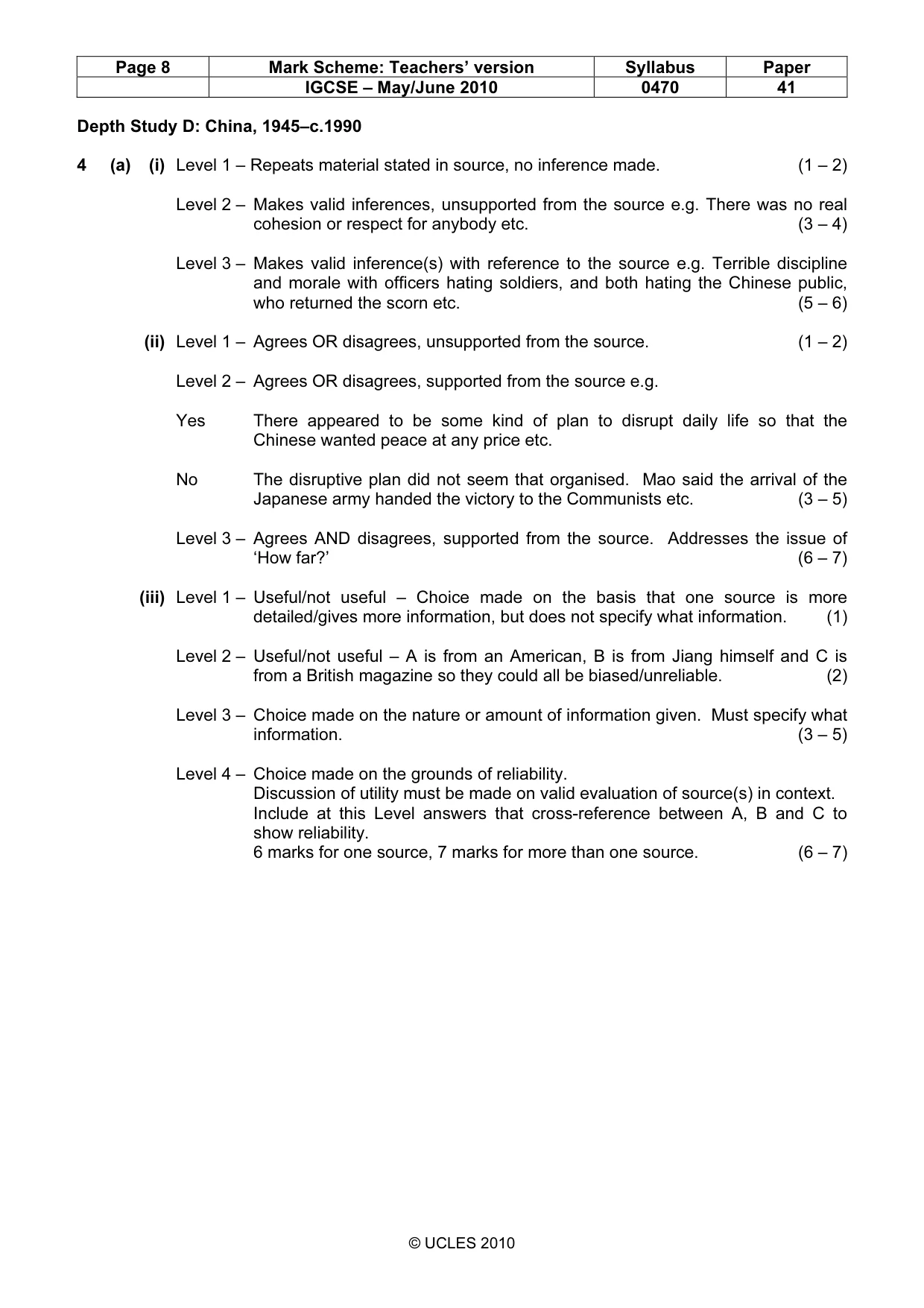
Page 8 Mark Scheme: Teachers’ version Syllabus Paper IGCSE – May/June 2010 0470 41 © UCLES 2010 Depth Study D: China, 1945–c.1990 4 (a) (i) Level 1 – Repeats material stated in source, no inference made. (1 – 2) Level 2 – Makes valid inferences, unsupported from the source e.g. There was no real cohesion or respect for anybody etc. (3 – 4) Level 3 – Makes valid inference(s) with reference to the source e.g. Terrible discipline and morale with officers hating soldiers, and both hating the Chinese public, who returned the scorn etc. (5 – 6) (ii) Level 1 – Agrees OR disagrees, unsupported from the source. (1 – 2) Level 2 – Agrees OR disagrees, supported from the source e.g. Yes There appeared to be some kind of plan to disrupt daily life so that the Chinese wanted peace at any price etc. No The disruptive plan did not seem that organised. Mao said the arrival of the Japanese army handed the victory to the Communists etc. (3 – 5) Level 3 – Agrees AND disagrees, supported from the source. Addresses the issue of ‘How far?’ (6 – 7) (iii) Level 1 – Useful/not useful – Choice made on the basis that one source is more detailed/gives more information, but does not specify what information. (1) Level 2 – Useful/not useful – A is from an American, B is from Jiang himself and C is from a British magazine so they could all be biased/unreliable. (2) Level 3 – Choice made on the nature or amount of information given. Must specify what information. (3 – 5) Level 4 – Choice made on the grounds of reliability. Discussion of utility must be made on valid evaluation of source(s) in context. Include at this Level answers that cross-reference between A, B and C to show reliability. 6 marks for one source, 7 marks for more than one source. (6 – 7)
Mark scheme, page 9
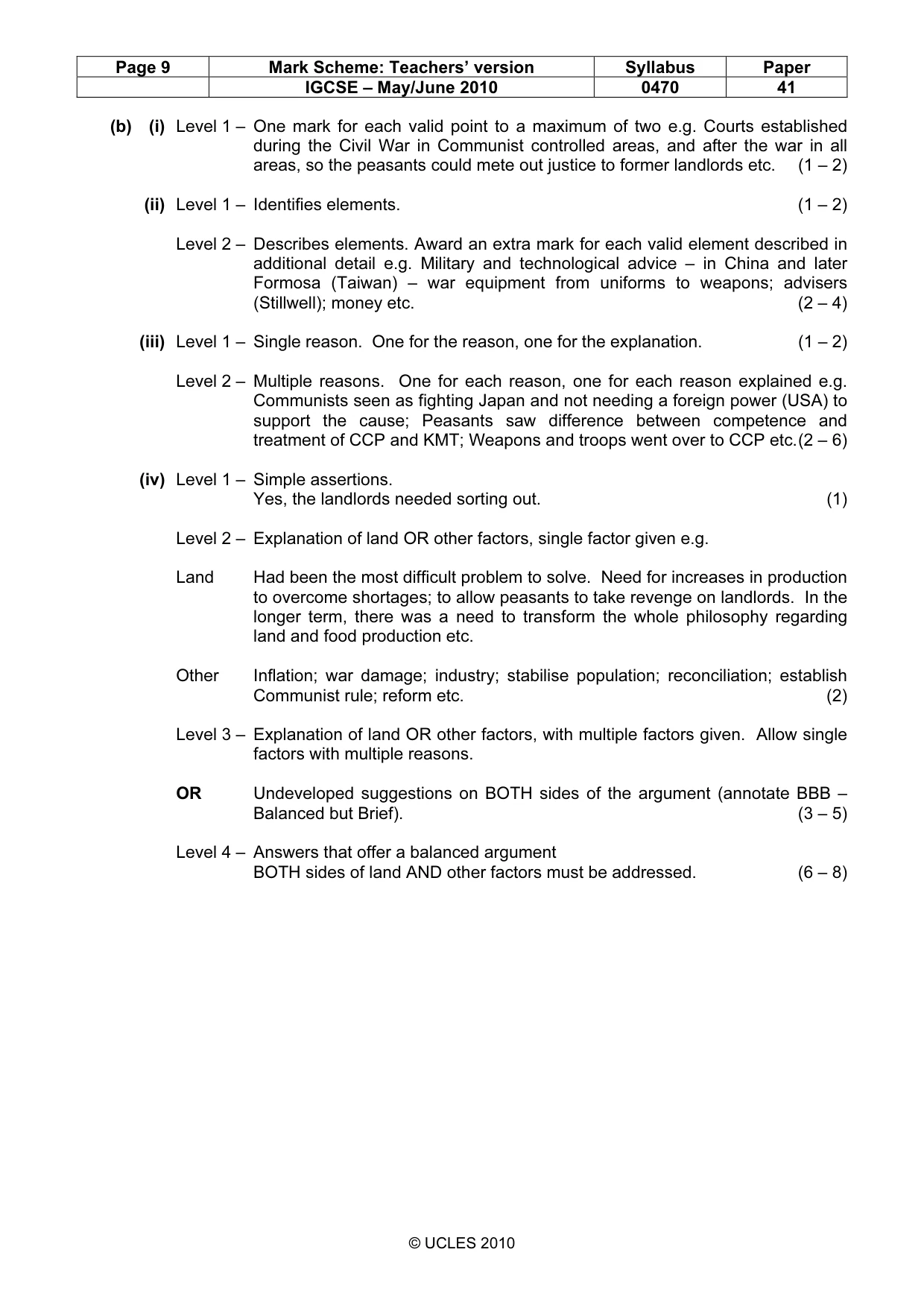
Page 9 Mark Scheme: Teachers’ version Syllabus Paper IGCSE – May/June 2010 0470 41 © UCLES 2010 (b) (i) Level 1 – One mark for each valid point to a maximum of two e.g. Courts established during the Civil War in Communist controlled areas, and after the war in all areas, so the peasants could mete out justice to former landlords etc. (1 – 2) (ii) Level 1 – Identifies elements. (1 – 2) Level 2 – Describes elements. Award an extra mark for each valid element described in additional detail e.g. Military and technological advice – in China and later Formosa (Taiwan) – war equipment from uniforms to weapons; advisers (Stillwell); money etc. (2 – 4) (iii) Level 1 – Single reason. One for the reason, one for the explanation. (1 – 2) Level 2 – Multiple reasons. One for each reason, one for each reason explained e.g. Communists seen as fighting Japan and not needing a foreign power (USA) to support the cause; Peasants saw difference between competence and treatment of CCP and KMT; Weapons and troops went over to CCP etc. (2 – 6) (iv) Level 1 – Simple assertions. Yes, the landlords needed sorting out. (1) Level 2 – Explanation of land OR other factors, single factor given e.g. Land Had been the most difficult problem to solve. Need for increases in production to overcome shortages; to allow peasants to take revenge on landlords. In the longer term, there was a need to transform the whole philosophy regarding land and food production etc. Other Inflation; war damage; industry; stabilise population; reconciliation; establish Communist rule; reform etc. (2) Level 3 – Explanation of land OR other factors, with multiple factors given. Allow single factors with multiple reasons. OR Undeveloped suggestions on BOTH sides of the argument (annotate BBB – Balanced but Brief). (3 – 5) Level 4 – Answers that offer a balanced argument BOTH sides of land AND other factors must be addressed. (6 – 8)
Mark scheme, page 10
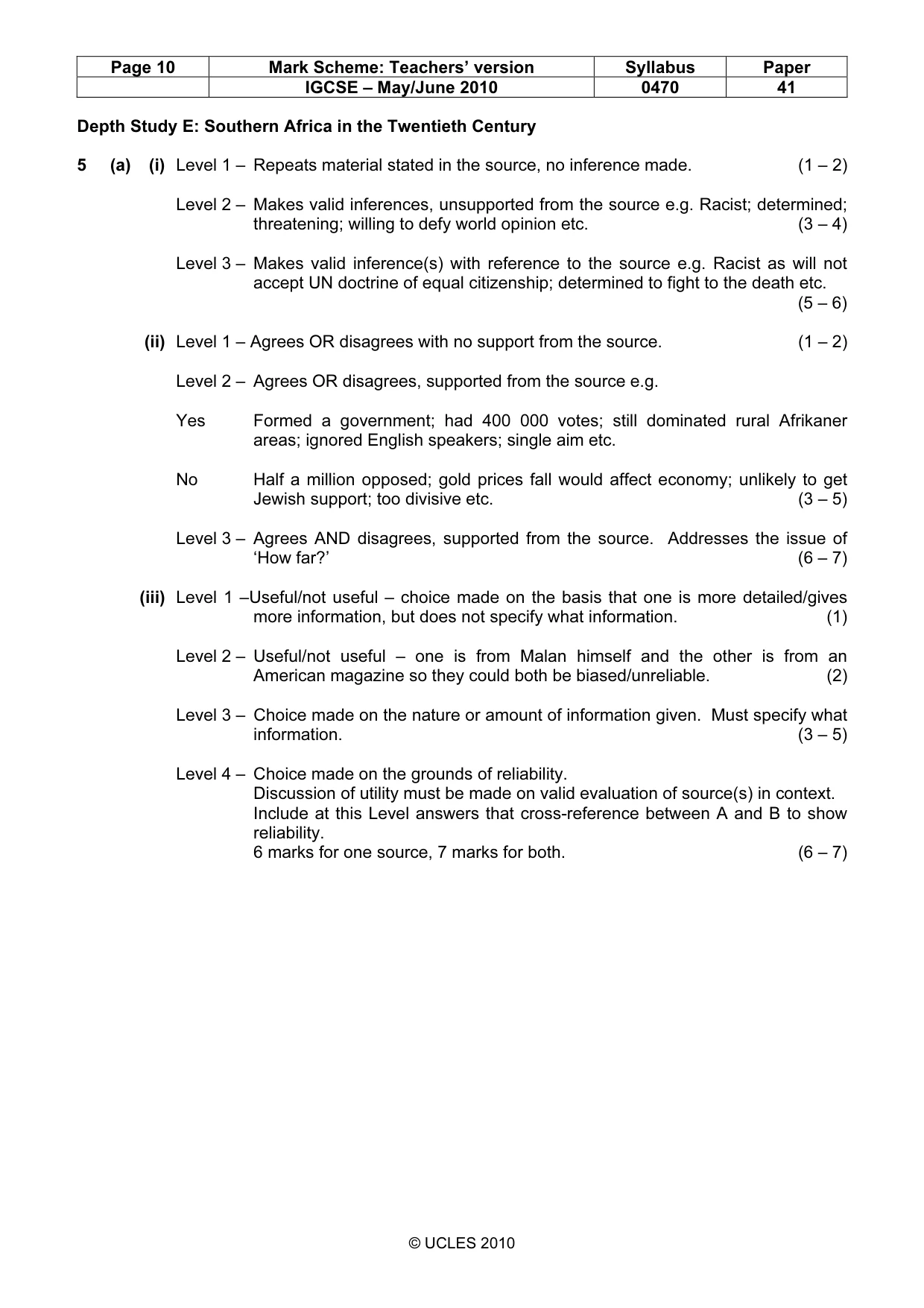
Page 10 Mark Scheme: Teachers’ version Syllabus Paper IGCSE – May/June 2010 0470 41 © UCLES 2010 Depth Study E: Southern Africa in the Twentieth Century 5 (a) (i) Level 1 – Repeats material stated in the source, no inference made. (1 – 2) Level 2 – Makes valid inferences, unsupported from the source e.g. Racist; determined; threatening; willing to defy world opinion etc. (3 – 4) Level 3 – Makes valid inference(s) with reference to the source e.g. Racist as will not accept UN doctrine of equal citizenship; determined to fight to the death etc. (5 – 6) (ii) Level 1 – Agrees OR disagrees with no support from the source. (1 – 2) Level 2 – Agrees OR disagrees, supported from the source e.g. Yes Formed a government; had 400 000 votes; still dominated rural Afrikaner areas; ignored English speakers; single aim etc. No Half a million opposed; gold prices fall would affect economy; unlikely to get Jewish support; too divisive etc. (3 – 5) Level 3 – Agrees AND disagrees, supported from the source. Addresses the issue of ‘How far?’ (6 – 7) (iii) Level 1 –Useful/not useful – choice made on the basis that one is more detailed/gives more information, but does not specify what information. (1) Level 2 – Useful/not useful – one is from Malan himself and the other is from an American magazine so they could both be biased/unreliable. (2) Level 3 – Choice made on the nature or amount of information given. Must specify what information. (3 – 5) Level 4 – Choice made on the grounds of reliability. Discussion of utility must be made on valid evaluation of source(s) in context. Include at this Level answers that cross-reference between A and B to show reliability. 6 marks for one source, 7 marks for both. (6 – 7)
Mark scheme, page 11
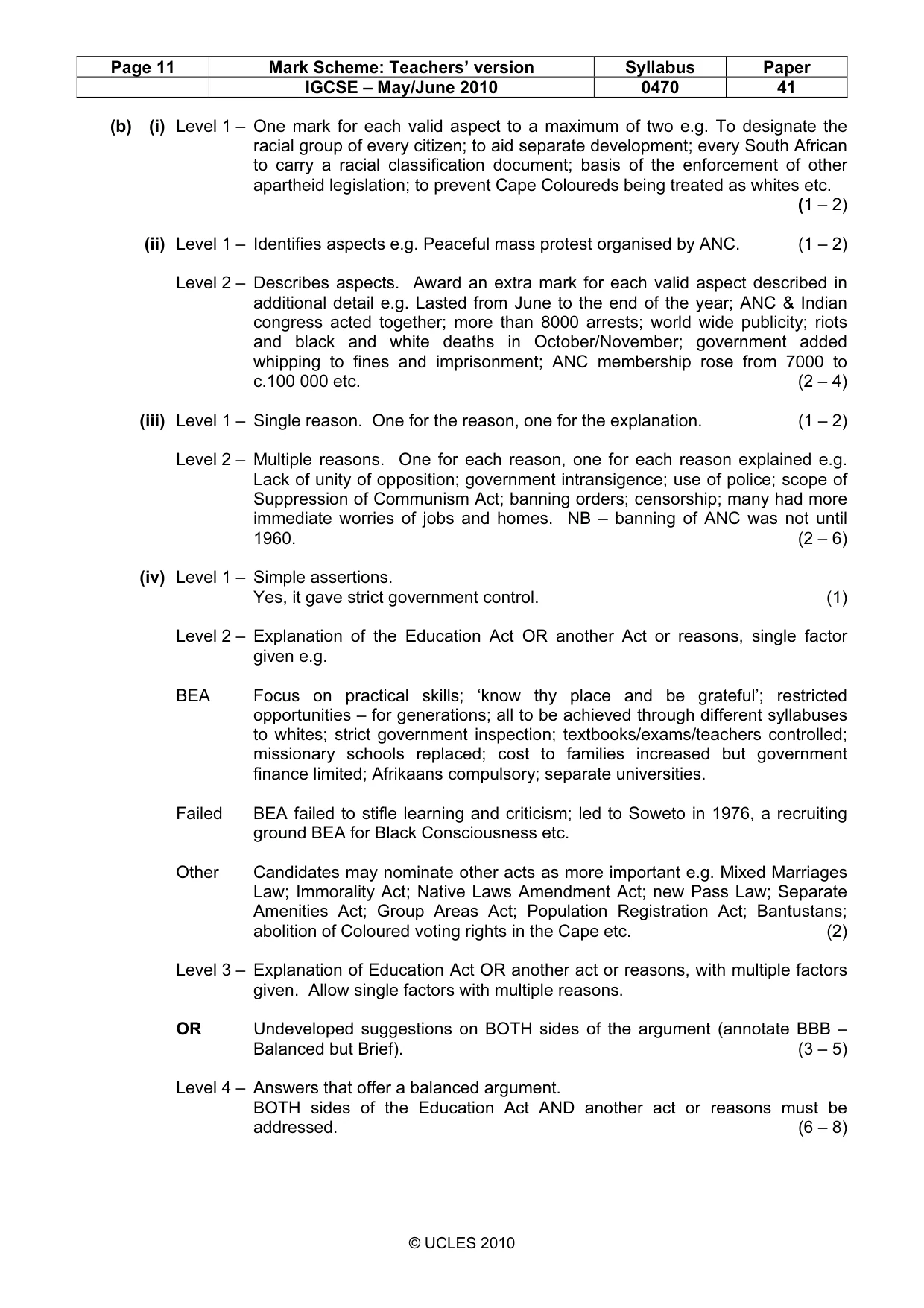
Page 11 Mark Scheme: Teachers’ version Syllabus Paper IGCSE – May/June 2010 0470 41 © UCLES 2010 (b) (i) Level 1 – One mark for each valid aspect to a maximum of two e.g. To designate the racial group of every citizen; to aid separate development; every South African to carry a racial classification document; basis of the enforcement of other apartheid legislation; to prevent Cape Coloureds being treated as whites etc. (1 – 2) (ii) Level 1 – Identifies aspects e.g. Peaceful mass protest organised by ANC. (1 – 2) Level 2 – Describes aspects. Award an extra mark for each valid aspect described in additional detail e.g. Lasted from June to the end of the year; ANC & Indian congress acted together; more than 8000 arrests; world wide publicity; riots and black and white deaths in October/November; government added whipping to fines and imprisonment; ANC membership rose from 7000 to c.100 000 etc. (2 – 4) (iii) Level 1 – Single reason. One for the reason, one for the explanation. (1 – 2) Level 2 – Multiple reasons. One for each reason, one for each reason explained e.g. Lack of unity of opposition; government intransigence; use of police; scope of Suppression of Communism Act; banning orders; censorship; many had more immediate worries of jobs and homes. NB – banning of ANC was not until 1960. (2 – 6) (iv) Level 1 – Simple assertions. Yes, it gave strict government control. (1) Level 2 – Explanation of the Education Act OR another Act or reasons, single factor given e.g. BEA Focus on practical skills; ‘know thy place and be grateful’; restricted opportunities – for generations; all to be achieved through different syllabuses to whites; strict government inspection; textbooks/exams/teachers controlled; missionary schools replaced; cost to families increased but government finance limited; Afrikaans compulsory; separate universities. Failed BEA failed to stifle learning and criticism; led to Soweto in 1976, a recruiting ground BEA for Black Consciousness etc. Other Candidates may nominate other acts as more important e.g. Mixed Marriages Law; Immorality Act; Native Laws Amendment Act; new Pass Law; Separate Amenities Act; Group Areas Act; Population Registration Act; Bantustans; abolition of Coloured voting rights in the Cape etc. (2) Level 3 – Explanation of Education Act OR another act or reasons, with multiple factors given. Allow single factors with multiple reasons. OR Undeveloped suggestions on BOTH sides of the argument (annotate BBB – Balanced but Brief). (3 – 5) Level 4 – Answers that offer a balanced argument. BOTH sides of the Education Act AND another act or reasons must be addressed. (6 – 8)
Mark scheme, page 12
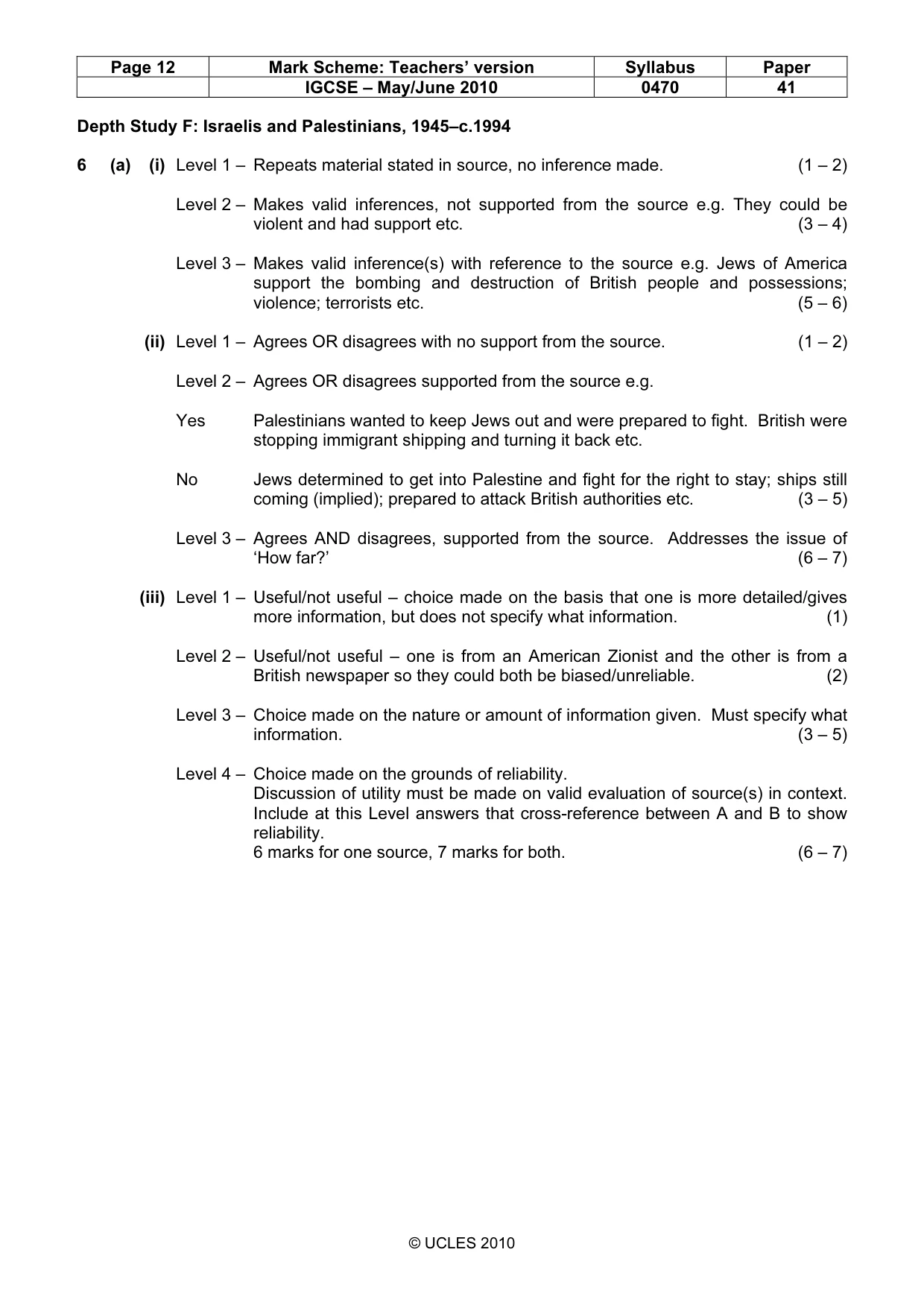
Page 12 Mark Scheme: Teachers’ version Syllabus Paper IGCSE – May/June 2010 0470 41 © UCLES 2010 Depth Study F: Israelis and Palestinians, 1945–c.1994 6 (a) (i) Level 1 – Repeats material stated in source, no inference made. (1 – 2) Level 2 – Makes valid inferences, not supported from the source e.g. They could be violent and had support etc. (3 – 4) Level 3 – Makes valid inference(s) with reference to the source e.g. Jews of America support the bombing and destruction of British people and possessions; violence; terrorists etc. (5 – 6) (ii) Level 1 – Agrees OR disagrees with no support from the source. (1 – 2) Level 2 – Agrees OR disagrees supported from the source e.g. Yes Palestinians wanted to keep Jews out and were prepared to fight. British were stopping immigrant shipping and turning it back etc. No Jews determined to get into Palestine and fight for the right to stay; ships still coming (implied); prepared to attack British authorities etc. (3 – 5) Level 3 – Agrees AND disagrees, supported from the source. Addresses the issue of ‘How far?’ (6 – 7) (iii) Level 1 – Useful/not useful – choice made on the basis that one is more detailed/gives more information, but does not specify what information. (1) Level 2 – Useful/not useful – one is from an American Zionist and the other is from a British newspaper so they could both be biased/unreliable. (2) Level 3 – Choice made on the nature or amount of information given. Must specify what information. (3 – 5) Level 4 – Choice made on the grounds of reliability. Discussion of utility must be made on valid evaluation of source(s) in context. Include at this Level answers that cross-reference between A and B to show reliability. 6 marks for one source, 7 marks for both. (6 – 7)
Mark scheme, page 13
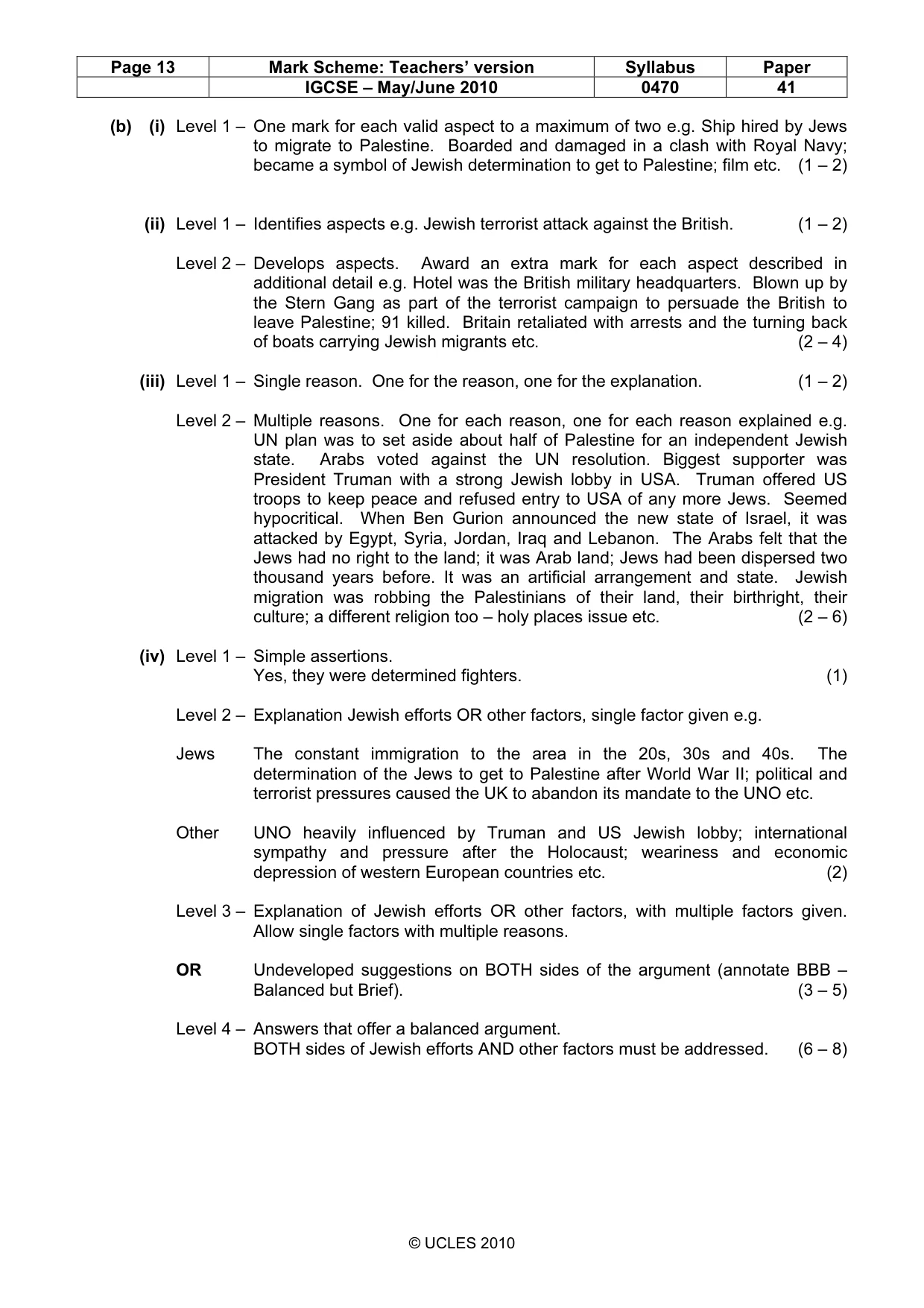
Page 13 Mark Scheme: Teachers’ version Syllabus Paper IGCSE – May/June 2010 0470 41 © UCLES 2010 (b) (i) Level 1 – One mark for each valid aspect to a maximum of two e.g. Ship hired by Jews to migrate to Palestine. Boarded and damaged in a clash with Royal Navy; became a symbol of Jewish determination to get to Palestine; film etc. (1 – 2) (ii) Level 1 – Identifies aspects e.g. Jewish terrorist attack against the British. (1 – 2) Level 2 – Develops aspects. Award an extra mark for each aspect described in additional detail e.g. Hotel was the British military headquarters. Blown up by the Stern Gang as part of the terrorist campaign to persuade the British to leave Palestine; 91 killed. Britain retaliated with arrests and the turning back of boats carrying Jewish migrants etc. (2 – 4) (iii) Level 1 – Single reason. One for the reason, one for the explanation. (1 – 2) Level 2 – Multiple reasons. One for each reason, one for each reason explained e.g. UN plan was to set aside about half of Palestine for an independent Jewish state. Arabs voted against the UN resolution. Biggest supporter was President Truman with a strong Jewish lobby in USA. Truman offered US troops to keep peace and refused entry to USA of any more Jews. Seemed hypocritical. When Ben Gurion announced the new state of Israel, it was attacked by Egypt, Syria, Jordan, Iraq and Lebanon. The Arabs felt that the Jews had no right to the land; it was Arab land; Jews had been dispersed two thousand years before. It was an artificial arrangement and state. Jewish migration was robbing the Palestinians of their land, their birthright, their culture; a different religion too – holy places issue etc. (2 – 6) (iv) Level 1 – Simple assertions. Yes, they were determined fighters. (1) Level 2 – Explanation Jewish efforts OR other factors, single factor given e.g. Jews The constant immigration to the area in the 20s, 30s and 40s. The determination of the Jews to get to Palestine after World War II; political and terrorist pressures caused the UK to abandon its mandate to the UNO etc. Other UNO heavily influenced by Truman and US Jewish lobby; international sympathy and pressure after the Holocaust; weariness and economic depression of western European countries etc. (2) Level 3 – Explanation of Jewish efforts OR other factors, with multiple factors given. Allow single factors with multiple reasons. OR Undeveloped suggestions on BOTH sides of the argument (annotate BBB – Balanced but Brief). (3 – 5) Level 4 – Answers that offer a balanced argument. BOTH sides of Jewish efforts AND other factors must be addressed. (6 – 8)
Mark scheme, page 14
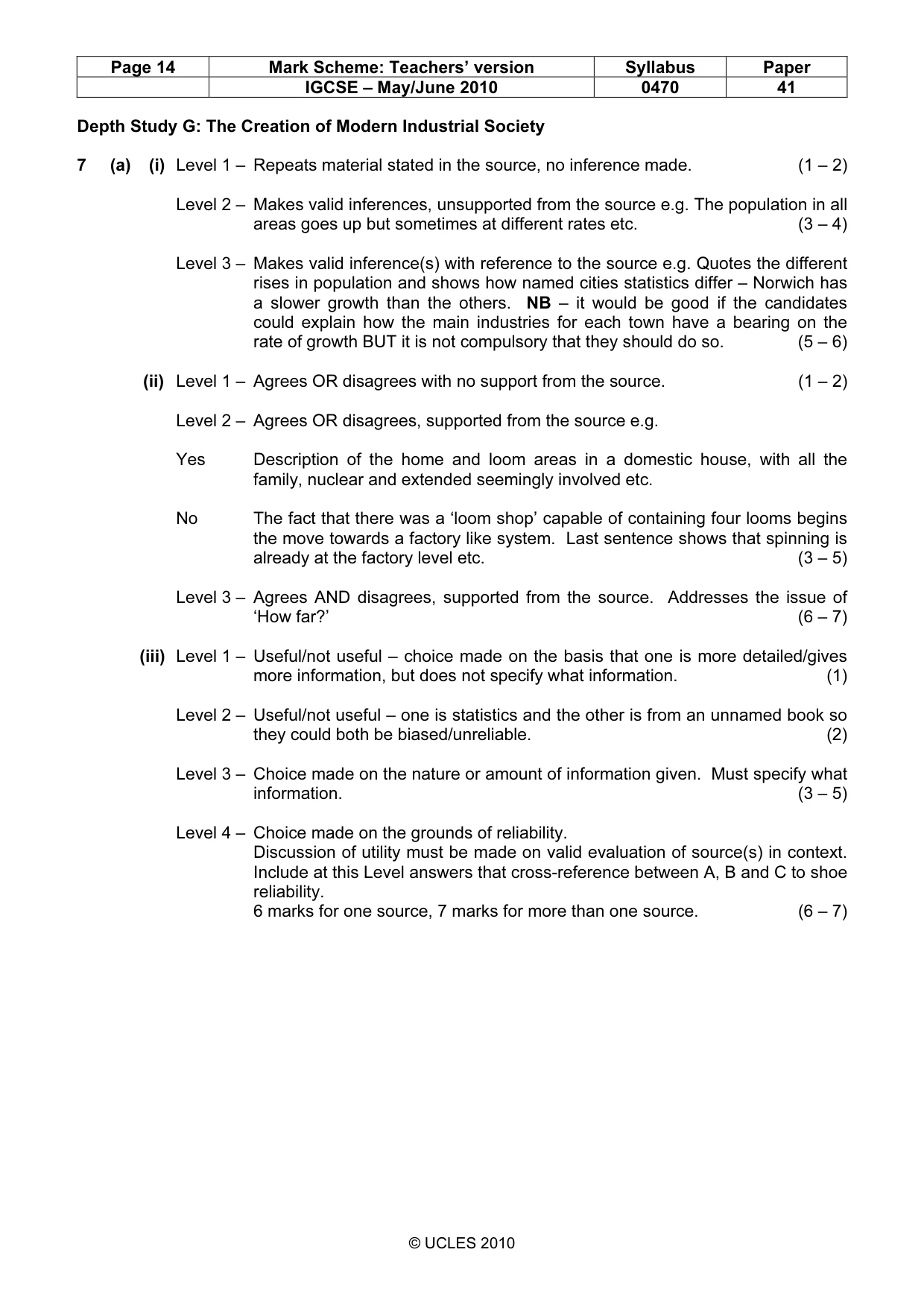
Page 14 Mark Scheme: Teachers’ version Syllabus Paper IGCSE – May/June 2010 0470 41 © UCLES 2010 Depth Study G: The Creation of Modern Industrial Society 7 (a) (i) Level 1 – Repeats material stated in the source, no inference made. (1 – 2) Level 2 – Makes valid inferences, unsupported from the source e.g. The population in all areas goes up but sometimes at different rates etc. (3 – 4) Level 3 – Makes valid inference(s) with reference to the source e.g. Quotes the different rises in population and shows how named cities statistics differ – Norwich has a slower growth than the others. NB – it would be good if the candidates could explain how the main industries for each town have a bearing on the rate of growth BUT it is not compulsory that they should do so. (5 – 6) (ii) Level 1 – Agrees OR disagrees with no support from the source. (1 – 2) Level 2 – Agrees OR disagrees, supported from the source e.g. Yes Description of the home and loom areas in a domestic house, with all the family, nuclear and extended seemingly involved etc. No The fact that there was a ‘loom shop’ capable of containing four looms begins the move towards a factory like system. Last sentence shows that spinning is already at the factory level etc. (3 – 5) Level 3 – Agrees AND disagrees, supported from the source. Addresses the issue of ‘How far?’ (6 – 7) (iii) Level 1 – Useful/not useful – choice made on the basis that one is more detailed/gives more information, but does not specify what information. (1) Level 2 – Useful/not useful – one is statistics and the other is from an unnamed book so they could both be biased/unreliable. (2) Level 3 – Choice made on the nature or amount of information given. Must specify what information. (3 – 5) Level 4 – Choice made on the grounds of reliability. Discussion of utility must be made on valid evaluation of source(s) in context. Include at this Level answers that cross-reference between A, B and C to shoe reliability. 6 marks for one source, 7 marks for more than one source. (6 – 7)
Mark scheme, page 15
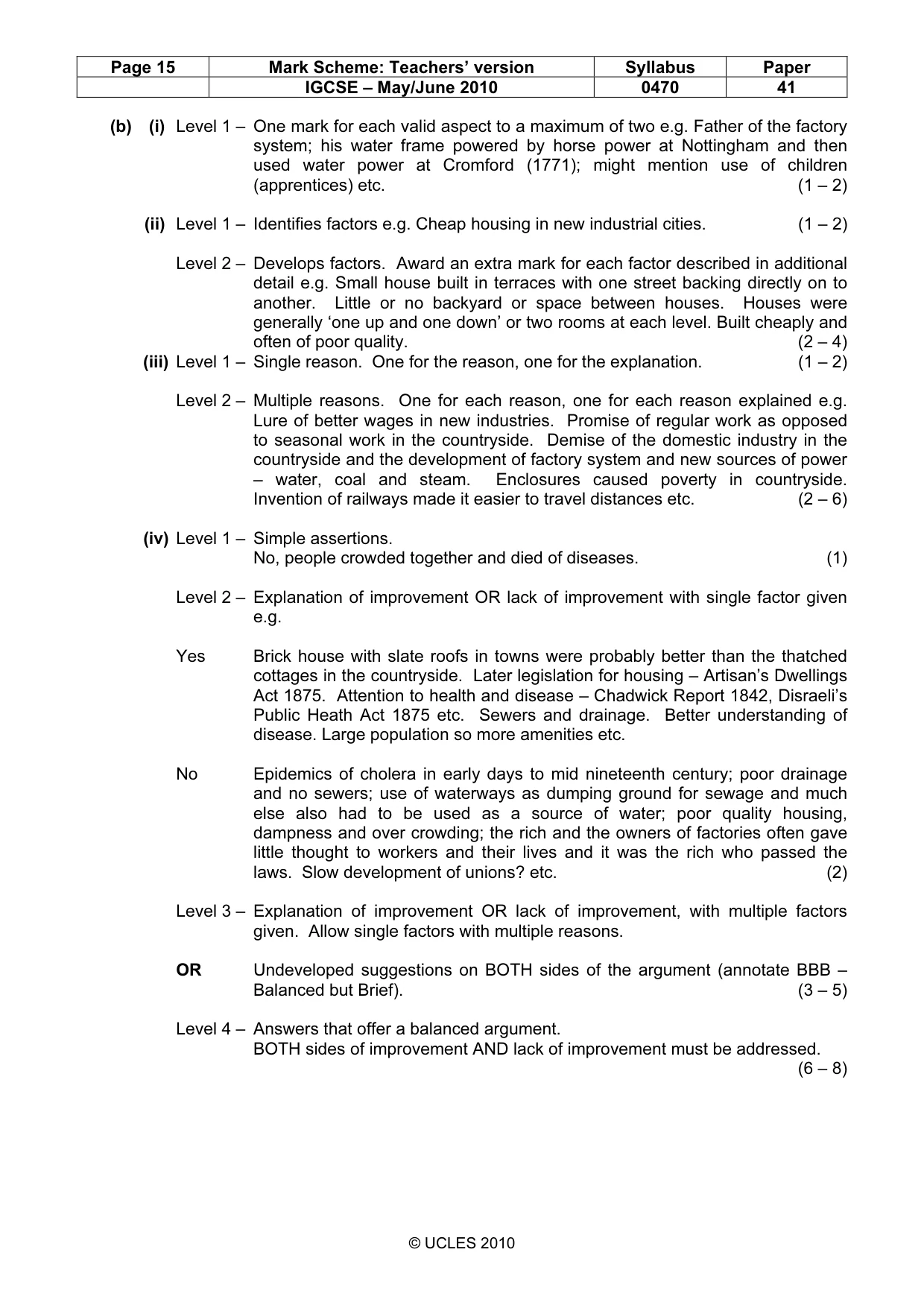
Page 15 Mark Scheme: Teachers’ version Syllabus Paper IGCSE – May/June 2010 0470 41 © UCLES 2010 (b) (i) Level 1 – One mark for each valid aspect to a maximum of two e.g. Father of the factory system; his water frame powered by horse power at Nottingham and then used water power at Cromford (1771); might mention use of children (apprentices) etc. (1 – 2) (ii) Level 1 – Identifies factors e.g. Cheap housing in new industrial cities. (1 – 2) Level 2 – Develops factors. Award an extra mark for each factor described in additional detail e.g. Small house built in terraces with one street backing directly on to another. Little or no backyard or space between houses. Houses were generally ‘one up and one down’ or two rooms at each level. Built cheaply and often of poor quality. (2 – 4) (iii) Level 1 – Single reason. One for the reason, one for the explanation. (1 – 2) Level 2 – Multiple reasons. One for each reason, one for each reason explained e.g. Lure of better wages in new industries. Promise of regular work as opposed to seasonal work in the countryside. Demise of the domestic industry in the countryside and the development of factory system and new sources of power – water, coal and steam. Enclosures caused poverty in countryside. Invention of railways made it easier to travel distances etc. (2 – 6) (iv) Level 1 – Simple assertions. No, people crowded together and died of diseases. (1) Level 2 – Explanation of improvement OR lack of improvement with single factor given e.g. Yes Brick house with slate roofs in towns were probably better than the thatched cottages in the countryside. Later legislation for housing – Artisan’s Dwellings Act 1875. Attention to health and disease – Chadwick Report 1842, Disraeli’s Public Heath Act 1875 etc. Sewers and drainage. Better understanding of disease. Large population so more amenities etc. No Epidemics of cholera in early days to mid nineteenth century; poor drainage and no sewers; use of waterways as dumping ground for sewage and much else also had to be used as a source of water; poor quality housing, dampness and over crowding; the rich and the owners of factories often gave little thought to workers and their lives and it was the rich who passed the laws. Slow development of unions? etc. (2) Level 3 – Explanation of improvement OR lack of improvement, with multiple factors given. Allow single factors with multiple reasons. OR Undeveloped suggestions on BOTH sides of the argument (annotate BBB – Balanced but Brief). (3 – 5) Level 4 – Answers that offer a balanced argument. BOTH sides of improvement AND lack of improvement must be addressed. (6 – 8)
Mark scheme, page 16
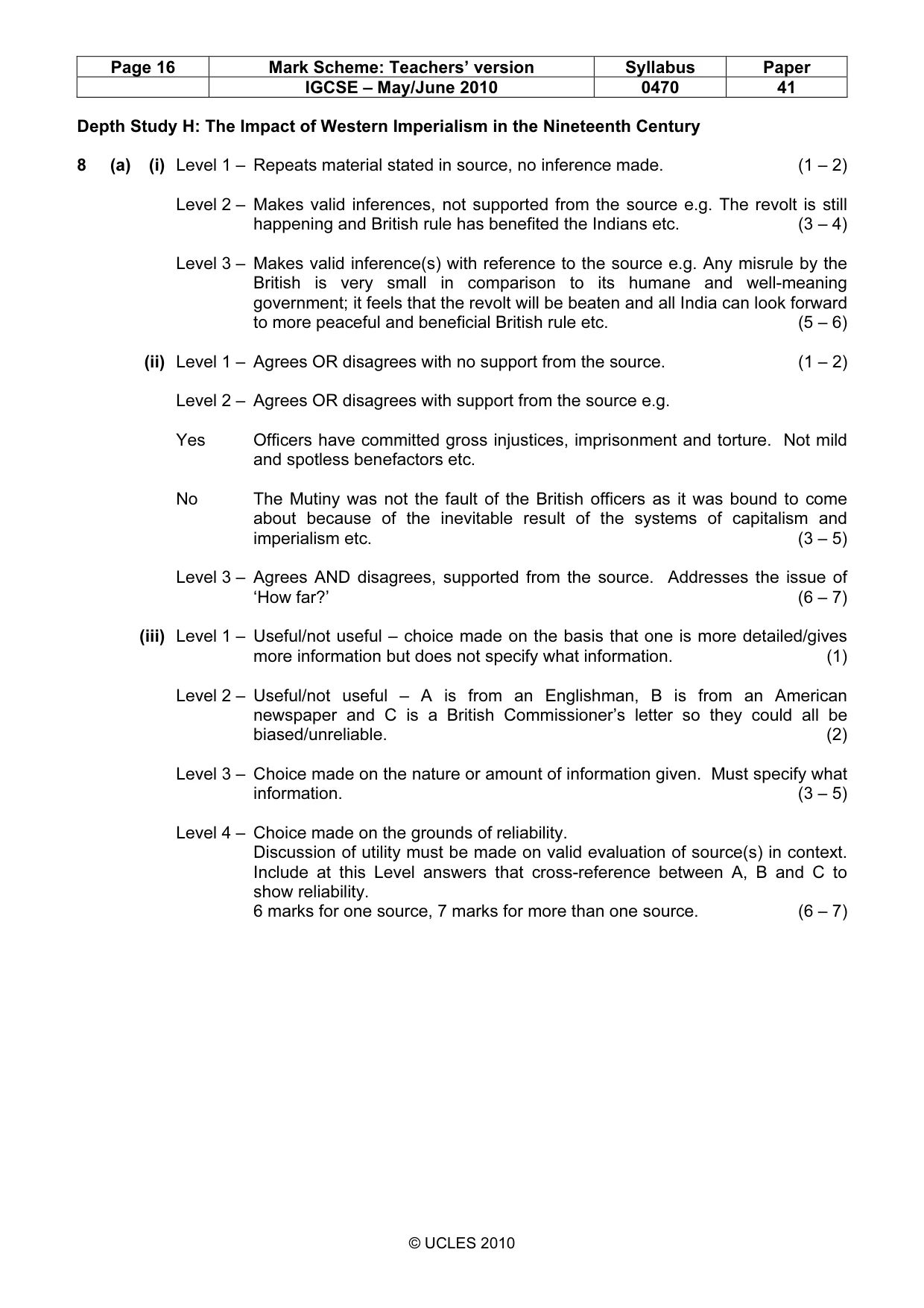
Page 16 Mark Scheme: Teachers’ version Syllabus Paper IGCSE – May/June 2010 0470 41 © UCLES 2010 Depth Study H: The Impact of Western Imperialism in the Nineteenth Century 8 (a) (i) Level 1 – Repeats material stated in source, no inference made. (1 – 2) Level 2 – Makes valid inferences, not supported from the source e.g. The revolt is still happening and British rule has benefited the Indians etc. (3 – 4) Level 3 – Makes valid inference(s) with reference to the source e.g. Any misrule by the British is very small in comparison to its humane and well-meaning government; it feels that the revolt will be beaten and all India can look forward to more peaceful and beneficial British rule etc. (5 – 6) (ii) Level 1 – Agrees OR disagrees with no support from the source. (1 – 2) Level 2 – Agrees OR disagrees with support from the source e.g. Yes Officers have committed gross injustices, imprisonment and torture. Not mild and spotless benefactors etc. No The Mutiny was not the fault of the British officers as it was bound to come about because of the inevitable result of the systems of capitalism and imperialism etc. (3 – 5) Level 3 – Agrees AND disagrees, supported from the source. Addresses the issue of ‘How far?’ (6 – 7) (iii) Level 1 – Useful/not useful – choice made on the basis that one is more detailed/gives more information but does not specify what information. (1) Level 2 – Useful/not useful – A is from an Englishman, B is from an American newspaper and C is a British Commissioner’s letter so they could all be biased/unreliable. (2) Level 3 – Choice made on the nature or amount of information given. Must specify what information. (3 – 5) Level 4 – Choice made on the grounds of reliability. Discussion of utility must be made on valid evaluation of source(s) in context. Include at this Level answers that cross-reference between A, B and C to show reliability. 6 marks for one source, 7 marks for more than one source. (6 – 7)
Mark scheme, page 17
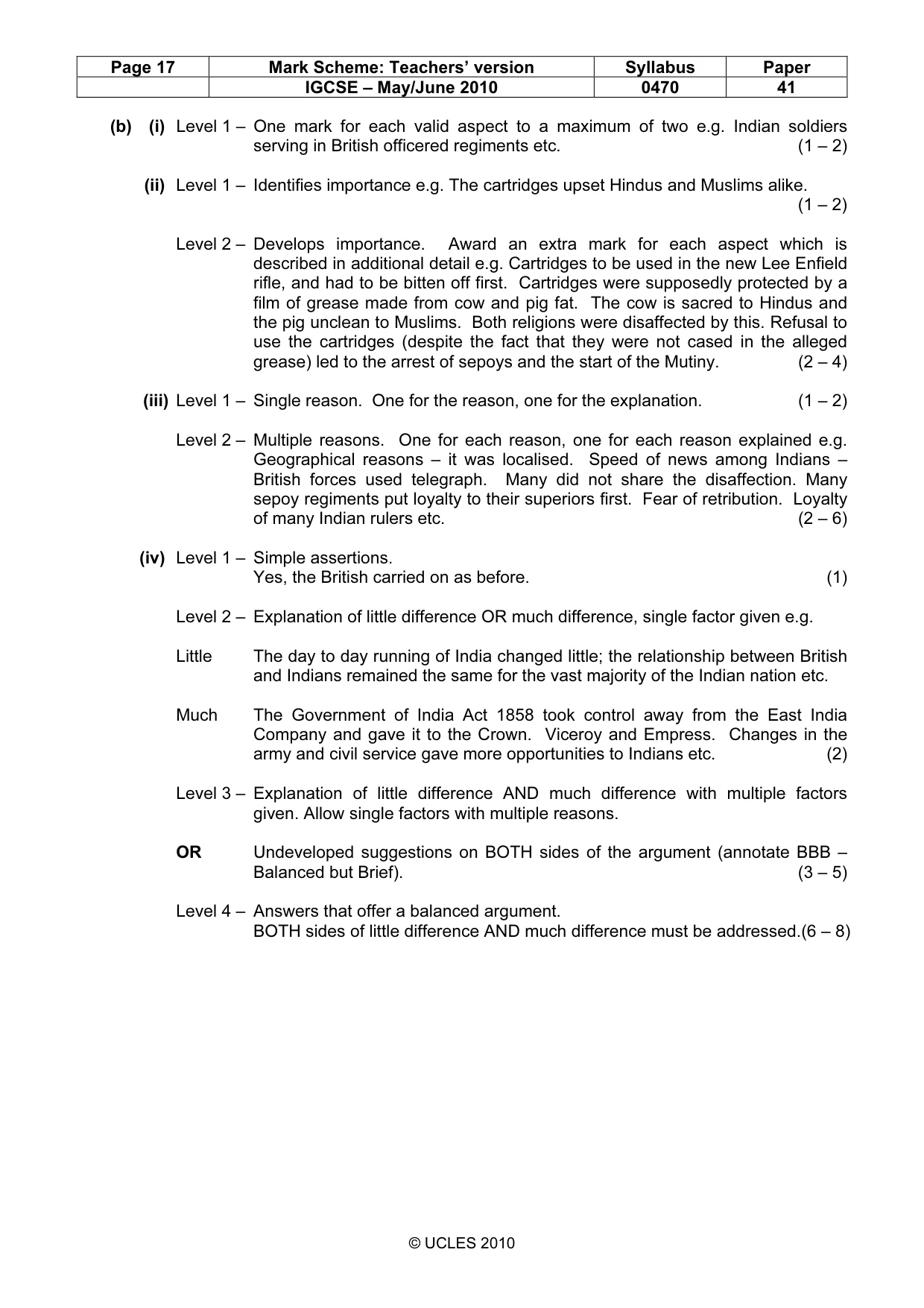
Page 17 Mark Scheme: Teachers’ version Syllabus Paper IGCSE – May/June 2010 0470 41 © UCLES 2010 (b) (i) Level 1 – One mark for each valid aspect to a maximum of two e.g. Indian soldiers serving in British officered regiments etc. (1 – 2) (ii) Level 1 – Identifies importance e.g. The cartridges upset Hindus and Muslims alike. (1 – 2) Level 2 – Develops importance. Award an extra mark for each aspect which is described in additional detail e.g. Cartridges to be used in the new Lee Enfield rifle, and had to be bitten off first. Cartridges were supposedly protected by a film of grease made from cow and pig fat. The cow is sacred to Hindus and the pig unclean to Muslims. Both religions were disaffected by this. Refusal to use the cartridges (despite the fact that they were not cased in the alleged grease) led to the arrest of sepoys and the start of the Mutiny. (2 – 4) (iii) Level 1 – Single reason. One for the reason, one for the explanation. (1 – 2) Level 2 – Multiple reasons. One for each reason, one for each reason explained e.g. Geographical reasons – it was localised. Speed of news among Indians – British forces used telegraph. Many did not share the disaffection. Many sepoy regiments put loyalty to their superiors first. Fear of retribution. Loyalty of many Indian rulers etc. (2 – 6) (iv) Level 1 – Simple assertions. Yes, the British carried on as before. (1) Level 2 – Explanation of little difference OR much difference, single factor given e.g. Little The day to day running of India changed little; the relationship between British and Indians remained the same for the vast majority of the Indian nation etc. Much The Government of India Act 1858 took control away from the East India Company and gave it to the Crown. Viceroy and Empress. Changes in the army and civil service gave more opportunities to Indians etc. (2) Level 3 – Explanation of little difference AND much difference with multiple factors given. Allow single factors with multiple reasons. OR Undeveloped suggestions on BOTH sides of the argument (annotate BBB – Balanced but Brief). (3 – 5) Level 4 – Answers that offer a balanced argument. BOTH sides of little difference AND much difference must be addressed.(6 – 8)
What you needed in this session
Cambridge’s own grade thresholds for 2010 May/June, Paper 4 · Variant 1. A higher threshold means an easier paper — the bar moves with how the cohort did.