Cambridge IGCSE Geography 0460 — 2024 May/June Paper 2 · Variant 3
0460/23/M/J/24 · 6 questions · 60 marks · ≈68 min
The question paper and its mark scheme, free to read here and free to download. This is Cambridge’s own paper, exactly as it was sat.
Question paper16 pages
Mark scheme9 pages
Answers below. Sit the paper first if you are practising.
Questions as text
Q1 · Study the map extract for the Badia de Roses, Spain
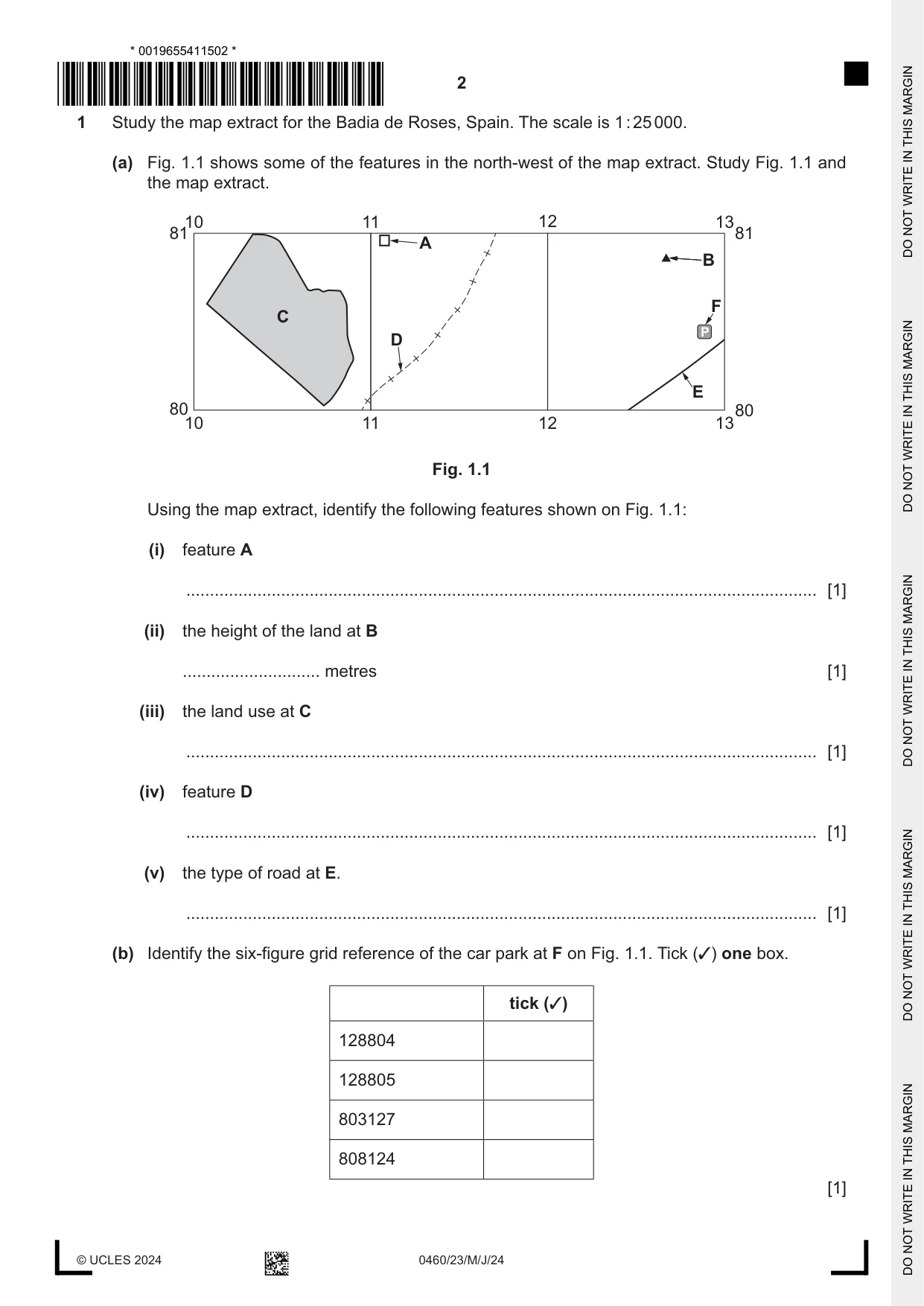
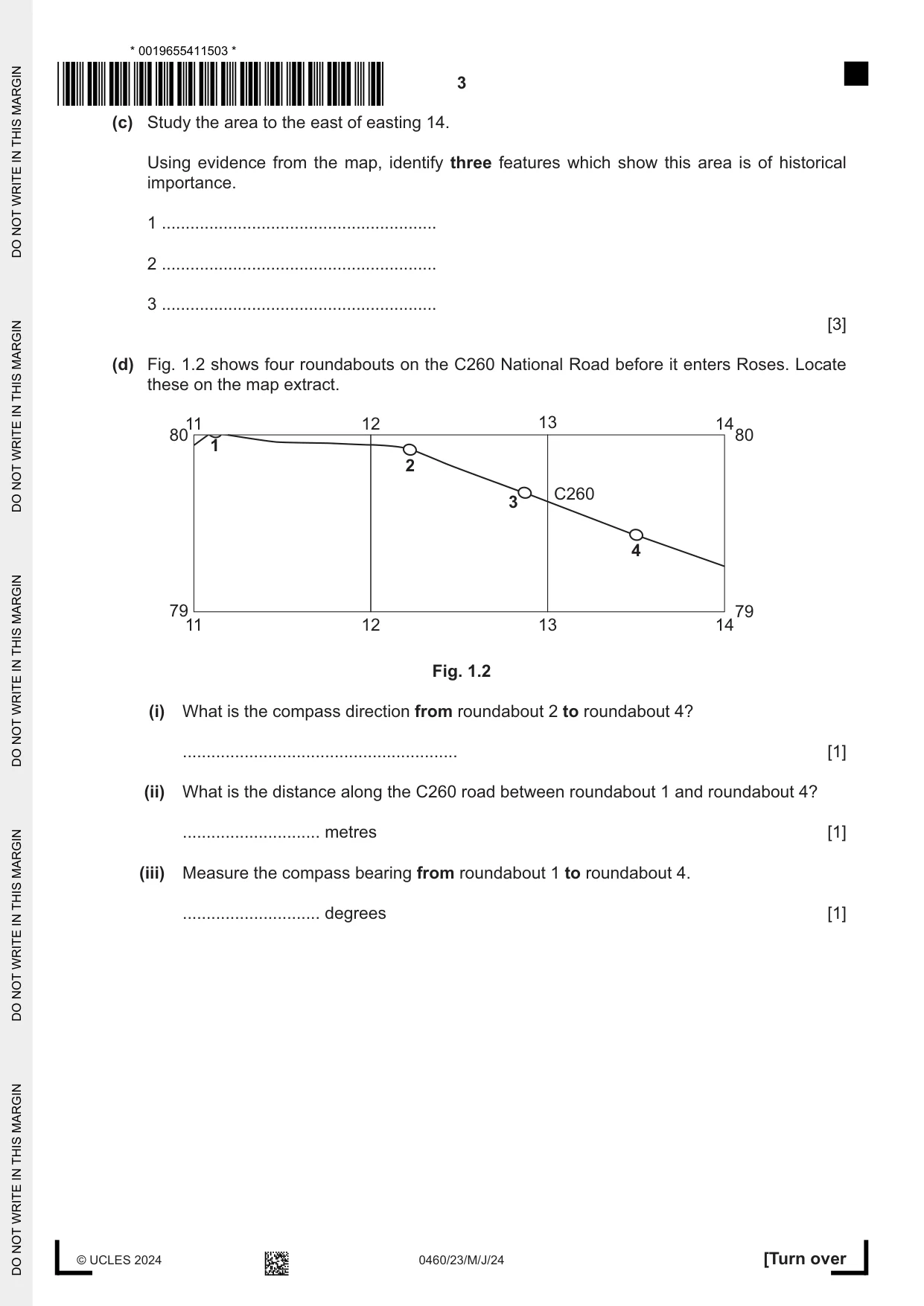
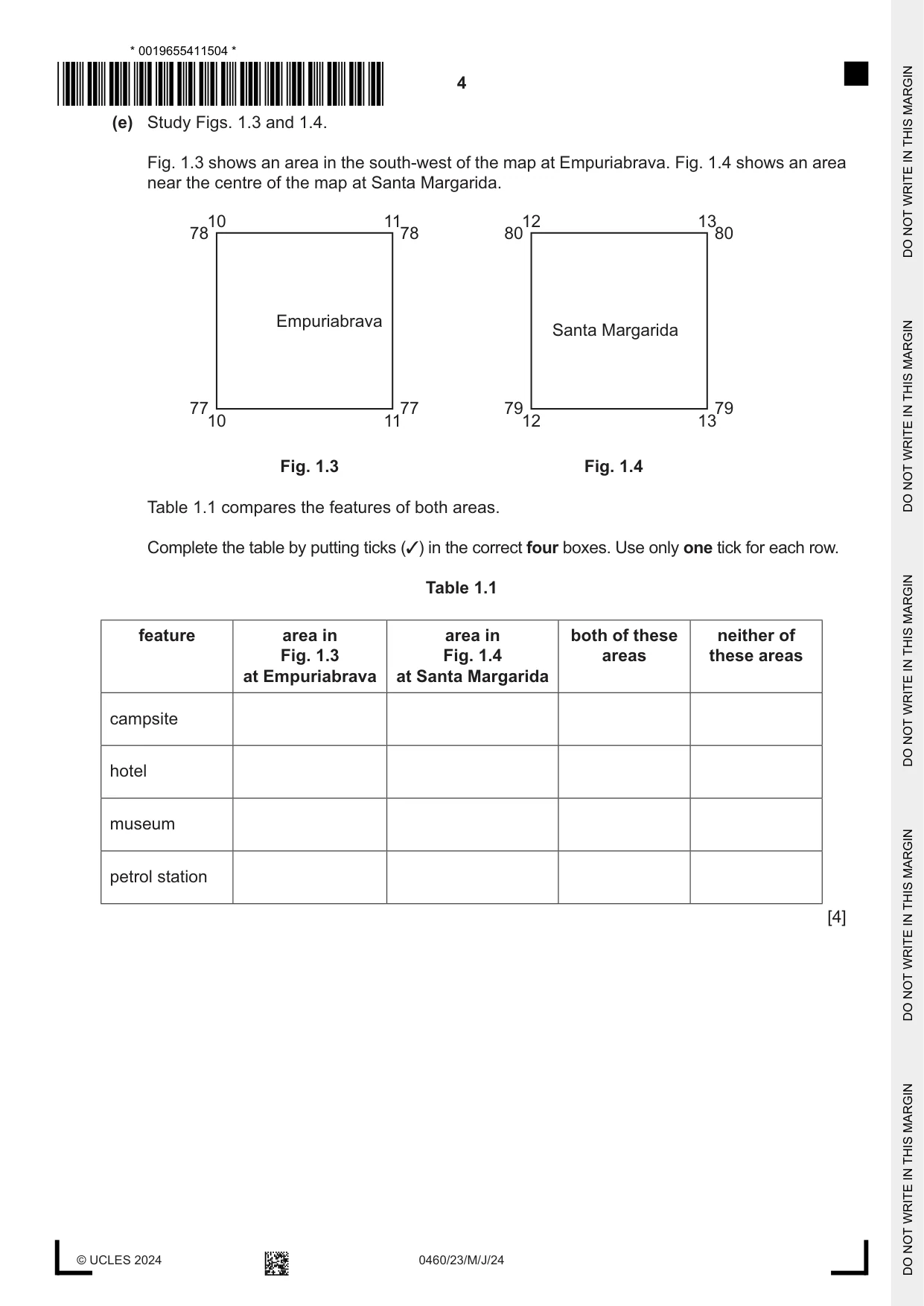
1 Study the map extract for the Badia de Roses, Spain. The scale is 1 : 25 000. (a) Fig. 1.1 shows some of the features in the north-west of the map extract. Study Fig. 1.1 and the map extract. 10 11 12 13 81 81 A B F C P D E 80 80 10 11 12 13 Fig. 1.1 Using the map extract, identify the following features shown on Fig. 1.1: (i) feature A ..................................................................................................................................... [1] (ii) the height of the land at B ............................. metres [1] (iii) the land use at C ..................................................................................................................................... [1] (iv) feature D ..................................................................................................................................... [1] (v) the type of road at E. ..................................................................................................................................... [1] (b) Identify the six-figure grid reference of the car park at F on Fig. 1.1. Tick (✓) one box. tick (✓) 128804 128805 803127 808124 [1] (c) Study the area to the east of easting 14. Using evidence from the map, identify three features which show this area is of historical importance. 1 .......................................................... 2 .......................................................... 3 .......................................................... [3] (d) Fig. 1.2 shows four roundabouts on the C260 National Road before it enters Roses. Locate these on the map extract. 11 12 13 14 80 80 1 2 C260 3 4 79 79 11 12 13 14 Fig. 1.2 (i) What is the compass direction from roundabout 2 to roundabout 4? .......................................................... [1] (ii) What is the distance along the C260 road between roundabout 1 and roundabout 4? ............................. metres [1] (iii) Measure the compass bearing from roundabout 1 to roundabout 4. ............................. degrees [1] (e) Study Figs. 1.3 and 1.4. Fig. 1.3 shows an area in the south-west of the map at Empuriabrava. Fig. 1.4 shows an area near the centre of the map at Santa Margarida. 10 11 12 13 78 78 80 80 Empuriabrava Santa Margarida 77 77 79 79 10 11 12 13 Fig. 1.3 Fig. 1.4 Table 1.1 compares the features of both areas. Complete the table by putting ticks (✓) in the correct four boxes. Use only one tick for each row. Table 1.1 feature area in area in both of these neither of Fig. 1.3 Fig. 1.4 areas these areas at Empuriabrava at Santa Margarida campsite hotel museum petrol station [4] (f) Study the coastline to the west of easting 14 and to the east of easting 15. Compare the natural features of the two coastal areas. ................................................................................................................................................... ................................................................................................................................................... ................................................................................................................................................... ................................................................................................................................................... ................................................................................................................................................... ................................................................................................................................................... ................................................................................................................................................... ............................................................................................................................................. [4] [Total: 20]
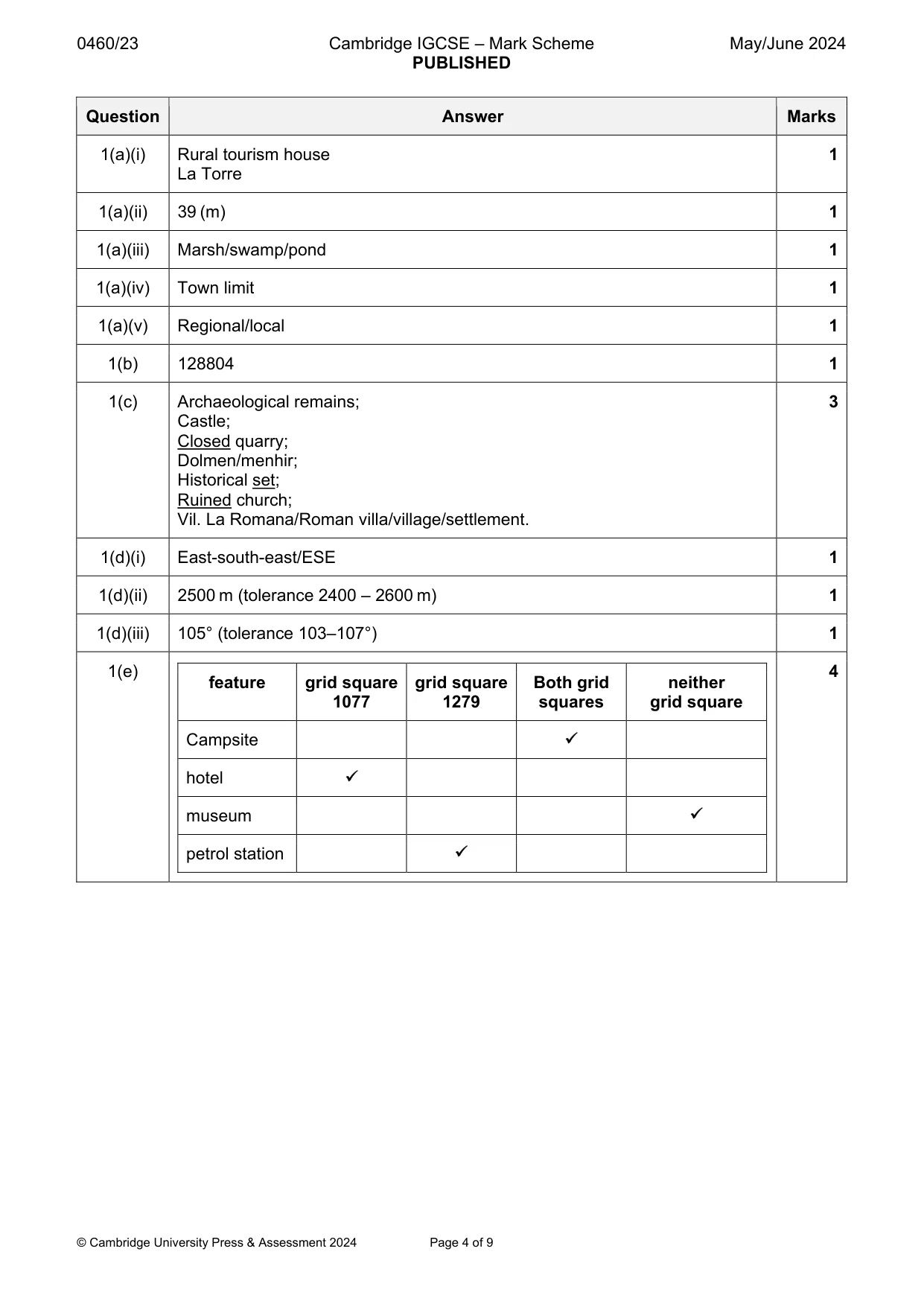
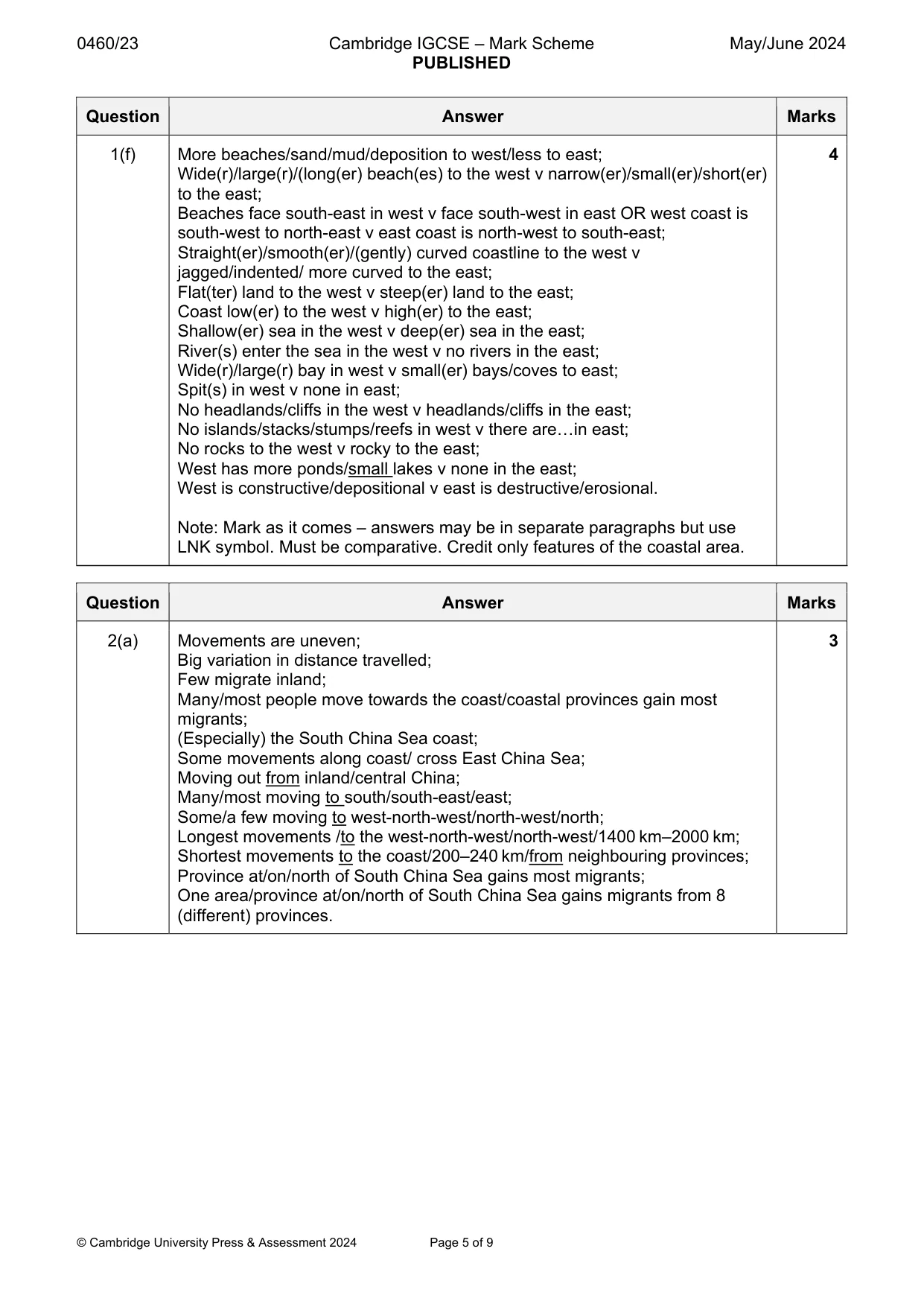
Mark scheme: Question Answer Marks 1(a)(i) Rural tourism house 1 La Torre 1(a)(ii) 39 (m) 1 1(a)(iii) Marsh/swamp/pond 1 1(a)(iv) Town limit 1 1(a)(v) Regional/local 1 1(b) 128804 1 1(c) Archaeological remains; 3 Castle; Closed quarry; Dolmen/menhir; Historical set; Ruined church; Vil. La Romana/Roman villa/village/settlement. 1(d)(i) East-south-east/ESE 1 1(d)(ii) 2500 m (tolerance 2400 – 2600 m) 1 1(d)(iii) 105° (tolerance 103–107°) 1 1(e) 4 feature grid square grid square Both grid neither 1077 1279 squares grid square Campsite hotel museum petrol station 1(f) More beaches/sand/mud/deposition to west/less to east; 4 Wide(r)/large(r)/(long(er) beach(es) to the west v narrow(er)/small(er)/short(er) to the east; Beaches face south-east in west v face south-west in east OR west coast is south-west to north-east v east coast is north-west to south-east; Straight(er)/smooth(er)/(gently) curved coastline to the west v jagged/indented/ more curved to the east; Flat(ter) land to the west v steep(er) land to the east; Coast low(er) to the west v high(er) to the east; Shallow(er) sea in the west v deep(er) sea in the east; River(s) enter the sea in the west v no rivers in the east; Wide(r)/large(r) bay in west v small(er) bays/coves to east; Spit(s) in west v none in east; No headlands/cliffs in the west v headlands/cliffs in the east; No islands/stacks/stumps/reefs in west v there are…in east; No rocks to the west v rocky to the east; West has more ponds/small lakes v none in the east; West is constructive/depositional v east is destructive/erosional. Note: Mark as it comes – answers may be in separate paragraphs but use LNK symbol. Must be comparative. Credit only features of the coastal area.
More questions on Settlements (rural and urban) and service provision
Question 2
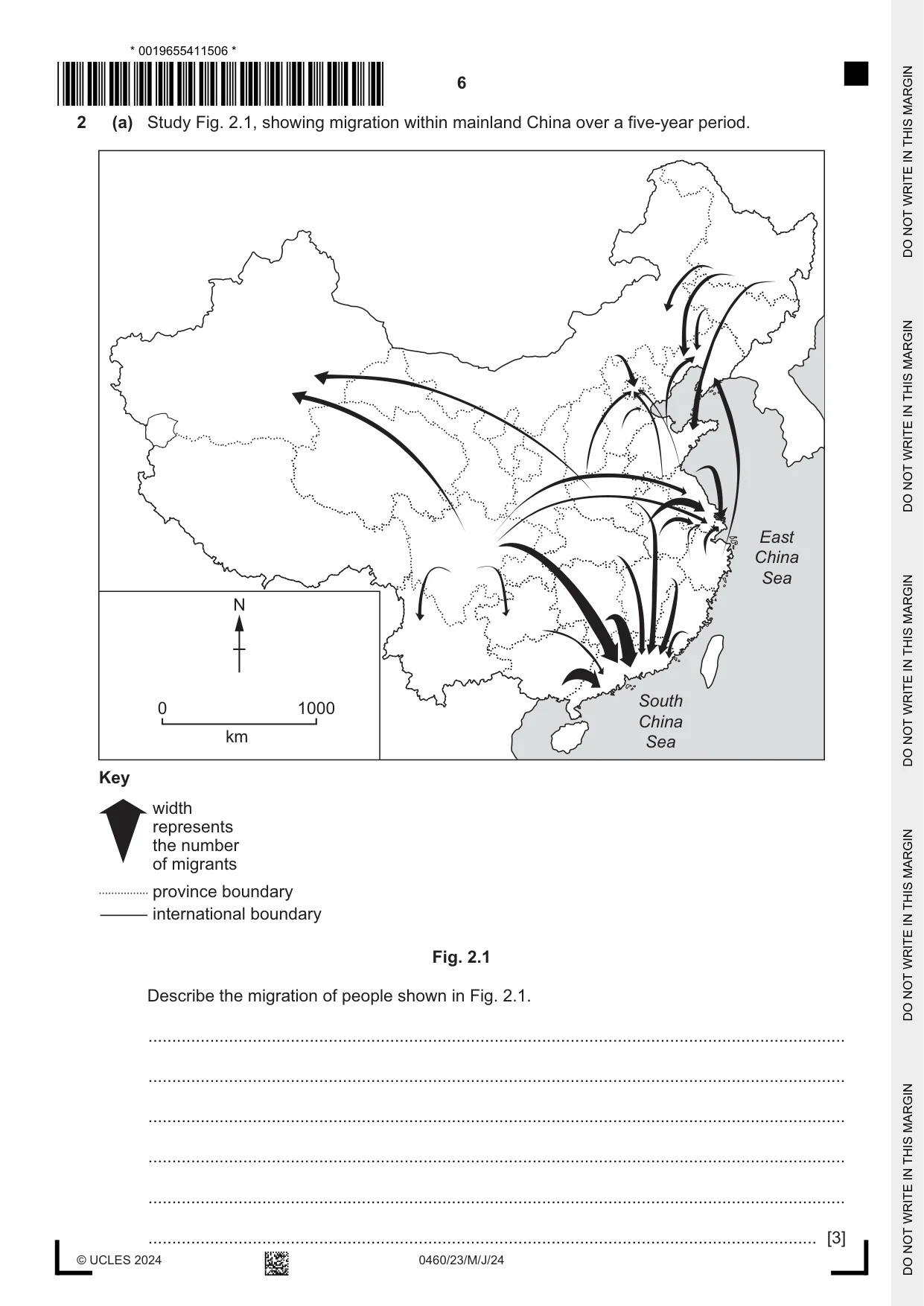
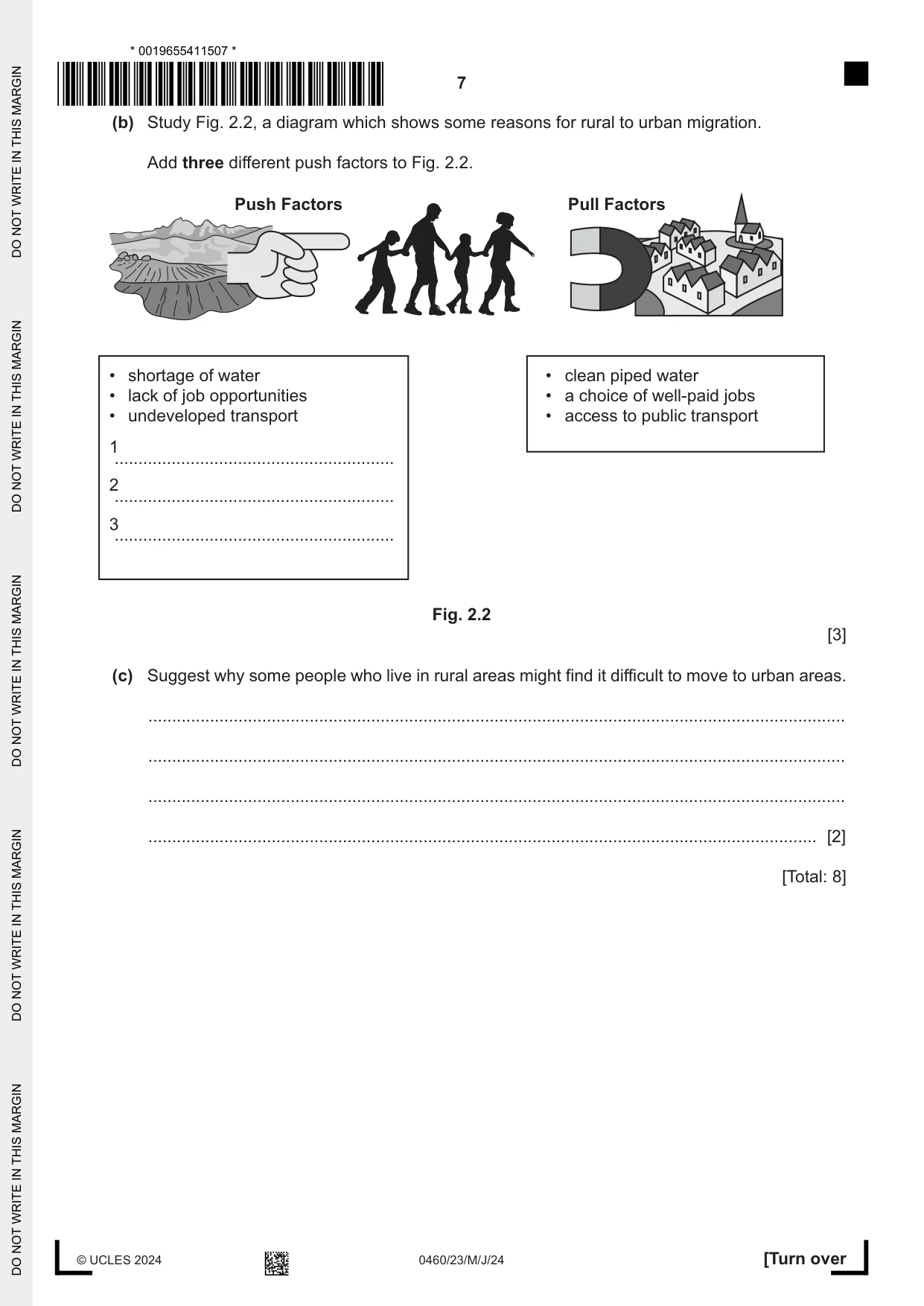
2 (a) Study Fig. 2.1, showing migration within mainland China over a five-year period. East China Sea N South 0 1000 China km Sea Key width represents the number of migrants province boundary international boundary Fig. 2.1 Describe the migration of people shown in Fig. 2.1. ................................................................................................................................................... ................................................................................................................................................... ................................................................................................................................................... ................................................................................................................................................... ................................................................................................................................................... ............................................................................................................................................. [3] (b) Study Fig. 2.2, a diagram which shows some reasons for rural to urban migration. Add three different push factors to Fig. 2.2. Push Factors Pull Factors • shortage of water • clean piped water • lack of job opportunities • a choice of well-paid jobs • undeveloped transport • access to public transport 1 ........................................................... 2 ........................................................... 3 ........................................................... Fig. 2.2 [3] (c) Suggest why some people who live in rural areas might find it difficult to move to urban areas. ................................................................................................................................................... ................................................................................................................................................... ................................................................................................................................................... ............................................................................................................................................. [2] [Total: 8]
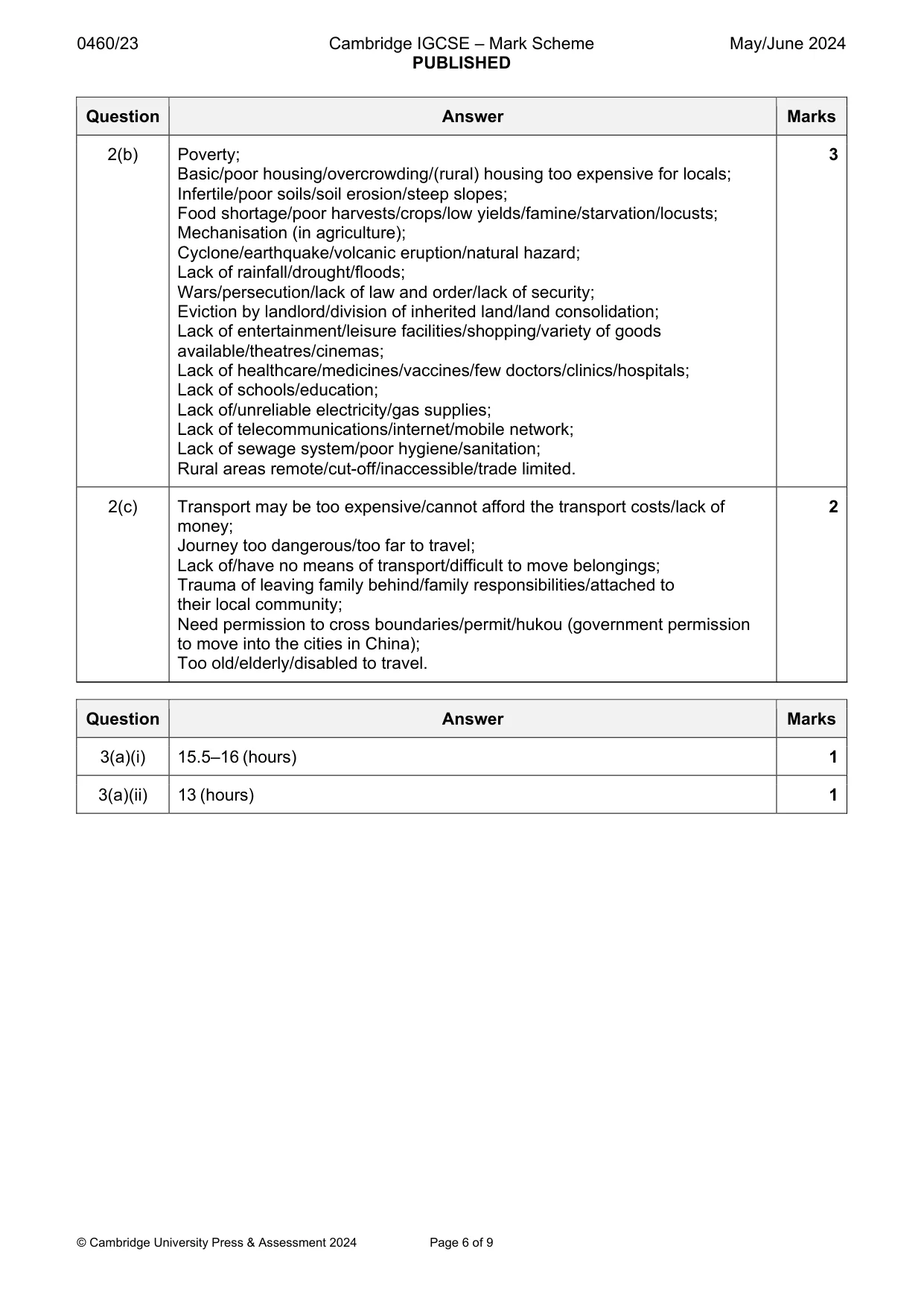
Mark scheme: 2(a) Movements are uneven; 3 Big variation in distance travelled; Few migrate inland; Many/most people move towards the coast/coastal provinces gain most migrants; (Especially) the South China Sea coast; Some movements along coast/ cross East China Sea; Moving out from inland/central China; Many/most moving to south/south-east/east; Some/a few moving to west-north-west/north-west/north; Longest movements /to the west-north-west/north-west/1400 km–2000 km; Shortest movements to the coast/200–240 km/from neighbouring provinces; Province at/on/north of South China Sea gains most migrants; One area/province at/on/north of South China Sea gains migrants from 8 (different) provinces. 2(b) Poverty; 3 Basic/poor housing/overcrowding/(rural) housing too expensive for locals; Infertile/poor soils/soil erosion/steep slopes; Food shortage/poor harvests/crops/low yields/famine/starvation/locusts; Mechanisation (in agriculture); Cyclone/earthquake/volcanic eruption/natural hazard; Lack of rainfall/drought/floods; Wars/persecution/lack of law and order/lack of security; Eviction by landlord/division of inherited land/land consolidation; Lack of entertainment/leisure facilities/shopping/variety of goods available/theatres/cinemas; Lack of healthcare/medicines/vaccines/few doctors/clinics/hospitals; Lack of schools/education; Lack of/unreliable electricity/gas supplies; Lack of telecommunications/internet/mobile network; Lack of sewage system/poor hygiene/sanitation; Rural areas remote/cut-off/inaccessible/trade limited. 2(c) Transport may be too expensive/cannot afford the transport costs/lack of 2 money; Journey too dangerous/too far to travel; Lack of/have no means of transport/difficult to move belongings; Trauma of leaving family behind/family responsibilities/attached to their local community; Need permission to cross boundaries/permit/hukou (government permission to move into the cities in China); Too old/elderly/disabled to travel.
Question 3
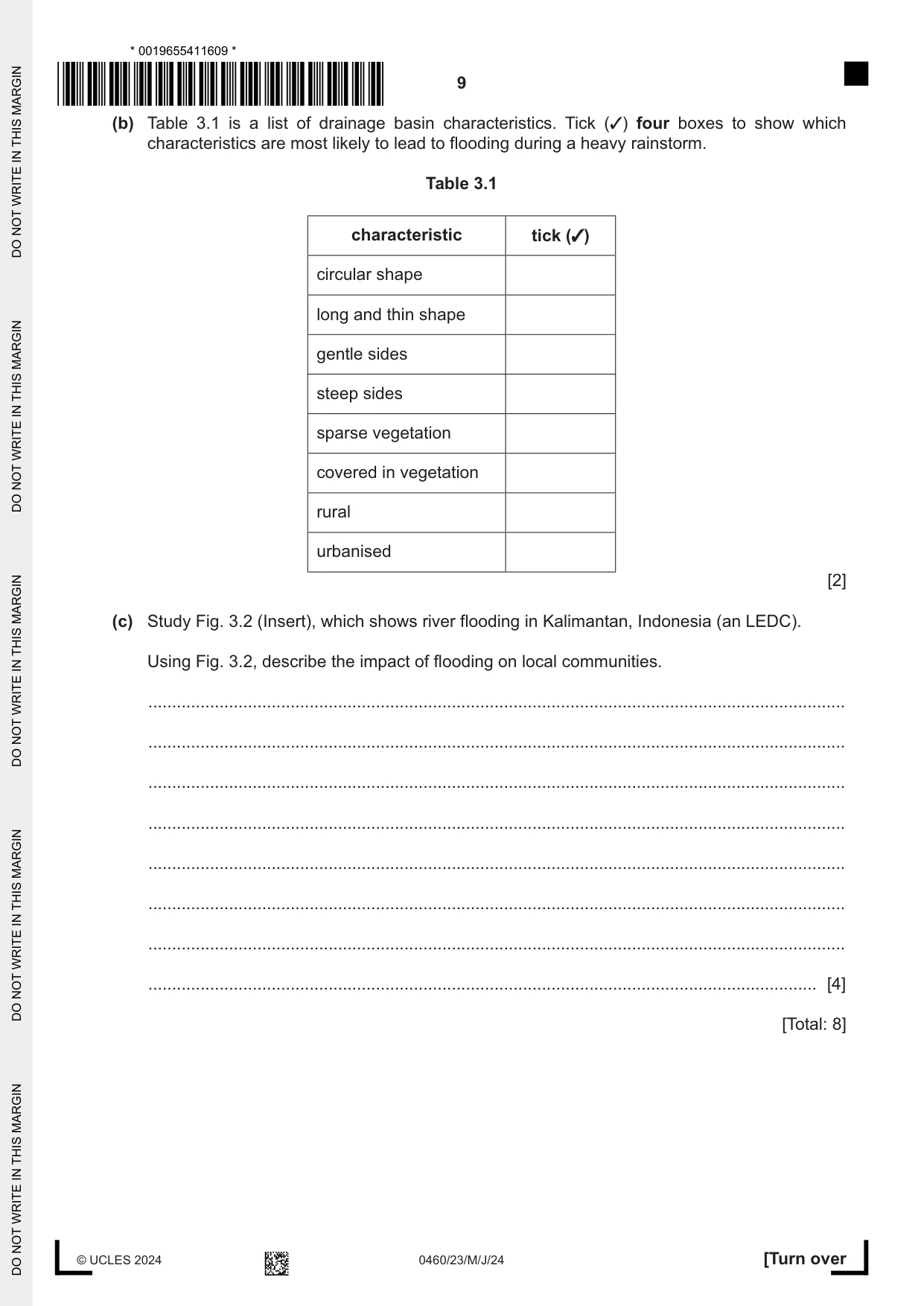
3 (a) Study Fig. 3.1, a storm hydrograph for a drainage basin. Content removed due to copyright restrictions. Fig. 3.1 (i) How many hours after the start of the rainfall will flooding begin? ............................. hrs [1] (ii) Calculate the time between the peak rainfall and peak discharge. ............................. hrs [1] (b) Table 3.1 is a list of drainage basin characteristics. Tick (✓) four boxes to show which characteristics are most likely to lead to flooding during a heavy rainstorm. Table 3.1 characteristic tick (✓) circular shape long and thin shape gentle sides steep sides sparse vegetation covered in vegetation rural urbanised [2] (c) Study Fig. 3.2 (Insert), which shows river flooding in Kalimantan, Indonesia (an LEDC). Using Fig. 3.2, describe the impact of flooding on local communities. ................................................................................................................................................... ................................................................................................................................................... ................................................................................................................................................... ................................................................................................................................................... ................................................................................................................................................... ................................................................................................................................................... ................................................................................................................................................... ............................................................................................................................................. [4] [Total: 8]
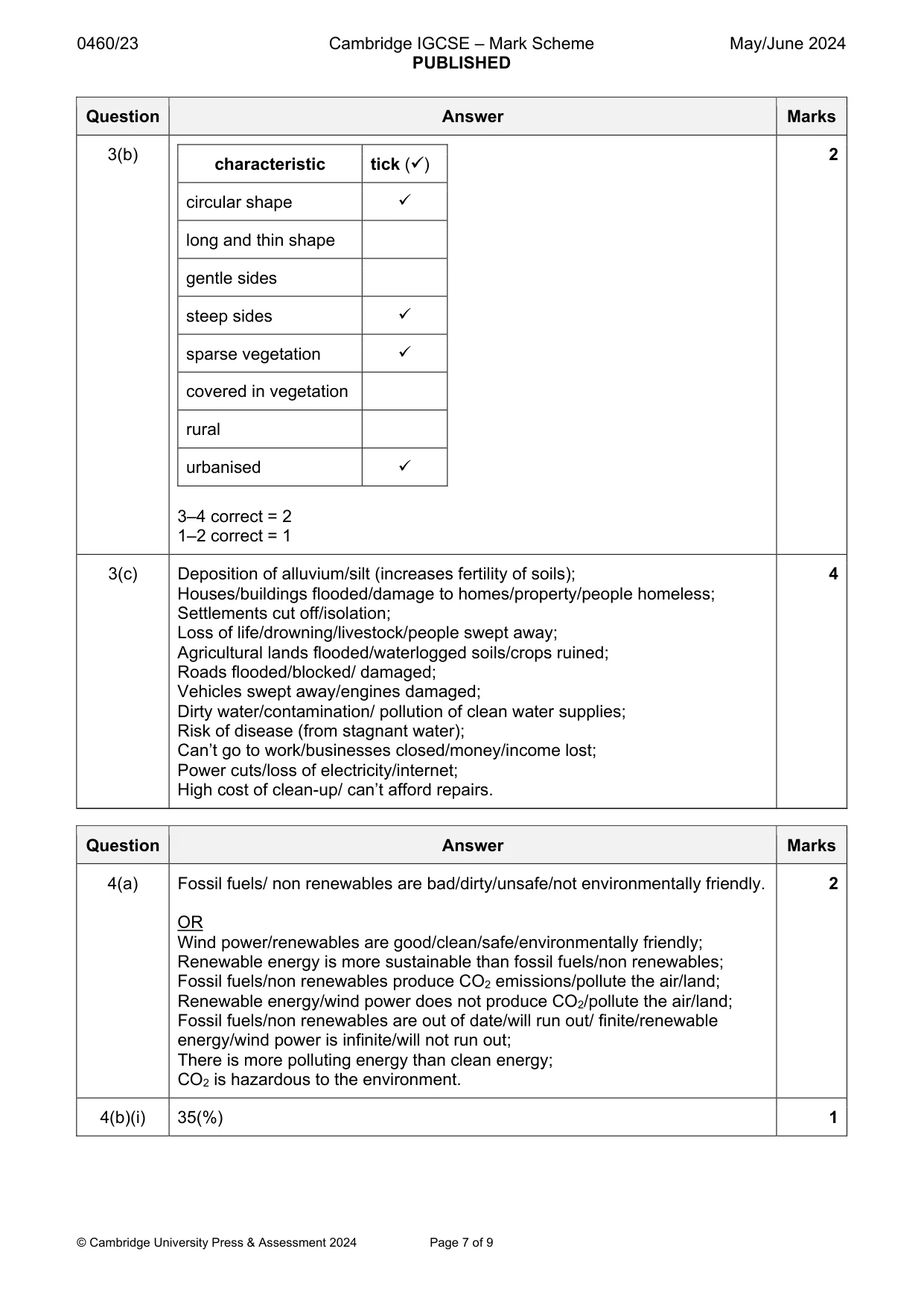
Mark scheme: 3(a)(i) 15.5–16 (hours) 1 3(a)(ii) 13 (hours) 1 3(b) 2 characteristic tick () circular shape long and thin shape gentle sides steep sides sparse vegetation covered in vegetation rural urbanised 3–4 correct = 2 1–2 correct = 1 3(c) Deposition of alluvium/silt (increases fertility of soils); 4 Houses/buildings flooded/damage to homes/property/people homeless; Settlements cut off/isolation; Loss of life/drowning/livestock/people swept away; Agricultural lands flooded/waterlogged soils/crops ruined; Roads flooded/blocked/ damaged; Vehicles swept away/engines damaged; Dirty water/contamination/ pollution of clean water supplies; Risk of disease (from stagnant water); Can’t go to work/businesses closed/money/income lost; Power cuts/loss of electricity/internet; High cost of clean-up/ can’t afford repairs.
Question 4
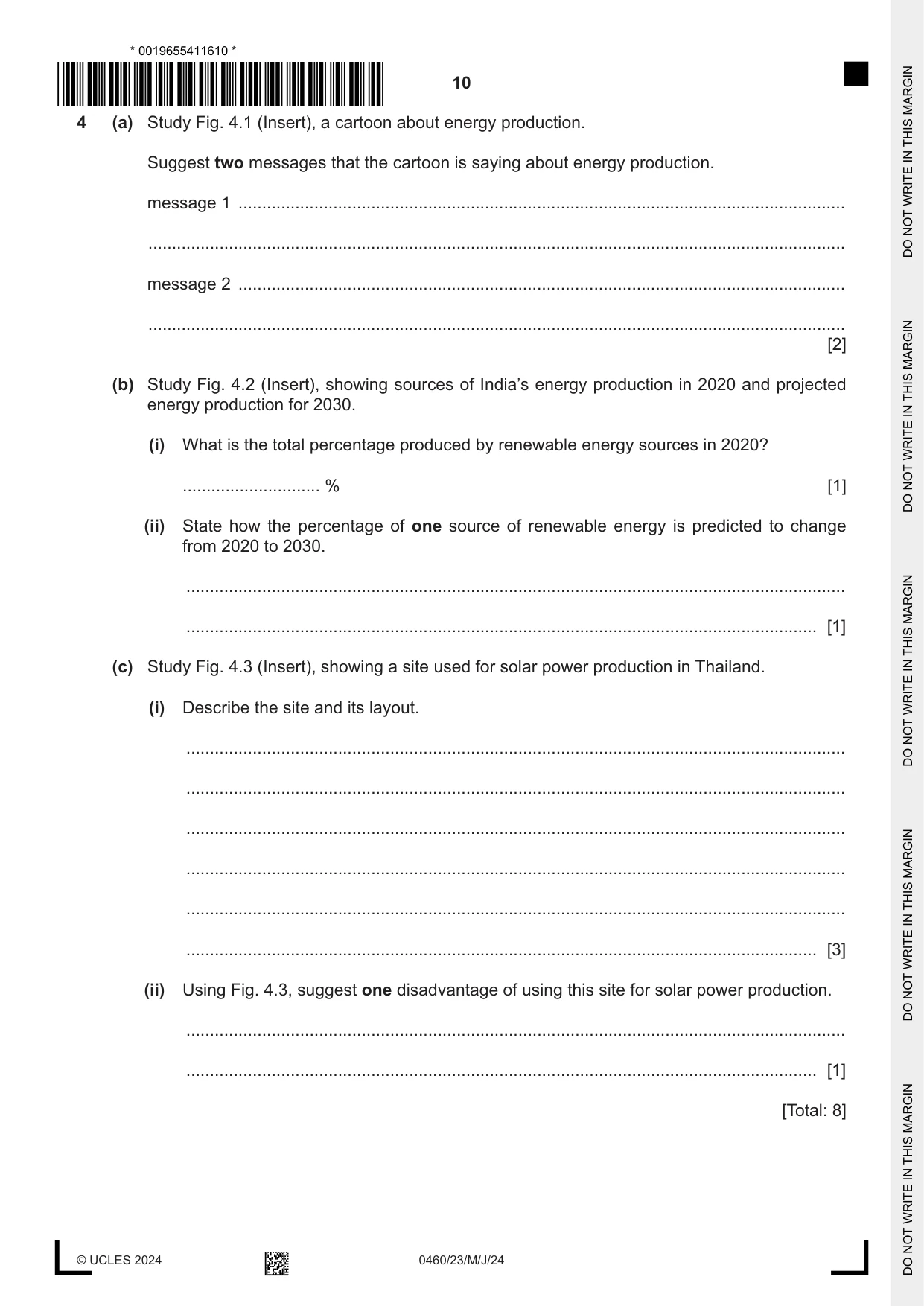
4 (a) Study Fig. 4.1 (Insert), a cartoon about energy production. Suggest two messages that the cartoon is saying about energy production. message 1 ................................................................................................................................ ................................................................................................................................................... message 2 ................................................................................................................................ ................................................................................................................................................... [2] (b) Study Fig. 4.2 (Insert), showing sources of India’s energy production in 2020 and projected energy production for 2030. (i) What is the total percentage produced by renewable energy sources in 2020? ............................. % [1] (ii) State how the percentage of one source of renewable energy is predicted to change from 2020 to 2030. ........................................................................................................................................... ..................................................................................................................................... [1] (c) Study Fig. 4.3 (Insert), showing a site used for solar power production in Thailand. (i) Describe the site and its layout. ........................................................................................................................................... ........................................................................................................................................... ........................................................................................................................................... ........................................................................................................................................... ........................................................................................................................................... ..................................................................................................................................... [3] (ii) Using Fig. 4.3, suggest one disadvantage of using this site for solar power production. ........................................................................................................................................... ..................................................................................................................................... [1] [Total: 8]
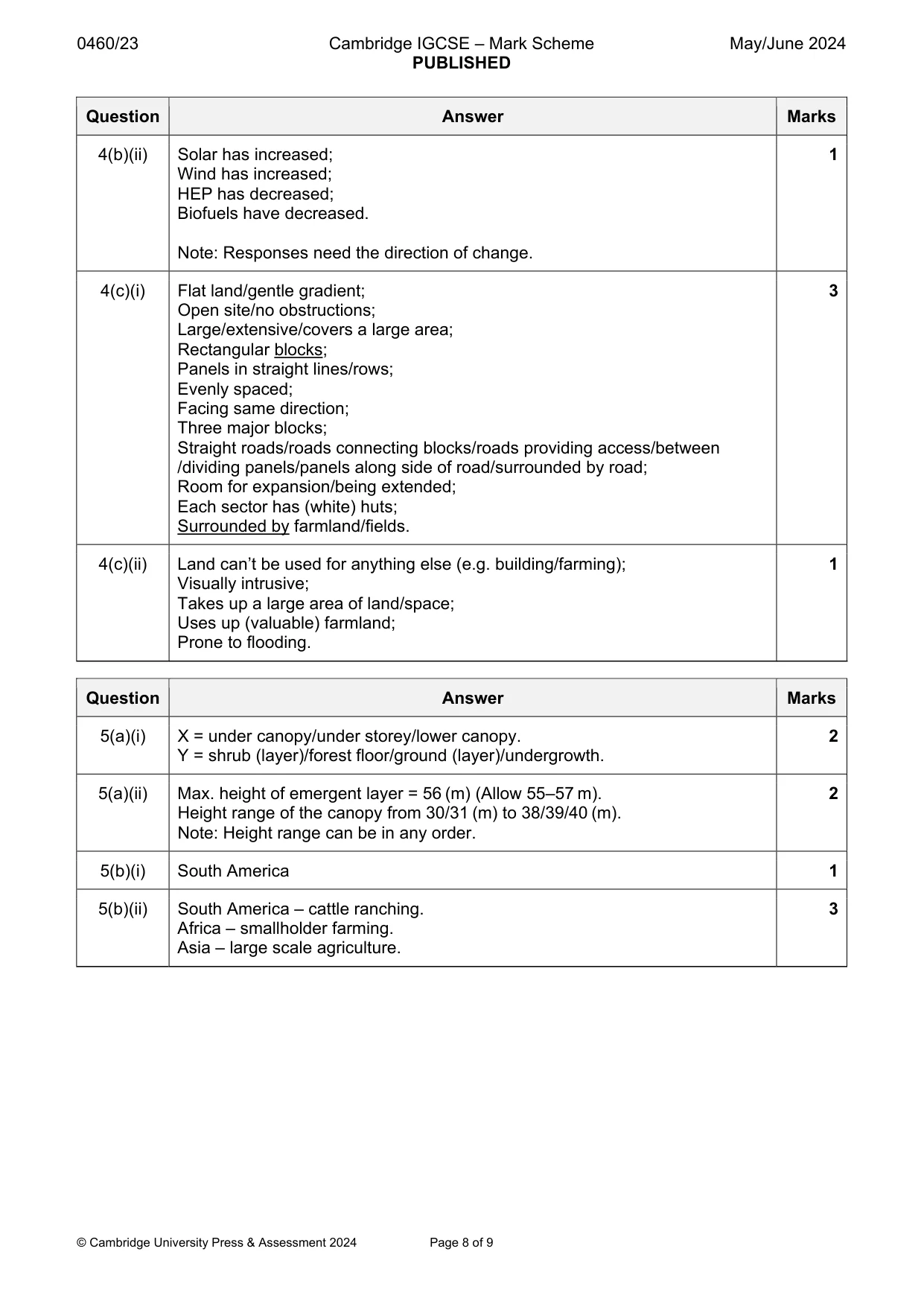
Mark scheme: 4(a) Fossil fuels/ non renewables are bad/dirty/unsafe/not environmentally friendly. 2 OR Wind power/renewables are good/clean/safe/environmentally friendly; Renewable energy is more sustainable than fossil fuels/non renewables; Fossil fuels/non renewables produce CO2 emissions/pollute the air/land; Renewable energy/wind power does not produce CO2/pollute the air/land; Fossil fuels/non renewables are out of date/will run out/ finite/renewable energy/wind power is infinite/will not run out; There is more polluting energy than clean energy; CO2 is hazardous to the environment. 4(b)(i) 35(%) 1 4(b)(ii) Solar has increased; 1 Wind has increased; HEP has decreased; Biofuels have decreased. Note: Responses need the direction of change. 4(c)(i) Flat land/gentle gradient; 3 Open site/no obstructions; Large/extensive/covers a large area; Rectangular blocks; Panels in straight lines/rows; Evenly spaced; Facing same direction; Three major blocks; Straight roads/roads connecting blocks/roads providing access/between /dividing panels/panels along side of road/surrounded by road; Room for expansion/being extended; Each sector has (white) huts; Surrounded by farmland/fields. 4(c)(ii) Land can’t be used for anything else (e.g. building/farming); 1 Visually intrusive; Takes up a large area of land/space; Uses up (valuable) farmland; Prone to flooding.
Question 5
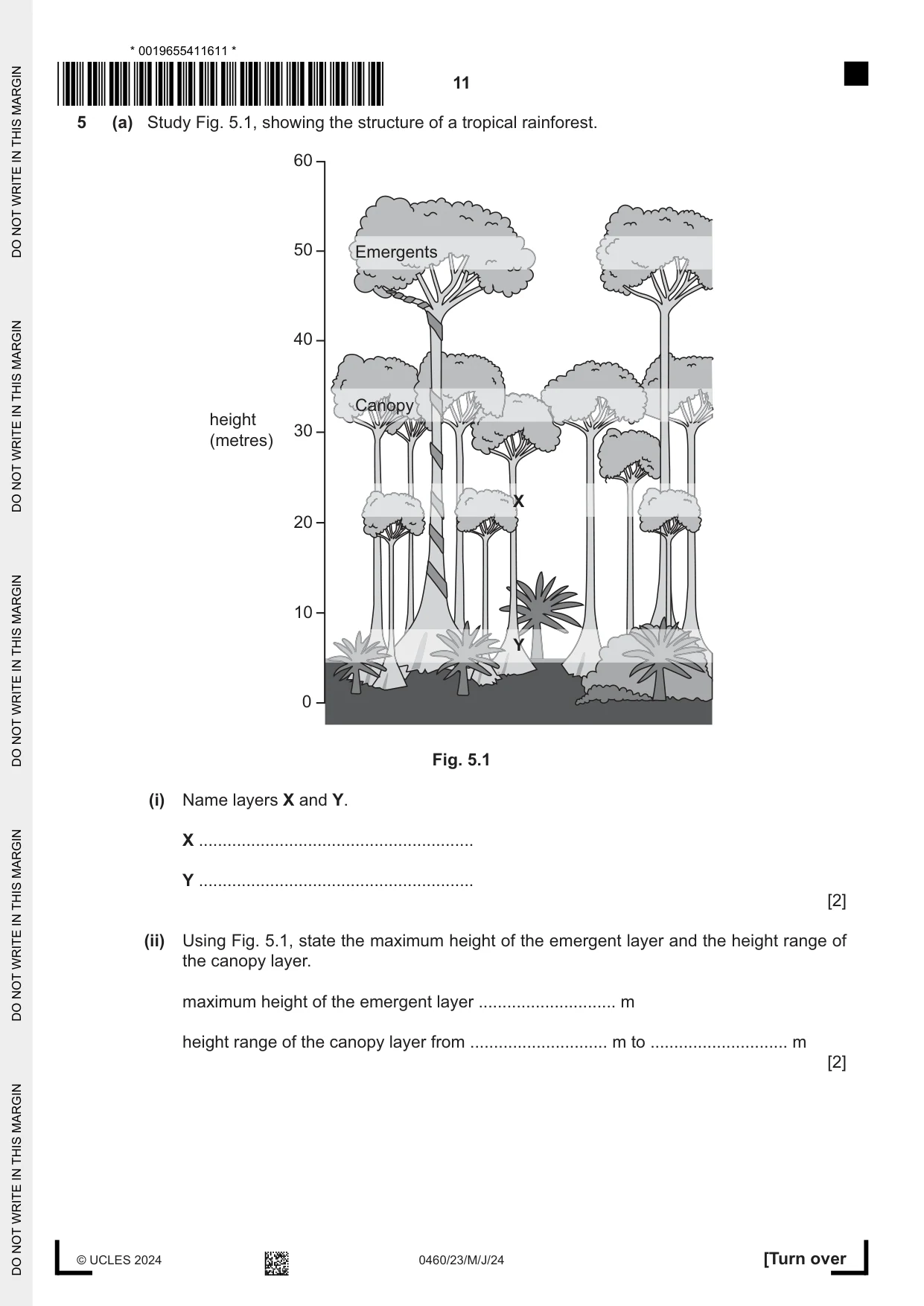
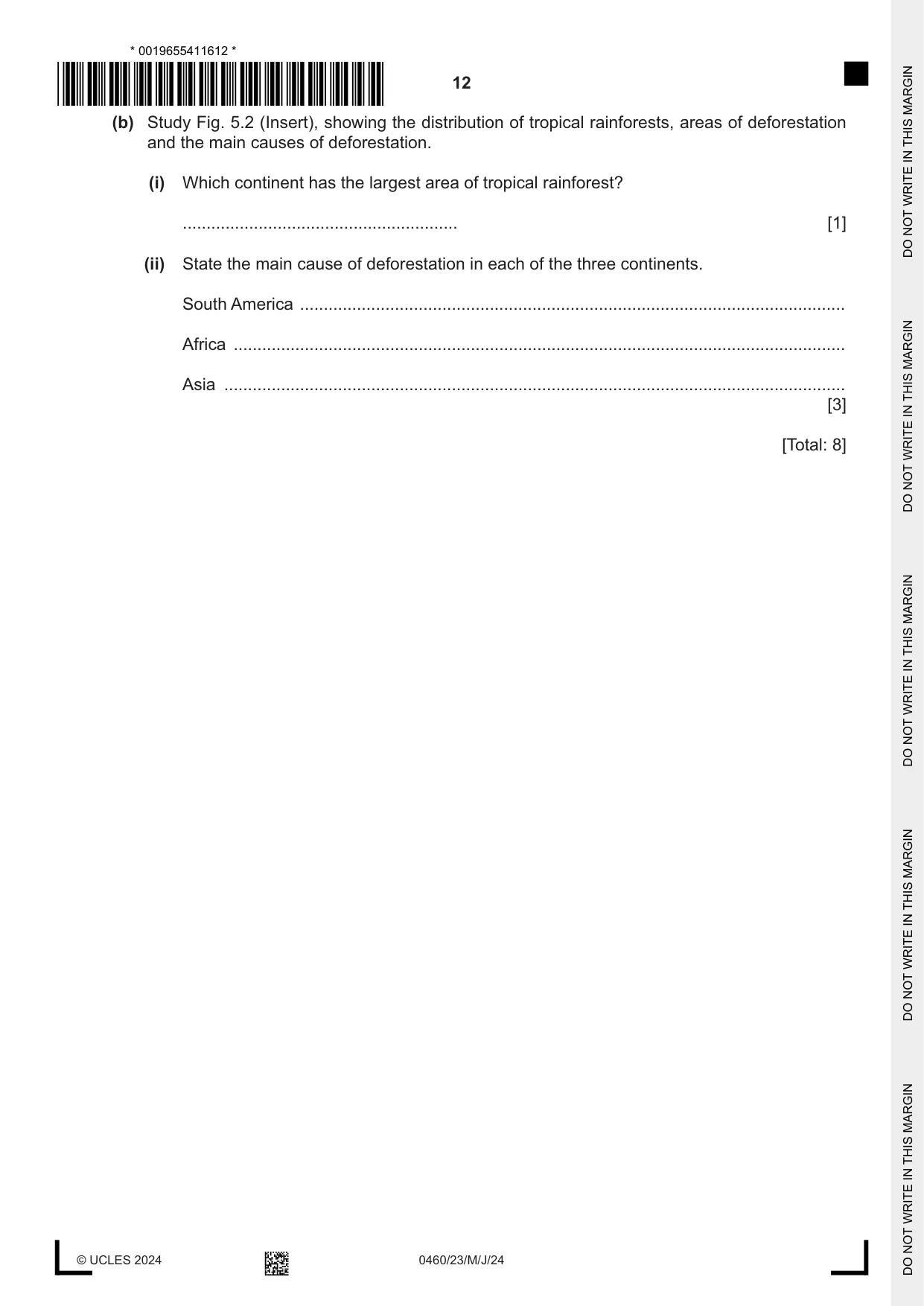
5 (a) Study Fig. 5.1, showing the structure of a tropical rainforest. 60 50 Emergents 40 Canopy height 30 (metres) X 20 10 Y 0 Fig. 5.1 (i) Name layers X and Y. X .......................................................... Y .......................................................... [2] (ii) Using Fig. 5.1, state the maximum height of the emergent layer and the height range of the canopy layer. maximum height of the emergent layer ............................. m height range of the canopy layer from ............................. m to ............................. m [2] (b) Study Fig. 5.2 (Insert), showing the distribution of tropical rainforests, areas of deforestation and the main causes of deforestation. (i) Which continent has the largest area of tropical rainforest? .......................................................... [1] (ii) State the main cause of deforestation in each of the three continents. South America ................................................................................................................... Africa ................................................................................................................................. Asia ................................................................................................................................... [3] [Total: 8]
Mark scheme: 5(a)(i) X = under canopy/under storey/lower canopy. 2 Y = shrub (layer)/forest floor/ground (layer)/undergrowth. 5(a)(ii) Max. height of emergent layer = 56 (m) (Allow 55–57 m). 2 Height range of the canopy from 30/31 (m) to 38/39/40 (m). Note: Height range can be in any order. 5(b)(i) South America 1 5(b)(ii) South America – cattle ranching. 3 Africa – smallholder farming. Asia – large scale agriculture.
Question 6
6 (a) Study Fig. 6.1 (Insert), showing the distribution of squatter settlements in Cairo, Egypt. Describe the distribution of squatter settlements. ................................................................................................................................................... ................................................................................................................................................... ................................................................................................................................................... ................................................................................................................................................... ................................................................................................................................................... ............................................................................................................................................. [3] (b) Study Figs. 6.2 and 6.3 (Insert), showing two squatter settlements. Suggest reasons why people who live in the squatter settlement in Fig. 6.2 might have a better quality of life than those who live in the squatter settlement in Fig. 6.3. ................................................................................................................................................... ................................................................................................................................................... ................................................................................................................................................... ................................................................................................................................................... ................................................................................................................................................... ................................................................................................................................................... ................................................................................................................................................... ................................................................................................................................................... ................................................................................................................................................... ............................................................................................................................................. [5] [Total: 8] Additional pages If you use the following pages to complete the answer to any question, the question number must be clearly shown. .................................................................................................................................................................. .................................................................................................................................................................. .................................................................................................................................................................. .................................................................................................................................................................. .................................................................................................................................................................. .................................................................................................................................................................. .................................................................................................................................................................. .................................................................................................................................................................. .................................................................................................................................................................. .................................................................................................................................................................. .................................................................................................................................................................. .................................................................................................................................................................. .................................................................................................................................................................. .................................................................................................................................................................. .................................................................................................................................................................. .................................................................................................................................................................. .................................................................................................................................................................. .................................................................................................................................................................. .................................................................................................................................................................. .................................................................................................................................................................. .................................................................................................................................................................. .................................................................................................................................................................. .................................................................................................................................................................. .................................................................................................................................................................. .................................................................................................................................................................. .................................................................................................................................................................. .................................................................................................................................................................. .................................................................................................................................................................. .................................................................................................................................................................. .................................................................................................................................................................. .................................................................................................................................................................. .................................................................................................................................................................. .................................................................................................................................................................. .................................................................................................................................................................. .................................................................................................................................................................. .................................................................................................................................................................. .................................................................................................................................................................. .................................................................................................................................................................. .................................................................................................................................................................. .................................................................................................................................................................. .................................................................................................................................................................. .................................................................................................................................................................. .................................................................................................................................................................. .................................................................................................................................................................. .................................................................................................................................................................. .................................................................................................................................................................. .................................................................................................................................................................. .................................................................................................................................................................. .................................................................................................................................................................. .................................................................................................................................................................. .................................................................................................................................................................. .................................................................................................................................................................. ..................................................................................................................................................................
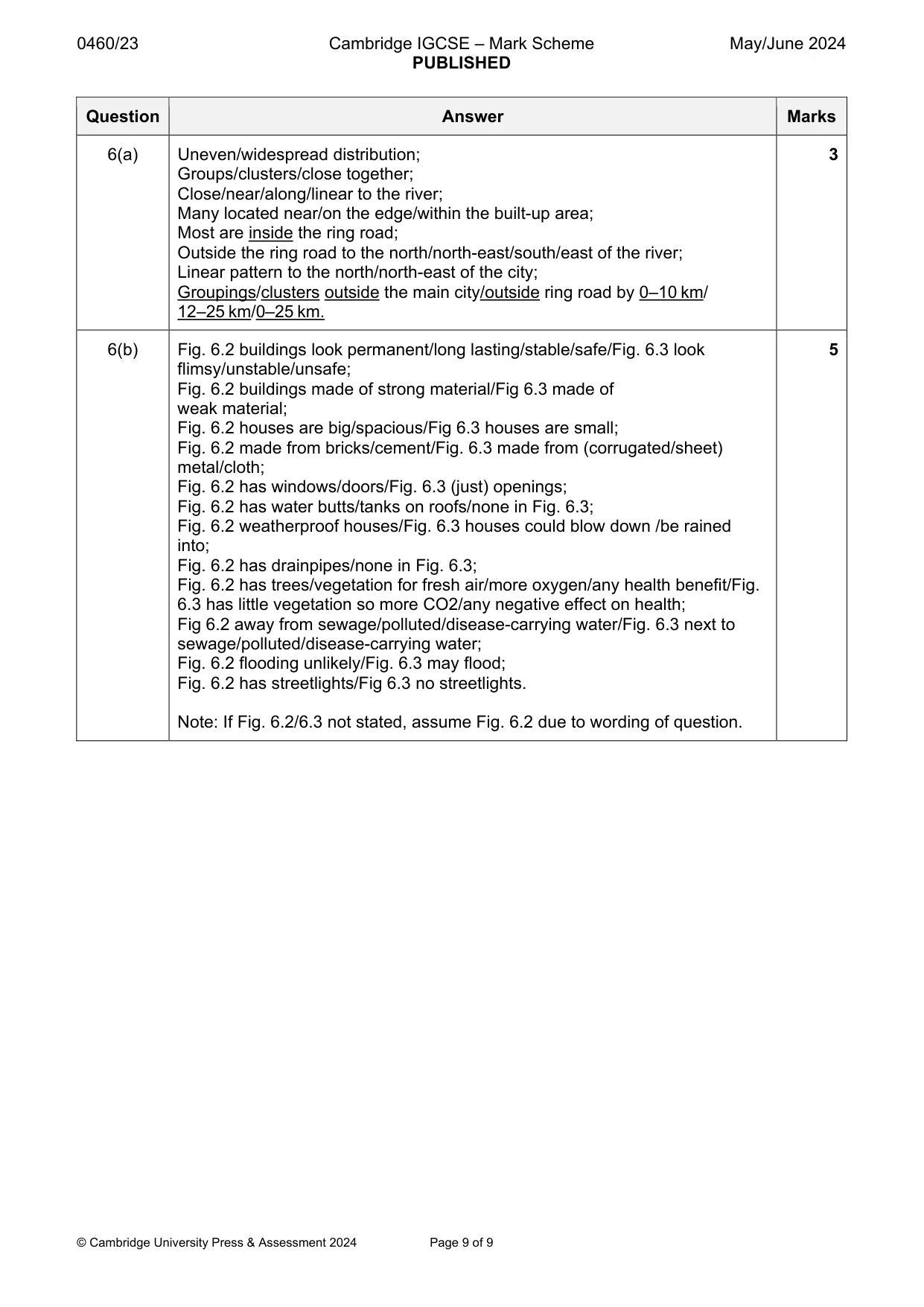
Mark scheme: 6(a) Uneven/widespread distribution; 3 Groups/clusters/close together; Close/near/along/linear to the river; Many located near/on the edge/within the built-up area; Most are inside the ring road; Outside the ring road to the north/north-east/south/east of the river; Linear pattern to the north/north-east of the city; Groupings/clusters outside the main city/outside ring road by 0–10 km/ 12–25 km/0–25 km. 6(b) Fig. 6.2 buildings look permanent/long lasting/stable/safe/Fig. 6.3 look 5 flimsy/unstable/unsafe; Fig. 6.2 buildings made of strong material/Fig 6.3 made of weak material; Fig. 6.2 houses are big/spacious/Fig 6.3 houses are small; Fig. 6.2 made from bricks/cement/Fig. 6.3 made from (corrugated/sheet) metal/cloth; Fig. 6.2 has windows/doors/Fig. 6.3 (just) openings; Fig. 6.2 has water butts/tanks on roofs/none in Fig. 6.3; Fig. 6.2 weatherproof houses/Fig. 6.3 houses could blow down /be rained into; Fig. 6.2 has drainpipes/none in Fig. 6.3; Fig. 6.2 has trees/vegetation for fresh air/more oxygen/any health benefit/Fig. 6.3 has little vegetation so more CO2/any negative effect on health; Fig 6.2 away from sewage/polluted/disease-carrying water/Fig. 6.3 next to sewage/polluted/disease-carrying water; Fig. 6.2 flooding unlikely/Fig. 6.3 may flood; Fig. 6.2 has streetlights/Fig 6.3 no streetlights. Note: If Fig. 6.2/6.3 not stated, assume Fig. 6.2 due to wording of question.
What was in this paper
The subtopics covered by these 6 questions, and how many questions each got. Open one in a new tab to see every Cambridge question on it.
What you needed in this session
Cambridge’s own grade thresholds for 2024 May/June, Paper 2 · Variant 3. A higher threshold means an easier paper — the bar moves with how the cohort did.