Cambridge IGCSE Geography 0460 — 2017 Oct/Nov Paper 2 · Variant 3
0460/23/O/N/17 · 6 questions · 60 marks · ≈68 min
The question paper and its mark scheme, free to read here and free to download. This is Cambridge’s own paper, exactly as it was sat.
Question paper16 pages
Mark scheme5 pages
Answers below. Sit the paper first if you are practising.
Questions as text
Q1 · Study the map extract, which is for Mesnali, Norway
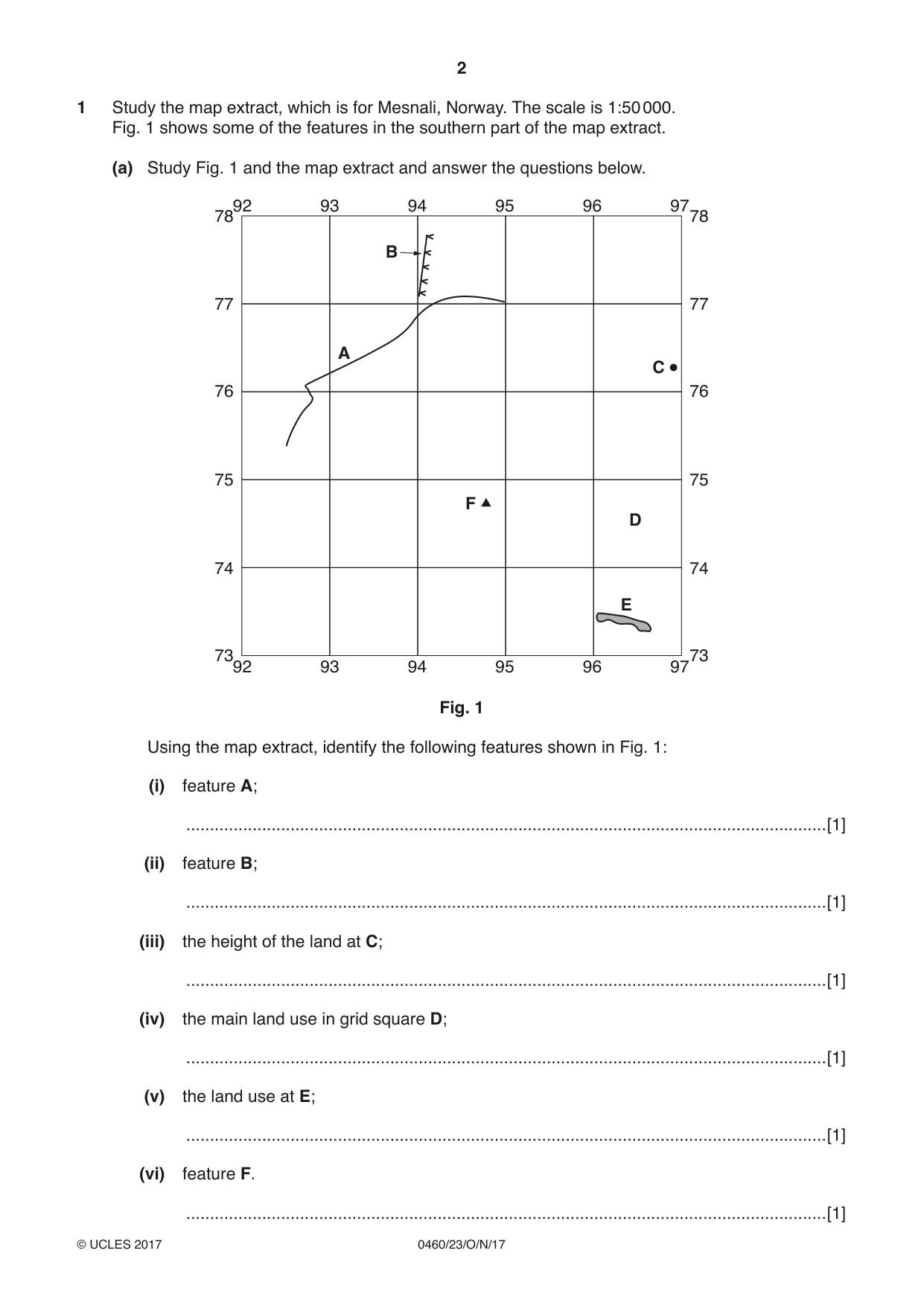
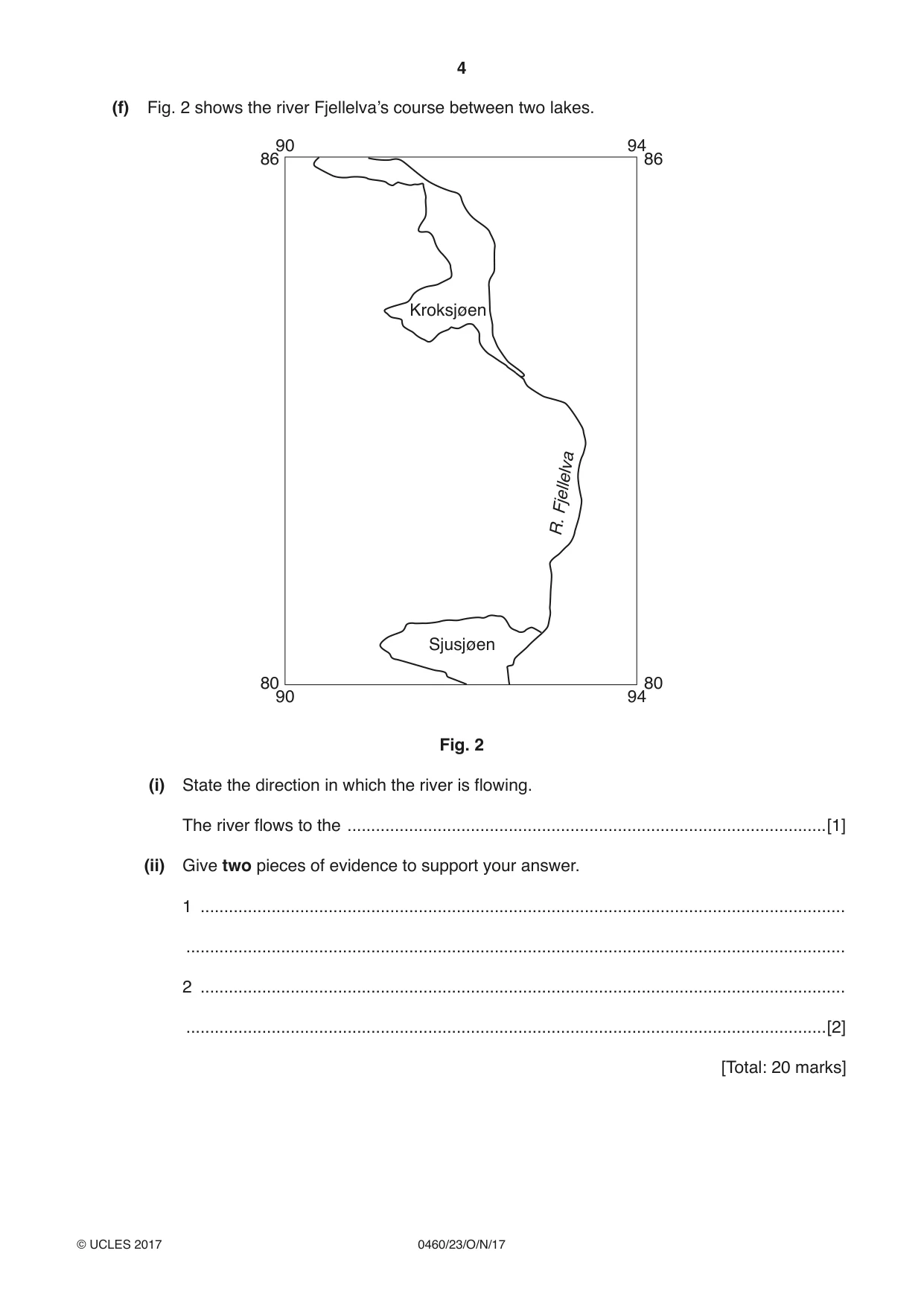
1 Study the map extract, which is for Mesnali, Norway. The scale is 1:50 000. Fig. 1 shows some of the features in the southern part of the map extract. (a) Study Fig. 1 and the map extract and answer the questions below. 92 93 94 95 96 97 78 78 B 77 77 A C 76 76 75 75 F D 74 74 E 73 73 92 93 94 95 96 97 Fig. 1 Using the map extract, identify the following features shown in Fig. 1: (i) feature A; .......................................................................................................................................[1] (ii) feature B; .......................................................................................................................................[1] (iii) the height of the land at C; .......................................................................................................................................[1] (iv) the main land use in grid square D; .......................................................................................................................................[1] (v) the land use at E; .......................................................................................................................................[1] (vi) feature F. .......................................................................................................................................[1] (b) List three services in the settlement of Mesnali. 1 ................................................................................................................................................ 2 ................................................................................................................................................ 3 ............................................................................................................................................[3] (c) Identify ways in which the settlement of Mesnali differs from that of Nattrudstilen. Do not write about services. ................................................................................................................................................... ................................................................................................................................................... ................................................................................................................................................... ................................................................................................................................................... ................................................................................................................................................... ...............................................................................................................................................[3] (d) Describe the relief of Snørvillen in grid squares 9581 and 9681. ................................................................................................................................................... ................................................................................................................................................... ................................................................................................................................................... ................................................................................................................................................... ................................................................................................................................................... ...............................................................................................................................................[3] (e) (i) Measure the distance along the power line from the junction of power lines in Mesnali at 911755 to where the power line leaves the southern edge of the map in grid square 9773. Give your answer in metres. ................................................... metres [1] (ii) State the bearing of the power line from the junction of power lines in 9175 to where the power line leaves the southern edge of the map in grid square 9773. ................................................... degrees [1] (f) Fig. 2 shows the river Fjellelva’s course between two lakes. 90 94 86 86 Kroksjøen Fjellelva R. Sjusjøen 80 80 90 94 Fig. 2 (i) State the direction in which the river is flowing. The river flows to the .....................................................................................................[1] (ii) Give two pieces of evidence to support your answer. 1 ........................................................................................................................................ ........................................................................................................................................... 2 ........................................................................................................................................ .......................................................................................................................................[2] [Total: 20 marks]
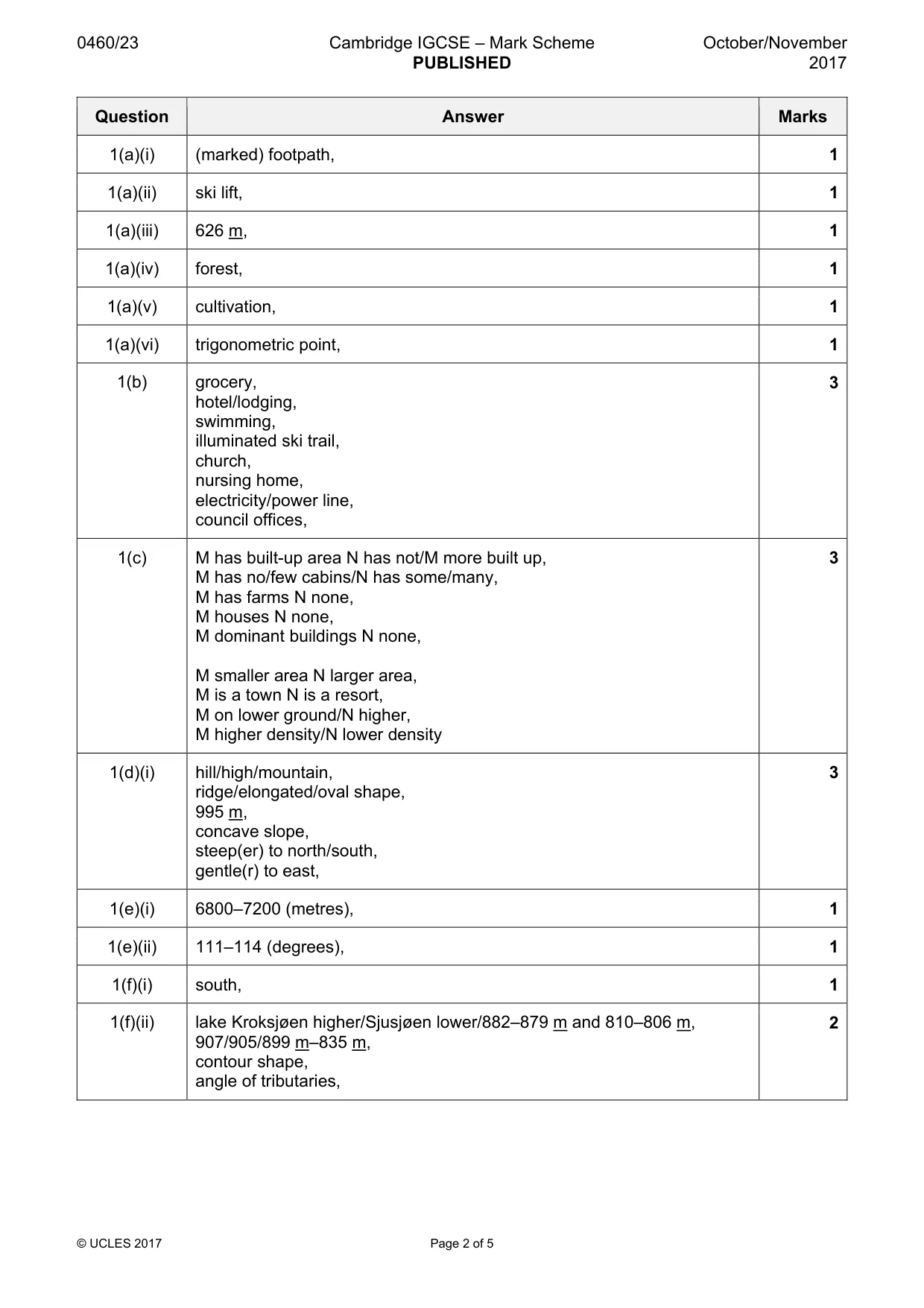
Mark scheme: Question Answer Marks 1(a)(i) (marked) footpath, 1 1(a)(ii) ski lift, 1 1(a)(iii) 626 m, 1 1(a)(iv) forest, 1 1(a)(v) cultivation, 1 1(a)(vi) trigonometric point, 1 1(b) grocery, 3 hotel/lodging, swimming, illuminated ski trail, church, nursing home, electricity/power line, council offices, 1(c) M has built-up area N has not/M more built up, 3 M has no/few cabins/N has some/many, M has farms N none, M houses N none, M dominant buildings N none, M smaller area N larger area, M is a town N is a resort, M on lower ground/N higher, M higher density/N lower density 1(d)(i) hill/high/mountain, 3 ridge/elongated/oval shape, 995 m, concave slope, steep(er) to north/south, gentle(r) to east, 1(e)(i) 6800–7200 (metres), 1 1(e)(ii) 111–114 (degrees), 1 1(f)(i) south, 1 1(f)(ii) lake Kroksjøen higher/Sjusjøen lower/882–879 m and 810–806 m, 2 907/905/899 m–835 m, contour shape, angle of tributaries,
More questions on Settlements (rural and urban) and service provision
Q2 · Study Photographs A and B (Insert), which show areas important for tourism
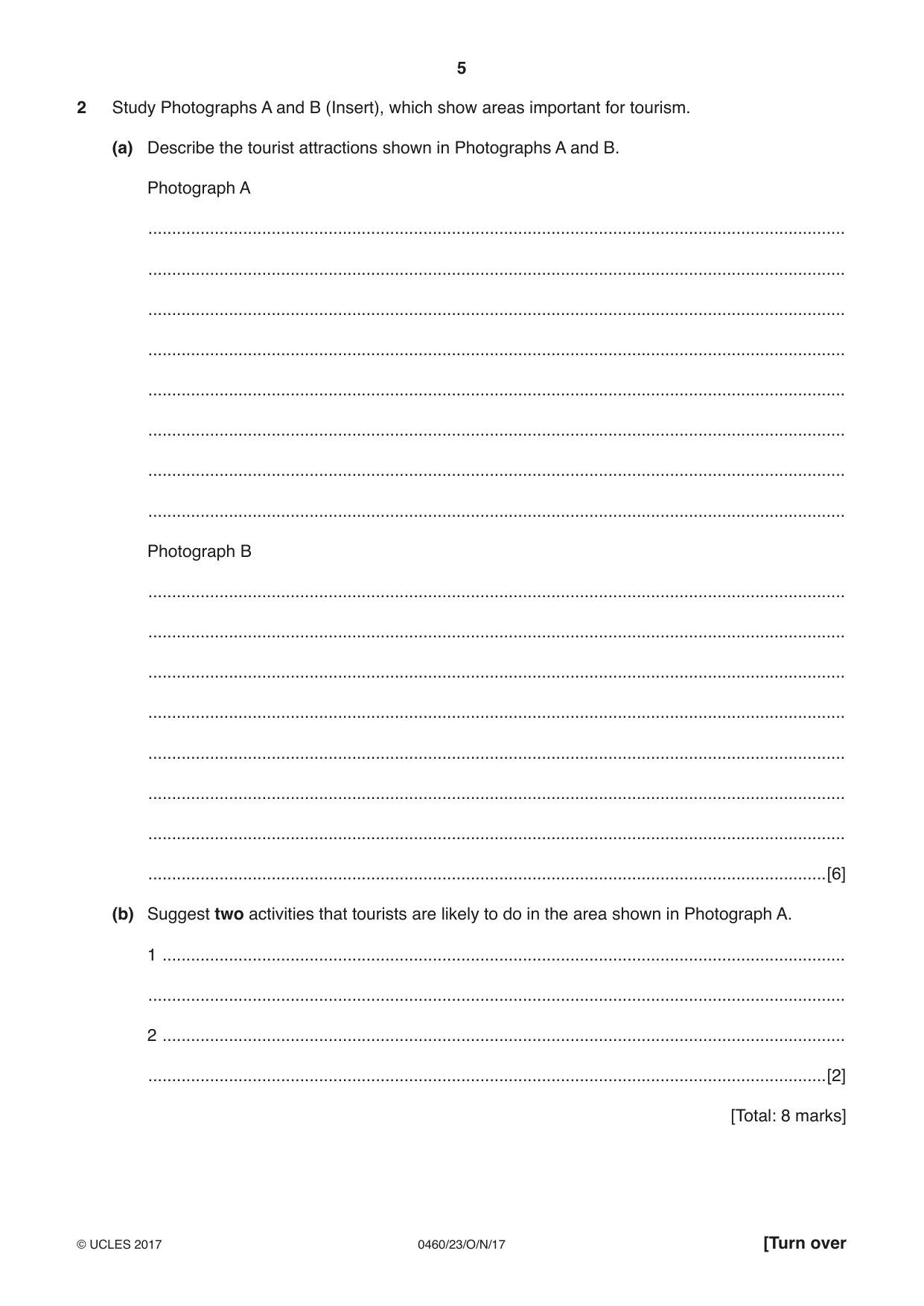
2 Study Photographs A and B (Insert), which show areas important for tourism. (a) Describe the tourist attractions shown in Photographs A and B. Photograph A ................................................................................................................................................... ................................................................................................................................................... ................................................................................................................................................... ................................................................................................................................................... ................................................................................................................................................... ................................................................................................................................................... ................................................................................................................................................... ................................................................................................................................................... Photograph B ................................................................................................................................................... ................................................................................................................................................... ................................................................................................................................................... ................................................................................................................................................... ................................................................................................................................................... ................................................................................................................................................... ................................................................................................................................................... ...............................................................................................................................................[6] (b) Suggest two activities that tourists are likely to do in the area shown in Photograph A. 1 ................................................................................................................................................ ................................................................................................................................................... 2 ................................................................................................................................................ ...............................................................................................................................................[2] [Total: 8 marks]
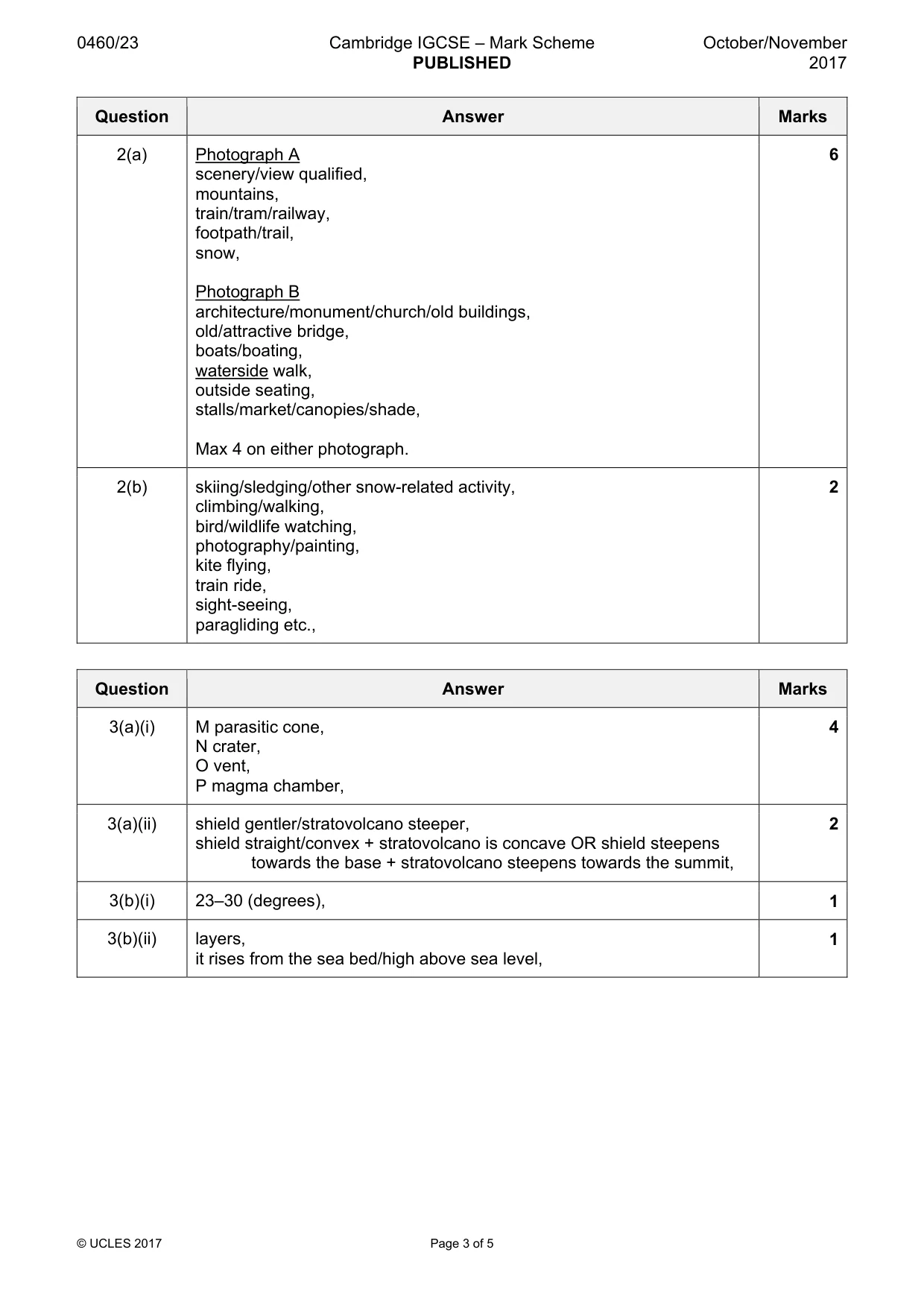
Mark scheme: 2(a) Photograph A 6 scenery/view qualified, mountains, train/tram/railway, footpath/trail, snow, Photograph B architecture/monument/church/old buildings, old/attractive bridge, boats/boating, waterside walk, outside seating, stalls/market/canopies/shade, Max 4 on either photograph. 2(b) skiing/sledging/other snow-related activity, 2 climbing/walking, bird/wildlife watching, photography/painting, kite flying, train ride, sight-seeing, paragliding etc.,
Question 3
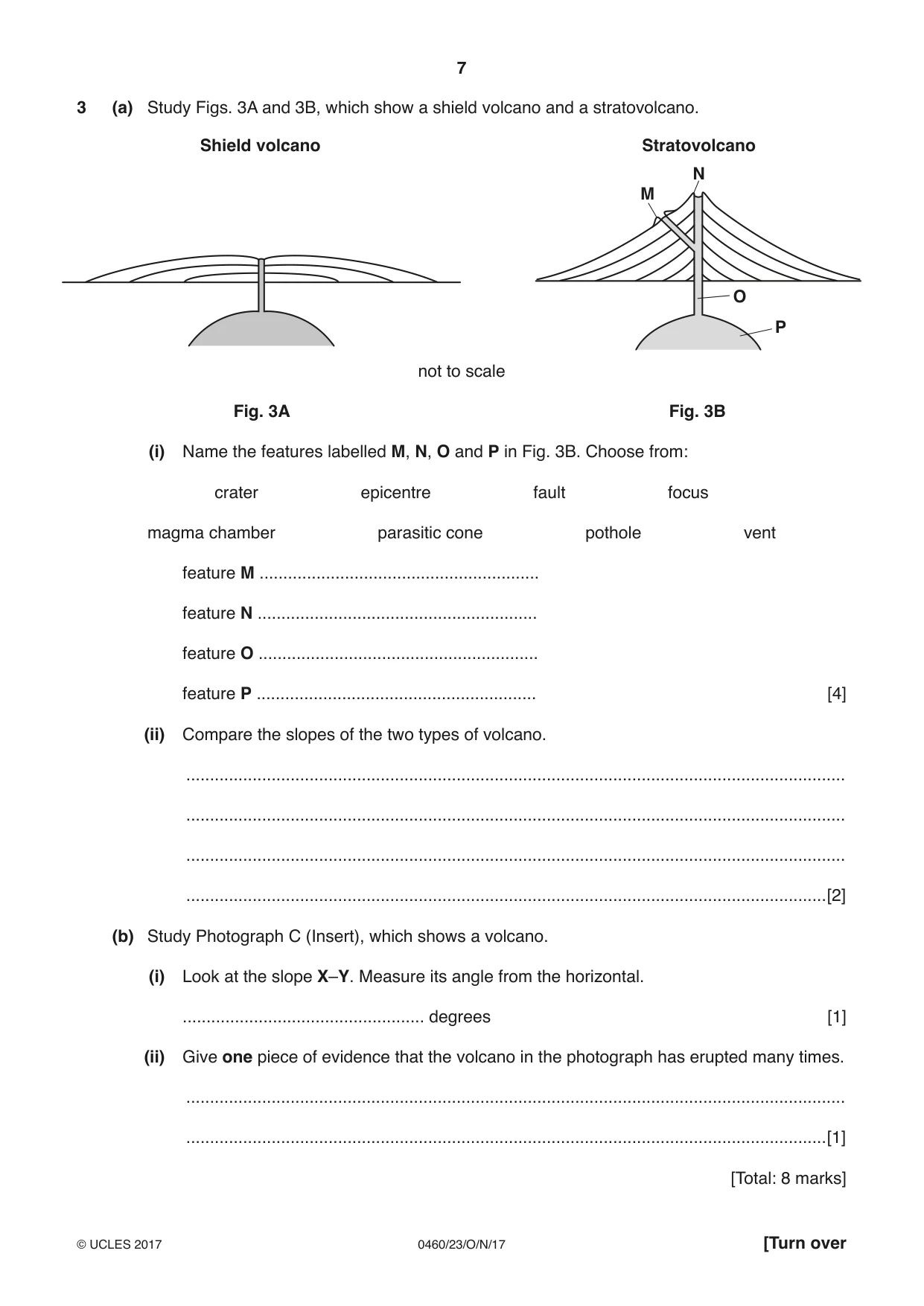
3 (a) Study Figs. 3A and 3B, which show a shield volcano and a stratovolcano. Shield volcano Stratovolcano N M O P not to scale Fig. 3A Fig. 3B (i) Name the features labelled M, N, O and P in Fig. 3B. Choose from: crater epicentre fault focus magma chamber parasitic cone pothole vent feature M ........................................................... feature N ........................................................... feature O ........................................................... feature P ........................................................... [4] (ii) Compare the slopes of the two types of volcano. ........................................................................................................................................... ........................................................................................................................................... ........................................................................................................................................... .......................................................................................................................................[2] (b) Study Photograph C (Insert), which shows a volcano. (i) Look at the slope X–Y. Measure its angle from the horizontal. ................................................... degrees [1] (ii) Give one piece of evidence that the volcano in the photograph has erupted many times. ........................................................................................................................................... .......................................................................................................................................[1] [Total: 8 marks]
Mark scheme: 3(a)(i) M parasitic cone, 4 N crater, O vent, P magma chamber, 3(a)(ii) shield gentler/stratovolcano steeper, 2 shield straight/convex + stratovolcano is concave OR shield steepens towards the base + stratovolcano steepens towards the summit, 3(b)(i) 23–30 (degrees), 1 3(b)(ii) layers, 1 it rises from the sea bed/high above sea level,
Q4 · Qatar is a country in the Middle East
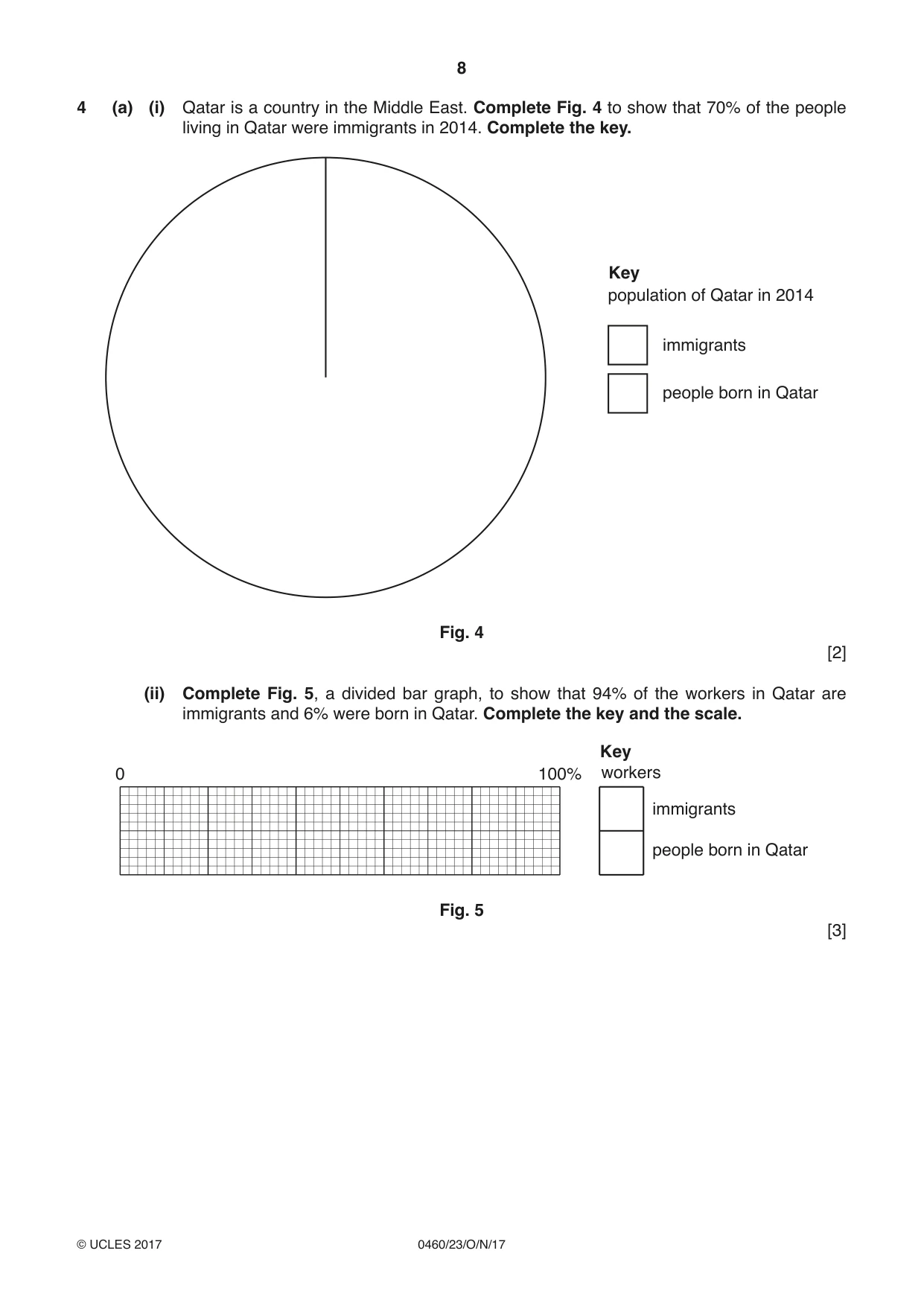
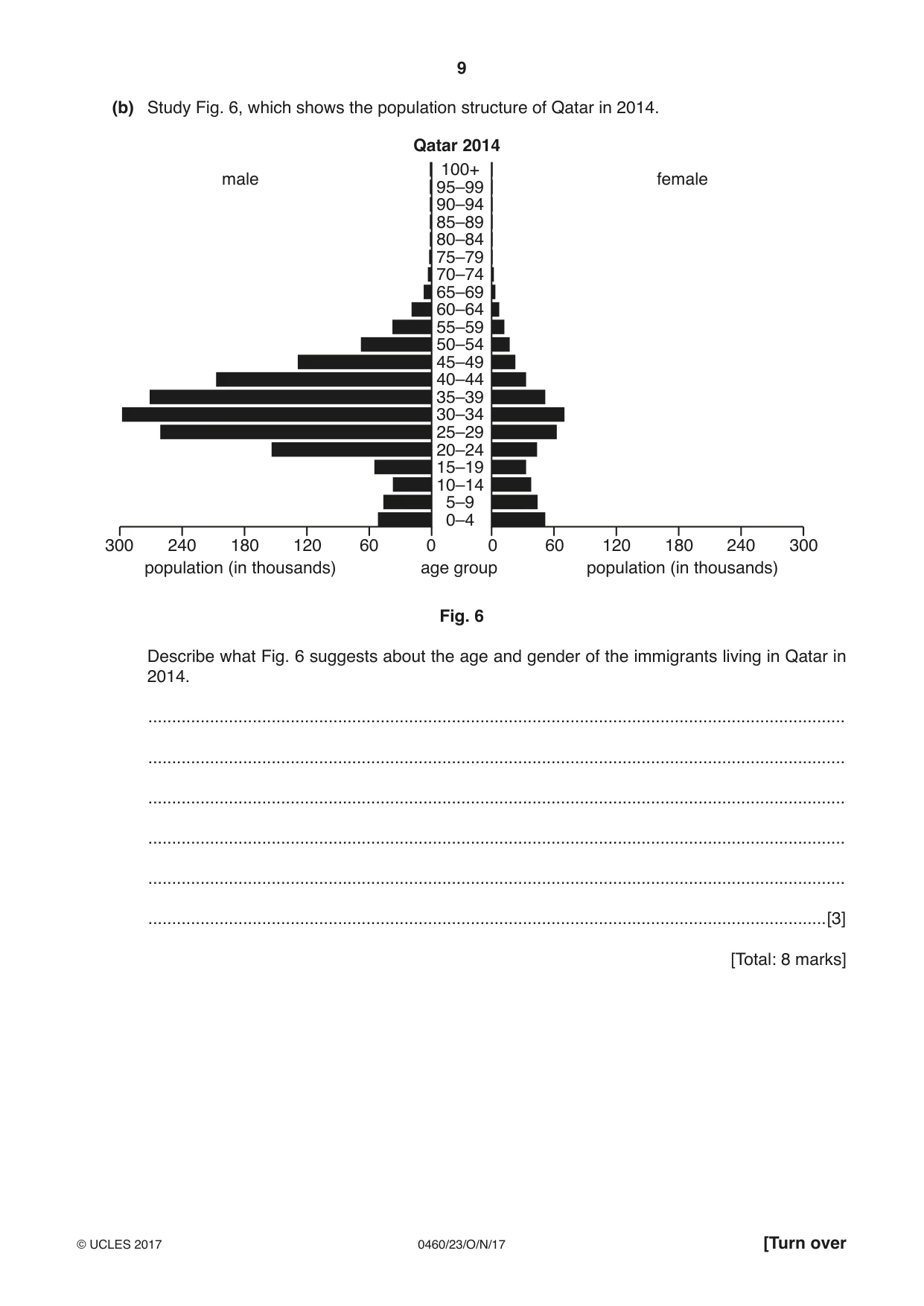
4 (a) (i) Qatar is a country in the Middle East. Complete Fig. 4 to show that 70% of the people living in Qatar were immigrants in 2014. Complete the key. Key population of Qatar in 2014 immigrants people born in Qatar Fig. 4 [2] (ii) Complete Fig. 5, a divided bar graph, to show that 94% of the workers in Qatar are immigrants and 6% were born in Qatar. Complete the key and the scale. Key 0 100% workers immigrants people born in Qatar Fig. 5 [3] (b) Study Fig. 6, which shows the population structure of Qatar in 2014. Qatar 2014 100+ male female 95–99 90–94 85–89 80–84 75–79 70–74 65–69 60–64 55–59 50–54 45–49 40–44 35–39 30–34 25–29 20–24 15–19 10–14 5–9 0–4 300 240 180 120 60 0 0 60 120 180 240 300 population (in thousands) age group population (in thousands) Fig. 6 Describe what Fig. 6 suggests about the age and gender of the immigrants living in Qatar in 2014. ................................................................................................................................................... ................................................................................................................................................... ................................................................................................................................................... ................................................................................................................................................... ................................................................................................................................................... ...............................................................................................................................................[3] [Total: 8 marks]
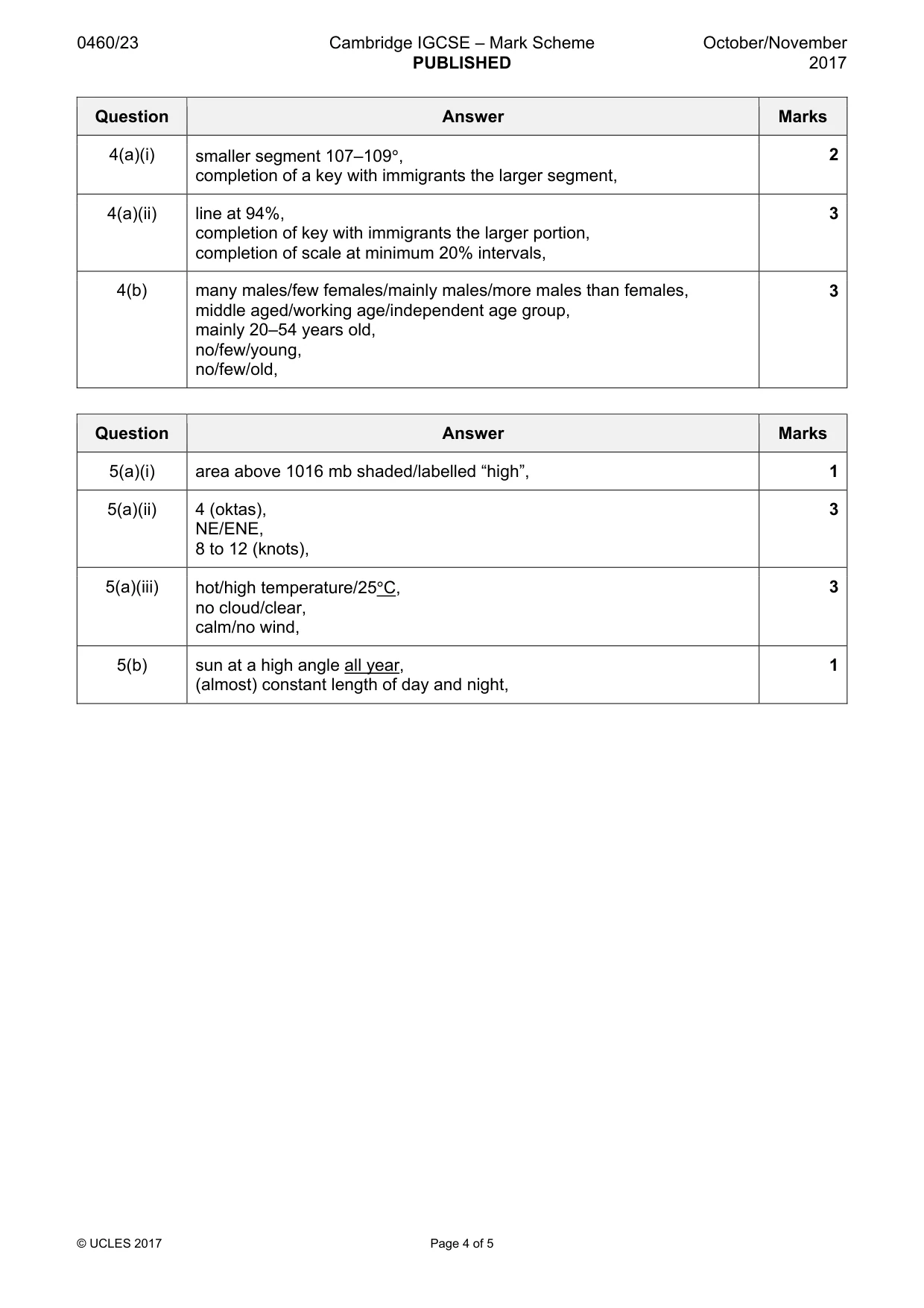
Mark scheme: 4(a)(i) smaller segment 107–109°, 2 completion of a key with immigrants the larger segment, 4(a)(ii) line at 94%, 3 completion of key with immigrants the larger portion, completion of scale at minimum 20% intervals, 4(b) many males/few females/mainly males/more males than females, 3 middle aged/working age/independent age group, mainly 20–54 years old, no/few/young, no/few/old,
Question 5
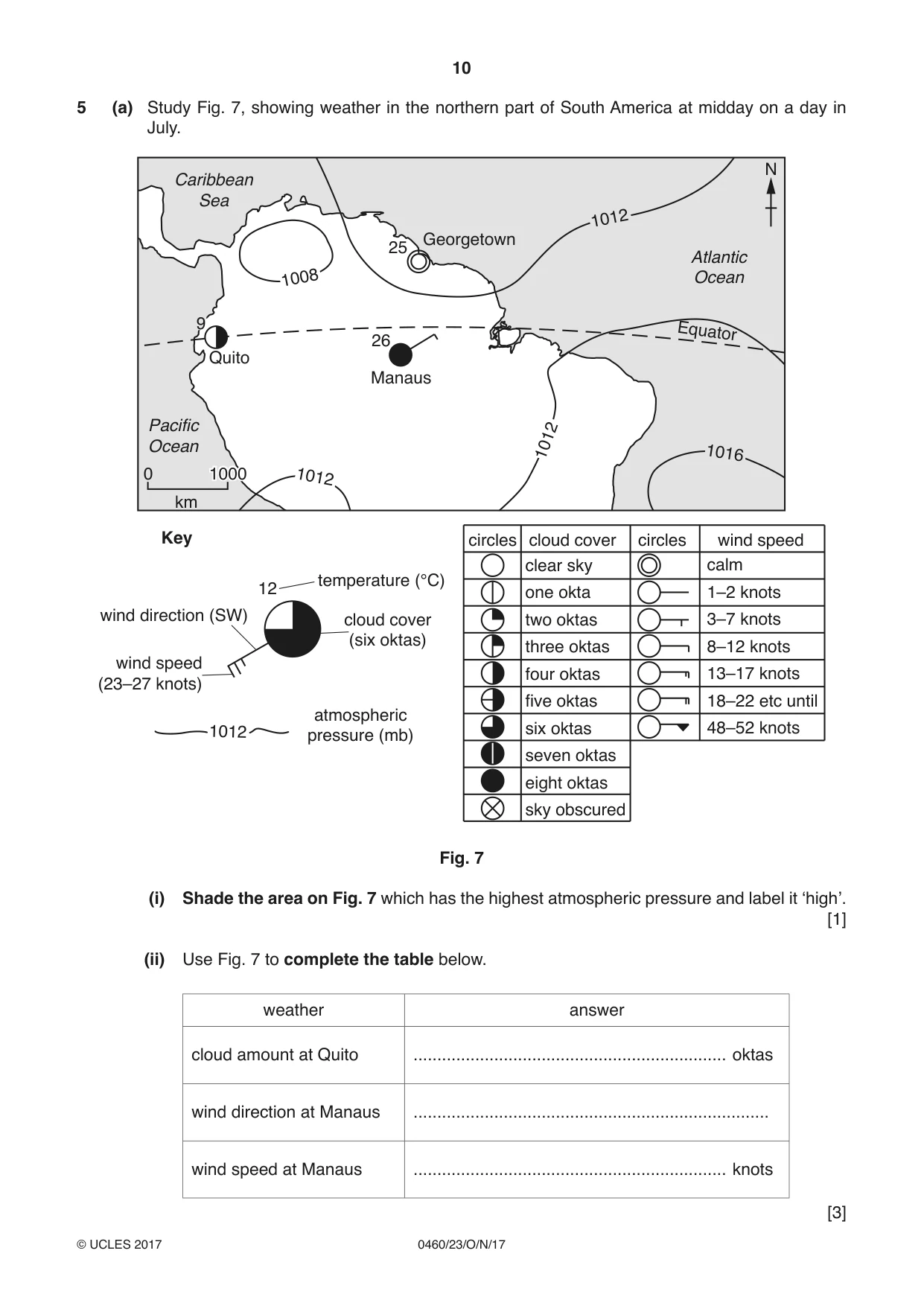
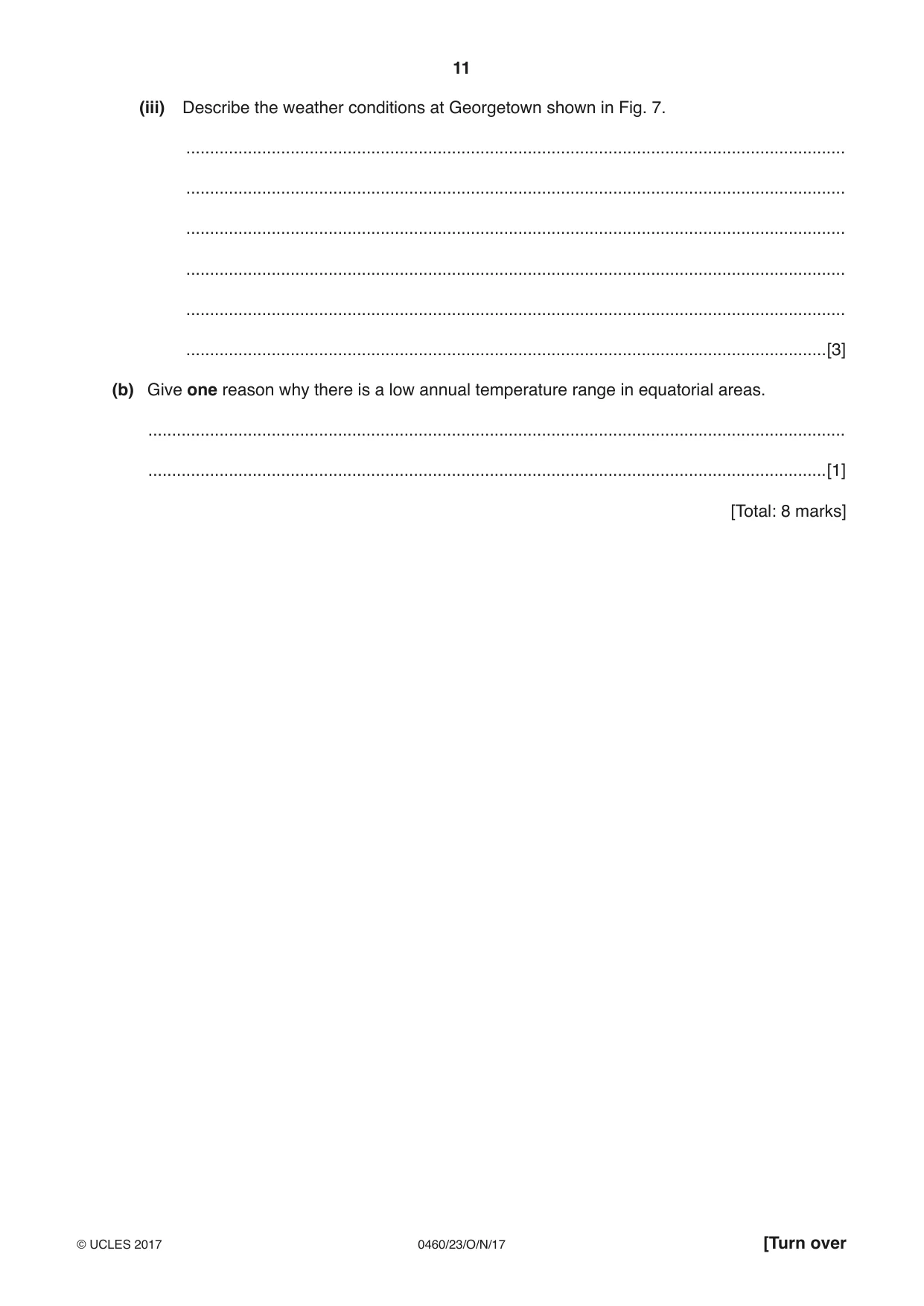
5 (a) Study Fig. 7, showing weather in the northern part of South America at midday on a day in July. N Caribbean Sea 1012 Georgetown 25 Atlantic 1008 Ocean 9 Equator 26 Quito Manaus Pacific Ocean 1012 1016 0 1000 1012 km Key circles cloud cover circles wind speed clear sky calm temperature (°C) 12 one okta 1–2 knots wind direction (SW) cloud cover two oktas 3–7 knots (six oktas) three oktas 8–12 knots wind speed four oktas 13–17 knots (23–27 knots) five oktas 18–22 etc until atmospheric 1012 pressure (mb) six oktas 48–52 knots seven oktas eight oktas sky obscured Fig. 7 (i) Shade the area on Fig. 7 which has the highest atmospheric pressure and label it ‘high’. [1] (ii) Use Fig. 7 to complete the table below. weather answer cloud amount at Quito .................................................................. oktas wind direction at Manaus ........................................................................... wind speed at Manaus .................................................................. knots [3] (iii) Describe the weather conditions at Georgetown shown in Fig. 7. ........................................................................................................................................... ........................................................................................................................................... ........................................................................................................................................... ........................................................................................................................................... ........................................................................................................................................... .......................................................................................................................................[3] (b) Give one reason why there is a low annual temperature range in equatorial areas. ................................................................................................................................................... ...............................................................................................................................................[1] [Total: 8 marks]
Mark scheme: 5(a)(i) area above 1016 mb shaded/labelled “high”, 1 5(a)(ii) 4 (oktas), 3 NE/ENE, 8 to 12 (knots), 5(a)(iii) hot/high temperature/25°C, 3 no cloud/clear, calm/no wind, 5(b) sun at a high angle all year, 1 (almost) constant length of day and night,
Question 6
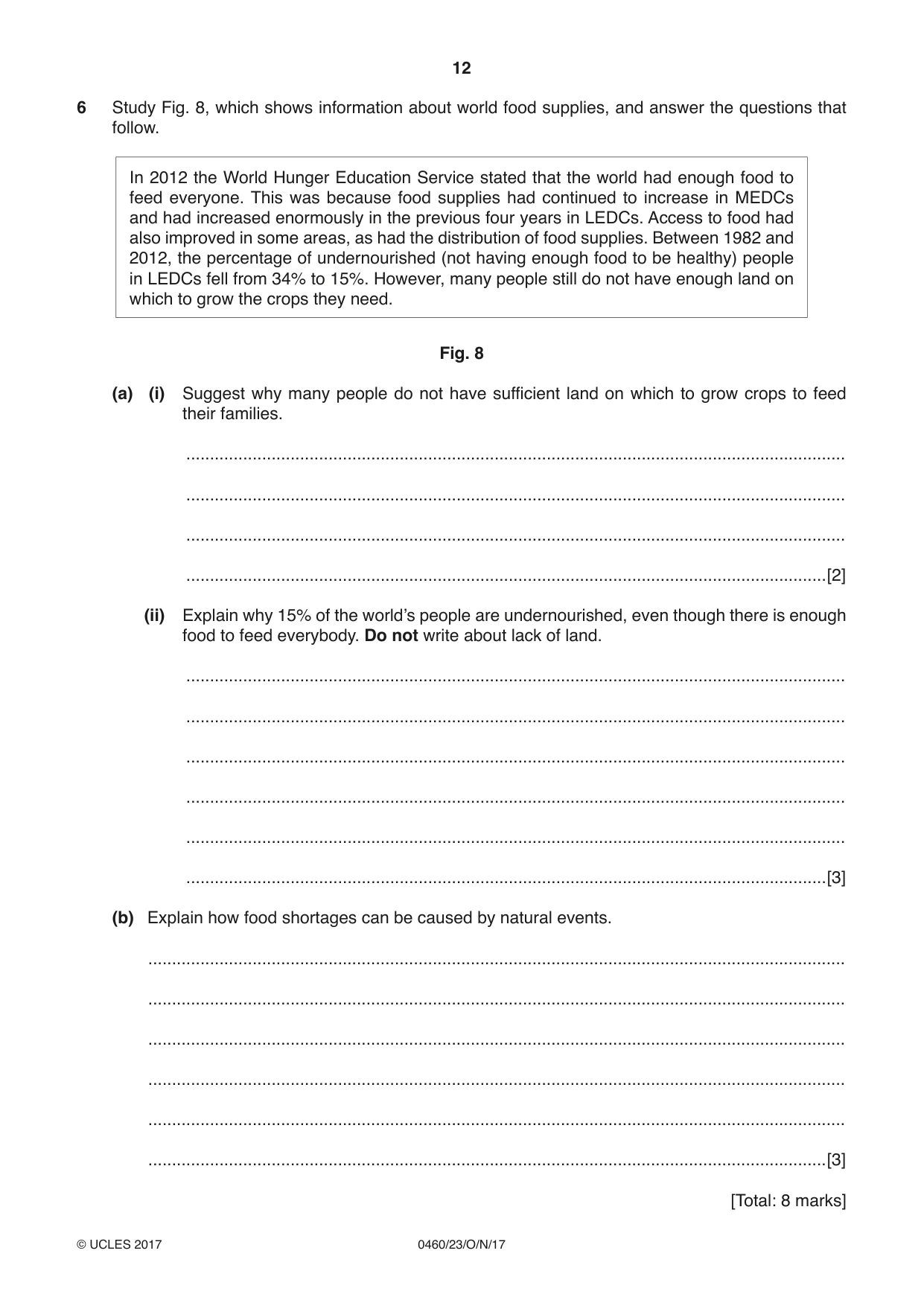
6 Study Fig. 8, which shows information about world food supplies, and answer the questions that follow. In 2012 the World Hunger Education Service stated that the world had enough food to feed everyone. This was because food supplies had continued to increase in MEDCs and had increased enormously in the previous four years in LEDCs. Access to food had also improved in some areas, as had the distribution of food supplies. Between 1982 and 2012, the percentage of undernourished (not having enough food to be healthy) people in LEDCs fell from 34% to 15%. However, many people still do not have enough land on which to grow the crops they need. Fig. 8 (a) (i) Suggest why many people do not have sufficient land on which to grow crops to feed their families. ........................................................................................................................................... ........................................................................................................................................... ........................................................................................................................................... .......................................................................................................................................[2] (ii) Explain why 15% of the world’s people are undernourished, even though there is enough food to feed everybody. Do not write about lack of land. ........................................................................................................................................... ........................................................................................................................................... ........................................................................................................................................... ........................................................................................................................................... ........................................................................................................................................... .......................................................................................................................................[3] (b) Explain how food shortages can be caused by natural events. ................................................................................................................................................... ................................................................................................................................................... ................................................................................................................................................... ................................................................................................................................................... ................................................................................................................................................... ...............................................................................................................................................[3] [Total: 8 marks] Additional Pages If you use the following lined pages to complete the answer(s) to any question(s), the question number(s) must be clearly shown. .................................................................................................................................................................. .................................................................................................................................................................. .................................................................................................................................................................. .................................................................................................................................................................. .................................................................................................................................................................. .................................................................................................................................................................. .................................................................................................................................................................. .................................................................................................................................................................. .................................................................................................................................................................. .................................................................................................................................................................. .................................................................................................................................................................. .................................................................................................................................................................. .................................................................................................................................................................. .................................................................................................................................................................. .................................................................................................................................................................. .................................................................................................................................................................. .................................................................................................................................................................. .................................................................................................................................................................. .................................................................................................................................................................. .................................................................................................................................................................. .................................................................................................................................................................. .................................................................................................................................................................. .................................................................................................................................................................. .................................................................................................................................................................. .................................................................................................................................................................. .................................................................................................................................................................. .................................................................................................................................................................. .................................................................................................................................................................. .................................................................................................................................................................. .................................................................................................................................................................. .................................................................................................................................................................. .................................................................................................................................................................. .................................................................................................................................................................. .................................................................................................................................................................. .................................................................................................................................................................. .................................................................................................................................................................. .................................................................................................................................................................. .................................................................................................................................................................. .................................................................................................................................................................. .................................................................................................................................................................. .................................................................................................................................................................. .................................................................................................................................................................. .................................................................................................................................................................. .................................................................................................................................................................. .................................................................................................................................................................. .................................................................................................................................................................. .................................................................................................................................................................. .................................................................................................................................................................. .................................................................................................................................................................. .................................................................................................................................................................. .................................................................................................................................................................. .................................................................................................................................................................. ..................................................................................................................................................................
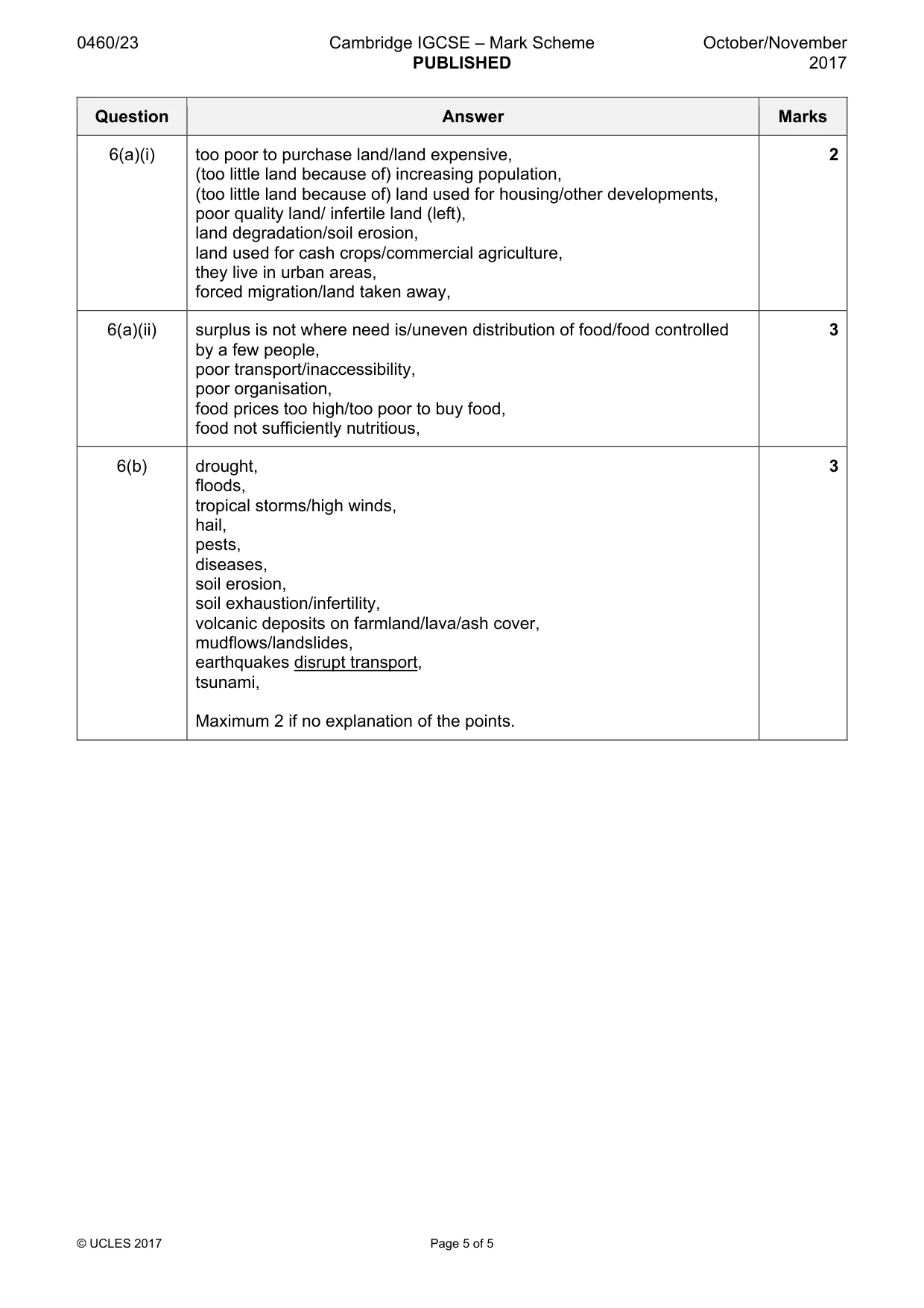
Mark scheme: 6(a)(i) too poor to purchase land/land expensive, 2 (too little land because of) increasing population, (too little land because of) land used for housing/other developments, poor quality land/ infertile land (left), land degradation/soil erosion, land used for cash crops/commercial agriculture, they live in urban areas, forced migration/land taken away, 6(a)(ii) surplus is not where need is/uneven distribution of food/food controlled 3 by a few people, poor transport/inaccessibility, poor organisation, food prices too high/too poor to buy food, food not sufficiently nutritious, 6(b) drought, 3 floods, tropical storms/high winds, hail, pests, diseases, soil erosion, soil exhaustion/infertility, volcanic deposits on farmland/lava/ash cover, mudflows/landslides, earthquakes disrupt transport, tsunami, Maximum 2 if no explanation of the points.
What was in this paper
The subtopics covered by these 6 questions, and how many questions each got. Open one in a new tab to see every Cambridge question on it.
What you needed in this session
Cambridge’s own grade thresholds for 2017 Oct/Nov, Paper 2 · Variant 3. A higher threshold means an easier paper — the bar moves with how the cohort did.