Cambridge IGCSE Geography 0460 — 2016 May/June Paper 4 · Variant 3
0460/43/M/J/16 · 60 marks · ≈68 min
The question paper and its mark scheme, free to read here and free to download. This is Cambridge’s own paper, exactly as it was sat.
Question paper24 pages





Mark scheme8 pages
Answers below. Sit the paper first if you are practising.
Paper as text
Question paper, page 1
This document consists of 21 printed pages, 3 blank pages and 1 Insert. DC (LK/FD) 114174/6 © UCLES 2016 [Turn over Cambridge International Examinations Cambridge International General Certificate of Secondary Education * 1 0 8 9 8 5 8 0 8 8 * GEOGRAPHY 0460/43 Paper 4 Alternative to Coursework May/June 2016 1 hour 30 minutes Candidates answer on the Question Paper. Additional Materials: Ruler Calculator Protractor READ THESE INSTRUCTIONS FIRST Write your Centre number, candidate number and name in the spaces provided. Write in dark blue or black pen. You may use an HB pencil for any diagrams or graphs. Do not use staples, paper clips, glue or correction fluid. DO NOT WRITE IN ANY BARCODES. Write your answer to each question in the space provided. If additional space is required, you should use the lined pages at the end of this booklet. The question number(s) must be clearly shown. Answer all questions. The Insert contains Tables 1, 2 and 3 for Question 1, and Figs. 6, 8, 11 and Tables 5 and 6 for Question 2. The Insert is not required by the Examiner. Sketch maps and diagrams should be drawn whenever they serve to illustrate an answer. At the end of the examination, fasten all your work securely together. The number of marks is given in brackets [ ] at the end of each question or part question. The syllabus is approved for use in England, Wales and Northern Ireland as a Cambridge International Level 1/Level 2 Certificate.
Question paper, page 2
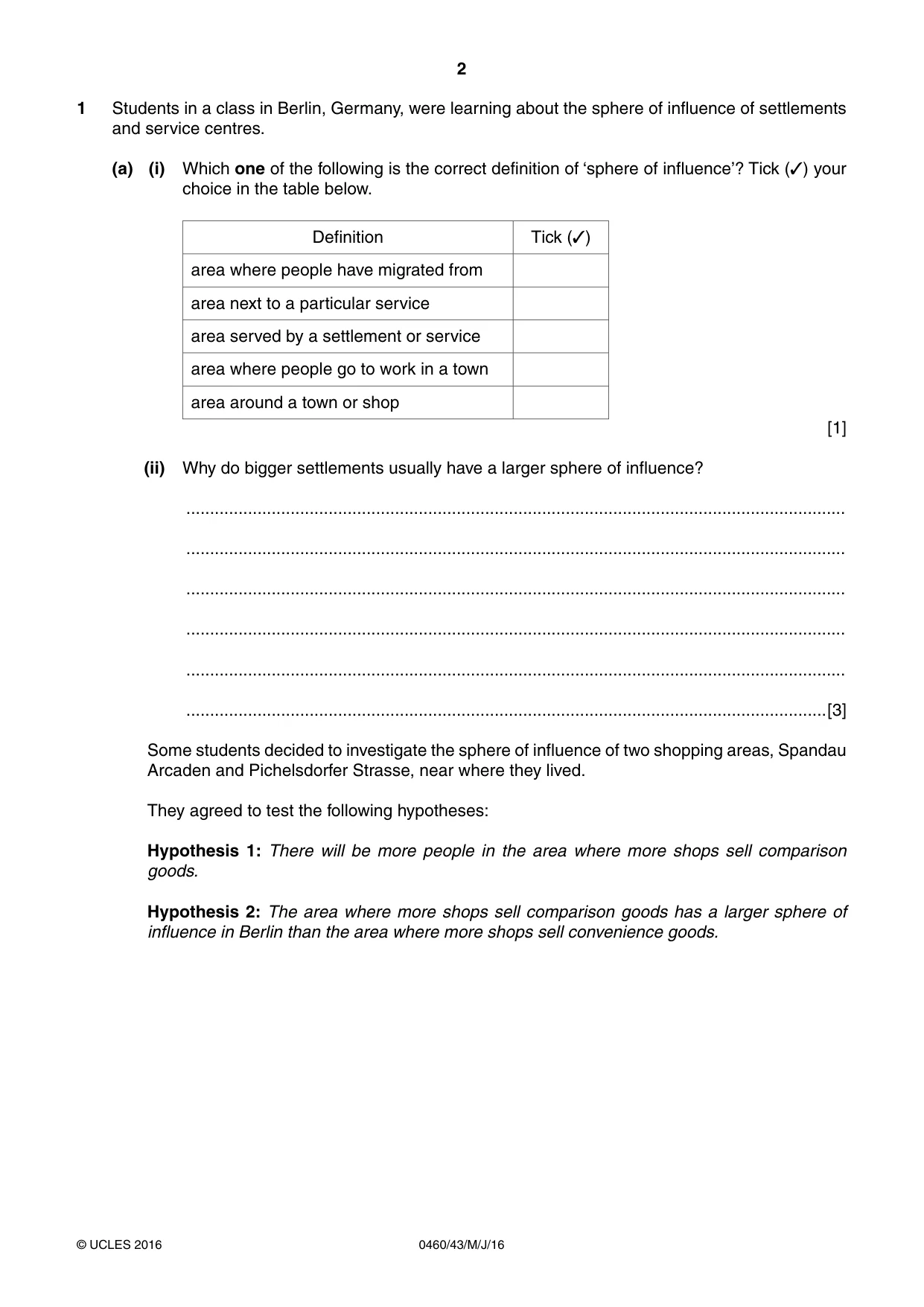
2 0460/43/M/J/16 © UCLES 2016 1 Students in a class in Berlin, Germany, were learning about the sphere of influence of settlements and service centres. (a) (i) Which one of the following is the correct definition of ‘sphere of influence’? Tick (✓) your choice in the table below. Definition Tick (✓) area where people have migrated from area next to a particular service area served by a settlement or service area where people go to work in a town area around a town or shop [1] (ii) Why do bigger settlements usually have a larger sphere of influence? … … … … … …[3] Some students decided to investigate the sphere of influence of two shopping areas, Spandau Arcaden and Pichelsdorfer Strasse, near where they lived. They agreed to test the following hypotheses: Hypothesis 1: There will be more people in the area where more shops sell comparison goods. Hypothesis 2: The area where more shops sell comparison goods has a larger sphere of influence in Berlin than the area where more shops sell convenience goods.
Question paper, page 3
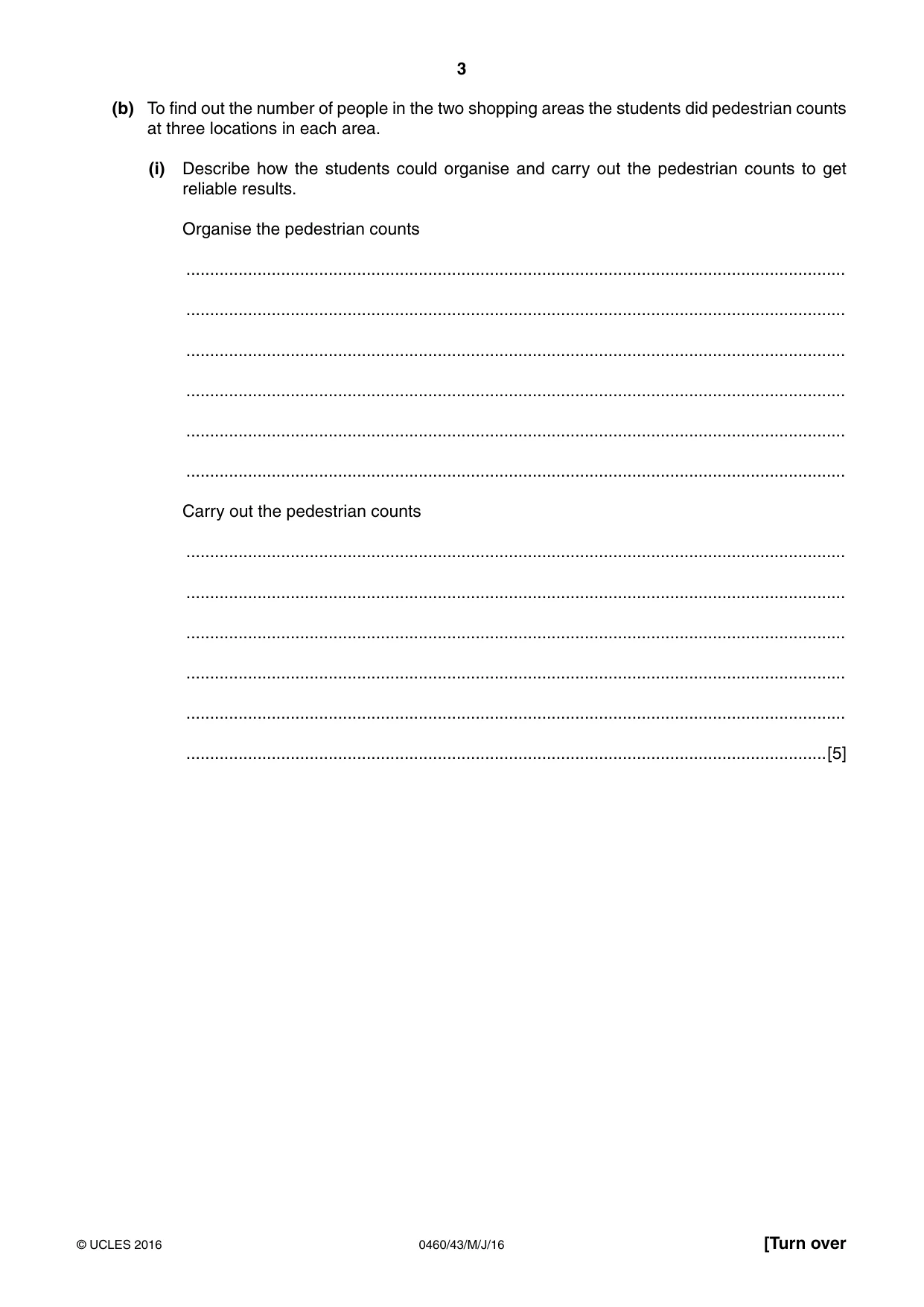
3 0460/43/M/J/16 © UCLES 2016 [Turn over (b) To find out the number of people in the two shopping areas the students did pedestrian counts at three locations in each area. (i) Describe how the students could organise and carry out the pedestrian counts to get reliable results. Organise the pedestrian counts … … … … … … Carry out the pedestrian counts … … … … … …[5]
Question paper, page 4
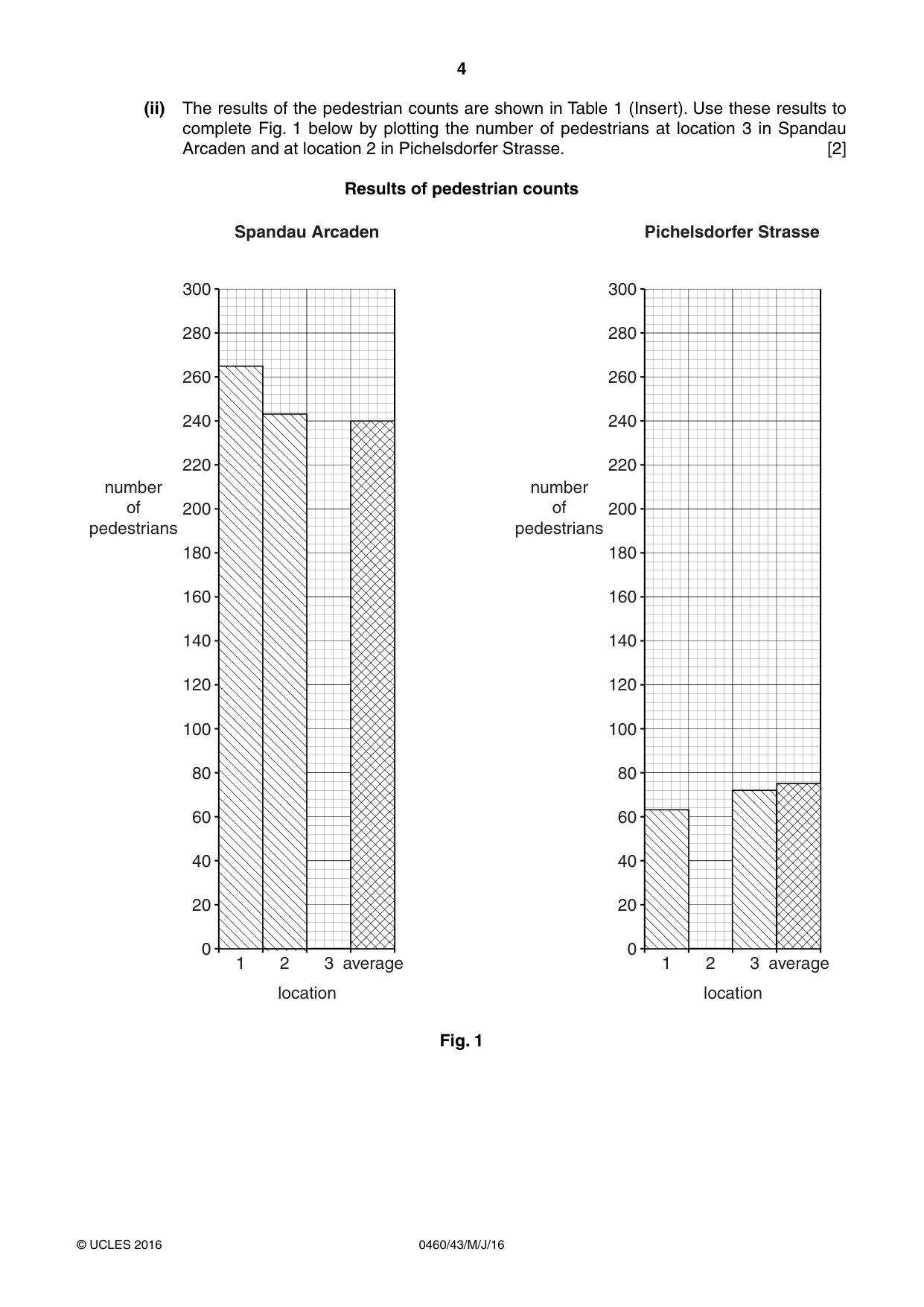
4 0460/43/M/J/16 © UCLES 2016 (ii) The results of the pedestrian counts are shown in Table 1 (Insert). Use these results to complete Fig. 1 below by plotting the number of pedestrians at location 3 in Spandau Arcaden and at location 2 in Pichelsdorfer Strasse. [2] Results of pedestrian counts 1 0 20 40 60 80 100 120 140 160 180 200 220 240 260 280 300 number of pedestrians 2 location 3 average Spandau Arcaden Pichelsdorfer Strasse 1 0 20 40 60 80 100 120 140 160 180 200 220 240 260 280 300 number of pedestrians 2 location 3 average Fig. 1
Question paper, page 5
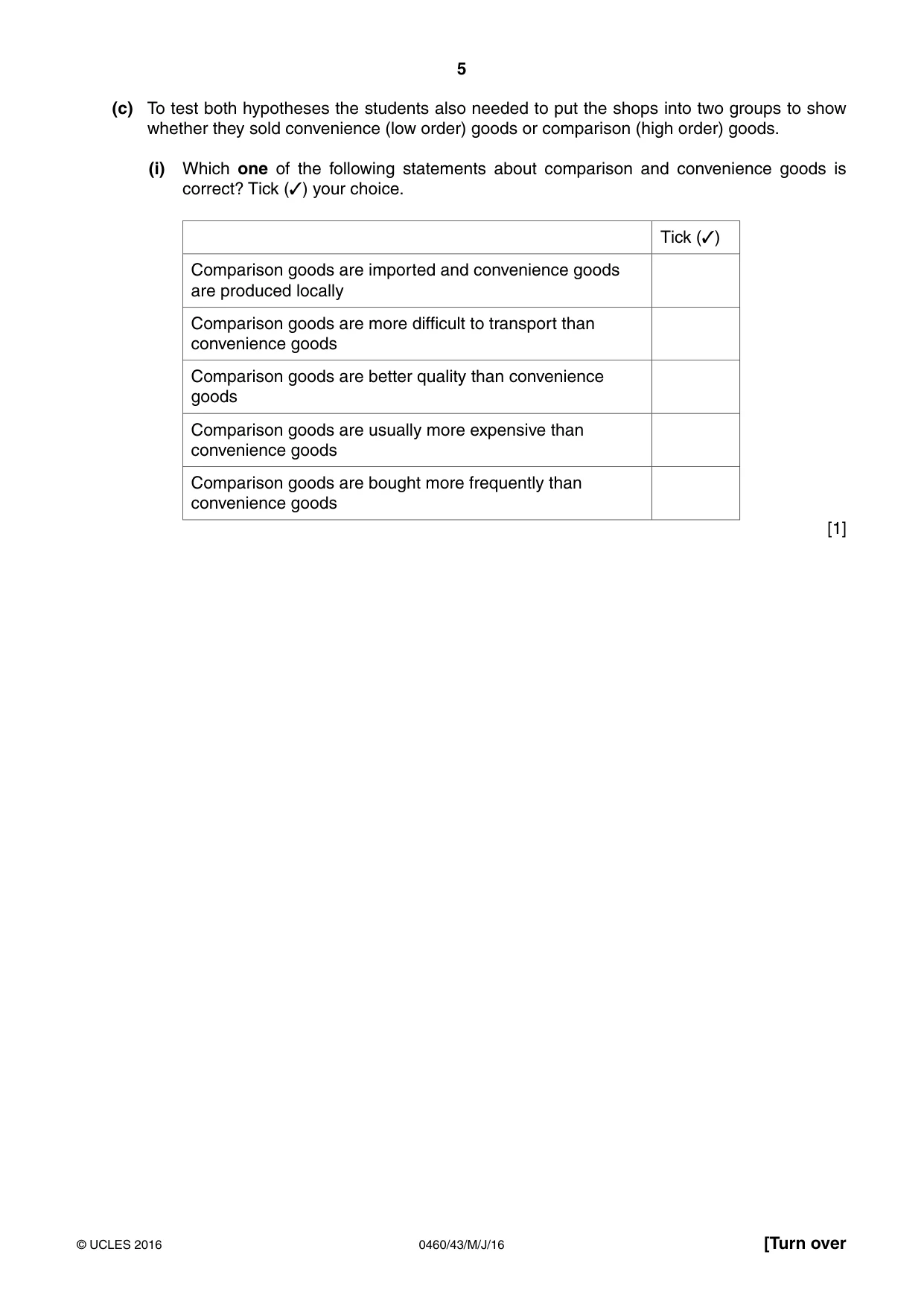
5 0460/43/M/J/16 © UCLES 2016 [Turn over (c) To test both hypotheses the students also needed to put the shops into two groups to show whether they sold convenience (low order) goods or comparison (high order) goods. (i) Which one of the following statements about comparison and convenience goods is correct? Tick (✓) your choice. Tick (✓) Comparison goods are imported and convenience goods are produced locally Comparison goods are more difficult to transport than convenience goods Comparison goods are better quality than convenience goods Comparison goods are usually more expensive than convenience goods Comparison goods are bought more frequently than convenience goods [1]
Question paper, page 6
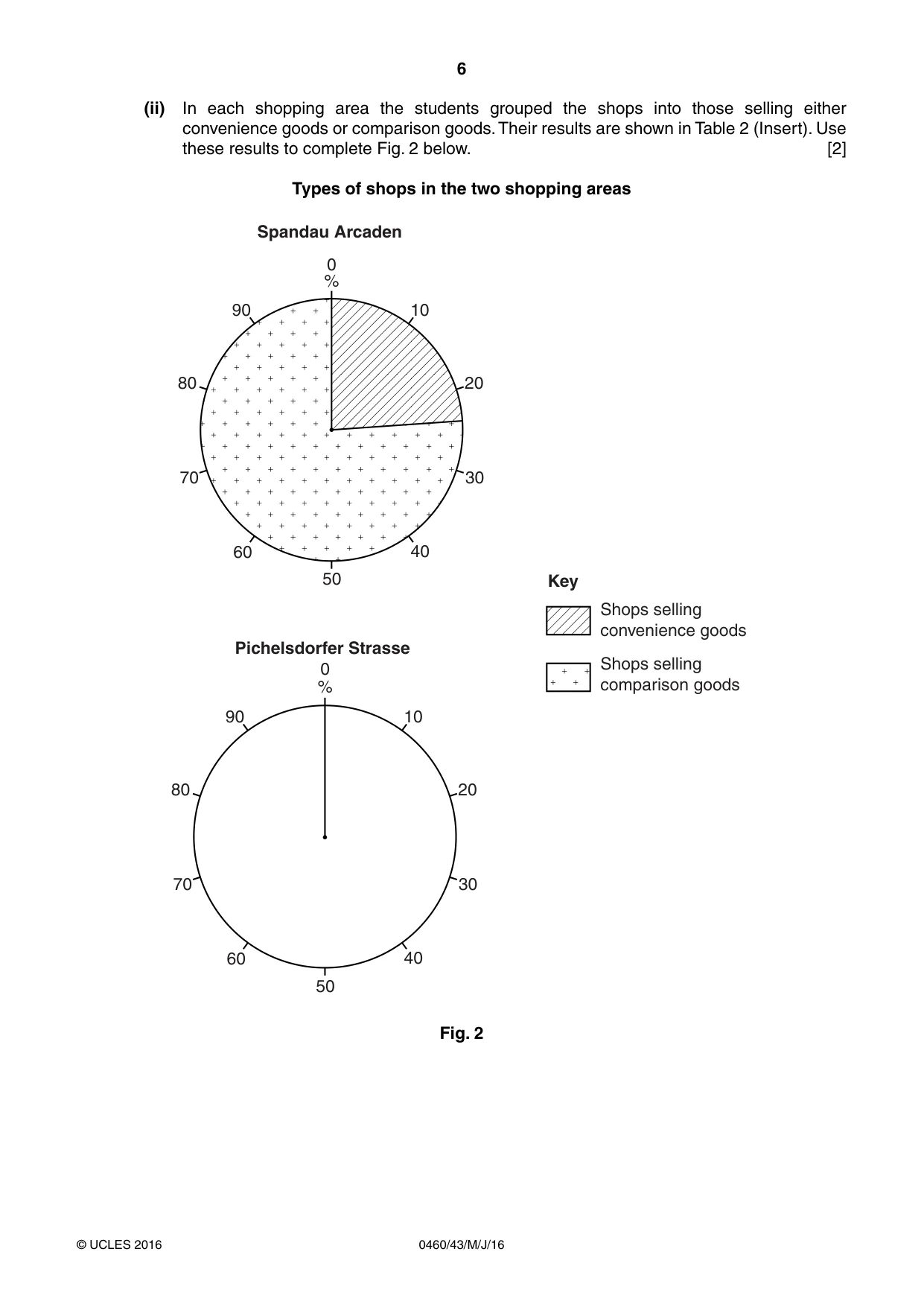
6 0460/43/M/J/16 © UCLES 2016 (ii) In each shopping area the students grouped the shops into those selling either convenience goods or comparison goods. Their results are shown in Table 2 (Insert). Use these results to complete Fig. 2 below. [2] Types of shops in the two shopping areas 0 50 10 % % 90 20 80 30 70 40 60 0 50 10 90 20 80 30 70 40 60 Key Shops selling convenience goods Spandau Arcaden Pichelsdorfer Strasse Shops selling comparison goods Fig. 2
Question paper, page 7
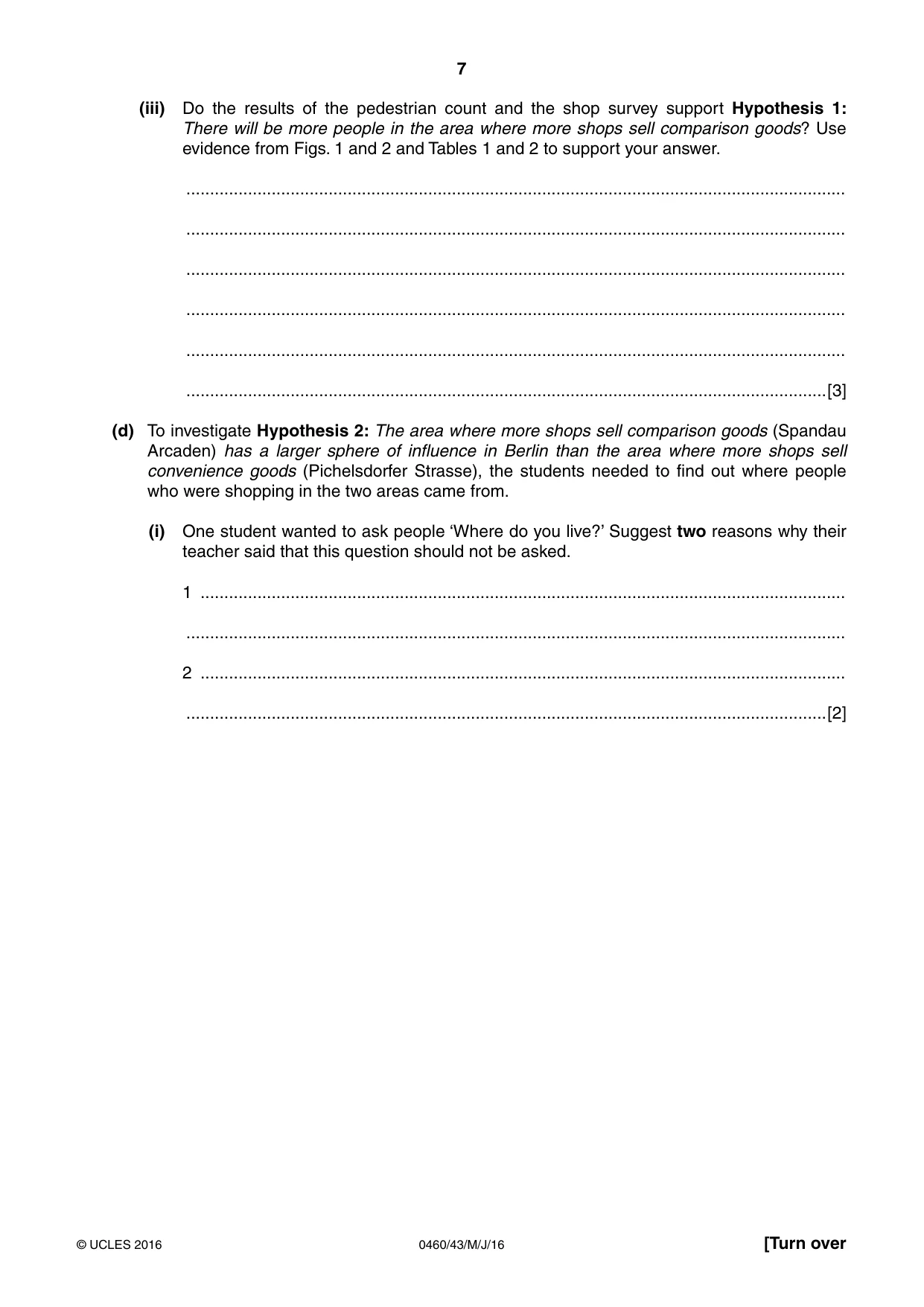
7 0460/43/M/J/16 © UCLES 2016 [Turn over (iii) Do the results of the pedestrian count and the shop survey support Hypothesis 1: There will be more people in the area where more shops sell comparison goods? Use evidence from Figs. 1 and 2 and Tables 1 and 2 to support your answer. … … … … … …[3] (d) To investigate Hypothesis 2: The area where more shops sell comparison goods (Spandau Arcaden) has a larger sphere of influence in Berlin than the area where more shops sell convenience goods (Pichelsdorfer Strasse), the students needed to find out where people who were shopping in the two areas came from. (i) One student wanted to ask people ‘Where do you live?’ Suggest two reasons why their teacher said that this question should not be asked. 1 … … 2 … …[2]
Question paper, page 8
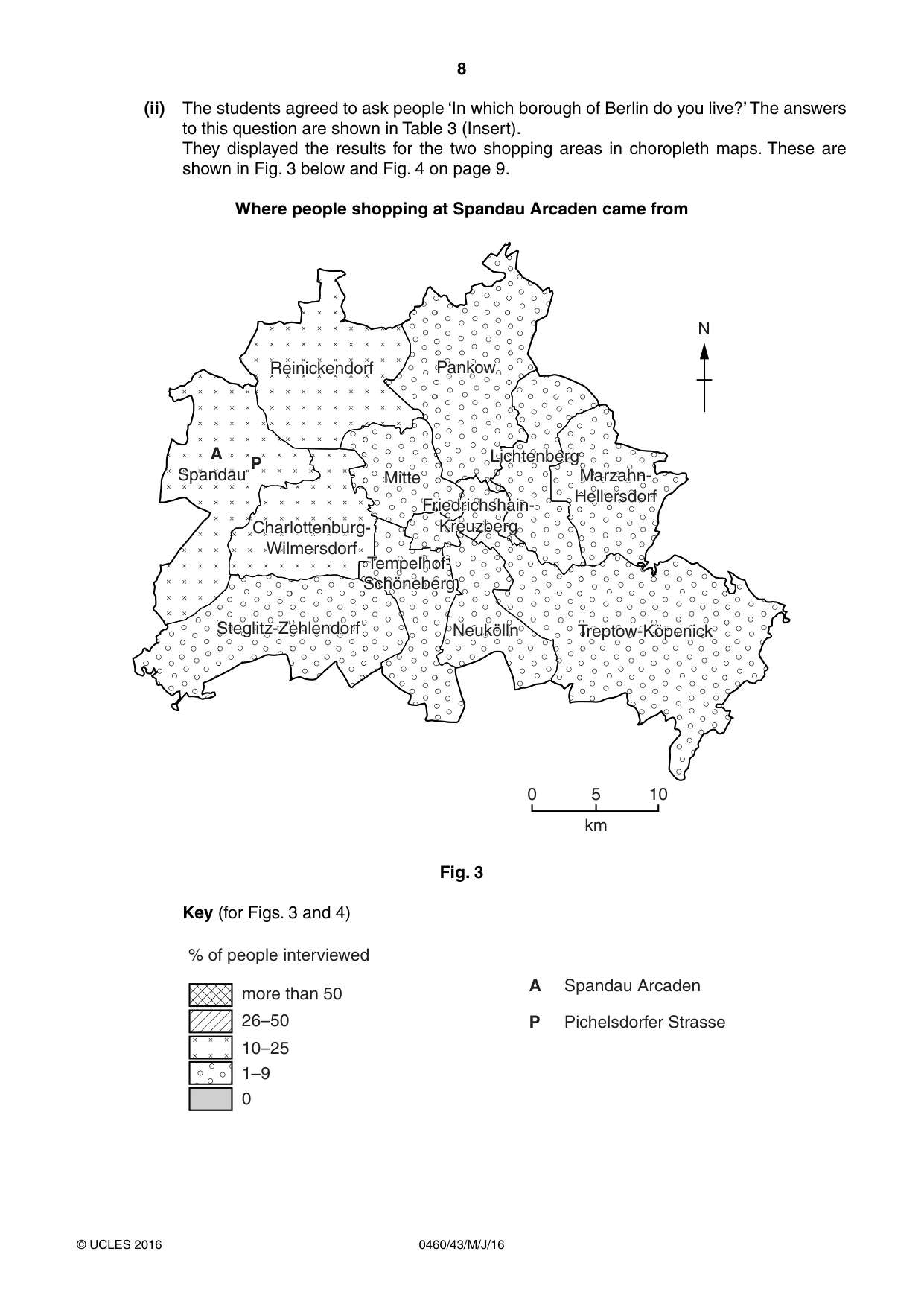
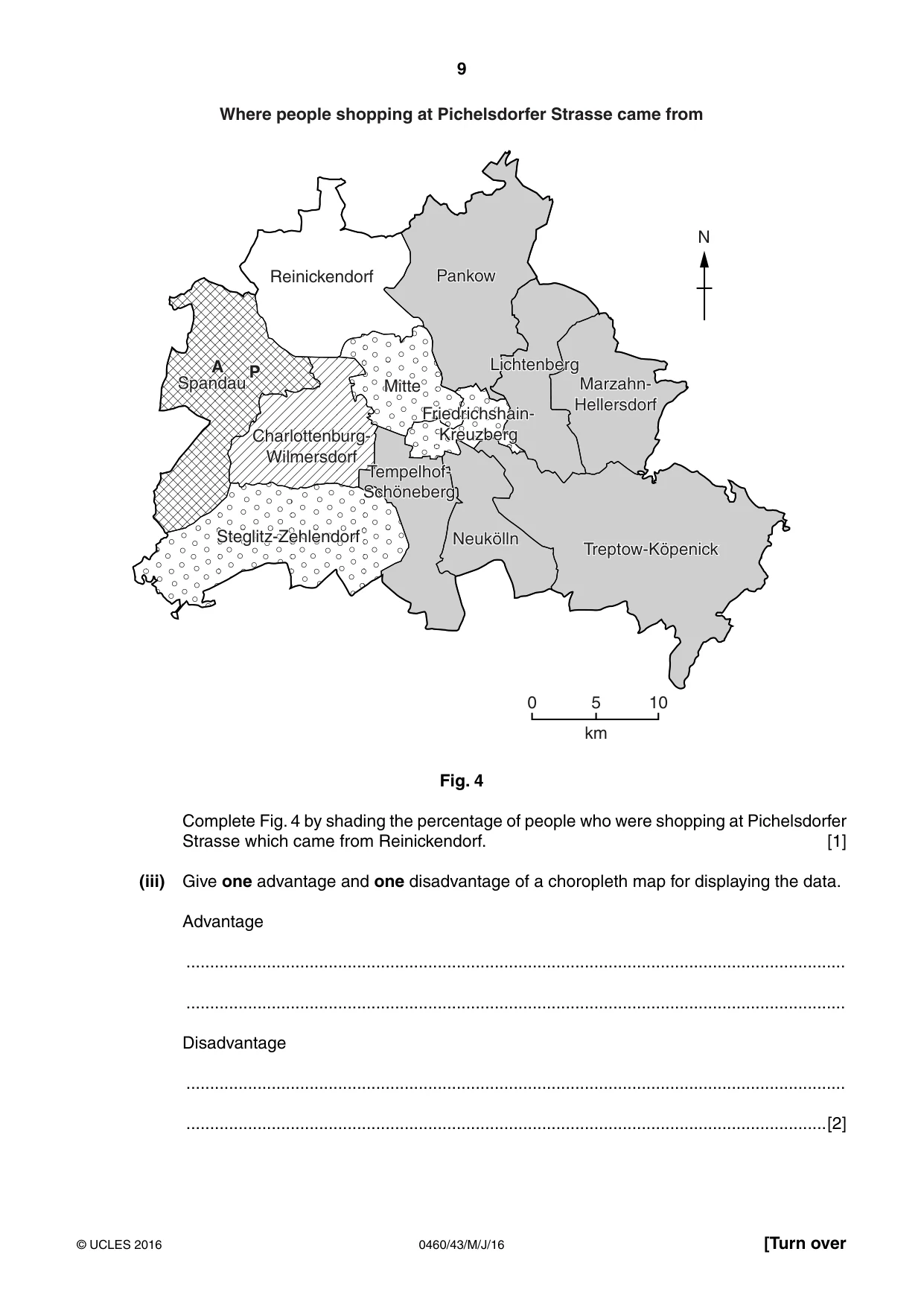
8 0460/43/M/J/16 © UCLES 2016 (ii) The students agreed to ask people ‘In which borough of Berlin do you live?’ The answers to this question are shown in Table 3 (Insert). They displayed the results for the two shopping areas in choropleth maps. These are shown in Fig. 3 below and Fig. 4 on page 9. Where people shopping at Spandau Arcaden came from N 0 5 km 10 Spandau Spandau A P Reinickendorf Reinickendorf Mitte Mitte Friedrichshain- Kreuzberg Friedrichshain- Kreuzberg Pankow Pankow Lichtenberg Lichtenberg Marzahn- Hellersdorf Marzahn- Hellersdorf Treptow-Köpenick Treptow-Köpenick Neukölln Neukölln Tempelhof- Schöneberg Tempelhof- Schöneberg Steglitz-Zehlendorf Steglitz-Zehlendorf Charlottenburg- Wilmersdorf Charlottenburg- Wilmersdorf Fig. 3 Key (for Figs. 3 and 4) % of people interviewed A P Spandau Arcaden Pichelsdorfer Strasse 0 1–9 10–25 26–50 more than 50
Question paper, page 9
9 0460/43/M/J/16 © UCLES 2016 [Turn over N 0 5 km 10 Spandau Spandau A P Reinickendorf Reinickendorf Where people shopping at Pichelsdorfer Strasse came from Mitte Mitte Friedrichshain- Kreuzberg Friedrichshain- Kreuzberg Pankow Pankow Lichtenberg Lichtenberg Marzahn- Hellersdorf Marzahn- Hellersdorf Treptow-Köpenick Treptow-Köpenick Neukölln Neukölln Tempelhof- Schöneberg Tempelhof- Schöneberg Steglitz-Zehlendorf Steglitz-Zehlendorf Charlottenburg- Wilmersdorf Charlottenburg- Wilmersdorf Fig. 4 Complete Fig. 4 by shading the percentage of people who were shopping at Pichelsdorfer Strasse which came from Reinickendorf. [1] (iii) Give one advantage and one disadvantage of a choropleth map for displaying the data. Advantage … … Disadvantage … …[2]
Question paper, page 10
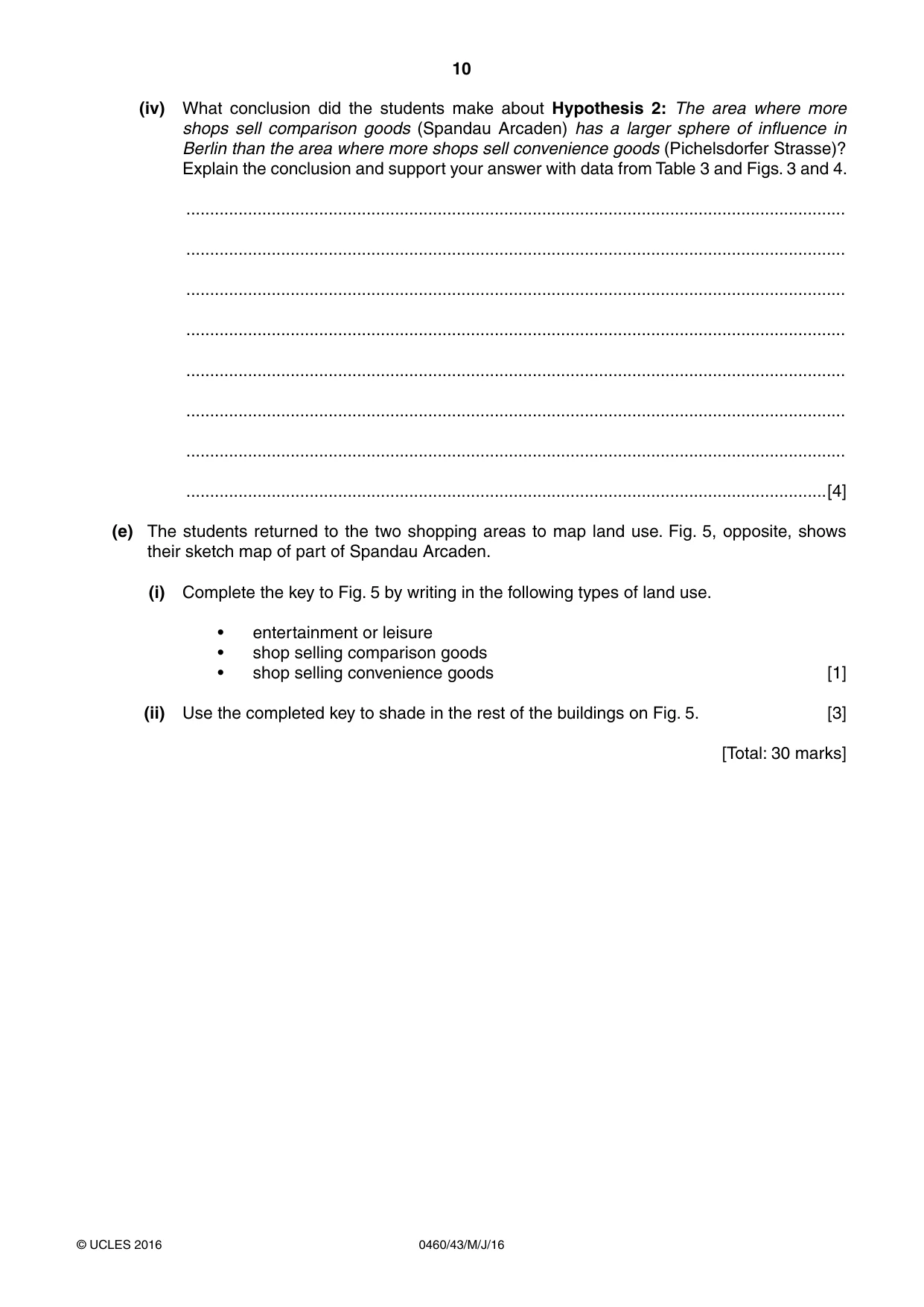
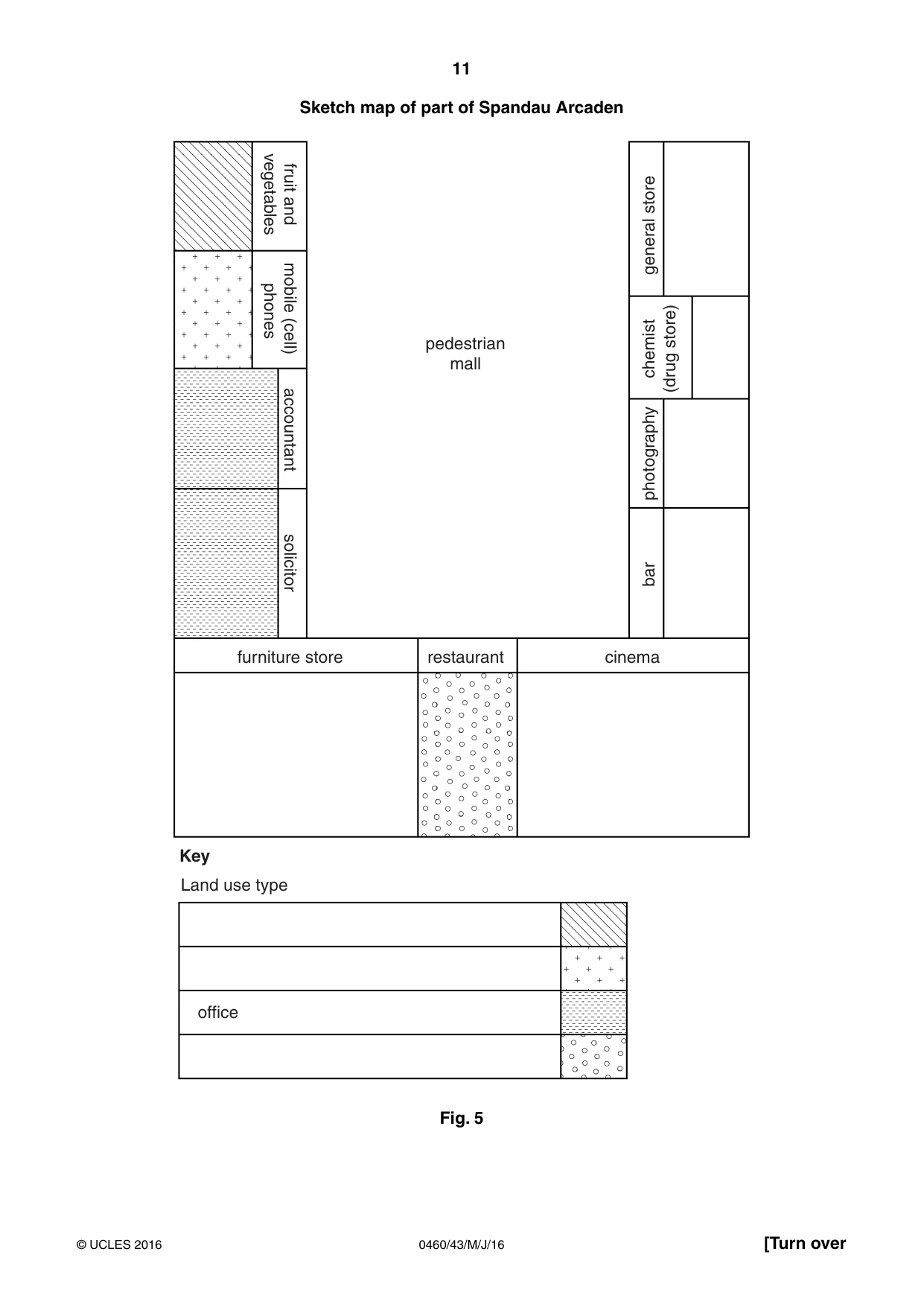
10 0460/43/M/J/16 © UCLES 2016 (iv) What conclusion did the students make about Hypothesis 2: The area where more shops sell comparison goods (Spandau Arcaden) has a larger sphere of influence in Berlin than the area where more shops sell convenience goods (Pichelsdorfer Strasse)? Explain the conclusion and support your answer with data from Table 3 and Figs. 3 and 4. … … … … … … … …[4] (e) The students returned to the two shopping areas to map land use. Fig. 5, opposite, shows their sketch map of part of Spandau Arcaden. (i) Complete the key to Fig. 5 by writing in the following types of land use. • entertainment or leisure • shop selling comparison goods • shop selling convenience goods [1] (ii) Use the completed key to shade in the rest of the buildings on Fig. 5. [3] [Total: 30 marks]
Question paper, page 11
11 0460/43/M/J/16 © UCLES 2016 [Turn over Sketch map of part of Spandau Arcaden pedestrian mall fruit and vegetables mobile (cell) phones accountant solicitor furniture store restaurant Key Land use type office cinema bar photography general store chemist (drug store) Fig. 5
Question paper, page 12
12 0460/43/M/J/16 © UCLES 2016 BLANK PAGE
Question paper, page 13
13 0460/43/M/J/16 © UCLES 2016 [Turn over 2 Students who live in North East England visited the local coast to do two pieces of fieldwork. This coastal area is shown in Fig. 6 (Insert). They wanted to investigate the impact of groynes on longshore drift and to find out what local people thought about the different types of coastal defences in the area. A groyne is a structure, usually made of wood or concrete, built out into the sea. The students decided to investigate the following hypotheses: Hypothesis 1: Groynes reduce the movement of material along a beach. Hypothesis 2: Local people are in favour of the coastal defences used in the area. (a) (i) The students knew that longshore drift is usually related to the wind direction. Describe how the students could work out the wind direction at the beach. … … … …[2]
Question paper, page 14
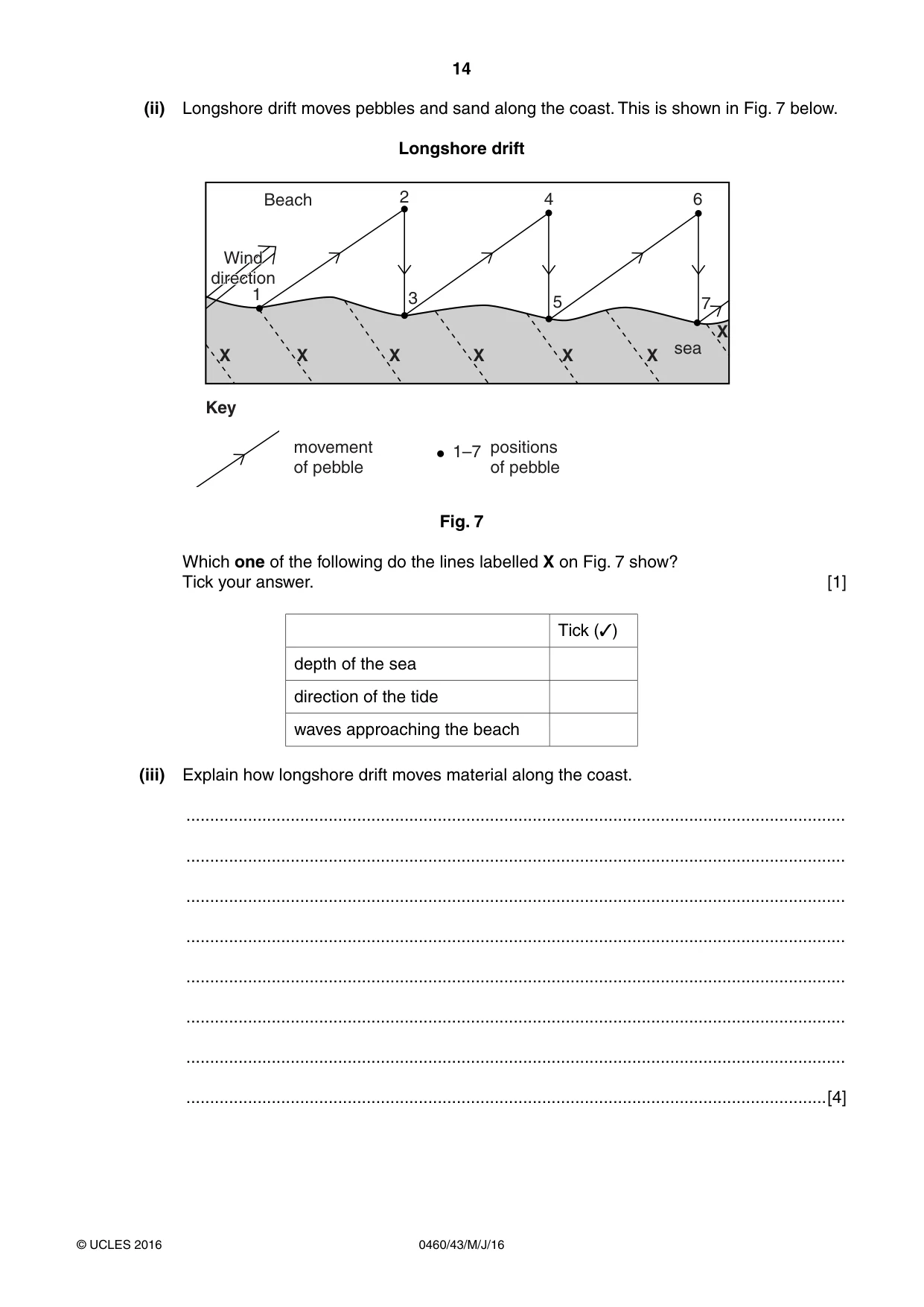
14 0460/43/M/J/16 © UCLES 2016 (ii) Longshore drift moves pebbles and sand along the coast. This is shown in Fig. 7 below. Longshore drift 1 1–7 X X X X X X X 2 4 6 3 5 7 sea Beach Key Wind direction Wind direction movement of pebble positions of pebble Fig. 7 Which one of the following do the lines labelled X on Fig. 7 show? Tick your answer. [1] Tick (✓) depth of the sea direction of the tide waves approaching the beach (iii) Explain how longshore drift moves material along the coast. … … … … … … … …[4]
Question paper, page 15
15 0460/43/M/J/16 © UCLES 2016 [Turn over TURN PAGE FOR QUESTION 2(b)
Question paper, page 16
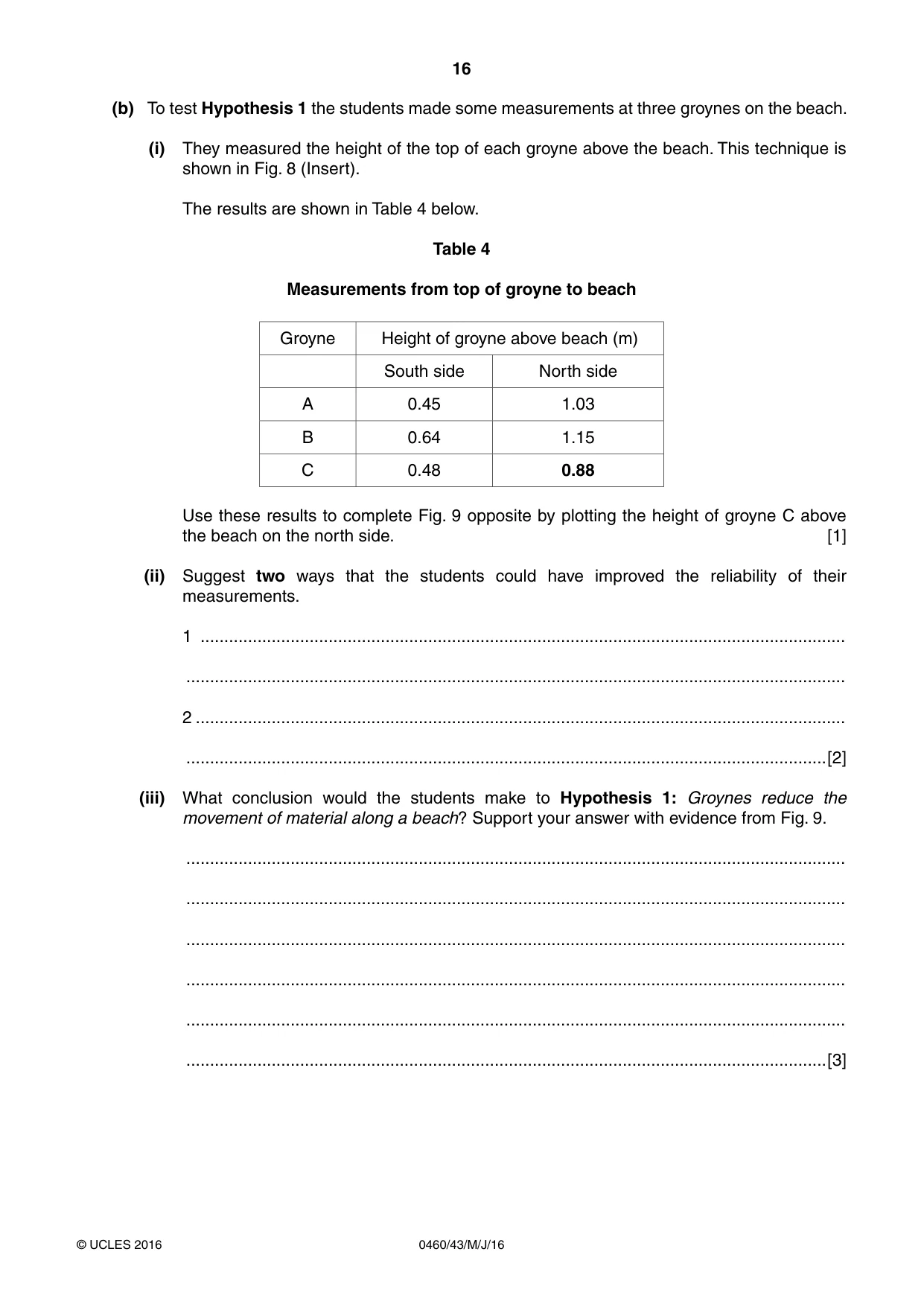
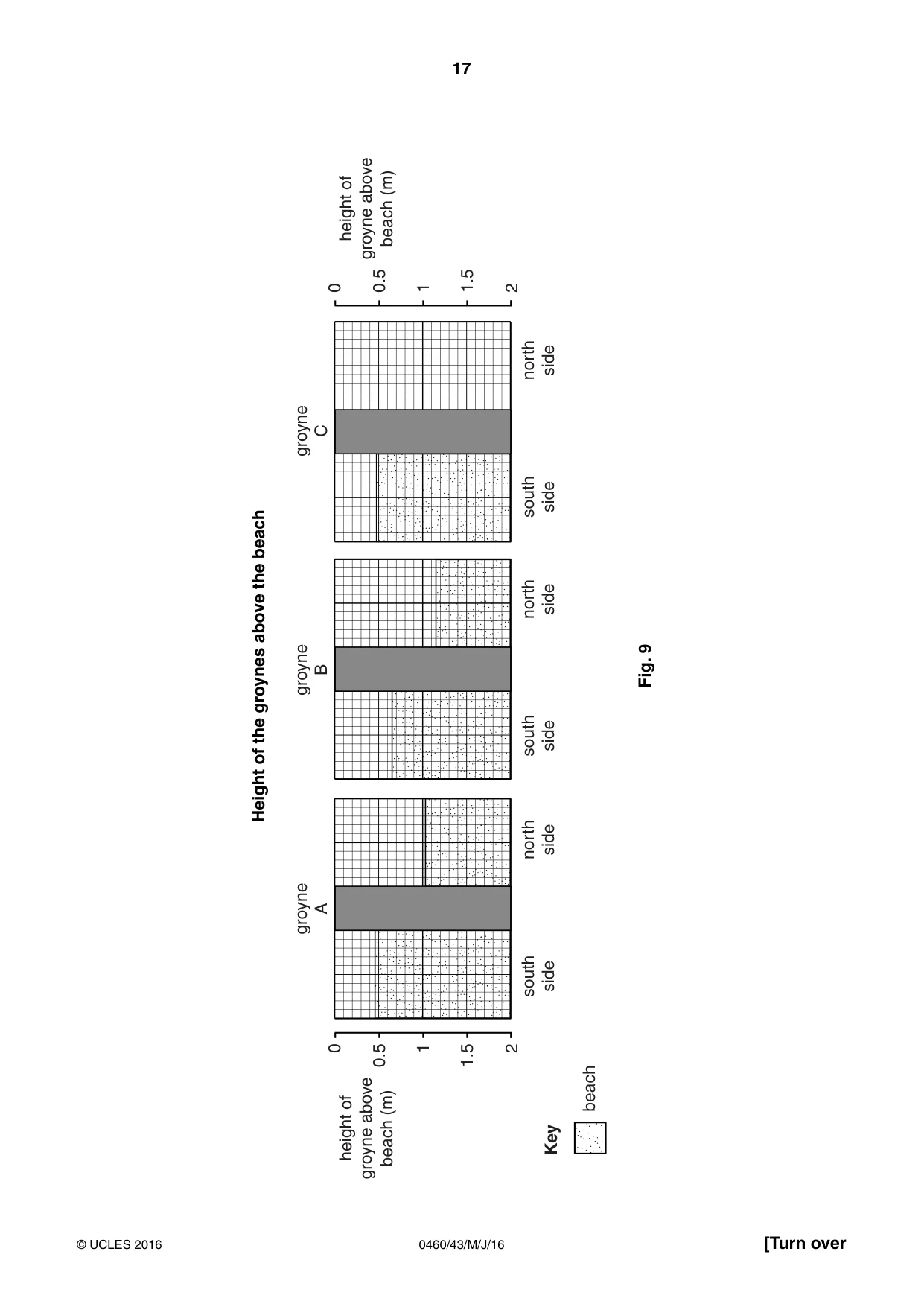
16 0460/43/M/J/16 © UCLES 2016 (b) To test Hypothesis 1 the students made some measurements at three groynes on the beach. (i) They measured the height of the top of each groyne above the beach. This technique is shown in Fig. 8 (Insert). The results are shown in Table 4 below. Table 4 Measurements from top of groyne to beach Groyne Height of groyne above beach (m) South side North side A 0.45 1.03 B 0.64 1.15 C 0.48 0.88 Use these results to complete Fig. 9 opposite by plotting the height of groyne C above the beach on the north side. [1] (ii) Suggest two ways that the students could have improved the reliability of their measurements. 1 … … 2 … …[2] (iii) What conclusion would the students make to Hypothesis 1: Groynes reduce the movement of material along a beach? Support your answer with evidence from Fig. 9. … … … … … …[3]
Question paper, page 17
17 0460/43/M/J/16 © UCLES 2016 [Turn over Height of the groynes above the beach 0 0.5 1 1.5 2 Key beach south side groyne A height of groyne above beach (m) height of groyne above beach (m) groyne B groyne C north side south side north side south side north side 0 0.5 1 1.5 2 Fig. 9
Question paper, page 18
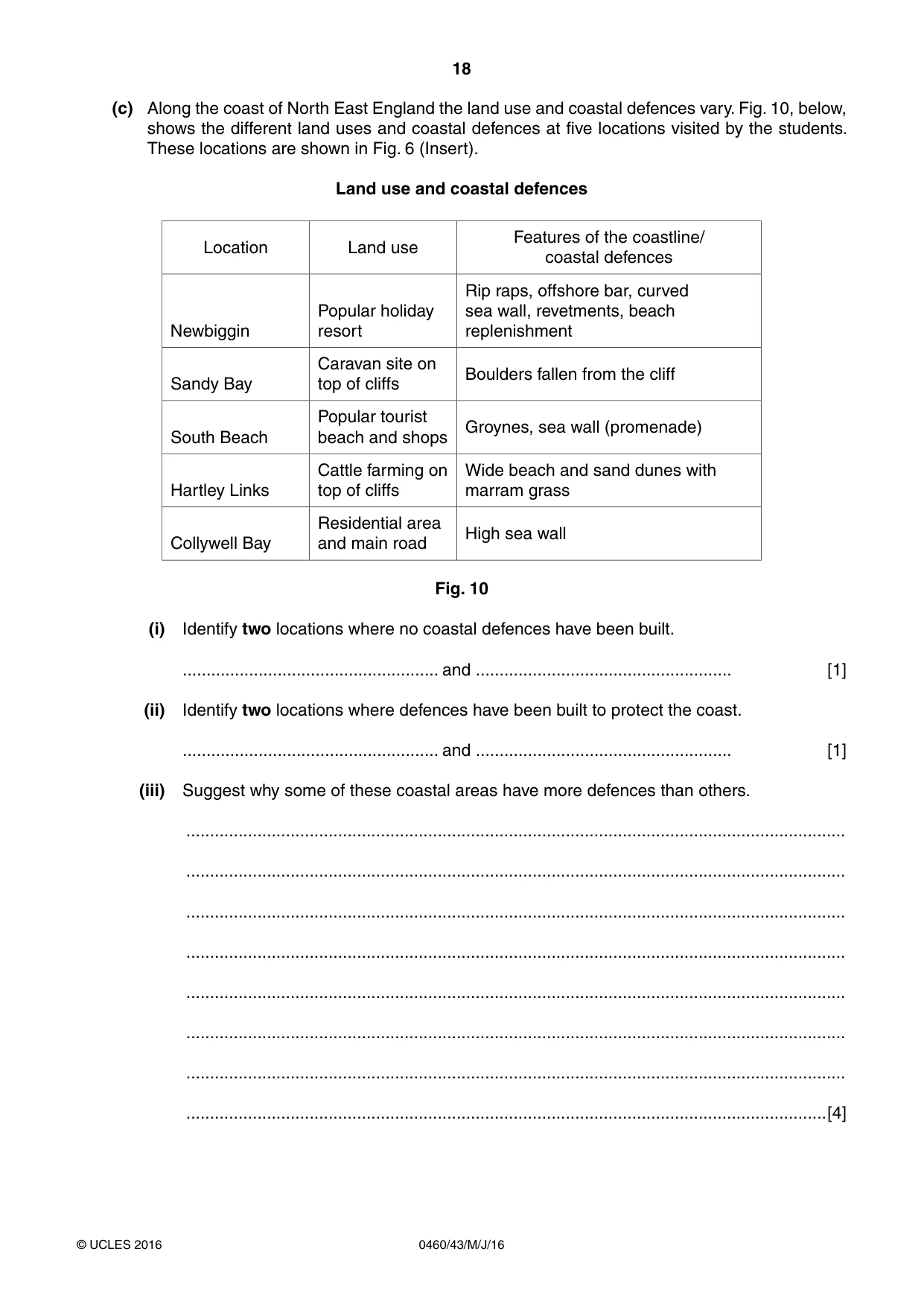
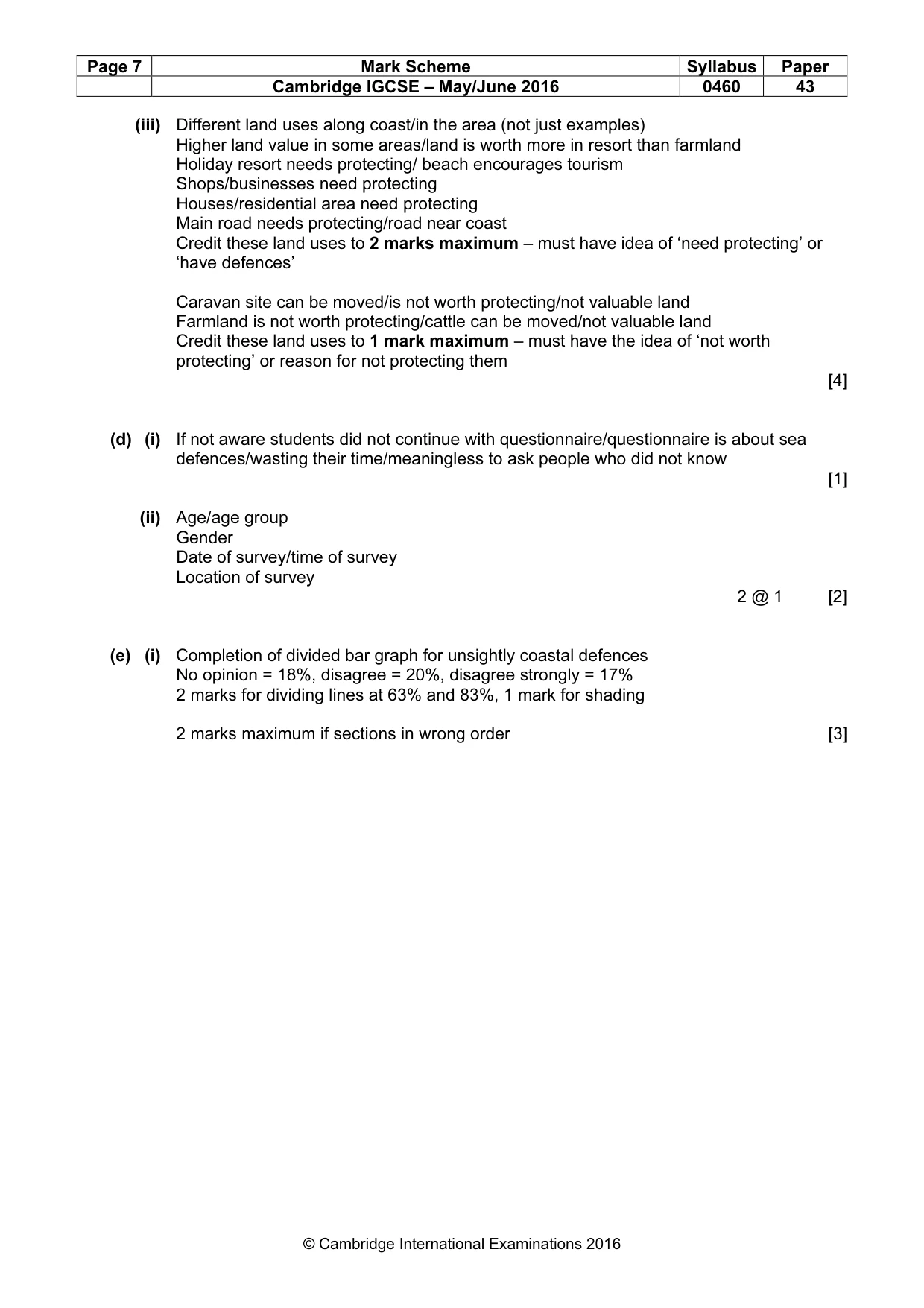
18 0460/43/M/J/16 © UCLES 2016 (c) Along the coast of North East England the land use and coastal defences vary. Fig. 10, below, shows the different land uses and coastal defences at five locations visited by the students. These locations are shown in Fig. 6 (Insert). Land use and coastal defences Location Land use Features of the coastline/ coastal defences Newbiggin Popular holiday resort Rip raps, offshore bar, curved sea wall, revetments, beach replenishment Sandy Bay Caravan site on top of cliffs Boulders fallen from the cliff South Beach Popular tourist beach and shops Groynes, sea wall (promenade) Hartley Links Cattle farming on top of cliffs Wide beach and sand dunes with marram grass Collywell Bay Residential area and main road High sea wall Fig. 10 (i) Identify two locations where no coastal defences have been built. … and … [1] (ii) Identify two locations where defences have been built to protect the coast. … and … [1] (iii) Suggest why some of these coastal areas have more defences than others. … … … … … … … …[4]
Question paper, page 19
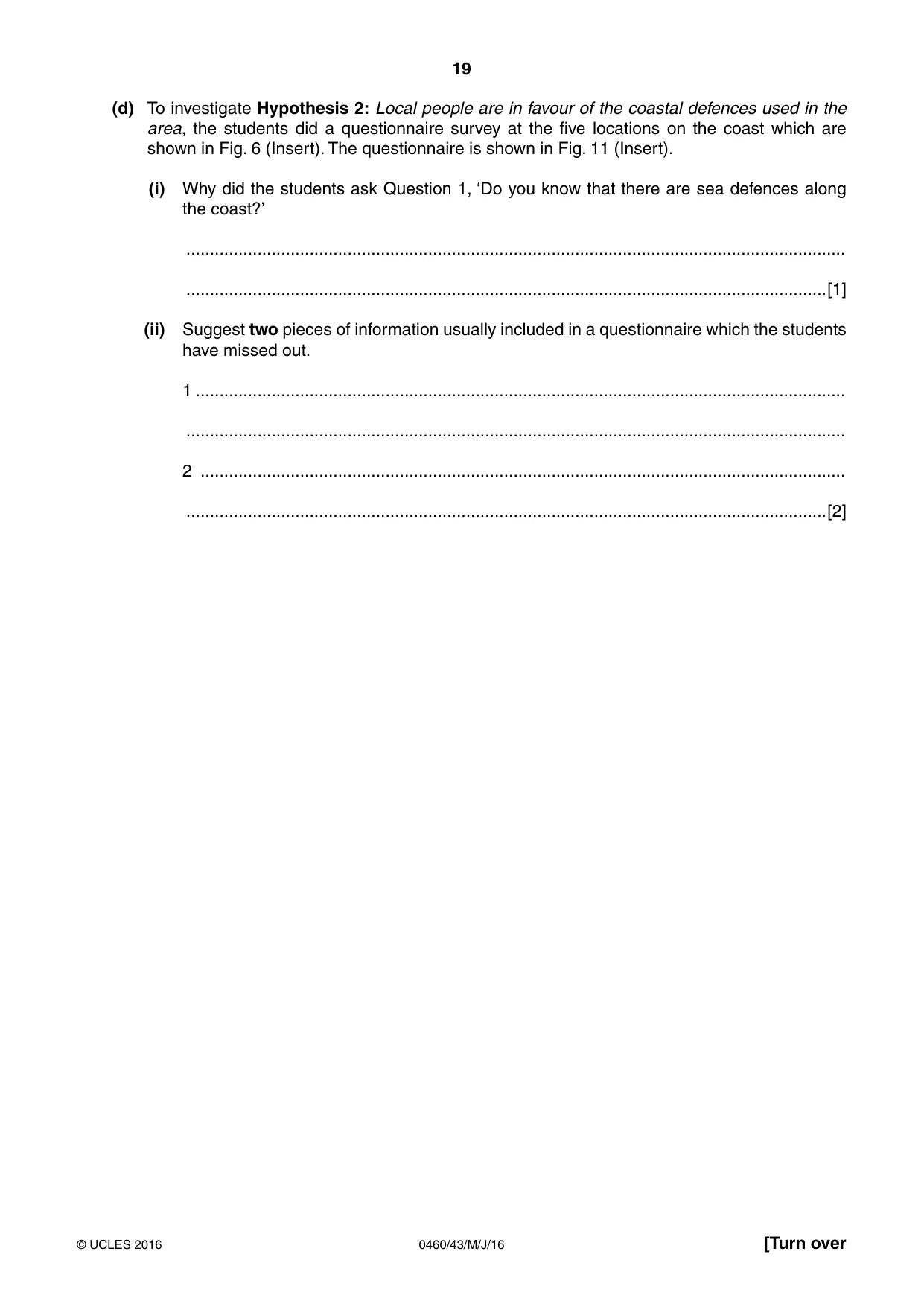
19 0460/43/M/J/16 © UCLES 2016 [Turn over (d) To investigate Hypothesis 2: Local people are in favour of the coastal defences used in the area, the students did a questionnaire survey at the five locations on the coast which are shown in Fig. 6 (Insert). The questionnaire is shown in Fig. 11 (Insert). (i) Why did the students ask Question 1, ‘Do you know that there are sea defences along the coast?’ … …[1] (ii) Suggest two pieces of information usually included in a questionnaire which the students have missed out. 1 … … 2 … …[2]
Question paper, page 20
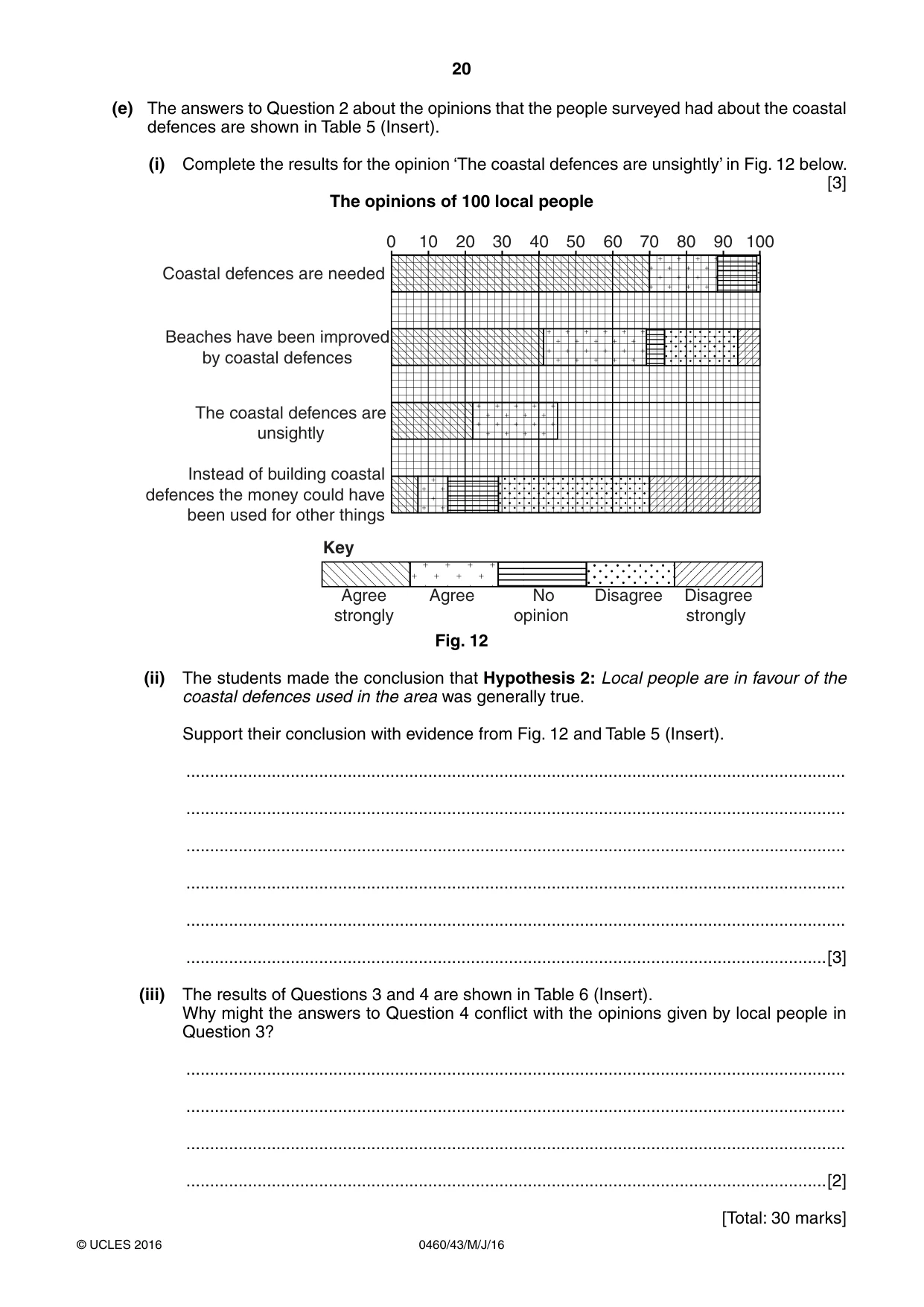
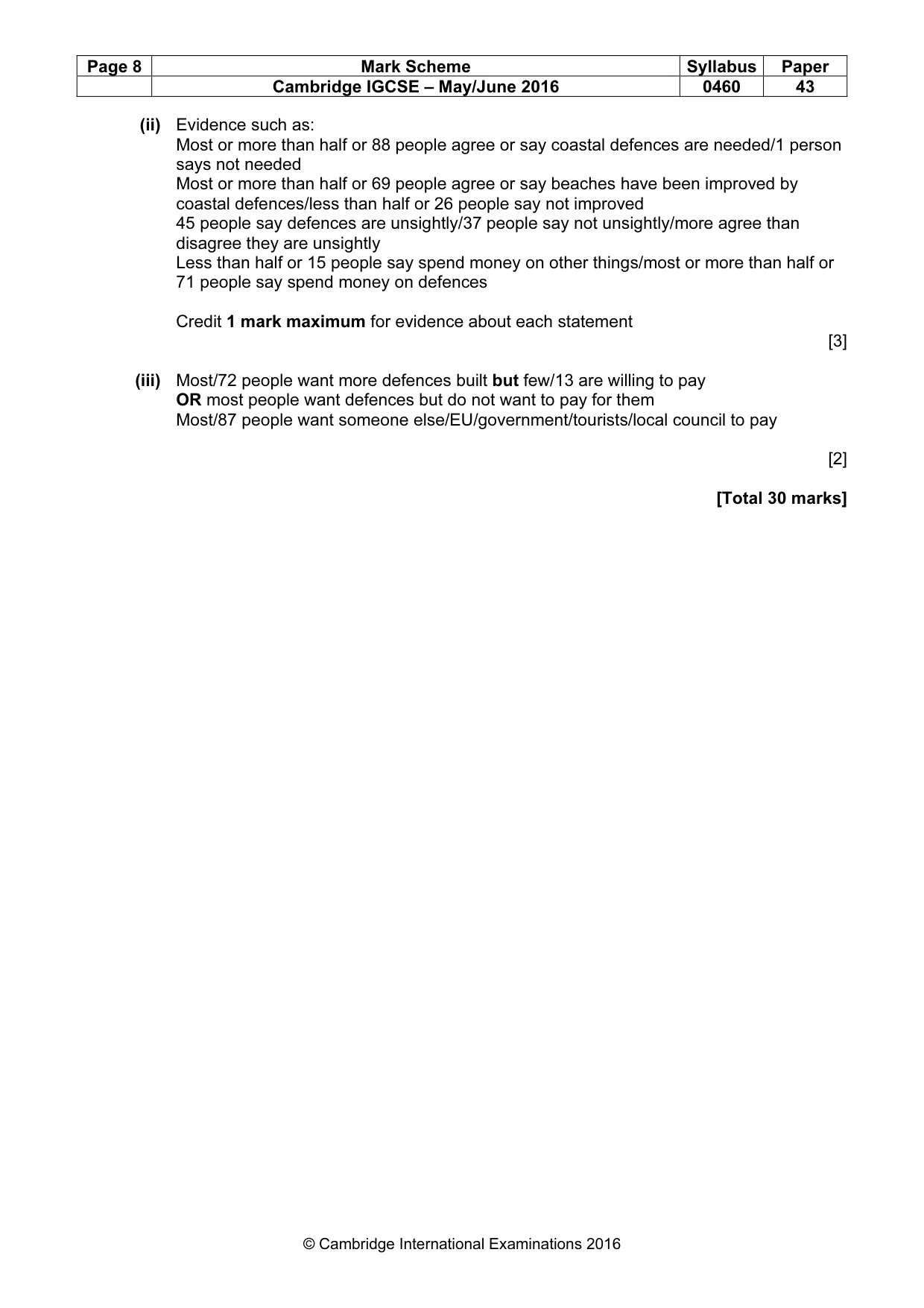
20 0460/43/M/J/16 © UCLES 2016 (e) The answers to Question 2 about the opinions that the people surveyed had about the coastal defences are shown in Table 5 (Insert). (i) Complete the results for the opinion ‘The coastal defences are unsightly’ in Fig. 12 below. [3] The opinions of 100 local people 0 Coastal defences are needed Beaches have been improved by coastal defences The coastal defences are unsightly Instead of building coastal defences the money could have been used for other things Agree strongly Agree No opinion Disagree Disagree strongly .H\ 10 20 30 40 50 60 70 80 90 100 Fig. 12 (ii) The students made the conclusion that Hypothesis 2: Local people are in favour of the coastal defences used in the area was generally true. Support their conclusion with evidence from Fig. 12 and Table 5 (Insert). … … … … … …[3] (iii) The results of Questions 3 and 4 are shown in Table 6 (Insert). Why might the answers to Question 4 conflict with the opinions given by local people in Question 3? … … … …[2] [Total: 30 marks]
Question paper, page 21
21 0460/43/M/J/16 © UCLES 2016 Additional Pages If you use the following lined pages to complete the answer(s) to any question(s), the question number(s) must be clearly shown. … … … … … … … … … … … … … … … … … … … … … … … … …
Question paper, page 22
22 0460/43/M/J/16 © UCLES 2016 … … … … … … … … … … … … … … … … … … … … … … … … … …
Question paper, page 23
23 0460/43/M/J/16 © UCLES 2016 BLANK PAGE
Question paper, page 24
24 0460/43/M/J/16 © UCLES 2016 Permission to reproduce items where third-party owned material protected by copyright is included has been sought and cleared where possible. Every reasonable effort has been made by the publisher (UCLES) to trace copyright holders, but if any items requiring clearance have unwittingly been included, the publisher will be pleased to make amends at the earliest possible opportunity. To avoid the issue of disclosure of answer-related information to candidates, all copyright acknowledgements are reproduced online in the Cambridge International Examinations Copyright Acknowledgements Booklet. This is produced for each series of examinations and is freely available to download at www.cie.org.uk after the live examination series. Cambridge International Examinations is part of the Cambridge Assessment Group. Cambridge Assessment is the brand name of University of Cambridge Local Examinations Syndicate (UCLES), which is itself a department of the University of Cambridge. BLANK PAGE
Mark scheme, page 1
® IGCSE is the registered trademark of Cambridge International Examinations. This syllabus is approved for use in England, Wales and Northern Ireland as a Cambridge International Level 1/Level 2 Certificate. This document consists of 8 printed pages. © UCLES 2016 [Turn over Cambridge International Examinations Cambridge International General Certificate of Secondary Education GEOGRAPHY 0460/43 Paper 4 Alternative to Coursework May/June 2016 MARK SCHEME Maximum Mark: 60 Published This mark scheme is published as an aid to teachers and candidates, to indicate the requirements of the examination. It shows the basis on which Examiners were instructed to award marks. It does not indicate the details of the discussions that took place at an Examiners’ meeting before marking began, which would have considered the acceptability of alternative answers. Mark schemes should be read in conjunction with the question paper and the Principal Examiner Report for Teachers. Cambridge will not enter into discussions about these mark schemes. Cambridge is publishing the mark schemes for the May/June 2016 series for most Cambridge IGCSE®, Cambridge International A and AS Level components and some Cambridge O Level components.
Mark scheme, page 2
Page 2 Mark Scheme Syllabus Paper Cambridge IGCSE – May/June 2016 0460 43 © Cambridge International Examinations 2016 1 (a) (i) Area served by a settlement or service 2 ✓ = 0 [1] (ii) Bigger settlements: Provide high order services/high order goods Provide comparison goods/big name shops or example Have many/larger variety of services/big choice/lots of shops/larger stores/more shops/more services Provide specialised services/specialised goods Provide specific functions e.g. administration, business, tourism, university, bank/people go to work there Have easy access/good road or rail links/good transport links There are few big settlements People travel further/long way to buy the goods/infrastructure [3] (b) (i) Organise: When/at what time to do the counts/how long to do each count/start at same time Number of students per group/students get into groups/decide which students go to each counting point How many times to do the counts per day/e.g. do it 3 times in the day Whether to do the counts on more than one day/repeat on a different day Make a recording sheet/recording table Carry out: Use tally method/‘clicker’ Use a watch or timer to time the counts/time when they start counting Separate tasks in the group e.g. two students do each count/count people going in different directions/one student counts and one students records Credit ideas in either section and do not ignore ideas if they are in the ‘wrong’ section. No reserve mark for either section If answer refers to a traffic count credit to 3 marks maximum for relevant points [5]
Mark scheme, page 3
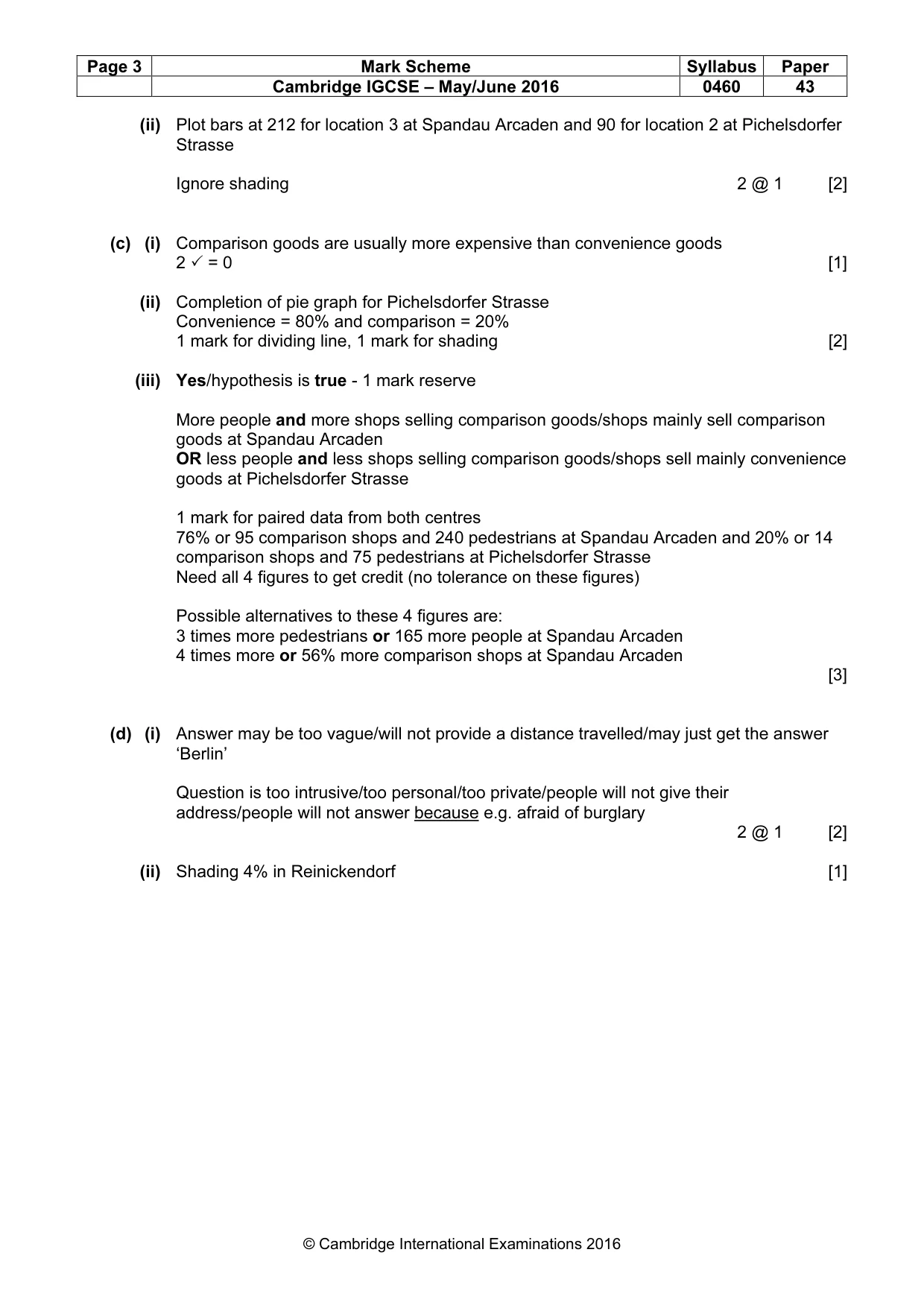
Page 3 Mark Scheme Syllabus Paper Cambridge IGCSE – May/June 2016 0460 43 © Cambridge International Examinations 2016 (ii) Plot bars at 212 for location 3 at Spandau Arcaden and 90 for location 2 at Pichelsdorfer Strasse Ignore shading 2 @ 1 [2] (c) (i) Comparison goods are usually more expensive than convenience goods 2 ✓ = 0 [1] (ii) Completion of pie graph for Pichelsdorfer Strasse Convenience = 80% and comparison = 20% 1 mark for dividing line, 1 mark for shading [2] (iii) Yes/hypothesis is true - 1 mark reserve More people and more shops selling comparison goods/shops mainly sell comparison goods at Spandau Arcaden OR less people and less shops selling comparison goods/shops sell mainly convenience goods at Pichelsdorfer Strasse 1 mark for paired data from both centres 76% or 95 comparison shops and 240 pedestrians at Spandau Arcaden and 20% or 14 comparison shops and 75 pedestrians at Pichelsdorfer Strasse Need all 4 figures to get credit (no tolerance on these figures) Possible alternatives to these 4 figures are: 3 times more pedestrians or 165 more people at Spandau Arcaden 4 times more or 56% more comparison shops at Spandau Arcaden [3] (d) (i) Answer may be too vague/will not provide a distance travelled/may just get the answer ‘Berlin’ Question is too intrusive/too personal/too private/people will not give their address/people will not answer because e.g. afraid of burglary 2 @ 1 [2] (ii) Shading 4% in Reinickendorf [1]
Mark scheme, page 4
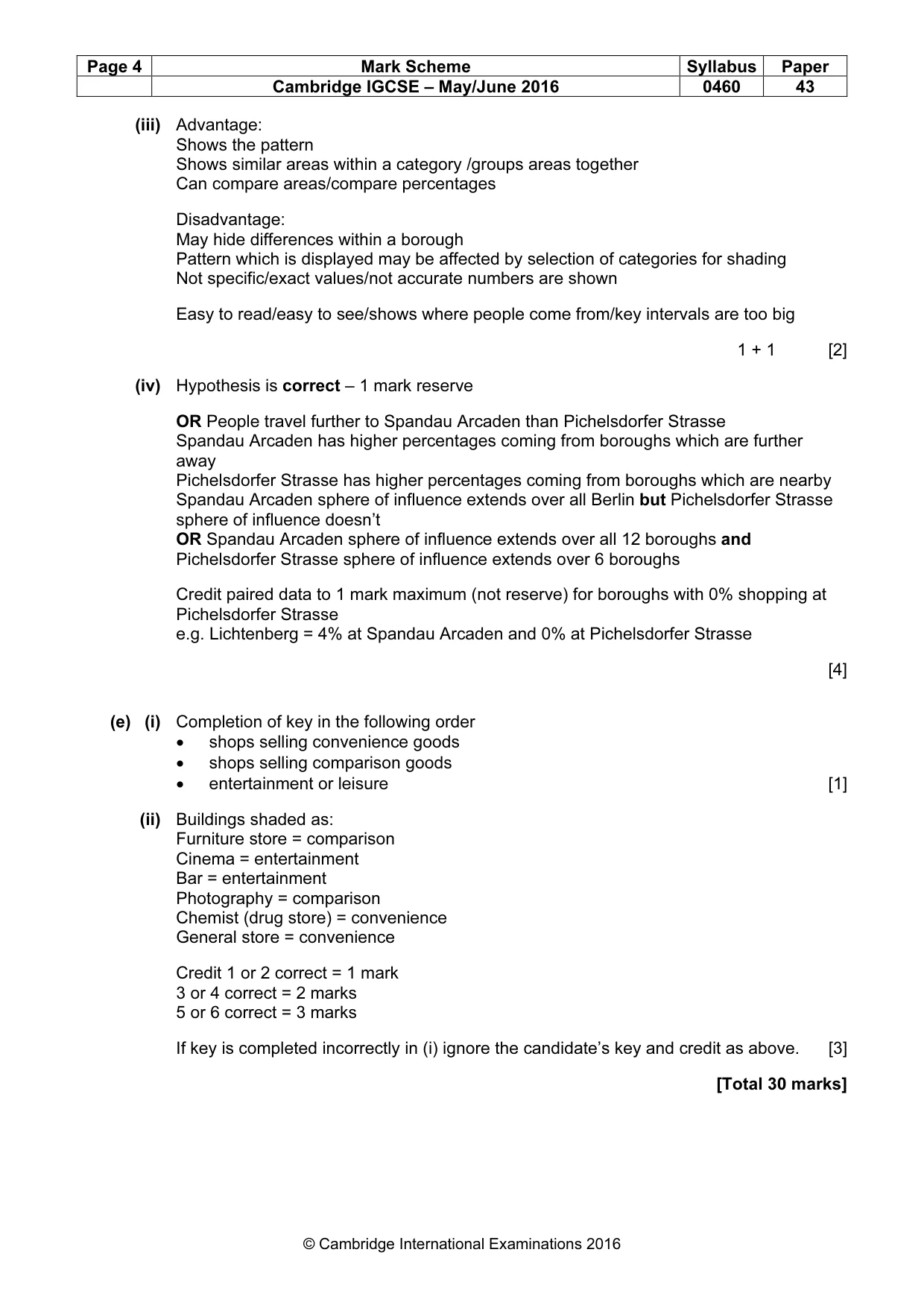
Page 4 Mark Scheme Syllabus Paper Cambridge IGCSE – May/June 2016 0460 43 © Cambridge International Examinations 2016 (iii) Advantage: Shows the pattern Shows similar areas within a category /groups areas together Can compare areas/compare percentages Disadvantage: May hide differences within a borough Pattern which is displayed may be affected by selection of categories for shading Not specific/exact values/not accurate numbers are shown Easy to read/easy to see/shows where people come from/key intervals are too big 1 + 1 [2] (iv) Hypothesis is correct – 1 mark reserve OR People travel further to Spandau Arcaden than Pichelsdorfer Strasse Spandau Arcaden has higher percentages coming from boroughs which are further away Pichelsdorfer Strasse has higher percentages coming from boroughs which are nearby Spandau Arcaden sphere of influence extends over all Berlin but Pichelsdorfer Strasse sphere of influence doesn’t OR Spandau Arcaden sphere of influence extends over all 12 boroughs and Pichelsdorfer Strasse sphere of influence extends over 6 boroughs Credit paired data to 1 mark maximum (not reserve) for boroughs with 0% shopping at Pichelsdorfer Strasse e.g. Lichtenberg = 4% at Spandau Arcaden and 0% at Pichelsdorfer Strasse [4] (e) (i) Completion of key in the following order • shops selling convenience goods • shops selling comparison goods • entertainment or leisure [1] (ii) Buildings shaded as: Furniture store = comparison Cinema = entertainment Bar = entertainment Photography = comparison Chemist (drug store) = convenience General store = convenience Credit 1 or 2 correct = 1 mark 3 or 4 correct = 2 marks 5 or 6 correct = 3 marks If key is completed incorrectly in (i) ignore the candidate’s key and credit as above. [3] [Total 30 marks]
Mark scheme, page 5
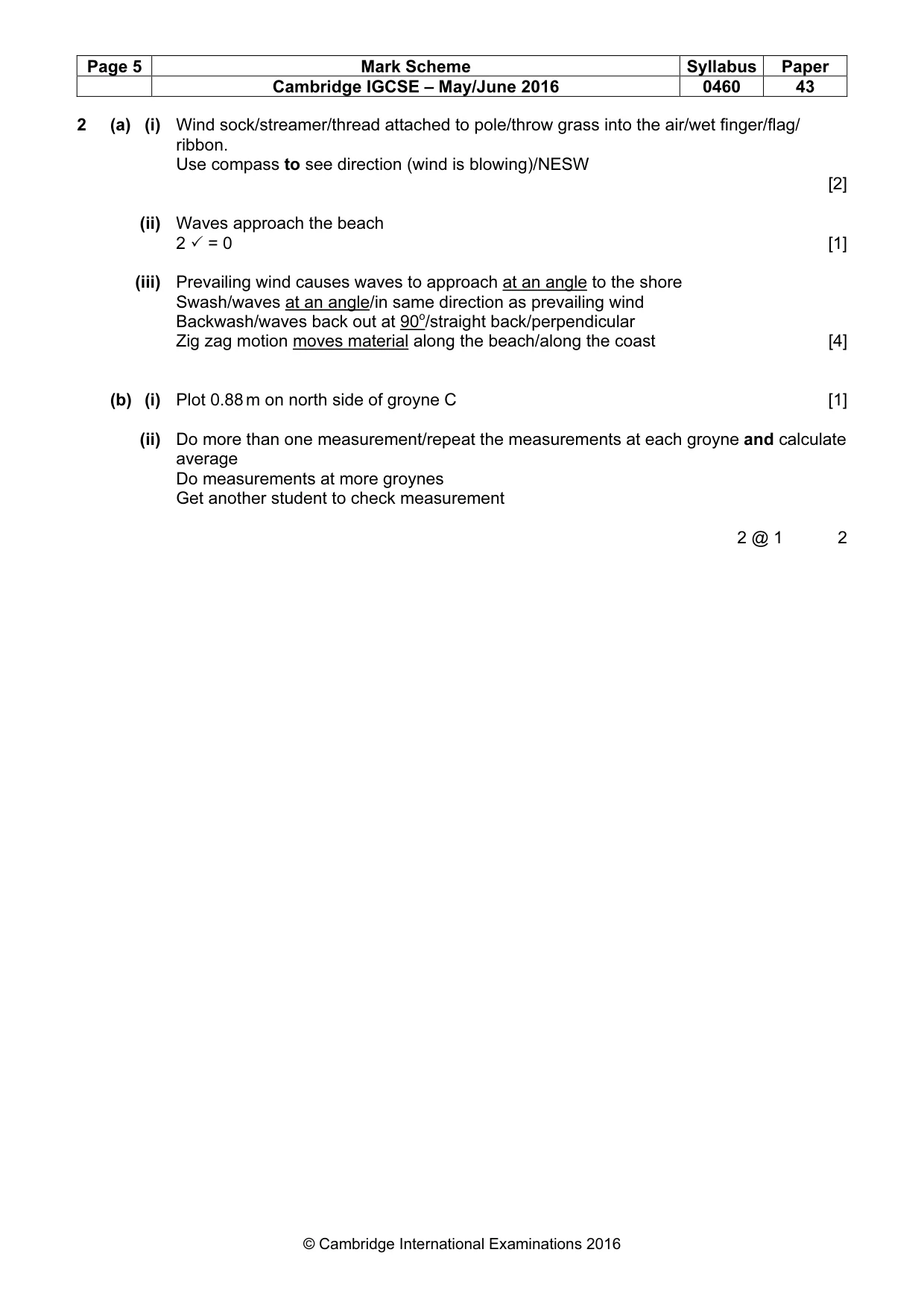
Page 5 Mark Scheme Syllabus Paper Cambridge IGCSE – May/June 2016 0460 43 © Cambridge International Examinations 2016 2 (a) (i) Wind sock/streamer/thread attached to pole/throw grass into the air/wet finger/flag/ ribbon. Use compass to see direction (wind is blowing)/NESW [2] (ii) Waves approach the beach 2 ✓ = 0 [1] (iii) Prevailing wind causes waves to approach at an angle to the shore Swash/waves at an angle/in same direction as prevailing wind Backwash/waves back out at 90o/straight back/perpendicular Zig zag motion moves material along the beach/along the coast [4] (b) (i) Plot 0.88 m on north side of groyne C [1] (ii) Do more than one measurement/repeat the measurements at each groyne and calculate average Do measurements at more groynes Get another student to check measurement 2 @ 1 2
Mark scheme, page 6
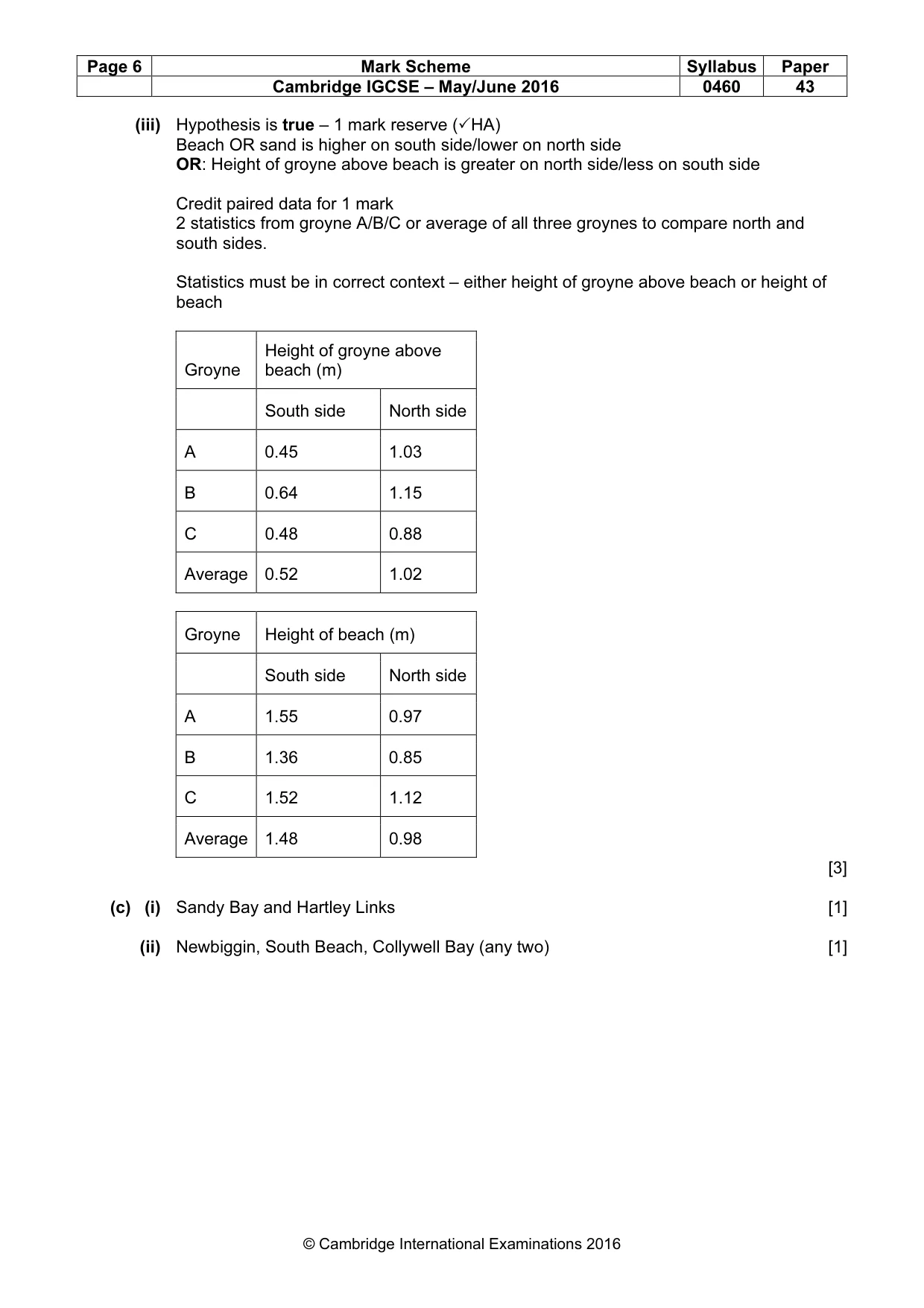
Page 6 Mark Scheme Syllabus Paper Cambridge IGCSE – May/June 2016 0460 43 © Cambridge International Examinations 2016 (iii) Hypothesis is true – 1 mark reserve (✓HA) Beach OR sand is higher on south side/lower on north side OR: Height of groyne above beach is greater on north side/less on south side Credit paired data for 1 mark 2 statistics from groyne A/B/C or average of all three groynes to compare north and south sides. Statistics must be in correct context – either height of groyne above beach or height of beach Groyne Height of groyne above beach (m) South side North side A 0.45 1.03 B 0.64 1.15 C 0.48 0.88 Average 0.52 1.02 Groyne Height of beach (m) South side North side A 1.55 0.97 B 1.36 0.85 C 1.52 1.12 Average 1.48 0.98 [3] (c) (i) Sandy Bay and Hartley Links [1] (ii) Newbiggin, South Beach, Collywell Bay (any two) [1]
Mark scheme, page 7
Page 7 Mark Scheme Syllabus Paper Cambridge IGCSE – May/June 2016 0460 43 © Cambridge International Examinations 2016 (iii) Different land uses along coast/in the area (not just examples) Higher land value in some areas/land is worth more in resort than farmland Holiday resort needs protecting/ beach encourages tourism Shops/businesses need protecting Houses/residential area need protecting Main road needs protecting/road near coast Credit these land uses to 2 marks maximum – must have idea of ‘need protecting’ or ‘have defences’ Caravan site can be moved/is not worth protecting/not valuable land Farmland is not worth protecting/cattle can be moved/not valuable land Credit these land uses to 1 mark maximum – must have the idea of ‘not worth protecting’ or reason for not protecting them [4] (d) (i) If not aware students did not continue with questionnaire/questionnaire is about sea defences/wasting their time/meaningless to ask people who did not know [1] (ii) Age/age group Gender Date of survey/time of survey Location of survey 2 @ 1 [2] (e) (i) Completion of divided bar graph for unsightly coastal defences No opinion = 18%, disagree = 20%, disagree strongly = 17% 2 marks for dividing lines at 63% and 83%, 1 mark for shading 2 marks maximum if sections in wrong order [3]
Mark scheme, page 8
Page 8 Mark Scheme Syllabus Paper Cambridge IGCSE – May/June 2016 0460 43 © Cambridge International Examinations 2016 (ii) Evidence such as: Most or more than half or 88 people agree or say coastal defences are needed/1 person says not needed Most or more than half or 69 people agree or say beaches have been improved by coastal defences/less than half or 26 people say not improved 45 people say defences are unsightly/37 people say not unsightly/more agree than disagree they are unsightly Less than half or 15 people say spend money on other things/most or more than half or 71 people say spend money on defences Credit 1 mark maximum for evidence about each statement [3] (iii) Most/72 people want more defences built but few/13 are willing to pay OR most people want defences but do not want to pay for them Most/87 people want someone else/EU/government/tourists/local council to pay [2] [Total 30 marks]
What you needed in this session
Cambridge’s own grade thresholds for 2016 May/June, Paper 4 · Variant 3. A higher threshold means an easier paper — the bar moves with how the cohort did.