Cambridge IGCSE French - Foreign Language 0520 — 2016 Oct/Nov Paper 2 · Variant 1
0520/21/O/N/16 · 45 marks · ≈51 min
The question paper and its mark scheme, free to read here and free to download. This is Cambridge’s own paper, exactly as it was sat.
Question paper16 pages



Mark scheme12 pages
Answers below. Sit the paper first if you are practising.
Paper as text
Question paper, page 1
This document consists of 14 printed pages and 2 blank pages. DC (CW/SW) 117185/3 © UCLES 2016 [Turn over Cambridge International Examinations Cambridge International General Certificate of Secondary Education * 0 9 7 3 8 8 5 5 0 7 * FRENCH 0520/21 Paper 2 Reading October/November 2016 1 hour Candidates answer on the Question Paper. No Additional Materials are required. READ THESE INSTRUCTIONS FIRST Write your Centre number, candidate number and name on all the work you hand in. Write in dark blue or black pen. Do not use staples, paper clips, glue or correction fluid. DO NOT WRITE IN ANY BARCODES. Answer all questions. The number of marks is given in brackets [ ] at the end of each question or part question. The syllabus is approved for use in England, Wales and Northern Ireland as a Cambridge International Level 1/Level 2 Certificate.
Question paper, page 2
2 0520/21/O/N/16 © UCLES 2016 BLANK PAGE
Question paper, page 3
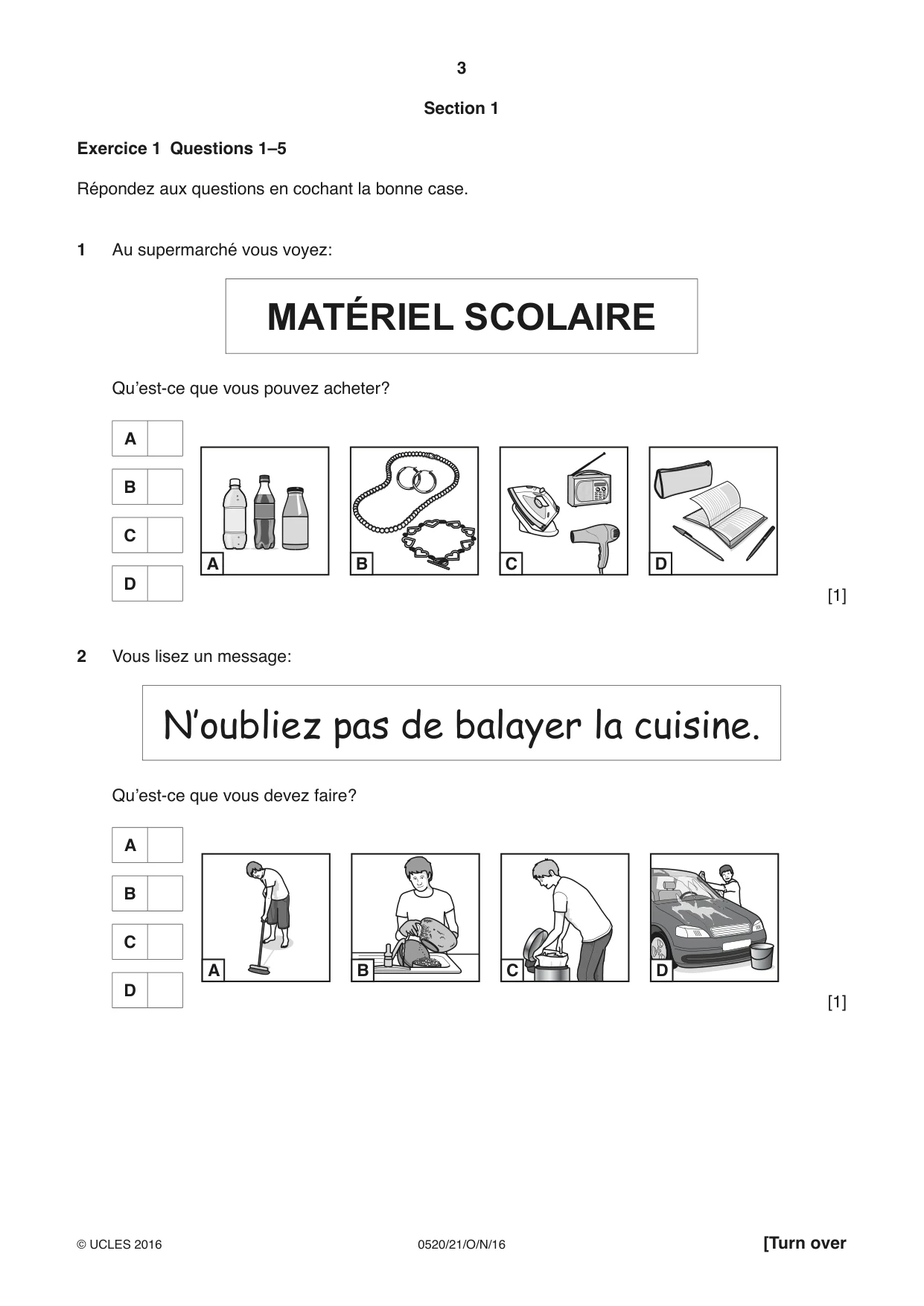
3 0520/21/O/N/16 © UCLES 2016 [Turn over Section 1 Exercice 1 Questions 1–5 Répondez aux questions en cochant la bonne case. 1 Au supermarché vous voyez: MATÉRIEL SCOLAIRE Qu’est-ce que vous pouvez acheter? A A B C D [1] B C D 2 Vous lisez un message: N’oubliez pas de balayer la cuisine. Qu’est-ce que vous devez faire? A A B C D [1] B C D
Question paper, page 4
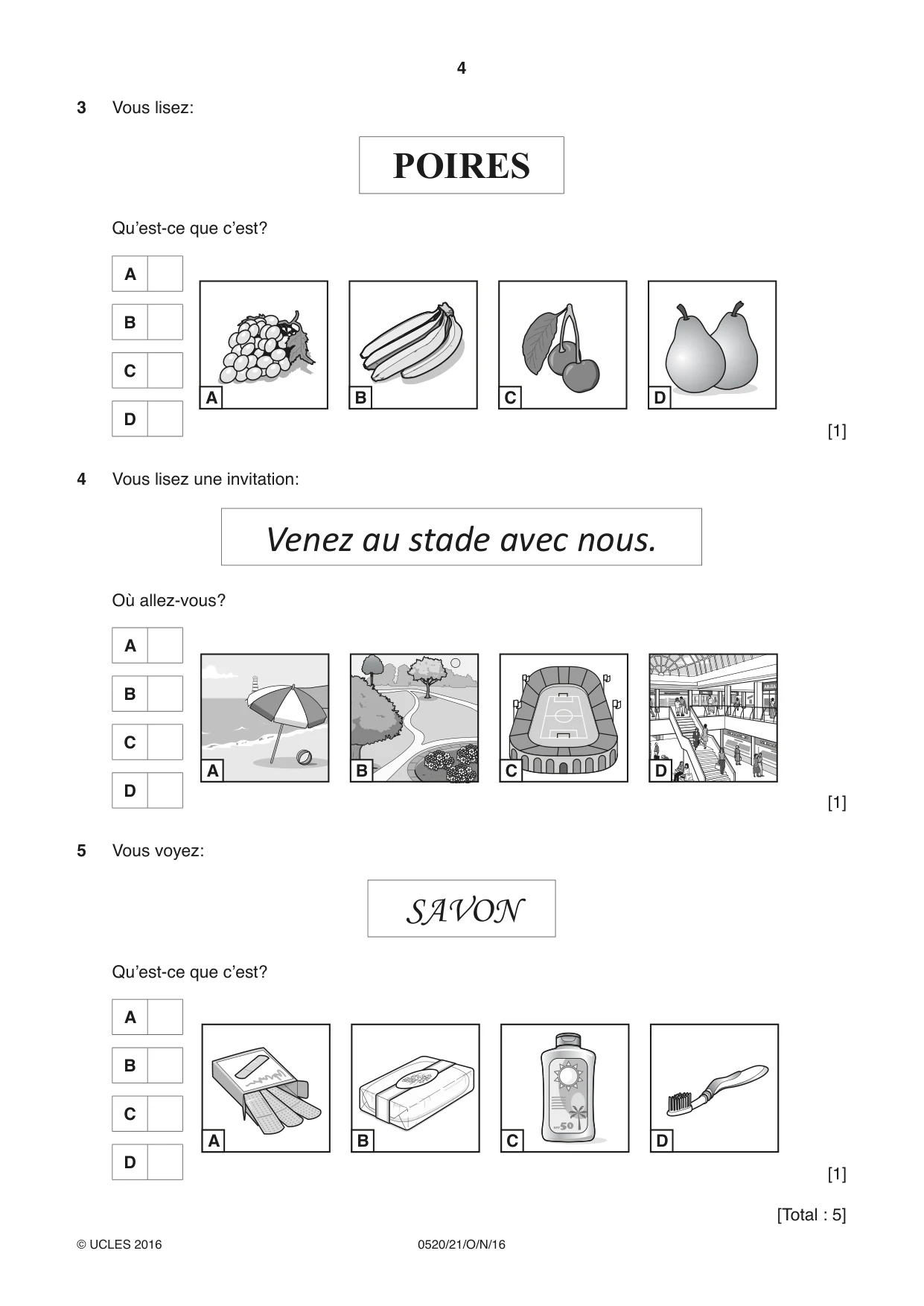
4 0520/21/O/N/16 © UCLES 2016 3 Vous lisez: POIRES Qu’est-ce que c’est? A A B C D [1] B C D 4 Vous lisez une invitation: Venez au stade avec nous. Où allez-vous? A A B C D [1] B C D 5 Vous voyez: SAVON Qu’est-ce que c’est? A A B C D [1] B C D [Total : 5]
Question paper, page 5
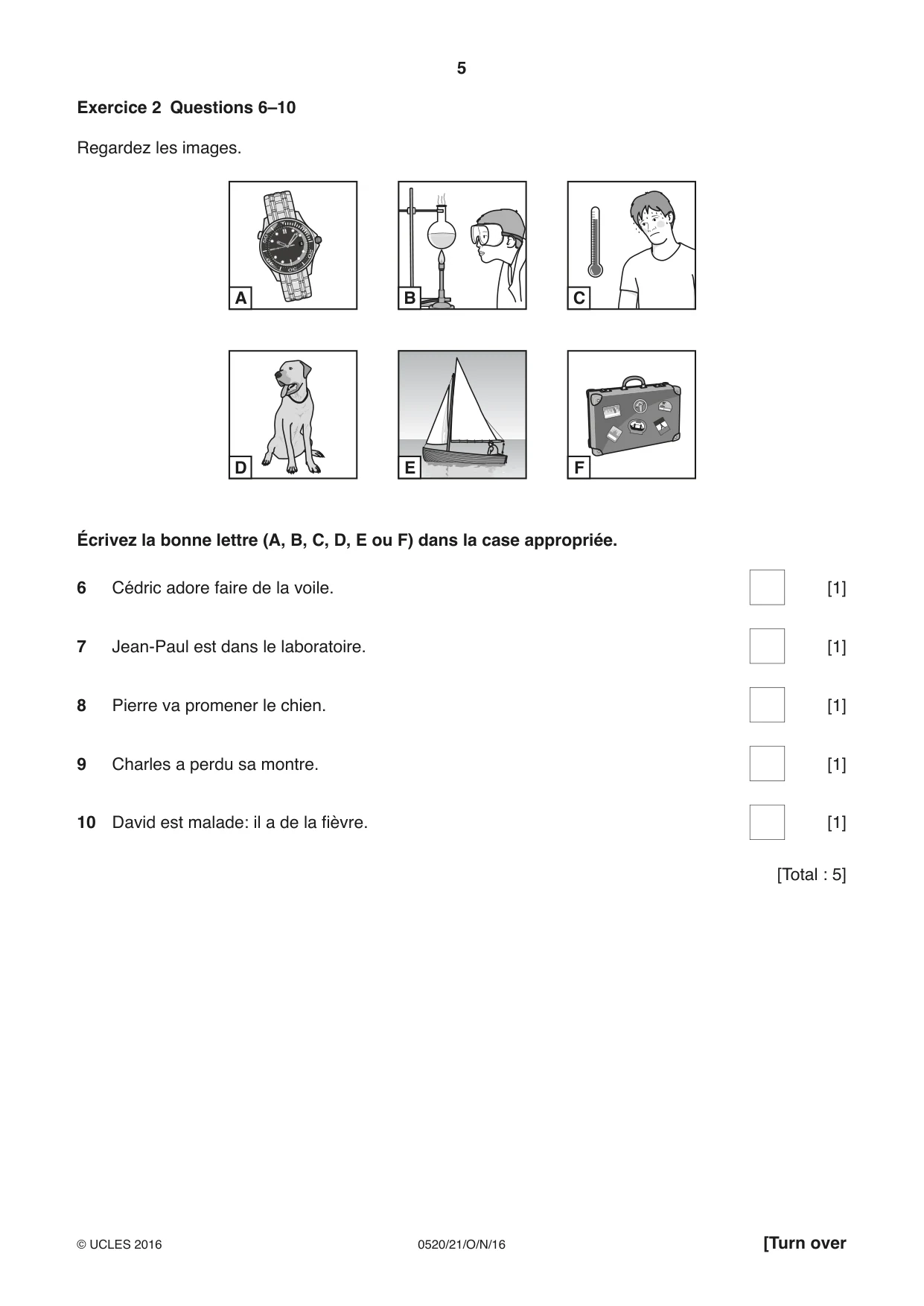
5 0520/21/O/N/16 © UCLES 2016 [Turn over Exercice 2 Questions 6–10 Regardez les images. A B C D E F Écrivez la bonne lettre (A, B, C, D, E ou F) dans la case appropriée. 6 Cédric adore faire de la voile. [1] 7 Jean-Paul est dans le laboratoire. [1] 8 Pierre va promener le chien. [1] 9 Charles a perdu sa montre. [1] 10 David est malade: il a de la fièvre. [1] [Total : 5]
Question paper, page 6
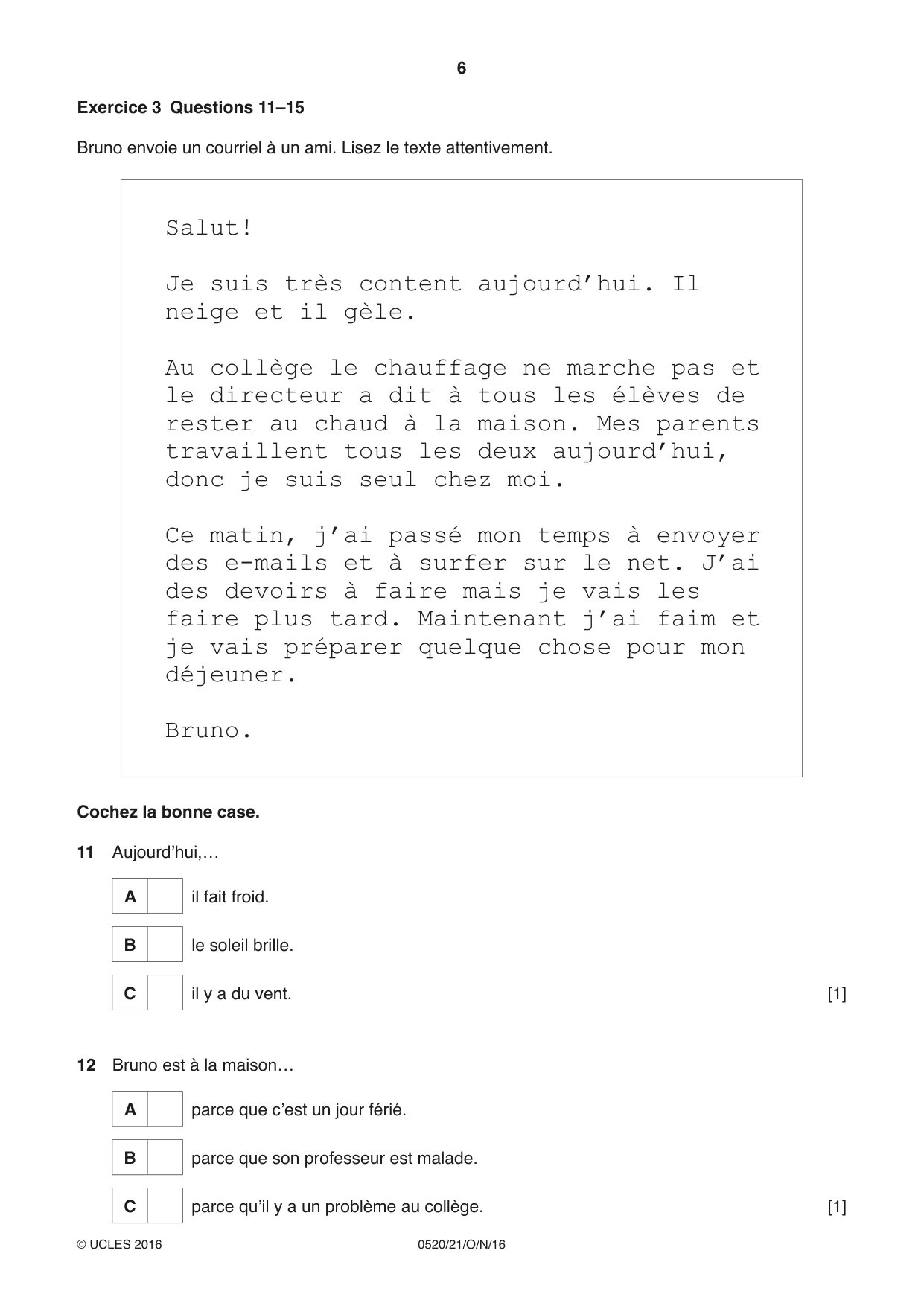
6 0520/21/O/N/16 © UCLES 2016 Exercice 3 Questions 11–15 Bruno envoie un courriel à un ami. Lisez le texte attentivement. Salut! Je suis très content aujourd’hui. Il neige et il gèle. Au collège le chauffage ne marche pas et le directeur a dit à tous les élèves de rester au chaud à la maison. Mes parents travaillent tous les deux aujourd’hui, donc je suis seul chez moi. Ce matin, j’ai passé mon temps à envoyer des e-mails et à surfer sur le net. J’ai des devoirs à faire mais je vais les faire plus tard. Maintenant j’ai faim et je vais préparer quelque chose pour mon déjeuner. Bruno. Cochez la bonne case. 11 Aujourd’hui,… A il fait froid. B le soleil brille. C il y a du vent. [1] 12 Bruno est à la maison… A parce que c’est un jour férié. B parce que son professeur est malade. C parce qu’il y a un problème au collège. [1]
Question paper, page 7
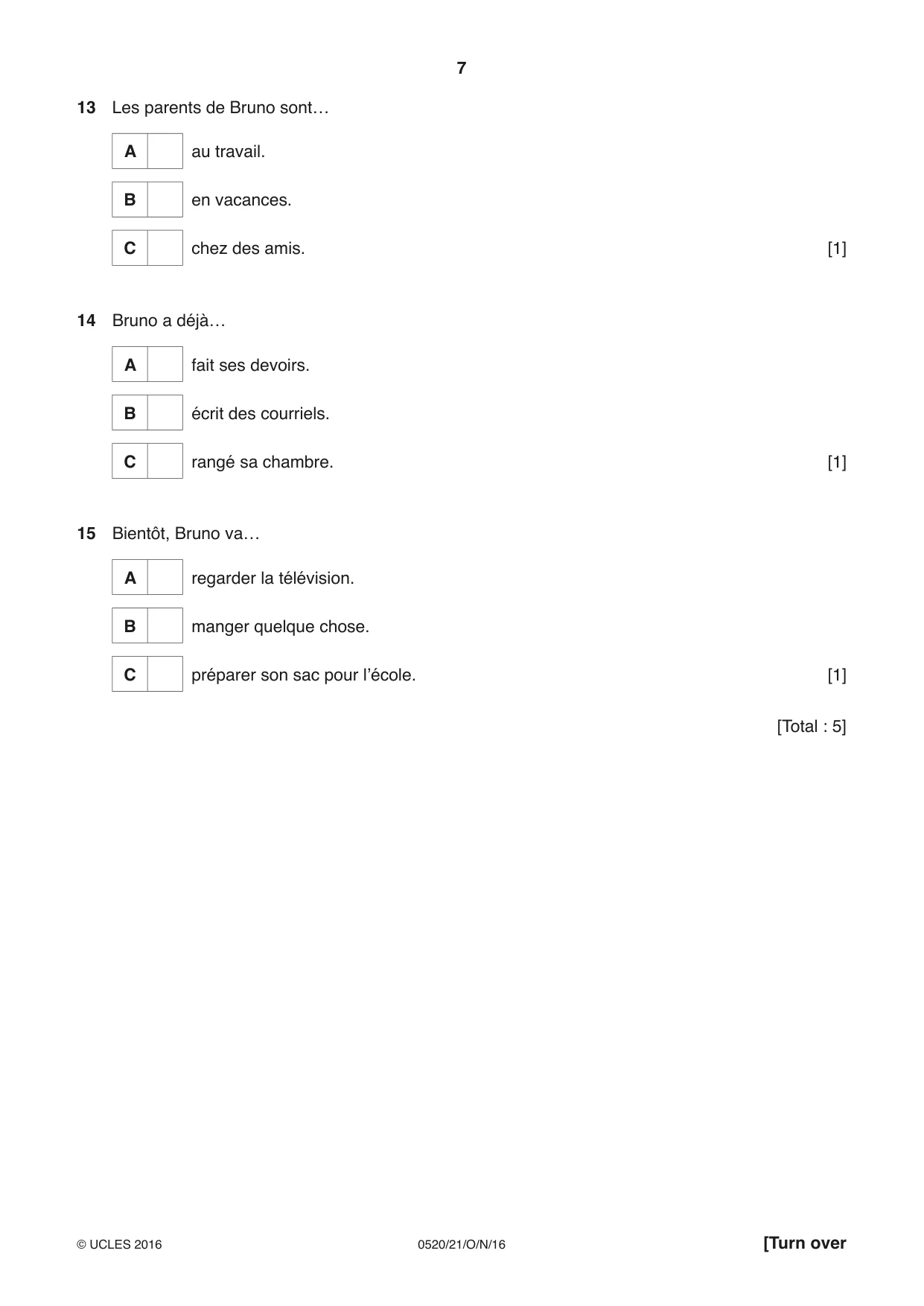
7 0520/21/O/N/16 © UCLES 2016 [Turn over 13 Les parents de Bruno sont… A au travail. B en vacances. C chez des amis. [1] 14 Bruno a déjà… A fait ses devoirs. B écrit des courriels. C rangé sa chambre. [1] 15 Bientôt, Bruno va… A regarder la télévision. B manger quelque chose. C préparer son sac pour l’école. [1] [Total : 5]
Question paper, page 8
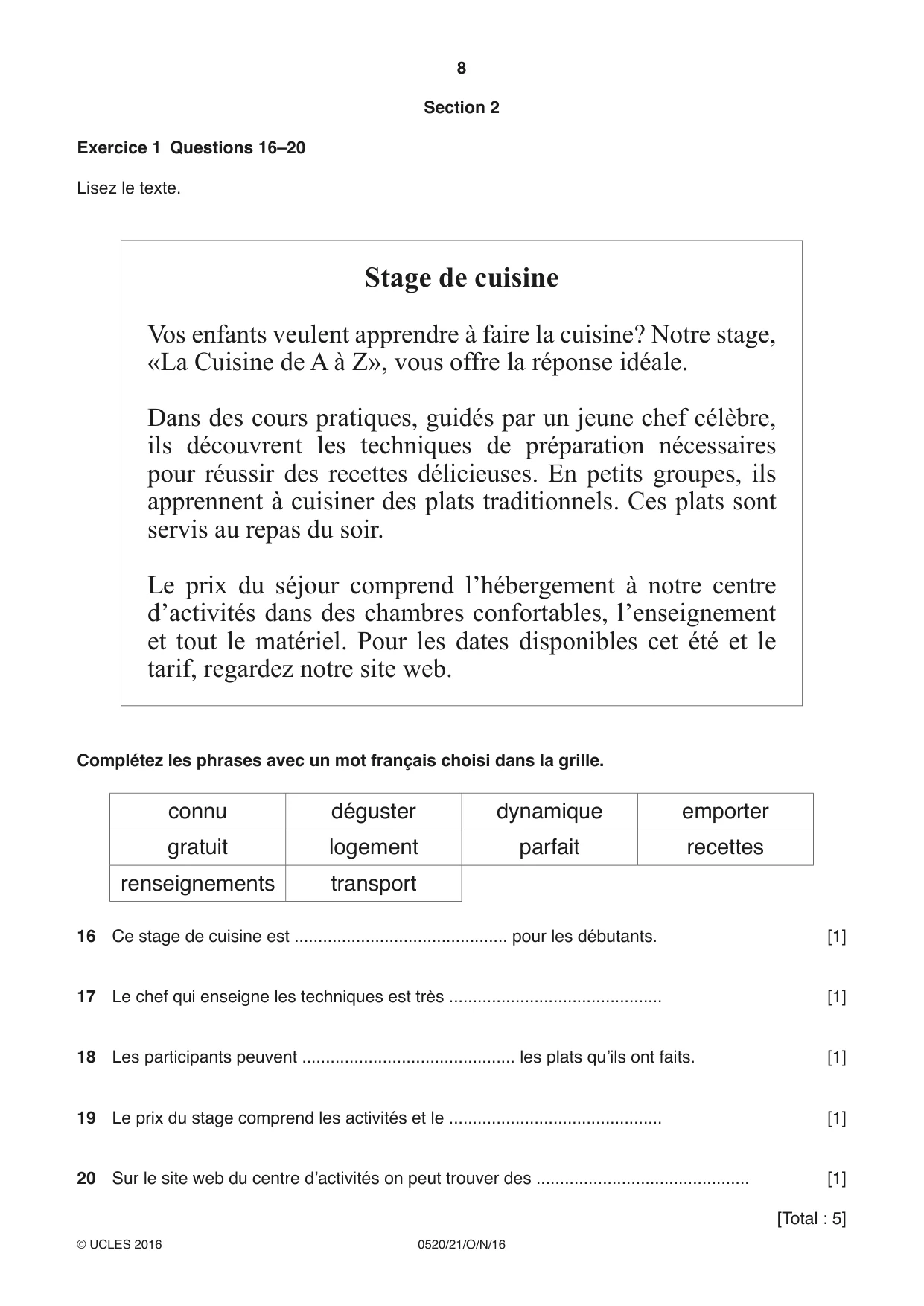
8 0520/21/O/N/16 © UCLES 2016 Section 2 Exercice 1 Questions 16–20 Lisez le texte. Stage de cuisine Vos enfants veulent apprendre à faire la cuisine? Notre stage, «La Cuisine de A à Z», vous offre la réponse idéale. Dans des cours pratiques, guidés par un jeune chef célèbre, ils découvrent les techniques de préparation nécessaires pour réussir des recettes délicieuses. En petits groupes, ils apprennent à cuisiner des plats traditionnels. Ces plats sont servis au repas du soir. Le prix du séjour comprend l’hébergement à notre centre d’activités dans des chambres confortables, l’enseignement et tout le matériel. Pour les dates disponibles cet été et le tarif, regardez notre site web. Complétez les phrases avec un mot français choisi dans la grille. connu déguster dynamique emporter gratuit logement parfait recettes renseignements transport 16 Ce stage de cuisine est … pour les débutants. [1] 17 Le chef qui enseigne les techniques est très … [1] 18 Les participants peuvent … les plats qu’ils ont faits. [1] 19 Le prix du stage comprend les activités et le … [1] 20 Sur le site web du centre d’activités on peut trouver des … [1] [Total : 5]
Question paper, page 9
9 0520/21/O/N/16 © UCLES 2016 [Turn over Tournez la page pour Exercice 2.
Question paper, page 10
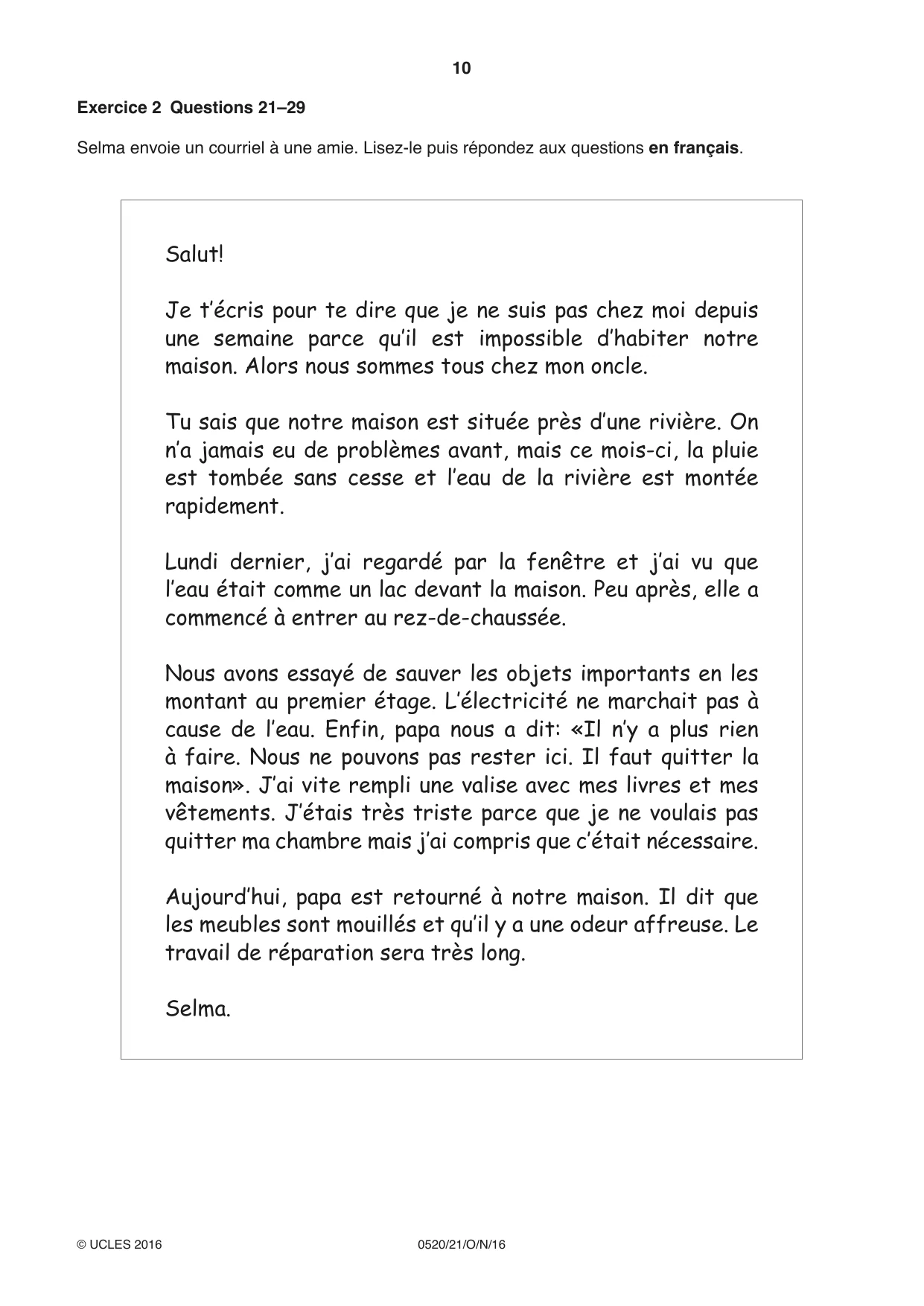
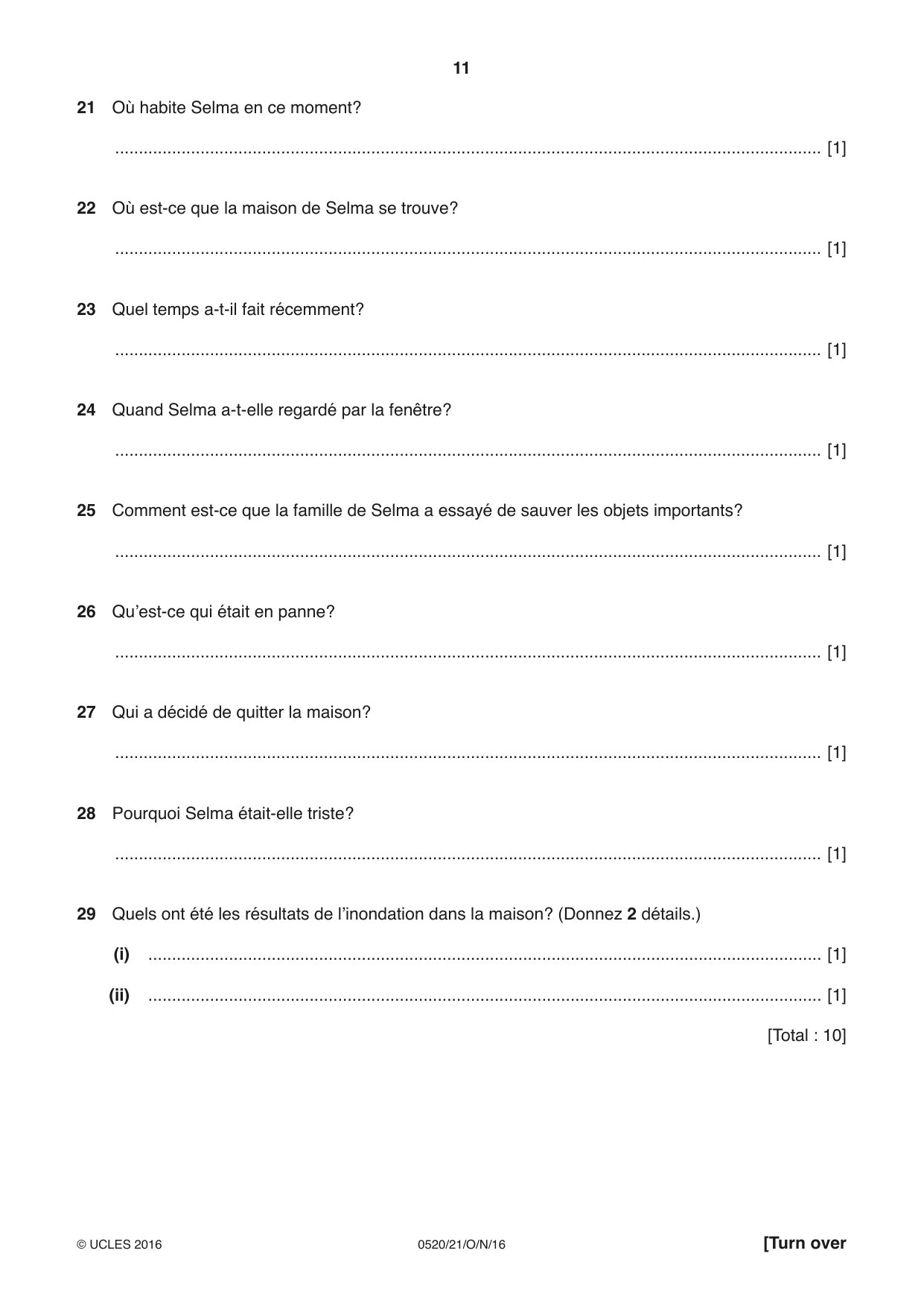
10 0520/21/O/N/16 © UCLES 2016 Exercice 2 Questions 21–29 Selma envoie un courriel à une amie. Lisez-le puis répondez aux questions en français. Salut! Je t’écris pour te dire que je ne suis pas chez moi depuis une semaine parce qu’il est impossible d’habiter notre maison. Alors nous sommes tous chez mon oncle. Tu sais que notre maison est située près d’une rivière. On n’a jamais eu de problèmes avant, mais ce mois-ci, la pluie est tombée sans cesse et l’eau de la rivière est montée rapidement. Lundi dernier, j’ai regardé par la fenêtre et j’ai vu que l’eau était comme un lac devant la maison. Peu après, elle a commencé à entrer au rez-de-chaussée. Nous avons essayé de sauver les objets importants en les montant au premier étage. L’électricité ne marchait pas à cause de l’eau. Enfin, papa nous a dit: «Il n’y a plus rien à faire. Nous ne pouvons pas rester ici. Il faut quitter la maison». J’ai vite rempli une valise avec mes livres et mes vêtements. J’étais très triste parce que je ne voulais pas quitter ma chambre mais j’ai compris que c’était nécessaire. Aujourd’hui, papa est retourné à notre maison. Il dit que les meubles sont mouillés et qu’il y a une odeur affreuse. Le travail de réparation sera très long. Selma.
Question paper, page 11
11 0520/21/O/N/16 © UCLES 2016 [Turn over 21 Où habite Selma en ce moment? … [1] 22 Où est-ce que la maison de Selma se trouve? … [1] 23 Quel temps a-t-il fait récemment? … [1] 24 Quand Selma a-t-elle regardé par la fenêtre? … [1] 25 Comment est-ce que la famille de Selma a essayé de sauver les objets importants? … [1] 26 Qu’est-ce qui était en panne? … [1] 27 Qui a décidé de quitter la maison? … [1] 28 Pourquoi Selma était-elle triste? … [1] 29 Quels ont été les résultats de l’inondation dans la maison? (Donnez 2 détails.) (i) … [1] (ii) … [1] [Total : 10]
Question paper, page 12
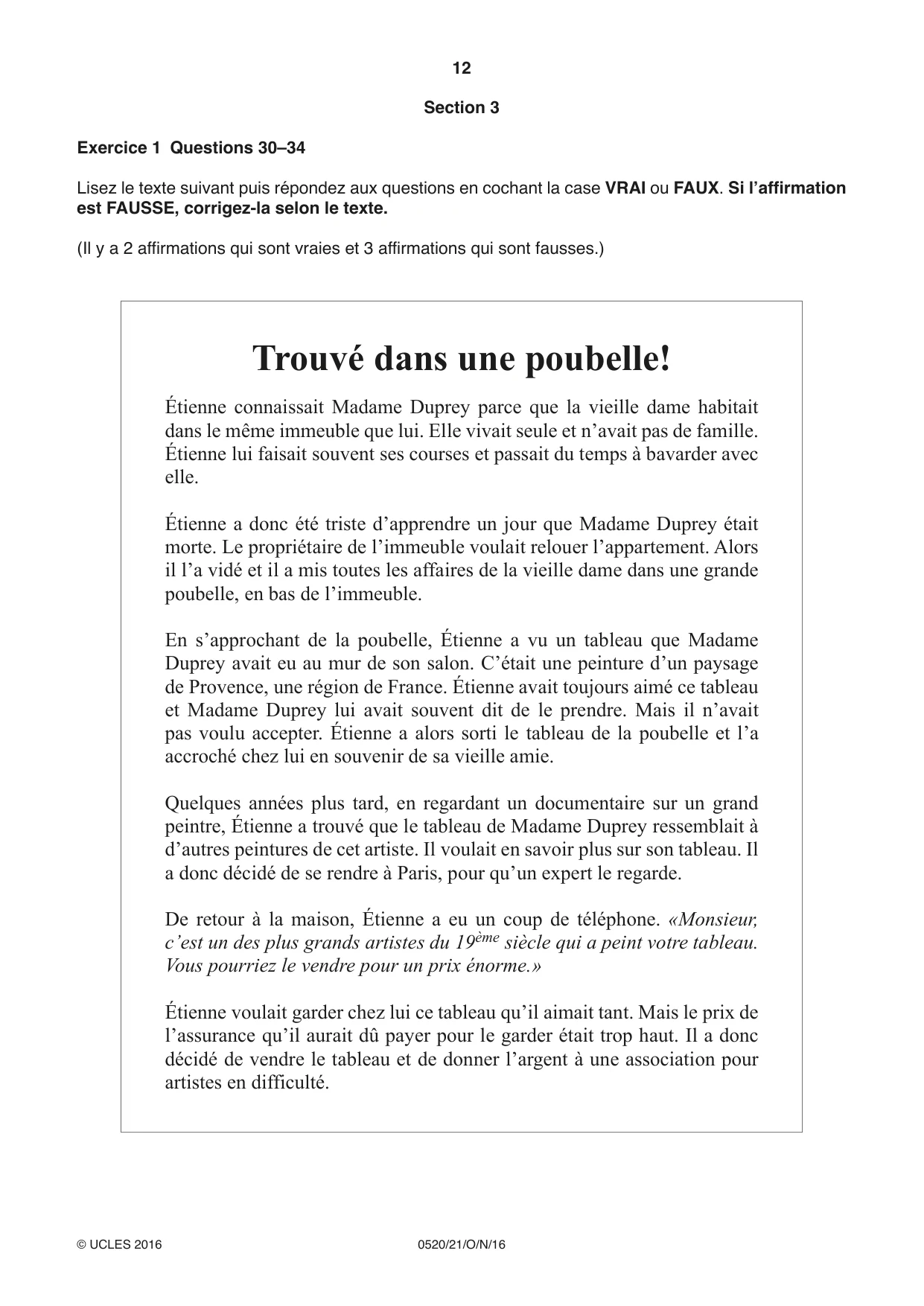
12 0520/21/O/N/16 © UCLES 2016 Section 3 Exercice 1 Questions 30–34 Lisez le texte suivant puis répondez aux questions en cochant la case VRAI ou FAUX. Si l’affirmation est FAUSSE, corrigez-la selon le texte. (Il y a 2 affirmations qui sont vraies et 3 affirmations qui sont fausses.) Trouvé dans une poubelle! Étienne connaissait Madame Duprey parce que la vieille dame habitait dans le même immeuble que lui. Elle vivait seule et n’avait pas de famille. Étienne lui faisait souvent ses courses et passait du temps à bavarder avec elle. Étienne a donc été triste d’apprendre un jour que Madame Duprey était morte. Le propriétaire de l’immeuble voulait relouer l’appartement. Alors il l’a vidé et il a mis toutes les affaires de la vieille dame dans une grande poubelle, en bas de l’immeuble. En s’approchant de la poubelle, Étienne a vu un tableau que Madame Duprey avait eu au mur de son salon. C’était une peinture d’un paysage de Provence, une région de France. Étienne avait toujours aimé ce tableau et Madame Duprey lui avait souvent dit de le prendre. Mais il n’avait pas voulu accepter. Étienne a alors sorti le tableau de la poubelle et l’a accroché chez lui en souvenir de sa vieille amie. Quelques années plus tard, en regardant un documentaire sur un grand peintre, Étienne a trouvé que le tableau de Madame Duprey ressemblait à d’autres peintures de cet artiste. Il voulait en savoir plus sur son tableau. Il a donc décidé de se rendre à Paris, pour qu’un expert le regarde. De retour à la maison, Étienne a eu un coup de téléphone. «Monsieur, c’est un des plus grands artistes du 19ème siècle qui a peint votre tableau. Vous pourriez le vendre pour un prix énorme.» Étienne voulait garder chez lui ce tableau qu’il aimait tant. Mais le prix de l’assurance qu’il aurait dû payer pour le garder était trop haut. Il a donc décidé de vendre le tableau et de donner l’argent à une association pour artistes en difficulté.
Question paper, page 13
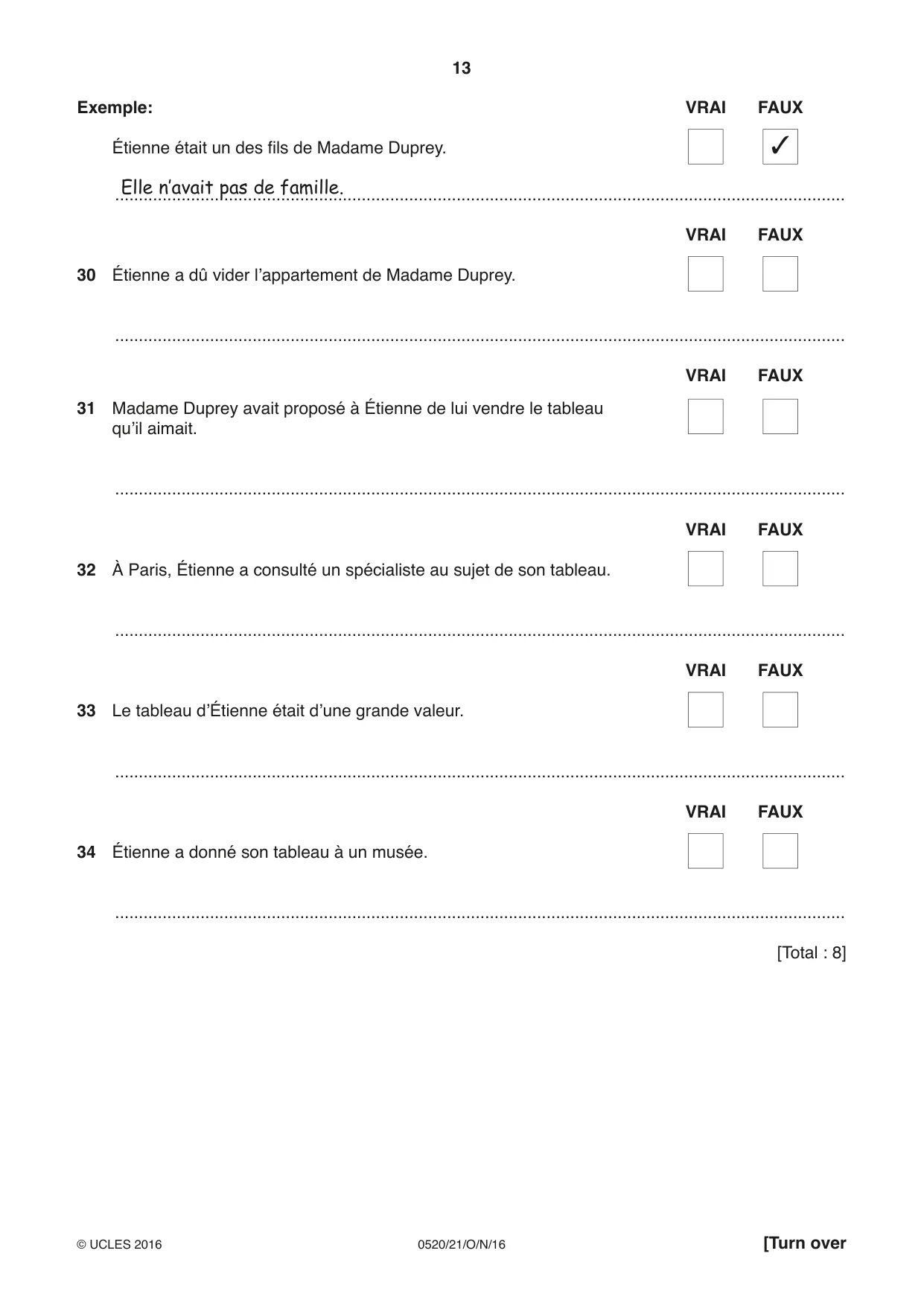
13 0520/21/O/N/16 © UCLES 2016 [Turn over Exemple: VRAI FAUX Étienne était un des fils de Madame Duprey. ✓ Elle n’avait pas de famille. … VRAI FAUX 30 Étienne a dû vider l’appartement de Madame Duprey. … VRAI FAUX 31 Madame Duprey avait proposé à Étienne de lui vendre le tableau qu’il aimait. … VRAI FAUX 32 À Paris, Étienne a consulté un spécialiste au sujet de son tableau. … VRAI FAUX 33 Le tableau d’Étienne était d’une grande valeur. … VRAI FAUX 34 Étienne a donné son tableau à un musée. … [Total : 8]
Question paper, page 14
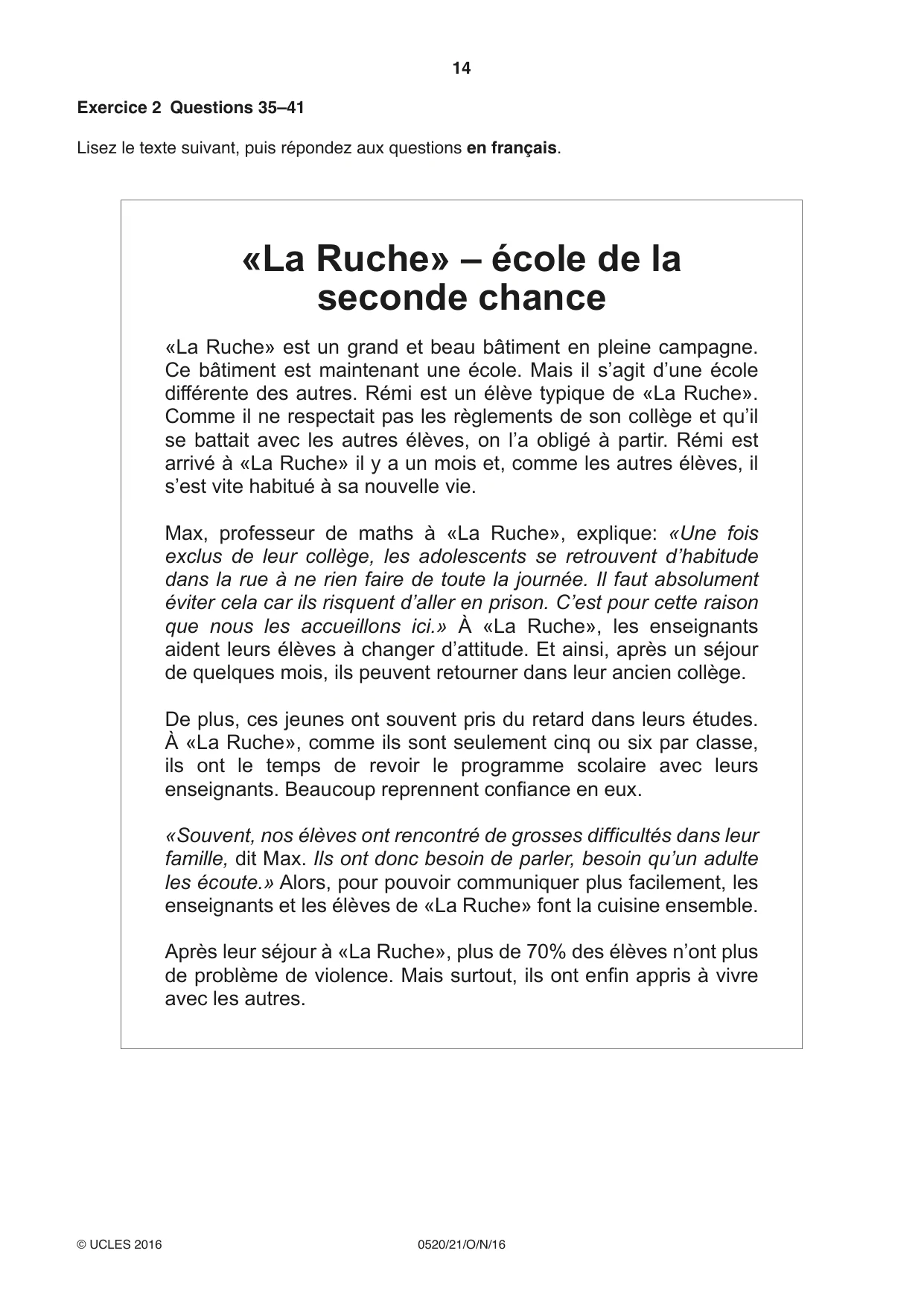
14 0520/21/O/N/16 © UCLES 2016 Exercice 2 Questions 35–41 Lisez le texte suivant, puis répondez aux questions en français. «La Ruche» – école de la seconde chance «La Ruche» est un grand et beau bâtiment en pleine campagne. Ce bâtiment est maintenant une école. Mais il s’agit d’une école différente des autres. Rémi est un élève typique de «La Ruche». Comme il ne respectait pas les règlements de son collège et qu’il se battait avec les autres élèves, on l’a obligé à partir. Rémi est arrivé à «La Ruche» il y a un mois et, comme les autres élèves, il s’est vite habitué à sa nouvelle vie. Max, professeur de maths à «La Ruche», explique: «Une fois exclus de leur collège, les adolescents se retrouvent d’habitude dans la rue à ne rien faire de toute la journée. Il faut absolument éviter cela car ils risquent d’aller en prison. C’est pour cette raison que nous les accueillons ici.» À «La Ruche», les enseignants aident leurs élèves à changer d’attitude. Et ainsi, après un séjour de quelques mois, ils peuvent retourner dans leur ancien collège. De plus, ces jeunes ont souvent pris du retard dans leurs études. À «La Ruche», comme ils sont seulement cinq ou six par classe, ils ont le temps de revoir le programme scolaire avec leurs enseignants. Beaucoup reprennent confiance en eux. «Souvent, nos élèves ont rencontré de grosses difficultés dans leur famille, dit Max. Ils ont donc besoin de parler, besoin qu’un adulte les écoute.» Alors, pour pouvoir communiquer plus facilement, les enseignants et les élèves de «La Ruche» font la cuisine ensemble. Après leur séjour à «La Ruche», plus de 70% des élèves n’ont plus de problème de violence. Mais surtout, ils ont enfin appris à vivre avec les autres.
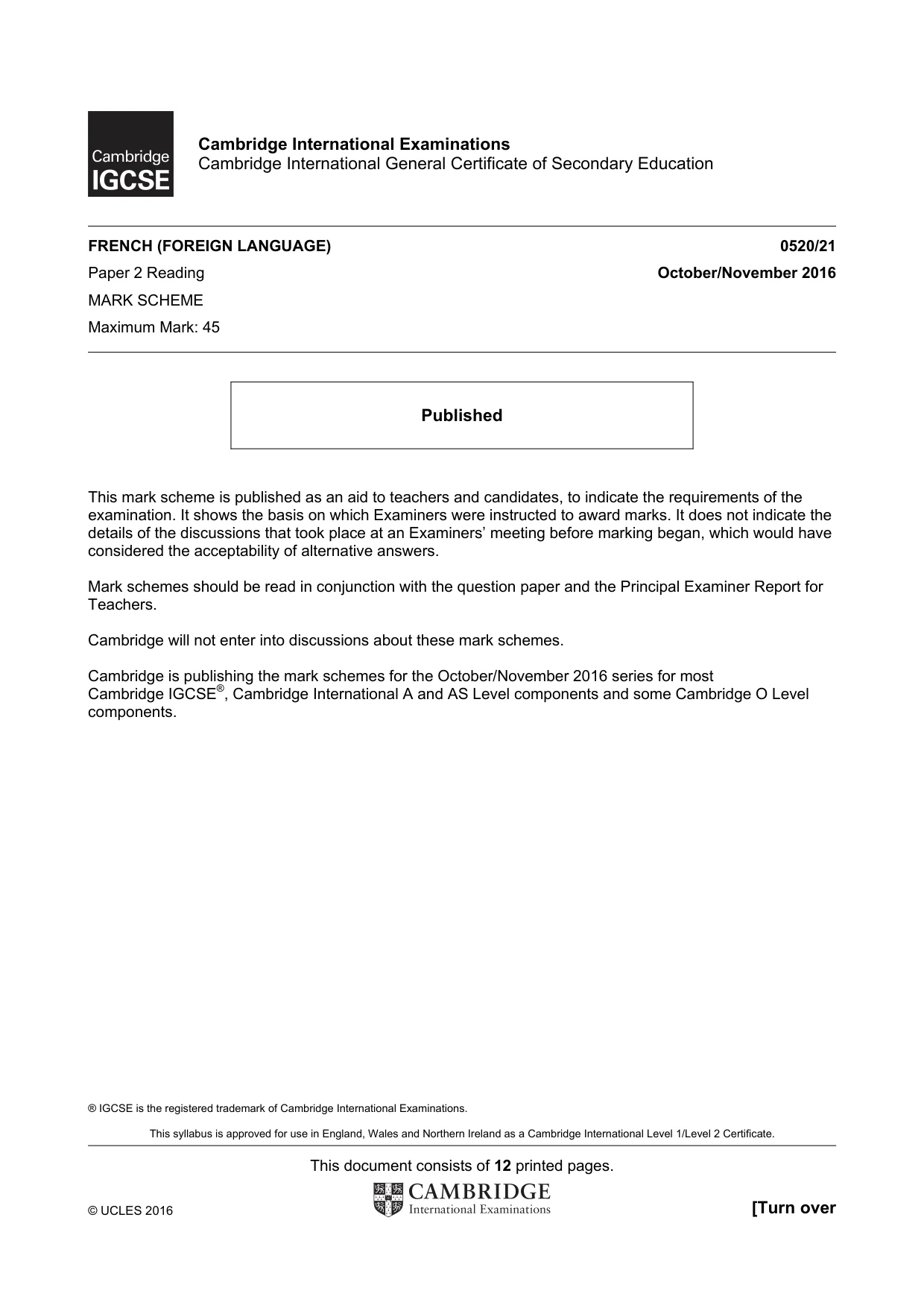
Question paper, page 15
15 0520/21/O/N/16 © UCLES 2016 35 Où est situé le bâtiment qu’on appelle «La Ruche»? … [1] 36 Qu’est-ce qui a causé l’exclusion de Rémi de son collège? (Donnez 1 détail.) … [1] 37 Selon Max, pourquoi est-il dangereux que les jeunes passent trop de temps dans la rue? … [1] 38 Que font les élèves après leur séjour à «La Ruche»? … [1] 39 Pourquoi les élèves de «La Ruche» ont-ils besoin de revoir le programme scolaire? … [1] 40 À «La Ruche», quelle activité encourage la communication entre élèves et professeurs? … [1] 41 Quel est l’aspect le plus positif de l’éducation reçue à «La Ruche»? … [1] [Total : 7]
Question paper, page 16
16 0520/21/O/N/16 © UCLES 2016 BLANK PAGE Permission to reproduce items where third-party owned material protected by copyright is included has been sought and cleared where possible. Every reasonable effort has been made by the publisher (UCLES) to trace copyright holders, but if any items requiring clearance have unwittingly been included, the publisher will be pleased to make amends at the earliest possible opportunity. To avoid the issue of disclosure of answer-related information to candidates, all copyright acknowledgements are reproduced online in the Cambridge International Examinations Copyright Acknowledgements Booklet. This is produced for each series of examinations and is freely available to download at www.cie.org.uk after the live examination series. Cambridge International Examinations is part of the Cambridge Assessment Group. Cambridge Assessment is the brand name of University of Cambridge Local Examinations Syndicate (UCLES), which is itself a department of the University of Cambridge.
Mark scheme, page 1
® IGCSE is the registered trademark of Cambridge International Examinations. This syllabus is approved for use in England, Wales and Northern Ireland as a Cambridge International Level 1/Level 2 Certificate. This document consists of 12 printed pages. © UCLES 2016 [Turn over Cambridge International Examinations Cambridge International General Certificate of Secondary Education FRENCH (FOREIGN LANGUAGE) 0520/21 Paper 2 Reading October/November 2016 MARK SCHEME Maximum Mark: 45 Published This mark scheme is published as an aid to teachers and candidates, to indicate the requirements of the examination. It shows the basis on which Examiners were instructed to award marks. It does not indicate the details of the discussions that took place at an Examiners’ meeting before marking began, which would have considered the acceptability of alternative answers. Mark schemes should be read in conjunction with the question paper and the Principal Examiner Report for Teachers. Cambridge will not enter into discussions about these mark schemes. Cambridge is publishing the mark schemes for the October/November 2016 series for most Cambridge IGCSE®, Cambridge International A and AS Level components and some Cambridge O Level components.
Mark scheme, page 2
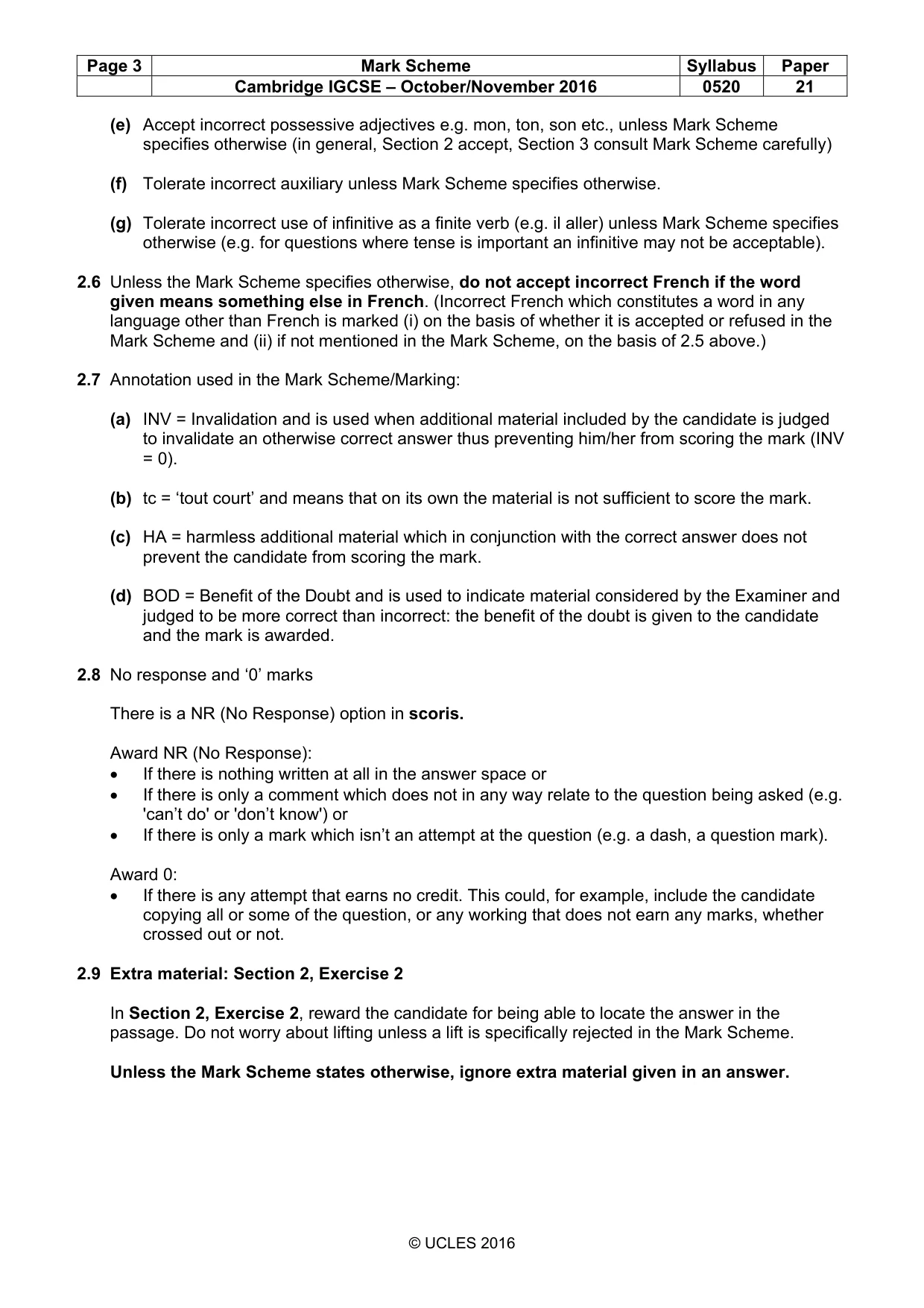
Page 2 Mark Scheme Syllabus Paper Cambridge IGCSE – October/November 2016 0520 21 © UCLES 2016 1 General Marking Notes 2 General Marking Principles 2.1 Please note that it is not possible to list all acceptable alternatives in the Detailed Mark Scheme provided in Section 3. You will need to consider all alternative answers and unexpected approaches in candidates' scripts, make a decision on whether they communicate the required elements, in consultation with your Team Leader if necessary (or with your Product Manager if you are a single Examiner), and award marks accordingly. The following marking principles underpin the detailed instructions provided in Section 3 of the Mark Scheme. Where a decision is taken to deviate from these principles for a particular question, this will be specified in the Mark Scheme. 2.2 Crossing out: (a) If a candidate changes his/her mind over an answer and crosses out an attempt, award a mark if the final attempt is correct. (b) If a candidate crosses out an answer to a whole question but makes no second attempt at it, mark the crossed out work. 2.3 More than the stipulated number of boxes ticked/crossed by the candidate: (a) If more than one attempt is visible, but the candidate has clearly indicated which attempt is his/her final answer (e.g. by crossing out other attempts or by annotating the script in some way), mark in the usual way. (b) If two attempts are visible (e.g. 2 boxes ticked instead of the 1 box stipulated), and neither has been crossed out/discounted by the candidate, no mark can be awarded. (c) Answers in pen do not take precedence over answers in pencil, e.g. if a candidate is asked to tick 1 box and ticks 2, one in pen and the other in pencil, the mark cannot be awarded unless there is some explicit indication from the candidate as to which is his/her final answer. 2.4 For questions requiring more than one element for the answer, (i) and (ii), where the answers are interchangeable: Both correct answers on line 1 and line 2 blank = 2 Both correct answers on line 1 and line 2 wrong = 1 (or vice-versa) 2.5 Answers requiring the use of French (rather than a non-verbal response) should be marked for communication. Tolerate inaccuracies provided the message is clear. (a) Spellings recognised by the Académie Française will be accepted. (b) ‘If in doubt, sound it out’: if you read what the candidate has written, does it sound like the correct answer? (c) Look-alike test: does what the candidate has written look like the correct answer? (d) Accept incorrect gender or person unless Mark Scheme specifies otherwise.
Mark scheme, page 3
Page 3 Mark Scheme Syllabus Paper Cambridge IGCSE – October/November 2016 0520 21 © UCLES 2016 (e) Accept incorrect possessive adjectives e.g. mon, ton, son etc., unless Mark Scheme specifies otherwise (in general, Section 2 accept, Section 3 consult Mark Scheme carefully) (f) Tolerate incorrect auxiliary unless Mark Scheme specifies otherwise. (g) Tolerate incorrect use of infinitive as a finite verb (e.g. il aller) unless Mark Scheme specifies otherwise (e.g. for questions where tense is important an infinitive may not be acceptable). 2.6 Unless the Mark Scheme specifies otherwise, do not accept incorrect French if the word given means something else in French. (Incorrect French which constitutes a word in any language other than French is marked (i) on the basis of whether it is accepted or refused in the Mark Scheme and (ii) if not mentioned in the Mark Scheme, on the basis of 2.5 above.) 2.7 Annotation used in the Mark Scheme/Marking: (a) INV = Invalidation and is used when additional material included by the candidate is judged to invalidate an otherwise correct answer thus preventing him/her from scoring the mark (INV = 0). (b) tc = ‘tout court’ and means that on its own the material is not sufficient to score the mark. (c) HA = harmless additional material which in conjunction with the correct answer does not prevent the candidate from scoring the mark. (d) BOD = Benefit of the Doubt and is used to indicate material considered by the Examiner and judged to be more correct than incorrect: the benefit of the doubt is given to the candidate and the mark is awarded. 2.8 No response and ‘0’ marks There is a NR (No Response) option in scoris. Award NR (No Response): • If there is nothing written at all in the answer space or • If there is only a comment which does not in any way relate to the question being asked (e.g. 'can’t do' or 'don’t know') or • If there is only a mark which isn’t an attempt at the question (e.g. a dash, a question mark). Award 0: • If there is any attempt that earns no credit. This could, for example, include the candidate copying all or some of the question, or any working that does not earn any marks, whether crossed out or not. 2.9 Extra material: Section 2, Exercise 2 In Section 2, Exercise 2, reward the candidate for being able to locate the answer in the passage. Do not worry about lifting unless a lift is specifically rejected in the Mark Scheme. Unless the Mark Scheme states otherwise, ignore extra material given in an answer.
Mark scheme, page 4
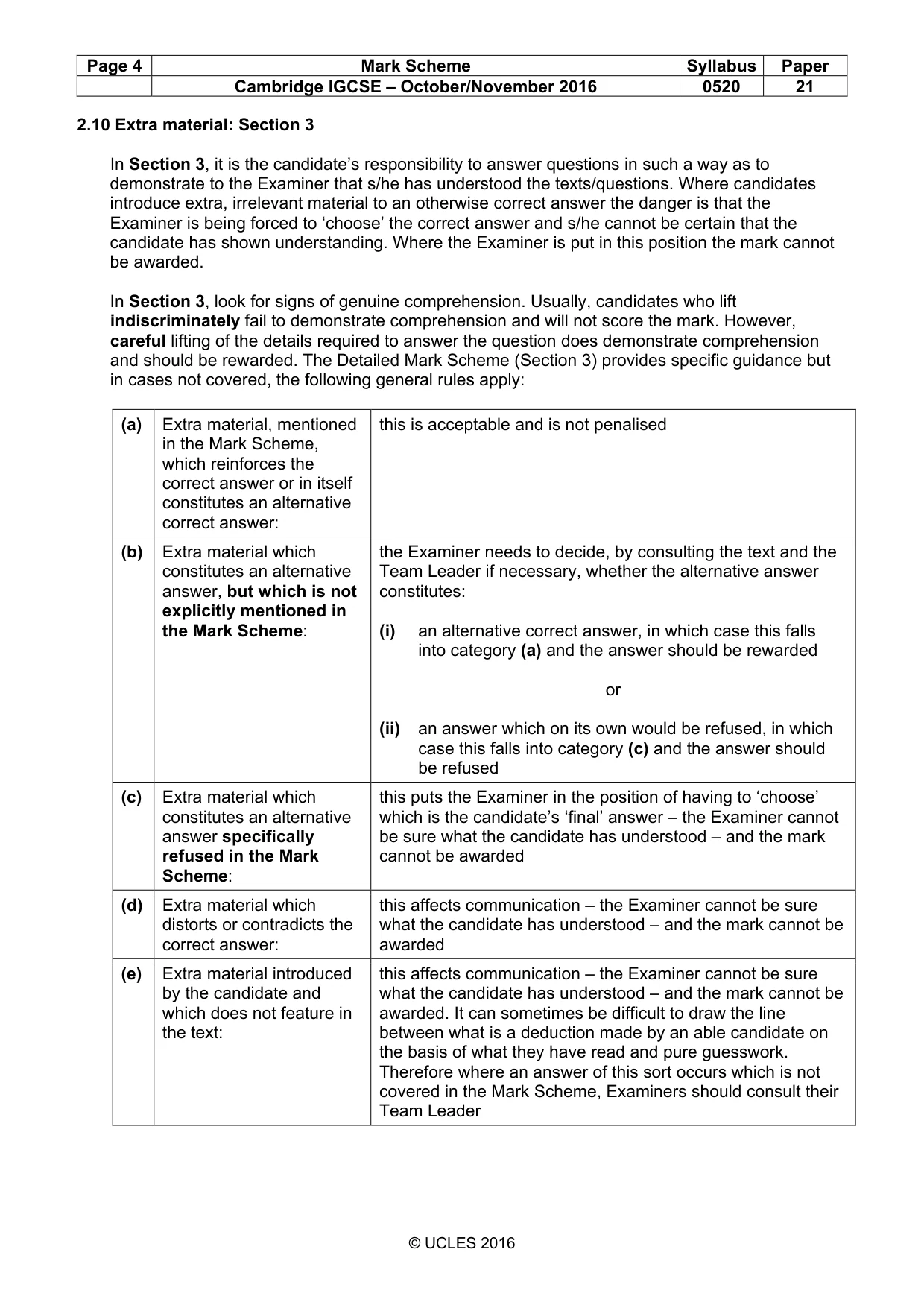
Page 4 Mark Scheme Syllabus Paper Cambridge IGCSE – October/November 2016 0520 21 © UCLES 2016 2.10 Extra material: Section 3 In Section 3, it is the candidate’s responsibility to answer questions in such a way as to demonstrate to the Examiner that s/he has understood the texts/questions. Where candidates introduce extra, irrelevant material to an otherwise correct answer the danger is that the Examiner is being forced to ‘choose’ the correct answer and s/he cannot be certain that the candidate has shown understanding. Where the Examiner is put in this position the mark cannot be awarded. In Section 3, look for signs of genuine comprehension. Usually, candidates who lift indiscriminately fail to demonstrate comprehension and will not score the mark. However, careful lifting of the details required to answer the question does demonstrate comprehension and should be rewarded. The Detailed Mark Scheme (Section 3) provides specific guidance but in cases not covered, the following general rules apply: (a) Extra material, mentioned in the Mark Scheme, which reinforces the correct answer or in itself constitutes an alternative correct answer: this is acceptable and is not penalised (b) Extra material which constitutes an alternative answer, but which is not explicitly mentioned in the Mark Scheme: the Examiner needs to decide, by consulting the text and the Team Leader if necessary, whether the alternative answer constitutes: (i) an alternative correct answer, in which case this falls into category (a) and the answer should be rewarded or (ii) an answer which on its own would be refused, in which case this falls into category (c) and the answer should be refused (c) Extra material which constitutes an alternative answer specifically refused in the Mark Scheme: this puts the Examiner in the position of having to ‘choose’ which is the candidate’s ‘final’ answer – the Examiner cannot be sure what the candidate has understood – and the mark cannot be awarded (d) Extra material which distorts or contradicts the correct answer: this affects communication – the Examiner cannot be sure what the candidate has understood – and the mark cannot be awarded (e) Extra material introduced by the candidate and which does not feature in the text: this affects communication – the Examiner cannot be sure what the candidate has understood – and the mark cannot be awarded. It can sometimes be difficult to draw the line between what is a deduction made by an able candidate on the basis of what they have read and pure guesswork. Therefore where an answer of this sort occurs which is not covered in the Mark Scheme, Examiners should consult their Team Leader
Mark scheme, page 5
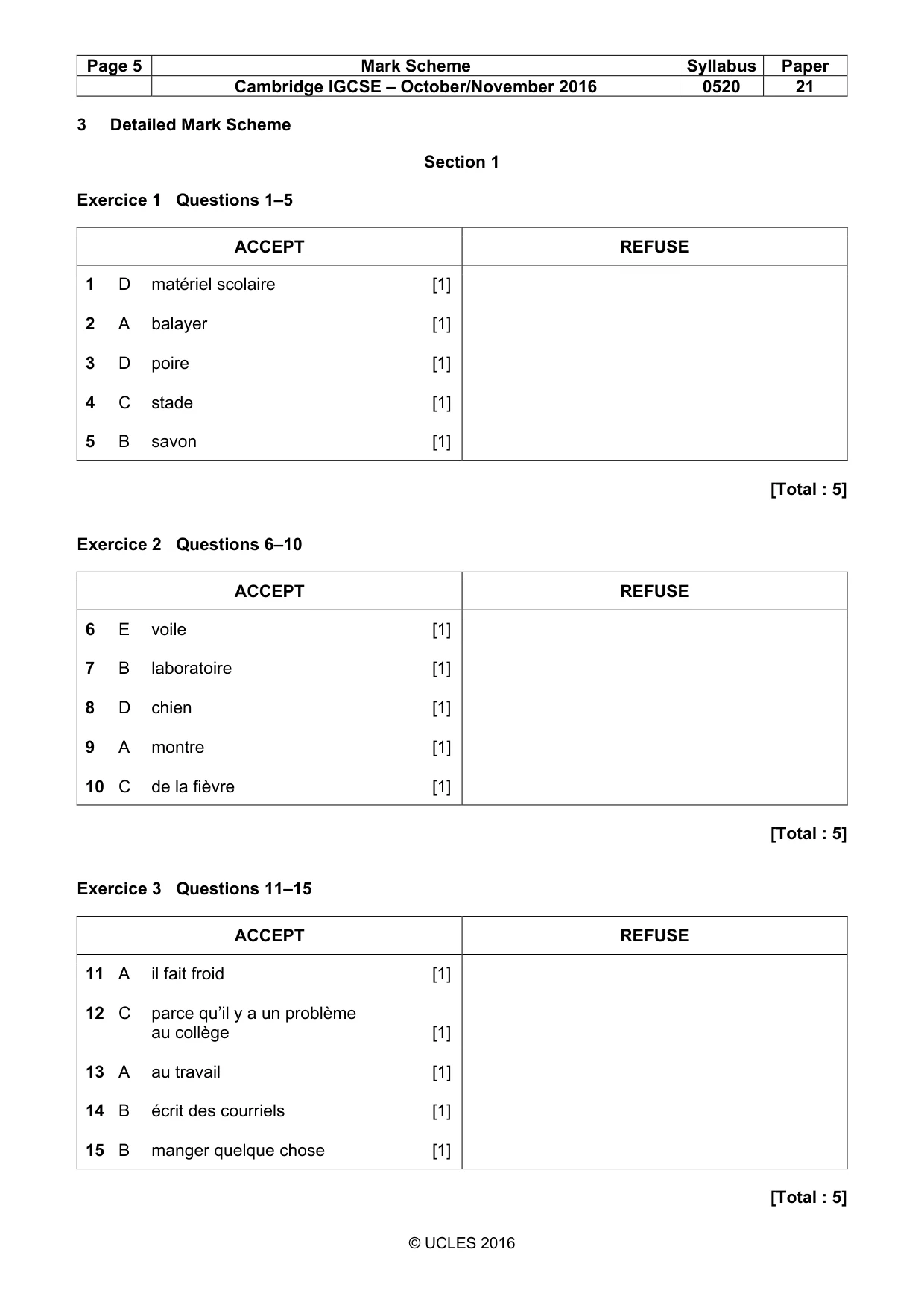
Page 5 Mark Scheme Syllabus Paper Cambridge IGCSE – October/November 2016 0520 21 © UCLES 2016 3 Detailed Mark Scheme Section 1 Exercice 1 Questions 1–5 ACCEPT REFUSE 1 D matériel scolaire [1] 2 A balayer [1] 3 D poire [1] 4 C stade [1] 5 B savon [1] [Total : 5] Exercice 2 Questions 6–10 ACCEPT REFUSE 6 E voile [1] 7 B laboratoire [1] 8 D chien [1] 9 A montre [1] 10 C de la fièvre [1] [Total : 5] Exercice 3 Questions 11–15 ACCEPT REFUSE 11 A il fait froid [1] 12 C parce qu’il y a un problème au collège [1] 13 A au travail [1] 14 B écrit des courriels [1] 15 B manger quelque chose [1] [Total : 5]
Mark scheme, page 6
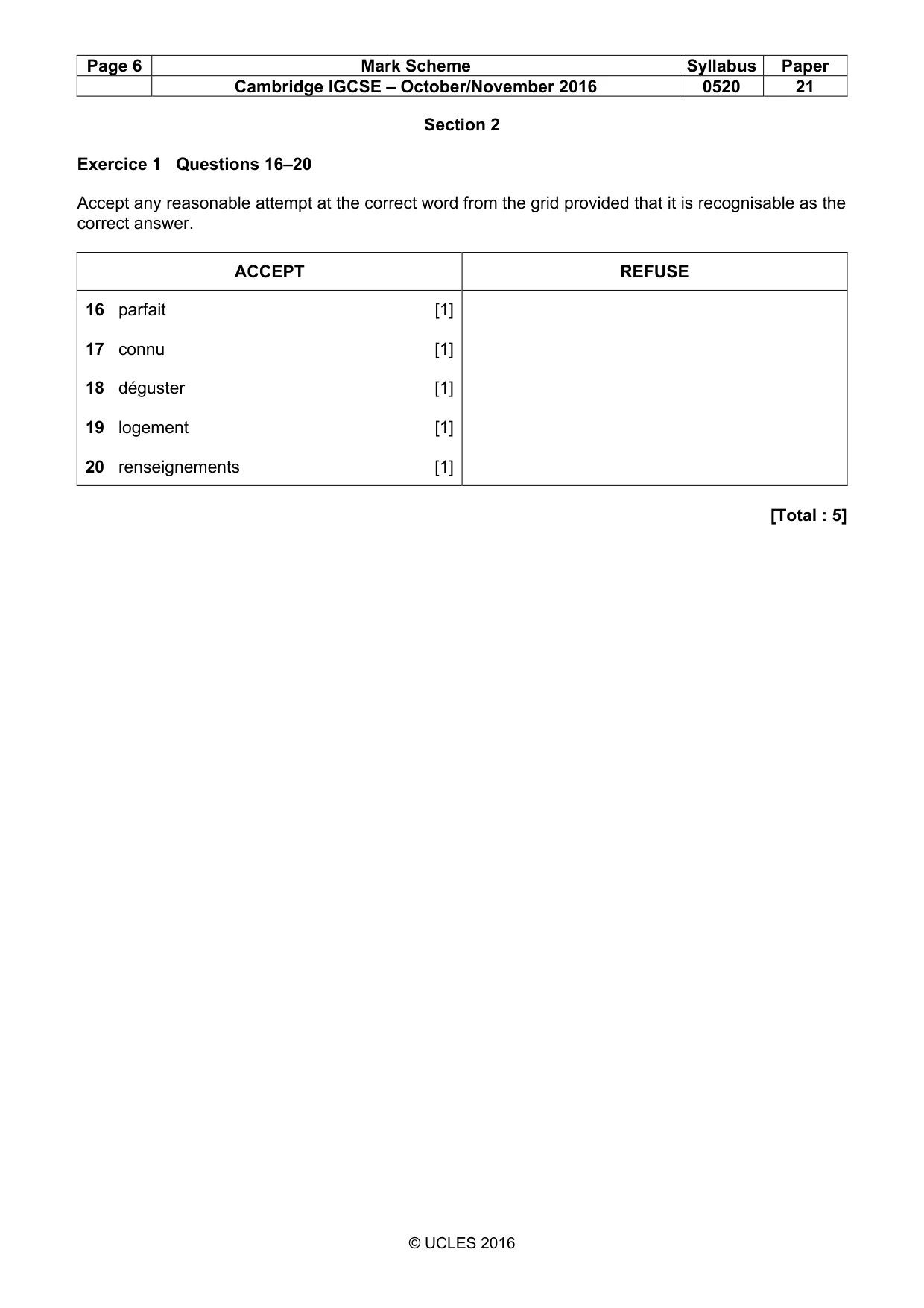
Page 6 Mark Scheme Syllabus Paper Cambridge IGCSE – October/November 2016 0520 21 © UCLES 2016 Section 2 Exercice 1 Questions 16–20 Accept any reasonable attempt at the correct word from the grid provided that it is recognisable as the correct answer. ACCEPT REFUSE 16 parfait [1] 17 connu [1] 18 déguster [1] 19 logement [1] 20 renseignements [1] [Total : 5]
Mark scheme, page 7
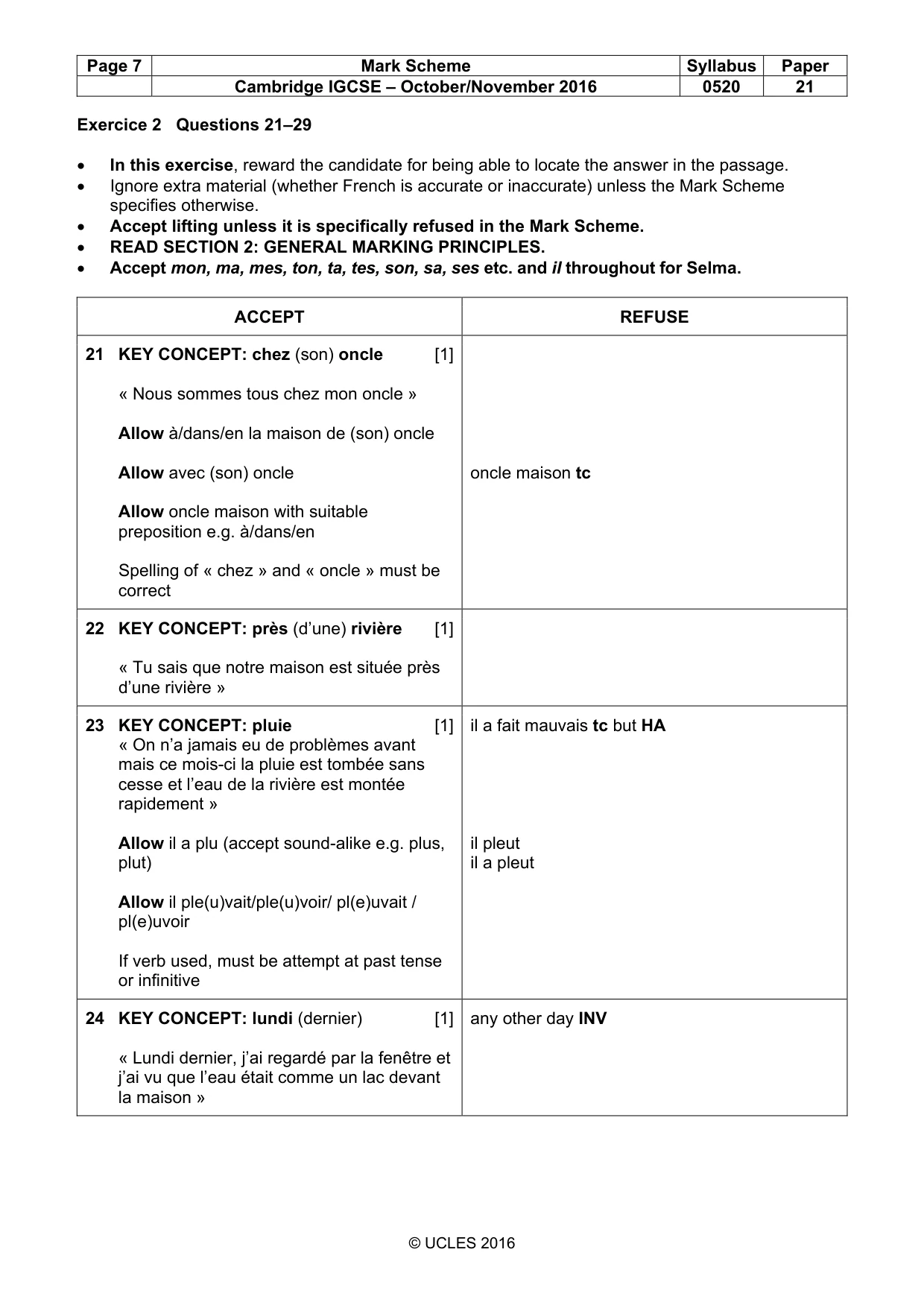
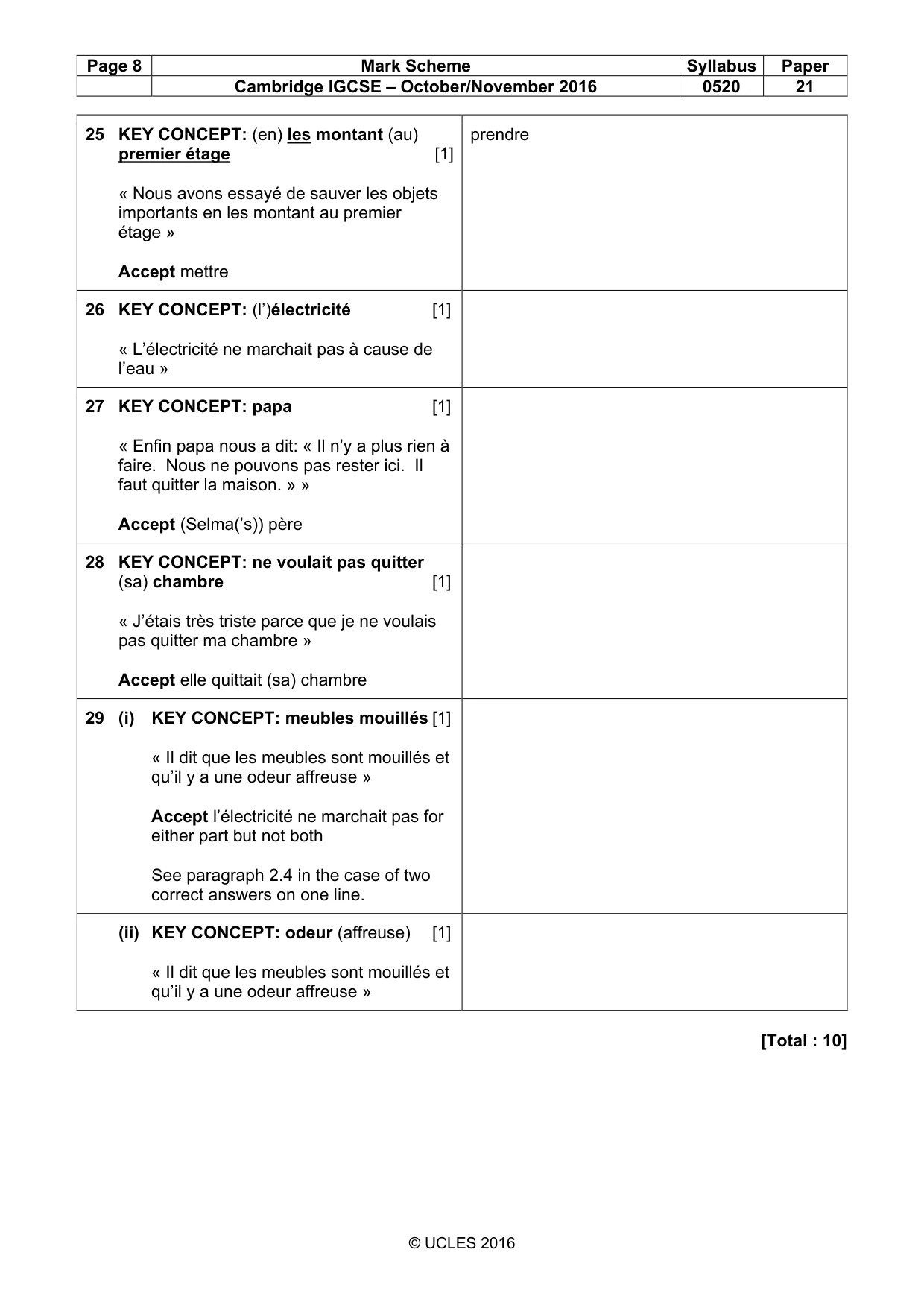
Page 7 Mark Scheme Syllabus Paper Cambridge IGCSE – October/November 2016 0520 21 © UCLES 2016 Exercice 2 Questions 21–29 • In this exercise, reward the candidate for being able to locate the answer in the passage. • Ignore extra material (whether French is accurate or inaccurate) unless the Mark Scheme specifies otherwise. • Accept lifting unless it is specifically refused in the Mark Scheme. • READ SECTION 2: GENERAL MARKING PRINCIPLES. • Accept mon, ma, mes, ton, ta, tes, son, sa, ses etc. and il throughout for Selma. ACCEPT REFUSE 21 KEY CONCEPT: chez (son) oncle [1] « Nous sommes tous chez mon oncle » Allow à/dans/en la maison de (son) oncle Allow avec (son) oncle Allow oncle maison with suitable preposition e.g. à/dans/en Spelling of « chez » and « oncle » must be correct oncle maison tc 22 KEY CONCEPT: près (d’une) rivière [1] « Tu sais que notre maison est située près d’une rivière » 23 KEY CONCEPT: pluie [1] « On n’a jamais eu de problèmes avant mais ce mois-ci la pluie est tombée sans cesse et l’eau de la rivière est montée rapidement » Allow il a plu (accept sound-alike e.g. plus, plut) Allow il ple(u)vait/ple(u)voir/ pl(e)uvait / pl(e)uvoir If verb used, must be attempt at past tense or infinitive il a fait mauvais tc but HA il pleut il a pleut 24 KEY CONCEPT: lundi (dernier) [1] « Lundi dernier, j’ai regardé par la fenêtre et j’ai vu que l’eau était comme un lac devant la maison » any other day INV
Mark scheme, page 8
Page 8 Mark Scheme Syllabus Paper Cambridge IGCSE – October/November 2016 0520 21 © UCLES 2016 25 KEY CONCEPT: (en) les montant (au) premier étage [1] « Nous avons essayé de sauver les objets importants en les montant au premier étage » Accept mettre prendre 26 KEY CONCEPT: (l’)électricité [1] « L’électricité ne marchait pas à cause de l’eau » 27 KEY CONCEPT: papa [1] « Enfin papa nous a dit: « Il n’y a plus rien à faire. Nous ne pouvons pas rester ici. Il faut quitter la maison. » » Accept (Selma(’s)) père 28 KEY CONCEPT: ne voulait pas quitter (sa) chambre [1] « J’étais très triste parce que je ne voulais pas quitter ma chambre » Accept elle quittait (sa) chambre 29 (i) KEY CONCEPT: meubles mouillés [1] « Il dit que les meubles sont mouillés et qu’il y a une odeur affreuse » Accept l’électricité ne marchait pas for either part but not both See paragraph 2.4 in the case of two correct answers on one line. (ii) KEY CONCEPT: odeur (affreuse) [1] « Il dit que les meubles sont mouillés et qu’il y a une odeur affreuse » [Total : 10]
Mark scheme, page 9
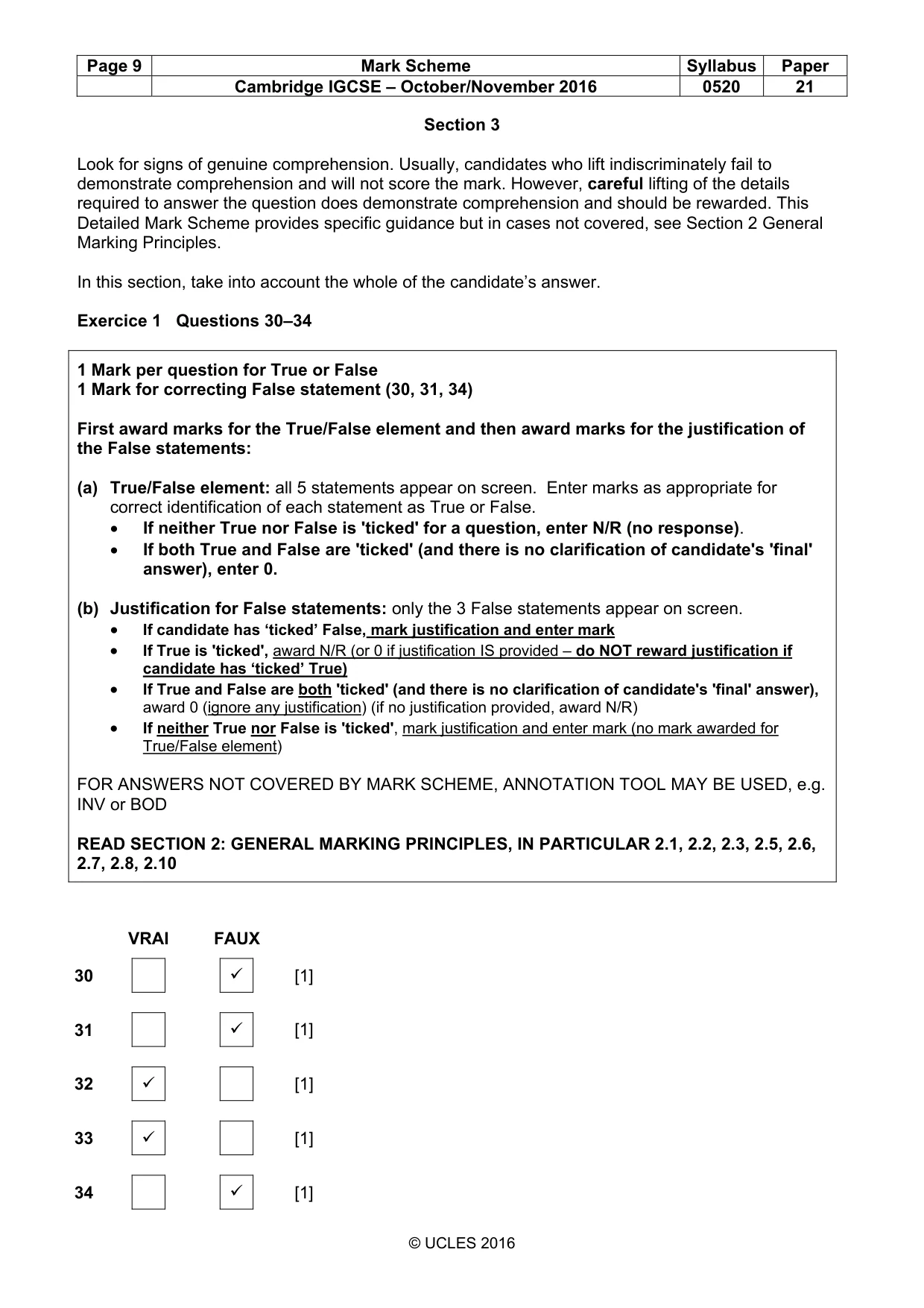
Page 9 Mark Scheme Syllabus Paper Cambridge IGCSE – October/November 2016 0520 21 © UCLES 2016 Section 3 Look for signs of genuine comprehension. Usually, candidates who lift indiscriminately fail to demonstrate comprehension and will not score the mark. However, careful lifting of the details required to answer the question does demonstrate comprehension and should be rewarded. This Detailed Mark Scheme provides specific guidance but in cases not covered, see Section 2 General Marking Principles. In this section, take into account the whole of the candidate’s answer. Exercice 1 Questions 30–34 1 Mark per question for True or False 1 Mark for correcting False statement (30, 31, 34) First award marks for the True/False element and then award marks for the justification of the False statements: (a) True/False element: all 5 statements appear on screen. Enter marks as appropriate for correct identification of each statement as True or False. • If neither True nor False is 'ticked' for a question, enter N/R (no response). • If both True and False are 'ticked' (and there is no clarification of candidate's 'final' answer), enter 0. (b) Justification for False statements: only the 3 False statements appear on screen. • If candidate has ‘ticked’ False, mark justification and enter mark • If True is 'ticked', award N/R (or 0 if justification IS provided – do NOT reward justification if candidate has ‘ticked’ True) • If True and False are both 'ticked' (and there is no clarification of candidate's 'final' answer), award 0 (ignore any justification) (if no justification provided, award N/R) • If neither True nor False is 'ticked', mark justification and enter mark (no mark awarded for True/False element) FOR ANSWERS NOT COVERED BY MARK SCHEME, ANNOTATION TOOL MAY BE USED, e.g. INV or BOD READ SECTION 2: GENERAL MARKING PRINCIPLES, IN PARTICULAR 2.1, 2.2, 2.3, 2.5, 2.6, 2.7, 2.8, 2.10 VRAI FAUX 30 9 [1] 31 9 [1] 32 9 [1] 33 9 [1] 34 9 [1]
Mark scheme, page 10
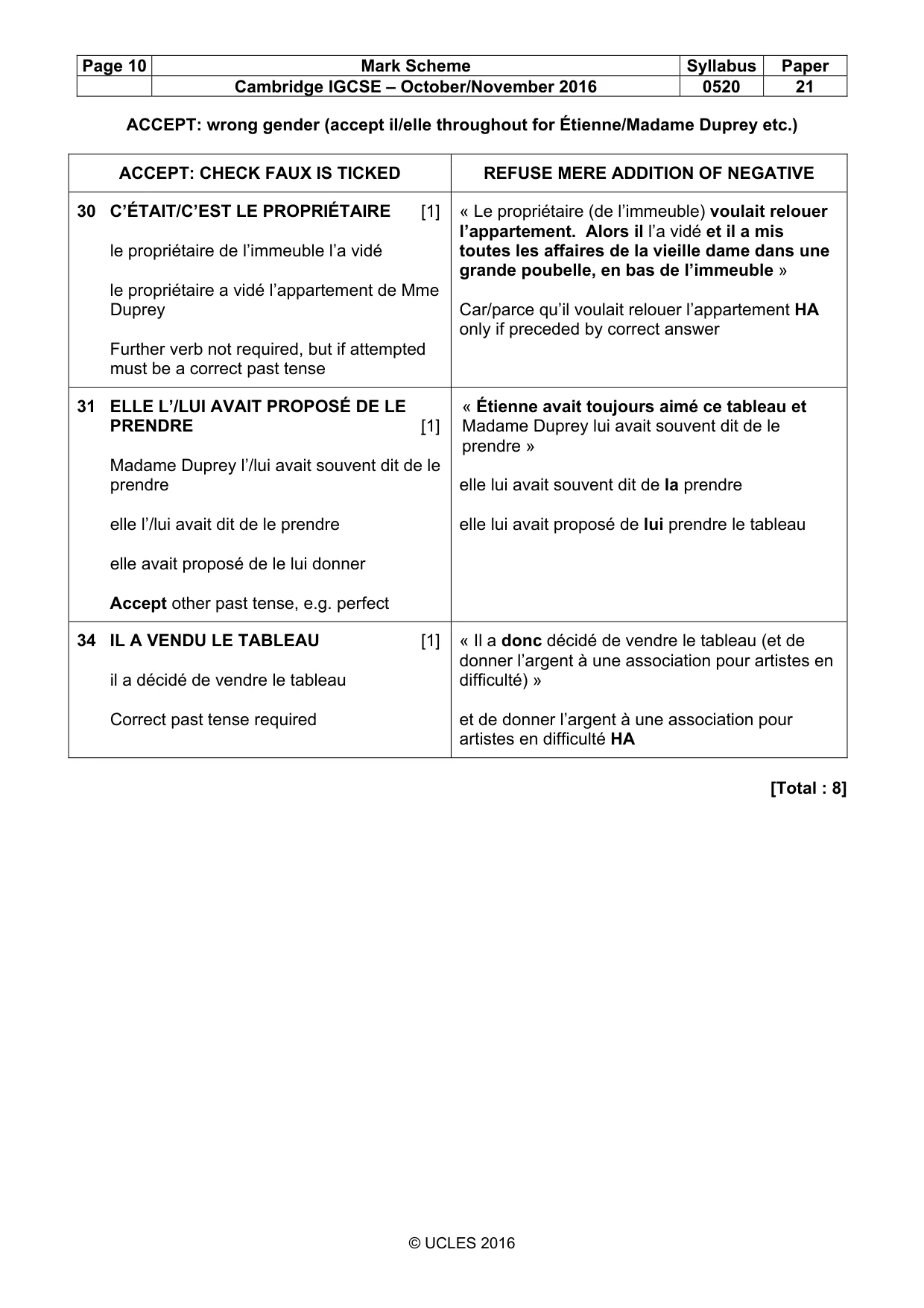
Page 10 Mark Scheme Syllabus Paper Cambridge IGCSE – October/November 2016 0520 21 © UCLES 2016 ACCEPT: wrong gender (accept il/elle throughout for Étienne/Madame Duprey etc.) ACCEPT: CHECK FAUX IS TICKED REFUSE MERE ADDITION OF NEGATIVE 30 C’ÉTAIT/C’EST LE PROPRIÉTAIRE [1] le propriétaire de l’immeuble l’a vidé le propriétaire a vidé l’appartement de Mme Duprey Further verb not required, but if attempted must be a correct past tense « Le propriétaire (de l’immeuble) voulait relouer l’appartement. Alors il l’a vidé et il a mis toutes les affaires de la vieille dame dans une grande poubelle, en bas de l’immeuble » Car/parce qu’il voulait relouer l’appartement HA only if preceded by correct answer 31 ELLE L’/LUI AVAIT PROPOSÉ DE LE PRENDRE [1] Madame Duprey l’/lui avait souvent dit de le prendre elle l’/lui avait dit de le prendre elle avait proposé de le lui donner Accept other past tense, e.g. perfect « Étienne avait toujours aimé ce tableau et Madame Duprey lui avait souvent dit de le prendre » elle lui avait souvent dit de la prendre elle lui avait proposé de lui prendre le tableau 34 IL A VENDU LE TABLEAU [1] il a décidé de vendre le tableau Correct past tense required « Il a donc décidé de vendre le tableau (et de donner l’argent à une association pour artistes en difficulté) » et de donner l’argent à une association pour artistes en difficulté HA [Total : 8]
Mark scheme, page 11
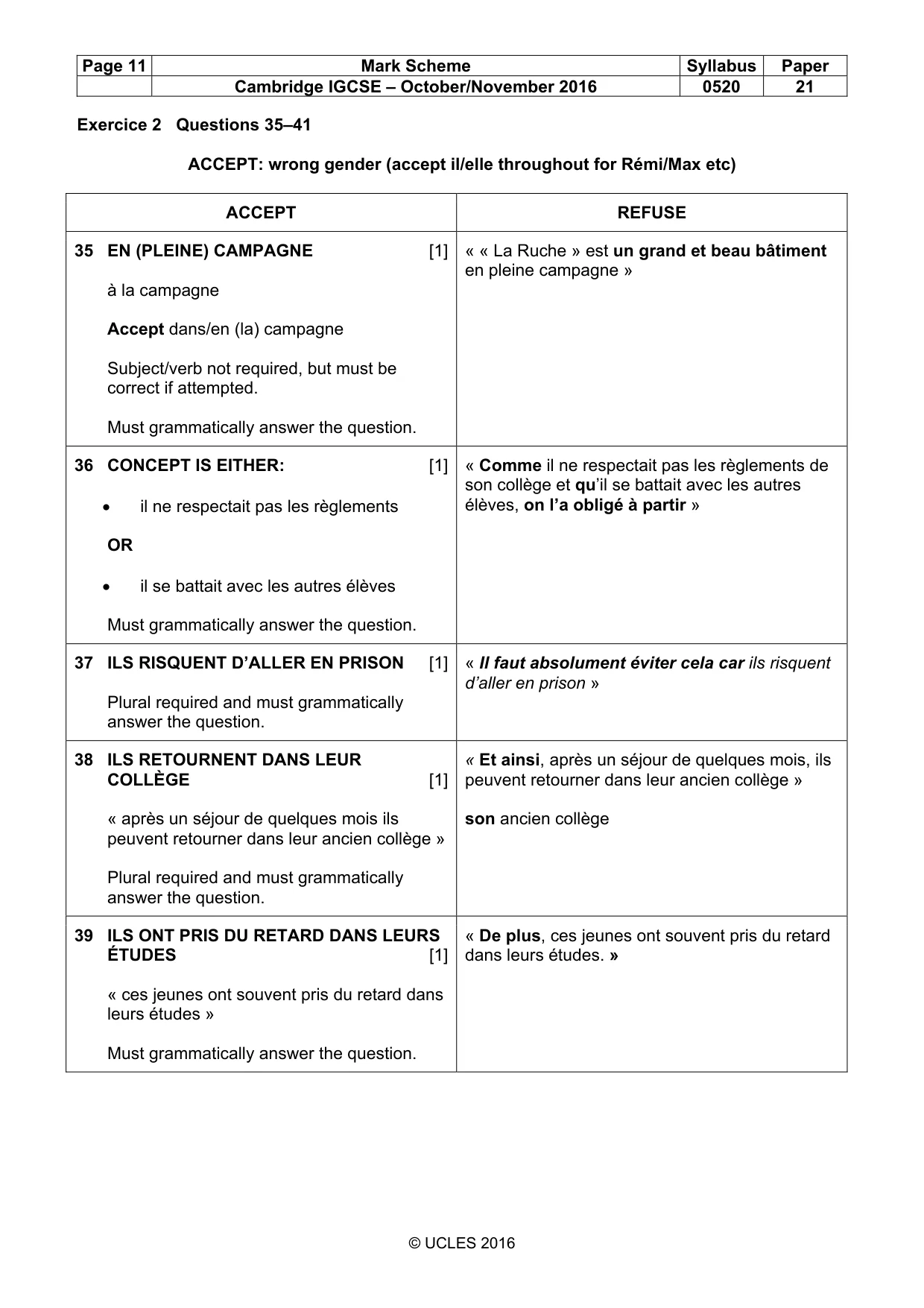
Page 11 Mark Scheme Syllabus Paper Cambridge IGCSE – October/November 2016 0520 21 © UCLES 2016 Exercice 2 Questions 35–41 ACCEPT: wrong gender (accept il/elle throughout for Rémi/Max etc) ACCEPT REFUSE 35 EN (PLEINE) CAMPAGNE [1] à la campagne Accept dans/en (la) campagne Subject/verb not required, but must be correct if attempted. Must grammatically answer the question. « « La Ruche » est un grand et beau bâtiment en pleine campagne » 36 CONCEPT IS EITHER: [1] • il ne respectait pas les règlements OR • il se battait avec les autres élèves Must grammatically answer the question. « Comme il ne respectait pas les règlements de son collège et qu’il se battait avec les autres élèves, on l’a obligé à partir » 37 ILS RISQUENT D’ALLER EN PRISON [1] Plural required and must grammatically answer the question. « Il faut absolument éviter cela car ils risquent d’aller en prison » 38 ILS RETOURNENT DANS LEUR COLLÈGE [1] « après un séjour de quelques mois ils peuvent retourner dans leur ancien collège » Plural required and must grammatically answer the question. « Et ainsi, après un séjour de quelques mois, ils peuvent retourner dans leur ancien collège » son ancien collège 39 ILS ONT PRIS DU RETARD DANS LEURS ÉTUDES [1] « ces jeunes ont souvent pris du retard dans leurs études » Must grammatically answer the question. « De plus, ces jeunes ont souvent pris du retard dans leurs études. »
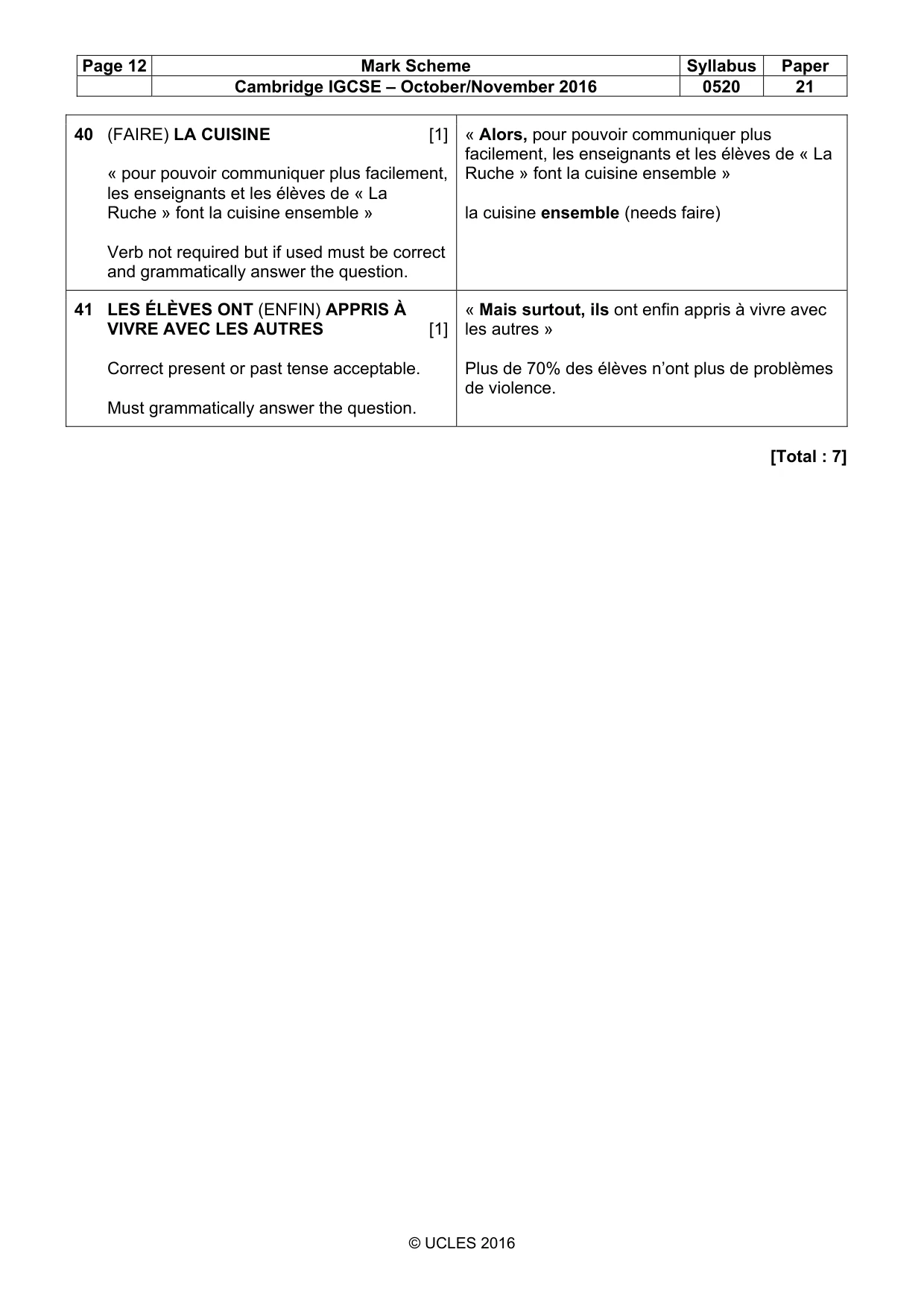
Mark scheme, page 12
Page 12 Mark Scheme Syllabus Paper Cambridge IGCSE – October/November 2016 0520 21 © UCLES 2016 40 (FAIRE) LA CUISINE [1] « pour pouvoir communiquer plus facilement, les enseignants et les élèves de « La Ruche » font la cuisine ensemble » Verb not required but if used must be correct and grammatically answer the question. « Alors, pour pouvoir communiquer plus facilement, les enseignants et les élèves de « La Ruche » font la cuisine ensemble » la cuisine ensemble (needs faire) 41 LES ÉLÈVES ONT (ENFIN) APPRIS À VIVRE AVEC LES AUTRES [1] Correct present or past tense acceptable. Must grammatically answer the question. « Mais surtout, ils ont enfin appris à vivre avec les autres » Plus de 70% des élèves n’ont plus de problèmes de violence. [Total : 7]
What you needed in this session
Cambridge’s own grade thresholds for 2016 Oct/Nov, Paper 2 · Variant 1. A higher threshold means an easier paper — the bar moves with how the cohort did.