Cambridge IGCSE French - Foreign Language 0520 — 2023 Oct/Nov Paper 2 · Variant 1
0520/21/O/N/23 · 45 marks · ≈51 min
The question paper and its mark scheme, free to read here and free to download. This is Cambridge’s own paper, exactly as it was sat.
Question paper12 pages

Mark scheme8 pages
Answers below. Sit the paper first if you are practising.
Paper as text
Question paper, page 1
This document has 12 pages. Any blank pages are indicated. [Turn over Cambridge IGCSE™ FRENCH 0520/21 Paper 2 Reading October/November 2023 1 hour You must answer on the question paper. No additional materials are needed. INSTRUCTIONS ● Answer all questions. ● Use a black or dark blue pen. ● Write your name, centre number and candidate number in the boxes at the top of the page. ● Write your answer to each question in the space provided. ● Do not use an erasable pen or correction fluid. ● Do not write on any bar codes. ● Dictionaries are not allowed. INFORMATION ● The total mark for this paper is 45. ● The number of marks for each question or part question is shown in brackets [ ]. * 7 9 6 1 6 8 4 0 4 2 * DC (PQ/SW) 324843/1 © UCLES 2023
Question paper, page 2
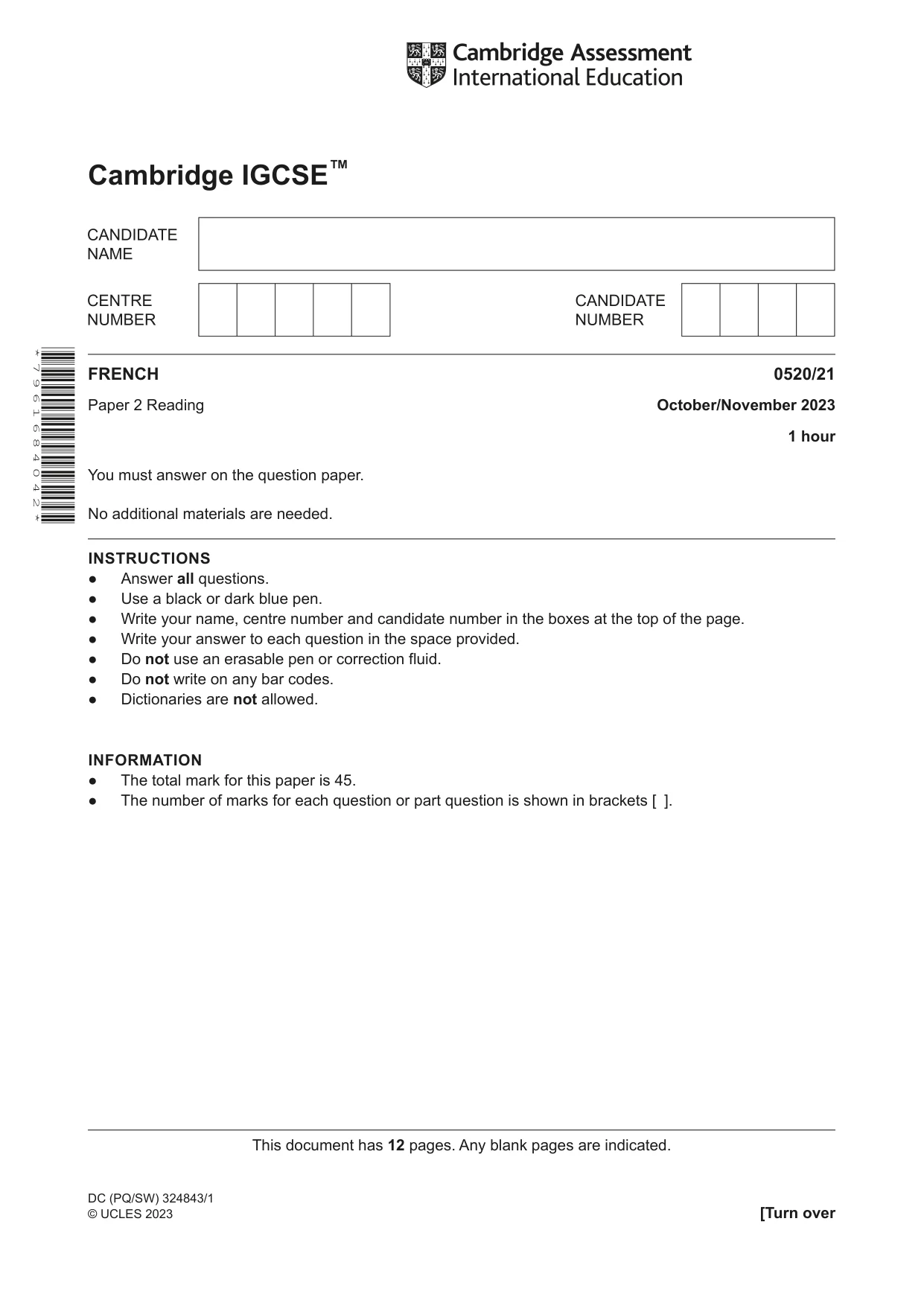
2 0520/21/ O/ N/23 © UCLES 2023 1 Regardez les images. A B C D E F Pour chaque question, écrivez la bonne lettre (A–F) dans la case appropriée. (a) Aujourd’hui, il pleut beaucoup. [1] (b) J’adore jouer dans la neige ! [1] (c) Demain, il va faire de l’orage. [1] (d) Il fera très froid ce week-end. [1] (e) Ma sœur aime beaucoup le soleil. [1] [Total : 5]
Question paper, page 3
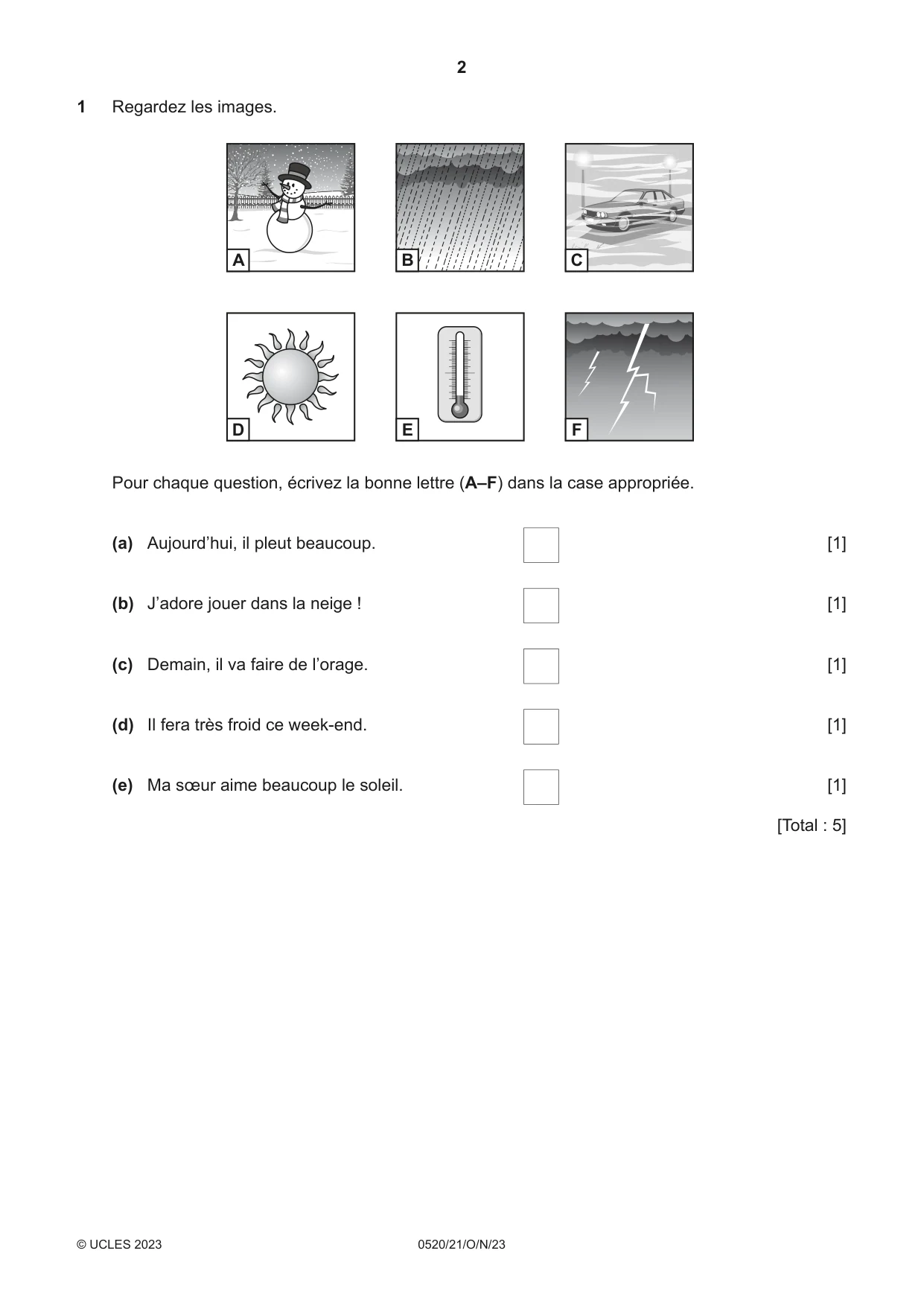
3 0520/21/O/N/23 © UCLES 2023 [Turn over 2 Regardez les panneaux. En ville BOULANGERIE ÉPICERIE PARKING HÔTEL DE VILLE COIFFEUR BOUCHER CINÉMA PISCINE A B C D E F G H Pour chaque question, écrivez la bonne lettre (A–H) dans la case appropriée. (a) J’ai envie d’aller voir une comédie. [1] (b) Je cherche un endroit pour garer ma voiture. [1] (c) Je dois me faire couper les cheveux. [1] (d) Je vais acheter une baguette de pain. [1] (e) J’ai besoin de viande pour le déjeuner. [1] [Total : 5]
Question paper, page 4
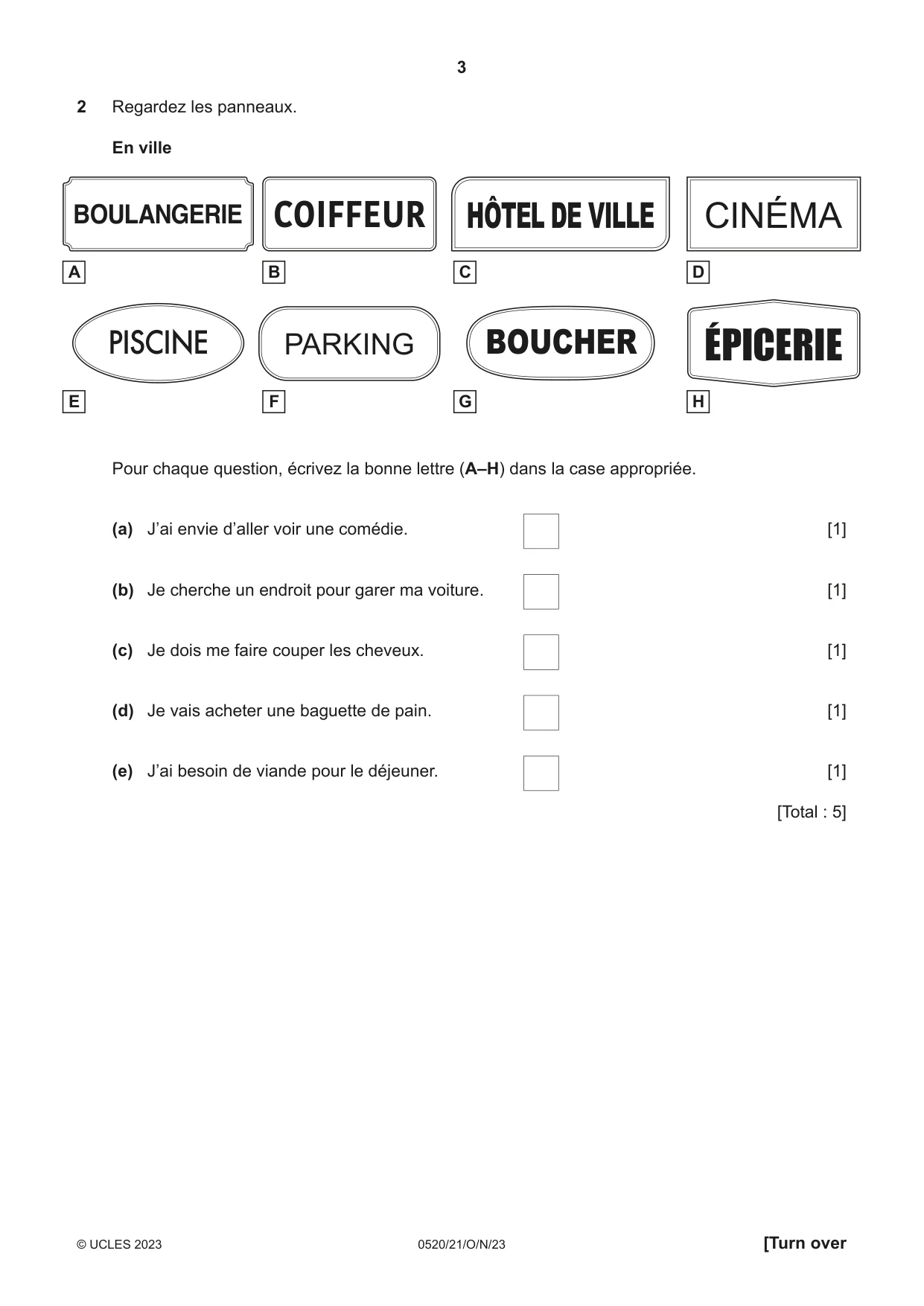
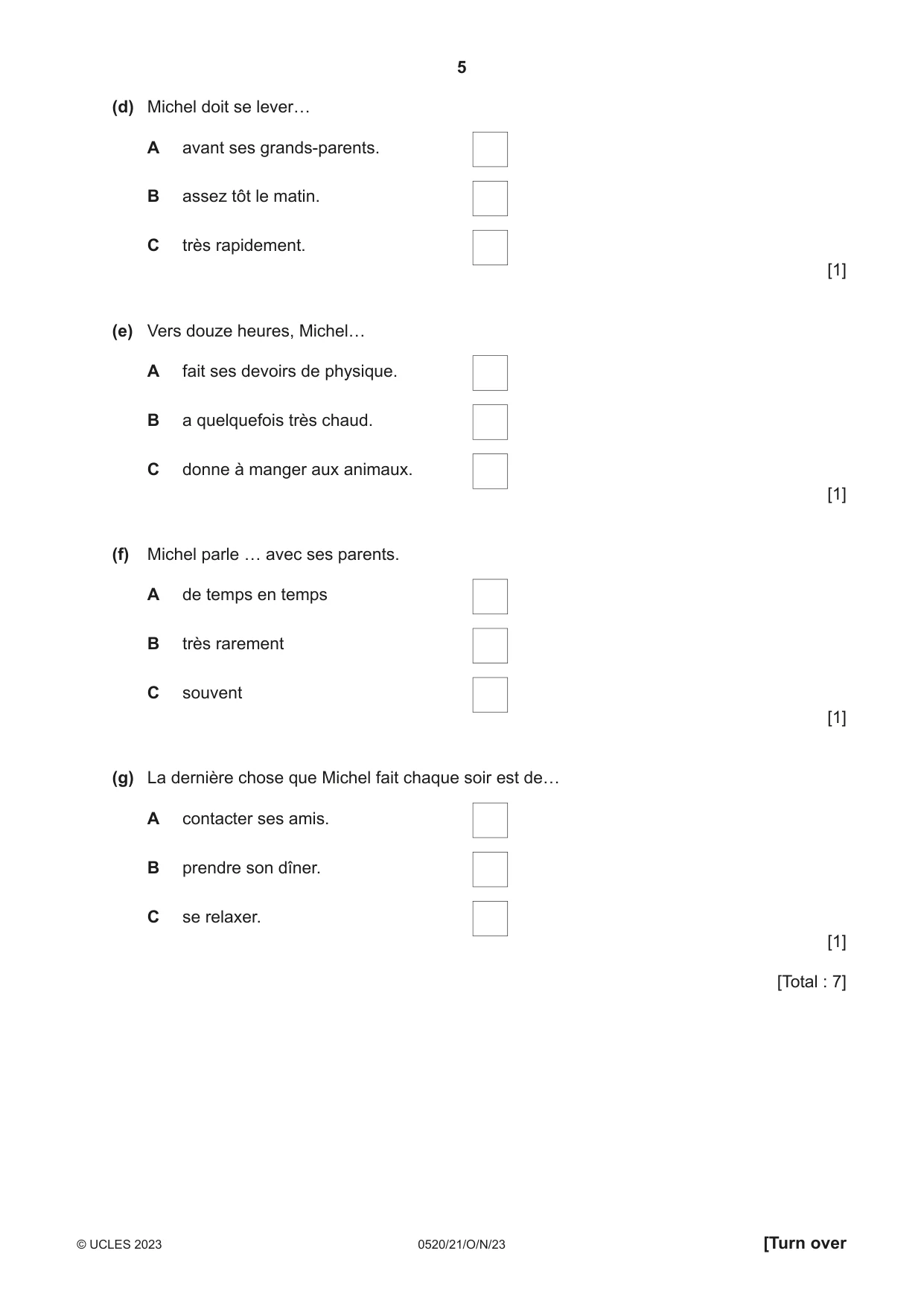
4 0520/21/O/N/23 © UCLES 2023 3 Lisez le texte. Pour chaque question, cochez (3) la case qui correspond à la bonne réponse. Mes grands-parents vivent dans une ferme. Ils sont assez jeunes et ma grand-mère n’est pas encore retraitée : elle travaille toujours comme professeur. Chaque juillet, je passe quinze jours chez eux et c’est un de mes moments préférés de l’année. Le seul inconvénient c’est que je dois me lever de bonne heure. Cependant, j’aime bien donner à manger aux animaux le matin. La température peut être très élevée vers midi donc je préfère faire quelque chose de moins physique à cette heure-là. Mes parents me téléphonent chaque soir juste avant le repas et j’aime bien ça. Je discute avec eux, puis je mange et je vais me détendre devant la télé. Il y a souvent un bon film à regarder. Michel (a) Les grands-parents de Michel habitent… A à la montagne. B dans une ville. C à la campagne. [1] (b) La grand-mère de Michel travaille dans une… A usine. B école. C banque. [1] (c) Michel adore … ses grands-parents. A rester chez B téléphoner à C jouer avec [1]
Question paper, page 5
5 0520/21/O/N/23 © UCLES 2023 [Turn over (d) Michel doit se lever… A avant ses grands-parents. B assez tôt le matin. C très rapidement. [1] (e) Vers douze heures, Michel… A fait ses devoirs de physique. B a quelquefois très chaud. C donne à manger aux animaux. [1] (f) Michel parle … avec ses parents. A de temps en temps B très rarement C souvent [1] (g) La dernière chose que Michel fait chaque soir est de… A contacter ses amis. B prendre son dîner. C se relaxer. [1] [Total : 7]
Question paper, page 6
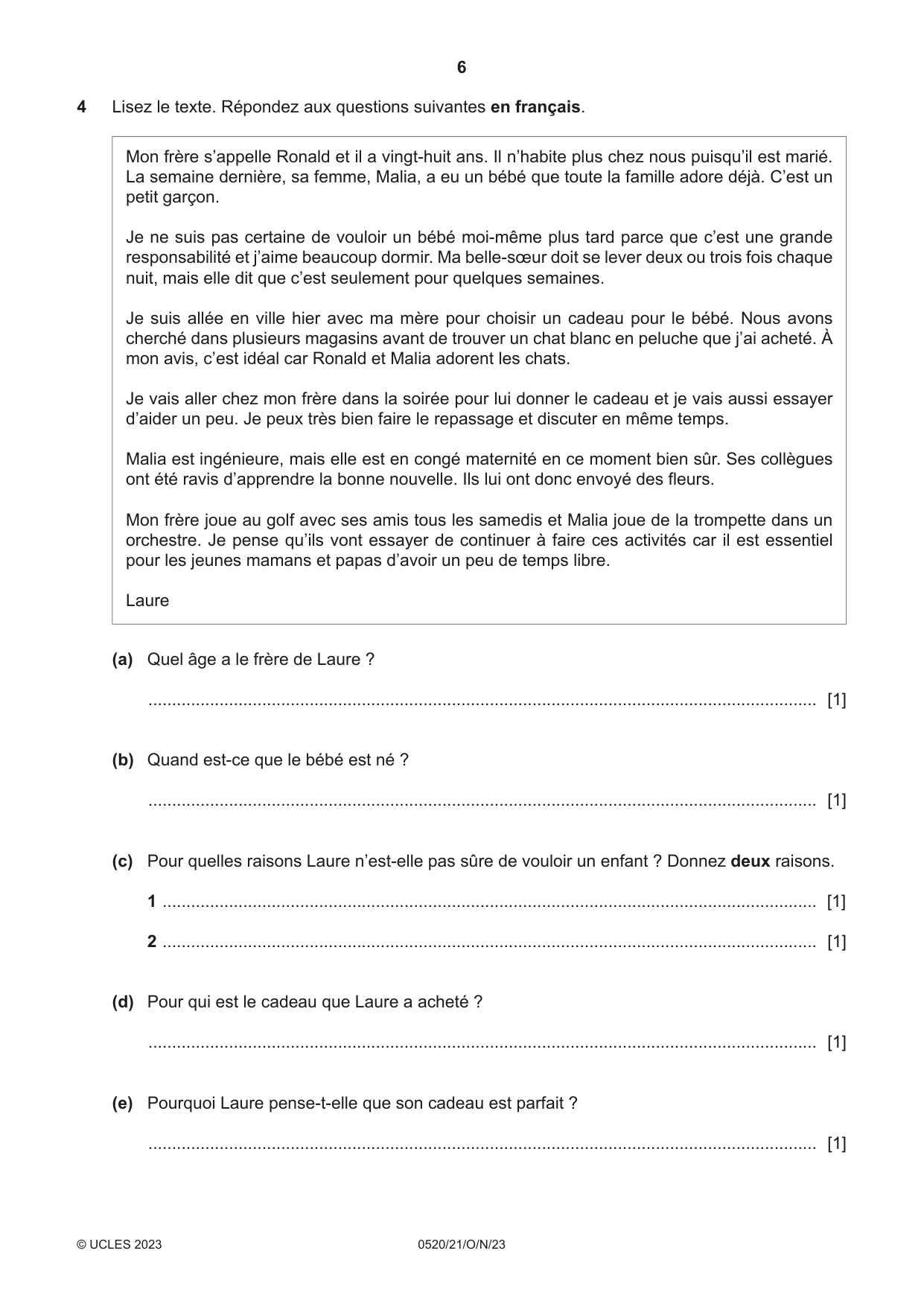
6 0520/21/O/N/23 © UCLES 2023 4 Lisez le texte. Répondez aux questions suivantes en français. Mon frère s’appelle Ronald et il a vingt-huit ans. Il n’habite plus chez nous puisqu’il est marié. La semaine dernière, sa femme, Malia, a eu un bébé que toute la famille adore déjà. C’est un petit garçon. Je ne suis pas certaine de vouloir un bébé moi-même plus tard parce que c’est une grande responsabilité et j’aime beaucoup dormir. Ma belle-sœur doit se lever deux ou trois fois chaque nuit, mais elle dit que c’est seulement pour quelques semaines. Je suis allée en ville hier avec ma mère pour choisir un cadeau pour le bébé. Nous avons cherché dans plusieurs magasins avant de trouver un chat blanc en peluche que j’ai acheté. À mon avis, c’est idéal car Ronald et Malia adorent les chats. Je vais aller chez mon frère dans la soirée pour lui donner le cadeau et je vais aussi essayer d’aider un peu. Je peux très bien faire le repassage et discuter en même temps. Malia est ingénieure, mais elle est en congé maternité en ce moment bien sûr. Ses collègues ont été ravis d’apprendre la bonne nouvelle. Ils lui ont donc envoyé des fleurs. Mon frère joue au golf avec ses amis tous les samedis et Malia joue de la trompette dans un orchestre. Je pense qu’ils vont essayer de continuer à faire ces activités car il est essentiel pour les jeunes mamans et papas d’avoir un peu de temps libre. Laure (a) Quel âge a le frère de Laure ? … [1] (b) Quand est-ce que le bébé est né ? … [1] (c) Pour quelles raisons Laure n’est-elle pas sûre de vouloir un enfant ? Donnez deux raisons. 1 … [1] 2 … [1] (d) Pour qui est le cadeau que Laure a acheté ? … [1] (e) Pourquoi Laure pense-t-elle que son cadeau est parfait ? … [1]
Question paper, page 7
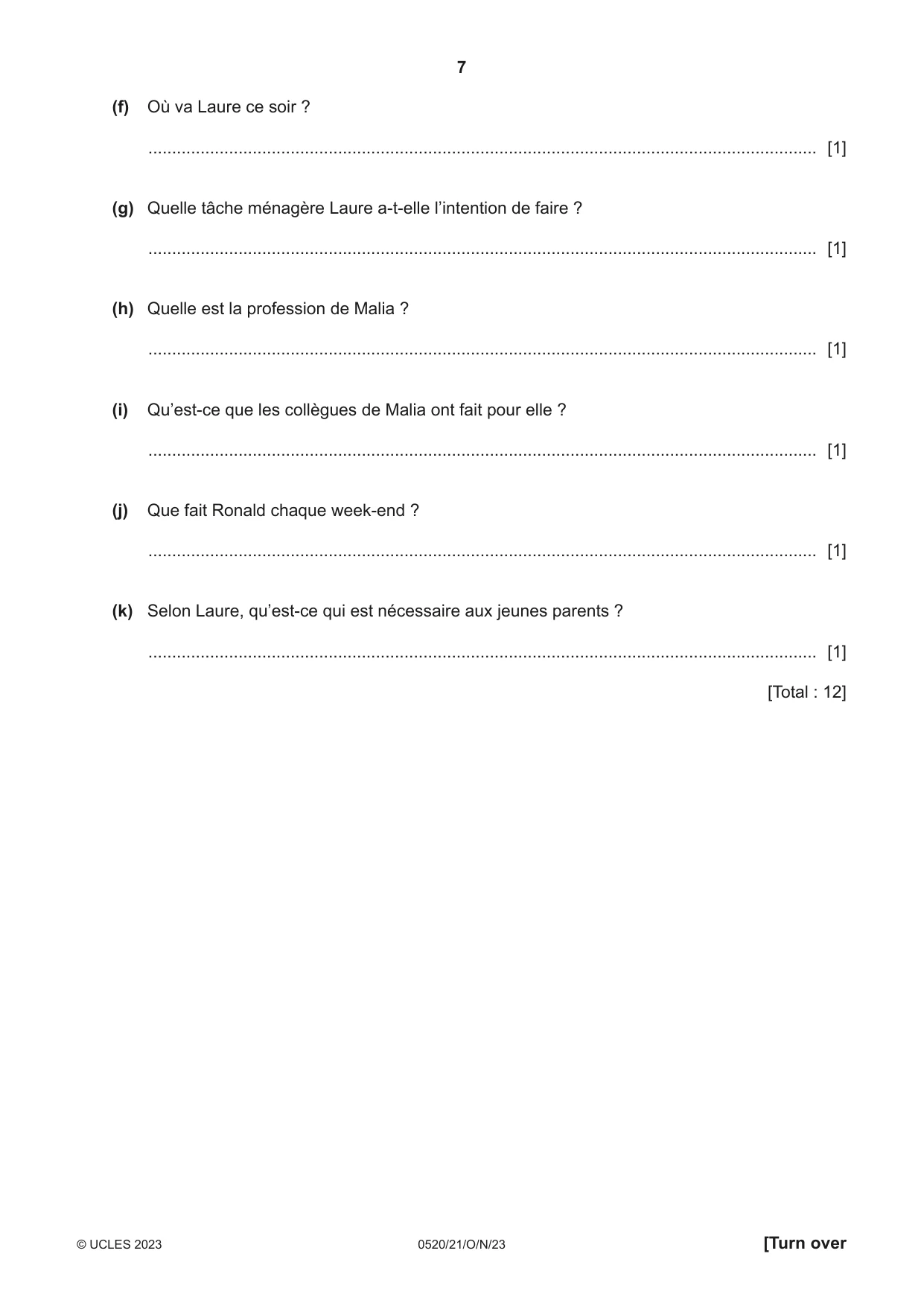
7 0520/21/O/N/23 © UCLES 2023 [Turn over (f) Où va Laure ce soir ? … [1] (g) Quelle tâche ménagère Laure a-t-elle l’intention de faire ? … [1] (h) Quelle est la profession de Malia ? … [1] (i) Qu’est-ce que les collègues de Malia ont fait pour elle ? … [1] (j) Que fait Ronald chaque week-end ? … [1] (k) Selon Laure, qu’est-ce qui est nécessaire aux jeunes parents ? … [1] [Total : 12]
Question paper, page 8
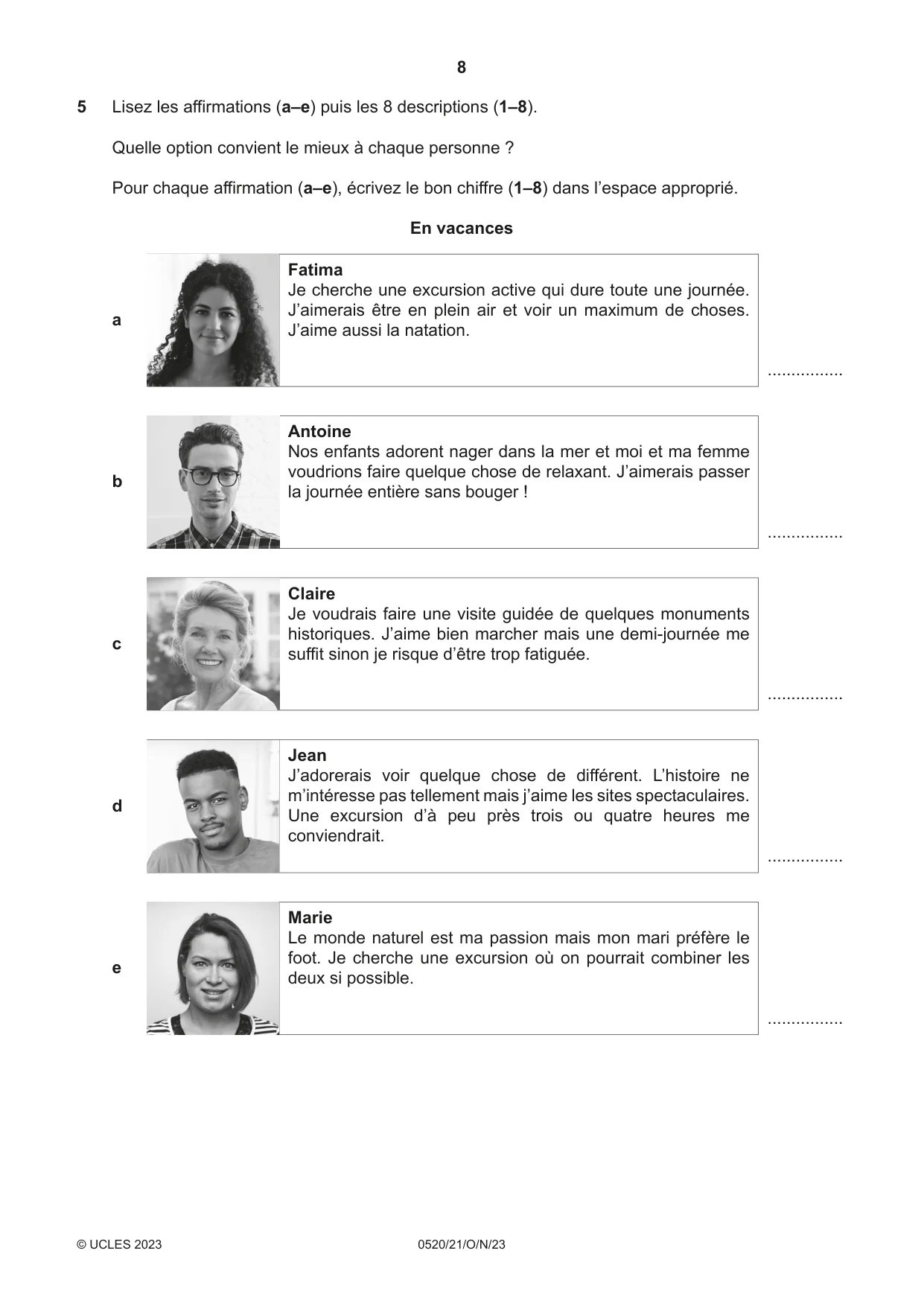
8 0520/21/O/N/23 © UCLES 2023 5 Lisez les affirmations (a–e) puis les 8 descriptions (1–8). Quelle option convient le mieux à chaque personne ? Pour chaque affirmation (a–e), écrivez le bon chiffre (1–8) dans l’espace approprié. En vacances a Fatima Je cherche une excursion active qui dure toute une journée. J’aimerais être en plein air et voir un maximum de choses. J’aime aussi la natation. … b Antoine Nos enfants adorent nager dans la mer et moi et ma femme voudrions faire quelque chose de relaxant. J’aimerais passer la journée entière sans bouger ! … c Claire Je voudrais faire une visite guidée de quelques monuments historiques. J’aime bien marcher mais une demi-journée me suffit sinon je risque d’être trop fatiguée. … d Jean J’adorerais voir quelque chose de différent. L’histoire ne m’intéresse pas tellement mais j’aime les sites spectaculaires. Une excursion d’à peu près trois ou quatre heures me conviendrait. … e Marie Le monde naturel est ma passion mais mon mari préfère le foot. Je cherche une excursion où on pourrait combiner les deux si possible. …
Question paper, page 9
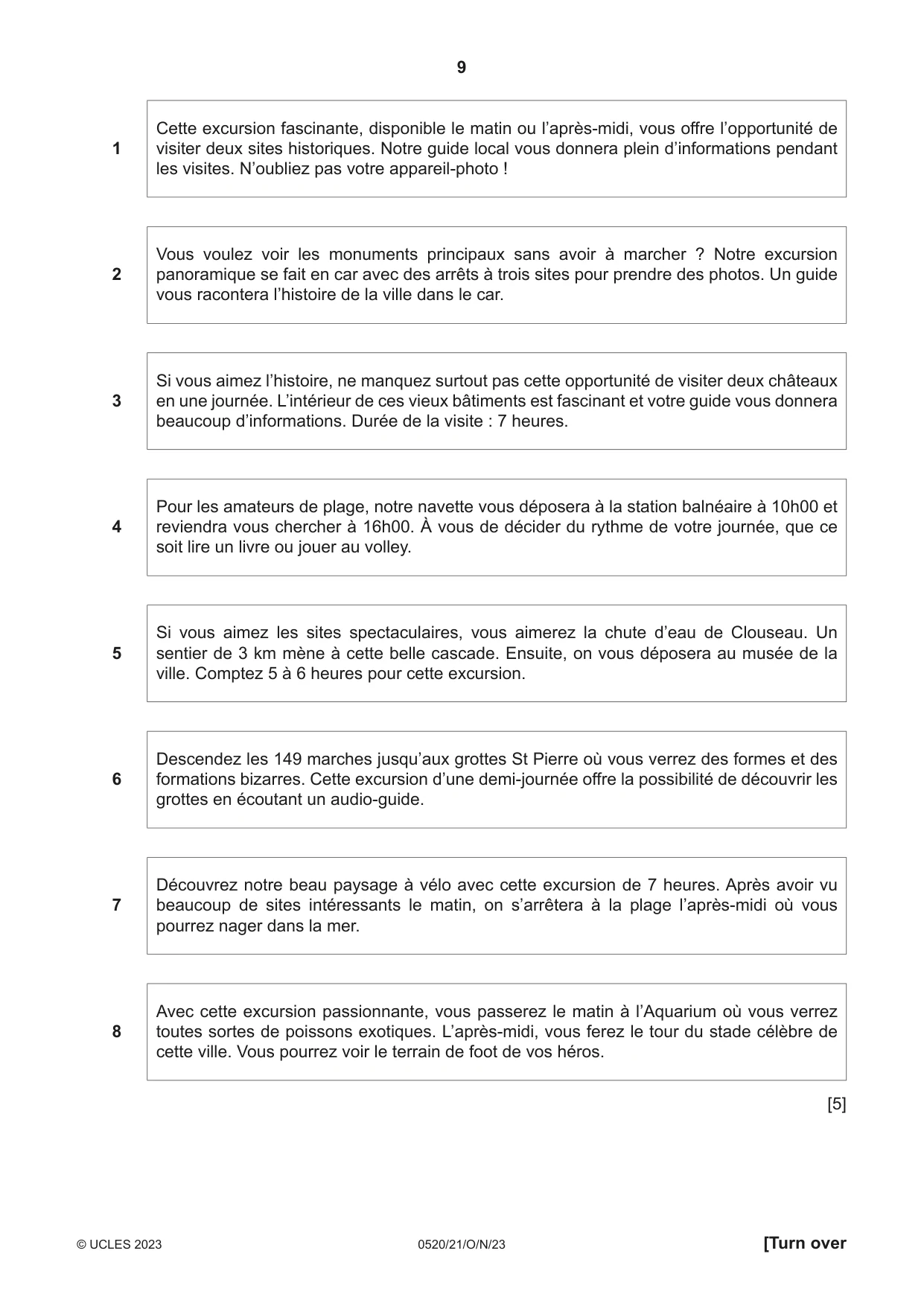
9 0520/21/O/N/23 © UCLES 2023 [Turn over 1 Cette excursion fascinante, disponible le matin ou l’après-midi, vous offre l’opportunité de visiter deux sites historiques. Notre guide local vous donnera plein d’informations pendant les visites. N’oubliez pas votre appareil-photo ! 2 Vous voulez voir les monuments principaux sans avoir à marcher ? Notre excursion panoramique se fait en car avec des arrêts à trois sites pour prendre des photos. Un guide vous racontera l’histoire de la ville dans le car. 3 Si vous aimez l’histoire, ne manquez surtout pas cette opportunité de visiter deux châteaux en une journée. L’intérieur de ces vieux bâtiments est fascinant et votre guide vous donnera beaucoup d’informations. Durée de la visite : 7 heures. 4 Pour les amateurs de plage, notre navette vous déposera à la station balnéaire à 10h00 et reviendra vous chercher à 16h00. À vous de décider du rythme de votre journée, que ce soit lire un livre ou jouer au volley. 5 Si vous aimez les sites spectaculaires, vous aimerez la chute d’eau de Clouseau. Un sentier de 3 km mène à cette belle cascade. Ensuite, on vous déposera au musée de la ville. Comptez 5 à 6 heures pour cette excursion. 6 Descendez les 149 marches jusqu’aux grottes St Pierre où vous verrez des formes et des formations bizarres. Cette excursion d’une demi-journée offre la possibilité de découvrir les grottes en écoutant un audio-guide. 7 Découvrez notre beau paysage à vélo avec cette excursion de 7 heures. Après avoir vu beaucoup de sites intéressants le matin, on s’arrêtera à la plage l’après-midi où vous pourrez nager dans la mer. 8 Avec cette excursion passionnante, vous passerez le matin à l’Aquarium où vous verrez toutes sortes de poissons exotiques. L’après-midi, vous ferez le tour du stade célèbre de cette ville. Vous pourrez voir le terrain de foot de vos héros. [5]
Question paper, page 10
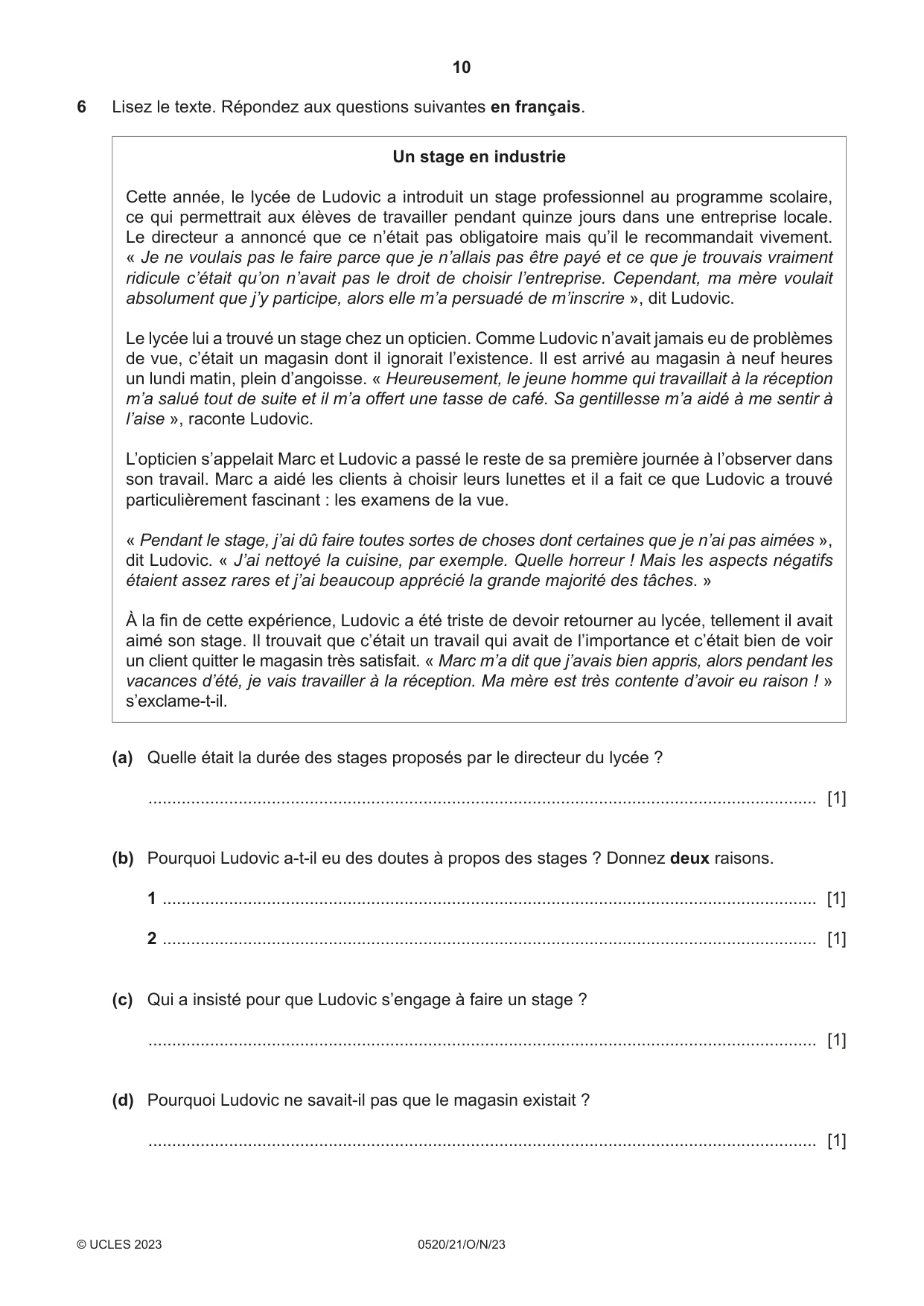
10 0520/21/O/N/23 © UCLES 2023 6 Lisez le texte. Répondez aux questions suivantes en français. Un stage en industrie Cette année, le lycée de Ludovic a introduit un stage professionnel au programme scolaire, ce qui permettrait aux élèves de travailler pendant quinze jours dans une entreprise locale. Le directeur a annoncé que ce n’était pas obligatoire mais qu’il le recommandait vivement. « Je ne voulais pas le faire parce que je n’allais pas être payé et ce que je trouvais vraiment ridicule c’était qu’on n’avait pas le droit de choisir l’entreprise. Cependant, ma mère voulait absolument que j’y participe, alors elle m’a persuadé de m’inscrire », dit Ludovic. Le lycée lui a trouvé un stage chez un opticien. Comme Ludovic n’avait jamais eu de problèmes de vue, c’était un magasin dont il ignorait l’existence. Il est arrivé au magasin à neuf heures un lundi matin, plein d’angoisse. « Heureusement, le jeune homme qui travaillait à la réception m’a salué tout de suite et il m’a offert une tasse de café. Sa gentillesse m’a aidé à me sentir à l’aise », raconte Ludovic. L’opticien s’appelait Marc et Ludovic a passé le reste de sa première journée à l’observer dans son travail. Marc a aidé les clients à choisir leurs lunettes et il a fait ce que Ludovic a trouvé particulièrement fascinant : les examens de la vue. « Pendant le stage, j’ai dû faire toutes sortes de choses dont certaines que je n’ai pas aimées », dit Ludovic. « J’ai nettoyé la cuisine, par exemple. Quelle horreur ! Mais les aspects négatifs étaient assez rares et j’ai beaucoup apprécié la grande majorité des tâches. » À la fin de cette expérience, Ludovic a été triste de devoir retourner au lycée, tellement il avait aimé son stage. Il trouvait que c’était un travail qui avait de l’importance et c’était bien de voir un client quitter le magasin très satisfait. « Marc m’a dit que j’avais bien appris, alors pendant les vacances d’été, je vais travailler à la réception. Ma mère est très contente d’avoir eu raison ! » s’exclame-t-il. (a) Quelle était la durée des stages proposés par le directeur du lycée ? … [1] (b) Pourquoi Ludovic a-t-il eu des doutes à propos des stages ? Donnez deux raisons. 1 … [1] 2 … [1] (c) Qui a insisté pour que Ludovic s’engage à faire un stage ? … [1] (d) Pourquoi Ludovic ne savait-il pas que le magasin existait ? … [1]
Question paper, page 11
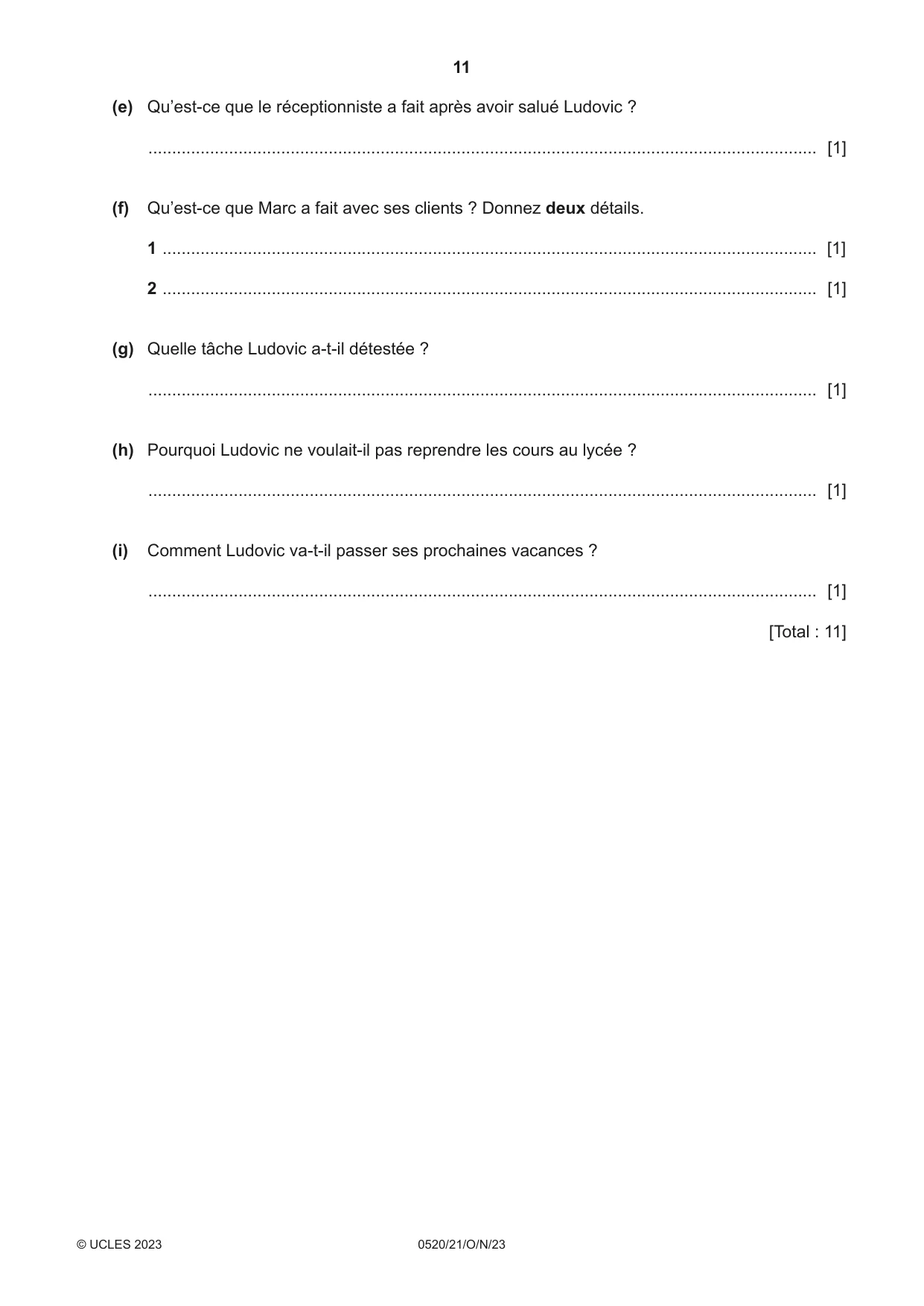
11 0520/21/O/N/23 © UCLES 2023 (e) Qu’est-ce que le réceptionniste a fait après avoir salué Ludovic ? … [1] (f) Qu’est-ce que Marc a fait avec ses clients ? Donnez deux détails. 1 … [1] 2 … [1] (g) Quelle tâche Ludovic a-t-il détestée ? … [1] (h) Pourquoi Ludovic ne voulait-il pas reprendre les cours au lycée ? … [1] (i) Comment Ludovic va-t-il passer ses prochaines vacances ? … [1] [Total : 11]
Question paper, page 12
12 0520/21/O/N/23 © UCLES 2023 Permission to reproduce items where third-party owned material protected by copyright is included has been sought and cleared where possible. Every reasonable effort has been made by the publisher (UCLES) to trace copyright holders, but if any items requiring clearance have unwittingly been included, the publisher will be pleased to make amends at the earliest possible opportunity. To avoid the issue of disclosure of answer-related information to candidates, all copyright acknowledgements are reproduced online in the Cambridge Assessment International Education Copyright Acknowledgements Booklet. This is produced for each series of examinations and is freely available to download at www.cambridgeinternational.org after the live examination series. Cambridge Assessment International Education is part of Cambridge Assessment. Cambridge Assessment is the brand name of the University of Cambridge Local Examinations Syndicate (UCLES), which is a department of the University of Cambridge. BLANK PAGE
Mark scheme, page 1
This document consists of 8 printed pages. © UCLES 2023 [Turn over Cambridge IGCSE™ FRENCH 0520/21 Paper 2 Reading October/November 2023 MARK SCHEME Maximum Mark: 45 Published This mark scheme is published as an aid to teachers and candidates, to indicate the requirements of the examination. It shows the basis on which Examiners were instructed to award marks. It does not indicate the details of the discussions that took place at an Examiners’ meeting before marking began, which would have considered the acceptability of alternative answers. Mark schemes should be read in conjunction with the question paper and the Principal Examiner Report for Teachers. Cambridge International will not enter into discussions about these mark schemes. Cambridge International is publishing the mark schemes for the October/November 2023 series for most Cambridge IGCSE, Cambridge International A and AS Level components, and some Cambridge O Level components.
Mark scheme, page 2
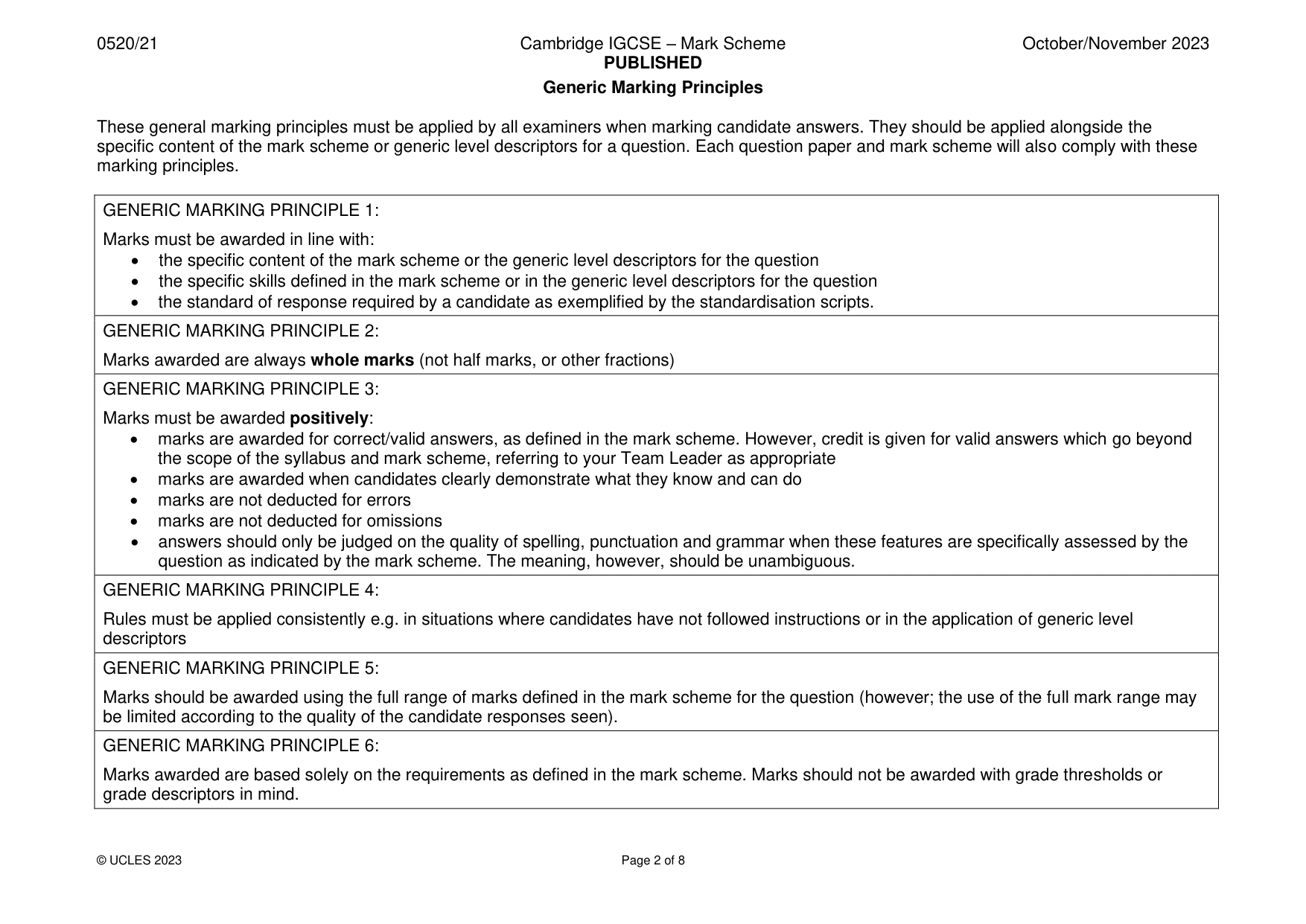
0520/21 Cambridge IGCSE – Mark Scheme PUBLISHED October/November 2023 © UCLES 2023 Page 2 of 8 Generic Marking Principles These general marking principles must be applied by all examiners when marking candidate answers. They should be applied alongside the specific content of the mark scheme or generic level descriptors for a question. Each question paper and mark scheme will also comply with these marking principles. GENERIC MARKING PRINCIPLE 1: Marks must be awarded in line with: • the specific content of the mark scheme or the generic level descriptors for the question • the specific skills defined in the mark scheme or in the generic level descriptors for the question • the standard of response required by a candidate as exemplified by the standardisation scripts. GENERIC MARKING PRINCIPLE 2: Marks awarded are always whole marks (not half marks, or other fractions) GENERIC MARKING PRINCIPLE 3: Marks must be awarded positively: • marks are awarded for correct/valid answers, as defined in the mark scheme. However, credit is given for valid answers which go beyond the scope of the syllabus and mark scheme, referring to your Team Leader as appropriate • marks are awarded when candidates clearly demonstrate what they know and can do • marks are not deducted for errors • marks are not deducted for omissions • answers should only be judged on the quality of spelling, punctuation and grammar when these features are specifically assessed by the question as indicated by the mark scheme. The meaning, however, should be unambiguous. GENERIC MARKING PRINCIPLE 4: Rules must be applied consistently e.g. in situations where candidates have not followed instructions or in the application of generic level descriptors GENERIC MARKING PRINCIPLE 5: Marks should be awarded using the full range of marks defined in the mark scheme for the question (however; the use of the full mark range may be limited according to the quality of the candidate responses seen). GENERIC MARKING PRINCIPLE 6: Marks awarded are based solely on the requirements as defined in the mark scheme. Marks should not be awarded with grade thresholds or grade descriptors in mind.
Mark scheme, page 3
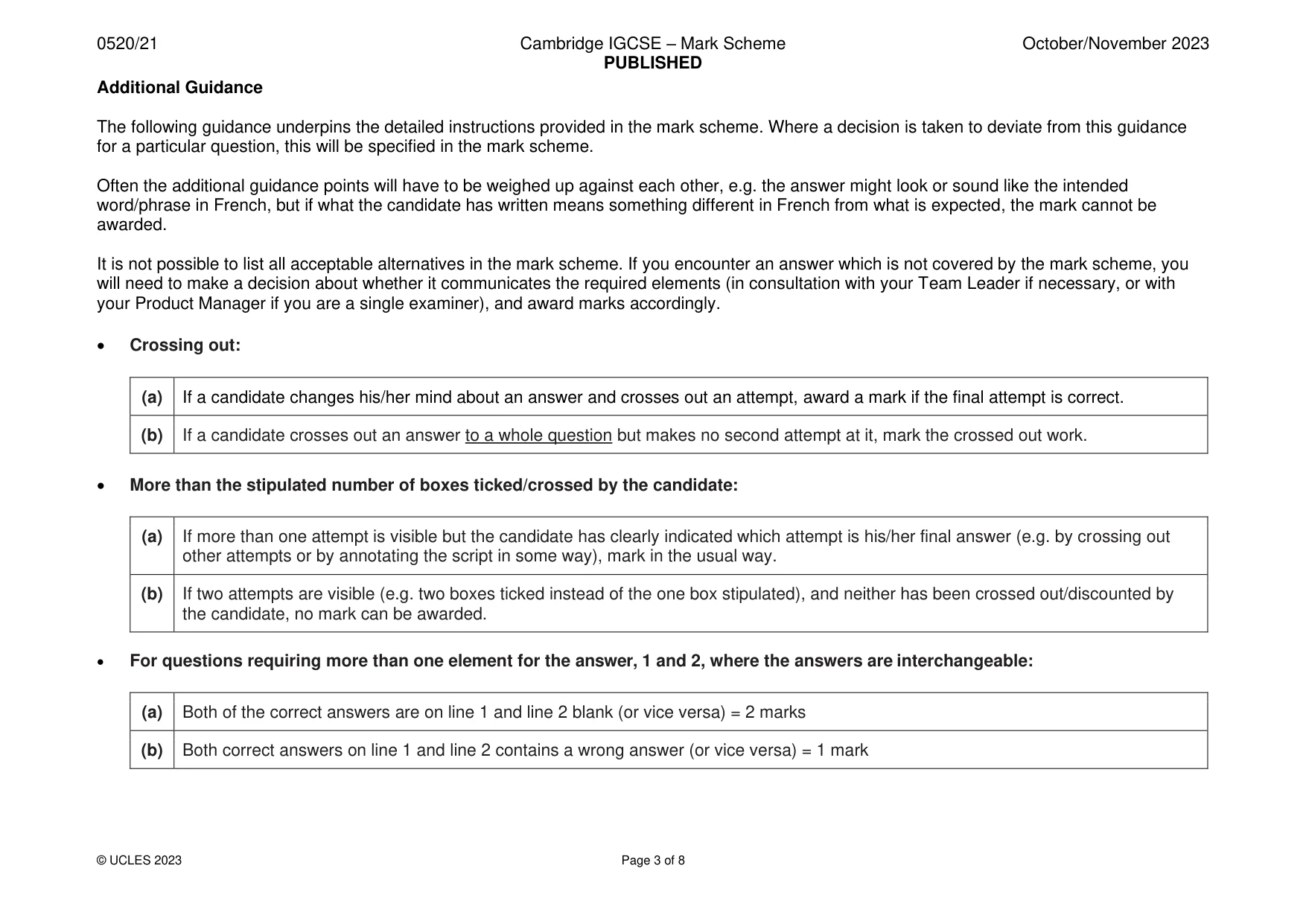
0520/21 Cambridge IGCSE – Mark Scheme PUBLISHED October/November 2023 © UCLES 2023 Page 3 of 8 Additional Guidance The following guidance underpins the detailed instructions provided in the mark scheme. Where a decision is taken to deviate from this guidance for a particular question, this will be specified in the mark scheme. Often the additional guidance points will have to be weighed up against each other, e.g. the answer might look or sound like the intended word/phrase in French, but if what the candidate has written means something different in French from what is expected, the mark cannot be awarded. It is not possible to list all acceptable alternatives in the mark scheme. If you encounter an answer which is not covered by the mark scheme, you will need to make a decision about whether it communicates the required elements (in consultation with your Team Leader if necessary, or with your Product Manager if you are a single examiner), and award marks accordingly. • Crossing out: (a) If a candidate changes his/her mind about an answer and crosses out an attempt, award a mark if the final attempt is correct. (b) If a candidate crosses out an answer to a whole question but makes no second attempt at it, mark the crossed out work. • More than the stipulated number of boxes ticked/crossed by the candidate: (a) If more than one attempt is visible but the candidate has clearly indicated which attempt is his/her final answer (e.g. by crossing out other attempts or by annotating the script in some way), mark in the usual way. (b) If two attempts are visible (e.g. two boxes ticked instead of the one box stipulated), and neither has been crossed out/discounted by the candidate, no mark can be awarded. • For questions requiring more than one element for the answer, 1 and 2, where the answers are interchangeable: (a) Both of the correct answers are on line 1 and line 2 blank (or vice versa) = 2 marks (b) Both correct answers on line 1 and line 2 contains a wrong answer (or vice versa) = 1 mark
Mark scheme, page 4
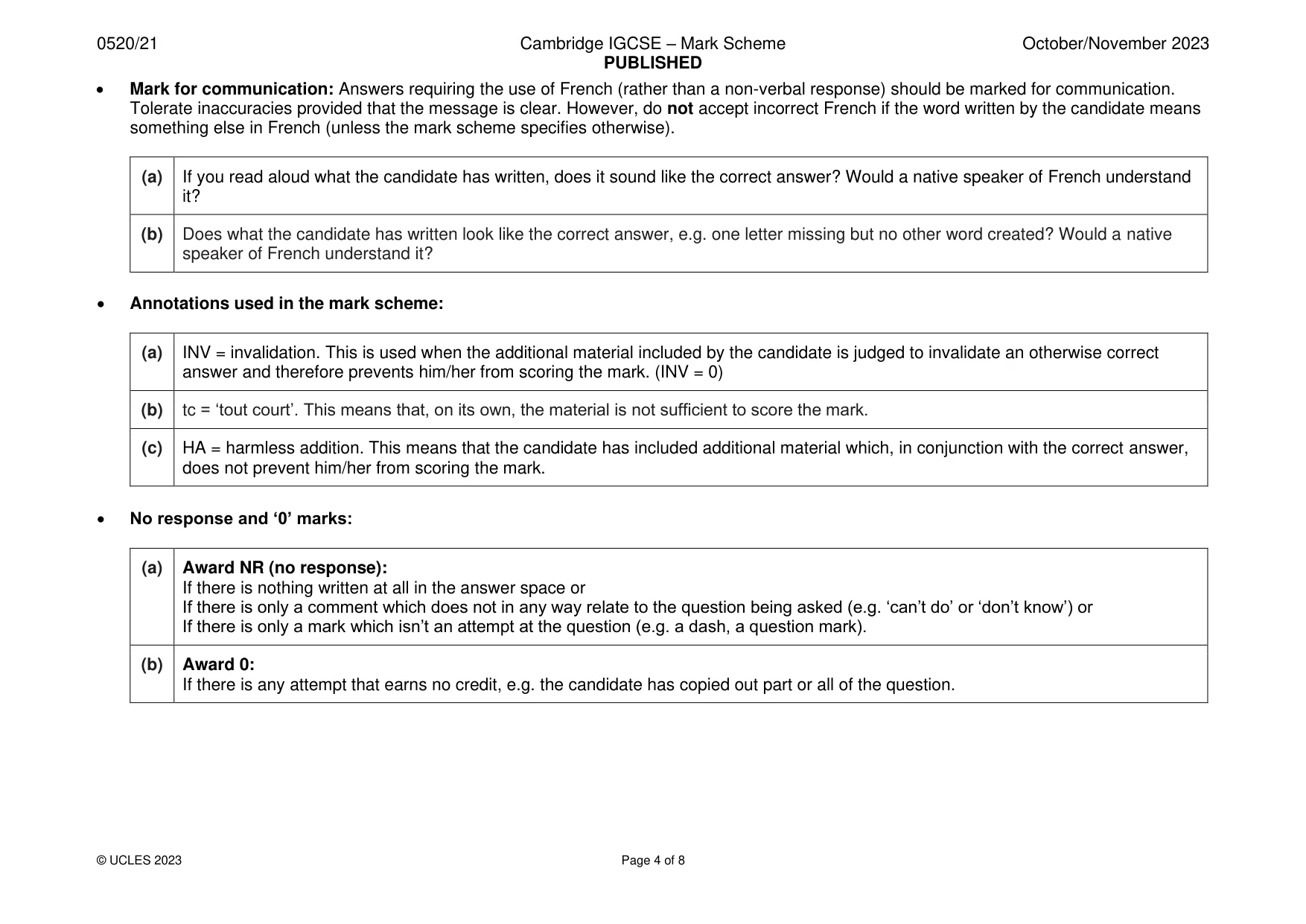
0520/21 Cambridge IGCSE – Mark Scheme PUBLISHED October/November 2023 © UCLES 2023 Page 4 of 8 • Mark for communication: Answers requiring the use of French (rather than a non-verbal response) should be marked for communication. Tolerate inaccuracies provided that the message is clear. However, do not accept incorrect French if the word written by the candidate means something else in French (unless the mark scheme specifies otherwise). (a) If you read aloud what the candidate has written, does it sound like the correct answer? Would a native speaker of French understand it? (b) Does what the candidate has written look like the correct answer, e.g. one letter missing but no other word created? Would a native speaker of French understand it? • Annotations used in the mark scheme: (a) INV = invalidation. This is used when the additional material included by the candidate is judged to invalidate an otherwise correct answer and therefore prevents him/her from scoring the mark. (INV = 0) (b) tc = ‘tout court’. This means that, on its own, the material is not sufficient to score the mark. (c) HA = harmless addition. This means that the candidate has included additional material which, in conjunction with the correct answer, does not prevent him/her from scoring the mark. • No response and ‘0’ marks: (a) Award NR (no response): If there is nothing written at all in the answer space or If there is only a comment which does not in any way relate to the question being asked (e.g. ‘can’t do’ or ‘don’t know’) or If there is only a mark which isn’t an attempt at the question (e.g. a dash, a question mark). (b) Award 0: If there is any attempt that earns no credit, e.g. the candidate has copied out part or all of the question.
Mark scheme, page 5
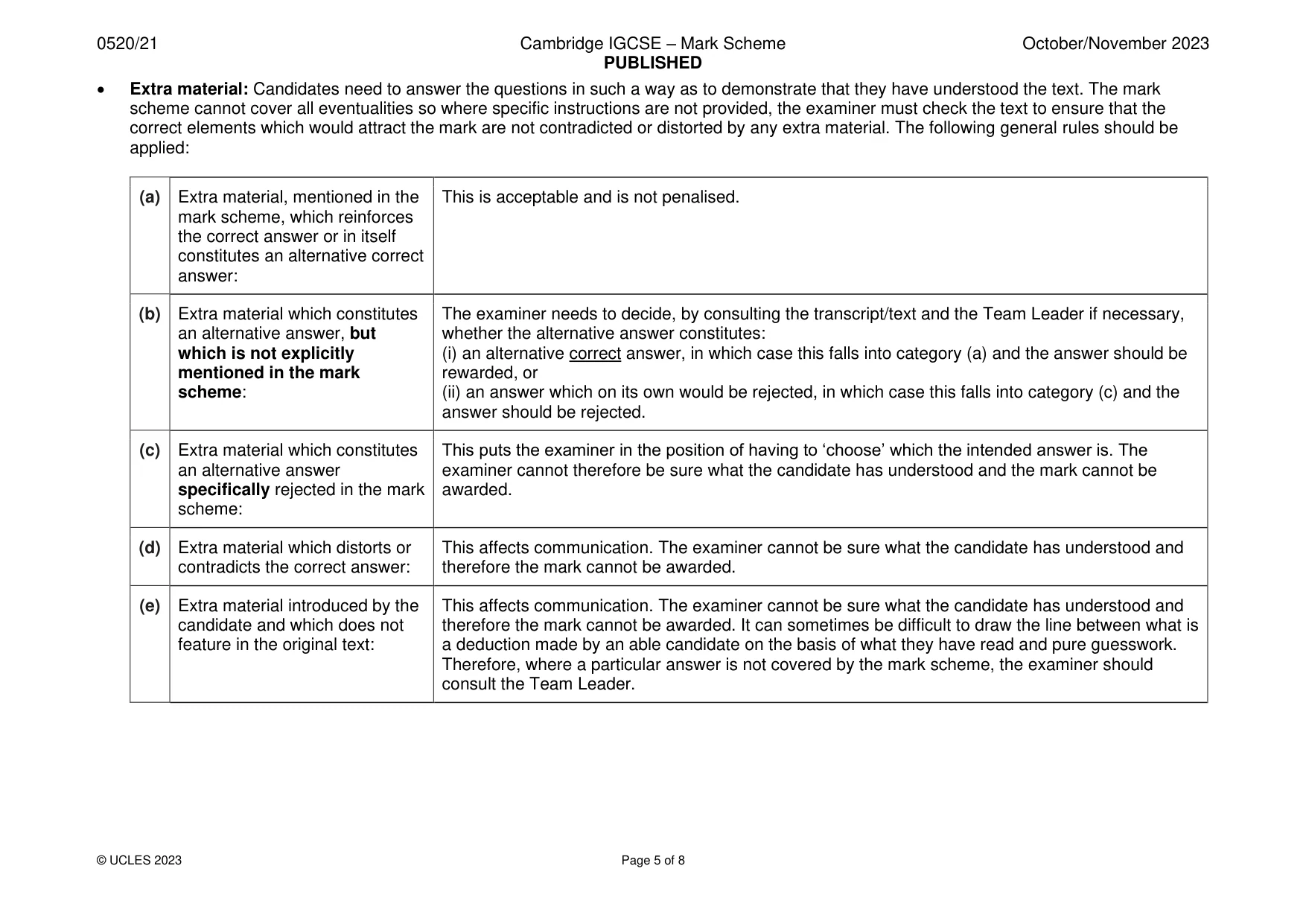
0520/21 Cambridge IGCSE – Mark Scheme PUBLISHED October/November 2023 © UCLES 2023 Page 5 of 8 • Extra material: Candidates need to answer the questions in such a way as to demonstrate that they have understood the text. The mark scheme cannot cover all eventualities so where specific instructions are not provided, the examiner must check the text to ensure that the correct elements which would attract the mark are not contradicted or distorted by any extra material. The following general rules should be applied: (a) Extra material, mentioned in the mark scheme, which reinforces the correct answer or in itself constitutes an alternative correct answer: This is acceptable and is not penalised. (b) Extra material which constitutes an alternative answer, but which is not explicitly mentioned in the mark scheme: The examiner needs to decide, by consulting the transcript/text and the Team Leader if necessary, whether the alternative answer constitutes: (i) an alternative correct answer, in which case this falls into category (a) and the answer should be rewarded, or (ii) an answer which on its own would be rejected, in which case this falls into category (c) and the answer should be rejected. (c) Extra material which constitutes an alternative answer specifically rejected in the mark scheme: This puts the examiner in the position of having to ‘choose’ which the intended answer is. The examiner cannot therefore be sure what the candidate has understood and the mark cannot be awarded. (d) Extra material which distorts or contradicts the correct answer: This affects communication. The examiner cannot be sure what the candidate has understood and therefore the mark cannot be awarded. (e) Extra material introduced by the candidate and which does not feature in the original text: This affects communication. The examiner cannot be sure what the candidate has understood and therefore the mark cannot be awarded. It can sometimes be difficult to draw the line between what is a deduction made by an able candidate on the basis of what they have read and pure guesswork. Therefore, where a particular answer is not covered by the mark scheme, the examiner should consult the Team Leader.
Mark scheme, page 6
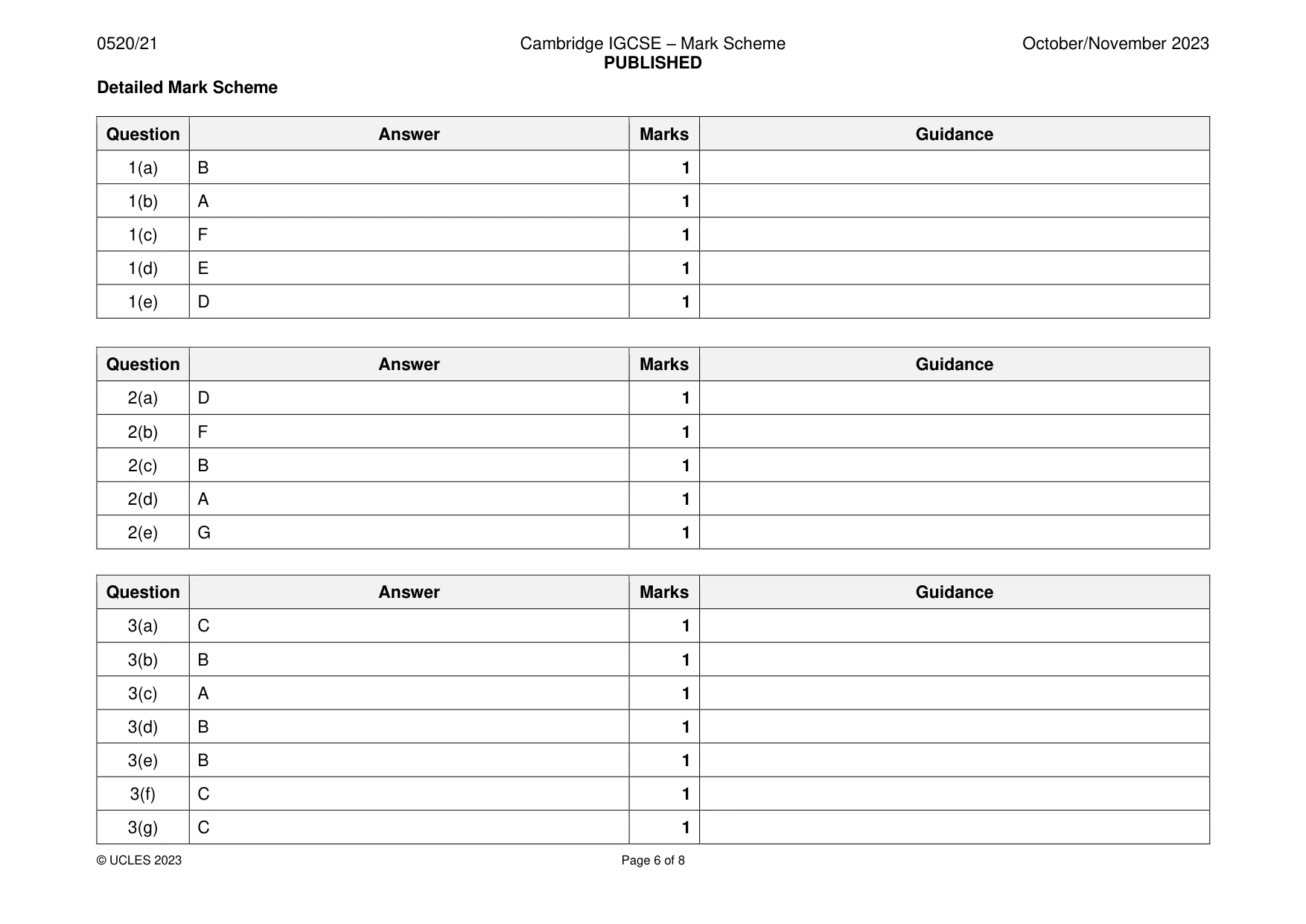
0520/21 Cambridge IGCSE – Mark Scheme PUBLISHED October/November 2023 © UCLES 2023 Page 6 of 8 Detailed Mark Scheme Question Answer Marks Guidance 1(a) B 1 1(b) A 1 1(c) F 1 1(d) E 1 1(e) D 1 Question Answer Marks Guidance 2(a) D 1 2(b) F 1 2(c) B 1 2(d) A 1 2(e) G 1 Question Answer Marks Guidance 3(a) C 1 3(b) B 1 3(c) A 1 3(d) B 1 3(e) B 1 3(f) C 1 3(g) C 1
Mark scheme, page 7
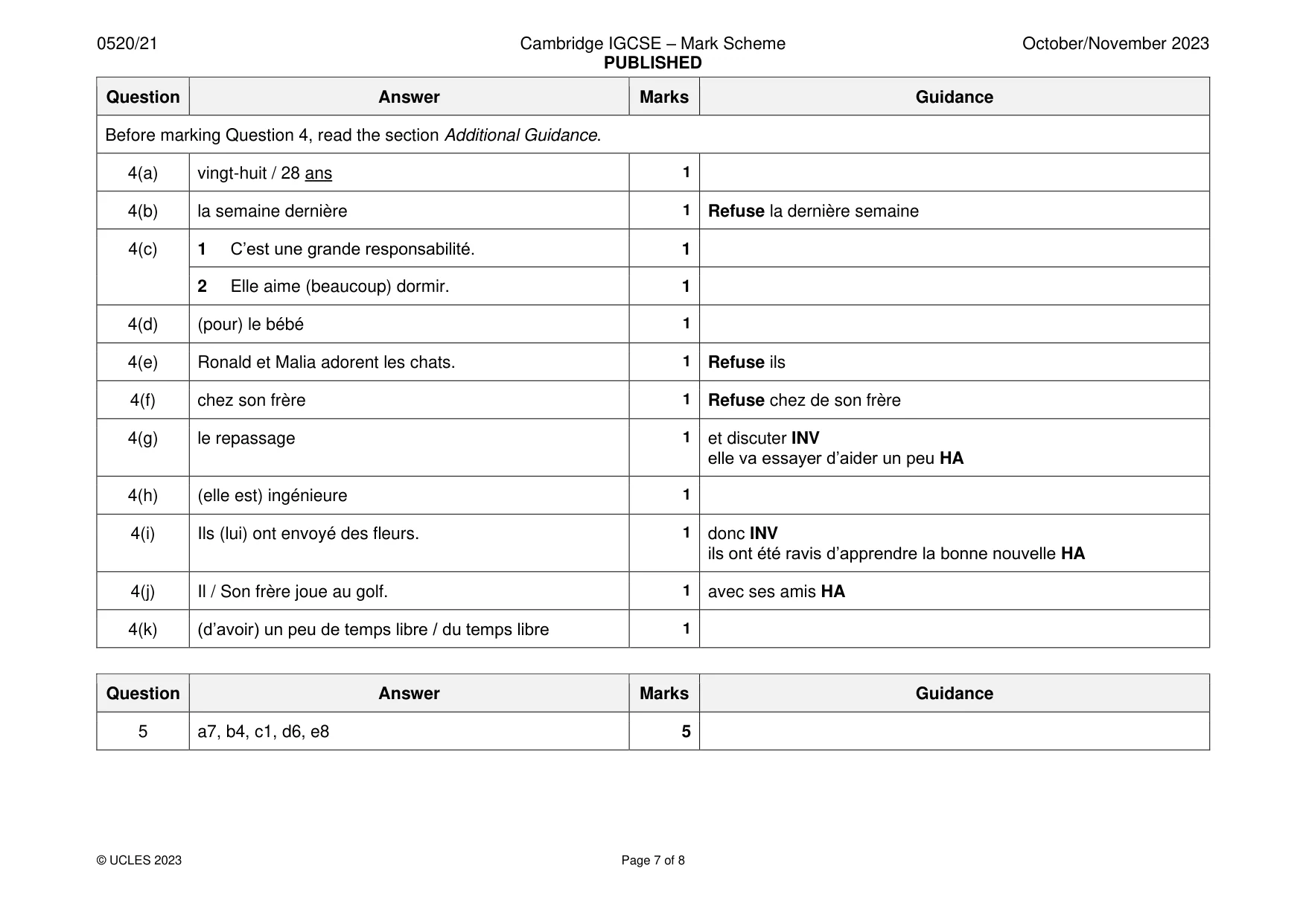
0520/21 Cambridge IGCSE – Mark Scheme PUBLISHED October/November 2023 © UCLES 2023 Page 7 of 8 Question Answer Marks Guidance Before marking Question 4, read the section Additional Guidance. 4(a) vingt-huit / 28 ans 1 4(b) la semaine dernière 1 Refuse la dernière semaine 4(c) 1 C’est une grande responsabilité. 1 2 Elle aime (beaucoup) dormir. 1 4(d) (pour) le bébé 1 4(e) Ronald et Malia adorent les chats. 1 Refuse ils 4(f) chez son frère 1 Refuse chez de son frère 4(g) le repassage 1 et discuter INV elle va essayer d’aider un peu HA 4(h) (elle est) ingénieure 1 4(i) Ils (lui) ont envoyé des fleurs. 1 donc INV ils ont été ravis d’apprendre la bonne nouvelle HA 4(j) Il / Son frère joue au golf. 1 avec ses amis HA 4(k) (d’avoir) un peu de temps libre / du temps libre 1 Question Answer Marks Guidance 5 a7, b4, c1, d6, e8 5
Mark scheme, page 8
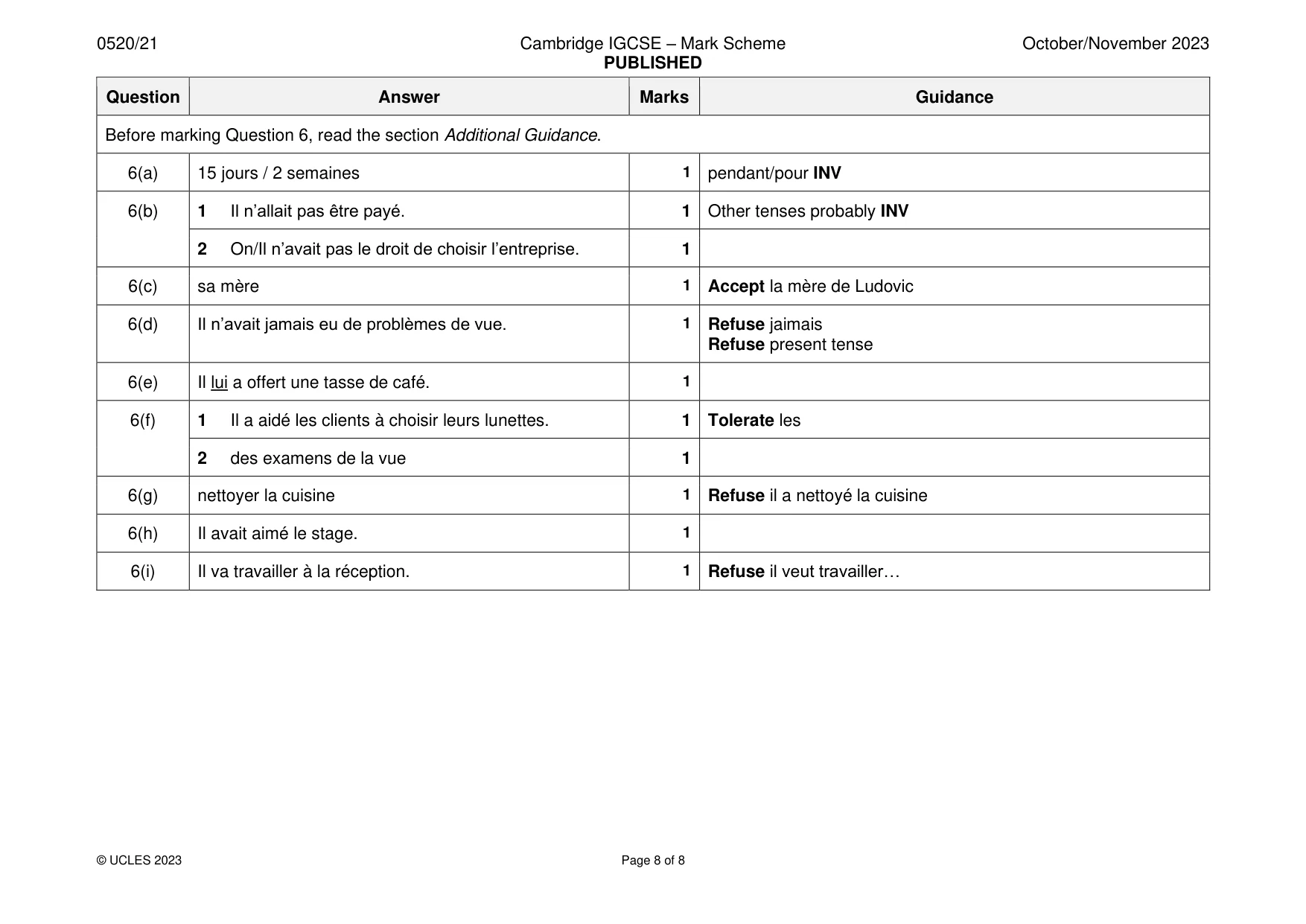
0520/21 Cambridge IGCSE – Mark Scheme PUBLISHED October/November 2023 © UCLES 2023 Page 8 of 8 Question Answer Marks Guidance Before marking Question 6, read the section Additional Guidance. 6(a) 15 jours / 2 semaines 1 pendant/pour INV 6(b) 1 Il n’allait pas être payé. 1 Other tenses probably INV 2 On/Il n’avait pas le droit de choisir l’entreprise. 1 6(c) sa mère 1 Accept la mère de Ludovic 6(d) Il n’avait jamais eu de problèmes de vue. 1 Refuse jaimais Refuse present tense 6(e) Il lui a offert une tasse de café. 1 6(f) 1 Il a aidé les clients à choisir leurs lunettes. 1 Tolerate les 2 des examens de la vue 1 6(g) nettoyer la cuisine 1 Refuse il a nettoyé la cuisine 6(h) Il avait aimé le stage. 1 6(i) Il va travailler à la réception. 1 Refuse il veut travailler…
What you needed in this session
Cambridge’s own grade thresholds for 2023 Oct/Nov, Paper 2 · Variant 1. A higher threshold means an easier paper — the bar moves with how the cohort did.