Cambridge IGCSE French - Foreign Language 0520 — 2016 Oct/Nov Paper 2 · Variant 2
0520/22/O/N/16 · 45 marks · ≈51 min
The question paper and its mark scheme, free to read here and free to download. This is Cambridge’s own paper, exactly as it was sat.
Question paper16 pages



Mark scheme12 pages
Answers below. Sit the paper first if you are practising.
Paper as text
Question paper, page 1
This document consists of 14 printed pages and 2 blank pages. DC (CW/SW) 117183/3 © UCLES 2016 [Turn over Cambridge International Examinations Cambridge International General Certificate of Secondary Education * 1 3 6 7 6 3 2 1 9 0 * FRENCH 0520/22 Paper 2 Reading October/November 2016 1 hour Candidates answer on the Question Paper. No Additional Materials are required. READ THESE INSTRUCTIONS FIRST Write your Centre number, candidate number and name on all the work you hand in. Write in dark blue or black pen. Do not use staples, paper clips, glue or correction fluid. DO NOT WRITE IN ANY BARCODES. Answer all questions. The number of marks is given in brackets [ ] at the end of each question or part question. The syllabus is approved for use in England, Wales and Northern Ireland as a Cambridge International Level 1/Level 2 Certificate.
Question paper, page 2
2 0520/22/O/N/16 © UCLES 2016 BLANK PAGE
Question paper, page 3
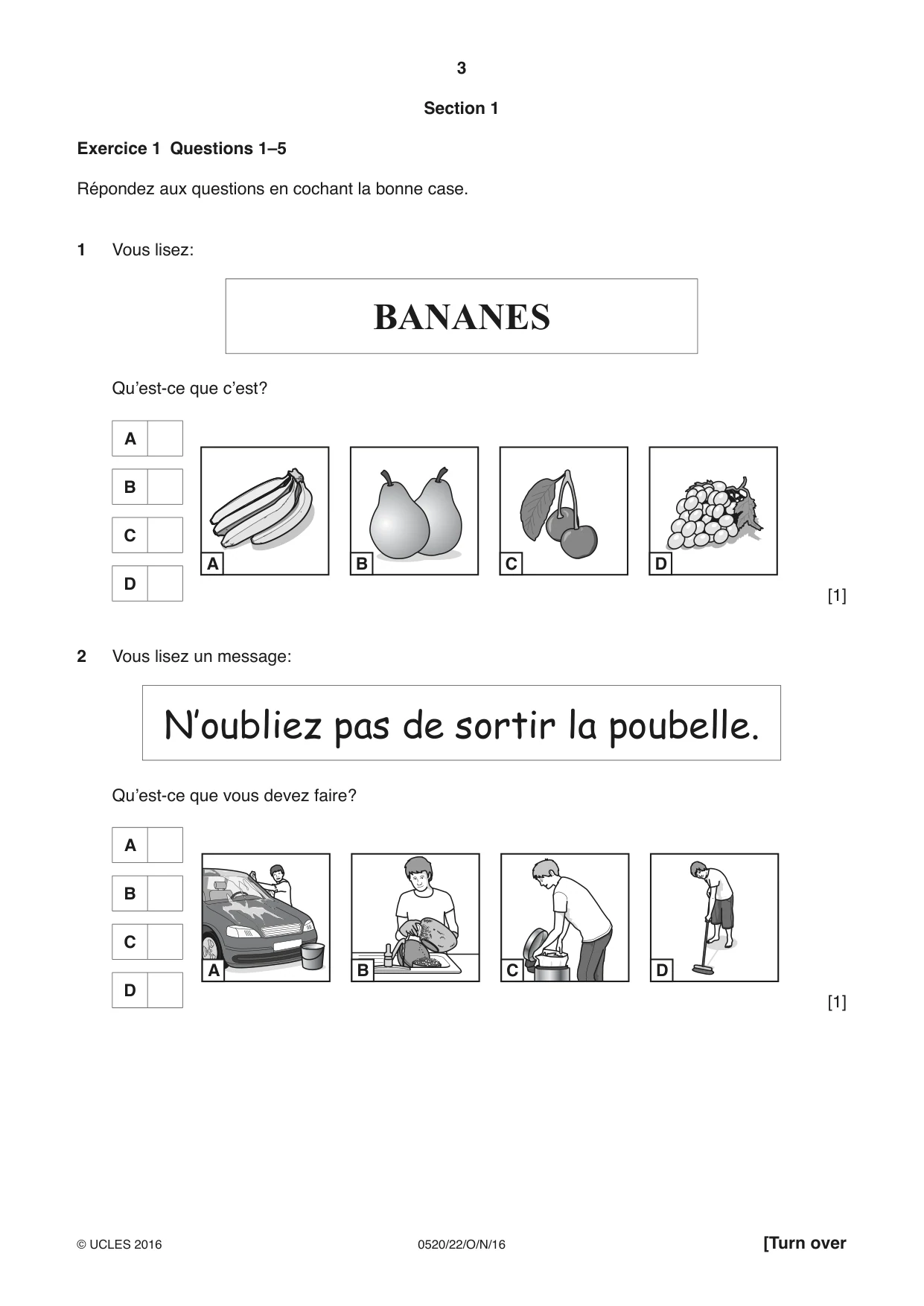
3 0520/22/O/N/16 © UCLES 2016 [Turn over Section 1 Exercice 1 Questions 1–5 Répondez aux questions en cochant la bonne case. 1 Vous lisez: BANANES Qu’est-ce que c’est? A A B C D [1] B C D 2 Vous lisez un message: N’oubliez pas de sortir la poubelle. Qu’est-ce que vous devez faire? A A B C D [1] B C D
Question paper, page 4
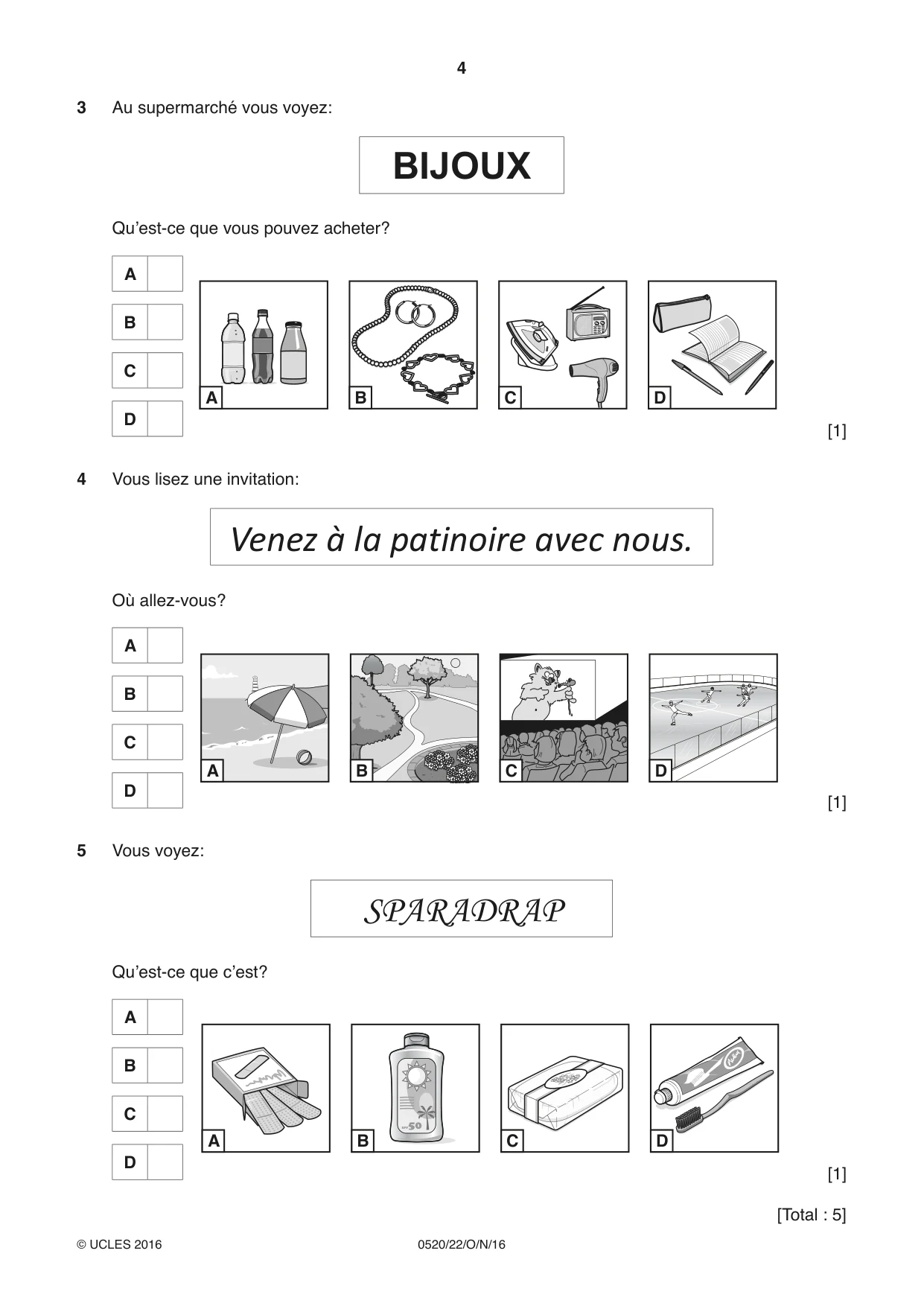
4 0520/22/O/N/16 © UCLES 2016 3 Au supermarché vous voyez: BIJOUX Qu’est-ce que vous pouvez acheter? A A B C D [1] B C D 4 Vous lisez une invitation: Venez à la patinoire avec nous. Où allez-vous? A A B C D [1] B C D 5 Vous voyez: SPARADRAP Qu’est-ce que c’est? A A B C D [1] B C D [Total : 5]
Question paper, page 5
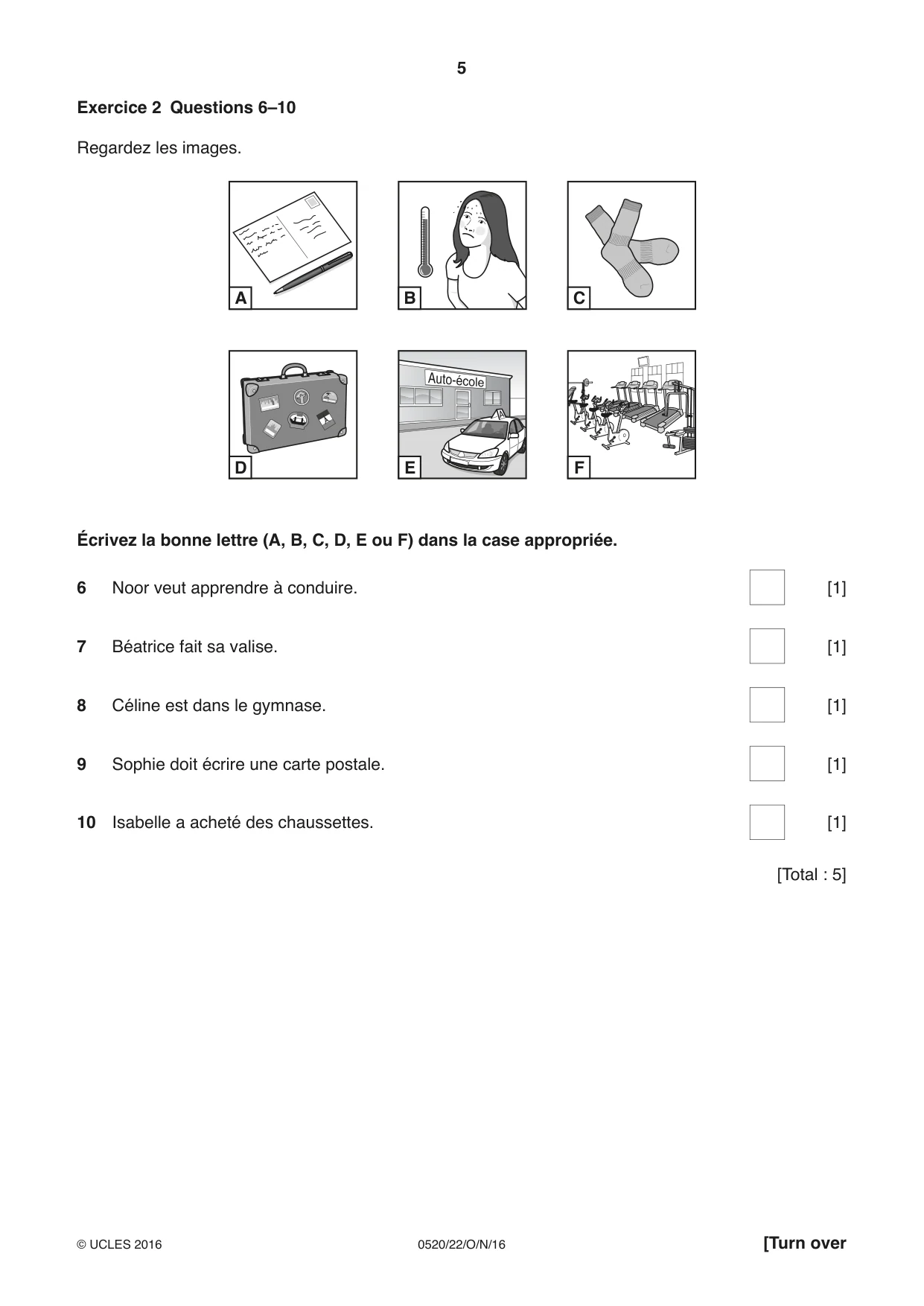
5 0520/22/O/N/16 © UCLES 2016 [Turn over Exercice 2 Questions 6–10 Regardez les images. A B C D E F Écrivez la bonne lettre (A, B, C, D, E ou F) dans la case appropriée. 6 Noor veut apprendre à conduire. [1] 7 Béatrice fait sa valise. [1] 8 Céline est dans le gymnase. [1] 9 Sophie doit écrire une carte postale. [1] 10 Isabelle a acheté des chaussettes. [1] [Total : 5]
Question paper, page 6
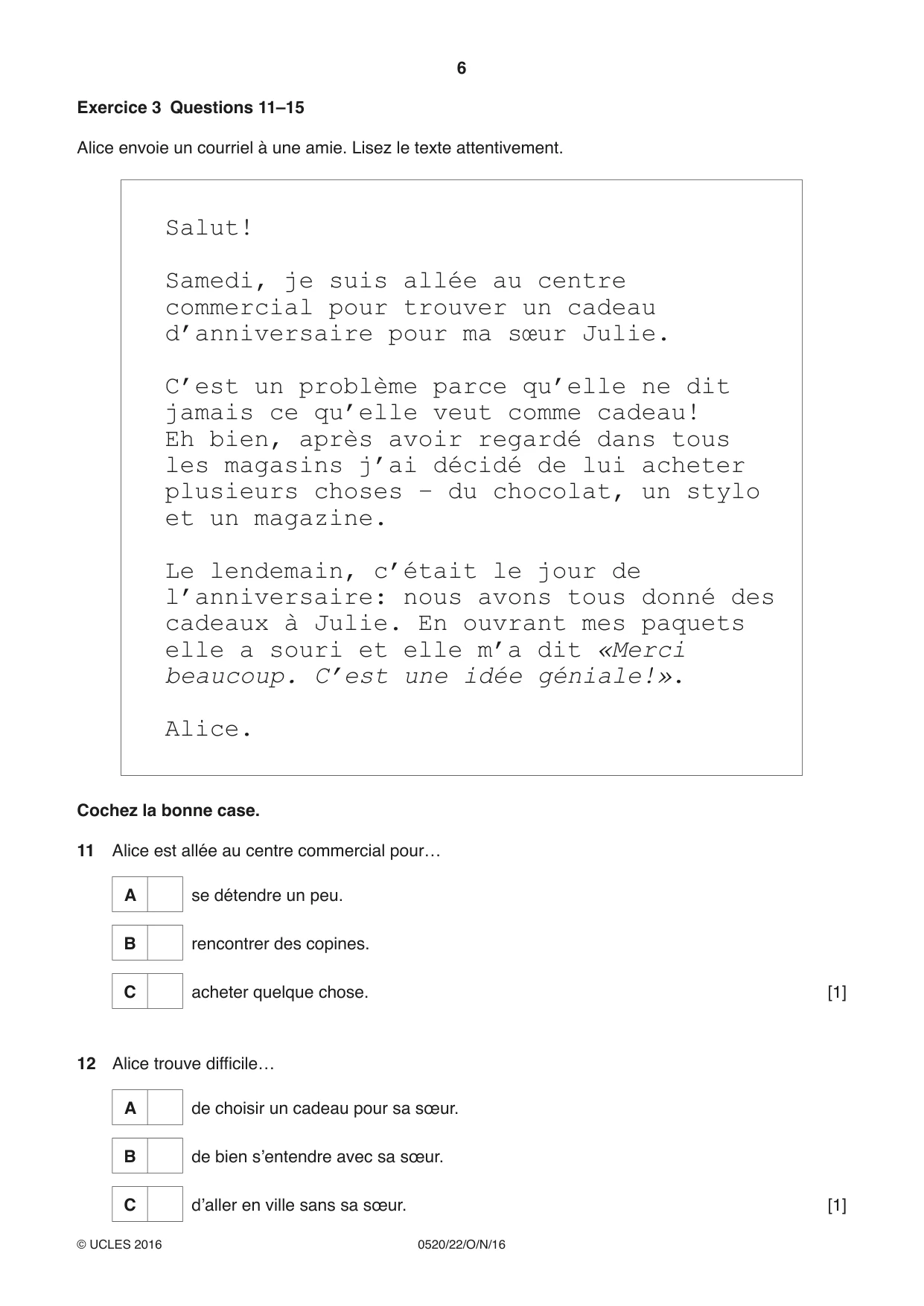
6 0520/22/O/N/16 © UCLES 2016 Exercice 3 Questions 11–15 Alice envoie un courriel à une amie. Lisez le texte attentivement. Salut! Samedi, je suis allée au centre commercial pour trouver un cadeau d’anniversaire pour ma sœur Julie. C’est un problème parce qu’elle ne dit jamais ce qu’elle veut comme cadeau! Eh bien, après avoir regardé dans tous les magasins j’ai décidé de lui acheter plusieurs choses – du chocolat, un stylo et un magazine. Le lendemain, c’était le jour de l’anniversaire: nous avons tous donné des cadeaux à Julie. En ouvrant mes paquets elle a souri et elle m’a dit «Merci beaucoup. C’est une idée géniale!». Alice. Cochez la bonne case. 11 Alice est allée au centre commercial pour… A se détendre un peu. B rencontrer des copines. C acheter quelque chose. [1] 12 Alice trouve difficile… A de choisir un cadeau pour sa sœur. B de bien s’entendre avec sa sœur. C d’aller en ville sans sa sœur. [1]
Question paper, page 7
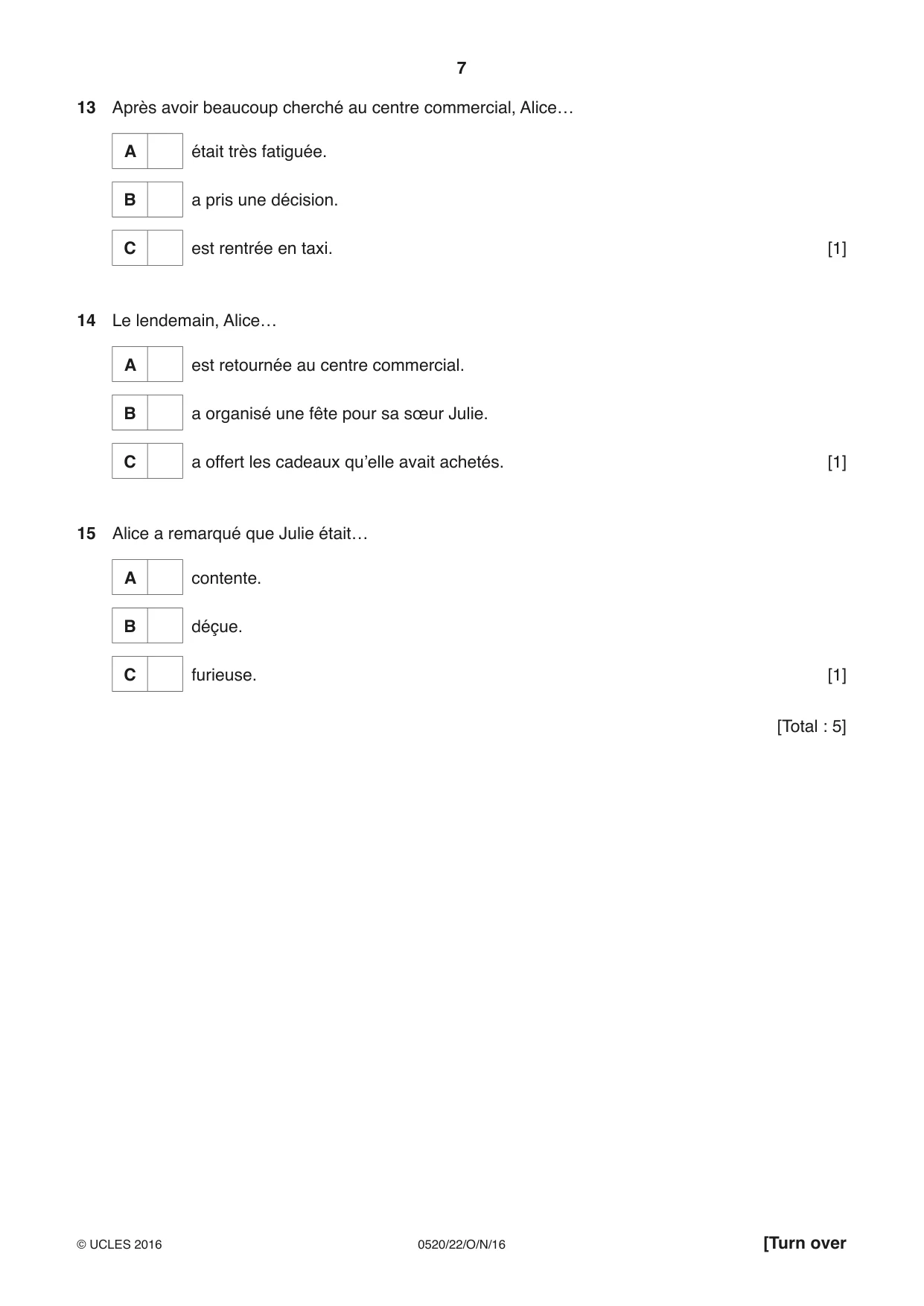
7 0520/22/O/N/16 © UCLES 2016 [Turn over 13 Après avoir beaucoup cherché au centre commercial, Alice… A était très fatiguée. B a pris une décision. C est rentrée en taxi. [1] 14 Le lendemain, Alice… A est retournée au centre commercial. B a organisé une fête pour sa sœur Julie. C a offert les cadeaux qu’elle avait achetés. [1] 15 Alice a remarqué que Julie était… A contente. B déçue. C furieuse. [1] [Total : 5]
Question paper, page 8
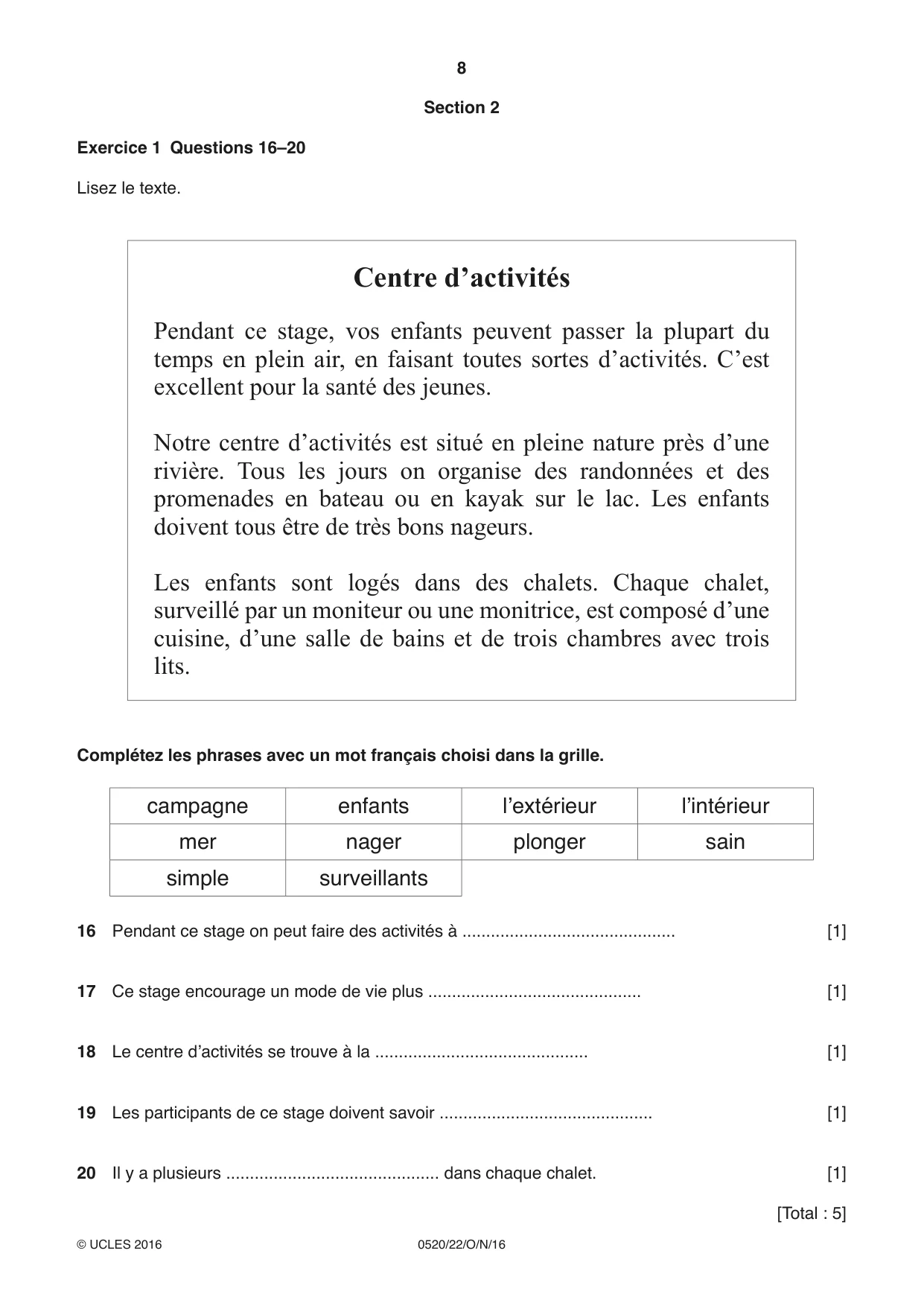
8 0520/22/O/N/16 © UCLES 2016 Section 2 Exercice 1 Questions 16–20 Lisez le texte. Centre d’activités Pendant ce stage, vos enfants peuvent passer la plupart du temps en plein air, en faisant toutes sortes d’activités. C’est excellent pour la santé des jeunes. Notre centre d’activités est situé en pleine nature près d’une rivière. Tous les jours on organise des randonnées et des promenades en bateau ou en kayak sur le lac. Les enfants doivent tous être de très bons nageurs. Les enfants sont logés dans des chalets. Chaque chalet, surveillé par un moniteur ou une monitrice, est composé d’une cuisine, d’une salle de bains et de trois chambres avec trois lits. Complétez les phrases avec un mot français choisi dans la grille. campagne enfants l’extérieur l’intérieur mer nager plonger sain simple surveillants 16 Pendant ce stage on peut faire des activités à … [1] 17 Ce stage encourage un mode de vie plus … [1] 18 Le centre d’activités se trouve à la … [1] 19 Les participants de ce stage doivent savoir … [1] 20 Il y a plusieurs … dans chaque chalet. [1] [Total : 5]
Question paper, page 9
9 0520/22/O/N/16 © UCLES 2016 [Turn over Tournez la page pour Exercice 2.
Question paper, page 10
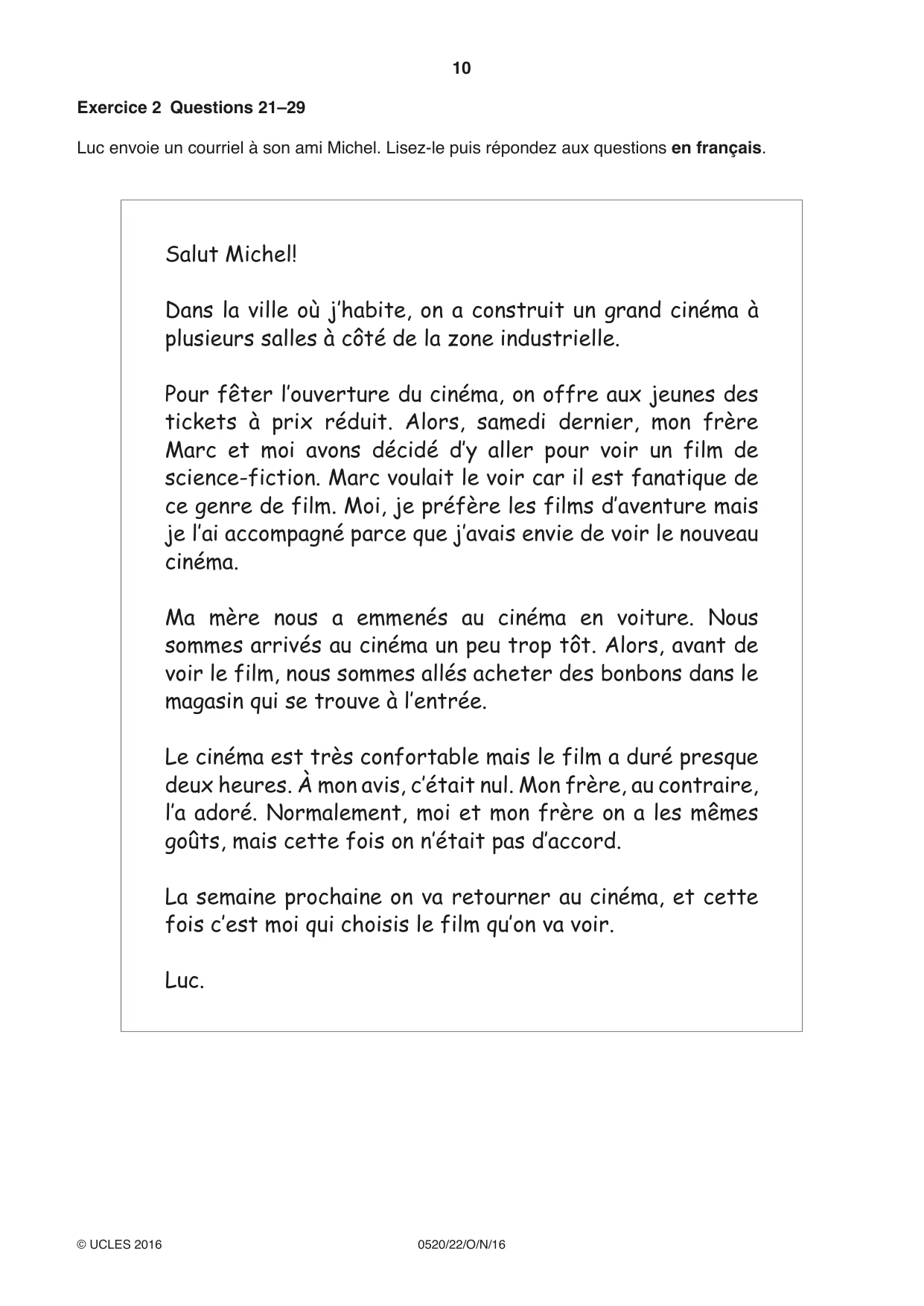
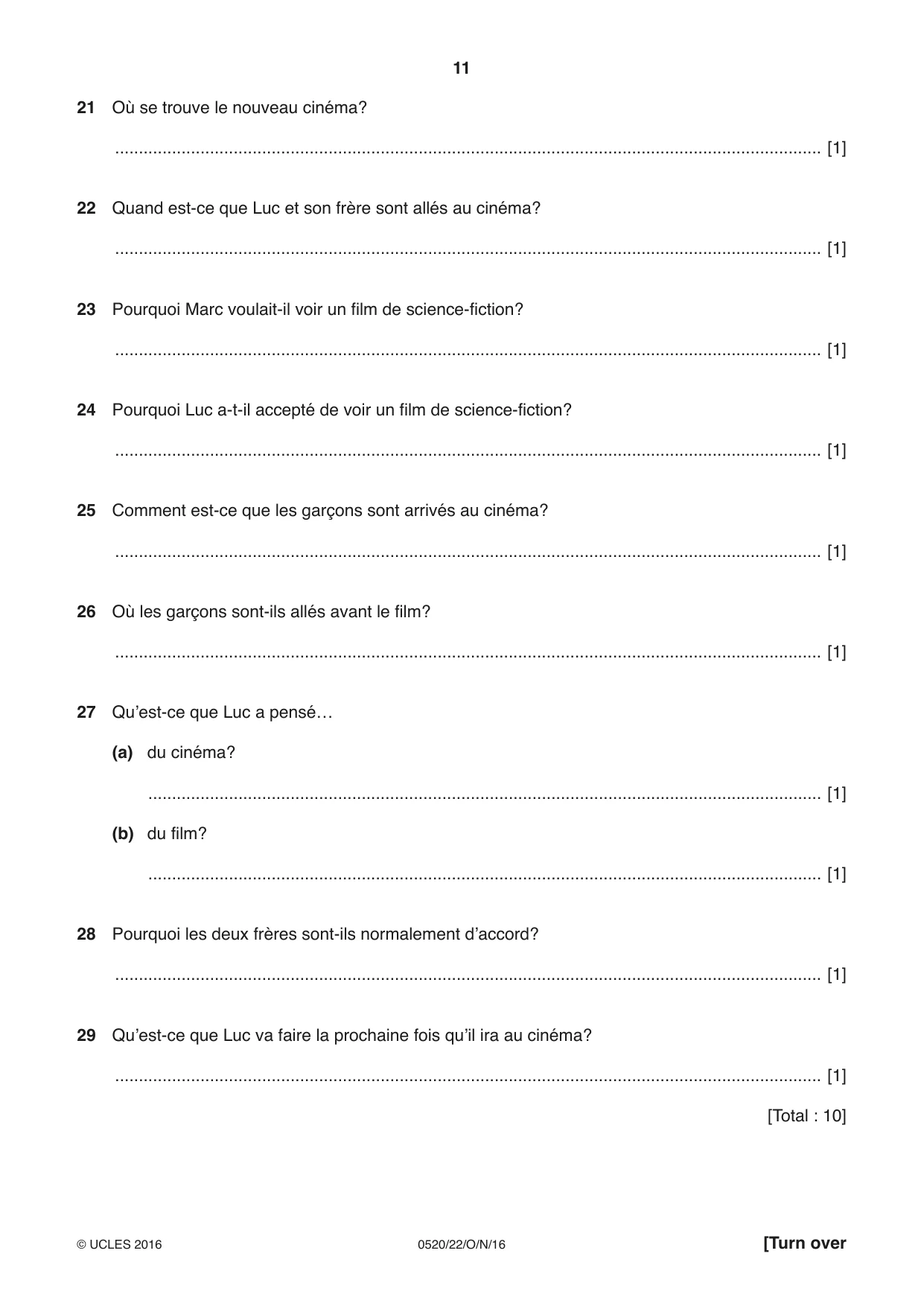
10 0520/22/O/N/16 © UCLES 2016 Exercice 2 Questions 21–29 Luc envoie un courriel à son ami Michel. Lisez-le puis répondez aux questions en français. Salut Michel! Dans la ville où j’habite, on a construit un grand cinéma à plusieurs salles à côté de la zone industrielle. Pour fêter l’ouverture du cinéma, on offre aux jeunes des tickets à prix réduit. Alors, samedi dernier, mon frère Marc et moi avons décidé d’y aller pour voir un film de science-fiction. Marc voulait le voir car il est fanatique de ce genre de film. Moi, je préfère les films d’aventure mais je l’ai accompagné parce que j’avais envie de voir le nouveau cinéma. Ma mère nous a emmenés au cinéma en voiture. Nous sommes arrivés au cinéma un peu trop tôt. Alors, avant de voir le film, nous sommes allés acheter des bonbons dans le magasin qui se trouve à l’entrée. Le cinéma est très confortable mais le film a duré presque deux heures. À mon avis, c’était nul. Mon frère, au contraire, l’a adoré. Normalement, moi et mon frère on a les mêmes goûts, mais cette fois on n’était pas d’accord. La semaine prochaine on va retourner au cinéma, et cette fois c’est moi qui choisis le film qu’on va voir. Luc.
Question paper, page 11
11 0520/22/O/N/16 © UCLES 2016 [Turn over 21 Où se trouve le nouveau cinéma? … [1] 22 Quand est-ce que Luc et son frère sont allés au cinéma? … [1] 23 Pourquoi Marc voulait-il voir un film de science-fiction? … [1] 24 Pourquoi Luc a-t-il accepté de voir un film de science-fiction? … [1] 25 Comment est-ce que les garçons sont arrivés au cinéma? … [1] 26 Où les garçons sont-ils allés avant le film? … [1] 27 Qu’est-ce que Luc a pensé… (a) du cinéma? … [1] (b) du film? … [1] 28 Pourquoi les deux frères sont-ils normalement d’accord? … [1] 29 Qu’est-ce que Luc va faire la prochaine fois qu’il ira au cinéma? … [1] [Total : 10]
Question paper, page 12
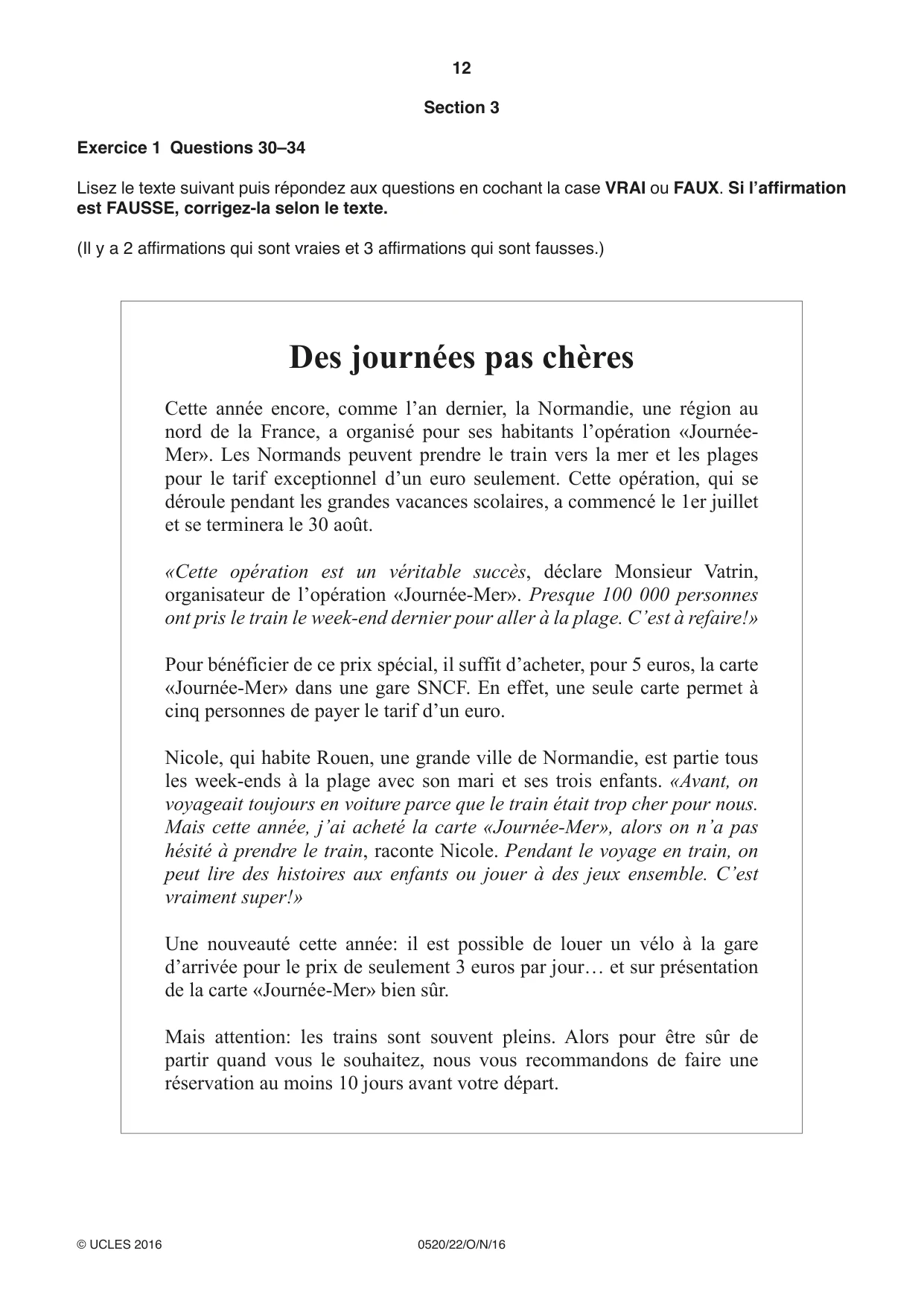
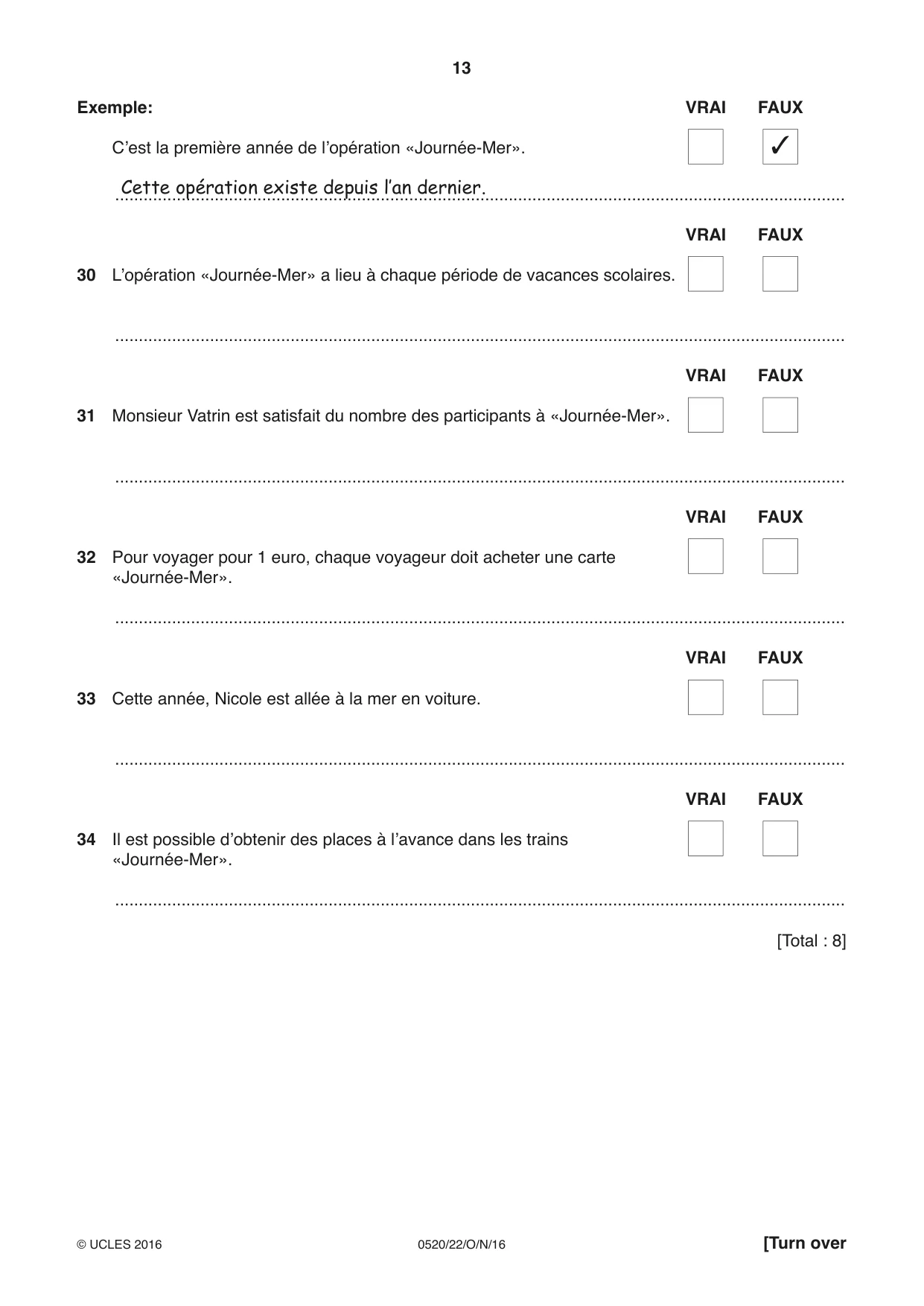
12 0520/22/O/N/16 © UCLES 2016 Section 3 Exercice 1 Questions 30–34 Lisez le texte suivant puis répondez aux questions en cochant la case VRAI ou FAUX. Si l’affirmation est FAUSSE, corrigez-la selon le texte. (Il y a 2 affirmations qui sont vraies et 3 affirmations qui sont fausses.) Des journées pas chères Cette année encore, comme l’an dernier, la Normandie, une région au nord de la France, a organisé pour ses habitants l’opération «Journée- Mer». Les Normands peuvent prendre le train vers la mer et les plages pour le tarif exceptionnel d’un euro seulement. Cette opération, qui se déroule pendant les grandes vacances scolaires, a commencé le 1er juillet et se terminera le 30 août. «Cette opération est un véritable succès, déclare Monsieur Vatrin, organisateur de l’opération «Journée-Mer». Presque 100 000 personnes ont pris le train le week-end dernier pour aller à la plage. C’est à refaire!» Pour bénéficier de ce prix spécial, il suffit d’acheter, pour 5 euros, la carte «Journée-Mer» dans une gare SNCF. En effet, une seule carte permet à cinq personnes de payer le tarif d’un euro. Nicole, qui habite Rouen, une grande ville de Normandie, est partie tous les week-ends à la plage avec son mari et ses trois enfants. «Avant, on voyageait toujours en voiture parce que le train était trop cher pour nous. Mais cette année, j’ai acheté la carte «Journée-Mer», alors on n’a pas hésité à prendre le train, raconte Nicole. Pendant le voyage en train, on peut lire des histoires aux enfants ou jouer à des jeux ensemble. C’est vraiment super!» Une nouveauté cette année: il est possible de louer un vélo à la gare d’arrivée pour le prix de seulement 3 euros par jour… et sur présentation de la carte «Journée-Mer» bien sûr. Mais attention: les trains sont souvent pleins. Alors pour être sûr de partir quand vous le souhaitez, nous vous recommandons de faire une réservation au moins 10 jours avant votre départ.
Question paper, page 13
13 0520/22/O/N/16 © UCLES 2016 [Turn over Exemple: VRAI FAUX C’est la première année de l’opération «Journée-Mer». ✓ Cette opération existe depuis l’an dernier. … VRAI FAUX 30 L’opération «Journée-Mer» a lieu à chaque période de vacances scolaires. … VRAI FAUX 31 Monsieur Vatrin est satisfait du nombre des participants à «Journée-Mer». … VRAI FAUX 32 Pour voyager pour 1 euro, chaque voyageur doit acheter une carte «Journée-Mer». … VRAI FAUX 33 Cette année, Nicole est allée à la mer en voiture. … VRAI FAUX 34 Il est possible d’obtenir des places à l’avance dans les trains «Journée-Mer». … [Total : 8]
Question paper, page 14
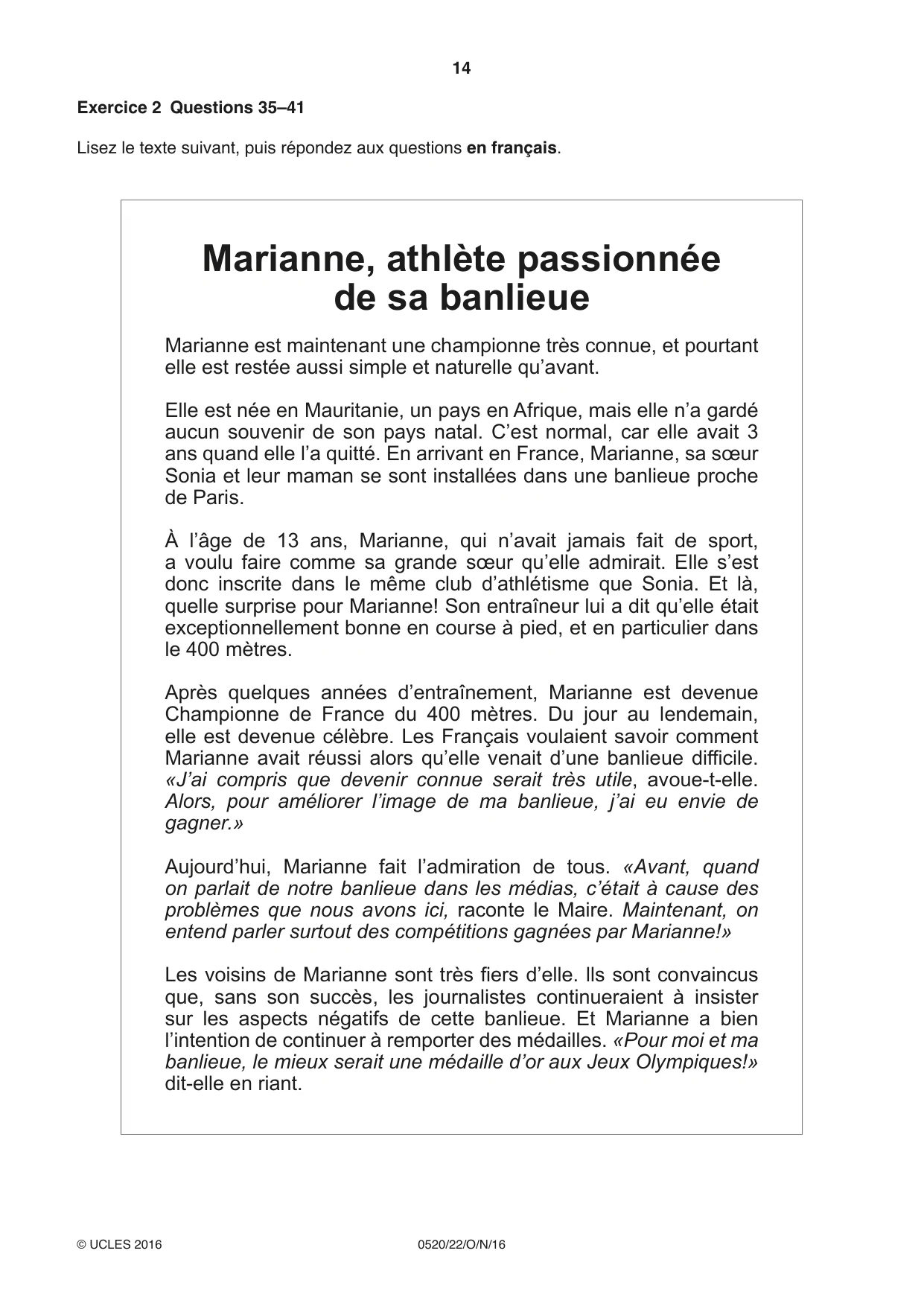
14 0520/22/O/N/16 © UCLES 2016 Exercice 2 Questions 35–41 Lisez le texte suivant, puis répondez aux questions en français. Marianne, athlète passionnée de sa banlieue Marianne est maintenant une championne très connue, et pourtant elle est restée aussi simple et naturelle qu’avant. Elle est née en Mauritanie, un pays en Afrique, mais elle n’a gardé aucun souvenir de son pays natal. C’est normal, car elle avait 3 ans quand elle l’a quitté. En arrivant en France, Marianne, sa sœur Sonia et leur maman se sont installées dans une banlieue proche de Paris. À l’âge de 13 ans, Marianne, qui n’avait jamais fait de sport, a voulu faire comme sa grande sœur qu’elle admirait. Elle s’est donc inscrite dans le même club d’athlétisme que Sonia. Et là, quelle surprise pour Marianne! Son entraîneur lui a dit qu’elle était exceptionnellement bonne en course à pied, et en particulier dans le 400 mètres. Après quelques années d’entraînement, Marianne est devenue Championne de France du 400 mètres. Du jour au lendemain, elle est devenue célèbre. Les Français voulaient savoir comment Marianne avait réussi alors qu’elle venait d’une banlieue difficile. «J’ai compris que devenir connue serait très utile, avoue-t-elle. Alors, pour améliorer l’image de ma banlieue, j’ai eu envie de gagner.» Aujourd’hui, Marianne fait l’admiration de tous. «Avant, quand on parlait de notre banlieue dans les médias, c’était à cause des problèmes que nous avons ici, raconte le Maire. Maintenant, on entend parler surtout des compétitions gagnées par Marianne!» Les voisins de Marianne sont très fiers d’elle. lls sont convaincus que, sans son succès, les journalistes continueraient à insister sur les aspects négatifs de cette banlieue. Et Marianne a bien l’intention de continuer à remporter des médailles. «Pour moi et ma banlieue, le mieux serait une médaille d’or aux Jeux Olympiques!» dit-elle en riant.
Question paper, page 15
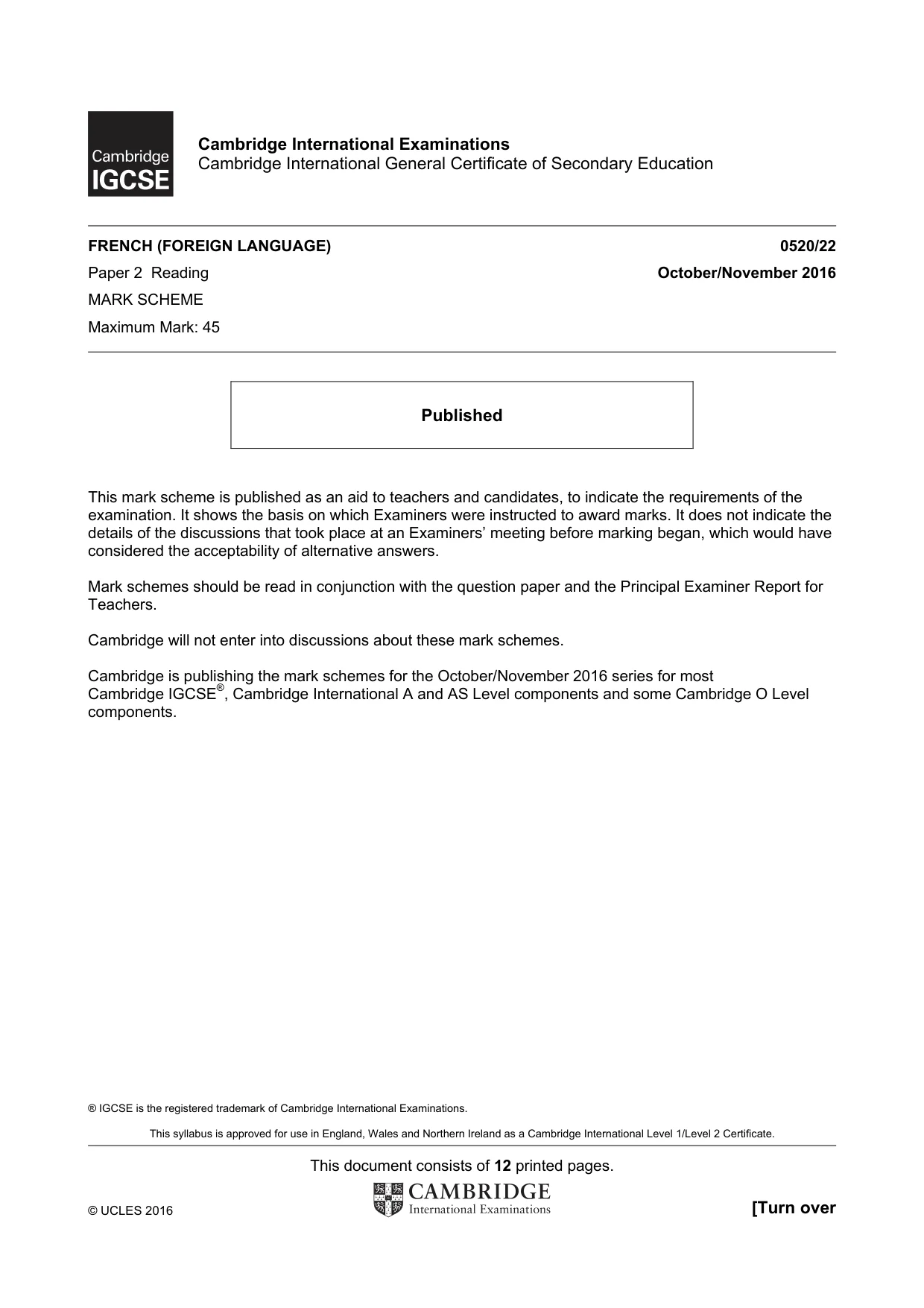
15 0520/22/O/N/16 © UCLES 2016 35 Pourquoi Marianne ne se souvient-elle pas de la Mauritanie? … [1] 36 Qu’est-ce qui a poussé Marianne à s’inscrire dans un club d’athlétisme? … [1] 37 Quelle est la spécialité sportive de Marianne? … [1] 38 Pourquoi Marianne voulait-elle devenir célèbre? … [1] 39 Selon le Maire, pourquoi parlait-on souvent de la banlieue de Marianne dans le passé? … [1] 40 En quoi l’attitude des journalistes a-t-elle changé grâce à Marianne? … [1] 41 Qu’est-ce que Marianne aimerait le plus à l’avenir? … [1] [Total : 7]
Question paper, page 16
16 0520/22/O/N/16 © UCLES 2016 BLANK PAGE Permission to reproduce items where third-party owned material protected by copyright is included has been sought and cleared where possible. Every reasonable effort has been made by the publisher (UCLES) to trace copyright holders, but if any items requiring clearance have unwittingly been included, the publisher will be pleased to make amends at the earliest possible opportunity. To avoid the issue of disclosure of answer-related information to candidates, all copyright acknowledgements are reproduced online in the Cambridge International Examinations Copyright Acknowledgements Booklet. This is produced for each series of examinations and is freely available to download at www.cie.org.uk after the live examination series. Cambridge International Examinations is part of the Cambridge Assessment Group. Cambridge Assessment is the brand name of University of Cambridge Local Examinations Syndicate (UCLES), which is itself a department of the University of Cambridge.
Mark scheme, page 1
® IGCSE is the registered trademark of Cambridge International Examinations. This syllabus is approved for use in England, Wales and Northern Ireland as a Cambridge International Level 1/Level 2 Certificate. This document consists of 12 printed pages. © UCLES 2016 [Turn over Cambridge International Examinations Cambridge International General Certificate of Secondary Education FRENCH (FOREIGN LANGUAGE) 0520/22 Paper 2 Reading October/November 2016 MARK SCHEME Maximum Mark: 45 Published This mark scheme is published as an aid to teachers and candidates, to indicate the requirements of the examination. It shows the basis on which Examiners were instructed to award marks. It does not indicate the details of the discussions that took place at an Examiners’ meeting before marking began, which would have considered the acceptability of alternative answers. Mark schemes should be read in conjunction with the question paper and the Principal Examiner Report for Teachers. Cambridge will not enter into discussions about these mark schemes. Cambridge is publishing the mark schemes for the October/November 2016 series for most Cambridge IGCSE®, Cambridge International A and AS Level components and some Cambridge O Level components.
Mark scheme, page 2
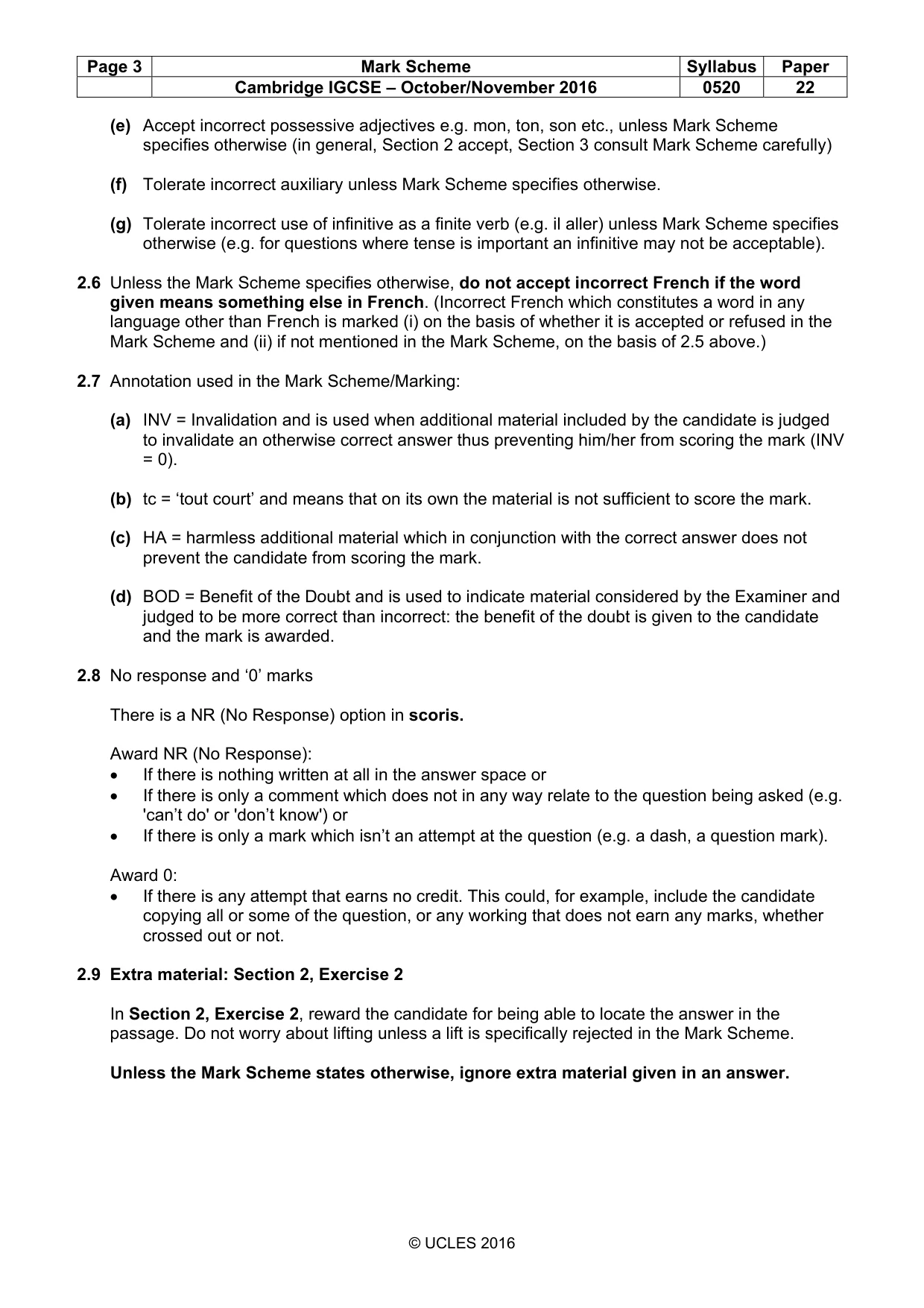
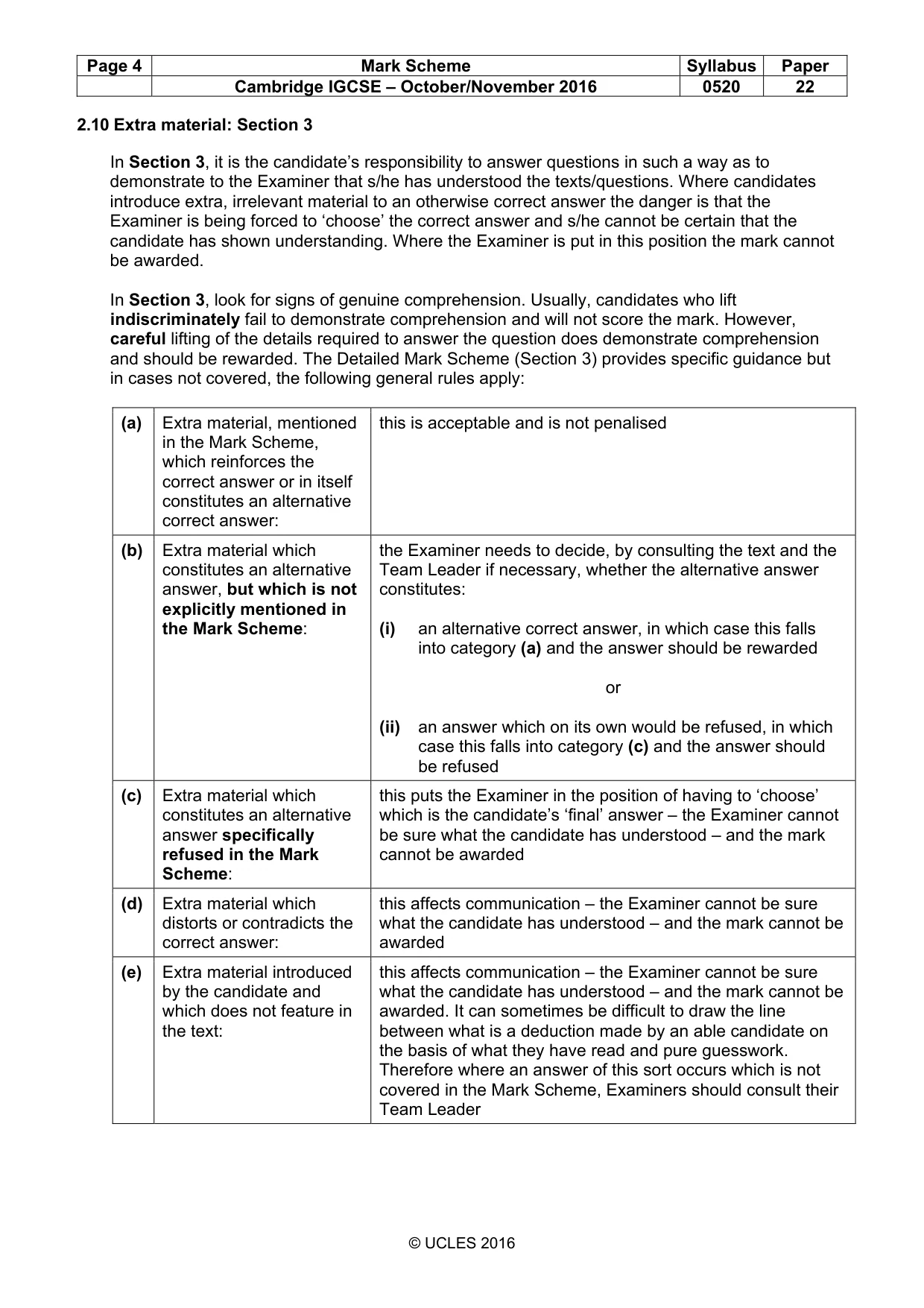
Page 2 Mark Scheme Syllabus Paper Cambridge IGCSE – October/November 2016 0520 22 © UCLES 2016 1 General Marking Notes 2 General Marking Principles 2.1 Please note that it is not possible to list all acceptable alternatives in the Detailed Mark Scheme provided in Section 3. You will need to consider all alternative answers and unexpected approaches in candidates' scripts, make a decision on whether they communicate the required elements, in consultation with your Team Leader if necessary (or with your Product Manager if you are a single Examiner), and award marks accordingly. The following marking principles underpin the detailed instructions provided in Section 3 of the Mark Scheme. Where a decision is taken to deviate from these principles for a particular question, this will be specified in the Mark Scheme. 2.2 Crossing out: (a) If a candidate changes his/her mind over an answer and crosses out an attempt, award a mark if the final attempt is correct. (b) If a candidate crosses out an answer to a whole question but makes no second attempt at it, mark the crossed out work. 2.3 More than the stipulated number of boxes ticked/crossed by the candidate: (a) If more than one attempt is visible, but the candidate has clearly indicated which attempt is his/her final answer (e.g. by crossing out other attempts or by annotating the script in some way), mark in the usual way. (b) If two attempts are visible (e.g. 2 boxes ticked instead of the 1 box stipulated), and neither has been crossed out/discounted by the candidate, no mark can be awarded. (c) Answers in pen do not take precedence over answers in pencil, e.g. if a candidate is asked to tick 1 box and ticks 2, one in pen and the other in pencil, the mark cannot be awarded unless there is some explicit indication from the candidate as to which is his/her final answer. 2.4 For questions requiring more than one element for the answer, (i) and (ii), where the answers are interchangeable: Both correct answers on line 1 and line 2 blank = 2 Both correct answers on line 1 and line 2 wrong = 1 (or vice-versa) 2.5 Answers requiring the use of French (rather than a non-verbal response) should be marked for communication. Tolerate inaccuracies provided the message is clear. (a) Spellings recognised by the Académie Française will be accepted. (b) ‘If in doubt, sound it out’: if you read what the candidate has written, does it sound like the correct answer? (c) Look-alike test: does what the candidate has written look like the correct answer? (d) Accept incorrect gender or person unless Mark Scheme specifies otherwise.
Mark scheme, page 3
Page 3 Mark Scheme Syllabus Paper Cambridge IGCSE – October/November 2016 0520 22 © UCLES 2016 (e) Accept incorrect possessive adjectives e.g. mon, ton, son etc., unless Mark Scheme specifies otherwise (in general, Section 2 accept, Section 3 consult Mark Scheme carefully) (f) Tolerate incorrect auxiliary unless Mark Scheme specifies otherwise. (g) Tolerate incorrect use of infinitive as a finite verb (e.g. il aller) unless Mark Scheme specifies otherwise (e.g. for questions where tense is important an infinitive may not be acceptable). 2.6 Unless the Mark Scheme specifies otherwise, do not accept incorrect French if the word given means something else in French. (Incorrect French which constitutes a word in any language other than French is marked (i) on the basis of whether it is accepted or refused in the Mark Scheme and (ii) if not mentioned in the Mark Scheme, on the basis of 2.5 above.) 2.7 Annotation used in the Mark Scheme/Marking: (a) INV = Invalidation and is used when additional material included by the candidate is judged to invalidate an otherwise correct answer thus preventing him/her from scoring the mark (INV = 0). (b) tc = ‘tout court’ and means that on its own the material is not sufficient to score the mark. (c) HA = harmless additional material which in conjunction with the correct answer does not prevent the candidate from scoring the mark. (d) BOD = Benefit of the Doubt and is used to indicate material considered by the Examiner and judged to be more correct than incorrect: the benefit of the doubt is given to the candidate and the mark is awarded. 2.8 No response and ‘0’ marks There is a NR (No Response) option in scoris. Award NR (No Response): • If there is nothing written at all in the answer space or • If there is only a comment which does not in any way relate to the question being asked (e.g. 'can’t do' or 'don’t know') or • If there is only a mark which isn’t an attempt at the question (e.g. a dash, a question mark). Award 0: • If there is any attempt that earns no credit. This could, for example, include the candidate copying all or some of the question, or any working that does not earn any marks, whether crossed out or not. 2.9 Extra material: Section 2, Exercise 2 In Section 2, Exercise 2, reward the candidate for being able to locate the answer in the passage. Do not worry about lifting unless a lift is specifically rejected in the Mark Scheme. Unless the Mark Scheme states otherwise, ignore extra material given in an answer.
Mark scheme, page 4
Page 4 Mark Scheme Syllabus Paper Cambridge IGCSE – October/November 2016 0520 22 © UCLES 2016 2.10 Extra material: Section 3 In Section 3, it is the candidate’s responsibility to answer questions in such a way as to demonstrate to the Examiner that s/he has understood the texts/questions. Where candidates introduce extra, irrelevant material to an otherwise correct answer the danger is that the Examiner is being forced to ‘choose’ the correct answer and s/he cannot be certain that the candidate has shown understanding. Where the Examiner is put in this position the mark cannot be awarded. In Section 3, look for signs of genuine comprehension. Usually, candidates who lift indiscriminately fail to demonstrate comprehension and will not score the mark. However, careful lifting of the details required to answer the question does demonstrate comprehension and should be rewarded. The Detailed Mark Scheme (Section 3) provides specific guidance but in cases not covered, the following general rules apply: (a) Extra material, mentioned in the Mark Scheme, which reinforces the correct answer or in itself constitutes an alternative correct answer: this is acceptable and is not penalised (b) Extra material which constitutes an alternative answer, but which is not explicitly mentioned in the Mark Scheme: the Examiner needs to decide, by consulting the text and the Team Leader if necessary, whether the alternative answer constitutes: (i) an alternative correct answer, in which case this falls into category (a) and the answer should be rewarded or (ii) an answer which on its own would be refused, in which case this falls into category (c) and the answer should be refused (c) Extra material which constitutes an alternative answer specifically refused in the Mark Scheme: this puts the Examiner in the position of having to ‘choose’ which is the candidate’s ‘final’ answer – the Examiner cannot be sure what the candidate has understood – and the mark cannot be awarded (d) Extra material which distorts or contradicts the correct answer: this affects communication – the Examiner cannot be sure what the candidate has understood – and the mark cannot be awarded (e) Extra material introduced by the candidate and which does not feature in the text: this affects communication – the Examiner cannot be sure what the candidate has understood – and the mark cannot be awarded. It can sometimes be difficult to draw the line between what is a deduction made by an able candidate on the basis of what they have read and pure guesswork. Therefore where an answer of this sort occurs which is not covered in the Mark Scheme, Examiners should consult their Team Leader
Mark scheme, page 5
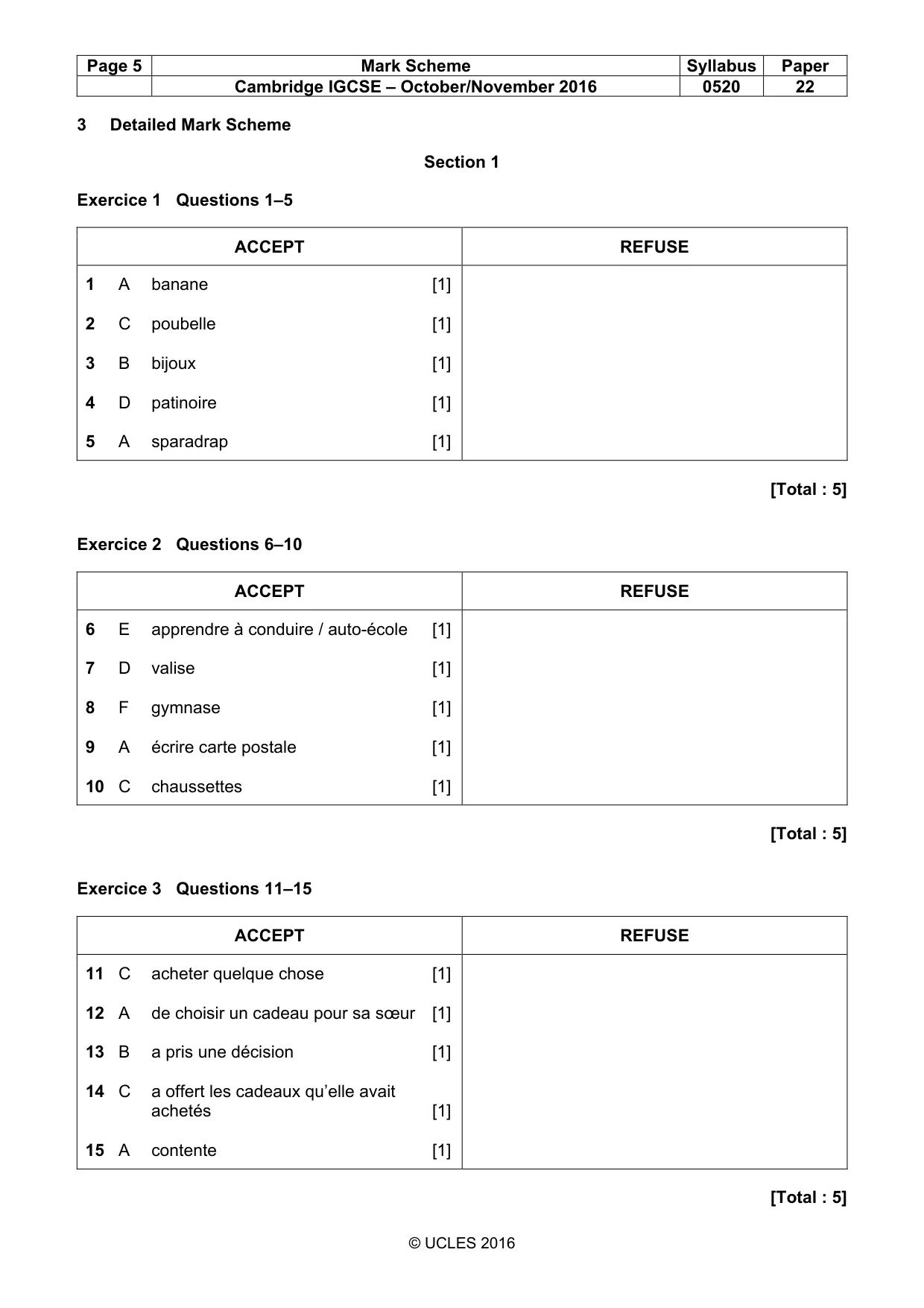
Page 5 Mark Scheme Syllabus Paper Cambridge IGCSE – October/November 2016 0520 22 © UCLES 2016 3 Detailed Mark Scheme Section 1 Exercice 1 Questions 1–5 ACCEPT REFUSE 1 A banane [1] 2 C poubelle [1] 3 B bijoux [1] 4 D patinoire [1] 5 A sparadrap [1] [Total : 5] Exercice 2 Questions 6–10 ACCEPT REFUSE 6 E apprendre à conduire / auto-école [1] 7 D valise [1] 8 F gymnase [1] 9 A écrire carte postale [1] 10 C chaussettes [1] [Total : 5] Exercice 3 Questions 11–15 ACCEPT REFUSE 11 C acheter quelque chose [1] 12 A de choisir un cadeau pour sa sœur [1] 13 B a pris une décision [1] 14 C a offert les cadeaux qu’elle avait achetés [1] 15 A contente [1] [Total : 5]
Mark scheme, page 6
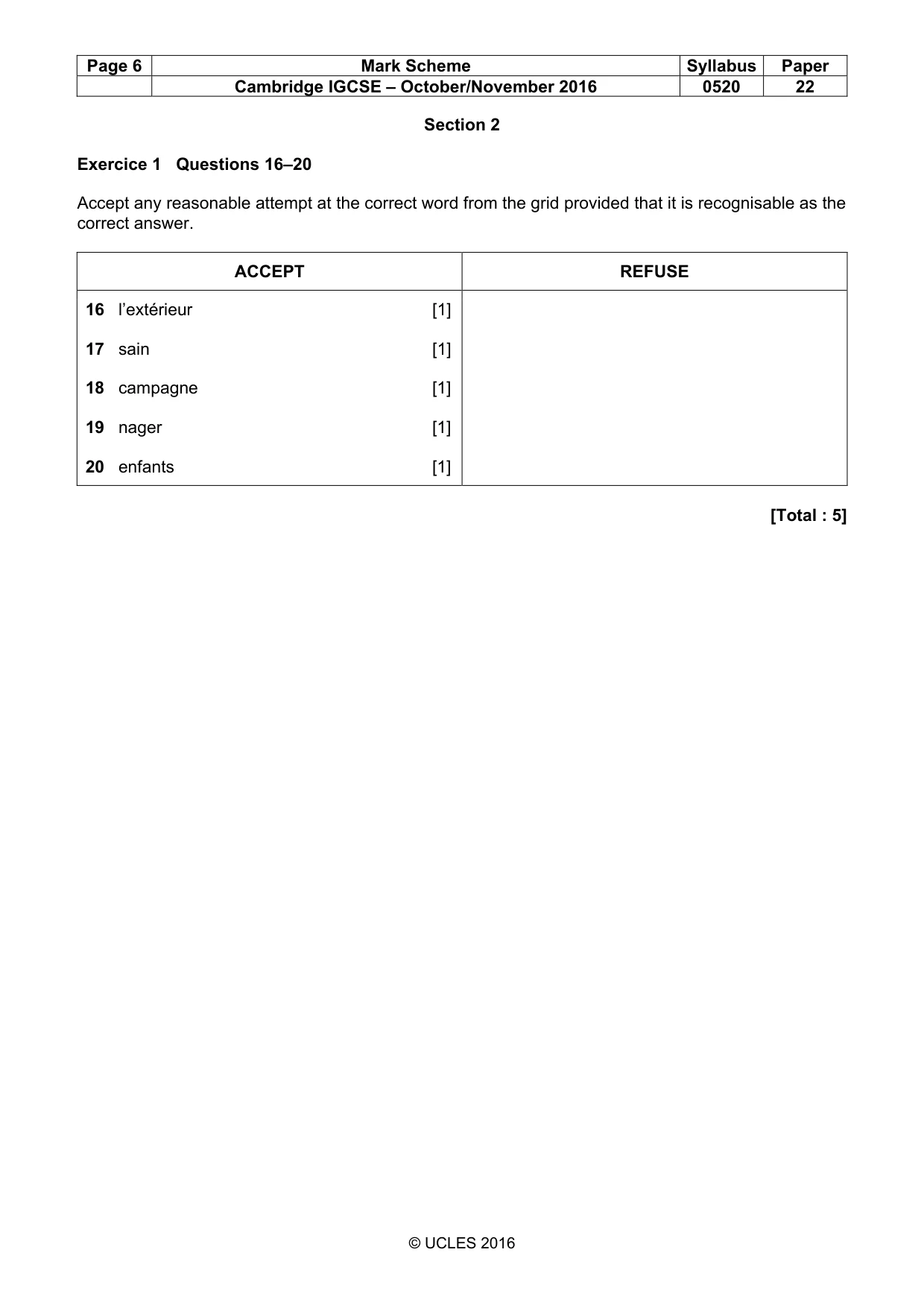
Page 6 Mark Scheme Syllabus Paper Cambridge IGCSE – October/November 2016 0520 22 © UCLES 2016 Section 2 Exercice 1 Questions 16–20 Accept any reasonable attempt at the correct word from the grid provided that it is recognisable as the correct answer. ACCEPT REFUSE 16 l’extérieur [1] 17 sain [1] 18 campagne [1] 19 nager [1] 20 enfants [1] [Total : 5]
Mark scheme, page 7
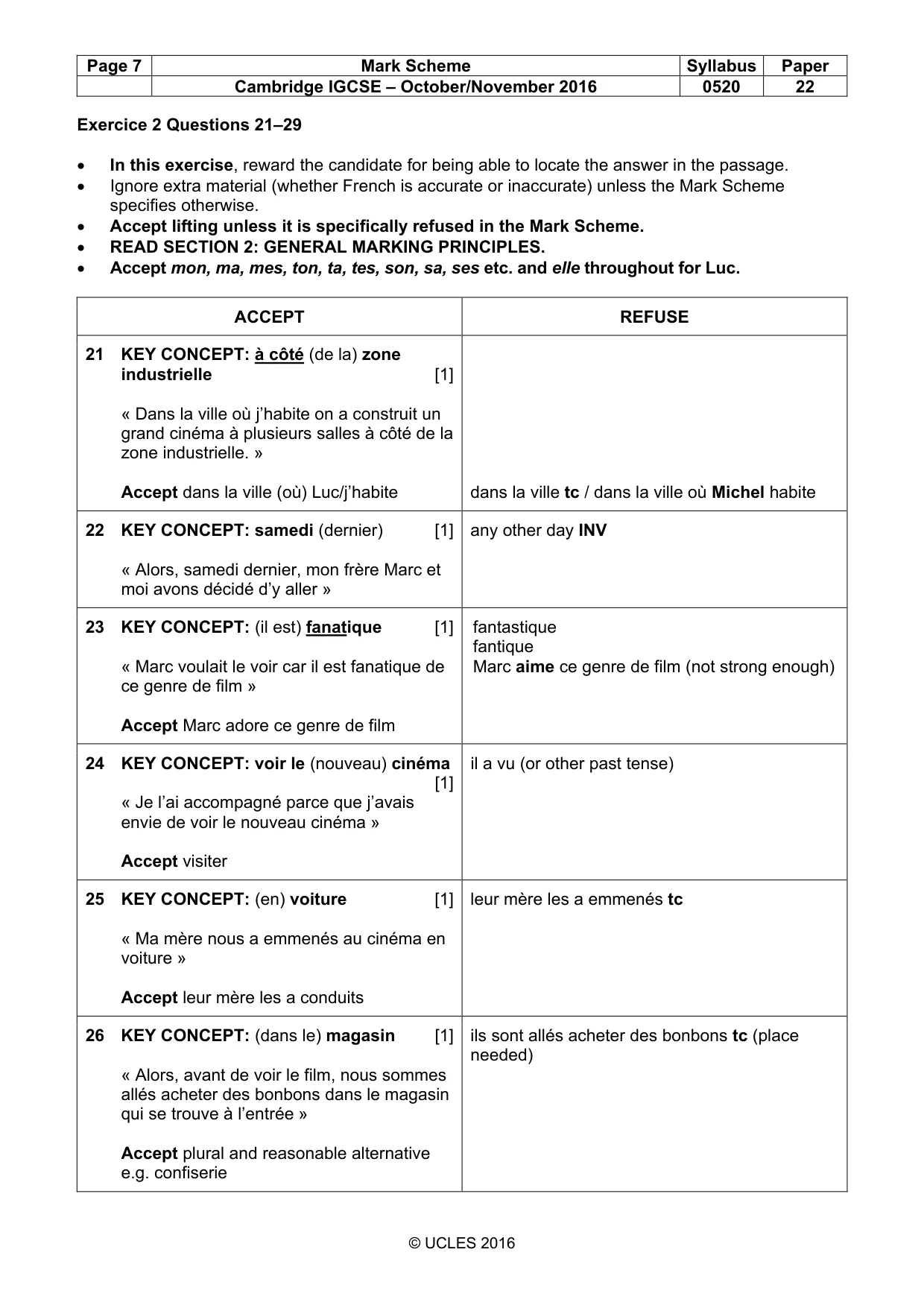
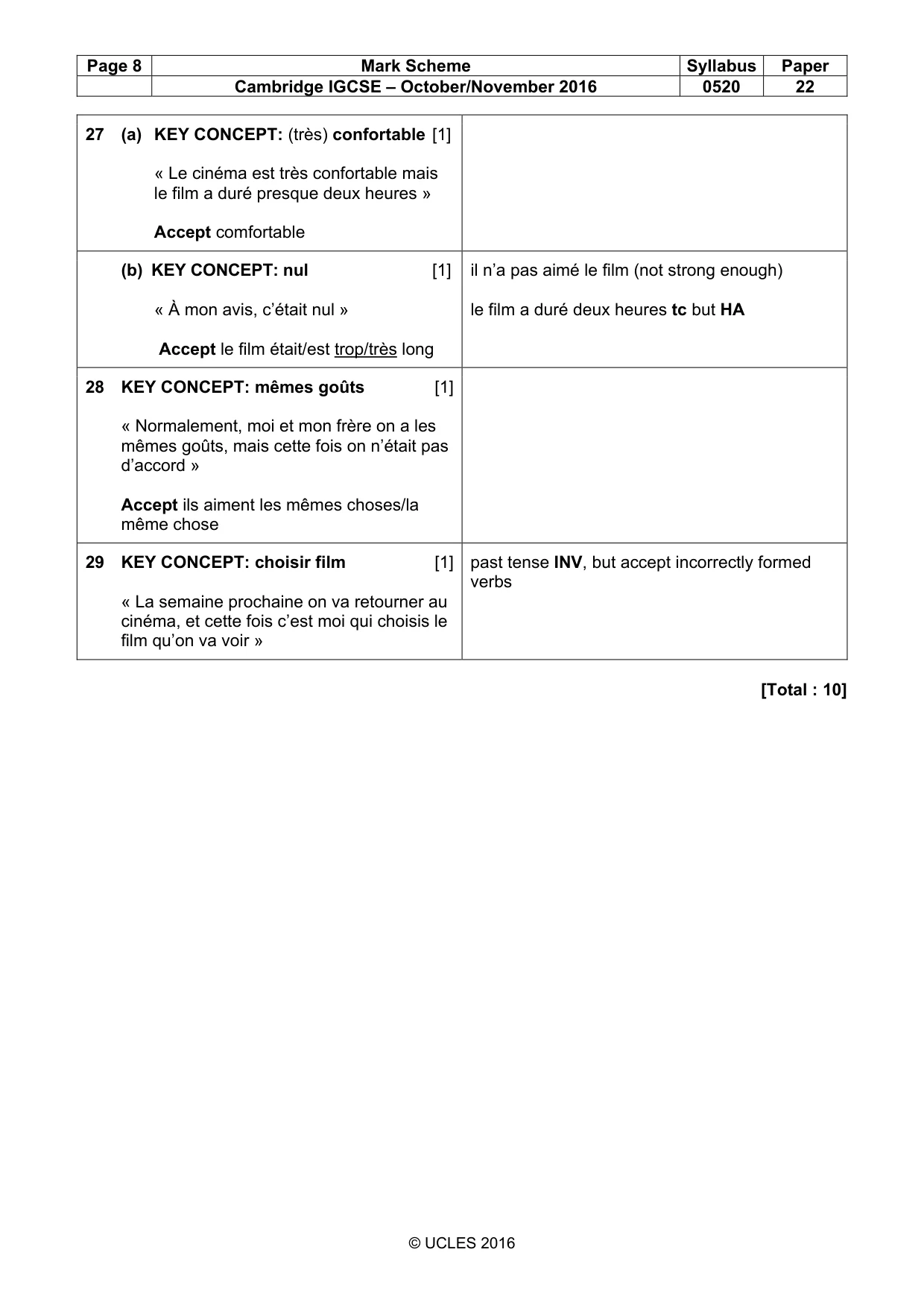
Page 7 Mark Scheme Syllabus Paper Cambridge IGCSE – October/November 2016 0520 22 © UCLES 2016 Exercice 2 Questions 21–29 • In this exercise, reward the candidate for being able to locate the answer in the passage. • Ignore extra material (whether French is accurate or inaccurate) unless the Mark Scheme specifies otherwise. • Accept lifting unless it is specifically refused in the Mark Scheme. • READ SECTION 2: GENERAL MARKING PRINCIPLES. • Accept mon, ma, mes, ton, ta, tes, son, sa, ses etc. and elle throughout for Luc. ACCEPT REFUSE 21 KEY CONCEPT: à côté (de la) zone industrielle [1] « Dans la ville où j’habite on a construit un grand cinéma à plusieurs salles à côté de la zone industrielle. » Accept dans la ville (où) Luc/j’habite dans la ville tc / dans la ville où Michel habite 22 KEY CONCEPT: samedi (dernier) [1] « Alors, samedi dernier, mon frère Marc et moi avons décidé d’y aller » any other day INV 23 KEY CONCEPT: (il est) fanatique [1] « Marc voulait le voir car il est fanatique de ce genre de film » Accept Marc adore ce genre de film fantastique fantique Marc aime ce genre de film (not strong enough) 24 KEY CONCEPT: voir le (nouveau) cinéma [1] « Je l’ai accompagné parce que j’avais envie de voir le nouveau cinéma » Accept visiter il a vu (or other past tense) 25 KEY CONCEPT: (en) voiture [1] « Ma mère nous a emmenés au cinéma en voiture » Accept leur mère les a conduits leur mère les a emmenés tc 26 KEY CONCEPT: (dans le) magasin [1] « Alors, avant de voir le film, nous sommes allés acheter des bonbons dans le magasin qui se trouve à l’entrée » Accept plural and reasonable alternative e.g. confiserie ils sont allés acheter des bonbons tc (place needed)
Mark scheme, page 8
Page 8 Mark Scheme Syllabus Paper Cambridge IGCSE – October/November 2016 0520 22 © UCLES 2016 27 (a) KEY CONCEPT: (très) confortable [1] « Le cinéma est très confortable mais le film a duré presque deux heures » Accept comfortable (b) KEY CONCEPT: nul [1] « À mon avis, c’était nul » Accept le film était/est trop/très long il n’a pas aimé le film (not strong enough) le film a duré deux heures tc but HA 28 KEY CONCEPT: mêmes goûts [1] « Normalement, moi et mon frère on a les mêmes goûts, mais cette fois on n’était pas d’accord » Accept ils aiment les mêmes choses/la même chose 29 KEY CONCEPT: choisir film [1] « La semaine prochaine on va retourner au cinéma, et cette fois c’est moi qui choisis le film qu’on va voir » past tense INV, but accept incorrectly formed verbs [Total : 10]
Mark scheme, page 9
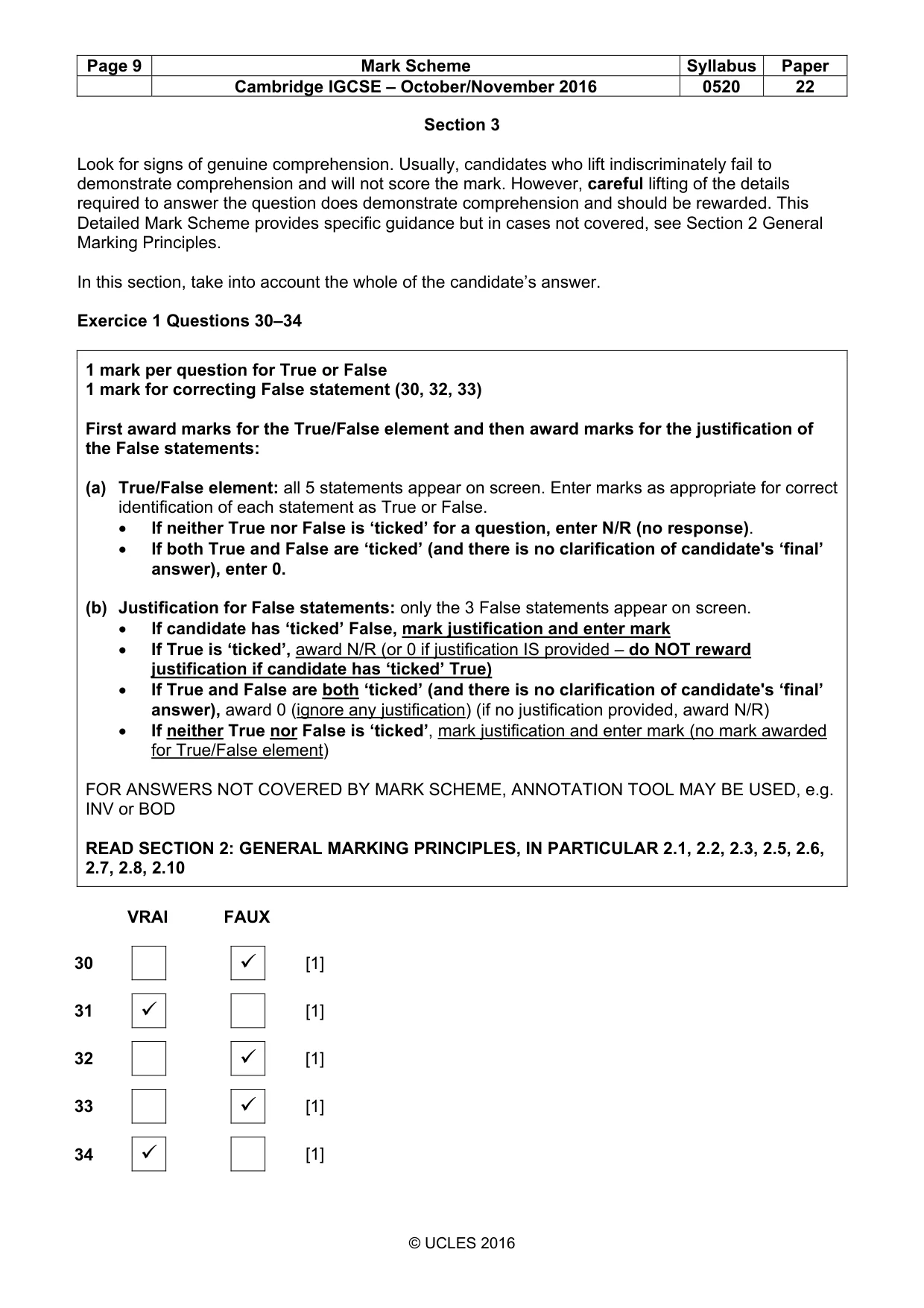
Page 9 Mark Scheme Syllabus Paper Cambridge IGCSE – October/November 2016 0520 22 © UCLES 2016 Section 3 Look for signs of genuine comprehension. Usually, candidates who lift indiscriminately fail to demonstrate comprehension and will not score the mark. However, careful lifting of the details required to answer the question does demonstrate comprehension and should be rewarded. This Detailed Mark Scheme provides specific guidance but in cases not covered, see Section 2 General Marking Principles. In this section, take into account the whole of the candidate’s answer. Exercice 1 Questions 30–34 1 mark per question for True or False 1 mark for correcting False statement (30, 32, 33) First award marks for the True/False element and then award marks for the justification of the False statements: (a) True/False element: all 5 statements appear on screen. Enter marks as appropriate for correct identification of each statement as True or False. • If neither True nor False is ‘ticked’ for a question, enter N/R (no response). • If both True and False are ‘ticked’ (and there is no clarification of candidate's ‘final’ answer), enter 0. (b) Justification for False statements: only the 3 False statements appear on screen. • If candidate has ‘ticked’ False, mark justification and enter mark • If True is ‘ticked’, award N/R (or 0 if justification IS provided – do NOT reward justification if candidate has ‘ticked’ True) • If True and False are both ‘ticked’ (and there is no clarification of candidate's ‘final’ answer), award 0 (ignore any justification) (if no justification provided, award N/R) • If neither True nor False is ‘ticked’, mark justification and enter mark (no mark awarded for True/False element) FOR ANSWERS NOT COVERED BY MARK SCHEME, ANNOTATION TOOL MAY BE USED, e.g. INV or BOD READ SECTION 2: GENERAL MARKING PRINCIPLES, IN PARTICULAR 2.1, 2.2, 2.3, 2.5, 2.6, 2.7, 2.8, 2.10 VRAI FAUX 30 9 [1] 31 9 [1] 32 9 [1] 33 9 [1] 34 9 [1]
Mark scheme, page 10
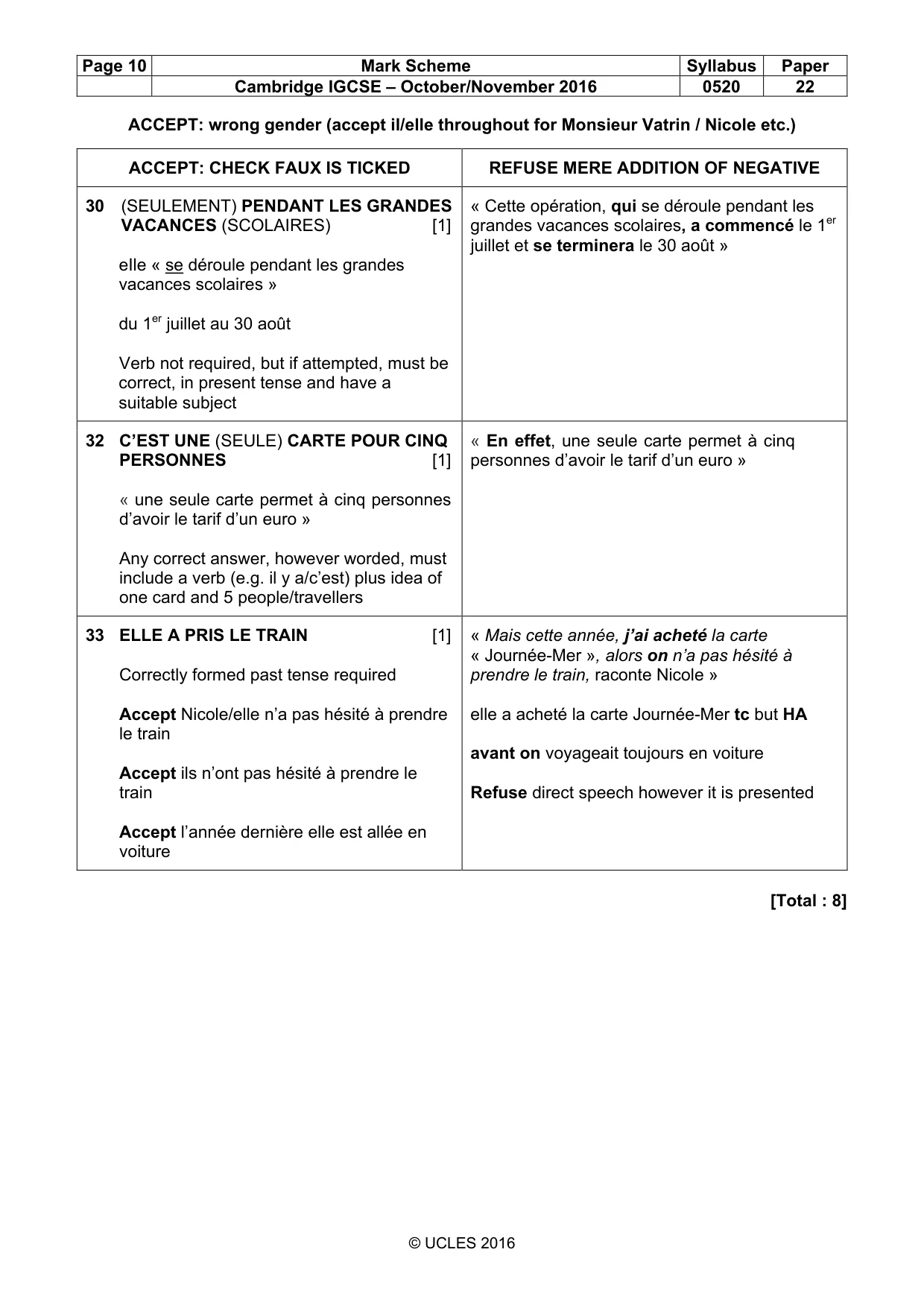
Page 10 Mark Scheme Syllabus Paper Cambridge IGCSE – October/November 2016 0520 22 © UCLES 2016 ACCEPT: wrong gender (accept il/elle throughout for Monsieur Vatrin / Nicole etc.) ACCEPT: CHECK FAUX IS TICKED REFUSE MERE ADDITION OF NEGATIVE 30 (SEULEMENT) PENDANT LES GRANDES VACANCES (SCOLAIRES) [1] eIle « se déroule pendant les grandes vacances scolaires » du 1er juillet au 30 août Verb not required, but if attempted, must be correct, in present tense and have a suitable subject « Cette opération, qui se déroule pendant les grandes vacances scolaires, a commencé le 1er juillet et se terminera le 30 août » 32 C’EST UNE (SEULE) CARTE POUR CINQ PERSONNES [1] « une seule carte permet à cinq personnes d’avoir le tarif d’un euro » Any correct answer, however worded, must include a verb (e.g. il y a/c’est) plus idea of one card and 5 people/travellers « En effet, une seule carte permet à cinq personnes d’avoir le tarif d’un euro » 33 ELLE A PRIS LE TRAIN [1] Correctly formed past tense required Accept Nicole/elle n’a pas hésité à prendre le train Accept ils n’ont pas hésité à prendre le train Accept l’année dernière elle est allée en voiture « Mais cette année, j’ai acheté la carte « Journée-Mer », alors on n’a pas hésité à prendre le train, raconte Nicole » elle a acheté la carte Journée-Mer tc but HA avant on voyageait toujours en voiture Refuse direct speech however it is presented [Total : 8]
Mark scheme, page 11
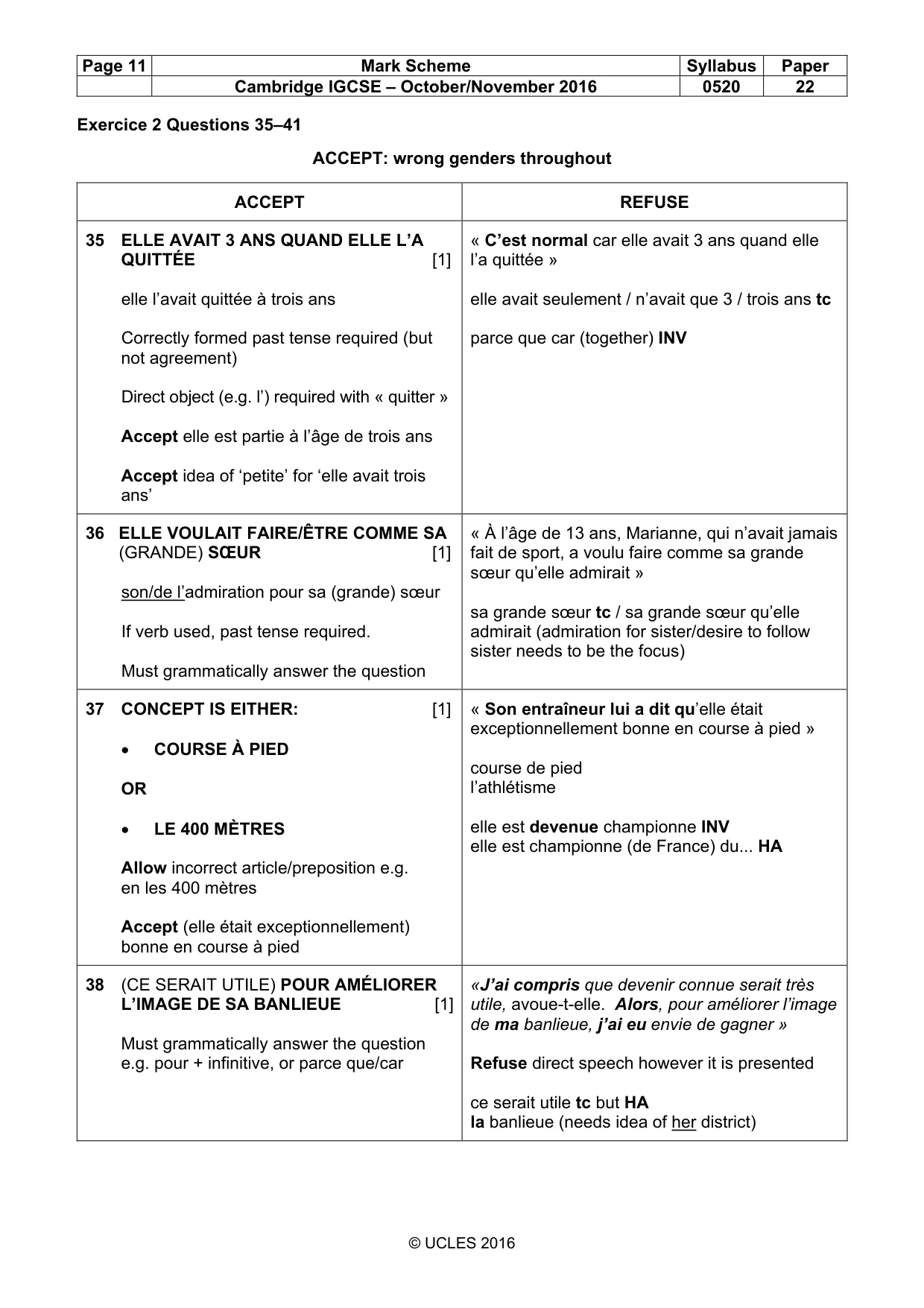
Page 11 Mark Scheme Syllabus Paper Cambridge IGCSE – October/November 2016 0520 22 © UCLES 2016 Exercice 2 Questions 35–41 ACCEPT: wrong genders throughout ACCEPT REFUSE 35 ELLE AVAIT 3 ANS QUAND ELLE L’A QUITTÉE [1] elle l’avait quittée à trois ans Correctly formed past tense required (but not agreement) Direct object (e.g. l’) required with « quitter » Accept elle est partie à l’âge de trois ans Accept idea of ‘petite’ for ‘elle avait trois ans’ « C’est normal car elle avait 3 ans quand elle l’a quittée » elle avait seulement / n’avait que 3 / trois ans tc parce que car (together) INV 36 ELLE VOULAIT FAIRE/ÊTRE COMME SA (GRANDE) SŒUR [1] son/de l’admiration pour sa (grande) sœur If verb used, past tense required. Must grammatically answer the question « À l’âge de 13 ans, Marianne, qui n’avait jamais fait de sport, a voulu faire comme sa grande sœur qu’elle admirait » sa grande sœur tc / sa grande sœur qu’elle admirait (admiration for sister/desire to follow sister needs to be the focus) 37 CONCEPT IS EITHER: [1] • COURSE À PIED OR • LE 400 MÈTRES Allow incorrect article/preposition e.g. en les 400 mètres Accept (elle était exceptionnellement) bonne en course à pied « Son entraîneur lui a dit qu’elle était exceptionnellement bonne en course à pied » course de pied l’athlétisme elle est devenue championne INV elle est championne (de France) du... HA 38 (CE SERAIT UTILE) POUR AMÉLIORER L’IMAGE DE SA BANLIEUE [1] Must grammatically answer the question e.g. pour + infinitive, or parce que/car «J’ai compris que devenir connue serait très utile, avoue-t-elle. Alors, pour améliorer l’image de ma banlieue, j’ai eu envie de gagner » Refuse direct speech however it is presented ce serait utile tc but HA la banlieue (needs idea of her district)
Mark scheme, page 12
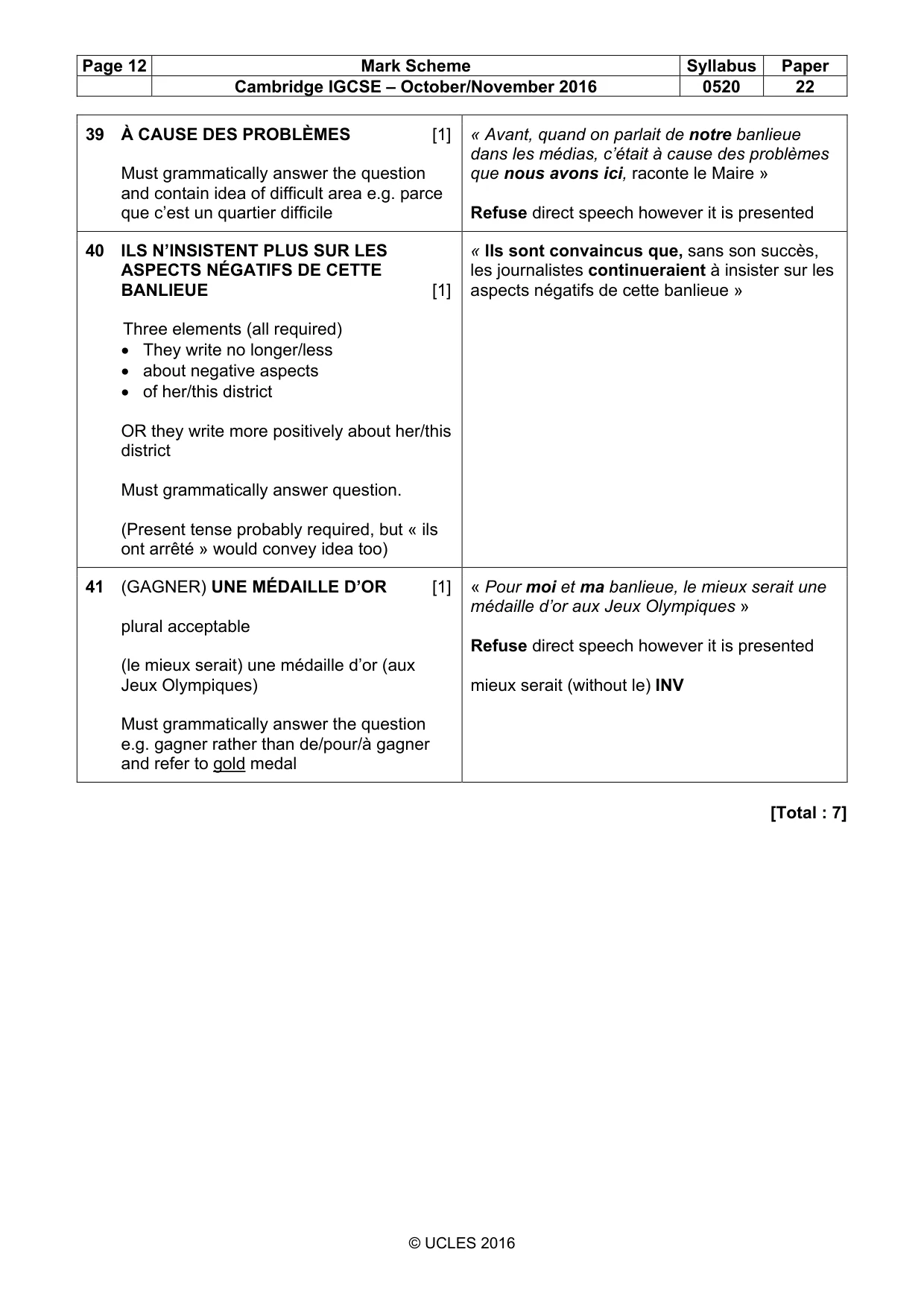
Page 12 Mark Scheme Syllabus Paper Cambridge IGCSE – October/November 2016 0520 22 © UCLES 2016 39 À CAUSE DES PROBLÈMES [1] Must grammatically answer the question and contain idea of difficult area e.g. parce que c’est un quartier difficile « Avant, quand on parlait de notre banlieue dans les médias, c’était à cause des problèmes que nous avons ici, raconte le Maire » Refuse direct speech however it is presented 40 ILS N’INSISTENT PLUS SUR LES ASPECTS NÉGATIFS DE CETTE BANLIEUE [1] Three elements (all required) • They write no longer/less • about negative aspects • of her/this district OR they write more positively about her/this district Must grammatically answer question. (Present tense probably required, but « ils ont arrêté » would convey idea too) « lls sont convaincus que, sans son succès, les journalistes continueraient à insister sur les aspects négatifs de cette banlieue » 41 (GAGNER) UNE MÉDAILLE D’OR [1] plural acceptable (le mieux serait) une médaille d’or (aux Jeux Olympiques) Must grammatically answer the question e.g. gagner rather than de/pour/à gagner and refer to gold medal « Pour moi et ma banlieue, le mieux serait une médaille d’or aux Jeux Olympiques » Refuse direct speech however it is presented mieux serait (without le) INV [Total : 7]
What you needed in this session
Cambridge’s own grade thresholds for 2016 Oct/Nov, Paper 2 · Variant 2. A higher threshold means an easier paper — the bar moves with how the cohort did.