Cambridge IGCSE Environmental Management 0680 — 2018 Oct/Nov Paper 2 · Variant 2
0680/22/O/N/18 · 3 questions · 80 marks · ≈90 min
The question paper and its mark scheme, free to read here and free to download. This is Cambridge’s own paper, exactly as it was sat.
Question paper16 pages

Mark scheme11 pages
Answers below. Sit the paper first if you are practising.
Questions as text
Q1 · Coffee is a major world crop
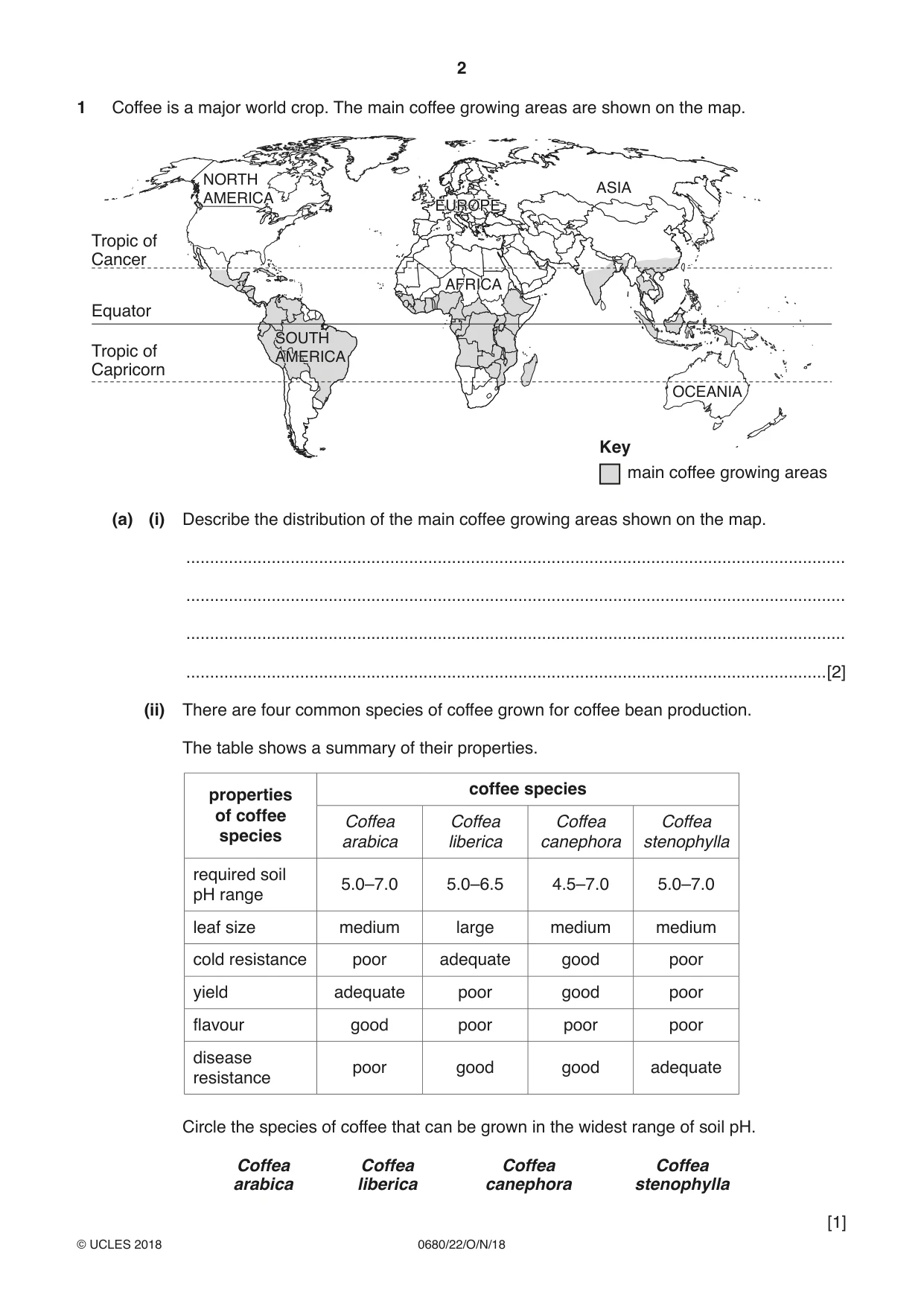
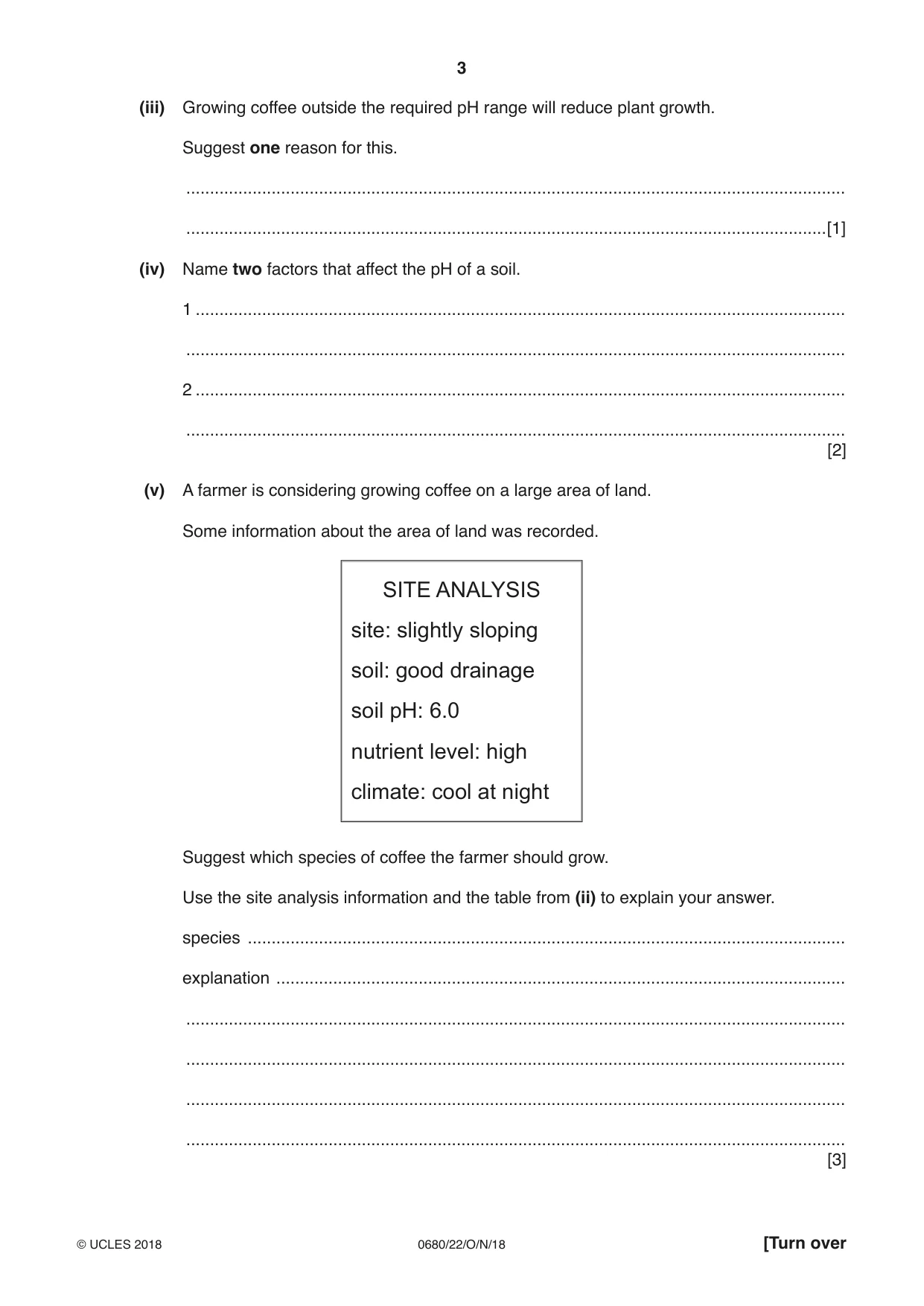
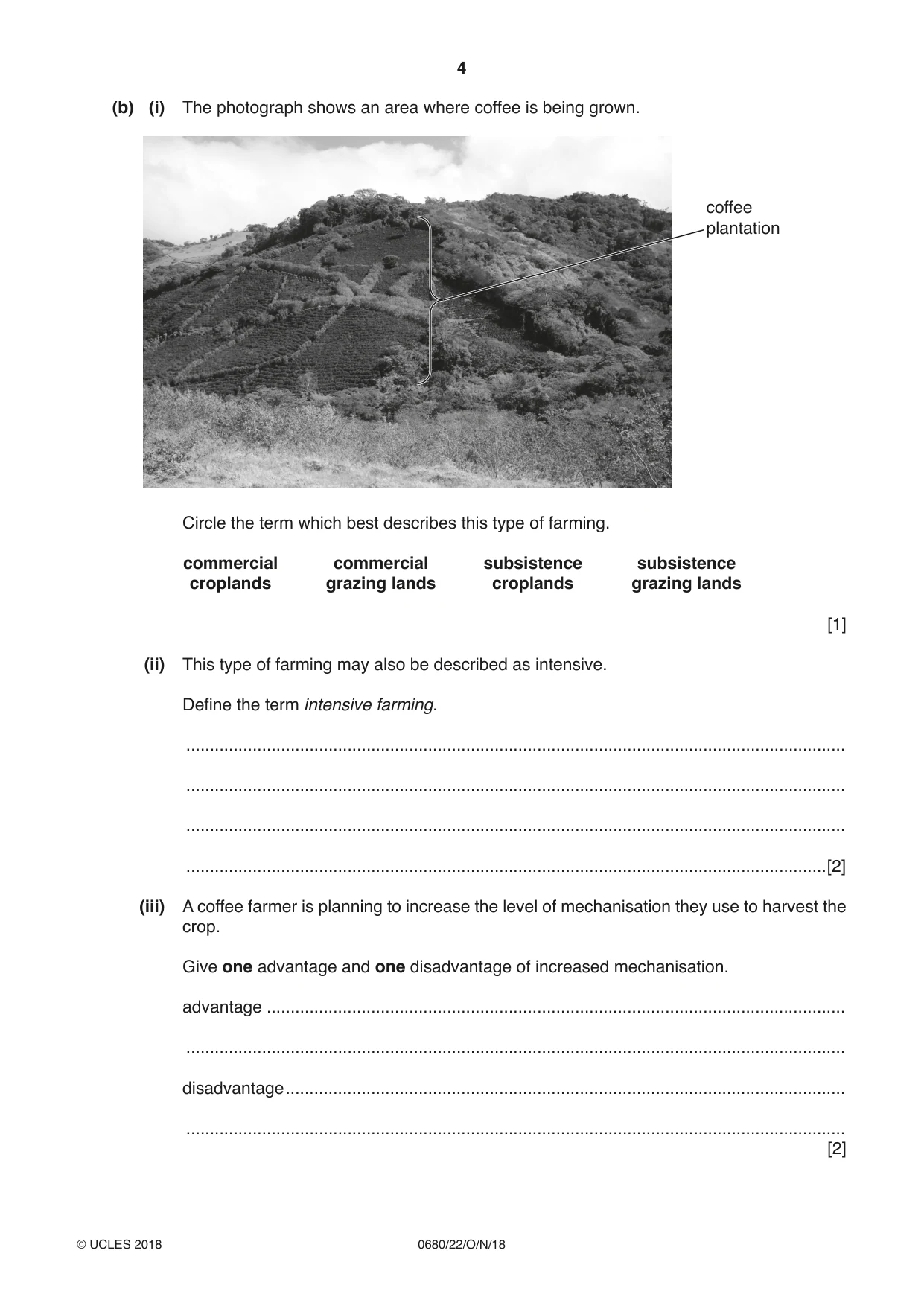
1 Coffee is a major world crop. The main coffee growing areas are shown on the map. NORTH ASIA AMERICA EUROPEEUROPE Tropic of Cancer AFRICAAFRICA Equator SOUTHSOUTH Tropic of AMERICAAMERICA Capricorn OCEANIAOCEANIA Key main coffee growing areas (a) (i) Describe the distribution of the main coffee growing areas shown on the map. ........................................................................................................................................... ........................................................................................................................................... ........................................................................................................................................... .......................................................................................................................................[2] (ii) There are four common species of coffee grown for coffee bean production. The table shows a summary of their properties. coffee species properties of coffee Coffea Coffea Coffea Coffea species arabica liberica canephora stenophylla required soil 5.0–7.0 5.0–6.5 4.5–7.0 5.0–7.0 pH range leaf size medium large medium medium cold resistance poor adequate good poor yield adequate poor good poor flavour good poor poor poor disease poor good good adequate resistance Circle the species of coffee that can be grown in the widest range of soil pH. Coffea Coffea Coffea Coffea arabica liberica canephora stenophylla [1] (iii) Growing coffee outside the required pH range will reduce plant growth. Suggest one reason for this. ........................................................................................................................................... .......................................................................................................................................[1] (iv) Name two factors that affect the pH of a soil. 1 ......................................................................................................................................... ........................................................................................................................................... 2 ......................................................................................................................................... ........................................................................................................................................... [2] (v) A farmer is considering growing coffee on a large area of land. Some information about the area of land was recorded. SITE ANALYSIS site: slightly sloping soil: good drainage soil pH: 6.0 nutrient level: high climate: cool at night Suggest which species of coffee the farmer should grow. Use the site analysis information and the table from (ii) to explain your answer. species .............................................................................................................................. explanation ........................................................................................................................ ........................................................................................................................................... ........................................................................................................................................... ........................................................................................................................................... ........................................................................................................................................... [3] (b) (i) The photograph shows an area where coffee is being grown. coffee plantation Circle the term which best describes this type of farming. commercial commercial subsistence subsistence croplands grazing lands croplands grazing lands [1] (ii) This type of farming may also be described as intensive. Define the term intensive farming. ........................................................................................................................................... ........................................................................................................................................... ........................................................................................................................................... .......................................................................................................................................[2] (iii) A coffee farmer is planning to increase the level of mechanisation they use to harvest the crop. Give one advantage and one disadvantage of increased mechanisation. advantage .......................................................................................................................... ........................................................................................................................................... disadvantage ...................................................................................................................... ........................................................................................................................................... [2] (c) (i) Coffee grown without the use of artificial pesticides can be sold at a higher price. Explain how pests might be controlled without the use of artificial pesticides. ........................................................................................................................................... ........................................................................................................................................... ........................................................................................................................................... ........................................................................................................................................... ........................................................................................................................................... .......................................................................................................................................[3] (ii) Coffee grown with artificial pesticides costs 1.10 USD per kg. Coffee grown without artificial pesticides costs 20% more. Calculate the cost of this coffee. ....................................... USD per kg [1] (iii) Suggest why some people might be against the use of artificial pesticides on a coffee crop. ........................................................................................................................................... ........................................................................................................................................... ........................................................................................................................................... ........................................................................................................................................... ........................................................................................................................................... ........................................................................................................................................... ........................................................................................................................................... .......................................................................................................................................[4] (iv) Rust disease is a major threat to coffee crops because plants with the disease die. Some scientists suggest the way to control rust disease in coffee is to use genetic engineering. Explain how genetic engineering might be a solution to this problem. ........................................................................................................................................... ........................................................................................................................................... ........................................................................................................................................... .......................................................................................................................................[2] (v) Suggest three reasons why some people might be against the use of genetic engineering. 1 ......................................................................................................................................... ........................................................................................................................................... 2 ......................................................................................................................................... ........................................................................................................................................... 3 ......................................................................................................................................... ........................................................................................................................................... [3] (d) (i) In South America trees have been removed to grow more coffee. Describe the impact the removal of trees may have on the local ecosystem. ........................................................................................................................................... ........................................................................................................................................... ........................................................................................................................................... ........................................................................................................................................... ........................................................................................................................................... ........................................................................................................................................... ........................................................................................................................................... .......................................................................................................................................[4] (ii) Suggest three ways the government could help conserve these trees. 1 ......................................................................................................................................... ........................................................................................................................................... 2 ......................................................................................................................................... ........................................................................................................................................... 3 ......................................................................................................................................... ........................................................................................................................................... [3] (e) ‘Sustainable agricultural techniques are a viable economic strategy for farmers.’ To what extent do you agree with this statement? Give reasons for your answer. ................................................................................................................................................... ................................................................................................................................................... ................................................................................................................................................... ................................................................................................................................................... ................................................................................................................................................... ................................................................................................................................................... ................................................................................................................................................... ................................................................................................................................................... ................................................................................................................................................... ................................................................................................................................................... ................................................................................................................................................... ...............................................................................................................................................[6]
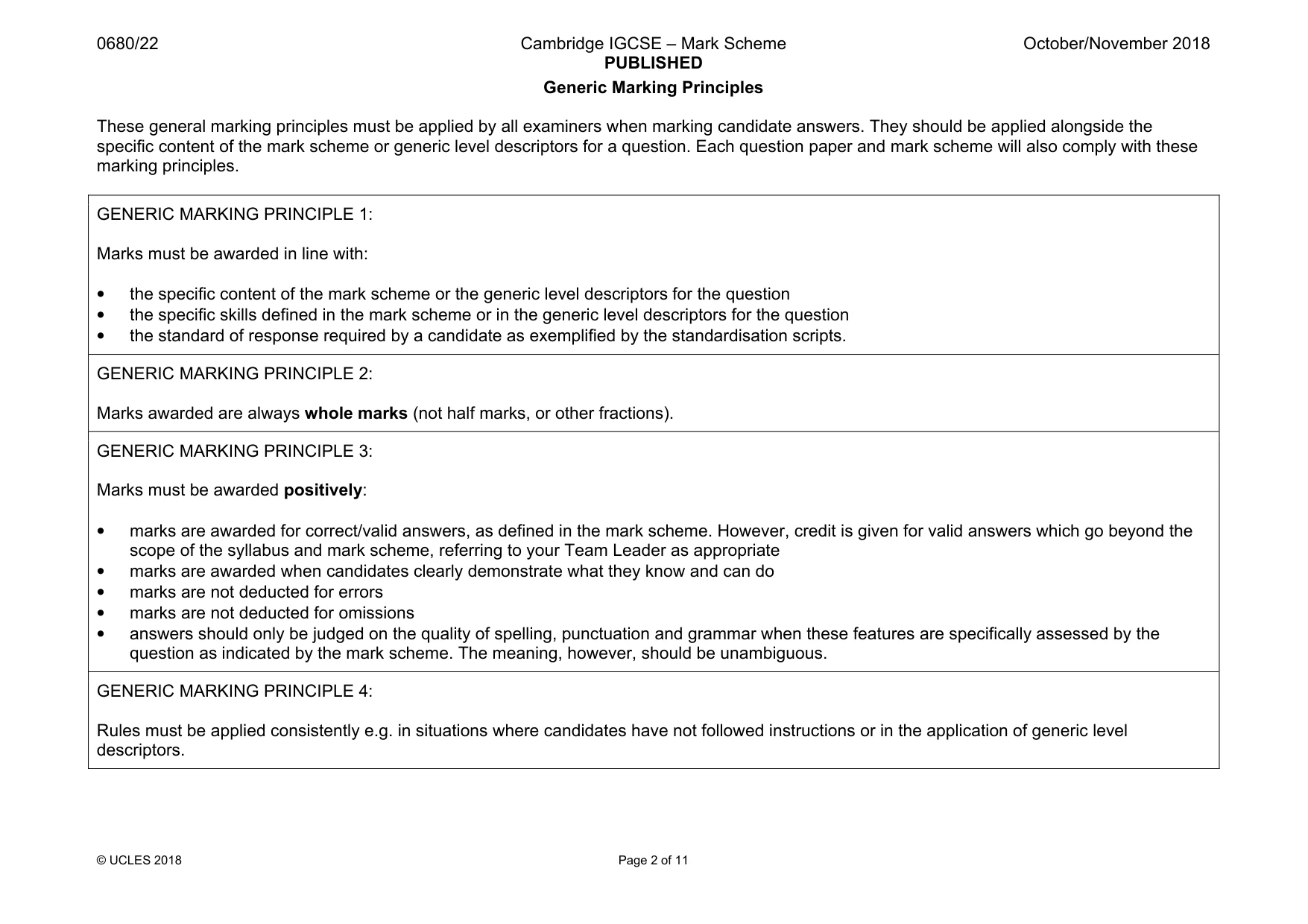
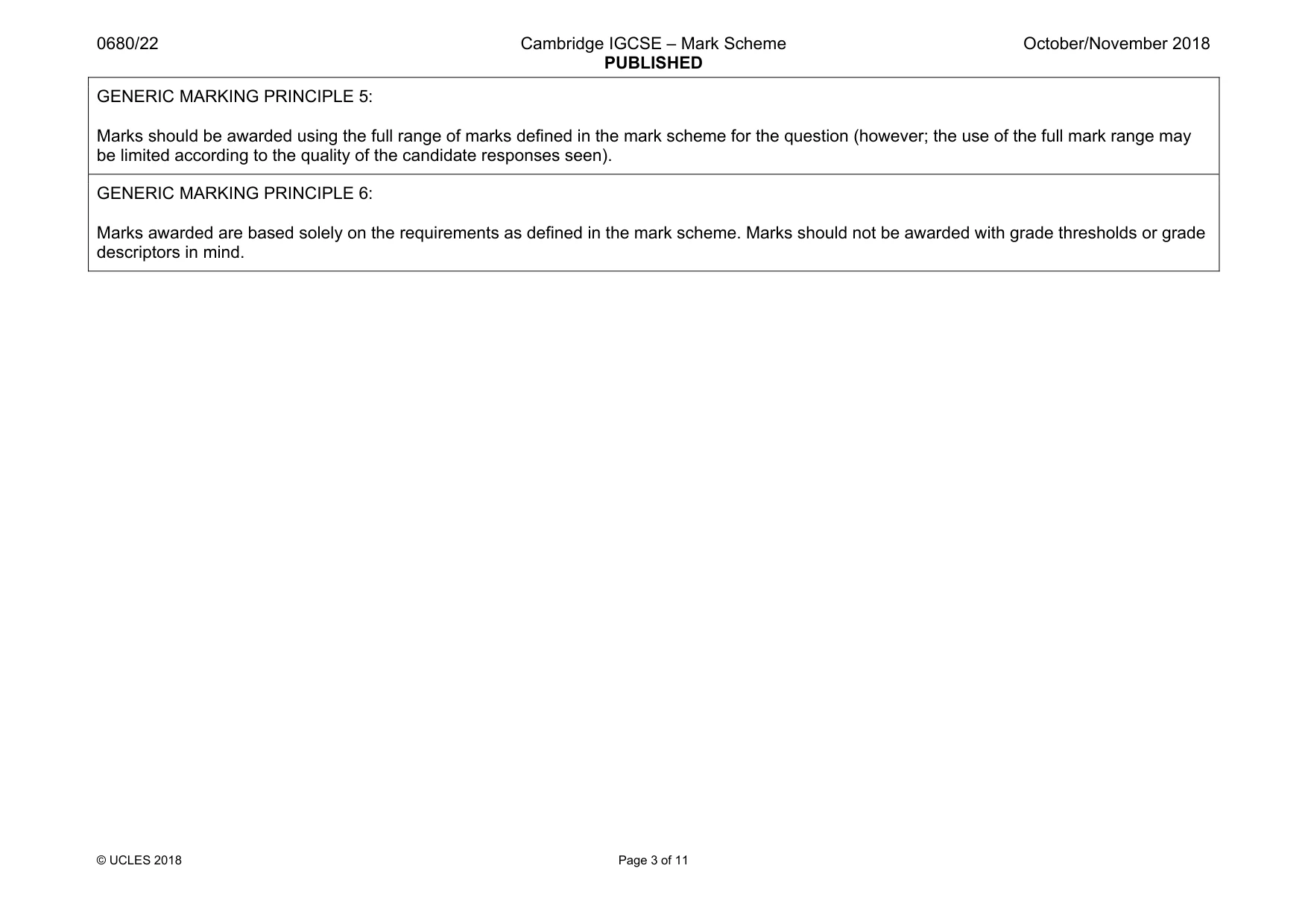
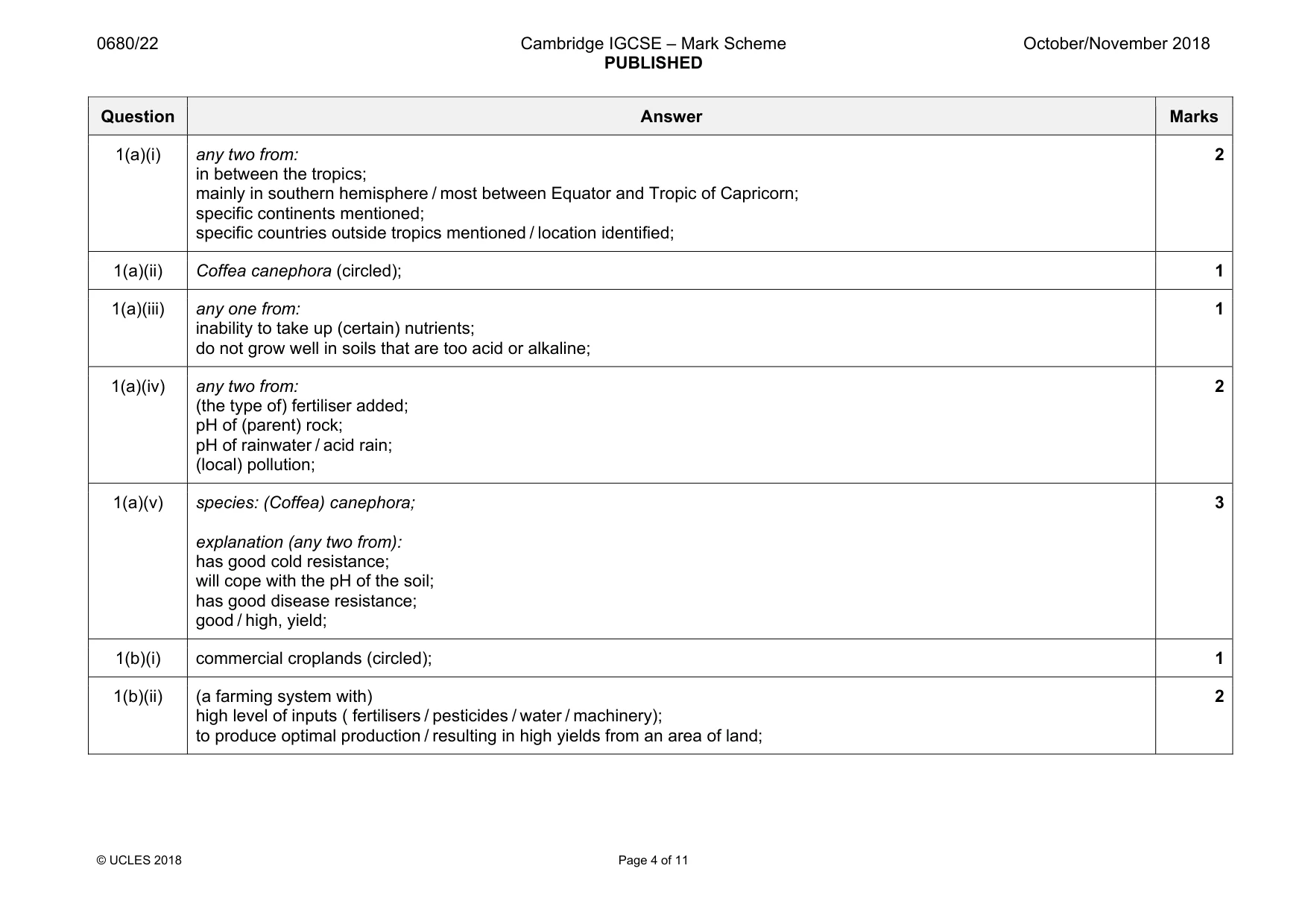
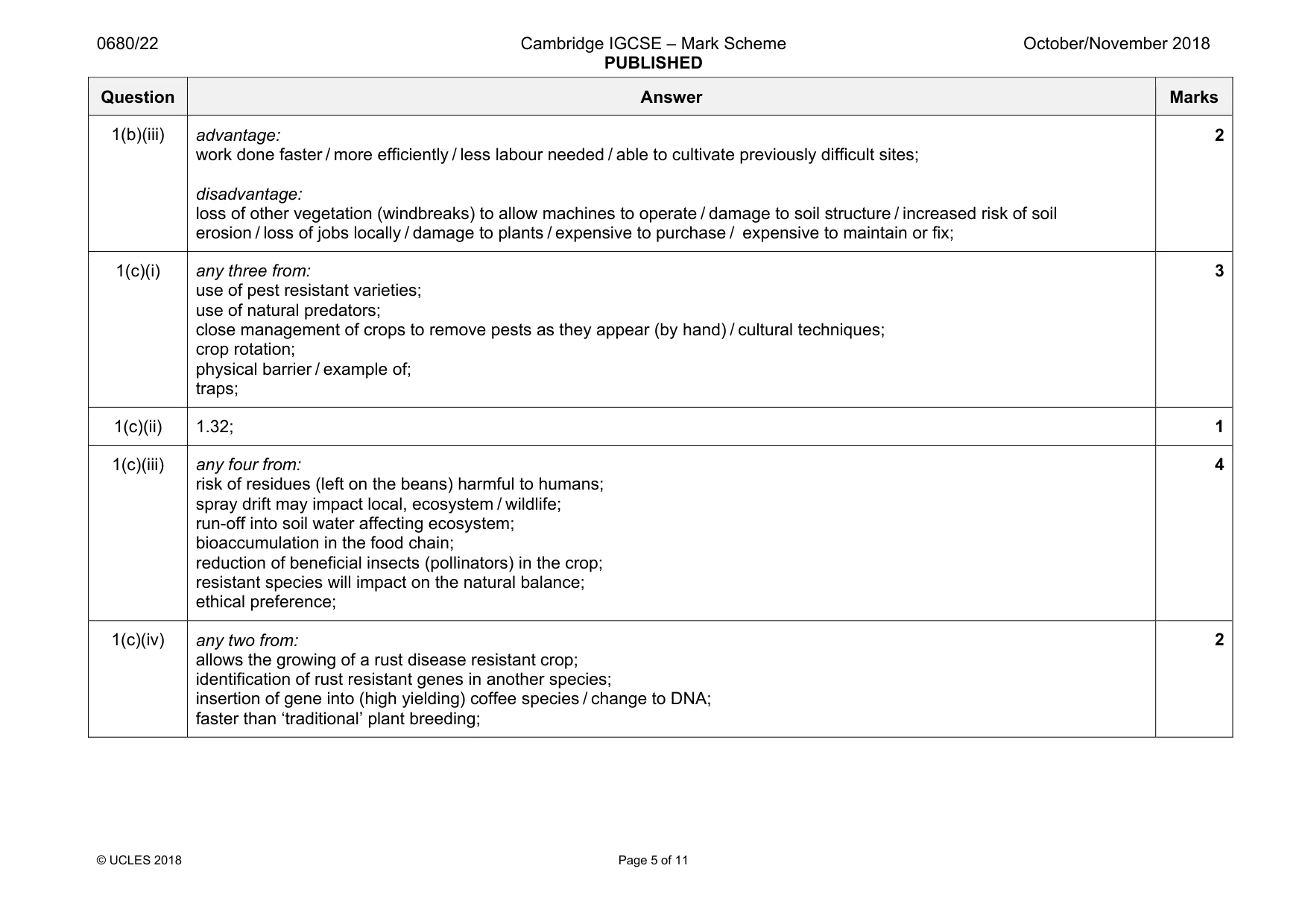
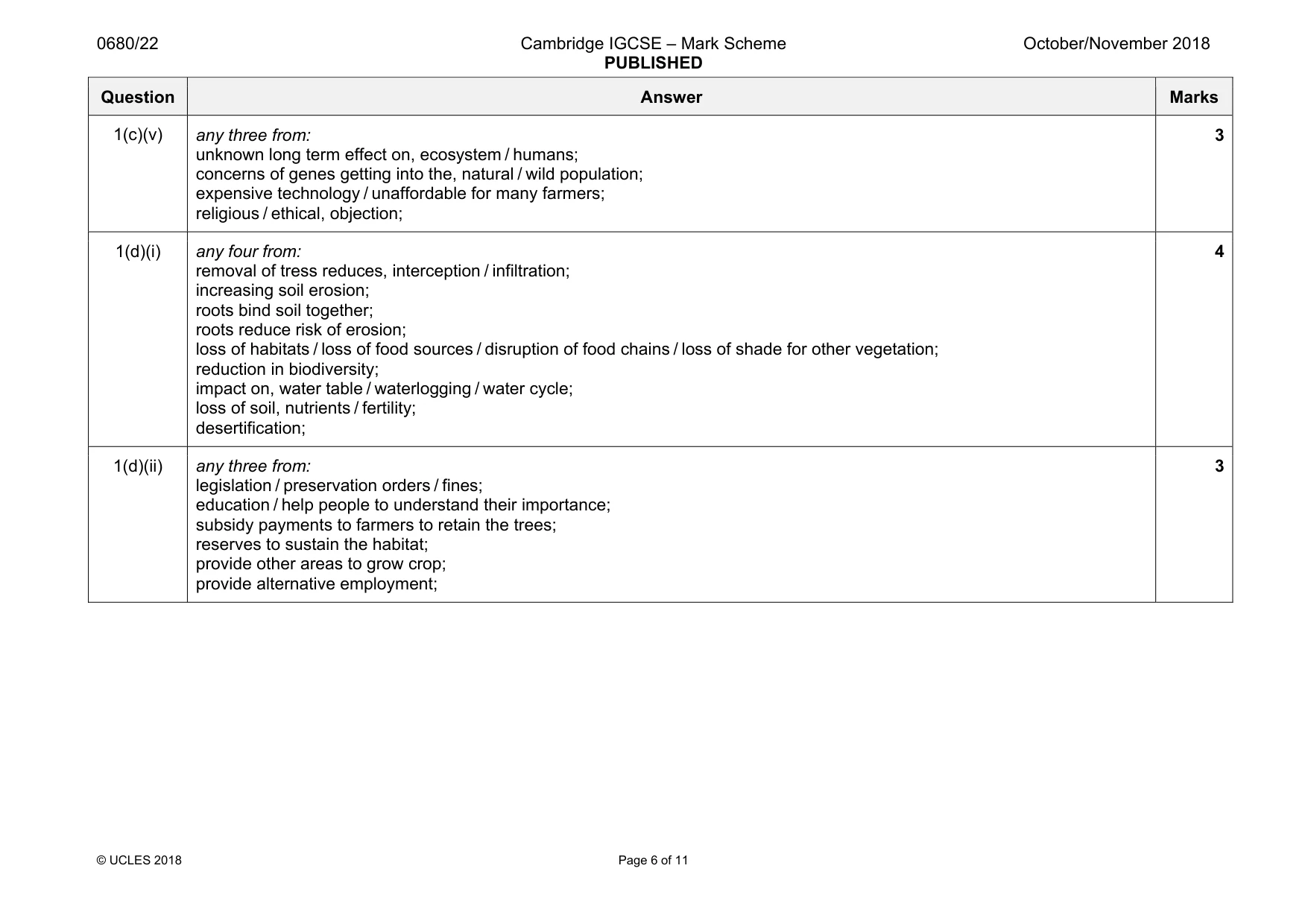
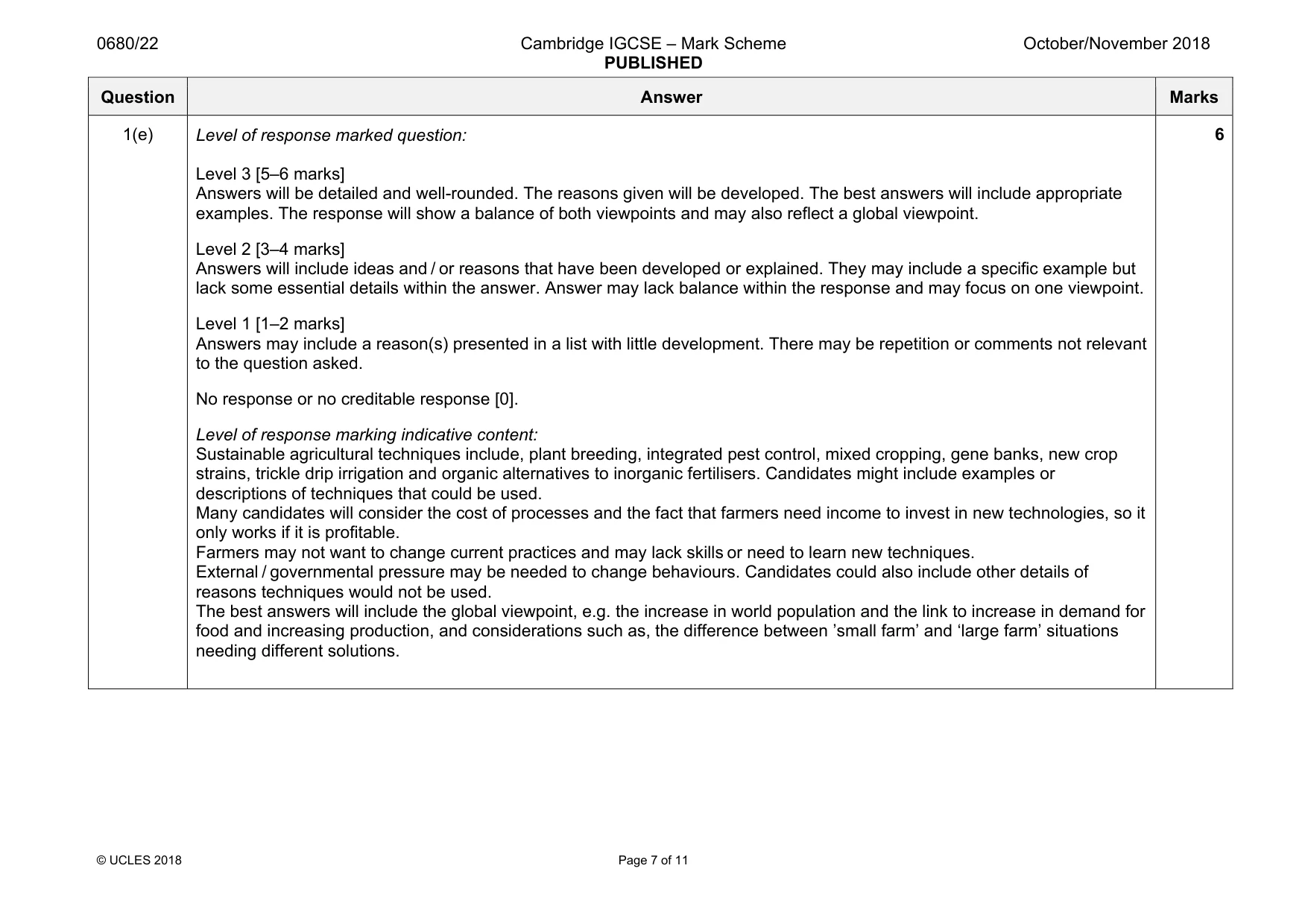
Mark scheme: 1(a)(i) any two from: in between the tropics; mainly in southern hemisphere / most between Equator and Tropic of Capricorn; specific continents mentioned; specific countries outside tropics mentioned / location identified; 2 1(a)(ii) Coffea canephora (circled); 1 1(a)(iii) any one from: inability to take up (certain) nutrients; do not grow well in soils that are too acid or alkaline; 1 1(a)(iv) any two from: (the type of) fertiliser added; pH of (parent) rock; pH of rainwater / acid rain; (local) pollution; 2 1(a)(v) species: (Coffea) canephora; explanation (any two from): has good cold resistance; will cope with the pH of the soil; has good disease resistance; good / high, yield; 3 1(b)(i) commercial croplands (circled); 1 1(b)(ii) (a farming system with) high level of inputs ( fertilisers / pesticides / water / machinery); to produce optimal production / resulting in high yields from an area of land; 2 Question Answer Marks 1(b)(iii) advantage: work done faster / more efficiently / less labour needed / able to cultivate previously difficult sites; disadvantage: loss of other vegetation (windbreaks) to allow machines to operate / damage to soil structure / increased risk of soil erosion / loss of jobs locally / damage to plants / expensive to purchase / expensive to maintain or fix; 2 1(c)(i) any three from: use of pest resistant varieties; use of natural predators; close management of crops to remove pests as they appear (by hand) / cultural techniques; crop rotation; physical barrier / example of; traps; 3 1(c)(ii) 1.32; 1 1(c)(iii) any four from: risk of residues (left on the beans) harmful to humans; spray drift may impact local, ecosystem / wildlife; run-off into soil water affecting ecosystem; bioaccumulation in the food chain; reduction of beneficial insects (pollinators) in the crop; resistant species will impact on the natural balance; ethical preference; 4 1(c)(iv) any two from: allows the growing of a rust disease resistant crop; identification of rust resistant genes in another species; insertion of gene into (high yielding) coffee species / change to DNA; faster than ‘traditional’ plant breeding; 2 Question Answer Marks 1(c)(v) any three from: unknown long term effect on, ecosystem / humans; concerns of genes getting into the, natural / wild population; expensive technology / unaffordable for many farmers; religious / ethical, objection; 3 1(d)(i) any four from: removal of tress reduces, interception / infiltration; increasing soil erosion; roots bind soil together; roots reduce risk of erosion; loss of habitats / loss of food sources / disruption of food chains / loss of shade for other vegetation; reduction in biodiversity; impact on, water table / waterlogging / water cycle; loss of soil, nutrients / fertility; desertification; 4 1(d)(ii) any three from: legislation / preservation orders / fines; education / help people to understand their importance; subsidy payments to farmers to retain the trees; reserves to sustain the habitat; provide other areas to grow crop; provide alternative employment; 3 Question Answer Marks 1(e) Level of response marked question: Level 3 [5–6 marks] Answers will be detailed and well-rounded. The reasons given will be developed. The best answers will include appropriate examples. The response will show a balance of both viewpoints and may also reflect a global viewpoint. Level 2 [3–4 marks] Answers will include ideas and / or reasons that have been developed or explained. They may include a specific example but lack some essential details within the answer. Answer may lack balance within the response and may focus on one viewpoint. Level 1 [1–2 marks] Answers may include a reason(s) presented in a list with little development. There may be repetition or comments not relevant to the question asked. No response or no creditable response [0]. Level of response marking indicative content: Sustainable agricultural techniques include, plant breeding, integrated pest control, mixed cropping, gene banks, new crop strains, trickle drip irrigation and organic alternatives to inorganic fertilisers. Candidates might include examples or descriptions of techniques that could be used. Many candidates will consider the cost of processes and the fact that farmers need income to invest in new technologies, so it only works if it is profitable. Farmers may not want to change current practices and may lack skills or need to learn new techniques. External / governmental pressure may be needed to change behaviours. Candidates could also include other details of reasons techniques would not be used. The best answers will include the global viewpoint, e.g. the increase in world population and the link to increase in demand for food and increasing production, and considerations such as, the difference between ’small farm’ and ‘large farm’ situations needing different solutions. 6
Q2 · The graph shows the worldwide extraction of materials from mines between 1980 and 2015
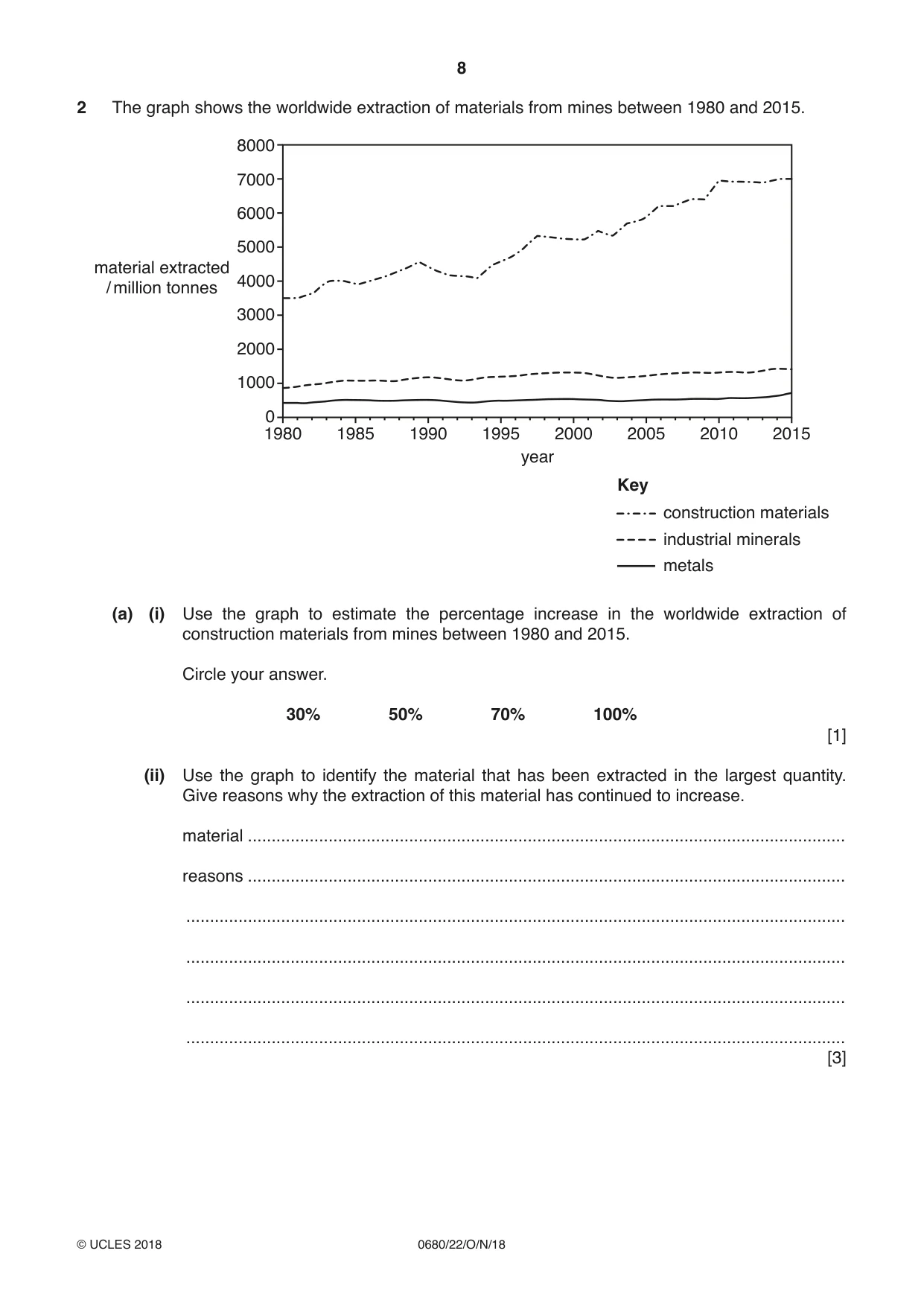
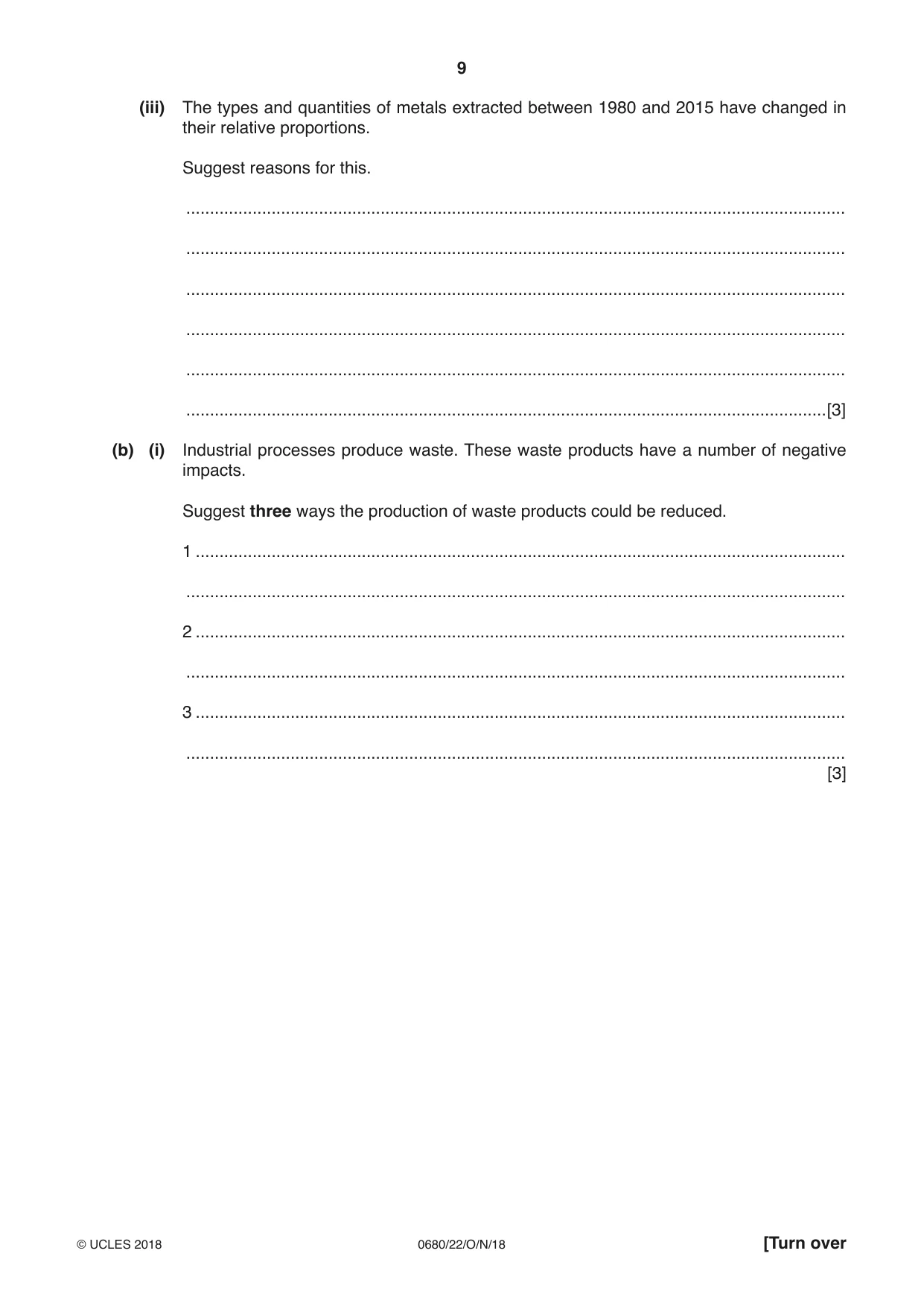
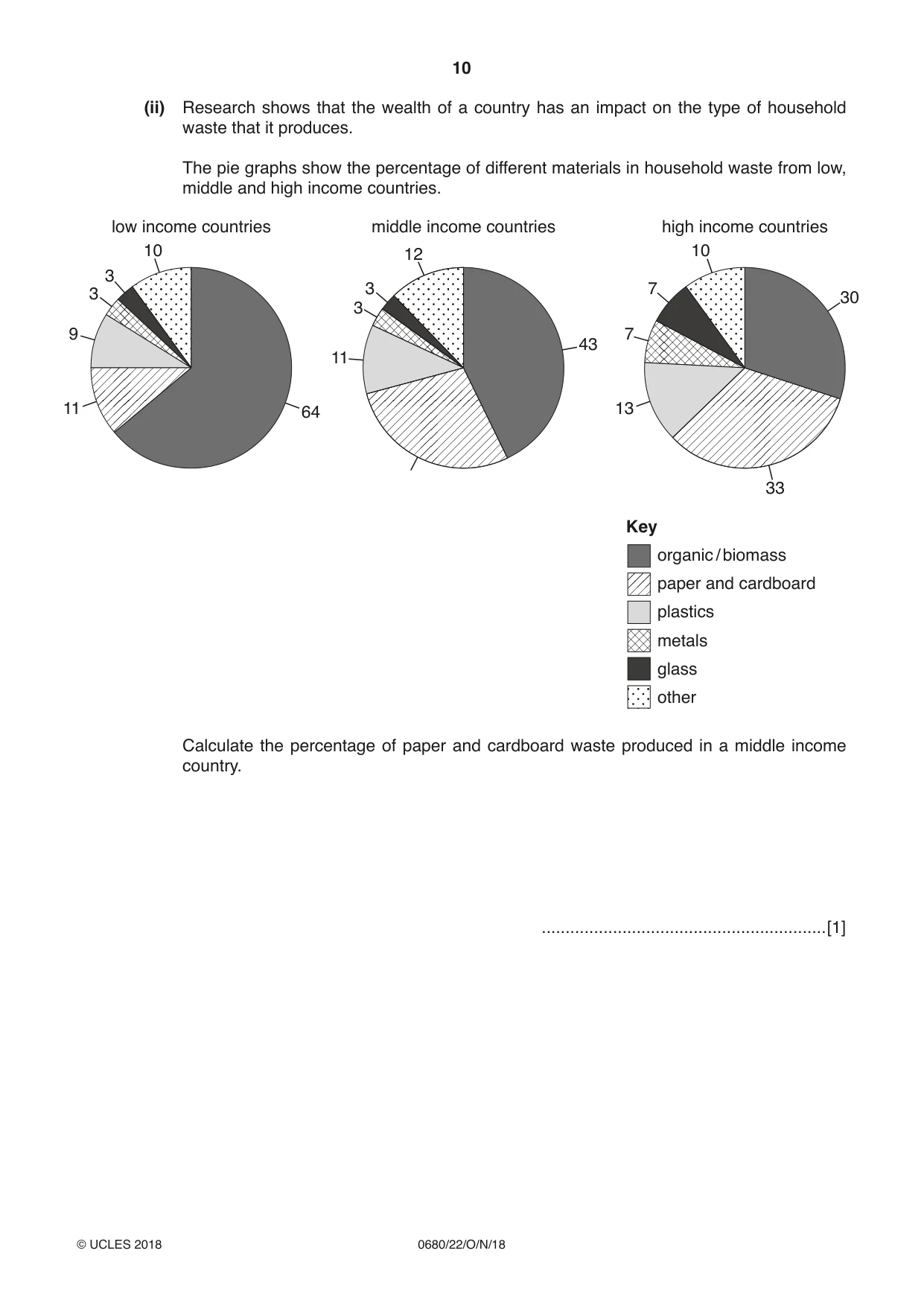
2 The graph shows the worldwide extraction of materials from mines between 1980 and 2015. 8000 7000 6000 5000 material extracted 4000 / million tonnes 3000 2000 1000 0 1980 1985 1990 1995 2000 2005 2010 2015 year Key construction materials industrial minerals metals (a) (i) Use the graph to estimate the percentage increase in the worldwide extraction of construction materials from mines between 1980 and 2015. Circle your answer. 30% 50% 70% 100% [1] (ii) Use the graph to identify the material that has been extracted in the largest quantity. Give reasons why the extraction of this material has continued to increase. material .............................................................................................................................. reasons .............................................................................................................................. ........................................................................................................................................... ........................................................................................................................................... ........................................................................................................................................... ........................................................................................................................................... [3] (iii) The types and quantities of metals extracted between 1980 and 2015 have changed in their relative proportions. Suggest reasons for this. ........................................................................................................................................... ........................................................................................................................................... ........................................................................................................................................... ........................................................................................................................................... ........................................................................................................................................... .......................................................................................................................................[3] (b) (i) Industrial processes produce waste. These waste products have a number of negative impacts. Suggest three ways the production of waste products could be reduced. 1 ......................................................................................................................................... ........................................................................................................................................... 2 ......................................................................................................................................... ........................................................................................................................................... 3 ......................................................................................................................................... ........................................................................................................................................... [3] (ii) Research shows that the wealth of a country has an impact on the type of household waste that it produces. The pie graphs show the percentage of different materials in household waste from low, middle and high income countries. low income countries middle income countries high income countries 10 12 10
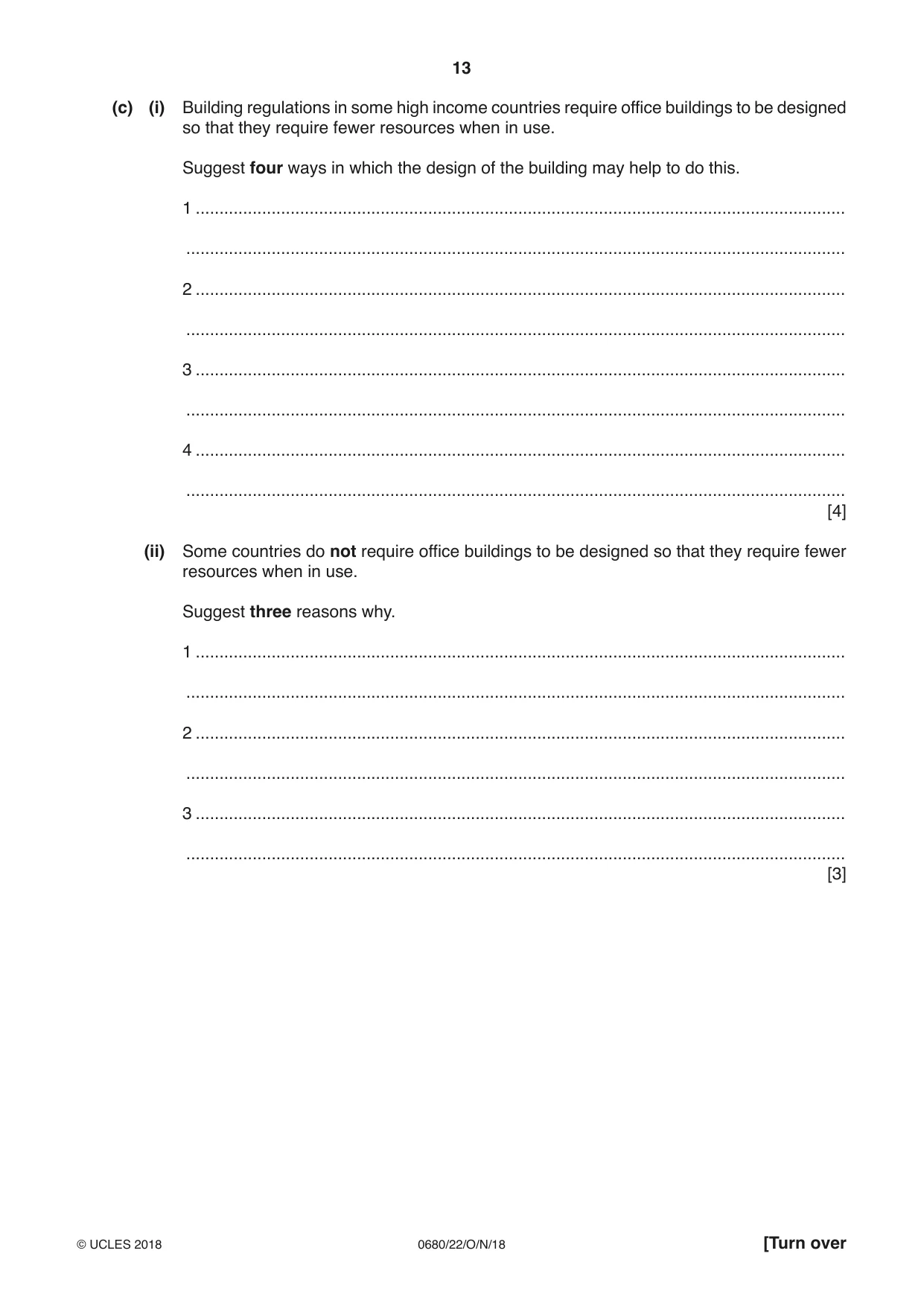
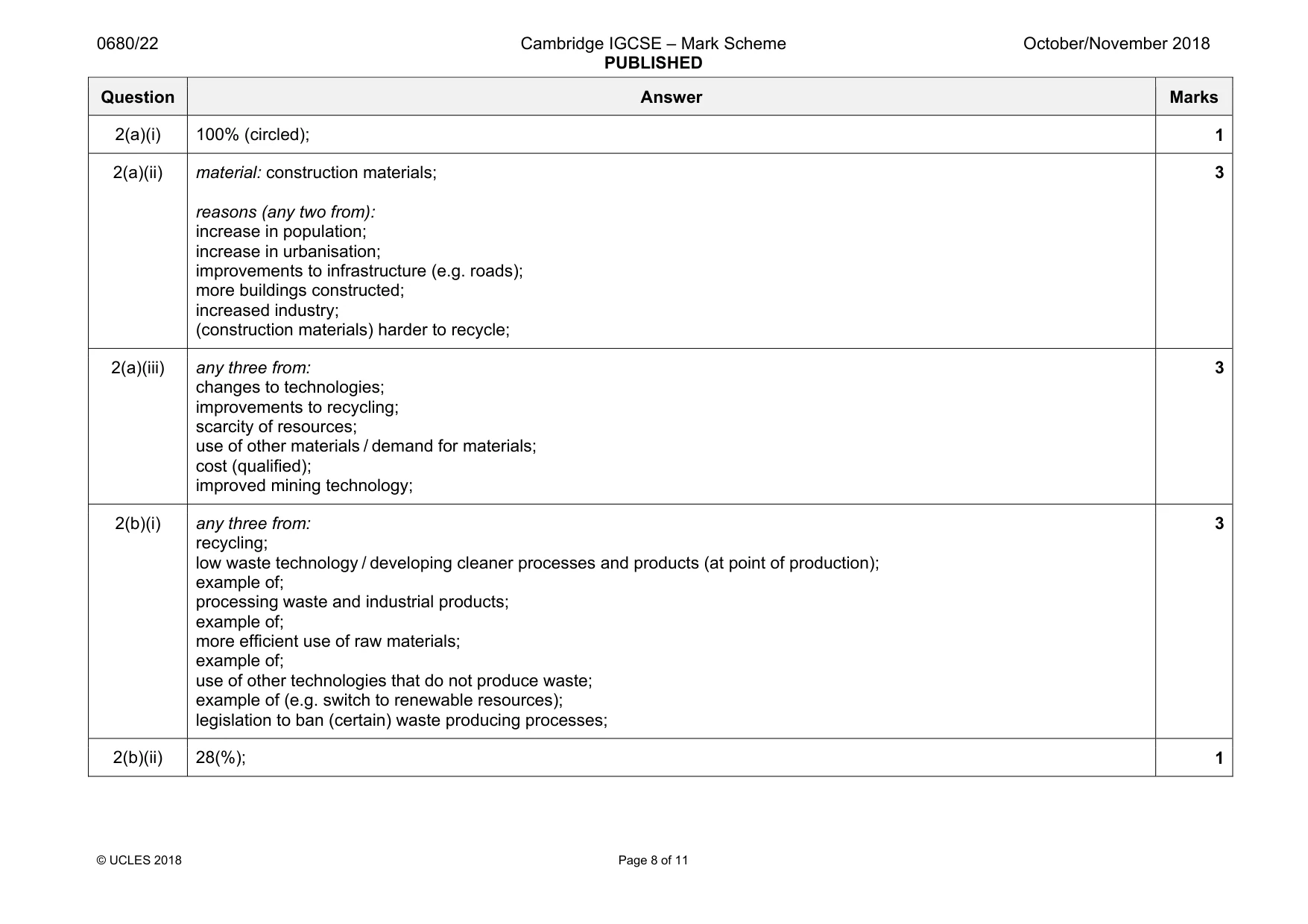
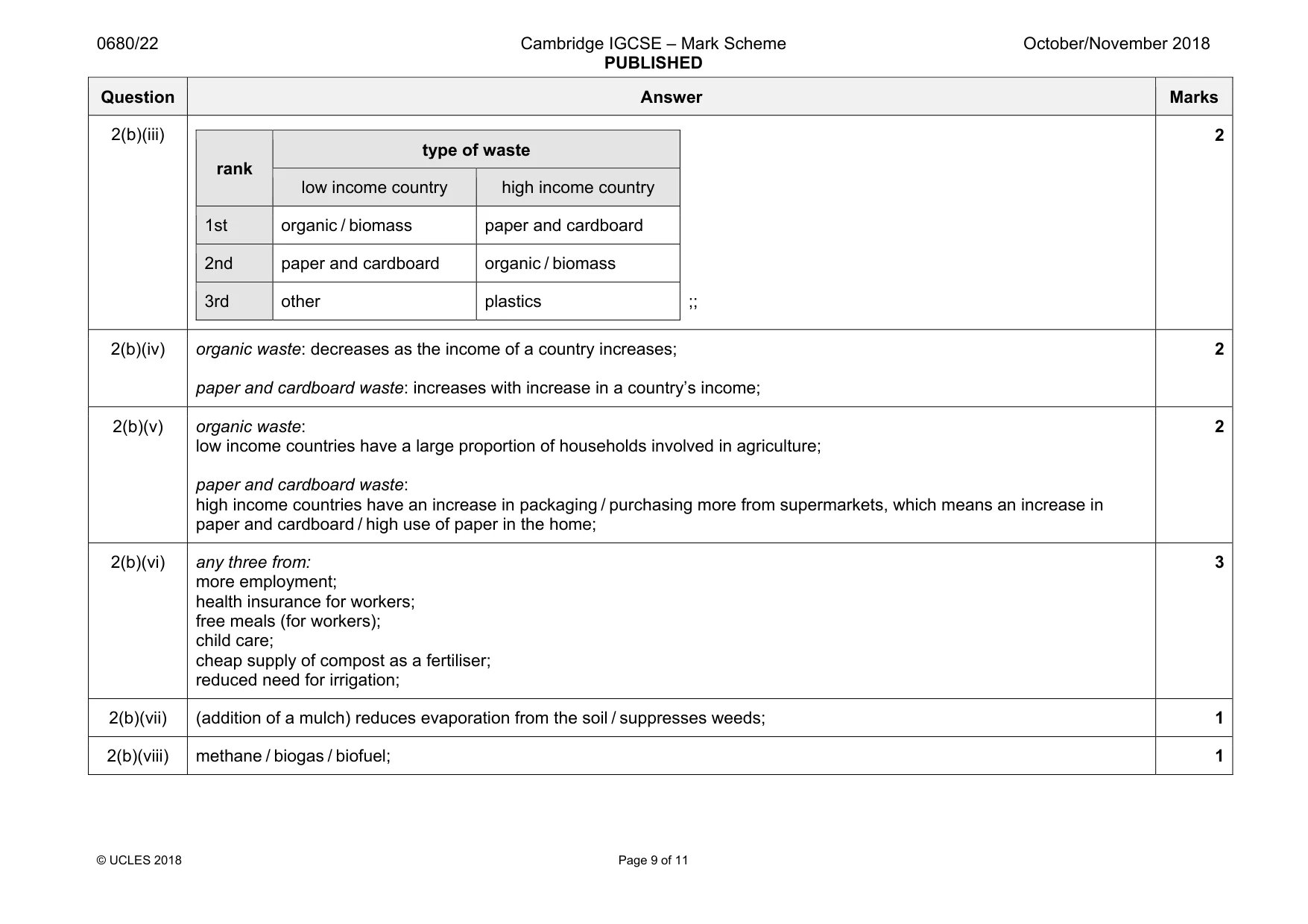
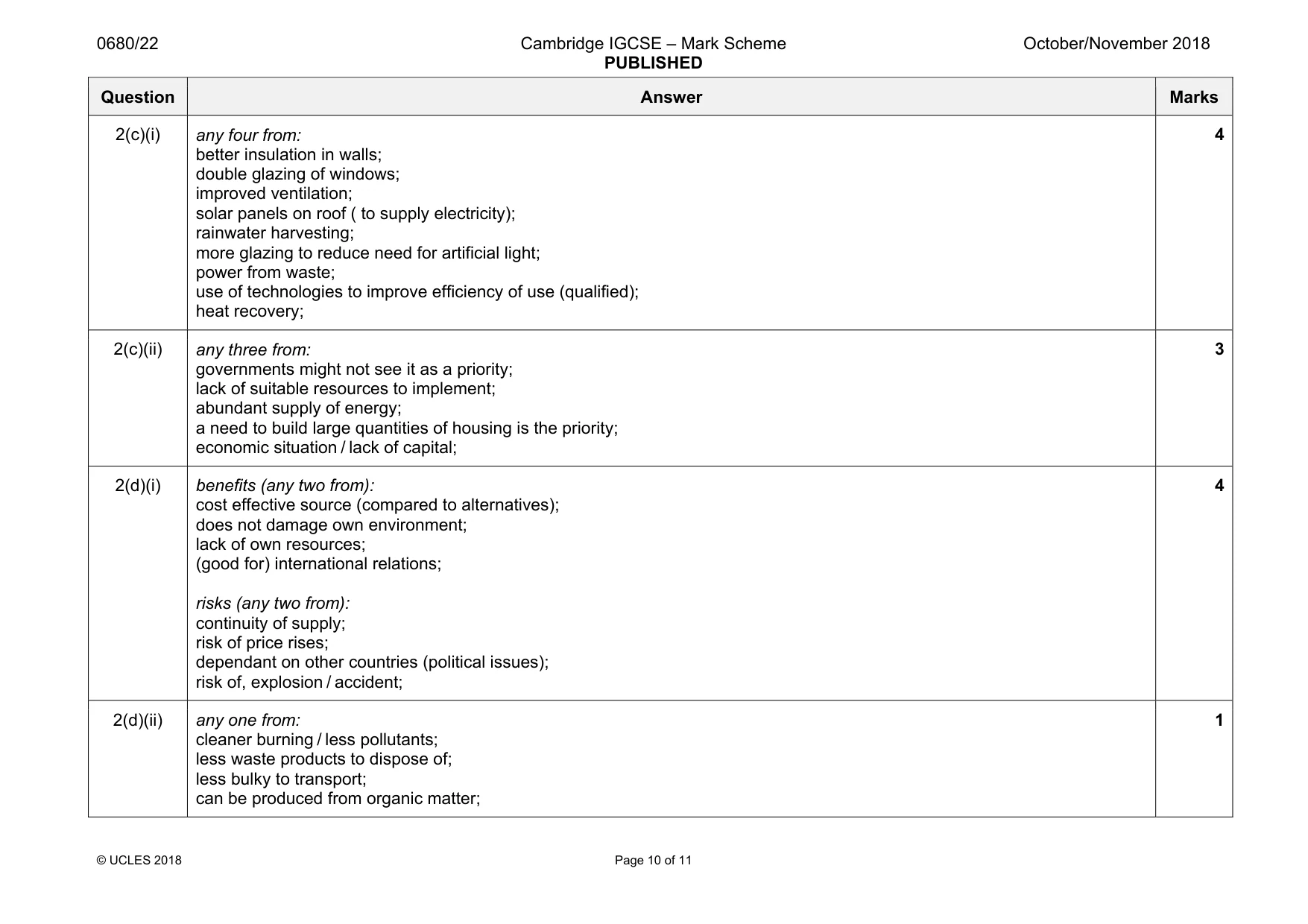
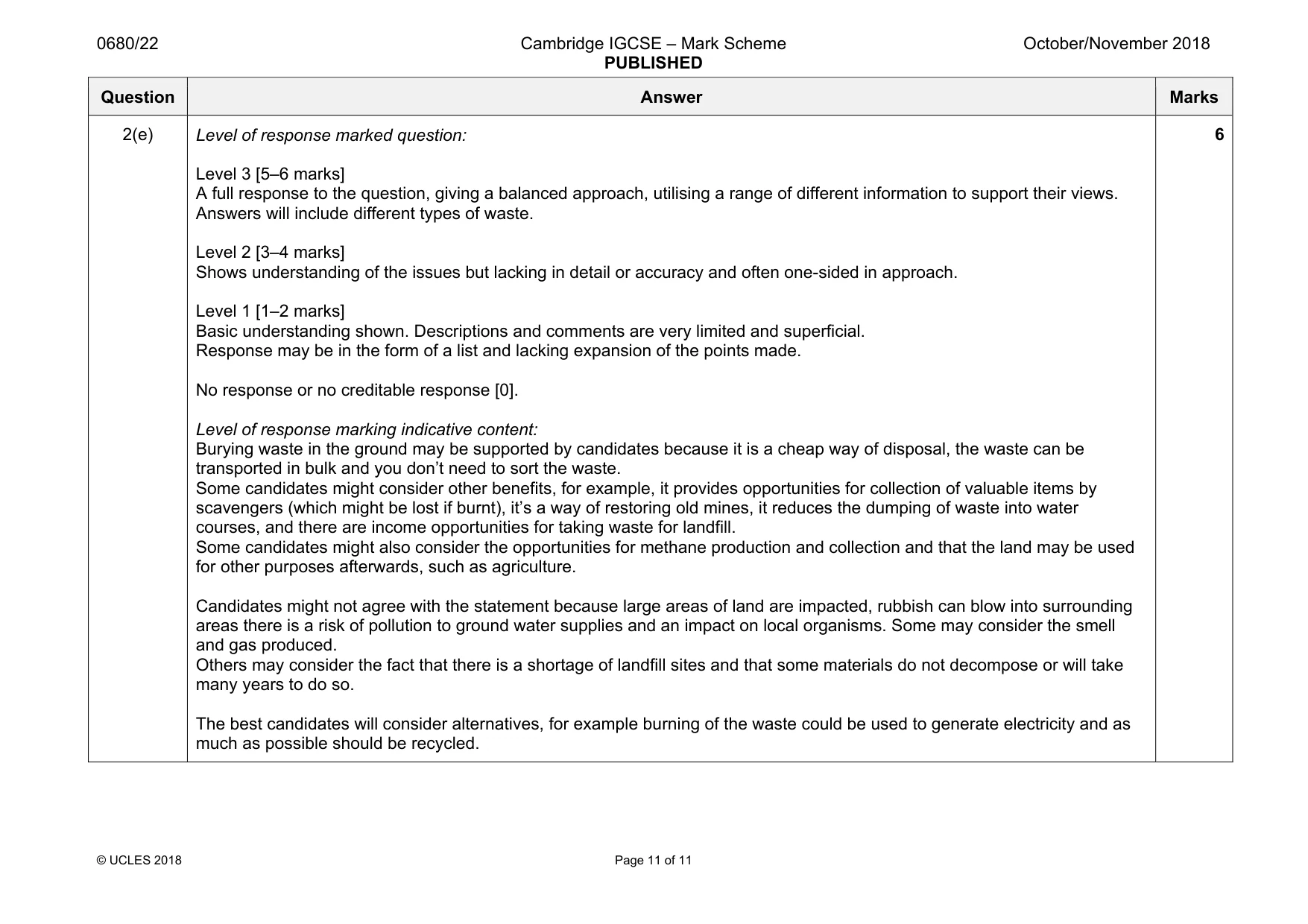
Mark scheme: 2(a)(i) 100% (circled); 1 2(a)(ii) material: construction materials; reasons (any two from): increase in population; increase in urbanisation; improvements to infrastructure (e.g. roads); more buildings constructed; increased industry; (construction materials) harder to recycle; 3 2(a)(iii) any three from: changes to technologies; improvements to recycling; scarcity of resources; use of other materials / demand for materials; cost (qualified); improved mining technology; 3 2(b)(i) any three from: recycling; low waste technology / developing cleaner processes and products (at point of production); example of; processing waste and industrial products; example of; more efficient use of raw materials; example of; use of other technologies that do not produce waste; example of (e.g. switch to renewable resources); legislation to ban (certain) waste producing processes; 3 2(b)(ii) 28(%); 1 Question Answer Marks 2(b)(iii) rank type of waste low income country high income country 1st organic / biomass paper and cardboard 2nd paper and cardboard organic / biomass 3rd other plastics ;; 2 2(b)(iv) organic waste: decreases as the income of a country increases; paper and cardboard waste: increases with increase in a country’s income; 2 2(b)(v) organic waste: low income countries have a large proportion of households involved in agriculture; paper and cardboard waste: high income countries have an increase in packaging / purchasing more from supermarkets, which means an increase in paper and cardboard / high use of paper in the home; 2 2(b)(vi) any three from: more employment; health insurance for workers; free meals (for workers); child care; cheap supply of compost as a fertiliser; reduced need for irrigation; 3 2(b)(vii) (addition of a mulch) reduces evaporation from the soil / suppresses weeds; 1 2(b)(viii) methane / biogas / biofuel; 1 Question Answer Marks 2(c)(i) any four from: better insulation in walls; double glazing of windows; improved ventilation; solar panels on roof ( to supply electricity); rainwater harvesting; more glazing to reduce need for artificial light; power from waste; use of technologies to improve efficiency of use (qualified); heat recovery; 4 2(c)(ii) any three from: governments might not see it as a priority; lack of suitable resources to implement; abundant supply of energy; a need to build large quantities of housing is the priority; economic situation / lack of capital; 3 2(d)(i) benefits (any two from): cost effective source (compared to alternatives); does not damage own environment; lack of own resources; (good for) international relations; risks (any two from): continuity of supply; risk of price rises; dependant on other countries (political issues); risk of, explosion / accident; 4 2(d)(ii) any one from: cleaner burning / less pollutants; less waste products to dispose of; less bulky to transport; can be produced from organic matter; 1 Question Answer Marks 2(e) Level of response marked question: Level 3 [5–6 marks] A full response to the question, giving a balanced approach, utilising a range of different information to support their views. Answers will include different types of waste. Level 2 [3–4 marks] Shows understanding of the issues but lacking in detail or accuracy and often one-sided in approach. Level 1 [1–2 marks] Basic understanding shown. Descriptions and comments are very limited and superficial. Response may be in the form of a list and lacking expansion of the points made. No response or no creditable response [0]. Level of response marking indicative content: Burying waste in the ground may be supported by candidates because it is a cheap way of disposal, the waste can be transported in bulk and you don’t need to sort the waste. Some candidates might consider other benefits, for example, it provides opportunities for collection of valuable items by scavengers (which might be lost if burnt), it’s a way of restoring old mines, it reduces the dumping of waste into water courses, and there are income opportunities for taking waste for landfill. Some candidates might also consider the opportunities for methane production and collection and that the land may be used for other purposes afterwards, such as agriculture. Candidates might not agree with the statement because large areas of land are impacted, rubbish can blow into surrounding areas there is a risk of pollution to ground water supplies and an impact on local organisms. Some may consider the smell and gas produced. Others may consider the fact that there is a shortage of landfill sites and that some materials do not decompose or will take many years to do so. The best candidates will consider alternatives, for example burning of the waste could be used to generate electricity and as much as possible should be recycled. 6
Q3 · 7 3 30 3 9 7 43 11 11 64 13 33 Key organic / biomass paper and cardboard plastics metals…
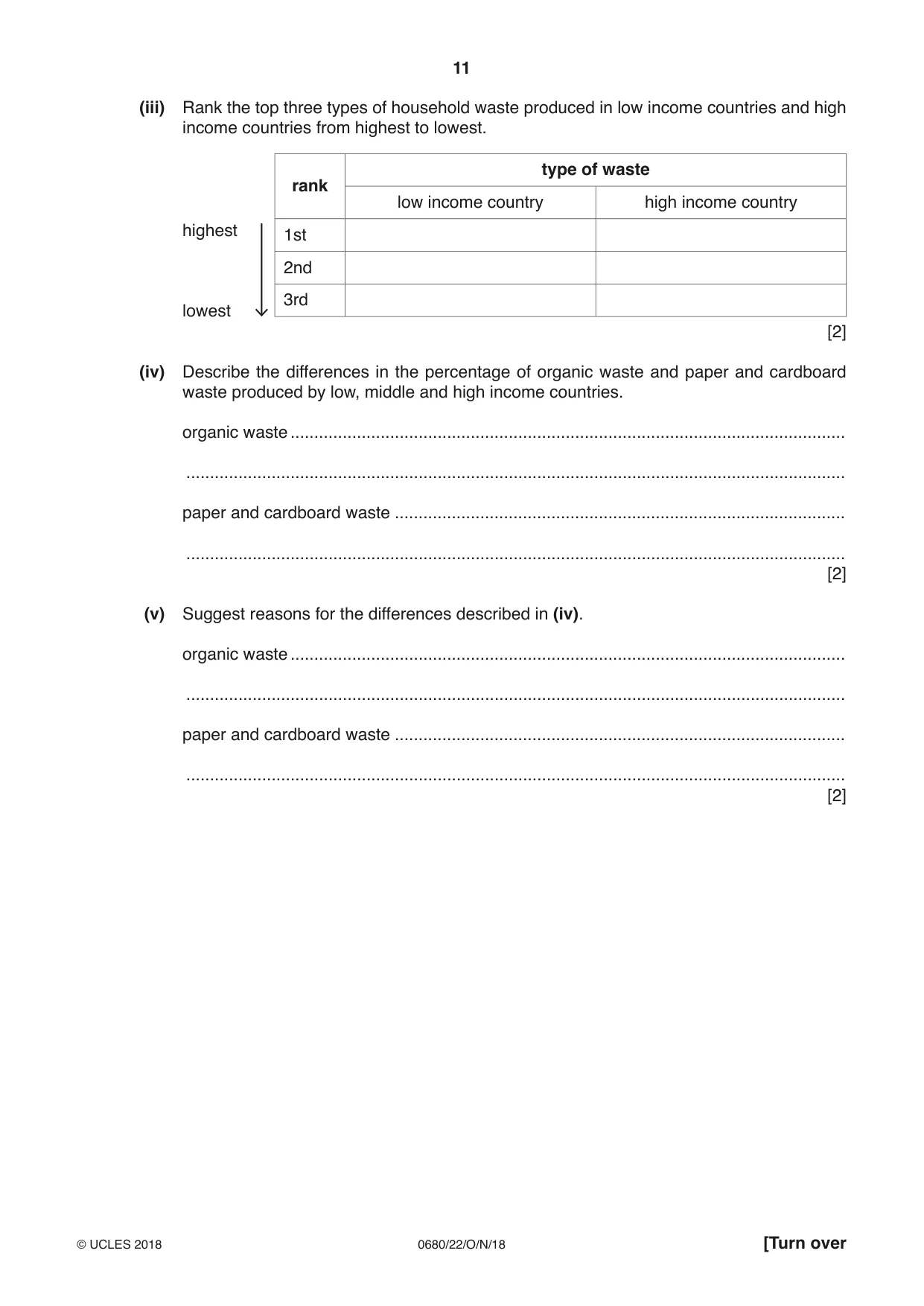
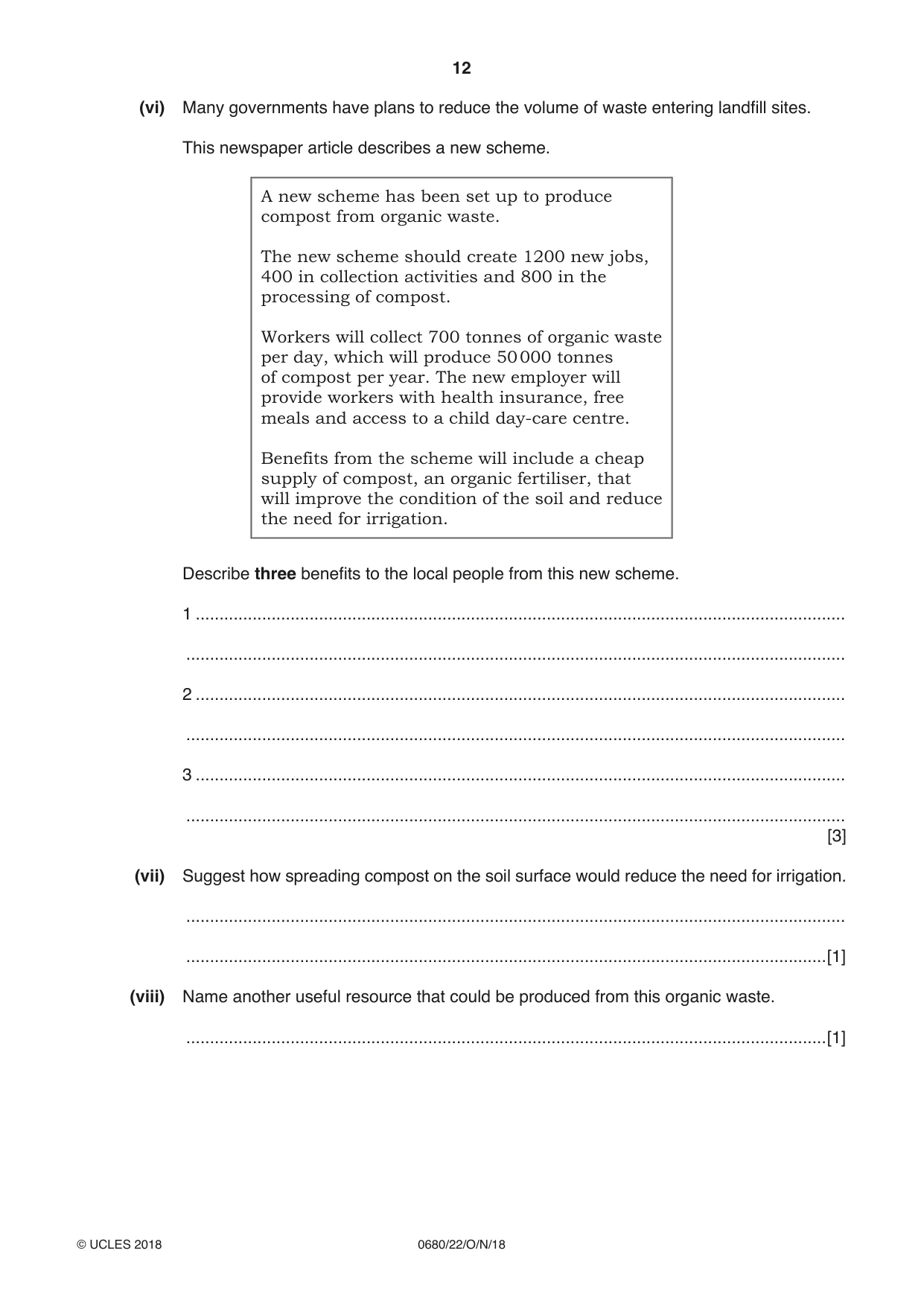
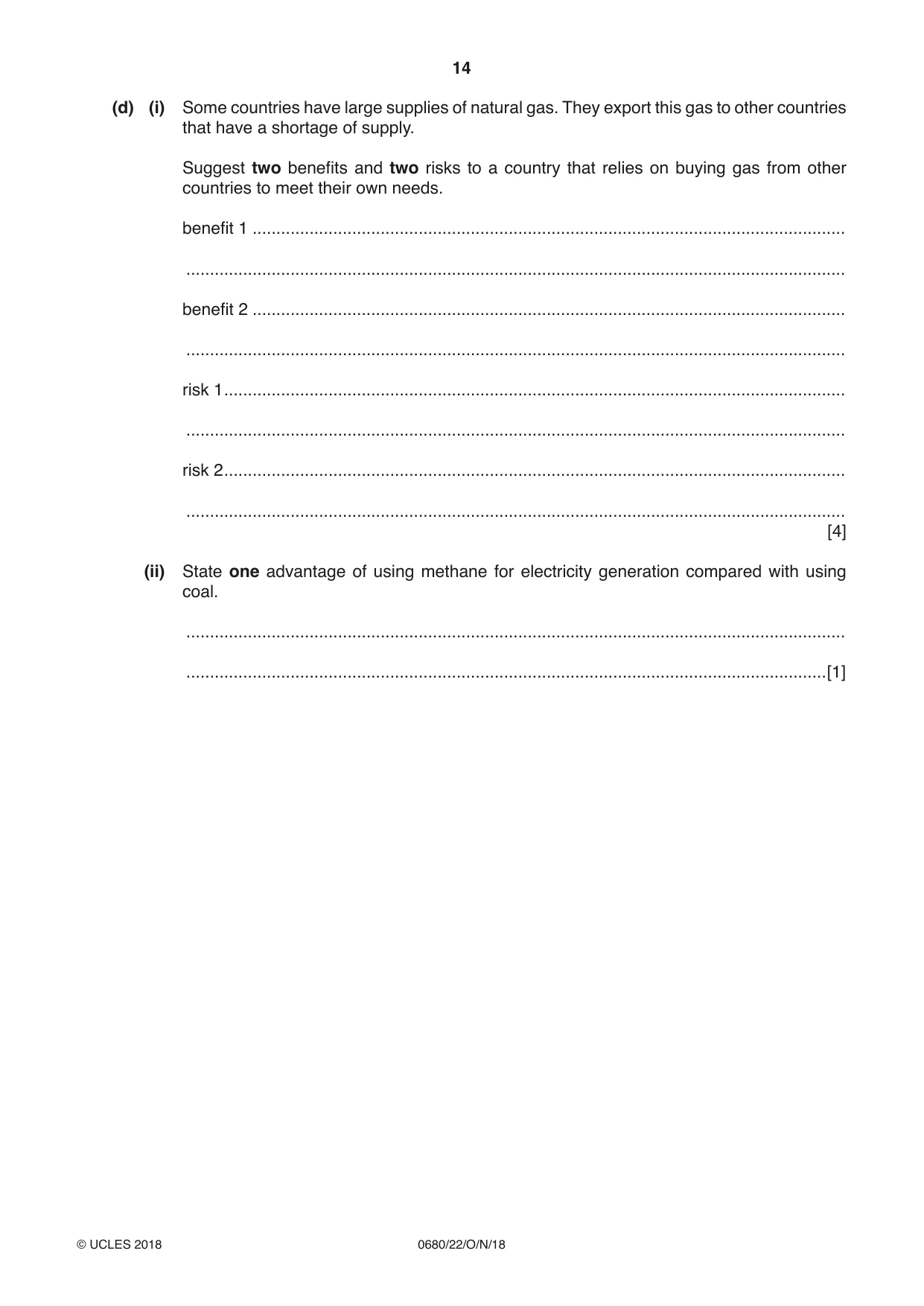
3 7 3 30 3 9 7 43 11 11 64 13 33 Key organic / biomass paper and cardboard plastics metals glass other Calculate the percentage of paper and cardboard waste produced in a middle income country. ............................................................[1] (iii) Rank the top three types of household waste produced in low income countries and high income countries from highest to lowest. type of waste rank low income country high income country highest 1st 2nd 3rd lowest [2] (iv) Describe the differences in the percentage of organic waste and paper and cardboard waste produced by low, middle and high income countries. organic waste ..................................................................................................................... ........................................................................................................................................... paper and cardboard waste ............................................................................................... ........................................................................................................................................... [2] (v) Suggest reasons for the differences described in (iv). organic waste ..................................................................................................................... ........................................................................................................................................... paper and cardboard waste ............................................................................................... ........................................................................................................................................... [2] (vi) Many governments have plans to reduce the volume of waste entering landfill sites. This newspaper article describes a new scheme. A new scheme has been set up to produce compost from organic waste. The new scheme should create 1200 new jobs, 400 in collection activities and 800 in the processing of compost. Workers will collect 700 tonnes of organic waste per day, which will produce 50 000 tonnes of compost per year. The new employer will provide workers with health insurance, free meals and access to a child day-care centre. Benefits from the scheme will include a cheap supply of compost, an organic fertiliser, that will improve the condition of the soil and reduce the need for irrigation. Describe three benefits to the local people from this new scheme. 1 ......................................................................................................................................... ........................................................................................................................................... 2 ......................................................................................................................................... ........................................................................................................................................... 3 ......................................................................................................................................... ........................................................................................................................................... [3] (vii) Suggest how spreading compost on the soil surface would reduce the need for irrigation. ........................................................................................................................................... .......................................................................................................................................[1] (viii) Name another useful resource that could be produced from this organic waste. .......................................................................................................................................[1]
What was in this paper
The subtopics covered by these 3 questions, and how many questions each got. Open one in a new tab to see every Cambridge question on it.
What you needed in this session
Cambridge’s own grade thresholds for 2018 Oct/Nov, Paper 2 · Variant 2. A higher threshold means an easier paper — the bar moves with how the cohort did.