Cambridge IGCSE Environmental Management 0680 — 2018 Oct/Nov Paper 2 · Variant 3
0680/23/O/N/18 · 2 questions · 80 marks · ≈90 min
The question paper and its mark scheme, free to read here and free to download. This is Cambridge’s own paper, exactly as it was sat.
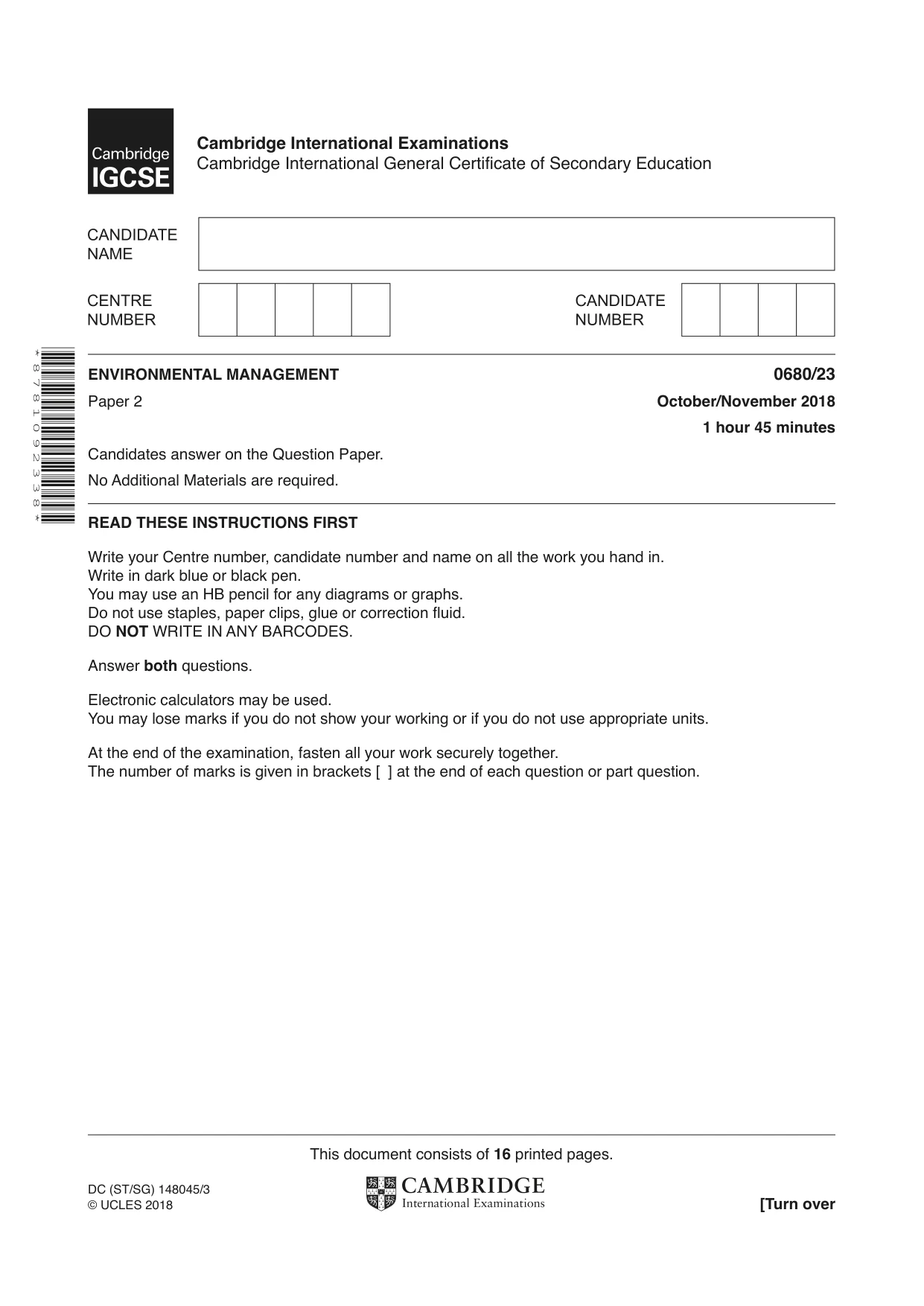
Question paper16 pages
Mark scheme13 pages
Answers below. Sit the paper first if you are practising.
Questions as text
Q1 · The table shows the percentage change in the world total production and percentage change…
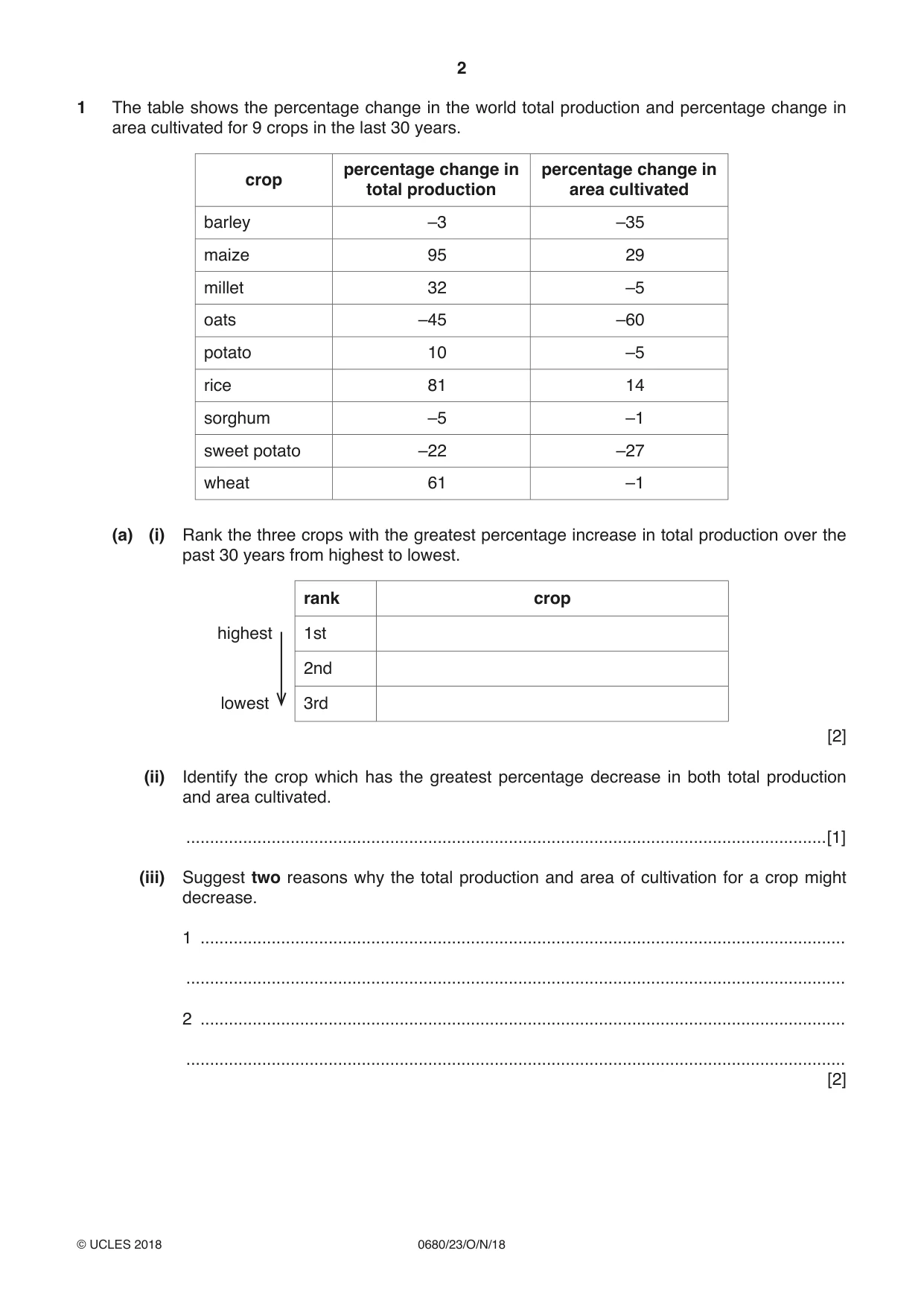
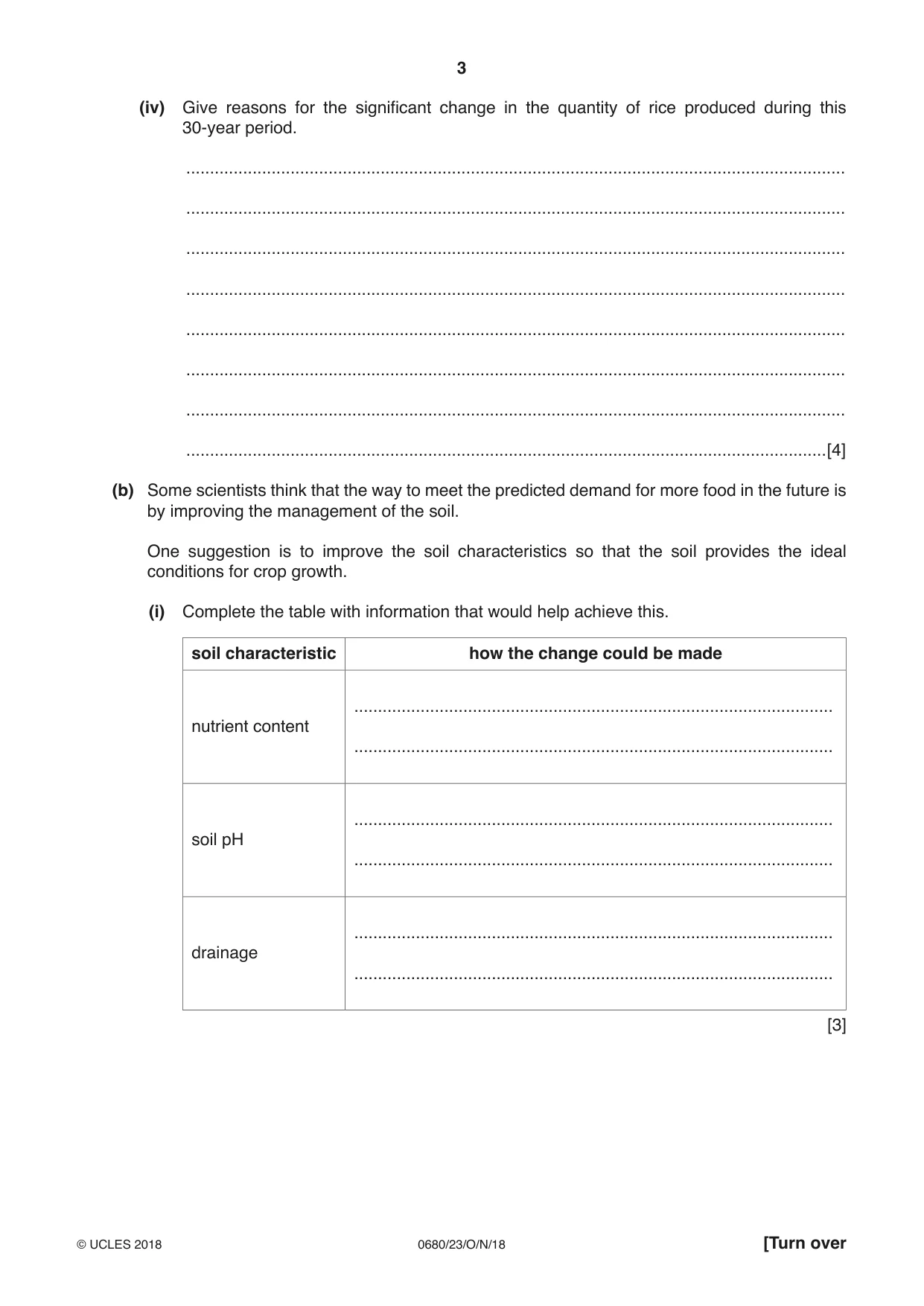
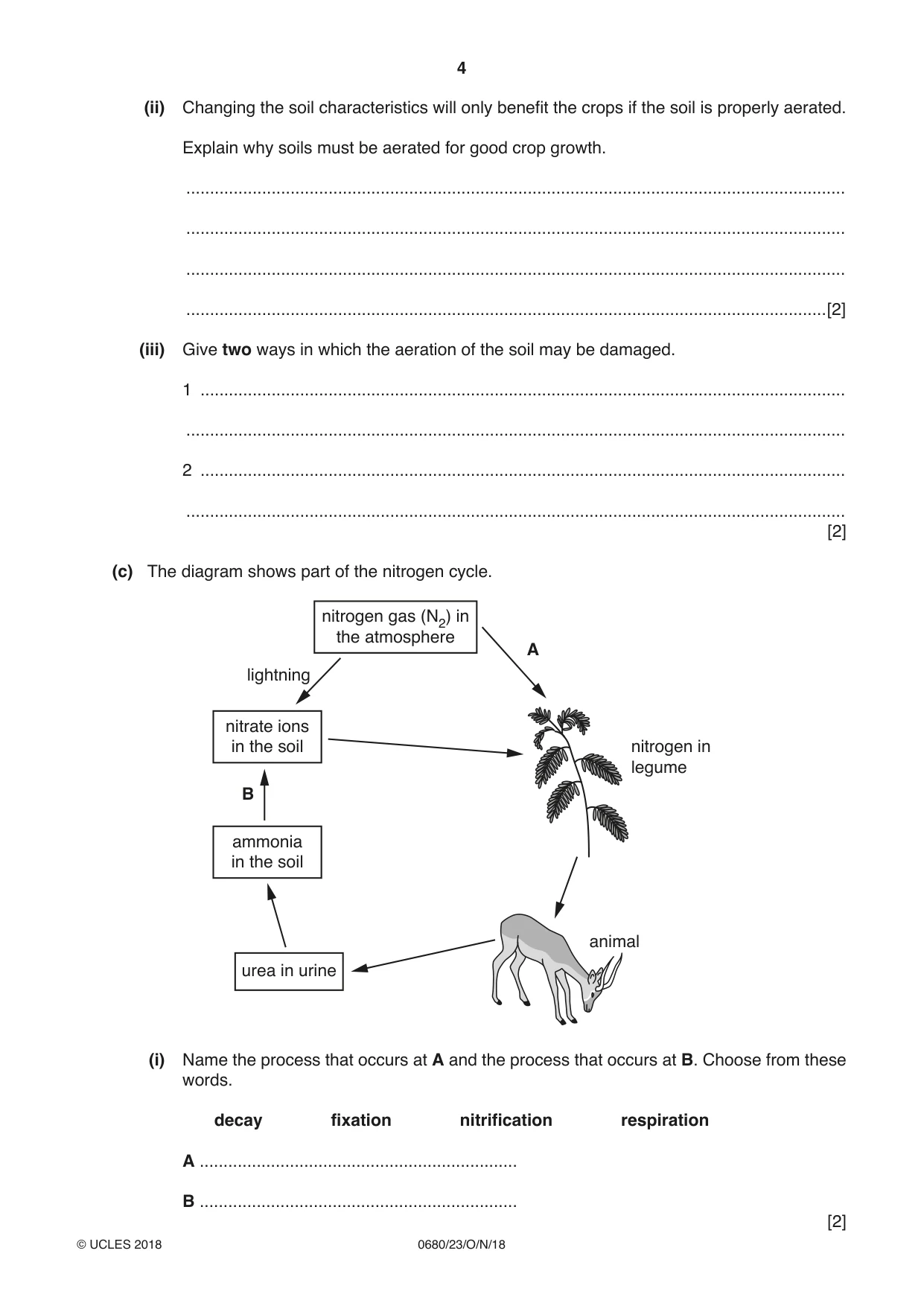
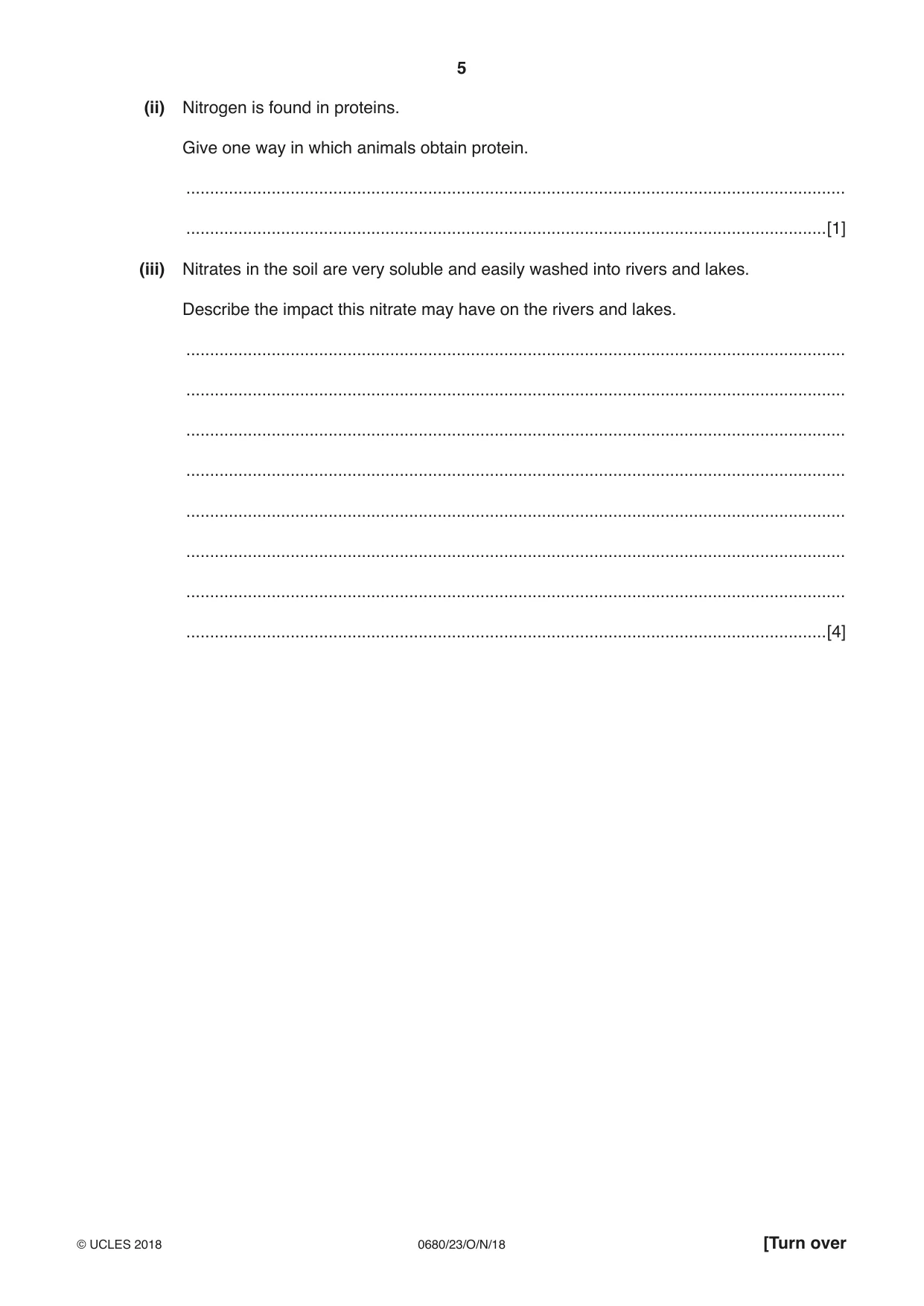
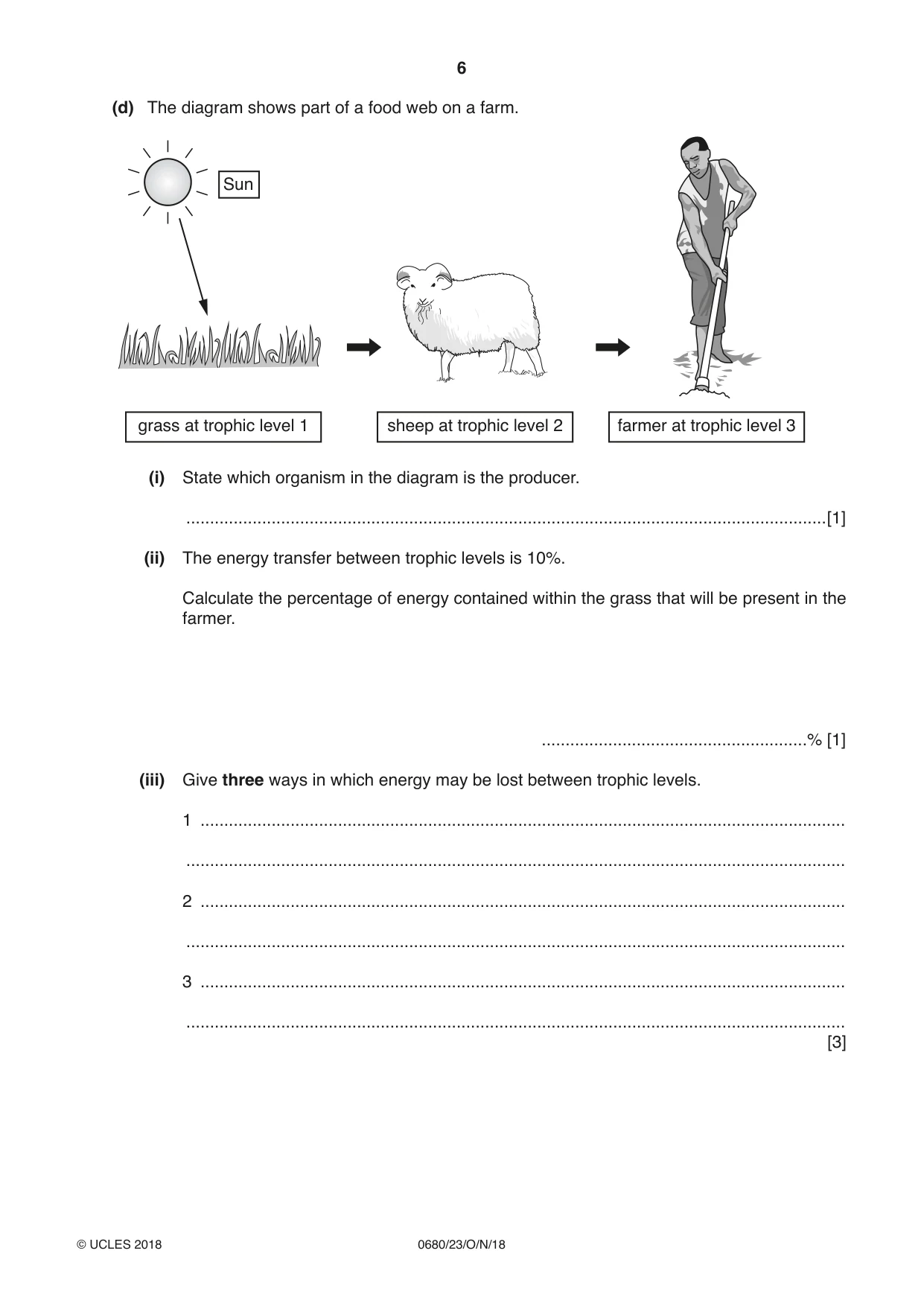
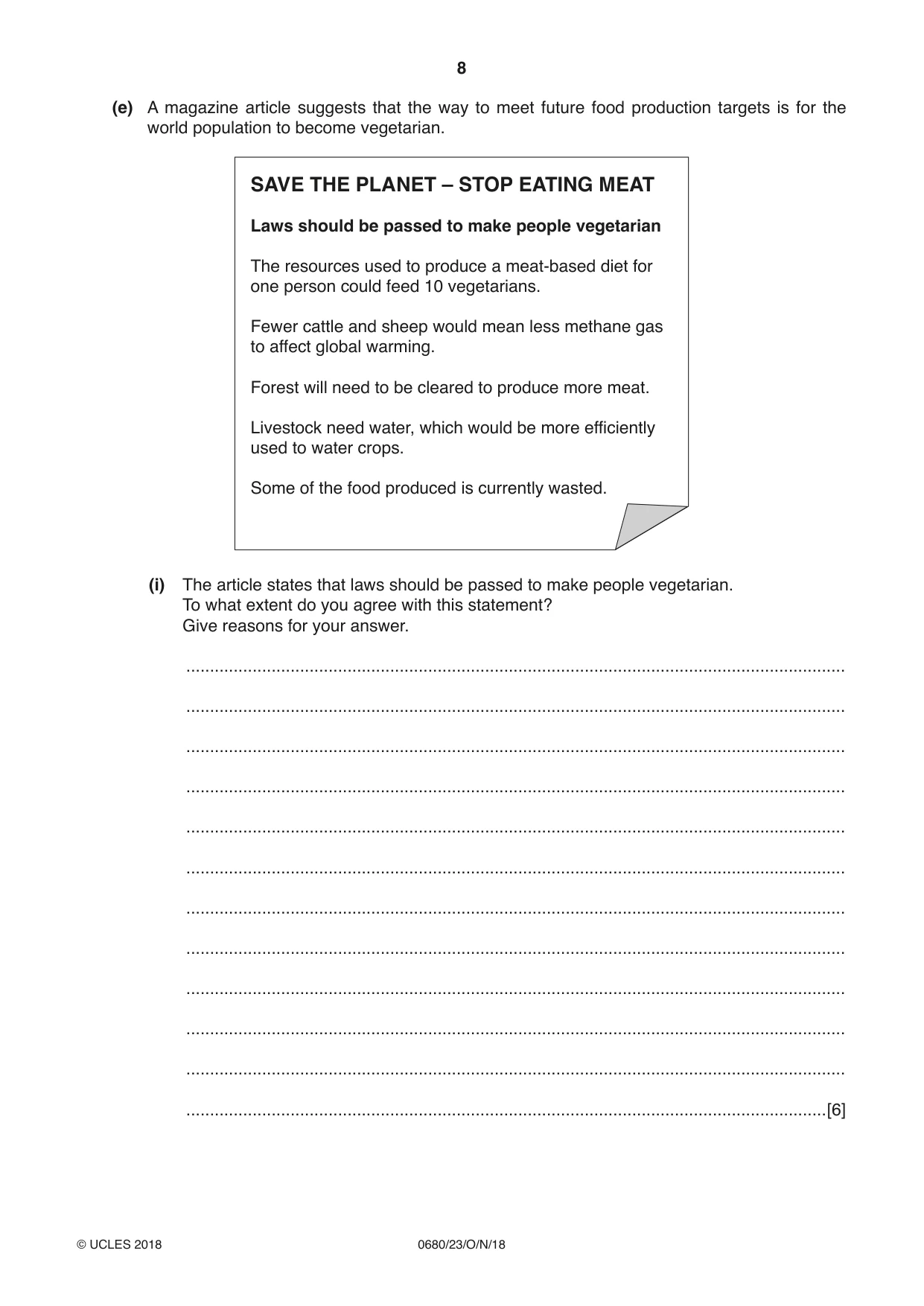
1 The table shows the percentage change in the world total production and percentage change in area cultivated for 9 crops in the last 30 years. percentage change in percentage change in crop total production area cultivated barley –3 –35 maize 95 29 millet 32 –5 oats –45 –60 potato 10 –5 rice 81 14 sorghum –5 –1 sweet potato –22 –27 wheat 61 –1 (a) (i) Rank the three crops with the greatest percentage increase in total production over the past 30 years from highest to lowest. rank crop highest 1st 2nd lowest 3rd [2] (ii) Identify the crop which has the greatest percentage decrease in both total production and area cultivated. .......................................................................................................................................[1] (iii) Suggest two reasons why the total production and area of cultivation for a crop might decrease. 1 ........................................................................................................................................ ........................................................................................................................................... 2 ........................................................................................................................................ ........................................................................................................................................... [2] (iv) Give reasons for the significant change in the quantity of rice produced during this 30-year period. ........................................................................................................................................... ........................................................................................................................................... ........................................................................................................................................... ........................................................................................................................................... ........................................................................................................................................... ........................................................................................................................................... ........................................................................................................................................... .......................................................................................................................................[4] (b) Some scientists think that the way to meet the predicted demand for more food in the future is by improving the management of the soil. One suggestion is to improve the soil characteristics so that the soil provides the ideal conditions for crop growth. (i) Complete the table with information that would help achieve this. soil characteristic how the change could be made ..................................................................................................... nutrient content ..................................................................................................... ..................................................................................................... soil pH ..................................................................................................... ..................................................................................................... drainage ..................................................................................................... [3] (ii) Changing the soil characteristics will only benefit the crops if the soil is properly aerated. Explain why soils must be aerated for good crop growth. ........................................................................................................................................... ........................................................................................................................................... ........................................................................................................................................... .......................................................................................................................................[2] (iii) Give two ways in which the aeration of the soil may be damaged. 1 ........................................................................................................................................ ........................................................................................................................................... 2 ........................................................................................................................................ ........................................................................................................................................... [2] (c) The diagram shows part of the nitrogen cycle. nitrogen gas (N2) in the atmosphere A lightning nitrate ions in the soil nitrogen in legume B ammonia in the soil animal urea in urine (i) Name the process that occurs at A and the process that occurs at B. Choose from these words. decay fixation nitrification respiration A ................................................................... B ................................................................... [2] (ii) Nitrogen is found in proteins. Give one way in which animals obtain protein. ........................................................................................................................................... .......................................................................................................................................[1] (iii) Nitrates in the soil are very soluble and easily washed into rivers and lakes. Describe the impact this nitrate may have on the rivers and lakes. ........................................................................................................................................... ........................................................................................................................................... ........................................................................................................................................... ........................................................................................................................................... ........................................................................................................................................... ........................................................................................................................................... ........................................................................................................................................... .......................................................................................................................................[4] (d) The diagram shows part of a food web on a farm. Sun grass at trophic level 1 sheep at trophic level 2 farmer at trophic level 3 (i) State which organism in the diagram is the producer. .......................................................................................................................................[1] (ii) The energy transfer between trophic levels is 10%. Calculate the percentage of energy contained within the grass that will be present in the farmer. ........................................................% [1] (iii) Give three ways in which energy may be lost between trophic levels. 1 ........................................................................................................................................ ........................................................................................................................................... 2 ........................................................................................................................................ ........................................................................................................................................... 3 ........................................................................................................................................ ........................................................................................................................................... [3] (iv) Describe the process used by plants to capture and store energy from the Sun. ........................................................................................................................................... ........................................................................................................................................... ........................................................................................................................................... ........................................................................................................................................... ........................................................................................................................................... .......................................................................................................................................[3] (e) A magazine article suggests that the way to meet future food production targets is for the world population to become vegetarian. SAVE THE PLANET – STOP EATING MEAT Laws should be passed to make people vegetarian The resources used to produce a meat-based diet for one person could feed 10 vegetarians. Fewer cattle and sheep would mean less methane gas to affect global warming. Forest will need to be cleared to produce more meat. Livestock need water, which would be more efficiently used to water crops. Some of the food produced is currently wasted. (i) The article states that laws should be passed to make people vegetarian. To what extent do you agree with this statement? Give reasons for your answer. ........................................................................................................................................... ........................................................................................................................................... ........................................................................................................................................... ........................................................................................................................................... ........................................................................................................................................... ........................................................................................................................................... ........................................................................................................................................... ........................................................................................................................................... ........................................................................................................................................... ........................................................................................................................................... ........................................................................................................................................... .......................................................................................................................................[6] (ii) Many people think that forests should not be cleared for food production. Suggest why some governments decide to allow forests to be cleared. ........................................................................................................................................... ........................................................................................................................................... ........................................................................................................................................... ........................................................................................................................................... ........................................................................................................................................... .......................................................................................................................................[3]
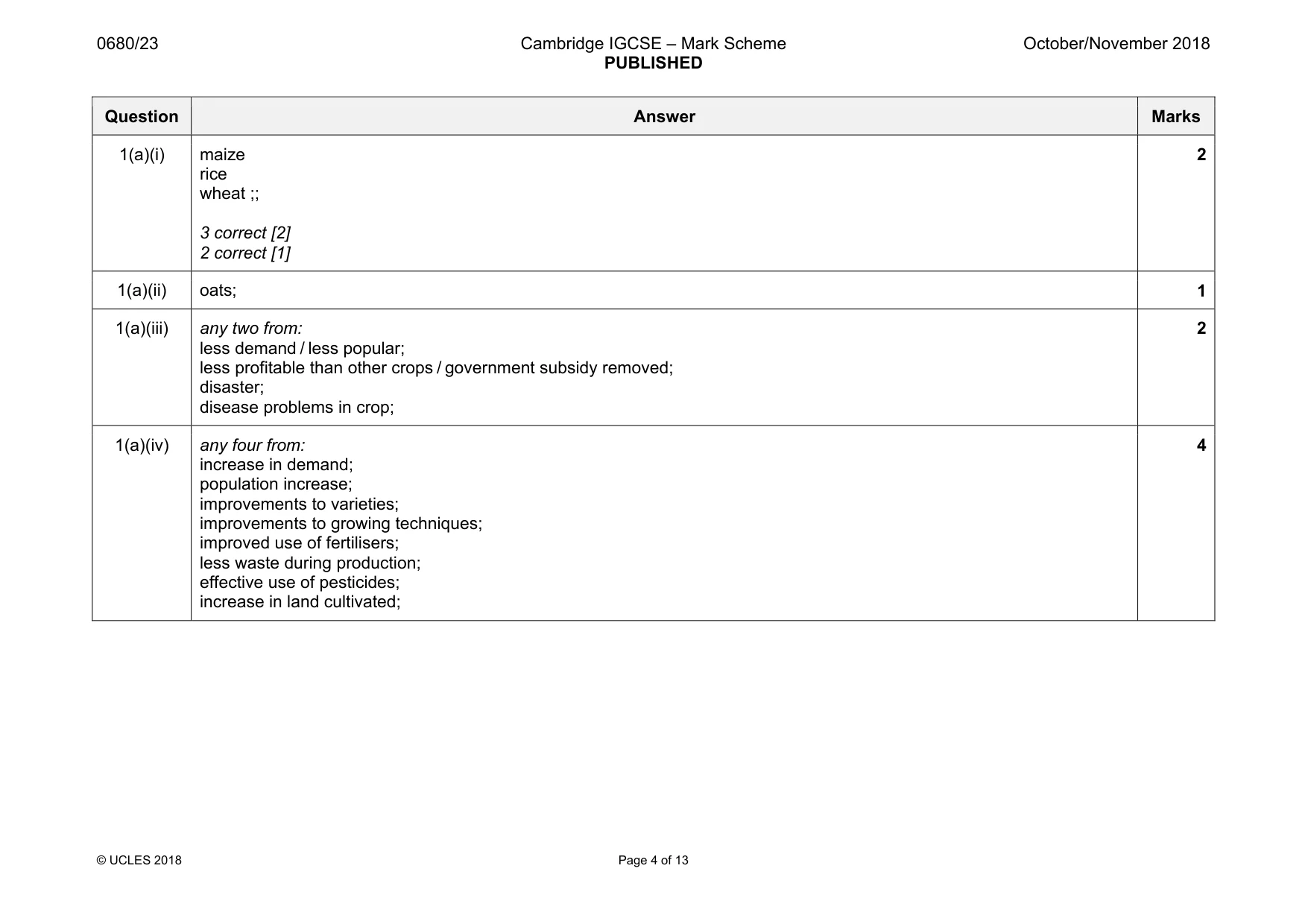
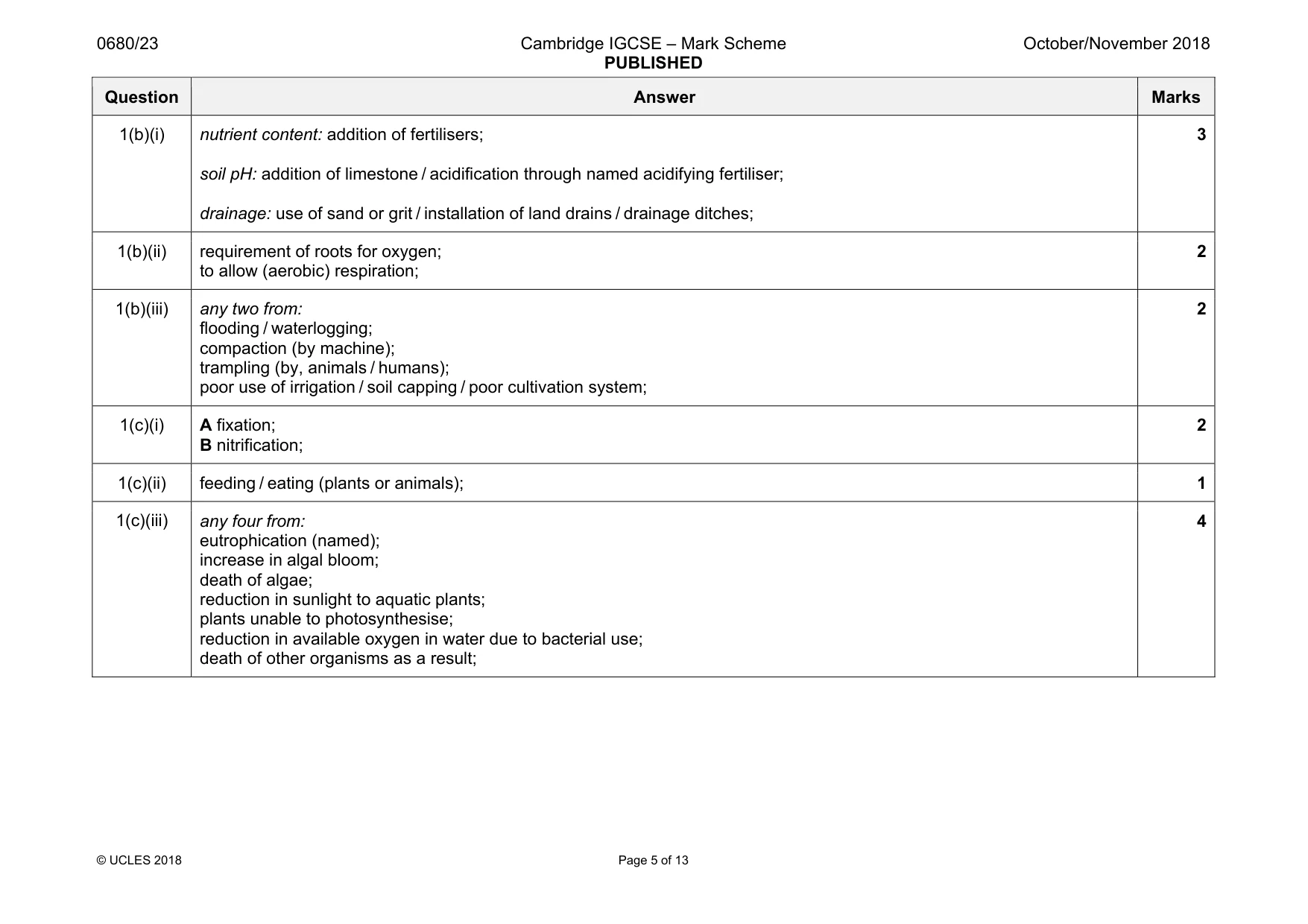
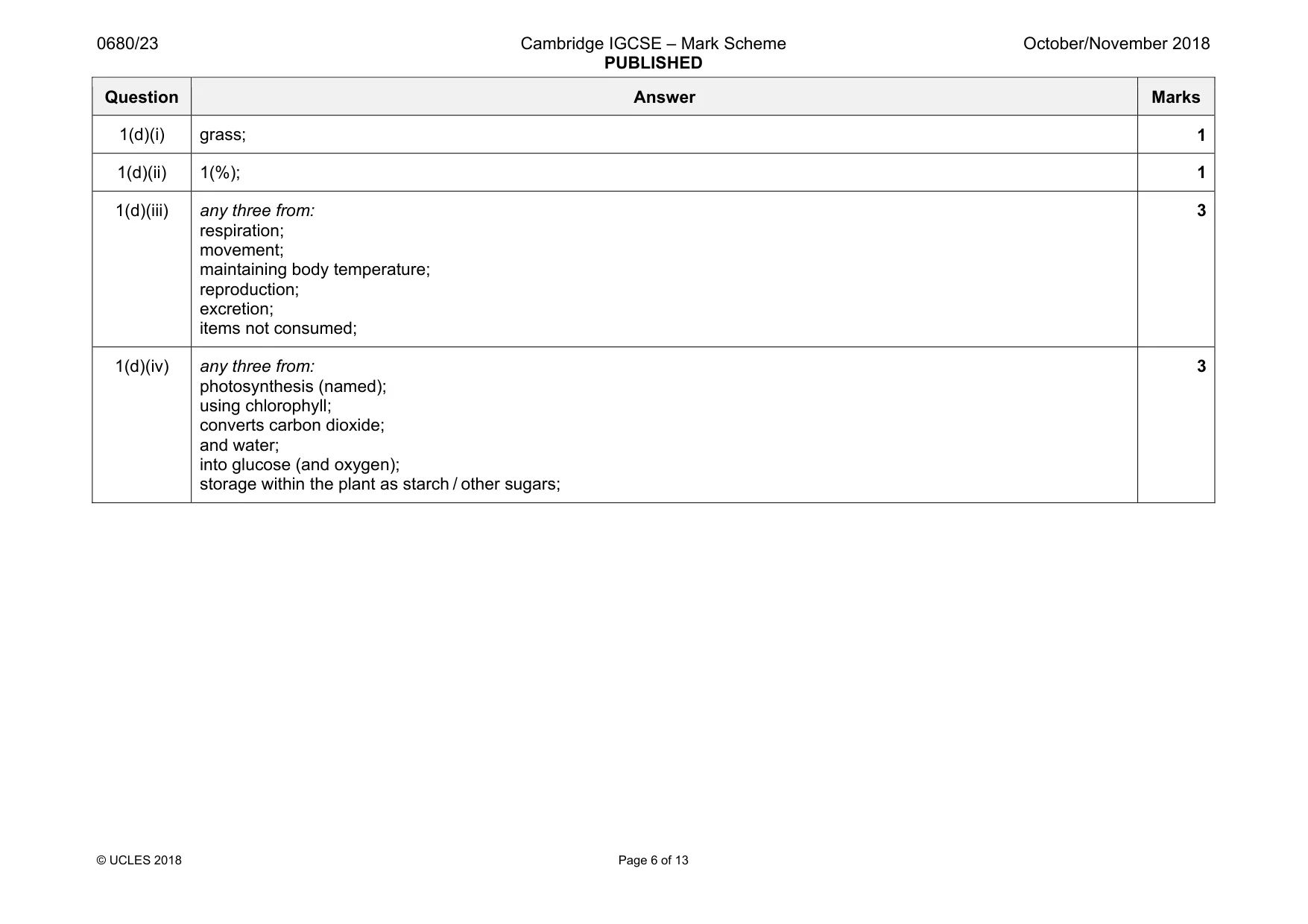
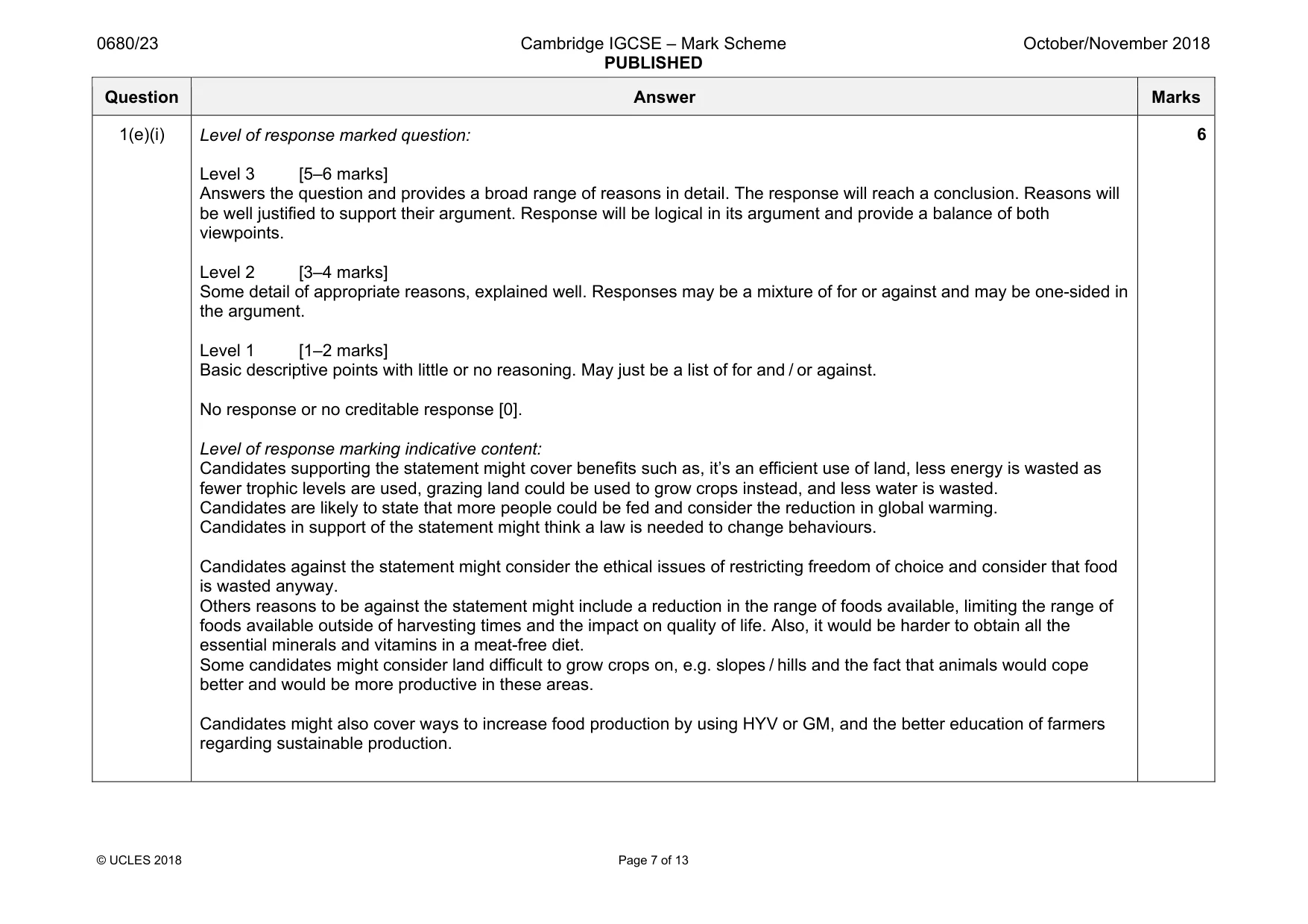
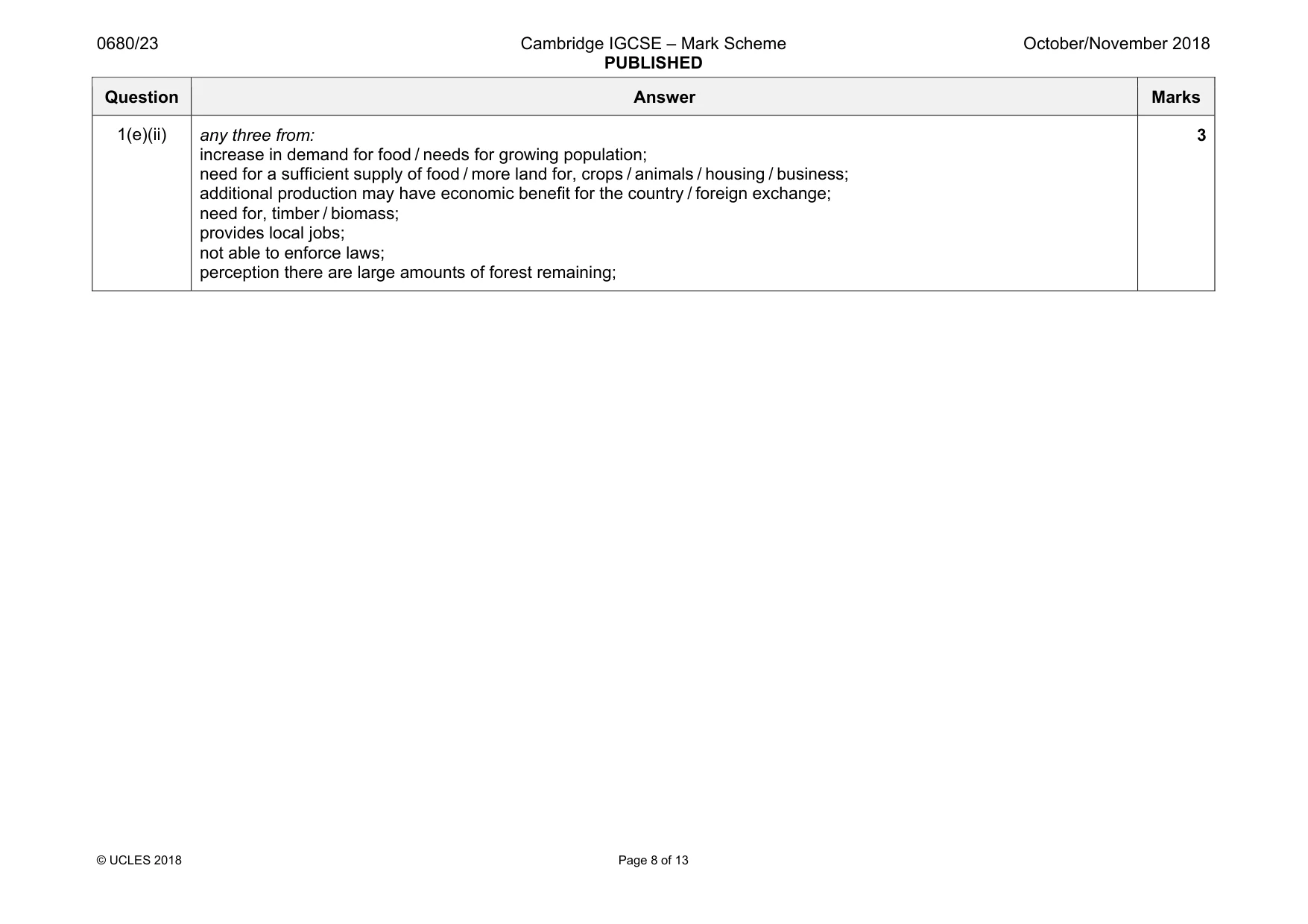
Mark scheme: 1(a)(i) maize rice wheat ;; 3 correct [2] 2 correct [1] 2 1(a)(ii) oats; 1 1(a)(iii) any two from: less demand / less popular; less profitable than other crops / government subsidy removed; disaster; disease problems in crop; 2 1(a)(iv) any four from: increase in demand; population increase; improvements to varieties; improvements to growing techniques; improved use of fertilisers; less waste during production; effective use of pesticides; increase in land cultivated; 4 Question Answer Marks 1(b)(i) nutrient content: addition of fertilisers; soil pH: addition of limestone / acidification through named acidifying fertiliser; drainage: use of sand or grit / installation of land drains / drainage ditches; 3 1(b)(ii) requirement of roots for oxygen; to allow (aerobic) respiration; 2 1(b)(iii) any two from: flooding / waterlogging; compaction (by machine); trampling (by, animals / humans); poor use of irrigation / soil capping / poor cultivation system; 2 1(c)(i) A fixation; B nitrification; 2 1(c)(ii) feeding / eating (plants or animals); 1 1(c)(iii) any four from: eutrophication (named); increase in algal bloom; death of algae; reduction in sunlight to aquatic plants; plants unable to photosynthesise; reduction in available oxygen in water due to bacterial use; death of other organisms as a result; 4 Question Answer Marks 1(d)(i) grass; 1 1(d)(ii) 1(%); 1 1(d)(iii) any three from: respiration; movement; maintaining body temperature; reproduction; excretion; items not consumed; 3 1(d)(iv) any three from: photosynthesis (named); using chlorophyll; converts carbon dioxide; and water; into glucose (and oxygen); storage within the plant as starch / other sugars; 3 Question Answer Marks 1(e)(i) Level of response marked question: Level 3 [5–6 marks] Answers the question and provides a broad range of reasons in detail. The response will reach a conclusion. Reasons will be well justified to support their argument. Response will be logical in its argument and provide a balance of both viewpoints. Level 2 [3–4 marks] Some detail of appropriate reasons, explained well. Responses may be a mixture of for or against and may be one-sided in the argument. Level 1 [1–2 marks] Basic descriptive points with little or no reasoning. May just be a list of for and / or against. No response or no creditable response [0]. Level of response marking indicative content: Candidates supporting the statement might cover benefits such as, it’s an efficient use of land, less energy is wasted as fewer trophic levels are used, grazing land could be used to grow crops instead, and less water is wasted. Candidates are likely to state that more people could be fed and consider the reduction in global warming. Candidates in support of the statement might think a law is needed to change behaviours. Candidates against the statement might consider the ethical issues of restricting freedom of choice and consider that food is wasted anyway. Others reasons to be against the statement might include a reduction in the range of foods available, limiting the range of foods available outside of harvesting times and the impact on quality of life. Also, it would be harder to obtain all the essential minerals and vitamins in a meat-free diet. Some candidates might consider land difficult to grow crops on, e.g. slopes / hills and the fact that animals would cope better and would be more productive in these areas. Candidates might also cover ways to increase food production by using HYV or GM, and the better education of farmers regarding sustainable production. 6 Question Answer Marks 1(e)(ii) any three from: increase in demand for food / needs for growing population; need for a sufficient supply of food / more land for, crops / animals / housing / business; additional production may have economic benefit for the country / foreign exchange; need for, timber / biomass; provides local jobs; not able to enforce laws; perception there are large amounts of forest remaining; 3
Q2 · Minerals and fossil fuels are non-renewable resources
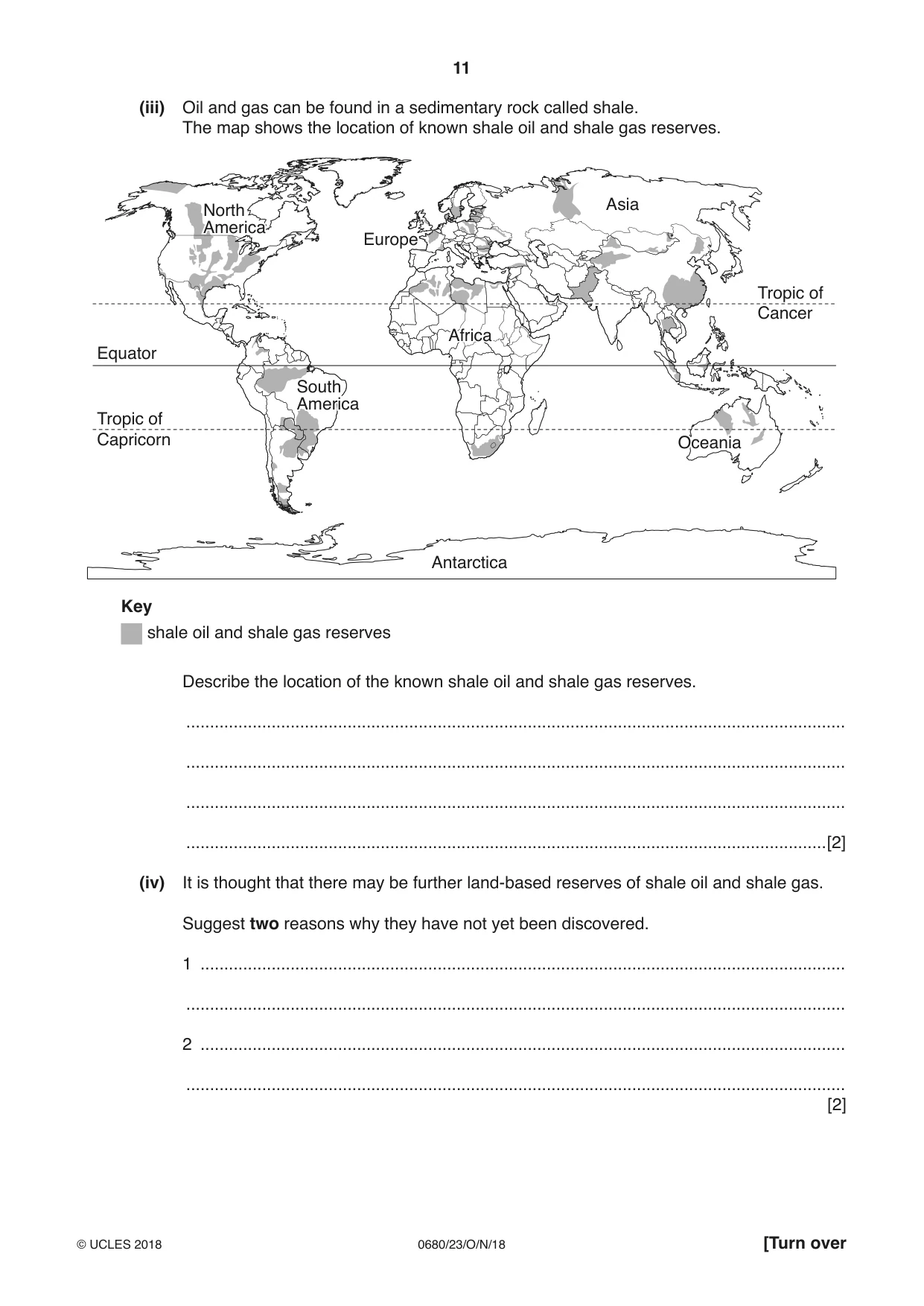
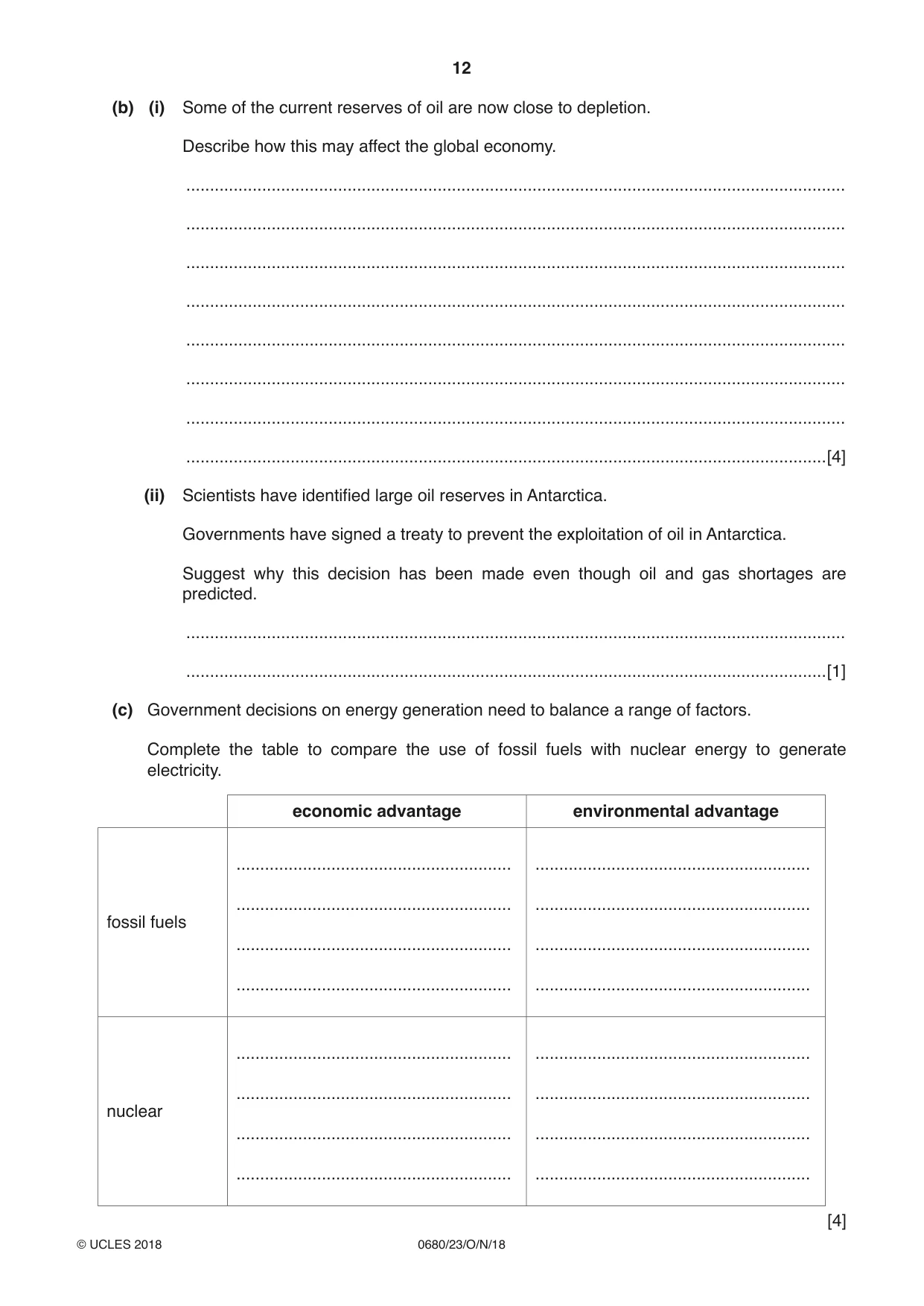
2 Minerals and fossil fuels are non-renewable resources. (a) (i) State two economic advantages of mineral extraction to a local community. 1 ........................................................................................................................................ ........................................................................................................................................... 2 ........................................................................................................................................ ........................................................................................................................................... [2] (ii) Suggest three reasons why mining might stop in a location. 1 ........................................................................................................................................ ........................................................................................................................................... 2 ........................................................................................................................................ ........................................................................................................................................... 3 ........................................................................................................................................ ........................................................................................................................................... [3] (iii) Oil and gas can be found in a sedimentary rock called shale. The map shows the location of known shale oil and shale gas reserves. Asia NorthNorth AmericaAmerica Europe Tropic of Cancer AfricaAfrica Equator SouthSouth AmericaAmerica Tropic of Capricorn OceaniaOceania Antarctica Key shale oil and shale gas reserves Describe the location of the known shale oil and shale gas reserves. ........................................................................................................................................... ........................................................................................................................................... ........................................................................................................................................... .......................................................................................................................................[2] (iv) It is thought that there may be further land-based reserves of shale oil and shale gas. Suggest two reasons why they have not yet been discovered. 1 ........................................................................................................................................ ........................................................................................................................................... 2 ........................................................................................................................................ ........................................................................................................................................... [2] (b) (i) Some of the current reserves of oil are now close to depletion. Describe how this may affect the global economy. ........................................................................................................................................... ........................................................................................................................................... ........................................................................................................................................... ........................................................................................................................................... ........................................................................................................................................... ........................................................................................................................................... ........................................................................................................................................... .......................................................................................................................................[4] (ii) Scientists have identified large oil reserves in Antarctica. Governments have signed a treaty to prevent the exploitation of oil in Antarctica. Suggest why this decision has been made even though oil and gas shortages are predicted. ........................................................................................................................................... .......................................................................................................................................[1] (c) Government decisions on energy generation need to balance a range of factors. Complete the table to compare the use of fossil fuels with nuclear energy to generate electricity. economic advantage environmental advantage .......................................................... .......................................................... .......................................................... .......................................................... fossil fuels .......................................................... .......................................................... .......................................................... .......................................................... .......................................................... .......................................................... .......................................................... .......................................................... nuclear .......................................................... .......................................................... .......................................................... ..........................................................
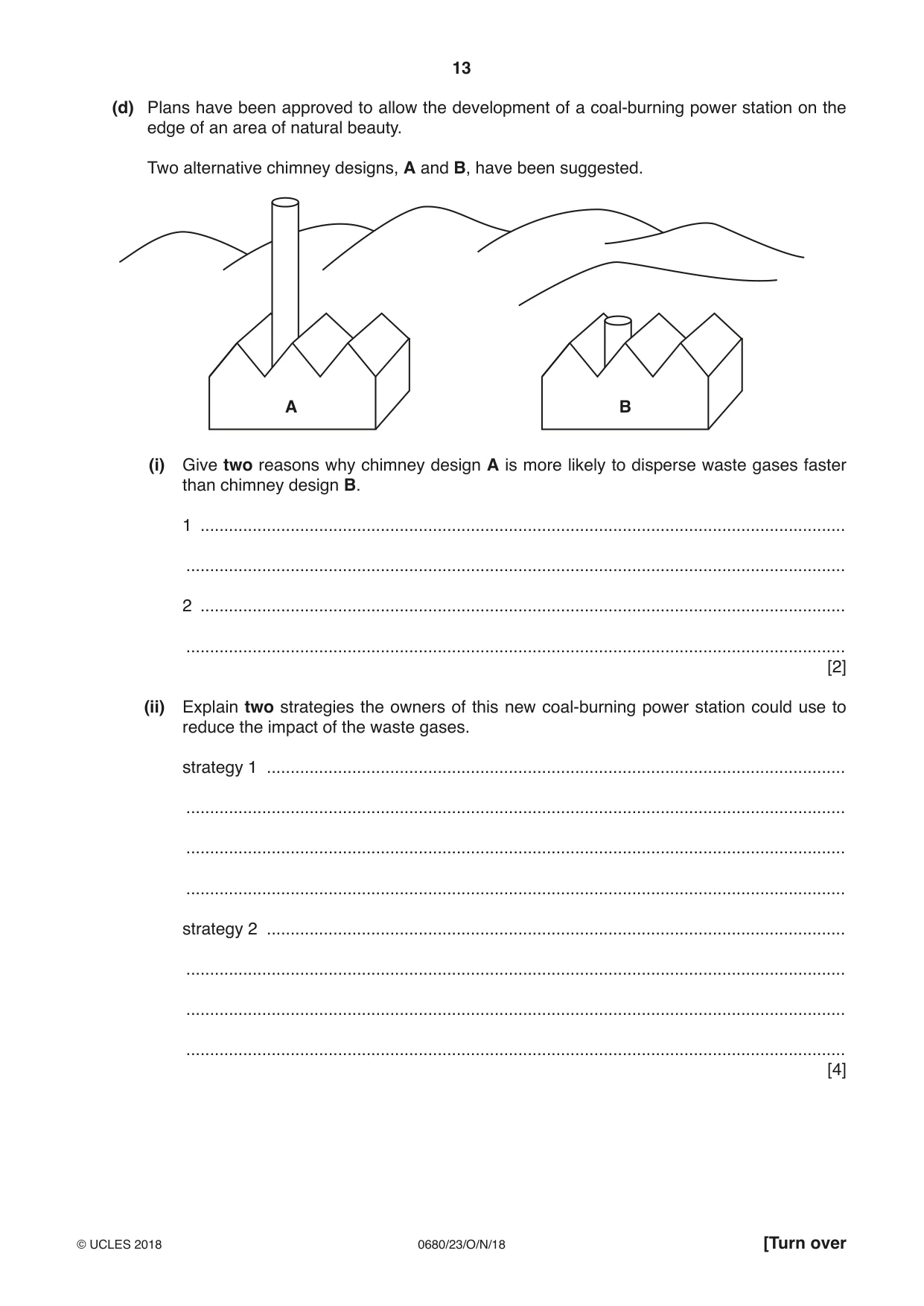
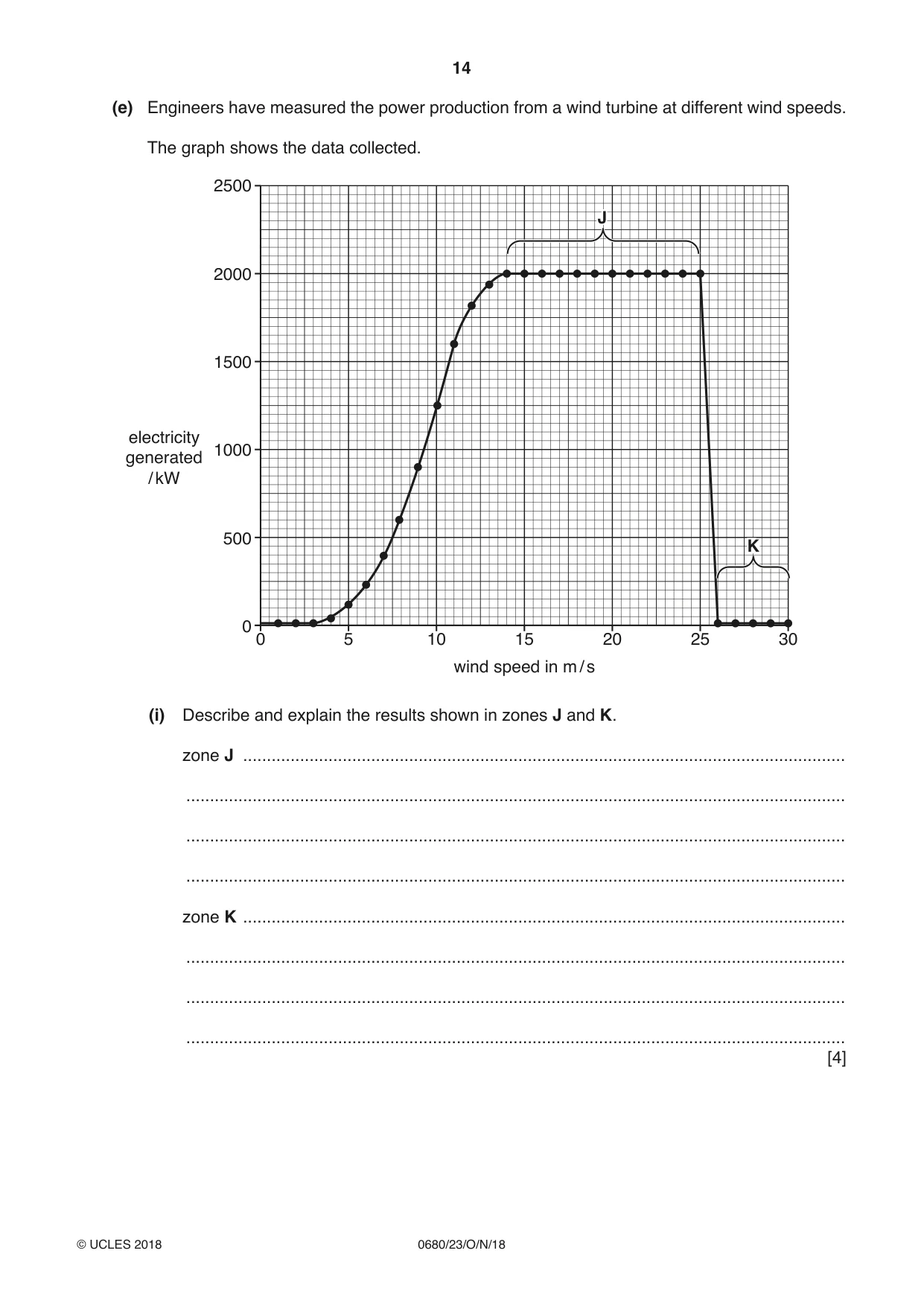
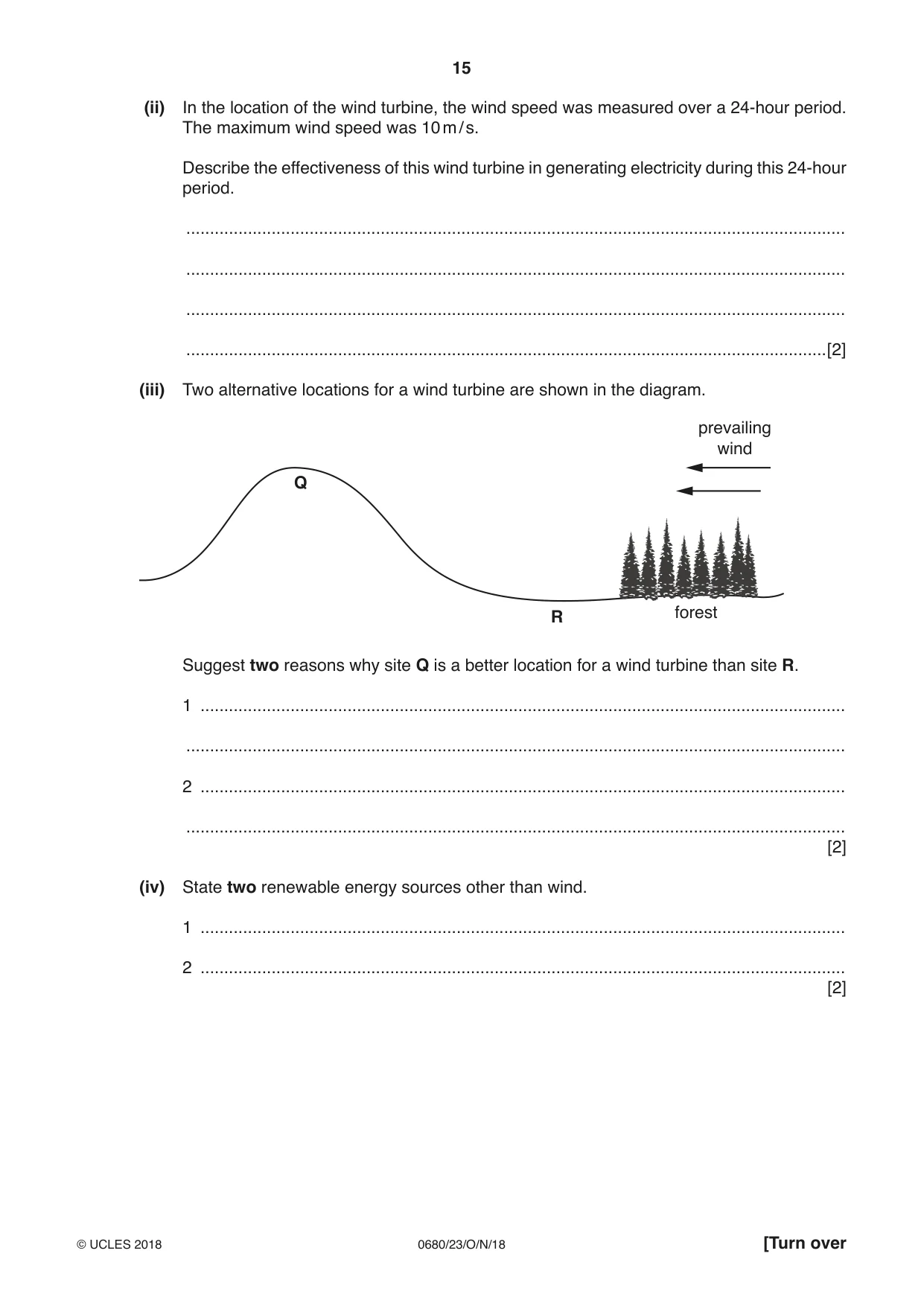
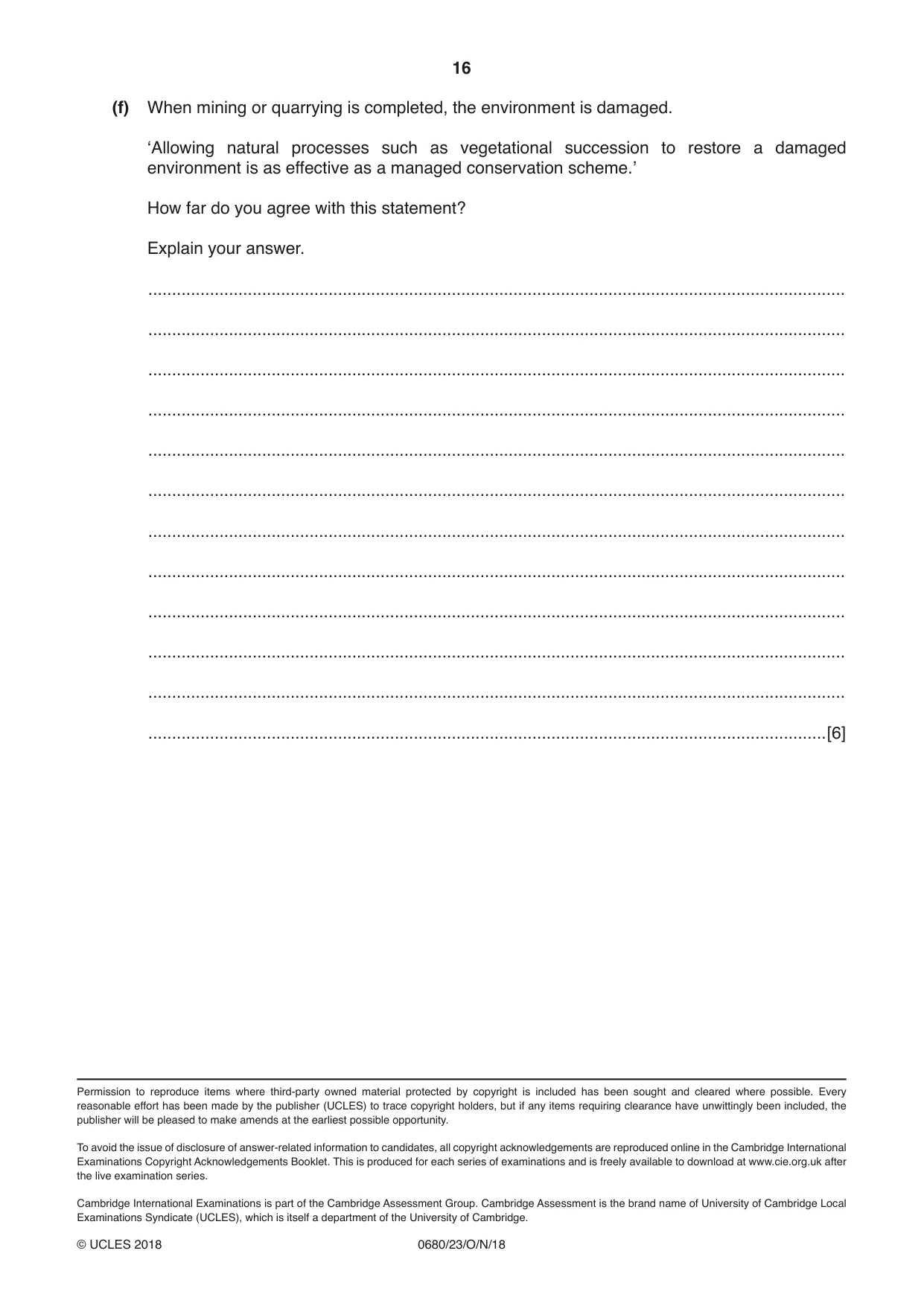
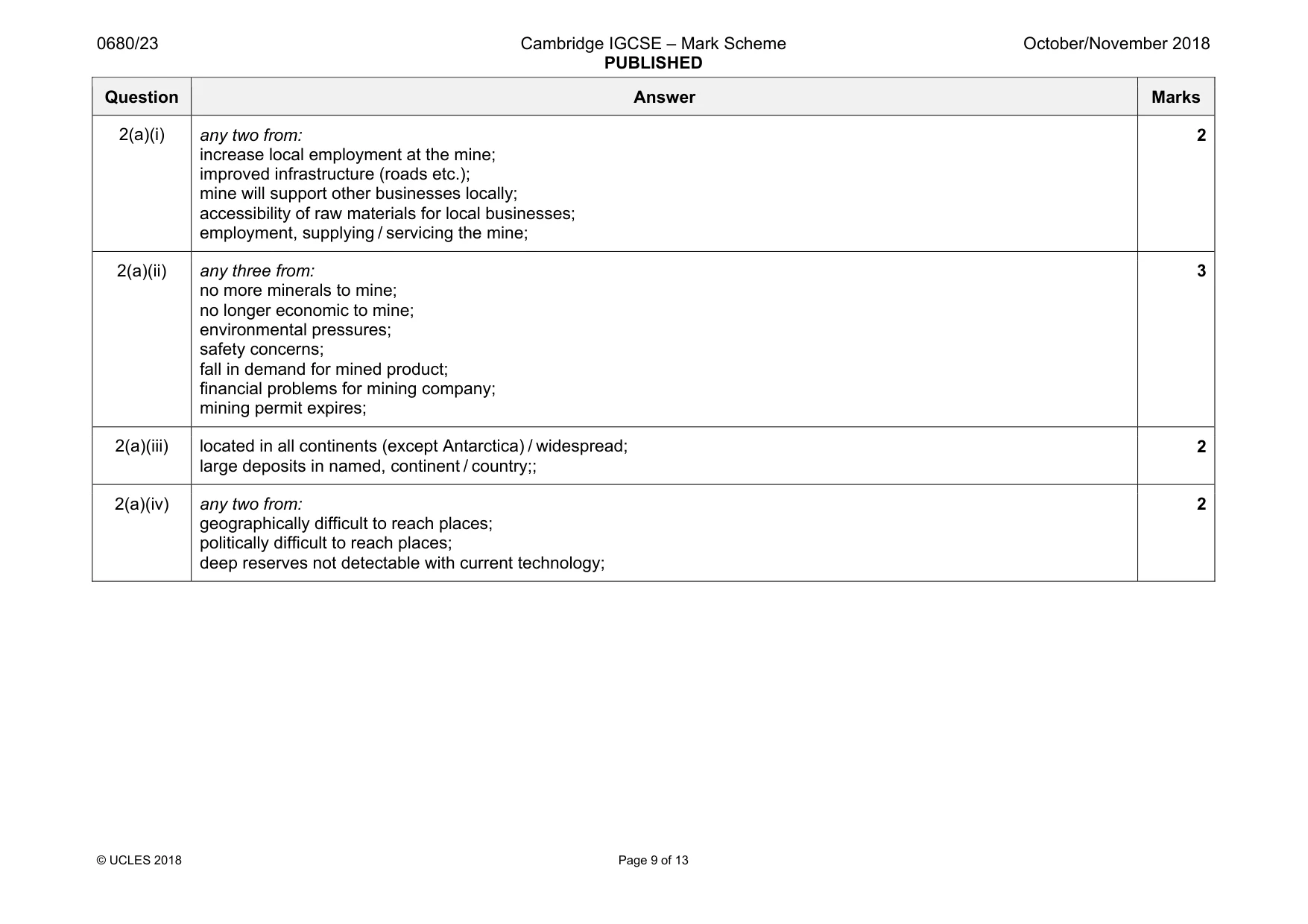
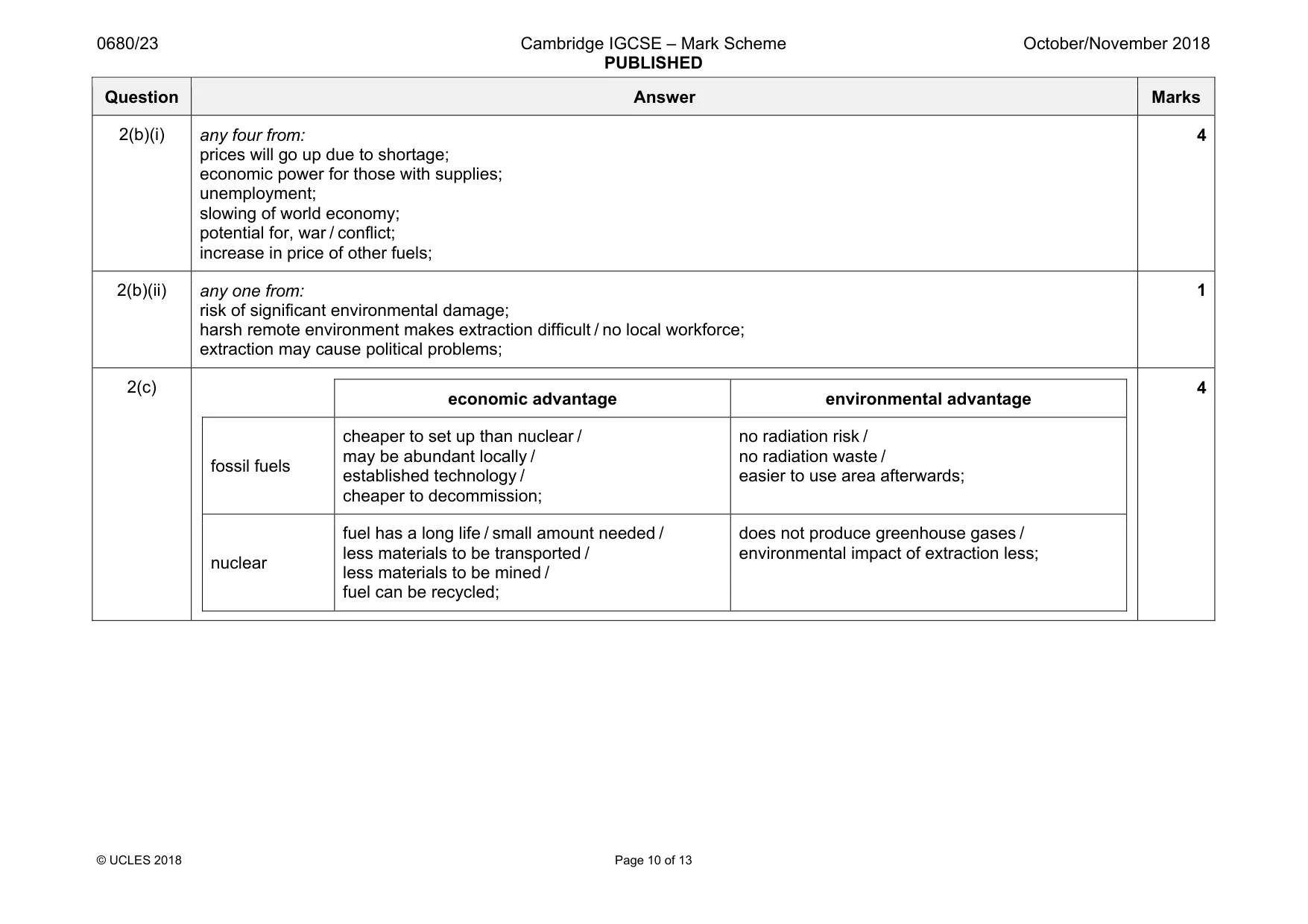
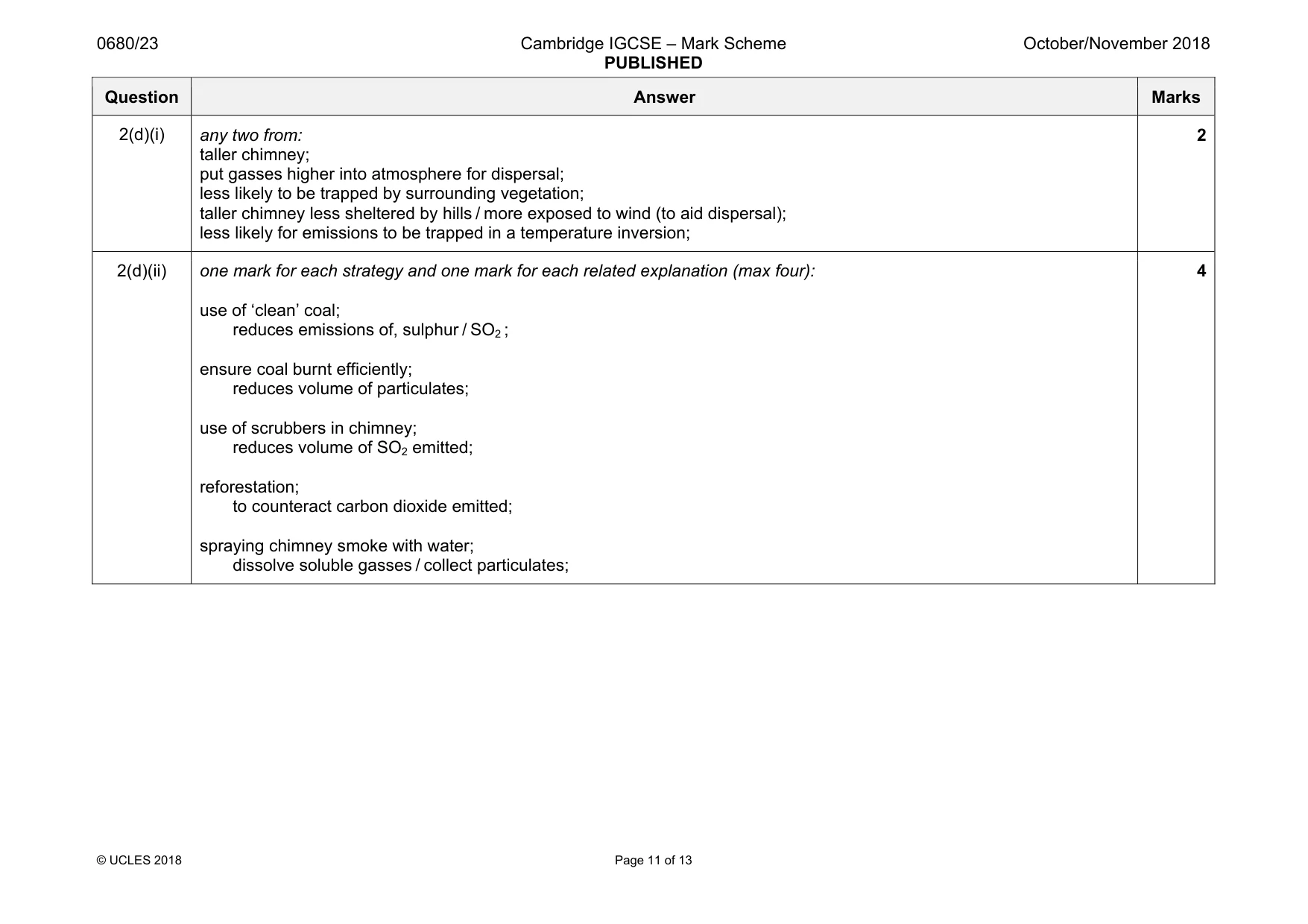
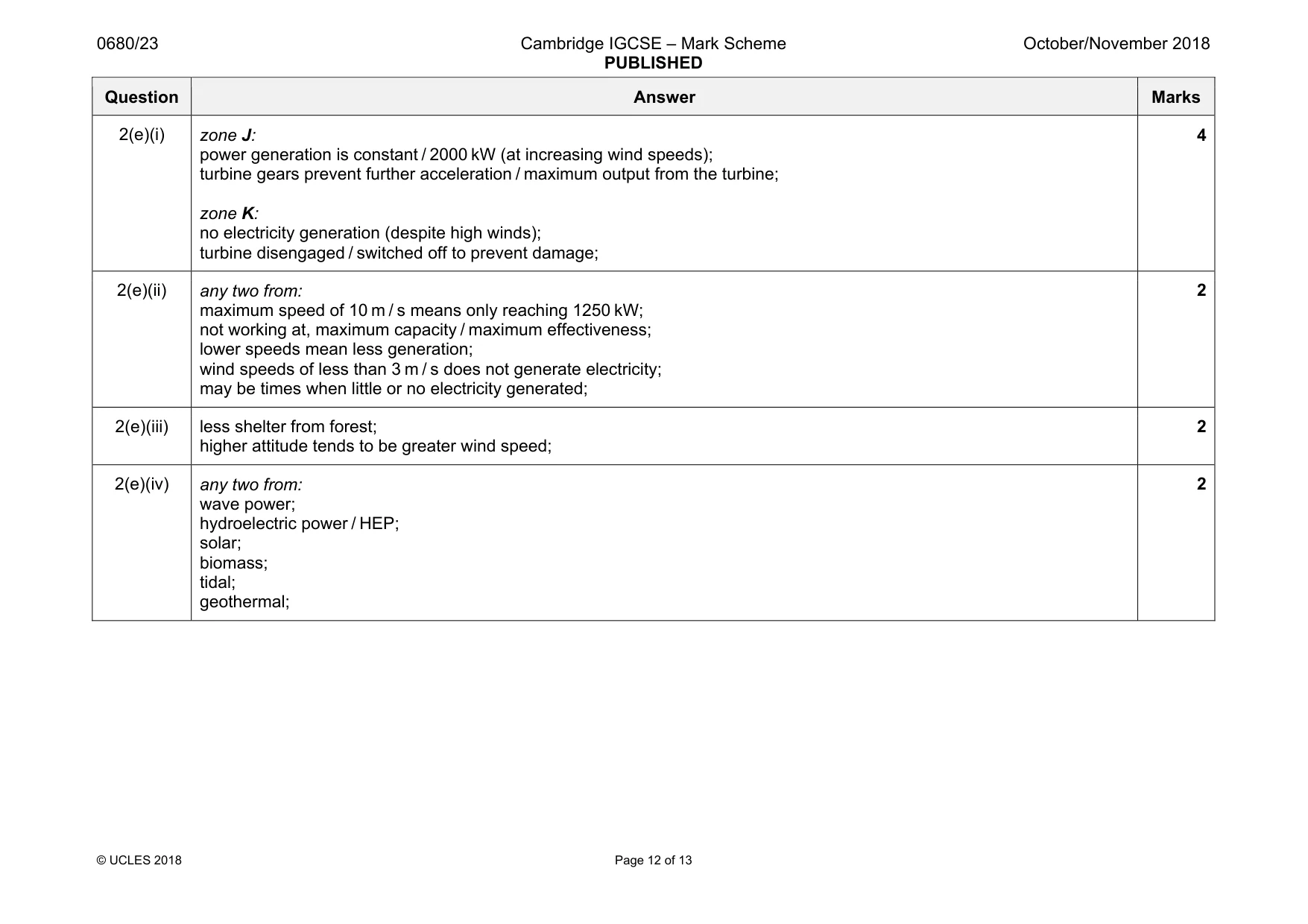
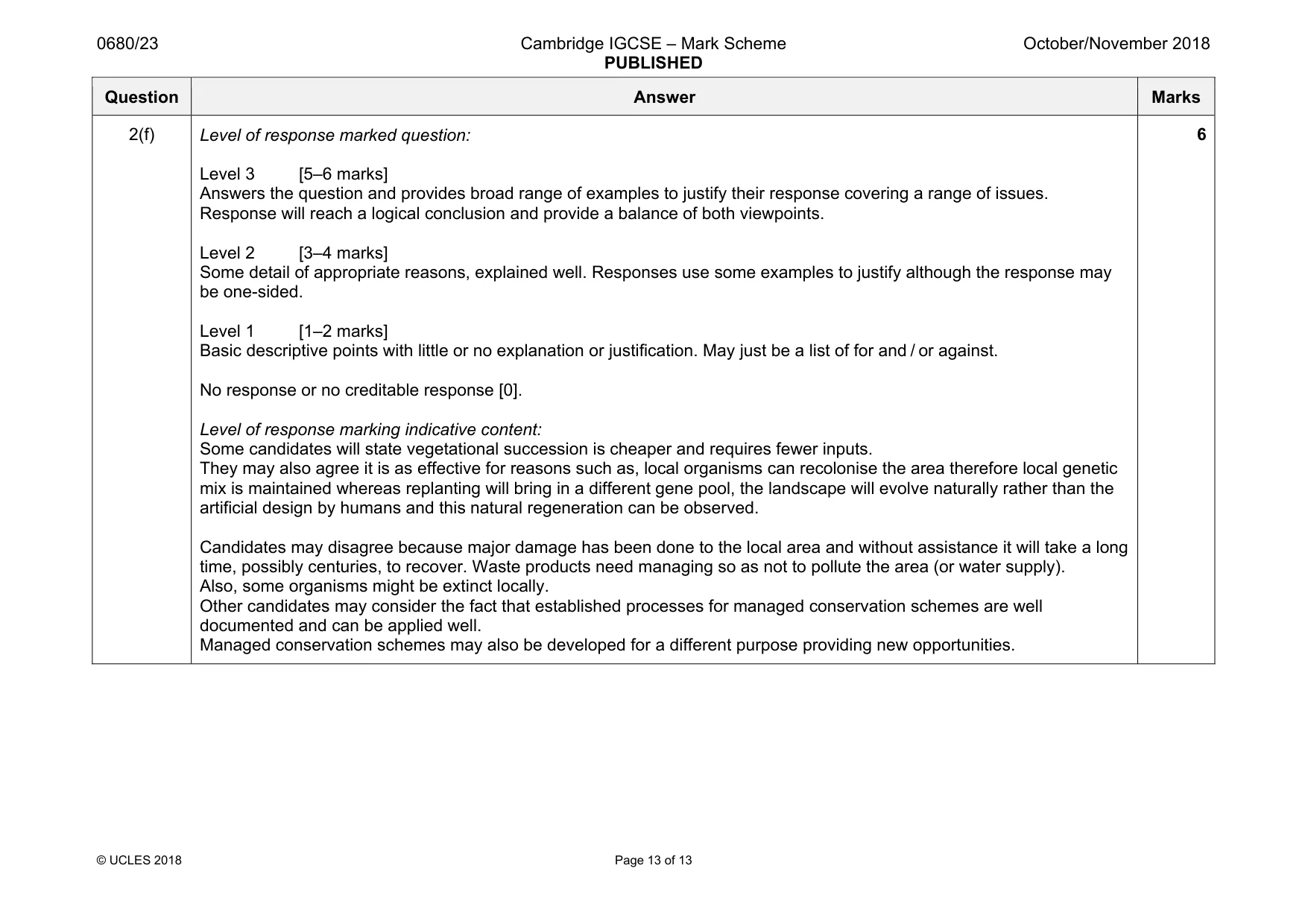
Mark scheme: 2(a)(i) any two from: increase local employment at the mine; improved infrastructure (roads etc.); mine will support other businesses locally; accessibility of raw materials for local businesses; employment, supplying / servicing the mine; 2 2(a)(ii) any three from: no more minerals to mine; no longer economic to mine; environmental pressures; safety concerns; fall in demand for mined product; financial problems for mining company; mining permit expires; 3 2(a)(iii) located in all continents (except Antarctica) / widespread; large deposits in named, continent / country;; 2 2(a)(iv) any two from: geographically difficult to reach places; politically difficult to reach places; deep reserves not detectable with current technology; 2 Question Answer Marks 2(b)(i) any four from: prices will go up due to shortage; economic power for those with supplies; unemployment; slowing of world economy; potential for, war / conflict; increase in price of other fuels; 4 2(b)(ii) any one from: risk of significant environmental damage; harsh remote environment makes extraction difficult / no local workforce; extraction may cause political problems; 1 2(c) economic advantage environmental advantage fossil fuels cheaper to set up than nuclear / may be abundant locally / established technology / cheaper to decommission; no radiation risk / no radiation waste / easier to use area afterwards; nuclear fuel has a long life / small amount needed / less materials to be transported / less materials to be mined / fuel can be recycled; does not produce greenhouse gases / environmental impact of extraction less; 4 Question Answer Marks 2(d)(i) any two from: taller chimney; put gasses higher into atmosphere for dispersal; less likely to be trapped by surrounding vegetation; taller chimney less sheltered by hills / more exposed to wind (to aid dispersal); less likely for emissions to be trapped in a temperature inversion; 2 2(d)(ii) one mark for each strategy and one mark for each related explanation (max four): use of ‘clean’ coal; reduces emissions of, sulphur / SO2 ; ensure coal burnt efficiently; reduces volume of particulates; use of scrubbers in chimney; reduces volume of SO2 emitted; reforestation; to counteract carbon dioxide emitted; spraying chimney smoke with water; dissolve soluble gasses / collect particulates; 4 Question Answer Marks 2(e)(i) zone J: power generation is constant / 2000 kW (at increasing wind speeds); turbine gears prevent further acceleration / maximum output from the turbine; zone K: no electricity generation (despite high winds); turbine disengaged / switched off to prevent damage; 4 2(e)(ii) any two from: maximum speed of 10 m / s means only reaching 1250 kW; not working at, maximum capacity / maximum effectiveness; lower speeds mean less generation; wind speeds of less than 3 m / s does not generate electricity; may be times when little or no electricity generated; 2 2(e)(iii) less shelter from forest; higher attitude tends to be greater wind speed; 2 2(e)(iv) any two from: wave power; hydroelectric power / HEP; solar; biomass; tidal; geothermal; 2 Question Answer Marks 2(f) Level of response marked question: Level 3 [5–6 marks] Answers the question and provides broad range of examples to justify their response covering a range of issues. Response will reach a logical conclusion and provide a balance of both viewpoints. Level 2 [3–4 marks] Some detail of appropriate reasons, explained well. Responses use some examples to justify although the response may be one-sided. Level 1 [1–2 marks] Basic descriptive points with little or no explanation or justification. May just be a list of for and / or against. No response or no creditable response [0]. Level of response marking indicative content: Some candidates will state vegetational succession is cheaper and requires fewer inputs. They may also agree it is as effective for reasons such as, local organisms can recolonise the area therefore local genetic mix is maintained whereas replanting will bring in a different gene pool, the landscape will evolve naturally rather than the artificial design by humans and this natural regeneration can be observed. Candidates may disagree because major damage has been done to the local area and without assistance it will take a long time, possibly centuries, to recover. Waste products need managing so as not to pollute the area (or water supply). Also, some organisms might be extinct locally. Other candidates may consider the fact that established processes for managed conservation schemes are well documented and can be applied well. Managed conservation schemes may also be developed for a different purpose providing new opportunities. 6
What was in this paper
The subtopics covered by these 2 questions, and how many questions each got. Open one in a new tab to see every Cambridge question on it.
What you needed in this session
Cambridge’s own grade thresholds for 2018 Oct/Nov, Paper 2 · Variant 3. A higher threshold means an easier paper — the bar moves with how the cohort did.