Cambridge IGCSE Environmental Management 0680 — 2016 May/June Paper 2 · Variant 2
0680/22/M/J/16 · 80 marks · ≈90 min
The question paper and its mark scheme, free to read here and free to download. This is Cambridge’s own paper, exactly as it was sat.
Question paper16 pages
Mark scheme8 pages
Answers below. Sit the paper first if you are practising.
Paper as text
Question paper, page 1
This document consists of 15 printed pages and 1 blank page. DC (RW/JG) 112798/4 © UCLES 2016 [Turn over Cambridge International Examinations Cambridge International General Certificate of Secondary Education * 3 6 4 0 5 8 9 1 7 7 * ENVIRONMENTAL MANAGEMENT 0680/22 Paper 2 May/June 2016 1 hour 45 minutes Candidates answer on the Question Paper. No Additional Materials are required. READ THESE INSTRUCTIONS FIRST Write your Centre number, candidate number and name on all the work you hand in. Write in dark blue or black pen. You may use an HB pencil for any diagrams or graphs. Do not use staples, paper clips, glue or correction fluid. DO NOT WRITE IN ANY BARCODES. Answer both questions. Electronic calculators may be used. You may lose marks if you do not show your working or if you do not use appropriate units. At the end of the examination, fasten all your work securely together. The number of marks is given in brackets [ ] at the end of each question or part question.
Question paper, page 2
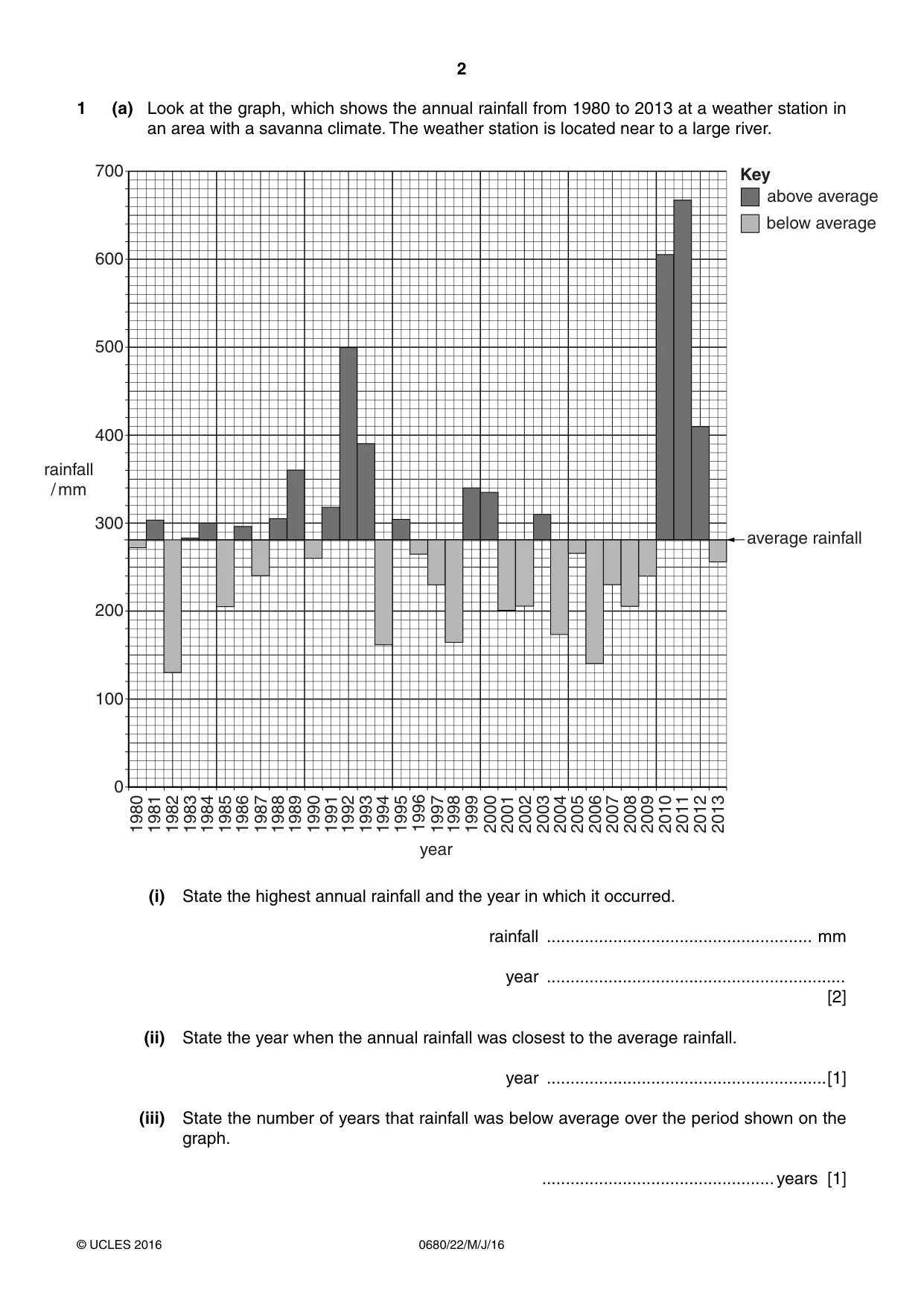
2 0680/22/M/J/16 © UCLES 2016 1 (a) Look at the graph, which shows the annual rainfall from 1980 to 2013 at a weather station in an area with a savanna climate. The weather station is located near to a large river. 100 0 1980 1981 1982 1983 1984 1985 1986 1987 1988 1989 1990 1991 1992 1993 1994 1995 1996 1997 1998 1999 2000 2001 2002 2003 2004 2005 2006 2007 2008 2009 2010 2011 2012 2013 200 300 400 500 600 700 Key year rainfall / mm below average above average average rainfall (i) State the highest annual rainfall and the year in which it occurred. rainfall … mm year … [2] (ii) State the year when the annual rainfall was closest to the average rainfall. year …[1] (iii) State the number of years that rainfall was below average over the period shown on the graph. … years [1]
Question paper, page 3
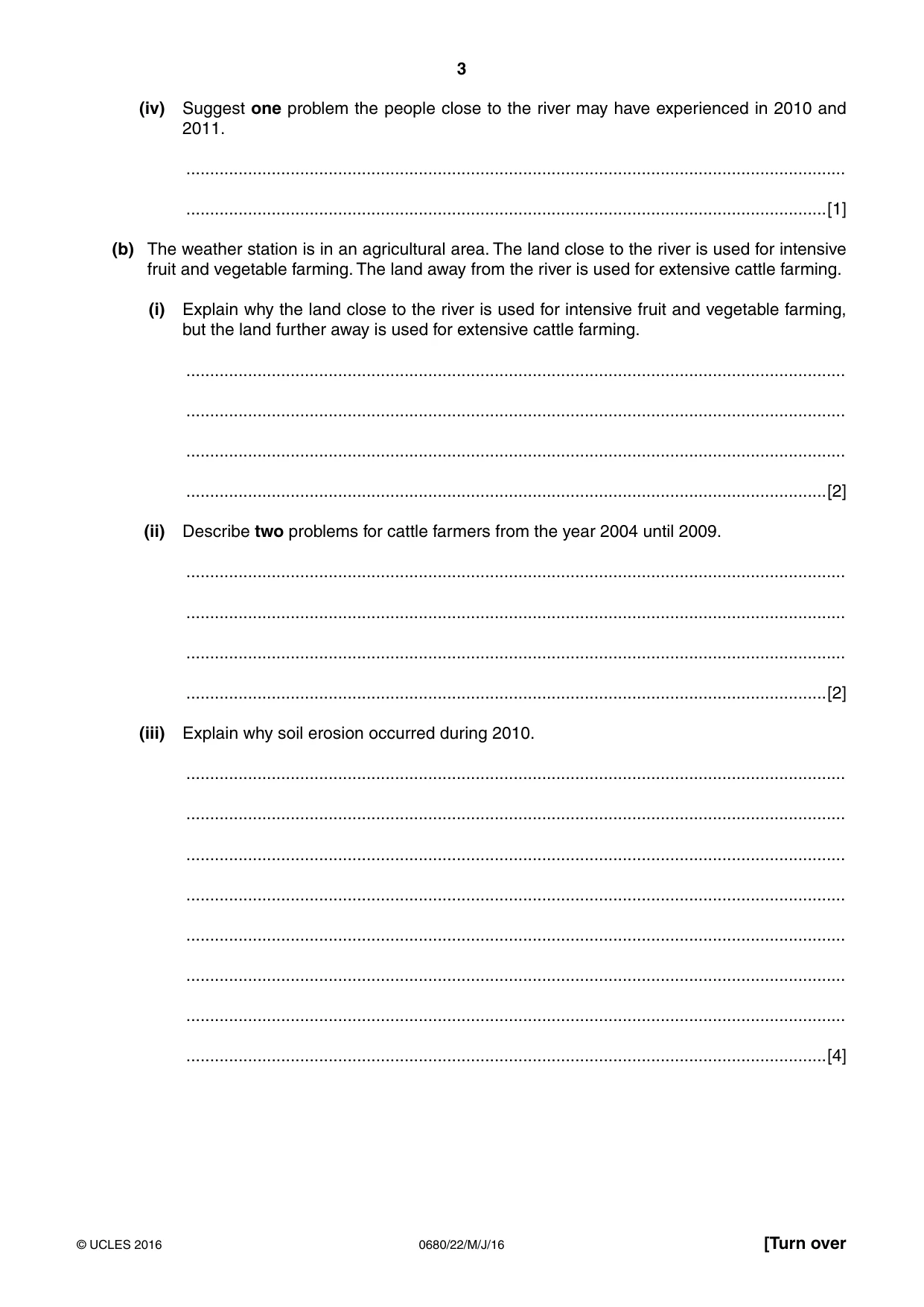
3 0680/22/M/J/16 © UCLES 2016 [Turn over (iv) Suggest one problem the people close to the river may have experienced in 2010 and 2011. … …[1] (b) The weather station is in an agricultural area. The land close to the river is used for intensive fruit and vegetable farming. The land away from the river is used for extensive cattle farming. (i) Explain why the land close to the river is used for intensive fruit and vegetable farming, but the land further away is used for extensive cattle farming. … … … …[2] (ii) Describe two problems for cattle farmers from the year 2004 until 2009. … … … …[2] (iii) Explain why soil erosion occurred during 2010. … … … … … … … …[4]
Question paper, page 4
4 0680/22/M/J/16 © UCLES 2016 (iv) The fruit and vegetable farmers use large quantities of fertilisers. Describe the problems that these may cause for the environment. … … … … … … … …[4] (v) Suggest how farming in this area could be made more sustainable. … … … … … …[3]
Question paper, page 5
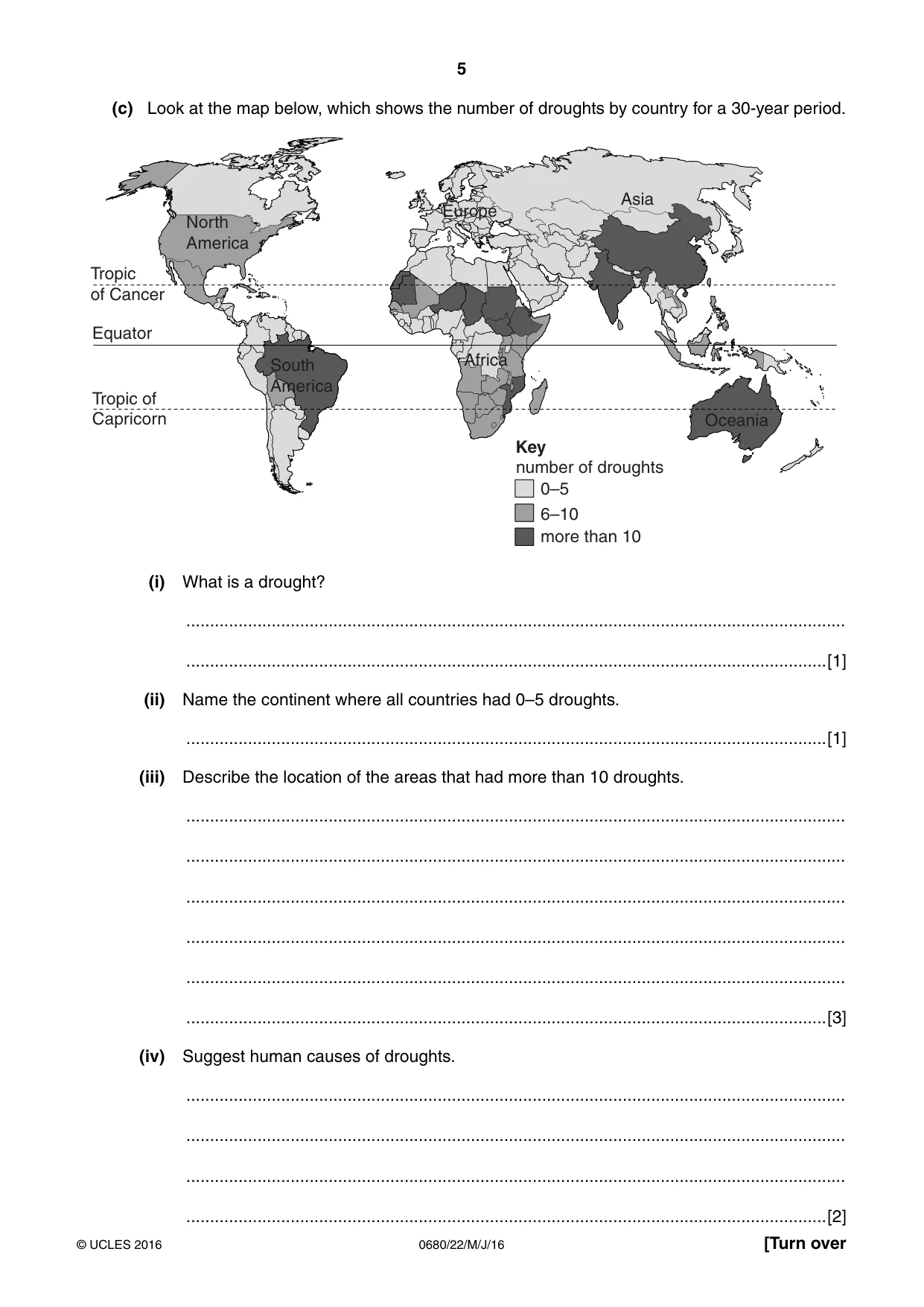
5 0680/22/M/J/16 © UCLES 2016 [Turn over (c) Look at the map below, which shows the number of droughts by country for a 30-year period. Equator Tropic of Capricorn Tropic of Cancer Asia Africa Oceania Europe North America South America more than 10 Key number of droughts 6–10 0–5 (i) What is a drought? … …[1] (ii) Name the continent where all countries had 0–5 droughts. …[1] (iii) Describe the location of the areas that had more than 10 droughts. … … … … … …[3] (iv) Suggest human causes of droughts. … … … …[2]
Question paper, page 6
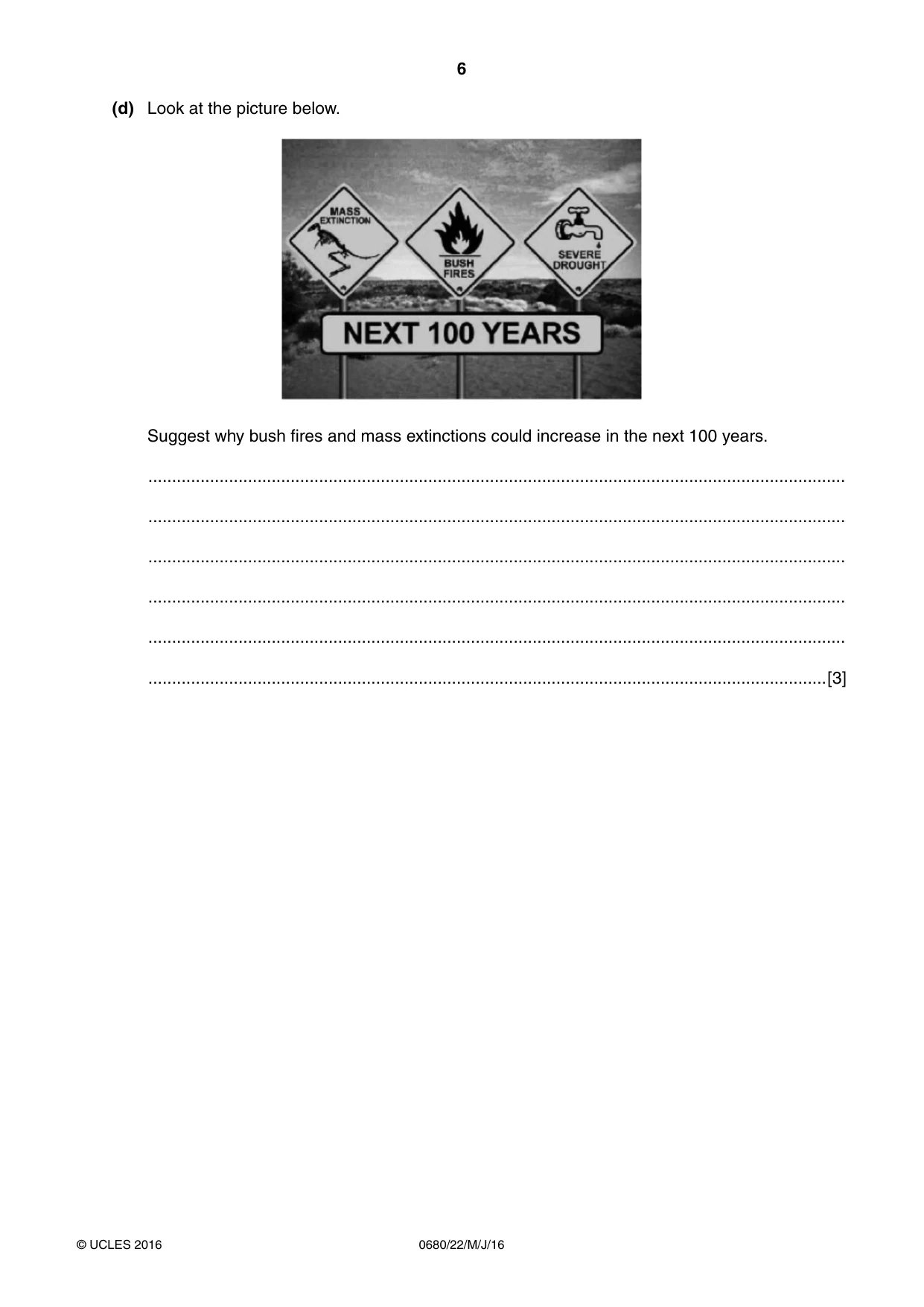
6 0680/22/M/J/16 © UCLES 2016 (d) Look at the picture below. Suggest why bush fires and mass extinctions could increase in the next 100 years. … … … … … …[3]
Question paper, page 7
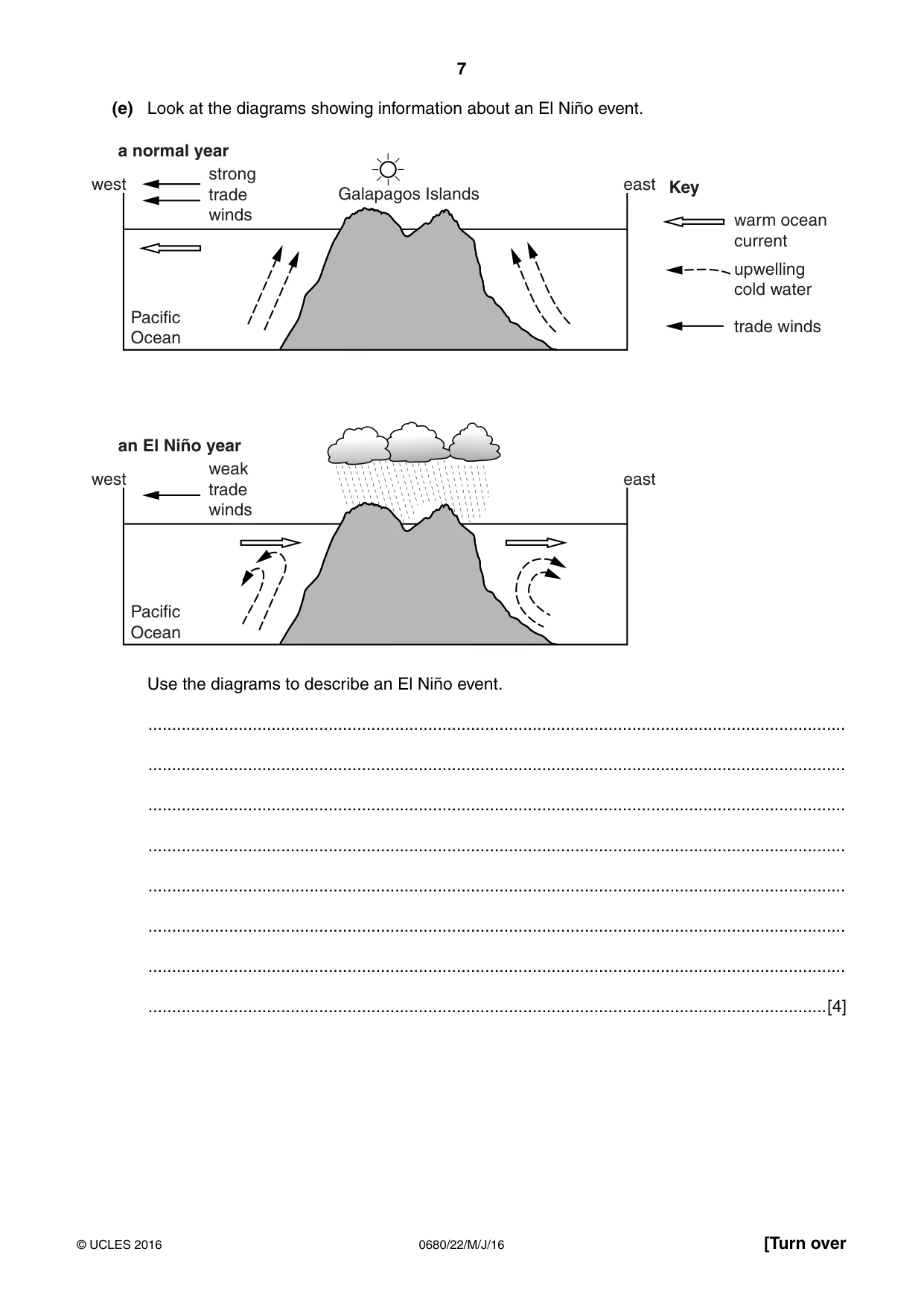
7 0680/22/M/J/16 © UCLES 2016 [Turn over (e) Look at the diagrams showing information about an El Niño event. a normal year west east strong trade winds warm ocean current upwelling cold water trade winds Galapagos Islands Key Pacific Ocean an El Niño year west east weak trade winds Pacific Ocean Use the diagrams to describe an El Niño event. … … … … … … … …[4]
Question paper, page 8
8 0680/22/M/J/16 © UCLES 2016 (f) ‘Cyclones are the most damaging climatic hazards.’ How far do you agree with this statement? Give reasons for your answer. … … … … … … … … … … … …[6]
Question paper, page 9
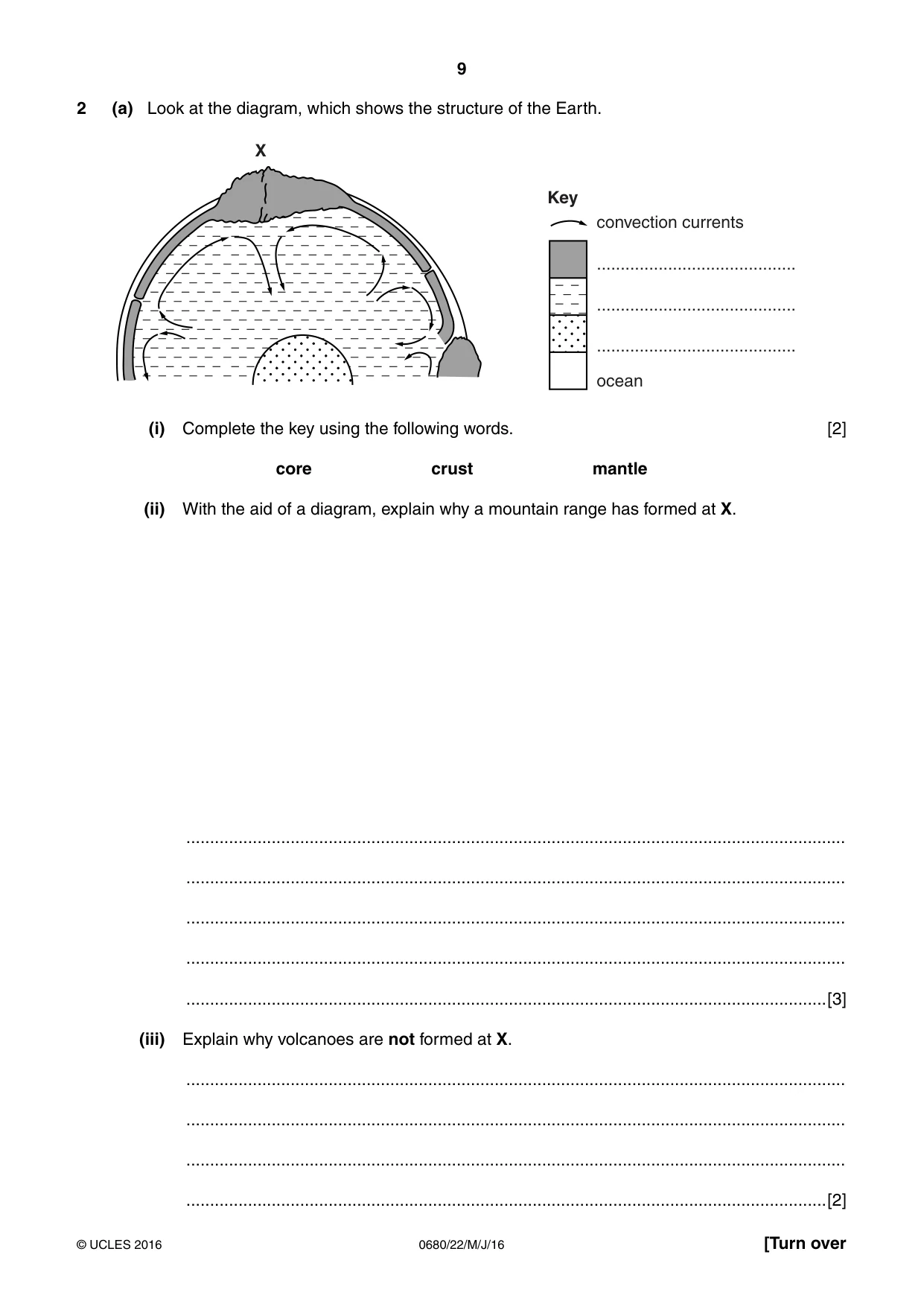
9 0680/22/M/J/16 © UCLES 2016 [Turn over 2 (a) Look at the diagram, which shows the structure of the Earth. X Key … … … ocean convection currents (i) Complete the key using the following words. [2] core crust mantle (ii) With the aid of a diagram, explain why a mountain range has formed at X. … … … … …[3] (iii) Explain why volcanoes are not formed at X. … … … …[2]
Question paper, page 10
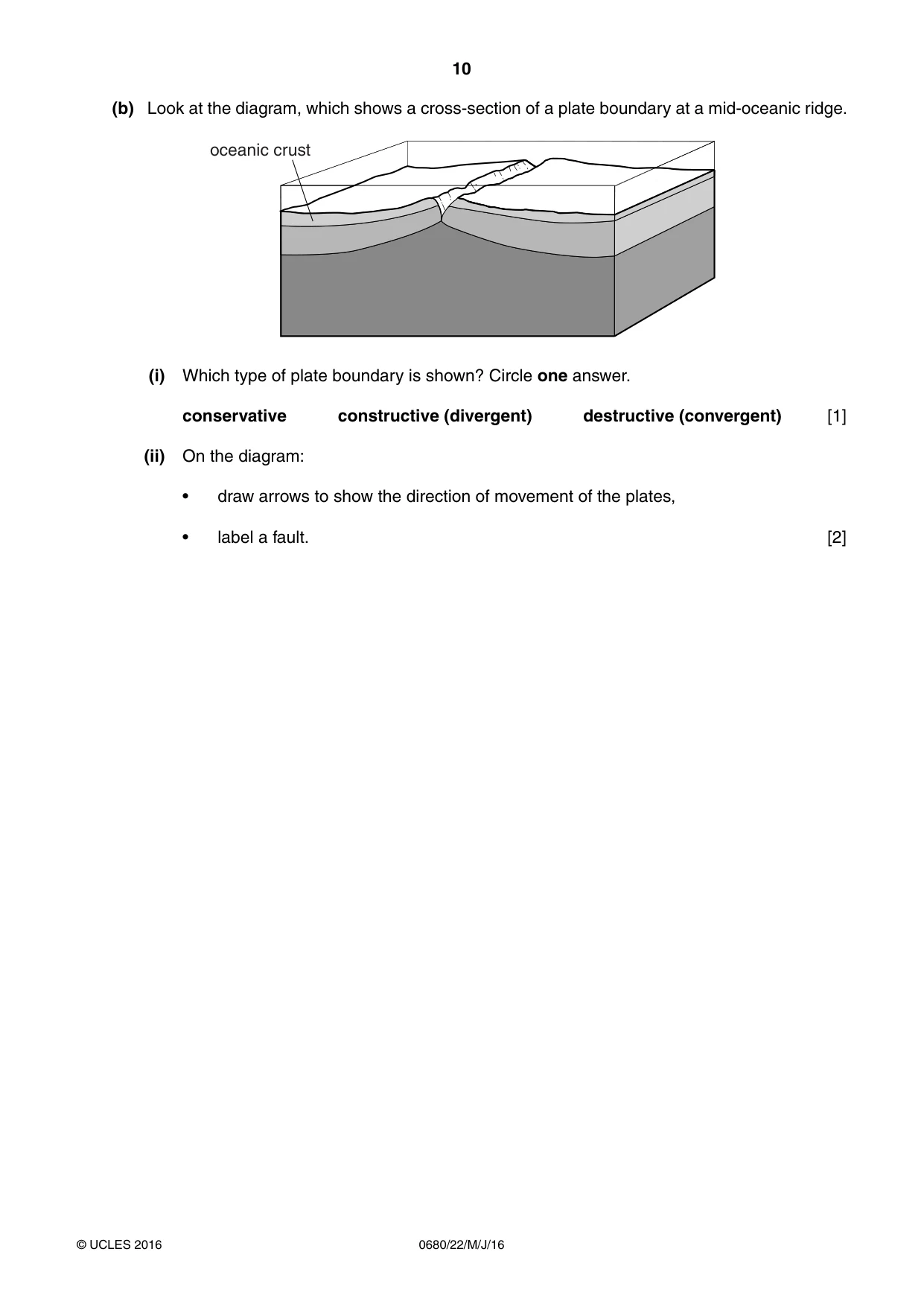
10 0680/22/M/J/16 © UCLES 2016 (b) Look at the diagram, which shows a cross-section of a plate boundary at a mid-oceanic ridge. oceanic crust (i) Which type of plate boundary is shown? Circle one answer. conservative constructive (divergent) destructive (convergent) [1] (ii) On the diagram: • draw arrows to show the direction of movement of the plates, • label a fault. [2]
Question paper, page 11
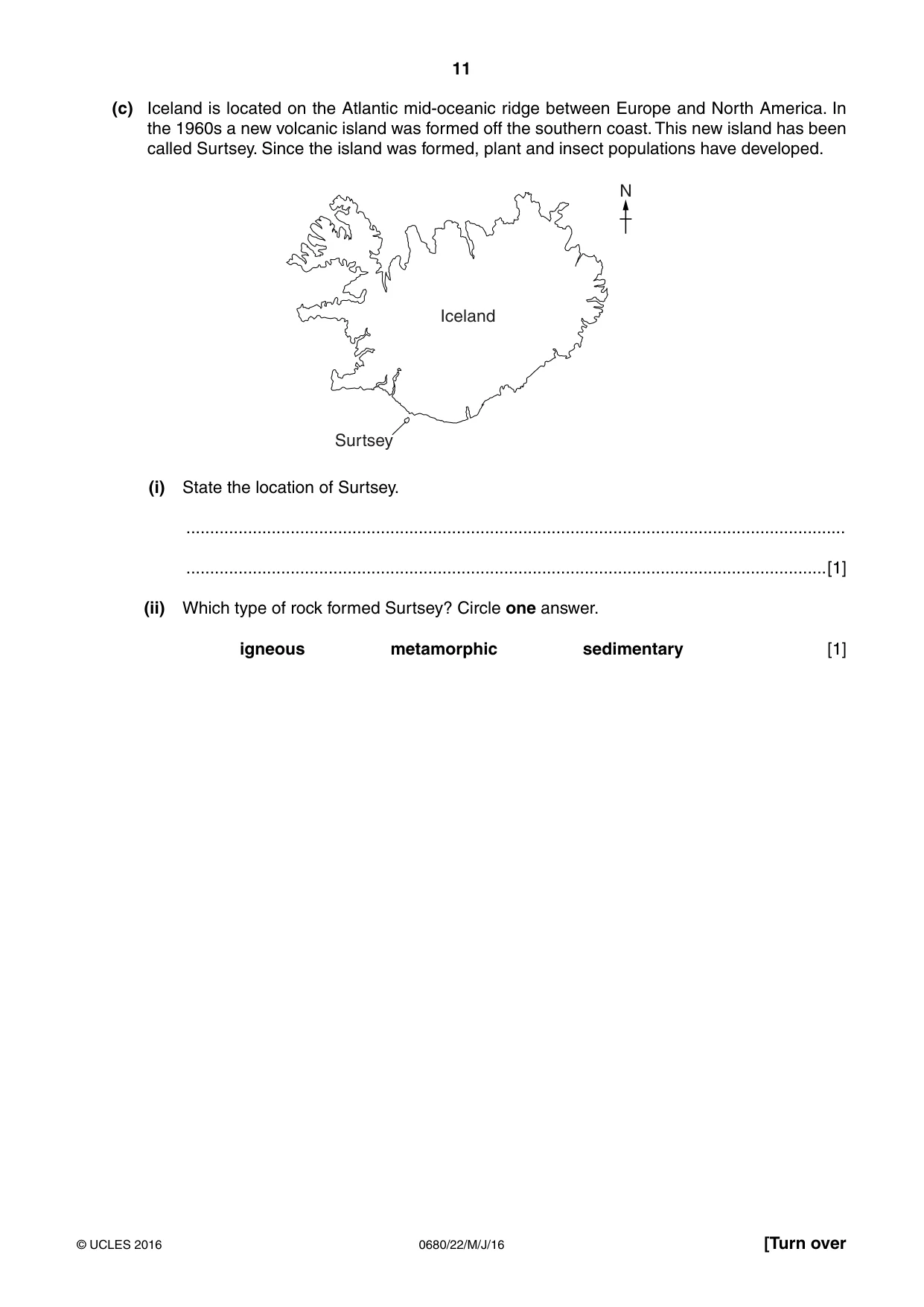
11 0680/22/M/J/16 © UCLES 2016 [Turn over (c) Iceland is located on the Atlantic mid-oceanic ridge between Europe and North America. In the 1960s a new volcanic island was formed off the southern coast. This new island has been called Surtsey. Since the island was formed, plant and insect populations have developed. N Surtsey Iceland (i) State the location of Surtsey. … …[1] (ii) Which type of rock formed Surtsey? Circle one answer. igneous metamorphic sedimentary [1]
Question paper, page 12
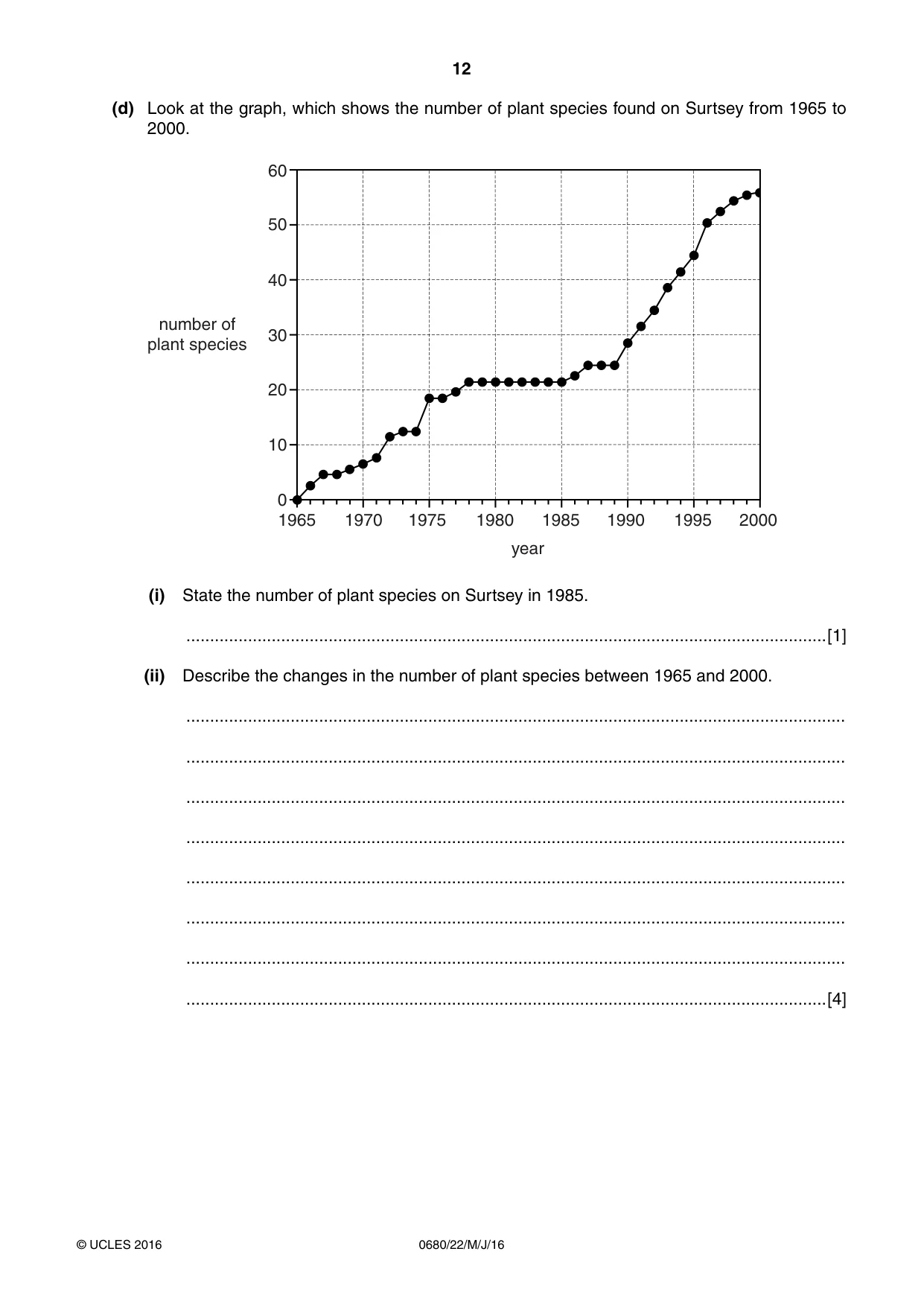
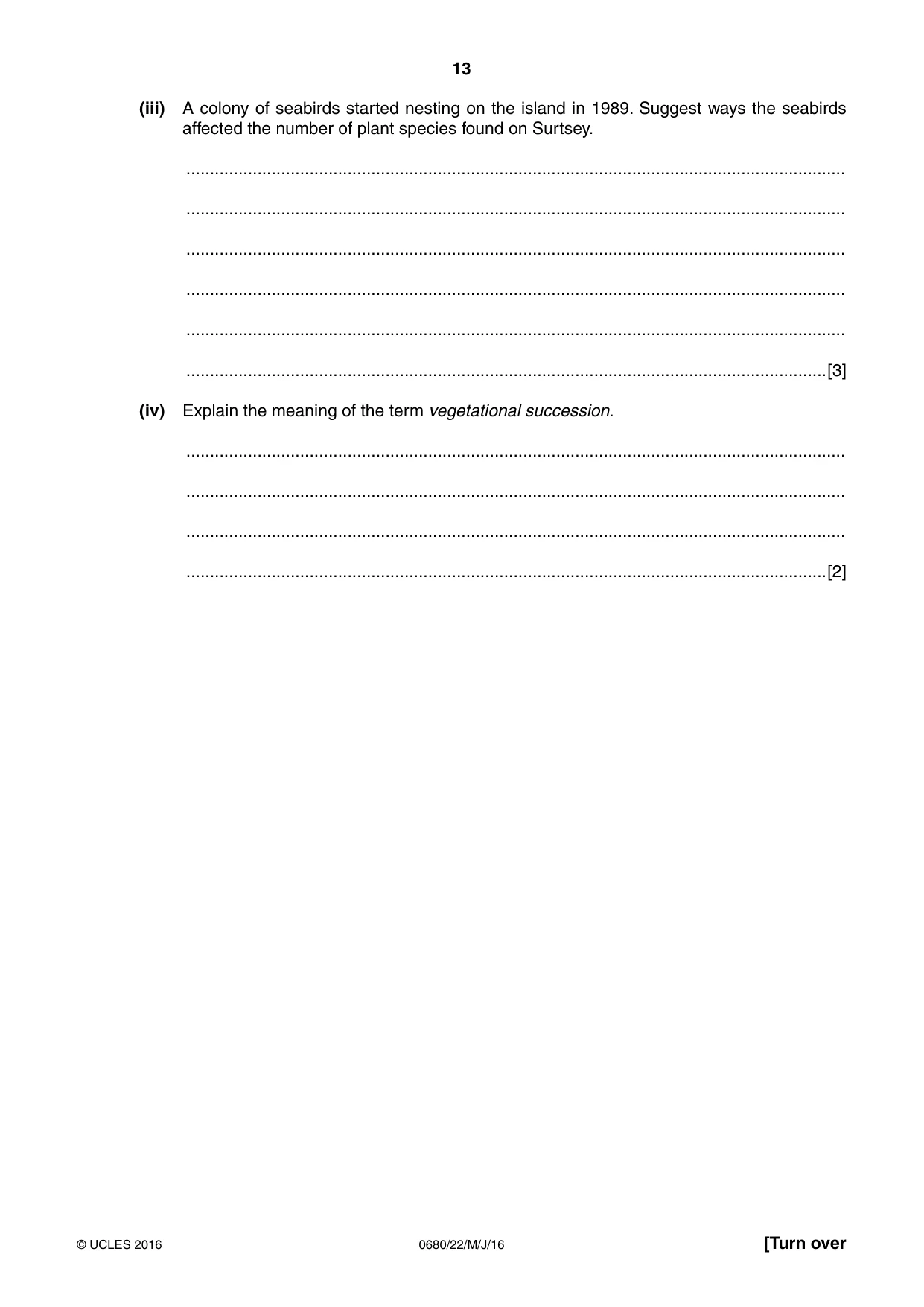
12 0680/22/M/J/16 © UCLES 2016 (d) Look at the graph, which shows the number of plant species found on Surtsey from 1965 to 2000. number of plant species 0 10 20 30 40 50 60 1965 1970 1975 1980 1985 1990 1995 2000 year (i) State the number of plant species on Surtsey in 1985. …[1] (ii) Describe the changes in the number of plant species between 1965 and 2000. … … … … … … … …[4]
Question paper, page 13
13 0680/22/M/J/16 © UCLES 2016 [Turn over (iii) A colony of seabirds started nesting on the island in 1989. Suggest ways the seabirds affected the number of plant species found on Surtsey. … … … … … …[3] (iv) Explain the meaning of the term vegetational succession. … … … …[2]
Question paper, page 14
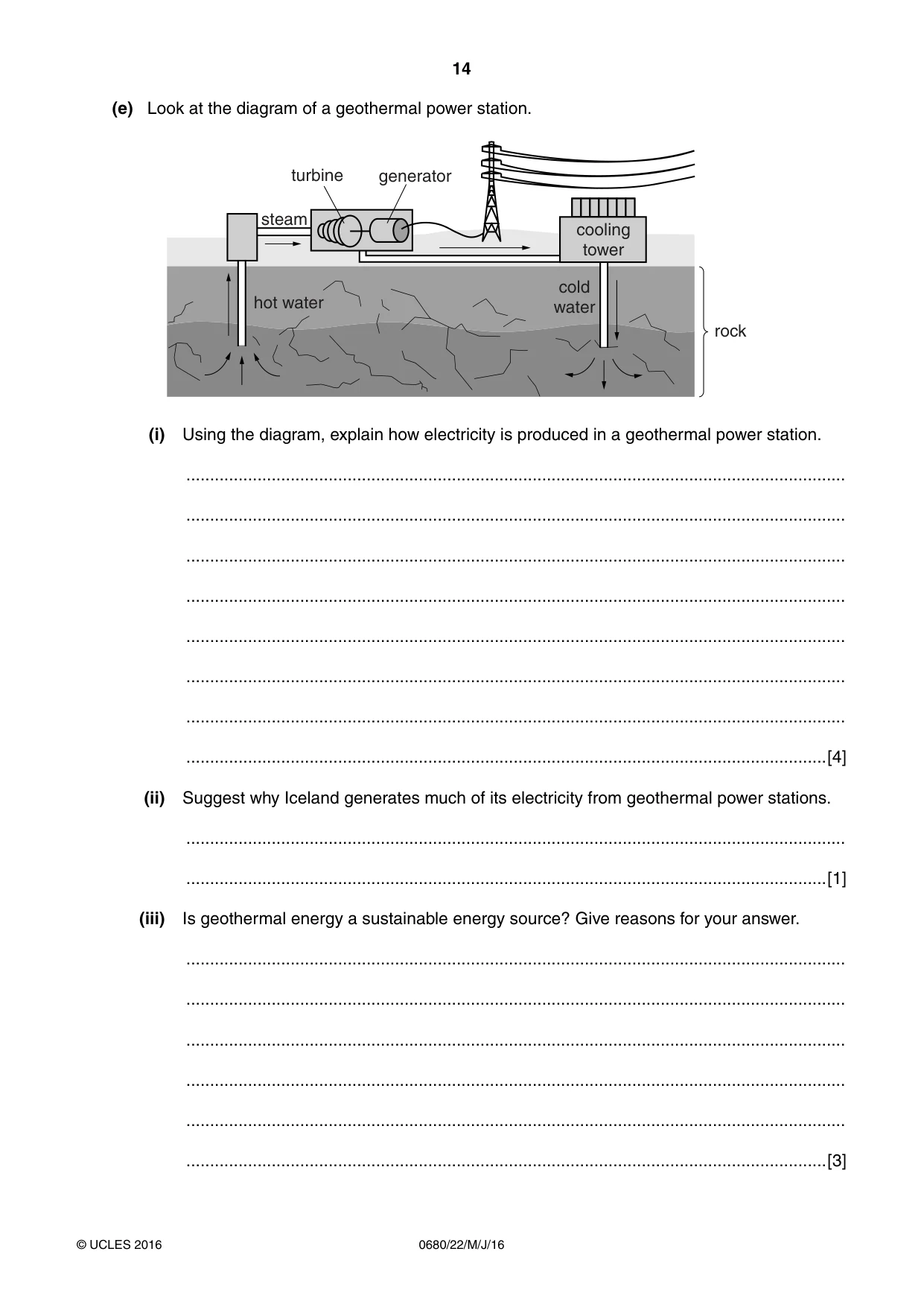
14 0680/22/M/J/16 © UCLES 2016 (e) Look at the diagram of a geothermal power station. hot water cold water steam turbine generator cooling tower rock (i) Using the diagram, explain how electricity is produced in a geothermal power station. … … … … … … … …[4] (ii) Suggest why Iceland generates much of its electricity from geothermal power stations. … …[1] (iii) Is geothermal energy a sustainable energy source? Give reasons for your answer. … … … … … …[3]
Question paper, page 15
15 0680/22/M/J/16 © UCLES 2016 (iv) Much of the world’s electricity is generated using fossil fuels. Explain why environmental groups want to reduce the use of fossil fuels. … … … … … … … …[4] (f) Are the advantages of living in an area of active volcanoes greater than the disadvantages? Give reasons for your answer. … … … … … … … … … … … …[6]
Question paper, page 16
16 0680/22/M/J/16 © UCLES 2016 Permission to reproduce items where third-party owned material protected by copyright is included has been sought and cleared where possible. Every reasonable effort has been made by the publisher (UCLES) to trace copyright holders, but if any items requiring clearance have unwittingly been included, the publisher will be pleased to make amends at the earliest possible opportunity. To avoid the issue of disclosure of answer-related information to candidates, all copyright acknowledgements are reproduced online in the Cambridge International Examinations Copyright Acknowledgements Booklet. This is produced for each series of examinations and is freely available to download at www.cie.org.uk after the live examination series. Cambridge International Examinations is part of the Cambridge Assessment Group. Cambridge Assessment is the brand name of University of Cambridge Local Examinations Syndicate (UCLES), which is itself a department of the University of Cambridge. BLANK PAGE
Mark scheme, page 1
® IGCSE is the registered trademark of Cambridge International Examinations. This document consists of 8 printed pages. © UCLES 2016 [Turn over Cambridge International Examinations Cambridge International General Certificate of Secondary Education ENVIRONMENTAL MANAGEMENT 0680/22 Paper 2 May/June 2016 MARK SCHEME Maximum Mark: 80 Published This mark scheme is published as an aid to teachers and candidates, to indicate the requirements of the examination. It shows the basis on which Examiners were instructed to award marks. It does not indicate the details of the discussions that took place at an Examiners’ meeting before marking began, which would have considered the acceptability of alternative answers. Mark schemes should be read in conjunction with the question paper and the Principal Examiner Report for Teachers. Cambridge will not enter into discussions about these mark schemes. Cambridge is publishing the mark schemes for the May/June 2016 series for most Cambridge IGCSE®, Cambridge International A and AS Level components and some Cambridge O Level components.
Mark scheme, page 2
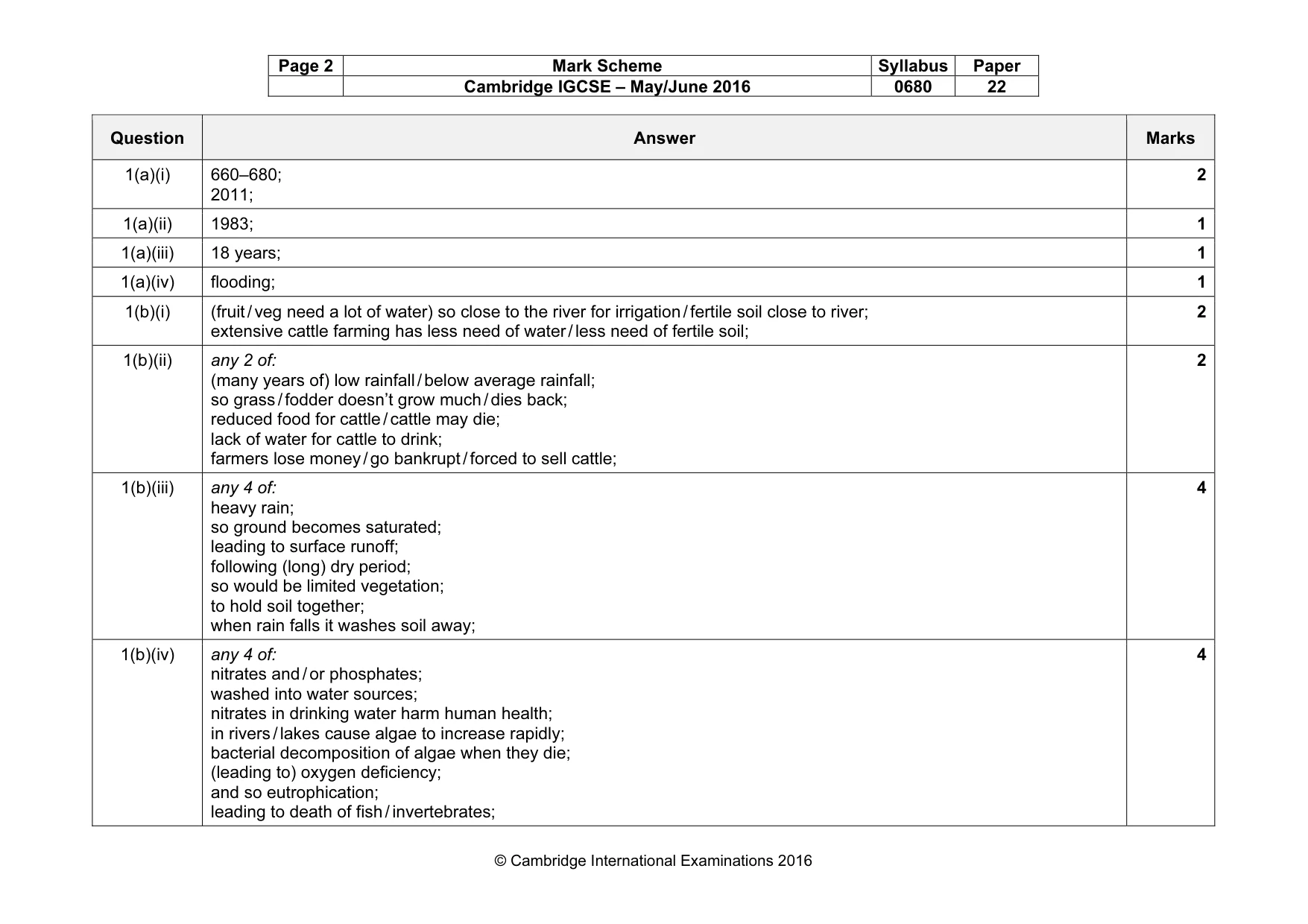
Page 2 Mark Scheme Syllabus Paper Cambridge IGCSE – May/June 2016 0680 22 © Cambridge International Examinations 2016 Question Answer Marks 1(a)(i) 660–680; 2011; 2 1(a)(ii) 1983; 1 1(a)(iii) 18 years; 1 1(a)(iv) flooding; 1 1(b)(i) (fruit / veg need a lot of water) so close to the river for irrigation / fertile soil close to river; extensive cattle farming has less need of water / less need of fertile soil; 2 1(b)(ii) any 2 of: (many years of) low rainfall / below average rainfall; so grass / fodder doesn’t grow much / dies back; reduced food for cattle / cattle may die; lack of water for cattle to drink; farmers lose money / go bankrupt / forced to sell cattle; 2 1(b)(iii) any 4 of: heavy rain; so ground becomes saturated; leading to surface runoff; following (long) dry period; so would be limited vegetation; to hold soil together; when rain falls it washes soil away; 4 1(b)(iv) any 4 of: nitrates and / or phosphates; washed into water sources; nitrates in drinking water harm human health; in rivers / lakes cause algae to increase rapidly; bacterial decomposition of algae when they die; (leading to) oxygen deficiency; and so eutrophication; leading to death of fish / invertebrates; 4
Mark scheme, page 3
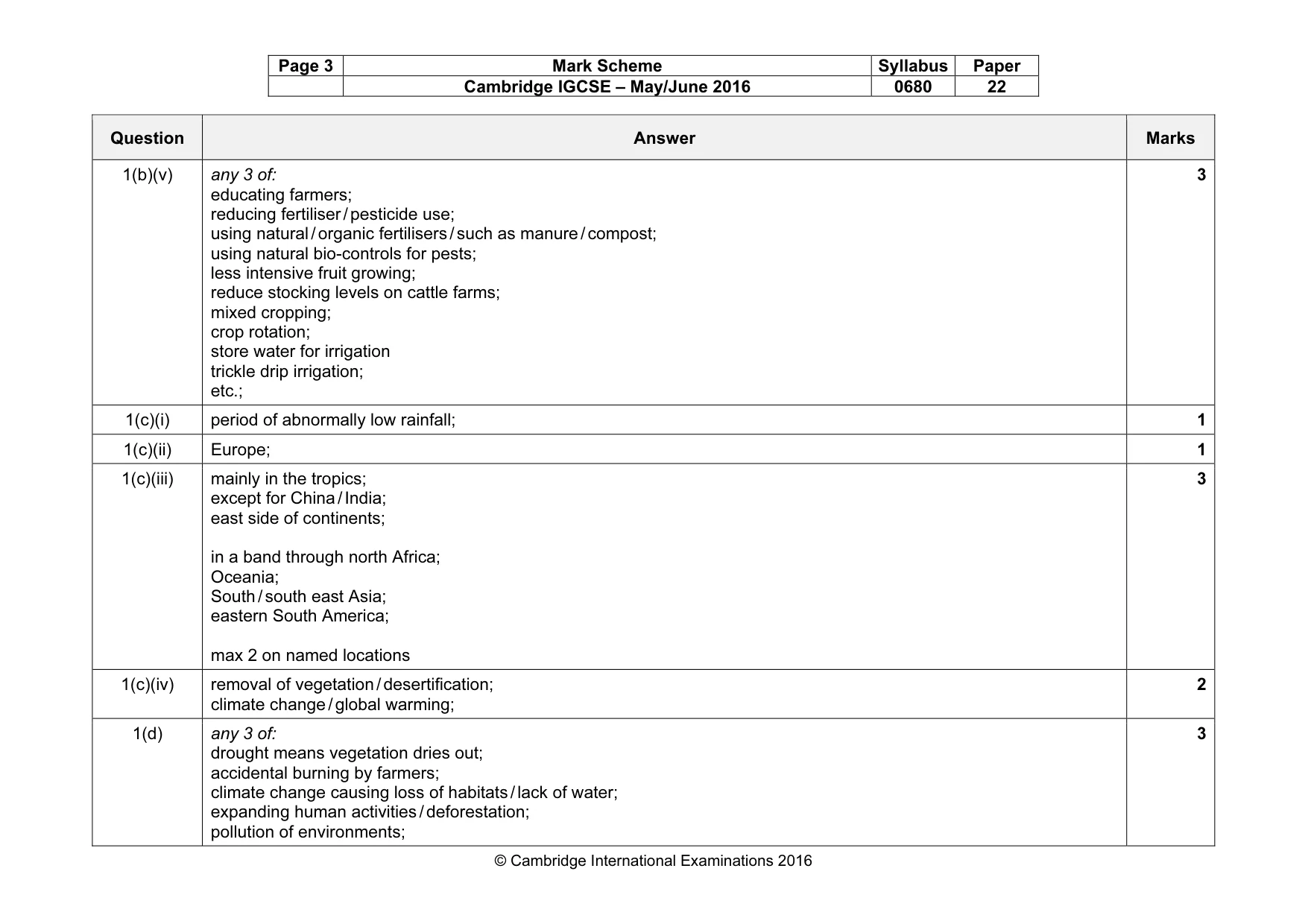
Page 3 Mark Scheme Syllabus Paper Cambridge IGCSE – May/June 2016 0680 22 © Cambridge International Examinations 2016 Question Answer Marks 1(b)(v) any 3 of: educating farmers; reducing fertiliser / pesticide use; using natural / organic fertilisers / such as manure / compost; using natural bio-controls for pests; less intensive fruit growing; reduce stocking levels on cattle farms; mixed cropping; crop rotation; store water for irrigation trickle drip irrigation; etc.; 3 1(c)(i) period of abnormally low rainfall; 1 1(c)(ii) Europe; 1 1(c)(iii) mainly in the tropics; except for China / India; east side of continents; in a band through north Africa; Oceania; South / south east Asia; eastern South America; max 2 on named locations 3 1(c)(iv) removal of vegetation / desertification; climate change / global warming; 2 1(d) any 3 of: drought means vegetation dries out; accidental burning by farmers; climate change causing loss of habitats / lack of water; expanding human activities / deforestation; pollution of environments; 3
Mark scheme, page 4
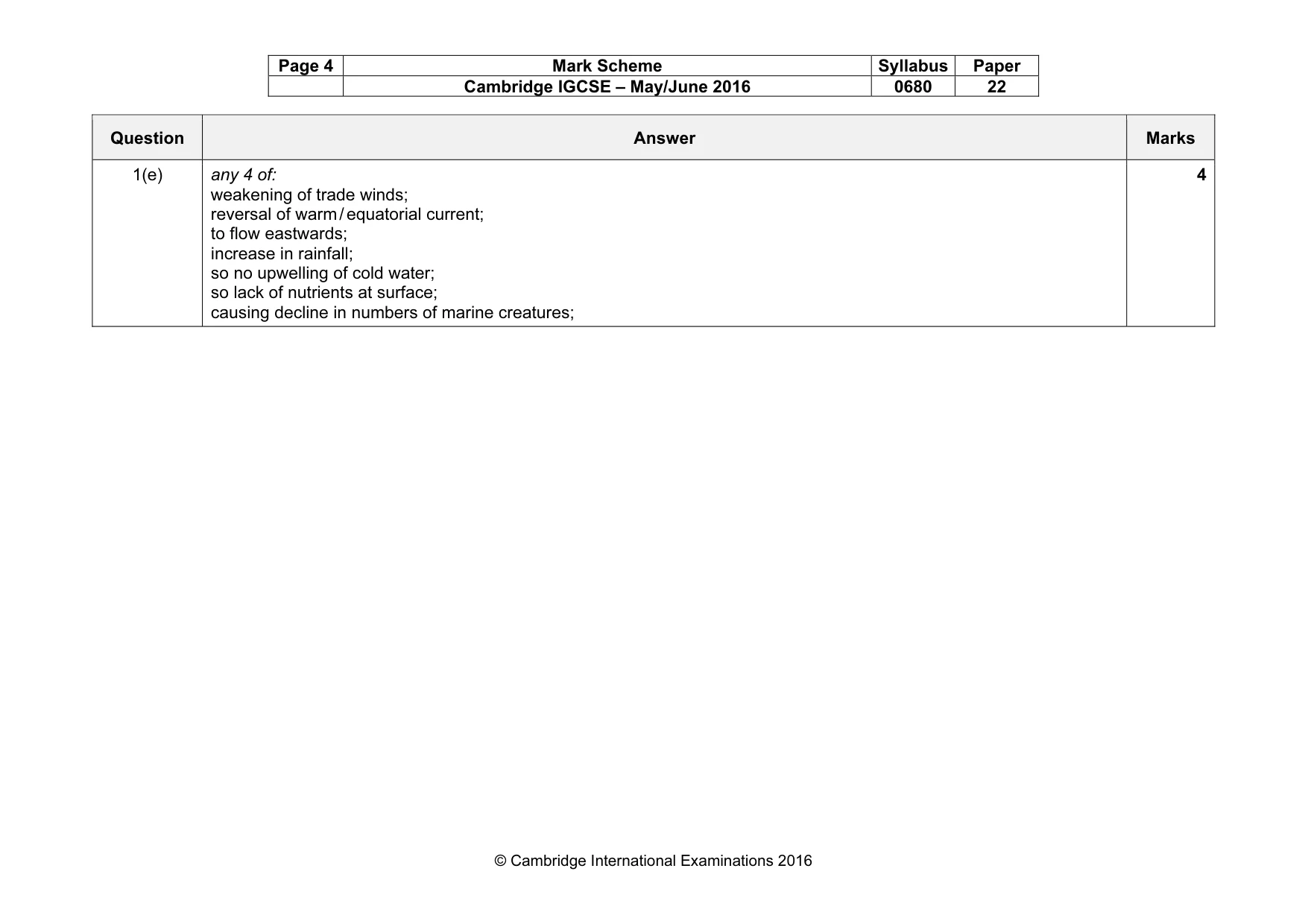
Page 4 Mark Scheme Syllabus Paper Cambridge IGCSE – May/June 2016 0680 22 © Cambridge International Examinations 2016 Question Answer Marks 1(e) any 4 of: weakening of trade winds; reversal of warm / equatorial current; to flow eastwards; increase in rainfall; so no upwelling of cold water; so lack of nutrients at surface; causing decline in numbers of marine creatures; 4
Mark scheme, page 5
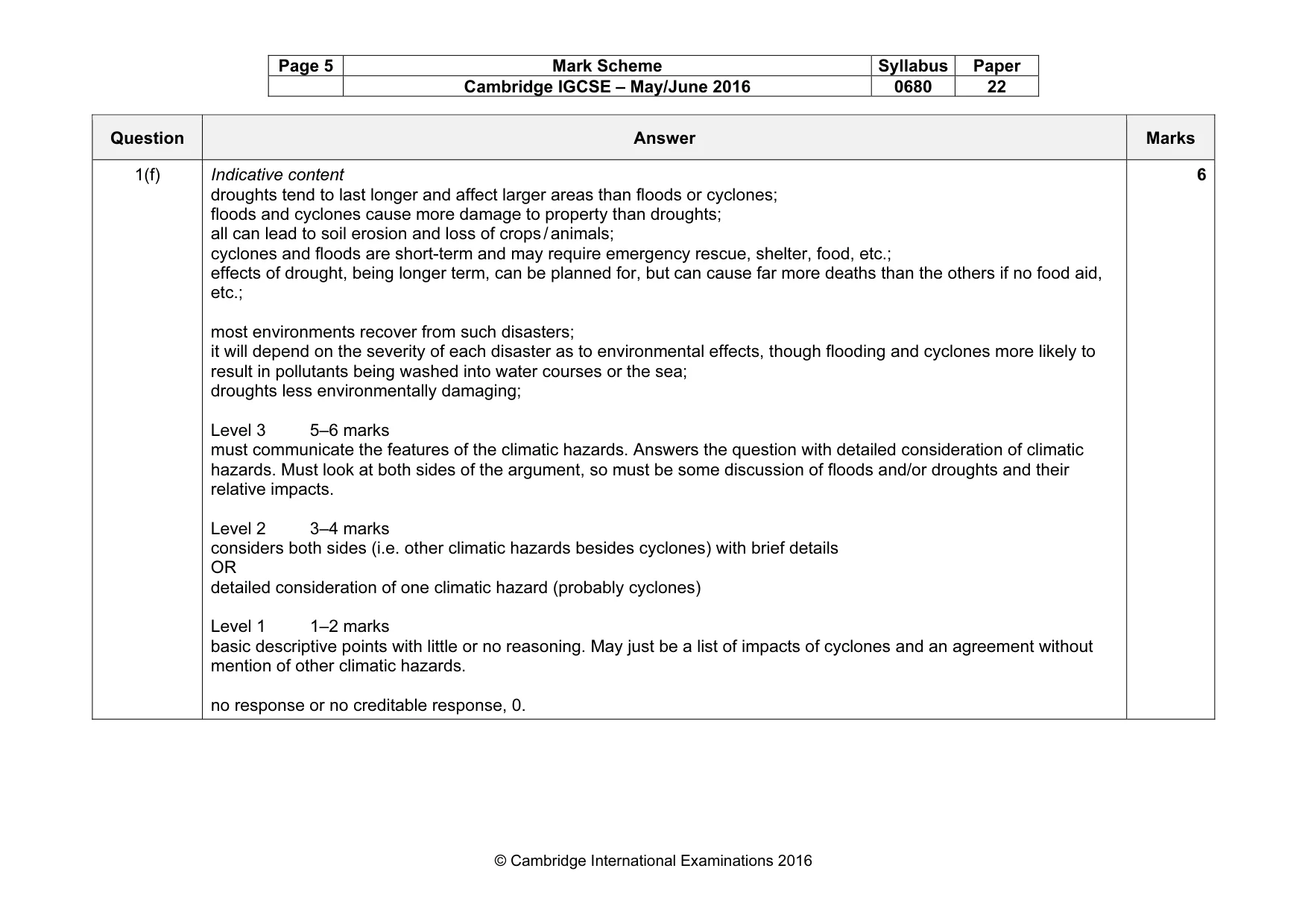
Page 5 Mark Scheme Syllabus Paper Cambridge IGCSE – May/June 2016 0680 22 © Cambridge International Examinations 2016 Question Answer Marks 1(f) Indicative content droughts tend to last longer and affect larger areas than floods or cyclones; floods and cyclones cause more damage to property than droughts; all can lead to soil erosion and loss of crops / animals; cyclones and floods are short-term and may require emergency rescue, shelter, food, etc.; effects of drought, being longer term, can be planned for, but can cause far more deaths than the others if no food aid, etc.; most environments recover from such disasters; it will depend on the severity of each disaster as to environmental effects, though flooding and cyclones more likely to result in pollutants being washed into water courses or the sea; droughts less environmentally damaging; Level 3 5–6 marks must communicate the features of the climatic hazards. Answers the question with detailed consideration of climatic hazards. Must look at both sides of the argument, so must be some discussion of floods and/or droughts and their relative impacts. Level 2 3–4 marks considers both sides (i.e. other climatic hazards besides cyclones) with brief details OR detailed consideration of one climatic hazard (probably cyclones) Level 1 1–2 marks basic descriptive points with little or no reasoning. May just be a list of impacts of cyclones and an agreement without mention of other climatic hazards. no response or no creditable response, 0. 6
Mark scheme, page 6
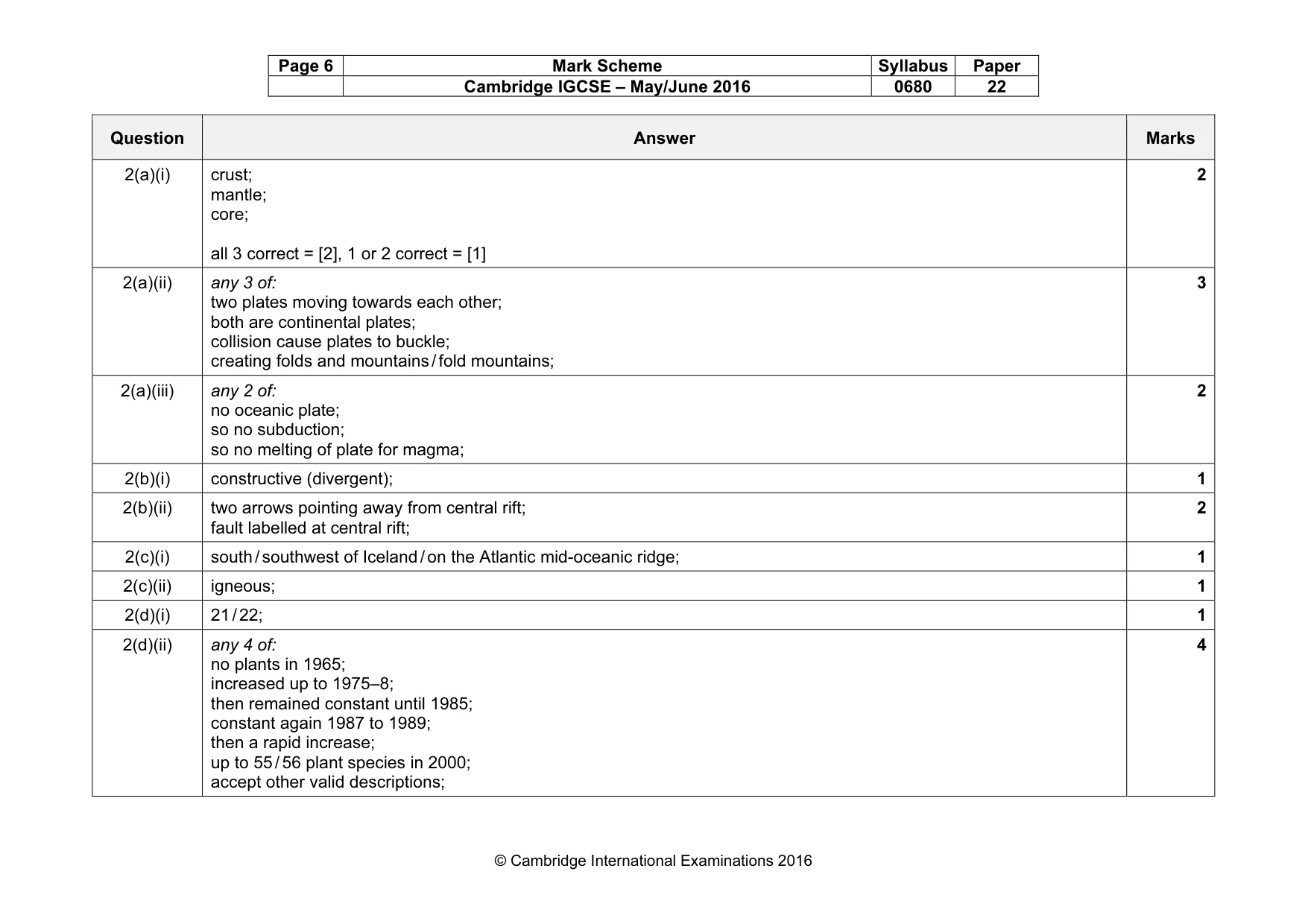
Page 6 Mark Scheme Syllabus Paper Cambridge IGCSE – May/June 2016 0680 22 © Cambridge International Examinations 2016 Question Answer Marks 2(a)(i) crust; mantle; core; all 3 correct = [2], 1 or 2 correct = [1] 2 2(a)(ii) any 3 of: two plates moving towards each other; both are continental plates; collision cause plates to buckle; creating folds and mountains / fold mountains; 3 2(a)(iii) any 2 of: no oceanic plate; so no subduction; so no melting of plate for magma; 2 2(b)(i) constructive (divergent); 1 2(b)(ii) two arrows pointing away from central rift; fault labelled at central rift; 2 2(c)(i) south / southwest of Iceland / on the Atlantic mid-oceanic ridge; 1 2(c)(ii) igneous; 1 2(d)(i) 21 / 22; 1 2(d)(ii) any 4 of: no plants in 1965; increased up to 1975–8; then remained constant until 1985; constant again 1987 to 1989; then a rapid increase; up to 55 / 56 plant species in 2000; accept other valid descriptions; 4
Mark scheme, page 7
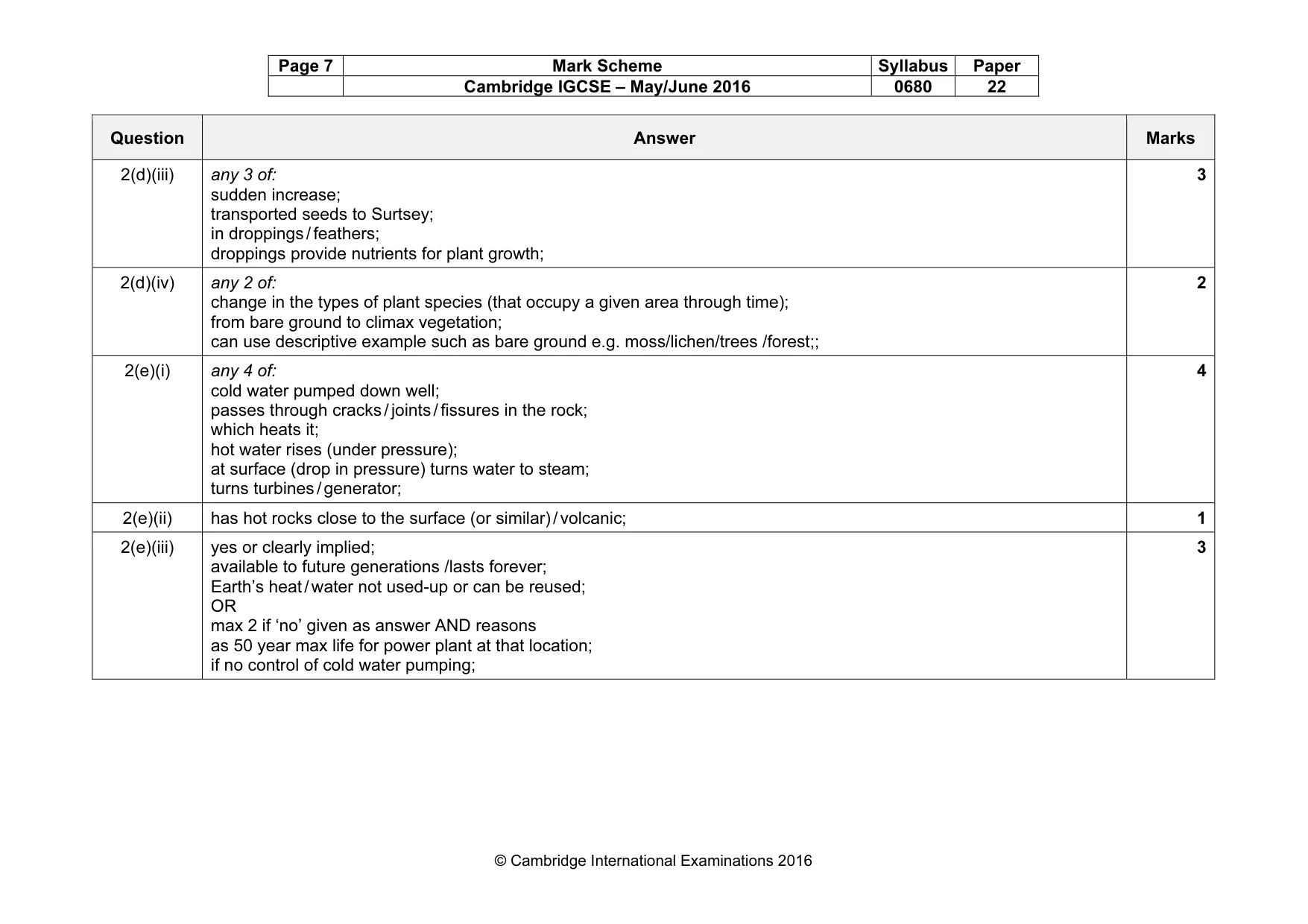
Page 7 Mark Scheme Syllabus Paper Cambridge IGCSE – May/June 2016 0680 22 © Cambridge International Examinations 2016 Question Answer Marks 2(d)(iii) any 3 of: sudden increase; transported seeds to Surtsey; in droppings / feathers; droppings provide nutrients for plant growth; 3 2(d)(iv) any 2 of: change in the types of plant species (that occupy a given area through time); from bare ground to climax vegetation; can use descriptive example such as bare ground e.g. moss/lichen/trees /forest;; 2 2(e)(i) any 4 of: cold water pumped down well; passes through cracks / joints / fissures in the rock; which heats it; hot water rises (under pressure); at surface (drop in pressure) turns water to steam; turns turbines / generator; 4 2(e)(ii) has hot rocks close to the surface (or similar) / volcanic; 1 2(e)(iii) yes or clearly implied; available to future generations /lasts forever; Earth’s heat / water not used-up or can be reused; OR max 2 if ‘no’ given as answer AND reasons as 50 year max life for power plant at that location; if no control of cold water pumping; 3
Mark scheme, page 8
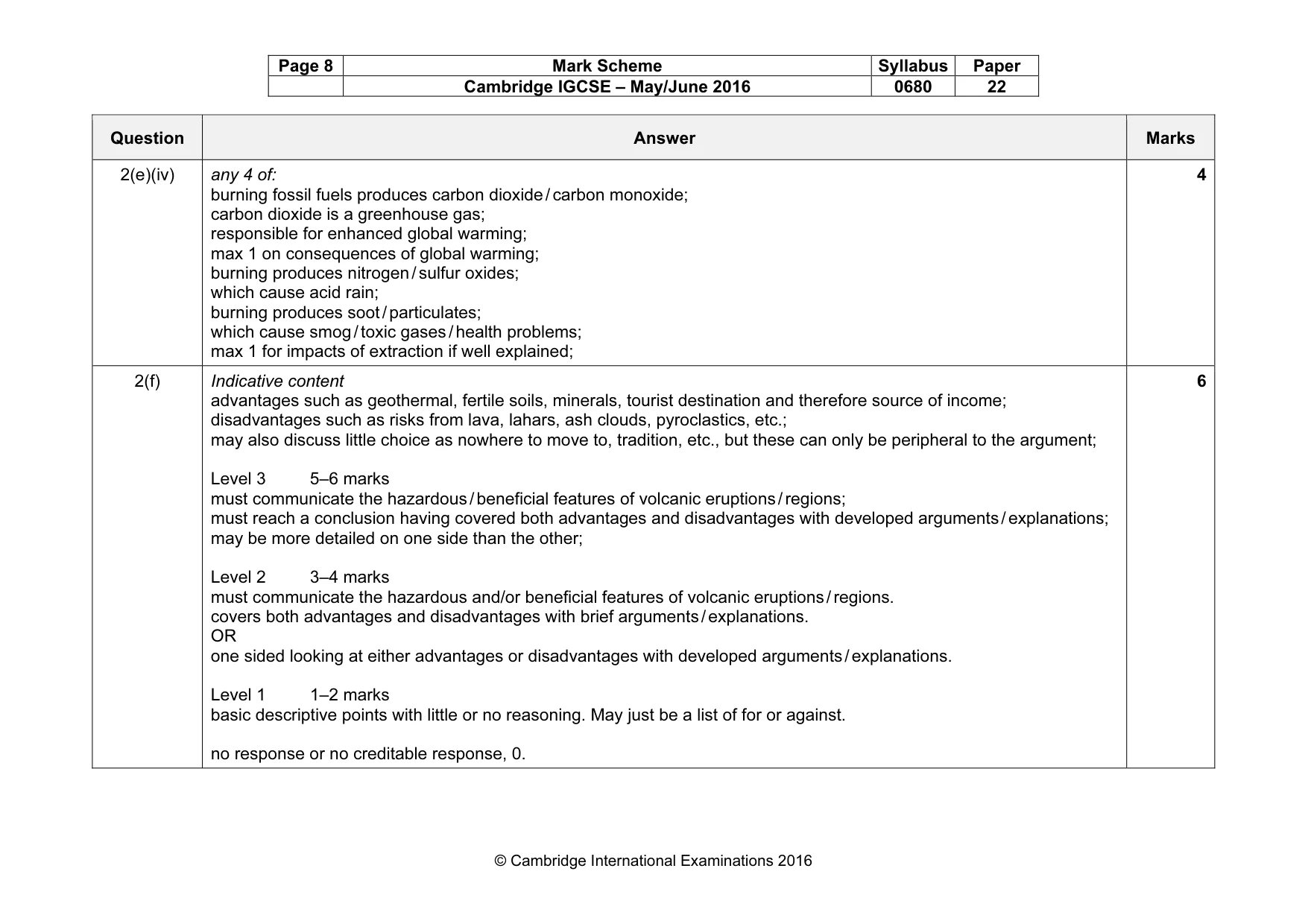
Page 8 Mark Scheme Syllabus Paper Cambridge IGCSE – May/June 2016 0680 22 © Cambridge International Examinations 2016 Question Answer Marks 2(e)(iv) any 4 of: burning fossil fuels produces carbon dioxide / carbon monoxide; carbon dioxide is a greenhouse gas; responsible for enhanced global warming; max 1 on consequences of global warming; burning produces nitrogen / sulfur oxides; which cause acid rain; burning produces soot / particulates; which cause smog / toxic gases / health problems; max 1 for impacts of extraction if well explained; 4 2(f) Indicative content advantages such as geothermal, fertile soils, minerals, tourist destination and therefore source of income; disadvantages such as risks from lava, lahars, ash clouds, pyroclastics, etc.; may also discuss little choice as nowhere to move to, tradition, etc., but these can only be peripheral to the argument; Level 3 5–6 marks must communicate the hazardous / beneficial features of volcanic eruptions / regions; must reach a conclusion having covered both advantages and disadvantages with developed arguments / explanations; may be more detailed on one side than the other; Level 2 3–4 marks must communicate the hazardous and/or beneficial features of volcanic eruptions / regions. covers both advantages and disadvantages with brief arguments / explanations. OR one sided looking at either advantages or disadvantages with developed arguments / explanations. Level 1 1–2 marks basic descriptive points with little or no reasoning. May just be a list of for or against. no response or no creditable response, 0. 6
What you needed in this session
Cambridge’s own grade thresholds for 2016 May/June, Paper 2 · Variant 2. A higher threshold means an easier paper — the bar moves with how the cohort did.