Cambridge IGCSE Environmental Management 0680 — 2016 May/June Paper 2 · Variant 3
0680/23/M/J/16 · 80 marks · ≈90 min
The question paper and its mark scheme, free to read here and free to download. This is Cambridge’s own paper, exactly as it was sat.
Question paper16 pages

Mark scheme9 pages
Answers below. Sit the paper first if you are practising.
Paper as text
Question paper, page 1
This document consists of 14 printed pages and 2 blank pages. DC (CW/SG) 112800/4 © UCLES 2016 [Turn over Cambridge International Examinations Cambridge International General Certificate of Secondary Education * 2 2 7 1 5 2 0 7 3 4 * ENVIRONMENTAL MANAGEMENT 0680/23 Paper 2 May/June 2016 1 hour 45 minutes Candidates answer on the Question Paper. No Additional Materials are required. READ THESE INSTRUCTIONS FIRST Write your Centre number, candidate number and name on all the work you hand in. Write in dark blue or black pen. You may use an HB pencil for any diagrams or graphs. Do not use staples, paper clips, glue or correction fluid. DO NOT WRITE IN ANY BARCODES. Answer both questions. Electronic calculators may be used. You may lose marks if you do not show your working or if you do not use appropriate units. At the end of the examination, fasten all your work securely together. The number of marks is given in brackets [ ] at the end of each question or part question.
Question paper, page 2
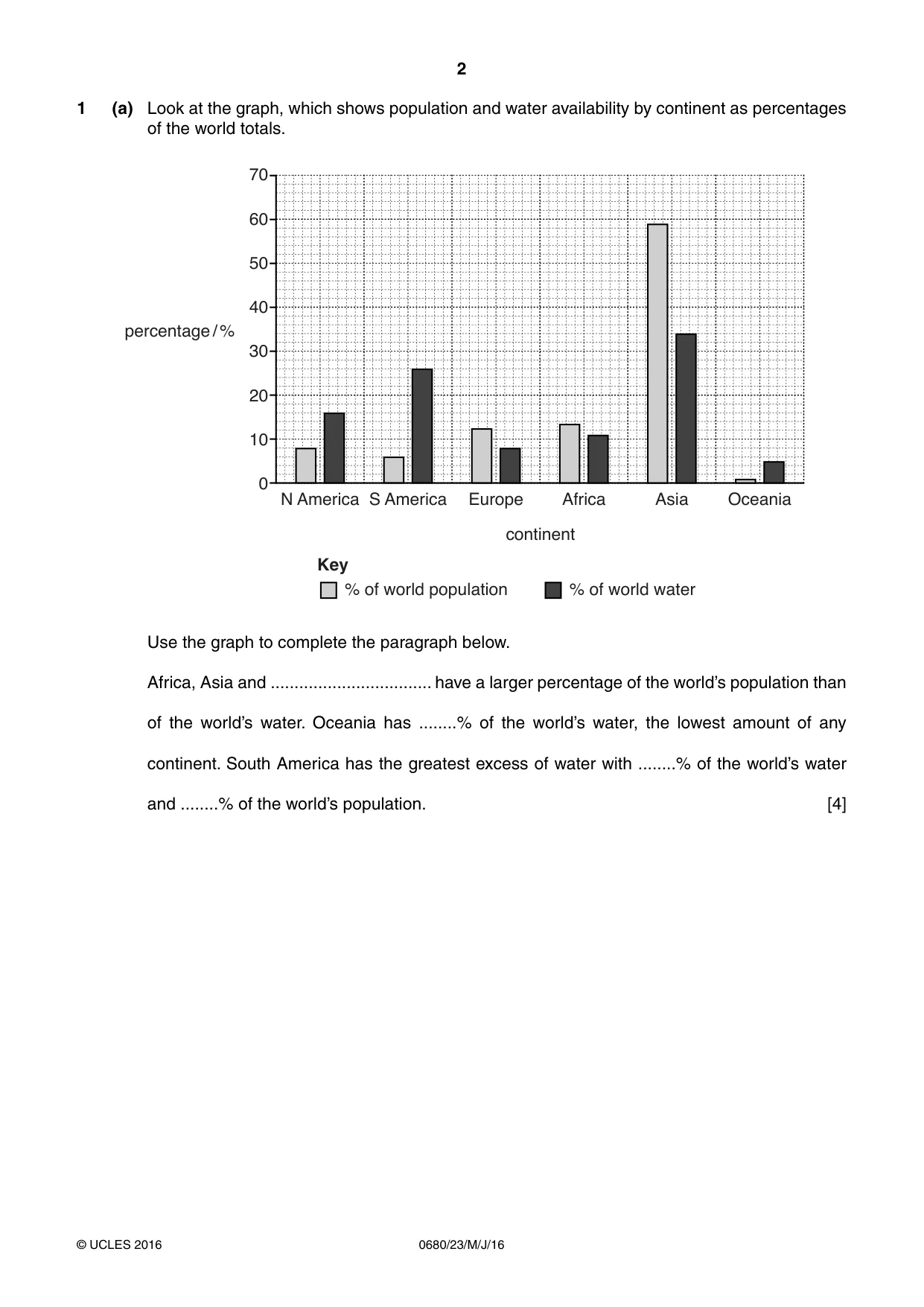
2 0680/23/M/J/16 © UCLES 2016 1 (a) Look at the graph, which shows population and water availability by continent as percentages of the world totals. 70 60 50 40 30 20 10 0 N America S America Europe Africa continent percentage / % Asia Oceania Key % of world population % of world water Use the graph to complete the paragraph below. Africa, Asia and … have a larger percentage of the world’s population than of the world’s water. Oceania has …% of the world’s water, the lowest amount of any continent. South America has the greatest excess of water with …% of the world’s water and …% of the world’s population. [4]
Question paper, page 3
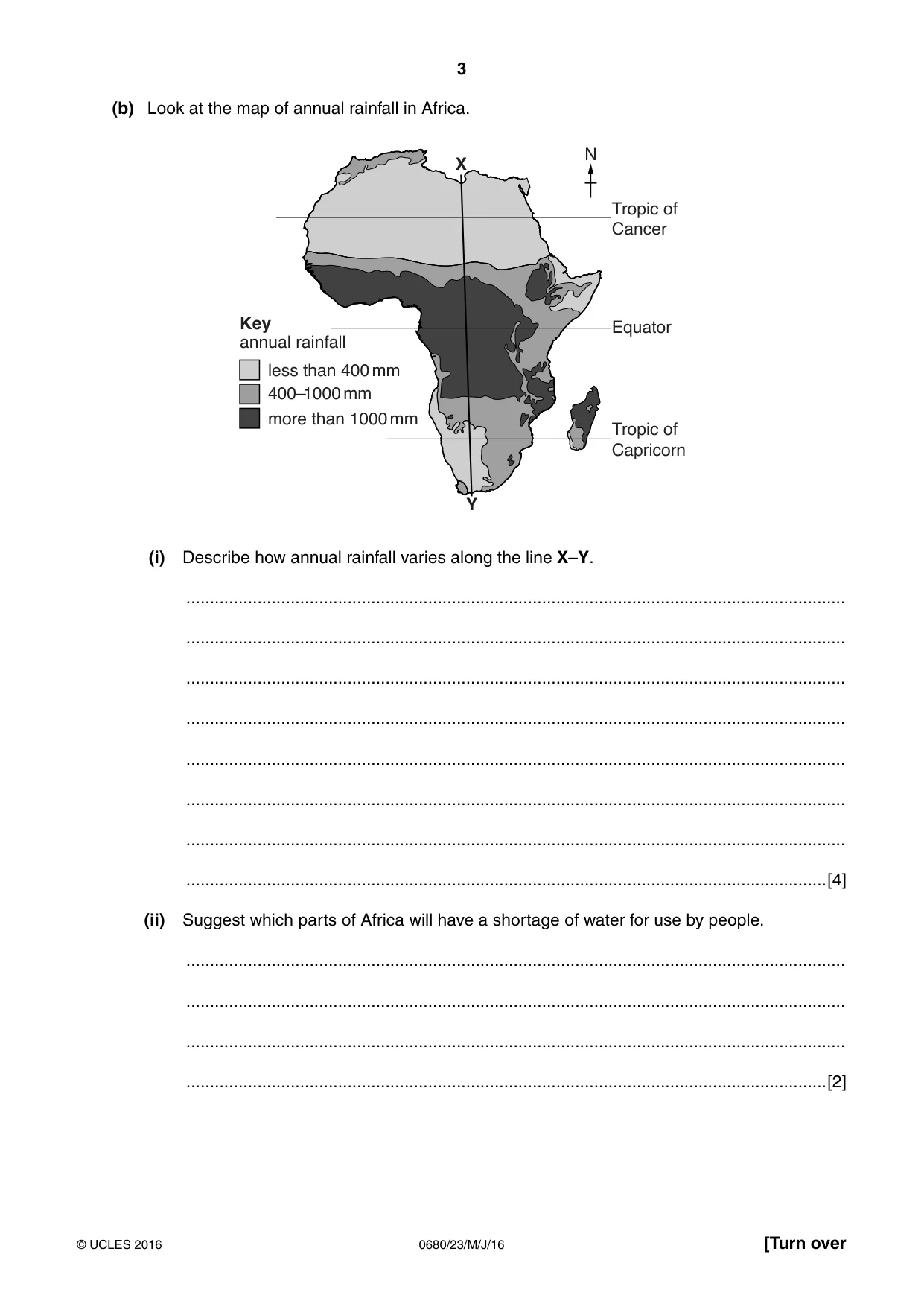
3 0680/23/M/J/16 © UCLES 2016 [Turn over (b) Look at the map of annual rainfall in Africa. Key N less than 400 mm 400–1000 mm more than 1000 mm X Y Tropic of Cancer Equator Tropic of Capricorn annual rainfall (i) Describe how annual rainfall varies along the line X–Y. … … … … … … … …[4] (ii) Suggest which parts of Africa will have a shortage of water for use by people. … … … …[2]
Question paper, page 4
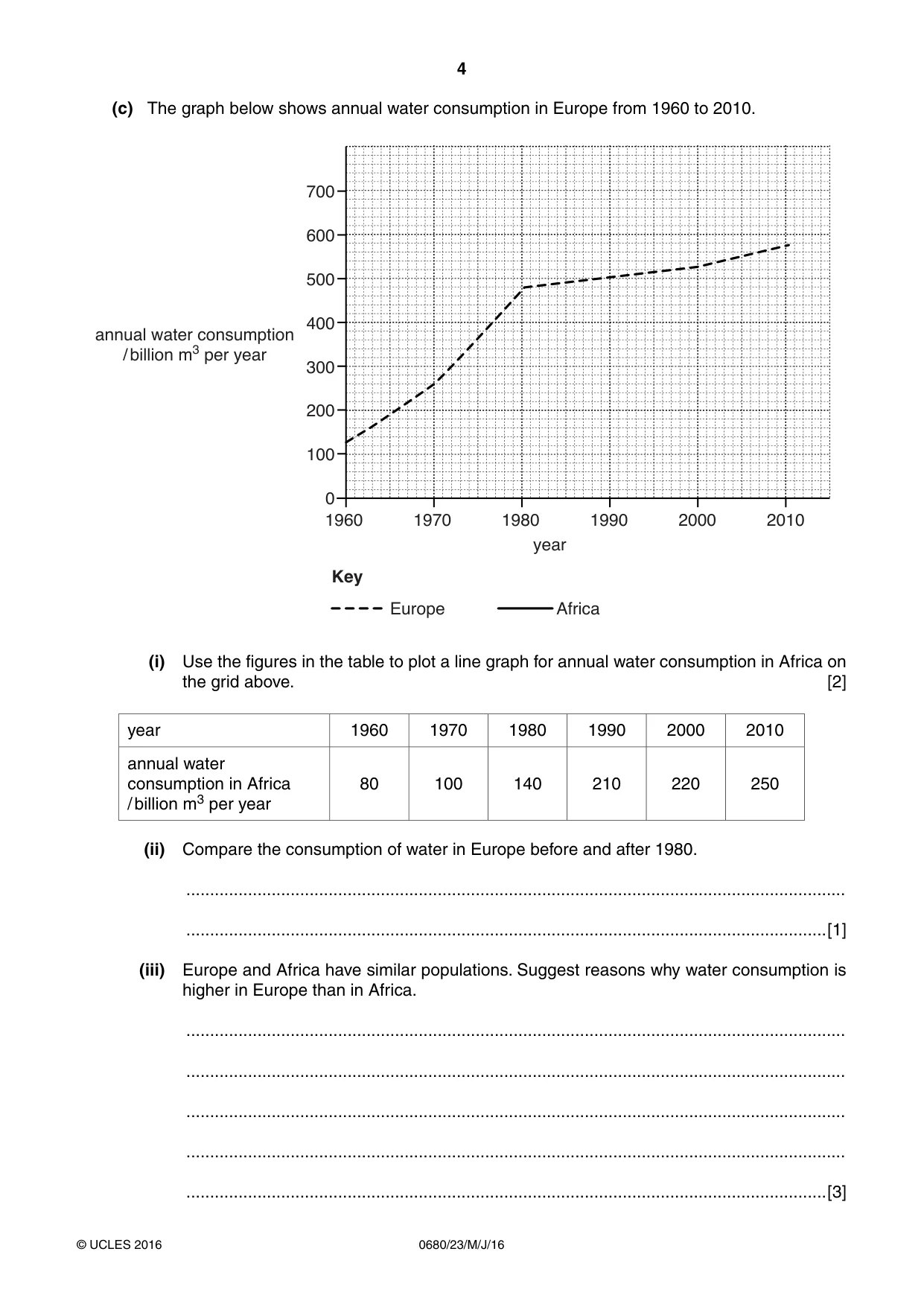
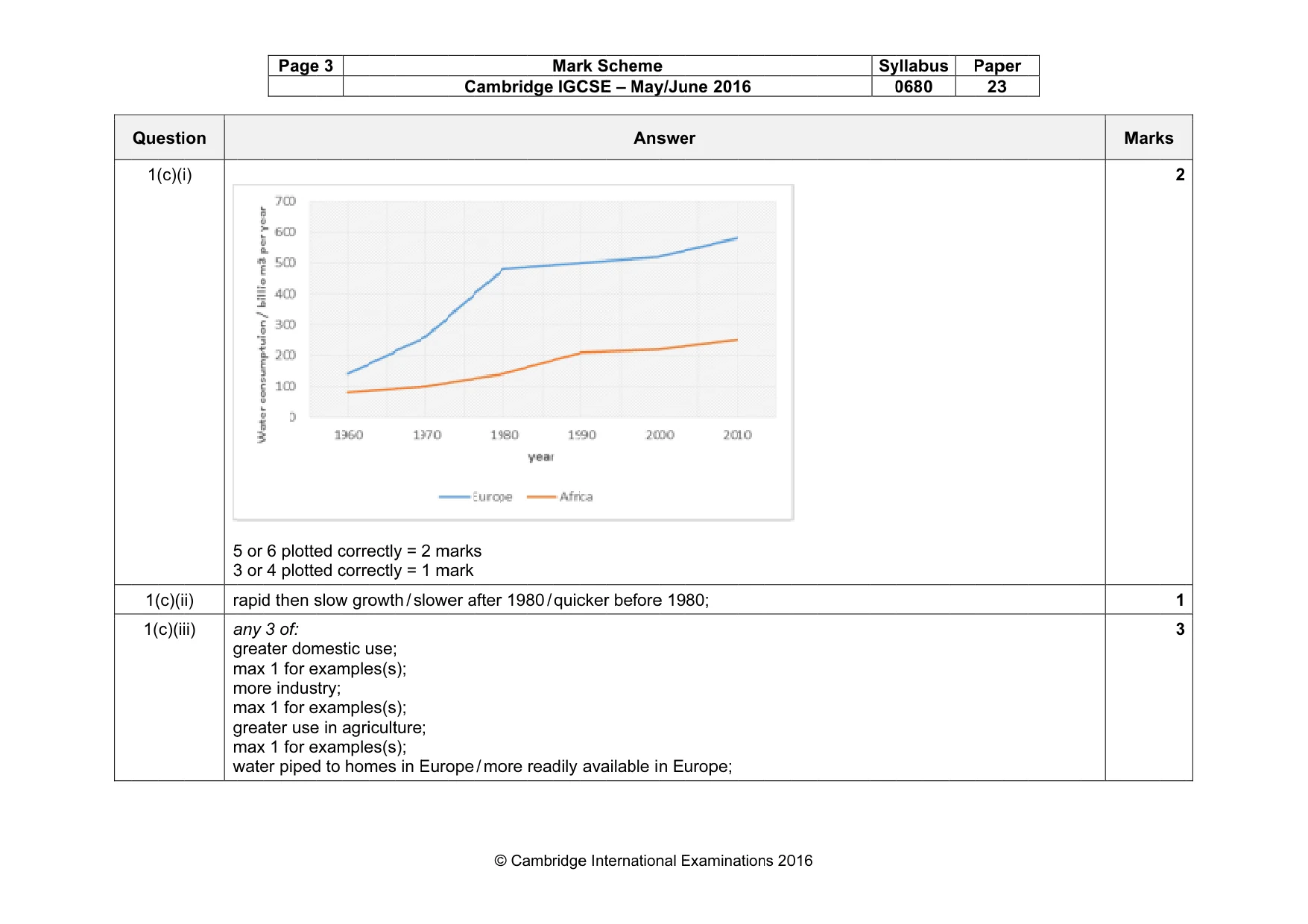
4 0680/23/M/J/16 © UCLES 2016 (c) The graph below shows annual water consumption in Europe from 1960 to 2010. 700 600 500 400 300 200 100 0 1960 1970 1980 1990 year Europe 2000 2010 annual water consumption / billion m3 per year Key Africa (i) Use the figures in the table to plot a line graph for annual water consumption in Africa on the grid above. [2] year 1960 1970 1980 1990 2000 2010 annual water consumption in Africa / billion m3 per year 80 100 140 210 220 250 (ii) Compare the consumption of water in Europe before and after 1980. … …[1] (iii) Europe and Africa have similar populations. Suggest reasons why water consumption is higher in Europe than in Africa. … … … … …[3]
Question paper, page 5
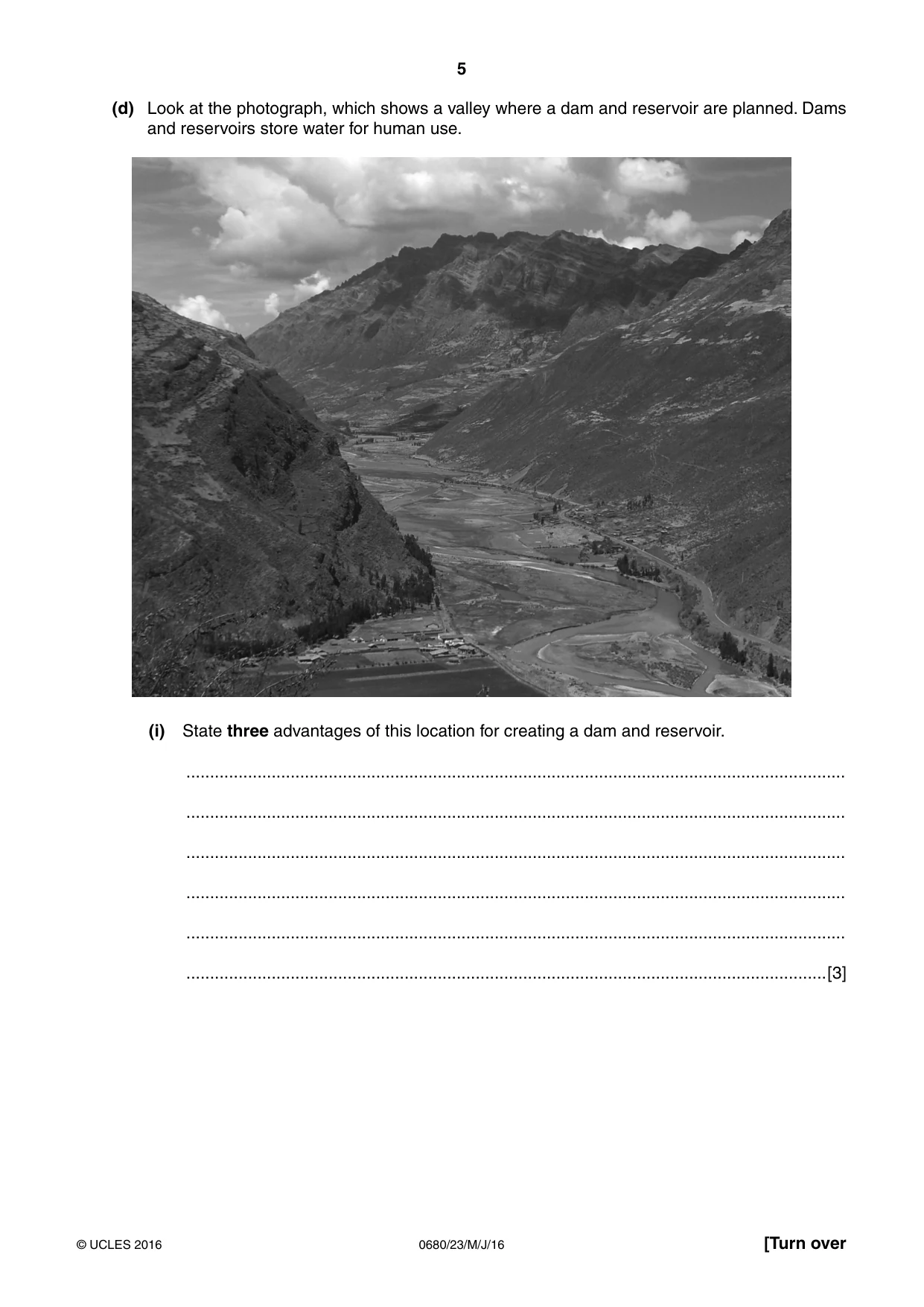
5 0680/23/M/J/16 © UCLES 2016 [Turn over (d) Look at the photograph, which shows a valley where a dam and reservoir are planned. Dams and reservoirs store water for human use. (i) State three advantages of this location for creating a dam and reservoir. … … … … … …[3]
Question paper, page 6
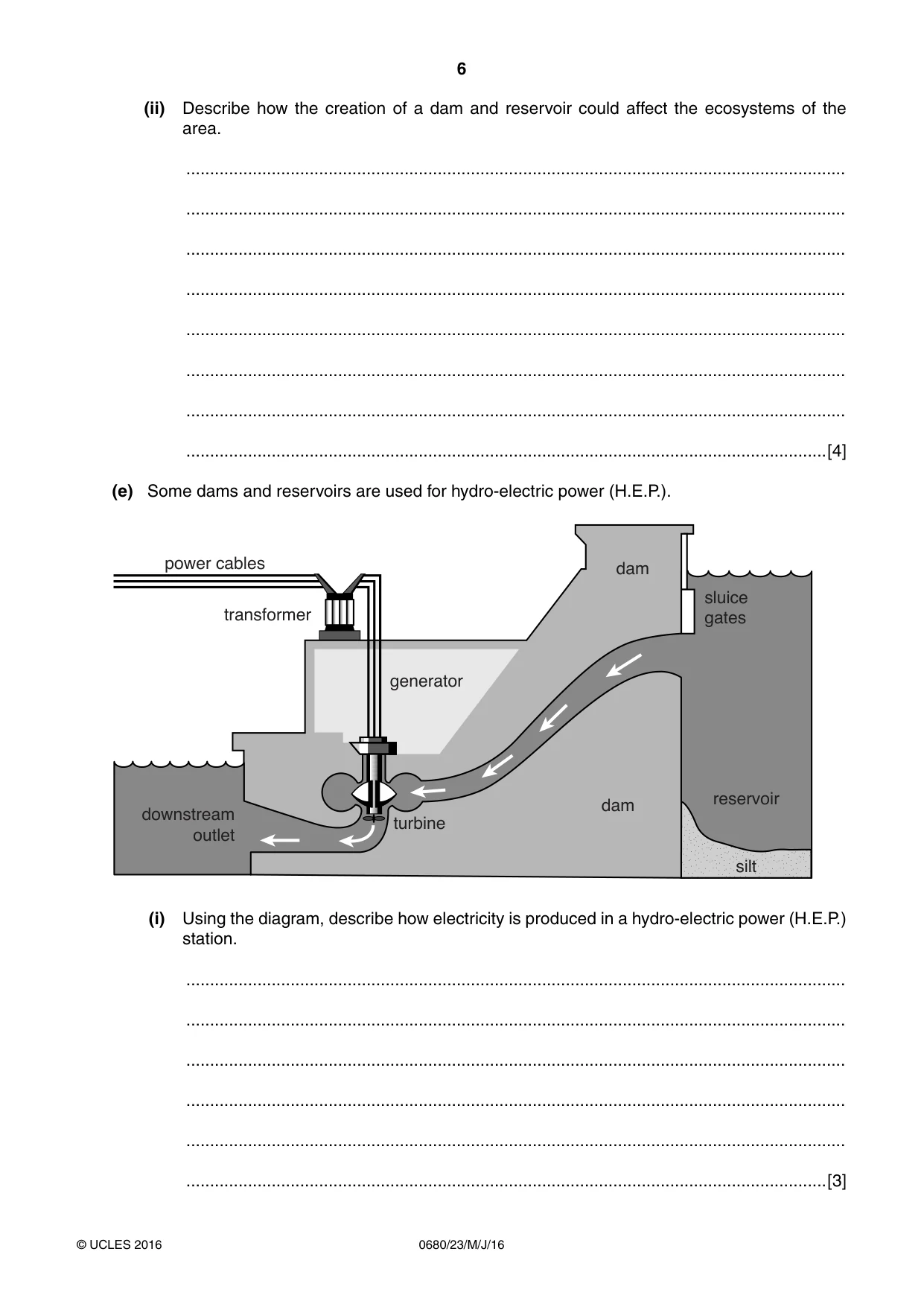
6 0680/23/M/J/16 © UCLES 2016 (ii) Describe how the creation of a dam and reservoir could affect the ecosystems of the area. … … … … … … … …[4] (e) Some dams and reservoirs are used for hydro-electric power (H.E.P.). power cables transformer downstream outlet turbine sluice gates generator dam dam silt reservoir (i) Using the diagram, describe how electricity is produced in a hydro-electric power (H.E.P.) station. … … … … … …[3]
Question paper, page 7
7 0680/23/M/J/16 © UCLES 2016 [Turn over (ii) Is hydro-electric power (H.E.P.) a sustainable energy source? Give reasons for your answer. … … … … … …[3] (f) Bilharzia is a water-based disease caused by a parasite. Describe the life cycle of this parasite and its effects on humans. life cycle … … … … … … effects on humans … … … … … … [5]
Question paper, page 8
8 0680/23/M/J/16 © UCLES 2016 (g) ‘Improving sanitation is the best way to control water-related diseases.’ How far do you agree with this statement? Give reasons for your answer. … … … … … … … … … … … …[6]
Question paper, page 9
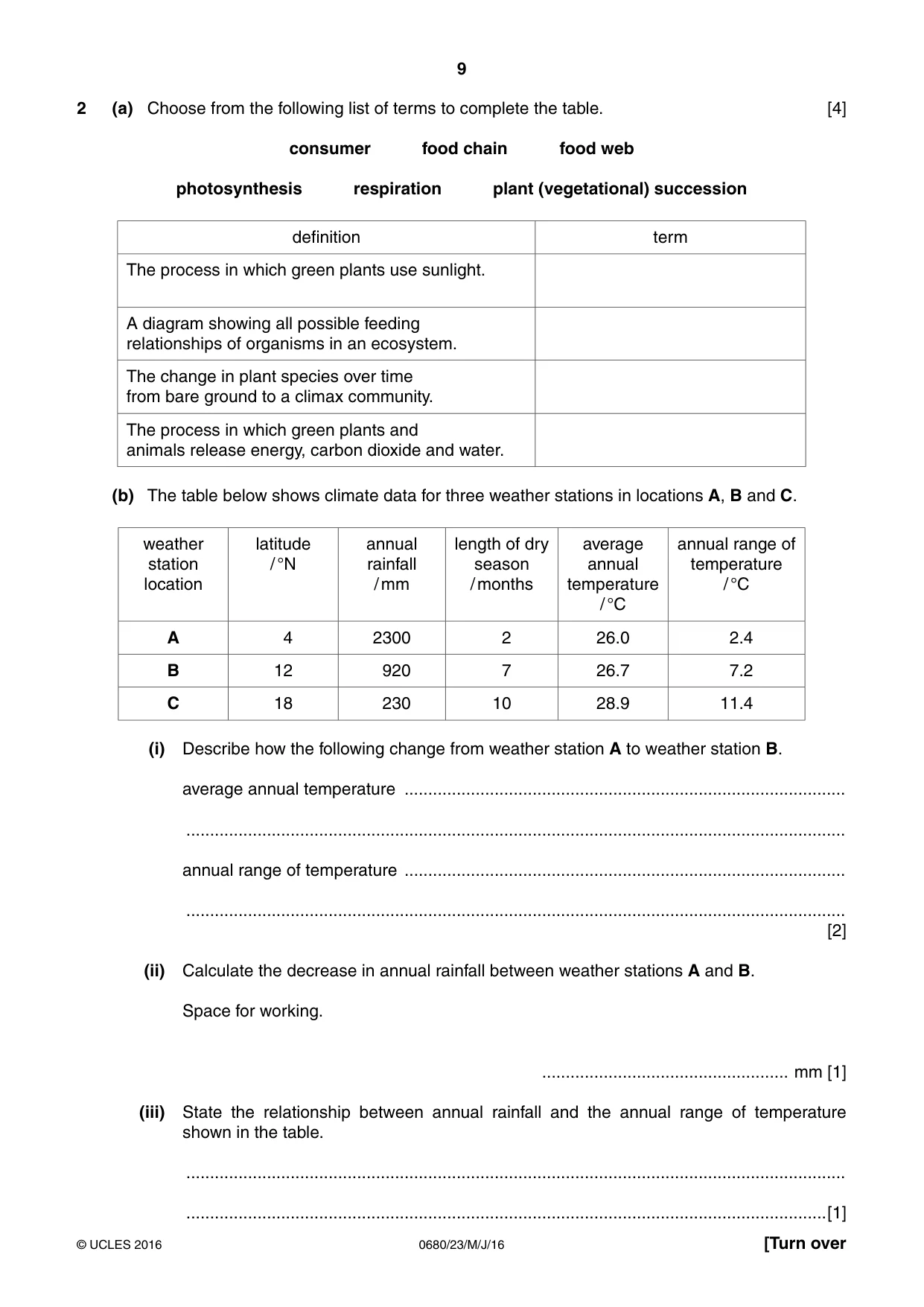
9 0680/23/M/J/16 © UCLES 2016 [Turn over 2 (a) Choose from the following list of terms to complete the table. [4] consumer food chain food web photosynthesis respiration plant (vegetational) succession definition term The process in which green plants use sunlight. A diagram showing all possible feeding relationships of organisms in an ecosystem. The change in plant species over time from bare ground to a climax community. The process in which green plants and animals release energy, carbon dioxide and water. (b) The table below shows climate data for three weather stations in locations A, B and C. weather station location latitude / °N annual rainfall / mm length of dry season / months average annual temperature / °C annual range of temperature / °C A 4 2300 2 26.0 2.4 B 12 920 7 26.7 7.2 C 18 230 10 28.9 11.4 (i) Describe how the following change from weather station A to weather station B. average annual temperature … … annual range of temperature … … [2] (ii) Calculate the decrease in annual rainfall between weather stations A and B. Space for working. … mm [1] (iii) State the relationship between annual rainfall and the annual range of temperature shown in the table. … …[1]
Question paper, page 10
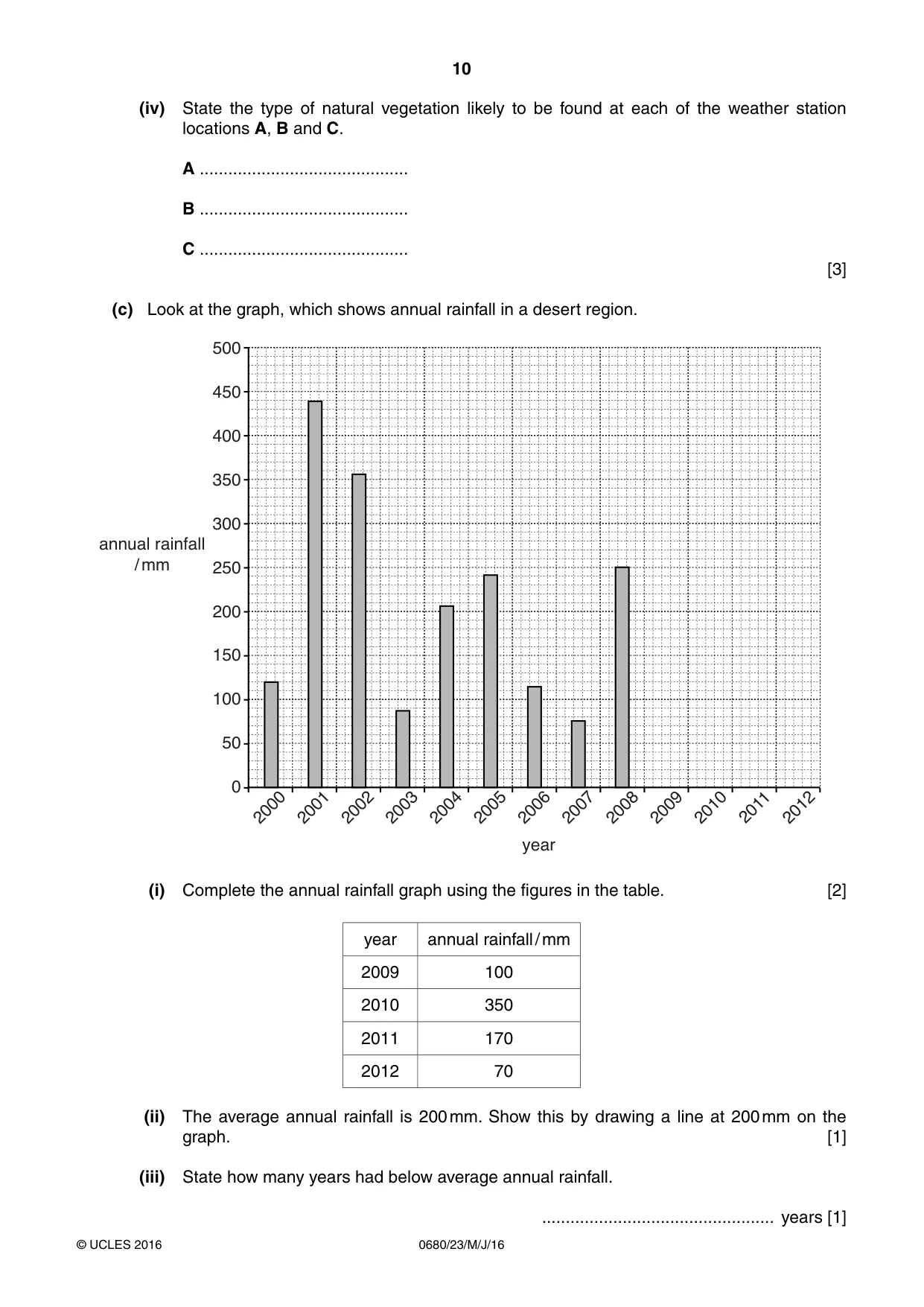
10 0680/23/M/J/16 © UCLES 2016 (iv) State the type of natural vegetation likely to be found at each of the weather station locations A, B and C. A … B … C … [3] (c) Look at the graph, which shows annual rainfall in a desert region. 500 450 400 350 300 250 200 150 100 50 0 2000 2001 2002 2003 2004 2005 2006 year 2007 2008 2009 2010 2011 2012 annual rainfall / mm (i) Complete the annual rainfall graph using the figures in the table. [2] year annual rainfall / mm 2009 100 2010 350 2011 170 2012 70 (ii) The average annual rainfall is 200 mm. Show this by drawing a line at 200 mm on the graph. [1] (iii) State how many years had below average annual rainfall. … years [1]
Question paper, page 11
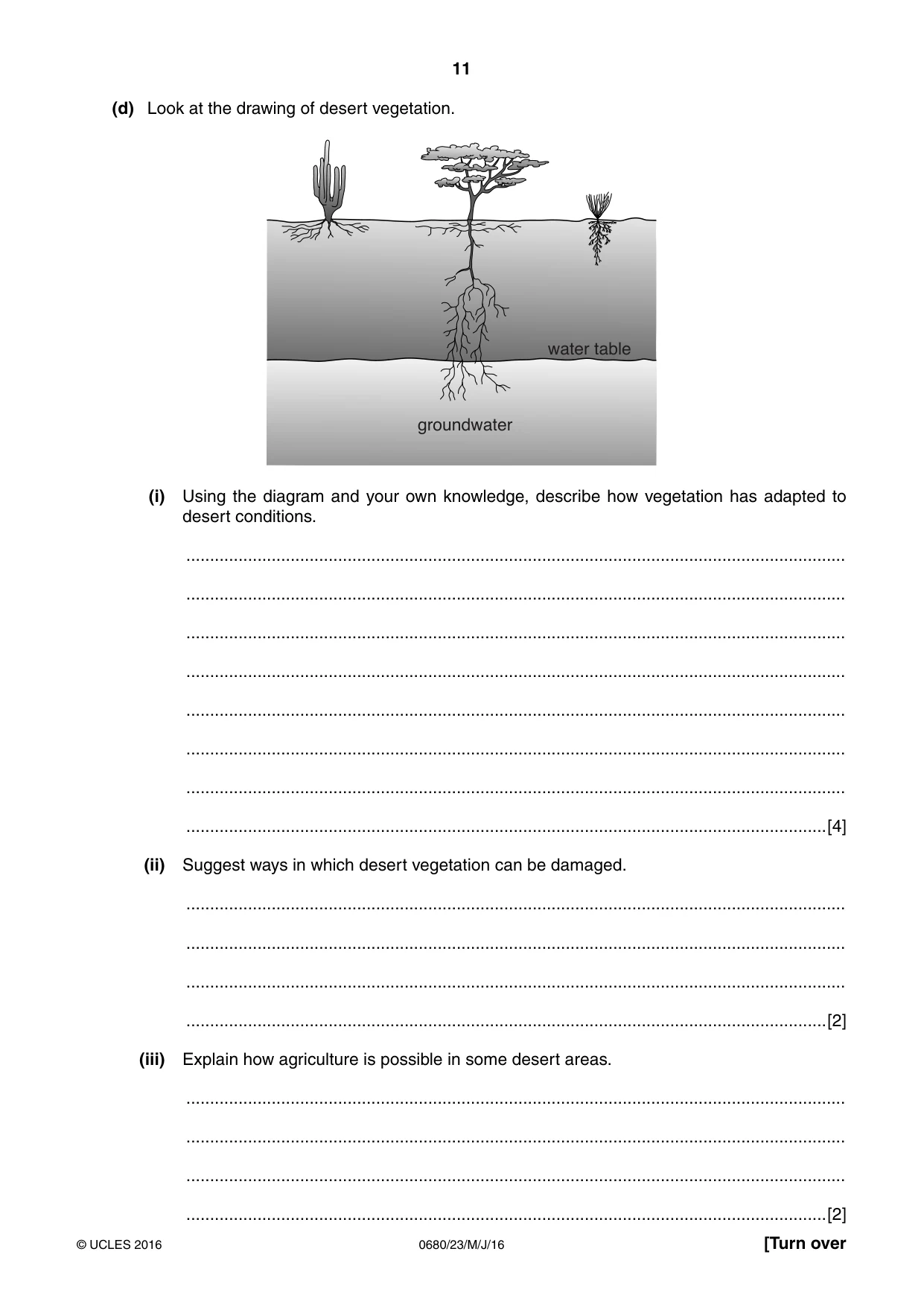
11 0680/23/M/J/16 © UCLES 2016 [Turn over (d) Look at the drawing of desert vegetation. water table groundwater (i) Using the diagram and your own knowledge, describe how vegetation has adapted to desert conditions. … … … … … … … …[4] (ii) Suggest ways in which desert vegetation can be damaged. … … … …[2] (iii) Explain how agriculture is possible in some desert areas. … … … …[2]
Question paper, page 12
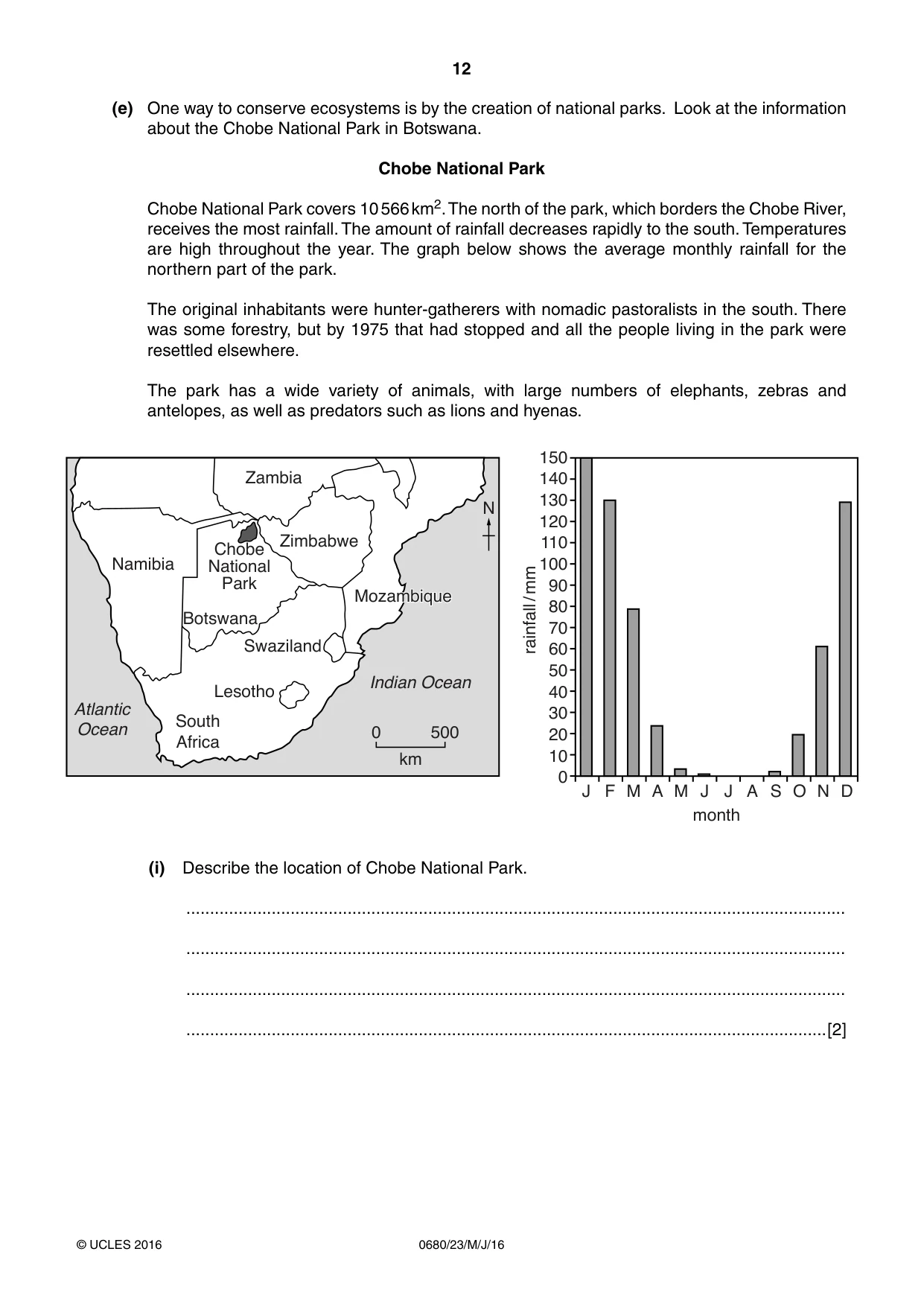
12 0680/23/M/J/16 © UCLES 2016 (e) One way to conserve ecosystems is by the creation of national parks. Look at the information about the Chobe National Park in Botswana. Chobe National Park Chobe National Park covers 10 566 km2. The north of the park, which borders the Chobe River, receives the most rainfall. The amount of rainfall decreases rapidly to the south. Temperatures are high throughout the year. The graph below shows the average monthly rainfall for the northern part of the park. The original inhabitants were hunter-gatherers with nomadic pastoralists in the south. There was some forestry, but by 1975 that had stopped and all the people living in the park were resettled elsewhere. The park has a wide variety of animals, with large numbers of elephants, zebras and antelopes, as well as predators such as lions and hyenas. 0 500 km Indian Ocean Atlantic Ocean N Zambia Namibia Botswana South Africa Lesotho Swaziland Zimbabwe Mozambique Mozambique Chobe National Park J F M A M J J A S O N D 150 140 130 120 110 100 90 80 70 60 50 40 30 20 10 0 rainfall / mm month (i) Describe the location of Chobe National Park. … … … …[2]
Question paper, page 13
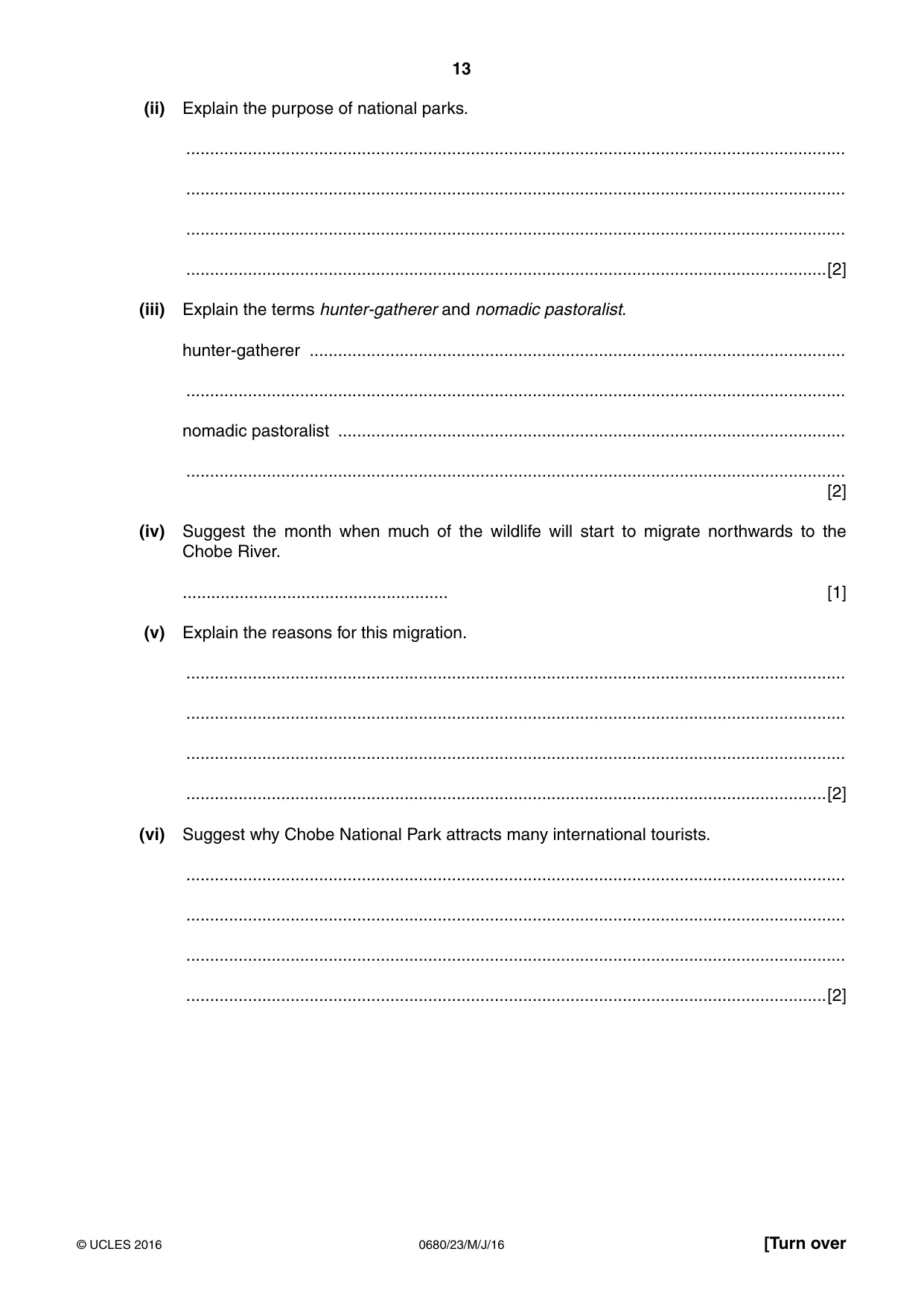
13 0680/23/M/J/16 © UCLES 2016 [Turn over (ii) Explain the purpose of national parks. … … … …[2] (iii) Explain the terms hunter-gatherer and nomadic pastoralist. hunter-gatherer … … nomadic pastoralist … … [2] (iv) Suggest the month when much of the wildlife will start to migrate northwards to the Chobe River. … [1] (v) Explain the reasons for this migration. … … … …[2] (vi) Suggest why Chobe National Park attracts many international tourists. … … … …[2]
Question paper, page 14
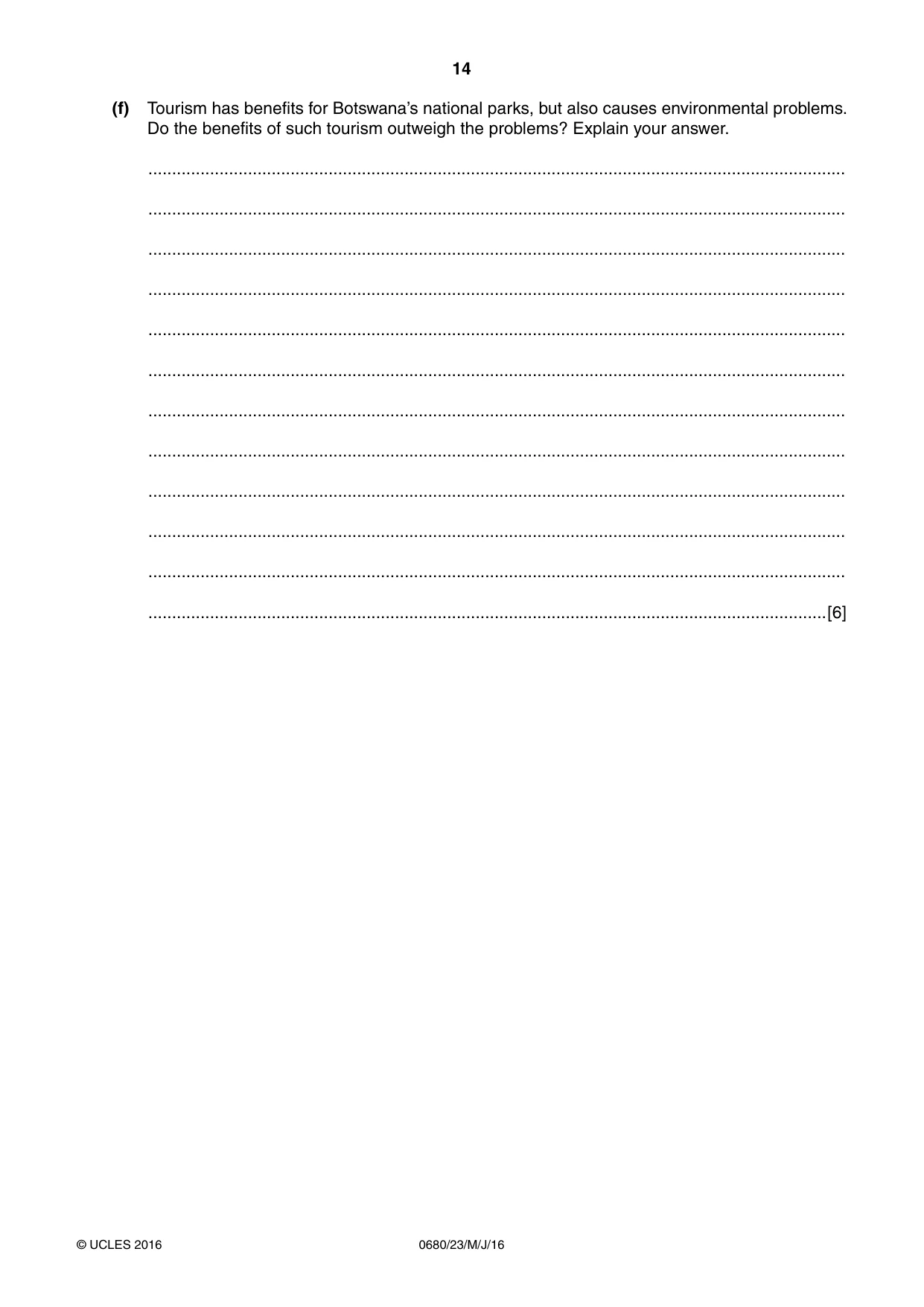
14 0680/23/M/J/16 © UCLES 2016 (f) Tourism has benefits for Botswana’s national parks, but also causes environmental problems. Do the benefits of such tourism outweigh the problems? Explain your answer. … … … … … … … … … … … …[6]
Question paper, page 15
15 0680/23/M/J/16 © UCLES 2016 BLANK PAGE
Question paper, page 16
16 0680/23/M/J/16 © UCLES 2016 BLANK PAGE Permission to reproduce items where third-party owned material protected by copyright is included has been sought and cleared where possible. Every reasonable effort has been made by the publisher (UCLES) to trace copyright holders, but if any items requiring clearance have unwittingly been included, the publisher will be pleased to make amends at the earliest possible opportunity. To avoid the issue of disclosure of answer-related information to candidates, all copyright acknowledgements are reproduced online in the Cambridge International Examinations Copyright Acknowledgements Booklet. This is produced for each series of examinations and is freely available to download at www.cie.org.uk after the live examination series. Cambridge International Examinations is part of the Cambridge Assessment Group. Cambridge Assessment is the brand name of University of Cambridge Local Examinations Syndicate (UCLES), which is itself a department of the University of Cambridge.
Mark scheme, page 1
® IGCSE is the registered trademark of Cambridge International Examinations. This document consists of 9 printed pages. © UCLES 2016 [Turn over Cambridge International Examinations Cambridge International General Certificate of Secondary Education ENVIRONMENTAL MANAGEMENT 0680/23 Paper 2 May/June 2016 MARK SCHEME Maximum Mark: 80 Published This mark scheme is published as an aid to teachers and candidates, to indicate the requirements of the examination. It shows the basis on which Examiners were instructed to award marks. It does not indicate the details of the discussions that took place at an Examiners’ meeting before marking began, which would have considered the acceptability of alternative answers. Mark schemes should be read in conjunction with the question paper and the Principal Examiner Report for Teachers. Cambridge will not enter into discussions about these mark schemes. Cambridge is publishing the mark schemes for the May/June 2016 series for most Cambridge IGCSE®, Cambridge International A and AS Level components and some Cambridge O Level components.
Mark scheme, page 2
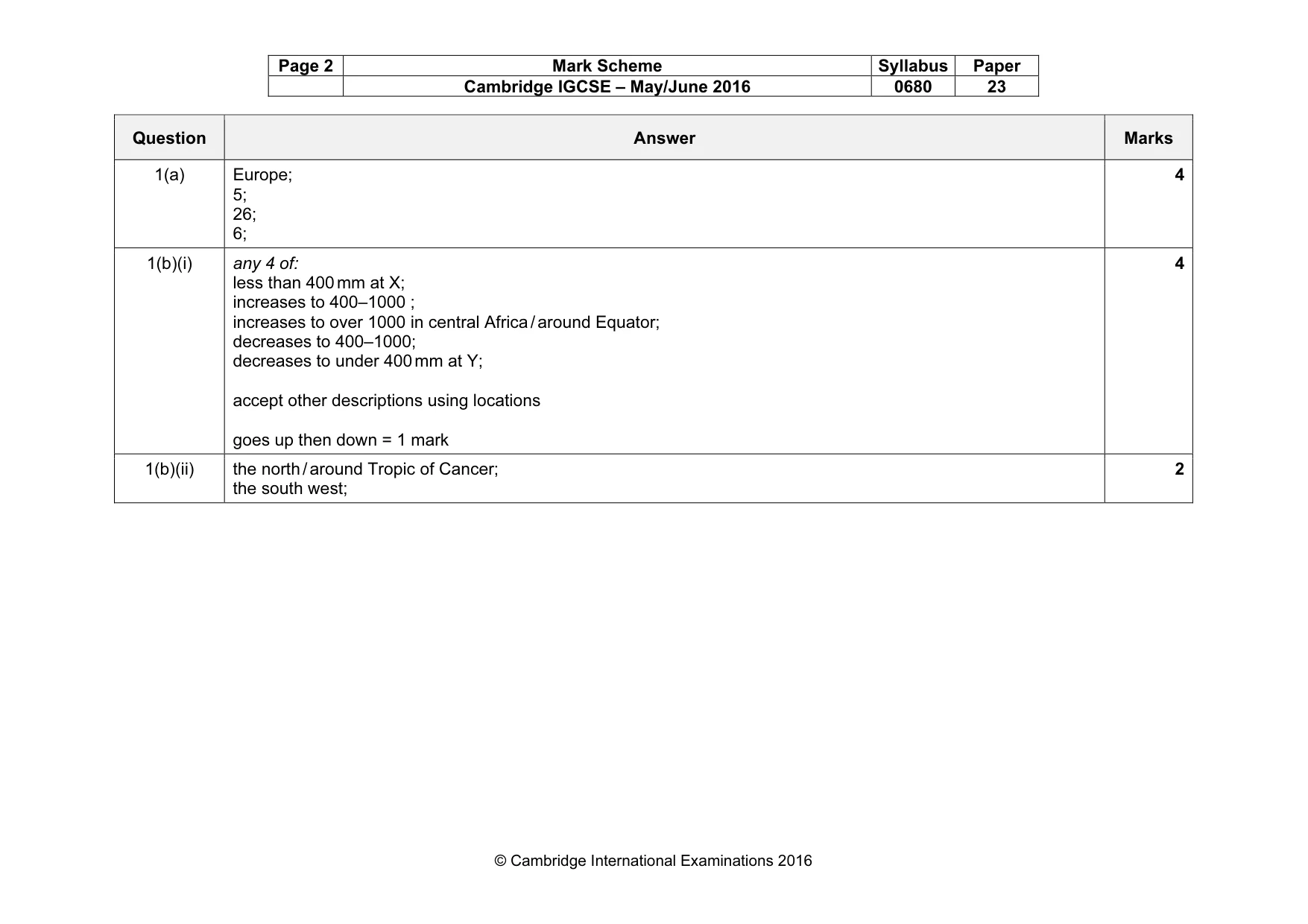
Page 2 Mark Scheme Syllabus Paper Cambridge IGCSE – May/June 2016 0680 23 © Cambridge International Examinations 2016 Question Answer Marks 1(a) Europe; 5; 26; 6; 4 1(b)(i) any 4 of: less than 400 mm at X; increases to 400–1000 ; increases to over 1000 in central Africa / around Equator; decreases to 400–1000; decreases to under 400 mm at Y; accept other descriptions using locations goes up then down = 1 mark 4 1(b)(ii) the north / around Tropic of Cancer; the south west; 2
Mark scheme, page 3
Que 1( 1( 1( esti (c)(i (c)(i c)(ii on i) i) ii) 5 3 r a g m m m g m w 5 or 3 or rapid any grea max more max grea max wate P 6 p 4 p d th 3 of ater x 1 fo e in x 1 fo ater x 1 fo er p age plotte plotte en s f: dom or e dus or e use or e iped e 3 ed c ed c slow mes exam stry; exam e in exam d to corre corre w gro tic u mple mple agri mple hom ectly ectly owt use; es(s es(s icult es(s mes y = y = h / s ; s); s); ture s); s in E 2 m 1 m lowe ; Euro C marks mark er a ope Cam © s after / mo brid © Ca r 198 ore dge ambr 80 / read Mar IGC ridge quic dily rk S CSE e Int cker ava Sche E – M terna r be ailab eme May ation Ans fore ble i e y/Ju nal E swe e 19 n Eu une Exam er 80; urop 201 mina pe; 16 ations 2016 Sy 0 yllab 068 bus 0 Pap 23 per 3 Marks 2 1 3
Mark scheme, page 4
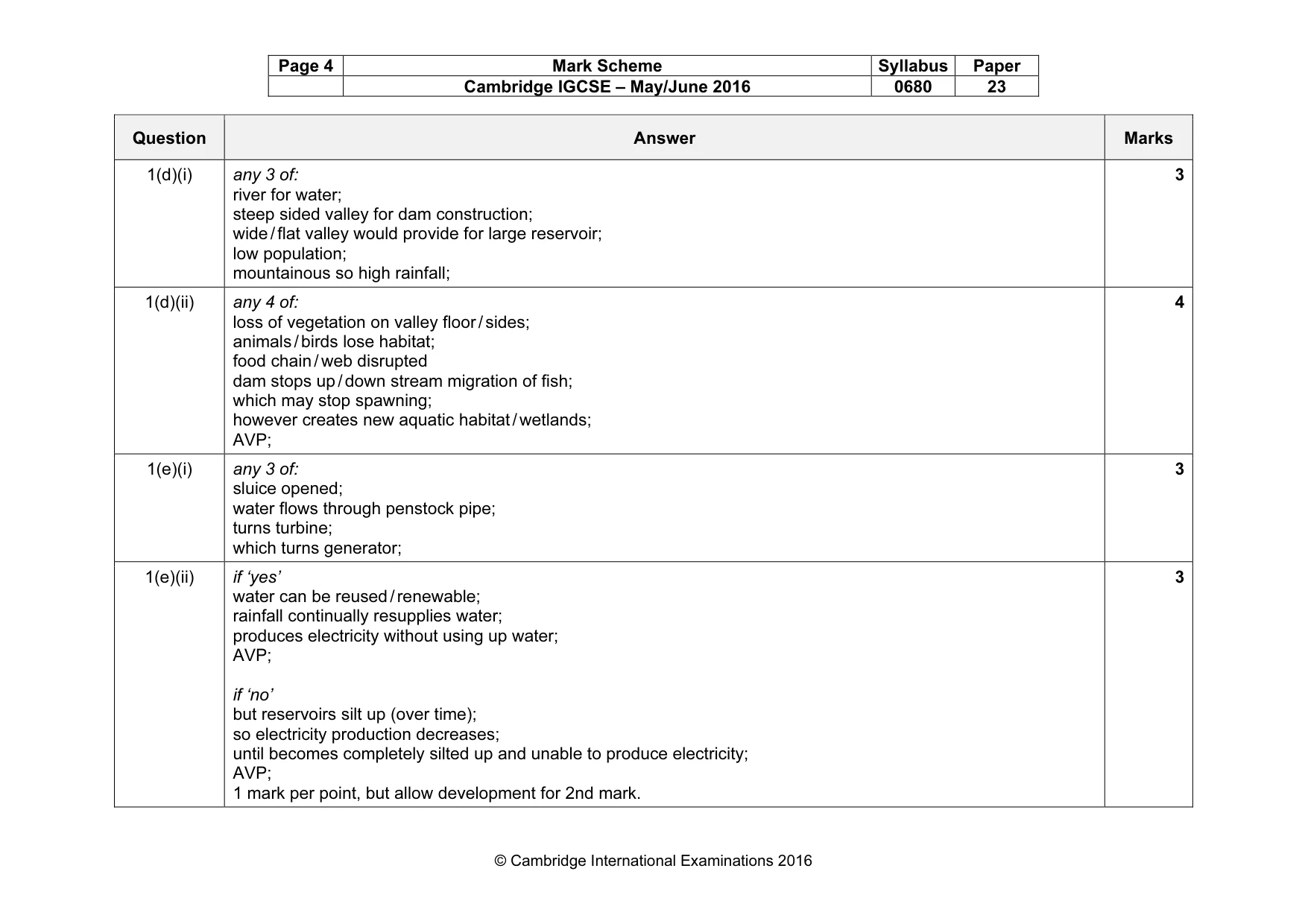
Page 4 Mark Scheme Syllabus Paper Cambridge IGCSE – May/June 2016 0680 23 © Cambridge International Examinations 2016 Question Answer Marks 1(d)(i) any 3 of: river for water; steep sided valley for dam construction; wide / flat valley would provide for large reservoir; low population; mountainous so high rainfall; 3 1(d)(ii) any 4 of: loss of vegetation on valley floor / sides; animals / birds lose habitat; food chain / web disrupted dam stops up / down stream migration of fish; which may stop spawning; however creates new aquatic habitat / wetlands; AVP; 4 1(e)(i) any 3 of: sluice opened; water flows through penstock pipe; turns turbine; which turns generator; 3 1(e)(ii) if ‘yes’ water can be reused / renewable; rainfall continually resupplies water; produces electricity without using up water; AVP; if ‘no’ but reservoirs silt up (over time); so electricity production decreases; until becomes completely silted up and unable to produce electricity; AVP; 1 mark per point, but allow development for 2nd mark. 3
Mark scheme, page 5
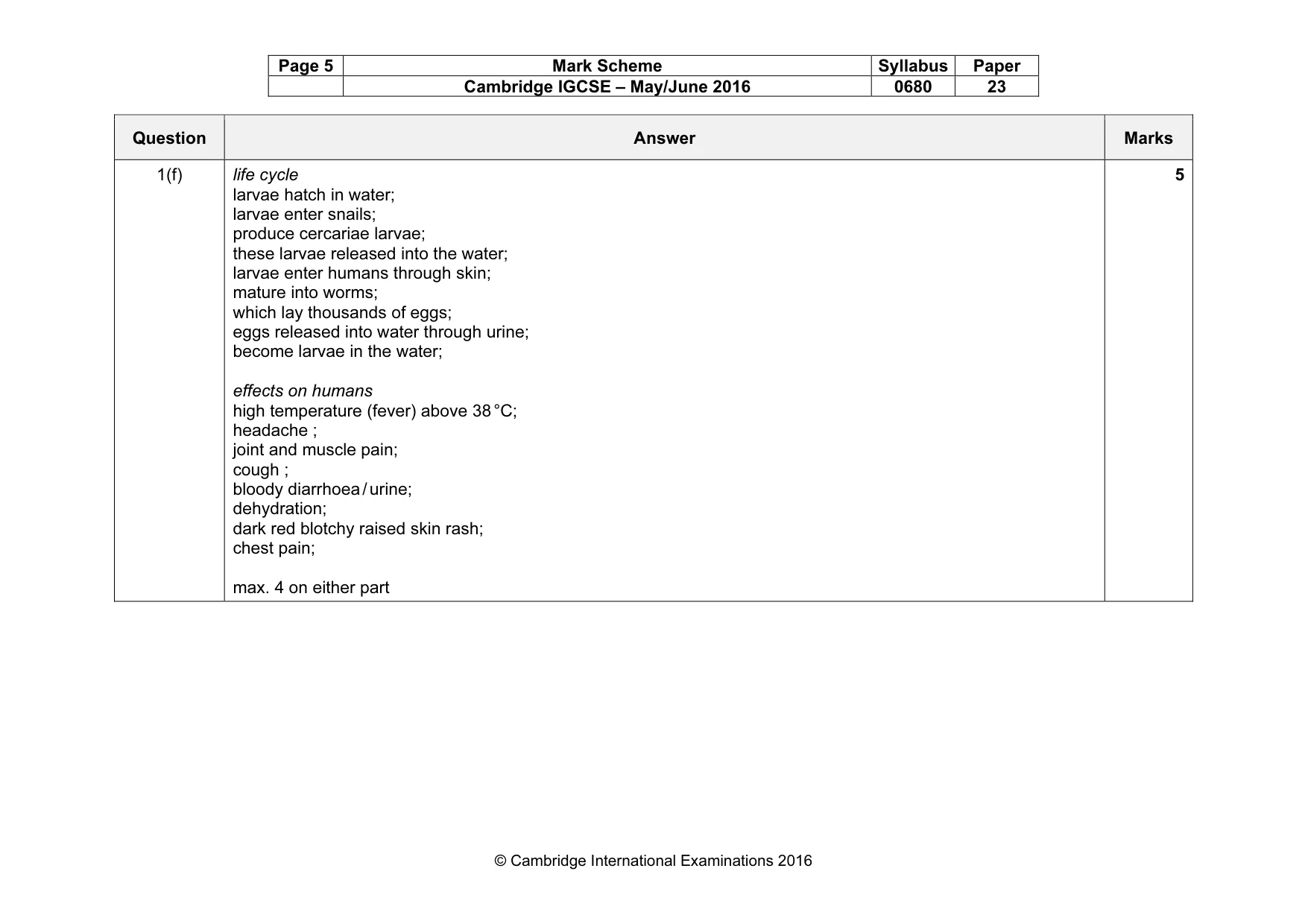
Page 5 Mark Scheme Syllabus Paper Cambridge IGCSE – May/June 2016 0680 23 © Cambridge International Examinations 2016 Question Answer Marks 1(f) life cycle larvae hatch in water; larvae enter snails; produce cercariae larvae; these larvae released into the water; larvae enter humans through skin; mature into worms; which lay thousands of eggs; eggs released into water through urine; become larvae in the water; effects on humans high temperature (fever) above 38 °C; headache ; joint and muscle pain; cough ; bloody diarrhoea / urine; dehydration; dark red blotchy raised skin rash; chest pain; max. 4 on either part 5
Mark scheme, page 6
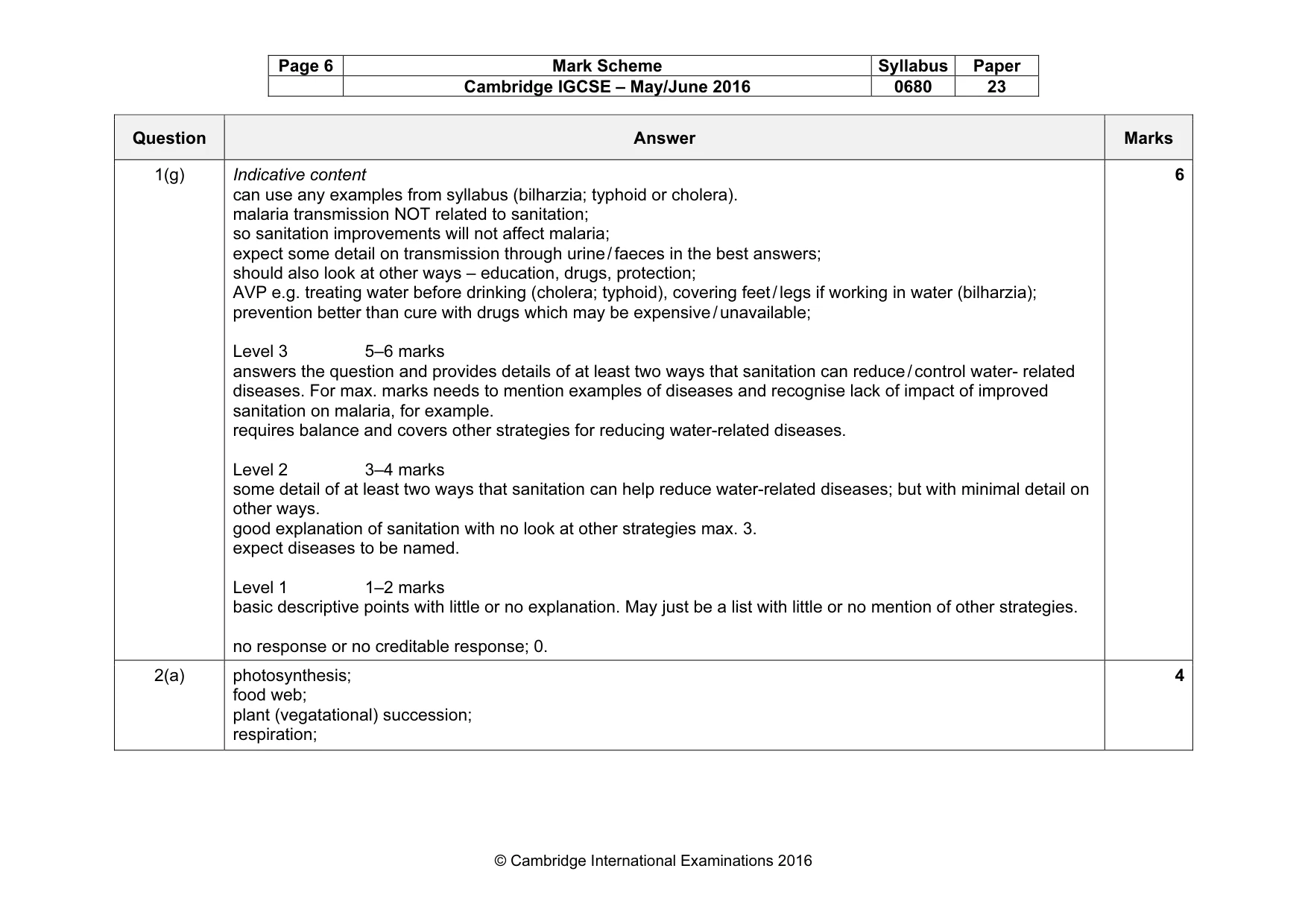
Page 6 Mark Scheme Syllabus Paper Cambridge IGCSE – May/June 2016 0680 23 © Cambridge International Examinations 2016 Question Answer Marks 1(g) Indicative content can use any examples from syllabus (bilharzia; typhoid or cholera). malaria transmission NOT related to sanitation; so sanitation improvements will not affect malaria; expect some detail on transmission through urine / faeces in the best answers; should also look at other ways – education, drugs, protection; AVP e.g. treating water before drinking (cholera; typhoid), covering feet / legs if working in water (bilharzia); prevention better than cure with drugs which may be expensive / unavailable; Level 3 5–6 marks answers the question and provides details of at least two ways that sanitation can reduce / control water- related diseases. For max. marks needs to mention examples of diseases and recognise lack of impact of improved sanitation on malaria, for example. requires balance and covers other strategies for reducing water-related diseases. Level 2 3–4 marks some detail of at least two ways that sanitation can help reduce water-related diseases; but with minimal detail on other ways. good explanation of sanitation with no look at other strategies max. 3. expect diseases to be named. Level 1 1–2 marks basic descriptive points with little or no explanation. May just be a list with little or no mention of other strategies. no response or no creditable response; 0. 6 2(a) photosynthesis; food web; plant (vegatational) succession; respiration; 4
Mark scheme, page 7
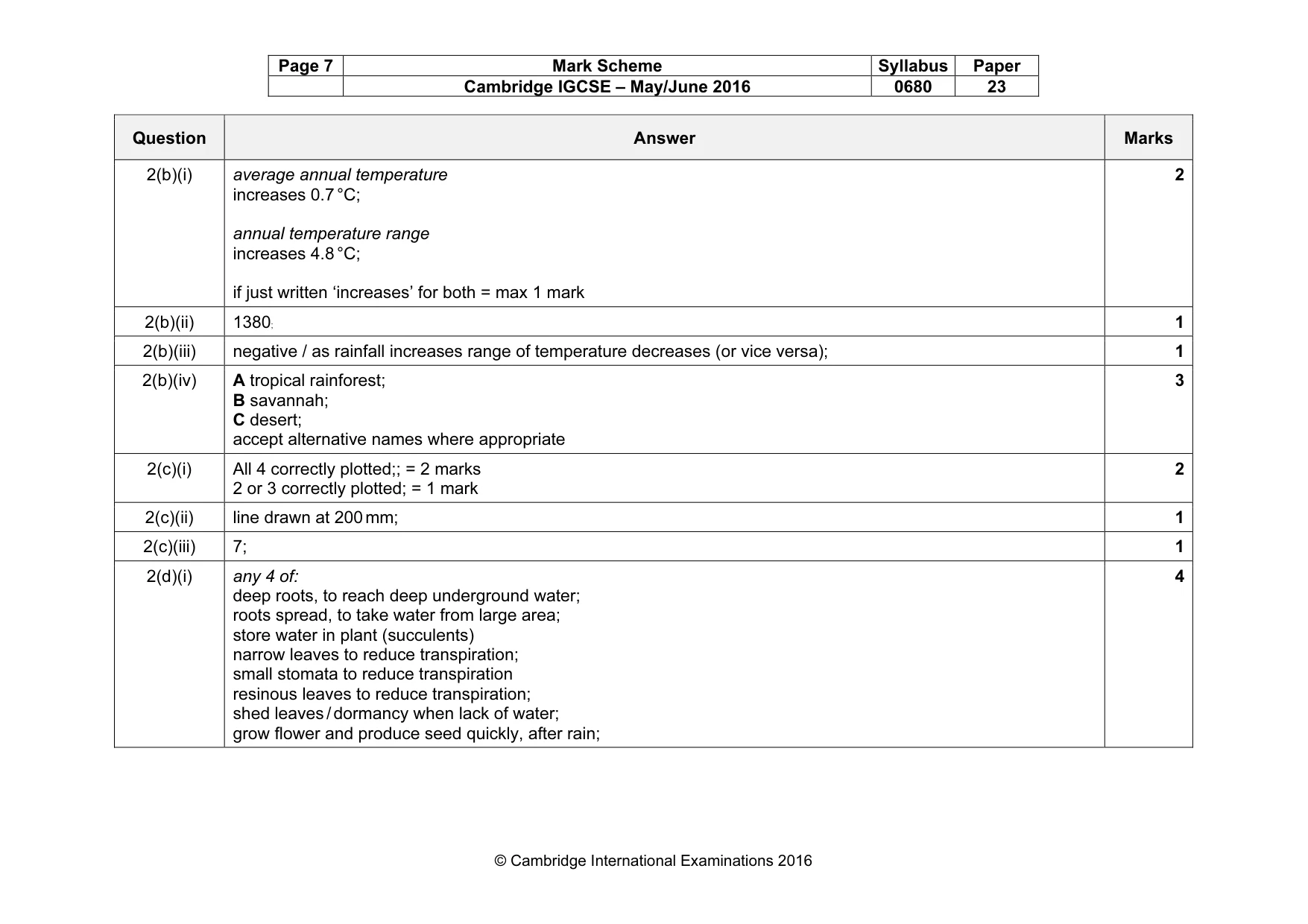
Page 7 Mark Scheme Syllabus Paper Cambridge IGCSE – May/June 2016 0680 23 © Cambridge International Examinations 2016 Question Answer Marks 2(b)(i) average annual temperature increases 0.7 °C; annual temperature range increases 4.8 °C; if just written ‘increases’ for both = max 1 mark 2 2(b)(ii) 1380; 1 2(b)(iii) negative / as rainfall increases range of temperature decreases (or vice versa); 1 2(b)(iv) A tropical rainforest; B savannah; C desert; accept alternative names where appropriate 3 2(c)(i) All 4 correctly plotted;; = 2 marks 2 or 3 correctly plotted; = 1 mark 2 2(c)(ii) line drawn at 200 mm; 1 2(c)(iii) 7; 1 2(d)(i) any 4 of: deep roots, to reach deep underground water; roots spread, to take water from large area; store water in plant (succulents) narrow leaves to reduce transpiration; small stomata to reduce transpiration resinous leaves to reduce transpiration; shed leaves / dormancy when lack of water; grow flower and produce seed quickly, after rain; 4
Mark scheme, page 8
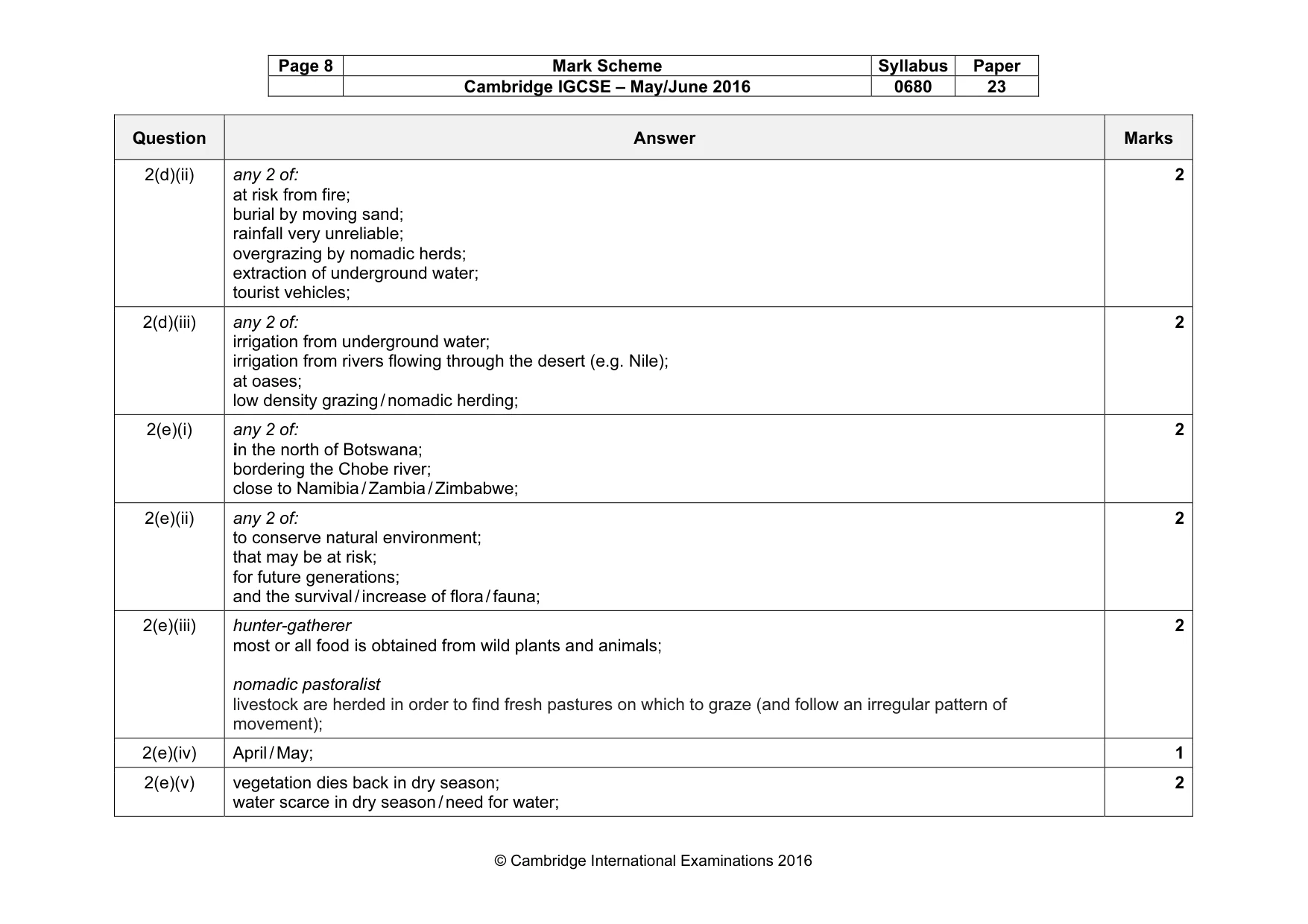
Page 8 Mark Scheme Syllabus Paper Cambridge IGCSE – May/June 2016 0680 23 © Cambridge International Examinations 2016 Question Answer Marks 2(d)(ii) any 2 of: at risk from fire; burial by moving sand; rainfall very unreliable; overgrazing by nomadic herds; extraction of underground water; tourist vehicles; 2 2(d)(iii) any 2 of: irrigation from underground water; irrigation from rivers flowing through the desert (e.g. Nile); at oases; low density grazing / nomadic herding; 2 2(e)(i) any 2 of: in the north of Botswana; bordering the Chobe river; close to Namibia / Zambia / Zimbabwe; 2 2(e)(ii) any 2 of: to conserve natural environment; that may be at risk; for future generations; and the survival / increase of flora / fauna; 2 2(e)(iii) hunter-gatherer most or all food is obtained from wild plants and animals; nomadic pastoralist livestock are herded in order to find fresh pastures on which to graze (and follow an irregular pattern of movement); 2 2(e)(iv) April / May; 1 2(e)(v) vegetation dies back in dry season; water scarce in dry season / need for water; 2
Mark scheme, page 9
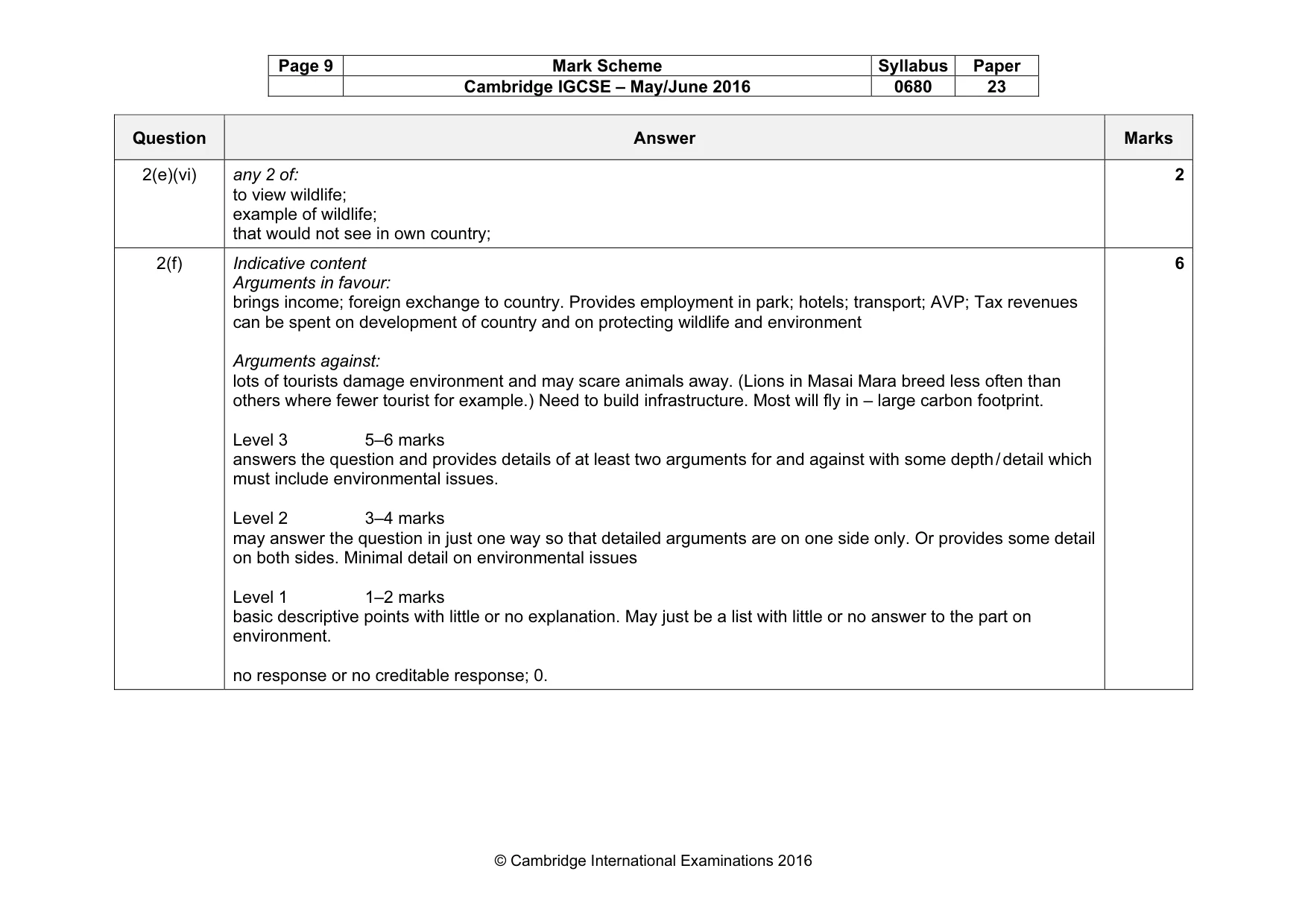
Page 9 Mark Scheme Syllabus Paper Cambridge IGCSE – May/June 2016 0680 23 © Cambridge International Examinations 2016 Question Answer Marks 2(e)(vi) any 2 of: to view wildlife; example of wildlife; that would not see in own country; 2 2(f) Indicative content Arguments in favour: brings income; foreign exchange to country. Provides employment in park; hotels; transport; AVP; Tax revenues can be spent on development of country and on protecting wildlife and environment Arguments against: lots of tourists damage environment and may scare animals away. (Lions in Masai Mara breed less often than others where fewer tourist for example.) Need to build infrastructure. Most will fly in – large carbon footprint. Level 3 5–6 marks answers the question and provides details of at least two arguments for and against with some depth / detail which must include environmental issues. Level 2 3–4 marks may answer the question in just one way so that detailed arguments are on one side only. Or provides some detail on both sides. Minimal detail on environmental issues Level 1 1–2 marks basic descriptive points with little or no explanation. May just be a list with little or no answer to the part on environment. no response or no creditable response; 0. 6
What you needed in this session
Cambridge’s own grade thresholds for 2016 May/June, Paper 2 · Variant 3. A higher threshold means an easier paper — the bar moves with how the cohort did.