Cambridge IGCSE Environmental Management 0680 — 2014 May/June Paper 2 · Variant 2
0680/22/M/J/14 · 80 marks · ≈90 min
The question paper and its mark scheme, free to read here and free to download. This is Cambridge’s own paper, exactly as it was sat.
Question paper20 pages
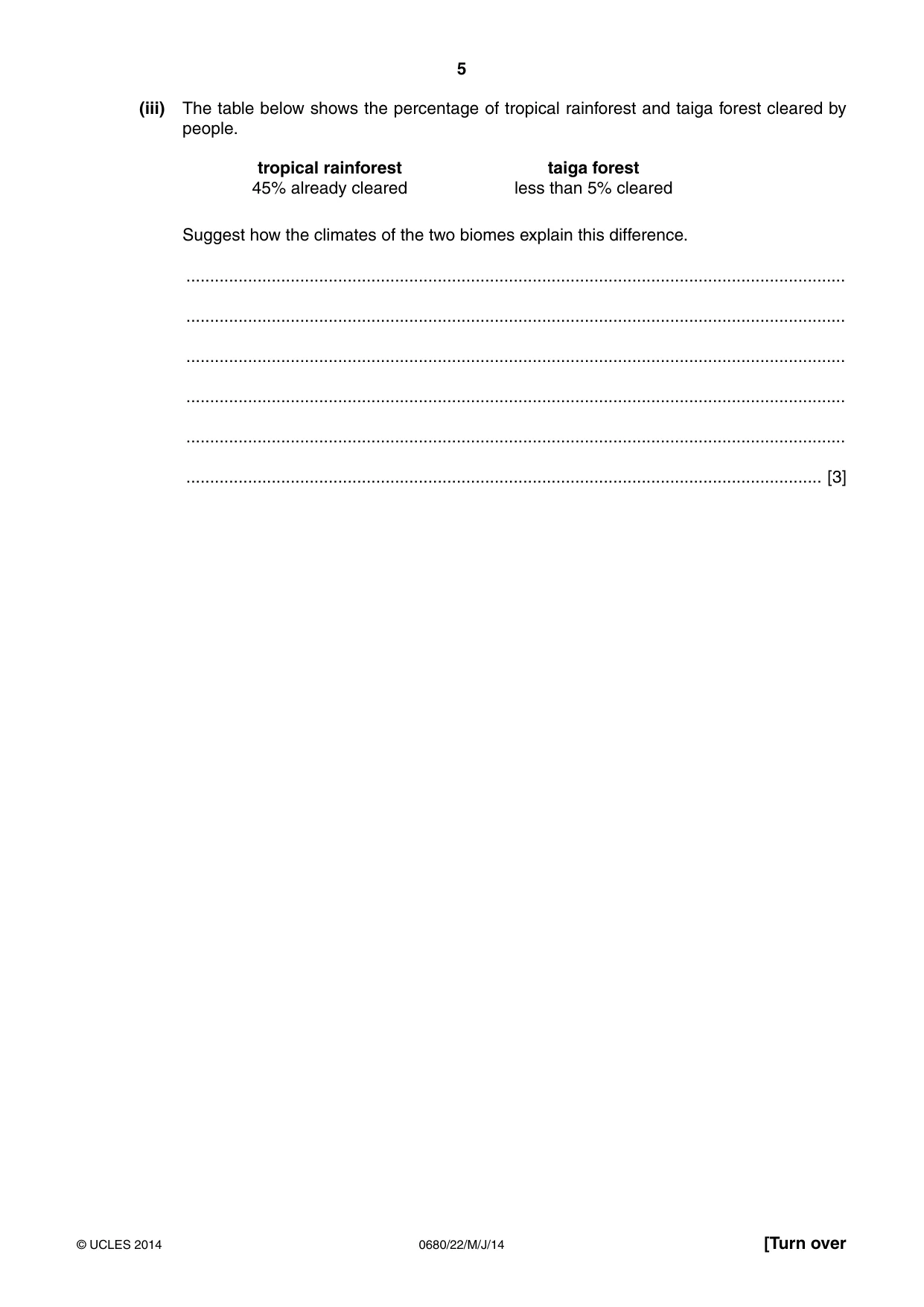
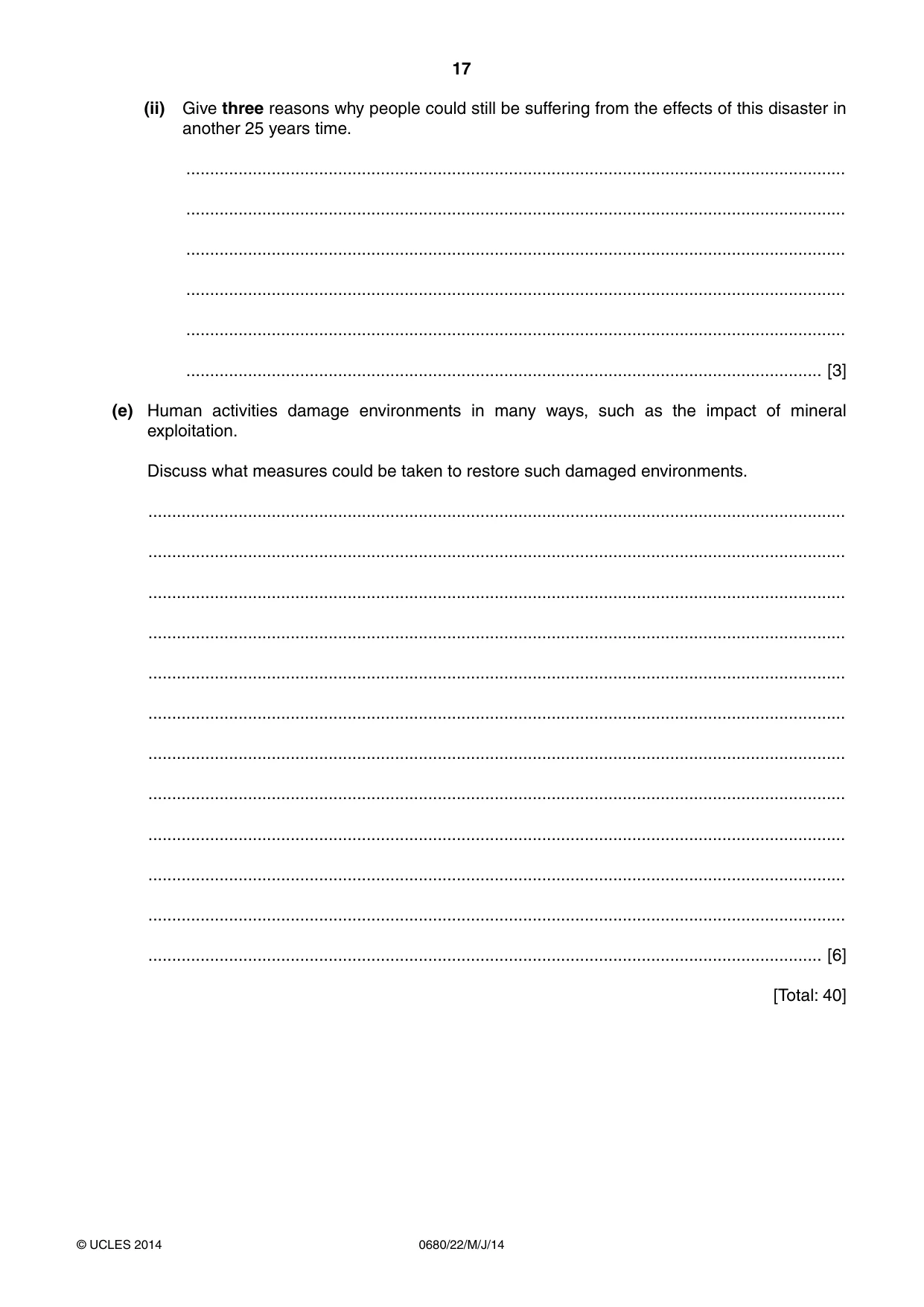


Mark scheme8 pages
Answers below. Sit the paper first if you are practising.
Paper as text
Question paper, page 1
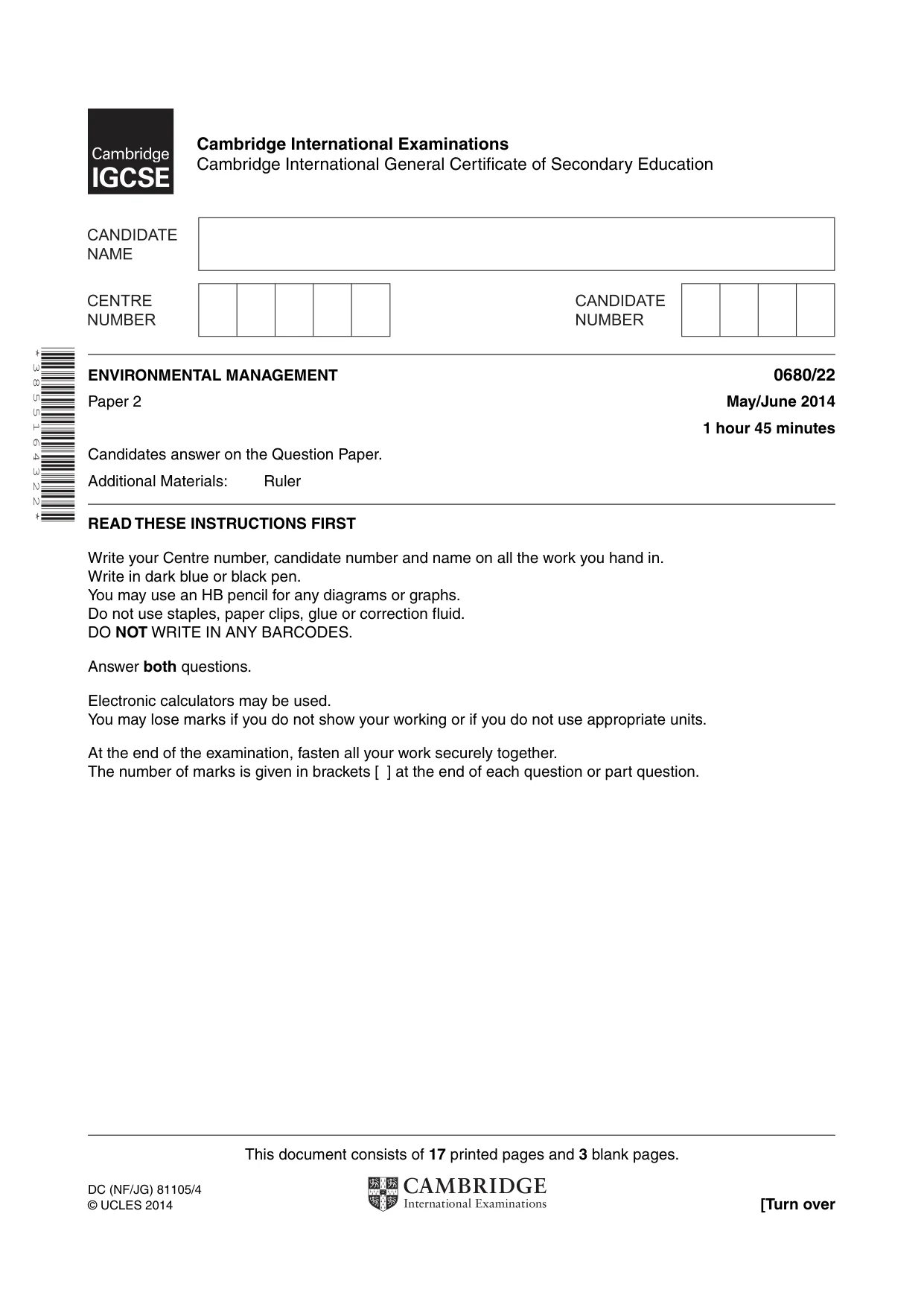
This document consists of 17 printed pages and 3 blank pages. DC (NF/JG) 81105/4 © UCLES 2014 [Turn over Cambridge International Examinations Cambridge International General Certificate of Secondary Education * 3 8 5 5 1 6 4 3 2 2 * ENVIRONMENTAL MANAGEMENT 0680/22 Paper 2 May/June 2014 1 hour 45 minutes Candidates answer on the Question Paper. Additional Materials: Ruler READ THESE INSTRUCTIONS FIRST Write your Centre number, candidate number and name on all the work you hand in. Write in dark blue or black pen. You may use an HB pencil for any diagrams or graphs. Do not use staples, paper clips, glue or correction fluid. DO NOT WRITE IN ANY BARCODES. Answer both questions. Electronic calculators may be used. You may lose marks if you do not show your working or if you do not use appropriate units. At the end of the examination, fasten all your work securely together. The number of marks is given in brackets [ ] at the end of each question or part question.
Question paper, page 2
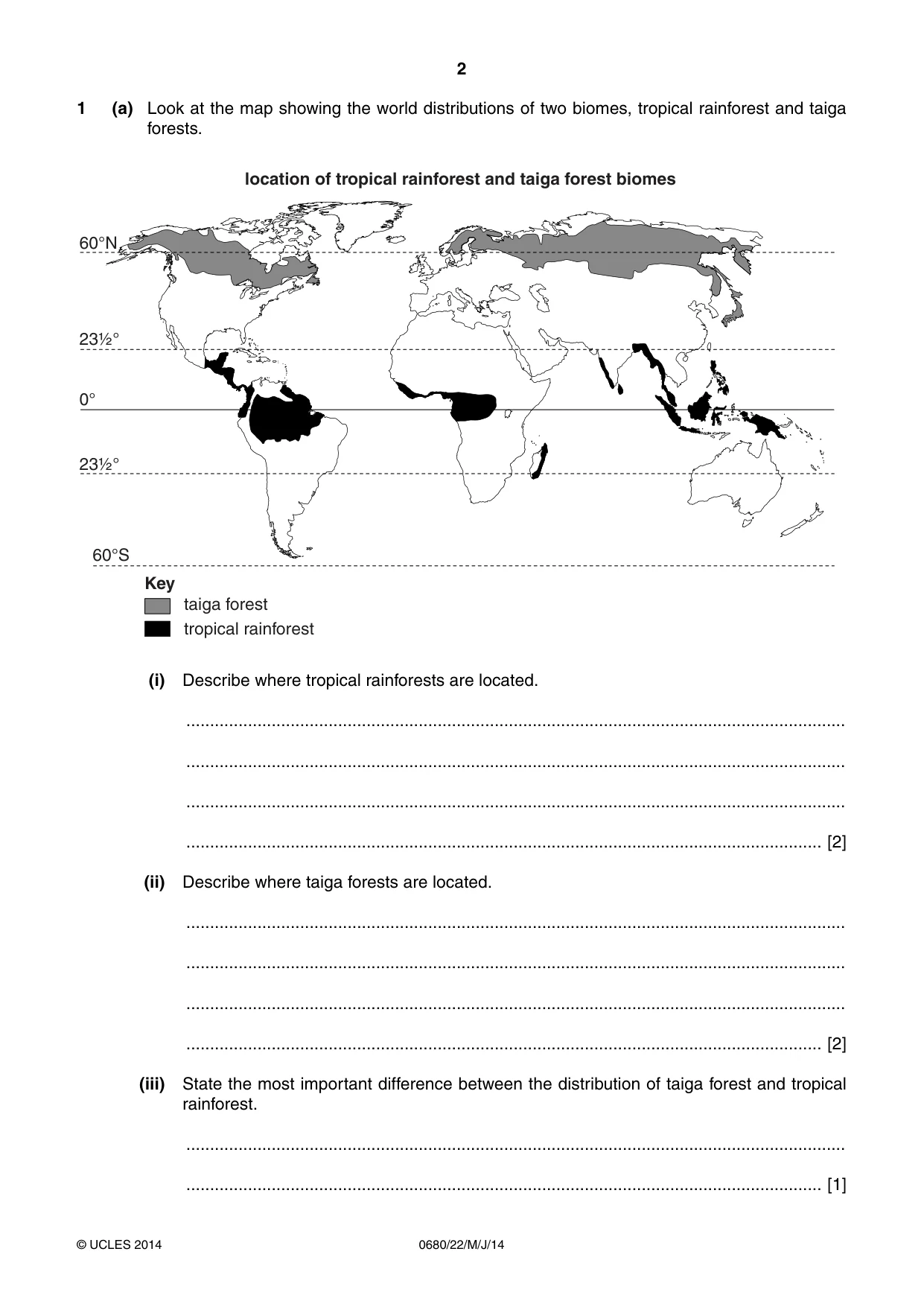
2 0680/22/M/J/14 © UCLES 2014 1 (a) Look at the map showing the world distributions of two biomes, tropical rainforest and taiga forests. 0° 60°S 60°N 23½° 23½° Key taiga forest tropical rainforest location of tropical rainforest and taiga forest biomes (i) Describe where tropical rainforests are located. … … … … [2] (ii) Describe where taiga forests are located. … … … … [2] (iii) State the most important difference between the distribution of taiga forest and tropical rainforest. … … [1]
Question paper, page 3
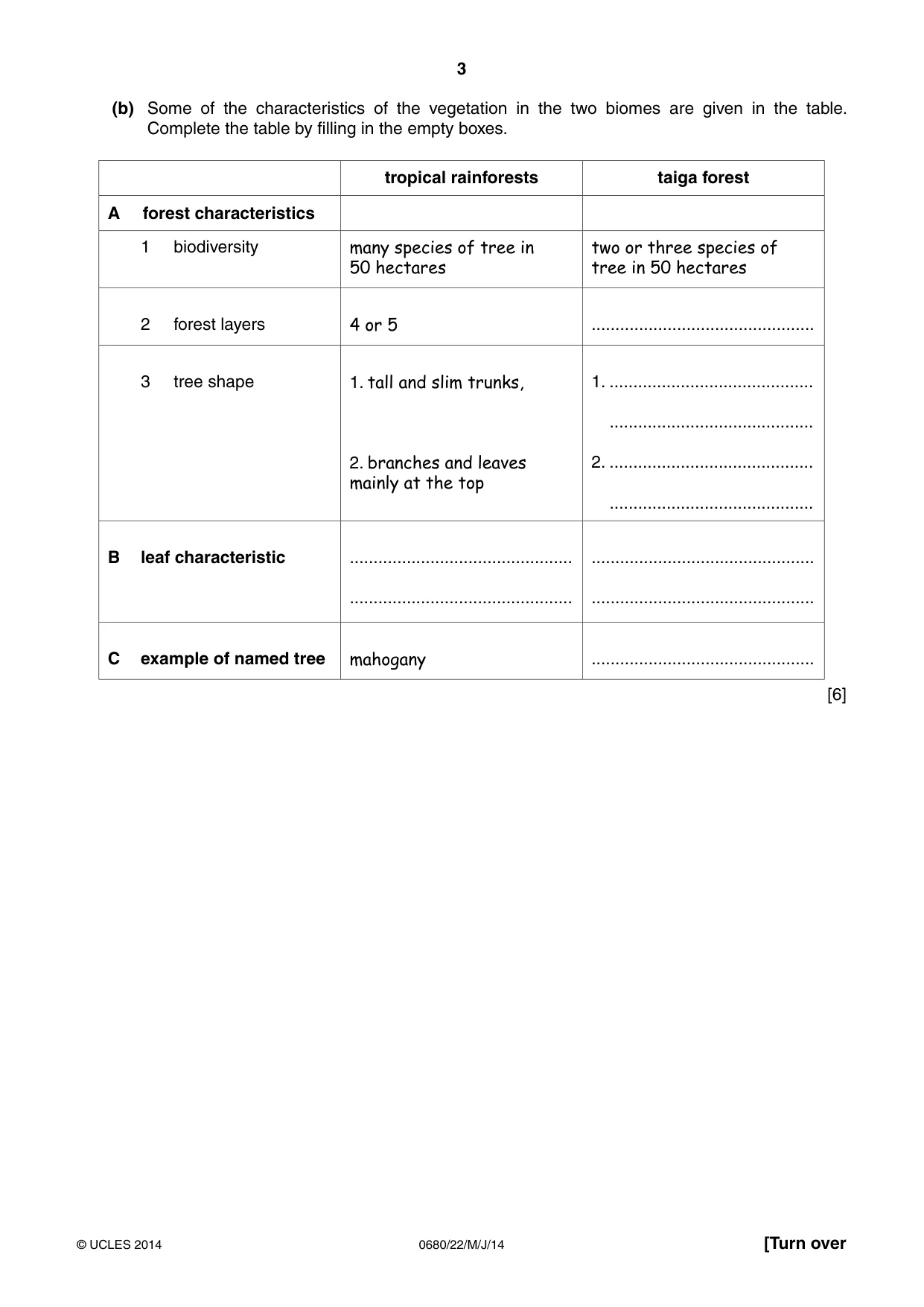
3 0680/22/M/J/14 © UCLES 2014 [Turn over (b) Some of the characteristics of the vegetation in the two biomes are given in the table. Complete the table by filling in the empty boxes. tropical rainforests taiga forest A forest characteristics 1 biodiversity many species of tree in 50 hectares two or three species of tree in 50 hectares 2 forest layers 4 or 5 … 3 tree shape 1. tall and slim trunks, 2. branches and leaves mainly at the top 1. … … 2. … … B leaf characteristic … … … … C example of named tree mahogany … [6]
Question paper, page 4
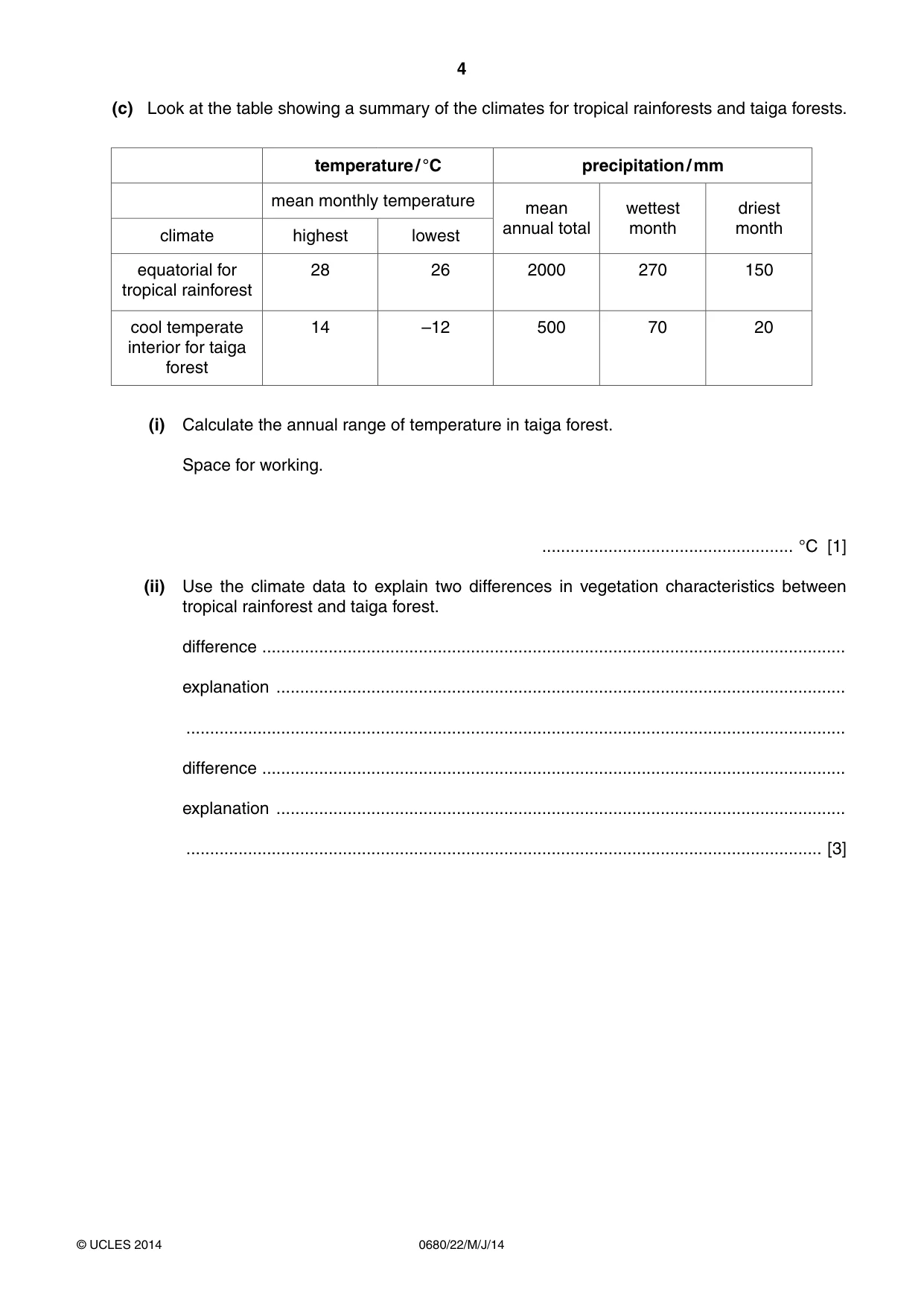
4 0680/22/M/J/14 © UCLES 2014 (c) Look at the table showing a summary of the climates for tropical rainforests and taiga forests. temperature / °C precipitation / mm mean monthly temperature mean annual total wettest month driest month climate highest lowest equatorial for tropical rainforest 28 26 2000 270 150 cool temperate interior for taiga forest 14 –12 500 70 20 (i) Calculate the annual range of temperature in taiga forest. Space for working. … °C [1] (ii) Use the climate data to explain two differences in vegetation characteristics between tropical rainforest and taiga forest. difference … explanation … … difference … explanation … … [3]
Question paper, page 5
5 0680/22/M/J/14 © UCLES 2014 [Turn over (iii) The table below shows the percentage of tropical rainforest and taiga forest cleared by people. tropical rainforest 45% already cleared taiga forest less than 5% cleared Suggest how the climates of the two biomes explain this difference. … … … … … … [3]
Question paper, page 6
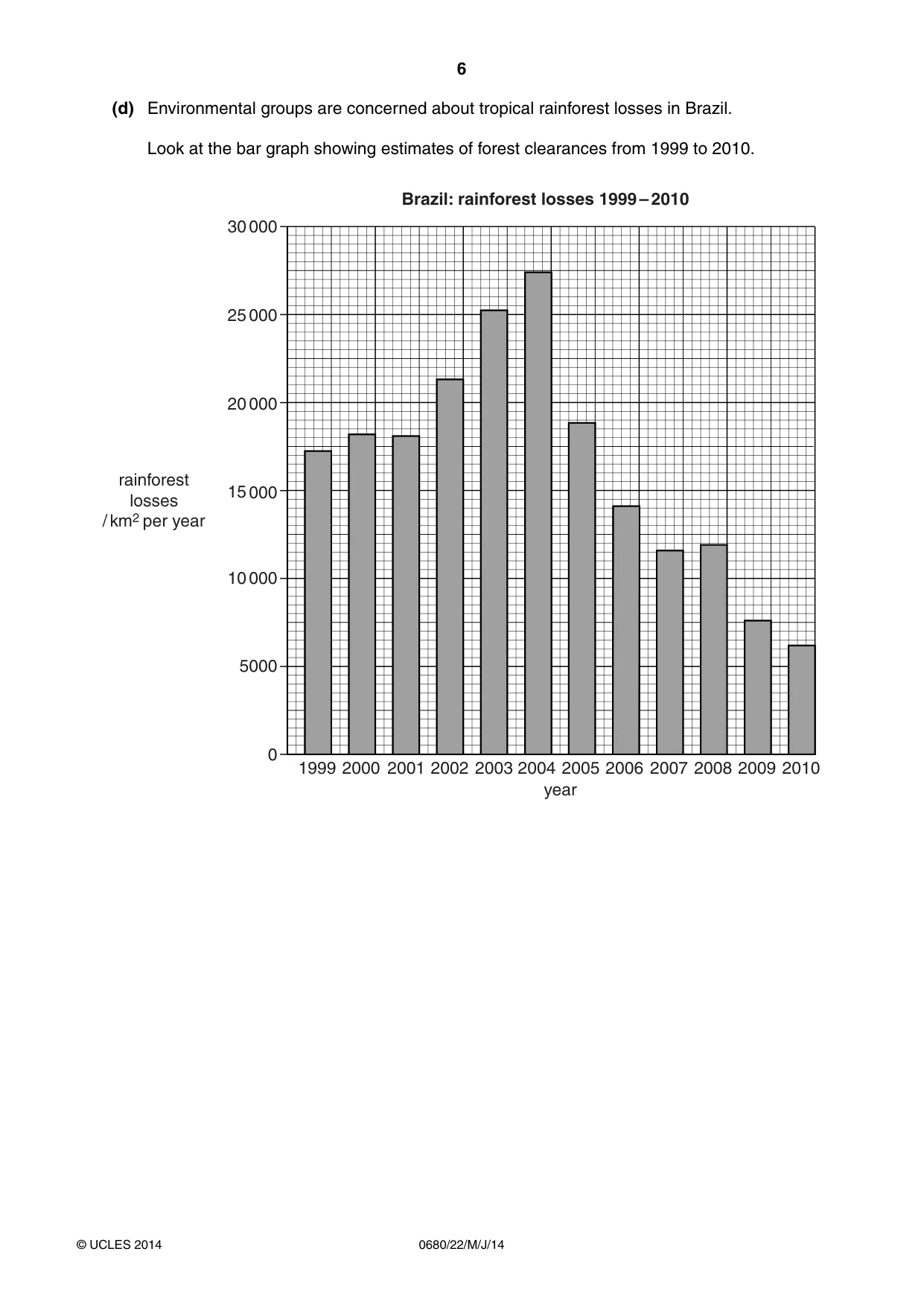
6 0680/22/M/J/14 © UCLES 2014 (d) Environmental groups are concerned about tropical rainforest losses in Brazil. Look at the bar graph showing estimates of forest clearances from 1999 to 2010. 0 5000 10 000 15 000 20 000 25 000 30 000 1999 2000 2001 2002 2003 2004 2005 2006 2007 2008 2009 2010 year rainforest losses / km2 per year Brazil: rainforest losses 1999 – 2010
Question paper, page 7
7 0680/22/M/J/14 © UCLES 2014 [Turn over (i) Describe the trends shown by the graph on page 6. … … … … … … [3] (ii) Discuss the extent to which the graph shows that the environmental groups should be concerned about the clearance of the tropical rainforest in Brazil. … … … … … … [3]
Question paper, page 8
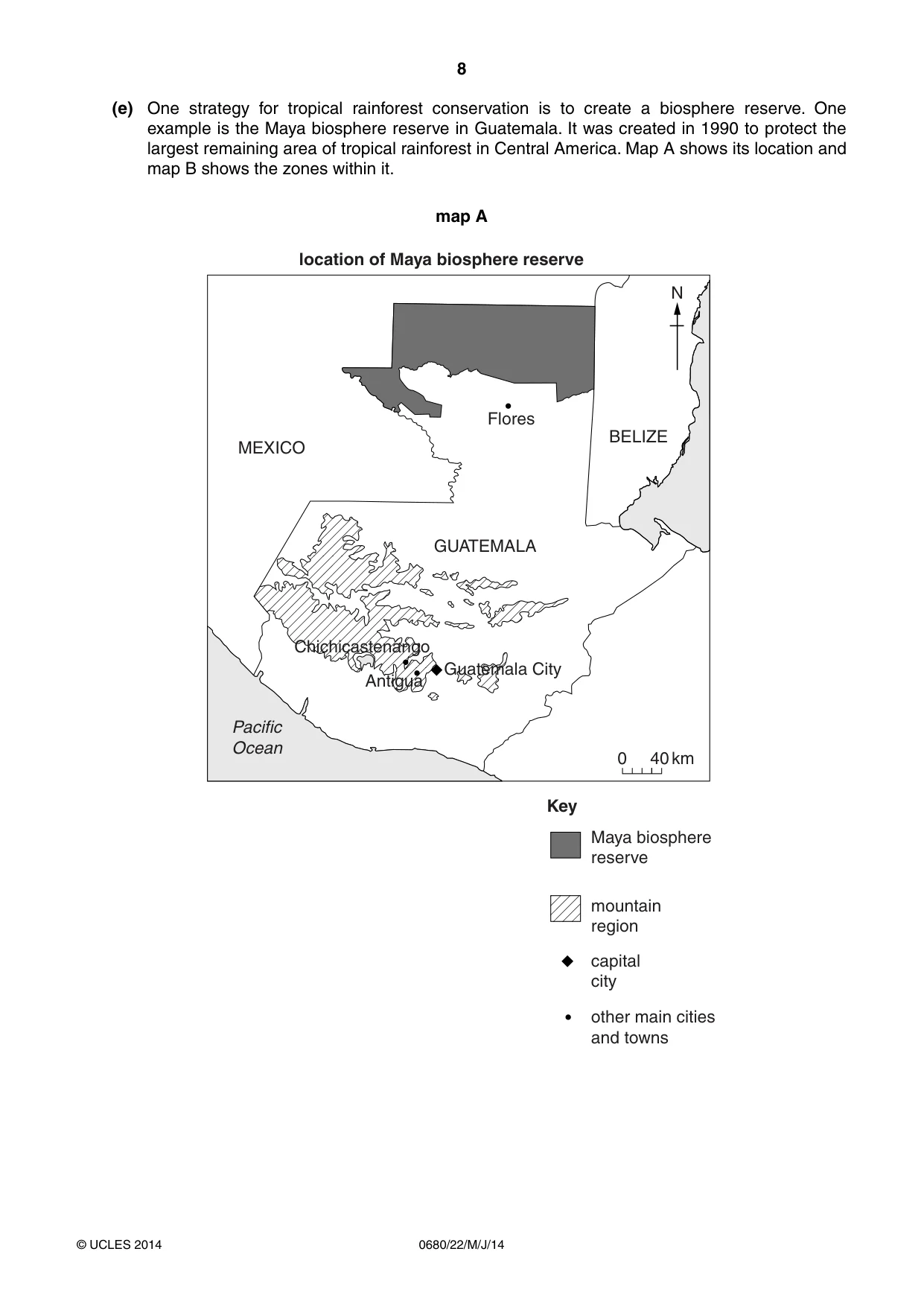
8 0680/22/M/J/14 © UCLES 2014 (e) One strategy for tropical rainforest conservation is to create a biosphere reserve. One example is the Maya biosphere reserve in Guatemala. It was created in 1990 to protect the largest remaining area of tropical rainforest in Central America. Map A shows its location and map B shows the zones within it. map A 0 40 km Flores Pacific Ocean location of Maya biosphere reserve MEXICO BELIZE GUATEMALA Guatemala City Antigua Chichicastenango Maya biosphere reserve mountain region capital city other main cities and towns Key N
Question paper, page 9
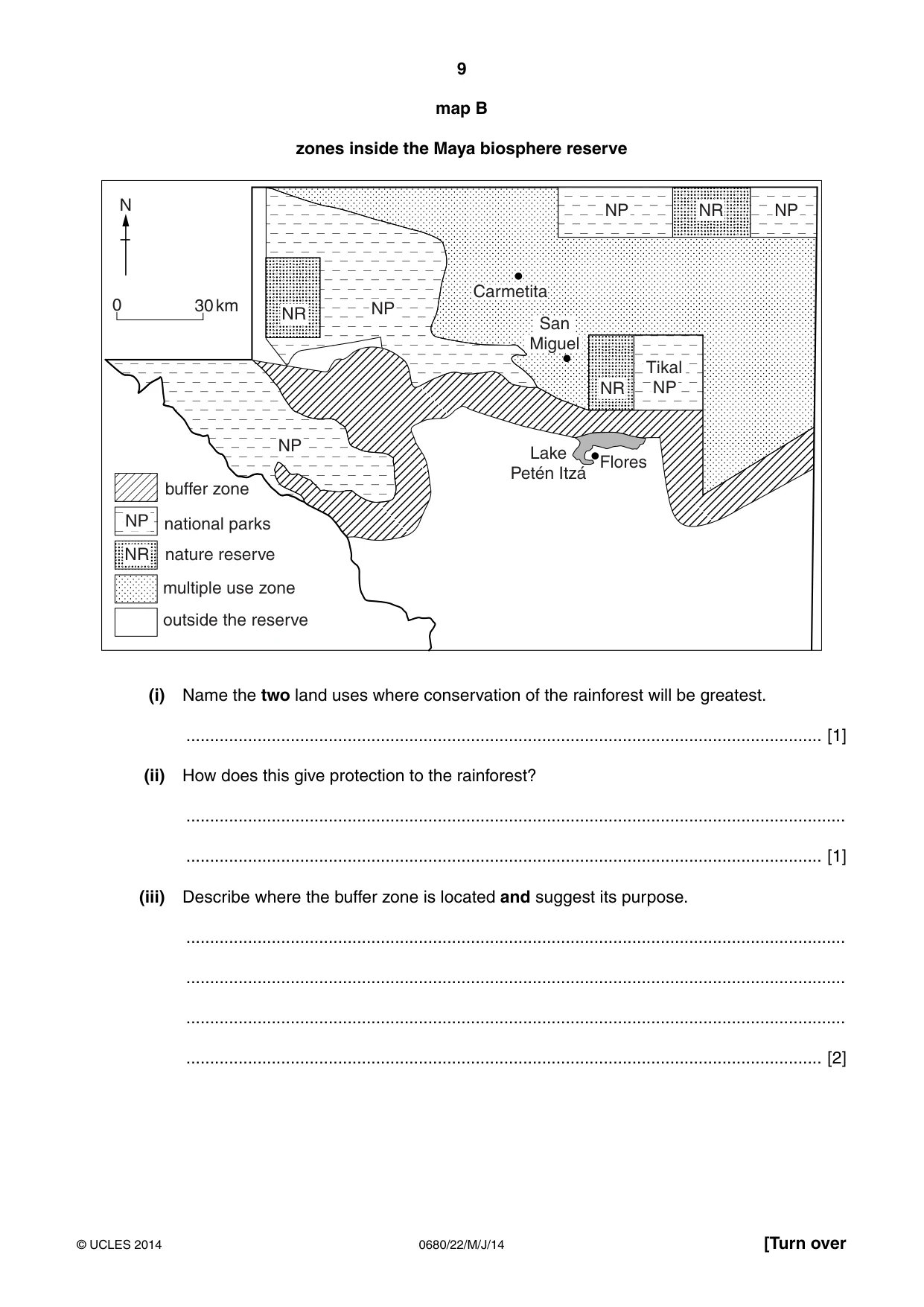
9 0680/22/M/J/14 © UCLES 2014 [Turn over map B zones inside the Maya biosphere reserve 0 30 km N Lake Petén Itzá Flores NP NP NP NR NP NP NP NR NR NR buffer zone national parks nature reserve multiple use zone outside the reserve Carmetita San Miguel Tikal (i) Name the two land uses where conservation of the rainforest will be greatest. … [1] (ii) How does this give protection to the rainforest? … … [1] (iii) Describe where the buffer zone is located and suggest its purpose. … … … … [2]
Question paper, page 10
10 0680/22/M/J/14 © UCLES 2014 (iv) People living in the multiple use zone are encouraged to follow new economic activities, such as the sustainable harvesting of forest products rather than slash and burn subsistence farming. A Fair Trade group has been organised to buy and export products. Explain how and why these new economic activities can increase the chances of remaining areas of forest being conserved by the local people. … … … … … … [3] (v) Tikal, with its Mayan pyramids, attracts 200 000 visitors a year many of them from overseas. Suggest what can be done to try to ensure that local people can share in some of the economic benefits from tourism. … … … … … … [3]
Question paper, page 11
11 0680/22/M/J/14 © UCLES 2014 [Turn over (vi) Government figures show that the Maya biosphere reserve has lost 21% of its forest cover since being declared a protected zone in 1990. Some losses are due to illegal activities, such as production of drugs and forest clearance for airstrips to export the drugs. Suggest why the government find it difficult to protect the forest from clearance. … … … … [2] (vii) Many biosphere reserves are located in countries where average incomes are low, such as Guatemala. To what extent is the strategy of creating biosphere reserves likely to be successful? Explain your answer. … … … … … … … … [4] [Total: 40]
Question paper, page 12
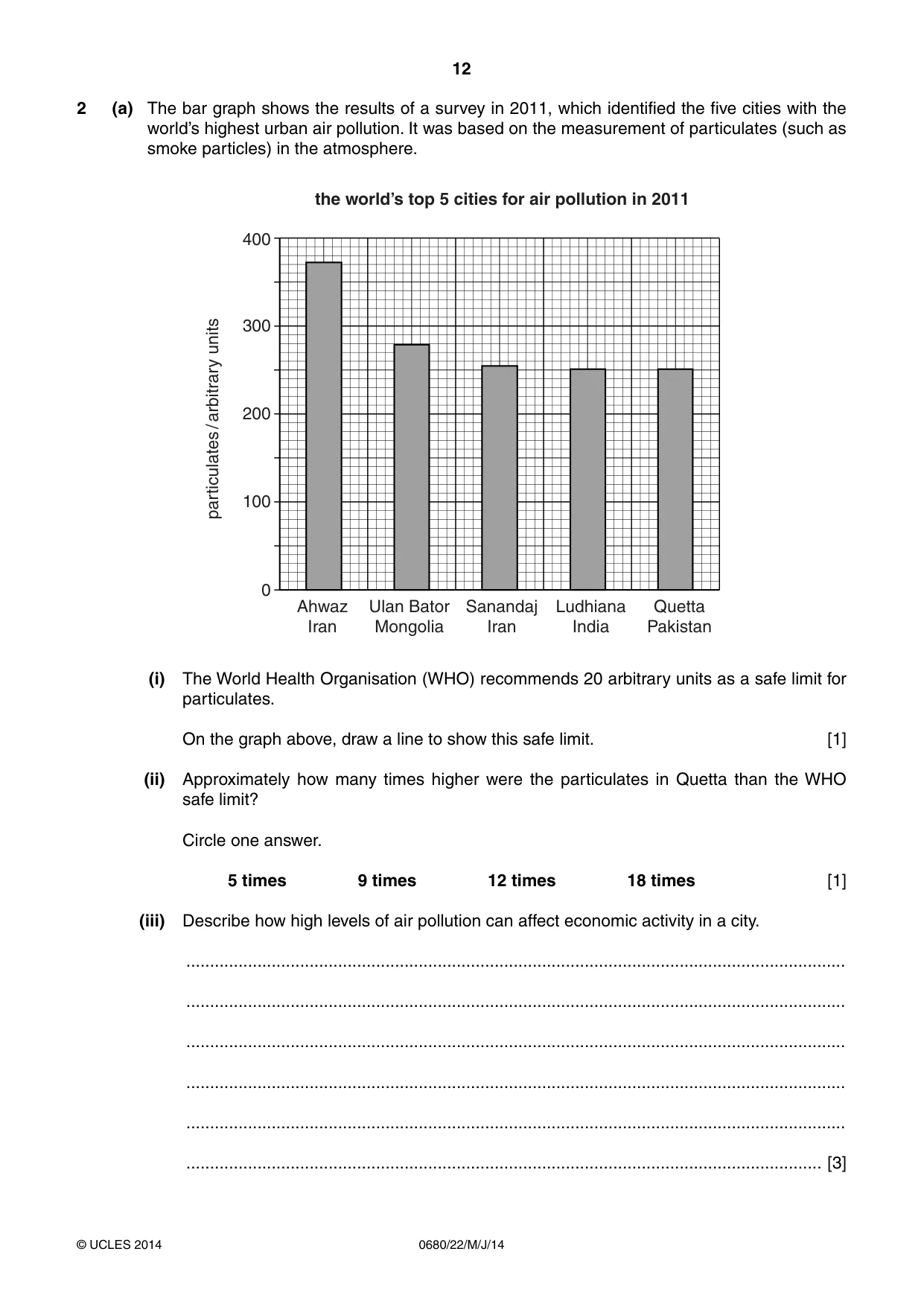
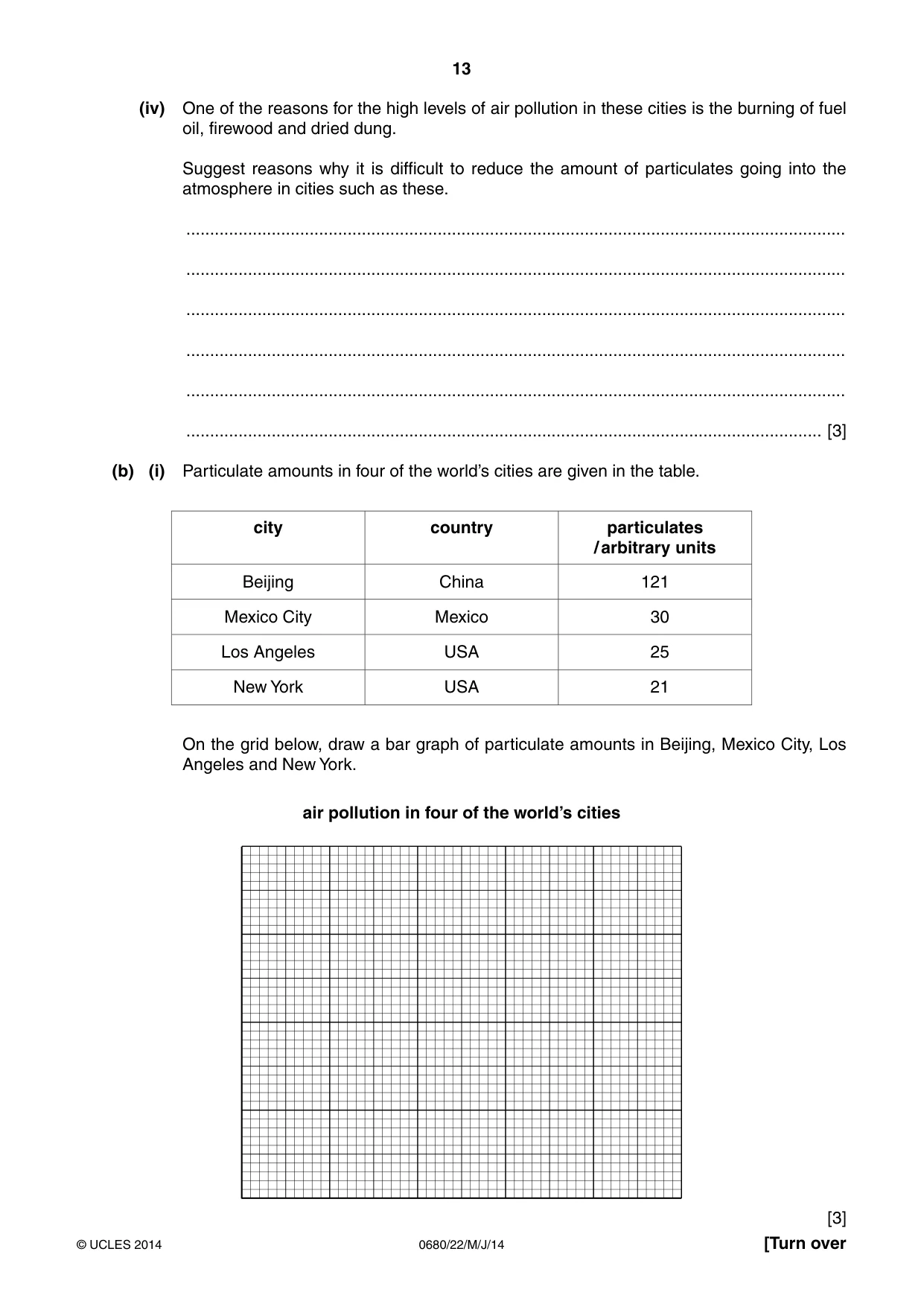
12 0680/22/M/J/14 © UCLES 2014 2 (a) The bar graph shows the results of a survey in 2011, which identified the five cities with the world’s highest urban air pollution. It was based on the measurement of particulates (such as smoke particles) in the atmosphere. 0 100 200 300 400 Ahwaz Iran Ulan Bator Mongolia Sanandaj Iran Ludhiana India Quetta Pakistan particulates / arbitrary units the world’s top 5 cities for air pollution in 2011 (i) The World Health Organisation (WHO) recommends 20 arbitrary units as a safe limit for particulates. On the graph above, draw a line to show this safe limit. [1] (ii) Approximately how many times higher were the particulates in Quetta than the WHO safe limit? Circle one answer. 5 times 9 times 12 times 18 times [1] (iii) Describe how high levels of air pollution can affect economic activity in a city. … … … … … … [3]
Question paper, page 13
13 0680/22/M/J/14 © UCLES 2014 [Turn over (iv) One of the reasons for the high levels of air pollution in these cities is the burning of fuel oil, firewood and dried dung. Suggest reasons why it is difficult to reduce the amount of particulates going into the atmosphere in cities such as these. … … … … … … [3] (b) (i) Particulate amounts in four of the world’s cities are given in the table. city country particulates / arbitrary units Beijing China 121 Mexico City Mexico 30 Los Angeles USA 25 New York USA 21 On the grid below, draw a bar graph of particulate amounts in Beijing, Mexico City, Los Angeles and New York. air pollution in four of the world’s cities [3]
Question paper, page 14
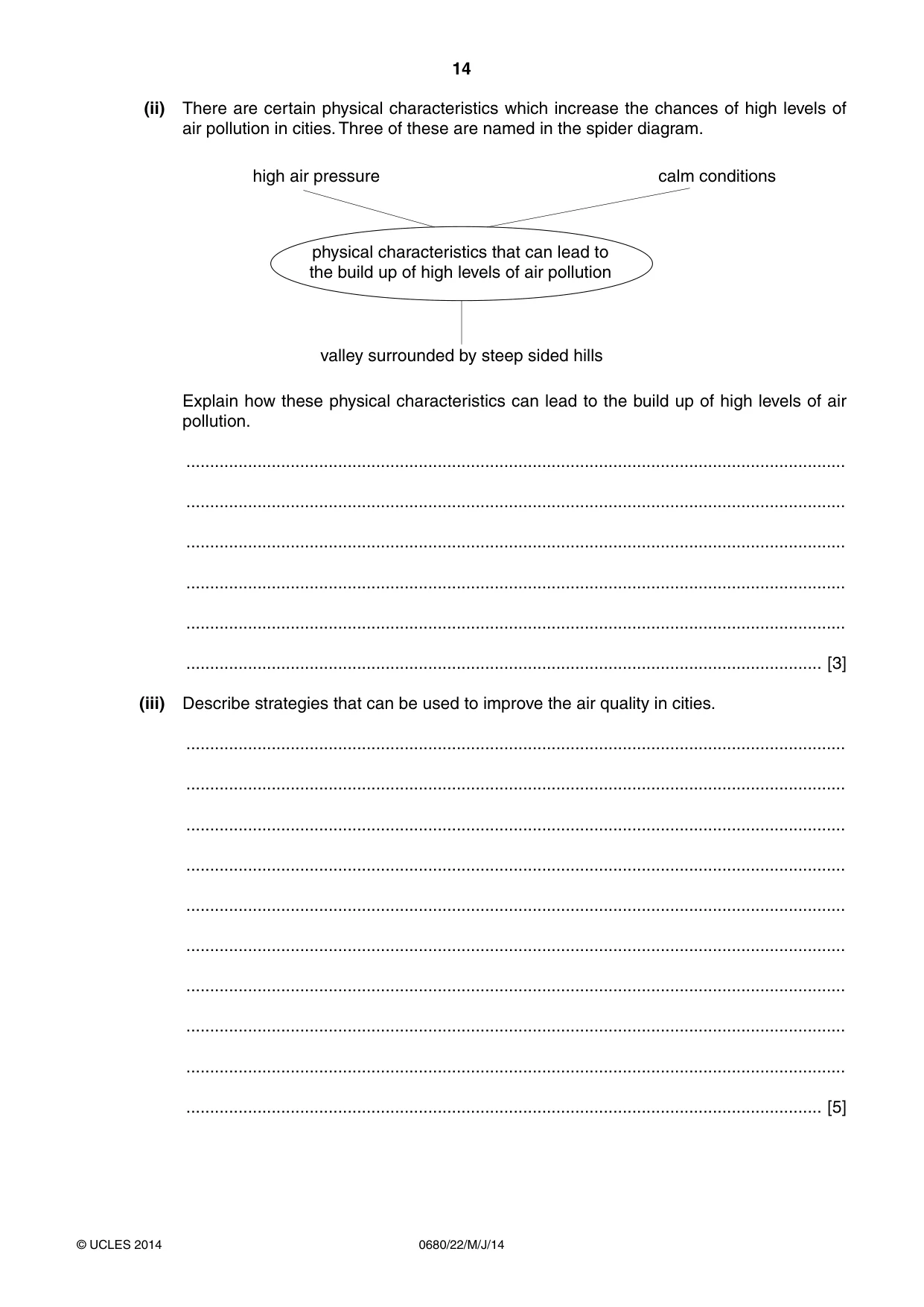
14 0680/22/M/J/14 © UCLES 2014 (ii) There are certain physical characteristics which increase the chances of high levels of air pollution in cities. Three of these are named in the spider diagram. high air pressure calm conditions physical characteristics that can lead to the build up of high levels of air pollution valley surrounded by steep sided hills Explain how these physical characteristics can lead to the build up of high levels of air pollution. … … … … … … [3] (iii) Describe strategies that can be used to improve the air quality in cities. … … … … … … … … … … [5]
Question paper, page 15
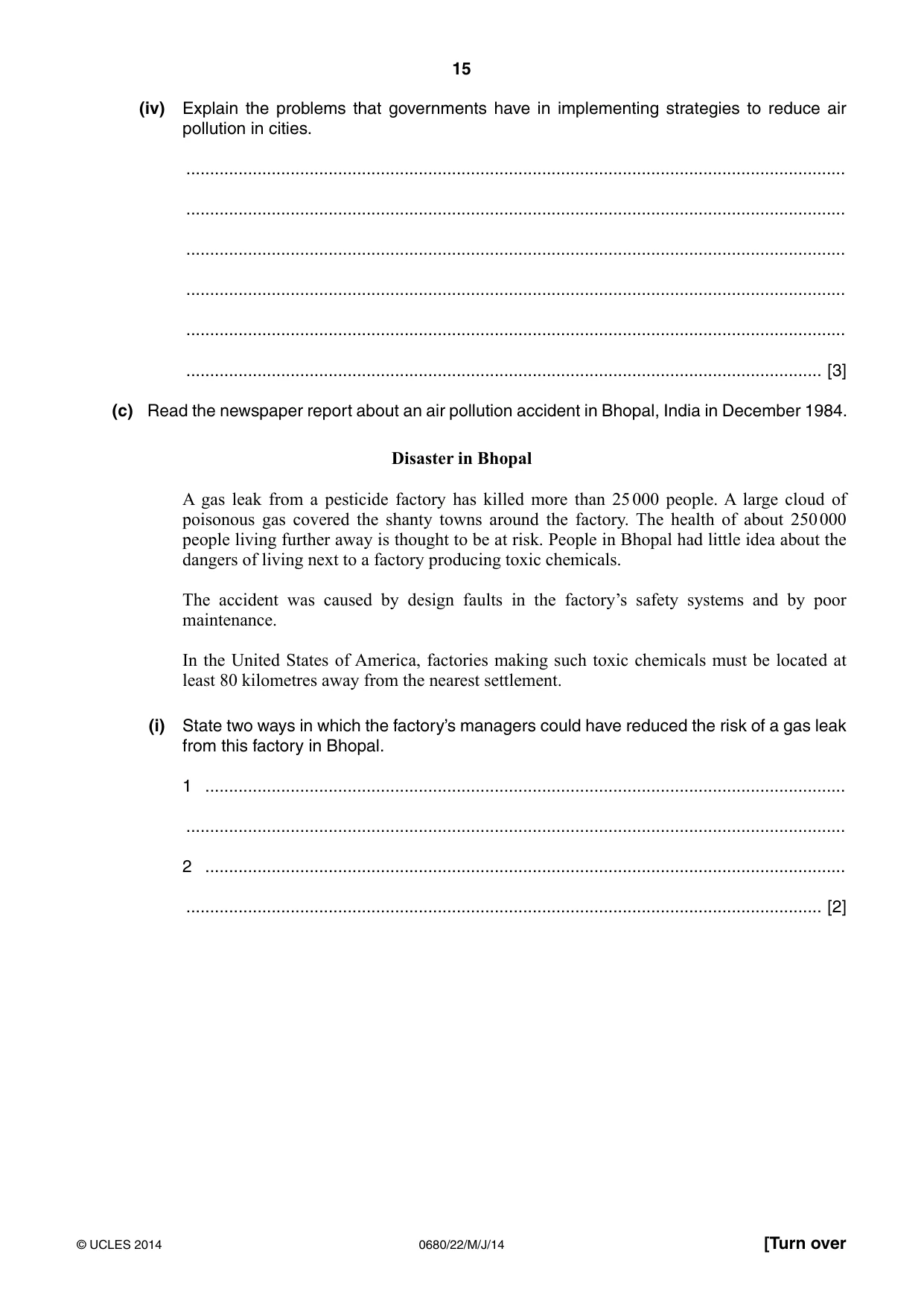
15 0680/22/M/J/14 © UCLES 2014 [Turn over (iv) Explain the problems that governments have in implementing strategies to reduce air pollution in cities. … … … … … … [3] (c) Read the newspaper report about an air pollution accident in Bhopal, India in December 1984. Disaster in Bhopal A gas leak from a pesticide factory has killed more than 25 000 people. A large cloud of poisonous gas covered the shanty towns around the factory. The health of about 250 000 people living further away is thought to be at risk. People in Bhopal had little idea about the dangers of living next to a factory producing toxic chemicals. The accident was caused by design faults in the factory’s safety systems and by poor maintenance. In the United States of America, factories making such toxic chemicals must be located at least 80 kilometres away from the nearest settlement. (i) State two ways in which the factory’s managers could have reduced the risk of a gas leak from this factory in Bhopal. 1 … … 2 … … [2]
Question paper, page 16
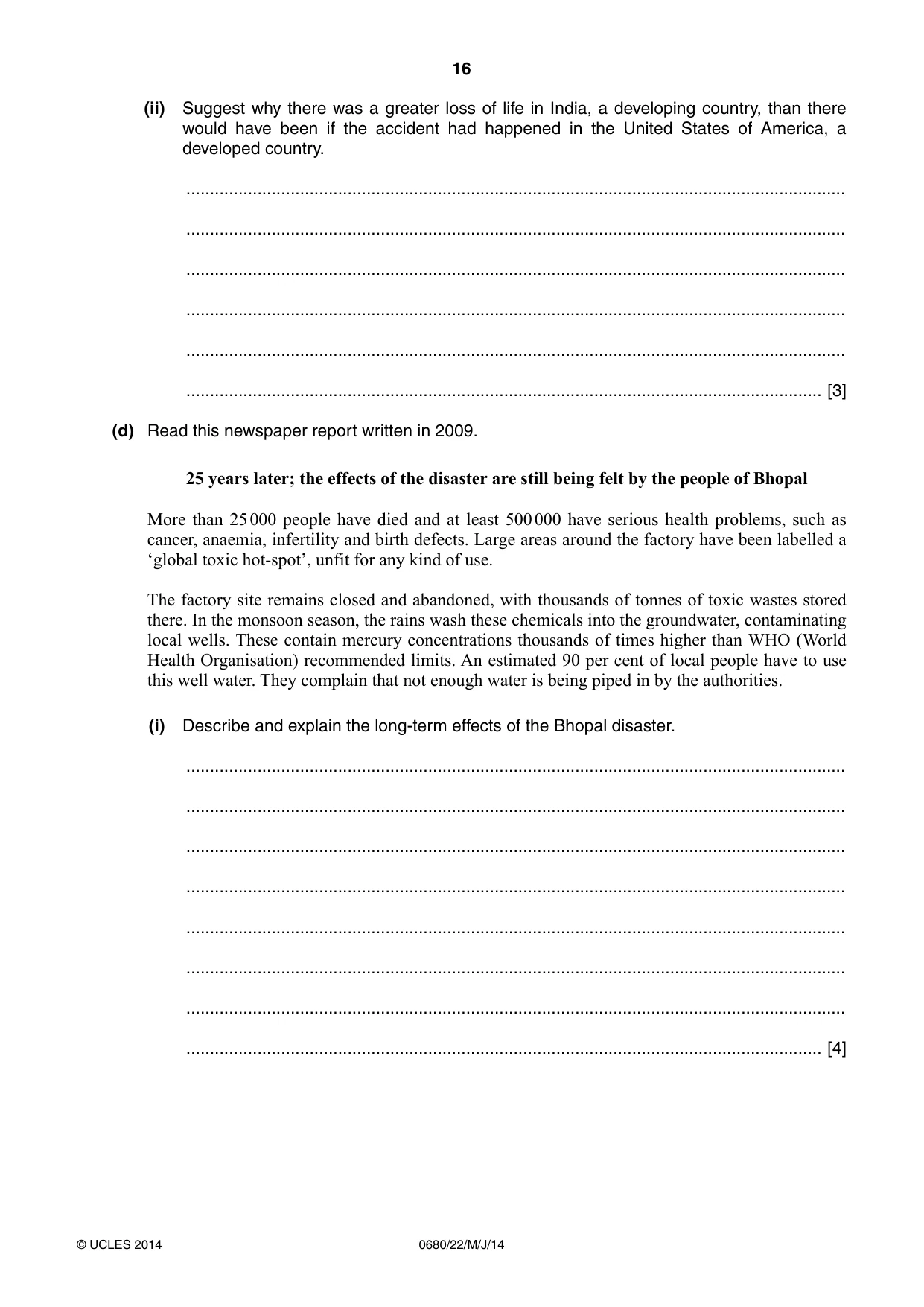
16 0680/22/M/J/14 © UCLES 2014 (ii) Suggest why there was a greater loss of life in India, a developing country, than there would have been if the accident had happened in the United States of America, a developed country. … … … … … … [3] (d) Read this newspaper report written in 2009. 25 years later; the effects of the disaster are still being felt by the people of Bhopal More than 25 000 people have died and at least 500 000 have serious health problems, such as cancer, anaemia, infertility and birth defects. Large areas around the factory have been labelled a ‘global toxic hot-spot’, unfit for any kind of use. The factory site remains closed and abandoned, with thousands of tonnes of toxic wastes stored there. In the monsoon season, the rains wash these chemicals into the groundwater, contaminating local wells. These contain mercury concentrations thousands of times higher than WHO (World Health Organisation) recommended limits. An estimated 90 per cent of local people have to use this well water. They complain that not enough water is being piped in by the authorities. (i) Describe and explain the long-term effects of the Bhopal disaster. … … … … … … … … [4]
Question paper, page 17
17 0680/22/M/J/14 © UCLES 2014 (ii) Give three reasons why people could still be suffering from the effects of this disaster in another 25 years time. … … … … … … [3] (e) Human activities damage environments in many ways, such as the impact of mineral exploitation. Discuss what measures could be taken to restore such damaged environments. … … … … … … … … … … … … [6] [Total: 40]
Question paper, page 18
18 0680/22/M/J/14 © UCLES 2014 BLANK PAGE
Question paper, page 19
19 0680/22/M/J/14 © UCLES 2014 BLANK PAGE
Question paper, page 20
20 0680/22/M/J/14 © UCLES 2014 Permission to reproduce items where third-party owned material protected by copyright is included has been sought and cleared where possible. Every reasonable effort has been made by the publisher (UCLES) to trace copyright holders, but if any items requiring clearance have unwittingly been included, the publisher will be pleased to make amends at the earliest possible opportunity. Cambridge International Examinations is part of the Cambridge Assessment Group. Cambridge Assessment is the brand name of University of Cambridge Local Examinations Syndicate (UCLES), which is itself a department of the University of Cambridge. BLANK PAGE
Mark scheme, page 1
CAMBRIDGE INTERNATIONAL EXAMINATIONS International General Certificate of Secondary Education MARK SCHEME for the May/June 2014 series 0680 ENVIRONMENTAL MANAGEMENT 0680/22 Paper 2, maximum raw mark 80 This mark scheme is published as an aid to teachers and candidates, to indicate the requirements of the examination. It shows the basis on which Examiners were instructed to award marks. It does not indicate the details of the discussions that took place at an Examiners’ meeting before marking began, which would have considered the acceptability of alternative answers. Mark schemes should be read in conjunction with the question paper and the Principal Examiner Report for Teachers. Cambridge will not enter into discussions about these mark schemes. Cambridge is publishing the mark schemes for the May/June 2014 series for most IGCSE, GCE Advanced Level and Advanced Subsidiary Level components and some Ordinary Level components.
Mark scheme, page 2
Page 2 Mark Scheme Syllabus Paper IGCSE – May/June 2014 0680 22 © Cambridge International Examinations 2014 1 (a) (i) around the Equator / both sides of the Equator / mainly in the tropics; names of the continents / countries; some ides of the relative size / extent within / between continents; [2] (ii) (most) in cold temperate / southern edge of polar latitudes; more detailed description in relation to latitude 60°N; some idea of the relative size / extent within / between continents; names of the continents / countries; [2] (iii) tropical compared with temperate; tropical north and south of the Equator compared with taiga northern hemisphere only; longer more continuous unbroken extent for taiga across the continents / vice-versa for tropical rainforest; tropical more spread out / dispersed; [1] (b) Forest layers – taiga 1 or 2 one mark Tree shape – taiga two of: conical shape; downward sloping branches; branches all the way up the stem; two marks Leaf characteristics – tropical rainforest one of: drip tips (pointed ends); large / broad leaves / leathery; network of veins; one mark – taiga one of: needle leaves; small / hard; waxy; dark colour; one mark Examples of named types of trees – taiga pine, spruce, larch one mark [6]
Mark scheme, page 3
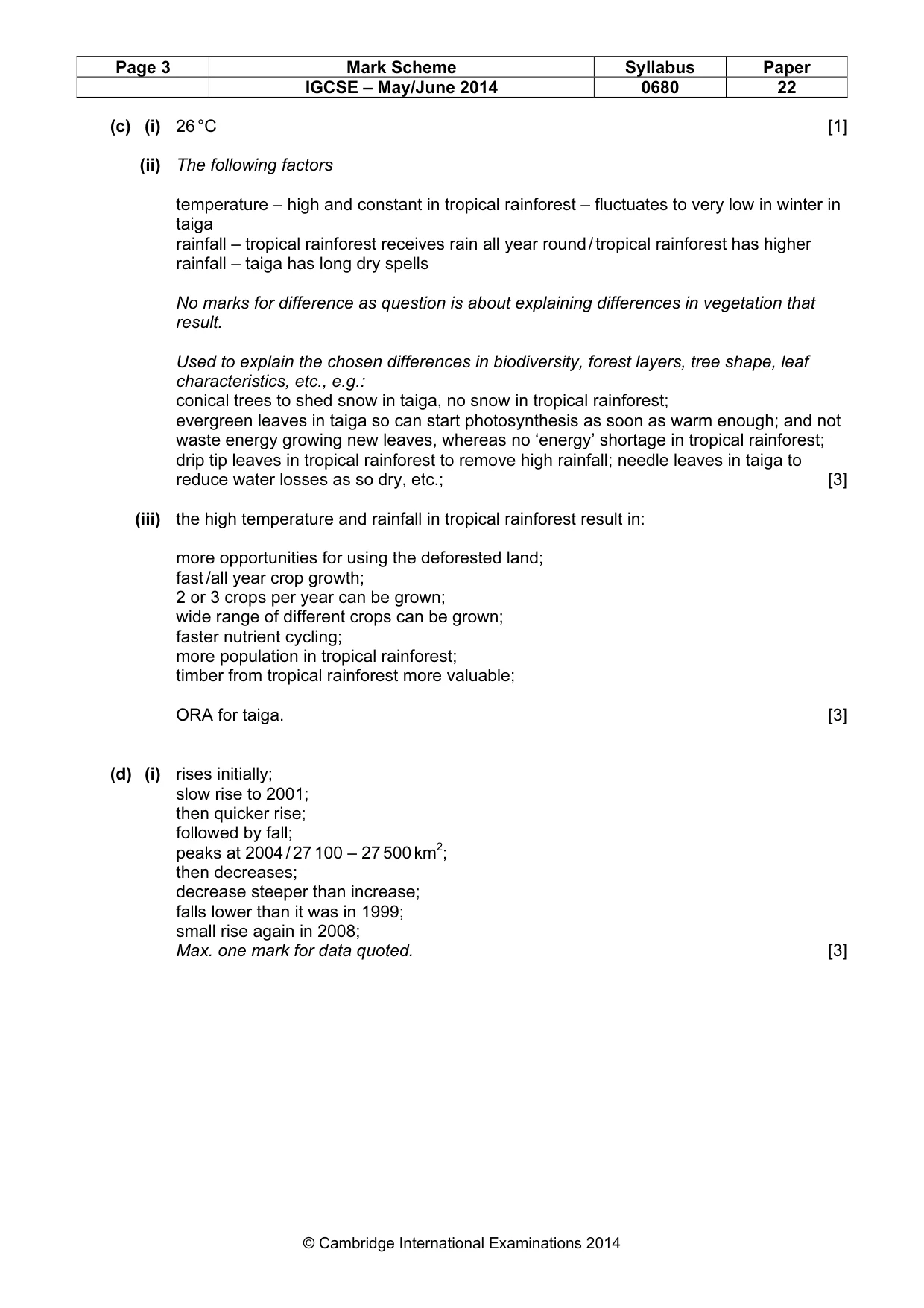
Page 3 Mark Scheme Syllabus Paper IGCSE – May/June 2014 0680 22 © Cambridge International Examinations 2014 (c) (i) 26 °C [1] (ii) The following factors temperature – high and constant in tropical rainforest – fluctuates to very low in winter in taiga rainfall – tropical rainforest receives rain all year round / tropical rainforest has higher rainfall – taiga has long dry spells No marks for difference as question is about explaining differences in vegetation that result. Used to explain the chosen differences in biodiversity, forest layers, tree shape, leaf characteristics, etc., e.g.: conical trees to shed snow in taiga, no snow in tropical rainforest; evergreen leaves in taiga so can start photosynthesis as soon as warm enough; and not waste energy growing new leaves, whereas no ‘energy’ shortage in tropical rainforest; drip tip leaves in tropical rainforest to remove high rainfall; needle leaves in taiga to reduce water losses as so dry, etc.; [3] (iii) the high temperature and rainfall in tropical rainforest result in: more opportunities for using the deforested land; fast /all year crop growth; 2 or 3 crops per year can be grown; wide range of different crops can be grown; faster nutrient cycling; more population in tropical rainforest; timber from tropical rainforest more valuable; ORA for taiga. [3] (d) (i) rises initially; slow rise to 2001; then quicker rise; followed by fall; peaks at 2004 / 27 100 – 27 500 km2; then decreases; decrease steeper than increase; falls lower than it was in 1999; small rise again in 2008; Max. one mark for data quoted. [3]
Mark scheme, page 4
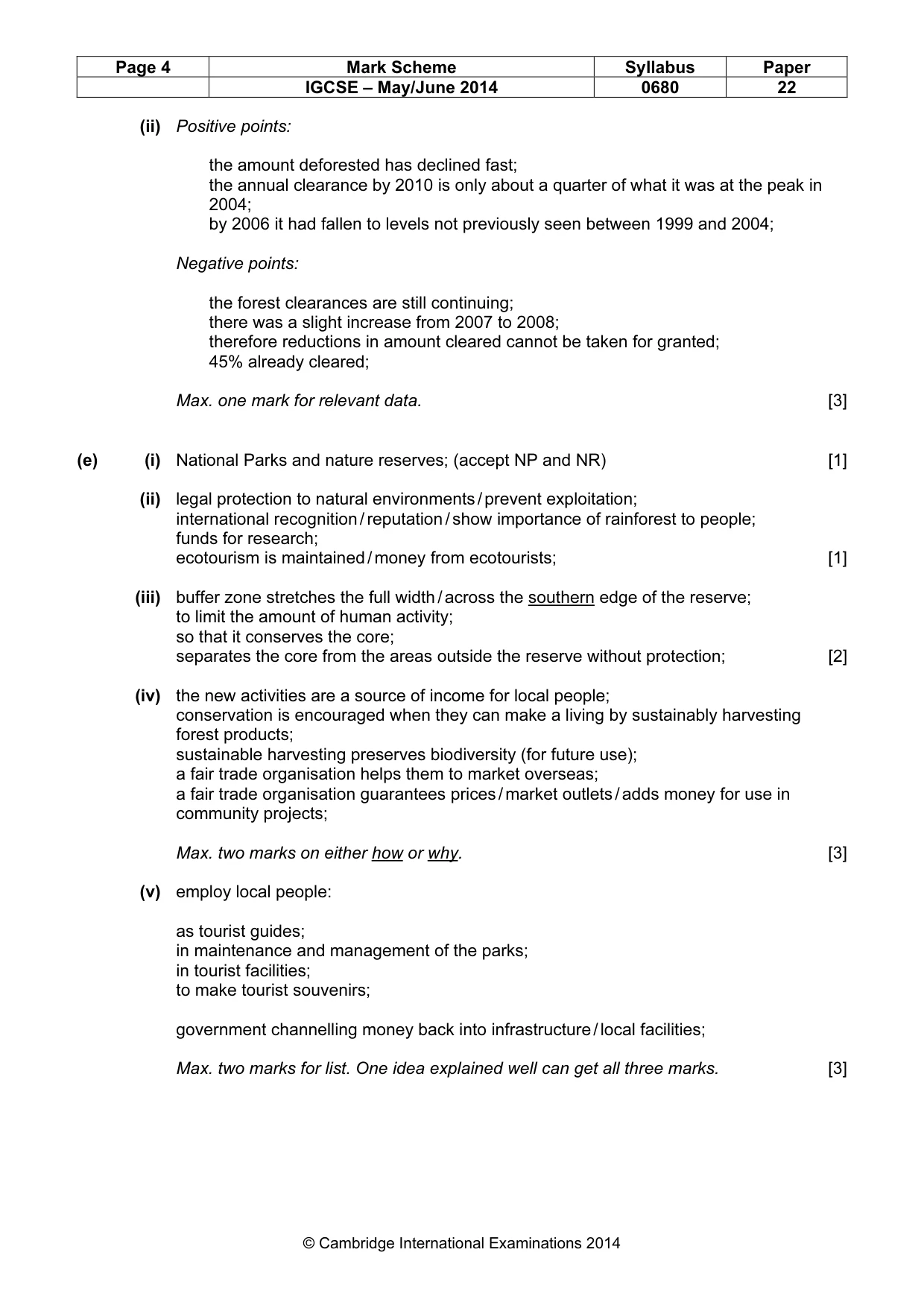
Page 4 Mark Scheme Syllabus Paper IGCSE – May/June 2014 0680 22 © Cambridge International Examinations 2014 (ii) Positive points: the amount deforested has declined fast; the annual clearance by 2010 is only about a quarter of what it was at the peak in 2004; by 2006 it had fallen to levels not previously seen between 1999 and 2004; Negative points: the forest clearances are still continuing; there was a slight increase from 2007 to 2008; therefore reductions in amount cleared cannot be taken for granted; 45% already cleared; Max. one mark for relevant data. [3] (e) (i) National Parks and nature reserves; (accept NP and NR) [1] (ii) legal protection to natural environments / prevent exploitation; international recognition / reputation / show importance of rainforest to people; funds for research; ecotourism is maintained / money from ecotourists; [1] (iii) buffer zone stretches the full width / across the southern edge of the reserve; to limit the amount of human activity; so that it conserves the core; separates the core from the areas outside the reserve without protection; [2] (iv) the new activities are a source of income for local people; conservation is encouraged when they can make a living by sustainably harvesting forest products; sustainable harvesting preserves biodiversity (for future use); a fair trade organisation helps them to market overseas; a fair trade organisation guarantees prices / market outlets / adds money for use in community projects; Max. two marks on either how or why. [3] (v) employ local people: as tourist guides; in maintenance and management of the parks; in tourist facilities; to make tourist souvenirs; government channelling money back into infrastructure / local facilities; Max. two marks for list. One idea explained well can get all three marks. [3]
Mark scheme, page 5
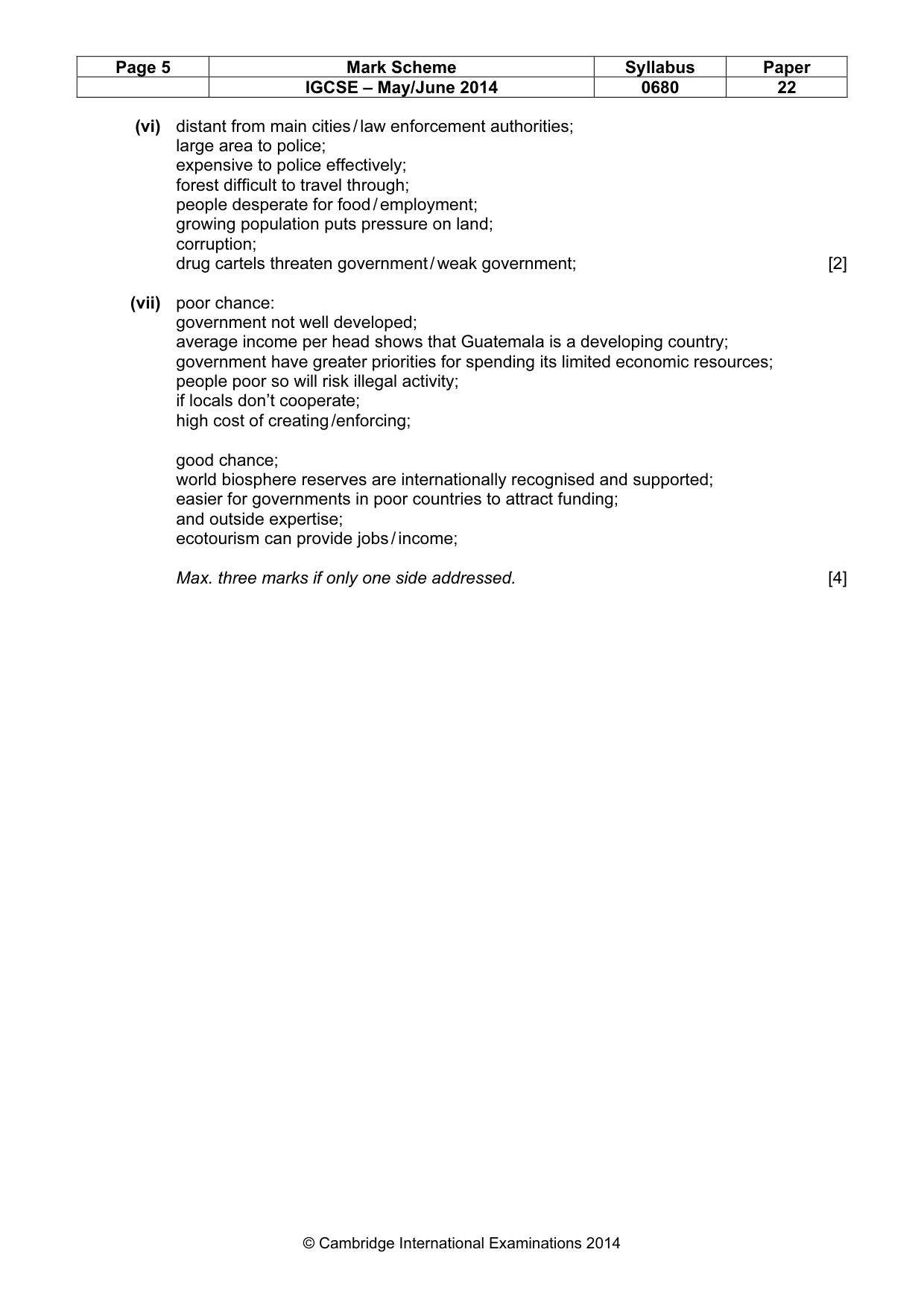
Page 5 Mark Scheme Syllabus Paper IGCSE – May/June 2014 0680 22 © Cambridge International Examinations 2014 (vi) distant from main cities / law enforcement authorities; large area to police; expensive to police effectively; forest difficult to travel through; people desperate for food / employment; growing population puts pressure on land; corruption; drug cartels threaten government / weak government; [2] (vii) poor chance: government not well developed; average income per head shows that Guatemala is a developing country; government have greater priorities for spending its limited economic resources; people poor so will risk illegal activity; if locals don’t cooperate; high cost of creating /enforcing; good chance; world biosphere reserves are internationally recognised and supported; easier for governments in poor countries to attract funding; and outside expertise; ecotourism can provide jobs / income; Max. three marks if only one side addressed. [4]
Mark scheme, page 6
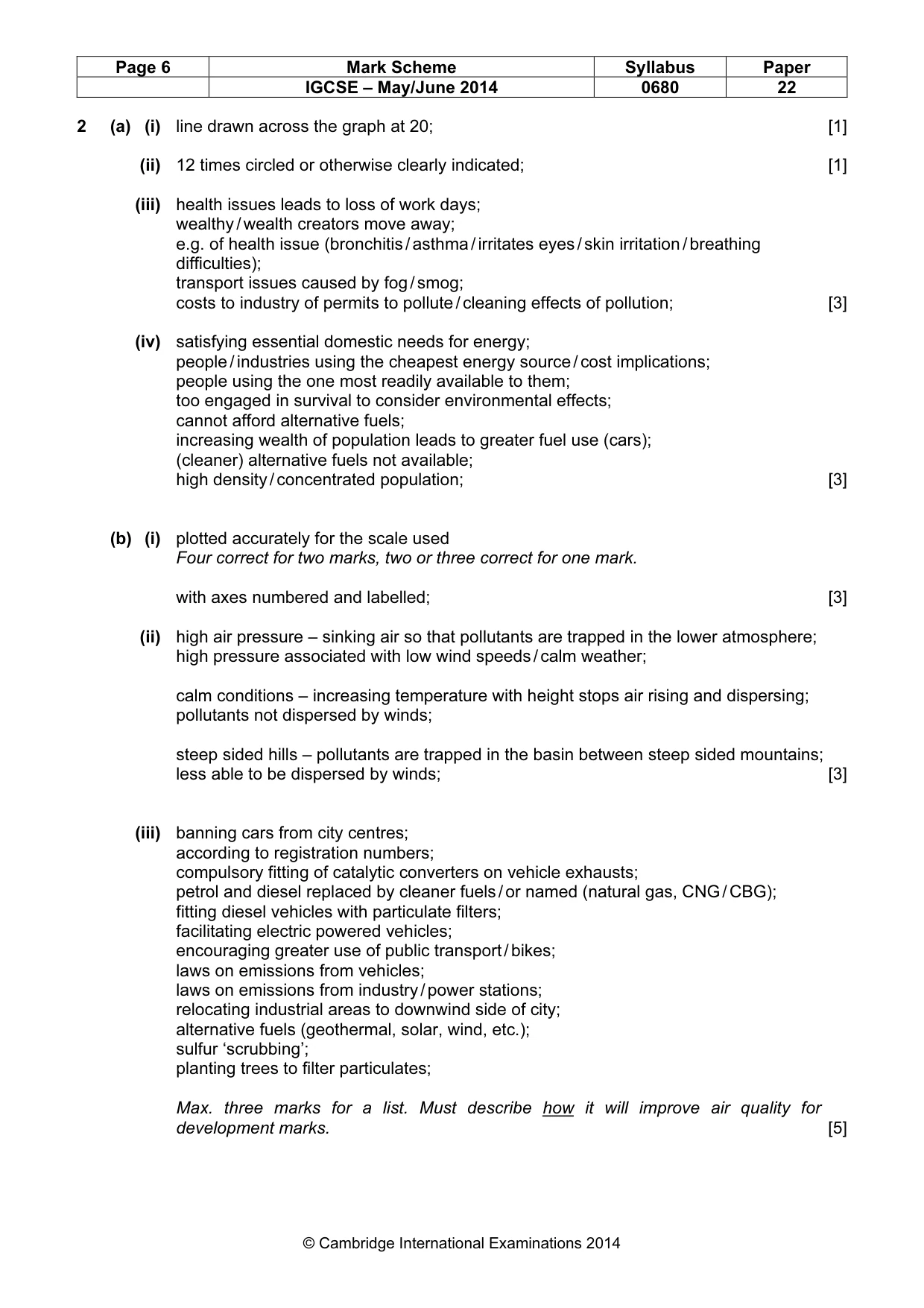
Page 6 Mark Scheme Syllabus Paper IGCSE – May/June 2014 0680 22 © Cambridge International Examinations 2014 2 (a) (i) line drawn across the graph at 20; [1] (ii) 12 times circled or otherwise clearly indicated; [1] (iii) health issues leads to loss of work days; wealthy / wealth creators move away; e.g. of health issue (bronchitis / asthma / irritates eyes / skin irritation / breathing difficulties); transport issues caused by fog / smog; costs to industry of permits to pollute / cleaning effects of pollution; [3] (iv) satisfying essential domestic needs for energy; people / industries using the cheapest energy source / cost implications; people using the one most readily available to them; too engaged in survival to consider environmental effects; cannot afford alternative fuels; increasing wealth of population leads to greater fuel use (cars); (cleaner) alternative fuels not available; high density / concentrated population; [3] (b) (i) plotted accurately for the scale used Four correct for two marks, two or three correct for one mark. with axes numbered and labelled; [3] (ii) high air pressure – sinking air so that pollutants are trapped in the lower atmosphere; high pressure associated with low wind speeds / calm weather; calm conditions – increasing temperature with height stops air rising and dispersing; pollutants not dispersed by winds; steep sided hills – pollutants are trapped in the basin between steep sided mountains; less able to be dispersed by winds; [3] (iii) banning cars from city centres; according to registration numbers; compulsory fitting of catalytic converters on vehicle exhausts; petrol and diesel replaced by cleaner fuels / or named (natural gas, CNG / CBG); fitting diesel vehicles with particulate filters; facilitating electric powered vehicles; encouraging greater use of public transport / bikes; laws on emissions from vehicles; laws on emissions from industry / power stations; relocating industrial areas to downwind side of city; alternative fuels (geothermal, solar, wind, etc.); sulfur ‘scrubbing’; planting trees to filter particulates; Max. three marks for a list. Must describe how it will improve air quality for development marks. [5]
Mark scheme, page 7
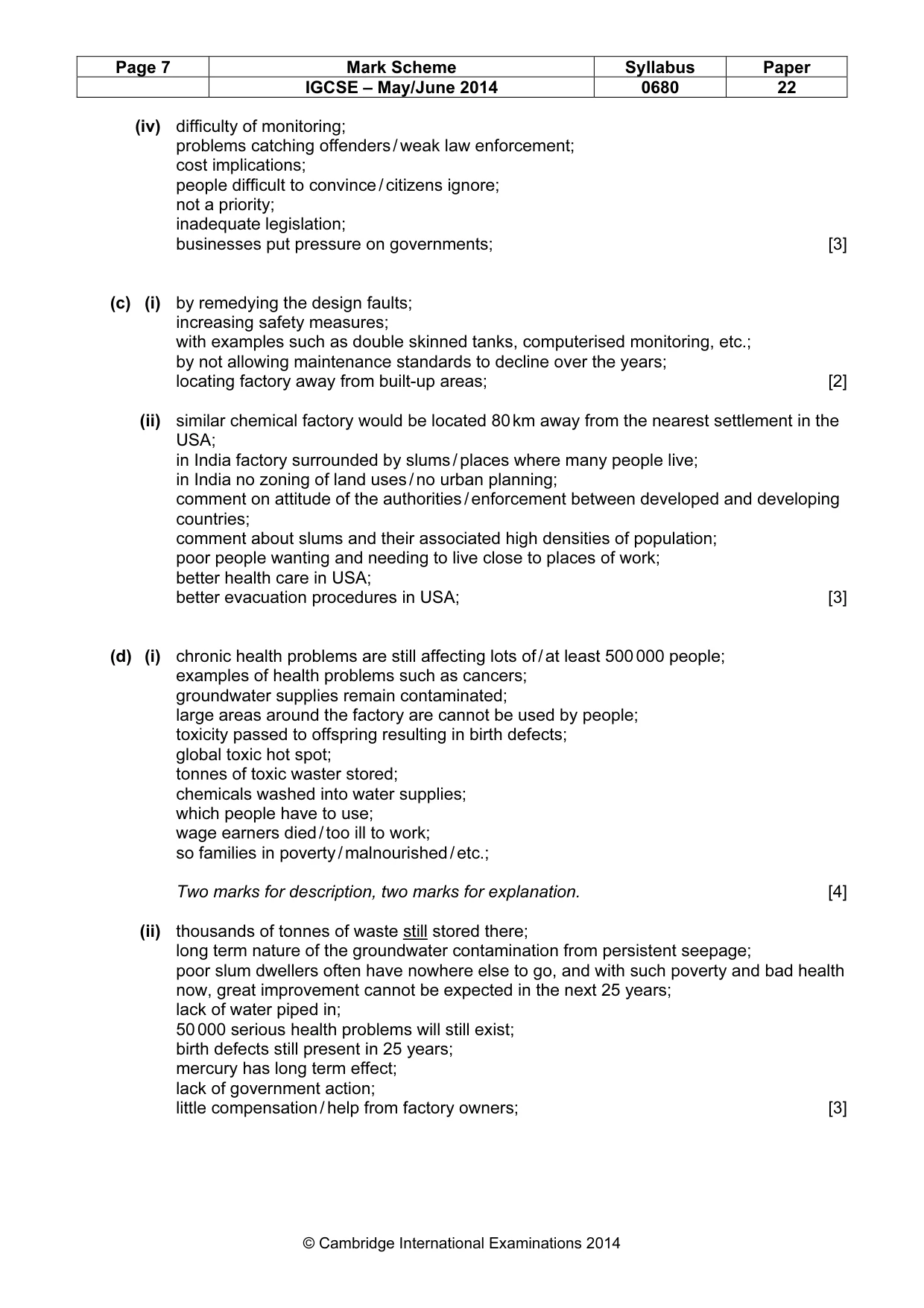
Page 7 Mark Scheme Syllabus Paper IGCSE – May/June 2014 0680 22 © Cambridge International Examinations 2014 (iv) difficulty of monitoring; problems catching offenders / weak law enforcement; cost implications; people difficult to convince / citizens ignore; not a priority; inadequate legislation; businesses put pressure on governments; [3] (c) (i) by remedying the design faults; increasing safety measures; with examples such as double skinned tanks, computerised monitoring, etc.; by not allowing maintenance standards to decline over the years; locating factory away from built-up areas; [2] (ii) similar chemical factory would be located 80 km away from the nearest settlement in the USA; in India factory surrounded by slums / places where many people live; in India no zoning of land uses / no urban planning; comment on attitude of the authorities / enforcement between developed and developing countries; comment about slums and their associated high densities of population; poor people wanting and needing to live close to places of work; better health care in USA; better evacuation procedures in USA; [3] (d) (i) chronic health problems are still affecting lots of / at least 500 000 people; examples of health problems such as cancers; groundwater supplies remain contaminated; large areas around the factory are cannot be used by people; toxicity passed to offspring resulting in birth defects; global toxic hot spot; tonnes of toxic waster stored; chemicals washed into water supplies; which people have to use; wage earners died / too ill to work; so families in poverty / malnourished / etc.; Two marks for description, two marks for explanation. [4] (ii) thousands of tonnes of waste still stored there; long term nature of the groundwater contamination from persistent seepage; poor slum dwellers often have nowhere else to go, and with such poverty and bad health now, great improvement cannot be expected in the next 25 years; lack of water piped in; 50 000 serious health problems will still exist; birth defects still present in 25 years; mercury has long term effect; lack of government action; little compensation / help from factory owners; [3]
Mark scheme, page 8
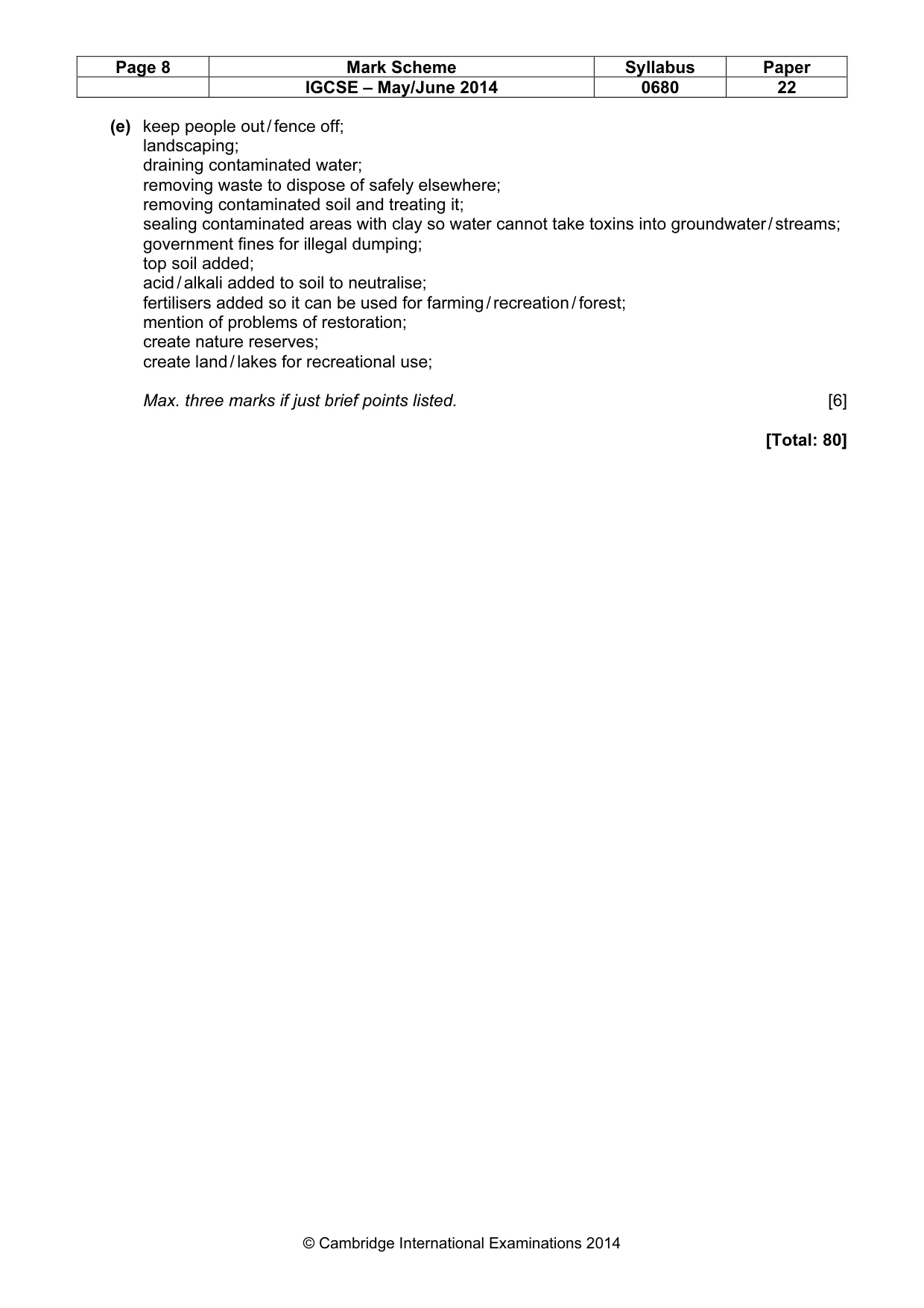
Page 8 Mark Scheme Syllabus Paper IGCSE – May/June 2014 0680 22 © Cambridge International Examinations 2014 (e) keep people out / fence off; landscaping; draining contaminated water; removing waste to dispose of safely elsewhere; removing contaminated soil and treating it; sealing contaminated areas with clay so water cannot take toxins into groundwater / streams; government fines for illegal dumping; top soil added; acid / alkali added to soil to neutralise; fertilisers added so it can be used for farming / recreation / forest; mention of problems of restoration; create nature reserves; create land / lakes for recreational use; Max. three marks if just brief points listed. [6] [Total: 80]
What you needed in this session
Cambridge’s own grade thresholds for 2014 May/June, Paper 2 · Variant 2. A higher threshold means an easier paper — the bar moves with how the cohort did.