Cambridge IGCSE English - Literature in English 0475 — 2024 Oct/Nov Paper 1 · Variant 3
0475/13/O/N/24 · 50 marks · ≈56 min
The question paper and its mark scheme, free to read here and free to download. This is Cambridge’s own paper, exactly as it was sat.
Question paper28 pages



Mark scheme4 pages
Answers below. Sit the paper first if you are practising.
Paper as text
Question paper, page 1
This document has 28 pages. Any blank pages are indicated. [Turn over Cambridge IGCSE™ * 7 1 2 1 6 4 6 5 0 4 * DC (RCL (DF)) 326940/2 © UCLES 2024 LITERATURE IN ENGLISH 0475/13 Paper 1 Poetry and Prose October/November 2024 1 hour 30 minutes You must answer on the enclosed answer booklet. You will need: Answer booklet (enclosed) INSTRUCTIONS ● Answer two questions in total: Section A: answer one question. Section B: answer one question. ● Follow the instructions on the front cover of the answer booklet. If you need additional answer paper, ask the invigilator for a continuation booklet. INFORMATION ● The total mark for this paper is 50. ● All questions are worth equal marks.
Question paper, page 2
2 0475/13/O/N/24 © UCLES 2024 BLANK PAGE
Question paper, page 3
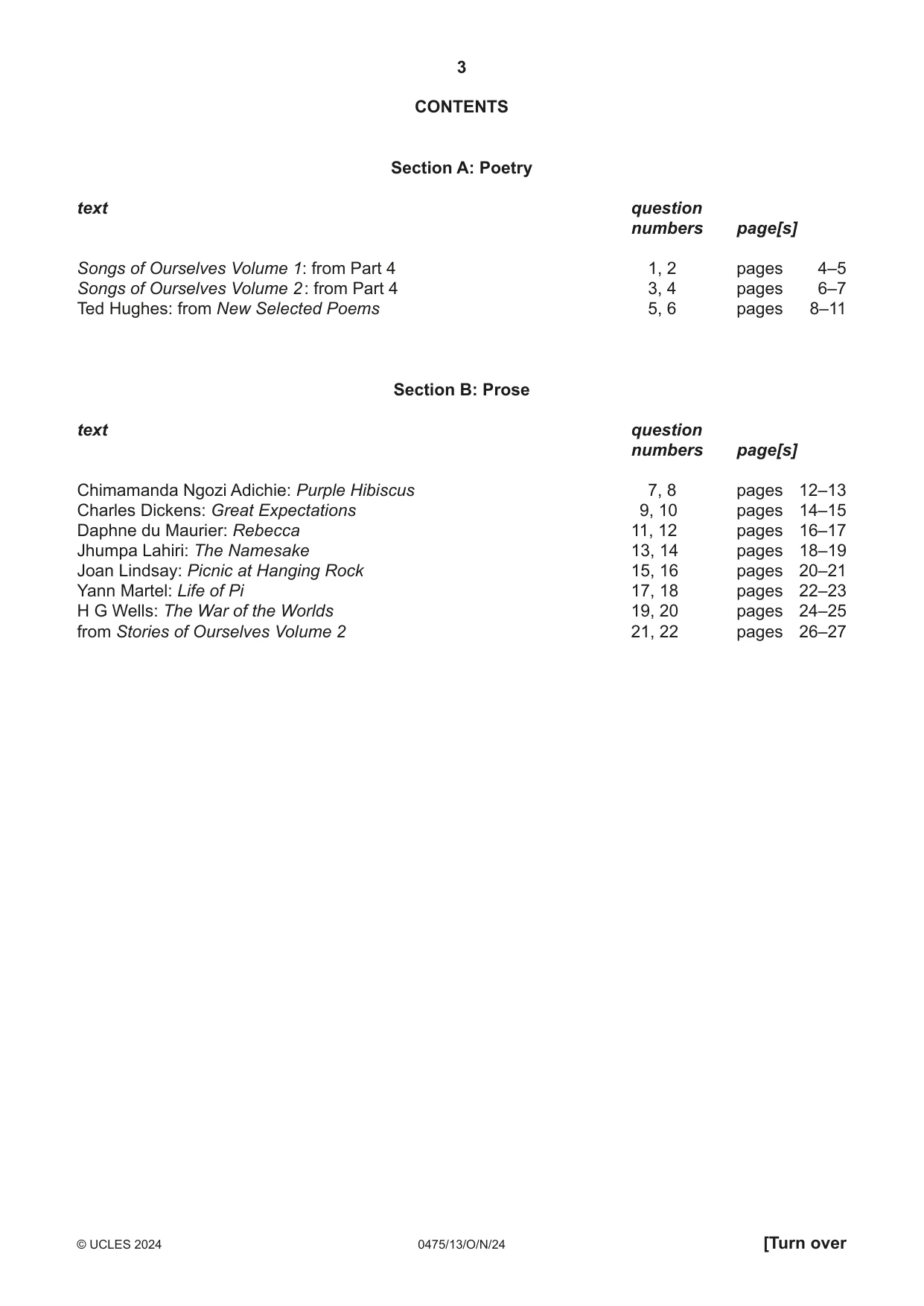
3 0475/13/O/N/24 © UCLES 2024 [Turn over CONTENTS Section A: Poetry text question numbers page[s] Songs of Ourselves Volume 1: from Part 4 1, 2 pages 4–5 Songs of Ourselves Volume 2 : from Part 4 3, 4 pages 6–7 Ted Hughes: from New Selected Poems 5, 6 pages 8–11 Section B: Prose text question numbers page[s] Chimamanda Ngozi Adichie: Purple Hibiscus 7, 8 pages 12–13 Charles Dickens: Great Expectations 9, 10 pages 14–15 Daphne du Maurier: Rebecca 11, 12 pages 16–17 Jhumpa Lahiri: The Namesake 13, 14 pages 18–19 Joan Lindsay: Picnic at Hanging Rock 15, 16 pages 20–21 Yann Martel: Life of Pi 17, 18 pages 22–23 H G Wells: The War of the Worlds 19, 20 pages 24–25 from Stories of Ourselves Volume 2 21, 22 pages 26–27
Question paper, page 4
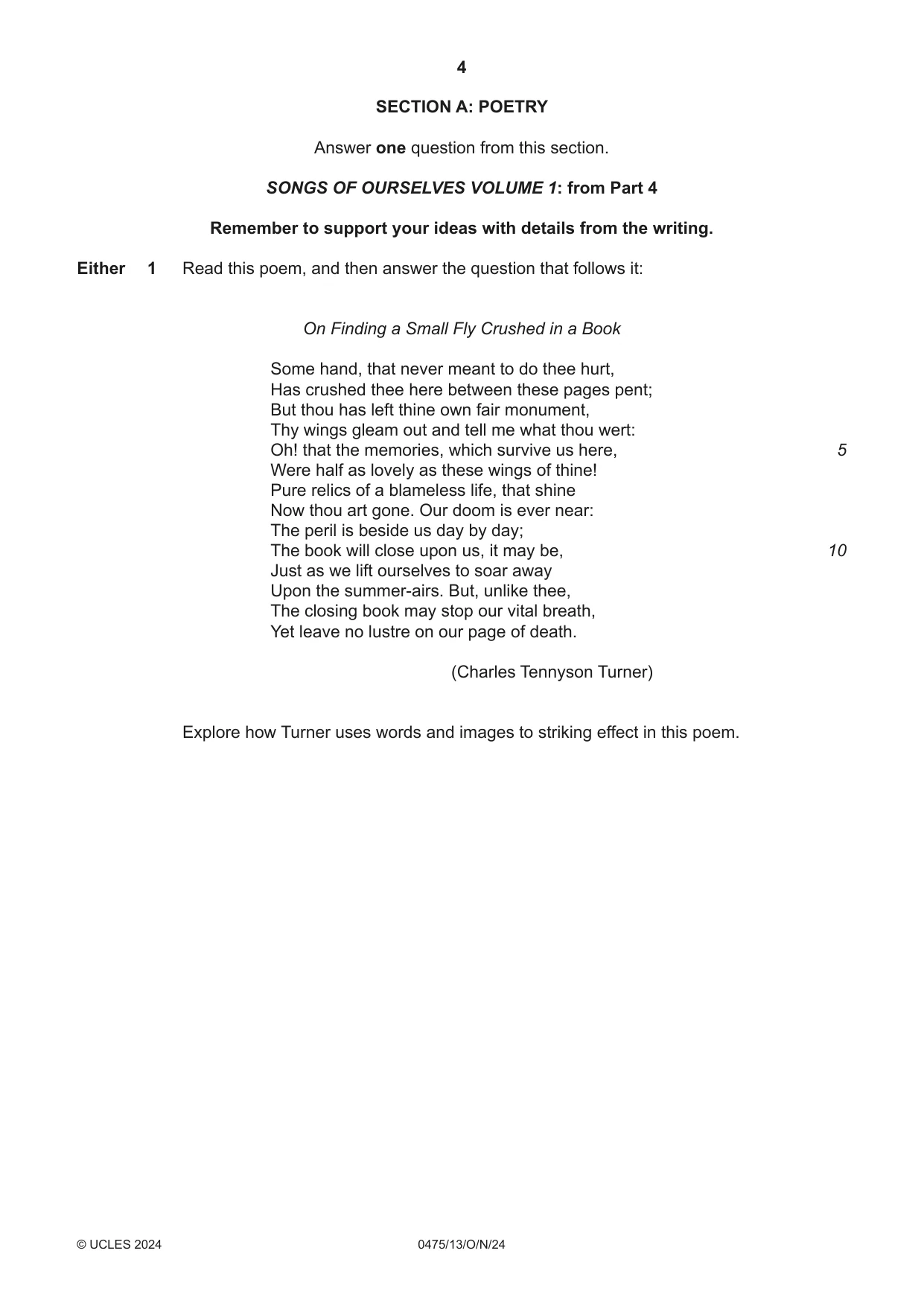
4 0475/13/O/N/24 © UCLES 2024 SECTION A: POETRY Answer one question from this section. SONGS OF OURSELVES VOLUME 1: from Part 4 Remember to support your ideas with details from the writing. Either 1 Read this poem, and then answer the question that follows it: On Finding a Small Fly Crushed in a Book Some hand, that never meant to do thee hurt, Has crushed thee here between these pages pent; But thou has left thine own fair monument, Thy wings gleam out and tell me what thou wert: Oh! that the memories, which survive us here, Were half as lovely as these wings of thine! Pure relics of a blameless life, that shine Now thou art gone. Our doom is ever near: The peril is beside us day by day; The book will close upon us, it may be, Just as we lift ourselves to soar away Upon the summer-airs. But, unlike thee, The closing book may stop our vital breath, Yet leave no lustre on our page of death. (Charles Tennyson Turner) Explore how Turner uses words and images to striking effect in this poem. 5 10
Question paper, page 5
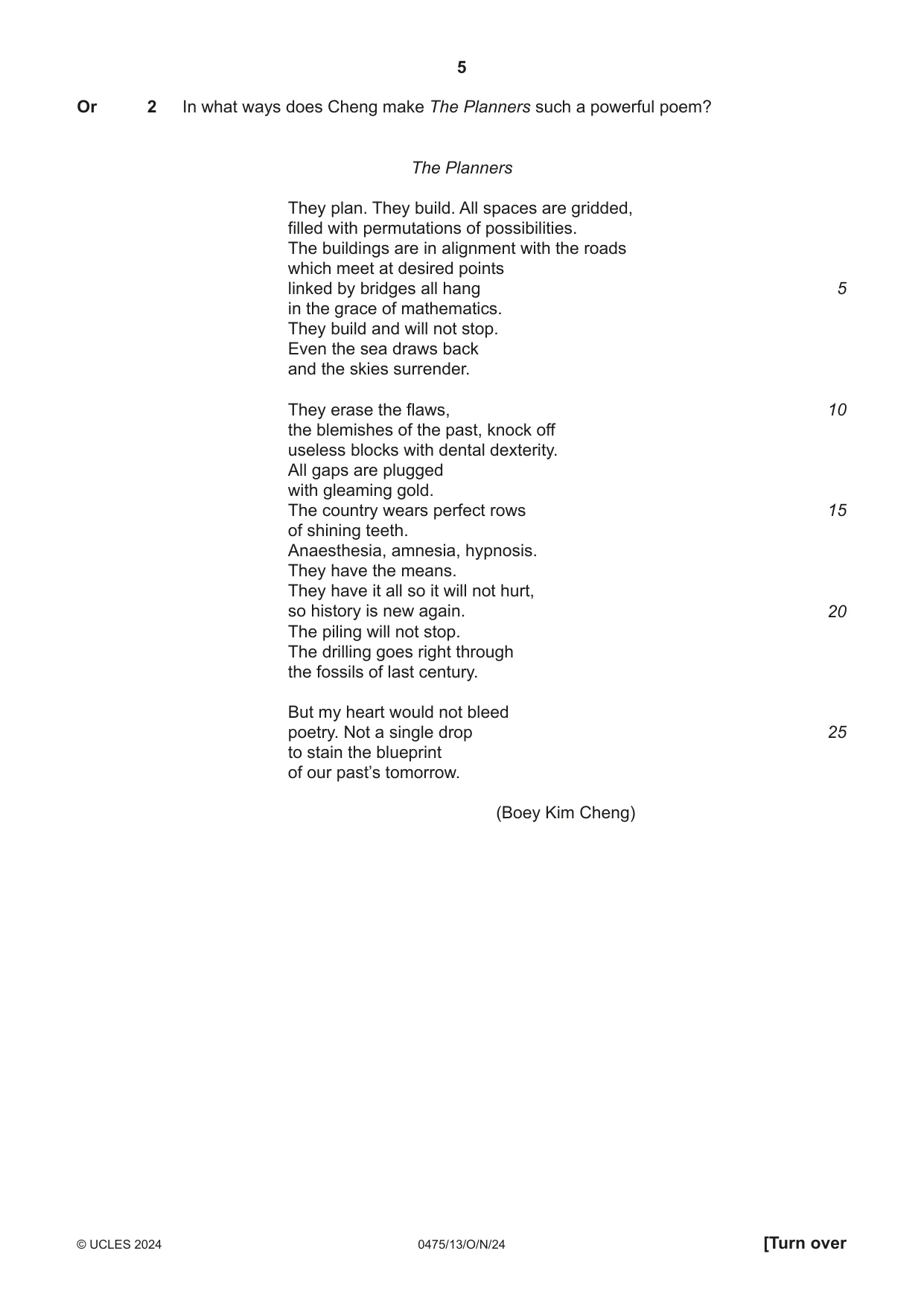
5 0475/13/O/N/24 © UCLES 2024 [Turn over Or 2 In what ways does Cheng make The Planners such a powerful poem? The Planners They plan. They build. All spaces are gridded, filled with permutations of possibilities. The buildings are in alignment with the roads which meet at desired points linked by bridges all hang in the grace of mathematics. They build and will not stop. Even the sea draws back and the skies surrender. They erase the flaws, the blemishes of the past, knock off useless blocks with dental dexterity. All gaps are plugged with gleaming gold. The country wears perfect rows of shining teeth. Anaesthesia, amnesia, hypnosis. They have the means. They have it all so it will not hurt, so history is new again. The piling will not stop. The drilling goes right through the fossils of last century. But my heart would not bleed poetry. Not a single drop to stain the blueprint of our past’s tomorrow. (Boey Kim Cheng) 5 10 15 20 25
Question paper, page 6
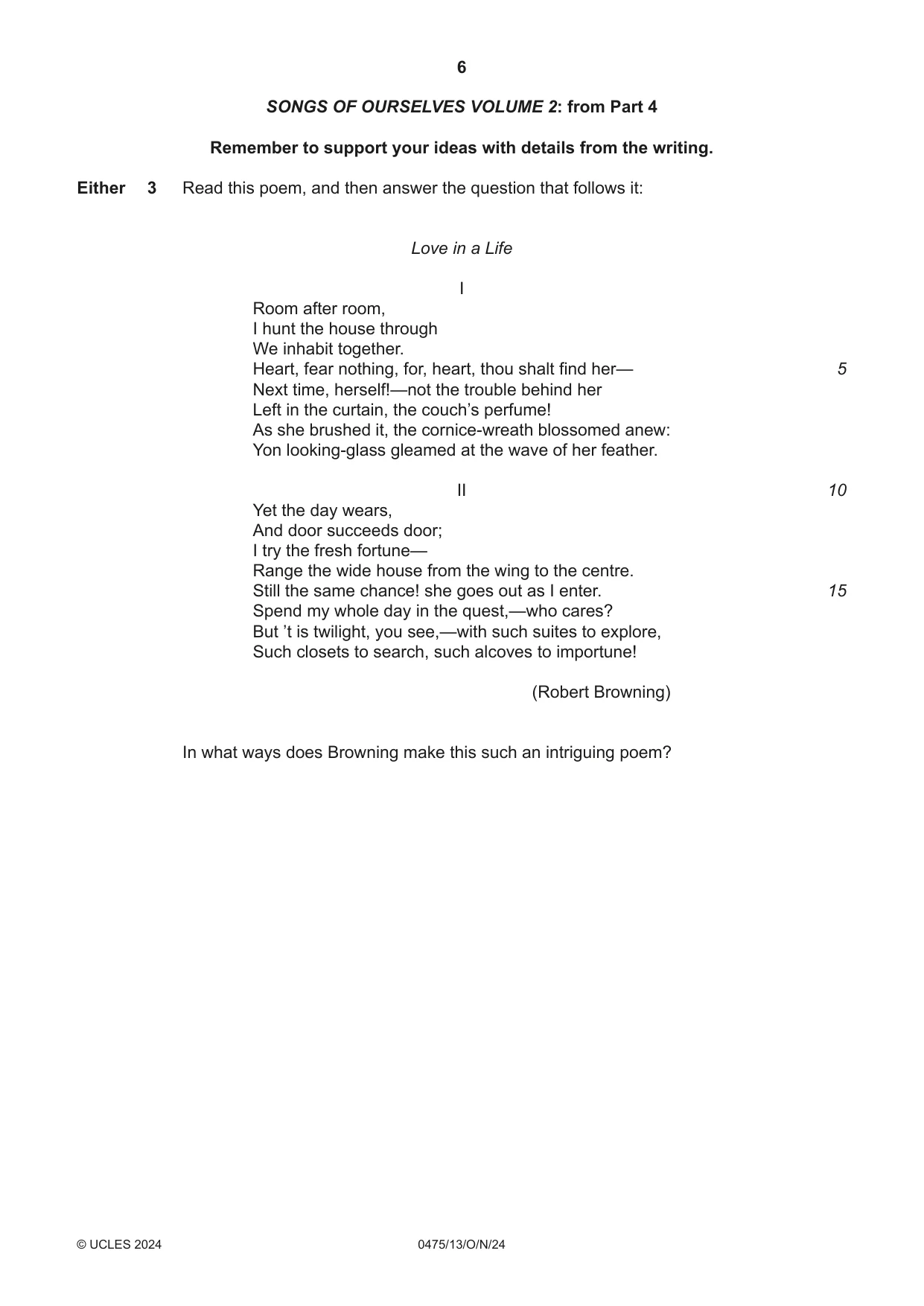
6 0475/13/O/N/24 © UCLES 2024 SONGS OF OURSELVES VOLUME 2: from Part 4 Remember to support your ideas with details from the writing. Either 3 Read this poem, and then answer the question that follows it: Love in a Life I Room after room, I hunt the house through We inhabit together. Heart, fear nothing, for, heart, thou shalt find her— Next time, herself!—not the trouble behind her Left in the curtain, the couch’s perfume! As she brushed it, the cornice-wreath blossomed anew: Yon looking-glass gleamed at the wave of her feather. II Yet the day wears, And door succeeds door; I try the fresh fortune— Range the wide house from the wing to the centre. Still the same chance! she goes out as I enter. Spend my whole day in the quest,—who cares? But ’t is twilight, you see,—with such suites to explore, Such closets to search, such alcoves to importune! (Robert Browning) In what ways does Browning make this such an intriguing poem? 5 10 15
Question paper, page 7
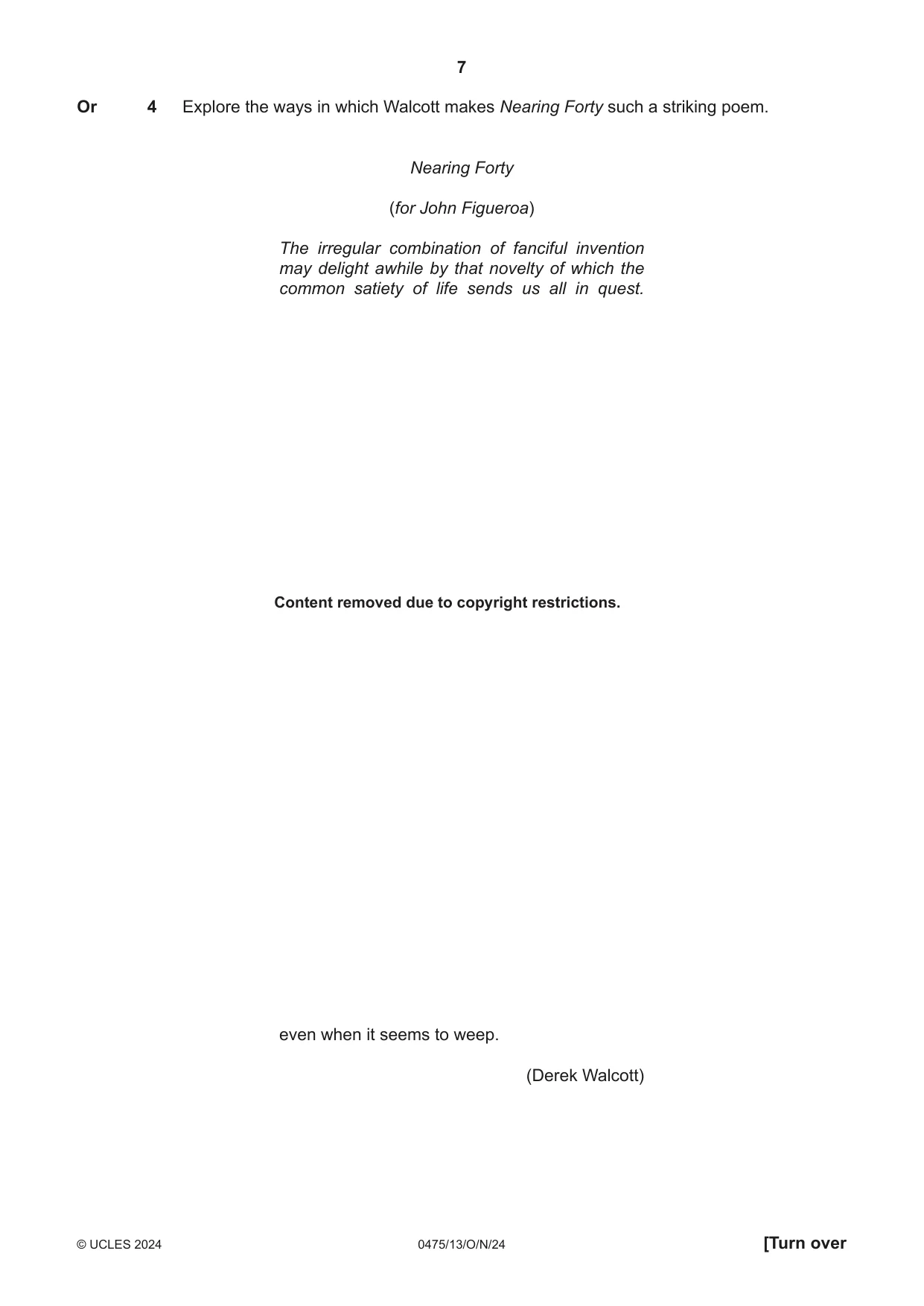
7 0475/13/O/N/24 © UCLES 2024 [Turn over Or 4 Explore the ways in which Walcott makes Nearing Forty such a striking poem. Nearing Forty (for John Figueroa) The irregular combination of fanciful invention may delight awhile by that novelty of which the common satiety of life sends us all in quest. even when it seems to weep. (Derek Walcott) Content removed due to copyright restrictions.
Question paper, page 8
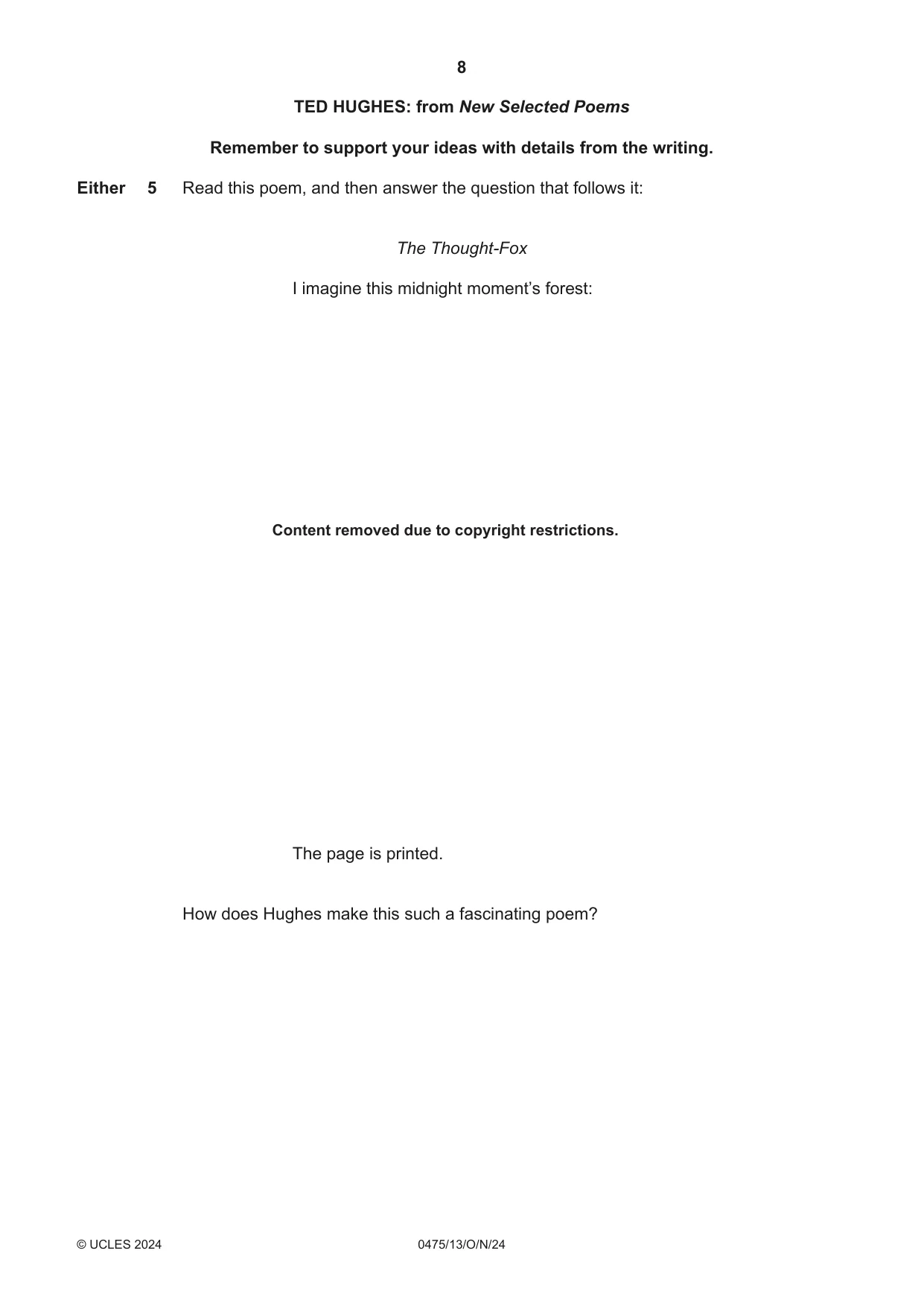
8 0475/13/O/N/24 © UCLES 2024 TED HUGHES: from New Selected Poems Remember to support your ideas with details from the writing. Either 5 Read this poem, and then answer the question that follows it: The Thought-Fox I imagine this midnight moment’s forest: The page is printed. How does Hughes make this such a fascinating poem? Content removed due to copyright restrictions.
Question paper, page 9
9 0475/13/O/N/24 © UCLES 2024 [Turn over TURN OVER FOR QUESTION 6.
Question paper, page 10
10 0475/13/O/N/24 © UCLES 2024 Or 6 Explore the ways in which Hughes creates such a powerful atmosphere in The Horses. The Horses I climbed through woods in the hour-before-dawn dark. Content removed due to copyright restrictions.
Question paper, page 11
11 0475/13/O/N/24 © UCLES 2024 [Turn over Hearing the horizons endure. Content removed due to copyright restrictions.
Question paper, page 12
12 0475/13/O/N/24 © UCLES 2024 SECTION B: PROSE Answer one question from this section. CHIMAMANDA NGOZI ADICHIE: Purple Hibiscus Remember to support your ideas with details from the writing. Either 7 Read this passage, and then answer the question that follows it: ‘Good evening, Papa, nno.’ Content removed due to copyright restrictions.
Question paper, page 13
13 0475/13/O/N/24 © UCLES 2024 [Turn over He did not call me the next day, or the day after, to talk about my report card, to decide how I would be punished. How does Adichie vividly convey Kambili’s fear at this moment in the novel? Or 8 In what ways does Adichie make Amaka a memorable and significant character in the novel? Content removed due to copyright restrictions.
Question paper, page 14
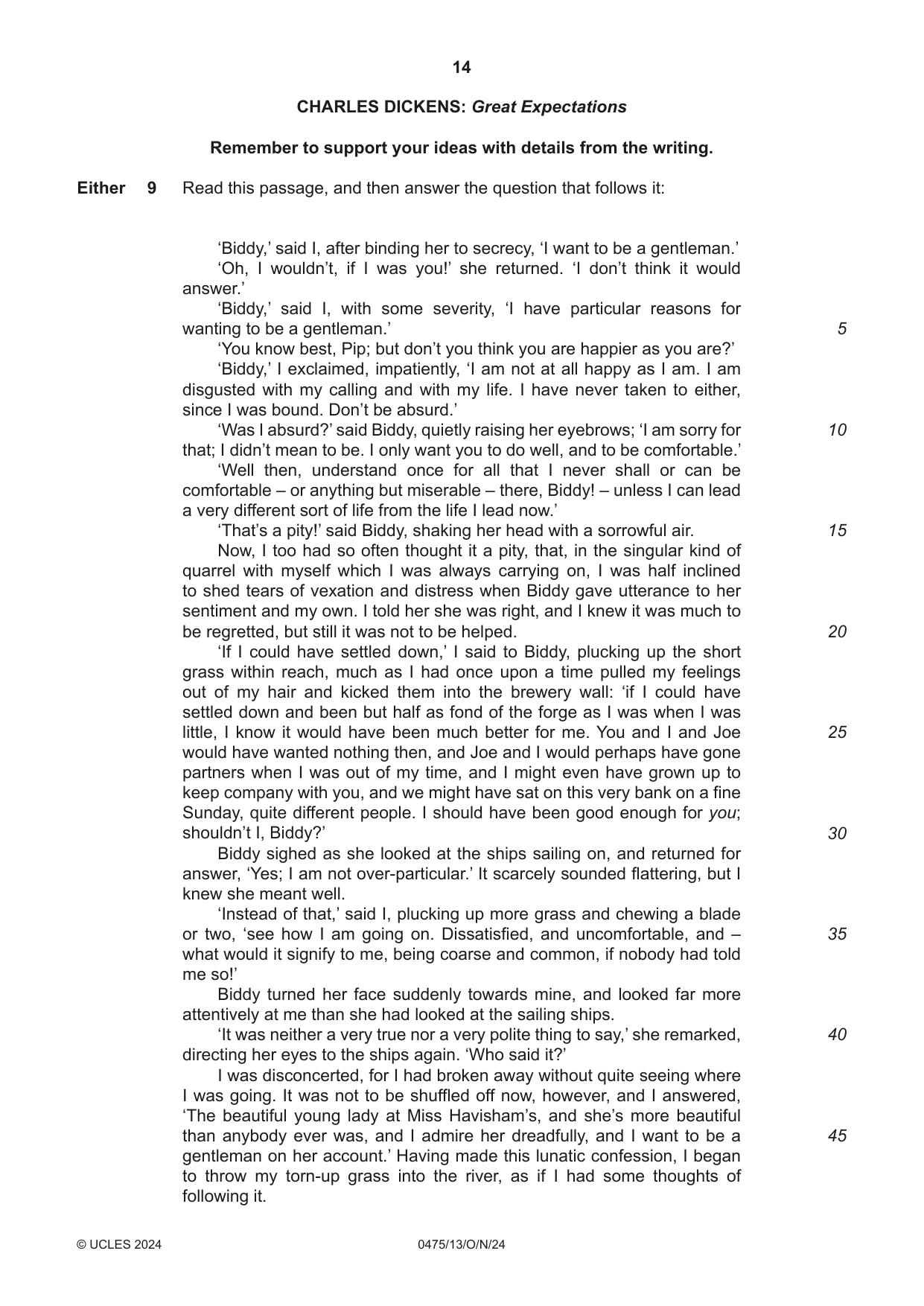
14 0475/13/O/N/24 © UCLES 2024 CHARLES DICKENS: Great Expectations Remember to support your ideas with details from the writing. Either 9 Read this passage, and then answer the question that follows it: ‘Biddy,’ said I, after binding her to secrecy, ‘I want to be a gentleman.’ ‘Oh, I wouldn’t, if I was you!’ she returned. ‘I don’t think it would answer.’ ‘Biddy,’ said I, with some severity, ‘I have particular reasons for wanting to be a gentleman.’ ‘You know best, Pip; but don’t you think you are happier as you are?’ ‘Biddy,’ I exclaimed, impatiently, ‘I am not at all happy as I am. I am disgusted with my calling and with my life. I have never taken to either, since I was bound. Don’t be absurd.’ ‘Was I absurd?’ said Biddy, quietly raising her eyebrows; ‘I am sorry for that; I didn’t mean to be. I only want you to do well, and to be comfortable.’ ‘Well then, understand once for all that I never shall or can be comfortable – or anything but miserable – there, Biddy! – unless I can lead a very different sort of life from the life I lead now.’ ‘That’s a pity!’ said Biddy, shaking her head with a sorrowful air. Now, I too had so often thought it a pity, that, in the singular kind of quarrel with myself which I was always carrying on, I was half inclined to shed tears of vexation and distress when Biddy gave utterance to her sentiment and my own. I told her she was right, and I knew it was much to be regretted, but still it was not to be helped. ‘If I could have settled down,’ I said to Biddy, plucking up the short grass within reach, much as I had once upon a time pulled my feelings out of my hair and kicked them into the brewery wall: ‘if I could have settled down and been but half as fond of the forge as I was when I was little, I know it would have been much better for me. You and I and Joe would have wanted nothing then, and Joe and I would perhaps have gone partners when I was out of my time, and I might even have grown up to keep company with you, and we might have sat on this very bank on a fine Sunday, quite different people. I should have been good enough for you; shouldn’t I, Biddy?’ Biddy sighed as she looked at the ships sailing on, and returned for answer, ‘Yes; I am not over-particular.’ It scarcely sounded flattering, but I knew she meant well. ‘Instead of that,’ said I, plucking up more grass and chewing a blade or two, ‘see how I am going on. Dissatisfied, and uncomfortable, and – what would it signify to me, being coarse and common, if nobody had told me so!’ Biddy turned her face suddenly towards mine, and looked far more attentively at me than she had looked at the sailing ships. ‘It was neither a very true nor a very polite thing to say,’ she remarked, directing her eyes to the ships again. ‘Who said it?’ I was disconcerted, for I had broken away without quite seeing where I was going. It was not to be shuffled off now, however, and I answered, ‘The beautiful young lady at Miss Havisham’s, and she’s more beautiful than anybody ever was, and I admire her dreadfully, and I want to be a gentleman on her account.’ Having made this lunatic confession, I began to throw my torn-up grass into the river, as if I had some thoughts of following it. 5 10 15 20 25 30 35 40 45
Question paper, page 15
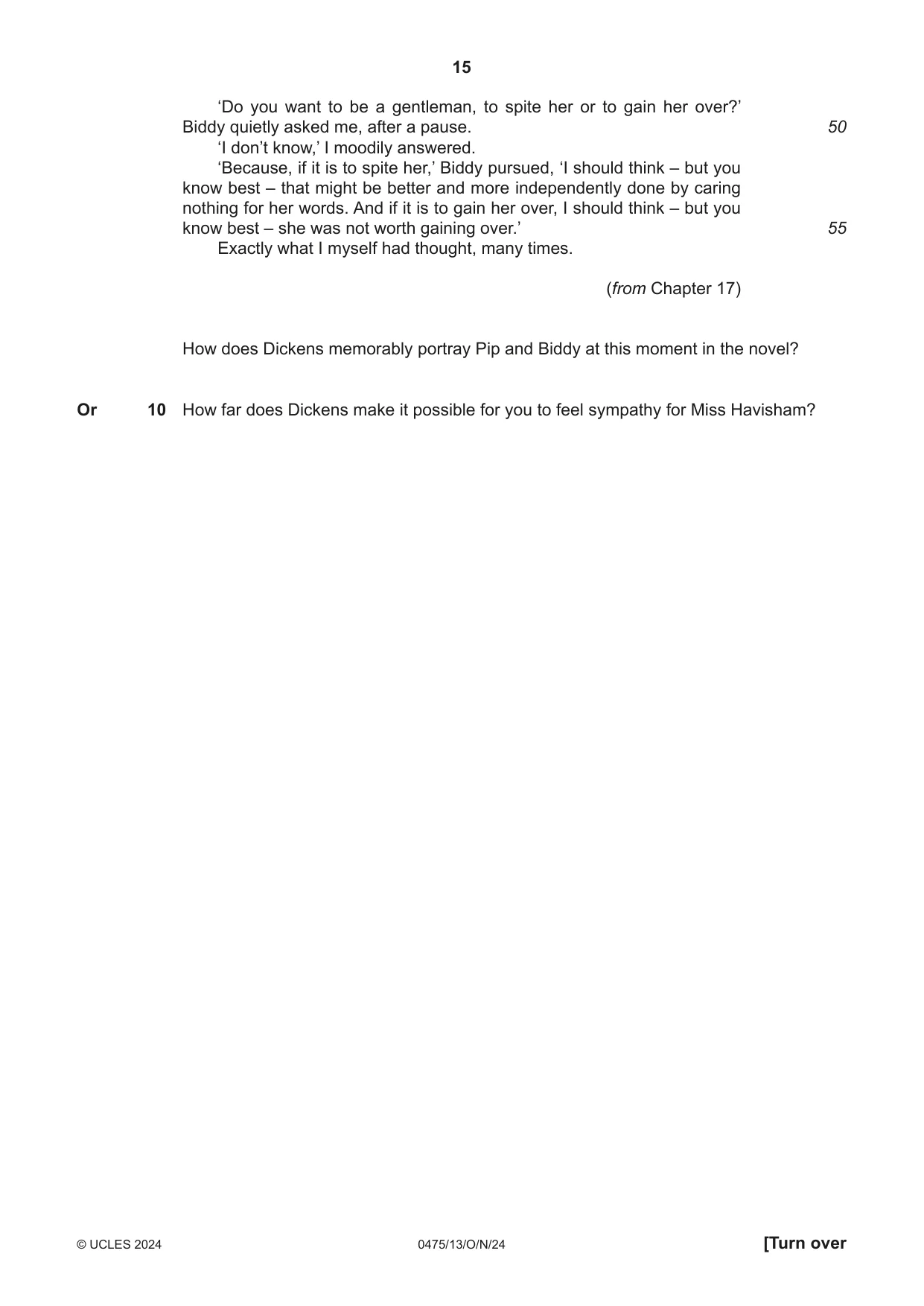
15 0475/13/O/N/24 © UCLES 2024 [Turn over ‘Do you want to be a gentleman, to spite her or to gain her over?’ Biddy quietly asked me, after a pause. ‘I don’t know,’ I moodily answered. ‘Because, if it is to spite her,’ Biddy pursued, ‘I should think – but you know best – that might be better and more independently done by caring nothing for her words. And if it is to gain her over, I should think – but you know best – she was not worth gaining over.’ Exactly what I myself had thought, many times. (from Chapter 17) How does Dickens memorably portray Pip and Biddy at this moment in the novel? Or 10 How far does Dickens make it possible for you to feel sympathy for Miss Havisham? 50 55
Question paper, page 16
16 0475/13/O/N/24 © UCLES 2024 DAPHNE DU MAURIER: Rebecca Remember to support your ideas with details from the writing. Either 11 Read this passage, and then answer the question that follows it: I backed away from her towards the window, my old fear and horror rising up in me again. Content removed due to copyright restrictions.
Question paper, page 17
0475/13/O/N/24 © UCLES 2024 [Turn over And then we heard the sound of footsteps running on the terrace beneath us. (from Chapter 18) In what ways does du Maurier make this such a frightening moment in the novel? Or 12 How does du Maurier vividly convey the narrator’s feelings about Rebecca? Content removed due to copyright restrictions.
Question paper, page 18
18 0475/13/O/N/24 © UCLES 2024 JHUMPA LAHIRI: The Namesake Remember to support your ideas with details from the writing. Either 13 Read this passage, and then answer the question that follows it: The fuss feels unwarranted as they step into a stark, sunken dining room. Content removed due to copyright restrictions.
Question paper, page 19
19 0475/13/O/N/24 © UCLES 2024 [Turn over She feels a lump form in her throat, tears filming her eyes. (from Chapter 10) How does Lahiri make this such a disturbing moment in the novel? Or 14 Explore the ways in which Lahiri shows how Gogol tries to distance himself from his past. Content removed due to copyright restrictions.
Question paper, page 20
20 0475/13/O/N/24 © UCLES 2024 JOAN LINDSAY: Picnic at Hanging Rock Remember to support your ideas with details from the writing. Either 15 Read this passage, and then answer the question that follows it: At two o’clock on the afternoon of Thursday the nineteenth of March, Appleyard College was cold, silent and smelling of roast mutton and cabbage. Content removed due to copyright restrictions.
Question paper, page 21
21 0475/13/O/N/24 © UCLES 2024 [Turn over There was mention of a top-rank detective being brought out from Scotland Yard at Mr Leopold’s expense and other looming horrors impossible to thrust aside. (from Chapter 12) How does Lindsay make this such a memorable moment in the novel? Or 16 How far does Lindsay make the ending of the novel satisfying for you? Content removed due to copyright restrictions.
Question paper, page 22
22 0475/13/O/N/24 © UCLES 2024 YANN MARTEL: Life of Pi Remember to support your ideas with details from the writing. Either 17 Read this passage, and then answer the question that follows it: We perished away. Content removed due to copyright restrictions.
Question paper, page 23
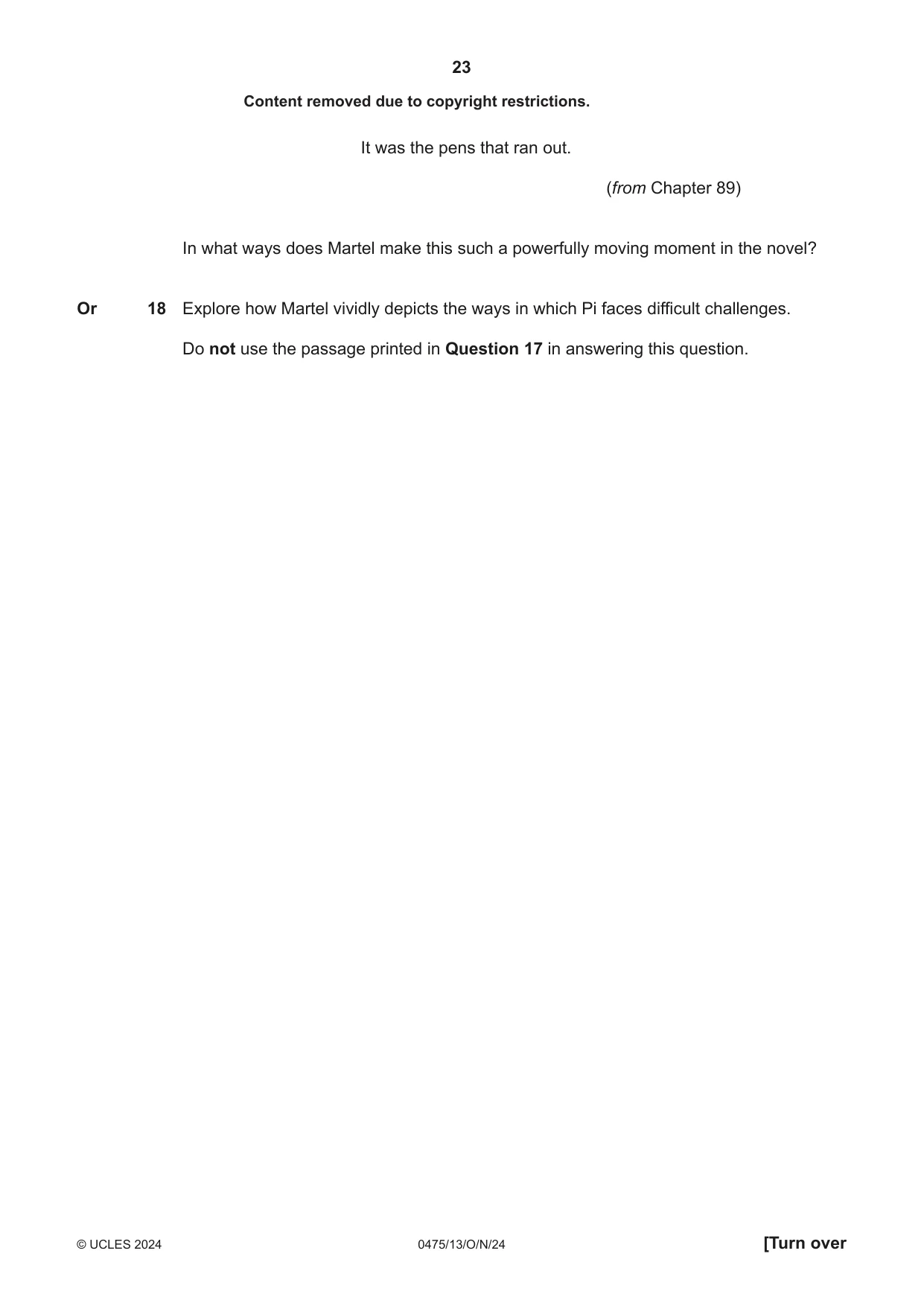
23 0475/13/O/N/24 © UCLES 2024 [Turn over It was the pens that ran out. (from Chapter 89) In what ways does Martel make this such a powerfully moving moment in the novel? Or 18 Explore how Martel vividly depicts the ways in which Pi faces difficult challenges. Do not use the passage printed in Question 17 in answering this question. Content removed due to copyright restrictions.
Question paper, page 24
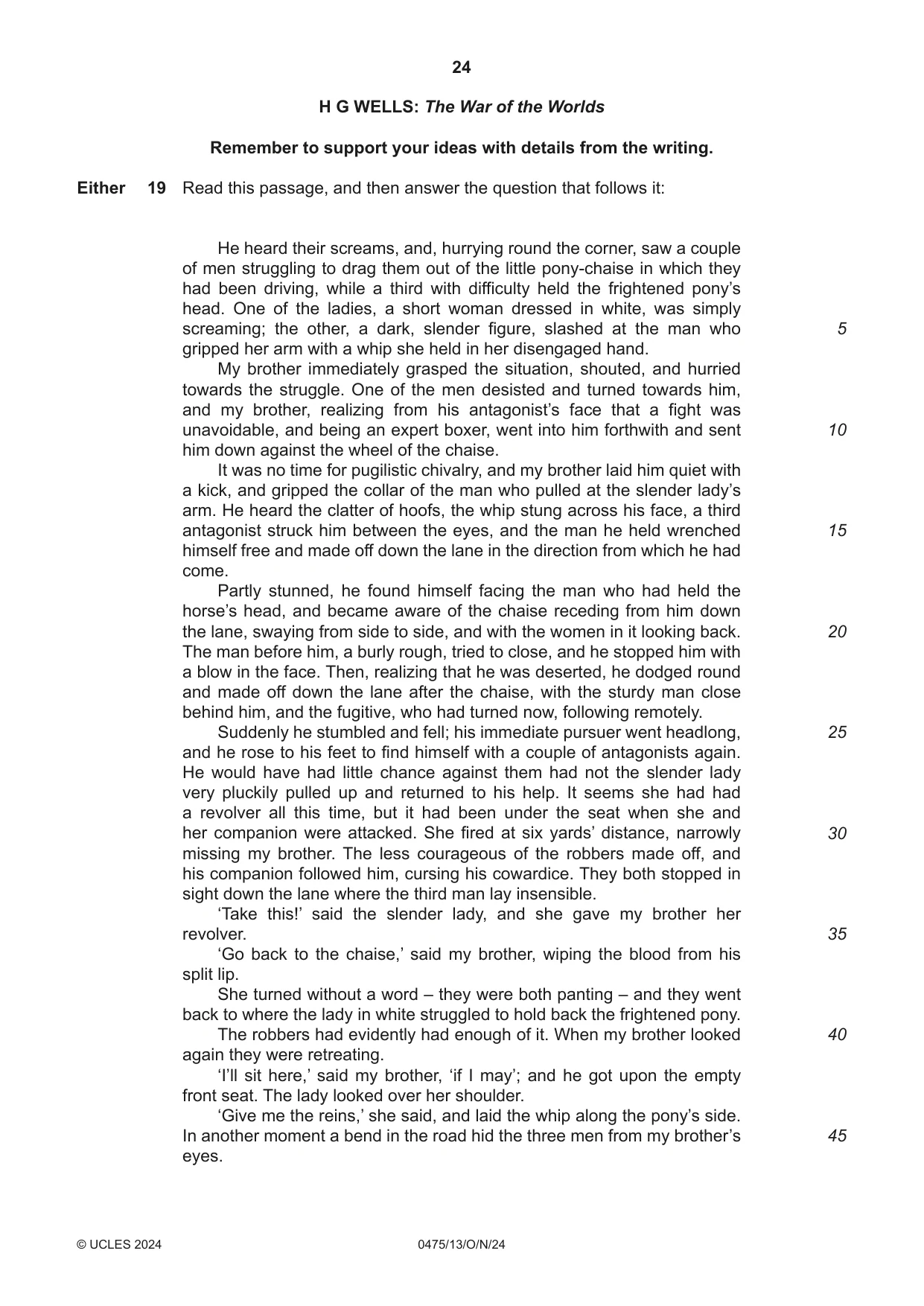
24 0475/13/O/N/24 © UCLES 2024 H G WELLS: The War of the Worlds Remember to support your ideas with details from the writing. Either 19 Read this passage, and then answer the question that follows it: He heard their screams, and, hurrying round the corner, saw a couple of men struggling to drag them out of the little pony-chaise in which they had been driving, while a third with difficulty held the frightened pony’s head. One of the ladies, a short woman dressed in white, was simply screaming; the other, a dark, slender figure, slashed at the man who gripped her arm with a whip she held in her disengaged hand. My brother immediately grasped the situation, shouted, and hurried towards the struggle. One of the men desisted and turned towards him, and my brother, realizing from his antagonist’s face that a fight was unavoidable, and being an expert boxer, went into him forthwith and sent him down against the wheel of the chaise. It was no time for pugilistic chivalry, and my brother laid him quiet with a kick, and gripped the collar of the man who pulled at the slender lady’s arm. He heard the clatter of hoofs, the whip stung across his face, a third antagonist struck him between the eyes, and the man he held wrenched himself free and made off down the lane in the direction from which he had come. Partly stunned, he found himself facing the man who had held the horse’s head, and became aware of the chaise receding from him down the lane, swaying from side to side, and with the women in it looking back. The man before him, a burly rough, tried to close, and he stopped him with a blow in the face. Then, realizing that he was deserted, he dodged round and made off down the lane after the chaise, with the sturdy man close behind him, and the fugitive, who had turned now, following remotely. Suddenly he stumbled and fell; his immediate pursuer went headlong, and he rose to his feet to find himself with a couple of antagonists again. He would have had little chance against them had not the slender lady very pluckily pulled up and returned to his help. It seems she had had a revolver all this time, but it had been under the seat when she and her companion were attacked. She fired at six yards’ distance, narrowly missing my brother. The less courageous of the robbers made off, and his companion followed him, cursing his cowardice. They both stopped in sight down the lane where the third man lay insensible. ‘Take this!’ said the slender lady, and she gave my brother her revolver. ‘Go back to the chaise,’ said my brother, wiping the blood from his split lip. She turned without a word – they were both panting – and they went back to where the lady in white struggled to hold back the frightened pony. The robbers had evidently had enough of it. When my brother looked again they were retreating. ‘I’ll sit here,’ said my brother, ‘if I may’; and he got upon the empty front seat. The lady looked over her shoulder. ‘Give me the reins,’ she said, and laid the whip along the pony’s side. In another moment a bend in the road hid the three men from my brother’s eyes. 5 10 15 20 25 30 35 40 45
Question paper, page 25
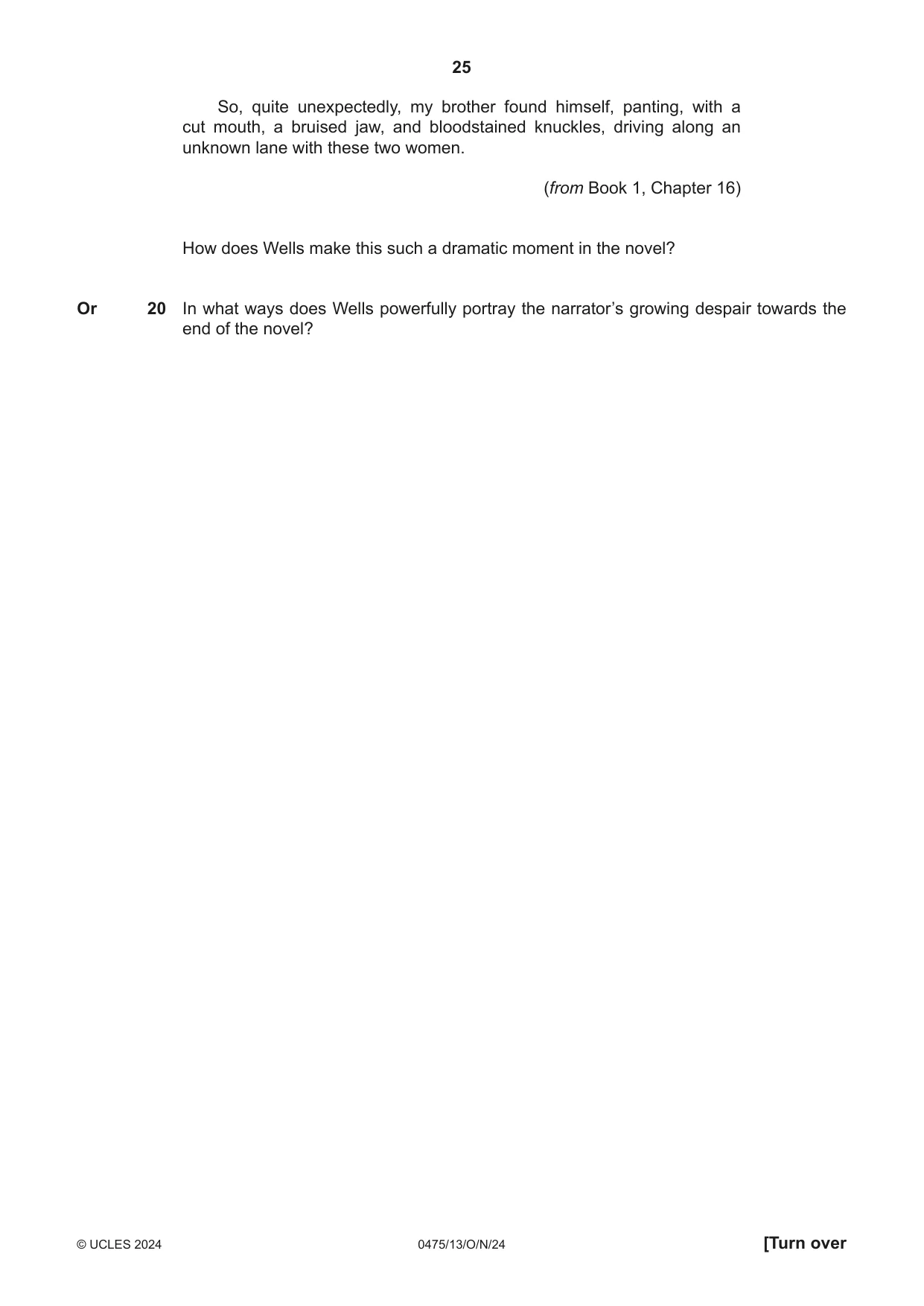
25 0475/13/O/N/24 © UCLES 2024 [Turn over So, quite unexpectedly, my brother found himself, panting, with a cut mouth, a bruised jaw, and bloodstained knuckles, driving along an unknown lane with these two women. (from Book 1, Chapter 16) How does Wells make this such a dramatic moment in the novel? Or 20 In what ways does Wells powerfully portray the narrator’s growing despair towards the end of the novel?
Question paper, page 26
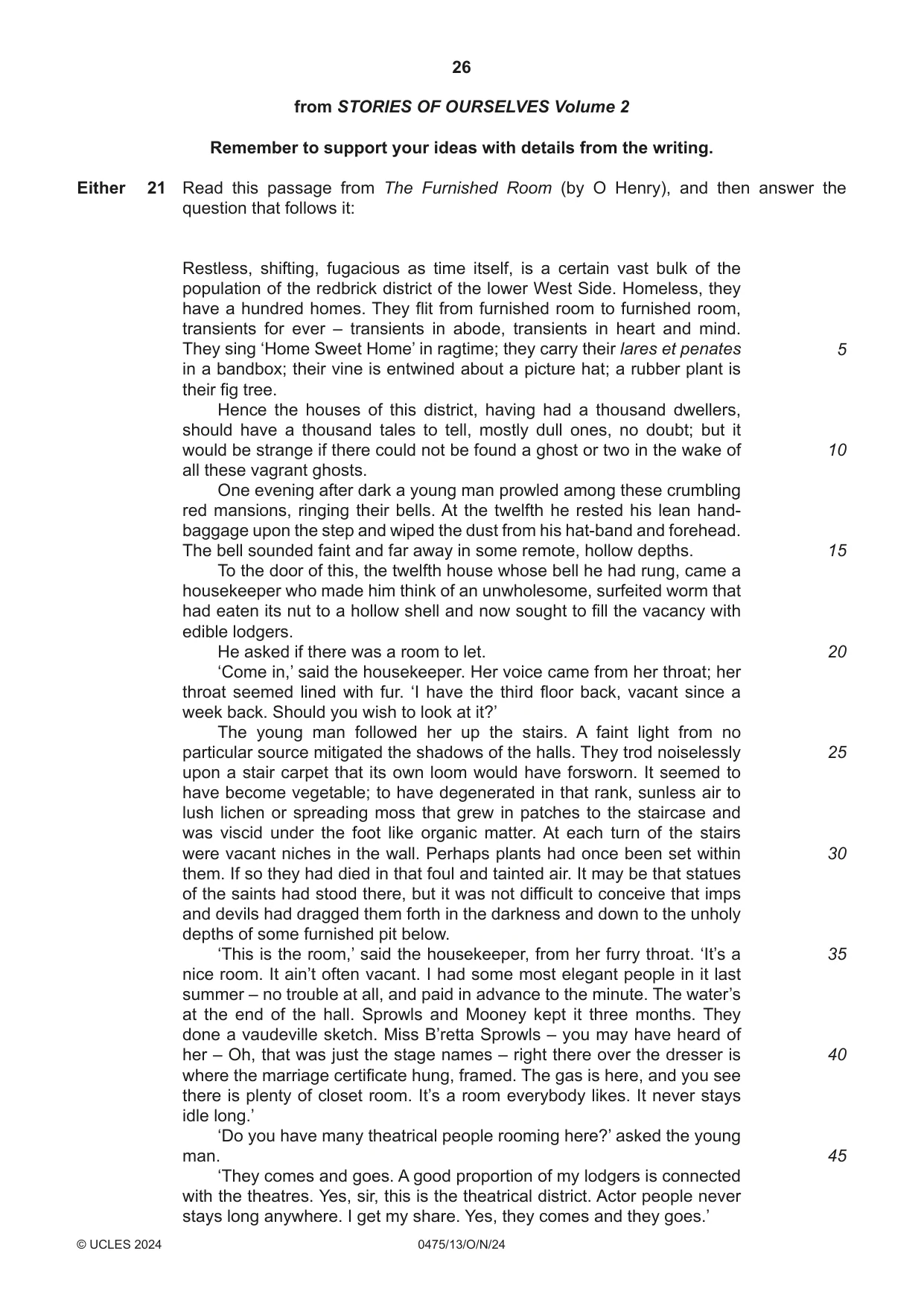
26 0475/13/O/N/24 © UCLES 2024 from STORIES OF OURSELVES Volume 2 Remember to support your ideas with details from the writing. Either 21 Read this passage from The Furnished Room (by O Henry), and then answer the question that follows it: Restless, shifting, fugacious as time itself, is a certain vast bulk of the population of the redbrick district of the lower West Side. Homeless, they have a hundred homes. They flit from furnished room to furnished room, transients for ever – transients in abode, transients in heart and mind. They sing ‘Home Sweet Home’ in ragtime; they carry their lares et penates in a bandbox; their vine is entwined about a picture hat; a rubber plant is their fig tree. Hence the houses of this district, having had a thousand dwellers, should have a thousand tales to tell, mostly dull ones, no doubt; but it would be strange if there could not be found a ghost or two in the wake of all these vagrant ghosts. One evening after dark a young man prowled among these crumbling red mansions, ringing their bells. At the twelfth he rested his lean hand- baggage upon the step and wiped the dust from his hat-band and forehead. The bell sounded faint and far away in some remote, hollow depths. To the door of this, the twelfth house whose bell he had rung, came a housekeeper who made him think of an unwholesome, surfeited worm that had eaten its nut to a hollow shell and now sought to fill the vacancy with edible lodgers. He asked if there was a room to let. ‘Come in,’ said the housekeeper. Her voice came from her throat; her throat seemed lined with fur. ‘I have the third floor back, vacant since a week back. Should you wish to look at it?’ The young man followed her up the stairs. A faint light from no particular source mitigated the shadows of the halls. They trod noiselessly upon a stair carpet that its own loom would have forsworn. It seemed to have become vegetable; to have degenerated in that rank, sunless air to lush lichen or spreading moss that grew in patches to the staircase and was viscid under the foot like organic matter. At each turn of the stairs were vacant niches in the wall. Perhaps plants had once been set within them. If so they had died in that foul and tainted air. It may be that statues of the saints had stood there, but it was not difficult to conceive that imps and devils had dragged them forth in the darkness and down to the unholy depths of some furnished pit below. ‘This is the room,’ said the housekeeper, from her furry throat. ‘It’s a nice room. It ain’t often vacant. I had some most elegant people in it last summer – no trouble at all, and paid in advance to the minute. The water’s at the end of the hall. Sprowls and Mooney kept it three months. They done a vaudeville sketch. Miss B’retta Sprowls – you may have heard of her – Oh, that was just the stage names – right there over the dresser is where the marriage certificate hung, framed. The gas is here, and you see there is plenty of closet room. It’s a room everybody likes. It never stays idle long.’ ‘Do you have many theatrical people rooming here?’ asked the young man. ‘They comes and goes. A good proportion of my lodgers is connected with the theatres. Yes, sir, this is the theatrical district. Actor people never stays long anywhere. I get my share. Yes, they comes and they goes.’ 5 10 15 20 25 30 35 40 45
Question paper, page 27
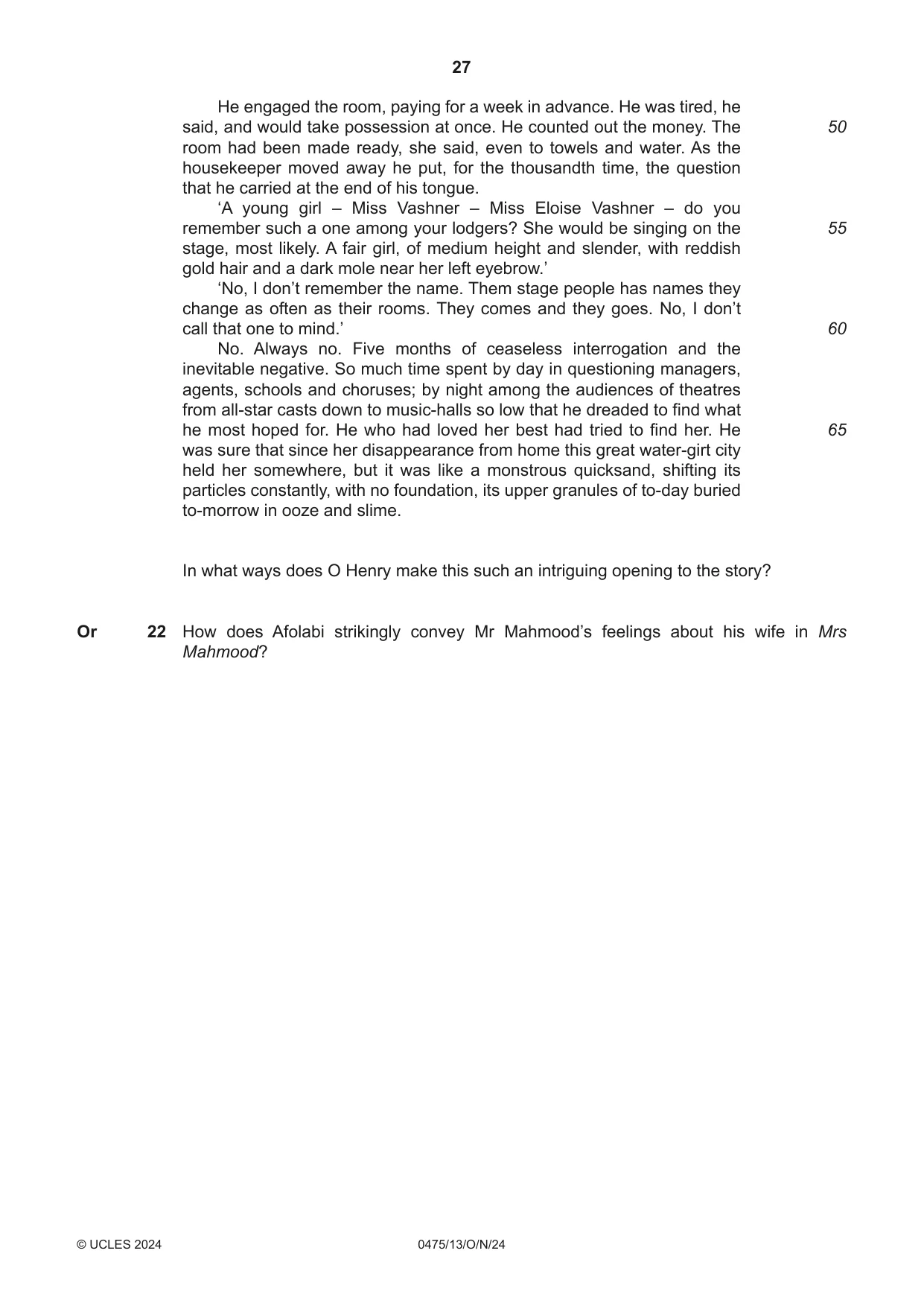
27 0475/13/O/N/24 © UCLES 2024 He engaged the room, paying for a week in advance. He was tired, he said, and would take possession at once. He counted out the money. The room had been made ready, she said, even to towels and water. As the housekeeper moved away he put, for the thousandth time, the question that he carried at the end of his tongue. ‘A young girl – Miss Vashner – Miss Eloise Vashner – do you remember such a one among your lodgers? She would be singing on the stage, most likely. A fair girl, of medium height and slender, with reddish gold hair and a dark mole near her left eyebrow.’ ‘No, I don’t remember the name. Them stage people has names they change as often as their rooms. They comes and they goes. No, I don’t call that one to mind.’ No. Always no. Five months of ceaseless interrogation and the inevitable negative. So much time spent by day in questioning managers, agents, schools and choruses; by night among the audiences of theatres from all-star casts down to music-halls so low that he dreaded to find what he most hoped for. He who had loved her best had tried to find her. He was sure that since her disappearance from home this great water-girt city held her somewhere, but it was like a monstrous quicksand, shifting its particles constantly, with no foundation, its upper granules of to-day buried to-morrow in ooze and slime. In what ways does O Henry make this such an intriguing opening to the story? Or 22 How does Afolabi strikingly convey Mr Mahmood’s feelings about his wife in Mrs Mahmood? 50 55 60 65
Question paper, page 28
28 0475/13/O/N/24 © UCLES 2024 Permission to reproduce items where third-party owned material protected by copyright is included has been sought and cleared where possible. Every reasonable effort has been made by the publisher (UCLES) to trace copyright holders, but if any items requiring clearance have unwittingly been included, the publisher will be pleased to make amends at the earliest possible opportunity. To avoid the issue of disclosure of answer-related information to candidates, all copyright acknowledgements are reproduced online in the Cambridge Assessment International Education Copyright Acknowledgements Booklet. This is produced for each series of examinations and is freely available to download at www.cambridgeinternational.org after the live examination series. Cambridge Assessment International Education is part of Cambridge Assessment. Cambridge Assessment is the brand name of the University of Cambridge Local Examinations Syndicate (UCLES), which is a department of the University of Cambridge. BLANK PAGE
Mark scheme, page 1
This document consists of 4 printed pages. © Cambridge University Press & Assessment 2024 [Turn over Cambridge IGCSE™ LITERATURE IN ENGLISH 0475/13 Paper 1 Poetry and Prose October/November 2024 MARK SCHEME Maximum Mark: 50 Published This mark scheme is published as an aid to teachers and candidates, to indicate the requirements of the examination. It shows the basis on which Examiners were instructed to award marks. It does not indicate the details of the discussions that took place at an Examiners’ meeting before marking began, which would have considered the acceptability of alternative answers. Mark schemes should be read in conjunction with the question paper and the Principal Examiner Report for Teachers. Cambridge International will not enter into discussions about these mark schemes. Cambridge International is publishing the mark schemes for the October/November 2024 series for most Cambridge IGCSE, Cambridge International A and AS Level components, and some Cambridge O Level components.
Mark scheme, page 2
0475/13 Cambridge IGCSE – Mark Scheme PUBLISHED October/November 2024 © Cambridge University Press & Assessment 2024 Page 2 of 4 Generic Marking Principles These general marking principles must be applied by all examiners when marking candidate answers. They should be applied alongside the specific content of the mark scheme or generic level descriptions for a question. Each question paper and mark scheme will also comply with these marking principles. GENERIC MARKING PRINCIPLE 1: Marks must be awarded in line with: • the specific content of the mark scheme or the generic level descriptors for the question • the specific skills defined in the mark scheme or in the generic level descriptors for the question • the standard of response required by a candidate as exemplified by the standardisation scripts. GENERIC MARKING PRINCIPLE 2: Marks awarded are always whole marks (not half marks, or other fractions). GENERIC MARKING PRINCIPLE 3: Marks must be awarded positively: • marks are awarded for correct/valid answers, as defined in the mark scheme. However, credit is given for valid answers which go beyond the scope of the syllabus and mark scheme, referring to your Team Leader as appropriate • marks are awarded when candidates clearly demonstrate what they know and can do • marks are not deducted for errors • marks are not deducted for omissions • answers should only be judged on the quality of spelling, punctuation and grammar when these features are specifically assessed by the question as indicated by the mark scheme. The meaning, however, should be unambiguous. GENERIC MARKING PRINCIPLE 4: Rules must be applied consistently, e.g. in situations where candidates have not followed instructions or in the application of generic level descriptors. GENERIC MARKING PRINCIPLE 5: Marks should be awarded using the full range of marks defined in the mark scheme for the question (however; the use of the full mark range may be limited according to the quality of the candidate responses seen). GENERIC MARKING PRINCIPLE 6: Marks awarded are based solely on the requirements as defined in the mark scheme. Marks should not be awarded with grade thresholds or grade descriptors in mind.
Mark scheme, page 3
0475/13 Cambridge IGCSE – Mark Scheme PUBLISHED October/November 2024 © Cambridge University Press & Assessment 2024 Page 3 of 4 English & Media subject specific general marking principles (To be read in conjunction with the Generic Marking Principles (and requiring further guidance on how to place marks within levels)) Components using level descriptors: • We use level descriptors as a guide to broad understanding of the qualities normally expected of, or typical of, work in a level. • Level descriptors are a means of general guidance, and should not be interpreted as hurdle statements. • Where indicative content notes are supplied for a question, these are not a prescription of required content, and must not be treated as such. Alternative correct points and unexpected answers in candidates’ scripts must be given marks that fairly reflect the knowledge and skills demonstrated. • While we may have legitimate expectations as to the ground most answers may occupy, we must at all times be prepared to meet candidates on their chosen ground, provided it is relevant ground (e.g. clearly related to and derived from a relevant passage/text and meeting the mark scheme requirements for the question). Components using point-based marking: Point marking is often used to reward knowledge, understanding and application of skills. We give credit where the candidate’s answer shows relevant knowledge, understanding and application of skills in answering the question. We do not give credit where the answer shows confusion. From this it follows that we: a DO credit answers which are worded differently from the mark scheme if they clearly convey the same meaning (unless the mark scheme requires a specific term). b DO credit alternative answers/examples which are not written in the mark scheme if they are correct. c DO credit answers where candidates give more than one correct answer in one prompt/numbered/scaffolded space where extended writing is required rather than list-type answers. For example, questions that require n reasons (e.g. State two reasons…). d DO NOT credit answers simply for using a ‘key term’ unless that is all that is required. (Check for evidence it is understood and not used wrongly.) e DO NOT credit answers which are obviously self-contradicting or trying to cover all possibilities. f DO NOT give further credit for what is effectively repetition of a correct point already credited unless the language itself is being tested. This applies equally to ‘mirror statements’ (i.e. polluted/not polluted). g DO NOT require spellings to be correct, unless this is part of the test. However spellings of syllabus terms must allow for clear and unambiguous separation from other syllabus terms with which they may be confused (e.g. Corrasion/Corrosion).
Mark scheme, page 4
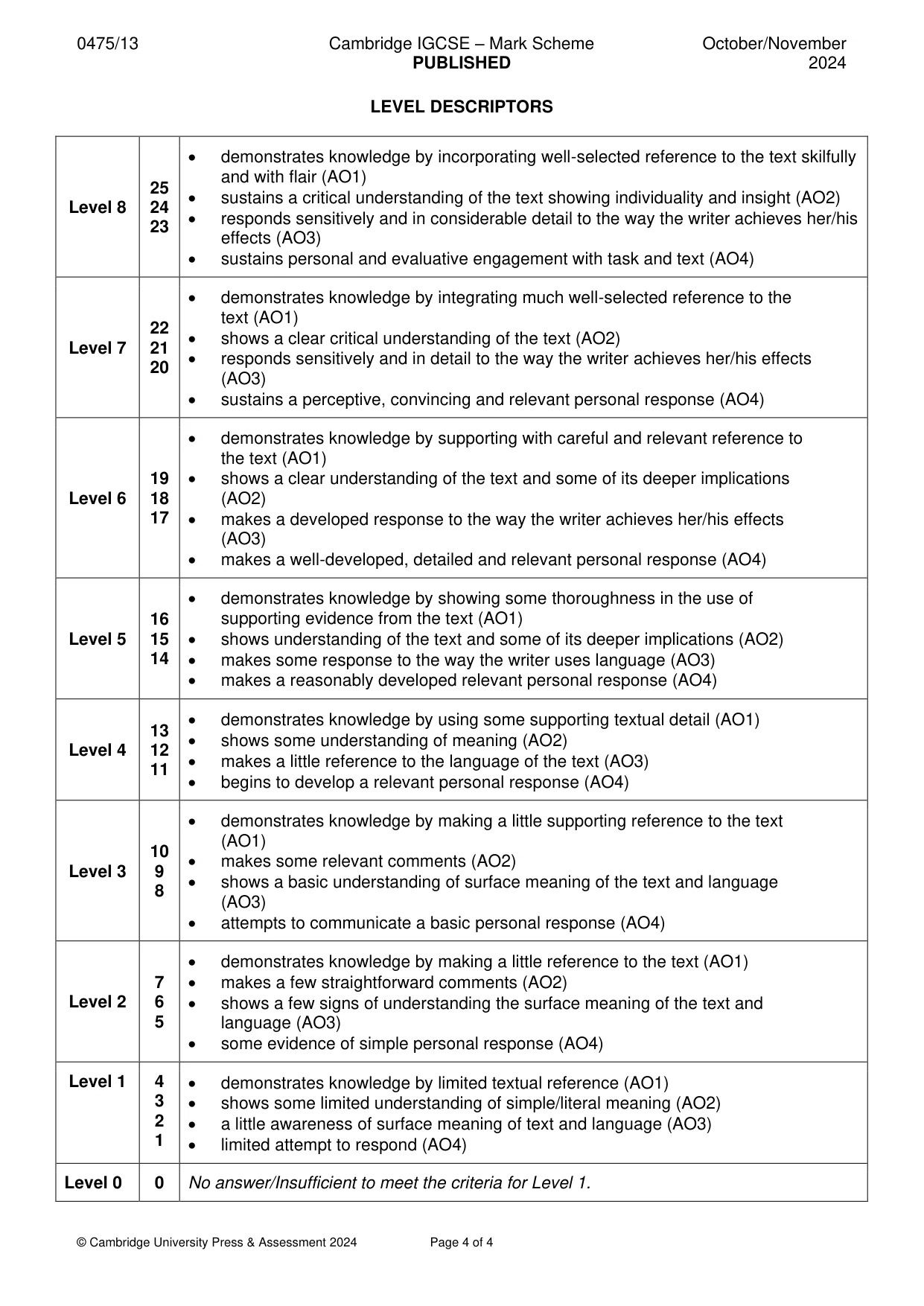
0475/13 Cambridge IGCSE – Mark Scheme PUBLISHED October/November 2024 © Cambridge University Press & Assessment 2024 Page 4 of 4 LEVEL DESCRIPTORS Level 8 25 24 23 • demonstrates knowledge by incorporating well-selected reference to the text skilfully and with flair (AO1) • sustains a critical understanding of the text showing individuality and insight (AO2) • responds sensitively and in considerable detail to the way the writer achieves her/his effects (AO3) • sustains personal and evaluative engagement with task and text (AO4) Level 7 22 21 20 • demonstrates knowledge by integrating much well-selected reference to the text (AO1) • shows a clear critical understanding of the text (AO2) • responds sensitively and in detail to the way the writer achieves her/his effects (AO3) • sustains a perceptive, convincing and relevant personal response (AO4) Level 6 19 18 17 • demonstrates knowledge by supporting with careful and relevant reference to the text (AO1) • shows a clear understanding of the text and some of its deeper implications (AO2) • makes a developed response to the way the writer achieves her/his effects (AO3) • makes a well-developed, detailed and relevant personal response (AO4) Level 5 16 15 14 • demonstrates knowledge by showing some thoroughness in the use of supporting evidence from the text (AO1) • shows understanding of the text and some of its deeper implications (AO2) • makes some response to the way the writer uses language (AO3) • makes a reasonably developed relevant personal response (AO4) Level 4 13 12 11 • demonstrates knowledge by using some supporting textual detail (AO1) • shows some understanding of meaning (AO2) • makes a little reference to the language of the text (AO3) • begins to develop a relevant personal response (AO4) Level 3 10 9 8 • demonstrates knowledge by making a little supporting reference to the text (AO1) • makes some relevant comments (AO2) • shows a basic understanding of surface meaning of the text and language (AO3) • attempts to communicate a basic personal response (AO4) Level 2 7 6 5 • demonstrates knowledge by making a little reference to the text (AO1) • makes a few straightforward comments (AO2) • shows a few signs of understanding the surface meaning of the text and language (AO3) • some evidence of simple personal response (AO4) Level 1 4 3 2 1 • demonstrates knowledge by limited textual reference (AO1) • shows some limited understanding of simple/literal meaning (AO2) • a little awareness of surface meaning of text and language (AO3) • limited attempt to respond (AO4) Level 0 0 No answer/Insufficient to meet the criteria for Level 1.
What you needed in this session
Cambridge’s own grade thresholds for 2024 Oct/Nov, Paper 1 · Variant 3. A higher threshold means an easier paper — the bar moves with how the cohort did.