Cambridge IGCSE English - Literature in English 0475 — 2023 Oct/Nov Paper 1 · Variant 3
0475/13/O/N/23 · 50 marks · ≈56 min
The question paper and its mark scheme, free to read here and free to download. This is Cambridge’s own paper, exactly as it was sat.
Question paper28 pages



Mark scheme4 pages
Answers below. Sit the paper first if you are practising.
Paper as text
Question paper, page 1
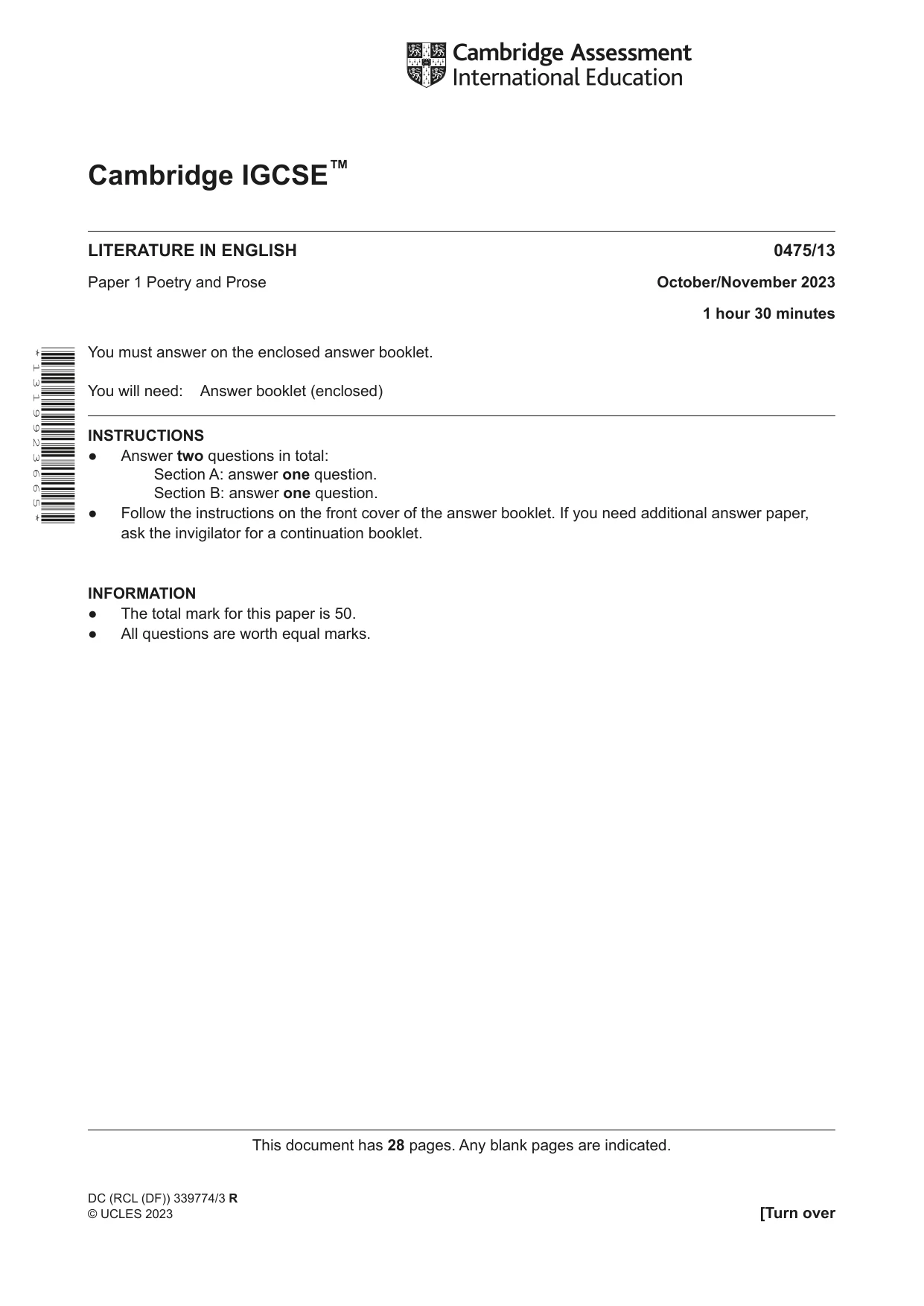
This document has 28 pages. Any blank pages are indicated. [Turn over Cambridge IGCSE™ * 1 3 1 9 9 2 3 6 6 5 * DC (RCL (DF)) 339774/3 R © UCLES 2023 LITERATURE IN ENGLISH 0475/13 Paper 1 Poetry and Prose October/November 2023 1 hour 30 minutes You must answer on the enclosed answer booklet. You will need: Answer booklet (enclosed) INSTRUCTIONS ● Answer two questions in total: Section A: answer one question. Section B: answer one question. ● Follow the instructions on the front cover of the answer booklet. If you need additional answer paper, ask the invigilator for a continuation booklet. INFORMATION ● The total mark for this paper is 50. ● All questions are worth equal marks.
Question paper, page 2
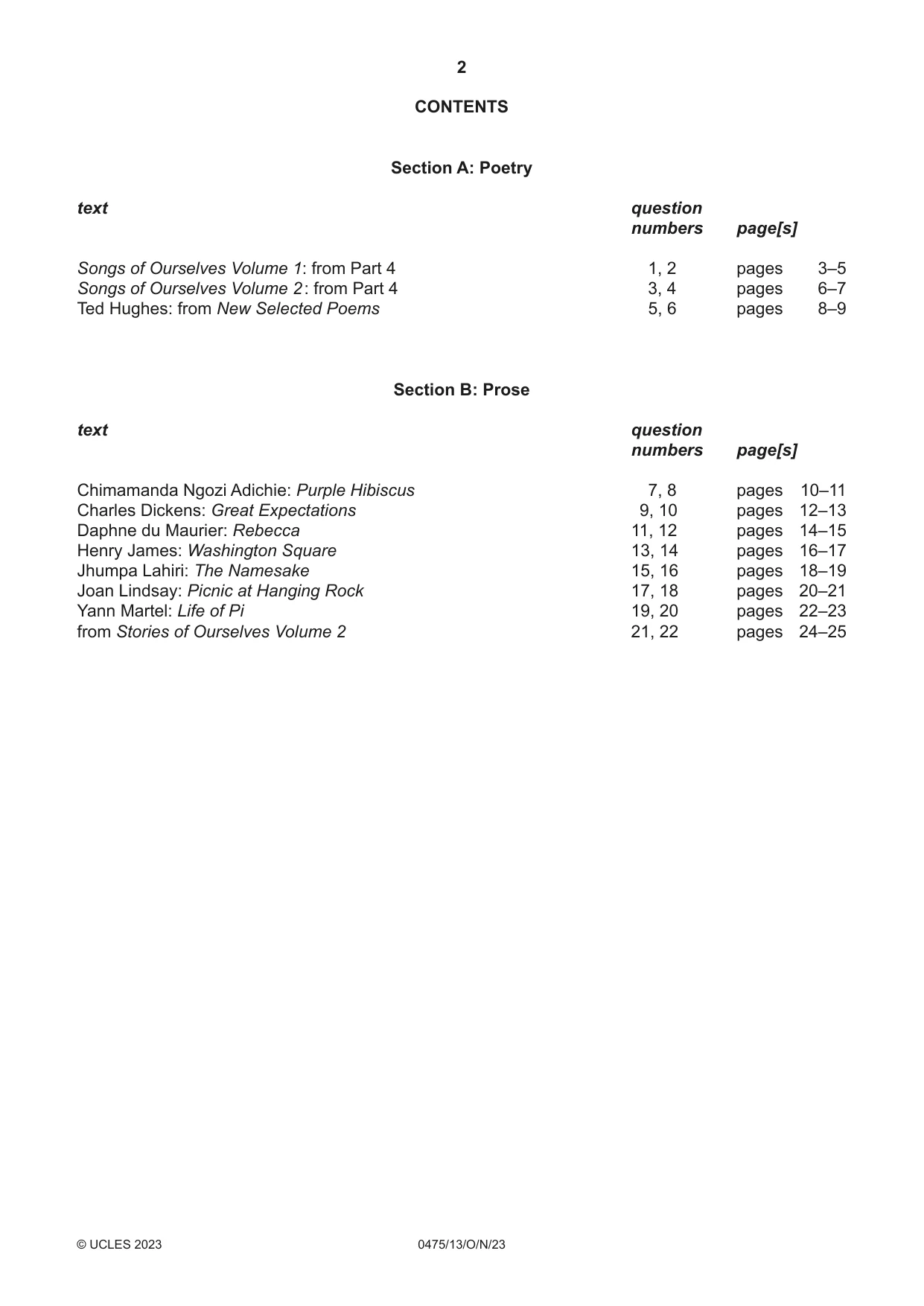
2 0475/13/O/N/23 © UCLES 2023 CONTENTS Section A: Poetry text question numbers page[s] Songs of Ourselves Volume 1: from Part 4 1, 2 pages 3–5 Songs of Ourselves Volume 2 : from Part 4 3, 4 pages 6–7 Ted Hughes: from New Selected Poems 5, 6 pages 8–9 Section B: Prose text question numbers page[s] Chimamanda Ngozi Adichie: Purple Hibiscus 7, 8 pages 10–11 Charles Dickens: Great Expectations 9, 10 pages 12–13 Daphne du Maurier: Rebecca 11, 12 pages 14–15 Henry James: Washington Square 13, 14 pages 16–17 Jhumpa Lahiri: The Namesake 15, 16 pages 18–19 Joan Lindsay: Picnic at Hanging Rock 17, 18 pages 20–21 Yann Martel: Life of Pi 19, 20 pages 22–23 from Stories of Ourselves Volume 2 21, 22 pages 24–25
Question paper, page 3
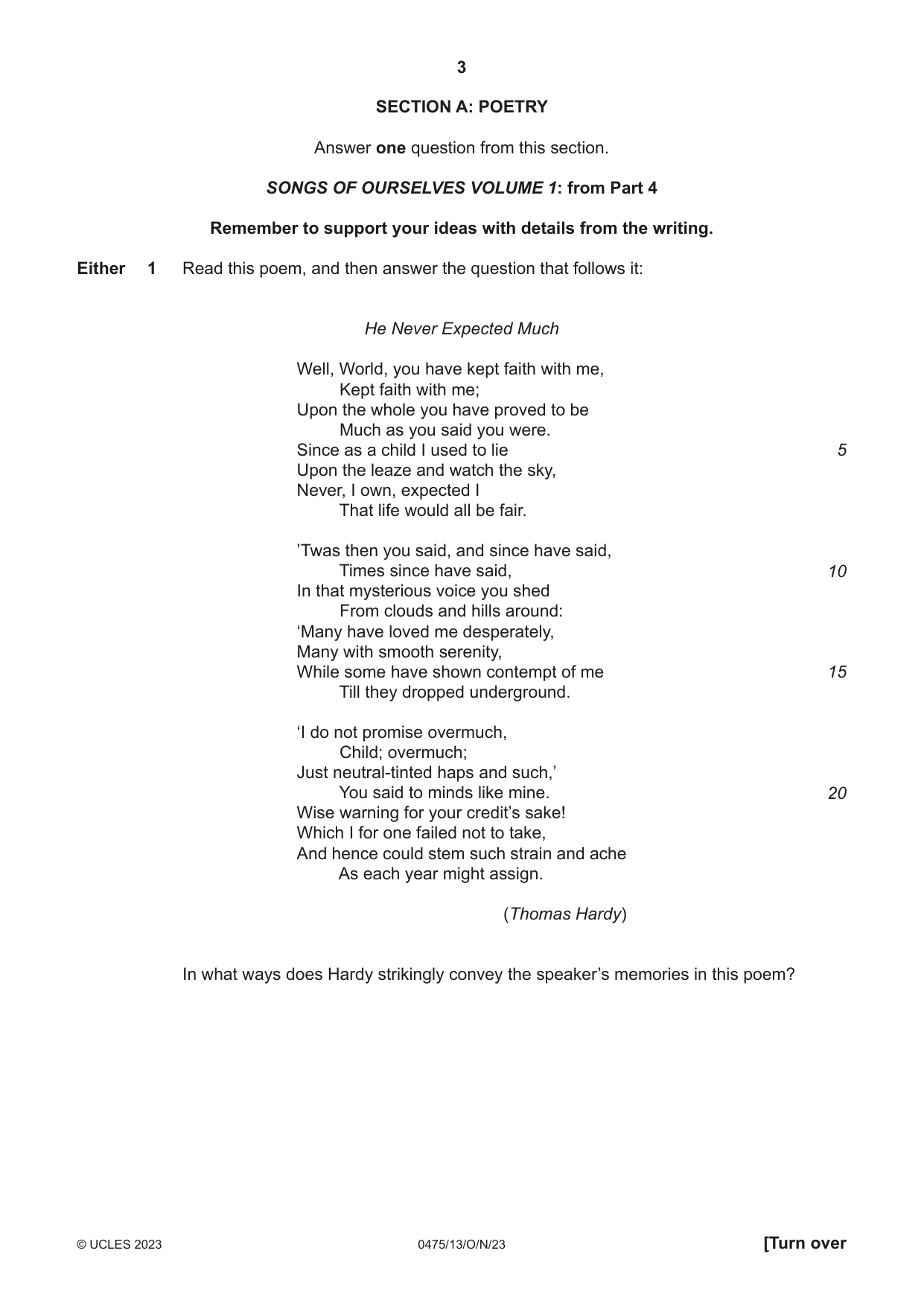
3 0475/13/O/N/23 © UCLES 2023 [Turn over SECTION A: POETRY Answer one question from this section. SONGS OF OURSELVES VOLUME 1: from Part 4 Remember to support your ideas with details from the writing. Either 1 Read this poem, and then answer the question that follows it: He Never Expected Much Well, World, you have kept faith with me, Kept faith with me; Upon the whole you have proved to be Much as you said you were. Since as a child I used to lie Upon the leaze and watch the sky, Never, I own, expected I That life would all be fair. ’Twas then you said, and since have said, Times since have said, In that mysterious voice you shed From clouds and hills around: ‘Many have loved me desperately, Many with smooth serenity, While some have shown contempt of me Till they dropped underground. ‘I do not promise overmuch, Child; overmuch; Just neutral-tinted haps and such,’ You said to minds like mine. Wise warning for your credit’s sake! Which I for one failed not to take, And hence could stem such strain and ache As each year might assign. (Thomas Hardy) In what ways does Hardy strikingly convey the speaker’s memories in this poem? 5 10 15 20
Question paper, page 4
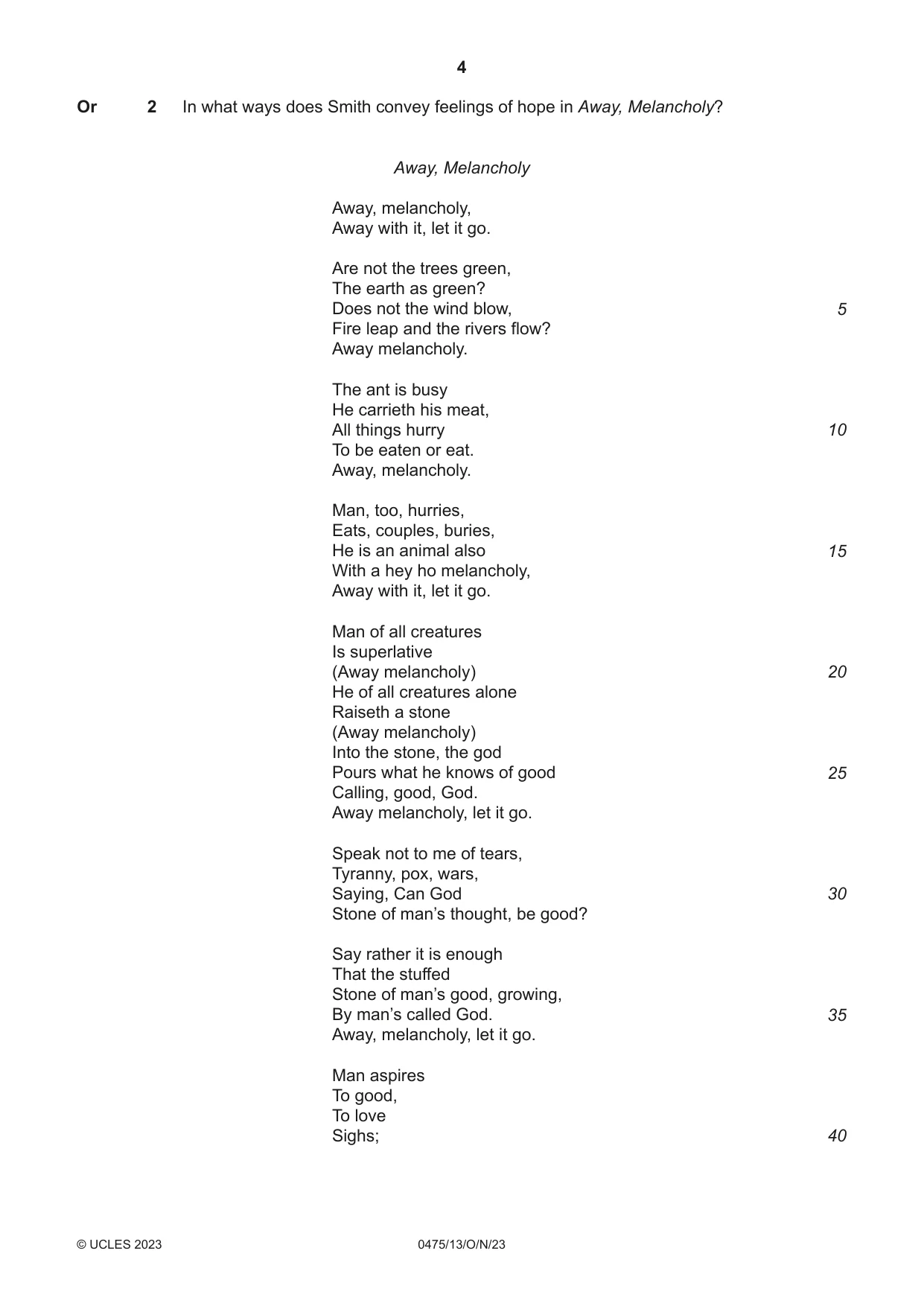
4 0475/13/O/N/23 © UCLES 2023 Or 2 In what ways does Smith convey feelings of hope in Away, Melancholy? Away, Melancholy Away, melancholy, Away with it, let it go. Are not the trees green, The earth as green? Does not the wind blow, Fire leap and the rivers flow? Away melancholy. The ant is busy He carrieth his meat, All things hurry To be eaten or eat. Away, melancholy. Man, too, hurries, Eats, couples, buries, He is an animal also With a hey ho melancholy, Away with it, let it go. Man of all creatures Is superlative (Away melancholy) He of all creatures alone Raiseth a stone (Away melancholy) Into the stone, the god Pours what he knows of good Calling, good, God. Away melancholy, let it go. Speak not to me of tears, Tyranny, pox, wars, Saying, Can God Stone of man’s thought, be good? Say rather it is enough That the stuffed Stone of man’s good, growing, By man’s called God. Away, melancholy, let it go. Man aspires To good, To love Sighs; 5 10 15 20 25 30 35 40
Question paper, page 5
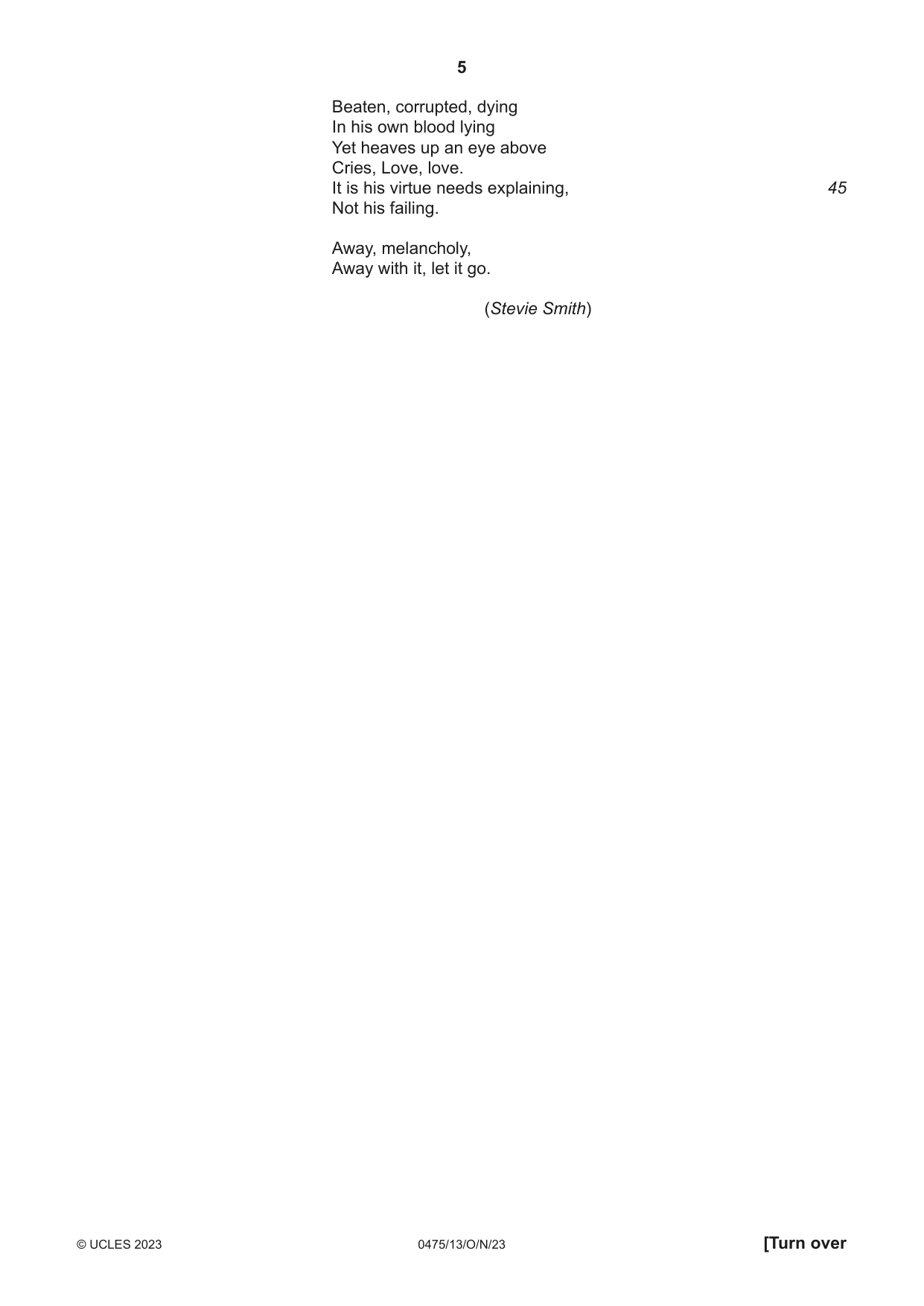
5 0475/13/O/N/23 © UCLES 2023 [Turn over Beaten, corrupted, dying In his own blood lying Yet heaves up an eye above Cries, Love, love. It is his virtue needs explaining, Not his failing. Away, melancholy, Away with it, let it go. (Stevie Smith) 45
Question paper, page 6
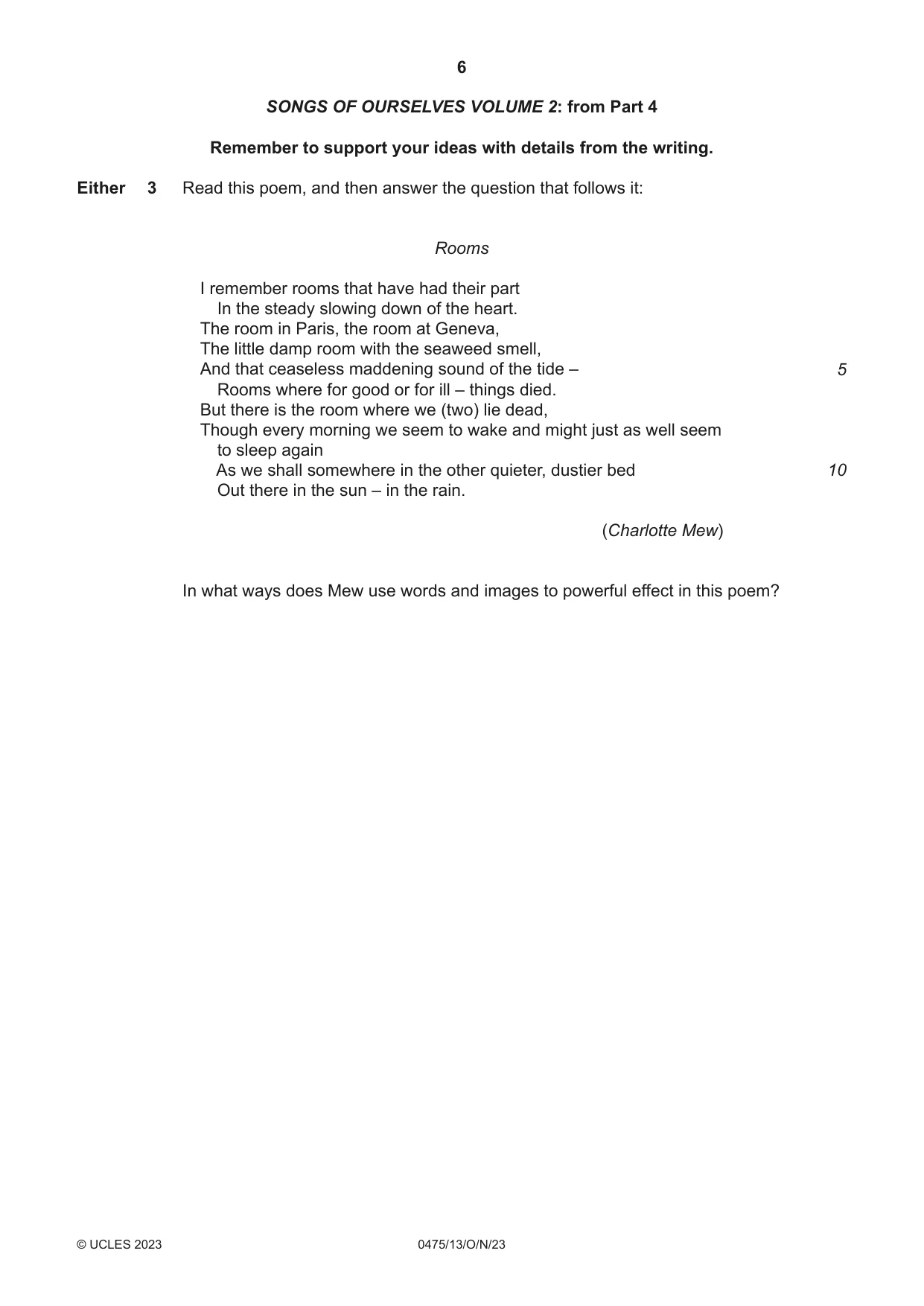
6 0475/13/O/N/23 © UCLES 2023 SONGS OF OURSELVES VOLUME 2: from Part 4 Remember to support your ideas with details from the writing. Either 3 Read this poem, and then answer the question that follows it: Rooms I remember rooms that have had their part In the steady slowing down of the heart. The room in Paris, the room at Geneva, The little damp room with the seaweed smell, And that ceaseless maddening sound of the tide – Rooms where for good or for ill – things died. But there is the room where we (two) lie dead, Though every morning we seem to wake and might just as well seem to sleep again As we shall somewhere in the other quieter, dustier bed Out there in the sun – in the rain. (Charlotte Mew) In what ways does Mew use words and images to powerful effect in this poem? 5 10
Question paper, page 7
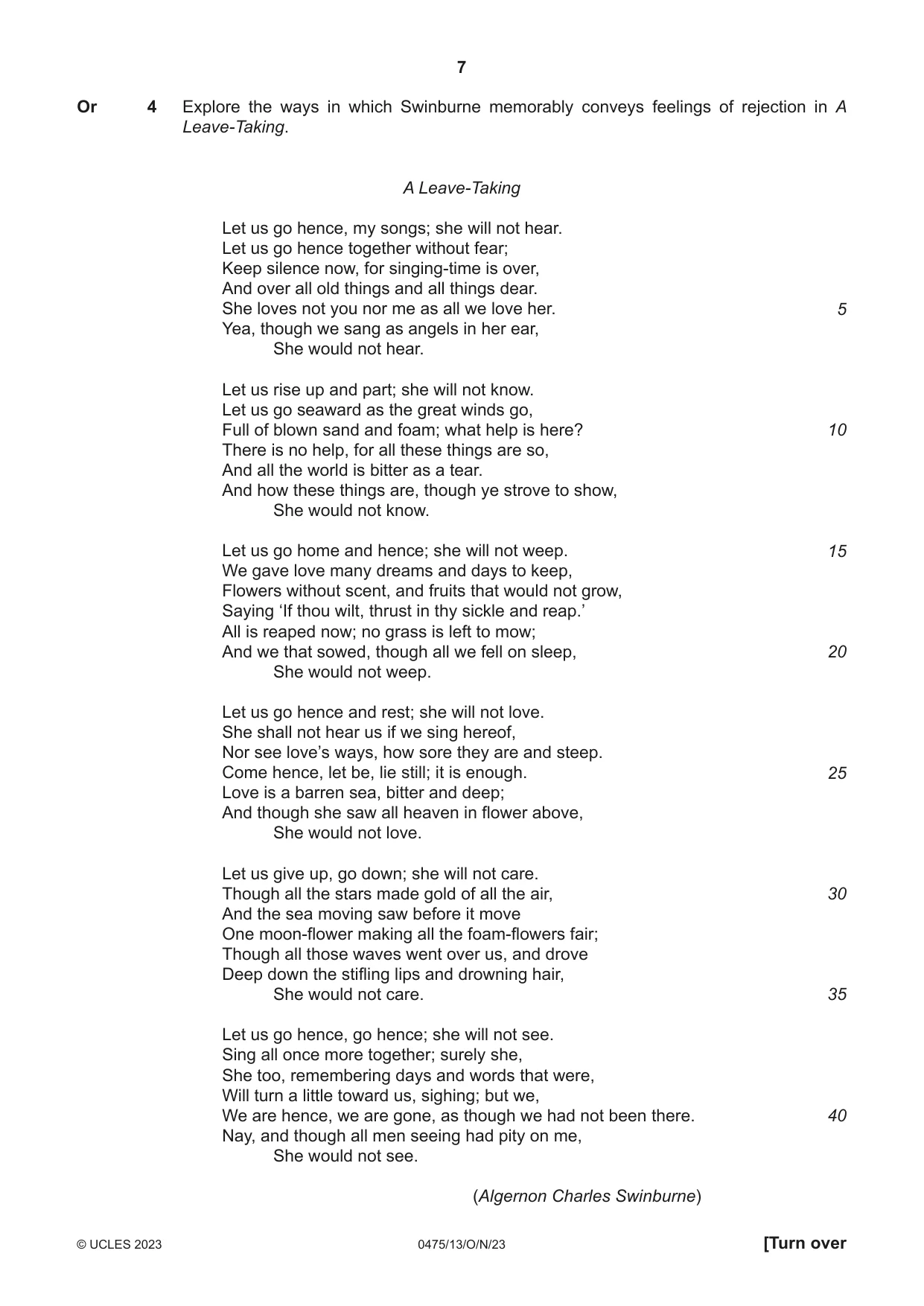
7 0475/13/O/N/23 © UCLES 2023 [Turn over Or 4 Explore the ways in which Swinburne memorably conveys feelings of rejection in A Leave-Taking. A Leave-Taking Let us go hence, my songs; she will not hear. Let us go hence together without fear; Keep silence now, for singing-time is over, And over all old things and all things dear. She loves not you nor me as all we love her. Yea, though we sang as angels in her ear, She would not hear. Let us rise up and part; she will not know. Let us go seaward as the great winds go, Full of blown sand and foam; what help is here? There is no help, for all these things are so, And all the world is bitter as a tear. And how these things are, though ye strove to show, She would not know. Let us go home and hence; she will not weep. We gave love many dreams and days to keep, Flowers without scent, and fruits that would not grow, Saying ‘If thou wilt, thrust in thy sickle and reap.’ All is reaped now; no grass is left to mow; And we that sowed, though all we fell on sleep, She would not weep. Let us go hence and rest; she will not love. She shall not hear us if we sing hereof, Nor see love’s ways, how sore they are and steep. Come hence, let be, lie still; it is enough. Love is a barren sea, bitter and deep; And though she saw all heaven in flower above, She would not love. Let us give up, go down; she will not care. Though all the stars made gold of all the air, And the sea moving saw before it move One moon-flower making all the foam-flowers fair; Though all those waves went over us, and drove Deep down the stifling lips and drowning hair, She would not care. Let us go hence, go hence; she will not see. Sing all once more together; surely she, She too, remembering days and words that were, Will turn a little toward us, sighing; but we, We are hence, we are gone, as though we had not been there. Nay, and though all men seeing had pity on me, She would not see. (Algernon Charles Swinburne) 5 10 15 20 25 30 35 40
Question paper, page 8
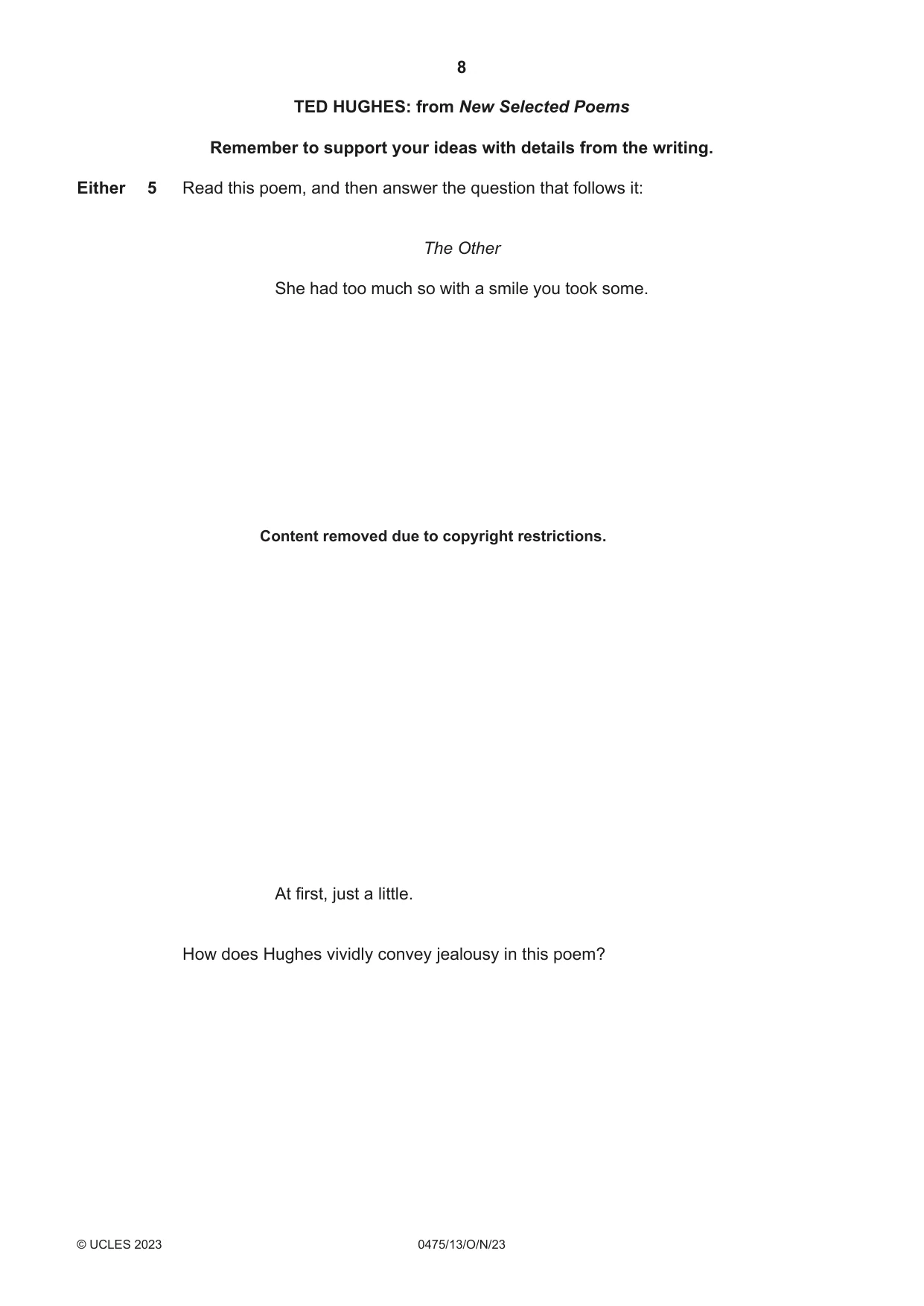
8 0475/13/O/N/23 © UCLES 2023 TED HUGHES: from New Selected Poems Remember to support your ideas with details from the writing. Either 5 Read this poem, and then answer the question that follows it: The Other She had too much so with a smile you took some. At first, just a little. How does Hughes vividly convey jealousy in this poem? Content removed due to copyright restrictions.
Question paper, page 9
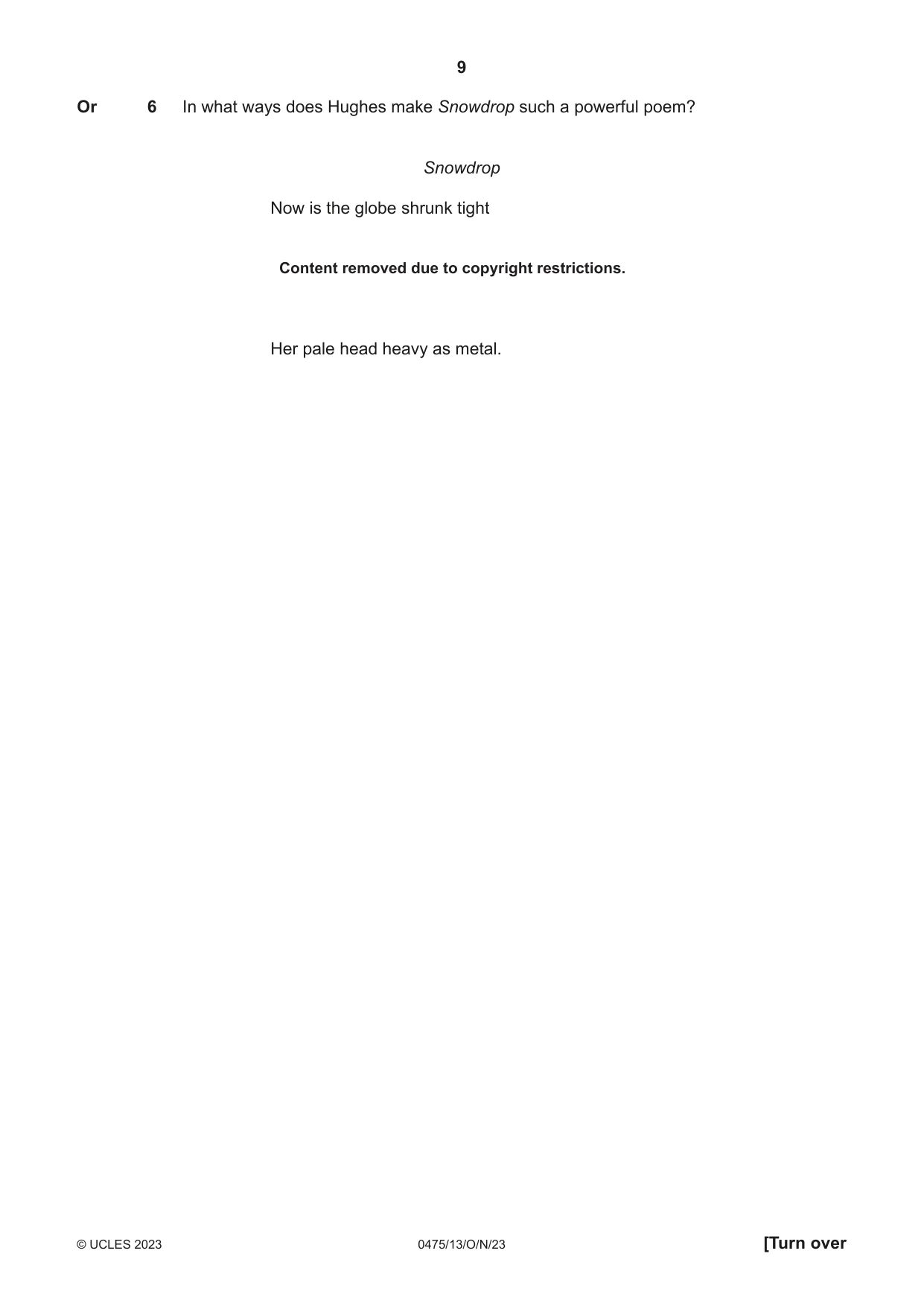
9 0475/13/O/N/23 © UCLES 2023 [Turn over Or 6 In what ways does Hughes make Snowdrop such a powerful poem? Snowdrop Now is the globe shrunk tight Her pale head heavy as metal. Content removed due to copyright restrictions.
Question paper, page 10
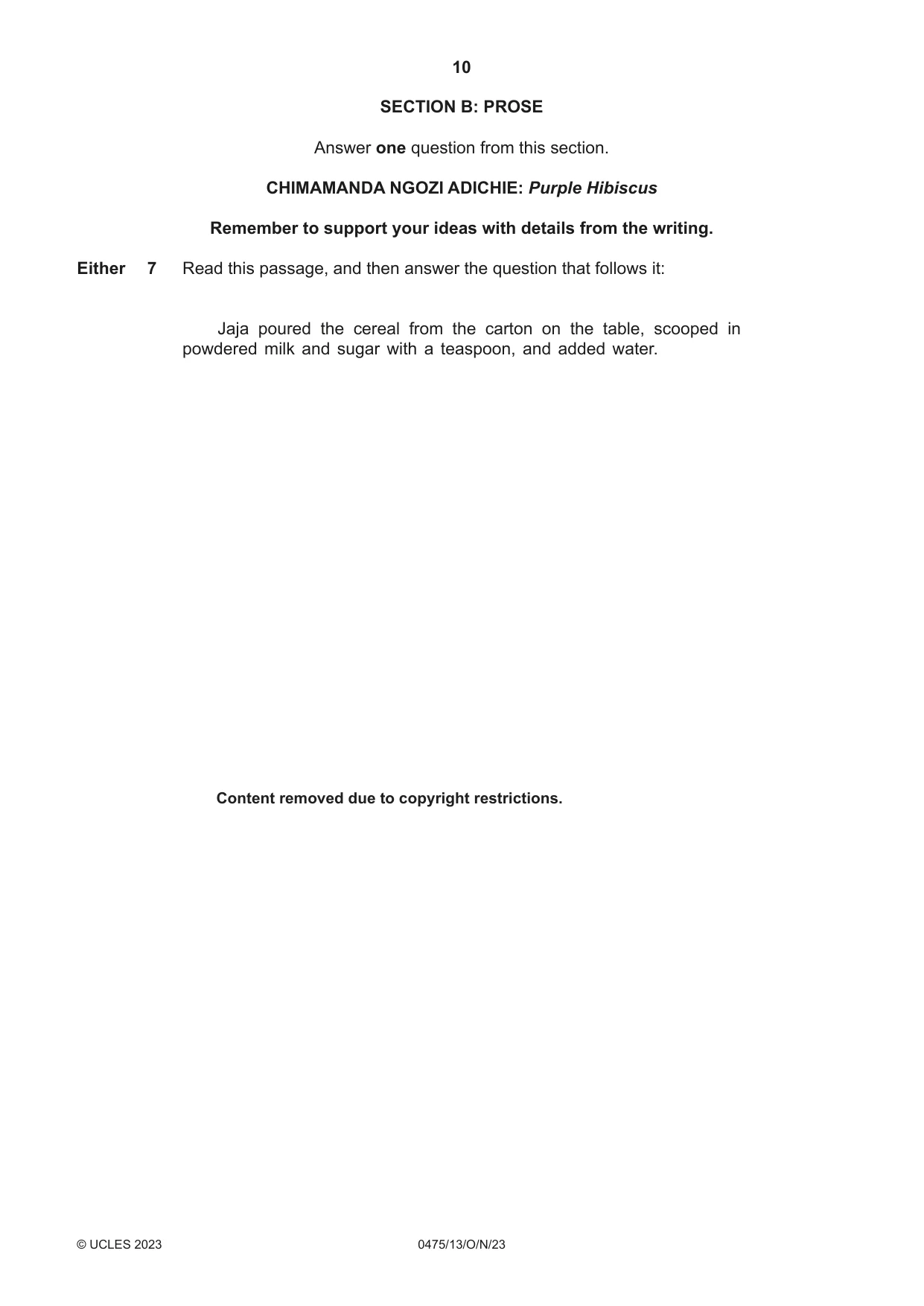
10 0475/13/O/N/23 © UCLES 2023 SECTION B: PROSE Answer one question from this section. CHIMAMANDA NGOZI ADICHIE: Purple Hibiscus Remember to support your ideas with details from the writing. Either 7 Read this passage, and then answer the question that follows it: Jaja poured the cereal from the carton on the table, scooped in powdered milk and sugar with a teaspoon, and added water. Content removed due to copyright restrictions.
Question paper, page 11
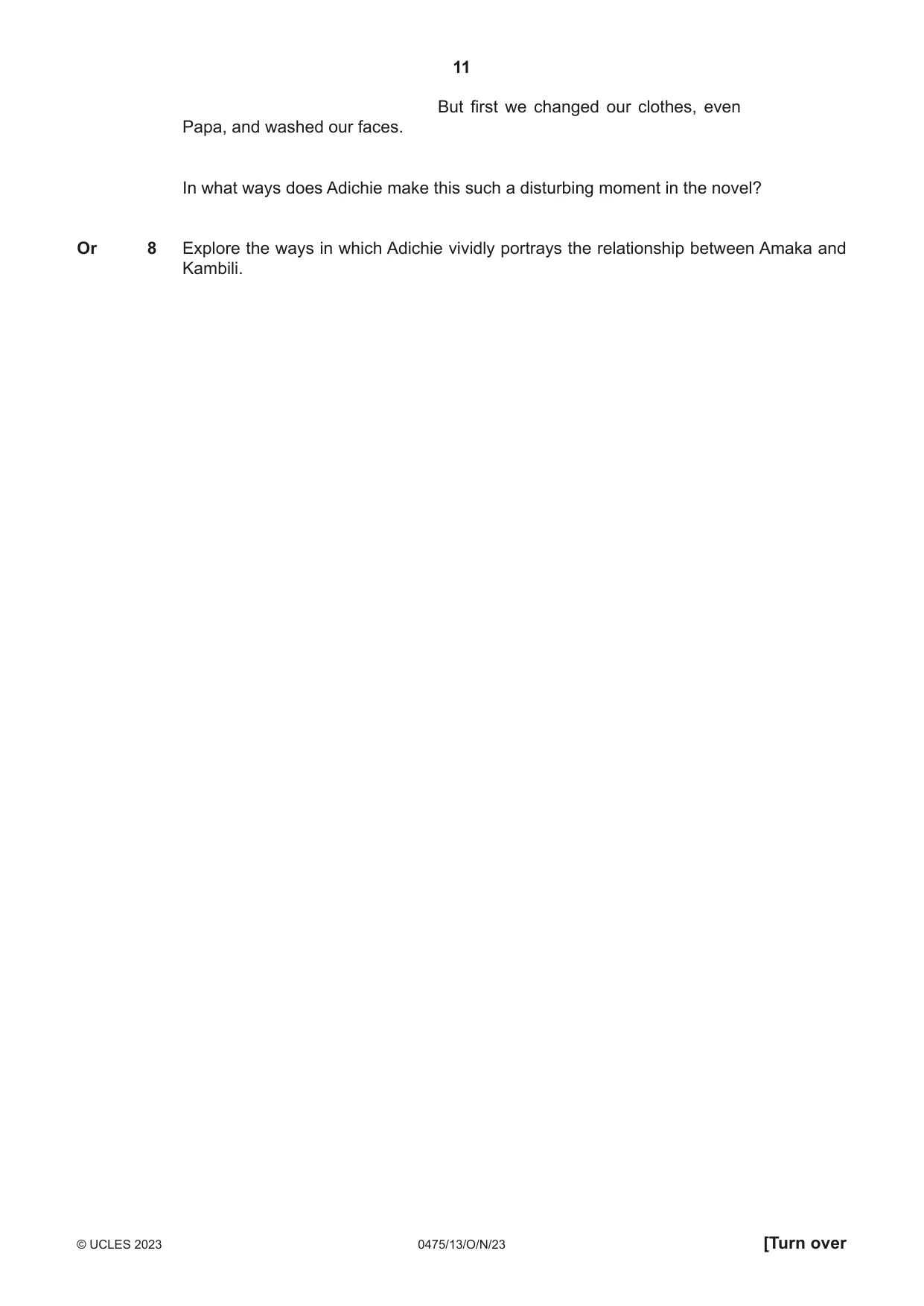
11 0475/13/O/N/23 © UCLES 2023 [Turn over But first we changed our clothes, even Papa, and washed our faces. In what ways does Adichie make this such a disturbing moment in the novel? Or 8 Explore the ways in which Adichie vividly portrays the relationship between Amaka and Kambili.
Question paper, page 12
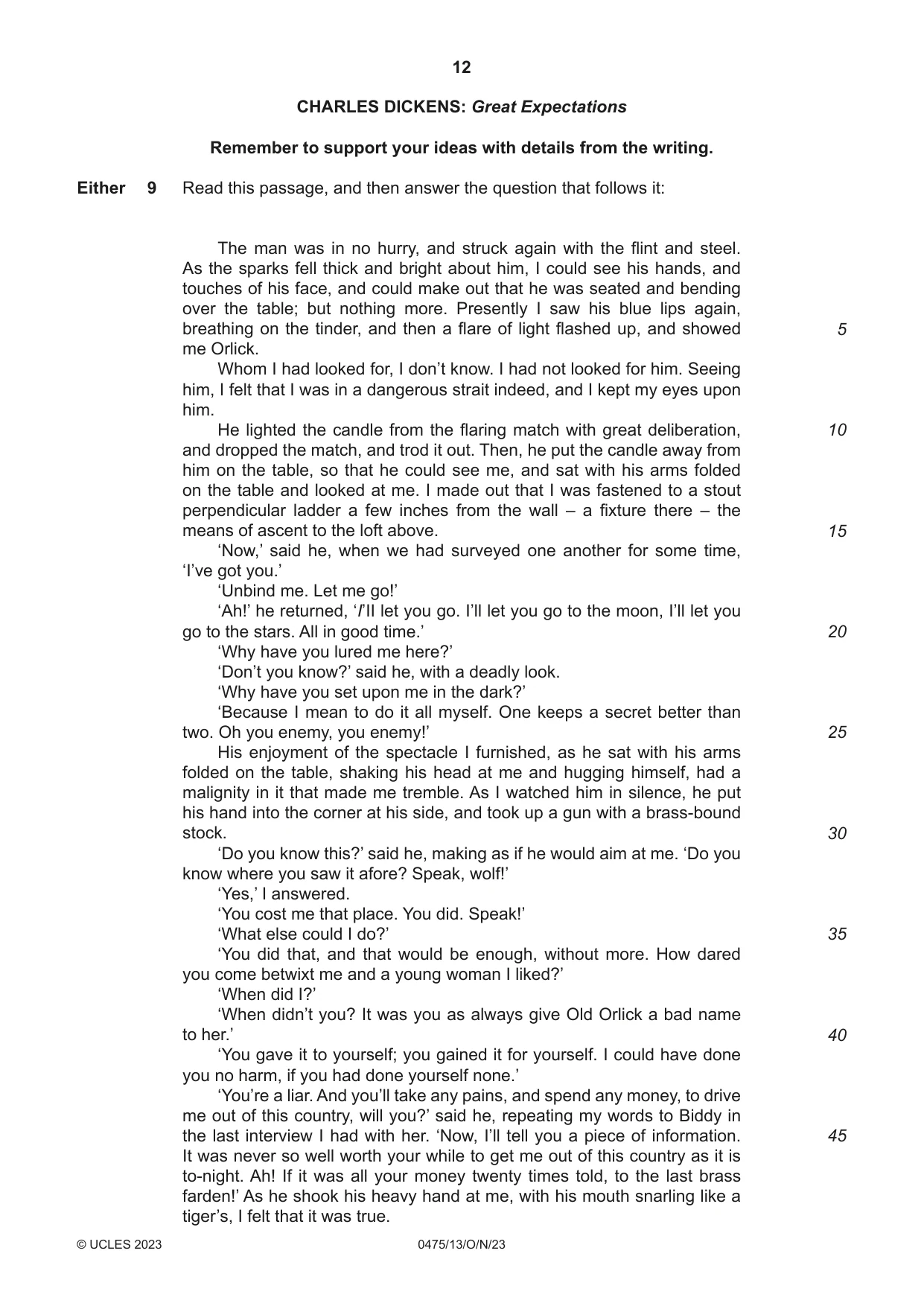
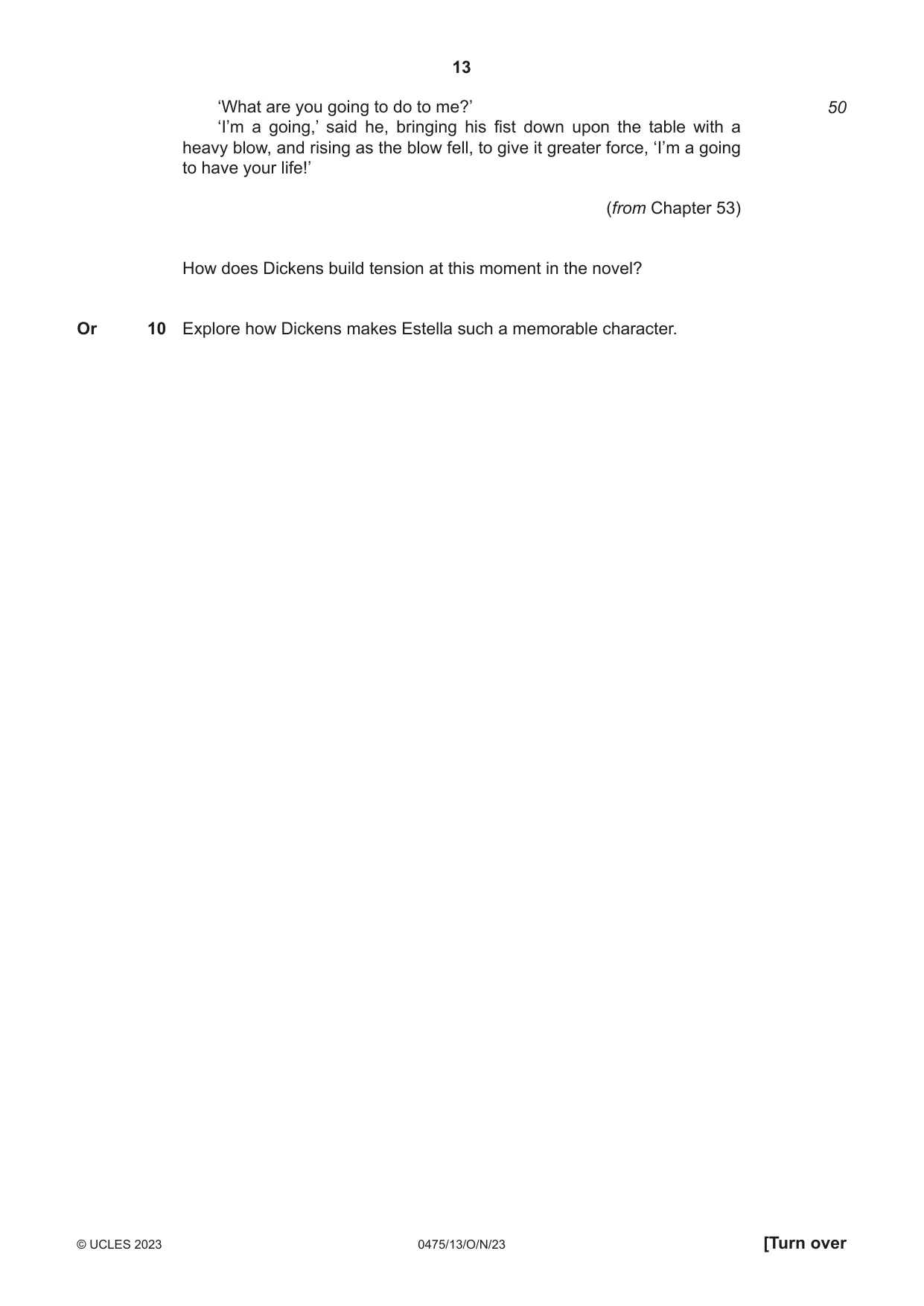
12 0475/13/O/N/23 © UCLES 2023 CHARLES DICKENS: Great Expectations Remember to support your ideas with details from the writing. Either 9 Read this passage, and then answer the question that follows it: The man was in no hurry, and struck again with the flint and steel. As the sparks fell thick and bright about him, I could see his hands, and touches of his face, and could make out that he was seated and bending over the table; but nothing more. Presently I saw his blue lips again, breathing on the tinder, and then a flare of light flashed up, and showed me Orlick. Whom I had looked for, I don’t know. I had not looked for him. Seeing him, I felt that I was in a dangerous strait indeed, and I kept my eyes upon him. He lighted the candle from the flaring match with great deliberation, and dropped the match, and trod it out. Then, he put the candle away from him on the table, so that he could see me, and sat with his arms folded on the table and looked at me. I made out that I was fastened to a stout perpendicular ladder a few inches from the wall – a fixture there – the means of ascent to the loft above. ‘Now,’ said he, when we had surveyed one another for some time, ‘I’ve got you.’ ‘Unbind me. Let me go!’ ‘Ah!’ he returned, ‘I’II let you go. I’ll let you go to the moon, I’ll let you go to the stars. All in good time.’ ‘Why have you lured me here?’ ‘Don’t you know?’ said he, with a deadly look. ‘Why have you set upon me in the dark?’ ‘Because I mean to do it all myself. One keeps a secret better than two. Oh you enemy, you enemy!’ His enjoyment of the spectacle I furnished, as he sat with his arms folded on the table, shaking his head at me and hugging himself, had a malignity in it that made me tremble. As I watched him in silence, he put his hand into the corner at his side, and took up a gun with a brass-bound stock. ‘Do you know this?’ said he, making as if he would aim at me. ‘Do you know where you saw it afore? Speak, wolf!’ ‘Yes,’ I answered. ‘You cost me that place. You did. Speak!’ ‘What else could I do?’ ‘You did that, and that would be enough, without more. How dared you come betwixt me and a young woman I liked?’ ‘When did I?’ ‘When didn’t you? It was you as always give Old Orlick a bad name to her.’ ‘You gave it to yourself; you gained it for yourself. I could have done you no harm, if you had done yourself none.’ ‘You’re a liar. And you’ll take any pains, and spend any money, to drive me out of this country, will you?’ said he, repeating my words to Biddy in the last interview I had with her. ‘Now, I’ll tell you a piece of information. It was never so well worth your while to get me out of this country as it is to-night. Ah! If it was all your money twenty times told, to the last brass farden!’ As he shook his heavy hand at me, with his mouth snarling like a tiger’s, I felt that it was true. 5 10 15 20 25 30 35 40 45
Question paper, page 13
13 0475/13/O/N/23 © UCLES 2023 [Turn over ‘What are you going to do to me?’ ‘I’m a going,’ said he, bringing his fist down upon the table with a heavy blow, and rising as the blow fell, to give it greater force, ‘I’m a going to have your life!’ (from Chapter 53) How does Dickens build tension at this moment in the novel? Or 10 Explore how Dickens makes Estella such a memorable character. 50
Question paper, page 14
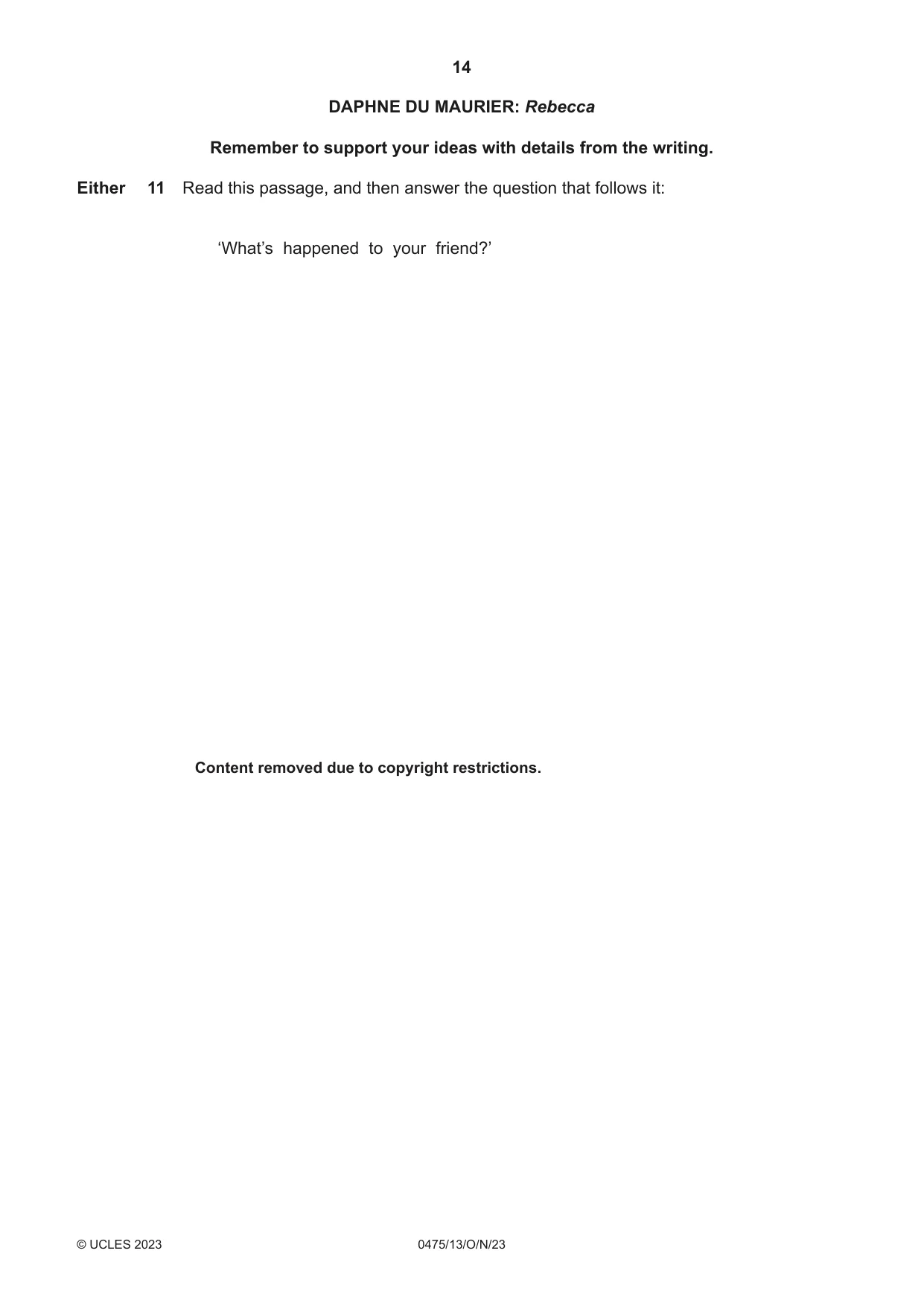
14 0475/13/O/N/23 © UCLES 2023 DAPHNE DU MAURIER: Rebecca Remember to support your ideas with details from the writing. Either 11 Read this passage, and then answer the question that follows it: ‘What’s happened to your friend?’ Content removed due to copyright restrictions.
Question paper, page 15
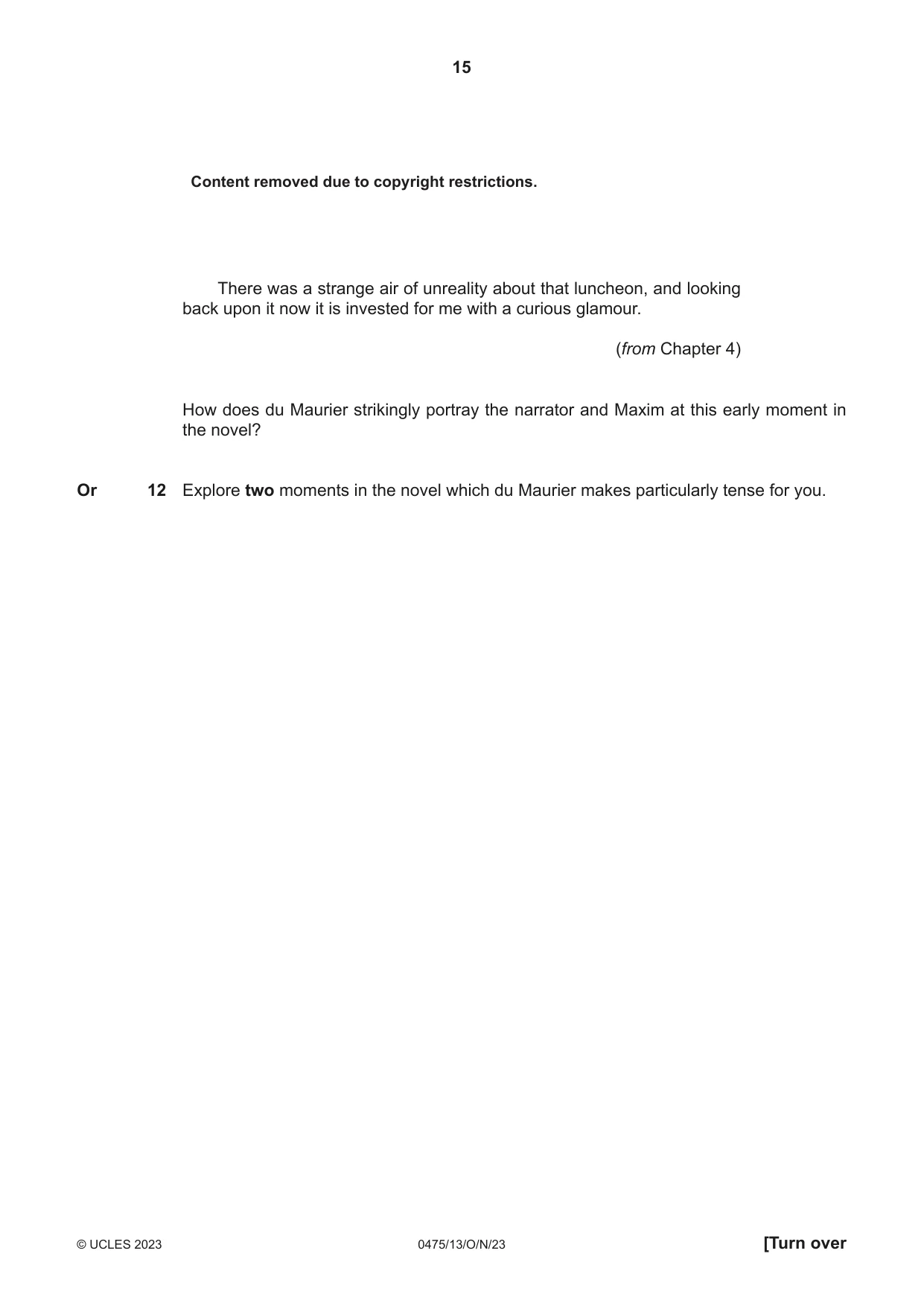
15 0475/13/O/N/23 © UCLES 2023 [Turn over There was a strange air of unreality about that luncheon, and looking back upon it now it is invested for me with a curious glamour. (from Chapter 4) How does du Maurier strikingly portray the narrator and Maxim at this early moment in the novel? Or 12 Explore two moments in the novel which du Maurier makes particularly tense for you. Content removed due to copyright restrictions.
Question paper, page 16
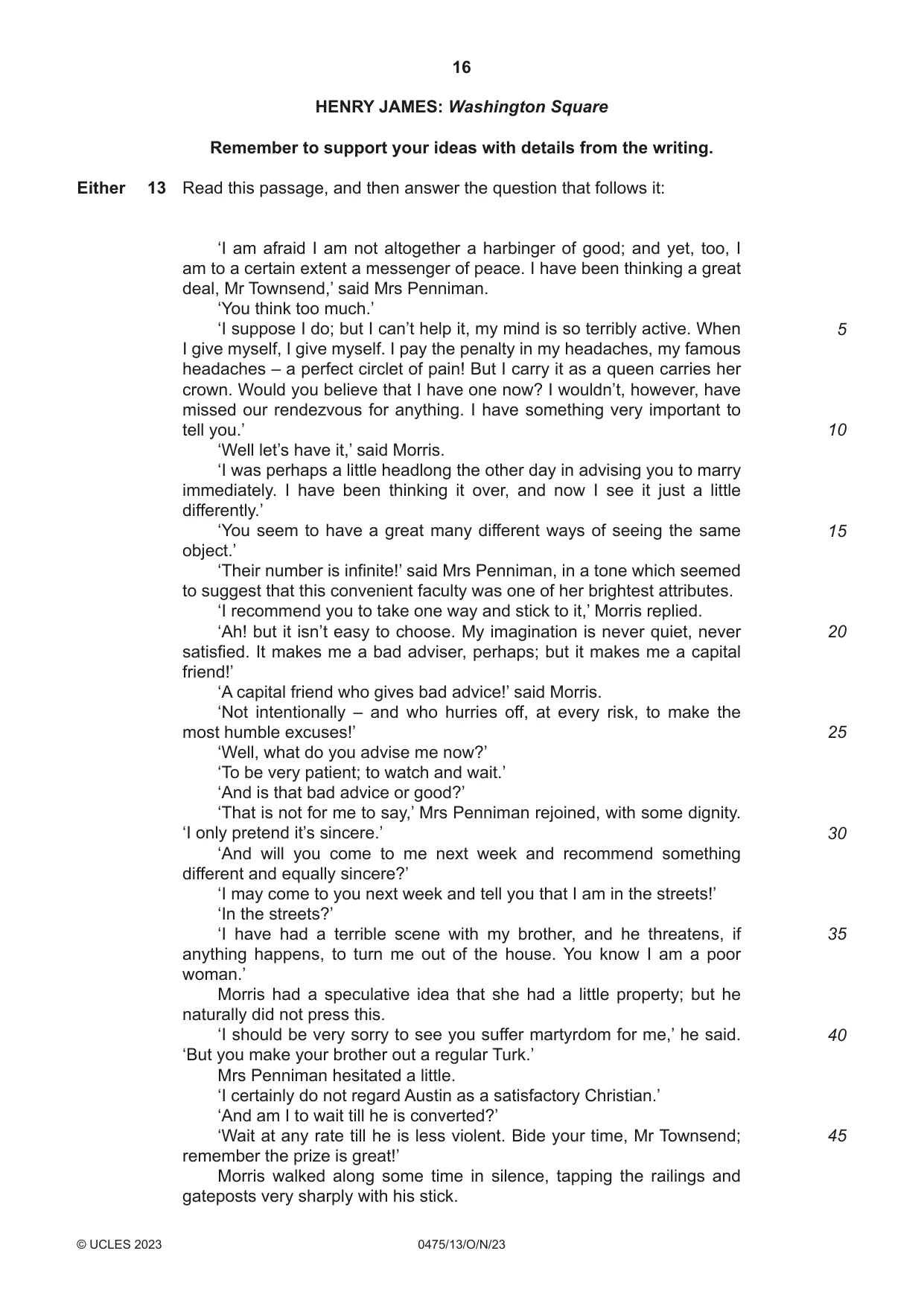
16 0475/13/O/N/23 © UCLES 2023 HENRY JAMES: Washington Square Remember to support your ideas with details from the writing. Either 13 Read this passage, and then answer the question that follows it: ‘I am afraid I am not altogether a harbinger of good; and yet, too, I am to a certain extent a messenger of peace. I have been thinking a great deal, Mr Townsend,’ said Mrs Penniman. ‘You think too much.’ ‘I suppose I do; but I can’t help it, my mind is so terribly active. When I give myself, I give myself. I pay the penalty in my headaches, my famous headaches – a perfect circlet of pain! But I carry it as a queen carries her crown. Would you believe that I have one now? I wouldn’t, however, have missed our rendezvous for anything. I have something very important to tell you.’ ‘Well let’s have it,’ said Morris. ‘I was perhaps a little headlong the other day in advising you to marry immediately. I have been thinking it over, and now I see it just a little differently.’ ‘You seem to have a great many different ways of seeing the same object.’ ‘Their number is infinite!’ said Mrs Penniman, in a tone which seemed to suggest that this convenient faculty was one of her brightest attributes. ‘I recommend you to take one way and stick to it,’ Morris replied. ‘Ah! but it isn’t easy to choose. My imagination is never quiet, never satisfied. It makes me a bad adviser, perhaps; but it makes me a capital friend!’ ‘A capital friend who gives bad advice!’ said Morris. ‘Not intentionally – and who hurries off, at every risk, to make the most humble excuses!’ ‘Well, what do you advise me now?’ ‘To be very patient; to watch and wait.’ ‘And is that bad advice or good?’ ‘That is not for me to say,’ Mrs Penniman rejoined, with some dignity. ‘I only pretend it’s sincere.’ ‘And will you come to me next week and recommend something different and equally sincere?’ ‘I may come to you next week and tell you that I am in the streets!’ ‘In the streets?’ ‘I have had a terrible scene with my brother, and he threatens, if anything happens, to turn me out of the house. You know I am a poor woman.’ Morris had a speculative idea that she had a little property; but he naturally did not press this. ‘I should be very sorry to see you suffer martyrdom for me,’ he said. ‘But you make your brother out a regular Turk.’ Mrs Penniman hesitated a little. ‘I certainly do not regard Austin as a satisfactory Christian.’ ‘And am I to wait till he is converted?’ ‘Wait at any rate till he is less violent. Bide your time, Mr Townsend; remember the prize is great!’ Morris walked along some time in silence, tapping the railings and gateposts very sharply with his stick. 5 10 15 20 25 30 35 40 45
Question paper, page 17
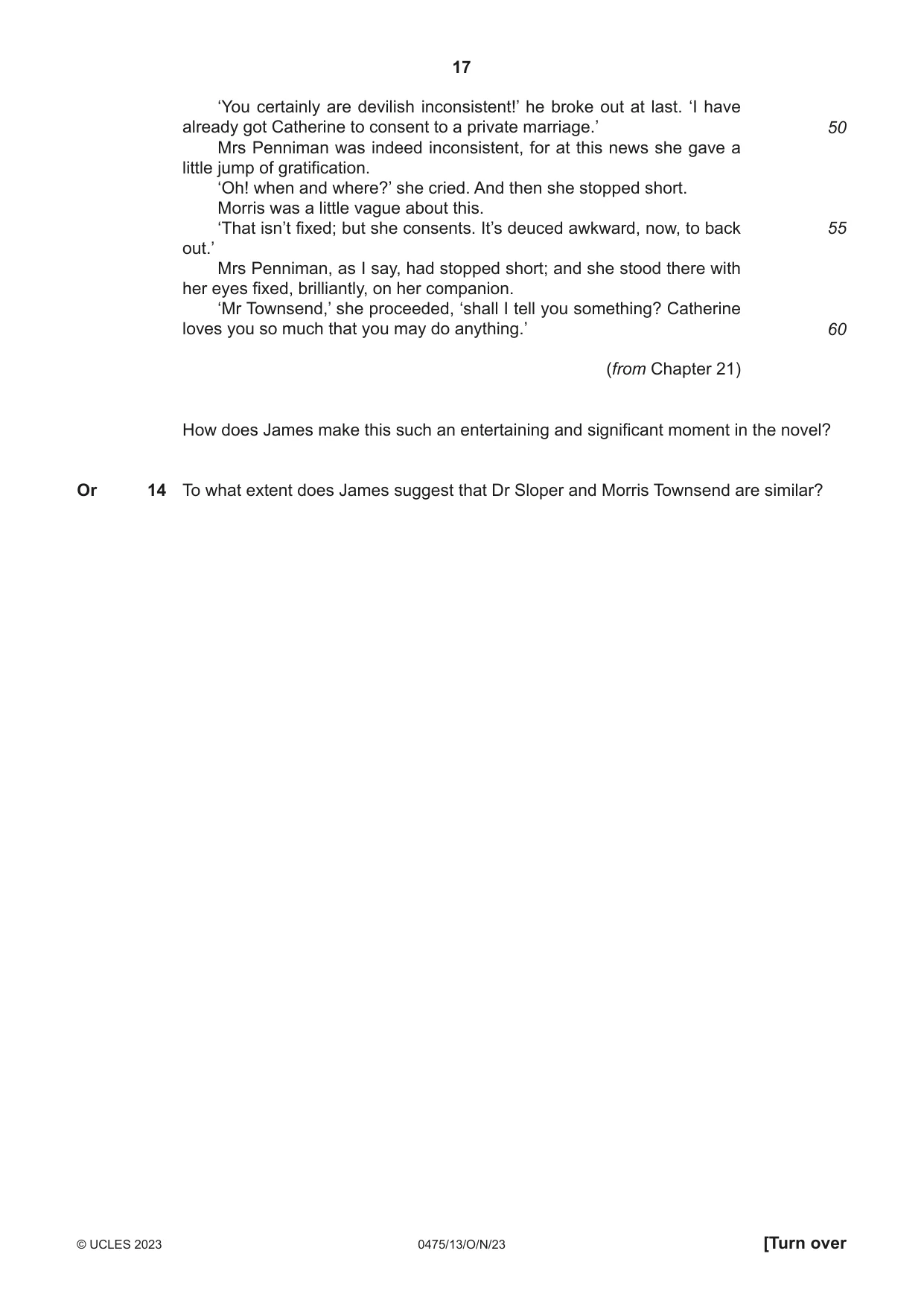
17 0475/13/O/N/23 © UCLES 2023 [Turn over ‘You certainly are devilish inconsistent!’ he broke out at last. ‘I have already got Catherine to consent to a private marriage.’ Mrs Penniman was indeed inconsistent, for at this news she gave a little jump of gratification. ‘Oh! when and where?’ she cried. And then she stopped short. Morris was a little vague about this. ‘That isn’t fixed; but she consents. It’s deuced awkward, now, to back out.’ Mrs Penniman, as I say, had stopped short; and she stood there with her eyes fixed, brilliantly, on her companion. ‘Mr Townsend,’ she proceeded, ‘shall I tell you something? Catherine loves you so much that you may do anything.’ (from Chapter 21) How does James make this such an entertaining and significant moment in the novel? Or 14 To what extent does James suggest that Dr Sloper and Morris Townsend are similar? 50 55 60
Question paper, page 18
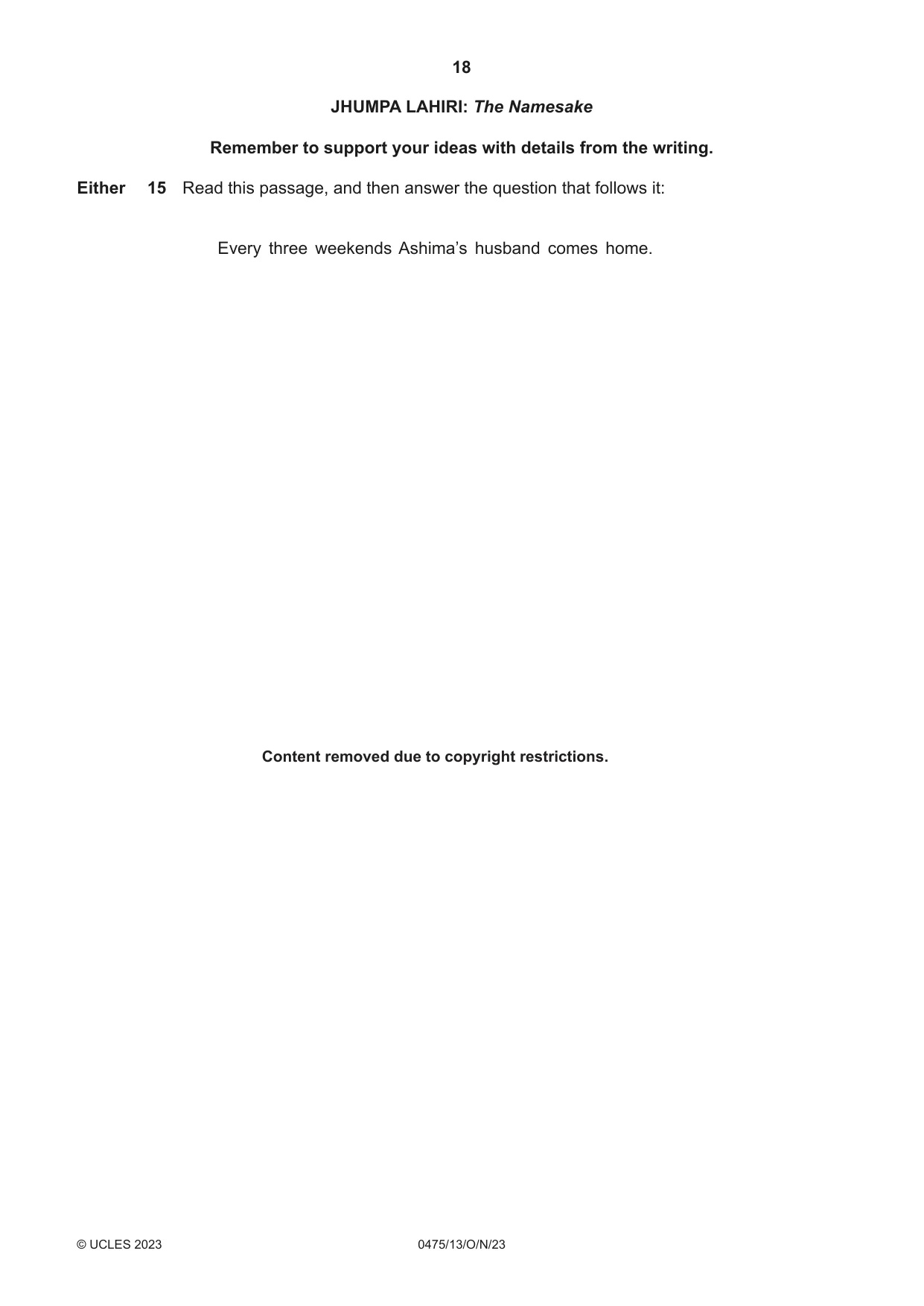
18 0475/13/O/N/23 © UCLES 2023 JHUMPA LAHIRI: The Namesake Remember to support your ideas with details from the writing. Either 15 Read this passage, and then answer the question that follows it: Every three weekends Ashima’s husband comes home. Content removed due to copyright restrictions.
Question paper, page 19
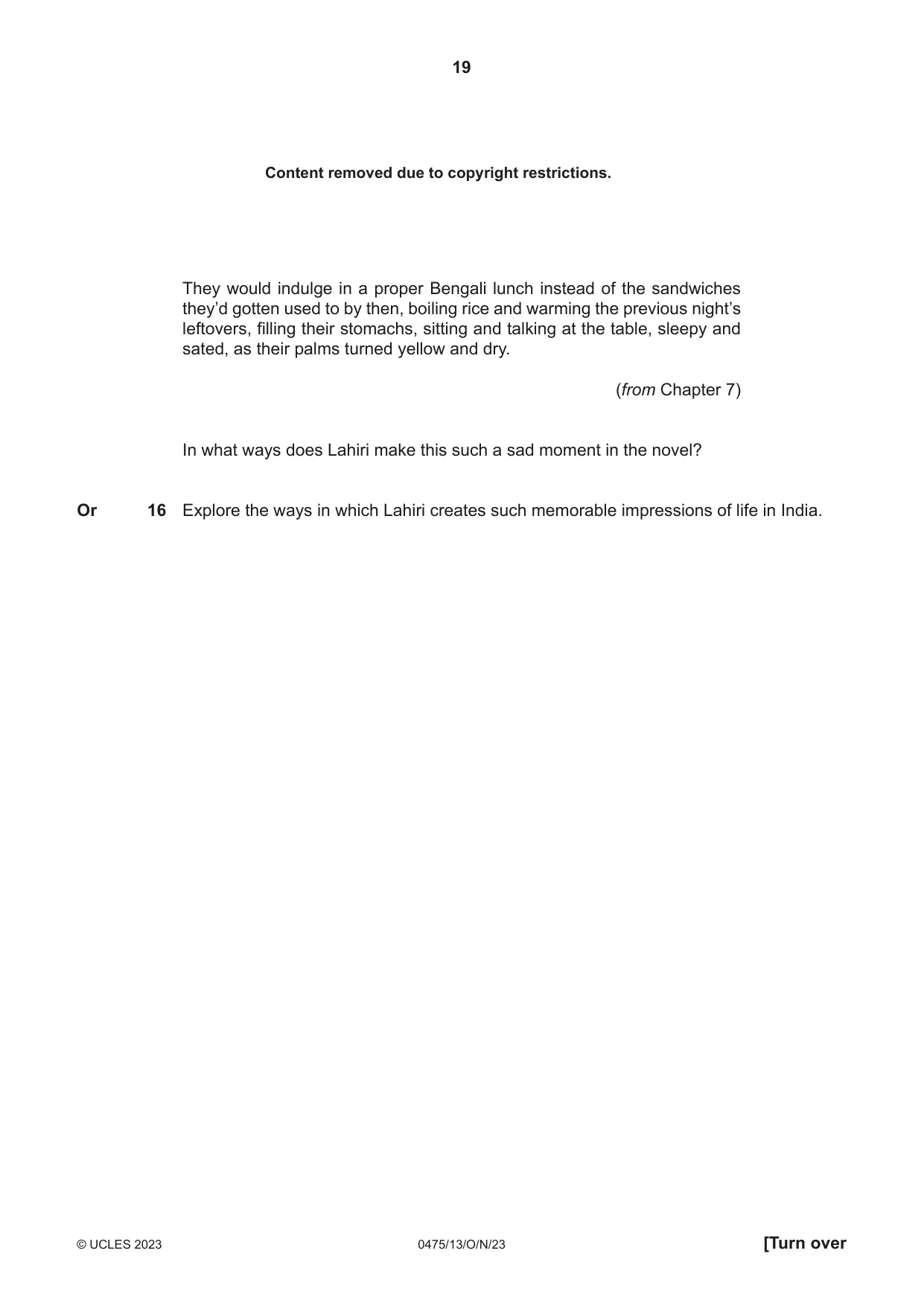
19 0475/13/O/N/23 © UCLES 2023 [Turn over They would indulge in a proper Bengali lunch instead of the sandwiches they’d gotten used to by then, boiling rice and warming the previous night’s leftovers, filling their stomachs, sitting and talking at the table, sleepy and sated, as their palms turned yellow and dry. (from Chapter 7) In what ways does Lahiri make this such a sad moment in the novel? Or 16 Explore the ways in which Lahiri creates such memorable impressions of life in India. Content removed due to copyright restrictions.
Question paper, page 20
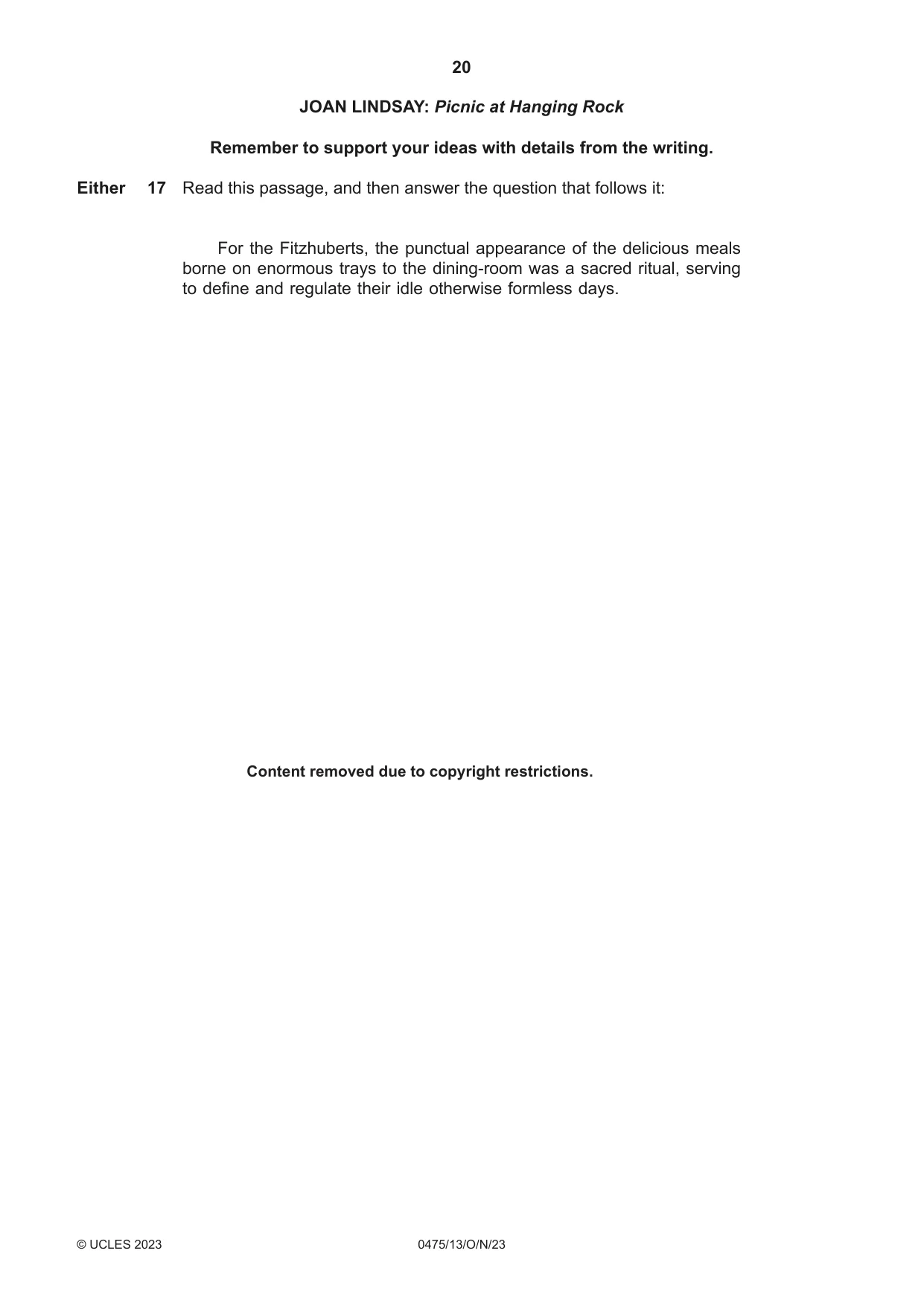
20 0475/13/O/N/23 © UCLES 2023 JOAN LINDSAY: Picnic at Hanging Rock Remember to support your ideas with details from the writing. Either 17 Read this passage, and then answer the question that follows it: For the Fitzhuberts, the punctual appearance of the delicious meals borne on enormous trays to the dining-room was a sacred ritual, serving to define and regulate their idle otherwise formless days. Content removed due to copyright restrictions.
Question paper, page 21
21 0475/13/O/N/23 © UCLES 2023 [Turn over At the Calcutta Club eight was always considered the perfect number for a small luncheon party.’ (from Chapter 11) How does Lindsay make this such an entertaining moment in the novel? Or 18 Explore how Lindsay strikingly portrays life at Appleyard College. Content removed due to copyright restrictions.
Question paper, page 22
22 0475/13/O/N/23 © UCLES 2023 YANN MARTEL: Life of Pi Remember to support your ideas with details from the writing. Either 19 Read this passage, and then answer the question that follows it: It was Richard Parker who calmed me down. Content removed due to copyright restrictions.
Question paper, page 23
23 0475/13/O/N/23 © UCLES 2023 [Turn over It’s the plain truth: without Richard Parker, I wouldn’t be alive today to tell you my story. (from Chapter 57) Explore the ways in which Martel conveys the surprising relationship between Pi and Richard Parker at this moment in the novel. Or 20 How does Martel vividly portray Pi’s amazement at the natural world while he is at sea? Content removed due to copyright restrictions.
Question paper, page 24
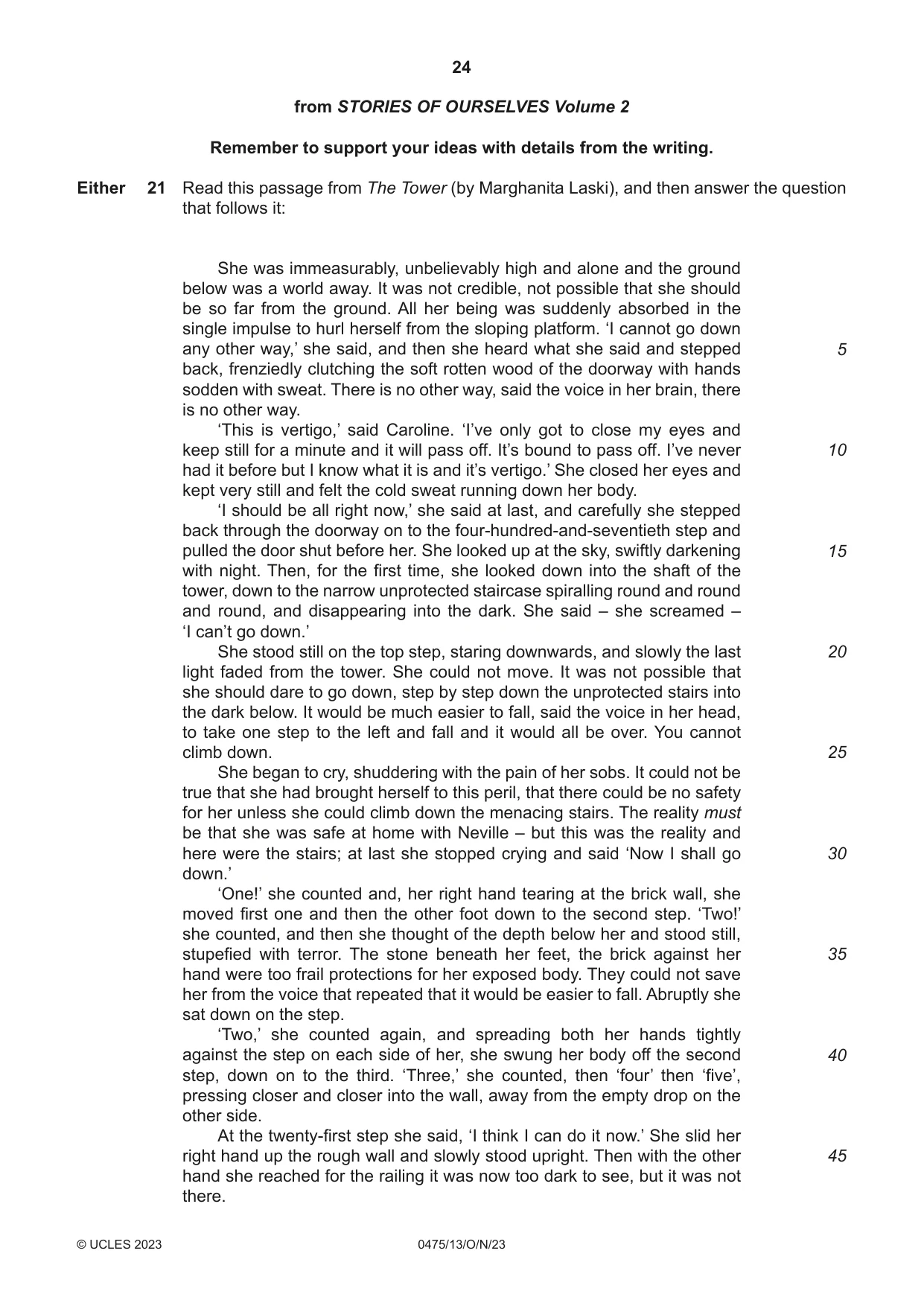
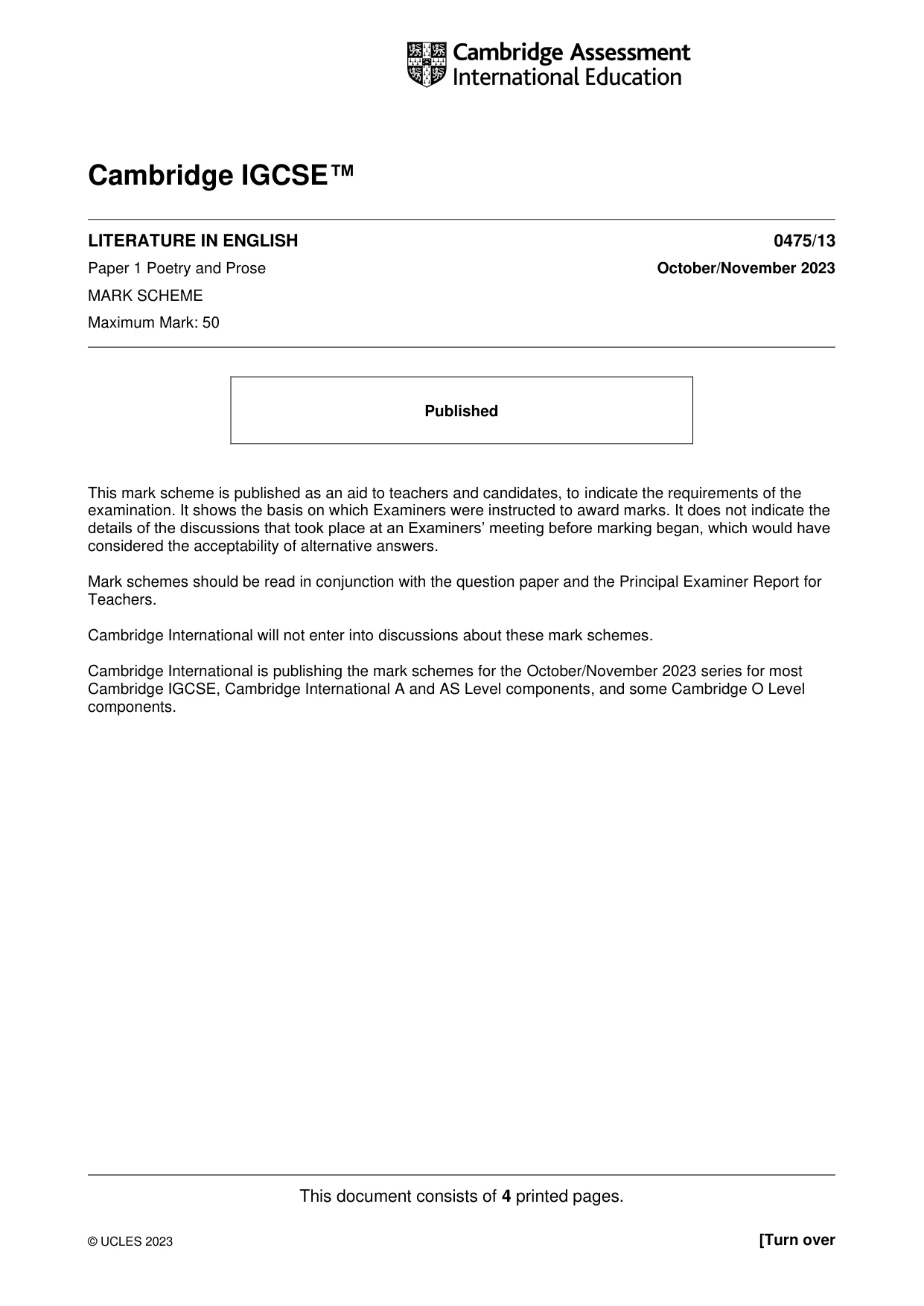
24 0475/13/O/N/23 © UCLES 2023 from STORIES OF OURSELVES Volume 2 Remember to support your ideas with details from the writing. Either 21 Read this passage from The Tower (by Marghanita Laski), and then answer the question that follows it: She was immeasurably, unbelievably high and alone and the ground below was a world away. It was not credible, not possible that she should be so far from the ground. All her being was suddenly absorbed in the single impulse to hurl herself from the sloping platform. ‘I cannot go down any other way,’ she said, and then she heard what she said and stepped back, frenziedly clutching the soft rotten wood of the doorway with hands sodden with sweat. There is no other way, said the voice in her brain, there is no other way. ‘This is vertigo,’ said Caroline. ‘I’ve only got to close my eyes and keep still for a minute and it will pass off. It’s bound to pass off. I’ve never had it before but I know what it is and it’s vertigo.’ She closed her eyes and kept very still and felt the cold sweat running down her body. ‘I should be all right now,’ she said at last, and carefully she stepped back through the doorway on to the four-hundred-and-seventieth step and pulled the door shut before her. She looked up at the sky, swiftly darkening with night. Then, for the first time, she looked down into the shaft of the tower, down to the narrow unprotected staircase spiralling round and round and round, and disappearing into the dark. She said – she screamed – ‘I can’t go down.’ She stood still on the top step, staring downwards, and slowly the last light faded from the tower. She could not move. It was not possible that she should dare to go down, step by step down the unprotected stairs into the dark below. It would be much easier to fall, said the voice in her head, to take one step to the left and fall and it would all be over. You cannot climb down. She began to cry, shuddering with the pain of her sobs. It could not be true that she had brought herself to this peril, that there could be no safety for her unless she could climb down the menacing stairs. The reality must be that she was safe at home with Neville – but this was the reality and here were the stairs; at last she stopped crying and said ‘Now I shall go down.’ ‘One!’ she counted and, her right hand tearing at the brick wall, she moved first one and then the other foot down to the second step. ‘Two!’ she counted, and then she thought of the depth below her and stood still, stupefied with terror. The stone beneath her feet, the brick against her hand were too frail protections for her exposed body. They could not save her from the voice that repeated that it would be easier to fall. Abruptly she sat down on the step. ‘Two,’ she counted again, and spreading both her hands tightly against the step on each side of her, she swung her body off the second step, down on to the third. ‘Three,’ she counted, then ‘four’ then ‘five’, pressing closer and closer into the wall, away from the empty drop on the other side. At the twenty-first step she said, ‘I think I can do it now.’ She slid her right hand up the rough wall and slowly stood upright. Then with the other hand she reached for the railing it was now too dark to see, but it was not there. 5 10 15 20 25 30 35 40 45
Question paper, page 25
25 0475/13/O/N/23 © UCLES 2023 For timeless time she stood there, knowing nothing but fear, ‘Twenty- one,’ she said, ‘twenty-one,’ over and over again, but she could not step on to the twenty-second stair. Something brushed her face. She knew it was a bat, not a hand, that touched her but still it was horror beyond conceivable horror, and it was this horror, without any sense of moving from dread to safety, that at last impelled her down the stairs. ‘Twenty-three, twenty-four, twenty-five –’ she counted, and around her the air was full of whispering skin-stretched wings. If one of them should touch her again, she must fall. ‘Twenty-six, twenty-seven, twenty-eight –’ The skin of her right hand was torn and hot with blood, for she would never lift it from the wall, only press it slowly down and force her rigid legs to move from the knowledge of each step to the peril of the next. So Caroline came down the dark tower. She could not think. She could know nothing but fear. Only her brain remorselessly recorded the tally. ‘Five hundred and one,’ it counted, ‘five hundred and two – and three and four –’ How does Laski make this such a terrifying moment in the story? Or 22 How does Gilman make the mother such an impressive character in The Widow’s Might? 50 55 60
Question paper, page 26
26 0475/13/O/N/23 © UCLES 2023 BLANK PAGE
Question paper, page 27
27 0475/13/O/N/23 © UCLES 2023 BLANK PAGE
Question paper, page 28
28 0475/13/O/N/23 © UCLES 2023 Permission to reproduce items where third-party owned material protected by copyright is included has been sought and cleared where possible. Every reasonable effort has been made by the publisher (UCLES) to trace copyright holders, but if any items requiring clearance have unwittingly been included, the publisher will be pleased to make amends at the earliest possible opportunity. To avoid the issue of disclosure of answer-related information to candidates, all copyright acknowledgements are reproduced online in the Cambridge Assessment International Education Copyright Acknowledgements Booklet. This is produced for each series of examinations and is freely available to download at www.cambridgeinternational.org after the live examination series. Cambridge Assessment International Education is part of Cambridge Assessment. Cambridge Assessment is the brand name of the University of Cambridge Local Examinations Syndicate (UCLES), which is a department of the University of Cambridge. BLANK PAGE
Mark scheme, page 1
This document consists of 4 printed pages. © UCLES 2023 [Turn over Cambridge IGCSE™ LITERATURE IN ENGLISH 0475/13 Paper 1 Poetry and Prose October/November 2023 MARK SCHEME Maximum Mark: 50 Published This mark scheme is published as an aid to teachers and candidates, to indicate the requirements of the examination. It shows the basis on which Examiners were instructed to award marks. It does not indicate the details of the discussions that took place at an Examiners’ meeting before marking began, which would have considered the acceptability of alternative answers. Mark schemes should be read in conjunction with the question paper and the Principal Examiner Report for Teachers. Cambridge International will not enter into discussions about these mark schemes. Cambridge International is publishing the mark schemes for the October/November 2023 series for most Cambridge IGCSE, Cambridge International A and AS Level components, and some Cambridge O Level components.
Mark scheme, page 2
0475/13 Cambridge IGCSE – Mark Scheme PUBLISHED October/November 2023 © UCLES 2023 Page 2 of 4 Generic Marking Principles These general marking principles must be applied by all examiners when marking candidate answers. They should be applied alongside the specific content of the mark scheme or generic level descriptors for a question. Each question paper and mark scheme will also comply with these marking principles. GENERIC MARKING PRINCIPLE 1: Marks must be awarded in line with: • the specific content of the mark scheme or the generic level descriptors for the question • the specific skills defined in the mark scheme or in the generic level descriptors for the question • the standard of response required by a candidate as exemplified by the standardisation scripts. GENERIC MARKING PRINCIPLE 2: Marks awarded are always whole marks (not half marks, or other fractions). GENERIC MARKING PRINCIPLE 3: Marks must be awarded positively: • marks are awarded for correct/valid answers, as defined in the mark scheme. However, credit is given for valid answers which go beyond the scope of the syllabus and mark scheme, referring to your Team Leader as appropriate • marks are awarded when candidates clearly demonstrate what they know and can do • marks are not deducted for errors • marks are not deducted for omissions • answers should only be judged on the quality of spelling, punctuation and grammar when these features are specifically assessed by the question as indicated by the mark scheme. The meaning, however, should be unambiguous. GENERIC MARKING PRINCIPLE 4: Rules must be applied consistently, e.g. in situations where candidates have not followed instructions or in the application of generic level descriptors. GENERIC MARKING PRINCIPLE 5: Marks should be awarded using the full range of marks defined in the mark scheme for the question (however; the use of the full mark range may be limited according to the quality of the candidate responses seen). GENERIC MARKING PRINCIPLE 6: Marks awarded are based solely on the requirements as defined in the mark scheme. Marks should not be awarded with grade thresholds or grade descriptors in mind.
Mark scheme, page 3
0475/13 Cambridge IGCSE – Mark Scheme PUBLISHED October/November 2023 © UCLES 2023 Page 3 of 4 English & Media subject specific general marking principles (To be read in conjunction with the Generic Marking Principles (and requiring further guidance on how to place marks within levels)) Components using level descriptors: • We use level descriptors as a guide to broad understanding of the qualities normally expected of, or typical of, work in a level. • Level descriptors are a means of general guidance, and should not be interpreted as hurdle statements. • Where indicative content notes are supplied for a question, these are not a prescription of required content, and must not be treated as such. Alternative correct points and unexpected answers in candidates’ scripts must be given marks that fairly reflect the knowledge and skills demonstrated. • While we may have legitimate expectations as to the ground most answers may occupy, we must at all times be prepared to meet candidates on their chosen ground, provided it is relevant ground (e.g. clearly related to and derived from a relevant passage/text and meeting the mark scheme requirements for the question). Components using point-based marking: Point marking is often used to reward knowledge, understanding and application of skills. We give credit where the candidate’s answer shows relevant knowledge, understanding and application of skills in answering the question. We do not give credit where the answer shows confusion. From this it follows that we: a DO credit answers which are worded differently from the mark scheme if they clearly convey the same meaning (unless the mark scheme requires a specific term). b DO credit alternative answers/examples which are not written in the mark scheme if they are correct. c DO credit answers where candidates give more than one correct answer in one prompt/numbered/scaffolded space where extended writing is required rather than list-type answers. For example, questions that require n reasons (e.g. State two reasons…). d DO NOT credit answers simply for using a ‘key term’ unless that is all that is required. (Check for evidence it is understood and not used wrongly.). e DO NOT credit answers which are obviously self-contradicting or trying to cover all possibilities. f DO NOT give further credit for what is effectively repetition of a correct point already credited unless the language itself is being tested. This applies equally to ‘mirror statements’ (i.e. polluted/not polluted). g DO NOT require spellings to be correct, unless this is part of the test. However spellings of syllabus terms must allow for clear and unambiguous separation from other syllabus terms with which they may be confused (e.g. Corrasion/Corrosion).
Mark scheme, page 4
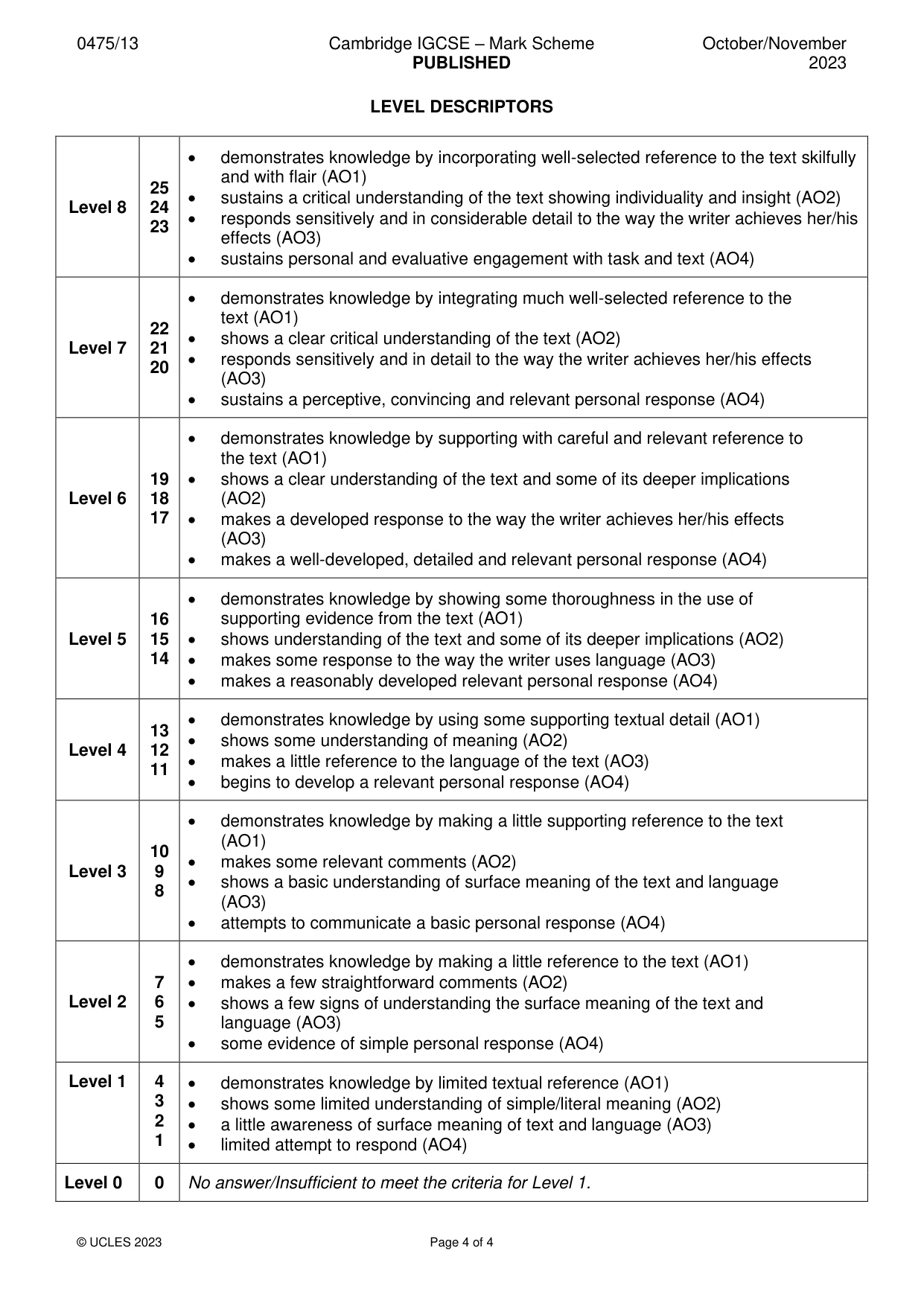
0475/13 Cambridge IGCSE – Mark Scheme PUBLISHED October/November 2023 © UCLES 2023 Page 4 of 4 LEVEL DESCRIPTORS Level 8 25 24 23 • demonstrates knowledge by incorporating well-selected reference to the text skilfully and with flair (AO1) • sustains a critical understanding of the text showing individuality and insight (AO2) • responds sensitively and in considerable detail to the way the writer achieves her/his effects (AO3) • sustains personal and evaluative engagement with task and text (AO4) Level 7 22 21 20 • demonstrates knowledge by integrating much well-selected reference to the text (AO1) • shows a clear critical understanding of the text (AO2) • responds sensitively and in detail to the way the writer achieves her/his effects (AO3) • sustains a perceptive, convincing and relevant personal response (AO4) Level 6 19 18 17 • demonstrates knowledge by supporting with careful and relevant reference to the text (AO1) • shows a clear understanding of the text and some of its deeper implications (AO2) • makes a developed response to the way the writer achieves her/his effects (AO3) • makes a well-developed, detailed and relevant personal response (AO4) Level 5 16 15 14 • demonstrates knowledge by showing some thoroughness in the use of supporting evidence from the text (AO1) • shows understanding of the text and some of its deeper implications (AO2) • makes some response to the way the writer uses language (AO3) • makes a reasonably developed relevant personal response (AO4) Level 4 13 12 11 • demonstrates knowledge by using some supporting textual detail (AO1) • shows some understanding of meaning (AO2) • makes a little reference to the language of the text (AO3) • begins to develop a relevant personal response (AO4) Level 3 10 9 8 • demonstrates knowledge by making a little supporting reference to the text (AO1) • makes some relevant comments (AO2) • shows a basic understanding of surface meaning of the text and language (AO3) • attempts to communicate a basic personal response (AO4) Level 2 7 6 5 • demonstrates knowledge by making a little reference to the text (AO1) • makes a few straightforward comments (AO2) • shows a few signs of understanding the surface meaning of the text and language (AO3) • some evidence of simple personal response (AO4) Level 1 4 3 2 1 • demonstrates knowledge by limited textual reference (AO1) • shows some limited understanding of simple/literal meaning (AO2) • a little awareness of surface meaning of text and language (AO3) • limited attempt to respond (AO4) Level 0 0 No answer/Insufficient to meet the criteria for Level 1.
What you needed in this session
Cambridge’s own grade thresholds for 2023 Oct/Nov, Paper 1 · Variant 3. A higher threshold means an easier paper — the bar moves with how the cohort did.