Cambridge IGCSE English - Literature in English 0475 — 2024 Oct/Nov Paper 1 · Variant 2
0475/12/O/N/24 · 50 marks · ≈56 min
The question paper and its mark scheme, free to read here and free to download. This is Cambridge’s own paper, exactly as it was sat.
Question paper28 pages






Mark scheme4 pages
Answers below. Sit the paper first if you are practising.
Paper as text
Question paper, page 1
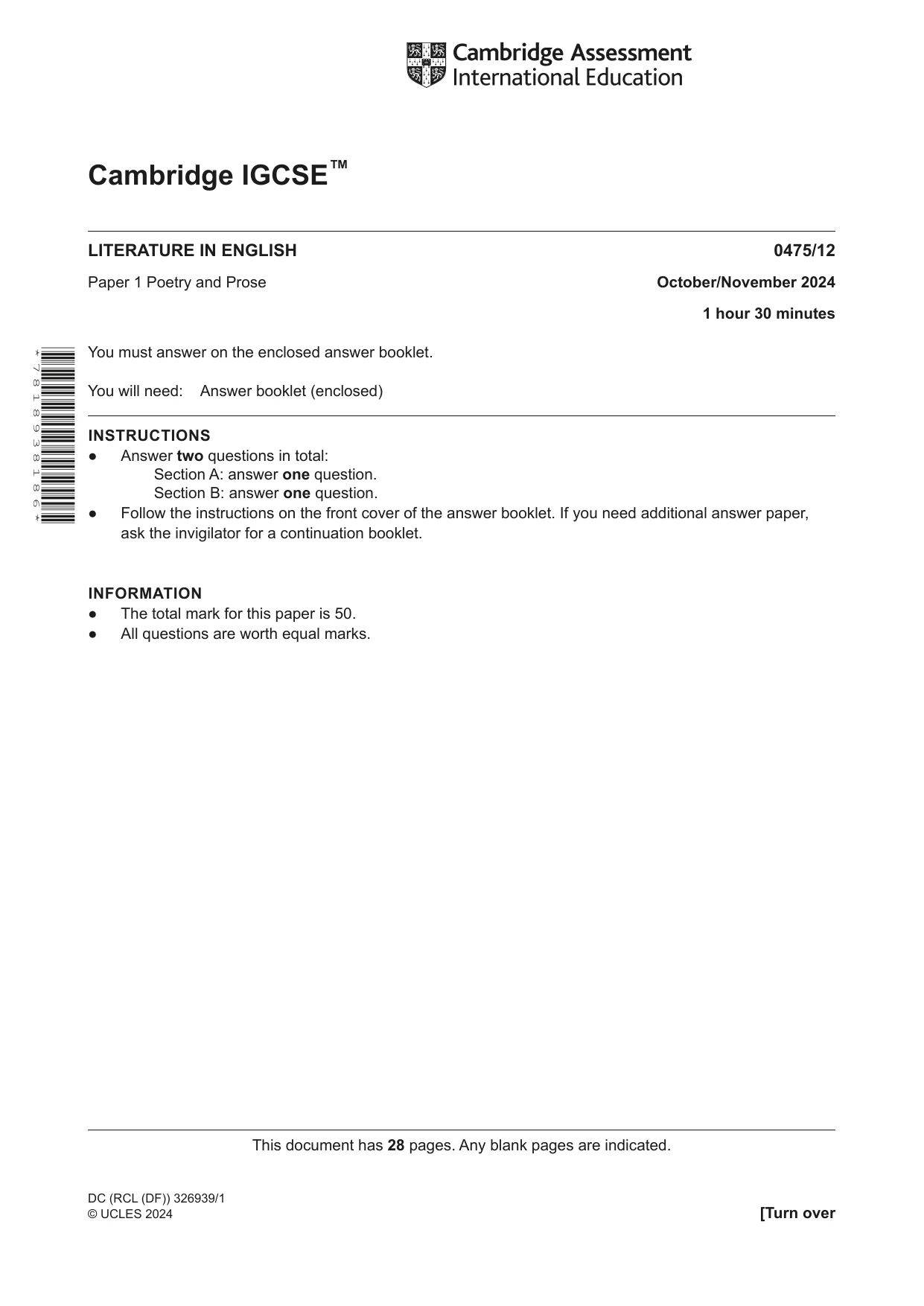
This document has 28 pages. Any blank pages are indicated. [Turn over Cambridge IGCSE™ * 7 8 1 8 9 3 8 1 8 6 * DC (RCL (DF)) 326939/1 © UCLES 2024 LITERATURE IN ENGLISH 0475/12 Paper 1 Poetry and Prose October/November 2024 1 hour 30 minutes You must answer on the enclosed answer booklet. You will need: Answer booklet (enclosed) INSTRUCTIONS ● Answer two questions in total: Section A: answer one question. Section B: answer one question. ● Follow the instructions on the front cover of the answer booklet. If you need additional answer paper, ask the invigilator for a continuation booklet. INFORMATION ● The total mark for this paper is 50. ● All questions are worth equal marks.
Question paper, page 2
2 0475/12/O/N/24 © UCLES 2024 BLANK PAGE
Question paper, page 3
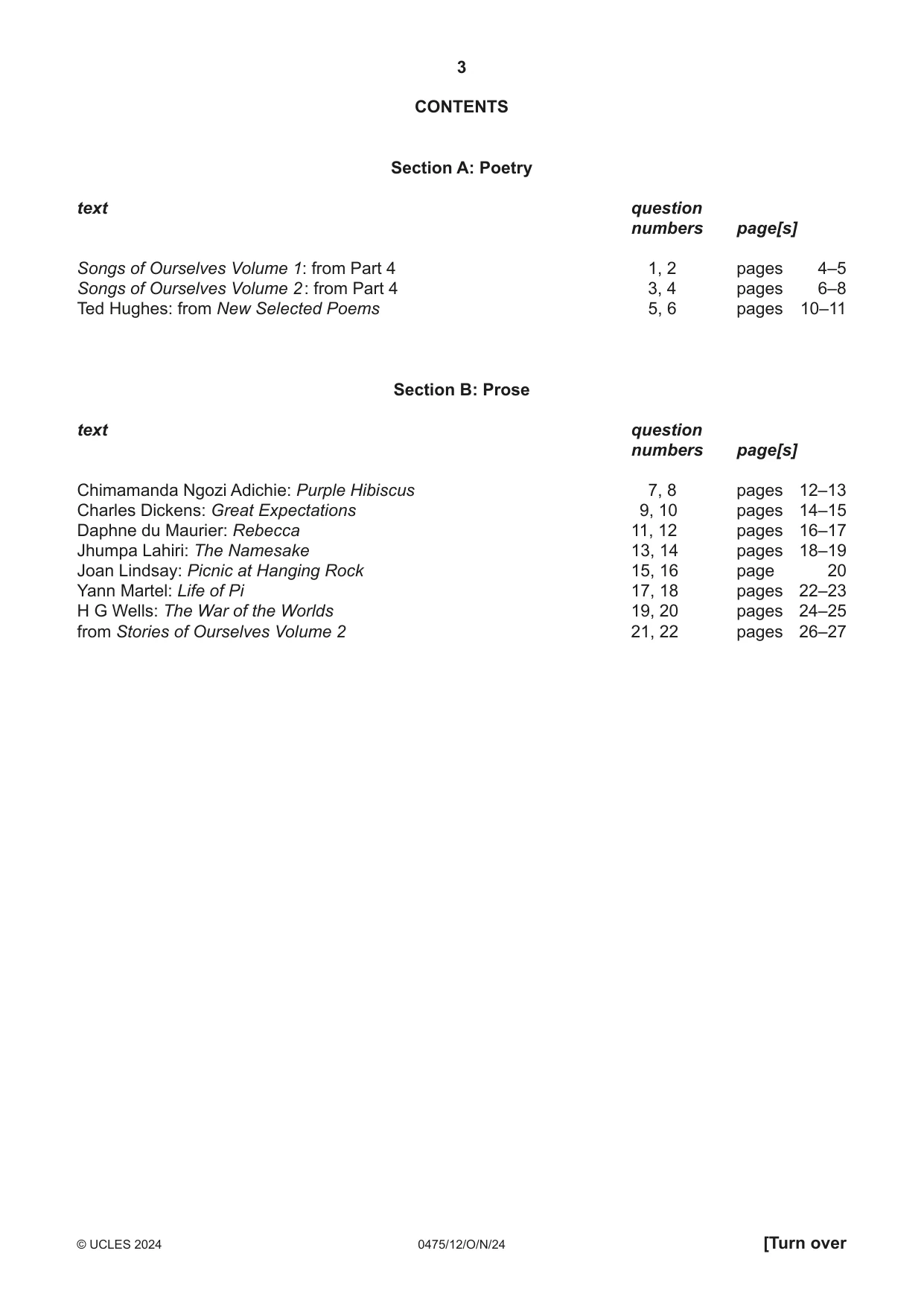
3 0475/12/O/N/24 © UCLES 2024 [Turn over CONTENTS Section A: Poetry text question numbers page[s] Songs of Ourselves Volume 1: from Part 4 1, 2 pages 4–5 Songs of Ourselves Volume 2 : from Part 4 3, 4 pages 6–8 Ted Hughes: from New Selected Poems 5, 6 pages 10–11 Section B: Prose text question numbers page[s] Chimamanda Ngozi Adichie: Purple Hibiscus 7, 8 pages 12–13 Charles Dickens: Great Expectations 9, 10 pages 14–15 Daphne du Maurier: Rebecca 11, 12 pages 16–17 Jhumpa Lahiri: The Namesake 13, 14 pages 18–19 Joan Lindsay: Picnic at Hanging Rock 15, 16 page 20 Yann Martel: Life of Pi 17, 18 pages 22–23 H G Wells: The War of the Worlds 19, 20 pages 24–25 from Stories of Ourselves Volume 2 21, 22 pages 26–27
Question paper, page 4
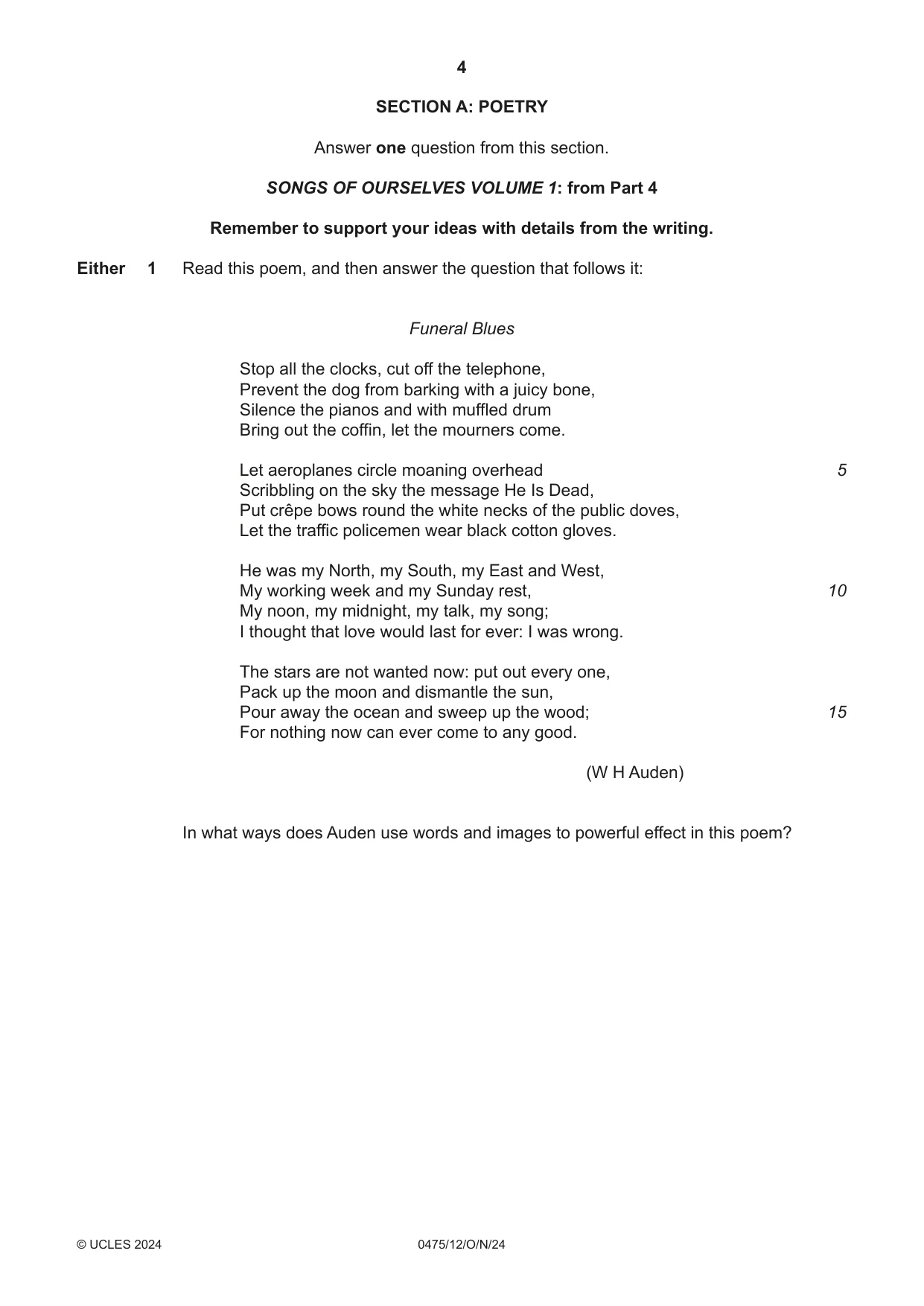
4 0475/12/O/N/24 © UCLES 2024 SECTION A: POETRY Answer one question from this section. SONGS OF OURSELVES VOLUME 1: from Part 4 Remember to support your ideas with details from the writing. Either 1 Read this poem, and then answer the question that follows it: Funeral Blues Stop all the clocks, cut off the telephone, Prevent the dog from barking with a juicy bone, Silence the pianos and with muffled drum Bring out the coffin, let the mourners come. Let aeroplanes circle moaning overhead Scribbling on the sky the message He Is Dead, Put crêpe bows round the white necks of the public doves, Let the traffic policemen wear black cotton gloves. He was my North, my South, my East and West, My working week and my Sunday rest, My noon, my midnight, my talk, my song; I thought that love would last for ever: I was wrong. The stars are not wanted now: put out every one, Pack up the moon and dismantle the sun, Pour away the ocean and sweep up the wood; For nothing now can ever come to any good. (W H Auden) In what ways does Auden use words and images to powerful effect in this poem? 5 10 15
Question paper, page 5
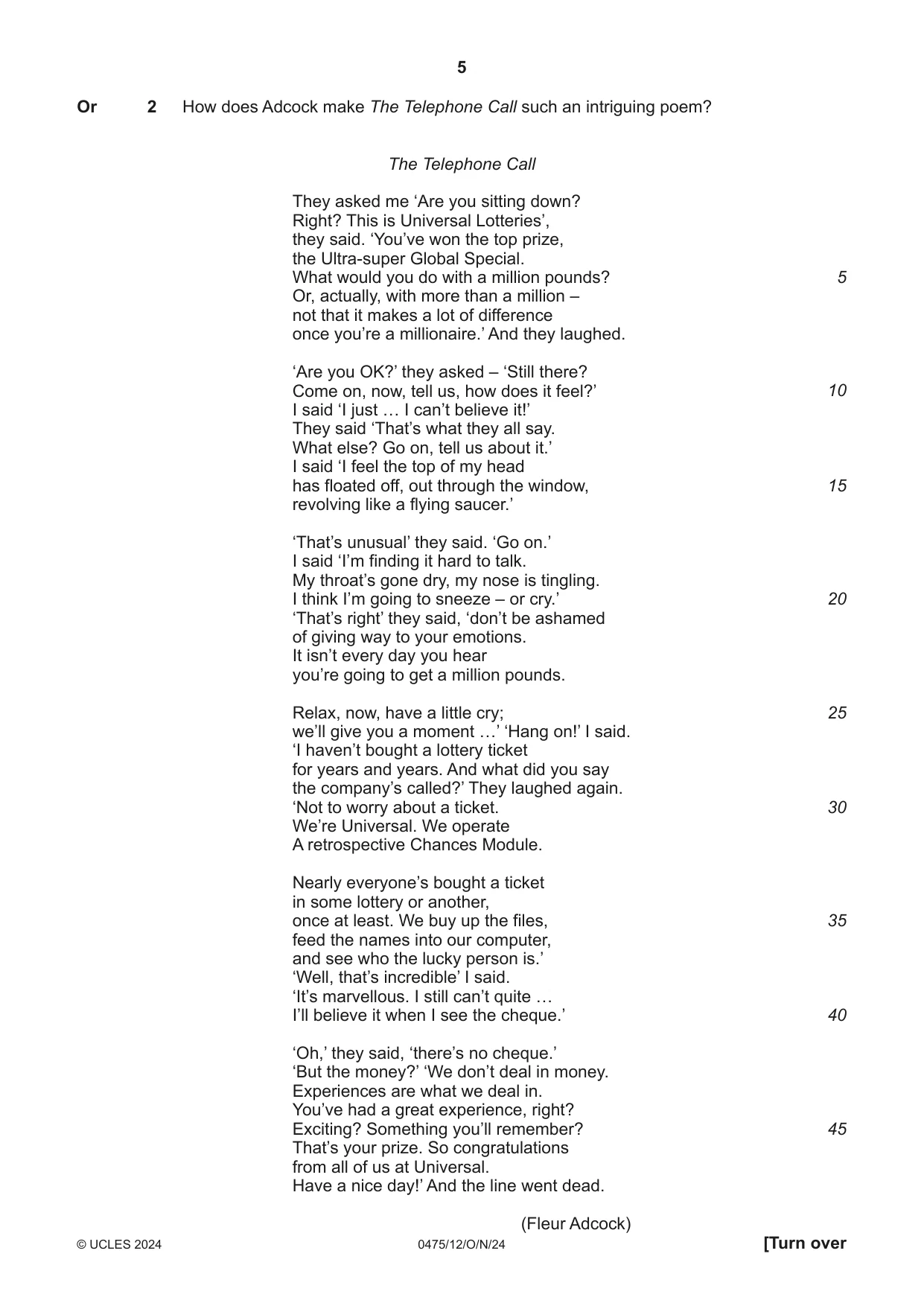
5 0475/12/O/N/24 © UCLES 2024 [Turn over Or 2 How does Adcock make The Telephone Call such an intriguing poem? The Telephone Call They asked me ‘Are you sitting down? Right? This is Universal Lotteries’, they said. ‘You’ve won the top prize, the Ultra-super Global Special. What would you do with a million pounds? Or, actually, with more than a million – not that it makes a lot of difference once you’re a millionaire.’ And they laughed. ‘Are you OK?’ they asked – ‘Still there? Come on, now, tell us, how does it feel?’ I said ‘I just … I can’t believe it!’ They said ‘That’s what they all say. What else? Go on, tell us about it.’ I said ‘I feel the top of my head has floated off, out through the window, revolving like a flying saucer.’ ‘That’s unusual’ they said. ‘Go on.’ I said ‘I’m finding it hard to talk. My throat’s gone dry, my nose is tingling. I think I’m going to sneeze – or cry.’ ‘That’s right’ they said, ‘don’t be ashamed of giving way to your emotions. It isn’t every day you hear you’re going to get a million pounds. Relax, now, have a little cry; we’ll give you a moment …’ ‘Hang on!’ I said. ‘I haven’t bought a lottery ticket for years and years. And what did you say the company’s called?’ They laughed again. ‘Not to worry about a ticket. We’re Universal. We operate A retrospective Chances Module. Nearly everyone’s bought a ticket in some lottery or another, once at least. We buy up the files, feed the names into our computer, and see who the lucky person is.’ ‘Well, that’s incredible’ I said. ‘It’s marvellous. I still can’t quite … I’ll believe it when I see the cheque.’ ‘Oh,’ they said, ‘there’s no cheque.’ ‘But the money?’ ‘We don’t deal in money. Experiences are what we deal in. You’ve had a great experience, right? Exciting? Something you’ll remember? That’s your prize. So congratulations from all of us at Universal. Have a nice day!’ And the line went dead. (Fleur Adcock) 5 10 15 20 25 30 35 40 45
Question paper, page 6
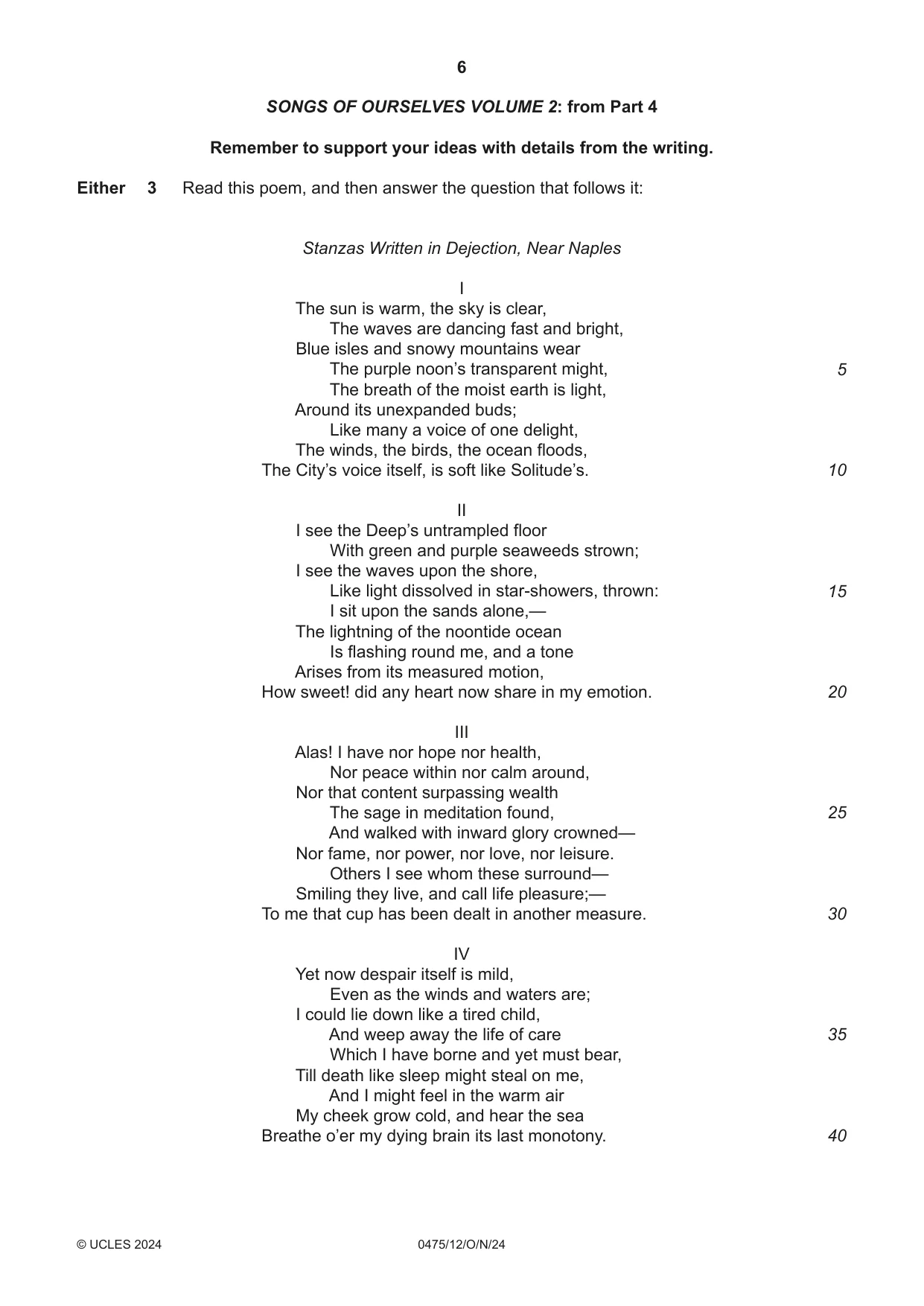
6 0475/12/O/N/24 © UCLES 2024 SONGS OF OURSELVES VOLUME 2: from Part 4 Remember to support your ideas with details from the writing. Either 3 Read this poem, and then answer the question that follows it: Stanzas Written in Dejection, Near Naples I The sun is warm, the sky is clear, The waves are dancing fast and bright, Blue isles and snowy mountains wear The purple noon’s transparent might, The breath of the moist earth is light, Around its unexpanded buds; Like many a voice of one delight, The winds, the birds, the ocean floods, The City’s voice itself, is soft like Solitude’s. II I see the Deep’s untrampled floor With green and purple seaweeds strown; I see the waves upon the shore, Like light dissolved in star-showers, thrown: I sit upon the sands alone,— The lightning of the noontide ocean Is flashing round me, and a tone Arises from its measured motion, How sweet! did any heart now share in my emotion. III Alas! I have nor hope nor health, Nor peace within nor calm around, Nor that content surpassing wealth The sage in meditation found, And walked with inward glory crowned— Nor fame, nor power, nor love, nor leisure. Others I see whom these surround— Smiling they live, and call life pleasure;— To me that cup has been dealt in another measure. IV Yet now despair itself is mild, Even as the winds and waters are; I could lie down like a tired child, And weep away the life of care Which I have borne and yet must bear, Till death like sleep might steal on me, And I might feel in the warm air My cheek grow cold, and hear the sea Breathe o’er my dying brain its last monotony. 5 10 15 20 25 30 35 40
Question paper, page 7
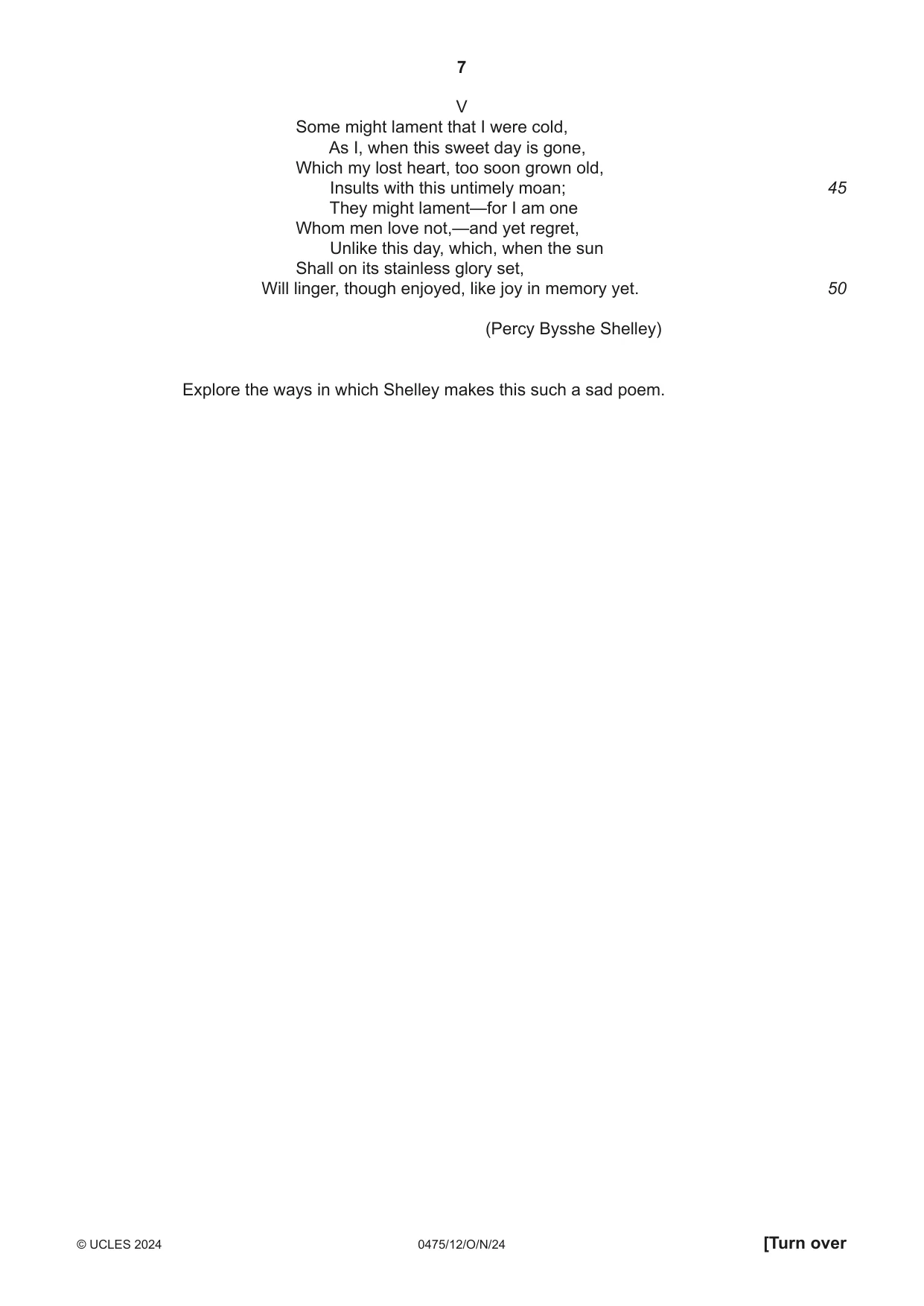
7 0475/12/O/N/24 © UCLES 2024 [Turn over V Some might lament that I were cold, As I, when this sweet day is gone, Which my lost heart, too soon grown old, Insults with this untimely moan; They might lament—for I am one Whom men love not,—and yet regret, Unlike this day, which, when the sun Shall on its stainless glory set, Will linger, though enjoyed, like joy in memory yet. (Percy Bysshe Shelley) Explore the ways in which Shelley makes this such a sad poem. 45 50
Question paper, page 8
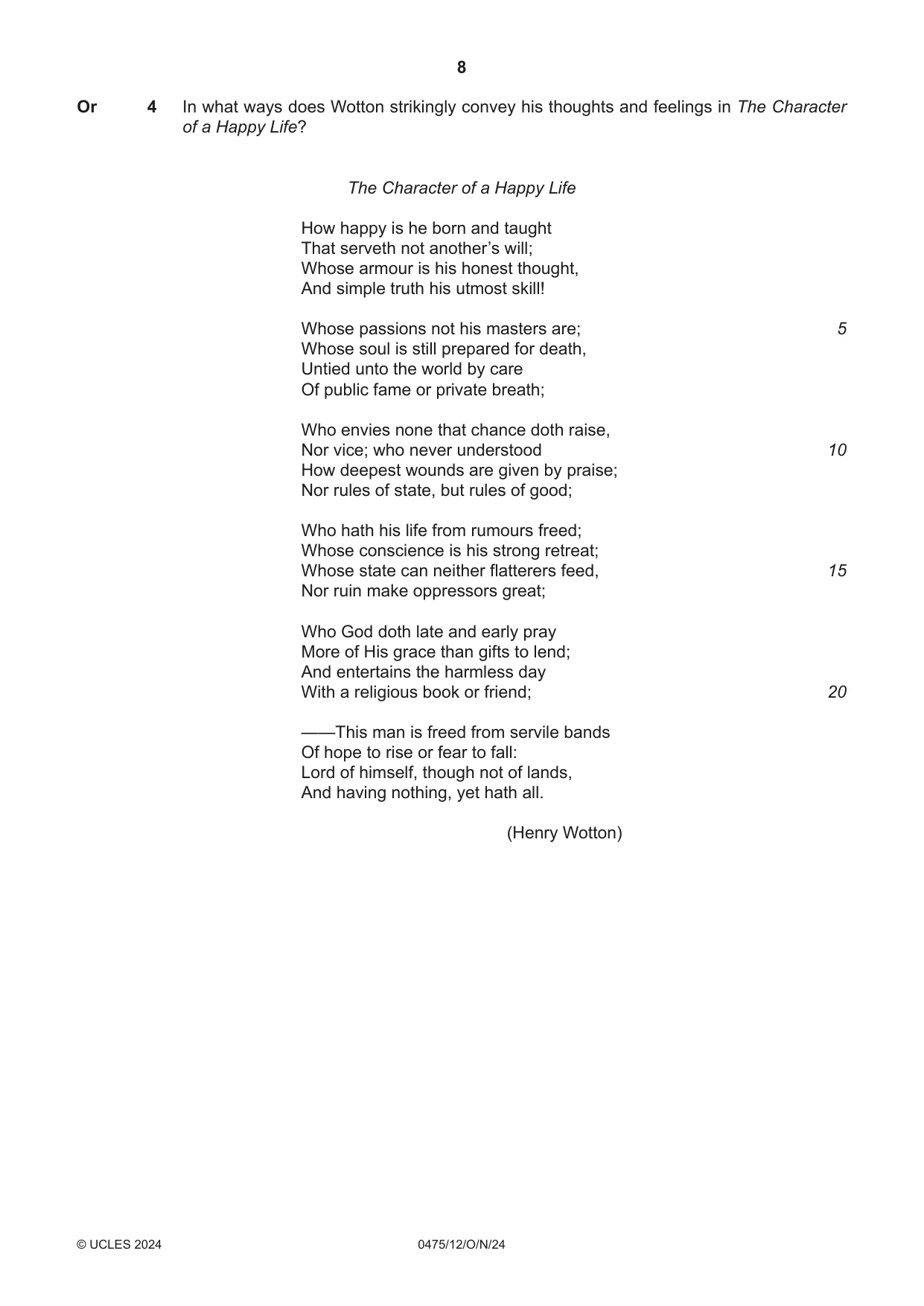
8 0475/12/O/N/24 © UCLES 2024 Or 4 In what ways does Wotton strikingly convey his thoughts and feelings in The Character of a Happy Life? The Character of a Happy Life How happy is he born and taught That serveth not another’s will; Whose armour is his honest thought, And simple truth his utmost skill! Whose passions not his masters are; Whose soul is still prepared for death, Untied unto the world by care Of public fame or private breath; Who envies none that chance doth raise, Nor vice; who never understood How deepest wounds are given by praise; Nor rules of state, but rules of good; Who hath his life from rumours freed; Whose conscience is his strong retreat; Whose state can neither flatterers feed, Nor ruin make oppressors great; Who God doth late and early pray More of His grace than gifts to lend; And entertains the harmless day With a religious book or friend; ——This man is freed from servile bands Of hope to rise or fear to fall: Lord of himself, though not of lands, And having nothing, yet hath all. (Henry Wotton) 5 10 15 20
Question paper, page 9
9 0475/12/O/N/24 © UCLES 2024 [Turn over TURN OVER FOR QUESTION 5.
Question paper, page 10
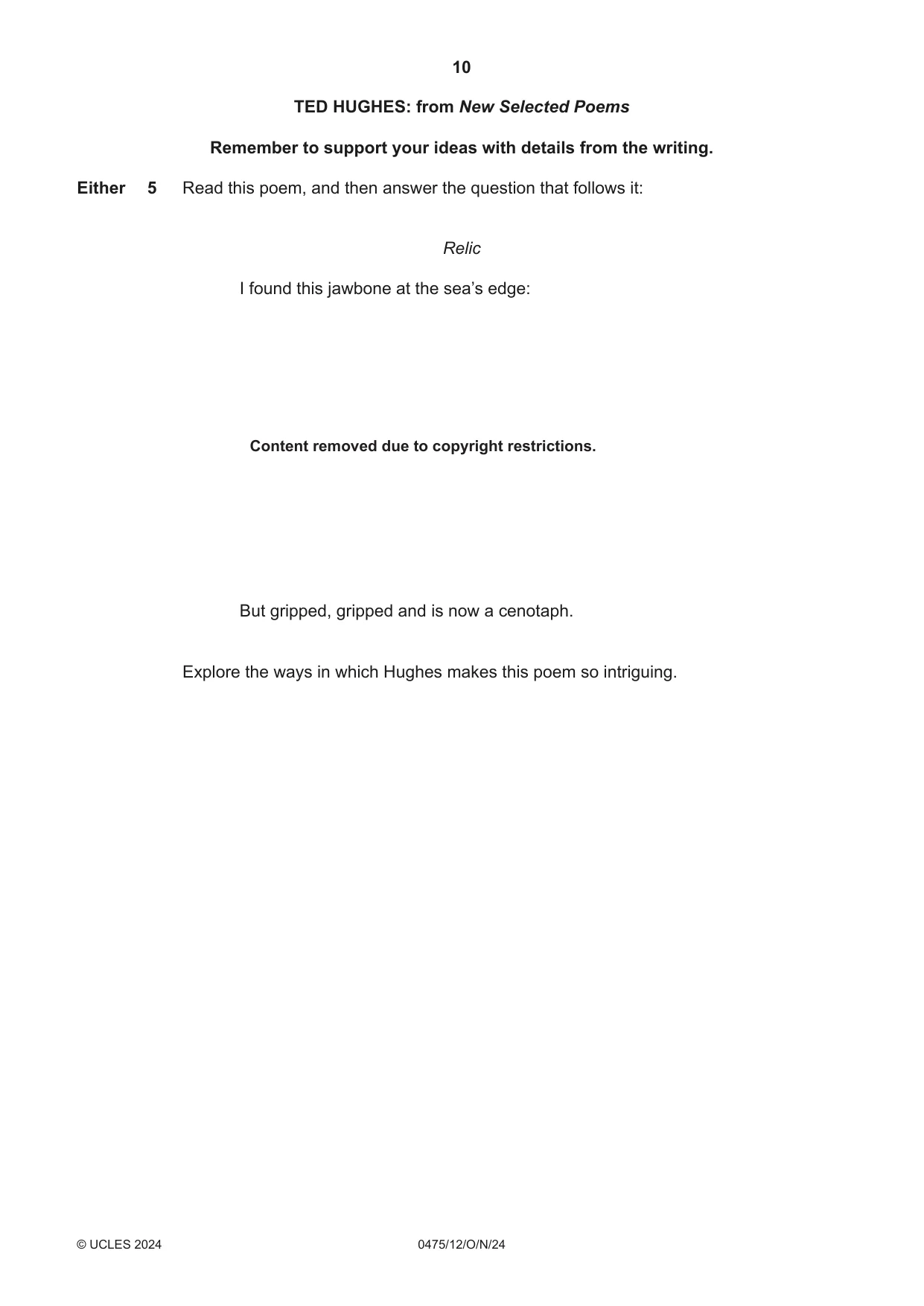
10 0475/12/O/N/24 © UCLES 2024 TED HUGHES: from New Selected Poems Remember to support your ideas with details from the writing. Either 5 Read this poem, and then answer the question that follows it: Relic I found this jawbone at the sea’s edge: But gripped, gripped and is now a cenotaph. Explore the ways in which Hughes makes this poem so intriguing. Content removed due to copyright restrictions.
Question paper, page 11
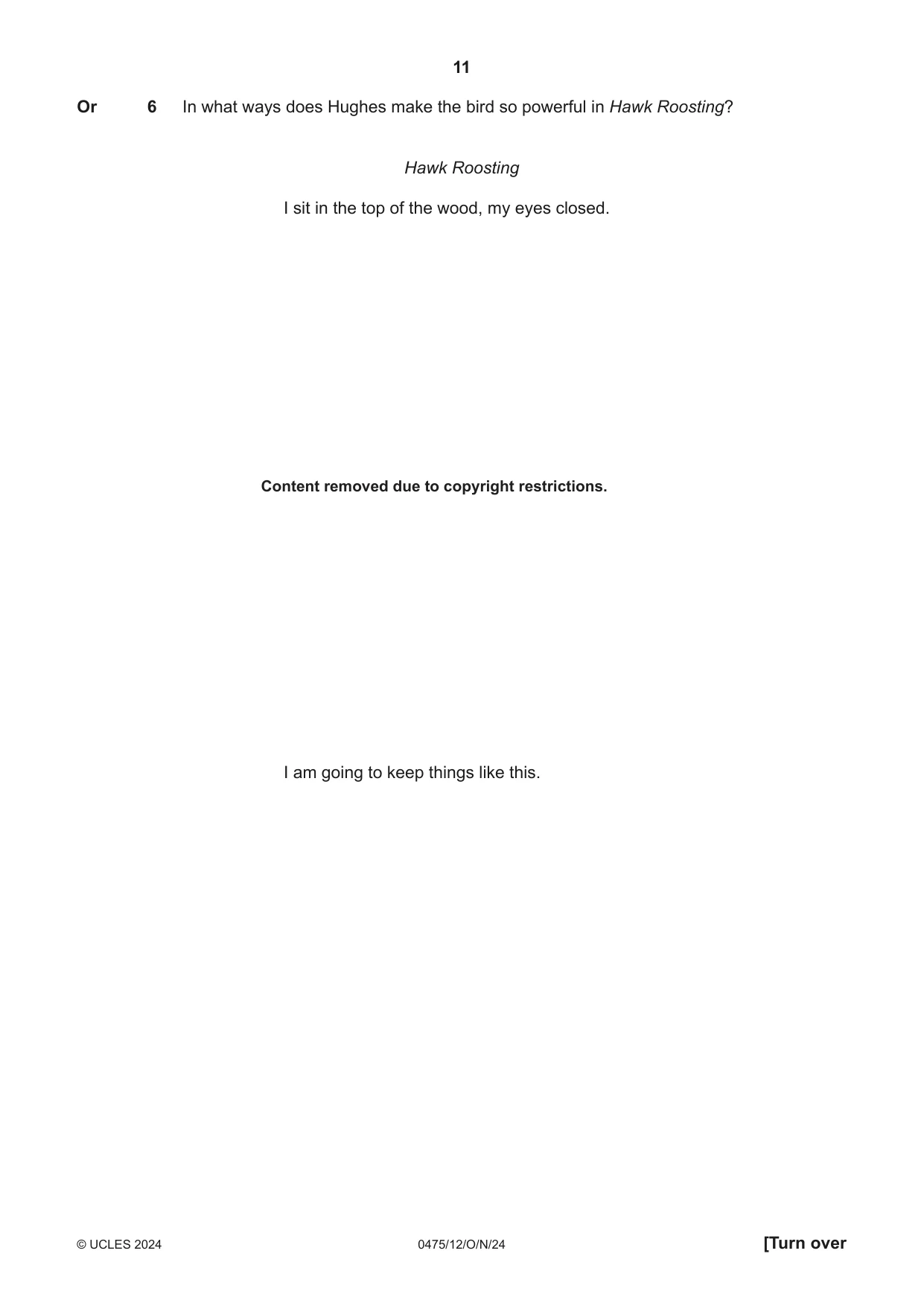
11 0475/12/O/N/24 © UCLES 2024 [Turn over Or 6 In what ways does Hughes make the bird so powerful in Hawk Roosting? Hawk Roosting I sit in the top of the wood, my eyes closed. I am going to keep things like this. Content removed due to copyright restrictions.
Question paper, page 12
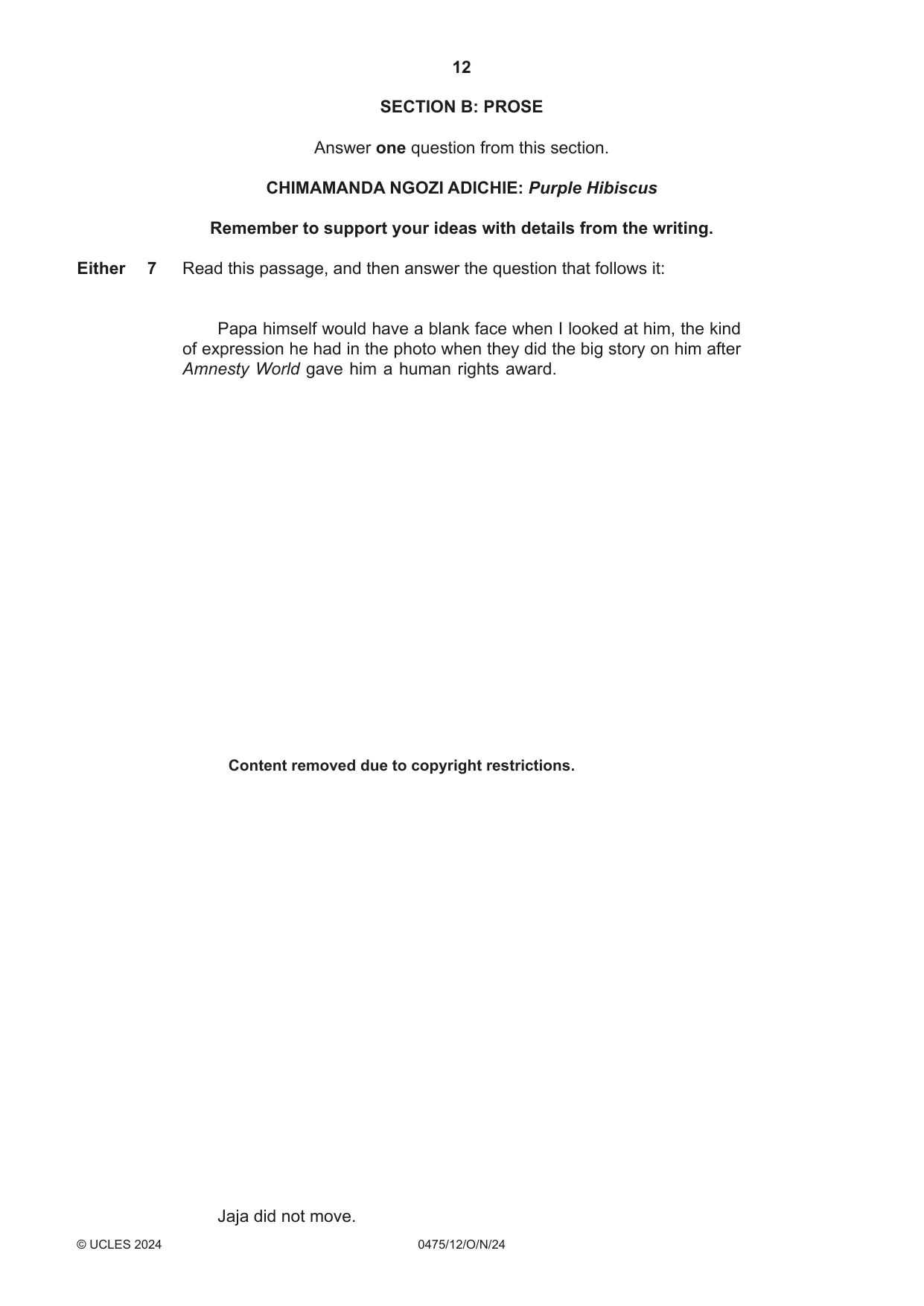
12 0475/12/O/N/24 © UCLES 2024 SECTION B: PROSE Answer one question from this section. CHIMAMANDA NGOZI ADICHIE: Purple Hibiscus Remember to support your ideas with details from the writing. Either 7 Read this passage, and then answer the question that follows it: Papa himself would have a blank face when I looked at him, the kind of expression he had in the photo when they did the big story on him after Amnesty World gave him a human rights award. Jaja did not move. Content removed due to copyright restrictions.
Question paper, page 13
13 0475/12/O/N/24 © UCLES 2024 [Turn over How does Adichie make this such a dramatic and significant moment in the novel? Or 8 Explore the ways in which Adichie strikingly contrasts Eugene and Aunty Ifeoma.
Question paper, page 14
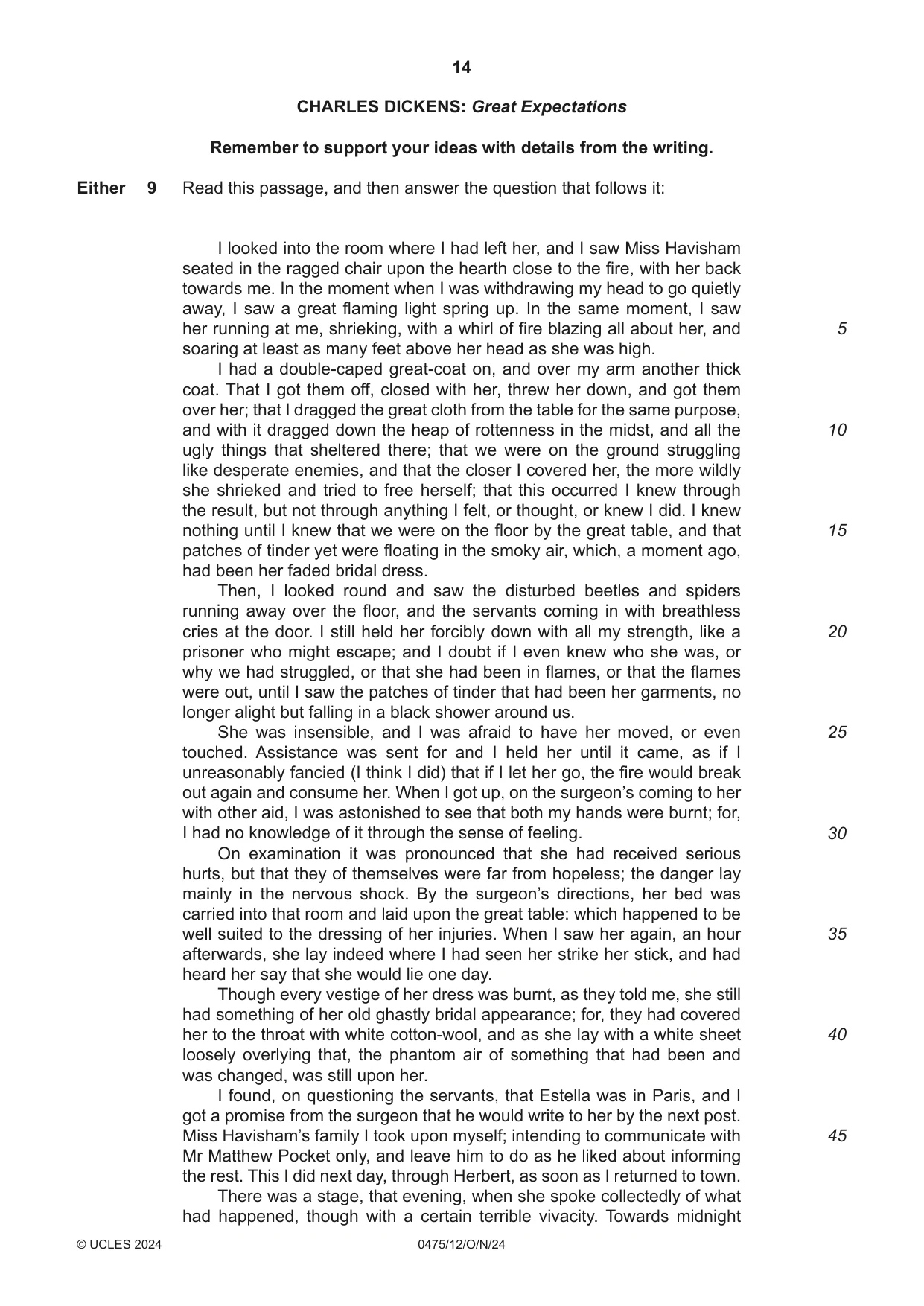
14 0475/12/O/N/24 © UCLES 2024 CHARLES DICKENS: Great Expectations Remember to support your ideas with details from the writing. Either 9 Read this passage, and then answer the question that follows it: I looked into the room where I had left her, and I saw Miss Havisham seated in the ragged chair upon the hearth close to the fire, with her back towards me. In the moment when I was withdrawing my head to go quietly away, I saw a great flaming light spring up. In the same moment, I saw her running at me, shrieking, with a whirl of fire blazing all about her, and soaring at least as many feet above her head as she was high. I had a double-caped great-coat on, and over my arm another thick coat. That I got them off, closed with her, threw her down, and got them over her; that I dragged the great cloth from the table for the same purpose, and with it dragged down the heap of rottenness in the midst, and all the ugly things that sheltered there; that we were on the ground struggling like desperate enemies, and that the closer I covered her, the more wildly she shrieked and tried to free herself; that this occurred I knew through the result, but not through anything I felt, or thought, or knew I did. I knew nothing until I knew that we were on the floor by the great table, and that patches of tinder yet were floating in the smoky air, which, a moment ago, had been her faded bridal dress. Then, I looked round and saw the disturbed beetles and spiders running away over the floor, and the servants coming in with breathless cries at the door. I still held her forcibly down with all my strength, like a prisoner who might escape; and I doubt if I even knew who she was, or why we had struggled, or that she had been in flames, or that the flames were out, until I saw the patches of tinder that had been her garments, no longer alight but falling in a black shower around us. She was insensible, and I was afraid to have her moved, or even touched. Assistance was sent for and I held her until it came, as if I unreasonably fancied (I think I did) that if I let her go, the fire would break out again and consume her. When I got up, on the surgeon’s coming to her with other aid, I was astonished to see that both my hands were burnt; for, I had no knowledge of it through the sense of feeling. On examination it was pronounced that she had received serious hurts, but that they of themselves were far from hopeless; the danger lay mainly in the nervous shock. By the surgeon’s directions, her bed was carried into that room and laid upon the great table: which happened to be well suited to the dressing of her injuries. When I saw her again, an hour afterwards, she lay indeed where I had seen her strike her stick, and had heard her say that she would lie one day. Though every vestige of her dress was burnt, as they told me, she still had something of her old ghastly bridal appearance; for, they had covered her to the throat with white cotton-wool, and as she lay with a white sheet loosely overlying that, the phantom air of something that had been and was changed, was still upon her. I found, on questioning the servants, that Estella was in Paris, and I got a promise from the surgeon that he would write to her by the next post. Miss Havisham’s family I took upon myself; intending to communicate with Mr Matthew Pocket only, and leave him to do as he liked about informing the rest. This I did next day, through Herbert, as soon as I returned to town. There was a stage, that evening, when she spoke collectedly of what had happened, though with a certain terrible vivacity. Towards midnight 5 10 15 20 25 30 35 40 45
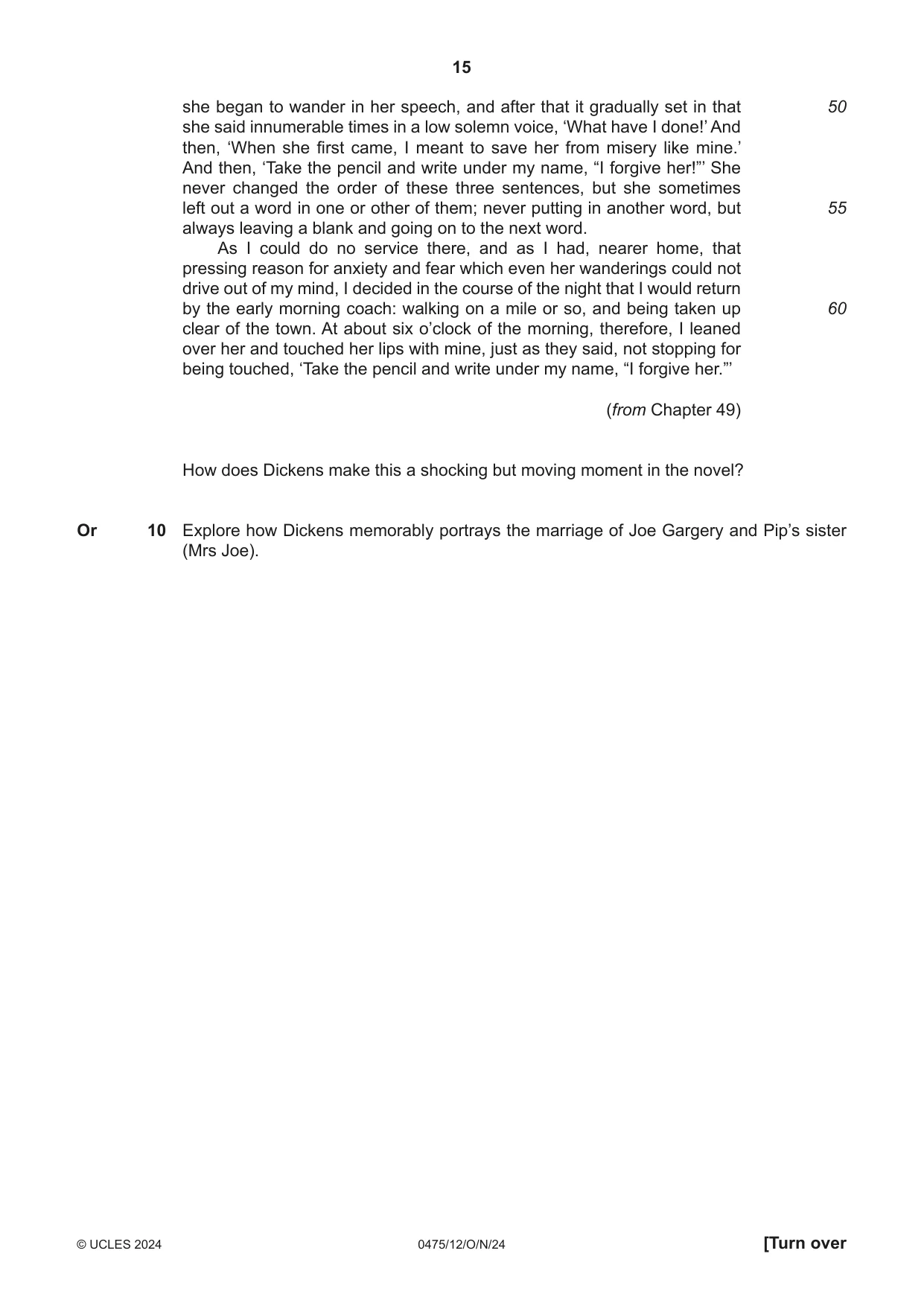
Question paper, page 15
15 0475/12/O/N/24 © UCLES 2024 [Turn over she began to wander in her speech, and after that it gradually set in that she said innumerable times in a low solemn voice, ‘What have I done!’ And then, ‘When she first came, I meant to save her from misery like mine.’ And then, ‘Take the pencil and write under my name, “I forgive her!”’ She never changed the order of these three sentences, but she sometimes left out a word in one or other of them; never putting in another word, but always leaving a blank and going on to the next word. As I could do no service there, and as I had, nearer home, that pressing reason for anxiety and fear which even her wanderings could not drive out of my mind, I decided in the course of the night that I would return by the early morning coach: walking on a mile or so, and being taken up clear of the town. At about six o’clock of the morning, therefore, I leaned over her and touched her lips with mine, just as they said, not stopping for being touched, ‘Take the pencil and write under my name, “I forgive her.”’ (from Chapter 49) How does Dickens make this a shocking but moving moment in the novel? Or 10 Explore how Dickens memorably portrays the marriage of Joe Gargery and Pip’s sister (Mrs Joe). 50 55 60
Question paper, page 16
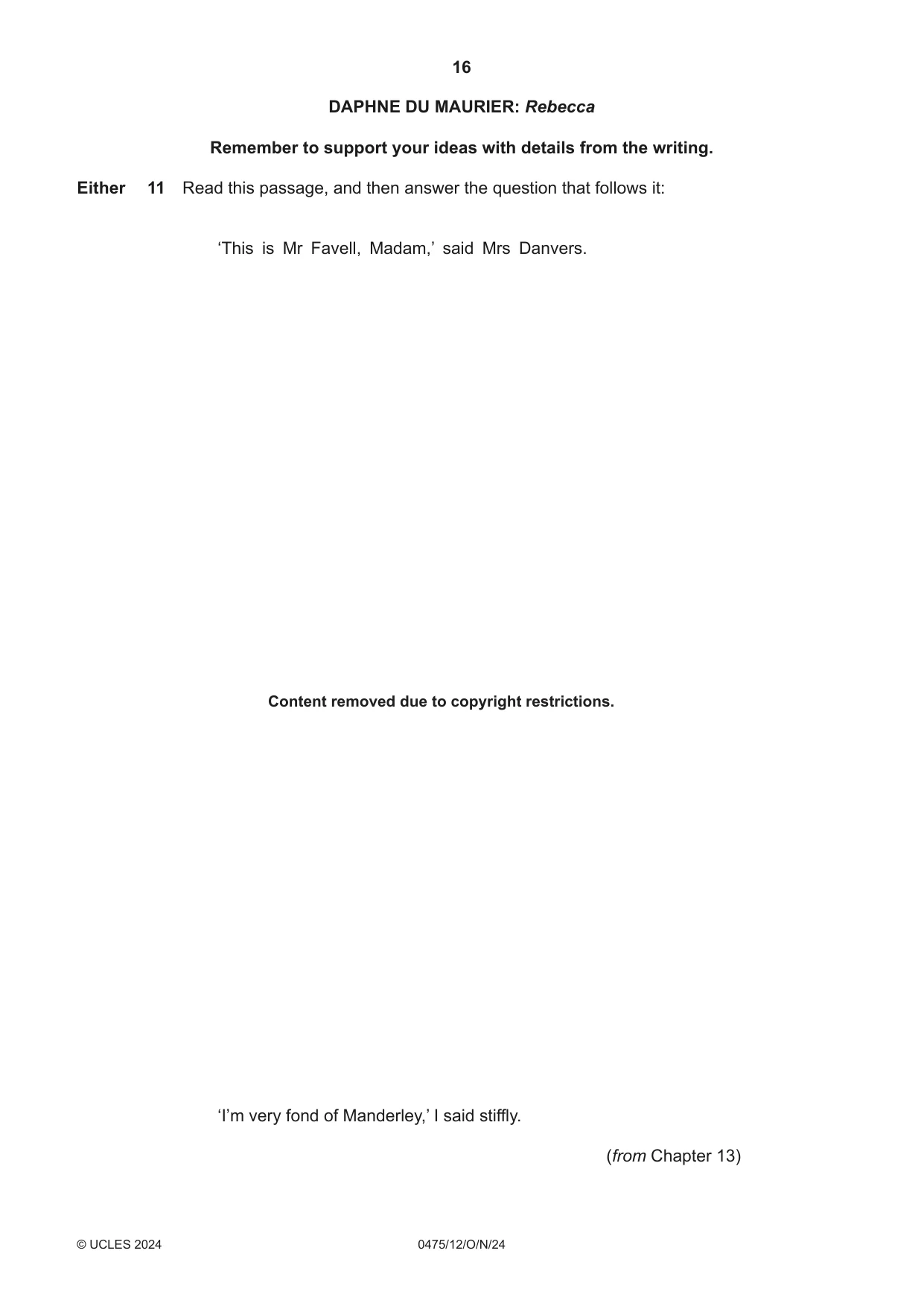
16 0475/12/O/N/24 © UCLES 2024 DAPHNE DU MAURIER: Rebecca Remember to support your ideas with details from the writing. Either 11 Read this passage, and then answer the question that follows it: ‘This is Mr Favell, Madam,’ said Mrs Danvers. ‘I’m very fond of Manderley,’ I said stiffly. (from Chapter 13) Content removed due to copyright restrictions.
Question paper, page 17
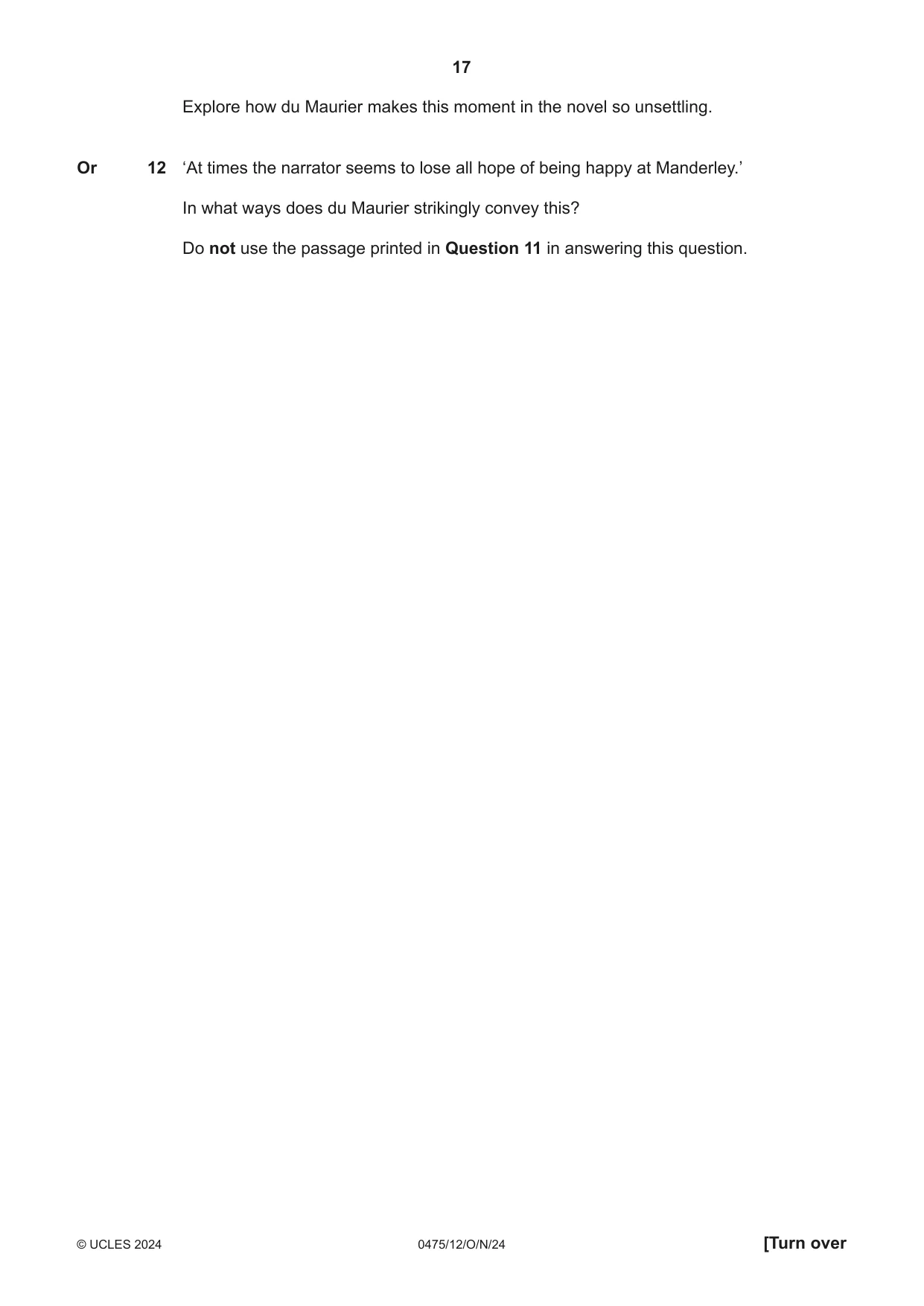
17 0475/12/O/N/24 © UCLES 2024 [Turn over Explore how du Maurier makes this moment in the novel so unsettling. Or 12 ‘At times the narrator seems to lose all hope of being happy at Manderley.’ In what ways does du Maurier strikingly convey this? Do not use the passage printed in Question 11 in answering this question.
Question paper, page 18
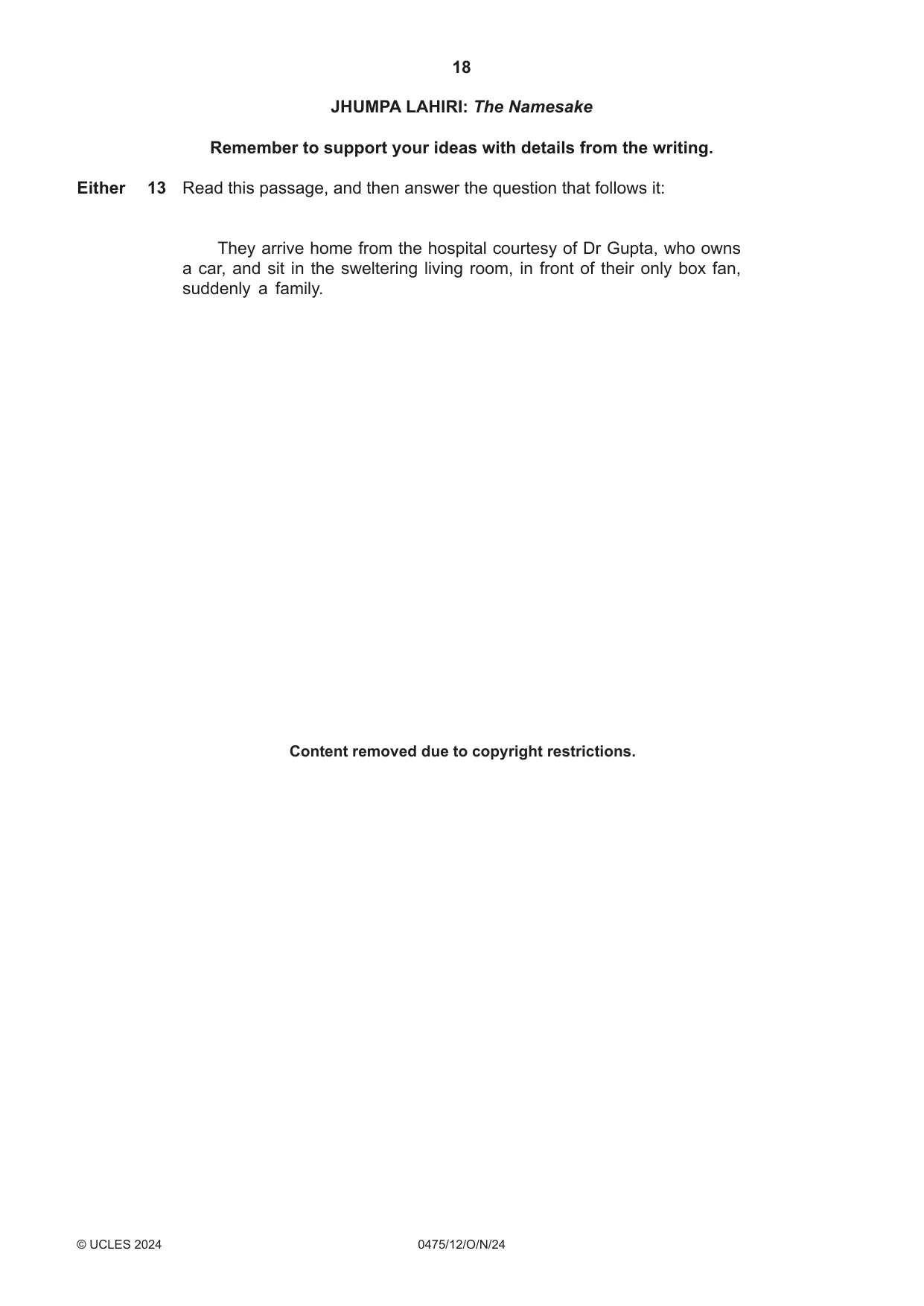
18 0475/12/O/N/24 © UCLES 2024 JHUMPA LAHIRI: The Namesake Remember to support your ideas with details from the writing. Either 13 Read this passage, and then answer the question that follows it: They arrive home from the hospital courtesy of Dr Gupta, who owns a car, and sit in the sweltering living room, in front of their only box fan, suddenly a family. Content removed due to copyright restrictions.
Question paper, page 19
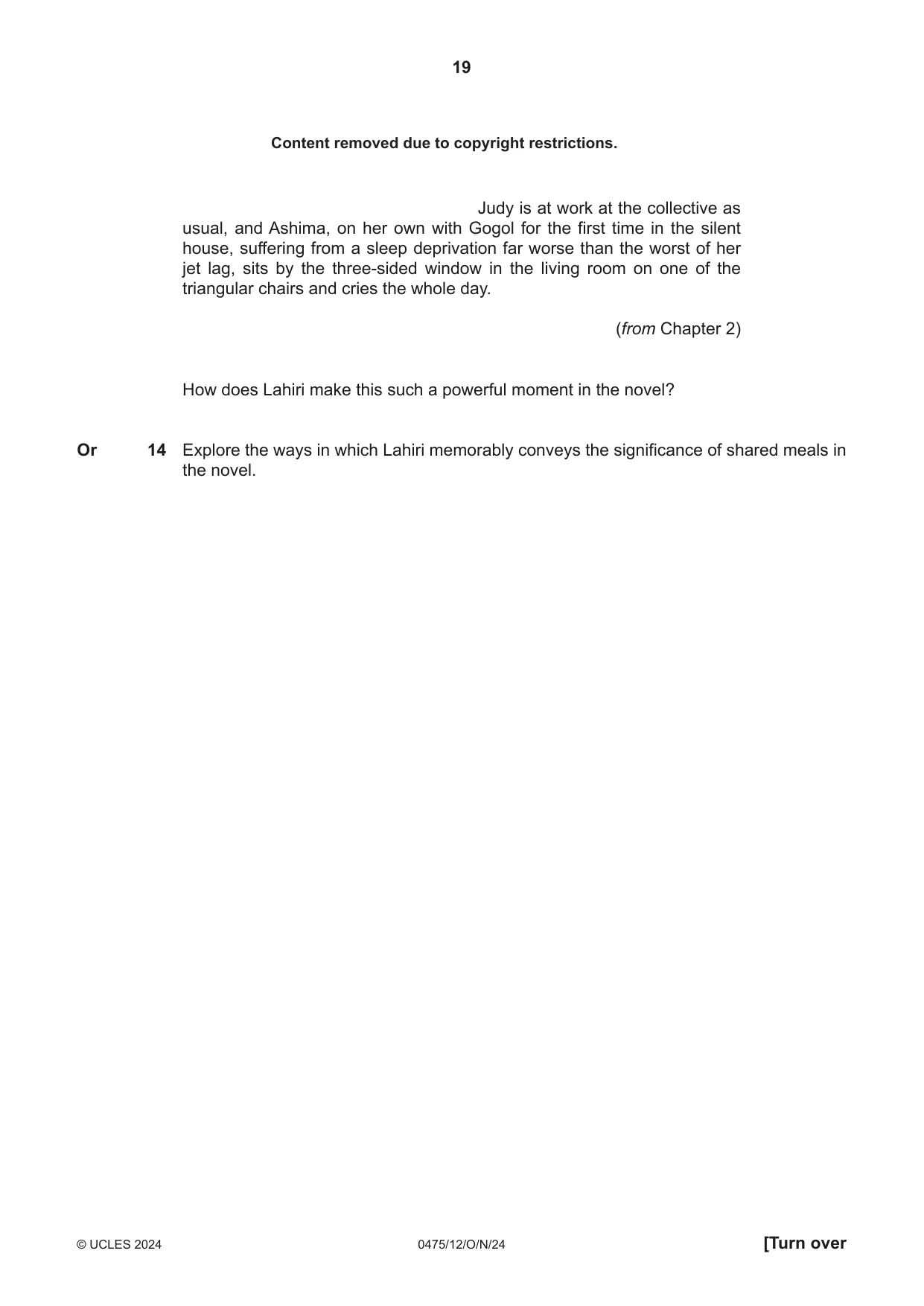
19 0475/12/O/N/24 © UCLES 2024 [Turn over Judy is at work at the collective as usual, and Ashima, on her own with Gogol for the first time in the silent house, suffering from a sleep deprivation far worse than the worst of her jet lag, sits by the three-sided window in the living room on one of the triangular chairs and cries the whole day. (from Chapter 2) How does Lahiri make this such a powerful moment in the novel? Or 14 Explore the ways in which Lahiri memorably conveys the significance of shared meals in the novel. Content removed due to copyright restrictions.
Question paper, page 20
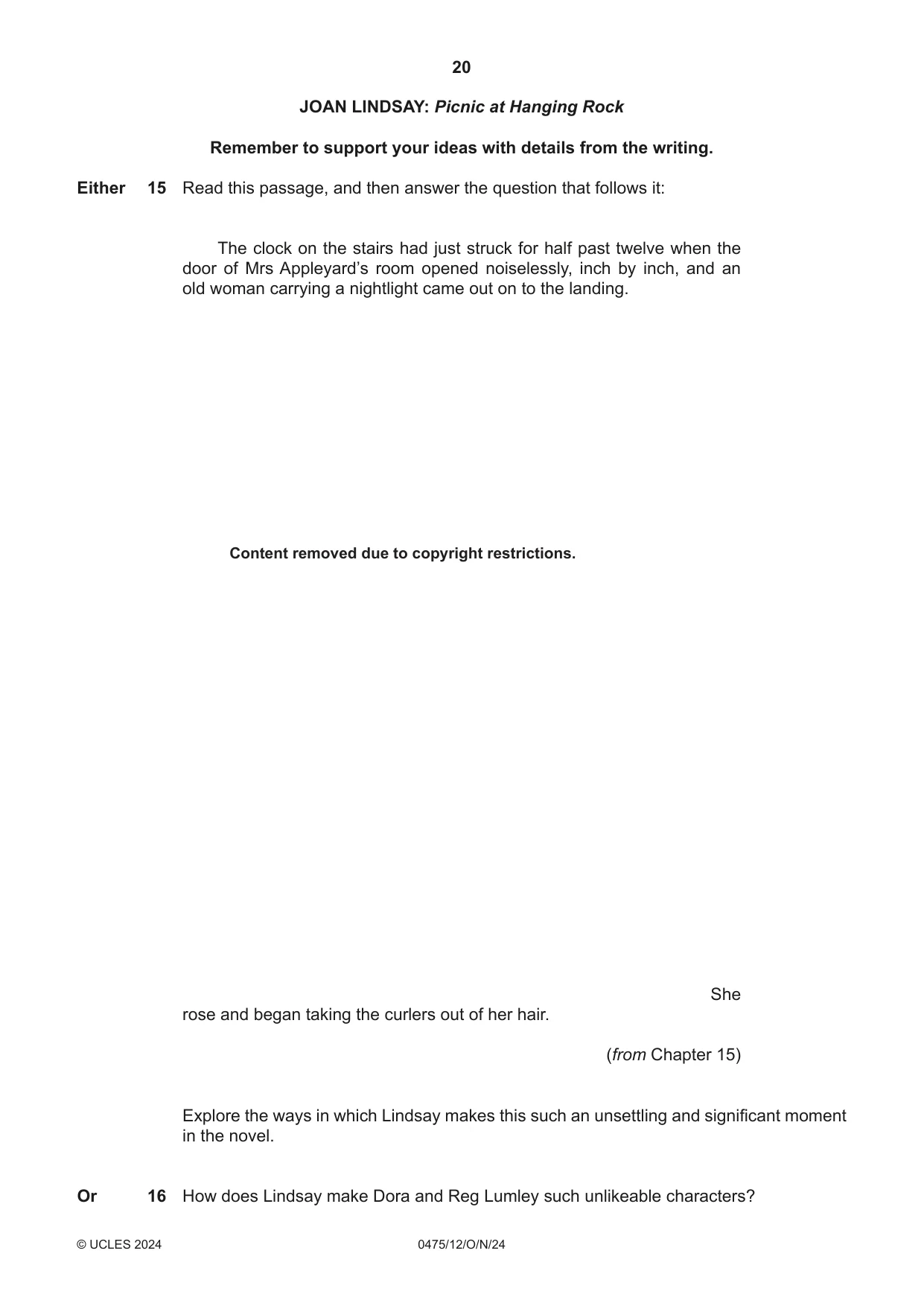
20 0475/12/O/N/24 © UCLES 2024 JOAN LINDSAY: Picnic at Hanging Rock Remember to support your ideas with details from the writing. Either 15 Read this passage, and then answer the question that follows it: The clock on the stairs had just struck for half past twelve when the door of Mrs Appleyard’s room opened noiselessly, inch by inch, and an old woman carrying a nightlight came out on to the landing. She rose and began taking the curlers out of her hair. (from Chapter 15) Explore the ways in which Lindsay makes this such an unsettling and significant moment in the novel. Or 16 How does Lindsay make Dora and Reg Lumley such unlikeable characters? Content removed due to copyright restrictions.
Question paper, page 21
21 0475/12/O/N/24 © UCLES 2024 [Turn over TURN OVER FOR QUESTION 17.
Question paper, page 22
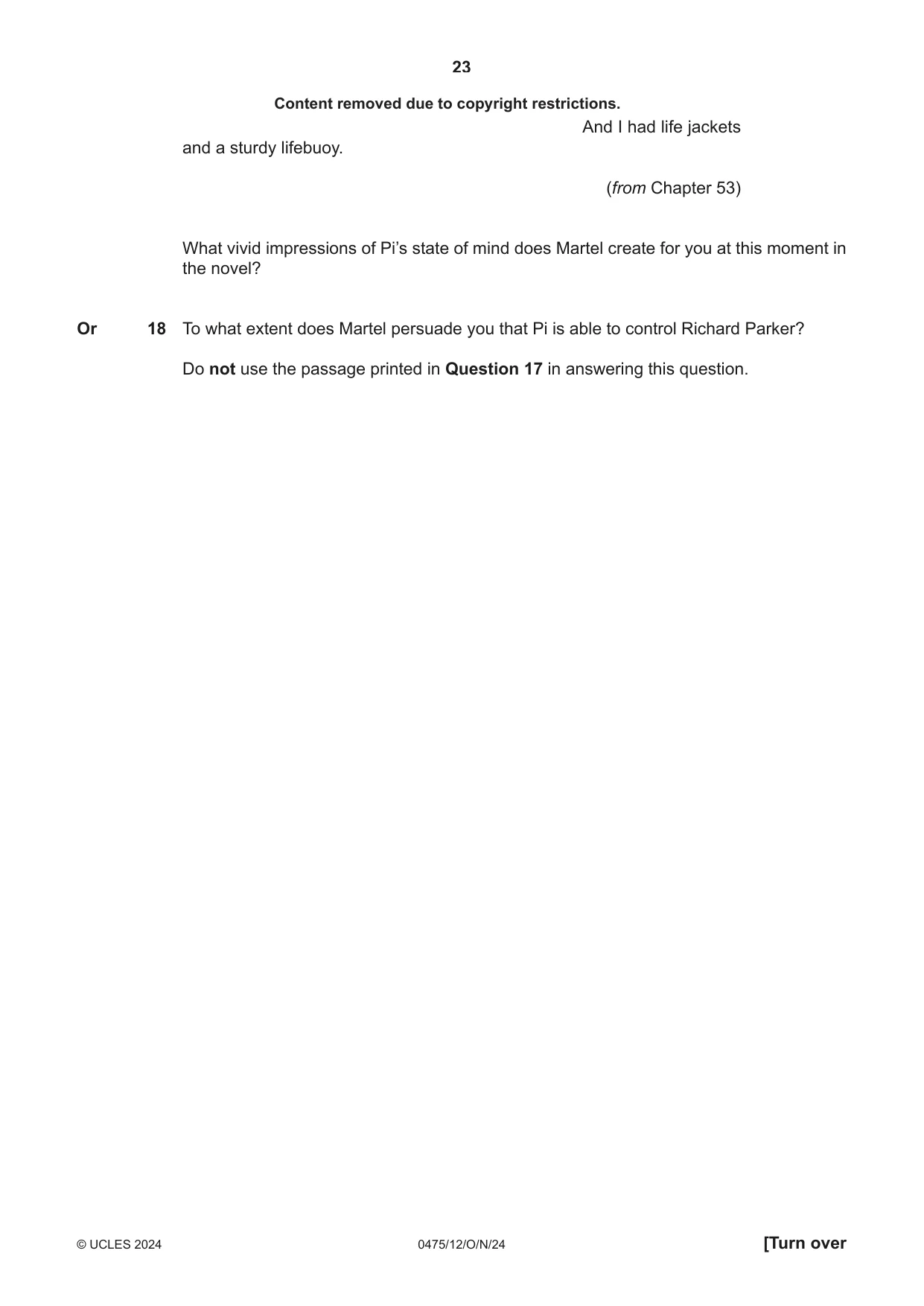
22 0475/12/O/N/24 © UCLES 2024 YANN MARTEL: Life of Pi Remember to support your ideas with details from the writing. Either 17 Read this passage, and then answer the question that follows it: I slept all morning. Content removed due to copyright restrictions.
Question paper, page 23
23 0475/12/O/N/24 © UCLES 2024 [Turn over And I had life jackets and a sturdy lifebuoy. (from Chapter 53) What vivid impressions of Pi’s state of mind does Martel create for you at this moment in the novel? Or 18 To what extent does Martel persuade you that Pi is able to control Richard Parker? Do not use the passage printed in Question 17 in answering this question. Content removed due to copyright restrictions.
Question paper, page 24
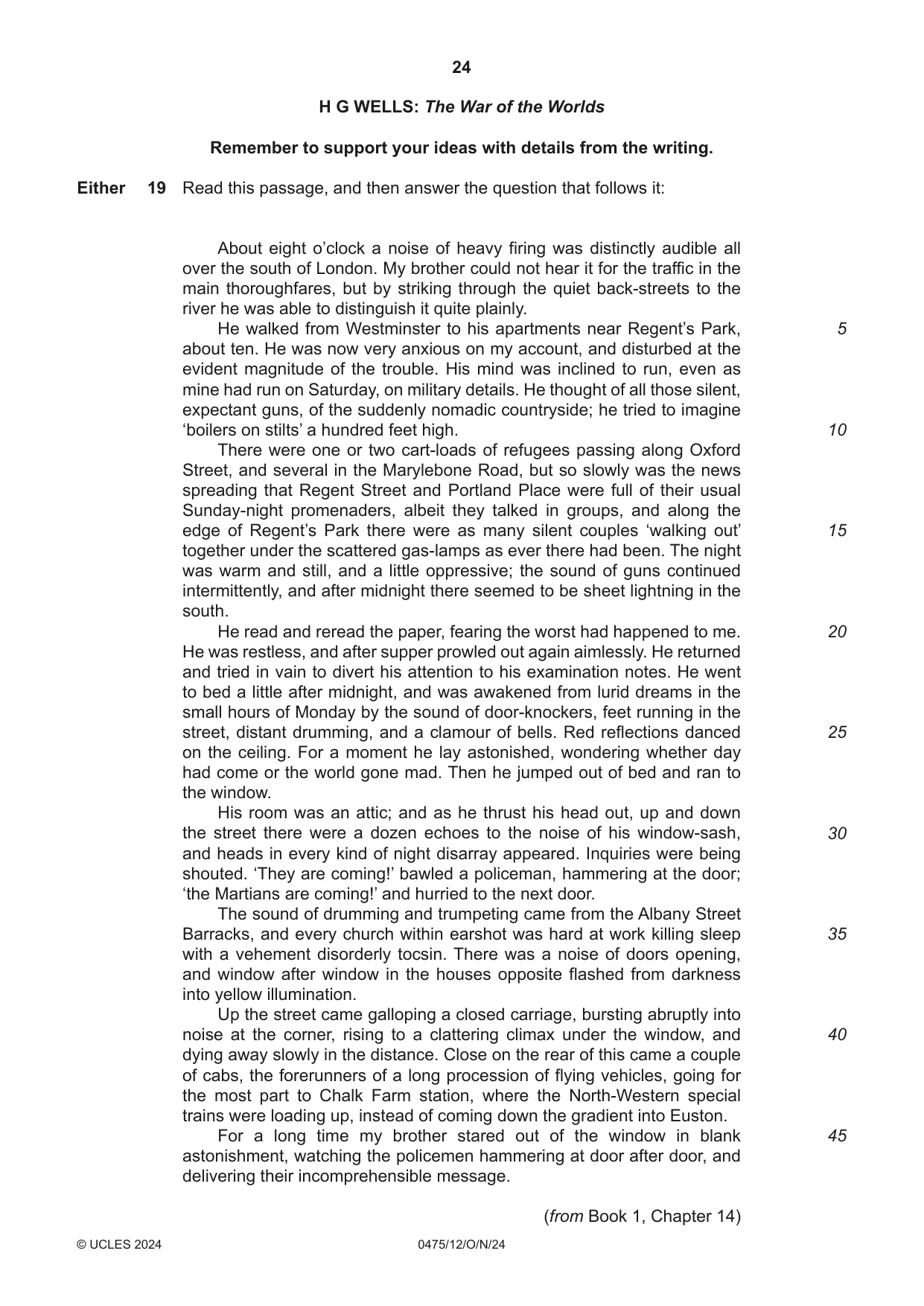
24 0475/12/O/N/24 © UCLES 2024 H G WELLS: The War of the Worlds Remember to support your ideas with details from the writing. Either 19 Read this passage, and then answer the question that follows it: About eight o’clock a noise of heavy firing was distinctly audible all over the south of London. My brother could not hear it for the traffic in the main thoroughfares, but by striking through the quiet back-streets to the river he was able to distinguish it quite plainly. He walked from Westminster to his apartments near Regent’s Park, about ten. He was now very anxious on my account, and disturbed at the evident magnitude of the trouble. His mind was inclined to run, even as mine had run on Saturday, on military details. He thought of all those silent, expectant guns, of the suddenly nomadic countryside; he tried to imagine ‘boilers on stilts’ a hundred feet high. There were one or two cart-loads of refugees passing along Oxford Street, and several in the Marylebone Road, but so slowly was the news spreading that Regent Street and Portland Place were full of their usual Sunday-night promenaders, albeit they talked in groups, and along the edge of Regent’s Park there were as many silent couples ‘walking out’ together under the scattered gas-lamps as ever there had been. The night was warm and still, and a little oppressive; the sound of guns continued intermittently, and after midnight there seemed to be sheet lightning in the south. He read and reread the paper, fearing the worst had happened to me. He was restless, and after supper prowled out again aimlessly. He returned and tried in vain to divert his attention to his examination notes. He went to bed a little after midnight, and was awakened from lurid dreams in the small hours of Monday by the sound of door-knockers, feet running in the street, distant drumming, and a clamour of bells. Red reflections danced on the ceiling. For a moment he lay astonished, wondering whether day had come or the world gone mad. Then he jumped out of bed and ran to the window. His room was an attic; and as he thrust his head out, up and down the street there were a dozen echoes to the noise of his window-sash, and heads in every kind of night disarray appeared. Inquiries were being shouted. ‘They are coming!’ bawled a policeman, hammering at the door; ‘the Martians are coming!’ and hurried to the next door. The sound of drumming and trumpeting came from the Albany Street Barracks, and every church within earshot was hard at work killing sleep with a vehement disorderly tocsin. There was a noise of doors opening, and window after window in the houses opposite flashed from darkness into yellow illumination. Up the street came galloping a closed carriage, bursting abruptly into noise at the corner, rising to a clattering climax under the window, and dying away slowly in the distance. Close on the rear of this came a couple of cabs, the forerunners of a long procession of flying vehicles, going for the most part to Chalk Farm station, where the North-Western special trains were loading up, instead of coming down the gradient into Euston. For a long time my brother stared out of the window in blank astonishment, watching the policemen hammering at door after door, and delivering their incomprehensible message. (from Book 1, Chapter 14) 5 10 15 20 25 30 35 40 45
Question paper, page 25
25 0475/12/O/N/24 © UCLES 2024 [Turn over How does Wells create striking impressions of London at this moment in the novel? Or 20 Explore the ways in which Wells memorably portrays the narrator.
Question paper, page 26
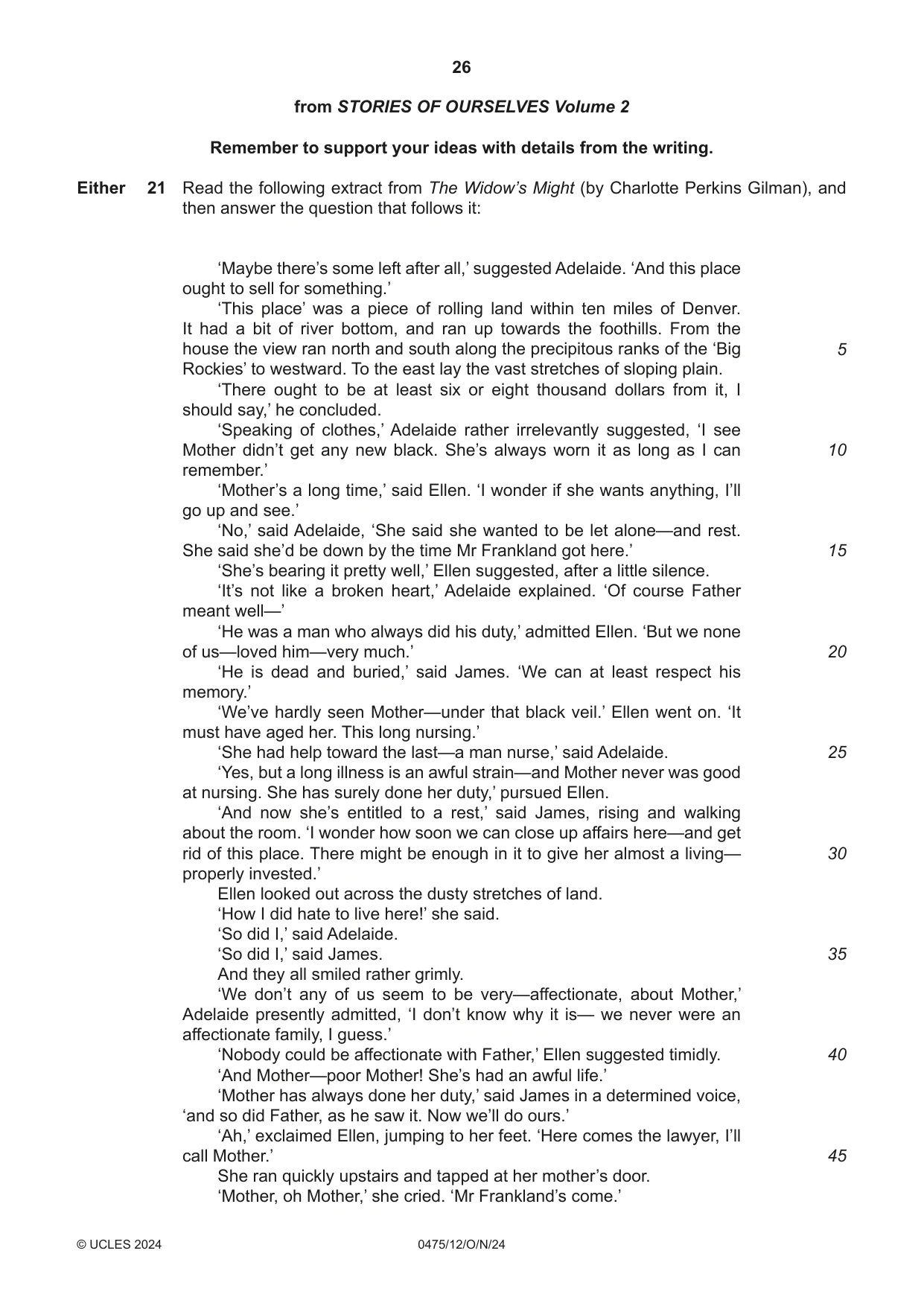
26 0475/12/O/N/24 © UCLES 2024 from STORIES OF OURSELVES Volume 2 Remember to support your ideas with details from the writing. Either 21 Read the following extract from The Widow’s Might (by Charlotte Perkins Gilman), and then answer the question that follows it: ‘Maybe there’s some left after all,’ suggested Adelaide. ‘And this place ought to sell for something.’ ‘This place’ was a piece of rolling land within ten miles of Denver. It had a bit of river bottom, and ran up towards the foothills. From the house the view ran north and south along the precipitous ranks of the ‘Big Rockies’ to westward. To the east lay the vast stretches of sloping plain. ‘There ought to be at least six or eight thousand dollars from it, I should say,’ he concluded. ‘Speaking of clothes,’ Adelaide rather irrelevantly suggested, ‘I see Mother didn’t get any new black. She’s always worn it as long as I can remember.’ ‘Mother’s a long time,’ said Ellen. ‘I wonder if she wants anything, I’ll go up and see.’ ‘No,’ said Adelaide, ‘She said she wanted to be let alone—and rest. She said she’d be down by the time Mr Frankland got here.’ ‘She’s bearing it pretty well,’ Ellen suggested, after a little silence. ‘It’s not like a broken heart,’ Adelaide explained. ‘Of course Father meant well—’ ‘He was a man who always did his duty,’ admitted Ellen. ‘But we none of us—loved him—very much.’ ‘He is dead and buried,’ said James. ‘We can at least respect his memory.’ ‘We’ve hardly seen Mother—under that black veil.’ Ellen went on. ‘It must have aged her. This long nursing.’ ‘She had help toward the last—a man nurse,’ said Adelaide. ‘Yes, but a long illness is an awful strain—and Mother never was good at nursing. She has surely done her duty,’ pursued Ellen. ‘And now she’s entitled to a rest,’ said James, rising and walking about the room. ‘I wonder how soon we can close up affairs here—and get rid of this place. There might be enough in it to give her almost a living— properly invested.’ Ellen looked out across the dusty stretches of land. ‘How I did hate to live here!’ she said. ‘So did I,’ said Adelaide. ‘So did I,’ said James. And they all smiled rather grimly. ‘We don’t any of us seem to be very—affectionate, about Mother,’ Adelaide presently admitted, ‘I don’t know why it is— we never were an affectionate family, I guess.’ ‘Nobody could be affectionate with Father,’ Ellen suggested timidly. ‘And Mother—poor Mother! She’s had an awful life.’ ‘Mother has always done her duty,’ said James in a determined voice, ‘and so did Father, as he saw it. Now we’ll do ours.’ ‘Ah,’ exclaimed Ellen, jumping to her feet. ‘Here comes the lawyer, I’ll call Mother.’ She ran quickly upstairs and tapped at her mother’s door. ‘Mother, oh Mother,’ she cried. ‘Mr Frankland’s come.’ 5 10 15 20 25 30 35 40 45
Question paper, page 27
27 0475/12/O/N/24 © UCLES 2024 ‘I know it,’ came back a voice from within. ‘Tell him to go ahead and read the will. I know what’s in it. I’ll be down in a few minutes.’ Ellen went slowly back downstairs with the fine criss-cross of wrinkles showing on her pale forehead again, and delivered her mother’s message. How does Gilman make this such a revealing and significant moment in the story? Or 22 Explore the ways in which Hughes vividly portrays the boy thief (Roger) in Thank You M’am. 50
Question paper, page 28
28 0475/12/O/N/24 © UCLES 2024 Permission to reproduce items where third-party owned material protected by copyright is included has been sought and cleared where possible. Every reasonable effort has been made by the publisher (UCLES) to trace copyright holders, but if any items requiring clearance have unwittingly been included, the publisher will be pleased to make amends at the earliest possible opportunity. To avoid the issue of disclosure of answer-related information to candidates, all copyright acknowledgements are reproduced online in the Cambridge Assessment International Education Copyright Acknowledgements Booklet. This is produced for each series of examinations and is freely available to download at www.cambridgeinternational.org after the live examination series. Cambridge Assessment International Education is part of Cambridge Assessment. Cambridge Assessment is the brand name of the University of Cambridge Local Examinations Syndicate (UCLES), which is a department of the University of Cambridge. BLANK PAGE
Mark scheme, page 1
This document consists of 4 printed pages. © Cambridge University Press & Assessment 2024 [Turn over Cambridge IGCSE™ LITERATURE IN ENGLISH 0475/12 Paper 1 Poetry and Prose October/November 2024 MARK SCHEME Maximum Mark: 50 Published This mark scheme is published as an aid to teachers and candidates, to indicate the requirements of the examination. It shows the basis on which Examiners were instructed to award marks. It does not indicate the details of the discussions that took place at an Examiners’ meeting before marking began, which would have considered the acceptability of alternative answers. Mark schemes should be read in conjunction with the question paper and the Principal Examiner Report for Teachers. Cambridge International will not enter into discussions about these mark schemes. Cambridge International is publishing the mark schemes for the October/November 2024 series for most Cambridge IGCSE, Cambridge International A and AS Level components, and some Cambridge O Level components.
Mark scheme, page 2
0475/12 Cambridge IGCSE – Mark Scheme PUBLISHED October/November 2024 © Cambridge University Press & Assessment 2024 Page 2 of 4 Generic Marking Principles These general marking principles must be applied by all examiners when marking candidate answers. They should be applied alongside the specific content of the mark scheme or generic level descriptions for a question. Each question paper and mark scheme will also comply with these marking principles. GENERIC MARKING PRINCIPLE 1: Marks must be awarded in line with: • the specific content of the mark scheme or the generic level descriptors for the question • the specific skills defined in the mark scheme or in the generic level descriptors for the question • the standard of response required by a candidate as exemplified by the standardisation scripts. GENERIC MARKING PRINCIPLE 2: Marks awarded are always whole marks (not half marks, or other fractions). GENERIC MARKING PRINCIPLE 3: Marks must be awarded positively: • marks are awarded for correct/valid answers, as defined in the mark scheme. However, credit is given for valid answers which go beyond the scope of the syllabus and mark scheme, referring to your Team Leader as appropriate • marks are awarded when candidates clearly demonstrate what they know and can do • marks are not deducted for errors • marks are not deducted for omissions • answers should only be judged on the quality of spelling, punctuation and grammar when these features are specifically assessed by the question as indicated by the mark scheme. The meaning, however, should be unambiguous. GENERIC MARKING PRINCIPLE 4: Rules must be applied consistently, e.g. in situations where candidates have not followed instructions or in the application of generic level descriptors. GENERIC MARKING PRINCIPLE 5: Marks should be awarded using the full range of marks defined in the mark scheme for the question (however; the use of the full mark range may be limited according to the quality of the candidate responses seen). GENERIC MARKING PRINCIPLE 6: Marks awarded are based solely on the requirements as defined in the mark scheme. Marks should not be awarded with grade thresholds or grade descriptors in mind.
Mark scheme, page 3
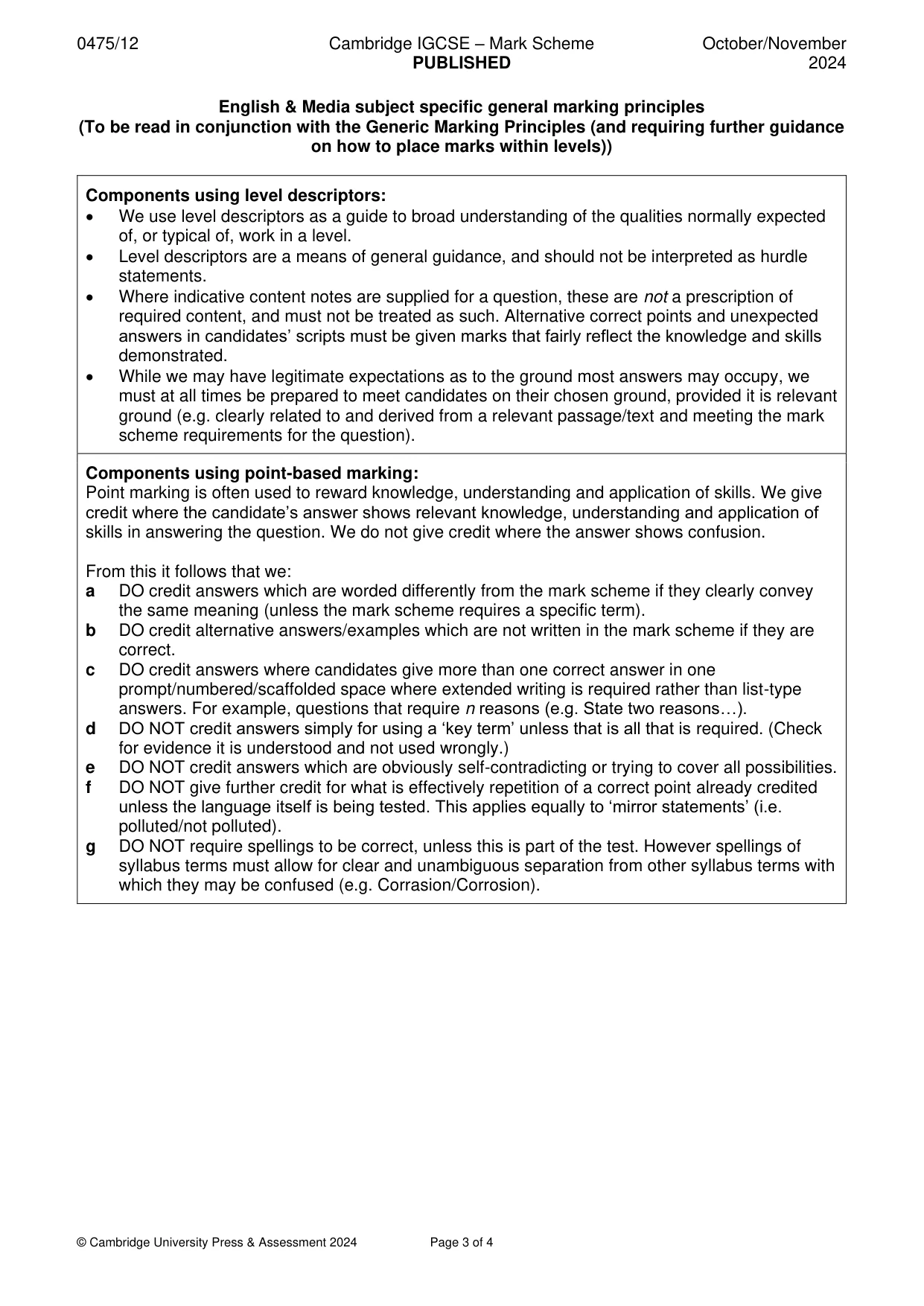
0475/12 Cambridge IGCSE – Mark Scheme PUBLISHED October/November 2024 © Cambridge University Press & Assessment 2024 Page 3 of 4 English & Media subject specific general marking principles (To be read in conjunction with the Generic Marking Principles (and requiring further guidance on how to place marks within levels)) Components using level descriptors: • We use level descriptors as a guide to broad understanding of the qualities normally expected of, or typical of, work in a level. • Level descriptors are a means of general guidance, and should not be interpreted as hurdle statements. • Where indicative content notes are supplied for a question, these are not a prescription of required content, and must not be treated as such. Alternative correct points and unexpected answers in candidates’ scripts must be given marks that fairly reflect the knowledge and skills demonstrated. • While we may have legitimate expectations as to the ground most answers may occupy, we must at all times be prepared to meet candidates on their chosen ground, provided it is relevant ground (e.g. clearly related to and derived from a relevant passage/text and meeting the mark scheme requirements for the question). Components using point-based marking: Point marking is often used to reward knowledge, understanding and application of skills. We give credit where the candidate’s answer shows relevant knowledge, understanding and application of skills in answering the question. We do not give credit where the answer shows confusion. From this it follows that we: a DO credit answers which are worded differently from the mark scheme if they clearly convey the same meaning (unless the mark scheme requires a specific term). b DO credit alternative answers/examples which are not written in the mark scheme if they are correct. c DO credit answers where candidates give more than one correct answer in one prompt/numbered/scaffolded space where extended writing is required rather than list-type answers. For example, questions that require n reasons (e.g. State two reasons…). d DO NOT credit answers simply for using a ‘key term’ unless that is all that is required. (Check for evidence it is understood and not used wrongly.) e DO NOT credit answers which are obviously self-contradicting or trying to cover all possibilities. f DO NOT give further credit for what is effectively repetition of a correct point already credited unless the language itself is being tested. This applies equally to ‘mirror statements’ (i.e. polluted/not polluted). g DO NOT require spellings to be correct, unless this is part of the test. However spellings of syllabus terms must allow for clear and unambiguous separation from other syllabus terms with which they may be confused (e.g. Corrasion/Corrosion).
Mark scheme, page 4
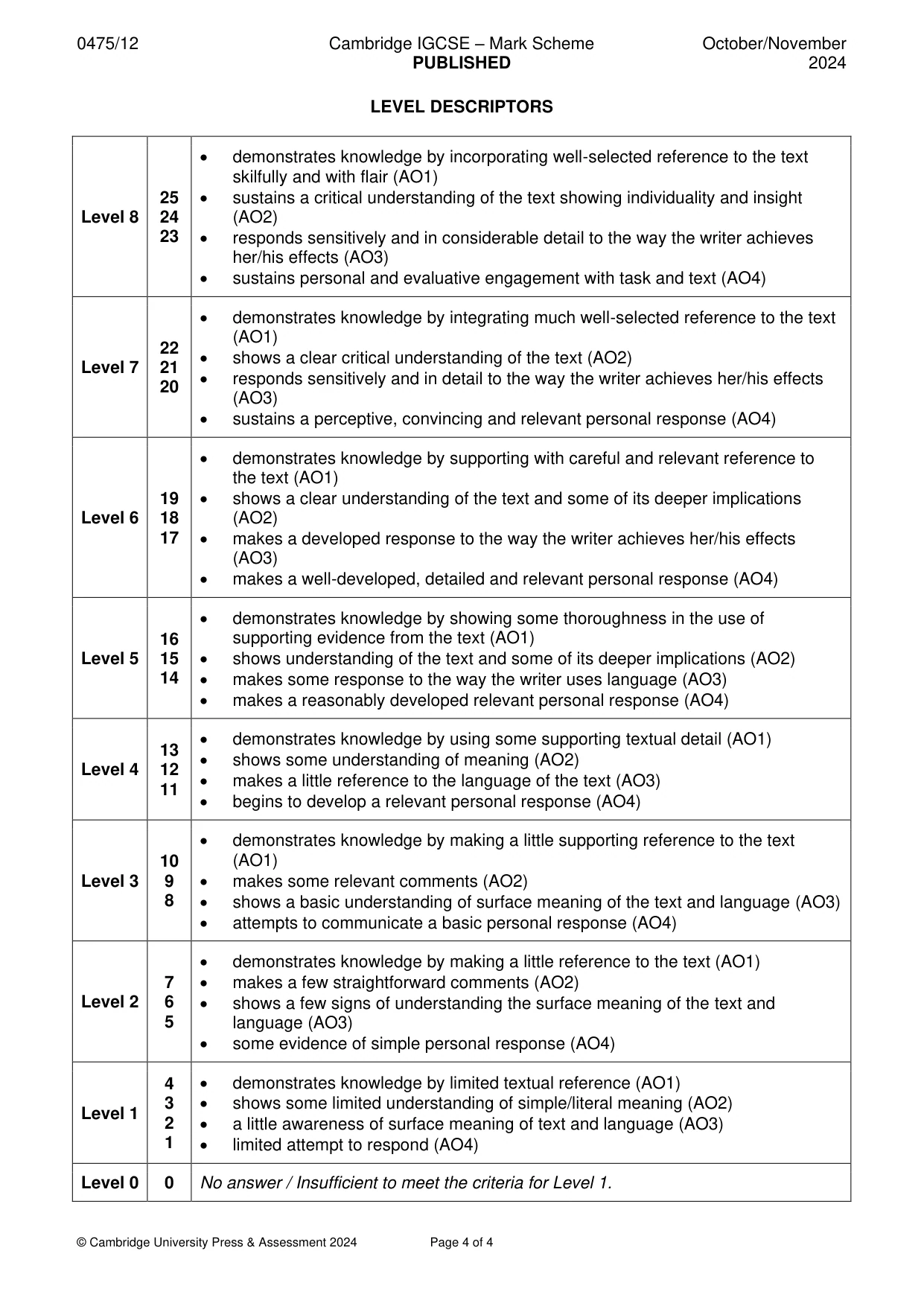
0475/12 Cambridge IGCSE – Mark Scheme PUBLISHED October/November 2024 © Cambridge University Press & Assessment 2024 Page 4 of 4 LEVEL DESCRIPTORS Level 8 25 24 23 • demonstrates knowledge by incorporating well-selected reference to the text skilfully and with flair (AO1) • sustains a critical understanding of the text showing individuality and insight (AO2) • responds sensitively and in considerable detail to the way the writer achieves her/his effects (AO3) • sustains personal and evaluative engagement with task and text (AO4) Level 7 22 21 20 • demonstrates knowledge by integrating much well-selected reference to the text (AO1) • shows a clear critical understanding of the text (AO2) • responds sensitively and in detail to the way the writer achieves her/his effects (AO3) • sustains a perceptive, convincing and relevant personal response (AO4) Level 6 19 18 17 • demonstrates knowledge by supporting with careful and relevant reference to the text (AO1) • shows a clear understanding of the text and some of its deeper implications (AO2) • makes a developed response to the way the writer achieves her/his effects (AO3) • makes a well-developed, detailed and relevant personal response (AO4) Level 5 16 15 14 • demonstrates knowledge by showing some thoroughness in the use of supporting evidence from the text (AO1) • shows understanding of the text and some of its deeper implications (AO2) • makes some response to the way the writer uses language (AO3) • makes a reasonably developed relevant personal response (AO4) Level 4 13 12 11 • demonstrates knowledge by using some supporting textual detail (AO1) • shows some understanding of meaning (AO2) • makes a little reference to the language of the text (AO3) • begins to develop a relevant personal response (AO4) Level 3 10 9 8 • demonstrates knowledge by making a little supporting reference to the text (AO1) • makes some relevant comments (AO2) • shows a basic understanding of surface meaning of the text and language (AO3) • attempts to communicate a basic personal response (AO4) Level 2 7 6 5 • demonstrates knowledge by making a little reference to the text (AO1) • makes a few straightforward comments (AO2) • shows a few signs of understanding the surface meaning of the text and language (AO3) • some evidence of simple personal response (AO4) Level 1 4 3 2 1 • demonstrates knowledge by limited textual reference (AO1) • shows some limited understanding of simple/literal meaning (AO2) • a little awareness of surface meaning of text and language (AO3) • limited attempt to respond (AO4) Level 0 0 No answer / Insufficient to meet the criteria for Level 1.
What you needed in this session
Cambridge’s own grade thresholds for 2024 Oct/Nov, Paper 1 · Variant 2. A higher threshold means an easier paper — the bar moves with how the cohort did.