Cambridge IGCSE English - Literature in English 0475 — 2024 May/June Paper 1 · Variant 3
0475/13/M/J/24 · 50 marks · ≈56 min
The question paper and its mark scheme, free to read here and free to download. This is Cambridge’s own paper, exactly as it was sat.
Question paper28 pages




Mark scheme5 pages
Answers below. Sit the paper first if you are practising.
Paper as text
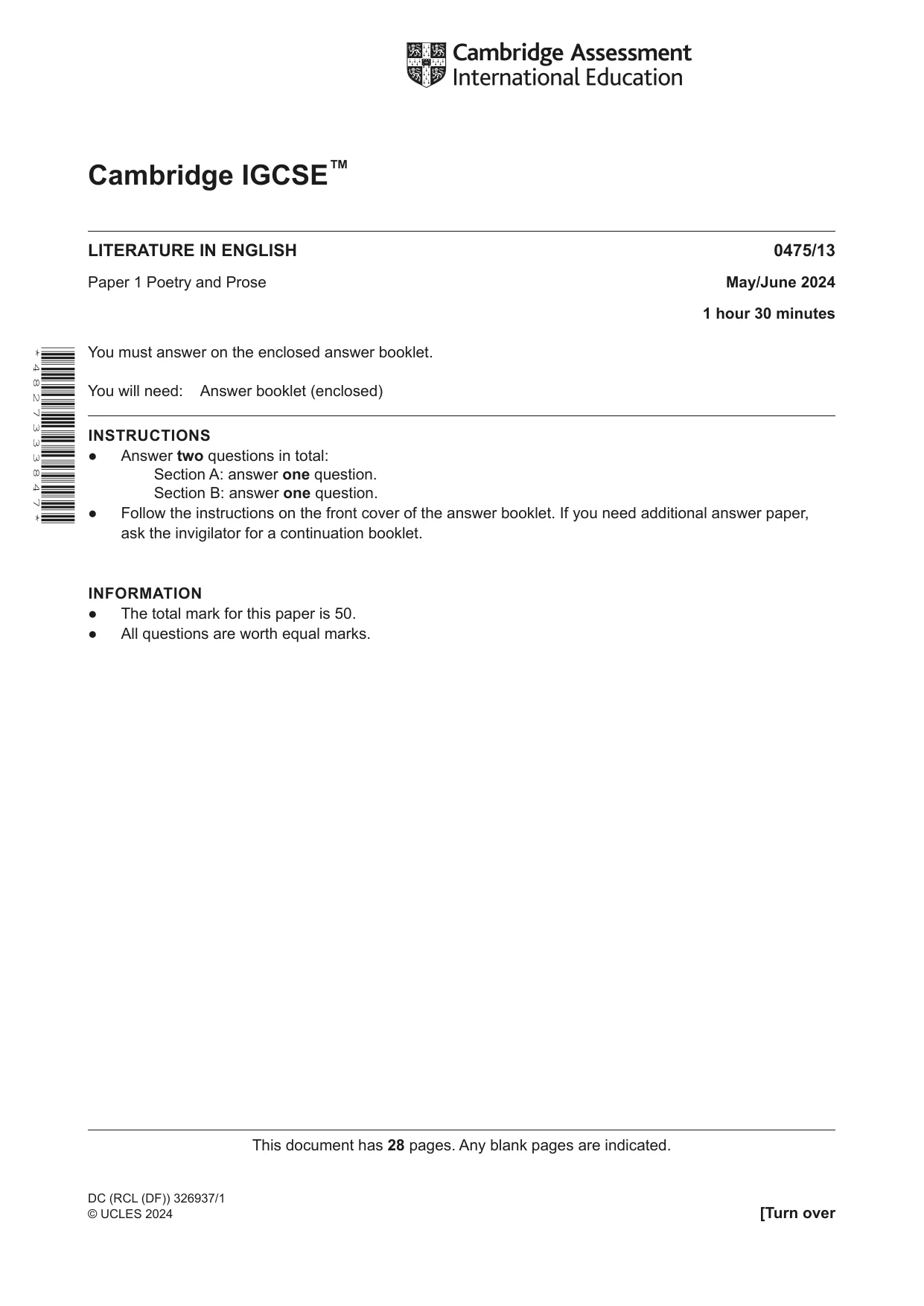
Question paper, page 1
This document has 28 pages. Any blank pages are indicated. [Turn over Cambridge IGCSE™ DC (RCL (DF)) 326937/1 © UCLES 2024 * 4 8 2 7 3 3 3 8 4 7 * LITERATURE IN ENGLISH 0475/13 Paper 1 Poetry and Prose May/June 2024 1 hour 30 minutes You must answer on the enclosed answer booklet. You will need: Answer booklet (enclosed) INSTRUCTIONS ● Answer two questions in total: Section A: answer one question. Section B: answer one question. ● Follow the instructions on the front cover of the answer booklet. If you need additional answer paper, ask the invigilator for a continuation booklet. INFORMATION ● The total mark for this paper is 50. ● All questions are worth equal marks.
Question paper, page 2
2 0475/13/M/J/24 © UCLES 2024 BLANK PAGE
Question paper, page 3
3 0475/13/M/J/24 © UCLES 2024 [Turn over CONTENTS Section A: Poetry text question numbers page[s] Songs of Ourselves Volume 1: from Part 4 1, 2 pages 4–5 Songs of Ourselves Volume 2 : from Part 4 3, 4 pages 6–7 Ted Hughes: from New Selected Poems 5, 6 pages 8–9 Section B: Prose text question numbers page[s] Chimamanda Ngozi Adichie: Purple Hibiscus 7, 8 pages 10–11 Charles Dickens: Great Expectations 9, 10 pages 12–13 Daphne du Maurier: Rebecca 11, 12 pages 14–15 Jhumpa Lahiri: The Namesake 13, 14 pages 16–17 Joan Lindsay: Picnic at Hanging Rock 15, 16 pages 18–19 Yann Martel: Life of Pi 17, 18 pages 20–21 H G Wells: The War of the Worlds 19, 20 pages 22–23 from Stories of Ourselves Volume 2 21, 22 pages 24–25
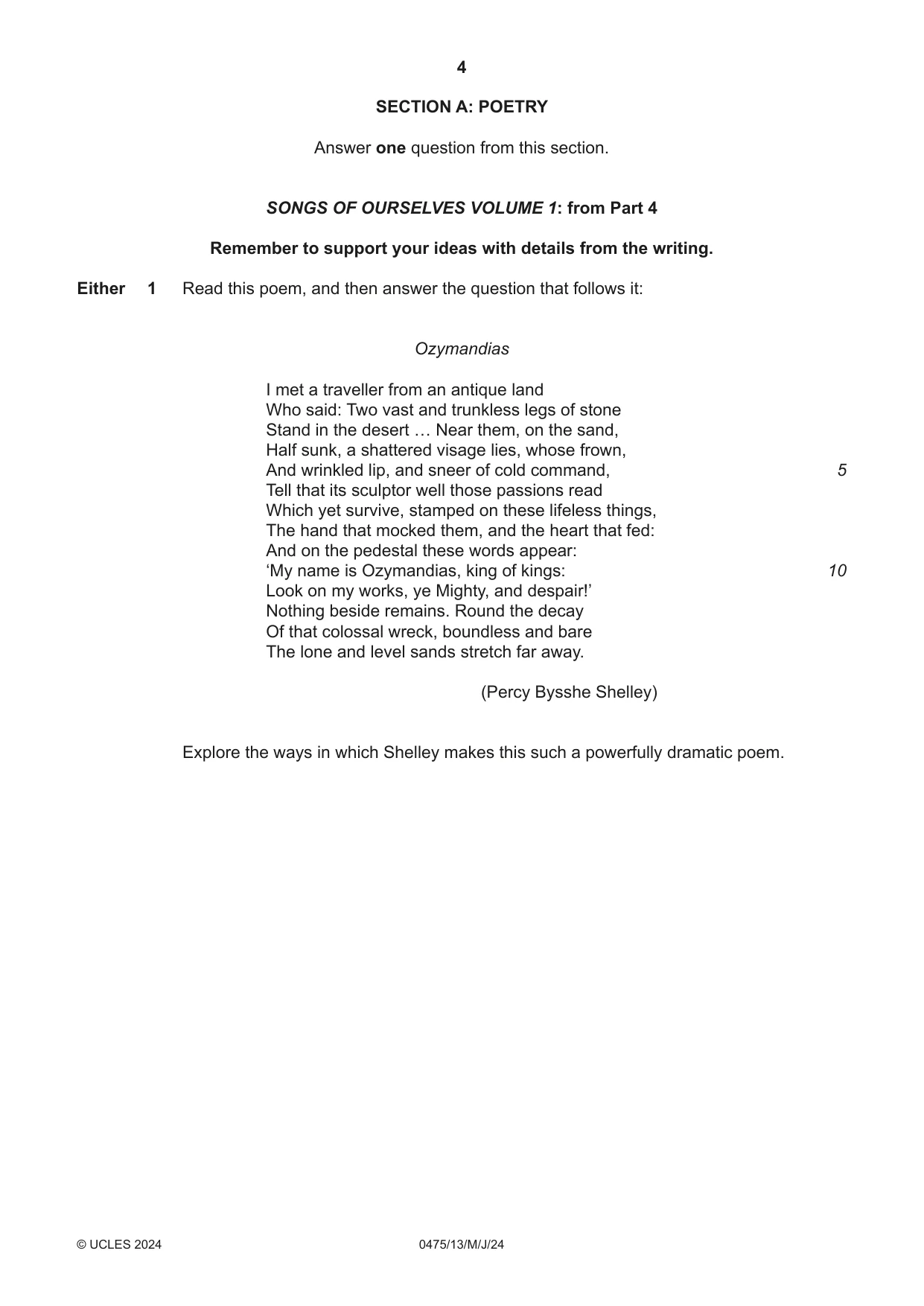
Question paper, page 4
4 0475/13/M/J/24 © UCLES 2024 SECTION A: POETRY Answer one question from this section. SONGS OF OURSELVES VOLUME 1: from Part 4 Remember to support your ideas with details from the writing. Either 1 Read this poem, and then answer the question that follows it: Ozymandias I met a traveller from an antique land Who said: Two vast and trunkless legs of stone Stand in the desert … Near them, on the sand, Half sunk, a shattered visage lies, whose frown, And wrinkled lip, and sneer of cold command, Tell that its sculptor well those passions read Which yet survive, stamped on these lifeless things, The hand that mocked them, and the heart that fed: And on the pedestal these words appear: ‘My name is Ozymandias, king of kings: Look on my works, ye Mighty, and despair!’ Nothing beside remains. Round the decay Of that colossal wreck, boundless and bare The lone and level sands stretch far away. (Percy Bysshe Shelley) Explore the ways in which Shelley makes this such a powerfully dramatic poem. 5 10
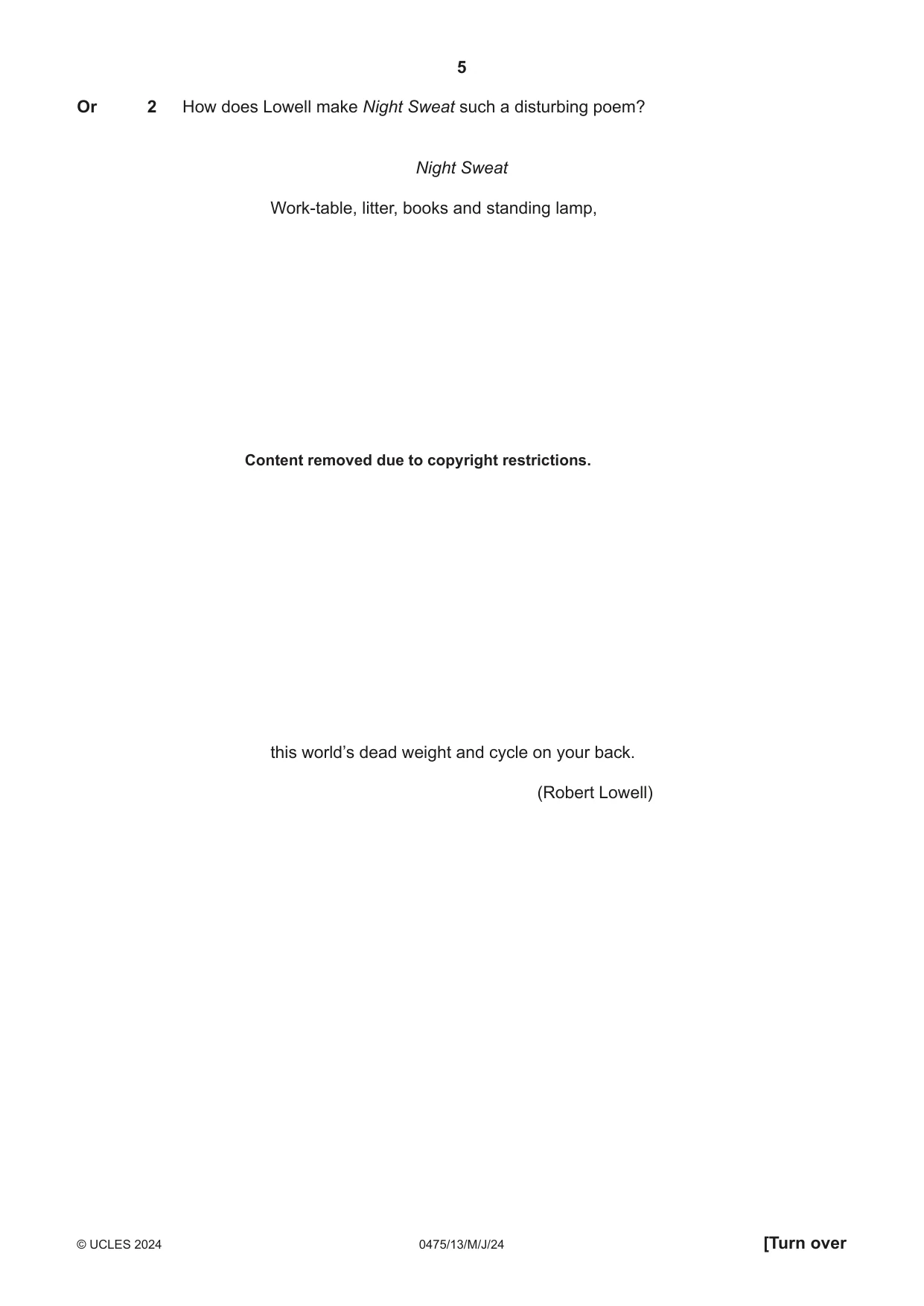
Question paper, page 5
5 0475/13/M/J/24 © UCLES 2024 [Turn over Or 2 How does Lowell make Night Sweat such a disturbing poem? Night Sweat Work-table, litter, books and standing lamp, this world’s dead weight and cycle on your back. (Robert Lowell) Content removed due to copyright restrictions.
Question paper, page 6
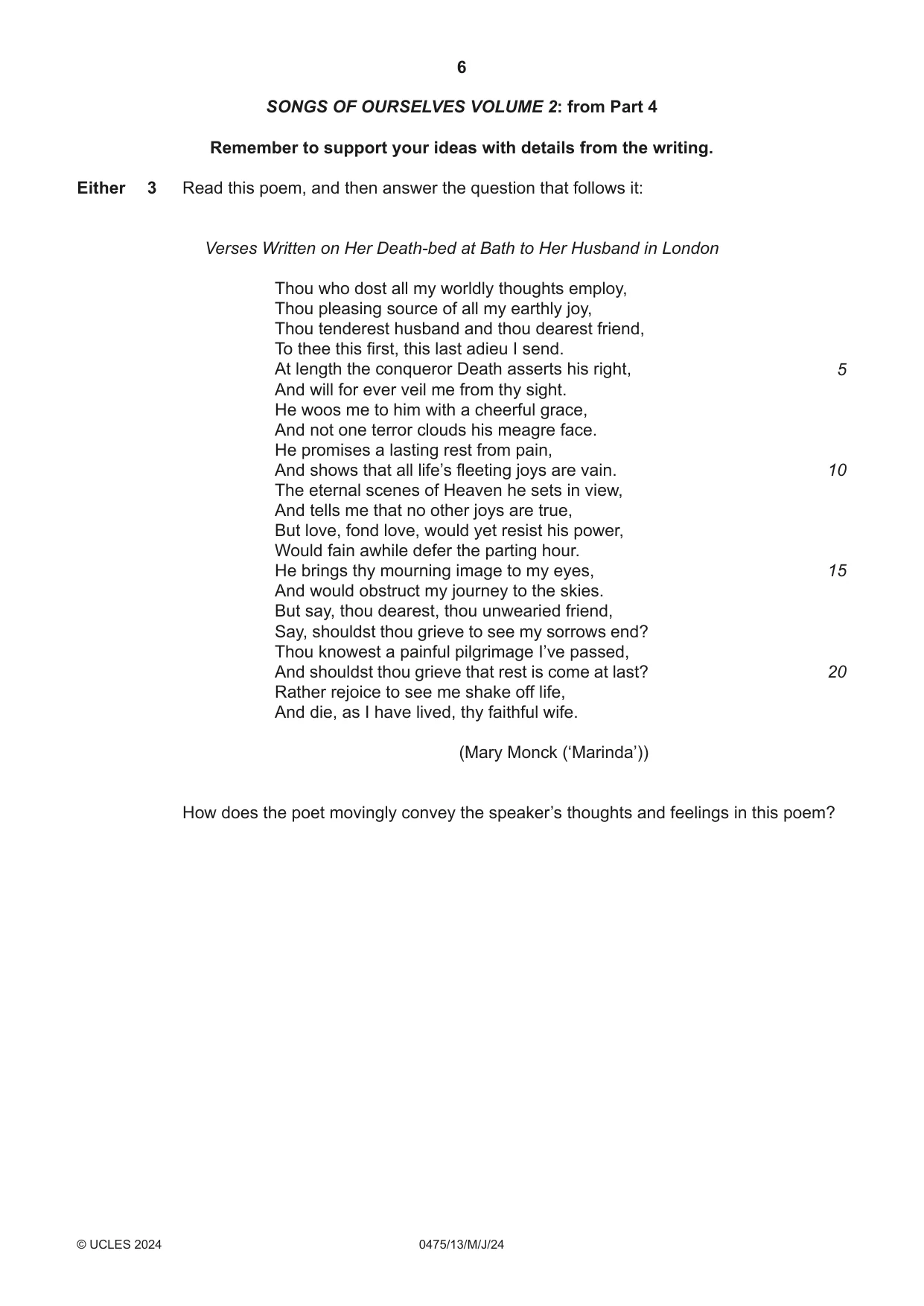
6 0475/13/M/J/24 © UCLES 2024 SONGS OF OURSELVES VOLUME 2: from Part 4 Remember to support your ideas with details from the writing. Either 3 Read this poem, and then answer the question that follows it: Verses Written on Her Death-bed at Bath to Her Husband in London Thou who dost all my worldly thoughts employ, Thou pleasing source of all my earthly joy, Thou tenderest husband and thou dearest friend, To thee this first, this last adieu I send. At length the conqueror Death asserts his right, And will for ever veil me from thy sight. He woos me to him with a cheerful grace, And not one terror clouds his meagre face. He promises a lasting rest from pain, And shows that all life’s fleeting joys are vain. The eternal scenes of Heaven he sets in view, And tells me that no other joys are true, But love, fond love, would yet resist his power, Would fain awhile defer the parting hour. He brings thy mourning image to my eyes, And would obstruct my journey to the skies. But say, thou dearest, thou unwearied friend, Say, shouldst thou grieve to see my sorrows end? Thou knowest a painful pilgrimage I’ve passed, And shouldst thou grieve that rest is come at last? Rather rejoice to see me shake off life, And die, as I have lived, thy faithful wife. (Mary Monck (‘Marinda’)) How does the poet movingly convey the speaker’s thoughts and feelings in this poem? 5 10 15 20
Question paper, page 7
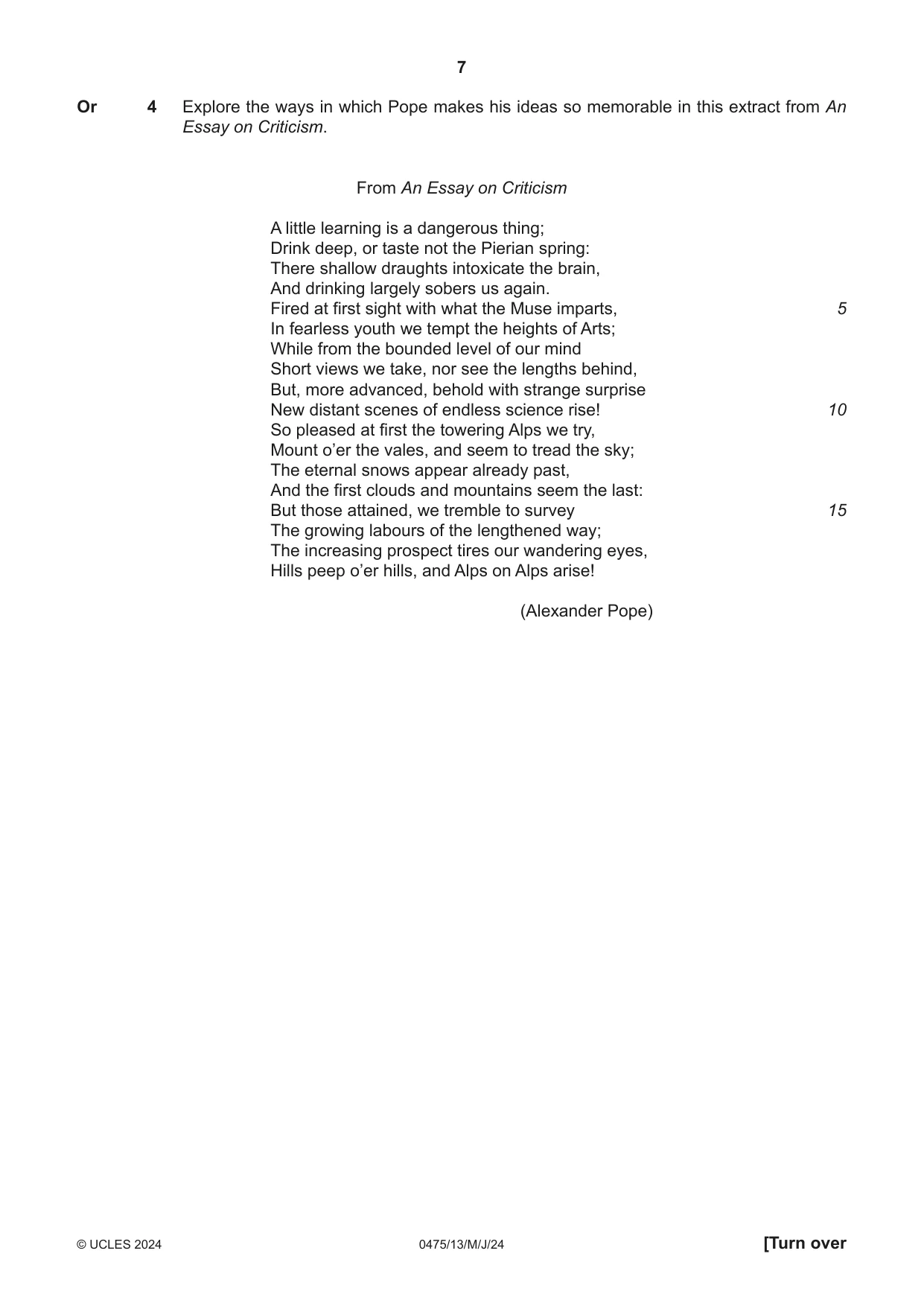
7 0475/13/M/J/24 © UCLES 2024 [Turn over Or 4 Explore the ways in which Pope makes his ideas so memorable in this extract from An Essay on Criticism. From An Essay on Criticism A little learning is a dangerous thing; Drink deep, or taste not the Pierian spring: There shallow draughts intoxicate the brain, And drinking largely sobers us again. Fired at first sight with what the Muse imparts, In fearless youth we tempt the heights of Arts; While from the bounded level of our mind Short views we take, nor see the lengths behind, But, more advanced, behold with strange surprise New distant scenes of endless science rise! So pleased at first the towering Alps we try, Mount o’er the vales, and seem to tread the sky; The eternal snows appear already past, And the first clouds and mountains seem the last: But those attained, we tremble to survey The growing labours of the lengthened way; The increasing prospect tires our wandering eyes, Hills peep o’er hills, and Alps on Alps arise! (Alexander Pope) 5 10 15
Question paper, page 8
8 0475/13/M/J/24 © UCLES 2024 TED HUGHES: from New Selected Poems Remember to support your ideas with details from the writing. Either 5 Read this poem, and then answer the question that follows it: Wind This house has been far out at sea all night, Hearing the stones cry out under the horizons. Explore the ways in which Hughes powerfully conveys the violence of nature in this poem. Content removed due to copyright restrictions.
Question paper, page 9
9 0475/13/M/J/24 © UCLES 2024 [Turn over Or 6 In what ways does Hughes make Roe-Deer such a mysterious poem? Roe-Deer In the dawn-dirty light, in the biggest snow of the year Back to the ordinary. Content removed due to copyright restrictions.
Question paper, page 10
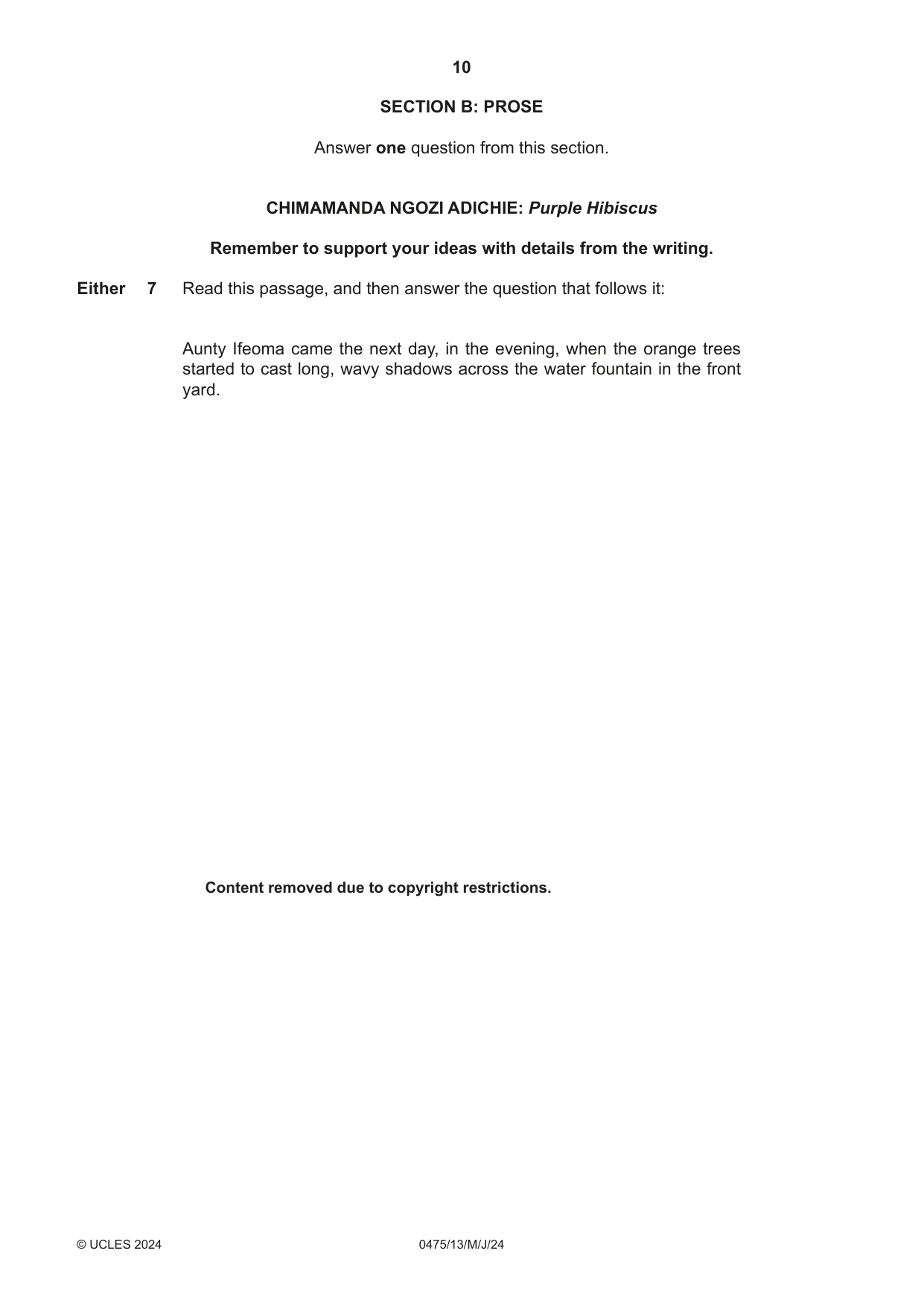
10 0475/13/M/J/24 © UCLES 2024 SECTION B: PROSE Answer one question from this section. CHIMAMANDA NGOZI ADICHIE: Purple Hibiscus Remember to support your ideas with details from the writing. Either 7 Read this passage, and then answer the question that follows it: Aunty Ifeoma came the next day, in the evening, when the orange trees started to cast long, wavy shadows across the water fountain in the front yard. Content removed due to copyright restrictions.
Question paper, page 11
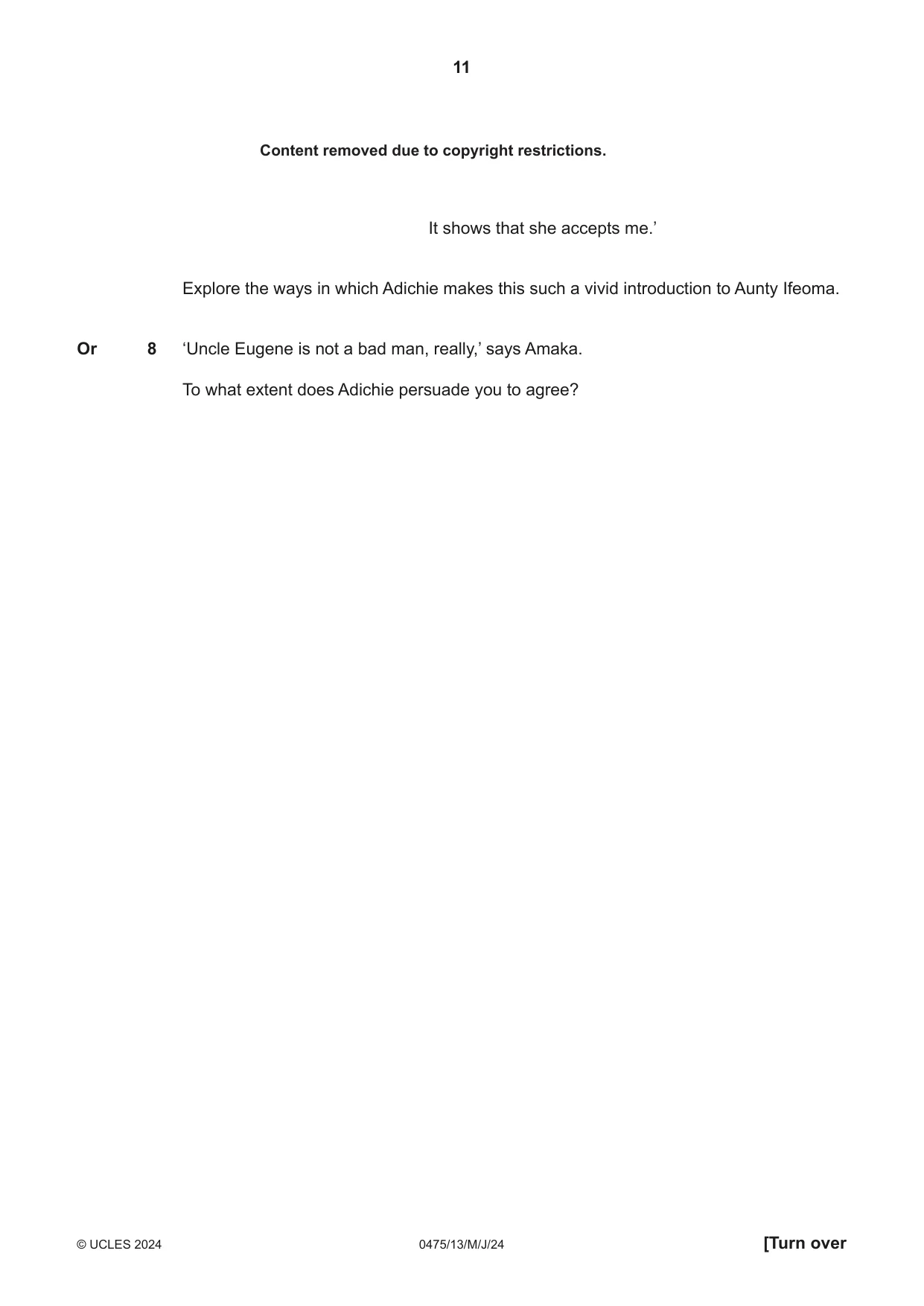
11 0475/13/M/J/24 © UCLES 2024 [Turn over It shows that she accepts me.’ Explore the ways in which Adichie makes this such a vivid introduction to Aunty Ifeoma. Or 8 ‘Uncle Eugene is not a bad man, really,’ says Amaka. To what extent does Adichie persuade you to agree? Content removed due to copyright restrictions.
Question paper, page 12
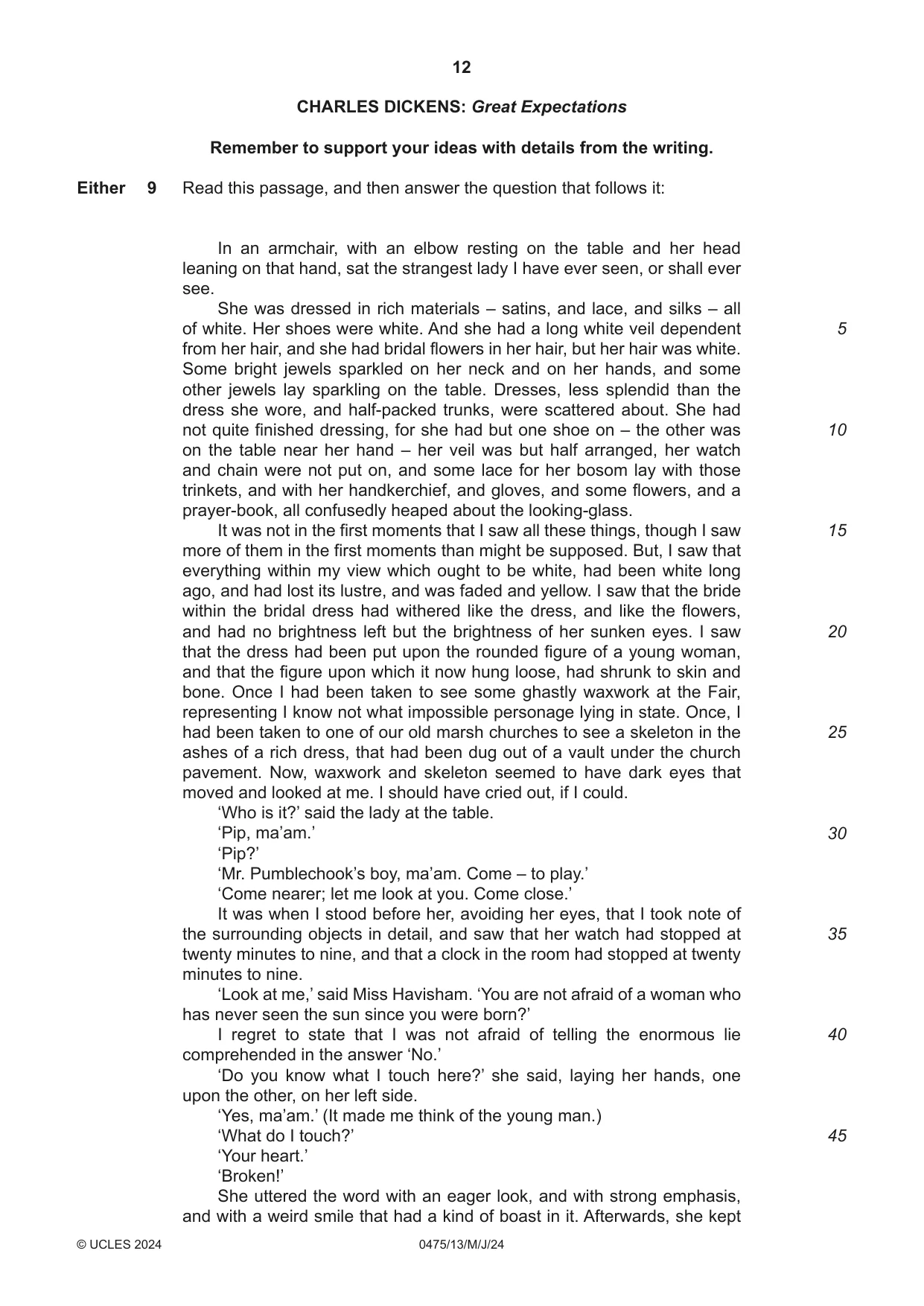
12 0475/13/M/J/24 © UCLES 2024 CHARLES DICKENS: Great Expectations Remember to support your ideas with details from the writing. Either 9 Read this passage, and then answer the question that follows it: In an armchair, with an elbow resting on the table and her head leaning on that hand, sat the strangest lady I have ever seen, or shall ever see. She was dressed in rich materials – satins, and lace, and silks – all of white. Her shoes were white. And she had a long white veil dependent from her hair, and she had bridal flowers in her hair, but her hair was white. Some bright jewels sparkled on her neck and on her hands, and some other jewels lay sparkling on the table. Dresses, less splendid than the dress she wore, and half-packed trunks, were scattered about. She had not quite finished dressing, for she had but one shoe on – the other was on the table near her hand – her veil was but half arranged, her watch and chain were not put on, and some lace for her bosom lay with those trinkets, and with her handkerchief, and gloves, and some flowers, and a prayer-book, all confusedly heaped about the looking-glass. It was not in the first moments that I saw all these things, though I saw more of them in the first moments than might be supposed. But, I saw that everything within my view which ought to be white, had been white long ago, and had lost its lustre, and was faded and yellow. I saw that the bride within the bridal dress had withered like the dress, and like the flowers, and had no brightness left but the brightness of her sunken eyes. I saw that the dress had been put upon the rounded figure of a young woman, and that the figure upon which it now hung loose, had shrunk to skin and bone. Once I had been taken to see some ghastly waxwork at the Fair, representing I know not what impossible personage lying in state. Once, I had been taken to one of our old marsh churches to see a skeleton in the ashes of a rich dress, that had been dug out of a vault under the church pavement. Now, waxwork and skeleton seemed to have dark eyes that moved and looked at me. I should have cried out, if I could. ‘Who is it?’ said the lady at the table. ‘Pip, ma’am.’ ‘Pip?’ ‘Mr. Pumblechook’s boy, ma’am. Come – to play.’ ‘Come nearer; let me look at you. Come close.’ It was when I stood before her, avoiding her eyes, that I took note of the surrounding objects in detail, and saw that her watch had stopped at twenty minutes to nine, and that a clock in the room had stopped at twenty minutes to nine. ‘Look at me,’ said Miss Havisham. ‘You are not afraid of a woman who has never seen the sun since you were born?’ I regret to state that I was not afraid of telling the enormous lie comprehended in the answer ‘No.’ ‘Do you know what I touch here?’ she said, laying her hands, one upon the other, on her left side. ‘Yes, ma’am.’ (It made me think of the young man.) ‘What do I touch?’ ‘Your heart.’ ‘Broken!’ She uttered the word with an eager look, and with strong emphasis, and with a weird smile that had a kind of boast in it. Afterwards, she kept 5 10 15 20 25 30 35 40 45
Question paper, page 13
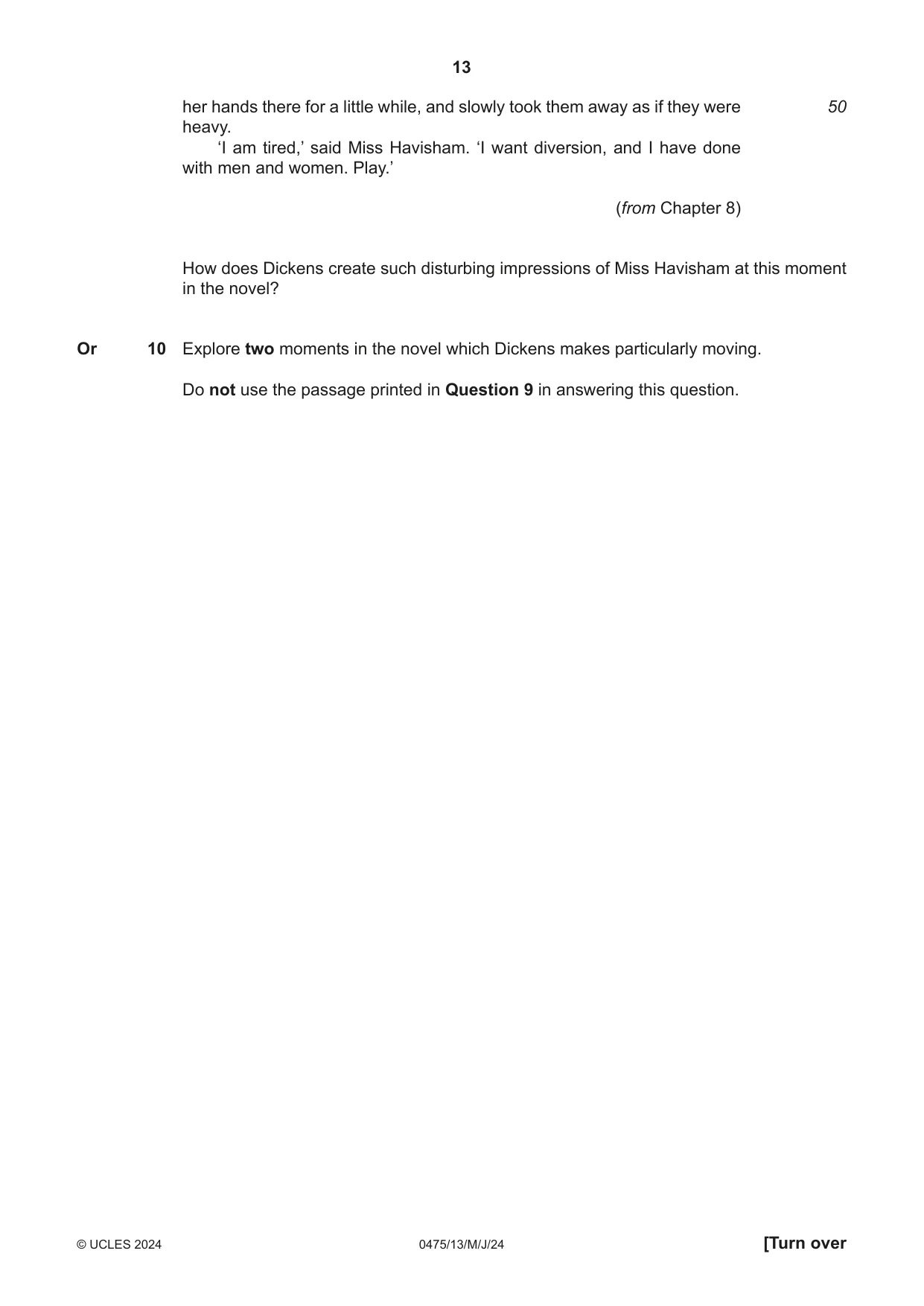
13 0475/13/M/J/24 © UCLES 2024 [Turn over her hands there for a little while, and slowly took them away as if they were heavy. ‘I am tired,’ said Miss Havisham. ‘I want diversion, and I have done with men and women. Play.’ (from Chapter 8) How does Dickens create such disturbing impressions of Miss Havisham at this moment in the novel? Or 10 Explore two moments in the novel which Dickens makes particularly moving. Do not use the passage printed in Question 9 in answering this question. 50
Question paper, page 14
14 0475/13/M/J/24 © UCLES 2024 DAPHNE DU MAURIER: Rebecca Remember to support your ideas with details from the writing. Either 11 Read this passage, and then answer the question that follows it: Maxim was standing by the window. Content removed due to copyright restrictions.
Question paper, page 15
15 0475/13/M/J/24 © UCLES 2024 [Turn over Will you look into my eyes and tell me that you love me now?’ (from Chapter 19) In what ways does du Maurier make this such a powerfully dramatic moment in the novel? Or 12 Jack Favell says of himself that he is ‘harmless’. Explore the ways in which du Maurier shows that this is completely untrue. Content removed due to copyright restrictions.
Question paper, page 16
16 0475/13/M/J/24 © UCLES 2024 JHUMPA LAHIRI: The Namesake Remember to support your ideas with details from the writing. Either 13 Read this passage, and then answer the question that follows it: The job is everything Ashoke has ever dreamed of. To avoid being alone at home she sits in the reading Content removed due to copyright restrictions.
Question paper, page 17
17 0475/13/M/J/24 © UCLES 2024 [Turn over room of the public library, in a cracked leather armchair, writing letters to her mother, or reading magazines or one of her Bengali books from home. (from Chapter 5) Explore the ways in which Lahiri strikingly contrasts Ashoke and Ashima at this moment in the novel. Or 14 To what extent does Lahiri make it possible for you to feel sympathy for Moushumi?
Question paper, page 18
18 0475/13/M/J/24 © UCLES 2024 JOAN LINDSAY: Picnic at Hanging Rock Remember to support your ideas with details from the writing. Either 15 Read this passage, and then answer the question that follows it: As soon as Albert had attended to the horses he flung himself fully clothed on his unmade truckle bed and fell asleep. Meanwhile Albert himself on the strawberry cob had ridden off to join the police party at a given rendezvous on the road to the Rock. (from Chapter 8) Content removed due to copyright restriction.
Question paper, page 19
19 0475/13/M/J/24 © UCLES 2024 [Turn over How does Lindsay memorably portray Albert at this moment in the novel? Or 16 In what ways does Lindsay create striking impressions of Irma?
Question paper, page 20
20 0475/13/M/J/24 © UCLES 2024 YANN MARTEL: Life of Pi Remember to support your ideas with details from the writing. Either 17 Read this passage, and then answer the question that follows it: Yes, it was all forcefully brought to the attention of my bemused parents. Content removed due to copyright restrictions.
Question paper, page 21
21 0475/13/M/J/24 © UCLES 2024 [Turn over My parents, the pandit and the imam looked surprised. (from Chapter 23) Explore the ways in which Martel makes this such an entertaining moment in the novel. Or 18 In what ways does Martel memorably convey Pi’s changing feelings towards Richard Parker? Content removed due to copyright restrictions.
Question paper, page 22
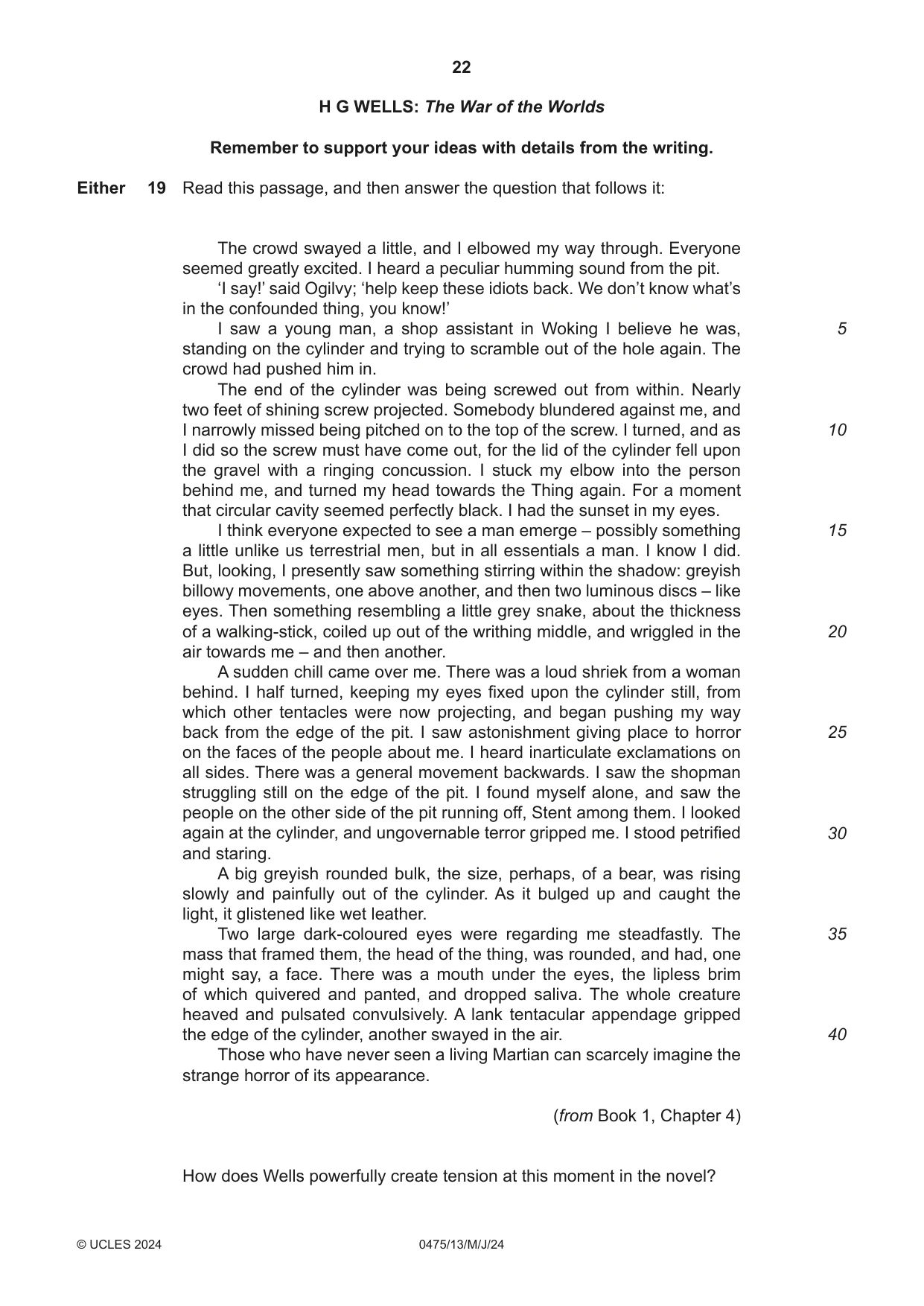
22 0475/13/M/J/24 © UCLES 2024 H G WELLS: The War of the Worlds Remember to support your ideas with details from the writing. Either 19 Read this passage, and then answer the question that follows it: The crowd swayed a little, and I elbowed my way through. Everyone seemed greatly excited. I heard a peculiar humming sound from the pit. ‘I say!’ said Ogilvy; ‘help keep these idiots back. We don’t know what’s in the confounded thing, you know!’ I saw a young man, a shop assistant in Woking I believe he was, standing on the cylinder and trying to scramble out of the hole again. The crowd had pushed him in. The end of the cylinder was being screwed out from within. Nearly two feet of shining screw projected. Somebody blundered against me, and I narrowly missed being pitched on to the top of the screw. I turned, and as I did so the screw must have come out, for the lid of the cylinder fell upon the gravel with a ringing concussion. I stuck my elbow into the person behind me, and turned my head towards the Thing again. For a moment that circular cavity seemed perfectly black. I had the sunset in my eyes. I think everyone expected to see a man emerge – possibly something a little unlike us terrestrial men, but in all essentials a man. I know I did. But, looking, I presently saw something stirring within the shadow: greyish billowy movements, one above another, and then two luminous discs – like eyes. Then something resembling a little grey snake, about the thickness of a walking-stick, coiled up out of the writhing middle, and wriggled in the air towards me – and then another. A sudden chill came over me. There was a loud shriek from a woman behind. I half turned, keeping my eyes fixed upon the cylinder still, from which other tentacles were now projecting, and began pushing my way back from the edge of the pit. I saw astonishment giving place to horror on the faces of the people about me. I heard inarticulate exclamations on all sides. There was a general movement backwards. I saw the shopman struggling still on the edge of the pit. I found myself alone, and saw the people on the other side of the pit running off, Stent among them. I looked again at the cylinder, and ungovernable terror gripped me. I stood petrified and staring. A big greyish rounded bulk, the size, perhaps, of a bear, was rising slowly and painfully out of the cylinder. As it bulged up and caught the light, it glistened like wet leather. Two large dark-coloured eyes were regarding me steadfastly. The mass that framed them, the head of the thing, was rounded, and had, one might say, a face. There was a mouth under the eyes, the lipless brim of which quivered and panted, and dropped saliva. The whole creature heaved and pulsated convulsively. A lank tentacular appendage gripped the edge of the cylinder, another swayed in the air. Those who have never seen a living Martian can scarcely imagine the strange horror of its appearance. (from Book 1, Chapter 4) How does Wells powerfully create tension at this moment in the novel? 5 10 15 20 25 30 35 40
Question paper, page 23
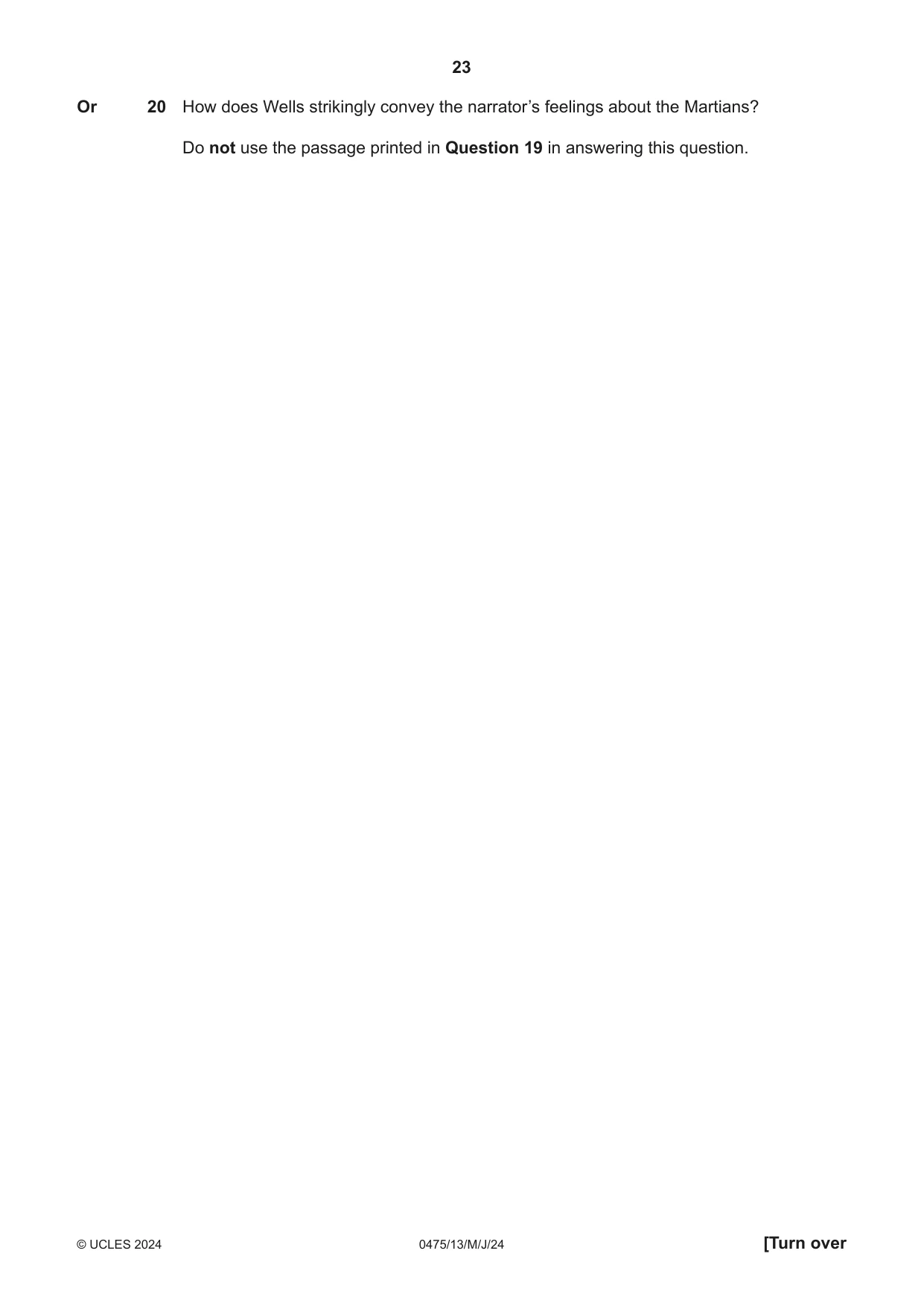
23 0475/13/M/J/24 © UCLES 2024 [Turn over Or 20 How does Wells strikingly convey the narrator’s feelings about the Martians? Do not use the passage printed in Question 19 in answering this question.
Question paper, page 24
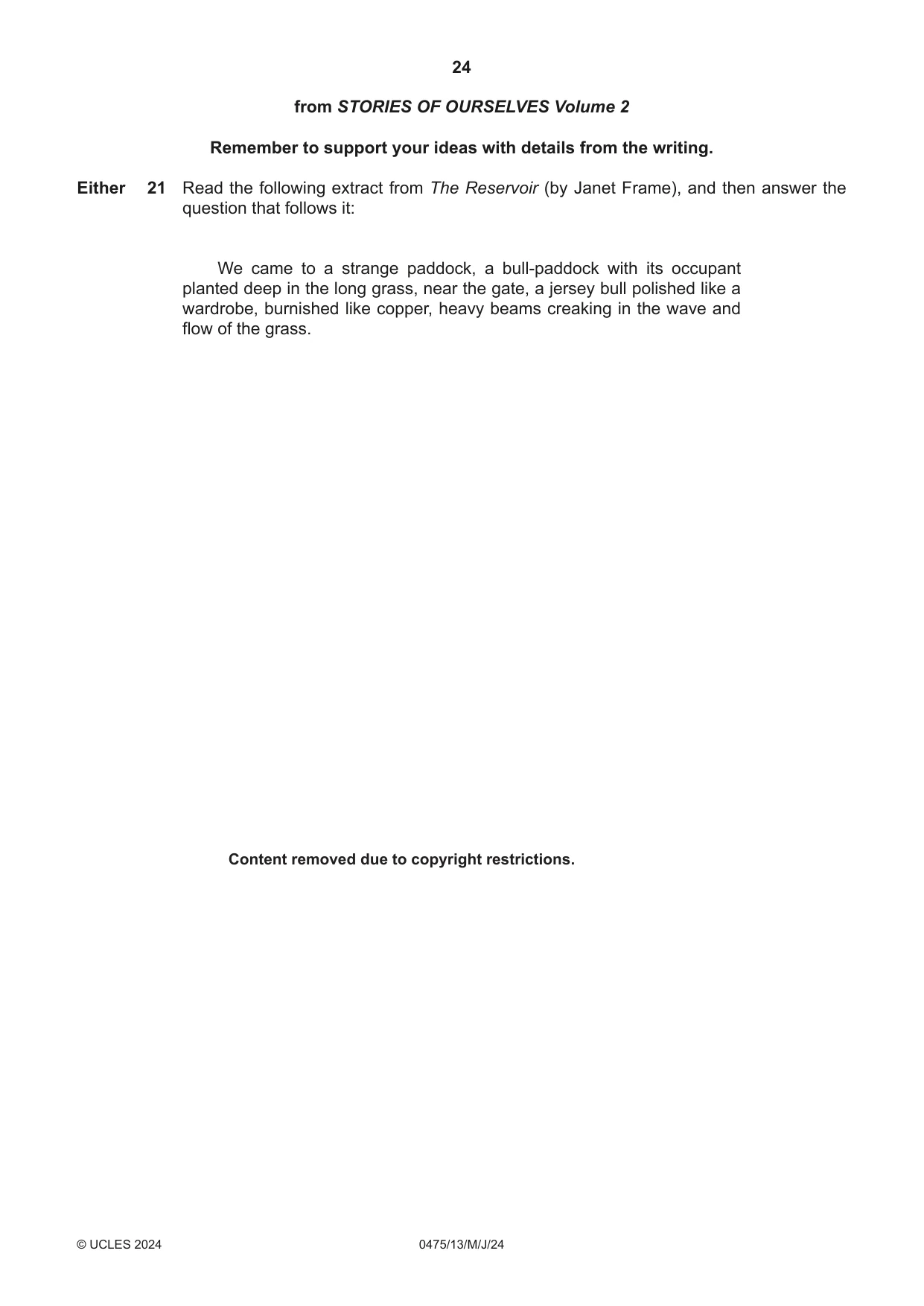
24 0475/13/M/J/24 © UCLES 2024 from STORIES OF OURSELVES Volume 2 Remember to support your ideas with details from the writing. Either 21 Read the following extract from The Reservoir (by Janet Frame), and then answer the question that follows it: We came to a strange paddock, a bull-paddock with its occupant planted deep in the long grass, near the gate, a jersey bull polished like a wardrobe, burnished like copper, heavy beams creaking in the wave and flow of the grass. Content removed due to copyright restrictions.
Question paper, page 25
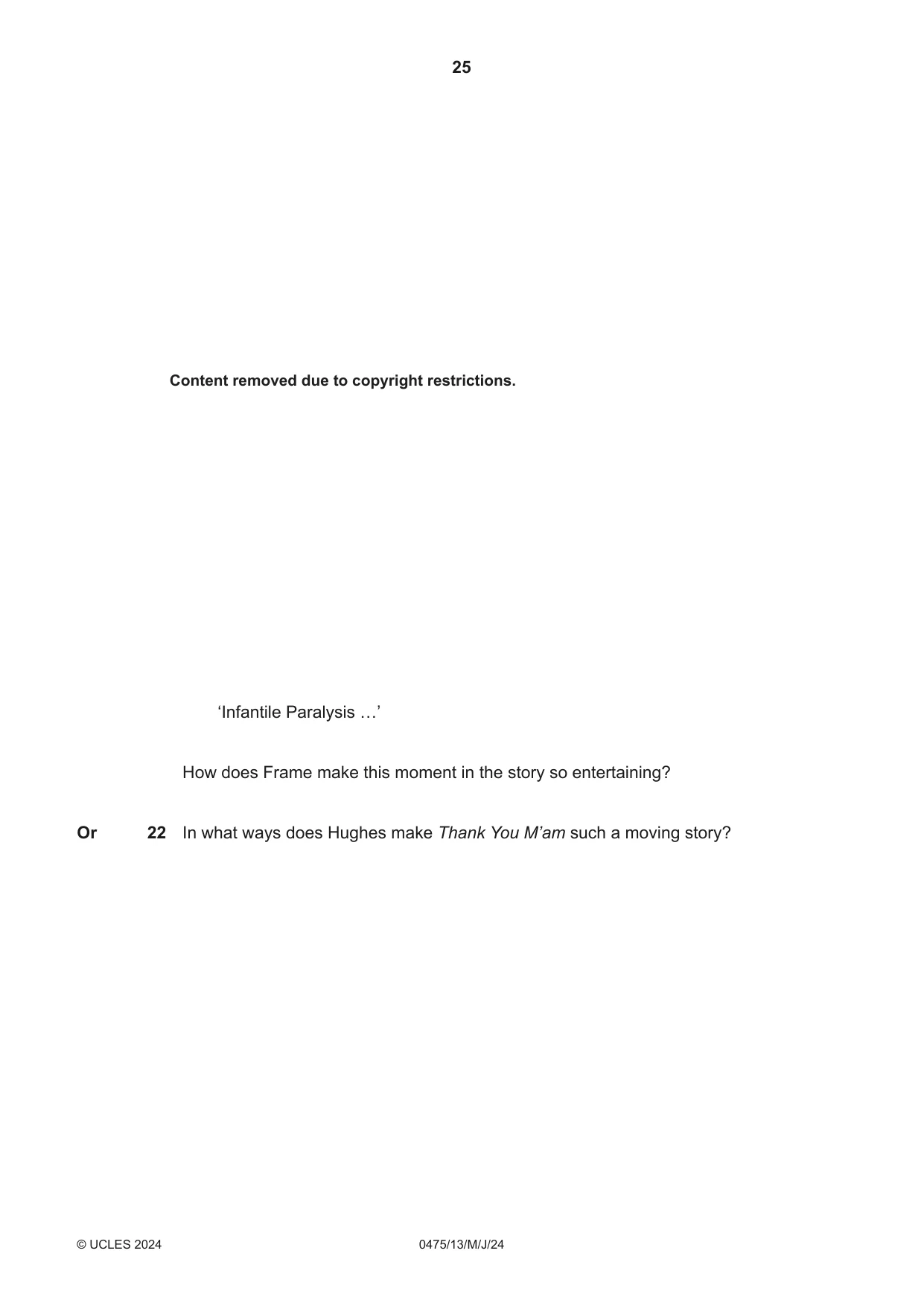
25 0475/13/M/J/24 © UCLES 2024 ‘Infantile Paralysis …’ How does Frame make this moment in the story so entertaining? Or 22 In what ways does Hughes make Thank You M’am such a moving story? Content removed due to copyright restrictions.
Question paper, page 26
26 0475/13/M/J/24 © UCLES 2024 BLANK PAGE
Question paper, page 27
27 0475/13/M/J/24 © UCLES 2024 BLANK PAGE
Question paper, page 28
28 0475/13/M/J/24 © UCLES 2024 Permission to reproduce items where third-party owned material protected by copyright is included has been sought and cleared where possible. Every reasonable effort has been made by the publisher (UCLES) to trace copyright holders, but if any items requiring clearance have unwittingly been included, the publisher will be pleased to make amends at the earliest possible opportunity. To avoid the issue of disclosure of answer-related information to candidates, all copyright acknowledgements are reproduced online in the Cambridge Assessment International Education Copyright Acknowledgements Booklet. This is produced for each series of examinations and is freely available to download at www.cambridgeinternational.org after the live examination series. Cambridge Assessment International Education is part of Cambridge Assessment. Cambridge Assessment is the brand name of the University of Cambridge Local Examinations Syndicate (UCLES), which is a department of the University of Cambridge. BLANK PAGE
Mark scheme, page 1
This document consists of 5 printed pages. © Cambridge University Press & Assessment 2024 [Turn over Cambridge IGCSE™ LITERATURE IN ENGLISH 0475/13 Paper 1 Poetry and Prose May/June 2024 MARK SCHEME Maximum Mark: 50 Published This mark scheme is published as an aid to teachers and candidates, to indicate the requirements of the examination. It shows the basis on which Examiners were instructed to award marks. It does not indicate the details of the discussions that took place at an Examiners’ meeting before marking began, which would have considered the acceptability of alternative answers. Mark schemes should be read in conjunction with the question paper and the Principal Examiner Report for Teachers. Cambridge International will not enter into discussions about these mark schemes. Cambridge International is publishing the mark schemes for the May/June 2024 series for most Cambridge IGCSE, Cambridge International A and AS Level and Cambridge Pre-U components, and some Cambridge O Level components.
Mark scheme, page 2
0475/13 Cambridge IGCSE – Mark Scheme PUBLISHED May/June 2024 © Cambridge University Press & Assessment 2024 Page 2 of 5 Generic Marking Principles These general marking principles must be applied by all examiners when marking candidate answers. They should be applied alongside the specific content of the mark scheme or generic level descriptions for a question. Each question paper and mark scheme will also comply with these marking principles. GENERIC MARKING PRINCIPLE 1: Marks must be awarded in line with: the specific content of the mark scheme or the generic level descriptors for the question the specific skills defined in the mark scheme or in the generic level descriptors for the question the standard of response required by a candidate as exemplified by the standardisation scripts. GENERIC MARKING PRINCIPLE 2: Marks awarded are always whole marks (not half marks, or other fractions). GENERIC MARKING PRINCIPLE 3: Marks must be awarded positively: marks are awarded for correct/valid answers, as defined in the mark scheme. However, credit is given for valid answers which go beyond the scope of the syllabus and mark scheme, referring to your Team Leader as appropriate marks are awarded when candidates clearly demonstrate what they know and can do marks are not deducted for errors marks are not deducted for omissions answers should only be judged on the quality of spelling, punctuation and grammar when these features are specifically assessed by the question as indicated by the mark scheme. The meaning, however, should be unambiguous. GENERIC MARKING PRINCIPLE 4: Rules must be applied consistently, e.g. in situations where candidates have not followed instructions or in the application of generic level descriptors. GENERIC MARKING PRINCIPLE 5: Marks should be awarded using the full range of marks defined in the mark scheme for the question (however; the use of the full mark range may be limited according to the quality of the candidate responses seen). GENERIC MARKING PRINCIPLE 6: Marks awarded are based solely on the requirements as defined in the mark scheme. Marks should not be awarded with grade thresholds or grade descriptors in mind.
Mark scheme, page 3
0475/13 Cambridge IGCSE – Mark Scheme PUBLISHED May/June 2024 © Cambridge University Press & Assessment 2024 Page 3 of 5 English & Media subject specific general marking principles (To be read in conjunction with the Generic Marking Principles (and requiring further guidance on how to place marks within levels)) Components using level descriptors: We use level descriptors as a guide to broad understanding of the qualities normally expected of, or typical of, work in a level. Level descriptors are a means of general guidance, and should not be interpreted as hurdle statements. Where indicative content notes are supplied for a question, these are not a prescription of required content, and must not be treated as such. Alternative correct points and unexpected answers in candidates’ scripts must be given marks that fairly reflect the knowledge and skills demonstrated. While we may have legitimate expectations as to the ground most answers may occupy, we must at all times be prepared to meet candidates on their chosen ground, provided it is relevant ground (e.g. clearly related to and derived from a relevant passage/text and meeting the mark scheme requirements for the question). Components using point-based marking: Point marking is often used to reward knowledge, understanding and application of skills. We give credit where the candidate’s answer shows relevant knowledge, understanding and application of skills in answering the question. We do not give credit where the answer shows confusion. From this it follows that we: a DO credit answers which are worded differently from the mark scheme if they clearly convey the same meaning (unless the mark scheme requires a specific term). b DO credit alternative answers/examples which are not written in the mark scheme if they are correct. c DO credit answers where candidates give more than one correct answer in one prompt/numbered/scaffolded space where extended writing is required rather than list-type answers. For example, questions that require n reasons (e.g. State two reasons…). d DO NOT credit answers simply for using a ‘key term’ unless that is all that is required. (Check for evidence it is understood and not used wrongly.). e DO NOT credit answers which are obviously self-contradicting or trying to cover all possibilities. f DO NOT give further credit for what is effectively repetition of a correct point already credited unless the language itself is being tested. This applies equally to ‘mirror statements’ (i.e. polluted/not polluted). g DO NOT require spellings to be correct, unless this is part of the test. However spellings of syllabus terms must allow for clear and unambiguous separation from other syllabus terms with which they may be confused (e.g. Corrasion/Corrosion).
Mark scheme, page 4
0475/13 Cambridge IGCSE – Mark Scheme PUBLISHED May/June 2024 © Cambridge University Press & Assessment 2024 Page 4 of 5 Using the mark bands All Assessment Objectives are equally weighted in this paper. Place the answer in a band first. Look for the best fit of the answer into a band. An answer needs to show evidence of most but not necessarily all of the qualities described in a band in order to be placed in that band. Then award a mark for the relative position of the answer within the band. Candidates sometimes mis-number questions under the pressure of timed conditions. Please check that you are marking against the correct question number.
Mark scheme, page 5
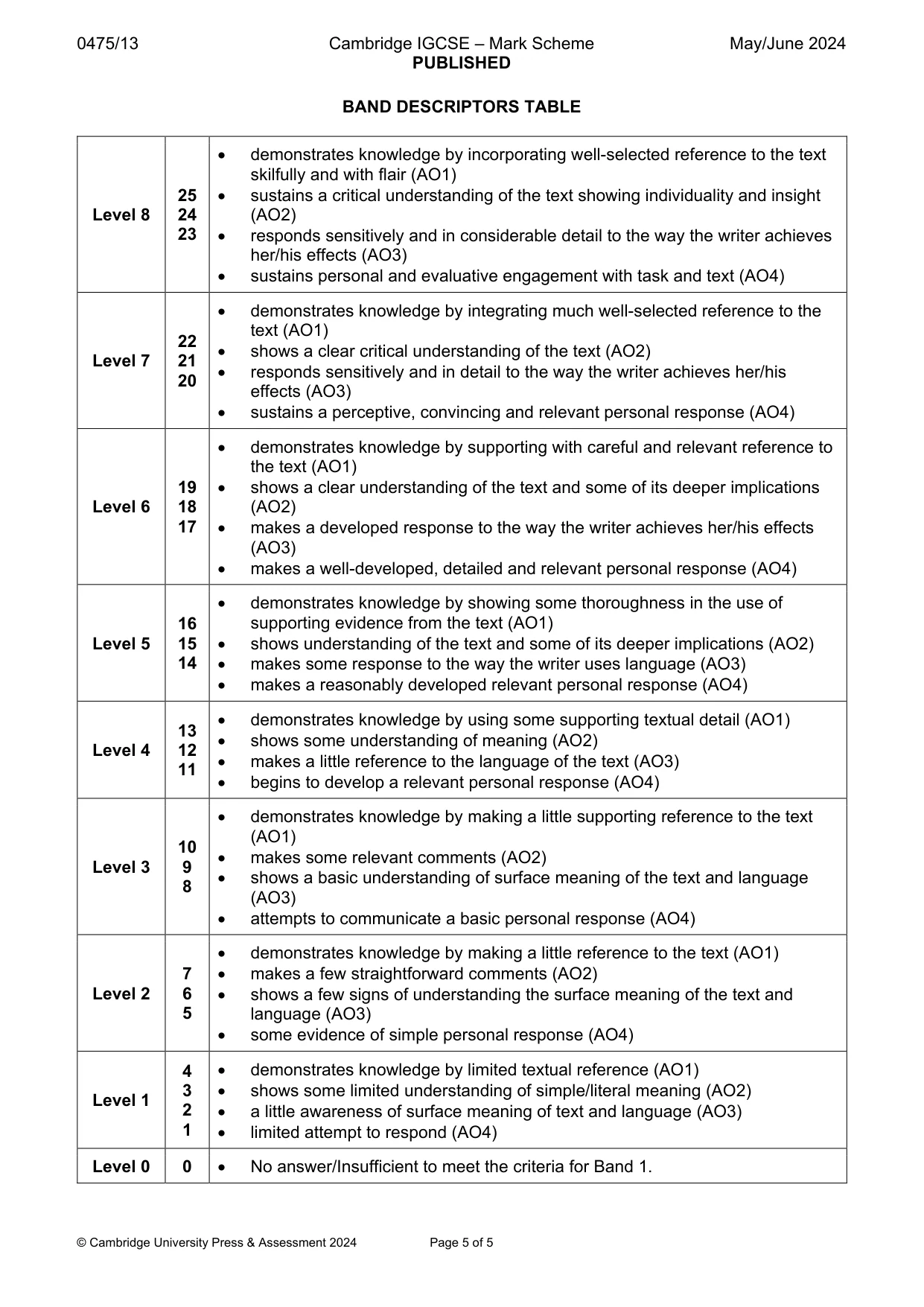
0475/13 Cambridge IGCSE – Mark Scheme PUBLISHED May/June 2024 © Cambridge University Press & Assessment 2024 Page 5 of 5 BAND DESCRIPTORS TABLE Level 8 25 24 23 demonstrates knowledge by incorporating well-selected reference to the text skilfully and with flair (AO1) sustains a critical understanding of the text showing individuality and insight (AO2) responds sensitively and in considerable detail to the way the writer achieves her/his effects (AO3) sustains personal and evaluative engagement with task and text (AO4) Level 7 22 21 20 demonstrates knowledge by integrating much well-selected reference to the text (AO1) shows a clear critical understanding of the text (AO2) responds sensitively and in detail to the way the writer achieves her/his effects (AO3) sustains a perceptive, convincing and relevant personal response (AO4) Level 6 19 18 17 demonstrates knowledge by supporting with careful and relevant reference to the text (AO1) shows a clear understanding of the text and some of its deeper implications (AO2) makes a developed response to the way the writer achieves her/his effects (AO3) makes a well-developed, detailed and relevant personal response (AO4) Level 5 16 15 14 demonstrates knowledge by showing some thoroughness in the use of supporting evidence from the text (AO1) shows understanding of the text and some of its deeper implications (AO2) makes some response to the way the writer uses language (AO3) makes a reasonably developed relevant personal response (AO4) Level 4 13 12 11 demonstrates knowledge by using some supporting textual detail (AO1) shows some understanding of meaning (AO2) makes a little reference to the language of the text (AO3) begins to develop a relevant personal response (AO4) Level 3 10 9 8 demonstrates knowledge by making a little supporting reference to the text (AO1) makes some relevant comments (AO2) shows a basic understanding of surface meaning of the text and language (AO3) attempts to communicate a basic personal response (AO4) Level 2 7 6 5 demonstrates knowledge by making a little reference to the text (AO1) makes a few straightforward comments (AO2) shows a few signs of understanding the surface meaning of the text and language (AO3) some evidence of simple personal response (AO4) Level 1 4 3 2 1 demonstrates knowledge by limited textual reference (AO1) shows some limited understanding of simple/literal meaning (AO2) a little awareness of surface meaning of text and language (AO3) limited attempt to respond (AO4) Level 0 0 No answer/Insufficient to meet the criteria for Band 1.
What you needed in this session
Cambridge’s own grade thresholds for 2024 May/June, Paper 1 · Variant 3. A higher threshold means an easier paper — the bar moves with how the cohort did.