Cambridge IGCSE English - Literature in English 0475 — 2025 Oct/Nov Paper 1 · Variant 3
0475/13/O/N/25 · 50 marks · ≈56 min
The question paper and its mark scheme, free to read here and free to download. This is Cambridge’s own paper, exactly as it was sat.
Question paper28 pages





Mark scheme5 pages
Answers below. Sit the paper first if you are practising.
Paper as text
Question paper, page 1
Cambridge Assessment International Education Cambridge IGCSE™ LITERATURE IN ENGLISH 0475/13 Paper 1 Poetry and Prose October/November 2025 1 hour 30 minutes You must answer on the enclosed answer booklet. You will need: Answer booklet (enclosed) INSTRUCTIONS e Answer two questions in total: Section A: answer one question. Section B: answer one question. e Follow the instructions on the front cover of the answer booklet. If you need additional answer paper, ask the invigilator for a continuation booklet. INFORMATION e The total mark for this paper is 50. e All questions are worth equal marks. This document has 28 pages. Any blank pages are indicated. DC (RCL (DF)) 341356/2 © UCLES 2025 [Turn over
Question paper, page 2
2 0475/13/O/N/25 © UCLES 2025 BLANK PAGE
Question paper, page 3
3 0475/13/O/N/25 © UCLES 2025 [Turn over CONTENTS Section A: Poetry text question numbers page[s] Songs of Ourselves Volume 1: from Part 4 1, 2 pages 4–6 Songs of Ourselves Volume 2 : from Part 3 3, 4 pages 8–9 Ted Hughes: from New Selected Poems 5, 6 pages 10–11 Section B: Prose text question numbers page[s] Chinua Achebe: Things Fall Apart 7, 8 pages 12–13 Anita Desai: Fire on the Mountain 9, 10 pages 14–15 Charles Dickens: Great Expectations 11, 12 pages 16–17 Daphne du Maurier: Rebecca 13, 14 pages 18–19 Harper Lee: To Kill a Mockingbird 15, 16 pages 20–21 Joan Lindsay: Picnic at Hanging Rock 17, 18 pages 22–23 H G Wells: The War of the Worlds 19, 20 pages 24–25 from Stories of Ourselves Volume 2 21, 22 pages 26–27
Question paper, page 4
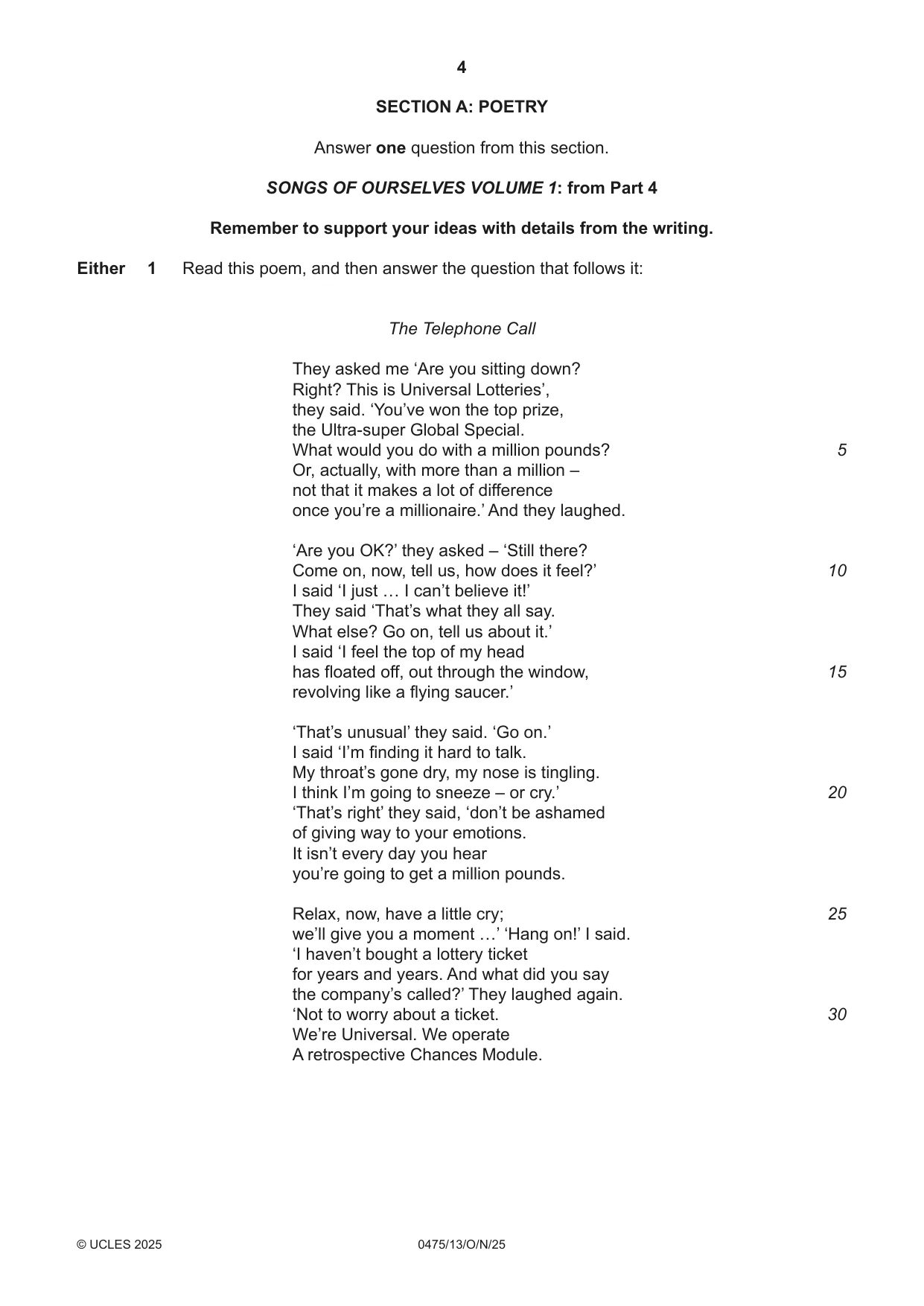
4 0475/13/O/N/25 © UCLES 2025 SECTION A: POETRY Answer one question from this section. SONGS OF OURSELVES VOLUME 1: from Part 4 Remember to support your ideas with details from the writing. Either 1 Read this poem, and then answer the question that follows it: The Telephone Call They asked me ‘Are you sitting down? Right? This is Universal Lotteries’, they said. ‘You’ve won the top prize, the Ultra-super Global Special. What would you do with a million pounds? Or, actually, with more than a million – not that it makes a lot of difference once you’re a millionaire.’ And they laughed. ‘Are you OK?’ they asked – ‘Still there? Come on, now, tell us, how does it feel?’ I said ‘I just … I can’t believe it!’ They said ‘That’s what they all say. What else? Go on, tell us about it.’ I said ‘I feel the top of my head has floated off, out through the window, revolving like a flying saucer.’ ‘That’s unusual’ they said. ‘Go on.’ I said ‘I’m finding it hard to talk. My throat’s gone dry, my nose is tingling. I think I’m going to sneeze – or cry.’ ‘That’s right’ they said, ‘don’t be ashamed of giving way to your emotions. It isn’t every day you hear you’re going to get a million pounds. Relax, now, have a little cry; we’ll give you a moment …’ ‘Hang on!’ I said. ‘I haven’t bought a lottery ticket for years and years. And what did you say the company’s called?’ They laughed again. ‘Not to worry about a ticket. We’re Universal. We operate A retrospective Chances Module. 5 10 15 20 25 30
Question paper, page 5
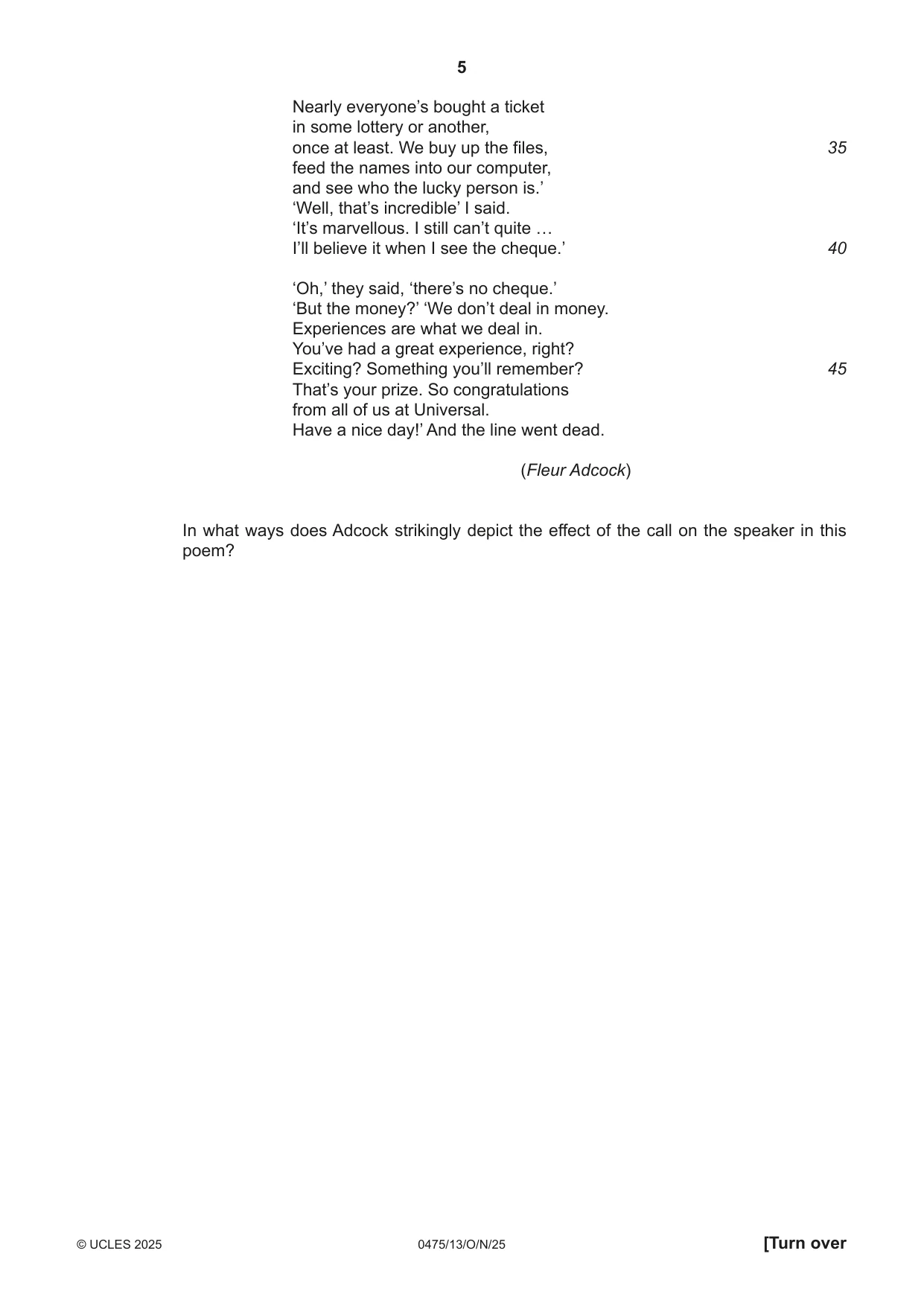
5 0475/13/O/N/25 © UCLES 2025 [Turn over Nearly everyone’s bought a ticket in some lottery or another, once at least. We buy up the files, feed the names into our computer, and see who the lucky person is.’ ‘Well, that’s incredible’ I said. ‘It’s marvellous. I still can’t quite … I’ll believe it when I see the cheque.’ ‘Oh,’ they said, ‘there’s no cheque.’ ‘But the money?’ ‘We don’t deal in money. Experiences are what we deal in. You’ve had a great experience, right? Exciting? Something you’ll remember? That’s your prize. So congratulations from all of us at Universal. Have a nice day!’ And the line went dead. (Fleur Adcock) In what ways does Adcock strikingly depict the effect of the call on the speaker in this poem? 35 40 45
Question paper, page 6
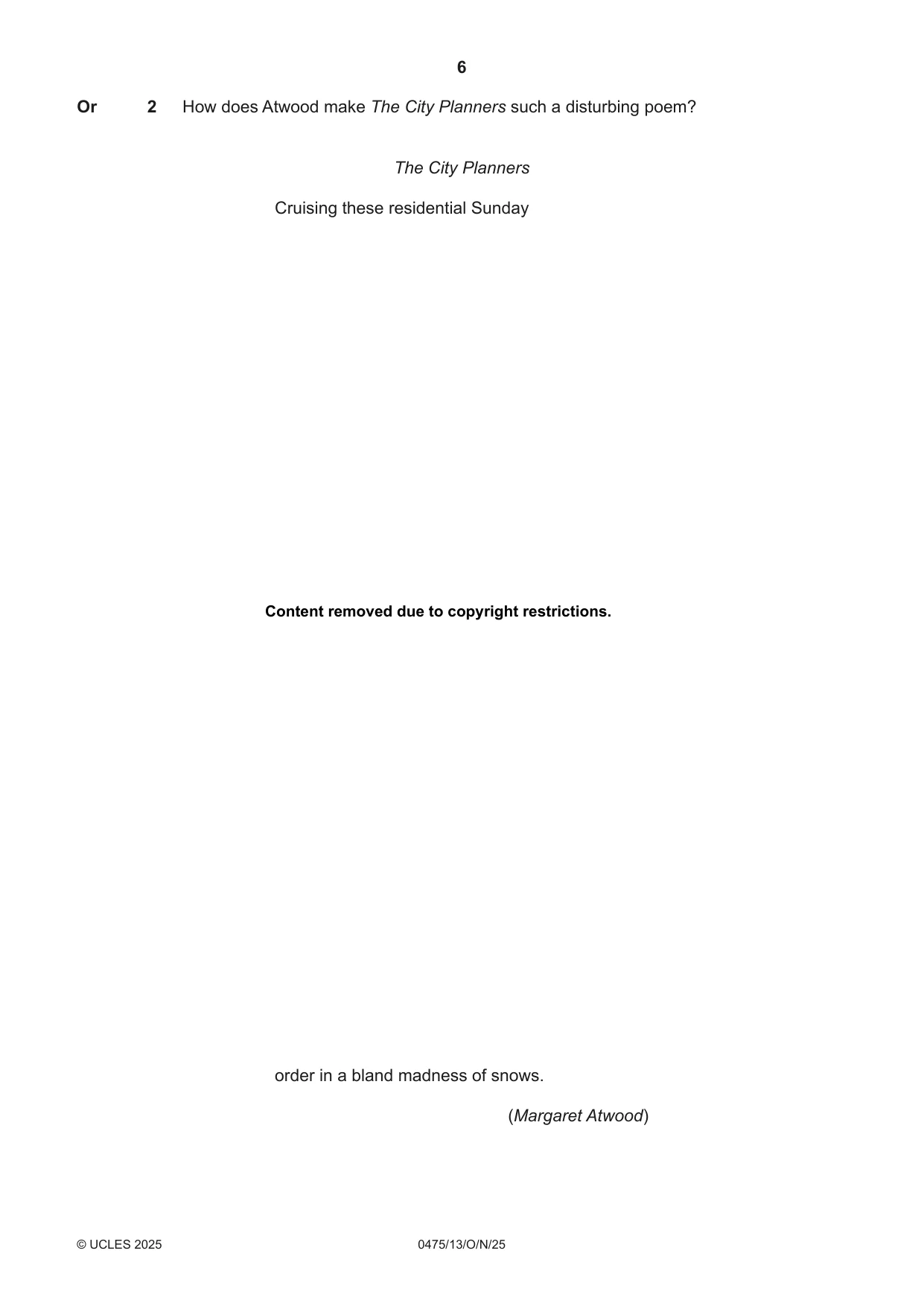
6 0475/13/O/N/25 © UCLES 2025 Or 2 How does Atwood make The City Planners such a disturbing poem? The City Planners Cruising these residential Sunday order in a bland madness of snows. (Margaret Atwood) Content removed due to copyright restrictions.
Question paper, page 7
7 0475/13/O/N/25 © UCLES 2025 [Turn over TURN OVER FOR QUESTION 3.
Question paper, page 8
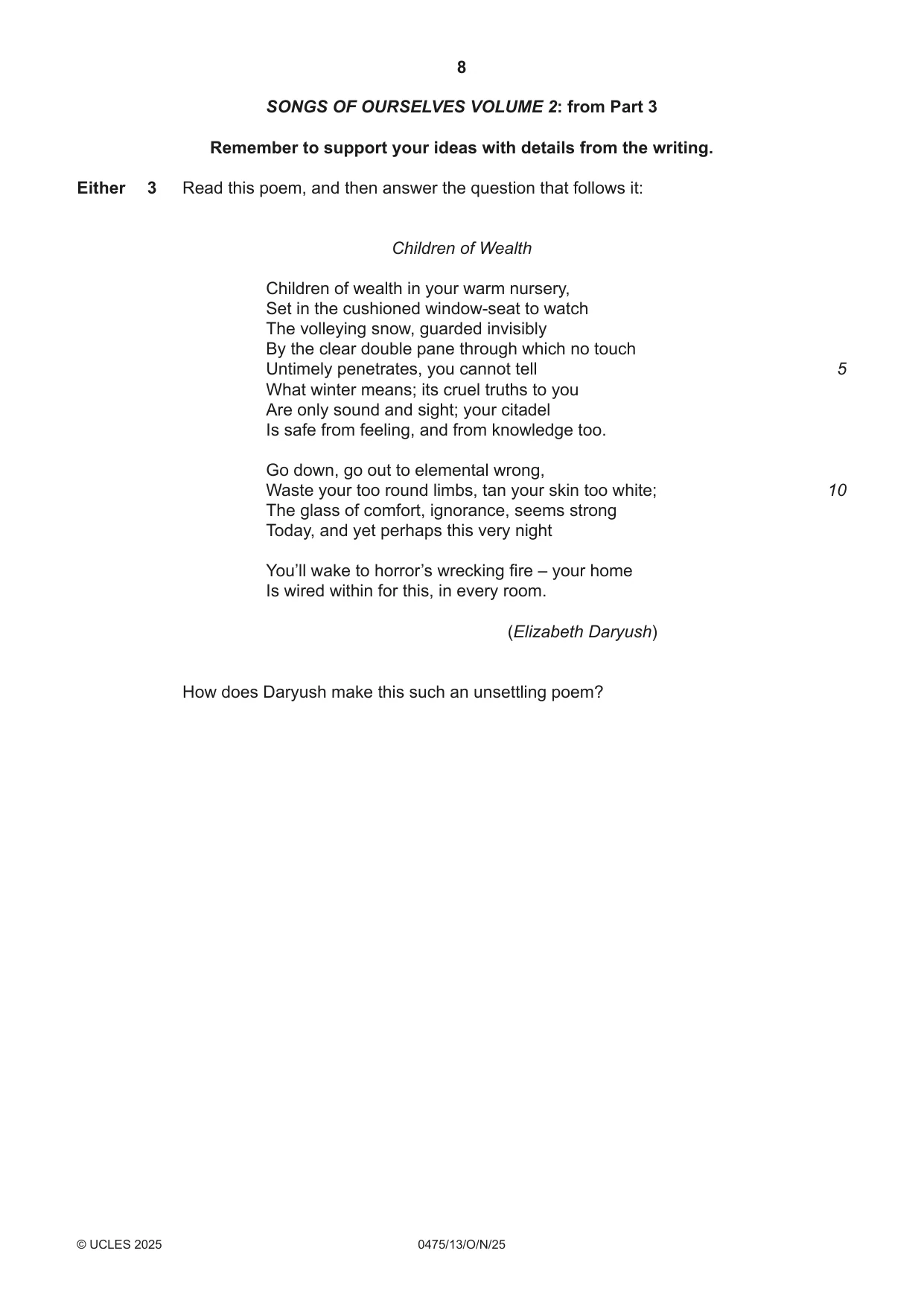
8 0475/13/O/N/25 © UCLES 2025 SONGS OF OURSELVES VOLUME 2: from Part 3 Remember to support your ideas with details from the writing. Either 3 Read this poem, and then answer the question that follows it: Children of Wealth Children of wealth in your warm nursery, Set in the cushioned window-seat to watch The volleying snow, guarded invisibly By the clear double pane through which no touch Untimely penetrates, you cannot tell What winter means; its cruel truths to you Are only sound and sight; your citadel Is safe from feeling, and from knowledge too. Go down, go out to elemental wrong, Waste your too round limbs, tan your skin too white; The glass of comfort, ignorance, seems strong Today, and yet perhaps this very night You’ll wake to horror’s wrecking fire – your home Is wired within for this, in every room. (Elizabeth Daryush) How does Daryush make this such an unsettling poem? 5 10
Question paper, page 9
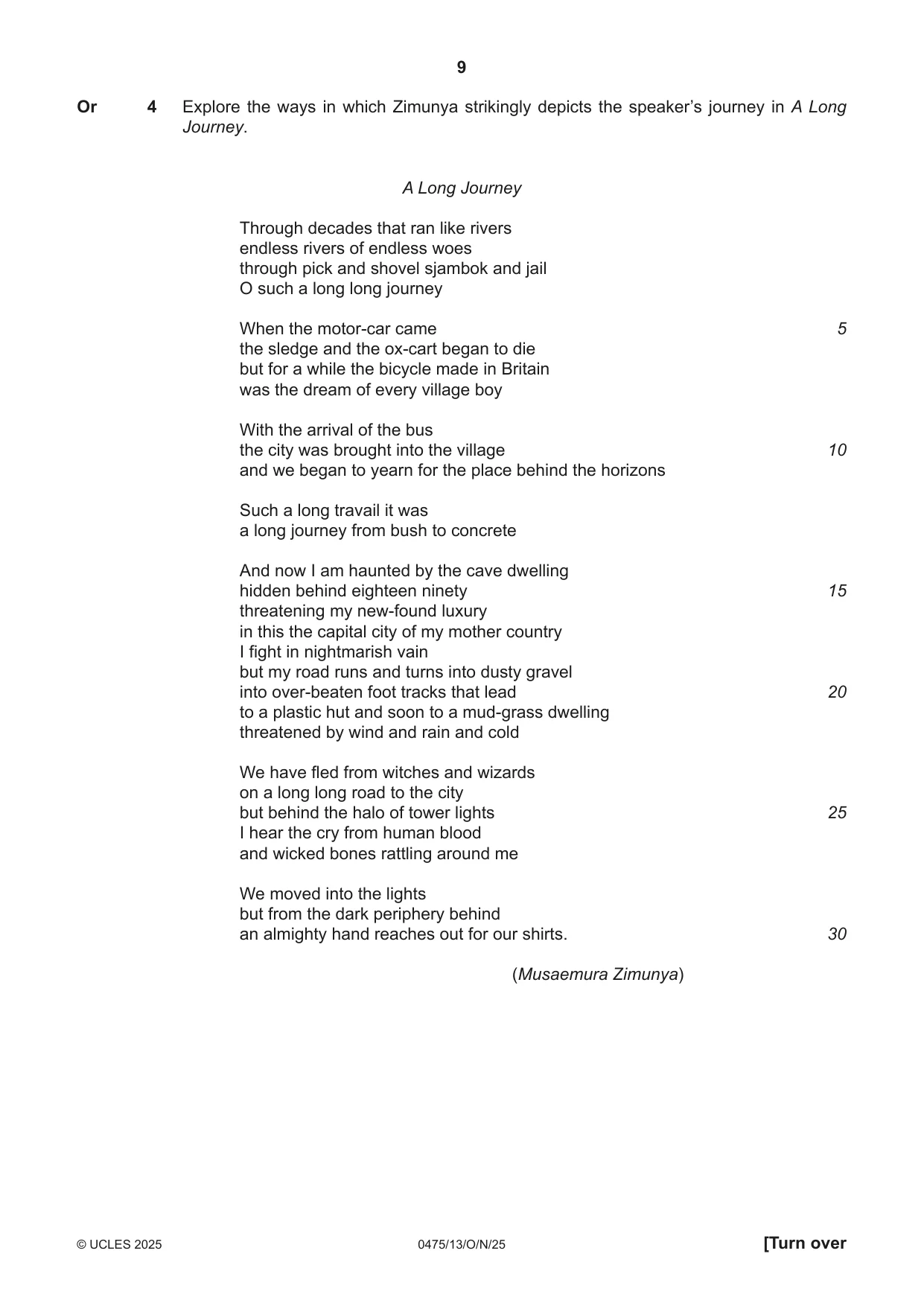
9 0475/13/O/N/25 © UCLES 2025 [Turn over Or 4 Explore the ways in which Zimunya strikingly depicts the speaker’s journey in A Long Journey. A Long Journey Through decades that ran like rivers endless rivers of endless woes through pick and shovel sjambok and jail O such a long long journey When the motor-car came the sledge and the ox-cart began to die but for a while the bicycle made in Britain was the dream of every village boy With the arrival of the bus the city was brought into the village and we began to yearn for the place behind the horizons Such a long travail it was a long journey from bush to concrete And now I am haunted by the cave dwelling hidden behind eighteen ninety threatening my new-found luxury in this the capital city of my mother country I fight in nightmarish vain but my road runs and turns into dusty gravel into over-beaten foot tracks that lead to a plastic hut and soon to a mud-grass dwelling threatened by wind and rain and cold We have fled from witches and wizards on a long long road to the city but behind the halo of tower lights I hear the cry from human blood and wicked bones rattling around me We moved into the lights but from the dark periphery behind an almighty hand reaches out for our shirts. (Musaemura Zimunya) 5 10 15 20 25 30
Question paper, page 10
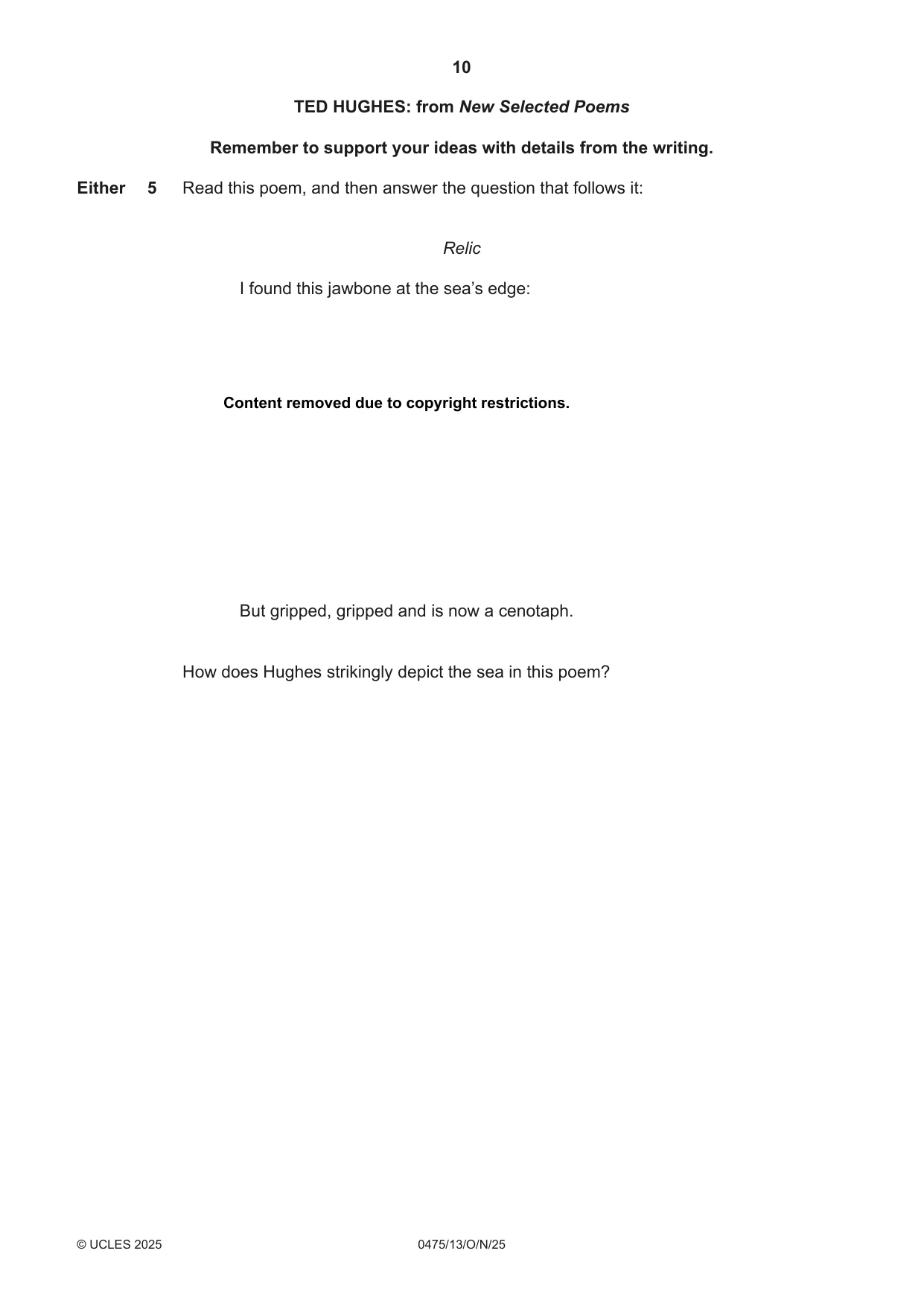
10 0475/13/O/N/25 © UCLES 2025 TED HUGHES: from New Selected Poems Remember to support your ideas with details from the writing. Either 5 Read this poem, and then answer the question that follows it: Relic I found this jawbone at the sea’s edge: But gripped, gripped and is now a cenotaph. How does Hughes strikingly depict the sea in this poem? Content removed due to copyright restrictions.
Question paper, page 11
11 0475/13/O/N/25 © UCLES 2025 [Turn over Or 6 In what ways does Hughes vividly convey admiration for the man he describes in A Memory? A Memory Your bony white bowed back, in a singlet, Lit another at it Content removed due to copyright restrictions.
Question paper, page 12
12 0475/13/O/N/25 © UCLES 2025 SECTION B: PROSE Answer one question from this section. CHINUA ACHEBE: Things Fall Apart Remember to support your ideas with details from the writing. Either 7 Read this passage, and then answer the question that follows it: Mr Brown’s successor was the Reverend James Smith, and he was a different kind of man. Content removed due to copyright restrictions.
Question paper, page 13
13 0475/13/O/N/25 © UCLES 2025 [Turn over Enoch had killed an ancestral spirit, and Umuofia was thrown into confusion. (from Chapter 22) How does Achebe vividly depict the confusion in Umuofia at this moment in the novel? Or 8 Explore how Achebe memorably portrays Okonkwo in the novel. Content removed due to copyright restrictions.
Question paper, page 14
14 0475/13/O/N/25 © UCLES 2025 ANITA DESAI: Fire on the Mountain Remember to support your ideas with details from the writing. Either 9 Read this passage, and then answer the question that follows it: Ila Das did not take the Garkhal road that led down the hillside to her village, no. No one noticed anything staunch or splendid about her trembling chin, her wobbling top-knot or her hurried walk. (from Part 3, Chapter 11) How does Desai make this such a sad moment in the novel? Content removed due to copyright restrictions.
Question paper, page 15
15 0475/13/O/N/25 © UCLES 2025 [Turn over Or 10 To what extent does Desai portray Raka as a likeable character?
Question paper, page 16
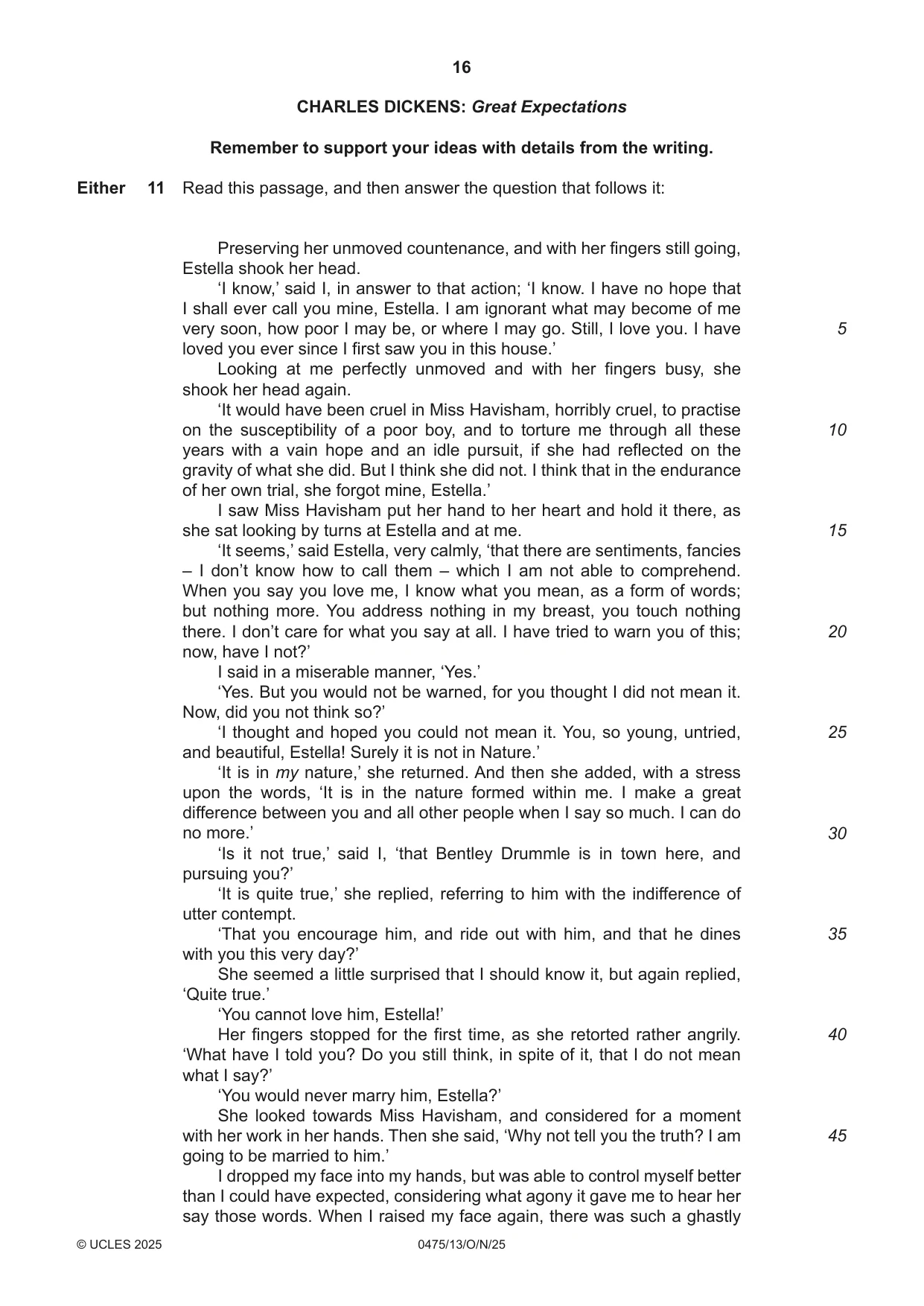
16 0475/13/O/N/25 © UCLES 2025 CHARLES DICKENS: Great Expectations Remember to support your ideas with details from the writing. Either 11 Read this passage, and then answer the question that follows it: Preserving her unmoved countenance, and with her fingers still going, Estella shook her head. ‘I know,’ said I, in answer to that action; ‘I know. I have no hope that I shall ever call you mine, Estella. I am ignorant what may become of me very soon, how poor I may be, or where I may go. Still, I love you. I have loved you ever since I first saw you in this house.’ Looking at me perfectly unmoved and with her fingers busy, she shook her head again. ‘It would have been cruel in Miss Havisham, horribly cruel, to practise on the susceptibility of a poor boy, and to torture me through all these years with a vain hope and an idle pursuit, if she had reflected on the gravity of what she did. But I think she did not. I think that in the endurance of her own trial, she forgot mine, Estella.’ I saw Miss Havisham put her hand to her heart and hold it there, as she sat looking by turns at Estella and at me. ‘It seems,’ said Estella, very calmly, ‘that there are sentiments, fancies – I don’t know how to call them – which I am not able to comprehend. When you say you love me, I know what you mean, as a form of words; but nothing more. You address nothing in my breast, you touch nothing there. I don’t care for what you say at all. I have tried to warn you of this; now, have I not?’ I said in a miserable manner, ‘Yes.’ ‘Yes. But you would not be warned, for you thought I did not mean it. Now, did you not think so?’ ‘I thought and hoped you could not mean it. You, so young, untried, and beautiful, Estella! Surely it is not in Nature.’ ‘It is in my nature,’ she returned. And then she added, with a stress upon the words, ‘It is in the nature formed within me. I make a great difference between you and all other people when I say so much. I can do no more.’ ‘Is it not true,’ said I, ‘that Bentley Drummle is in town here, and pursuing you?’ ‘It is quite true,’ she replied, referring to him with the indifference of utter contempt. ‘That you encourage him, and ride out with him, and that he dines with you this very day?’ She seemed a little surprised that I should know it, but again replied, ‘Quite true.’ ‘You cannot love him, Estella!’ Her fingers stopped for the first time, as she retorted rather angrily. ‘What have I told you? Do you still think, in spite of it, that I do not mean what I say?’ ‘You would never marry him, Estella?’ She looked towards Miss Havisham, and considered for a moment with her work in her hands. Then she said, ‘Why not tell you the truth? I am going to be married to him.’ I dropped my face into my hands, but was able to control myself better than I could have expected, considering what agony it gave me to hear her say those words. When I raised my face again, there was such a ghastly 5 10 15 20 25 30 35 40 45
Question paper, page 17
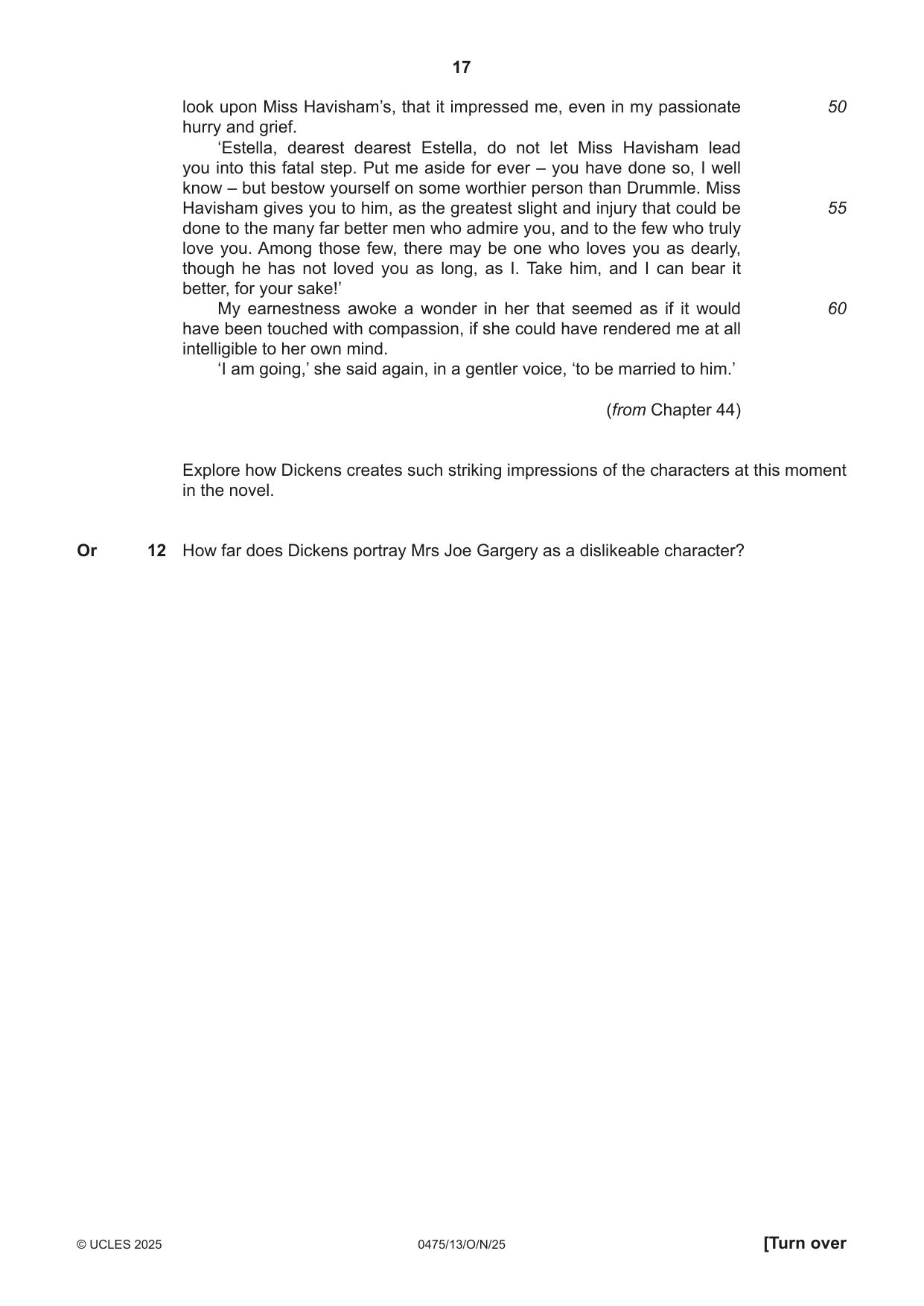
17 0475/13/O/N/25 © UCLES 2025 [Turn over look upon Miss Havisham’s, that it impressed me, even in my passionate hurry and grief. ‘Estella, dearest dearest Estella, do not let Miss Havisham lead you into this fatal step. Put me aside for ever – you have done so, I well know – but bestow yourself on some worthier person than Drummle. Miss Havisham gives you to him, as the greatest slight and injury that could be done to the many far better men who admire you, and to the few who truly love you. Among those few, there may be one who loves you as dearly, though he has not loved you as long, as I. Take him, and I can bear it better, for your sake!’ My earnestness awoke a wonder in her that seemed as if it would have been touched with compassion, if she could have rendered me at all intelligible to her own mind. ‘I am going,’ she said again, in a gentler voice, ‘to be married to him.’ (from Chapter 44) Explore how Dickens creates such striking impressions of the characters at this moment in the novel. Or 12 How far does Dickens portray Mrs Joe Gargery as a dislikeable character? 50 55 60
Question paper, page 18
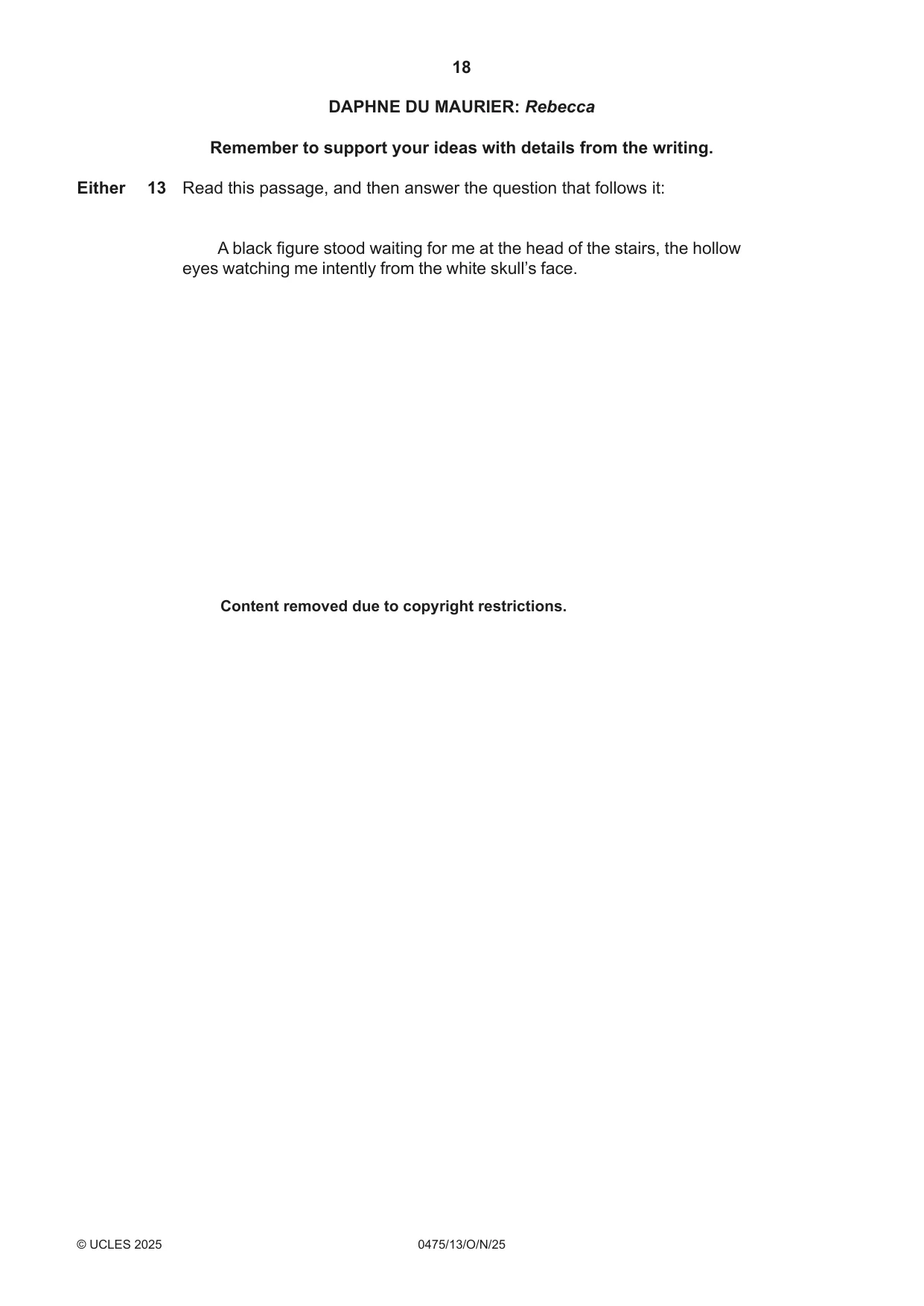
18 0475/13/O/N/25 © UCLES 2025 DAPHNE DU MAURIER: Rebecca Remember to support your ideas with details from the writing. Either 13 Read this passage, and then answer the question that follows it: A black figure stood waiting for me at the head of the stairs, the hollow eyes watching me intently from the white skull’s face. Content removed due to copyright restrictions.
Question paper, page 19
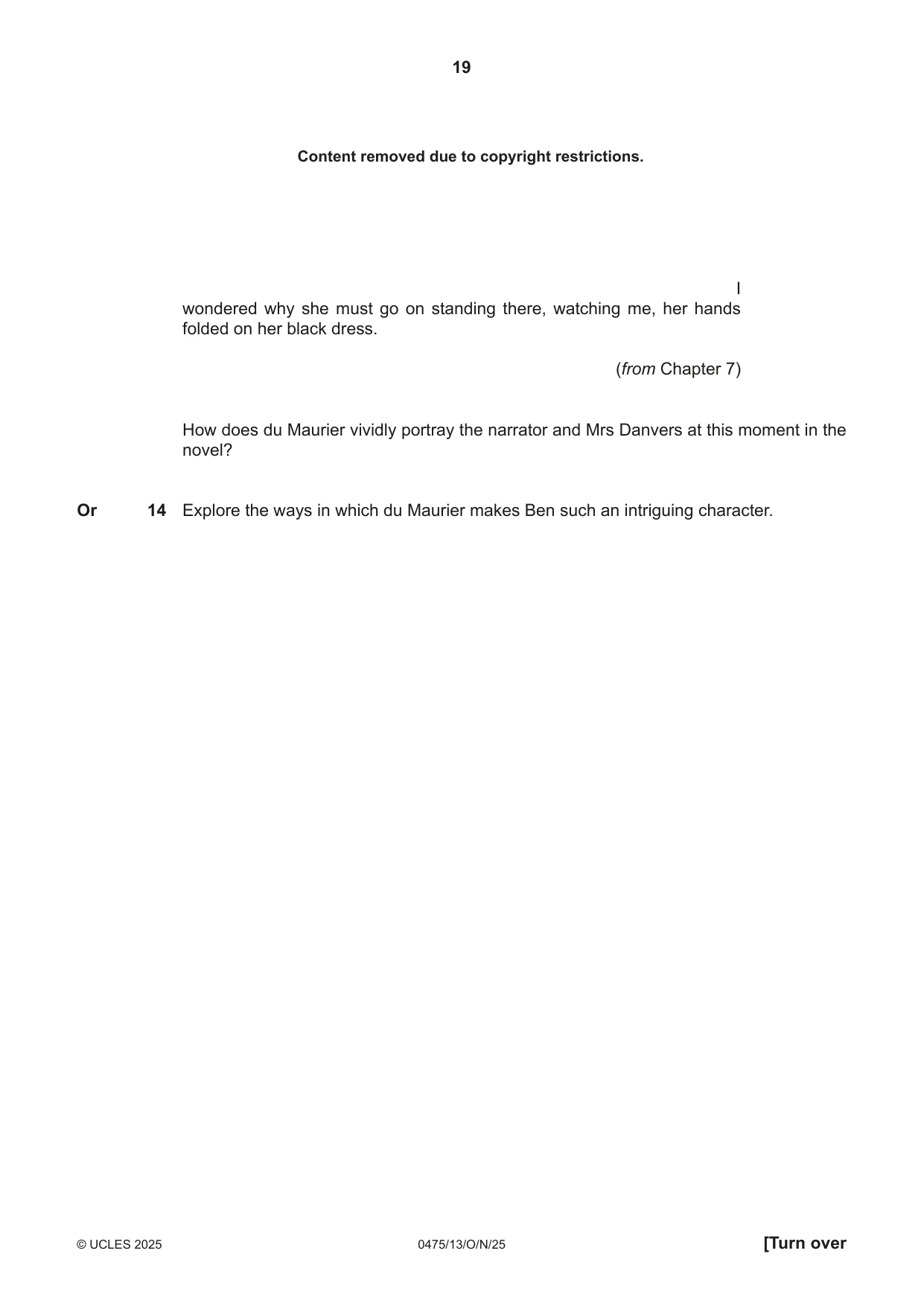
19 0475/13/O/N/25 © UCLES 2025 [Turn over I wondered why she must go on standing there, watching me, her hands folded on her black dress. (from Chapter 7) How does du Maurier vividly portray the narrator and Mrs Danvers at this moment in the novel? Or 14 Explore the ways in which du Maurier makes Ben such an intriguing character. Content removed due to copyright restrictions.
Question paper, page 20
20 0475/13/O/N/25 © UCLES 2025 HARPER LEE: To Kill a Mockingbird Remember to support your ideas with details from the writing. Either 15 Read this passage, and then answer the question that follows it: I told him in detail about our trip to church with Calpurnia. Content removed due to copyright restrictions.
Question paper, page 21
21 0475/13/O/N/25 © UCLES 2025 [Turn over It was not a comfortable sight. (from Chapter 14) Explore the ways in which Lee makes this such a revealing moment in the novel. Or 16 How does Lee make Heck Tate such a memorable character? Content removed due to copyright restrictions.
Question paper, page 22
22 0475/13/O/N/25 © UCLES 2025 JOAN LINDSAY: Picnic at Hanging Rock Remember to support your ideas with details from the writing. Either 17 Read this passage, and then answer the question that follows it: The weather continued warm and sunny and there were daily outings on the placid lake, soothed by the musical box tinkle of the mountain stream. Quite suddenly he would come to her in the Bois de Boulogne, under the trees in Hyde Park; a lock of fair hair hanging over one eye, his face half turned to follow the flight of a swan. (from Chapter 10) Content removed due to copyright restrictions.
Question paper, page 23
23 0475/13/O/N/25 © UCLES 2025 [Turn over How does Lindsay vividly capture the relationship between Mike and Irma at this moment in the novel? Or 18 Explore how Lindsay strikingly portrays two of the following characters: • Edith Horton • Dora Lumley.
Question paper, page 24
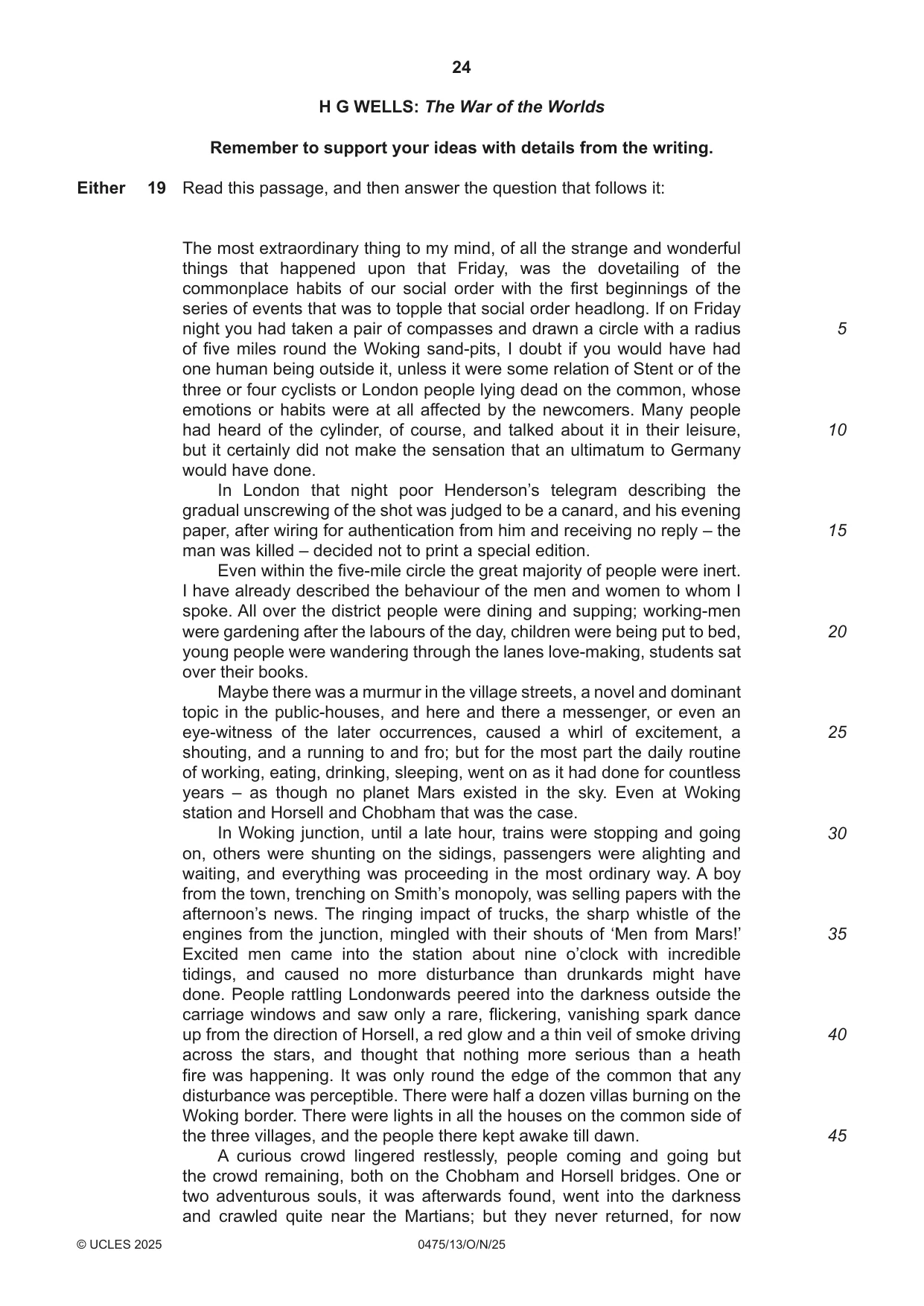
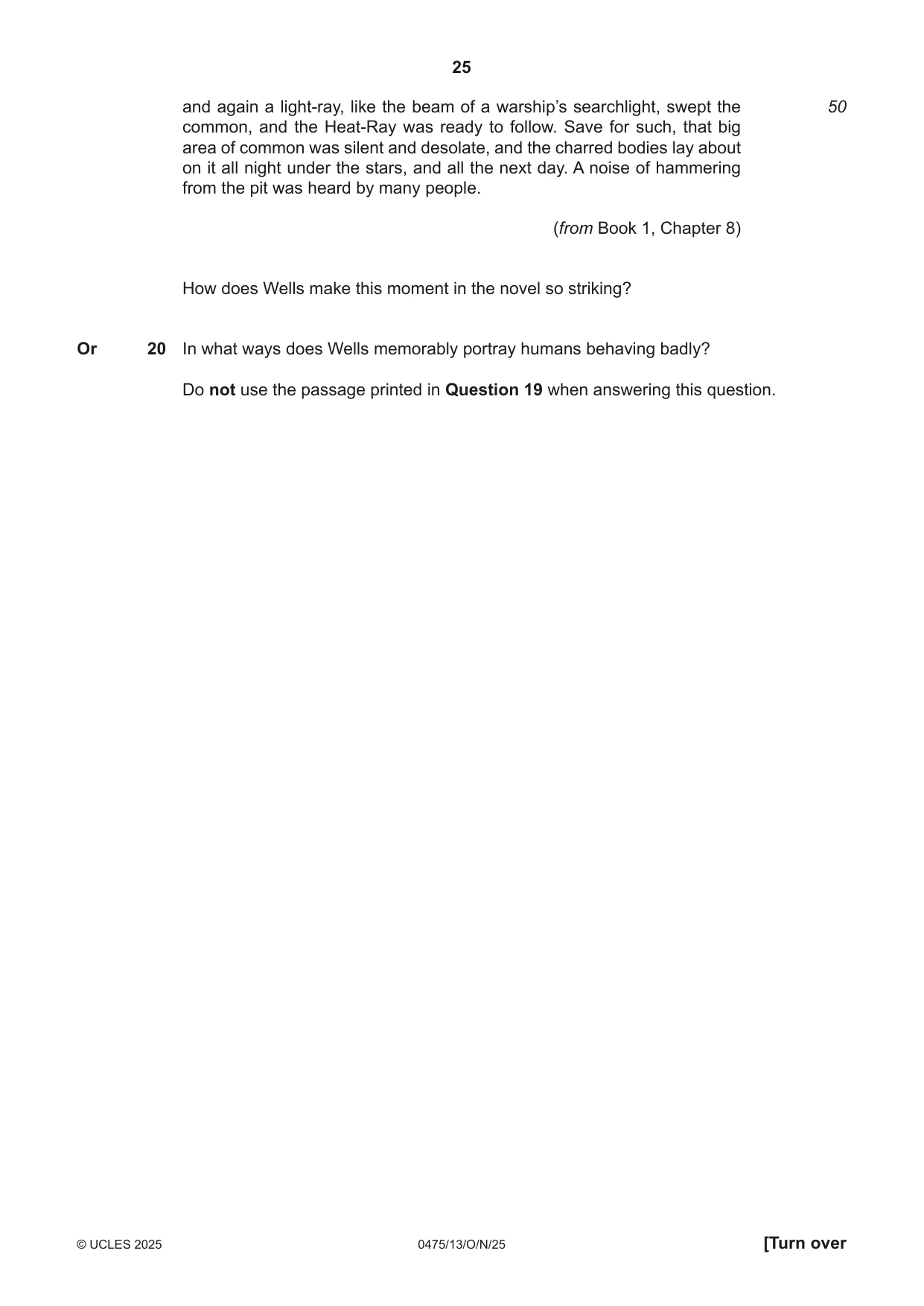
24 0475/13/O/N/25 © UCLES 2025 H G WELLS: The War of the Worlds Remember to support your ideas with details from the writing. Either 19 Read this passage, and then answer the question that follows it: The most extraordinary thing to my mind, of all the strange and wonderful things that happened upon that Friday, was the dovetailing of the commonplace habits of our social order with the first beginnings of the series of events that was to topple that social order headlong. If on Friday night you had taken a pair of compasses and drawn a circle with a radius of five miles round the Woking sand-pits, I doubt if you would have had one human being outside it, unless it were some relation of Stent or of the three or four cyclists or London people lying dead on the common, whose emotions or habits were at all affected by the newcomers. Many people had heard of the cylinder, of course, and talked about it in their leisure, but it certainly did not make the sensation that an ultimatum to Germany would have done. In London that night poor Henderson’s telegram describing the gradual unscrewing of the shot was judged to be a canard, and his evening paper, after wiring for authentication from him and receiving no reply – the man was killed – decided not to print a special edition. Even within the five-mile circle the great majority of people were inert. I have already described the behaviour of the men and women to whom I spoke. All over the district people were dining and supping; working-men were gardening after the labours of the day, children were being put to bed, young people were wandering through the lanes love-making, students sat over their books. Maybe there was a murmur in the village streets, a novel and dominant topic in the public-houses, and here and there a messenger, or even an eye-witness of the later occurrences, caused a whirl of excitement, a shouting, and a running to and fro; but for the most part the daily routine of working, eating, drinking, sleeping, went on as it had done for countless years – as though no planet Mars existed in the sky. Even at Woking station and Horsell and Chobham that was the case. In Woking junction, until a late hour, trains were stopping and going on, others were shunting on the sidings, passengers were alighting and waiting, and everything was proceeding in the most ordinary way. A boy from the town, trenching on Smith’s monopoly, was selling papers with the afternoon’s news. The ringing impact of trucks, the sharp whistle of the engines from the junction, mingled with their shouts of ‘Men from Mars!’ Excited men came into the station about nine o’clock with incredible tidings, and caused no more disturbance than drunkards might have done. People rattling Londonwards peered into the darkness outside the carriage windows and saw only a rare, flickering, vanishing spark dance up from the direction of Horsell, a red glow and a thin veil of smoke driving across the stars, and thought that nothing more serious than a heath fire was happening. It was only round the edge of the common that any disturbance was perceptible. There were half a dozen villas burning on the Woking border. There were lights in all the houses on the common side of the three villages, and the people there kept awake till dawn. A curious crowd lingered restlessly, people coming and going but the crowd remaining, both on the Chobham and Horsell bridges. One or two adventurous souls, it was afterwards found, went into the darkness and crawled quite near the Martians; but they never returned, for now 5 10 15 20 25 30 35 40 45
Question paper, page 25
25 0475/13/O/N/25 © UCLES 2025 [Turn over and again a light-ray, like the beam of a warship’s searchlight, swept the common, and the Heat-Ray was ready to follow. Save for such, that big area of common was silent and desolate, and the charred bodies lay about on it all night under the stars, and all the next day. A noise of hammering from the pit was heard by many people. (from Book 1, Chapter 8) How does Wells make this moment in the novel so striking? Or 20 In what ways does Wells memorably portray humans behaving badly? Do not use the passage printed in Question 19 when answering this question. 50
Question paper, page 26
26 0475/13/O/N/25 © UCLES 2025 from STORIES OF OURSELVES VOLUME 2 Remember to support your ideas with details from the writing. Either 21 Read this passage from Showing the Flag (by Jane Gardam), and then answer the question that follows it: She wanted him lost. Content removed due to copyright restrictions.
Question paper, page 27
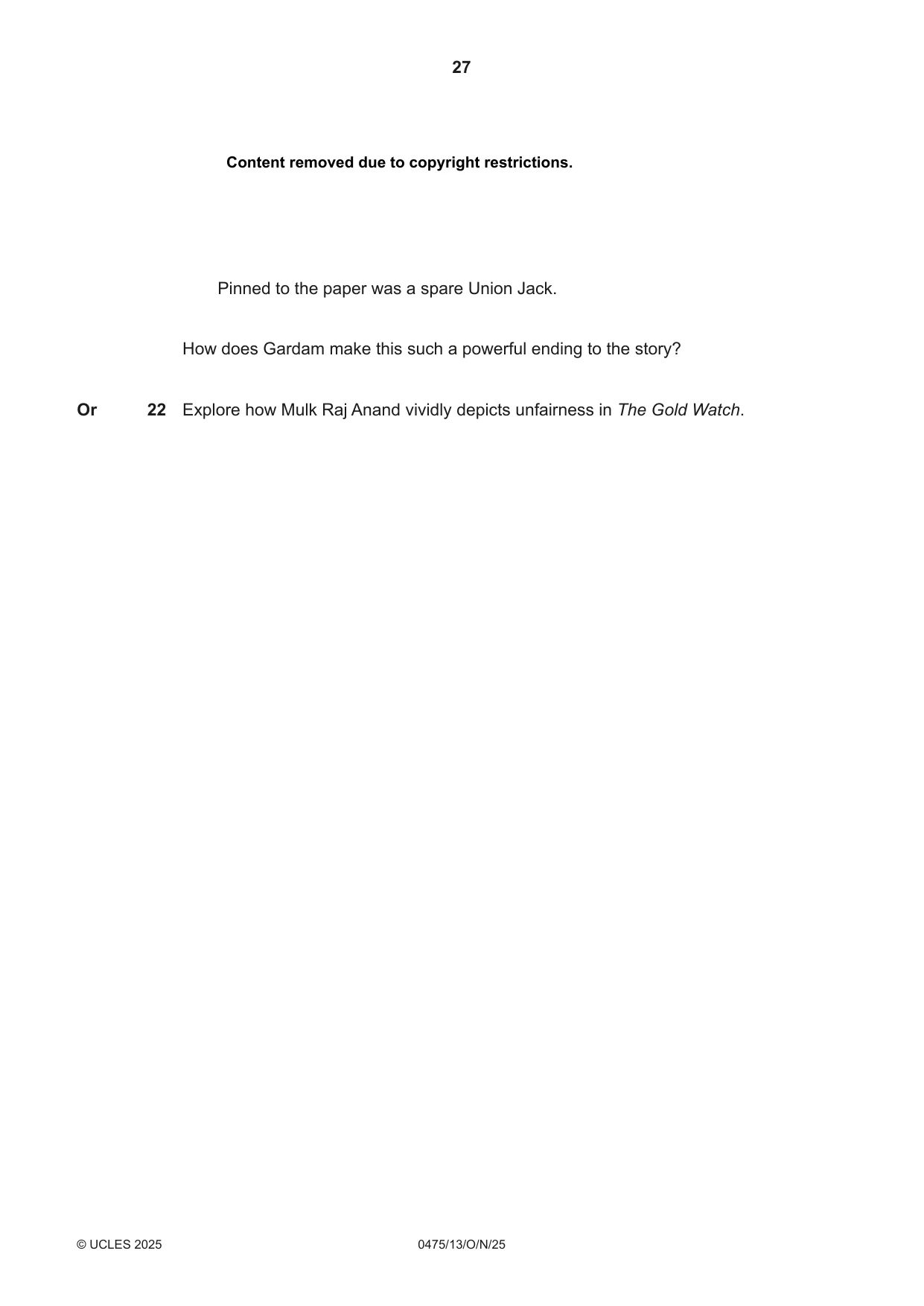
27 0475/13/O/N/25 © UCLES 2025 Pinned to the paper was a spare Union Jack. How does Gardam make this such a powerful ending to the story? Or 22 Explore how Mulk Raj Anand vividly depicts unfairness in The Gold Watch. Content removed due to copyright restrictions.
Question paper, page 28
28 0475/13/O/N/25 © UCLES 2025 Permission to reproduce items where third-party owned material protected by copyright is included has been sought and cleared where possible. Every reasonable effort has been made by the publisher (UCLES) to trace copyright holders, but if any items requiring clearance have unwittingly been included, the publisher will be pleased to make amends at the earliest possible opportunity. To avoid the issue of disclosure of answer-related information to candidates, all copyright acknowledgements are reproduced online in the Cambridge Assessment International Education Copyright Acknowledgements Booklet. This is produced for each series of examinations and is freely available to download at www.cambridgeinternational.org after the live examination series. Cambridge Assessment International Education is part of Cambridge Assessment. Cambridge Assessment is the brand name of the University of Cambridge Local Examinations Syndicate (UCLES), which is a department of the University of Cambridge. BLANK PAGE
Mark scheme, page 1
This document consists of 5 printed pages. © Cambridge University Press & Assessment 2025 [Turn over Cambridge IGCSE™ LITERATURE IN ENGLISH 0475/13 Paper 1 Poetry and Prose October/November 2025 MARK SCHEME Maximum Mark: 50 Published This mark scheme is published as an aid to teachers and candidates, to indicate the requirements of the examination. It shows the basis on which Examiners were instructed to award marks. It does not indicate the details of the discussions that took place at an Examiners’ meeting before marking began, which would have considered the acceptability of alternative answers. Mark schemes should be read in conjunction with the question paper and the Principal Examiner Report for Teachers. Cambridge International will not enter into discussions about these mark schemes. Cambridge International is publishing the mark schemes for the October/November 2025 series for most Cambridge IGCSE, Cambridge International A and AS Level components, and some Cambridge O Level components.
Mark scheme, page 2
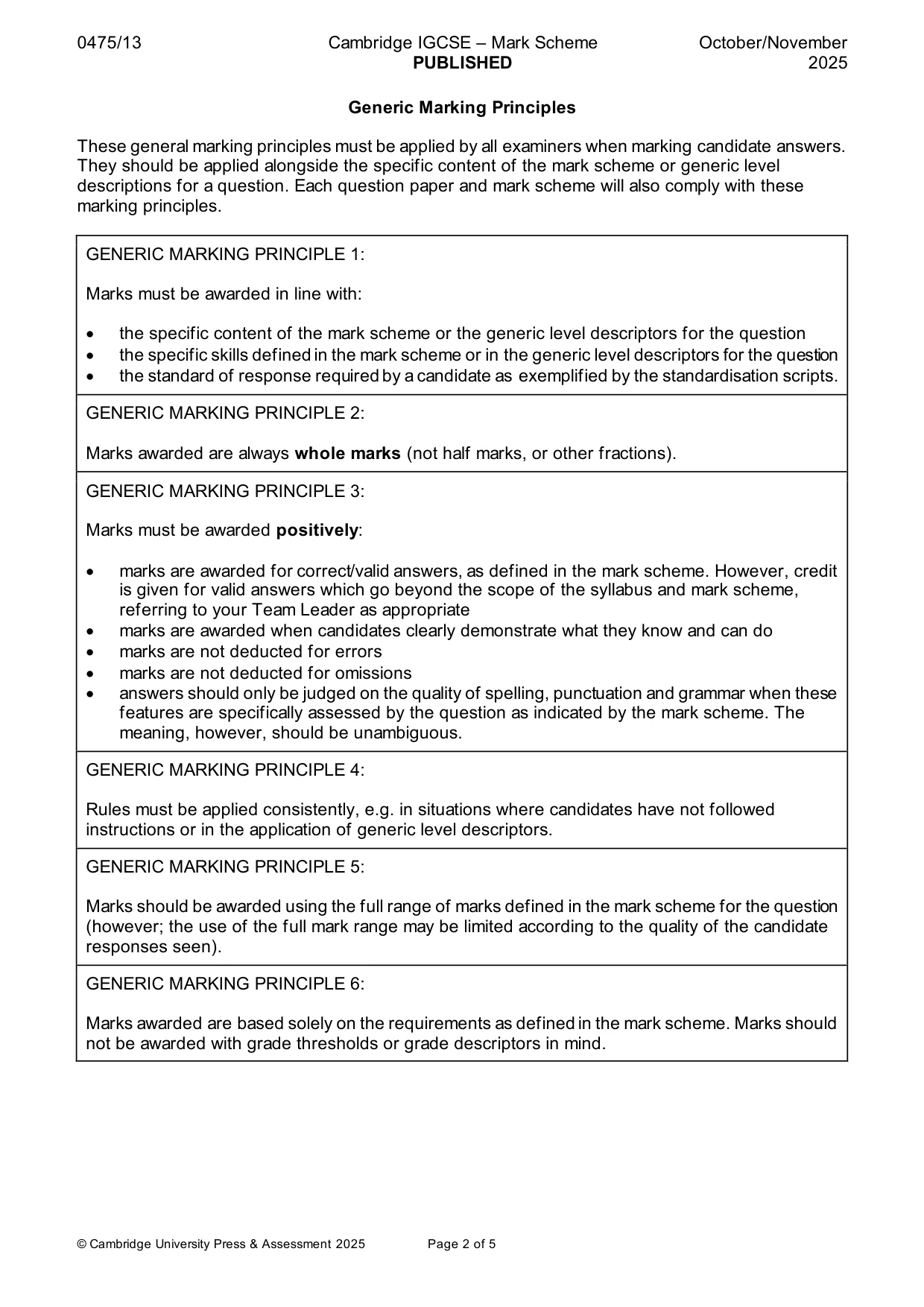
0475/13 Cambridge IGCSE – Mark Scheme PUBLISHED October/November 2025 © Cambridge University Press & Assessment 2025 Page 2 of 5 Generic Marking Principles These general marking principles must be applied by all examiners when marking candidate answers. They should be applied alongside the specific content of the mark scheme or generic level descriptions for a question. Each question paper and mark scheme will also comply with these marking principles. GENERIC MARKING PRINCIPLE 1: Marks must be awarded in line with: • the specific content of the mark scheme or the generic level descriptors for the question • the specific skills defined in the mark scheme or in the generic level descriptors for the question • the standard of response required by a candidate as exemplified by the standardisation scripts. GENERIC MARKING PRINCIPLE 2: Marks awarded are always whole marks (not half marks, or other fractions). GENERIC MARKING PRINCIPLE 3: Marks must be awarded positively: • marks are awarded for correct/valid answers, as defined in the mark scheme. However, credit is given for valid answers which go beyond the scope of the syllabus and mark scheme, referring to your Team Leader as appropriate • marks are awarded when candidates clearly demonstrate what they know and can do • marks are not deducted for errors • marks are not deducted for omissions • answers should only be judged on the quality of spelling, punctuation and grammar when these features are specifically assessed by the question as indicated by the mark scheme. The meaning, however, should be unambiguous. GENERIC MARKING PRINCIPLE 4: Rules must be applied consistently, e.g. in situations where candidates have not followed instructions or in the application of generic level descriptors. GENERIC MARKING PRINCIPLE 5: Marks should be awarded using the full range of marks defined in the mark scheme for the question (however; the use of the full mark range may be limited according to the quality of the candidate responses seen). GENERIC MARKING PRINCIPLE 6: Marks awarded are based solely on the requirements as defined in the mark scheme. Marks should not be awarded with grade thresholds or grade descriptors in mind.
Mark scheme, page 3
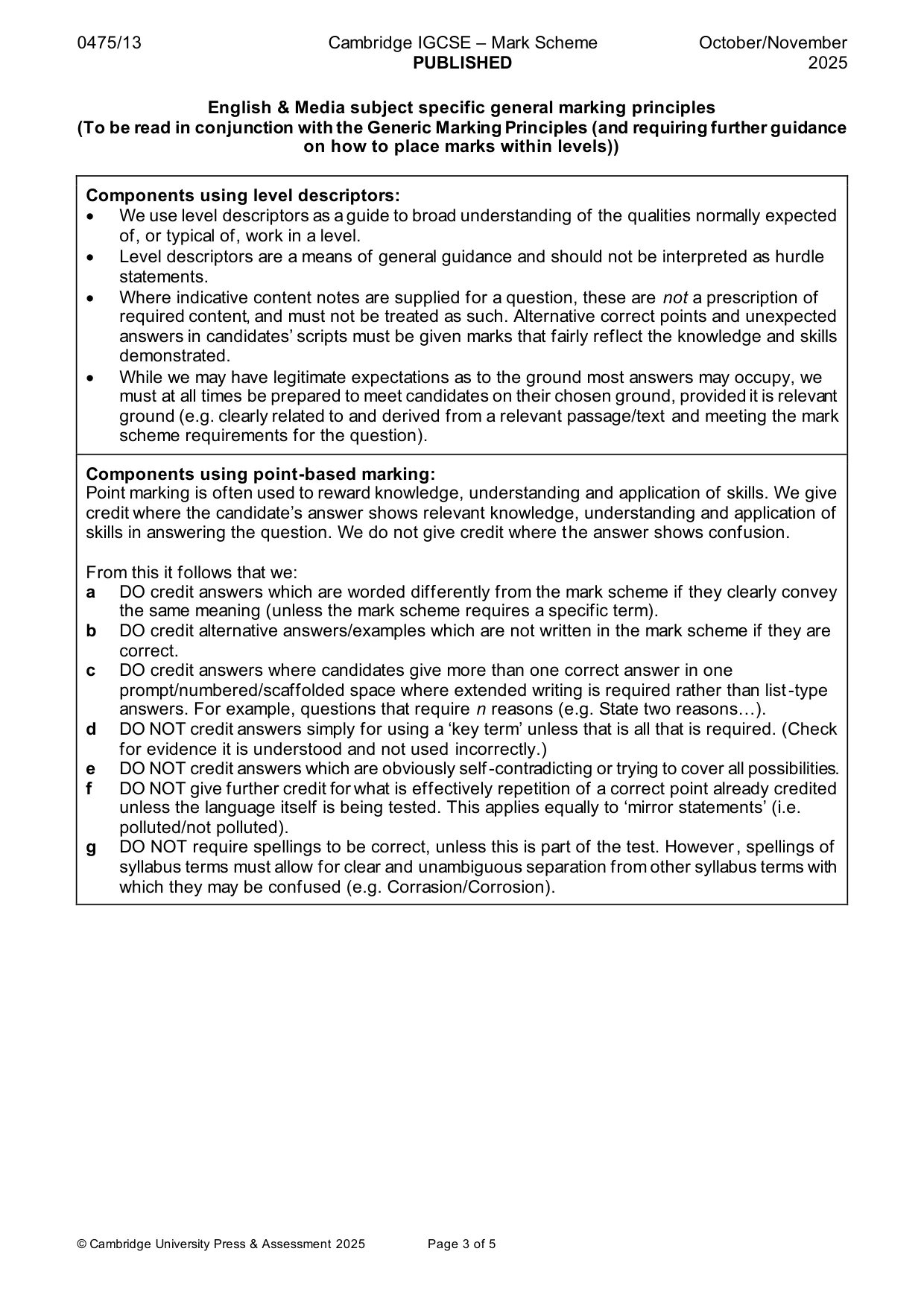
0475/13 Cambridge IGCSE – Mark Scheme PUBLISHED October/November 2025 © Cambridge University Press & Assessment 2025 Page 3 of 5 English & Media subject specific general marking principles (To be read in conjunction with the Generic Marking Principles (and requiring further guidance on how to place marks within levels)) Components using level descriptors: • We use level descriptors as a guide to broad understanding of the qualities normally expected of, or typical of, work in a level. • Level descriptors are a means of general guidance and should not be interpreted as hurdle statements. • Where indicative content notes are supplied for a question, these are not a prescription of required content, and must not be treated as such. Alternative correct points and unexpected answers in candidates’ scripts must be given marks that fairly reflect the knowledge and skills demonstrated. • While we may have legitimate expectations as to the ground most answers may occupy, we must at all times be prepared to meet candidates on their chosen ground, provided it is relevant ground (e.g. clearly related to and derived from a relevant passage/text and meeting the mark scheme requirements for the question). Components using point-based marking: Point marking is often used to reward knowledge, understanding and application of skills. We give credit where the candidate’s answer shows relevant knowledge, understanding and application of skills in answering the question. We do not give credit where the answer shows confusion. From this it follows that we: a DO credit answers which are worded differently from the mark scheme if they clearly convey the same meaning (unless the mark scheme requires a specific term). b DO credit alternative answers/examples which are not written in the mark scheme if they are correct. c DO credit answers where candidates give more than one correct answer in one prompt/numbered/scaffolded space where extended writing is required rather than list-type answers. For example, questions that require n reasons (e.g. State two reasons…). d DO NOT credit answers simply for using a ‘key term’ unless that is all that is required. (Check for evidence it is understood and not used incorrectly.) e DO NOT credit answers which are obviously self-contradicting or trying to cover all possibilities. f DO NOT give further credit for what is effectively repetition of a correct point already credited unless the language itself is being tested. This applies equally to ‘mirror statements’ (i.e. polluted/not polluted). g DO NOT require spellings to be correct, unless this is part of the test. However, spellings of syllabus terms must allow for clear and unambiguous separation from other syllabus terms with which they may be confused (e.g. Corrasion/Corrosion).
Mark scheme, page 4
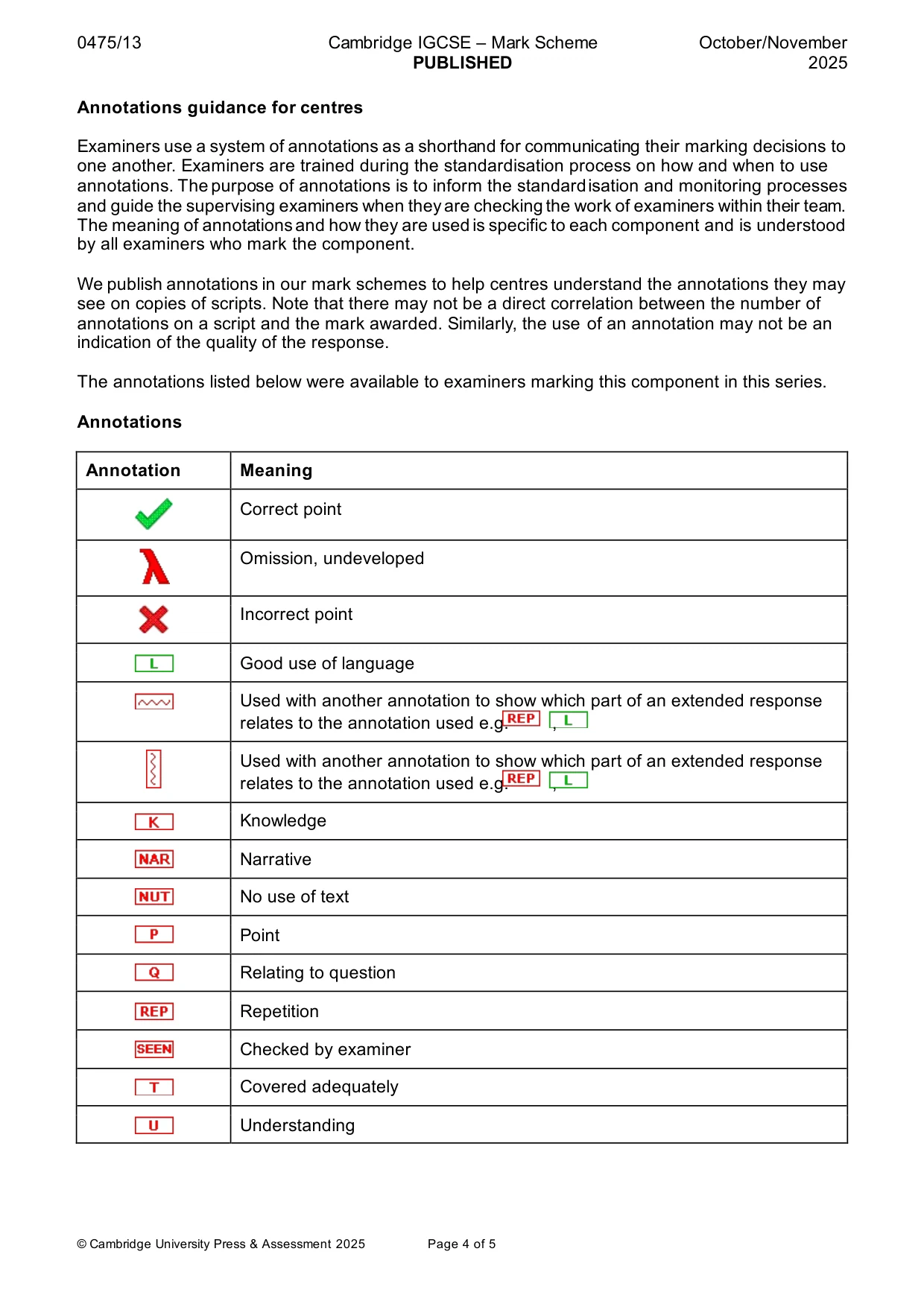
0475/13 Cambridge IGCSE – Mark Scheme PUBLISHED October/November 2025 © Cambridge University Press & Assessment 2025 Page 4 of 5 Annotations guidance for centres Examiners use a system of annotations as a shorthand for communicating their marking decisions to one another. Examiners are trained during the standardisation process on how and when to use annotations. The purpose of annotations is to inform the standardisation and monitoring processes and guide the supervising examiners when they are checking the work of examiners within their team. The meaning of annotations and how they are used is specific to each component and is understood by all examiners who mark the component. We publish annotations in our mark schemes to help centres understand the annotations they may see on copies of scripts. Note that there may not be a direct correlation between the number of annotations on a script and the mark awarded. Similarly, the use of an annotation may not be an indication of the quality of the response. The annotations listed below were available to examiners marking this component in this series. Annotations Annotation Meaning Correct point Omission, undeveloped Incorrect point Good use of language Used with another annotation to show which part of an extended response relates to the annotation used e.g. , Used with another annotation to show which part of an extended response relates to the annotation used e.g. , Knowledge Narrative No use of text Point Relating to question Repetition Checked by examiner Covered adequately Understanding
Mark scheme, page 5
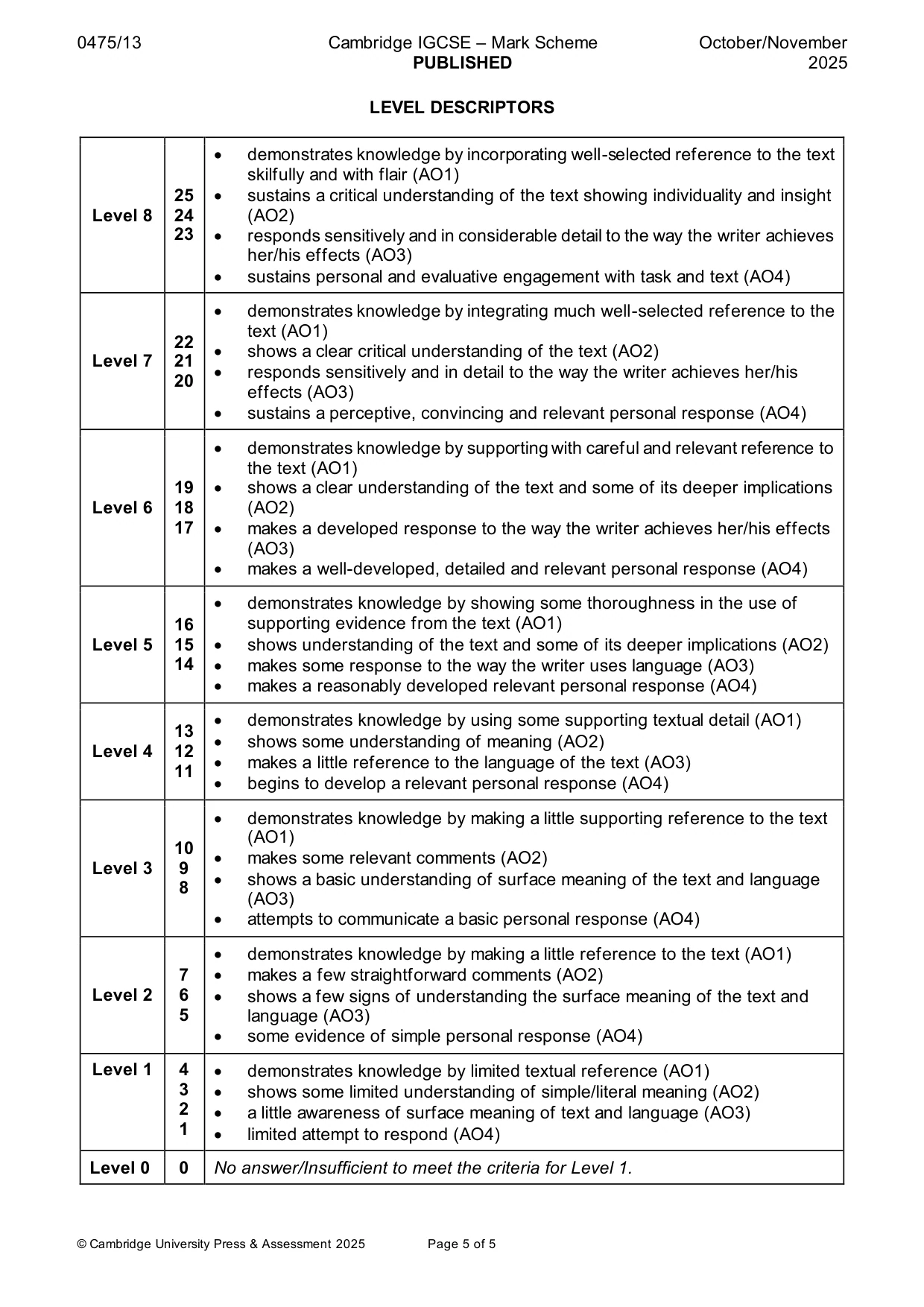
0475/13 Cambridge IGCSE – Mark Scheme PUBLISHED October/November 2025 © Cambridge University Press & Assessment 2025 Page 5 of 5 LEVEL DESCRIPTORS Level 8 25 24 23 • demonstrates knowledge by incorporating well-selected reference to the text skilfully and with flair (AO1) • sustains a critical understanding of the text showing individuality and insight (AO2) • responds sensitively and in considerable detail to the way the writer achieves her/his effects (AO3) • sustains personal and evaluative engagement with task and text (AO4) Level 7 22 21 20 • demonstrates knowledge by integrating much well-selected reference to the text (AO1) • shows a clear critical understanding of the text (AO2) • responds sensitively and in detail to the way the writer achieves her/his effects (AO3) • sustains a perceptive, convincing and relevant personal response (AO4) Level 6 19 18 17 • demonstrates knowledge by supporting with careful and relevant reference to the text (AO1) • shows a clear understanding of the text and some of its deeper implications (AO2) • makes a developed response to the way the writer achieves her/his effects (AO3) • makes a well-developed, detailed and relevant personal response (AO4) Level 5 16 15 14 • demonstrates knowledge by showing some thoroughness in the use of supporting evidence from the text (AO1) • shows understanding of the text and some of its deeper implications (AO2) • makes some response to the way the writer uses language (AO3) • makes a reasonably developed relevant personal response (AO4) Level 4 13 12 11 • demonstrates knowledge by using some supporting textual detail (AO1) • shows some understanding of meaning (AO2) • makes a little reference to the language of the text (AO3) • begins to develop a relevant personal response (AO4) Level 3 10 9 8 • demonstrates knowledge by making a little supporting reference to the text (AO1) • makes some relevant comments (AO2) • shows a basic understanding of surface meaning of the text and language (AO3) • attempts to communicate a basic personal response (AO4) Level 2 7 6 5 • demonstrates knowledge by making a little reference to the text (AO1) • makes a few straightforward comments (AO2) • shows a few signs of understanding the surface meaning of the text and language (AO3) • some evidence of simple personal response (AO4) Level 1 4 3 2 1 • demonstrates knowledge by limited textual reference (AO1) • shows some limited understanding of simple/literal meaning (AO2) • a little awareness of surface meaning of text and language (AO3) • limited attempt to respond (AO4) Level 0 0 No answer/Insufficient to meet the criteria for Level 1.
What you needed in this session
Cambridge’s own grade thresholds for 2025 Oct/Nov, Paper 1 · Variant 3. A higher threshold means an easier paper — the bar moves with how the cohort did.