Cambridge IGCSE English - Literature in English 0475 — 2025 May/June Paper 1 · Variant 3
0475/13/M/J/25 · 50 marks · ≈56 min
The question paper and its mark scheme, free to read here and free to download. This is Cambridge’s own paper, exactly as it was sat.
Question paper28 pages



Mark scheme6 pages
Answers below. Sit the paper first if you are practising.
Paper as text
Question paper, page 1
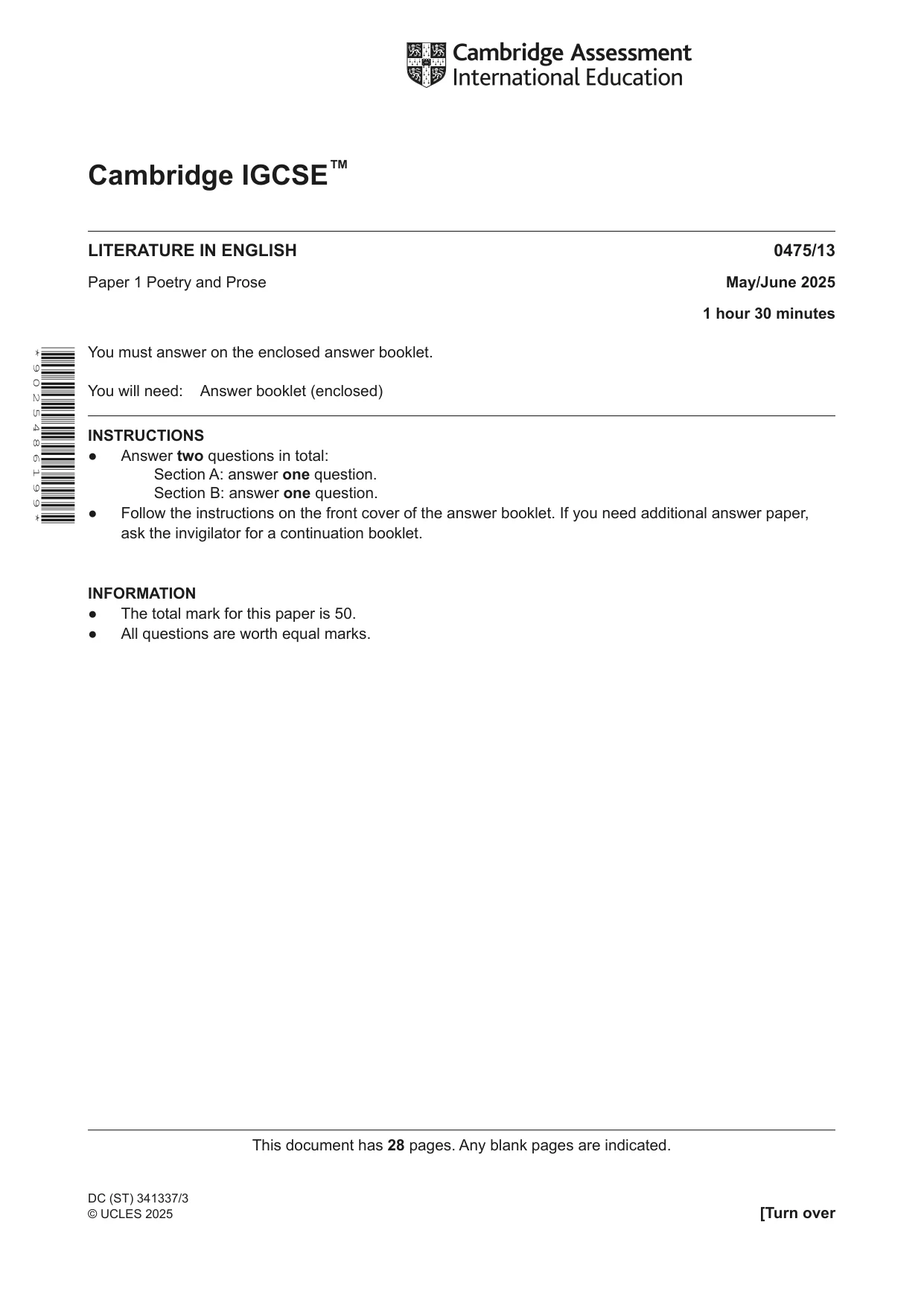
This document has 28 pages. Any blank pages are indicated. [Turn over Cambridge IGCSE™ * 9 0 2 5 4 8 6 1 9 9 * LITERATURE IN ENGLISH 0475/13 Paper 1 Poetry and Prose May/June 2025 1 hour 30 minutes You must answer on the enclosed answer booklet. You will need: Answer booklet (enclosed) INSTRUCTIONS ● Answer two questions in total: Section A: answer one question. Section B: answer one question. ● Follow the instructions on the front cover of the answer booklet. If you need additional answer paper, ask the invigilator for a continuation booklet. INFORMATION ● The total mark for this paper is 50. ● All questions are worth equal marks. DC (ST) 341337/3 © UCLES 2025
Question paper, page 2
2 0475/13/M/J/25 © UCLES 2025 BLANK PAGE
Question paper, page 3
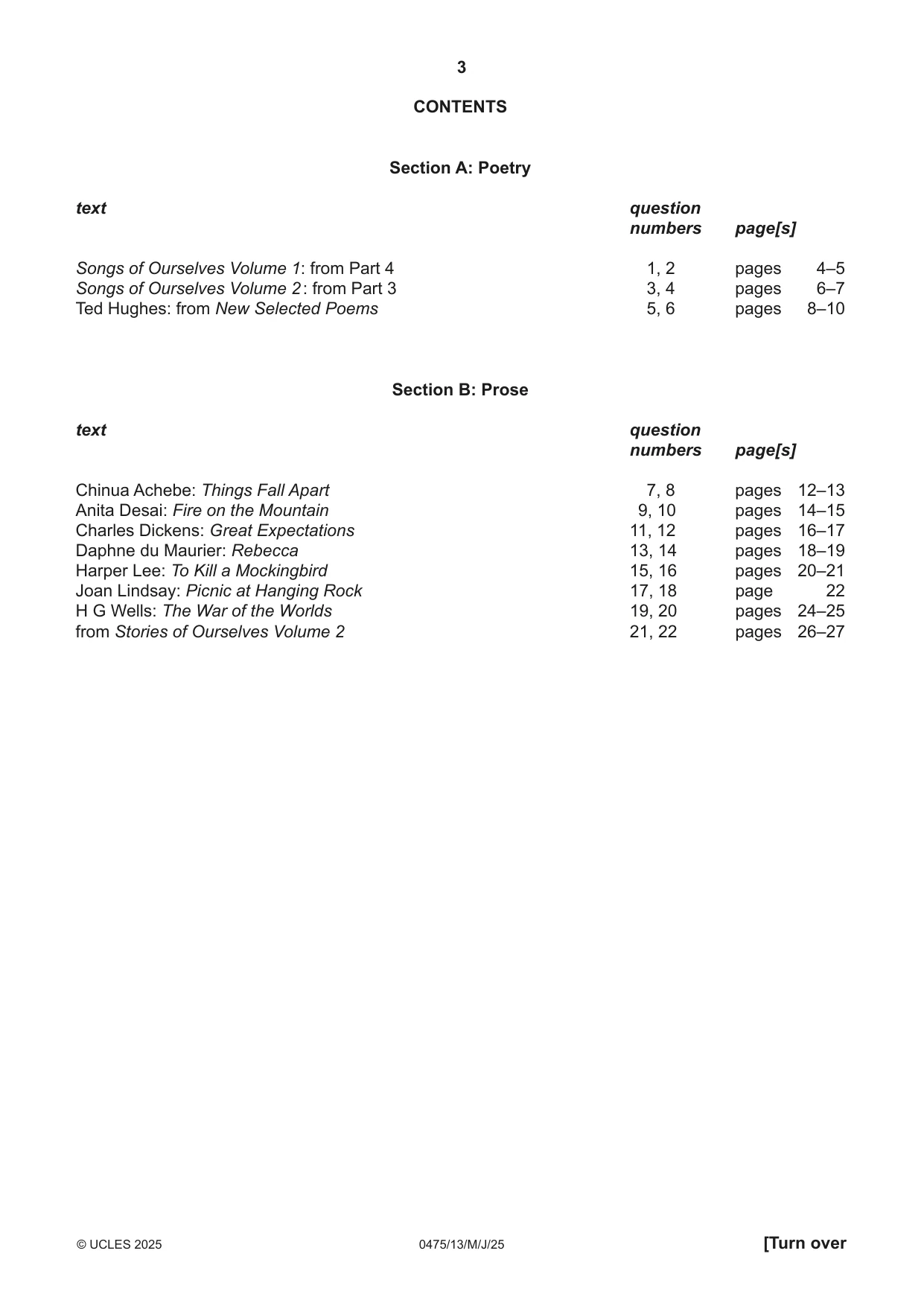
3 0475/13/M/J/25 © UCLES 2025 [Turn over CONTENTS Section A: Poetry text question numbers page[s] Songs of Ourselves Volume 1: from Part 4 1, 2 pages 4–5 Songs of Ourselves Volume 2 : from Part 3 3, 4 pages 6–7 Ted Hughes: from New Selected Poems 5, 6 pages 8–10 Section B: Prose text question numbers page[s] Chinua Achebe: Things Fall Apart 7, 8 pages 12–13 Anita Desai: Fire on the Mountain 9, 10 pages 14–15 Charles Dickens: Great Expectations 11, 12 pages 16–17 Daphne du Maurier: Rebecca 13, 14 pages 18–19 Harper Lee: To Kill a Mockingbird 15, 16 pages 20–21 Joan Lindsay: Picnic at Hanging Rock 17, 18 page 22 H G Wells: The War of the Worlds 19, 20 pages 24–25 from Stories of Ourselves Volume 2 21, 22 pages 26–27
Question paper, page 4
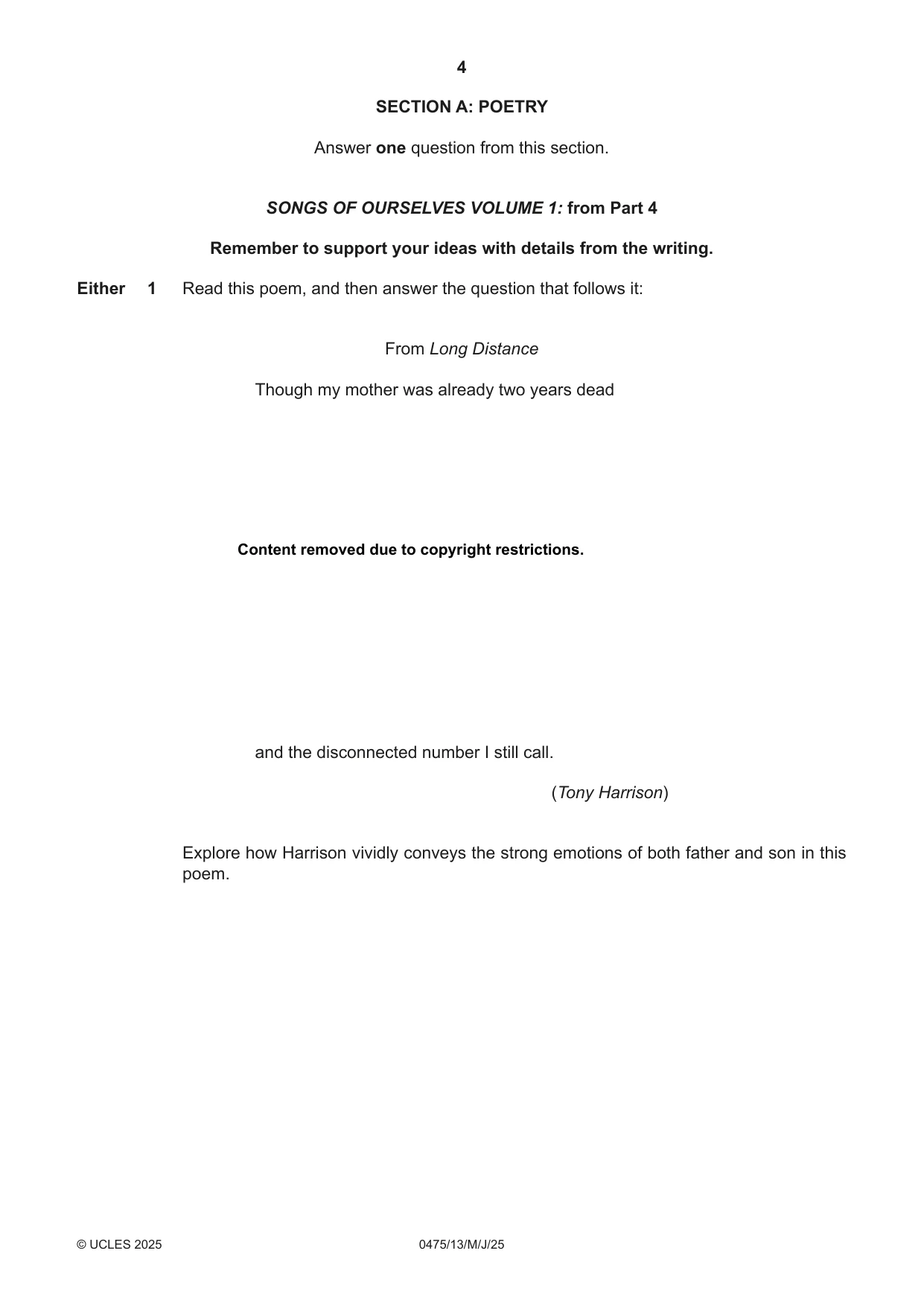
4 0475/13/M/J/25 © UCLES 2025 SECTION A: POETRY Answer one question from this section. SONGS OF OURSELVES VOLUME 1: from Part 4 Remember to support your ideas with details from the writing. Either 1 Read this poem, and then answer the question that follows it: From Long Distance Though my mother was already two years dead and the disconnected number I still call. (Tony Harrison) Explore how Harrison vividly conveys the strong emotions of both father and son in this poem. Content removed due to copyright restrictions.
Question paper, page 5
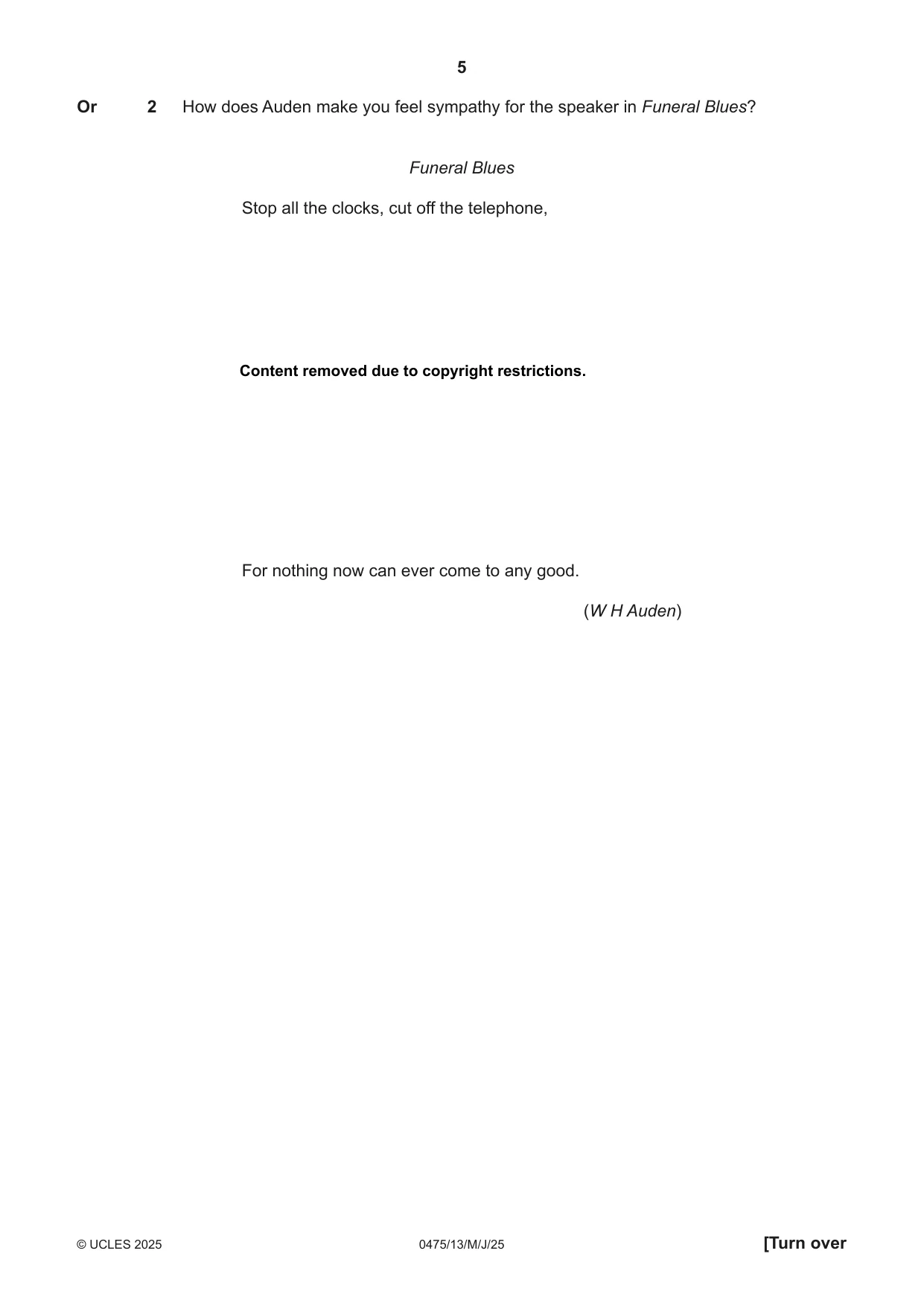
5 0475/13/M/J/25 © UCLES 2025 [Turn over Or 2 How does Auden make you feel sympathy for the speaker in Funeral Blues? Funeral Blues Stop all the clocks, cut off the telephone, For nothing now can ever come to any good. (W H Auden) Content removed due to copyright restrictions.
Question paper, page 6
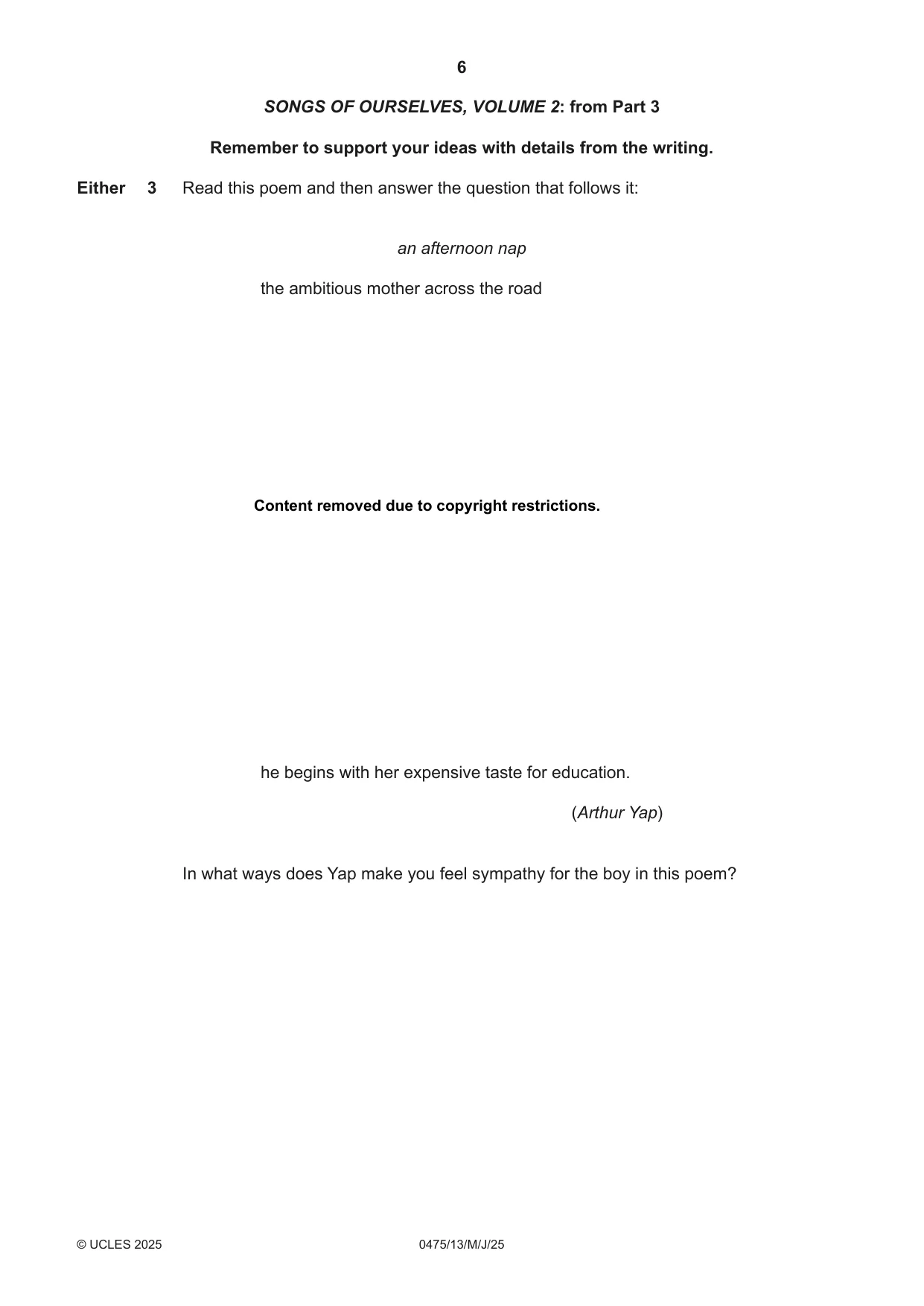
6 0475/13/M/J/25 © UCLES 2025 SONGS OF OURSELVES, VOLUME 2: from Part 3 Remember to support your ideas with details from the writing. Either 3 Read this poem and then answer the question that follows it: an afternoon nap the ambitious mother across the road he begins with her expensive taste for education. (Arthur Yap) In what ways does Yap make you feel sympathy for the boy in this poem? Content removed due to copyright restrictions.
Question paper, page 7
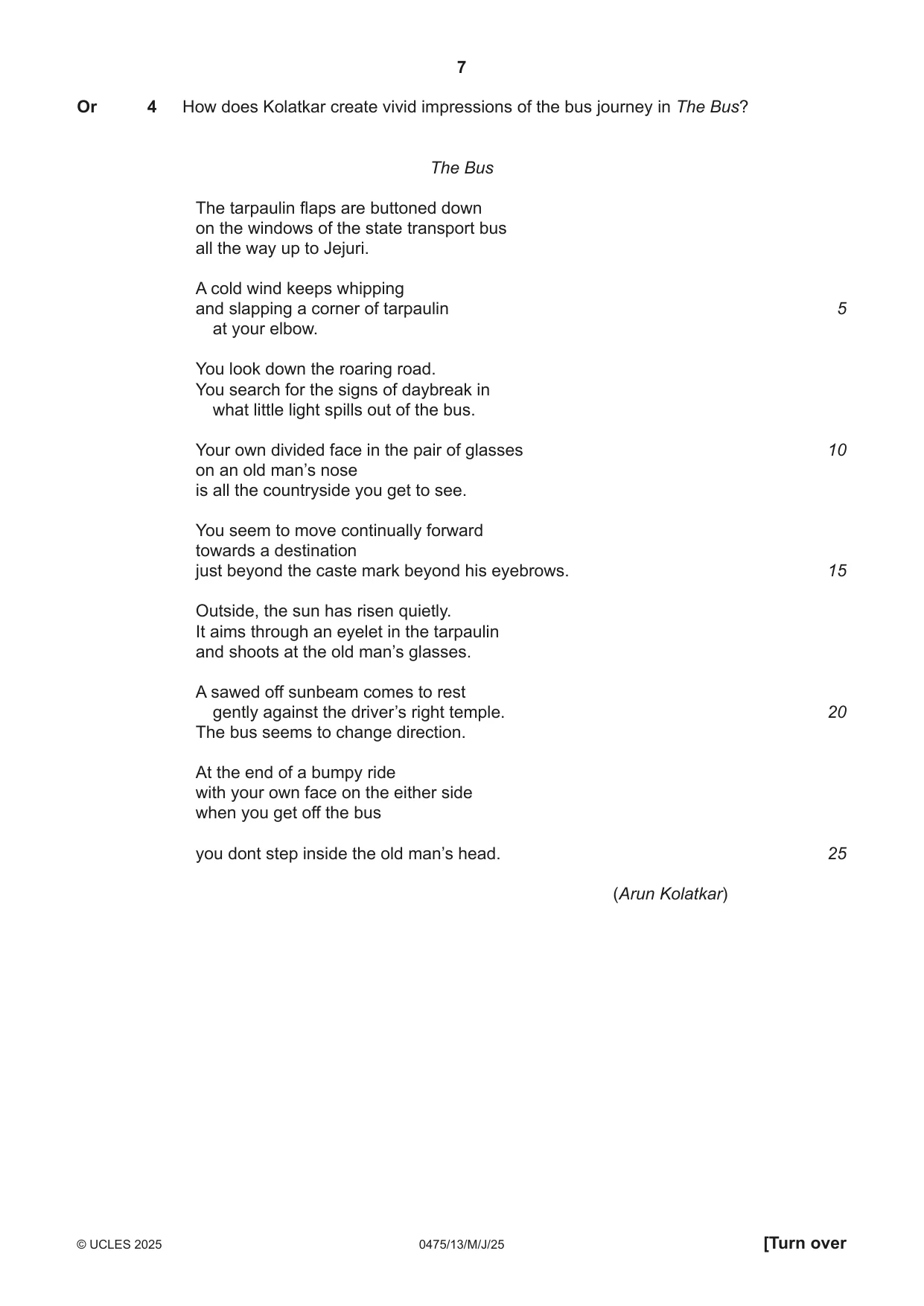
7 0475/13/M/J/25 © UCLES 2025 [Turn over Or 4 How does Kolatkar create vivid impressions of the bus journey in The Bus? The Bus The tarpaulin flaps are buttoned down on the windows of the state transport bus all the way up to Jejuri. A cold wind keeps whipping and slapping a corner of tarpaulin 5 at your elbow. You look down the roaring road. You search for the signs of daybreak in what little light spills out of the bus. Your own divided face in the pair of glasses 10 on an old man’s nose is all the countryside you get to see. You seem to move continually forward towards a destination just beyond the caste mark beyond his eyebrows. 15 Outside, the sun has risen quietly. It aims through an eyelet in the tarpaulin and shoots at the old man’s glasses. A sawed off sunbeam comes to rest gently against the driver’s right temple. 20 The bus seems to change direction. At the end of a bumpy ride with your own face on the either side when you get off the bus you dont step inside the old man’s head. 25 (Arun Kolatkar)
Question paper, page 8
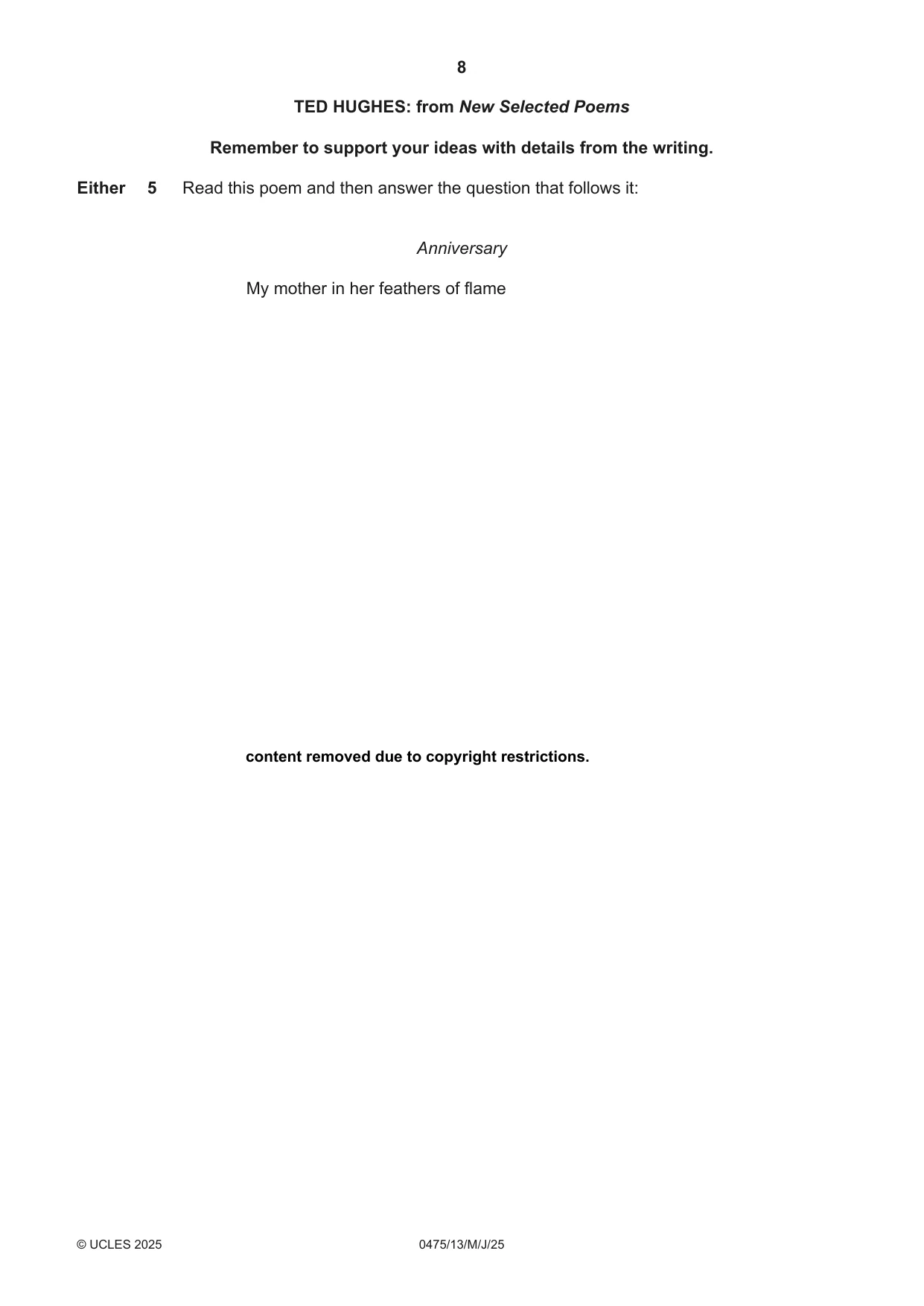
8 0475/13/M/J/25 © UCLES 2025 TED HUGHES: from New Selected Poems Remember to support your ideas with details from the writing. Either 5 Read this poem and then answer the question that follows it: Anniversary My mother in her feathers of flame content removed due to copyright restrictions.
Question paper, page 9
9 0475/13/M/J/25 © UCLES 2025 [Turn over Able for all that distance to think me him. Explore the ways in which Hughes vividly reveals his thoughts and feelings in this poem. Content removed due to copyright restrictions.
Question paper, page 10
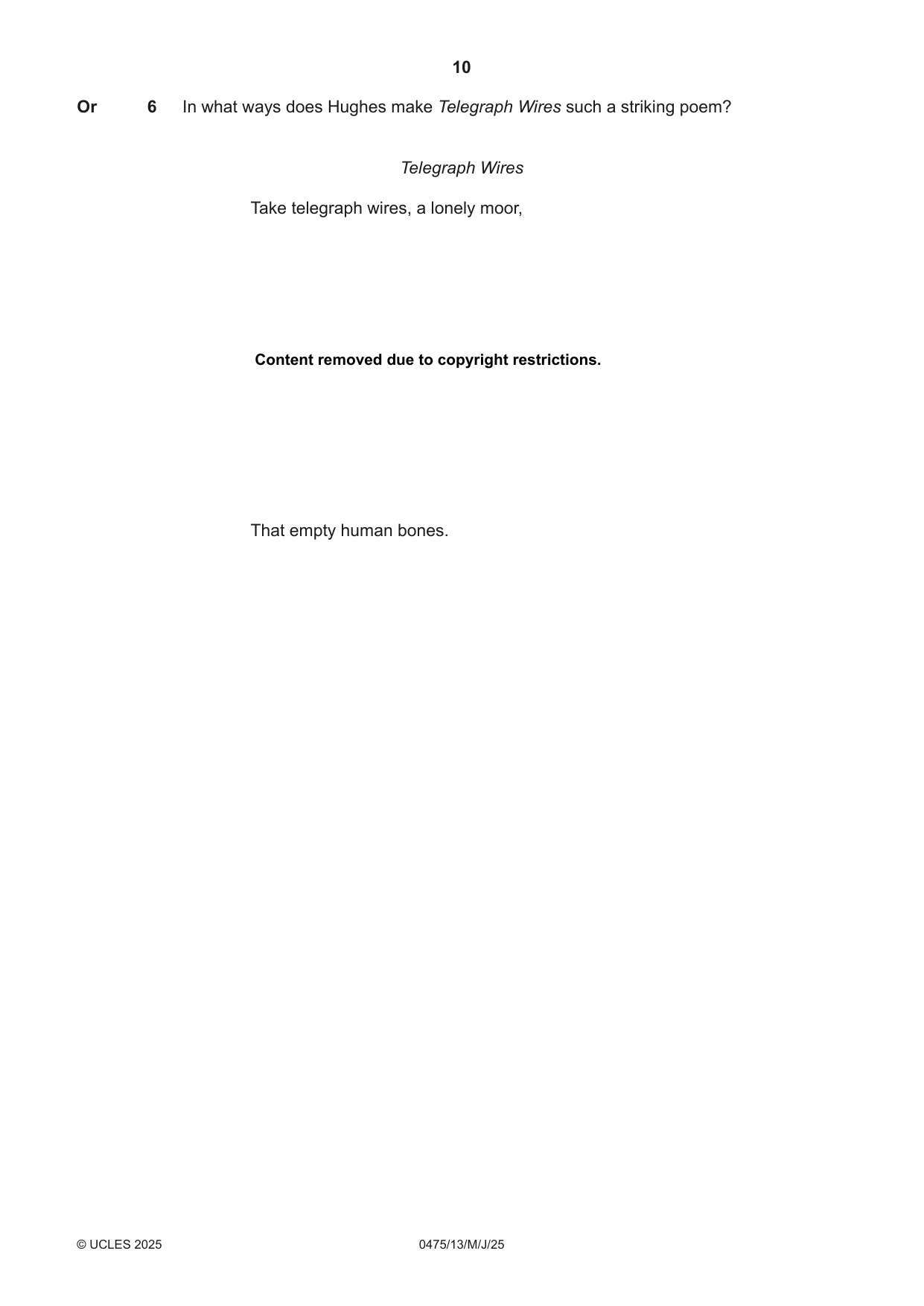
10 0475/13/M/J/25 © UCLES 2025 Or 6 In what ways does Hughes make Telegraph Wires such a striking poem? Telegraph Wires Take telegraph wires, a lonely moor, That empty human bones. Content removed due to copyright restrictions.
Question paper, page 11
11 0475/13/M/J/25 © UCLES 2025 [Turn over BLANK PAGE
Question paper, page 12
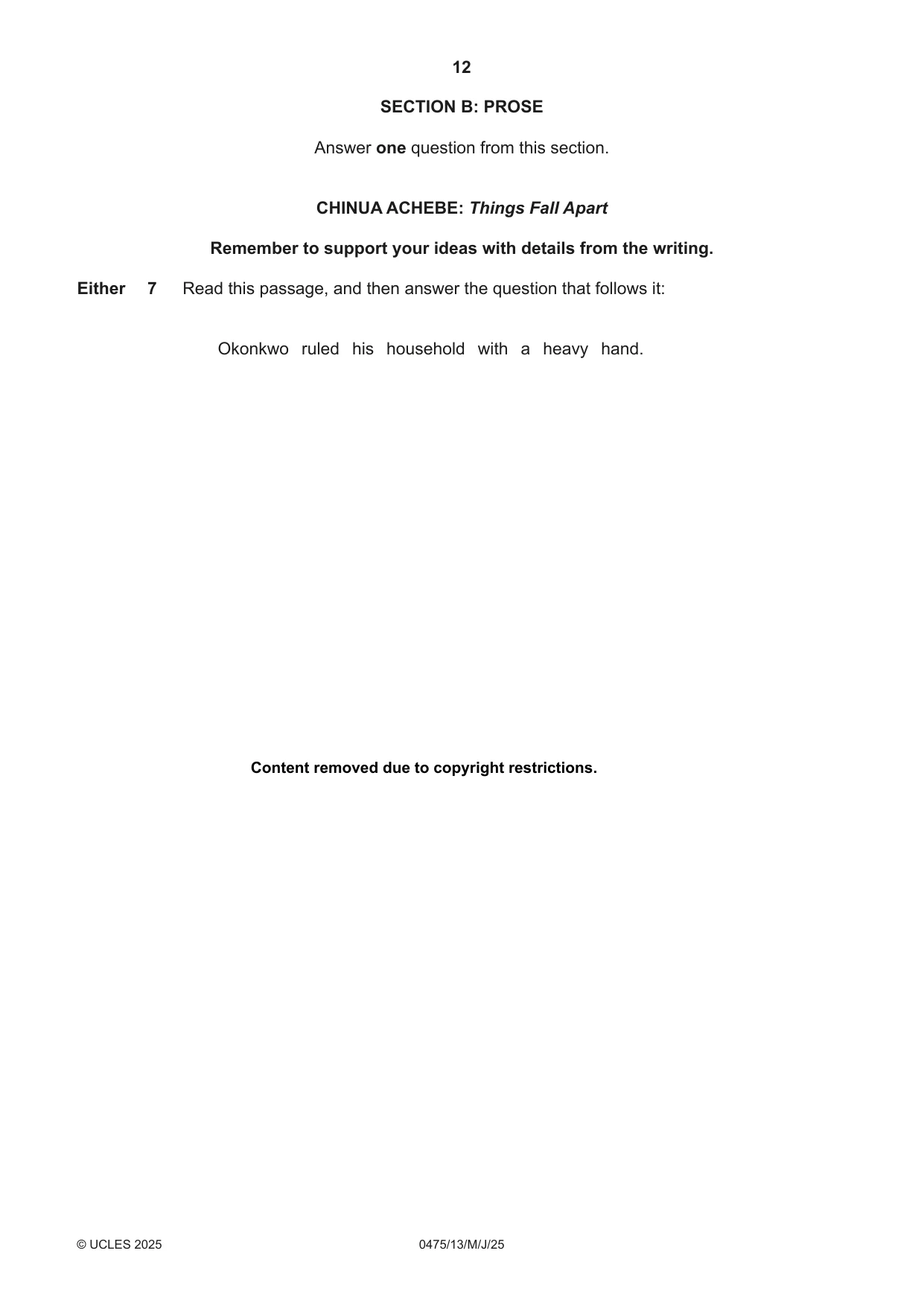
12 0475/13/M/J/25 © UCLES 2025 SECTION B: PROSE Answer one question from this section. CHINUA ACHEBE: Things Fall Apart Remember to support your ideas with details from the writing. Either 7 Read this passage, and then answer the question that follows it: Okonkwo ruled his household with a heavy hand. Content removed due to copyright restrictions.
Question paper, page 13
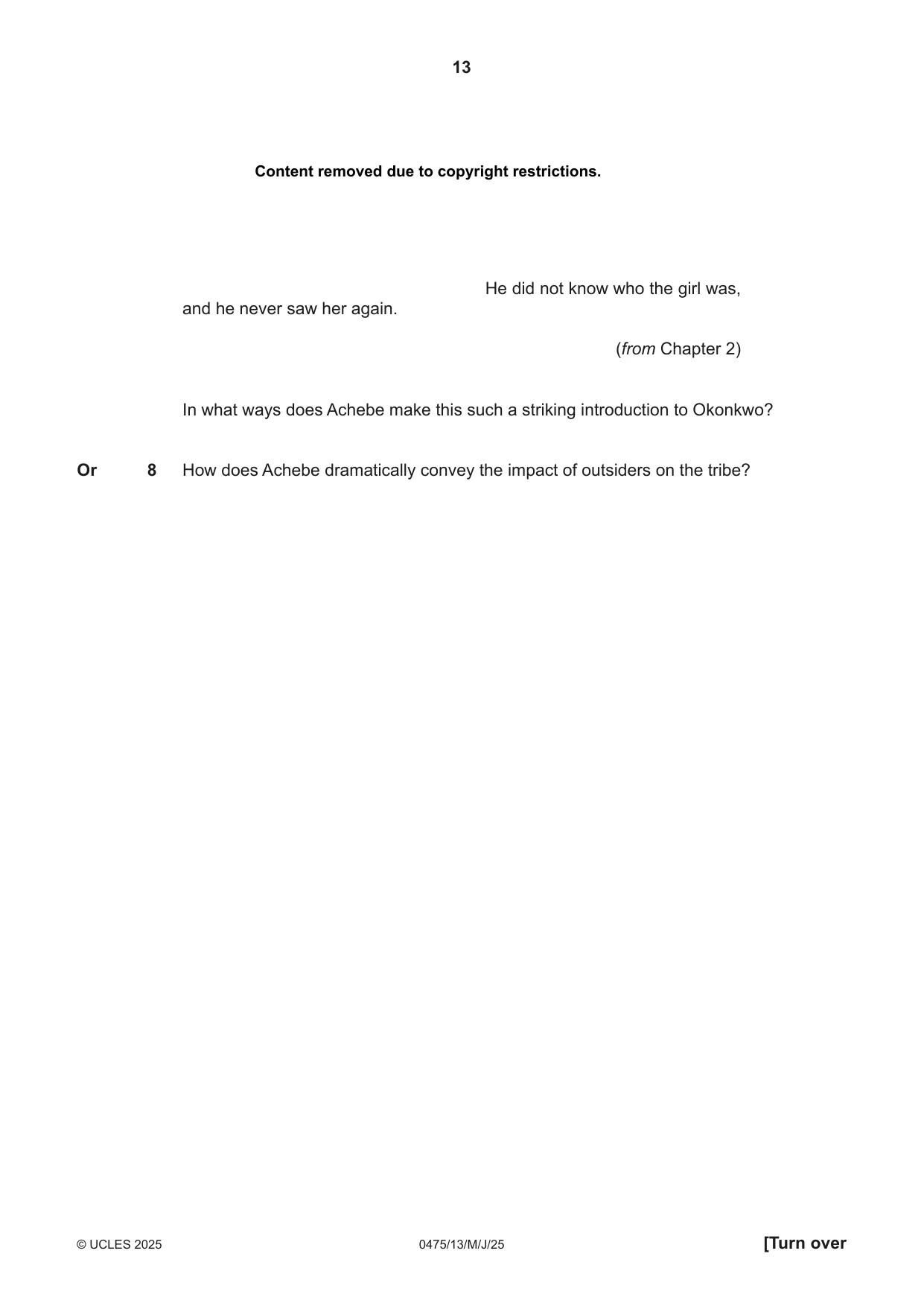
13 0475/13/M/J/25 © UCLES 2025 [Turn over He did not know who the girl was, and he never saw her again. (from Chapter 2) In what ways does Achebe make this such a striking introduction to Okonkwo? Or 8 How does Achebe dramatically convey the impact of outsiders on the tribe? Content removed due to copyright restrictions.
Question paper, page 14
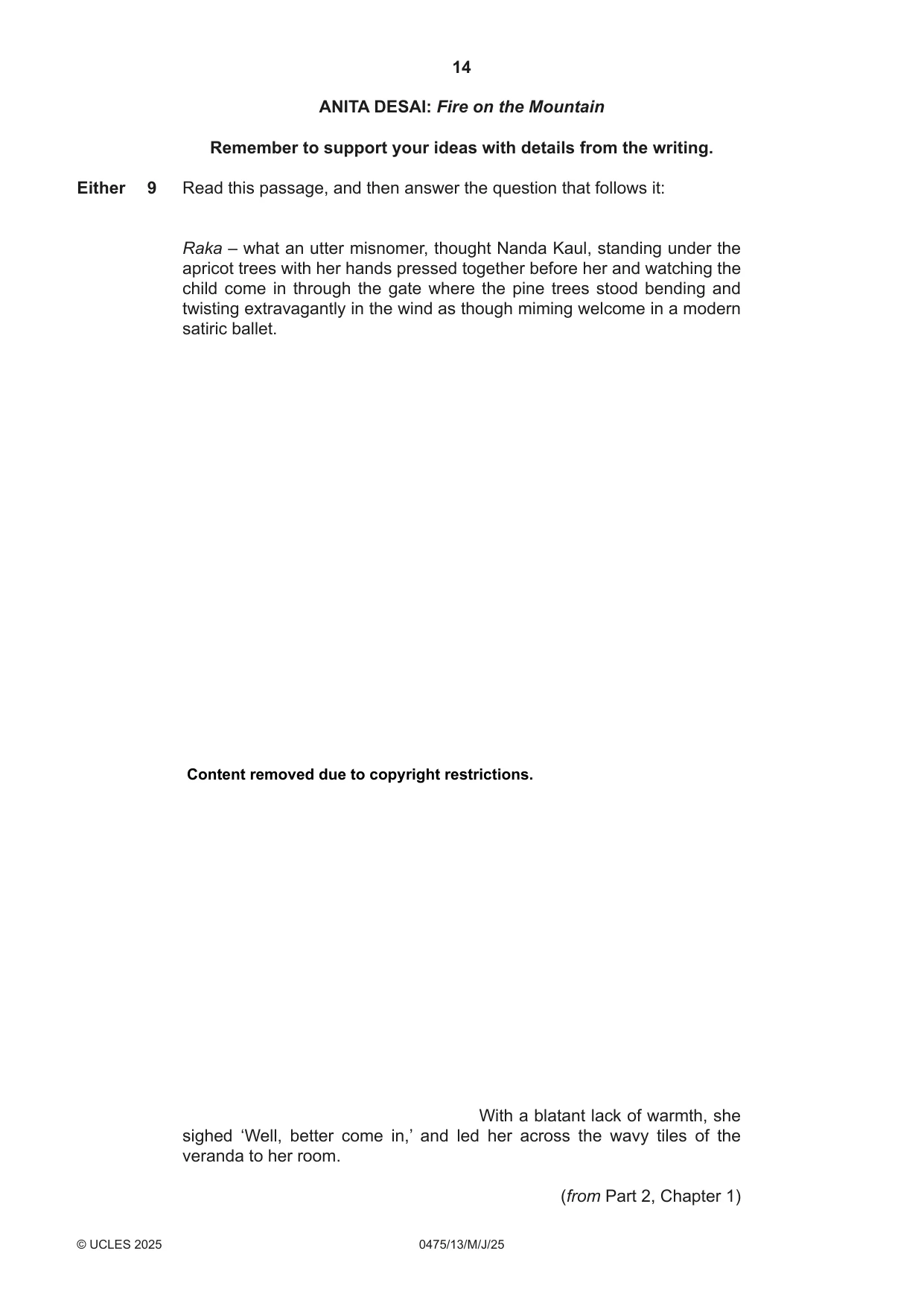
14 0475/13/M/J/25 © UCLES 2025 ANITA DESAI: Fire on the Mountain Remember to support your ideas with details from the writing. Either 9 Read this passage, and then answer the question that follows it: Raka – what an utter misnomer, thought Nanda Kaul, standing under the apricot trees with her hands pressed together before her and watching the child come in through the gate where the pine trees stood bending and twisting extravagantly in the wind as though miming welcome in a modern satiric ballet. With a blatant lack of warmth, she sighed ‘Well, better come in,’ and led her across the wavy tiles of the veranda to her room. (from Part 2, Chapter 1) Content removed due to copyright restrictions.
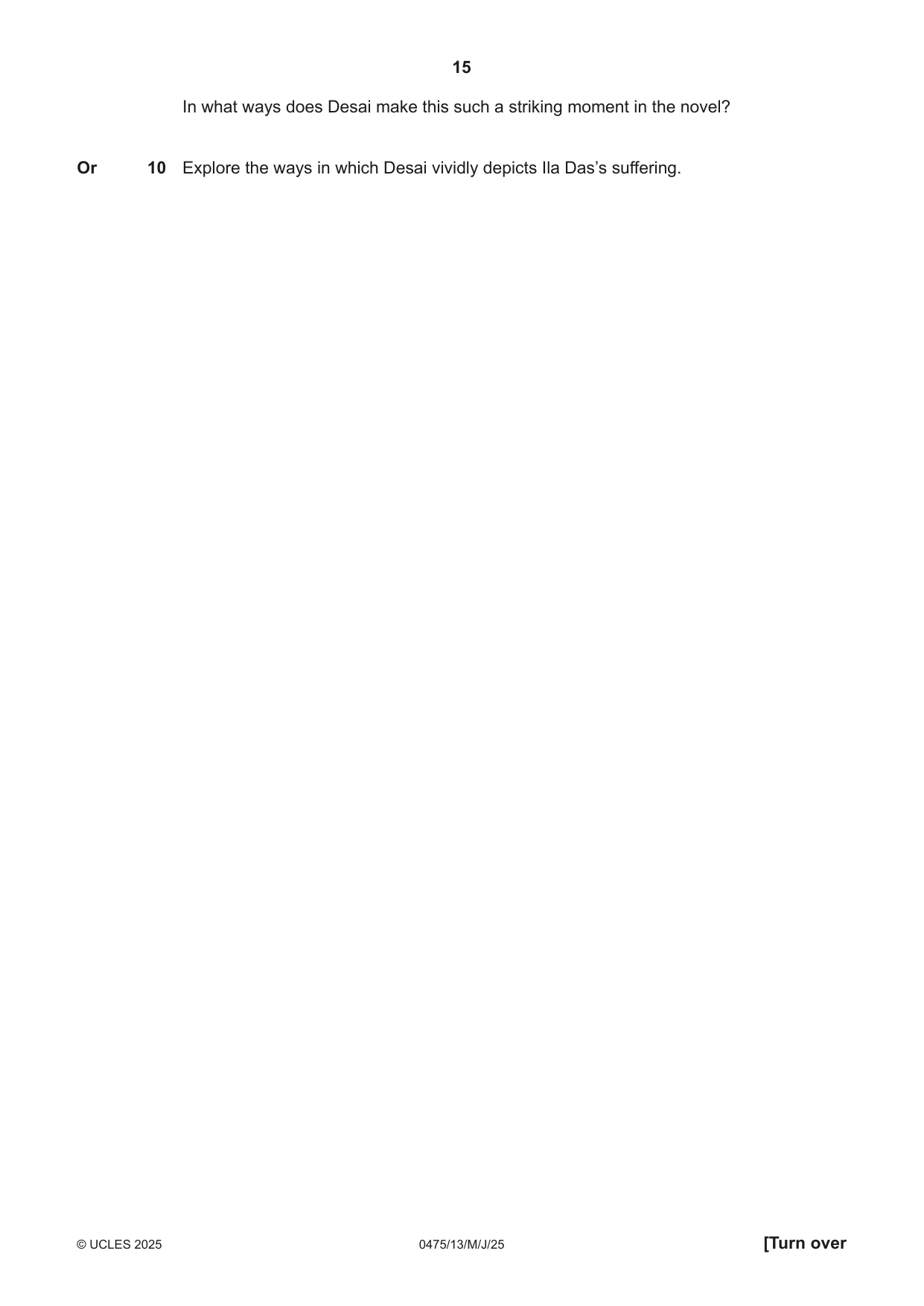
Question paper, page 15
15 0475/13/M/J/25 © UCLES 2025 [Turn over In what ways does Desai make this such a striking moment in the novel? Or 10 Explore the ways in which Desai vividly depicts Ila Das’s suffering.
Question paper, page 16
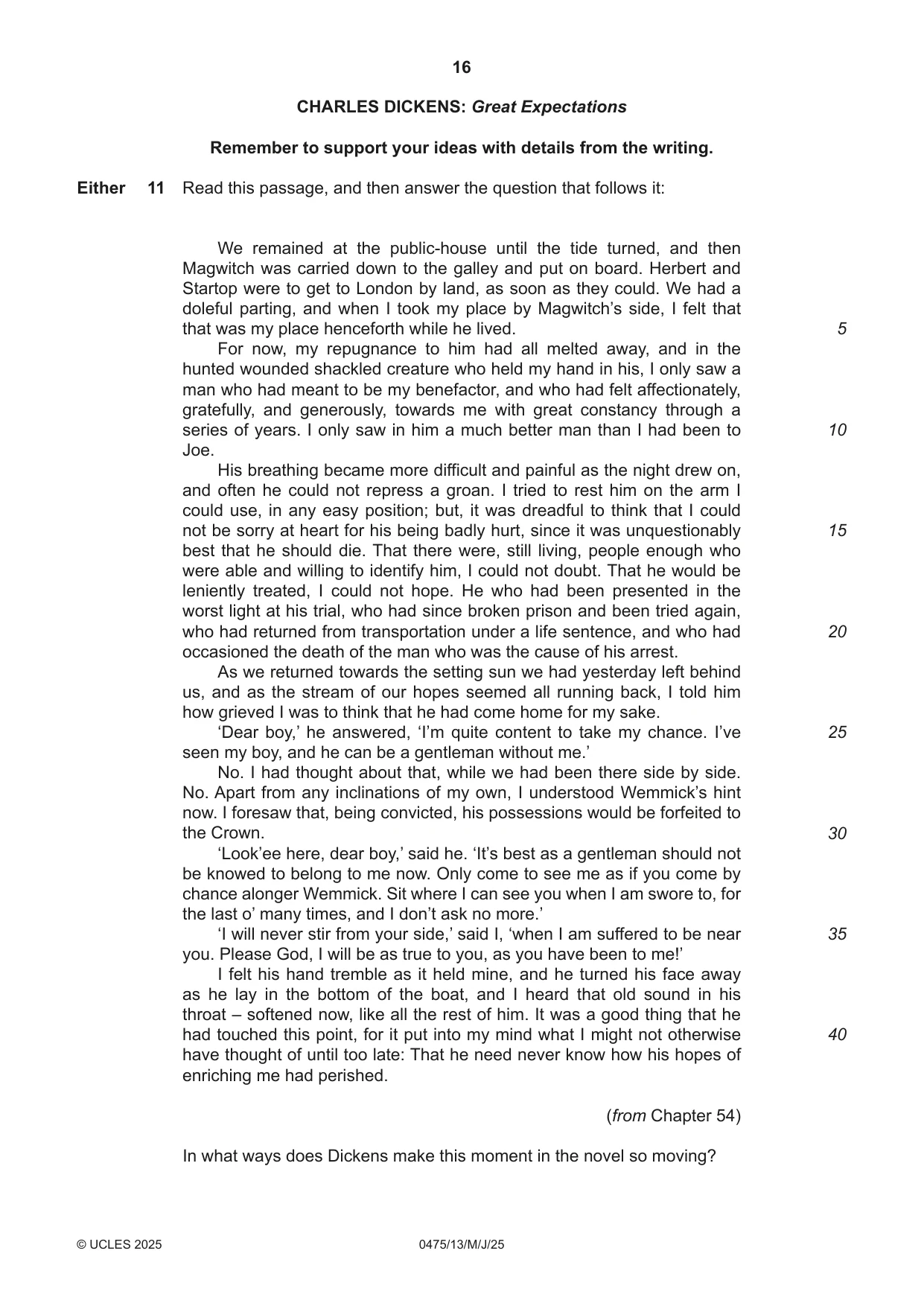
16 0475/13/M/J/25 © UCLES 2025 CHARLES DICKENS: Great Expectations Remember to support your ideas with details from the writing. Either 11 Read this passage, and then answer the question that follows it: We remained at the public‑house until the tide turned, and then Magwitch was carried down to the galley and put on board. Herbert and Startop were to get to London by land, as soon as they could. We had a doleful parting, and when I took my place by Magwitch’s side, I felt that that was my place henceforth while he lived. For now, my repugnance to him had all melted away, and in the hunted wounded shackled creature who held my hand in his, I only saw a man who had meant to be my benefactor, and who had felt affectionately, gratefully, and generously, towards me with great constancy through a series of years. I only saw in him a much better man than I had been to Joe. His breathing became more difficult and painful as the night drew on, and often he could not repress a groan. I tried to rest him on the arm I could use, in any easy position; but, it was dreadful to think that I could not be sorry at heart for his being badly hurt, since it was unquestionably best that he should die. That there were, still living, people enough who were able and willing to identify him, I could not doubt. That he would be leniently treated, I could not hope. He who had been presented in the worst light at his trial, who had since broken prison and been tried again, who had returned from transportation under a life sentence, and who had occasioned the death of the man who was the cause of his arrest. As we returned towards the setting sun we had yesterday left behind us, and as the stream of our hopes seemed all running back, I told him how grieved I was to think that he had come home for my sake. ‘Dear boy,’ he answered, ‘I’m quite content to take my chance. I’ve seen my boy, and he can be a gentleman without me.’ No. I had thought about that, while we had been there side by side. No. Apart from any inclinations of my own, I understood Wemmick’s hint now. I foresaw that, being convicted, his possessions would be forfeited to the Crown. ‘Look’ee here, dear boy,’ said he. ‘It’s best as a gentleman should not be knowed to belong to me now. Only come to see me as if you come by chance alonger Wemmick. Sit where I can see you when I am swore to, for the last o’ many times, and I don’t ask no more.’ ‘I will never stir from your side,’ said I, ‘when I am suffered to be near you. Please God, I will be as true to you, as you have been to me!’ I felt his hand tremble as it held mine, and he turned his face away as he lay in the bottom of the boat, and I heard that old sound in his throat – softened now, like all the rest of him. It was a good thing that he had touched this point, for it put into my mind what I might not otherwise have thought of until too late: That he need never know how his hopes of enriching me had perished. (from Chapter 54) In what ways does Dickens make this moment in the novel so moving? 5 10 15 20 25 30 35 40
Question paper, page 17
17 0475/13/M/J/25 © UCLES 2025 [Turn over Or 12 Explore the ways in which Dickens memorably portrays the relationship between Pip and Joe Gargery.
Question paper, page 18
18 0475/13/M/J/25 © UCLES 2025 DAPHNE DU MAURIER: Rebecca Remember to support your ideas with details from the writing. Either 13 Read this passage, and then answer the question that follows it: It was the following day I remember, when Frith, who had brought in the coffee after lunch to the library, waited a moment, hovering behind Maxim, and said, At least, not afraid, but …’ (from Chapter 12) Content removed due to copyright restrictions.
Question paper, page 19
19 0475/13/M/J/25 © UCLES 2025 [Turn over In what ways does du Maurier make this such a memorable moment in the novel? Or 14 How does du Maurier’s portrayal of Maxim make you feel about him?
Question paper, page 20
20 0475/13/M/J/25 © UCLES 2025 HARPER LEE: To Kill a Mockingbird Remember to support your ideas with details from the writing. Either 15 Read this passage, and then answer the question that follows it: Mrs Dubose was stationed on her porch when we went by. Content removed due to copyright restrictions.
Question paper, page 21
21 0475/13/M/J/25 © UCLES 2025 [Turn over He bent my baton against his knee, snapped it in two and threw it down. (from Chapter 11) How does Lee powerfully depict the impact of Mrs Dubose’s words on Jem and Scout at this moment in the novel? Or 16 Explore how Lee strikingly portrays Bob and Mayella Ewell during the trial. Content removed due to copyright restrictions.
Question paper, page 22
22 0475/13/M/J/25 © UCLES 2025 JOAN LINDSAY: Picnic at Hanging Rock Remember to support your ideas with details from the writing. Either 17 Read this passage, and then answer the question that follows it: Miranda was the first to see the monolith rising up ahead, a single outcrop of pock‑marked stone, something like a monstrous egg perched above a precipitous drop to the plain. The wallaby sprang up in alarm and bounded away, as Edith turned back, plunged blindly into the scrub and ran, stumbling and screaming, towards the plain. (from Chapter 3) Explore the ways in which Lindsay makes this such a disturbing moment in the novel. Or 18 How does Lindsay memorably portray Mademoiselle Dianne de Poitiers? Content removed due to copyright restrictions.
Question paper, page 23
23 0475/13/M/J/25 © UCLES 2025 [Turn over BLANK PAGE
Question paper, page 24
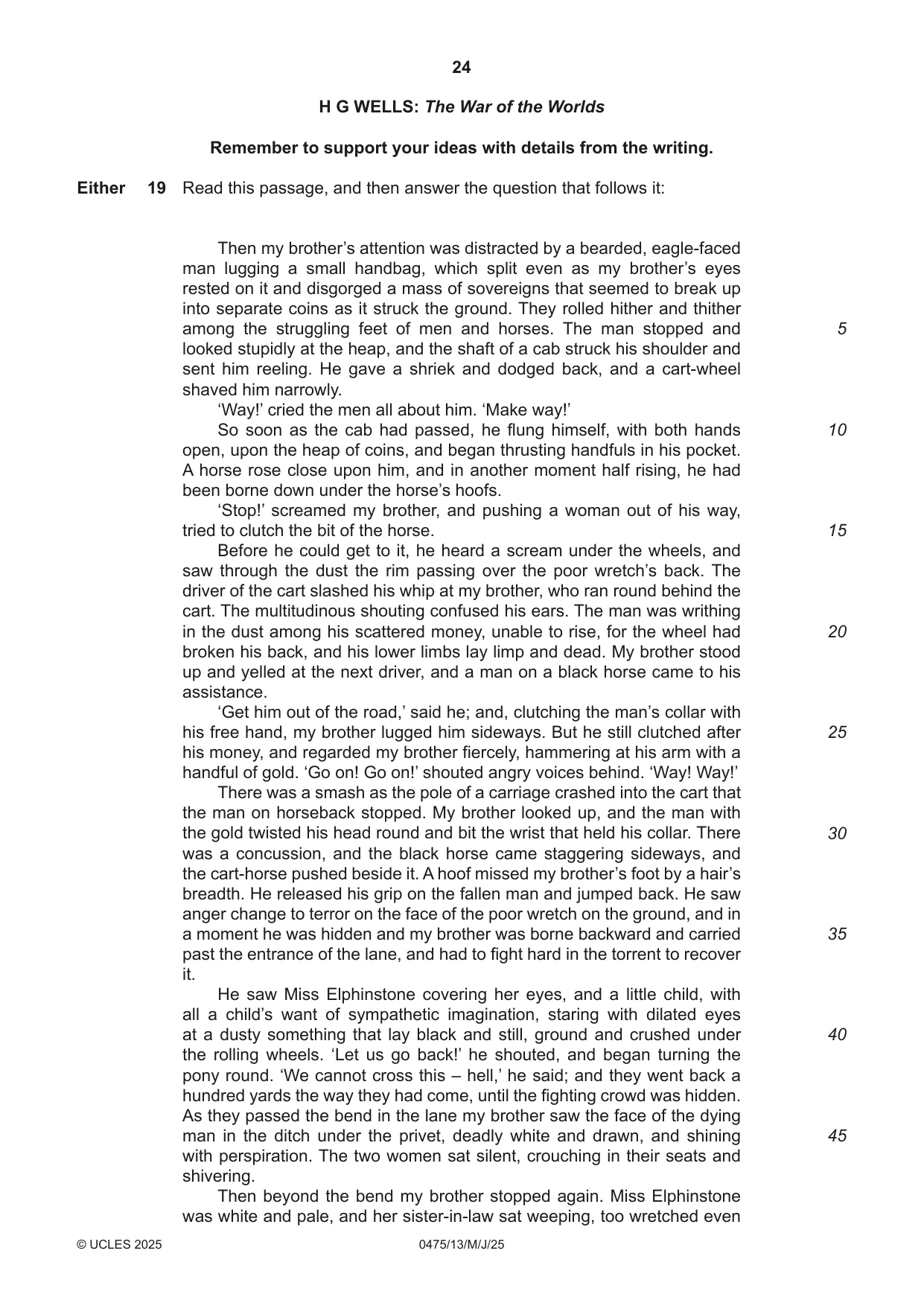
24 0475/13/M/J/25 © UCLES 2025 H G WELLS: The War of the Worlds Remember to support your ideas with details from the writing. Either 19 Read this passage, and then answer the question that follows it: Then my brother’s attention was distracted by a bearded, eagle‑faced man lugging a small handbag, which split even as my brother’s eyes rested on it and disgorged a mass of sovereigns that seemed to break up into separate coins as it struck the ground. They rolled hither and thither among the struggling feet of men and horses. The man stopped and looked stupidly at the heap, and the shaft of a cab struck his shoulder and sent him reeling. He gave a shriek and dodged back, and a cart‑wheel shaved him narrowly. ‘Way!’ cried the men all about him. ‘Make way!’ So soon as the cab had passed, he flung himself, with both hands open, upon the heap of coins, and began thrusting handfuls in his pocket. A horse rose close upon him, and in another moment half rising, he had been borne down under the horse’s hoofs. ‘Stop!’ screamed my brother, and pushing a woman out of his way, tried to clutch the bit of the horse. Before he could get to it, he heard a scream under the wheels, and saw through the dust the rim passing over the poor wretch’s back. The driver of the cart slashed his whip at my brother, who ran round behind the cart. The multitudinous shouting confused his ears. The man was writhing in the dust among his scattered money, unable to rise, for the wheel had broken his back, and his lower limbs lay limp and dead. My brother stood up and yelled at the next driver, and a man on a black horse came to his assistance. ‘Get him out of the road,’ said he; and, clutching the man’s collar with his free hand, my brother lugged him sideways. But he still clutched after his money, and regarded my brother fiercely, hammering at his arm with a handful of gold. ‘Go on! Go on!’ shouted angry voices behind. ‘Way! Way!’ There was a smash as the pole of a carriage crashed into the cart that the man on horseback stopped. My brother looked up, and the man with the gold twisted his head round and bit the wrist that held his collar. There was a concussion, and the black horse came staggering sideways, and the cart‑horse pushed beside it. A hoof missed my brother’s foot by a hair’s breadth. He released his grip on the fallen man and jumped back. He saw anger change to terror on the face of the poor wretch on the ground, and in a moment he was hidden and my brother was borne backward and carried past the entrance of the lane, and had to fight hard in the torrent to recover it. He saw Miss Elphinstone covering her eyes, and a little child, with all a child’s want of sympathetic imagination, staring with dilated eyes at a dusty something that lay black and still, ground and crushed under the rolling wheels. ‘Let us go back!’ he shouted, and began turning the pony round. ‘We cannot cross this – hell,’ he said; and they went back a hundred yards the way they had come, until the fighting crowd was hidden. As they passed the bend in the lane my brother saw the face of the dying man in the ditch under the privet, deadly white and drawn, and shining with perspiration. The two women sat silent, crouching in their seats and shivering. Then beyond the bend my brother stopped again. Miss Elphinstone was white and pale, and her sister‑in‑law sat weeping, too wretched even 5 10 15 20 25 30 35 40 45
Question paper, page 25
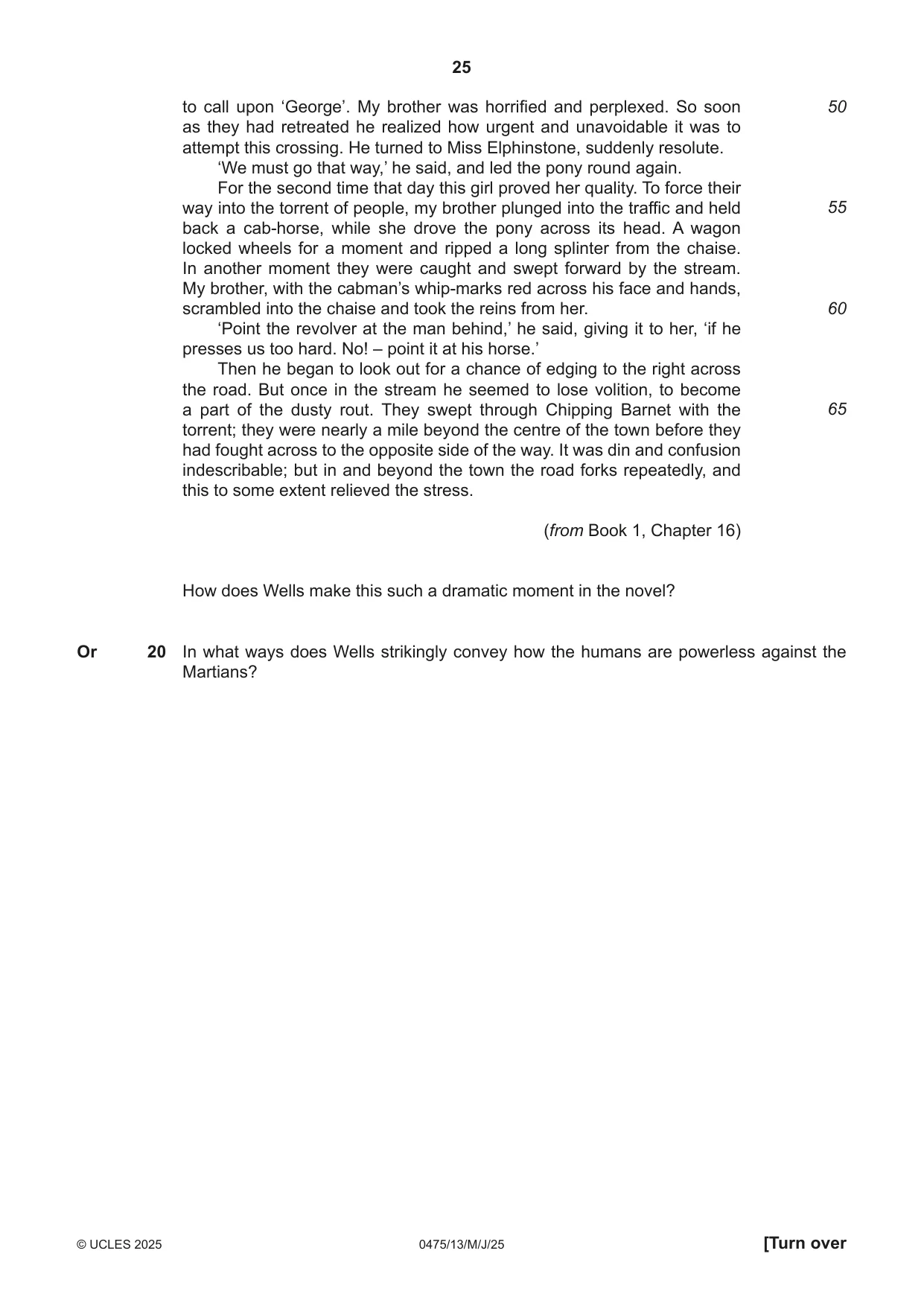
25 0475/13/M/J/25 © UCLES 2025 [Turn over to call upon ‘George’. My brother was horrified and perplexed. So soon as they had retreated he realized how urgent and unavoidable it was to attempt this crossing. He turned to Miss Elphinstone, suddenly resolute. ‘We must go that way,’ he said, and led the pony round again. For the second time that day this girl proved her quality. To force their way into the torrent of people, my brother plunged into the traffic and held back a cab‑horse, while she drove the pony across its head. A wagon locked wheels for a moment and ripped a long splinter from the chaise. In another moment they were caught and swept forward by the stream. My brother, with the cabman’s whip‑marks red across his face and hands, scrambled into the chaise and took the reins from her. ‘Point the revolver at the man behind,’ he said, giving it to her, ‘if he presses us too hard. No! – point it at his horse.’ Then he began to look out for a chance of edging to the right across the road. But once in the stream he seemed to lose volition, to become a part of the dusty rout. They swept through Chipping Barnet with the torrent; they were nearly a mile beyond the centre of the town before they had fought across to the opposite side of the way. It was din and confusion indescribable; but in and beyond the town the road forks repeatedly, and this to some extent relieved the stress. (from Book 1, Chapter 16) How does Wells make this such a dramatic moment in the novel? Or 20 In what ways does Wells strikingly convey how the humans are powerless against the Martians? 50 55 60 65
Question paper, page 26
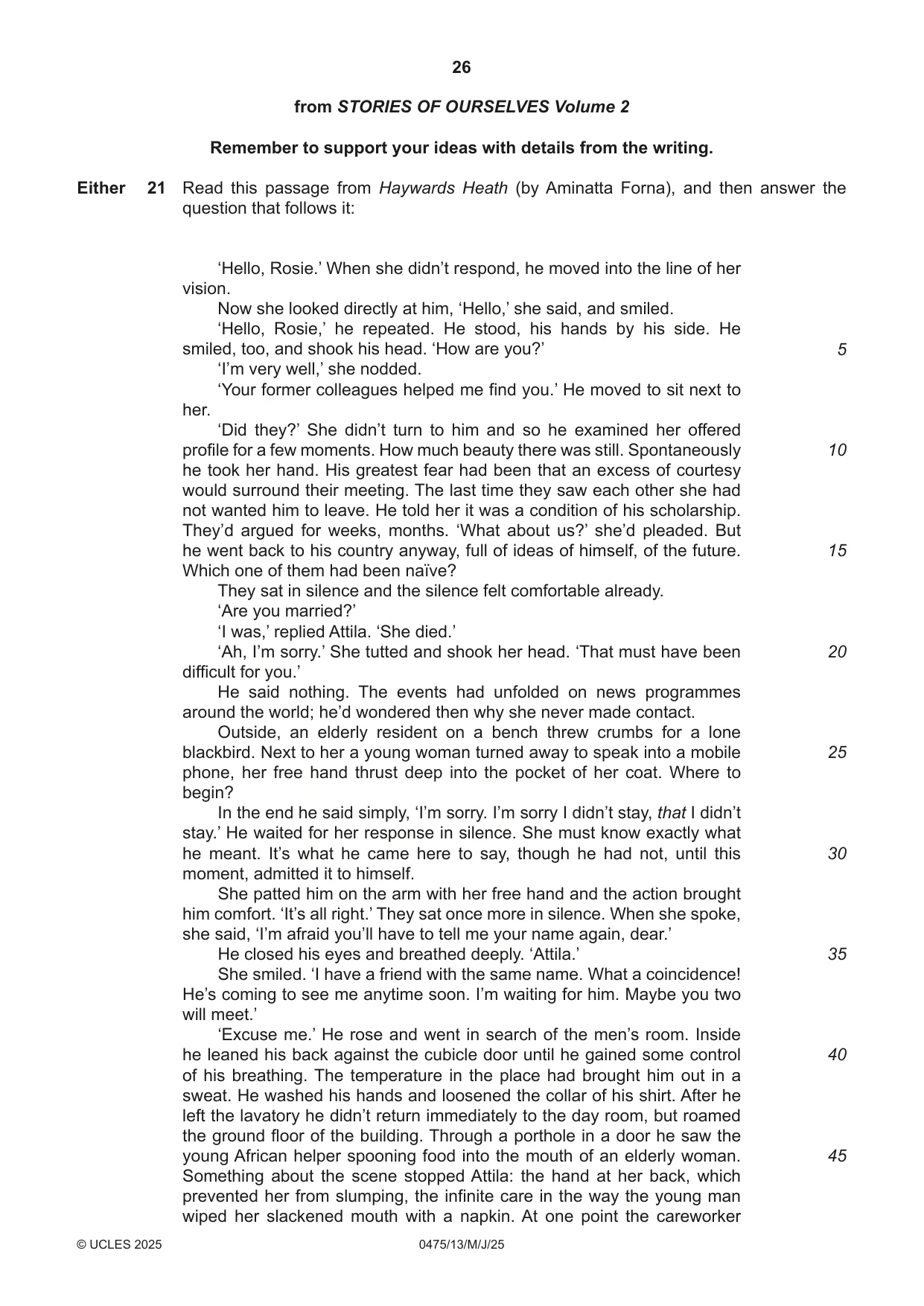
26 0475/13/M/J/25 © UCLES 2025 from STORIES OF OURSELVES Volume 2 Remember to support your ideas with details from the writing. Either 21 Read this passage from Haywards Heath (by Aminatta Forna), and then answer the question that follows it: ‘Hello, Rosie.’ When she didn’t respond, he moved into the line of her vision. Now she looked directly at him, ‘Hello,’ she said, and smiled. ‘Hello, Rosie,’ he repeated. He stood, his hands by his side. He smiled, too, and shook his head. ‘How are you?’ ‘I’m very well,’ she nodded. ‘Your former colleagues helped me find you.’ He moved to sit next to her. ‘Did they?’ She didn’t turn to him and so he examined her offered profile for a few moments. How much beauty there was still. Spontaneously he took her hand. His greatest fear had been that an excess of courtesy would surround their meeting. The last time they saw each other she had not wanted him to leave. He told her it was a condition of his scholarship. They’d argued for weeks, months. ‘What about us?’ she’d pleaded. But he went back to his country anyway, full of ideas of himself, of the future. Which one of them had been naïve? They sat in silence and the silence felt comfortable already. ‘Are you married?’ ‘I was,’ replied Attila. ‘She died.’ ‘Ah, I’m sorry.’ She tutted and shook her head. ‘That must have been difficult for you.’ He said nothing. The events had unfolded on news programmes around the world; he’d wondered then why she never made contact. Outside, an elderly resident on a bench threw crumbs for a lone blackbird. Next to her a young woman turned away to speak into a mobile phone, her free hand thrust deep into the pocket of her coat. Where to begin? In the end he said simply, ‘I’m sorry. I’m sorry I didn’t stay, that I didn’t stay.’ He waited for her response in silence. She must know exactly what he meant. It’s what he came here to say, though he had not, until this moment, admitted it to himself. She patted him on the arm with her free hand and the action brought him comfort. ‘It’s all right.’ They sat once more in silence. When she spoke, she said, ‘I’m afraid you’ll have to tell me your name again, dear.’ He closed his eyes and breathed deeply. ‘Attila.’ She smiled. ‘I have a friend with the same name. What a coincidence! He’s coming to see me anytime soon. I’m waiting for him. Maybe you two will meet.’ ‘Excuse me.’ He rose and went in search of the men’s room. Inside he leaned his back against the cubicle door until he gained some control of his breathing. The temperature in the place had brought him out in a sweat. He washed his hands and loosened the collar of his shirt. After he left the lavatory he didn’t return immediately to the day room, but roamed the ground floor of the building. Through a porthole in a door he saw the young African helper spooning food into the mouth of an elderly woman. Something about the scene stopped Attila: the hand at her back, which prevented her from slumping, the infinite care in the way the young man wiped her slackened mouth with a napkin. At one point the careworker 5 10 15 20 25 30 35 40 45
Question paper, page 27
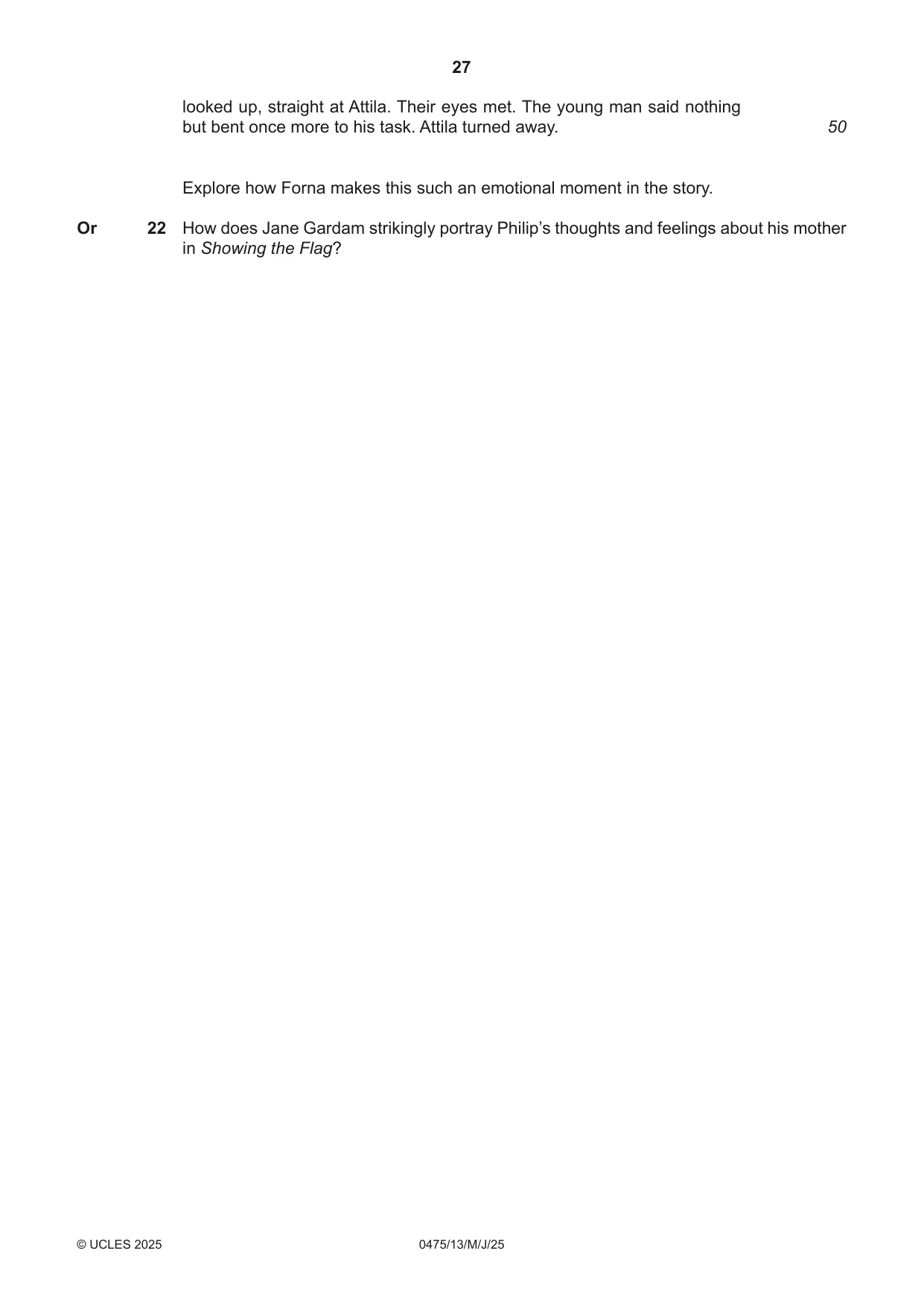
27 0475/13/M/J/25 © UCLES 2025 looked up, straight at Attila. Their eyes met. The young man said nothing but bent once more to his task. Attila turned away. Explore how Forna makes this such an emotional moment in the story. Or 22 How does Jane Gardam strikingly portray Philip’s thoughts and feelings about his mother in Showing the Flag? 50
Question paper, page 28
28 0475/13/M/J/25 © UCLES 2025 Permission to reproduce items where third‑party owned material protected by copyright is included has been sought and cleared where possible. Every reasonable effort has been made by the publisher (UCLES) to trace copyright holders, but if any items requiring clearance have unwittingly been included, the publisher will be pleased to make amends at the earliest possible opportunity. To avoid the issue of disclosure of answer‑related information to candidates, all copyright acknowledgements are reproduced online in the Cambridge Assessment International Education Copyright Acknowledgements Booklet. This is produced for each series of examinations and is freely available to download at www.cambridgeinternational.org after the live examination series. Cambridge Assessment International Education is part of Cambridge Assessment. Cambridge Assessment is the brand name of the University of Cambridge Local Examinations Syndicate (UCLES), which is a department of the University of Cambridge. BLANK PAGE
Mark scheme, page 1
This document consists of 6 printed pages. © Cambridge University Press & Assessment 2025 [Turn over Cambridge IGCSE™ LITERATURE IN ENGLISH 0475/13 Paper 1 Poetry and Prose May/June 2025 MARK SCHEME Maximum Mark: 50 Published This mark scheme is published as an aid to teachers and candidates, to indicate the requirements of the examination. It shows the basis on which Examiners were instructed to award marks. It does not indicate the details of the discussions that took place at an Examiners’ meeting before marking began, which would have considered the acceptability of alternative answers. Mark schemes should be read in conjunction with the question paper and the Principal Examiner Report for Teachers. Cambridge International will not enter into discussions about these mark schemes. Cambridge International is publishing the mark schemes for the May/June 2025 series for most Cambridge IGCSE, Cambridge International A and AS Level components, and some Cambridge O Level components.
Mark scheme, page 2
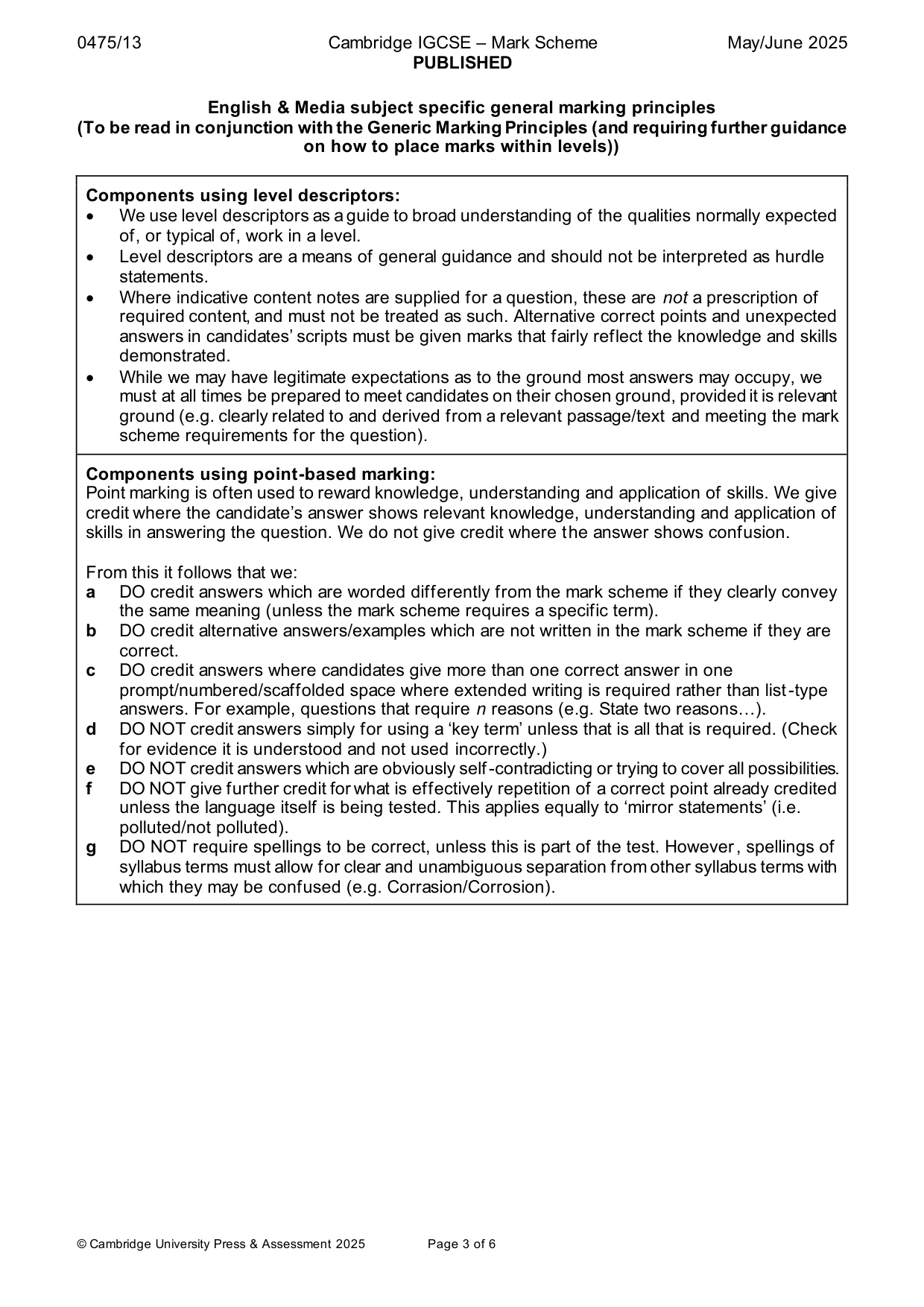
0475/13 Cambridge IGCSE – Mark Scheme PUBLISHED May/June 2025 © Cambridge University Press & Assessment 2025 Page 2 of 6 Generic Marking Principles These general marking principles must be applied by all examiners when marking candidate answers. They should be applied alongside the specific content of the mark scheme or generic level descriptions for a question. Each question paper and mark scheme will also comply with these marking principles. GENERIC MARKING PRINCIPLE 1: Marks must be awarded in line with: • the specific content of the mark scheme or the generic level descriptors for the question • the specific skills defined in the mark scheme or in the generic level descriptors for the question • the standard of response required by a candidate as exemplified by the standardisation scripts. GENERIC MARKING PRINCIPLE 2: Marks awarded are always whole marks (not half marks, or other fractions). GENERIC MARKING PRINCIPLE 3: Marks must be awarded positively: • marks are awarded for correct/valid answers, as defined in the mark scheme. However, credit is given for valid answers which go beyond the scope of the syllabus and mark scheme, referring to your Team Leader as appropriate • marks are awarded when candidates clearly demonstrate what they know and can do • marks are not deducted for errors • marks are not deducted for omissions • answers should only be judged on the quality of spelling, punctuation and grammar when these features are specifically assessed by the question as indicated by the mark scheme. The meaning, however, should be unambiguous. GENERIC MARKING PRINCIPLE 4: Rules must be applied consistently, e.g. in situations where candidates have not followed instructions or in the application of generic level descriptors. GENERIC MARKING PRINCIPLE 5: Marks should be awarded using the full range of marks defined in the mark scheme for the question (however; the use of the full mark range may be limited according to the quality of the candidate responses seen). GENERIC MARKING PRINCIPLE 6: Marks awarded are based solely on the requirements as defined in the mark scheme. Marks should not be awarded with grade thresholds or grade descriptors in mind.
Mark scheme, page 3
0475/13 Cambridge IGCSE – Mark Scheme PUBLISHED May/June 2025 © Cambridge University Press & Assessment 2025 Page 3 of 6 English & Media subject specific general marking principles (To be read in conjunction with the Generic Marking Principles (and requiring further guidance on how to place marks within levels)) Components using level descriptors: • We use level descriptors as a guide to broad understanding of the qualities normally expected of, or typical of, work in a level. • Level descriptors are a means of general guidance and should not be interpreted as hurdle statements. • Where indicative content notes are supplied for a question, these are not a prescription of required content, and must not be treated as such. Alternative correct points and unexpected answers in candidates’ scripts must be given marks that fairly reflect the knowledge and skills demonstrated. • While we may have legitimate expectations as to the ground most answers may occupy, we must at all times be prepared to meet candidates on their chosen ground, provided it is relevant ground (e.g. clearly related to and derived from a relevant passage/text and meeting the mark scheme requirements for the question). Components using point-based marking: Point marking is often used to reward knowledge, understanding and application of skills. We give credit where the candidate’s answer shows relevant knowledge, understanding and application of skills in answering the question. We do not give credit where the answer shows confusion. From this it follows that we: a DO credit answers which are worded differently from the mark scheme if they clearly convey the same meaning (unless the mark scheme requires a specific term). b DO credit alternative answers/examples which are not written in the mark scheme if they are correct. c DO credit answers where candidates give more than one correct answer in one prompt/numbered/scaffolded space where extended writing is required rather than list-type answers. For example, questions that require n reasons (e.g. State two reasons…). d DO NOT credit answers simply for using a ‘key term’ unless that is all that is required. (Check for evidence it is understood and not used incorrectly.) e DO NOT credit answers which are obviously self-contradicting or trying to cover all possibilities. f DO NOT give further credit for what is effectively repetition of a correct point already credited unless the language itself is being tested. This applies equally to ‘mirror statements’ (i.e. polluted/not polluted). g DO NOT require spellings to be correct, unless this is part of the test. However, spellings of syllabus terms must allow for clear and unambiguous separation from other syllabus terms with which they may be confused (e.g. Corrasion/Corrosion).
Mark scheme, page 4
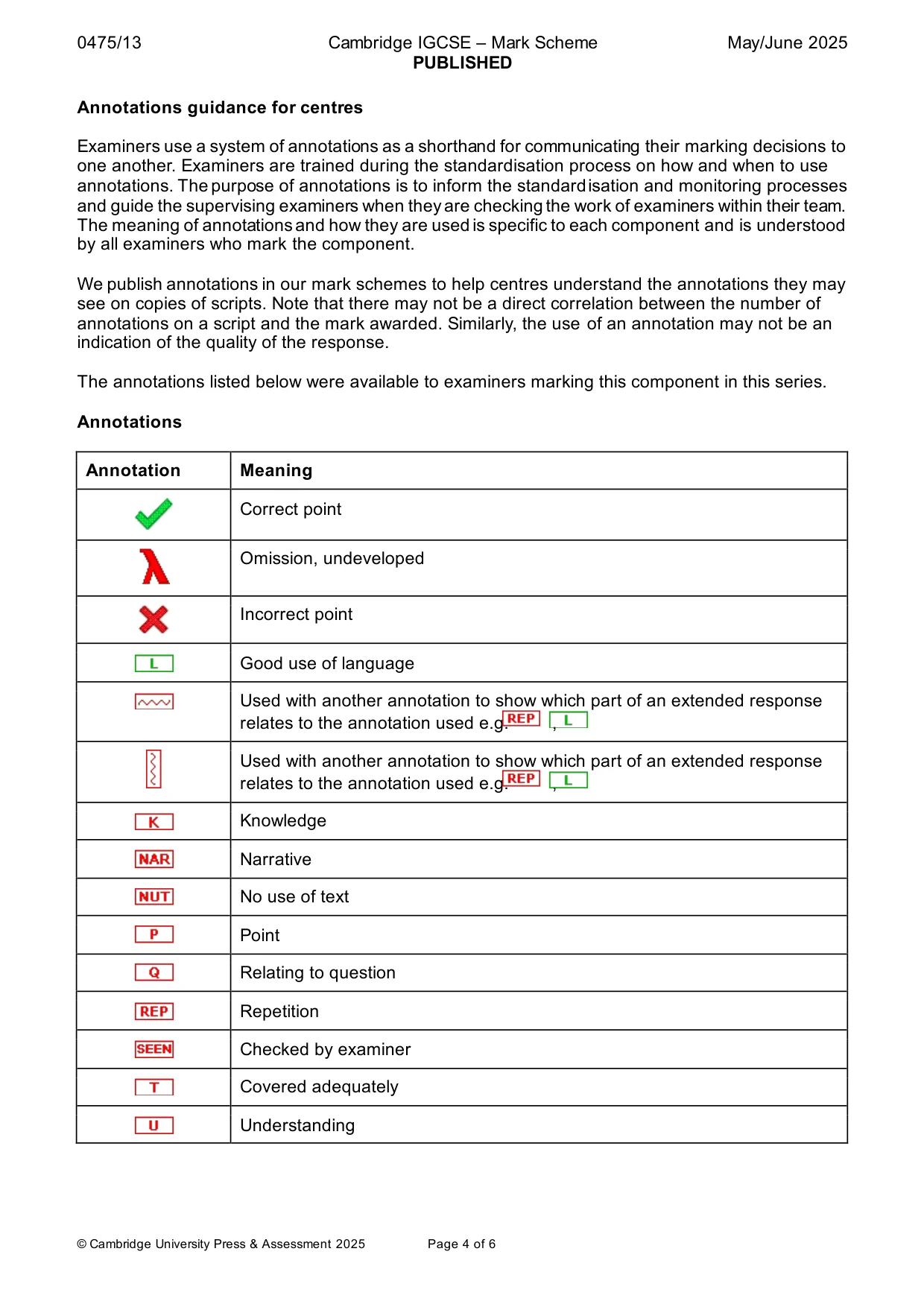
0475/13 Cambridge IGCSE – Mark Scheme PUBLISHED May/June 2025 © Cambridge University Press & Assessment 2025 Page 4 of 6 Annotations guidance for centres Examiners use a system of annotations as a shorthand for communicating their marking decisions to one another. Examiners are trained during the standardisation process on how and when to use annotations. The purpose of annotations is to inform the standardisation and monitoring processes and guide the supervising examiners when they are checking the work of examiners within their team. The meaning of annotations and how they are used is specific to each component and is understood by all examiners who mark the component. We publish annotations in our mark schemes to help centres understand the annotations they may see on copies of scripts. Note that there may not be a direct correlation between the number of annotations on a script and the mark awarded. Similarly, the use of an annotation may not be an indication of the quality of the response. The annotations listed below were available to examiners marking this component in this series. Annotations Annotation Meaning Correct point Omission, undeveloped Incorrect point Good use of language Used with another annotation to show which part of an extended response relates to the annotation used e.g. , Used with another annotation to show which part of an extended response relates to the annotation used e.g. , Knowledge Narrative No use of text Point Relating to question Repetition Checked by examiner Covered adequately Understanding
Mark scheme, page 5
0475/13 Cambridge IGCSE – Mark Scheme PUBLISHED May/June 2025 © Cambridge University Press & Assessment 2025 Page 5 of 6 Using the mark levels All Assessment Objectives are equally weighted in this paper. Place the answer in a band first. Look for the best fit of the answer into a band. An answer needs to show evidence of most but not necessarily all of the qualities described in a band in order to be placed in that band. Then award a mark for the relative position of the answer within the band. Candidates sometimes mis-number questions under the pressure of timed conditions. Please check that you are marking against the correct question number.
Mark scheme, page 6
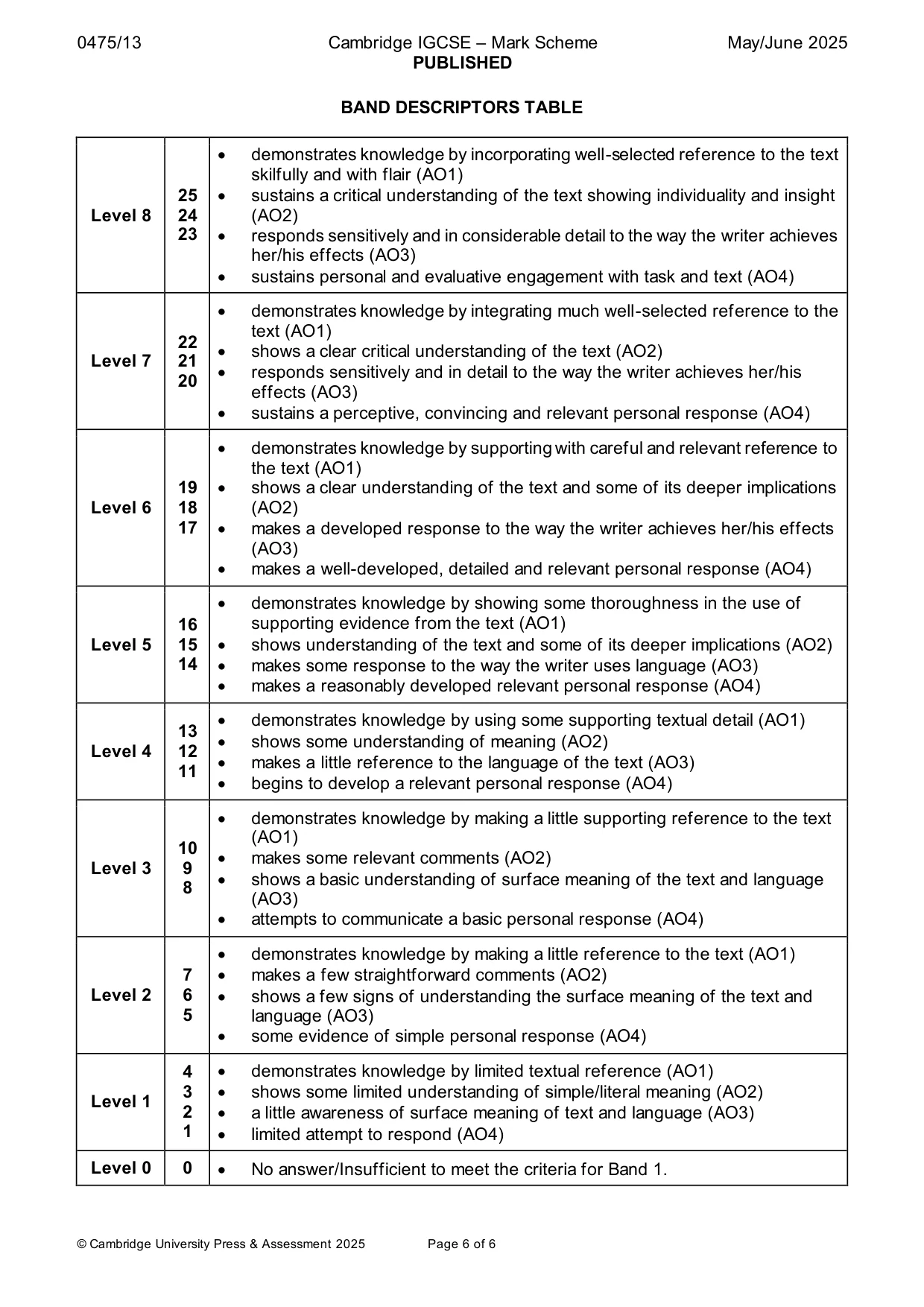
0475/13 Cambridge IGCSE – Mark Scheme PUBLISHED May/June 2025 © Cambridge University Press & Assessment 2025 Page 6 of 6 BAND DESCRIPTORS TABLE Level 8 25 24 23 • demonstrates knowledge by incorporating well-selected reference to the text skilfully and with flair (AO1) • sustains a critical understanding of the text showing individuality and insight (AO2) • responds sensitively and in considerable detail to the way the writer achieves her/his effects (AO3) • sustains personal and evaluative engagement with task and text (AO4) Level 7 22 21 20 • demonstrates knowledge by integrating much well-selected reference to the text (AO1) • shows a clear critical understanding of the text (AO2) • responds sensitively and in detail to the way the writer achieves her/his effects (AO3) • sustains a perceptive, convincing and relevant personal response (AO4) Level 6 19 18 17 • demonstrates knowledge by supporting with careful and relevant reference to the text (AO1) • shows a clear understanding of the text and some of its deeper implications (AO2) • makes a developed response to the way the writer achieves her/his effects (AO3) • makes a well-developed, detailed and relevant personal response (AO4) Level 5 16 15 14 • demonstrates knowledge by showing some thoroughness in the use of supporting evidence from the text (AO1) • shows understanding of the text and some of its deeper implications (AO2) • makes some response to the way the writer uses language (AO3) • makes a reasonably developed relevant personal response (AO4) Level 4 13 12 11 • demonstrates knowledge by using some supporting textual detail (AO1) • shows some understanding of meaning (AO2) • makes a little reference to the language of the text (AO3) • begins to develop a relevant personal response (AO4) Level 3 10 9 8 • demonstrates knowledge by making a little supporting reference to the text (AO1) • makes some relevant comments (AO2) • shows a basic understanding of surface meaning of the text and language (AO3) • attempts to communicate a basic personal response (AO4) Level 2 7 6 5 • demonstrates knowledge by making a little reference to the text (AO1) • makes a few straightforward comments (AO2) • shows a few signs of understanding the surface meaning of the text and language (AO3) • some evidence of simple personal response (AO4) Level 1 4 3 2 1 • demonstrates knowledge by limited textual reference (AO1) • shows some limited understanding of simple/literal meaning (AO2) • a little awareness of surface meaning of text and language (AO3) • limited attempt to respond (AO4) Level 0 0 • No answer/Insufficient to meet the criteria for Band 1.
What you needed in this session
Cambridge’s own grade thresholds for 2025 May/June, Paper 1 · Variant 3. A higher threshold means an easier paper — the bar moves with how the cohort did.