Cambridge IGCSE English - Literature in English 0475 — 2024 Oct/Nov Paper 1 · Variant 1
0475/11/O/N/24 · 50 marks · ≈56 min
The question paper and its mark scheme, free to read here and free to download. This is Cambridge’s own paper, exactly as it was sat.
Question paper28 pages





Mark scheme4 pages
Answers below. Sit the paper first if you are practising.
Paper as text
Question paper, page 1
This document has 28 pages. Any blank pages are indicated. [Turn over Cambridge IGCSE™ * 4 0 4 2 9 9 8 0 1 0 * DC (RCL (DF)) 326938/2 © UCLES 2024 LITERATURE IN ENGLISH 0475/11 Paper 1 Poetry and Prose October/November 2024 1 hour 30 minutes You must answer on the enclosed answer booklet. You will need: Answer booklet (enclosed) INSTRUCTIONS ● Answer two questions in total: Section A: answer one question. Section B: answer one question. ● Follow the instructions on the front cover of the answer booklet. If you need additional answer paper, ask the invigilator for a continuation booklet. INFORMATION ● The total mark for this paper is 50. ● All questions are worth equal marks.
Question paper, page 2
2 0475/11/O/N/24 © UCLES 2024 BLANK PAGE
Question paper, page 3
3 0475/11/O/N/24 © UCLES 2024 [Turn over CONTENTS Section A: Poetry text question numbers page[s] Songs of Ourselves Volume 1: from Part 4 1, 2 pages 4–5 Songs of Ourselves Volume 2 : from Part 4 3, 4 pages 6–7 Ted Hughes: from New Selected Poems 5, 6 pages 8–9 Section B: Prose text question numbers page[s] Chimamanda Ngozi Adichie: Purple Hibiscus 7, 8 pages 10–11 Charles Dickens: Great Expectations 9, 10 pages 12–13 Daphne du Maurier: Rebecca 11, 12 pages 14–15 Jhumpa Lahiri: The Namesake 13, 14 pages 16–17 Joan Lindsay: Picnic at Hanging Rock 15, 16 page 18 Yann Martel: Life of Pi 17, 18 pages 20–21 H G Wells: The War of the Worlds 19, 20 pages 22–23 from Stories of Ourselves Volume 2 21, 22 pages 24–25
Question paper, page 4
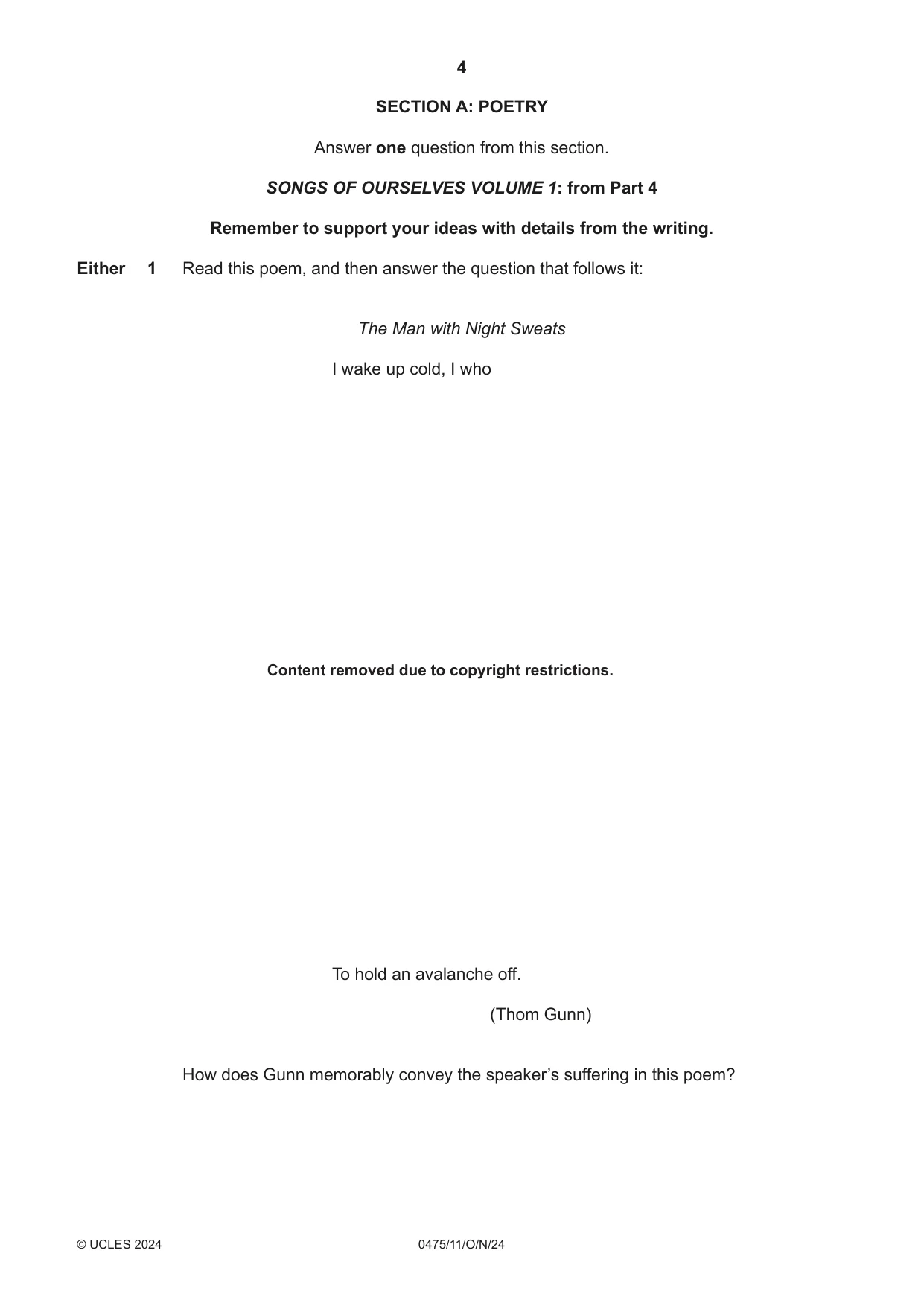
4 0475/11/O/N/24 © UCLES 2024 SECTION A: POETRY Answer one question from this section. SONGS OF OURSELVES VOLUME 1: from Part 4 Remember to support your ideas with details from the writing. Either 1 Read this poem, and then answer the question that follows it: The Man with Night Sweats I wake up cold, I who To hold an avalanche off. (Thom Gunn) How does Gunn memorably convey the speaker’s suffering in this poem? Content removed due to copyright restrictions.
Question paper, page 5
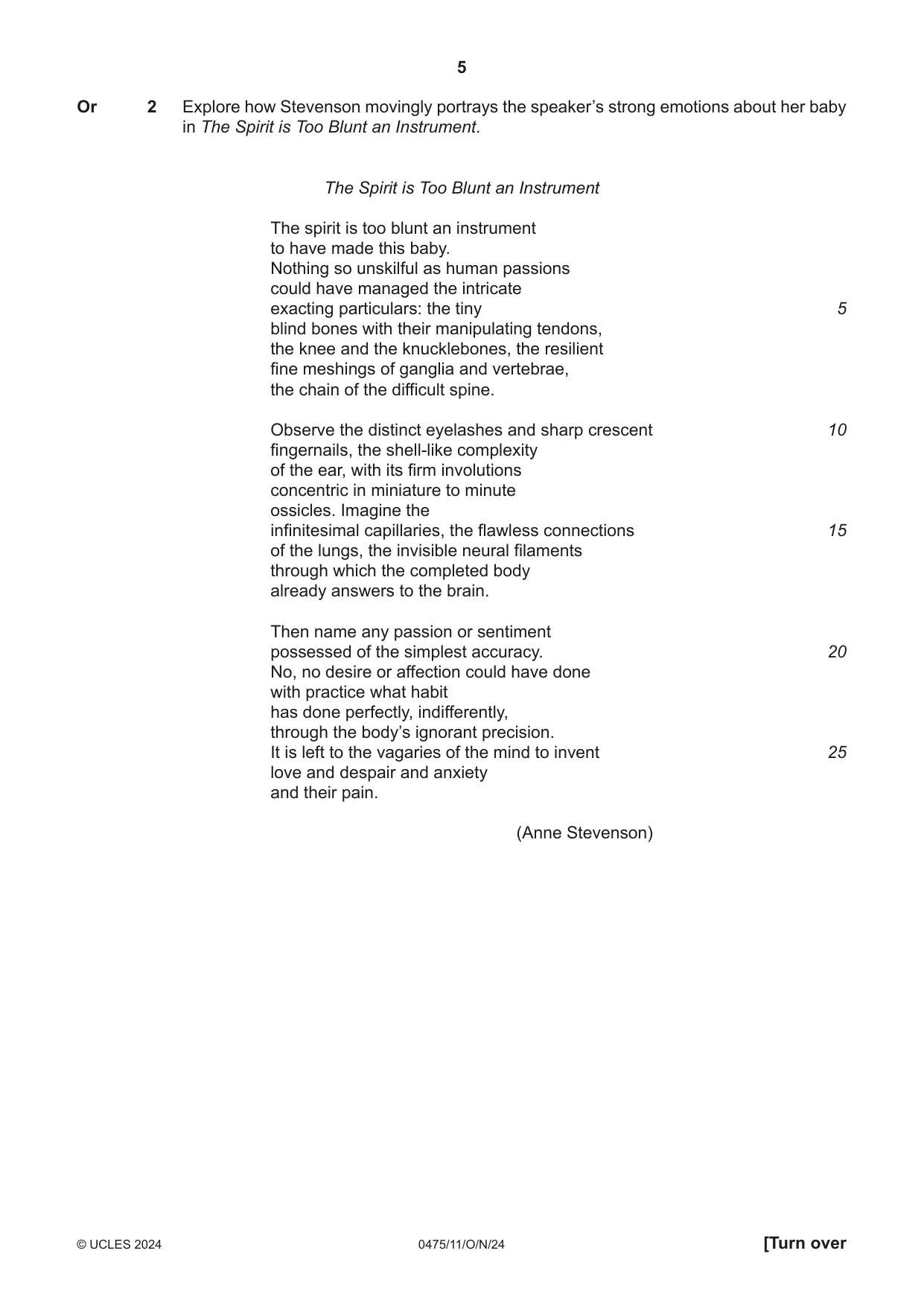
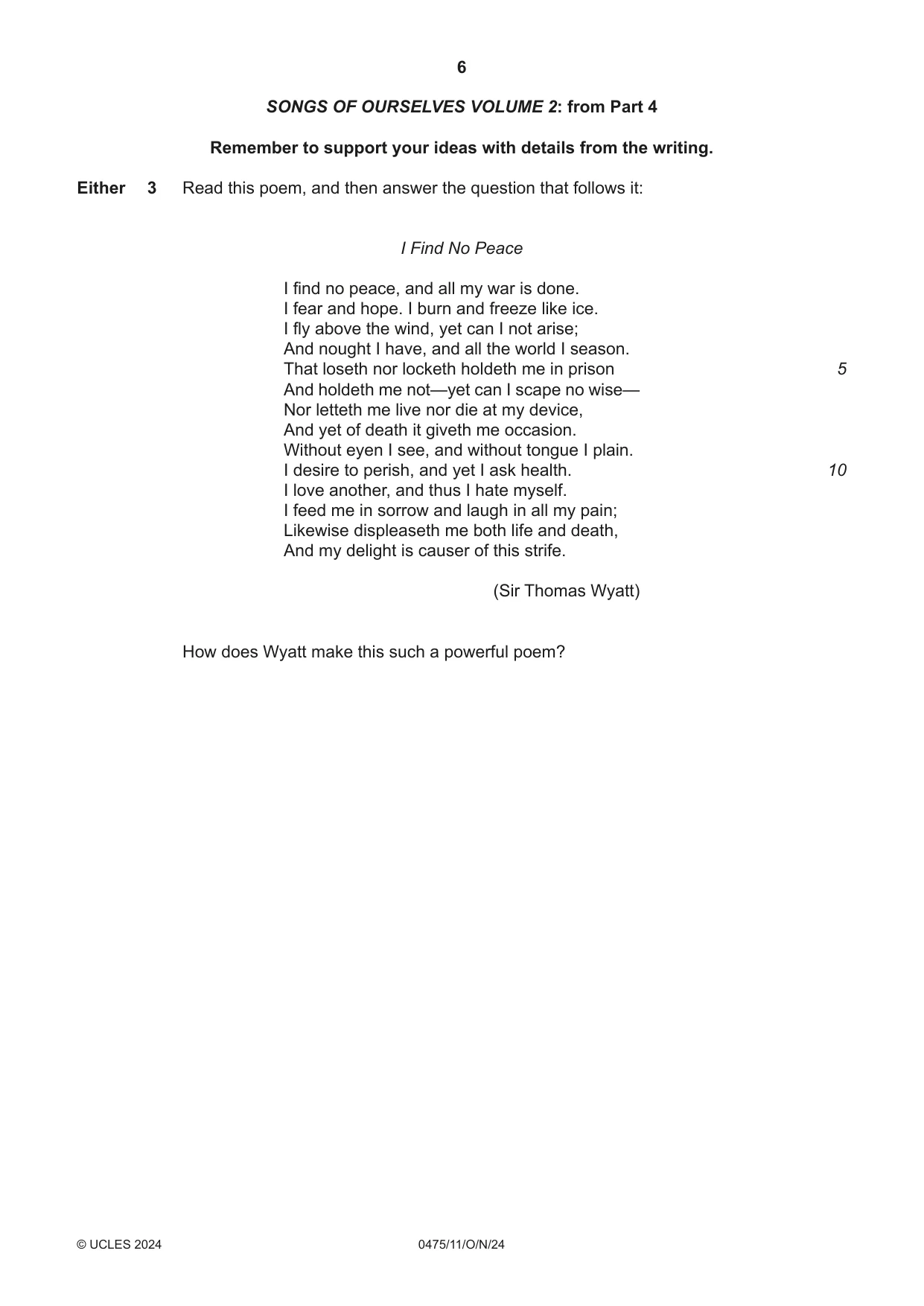
5 0475/11/O/N/24 © UCLES 2024 [Turn over Or 2 Explore how Stevenson movingly portrays the speaker’s strong emotions about her baby in The Spirit is Too Blunt an Instrument. The Spirit is Too Blunt an Instrument The spirit is too blunt an instrument to have made this baby. Nothing so unskilful as human passions could have managed the intricate exacting particulars: the tiny blind bones with their manipulating tendons, the knee and the knucklebones, the resilient fine meshings of ganglia and vertebrae, the chain of the difficult spine. Observe the distinct eyelashes and sharp crescent fingernails, the shell-like complexity of the ear, with its firm involutions concentric in miniature to minute ossicles. Imagine the infinitesimal capillaries, the flawless connections of the lungs, the invisible neural filaments through which the completed body already answers to the brain. Then name any passion or sentiment possessed of the simplest accuracy. No, no desire or affection could have done with practice what habit has done perfectly, indifferently, through the body’s ignorant precision. It is left to the vagaries of the mind to invent love and despair and anxiety and their pain. (Anne Stevenson) 5 10 15 20 25
Question paper, page 6
6 0475/11/O/N/24 © UCLES 2024 SONGS OF OURSELVES VOLUME 2: from Part 4 Remember to support your ideas with details from the writing. Either 3 Read this poem, and then answer the question that follows it: I Find No Peace I find no peace, and all my war is done. I fear and hope. I burn and freeze like ice. I fly above the wind, yet can I not arise; And nought I have, and all the world I season. That loseth nor locketh holdeth me in prison And holdeth me not—yet can I scape no wise— Nor letteth me live nor die at my device, And yet of death it giveth me occasion. Without eyen I see, and without tongue I plain. I desire to perish, and yet I ask health. I love another, and thus I hate myself. I feed me in sorrow and laugh in all my pain; Likewise displeaseth me both life and death, And my delight is causer of this strife. (Sir Thomas Wyatt) How does Wyatt make this such a powerful poem? 5 10
Question paper, page 7
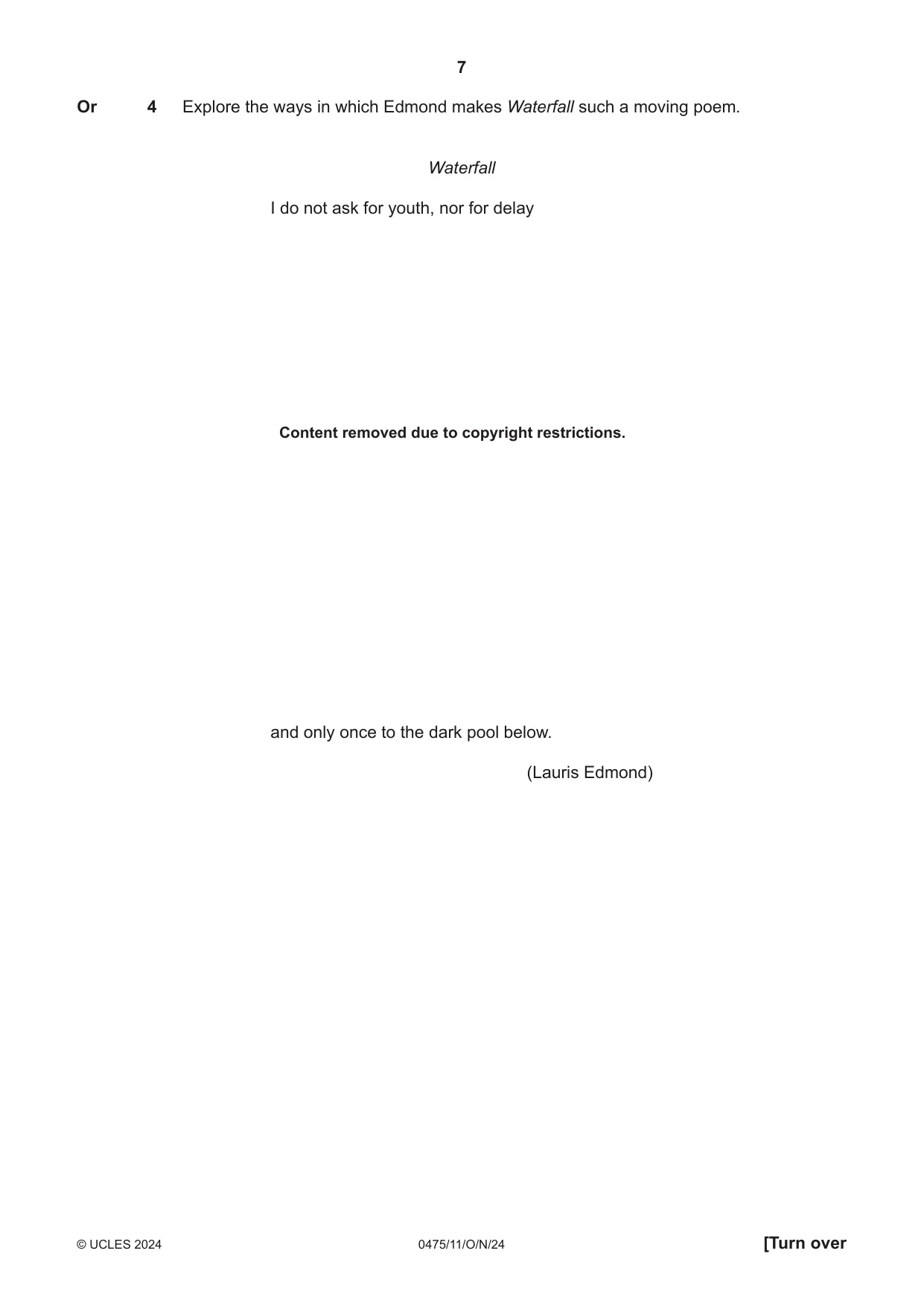
7 0475/11/O/N/24 © UCLES 2024 [Turn over Or 4 Explore the ways in which Edmond makes Waterfall such a moving poem. Waterfall I do not ask for youth, nor for delay and only once to the dark pool below. (Lauris Edmond) Content removed due to copyright restrictions.
Question paper, page 8
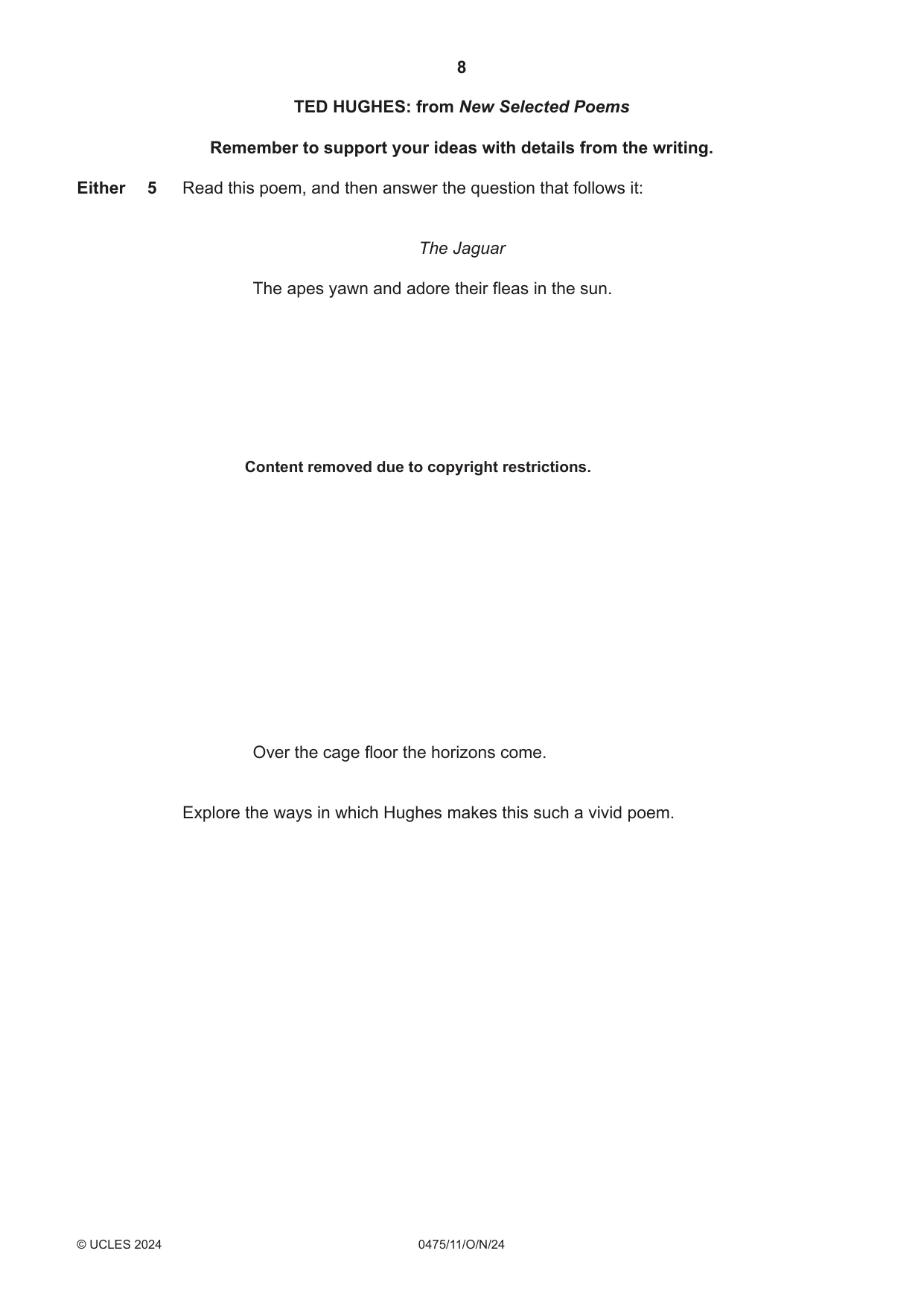
8 0475/11/O/N/24 © UCLES 2024 TED HUGHES: from New Selected Poems Remember to support your ideas with details from the writing. Either 5 Read this poem, and then answer the question that follows it: The Jaguar The apes yawn and adore their fleas in the sun. Over the cage floor the horizons come. Explore the ways in which Hughes makes this such a vivid poem. Content removed due to copyright restrictions.
Question paper, page 9
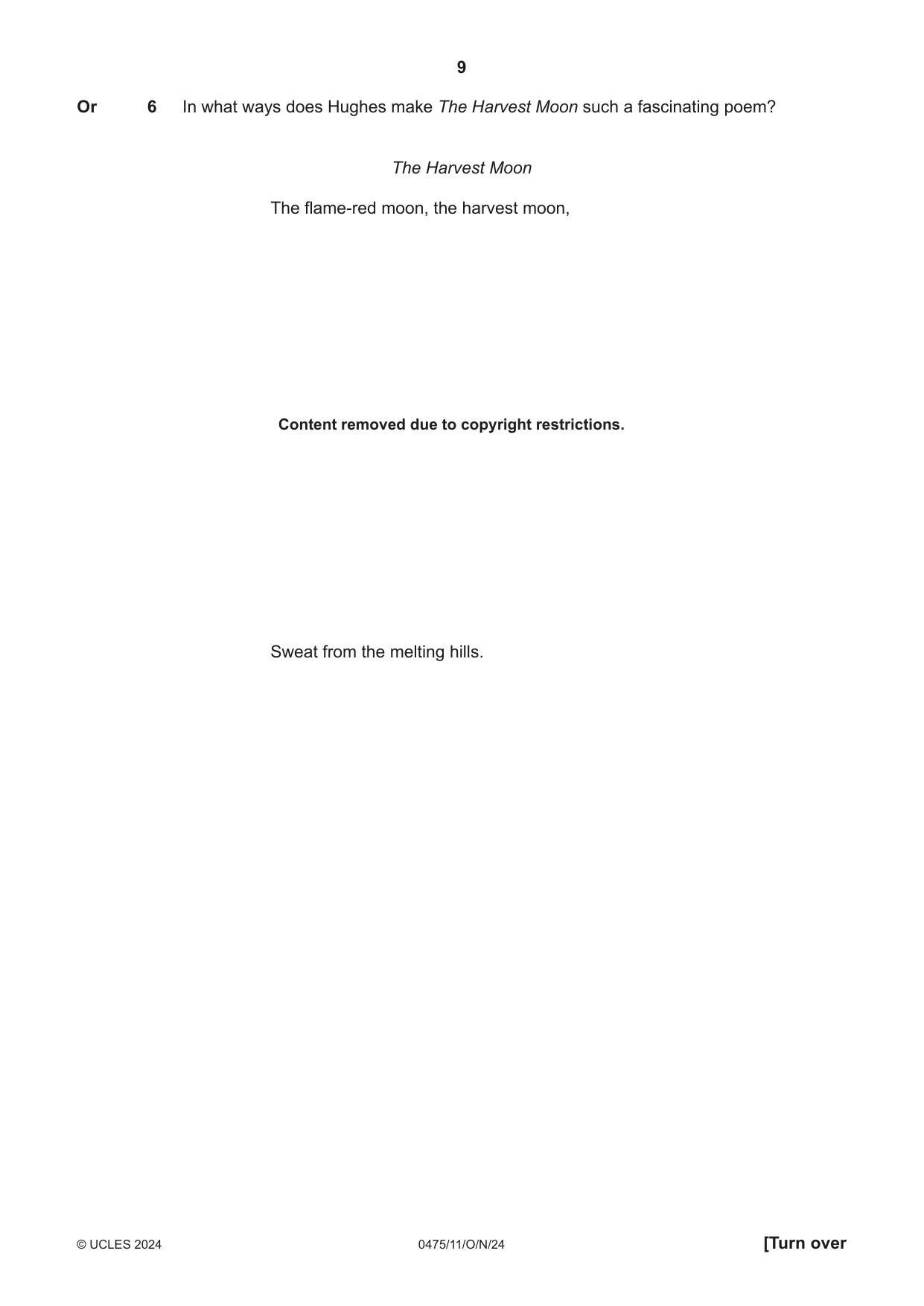
9 0475/11/O/N/24 © UCLES 2024 [Turn over Or 6 In what ways does Hughes make The Harvest Moon such a fascinating poem? The Harvest Moon The flame-red moon, the harvest moon, Sweat from the melting hills. Content removed due to copyright restrictions.
Question paper, page 10
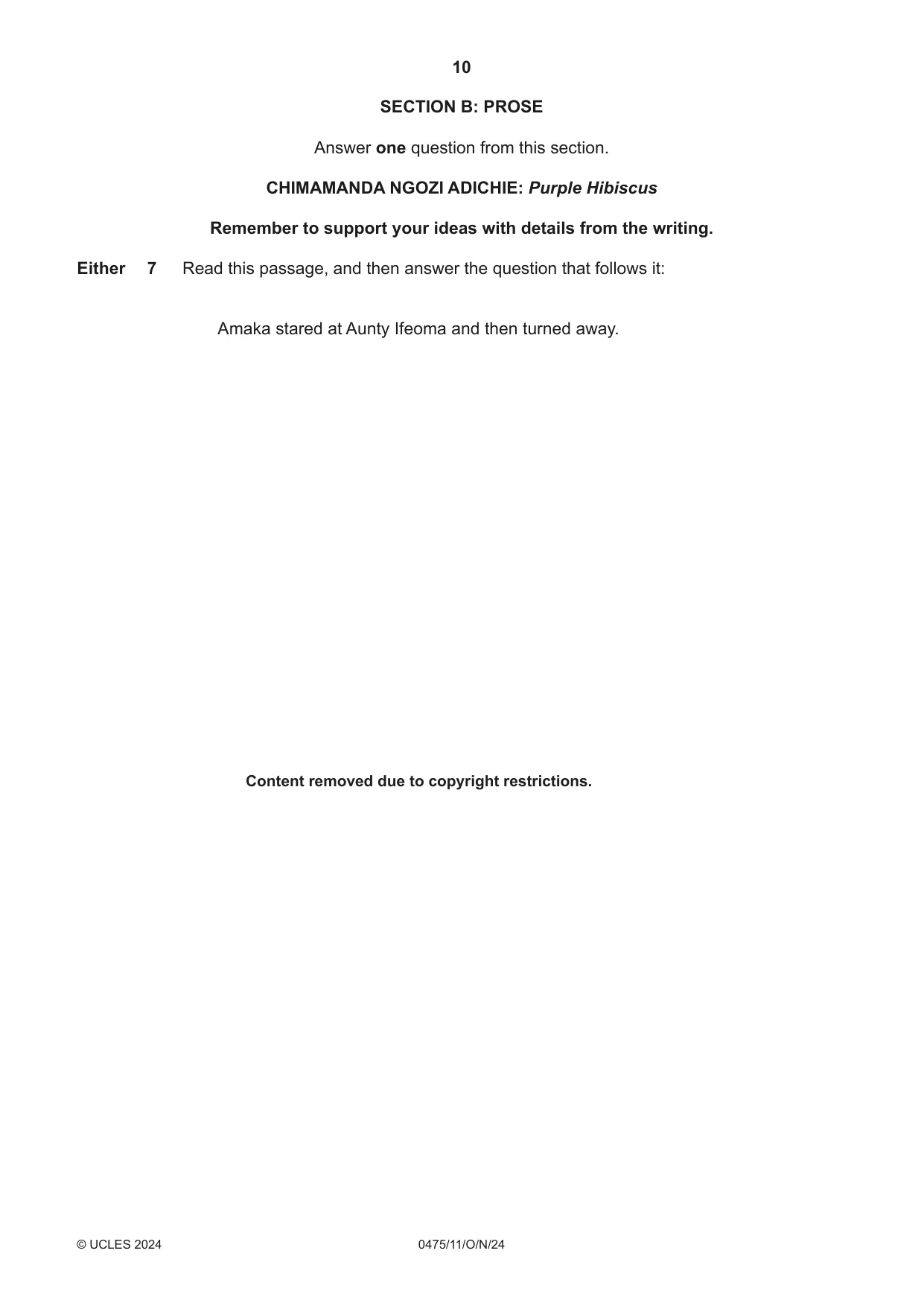
10 0475/11/O/N/24 © UCLES 2024 SECTION B: PROSE Answer one question from this section. CHIMAMANDA NGOZI ADICHIE: Purple Hibiscus Remember to support your ideas with details from the writing. Either 7 Read this passage, and then answer the question that follows it: Amaka stared at Aunty Ifeoma and then turned away. Content removed due to copyright restrictions.
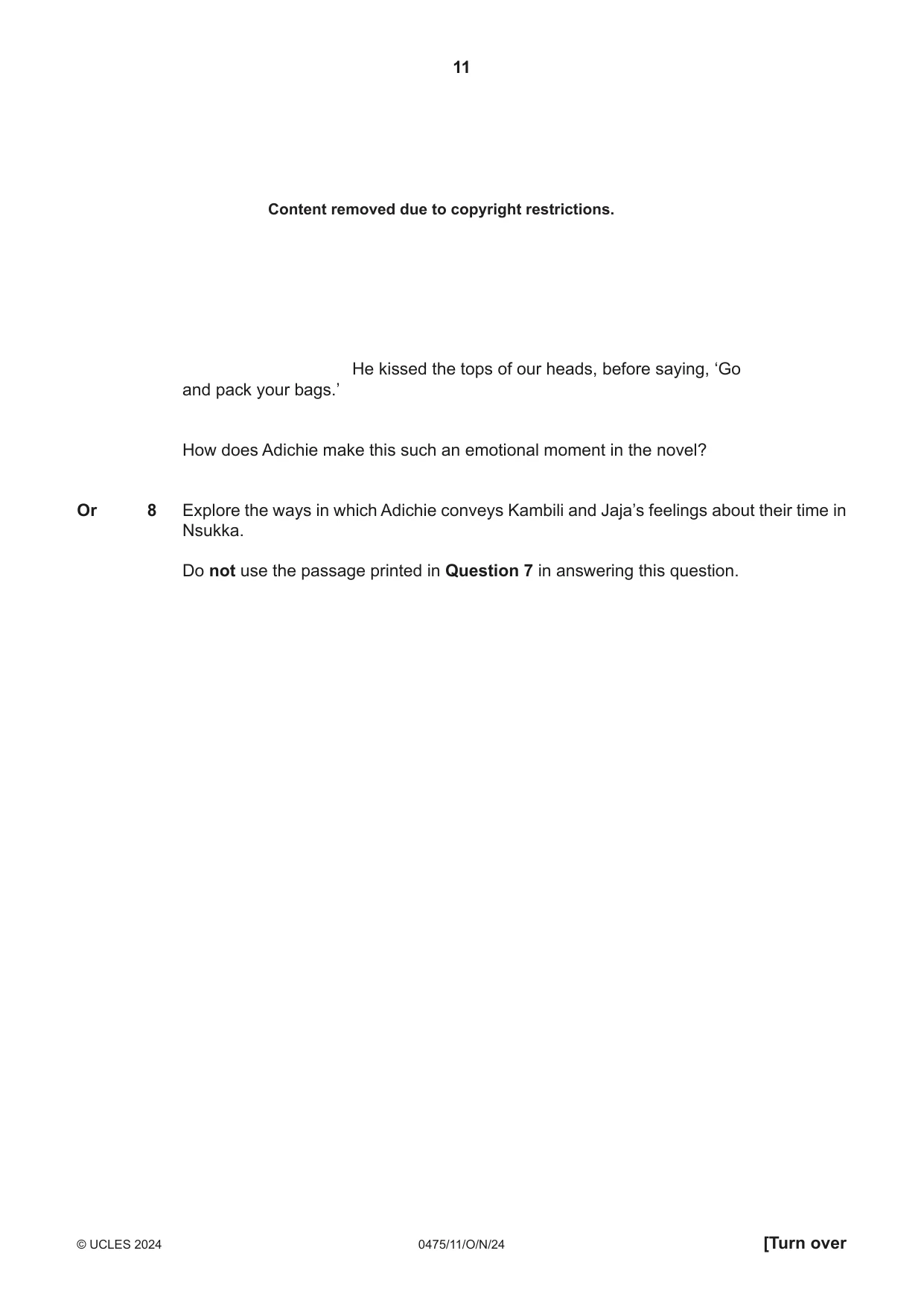
Question paper, page 11
11 0475/11/O/N/24 © UCLES 2024 [Turn over He kissed the tops of our heads, before saying, ‘Go and pack your bags.’ How does Adichie make this such an emotional moment in the novel? Or 8 Explore the ways in which Adichie conveys Kambili and Jaja’s feelings about their time in Nsukka. Do not use the passage printed in Question 7 in answering this question. Content removed due to copyright restrictions.
Question paper, page 12
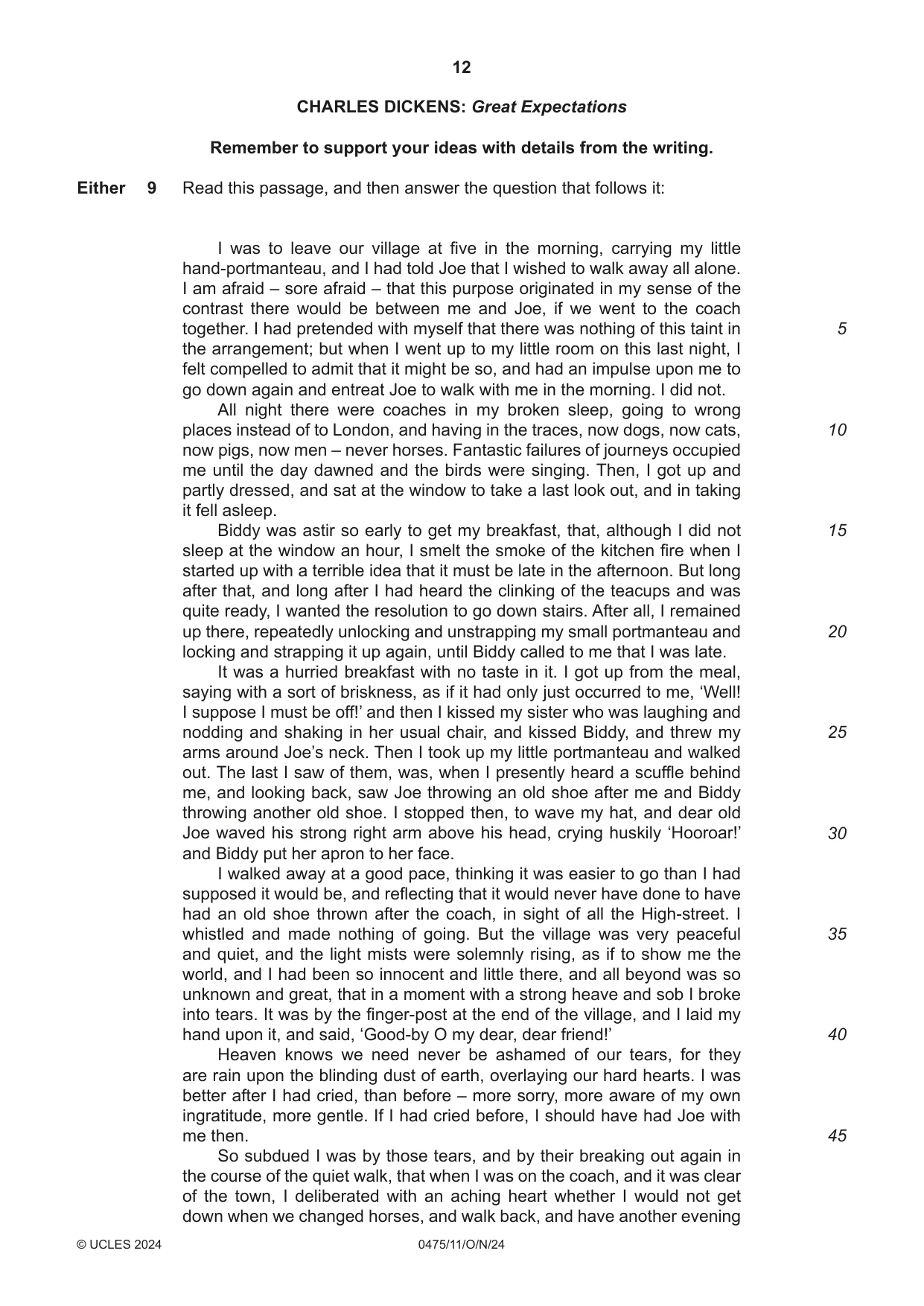
12 0475/11/O/N/24 © UCLES 2024 CHARLES DICKENS: Great Expectations Remember to support your ideas with details from the writing. Either 9 Read this passage, and then answer the question that follows it: I was to leave our village at five in the morning, carrying my little hand-portmanteau, and I had told Joe that I wished to walk away all alone. I am afraid – sore afraid – that this purpose originated in my sense of the contrast there would be between me and Joe, if we went to the coach together. I had pretended with myself that there was nothing of this taint in the arrangement; but when I went up to my little room on this last night, I felt compelled to admit that it might be so, and had an impulse upon me to go down again and entreat Joe to walk with me in the morning. I did not. All night there were coaches in my broken sleep, going to wrong places instead of to London, and having in the traces, now dogs, now cats, now pigs, now men – never horses. Fantastic failures of journeys occupied me until the day dawned and the birds were singing. Then, I got up and partly dressed, and sat at the window to take a last look out, and in taking it fell asleep. Biddy was astir so early to get my breakfast, that, although I did not sleep at the window an hour, I smelt the smoke of the kitchen fire when I started up with a terrible idea that it must be late in the afternoon. But long after that, and long after I had heard the clinking of the teacups and was quite ready, I wanted the resolution to go down stairs. After all, I remained up there, repeatedly unlocking and unstrapping my small portmanteau and locking and strapping it up again, until Biddy called to me that I was late. It was a hurried breakfast with no taste in it. I got up from the meal, saying with a sort of briskness, as if it had only just occurred to me, ‘Well! I suppose I must be off!’ and then I kissed my sister who was laughing and nodding and shaking in her usual chair, and kissed Biddy, and threw my arms around Joe’s neck. Then I took up my little portmanteau and walked out. The last I saw of them, was, when I presently heard a scuffle behind me, and looking back, saw Joe throwing an old shoe after me and Biddy throwing another old shoe. I stopped then, to wave my hat, and dear old Joe waved his strong right arm above his head, crying huskily ‘Hooroar!’ and Biddy put her apron to her face. I walked away at a good pace, thinking it was easier to go than I had supposed it would be, and reflecting that it would never have done to have had an old shoe thrown after the coach, in sight of all the High-street. I whistled and made nothing of going. But the village was very peaceful and quiet, and the light mists were solemnly rising, as if to show me the world, and I had been so innocent and little there, and all beyond was so unknown and great, that in a moment with a strong heave and sob I broke into tears. It was by the finger-post at the end of the village, and I laid my hand upon it, and said, ‘Good-by O my dear, dear friend!’ Heaven knows we need never be ashamed of our tears, for they are rain upon the blinding dust of earth, overlaying our hard hearts. I was better after I had cried, than before – more sorry, more aware of my own ingratitude, more gentle. If I had cried before, I should have had Joe with me then. So subdued I was by those tears, and by their breaking out again in the course of the quiet walk, that when I was on the coach, and it was clear of the town, I deliberated with an aching heart whether I would not get down when we changed horses, and walk back, and have another evening 5 10 15 20 25 30 35 40 45
Question paper, page 13
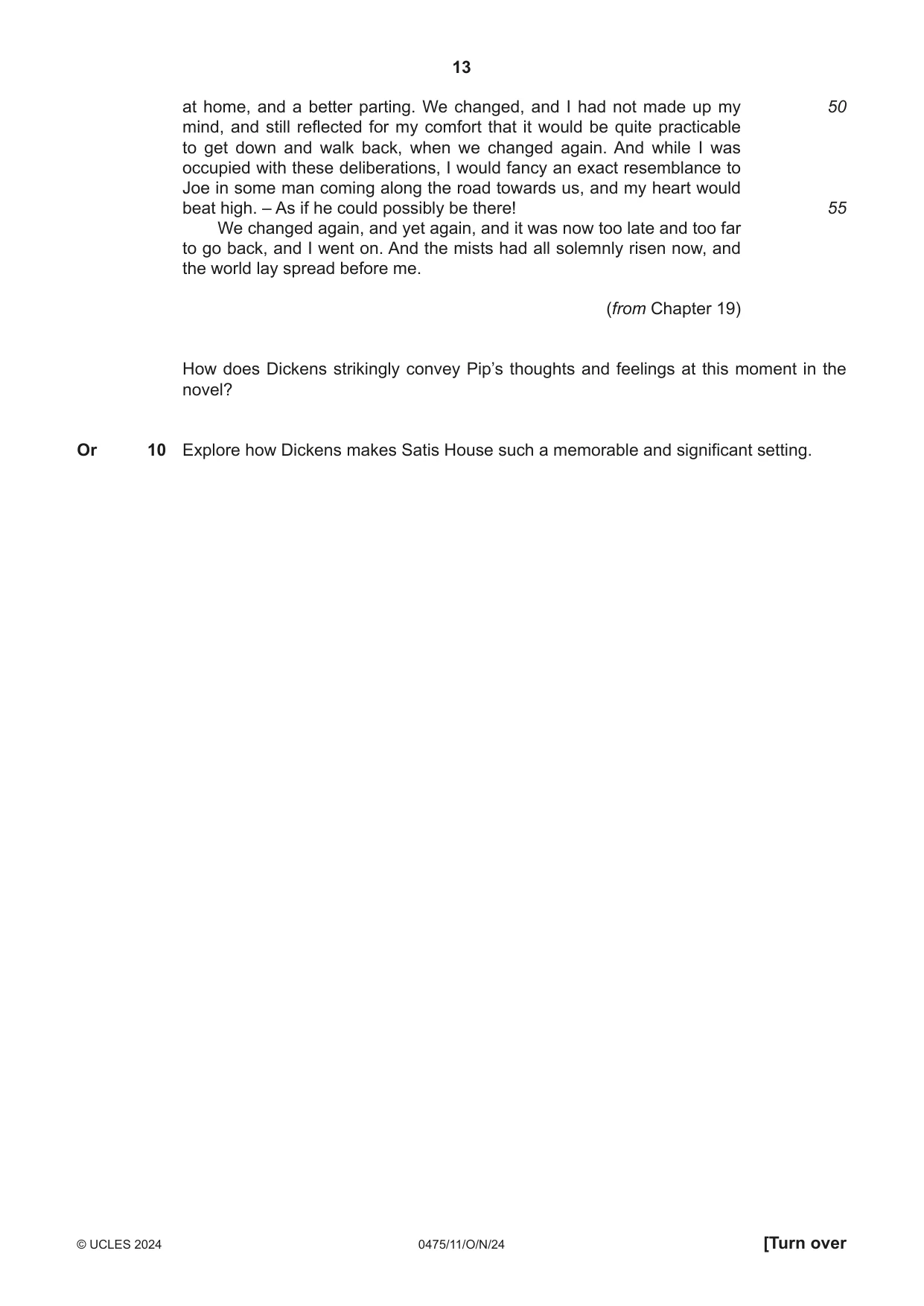
13 0475/11/O/N/24 © UCLES 2024 [Turn over at home, and a better parting. We changed, and I had not made up my mind, and still reflected for my comfort that it would be quite practicable to get down and walk back, when we changed again. And while I was occupied with these deliberations, I would fancy an exact resemblance to Joe in some man coming along the road towards us, and my heart would beat high. – As if he could possibly be there! We changed again, and yet again, and it was now too late and too far to go back, and I went on. And the mists had all solemnly risen now, and the world lay spread before me. (from Chapter 19) How does Dickens strikingly convey Pip’s thoughts and feelings at this moment in the novel? Or 10 Explore how Dickens makes Satis House such a memorable and significant setting. 50 55
Question paper, page 14
14 0475/11/O/N/24 © UCLES 2024 DAPHNE DU MAURIER: Rebecca Remember to support your ideas with details from the writing. Either 11 Read this passage, and then answer the question that follows it: It seemed to me, as I sat there in bed, staring at the wall, at the sunlight coming in at the window, at Maxim’s empty bed, that there was nothing quite so shaming, so degrading as a marriage that had failed. Content removed due copyright restrictions.
Question paper, page 15
15 0475/11/O/N/24 © UCLES 2024 [Turn over ‘Yes, she was the most beautiful creature I have ever seen.’ (from Chapter 18) How does du Maurier vividly convey the narrator’s thoughts and feelings at this moment in the novel? Or 12 Explore the ways in which du Maurier strikingly portrays the relationship of the narrator and Maxim. Do not use the passage printed in Question 11 in answering this question.
Question paper, page 16
16 0475/11/O/N/24 © UCLES 2024 JHUMPA LAHIRI: The Namesake Remember to support your ideas with details from the writing. Either 13 Read this passage, and then answer the question that follows it: She goes upstairs to shower and change. Content removed due to copyright restrictions.
Question paper, page 17
17 0475/11/O/N/24 © UCLES 2024 [Turn over Its warmth is a comfort all the same. (from Chapter 12) How does Lahiri make this such a moving moment in the novel? Or 14 In what ways does Lahiri make Ashoke such an admirable character? Content removed due to copyright restrictions.
Question paper, page 18
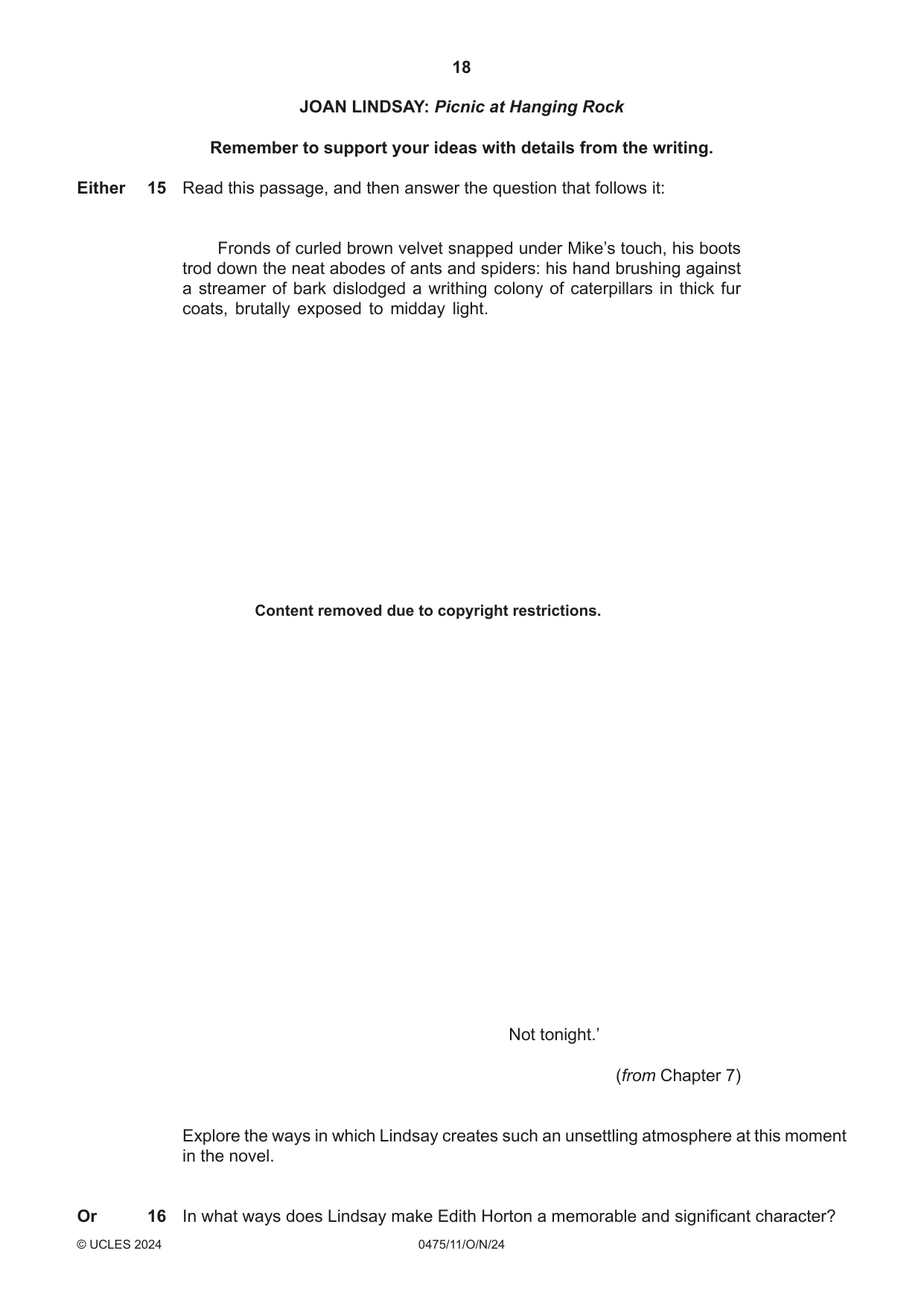
18 0475/11/O/N/24 © UCLES 2024 JOAN LINDSAY: Picnic at Hanging Rock Remember to support your ideas with details from the writing. Either 15 Read this passage, and then answer the question that follows it: Fronds of curled brown velvet snapped under Mike’s touch, his boots trod down the neat abodes of ants and spiders: his hand brushing against a streamer of bark dislodged a writhing colony of caterpillars in thick fur coats, brutally exposed to midday light. Not tonight.’ (from Chapter 7) Explore the ways in which Lindsay creates such an unsettling atmosphere at this moment in the novel. Or 16 In what ways does Lindsay make Edith Horton a memorable and significant character? Content removed due to copyright restrictions.
Question paper, page 19
19 0475/11/O/N/24 © UCLES 2024 [Turn over TURN OVER FOR QUESTION 17.
Question paper, page 20
20 0475/11/O/N/24 © UCLES 2024 YANN MARTEL: Life of Pi Remember to support your ideas with details from the writing. Either 17 Read this passage, and then answer the question that follows it: Dawn came and matters were worse for it. Content removed due to copyright restrictions.
Question paper, page 21
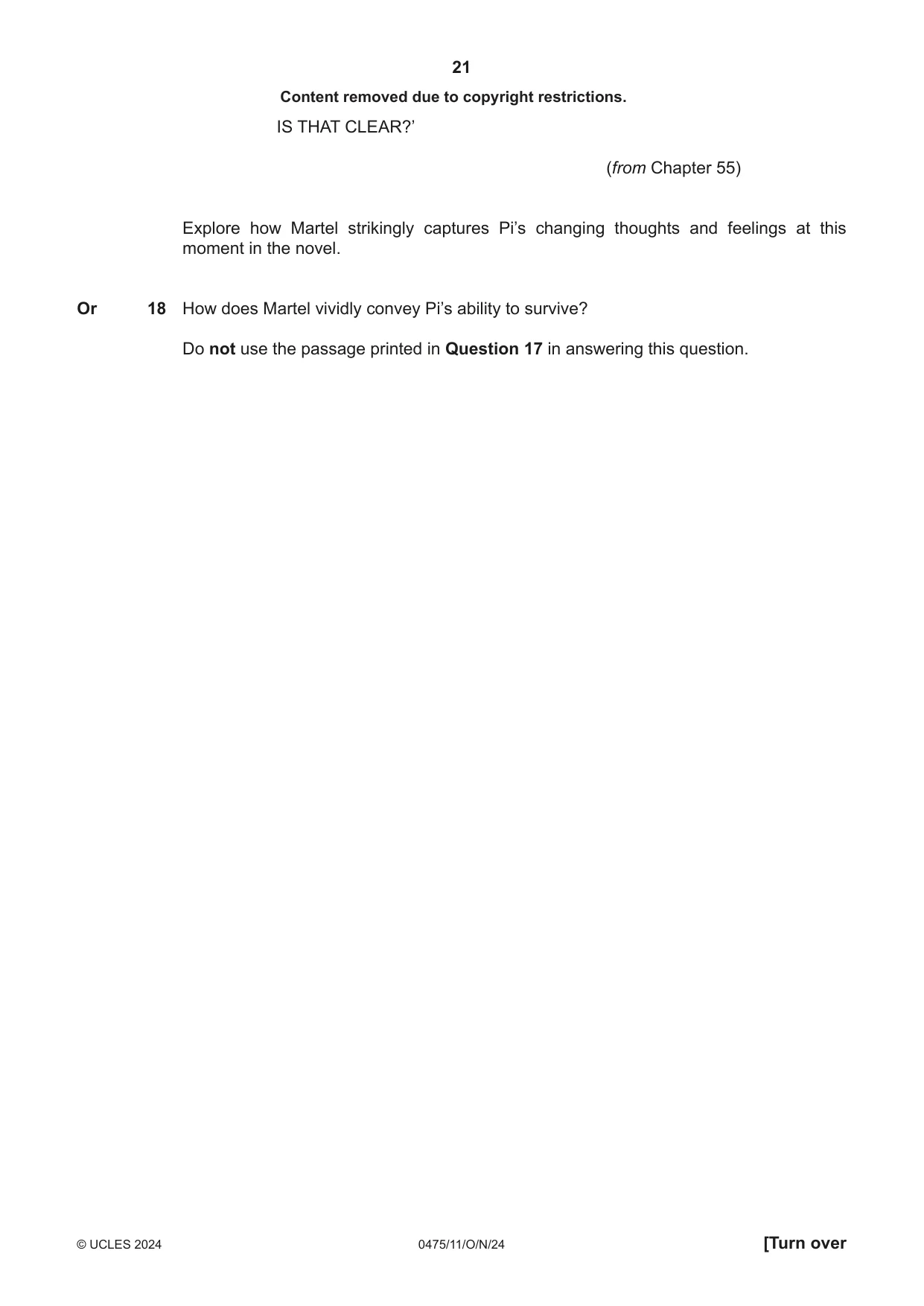
21 0475/11/O/N/24 © UCLES 2024 [Turn over IS THAT CLEAR?’ (from Chapter 55) Explore how Martel strikingly captures Pi’s changing thoughts and feelings at this moment in the novel. Or 18 How does Martel vividly convey Pi’s ability to survive? Do not use the passage printed in Question 17 in answering this question. Content removed due to copyright restrictions.
Question paper, page 22
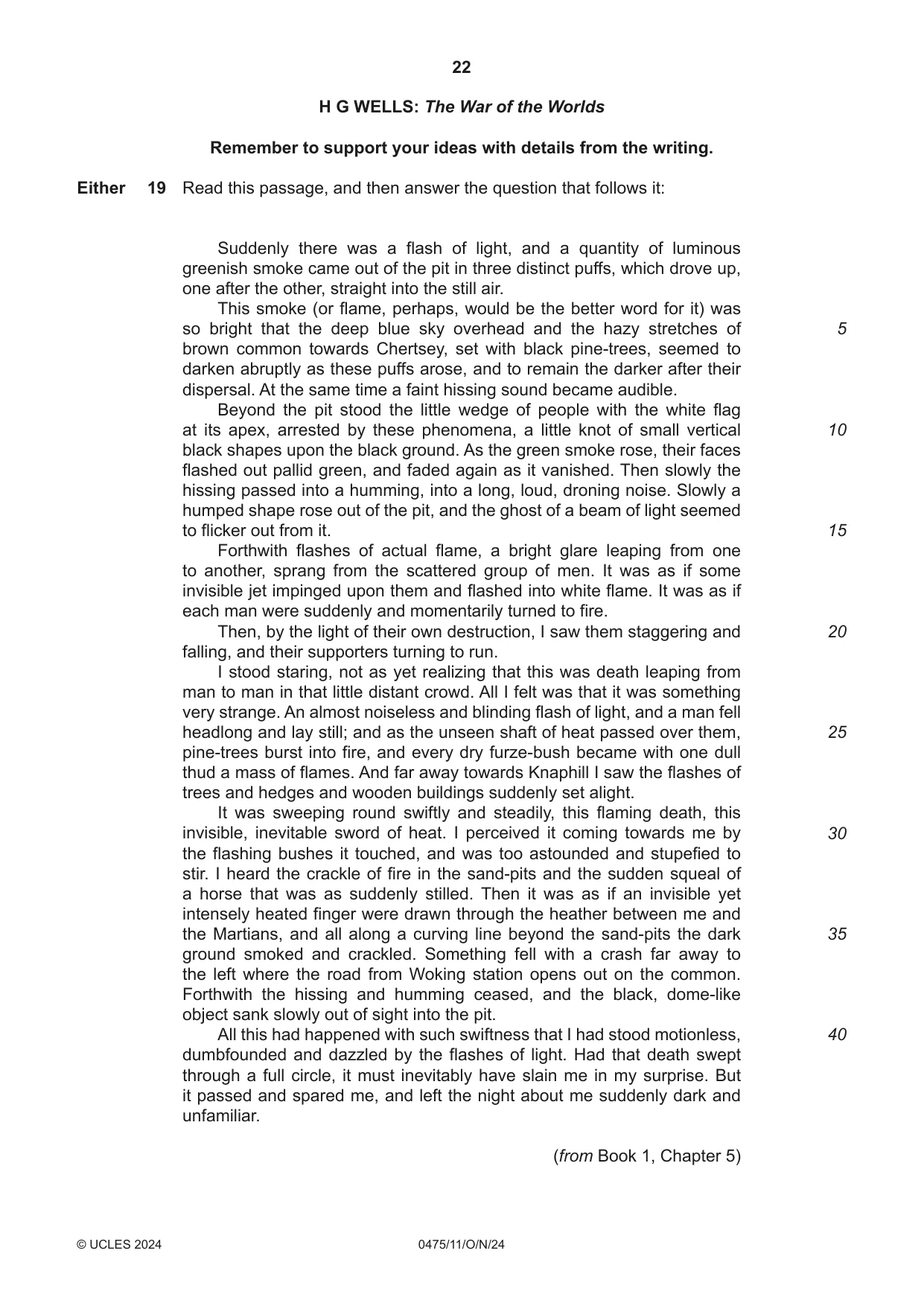
22 0475/11/O/N/24 © UCLES 2024 H G WELLS: The War of the Worlds Remember to support your ideas with details from the writing. Either 19 Read this passage, and then answer the question that follows it: Suddenly there was a flash of light, and a quantity of luminous greenish smoke came out of the pit in three distinct puffs, which drove up, one after the other, straight into the still air. This smoke (or flame, perhaps, would be the better word for it) was so bright that the deep blue sky overhead and the hazy stretches of brown common towards Chertsey, set with black pine-trees, seemed to darken abruptly as these puffs arose, and to remain the darker after their dispersal. At the same time a faint hissing sound became audible. Beyond the pit stood the little wedge of people with the white flag at its apex, arrested by these phenomena, a little knot of small vertical black shapes upon the black ground. As the green smoke rose, their faces flashed out pallid green, and faded again as it vanished. Then slowly the hissing passed into a humming, into a long, loud, droning noise. Slowly a humped shape rose out of the pit, and the ghost of a beam of light seemed to flicker out from it. Forthwith flashes of actual flame, a bright glare leaping from one to another, sprang from the scattered group of men. It was as if some invisible jet impinged upon them and flashed into white flame. It was as if each man were suddenly and momentarily turned to fire. Then, by the light of their own destruction, I saw them staggering and falling, and their supporters turning to run. I stood staring, not as yet realizing that this was death leaping from man to man in that little distant crowd. All I felt was that it was something very strange. An almost noiseless and blinding flash of light, and a man fell headlong and lay still; and as the unseen shaft of heat passed over them, pine-trees burst into fire, and every dry furze-bush became with one dull thud a mass of flames. And far away towards Knaphill I saw the flashes of trees and hedges and wooden buildings suddenly set alight. It was sweeping round swiftly and steadily, this flaming death, this invisible, inevitable sword of heat. I perceived it coming towards me by the flashing bushes it touched, and was too astounded and stupefied to stir. I heard the crackle of fire in the sand-pits and the sudden squeal of a horse that was as suddenly stilled. Then it was as if an invisible yet intensely heated finger were drawn through the heather between me and the Martians, and all along a curving line beyond the sand-pits the dark ground smoked and crackled. Something fell with a crash far away to the left where the road from Woking station opens out on the common. Forthwith the hissing and humming ceased, and the black, dome-like object sank slowly out of sight into the pit. All this had happened with such swiftness that I had stood motionless, dumbfounded and dazzled by the flashes of light. Had that death swept through a full circle, it must inevitably have slain me in my surprise. But it passed and spared me, and left the night about me suddenly dark and unfamiliar. (from Book 1, Chapter 5) 5 10 15 20 25 30 35 40
Question paper, page 23
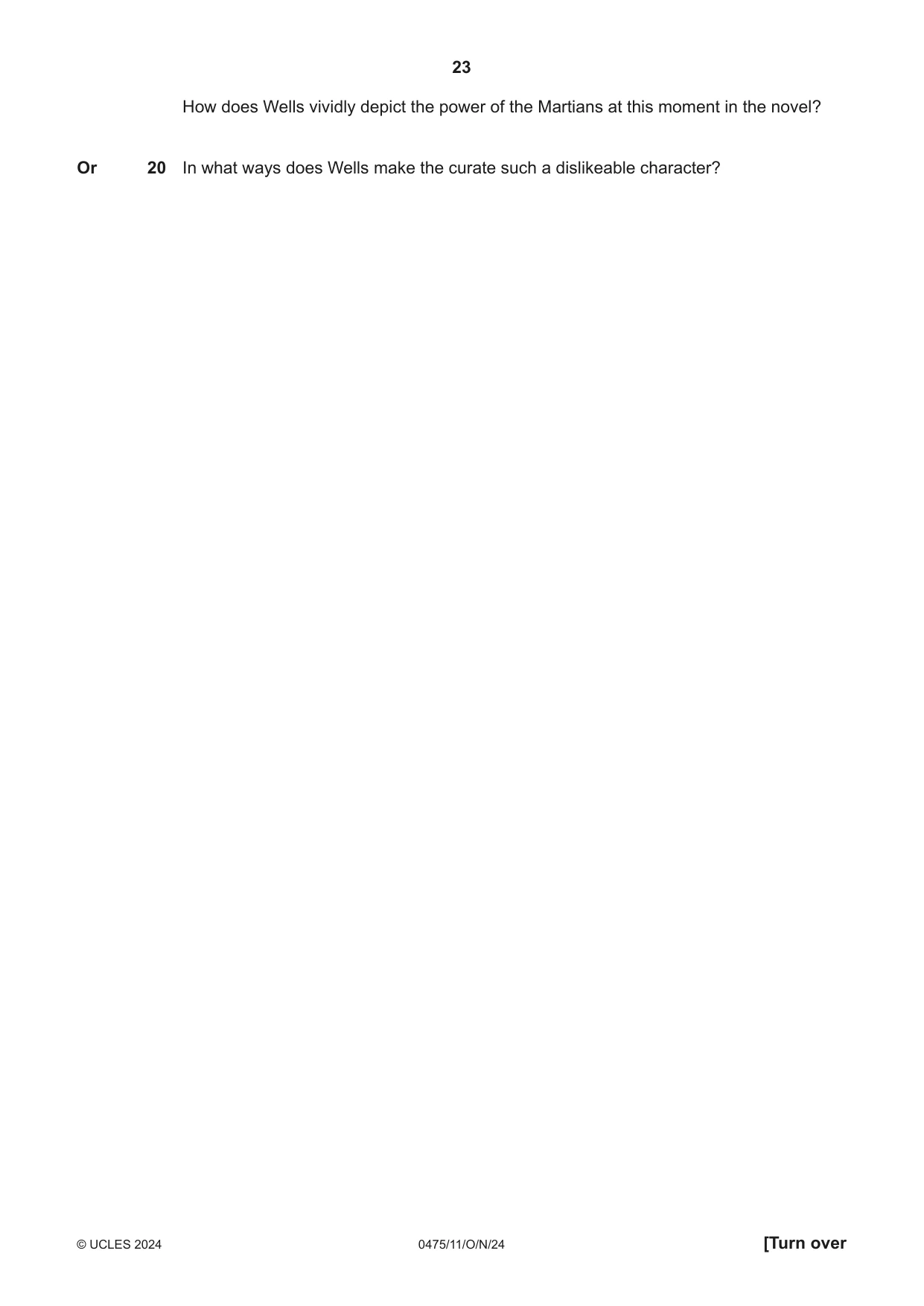
23 0475/11/O/N/24 © UCLES 2024 [Turn over How does Wells vividly depict the power of the Martians at this moment in the novel? Or 20 In what ways does Wells make the curate such a dislikeable character?
Question paper, page 24
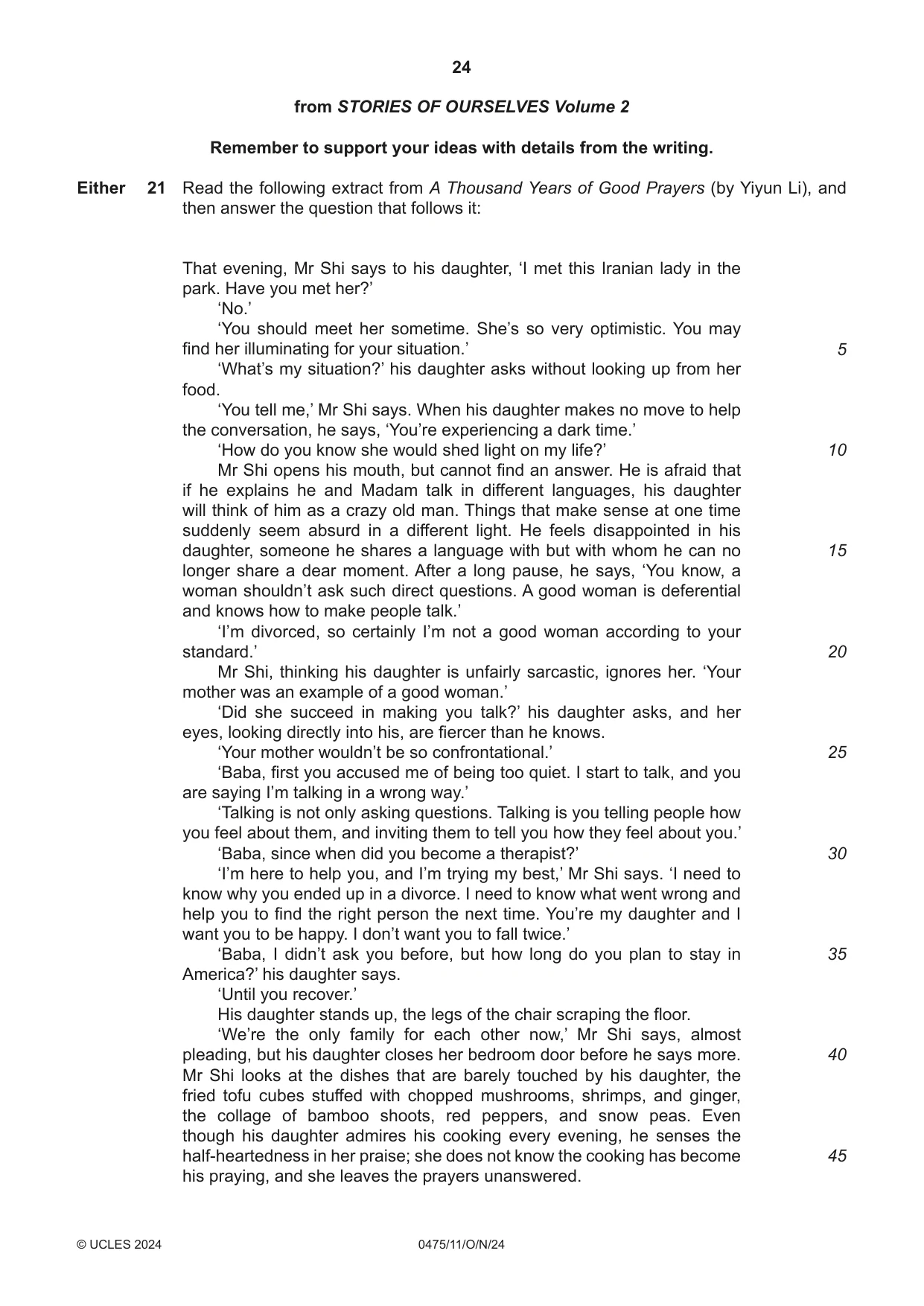
24 0475/11/O/N/24 © UCLES 2024 from STORIES OF OURSELVES Volume 2 Remember to support your ideas with details from the writing. Either 21 Read the following extract from A Thousand Years of Good Prayers (by Yiyun Li), and then answer the question that follows it: That evening, Mr Shi says to his daughter, ‘I met this Iranian lady in the park. Have you met her?’ ‘No.’ ‘You should meet her sometime. She’s so very optimistic. You may find her illuminating for your situation.’ ‘What’s my situation?’ his daughter asks without looking up from her food. ‘You tell me,’ Mr Shi says. When his daughter makes no move to help the conversation, he says, ‘You’re experiencing a dark time.’ ‘How do you know she would shed light on my life?’ Mr Shi opens his mouth, but cannot find an answer. He is afraid that if he explains he and Madam talk in different languages, his daughter will think of him as a crazy old man. Things that make sense at one time suddenly seem absurd in a different light. He feels disappointed in his daughter, someone he shares a language with but with whom he can no longer share a dear moment. After a long pause, he says, ‘You know, a woman shouldn’t ask such direct questions. A good woman is deferential and knows how to make people talk.’ ‘I’m divorced, so certainly I’m not a good woman according to your standard.’ Mr Shi, thinking his daughter is unfairly sarcastic, ignores her. ‘Your mother was an example of a good woman.’ ‘Did she succeed in making you talk?’ his daughter asks, and her eyes, looking directly into his, are fiercer than he knows. ‘Your mother wouldn’t be so confrontational.’ ‘Baba, first you accused me of being too quiet. I start to talk, and you are saying I’m talking in a wrong way.’ ‘Talking is not only asking questions. Talking is you telling people how you feel about them, and inviting them to tell you how they feel about you.’ ‘Baba, since when did you become a therapist?’ ‘I’m here to help you, and I’m trying my best,’ Mr Shi says. ‘I need to know why you ended up in a divorce. I need to know what went wrong and help you to find the right person the next time. You’re my daughter and I want you to be happy. I don’t want you to fall twice.’ ‘Baba, I didn’t ask you before, but how long do you plan to stay in America?’ his daughter says. ‘Until you recover.’ His daughter stands up, the legs of the chair scraping the floor. ‘We’re the only family for each other now,’ Mr Shi says, almost pleading, but his daughter closes her bedroom door before he says more. Mr Shi looks at the dishes that are barely touched by his daughter, the fried tofu cubes stuffed with chopped mushrooms, shrimps, and ginger, the collage of bamboo shoots, red peppers, and snow peas. Even though his daughter admires his cooking every evening, he senses the half-heartedness in her praise; she does not know the cooking has become his praying, and she leaves the prayers unanswered. 5 10 15 20 25 30 35 40 45
Question paper, page 25
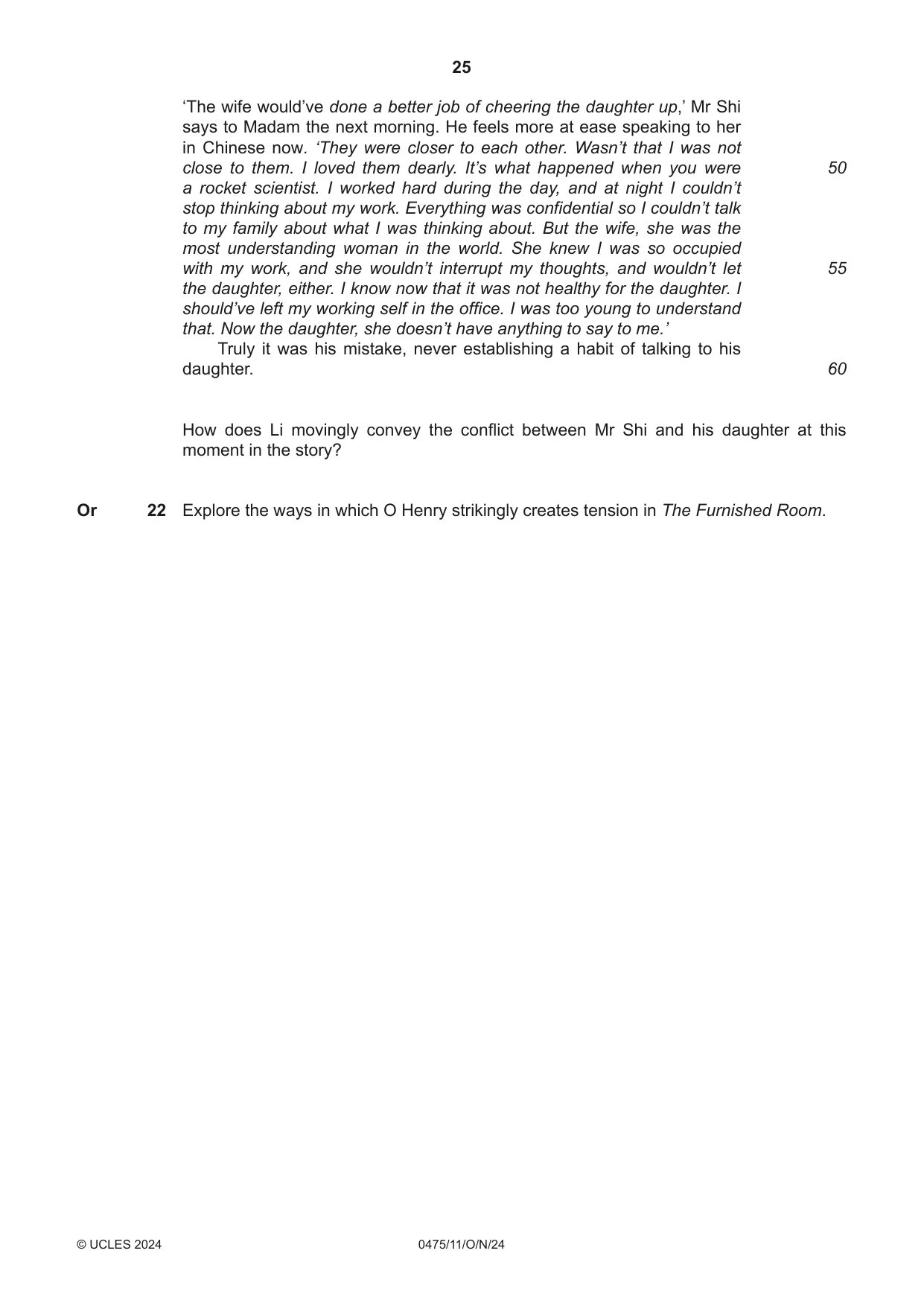
25 0475/11/O/N/24 © UCLES 2024 ‘The wife would’ve done a better job of cheering the daughter up,’ Mr Shi says to Madam the next morning. He feels more at ease speaking to her in Chinese now. ‘They were closer to each other. Wasn’t that I was not close to them. I loved them dearly. It’s what happened when you were a rocket scientist. I worked hard during the day, and at night I couldn’t stop thinking about my work. Everything was confidential so I couldn’t talk to my family about what I was thinking about. But the wife, she was the most understanding woman in the world. She knew I was so occupied with my work, and she wouldn’t interrupt my thoughts, and wouldn’t let the daughter, either. I know now that it was not healthy for the daughter. I should’ve left my working self in the office. I was too young to understand that. Now the daughter, she doesn’t have anything to say to me.’ Truly it was his mistake, never establishing a habit of talking to his daughter. How does Li movingly convey the conflict between Mr Shi and his daughter at this moment in the story? Or 22 Explore the ways in which O Henry strikingly creates tension in The Furnished Room. 50 55 60
Question paper, page 26
26 0475/11/O/N/24 © UCLES 2024 BLANK PAGE
Question paper, page 27
27 0475/11/O/N/24 © UCLES 2024 BLANK PAGE
Question paper, page 28
28 0475/11/O/N/24 © UCLES 2024 Permission to reproduce items where third-party owned material protected by copyright is included has been sought and cleared where possible. Every reasonable effort has been made by the publisher (UCLES) to trace copyright holders, but if any items requiring clearance have unwittingly been included, the publisher will be pleased to make amends at the earliest possible opportunity. To avoid the issue of disclosure of answer-related information to candidates, all copyright acknowledgements are reproduced online in the Cambridge Assessment International Education Copyright Acknowledgements Booklet. This is produced for each series of examinations and is freely available to download at www.cambridgeinternational.org after the live examination series. Cambridge Assessment International Education is part of Cambridge Assessment. Cambridge Assessment is the brand name of the University of Cambridge Local Examinations Syndicate (UCLES), which is a department of the University of Cambridge. BLANK PAGE
Mark scheme, page 1
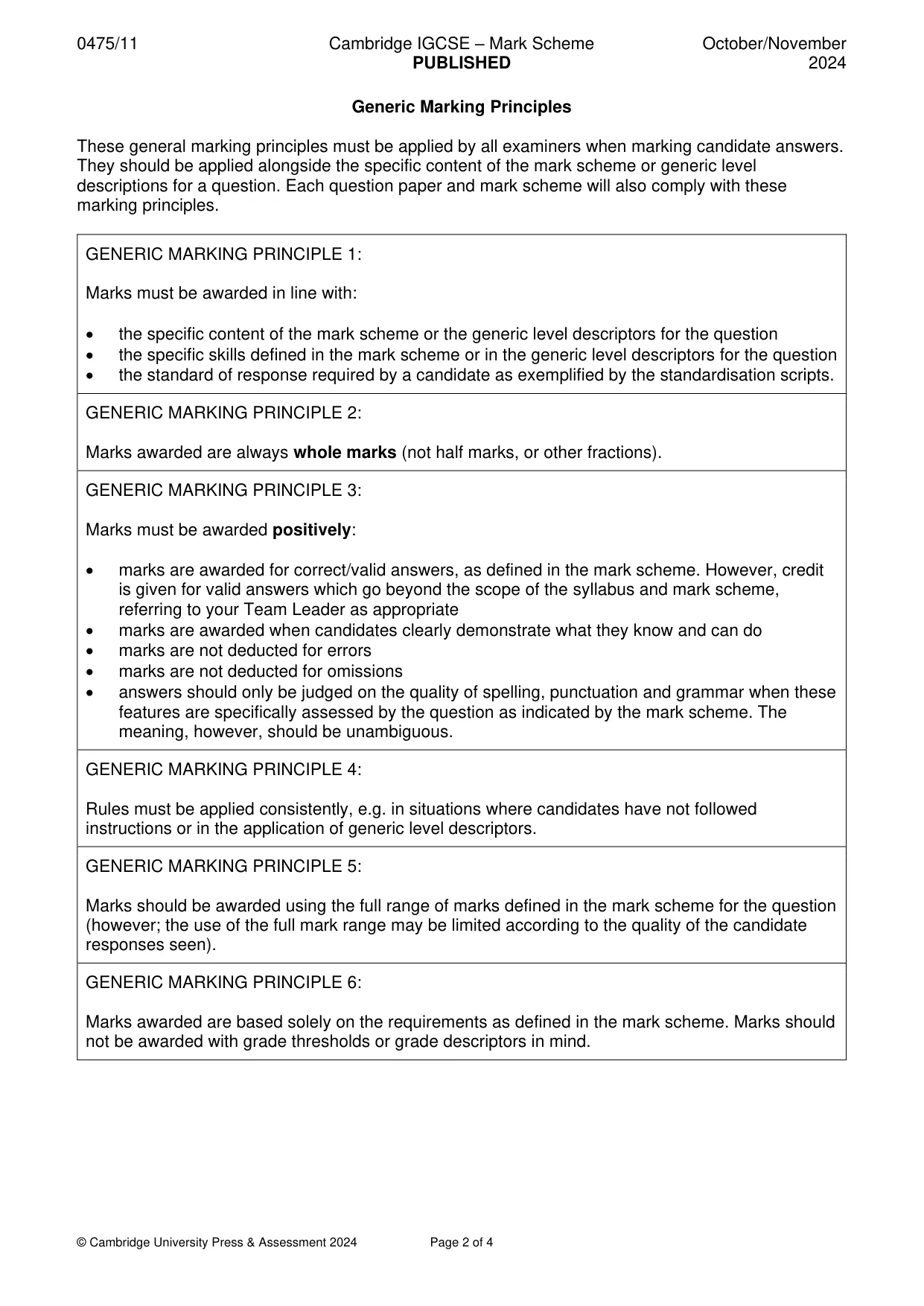
This document consists of 4 printed pages. © Cambridge University Press & Assessment 2024 [Turn over Cambridge IGCSE™ LITERATURE IN ENGLISH 0475/11 Paper 1 Poetry and Prose October/November 2024 MARK SCHEME Maximum Mark: 50 Published This mark scheme is published as an aid to teachers and candidates, to indicate the requirements of the examination. It shows the basis on which Examiners were instructed to award marks. It does not indicate the details of the discussions that took place at an Examiners’ meeting before marking began, which would have considered the acceptability of alternative answers. Mark schemes should be read in conjunction with the question paper and the Principal Examiner Report for Teachers. Cambridge International will not enter into discussions about these mark schemes. Cambridge International is publishing the mark schemes for the October/November 2024 series for most Cambridge IGCSE, Cambridge International A and AS Level components, and some Cambridge O Level components.
Mark scheme, page 2
0475/11 Cambridge IGCSE – Mark Scheme PUBLISHED October/November 2024 © Cambridge University Press & Assessment 2024 Page 2 of 4 Generic Marking Principles These general marking principles must be applied by all examiners when marking candidate answers. They should be applied alongside the specific content of the mark scheme or generic level descriptions for a question. Each question paper and mark scheme will also comply with these marking principles. GENERIC MARKING PRINCIPLE 1: Marks must be awarded in line with: • the specific content of the mark scheme or the generic level descriptors for the question • the specific skills defined in the mark scheme or in the generic level descriptors for the question • the standard of response required by a candidate as exemplified by the standardisation scripts. GENERIC MARKING PRINCIPLE 2: Marks awarded are always whole marks (not half marks, or other fractions). GENERIC MARKING PRINCIPLE 3: Marks must be awarded positively: • marks are awarded for correct/valid answers, as defined in the mark scheme. However, credit is given for valid answers which go beyond the scope of the syllabus and mark scheme, referring to your Team Leader as appropriate • marks are awarded when candidates clearly demonstrate what they know and can do • marks are not deducted for errors • marks are not deducted for omissions • answers should only be judged on the quality of spelling, punctuation and grammar when these features are specifically assessed by the question as indicated by the mark scheme. The meaning, however, should be unambiguous. GENERIC MARKING PRINCIPLE 4: Rules must be applied consistently, e.g. in situations where candidates have not followed instructions or in the application of generic level descriptors. GENERIC MARKING PRINCIPLE 5: Marks should be awarded using the full range of marks defined in the mark scheme for the question (however; the use of the full mark range may be limited according to the quality of the candidate responses seen). GENERIC MARKING PRINCIPLE 6: Marks awarded are based solely on the requirements as defined in the mark scheme. Marks should not be awarded with grade thresholds or grade descriptors in mind.
Mark scheme, page 3
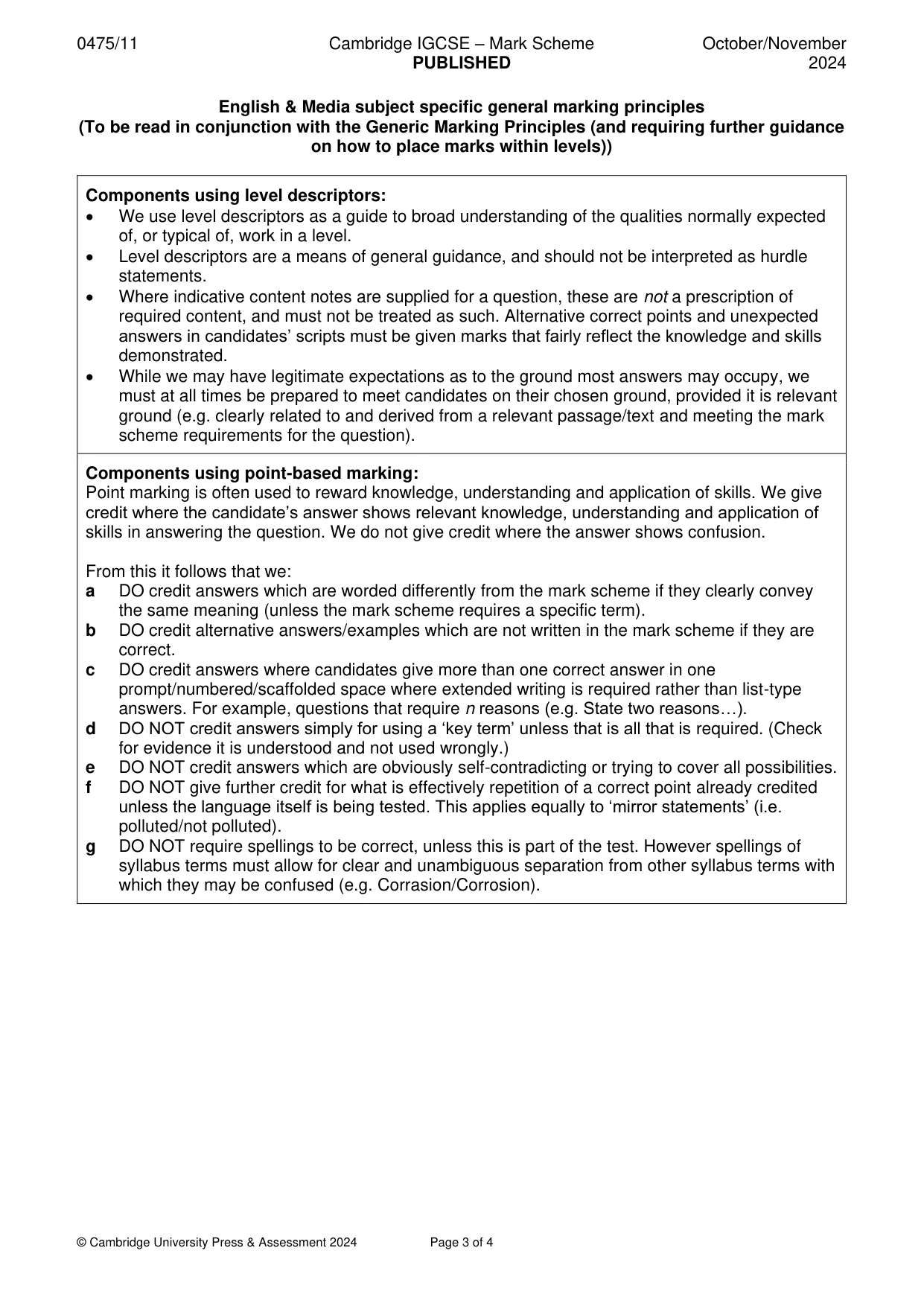
0475/11 Cambridge IGCSE – Mark Scheme PUBLISHED October/November 2024 © Cambridge University Press & Assessment 2024 Page 3 of 4 English & Media subject specific general marking principles (To be read in conjunction with the Generic Marking Principles (and requiring further guidance on how to place marks within levels)) Components using level descriptors: • We use level descriptors as a guide to broad understanding of the qualities normally expected of, or typical of, work in a level. • Level descriptors are a means of general guidance, and should not be interpreted as hurdle statements. • Where indicative content notes are supplied for a question, these are not a prescription of required content, and must not be treated as such. Alternative correct points and unexpected answers in candidates’ scripts must be given marks that fairly reflect the knowledge and skills demonstrated. • While we may have legitimate expectations as to the ground most answers may occupy, we must at all times be prepared to meet candidates on their chosen ground, provided it is relevant ground (e.g. clearly related to and derived from a relevant passage/text and meeting the mark scheme requirements for the question). Components using point-based marking: Point marking is often used to reward knowledge, understanding and application of skills. We give credit where the candidate’s answer shows relevant knowledge, understanding and application of skills in answering the question. We do not give credit where the answer shows confusion. From this it follows that we: a DO credit answers which are worded differently from the mark scheme if they clearly convey the same meaning (unless the mark scheme requires a specific term). b DO credit alternative answers/examples which are not written in the mark scheme if they are correct. c DO credit answers where candidates give more than one correct answer in one prompt/numbered/scaffolded space where extended writing is required rather than list-type answers. For example, questions that require n reasons (e.g. State two reasons…). d DO NOT credit answers simply for using a ‘key term’ unless that is all that is required. (Check for evidence it is understood and not used wrongly.) e DO NOT credit answers which are obviously self-contradicting or trying to cover all possibilities. f DO NOT give further credit for what is effectively repetition of a correct point already credited unless the language itself is being tested. This applies equally to ‘mirror statements’ (i.e. polluted/not polluted). g DO NOT require spellings to be correct, unless this is part of the test. However spellings of syllabus terms must allow for clear and unambiguous separation from other syllabus terms with which they may be confused (e.g. Corrasion/Corrosion).
Mark scheme, page 4
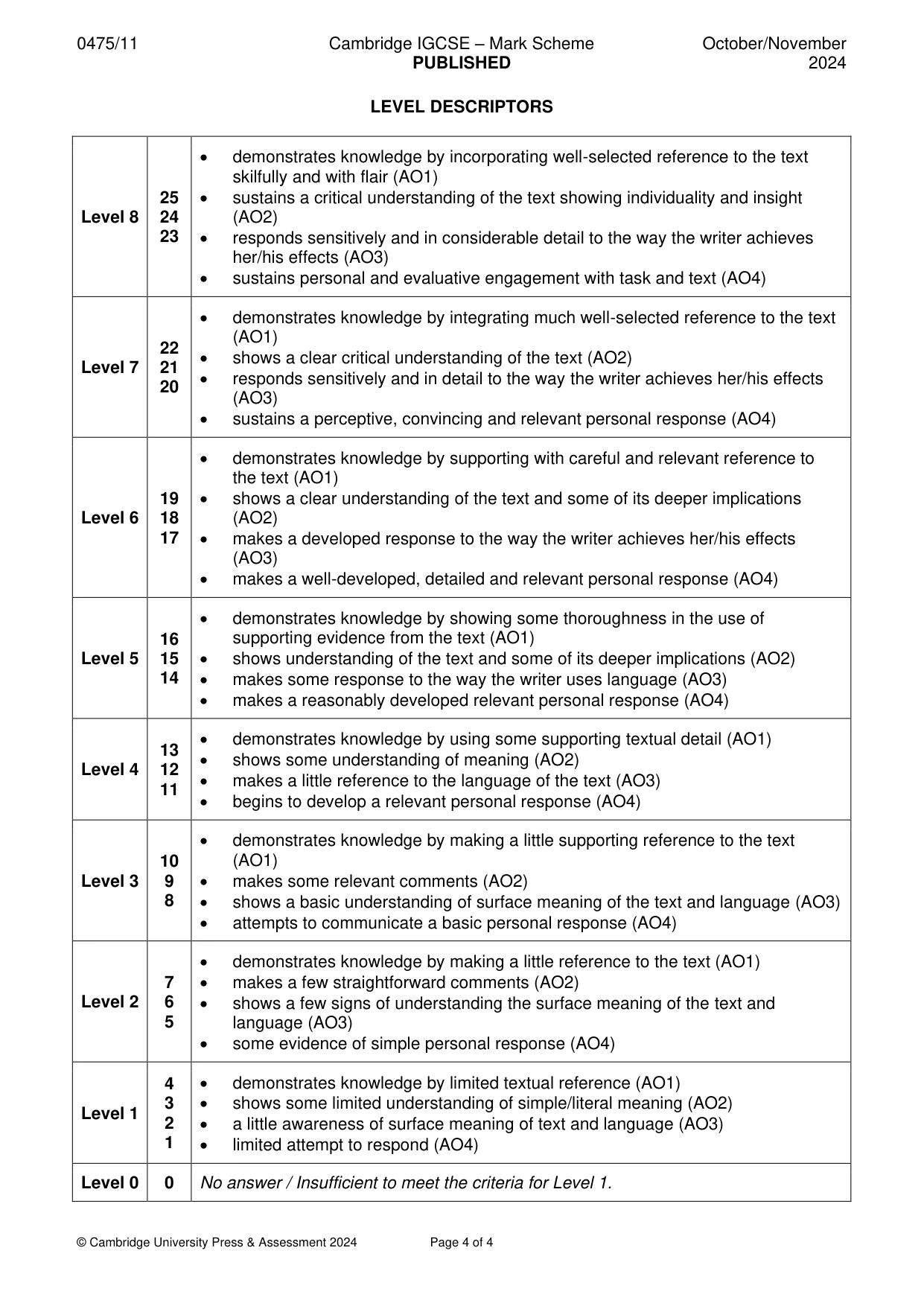
0475/11 Cambridge IGCSE – Mark Scheme PUBLISHED October/November 2024 © Cambridge University Press & Assessment 2024 Page 4 of 4 LEVEL DESCRIPTORS Level 8 25 24 23 • demonstrates knowledge by incorporating well-selected reference to the text skilfully and with flair (AO1) • sustains a critical understanding of the text showing individuality and insight (AO2) • responds sensitively and in considerable detail to the way the writer achieves her/his effects (AO3) • sustains personal and evaluative engagement with task and text (AO4) Level 7 22 21 20 • demonstrates knowledge by integrating much well-selected reference to the text (AO1) • shows a clear critical understanding of the text (AO2) • responds sensitively and in detail to the way the writer achieves her/his effects (AO3) • sustains a perceptive, convincing and relevant personal response (AO4) Level 6 19 18 17 • demonstrates knowledge by supporting with careful and relevant reference to the text (AO1) • shows a clear understanding of the text and some of its deeper implications (AO2) • makes a developed response to the way the writer achieves her/his effects (AO3) • makes a well-developed, detailed and relevant personal response (AO4) Level 5 16 15 14 • demonstrates knowledge by showing some thoroughness in the use of supporting evidence from the text (AO1) • shows understanding of the text and some of its deeper implications (AO2) • makes some response to the way the writer uses language (AO3) • makes a reasonably developed relevant personal response (AO4) Level 4 13 12 11 • demonstrates knowledge by using some supporting textual detail (AO1) • shows some understanding of meaning (AO2) • makes a little reference to the language of the text (AO3) • begins to develop a relevant personal response (AO4) Level 3 10 9 8 • demonstrates knowledge by making a little supporting reference to the text (AO1) • makes some relevant comments (AO2) • shows a basic understanding of surface meaning of the text and language (AO3) • attempts to communicate a basic personal response (AO4) Level 2 7 6 5 • demonstrates knowledge by making a little reference to the text (AO1) • makes a few straightforward comments (AO2) • shows a few signs of understanding the surface meaning of the text and language (AO3) • some evidence of simple personal response (AO4) Level 1 4 3 2 1 • demonstrates knowledge by limited textual reference (AO1) • shows some limited understanding of simple/literal meaning (AO2) • a little awareness of surface meaning of text and language (AO3) • limited attempt to respond (AO4) Level 0 0 No answer / Insufficient to meet the criteria for Level 1.
What you needed in this session
Cambridge’s own grade thresholds for 2024 Oct/Nov, Paper 1 · Variant 1. A higher threshold means an easier paper — the bar moves with how the cohort did.