Cambridge IGCSE English - Literature in English 0475 — 2022 May/June Paper 1 · Variant 3
0475/13/M/J/22 · 50 marks · ≈56 min
The question paper and its mark scheme, free to read here and free to download. This is Cambridge’s own paper, exactly as it was sat.
Question paper28 pages




Mark scheme6 pages
Answers below. Sit the paper first if you are practising.


Paper as text
Question paper, page 1
This document has 28 pages. Any blank pages are indicated. * 1 7 8 2 0 9 7 9 2 0 * Cambridge IGCSE™ LITERATURE IN ENGLISH 0475/13 Paper 1 Poetry and Prose May/June 2022 1 hour 30 minutes You must answer on the enclosed answer booklet. You will need: Answer booklet (enclosed) INSTRUCTIONS ● Answer two questions in total: Section A: answer one question. Section B: answer one question. ● Follow the instructions on the front cover of the answer booklet. If you need additional answer paper, ask the invigilator for a continuation booklet. INFORMATION ● The total mark for this paper is 50. ● All questions are worth equal marks. DC (RCL (DF)) 301855/1 © UCLES 2022 [Turn over
Question paper, page 2
2 0475/13/M/J/22 © UCLES 2022 BLANK PAGE
Question paper, page 3
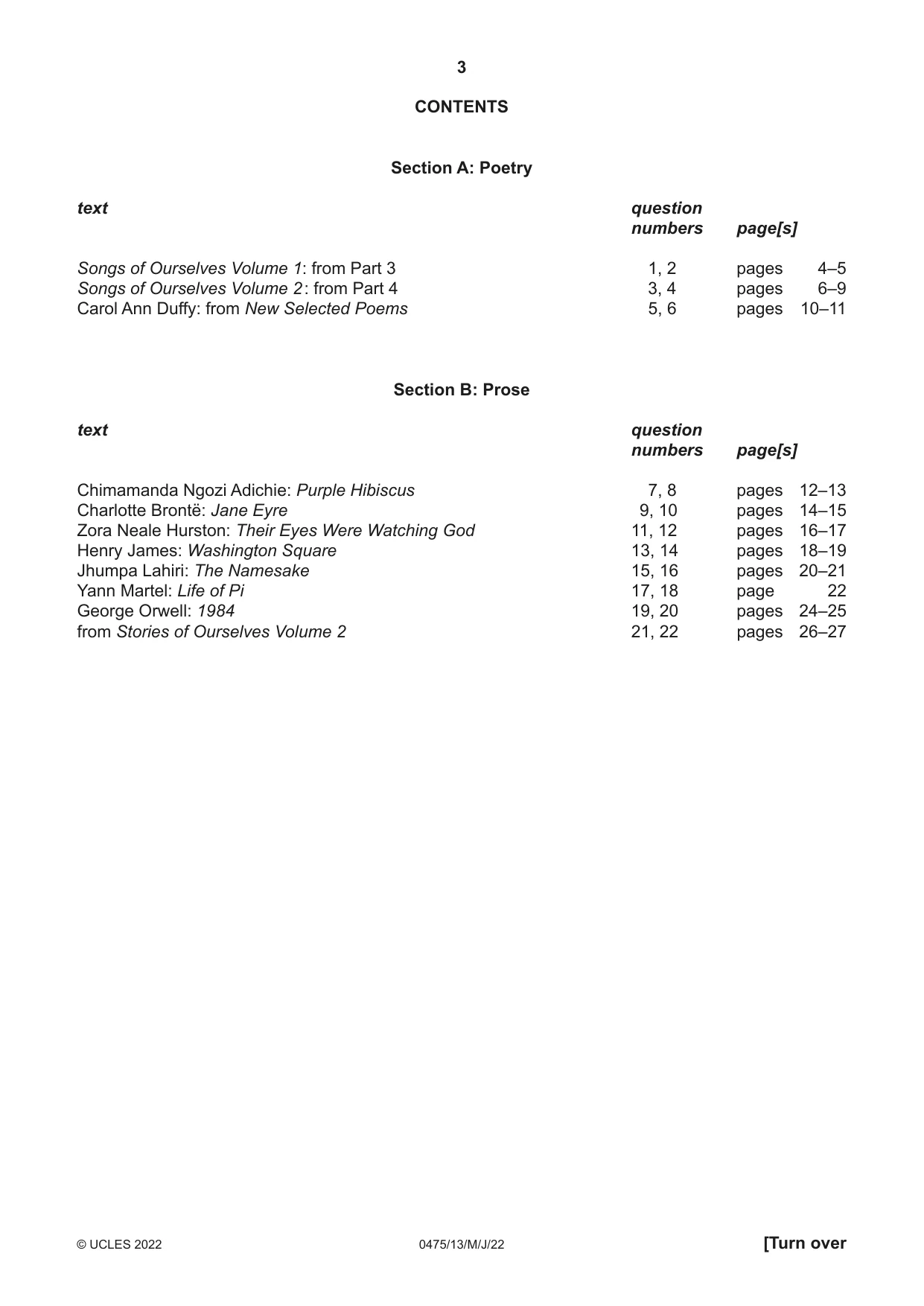
3 0475/13/M/J/22 © UCLES 2022 [Turn over CONTENTS Section A: Poetry text question numbers page[s] Songs of Ourselves Volume 1: from Part 3 1, 2 pages 4–5 Songs of Ourselves Volume 2 : from Part 4 3, 4 pages 6–9 Carol Ann Duffy: from New Selected Poems 5, 6 pages 10–11 Section B: Prose text question numbers page[s] Chimamanda Ngozi Adichie: Purple Hibiscus 7, 8 pages 12–13 Charlotte Brontë: Jane Eyre 9, 10 pages 14–15 Zora Neale Hurston: Their Eyes Were Watching God 11, 12 pages 16–17 Henry James: Washington Square 13, 14 pages 18–19 Jhumpa Lahiri: The Namesake 15, 16 pages 20–21 Yann Martel: Life of Pi 17, 18 page 22 George Orwell: 1984 19, 20 pages 24–25 from Stories of Ourselves Volume 2 21, 22 pages 26–27
Question paper, page 4
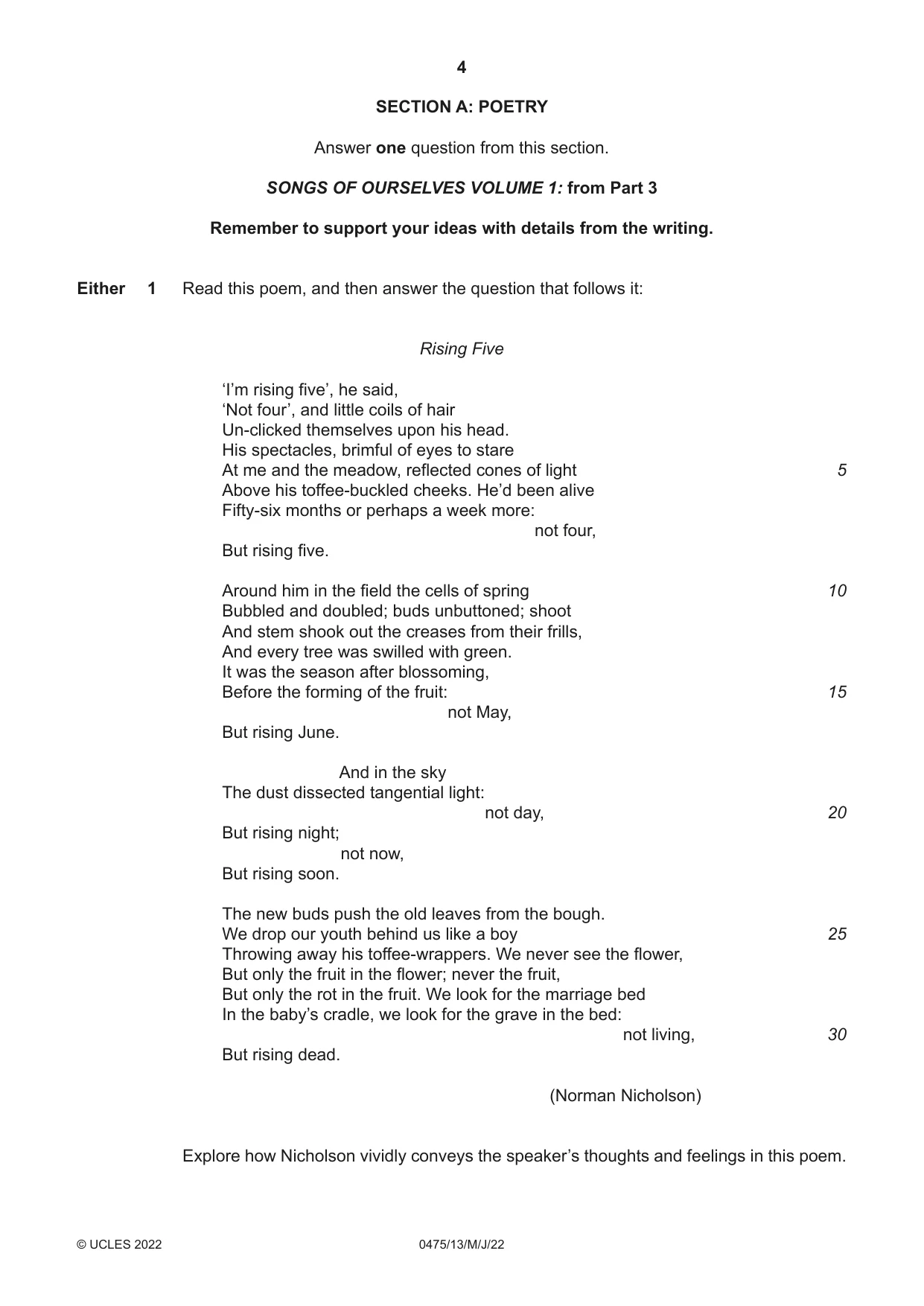
4 0475/13/M/J/22 © UCLES 2022 SECTION A: POETRY Answer one question from this section. SONGS OF OURSELVES VOLUME 1: from Part 3 Remember to support your ideas with details from the writing. Either 1 Read this poem, and then answer the question that follows it: Rising Five ‘I’m rising five’, he said, ‘Not four’, and little coils of hair Un-clicked themselves upon his head. His spectacles, brimful of eyes to stare At me and the meadow, reflected cones of light Above his toffee-buckled cheeks. He’d been alive Fifty-six months or perhaps a week more: not four, But rising five. Around him in the field the cells of spring Bubbled and doubled; buds unbuttoned; shoot And stem shook out the creases from their frills, And every tree was swilled with green. It was the season after blossoming, Before the forming of the fruit: not May, But rising June. And in the sky The dust dissected tangential light: not day, But rising night; not now, But rising soon. The new buds push the old leaves from the bough. We drop our youth behind us like a boy Throwing away his toffee-wrappers. We never see the flower, But only the fruit in the flower; never the fruit, But only the rot in the fruit. We look for the marriage bed In the baby’s cradle, we look for the grave in the bed: not living, But rising dead. (Norman Nicholson) Explore how Nicholson vividly conveys the speaker’s thoughts and feelings in this poem. 5 10 15 20 25 30
Question paper, page 5
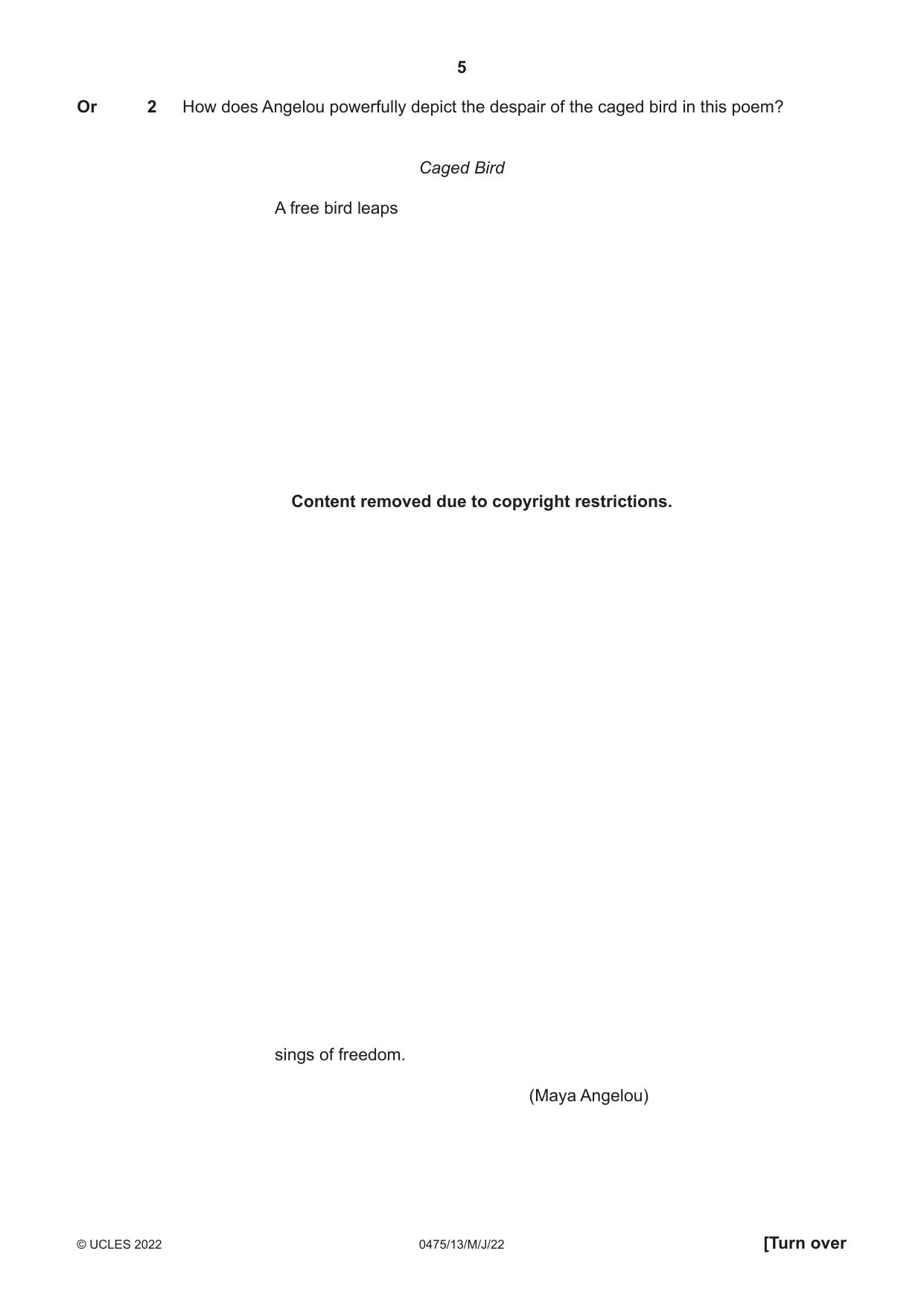
5 0475/13/M/J/22 © UCLES 2022 [Turn over Or 2 How does Angelou powerfully depict the despair of the caged bird in this poem? Caged Bird A free bird leaps sings of freedom. (Maya Angelou) Content removed due to copyright restrictions.
Question paper, page 6
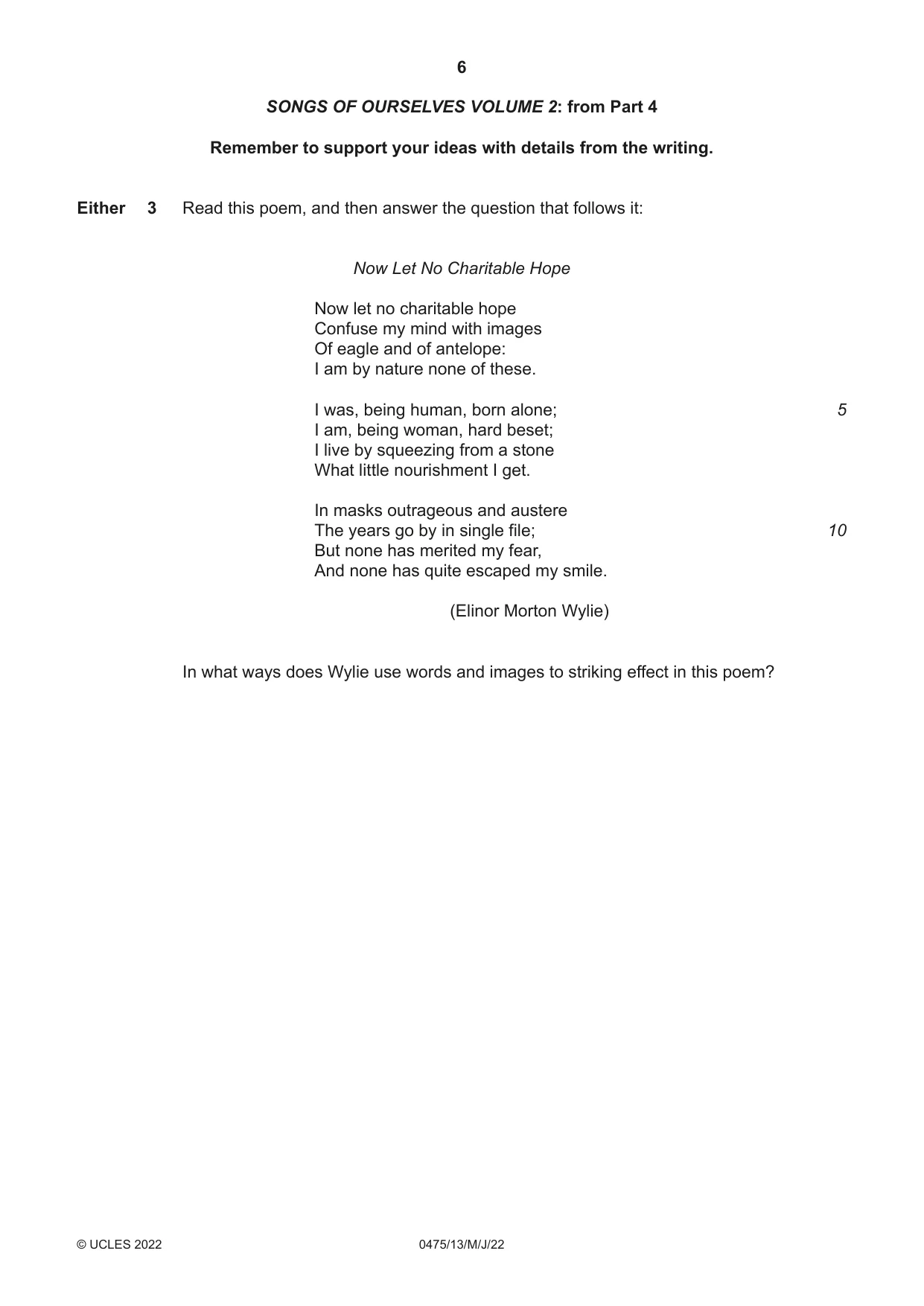
6 0475/13/M/J/22 © UCLES 2022 SONGS OF OURSELVES VOLUME 2: from Part 4 Remember to support your ideas with details from the writing. Either 3 Read this poem, and then answer the question that follows it: Now Let No Charitable Hope Now let no charitable hope Confuse my mind with images Of eagle and of antelope: I am by nature none of these. I was, being human, born alone; I am, being woman, hard beset; I live by squeezing from a stone What little nourishment I get. In masks outrageous and austere The years go by in single file; But none has merited my fear, And none has quite escaped my smile. (Elinor Morton Wylie) In what ways does Wylie use words and images to striking effect in this poem? 5 10
Question paper, page 7
7 0475/13/M/J/22 © UCLES 2022 [Turn over Turn over for Question 4.
Question paper, page 8
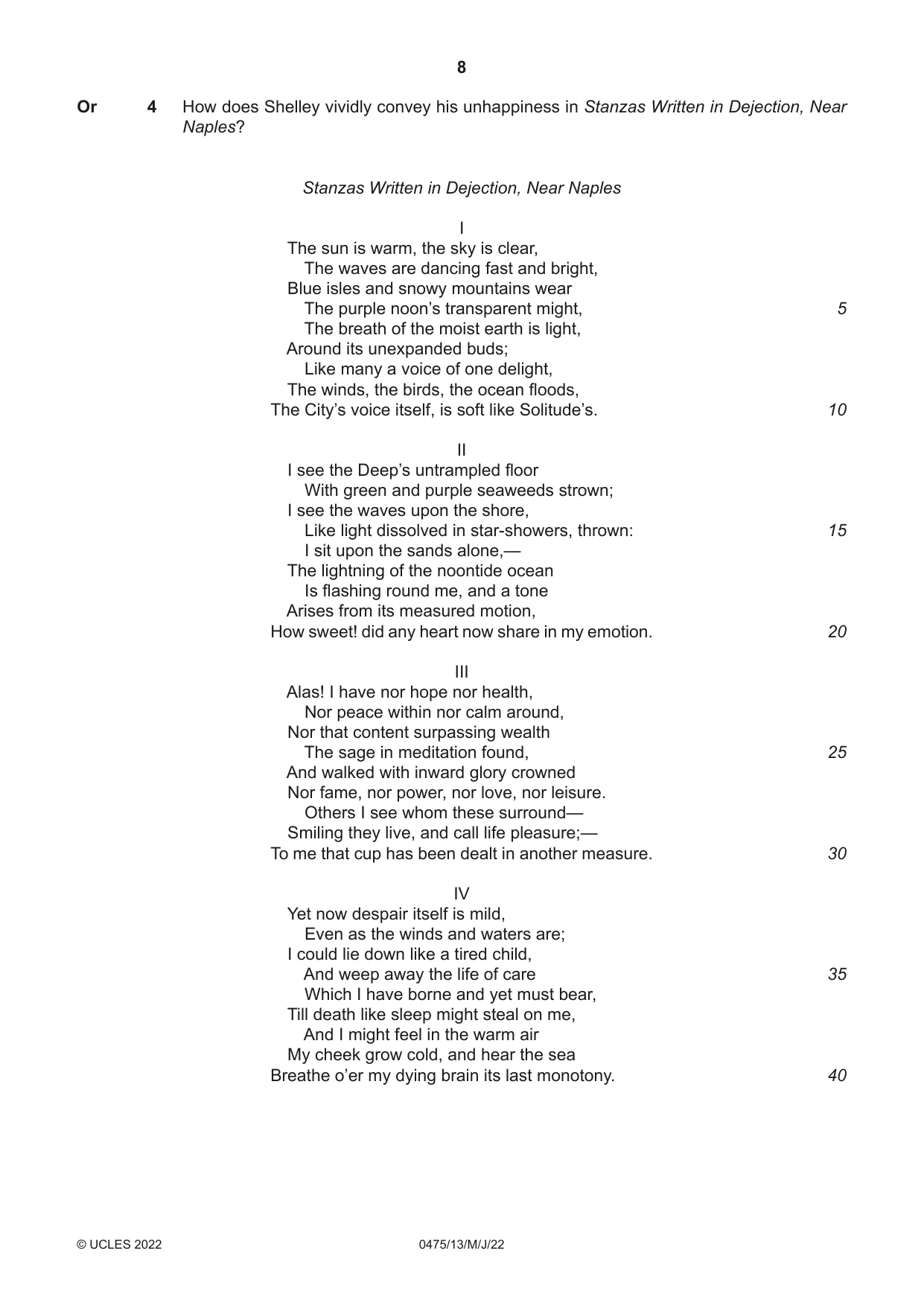
8 0475/13/M/J/22 © UCLES 2022 Or 4 How does Shelley vividly convey his unhappiness in Stanzas Written in Dejection, Near Naples? Stanzas Written in Dejection, Near Naples I The sun is warm, the sky is clear, The waves are dancing fast and bright, Blue isles and snowy mountains wear The purple noon’s transparent might, The breath of the moist earth is light, Around its unexpanded buds; Like many a voice of one delight, The winds, the birds, the ocean floods, The City’s voice itself, is soft like Solitude’s. II I see the Deep’s untrampled floor With green and purple seaweeds strown; I see the waves upon the shore, Like light dissolved in star-showers, thrown: I sit upon the sands alone,— The lightning of the noontide ocean Is flashing round me, and a tone Arises from its measured motion, How sweet! did any heart now share in my emotion. III Alas! I have nor hope nor health, Nor peace within nor calm around, Nor that content surpassing wealth The sage in meditation found, And walked with inward glory crowned Nor fame, nor power, nor love, nor leisure. Others I see whom these surround— Smiling they live, and call life pleasure;— To me that cup has been dealt in another measure. IV Yet now despair itself is mild, Even as the winds and waters are; I could lie down like a tired child, And weep away the life of care Which I have borne and yet must bear, Till death like sleep might steal on me, And I might feel in the warm air My cheek grow cold, and hear the sea Breathe o’er my dying brain its last monotony. 5 10 15 20 25 30 35 40
Question paper, page 9
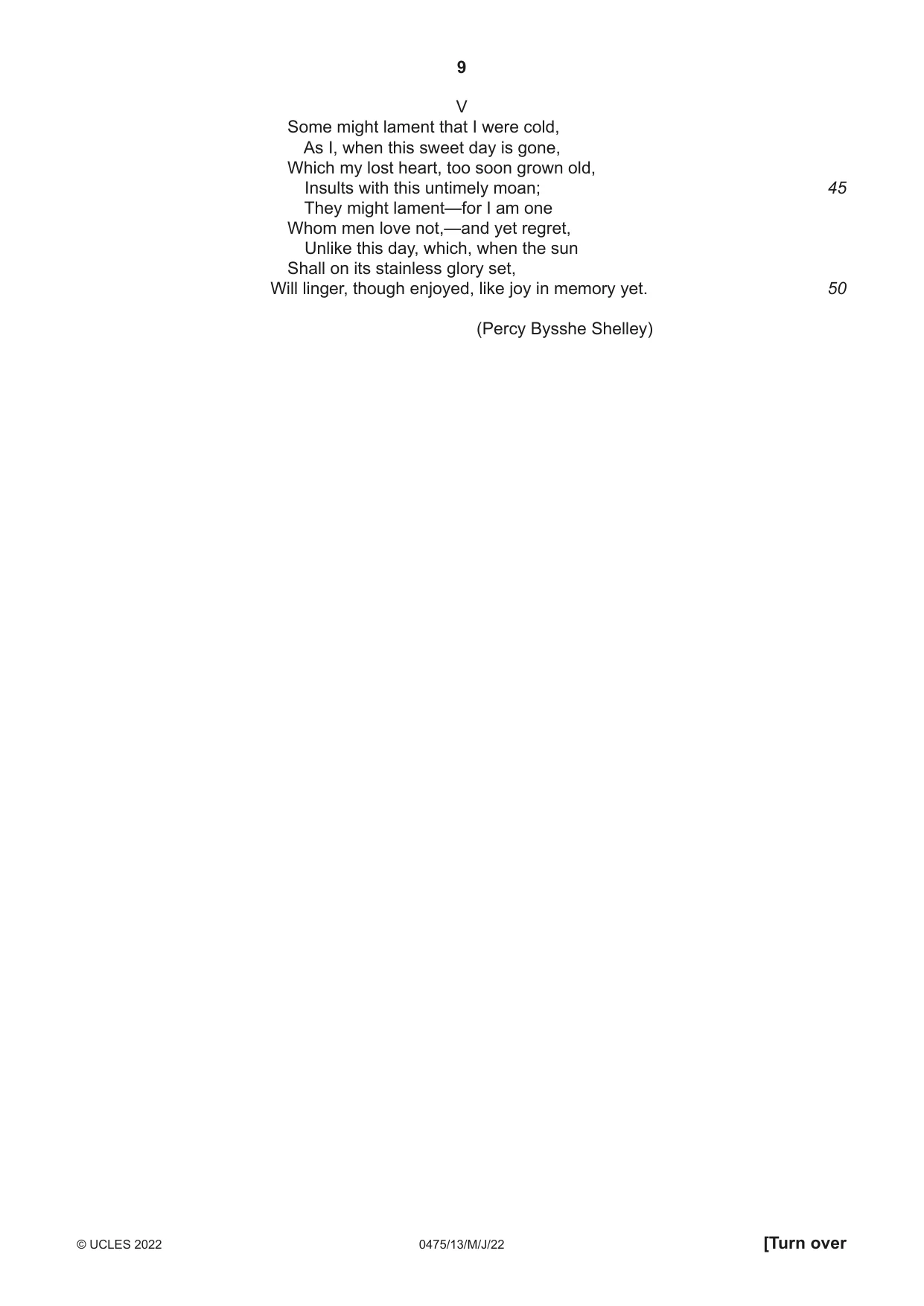
9 0475/13/M/J/22 © UCLES 2022 [Turn over V Some might lament that I were cold, As I, when this sweet day is gone, Which my lost heart, too soon grown old, Insults with this untimely moan; They might lament—for I am one Whom men love not,—and yet regret, Unlike this day, which, when the sun Shall on its stainless glory set, Will linger, though enjoyed, like joy in memory yet. (Percy Bysshe Shelley) 45 50
Question paper, page 10
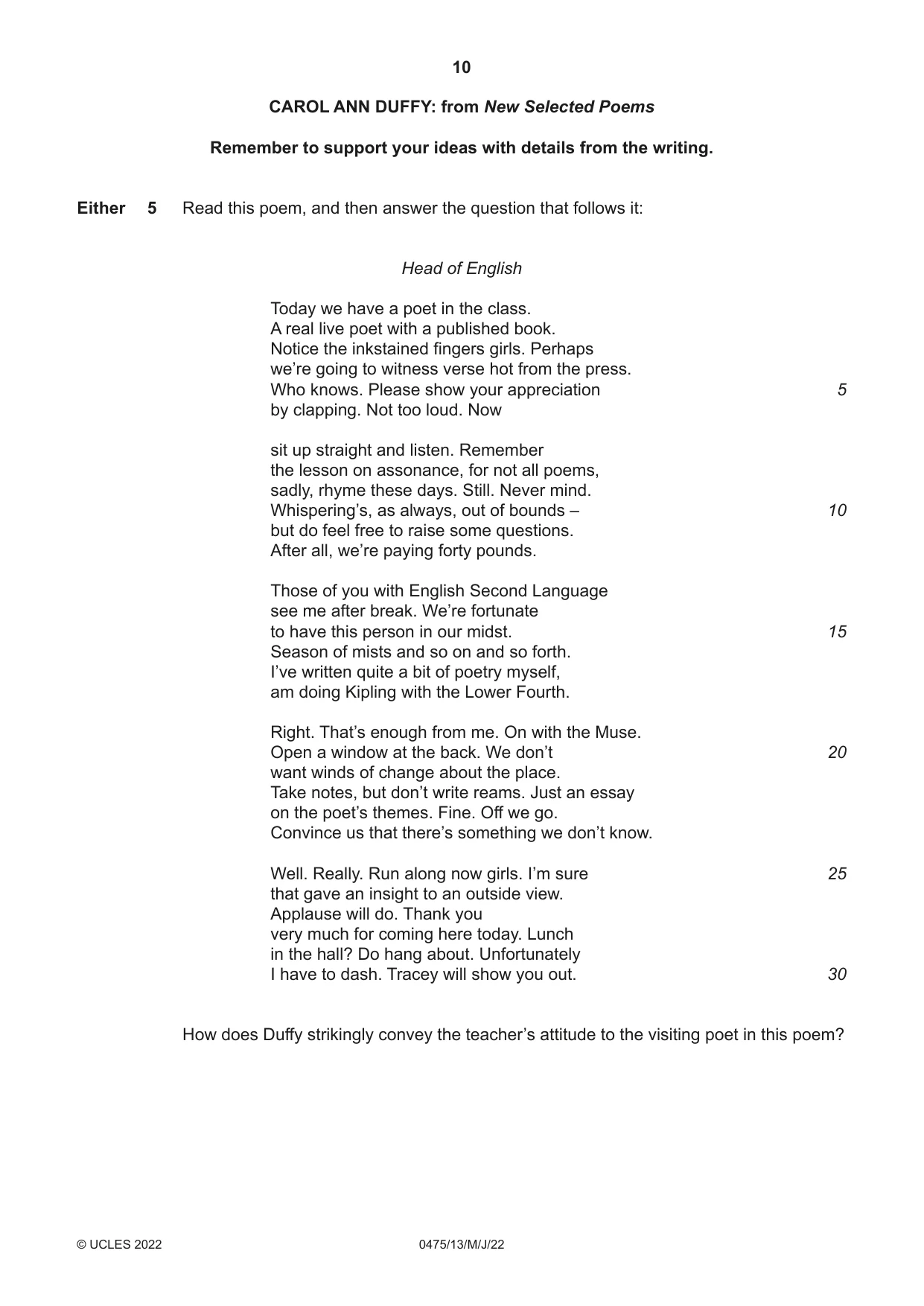
10 0475/13/M/J/22 © UCLES 2022 CAROL ANN DUFFY: from New Selected Poems Remember to support your ideas with details from the writing. Either 5 Read this poem, and then answer the question that follows it: Head of English Today we have a poet in the class. A real live poet with a published book. Notice the inkstained fingers girls. Perhaps we’re going to witness verse hot from the press. Who knows. Please show your appreciation by clapping. Not too loud. Now sit up straight and listen. Remember the lesson on assonance, for not all poems, sadly, rhyme these days. Still. Never mind. Whispering’s, as always, out of bounds – but do feel free to raise some questions. After all, we’re paying forty pounds. Those of you with English Second Language see me after break. We’re fortunate to have this person in our midst. Season of mists and so on and so forth. I’ve written quite a bit of poetry myself, am doing Kipling with the Lower Fourth. Right. That’s enough from me. On with the Muse. Open a window at the back. We don’t want winds of change about the place. Take notes, but don’t write reams. Just an essay on the poet’s themes. Fine. Off we go. Convince us that there’s something we don’t know. Well. Really. Run along now girls. I’m sure that gave an insight to an outside view. Applause will do. Thank you very much for coming here today. Lunch in the hall? Do hang about. Unfortunately I have to dash. Tracey will show you out. How does Duffy strikingly convey the teacher’s attitude to the visiting poet in this poem? 5 10 15 20 25 30
Question paper, page 11
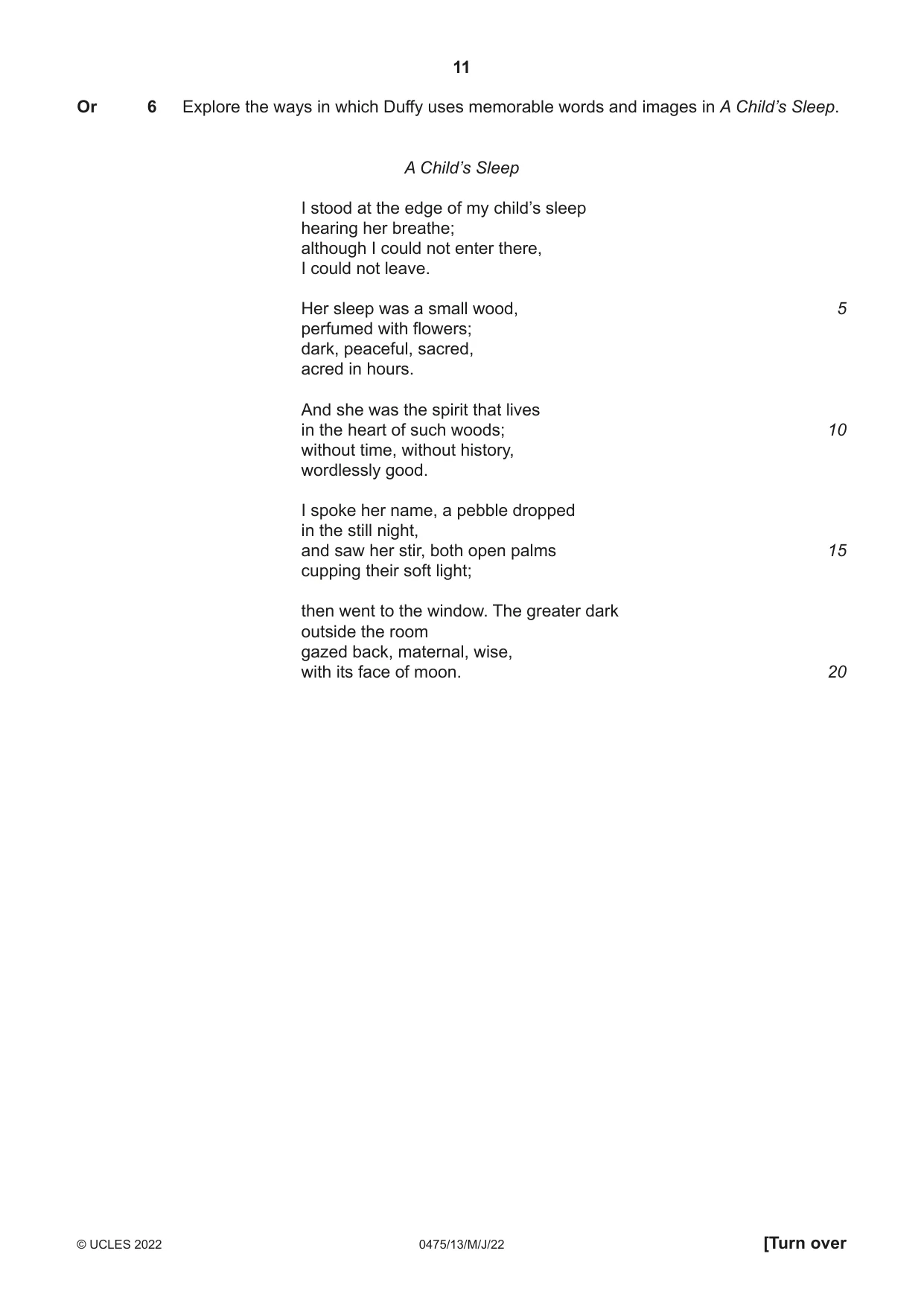
11 0475/13/M/J/22 © UCLES 2022 [Turn over Or 6 Explore the ways in which Duffy uses memorable words and images in A Child’s Sleep. A Child’s Sleep I stood at the edge of my child’s sleep hearing her breathe; although I could not enter there, I could not leave. Her sleep was a small wood, perfumed with flowers; dark, peaceful, sacred, acred in hours. And she was the spirit that lives in the heart of such woods; without time, without history, wordlessly good. I spoke her name, a pebble dropped in the still night, and saw her stir, both open palms cupping their soft light; then went to the window. The greater dark outside the room gazed back, maternal, wise, with its face of moon. 5 10 15 20
Question paper, page 12
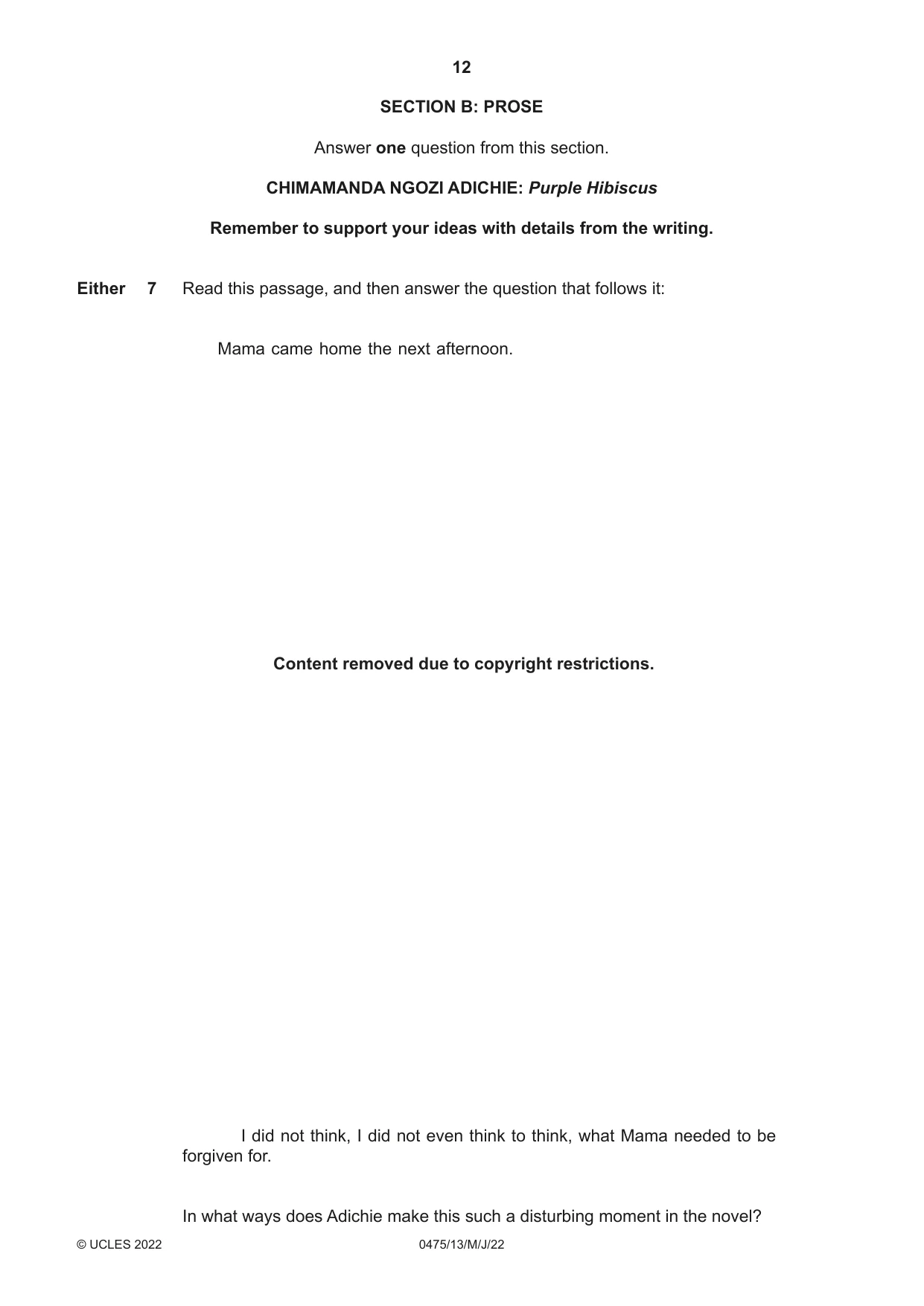
12 0475/13/M/J/22 © UCLES 2022 SECTION B: PROSE Answer one question from this section. CHIMAMANDA NGOZI ADICHIE: Purple Hibiscus Remember to support your ideas with details from the writing. Either 7 Read this passage, and then answer the question that follows it: Mama came home the next afternoon. I did not think, I did not even think to think, what Mama needed to be forgiven for. In what ways does Adichie make this such a disturbing moment in the novel? Content removed due to copyright restrictions.
Question paper, page 13
13 0475/13/M/J/22 © UCLES 2022 [Turn over Or 8 Explore the ways in which Adichie memorably portrays the relationship between Jaja and his father.
Question paper, page 14
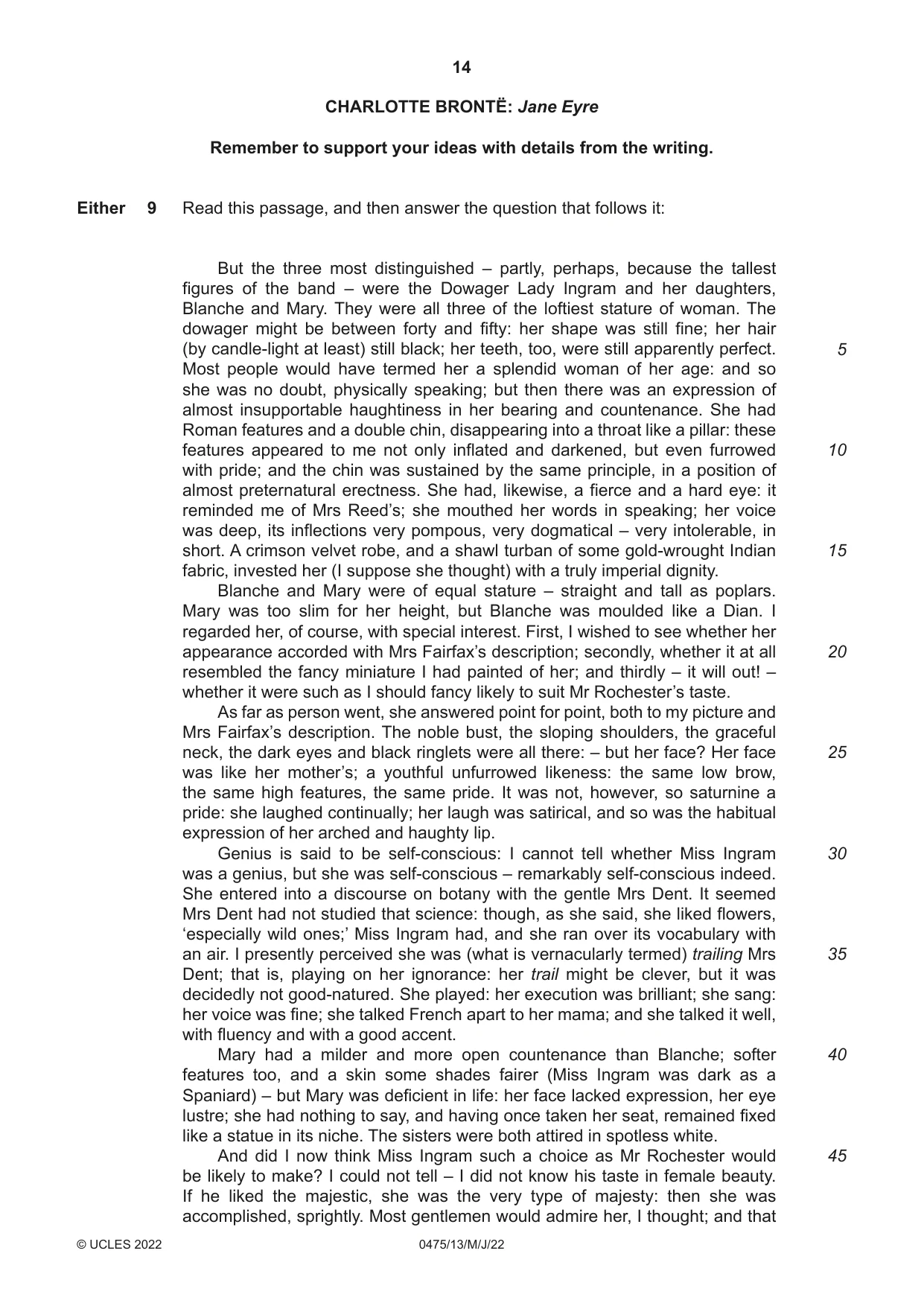
14 0475/13/M/J/22 © UCLES 2022 CHARLOTTE BRONTË: Jane Eyre Remember to support your ideas with details from the writing. Either 9 Read this passage, and then answer the question that follows it: But the three most distinguished – partly, perhaps, because the tallest figures of the band – were the Dowager Lady Ingram and her daughters, Blanche and Mary. They were all three of the loftiest stature of woman. The dowager might be between forty and fifty: her shape was still fine; her hair (by candle-light at least) still black; her teeth, too, were still apparently perfect. Most people would have termed her a splendid woman of her age: and so she was no doubt, physically speaking; but then there was an expression of almost insupportable haughtiness in her bearing and countenance. She had Roman features and a double chin, disappearing into a throat like a pillar: these features appeared to me not only inflated and darkened, but even furrowed with pride; and the chin was sustained by the same principle, in a position of almost preternatural erectness. She had, likewise, a fierce and a hard eye: it reminded me of Mrs Reed’s; she mouthed her words in speaking; her voice was deep, its inflections very pompous, very dogmatical – very intolerable, in short. A crimson velvet robe, and a shawl turban of some gold-wrought Indian fabric, invested her (I suppose she thought) with a truly imperial dignity. Blanche and Mary were of equal stature – straight and tall as poplars. Mary was too slim for her height, but Blanche was moulded like a Dian. I regarded her, of course, with special interest. First, I wished to see whether her appearance accorded with Mrs Fairfax’s description; secondly, whether it at all resembled the fancy miniature I had painted of her; and thirdly – it will out! – whether it were such as I should fancy likely to suit Mr Rochester’s taste. As far as person went, she answered point for point, both to my picture and Mrs Fairfax’s description. The noble bust, the sloping shoulders, the graceful neck, the dark eyes and black ringlets were all there: – but her face? Her face was like her mother’s; a youthful unfurrowed likeness: the same low brow, the same high features, the same pride. It was not, however, so saturnine a pride: she laughed continually; her laugh was satirical, and so was the habitual expression of her arched and haughty lip. Genius is said to be self-conscious: I cannot tell whether Miss Ingram was a genius, but she was self-conscious – remarkably self-conscious indeed. She entered into a discourse on botany with the gentle Mrs Dent. It seemed Mrs Dent had not studied that science: though, as she said, she liked flowers, ‘especially wild ones;’ Miss Ingram had, and she ran over its vocabulary with an air. I presently perceived she was (what is vernacularly termed) trailing Mrs Dent; that is, playing on her ignorance: her trail might be clever, but it was decidedly not good-natured. She played: her execution was brilliant; she sang: her voice was fine; she talked French apart to her mama; and she talked it well, with fluency and with a good accent. Mary had a milder and more open countenance than Blanche; softer features too, and a skin some shades fairer (Miss Ingram was dark as a Spaniard) – but Mary was deficient in life: her face lacked expression, her eye lustre; she had nothing to say, and having once taken her seat, remained fixed like a statue in its niche. The sisters were both attired in spotless white. And did I now think Miss Ingram such a choice as Mr Rochester would be likely to make? I could not tell – I did not know his taste in female beauty. If he liked the majestic, she was the very type of majesty: then she was accomplished, sprightly. Most gentlemen would admire her, I thought; and that 5 10 15 20 25 30 35 40 45
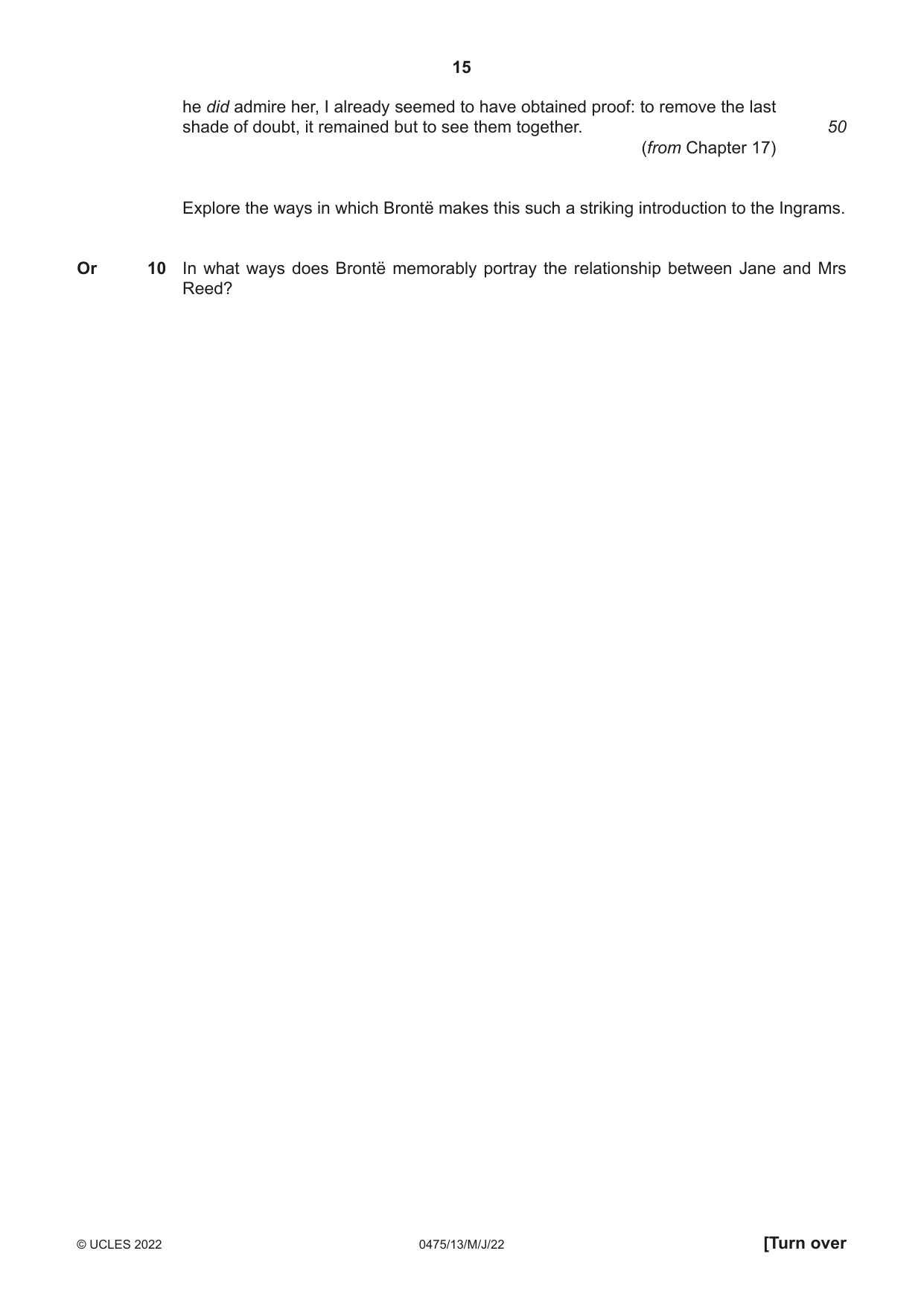
Question paper, page 15
15 0475/13/M/J/22 © UCLES 2022 [Turn over he did admire her, I already seemed to have obtained proof: to remove the last shade of doubt, it remained but to see them together. (from Chapter 17) Explore the ways in which Brontë makes this such a striking introduction to the Ingrams. Or 10 In what ways does Brontë memorably portray the relationship between Jane and Mrs Reed? 50
Question paper, page 16
16 0475/13/M/J/22 © UCLES 2022 ZORA NEALE HURSTON: Their Eyes Were Watching God Remember to support your ideas with details from the writing. Either 11 Read this passage, and then answer the question that follows it: ‘Mah name is Janie Mae Killicks since Ah got married. Content removed due to copyright restrictions.
Question paper, page 17
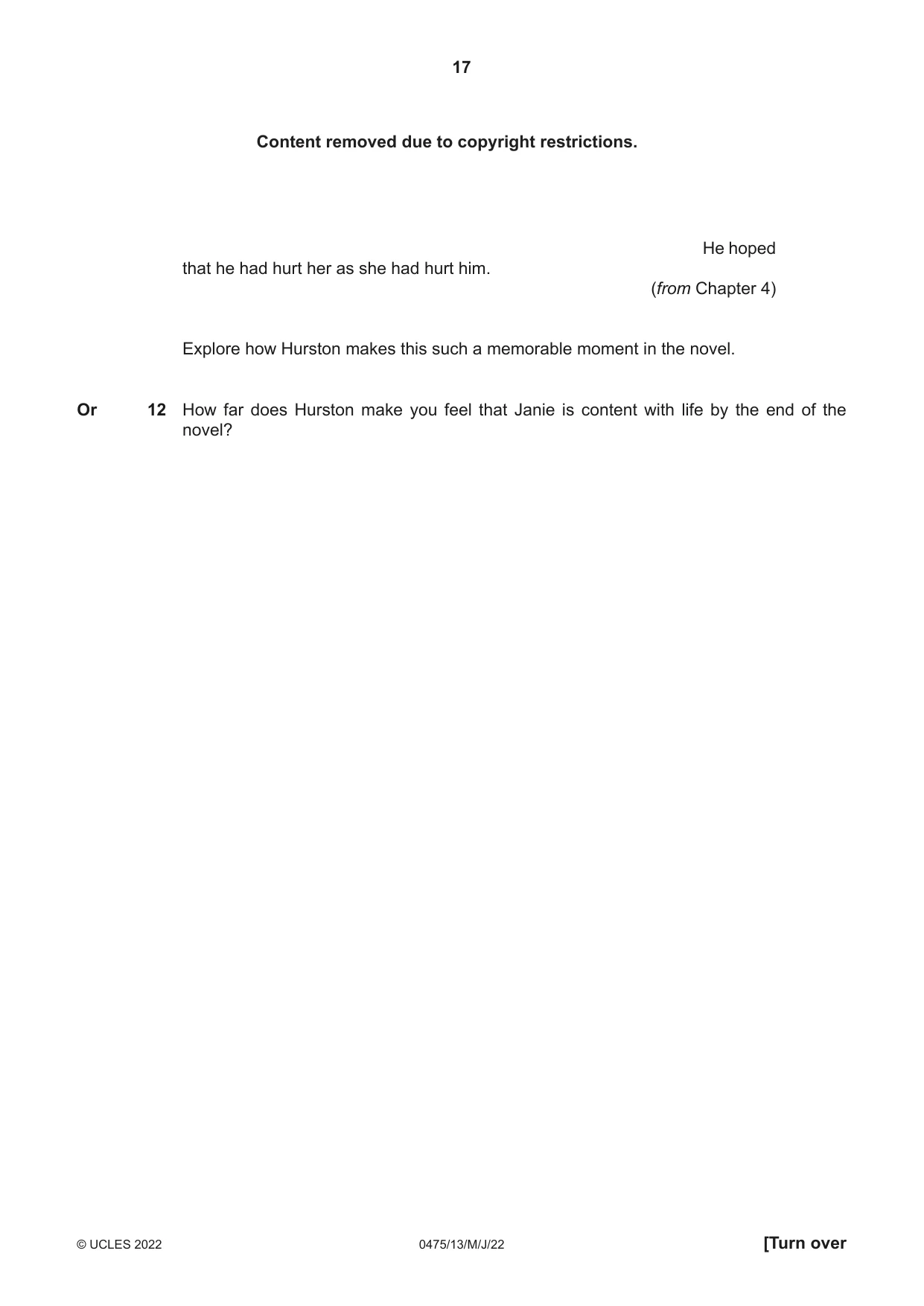
17 0475/13/M/J/22 © UCLES 2022 [Turn over He hoped that he had hurt her as she had hurt him. (from Chapter 4) Explore how Hurston makes this such a memorable moment in the novel. Or 12 How far does Hurston make you feel that Janie is content with life by the end of the novel? Content removed due to copyright restrictions.
Question paper, page 18
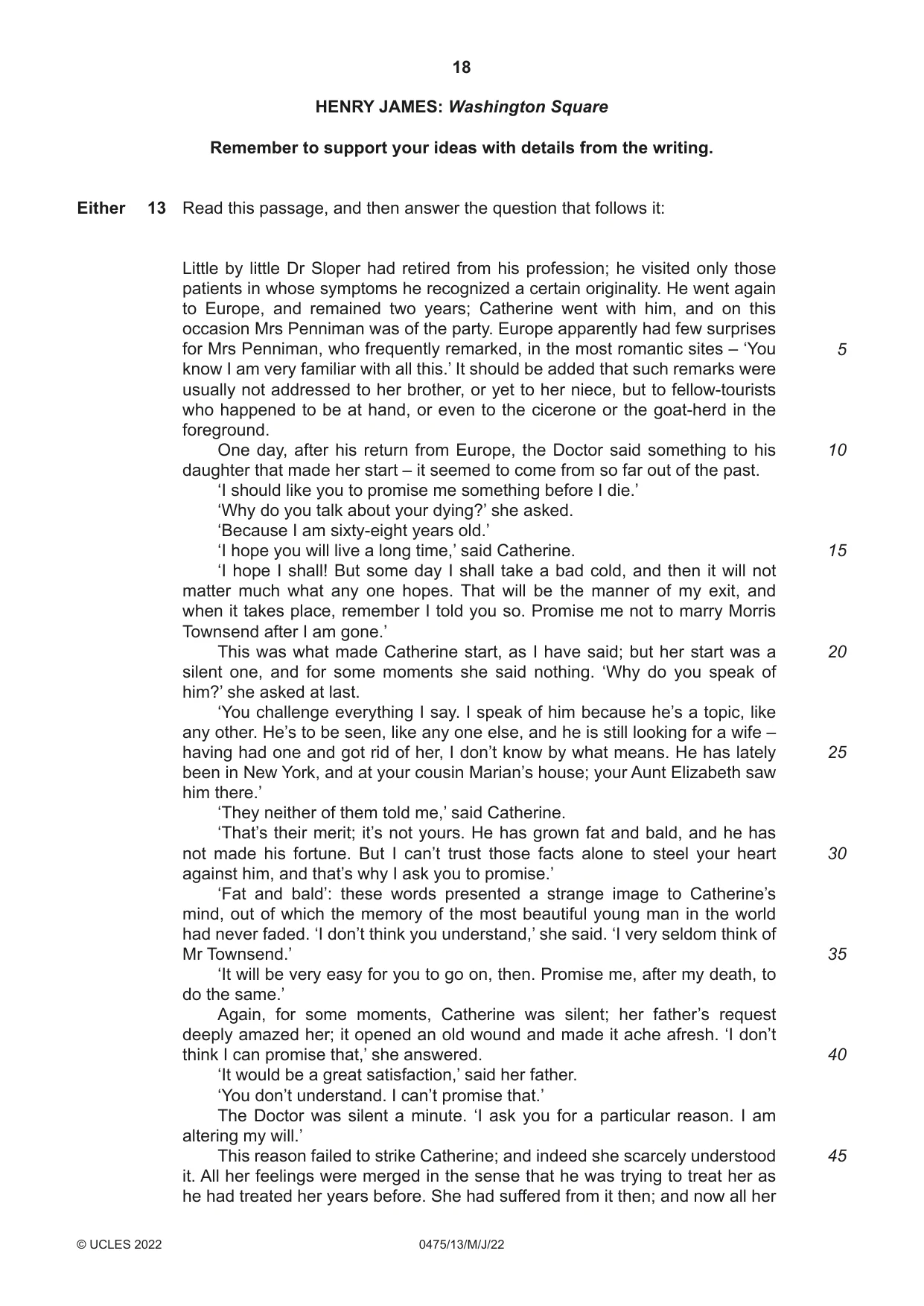
18 0475/13/M/J/22 © UCLES 2022 HENRY JAMES: Washington Square Remember to support your ideas with details from the writing. Either 13 Read this passage, and then answer the question that follows it: Little by little Dr Sloper had retired from his profession; he visited only those patients in whose symptoms he recognized a certain originality. He went again to Europe, and remained two years; Catherine went with him, and on this occasion Mrs Penniman was of the party. Europe apparently had few surprises for Mrs Penniman, who frequently remarked, in the most romantic sites – ‘You know I am very familiar with all this.’ It should be added that such remarks were usually not addressed to her brother, or yet to her niece, but to fellow-tourists who happened to be at hand, or even to the cicerone or the goat-herd in the foreground. One day, after his return from Europe, the Doctor said something to his daughter that made her start – it seemed to come from so far out of the past. ‘I should like you to promise me something before I die.’ ‘Why do you talk about your dying?’ she asked. ‘Because I am sixty-eight years old.’ ‘I hope you will live a long time,’ said Catherine. ‘I hope I shall! But some day I shall take a bad cold, and then it will not matter much what any one hopes. That will be the manner of my exit, and when it takes place, remember I told you so. Promise me not to marry Morris Townsend after I am gone.’ This was what made Catherine start, as I have said; but her start was a silent one, and for some moments she said nothing. ‘Why do you speak of him?’ she asked at last. ‘You challenge everything I say. I speak of him because he’s a topic, like any other. He’s to be seen, like any one else, and he is still looking for a wife – having had one and got rid of her, I don’t know by what means. He has lately been in New York, and at your cousin Marian’s house; your Aunt Elizabeth saw him there.’ ‘They neither of them told me,’ said Catherine. ‘That’s their merit; it’s not yours. He has grown fat and bald, and he has not made his fortune. But I can’t trust those facts alone to steel your heart against him, and that’s why I ask you to promise.’ ‘Fat and bald’: these words presented a strange image to Catherine’s mind, out of which the memory of the most beautiful young man in the world had never faded. ‘I don’t think you understand,’ she said. ‘I very seldom think of Mr Townsend.’ ‘It will be very easy for you to go on, then. Promise me, after my death, to do the same.’ Again, for some moments, Catherine was silent; her father’s request deeply amazed her; it opened an old wound and made it ache afresh. ‘I don’t think I can promise that,’ she answered. ‘It would be a great satisfaction,’ said her father. ‘You don’t understand. I can’t promise that.’ The Doctor was silent a minute. ‘I ask you for a particular reason. I am altering my will.’ This reason failed to strike Catherine; and indeed she scarcely understood it. All her feelings were merged in the sense that he was trying to treat her as he had treated her years before. She had suffered from it then; and now all her 5 10 15 20 25 30 35 40 45
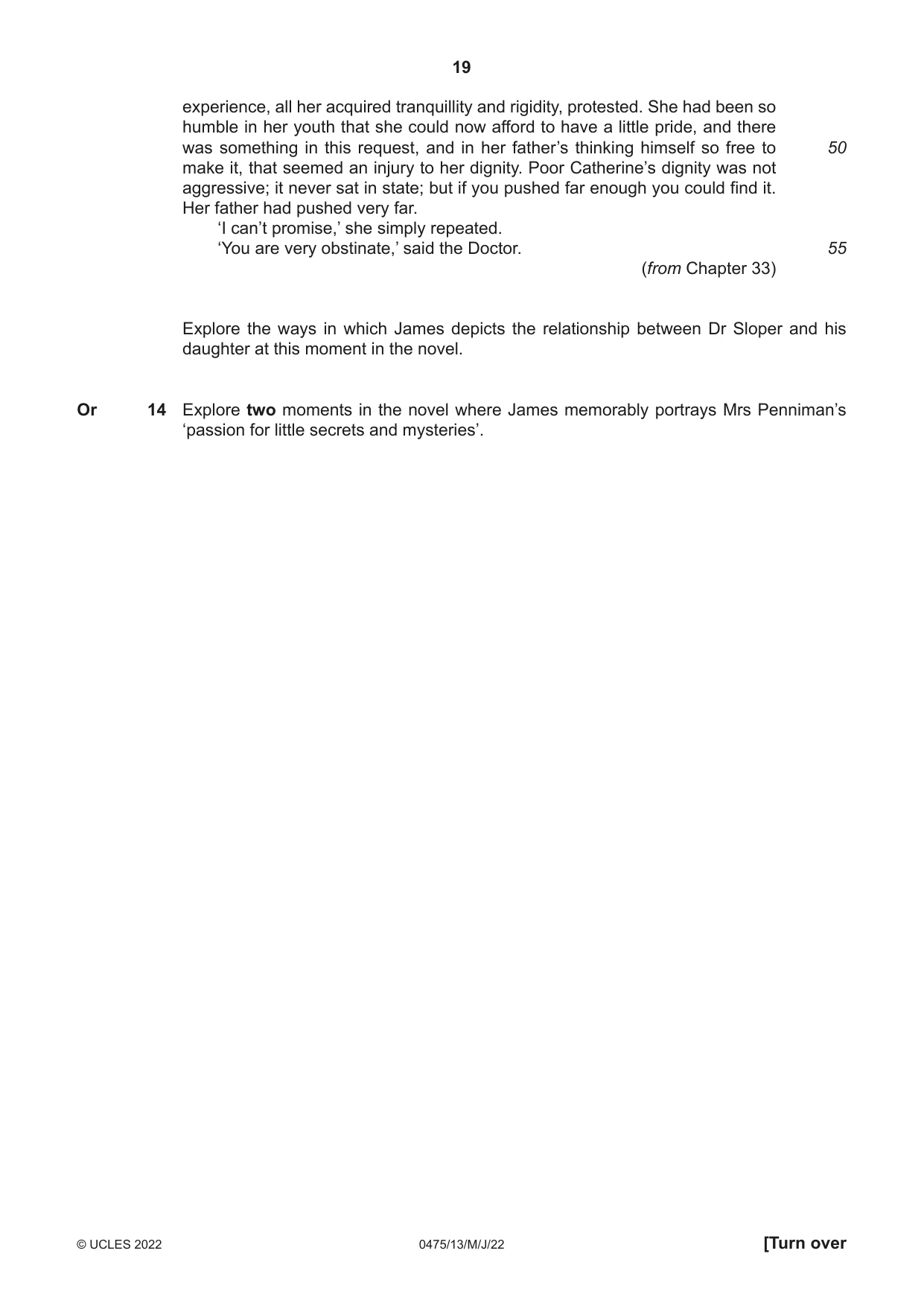
Question paper, page 19
19 0475/13/M/J/22 © UCLES 2022 [Turn over experience, all her acquired tranquillity and rigidity, protested. She had been so humble in her youth that she could now afford to have a little pride, and there was something in this request, and in her father’s thinking himself so free to make it, that seemed an injury to her dignity. Poor Catherine’s dignity was not aggressive; it never sat in state; but if you pushed far enough you could find it. Her father had pushed very far. ‘I can’t promise,’ she simply repeated. ‘You are very obstinate,’ said the Doctor. (from Chapter 33) Explore the ways in which James depicts the relationship between Dr Sloper and his daughter at this moment in the novel. Or 14 Explore two moments in the novel where James memorably portrays Mrs Penniman’s ‘passion for little secrets and mysteries’. 50 55
Question paper, page 20
20 0475/13/M/J/22 © UCLES 2022 JHUMPA LAHIRI: The Namesake Remember to support your ideas with details from the writing. Either 15 Read this passage, and then answer the question that follows it: A week later they meet for lunch. Content removed due to copyright restrictions.
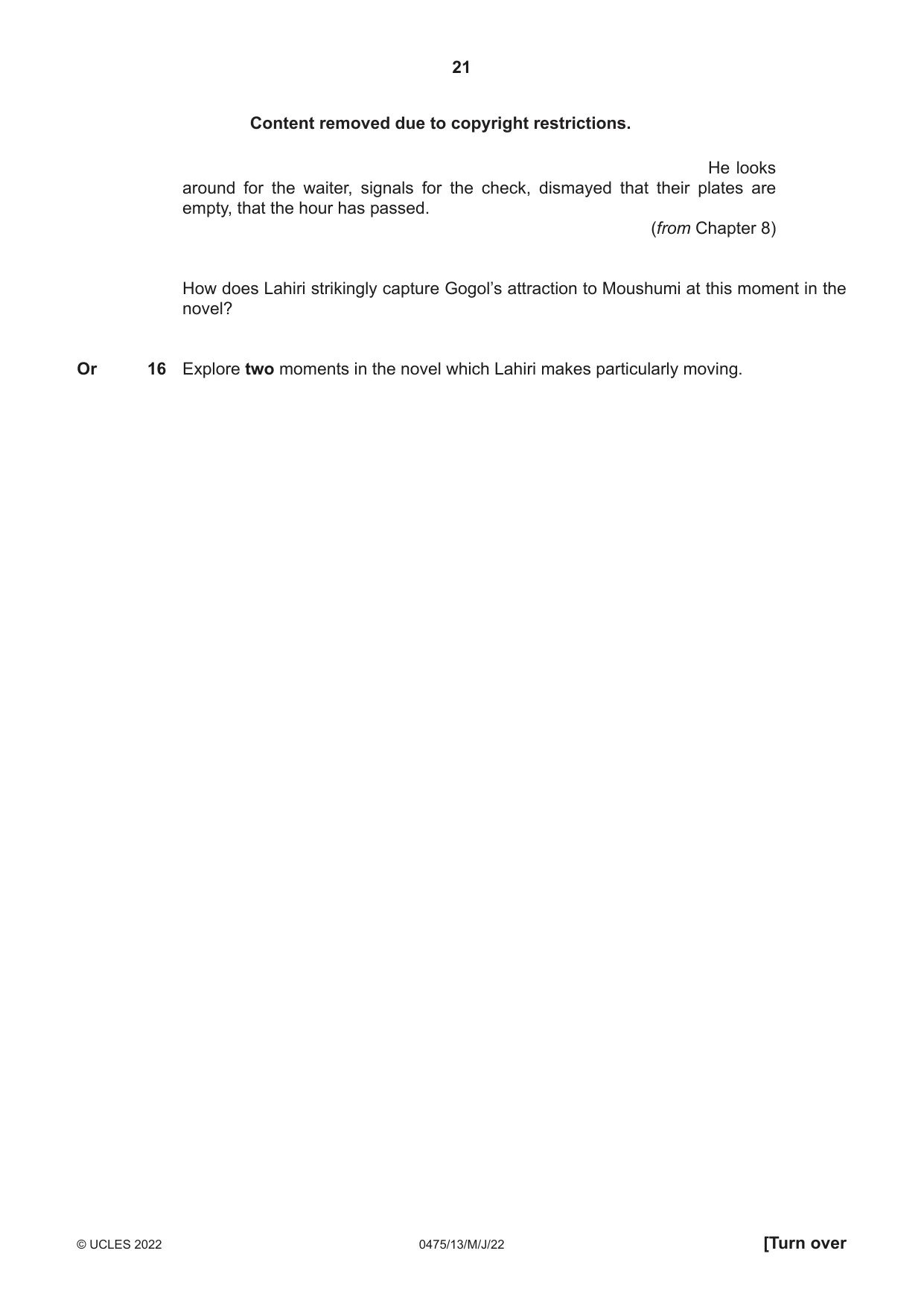
Question paper, page 21
21 0475/13/M/J/22 © UCLES 2022 [Turn over He looks around for the waiter, signals for the check, dismayed that their plates are empty, that the hour has passed. (from Chapter 8) How does Lahiri strikingly capture Gogol’s attraction to Moushumi at this moment in the novel? Or 16 Explore two moments in the novel which Lahiri makes particularly moving. Content removed due to copyright restrictions.
Question paper, page 22
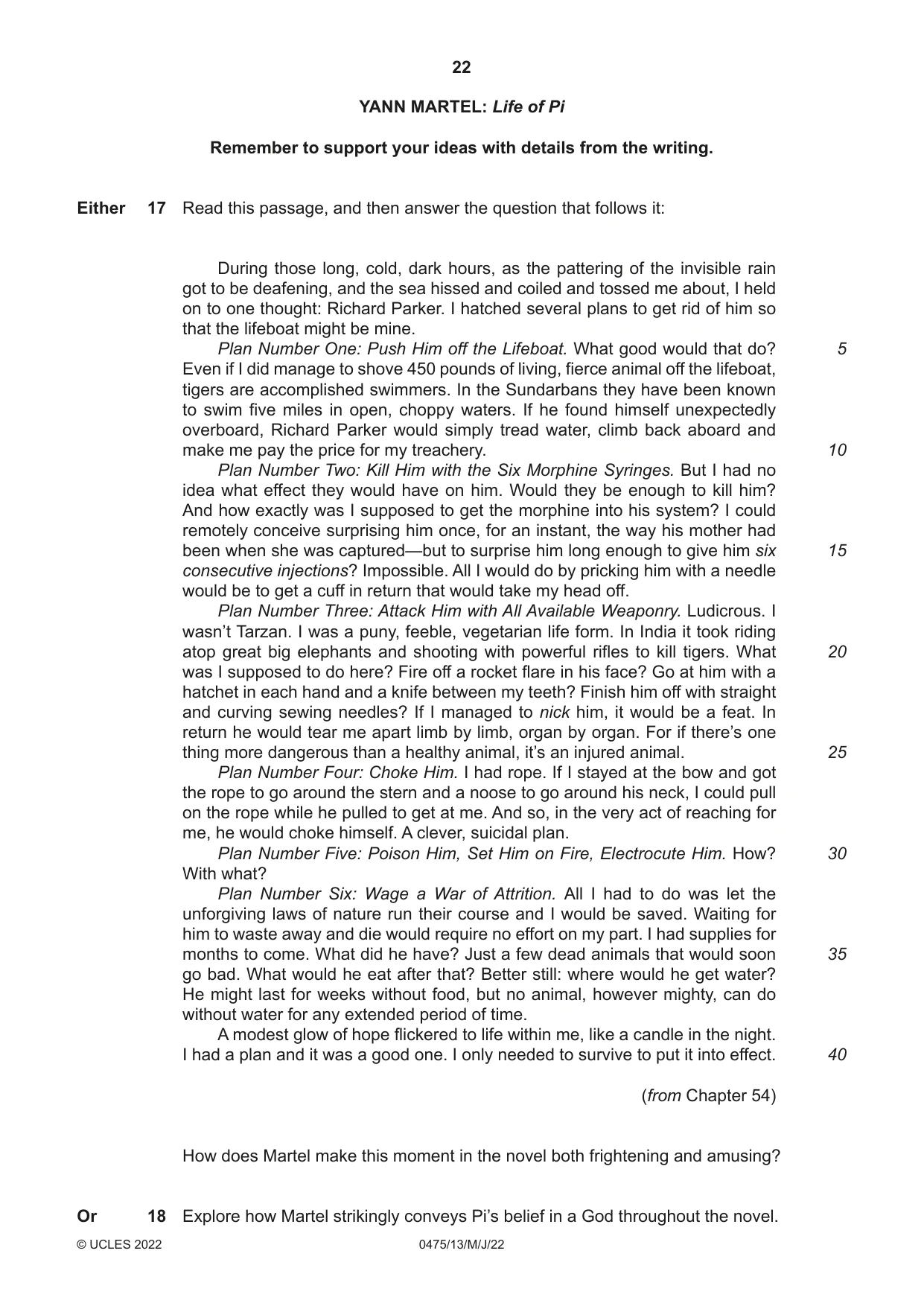
22 0475/13/M/J/22 © UCLES 2022 YANN MARTEL: Life of Pi Remember to support your ideas with details from the writing. Either 17 Read this passage, and then answer the question that follows it: During those long, cold, dark hours, as the pattering of the invisible rain got to be deafening, and the sea hissed and coiled and tossed me about, I held on to one thought: Richard Parker. I hatched several plans to get rid of him so that the lifeboat might be mine. Plan Number One: Push Him off the Lifeboat. What good would that do? Even if I did manage to shove 450 pounds of living, fierce animal off the lifeboat, tigers are accomplished swimmers. In the Sundarbans they have been known to swim five miles in open, choppy waters. If he found himself unexpectedly overboard, Richard Parker would simply tread water, climb back aboard and make me pay the price for my treachery. Plan Number Two: Kill Him with the Six Morphine Syringes. But I had no idea what effect they would have on him. Would they be enough to kill him? And how exactly was I supposed to get the morphine into his system? I could remotely conceive surprising him once, for an instant, the way his mother had been when she was captured—but to surprise him long enough to give him six consecutive injections? Impossible. All I would do by pricking him with a needle would be to get a cuff in return that would take my head off. Plan Number Three: Attack Him with All Available Weaponry. Ludicrous. I wasn’t Tarzan. I was a puny, feeble, vegetarian life form. In India it took riding atop great big elephants and shooting with powerful rifles to kill tigers. What was I supposed to do here? Fire off a rocket flare in his face? Go at him with a hatchet in each hand and a knife between my teeth? Finish him off with straight and curving sewing needles? If I managed to nick him, it would be a feat. In return he would tear me apart limb by limb, organ by organ. For if there’s one thing more dangerous than a healthy animal, it’s an injured animal. Plan Number Four: Choke Him. I had rope. If I stayed at the bow and got the rope to go around the stern and a noose to go around his neck, I could pull on the rope while he pulled to get at me. And so, in the very act of reaching for me, he would choke himself. A clever, suicidal plan. Plan Number Five: Poison Him, Set Him on Fire, Electrocute Him. How? With what? Plan Number Six: Wage a War of Attrition. All I had to do was let the unforgiving laws of nature run their course and I would be saved. Waiting for him to waste away and die would require no effort on my part. I had supplies for months to come. What did he have? Just a few dead animals that would soon go bad. What would he eat after that? Better still: where would he get water? He might last for weeks without food, but no animal, however mighty, can do without water for any extended period of time. A modest glow of hope flickered to life within me, like a candle in the night. I had a plan and it was a good one. I only needed to survive to put it into effect. (from Chapter 54) How does Martel make this moment in the novel both frightening and amusing? Or 18 Explore how Martel strikingly conveys Pi’s belief in a God throughout the novel. 5 10 15 20 25 30 35 40
Question paper, page 23
23 0475/13/M/J/22 © UCLES 2022 [Turn over Turn over for Question 19.
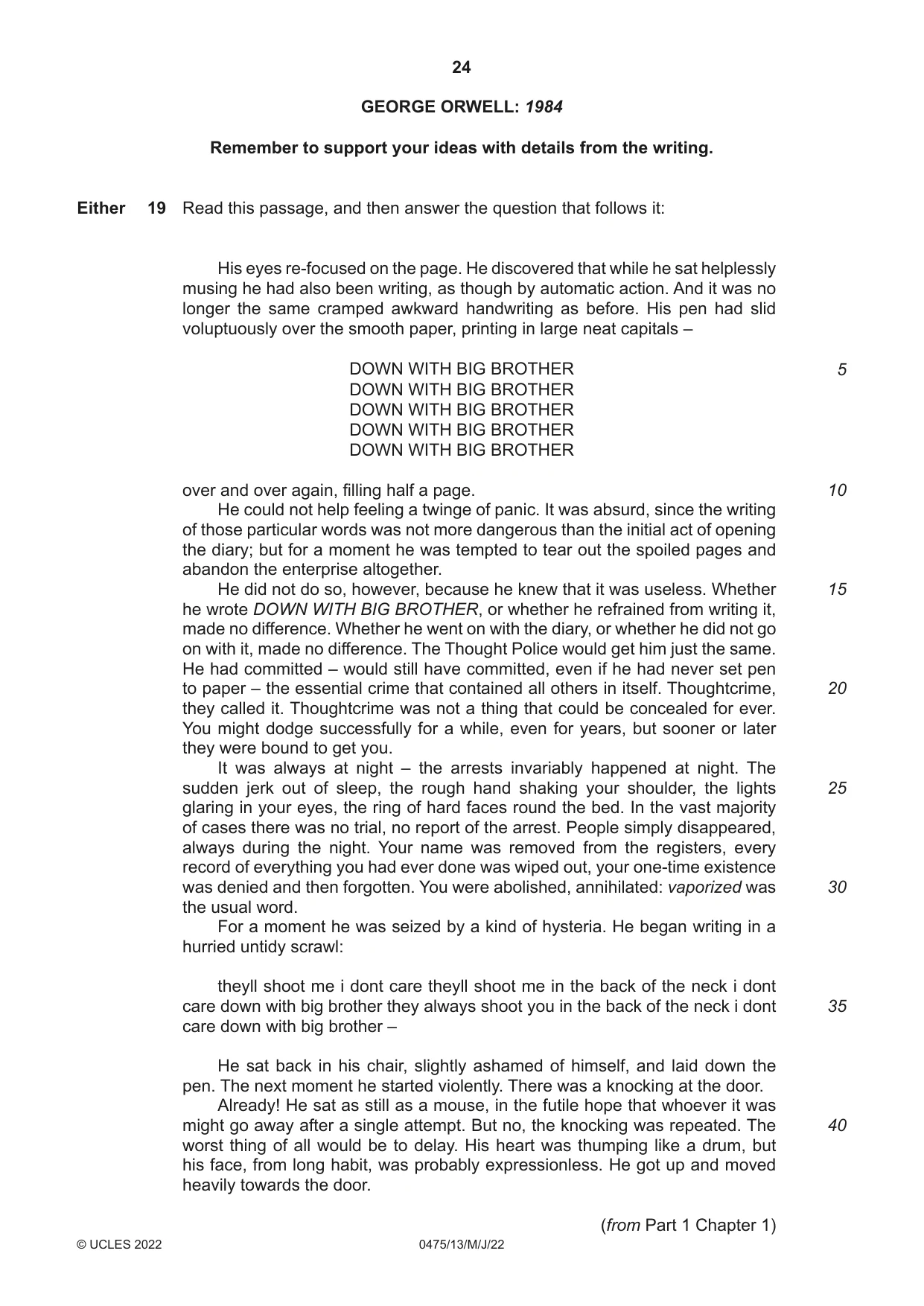
Question paper, page 24
24 0475/13/M/J/22 © UCLES 2022 GEORGE ORWELL: 1984 Remember to support your ideas with details from the writing. Either 19 Read this passage, and then answer the question that follows it: His eyes re-focused on the page. He discovered that while he sat helplessly musing he had also been writing, as though by automatic action. And it was no longer the same cramped awkward handwriting as before. His pen had slid voluptuously over the smooth paper, printing in large neat capitals – DOWN WITH BIG BROTHER DOWN WITH BIG BROTHER DOWN WITH BIG BROTHER DOWN WITH BIG BROTHER DOWN WITH BIG BROTHER over and over again, filling half a page. He could not help feeling a twinge of panic. It was absurd, since the writing of those particular words was not more dangerous than the initial act of opening the diary; but for a moment he was tempted to tear out the spoiled pages and abandon the enterprise altogether. He did not do so, however, because he knew that it was useless. Whether he wrote DOWN WITH BIG BROTHER, or whether he refrained from writing it, made no difference. Whether he went on with the diary, or whether he did not go on with it, made no difference. The Thought Police would get him just the same. He had committed – would still have committed, even if he had never set pen to paper – the essential crime that contained all others in itself. Thoughtcrime, they called it. Thoughtcrime was not a thing that could be concealed for ever. You might dodge successfully for a while, even for years, but sooner or later they were bound to get you. It was always at night – the arrests invariably happened at night. The sudden jerk out of sleep, the rough hand shaking your shoulder, the lights glaring in your eyes, the ring of hard faces round the bed. In the vast majority of cases there was no trial, no report of the arrest. People simply disappeared, always during the night. Your name was removed from the registers, every record of everything you had ever done was wiped out, your one-time existence was denied and then forgotten. You were abolished, annihilated: vaporized was the usual word. For a moment he was seized by a kind of hysteria. He began writing in a hurried untidy scrawl: theyll shoot me i dont care theyll shoot me in the back of the neck i dont care down with big brother they always shoot you in the back of the neck i dont care down with big brother – He sat back in his chair, slightly ashamed of himself, and laid down the pen. The next moment he started violently. There was a knocking at the door. Already! He sat as still as a mouse, in the futile hope that whoever it was might go away after a single attempt. But no, the knocking was repeated. The worst thing of all would be to delay. His heart was thumping like a drum, but his face, from long habit, was probably expressionless. He got up and moved heavily towards the door. (from Part 1 Chapter 1) 5 10 15 20 25 30 35 40
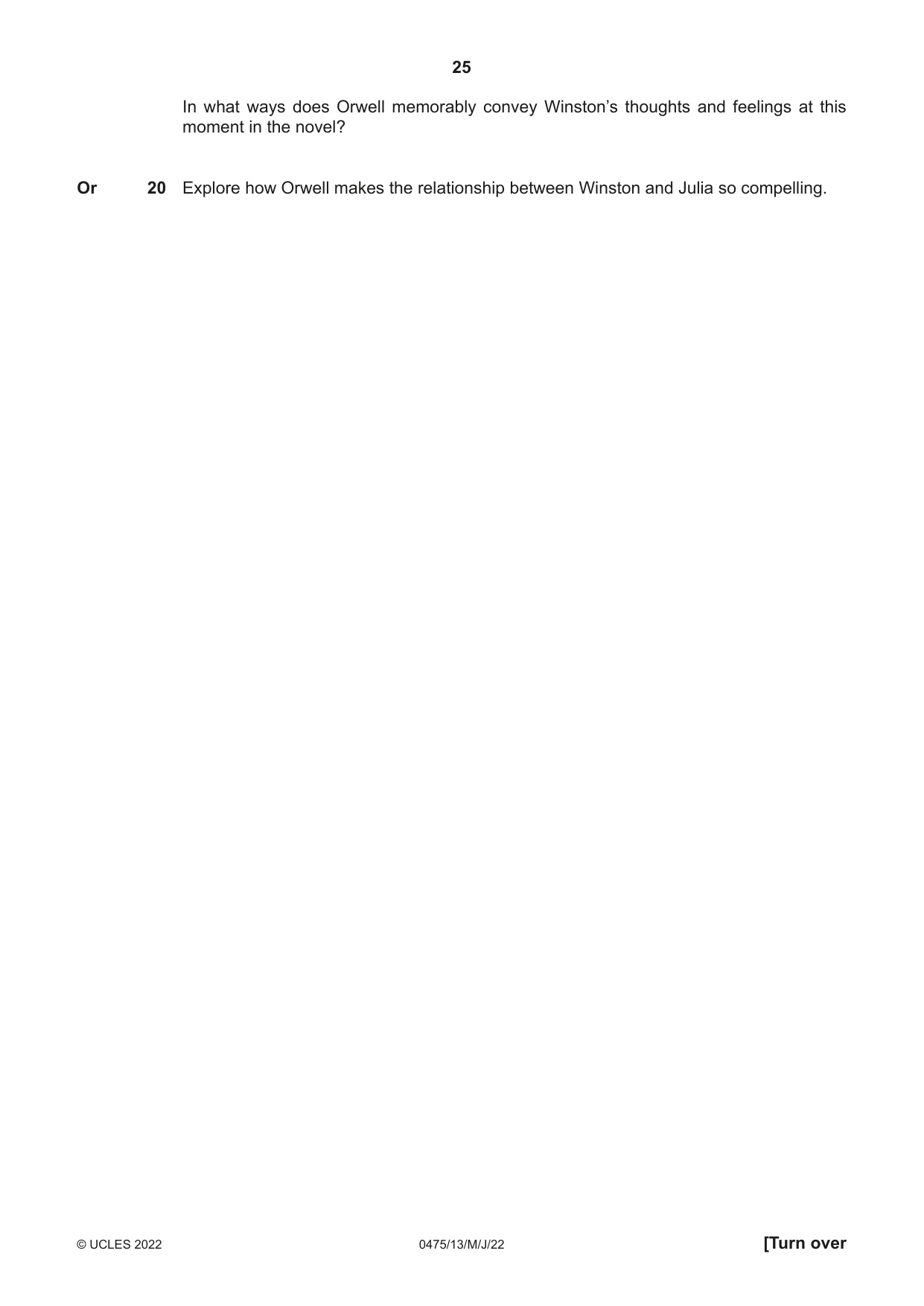
Question paper, page 25
25 0475/13/M/J/22 © UCLES 2022 [Turn over In what ways does Orwell memorably convey Winston’s thoughts and feelings at this moment in the novel? Or 20 Explore how Orwell makes the relationship between Winston and Julia so compelling.
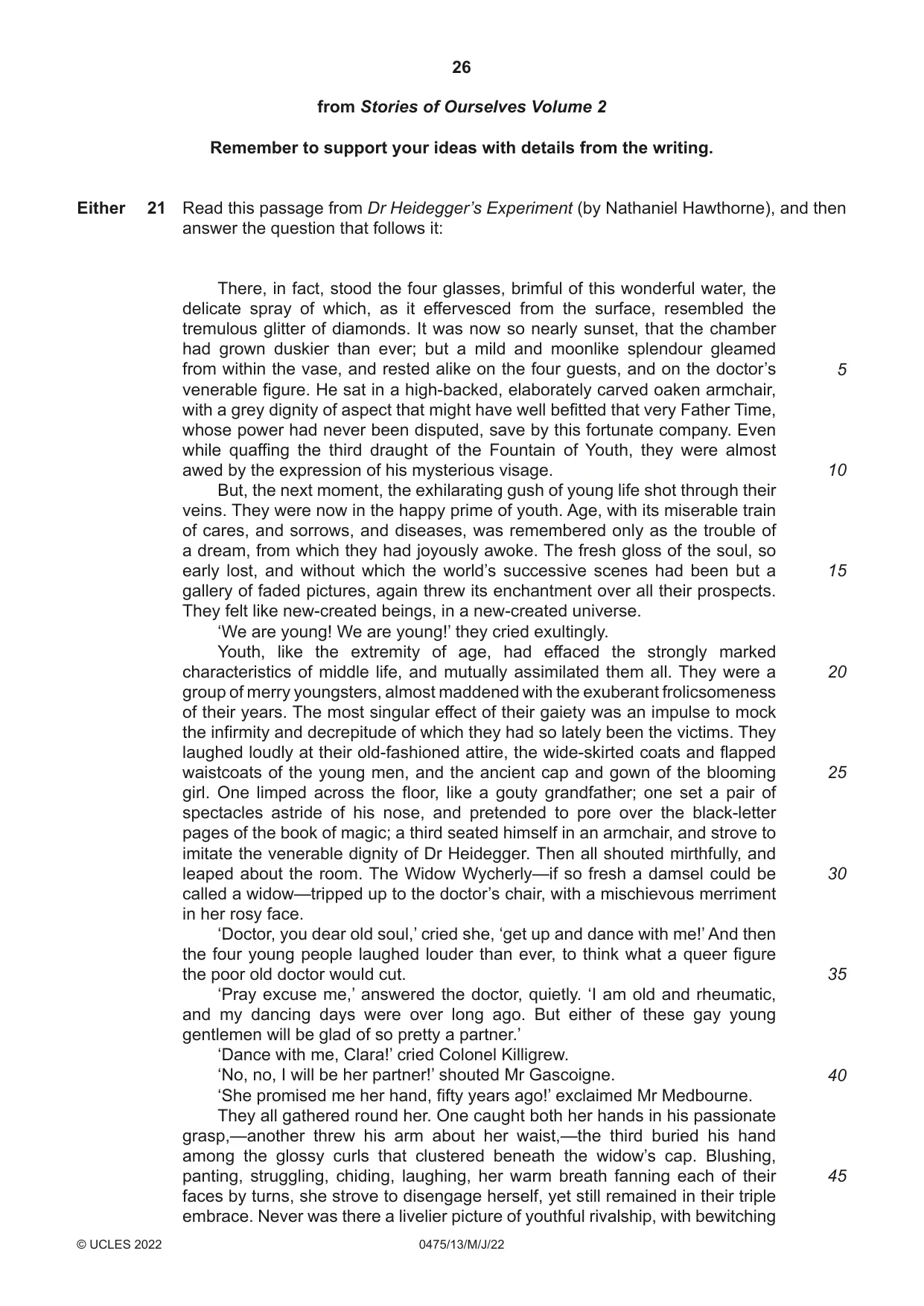
Question paper, page 26
26 0475/13/M/J/22 © UCLES 2022 from Stories of Ourselves Volume 2 Remember to support your ideas with details from the writing. Either 21 Read this passage from Dr Heidegger’s Experiment (by Nathaniel Hawthorne), and then answer the question that follows it: There, in fact, stood the four glasses, brimful of this wonderful water, the delicate spray of which, as it effervesced from the surface, resembled the tremulous glitter of diamonds. It was now so nearly sunset, that the chamber had grown duskier than ever; but a mild and moonlike splendour gleamed from within the vase, and rested alike on the four guests, and on the doctor’s venerable figure. He sat in a high-backed, elaborately carved oaken armchair, with a grey dignity of aspect that might have well befitted that very Father Time, whose power had never been disputed, save by this fortunate company. Even while quaffing the third draught of the Fountain of Youth, they were almost awed by the expression of his mysterious visage. But, the next moment, the exhilarating gush of young life shot through their veins. They were now in the happy prime of youth. Age, with its miserable train of cares, and sorrows, and diseases, was remembered only as the trouble of a dream, from which they had joyously awoke. The fresh gloss of the soul, so early lost, and without which the world’s successive scenes had been but a gallery of faded pictures, again threw its enchantment over all their prospects. They felt like new-created beings, in a new-created universe. ‘We are young! We are young!’ they cried exultingly. Youth, like the extremity of age, had effaced the strongly marked characteristics of middle life, and mutually assimilated them all. They were a group of merry youngsters, almost maddened with the exuberant frolicsomeness of their years. The most singular effect of their gaiety was an impulse to mock the infirmity and decrepitude of which they had so lately been the victims. They laughed loudly at their old-fashioned attire, the wide-skirted coats and flapped waistcoats of the young men, and the ancient cap and gown of the blooming girl. One limped across the floor, like a gouty grandfather; one set a pair of spectacles astride of his nose, and pretended to pore over the black-letter pages of the book of magic; a third seated himself in an armchair, and strove to imitate the venerable dignity of Dr Heidegger. Then all shouted mirthfully, and leaped about the room. The Widow Wycherly—if so fresh a damsel could be called a widow—tripped up to the doctor’s chair, with a mischievous merriment in her rosy face. ‘Doctor, you dear old soul,’ cried she, ‘get up and dance with me!’ And then the four young people laughed louder than ever, to think what a queer figure the poor old doctor would cut. ‘Pray excuse me,’ answered the doctor, quietly. ‘I am old and rheumatic, and my dancing days were over long ago. But either of these gay young gentlemen will be glad of so pretty a partner.’ ‘Dance with me, Clara!’ cried Colonel Killigrew. ‘No, no, I will be her partner!’ shouted Mr Gascoigne. ‘She promised me her hand, fifty years ago!’ exclaimed Mr Medbourne. They all gathered round her. One caught both her hands in his passionate grasp,—another threw his arm about her waist,—the third buried his hand among the glossy curls that clustered beneath the widow’s cap. Blushing, panting, struggling, chiding, laughing, her warm breath fanning each of their faces by turns, she strove to disengage herself, yet still remained in their triple embrace. Never was there a livelier picture of youthful rivalship, with bewitching 5 10 15 20 25 30 35 40 45
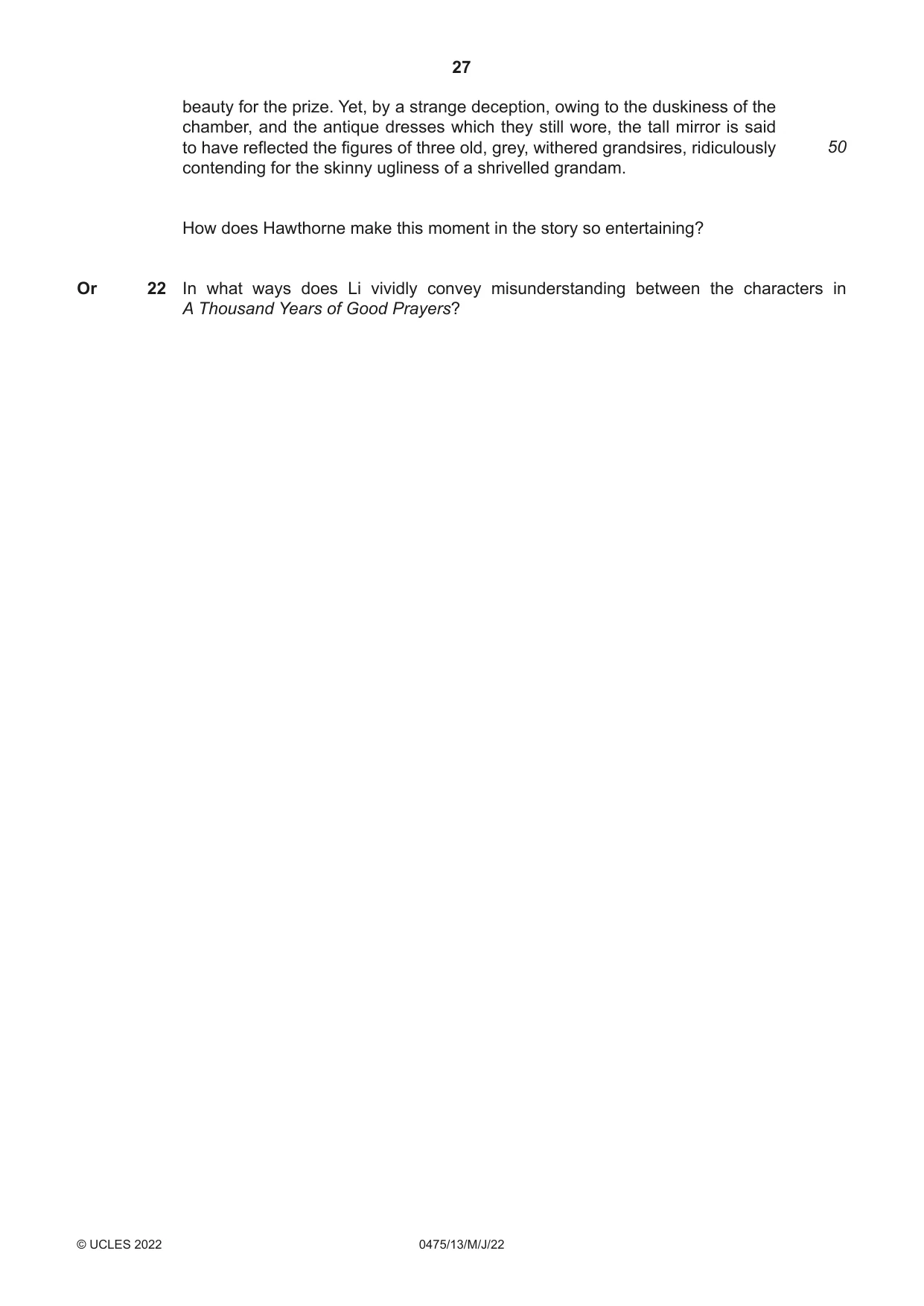
Question paper, page 27
27 0475/13/M/J/22 © UCLES 2022 beauty for the prize. Yet, by a strange deception, owing to the duskiness of the chamber, and the antique dresses which they still wore, the tall mirror is said to have reflected the figures of three old, grey, withered grandsires, ridiculously contending for the skinny ugliness of a shrivelled grandam. How does Hawthorne make this moment in the story so entertaining? Or 22 In what ways does Li vividly convey misunderstanding between the characters in A Thousand Years of Good Prayers? 50
Question paper, page 28
28 0475/13/M/J/22 © UCLES 2022 Permission to reproduce items where third-party owned material protected by copyright is included has been sought and cleared where possible. Every reasonable effort has been made by the publisher (UCLES) to trace copyright holders, but if any items requiring clearance have unwittingly been included, the publisher will be pleased to make amends at the earliest possible opportunity. To avoid the issue of disclosure of answer-related information to candidates, all copyright acknowledgements are reproduced online in the Cambridge Assessment International Education Copyright Acknowledgements Booklet. This is produced for each series of examinations and is freely available to download at www.cambridgeinternational.org after the live examination series. Cambridge Assessment International Education is part of Cambridge Assessment. Cambridge Assessment is the brand name of the University of Cambridge Local Examinations Syndicate (UCLES), which is a department of the University of Cambridge. BLANK PAGE
Mark scheme, page 1
This document consists of 6 printed pages. © UCLES 2022 [Turn over Cambridge IGCSE™ LITERATURE IN ENGLISH 0475/13 Paper 1 Poetry and Prose 13 May/June 2022 MARK SCHEME Maximum Mark: 50 Published This mark scheme is published as an aid to teachers and candidates, to indicate the requirements of the examination. It shows the basis on which Examiners were instructed to award marks. It does not indicate the details of the discussions that took place at an Examiners’ meeting before marking began, which would have considered the acceptability of alternative answers. Mark schemes should be read in conjunction with the question paper and the Principal Examiner Report for Teachers. Cambridge International will not enter into discussions about these mark schemes. Cambridge International is publishing the mark schemes for the May/June 2022 series for most Cambridge IGCSE, Cambridge International A and AS Level and Cambridge Pre-U components, and some Cambridge O Level components.
Mark scheme, page 2
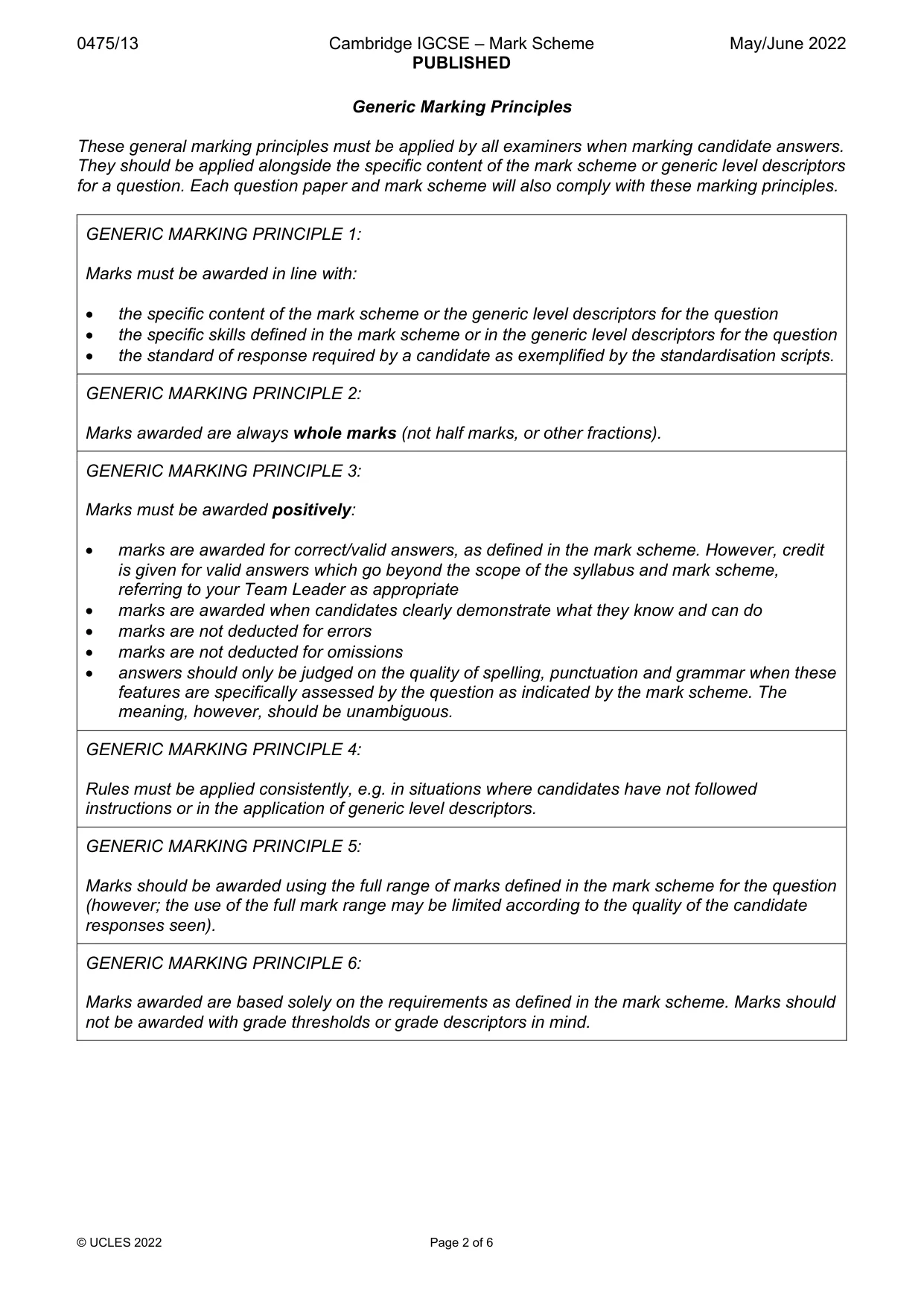
0475/13 Cambridge IGCSE – Mark Scheme PUBLISHED May/June 2022 © UCLES 2022 Page 2 of 6 Generic Marking Principles These general marking principles must be applied by all examiners when marking candidate answers. They should be applied alongside the specific content of the mark scheme or generic level descriptors for a question. Each question paper and mark scheme will also comply with these marking principles. GENERIC MARKING PRINCIPLE 1: Marks must be awarded in line with: the specific content of the mark scheme or the generic level descriptors for the question the specific skills defined in the mark scheme or in the generic level descriptors for the question the standard of response required by a candidate as exemplified by the standardisation scripts. GENERIC MARKING PRINCIPLE 2: Marks awarded are always whole marks (not half marks, or other fractions). GENERIC MARKING PRINCIPLE 3: Marks must be awarded positively: marks are awarded for correct/valid answers, as defined in the mark scheme. However, credit is given for valid answers which go beyond the scope of the syllabus and mark scheme, referring to your Team Leader as appropriate marks are awarded when candidates clearly demonstrate what they know and can do marks are not deducted for errors marks are not deducted for omissions answers should only be judged on the quality of spelling, punctuation and grammar when these features are specifically assessed by the question as indicated by the mark scheme. The meaning, however, should be unambiguous. GENERIC MARKING PRINCIPLE 4: Rules must be applied consistently, e.g. in situations where candidates have not followed instructions or in the application of generic level descriptors. GENERIC MARKING PRINCIPLE 5: Marks should be awarded using the full range of marks defined in the mark scheme for the question (however; the use of the full mark range may be limited according to the quality of the candidate responses seen). GENERIC MARKING PRINCIPLE 6: Marks awarded are based solely on the requirements as defined in the mark scheme. Marks should not be awarded with grade thresholds or grade descriptors in mind.
Mark scheme, page 3
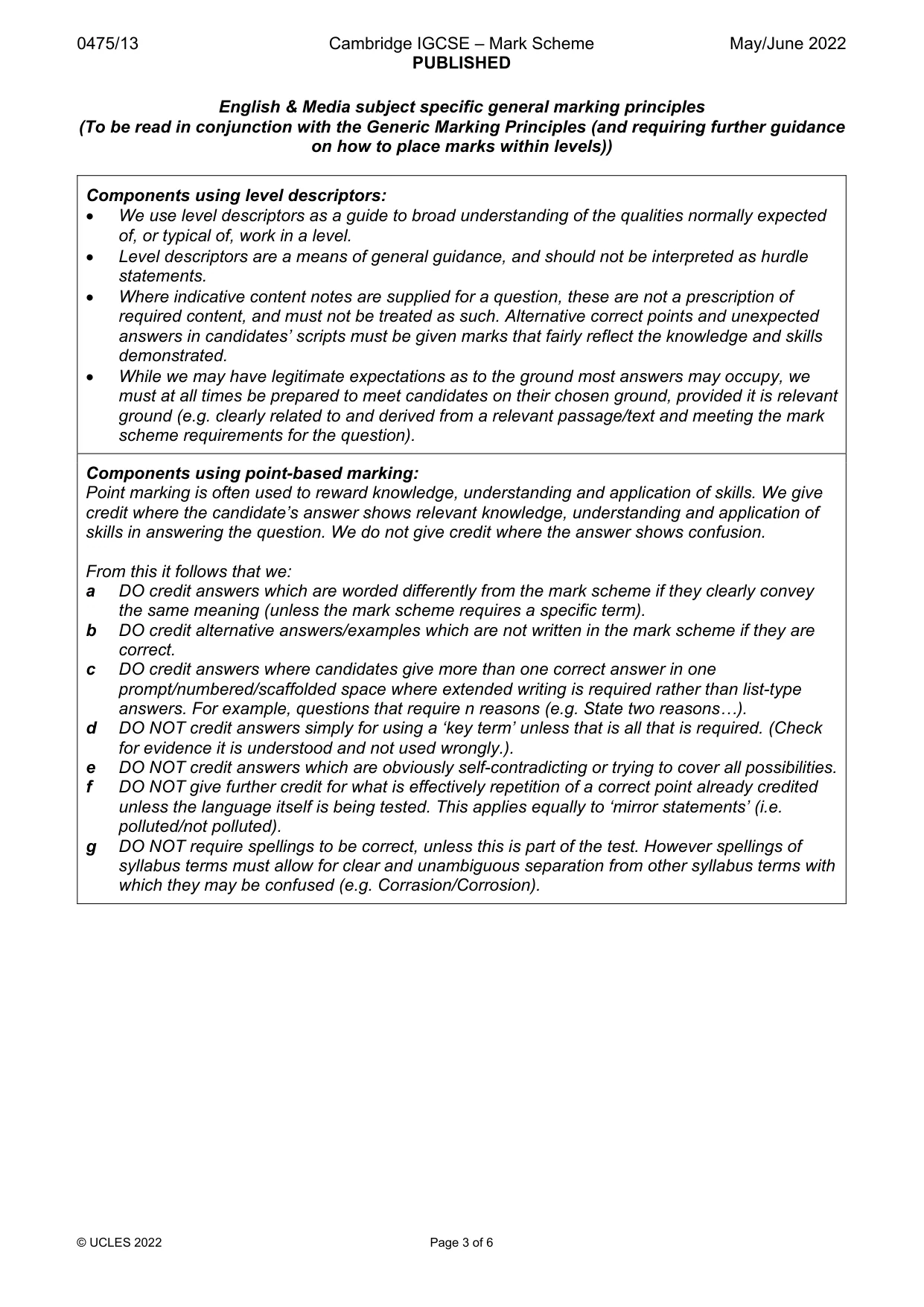
0475/13 Cambridge IGCSE – Mark Scheme PUBLISHED May/June 2022 © UCLES 2022 Page 3 of 6 English & Media subject specific general marking principles (To be read in conjunction with the Generic Marking Principles (and requiring further guidance on how to place marks within levels)) Components using level descriptors: We use level descriptors as a guide to broad understanding of the qualities normally expected of, or typical of, work in a level. Level descriptors are a means of general guidance, and should not be interpreted as hurdle statements. Where indicative content notes are supplied for a question, these are not a prescription of required content, and must not be treated as such. Alternative correct points and unexpected answers in candidates’ scripts must be given marks that fairly reflect the knowledge and skills demonstrated. While we may have legitimate expectations as to the ground most answers may occupy, we must at all times be prepared to meet candidates on their chosen ground, provided it is relevant ground (e.g. clearly related to and derived from a relevant passage/text and meeting the mark scheme requirements for the question). Components using point-based marking: Point marking is often used to reward knowledge, understanding and application of skills. We give credit where the candidate’s answer shows relevant knowledge, understanding and application of skills in answering the question. We do not give credit where the answer shows confusion. From this it follows that we: a DO credit answers which are worded differently from the mark scheme if they clearly convey the same meaning (unless the mark scheme requires a specific term). b DO credit alternative answers/examples which are not written in the mark scheme if they are correct. c DO credit answers where candidates give more than one correct answer in one prompt/numbered/scaffolded space where extended writing is required rather than list-type answers. For example, questions that require n reasons (e.g. State two reasons…). d DO NOT credit answers simply for using a ‘key term’ unless that is all that is required. (Check for evidence it is understood and not used wrongly.). e DO NOT credit answers which are obviously self-contradicting or trying to cover all possibilities. f DO NOT give further credit for what is effectively repetition of a correct point already credited unless the language itself is being tested. This applies equally to ‘mirror statements’ (i.e. polluted/not polluted). g DO NOT require spellings to be correct, unless this is part of the test. However spellings of syllabus terms must allow for clear and unambiguous separation from other syllabus terms with which they may be confused (e.g. Corrasion/Corrosion).
Mark scheme, page 4
0475/13 Cambridge IGCSE – Mark Scheme PUBLISHED May/June 2022 © UCLES 2022 Page 4 of 6 Using the mark bands All Assessment Objectives are equally weighted in this paper. Place the answer in a band first. Look for the best fit of the answer into a band. An answer needs to show evidence of most but not necessarily all of the qualities described in a band in order to be placed in that band. Then award a mark for the relative position of the answer within the band. Candidates sometimes mis-number questions under the pressure of timed conditions. Please check that you are marking against the correct question number.
Mark scheme, page 5
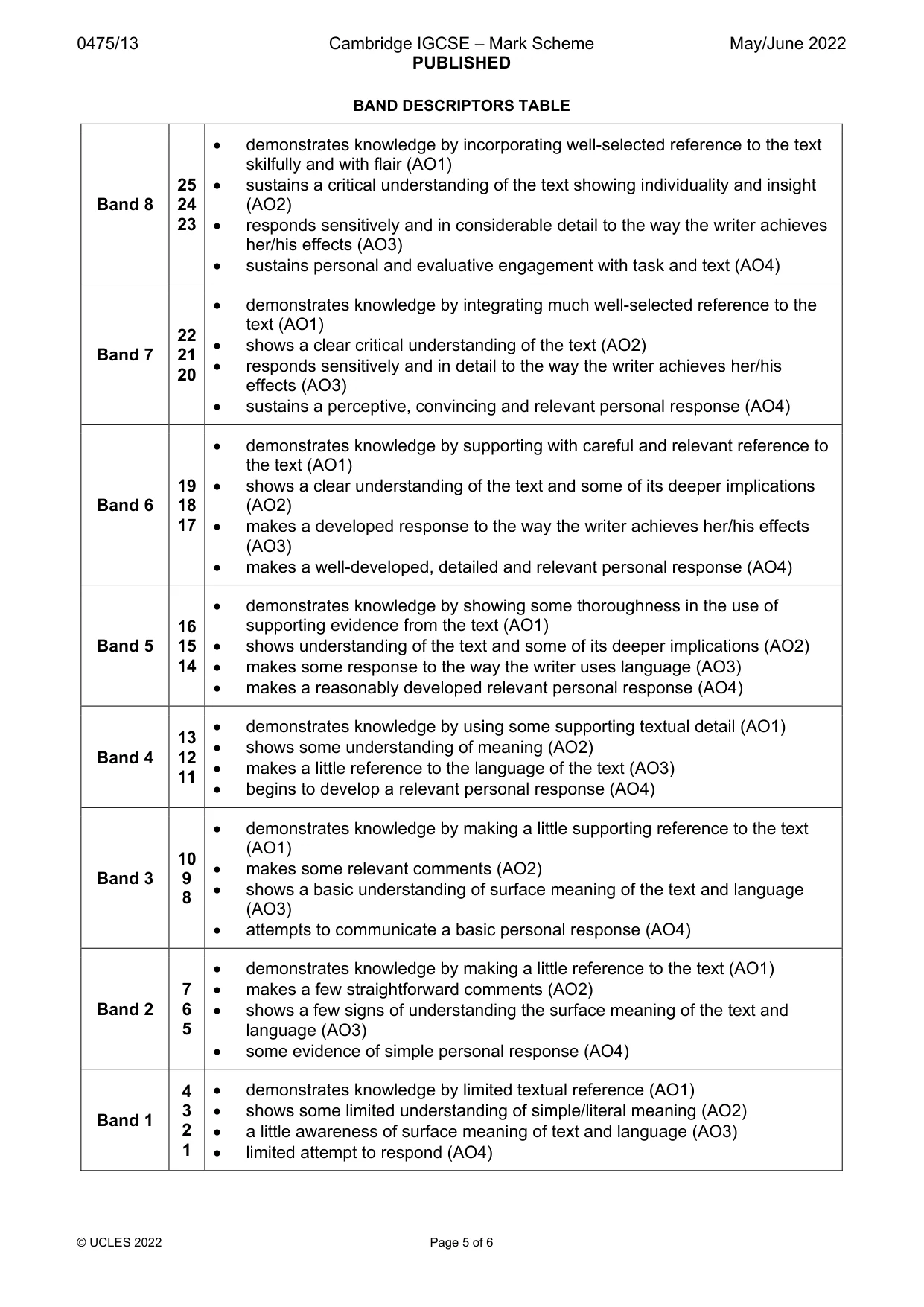
0475/13 Cambridge IGCSE – Mark Scheme PUBLISHED May/June 2022 © UCLES 2022 Page 5 of 6 BAND DESCRIPTORS TABLE Band 8 25 24 23 demonstrates knowledge by incorporating well-selected reference to the text skilfully and with flair (AO1) sustains a critical understanding of the text showing individuality and insight (AO2) responds sensitively and in considerable detail to the way the writer achieves her/his effects (AO3) sustains personal and evaluative engagement with task and text (AO4) Band 7 22 21 20 demonstrates knowledge by integrating much well-selected reference to the text (AO1) shows a clear critical understanding of the text (AO2) responds sensitively and in detail to the way the writer achieves her/his effects (AO3) sustains a perceptive, convincing and relevant personal response (AO4) Band 6 19 18 17 demonstrates knowledge by supporting with careful and relevant reference to the text (AO1) shows a clear understanding of the text and some of its deeper implications (AO2) makes a developed response to the way the writer achieves her/his effects (AO3) makes a well-developed, detailed and relevant personal response (AO4) Band 5 16 15 14 demonstrates knowledge by showing some thoroughness in the use of supporting evidence from the text (AO1) shows understanding of the text and some of its deeper implications (AO2) makes some response to the way the writer uses language (AO3) makes a reasonably developed relevant personal response (AO4) Band 4 13 12 11 demonstrates knowledge by using some supporting textual detail (AO1) shows some understanding of meaning (AO2) makes a little reference to the language of the text (AO3) begins to develop a relevant personal response (AO4) Band 3 10 9 8 demonstrates knowledge by making a little supporting reference to the text (AO1) makes some relevant comments (AO2) shows a basic understanding of surface meaning of the text and language (AO3) attempts to communicate a basic personal response (AO4) Band 2 7 6 5 demonstrates knowledge by making a little reference to the text (AO1) makes a few straightforward comments (AO2) shows a few signs of understanding the surface meaning of the text and language (AO3) some evidence of simple personal response (AO4) Band 1 4 3 2 1 demonstrates knowledge by limited textual reference (AO1) shows some limited understanding of simple/literal meaning (AO2) a little awareness of surface meaning of text and language (AO3) limited attempt to respond (AO4)
Mark scheme, page 6
0475/13 Cambridge IGCSE – Mark Scheme PUBLISHED May/June 2022 © UCLES 2022 Page 6 of 6 Band 0 0 No answer/Insufficient to meet the criteria for Band 1.
What you needed in this session
Cambridge’s own grade thresholds for 2022 May/June, Paper 1 · Variant 3. A higher threshold means an easier paper — the bar moves with how the cohort did.