Cambridge IGCSE English - Literature in English 0475 — 2023 May/June Paper 1 · Variant 3
0475/13/M/J/23 · 50 marks · ≈56 min
The question paper and its mark scheme, free to read here and free to download. This is Cambridge’s own paper, exactly as it was sat.
Question paper28 pages




Mark scheme5 pages
Answers below. Sit the paper first if you are practising.

Paper as text
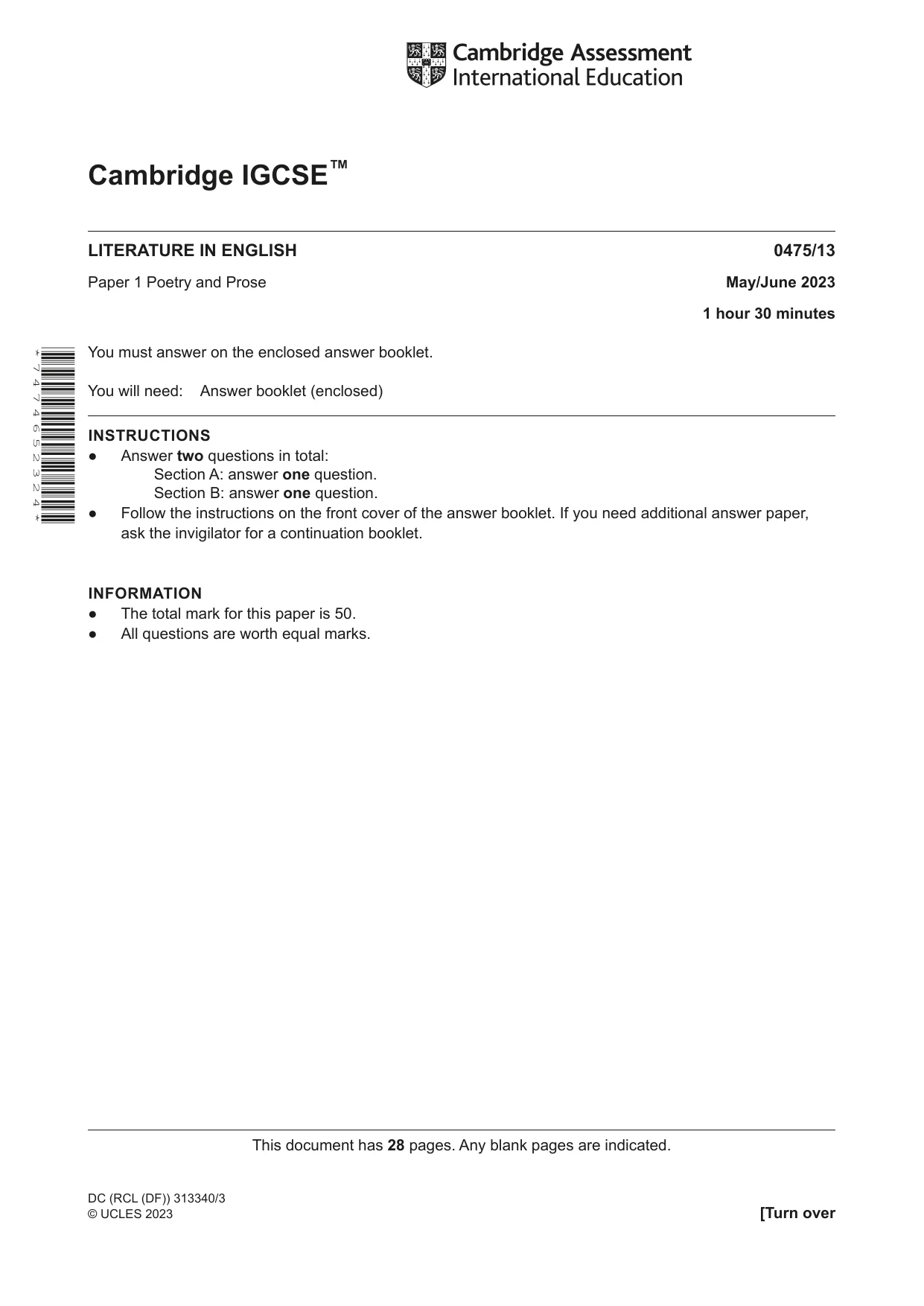
Question paper, page 1
This document has 28 pages. Any blank pages are indicated. [Turn over Cambridge IGCSE™ * 7 4 7 4 6 5 2 3 2 4 * DC (RCL (DF)) 313340/3 © UCLES 2023 LITERATURE IN ENGLISH 0475/13 Paper 1 Poetry and Prose May/June 2023 1 hour 30 minutes You must answer on the enclosed answer booklet. You will need: Answer booklet (enclosed) INSTRUCTIONS ● Answer two questions in total: Section A: answer one question. Section B: answer one question. ● Follow the instructions on the front cover of the answer booklet. If you need additional answer paper, ask the invigilator for a continuation booklet. INFORMATION ● The total mark for this paper is 50. ● All questions are worth equal marks.
Question paper, page 2
2 0475/13/M/J/23 © UCLES 2023 BLANK PAGE
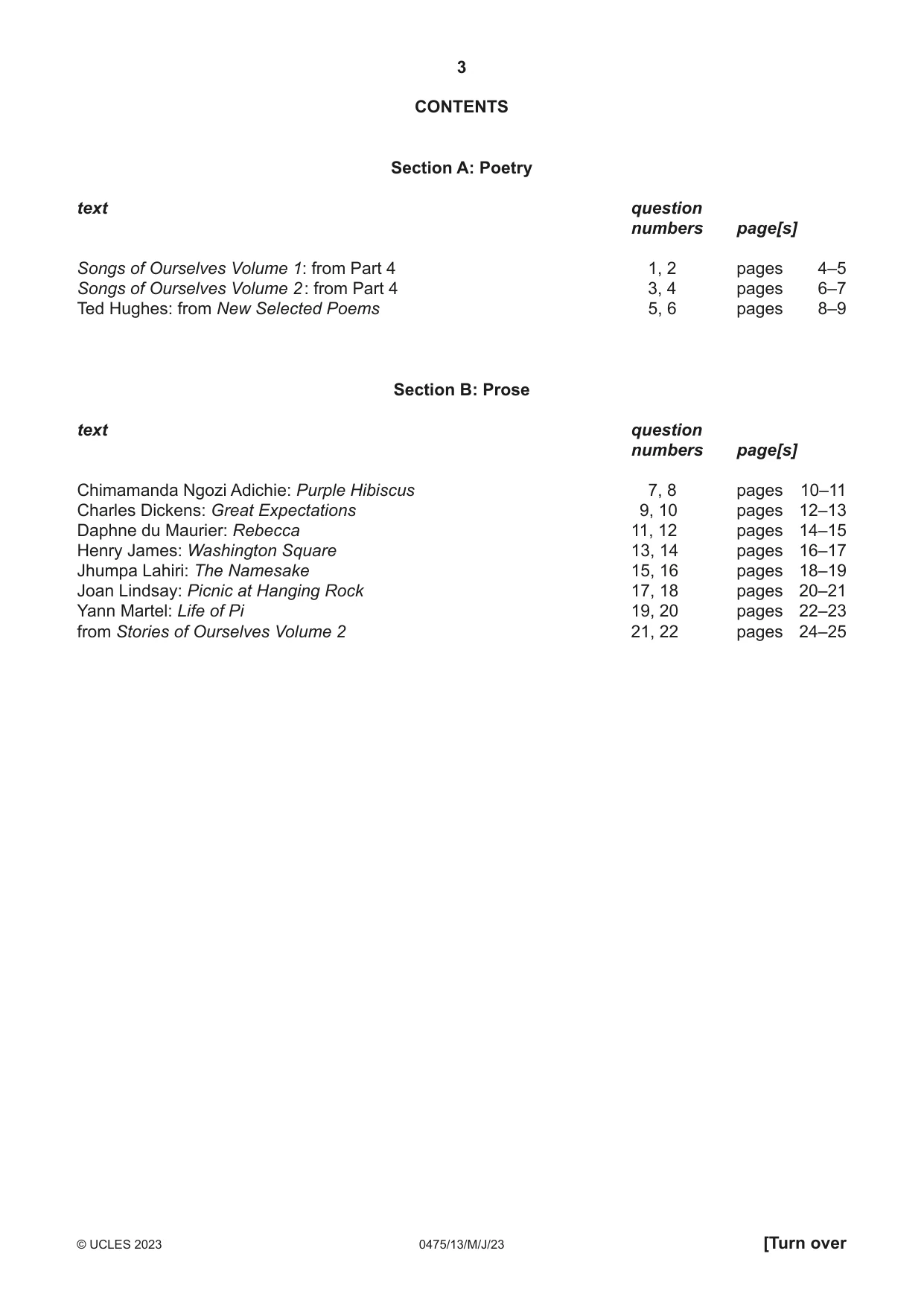
Question paper, page 3
3 0475/13/M/J/23 © UCLES 2023 [Turn over CONTENTS Section A: Poetry text question numbers page[s] Songs of Ourselves Volume 1: from Part 4 1, 2 pages 4–5 Songs of Ourselves Volume 2 : from Part 4 3, 4 pages 6–7 Ted Hughes: from New Selected Poems 5, 6 pages 8–9 Section B: Prose text question numbers page[s] Chimamanda Ngozi Adichie: Purple Hibiscus 7, 8 pages 10–11 Charles Dickens: Great Expectations 9, 10 pages 12–13 Daphne du Maurier: Rebecca 11, 12 pages 14–15 Henry James: Washington Square 13, 14 pages 16–17 Jhumpa Lahiri: The Namesake 15, 16 pages 18–19 Joan Lindsay: Picnic at Hanging Rock 17, 18 pages 20–21 Yann Martel: Life of Pi 19, 20 pages 22–23 from Stories of Ourselves Volume 2 21, 22 pages 24–25
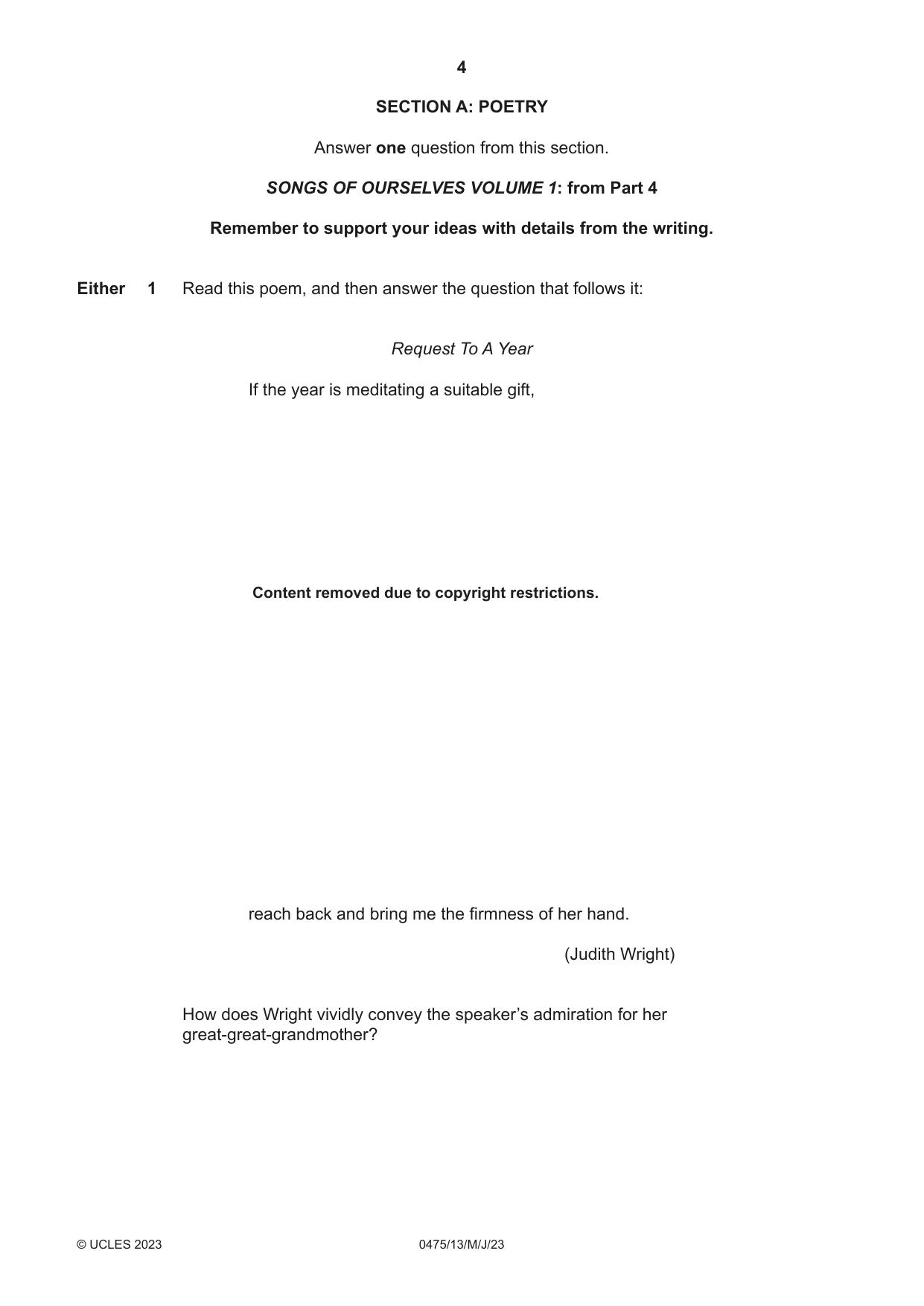
Question paper, page 4
4 0475/13/M/J/23 © UCLES 2023 SECTION A: POETRY Answer one question from this section. SONGS OF OURSELVES VOLUME 1: from Part 4 Remember to support your ideas with details from the writing. Either 1 Read this poem, and then answer the question that follows it: Request To A Year If the year is meditating a suitable gift, reach back and bring me the firmness of her hand. (Judith Wright) How does Wright vividly convey the speaker’s admiration for her great-great-grandmother? Content removed due to copyright restrictions.
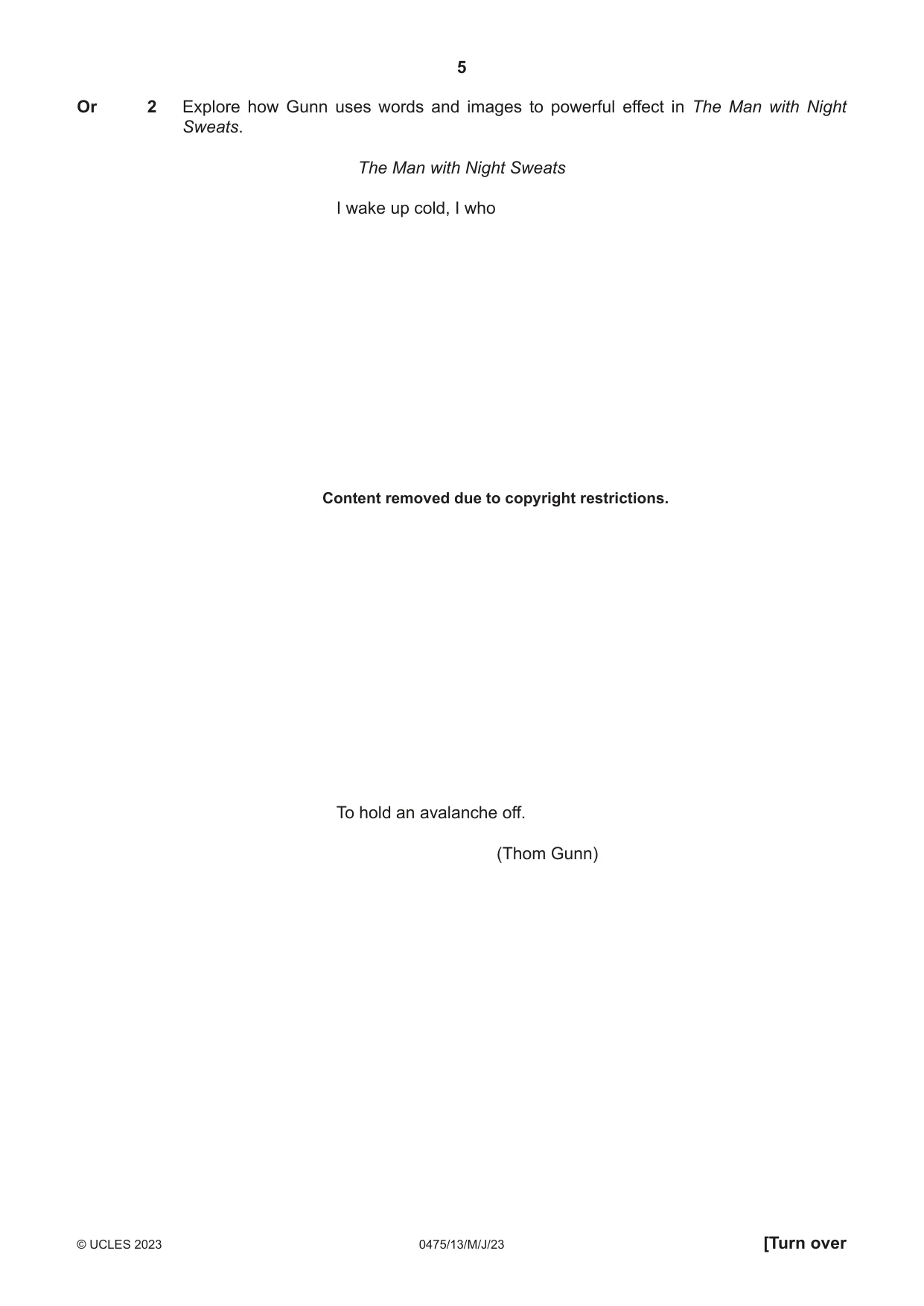
Question paper, page 5
5 0475/13/M/J/23 © UCLES 2023 [Turn over Or 2 Explore how Gunn uses words and images to powerful effect in The Man with Night Sweats. The Man with Night Sweats I wake up cold, I who To hold an avalanche off. (Thom Gunn) Content removed due to copyright restrictions.
Question paper, page 6
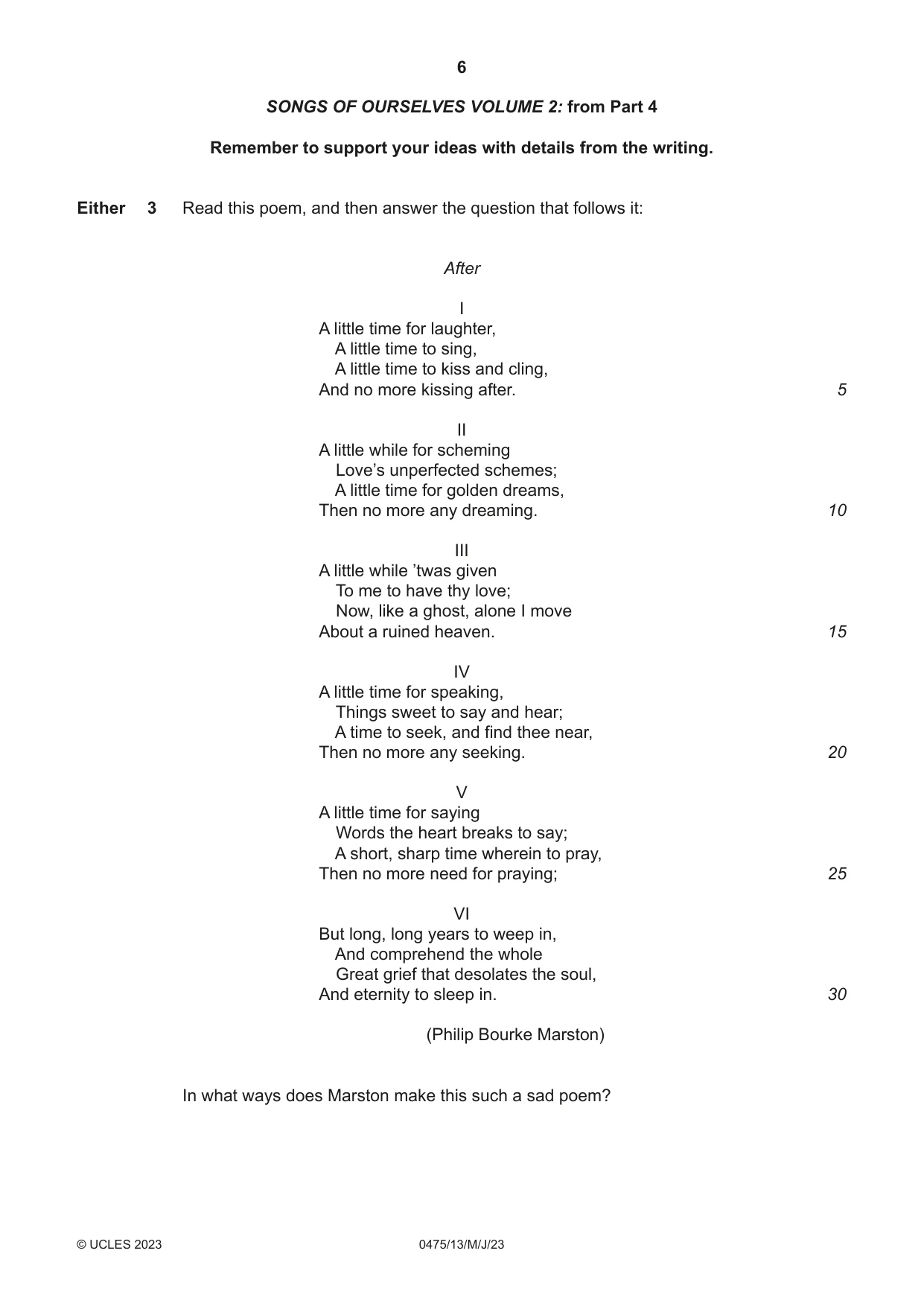
6 0475/13/M/J/23 © UCLES 2023 SONGS OF OURSELVES VOLUME 2: from Part 4 Remember to support your ideas with details from the writing. Either 3 Read this poem, and then answer the question that follows it: After I A little time for laughter, A little time to sing, A little time to kiss and cling, And no more kissing after. II A little while for scheming Love’s unperfected schemes; A little time for golden dreams, Then no more any dreaming. III A little while ’twas given To me to have thy love; Now, like a ghost, alone I move About a ruined heaven. IV A little time for speaking, Things sweet to say and hear; A time to seek, and find thee near, Then no more any seeking. V A little time for saying Words the heart breaks to say; A short, sharp time wherein to pray, Then no more need for praying; VI But long, long years to weep in, And comprehend the whole Great grief that desolates the soul, And eternity to sleep in. (Philip Bourke Marston) In what ways does Marston make this such a sad poem? 5 10 15 20 25 30
Question paper, page 7
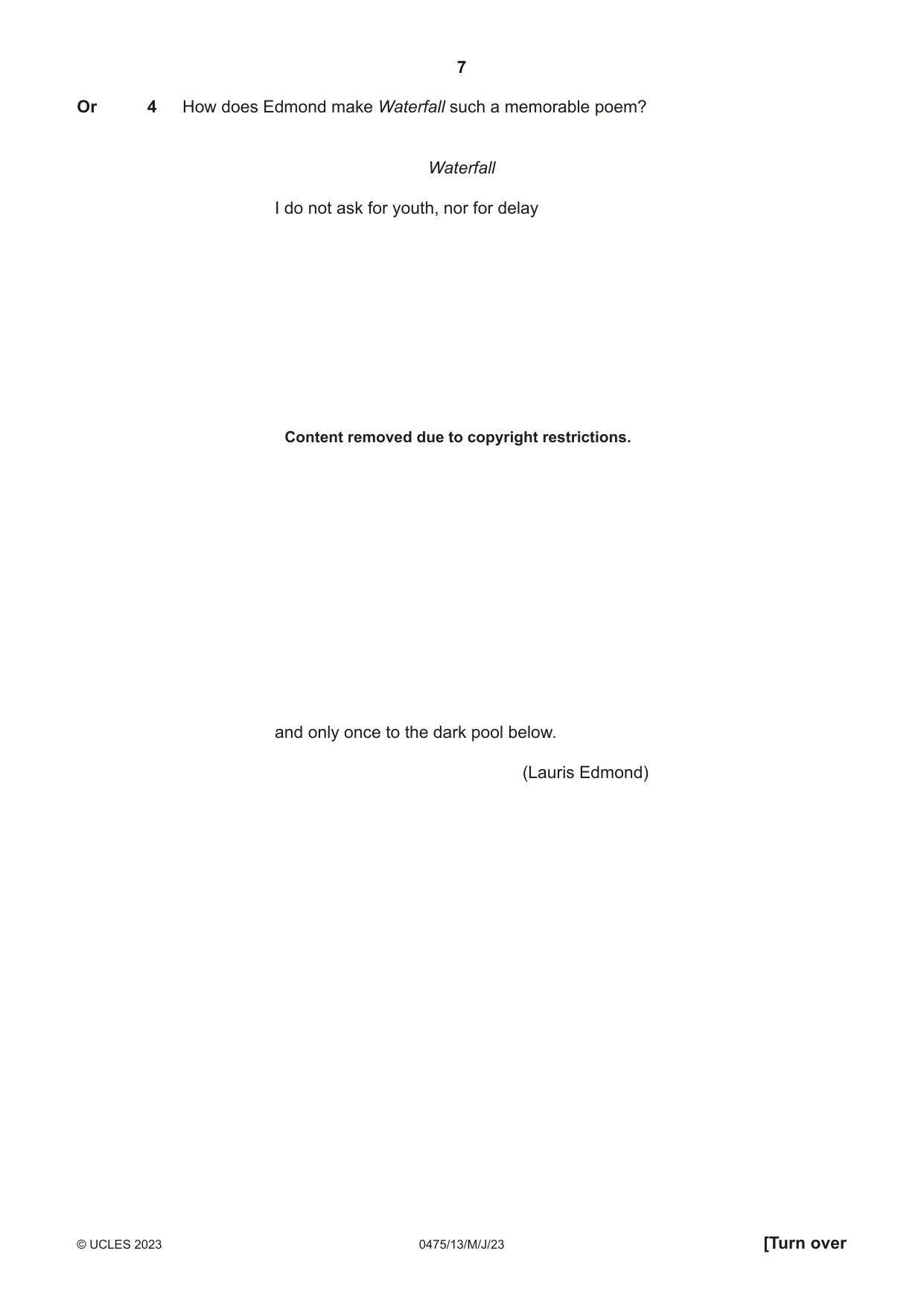
7 0475/13/M/J/23 © UCLES 2023 [Turn over Or 4 How does Edmond make Waterfall such a memorable poem? Waterfall I do not ask for youth, nor for delay and only once to the dark pool below. (Lauris Edmond) Content removed due to copyright restrictions.
Question paper, page 8
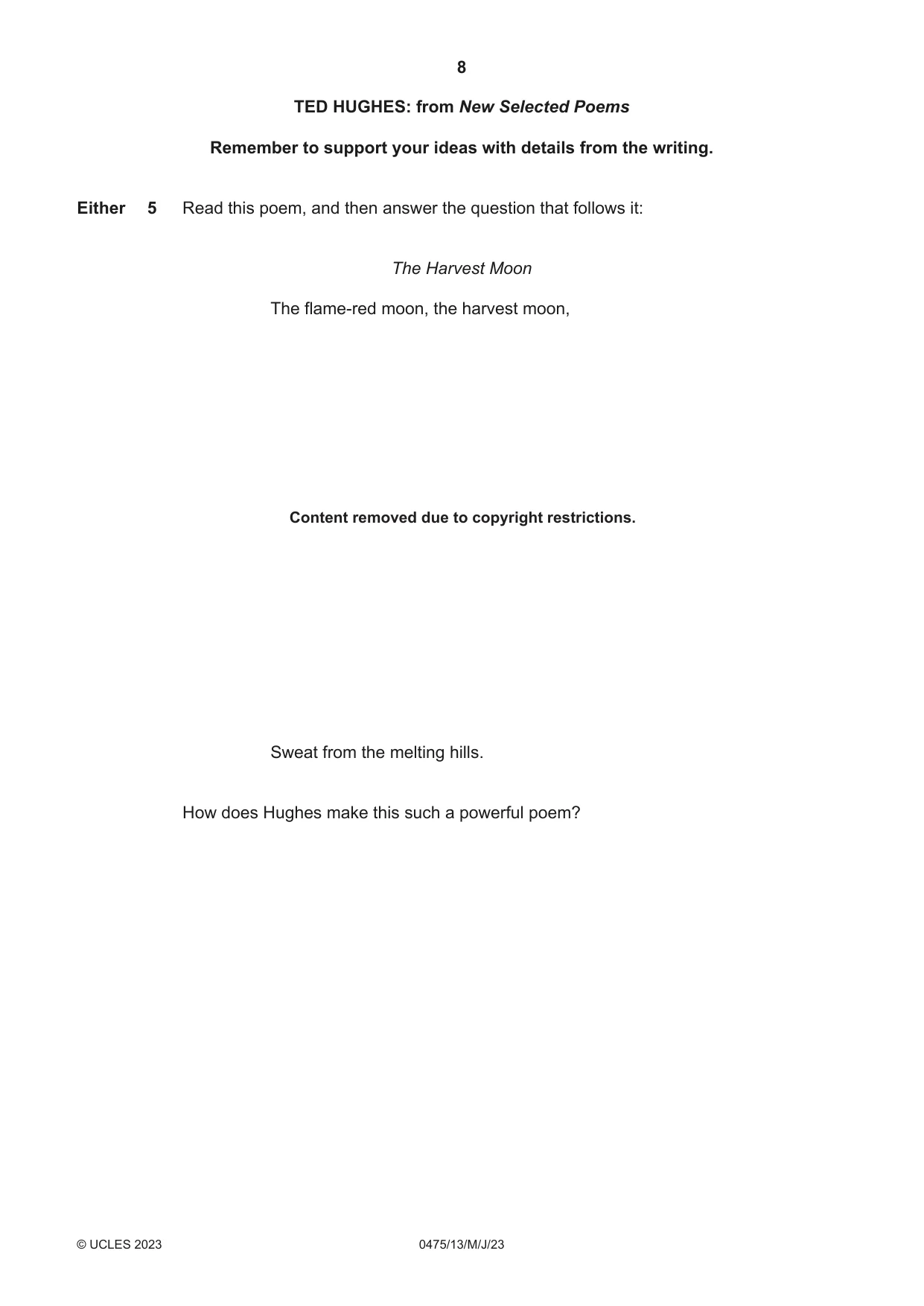
8 0475/13/M/J/23 © UCLES 2023 TED HUGHES: from New Selected Poems Remember to support your ideas with details from the writing. Either 5 Read this poem, and then answer the question that follows it: The Harvest Moon The flame-red moon, the harvest moon, Sweat from the melting hills. How does Hughes make this such a powerful poem? Content removed due to copyright restrictions.
Question paper, page 9
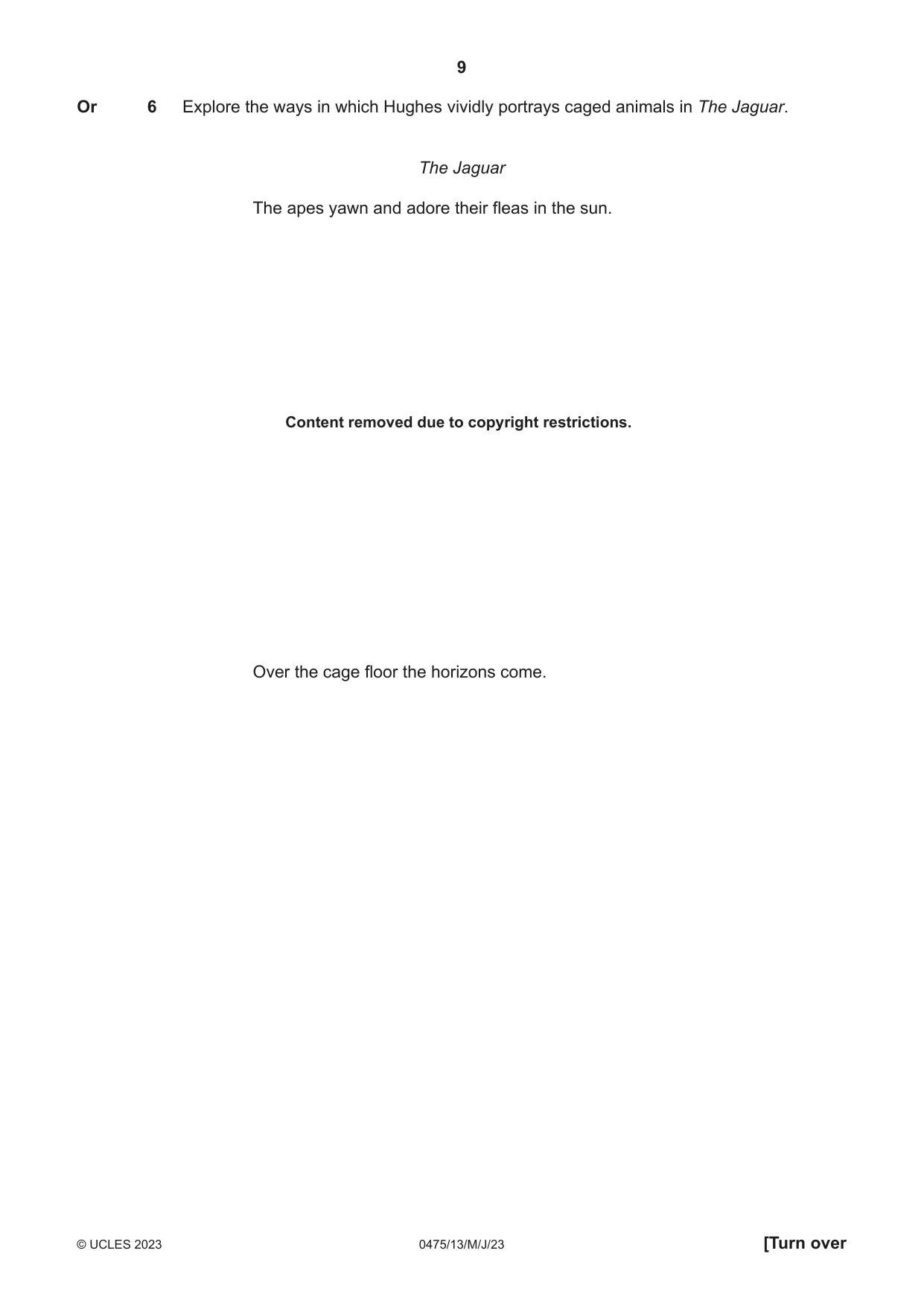
9 0475/13/M/J/23 © UCLES 2023 [Turn over Or 6 Explore the ways in which Hughes vividly portrays caged animals in The Jaguar. The Jaguar The apes yawn and adore their fleas in the sun. Over the cage floor the horizons come. Content removed due to copyright restrictions.
Question paper, page 10
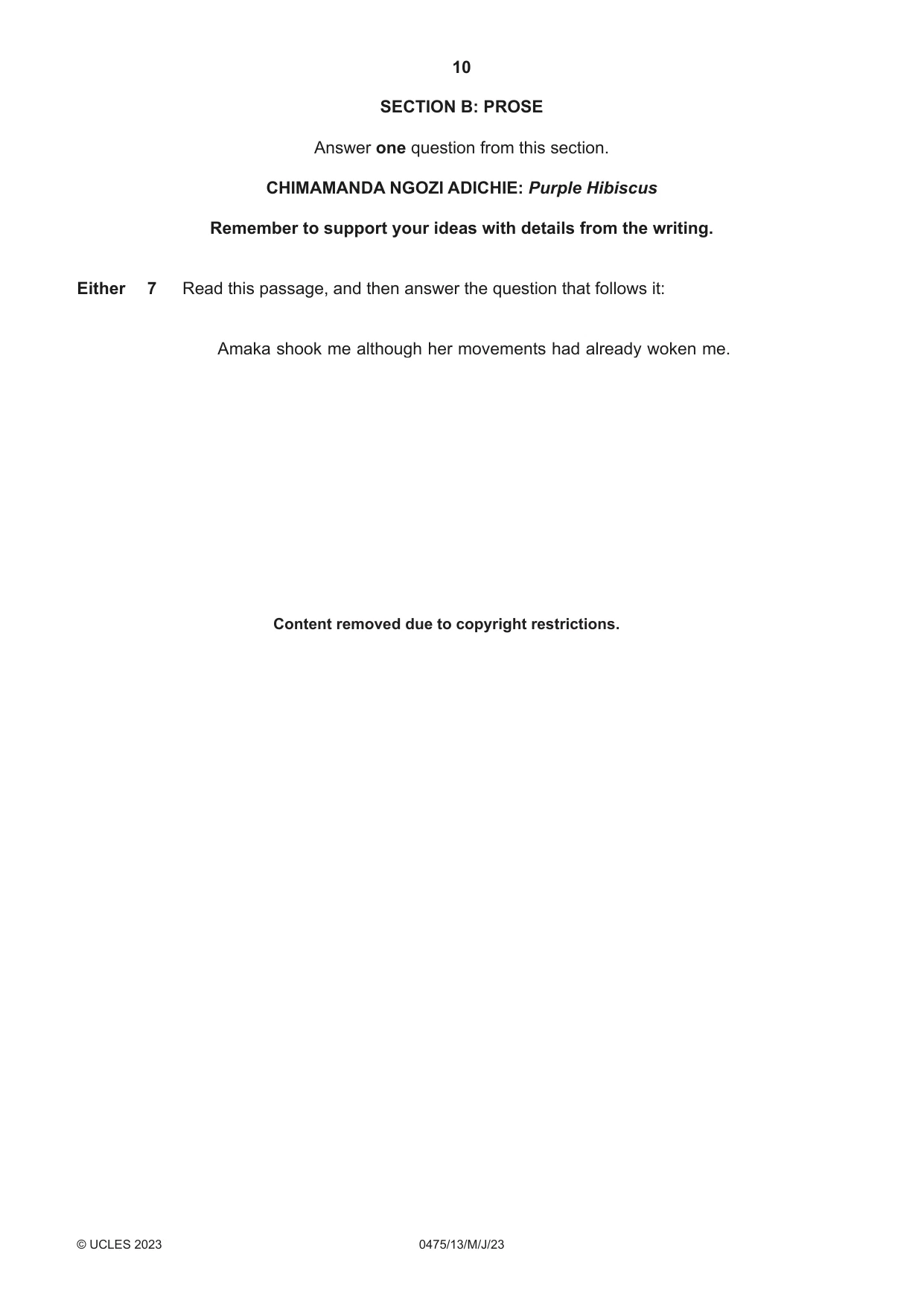
10 0475/13/M/J/23 © UCLES 2023 SECTION B: PROSE Answer one question from this section. CHIMAMANDA NGOZI ADICHIE: Purple Hibiscus Remember to support your ideas with details from the writing. Either 7 Read this passage, and then answer the question that follows it: Amaka shook me although her movements had already woken me. Content removed due to copyright restrictions.
Question paper, page 11
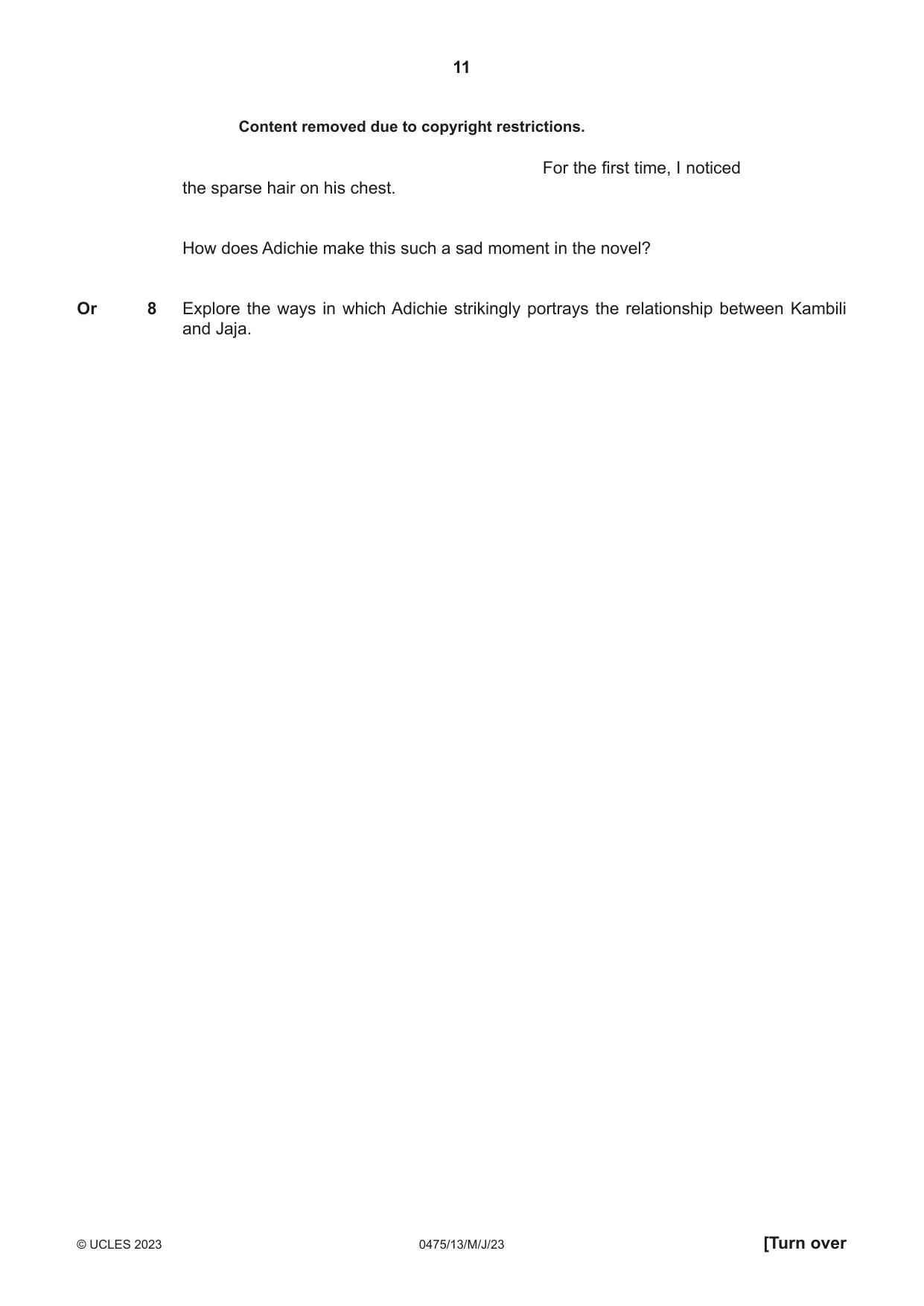
11 0475/13/M/J/23 © UCLES 2023 [Turn over For the first time, I noticed the sparse hair on his chest. How does Adichie make this such a sad moment in the novel? Or 8 Explore the ways in which Adichie strikingly portrays the relationship between Kambili and Jaja. Content removed due to copyright restrictions.
Question paper, page 12
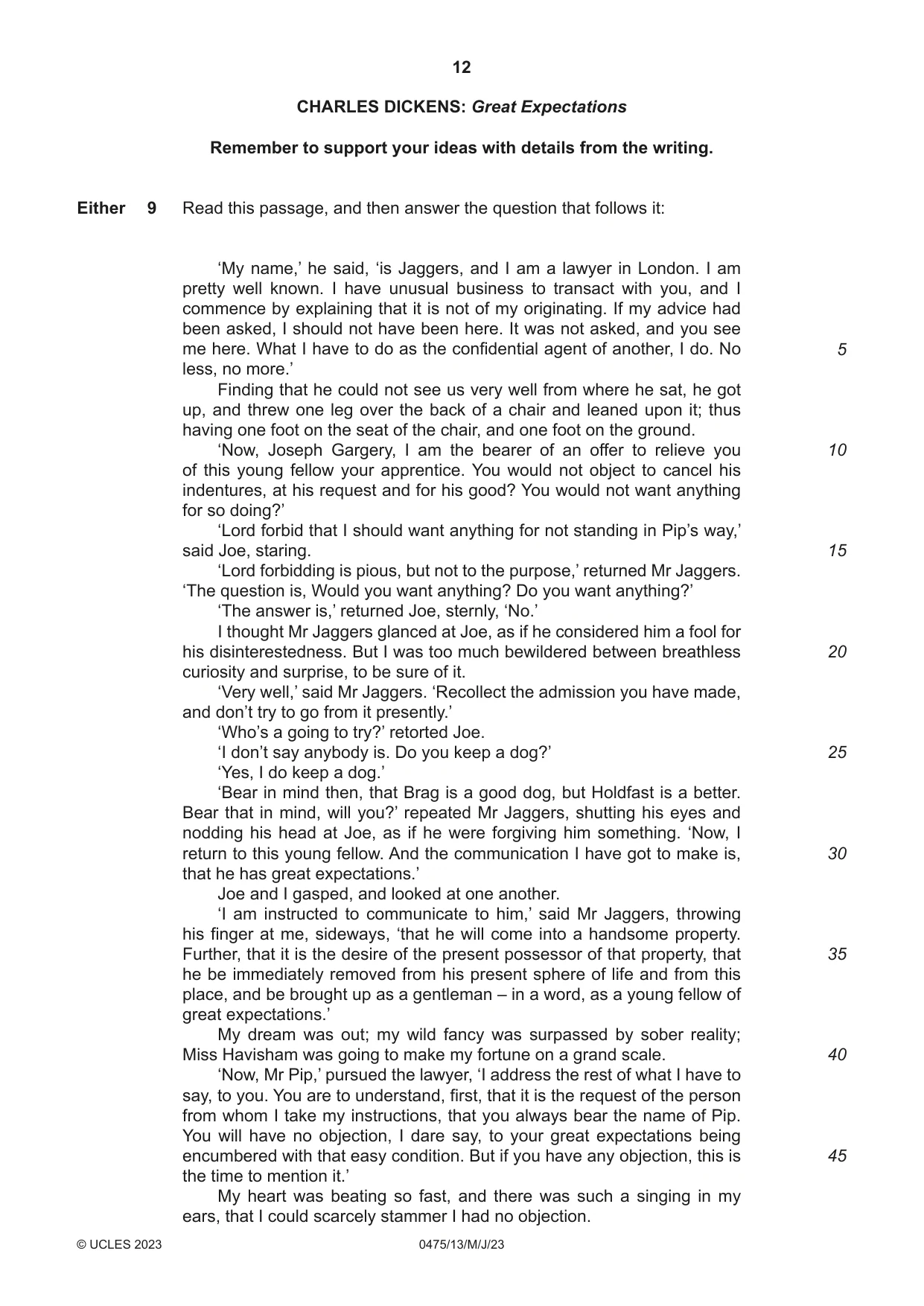
12 0475/13/M/J/23 © UCLES 2023 CHARLES DICKENS: Great Expectations Remember to support your ideas with details from the writing. Either 9 Read this passage, and then answer the question that follows it: ‘My name,’ he said, ‘is Jaggers, and I am a lawyer in London. I am pretty well known. I have unusual business to transact with you, and I commence by explaining that it is not of my originating. If my advice had been asked, I should not have been here. It was not asked, and you see me here. What I have to do as the confidential agent of another, I do. No less, no more.’ Finding that he could not see us very well from where he sat, he got up, and threw one leg over the back of a chair and leaned upon it; thus having one foot on the seat of the chair, and one foot on the ground. ‘Now, Joseph Gargery, I am the bearer of an offer to relieve you of this young fellow your apprentice. You would not object to cancel his indentures, at his request and for his good? You would not want anything for so doing?’ ‘Lord forbid that I should want anything for not standing in Pip’s way,’ said Joe, staring. ‘Lord forbidding is pious, but not to the purpose,’ returned Mr Jaggers. ‘The question is, Would you want anything? Do you want anything?’ ‘The answer is,’ returned Joe, sternly, ‘No.’ I thought Mr Jaggers glanced at Joe, as if he considered him a fool for his disinterestedness. But I was too much bewildered between breathless curiosity and surprise, to be sure of it. ‘Very well,’ said Mr Jaggers. ‘Recollect the admission you have made, and don’t try to go from it presently.’ ‘Who’s a going to try?’ retorted Joe. ‘I don’t say anybody is. Do you keep a dog?’ ‘Yes, I do keep a dog.’ ‘Bear in mind then, that Brag is a good dog, but Holdfast is a better. Bear that in mind, will you?’ repeated Mr Jaggers, shutting his eyes and nodding his head at Joe, as if he were forgiving him something. ‘Now, I return to this young fellow. And the communication I have got to make is, that he has great expectations.’ Joe and I gasped, and looked at one another. ‘I am instructed to communicate to him,’ said Mr Jaggers, throwing his finger at me, sideways, ‘that he will come into a handsome property. Further, that it is the desire of the present possessor of that property, that he be immediately removed from his present sphere of life and from this place, and be brought up as a gentleman – in a word, as a young fellow of great expectations.’ My dream was out; my wild fancy was surpassed by sober reality; Miss Havisham was going to make my fortune on a grand scale. ‘Now, Mr Pip,’ pursued the lawyer, ‘I address the rest of what I have to say, to you. You are to understand, first, that it is the request of the person from whom I take my instructions, that you always bear the name of Pip. You will have no objection, I dare say, to your great expectations being encumbered with that easy condition. But if you have any objection, this is the time to mention it.’ My heart was beating so fast, and there was such a singing in my ears, that I could scarcely stammer I had no objection. 5 10 15 20 25 30 35 40 45
Question paper, page 13
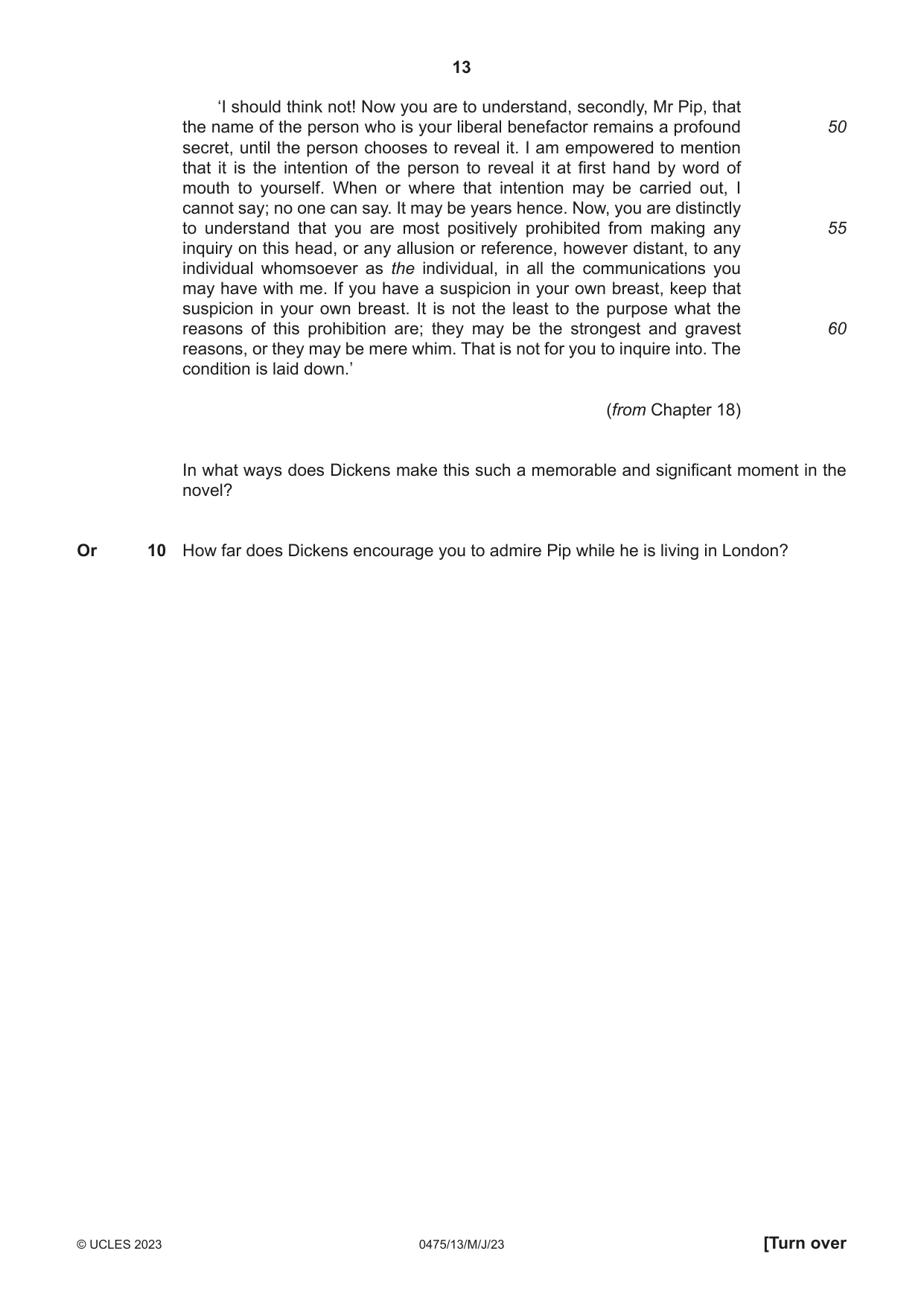
13 0475/13/M/J/23 © UCLES 2023 [Turn over ‘I should think not! Now you are to understand, secondly, Mr Pip, that the name of the person who is your liberal benefactor remains a profound secret, until the person chooses to reveal it. I am empowered to mention that it is the intention of the person to reveal it at first hand by word of mouth to yourself. When or where that intention may be carried out, I cannot say; no one can say. It may be years hence. Now, you are distinctly to understand that you are most positively prohibited from making any inquiry on this head, or any allusion or reference, however distant, to any individual whomsoever as the individual, in all the communications you may have with me. If you have a suspicion in your own breast, keep that suspicion in your own breast. It is not the least to the purpose what the reasons of this prohibition are; they may be the strongest and gravest reasons, or they may be mere whim. That is not for you to inquire into. The condition is laid down.’ (from Chapter 18) In what ways does Dickens make this such a memorable and significant moment in the novel? Or 10 How far does Dickens encourage you to admire Pip while he is living in London? 50 55 60
Question paper, page 14
14 0475/13/M/J/23 © UCLES 2023 DAPHNE DU MAURIER: Rebecca Remember to support your ideas with details from the writing. Either 11 Read this passage, and then answer the question that follows it: ‘What do you want, Ben?’ Content removed due to copyright restrictions.
Question paper, page 15
15 0475/13/M/J/23 © UCLES 2023 [Turn over He did not know what he was talking about. (from Chapter 13) Explore the ways in which du Maurier makes this such a revealing and significant moment in the novel. Or 12 To what extent does du Maurier make it possible for you to have any sympathy for Mrs Danvers? Content removed due to copyright restrictions.
Question paper, page 16
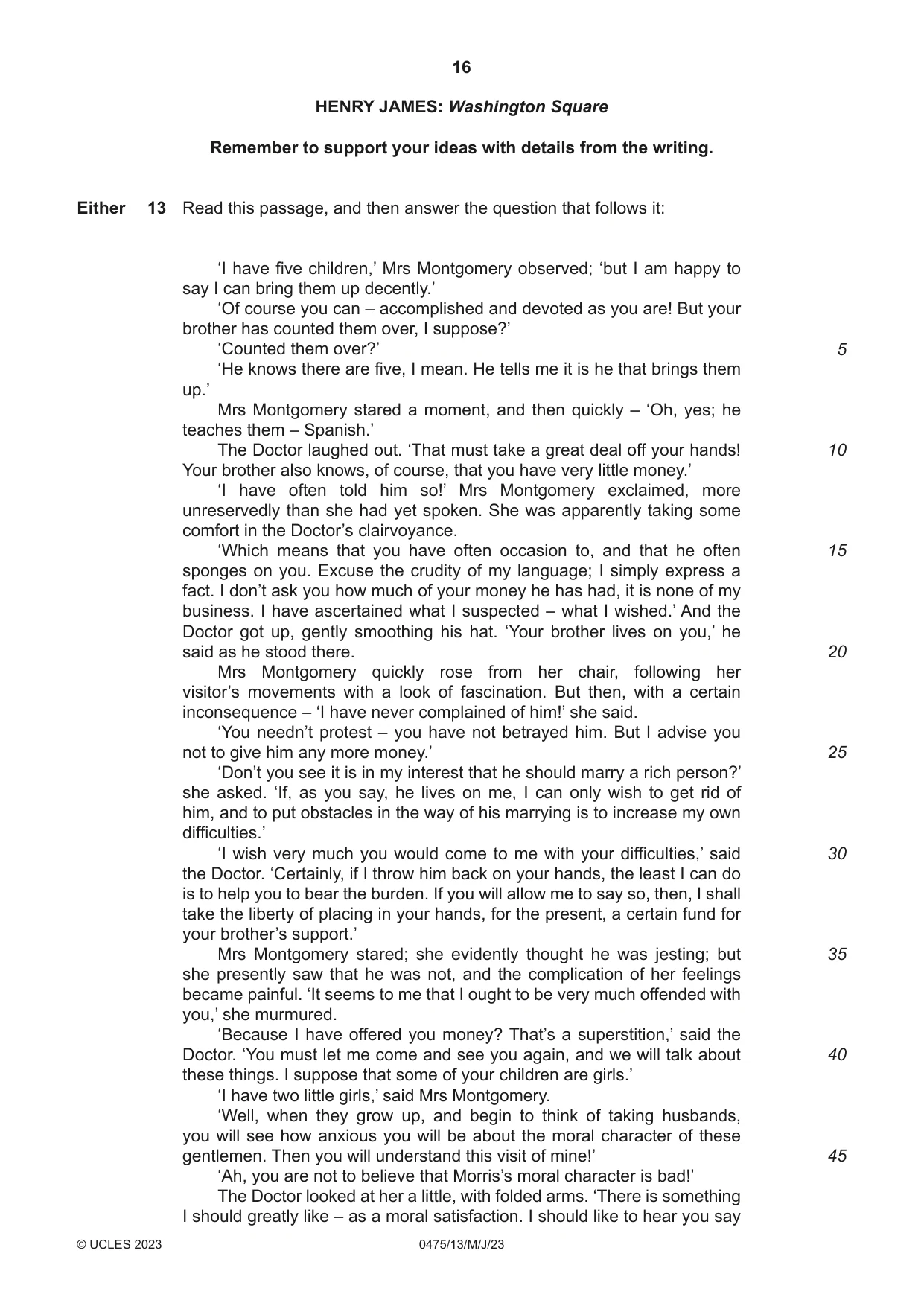
16 0475/13/M/J/23 © UCLES 2023 HENRY JAMES: Washington Square Remember to support your ideas with details from the writing. Either 13 Read this passage, and then answer the question that follows it: ‘I have five children,’ Mrs Montgomery observed; ‘but I am happy to say I can bring them up decently.’ ‘Of course you can – accomplished and devoted as you are! But your brother has counted them over, I suppose?’ ‘Counted them over?’ ‘He knows there are five, I mean. He tells me it is he that brings them up.’ Mrs Montgomery stared a moment, and then quickly – ‘Oh, yes; he teaches them – Spanish.’ The Doctor laughed out. ‘That must take a great deal off your hands! Your brother also knows, of course, that you have very little money.’ ‘I have often told him so!’ Mrs Montgomery exclaimed, more unreservedly than she had yet spoken. She was apparently taking some comfort in the Doctor’s clairvoyance. ‘Which means that you have often occasion to, and that he often sponges on you. Excuse the crudity of my language; I simply express a fact. I don’t ask you how much of your money he has had, it is none of my business. I have ascertained what I suspected – what I wished.’ And the Doctor got up, gently smoothing his hat. ‘Your brother lives on you,’ he said as he stood there. Mrs Montgomery quickly rose from her chair, following her visitor’s movements with a look of fascination. But then, with a certain inconsequence – ‘I have never complained of him!’ she said. ‘You needn’t protest – you have not betrayed him. But I advise you not to give him any more money.’ ‘Don’t you see it is in my interest that he should marry a rich person?’ she asked. ‘If, as you say, he lives on me, I can only wish to get rid of him, and to put obstacles in the way of his marrying is to increase my own difficulties.’ ‘I wish very much you would come to me with your difficulties,’ said the Doctor. ‘Certainly, if I throw him back on your hands, the least I can do is to help you to bear the burden. If you will allow me to say so, then, I shall take the liberty of placing in your hands, for the present, a certain fund for your brother’s support.’ Mrs Montgomery stared; she evidently thought he was jesting; but she presently saw that he was not, and the complication of her feelings became painful. ‘It seems to me that I ought to be very much offended with you,’ she murmured. ‘Because I have offered you money? That’s a superstition,’ said the Doctor. ‘You must let me come and see you again, and we will talk about these things. I suppose that some of your children are girls.’ ‘I have two little girls,’ said Mrs Montgomery. ‘Well, when they grow up, and begin to think of taking husbands, you will see how anxious you will be about the moral character of these gentlemen. Then you will understand this visit of mine!’ ‘Ah, you are not to believe that Morris’s moral character is bad!’ The Doctor looked at her a little, with folded arms. ‘There is something I should greatly like – as a moral satisfaction. I should like to hear you say 5 10 15 20 25 30 35 40 45
Question paper, page 17
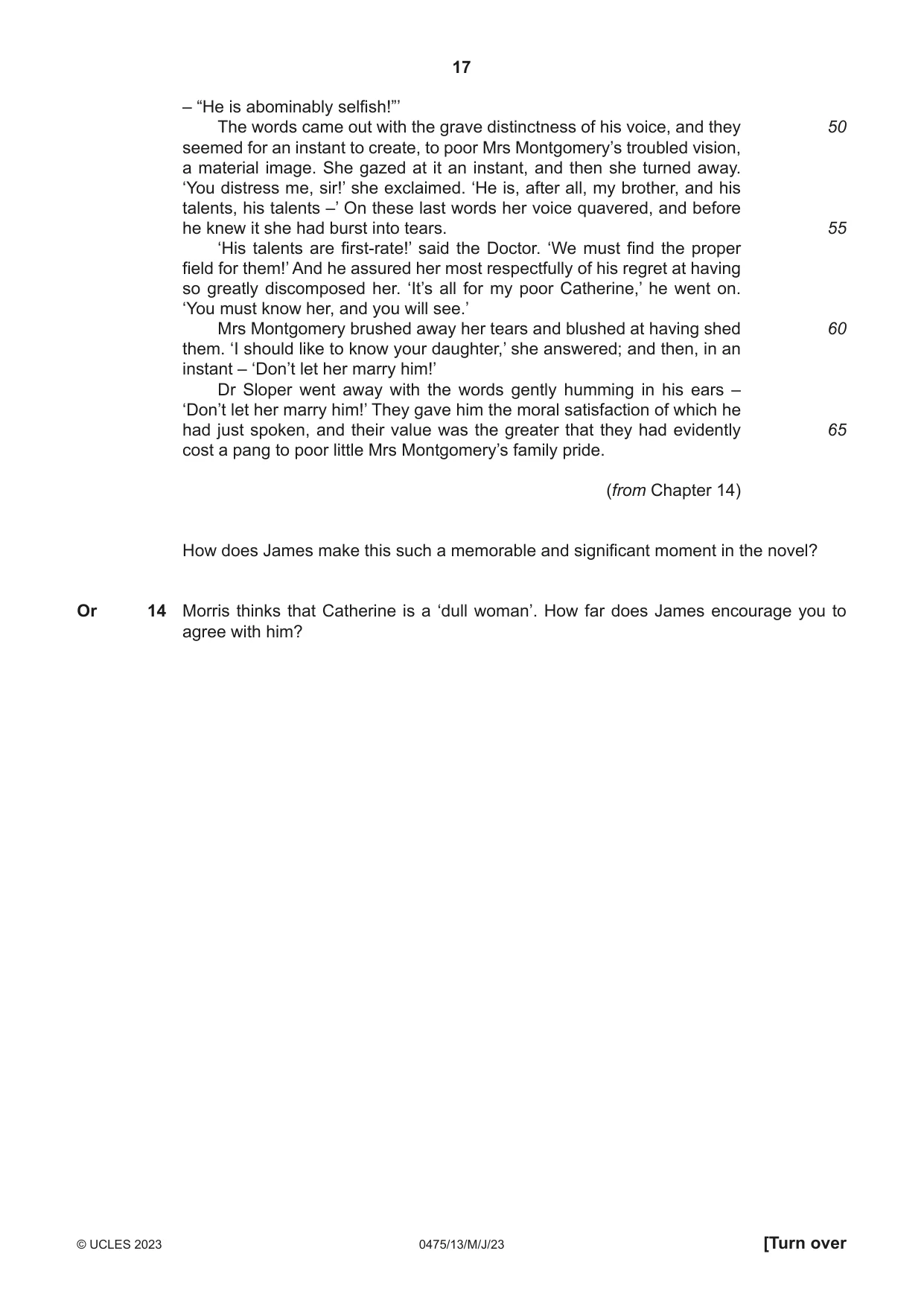
17 0475/13/M/J/23 © UCLES 2023 [Turn over – “He is abominably selfish!”’ The words came out with the grave distinctness of his voice, and they seemed for an instant to create, to poor Mrs Montgomery’s troubled vision, a material image. She gazed at it an instant, and then she turned away. ‘You distress me, sir!’ she exclaimed. ‘He is, after all, my brother, and his talents, his talents –’ On these last words her voice quavered, and before he knew it she had burst into tears. ‘His talents are first-rate!’ said the Doctor. ‘We must find the proper field for them!’ And he assured her most respectfully of his regret at having so greatly discomposed her. ‘It’s all for my poor Catherine,’ he went on. ‘You must know her, and you will see.’ Mrs Montgomery brushed away her tears and blushed at having shed them. ‘I should like to know your daughter,’ she answered; and then, in an instant – ‘Don’t let her marry him!’ Dr Sloper went away with the words gently humming in his ears – ‘Don’t let her marry him!’ They gave him the moral satisfaction of which he had just spoken, and their value was the greater that they had evidently cost a pang to poor little Mrs Montgomery’s family pride. (from Chapter 14) How does James make this such a memorable and significant moment in the novel? Or 14 Morris thinks that Catherine is a ‘dull woman’. How far does James encourage you to agree with him? 50 55 60 65
Question paper, page 18
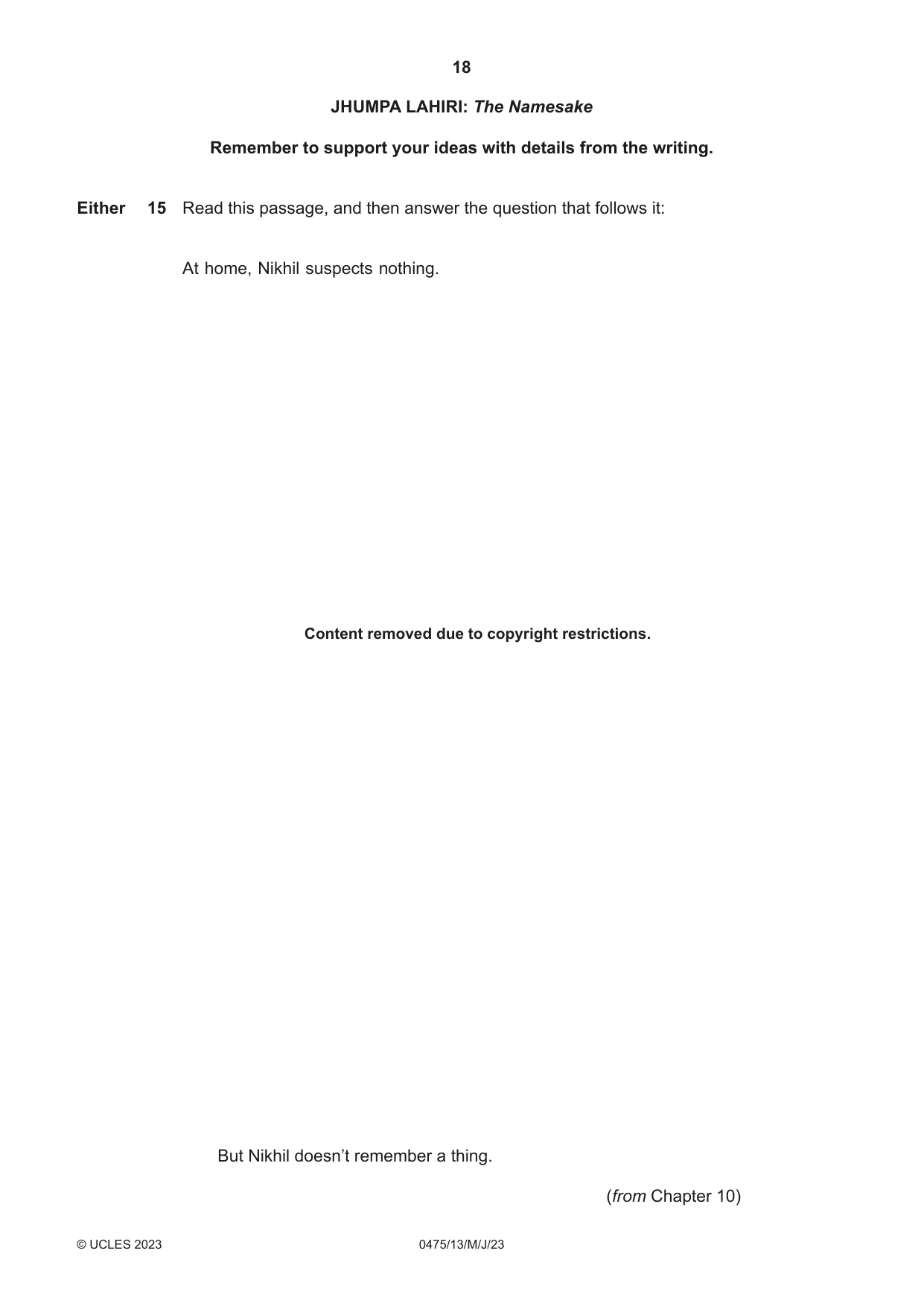
18 0475/13/M/J/23 © UCLES 2023 JHUMPA LAHIRI: The Namesake Remember to support your ideas with details from the writing. Either 15 Read this passage, and then answer the question that follows it: At home, Nikhil suspects nothing. But Nikhil doesn’t remember a thing. (from Chapter 10) Content removed due to copyright restrictions.
Question paper, page 19
19 0475/13/M/J/23 © UCLES 2023 [Turn over How does Lahiri vividly convey Moushumi’s thoughts and feelings at this moment in the novel? Or 16 Explore how Lahiri memorably portrays Gogol’s relationship with his parents.
Question paper, page 20
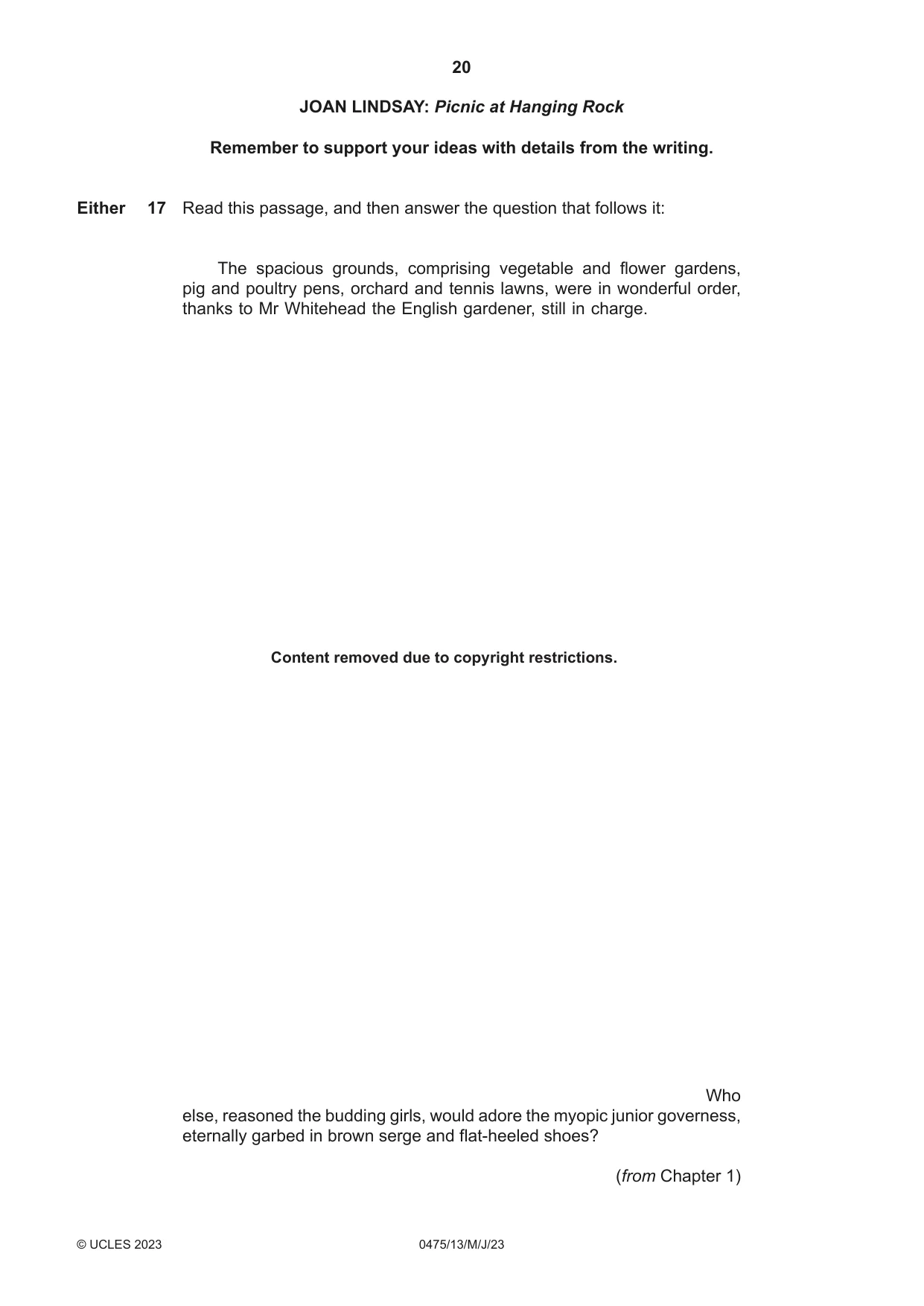
20 0475/13/M/J/23 © UCLES 2023 JOAN LINDSAY: Picnic at Hanging Rock Remember to support your ideas with details from the writing. Either 17 Read this passage, and then answer the question that follows it: The spacious grounds, comprising vegetable and flower gardens, pig and poultry pens, orchard and tennis lawns, were in wonderful order, thanks to Mr Whitehead the English gardener, still in charge. Who else, reasoned the budding girls, would adore the myopic junior governess, eternally garbed in brown serge and flat-heeled shoes? (from Chapter 1) Content removed due to copyright restrictions.
Question paper, page 21
21 0475/13/M/J/23 © UCLES 2023 [Turn over How does Lindsay make this early moment in the novel so vivid? Or 18 Explore how Lindsay powerfully depicts the relationship between Albert and Mike.
Question paper, page 22
22 0475/13/M/J/23 © UCLES 2023 YANN MARTEL: Life of Pi Remember to support your ideas with details from the writing. Either 19 Read this passage, and then answer the question that follows it: The elements allowed me to go on living. Each fit passed. (from Chapter 41) In what ways does Martel make this moment in the novel so powerful? Content removed due to copyright restrictions.
Question paper, page 23
23 0475/13/M/J/23 © UCLES 2023 [Turn over Or 20 Explore the ways in which Martel creates such a striking portrait of Richard Parker.
Question paper, page 24
24 0475/13/M/J/23 © UCLES 2023 from STORIES OF OURSELVES Volume 2 Remember to support your ideas with details from the writing. Either 21 Read this passage from Mrs Mahmood (by Segun Afolabi), and then answer the question that follows it: That happened today, this afternoon. Content removed due to copyright restrictions.
Question paper, page 25
25 0475/13/M/J/23 © UCLES 2023 If it came right down to it, if I thought about it clean out, pared back the skin, the tired flesh and arrived at the bones, I realise the one certainty in my life is Isobel. To what extent does Afolabi make you feel sympathy for the narrator in this final moment of the story? Or 22 Explore the ways in which Laski strikingly portrays the marriage between Caroline and Neville in The Tower. Content removed due to copyright restrictions.
Question paper, page 26
26 0475/13/M/J/23 © UCLES 2023 BLANK PAGE
Question paper, page 27
27 0475/13/M/J/23 © UCLES 2023 BLANK PAGE
Question paper, page 28
28 0475/13/M/J/23 © UCLES 2023 Permission to reproduce items where third-party owned material protected by copyright is included has been sought and cleared where possible. Every reasonable effort has been made by the publisher (UCLES) to trace copyright holders, but if any items requiring clearance have unwittingly been included, the publisher will be pleased to make amends at the earliest possible opportunity. To avoid the issue of disclosure of answer-related information to candidates, all copyright acknowledgements are reproduced online in the Cambridge Assessment International Education Copyright Acknowledgements Booklet. This is produced for each series of examinations and is freely available to download at www.cambridgeinternational.org after the live examination series. Cambridge Assessment International Education is part of Cambridge Assessment. Cambridge Assessment is the brand name of the University of Cambridge Local Examinations Syndicate (UCLES), which is a department of the University of Cambridge. BLANK PAGE
Mark scheme, page 1
This document consists of 5 printed pages. © UCLES 2023 [Turn over Cambridge IGCSE™ LITERATURE IN ENGLISH 0475/13 Paper 1 Poetry and Prose May/June 2023 MARK SCHEME Maximum Mark: 50 Published This mark scheme is published as an aid to teachers and candidates, to indicate the requirements of the examination. It shows the basis on which Examiners were instructed to award marks. It does not indicate the details of the discussions that took place at an Examiners’ meeting before marking began, which would have considered the acceptability of alternative answers. Mark schemes should be read in conjunction with the question paper and the Principal Examiner Report for Teachers. Cambridge International will not enter into discussions about these mark schemes. Cambridge International is publishing the mark schemes for the May/June 2023 series for most Cambridge IGCSE, Cambridge International A and AS Level and Cambridge Pre-U components, and some Cambridge O Level components.
Mark scheme, page 2
0475/13 Cambridge IGCSE – Mark Scheme PUBLISHED May/June 2023 © UCLES 2023 Page 2 of 5 Generic Marking Principles These general marking principles must be applied by all examiners when marking candidate answers. They should be applied alongside the specific content of the mark scheme or generic level descriptors for a question. Each question paper and mark scheme will also comply with these marking principles. GENERIC MARKING PRINCIPLE 1: Marks must be awarded in line with: the specific content of the mark scheme or the generic level descriptors for the question the specific skills defined in the mark scheme or in the generic level descriptors for the question the standard of response required by a candidate as exemplified by the standardisation scripts. GENERIC MARKING PRINCIPLE 2: Marks awarded are always whole marks (not half marks, or other fractions). GENERIC MARKING PRINCIPLE 3: Marks must be awarded positively: marks are awarded for correct/valid answers, as defined in the mark scheme. However, credit is given for valid answers which go beyond the scope of the syllabus and mark scheme, referring to your Team Leader as appropriate marks are awarded when candidates clearly demonstrate what they know and can do marks are not deducted for errors marks are not deducted for omissions answers should only be judged on the quality of spelling, punctuation and grammar when these features are specifically assessed by the question as indicated by the mark scheme. The meaning, however, should be unambiguous. GENERIC MARKING PRINCIPLE 4: Rules must be applied consistently, e.g. in situations where candidates have not followed instructions or in the application of generic level descriptors. GENERIC MARKING PRINCIPLE 5: Marks should be awarded using the full range of marks defined in the mark scheme for the question (however; the use of the full mark range may be limited according to the quality of the candidate responses seen). GENERIC MARKING PRINCIPLE 6: Marks awarded are based solely on the requirements as defined in the mark scheme. Marks should not be awarded with grade thresholds or grade descriptors in mind.
Mark scheme, page 3
0475/13 Cambridge IGCSE – Mark Scheme PUBLISHED May/June 2023 © UCLES 2023 Page 3 of 5 English & Media subject specific general marking principles (To be read in conjunction with the Generic Marking Principles (and requiring further guidance on how to place marks within levels)) Components using level descriptors: We use level descriptors as a guide to broad understanding of the qualities normally expected of, or typical of, work in a level. Level descriptors are a means of general guidance, and should not be interpreted as hurdle statements. Where indicative content notes are supplied for a question, these are not a prescription of required content, and must not be treated as such. Alternative correct points and unexpected answers in candidates’ scripts must be given marks that fairly reflect the knowledge and skills demonstrated. While we may have legitimate expectations as to the ground most answers may occupy, we must at all times be prepared to meet candidates on their chosen ground, provided it is relevant ground (e.g. clearly related to and derived from a relevant passage/text and meeting the mark scheme requirements for the question). Components using point-based marking: Point marking is often used to reward knowledge, understanding and application of skills. We give credit where the candidate’s answer shows relevant knowledge, understanding and application of skills in answering the question. We do not give credit where the answer shows confusion. From this it follows that we: a DO credit answers which are worded differently from the mark scheme if they clearly convey the same meaning (unless the mark scheme requires a specific term). b DO credit alternative answers/examples which are not written in the mark scheme if they are correct. c DO credit answers where candidates give more than one correct answer in one prompt/numbered/scaffolded space where extended writing is required rather than list-type answers. For example, questions that require n reasons (e.g. State two reasons…). d DO NOT credit answers simply for using a ‘key term’ unless that is all that is required. (Check for evidence it is understood and not used wrongly.). e DO NOT credit answers which are obviously self-contradicting or trying to cover all possibilities. f DO NOT give further credit for what is effectively repetition of a correct point already credited unless the language itself is being tested. This applies equally to ‘mirror statements’ (i.e. polluted/not polluted). g DO NOT require spellings to be correct, unless this is part of the test. However spellings of syllabus terms must allow for clear and unambiguous separation from other syllabus terms with which they may be confused (e.g. Corrasion/Corrosion).
Mark scheme, page 4
0475/13 Cambridge IGCSE – Mark Scheme PUBLISHED May/June 2023 © UCLES 2023 Page 4 of 5 Using the mark bands All Assessment Objectives are equally weighted in this paper. Place the answer in a band first. Look for the best fit of the answer into a band. An answer needs to show evidence of most but not necessarily all of the qualities described in a band in order to be placed in that band. Then award a mark for the relative position of the answer within the band. Candidates sometimes mis-number questions under the pressure of timed conditions. Please check that you are marking against the correct question number.
Mark scheme, page 5
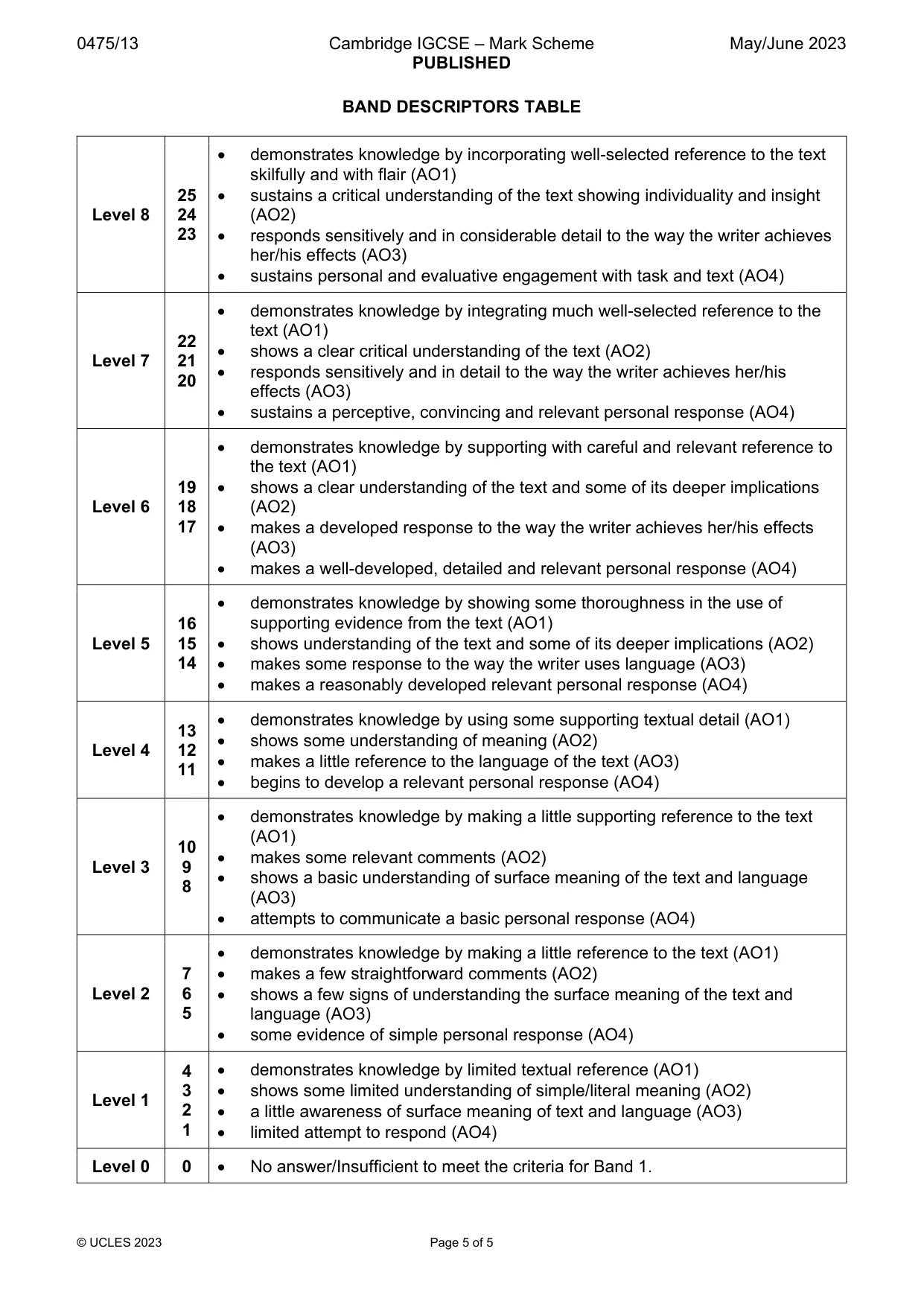
0475/13 Cambridge IGCSE – Mark Scheme PUBLISHED May/June 2023 © UCLES 2023 Page 5 of 5 BAND DESCRIPTORS TABLE Level 8 25 24 23 demonstrates knowledge by incorporating well-selected reference to the text skilfully and with flair (AO1) sustains a critical understanding of the text showing individuality and insight (AO2) responds sensitively and in considerable detail to the way the writer achieves her/his effects (AO3) sustains personal and evaluative engagement with task and text (AO4) Level 7 22 21 20 demonstrates knowledge by integrating much well-selected reference to the text (AO1) shows a clear critical understanding of the text (AO2) responds sensitively and in detail to the way the writer achieves her/his effects (AO3) sustains a perceptive, convincing and relevant personal response (AO4) Level 6 19 18 17 demonstrates knowledge by supporting with careful and relevant reference to the text (AO1) shows a clear understanding of the text and some of its deeper implications (AO2) makes a developed response to the way the writer achieves her/his effects (AO3) makes a well-developed, detailed and relevant personal response (AO4) Level 5 16 15 14 demonstrates knowledge by showing some thoroughness in the use of supporting evidence from the text (AO1) shows understanding of the text and some of its deeper implications (AO2) makes some response to the way the writer uses language (AO3) makes a reasonably developed relevant personal response (AO4) Level 4 13 12 11 demonstrates knowledge by using some supporting textual detail (AO1) shows some understanding of meaning (AO2) makes a little reference to the language of the text (AO3) begins to develop a relevant personal response (AO4) Level 3 10 9 8 demonstrates knowledge by making a little supporting reference to the text (AO1) makes some relevant comments (AO2) shows a basic understanding of surface meaning of the text and language (AO3) attempts to communicate a basic personal response (AO4) Level 2 7 6 5 demonstrates knowledge by making a little reference to the text (AO1) makes a few straightforward comments (AO2) shows a few signs of understanding the surface meaning of the text and language (AO3) some evidence of simple personal response (AO4) Level 1 4 3 2 1 demonstrates knowledge by limited textual reference (AO1) shows some limited understanding of simple/literal meaning (AO2) a little awareness of surface meaning of text and language (AO3) limited attempt to respond (AO4) Level 0 0 No answer/Insufficient to meet the criteria for Band 1.
What you needed in this session
Cambridge’s own grade thresholds for 2023 May/June, Paper 1 · Variant 3. A higher threshold means an easier paper — the bar moves with how the cohort did.