Cambridge IGCSE English - Literature in English 0475 — 2023 Oct/Nov Paper 1 · Variant 1
0475/11/O/N/23 · 50 marks · ≈56 min
The question paper and its mark scheme, free to read here and free to download. This is Cambridge’s own paper, exactly as it was sat.
Question paper28 pages


Mark scheme4 pages
Answers below. Sit the paper first if you are practising.
Paper as text
Question paper, page 1
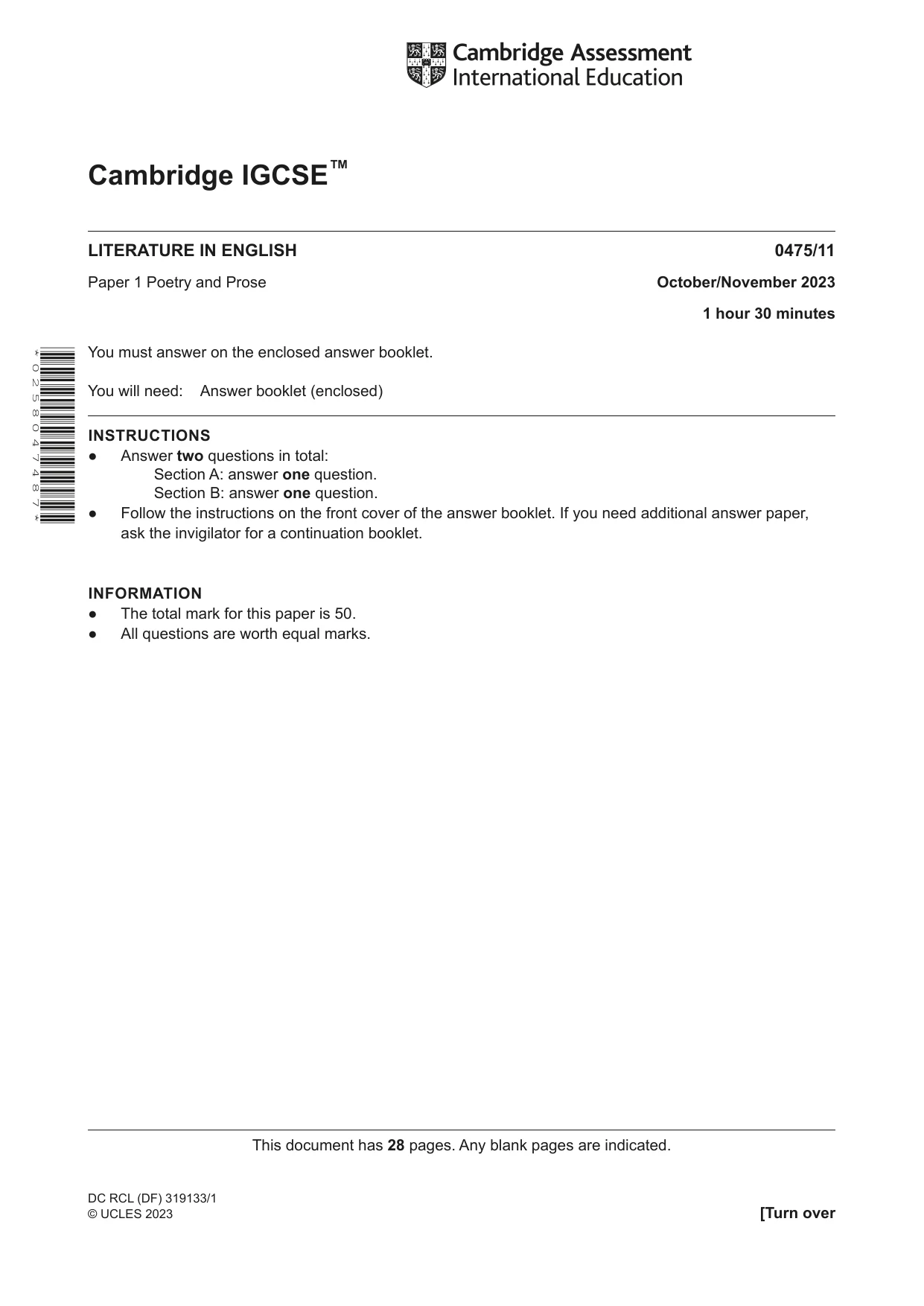
This document has 28 pages. Any blank pages are indicated. [Turn over Cambridge IGCSE™ * 0 2 5 8 0 4 7 4 8 7 * DC RCL (DF) 319133/1 © UCLES 2023 LITERATURE IN ENGLISH 0475/11 Paper 1 Poetry and Prose October/November 2023 1 hour 30 minutes You must answer on the enclosed answer booklet. You will need: Answer booklet (enclosed) INSTRUCTIONS ● Answer two questions in total: Section A: answer one question. Section B: answer one question. ● Follow the instructions on the front cover of the answer booklet. If you need additional answer paper, ask the invigilator for a continuation booklet. INFORMATION ● The total mark for this paper is 50. ● All questions are worth equal marks.
Question paper, page 2
2 0475/11/O/N/23 © UCLES 2023 BLANK PAGE
Question paper, page 3
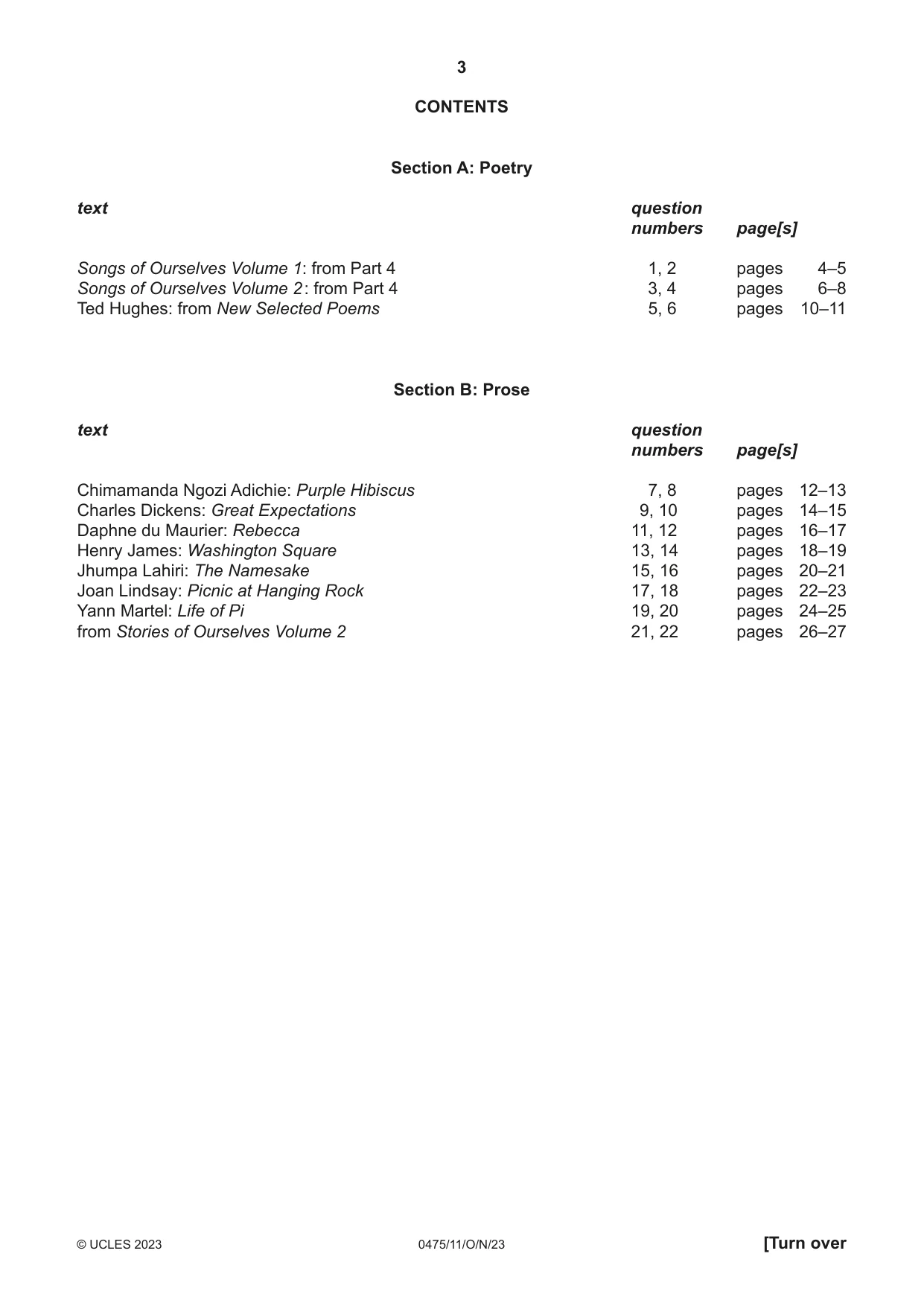
3 0475/11/O/N/23 © UCLES 2023 [Turn over CONTENTS Section A: Poetry text question numbers page[s] Songs of Ourselves Volume 1: from Part 4 1, 2 pages 4–5 Songs of Ourselves Volume 2 : from Part 4 3, 4 pages 6–8 Ted Hughes: from New Selected Poems 5, 6 pages 10–11 Section B: Prose text question numbers page[s] Chimamanda Ngozi Adichie: Purple Hibiscus 7, 8 pages 12–13 Charles Dickens: Great Expectations 9, 10 pages 14–15 Daphne du Maurier: Rebecca 11, 12 pages 16–17 Henry James: Washington Square 13, 14 pages 18–19 Jhumpa Lahiri: The Namesake 15, 16 pages 20–21 Joan Lindsay: Picnic at Hanging Rock 17, 18 pages 22–23 Yann Martel: Life of Pi 19, 20 pages 24–25 from Stories of Ourselves Volume 2 21, 22 pages 26–27
Question paper, page 4
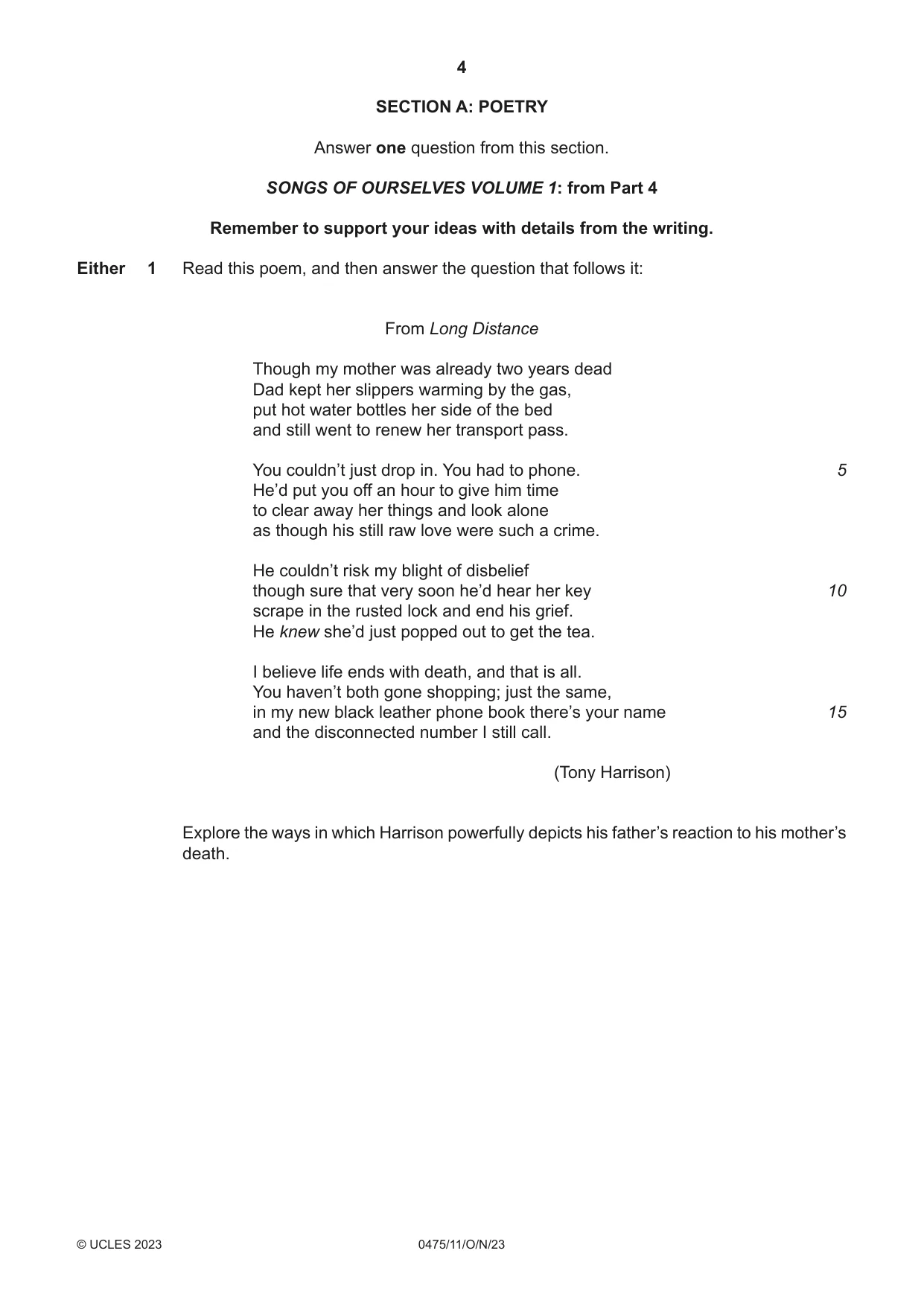
4 0475/11/O/N/23 © UCLES 2023 SECTION A: POETRY Answer one question from this section. SONGS OF OURSELVES VOLUME 1: from Part 4 Remember to support your ideas with details from the writing. Either 1 Read this poem, and then answer the question that follows it: From Long Distance Though my mother was already two years dead Dad kept her slippers warming by the gas, put hot water bottles her side of the bed and still went to renew her transport pass. You couldn’t just drop in. You had to phone. He’d put you off an hour to give him time to clear away her things and look alone as though his still raw love were such a crime. He couldn’t risk my blight of disbelief though sure that very soon he’d hear her key scrape in the rusted lock and end his grief. He knew she’d just popped out to get the tea. I believe life ends with death, and that is all. You haven’t both gone shopping; just the same, in my new black leather phone book there’s your name and the disconnected number I still call. (Tony Harrison) Explore the ways in which Harrison powerfully depicts his father’s reaction to his mother’s death. 5 10 15
Question paper, page 5
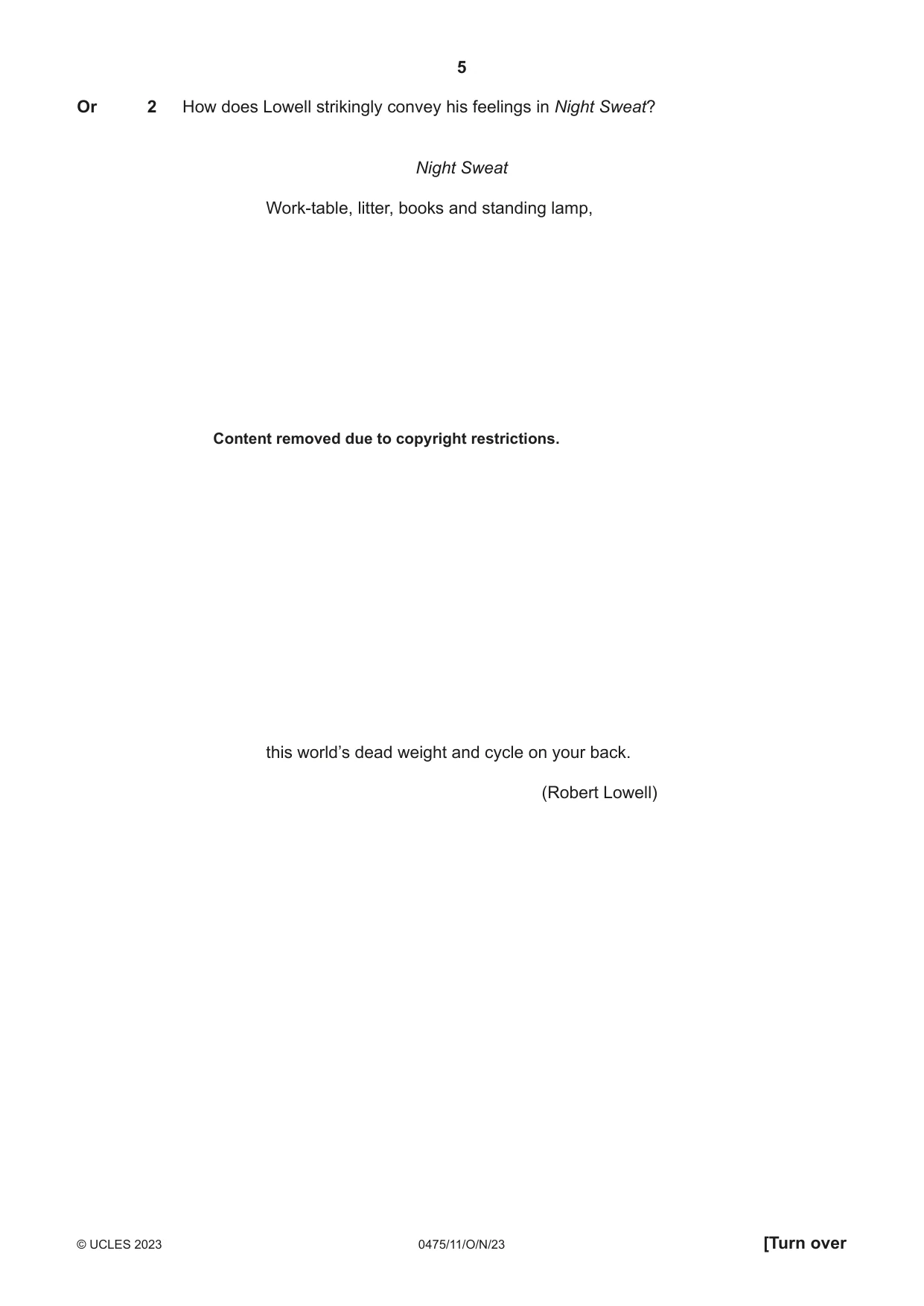
5 0475/11/O/N/23 © UCLES 2023 [Turn over Or 2 How does Lowell strikingly convey his feelings in Night Sweat? Night Sweat Work-table, litter, books and standing lamp, this world’s dead weight and cycle on your back. (Robert Lowell) Content removed due to copyright restrictions.
Question paper, page 6
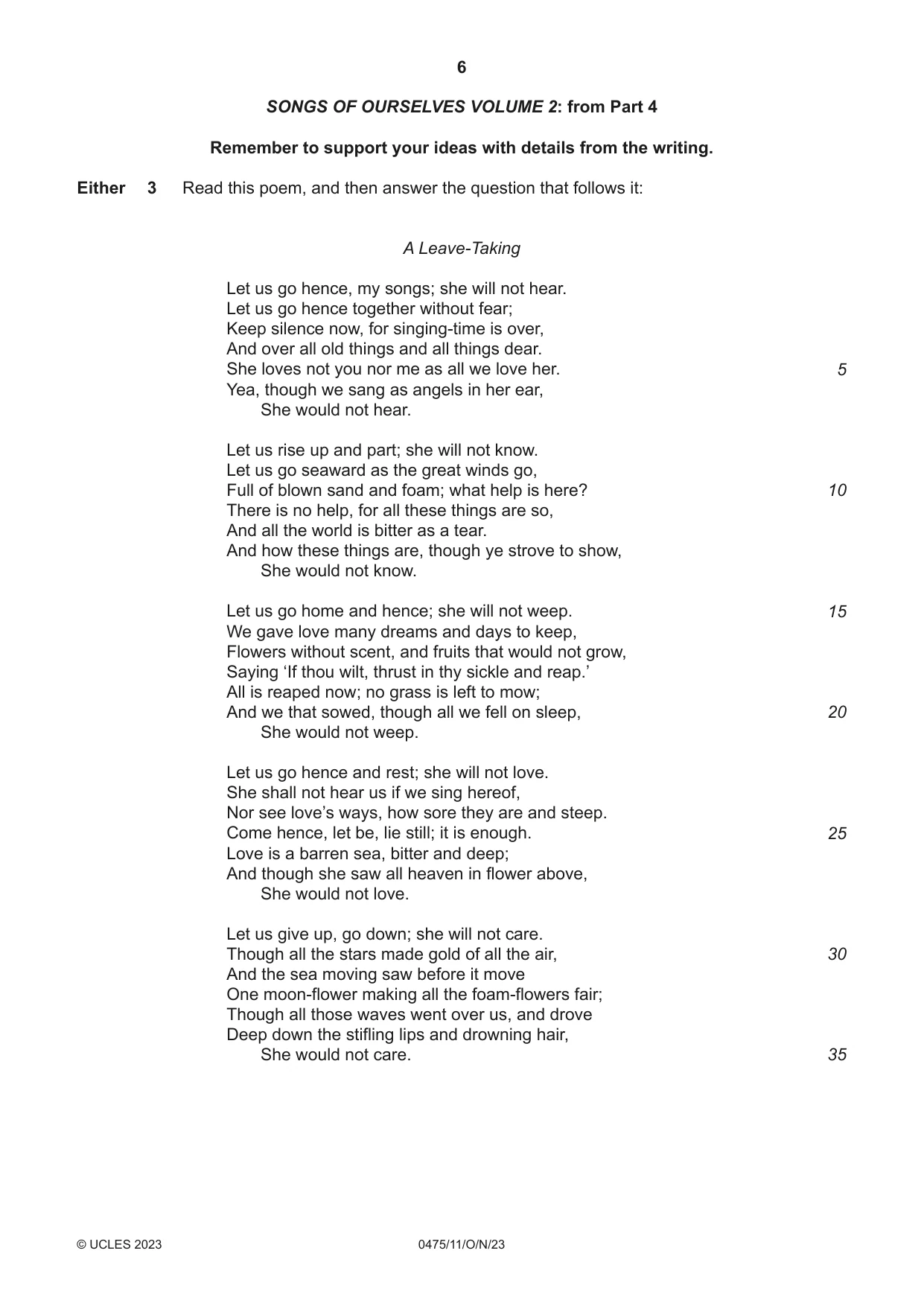
6 0475/11/O/N/23 © UCLES 2023 SONGS OF OURSELVES VOLUME 2: from Part 4 Remember to support your ideas with details from the writing. Either 3 Read this poem, and then answer the question that follows it: A Leave-Taking Let us go hence, my songs; she will not hear. Let us go hence together without fear; Keep silence now, for singing-time is over, And over all old things and all things dear. She loves not you nor me as all we love her. Yea, though we sang as angels in her ear, She would not hear. Let us rise up and part; she will not know. Let us go seaward as the great winds go, Full of blown sand and foam; what help is here? There is no help, for all these things are so, And all the world is bitter as a tear. And how these things are, though ye strove to show, She would not know. Let us go home and hence; she will not weep. We gave love many dreams and days to keep, Flowers without scent, and fruits that would not grow, Saying ‘If thou wilt, thrust in thy sickle and reap.’ All is reaped now; no grass is left to mow; And we that sowed, though all we fell on sleep, She would not weep. Let us go hence and rest; she will not love. She shall not hear us if we sing hereof, Nor see love’s ways, how sore they are and steep. Come hence, let be, lie still; it is enough. Love is a barren sea, bitter and deep; And though she saw all heaven in flower above, She would not love. Let us give up, go down; she will not care. Though all the stars made gold of all the air, And the sea moving saw before it move One moon-flower making all the foam-flowers fair; Though all those waves went over us, and drove Deep down the stifling lips and drowning hair, She would not care. 5 10 15 20 25 30 35
Question paper, page 7
7 0475/11/O/N/23 © UCLES 2023 [Turn over Let us go hence, go hence; she will not see. Sing all once more together; surely she, She too, remembering days and words that were, Will turn a little toward us, sighing; but we, We are hence, we are gone, as though we had not been there. Nay, and though all men seeing had pity on me, She would not see. (Algernon Charles Swinburne) Explore how Swinburne memorably conveys the speaker’s feelings in this poem. 40
Question paper, page 8
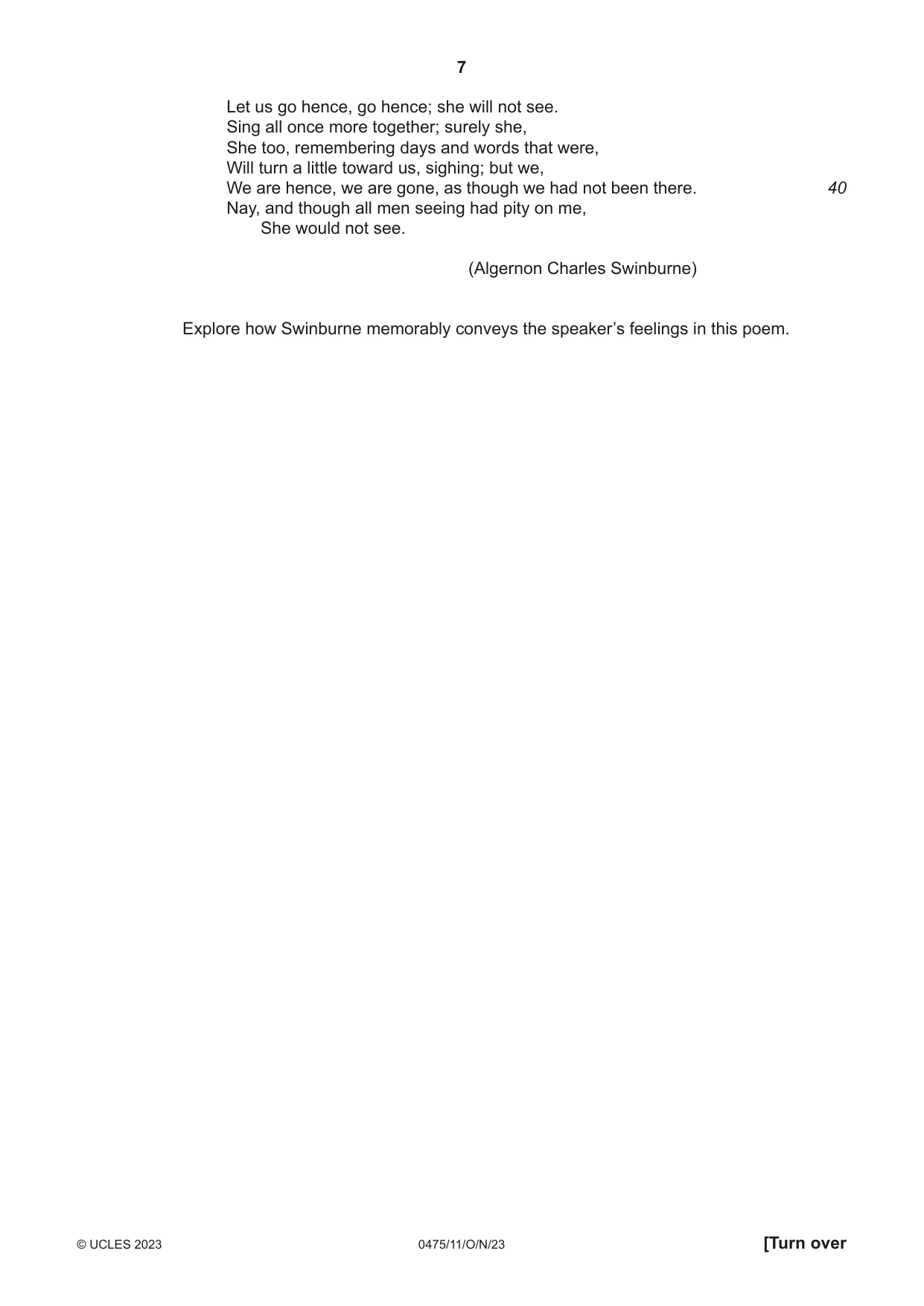
8 0475/11/O/N/23 © UCLES 2023 Or 4 How does Walcott make Nearing Forty such a moving poem? Nearing Forty (for John Figueroa) The irregular combination of fanciful invention may delight awhile by that novelty of which the common satiety of life sends us all in quest. even when it seems to weep. (Derek Walcott) Content removed due to copyright restrictions.
Question paper, page 9
9 0475/11/O/N/23 © UCLES 2023 [Turn over TURN OVER FOR QUESTION 5.
Question paper, page 10
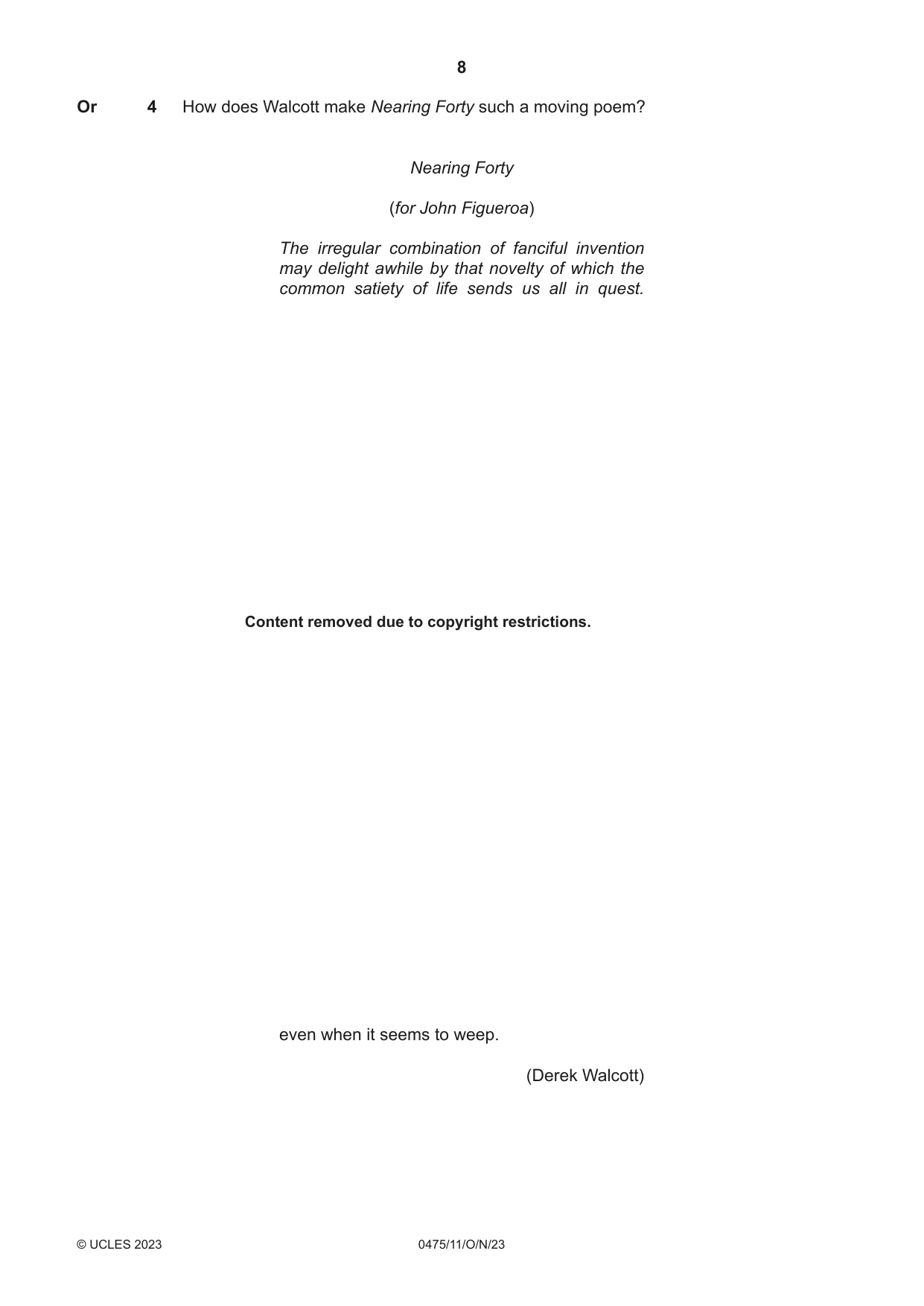
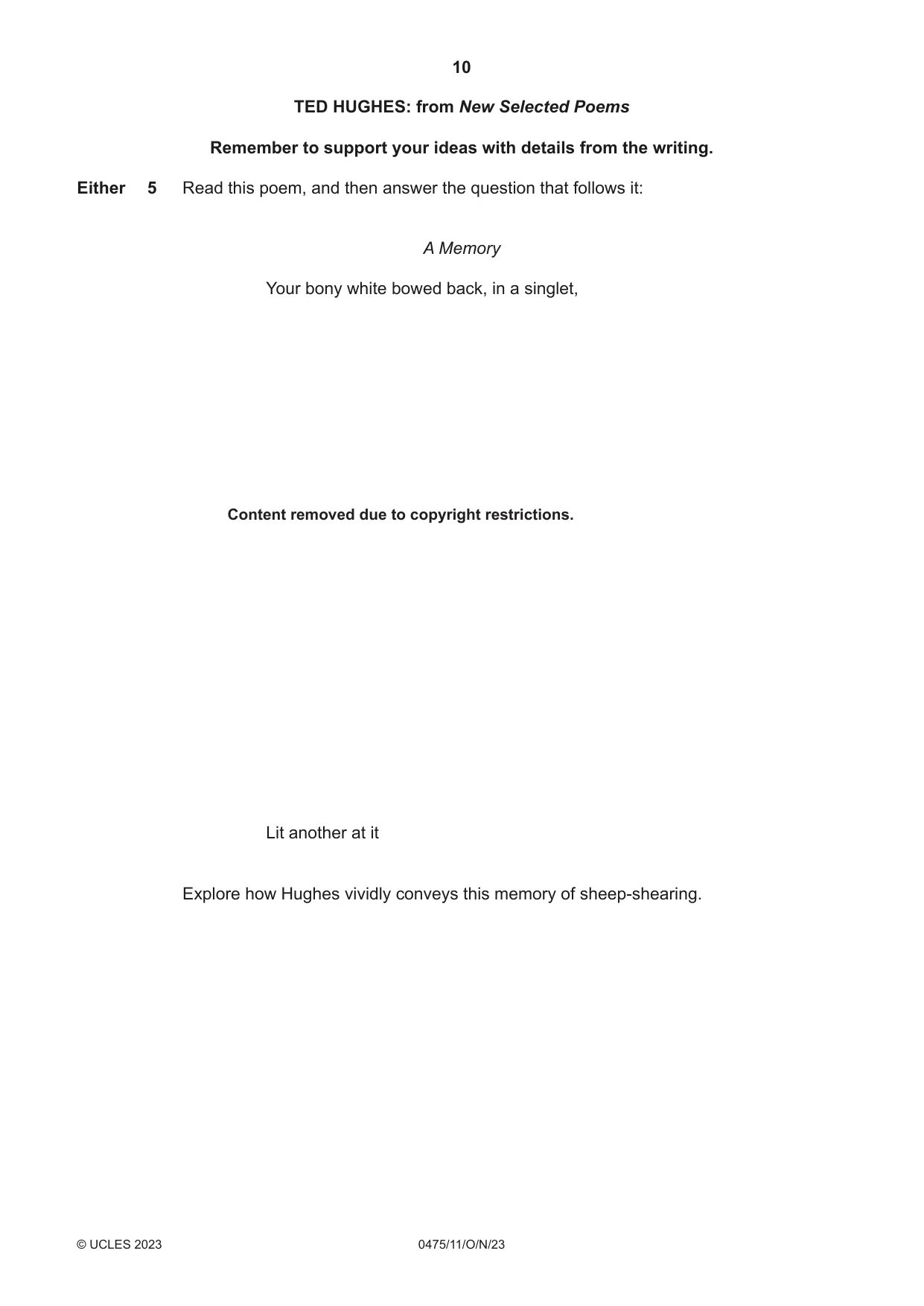
10 0475/11/O/N/23 © UCLES 2023 TED HUGHES: from New Selected Poems Remember to support your ideas with details from the writing. Either 5 Read this poem, and then answer the question that follows it: A Memory Your bony white bowed back, in a singlet, Lit another at it Explore how Hughes vividly conveys this memory of sheep-shearing. Content removed due to copyright restrictions.
Question paper, page 11
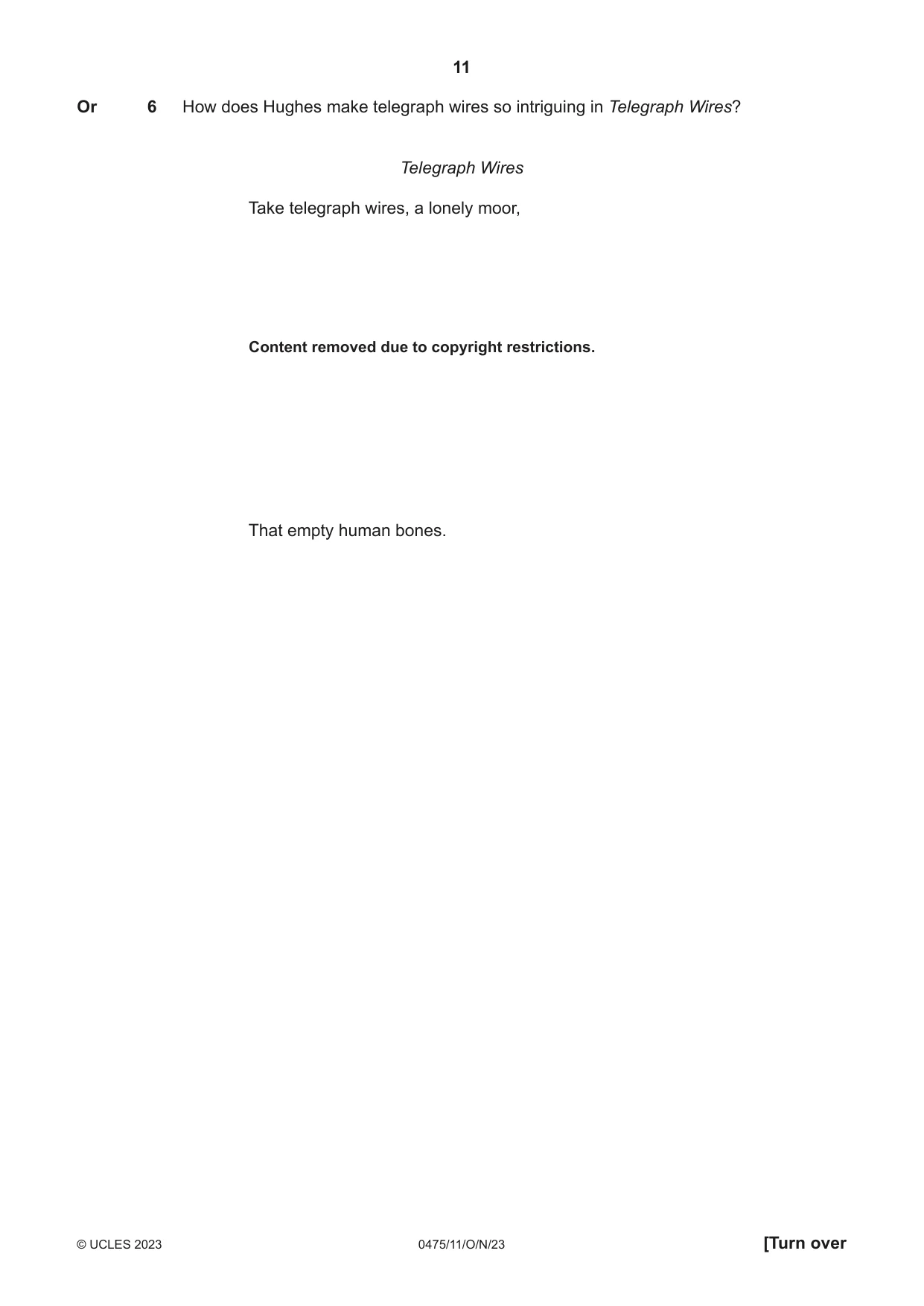
11 0475/11/O/N/23 © UCLES 2023 [Turn over Or 6 How does Hughes make telegraph wires so intriguing in Telegraph Wires? Telegraph Wires Take telegraph wires, a lonely moor, That empty human bones. Content removed due to copyright restrictions.
Question paper, page 12
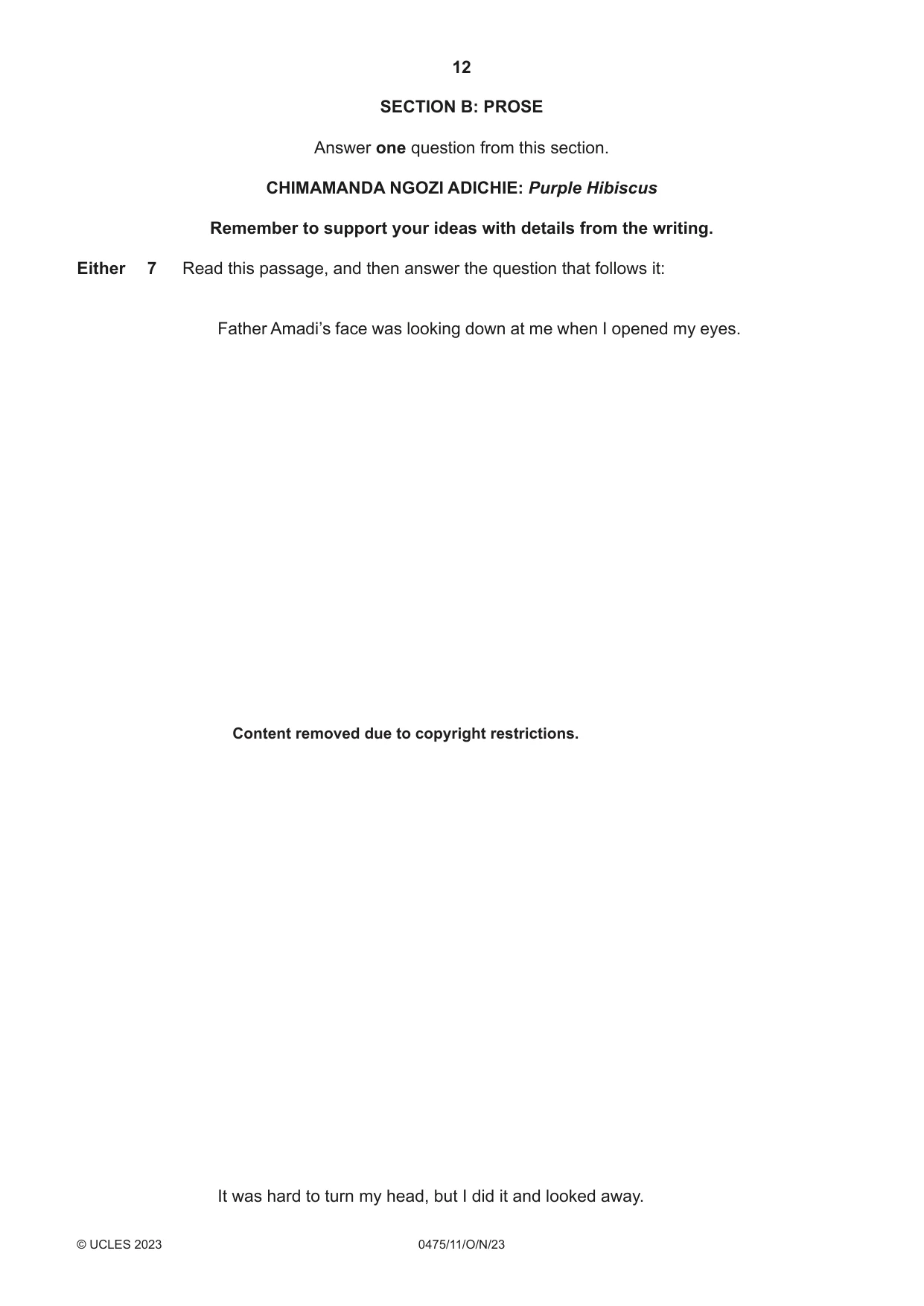
12 0475/11/O/N/23 © UCLES 2023 SECTION B: PROSE Answer one question from this section. CHIMAMANDA NGOZI ADICHIE: Purple Hibiscus Remember to support your ideas with details from the writing. Either 7 Read this passage, and then answer the question that follows it: Father Amadi’s face was looking down at me when I opened my eyes. It was hard to turn my head, but I did it and looked away. Content removed due to copyright restrictions.
Question paper, page 13
13 0475/11/O/N/23 © UCLES 2023 [Turn over Explore the ways in which Adichie makes this moment in the novel so powerful. Or 8 In what ways does Adichie vividly convey Aunty Ifeoma’s importance to Kambili? Do not use the extract printed for Question 7 in answering this question.
Question paper, page 14
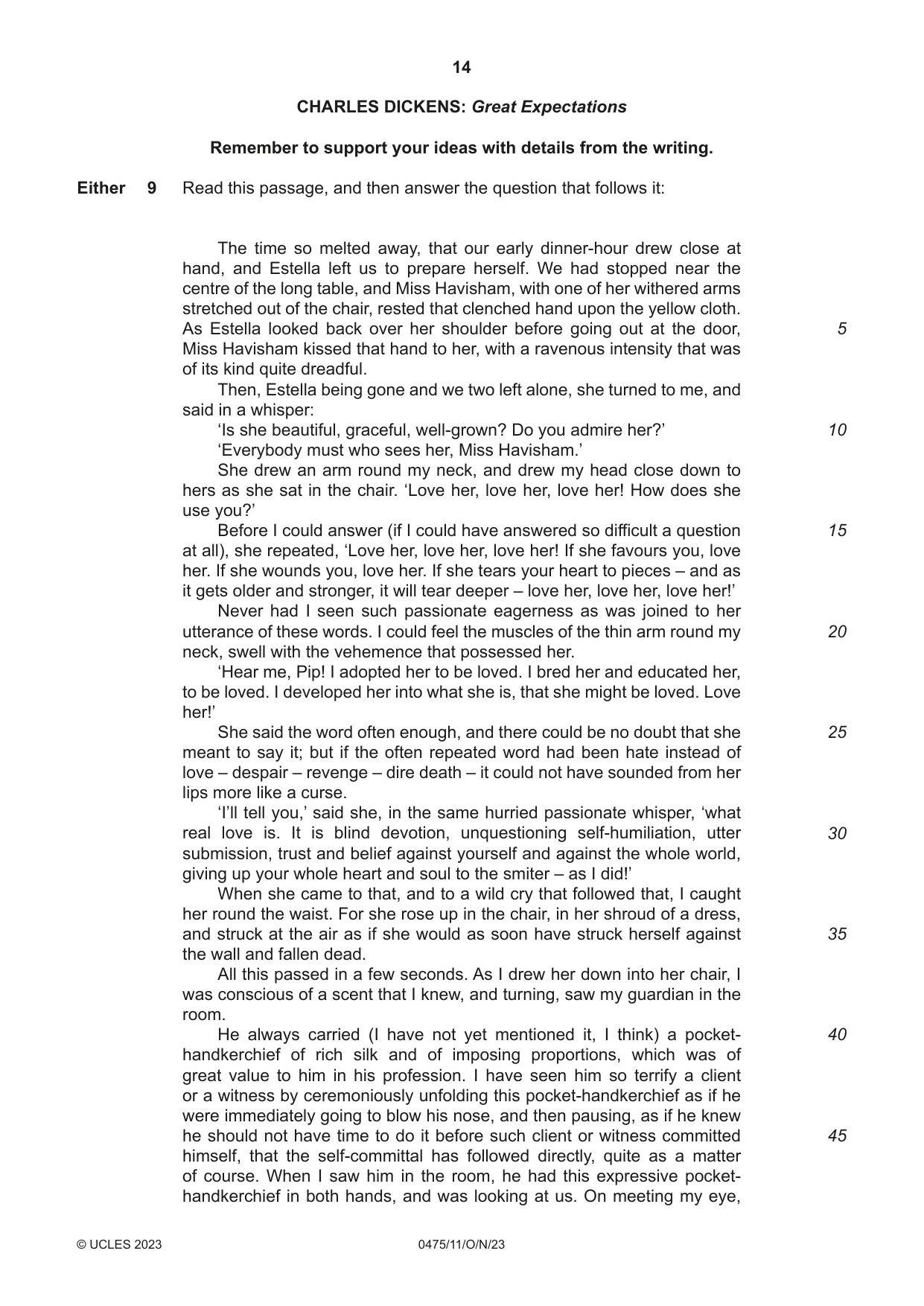
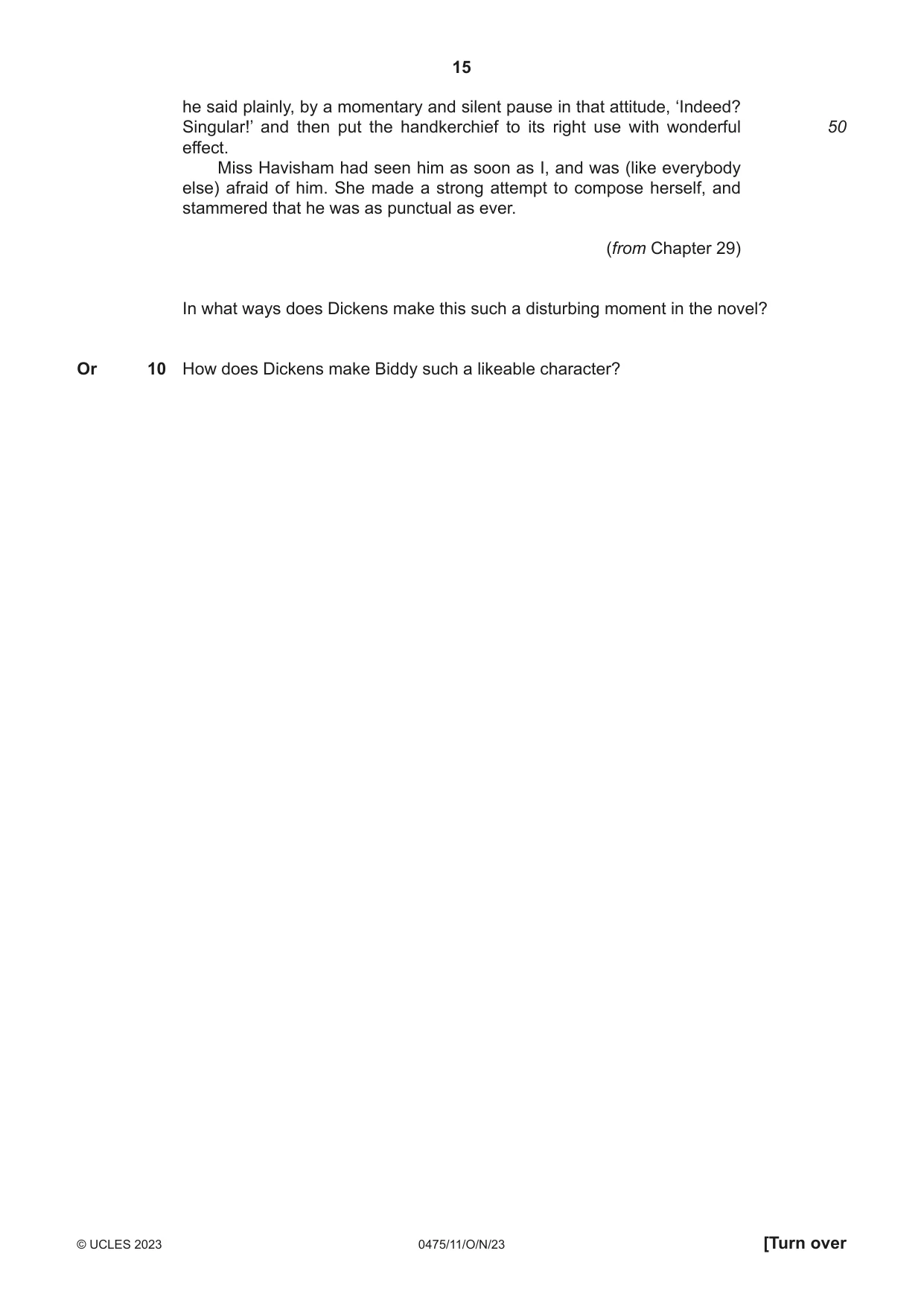
14 0475/11/O/N/23 © UCLES 2023 CHARLES DICKENS: Great Expectations Remember to support your ideas with details from the writing. Either 9 Read this passage, and then answer the question that follows it: The time so melted away, that our early dinner-hour drew close at hand, and Estella left us to prepare herself. We had stopped near the centre of the long table, and Miss Havisham, with one of her withered arms stretched out of the chair, rested that clenched hand upon the yellow cloth. As Estella looked back over her shoulder before going out at the door, Miss Havisham kissed that hand to her, with a ravenous intensity that was of its kind quite dreadful. Then, Estella being gone and we two left alone, she turned to me, and said in a whisper: ‘Is she beautiful, graceful, well-grown? Do you admire her?’ ‘Everybody must who sees her, Miss Havisham.’ She drew an arm round my neck, and drew my head close down to hers as she sat in the chair. ‘Love her, love her, love her! How does she use you?’ Before I could answer (if I could have answered so difficult a question at all), she repeated, ‘Love her, love her, love her! If she favours you, love her. If she wounds you, love her. If she tears your heart to pieces – and as it gets older and stronger, it will tear deeper – love her, love her, love her!’ Never had I seen such passionate eagerness as was joined to her utterance of these words. I could feel the muscles of the thin arm round my neck, swell with the vehemence that possessed her. ‘Hear me, Pip! I adopted her to be loved. I bred her and educated her, to be loved. I developed her into what she is, that she might be loved. Love her!’ She said the word often enough, and there could be no doubt that she meant to say it; but if the often repeated word had been hate instead of love – despair – revenge – dire death – it could not have sounded from her lips more like a curse. ‘I’ll tell you,’ said she, in the same hurried passionate whisper, ‘what real love is. It is blind devotion, unquestioning self-humiliation, utter submission, trust and belief against yourself and against the whole world, giving up your whole heart and soul to the smiter – as I did!’ When she came to that, and to a wild cry that followed that, I caught her round the waist. For she rose up in the chair, in her shroud of a dress, and struck at the air as if she would as soon have struck herself against the wall and fallen dead. All this passed in a few seconds. As I drew her down into her chair, I was conscious of a scent that I knew, and turning, saw my guardian in the room. He always carried (I have not yet mentioned it, I think) a pocket- handkerchief of rich silk and of imposing proportions, which was of great value to him in his profession. I have seen him so terrify a client or a witness by ceremoniously unfolding this pocket-handkerchief as if he were immediately going to blow his nose, and then pausing, as if he knew he should not have time to do it before such client or witness committed himself, that the self-committal has followed directly, quite as a matter of course. When I saw him in the room, he had this expressive pocket- handkerchief in both hands, and was looking at us. On meeting my eye, 5 10 15 20 25 30 35 40 45
Question paper, page 15
15 0475/11/O/N/23 © UCLES 2023 [Turn over he said plainly, by a momentary and silent pause in that attitude, ‘Indeed? Singular!’ and then put the handkerchief to its right use with wonderful effect. Miss Havisham had seen him as soon as I, and was (like everybody else) afraid of him. She made a strong attempt to compose herself, and stammered that he was as punctual as ever. (from Chapter 29) In what ways does Dickens make this such a disturbing moment in the novel? Or 10 How does Dickens make Biddy such a likeable character? 50
Question paper, page 16
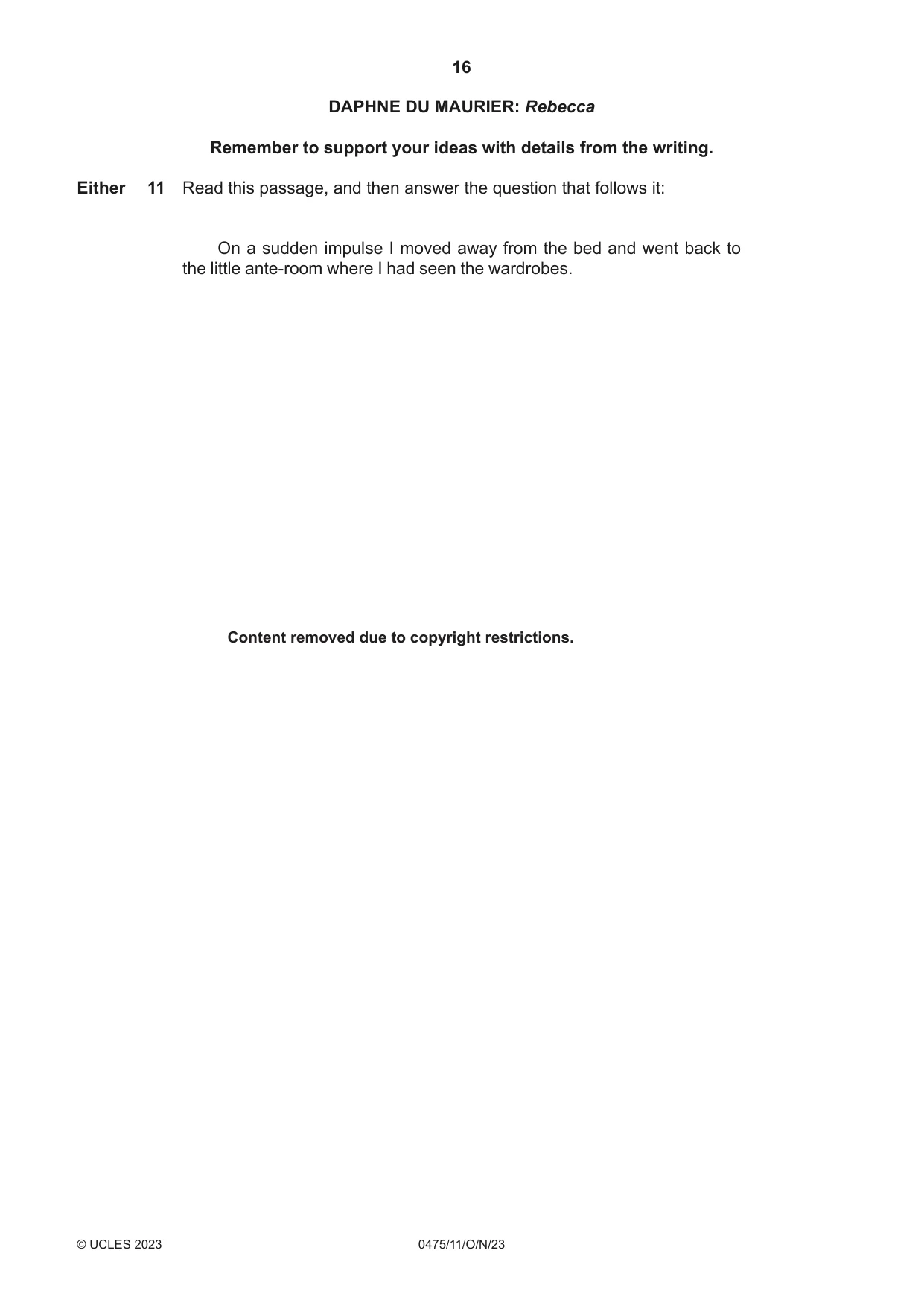
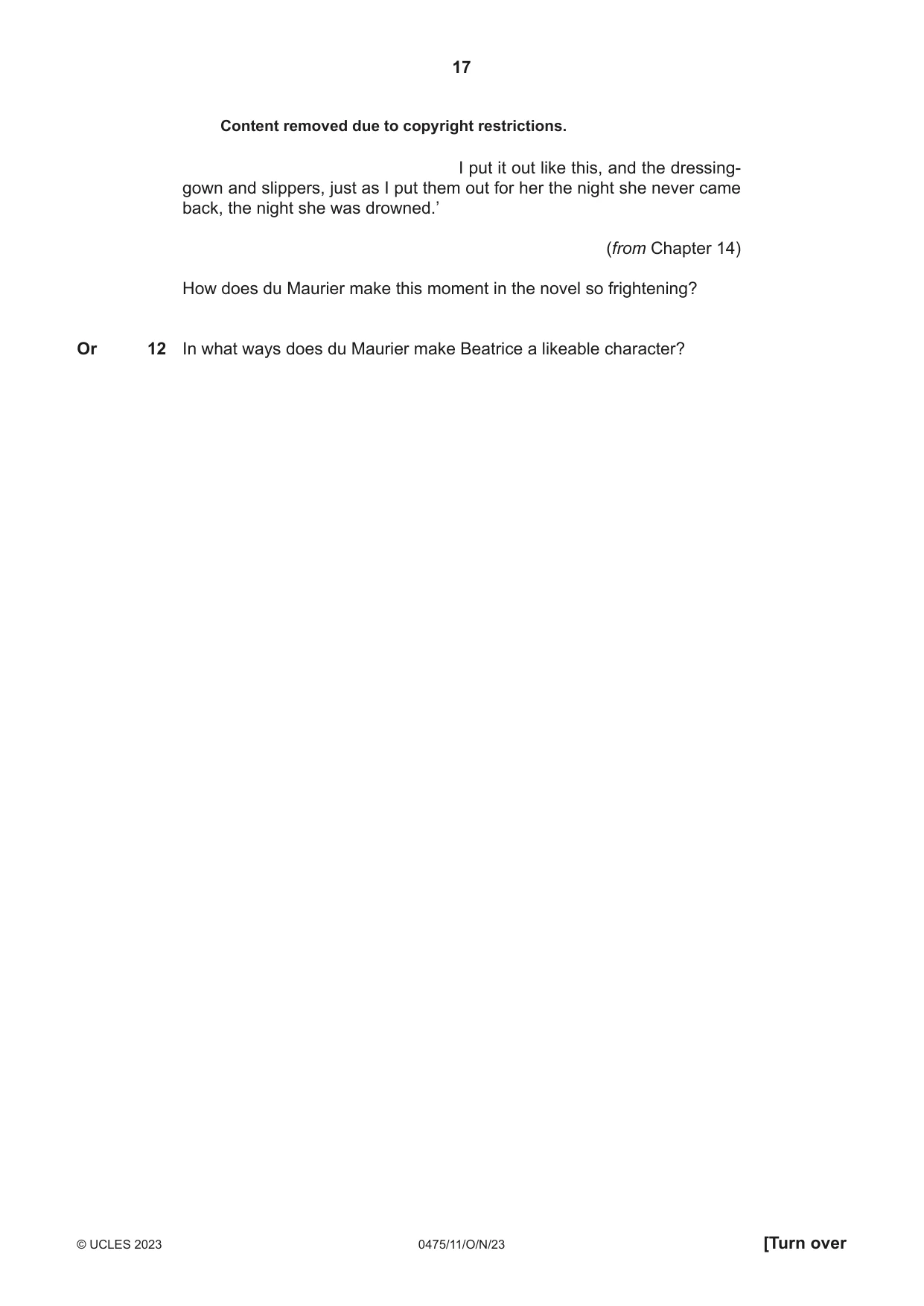
16 0475/11/O/N/23 © UCLES 2023 DAPHNE DU MAURIER: Rebecca Remember to support your ideas with details from the writing. Either 11 Read this passage, and then answer the question that follows it: On a sudden impulse I moved away from the bed and went back to the little ante-room where I had seen the wardrobes. Content removed due to copyright restrictions.
Question paper, page 17
17 0475/11/O/N/23 © UCLES 2023 [Turn over I put it out like this, and the dressing- gown and slippers, just as I put them out for her the night she never came back, the night she was drowned.’ (from Chapter 14) How does du Maurier make this moment in the novel so frightening? Or 12 In what ways does du Maurier make Beatrice a likeable character? Content removed due to copyright restrictions.
Question paper, page 18
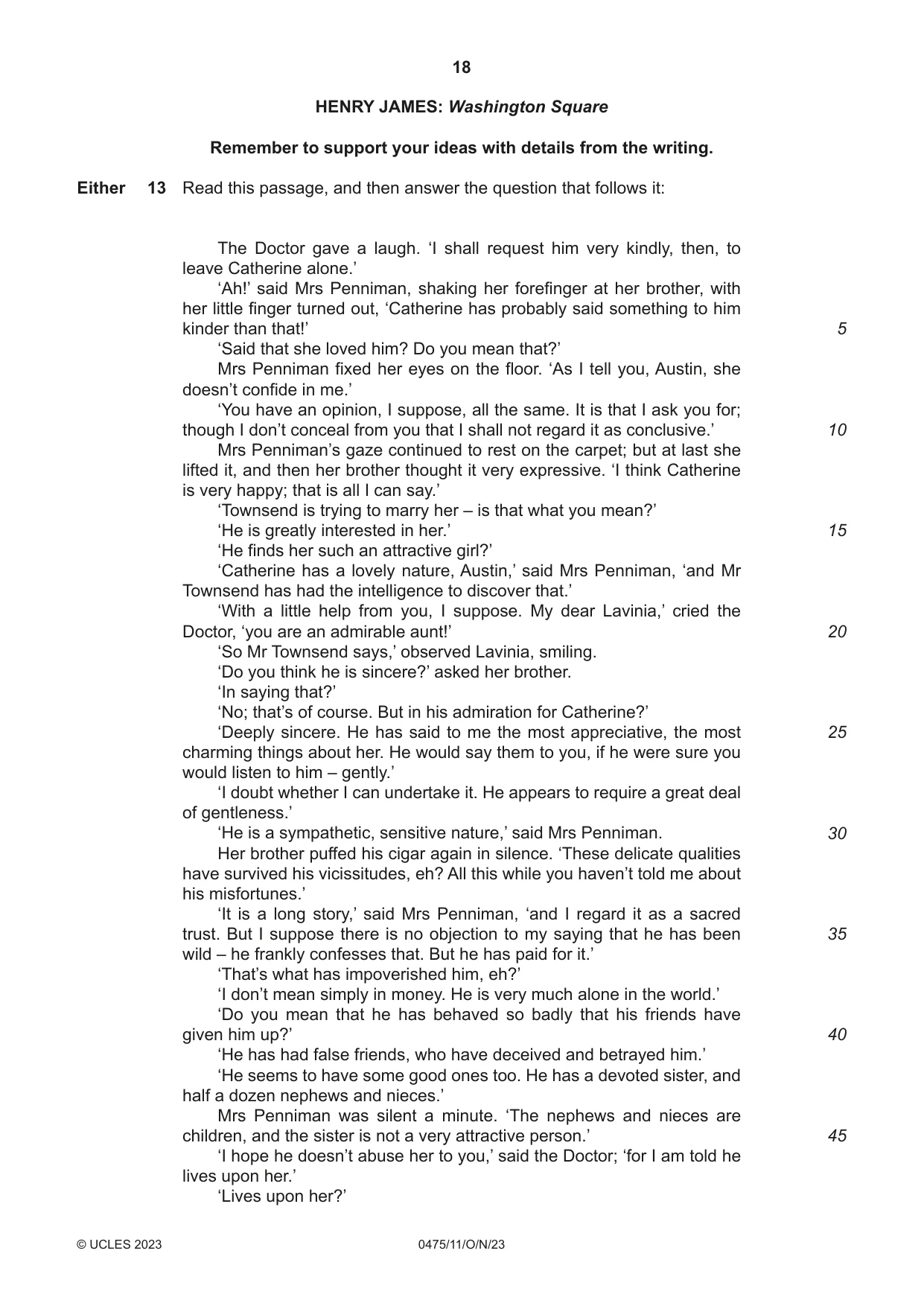
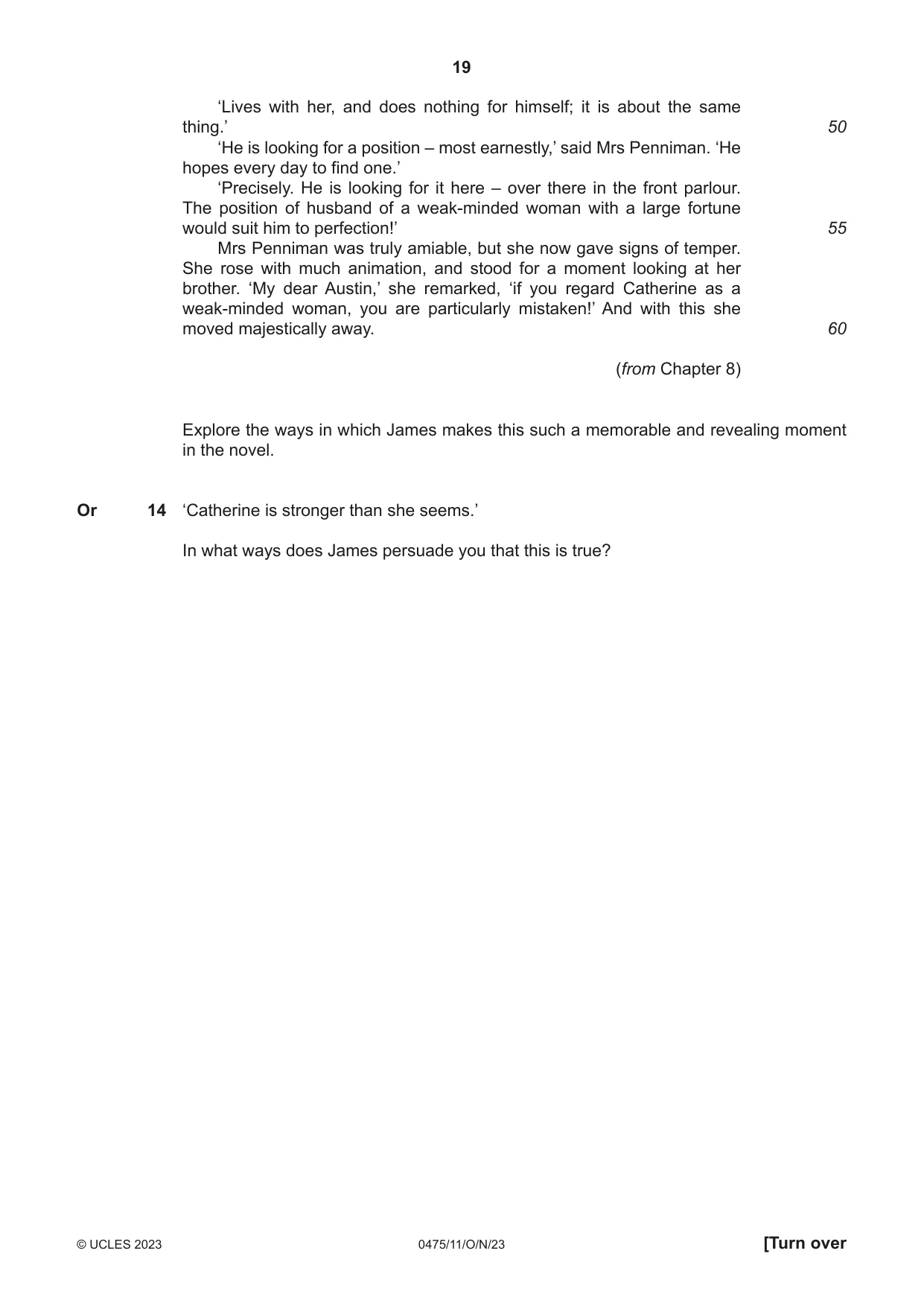
18 0475/11/O/N/23 © UCLES 2023 HENRY JAMES: Washington Square Remember to support your ideas with details from the writing. Either 13 Read this passage, and then answer the question that follows it: The Doctor gave a laugh. ‘I shall request him very kindly, then, to leave Catherine alone.’ ‘Ah!’ said Mrs Penniman, shaking her forefinger at her brother, with her little finger turned out, ‘Catherine has probably said something to him kinder than that!’ ‘Said that she loved him? Do you mean that?’ Mrs Penniman fixed her eyes on the floor. ‘As I tell you, Austin, she doesn’t confide in me.’ ‘You have an opinion, I suppose, all the same. It is that I ask you for; though I don’t conceal from you that I shall not regard it as conclusive.’ Mrs Penniman’s gaze continued to rest on the carpet; but at last she lifted it, and then her brother thought it very expressive. ‘I think Catherine is very happy; that is all I can say.’ ‘Townsend is trying to marry her – is that what you mean?’ ‘He is greatly interested in her.’ ‘He finds her such an attractive girl?’ ‘Catherine has a lovely nature, Austin,’ said Mrs Penniman, ‘and Mr Townsend has had the intelligence to discover that.’ ‘With a little help from you, I suppose. My dear Lavinia,’ cried the Doctor, ‘you are an admirable aunt!’ ‘So Mr Townsend says,’ observed Lavinia, smiling. ‘Do you think he is sincere?’ asked her brother. ‘In saying that?’ ‘No; that’s of course. But in his admiration for Catherine?’ ‘Deeply sincere. He has said to me the most appreciative, the most charming things about her. He would say them to you, if he were sure you would listen to him – gently.’ ‘I doubt whether I can undertake it. He appears to require a great deal of gentleness.’ ‘He is a sympathetic, sensitive nature,’ said Mrs Penniman. Her brother puffed his cigar again in silence. ‘These delicate qualities have survived his vicissitudes, eh? All this while you haven’t told me about his misfortunes.’ ‘It is a long story,’ said Mrs Penniman, ‘and I regard it as a sacred trust. But I suppose there is no objection to my saying that he has been wild – he frankly confesses that. But he has paid for it.’ ‘That’s what has impoverished him, eh?’ ‘I don’t mean simply in money. He is very much alone in the world.’ ‘Do you mean that he has behaved so badly that his friends have given him up?’ ‘He has had false friends, who have deceived and betrayed him.’ ‘He seems to have some good ones too. He has a devoted sister, and half a dozen nephews and nieces.’ Mrs Penniman was silent a minute. ‘The nephews and nieces are children, and the sister is not a very attractive person.’ ‘I hope he doesn’t abuse her to you,’ said the Doctor; ‘for I am told he lives upon her.’ ‘Lives upon her?’ 5 10 15 20 25 30 35 40 45
Question paper, page 19
19 0475/11/O/N/23 © UCLES 2023 [Turn over ‘Lives with her, and does nothing for himself; it is about the same thing.’ ‘He is looking for a position – most earnestly,’ said Mrs Penniman. ‘He hopes every day to find one.’ ‘Precisely. He is looking for it here – over there in the front parlour. The position of husband of a weak-minded woman with a large fortune would suit him to perfection!’ Mrs Penniman was truly amiable, but she now gave signs of temper. She rose with much animation, and stood for a moment looking at her brother. ‘My dear Austin,’ she remarked, ‘if you regard Catherine as a weak-minded woman, you are particularly mistaken!’ And with this she moved majestically away. (from Chapter 8) Explore the ways in which James makes this such a memorable and revealing moment in the novel. Or 14 ‘Catherine is stronger than she seems.’ In what ways does James persuade you that this is true? 50 55 60
Question paper, page 20
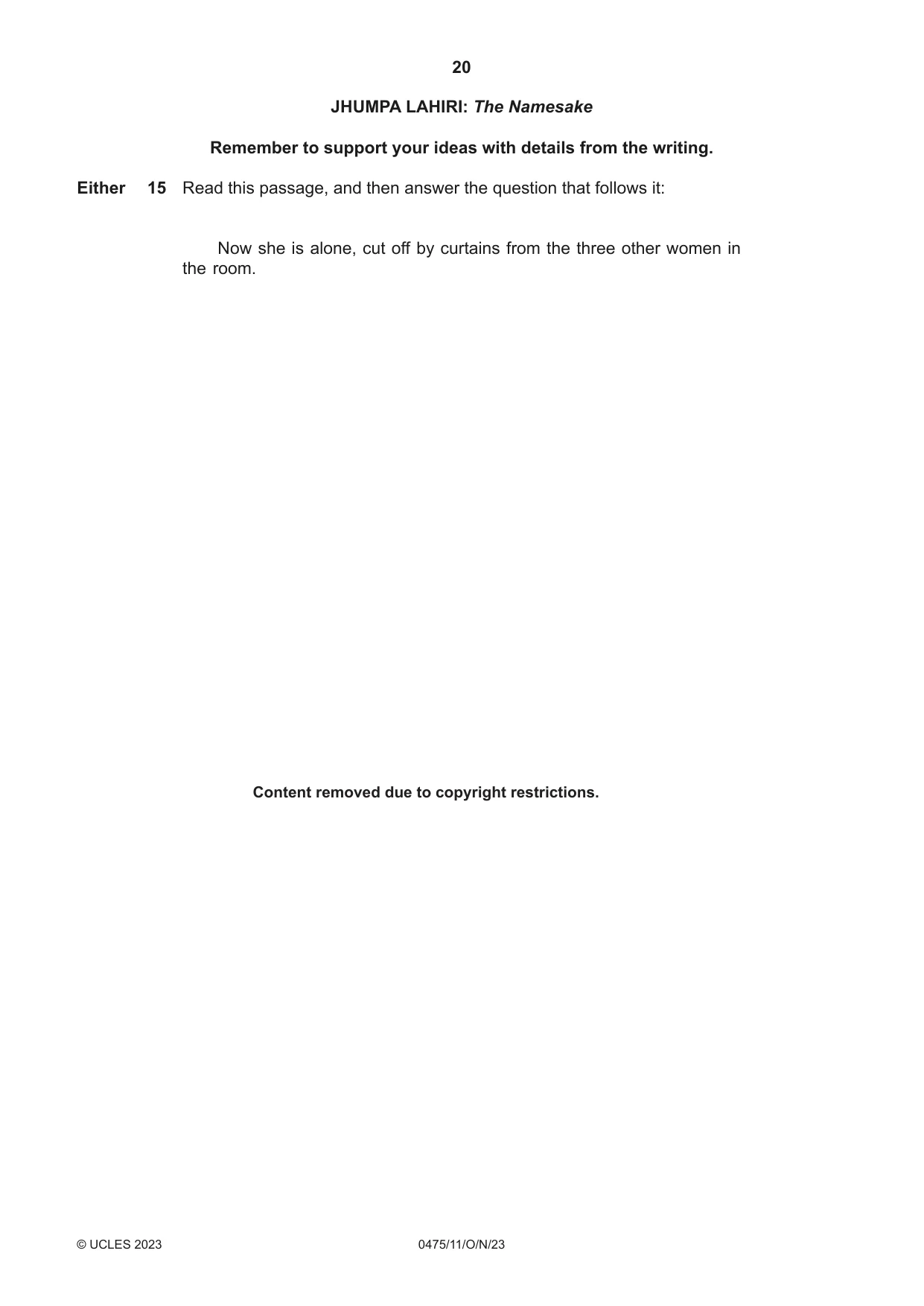
20 0475/11/O/N/23 © UCLES 2023 JHUMPA LAHIRI: The Namesake Remember to support your ideas with details from the writing. Either 15 Read this passage, and then answer the question that follows it: Now she is alone, cut off by curtains from the three other women in the room. Content removed due to copyright restrictions.
Question paper, page 21
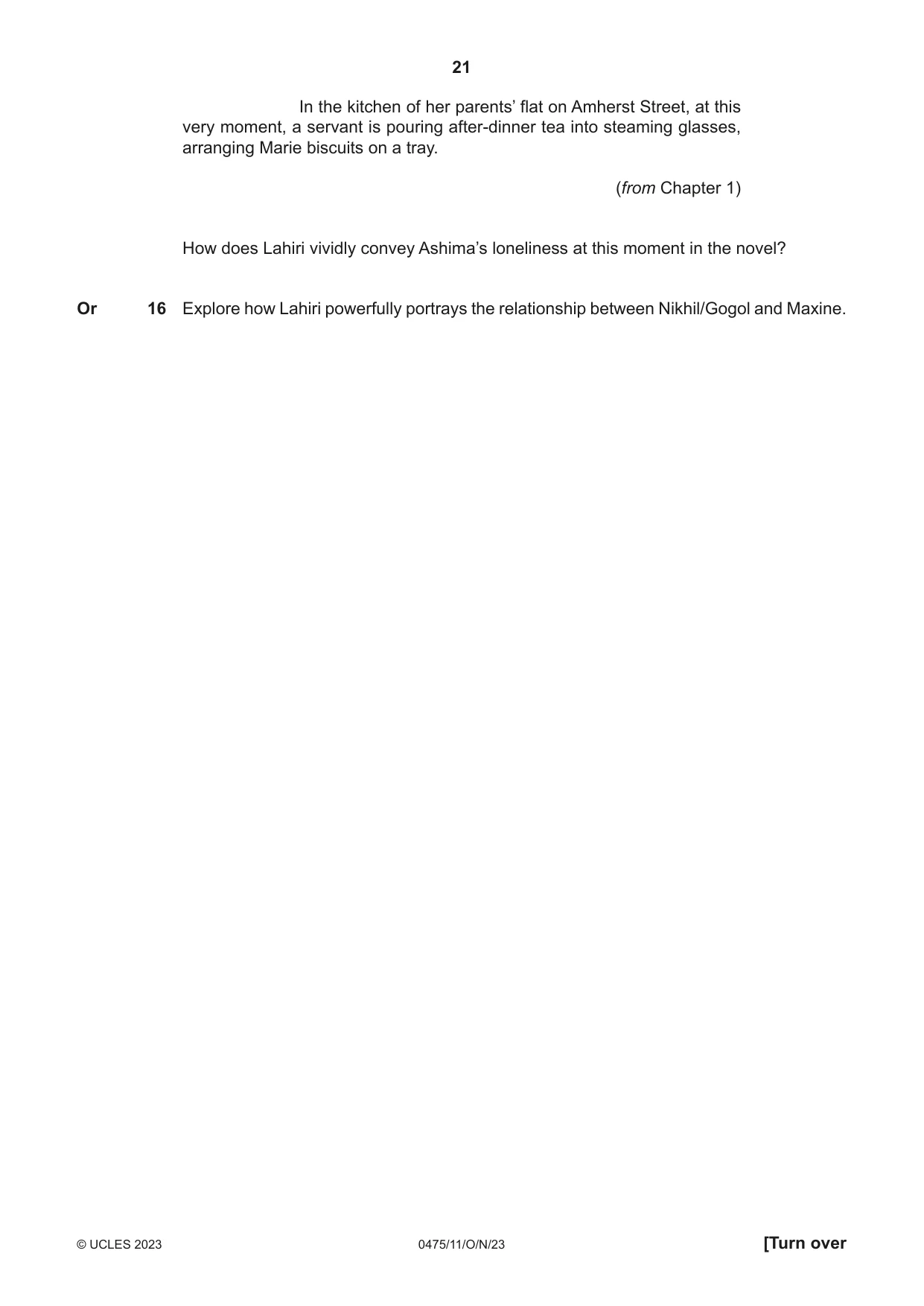
21 0475/11/O/N/23 © UCLES 2023 [Turn over In the kitchen of her parents’ flat on Amherst Street, at this very moment, a servant is pouring after-dinner tea into steaming glasses, arranging Marie biscuits on a tray. (from Chapter 1) How does Lahiri vividly convey Ashima’s loneliness at this moment in the novel? Or 16 Explore how Lahiri powerfully portrays the relationship between Nikhil/Gogol and Maxine.
Question paper, page 22
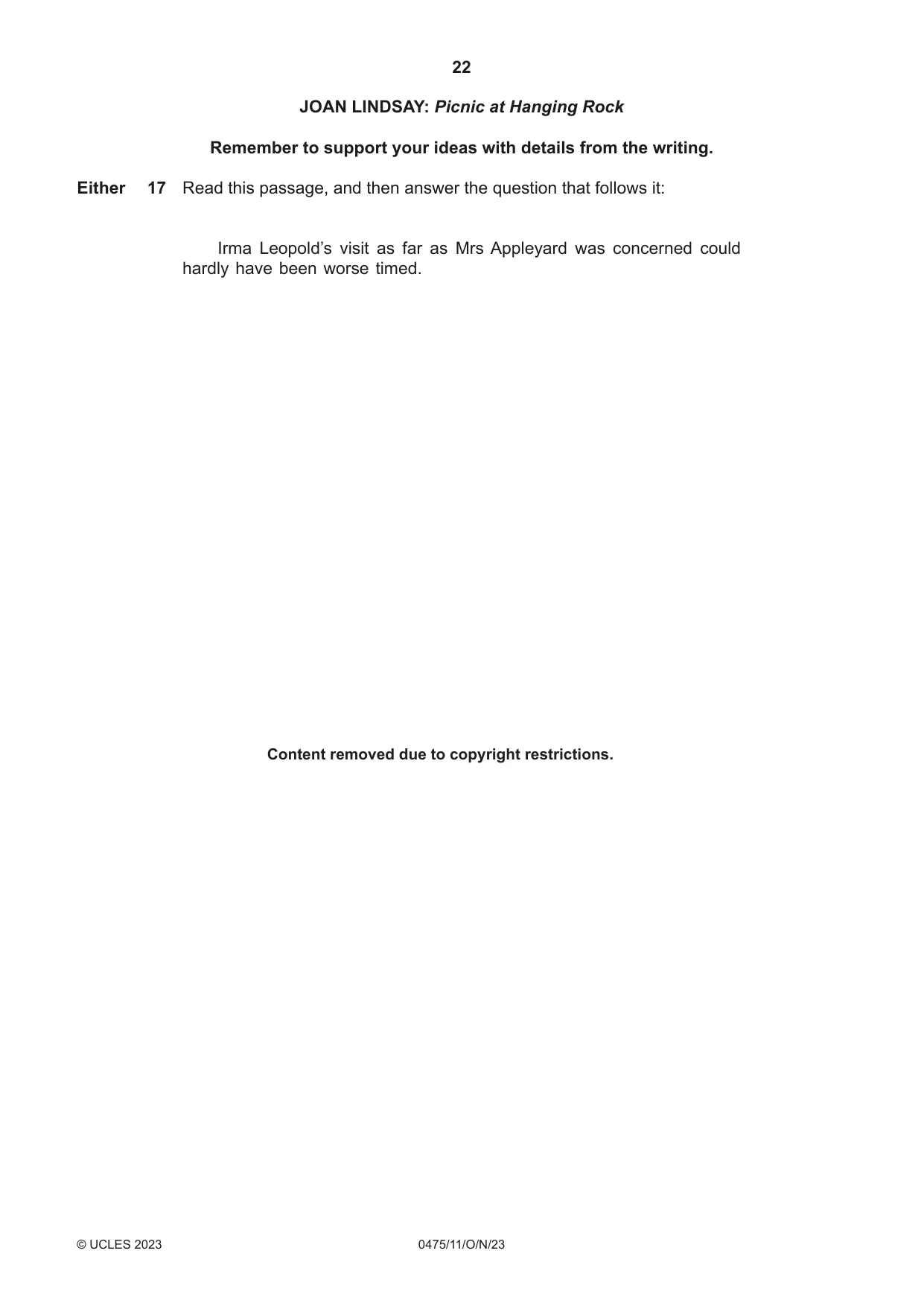
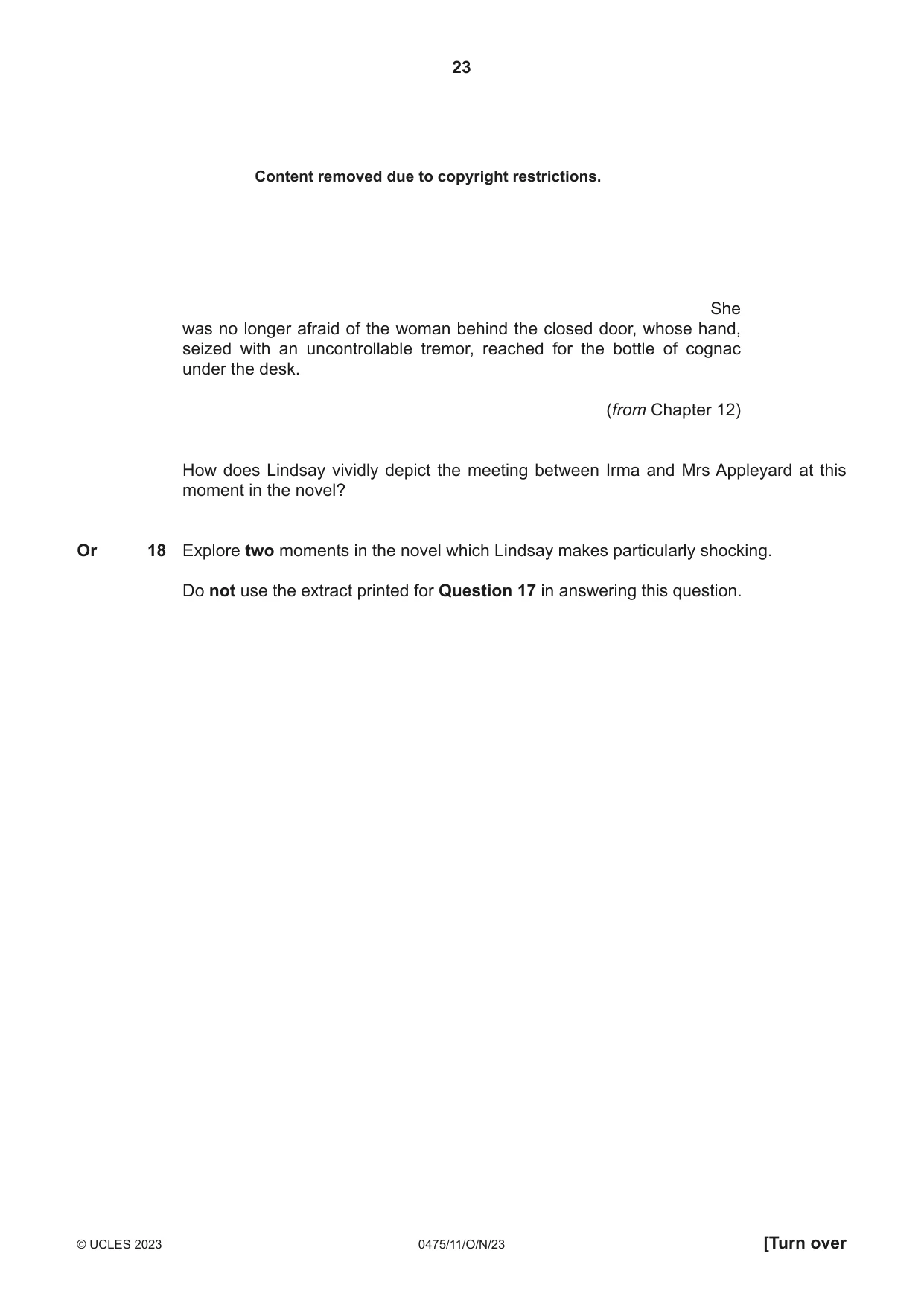
22 0475/11/O/N/23 © UCLES 2023 JOAN LINDSAY: Picnic at Hanging Rock Remember to support your ideas with details from the writing. Either 17 Read this passage, and then answer the question that follows it: Irma Leopold’s visit as far as Mrs Appleyard was concerned could hardly have been worse timed. Content removed due to copyright restrictions.
Question paper, page 23
23 0475/11/O/N/23 © UCLES 2023 [Turn over She was no longer afraid of the woman behind the closed door, whose hand, seized with an uncontrollable tremor, reached for the bottle of cognac under the desk. (from Chapter 12) How does Lindsay vividly depict the meeting between Irma and Mrs Appleyard at this moment in the novel? Or 18 Explore two moments in the novel which Lindsay makes particularly shocking. Do not use the extract printed for Question 17 in answering this question. Content removed due to copyright restrictions.
Question paper, page 24
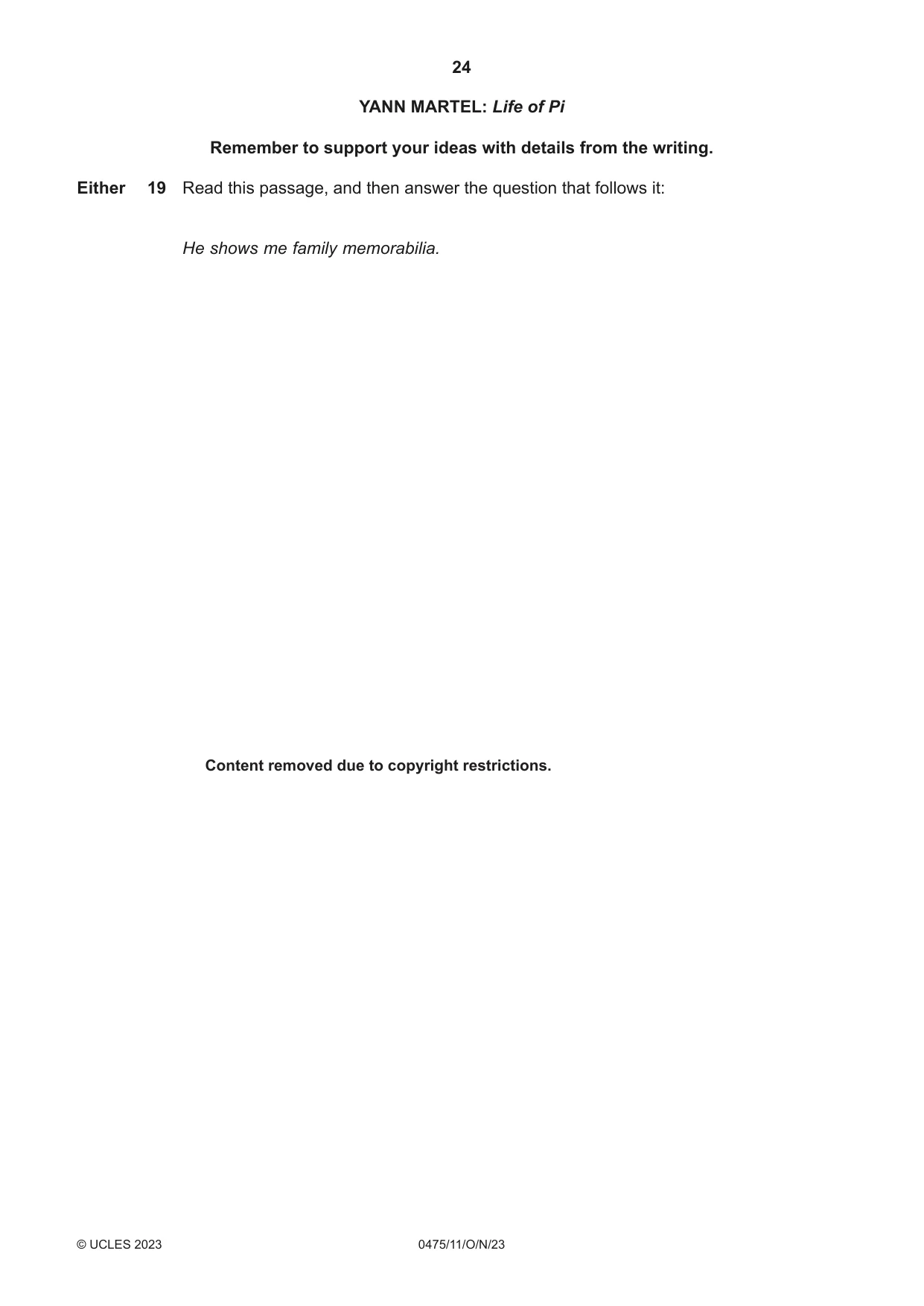
24 0475/11/O/N/23 © UCLES 2023 YANN MARTEL: Life of Pi Remember to support your ideas with details from the writing. Either 19 Read this passage, and then answer the question that follows it: He shows me family memorabilia. Content removed due to copyright restrictions.
Question paper, page 25
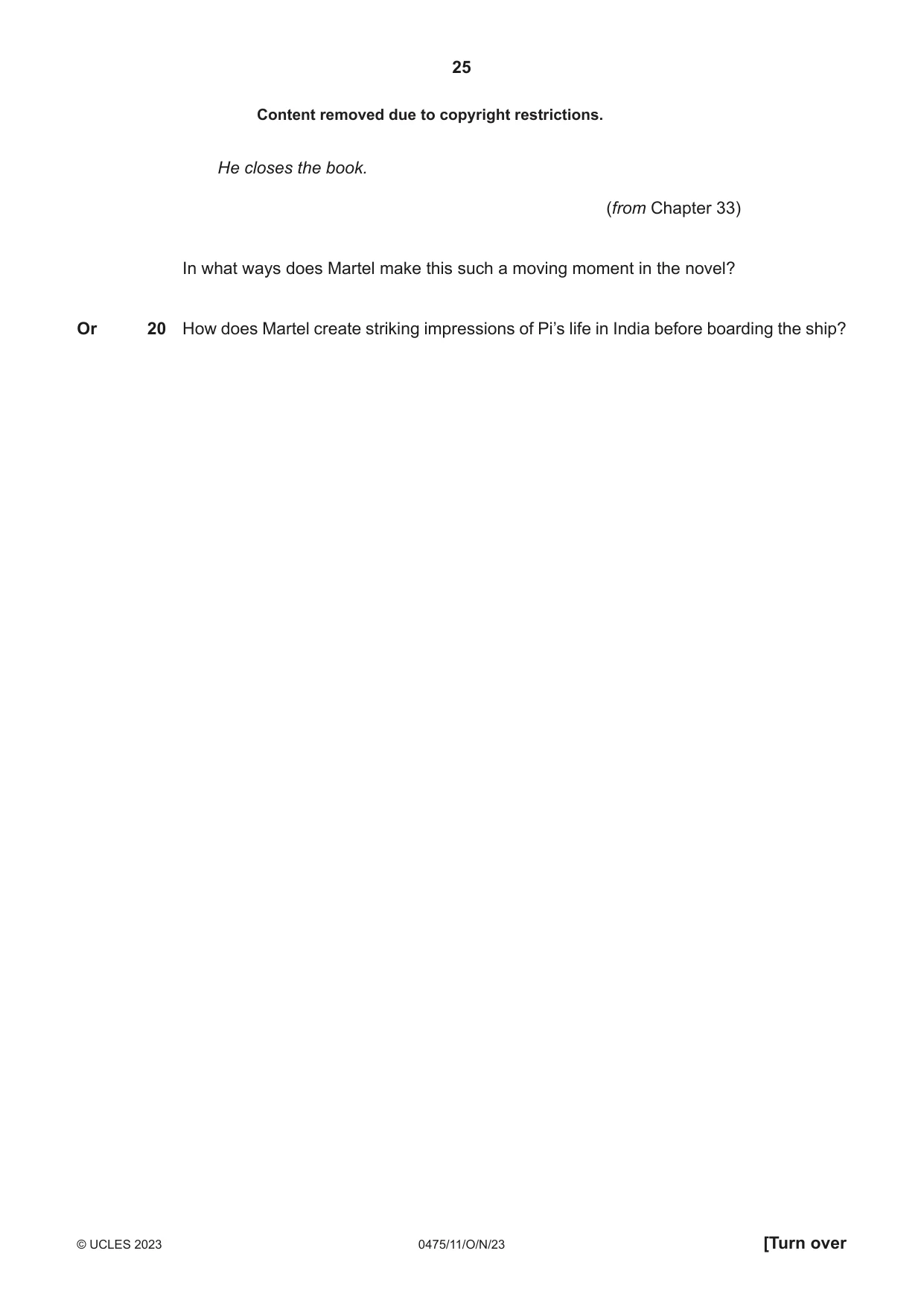
25 0475/11/O/N/23 © UCLES 2023 [Turn over He closes the book. (from Chapter 33) In what ways does Martel make this such a moving moment in the novel? Or 20 How does Martel create striking impressions of Pi’s life in India before boarding the ship? Content removed due to copyright restrictions.
Question paper, page 26
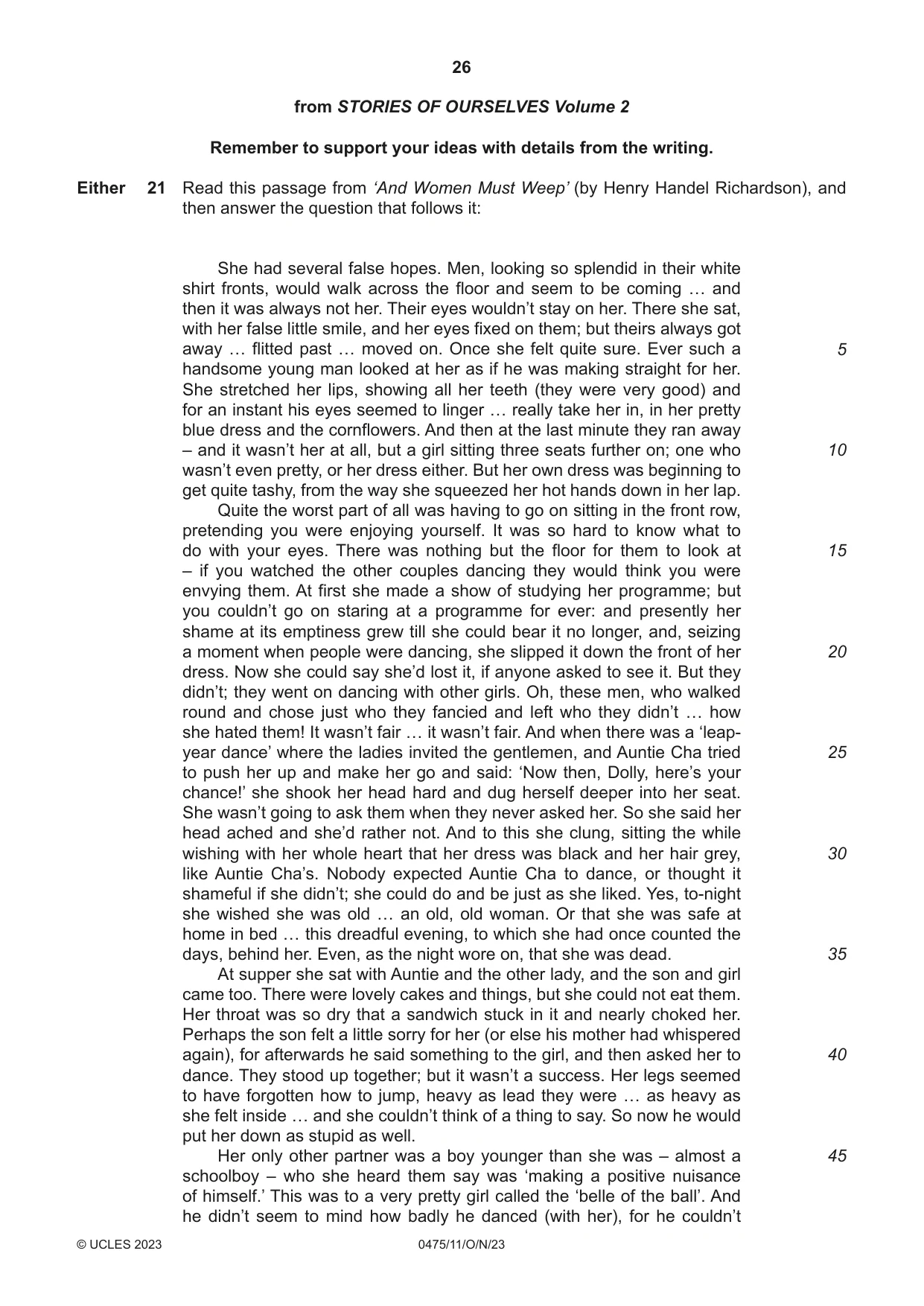
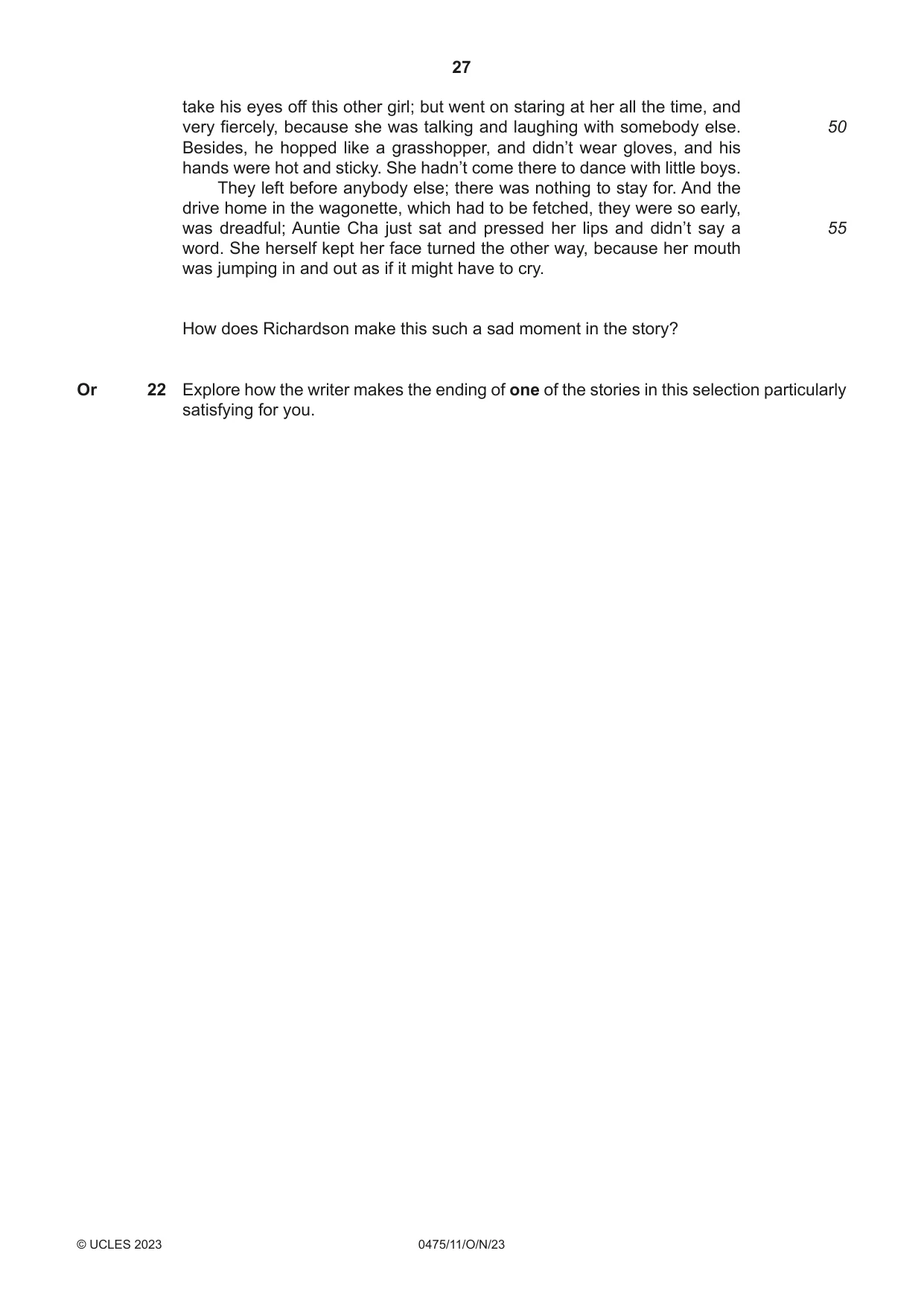
26 0475/11/O/N/23 © UCLES 2023 from STORIES OF OURSELVES Volume 2 Remember to support your ideas with details from the writing. Either 21 Read this passage from ‘And Women Must Weep’ (by Henry Handel Richardson), and then answer the question that follows it: She had several false hopes. Men, looking so splendid in their white shirt fronts, would walk across the floor and seem to be coming … and then it was always not her. Their eyes wouldn’t stay on her. There she sat, with her false little smile, and her eyes fixed on them; but theirs always got away … flitted past … moved on. Once she felt quite sure. Ever such a handsome young man looked at her as if he was making straight for her. She stretched her lips, showing all her teeth (they were very good) and for an instant his eyes seemed to linger … really take her in, in her pretty blue dress and the cornflowers. And then at the last minute they ran away – and it wasn’t her at all, but a girl sitting three seats further on; one who wasn’t even pretty, or her dress either. But her own dress was beginning to get quite tashy, from the way she squeezed her hot hands down in her lap. Quite the worst part of all was having to go on sitting in the front row, pretending you were enjoying yourself. It was so hard to know what to do with your eyes. There was nothing but the floor for them to look at – if you watched the other couples dancing they would think you were envying them. At first she made a show of studying her programme; but you couldn’t go on staring at a programme for ever: and presently her shame at its emptiness grew till she could bear it no longer, and, seizing a moment when people were dancing, she slipped it down the front of her dress. Now she could say she’d lost it, if anyone asked to see it. But they didn’t; they went on dancing with other girls. Oh, these men, who walked round and chose just who they fancied and left who they didn’t … how she hated them! It wasn’t fair … it wasn’t fair. And when there was a ‘leap- year dance’ where the ladies invited the gentlemen, and Auntie Cha tried to push her up and make her go and said: ‘Now then, Dolly, here’s your chance!’ she shook her head hard and dug herself deeper into her seat. She wasn’t going to ask them when they never asked her. So she said her head ached and she’d rather not. And to this she clung, sitting the while wishing with her whole heart that her dress was black and her hair grey, like Auntie Cha’s. Nobody expected Auntie Cha to dance, or thought it shameful if she didn’t; she could do and be just as she liked. Yes, to-night she wished she was old … an old, old woman. Or that she was safe at home in bed … this dreadful evening, to which she had once counted the days, behind her. Even, as the night wore on, that she was dead. At supper she sat with Auntie and the other lady, and the son and girl came too. There were lovely cakes and things, but she could not eat them. Her throat was so dry that a sandwich stuck in it and nearly choked her. Perhaps the son felt a little sorry for her (or else his mother had whispered again), for afterwards he said something to the girl, and then asked her to dance. They stood up together; but it wasn’t a success. Her legs seemed to have forgotten how to jump, heavy as lead they were … as heavy as she felt inside … and she couldn’t think of a thing to say. So now he would put her down as stupid as well. Her only other partner was a boy younger than she was – almost a schoolboy – who she heard them say was ‘making a positive nuisance of himself.’ This was to a very pretty girl called the ‘belle of the ball’. And he didn’t seem to mind how badly he danced (with her), for he couldn’t 5 10 15 20 25 30 35 40 45
Question paper, page 27
27 0475/11/O/N/23 © UCLES 2023 take his eyes off this other girl; but went on staring at her all the time, and very fiercely, because she was talking and laughing with somebody else. Besides, he hopped like a grasshopper, and didn’t wear gloves, and his hands were hot and sticky. She hadn’t come there to dance with little boys. They left before anybody else; there was nothing to stay for. And the drive home in the wagonette, which had to be fetched, they were so early, was dreadful; Auntie Cha just sat and pressed her lips and didn’t say a word. She herself kept her face turned the other way, because her mouth was jumping in and out as if it might have to cry. How does Richardson make this such a sad moment in the story? Or 22 Explore how the writer makes the ending of one of the stories in this selection particularly satisfying for you. 50 55
Question paper, page 28
28 0475/11/O/N/23 © UCLES 2023 Permission to reproduce items where third-party owned material protected by copyright is included has been sought and cleared where possible. Every reasonable effort has been made by the publisher (UCLES) to trace copyright holders, but if any items requiring clearance have unwittingly been included, the publisher will be pleased to make amends at the earliest possible opportunity. To avoid the issue of disclosure of answer-related information to candidates, all copyright acknowledgements are reproduced online in the Cambridge Assessment International Education Copyright Acknowledgements Booklet. This is produced for each series of examinations and is freely available to download at www.cambridgeinternational.org after the live examination series. Cambridge Assessment International Education is part of Cambridge Assessment. Cambridge Assessment is the brand name of the University of Cambridge Local Examinations Syndicate (UCLES), which is a department of the University of Cambridge. BLANK PAGE
Mark scheme, page 1
This document consists of 4 printed pages. © UCLES 2023 [Turn over Cambridge IGCSE™ LITERATURE IN ENGLISH 0475/11 Paper 1 Poetry and Prose October/November 2023 MARK SCHEME Maximum Mark: 50 Published This mark scheme is published as an aid to teachers and candidates, to indicate the requirements of the examination. It shows the basis on which Examiners were instructed to award marks. It does not indicate the details of the discussions that took place at an Examiners’ meeting before marking began, which would have considered the acceptability of alternative answers. Mark schemes should be read in conjunction with the question paper and the Principal Examiner Report for Teachers. Cambridge International will not enter into discussions about these mark schemes. Cambridge International is publishing the mark schemes for the October/November 2023 series for most Cambridge IGCSE, Cambridge International A and AS Level components, and some Cambridge O Level components.
Mark scheme, page 2
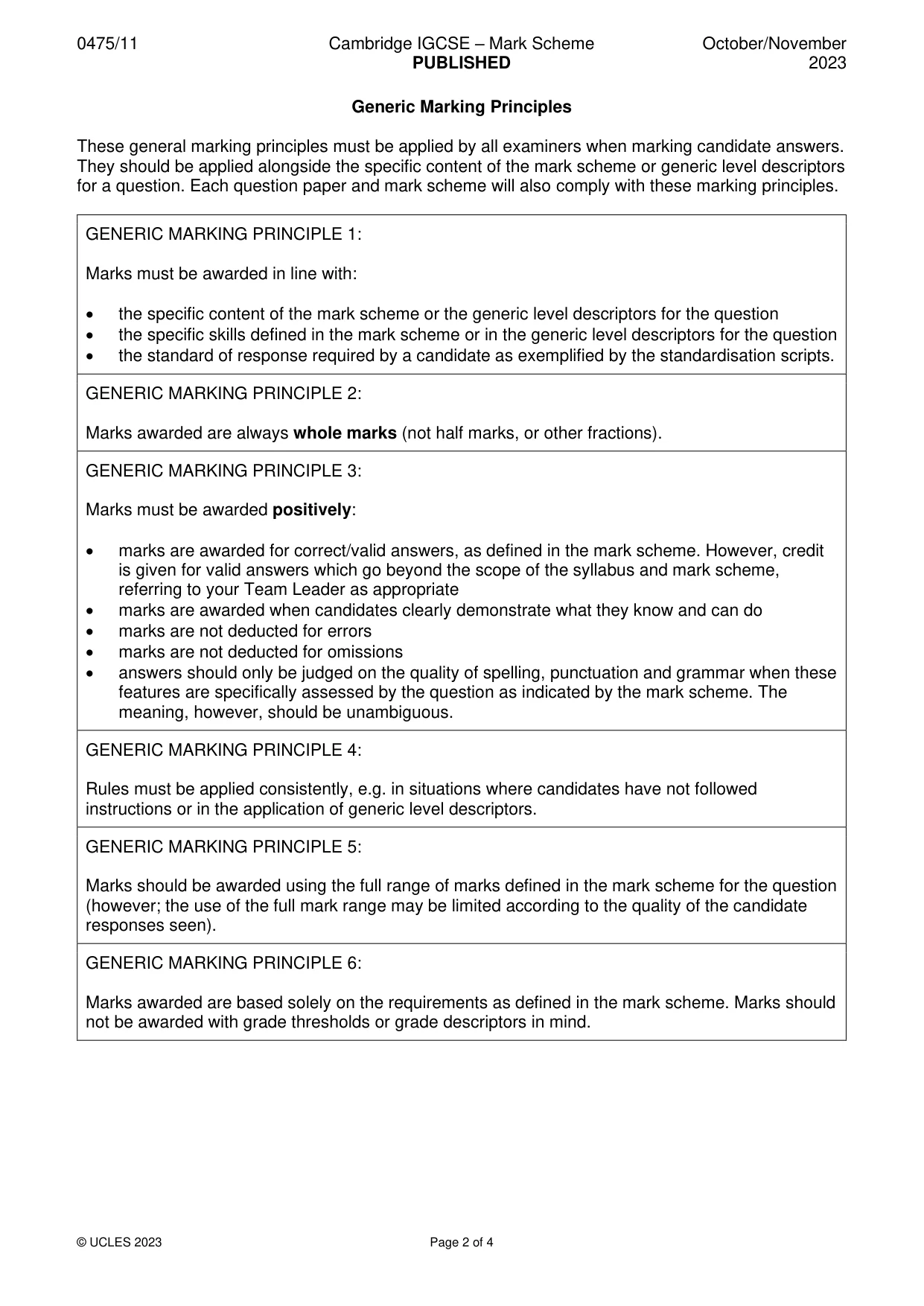
0475/11 Cambridge IGCSE – Mark Scheme PUBLISHED October/November 2023 © UCLES 2023 Page 2 of 4 Generic Marking Principles These general marking principles must be applied by all examiners when marking candidate answers. They should be applied alongside the specific content of the mark scheme or generic level descriptors for a question. Each question paper and mark scheme will also comply with these marking principles. GENERIC MARKING PRINCIPLE 1: Marks must be awarded in line with: • the specific content of the mark scheme or the generic level descriptors for the question • the specific skills defined in the mark scheme or in the generic level descriptors for the question • the standard of response required by a candidate as exemplified by the standardisation scripts. GENERIC MARKING PRINCIPLE 2: Marks awarded are always whole marks (not half marks, or other fractions). GENERIC MARKING PRINCIPLE 3: Marks must be awarded positively: • marks are awarded for correct/valid answers, as defined in the mark scheme. However, credit is given for valid answers which go beyond the scope of the syllabus and mark scheme, referring to your Team Leader as appropriate • marks are awarded when candidates clearly demonstrate what they know and can do • marks are not deducted for errors • marks are not deducted for omissions • answers should only be judged on the quality of spelling, punctuation and grammar when these features are specifically assessed by the question as indicated by the mark scheme. The meaning, however, should be unambiguous. GENERIC MARKING PRINCIPLE 4: Rules must be applied consistently, e.g. in situations where candidates have not followed instructions or in the application of generic level descriptors. GENERIC MARKING PRINCIPLE 5: Marks should be awarded using the full range of marks defined in the mark scheme for the question (however; the use of the full mark range may be limited according to the quality of the candidate responses seen). GENERIC MARKING PRINCIPLE 6: Marks awarded are based solely on the requirements as defined in the mark scheme. Marks should not be awarded with grade thresholds or grade descriptors in mind.
Mark scheme, page 3
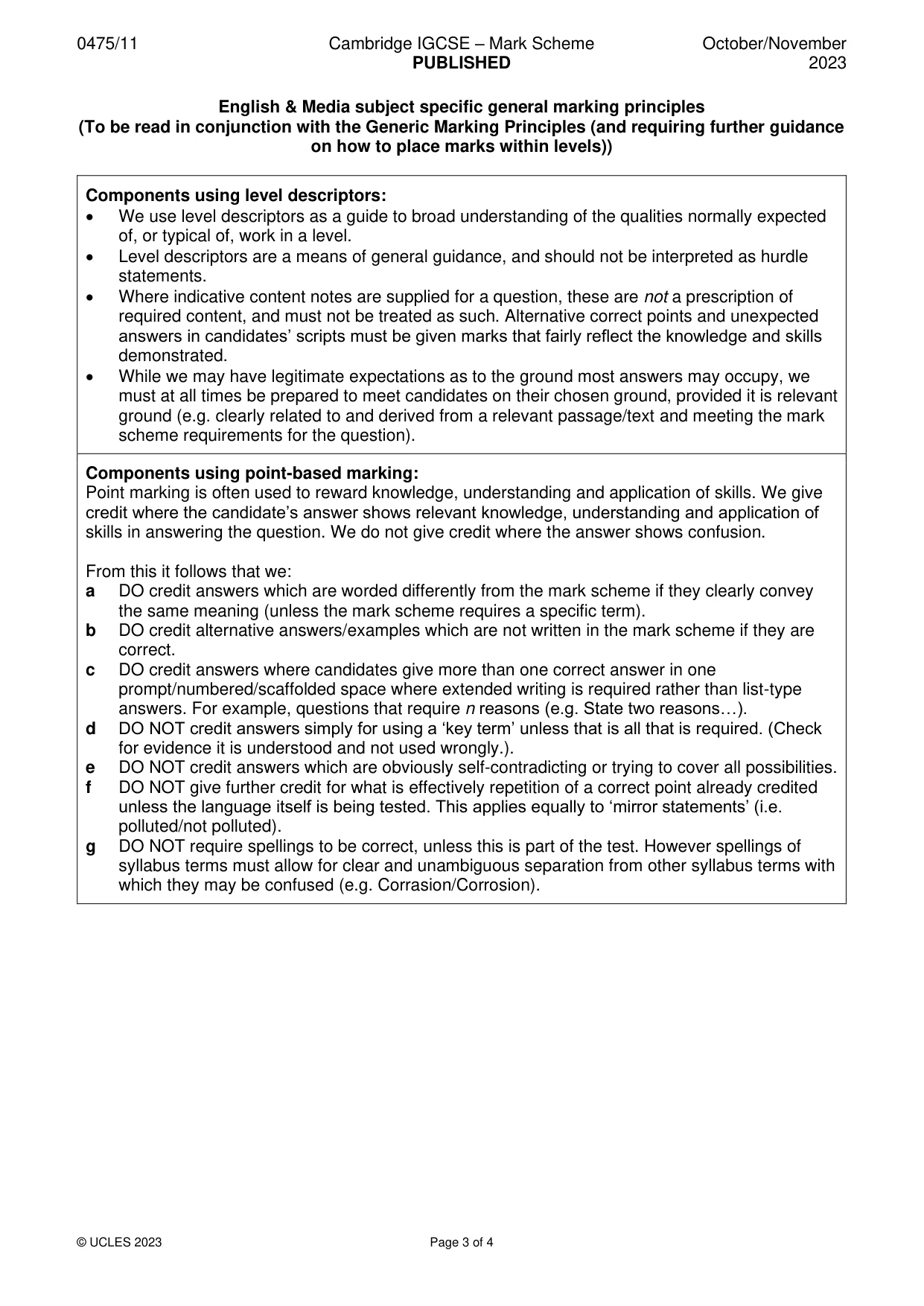
0475/11 Cambridge IGCSE – Mark Scheme PUBLISHED October/November 2023 © UCLES 2023 Page 3 of 4 English & Media subject specific general marking principles (To be read in conjunction with the Generic Marking Principles (and requiring further guidance on how to place marks within levels)) Components using level descriptors: • We use level descriptors as a guide to broad understanding of the qualities normally expected of, or typical of, work in a level. • Level descriptors are a means of general guidance, and should not be interpreted as hurdle statements. • Where indicative content notes are supplied for a question, these are not a prescription of required content, and must not be treated as such. Alternative correct points and unexpected answers in candidates’ scripts must be given marks that fairly reflect the knowledge and skills demonstrated. • While we may have legitimate expectations as to the ground most answers may occupy, we must at all times be prepared to meet candidates on their chosen ground, provided it is relevant ground (e.g. clearly related to and derived from a relevant passage/text and meeting the mark scheme requirements for the question). Components using point-based marking: Point marking is often used to reward knowledge, understanding and application of skills. We give credit where the candidate’s answer shows relevant knowledge, understanding and application of skills in answering the question. We do not give credit where the answer shows confusion. From this it follows that we: a DO credit answers which are worded differently from the mark scheme if they clearly convey the same meaning (unless the mark scheme requires a specific term). b DO credit alternative answers/examples which are not written in the mark scheme if they are correct. c DO credit answers where candidates give more than one correct answer in one prompt/numbered/scaffolded space where extended writing is required rather than list-type answers. For example, questions that require n reasons (e.g. State two reasons…). d DO NOT credit answers simply for using a ‘key term’ unless that is all that is required. (Check for evidence it is understood and not used wrongly.). e DO NOT credit answers which are obviously self-contradicting or trying to cover all possibilities. f DO NOT give further credit for what is effectively repetition of a correct point already credited unless the language itself is being tested. This applies equally to ‘mirror statements’ (i.e. polluted/not polluted). g DO NOT require spellings to be correct, unless this is part of the test. However spellings of syllabus terms must allow for clear and unambiguous separation from other syllabus terms with which they may be confused (e.g. Corrasion/Corrosion).
Mark scheme, page 4
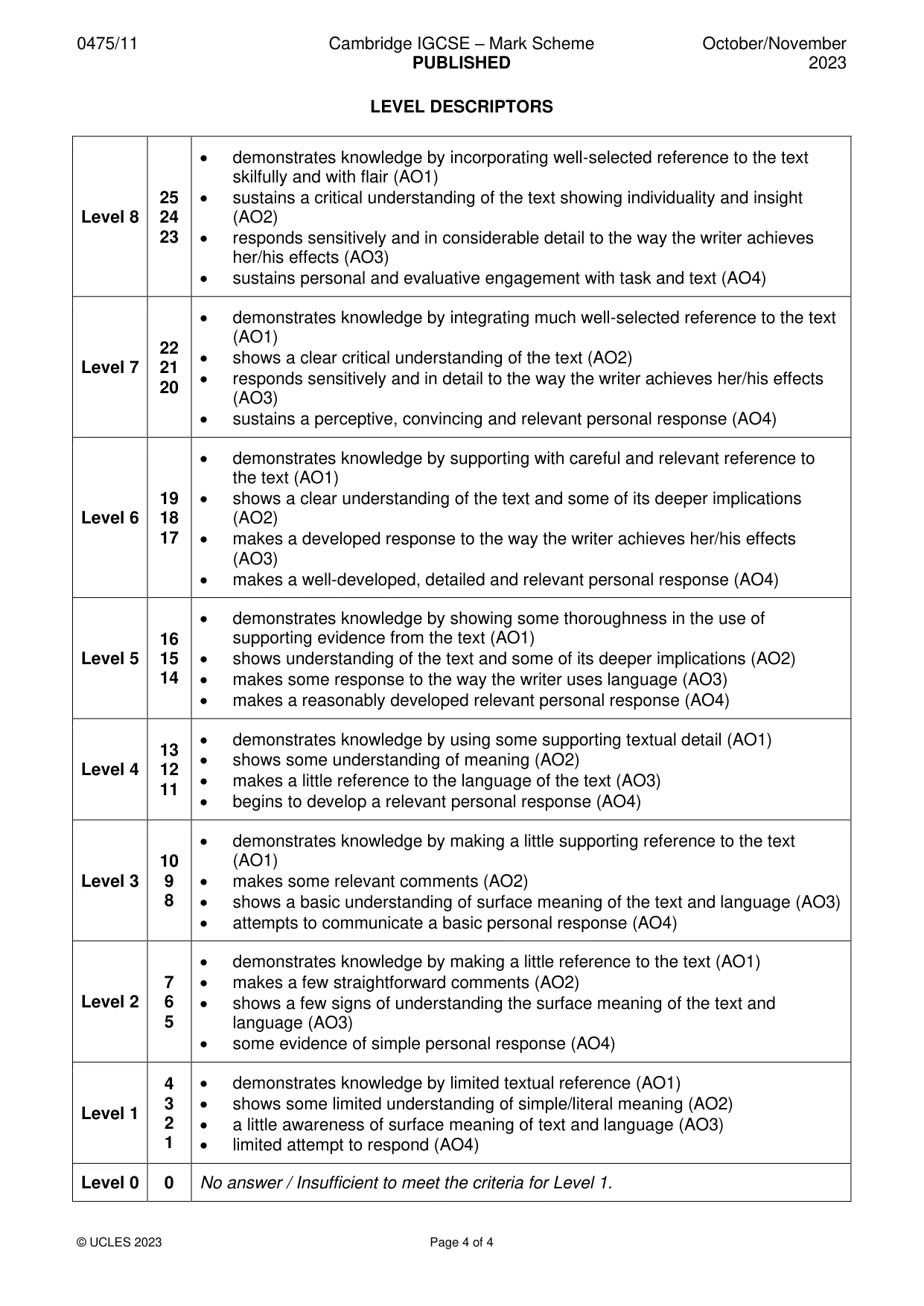
0475/11 Cambridge IGCSE – Mark Scheme PUBLISHED October/November 2023 © UCLES 2023 Page 4 of 4 LEVEL DESCRIPTORS Level 8 25 24 23 • demonstrates knowledge by incorporating well-selected reference to the text skilfully and with flair (AO1) • sustains a critical understanding of the text showing individuality and insight (AO2) • responds sensitively and in considerable detail to the way the writer achieves her/his effects (AO3) • sustains personal and evaluative engagement with task and text (AO4) Level 7 22 21 20 • demonstrates knowledge by integrating much well-selected reference to the text (AO1) • shows a clear critical understanding of the text (AO2) • responds sensitively and in detail to the way the writer achieves her/his effects (AO3) • sustains a perceptive, convincing and relevant personal response (AO4) Level 6 19 18 17 • demonstrates knowledge by supporting with careful and relevant reference to the text (AO1) • shows a clear understanding of the text and some of its deeper implications (AO2) • makes a developed response to the way the writer achieves her/his effects (AO3) • makes a well-developed, detailed and relevant personal response (AO4) Level 5 16 15 14 • demonstrates knowledge by showing some thoroughness in the use of supporting evidence from the text (AO1) • shows understanding of the text and some of its deeper implications (AO2) • makes some response to the way the writer uses language (AO3) • makes a reasonably developed relevant personal response (AO4) Level 4 13 12 11 • demonstrates knowledge by using some supporting textual detail (AO1) • shows some understanding of meaning (AO2) • makes a little reference to the language of the text (AO3) • begins to develop a relevant personal response (AO4) Level 3 10 9 8 • demonstrates knowledge by making a little supporting reference to the text (AO1) • makes some relevant comments (AO2) • shows a basic understanding of surface meaning of the text and language (AO3) • attempts to communicate a basic personal response (AO4) Level 2 7 6 5 • demonstrates knowledge by making a little reference to the text (AO1) • makes a few straightforward comments (AO2) • shows a few signs of understanding the surface meaning of the text and language (AO3) • some evidence of simple personal response (AO4) Level 1 4 3 2 1 • demonstrates knowledge by limited textual reference (AO1) • shows some limited understanding of simple/literal meaning (AO2) • a little awareness of surface meaning of text and language (AO3) • limited attempt to respond (AO4) Level 0 0 No answer / Insufficient to meet the criteria for Level 1.
What you needed in this session
Cambridge’s own grade thresholds for 2023 Oct/Nov, Paper 1 · Variant 1. A higher threshold means an easier paper — the bar moves with how the cohort did.