Cambridge IGCSE English - Literature in English 0475 — 2025 Oct/Nov Paper 1 · Variant 1
0475/11/O/N/25 · 50 marks · ≈56 min
The question paper and its mark scheme, free to read here and free to download. This is Cambridge’s own paper, exactly as it was sat.
Question paper32 pages




Mark scheme5 pages
Answers below. Sit the paper first if you are practising.
Paper as text
Question paper, page 1
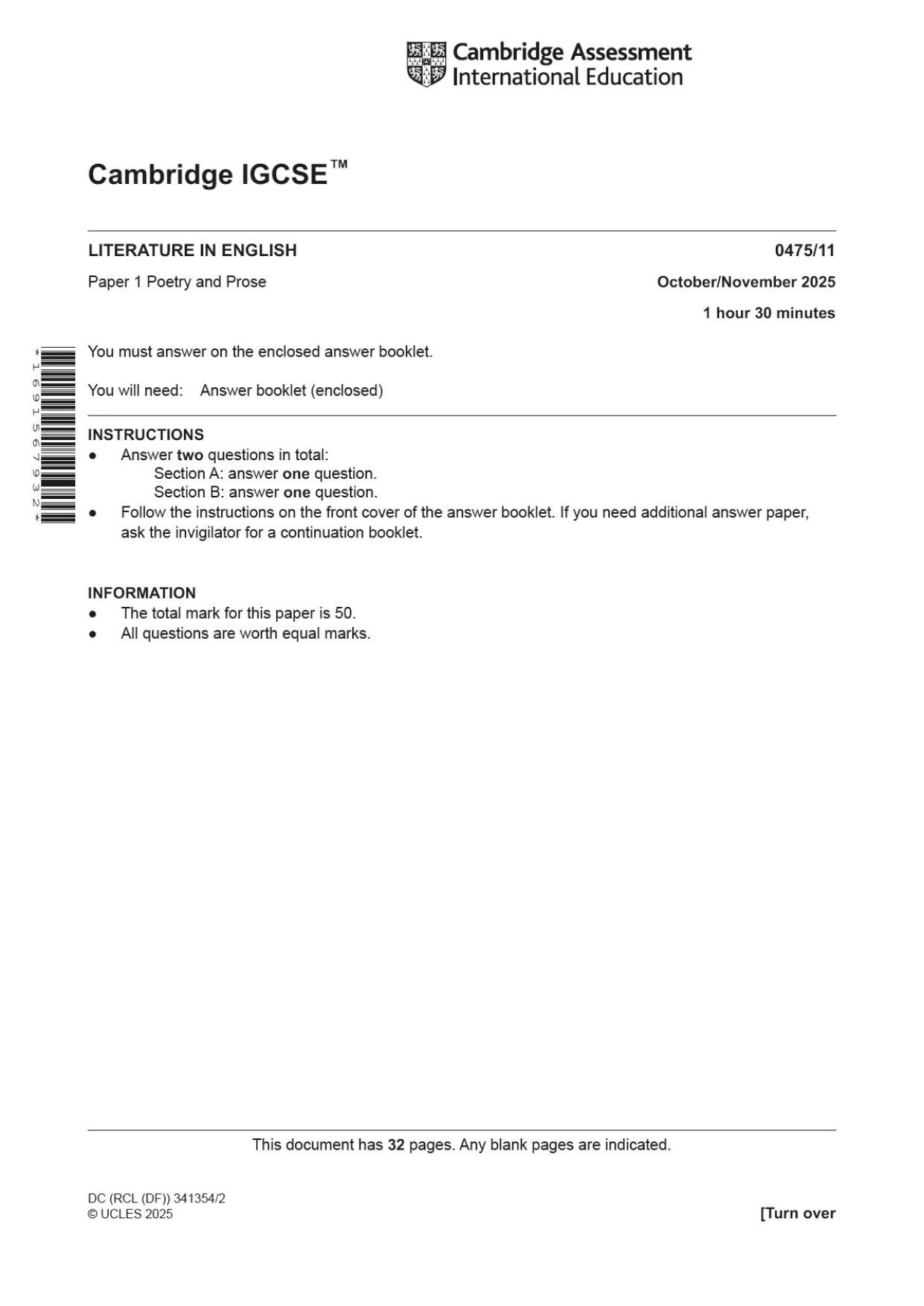
Cambridge Assessment International Education Cambridge IGCSE™ LITERATURE IN ENGLISH 0475/11 Paper 1 Poetry and Prose October/November 2025 1 hour 30 minutes You must answer on the enclosed answer booklet. You will need: Answer booklet (enclosed) INSTRUCTIONS e Answer two questions in total: Section A: answer one question. Section B: answer one question. e Follow the instructions on the front cover of the answer booklet. If you need additional answer paper, ask the invigilator for a continuation booklet. INFORMATION e The total mark for this paper is 50. e All questions are worth equal marks. This document has 32 pages. Any blank pages are indicated. DC (RCL (DF)) 341354/2 © UCLES 2025 [Turn over
Question paper, page 2
2 0475/11/O/N/25 © UCLES 2025 BLANK PAGE
Question paper, page 3
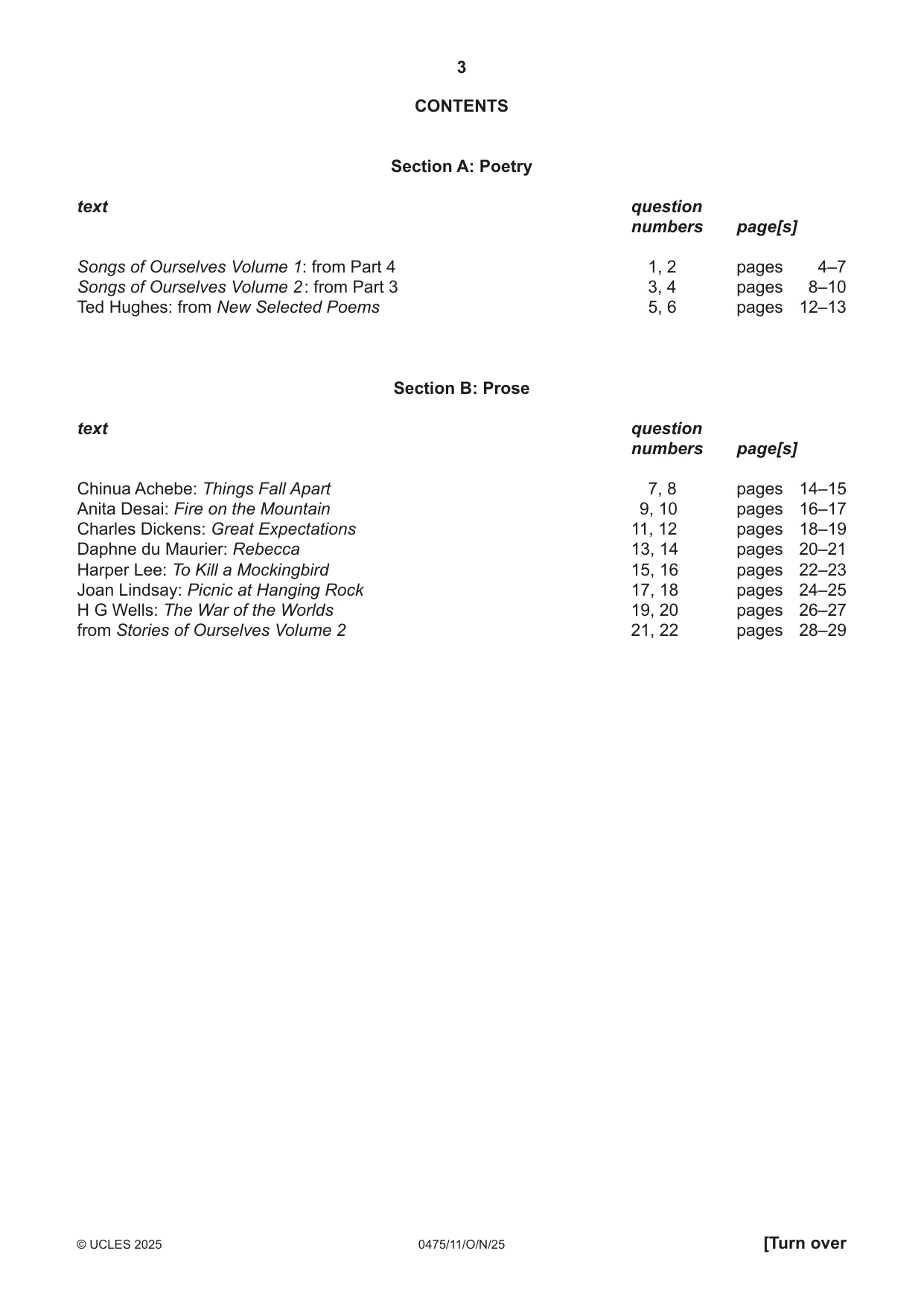
3 0475/11/O/N/25 © UCLES 2025 [Turn over CONTENTS Section A: Poetry text question numbers page[s] Songs of Ourselves Volume 1: from Part 4 1, 2 pages 4–7 Songs of Ourselves Volume 2 : from Part 3 3, 4 pages 8–10 Ted Hughes: from New Selected Poems 5, 6 pages 12–13 Section B: Prose text question numbers page[s] Chinua Achebe: Things Fall Apart 7, 8 pages 14–15 Anita Desai: Fire on the Mountain 9, 10 pages 16–17 Charles Dickens: Great Expectations 11, 12 pages 18–19 Daphne du Maurier: Rebecca 13, 14 pages 20–21 Harper Lee: To Kill a Mockingbird 15, 16 pages 22–23 Joan Lindsay: Picnic at Hanging Rock 17, 18 pages 24–25 H G Wells: The War of the Worlds 19, 20 pages 26–27 from Stories of Ourselves Volume 2 21, 22 pages 28–29
Question paper, page 4
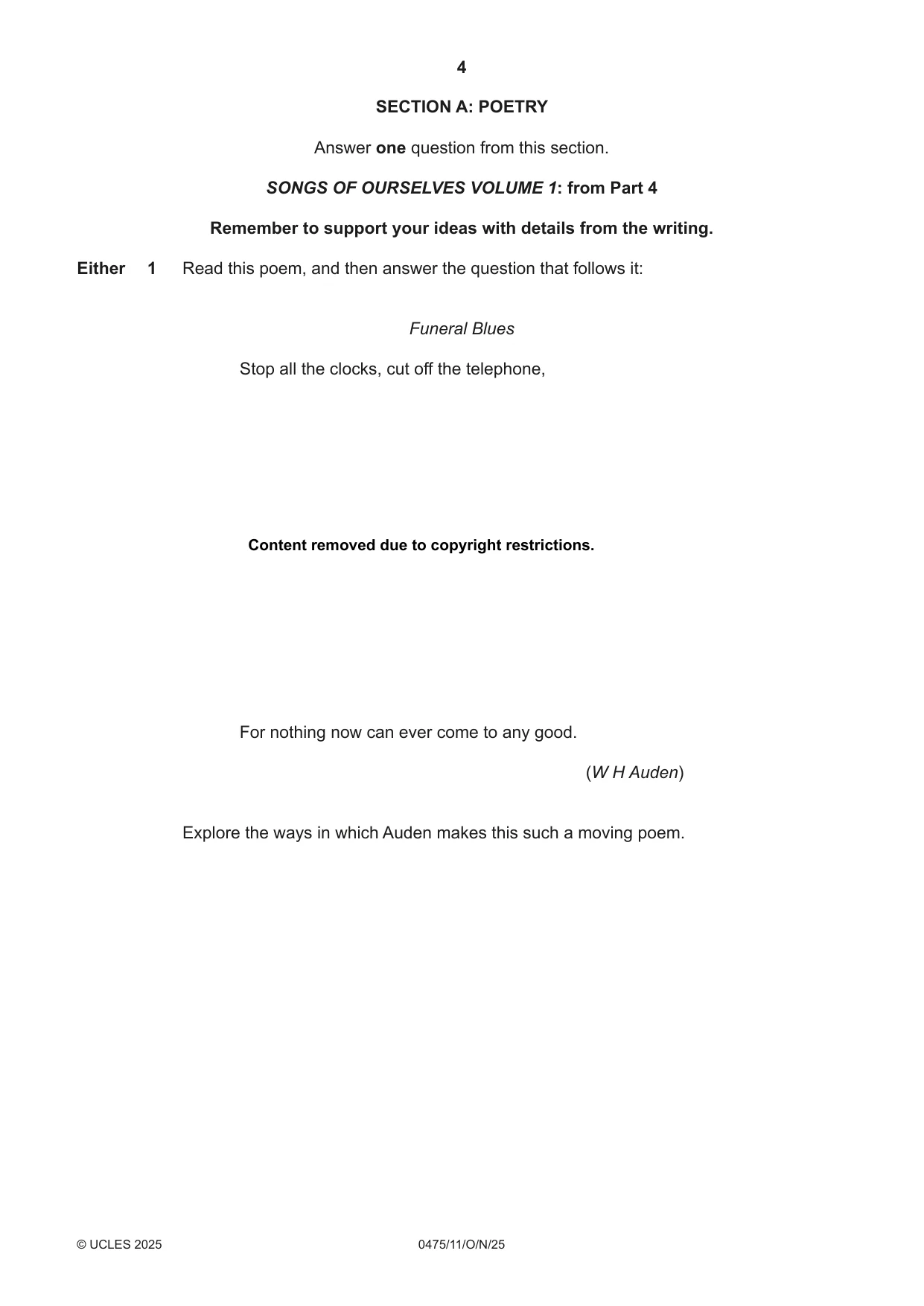
4 0475/11/O/N/25 © UCLES 2025 SECTION A: POETRY Answer one question from this section. SONGS OF OURSELVES VOLUME 1: from Part 4 Remember to support your ideas with details from the writing. Either 1 Read this poem, and then answer the question that follows it: Funeral Blues Stop all the clocks, cut off the telephone, For nothing now can ever come to any good. (W H Auden) Explore the ways in which Auden makes this such a moving poem. Content removed due to copyright restrictions.
Question paper, page 5
5 0475/11/O/N/25 © UCLES 2025 [Turn over TURN OVER FOR QUESTION 2.
Question paper, page 6
6 0475/11/O/N/25 © UCLES 2025 Or 2 How does Smith strikingly convey the beauty of the world in Away, Melancholy? Away, Melancholy Away, melancholy, Content removed due to copyright restrictions.
Question paper, page 7
7 0475/11/O/N/25 © UCLES 2025 [Turn over Away with it, let it go. (Stevie Smith) Content removed due to copyright restrictions.
Question paper, page 8
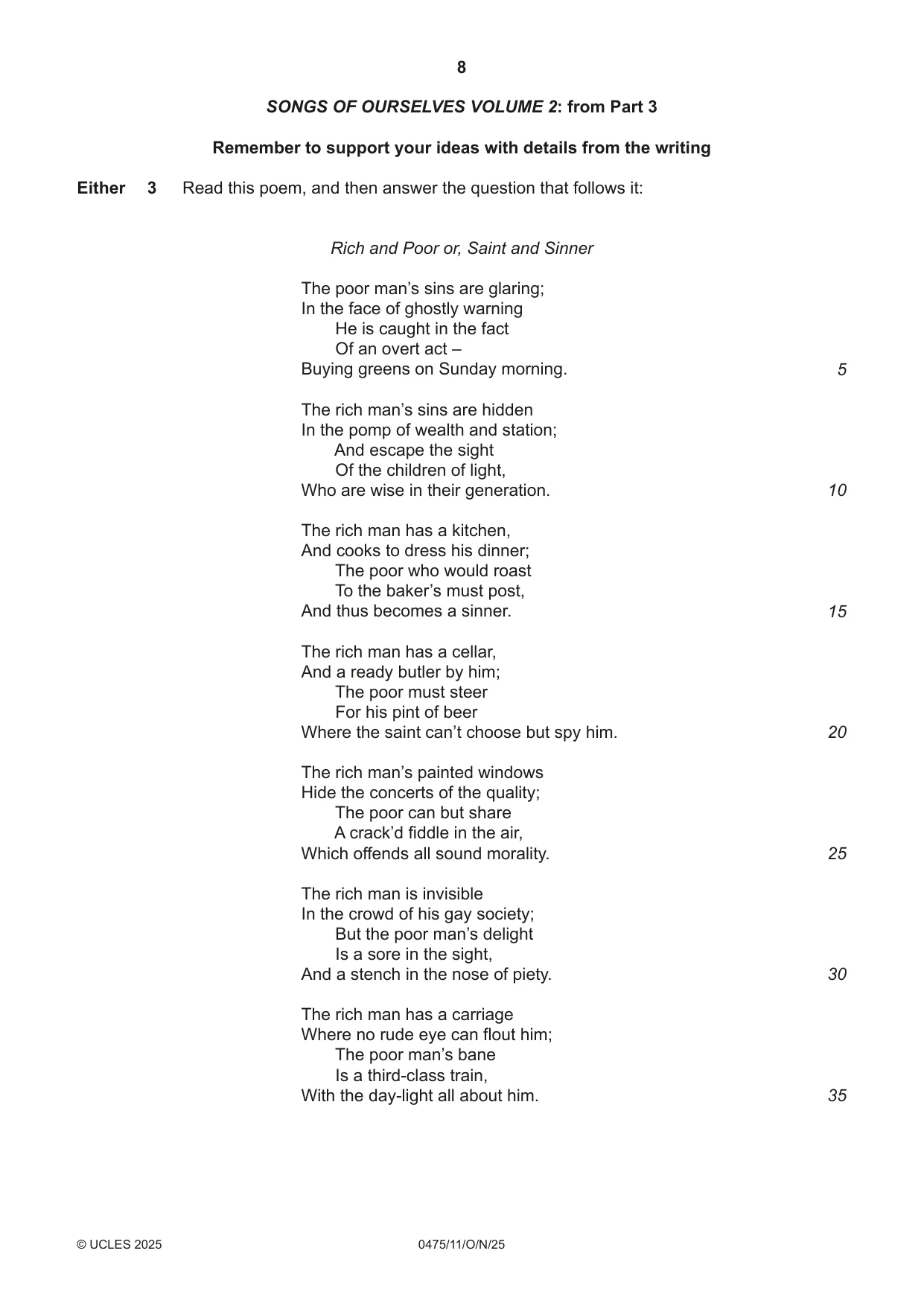
8 0475/11/O/N/25 © UCLES 2025 SONGS OF OURSELVES VOLUME 2: from Part 3 Remember to support your ideas with details from the writing Either 3 Read this poem, and then answer the question that follows it: Rich and Poor or, Saint and Sinner The poor man’s sins are glaring; In the face of ghostly warning He is caught in the fact Of an overt act – Buying greens on Sunday morning. The rich man’s sins are hidden In the pomp of wealth and station; And escape the sight Of the children of light, Who are wise in their generation. The rich man has a kitchen, And cooks to dress his dinner; The poor who would roast To the baker’s must post, And thus becomes a sinner. The rich man has a cellar, And a ready butler by him; The poor must steer For his pint of beer Where the saint can’t choose but spy him. The rich man’s painted windows Hide the concerts of the quality; The poor can but share A crack’d fiddle in the air, Which offends all sound morality. The rich man is invisible In the crowd of his gay society; But the poor man’s delight Is a sore in the sight, And a stench in the nose of piety. The rich man has a carriage Where no rude eye can flout him; The poor man’s bane Is a third-class train, With the day-light all about him. 5 10 15 20 25 30 35
Question paper, page 9
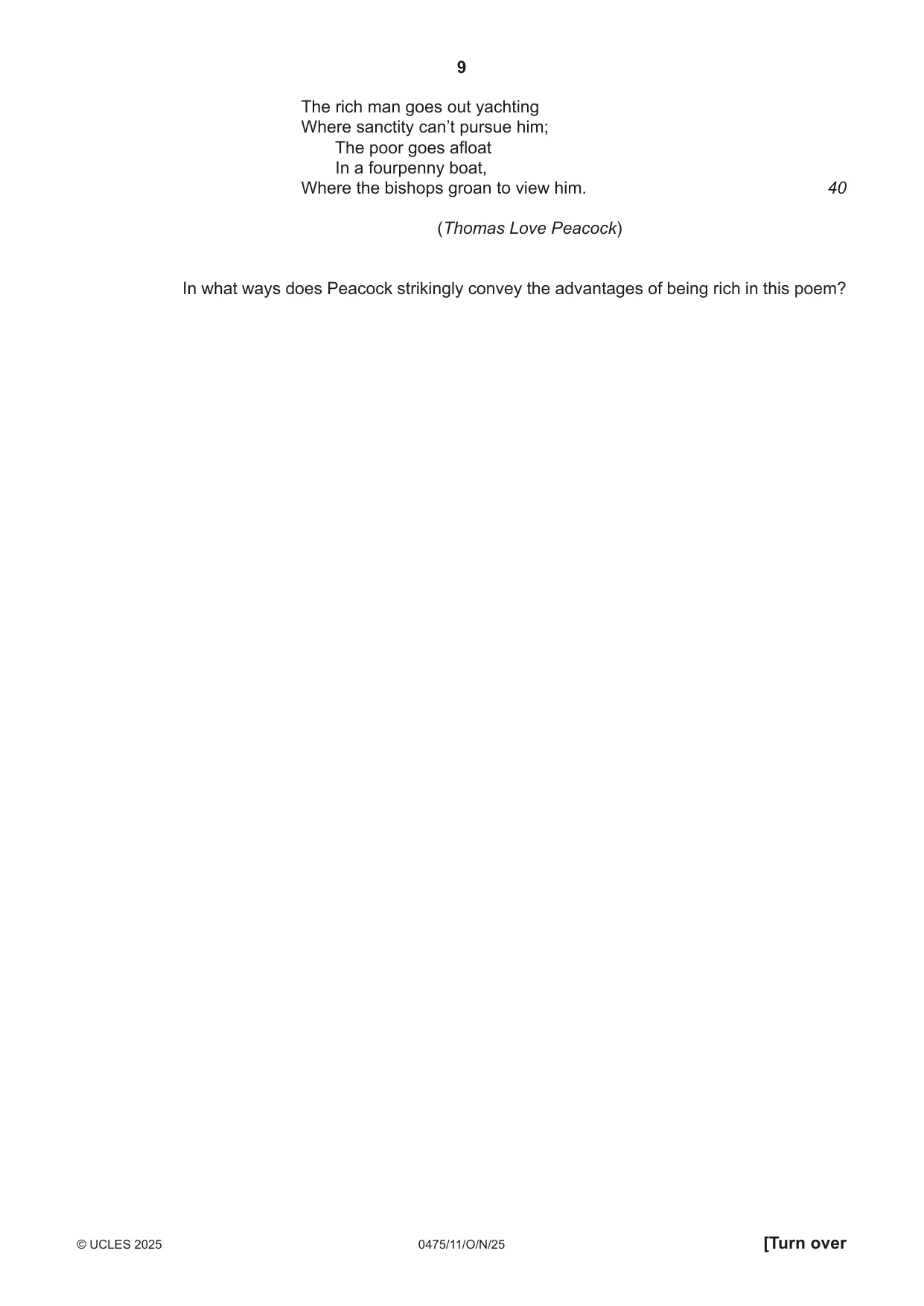
9 0475/11/O/N/25 © UCLES 2025 [Turn over The rich man goes out yachting Where sanctity can’t pursue him; The poor goes afloat In a fourpenny boat, Where the bishops groan to view him. (Thomas Love Peacock) In what ways does Peacock strikingly convey the advantages of being rich in this poem? 40
Question paper, page 10
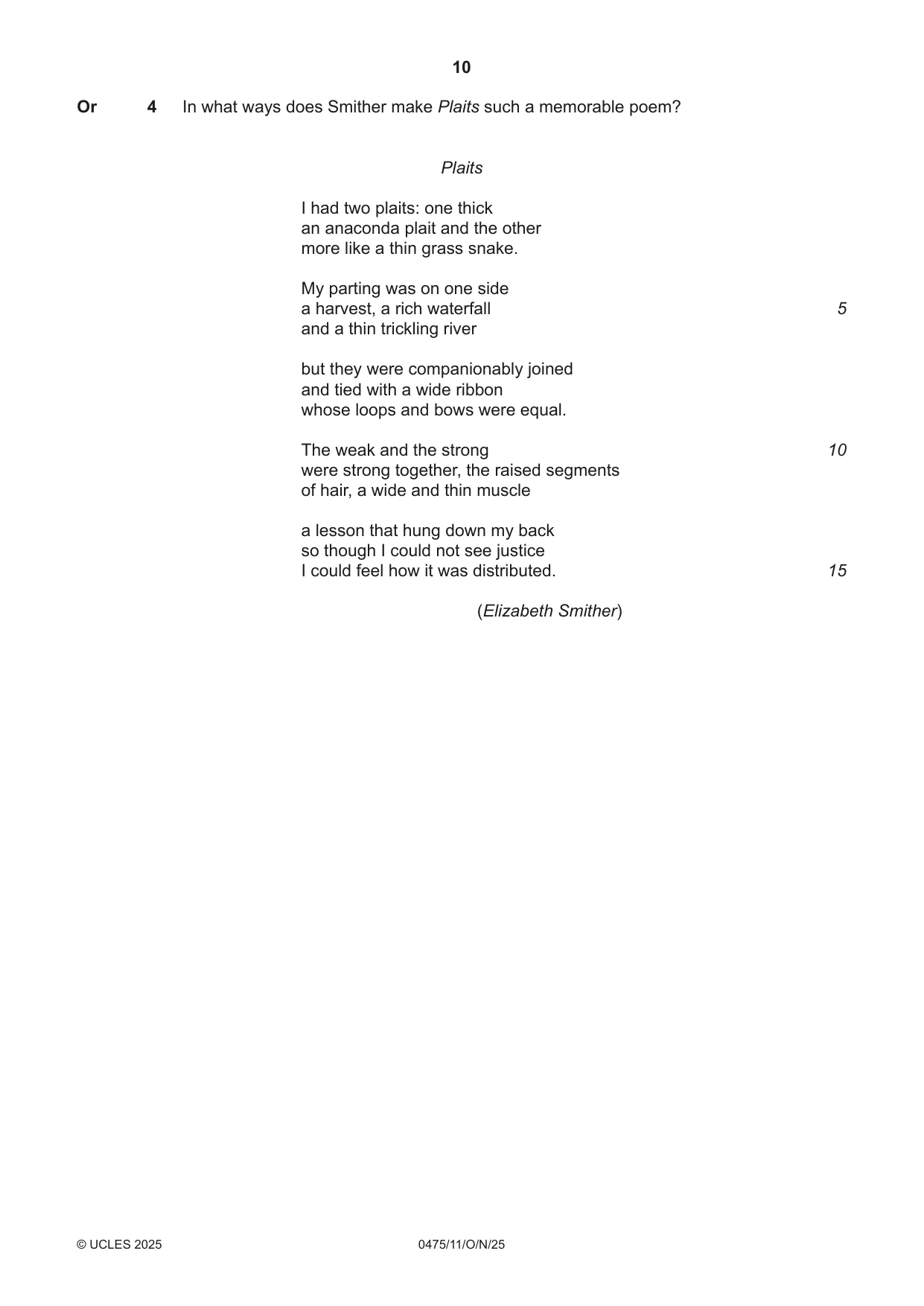
10 0475/11/O/N/25 © UCLES 2025 Or 4 In what ways does Smither make Plaits such a memorable poem? Plaits I had two plaits: one thick an anaconda plait and the other more like a thin grass snake. My parting was on one side a harvest, a rich waterfall and a thin trickling river but they were companionably joined and tied with a wide ribbon whose loops and bows were equal. The weak and the strong were strong together, the raised segments of hair, a wide and thin muscle a lesson that hung down my back so though I could not see justice I could feel how it was distributed. (Elizabeth Smither) 5 10 15
Question paper, page 11
11 0475/11/O/N/25 © UCLES 2025 [Turn over TURN OVER FOR QUESTION 5.
Question paper, page 12
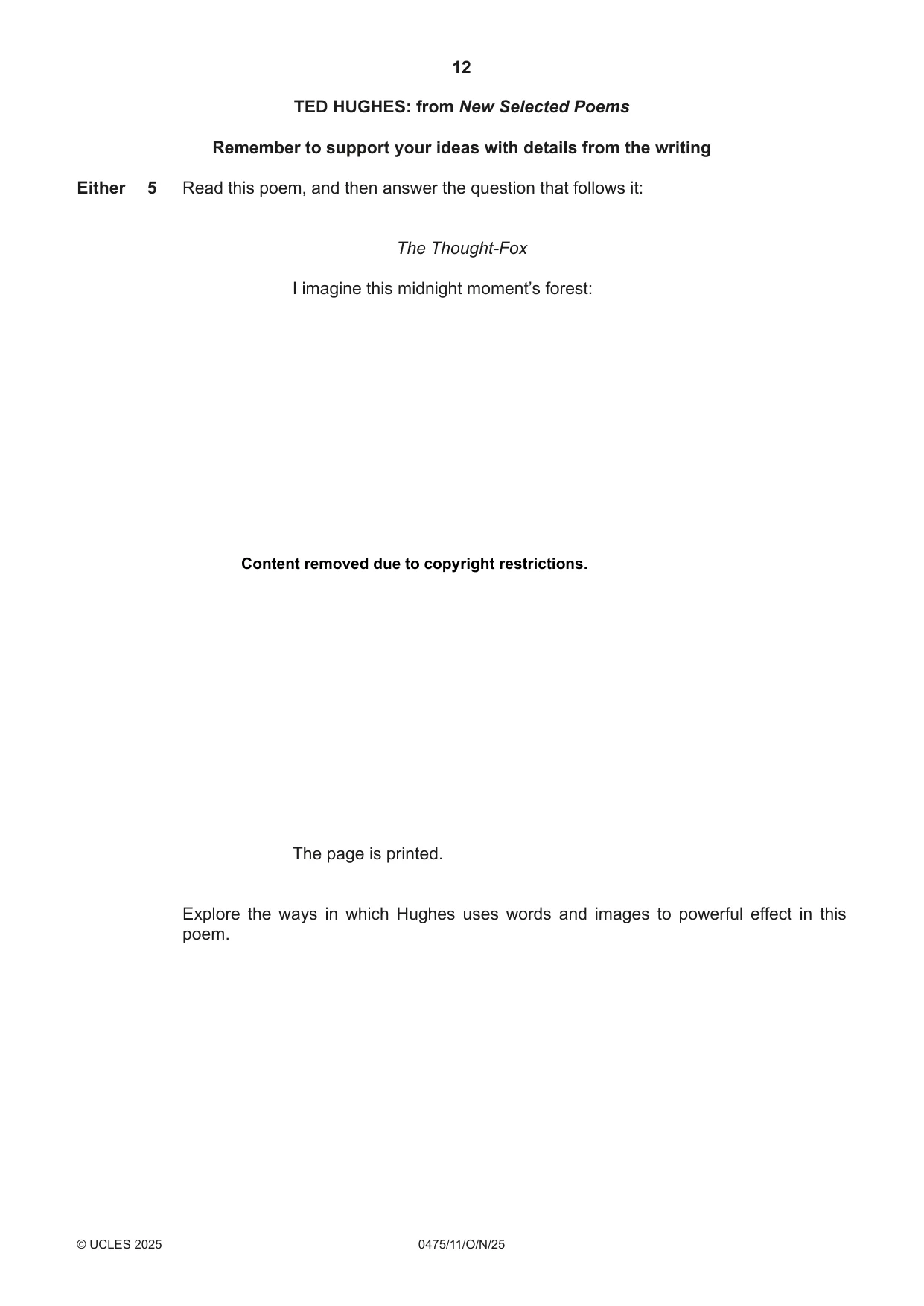
12 0475/11/O/N/25 © UCLES 2025 TED HUGHES: from New Selected Poems Remember to support your ideas with details from the writing Either 5 Read this poem, and then answer the question that follows it: The Thought-Fox I imagine this midnight moment’s forest: The page is printed. Explore the ways in which Hughes uses words and images to powerful effect in this poem. Content removed due to copyright restrictions.
Question paper, page 13
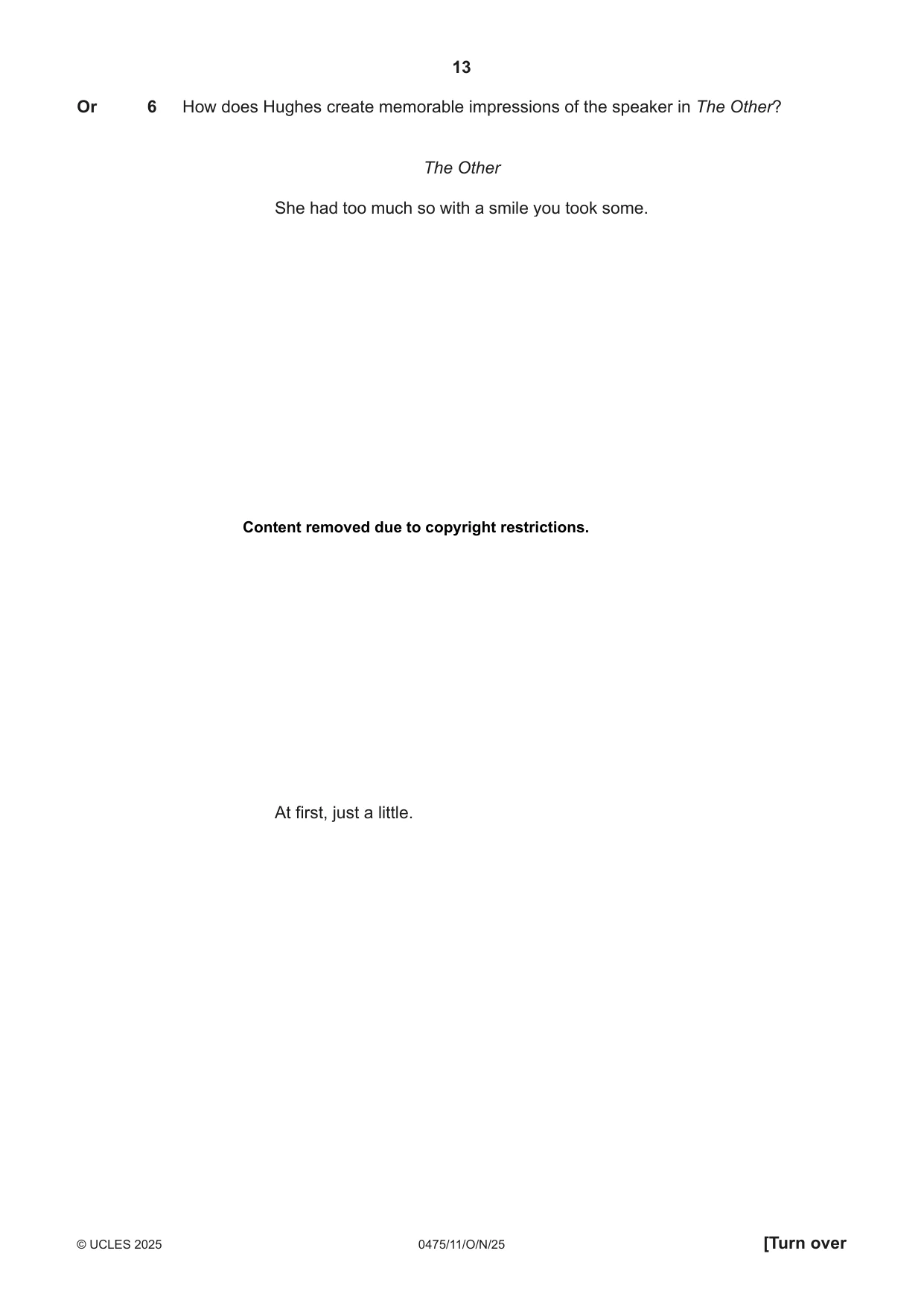
13 0475/11/O/N/25 © UCLES 2025 [Turn over Or 6 How does Hughes create memorable impressions of the speaker in The Other? The Other She had too much so with a smile you took some. At first, just a little. Content removed due to copyright restrictions.
Question paper, page 14
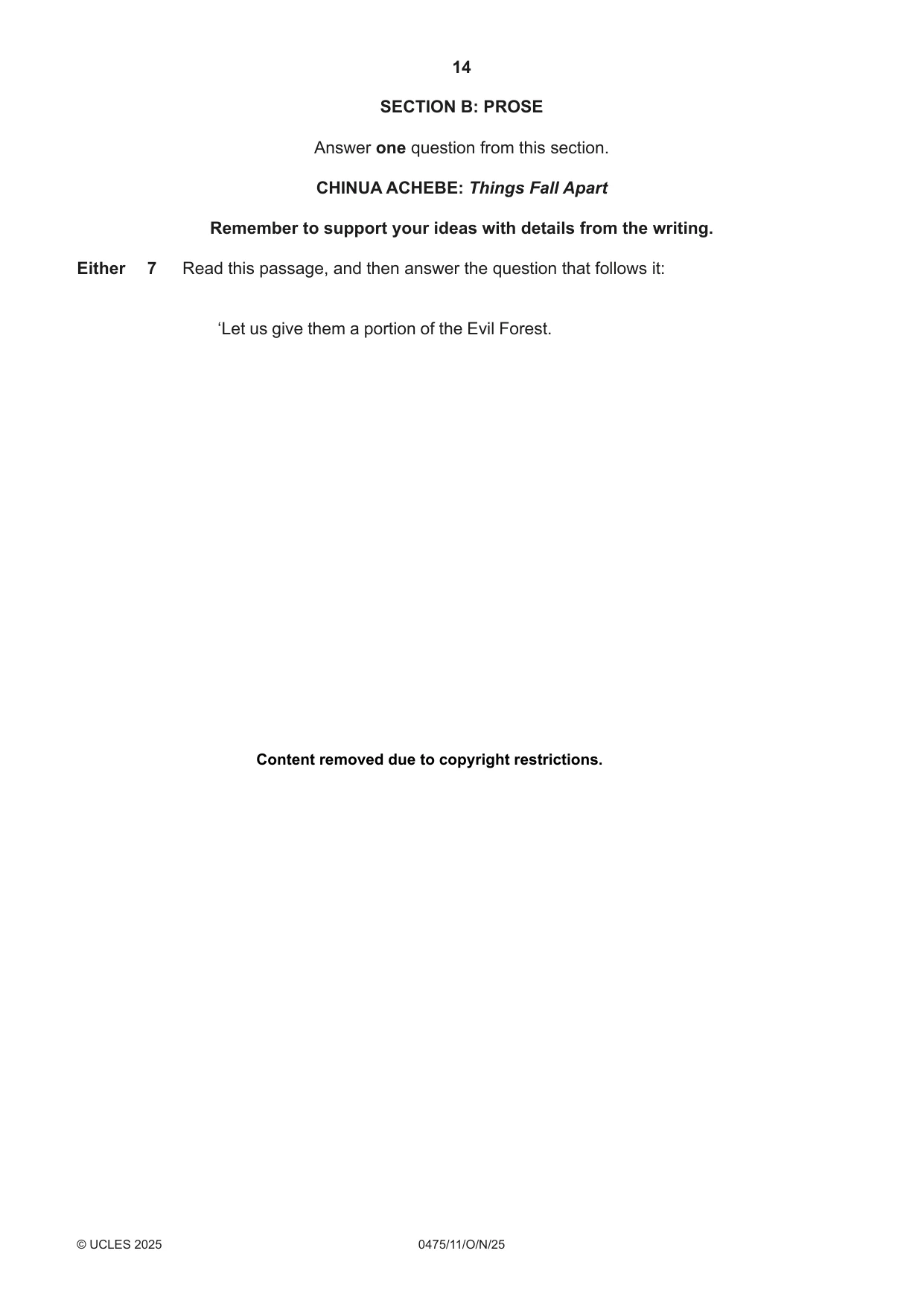
14 0475/11/O/N/25 © UCLES 2025 SECTION B: PROSE Answer one question from this section. CHINUA ACHEBE: Things Fall Apart Remember to support your ideas with details from the writing. Either 7 Read this passage, and then answer the question that follows it: ‘Let us give them a portion of the Evil Forest. Content removed due to copyright restrictions.
Question paper, page 15
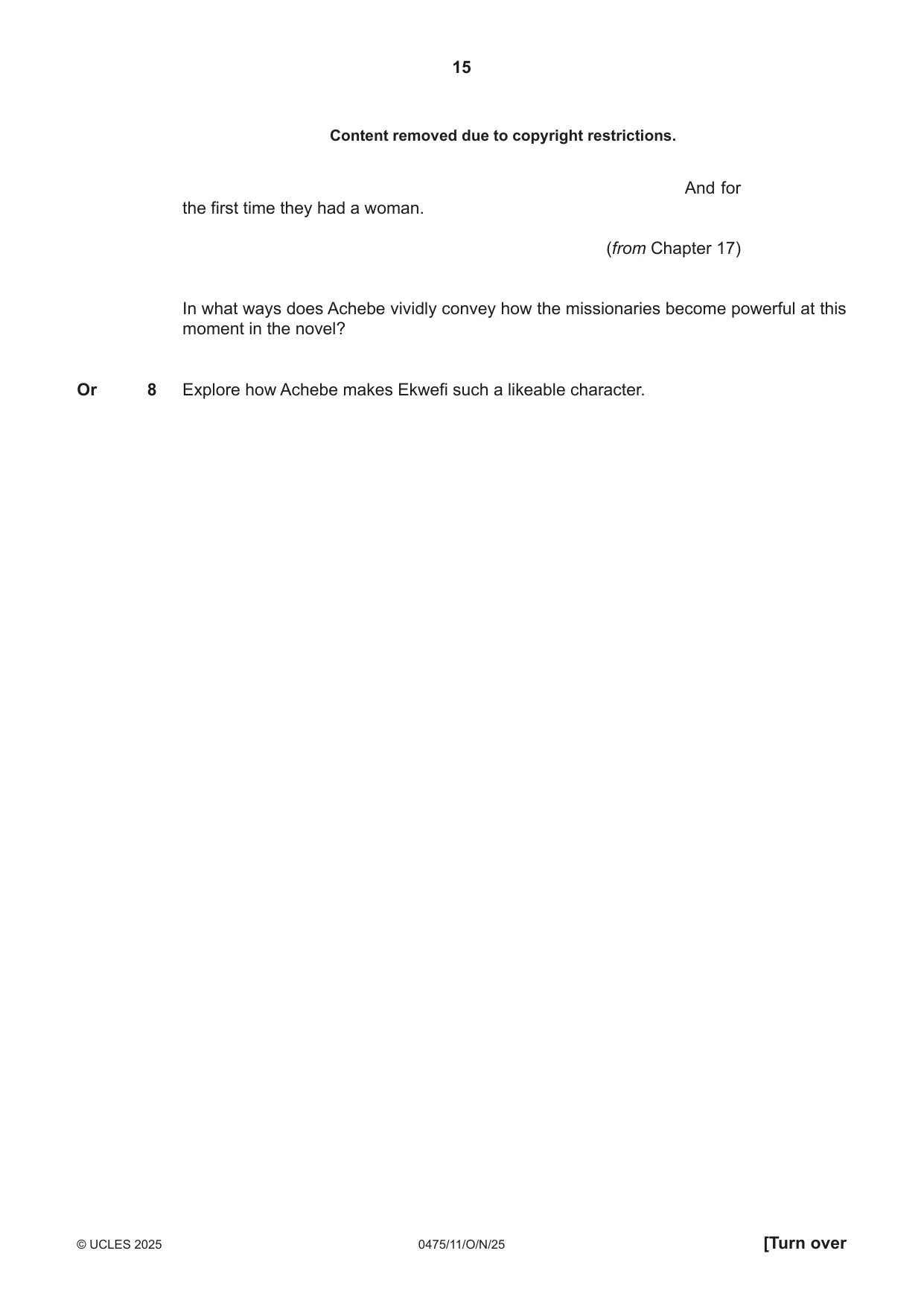
15 0475/11/O/N/25 © UCLES 2025 [Turn over And for the first time they had a woman. (from Chapter 17) In what ways does Achebe vividly convey how the missionaries become powerful at this moment in the novel? Or 8 Explore how Achebe makes Ekwefi such a likeable character. Content removed due to copyright restrictions.
Question paper, page 16
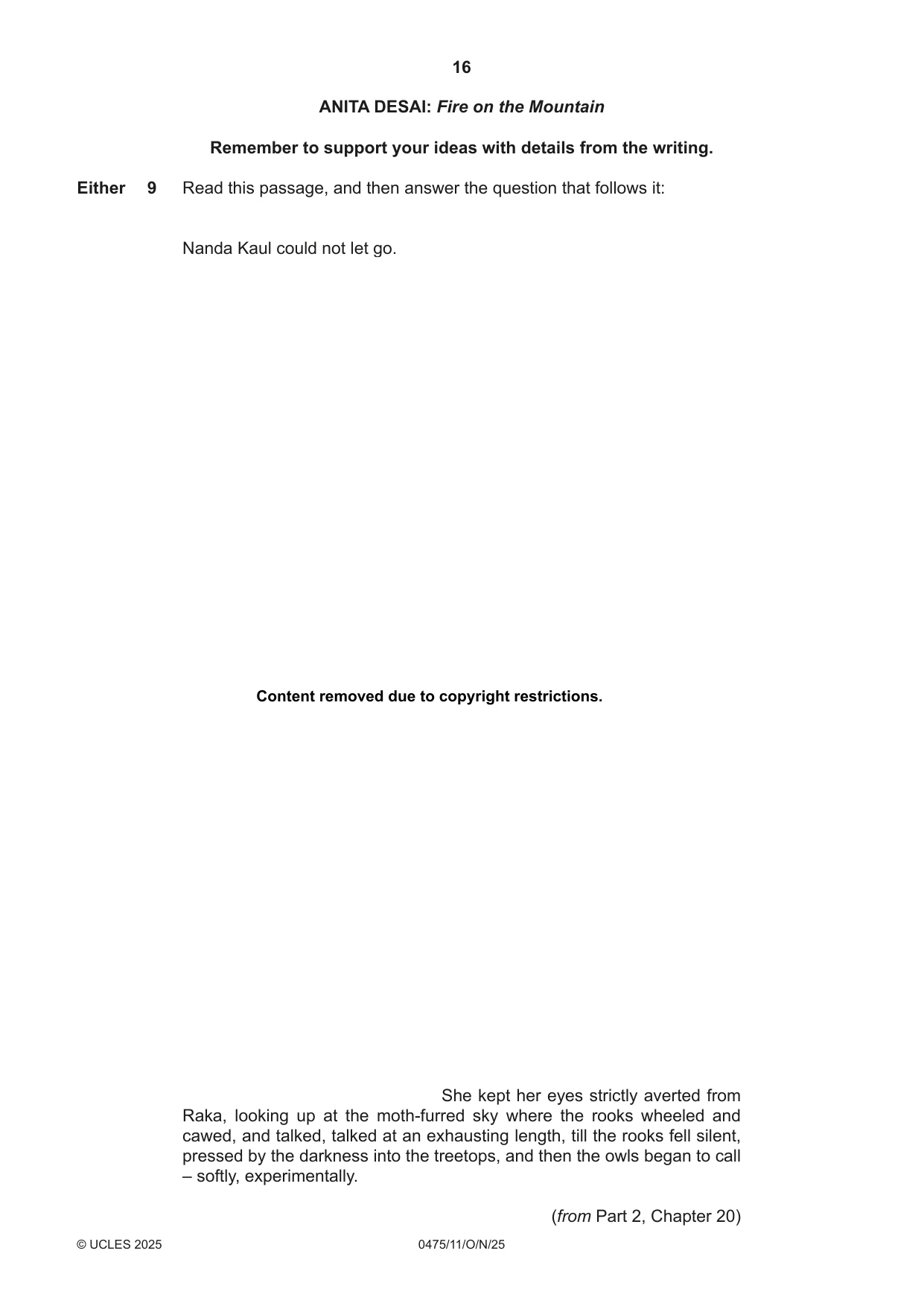
16 0475/11/O/N/25 © UCLES 2025 ANITA DESAI: Fire on the Mountain Remember to support your ideas with details from the writing. Either 9 Read this passage, and then answer the question that follows it: Nanda Kaul could not let go. She kept her eyes strictly averted from Raka, looking up at the moth-furred sky where the rooks wheeled and cawed, and talked, talked at an exhausting length, till the rooks fell silent, pressed by the darkness into the treetops, and then the owls began to call – softly, experimentally. (from Part 2, Chapter 20) Content removed due to copyright restrictions.
Question paper, page 17
17 0475/11/O/N/25 © UCLES 2025 [Turn over How does Desai memorably portray Nanda Kaul and Raka at this moment in the novel? Or 10 In what ways does Desai make the contrast between Nanda Kaul and Ila Das so compelling?
Question paper, page 18
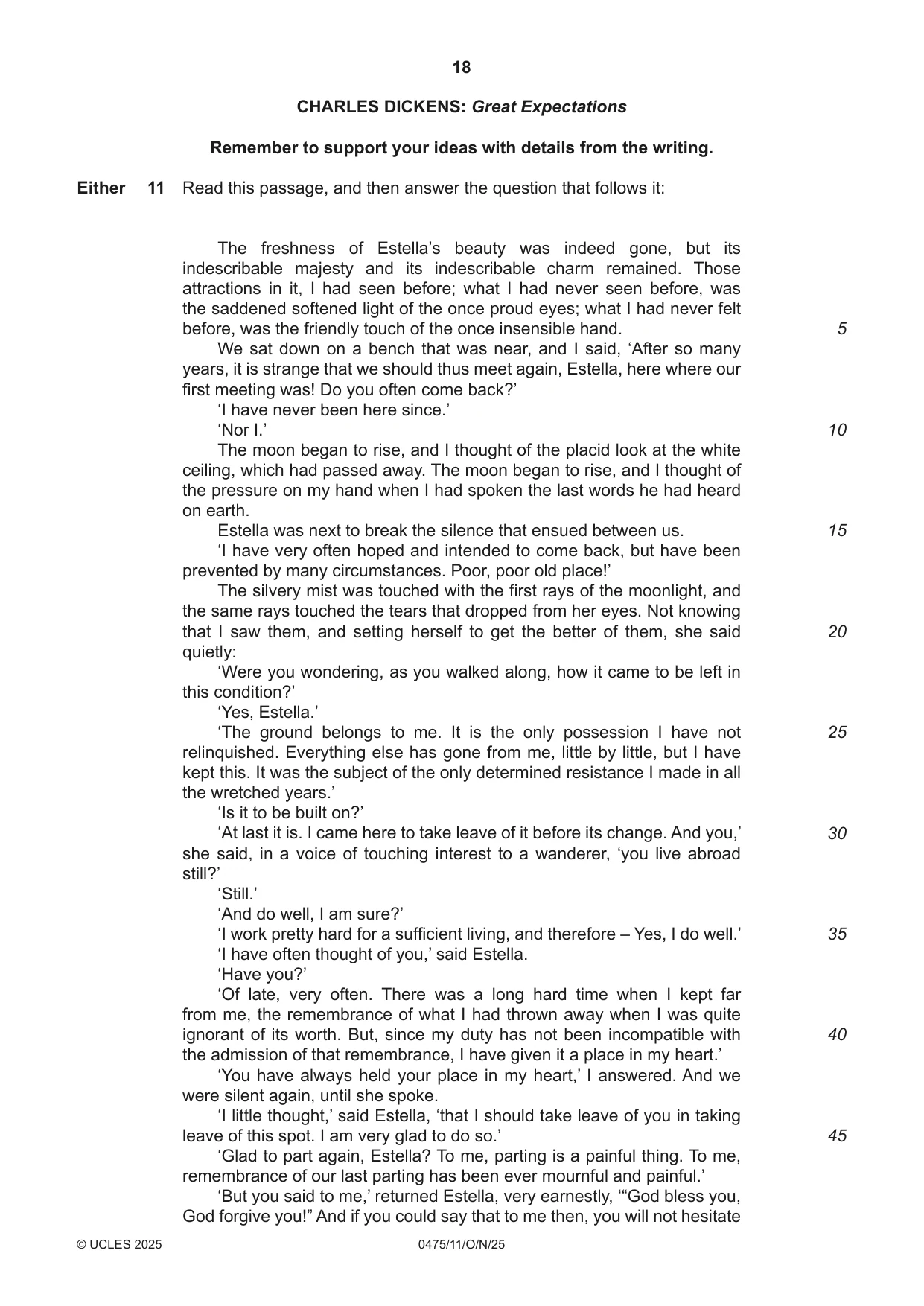
18 0475/11/O/N/25 © UCLES 2025 CHARLES DICKENS: Great Expectations Remember to support your ideas with details from the writing. Either 11 Read this passage, and then answer the question that follows it: The freshness of Estella’s beauty was indeed gone, but its indescribable majesty and its indescribable charm remained. Those attractions in it, I had seen before; what I had never seen before, was the saddened softened light of the once proud eyes; what I had never felt before, was the friendly touch of the once insensible hand. We sat down on a bench that was near, and I said, ‘After so many years, it is strange that we should thus meet again, Estella, here where our first meeting was! Do you often come back?’ ‘I have never been here since.’ ‘Nor I.’ The moon began to rise, and I thought of the placid look at the white ceiling, which had passed away. The moon began to rise, and I thought of the pressure on my hand when I had spoken the last words he had heard on earth. Estella was next to break the silence that ensued between us. ‘I have very often hoped and intended to come back, but have been prevented by many circumstances. Poor, poor old place!’ The silvery mist was touched with the first rays of the moonlight, and the same rays touched the tears that dropped from her eyes. Not knowing that I saw them, and setting herself to get the better of them, she said quietly: ‘Were you wondering, as you walked along, how it came to be left in this condition?’ ‘Yes, Estella.’ ‘The ground belongs to me. It is the only possession I have not relinquished. Everything else has gone from me, little by little, but I have kept this. It was the subject of the only determined resistance I made in all the wretched years.’ ‘Is it to be built on?’ ‘At last it is. I came here to take leave of it before its change. And you,’ she said, in a voice of touching interest to a wanderer, ‘you live abroad still?’ ‘Still.’ ‘And do well, I am sure?’ ‘I work pretty hard for a sufficient living, and therefore – Yes, I do well.’ ‘I have often thought of you,’ said Estella. ‘Have you?’ ‘Of late, very often. There was a long hard time when I kept far from me, the remembrance of what I had thrown away when I was quite ignorant of its worth. But, since my duty has not been incompatible with the admission of that remembrance, I have given it a place in my heart.’ ‘You have always held your place in my heart,’ I answered. And we were silent again, until she spoke. ‘I little thought,’ said Estella, ‘that I should take leave of you in taking leave of this spot. I am very glad to do so.’ ‘Glad to part again, Estella? To me, parting is a painful thing. To me, remembrance of our last parting has been ever mournful and painful.’ ‘But you said to me,’ returned Estella, very earnestly, ‘“God bless you, God forgive you!” And if you could say that to me then, you will not hesitate 5 10 15 20 25 30 35 40 45
Question paper, page 19
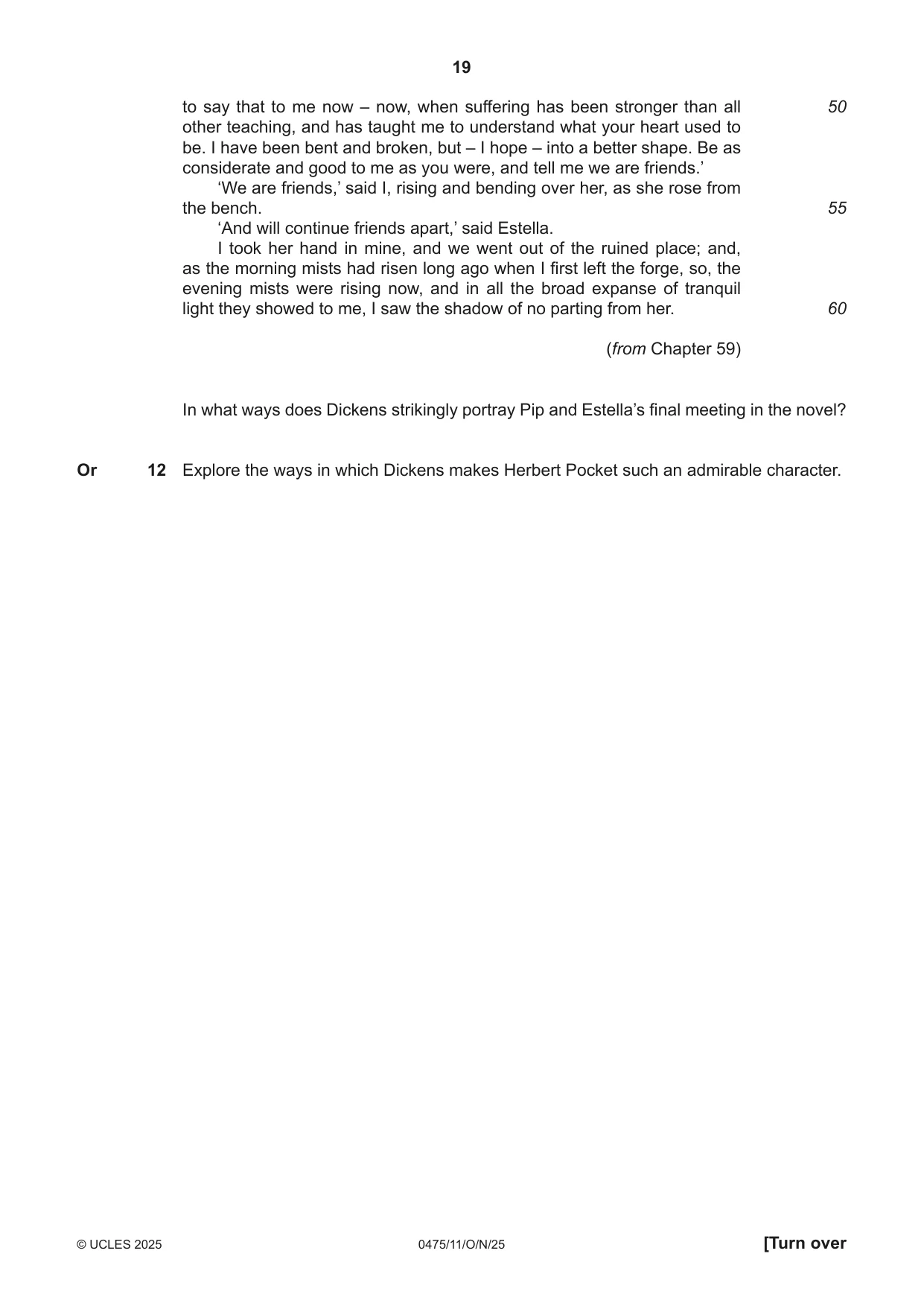
19 0475/11/O/N/25 © UCLES 2025 [Turn over to say that to me now – now, when suffering has been stronger than all other teaching, and has taught me to understand what your heart used to be. I have been bent and broken, but – I hope – into a better shape. Be as considerate and good to me as you were, and tell me we are friends.’ ‘We are friends,’ said I, rising and bending over her, as she rose from the bench. ‘And will continue friends apart,’ said Estella. I took her hand in mine, and we went out of the ruined place; and, as the morning mists had risen long ago when I first left the forge, so, the evening mists were rising now, and in all the broad expanse of tranquil light they showed to me, I saw the shadow of no parting from her. (from Chapter 59) In what ways does Dickens strikingly portray Pip and Estella’s final meeting in the novel? Or 12 Explore the ways in which Dickens makes Herbert Pocket such an admirable character. 50 55 60
Question paper, page 20
20 0475/11/O/N/25 © UCLES 2025 DAPHNE DU MAURIER: Rebecca Remember to support your ideas with details from the writing. Either 13 Read this passage, and then answer the question that follows it: Mrs Danvers was still standing by the window, and the shutter was folded back. Content removed due to copyright restrictions.
Question paper, page 21
21 0475/11/O/N/25 © UCLES 2025 [Turn over Do you think his agony and pain will bring Mrs de Winter back again?’ (from Chapter 18) How does du Maurier make this such a powerful moment in the novel? Or 14 Explore the ways in which du Maurier makes Frank such an admirable character. Content removed due to copyright restrictions.
Question paper, page 22
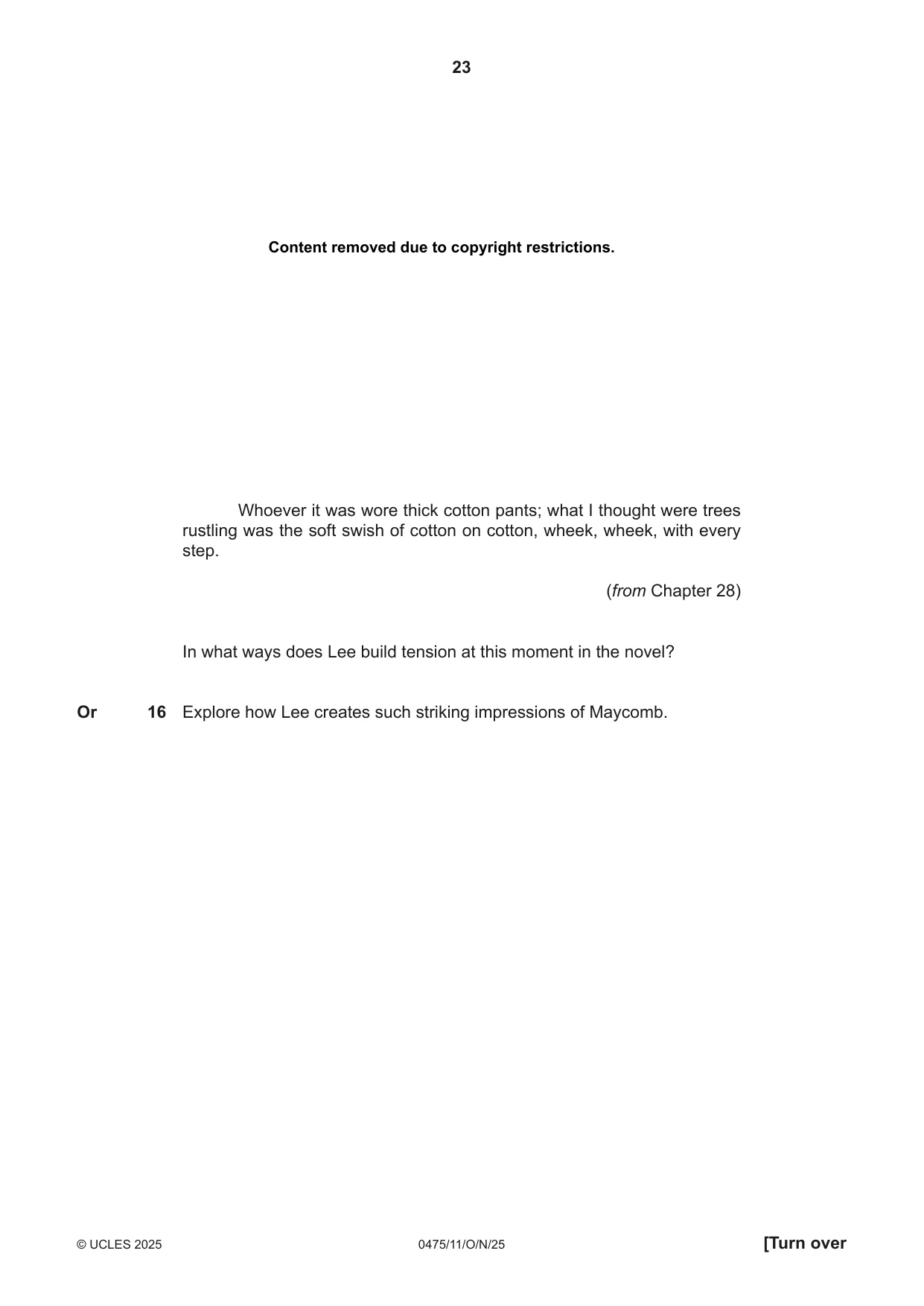
22 0475/11/O/N/25 © UCLES 2025 HARPER LEE: To Kill a Mockingbird Remember to support your ideas with details from the writing. Either 15 Read this passage, and then answer the question that follows it: We began crossing the black school yard, straining to see our feet. Content removed due to copyright restrictions.
Question paper, page 23
23 0475/11/O/N/25 © UCLES 2025 [Turn over Whoever it was wore thick cotton pants; what I thought were trees rustling was the soft swish of cotton on cotton, wheek, wheek, with every step. (from Chapter 28) In what ways does Lee build tension at this moment in the novel? Or 16 Explore how Lee creates such striking impressions of Maycomb. Content removed due to copyright restrictions.
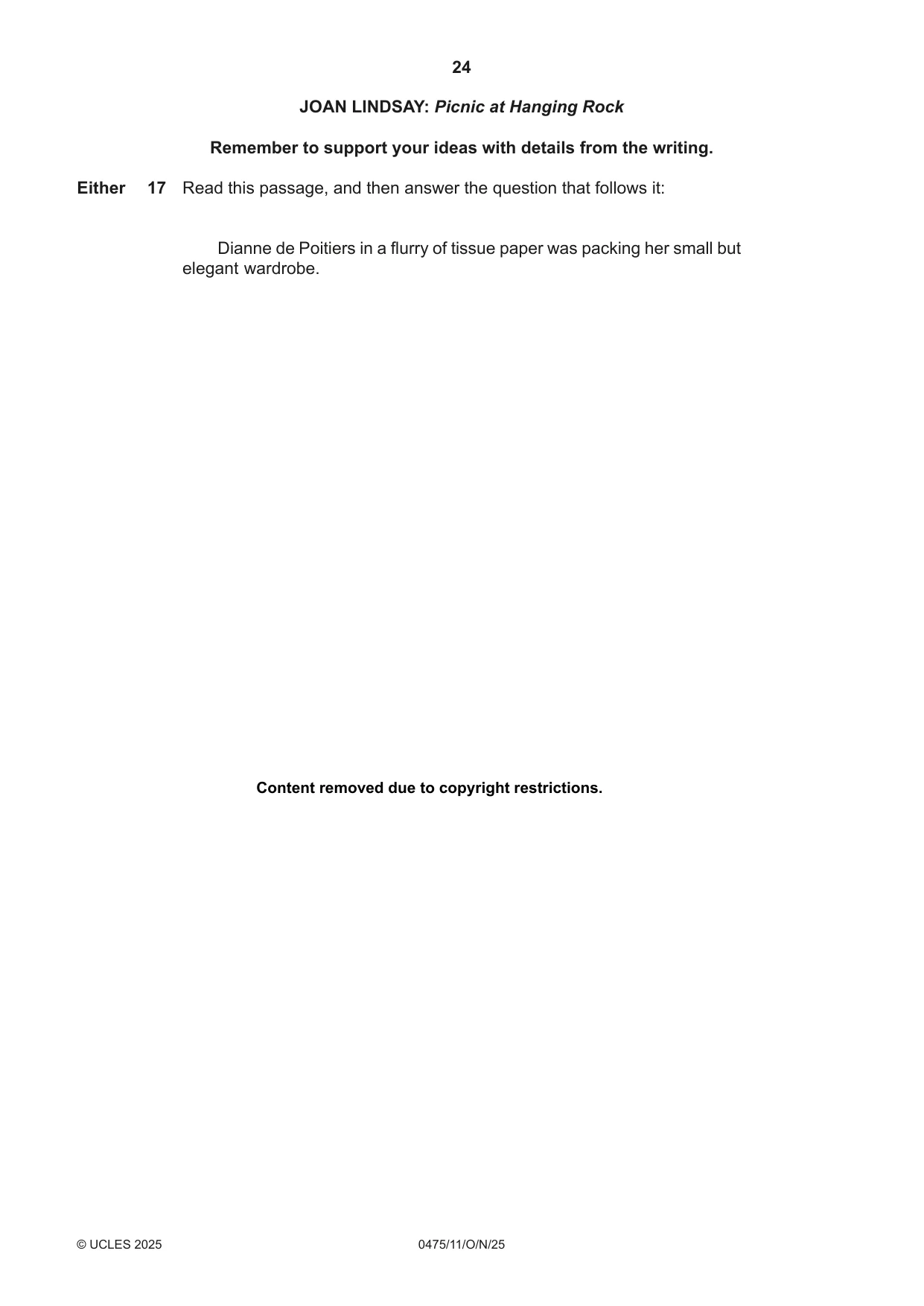
Question paper, page 24
24 0475/11/O/N/25 © UCLES 2025 JOAN LINDSAY: Picnic at Hanging Rock Remember to support your ideas with details from the writing. Either 17 Read this passage, and then answer the question that follows it: Dianne de Poitiers in a flurry of tissue paper was packing her small but elegant wardrobe. Content removed due to copyright restrictions.
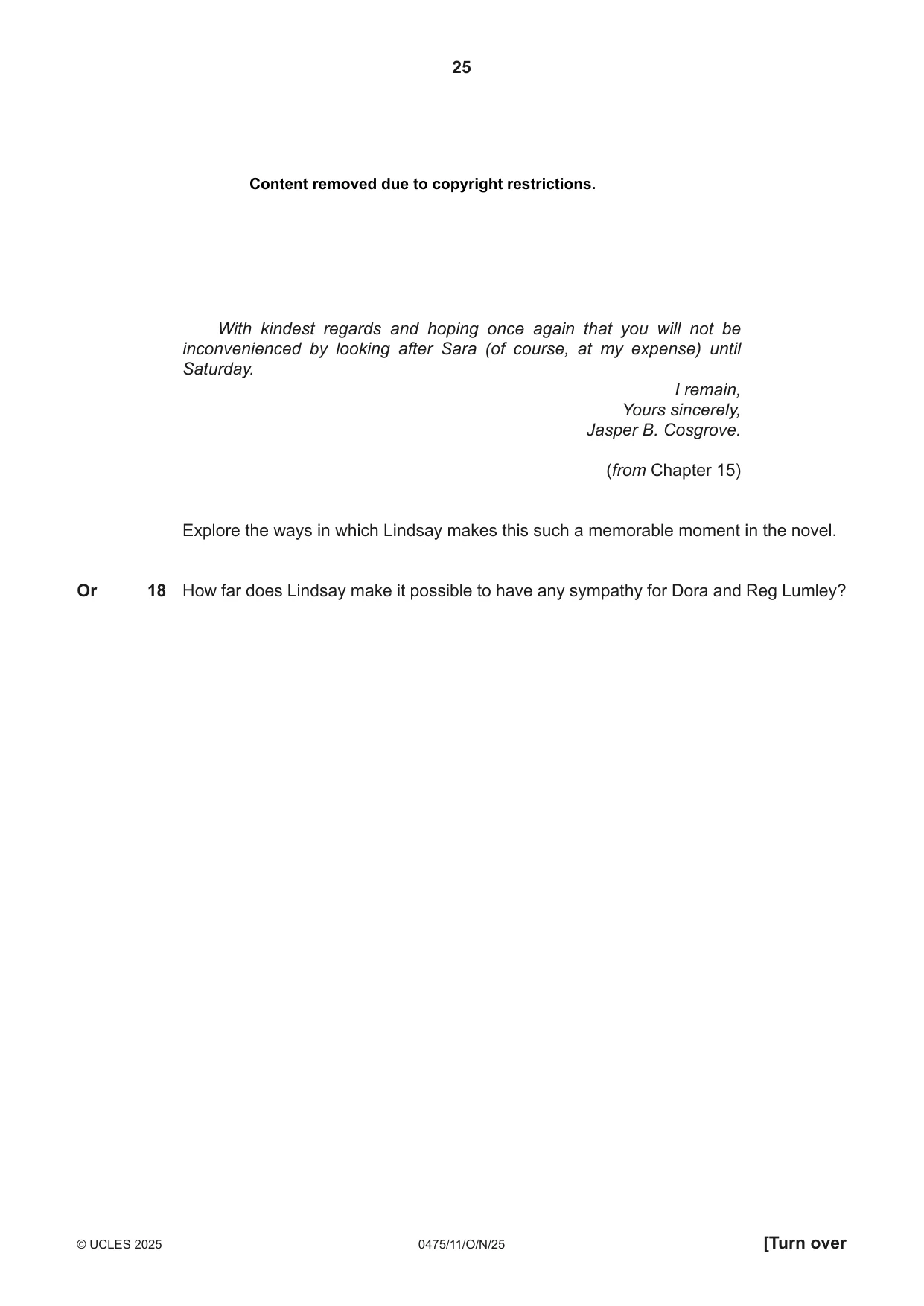
Question paper, page 25
25 0475/11/O/N/25 © UCLES 2025 [Turn over With kindest regards and hoping once again that you will not be inconvenienced by looking after Sara (of course, at my expense) until Saturday. I remain, Yours sincerely, Jasper B. Cosgrove. (from Chapter 15) Explore the ways in which Lindsay makes this such a memorable moment in the novel. Or 18 How far does Lindsay make it possible to have any sympathy for Dora and Reg Lumley? Content removed due to copyright restrictions.
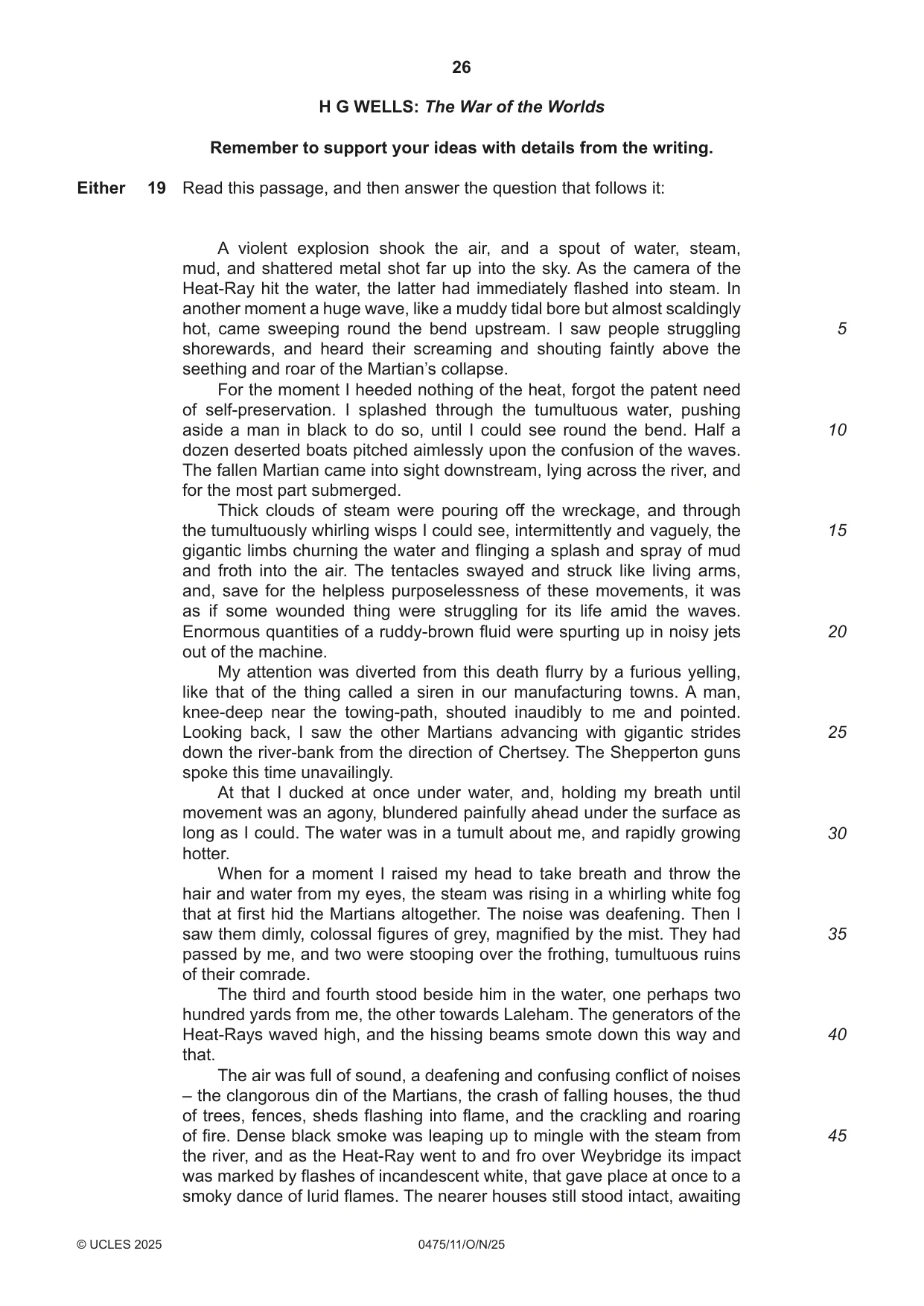
Question paper, page 26
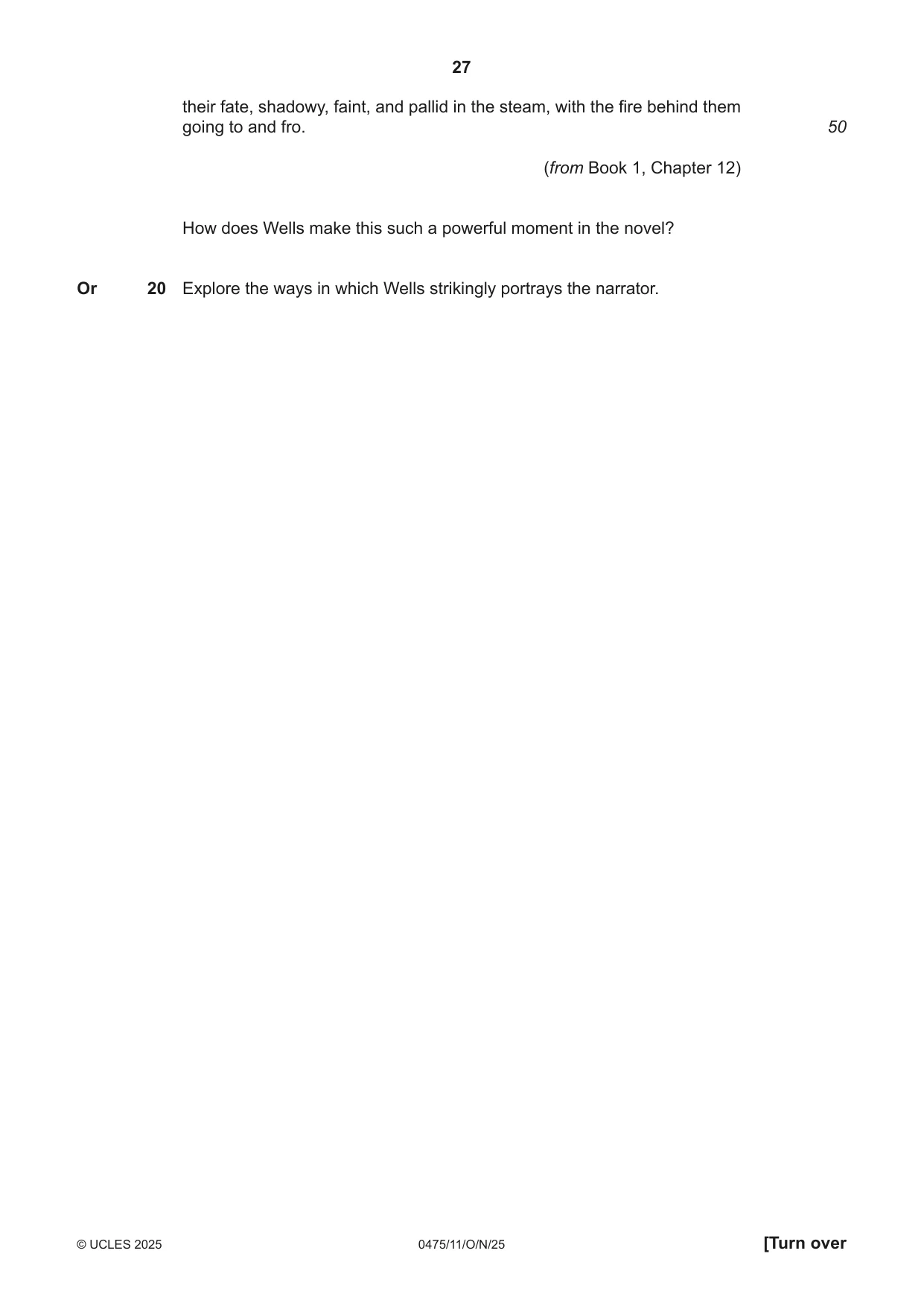
26 0475/11/O/N/25 © UCLES 2025 H G WELLS: The War of the Worlds Remember to support your ideas with details from the writing. Either 19 Read this passage, and then answer the question that follows it: A violent explosion shook the air, and a spout of water, steam, mud, and shattered metal shot far up into the sky. As the camera of the Heat-Ray hit the water, the latter had immediately flashed into steam. In another moment a huge wave, like a muddy tidal bore but almost scaldingly hot, came sweeping round the bend upstream. I saw people struggling shorewards, and heard their screaming and shouting faintly above the seething and roar of the Martian’s collapse. For the moment I heeded nothing of the heat, forgot the patent need of self-preservation. I splashed through the tumultuous water, pushing aside a man in black to do so, until I could see round the bend. Half a dozen deserted boats pitched aimlessly upon the confusion of the waves. The fallen Martian came into sight downstream, lying across the river, and for the most part submerged. Thick clouds of steam were pouring off the wreckage, and through the tumultuously whirling wisps I could see, intermittently and vaguely, the gigantic limbs churning the water and flinging a splash and spray of mud and froth into the air. The tentacles swayed and struck like living arms, and, save for the helpless purposelessness of these movements, it was as if some wounded thing were struggling for its life amid the waves. Enormous quantities of a ruddy-brown fluid were spurting up in noisy jets out of the machine. My attention was diverted from this death flurry by a furious yelling, like that of the thing called a siren in our manufacturing towns. A man, knee-deep near the towing-path, shouted inaudibly to me and pointed. Looking back, I saw the other Martians advancing with gigantic strides down the river-bank from the direction of Chertsey. The Shepperton guns spoke this time unavailingly. At that I ducked at once under water, and, holding my breath until movement was an agony, blundered painfully ahead under the surface as long as I could. The water was in a tumult about me, and rapidly growing hotter. When for a moment I raised my head to take breath and throw the hair and water from my eyes, the steam was rising in a whirling white fog that at first hid the Martians altogether. The noise was deafening. Then I saw them dimly, colossal figures of grey, magnified by the mist. They had passed by me, and two were stooping over the frothing, tumultuous ruins of their comrade. The third and fourth stood beside him in the water, one perhaps two hundred yards from me, the other towards Laleham. The generators of the Heat-Rays waved high, and the hissing beams smote down this way and that. The air was full of sound, a deafening and confusing conflict of noises – the clangorous din of the Martians, the crash of falling houses, the thud of trees, fences, sheds flashing into flame, and the crackling and roaring of fire. Dense black smoke was leaping up to mingle with the steam from the river, and as the Heat-Ray went to and fro over Weybridge its impact was marked by flashes of incandescent white, that gave place at once to a smoky dance of lurid flames. The nearer houses still stood intact, awaiting 5 10 15 20 25 30 35 40 45
Question paper, page 27
27 0475/11/O/N/25 © UCLES 2025 [Turn over their fate, shadowy, faint, and pallid in the steam, with the fire behind them going to and fro. (from Book 1, Chapter 12) How does Wells make this such a powerful moment in the novel? Or 20 Explore the ways in which Wells strikingly portrays the narrator. 50
Question paper, page 28
28 0475/11/O/N/25 © UCLES 2025 from STORIES OF OURSELVES VOLUME 2 Remember to support your ideas with details from the writing. Either 21 Read this passage from A Walk to the Jetty (by Jamaica Kincaid), and then answer the question that follows it: The Anglican church bell struck seven. Content removed due to copyright restrictions.
Question paper, page 29
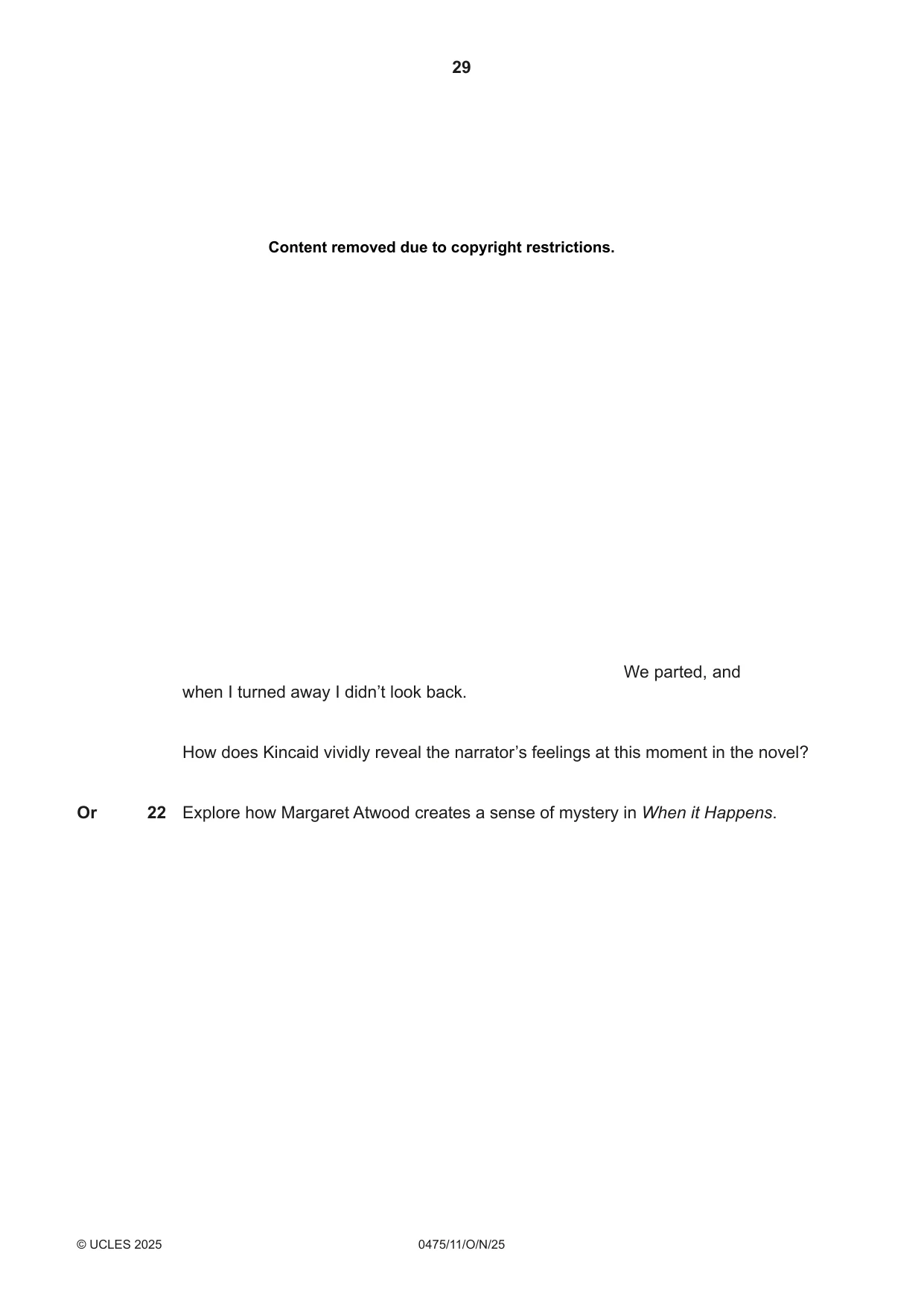
29 0475/11/O/N/25 © UCLES 2025 We parted, and when I turned away I didn’t look back. How does Kincaid vividly reveal the narrator’s feelings at this moment in the novel? Or 22 Explore how Margaret Atwood creates a sense of mystery in When it Happens. Content removed due to copyright restrictions.
Question paper, page 30
30 0475/11/O/N/25 © UCLES 2025 BLANK PAGE
Question paper, page 31
31 0475/11/O/N/25 © UCLES 2025 BLANK PAGE
Question paper, page 32
32 0475/11/O/N/25 © UCLES 2025 Permission to reproduce items where third-party owned material protected by copyright is included has been sought and cleared where possible. Every reasonable effort has been made by the publisher (UCLES) to trace copyright holders, but if any items requiring clearance have unwittingly been included, the publisher will be pleased to make amends at the earliest possible opportunity. To avoid the issue of disclosure of answer-related information to candidates, all copyright acknowledgements are reproduced online in the Cambridge Assessment International Education Copyright Acknowledgements Booklet. This is produced for each series of examinations and is freely available to download at www.cambridgeinternational.org after the live examination series. Cambridge Assessment International Education is part of Cambridge Assessment. Cambridge Assessment is the brand name of the University of Cambridge Local Examinations Syndicate (UCLES), which is a department of the University of Cambridge. BLANK PAGE
Mark scheme, page 1
This document consists of 5 printed pages. © Cambridge University Press & Assessment 2025 [Turn over Cambridge IGCSE™ LITERATURE IN ENGLISH 0475/11 Paper 1 Poetry and Prose October/November 2025 MARK SCHEME Maximum Mark: 50 Published This mark scheme is published as an aid to teachers and candidates, to indicate the requirements of the examination. It shows the basis on which Examiners were instructed to award marks. It does not indicate the details of the discussions that took place at an Examiners’ meeting before marking began, which would have considered the acceptability of alternative answers. Mark schemes should be read in conjunction with the question paper and the Principal Examiner Report for Teachers. Cambridge International will not enter into discussions about these mark schemes. Cambridge International is publishing the mark schemes for the October/November 2025 series for most Cambridge IGCSE, Cambridge International A and AS Level components, and some Cambridge O Level components.
Mark scheme, page 2
0475/11 Cambridge IGCSE – Mark Scheme PUBLISHED October/November 2025 © Cambridge University Press & Assessment 2025 Page 2 of 5 Generic Marking Principles These general marking principles must be applied by all examiners when marking candidate answers. They should be applied alongside the specific content of the mark scheme or generic level descriptions for a question. Each question paper and mark scheme will also comply with these marking principles. GENERIC MARKING PRINCIPLE 1: Marks must be awarded in line with: • the specific content of the mark scheme or the generic level descriptors for the question • the specific skills defined in the mark scheme or in the generic level descriptors for the question • the standard of response required by a candidate as exemplified by the standardisation scripts. GENERIC MARKING PRINCIPLE 2: Marks awarded are always whole marks (not half marks, or other fractions). GENERIC MARKING PRINCIPLE 3: Marks must be awarded positively: • marks are awarded for correct/valid answers, as defined in the mark scheme. However, credit is given for valid answers which go beyond the scope of the syllabus and mark scheme, referring to your Team Leader as appropriate • marks are awarded when candidates clearly demonstrate what they know and can do • marks are not deducted for errors • marks are not deducted for omissions • answers should only be judged on the quality of spelling, punctuation and grammar when these features are specifically assessed by the question as indicated by the mark scheme. The meaning, however, should be unambiguous. GENERIC MARKING PRINCIPLE 4: Rules must be applied consistently, e.g. in situations where candidates have not followed instructions or in the application of generic level descriptors. GENERIC MARKING PRINCIPLE 5: Marks should be awarded using the full range of marks defined in the mark scheme for the question (however; the use of the full mark range may be limited according to the quality of the candidate responses seen). GENERIC MARKING PRINCIPLE 6: Marks awarded are based solely on the requirements as defined in the mark scheme. Marks should not be awarded with grade thresholds or grade descriptors in mind.
Mark scheme, page 3
0475/11 Cambridge IGCSE – Mark Scheme PUBLISHED October/November 2025 © Cambridge University Press & Assessment 2025 Page 3 of 5 English & Media subject specific general marking principles (To be read in conjunction with the Generic Marking Principles (and requiring further guidance on how to place marks within levels)) Components using level descriptors: • We use level descriptors as a guide to broad understanding of the qualities normally expected of, or typical of, work in a level. • Level descriptors are a means of general guidance and should not be interpreted as hurdle statements. • Where indicative content notes are supplied for a question, these are not a prescription of required content, and must not be treated as such. Alternative correct points and unexpected answers in candidates’ scripts must be given marks that fairly reflect the knowledge and skills demonstrated. • While we may have legitimate expectations as to the ground most answers may occupy, we must at all times be prepared to meet candidates on their chosen ground, provided it is relevant ground (e.g. clearly related to and derived from a relevant passage/text and meeting the mark scheme requirements for the question). Components using point-based marking: Point marking is often used to reward knowledge, understanding and application of skills. We give credit where the candidate’s answer shows relevant knowledge, understanding and application of skills in answering the question. We do not give credit where the answer shows confusion. From this it follows that we: a DO credit answers which are worded differently from the mark scheme if they clearly convey the same meaning (unless the mark scheme requires a specific term). b DO credit alternative answers/examples which are not written in the mark scheme if they are correct. c DO credit answers where candidates give more than one correct answer in one prompt/numbered/scaffolded space where extended writing is required rather than list-type answers. For example, questions that require n reasons (e.g. State two reasons…). d DO NOT credit answers simply for using a ‘key term’ unless that is all that is required. (Check for evidence it is understood and not used incorrectly.) e DO NOT credit answers which are obviously self-contradicting or trying to cover all possibilities. f DO NOT give further credit for what is effectively repetition of a correct point already credited unless the language itself is being tested. This applies equally to ‘mirror statements’ (i.e. polluted/not polluted). g DO NOT require spellings to be correct, unless this is part of the test. However, spellings of syllabus terms must allow for clear and unambiguous separation from other syllabus terms with which they may be confused (e.g. Corrasion/Corrosion).
Mark scheme, page 4
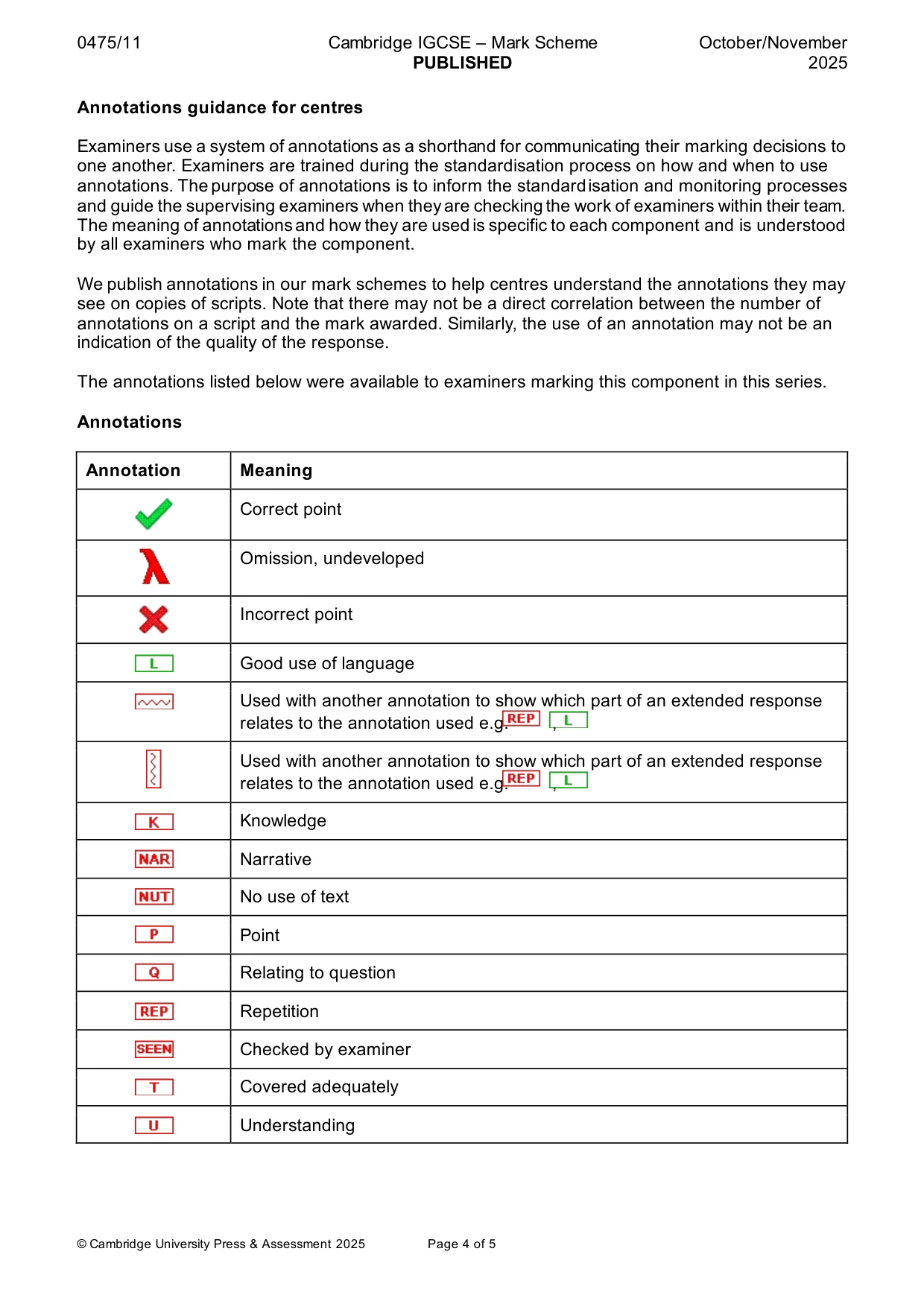
0475/11 Cambridge IGCSE – Mark Scheme PUBLISHED October/November 2025 © Cambridge University Press & Assessment 2025 Page 4 of 5 Annotations guidance for centres Examiners use a system of annotations as a shorthand for communicating their marking decisions to one another. Examiners are trained during the standardisation process on how and when to use annotations. The purpose of annotations is to inform the standardisation and monitoring processes and guide the supervising examiners when they are checking the work of examiners within their team. The meaning of annotations and how they are used is specific to each component and is understood by all examiners who mark the component. We publish annotations in our mark schemes to help centres understand the annotations they may see on copies of scripts. Note that there may not be a direct correlation between the number of annotations on a script and the mark awarded. Similarly, the use of an annotation may not be an indication of the quality of the response. The annotations listed below were available to examiners marking this component in this series. Annotations Annotation Meaning Correct point Omission, undeveloped Incorrect point Good use of language Used with another annotation to show which part of an extended response relates to the annotation used e.g. , Used with another annotation to show which part of an extended response relates to the annotation used e.g. , Knowledge Narrative No use of text Point Relating to question Repetition Checked by examiner Covered adequately Understanding
Mark scheme, page 5
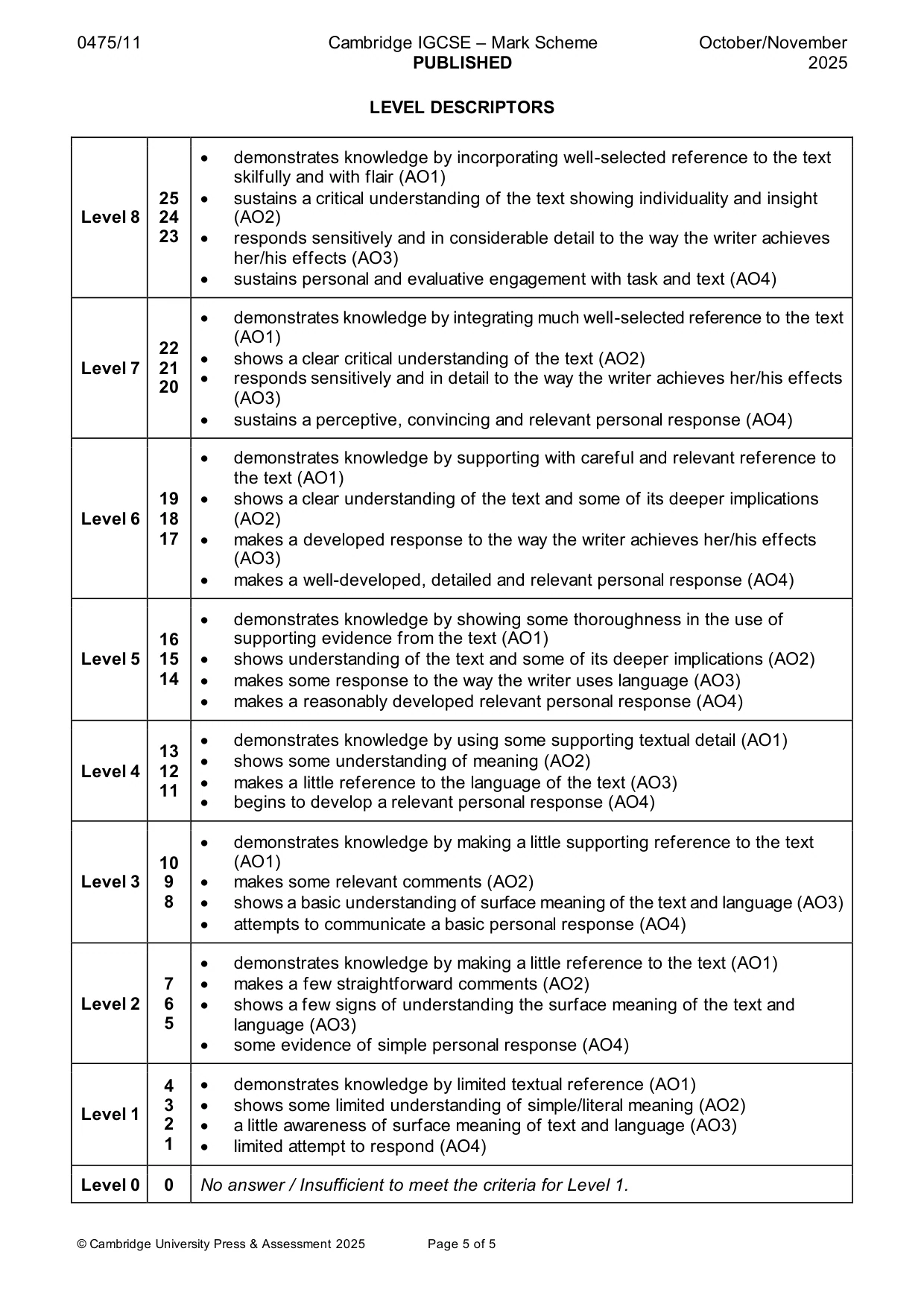
0475/11 Cambridge IGCSE – Mark Scheme PUBLISHED October/November 2025 © Cambridge University Press & Assessment 2025 Page 5 of 5 LEVEL DESCRIPTORS Level 8 25 24 23 • demonstrates knowledge by incorporating well-selected reference to the text skilfully and with flair (AO1) • sustains a critical understanding of the text showing individuality and insight (AO2) • responds sensitively and in considerable detail to the way the writer achieves her/his effects (AO3) • sustains personal and evaluative engagement with task and text (AO4) Level 7 22 21 20 • demonstrates knowledge by integrating much well-selected reference to the text (AO1) • shows a clear critical understanding of the text (AO2) • responds sensitively and in detail to the way the writer achieves her/his effects (AO3) • sustains a perceptive, convincing and relevant personal response (AO4) Level 6 19 18 17 • demonstrates knowledge by supporting with careful and relevant reference to the text (AO1) • shows a clear understanding of the text and some of its deeper implications (AO2) • makes a developed response to the way the writer achieves her/his effects (AO3) • makes a well-developed, detailed and relevant personal response (AO4) Level 5 16 15 14 • demonstrates knowledge by showing some thoroughness in the use of supporting evidence from the text (AO1) • shows understanding of the text and some of its deeper implications (AO2) • makes some response to the way the writer uses language (AO3) • makes a reasonably developed relevant personal response (AO4) Level 4 13 12 11 • demonstrates knowledge by using some supporting textual detail (AO1) • shows some understanding of meaning (AO2) • makes a little reference to the language of the text (AO3) • begins to develop a relevant personal response (AO4) Level 3 10 9 8 • demonstrates knowledge by making a little supporting reference to the text (AO1) • makes some relevant comments (AO2) • shows a basic understanding of surface meaning of the text and language (AO3) • attempts to communicate a basic personal response (AO4) Level 2 7 6 5 • demonstrates knowledge by making a little reference to the text (AO1) • makes a few straightforward comments (AO2) • shows a few signs of understanding the surface meaning of the text and language (AO3) • some evidence of simple personal response (AO4) Level 1 4 3 2 1 • demonstrates knowledge by limited textual reference (AO1) • shows some limited understanding of simple/literal meaning (AO2) • a little awareness of surface meaning of text and language (AO3) • limited attempt to respond (AO4) Level 0 0 No answer / Insufficient to meet the criteria for Level 1.
What you needed in this session
Cambridge’s own grade thresholds for 2025 Oct/Nov, Paper 1 · Variant 1. A higher threshold means an easier paper — the bar moves with how the cohort did.