Cambridge IGCSE English - Literature in English 0475 — 2022 May/June Paper 1 · Variant 1
0475/11/M/J/22 · 50 marks · ≈56 min
The question paper and its mark scheme, free to read here and free to download. This is Cambridge’s own paper, exactly as it was sat.
Question paper28 pages




Mark scheme4 pages
Answers below. Sit the paper first if you are practising.
Paper as text
Question paper, page 1
This document has 28 pages. Any blank pages are indicated. * 3 7 6 2 1 6 6 0 6 6 * Cambridge IGCSE™ LITERATURE IN ENGLISH 0475/11 Paper 1 Poetry and Prose May/June 2022 1 hour 30 minutes You must answer on the enclosed answer booklet. You will need: Answer booklet (enclosed) INSTRUCTIONS ● Answer two questions in total: Section A: answer one question. Section B: answer one question. ● Follow the instructions on the front cover of the answer booklet. If you need additional answer paper, ask the invigilator for a continuation booklet. INFORMATION ● The total mark for this paper is 50. ● All questions are worth equal marks. DC (RCL (DF)) 301852/3 © UCLES 2022 [Turn over
Question paper, page 2
2 0475/11/M/J/22 © UCLES 2022 BLANK PAGE
Question paper, page 3
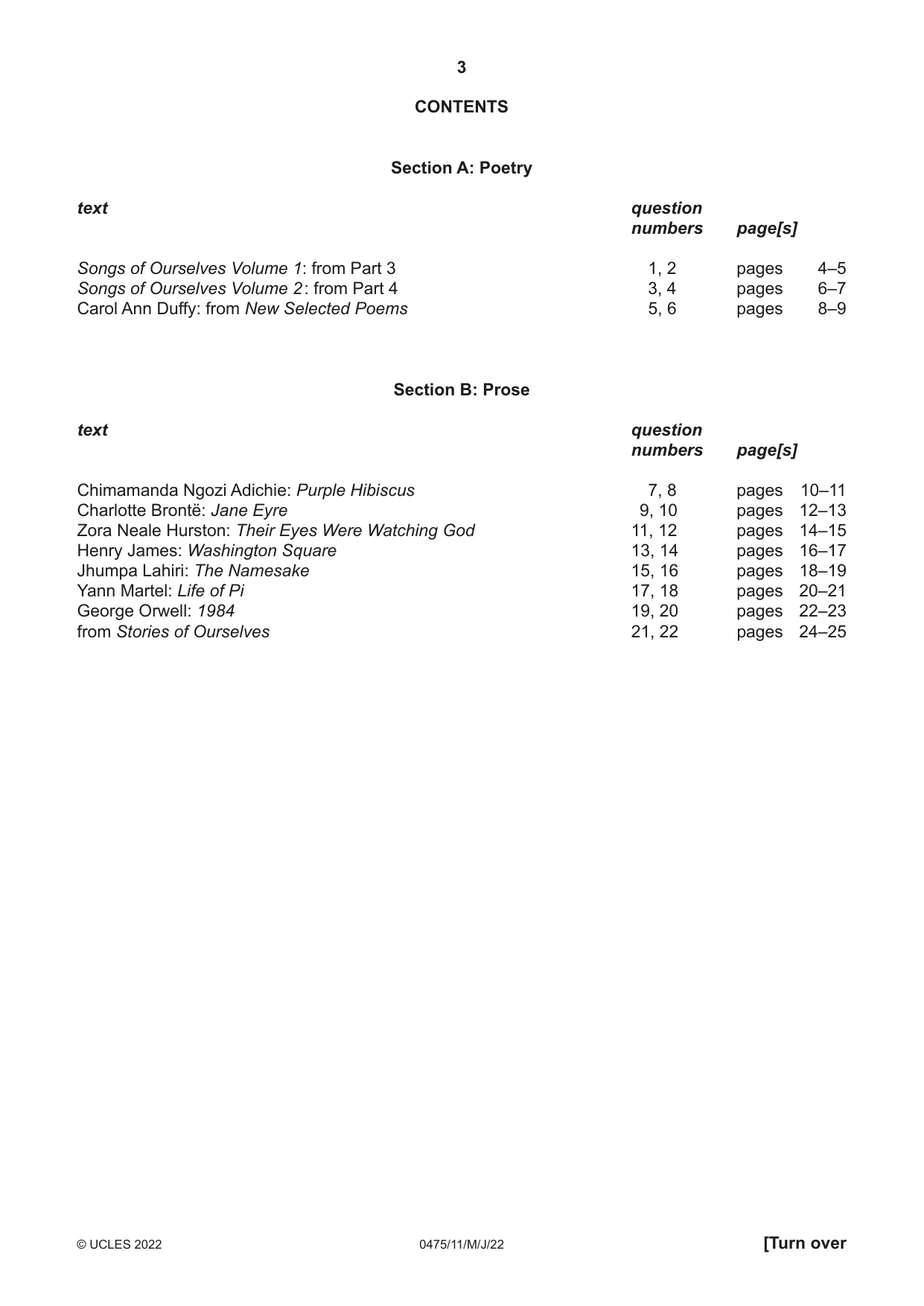
3 0475/11/M/J/22 © UCLES 2022 [Turn over CONTENTS Section A: Poetry text question numbers page[s] Songs of Ourselves Volume 1: from Part 3 1, 2 pages 4–5 Songs of Ourselves Volume 2 : from Part 4 3, 4 pages 6–7 Carol Ann Duffy: from New Selected Poems 5, 6 pages 8–9 Section B: Prose text question numbers page[s] Chimamanda Ngozi Adichie: Purple Hibiscus 7, 8 pages 10–11 Charlotte Brontë: Jane Eyre 9, 10 pages 12–13 Zora Neale Hurston: Their Eyes Were Watching God 11, 12 pages 14–15 Henry James: Washington Square 13, 14 pages 16–17 Jhumpa Lahiri: The Namesake 15, 16 pages 18–19 Yann Martel: Life of Pi 17, 18 pages 20–21 George Orwell: 1984 19, 20 pages 22–23 from Stories of Ourselves 21, 22 pages 24–25
Question paper, page 4
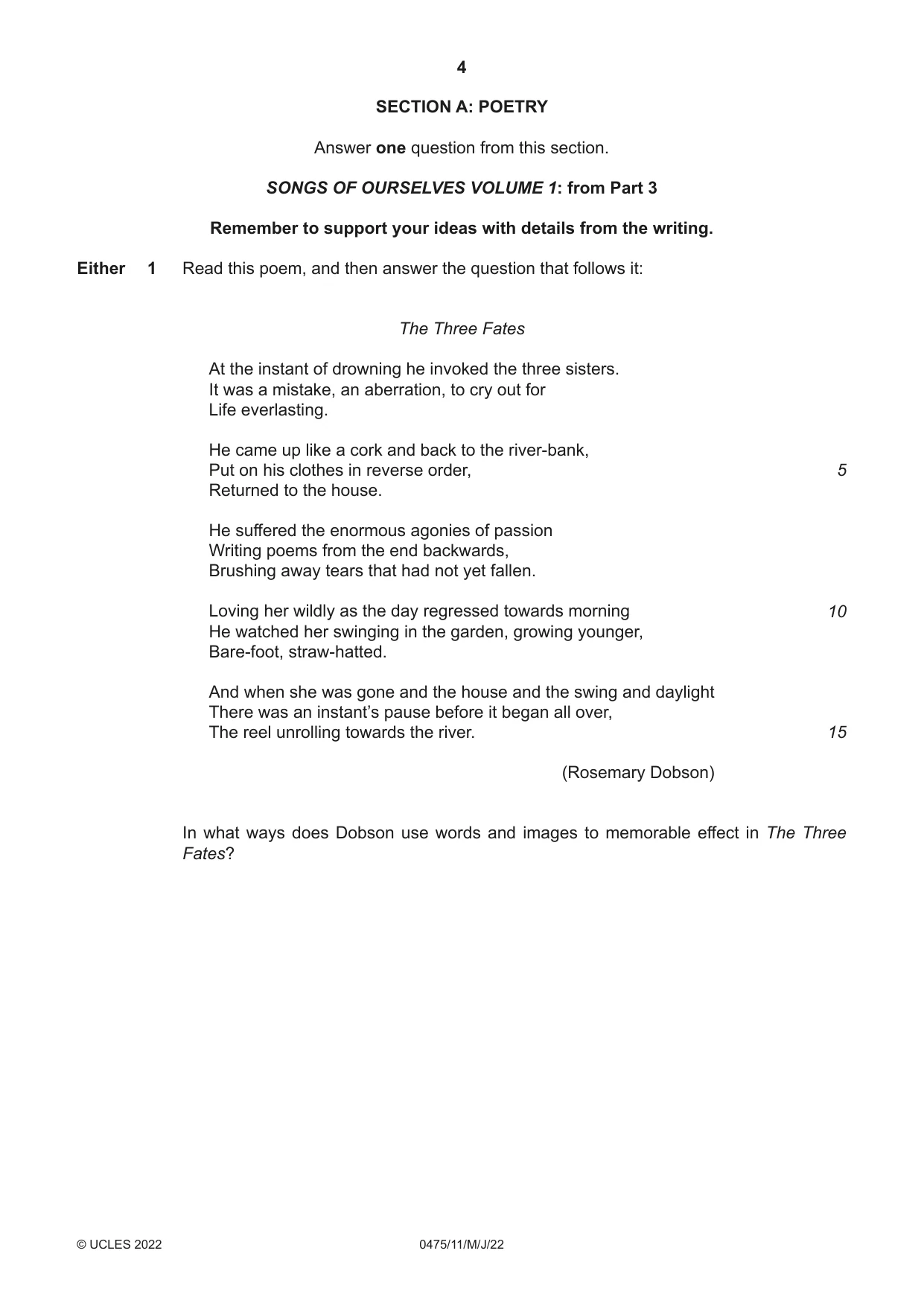
4 0475/11/M/J/22 © UCLES 2022 SECTION A: POETRY Answer one question from this section. SONGS OF OURSELVES VOLUME 1: from Part 3 Remember to support your ideas with details from the writing. Either 1 Read this poem, and then answer the question that follows it: The Three Fates At the instant of drowning he invoked the three sisters. It was a mistake, an aberration, to cry out for Life everlasting. He came up like a cork and back to the river-bank, Put on his clothes in reverse order, Returned to the house. He suffered the enormous agonies of passion Writing poems from the end backwards, Brushing away tears that had not yet fallen. Loving her wildly as the day regressed towards morning He watched her swinging in the garden, growing younger, Bare-foot, straw-hatted. And when she was gone and the house and the swing and daylight There was an instant’s pause before it began all over, The reel unrolling towards the river. (Rosemary Dobson) In what ways does Dobson use words and images to memorable effect in The Three Fates? 5 10 15
Question paper, page 5
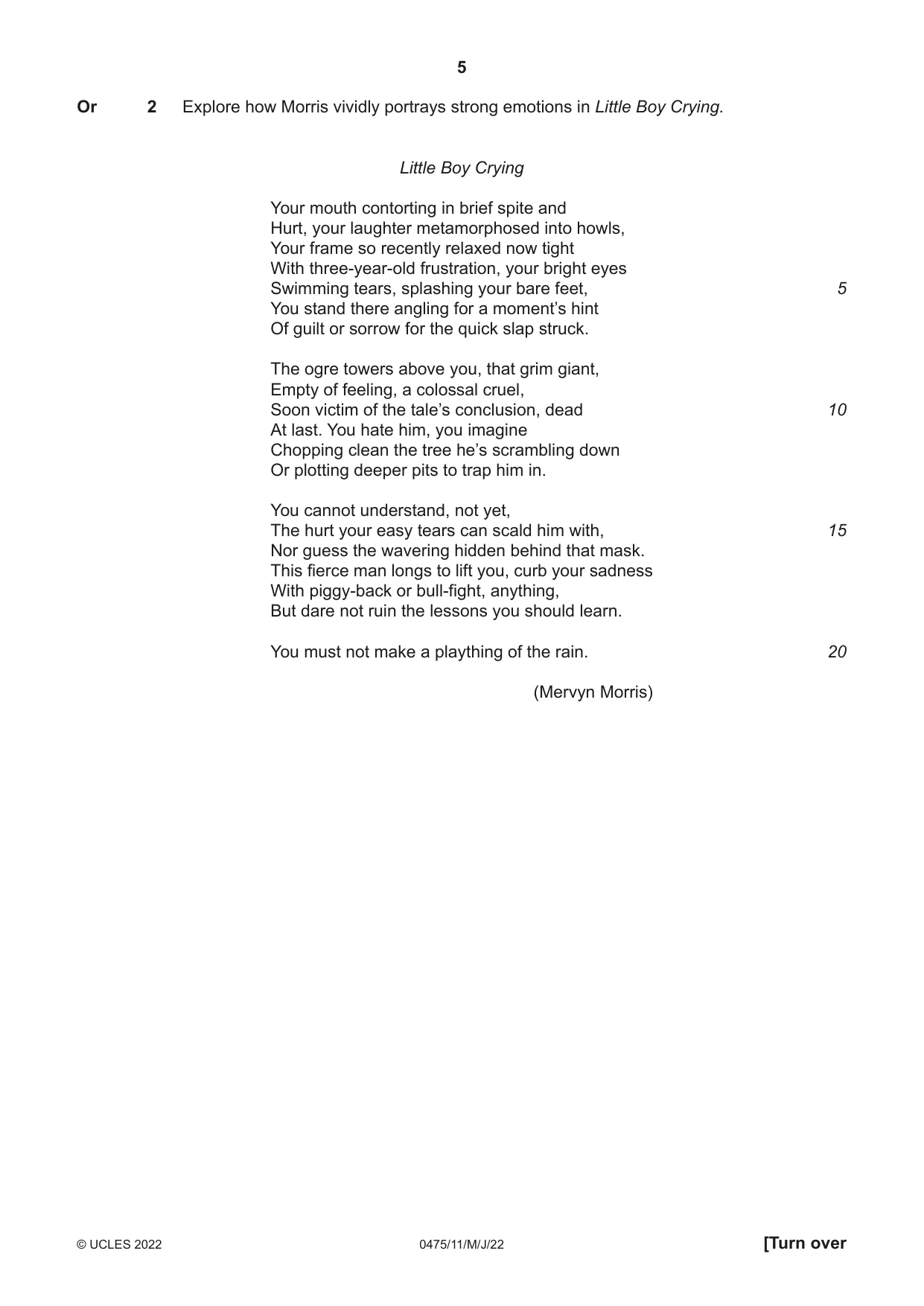
5 0475/11/M/J/22 © UCLES 2022 [Turn over Or 2 Explore how Morris vividly portrays strong emotions in Little Boy Crying. Little Boy Crying Your mouth contorting in brief spite and Hurt, your laughter metamorphosed into howls, Your frame so recently relaxed now tight With three-year-old frustration, your bright eyes Swimming tears, splashing your bare feet, You stand there angling for a moment’s hint Of guilt or sorrow for the quick slap struck. The ogre towers above you, that grim giant, Empty of feeling, a colossal cruel, Soon victim of the tale’s conclusion, dead At last. You hate him, you imagine Chopping clean the tree he’s scrambling down Or plotting deeper pits to trap him in. You cannot understand, not yet, The hurt your easy tears can scald him with, Nor guess the wavering hidden behind that mask. This fierce man longs to lift you, curb your sadness With piggy-back or bull-fight, anything, But dare not ruin the lessons you should learn. You must not make a plaything of the rain. (Mervyn Morris) 5 10 15 20
Question paper, page 6
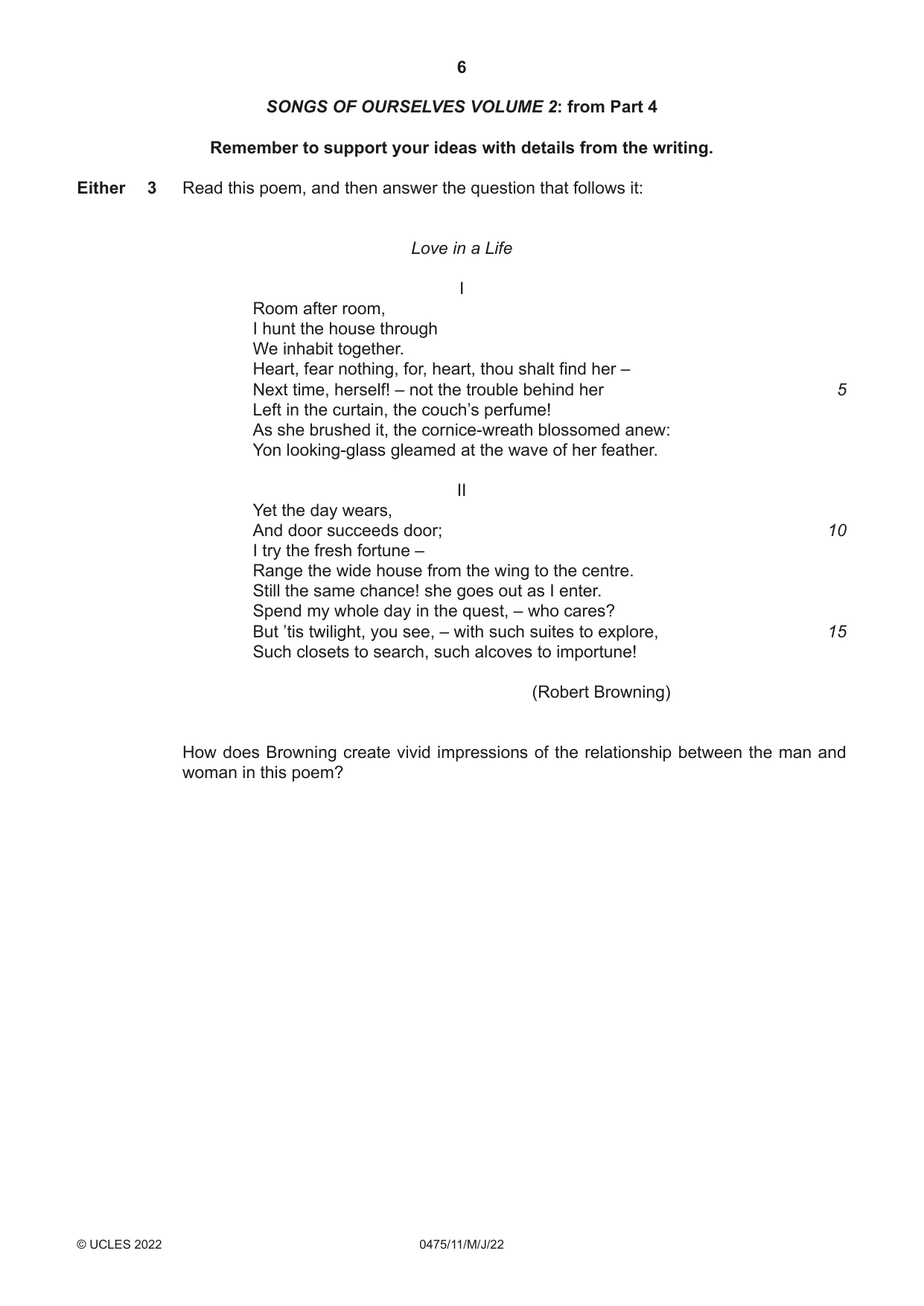
6 0475/11/M/J/22 © UCLES 2022 SONGS OF OURSELVES VOLUME 2: from Part 4 Remember to support your ideas with details from the writing. Either 3 Read this poem, and then answer the question that follows it: Love in a Life I Room after room, I hunt the house through We inhabit together. Heart, fear nothing, for, heart, thou shalt find her – Next time, herself! – not the trouble behind her Left in the curtain, the couch’s perfume! As she brushed it, the cornice-wreath blossomed anew: Yon looking-glass gleamed at the wave of her feather. II Yet the day wears, And door succeeds door; I try the fresh fortune – Range the wide house from the wing to the centre. Still the same chance! she goes out as I enter. Spend my whole day in the quest, – who cares? But ’tis twilight, you see, – with such suites to explore, Such closets to search, such alcoves to importune! (Robert Browning) How does Browning create vivid impressions of the relationship between the man and woman in this poem? 5 10 15
Question paper, page 7
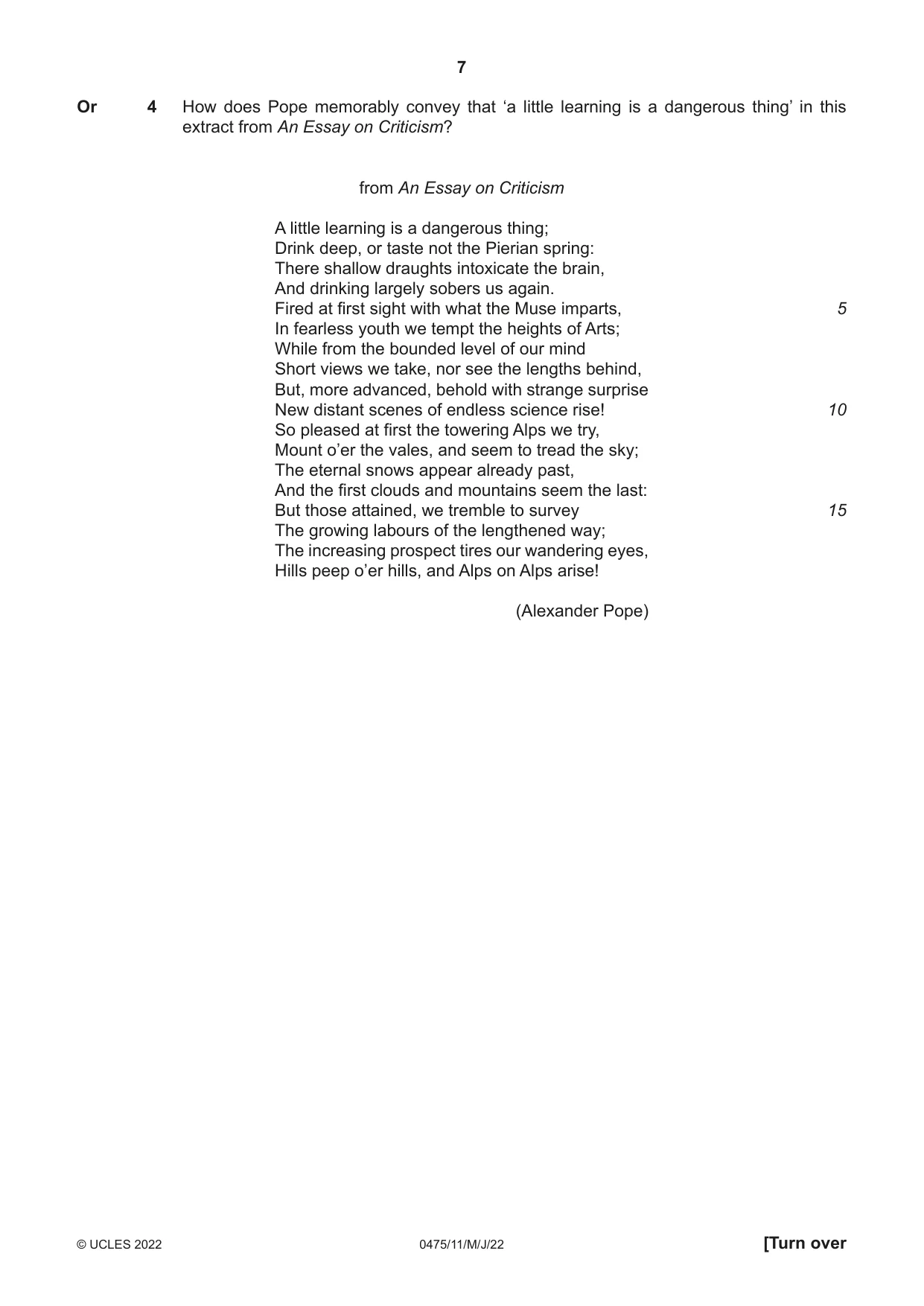
7 0475/11/M/J/22 © UCLES 2022 [Turn over Or 4 How does Pope memorably convey that ‘a little learning is a dangerous thing’ in this extract from An Essay on Criticism? from An Essay on Criticism A little learning is a dangerous thing; Drink deep, or taste not the Pierian spring: There shallow draughts intoxicate the brain, And drinking largely sobers us again. Fired at first sight with what the Muse imparts, In fearless youth we tempt the heights of Arts; While from the bounded level of our mind Short views we take, nor see the lengths behind, But, more advanced, behold with strange surprise New distant scenes of endless science rise! So pleased at first the towering Alps we try, Mount o’er the vales, and seem to tread the sky; The eternal snows appear already past, And the first clouds and mountains seem the last: But those attained, we tremble to survey The growing labours of the lengthened way; The increasing prospect tires our wandering eyes, Hills peep o’er hills, and Alps on Alps arise! (Alexander Pope) 5 10 15
Question paper, page 8
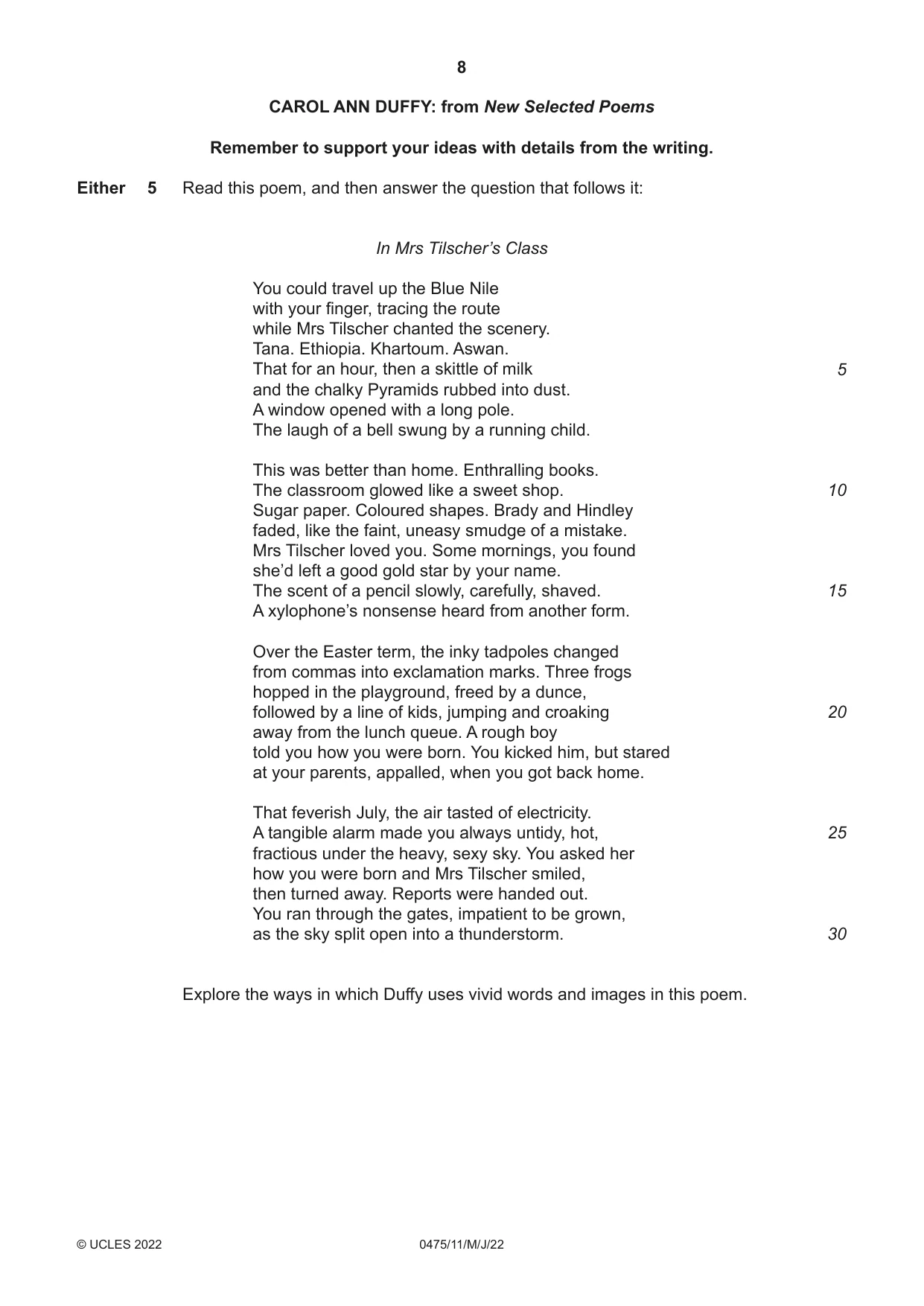
8 0475/11/M/J/22 © UCLES 2022 CAROL ANN DUFFY: from New Selected Poems Remember to support your ideas with details from the writing. Either 5 Read this poem, and then answer the question that follows it: In Mrs Tilscher’s Class You could travel up the Blue Nile with your finger, tracing the route while Mrs Tilscher chanted the scenery. Tana. Ethiopia. Khartoum. Aswan. That for an hour, then a skittle of milk and the chalky Pyramids rubbed into dust. A window opened with a long pole. The laugh of a bell swung by a running child. This was better than home. Enthralling books. The classroom glowed like a sweet shop. Sugar paper. Coloured shapes. Brady and Hindley faded, like the faint, uneasy smudge of a mistake. Mrs Tilscher loved you. Some mornings, you found she’d left a good gold star by your name. The scent of a pencil slowly, carefully, shaved. A xylophone’s nonsense heard from another form. Over the Easter term, the inky tadpoles changed from commas into exclamation marks. Three frogs hopped in the playground, freed by a dunce, followed by a line of kids, jumping and croaking away from the lunch queue. A rough boy told you how you were born. You kicked him, but stared at your parents, appalled, when you got back home. That feverish July, the air tasted of electricity. A tangible alarm made you always untidy, hot, fractious under the heavy, sexy sky. You asked her how you were born and Mrs Tilscher smiled, then turned away. Reports were handed out. You ran through the gates, impatient to be grown, as the sky split open into a thunderstorm. Explore the ways in which Duffy uses vivid words and images in this poem. 5 10 15 20 25 30
Question paper, page 9
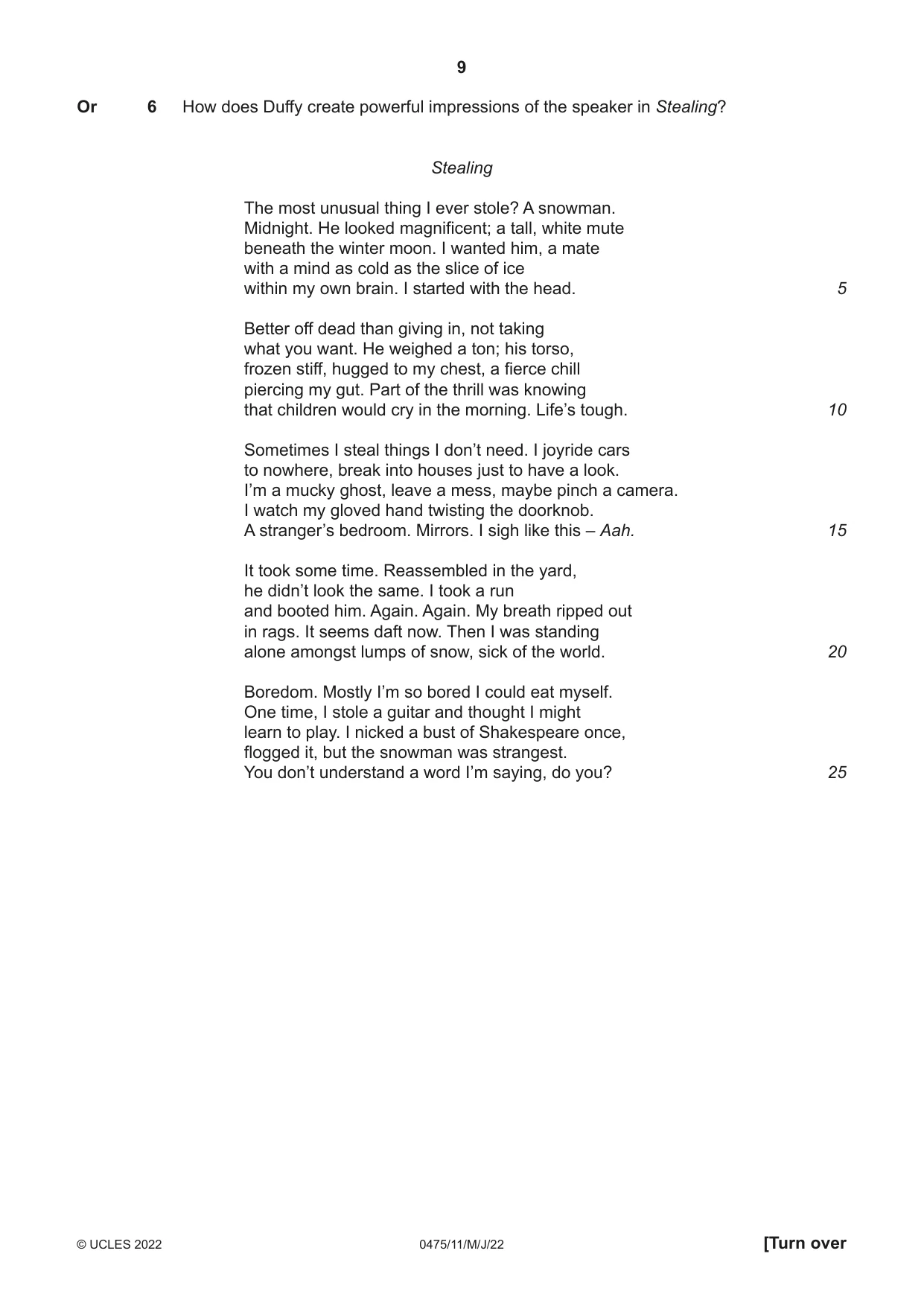
9 0475/11/M/J/22 © UCLES 2022 [Turn over Or 6 How does Duffy create powerful impressions of the speaker in Stealing? Stealing The most unusual thing I ever stole? A snowman. Midnight. He looked magnificent; a tall, white mute beneath the winter moon. I wanted him, a mate with a mind as cold as the slice of ice within my own brain. I started with the head. Better off dead than giving in, not taking what you want. He weighed a ton; his torso, frozen stiff, hugged to my chest, a fierce chill piercing my gut. Part of the thrill was knowing that children would cry in the morning. Life’s tough. Sometimes I steal things I don’t need. I joyride cars to nowhere, break into houses just to have a look. I’m a mucky ghost, leave a mess, maybe pinch a camera. I watch my gloved hand twisting the doorknob. A stranger’s bedroom. Mirrors. I sigh like this – Aah. It took some time. Reassembled in the yard, he didn’t look the same. I took a run and booted him. Again. Again. My breath ripped out in rags. It seems daft now. Then I was standing alone amongst lumps of snow, sick of the world. Boredom. Mostly I’m so bored I could eat myself. One time, I stole a guitar and thought I might learn to play. I nicked a bust of Shakespeare once, flogged it, but the snowman was strangest. You don’t understand a word I’m saying, do you? 5 10 15 20 25
Question paper, page 10
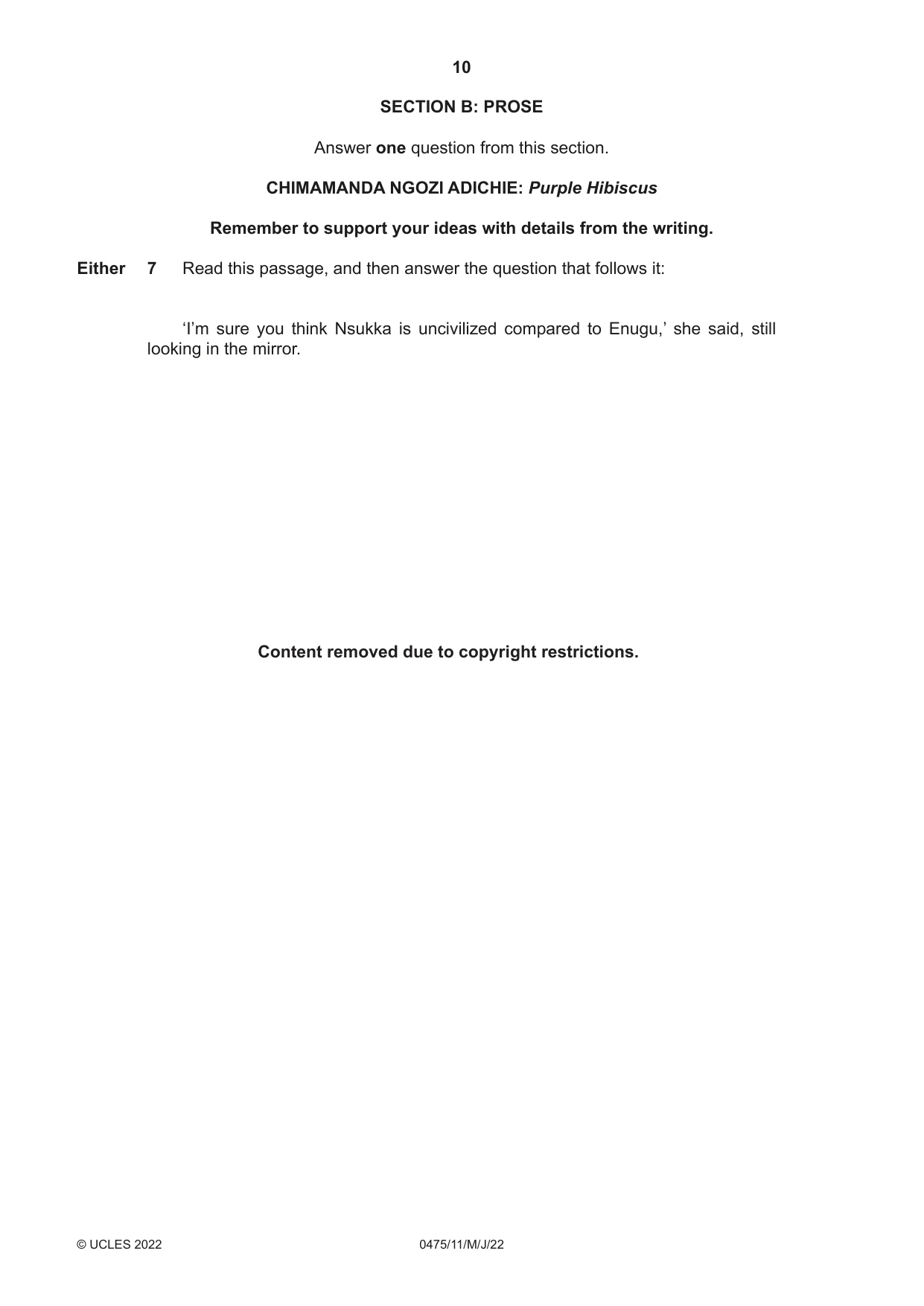
10 0475/11/M/J/22 © UCLES 2022 SECTION B: PROSE Answer one question from this section. CHIMAMANDA NGOZI ADICHIE: Purple Hibiscus Remember to support your ideas with details from the writing. Either 7 Read this passage, and then answer the question that follows it: ‘I’m sure you think Nsukka is uncivilized compared to Enugu,’ she said, still looking in the mirror. Content removed due to copyright restrictions.
Question paper, page 11
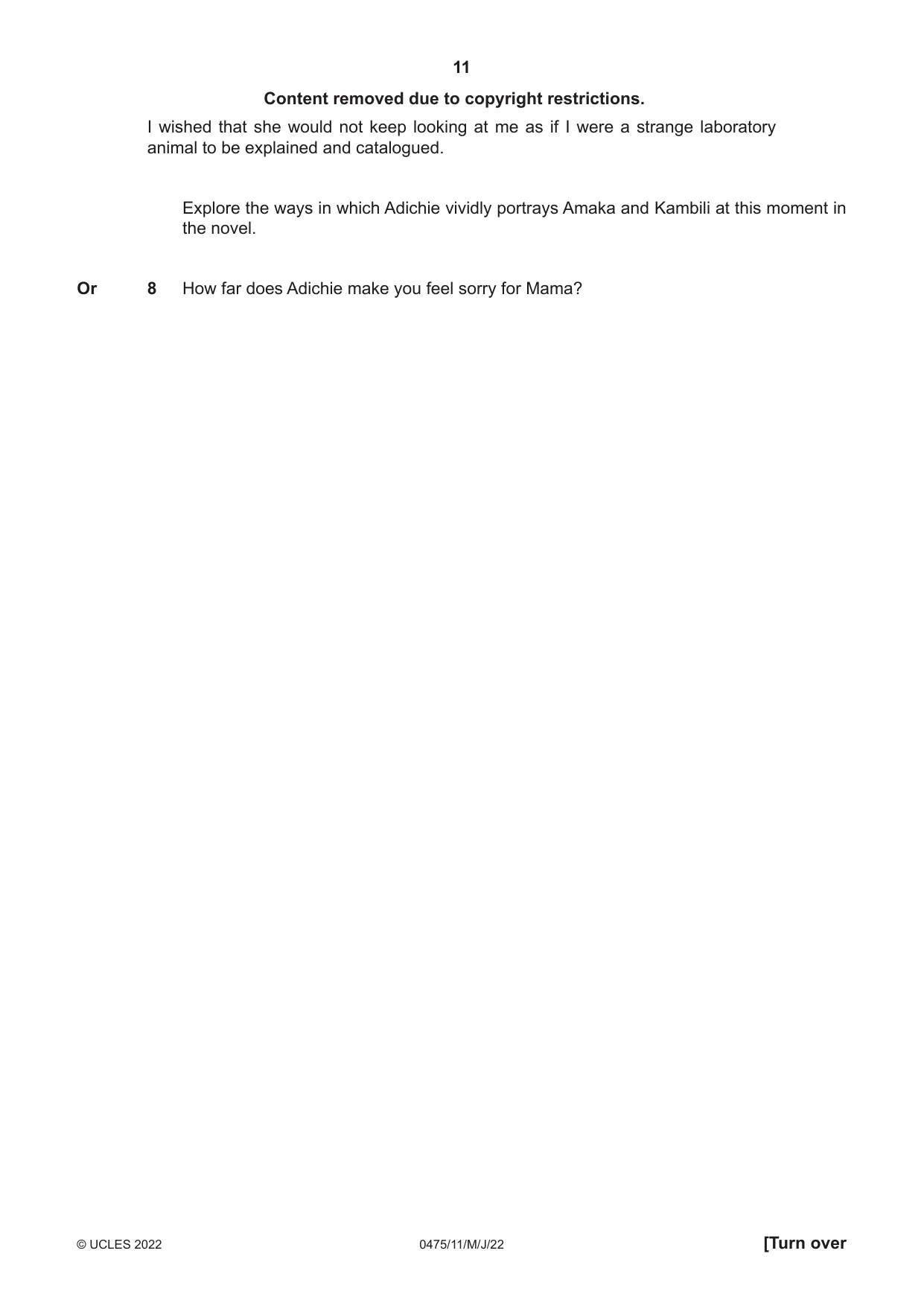
11 0475/11/M/J/22 © UCLES 2022 [Turn over I wished that she would not keep looking at me as if I were a strange laboratory animal to be explained and catalogued. Explore the ways in which Adichie vividly portrays Amaka and Kambili at this moment in the novel. Or 8 How far does Adichie make you feel sorry for Mama? Content removed due to copyright restrictions.
Question paper, page 12
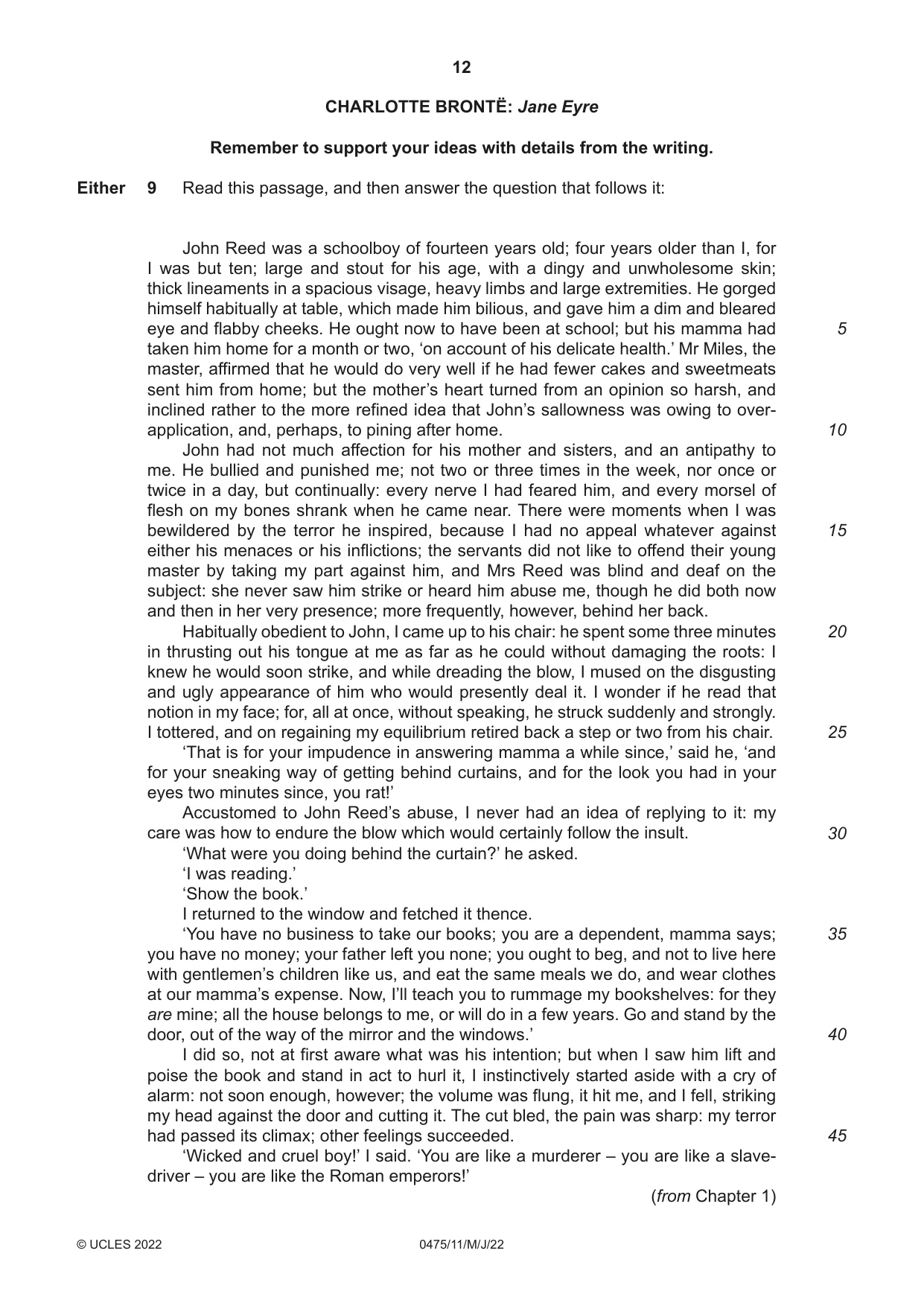
12 0475/11/M/J/22 © UCLES 2022 CHARLOTTE BRONTË: Jane Eyre Remember to support your ideas with details from the writing. Either 9 Read this passage, and then answer the question that follows it: John Reed was a schoolboy of fourteen years old; four years older than I, for I was but ten; large and stout for his age, with a dingy and unwholesome skin; thick lineaments in a spacious visage, heavy limbs and large extremities. He gorged himself habitually at table, which made him bilious, and gave him a dim and bleared eye and flabby cheeks. He ought now to have been at school; but his mamma had taken him home for a month or two, ‘on account of his delicate health.’ Mr Miles, the master, affirmed that he would do very well if he had fewer cakes and sweetmeats sent him from home; but the mother’s heart turned from an opinion so harsh, and inclined rather to the more refined idea that John’s sallowness was owing to over- application, and, perhaps, to pining after home. John had not much affection for his mother and sisters, and an antipathy to me. He bullied and punished me; not two or three times in the week, nor once or twice in a day, but continually: every nerve I had feared him, and every morsel of flesh on my bones shrank when he came near. There were moments when I was bewildered by the terror he inspired, because I had no appeal whatever against either his menaces or his inflictions; the servants did not like to offend their young master by taking my part against him, and Mrs Reed was blind and deaf on the subject: she never saw him strike or heard him abuse me, though he did both now and then in her very presence; more frequently, however, behind her back. Habitually obedient to John, I came up to his chair: he spent some three minutes in thrusting out his tongue at me as far as he could without damaging the roots: I knew he would soon strike, and while dreading the blow, I mused on the disgusting and ugly appearance of him who would presently deal it. I wonder if he read that notion in my face; for, all at once, without speaking, he struck suddenly and strongly. I tottered, and on regaining my equilibrium retired back a step or two from his chair. ‘That is for your impudence in answering mamma a while since,’ said he, ‘and for your sneaking way of getting behind curtains, and for the look you had in your eyes two minutes since, you rat!’ Accustomed to John Reed’s abuse, I never had an idea of replying to it: my care was how to endure the blow which would certainly follow the insult. ‘What were you doing behind the curtain?’ he asked. ‘I was reading.’ ‘Show the book.’ I returned to the window and fetched it thence. ‘You have no business to take our books; you are a dependent, mamma says; you have no money; your father left you none; you ought to beg, and not to live here with gentlemen’s children like us, and eat the same meals we do, and wear clothes at our mamma’s expense. Now, I’ll teach you to rummage my bookshelves: for they are mine; all the house belongs to me, or will do in a few years. Go and stand by the door, out of the way of the mirror and the windows.’ I did so, not at first aware what was his intention; but when I saw him lift and poise the book and stand in act to hurl it, I instinctively started aside with a cry of alarm: not soon enough, however; the volume was flung, it hit me, and I fell, striking my head against the door and cutting it. The cut bled, the pain was sharp: my terror had passed its climax; other feelings succeeded. ‘Wicked and cruel boy!’ I said. ‘You are like a murderer – you are like a slave- driver – you are like the Roman emperors!’ (from Chapter 1) 5 10 15 20 25 30 35 40 45
Question paper, page 13
13 0475/11/M/J/22 © UCLES 2022 [Turn over How does Brontë make this such a shocking introduction to John Reed? Or 10 To what extent does Brontë make Rochester a likeable character?
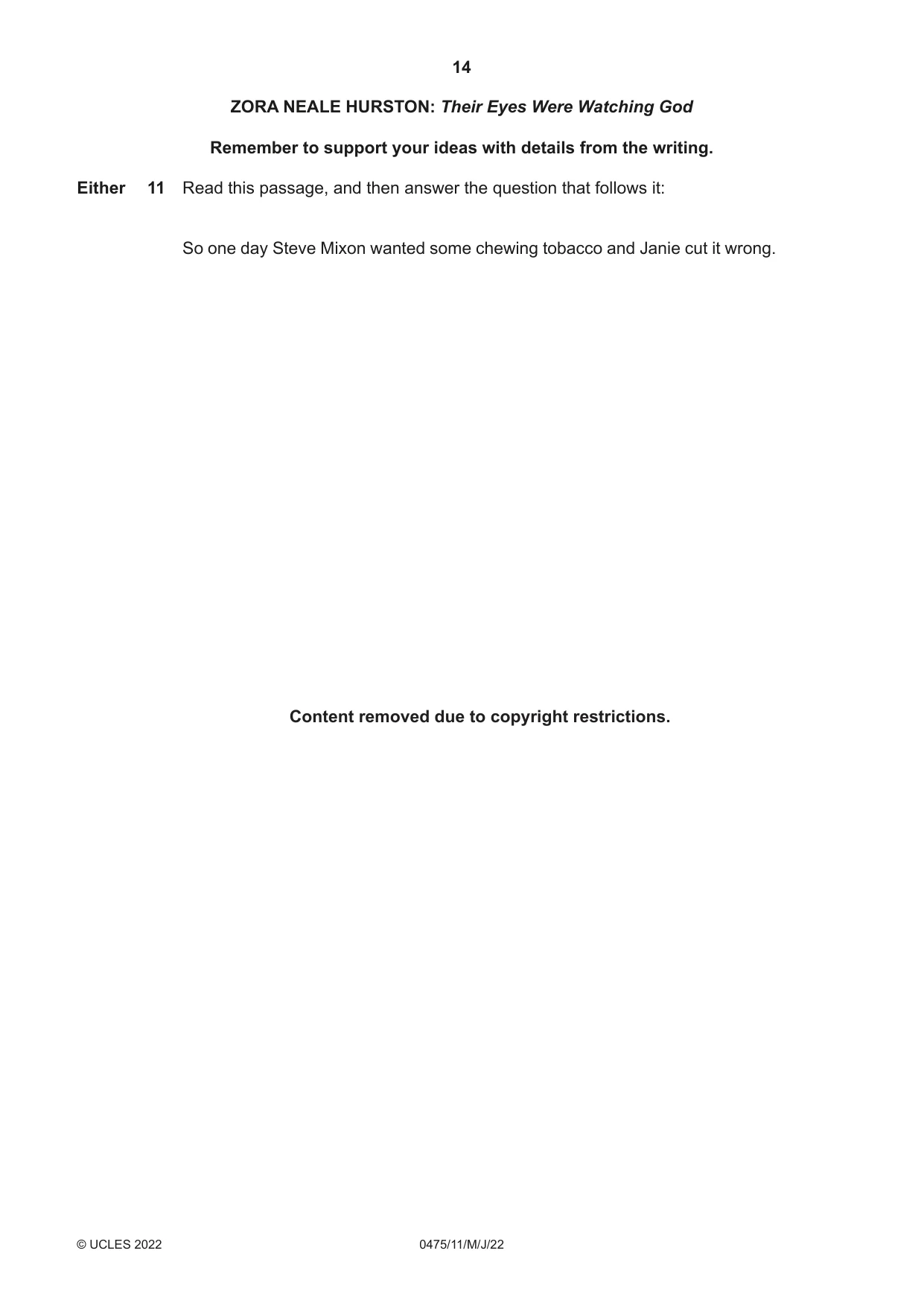
Question paper, page 14
14 0475/11/M/J/22 © UCLES 2022 ZORA NEALE HURSTON: Their Eyes Were Watching God Remember to support your ideas with details from the writing. Either 11 Read this passage, and then answer the question that follows it: So one day Steve Mixon wanted some chewing tobacco and Janie cut it wrong. Content removed due to copyright restrictions.
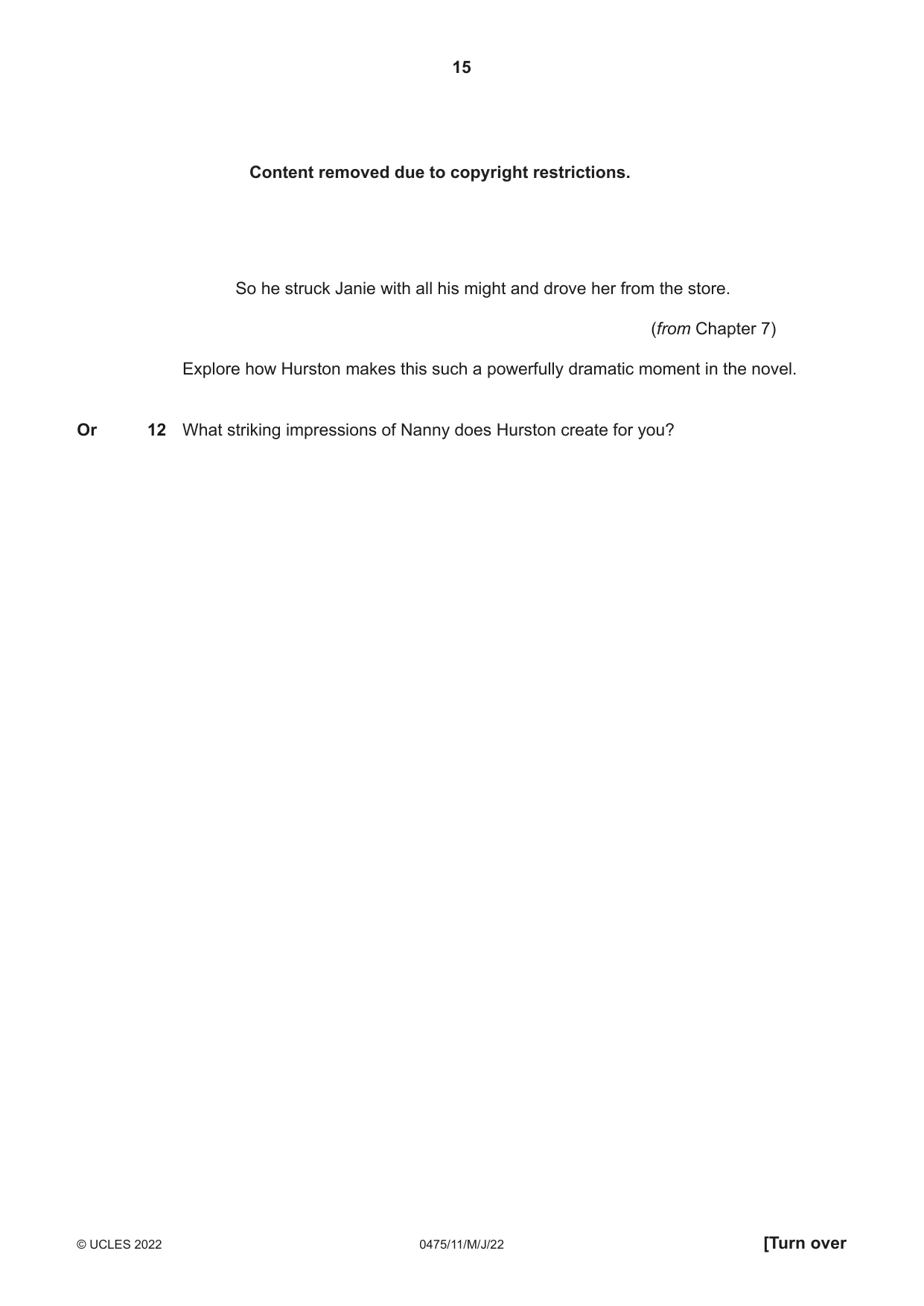
Question paper, page 15
15 0475/11/M/J/22 © UCLES 2022 [Turn over So he struck Janie with all his might and drove her from the store. (from Chapter 7) Explore how Hurston makes this such a powerfully dramatic moment in the novel. Or 12 What striking impressions of Nanny does Hurston create for you? Content removed due to copyright restrictions.
Question paper, page 16
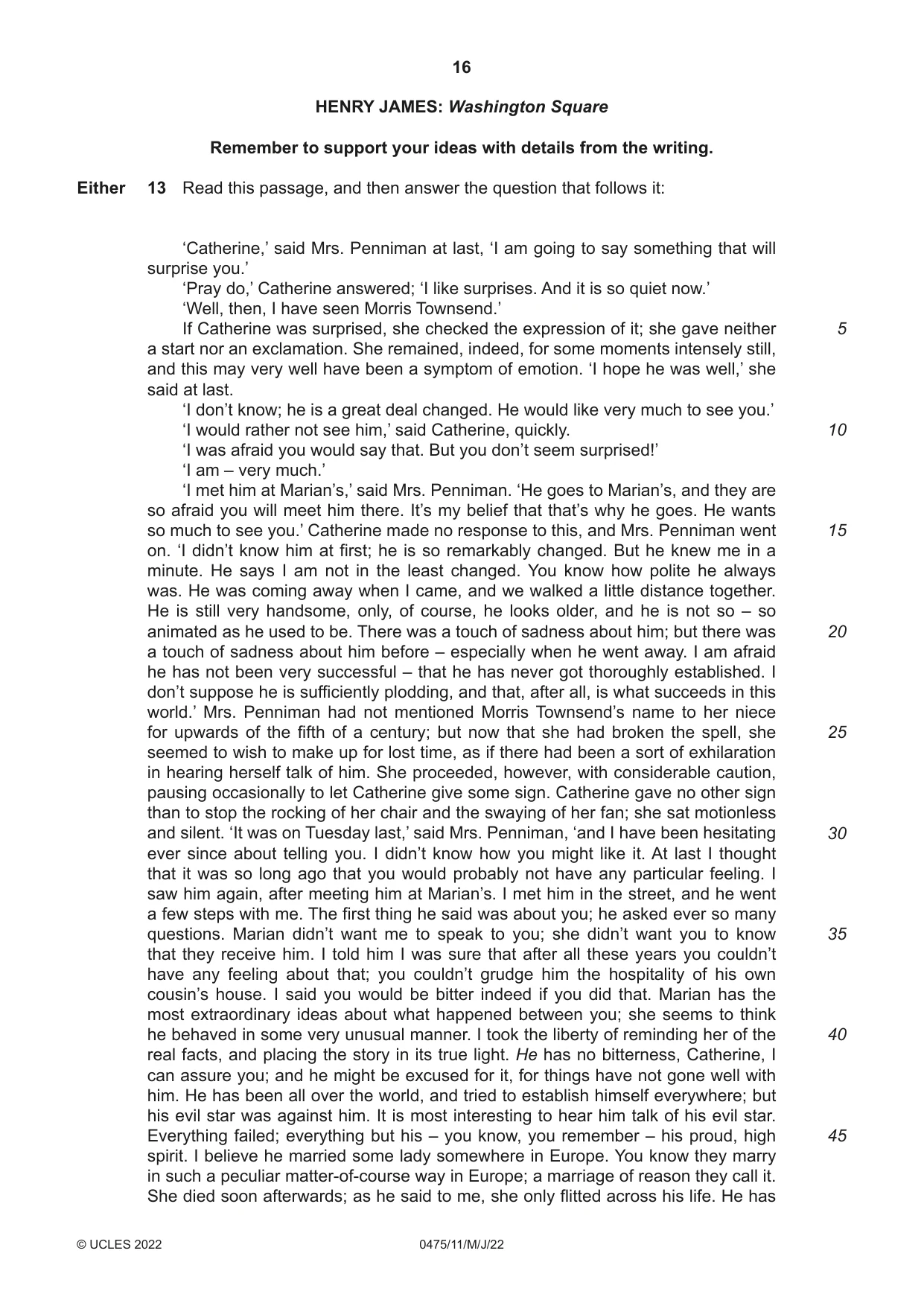
16 0475/11/M/J/22 © UCLES 2022 HENRY JAMES: Washington Square Remember to support your ideas with details from the writing. Either 13 Read this passage, and then answer the question that follows it: ‘Catherine,’ said Mrs. Penniman at last, ‘I am going to say something that will surprise you.’ ‘Pray do,’ Catherine answered; ‘I like surprises. And it is so quiet now.’ ‘Well, then, I have seen Morris Townsend.’ If Catherine was surprised, she checked the expression of it; she gave neither a start nor an exclamation. She remained, indeed, for some moments intensely still, and this may very well have been a symptom of emotion. ‘I hope he was well,’ she said at last. ‘I don’t know; he is a great deal changed. He would like very much to see you.’ ‘I would rather not see him,’ said Catherine, quickly. ‘I was afraid you would say that. But you don’t seem surprised!’ ‘I am – very much.’ ‘I met him at Marian’s,’ said Mrs. Penniman. ‘He goes to Marian’s, and they are so afraid you will meet him there. It’s my belief that that’s why he goes. He wants so much to see you.’ Catherine made no response to this, and Mrs. Penniman went on. ‘I didn’t know him at first; he is so remarkably changed. But he knew me in a minute. He says I am not in the least changed. You know how polite he always was. He was coming away when I came, and we walked a little distance together. He is still very handsome, only, of course, he looks older, and he is not so – so animated as he used to be. There was a touch of sadness about him; but there was a touch of sadness about him before – especially when he went away. I am afraid he has not been very successful – that he has never got thoroughly established. I don’t suppose he is sufficiently plodding, and that, after all, is what succeeds in this world.’ Mrs. Penniman had not mentioned Morris Townsend’s name to her niece for upwards of the fifth of a century; but now that she had broken the spell, she seemed to wish to make up for lost time, as if there had been a sort of exhilaration in hearing herself talk of him. She proceeded, however, with considerable caution, pausing occasionally to let Catherine give some sign. Catherine gave no other sign than to stop the rocking of her chair and the swaying of her fan; she sat motionless and silent. ‘It was on Tuesday last,’ said Mrs. Penniman, ‘and I have been hesitating ever since about telling you. I didn’t know how you might like it. At last I thought that it was so long ago that you would probably not have any particular feeling. I saw him again, after meeting him at Marian’s. I met him in the street, and he went a few steps with me. The first thing he said was about you; he asked ever so many questions. Marian didn’t want me to speak to you; she didn’t want you to know that they receive him. I told him I was sure that after all these years you couldn’t have any feeling about that; you couldn’t grudge him the hospitality of his own cousin’s house. I said you would be bitter indeed if you did that. Marian has the most extraordinary ideas about what happened between you; she seems to think he behaved in some very unusual manner. I took the liberty of reminding her of the real facts, and placing the story in its true light. He has no bitterness, Catherine, I can assure you; and he might be excused for it, for things have not gone well with him. He has been all over the world, and tried to establish himself everywhere; but his evil star was against him. It is most interesting to hear him talk of his evil star. Everything failed; everything but his – you know, you remember – his proud, high spirit. I believe he married some lady somewhere in Europe. You know they marry in such a peculiar matter-of-course way in Europe; a marriage of reason they call it. She died soon afterwards; as he said to me, she only flitted across his life. He has 5 10 15 20 25 30 35 40 45
Question paper, page 17
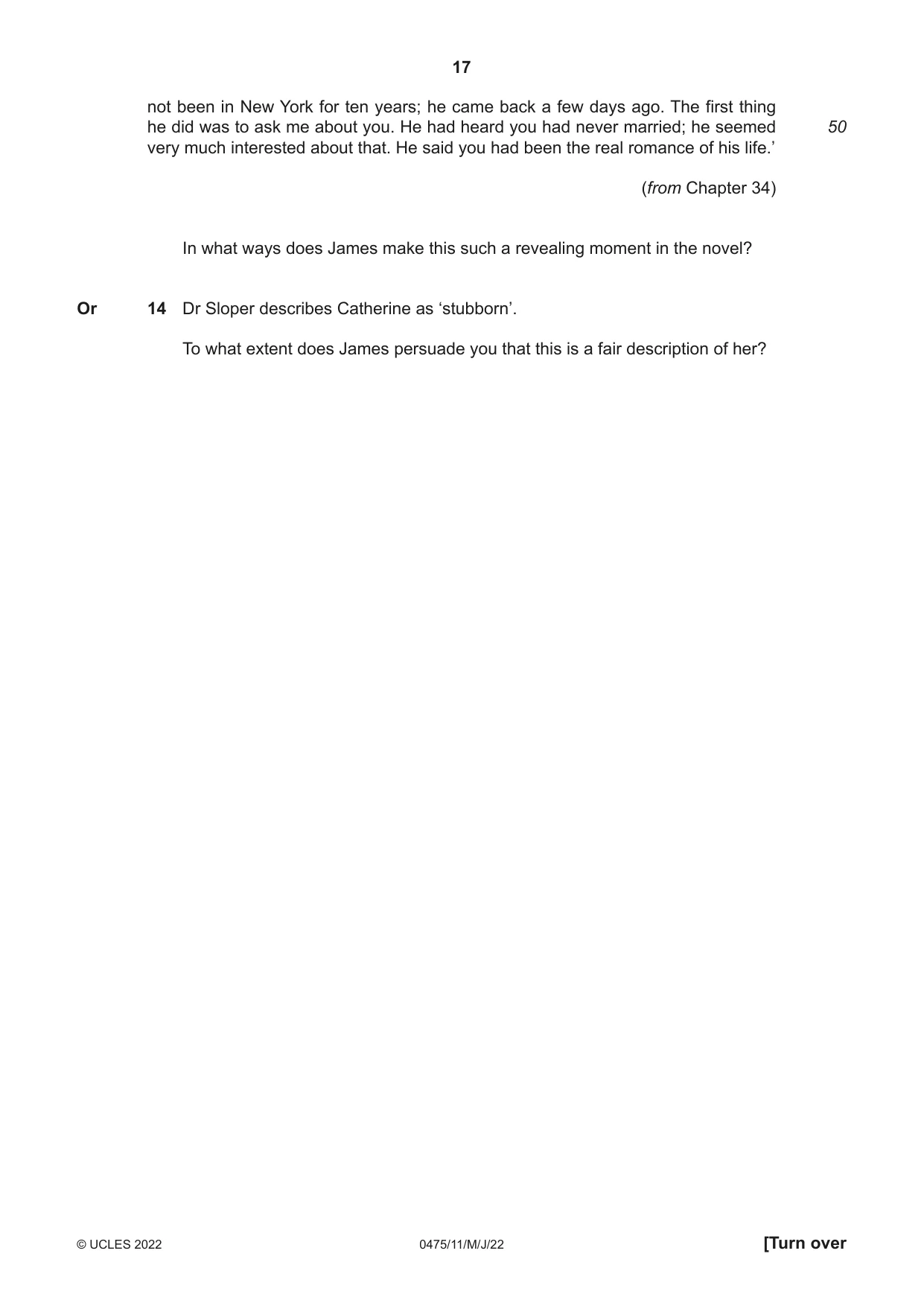
17 0475/11/M/J/22 © UCLES 2022 [Turn over not been in New York for ten years; he came back a few days ago. The first thing he did was to ask me about you. He had heard you had never married; he seemed very much interested about that. He said you had been the real romance of his life.’ (from Chapter 34) In what ways does James make this such a revealing moment in the novel? Or 14 Dr Sloper describes Catherine as ‘stubborn’. To what extent does James persuade you that this is a fair description of her? 50
Question paper, page 18
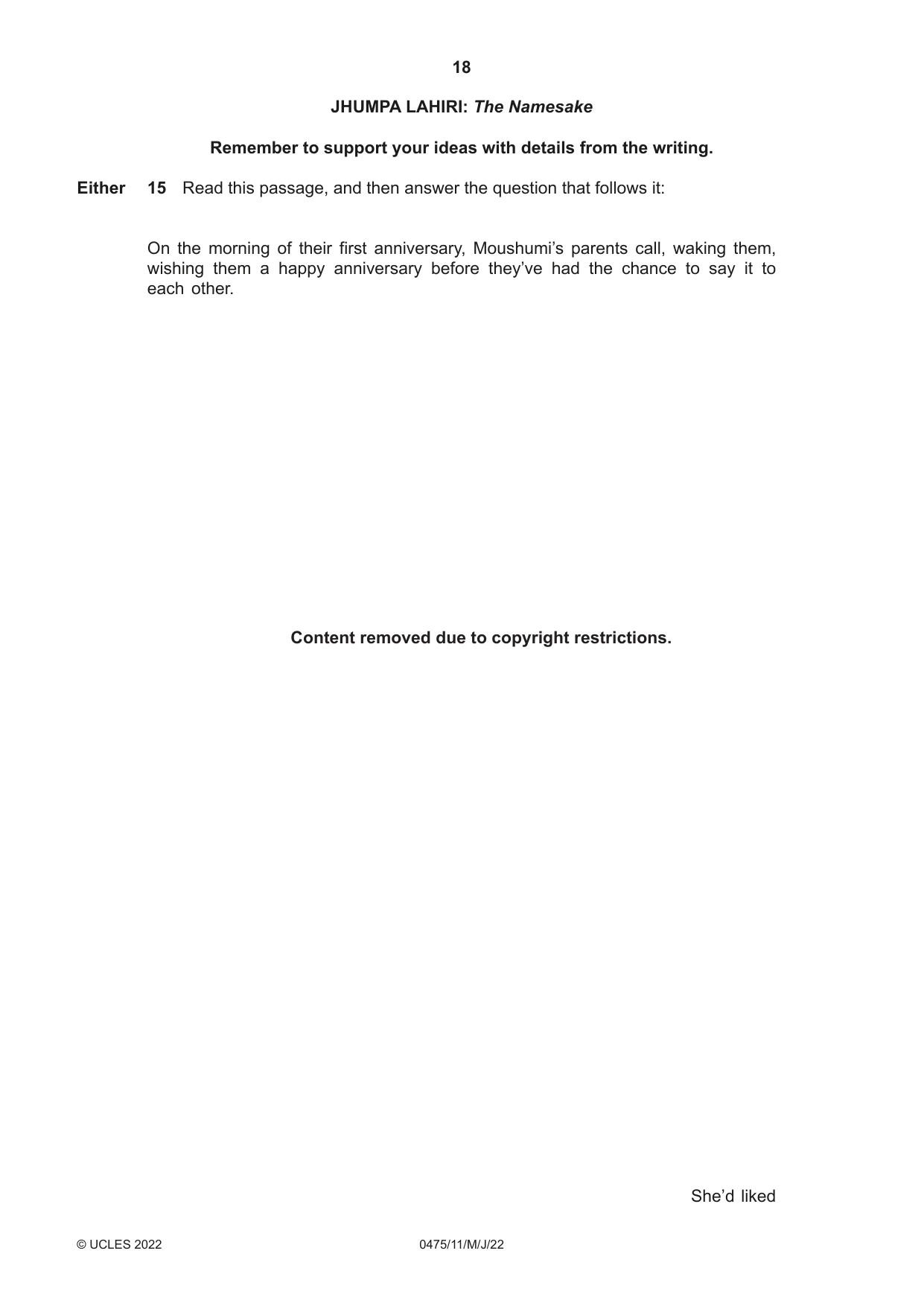
18 0475/11/M/J/22 © UCLES 2022 JHUMPA LAHIRI: The Namesake Remember to support your ideas with details from the writing. Either 15 Read this passage, and then answer the question that follows it: On the morning of their first anniversary, Moushumi’s parents call, waking them, wishing them a happy anniversary before they’ve had the chance to say it to each other. She’d liked Content removed due to copyright restrictions.
Question paper, page 19
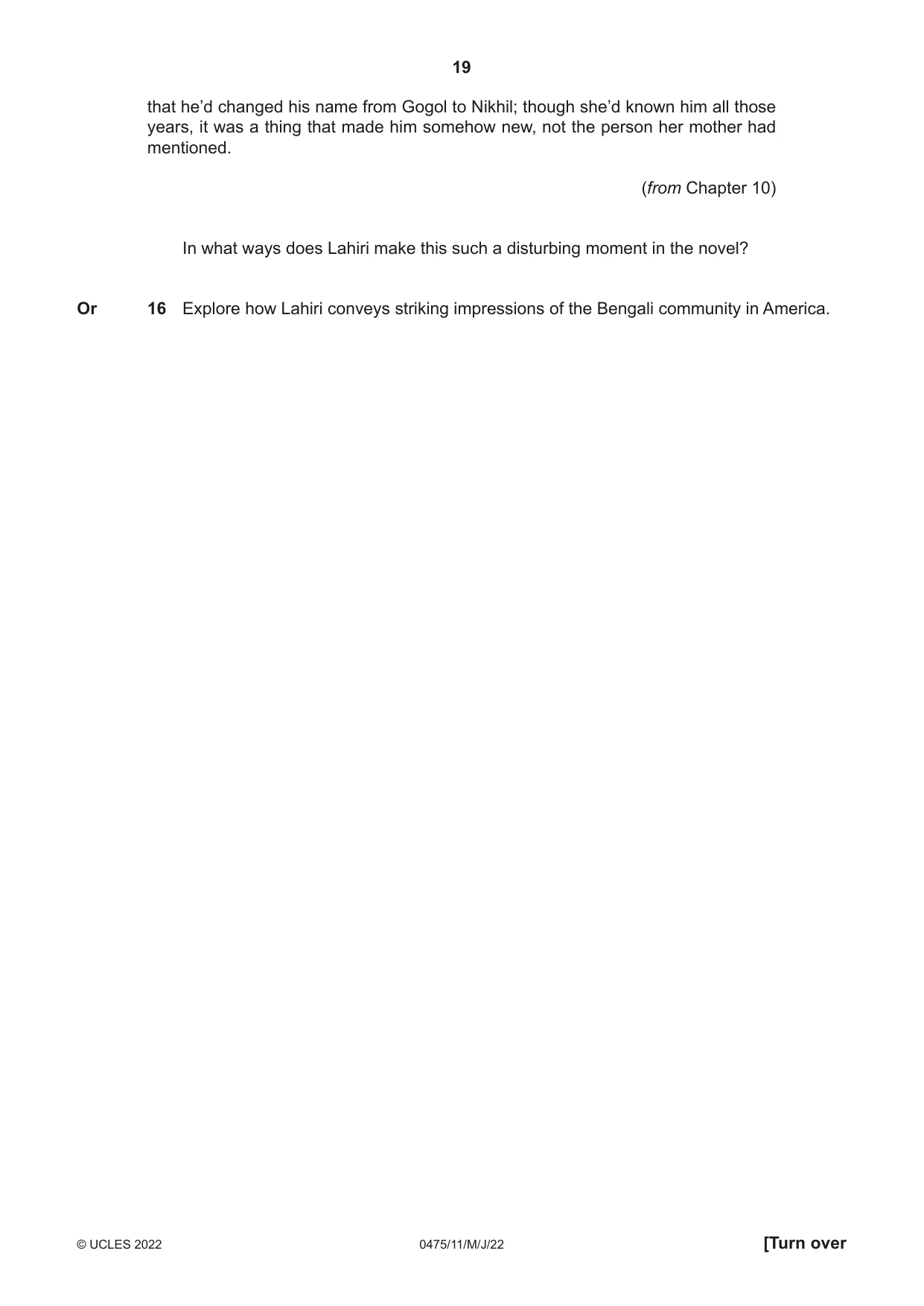
19 0475/11/M/J/22 © UCLES 2022 [Turn over that he’d changed his name from Gogol to Nikhil; though she’d known him all those years, it was a thing that made him somehow new, not the person her mother had mentioned. (from Chapter 10) In what ways does Lahiri make this such a disturbing moment in the novel? Or 16 Explore how Lahiri conveys striking impressions of the Bengali community in America.
Question paper, page 20
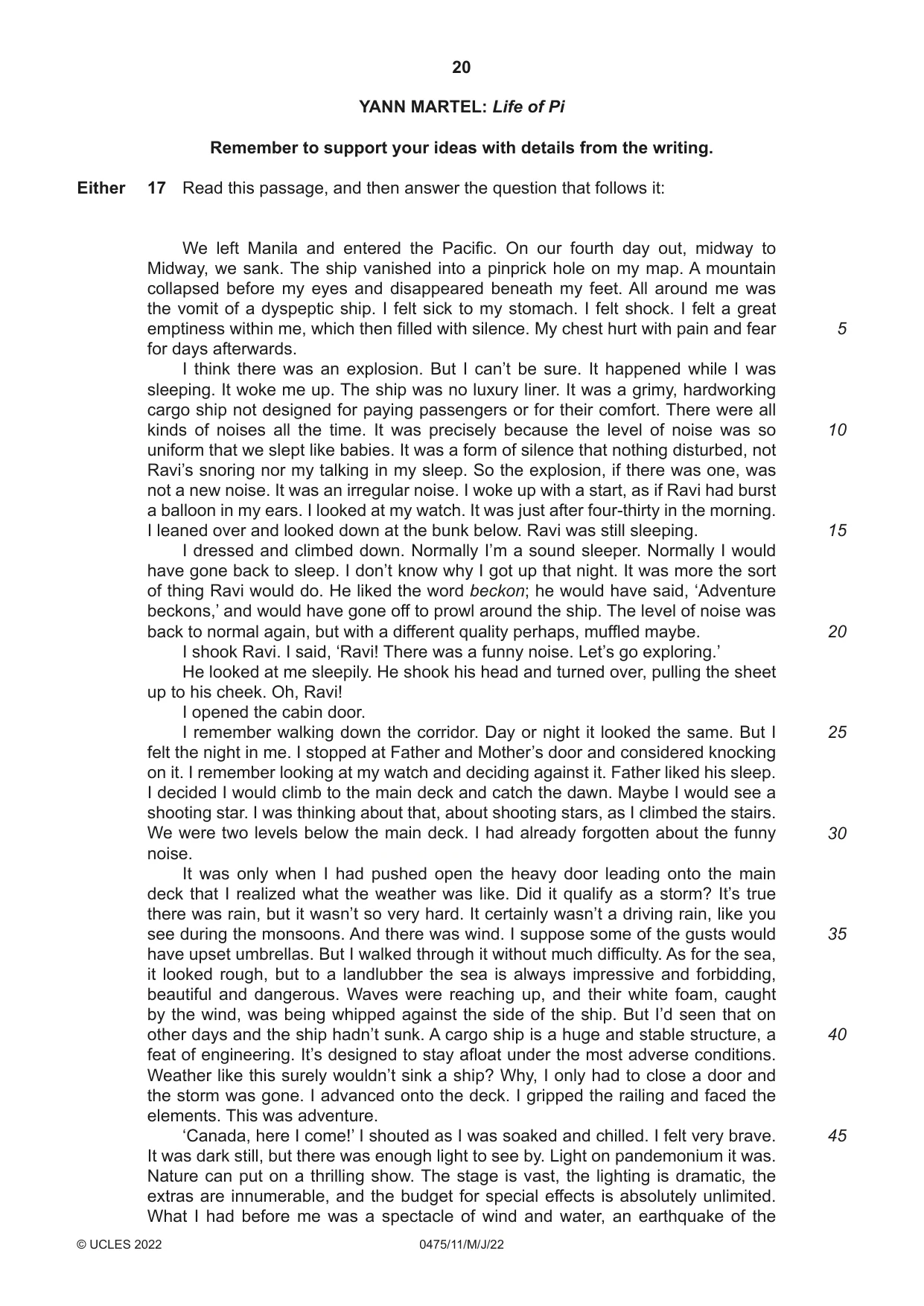
20 0475/11/M/J/22 © UCLES 2022 YANN MARTEL: Life of Pi Remember to support your ideas with details from the writing. Either 17 Read this passage, and then answer the question that follows it: We left Manila and entered the Pacific. On our fourth day out, midway to Midway, we sank. The ship vanished into a pinprick hole on my map. A mountain collapsed before my eyes and disappeared beneath my feet. All around me was the vomit of a dyspeptic ship. I felt sick to my stomach. I felt shock. I felt a great emptiness within me, which then filled with silence. My chest hurt with pain and fear for days afterwards. I think there was an explosion. But I can’t be sure. It happened while I was sleeping. It woke me up. The ship was no luxury liner. It was a grimy, hardworking cargo ship not designed for paying passengers or for their comfort. There were all kinds of noises all the time. It was precisely because the level of noise was so uniform that we slept like babies. It was a form of silence that nothing disturbed, not Ravi’s snoring nor my talking in my sleep. So the explosion, if there was one, was not a new noise. It was an irregular noise. I woke up with a start, as if Ravi had burst a balloon in my ears. I looked at my watch. It was just after four-thirty in the morning. I leaned over and looked down at the bunk below. Ravi was still sleeping. I dressed and climbed down. Normally I’m a sound sleeper. Normally I would have gone back to sleep. I don’t know why I got up that night. It was more the sort of thing Ravi would do. He liked the word beckon; he would have said, ‘Adventure beckons,’ and would have gone off to prowl around the ship. The level of noise was back to normal again, but with a different quality perhaps, muffled maybe. I shook Ravi. I said, ‘Ravi! There was a funny noise. Let’s go exploring.’ He looked at me sleepily. He shook his head and turned over, pulling the sheet up to his cheek. Oh, Ravi! I opened the cabin door. I remember walking down the corridor. Day or night it looked the same. But I felt the night in me. I stopped at Father and Mother’s door and considered knocking on it. I remember looking at my watch and deciding against it. Father liked his sleep. I decided I would climb to the main deck and catch the dawn. Maybe I would see a shooting star. I was thinking about that, about shooting stars, as I climbed the stairs. We were two levels below the main deck. I had already forgotten about the funny noise. It was only when I had pushed open the heavy door leading onto the main deck that I realized what the weather was like. Did it qualify as a storm? It’s true there was rain, but it wasn’t so very hard. It certainly wasn’t a driving rain, like you see during the monsoons. And there was wind. I suppose some of the gusts would have upset umbrellas. But I walked through it without much difficulty. As for the sea, it looked rough, but to a landlubber the sea is always impressive and forbidding, beautiful and dangerous. Waves were reaching up, and their white foam, caught by the wind, was being whipped against the side of the ship. But I’d seen that on other days and the ship hadn’t sunk. A cargo ship is a huge and stable structure, a feat of engineering. It’s designed to stay afloat under the most adverse conditions. Weather like this surely wouldn’t sink a ship? Why, I only had to close a door and the storm was gone. I advanced onto the deck. I gripped the railing and faced the elements. This was adventure. ‘Canada, here I come!’ I shouted as I was soaked and chilled. I felt very brave. It was dark still, but there was enough light to see by. Light on pandemonium it was. Nature can put on a thrilling show. The stage is vast, the lighting is dramatic, the extras are innumerable, and the budget for special effects is absolutely unlimited. What I had before me was a spectacle of wind and water, an earthquake of the 5 10 15 20 25 30 35 40 45
Question paper, page 21
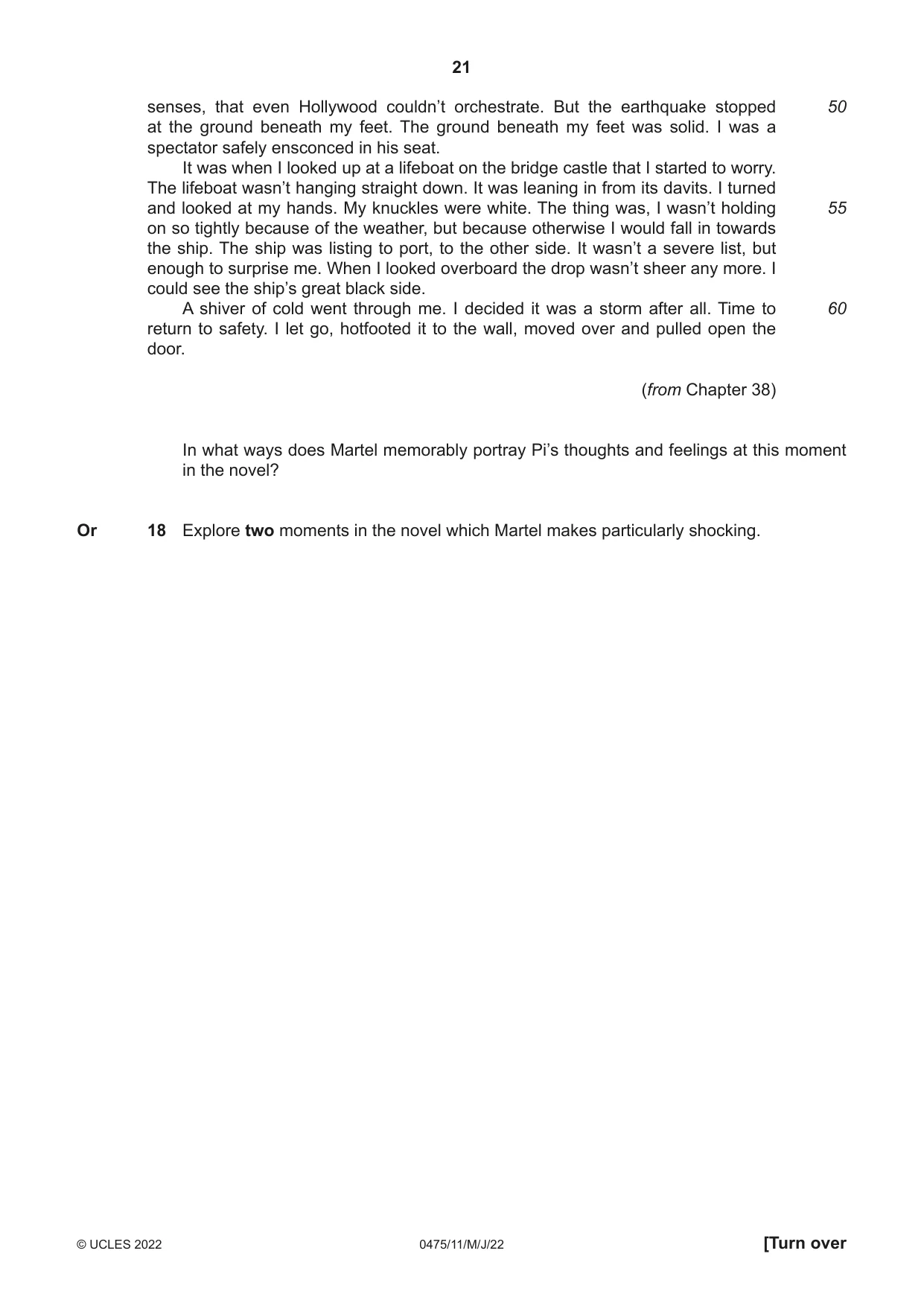
21 0475/11/M/J/22 © UCLES 2022 [Turn over senses, that even Hollywood couldn’t orchestrate. But the earthquake stopped at the ground beneath my feet. The ground beneath my feet was solid. I was a spectator safely ensconced in his seat. It was when I looked up at a lifeboat on the bridge castle that I started to worry. The lifeboat wasn’t hanging straight down. It was leaning in from its davits. I turned and looked at my hands. My knuckles were white. The thing was, I wasn’t holding on so tightly because of the weather, but because otherwise I would fall in towards the ship. The ship was listing to port, to the other side. It wasn’t a severe list, but enough to surprise me. When I looked overboard the drop wasn’t sheer any more. I could see the ship’s great black side. A shiver of cold went through me. I decided it was a storm after all. Time to return to safety. I let go, hotfooted it to the wall, moved over and pulled open the door. (from Chapter 38) In what ways does Martel memorably portray Pi’s thoughts and feelings at this moment in the novel? Or 18 Explore two moments in the novel which Martel makes particularly shocking. 50 55 60
Question paper, page 22
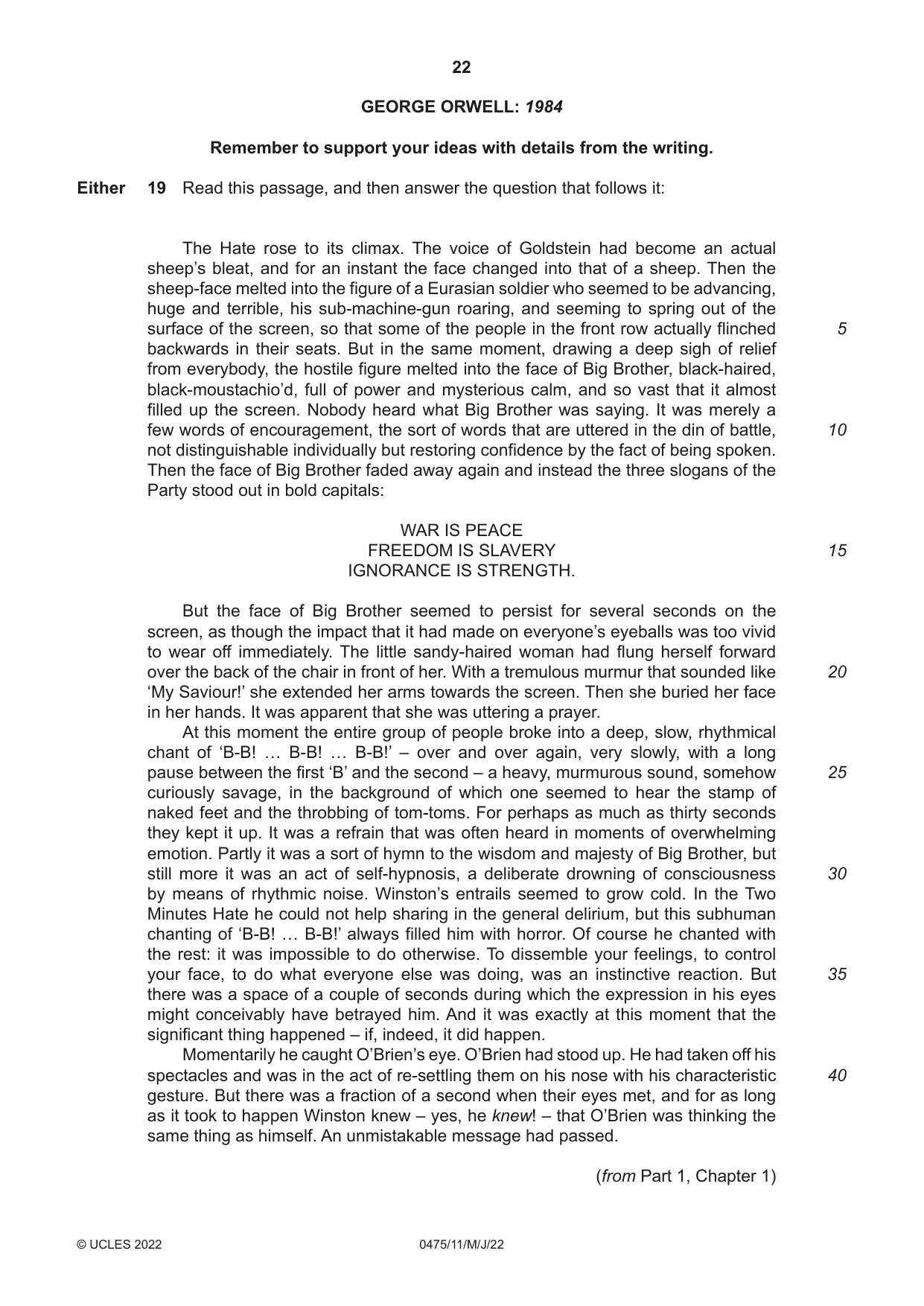
22 0475/11/M/J/22 © UCLES 2022 GEORGE ORWELL: 1984 Remember to support your ideas with details from the writing. Either 19 Read this passage, and then answer the question that follows it: The Hate rose to its climax. The voice of Goldstein had become an actual sheep’s bleat, and for an instant the face changed into that of a sheep. Then the sheep-face melted into the figure of a Eurasian soldier who seemed to be advancing, huge and terrible, his sub-machine-gun roaring, and seeming to spring out of the surface of the screen, so that some of the people in the front row actually flinched backwards in their seats. But in the same moment, drawing a deep sigh of relief from everybody, the hostile figure melted into the face of Big Brother, black-haired, black-moustachio’d, full of power and mysterious calm, and so vast that it almost filled up the screen. Nobody heard what Big Brother was saying. It was merely a few words of encouragement, the sort of words that are uttered in the din of battle, not distinguishable individually but restoring confidence by the fact of being spoken. Then the face of Big Brother faded away again and instead the three slogans of the Party stood out in bold capitals: WAR IS PEACE FREEDOM IS SLAVERY IGNORANCE IS STRENGTH. But the face of Big Brother seemed to persist for several seconds on the screen, as though the impact that it had made on everyone’s eyeballs was too vivid to wear off immediately. The little sandy-haired woman had flung herself forward over the back of the chair in front of her. With a tremulous murmur that sounded like ‘My Saviour!’ she extended her arms towards the screen. Then she buried her face in her hands. It was apparent that she was uttering a prayer. At this moment the entire group of people broke into a deep, slow, rhythmical chant of ‘B-B! … B-B! … B-B!’ – over and over again, very slowly, with a long pause between the first ‘B’ and the second – a heavy, murmurous sound, somehow curiously savage, in the background of which one seemed to hear the stamp of naked feet and the throbbing of tom-toms. For perhaps as much as thirty seconds they kept it up. It was a refrain that was often heard in moments of overwhelming emotion. Partly it was a sort of hymn to the wisdom and majesty of Big Brother, but still more it was an act of self-hypnosis, a deliberate drowning of consciousness by means of rhythmic noise. Winston’s entrails seemed to grow cold. In the Two Minutes Hate he could not help sharing in the general delirium, but this subhuman chanting of ‘B-B! … B-B!’ always filled him with horror. Of course he chanted with the rest: it was impossible to do otherwise. To dissemble your feelings, to control your face, to do what everyone else was doing, was an instinctive reaction. But there was a space of a couple of seconds during which the expression in his eyes might conceivably have betrayed him. And it was exactly at this moment that the significant thing happened – if, indeed, it did happen. Momentarily he caught O’Brien’s eye. O’Brien had stood up. He had taken off his spectacles and was in the act of re-settling them on his nose with his characteristic gesture. But there was a fraction of a second when their eyes met, and for as long as it took to happen Winston knew – yes, he knew! – that O’Brien was thinking the same thing as himself. An unmistakable message had passed. (from Part 1, Chapter 1) 5 10 15 20 25 30 35 40
Question paper, page 23
23 0475/11/M/J/22 © UCLES 2022 [Turn over How does Orwell make this such a powerful moment in the novel? Or 20 Explore two moments in the novel where Orwell strikingly creates a sense of fear.
Question paper, page 24
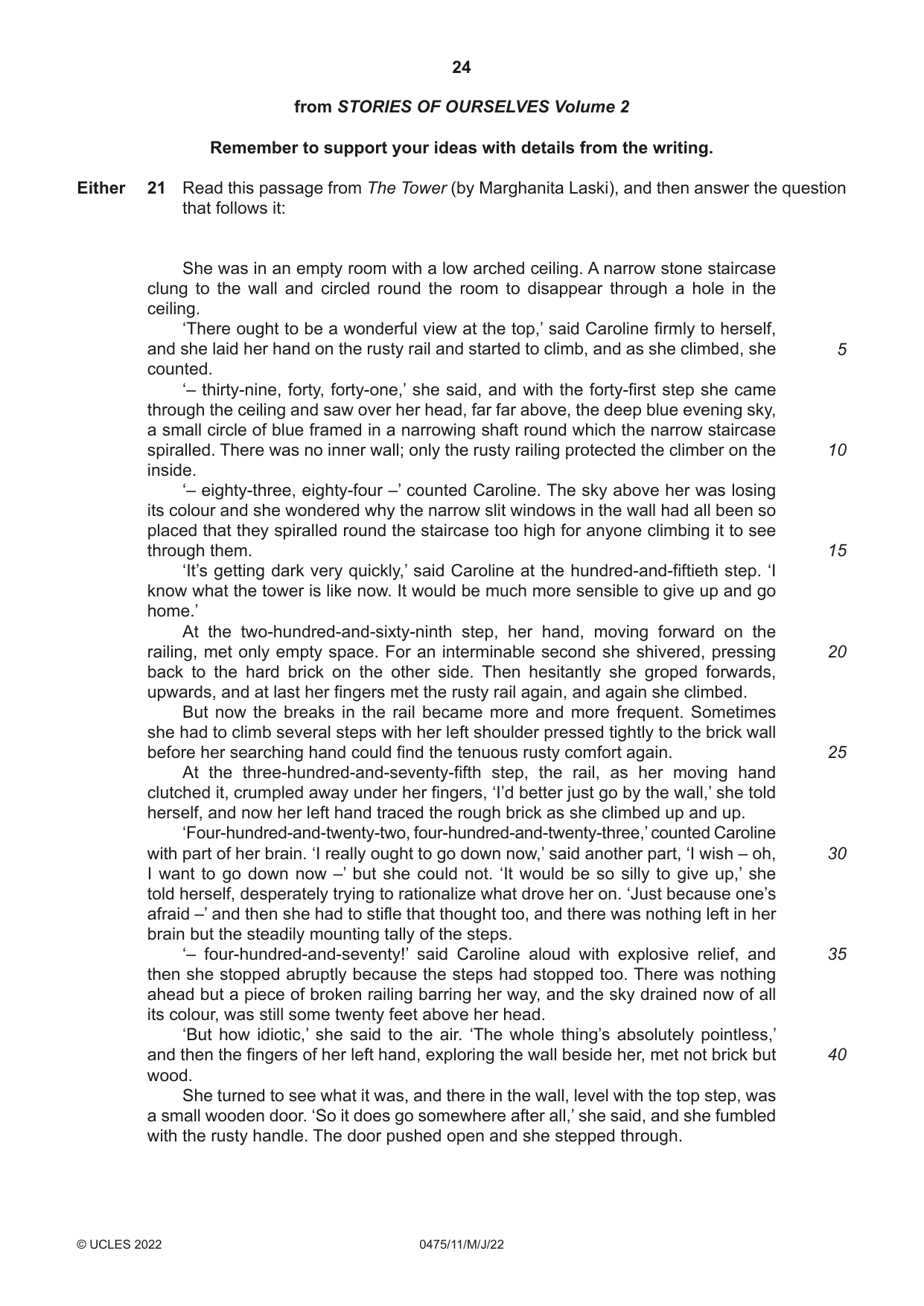
24 0475/11/M/J/22 © UCLES 2022 from STORIES OF OURSELVES Volume 2 Remember to support your ideas with details from the writing. Either 21 Read this passage from The Tower (by Marghanita Laski), and then answer the question that follows it: She was in an empty room with a low arched ceiling. A narrow stone staircase clung to the wall and circled round the room to disappear through a hole in the ceiling. ‘There ought to be a wonderful view at the top,’ said Caroline firmly to herself, and she laid her hand on the rusty rail and started to climb, and as she climbed, she counted. ‘– thirty-nine, forty, forty-one,’ she said, and with the forty-first step she came through the ceiling and saw over her head, far far above, the deep blue evening sky, a small circle of blue framed in a narrowing shaft round which the narrow staircase spiralled. There was no inner wall; only the rusty railing protected the climber on the inside. ‘– eighty-three, eighty-four –’ counted Caroline. The sky above her was losing its colour and she wondered why the narrow slit windows in the wall had all been so placed that they spiralled round the staircase too high for anyone climbing it to see through them. ‘It’s getting dark very quickly,’ said Caroline at the hundred-and-fiftieth step. ‘I know what the tower is like now. It would be much more sensible to give up and go home.’ At the two-hundred-and-sixty-ninth step, her hand, moving forward on the railing, met only empty space. For an interminable second she shivered, pressing back to the hard brick on the other side. Then hesitantly she groped forwards, upwards, and at last her fingers met the rusty rail again, and again she climbed. But now the breaks in the rail became more and more frequent. Sometimes she had to climb several steps with her left shoulder pressed tightly to the brick wall before her searching hand could find the tenuous rusty comfort again. At the three-hundred-and-seventy-fifth step, the rail, as her moving hand clutched it, crumpled away under her fingers, ‘I’d better just go by the wall,’ she told herself, and now her left hand traced the rough brick as she climbed up and up. ‘Four-hundred-and-twenty-two, four-hundred-and-twenty-three,’ counted Caroline with part of her brain. ‘I really ought to go down now,’ said another part, ‘I wish – oh, I want to go down now –’ but she could not. ‘It would be so silly to give up,’ she told herself, desperately trying to rationalize what drove her on. ‘Just because one’s afraid –’ and then she had to stifle that thought too, and there was nothing left in her brain but the steadily mounting tally of the steps. ‘– four-hundred-and-seventy!’ said Caroline aloud with explosive relief, and then she stopped abruptly because the steps had stopped too. There was nothing ahead but a piece of broken railing barring her way, and the sky drained now of all its colour, was still some twenty feet above her head. ‘But how idiotic,’ she said to the air. ‘The whole thing’s absolutely pointless,’ and then the fingers of her left hand, exploring the wall beside her, met not brick but wood. She turned to see what it was, and there in the wall, level with the top step, was a small wooden door. ‘So it does go somewhere after all,’ she said, and she fumbled with the rusty handle. The door pushed open and she stepped through. 5 10 15 20 25 30 35 40
Question paper, page 25
25 0475/11/M/J/22 © UCLES 2022 In what ways does Laski build up tension at this moment in the story? Or 22 How does Afolabi vividly portray the narrator in Mrs Mahmood?
Question paper, page 26
26 0475/11/M/J/22 © UCLES 2022 BLANK PAGE
Question paper, page 27
27 0475/11/M/J/22 © UCLES 2022 BLANK PAGE
Question paper, page 28
28 0475/11/M/J/22 © UCLES 2022 Permission to reproduce items where third-party owned material protected by copyright is included has been sought and cleared where possible. Every reasonable effort has been made by the publisher (UCLES) to trace copyright holders, but if any items requiring clearance have unwittingly been included, the publisher will be pleased to make amends at the earliest possible opportunity. To avoid the issue of disclosure of answer-related information to candidates, all copyright acknowledgements are reproduced online in the Cambridge Assessment International Education Copyright Acknowledgements Booklet. This is produced for each series of examinations and is freely available to download at www.cambridgeinternational.org after the live examination series. Cambridge Assessment International Education is part of Cambridge Assessment. Cambridge Assessment is the brand name of the University of Cambridge Local Examinations Syndicate (UCLES), which is a department of the University of Cambridge. BLANK PAGE
Mark scheme, page 1
This document consists of 4 printed pages. © UCLES 2022 [Turn over Cambridge IGCSE™ LITERATURE IN ENGLISH 0475/11 Paper 1 Poetry and Prose 11 May/June 2022 MARK SCHEME Maximum Mark: 50 Published This mark scheme is published as an aid to teachers and candidates, to indicate the requirements of the examination. It shows the basis on which Examiners were instructed to award marks. It does not indicate the details of the discussions that took place at an Examiners’ meeting before marking began, which would have considered the acceptability of alternative answers. Mark schemes should be read in conjunction with the question paper and the Principal Examiner Report for Teachers. Cambridge International will not enter into discussions about these mark schemes. Cambridge International is publishing the mark schemes for the May/June 2022 series for most Cambridge IGCSE, Cambridge International A and AS Level and Cambridge Pre-U components, and some Cambridge O Level components.
Mark scheme, page 2
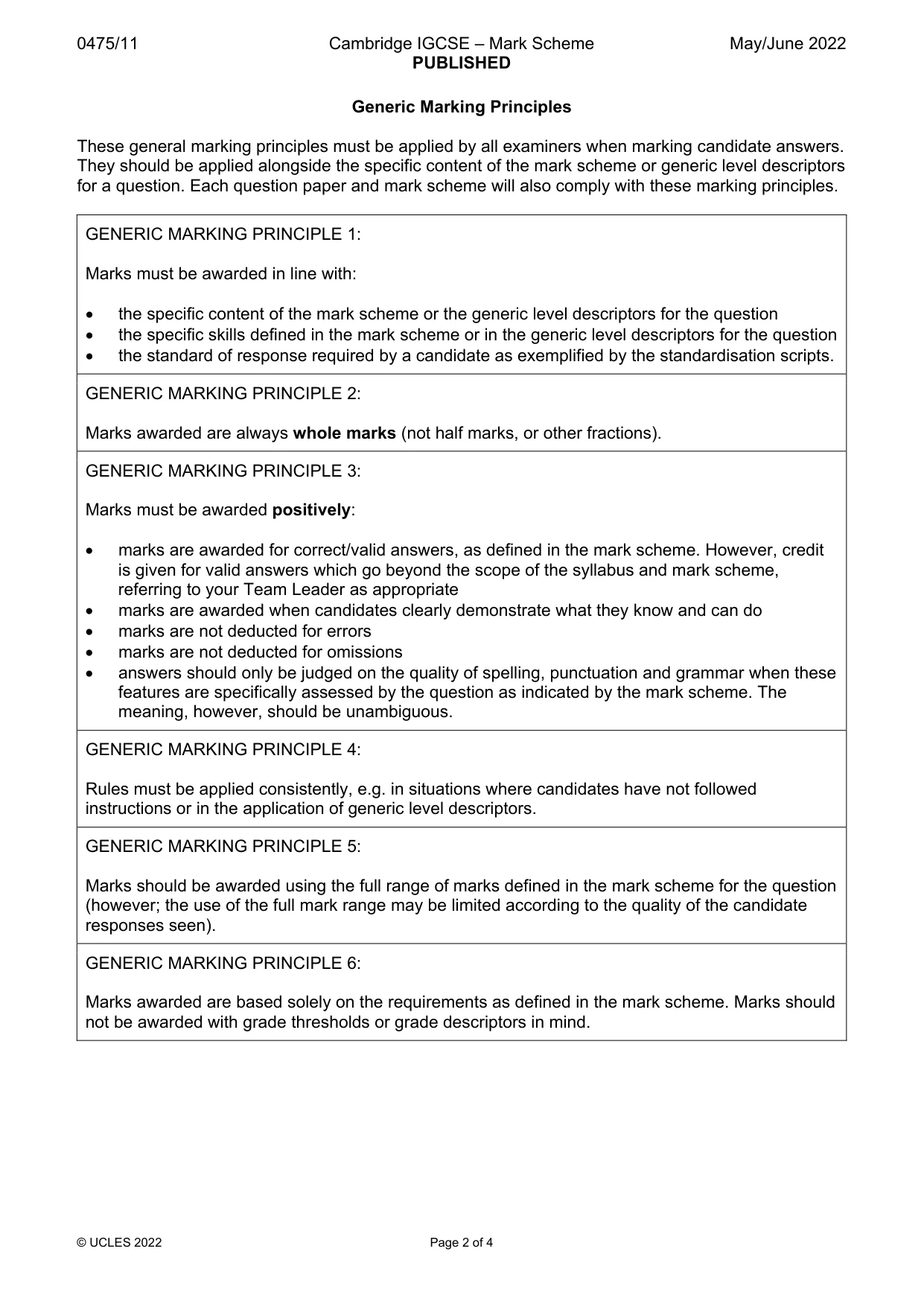
0475/11 Cambridge IGCSE – Mark Scheme PUBLISHED May/June 2022 © UCLES 2022 Page 2 of 4 Generic Marking Principles These general marking principles must be applied by all examiners when marking candidate answers. They should be applied alongside the specific content of the mark scheme or generic level descriptors for a question. Each question paper and mark scheme will also comply with these marking principles. GENERIC MARKING PRINCIPLE 1: Marks must be awarded in line with: the specific content of the mark scheme or the generic level descriptors for the question the specific skills defined in the mark scheme or in the generic level descriptors for the question the standard of response required by a candidate as exemplified by the standardisation scripts. GENERIC MARKING PRINCIPLE 2: Marks awarded are always whole marks (not half marks, or other fractions). GENERIC MARKING PRINCIPLE 3: Marks must be awarded positively: marks are awarded for correct/valid answers, as defined in the mark scheme. However, credit is given for valid answers which go beyond the scope of the syllabus and mark scheme, referring to your Team Leader as appropriate marks are awarded when candidates clearly demonstrate what they know and can do marks are not deducted for errors marks are not deducted for omissions answers should only be judged on the quality of spelling, punctuation and grammar when these features are specifically assessed by the question as indicated by the mark scheme. The meaning, however, should be unambiguous. GENERIC MARKING PRINCIPLE 4: Rules must be applied consistently, e.g. in situations where candidates have not followed instructions or in the application of generic level descriptors. GENERIC MARKING PRINCIPLE 5: Marks should be awarded using the full range of marks defined in the mark scheme for the question (however; the use of the full mark range may be limited according to the quality of the candidate responses seen). GENERIC MARKING PRINCIPLE 6: Marks awarded are based solely on the requirements as defined in the mark scheme. Marks should not be awarded with grade thresholds or grade descriptors in mind.
Mark scheme, page 3
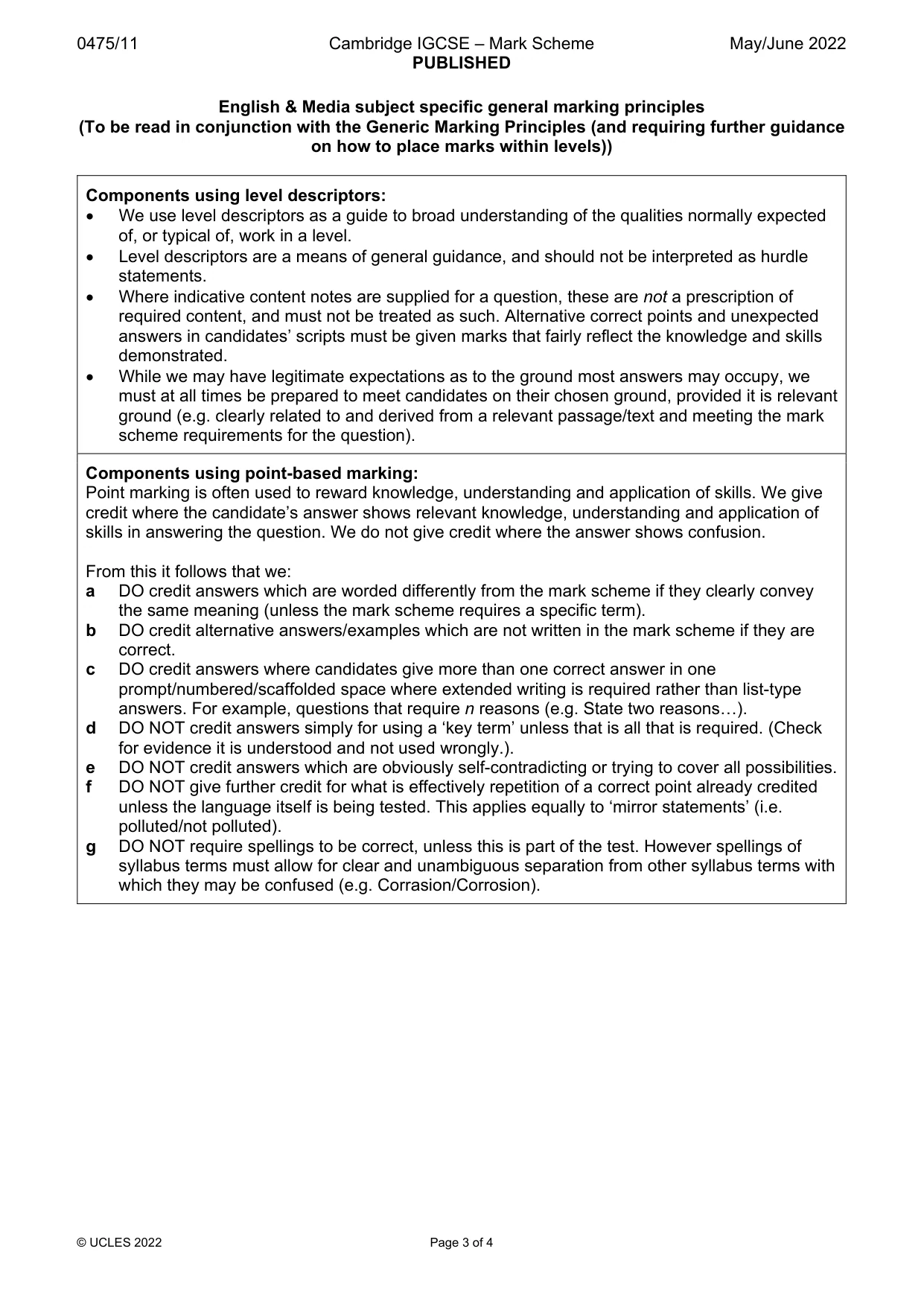
0475/11 Cambridge IGCSE – Mark Scheme PUBLISHED May/June 2022 © UCLES 2022 Page 3 of 4 English & Media subject specific general marking principles (To be read in conjunction with the Generic Marking Principles (and requiring further guidance on how to place marks within levels)) Components using level descriptors: We use level descriptors as a guide to broad understanding of the qualities normally expected of, or typical of, work in a level. Level descriptors are a means of general guidance, and should not be interpreted as hurdle statements. Where indicative content notes are supplied for a question, these are not a prescription of required content, and must not be treated as such. Alternative correct points and unexpected answers in candidates’ scripts must be given marks that fairly reflect the knowledge and skills demonstrated. While we may have legitimate expectations as to the ground most answers may occupy, we must at all times be prepared to meet candidates on their chosen ground, provided it is relevant ground (e.g. clearly related to and derived from a relevant passage/text and meeting the mark scheme requirements for the question). Components using point-based marking: Point marking is often used to reward knowledge, understanding and application of skills. We give credit where the candidate’s answer shows relevant knowledge, understanding and application of skills in answering the question. We do not give credit where the answer shows confusion. From this it follows that we: a DO credit answers which are worded differently from the mark scheme if they clearly convey the same meaning (unless the mark scheme requires a specific term). b DO credit alternative answers/examples which are not written in the mark scheme if they are correct. c DO credit answers where candidates give more than one correct answer in one prompt/numbered/scaffolded space where extended writing is required rather than list-type answers. For example, questions that require n reasons (e.g. State two reasons…). d DO NOT credit answers simply for using a ‘key term’ unless that is all that is required. (Check for evidence it is understood and not used wrongly.). e DO NOT credit answers which are obviously self-contradicting or trying to cover all possibilities. f DO NOT give further credit for what is effectively repetition of a correct point already credited unless the language itself is being tested. This applies equally to ‘mirror statements’ (i.e. polluted/not polluted). g DO NOT require spellings to be correct, unless this is part of the test. However spellings of syllabus terms must allow for clear and unambiguous separation from other syllabus terms with which they may be confused (e.g. Corrasion/Corrosion).
Mark scheme, page 4
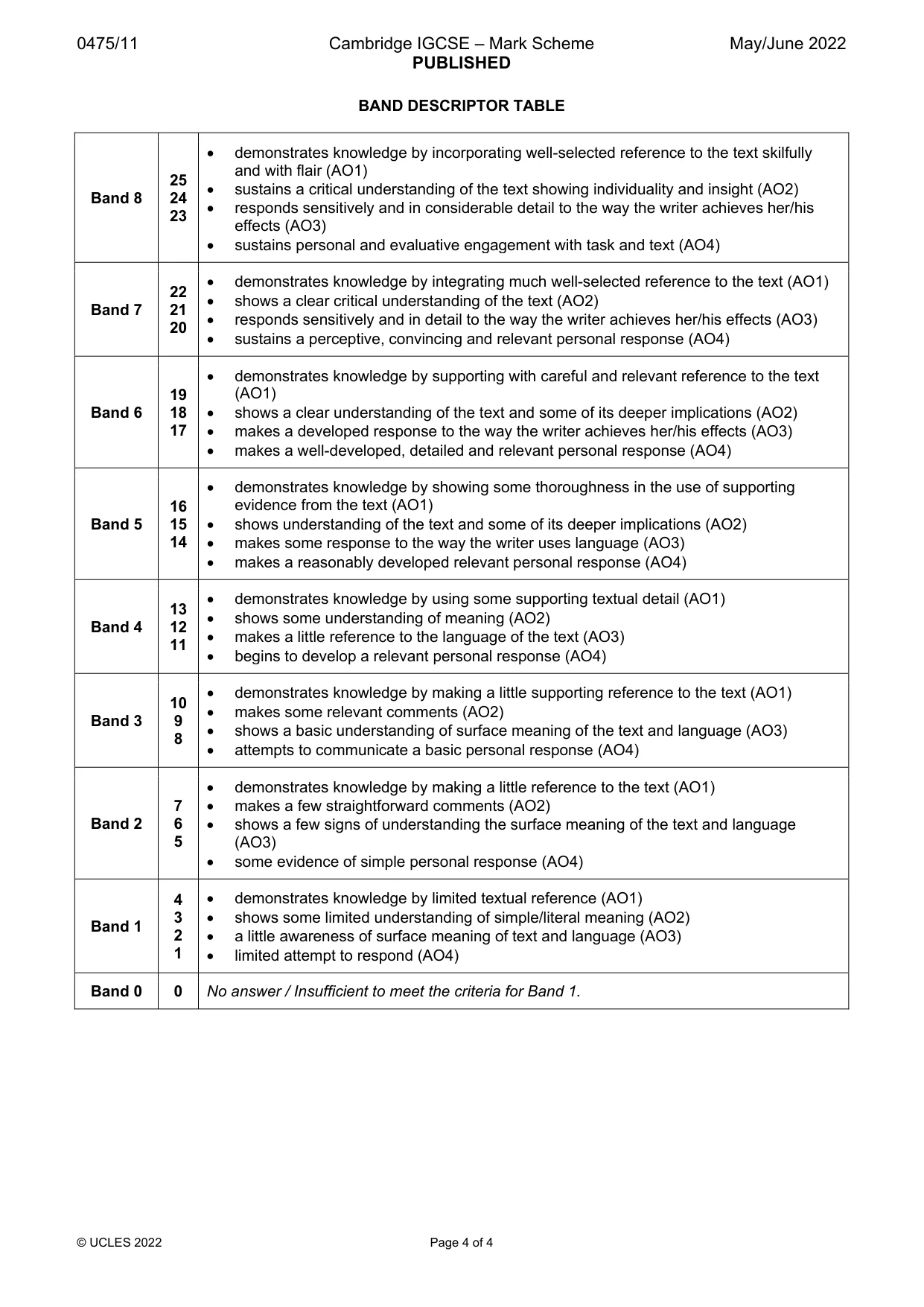
0475/11 Cambridge IGCSE – Mark Scheme PUBLISHED May/June 2022 © UCLES 2022 Page 4 of 4 BAND DESCRIPTOR TABLE Band 8 25 24 23 demonstrates knowledge by incorporating well-selected reference to the text skilfully and with flair (AO1) sustains a critical understanding of the text showing individuality and insight (AO2) responds sensitively and in considerable detail to the way the writer achieves her/his effects (AO3) sustains personal and evaluative engagement with task and text (AO4) Band 7 22 21 20 demonstrates knowledge by integrating much well-selected reference to the text (AO1) shows a clear critical understanding of the text (AO2) responds sensitively and in detail to the way the writer achieves her/his effects (AO3) sustains a perceptive, convincing and relevant personal response (AO4) Band 6 19 18 17 demonstrates knowledge by supporting with careful and relevant reference to the text (AO1) shows a clear understanding of the text and some of its deeper implications (AO2) makes a developed response to the way the writer achieves her/his effects (AO3) makes a well-developed, detailed and relevant personal response (AO4) Band 5 16 15 14 demonstrates knowledge by showing some thoroughness in the use of supporting evidence from the text (AO1) shows understanding of the text and some of its deeper implications (AO2) makes some response to the way the writer uses language (AO3) makes a reasonably developed relevant personal response (AO4) Band 4 13 12 11 demonstrates knowledge by using some supporting textual detail (AO1) shows some understanding of meaning (AO2) makes a little reference to the language of the text (AO3) begins to develop a relevant personal response (AO4) Band 3 10 9 8 demonstrates knowledge by making a little supporting reference to the text (AO1) makes some relevant comments (AO2) shows a basic understanding of surface meaning of the text and language (AO3) attempts to communicate a basic personal response (AO4) Band 2 7 6 5 demonstrates knowledge by making a little reference to the text (AO1) makes a few straightforward comments (AO2) shows a few signs of understanding the surface meaning of the text and language (AO3) some evidence of simple personal response (AO4) Band 1 4 3 2 1 demonstrates knowledge by limited textual reference (AO1) shows some limited understanding of simple/literal meaning (AO2) a little awareness of surface meaning of text and language (AO3) limited attempt to respond (AO4) Band 0 0 No answer / Insufficient to meet the criteria for Band 1.
What you needed in this session
Cambridge’s own grade thresholds for 2022 May/June, Paper 1 · Variant 1. A higher threshold means an easier paper — the bar moves with how the cohort did.