Cambridge IGCSE English - Literature in English 0475 — 2025 May/June Paper 1 · Variant 1
0475/11/M/J/25 · 50 marks · ≈56 min
The question paper and its mark scheme, free to read here and free to download. This is Cambridge’s own paper, exactly as it was sat.
Question paper28 pages

Mark scheme5 pages
Answers below. Sit the paper first if you are practising.
Paper as text
Question paper, page 1
This document has 28 pages. Any blank pages are indicated. [Turn over Cambridge IGCSE™ * 1 7 2 2 7 4 7 6 8 6 * DC (KN) 341332/3 © UCLES 2025 LITERATURE IN ENGLISH 0475/11 Paper 1 Poetry and Prose May/June 2025 1 hour 30 minutes You must answer on the enclosed answer booklet. You will need: Answer booklet (enclosed) INSTRUCTIONS ● Answer two questions in total: Section A: answer one question. Section B: answer one question. ● Follow the instructions on the front cover of the answer booklet. If you need additional answer paper, ask the invigilator for a continuation booklet. INFORMATION ● The total mark for this paper is 50. ● All questions are worth equal marks.
Question paper, page 2
2 0475/11/M/J/25 © UCLES 2025 BLANK PAGE
Question paper, page 3
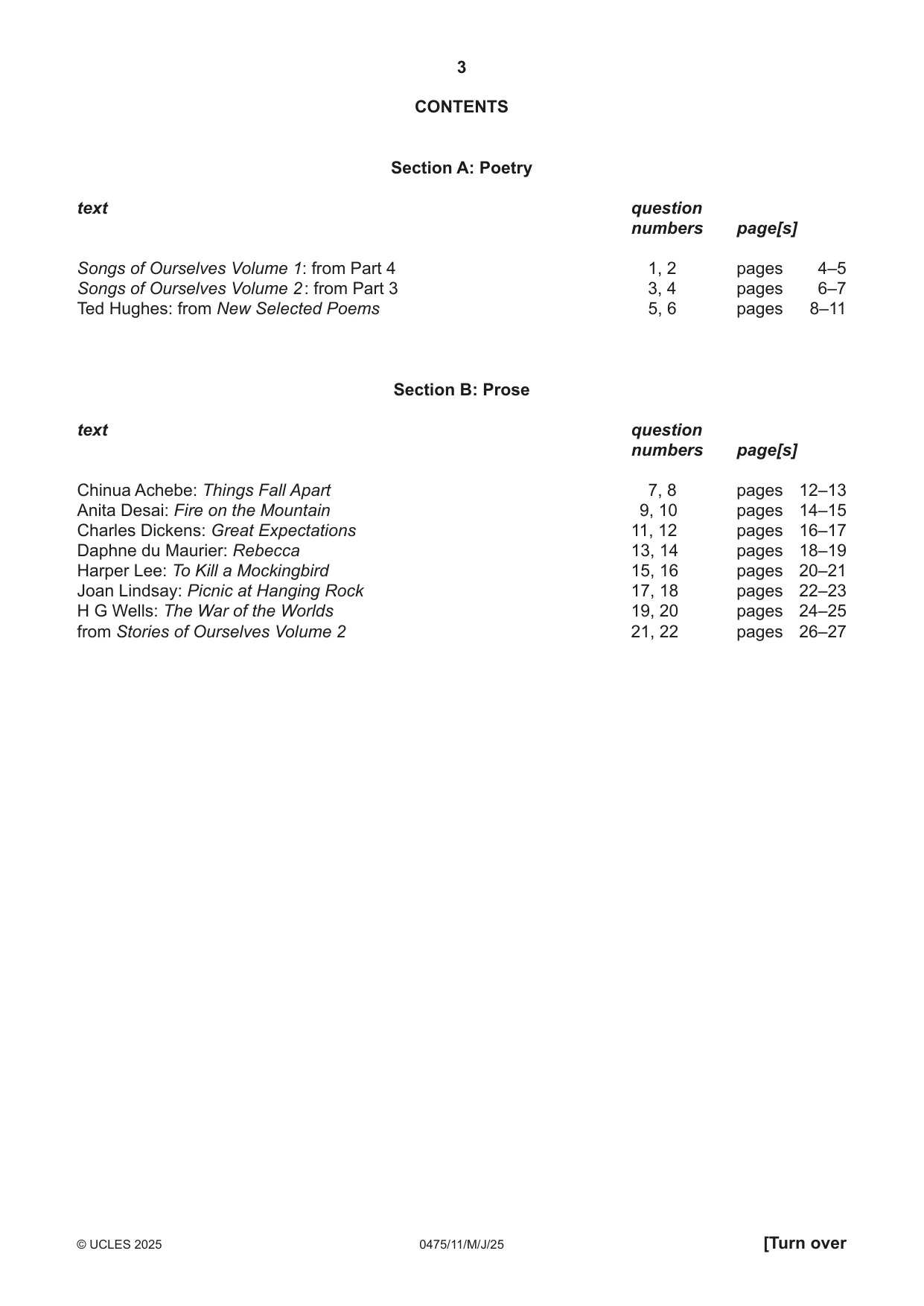
3 0475/11/M/J/25 © UCLES 2025 [Turn over CONTENTS Section A: Poetry text question numbers page[s] Songs of Ourselves Volume 1: from Part 4 1, 2 pages 4–5 Songs of Ourselves Volume 2 : from Part 3 3, 4 pages 6–7 Ted Hughes: from New Selected Poems 5, 6 pages 8–11 Section B: Prose text question numbers page[s] Chinua Achebe: Things Fall Apart 7, 8 pages 12–13 Anita Desai: Fire on the Mountain 9, 10 pages 14–15 Charles Dickens: Great Expectations 11, 12 pages 16–17 Daphne du Maurier: Rebecca 13, 14 pages 18–19 Harper Lee: To Kill a Mockingbird 15, 16 pages 20–21 Joan Lindsay: Picnic at Hanging Rock 17, 18 pages 22–23 H G Wells: The War of the Worlds 19, 20 pages 24–25 from Stories of Ourselves Volume 2 21, 22 pages 26–27
Question paper, page 4
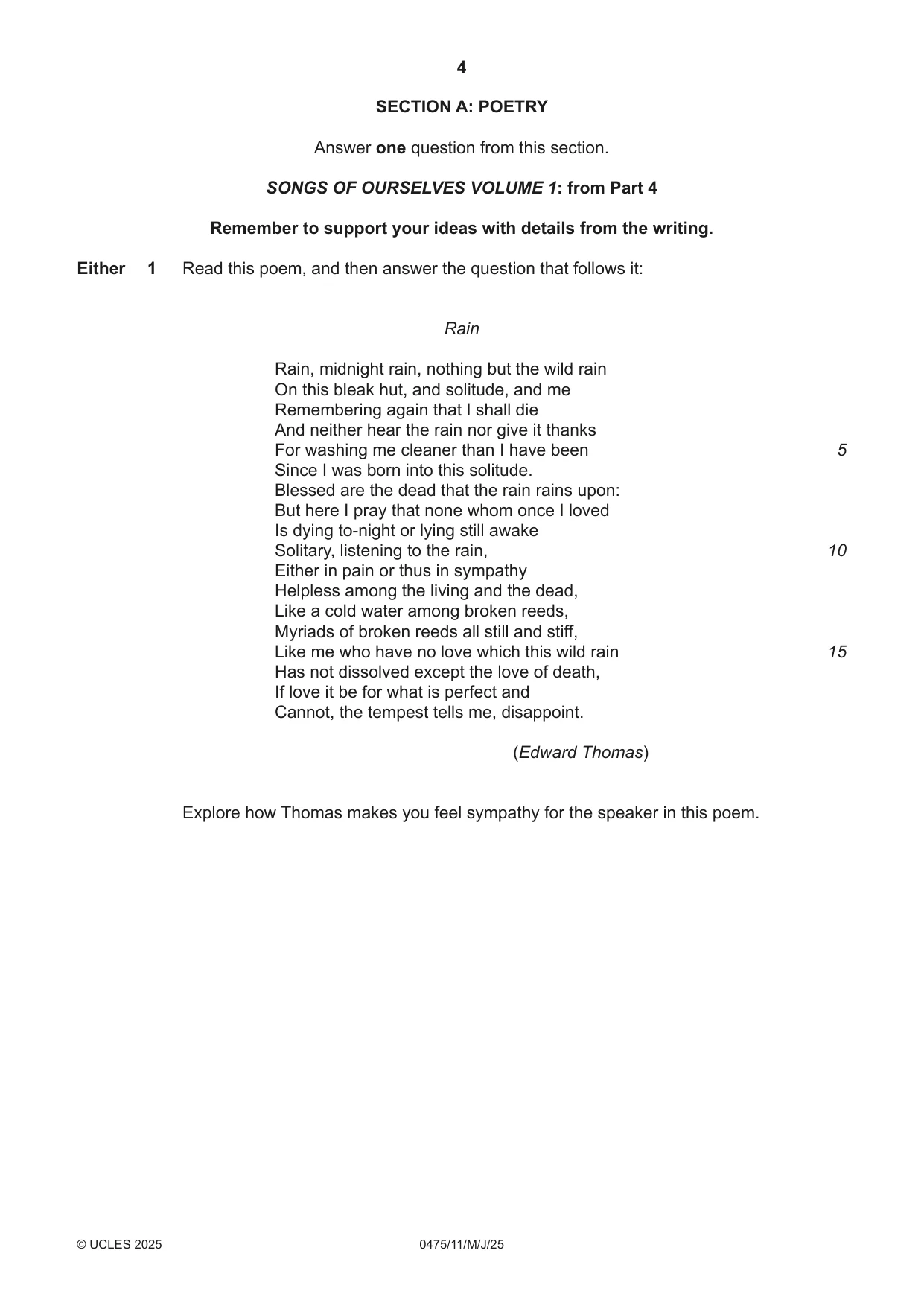
4 0475/11/M/J/25 © UCLES 2025 SECTION A: POETRY Answer one question from this section. SONGS OF OURSELVES VOLUME 1: from Part 4 Remember to support your ideas with details from the writing. Either 1 Read this poem, and then answer the question that follows it: Rain Rain, midnight rain, nothing but the wild rain On this bleak hut, and solitude, and me Remembering again that I shall die And neither hear the rain nor give it thanks For washing me cleaner than I have been 5 Since I was born into this solitude. Blessed are the dead that the rain rains upon: But here I pray that none whom once I loved Is dying to-night or lying still awake Solitary, listening to the rain, 10 Either in pain or thus in sympathy Helpless among the living and the dead, Like a cold water among broken reeds, Myriads of broken reeds all still and stiff, Like me who have no love which this wild rain 15 Has not dissolved except the love of death, If love it be for what is perfect and Cannot, the tempest tells me, disappoint. (Edward Thomas) Explore how Thomas makes you feel sympathy for the speaker in this poem.
Question paper, page 5
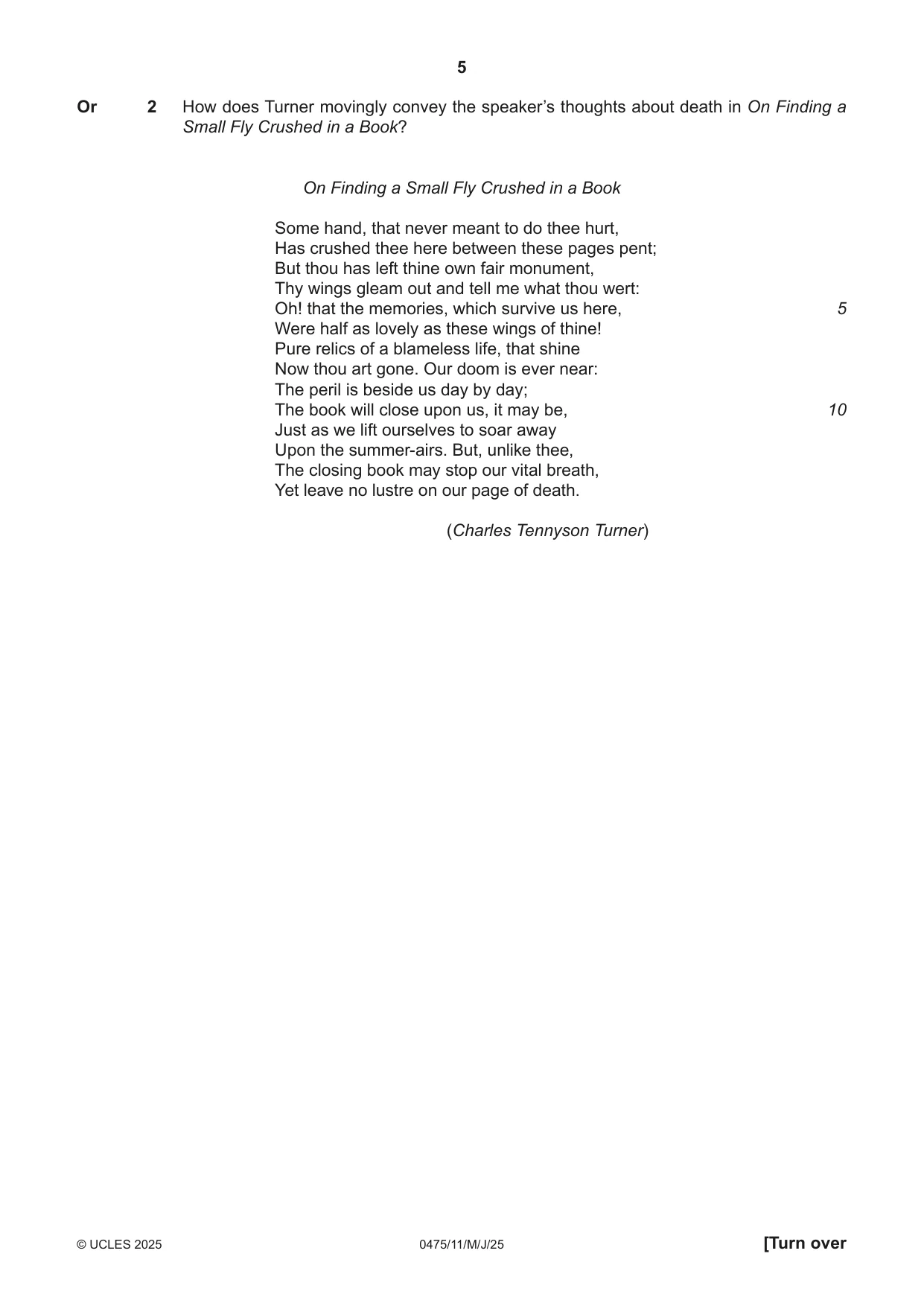
5 0475/11/M/J/25 © UCLES 2025 [Turn over Or 2 How does Turner movingly convey the speaker’s thoughts about death in On Finding a Small Fly Crushed in a Book? On Finding a Small Fly Crushed in a Book Some hand, that never meant to do thee hurt, Has crushed thee here between these pages pent; But thou has left thine own fair monument, Thy wings gleam out and tell me what thou wert: Oh! that the memories, which survive us here, 5 Were half as lovely as these wings of thine! Pure relics of a blameless life, that shine Now thou art gone. Our doom is ever near: The peril is beside us day by day; The book will close upon us, it may be, 10 Just as we lift ourselves to soar away Upon the summer-airs. But, unlike thee, The closing book may stop our vital breath, Yet leave no lustre on our page of death. (Charles Tennyson Turner)
Question paper, page 6
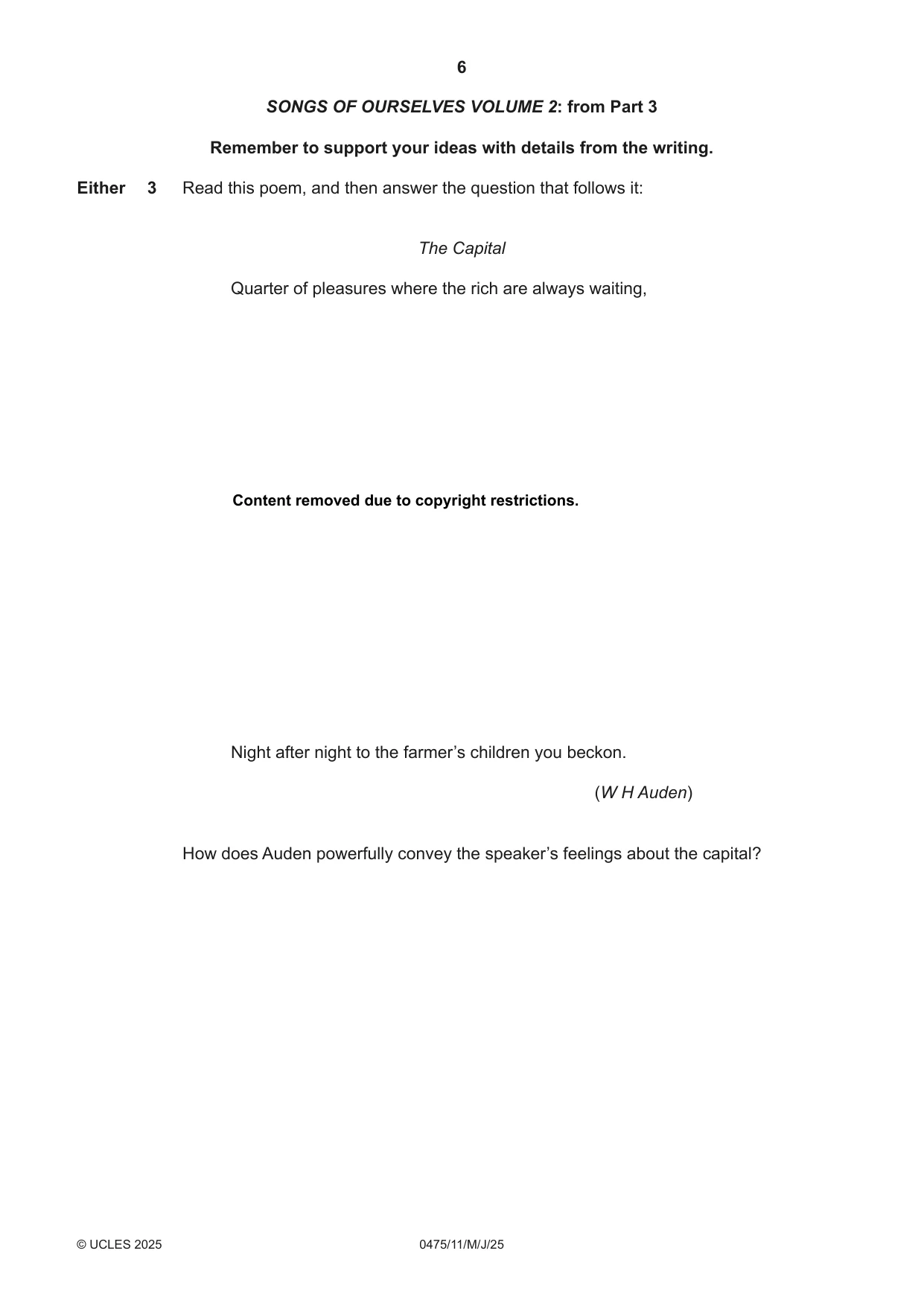
6 0475/11/M/J/25 © UCLES 2025 SONGS OF OURSELVES VOLUME 2: from Part 3 Remember to support your ideas with details from the writing. Either 3 Read this poem, and then answer the question that follows it: The Capital Quarter of pleasures where the rich are always waiting, Night after night to the farmer’s children you beckon. (W H Auden) How does Auden powerfully convey the speaker’s feelings about the capital? Content removed due to copyright restrictions.
Question paper, page 7
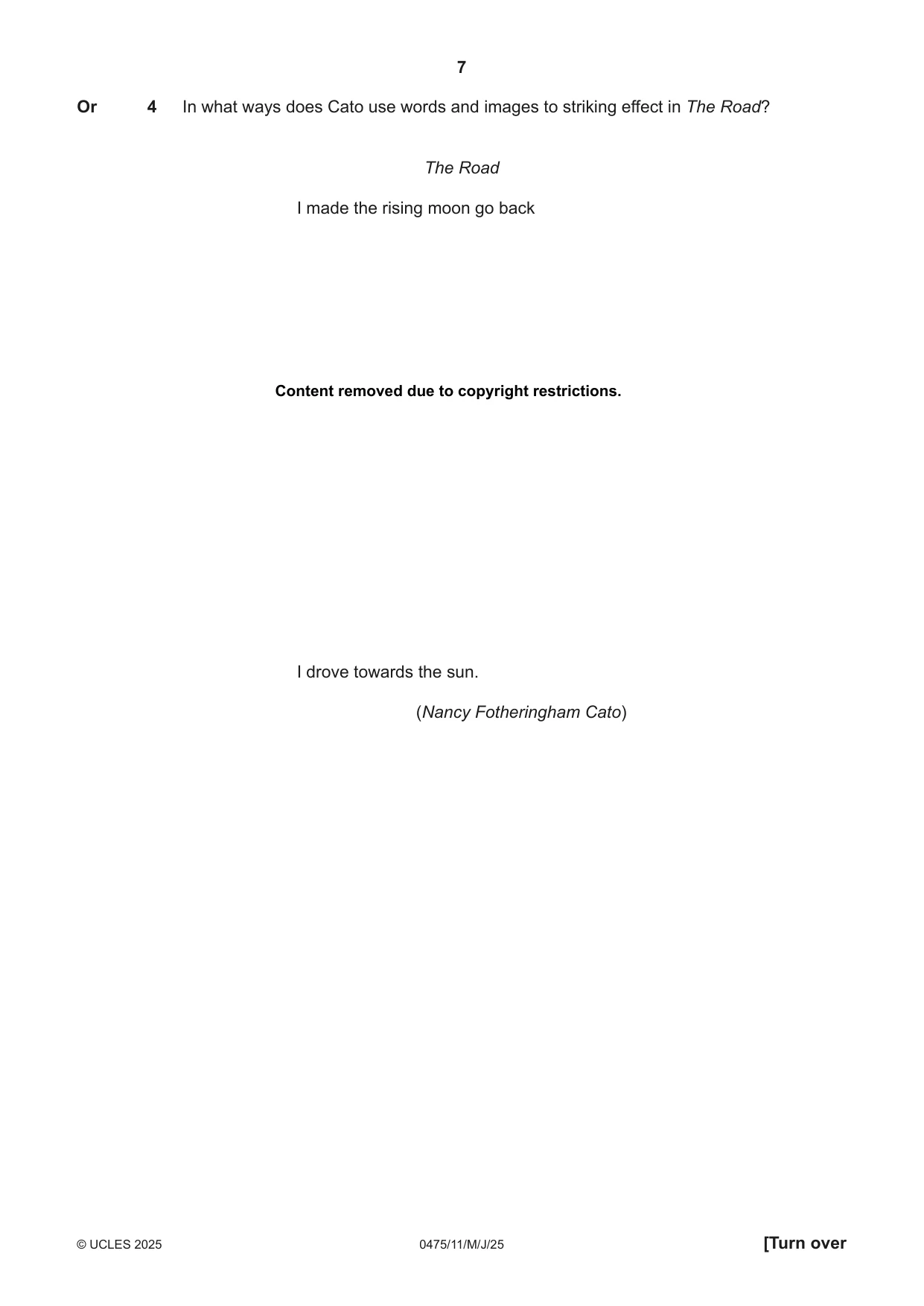
7 0475/11/M/J/25 © UCLES 2025 [Turn over Or 4 In what ways does Cato use words and images to striking effect in The Road? The Road I made the rising moon go back I drove towards the sun. (Nancy Fotheringham Cato) Content removed due to copyright restrictions.
Question paper, page 8
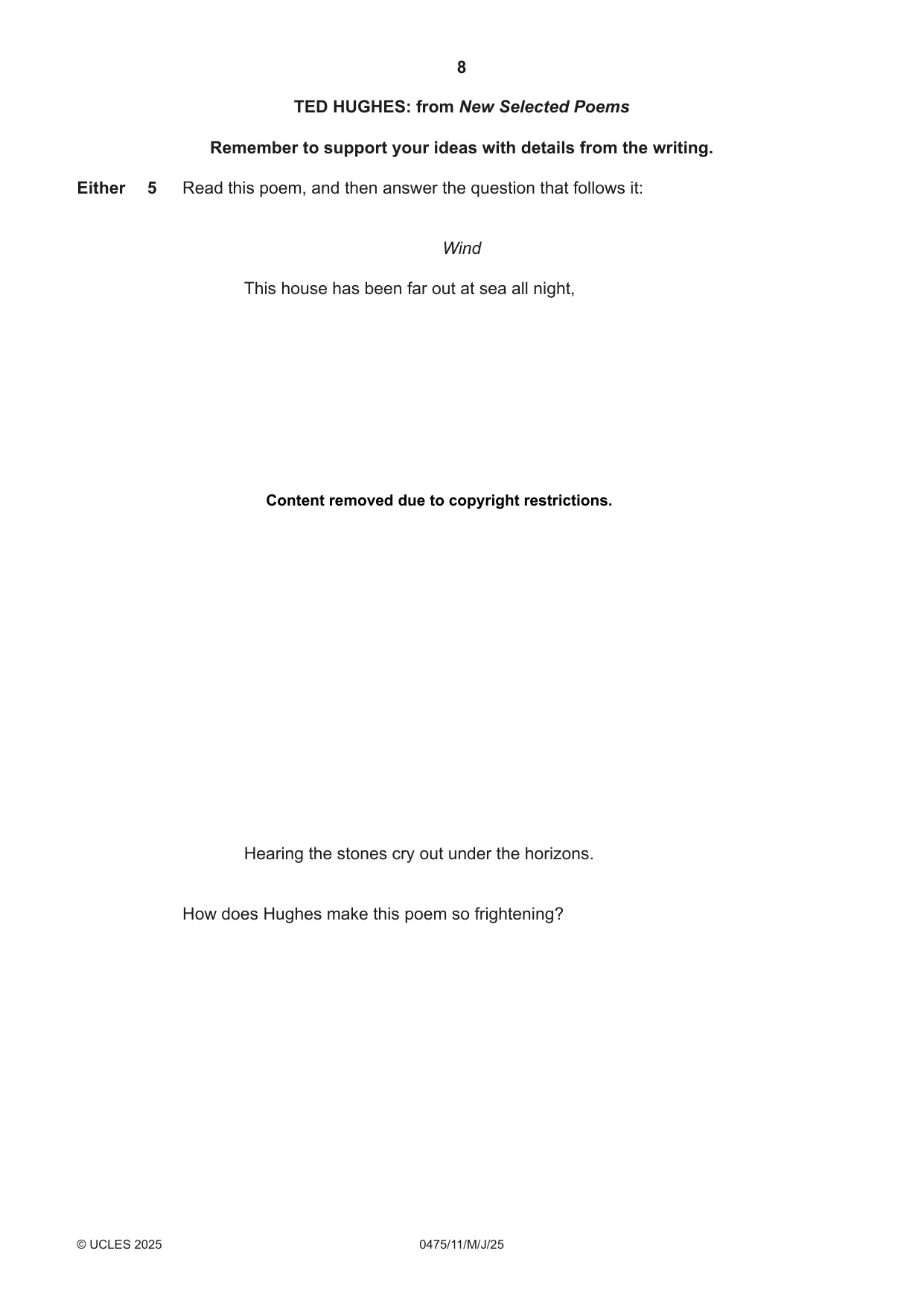
8 0475/11/M/J/25 © UCLES 2025 TED HUGHES: from New Selected Poems Remember to support your ideas with details from the writing. Either 5 Read this poem, and then answer the question that follows it: Wind This house has been far out at sea all night, Hearing the stones cry out under the horizons. How does Hughes make this poem so frightening? Content removed due to copyright restrictions.
Question paper, page 9
9 0475/11/M/J/25 © UCLES 2025 [Turn over TURN OVER FOR QUESTION 6.
Question paper, page 10
10 0475/11/M/J/25 © UCLES 2025 Or 6 In what ways does Hughes make the horses so mysterious in The Horses? The Horses I climbed through woods in the hour-before-dawn dark. Content removed due to copyright restrictions.
Question paper, page 11
11 0475/11/M/J/25 © UCLES 2025 [Turn over Hearing the horizons endure. Content removed due to copyright restrictions.
Question paper, page 12
12 0475/11/M/J/25 © UCLES 2025 SECTION B: PROSE Answer one question from this section. CHINUA ACHEBE: Things Fall Apart Remember to support your ideas with details from the writing. Either 7 Read this passage, and then answer the question that follows it: Okonkwo was inwardly pleased at his son’s development, and he knew it was due to Ikemefuna. An oil lamp was lit and Okonkwo tasted from each bowl, and then passed two shares to Nwoye and Ikemefuna. (from Chapter 7) Content removed due to copyright restrictions.
Question paper, page 13
13 0475/11/M/J/25 © UCLES 2025 [Turn over In what ways does Achebe make this such a moving moment in the novel? Or 8 Explore how Achebe strikingly conveys the impact of Okonkwo’s banishment.
Question paper, page 14
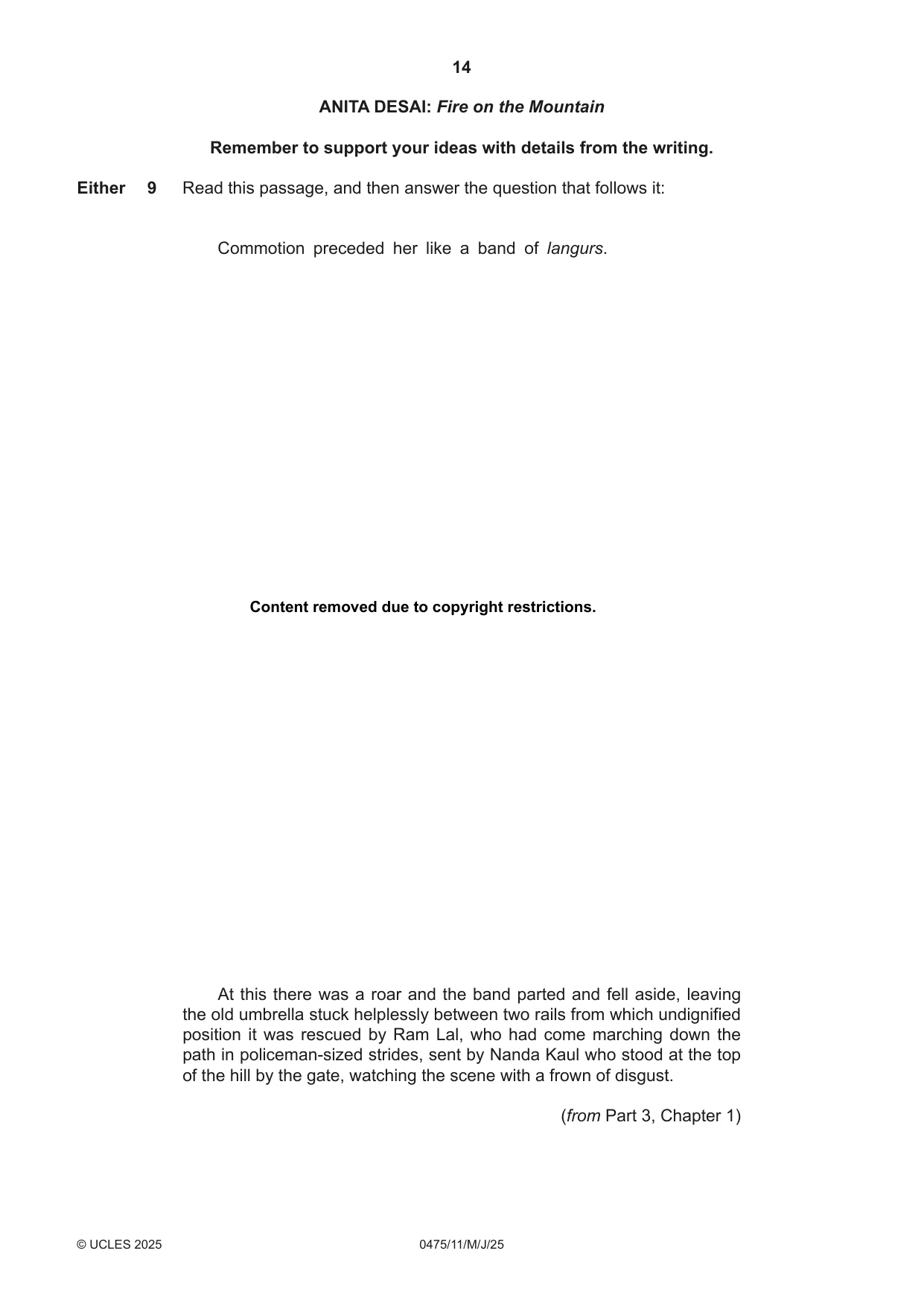
14 0475/11/M/J/25 © UCLES 2025 ANITA DESAI: Fire on the Mountain Remember to support your ideas with details from the writing. Either 9 Read this passage, and then answer the question that follows it: Commotion preceded her like a band of langurs. At this there was a roar and the band parted and fell aside, leaving the old umbrella stuck helplessly between two rails from which undignified position it was rescued by Ram Lal, who had come marching down the path in policeman-sized strides, sent by Nanda Kaul who stood at the top of the hill by the gate, watching the scene with a frown of disgust. (from Part 3, Chapter 1) Content removed due to copyright restrictions.
Question paper, page 15
15 0475/11/M/J/25 © UCLES 2025 [Turn over How does Desai make this moment in the novel both comical and sad? Or 10 Explore how Desai vividly conveys Nanda Kaul’s changing feelings towards Raka.
Question paper, page 16
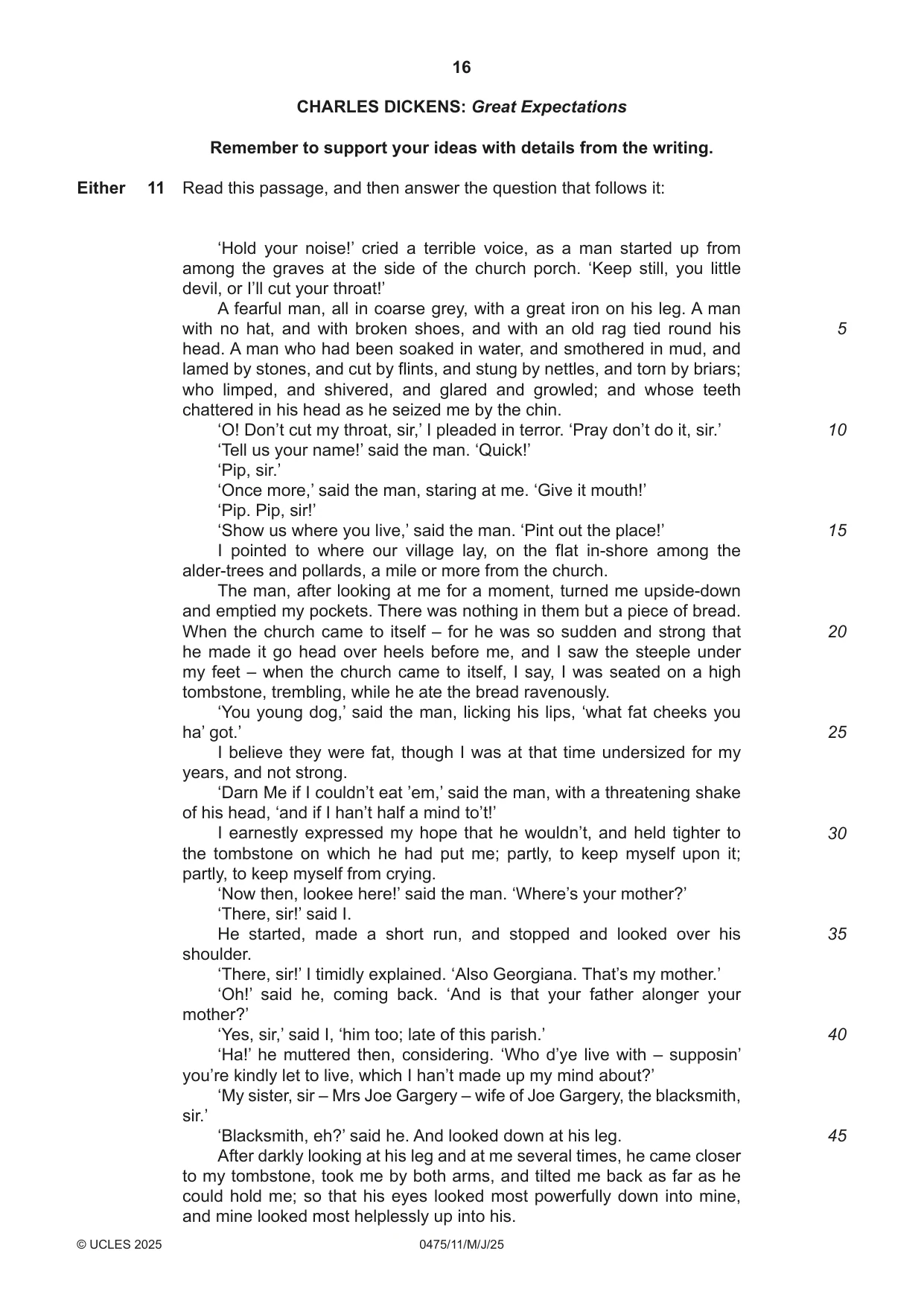
16 0475/11/M/J/25 © UCLES 2025 CHARLES DICKENS: Great Expectations Remember to support your ideas with details from the writing. Either 11 Read this passage, and then answer the question that follows it: ‘Hold your noise!’ cried a terrible voice, as a man started up from among the graves at the side of the church porch. ‘Keep still, you little devil, or I’ll cut your throat!’ A fearful man, all in coarse grey, with a great iron on his leg. A man with no hat, and with broken shoes, and with an old rag tied round his head. A man who had been soaked in water, and smothered in mud, and lamed by stones, and cut by flints, and stung by nettles, and torn by briars; who limped, and shivered, and glared and growled; and whose teeth chattered in his head as he seized me by the chin. ‘O! Don’t cut my throat, sir,’ I pleaded in terror. ‘Pray don’t do it, sir.’ ‘Tell us your name!’ said the man. ‘Quick!’ ‘Pip, sir.’ ‘Once more,’ said the man, staring at me. ‘Give it mouth!’ ‘Pip. Pip, sir!’ ‘Show us where you live,’ said the man. ‘Pint out the place!’ I pointed to where our village lay, on the flat in-shore among the alder-trees and pollards, a mile or more from the church. The man, after looking at me for a moment, turned me upside-down and emptied my pockets. There was nothing in them but a piece of bread. When the church came to itself – for he was so sudden and strong that he made it go head over heels before me, and I saw the steeple under my feet – when the church came to itself, I say, I was seated on a high tombstone, trembling, while he ate the bread ravenously. ‘You young dog,’ said the man, licking his lips, ‘what fat cheeks you ha’ got.’ I believe they were fat, though I was at that time undersized for my years, and not strong. ‘Darn Me if I couldn’t eat ʼem,’ said the man, with a threatening shake of his head, ‘and if I han’t half a mind to’t!’ I earnestly expressed my hope that he wouldn’t, and held tighter to the tombstone on which he had put me; partly, to keep myself upon it; partly, to keep myself from crying. ‘Now then, lookee here!’ said the man. ‘Where’s your mother?’ ‘There, sir!’ said I. He started, made a short run, and stopped and looked over his shoulder. ‘There, sir!’ I timidly explained. ‘Also Georgiana. That’s my mother.’ ‘Oh!’ said he, coming back. ‘And is that your father alonger your mother?’ ‘Yes, sir,’ said I, ‘him too; late of this parish.’ ‘Ha!’ he muttered then, considering. ‘Who d’ye live with – supposin’ you’re kindly let to live, which I han’t made up my mind about?’ ‘My sister, sir – Mrs Joe Gargery – wife of Joe Gargery, the blacksmith, sir.’ ‘Blacksmith, eh?’ said he. And looked down at his leg. After darkly looking at his leg and at me several times, he came closer to my tombstone, took me by both arms, and tilted me back as far as he could hold me; so that his eyes looked most powerfully down into mine, and mine looked most helplessly up into his. 5 10 15 20 25 30 35 40 45
Question paper, page 17
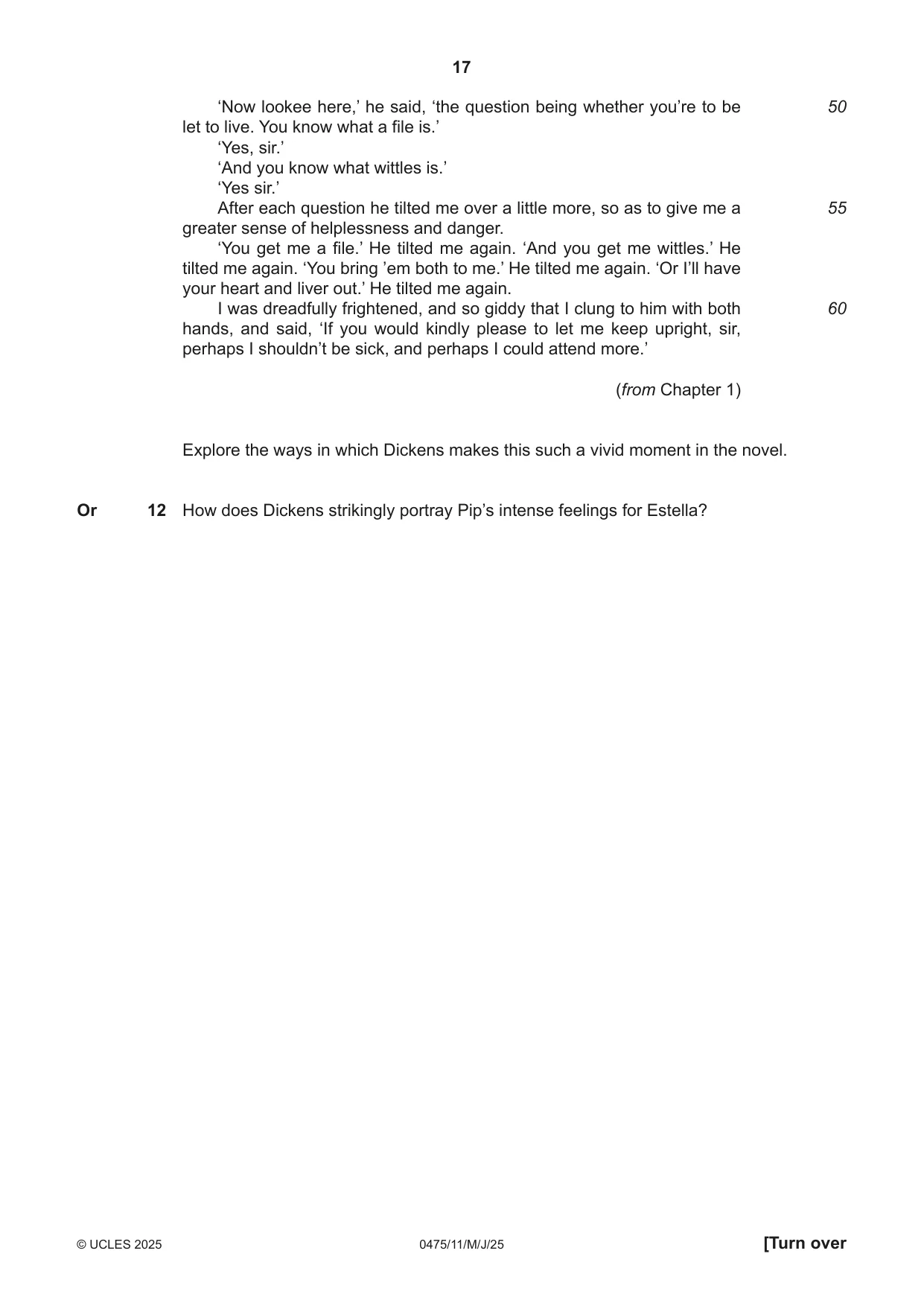
17 0475/11/M/J/25 © UCLES 2025 [Turn over ‘Now lookee here,’ he said, ‘the question being whether you’re to be let to live. You know what a file is.’ ‘Yes, sir.’ ‘And you know what wittles is.’ ‘Yes sir.’ After each question he tilted me over a little more, so as to give me a greater sense of helplessness and danger. ‘You get me a file.’ He tilted me again. ‘And you get me wittles.’ He tilted me again. ‘You bring ʼem both to me.’ He tilted me again. ‘Or I’ll have your heart and liver out.’ He tilted me again. I was dreadfully frightened, and so giddy that I clung to him with both hands, and said, ‘If you would kindly please to let me keep upright, sir, perhaps I shouldn’t be sick, and perhaps I could attend more.’ (from Chapter 1) Explore the ways in which Dickens makes this such a vivid moment in the novel. Or 12 How does Dickens strikingly portray Pip’s intense feelings for Estella? 50 55 60
Question paper, page 18
18 0475/11/M/J/25 © UCLES 2025 DAPHNE DU MAURIER: Rebecca Remember to support your ideas with details from the writing. Either 13 Read this passage, and then answer the question that follows it: ‘I killed Rebecca,’ Maxim had said. Content removed due to copyright restrictions.
Question paper, page 19
19 0475/11/M/J/25 © UCLES 2025 [Turn over She was not even normal.’ (from Chapter 20) How does du Maurier make this such a dramatic moment in the novel? Or 14 In what ways does du Maurier portray Jack Favell as a villain? Content removed due to copyright restrictions.
Question paper, page 20
20 0475/11/M/J/25 © UCLES 2025 HARPER LEE: To Kill a Mockingbird Remember to support your ideas with details from the writing. Either 15 Read this passage, and then answer the question that follows it: Miss Stephanie’s nose quivered with curiosity. Content removed due to copyright restrictions.
Question paper, page 21
21 0475/11/M/J/25 © UCLES 2025 [Turn over ‘That’s something you’ll have to take up with your father,’ Miss Maudie said. (from Chapter 22) How does Lee make this such a memorable moment in the novel? Or 16 In what ways does Lee make Dill such an intriguing character? Content removed due to copyright restrictions.
Question paper, page 22
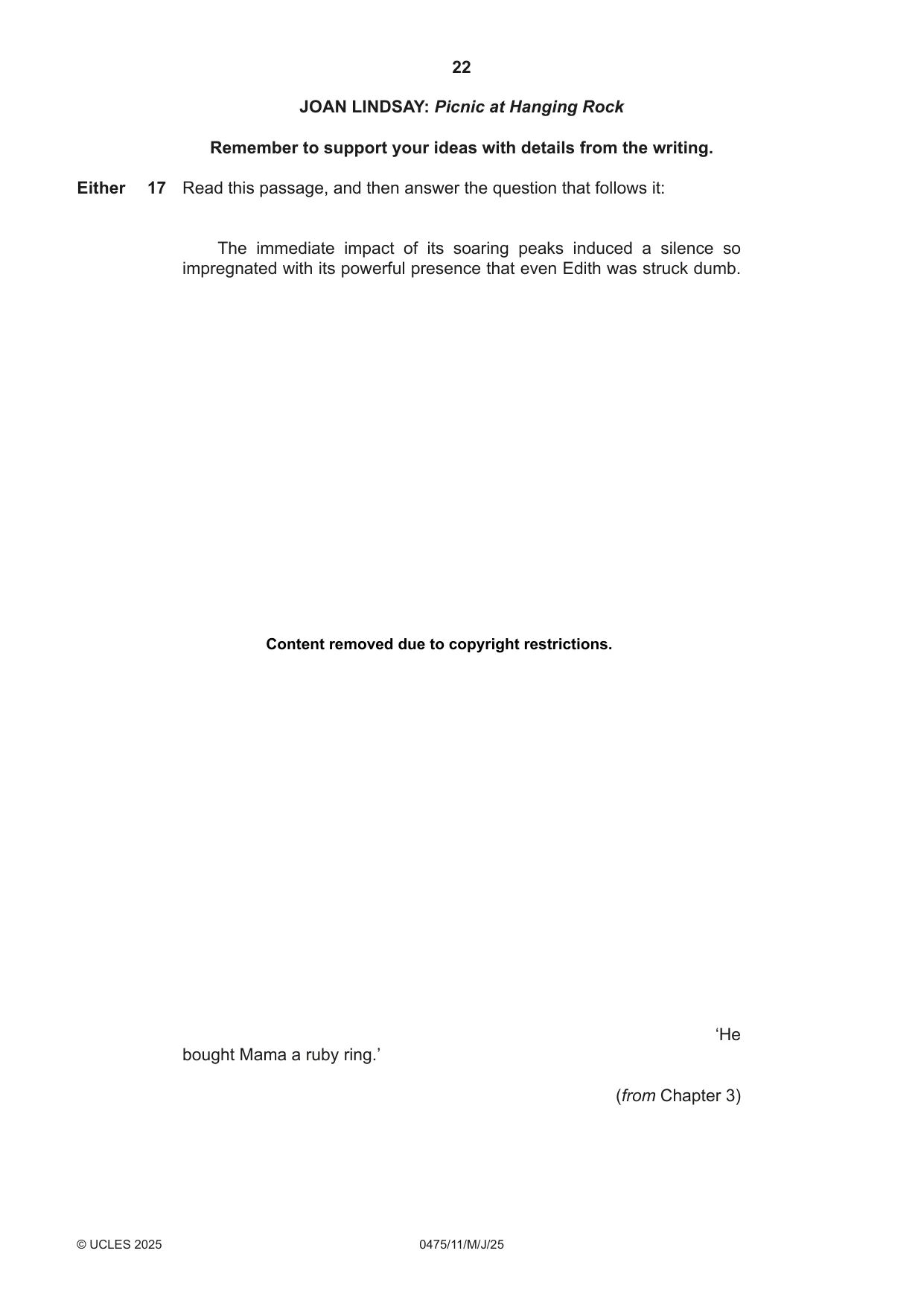
22 0475/11/M/J/25 © UCLES 2025 JOAN LINDSAY: Picnic at Hanging Rock Remember to support your ideas with details from the writing. Either 17 Read this passage, and then answer the question that follows it: The immediate impact of its soaring peaks induced a silence so impregnated with its powerful presence that even Edith was struck dumb. ‘He bought Mama a ruby ring.’ (from Chapter 3) Content removed due to copyright restrictions.
Question paper, page 23
23 0475/11/M/J/25 © UCLES 2025 [Turn over How does Lindsay make this such a powerful moment in the novel? Or 18 In what ways does Lindsay portray Mrs Appleyard as such an unpleasant character?
Question paper, page 24
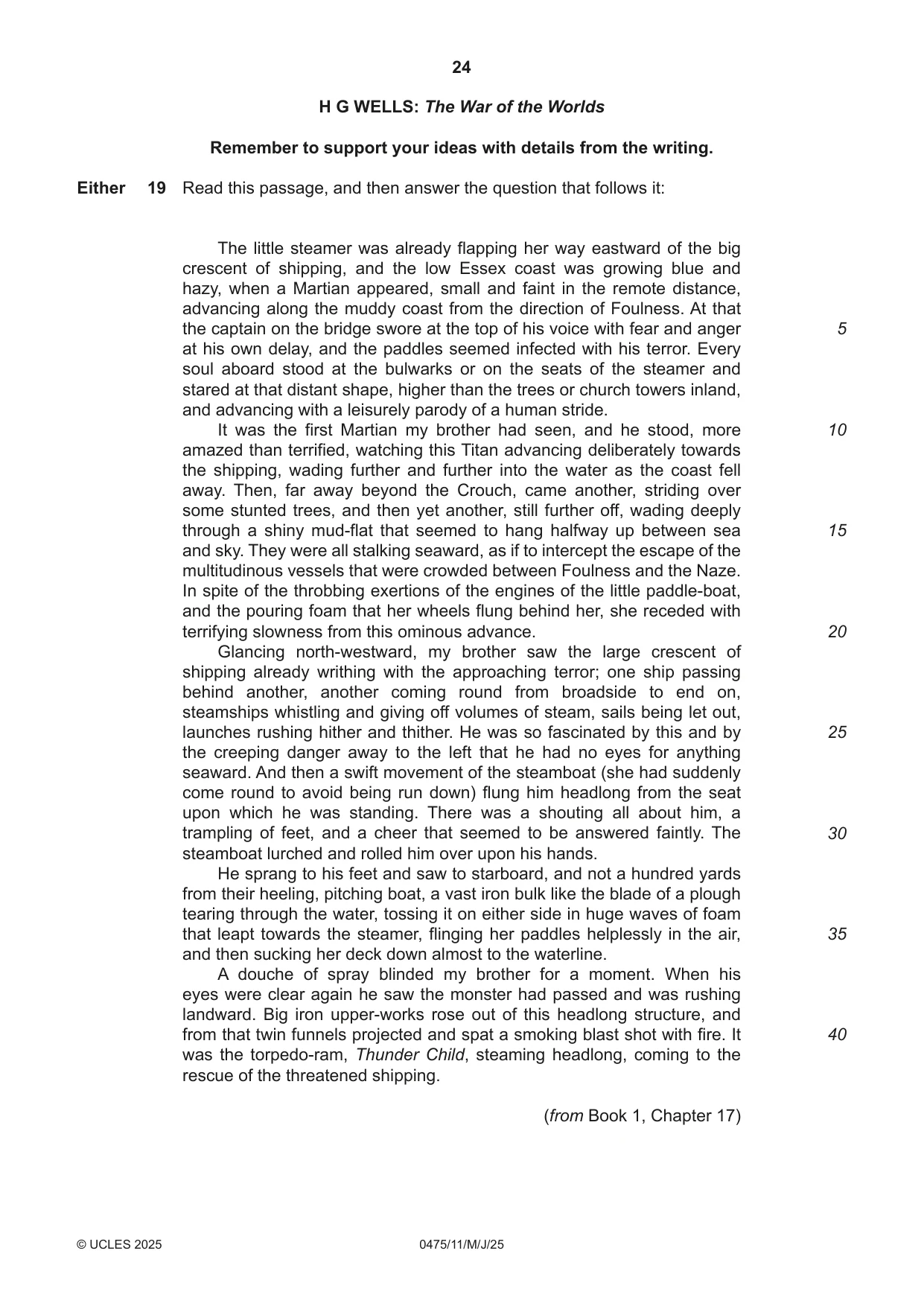
24 0475/11/M/J/25 © UCLES 2025 H G WELLS: The War of the Worlds Remember to support your ideas with details from the writing. Either 19 Read this passage, and then answer the question that follows it: The little steamer was already flapping her way eastward of the big crescent of shipping, and the low Essex coast was growing blue and hazy, when a Martian appeared, small and faint in the remote distance, advancing along the muddy coast from the direction of Foulness. At that the captain on the bridge swore at the top of his voice with fear and anger at his own delay, and the paddles seemed infected with his terror. Every soul aboard stood at the bulwarks or on the seats of the steamer and stared at that distant shape, higher than the trees or church towers inland, and advancing with a leisurely parody of a human stride. It was the first Martian my brother had seen, and he stood, more amazed than terrified, watching this Titan advancing deliberately towards the shipping, wading further and further into the water as the coast fell away. Then, far away beyond the Crouch, came another, striding over some stunted trees, and then yet another, still further off, wading deeply through a shiny mud-flat that seemed to hang halfway up between sea and sky. They were all stalking seaward, as if to intercept the escape of the multitudinous vessels that were crowded between Foulness and the Naze. In spite of the throbbing exertions of the engines of the little paddle-boat, and the pouring foam that her wheels flung behind her, she receded with terrifying slowness from this ominous advance. Glancing north-westward, my brother saw the large crescent of shipping already writhing with the approaching terror; one ship passing behind another, another coming round from broadside to end on, steamships whistling and giving off volumes of steam, sails being let out, launches rushing hither and thither. He was so fascinated by this and by the creeping danger away to the left that he had no eyes for anything seaward. And then a swift movement of the steamboat (she had suddenly come round to avoid being run down) flung him headlong from the seat upon which he was standing. There was a shouting all about him, a trampling of feet, and a cheer that seemed to be answered faintly. The steamboat lurched and rolled him over upon his hands. He sprang to his feet and saw to starboard, and not a hundred yards from their heeling, pitching boat, a vast iron bulk like the blade of a plough tearing through the water, tossing it on either side in huge waves of foam that leapt towards the steamer, flinging her paddles helplessly in the air, and then sucking her deck down almost to the waterline. A douche of spray blinded my brother for a moment. When his eyes were clear again he saw the monster had passed and was rushing landward. Big iron upper-works rose out of this headlong structure, and from that twin funnels projected and spat a smoking blast shot with fire. It was the torpedo-ram, Thunder Child, steaming headlong, coming to the rescue of the threatened shipping. (from Book 1, Chapter 17) 5 10 15 20 25 30 35 40
Question paper, page 25
25 0475/11/M/J/25 © UCLES 2025 [Turn over How does Wells make this such a frightening moment in the novel? Or 20 To what extent does Wells’s portrayal of the Martians suggest that they are admirable?
Question paper, page 26
26 0475/11/M/J/25 © UCLES 2025 from STORIES OF OURSELVES VOLUME 2 Remember to support your ideas with details from the writing. Either 21 Read this passage from Fluke (by Romesh Gunesekera), and then answer the question that follows it: I helped myself to a spoonful from every dish and sat at a table by the water’s edge. Content removed due to copyright restrictions.
Question paper, page 27
27 0475/11/M/J/25 © UCLES 2025 The rest of the world will follow.’ How does Gunesekera make this moment in the story so entertaining? Or 22 In what ways does Christina Rossetti make Nick such a powerful story about jealousy?
Question paper, page 28
28 0475/11/M/J/25 © UCLES 2025 Permission to reproduce items where third-party owned material protected by copyright is included has been sought and cleared where possible. Every reasonable effort has been made by the publisher (UCLES) to trace copyright holders, but if any items requiring clearance have unwittingly been included, the publisher will be pleased to make amends at the earliest possible opportunity. To avoid the issue of disclosure of answer-related information to candidates, all copyright acknowledgements are reproduced online in the Cambridge Assessment International Education Copyright Acknowledgements Booklet. This is produced for each series of examinations and is freely available to download at www.cambridgeinternational.org after the live examination series. Cambridge Assessment International Education is part of Cambridge Assessment. Cambridge Assessment is the brand name of the University of Cambridge Local Examinations Syndicate (UCLES), which is a department of the University of Cambridge. BLANK PAGE
Mark scheme, page 1
This document consists of 5 printed pages. © Cambridge University Press & Assessment 2025 [Turn over Cambridge IGCSE™ LITERATURE IN ENGLISH 0475/11 Paper 1 Poetry and Prose May/June 2025 MARK SCHEME Maximum Mark: 50 Published This mark scheme is published as an aid to teachers and candidates, to indicate the requirements of the examination. It shows the basis on which Examiners were instructed to award marks. It does not indicate the details of the discussions that took place at an Examiners’ meeting before marking began, which would have considered the acceptability of alternative answers. Mark schemes should be read in conjunction with the question paper and the Principal Examiner Report for Teachers. Cambridge International will not enter into discussions about these mark schemes. Cambridge International is publishing the mark schemes for the May/June 2025 series for most Cambridge IGCSE, Cambridge International A and AS Level components, and some Cambridge O Level components.
Mark scheme, page 2
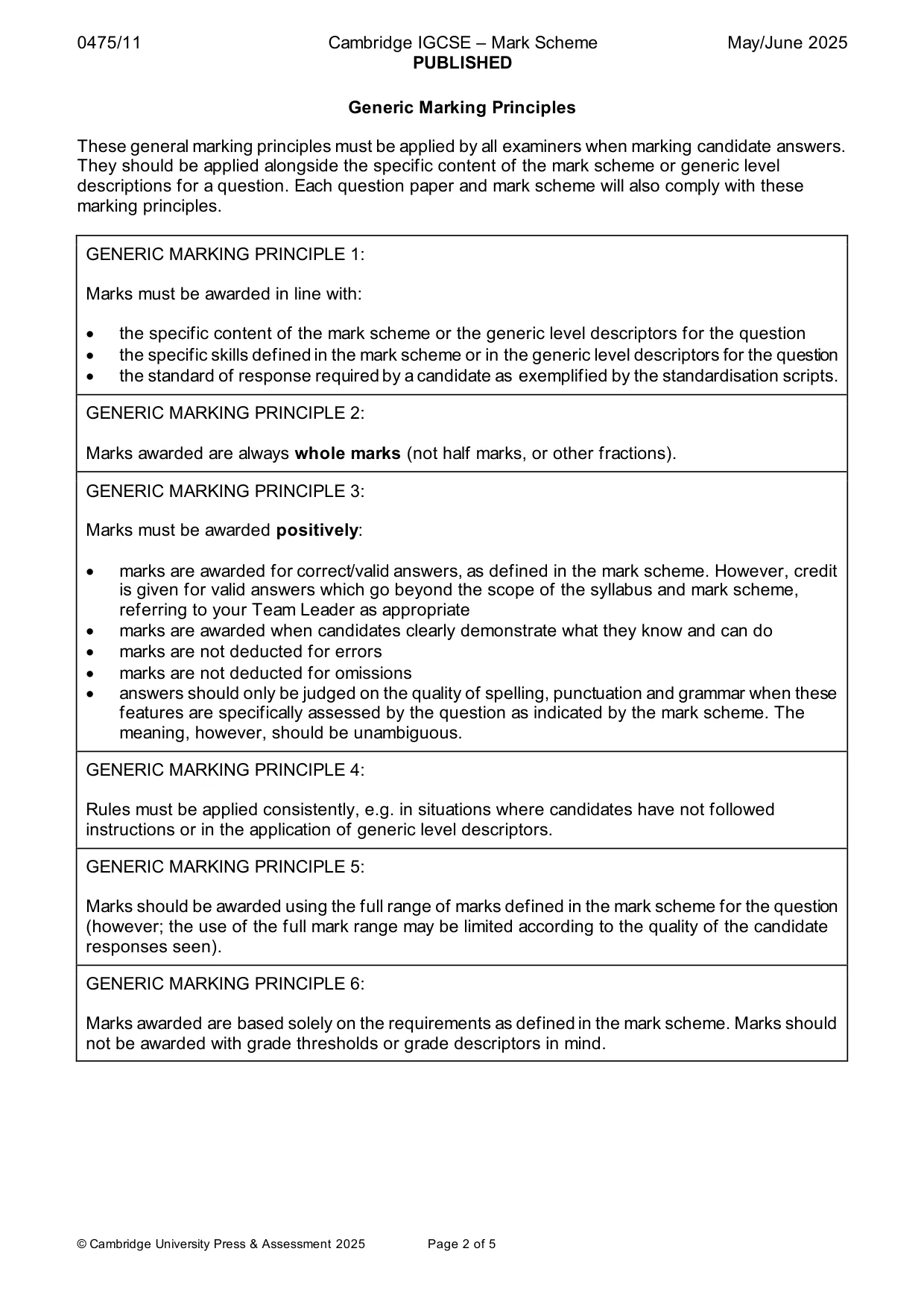
0475/11 Cambridge IGCSE – Mark Scheme PUBLISHED May/June 2025 © Cambridge University Press & Assessment 2025 Page 2 of 5 Generic Marking Principles These general marking principles must be applied by all examiners when marking candidate answers. They should be applied alongside the specific content of the mark scheme or generic level descriptions for a question. Each question paper and mark scheme will also comply with these marking principles. GENERIC MARKING PRINCIPLE 1: Marks must be awarded in line with: • the specific content of the mark scheme or the generic level descriptors for the question • the specific skills defined in the mark scheme or in the generic level descriptors for the question • the standard of response required by a candidate as exemplified by the standardisation scripts. GENERIC MARKING PRINCIPLE 2: Marks awarded are always whole marks (not half marks, or other fractions). GENERIC MARKING PRINCIPLE 3: Marks must be awarded positively: • marks are awarded for correct/valid answers, as defined in the mark scheme. However, credit is given for valid answers which go beyond the scope of the syllabus and mark scheme, referring to your Team Leader as appropriate • marks are awarded when candidates clearly demonstrate what they know and can do • marks are not deducted for errors • marks are not deducted for omissions • answers should only be judged on the quality of spelling, punctuation and grammar when these features are specifically assessed by the question as indicated by the mark scheme. The meaning, however, should be unambiguous. GENERIC MARKING PRINCIPLE 4: Rules must be applied consistently, e.g. in situations where candidates have not followed instructions or in the application of generic level descriptors. GENERIC MARKING PRINCIPLE 5: Marks should be awarded using the full range of marks defined in the mark scheme for the question (however; the use of the full mark range may be limited according to the quality of the candidate responses seen). GENERIC MARKING PRINCIPLE 6: Marks awarded are based solely on the requirements as defined in the mark scheme. Marks should not be awarded with grade thresholds or grade descriptors in mind.
Mark scheme, page 3
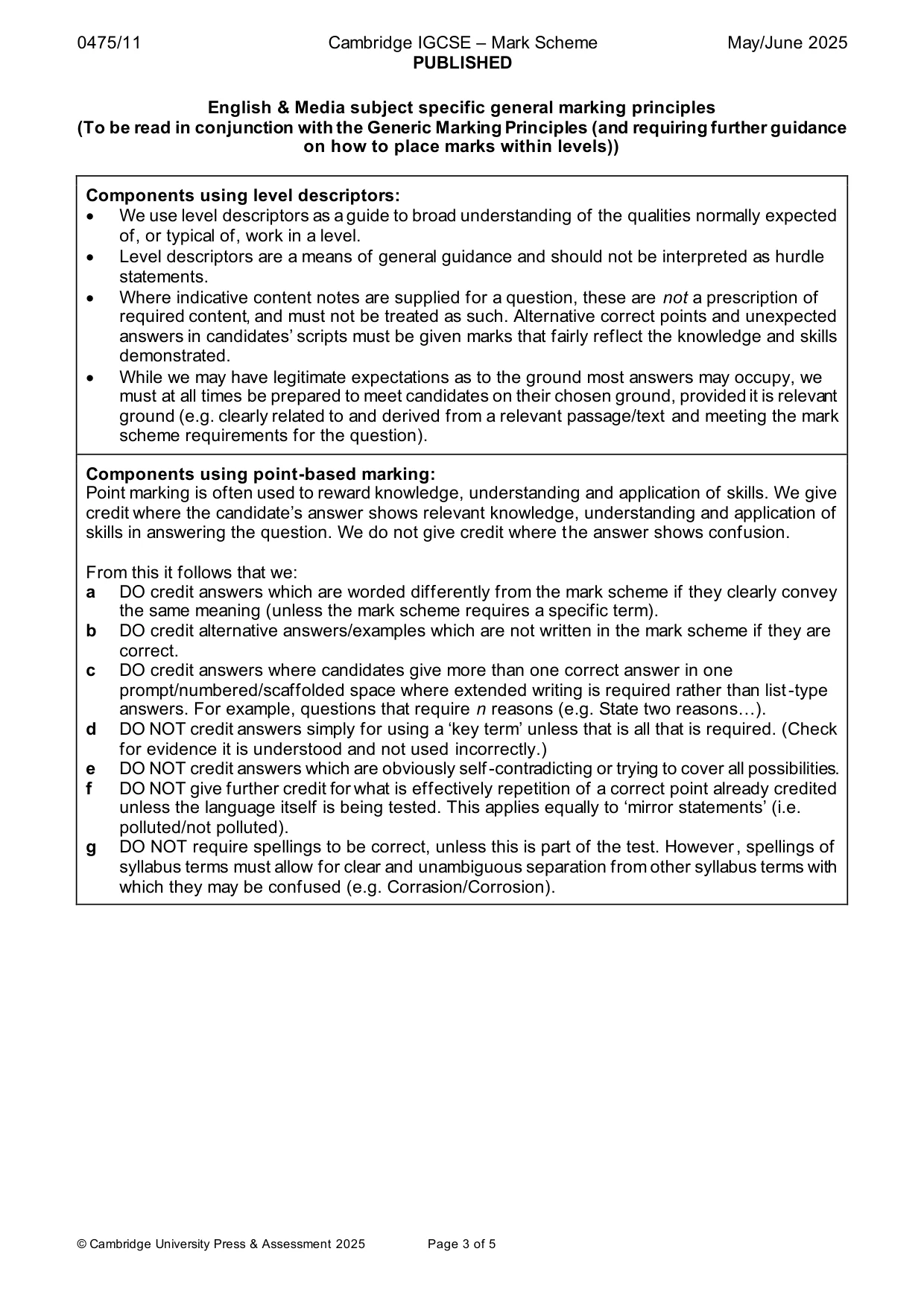
0475/11 Cambridge IGCSE – Mark Scheme PUBLISHED May/June 2025 © Cambridge University Press & Assessment 2025 Page 3 of 5 English & Media subject specific general marking principles (To be read in conjunction with the Generic Marking Principles (and requiring further guidance on how to place marks within levels)) Components using level descriptors: • We use level descriptors as a guide to broad understanding of the qualities normally expected of, or typical of, work in a level. • Level descriptors are a means of general guidance and should not be interpreted as hurdle statements. • Where indicative content notes are supplied for a question, these are not a prescription of required content, and must not be treated as such. Alternative correct points and unexpected answers in candidates’ scripts must be given marks that fairly reflect the knowledge and skills demonstrated. • While we may have legitimate expectations as to the ground most answers may occupy, we must at all times be prepared to meet candidates on their chosen ground, provided it is relevant ground (e.g. clearly related to and derived from a relevant passage/text and meeting the mark scheme requirements for the question). Components using point-based marking: Point marking is often used to reward knowledge, understanding and application of skills. We give credit where the candidate’s answer shows relevant knowledge, understanding and application of skills in answering the question. We do not give credit where the answer shows confusion. From this it follows that we: a DO credit answers which are worded differently from the mark scheme if they clearly convey the same meaning (unless the mark scheme requires a specific term). b DO credit alternative answers/examples which are not written in the mark scheme if they are correct. c DO credit answers where candidates give more than one correct answer in one prompt/numbered/scaffolded space where extended writing is required rather than list-type answers. For example, questions that require n reasons (e.g. State two reasons…). d DO NOT credit answers simply for using a ‘key term’ unless that is all that is required. (Check for evidence it is understood and not used incorrectly.) e DO NOT credit answers which are obviously self-contradicting or trying to cover all possibilities. f DO NOT give further credit for what is effectively repetition of a correct point already credited unless the language itself is being tested. This applies equally to ‘mirror statements’ (i.e. polluted/not polluted). g DO NOT require spellings to be correct, unless this is part of the test. However, spellings of syllabus terms must allow for clear and unambiguous separation from other syllabus terms with which they may be confused (e.g. Corrasion/Corrosion).
Mark scheme, page 4
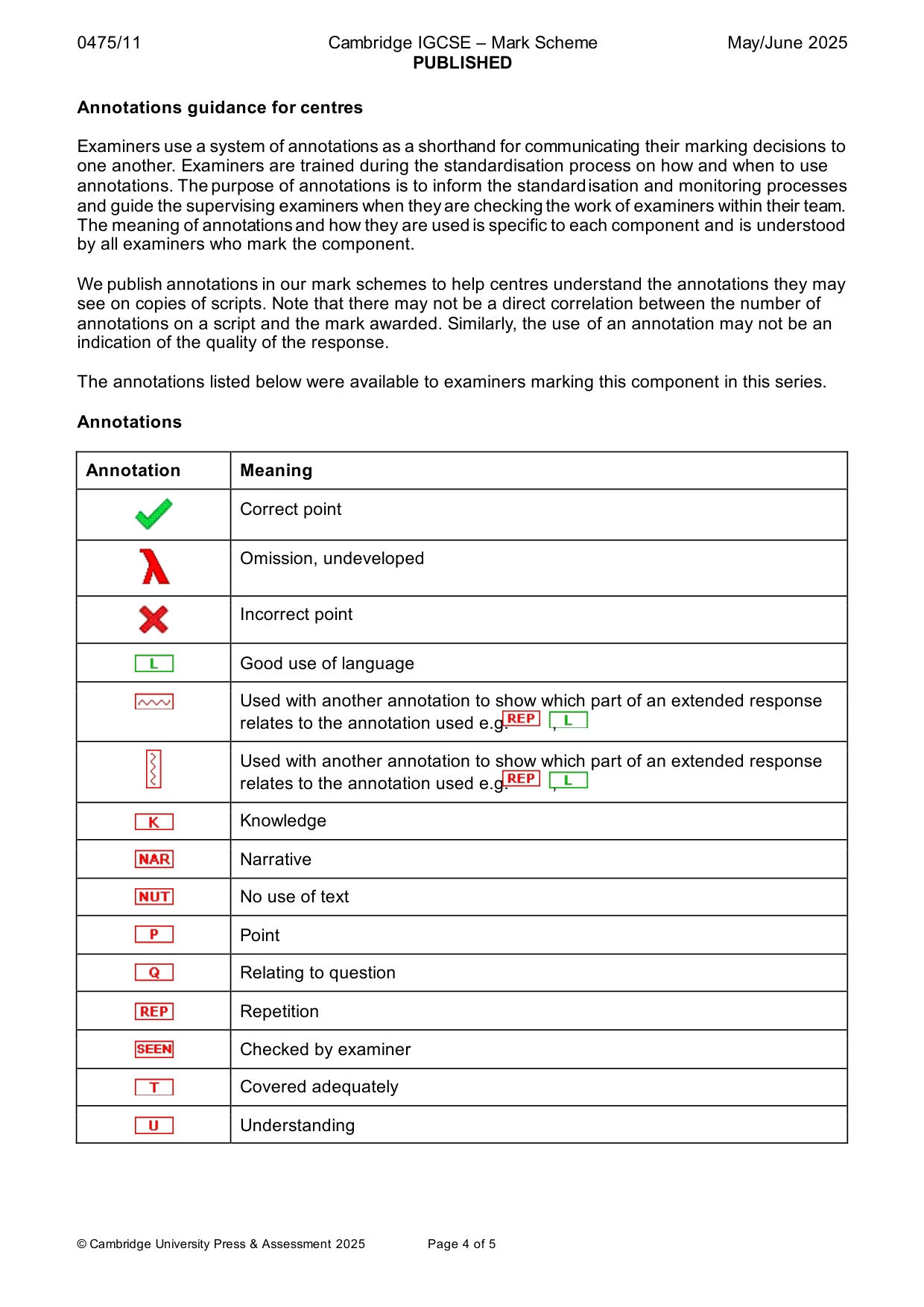
0475/11 Cambridge IGCSE – Mark Scheme PUBLISHED May/June 2025 © Cambridge University Press & Assessment 2025 Page 4 of 5 Annotations guidance for centres Examiners use a system of annotations as a shorthand for communicating their marking decisions to one another. Examiners are trained during the standardisation process on how and when to use annotations. The purpose of annotations is to inform the standardisation and monitoring processes and guide the supervising examiners when they are checking the work of examiners within their team. The meaning of annotations and how they are used is specific to each component and is understood by all examiners who mark the component. We publish annotations in our mark schemes to help centres understand the annotations they may see on copies of scripts. Note that there may not be a direct correlation between the number of annotations on a script and the mark awarded. Similarly, the use of an annotation may not be an indication of the quality of the response. The annotations listed below were available to examiners marking this component in this series. Annotations Annotation Meaning Correct point Omission, undeveloped Incorrect point Good use of language Used with another annotation to show which part of an extended response relates to the annotation used e.g. , Used with another annotation to show which part of an extended response relates to the annotation used e.g. , Knowledge Narrative No use of text Point Relating to question Repetition Checked by examiner Covered adequately Understanding
Mark scheme, page 5
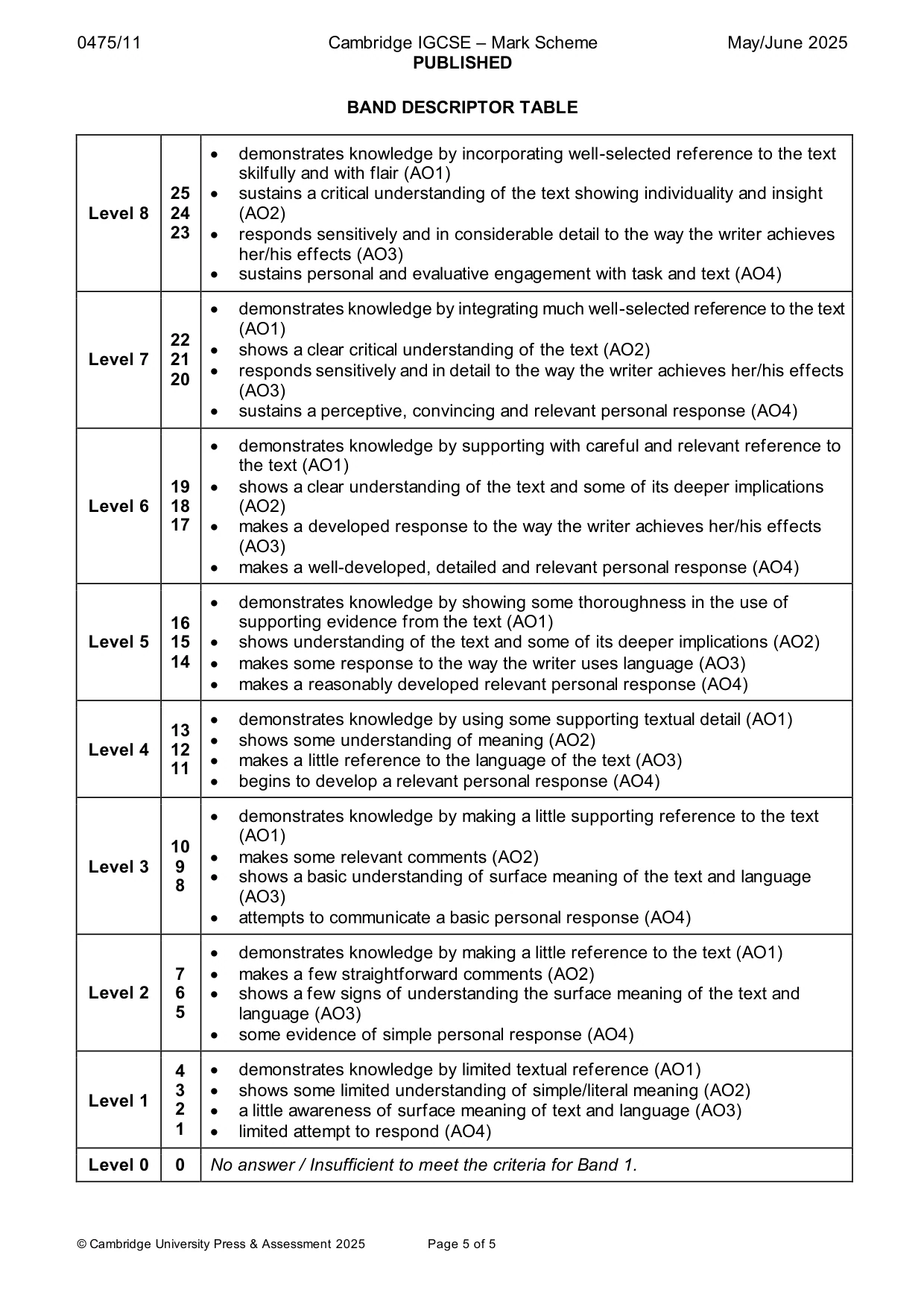
0475/11 Cambridge IGCSE – Mark Scheme PUBLISHED May/June 2025 © Cambridge University Press & Assessment 2025 Page 5 of 5 BAND DESCRIPTOR TABLE Level 8 25 24 23 • demonstrates knowledge by incorporating well-selected reference to the text skilfully and with flair (AO1) • sustains a critical understanding of the text showing individuality and insight (AO2) • responds sensitively and in considerable detail to the way the writer achieves her/his effects (AO3) • sustains personal and evaluative engagement with task and text (AO4) Level 7 22 21 20 • demonstrates knowledge by integrating much well-selected reference to the text (AO1) • shows a clear critical understanding of the text (AO2) • responds sensitively and in detail to the way the writer achieves her/his effects (AO3) • sustains a perceptive, convincing and relevant personal response (AO4) Level 6 19 18 17 • demonstrates knowledge by supporting with careful and relevant reference to the text (AO1) • shows a clear understanding of the text and some of its deeper implications (AO2) • makes a developed response to the way the writer achieves her/his effects (AO3) • makes a well-developed, detailed and relevant personal response (AO4) Level 5 16 15 14 • demonstrates knowledge by showing some thoroughness in the use of supporting evidence from the text (AO1) • shows understanding of the text and some of its deeper implications (AO2) • makes some response to the way the writer uses language (AO3) • makes a reasonably developed relevant personal response (AO4) Level 4 13 12 11 • demonstrates knowledge by using some supporting textual detail (AO1) • shows some understanding of meaning (AO2) • makes a little reference to the language of the text (AO3) • begins to develop a relevant personal response (AO4) Level 3 10 9 8 • demonstrates knowledge by making a little supporting reference to the text (AO1) • makes some relevant comments (AO2) • shows a basic understanding of surface meaning of the text and language (AO3) • attempts to communicate a basic personal response (AO4) Level 2 7 6 5 • demonstrates knowledge by making a little reference to the text (AO1) • makes a few straightforward comments (AO2) • shows a few signs of understanding the surface meaning of the text and language (AO3) • some evidence of simple personal response (AO4) Level 1 4 3 2 1 • demonstrates knowledge by limited textual reference (AO1) • shows some limited understanding of simple/literal meaning (AO2) • a little awareness of surface meaning of text and language (AO3) • limited attempt to respond (AO4) Level 0 0 No answer / Insufficient to meet the criteria for Band 1.
What you needed in this session
Cambridge’s own grade thresholds for 2025 May/June, Paper 1 · Variant 1. A higher threshold means an easier paper — the bar moves with how the cohort did.