Cambridge IGCSE English - Literature in English 0475 — 2023 May/June Paper 1 · Variant 1
0475/11/M/J/23 · 50 marks · ≈56 min
The question paper and its mark scheme, free to read here and free to download. This is Cambridge’s own paper, exactly as it was sat.
Question paper28 pages




Mark scheme4 pages
Answers below. Sit the paper first if you are practising.
Paper as text
Question paper, page 1
This document has 28 pages. Any blank pages are indicated. [Turn over Cambridge IGCSE™ DC (RCL (DF)) 313339/3 © UCLES 2023 LITERATURE IN ENGLISH 0475/11 Paper 1 Poetry and Prose May/June 2023 1 hour 30 minutes You must answer on the enclosed answer booklet. You will need: Answer booklet (enclosed) INSTRUCTIONS ● Answer two questions in total: Section A: answer one question. Section B: answer one question. ● Follow the instructions on the front cover of the answer booklet. If you need additional answer paper, ask the invigilator for a continuation booklet. INFORMATION ● The total mark for this paper is 50. ● All questions are worth equal marks. * 6 8 0 1 9 3 9 5 7 6 *
Question paper, page 2
2 0475/11/M/J/23 © UCLES 2023 BLANK PAGE
Question paper, page 3
3 0475/11/M/J/23 © UCLES 2023 [Turn over CONTENTS Section A: Poetry text question numbers page[s] Songs of Ourselves Volume 1: from Part 4 1, 2 pages 4–7 Songs of Ourselves Volume 2 : from Part 4 3, 4 pages 8–9 Ted Hughes: from New Selected Poems 5, 6 pages 10–11 Section B: Prose text question numbers page[s] Chimamanda Ngozi Adichie: Purple Hibiscus 7, 8 pages 12–13 Charles Dickens: Great Expectations 9, 10 pages 14–15 Daphne du Maurier: Rebecca 11, 12 pages 16–17 Henry James: Washington Square 13, 14 pages 18–19 Jhumpa Lahiri: The Namesake 15, 16 pages 20–21 Joan Lindsay: Picnic at Hanging Rock 17, 18 pages 22–23 Yann Martel: Life of Pi 19, 20 pages 24–25 from Stories of Ourselves Volume 2 21, 22 pages 26–27
Question paper, page 4
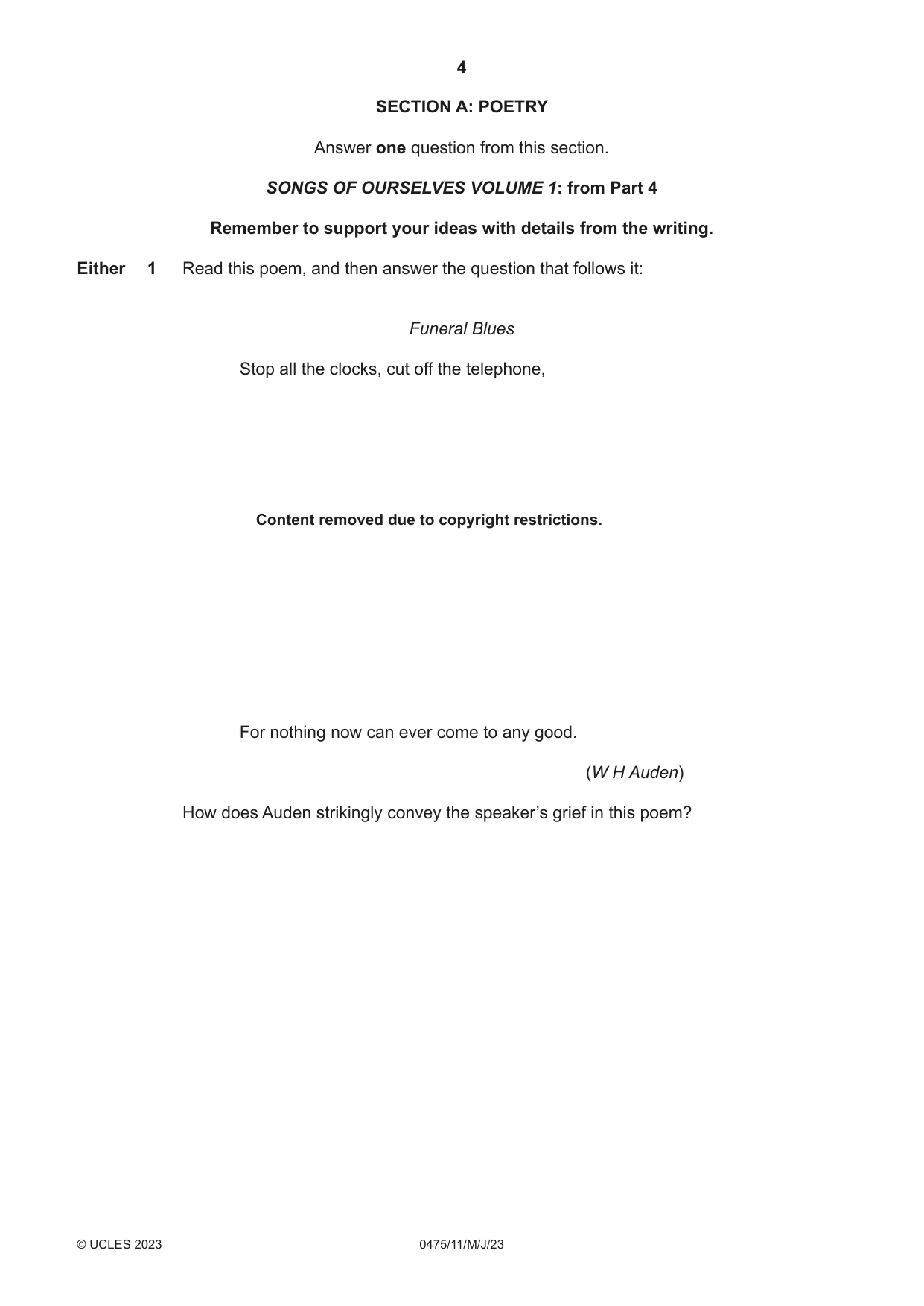
4 0475/11/M/J/23 © UCLES 2023 SECTION A: POETRY Answer one question from this section. SONGS OF OURSELVES VOLUME 1: from Part 4 Remember to support your ideas with details from the writing. Either 1 Read this poem, and then answer the question that follows it: Funeral Blues Stop all the clocks, cut off the telephone, For nothing now can ever come to any good. (W H Auden) How does Auden strikingly convey the speaker’s grief in this poem? Content removed due to copyright restrictions.
Question paper, page 5
5 0475/11/M/J/23 © UCLES 2023 [Turn over TURN OVER FOR QUESTION 2.
Question paper, page 6
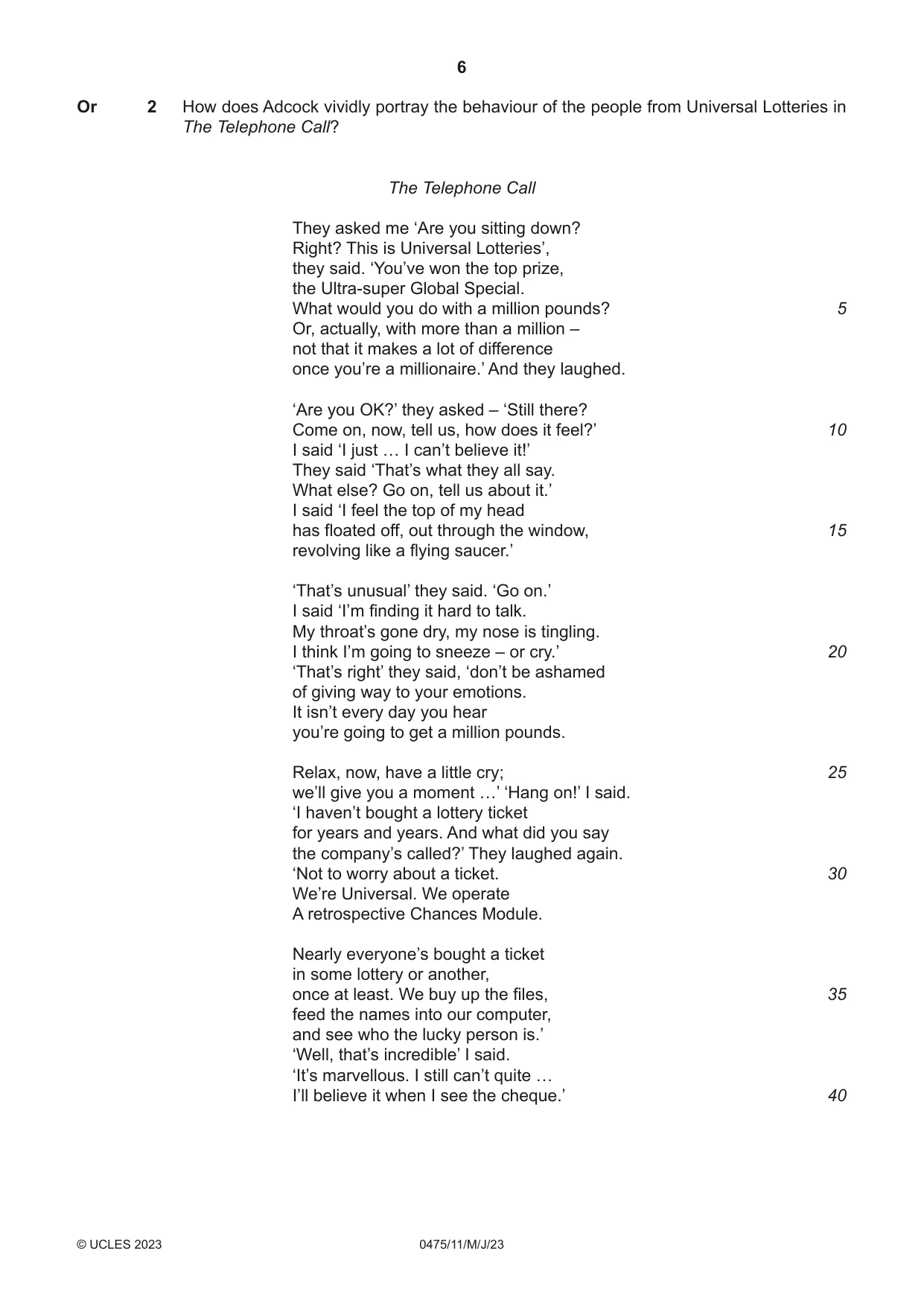
6 0475/11/M/J/23 © UCLES 2023 Or 2 How does Adcock vividly portray the behaviour of the people from Universal Lotteries in The Telephone Call? The Telephone Call They asked me ‘Are you sitting down? Right? This is Universal Lotteries’, they said. ‘You’ve won the top prize, the Ultra-super Global Special. What would you do with a million pounds? Or, actually, with more than a million – not that it makes a lot of difference once you’re a millionaire.’ And they laughed. ‘Are you OK?’ they asked – ‘Still there? Come on, now, tell us, how does it feel?’ I said ‘I just … I can’t believe it!’ They said ‘That’s what they all say. What else? Go on, tell us about it.’ I said ‘I feel the top of my head has floated off, out through the window, revolving like a flying saucer.’ ‘That’s unusual’ they said. ‘Go on.’ I said ‘I’m finding it hard to talk. My throat’s gone dry, my nose is tingling. I think I’m going to sneeze – or cry.’ ‘That’s right’ they said, ‘don’t be ashamed of giving way to your emotions. It isn’t every day you hear you’re going to get a million pounds. Relax, now, have a little cry; we’ll give you a moment …’ ‘Hang on!’ I said. ‘I haven’t bought a lottery ticket for years and years. And what did you say the company’s called?’ They laughed again. ‘Not to worry about a ticket. We’re Universal. We operate A retrospective Chances Module. Nearly everyone’s bought a ticket in some lottery or another, once at least. We buy up the files, feed the names into our computer, and see who the lucky person is.’ ‘Well, that’s incredible’ I said. ‘It’s marvellous. I still can’t quite … I’ll believe it when I see the cheque.’ 5 10 15 20 25 30 35 40
Question paper, page 7
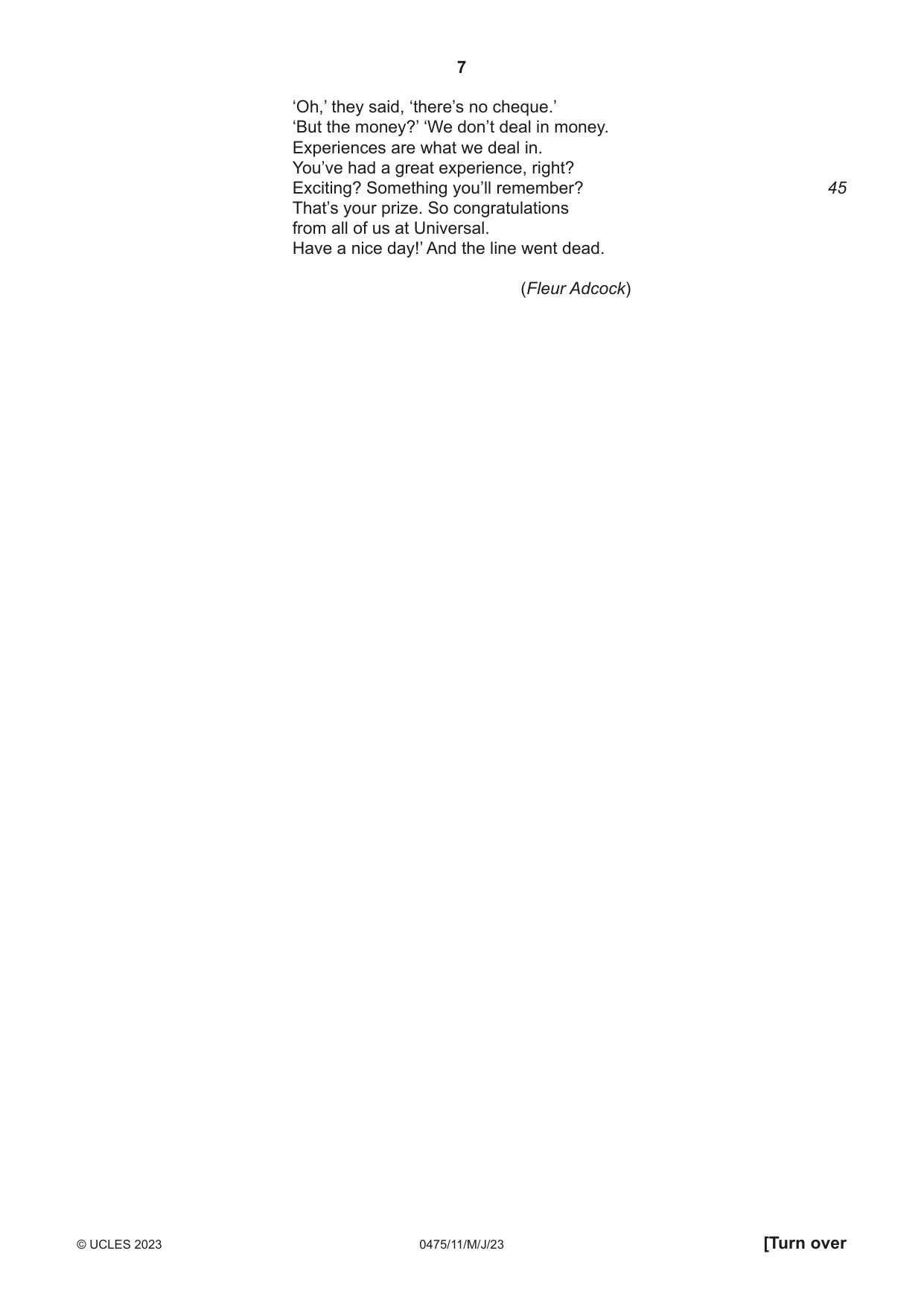
7 0475/11/M/J/23 © UCLES 2023 [Turn over ‘Oh,’ they said, ‘there’s no cheque.’ ‘But the money?’ ‘We don’t deal in money. Experiences are what we deal in. You’ve had a great experience, right? Exciting? Something you’ll remember? That’s your prize. So congratulations from all of us at Universal. Have a nice day!’ And the line went dead. (Fleur Adcock) 45
Question paper, page 8
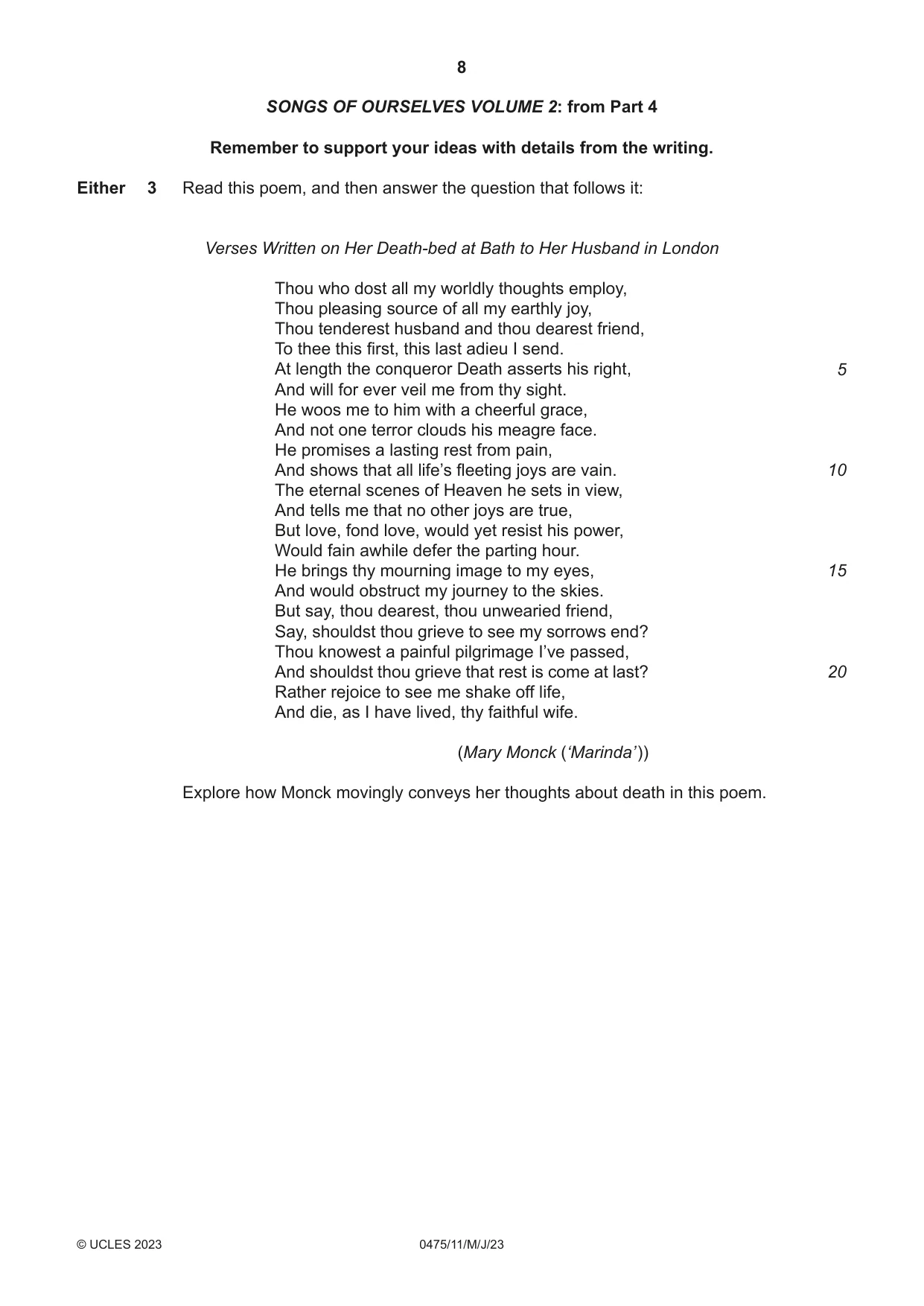
8 0475/11/M/J/23 © UCLES 2023 SONGS OF OURSELVES VOLUME 2: from Part 4 Remember to support your ideas with details from the writing. Either 3 Read this poem, and then answer the question that follows it: Verses Written on Her Death-bed at Bath to Her Husband in London Thou who dost all my worldly thoughts employ, Thou pleasing source of all my earthly joy, Thou tenderest husband and thou dearest friend, To thee this first, this last adieu I send. At length the conqueror Death asserts his right, And will for ever veil me from thy sight. He woos me to him with a cheerful grace, And not one terror clouds his meagre face. He promises a lasting rest from pain, And shows that all life’s fleeting joys are vain. The eternal scenes of Heaven he sets in view, And tells me that no other joys are true, But love, fond love, would yet resist his power, Would fain awhile defer the parting hour. He brings thy mourning image to my eyes, And would obstruct my journey to the skies. But say, thou dearest, thou unwearied friend, Say, shouldst thou grieve to see my sorrows end? Thou knowest a painful pilgrimage I’ve passed, And shouldst thou grieve that rest is come at last? Rather rejoice to see me shake off life, And die, as I have lived, thy faithful wife. (Mary Monck (‘Marinda’ )) Explore how Monck movingly conveys her thoughts about death in this poem. 5 10 15 20
Question paper, page 9
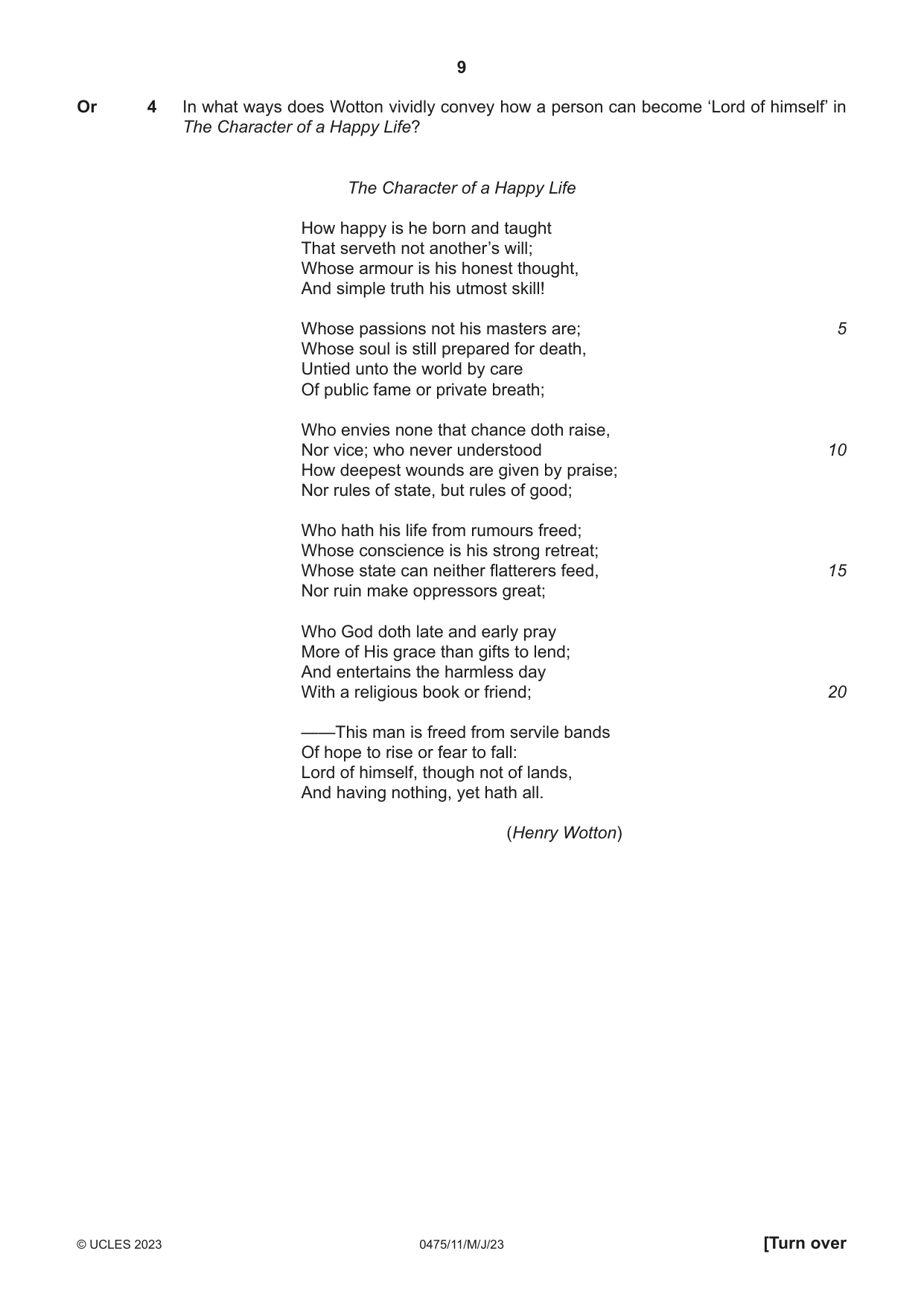
9 0475/11/M/J/23 © UCLES 2023 [Turn over Or 4 In what ways does Wotton vividly convey how a person can become ‘Lord of himself’ in The Character of a Happy Life? The Character of a Happy Life How happy is he born and taught That serveth not another’s will; Whose armour is his honest thought, And simple truth his utmost skill! Whose passions not his masters are; Whose soul is still prepared for death, Untied unto the world by care Of public fame or private breath; Who envies none that chance doth raise, Nor vice; who never understood How deepest wounds are given by praise; Nor rules of state, but rules of good; Who hath his life from rumours freed; Whose conscience is his strong retreat; Whose state can neither flatterers feed, Nor ruin make oppressors great; Who God doth late and early pray More of His grace than gifts to lend; And entertains the harmless day With a religious book or friend; ——This man is freed from servile bands Of hope to rise or fear to fall: Lord of himself, though not of lands, And having nothing, yet hath all. (Henry Wotton) 5 10 15 20
Question paper, page 10
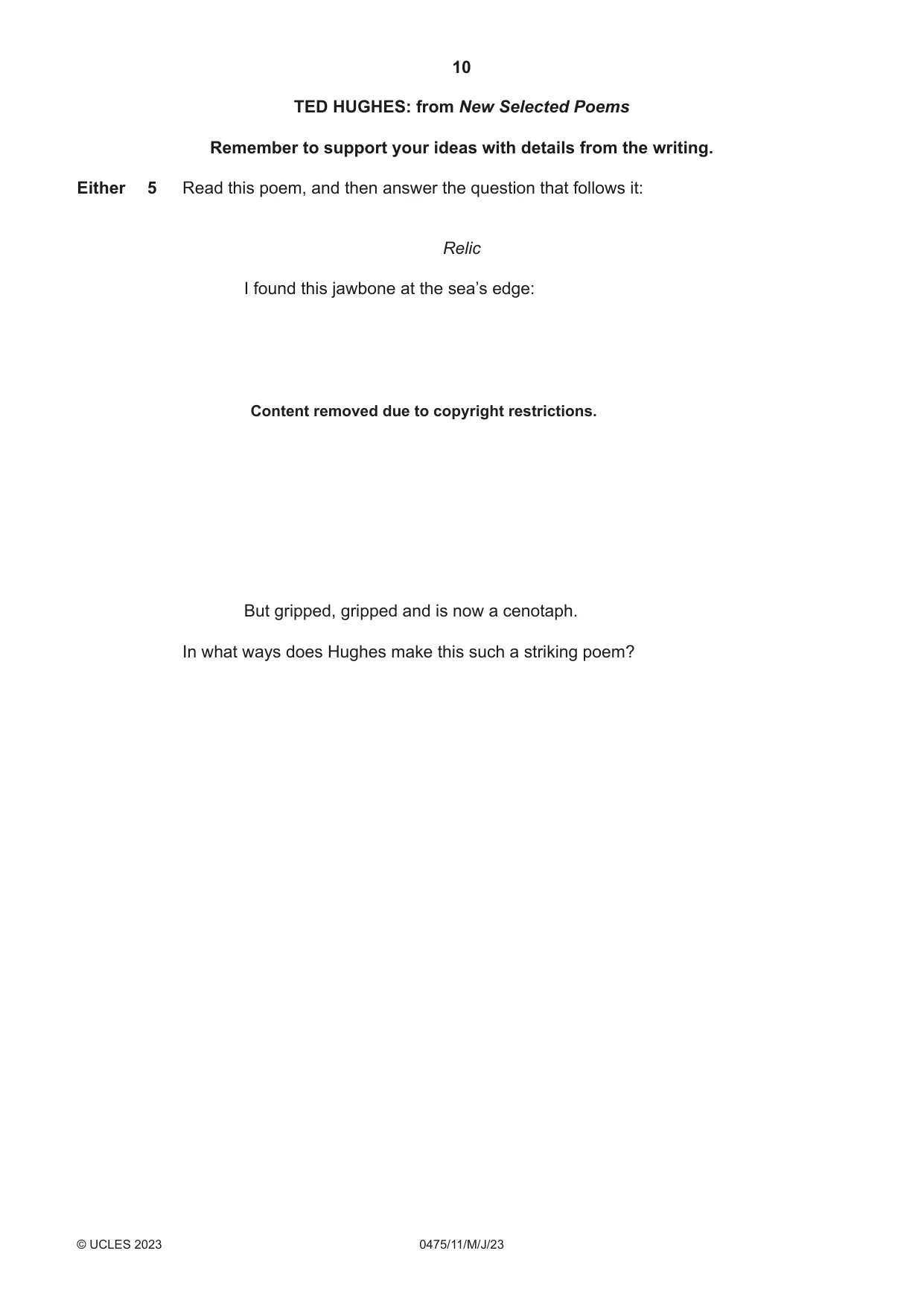
10 0475/11/M/J/23 © UCLES 2023 TED HUGHES: from New Selected Poems Remember to support your ideas with details from the writing. Either 5 Read this poem, and then answer the question that follows it: Relic I found this jawbone at the sea’s edge: But gripped, gripped and is now a cenotaph. In what ways does Hughes make this such a striking poem? Content removed due to copyright restrictions.
Question paper, page 11
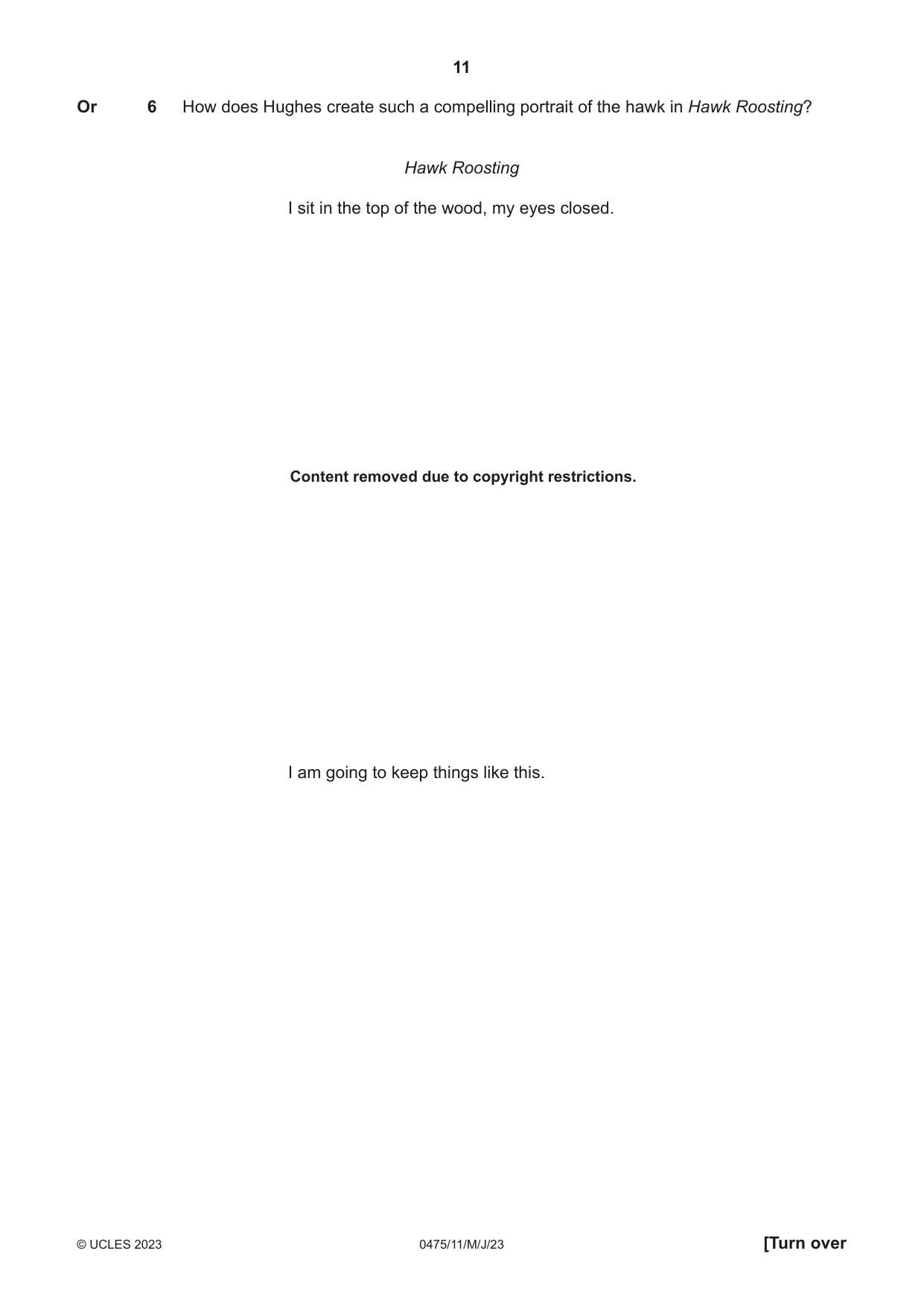
11 0475/11/M/J/23 © UCLES 2023 [Turn over Or 6 How does Hughes create such a compelling portrait of the hawk in Hawk Roosting? Hawk Roosting I sit in the top of the wood, my eyes closed. I am going to keep things like this. Content removed due to copyright restrictions.
Question paper, page 12
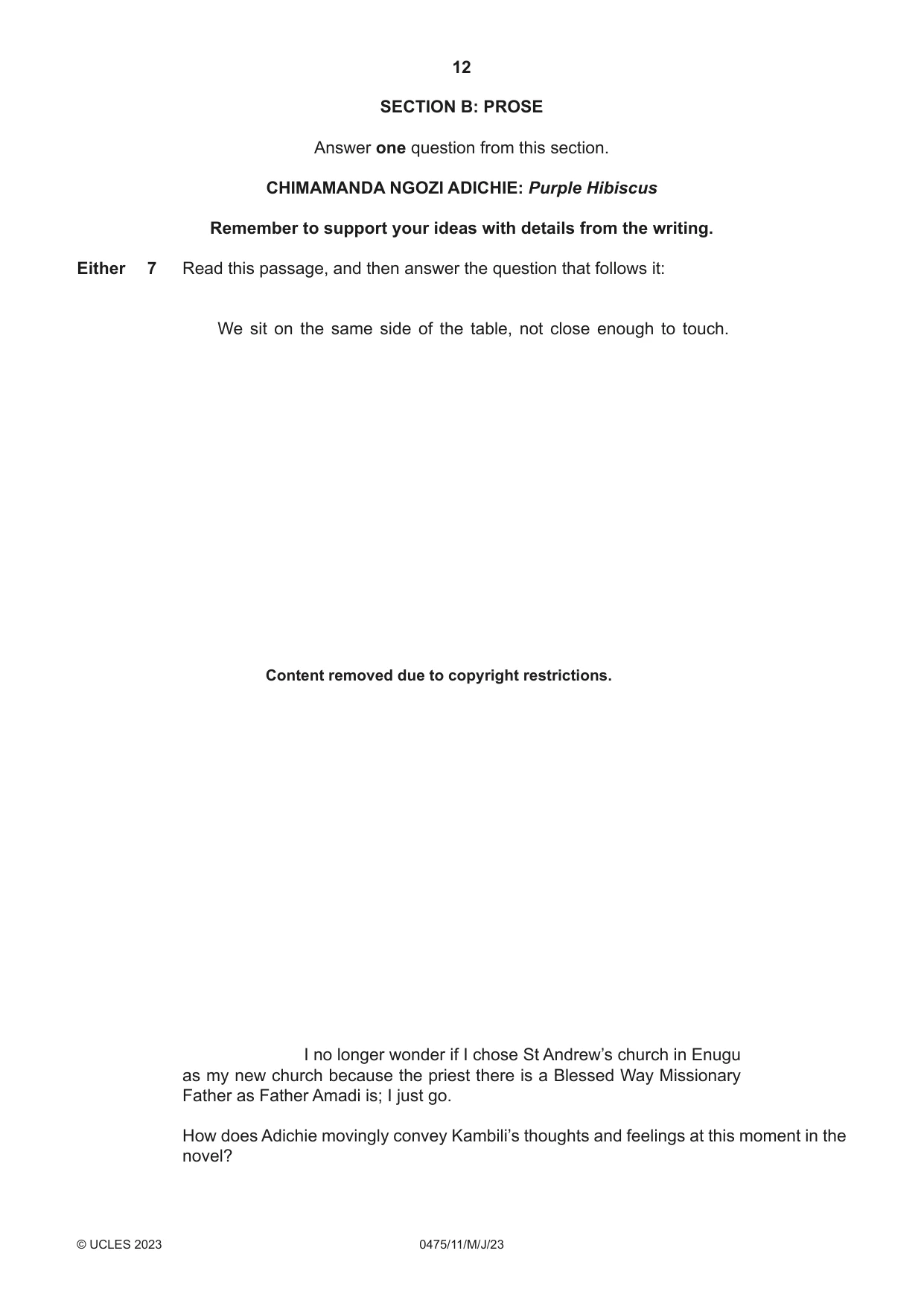
12 0475/11/M/J/23 © UCLES 2023 SECTION B: PROSE Answer one question from this section. CHIMAMANDA NGOZI ADICHIE: Purple Hibiscus Remember to support your ideas with details from the writing. Either 7 Read this passage, and then answer the question that follows it: We sit on the same side of the table, not close enough to touch. I no longer wonder if I chose St Andrew’s church in Enugu as my new church because the priest there is a Blessed Way Missionary Father as Father Amadi is; I just go. How does Adichie movingly convey Kambili’s thoughts and feelings at this moment in the novel? Content removed due to copyright restrictions.
Question paper, page 13
13 0475/11/M/J/23 © UCLES 2023 [Turn over Or 8 Explore the ways in which Adichie strikingly portrays the differences between Kambili’s mother and Aunty Ifeoma.
Question paper, page 14
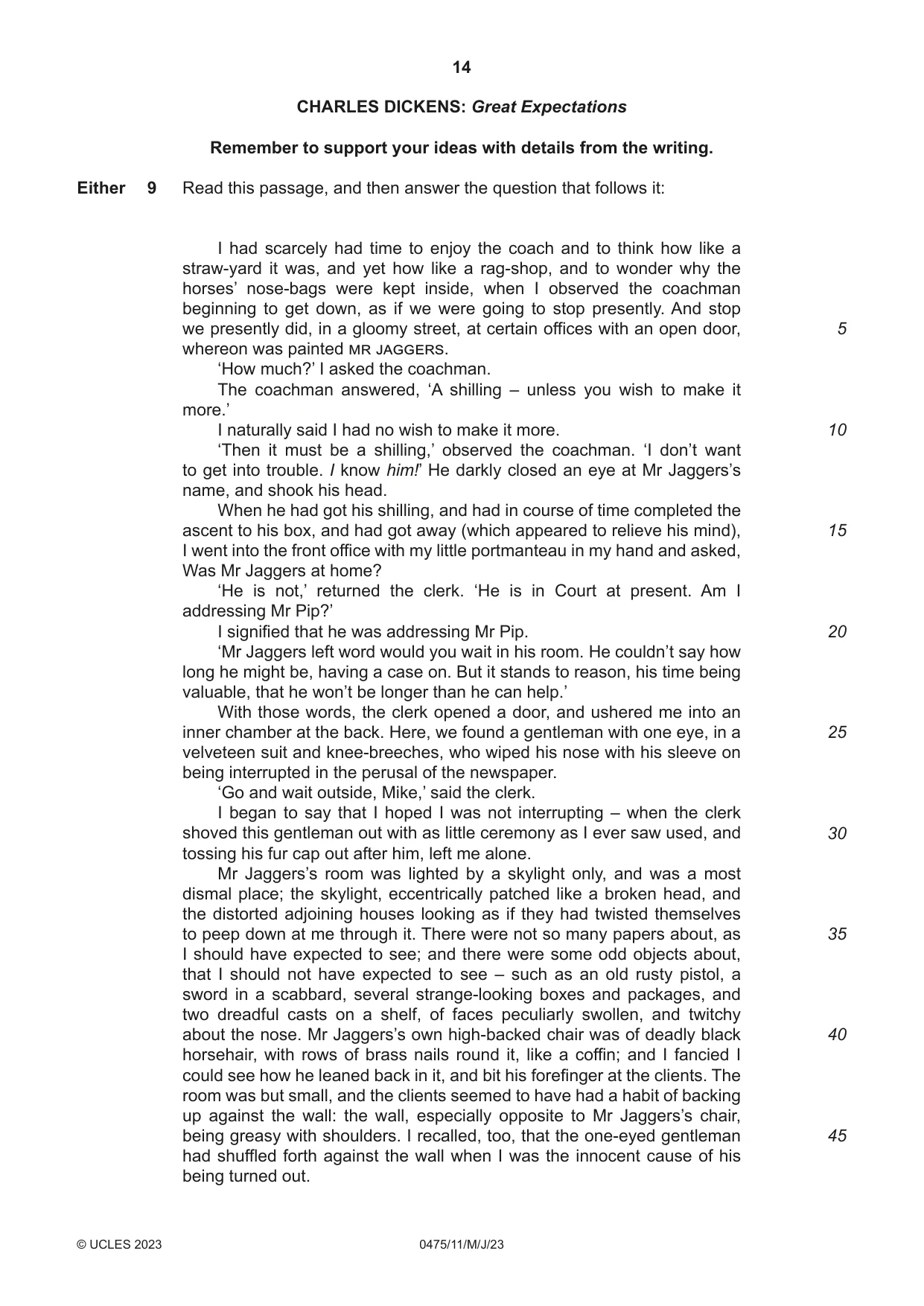
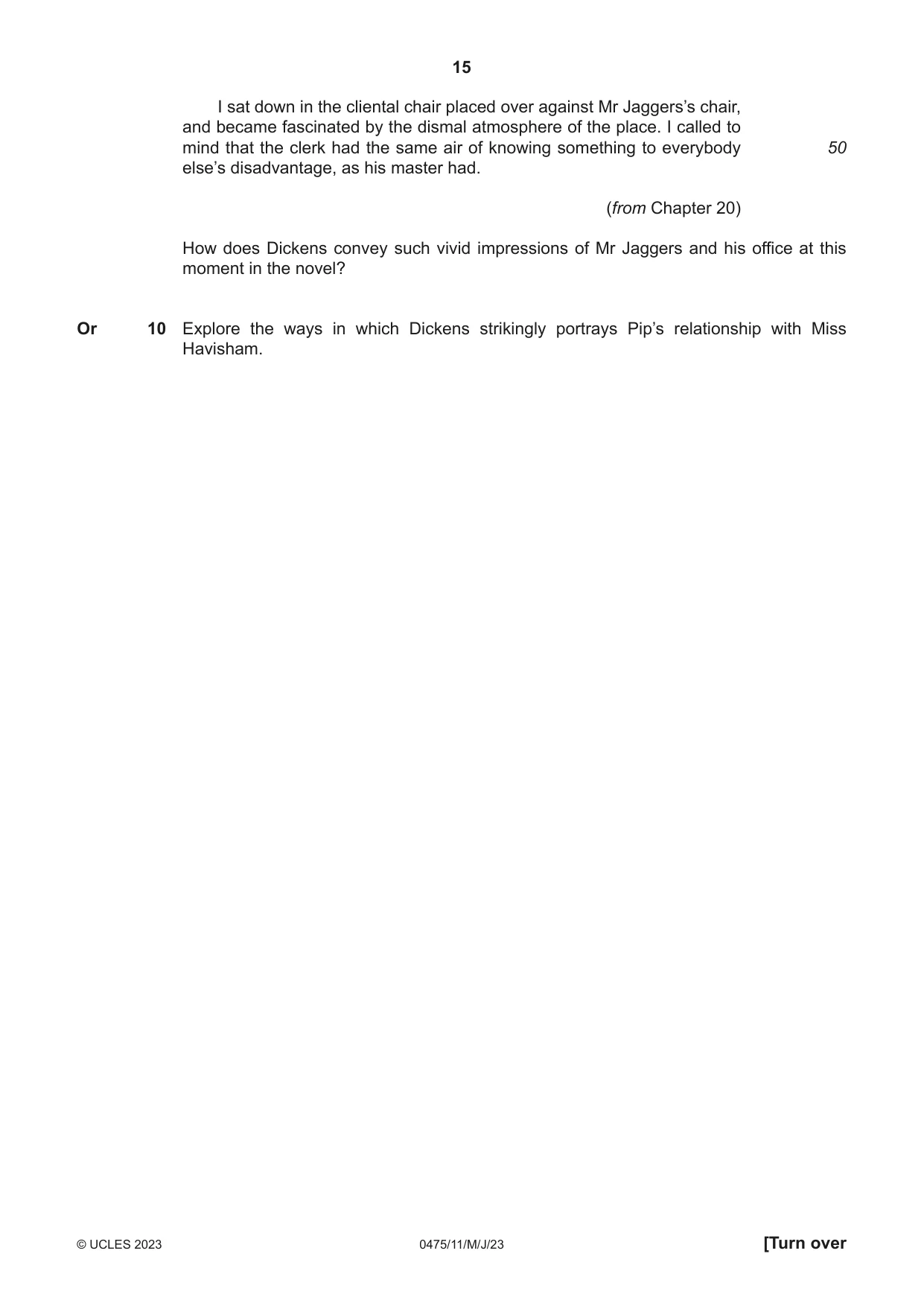
14 0475/11/M/J/23 © UCLES 2023 CHARLES DICKENS: Great Expectations Remember to support your ideas with details from the writing. Either 9 Read this passage, and then answer the question that follows it: I had scarcely had time to enjoy the coach and to think how like a straw-yard it was, and yet how like a rag-shop, and to wonder why the horses’ nose-bags were kept inside, when I observed the coachman beginning to get down, as if we were going to stop presently. And stop we presently did, in a gloomy street, at certain offices with an open door, whereon was painted mr jaggers. ‘How much?’ I asked the coachman. The coachman answered, ‘A shilling – unless you wish to make it more.’ I naturally said I had no wish to make it more. ‘Then it must be a shilling,’ observed the coachman. ‘I don’t want to get into trouble. I know him!’ He darkly closed an eye at Mr Jaggers’s name, and shook his head. When he had got his shilling, and had in course of time completed the ascent to his box, and had got away (which appeared to relieve his mind), I went into the front office with my little portmanteau in my hand and asked, Was Mr Jaggers at home? ‘He is not,’ returned the clerk. ‘He is in Court at present. Am I addressing Mr Pip?’ I signified that he was addressing Mr Pip. ‘Mr Jaggers left word would you wait in his room. He couldn’t say how long he might be, having a case on. But it stands to reason, his time being valuable, that he won’t be longer than he can help.’ With those words, the clerk opened a door, and ushered me into an inner chamber at the back. Here, we found a gentleman with one eye, in a velveteen suit and knee-breeches, who wiped his nose with his sleeve on being interrupted in the perusal of the newspaper. ‘Go and wait outside, Mike,’ said the clerk. I began to say that I hoped I was not interrupting – when the clerk shoved this gentleman out with as little ceremony as I ever saw used, and tossing his fur cap out after him, left me alone. Mr Jaggers’s room was lighted by a skylight only, and was a most dismal place; the skylight, eccentrically patched like a broken head, and the distorted adjoining houses looking as if they had twisted themselves to peep down at me through it. There were not so many papers about, as I should have expected to see; and there were some odd objects about, that I should not have expected to see – such as an old rusty pistol, a sword in a scabbard, several strange-looking boxes and packages, and two dreadful casts on a shelf, of faces peculiarly swollen, and twitchy about the nose. Mr Jaggers’s own high-backed chair was of deadly black horsehair, with rows of brass nails round it, like a coffin; and I fancied I could see how he leaned back in it, and bit his forefinger at the clients. The room was but small, and the clients seemed to have had a habit of backing up against the wall: the wall, especially opposite to Mr Jaggers’s chair, being greasy with shoulders. I recalled, too, that the one-eyed gentleman had shuffled forth against the wall when I was the innocent cause of his being turned out. 5 10 15 20 25 30 35 40 45
Question paper, page 15
15 0475/11/M/J/23 © UCLES 2023 [Turn over I sat down in the cliental chair placed over against Mr Jaggers’s chair, and became fascinated by the dismal atmosphere of the place. I called to mind that the clerk had the same air of knowing something to everybody else’s disadvantage, as his master had. (from Chapter 20) How does Dickens convey such vivid impressions of Mr Jaggers and his office at this moment in the novel? Or 10 Explore the ways in which Dickens strikingly portrays Pip’s relationship with Miss Havisham. 50
Question paper, page 16
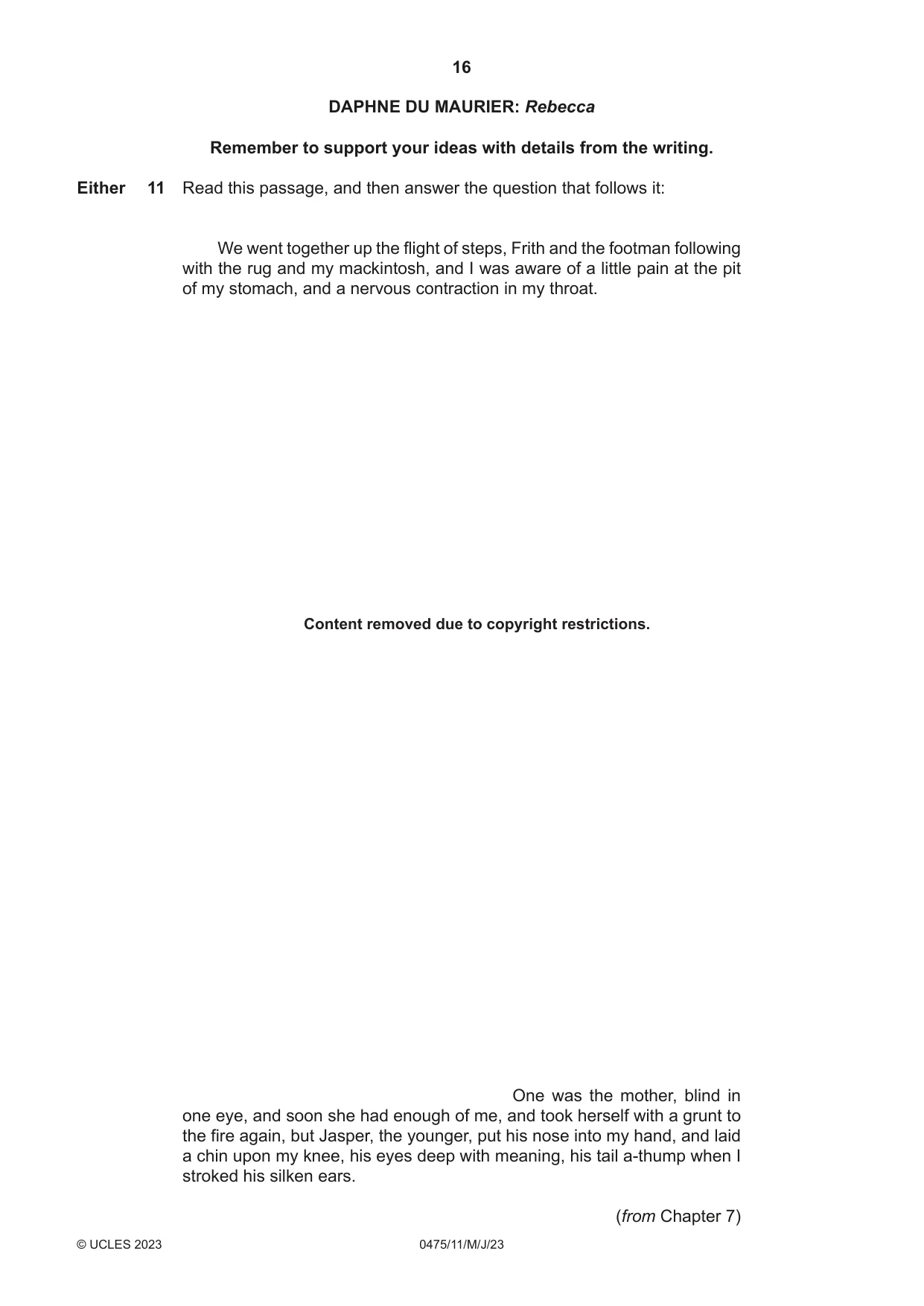
16 0475/11/M/J/23 © UCLES 2023 DAPHNE DU MAURIER: Rebecca Remember to support your ideas with details from the writing. Either 11 Read this passage, and then answer the question that follows it: We went together up the flight of steps, Frith and the footman following with the rug and my mackintosh, and I was aware of a little pain at the pit of my stomach, and a nervous contraction in my throat. One was the mother, blind in one eye, and soon she had enough of me, and took herself with a grunt to the fire again, but Jasper, the younger, put his nose into my hand, and laid a chin upon my knee, his eyes deep with meaning, his tail a-thump when I stroked his silken ears. (from Chapter 7) Content removed due to copyright restrictions.
Question paper, page 17
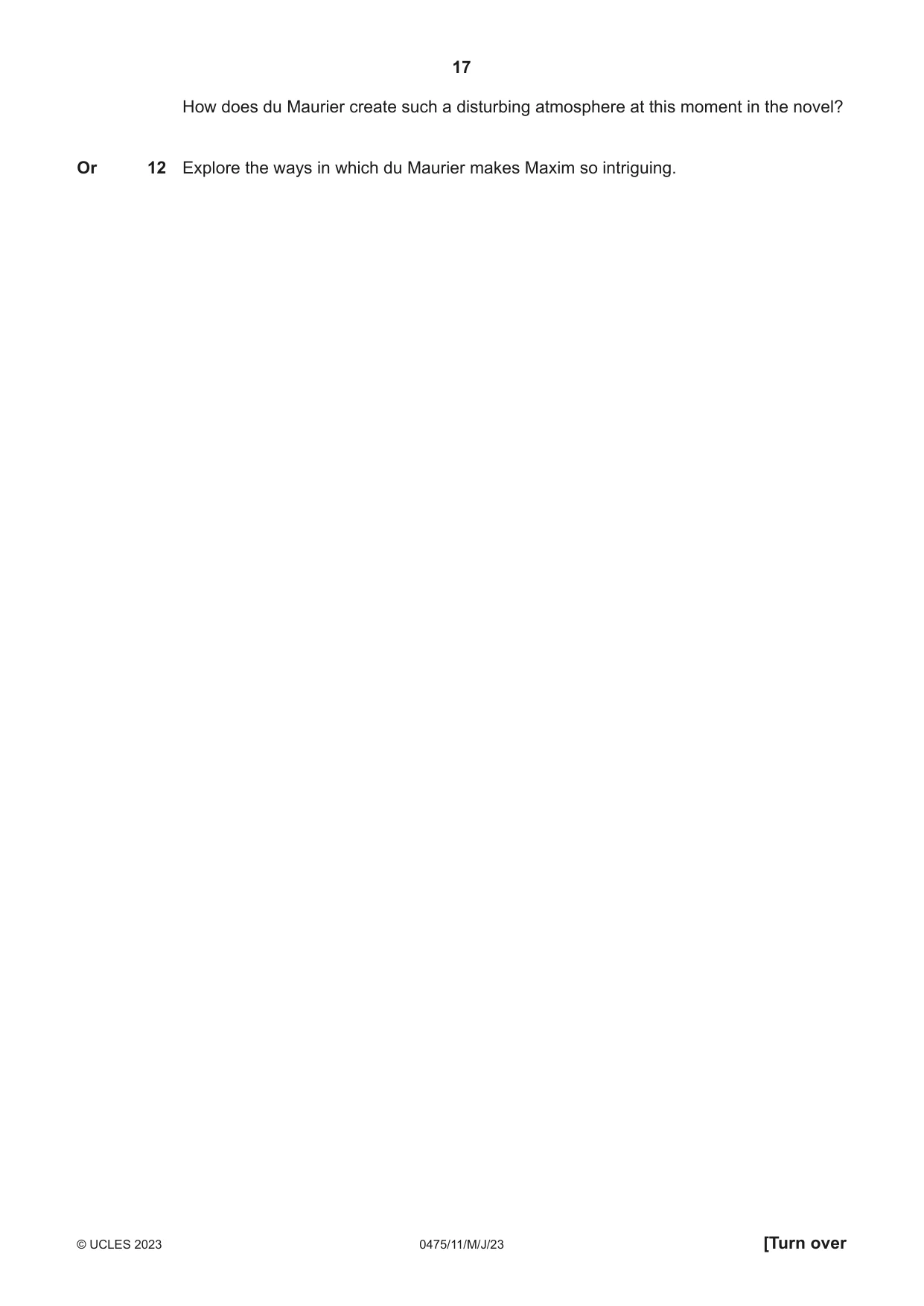
17 0475/11/M/J/23 © UCLES 2023 [Turn over How does du Maurier create such a disturbing atmosphere at this moment in the novel? Or 12 Explore the ways in which du Maurier makes Maxim so intriguing.
Question paper, page 18
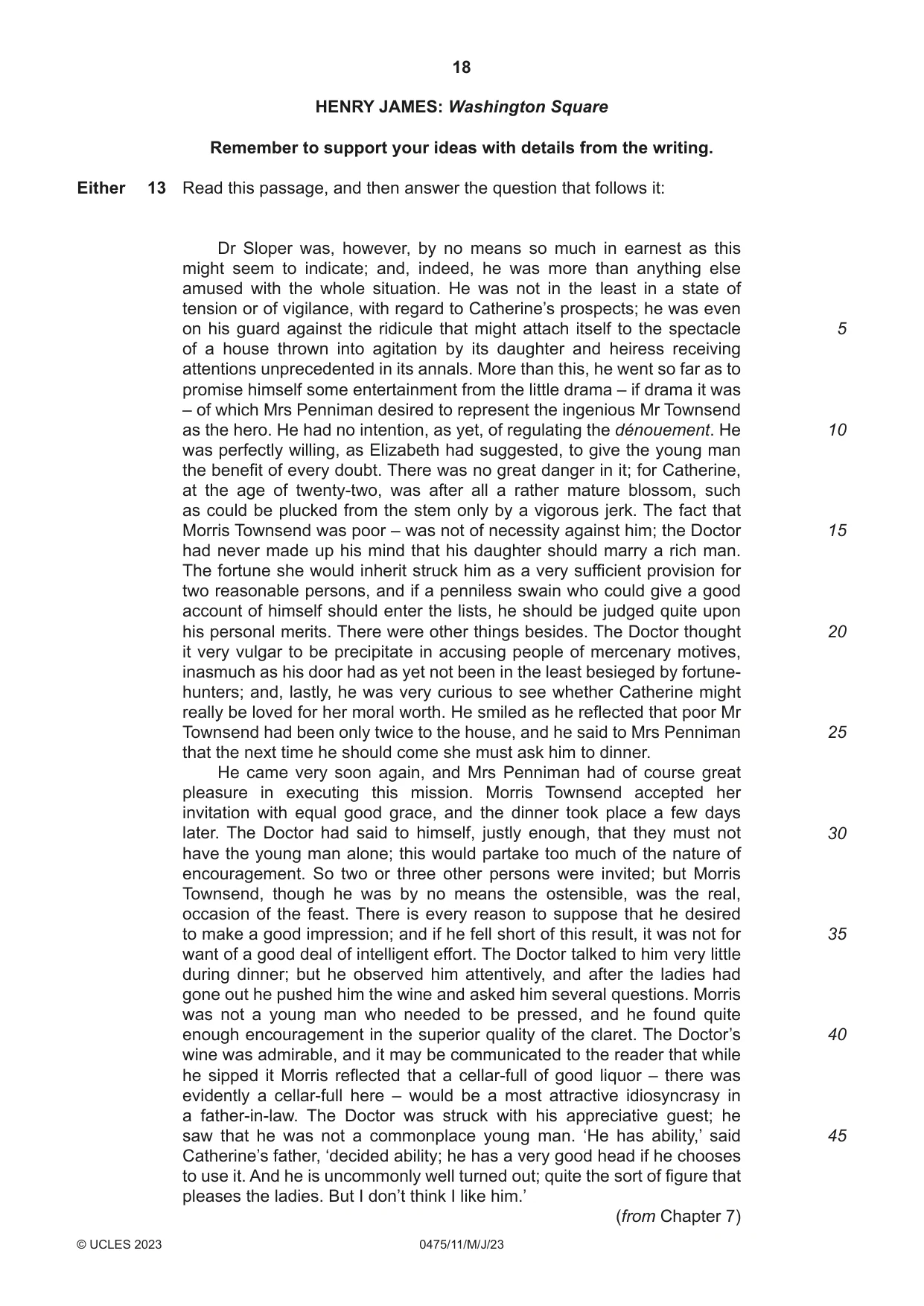
18 0475/11/M/J/23 © UCLES 2023 HENRY JAMES: Washington Square Remember to support your ideas with details from the writing. Either 13 Read this passage, and then answer the question that follows it: Dr Sloper was, however, by no means so much in earnest as this might seem to indicate; and, indeed, he was more than anything else amused with the whole situation. He was not in the least in a state of tension or of vigilance, with regard to Catherine’s prospects; he was even on his guard against the ridicule that might attach itself to the spectacle of a house thrown into agitation by its daughter and heiress receiving attentions unprecedented in its annals. More than this, he went so far as to promise himself some entertainment from the little drama – if drama it was – of which Mrs Penniman desired to represent the ingenious Mr Townsend as the hero. He had no intention, as yet, of regulating the dénouement. He was perfectly willing, as Elizabeth had suggested, to give the young man the benefit of every doubt. There was no great danger in it; for Catherine, at the age of twenty-two, was after all a rather mature blossom, such as could be plucked from the stem only by a vigorous jerk. The fact that Morris Townsend was poor – was not of necessity against him; the Doctor had never made up his mind that his daughter should marry a rich man. The fortune she would inherit struck him as a very sufficient provision for two reasonable persons, and if a penniless swain who could give a good account of himself should enter the lists, he should be judged quite upon his personal merits. There were other things besides. The Doctor thought it very vulgar to be precipitate in accusing people of mercenary motives, inasmuch as his door had as yet not been in the least besieged by fortune- hunters; and, lastly, he was very curious to see whether Catherine might really be loved for her moral worth. He smiled as he reflected that poor Mr Townsend had been only twice to the house, and he said to Mrs Penniman that the next time he should come she must ask him to dinner. He came very soon again, and Mrs Penniman had of course great pleasure in executing this mission. Morris Townsend accepted her invitation with equal good grace, and the dinner took place a few days later. The Doctor had said to himself, justly enough, that they must not have the young man alone; this would partake too much of the nature of encouragement. So two or three other persons were invited; but Morris Townsend, though he was by no means the ostensible, was the real, occasion of the feast. There is every reason to suppose that he desired to make a good impression; and if he fell short of this result, it was not for want of a good deal of intelligent effort. The Doctor talked to him very little during dinner; but he observed him attentively, and after the ladies had gone out he pushed him the wine and asked him several questions. Morris was not a young man who needed to be pressed, and he found quite enough encouragement in the superior quality of the claret. The Doctor’s wine was admirable, and it may be communicated to the reader that while he sipped it Morris reflected that a cellar-full of good liquor – there was evidently a cellar-full here – would be a most attractive idiosyncrasy in a father-in-law. The Doctor was struck with his appreciative guest; he saw that he was not a commonplace young man. ‘He has ability,’ said Catherine’s father, ‘decided ability; he has a very good head if he chooses to use it. And he is uncommonly well turned out; quite the sort of figure that pleases the ladies. But I don’t think I like him.’ (from Chapter 7) 5 10 15 20 25 30 35 40 45
Question paper, page 19
19 0475/11/M/J/23 © UCLES 2023 [Turn over How does James make this such a revealing and significant moment in the novel? Or 14 ‘Such a sad story.’ How far does James make you agree with this view of the novel?
Question paper, page 20
20 0475/11/M/J/23 © UCLES 2023 JHUMPA LAHIRI: The Namesake Remember to support your ideas with details from the writing. Either 15 Read this passage, and then answer the question that follows it: ‘Thanks again,’ Gogol tells his father now. Content removed due to copyright restrictions.
Question paper, page 21
21 0475/11/M/J/23 © UCLES 2023 [Turn over Not even the source of his namesake. (from Chapter 4) Explore the ways in which Lahiri makes this moment in the novel so moving. Or 16 How does Lahiri strikingly depict the changes in Gogol’s relationship with Moushumi during the course of the novel? Content removed due to copyright restrictions.
Question paper, page 22
22 0475/11/M/J/23 © UCLES 2023 JOAN LINDSAY: Picnic at Hanging Rock Remember to support your ideas with details from the writing. Either 17 Read this passage, and then answer the question that follows it: Nowadays the very sight of the child Sara slumped over a book in the garden was enough to send a flush of irritation crawling up the Head’s neck under the boned net collar. Content removed due to copyright restrictions.
Question paper, page 23
23 0475/11/M/J/23 © UCLES 2023 [Turn over You may go.’ (from Chapter 9) Explore the ways in which Lindsay memorably portrays Mrs Appleyard’s attitude towards Sara at this moment in the novel. Or 18 How does Lindsay create such striking impressions of Mike? Content removed due to copyright restrictions.
Question paper, page 24
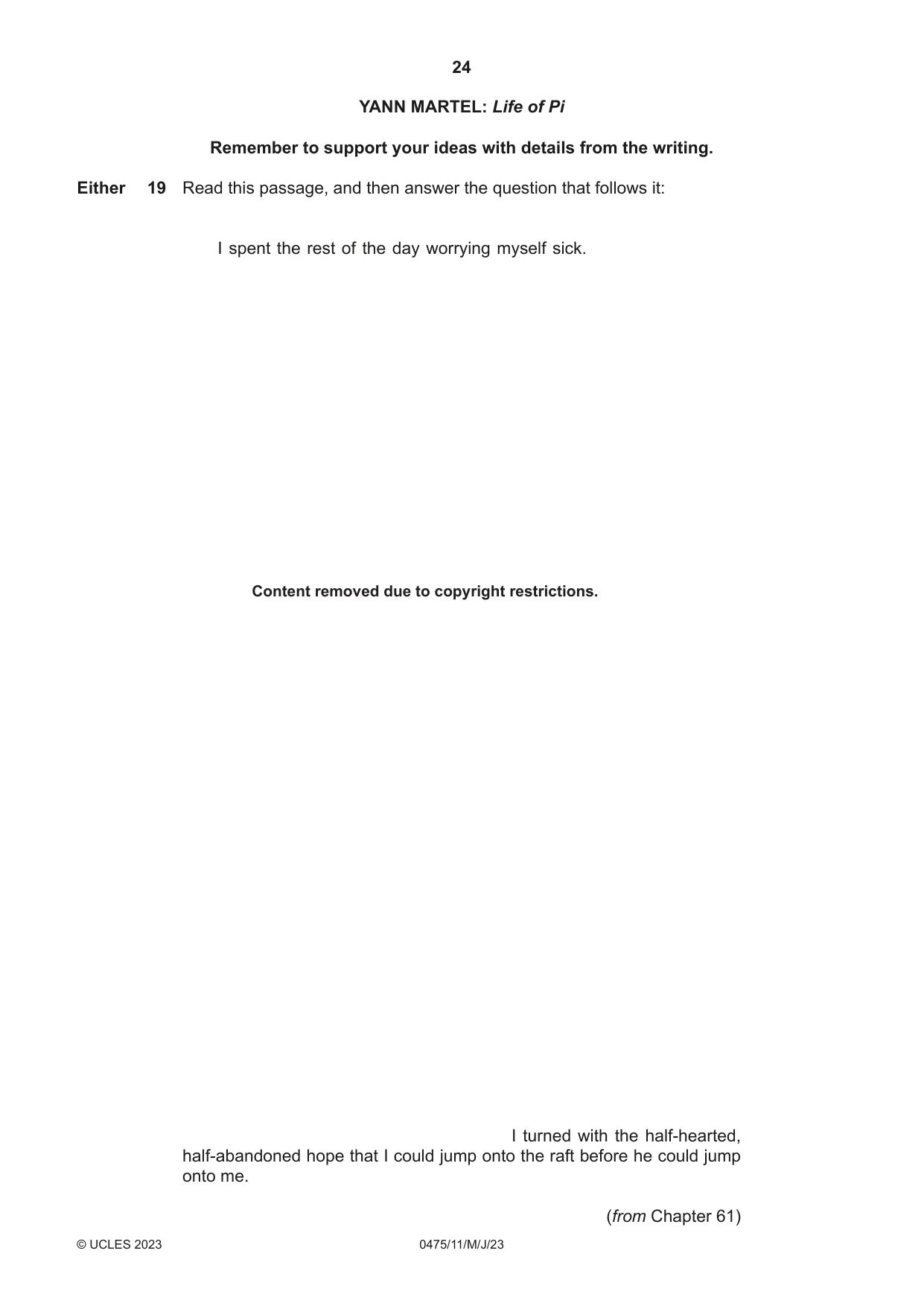
24 0475/11/M/J/23 © UCLES 2023 YANN MARTEL: Life of Pi Remember to support your ideas with details from the writing. Either 19 Read this passage, and then answer the question that follows it: I spent the rest of the day worrying myself sick. I turned with the half-hearted, half-abandoned hope that I could jump onto the raft before he could jump onto me. (from Chapter 61) Content removed due to copyright restrictions.
Question paper, page 25
25 0475/11/M/J/23 © UCLES 2023 [Turn over In what ways does Martel powerfully convey Pi’s thoughts and feelings at this moment in the novel? Or 20 ‘I had to tame him,’ Pi says. How does Martel memorably depict Pi’s success at taming Richard Parker? Do not use the passage printed in Question 19 in answering this question.
Question paper, page 26
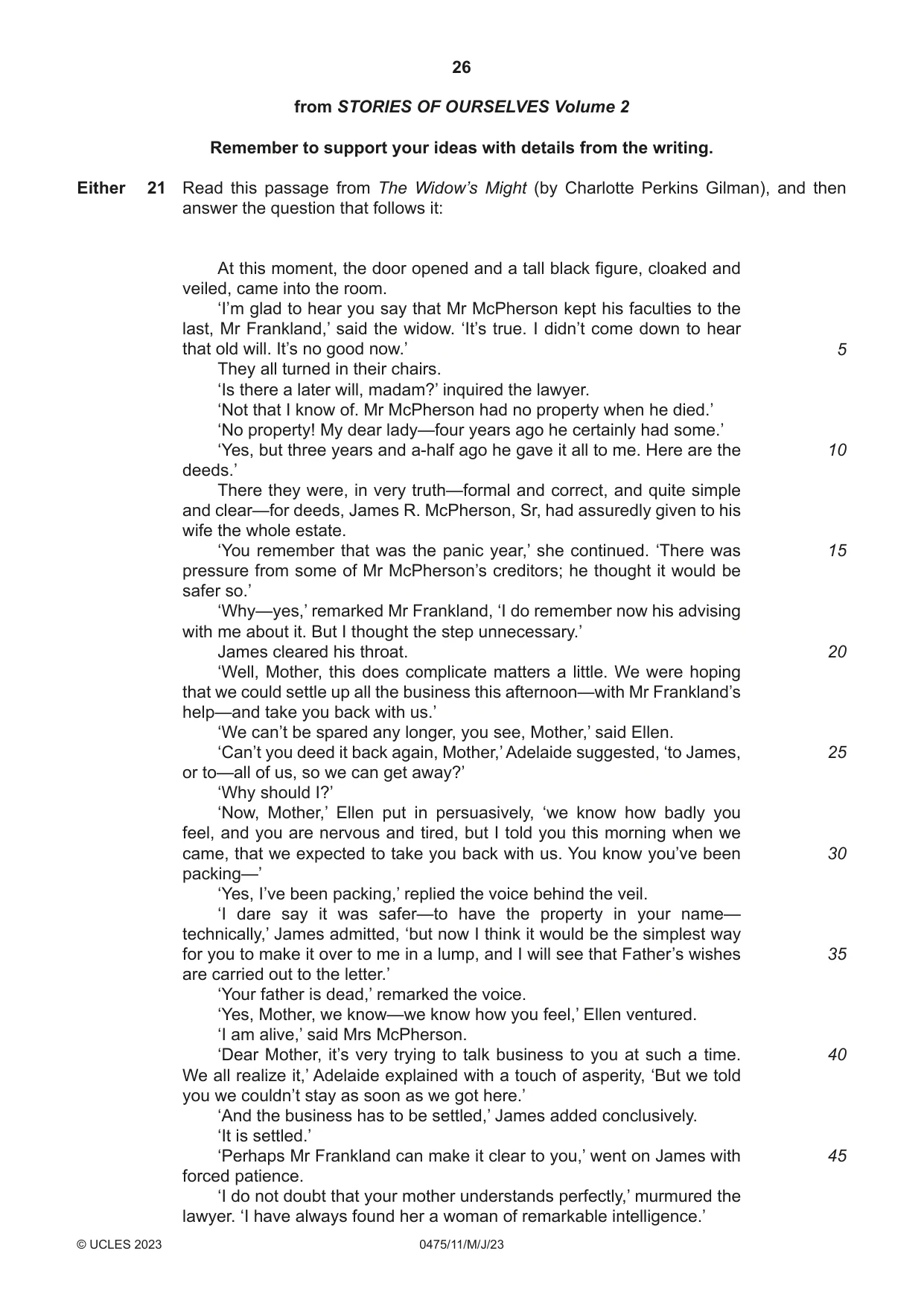
26 0475/11/M/J/23 © UCLES 2023 from STORIES OF OURSELVES Volume 2 Remember to support your ideas with details from the writing. Either 21 Read this passage from The Widow’s Might (by Charlotte Perkins Gilman), and then answer the question that follows it: At this moment, the door opened and a tall black figure, cloaked and veiled, came into the room. ‘I’m glad to hear you say that Mr McPherson kept his faculties to the last, Mr Frankland,’ said the widow. ‘It’s true. I didn’t come down to hear that old will. It’s no good now.’ They all turned in their chairs. ‘Is there a later will, madam?’ inquired the lawyer. ‘Not that I know of. Mr McPherson had no property when he died.’ ‘No property! My dear lady—four years ago he certainly had some.’ ‘Yes, but three years and a-half ago he gave it all to me. Here are the deeds.’ There they were, in very truth—formal and correct, and quite simple and clear—for deeds, James R. McPherson, Sr, had assuredly given to his wife the whole estate. ‘You remember that was the panic year,’ she continued. ‘There was pressure from some of Mr McPherson’s creditors; he thought it would be safer so.’ ‘Why—yes,’ remarked Mr Frankland, ‘I do remember now his advising with me about it. But I thought the step unnecessary.’ James cleared his throat. ‘Well, Mother, this does complicate matters a little. We were hoping that we could settle up all the business this afternoon—with Mr Frankland’s help—and take you back with us.’ ‘We can’t be spared any longer, you see, Mother,’ said Ellen. ‘Can’t you deed it back again, Mother,’ Adelaide suggested, ‘to James, or to—all of us, so we can get away?’ ‘Why should I?’ ‘Now, Mother,’ Ellen put in persuasively, ‘we know how badly you feel, and you are nervous and tired, but I told you this morning when we came, that we expected to take you back with us. You know you’ve been packing—’ ‘Yes, I’ve been packing,’ replied the voice behind the veil. ‘I dare say it was safer—to have the property in your name— technically,’ James admitted, ‘but now I think it would be the simplest way for you to make it over to me in a lump, and I will see that Father’s wishes are carried out to the letter.’ ‘Your father is dead,’ remarked the voice. ‘Yes, Mother, we know—we know how you feel,’ Ellen ventured. ‘I am alive,’ said Mrs McPherson. ‘Dear Mother, it’s very trying to talk business to you at such a time. We all realize it,’ Adelaide explained with a touch of asperity, ‘But we told you we couldn’t stay as soon as we got here.’ ‘And the business has to be settled,’ James added conclusively. ‘It is settled.’ ‘Perhaps Mr Frankland can make it clear to you,’ went on James with forced patience. ‘I do not doubt that your mother understands perfectly,’ murmured the lawyer. ‘I have always found her a woman of remarkable intelligence.’ 5 10 15 20 25 30 35 40 45
Question paper, page 27
27 0475/11/M/J/23 © UCLES 2023 ‘Thank you, Mr Frankland. Possibly you may be able to make my children understand that this property—such as it is—is mine now.’ ‘Why assuredly, assuredly, Mrs McPherson. We all see that. But we assume, as a matter of course, that you will consider Mr McPherson’s wishes in regard to the disposition of the estate.’ ‘I have considered Mr McPherson’s wishes for thirty years,’ she replied. ‘Now, I’ll consider mine. I have done my duty since the day I married him. It is eleven hundred days—to-day.’ The last with sudden intensity. ‘But madam, your children—’ ‘I have no children, Mr Frankland. I have two daughters and a son. These three grown persons here, grown up, married, having children of their own—or ought to have—were my children. I did my duty by them, and they did their duty by me—and would yet, no doubt.’ The tone changed suddenly. ‘But they don’t have to. I’m tired of duty.’ How does Gilman make this such a memorable moment in the story? Or 22 In what ways does O Henry make The Furnished Room such a disturbing story? 50 55 60
Question paper, page 28
28 0475/11/M/J/23 © UCLES 2023 Permission to reproduce items where third-party owned material protected by copyright is included has been sought and cleared where possible. Every reasonable effort has been made by the publisher (UCLES) to trace copyright holders, but if any items requiring clearance have unwittingly been included, the publisher will be pleased to make amends at the earliest possible opportunity. To avoid the issue of disclosure of answer-related information to candidates, all copyright acknowledgements are reproduced online in the Cambridge Assessment International Education Copyright Acknowledgements Booklet. This is produced for each series of examinations and is freely available to download at www.cambridgeinternational.org after the live examination series. Cambridge Assessment International Education is part of Cambridge Assessment. Cambridge Assessment is the brand name of the University of Cambridge Local Examinations Syndicate (UCLES), which is a department of the University of Cambridge. BLANK PAGE
Mark scheme, page 1
This document consists of 4 printed pages. © UCLES 2023 [Turn over Cambridge IGCSE™ LITERATURE IN ENGLISH 0475/11 Paper 1 Poetry and Prose May/June 2023 MARK SCHEME Maximum Mark: 50 Published This mark scheme is published as an aid to teachers and candidates, to indicate the requirements of the examination. It shows the basis on which Examiners were instructed to award marks. It does not indicate the details of the discussions that took place at an Examiners’ meeting before marking began, which would have considered the acceptability of alternative answers. Mark schemes should be read in conjunction with the question paper and the Principal Examiner Report for Teachers. Cambridge International will not enter into discussions about these mark schemes. Cambridge International is publishing the mark schemes for the May/June 2023 series for most Cambridge IGCSE, Cambridge International A and AS Level and Cambridge Pre-U components, and some Cambridge O Level components.
Mark scheme, page 2
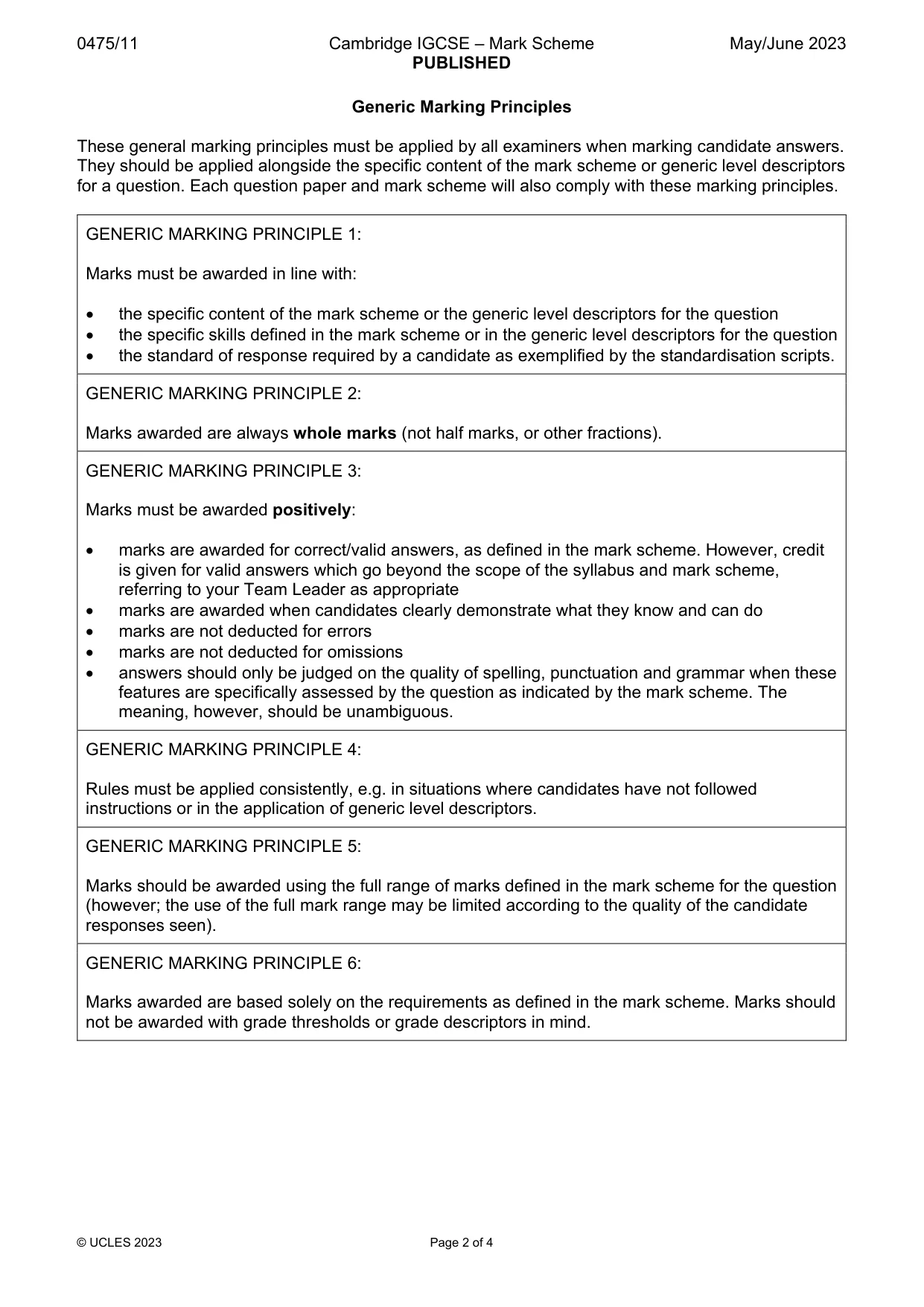
0475/11 Cambridge IGCSE – Mark Scheme PUBLISHED May/June 2023 © UCLES 2023 Page 2 of 4 Generic Marking Principles These general marking principles must be applied by all examiners when marking candidate answers. They should be applied alongside the specific content of the mark scheme or generic level descriptors for a question. Each question paper and mark scheme will also comply with these marking principles. GENERIC MARKING PRINCIPLE 1: Marks must be awarded in line with: the specific content of the mark scheme or the generic level descriptors for the question the specific skills defined in the mark scheme or in the generic level descriptors for the question the standard of response required by a candidate as exemplified by the standardisation scripts. GENERIC MARKING PRINCIPLE 2: Marks awarded are always whole marks (not half marks, or other fractions). GENERIC MARKING PRINCIPLE 3: Marks must be awarded positively: marks are awarded for correct/valid answers, as defined in the mark scheme. However, credit is given for valid answers which go beyond the scope of the syllabus and mark scheme, referring to your Team Leader as appropriate marks are awarded when candidates clearly demonstrate what they know and can do marks are not deducted for errors marks are not deducted for omissions answers should only be judged on the quality of spelling, punctuation and grammar when these features are specifically assessed by the question as indicated by the mark scheme. The meaning, however, should be unambiguous. GENERIC MARKING PRINCIPLE 4: Rules must be applied consistently, e.g. in situations where candidates have not followed instructions or in the application of generic level descriptors. GENERIC MARKING PRINCIPLE 5: Marks should be awarded using the full range of marks defined in the mark scheme for the question (however; the use of the full mark range may be limited according to the quality of the candidate responses seen). GENERIC MARKING PRINCIPLE 6: Marks awarded are based solely on the requirements as defined in the mark scheme. Marks should not be awarded with grade thresholds or grade descriptors in mind.
Mark scheme, page 3
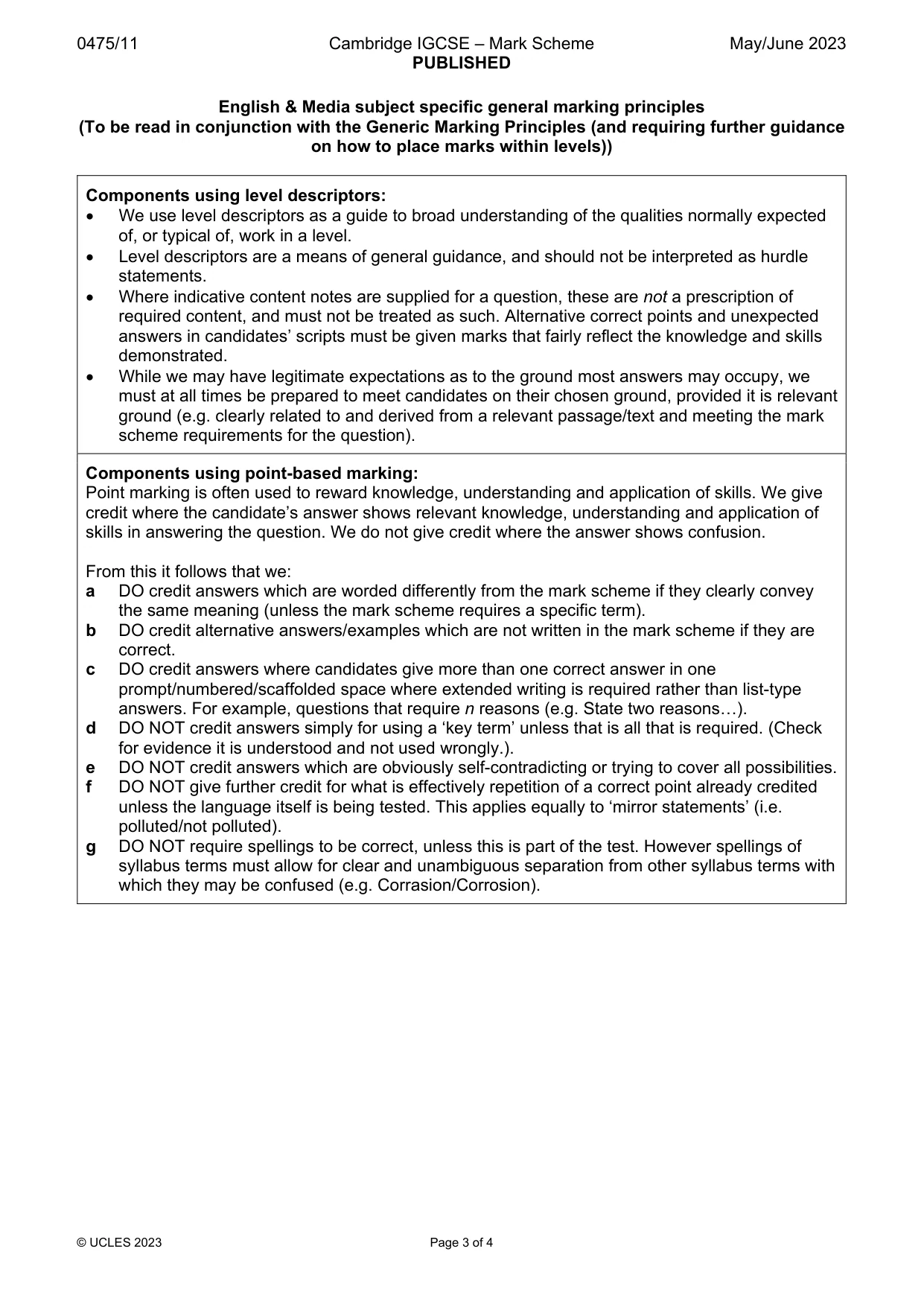
0475/11 Cambridge IGCSE – Mark Scheme PUBLISHED May/June 2023 © UCLES 2023 Page 3 of 4 English & Media subject specific general marking principles (To be read in conjunction with the Generic Marking Principles (and requiring further guidance on how to place marks within levels)) Components using level descriptors: We use level descriptors as a guide to broad understanding of the qualities normally expected of, or typical of, work in a level. Level descriptors are a means of general guidance, and should not be interpreted as hurdle statements. Where indicative content notes are supplied for a question, these are not a prescription of required content, and must not be treated as such. Alternative correct points and unexpected answers in candidates’ scripts must be given marks that fairly reflect the knowledge and skills demonstrated. While we may have legitimate expectations as to the ground most answers may occupy, we must at all times be prepared to meet candidates on their chosen ground, provided it is relevant ground (e.g. clearly related to and derived from a relevant passage/text and meeting the mark scheme requirements for the question). Components using point-based marking: Point marking is often used to reward knowledge, understanding and application of skills. We give credit where the candidate’s answer shows relevant knowledge, understanding and application of skills in answering the question. We do not give credit where the answer shows confusion. From this it follows that we: a DO credit answers which are worded differently from the mark scheme if they clearly convey the same meaning (unless the mark scheme requires a specific term). b DO credit alternative answers/examples which are not written in the mark scheme if they are correct. c DO credit answers where candidates give more than one correct answer in one prompt/numbered/scaffolded space where extended writing is required rather than list-type answers. For example, questions that require n reasons (e.g. State two reasons…). d DO NOT credit answers simply for using a ‘key term’ unless that is all that is required. (Check for evidence it is understood and not used wrongly.). e DO NOT credit answers which are obviously self-contradicting or trying to cover all possibilities. f DO NOT give further credit for what is effectively repetition of a correct point already credited unless the language itself is being tested. This applies equally to ‘mirror statements’ (i.e. polluted/not polluted). g DO NOT require spellings to be correct, unless this is part of the test. However spellings of syllabus terms must allow for clear and unambiguous separation from other syllabus terms with which they may be confused (e.g. Corrasion/Corrosion).
Mark scheme, page 4
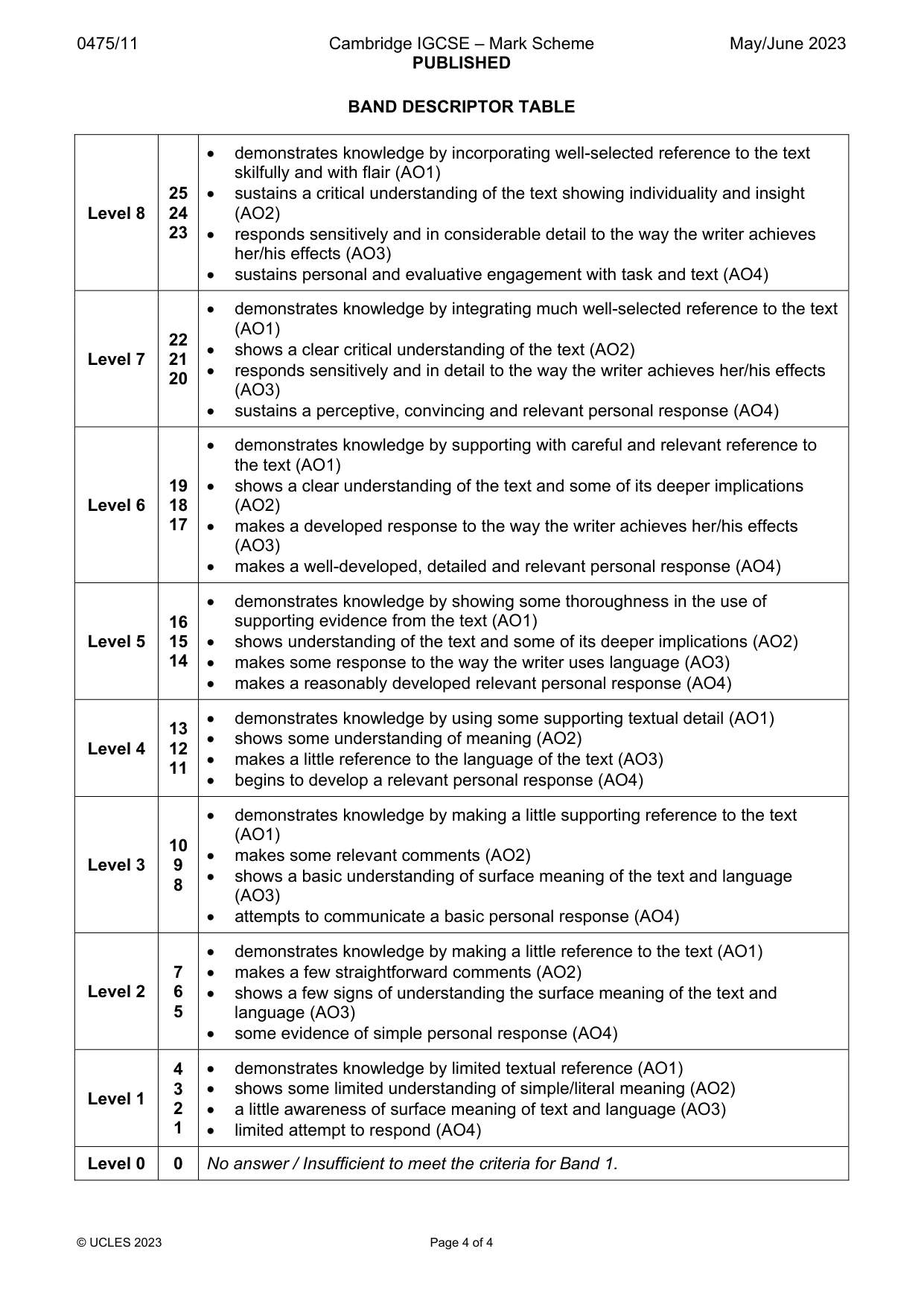
0475/11 Cambridge IGCSE – Mark Scheme PUBLISHED May/June 2023 © UCLES 2023 Page 4 of 4 BAND DESCRIPTOR TABLE Level 8 25 24 23 demonstrates knowledge by incorporating well-selected reference to the text skilfully and with flair (AO1) sustains a critical understanding of the text showing individuality and insight (AO2) responds sensitively and in considerable detail to the way the writer achieves her/his effects (AO3) sustains personal and evaluative engagement with task and text (AO4) Level 7 22 21 20 demonstrates knowledge by integrating much well-selected reference to the text (AO1) shows a clear critical understanding of the text (AO2) responds sensitively and in detail to the way the writer achieves her/his effects (AO3) sustains a perceptive, convincing and relevant personal response (AO4) Level 6 19 18 17 demonstrates knowledge by supporting with careful and relevant reference to the text (AO1) shows a clear understanding of the text and some of its deeper implications (AO2) makes a developed response to the way the writer achieves her/his effects (AO3) makes a well-developed, detailed and relevant personal response (AO4) Level 5 16 15 14 demonstrates knowledge by showing some thoroughness in the use of supporting evidence from the text (AO1) shows understanding of the text and some of its deeper implications (AO2) makes some response to the way the writer uses language (AO3) makes a reasonably developed relevant personal response (AO4) Level 4 13 12 11 demonstrates knowledge by using some supporting textual detail (AO1) shows some understanding of meaning (AO2) makes a little reference to the language of the text (AO3) begins to develop a relevant personal response (AO4) Level 3 10 9 8 demonstrates knowledge by making a little supporting reference to the text (AO1) makes some relevant comments (AO2) shows a basic understanding of surface meaning of the text and language (AO3) attempts to communicate a basic personal response (AO4) Level 2 7 6 5 demonstrates knowledge by making a little reference to the text (AO1) makes a few straightforward comments (AO2) shows a few signs of understanding the surface meaning of the text and language (AO3) some evidence of simple personal response (AO4) Level 1 4 3 2 1 demonstrates knowledge by limited textual reference (AO1) shows some limited understanding of simple/literal meaning (AO2) a little awareness of surface meaning of text and language (AO3) limited attempt to respond (AO4) Level 0 0 No answer / Insufficient to meet the criteria for Band 1.
What you needed in this session
Cambridge’s own grade thresholds for 2023 May/June, Paper 1 · Variant 1. A higher threshold means an easier paper — the bar moves with how the cohort did.