Cambridge IGCSE English - Literature in English 0475 — 2024 May/June Paper 1 · Variant 1
0475/11/M/J/24 · 50 marks · ≈56 min
The question paper and its mark scheme, free to read here and free to download. This is Cambridge’s own paper, exactly as it was sat.
Question paper32 pages






Mark scheme4 pages
Answers below. Sit the paper first if you are practising.
Paper as text
Question paper, page 1
This document has 32 pages. Any blank pages are indicated. [Turn over Cambridge IGCSE™ * 9 8 2 8 5 6 7 3 0 4 * DC (RCL (DF)) 326935/1 © UCLES 2024 LITERATURE IN ENGLISH 0475/11 Paper 1 Poetry and Prose May/June 2024 1 hour 30 minutes You must answer on the enclosed answer booklet. You will need: Answer booklet (enclosed) INSTRUCTIONS ● Answer two questions in total: Section A: answer one question. Section B: answer one question. ● Follow the instructions on the front cover of the answer booklet. If you need additional answer paper, ask the invigilator for a continuation booklet. INFORMATION ● The total mark for this paper is 50. ● All questions are worth equal marks.
Question paper, page 2
2 0475/11/M/J/24 © UCLES 2024 BLANK PAGE
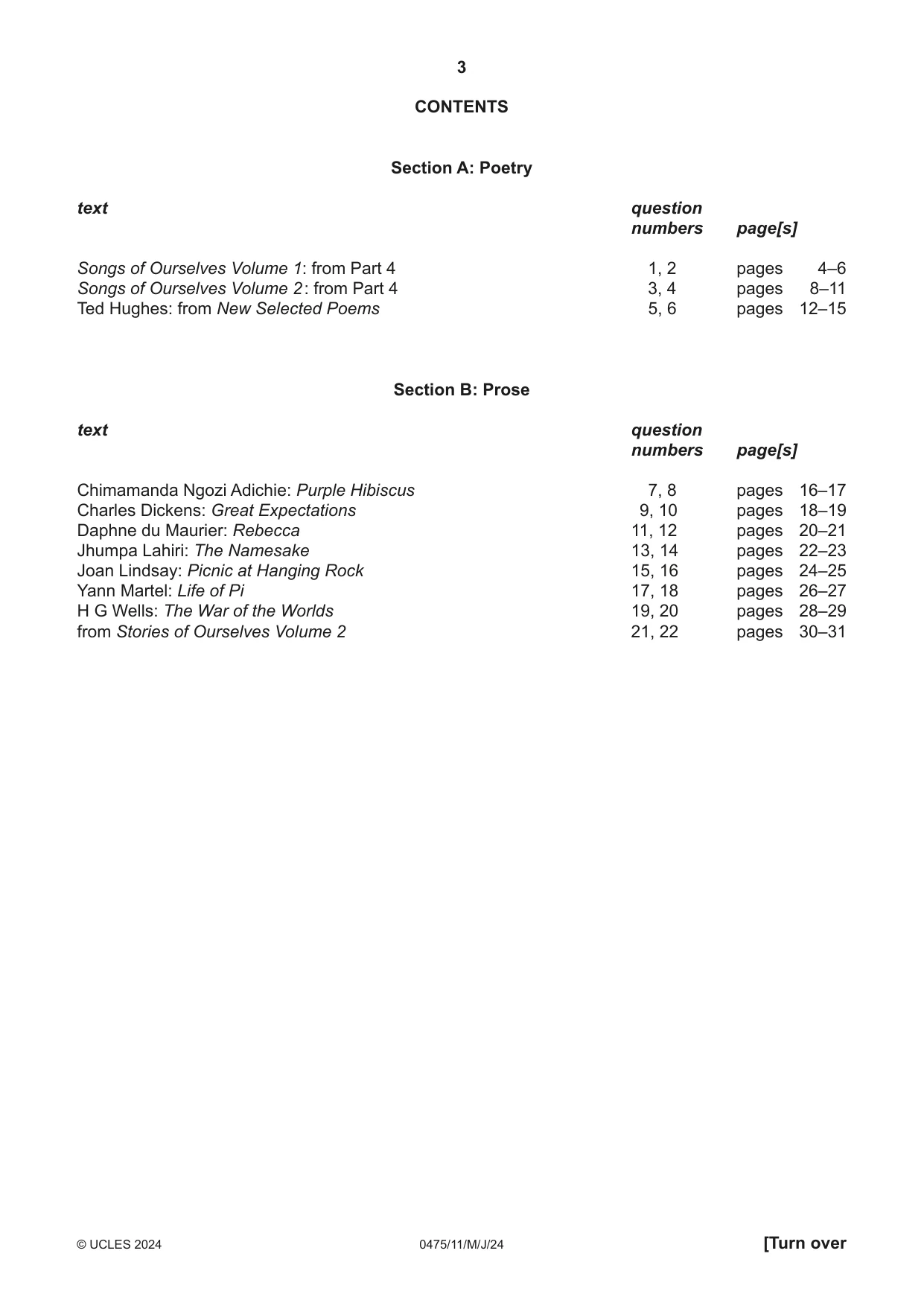
Question paper, page 3
3 0475/11/M/J/24 © UCLES 2024 [Turn over CONTENTS Section A: Poetry text question numbers page[s] Songs of Ourselves Volume 1: from Part 4 1, 2 pages 4–6 Songs of Ourselves Volume 2 : from Part 4 3, 4 pages 8–11 Ted Hughes: from New Selected Poems 5, 6 pages 12–15 Section B: Prose text question numbers page[s] Chimamanda Ngozi Adichie: Purple Hibiscus 7, 8 pages 16–17 Charles Dickens: Great Expectations 9, 10 pages 18–19 Daphne du Maurier: Rebecca 11, 12 pages 20–21 Jhumpa Lahiri: The Namesake 13, 14 pages 22–23 Joan Lindsay: Picnic at Hanging Rock 15, 16 pages 24–25 Yann Martel: Life of Pi 17, 18 pages 26–27 H G Wells: The War of the Worlds 19, 20 pages 28–29 from Stories of Ourselves Volume 2 21, 22 pages 30–31
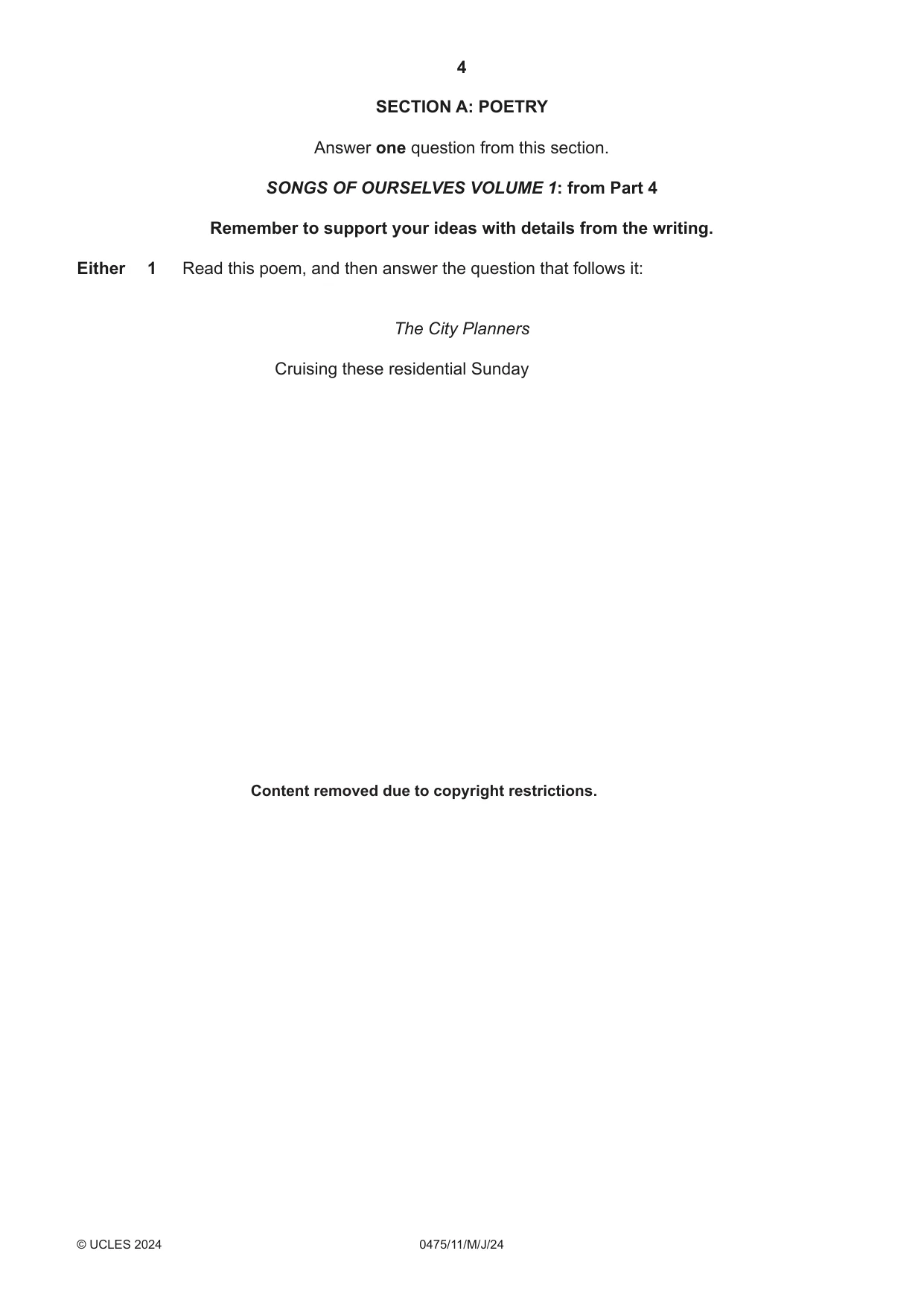
Question paper, page 4
4 0475/11/M/J/24 © UCLES 2024 SECTION A: POETRY Answer one question from this section. SONGS OF OURSELVES VOLUME 1: from Part 4 Remember to support your ideas with details from the writing. Either 1 Read this poem, and then answer the question that follows it: The City Planners Cruising these residential Sunday Content removed due to copyright restrictions.
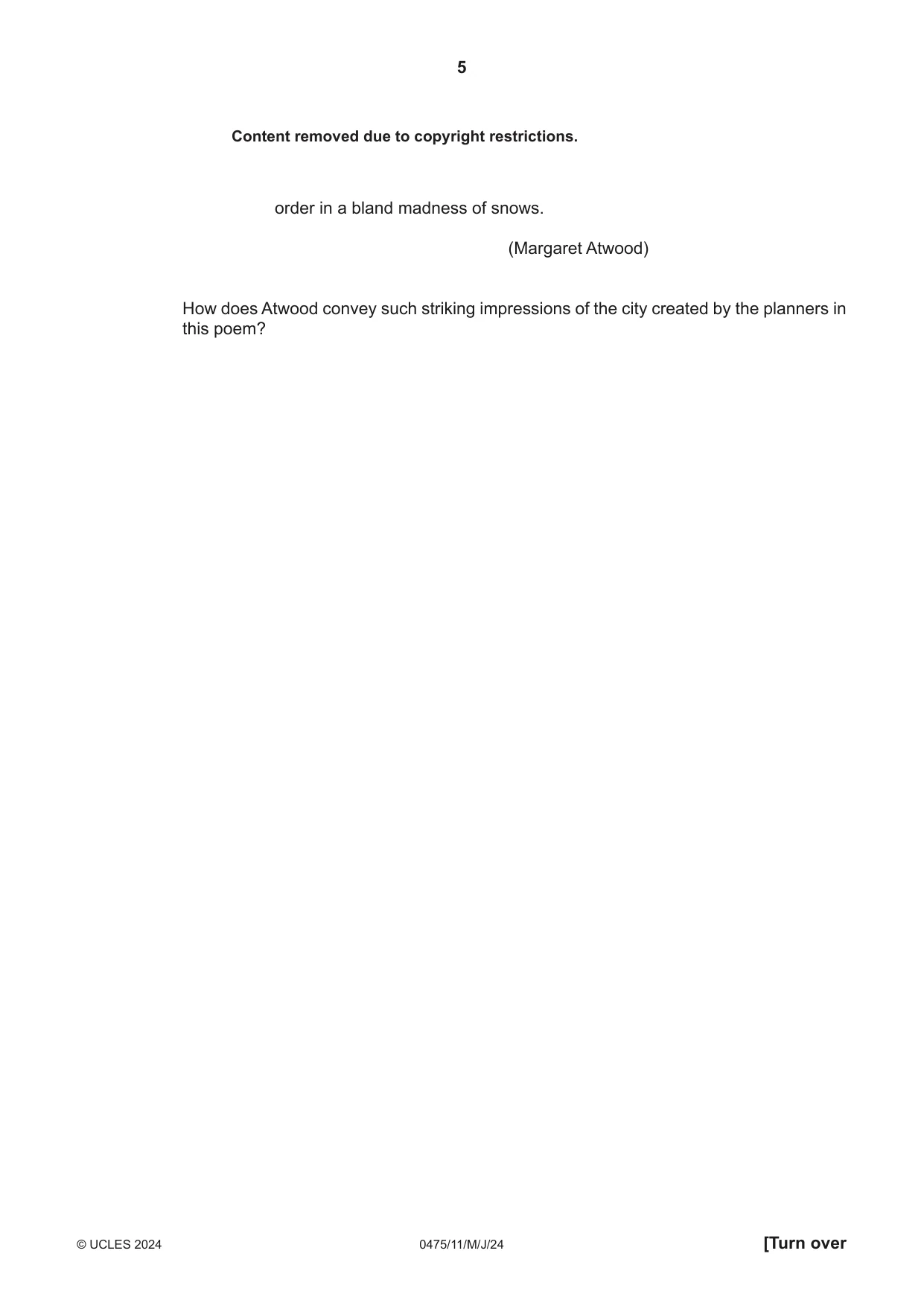
Question paper, page 5
5 0475/11/M/J/24 © UCLES 2024 [Turn over order in a bland madness of snows. (Margaret Atwood) How does Atwood convey such striking impressions of the city created by the planners in this poem? Content removed due to copyright restrictions.
Question paper, page 6
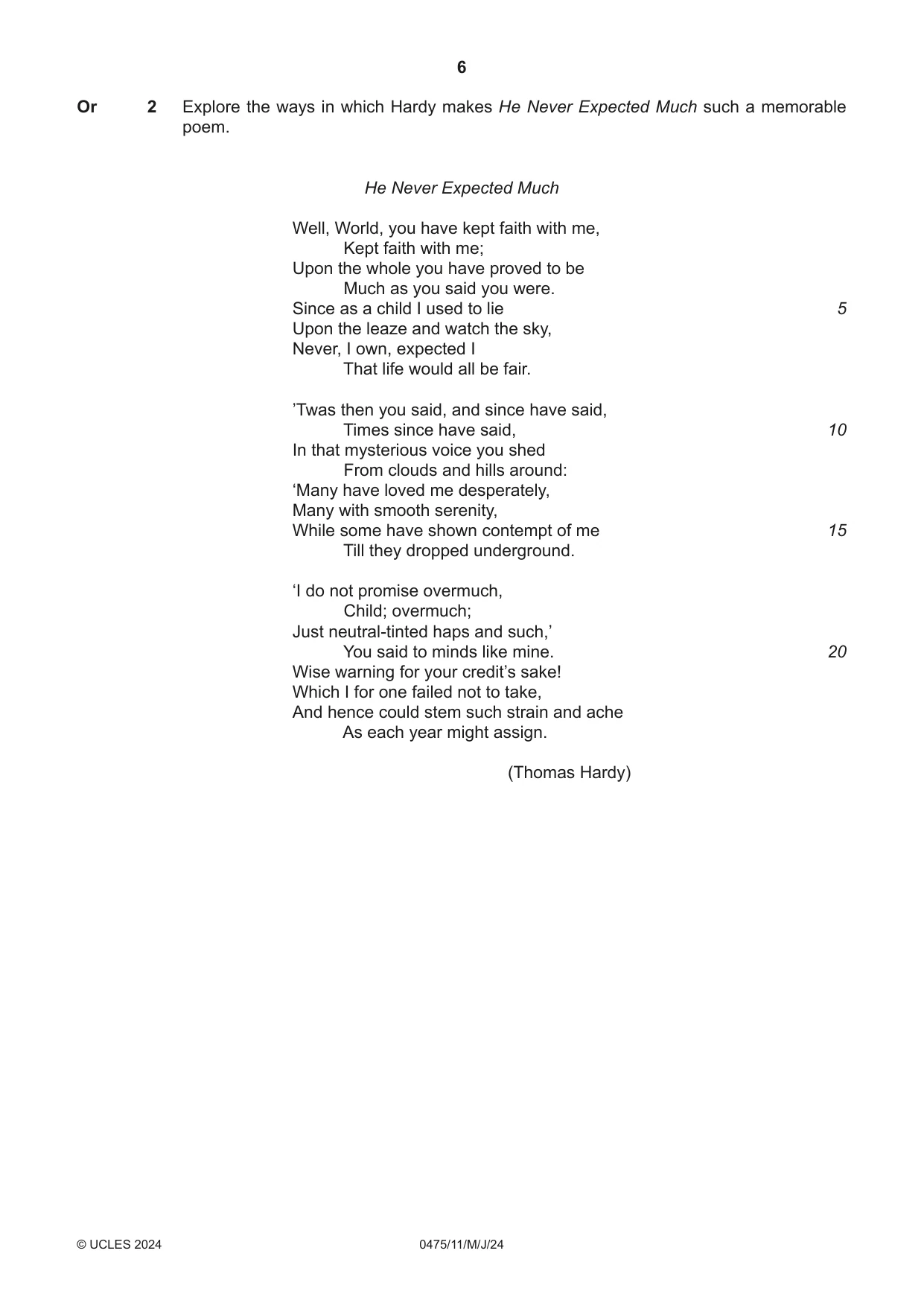
6 0475/11/M/J/24 © UCLES 2024 Or 2 Explore the ways in which Hardy makes He Never Expected Much such a memorable poem. He Never Expected Much Well, World, you have kept faith with me, Kept faith with me; Upon the whole you have proved to be Much as you said you were. Since as a child I used to lie Upon the leaze and watch the sky, Never, I own, expected I That life would all be fair. ’Twas then you said, and since have said, Times since have said, In that mysterious voice you shed From clouds and hills around: ‘Many have loved me desperately, Many with smooth serenity, While some have shown contempt of me Till they dropped underground. ‘I do not promise overmuch, Child; overmuch; Just neutral-tinted haps and such,’ You said to minds like mine. Wise warning for your credit’s sake! Which I for one failed not to take, And hence could stem such strain and ache As each year might assign. (Thomas Hardy) 5 10 15 20
Question paper, page 7
7 0475/11/M/J/24 © UCLES 2024 [Turn over TURN OVER FOR QUESTION 3.
Question paper, page 8
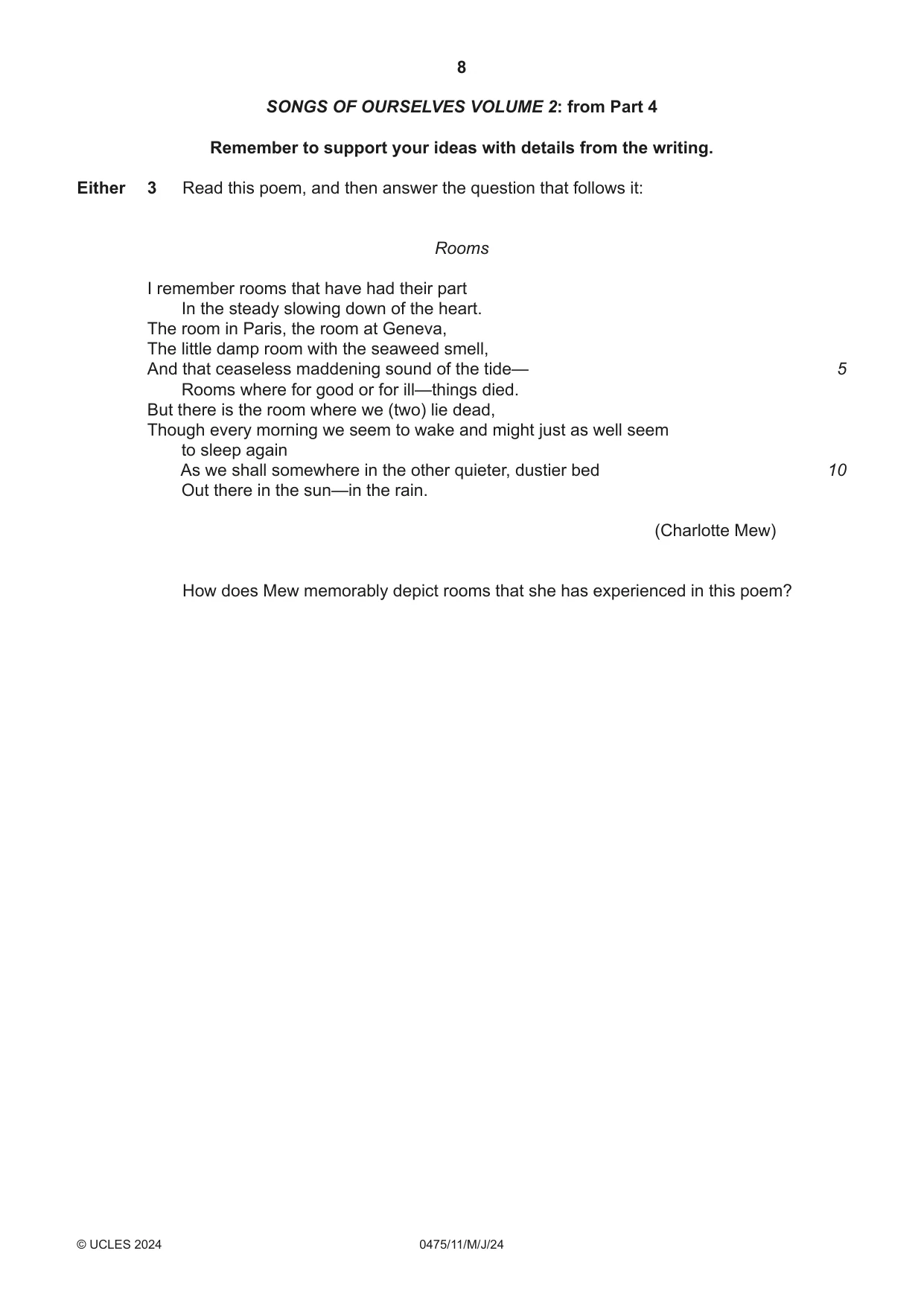
8 0475/11/M/J/24 © UCLES 2024 SONGS OF OURSELVES VOLUME 2: from Part 4 Remember to support your ideas with details from the writing. Either 3 Read this poem, and then answer the question that follows it: Rooms I remember rooms that have had their part In the steady slowing down of the heart. The room in Paris, the room at Geneva, The little damp room with the seaweed smell, And that ceaseless maddening sound of the tide— Rooms where for good or for ill—things died. But there is the room where we (two) lie dead, Though every morning we seem to wake and might just as well seem to sleep again As we shall somewhere in the other quieter, dustier bed Out there in the sun—in the rain. (Charlotte Mew) How does Mew memorably depict rooms that she has experienced in this poem? 5 10
Question paper, page 9
9 0475/11/M/J/24 © UCLES 2024 [Turn over TURN OVER FOR QUESTION 4.
Question paper, page 10
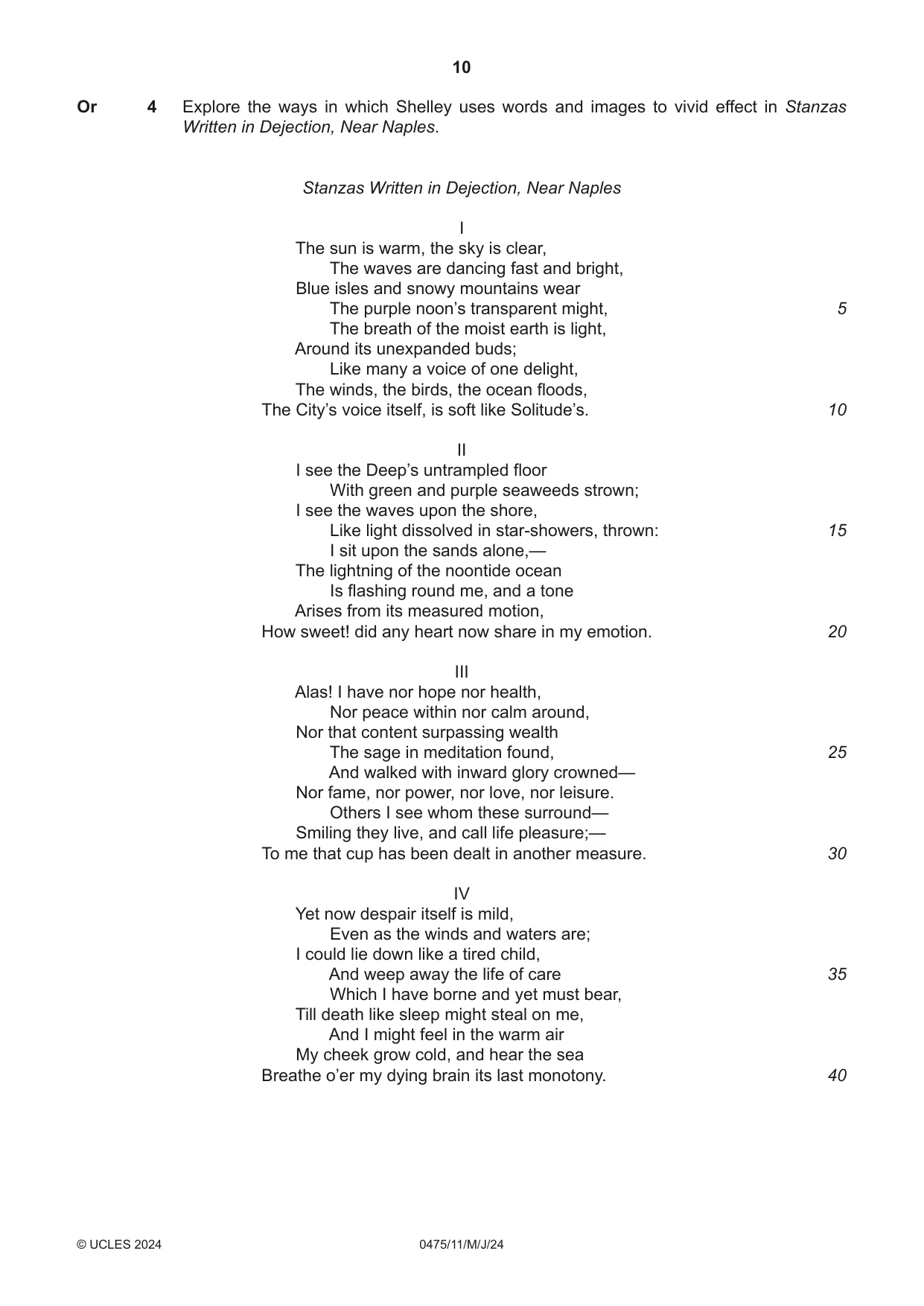
10 0475/11/M/J/24 © UCLES 2024 Or 4 Explore the ways in which Shelley uses words and images to vivid effect in Stanzas Written in Dejection, Near Naples. Stanzas Written in Dejection, Near Naples I The sun is warm, the sky is clear, The waves are dancing fast and bright, Blue isles and snowy mountains wear The purple noon’s transparent might, The breath of the moist earth is light, Around its unexpanded buds; Like many a voice of one delight, The winds, the birds, the ocean floods, The City’s voice itself, is soft like Solitude’s. II I see the Deep’s untrampled floor With green and purple seaweeds strown; I see the waves upon the shore, Like light dissolved in star-showers, thrown: I sit upon the sands alone,— The lightning of the noontide ocean Is flashing round me, and a tone Arises from its measured motion, How sweet! did any heart now share in my emotion. III Alas! I have nor hope nor health, Nor peace within nor calm around, Nor that content surpassing wealth The sage in meditation found, And walked with inward glory crowned— Nor fame, nor power, nor love, nor leisure. Others I see whom these surround— Smiling they live, and call life pleasure;— To me that cup has been dealt in another measure. IV Yet now despair itself is mild, Even as the winds and waters are; I could lie down like a tired child, And weep away the life of care Which I have borne and yet must bear, Till death like sleep might steal on me, And I might feel in the warm air My cheek grow cold, and hear the sea Breathe o’er my dying brain its last monotony. 5 10 15 20 25 30 35 40
Question paper, page 11
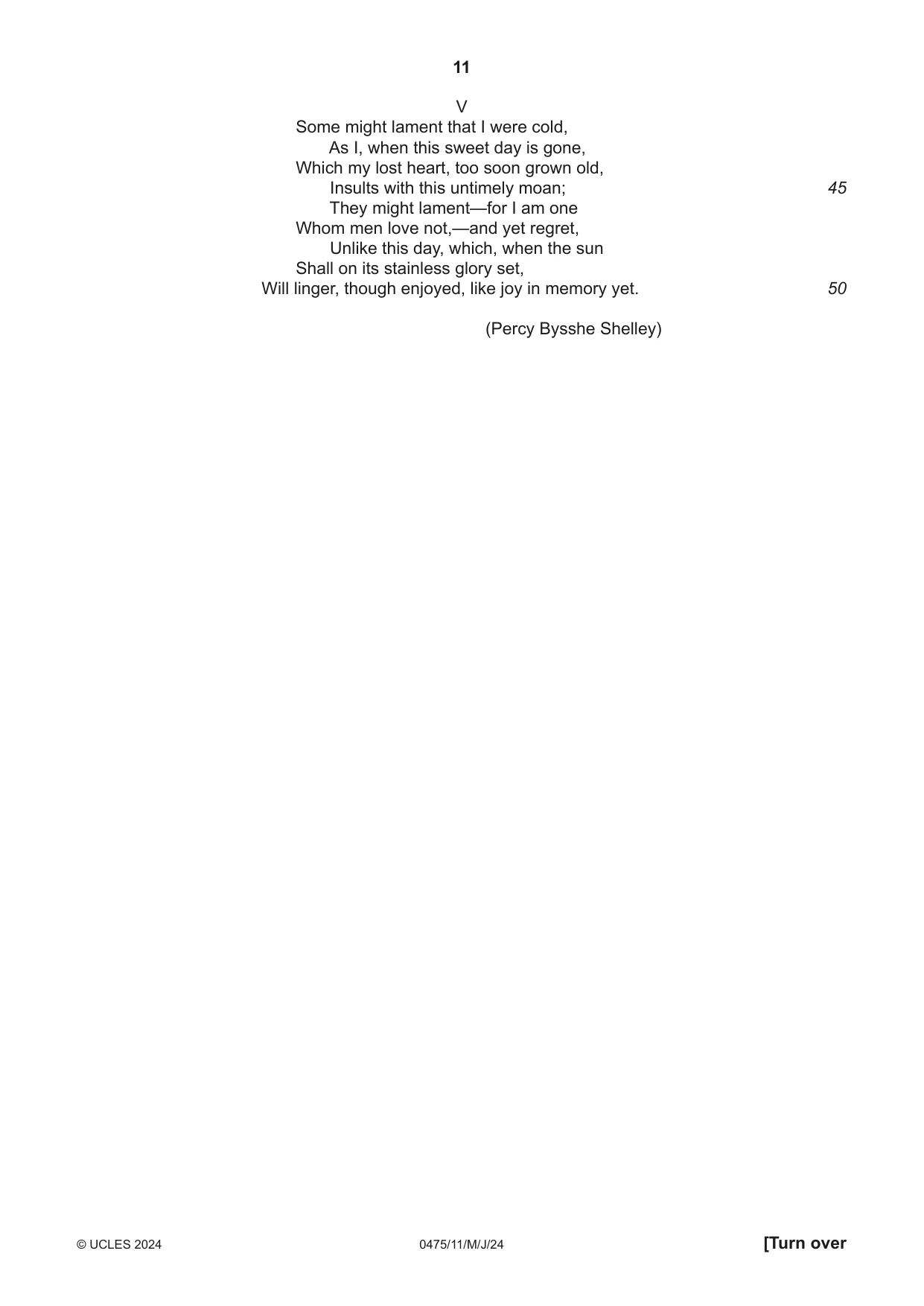
11 0475/11/M/J/24 © UCLES 2024 [Turn over V Some might lament that I were cold, As I, when this sweet day is gone, Which my lost heart, too soon grown old, Insults with this untimely moan; They might lament—for I am one Whom men love not,—and yet regret, Unlike this day, which, when the sun Shall on its stainless glory set, Will linger, though enjoyed, like joy in memory yet. (Percy Bysshe Shelley) 45 50
Question paper, page 12
12 0475/11/M/J/24 © UCLES 2024 TED HUGHES: from New Selected Poems Remember to support your ideas with details from the writing. Either 5 Read this poem, and then answer the question that follows it: Football at Slack Between plunging valleys, on a bareback of hill Lifted the cloud’s edge, to watch them. In what ways does Hughes vividly convey the pleasure that the men get from the football match? Content removed due to copyright restrictions.
Question paper, page 13
13 0475/11/M/J/24 © UCLES 2024 [Turn over TURN OVER FOR QUESTION 6.
Question paper, page 14
14 0475/11/M/J/24 © UCLES 2024 Or 6 Explore the ways in which Hughes creates memorable impressions of his mother and her sister in Anniversary. Anniversary My mother in her feathers of flame Content removed due to copyright restrictions.
Question paper, page 15
15 0475/11/M/J/24 © UCLES 2024 [Turn over Able for all that distance to think me him. Content removed due to copyright restrictions
Question paper, page 16
16 0475/11/M/J/24 © UCLES 2024 SECTION B: PROSE Answer one question from this section. CHIMAMANDA NGOZI ADICHIE: Purple Hibiscus Remember to support your ideas with details from the writing. Either 7 Read this passage, and then answer the question that follows it: When we got to Ezi Icheke, cars lined the road almost bumper to bumper. Content removed due to copyright restrictions.
Question paper, page 17
17 0475/11/M/J/24 © UCLES 2024 [Turn over Papa- Nnukwu snapped, turning to glare at Jaja. How does Adichie make this such a vivid moment in the novel? Or 8 Explore the ways in which Adichie movingly portrays the relationship between Kambili and Mama. Content removed due to copyright restrictions.
Question paper, page 18
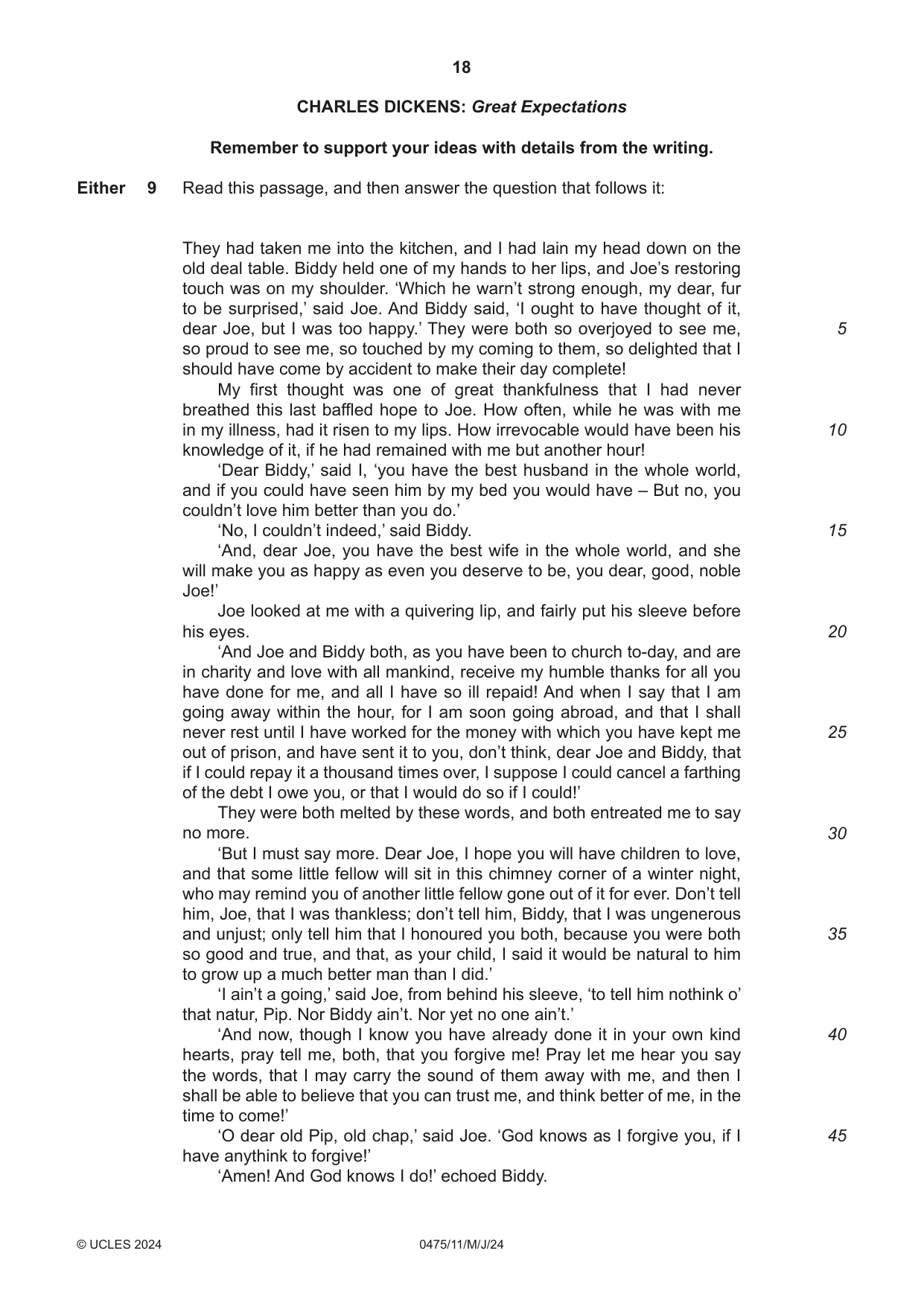
18 0475/11/M/J/24 © UCLES 2024 CHARLES DICKENS: Great Expectations Remember to support your ideas with details from the writing. Either 9 Read this passage, and then answer the question that follows it: They had taken me into the kitchen, and I had lain my head down on the old deal table. Biddy held one of my hands to her lips, and Joe’s restoring touch was on my shoulder. ‘Which he warn’t strong enough, my dear, fur to be surprised,’ said Joe. And Biddy said, ‘I ought to have thought of it, dear Joe, but I was too happy.’ They were both so overjoyed to see me, so proud to see me, so touched by my coming to them, so delighted that I should have come by accident to make their day complete! My first thought was one of great thankfulness that I had never breathed this last baffled hope to Joe. How often, while he was with me in my illness, had it risen to my lips. How irrevocable would have been his knowledge of it, if he had remained with me but another hour! ‘Dear Biddy,’ said I, ‘you have the best husband in the whole world, and if you could have seen him by my bed you would have – But no, you couldn’t love him better than you do.’ ‘No, I couldn’t indeed,’ said Biddy. ‘And, dear Joe, you have the best wife in the whole world, and she will make you as happy as even you deserve to be, you dear, good, noble Joe!’ Joe looked at me with a quivering lip, and fairly put his sleeve before his eyes. ‘And Joe and Biddy both, as you have been to church to-day, and are in charity and love with all mankind, receive my humble thanks for all you have done for me, and all I have so ill repaid! And when I say that I am going away within the hour, for I am soon going abroad, and that I shall never rest until I have worked for the money with which you have kept me out of prison, and have sent it to you, don’t think, dear Joe and Biddy, that if I could repay it a thousand times over, I suppose I could cancel a farthing of the debt I owe you, or that I would do so if I could!’ They were both melted by these words, and both entreated me to say no more. ‘But I must say more. Dear Joe, I hope you will have children to love, and that some little fellow will sit in this chimney corner of a winter night, who may remind you of another little fellow gone out of it for ever. Don’t tell him, Joe, that I was thankless; don’t tell him, Biddy, that I was ungenerous and unjust; only tell him that I honoured you both, because you were both so good and true, and that, as your child, I said it would be natural to him to grow up a much better man than I did.’ ‘I ain’t a going,’ said Joe, from behind his sleeve, ‘to tell him nothink o’ that natur, Pip. Nor Biddy ain’t. Nor yet no one ain’t.’ ‘And now, though I know you have already done it in your own kind hearts, pray tell me, both, that you forgive me! Pray let me hear you say the words, that I may carry the sound of them away with me, and then I shall be able to believe that you can trust me, and think better of me, in the time to come!’ ‘O dear old Pip, old chap,’ said Joe. ‘God knows as I forgive you, if I have anythink to forgive!’ ‘Amen! And God knows I do!’ echoed Biddy. 5 10 15 20 25 30 35 40 45
Question paper, page 19
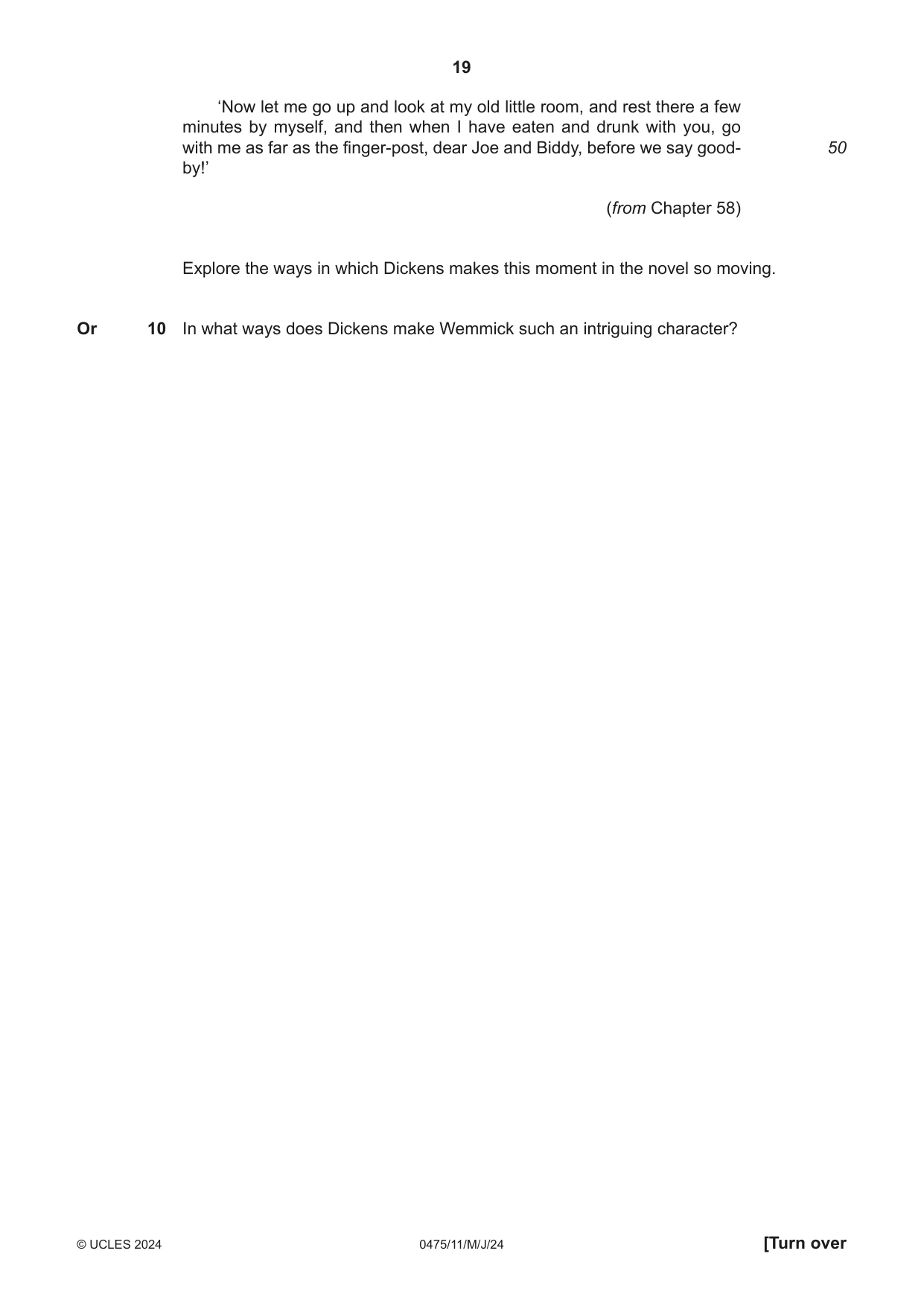
19 0475/11/M/J/24 © UCLES 2024 [Turn over ‘Now let me go up and look at my old little room, and rest there a few minutes by myself, and then when I have eaten and drunk with you, go with me as far as the finger-post, dear Joe and Biddy, before we say good- by!’ (from Chapter 58) Explore the ways in which Dickens makes this moment in the novel so moving. Or 10 In what ways does Dickens make Wemmick such an intriguing character? 50
Question paper, page 20
20 0475/11/M/J/24 © UCLES 2024 DAPHNE DU MAURIER: Rebecca Remember to support your ideas with details from the writing. Either 11 Read this passage, and then answer the question that follows it: ‘Maxim!’ I cried. ‘Maxim!’ Content removed due to copyright restrictions.
Question paper, page 21
21 0475/11/M/J/24 © UCLES 2024 [Turn over And the ashes blew towards us with the salt wind from the sea. (from Chapter 27) How does du Maurier make this such a dramatic ending to the novel? Or 12 Explore the ways in which du Maurier vividly conveys the narrator’s fear of Mrs Danvers. Content removed due to copyright restrictions.
Question paper, page 22
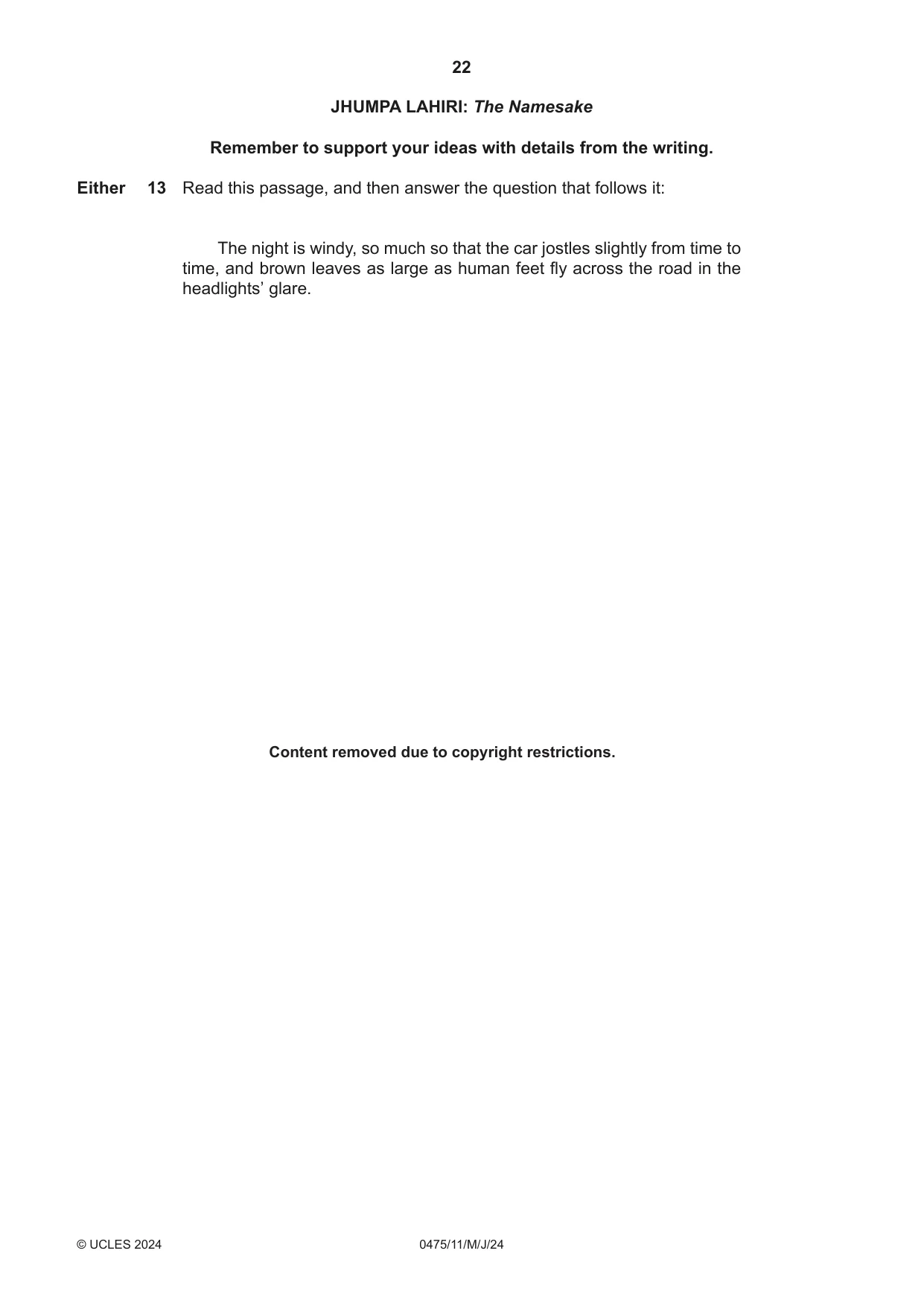
22 0475/11/M/J/24 © UCLES 2024 JHUMPA LAHIRI: The Namesake Remember to support your ideas with details from the writing. Either 13 Read this passage, and then answer the question that follows it: The night is windy, so much so that the car jostles slightly from time to time, and brown leaves as large as human feet fly across the road in the headlights’ glare. Content removed due to copyright restrictions.
Question paper, page 23
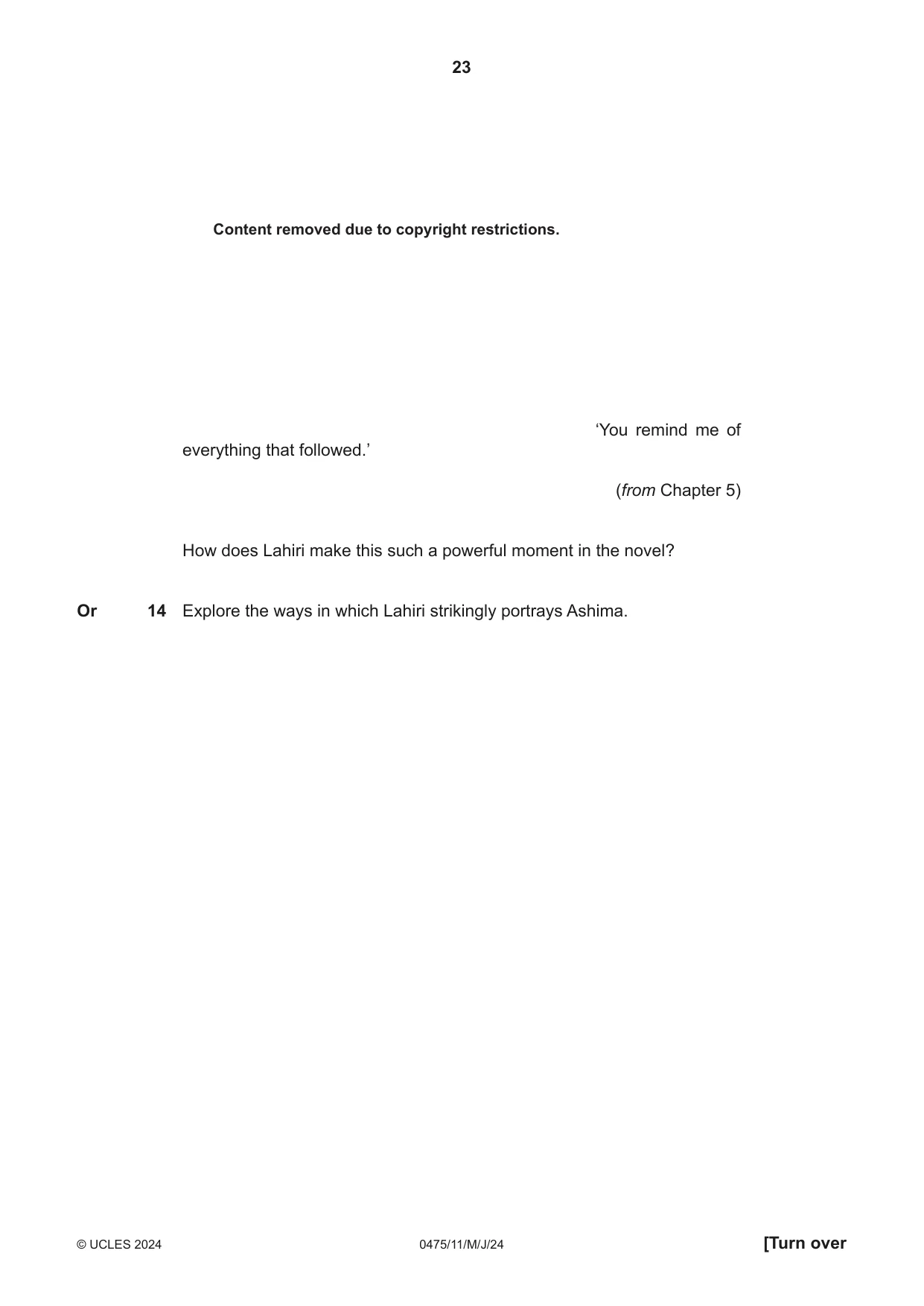
23 0475/11/M/J/24 © UCLES 2024 [Turn over ‘You remind me of everything that followed.’ (from Chapter 5) How does Lahiri make this such a powerful moment in the novel? Or 14 Explore the ways in which Lahiri strikingly portrays Ashima. Content removed due to copyright restrictions.
Question paper, page 24
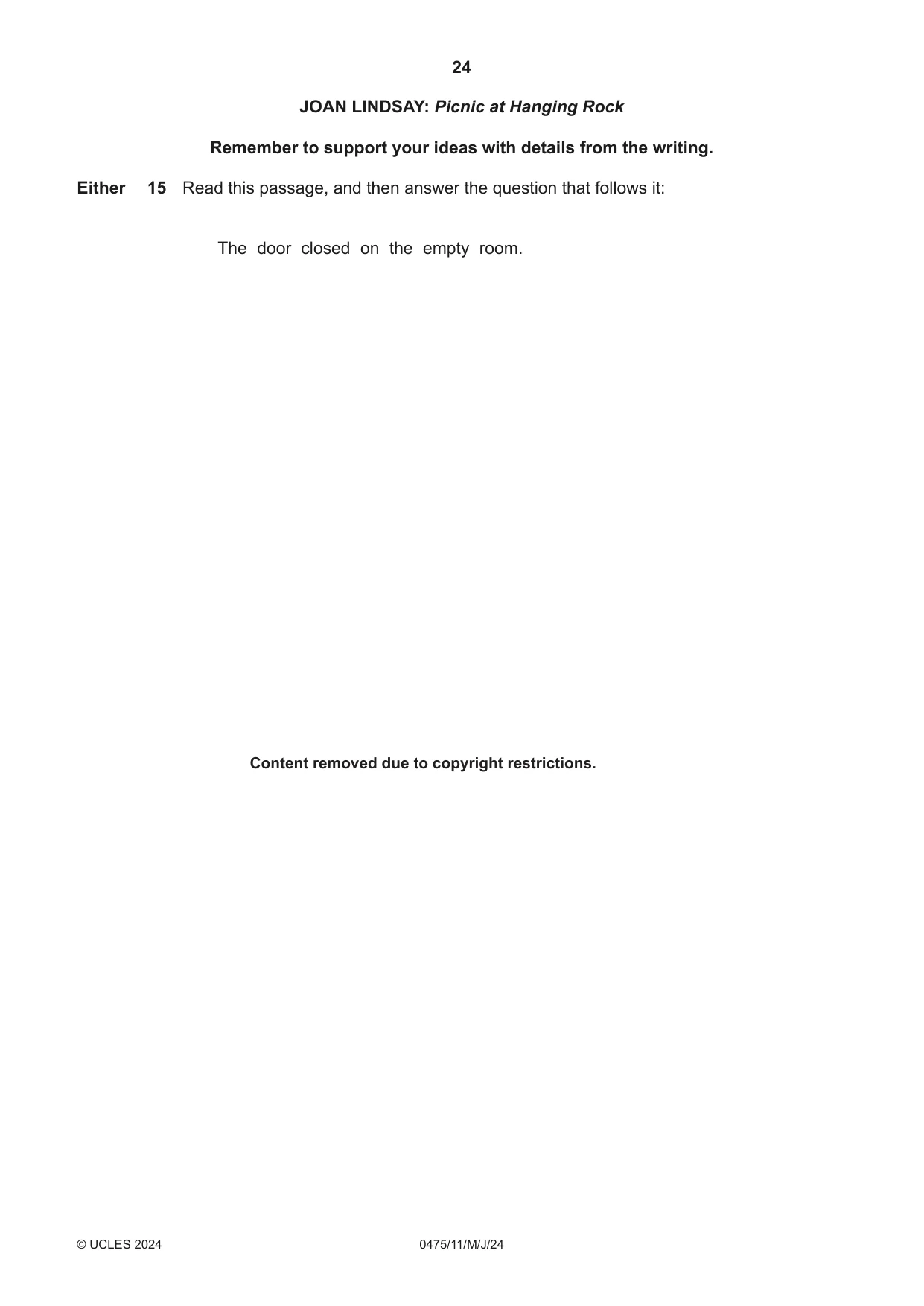
24 0475/11/M/J/24 © UCLES 2024 JOAN LINDSAY: Picnic at Hanging Rock Remember to support your ideas with details from the writing. Either 15 Read this passage, and then answer the question that follows it: The door closed on the empty room. Content removed due to copyright restrictions.
Question paper, page 25
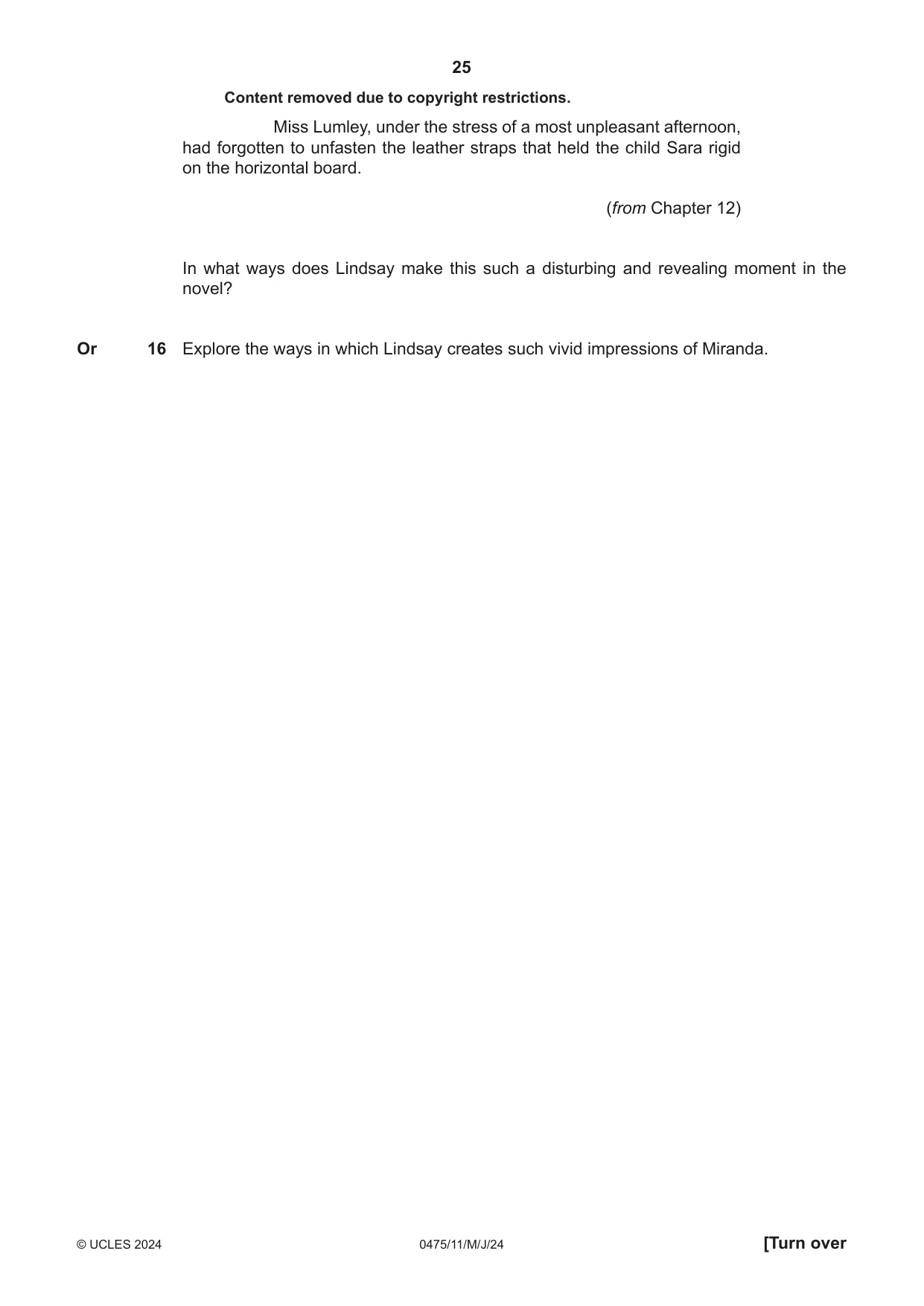
25 0475/11/M/J/24 © UCLES 2024 [Turn over Miss Lumley, under the stress of a most unpleasant afternoon, had forgotten to unfasten the leather straps that held the child Sara rigid on the horizontal board. (from Chapter 12) In what ways does Lindsay make this such a disturbing and revealing moment in the novel? Or 16 Explore the ways in which Lindsay creates such vivid impressions of Miranda. Content removed due to copyright restrictions.
Question paper, page 26
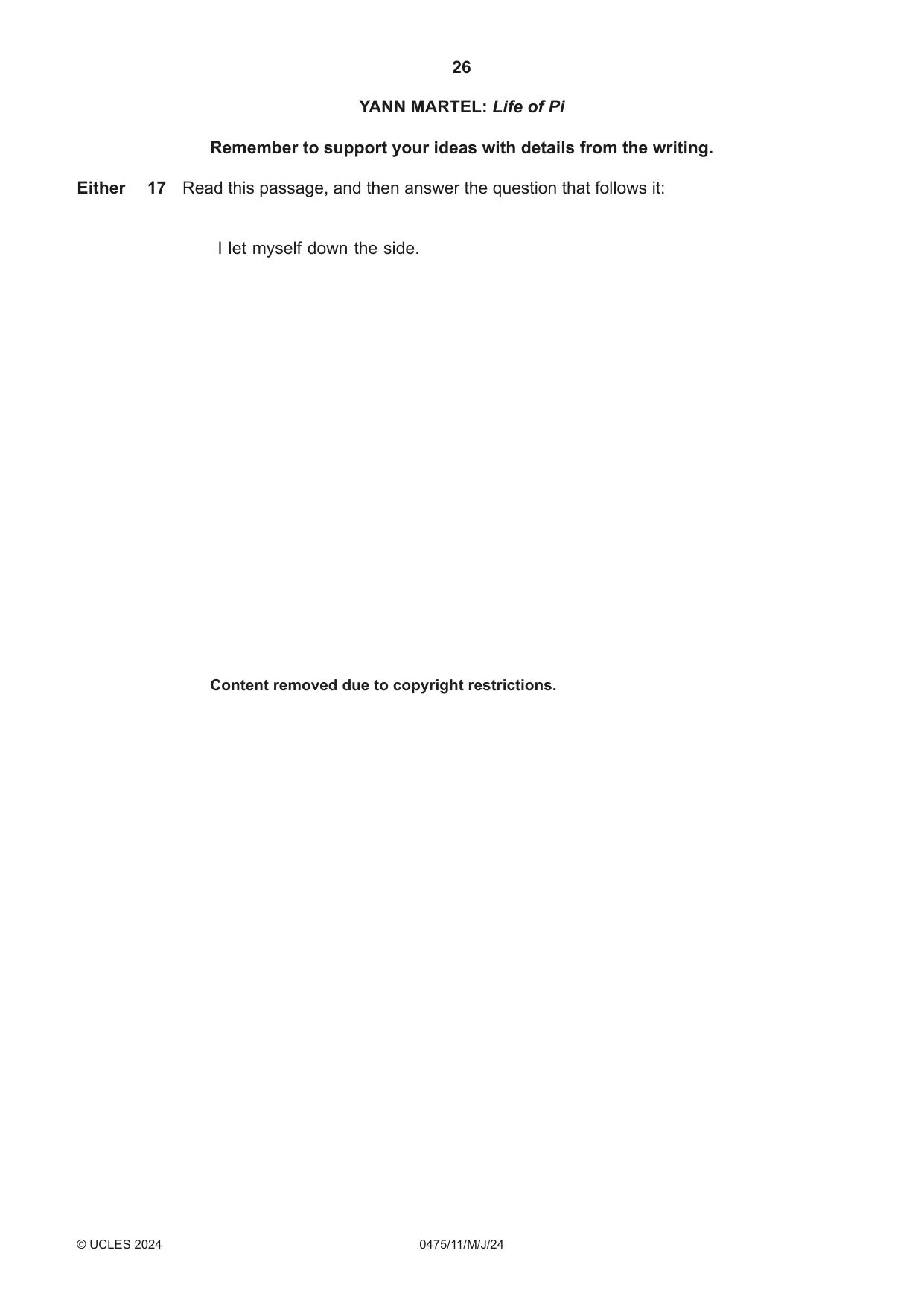
26 0475/11/M/J/24 © UCLES 2024 YANN MARTEL: Life of Pi Remember to support your ideas with details from the writing. Either 17 Read this passage, and then answer the question that follows it: I let myself down the side. Content removed due to copyright restrictions.
Question paper, page 27
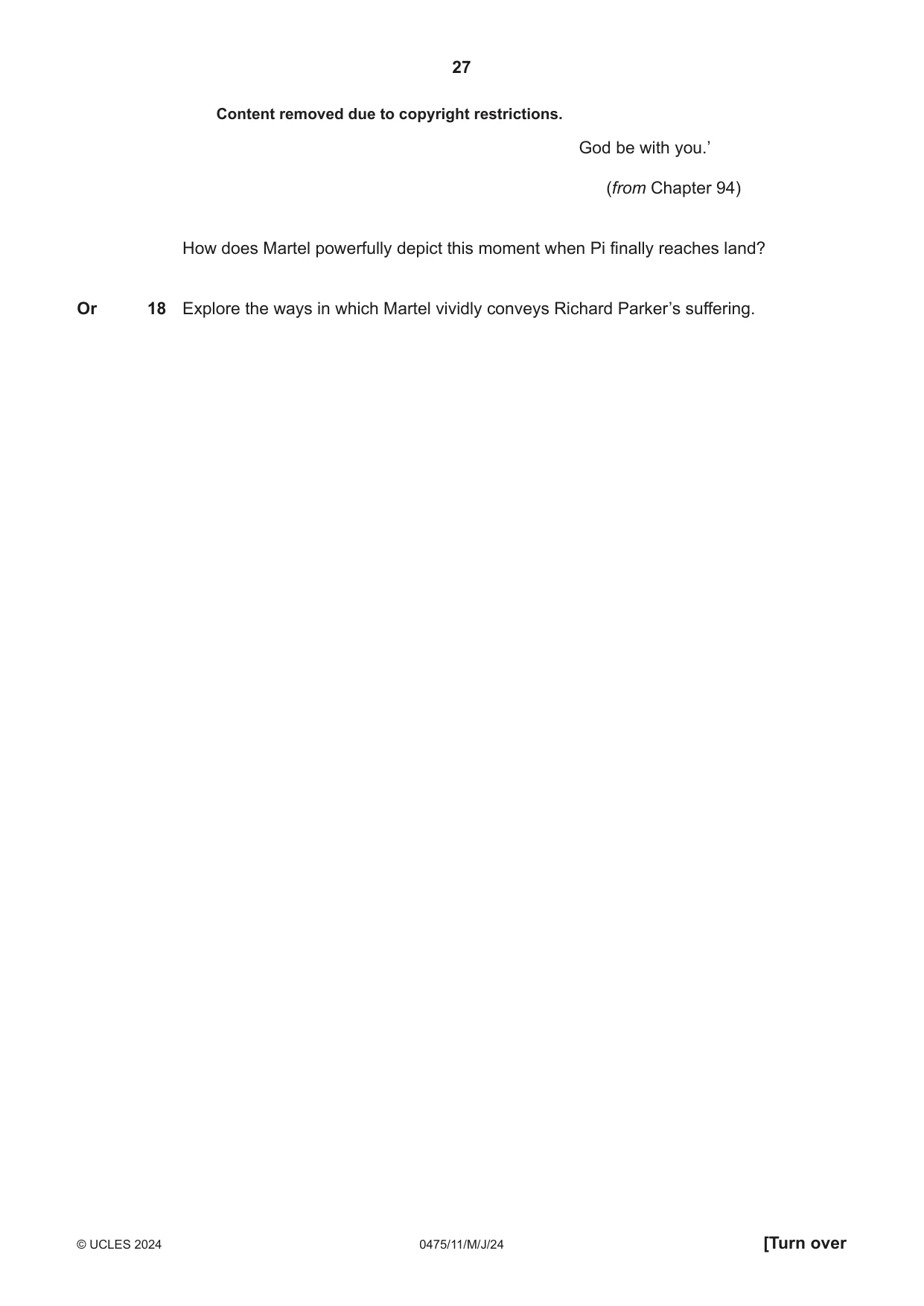
27 0475/11/M/J/24 © UCLES 2024 [Turn over God be with you.’ (from Chapter 94) How does Martel powerfully depict this moment when Pi finally reaches land? Or 18 Explore the ways in which Martel vividly conveys Richard Parker’s suffering. Content removed due to copyright restrictions.
Question paper, page 28
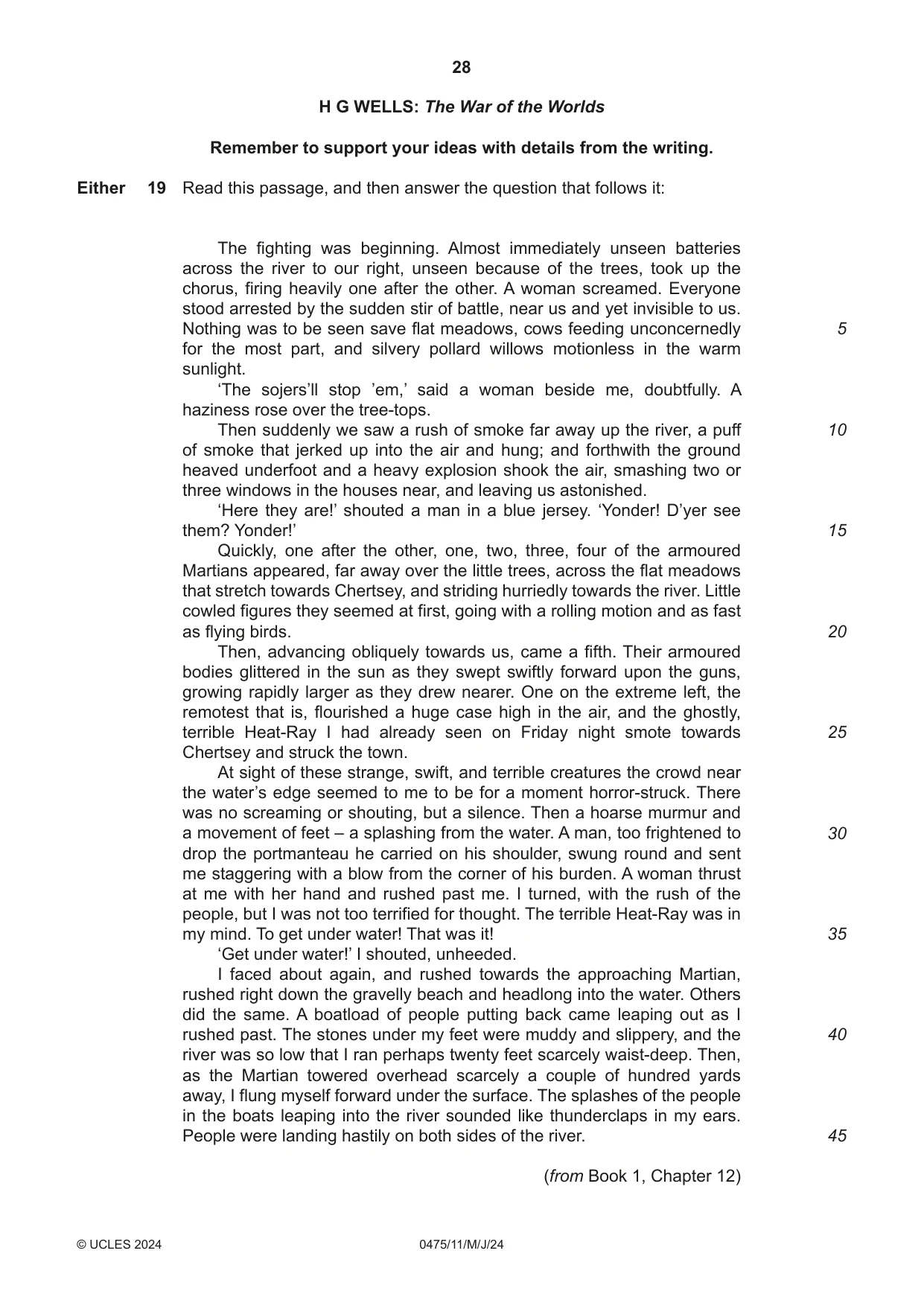
28 0475/11/M/J/24 © UCLES 2024 H G WELLS: The War of the Worlds Remember to support your ideas with details from the writing. Either 19 Read this passage, and then answer the question that follows it: The fighting was beginning. Almost immediately unseen batteries across the river to our right, unseen because of the trees, took up the chorus, firing heavily one after the other. A woman screamed. Everyone stood arrested by the sudden stir of battle, near us and yet invisible to us. Nothing was to be seen save flat meadows, cows feeding unconcernedly for the most part, and silvery pollard willows motionless in the warm sunlight. ‘The sojers’ll stop ’em,’ said a woman beside me, doubtfully. A haziness rose over the tree-tops. Then suddenly we saw a rush of smoke far away up the river, a puff of smoke that jerked up into the air and hung; and forthwith the ground heaved underfoot and a heavy explosion shook the air, smashing two or three windows in the houses near, and leaving us astonished. ‘Here they are!’ shouted a man in a blue jersey. ‘Yonder! D’yer see them? Yonder!’ Quickly, one after the other, one, two, three, four of the armoured Martians appeared, far away over the little trees, across the flat meadows that stretch towards Chertsey, and striding hurriedly towards the river. Little cowled figures they seemed at first, going with a rolling motion and as fast as flying birds. Then, advancing obliquely towards us, came a fifth. Their armoured bodies glittered in the sun as they swept swiftly forward upon the guns, growing rapidly larger as they drew nearer. One on the extreme left, the remotest that is, flourished a huge case high in the air, and the ghostly, terrible Heat-Ray I had already seen on Friday night smote towards Chertsey and struck the town. At sight of these strange, swift, and terrible creatures the crowd near the water’s edge seemed to me to be for a moment horror-struck. There was no screaming or shouting, but a silence. Then a hoarse murmur and a movement of feet – a splashing from the water. A man, too frightened to drop the portmanteau he carried on his shoulder, swung round and sent me staggering with a blow from the corner of his burden. A woman thrust at me with her hand and rushed past me. I turned, with the rush of the people, but I was not too terrified for thought. The terrible Heat-Ray was in my mind. To get under water! That was it! ‘Get under water!’ I shouted, unheeded. I faced about again, and rushed towards the approaching Martian, rushed right down the gravelly beach and headlong into the water. Others did the same. A boatload of people putting back came leaping out as I rushed past. The stones under my feet were muddy and slippery, and the river was so low that I ran perhaps twenty feet scarcely waist-deep. Then, as the Martian towered overhead scarcely a couple of hundred yards away, I flung myself forward under the surface. The splashes of the people in the boats leaping into the river sounded like thunderclaps in my ears. People were landing hastily on both sides of the river. (from Book 1, Chapter 12) 5 10 15 20 25 30 35 40 45
Question paper, page 29
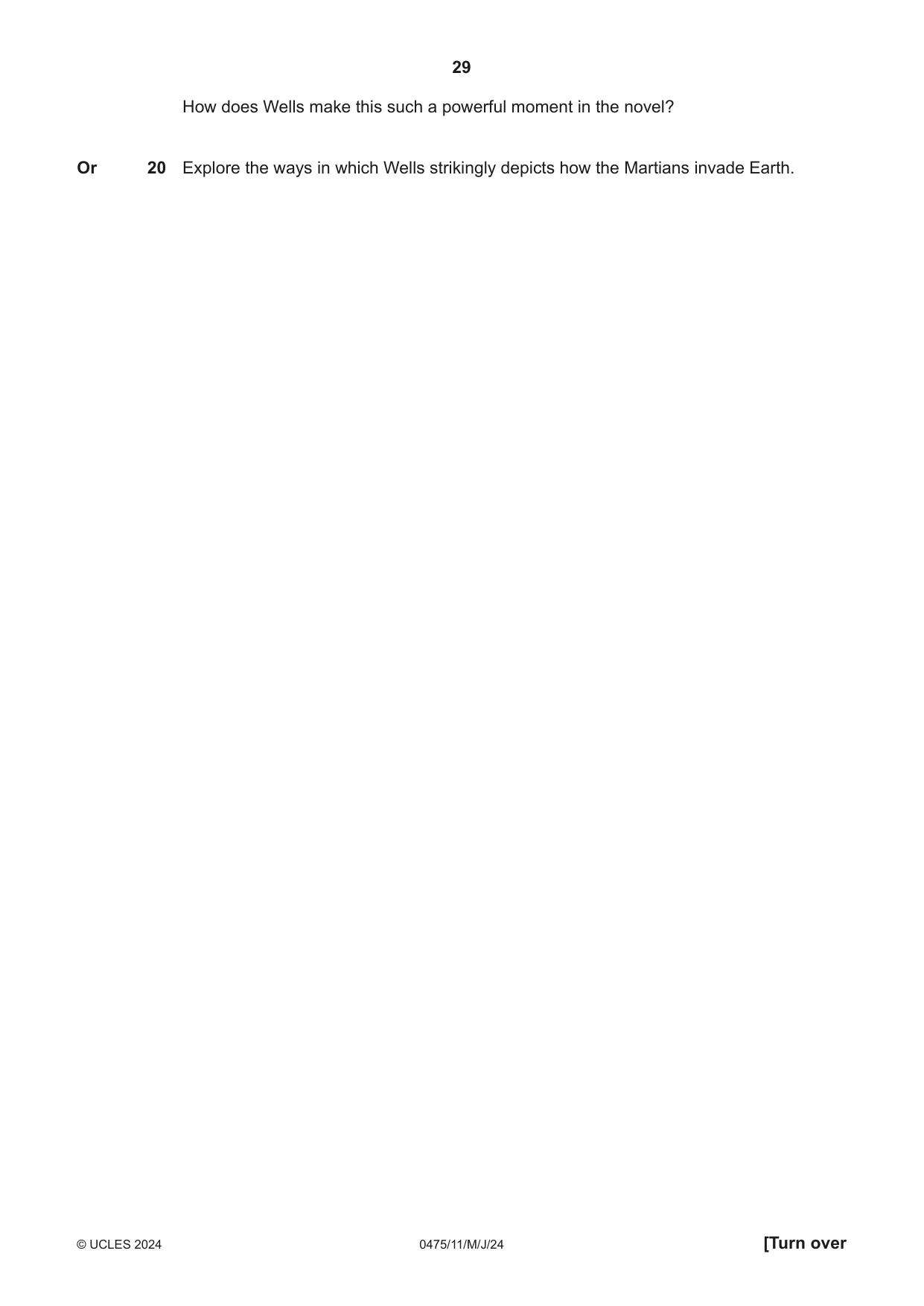
29 0475/11/M/J/24 © UCLES 2024 [Turn over How does Wells make this such a powerful moment in the novel? Or 20 Explore the ways in which Wells strikingly depicts how the Martians invade Earth.
Question paper, page 30
30 0475/11/M/J/24 © UCLES 2024 from STORIES OF OURSELVES Volume 2 Remember to support your ideas with details from the writing. Either 21 Read the following extract from Sharmaji (by Anjana Appachana), and then answer the question that follows it: He got up and was about to leave the room when a thought seemed to strike him. Content removed due to copyright restrictions.
Question paper, page 31
31 0475/11/M/J/24 © UCLES 2024 Lovingly, he placed it on his desk, licked his pencil and began a new poem. How does Appachana make this such an amusing ending to the story? Or 22 How does the writer make you feel sympathy for one of the following characters? • Mr Shi in A Thousand Years of Good Prayers (by Yiyun Li) • Caroline in The Tower (by Marghanita Laski) Content removed due to copyright restrictions.
Question paper, page 32
32 0475/11/M/J/24 © UCLES 2024 Permission to reproduce items where third-party owned material protected by copyright is included has been sought and cleared where possible. Every reasonable effort has been made by the publisher (UCLES) to trace copyright holders, but if any items requiring clearance have unwittingly been included, the publisher will be pleased to make amends at the earliest possible opportunity. To avoid the issue of disclosure of answer-related information to candidates, all copyright acknowledgements are reproduced online in the Cambridge Assessment International Education Copyright Acknowledgements Booklet. This is produced for each series of examinations and is freely available to download at www.cambridgeinternational.org after the live examination series. Cambridge Assessment International Education is part of Cambridge Assessment. Cambridge Assessment is the brand name of the University of Cambridge Local Examinations Syndicate (UCLES), which is a department of the University of Cambridge. BLANK PAGE
Mark scheme, page 1
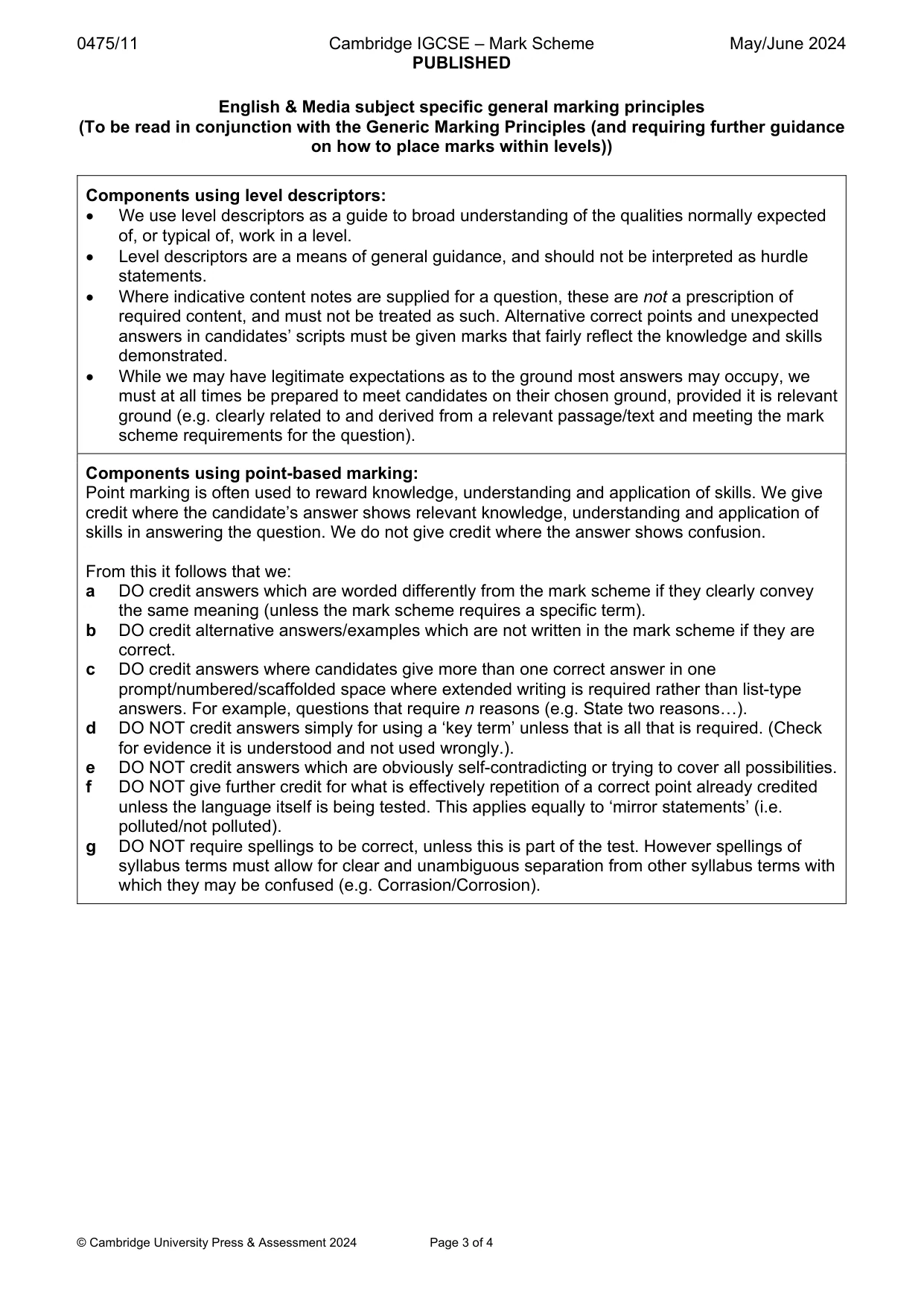
This document consists of 4 printed pages. © Cambridge University Press & Assessment 2024 [Turn over Cambridge IGCSE™ LITERATURE IN ENGLISH 0475/11 Paper 1 Poetry and Prose May/June 2024 MARK SCHEME Maximum Mark: 50 Published This mark scheme is published as an aid to teachers and candidates, to indicate the requirements of the examination. It shows the basis on which Examiners were instructed to award marks. It does not indicate the details of the discussions that took place at an Examiners’ meeting before marking began, which would have considered the acceptability of alternative answers. Mark schemes should be read in conjunction with the question paper and the Principal Examiner Report for Teachers. Cambridge International will not enter into discussions about these mark schemes. Cambridge International is publishing the mark schemes for the May/June 2024 series for most Cambridge IGCSE, Cambridge International A and AS Level and Cambridge Pre-U components, and some Cambridge O Level components.
Mark scheme, page 2
0475/11 Cambridge IGCSE – Mark Scheme PUBLISHED May/June 2024 © Cambridge University Press & Assessment 2024 Page 2 of 4 Generic Marking Principles These general marking principles must be applied by all examiners when marking candidate answers. They should be applied alongside the specific content of the mark scheme or generic level descriptions for a question. Each question paper and mark scheme will also comply with these marking principles. GENERIC MARKING PRINCIPLE 1: Marks must be awarded in line with: the specific content of the mark scheme or the generic level descriptors for the question the specific skills defined in the mark scheme or in the generic level descriptors for the question the standard of response required by a candidate as exemplified by the standardisation scripts. GENERIC MARKING PRINCIPLE 2: Marks awarded are always whole marks (not half marks, or other fractions). GENERIC MARKING PRINCIPLE 3: Marks must be awarded positively: marks are awarded for correct/valid answers, as defined in the mark scheme. However, credit is given for valid answers which go beyond the scope of the syllabus and mark scheme, referring to your Team Leader as appropriate marks are awarded when candidates clearly demonstrate what they know and can do marks are not deducted for errors marks are not deducted for omissions answers should only be judged on the quality of spelling, punctuation and grammar when these features are specifically assessed by the question as indicated by the mark scheme. The meaning, however, should be unambiguous. GENERIC MARKING PRINCIPLE 4: Rules must be applied consistently, e.g. in situations where candidates have not followed instructions or in the application of generic level descriptors. GENERIC MARKING PRINCIPLE 5: Marks should be awarded using the full range of marks defined in the mark scheme for the question (however; the use of the full mark range may be limited according to the quality of the candidate responses seen). GENERIC MARKING PRINCIPLE 6: Marks awarded are based solely on the requirements as defined in the mark scheme. Marks should not be awarded with grade thresholds or grade descriptors in mind.
Mark scheme, page 3
0475/11 Cambridge IGCSE – Mark Scheme PUBLISHED May/June 2024 © Cambridge University Press & Assessment 2024 Page 3 of 4 English & Media subject specific general marking principles (To be read in conjunction with the Generic Marking Principles (and requiring further guidance on how to place marks within levels)) Components using level descriptors: We use level descriptors as a guide to broad understanding of the qualities normally expected of, or typical of, work in a level. Level descriptors are a means of general guidance, and should not be interpreted as hurdle statements. Where indicative content notes are supplied for a question, these are not a prescription of required content, and must not be treated as such. Alternative correct points and unexpected answers in candidates’ scripts must be given marks that fairly reflect the knowledge and skills demonstrated. While we may have legitimate expectations as to the ground most answers may occupy, we must at all times be prepared to meet candidates on their chosen ground, provided it is relevant ground (e.g. clearly related to and derived from a relevant passage/text and meeting the mark scheme requirements for the question). Components using point-based marking: Point marking is often used to reward knowledge, understanding and application of skills. We give credit where the candidate’s answer shows relevant knowledge, understanding and application of skills in answering the question. We do not give credit where the answer shows confusion. From this it follows that we: a DO credit answers which are worded differently from the mark scheme if they clearly convey the same meaning (unless the mark scheme requires a specific term). b DO credit alternative answers/examples which are not written in the mark scheme if they are correct. c DO credit answers where candidates give more than one correct answer in one prompt/numbered/scaffolded space where extended writing is required rather than list-type answers. For example, questions that require n reasons (e.g. State two reasons…). d DO NOT credit answers simply for using a ‘key term’ unless that is all that is required. (Check for evidence it is understood and not used wrongly.). e DO NOT credit answers which are obviously self-contradicting or trying to cover all possibilities. f DO NOT give further credit for what is effectively repetition of a correct point already credited unless the language itself is being tested. This applies equally to ‘mirror statements’ (i.e. polluted/not polluted). g DO NOT require spellings to be correct, unless this is part of the test. However spellings of syllabus terms must allow for clear and unambiguous separation from other syllabus terms with which they may be confused (e.g. Corrasion/Corrosion).
Mark scheme, page 4
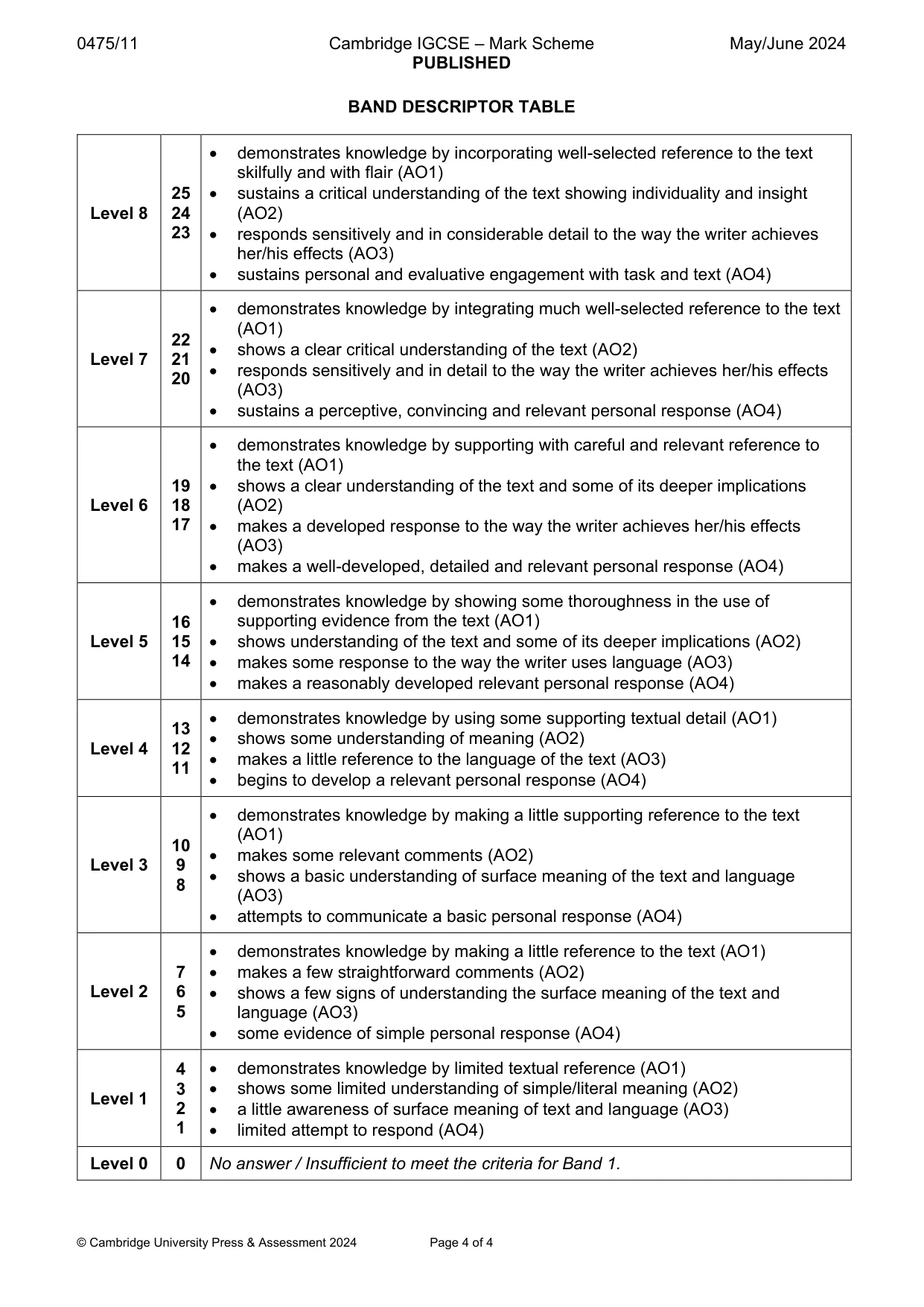
0475/11 Cambridge IGCSE – Mark Scheme PUBLISHED May/June 2024 © Cambridge University Press & Assessment 2024 Page 4 of 4 BAND DESCRIPTOR TABLE Level 8 25 24 23 demonstrates knowledge by incorporating well-selected reference to the text skilfully and with flair (AO1) sustains a critical understanding of the text showing individuality and insight (AO2) responds sensitively and in considerable detail to the way the writer achieves her/his effects (AO3) sustains personal and evaluative engagement with task and text (AO4) Level 7 22 21 20 demonstrates knowledge by integrating much well-selected reference to the text (AO1) shows a clear critical understanding of the text (AO2) responds sensitively and in detail to the way the writer achieves her/his effects (AO3) sustains a perceptive, convincing and relevant personal response (AO4) Level 6 19 18 17 demonstrates knowledge by supporting with careful and relevant reference to the text (AO1) shows a clear understanding of the text and some of its deeper implications (AO2) makes a developed response to the way the writer achieves her/his effects (AO3) makes a well-developed, detailed and relevant personal response (AO4) Level 5 16 15 14 demonstrates knowledge by showing some thoroughness in the use of supporting evidence from the text (AO1) shows understanding of the text and some of its deeper implications (AO2) makes some response to the way the writer uses language (AO3) makes a reasonably developed relevant personal response (AO4) Level 4 13 12 11 demonstrates knowledge by using some supporting textual detail (AO1) shows some understanding of meaning (AO2) makes a little reference to the language of the text (AO3) begins to develop a relevant personal response (AO4) Level 3 10 9 8 demonstrates knowledge by making a little supporting reference to the text (AO1) makes some relevant comments (AO2) shows a basic understanding of surface meaning of the text and language (AO3) attempts to communicate a basic personal response (AO4) Level 2 7 6 5 demonstrates knowledge by making a little reference to the text (AO1) makes a few straightforward comments (AO2) shows a few signs of understanding the surface meaning of the text and language (AO3) some evidence of simple personal response (AO4) Level 1 4 3 2 1 demonstrates knowledge by limited textual reference (AO1) shows some limited understanding of simple/literal meaning (AO2) a little awareness of surface meaning of text and language (AO3) limited attempt to respond (AO4) Level 0 0 No answer / Insufficient to meet the criteria for Band 1.
What you needed in this session
Cambridge’s own grade thresholds for 2024 May/June, Paper 1 · Variant 1. A higher threshold means an easier paper — the bar moves with how the cohort did.