Cambridge IGCSE English - Literature in English 0475 — 2022 Oct/Nov Paper 1 · Variant 3
0475/13/O/N/22 · 50 marks · ≈56 min
The question paper and its mark scheme, free to read here and free to download. This is Cambridge’s own paper, exactly as it was sat.
Question paper28 pages




Mark scheme4 pages
Answers below. Sit the paper first if you are practising.
Paper as text
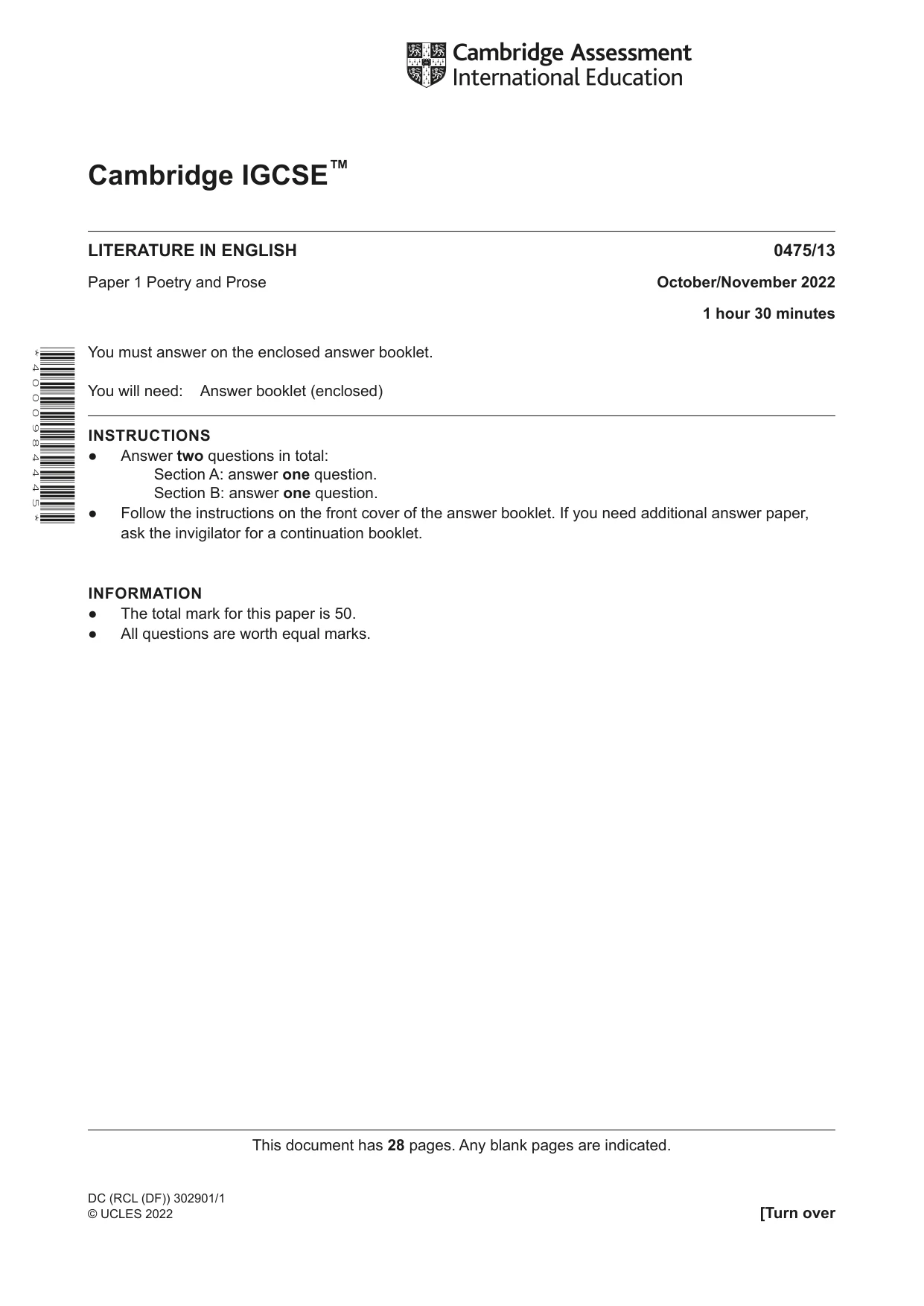
Question paper, page 1
This document has 28 pages. Any blank pages are indicated. * 4 0 0 0 9 8 4 4 4 5 * Cambridge IGCSE™ LITERATURE IN ENGLISH 0475/13 Paper 1 Poetry and Prose October/November 2022 1 hour 30 minutes You must answer on the enclosed answer booklet. You will need: Answer booklet (enclosed) INSTRUCTIONS ● Answer two questions in total: Section A: answer one question. Section B: answer one question. ● Follow the instructions on the front cover of the answer booklet. If you need additional answer paper, ask the invigilator for a continuation booklet. INFORMATION ● The total mark for this paper is 50. ● All questions are worth equal marks. DC (RCL (DF)) 302901/1 © UCLES 2022 [Turn over
Question paper, page 2
2 0475/13/O/N/22 © UCLES 2022 BLANK PAGE
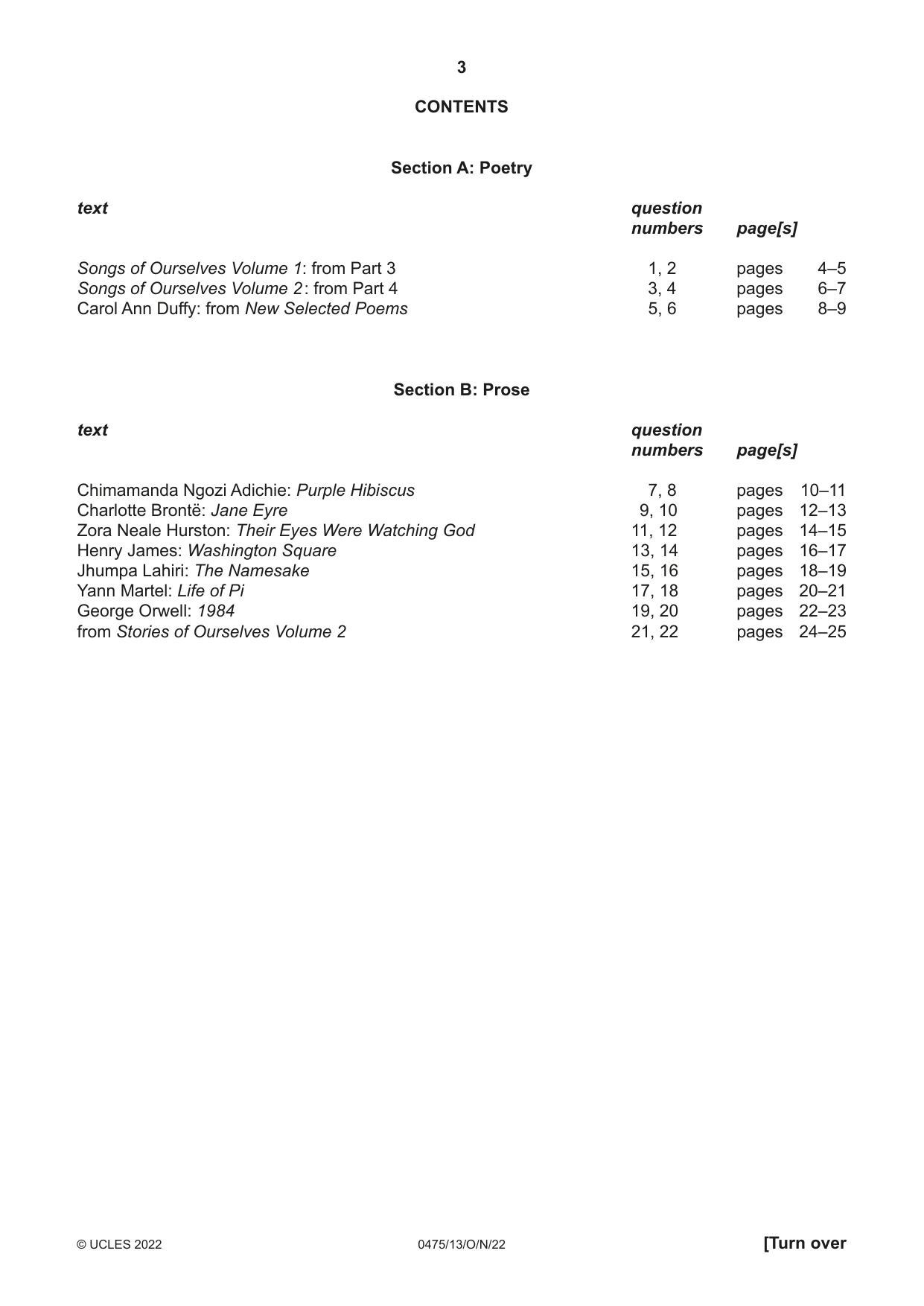
Question paper, page 3
3 0475/13/O/N/22 © UCLES 2022 [Turn over CONTENTS Section A: Poetry text question numbers page[s] Songs of Ourselves Volume 1: from Part 3 1, 2 pages 4–5 Songs of Ourselves Volume 2 : from Part 4 3, 4 pages 6–7 Carol Ann Duffy: from New Selected Poems 5, 6 pages 8–9 Section B: Prose text question numbers page[s] Chimamanda Ngozi Adichie: Purple Hibiscus 7, 8 pages 10–11 Charlotte Brontë: Jane Eyre 9, 10 pages 12–13 Zora Neale Hurston: Their Eyes Were Watching God 11, 12 pages 14–15 Henry James: Washington Square 13, 14 pages 16–17 Jhumpa Lahiri: The Namesake 15, 16 pages 18–19 Yann Martel: Life of Pi 17, 18 pages 20–21 George Orwell: 1984 19, 20 pages 22–23 from Stories of Ourselves Volume 2 21, 22 pages 24–25
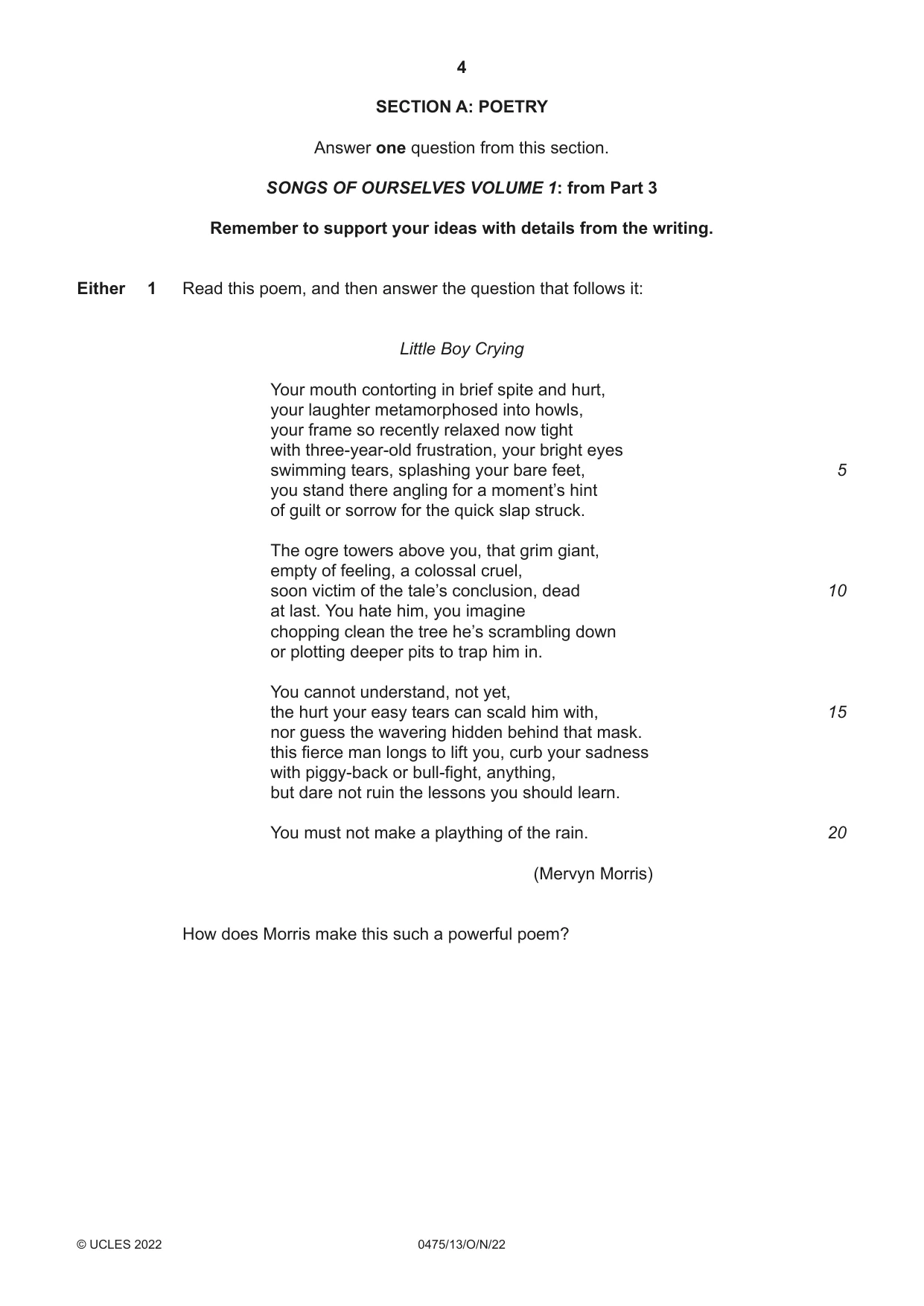
Question paper, page 4
4 0475/13/O/N/22 © UCLES 2022 SECTION A: POETRY Answer one question from this section. SONGS OF OURSELVES VOLUME 1: from Part 3 Remember to support your ideas with details from the writing. Either 1 Read this poem, and then answer the question that follows it: Little Boy Crying Your mouth contorting in brief spite and hurt, your laughter metamorphosed into howls, your frame so recently relaxed now tight with three-year-old frustration, your bright eyes swimming tears, splashing your bare feet, you stand there angling for a moment’s hint of guilt or sorrow for the quick slap struck. The ogre towers above you, that grim giant, empty of feeling, a colossal cruel, soon victim of the tale’s conclusion, dead at last. You hate him, you imagine chopping clean the tree he’s scrambling down or plotting deeper pits to trap him in. You cannot understand, not yet, the hurt your easy tears can scald him with, nor guess the wavering hidden behind that mask. this fierce man longs to lift you, curb your sadness with piggy-back or bull-fight, anything, but dare not ruin the lessons you should learn. You must not make a plaything of the rain. (Mervyn Morris) How does Morris make this such a powerful poem? 5 10 15 20
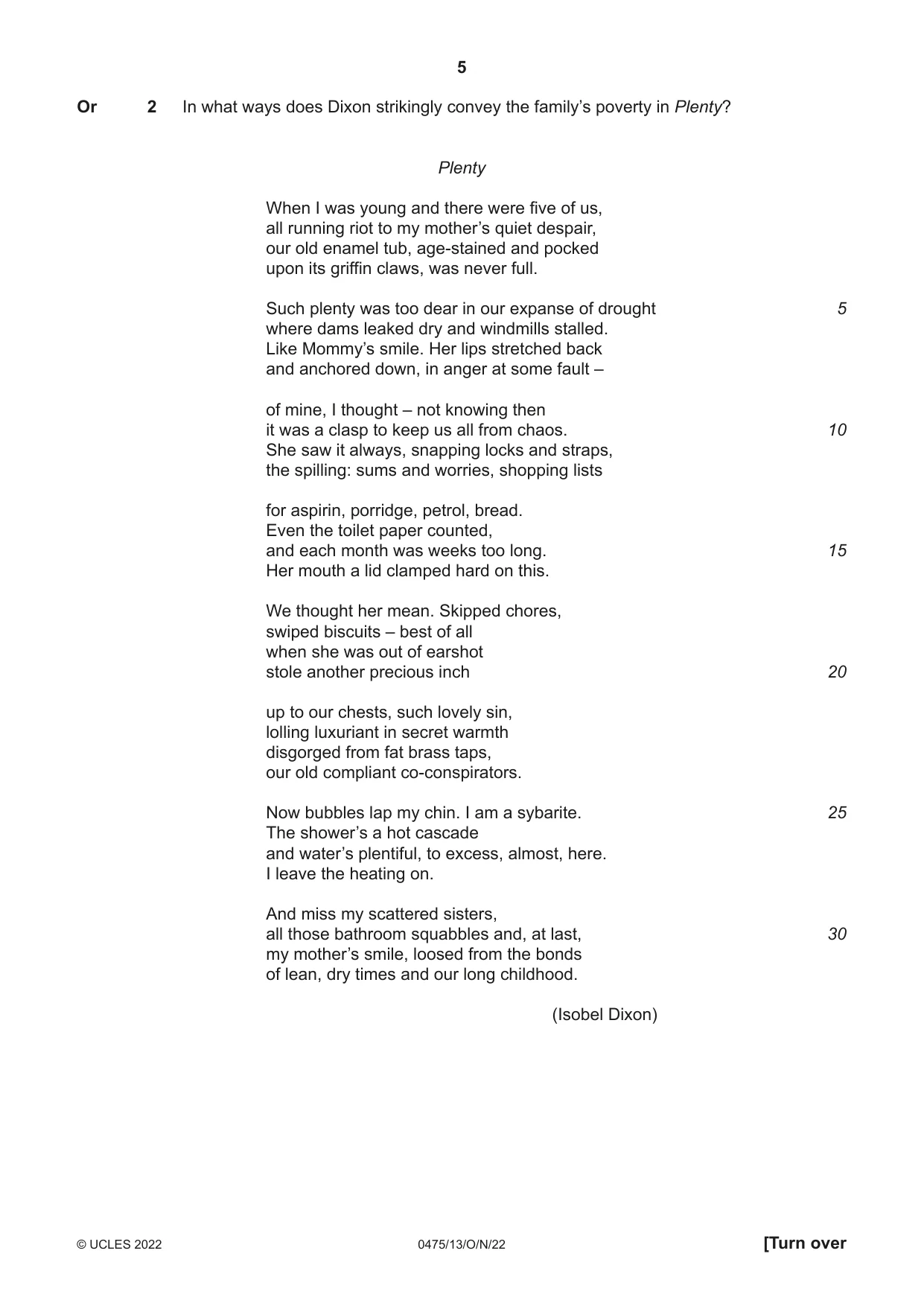
Question paper, page 5
5 0475/13/O/N/22 © UCLES 2022 [Turn over Or 2 In what ways does Dixon strikingly convey the family’s poverty in Plenty? Plenty When I was young and there were five of us, all running riot to my mother’s quiet despair, our old enamel tub, age-stained and pocked upon its griffin claws, was never full. Such plenty was too dear in our expanse of drought where dams leaked dry and windmills stalled. Like Mommy’s smile. Her lips stretched back and anchored down, in anger at some fault – of mine, I thought – not knowing then it was a clasp to keep us all from chaos. She saw it always, snapping locks and straps, the spilling: sums and worries, shopping lists for aspirin, porridge, petrol, bread. Even the toilet paper counted, and each month was weeks too long. Her mouth a lid clamped hard on this. We thought her mean. Skipped chores, swiped biscuits – best of all when she was out of earshot stole another precious inch up to our chests, such lovely sin, lolling luxuriant in secret warmth disgorged from fat brass taps, our old compliant co-conspirators. Now bubbles lap my chin. I am a sybarite. The shower’s a hot cascade and water’s plentiful, to excess, almost, here. I leave the heating on. And miss my scattered sisters, all those bathroom squabbles and, at last, my mother’s smile, loosed from the bonds of lean, dry times and our long childhood. (Isobel Dixon) 5 10 15 20 25 30
Question paper, page 6
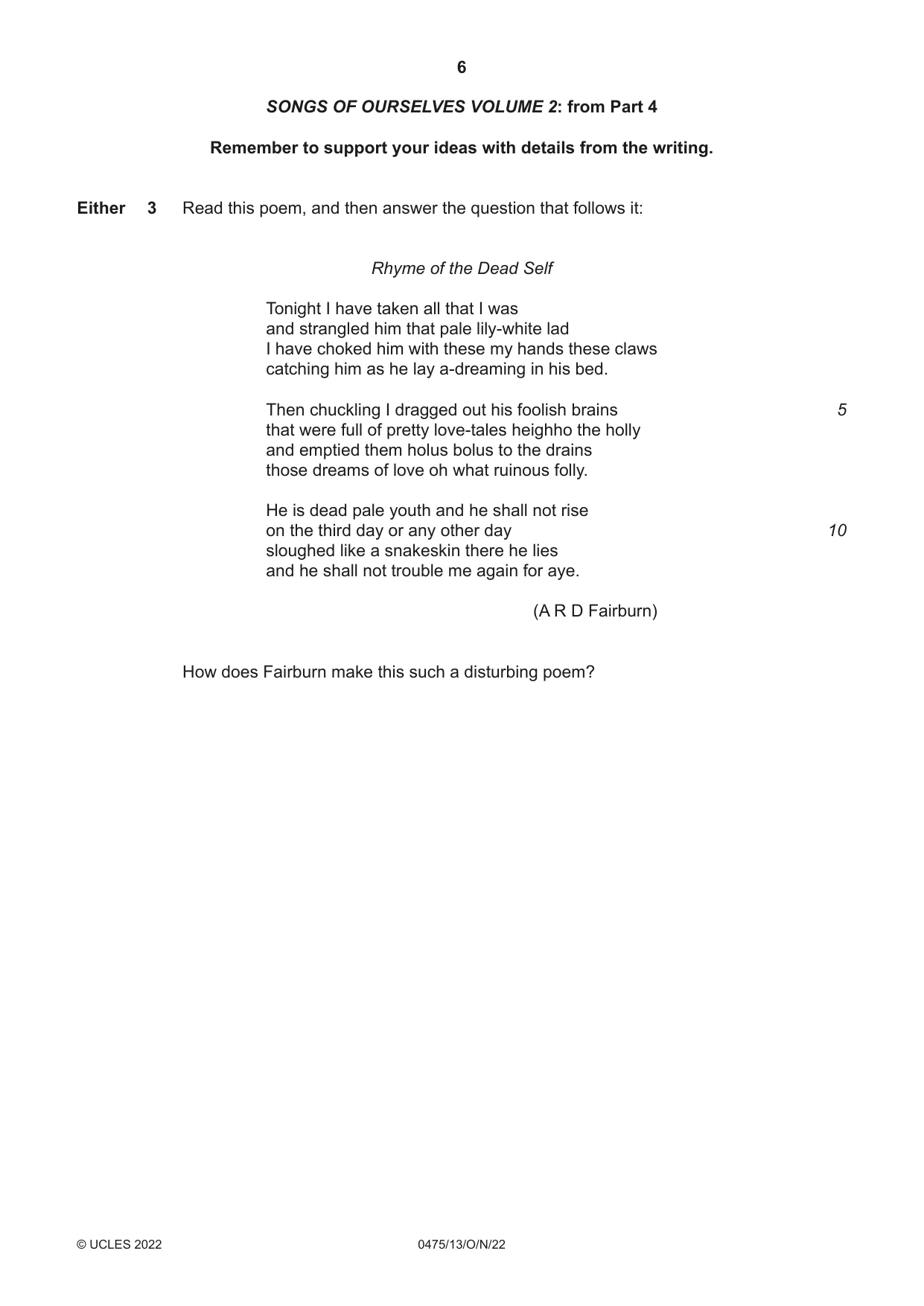
6 0475/13/O/N/22 © UCLES 2022 SONGS OF OURSELVES VOLUME 2: from Part 4 Remember to support your ideas with details from the writing. Either 3 Read this poem, and then answer the question that follows it: Rhyme of the Dead Self Tonight I have taken all that I was and strangled him that pale lily-white lad I have choked him with these my hands these claws catching him as he lay a-dreaming in his bed. Then chuckling I dragged out his foolish brains that were full of pretty love-tales heighho the holly and emptied them holus bolus to the drains those dreams of love oh what ruinous folly. He is dead pale youth and he shall not rise on the third day or any other day sloughed like a snakeskin there he lies and he shall not trouble me again for aye. (A R D Fairburn) How does Fairburn make this such a disturbing poem? 5 10
Question paper, page 7
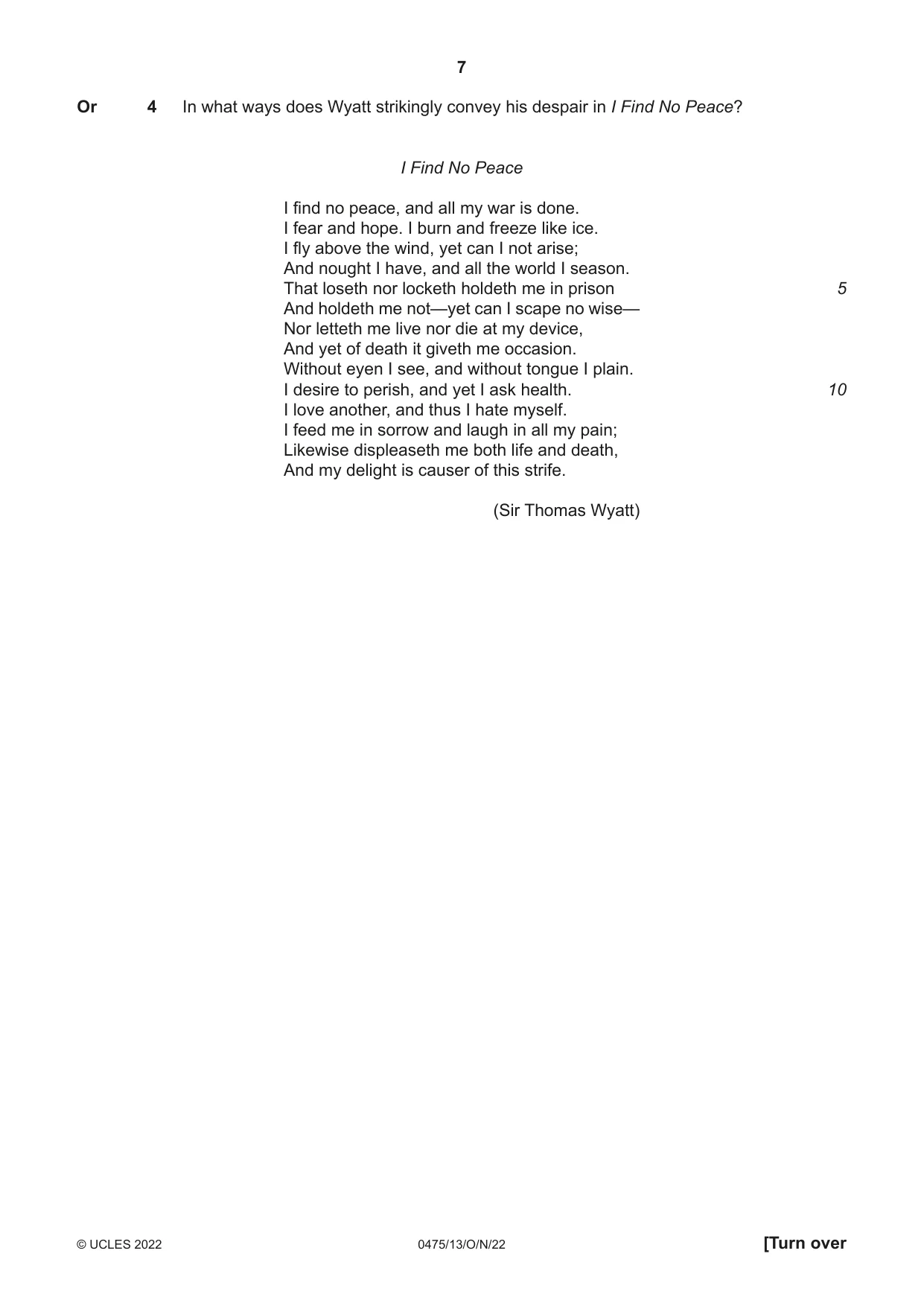
7 0475/13/O/N/22 © UCLES 2022 [Turn over Or 4 In what ways does Wyatt strikingly convey his despair in I Find No Peace? I Find No Peace I find no peace, and all my war is done. I fear and hope. I burn and freeze like ice. I fly above the wind, yet can I not arise; And nought I have, and all the world I season. That loseth nor locketh holdeth me in prison And holdeth me not—yet can I scape no wise — Nor letteth me live nor die at my device, And yet of death it giveth me occasion. Without eyen I see, and without tongue I plain. I desire to perish, and yet I ask health. I love another, and thus I hate myself. I feed me in sorrow and laugh in all my pain; Likewise displeaseth me both life and death, And my delight is causer of this strife. (Sir Thomas Wyatt) 5 10
Question paper, page 8
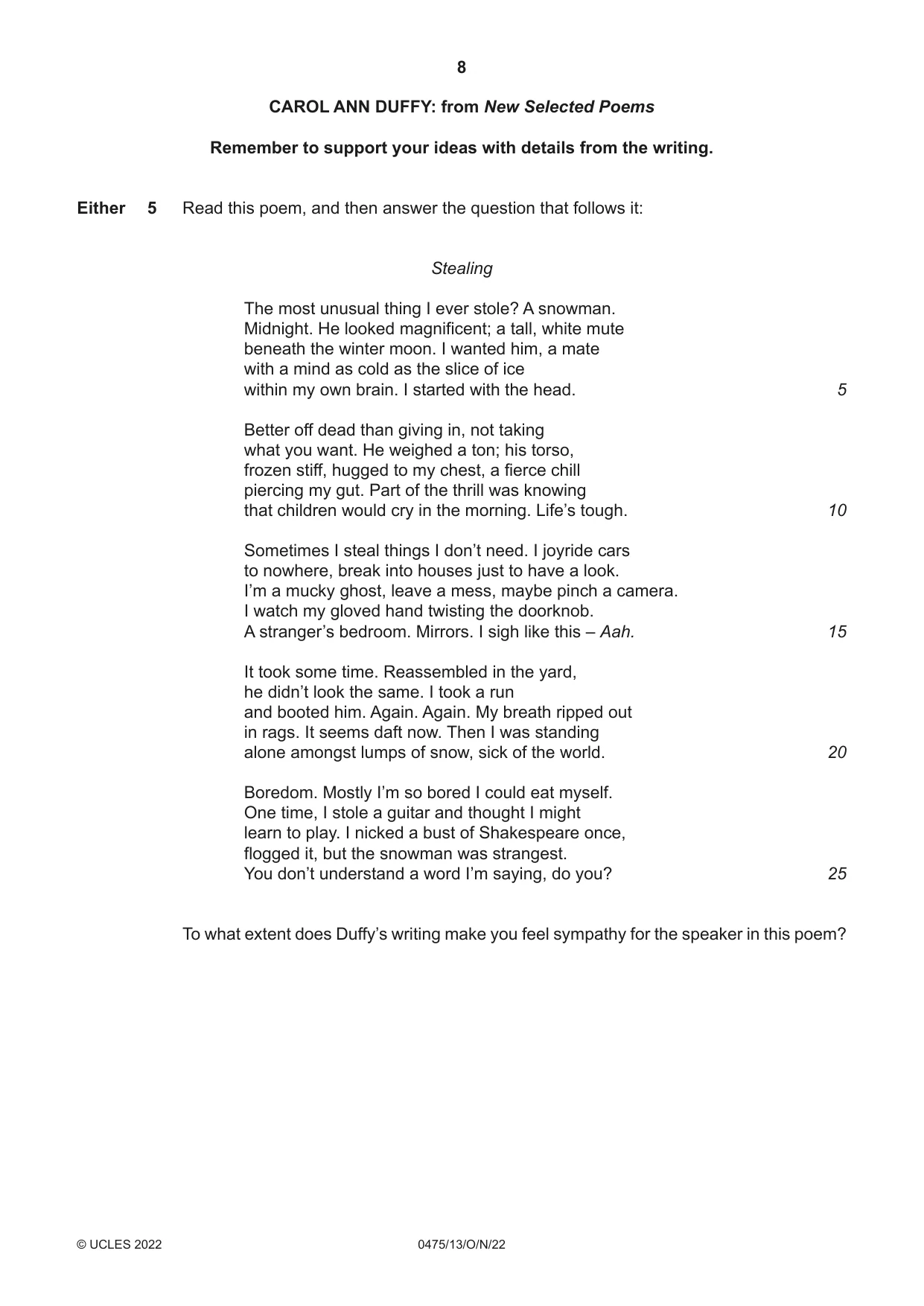
8 0475/13/O/N/22 © UCLES 2022 CAROL ANN DUFFY: from New Selected Poems Remember to support your ideas with details from the writing. Either 5 Read this poem, and then answer the question that follows it: Stealing The most unusual thing I ever stole? A snowman. Midnight. He looked magnificent; a tall, white mute beneath the winter moon. I wanted him, a mate with a mind as cold as the slice of ice within my own brain. I started with the head. Better off dead than giving in, not taking what you want. He weighed a ton; his torso, frozen stiff, hugged to my chest, a fierce chill piercing my gut. Part of the thrill was knowing that children would cry in the morning. Life’s tough. Sometimes I steal things I don’t need. I joyride cars to nowhere, break into houses just to have a look. I’m a mucky ghost, leave a mess, maybe pinch a camera. I watch my gloved hand twisting the doorknob. A stranger’s bedroom. Mirrors. I sigh like this – Aah. It took some time. Reassembled in the yard, he didn’t look the same. I took a run and booted him. Again. Again. My breath ripped out in rags. It seems daft now. Then I was standing alone amongst lumps of snow, sick of the world. Boredom. Mostly I’m so bored I could eat myself. One time, I stole a guitar and thought I might learn to play. I nicked a bust of Shakespeare once, flogged it, but the snowman was strangest. You don’t understand a word I’m saying, do you? To what extent does Duffy’s writing make you feel sympathy for the speaker in this poem? 5 10 15 20 25
Question paper, page 9
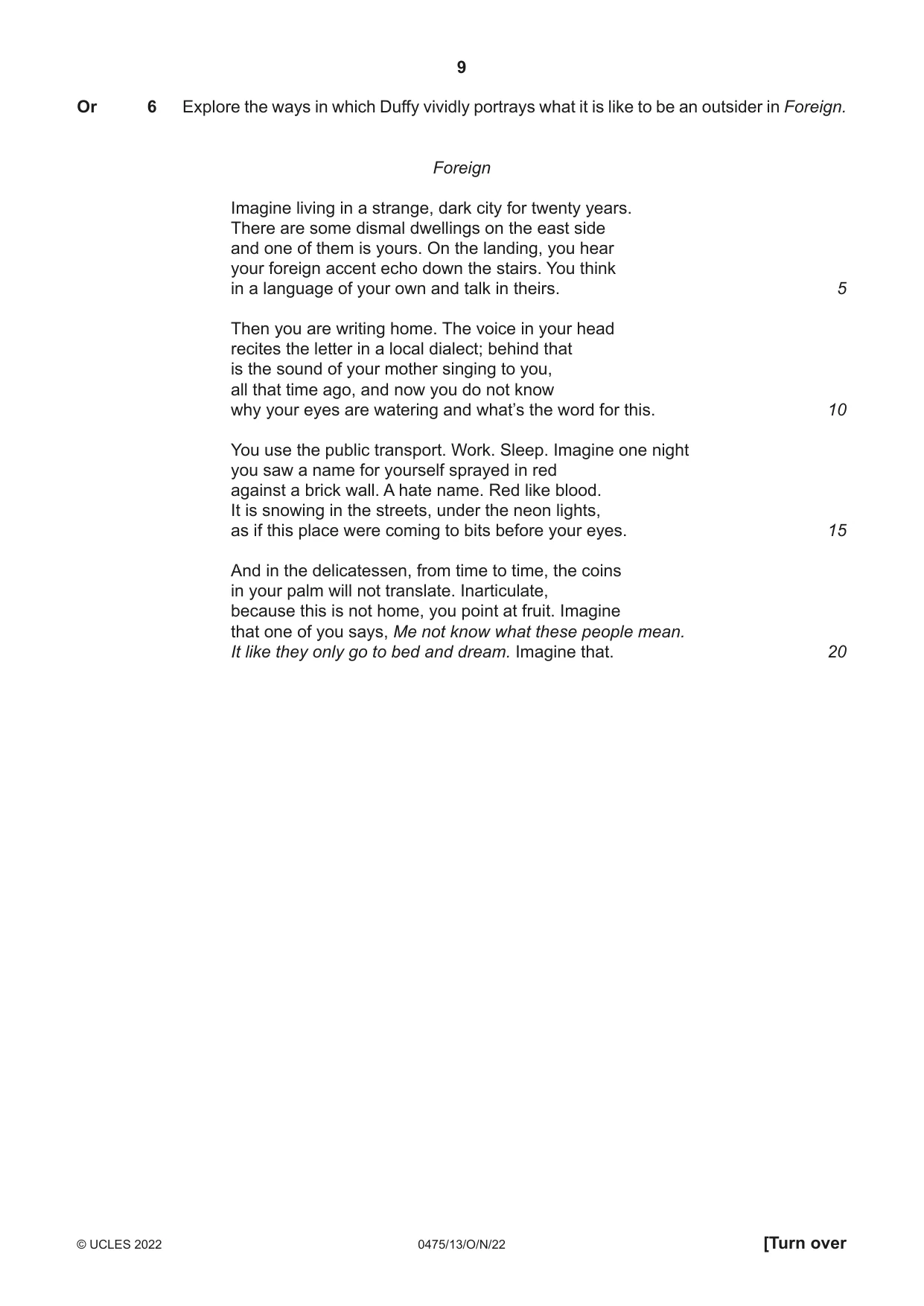
9 0475/13/O/N/22 © UCLES 2022 [Turn over Or 6 Explore the ways in which Duffy vividly portrays what it is like to be an outsider in Foreign. Foreign Imagine living in a strange, dark city for twenty years. There are some dismal dwellings on the east side and one of them is yours. On the landing, you hear your foreign accent echo down the stairs. You think in a language of your own and talk in theirs. Then you are writing home. The voice in your head recites the letter in a local dialect; behind that is the sound of your mother singing to you, all that time ago, and now you do not know why your eyes are watering and what’s the word for this. You use the public transport. Work. Sleep. Imagine one night you saw a name for yourself sprayed in red against a brick wall. A hate name. Red like blood. It is snowing in the streets, under the neon lights, as if this place were coming to bits before your eyes. And in the delicatessen, from time to time, the coins in your palm will not translate. Inarticulate, because this is not home, you point at fruit. Imagine that one of you says, Me not know what these people mean. It like they only go to bed and dream. Imagine that. 5 10 15 20
Question paper, page 10
10 0475/13/O/N/22 © UCLES 2022 SECTION B: PROSE Answer one question from this section. CHIMAMANDA NGOZI ADICHIE: Purple Hibiscus Remember to support your ideas with details from the writing. Either 7 Read this passage, and then answer the question that follows it: When Jaja and I sat down to have dinner that evening, I thought about Papa and Mama, sitting alone at our wide dining table. Content removed due to copyright restrictions.
Question paper, page 11
11 0475/13/O/N/22 © UCLES 2022 [Turn over Obiora turned on the TV after Aunty Ifeoma said good night and went into her bedroom. How does Adichie vividly convey the ways in which life at Aunty Ifeoma’s home surprises Kambili and Jaja? Or 8 Explore how Adichie memorably portrays Eugene’s power over Kambili. Content removed due to copyright restrictions.
Question paper, page 12
12 0475/13/O/N/22 © UCLES 2022 CHARLOTTE BRONTË: Jane Eyre Remember to support your ideas with details from the writing. Either 9 Read this passage, and then answer the question that follows it: ‘Helen!’ I whispered softly; ‘are you awake?’ She stirred herself, put back the curtain, and I saw her face, pale, wasted, but quite composed; she looked so little changed that my fear was instantly dissipated. ‘Can it be you, Jane?’ she asked, in her own gentle voice. ‘Oh!’ I thought, ‘she is not going to die; they are mistaken: she could not speak and look so calmly if she were.’ I got on to her crib and kissed her: her forehead was cold, and her cheek both cold and thin, and so were her hand and wrist: but she smiled as of old. ‘Why are you come here, Jane? It is past eleven o’clock: I heard it strike some minutes since.’ ‘I came to see you, Helen: I heard you were very ill, and I could not sleep till I had spoken to you.’ ‘You came to bid me good-bye, then: you are just in time probably.’ ‘Are you going somewhere, Helen? Are you going home?’ ‘Yes; to my long home – my last home.’ ‘No, no, Helen!’ I stopped, distressed. While I tried to devour my tears, a fit of coughing seized Helen; it did not, however, wake the nurse. When it was over, she lay some minutes exhausted; then she whispered – ‘Jane, your little feet are bare; lie down and cover yourself with my quilt.’ I did so: she put her arm over me, and I nestled close to her. After a long silence, she resumed, still whispering – ‘I am very happy, Jane; and when you hear that I am dead, you must be sure and not grieve: there is nothing to grieve about. We all must die one day, and the illness which is removing me is not painful; it is gentle and gradual: my mind is at rest. I leave no one to regret me much: I have only a father; and he is lately married, and will not miss me. By dying young, I shall escape great sufferings. I had not qualities or talents to make my way very well in the world: I should have been continually at fault.’ ‘But where are you going to, Helen? Can you see? Do you know?’ ‘I believe; I have faith: I am going to God.’ ‘Where is God? What is God?’ ‘My Maker and yours, who will never destroy what He created. I rely implicitly on His power, and confide wholly in His goodness: I count the hours till that eventful one arrives which shall restore me to Him, reveal Him to me.’ ‘You are sure, then, Helen, that there is such a place as heaven; and that our souls can get to it when we die?’ ‘I am sure there is a future state; I believe God is good; I can resign my immortal part to Him without any misgiving. God is my father; God is my friend: I love Him; I believe He loves me.’ ‘And shall I see you again, Helen, when I die?’ ‘You will come to the same region of happiness: be received by the same mighty universal Parent, no doubt, dear Jane.’ Again I questioned; but this time only in thought. ‘Where is that region? Does it exist?’ And I clasped my arms closer round Helen; she 5 10 15 20 25 30 35 40 45
Question paper, page 13
13 0475/13/O/N/22 © UCLES 2022 [Turn over seemed dearer to me than ever; I felt as if I could not let her go; I lay with my face hidden on her neck. Presently she said in the sweetest tone – ‘How comfortable I am! That last fit of coughing has tired me a little; I feel as if I could sleep: but don’t leave me, Jane; I like to have you near me.’ ‘I’ll stay with you, dear Helen: no one shall take me away.’ (from Chapter 9) How does Brontë make this such a moving and significant moment in the novel? Or 10 Explore two moments where Brontë memorably depicts bullying. 50
Question paper, page 14
14 0475/13/O/N/22 © UCLES 2022 ZORA NEALE HURSTON: Their Eyes Were Watching God Remember to support your ideas with details from the writing. Either 11 Read this passage, and then answer the question that follows it: The cooling palma christi leaves that Janie had bound about her grandma’s head with a white rag had wilted down and become part and parcel of the woman. Content removed due to copyright restrictions.
Question paper, page 15
15 0475/13/O/N/22 © UCLES 2022 [Turn over She don’t want nobody else to do it neither if she kin help it.' (from Chapter 2) In what ways does Hurston powerfully portray Janie and Nanny at this moment in the novel? Or 12 Explore the ways in which Hurston vividly depicts inequality in the novel. Content removed due to copyright restrictions.
Question paper, page 16
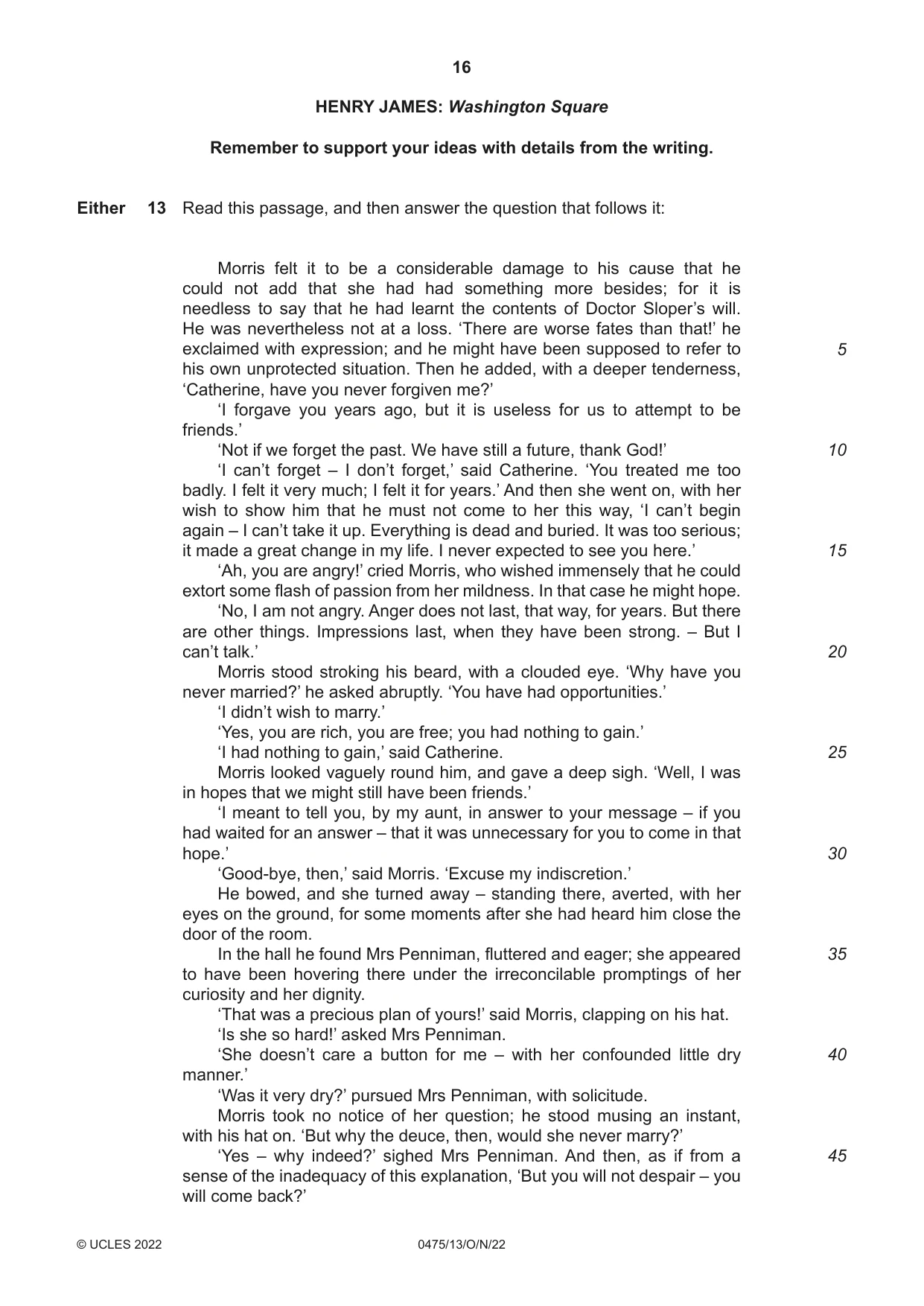
16 0475/13/O/N/22 © UCLES 2022 HENRY JAMES: Washington Square Remember to support your ideas with details from the writing. Either 13 Read this passage, and then answer the question that follows it: Morris felt it to be a considerable damage to his cause that he could not add that she had had something more besides; for it is needless to say that he had learnt the contents of Doctor Sloper’s will. He was nevertheless not at a loss. ‘There are worse fates than that!’ he exclaimed with expression; and he might have been supposed to refer to his own unprotected situation. Then he added, with a deeper tenderness, ‘Catherine, have you never forgiven me?’ ‘I forgave you years ago, but it is useless for us to attempt to be friends.’ ‘Not if we forget the past. We have still a future, thank God!’ ‘I can’t forget – I don’t forget,’ said Catherine. ‘You treated me too badly. I felt it very much; I felt it for years.’ And then she went on, with her wish to show him that he must not come to her this way, ‘I can’t begin again – I can’t take it up. Everything is dead and buried. It was too serious; it made a great change in my life. I never expected to see you here.’ ‘Ah, you are angry!’ cried Morris, who wished immensely that he could extort some flash of passion from her mildness. In that case he might hope. ‘No, I am not angry. Anger does not last, that way, for years. But there are other things. Impressions last, when they have been strong. – But I can’t talk.’ Morris stood stroking his beard, with a clouded eye. ‘Why have you never married?’ he asked abruptly. ‘You have had opportunities.’ ‘I didn’t wish to marry.’ ‘Yes, you are rich, you are free; you had nothing to gain.’ ‘I had nothing to gain,’ said Catherine. Morris looked vaguely round him, and gave a deep sigh. ‘Well, I was in hopes that we might still have been friends.’ ‘I meant to tell you, by my aunt, in answer to your message – if you had waited for an answer – that it was unnecessary for you to come in that hope.’ ‘Good-bye, then,’ said Morris. ‘Excuse my indiscretion.’ He bowed, and she turned away – standing there, averted, with her eyes on the ground, for some moments after she had heard him close the door of the room. In the hall he found Mrs Penniman, fluttered and eager; she appeared to have been hovering there under the irreconcilable promptings of her curiosity and her dignity. ‘That was a precious plan of yours!’ said Morris, clapping on his hat. ‘Is she so hard!’ asked Mrs Penniman. ‘She doesn’t care a button for me – with her confounded little dry manner.’ ‘Was it very dry?’ pursued Mrs Penniman, with solicitude. Morris took no notice of her question; he stood musing an instant, with his hat on. ‘But why the deuce, then, would she never marry?’ ‘Yes – why indeed?’ sighed Mrs Penniman. And then, as if from a sense of the inadequacy of this explanation, ‘But you will not despair – you will come back?’ 5 10 15 20 25 30 35 40 45
Question paper, page 17
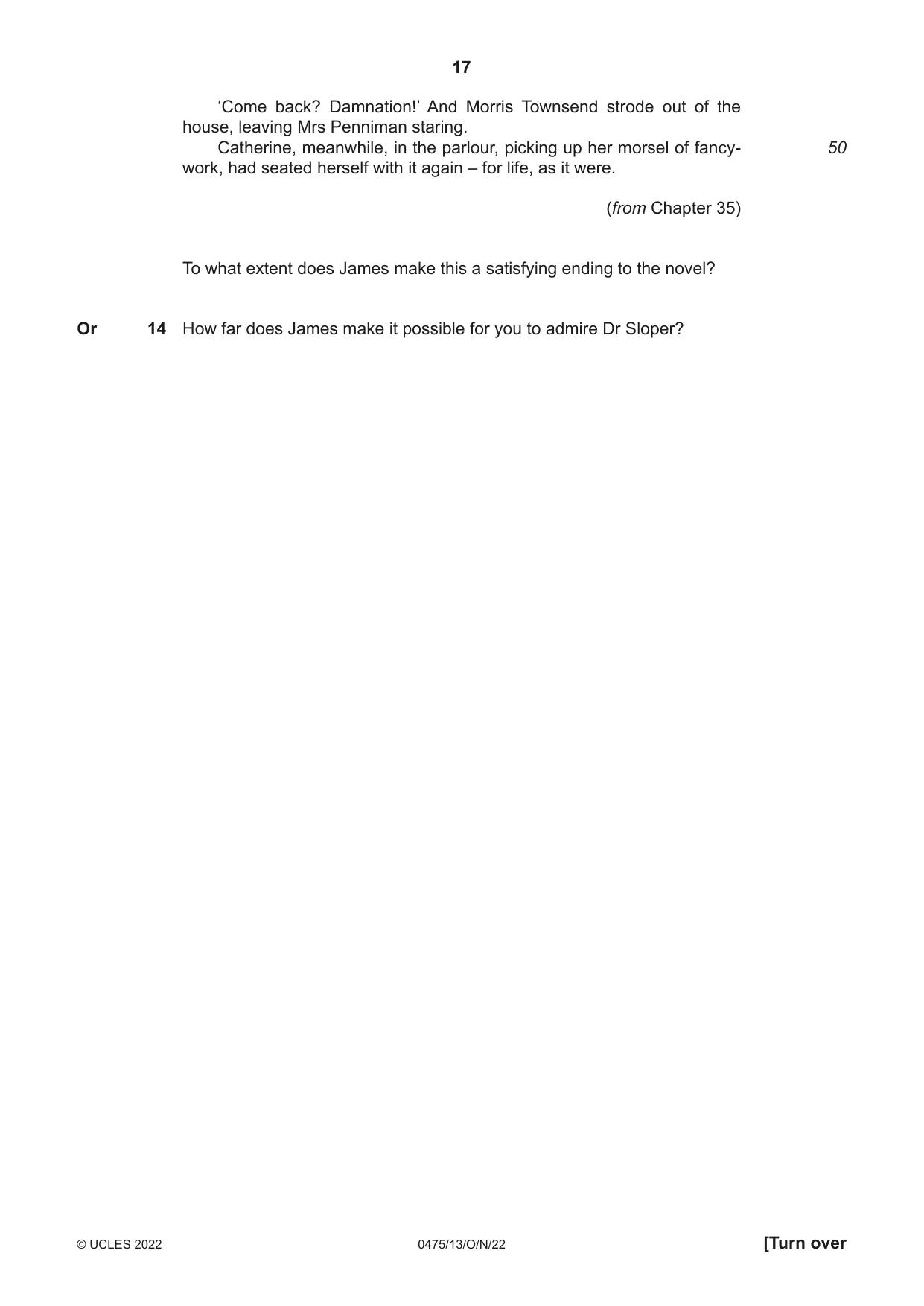
17 0475/13/O/N/22 © UCLES 2022 [Turn over ‘Come back? Damnation!’ And Morris Townsend strode out of the house, leaving Mrs Penniman staring. Catherine, meanwhile, in the parlour, picking up her morsel of fancy- work, had seated herself with it again – for life, as it were. (from Chapter 35) To what extent does James make this a satisfying ending to the novel? Or 14 How far does James make it possible for you to admire Dr Sloper? 50
Question paper, page 18
18 0475/13/O/N/22 © UCLES 2022 JHUMPA LAHIRI: The Namesake Remember to support your ideas with details from the writing. Either 15 Read this passage, and then answer the question that follows it: And yet to a casual observer, the Gangulis, apart from the name on their mailbox, apart from the issues of India Abroad and Sangbad Bichitra that are delivered there, appear no different from their neighbors. Content removed due to copyright restrictions.
Question paper, page 19
19 0475/13/O/N/22 © UCLES 2022 [Turn over In Bengali class they read from hand-sewn primers brought back by their teacher from Calcutta, intended for five-year-olds, printed, Gogol can’t help noticing, on paper that resembles the folded toilet paper he uses at school. (from Chapter 3) In what ways does Lahiri vividly capture the Gangulis’ attitudes to American culture at this moment in the novel? Or 16 How does Lahiri make Moushumi’s relationship with Dimitri such a powerful part of the novel? Content removed due to copyright restrictions.
Question paper, page 20
20 0475/13/O/N/22 © UCLES 2022 YANN MARTEL: Life of Pi Remember to support your ideas with details from the writing. Either 17 Read this passage, and then answer the question that follows it: The sun climbed through the sky, reached its zenith, began to come down. The night passed, minute by slow minute. (from Chapter 44) How does Martel strikingly convey Pi’s thoughts and feelings at this moment in the novel? Content removed due to copyright restrictions.
Question paper, page 21
21 0475/13/O/N/22 © UCLES 2022 [Turn over Or 18 In what ways does Martel make the meerkat island both mysterious and sinister?
Question paper, page 22
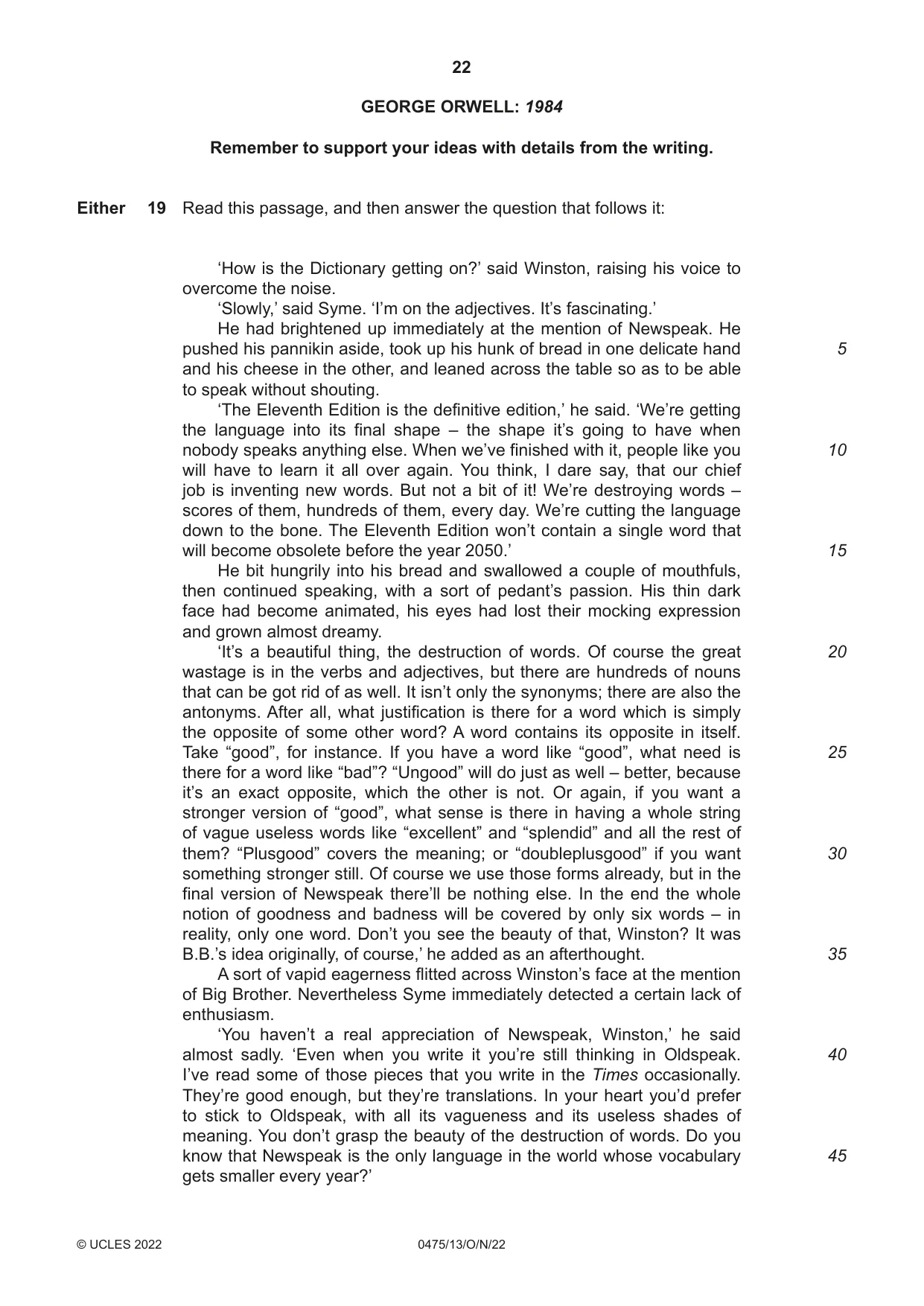
22 0475/13/O/N/22 © UCLES 2022 GEORGE ORWELL: 1984 Remember to support your ideas with details from the writing. Either 19 Read this passage, and then answer the question that follows it: ‘How is the Dictionary getting on?’ said Winston, raising his voice to overcome the noise. ‘Slowly,’ said Syme. ‘I’m on the adjectives. It’s fascinating.’ He had brightened up immediately at the mention of Newspeak. He pushed his pannikin aside, took up his hunk of bread in one delicate hand and his cheese in the other, and leaned across the table so as to be able to speak without shouting. ‘The Eleventh Edition is the definitive edition,’ he said. ‘We’re getting the language into its final shape – the shape it’s going to have when nobody speaks anything else. When we’ve finished with it, people like you will have to learn it all over again. You think, I dare say, that our chief job is inventing new words. But not a bit of it! We’re destroying words – scores of them, hundreds of them, every day. We’re cutting the language down to the bone. The Eleventh Edition won’t contain a single word that will become obsolete before the year 2050.’ He bit hungrily into his bread and swallowed a couple of mouthfuls, then continued speaking, with a sort of pedant’s passion. His thin dark face had become animated, his eyes had lost their mocking expression and grown almost dreamy. ‘It’s a beautiful thing, the destruction of words. Of course the great wastage is in the verbs and adjectives, but there are hundreds of nouns that can be got rid of as well. It isn’t only the synonyms; there are also the antonyms. After all, what justification is there for a word which is simply the opposite of some other word? A word contains its opposite in itself. Take “good”, for instance. If you have a word like “good”, what need is there for a word like “bad”? “Ungood” will do just as well – better, because it’s an exact opposite, which the other is not. Or again, if you want a stronger version of “good”, what sense is there in having a whole string of vague useless words like “excellent” and “splendid” and all the rest of them? “Plusgood” covers the meaning; or “doubleplusgood” if you want something stronger still. Of course we use those forms already, but in the final version of Newspeak there’ll be nothing else. In the end the whole notion of goodness and badness will be covered by only six words – in reality, only one word. Don’t you see the beauty of that, Winston? It was B.B.’s idea originally, of course,’ he added as an afterthought. A sort of vapid eagerness flitted across Winston’s face at the mention of Big Brother. Nevertheless Syme immediately detected a certain lack of enthusiasm. ‘You haven’t a real appreciation of Newspeak, Winston,’ he said almost sadly. ‘Even when you write it you’re still thinking in Oldspeak. I’ve read some of those pieces that you write in the Times occasionally. They’re good enough, but they’re translations. In your heart you’d prefer to stick to Oldspeak, with all its vagueness and its useless shades of meaning. You don’t grasp the beauty of the destruction of words. Do you know that Newspeak is the only language in the world whose vocabulary gets smaller every year?’ 5 10 15 20 25 30 35 40 45
Question paper, page 23
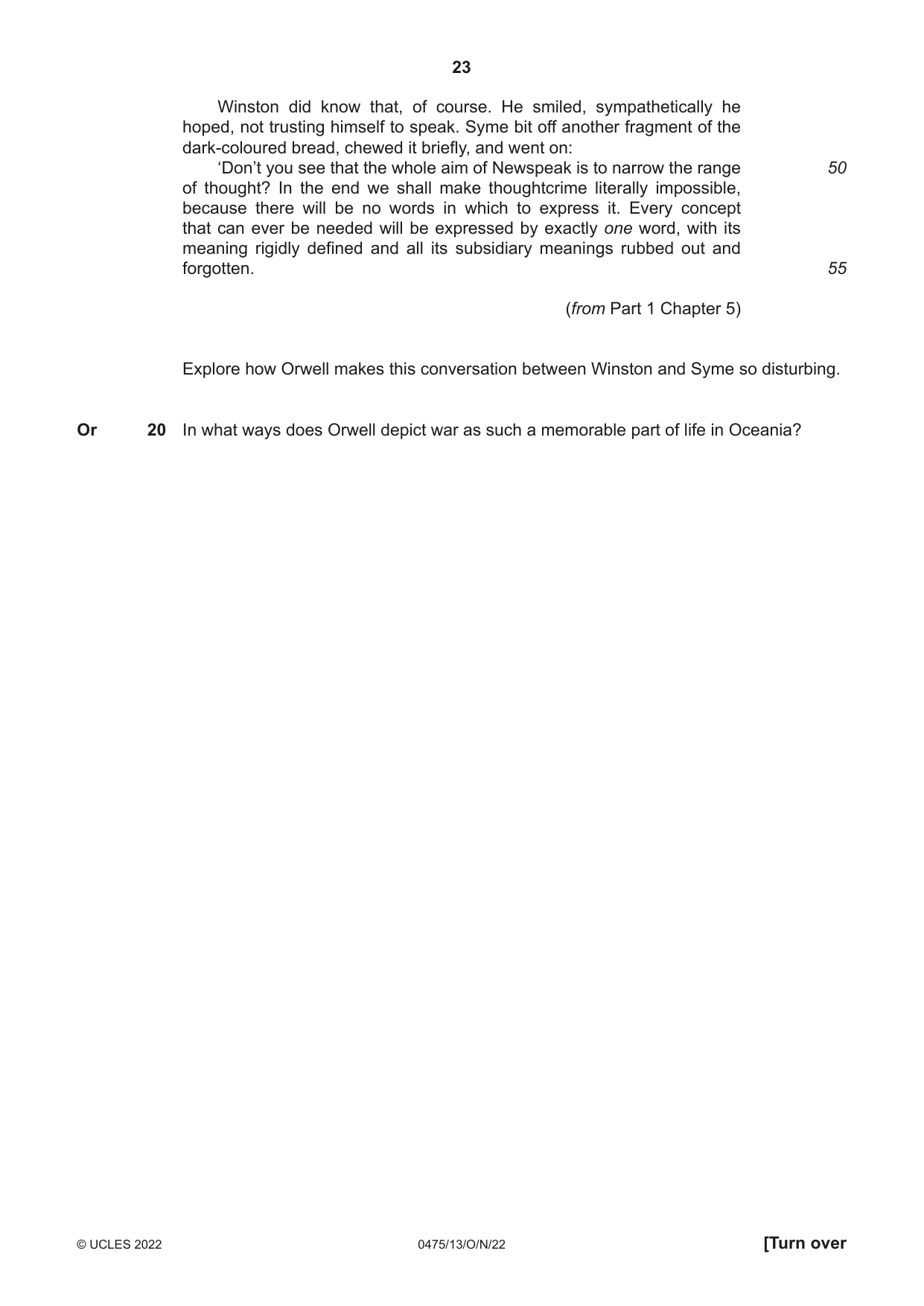
23 0475/13/O/N/22 © UCLES 2022 [Turn over Winston did know that, of course. He smiled, sympathetically he hoped, not trusting himself to speak. Syme bit off another fragment of the dark-coloured bread, chewed it briefly, and went on: ‘Don’t you see that the whole aim of Newspeak is to narrow the range of thought? In the end we shall make thoughtcrime literally impossible, because there will be no words in which to express it. Every concept that can ever be needed will be expressed by exactly one word, with its meaning rigidly defined and all its subsidiary meanings rubbed out and forgotten. (from Part 1 Chapter 5) Explore how Orwell makes this conversation between Winston and Syme so disturbing. Or 20 In what ways does Orwell depict war as such a memorable part of life in Oceania? 50 55
Question paper, page 24
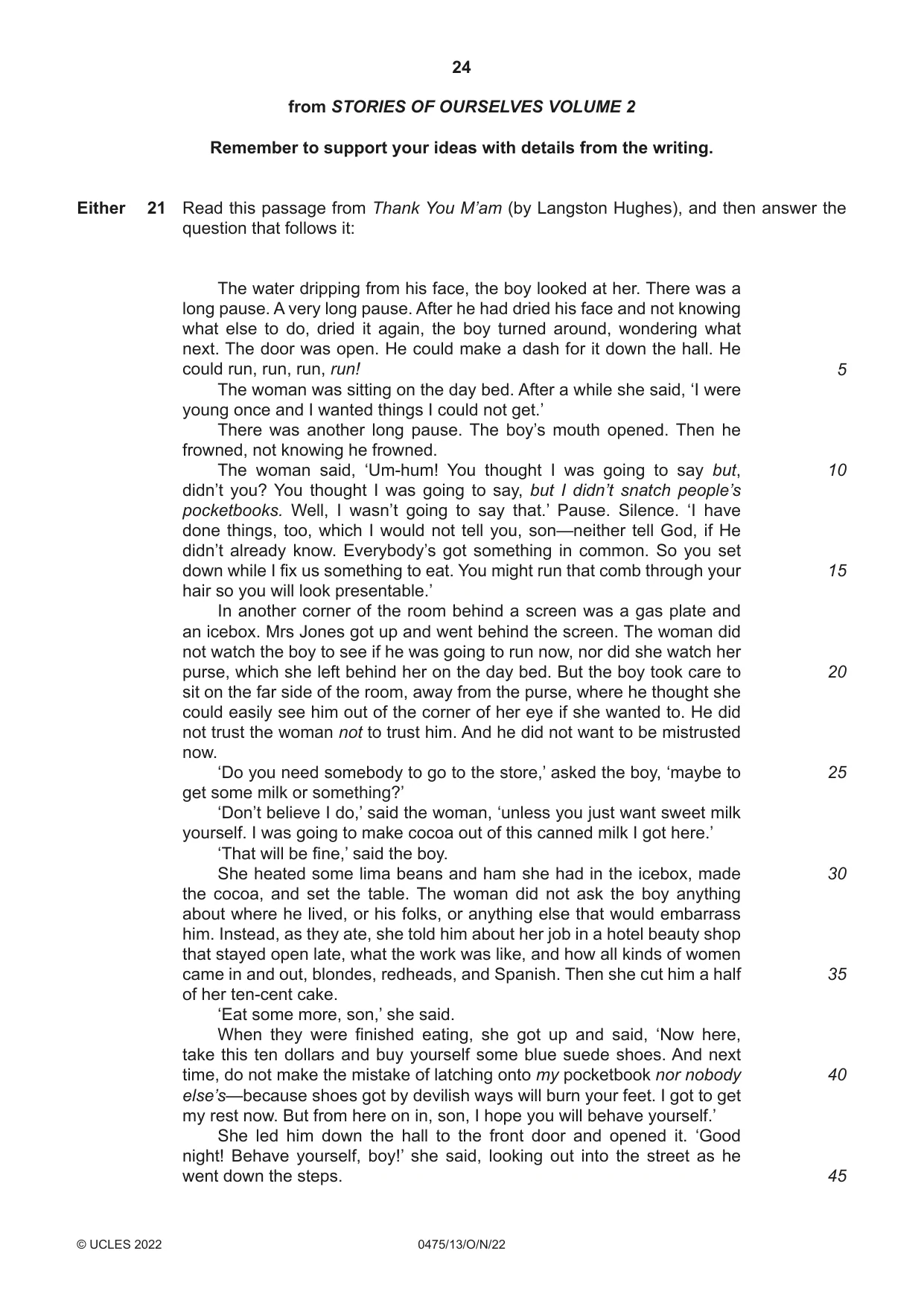
24 0475/13/O/N/22 © UCLES 2022 from STORIES OF OURSELVES VOLUME 2 Remember to support your ideas with details from the writing. Either 21 Read this passage from Thank You M’am (by Langston Hughes), and then answer the question that follows it: The water dripping from his face, the boy looked at her. There was a long pause. A very long pause. After he had dried his face and not knowing what else to do, dried it again, the boy turned around, wondering what next. The door was open. He could make a dash for it down the hall. He could run, run, run, run! The woman was sitting on the day bed. After a while she said, ‘I were young once and I wanted things I could not get.’ There was another long pause. The boy’s mouth opened. Then he frowned, not knowing he frowned. The woman said, ‘Um-hum! You thought I was going to say but, didn’t you? You thought I was going to say, but I didn’t snatch people’s pocketbooks. Well, I wasn’t going to say that.’ Pause. Silence. ‘I have done things, too, which I would not tell you, son—neither tell God, if He didn’t already know. Everybody’s got something in common. So you set down while I fix us something to eat. You might run that comb through your hair so you will look presentable.’ In another corner of the room behind a screen was a gas plate and an icebox. Mrs Jones got up and went behind the screen. The woman did not watch the boy to see if he was going to run now, nor did she watch her purse, which she left behind her on the day bed. But the boy took care to sit on the far side of the room, away from the purse, where he thought she could easily see him out of the corner of her eye if she wanted to. He did not trust the woman not to trust him. And he did not want to be mistrusted now. ‘Do you need somebody to go to the store,’ asked the boy, ‘maybe to get some milk or something?’ ‘Don’t believe I do,’ said the woman, ‘unless you just want sweet milk yourself. I was going to make cocoa out of this canned milk I got here.’ ‘That will be fine,’ said the boy. She heated some lima beans and ham she had in the icebox, made the cocoa, and set the table. The woman did not ask the boy anything about where he lived, or his folks, or anything else that would embarrass him. Instead, as they ate, she told him about her job in a hotel beauty shop that stayed open late, what the work was like, and how all kinds of women came in and out, blondes, redheads, and Spanish. Then she cut him a half of her ten-cent cake. ‘Eat some more, son,’ she said. When they were finished eating, she got up and said, ‘Now here, take this ten dollars and buy yourself some blue suede shoes. And next time, do not make the mistake of latching onto my pocketbook nor nobody else’s—because shoes got by devilish ways will burn your feet. I got to get my rest now. But from here on in, son, I hope you will behave yourself.’ She led him down the hall to the front door and opened it. ‘Good night! Behave yourself, boy!’ she said, looking out into the street as he went down the steps. 5 10 15 20 25 30 35 40 45
Question paper, page 25
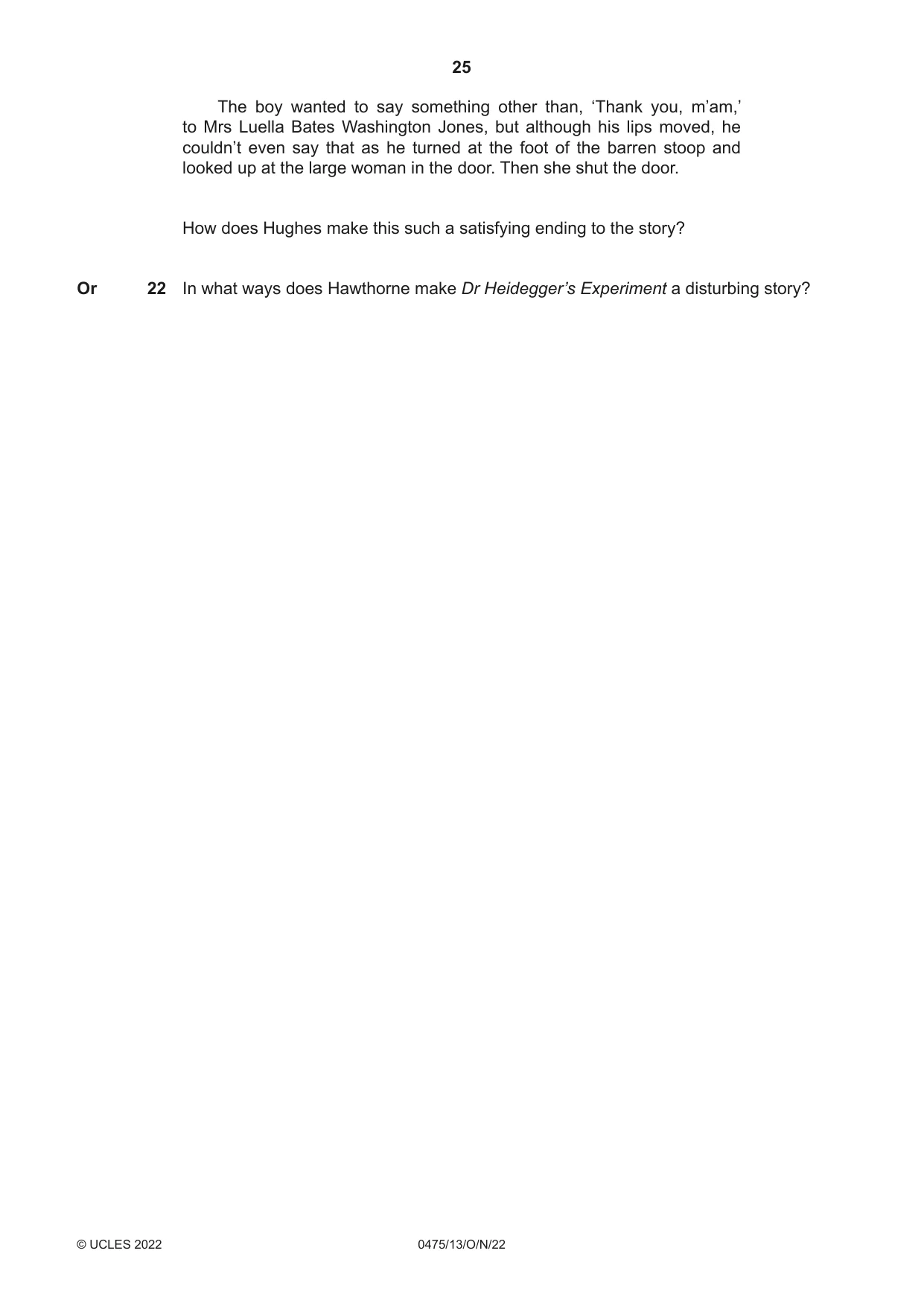
25 0475/13/O/N/22 © UCLES 2022 The boy wanted to say something other than, ‘Thank you, m’am,’ to Mrs Luella Bates Washington Jones, but although his lips moved, he couldn’t even say that as he turned at the foot of the barren stoop and looked up at the large woman in the door. Then she shut the door. How does Hughes make this such a satisfying ending to the story? Or 22 In what ways does Hawthorne make Dr Heidegger’s Experiment a disturbing story?
Question paper, page 26
26 0475/13/O/N/22 © UCLES 2022 BLANK PAGE
Question paper, page 27
27 0475/13/O/N/22 © UCLES 2022 BLANK PAGE
Question paper, page 28
28 0475/13/O/N/22 © UCLES 2022 Permission to reproduce items where third-party owned material protected by copyright is included has been sought and cleared where possible. Every reasonable effort has been made by the publisher (UCLES) to trace copyright holders, but if any items requiring clearance have unwittingly been included, the publisher will be pleased to make amends at the earliest possible opportunity. To avoid the issue of disclosure of answer-related information to candidates, all copyright acknowledgements are reproduced online in the Cambridge Assessment International Education Copyright Acknowledgements Booklet. This is produced for each series of examinations and is freely available to download at www.cambridgeinternational.org after the live examination series. Cambridge Assessment International Education is part of Cambridge Assessment. Cambridge Assessment is the brand name of the University of Cambridge Local Examinations Syndicate (UCLES), which is a department of the University of Cambridge. BLANK PAGE
Mark scheme, page 1
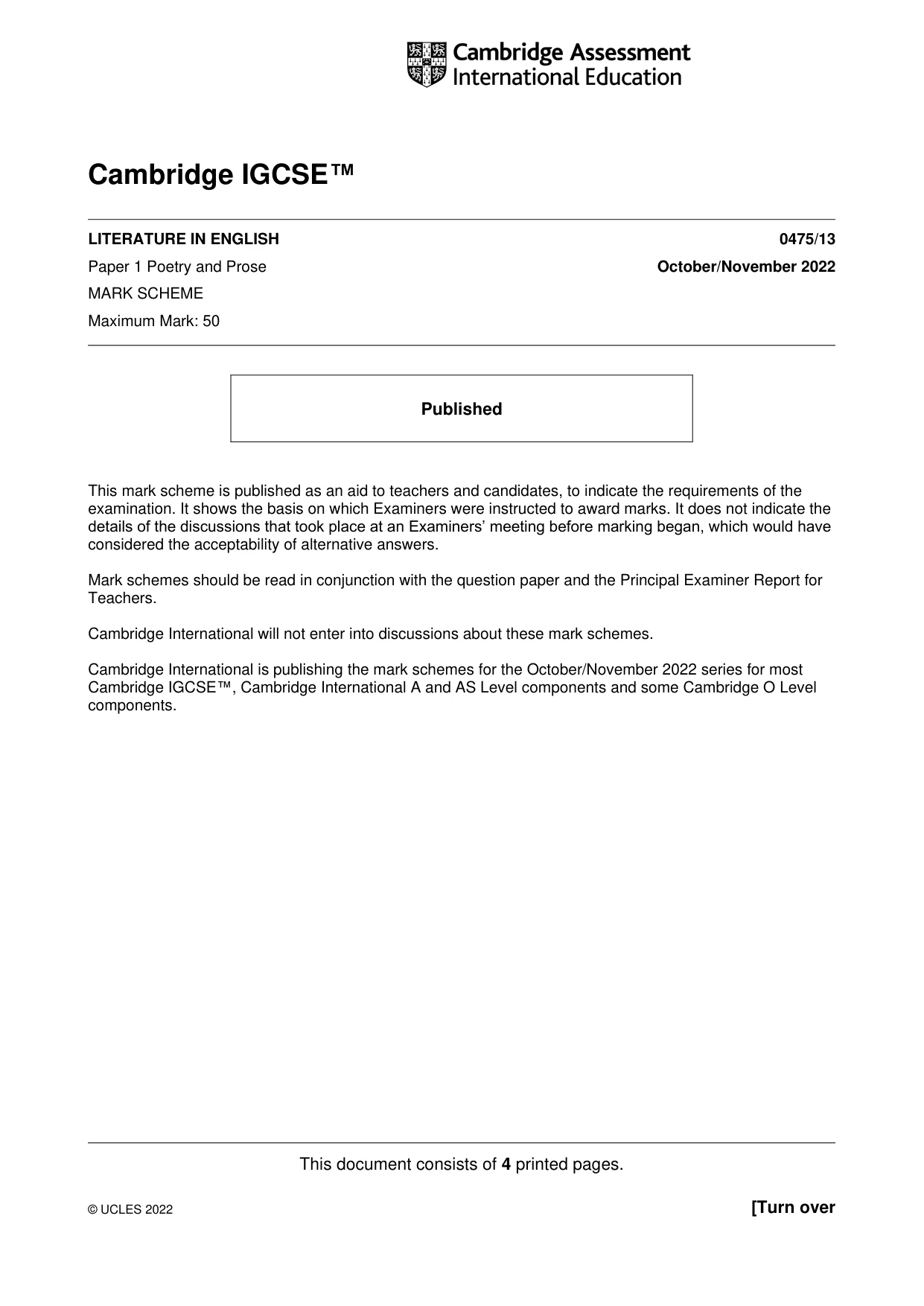
This document consists of 4 printed pages. © UCLES 2022 [Turn over Cambridge IGCSE™ LITERATURE IN ENGLISH 0475/13 Paper 1 Poetry and Prose October/November 2022 MARK SCHEME Maximum Mark: 50 Published This mark scheme is published as an aid to teachers and candidates, to indicate the requirements of the examination. It shows the basis on which Examiners were instructed to award marks. It does not indicate the details of the discussions that took place at an Examiners’ meeting before marking began, which would have considered the acceptability of alternative answers. Mark schemes should be read in conjunction with the question paper and the Principal Examiner Report for Teachers. Cambridge International will not enter into discussions about these mark schemes. Cambridge International is publishing the mark schemes for the October/November 2022 series for most Cambridge IGCSE™, Cambridge International A and AS Level components and some Cambridge O Level components.
Mark scheme, page 2
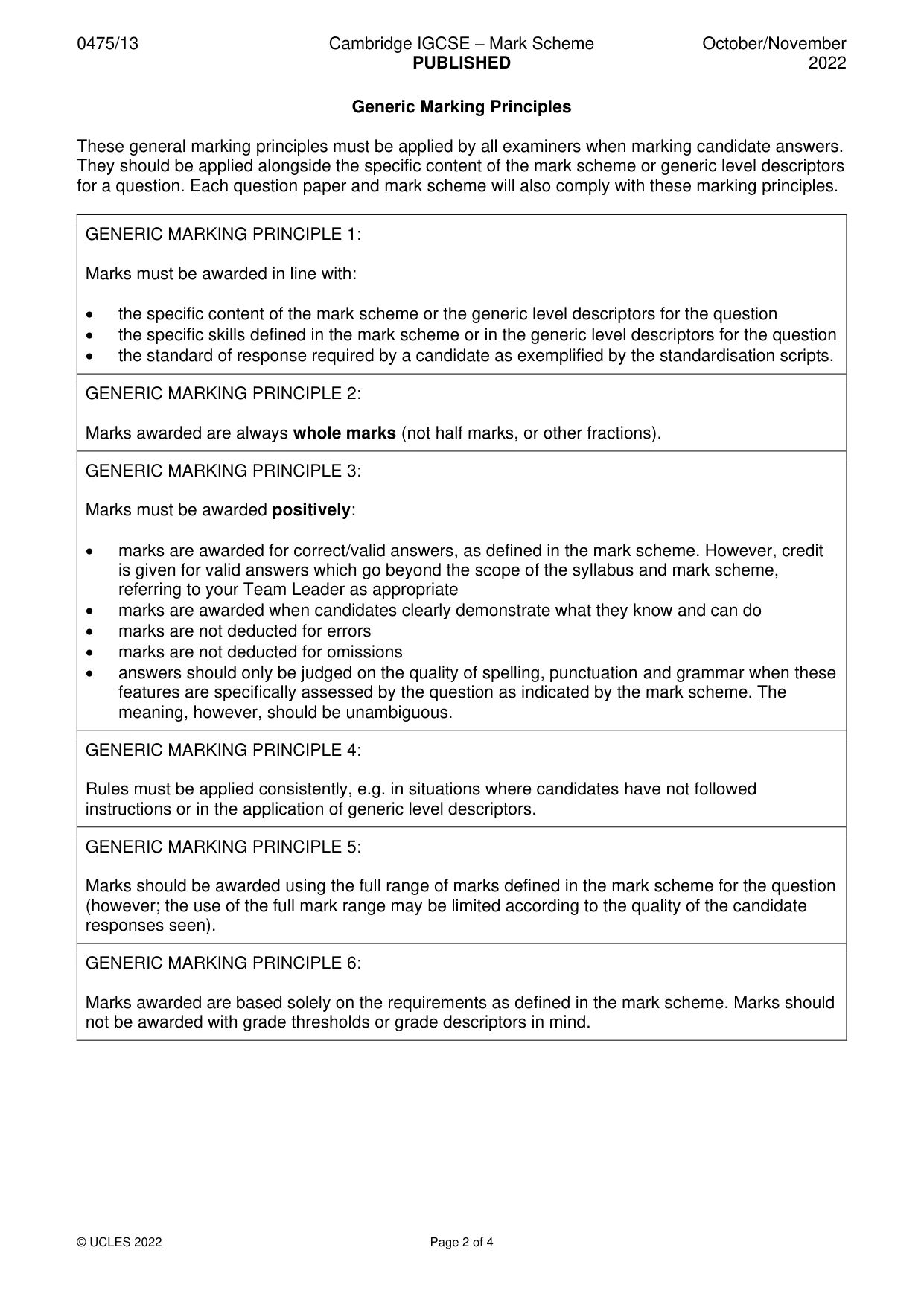
0475/13 Cambridge IGCSE – Mark Scheme PUBLISHED October/November 2022 © UCLES 2022 Page 2 of 4 Generic Marking Principles These general marking principles must be applied by all examiners when marking candidate answers. They should be applied alongside the specific content of the mark scheme or generic level descriptors for a question. Each question paper and mark scheme will also comply with these marking principles. GENERIC MARKING PRINCIPLE 1: Marks must be awarded in line with: • the specific content of the mark scheme or the generic level descriptors for the question • the specific skills defined in the mark scheme or in the generic level descriptors for the question • the standard of response required by a candidate as exemplified by the standardisation scripts. GENERIC MARKING PRINCIPLE 2: Marks awarded are always whole marks (not half marks, or other fractions). GENERIC MARKING PRINCIPLE 3: Marks must be awarded positively: • marks are awarded for correct/valid answers, as defined in the mark scheme. However, credit is given for valid answers which go beyond the scope of the syllabus and mark scheme, referring to your Team Leader as appropriate • marks are awarded when candidates clearly demonstrate what they know and can do • marks are not deducted for errors • marks are not deducted for omissions • answers should only be judged on the quality of spelling, punctuation and grammar when these features are specifically assessed by the question as indicated by the mark scheme. The meaning, however, should be unambiguous. GENERIC MARKING PRINCIPLE 4: Rules must be applied consistently, e.g. in situations where candidates have not followed instructions or in the application of generic level descriptors. GENERIC MARKING PRINCIPLE 5: Marks should be awarded using the full range of marks defined in the mark scheme for the question (however; the use of the full mark range may be limited according to the quality of the candidate responses seen). GENERIC MARKING PRINCIPLE 6: Marks awarded are based solely on the requirements as defined in the mark scheme. Marks should not be awarded with grade thresholds or grade descriptors in mind.
Mark scheme, page 3
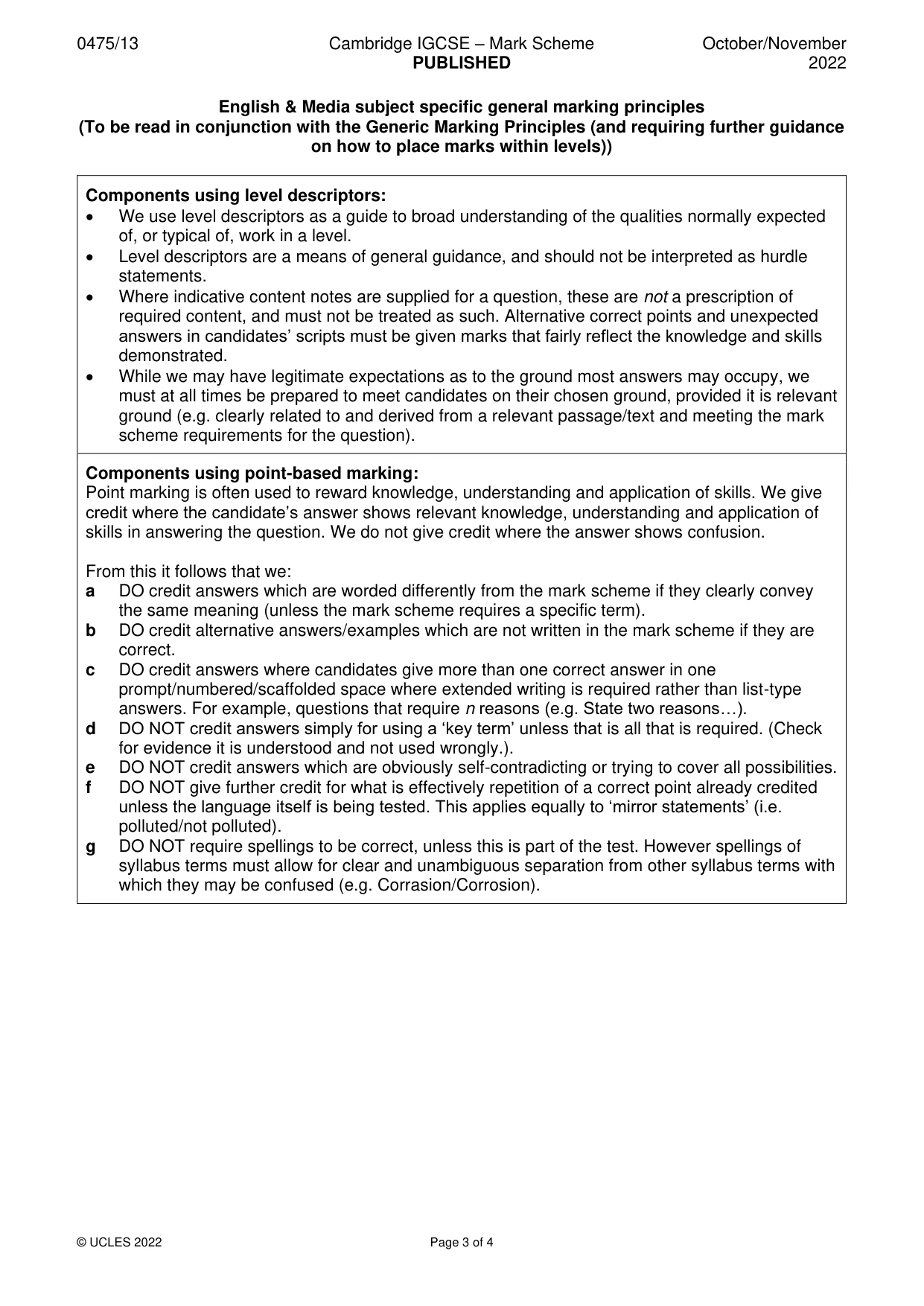
0475/13 Cambridge IGCSE – Mark Scheme PUBLISHED October/November 2022 © UCLES 2022 Page 3 of 4 English & Media subject specific general marking principles (To be read in conjunction with the Generic Marking Principles (and requiring further guidance on how to place marks within levels)) Components using level descriptors: • We use level descriptors as a guide to broad understanding of the qualities normally expected of, or typical of, work in a level. • Level descriptors are a means of general guidance, and should not be interpreted as hurdle statements. • Where indicative content notes are supplied for a question, these are not a prescription of required content, and must not be treated as such. Alternative correct points and unexpected answers in candidates’ scripts must be given marks that fairly reflect the knowledge and skills demonstrated. • While we may have legitimate expectations as to the ground most answers may occupy, we must at all times be prepared to meet candidates on their chosen ground, provided it is relevant ground (e.g. clearly related to and derived from a relevant passage/text and meeting the mark scheme requirements for the question). Components using point-based marking: Point marking is often used to reward knowledge, understanding and application of skills. We give credit where the candidate’s answer shows relevant knowledge, understanding and application of skills in answering the question. We do not give credit where the answer shows confusion. From this it follows that we: a DO credit answers which are worded differently from the mark scheme if they clearly convey the same meaning (unless the mark scheme requires a specific term). b DO credit alternative answers/examples which are not written in the mark scheme if they are correct. c DO credit answers where candidates give more than one correct answer in one prompt/numbered/scaffolded space where extended writing is required rather than list-type answers. For example, questions that require n reasons (e.g. State two reasons…). d DO NOT credit answers simply for using a ‘key term’ unless that is all that is required. (Check for evidence it is understood and not used wrongly.). e DO NOT credit answers which are obviously self-contradicting or trying to cover all possibilities. f DO NOT give further credit for what is effectively repetition of a correct point already credited unless the language itself is being tested. This applies equally to ‘mirror statements’ (i.e. polluted/not polluted). g DO NOT require spellings to be correct, unless this is part of the test. However spellings of syllabus terms must allow for clear and unambiguous separation from other syllabus terms with which they may be confused (e.g. Corrasion/Corrosion).
Mark scheme, page 4
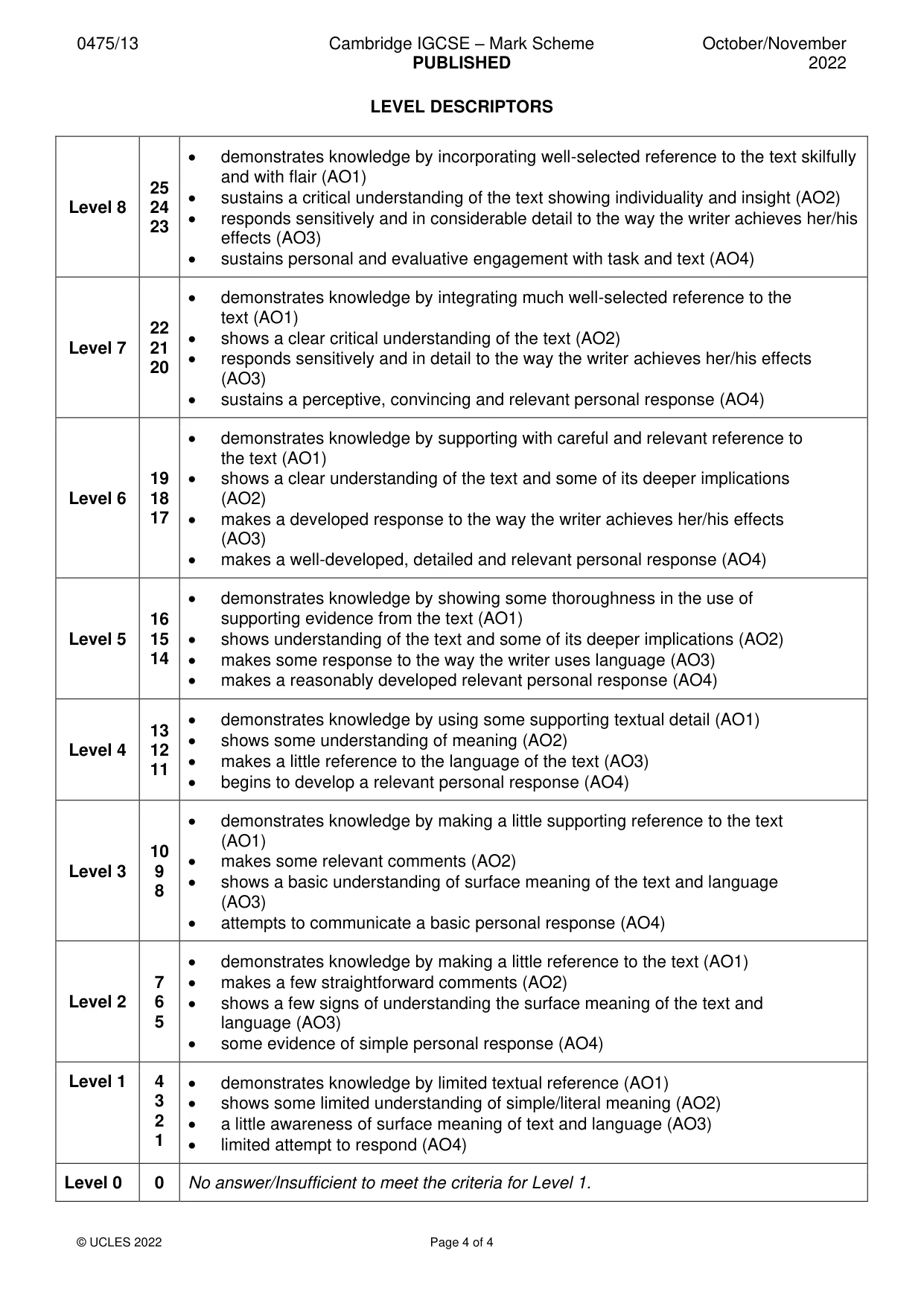
0475/13 Cambridge IGCSE – Mark Scheme PUBLISHED October/November 2022 © UCLES 2022 Page 4 of 4 LEVEL DESCRIPTORS Level 8 25 24 23 • demonstrates knowledge by incorporating well-selected reference to the text skilfully and with flair (AO1) • sustains a critical understanding of the text showing individuality and insight (AO2) • responds sensitively and in considerable detail to the way the writer achieves her/his effects (AO3) • sustains personal and evaluative engagement with task and text (AO4) Level 7 22 21 20 • demonstrates knowledge by integrating much well-selected reference to the text (AO1) • shows a clear critical understanding of the text (AO2) • responds sensitively and in detail to the way the writer achieves her/his effects (AO3) • sustains a perceptive, convincing and relevant personal response (AO4) Level 6 19 18 17 • demonstrates knowledge by supporting with careful and relevant reference to the text (AO1) • shows a clear understanding of the text and some of its deeper implications (AO2) • makes a developed response to the way the writer achieves her/his effects (AO3) • makes a well-developed, detailed and relevant personal response (AO4) Level 5 16 15 14 • demonstrates knowledge by showing some thoroughness in the use of supporting evidence from the text (AO1) • shows understanding of the text and some of its deeper implications (AO2) • makes some response to the way the writer uses language (AO3) • makes a reasonably developed relevant personal response (AO4) Level 4 13 12 11 • demonstrates knowledge by using some supporting textual detail (AO1) • shows some understanding of meaning (AO2) • makes a little reference to the language of the text (AO3) • begins to develop a relevant personal response (AO4) Level 3 10 9 8 • demonstrates knowledge by making a little supporting reference to the text (AO1) • makes some relevant comments (AO2) • shows a basic understanding of surface meaning of the text and language (AO3) • attempts to communicate a basic personal response (AO4) Level 2 7 6 5 • demonstrates knowledge by making a little reference to the text (AO1) • makes a few straightforward comments (AO2) • shows a few signs of understanding the surface meaning of the text and language (AO3) • some evidence of simple personal response (AO4) Level 1 4 3 2 1 • demonstrates knowledge by limited textual reference (AO1) • shows some limited understanding of simple/literal meaning (AO2) • a little awareness of surface meaning of text and language (AO3) • limited attempt to respond (AO4) Level 0 0 No answer/Insufficient to meet the criteria for Level 1.
What you needed in this session
Cambridge’s own grade thresholds for 2022 Oct/Nov, Paper 1 · Variant 3. A higher threshold means an easier paper — the bar moves with how the cohort did.