Cambridge IGCSE English - Literature in English 0475 — 2022 Oct/Nov Paper 1 · Variant 1
0475/11/O/N/22 · 50 marks · ≈56 min
The question paper and its mark scheme, free to read here and free to download. This is Cambridge’s own paper, exactly as it was sat.
Question paper28 pages




Mark scheme4 pages
Answers below. Sit the paper first if you are practising.
Paper as text
Question paper, page 1
This document has 28 pages. Any blank pages are indicated. Cambridge IGCSE™ * 4 9 2 5 8 6 5 3 8 7 * LITERATURE IN ENGLISH 0475/11 Paper 1 Poetry and Prose October/November 2022 1 hour 30 minutes You must answer on the enclosed answer booklet. You will need: Answer booklet (enclosed) INSTRUCTIONS ● Answer two questions in total: Section A: answer one question. Section B: answer one question. ● Follow the instructions on the front cover of the answer booklet. If you need additional answer paper, ask the invigilator for a continuation booklet. INFORMATION ● The total mark for this paper is 50. ● All questions are worth equal marks. DC (RCL (DF)) 302899/1 © UCLES 2022 [Turn over
Question paper, page 2
2 0475/11/O/N/22 © UCLES 2022 BLANK PAGE
Question paper, page 3
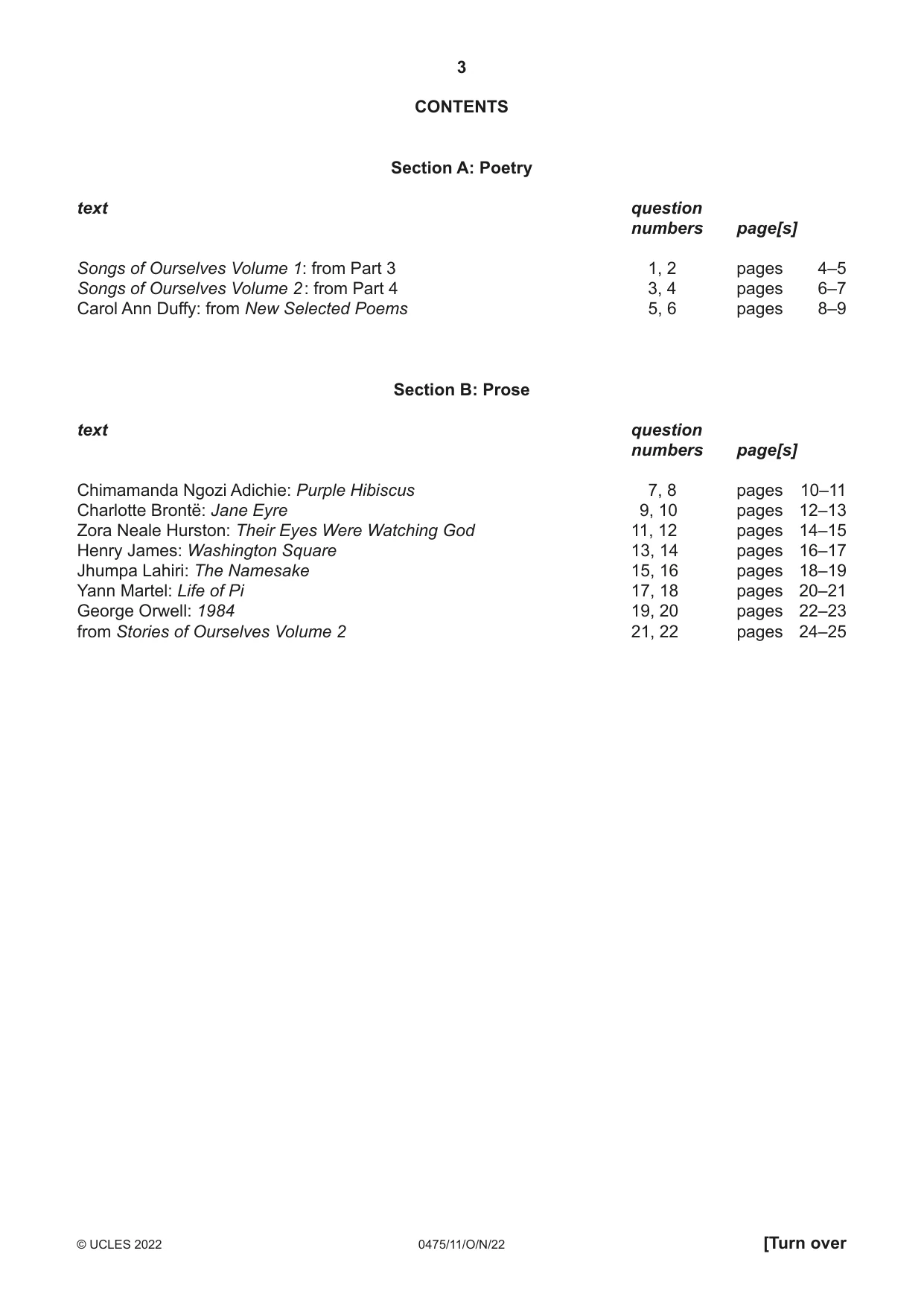
3 0475/11/O/N/22 © UCLES 2022 [Turn over CONTENTS Section A: Poetry text question numbers page[s] Songs of Ourselves Volume 1: from Part 3 1, 2 pages 4–5 Songs of Ourselves Volume 2 : from Part 4 3, 4 pages 6–7 Carol Ann Duffy: from New Selected Poems 5, 6 pages 8–9 Section B: Prose text question numbers page[s] Chimamanda Ngozi Adichie: Purple Hibiscus 7, 8 pages 10–11 Charlotte Brontë: Jane Eyre 9, 10 pages 12–13 Zora Neale Hurston: Their Eyes Were Watching God 11, 12 pages 14–15 Henry James: Washington Square 13, 14 pages 16–17 Jhumpa Lahiri: The Namesake 15, 16 pages 18–19 Yann Martel: Life of Pi 17, 18 pages 20–21 George Orwell: 1984 19, 20 pages 22–23 from Stories of Ourselves Volume 2 21, 22 pages 24–25
Question paper, page 4
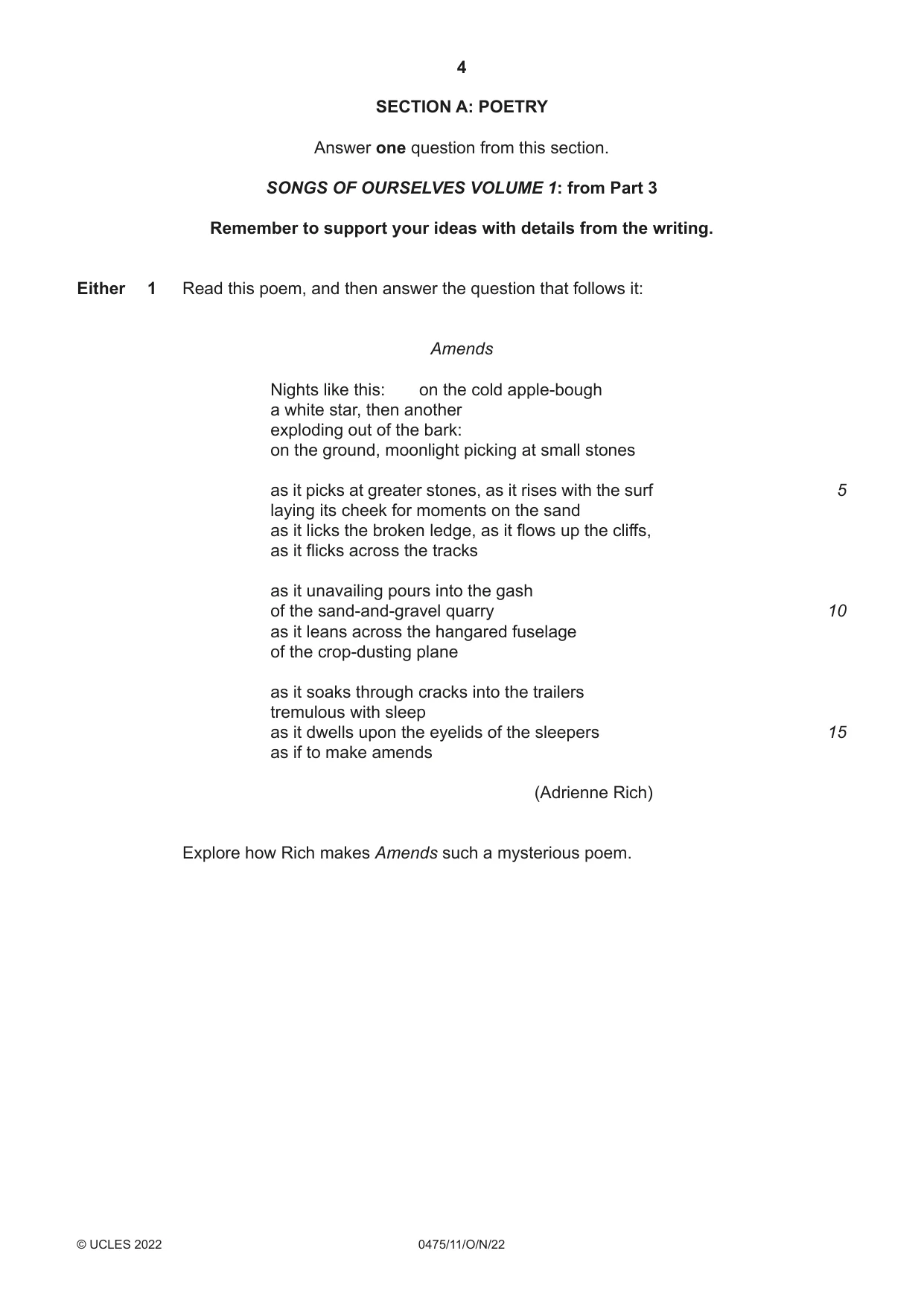
4 0475/11/O/N/22 © UCLES 2022 SECTION A: POETRY Answer one question from this section. SONGS OF OURSELVES VOLUME 1: from Part 3 Remember to support your ideas with details from the writing. Either 1 Read this poem, and then answer the question that follows it: Amends Nights like this: on the cold apple-bough a white star, then another exploding out of the bark: on the ground, moonlight picking at small stones as it picks at greater stones, as it rises with the surf laying its cheek for moments on the sand as it licks the broken ledge, as it flows up the cliffs, as it flicks across the tracks as it unavailing pours into the gash of the sand-and-gravel quarry as it leans across the hangared fuselage of the crop-dusting plane as it soaks through cracks into the trailers tremulous with sleep as it dwells upon the eyelids of the sleepers as if to make amends (Adrienne Rich) Explore how Rich makes Amends such a mysterious poem. 5 10 15
Question paper, page 5
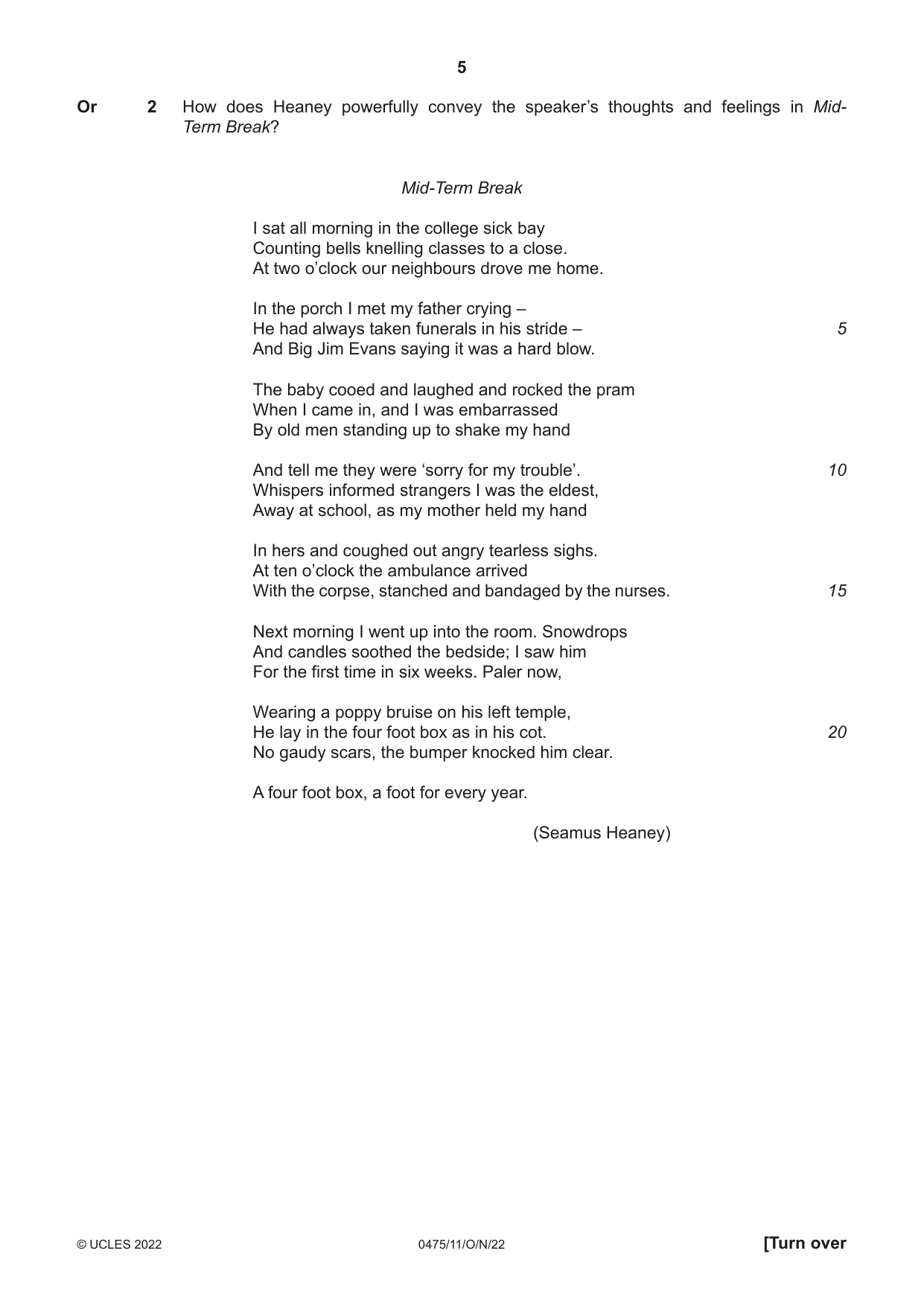
5 0475/11/O/N/22 © UCLES 2022 [Turn over Or 2 How does Heaney powerfully convey the speaker’s thoughts and feelings in Mid- Term Break? Mid-Term Break I sat all morning in the college sick bay Counting bells knelling classes to a close. At two o’clock our neighbours drove me home. In the porch I met my father crying – He had always taken funerals in his stride – And Big Jim Evans saying it was a hard blow. The baby cooed and laughed and rocked the pram When I came in, and I was embarrassed By old men standing up to shake my hand And tell me they were ‘sorry for my trouble’. Whispers informed strangers I was the eldest, Away at school, as my mother held my hand In hers and coughed out angry tearless sighs. At ten o’clock the ambulance arrived With the corpse, stanched and bandaged by the nurses. Next morning I went up into the room. Snowdrops And candles soothed the bedside; I saw him For the first time in six weeks. Paler now, Wearing a poppy bruise on his left temple, He lay in the four foot box as in his cot. No gaudy scars, the bumper knocked him clear. A four foot box, a foot for every year. (Seamus Heaney) 5 10 15 20
Question paper, page 6
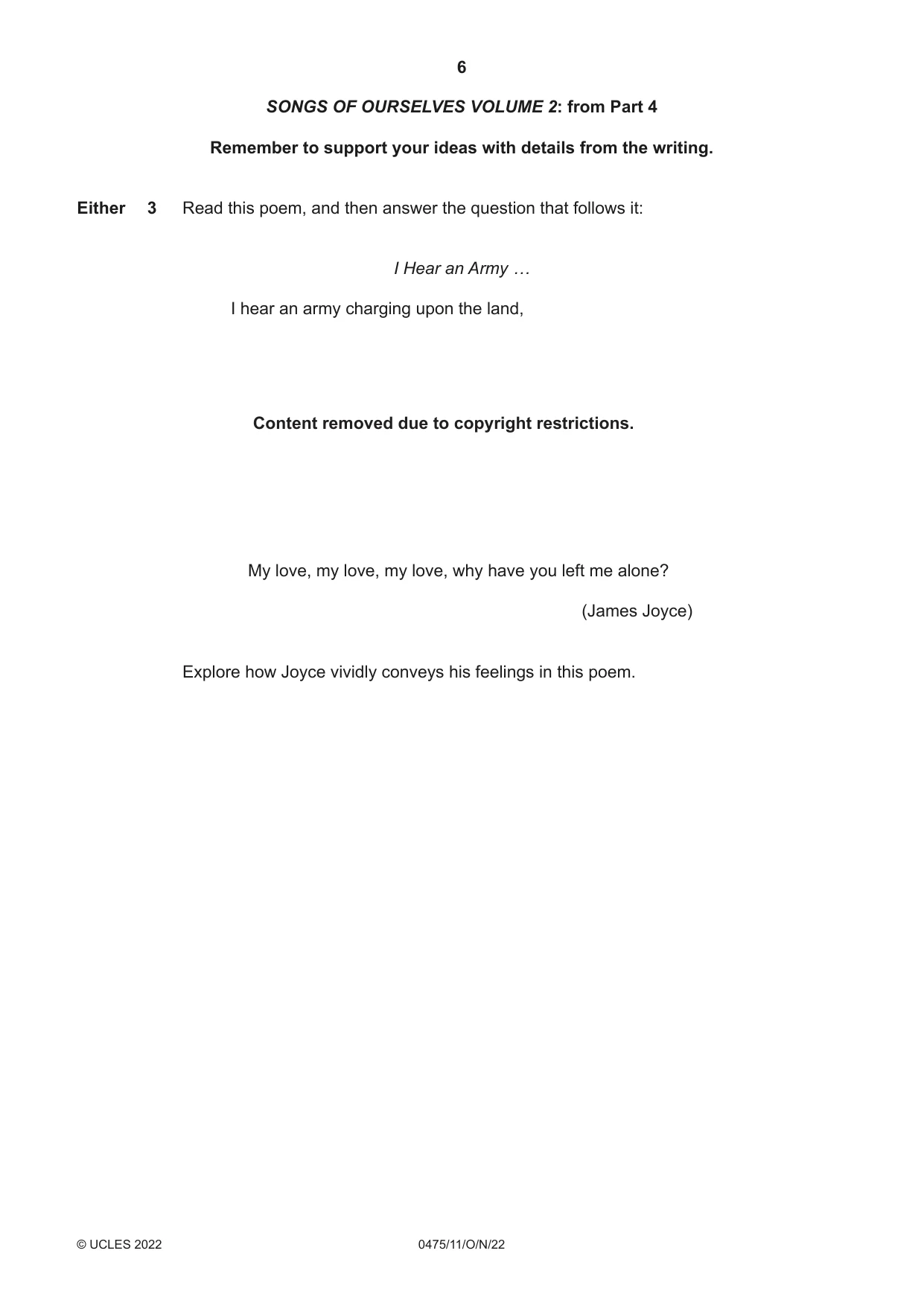
6 0475/11/O/N/22 © UCLES 2022 SONGS OF OURSELVES VOLUME 2: from Part 4 Remember to support your ideas with details from the writing. Either 3 Read this poem, and then answer the question that follows it: I Hear an Army … I hear an army charging upon the land, My love, my love, my love, why have you left me alone? (James Joyce) Explore how Joyce vividly conveys his feelings in this poem. Content removed due to copyright restrictions.
Question paper, page 7
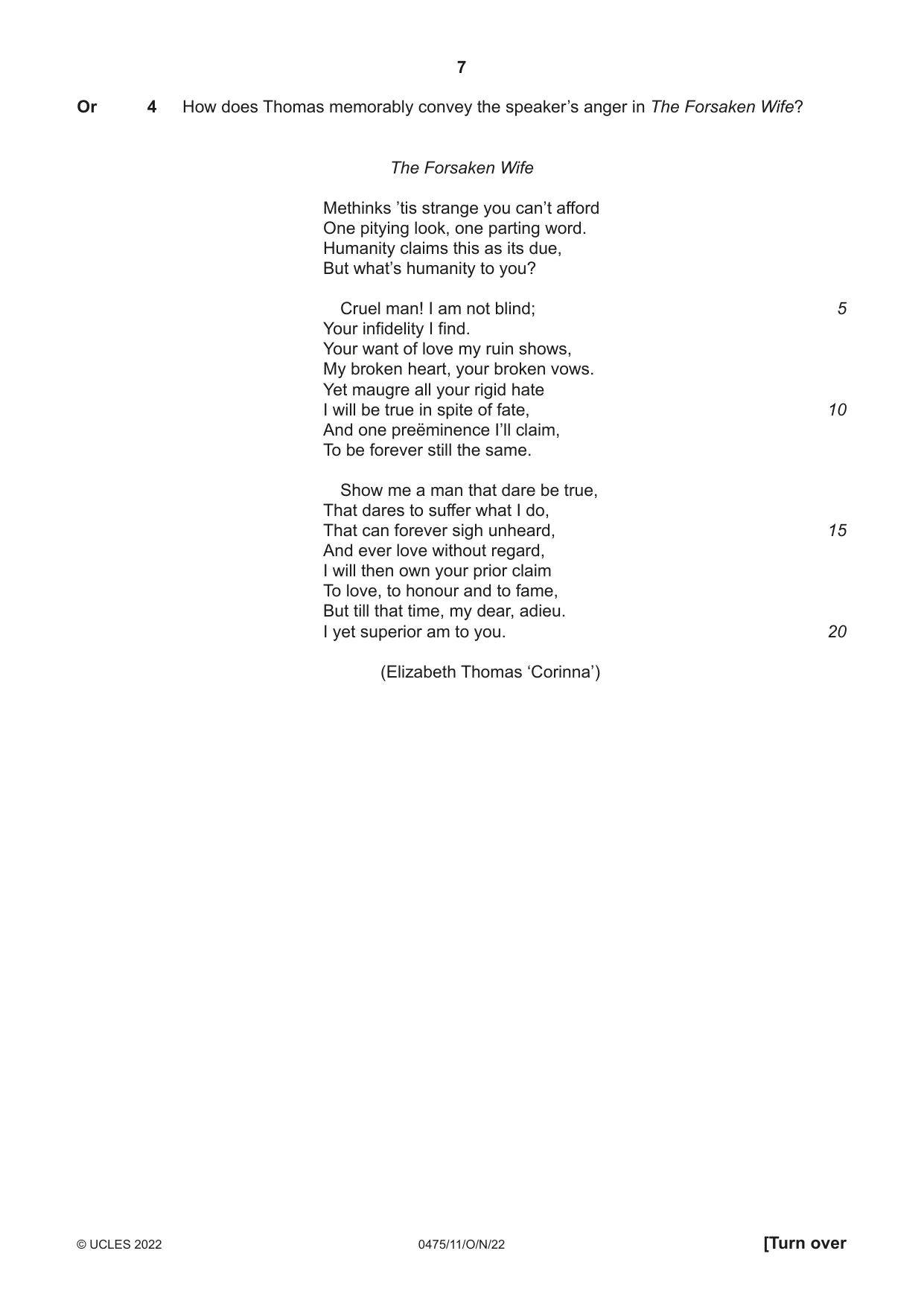
7 0475/11/O/N/22 © UCLES 2022 [Turn over Or 4 How does Thomas memorably convey the speaker’s anger in The Forsaken Wife? The Forsaken Wife Methinks ’tis strange you can’t afford One pitying look, one parting word. Humanity claims this as its due, But what’s humanity to you? Cruel man! I am not blind; Your infidelity I find. Your want of love my ruin shows, My broken heart, your broken vows. Yet maugre all your rigid hate I will be true in spite of fate, And one preëminence I’ll claim, To be forever still the same. Show me a man that dare be true, That dares to suffer what I do, That can forever sigh unheard, And ever love without regard, I will then own your prior claim To love, to honour and to fame, But till that time, my dear, adieu. I yet superior am to you. (Elizabeth Thomas ‘Corinna’) 5 10 15 20
Question paper, page 8
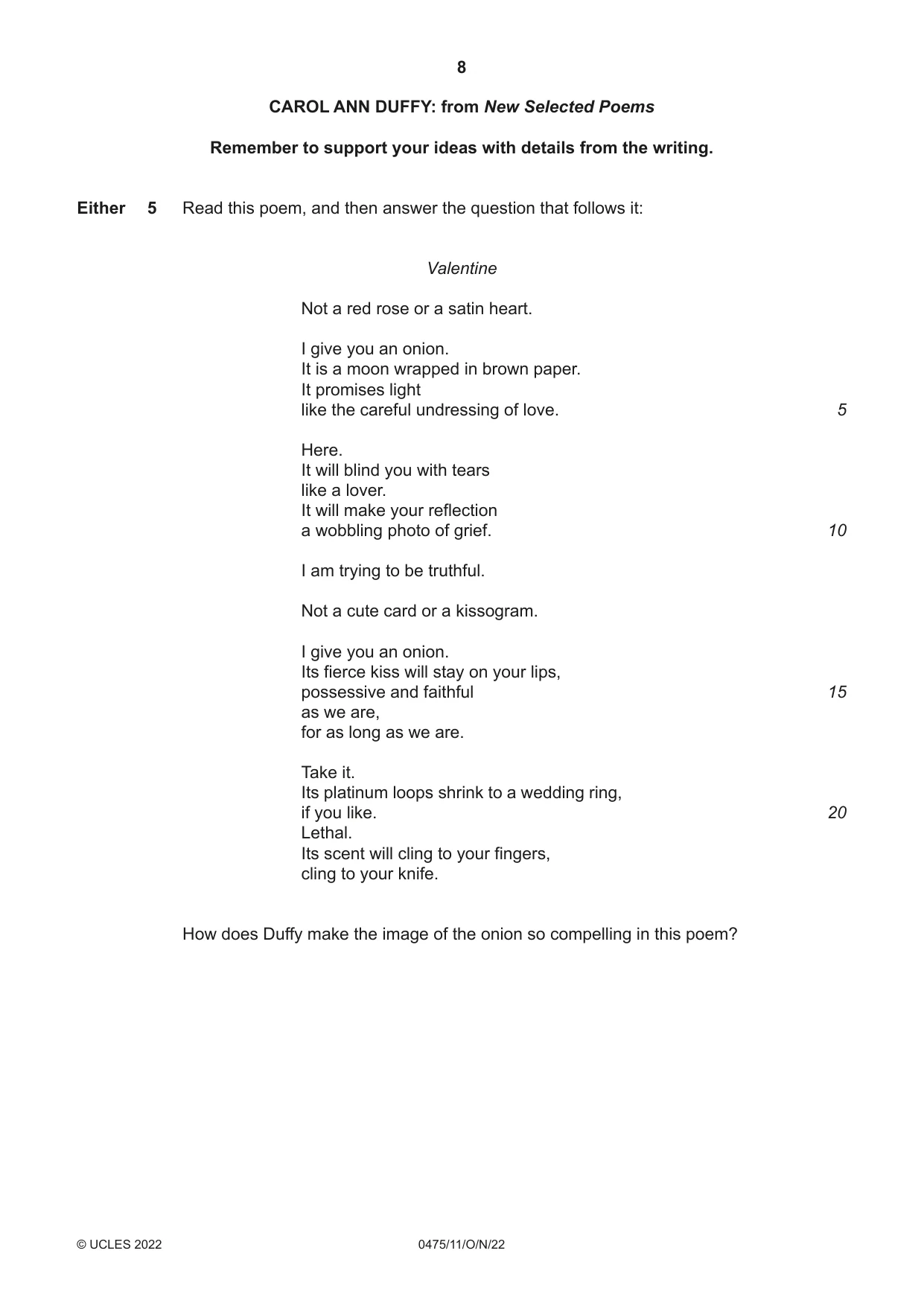
8 0475/11/O/N/22 © UCLES 2022 CAROL ANN DUFFY: from New Selected Poems Remember to support your ideas with details from the writing. Either 5 Read this poem, and then answer the question that follows it: Valentine Not a red rose or a satin heart. I give you an onion. It is a moon wrapped in brown paper. It promises light like the careful undressing of love. Here. It will blind you with tears like a lover. It will make your reflection a wobbling photo of grief. I am trying to be truthful. Not a cute card or a kissogram. I give you an onion. Its fierce kiss will stay on your lips, possessive and faithful as we are, for as long as we are. Take it. Its platinum loops shrink to a wedding ring, if you like. Lethal. Its scent will cling to your fingers, cling to your knife. How does Duffy make the image of the onion so compelling in this poem? 5 10 15 20
Question paper, page 9
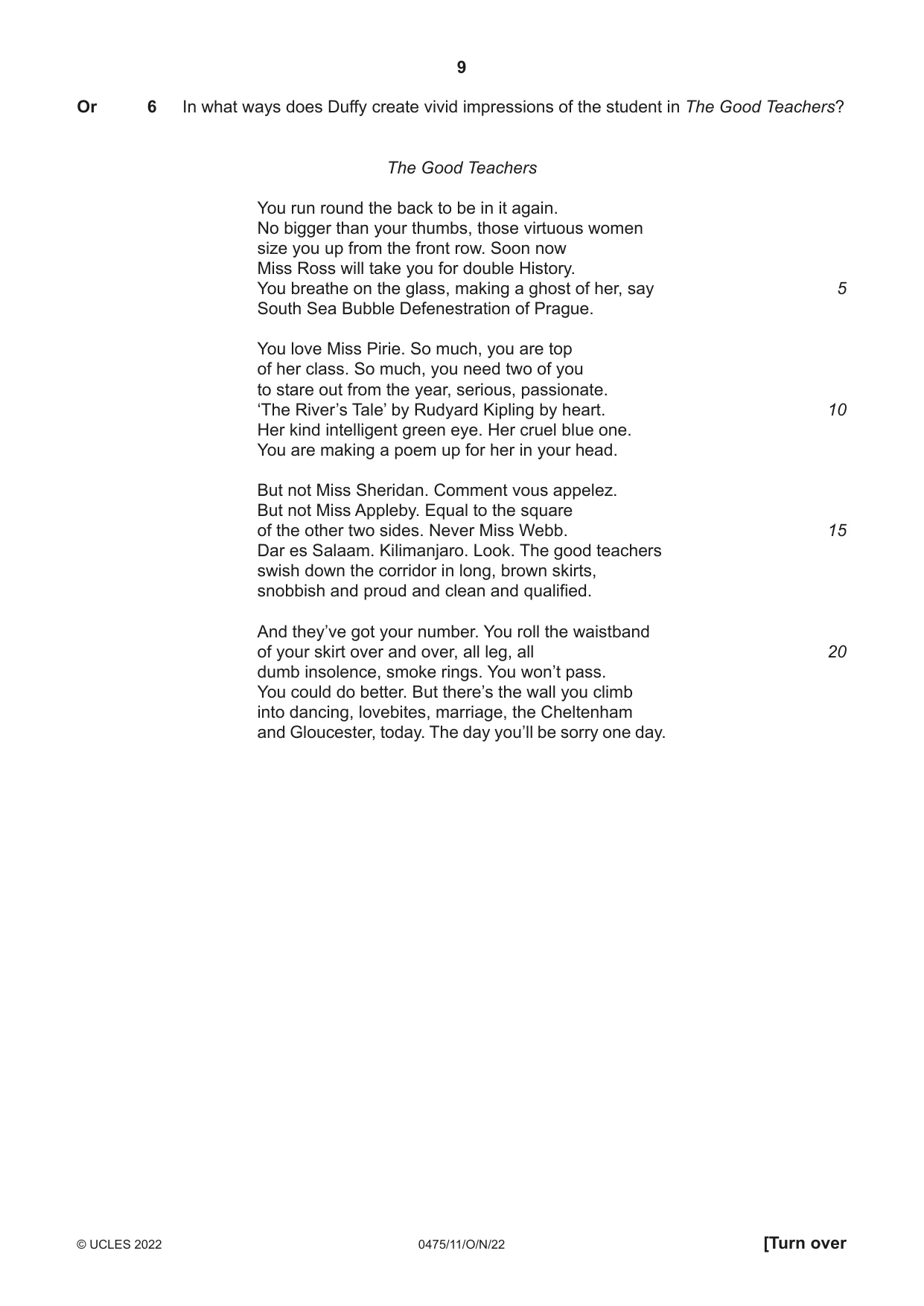
9 0475/11/O/N/22 © UCLES 2022 [Turn over Or 6 In what ways does Duffy create vivid impressions of the student in The Good Teachers? The Good Teachers You run round the back to be in it again. No bigger than your thumbs, those virtuous women size you up from the front row. Soon now Miss Ross will take you for double History. You breathe on the glass, making a ghost of her, say South Sea Bubble Defenestration of Prague. You love Miss Pirie. So much, you are top of her class. So much, you need two of you to stare out from the year, serious, passionate. ‘The River’s Tale’ by Rudyard Kipling by heart. Her kind intelligent green eye. Her cruel blue one. You are making a poem up for her in your head. But not Miss Sheridan. Comment vous appelez. But not Miss Appleby. Equal to the square of the other two sides. Never Miss Webb. Dar es Salaam. Kilimanjaro. Look. The good teachers swish down the corridor in long, brown skirts, snobbish and proud and clean and qualified. And they’ve got your number. You roll the waistband of your skirt over and over, all leg, all dumb insolence, smoke rings. You won’t pass. You could do better. But there’s the wall you climb into dancing, lovebites, marriage, the Cheltenham and Gloucester, today. The day you’ll be sorry one day. 5 10 15 20
Question paper, page 10
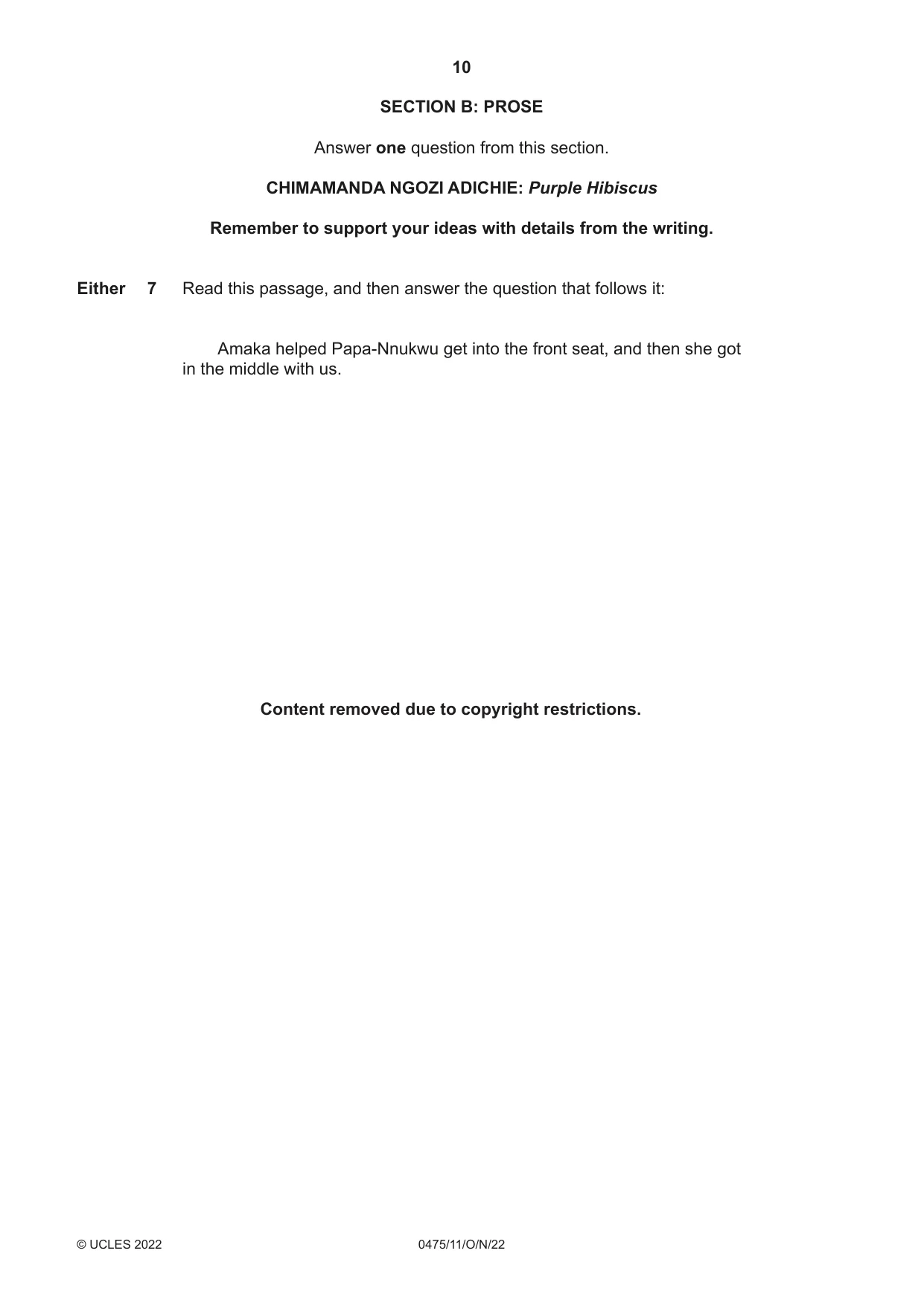
10 0475/11/O/N/22 © UCLES 2022 SECTION B: PROSE Answer one question from this section. CHIMAMANDA NGOZI ADICHIE: Purple Hibiscus Remember to support your ideas with details from the writing. Either 7 Read this passage, and then answer the question that follows it: Amaka helped Papa-Nnukwu get into the front seat, and then she got in the middle with us. Content removed due to copyright restrictions.
Question paper, page 11
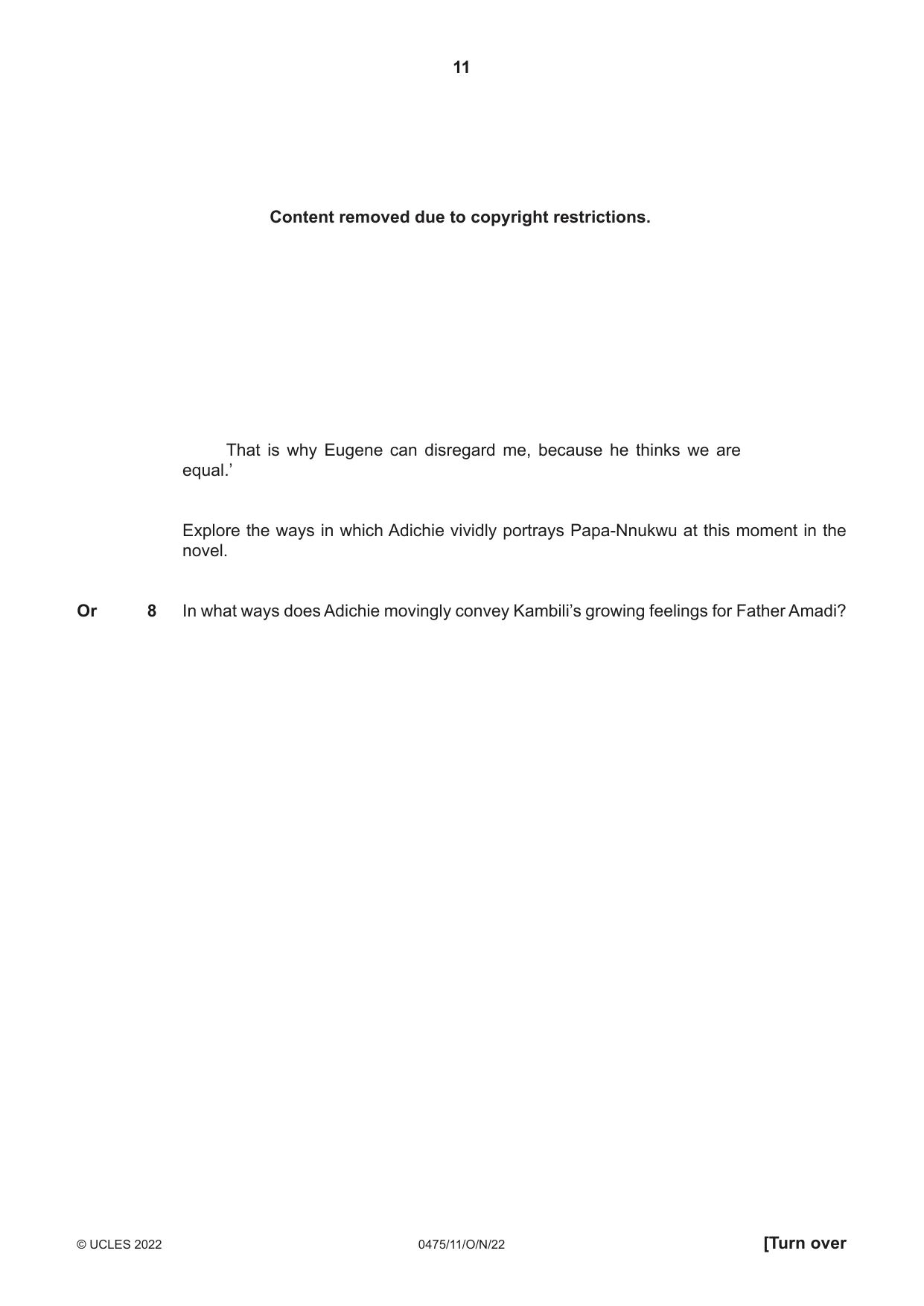
11 0475/11/O/N/22 © UCLES 2022 [Turn over That is why Eugene can disregard me, because he thinks we are equal.’ Explore the ways in which Adichie vividly portrays Papa-Nnukwu at this moment in the novel. Or 8 In what ways does Adichie movingly convey Kambili’s growing feelings for Father Amadi? Content removed due to copyright restrictions.
Question paper, page 12
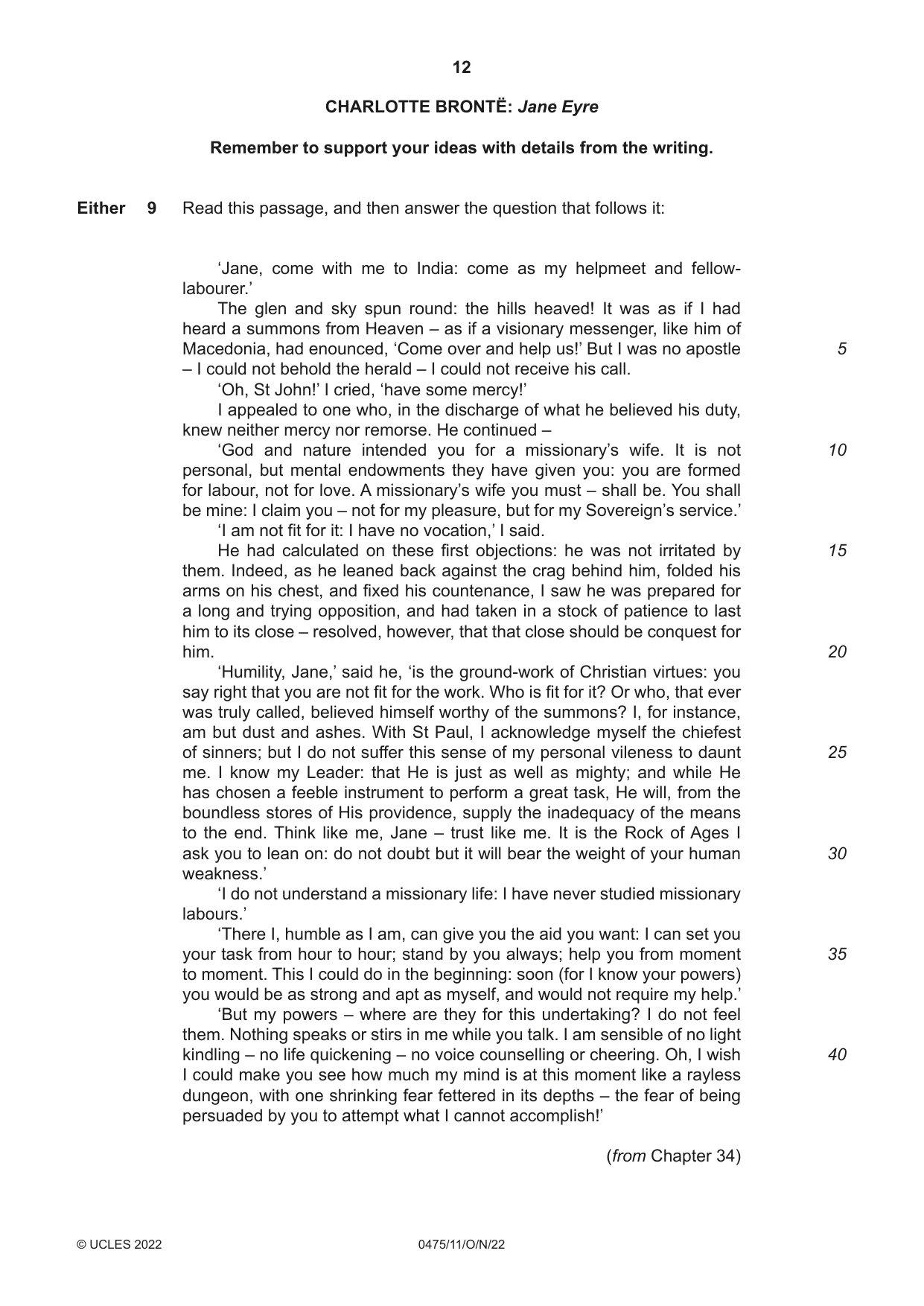
12 0475/11/O/N/22 © UCLES 2022 CHARLOTTE BRONTË: Jane Eyre Remember to support your ideas with details from the writing. Either 9 Read this passage, and then answer the question that follows it: ‘Jane, come with me to India: come as my helpmeet and fellow- labourer.’ The glen and sky spun round: the hills heaved! It was as if I had heard a summons from Heaven – as if a visionary messenger, like him of Macedonia, had enounced, ‘Come over and help us!’ But I was no apostle – I could not behold the herald – I could not receive his call. ‘Oh, St John!’ I cried, ‘have some mercy!’ I appealed to one who, in the discharge of what he believed his duty, knew neither mercy nor remorse. He continued – ‘God and nature intended you for a missionary’s wife. It is not personal, but mental endowments they have given you: you are formed for labour, not for love. A missionary’s wife you must – shall be. You shall be mine: I claim you – not for my pleasure, but for my Sovereign’s service.’ ‘I am not fit for it: I have no vocation,’ I said. He had calculated on these first objections: he was not irritated by them. Indeed, as he leaned back against the crag behind him, folded his arms on his chest, and fixed his countenance, I saw he was prepared for a long and trying opposition, and had taken in a stock of patience to last him to its close – resolved, however, that that close should be conquest for him. ‘Humility, Jane,’ said he, ‘is the ground-work of Christian virtues: you say right that you are not fit for the work. Who is fit for it? Or who, that ever was truly called, believed himself worthy of the summons? I, for instance, am but dust and ashes. With St Paul, I acknowledge myself the chiefest of sinners; but I do not suffer this sense of my personal vileness to daunt me. I know my Leader: that He is just as well as mighty; and while He has chosen a feeble instrument to perform a great task, He will, from the boundless stores of His providence, supply the inadequacy of the means to the end. Think like me, Jane – trust like me. It is the Rock of Ages I ask you to lean on: do not doubt but it will bear the weight of your human weakness.’ ‘I do not understand a missionary life: I have never studied missionary labours.’ ‘There I, humble as I am, can give you the aid you want: I can set you your task from hour to hour; stand by you always; help you from moment to moment. This I could do in the beginning: soon (for I know your powers) you would be as strong and apt as myself, and would not require my help.’ ‘But my powers – where are they for this undertaking? I do not feel them. Nothing speaks or stirs in me while you talk. I am sensible of no light kindling – no life quickening – no voice counselling or cheering. Oh, I wish I could make you see how much my mind is at this moment like a rayless dungeon, with one shrinking fear fettered in its depths – the fear of being persuaded by you to attempt what I cannot accomplish!’ (from Chapter 34) 5 10 15 20 25 30 35 40
Question paper, page 13
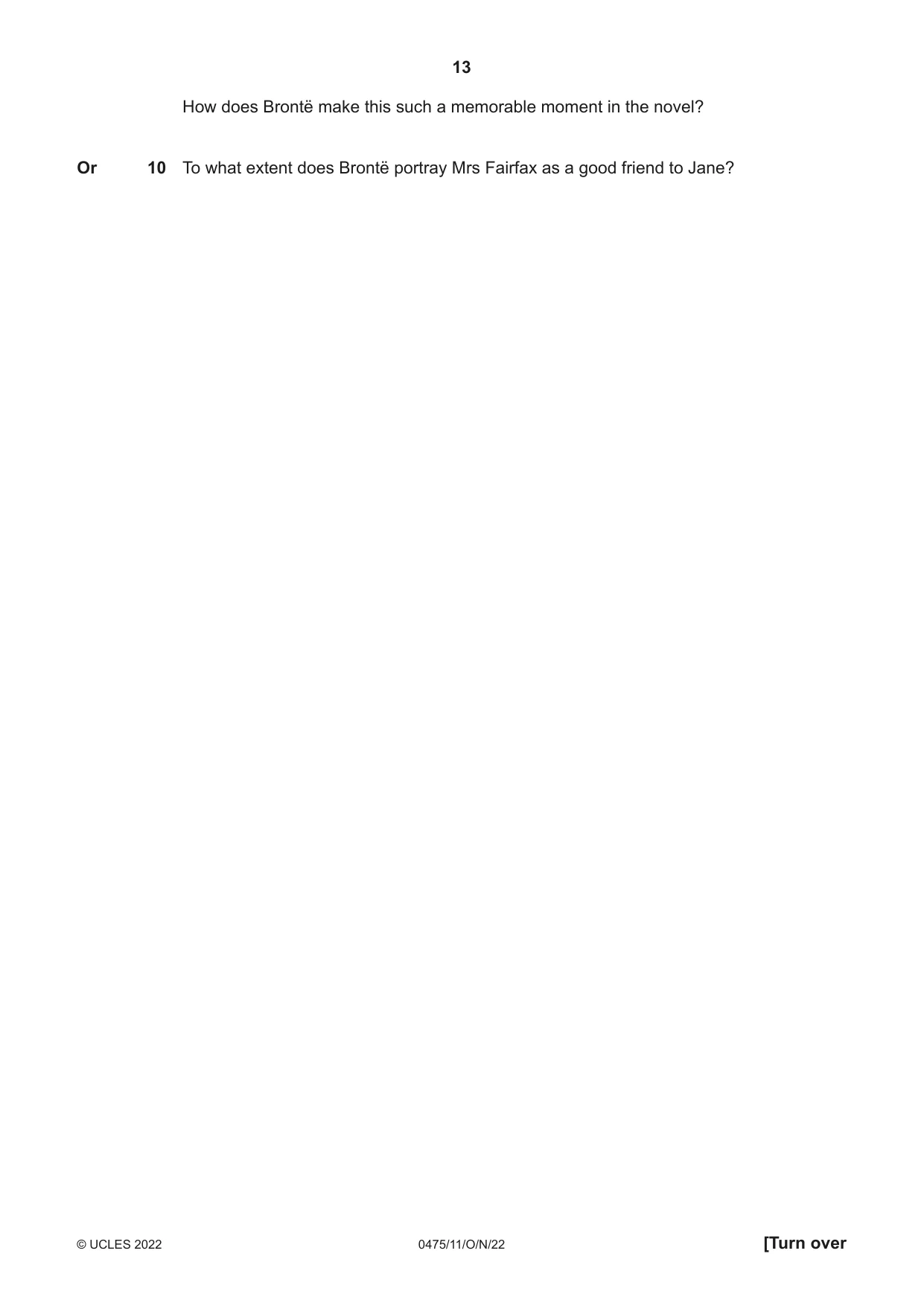
13 0475/11/O/N/22 © UCLES 2022 [Turn over How does Brontë make this such a memorable moment in the novel? Or 10 To what extent does Brontë portray Mrs Fairfax as a good friend to Jane?
Question paper, page 14
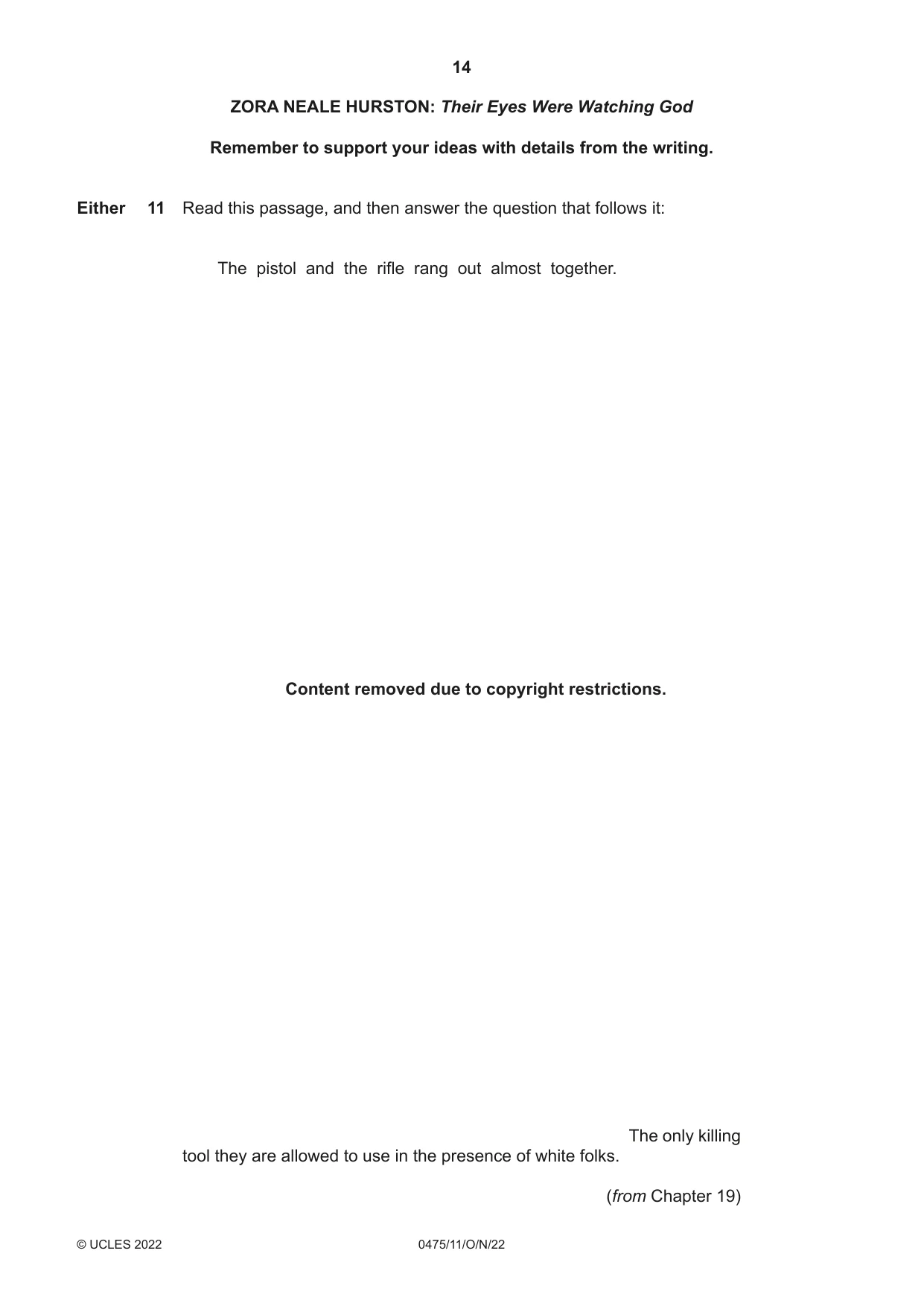
14 0475/11/O/N/22 © UCLES 2022 ZORA NEALE HURSTON: Their Eyes Were Watching God Remember to support your ideas with details from the writing. Either 11 Read this passage, and then answer the question that follows it: The pistol and the rifle rang out almost together. The only killing tool they are allowed to use in the presence of white folks. (from Chapter 19) Content removed due to copyright restrictions.
Question paper, page 15
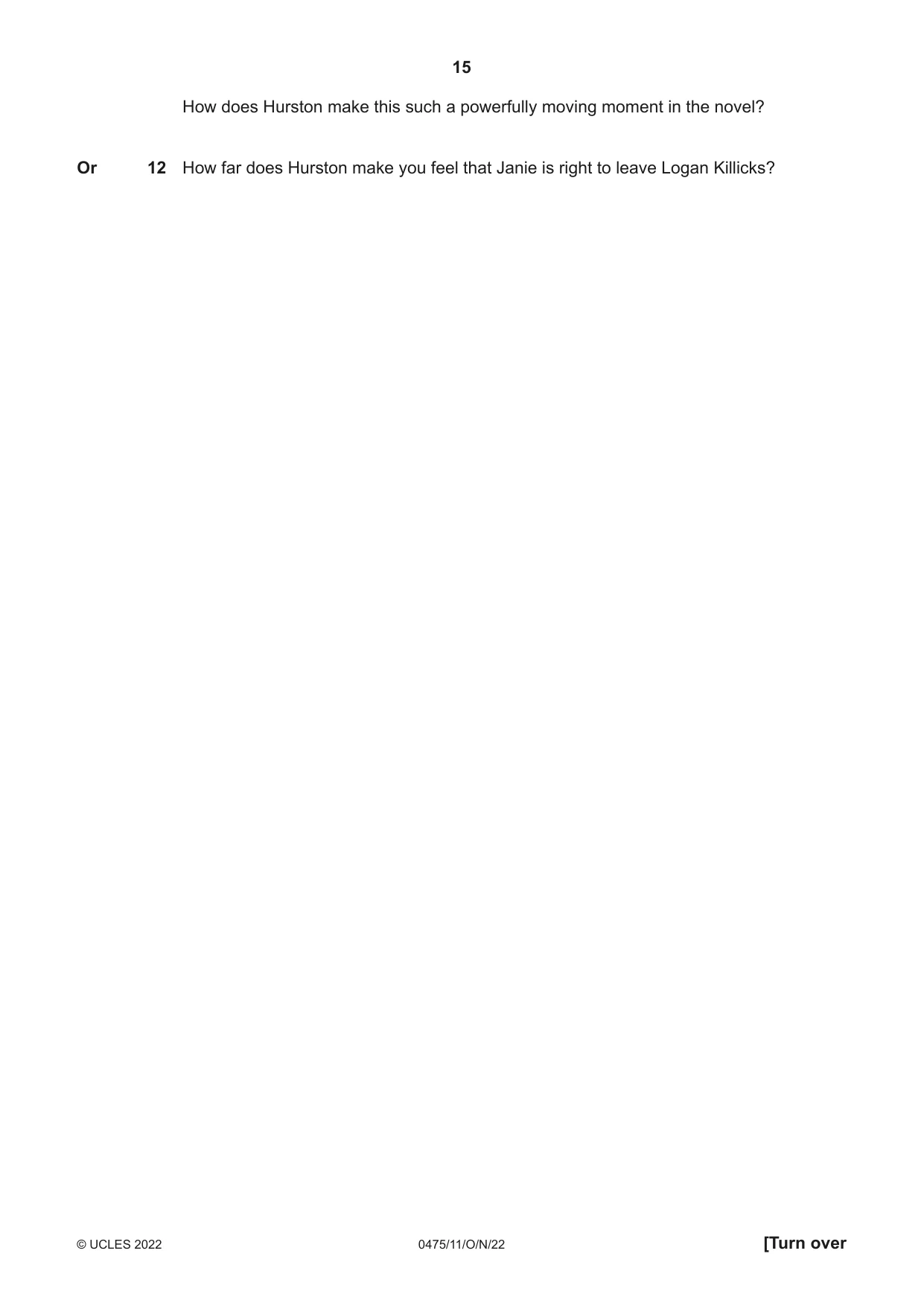
15 0475/11/O/N/22 © UCLES 2022 [Turn over How does Hurston make this such a powerfully moving moment in the novel? Or 12 How far does Hurston make you feel that Janie is right to leave Logan Killicks?
Question paper, page 16
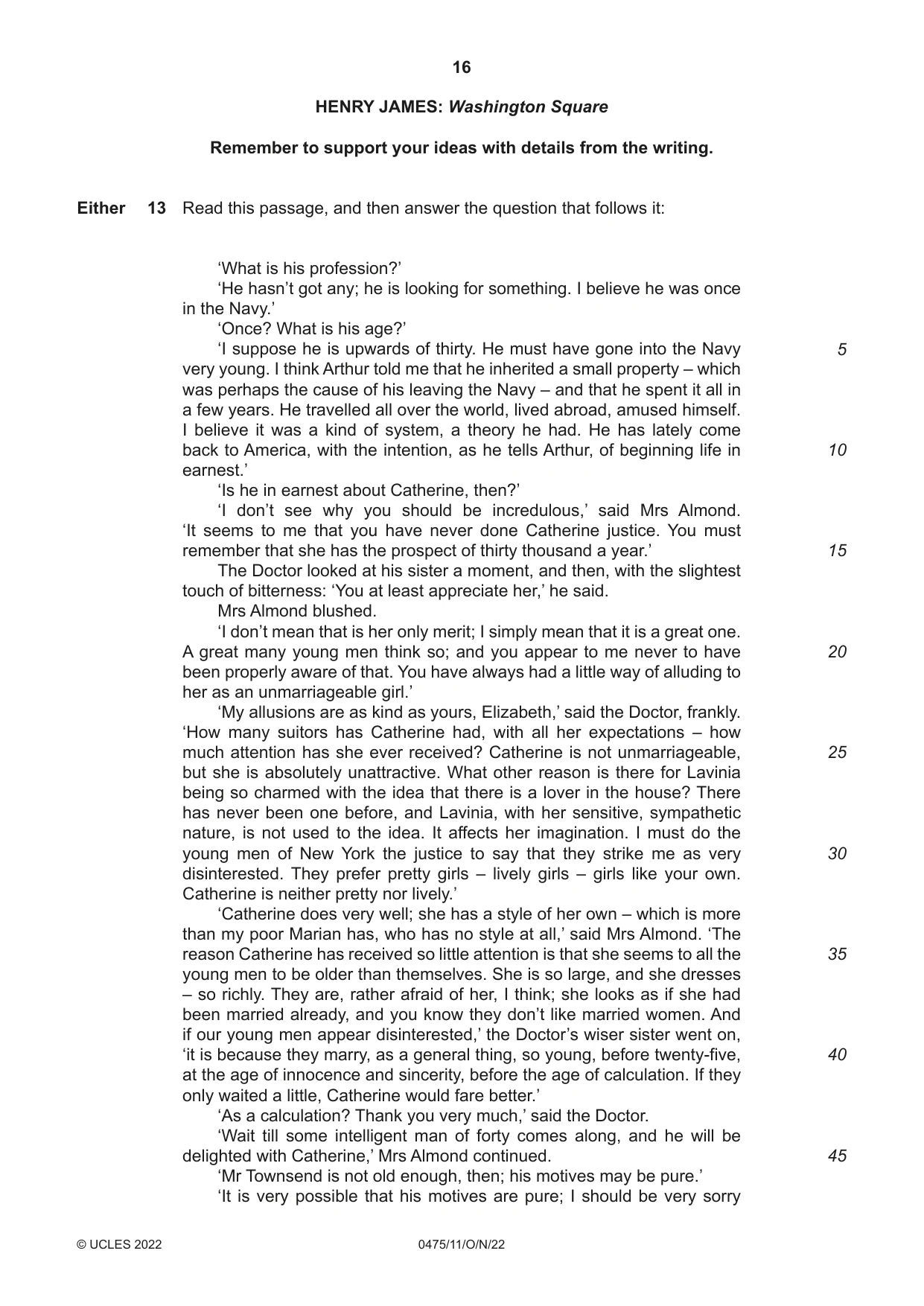
16 0475/11/O/N/22 © UCLES 2022 HENRY JAMES: Washington Square Remember to support your ideas with details from the writing. Either 13 Read this passage, and then answer the question that follows it: ‘What is his profession?’ ‘He hasn’t got any; he is looking for something. I believe he was once in the Navy.’ ‘Once? What is his age?’ ‘I suppose he is upwards of thirty. He must have gone into the Navy very young. I think Arthur told me that he inherited a small property – which was perhaps the cause of his leaving the Navy – and that he spent it all in a few years. He travelled all over the world, lived abroad, amused himself. I believe it was a kind of system, a theory he had. He has lately come back to America, with the intention, as he tells Arthur, of beginning life in earnest.’ ‘Is he in earnest about Catherine, then?’ ‘I don’t see why you should be incredulous,’ said Mrs Almond. ‘It seems to me that you have never done Catherine justice. You must remember that she has the prospect of thirty thousand a year.’ The Doctor looked at his sister a moment, and then, with the slightest touch of bitterness: ‘You at least appreciate her,’ he said. Mrs Almond blushed. ‘I don’t mean that is her only merit; I simply mean that it is a great one. A great many young men think so; and you appear to me never to have been properly aware of that. You have always had a little way of alluding to her as an unmarriageable girl.’ ‘My allusions are as kind as yours, Elizabeth,’ said the Doctor, frankly. ‘How many suitors has Catherine had, with all her expectations – how much attention has she ever received? Catherine is not unmarriageable, but she is absolutely unattractive. What other reason is there for Lavinia being so charmed with the idea that there is a lover in the house? There has never been one before, and Lavinia, with her sensitive, sympathetic nature, is not used to the idea. It affects her imagination. I must do the young men of New York the justice to say that they strike me as very disinterested. They prefer pretty girls – lively girls – girls like your own. Catherine is neither pretty nor lively.’ ‘Catherine does very well; she has a style of her own – which is more than my poor Marian has, who has no style at all,’ said Mrs Almond. ‘The reason Catherine has received so little attention is that she seems to all the young men to be older than themselves. She is so large, and she dresses – so richly. They are, rather afraid of her, I think; she looks as if she had been married already, and you know they don’t like married women. And if our young men appear disinterested,’ the Doctor’s wiser sister went on, ‘it is because they marry, as a general thing, so young, before twenty-five, at the age of innocence and sincerity, before the age of calculation. If they only waited a little, Catherine would fare better.’ ‘As a calculation? Thank you very much,’ said the Doctor. ‘Wait till some intelligent man of forty comes along, and he will be delighted with Catherine,’ Mrs Almond continued. ‘Mr Townsend is not old enough, then; his motives may be pure.’ ‘It is very possible that his motives are pure; I should be very sorry 5 10 15 20 25 30 35 40 45
Question paper, page 17
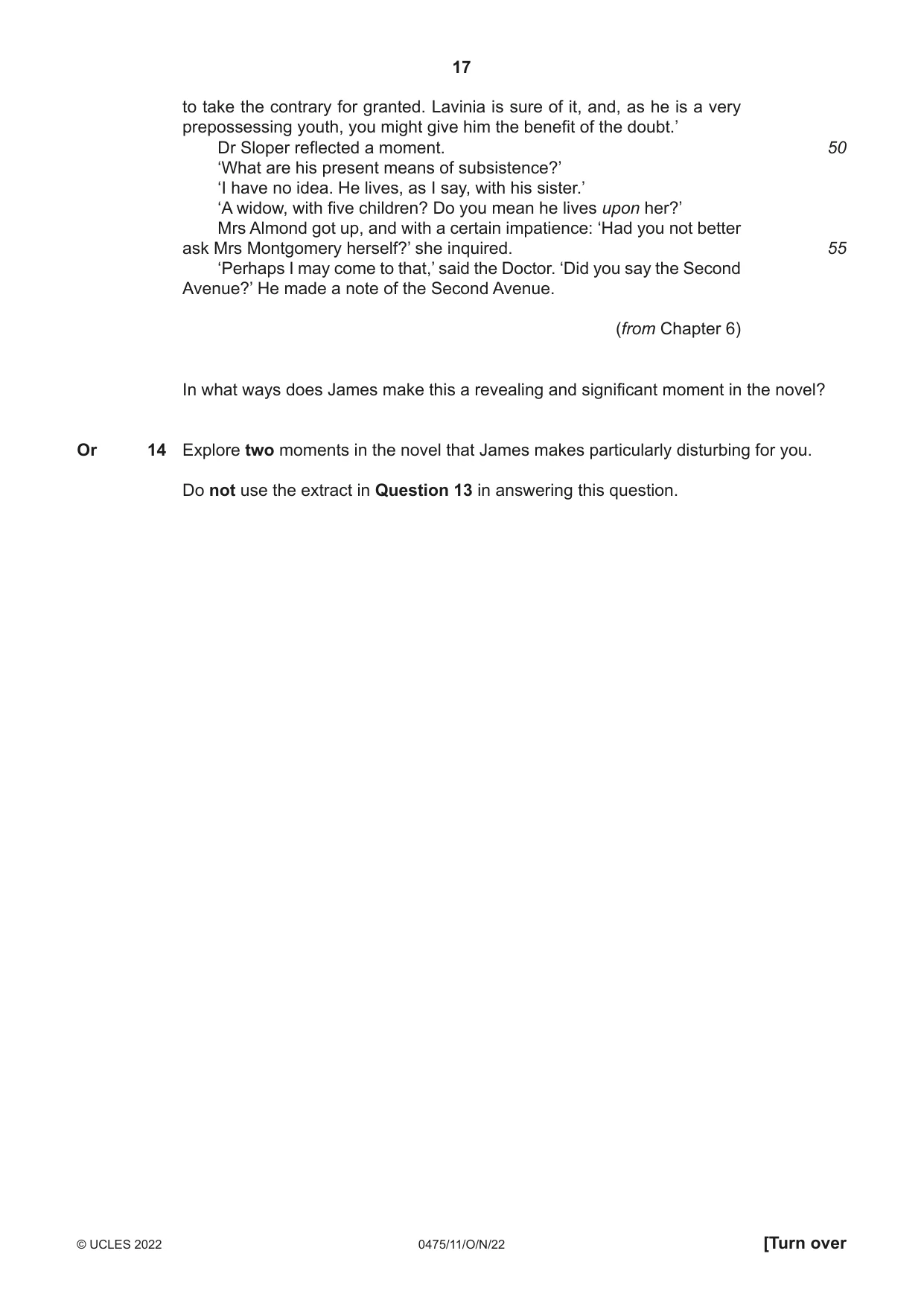
17 0475/11/O/N/22 © UCLES 2022 [Turn over to take the contrary for granted. Lavinia is sure of it, and, as he is a very prepossessing youth, you might give him the benefit of the doubt.’ Dr Sloper reflected a moment. ‘What are his present means of subsistence?’ ‘I have no idea. He lives, as I say, with his sister.’ ‘A widow, with five children? Do you mean he lives upon her?’ Mrs Almond got up, and with a certain impatience: ‘Had you not better ask Mrs Montgomery herself?’ she inquired. ‘Perhaps I may come to that,’ said the Doctor. ‘Did you say the Second Avenue?’ He made a note of the Second Avenue. (from Chapter 6) In what ways does James make this a revealing and significant moment in the novel? Or 14 Explore two moments in the novel that James makes particularly disturbing for you. Do not use the extract in Question 13 in answering this question. 50 55
Question paper, page 18
18 0475/11/O/N/22 © UCLES 2022 JHUMPA LAHIRI: The Namesake Remember to support your ideas with details from the writing. Either 15 Read this passage, and then answer the question that follows it: She takes the phone in order to hear the news for herself, to console her mother. Content removed due to copyright restrictions.
Question paper, page 19
19 0475/11/O/N/22 © UCLES 2022 [Turn over Instead he tells her what Rana told him a few minutes ago, what Rana couldn’t bear to tell his sister, over the telephone, himself: that her father died yesterday evening, of a heart attack, playing patience on his bed. (from Chapter 2) In what ways does Lahiri make this such a moving moment in the novel? Or 16 Explore the ways in which Lahiri encourages you to feel sympathy for Gogol. Content removed due to copyright restrictions.
Question paper, page 20
20 0475/11/O/N/22 © UCLES 2022 YANN MARTEL: Life of Pi Remember to support your ideas with details from the writing. Either 17 Read this passage, and then answer the question that follows it: I eased the raft off the lifeboat. Content removed due to copyright restrictions.
Question paper, page 21
21 0475/11/O/N/22 © UCLES 2022 [Turn over He wasn’t in sight. (from Chapter 53) How does Martel make this such a dramatic moment in the novel? Or 18 Explore two moments in the novel when Martel memorably portrays Pi’s despair. Do not use the extract in Question 17 in answering this question. Content removed due to copyright restrictions.
Question paper, page 22
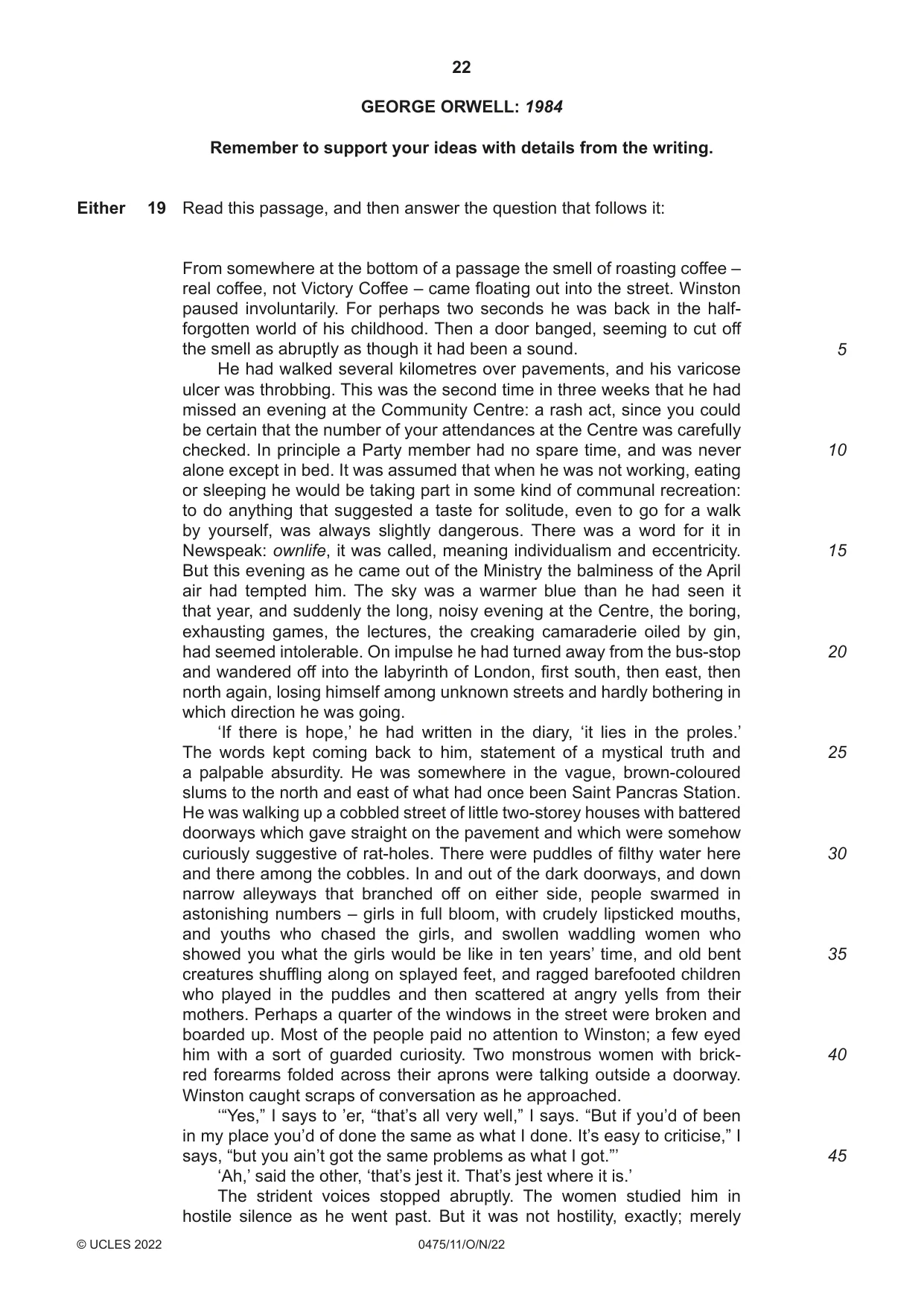
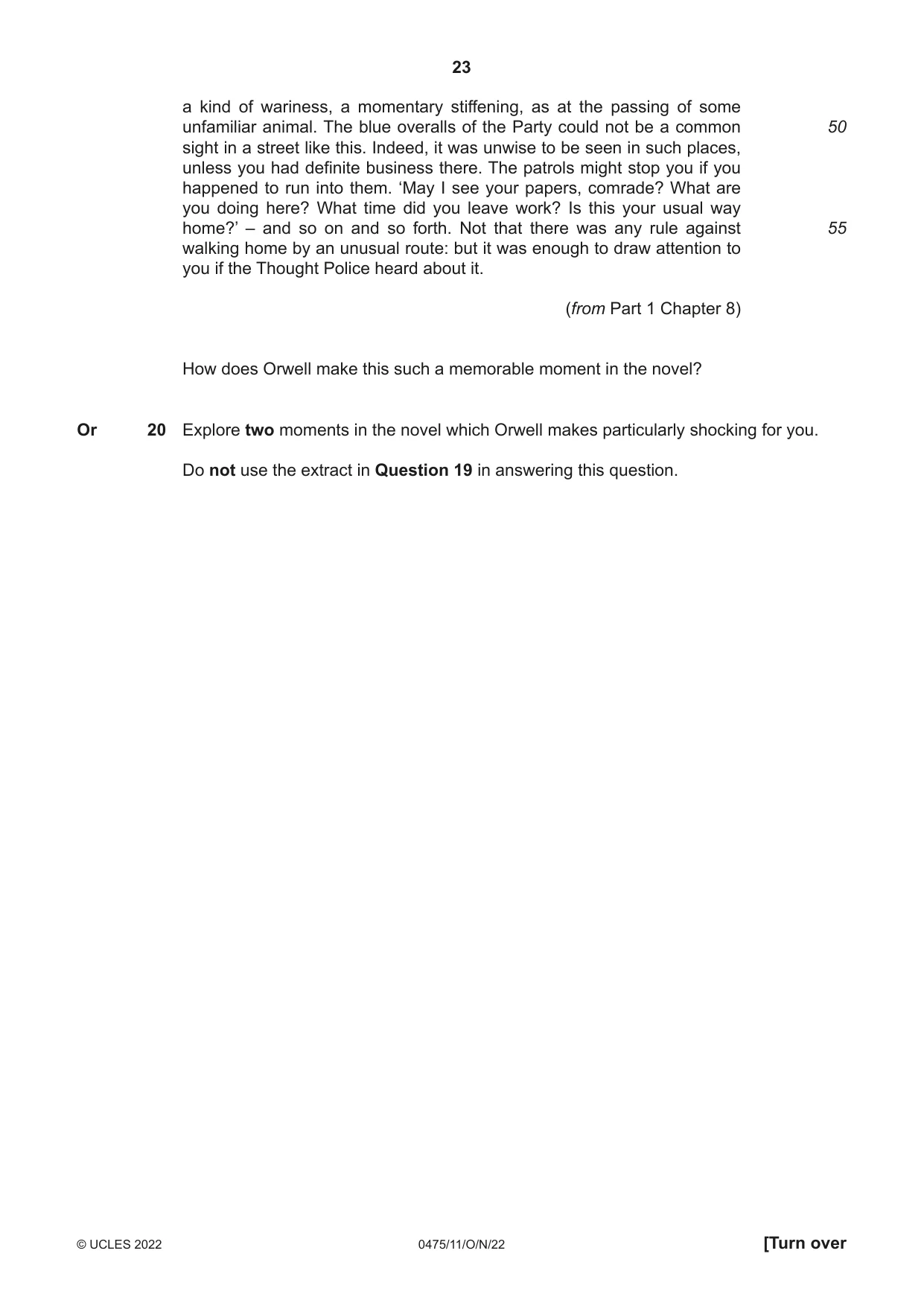
22 0475/11/O/N/22 © UCLES 2022 GEORGE ORWELL: 1984 Remember to support your ideas with details from the writing. Either 19 Read this passage, and then answer the question that follows it: From somewhere at the bottom of a passage the smell of roasting coffee – real coffee, not Victory Coffee – came floating out into the street. Winston paused involuntarily. For perhaps two seconds he was back in the half- forgotten world of his childhood. Then a door banged, seeming to cut off the smell as abruptly as though it had been a sound. He had walked several kilometres over pavements, and his varicose ulcer was throbbing. This was the second time in three weeks that he had missed an evening at the Community Centre: a rash act, since you could be certain that the number of your attendances at the Centre was carefully checked. In principle a Party member had no spare time, and was never alone except in bed. It was assumed that when he was not working, eating or sleeping he would be taking part in some kind of communal recreation: to do anything that suggested a taste for solitude, even to go for a walk by yourself, was always slightly dangerous. There was a word for it in Newspeak: ownlife, it was called, meaning individualism and eccentricity. But this evening as he came out of the Ministry the balminess of the April air had tempted him. The sky was a warmer blue than he had seen it that year, and suddenly the long, noisy evening at the Centre, the boring, exhausting games, the lectures, the creaking camaraderie oiled by gin, had seemed intolerable. On impulse he had turned away from the bus-stop and wandered off into the labyrinth of London, first south, then east, then north again, losing himself among unknown streets and hardly bothering in which direction he was going. ‘If there is hope,’ he had written in the diary, ‘it lies in the proles.’ The words kept coming back to him, statement of a mystical truth and a palpable absurdity. He was somewhere in the vague, brown-coloured slums to the north and east of what had once been Saint Pancras Station. He was walking up a cobbled street of little two-storey houses with battered doorways which gave straight on the pavement and which were somehow curiously suggestive of rat-holes. There were puddles of filthy water here and there among the cobbles. In and out of the dark doorways, and down narrow alleyways that branched off on either side, people swarmed in astonishing numbers – girls in full bloom, with crudely lipsticked mouths, and youths who chased the girls, and swollen waddling women who showed you what the girls would be like in ten years’ time, and old bent creatures shuffling along on splayed feet, and ragged barefooted children who played in the puddles and then scattered at angry yells from their mothers. Perhaps a quarter of the windows in the street were broken and boarded up. Most of the people paid no attention to Winston; a few eyed him with a sort of guarded curiosity. Two monstrous women with brick- red forearms folded across their aprons were talking outside a doorway. Winston caught scraps of conversation as he approached. ‘“Yes,” I says to ’er, “that’s all very well,” I says. “But if you’d of been in my place you’d of done the same as what I done. It’s easy to criticise,” I says, “but you ain’t got the same problems as what I got.”’ ‘Ah,’ said the other, ‘that’s jest it. That’s jest where it is.’ The strident voices stopped abruptly. The women studied him in hostile silence as he went past. But it was not hostility, exactly; merely 5 10 15 20 25 30 35 40 45
Question paper, page 23
23 0475/11/O/N/22 © UCLES 2022 [Turn over a kind of wariness, a momentary stiffening, as at the passing of some unfamiliar animal. The blue overalls of the Party could not be a common sight in a street like this. Indeed, it was unwise to be seen in such places, unless you had definite business there. The patrols might stop you if you happened to run into them. ‘May I see your papers, comrade? What are you doing here? What time did you leave work? Is this your usual way home?’ – and so on and so forth. Not that there was any rule against walking home by an unusual route: but it was enough to draw attention to you if the Thought Police heard about it. (from Part 1 Chapter 8) How does Orwell make this such a memorable moment in the novel? Or 20 Explore two moments in the novel which Orwell makes particularly shocking for you. Do not use the extract in Question 19 in answering this question. 50 55
Question paper, page 24
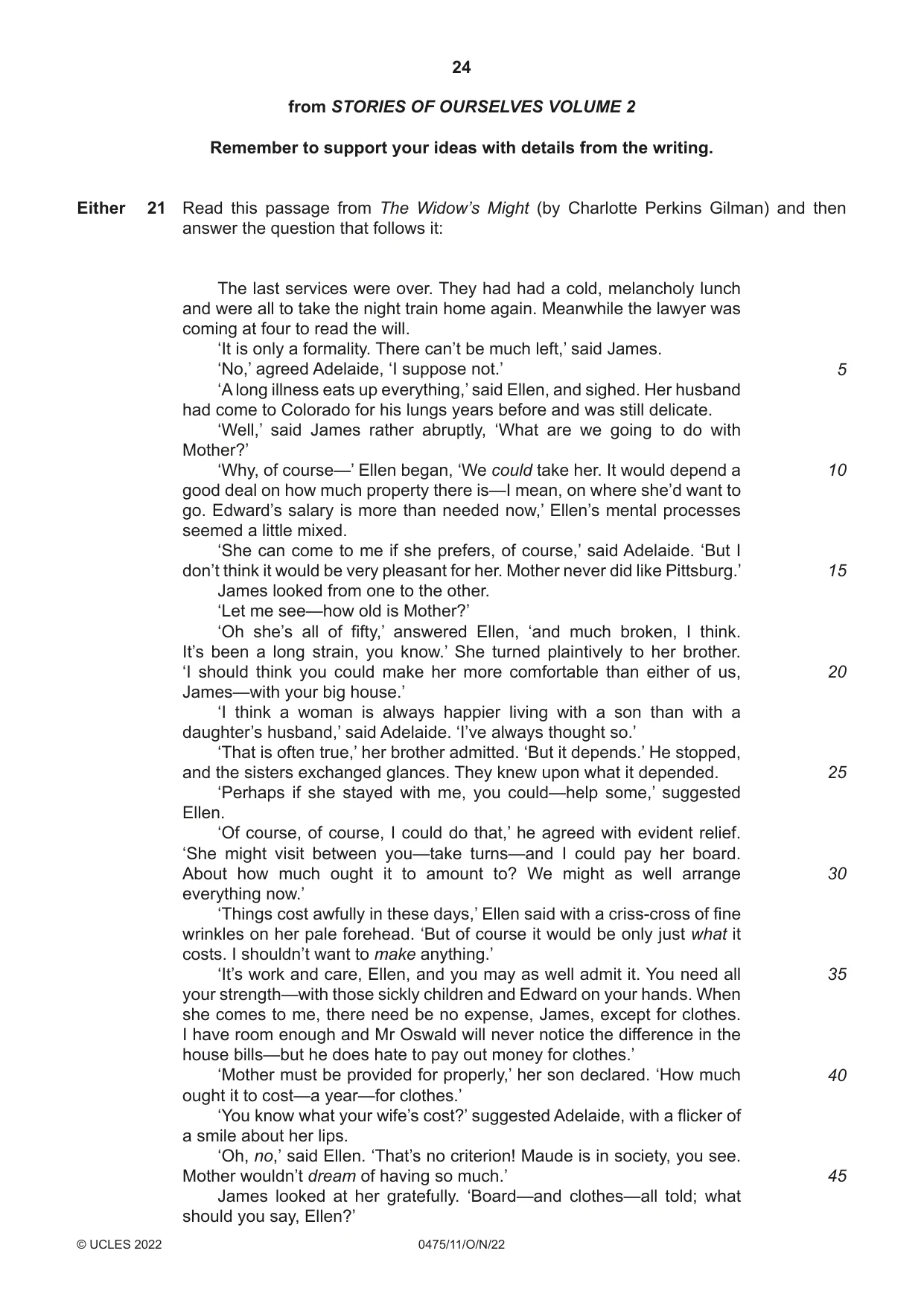
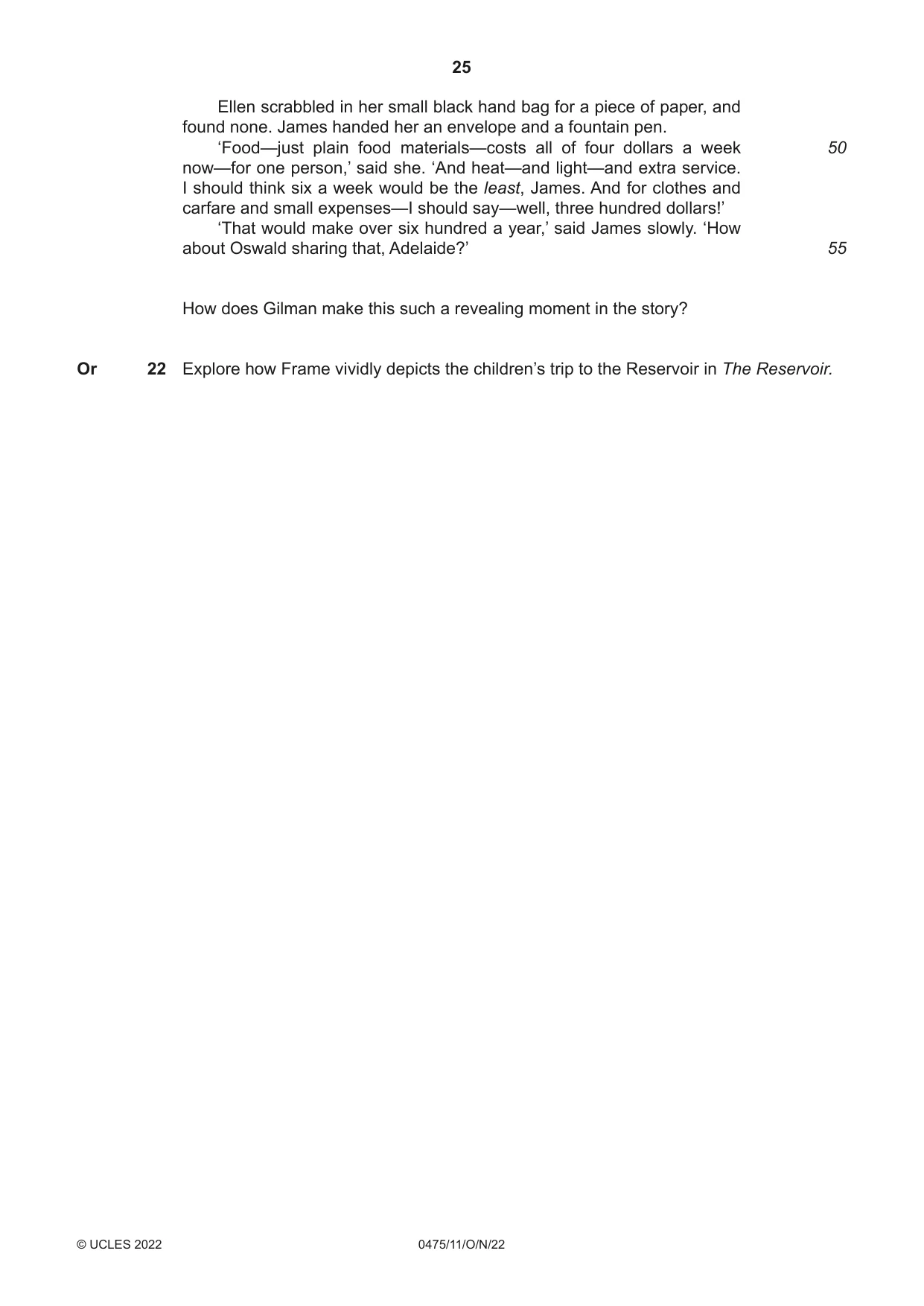
24 0475/11/O/N/22 © UCLES 2022 from STORIES OF OURSELVES VOLUME 2 Remember to support your ideas with details from the writing. Either 21 Read this passage from The Widow’s Might (by Charlotte Perkins Gilman) and then answer the question that follows it: The last services were over. They had had a cold, melancholy lunch and were all to take the night train home again. Meanwhile the lawyer was coming at four to read the will. ‘It is only a formality. There can’t be much left,’ said James. ‘No,’ agreed Adelaide, ‘I suppose not.’ ‘A long illness eats up everything,’ said Ellen, and sighed. Her husband had come to Colorado for his lungs years before and was still delicate. ‘Well,’ said James rather abruptly, ‘What are we going to do with Mother?’ ‘Why, of course—’ Ellen began, ‘We could take her. It would depend a good deal on how much property there is—I mean, on where she’d want to go. Edward’s salary is more than needed now,’ Ellen’s mental processes seemed a little mixed. ‘She can come to me if she prefers, of course,’ said Adelaide. ‘But I don’t think it would be very pleasant for her. Mother never did like Pittsburg.’ James looked from one to the other. ‘Let me see—how old is Mother?’ ‘Oh she’s all of fifty,’ answered Ellen, ‘and much broken, I think. It’s been a long strain, you know.’ She turned plaintively to her brother. ‘I should think you could make her more comfortable than either of us, James—with your big house.’ ‘I think a woman is always happier living with a son than with a daughter’s husband,’ said Adelaide. ‘I’ve always thought so.’ ‘That is often true,’ her brother admitted. ‘But it depends.’ He stopped, and the sisters exchanged glances. They knew upon what it depended. ‘Perhaps if she stayed with me, you could—help some,’ suggested Ellen. ‘Of course, of course, I could do that,’ he agreed with evident relief. ‘She might visit between you—take turns—and I could pay her board. About how much ought it to amount to? We might as well arrange everything now.’ ‘Things cost awfully in these days,’ Ellen said with a criss-cross of fine wrinkles on her pale forehead. ‘But of course it would be only just what it costs. I shouldn’t want to make anything.’ ‘It’s work and care, Ellen, and you may as well admit it. You need all your strength—with those sickly children and Edward on your hands. When she comes to me, there need be no expense, James, except for clothes. I have room enough and Mr Oswald will never notice the difference in the house bills—but he does hate to pay out money for clothes.’ ‘Mother must be provided for properly,’ her son declared. ‘How much ought it to cost—a year—for clothes.’ ‘You know what your wife’s cost?’ suggested Adelaide, with a flicker of a smile about her lips. ‘Oh, no,’ said Ellen. ‘That’s no criterion! Maude is in society, you see. Mother wouldn’t dream of having so much.’ James looked at her gratefully. ‘Board—and clothes—all told; what should you say, Ellen?’ 5 10 15 20 25 30 35 40 45
Question paper, page 25
25 0475/11/O/N/22 © UCLES 2022 Ellen scrabbled in her small black hand bag for a piece of paper, and found none. James handed her an envelope and a fountain pen. ‘Food—just plain food materials—costs all of four dollars a week now—for one person,’ said she. ‘And heat—and light—and extra service. I should think six a week would be the least, James. And for clothes and carfare and small expenses—I should say—well, three hundred dollars!’ ‘That would make over six hundred a year,’ said James slowly. ‘How about Oswald sharing that, Adelaide?’ How does Gilman make this such a revealing moment in the story? Or 22 Explore how Frame vividly depicts the children’s trip to the Reservoir in The Reservoir. 50 55
Question paper, page 26
26 0475/11/O/N/22 © UCLES 2022 BLANK PAGE
Question paper, page 27
27 0475/11/O/N/22 © UCLES 2022 BLANK PAGE
Question paper, page 28
28 0475/11/O/N/22 © UCLES 2022 Permission to reproduce items where third-party owned material protected by copyright is included has been sought and cleared where possible. Every reasonable effort has been made by the publisher (UCLES) to trace copyright holders, but if any items requiring clearance have unwittingly been included, the publisher will be pleased to make amends at the earliest possible opportunity. To avoid the issue of disclosure of answer-related information to candidates, all copyright acknowledgements are reproduced online in the Cambridge Assessment International Education Copyright Acknowledgements Booklet. This is produced for each series of examinations and is freely available to download at www.cambridgeinternational.org after the live examination series. Cambridge Assessment International Education is part of Cambridge Assessment. Cambridge Assessment is the brand name of the University of Cambridge Local Examinations Syndicate (UCLES), which is a department of the University of Cambridge. BLANK PAGE
Mark scheme, page 1
This document consists of 4 printed pages. © UCLES 2022 [Turn over Cambridge IGCSE™ LITERATURE IN ENGLISH 0475/11 Paper 1 Poetry and Prose October/November 2022 MARK SCHEME Maximum Mark: 50 Published This mark scheme is published as an aid to teachers and candidates, to indicate the requirements of the examination. It shows the basis on which Examiners were instructed to award marks. It does not indicate the details of the discussions that took place at an Examiners’ meeting before marking began, which would have considered the acceptability of alternative answers. Mark schemes should be read in conjunction with the question paper and the Principal Examiner Report for Teachers. Cambridge International will not enter into discussions about these mark schemes. Cambridge International is publishing the mark schemes for the October/November 2022 series for most Cambridge IGCSE™, Cambridge International A and AS Level components and some Cambridge O Level components.
Mark scheme, page 2
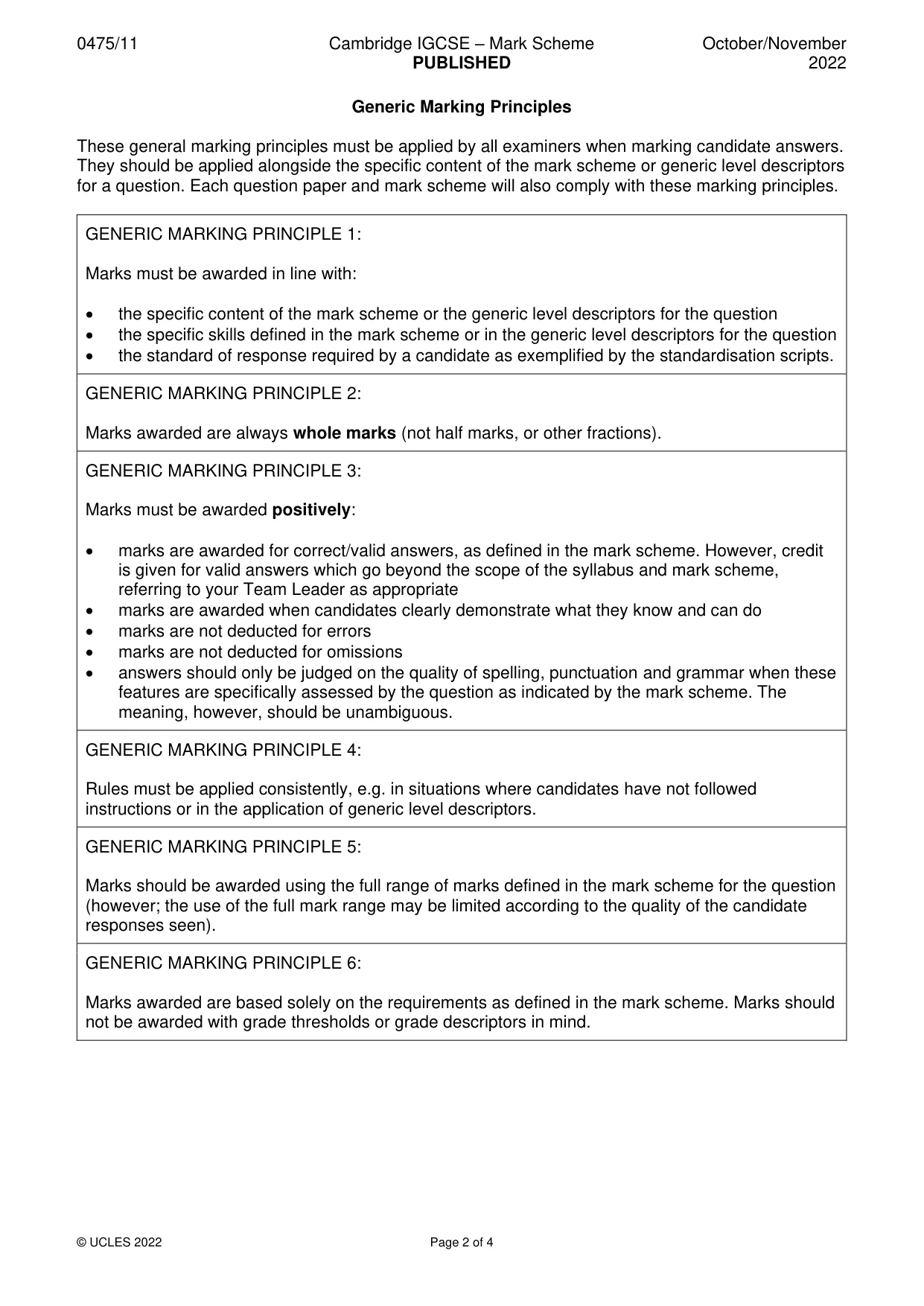
0475/11 Cambridge IGCSE – Mark Scheme PUBLISHED October/November 2022 © UCLES 2022 Page 2 of 4 Generic Marking Principles These general marking principles must be applied by all examiners when marking candidate answers. They should be applied alongside the specific content of the mark scheme or generic level descriptors for a question. Each question paper and mark scheme will also comply with these marking principles. GENERIC MARKING PRINCIPLE 1: Marks must be awarded in line with: • the specific content of the mark scheme or the generic level descriptors for the question • the specific skills defined in the mark scheme or in the generic level descriptors for the question • the standard of response required by a candidate as exemplified by the standardisation scripts. GENERIC MARKING PRINCIPLE 2: Marks awarded are always whole marks (not half marks, or other fractions). GENERIC MARKING PRINCIPLE 3: Marks must be awarded positively: • marks are awarded for correct/valid answers, as defined in the mark scheme. However, credit is given for valid answers which go beyond the scope of the syllabus and mark scheme, referring to your Team Leader as appropriate • marks are awarded when candidates clearly demonstrate what they know and can do • marks are not deducted for errors • marks are not deducted for omissions • answers should only be judged on the quality of spelling, punctuation and grammar when these features are specifically assessed by the question as indicated by the mark scheme. The meaning, however, should be unambiguous. GENERIC MARKING PRINCIPLE 4: Rules must be applied consistently, e.g. in situations where candidates have not followed instructions or in the application of generic level descriptors. GENERIC MARKING PRINCIPLE 5: Marks should be awarded using the full range of marks defined in the mark scheme for the question (however; the use of the full mark range may be limited according to the quality of the candidate responses seen). GENERIC MARKING PRINCIPLE 6: Marks awarded are based solely on the requirements as defined in the mark scheme. Marks should not be awarded with grade thresholds or grade descriptors in mind.
Mark scheme, page 3
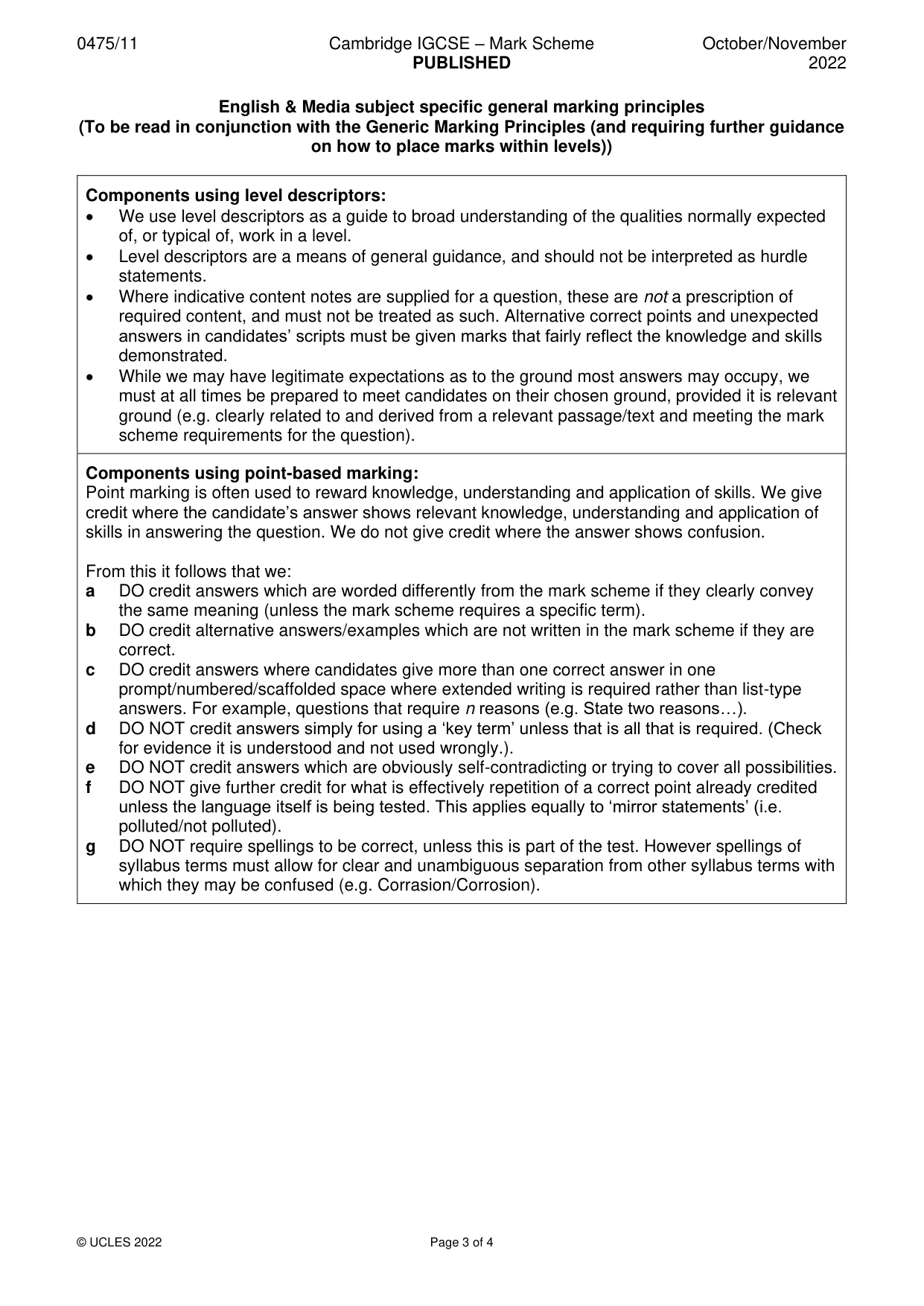
0475/11 Cambridge IGCSE – Mark Scheme PUBLISHED October/November 2022 © UCLES 2022 Page 3 of 4 English & Media subject specific general marking principles (To be read in conjunction with the Generic Marking Principles (and requiring further guidance on how to place marks within levels)) Components using level descriptors: • We use level descriptors as a guide to broad understanding of the qualities normally expected of, or typical of, work in a level. • Level descriptors are a means of general guidance, and should not be interpreted as hurdle statements. • Where indicative content notes are supplied for a question, these are not a prescription of required content, and must not be treated as such. Alternative correct points and unexpected answers in candidates’ scripts must be given marks that fairly reflect the knowledge and skills demonstrated. • While we may have legitimate expectations as to the ground most answers may occupy, we must at all times be prepared to meet candidates on their chosen ground, provided it is relevant ground (e.g. clearly related to and derived from a relevant passage/text and meeting the mark scheme requirements for the question). Components using point-based marking: Point marking is often used to reward knowledge, understanding and application of skills. We give credit where the candidate’s answer shows relevant knowledge, understanding and application of skills in answering the question. We do not give credit where the answer shows confusion. From this it follows that we: a DO credit answers which are worded differently from the mark scheme if they clearly convey the same meaning (unless the mark scheme requires a specific term). b DO credit alternative answers/examples which are not written in the mark scheme if they are correct. c DO credit answers where candidates give more than one correct answer in one prompt/numbered/scaffolded space where extended writing is required rather than list-type answers. For example, questions that require n reasons (e.g. State two reasons…). d DO NOT credit answers simply for using a ‘key term’ unless that is all that is required. (Check for evidence it is understood and not used wrongly.). e DO NOT credit answers which are obviously self-contradicting or trying to cover all possibilities. f DO NOT give further credit for what is effectively repetition of a correct point already credited unless the language itself is being tested. This applies equally to ‘mirror statements’ (i.e. polluted/not polluted). g DO NOT require spellings to be correct, unless this is part of the test. However spellings of syllabus terms must allow for clear and unambiguous separation from other syllabus terms with which they may be confused (e.g. Corrasion/Corrosion).
Mark scheme, page 4
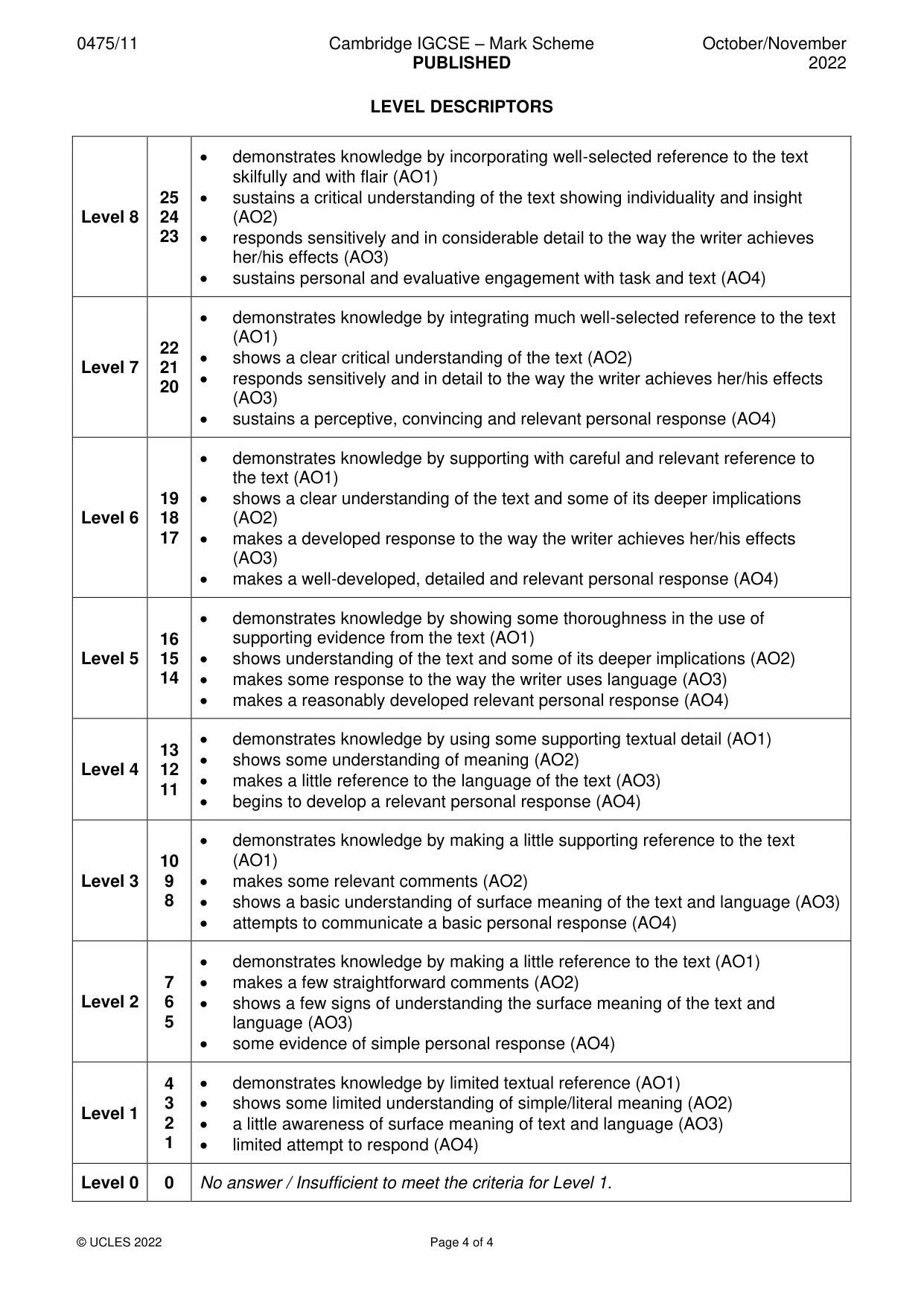
0475/11 Cambridge IGCSE – Mark Scheme PUBLISHED October/November 2022 © UCLES 2022 Page 4 of 4 LEVEL DESCRIPTORS Level 8 25 24 23 • demonstrates knowledge by incorporating well-selected reference to the text skilfully and with flair (AO1) • sustains a critical understanding of the text showing individuality and insight (AO2) • responds sensitively and in considerable detail to the way the writer achieves her/his effects (AO3) • sustains personal and evaluative engagement with task and text (AO4) Level 7 22 21 20 • demonstrates knowledge by integrating much well-selected reference to the text (AO1) • shows a clear critical understanding of the text (AO2) • responds sensitively and in detail to the way the writer achieves her/his effects (AO3) • sustains a perceptive, convincing and relevant personal response (AO4) Level 6 19 18 17 • demonstrates knowledge by supporting with careful and relevant reference to the text (AO1) • shows a clear understanding of the text and some of its deeper implications (AO2) • makes a developed response to the way the writer achieves her/his effects (AO3) • makes a well-developed, detailed and relevant personal response (AO4) Level 5 16 15 14 • demonstrates knowledge by showing some thoroughness in the use of supporting evidence from the text (AO1) • shows understanding of the text and some of its deeper implications (AO2) • makes some response to the way the writer uses language (AO3) • makes a reasonably developed relevant personal response (AO4) Level 4 13 12 11 • demonstrates knowledge by using some supporting textual detail (AO1) • shows some understanding of meaning (AO2) • makes a little reference to the language of the text (AO3) • begins to develop a relevant personal response (AO4) Level 3 10 9 8 • demonstrates knowledge by making a little supporting reference to the text (AO1) • makes some relevant comments (AO2) • shows a basic understanding of surface meaning of the text and language (AO3) • attempts to communicate a basic personal response (AO4) Level 2 7 6 5 • demonstrates knowledge by making a little reference to the text (AO1) • makes a few straightforward comments (AO2) • shows a few signs of understanding the surface meaning of the text and language (AO3) • some evidence of simple personal response (AO4) Level 1 4 3 2 1 • demonstrates knowledge by limited textual reference (AO1) • shows some limited understanding of simple/literal meaning (AO2) • a little awareness of surface meaning of text and language (AO3) • limited attempt to respond (AO4) Level 0 0 No answer / Insufficient to meet the criteria for Level 1.
What you needed in this session
Cambridge’s own grade thresholds for 2022 Oct/Nov, Paper 1 · Variant 1. A higher threshold means an easier paper — the bar moves with how the cohort did.