Cambridge IGCSE English - Literature in English 0475 — 2022 Oct/Nov Paper 1 · Variant 2
0475/12/O/N/22 · 50 marks · ≈56 min
The question paper and its mark scheme, free to read here and free to download. This is Cambridge’s own paper, exactly as it was sat.
Question paper28 pages




Mark scheme4 pages
Answers below. Sit the paper first if you are practising.
Paper as text
Question paper, page 1
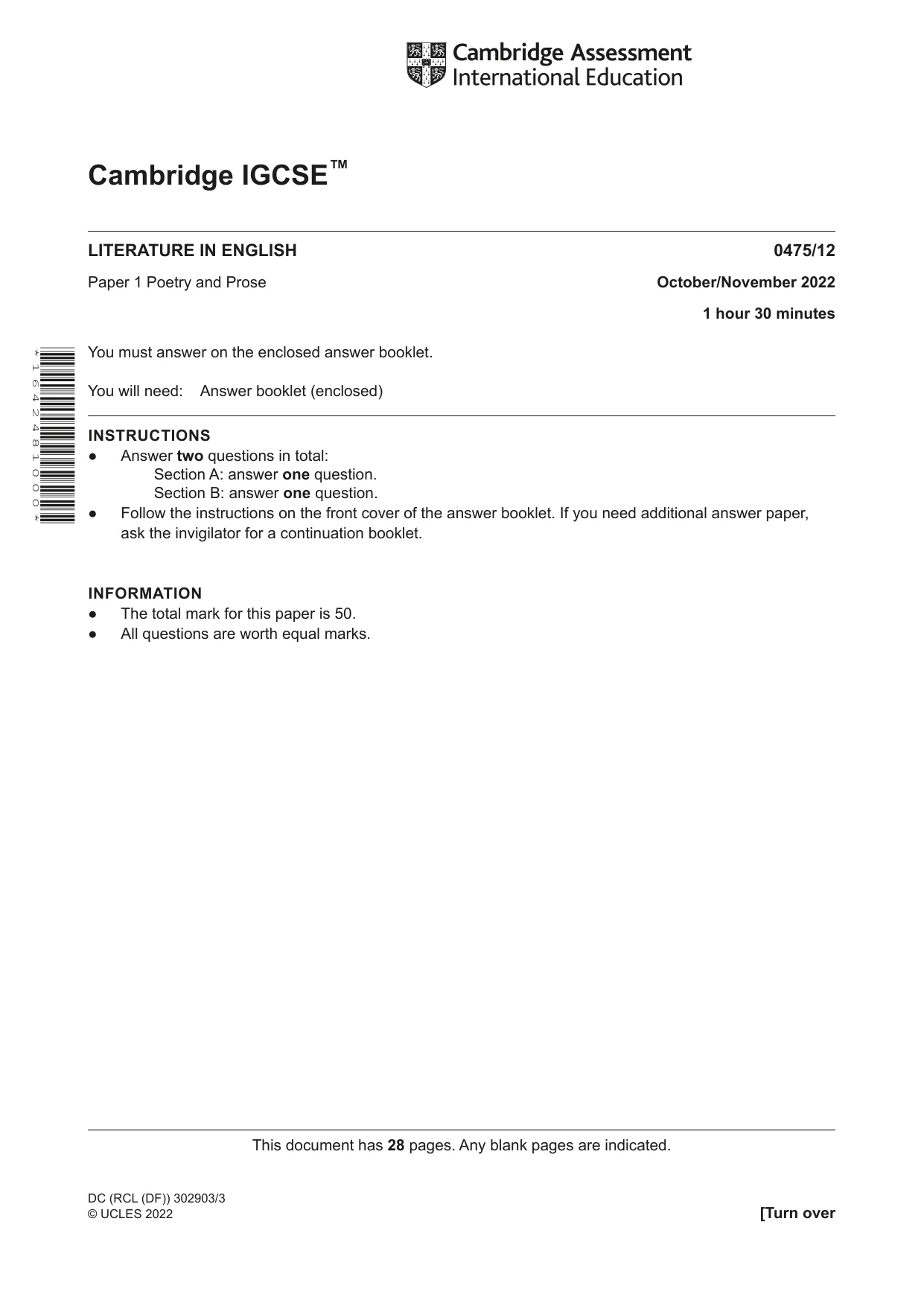
This document has 28 pages. Any blank pages are indicated. * 1 6 4 2 4 8 1 0 0 0 * Cambridge IGCSE™ LITERATURE IN ENGLISH 0475/12 Paper 1 Poetry and Prose October/November 2022 1 hour 30 minutes You must answer on the enclosed answer booklet. You will need: Answer booklet (enclosed) INSTRUCTIONS ● Answer two questions in total: Section A: answer one question. Section B: answer one question. ● Follow the instructions on the front cover of the answer booklet. If you need additional answer paper, ask the invigilator for a continuation booklet. INFORMATION ● The total mark for this paper is 50. ● All questions are worth equal marks. DC (RCL (DF)) 302903/3 © UCLES 2022 [Turn over
Question paper, page 2
2 0475/12/O/N/22 © UCLES 2022 BLANK PAGE
Question paper, page 3
3 0475/12/O/N/22 © UCLES 2022 [Turn over CONTENTS Section A: Poetry text question numbers page[s] Songs of Ourselves Volume 1: from Part 3 1, 2 pages 4–5 Songs of Ourselves Volume 2 : from Part 4 3, 4 pages 6–7 Carol Ann Duffy: from New Selected Poems 5, 6 pages 8–9 Section B: Prose text question numbers page[s] Chimamanda Ngozi Adichie: Purple Hibiscus 7, 8 pages 10–11 Charlotte Brontë: Jane Eyre 9, 10 pages 12–13 Zora Neale Hurston: Their Eyes Were Watching God 11, 12 pages 14–15 Henry James: Washington Square 13, 14 pages 16–17 Jhumpa Lahiri: The Namesake 15, 16 pages 18–19 Yann Martel: Life of Pi 17, 18 pages 20–21 George Orwell: 1984 19, 20 pages 22–23 from Stories of Ourselves Volume 2 21, 22 pages 24–25
Question paper, page 4
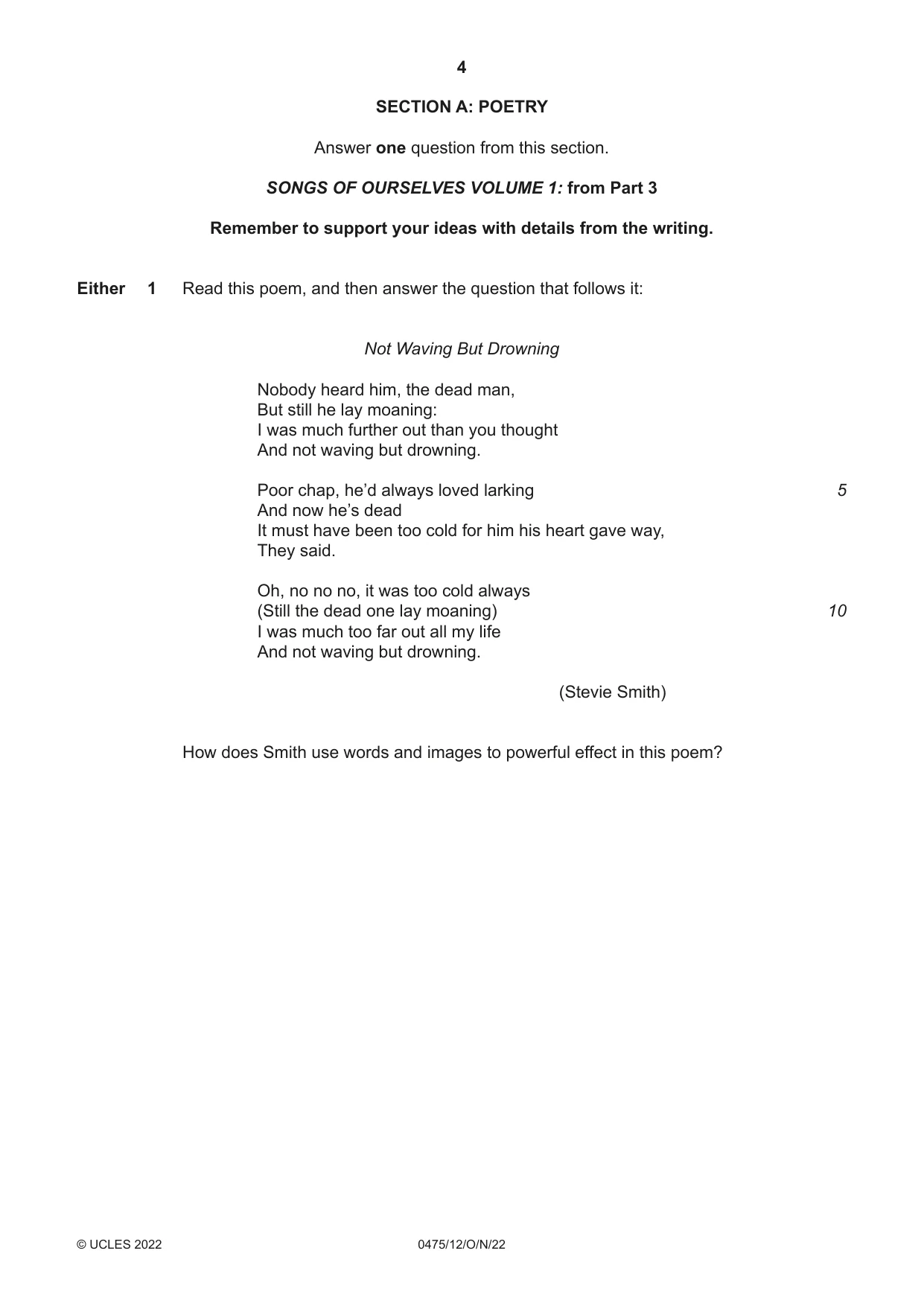
4 0475/12/O/N/22 © UCLES 2022 SECTION A: POETRY Answer one question from this section. SONGS OF OURSELVES VOLUME 1: from Part 3 Remember to support your ideas with details from the writing. Either 1 Read this poem, and then answer the question that follows it: Not Waving But Drowning Nobody heard him, the dead man, But still he lay moaning: I was much further out than you thought And not waving but drowning. Poor chap, he’d always loved larking And now he’s dead It must have been too cold for him his heart gave way, They said. Oh, no no no, it was too cold always (Still the dead one lay moaning) I was much too far out all my life And not waving but drowning. (Stevie Smith) How does Smith use words and images to powerful effect in this poem? 5 10
Question paper, page 5
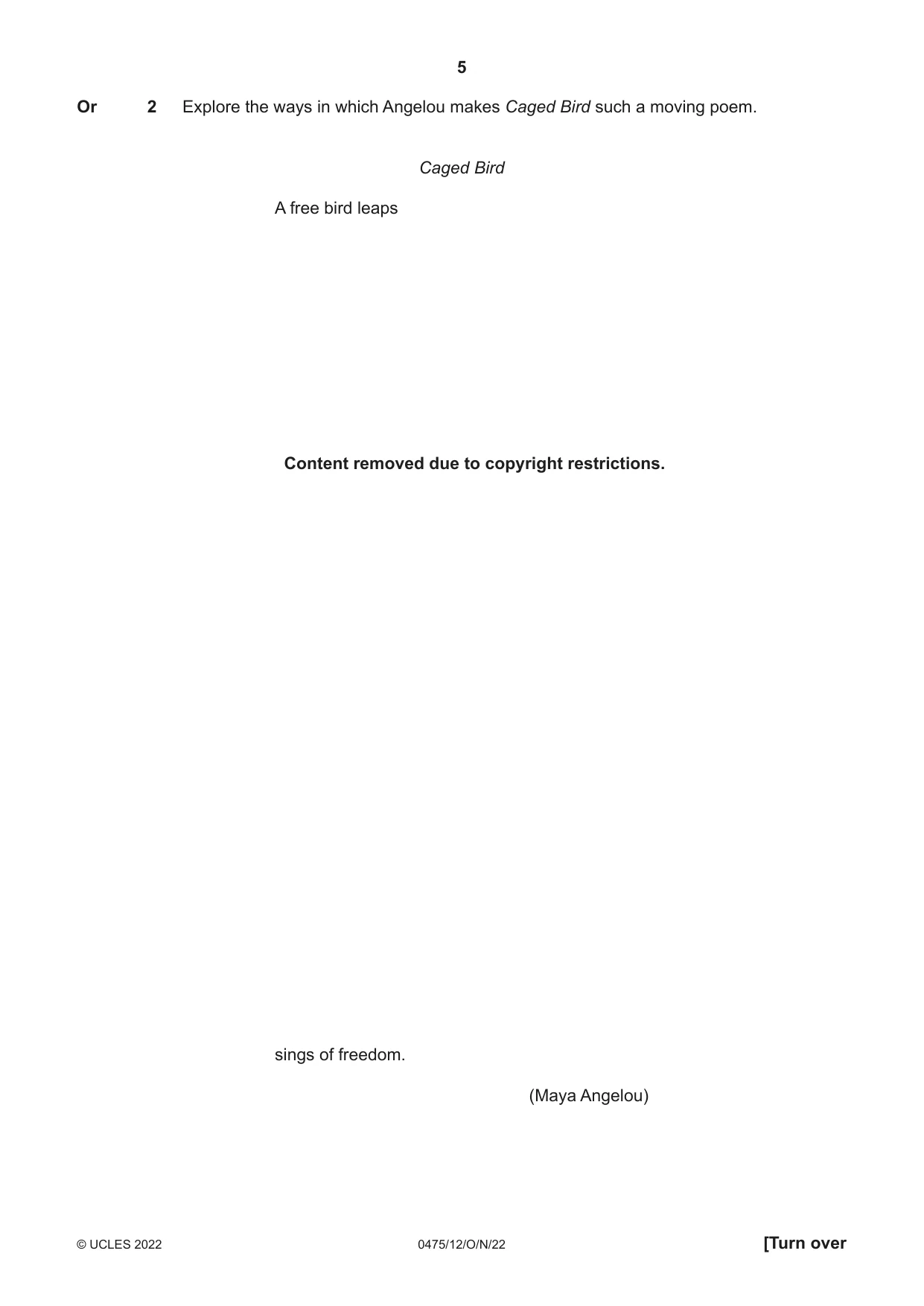
5 0475/12/O/N/22 © UCLES 2022 [Turn over Or 2 Explore the ways in which Angelou makes Caged Bird such a moving poem. Caged Bird A free bird leaps sings of freedom. (Maya Angelou) Content removed due to copyright restrictions.
Question paper, page 6
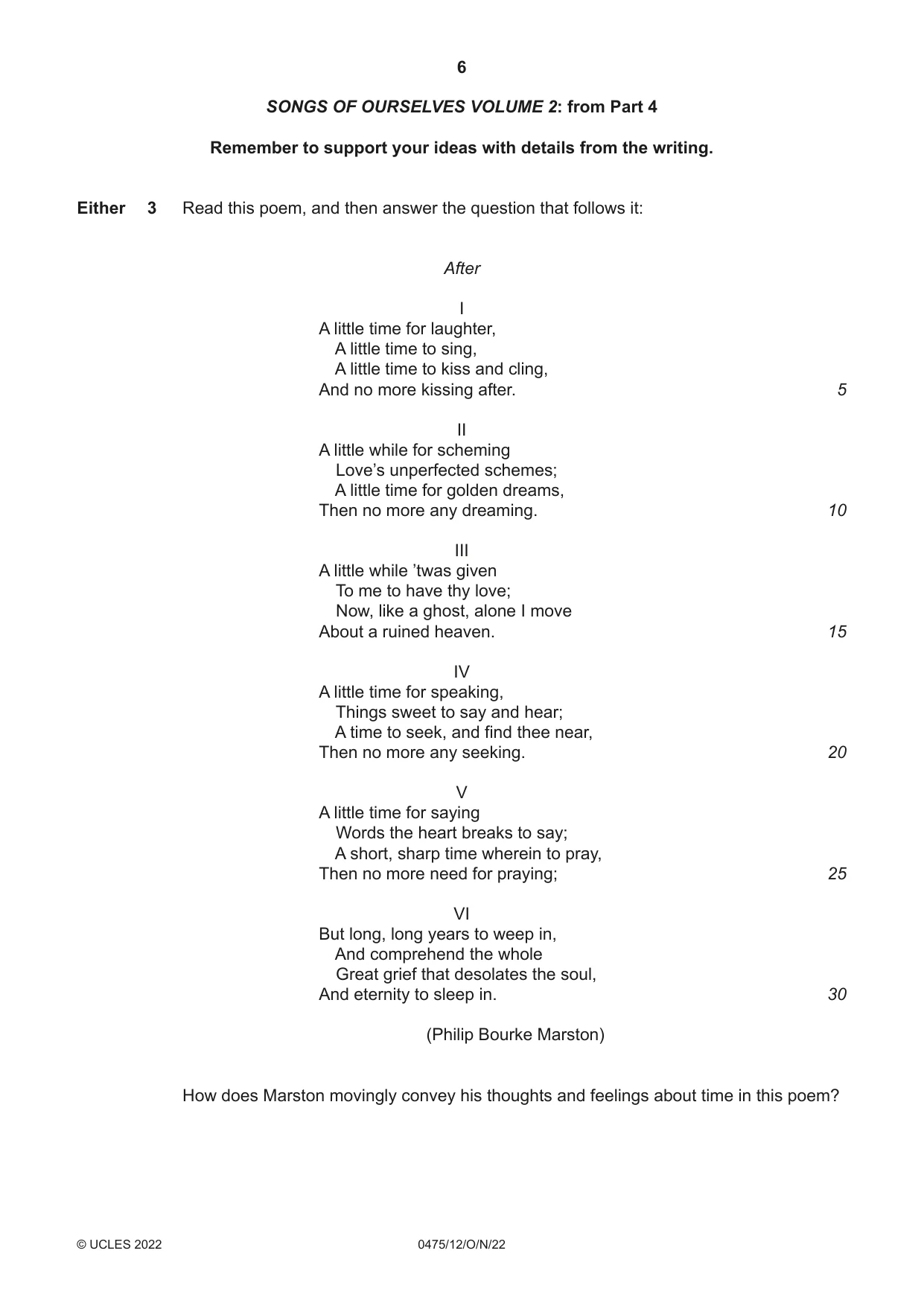
6 0475/12/O/N/22 © UCLES 2022 SONGS OF OURSELVES VOLUME 2: from Part 4 Remember to support your ideas with details from the writing. Either 3 Read this poem, and then answer the question that follows it: After I A little time for laughter, A little time to sing, A little time to kiss and cling, And no more kissing after. II A little while for scheming Love’s unperfected schemes; A little time for golden dreams, Then no more any dreaming. III A little while ’twas given To me to have thy love; Now, like a ghost, alone I move About a ruined heaven. IV A little time for speaking, Things sweet to say and hear; A time to seek, and find thee near, Then no more any seeking. V A little time for saying Words the heart breaks to say; A short, sharp time wherein to pray, Then no more need for praying; VI But long, long years to weep in, And comprehend the whole Great grief that desolates the soul, And eternity to sleep in. (Philip Bourke Marston) How does Marston movingly convey his thoughts and feelings about time in this poem? 5 10 15 20 25 30
Question paper, page 7
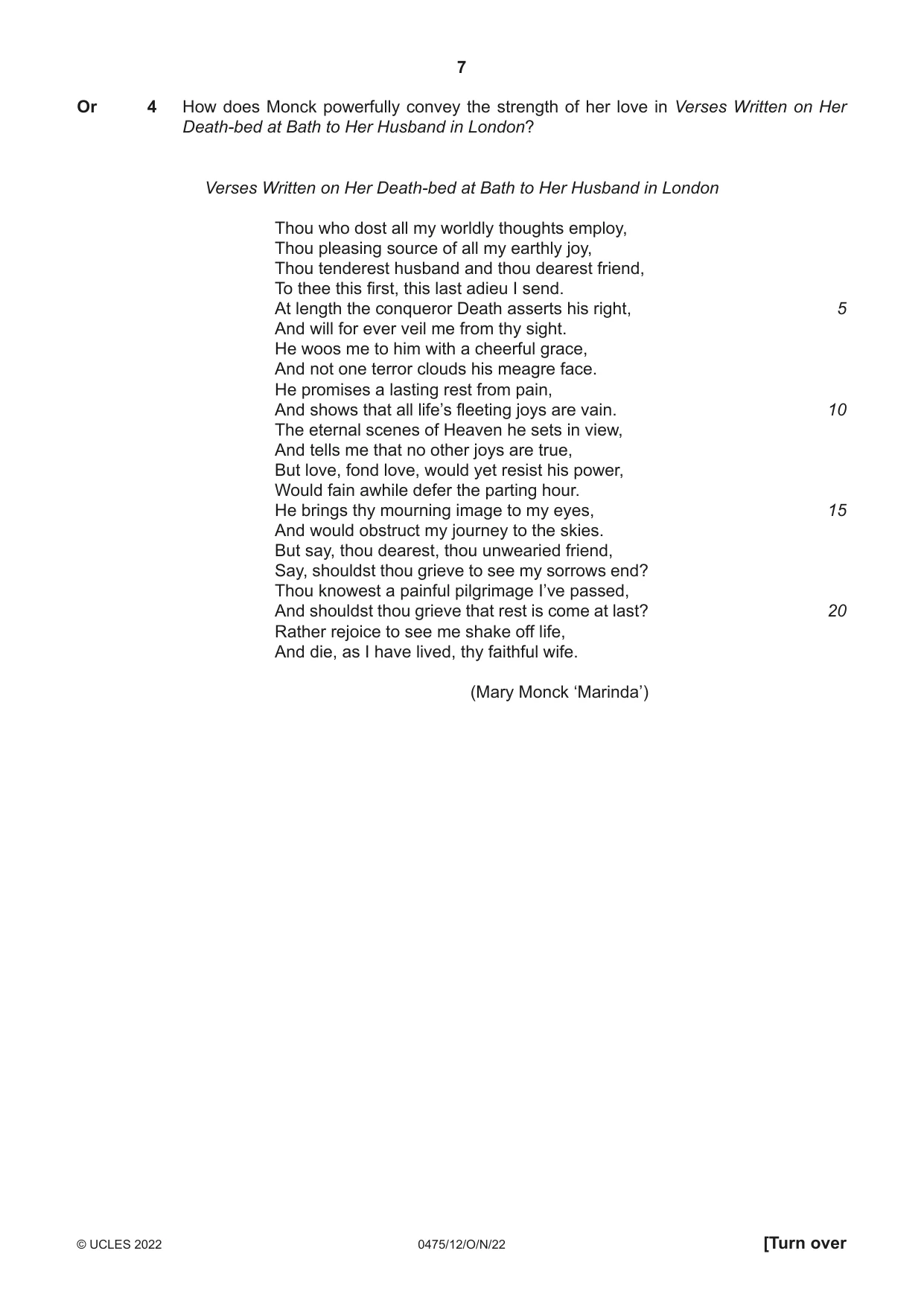
7 0475/12/O/N/22 © UCLES 2022 [Turn over Or 4 How does Monck powerfully convey the strength of her love in Verses Written on Her Death-bed at Bath to Her Husband in London? Verses Written on Her Death-bed at Bath to Her Husband in London Thou who dost all my worldly thoughts employ, Thou pleasing source of all my earthly joy, Thou tenderest husband and thou dearest friend, To thee this first, this last adieu I send. At length the conqueror Death asserts his right, And will for ever veil me from thy sight. He woos me to him with a cheerful grace, And not one terror clouds his meagre face. He promises a lasting rest from pain, And shows that all life’s fleeting joys are vain. The eternal scenes of Heaven he sets in view, And tells me that no other joys are true, But love, fond love, would yet resist his power, Would fain awhile defer the parting hour. He brings thy mourning image to my eyes, And would obstruct my journey to the skies. But say, thou dearest, thou unwearied friend, Say, shouldst thou grieve to see my sorrows end? Thou knowest a painful pilgrimage I’ve passed, And shouldst thou grieve that rest is come at last? Rather rejoice to see me shake off life, And die, as I have lived, thy faithful wife. (Mary Monck ‘Marinda’) 5 10 15 20
Question paper, page 8
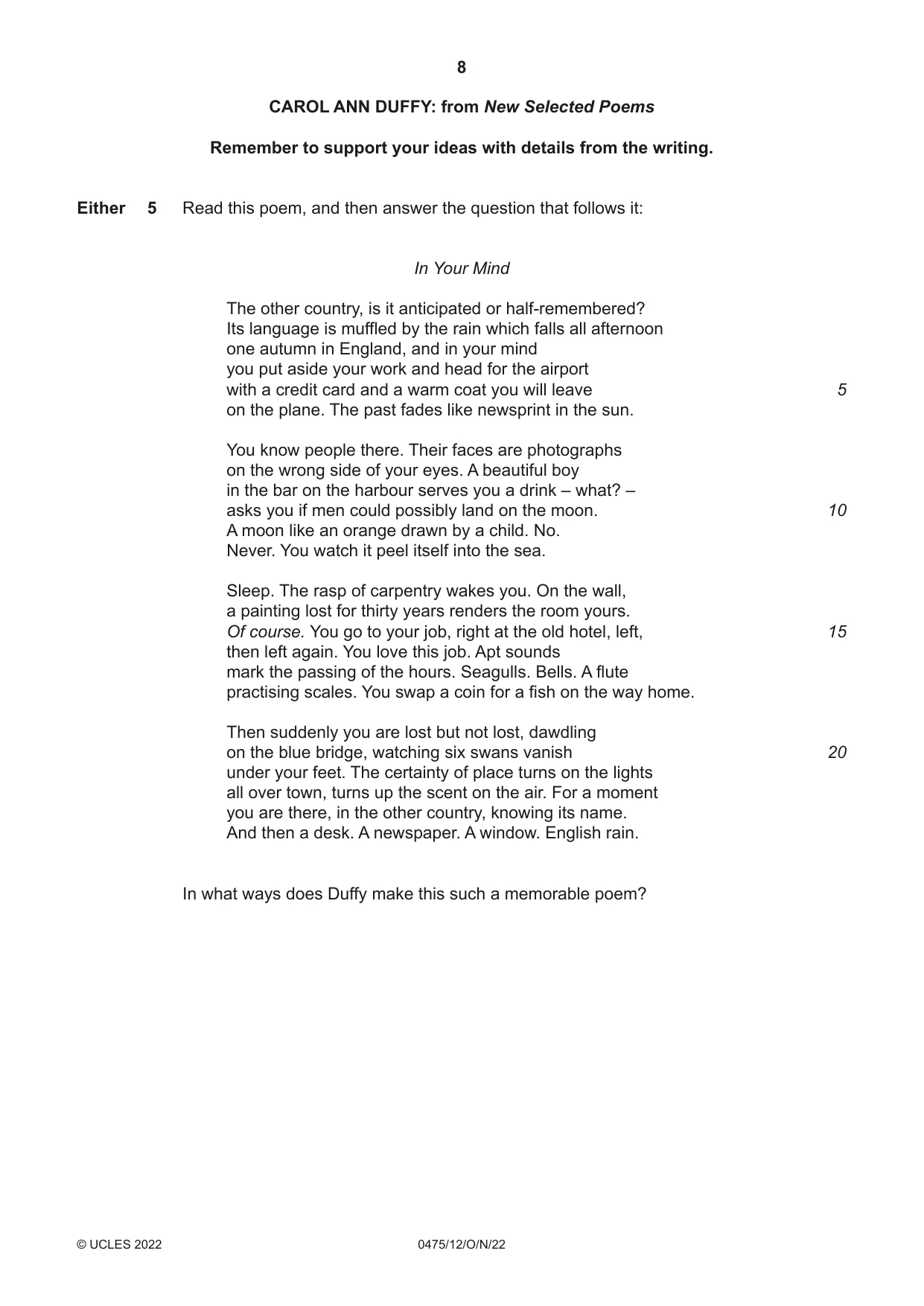
8 0475/12/O/N/22 © UCLES 2022 CAROL ANN DUFFY: from New Selected Poems Remember to support your ideas with details from the writing. Either 5 Read this poem, and then answer the question that follows it: In Your Mind The other country, is it anticipated or half-remembered? Its language is muffled by the rain which falls all afternoon one autumn in England, and in your mind you put aside your work and head for the airport with a credit card and a warm coat you will leave on the plane. The past fades like newsprint in the sun. You know people there. Their faces are photographs on the wrong side of your eyes. A beautiful boy in the bar on the harbour serves you a drink – what? – asks you if men could possibly land on the moon. A moon like an orange drawn by a child. No. Never. You watch it peel itself into the sea. Sleep. The rasp of carpentry wakes you. On the wall, a painting lost for thirty years renders the room yours. Of course. You go to your job, right at the old hotel, left, then left again. You love this job. Apt sounds mark the passing of the hours. Seagulls. Bells. A flute practising scales. You swap a coin for a fish on the way home. Then suddenly you are lost but not lost, dawdling on the blue bridge, watching six swans vanish under your feet. The certainty of place turns on the lights all over town, turns up the scent on the air. For a moment you are there, in the other country, knowing its name. And then a desk. A newspaper. A window. English rain. In what ways does Duffy make this such a memorable poem? 5 10 15 20
Question paper, page 9
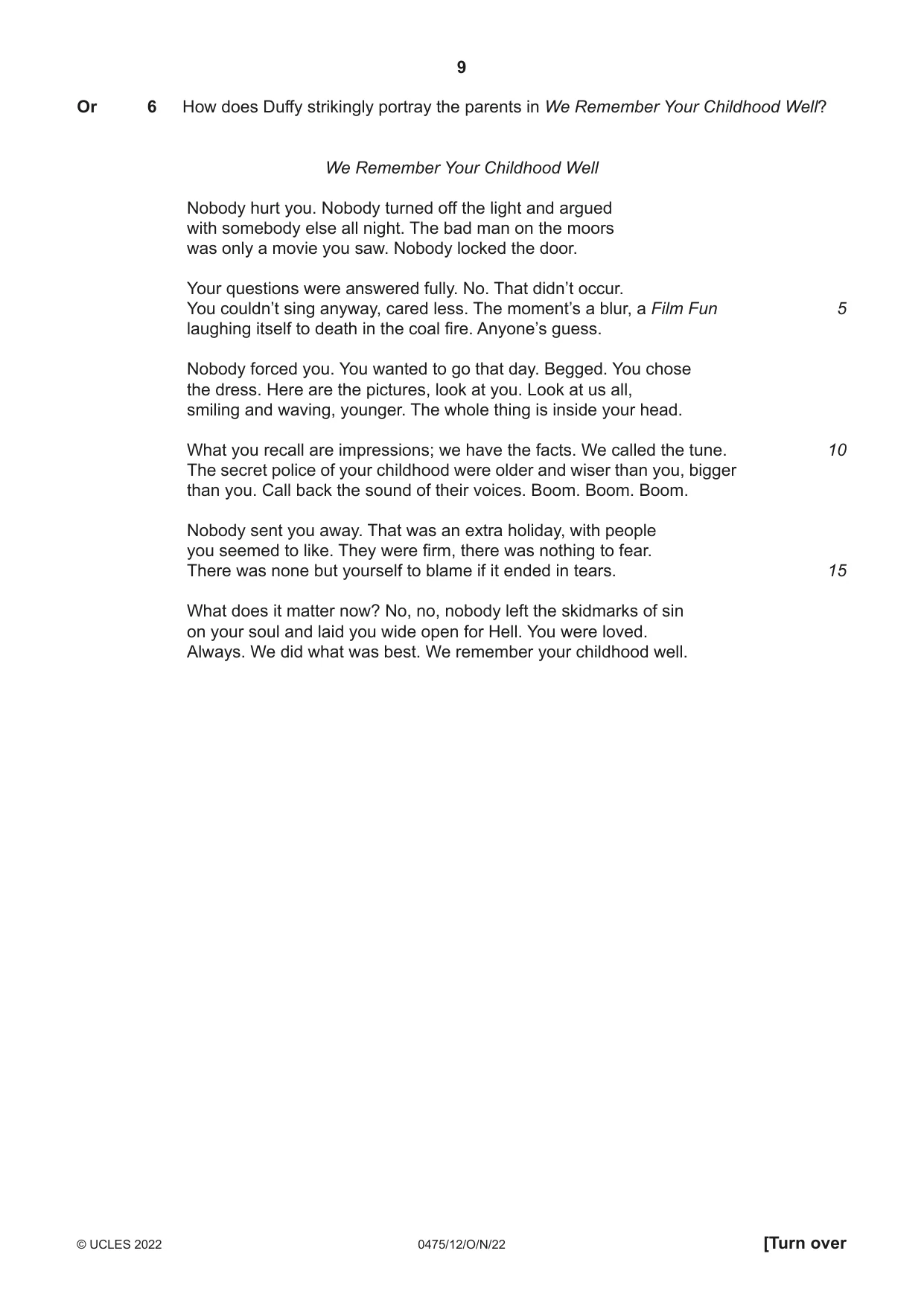
9 0475/12/O/N/22 © UCLES 2022 [Turn over Or 6 How does Duffy strikingly portray the parents in We Remember Your Childhood Well? We Remember Your Childhood Well Nobody hurt you. Nobody turned off the light and argued with somebody else all night. The bad man on the moors was only a movie you saw. Nobody locked the door. Your questions were answered fully. No. That didn’t occur. You couldn’t sing anyway, cared less. The moment’s a blur, a Film Fun laughing itself to death in the coal fire. Anyone’s guess. Nobody forced you. You wanted to go that day. Begged. You chose the dress. Here are the pictures, look at you. Look at us all, smiling and waving, younger. The whole thing is inside your head. What you recall are impressions; we have the facts. We called the tune. The secret police of your childhood were older and wiser than you, bigger than you. Call back the sound of their voices. Boom. Boom. Boom. Nobody sent you away. That was an extra holiday, with people you seemed to like. They were firm, there was nothing to fear. There was none but yourself to blame if it ended in tears. What does it matter now? No, no, nobody left the skidmarks of sin on your soul and laid you wide open for Hell. You were loved. Always. We did what was best. We remember your childhood well. 5 10 15
Question paper, page 10
10 0475/12/O/N/22 © UCLES 2022 SECTION B: PROSE Answer one question from this section. CHIMAMANDA NGOZI ADICHIE: Purple Hibiscus Remember to support your ideas with details from the writing. Either 7 Read this passage, and then answer the question that follows it: ‘God knows best,’ I said. Content removed due to copyright restrictions.
Question paper, page 11
11 0475/12/O/N/22 © UCLES 2022 [Turn over They allowed him to change his shirt before they took him away. How does Adichie make this such a powerful moment in the novel? Or 8 ‘Characters in the novel have different attitudes to Christianity.’ Explore how Adichie vividly portrays this. Content removed due to copyright restrictions.
Question paper, page 12
12 0475/12/O/N/22 © UCLES 2022 CHARLOTTE BRONTË: Jane Eyre Remember to support your ideas with details from the writing. Either 9 Read this passage, and then answer the question that follows it: Oh! I could not forget his look and his paleness when he whispered: ‘Jane, I have got a blow – I have got a blow, Jane.’ I could not forget how the arm had trembled which he rested on my shoulder: and it was no light matter which could thus bow the resolute spirit and thrill the vigorous frame of Fairfax Rochester. ‘When will he come? When will he come?’ I cried inwardly, as the night lingered and lingered – as my bleeding patient drooped, moaned, sickened: and neither day nor aid arrived. I had, again and again, held the water to Mason’s white lips; again and again offered him the stimulating salts: my efforts seemed ineffectual: either bodily or mental suffering, or loss of blood, or all three combined, were fast prostrating his strength. He moaned so, and looked so weak, wild, and lost, I feared he was dying; and I might not even speak to him. The candle, wasted at last, went out; as it expired, I perceived streaks of gray light edging the window curtains: dawn was then approaching. Presently I heard Pilot bark far below, out of his distant kennel in the courtyard: hope revived. Nor was it unwarranted: in five minutes more the grating key, the yielding lock, warned me my watch was relieved. It could not have lasted more than two hours: many a week has seemed shorter. Mr Rochester entered, and with him the surgeon he had been to fetch. ‘Now, Carter, be on the alert,’ he said to this last: ‘I give you but half an hour for dressing the wound, fastening the bandages, getting the patient downstairs and all.’ ‘But is he fit to move, sir?’ ‘No doubt of it; it is nothing serious; he is nervous, his spirits must be kept up. Come, set to work.’ Mr Rochester drew back the thick curtain, drew up the holland blind, let in all the daylight he could; and I was surprised and cheered to see how far dawn was advanced: what rosy streaks were beginning to brighten the east. Then he approached Mason, whom the surgeon was already handling. ‘Now, my good fellow, how are you?’ he asked. ‘She’s done for me, I fear,’ was the faint reply. ‘Not a whit! – courage! This day fortnight you’ll hardly be a pin the worse of it: you’ve lost a little blood; that’s all. – Carter, assure him there’s no danger.’ ‘I can do that conscientiously,’ said Carter, who had now undone the bandages; ‘only I wish I could have got here sooner: he would not have bled so much – but how is this? The flesh on the shoulder is torn as well as cut. This wound was not done with a knife: there have been teeth here!’ ‘She bit me,’ he murmured. ‘She worried me like a tigress, when Rochester got the knife from her.’ ‘You should not have yielded: you should have grappled with her at once,’ said Mr Rochester. ‘But under such circumstances, what could one do?’ returned Mason. ‘Oh, it was frightful!’ he added, shuddering. ‘And I did not expect it: she looked so quiet at first.’ 5 10 15 20 25 30 35 40 45
Question paper, page 13
13 0475/12/O/N/22 © UCLES 2022 [Turn over ‘I warned you,’ was his friend’s answer; ‘I said – be on your guard when you go near her. Besides, you might have waited till to-morrow, and had me with you: it was mere folly to attempt the interview to-night, and alone.’ (from Chapter 20) How does Brontë make this such a powerful moment in the novel? Or 10 How far does Brontë make the ending of the novel satisfying for you? 50
Question paper, page 14
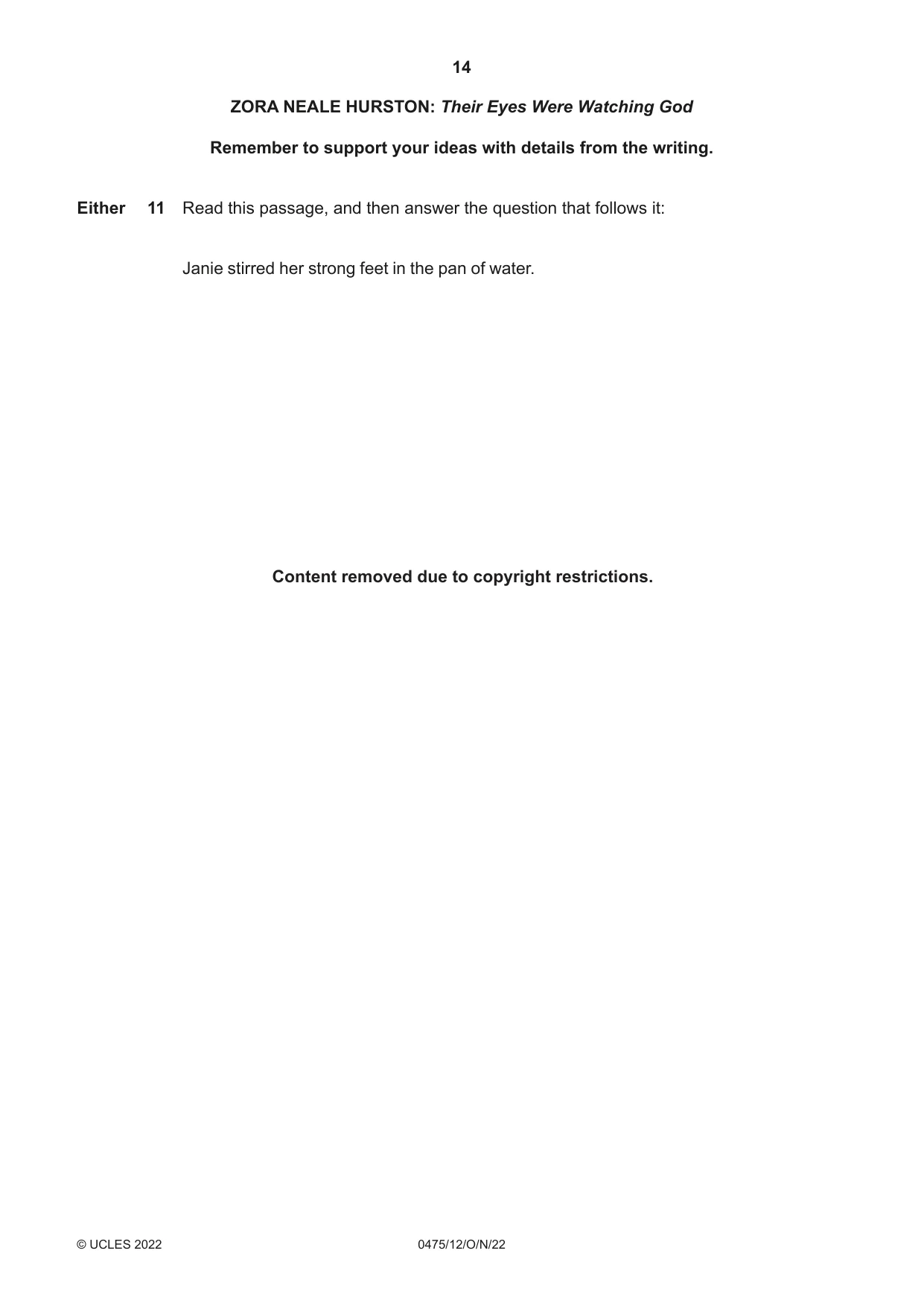
14 0475/12/O/N/22 © UCLES 2022 ZORA NEALE HURSTON: Their Eyes Were Watching God Remember to support your ideas with details from the writing. Either 11 Read this passage, and then answer the question that follows it: Janie stirred her strong feet in the pan of water. Content removed due to copyright restrictions.
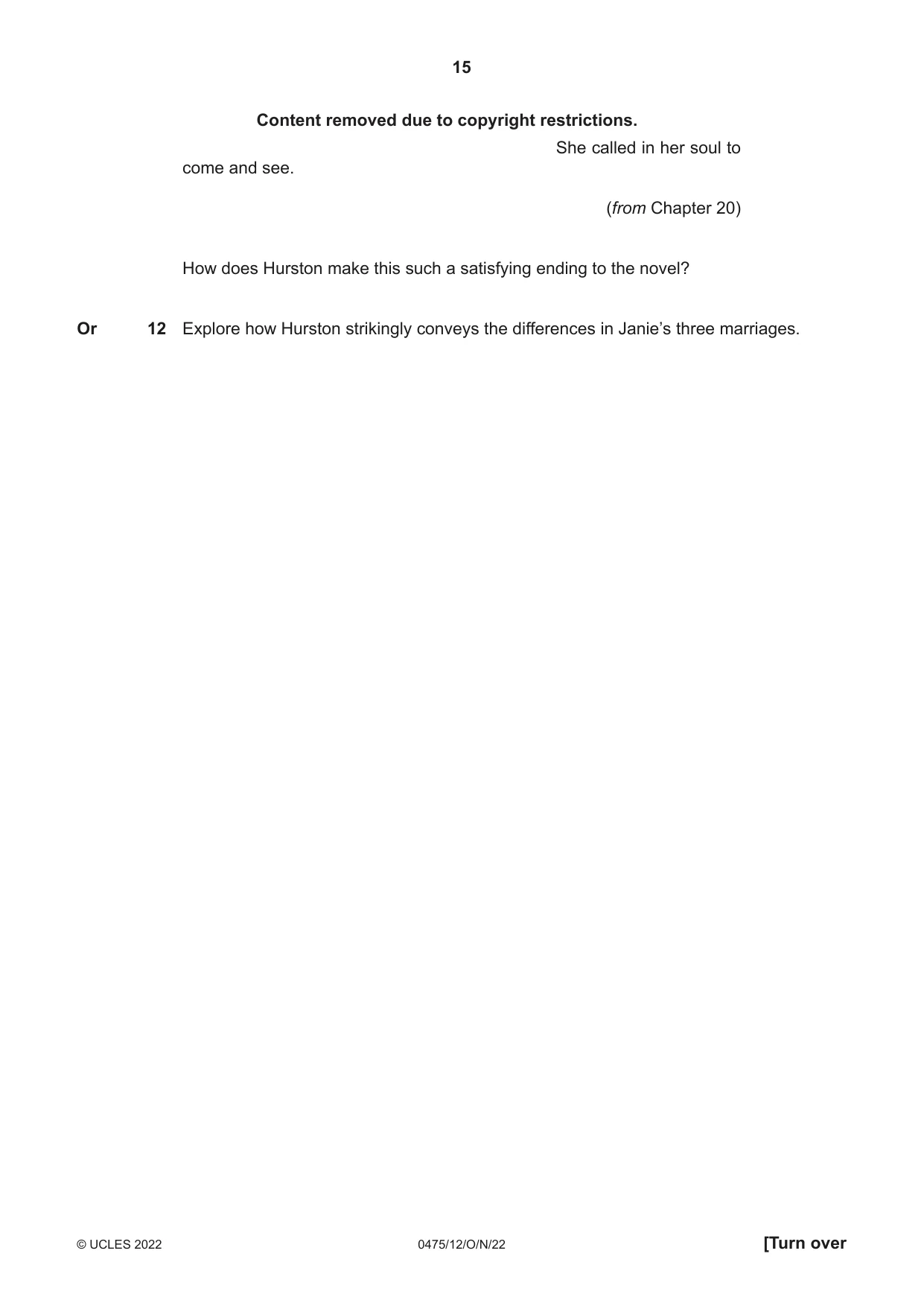
Question paper, page 15
15 0475/12/O/N/22 © UCLES 2022 [Turn over She called in her soul to come and see. (from Chapter 20) How does Hurston make this such a satisfying ending to the novel? Or 12 Explore how Hurston strikingly conveys the differences in Janie’s three marriages. Content removed due to copyright restrictions.
Question paper, page 16
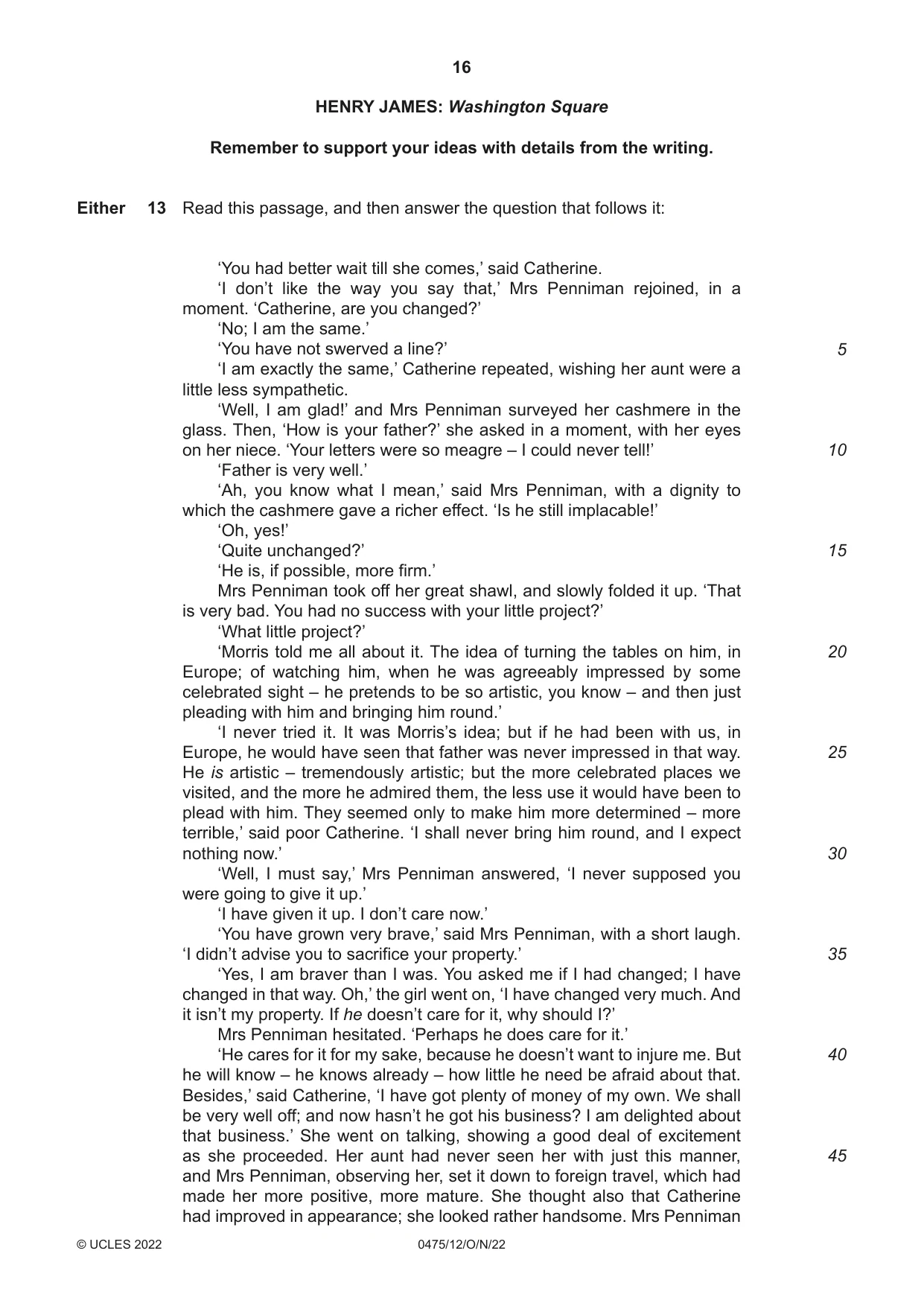
16 0475/12/O/N/22 © UCLES 2022 HENRY JAMES: Washington Square Remember to support your ideas with details from the writing. Either 13 Read this passage, and then answer the question that follows it: ‘You had better wait till she comes,’ said Catherine. ‘I don’t like the way you say that,’ Mrs Penniman rejoined, in a moment. ‘Catherine, are you changed?’ ‘No; I am the same.’ ‘You have not swerved a line?’ ‘I am exactly the same,’ Catherine repeated, wishing her aunt were a little less sympathetic. ‘Well, I am glad!’ and Mrs Penniman surveyed her cashmere in the glass. Then, ‘How is your father?’ she asked in a moment, with her eyes on her niece. ‘Your letters were so meagre – I could never tell!’ ‘Father is very well.’ ‘Ah, you know what I mean,’ said Mrs Penniman, with a dignity to which the cashmere gave a richer effect. ‘Is he still implacable!’ ‘Oh, yes!’ ‘Quite unchanged?’ ‘He is, if possible, more firm.’ Mrs Penniman took off her great shawl, and slowly folded it up. ‘That is very bad. You had no success with your little project?’ ‘What little project?’ ‘Morris told me all about it. The idea of turning the tables on him, in Europe; of watching him, when he was agreeably impressed by some celebrated sight – he pretends to be so artistic, you know – and then just pleading with him and bringing him round.’ ‘I never tried it. It was Morris’s idea; but if he had been with us, in Europe, he would have seen that father was never impressed in that way. He is artistic – tremendously artistic; but the more celebrated places we visited, and the more he admired them, the less use it would have been to plead with him. They seemed only to make him more determined – more terrible,’ said poor Catherine. ‘I shall never bring him round, and I expect nothing now.’ ‘Well, I must say,’ Mrs Penniman answered, ‘I never supposed you were going to give it up.’ ‘I have given it up. I don’t care now.’ ‘You have grown very brave,’ said Mrs Penniman, with a short laugh. ‘I didn’t advise you to sacrifice your property.’ ‘Yes, I am braver than I was. You asked me if I had changed; I have changed in that way. Oh,’ the girl went on, ‘I have changed very much. And it isn’t my property. If he doesn’t care for it, why should I?’ Mrs Penniman hesitated. ‘Perhaps he does care for it.’ ‘He cares for it for my sake, because he doesn’t want to injure me. But he will know – he knows already – how little he need be afraid about that. Besides,’ said Catherine, ‘I have got plenty of money of my own. We shall be very well off; and now hasn’t he got his business? I am delighted about that business.’ She went on talking, showing a good deal of excitement as she proceeded. Her aunt had never seen her with just this manner, and Mrs Penniman, observing her, set it down to foreign travel, which had made her more positive, more mature. She thought also that Catherine had improved in appearance; she looked rather handsome. Mrs Penniman 5 10 15 20 25 30 35 40 45
Question paper, page 17
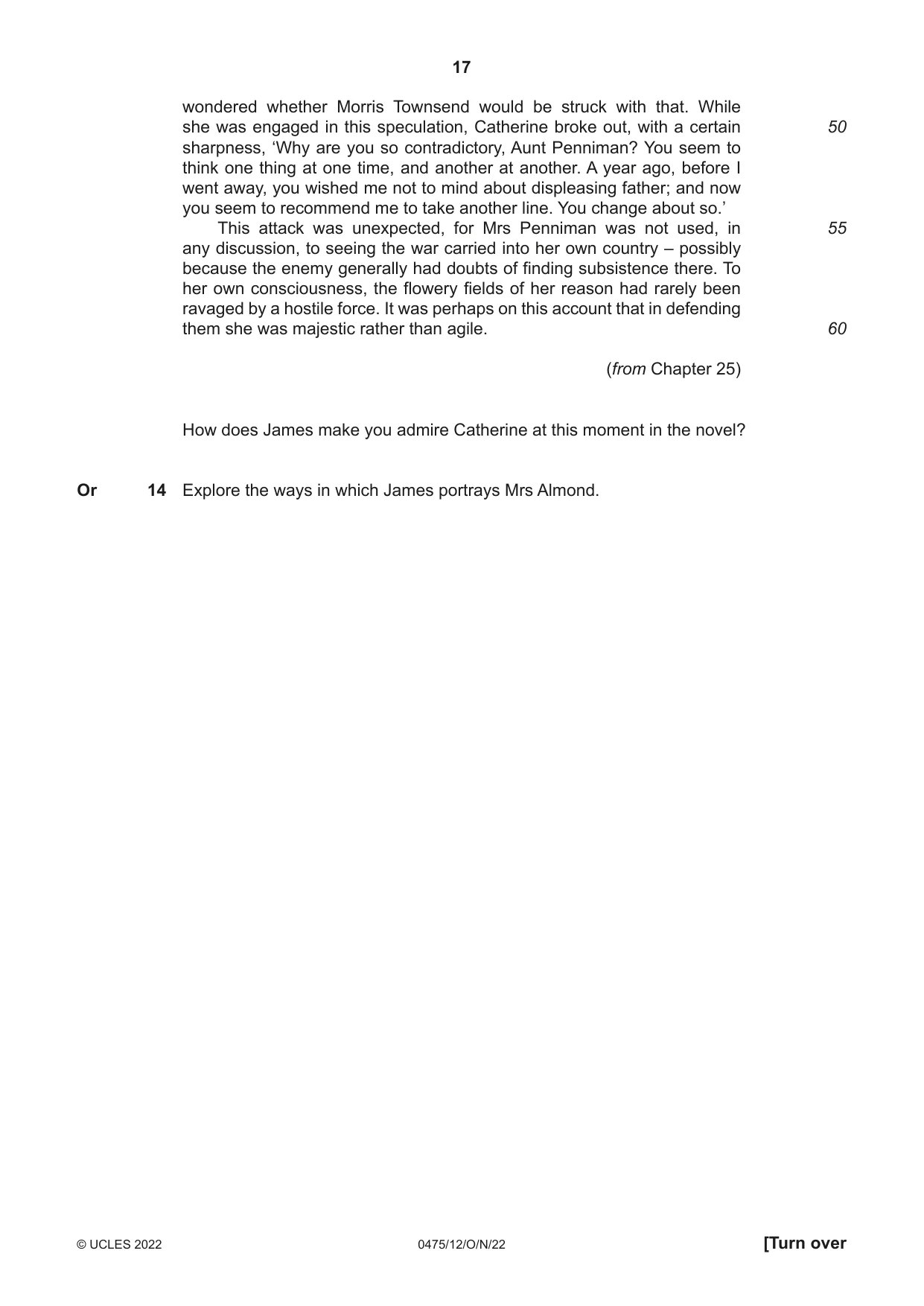
17 0475/12/O/N/22 © UCLES 2022 [Turn over wondered whether Morris Townsend would be struck with that. While she was engaged in this speculation, Catherine broke out, with a certain sharpness, ‘Why are you so contradictory, Aunt Penniman? You seem to think one thing at one time, and another at another. A year ago, before I went away, you wished me not to mind about displeasing father; and now you seem to recommend me to take another line. You change about so.’ This attack was unexpected, for Mrs Penniman was not used, in any discussion, to seeing the war carried into her own country – possibly because the enemy generally had doubts of finding subsistence there. To her own consciousness, the flowery fields of her reason had rarely been ravaged by a hostile force. It was perhaps on this account that in defending them she was majestic rather than agile. (from Chapter 25) How does James make you admire Catherine at this moment in the novel? Or 14 Explore the ways in which James portrays Mrs Almond. 50 55 60
Question paper, page 18
18 0475/12/O/N/22 © UCLES 2022 JHUMPA LAHIRI: The Namesake Remember to support your ideas with details from the writing. Either 15 Read this passage, and then answer the question that follows it: Instead of pushing his way through to the other end of the hallway, he decides to climb another set of stairs. Content removed due to copyright restrictions.
Question paper, page 19
19 0475/12/O/N/22 © UCLES 2022 [Turn over That Gogol had had nothing to do with it. (from Chapter 4) How does Lahiri memorably convey Gogol’s thoughts and feelings at this moment in the novel? Or 16 ‘Ashima longs for the past.’ How far does Lahiri’s portrayal of Ashima show this to be true? Content removed due to copyright restrictions.
Question paper, page 20
20 0475/12/O/N/22 © UCLES 2022 YANN MARTEL: Life of Pi Remember to support your ideas with details from the writing. Either 17 Read this passage, and then answer the question that follows it: ‘Richard Parker, a ship!’ Content removed due to copyright restrictions.
Question paper, page 21
21 0475/12/O/N/22 © UCLES 2022 [Turn over I’ll get you to land, I promise, I promise!’ (from Chapter 86) In what ways does Martel make this such a powerfully dramatic moment in the novel? Or 18 Explore how Martel vividly conveys Pi’s thoughts and feelings in the first few days after the ship sinks. Content removed due to copyright restrictions.
Question paper, page 22
22 0475/12/O/N/22 © UCLES 2022 GEORGE ORWELL: 1984 Remember to support your ideas with details from the writing. Either 19 Read this passage, and then answer the question that follows it: What seemed like a long time passed. The pain in Winston’s belly had revived. His mind sagged round and round on the same track, like a ball falling again and again into the same series of slots. He had only six thoughts. The pain in his belly; a piece of bread; the blood and the screaming; O’Brien; Julia; the razor blade. There was another spasm in his entrails; the heavy boots were approaching. As the door opened, the wave of air that it created brought in a powerful smell of cold sweat. Parsons walked into the cell. He was wearing khaki shorts and a sports-shirt. This time Winston was startled into self-forgetfulness. ‘You here!’ he said. Parsons gave Winston a glance in which there was neither interest nor surprise, but only misery. He began walking jerkily up and down, evidently unable to keep still. Each time he straightened his pudgy knees it was apparent that they were trembling. His eyes had a wide-open, staring look, as though he could not prevent himself from gazing at something in the middle distance. ‘What are you in for?’ said Winston. ‘Thoughtcrime!’ said Parsons, almost blubbering. The tone of his voice implied at once a complete admission of his guilt and a sort of incredulous horror that such a word could be applied to himself. He paused opposite Winston and began eagerly appealing to him: ‘You don’t think they’ll shoot me, do you, old chap? They don’t shoot you if you haven’t actually done anything – only thoughts, which you can’t help? I know they give you a fair hearing. Oh, I trust them for that! They’ll know my record, won’t they? You know what kind of a chap I was. Not a bad chap in my way. Not brainy, of course, but keen. I tried to do my best for the Party, didn’t I? I’ll get off with five years don’t you think? Or even ten years? A chap like me could make himself pretty useful in a labour-camp. They wouldn’t shoot me for going off the rails just once?’ ‘Are you guilty?’ said Winston. ‘Of course I’m guilty!’ cried Parsons with a servile glance at the telescreen. ‘You don’t think the Party would arrest an innocent man, do you?’ His froglike face grew calmer, and even took on a slightly sanctimonious expression. ‘Thoughtcrime is a dreadful thing, old man,’ he said sententiously. ‘It’s insidious. It can get hold of you without your even knowing it. Do you know how it got hold of me? In my sleep! Yes, that’s a fact. There I was, working away, trying to do my bit – never knew I had any bad stuff in my mind at all. And then I started talking in my sleep. Do you know what they heard me saying?’ He sank his voice, like someone who is obliged for medical reasons to utter an obscenity. ‘“Down with Big Brother!” Yes, I said that! Said it over and over again, it seems. Between you and me, old man, I’m glad they got me before it went any further. Do you know what I’m going to say to them when I go up before the tribunal? “Thank you,” I’m going to say, “thank you for saving me before it was too late.”’ ‘Who denounced you?’ said Winston. 5 10 15 20 25 30 35 40 45
Question paper, page 23
23 0475/12/O/N/22 © UCLES 2022 [Turn over ‘It was my little daughter,’ said Parsons with a sort of doleful pride. ‘She listened at the keyhole. Heard what I was saying, and nipped off to the patrols the very next day. Pretty smart for a nipper of seven, eh? I don’t bear her any grudge for it. In fact I’m proud of her. It shows I brought her up in the right spirit, anyway.’ (from Part 3 Chapter 1) How does Orwell make this moment in the novel so disturbing? Or 20 Explore how Orwell creates memorable impressions of women in the novel. 50
Question paper, page 24
24 0475/12/O/N/22 © UCLES 2022 from STORIES OF OURSELVES VOLUME 2 Remember to support your ideas with details from the writing. Either 21 Read this passage from Sharmaji (by Anjana Appachana), and then answer the question that follows it: ‘Sharma, could you please come to my office?’ It was Mr Borwankar, Sharma’s boss. Gupta slid away to his department. Sharma sighed. ‘Yes, Borwankar Sahib. I will come.’ He followed his manager to his office. ‘Sit down.’ Sharma sighed and sat. ‘I had called you to my office more than an hour ago.’ ‘It was lunchtime, sir.’ ‘Indeed.’ ‘Yes, sir.’ ‘What happened after lunch?’ ‘I am here sir, after lunch.’ ‘It is forty-five minutes past lunchtime.’ ‘I went to the dhaba to eat, sir. There was a long queue there, so I was delayed, sir. All this was because my daughters have been getting the virus, sir, and my wife has no time to pack lunch for me, sir. I am sure you understand, sir. After all, how can I work on an empty stomach? I feel so weak these days sir, so tired. I think I am also getting the virus.’ ‘Where have you been all morning?’ ‘Here, sir.’ ‘Here – where?’ ‘In the department, sir.’ ‘You were not at your desk all morning.’ ‘Sir, what are you saying? I must have gone down to the personnel department or the accounts department for some work.’ ‘What work?’ Sharma was silent. He shook his head. He looked sadly at Mr Borwankar. He said, ‘Borwankar sahib, why are you taking this tone with me? You ask me questions as though you have no faith in me. This is not a detective agency. Why must you interrogate me in this manner? All right, I was not in my department, but that was because I had work in other departments. Still, if it is your wish, I will not go to other departments even if I have work there. I will sit at my desk and work only at my desk. Yes, yes, I will do that. The company does not want me to consult other departments. All right, I will not consult other departments. You will see, work will suffer, but why should I care when you do not? I have been in this company for twenty-five years, but no one cares. For twenty-five years the company has bled me, sucked me dry. What do you know? You have been here only two years. You know nothing. Twenty-five years ago I joined as a clerk. Today I am still a clerk. Why should I work?’ His outburst had touched something raw in him. Overwhelmed and defiant, he glared at Mr Borwankar. ‘Sharma, you still haven’t answered my question.’ Sharma shrugged his shoulders. ‘Borwankar sahib, what is the point of answering? Even if I answer, you will not believe me.’ He reflected 5 10 15 20 25 30 35 40 45
Question paper, page 25
25 0475/12/O/N/22 © UCLES 2022 and said sadly, ‘No, there is no point telling you anything. What can you understand?’ Mr Borwankar said dryly, ‘I understand that you haven’t been at your desk all morning. You were seen loitering in the corridor and drinking tea in the canteen. Presumably that is what you did all morning. And that is what you have been doing virtually every day. In addition, you never come to work on time. Today you were half-an-hour late. This is your fourteenth late arrival this month. Last month you were late twenty days and the previous month, fifteen days. What do you have to say for yourself?’ ‘What can I say? This is the only work the personnel department has. Every day they sit and count how many late arrivals there are. For that they get paid. Even I can count.’ ‘Sharma, you are evading all my questions. I have already warned you three times. Each time you gave me to understand that things would change. Nothing has changed. Your work output is zero. Your attitude leaves much to be desired.’ Explore the ways in which Appachana vividly portrays Sharma at this moment in the story. Or 22 In what ways does Laski encourage you to admire Caroline in The Tower? 50 55 60
Question paper, page 26
26 0475/12/O/N/22 © UCLES 2022 BLANK PAGE
Question paper, page 27
27 0475/12/O/N/22 © UCLES 2022 BLANK PAGE
Question paper, page 28
28 0475/12/O/N/22 © UCLES 2022 Permission to reproduce items where third-party owned material protected by copyright is included has been sought and cleared where possible. Every reasonable effort has been made by the publisher (UCLES) to trace copyright holders, but if any items requiring clearance have unwittingly been included, the publisher will be pleased to make amends at the earliest possible opportunity. To avoid the issue of disclosure of answer-related information to candidates, all copyright acknowledgements are reproduced online in the Cambridge Assessment International Education Copyright Acknowledgements Booklet. This is produced for each series of examinations and is freely available to download at www.cambridgeinternational.org after the live examination series. Cambridge Assessment International Education is part of Cambridge Assessment. Cambridge Assessment is the brand name of the University of Cambridge Local Examinations Syndicate (UCLES), which is a department of the University of Cambridge. BLANK PAGE
Mark scheme, page 1
This document consists of 4 printed pages. © UCLES 2022 [Turn over Cambridge IGCSE™ LITERATURE IN ENGLISH 0475/12 Paper 1 Poetry and Prose October/November 2022 MARK SCHEME Maximum Mark: 50 Published This mark scheme is published as an aid to teachers and candidates, to indicate the requirements of the examination. It shows the basis on which Examiners were instructed to award marks. It does not indicate the details of the discussions that took place at an Examiners’ meeting before marking began, which would have considered the acceptability of alternative answers. Mark schemes should be read in conjunction with the question paper and the Principal Examiner Report for Teachers. Cambridge International will not enter into discussions about these mark schemes. Cambridge International is publishing the mark schemes for the October/November 2022 series for most Cambridge IGCSE™, Cambridge International A and AS Level components and some Cambridge O Level components.
Mark scheme, page 2
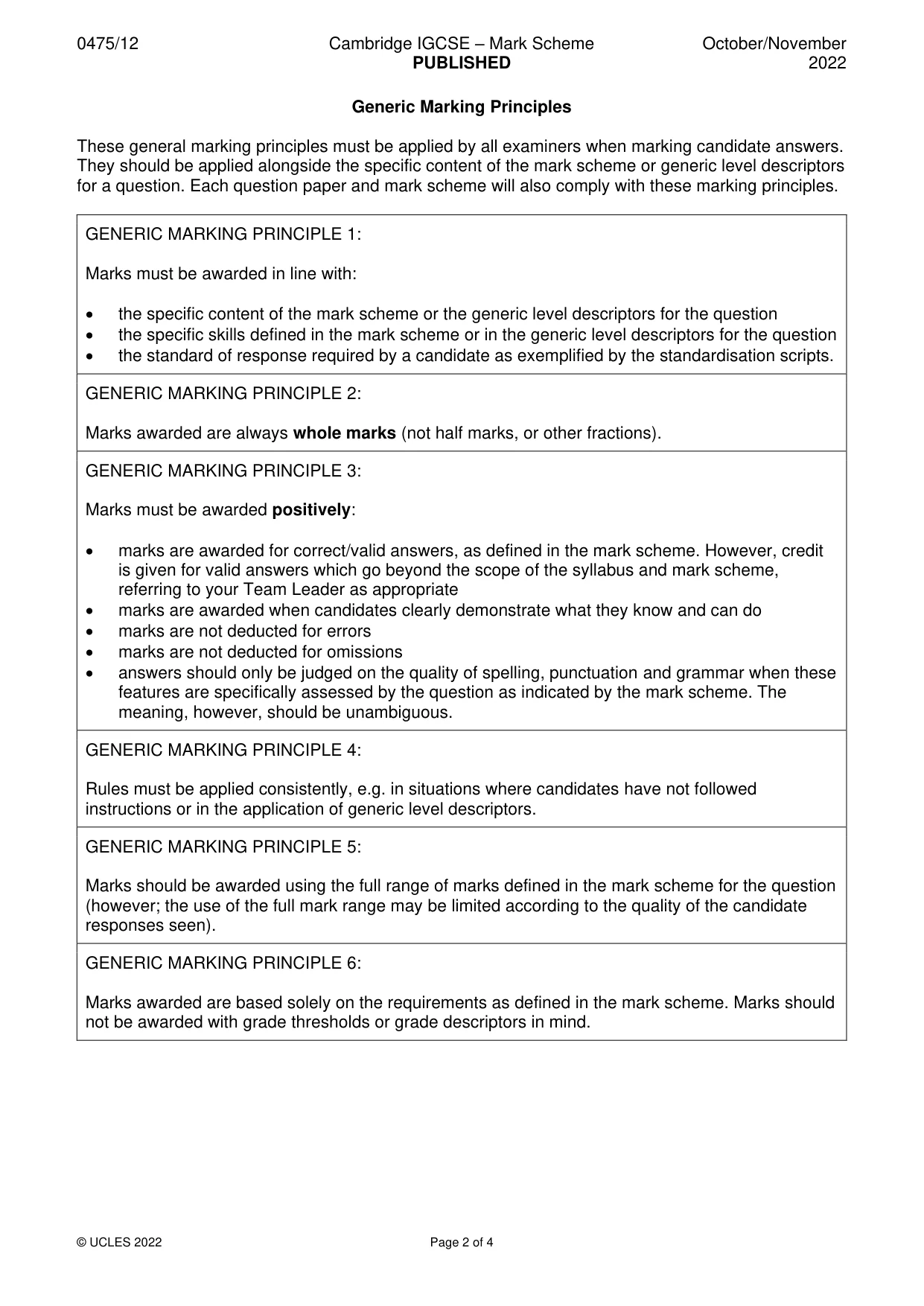
0475/12 Cambridge IGCSE – Mark Scheme PUBLISHED October/November 2022 © UCLES 2022 Page 2 of 4 Generic Marking Principles These general marking principles must be applied by all examiners when marking candidate answers. They should be applied alongside the specific content of the mark scheme or generic level descriptors for a question. Each question paper and mark scheme will also comply with these marking principles. GENERIC MARKING PRINCIPLE 1: Marks must be awarded in line with: • the specific content of the mark scheme or the generic level descriptors for the question • the specific skills defined in the mark scheme or in the generic level descriptors for the question • the standard of response required by a candidate as exemplified by the standardisation scripts. GENERIC MARKING PRINCIPLE 2: Marks awarded are always whole marks (not half marks, or other fractions). GENERIC MARKING PRINCIPLE 3: Marks must be awarded positively: • marks are awarded for correct/valid answers, as defined in the mark scheme. However, credit is given for valid answers which go beyond the scope of the syllabus and mark scheme, referring to your Team Leader as appropriate • marks are awarded when candidates clearly demonstrate what they know and can do • marks are not deducted for errors • marks are not deducted for omissions • answers should only be judged on the quality of spelling, punctuation and grammar when these features are specifically assessed by the question as indicated by the mark scheme. The meaning, however, should be unambiguous. GENERIC MARKING PRINCIPLE 4: Rules must be applied consistently, e.g. in situations where candidates have not followed instructions or in the application of generic level descriptors. GENERIC MARKING PRINCIPLE 5: Marks should be awarded using the full range of marks defined in the mark scheme for the question (however; the use of the full mark range may be limited according to the quality of the candidate responses seen). GENERIC MARKING PRINCIPLE 6: Marks awarded are based solely on the requirements as defined in the mark scheme. Marks should not be awarded with grade thresholds or grade descriptors in mind.
Mark scheme, page 3
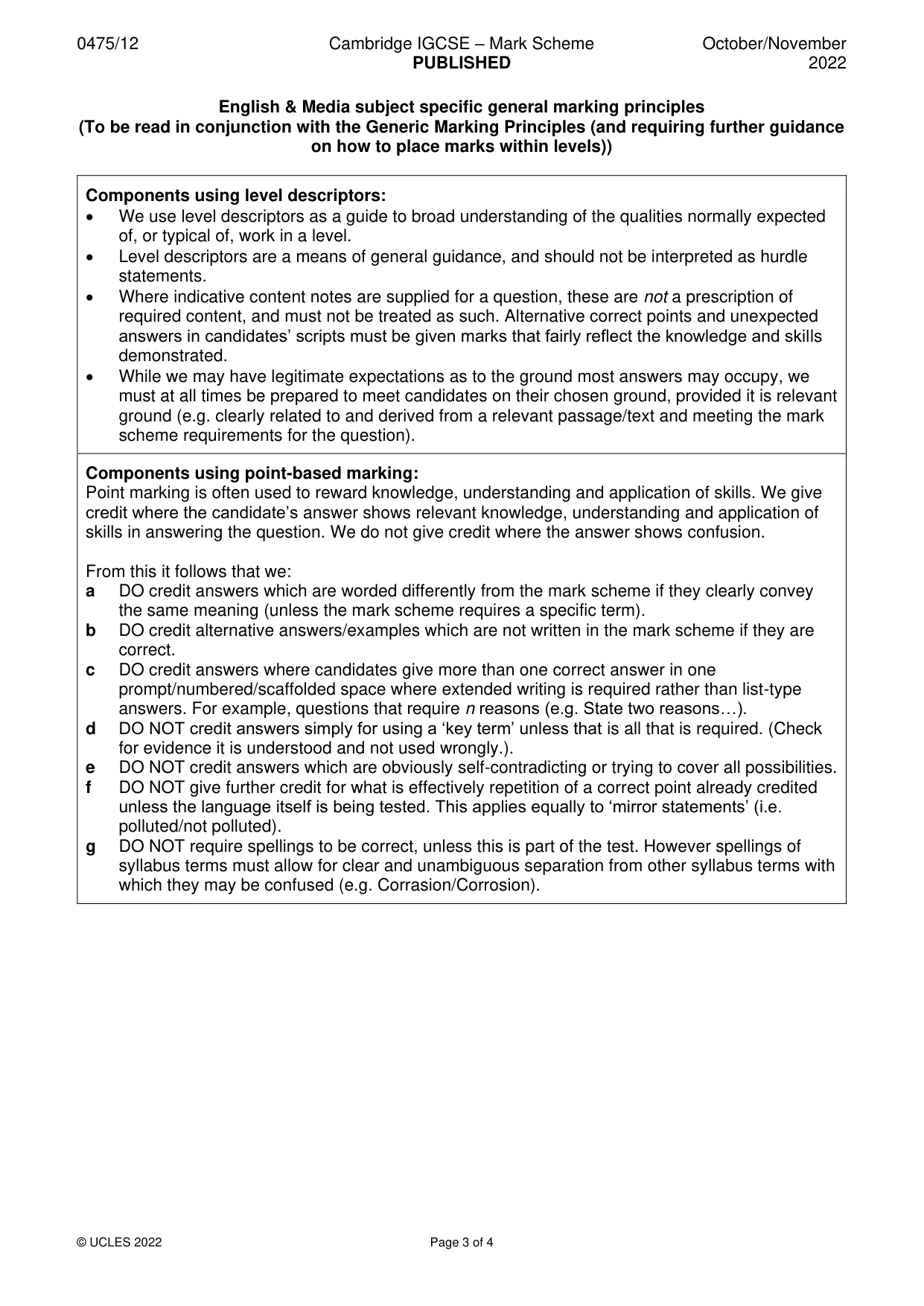
0475/12 Cambridge IGCSE – Mark Scheme PUBLISHED October/November 2022 © UCLES 2022 Page 3 of 4 English & Media subject specific general marking principles (To be read in conjunction with the Generic Marking Principles (and requiring further guidance on how to place marks within levels)) Components using level descriptors: • We use level descriptors as a guide to broad understanding of the qualities normally expected of, or typical of, work in a level. • Level descriptors are a means of general guidance, and should not be interpreted as hurdle statements. • Where indicative content notes are supplied for a question, these are not a prescription of required content, and must not be treated as such. Alternative correct points and unexpected answers in candidates’ scripts must be given marks that fairly reflect the knowledge and skills demonstrated. • While we may have legitimate expectations as to the ground most answers may occupy, we must at all times be prepared to meet candidates on their chosen ground, provided it is relevant ground (e.g. clearly related to and derived from a relevant passage/text and meeting the mark scheme requirements for the question). Components using point-based marking: Point marking is often used to reward knowledge, understanding and application of skills. We give credit where the candidate’s answer shows relevant knowledge, understanding and application of skills in answering the question. We do not give credit where the answer shows confusion. From this it follows that we: a DO credit answers which are worded differently from the mark scheme if they clearly convey the same meaning (unless the mark scheme requires a specific term). b DO credit alternative answers/examples which are not written in the mark scheme if they are correct. c DO credit answers where candidates give more than one correct answer in one prompt/numbered/scaffolded space where extended writing is required rather than list-type answers. For example, questions that require n reasons (e.g. State two reasons…). d DO NOT credit answers simply for using a ‘key term’ unless that is all that is required. (Check for evidence it is understood and not used wrongly.). e DO NOT credit answers which are obviously self-contradicting or trying to cover all possibilities. f DO NOT give further credit for what is effectively repetition of a correct point already credited unless the language itself is being tested. This applies equally to ‘mirror statements’ (i.e. polluted/not polluted). g DO NOT require spellings to be correct, unless this is part of the test. However spellings of syllabus terms must allow for clear and unambiguous separation from other syllabus terms with which they may be confused (e.g. Corrasion/Corrosion).
Mark scheme, page 4
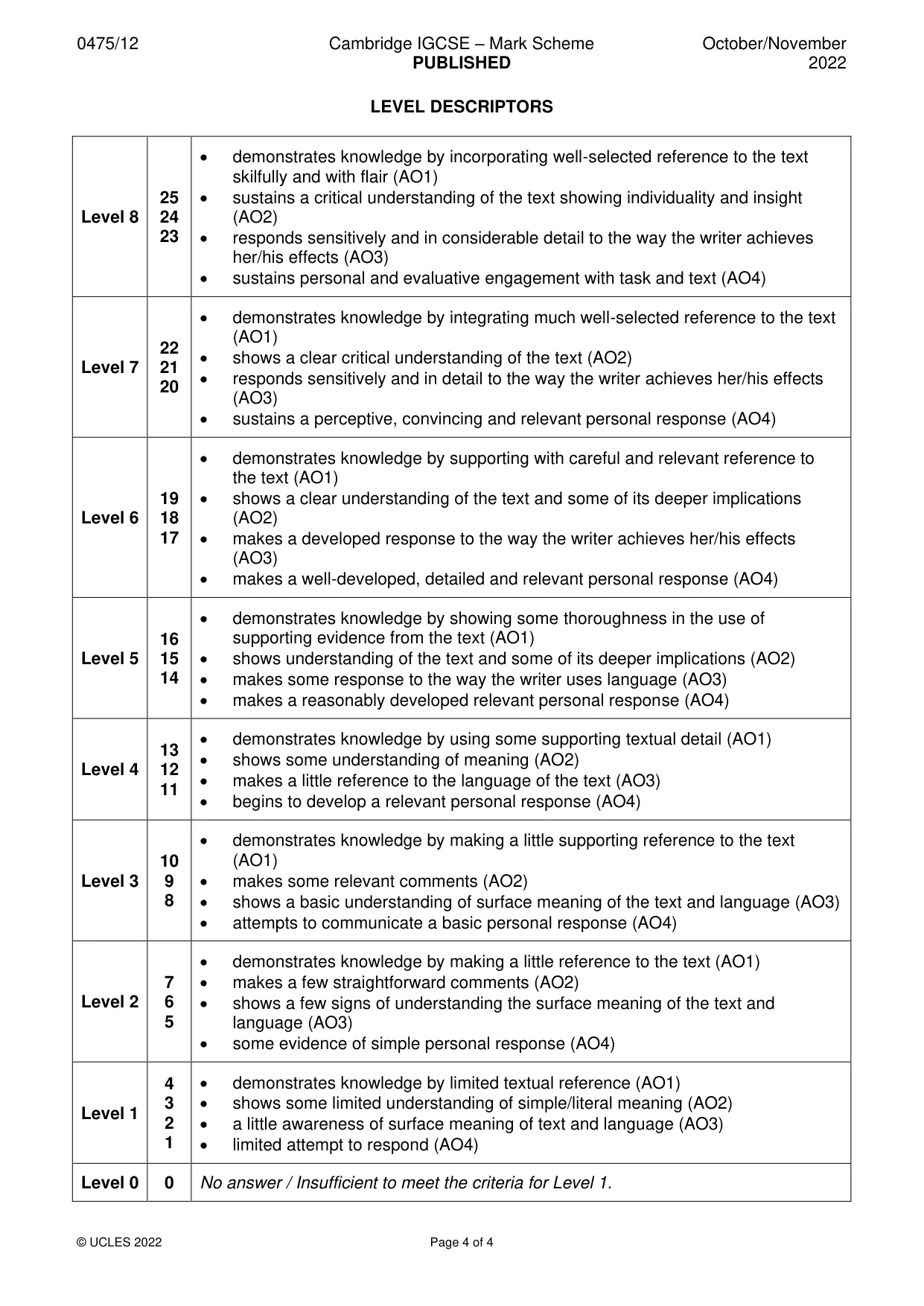
0475/12 Cambridge IGCSE – Mark Scheme PUBLISHED October/November 2022 © UCLES 2022 Page 4 of 4 LEVEL DESCRIPTORS Level 8 25 24 23 • demonstrates knowledge by incorporating well-selected reference to the text skilfully and with flair (AO1) • sustains a critical understanding of the text showing individuality and insight (AO2) • responds sensitively and in considerable detail to the way the writer achieves her/his effects (AO3) • sustains personal and evaluative engagement with task and text (AO4) Level 7 22 21 20 • demonstrates knowledge by integrating much well-selected reference to the text (AO1) • shows a clear critical understanding of the text (AO2) • responds sensitively and in detail to the way the writer achieves her/his effects (AO3) • sustains a perceptive, convincing and relevant personal response (AO4) Level 6 19 18 17 • demonstrates knowledge by supporting with careful and relevant reference to the text (AO1) • shows a clear understanding of the text and some of its deeper implications (AO2) • makes a developed response to the way the writer achieves her/his effects (AO3) • makes a well-developed, detailed and relevant personal response (AO4) Level 5 16 15 14 • demonstrates knowledge by showing some thoroughness in the use of supporting evidence from the text (AO1) • shows understanding of the text and some of its deeper implications (AO2) • makes some response to the way the writer uses language (AO3) • makes a reasonably developed relevant personal response (AO4) Level 4 13 12 11 • demonstrates knowledge by using some supporting textual detail (AO1) • shows some understanding of meaning (AO2) • makes a little reference to the language of the text (AO3) • begins to develop a relevant personal response (AO4) Level 3 10 9 8 • demonstrates knowledge by making a little supporting reference to the text (AO1) • makes some relevant comments (AO2) • shows a basic understanding of surface meaning of the text and language (AO3) • attempts to communicate a basic personal response (AO4) Level 2 7 6 5 • demonstrates knowledge by making a little reference to the text (AO1) • makes a few straightforward comments (AO2) • shows a few signs of understanding the surface meaning of the text and language (AO3) • some evidence of simple personal response (AO4) Level 1 4 3 2 1 • demonstrates knowledge by limited textual reference (AO1) • shows some limited understanding of simple/literal meaning (AO2) • a little awareness of surface meaning of text and language (AO3) • limited attempt to respond (AO4) Level 0 0 No answer / Insufficient to meet the criteria for Level 1.
What you needed in this session
Cambridge’s own grade thresholds for 2022 Oct/Nov, Paper 1 · Variant 2. A higher threshold means an easier paper — the bar moves with how the cohort did.