Cambridge IGCSE English - Literature in English 0475 — 2021 Oct/Nov Paper 1 · Variant 3
0475/13/O/N/21 · 50 marks · ≈56 min
The question paper and its mark scheme, free to read here and free to download. This is Cambridge’s own paper, exactly as it was sat.
Question paper28 pages




Mark scheme4 pages
Answers below. Sit the paper first if you are practising.
Paper as text
Question paper, page 1
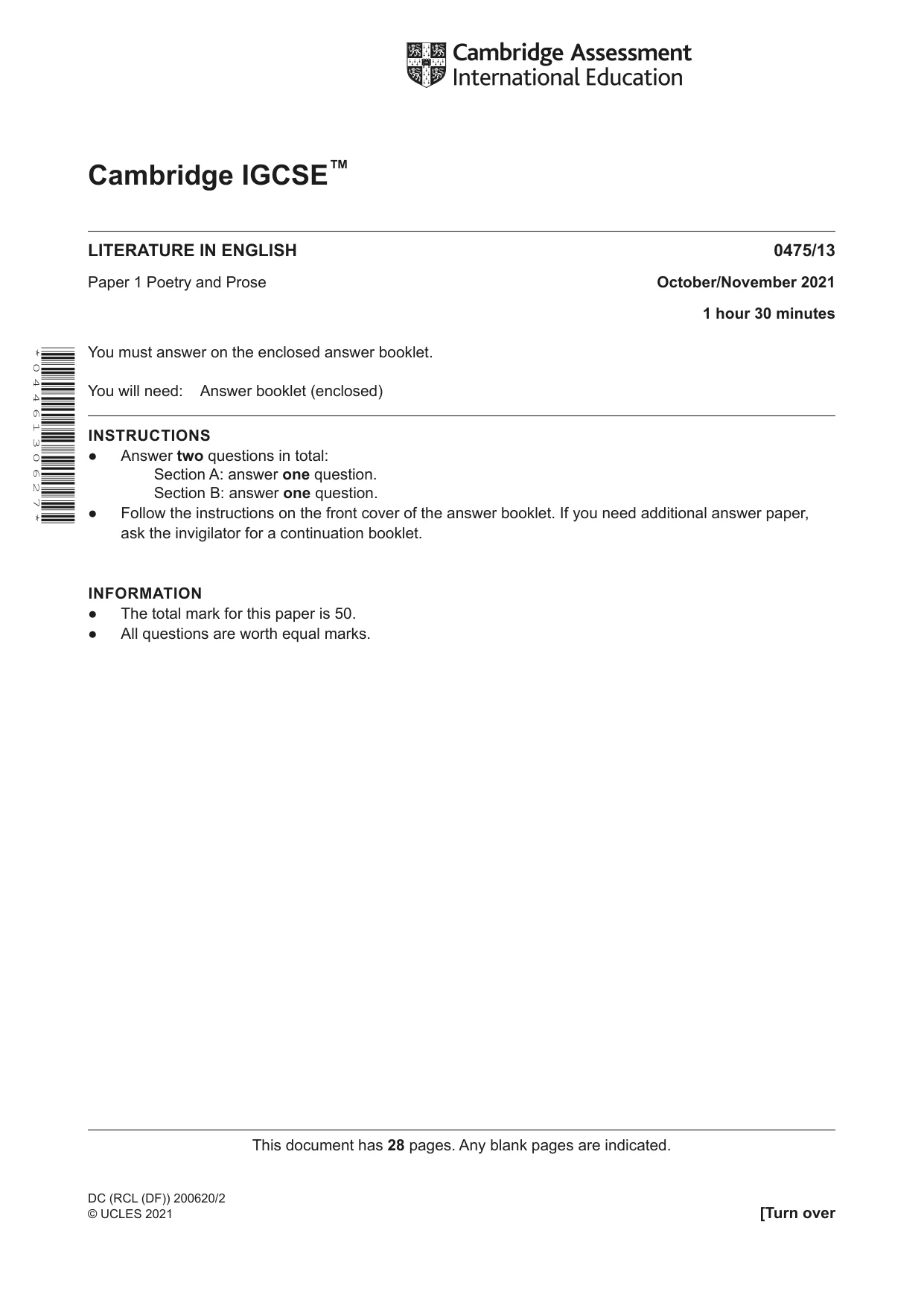
This document has 28 pages. Any blank pages are indicated. DC (RCL (DF)) 200620/2 © UCLES 2021 [Turn over * 0 4 4 6 1 3 0 6 2 7 * Cambridge IGCSE™ LITERATURE IN ENGLISH 0475/13 Paper 1 Poetry and Prose October/November 2021 1 hour 30 minutes You must answer on the enclosed answer booklet. You will need: Answer booklet (enclosed) INSTRUCTIONS ● Answer two questions in total: Section A: answer one question. Section B: answer one question. ● Follow the instructions on the front cover of the answer booklet. If you need additional answer paper, ask the invigilator for a continuation booklet. INFORMATION ● The total mark for this paper is 50. ● All questions are worth equal marks.
Question paper, page 2
2 0475/13/O/N/21 © UCLES 2021 BLANK PAGE
Question paper, page 3
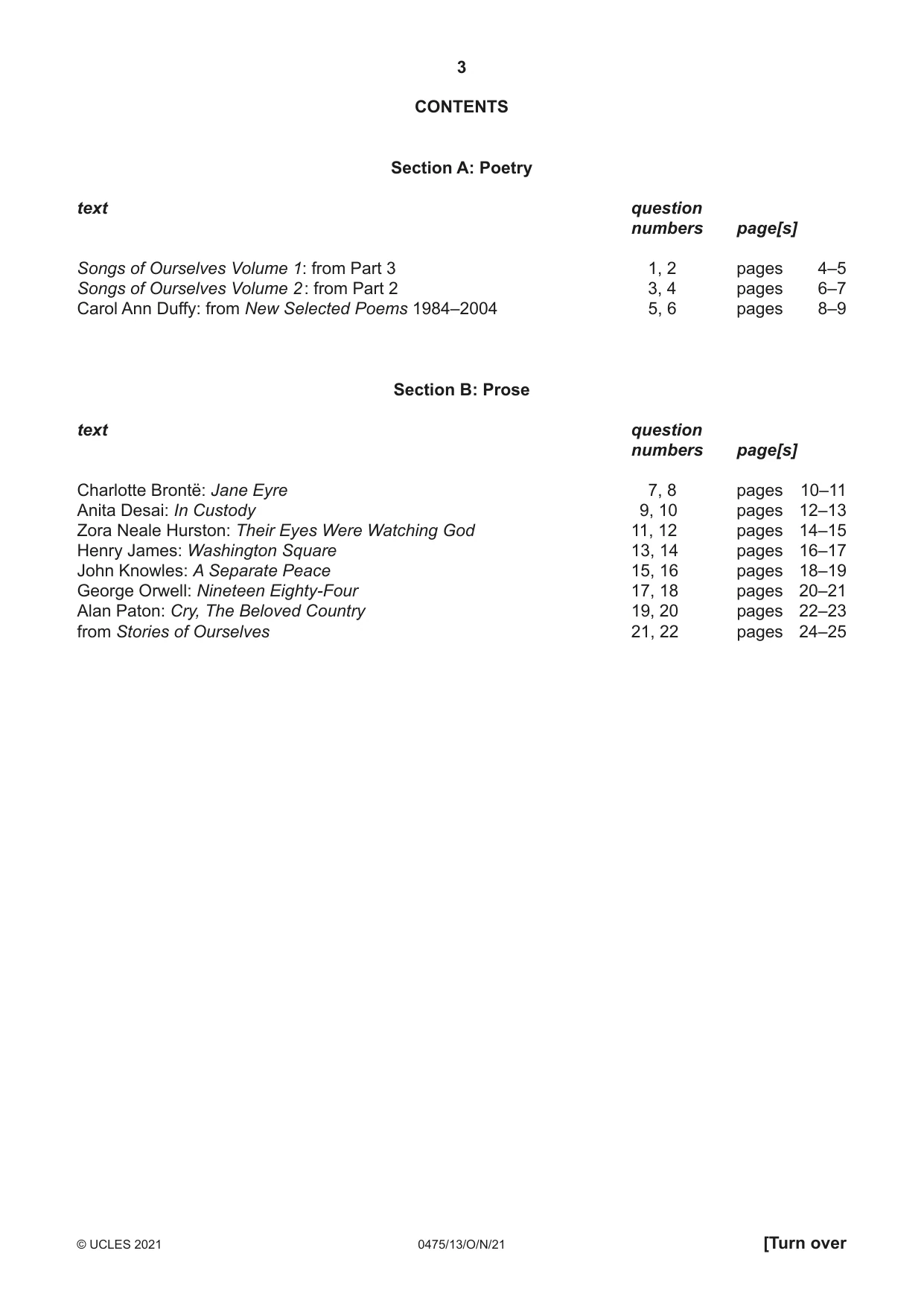
3 0475/13/O/N/21 © UCLES 2021 [Turn over CONTENTS Section A: Poetry text question numbers page[s] Songs of Ourselves Volume 1: from Part 3 1, 2 pages 4–5 Songs of Ourselves Volume 2 : from Part 2 3, 4 pages 6–7 Carol Ann Duffy: from New Selected Poems 1984–2004 5, 6 pages 8–9 Section B: Prose text question numbers page[s] Charlotte Brontë: Jane Eyre 7, 8 pages 10–11 Anita Desai: In Custody 9, 10 pages 12–13 Zora Neale Hurston: Their Eyes Were Watching God 11, 12 pages 14–15 Henry James: Washington Square 13, 14 pages 16–17 John Knowles: A Separate Peace 15, 16 pages 18–19 George Orwell: Nineteen Eighty-Four 17, 18 pages 20–21 Alan Paton: Cry, The Beloved Country 19, 20 pages 22–23 from Stories of Ourselves 21, 22 pages 24–25
Question paper, page 4
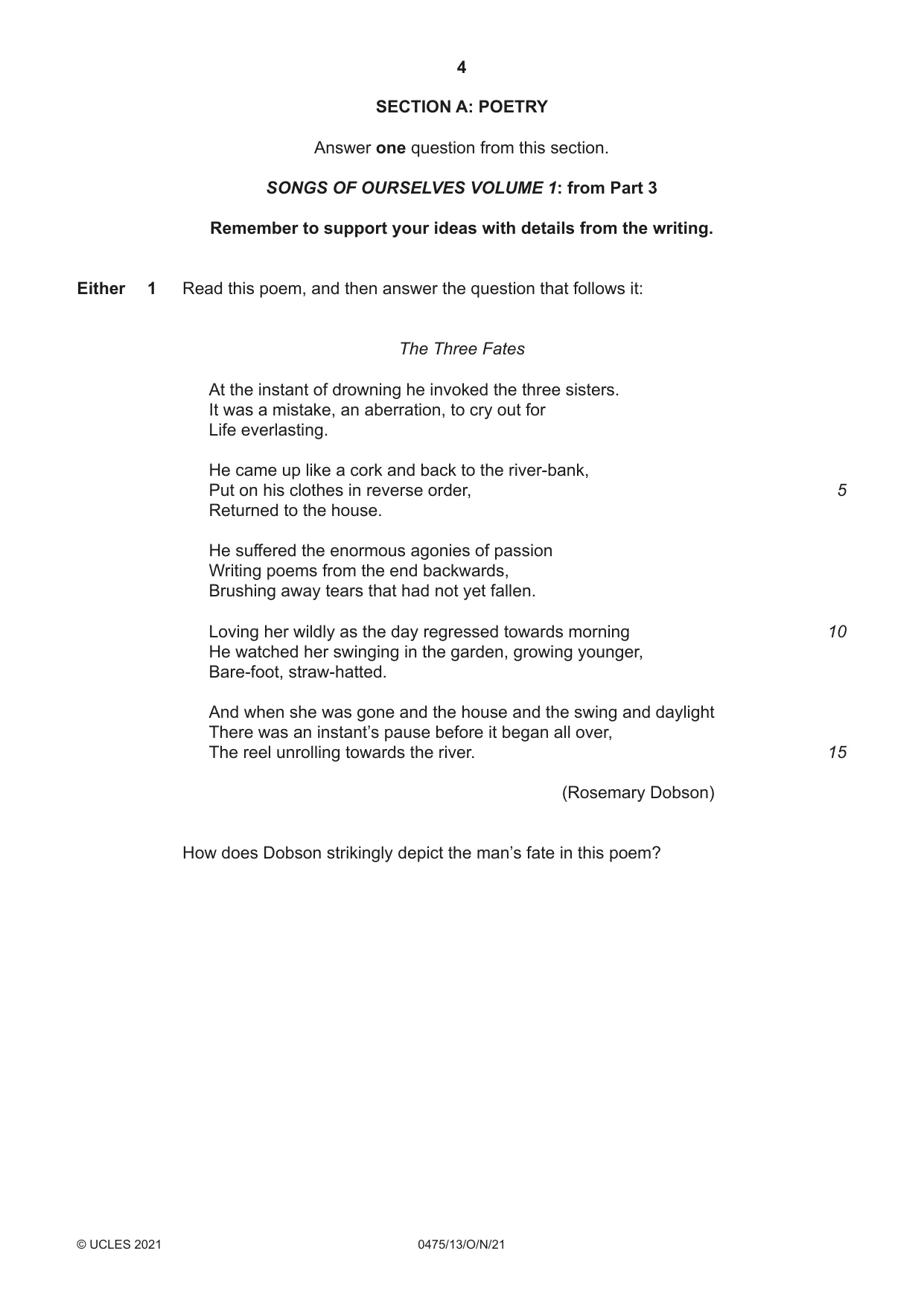
4 0475/13/O/N/21 © UCLES 2021 SECTION A: POETRY Answer one question from this section. SONGS OF OURSELVES VOLUME 1: from Part 3 Remember to support your ideas with details from the writing. Either 1 Read this poem, and then answer the question that follows it: The Three Fates At the instant of drowning he invoked the three sisters. It was a mistake, an aberration, to cry out for Life everlasting. He came up like a cork and back to the river-bank, Put on his clothes in reverse order, Returned to the house. He suffered the enormous agonies of passion Writing poems from the end backwards, Brushing away tears that had not yet fallen. Loving her wildly as the day regressed towards morning He watched her swinging in the garden, growing younger, Bare-foot, straw-hatted. And when she was gone and the house and the swing and daylight There was an instant’s pause before it began all over, The reel unrolling towards the river. (Rosemary Dobson) How does Dobson strikingly depict the man’s fate in this poem? 5 10 15
Question paper, page 5
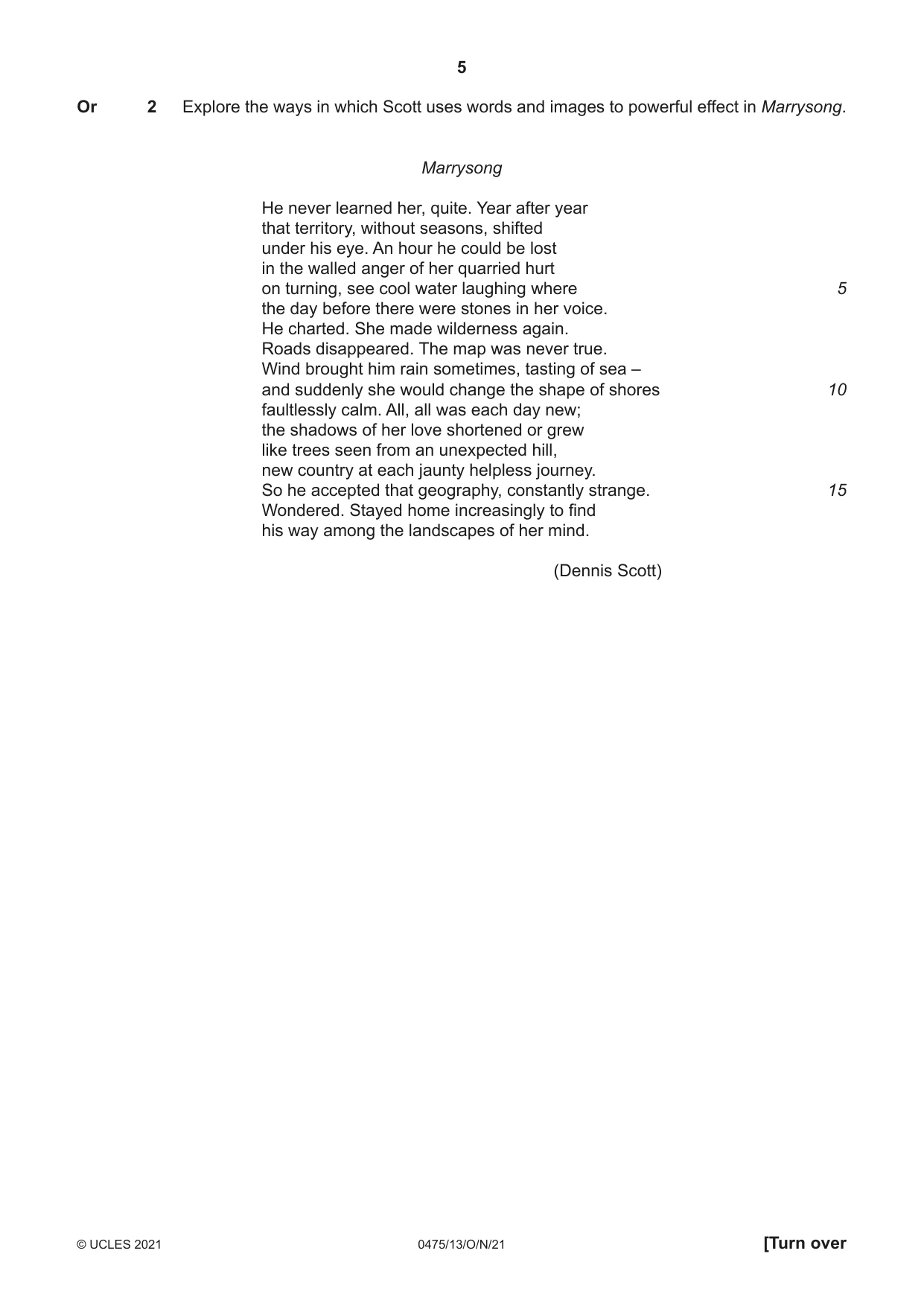
5 0475/13/O/N/21 © UCLES 2021 [Turn over Or 2 Explore the ways in which Scott uses words and images to powerful effect in Marrysong. Marrysong He never learned her, quite. Year after year that territory, without seasons, shifted under his eye. An hour he could be lost in the walled anger of her quarried hurt on turning, see cool water laughing where the day before there were stones in her voice. He charted. She made wilderness again. Roads disappeared. The map was never true. Wind brought him rain sometimes, tasting of sea – and suddenly she would change the shape of shores faultlessly calm. All, all was each day new; the shadows of her love shortened or grew like trees seen from an unexpected hill, new country at each jaunty helpless journey. So he accepted that geography, constantly strange. Wondered. Stayed home increasingly to find his way among the landscapes of her mind. (Dennis Scott) 5 10 15
Question paper, page 6
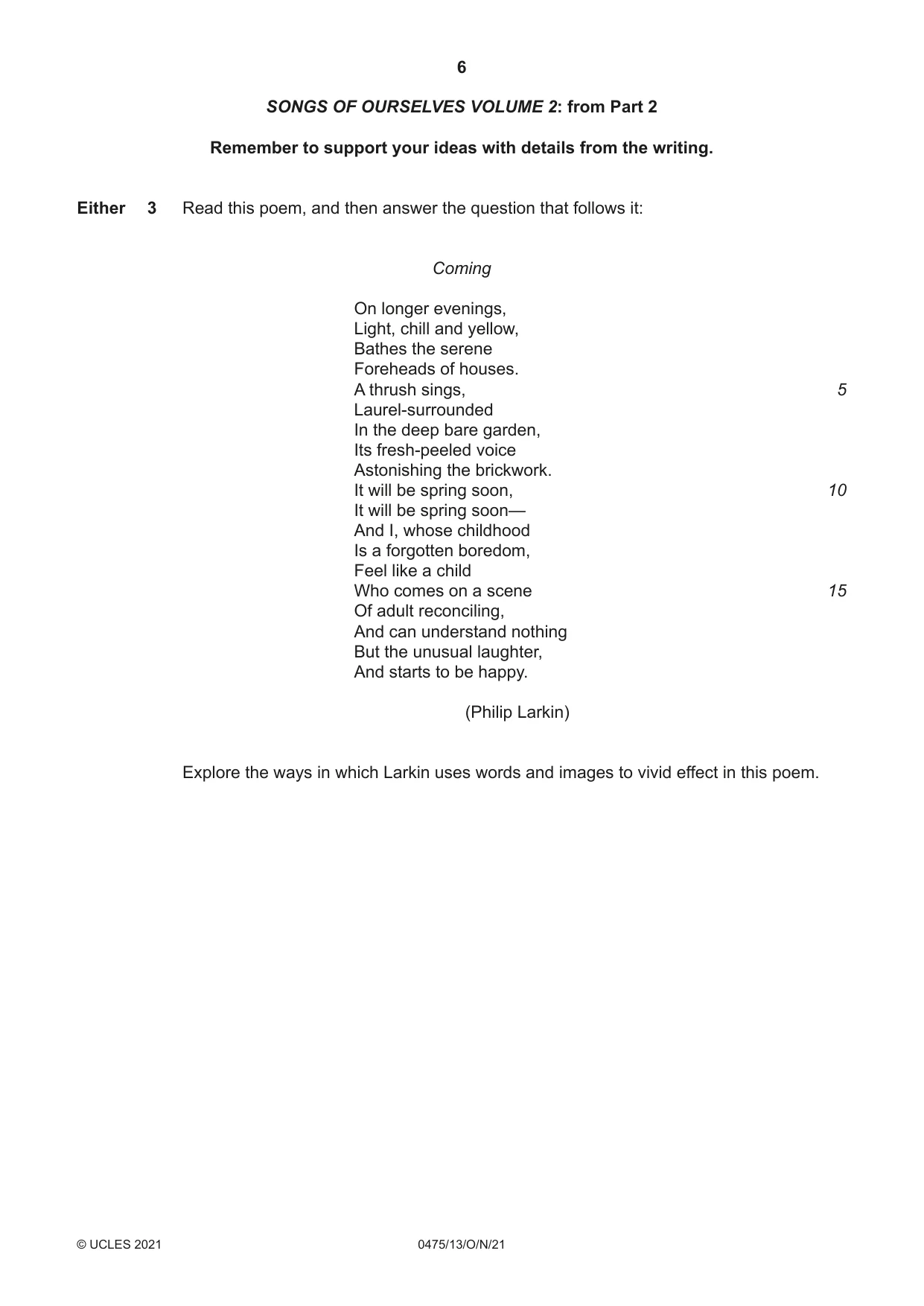
6 0475/13/O/N/21 © UCLES 2021 SONGS OF OURSELVES VOLUME 2: from Part 2 Remember to support your ideas with details from the writing. Either 3 Read this poem, and then answer the question that follows it: Coming On longer evenings, Light, chill and yellow, Bathes the serene Foreheads of houses. A thrush sings, Laurel-surrounded In the deep bare garden, Its fresh-peeled voice Astonishing the brickwork. It will be spring soon, It will be spring soon— And I, whose childhood Is a forgotten boredom, Feel like a child Who comes on a scene Of adult reconciling, And can understand nothing But the unusual laughter, And starts to be happy. (Philip Larkin) Explore the ways in which Larkin uses words and images to vivid effect in this poem. 5 10 15
Question paper, page 7
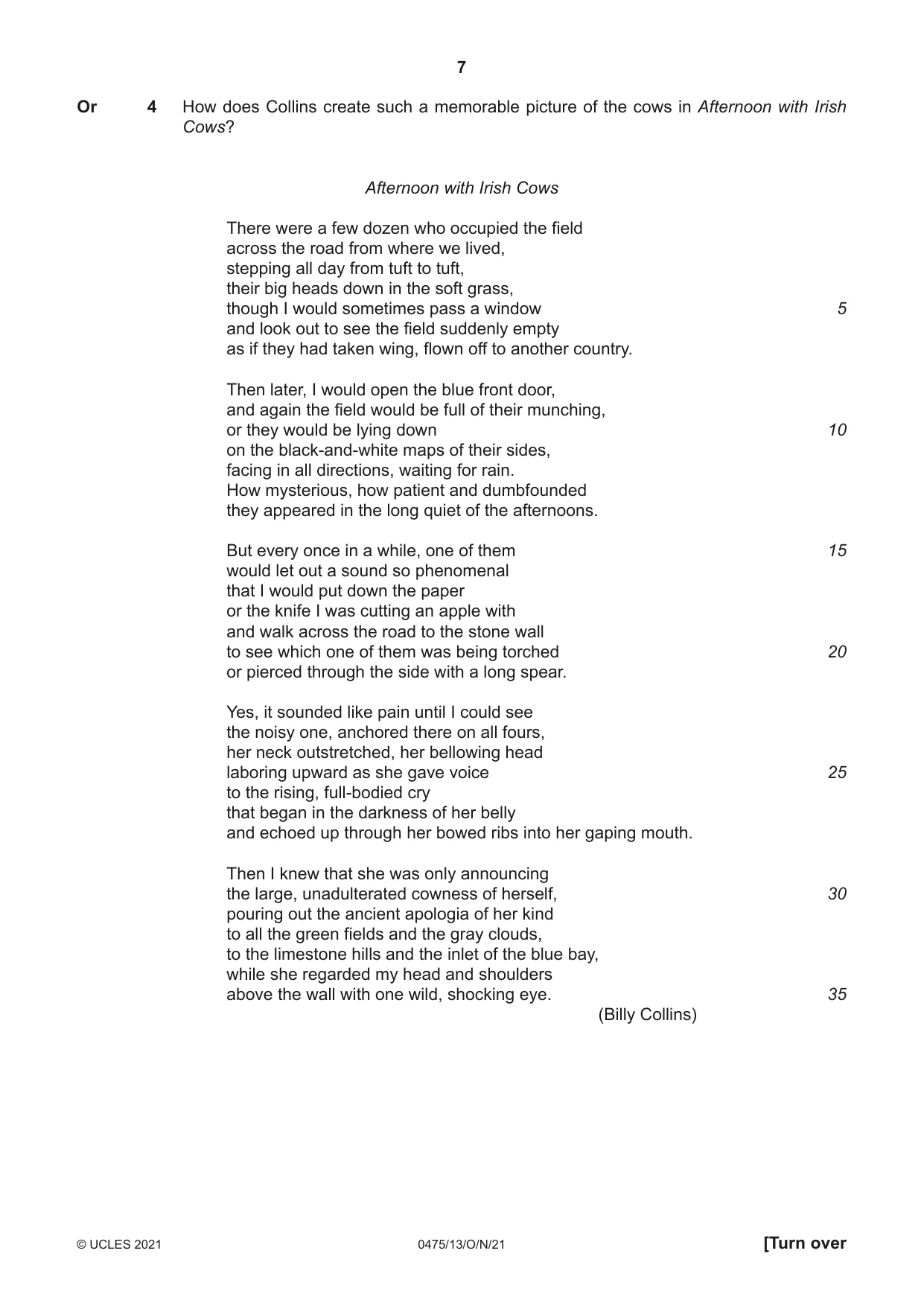
7 0475/13/O/N/21 © UCLES 2021 [Turn over Or 4 How does Collins create such a memorable picture of the cows in Afternoon with Irish Cows? Afternoon with Irish Cows There were a few dozen who occupied the field across the road from where we lived, stepping all day from tuft to tuft, their big heads down in the soft grass, though I would sometimes pass a window and look out to see the field suddenly empty as if they had taken wing, flown off to another country. Then later, I would open the blue front door, and again the field would be full of their munching, or they would be lying down on the black-and-white maps of their sides, facing in all directions, waiting for rain. How mysterious, how patient and dumbfounded they appeared in the long quiet of the afternoons. But every once in a while, one of them would let out a sound so phenomenal that I would put down the paper or the knife I was cutting an apple with and walk across the road to the stone wall to see which one of them was being torched or pierced through the side with a long spear. Yes, it sounded like pain until I could see the noisy one, anchored there on all fours, her neck outstretched, her bellowing head laboring upward as she gave voice to the rising, full-bodied cry that began in the darkness of her belly and echoed up through her bowed ribs into her gaping mouth. Then I knew that she was only announcing the large, unadulterated cowness of herself, pouring out the ancient apologia of her kind to all the green fields and the gray clouds, to the limestone hills and the inlet of the blue bay, while she regarded my head and shoulders above the wall with one wild, shocking eye. (Billy Collins) 5 10 15 20 25 30 35
Question paper, page 8
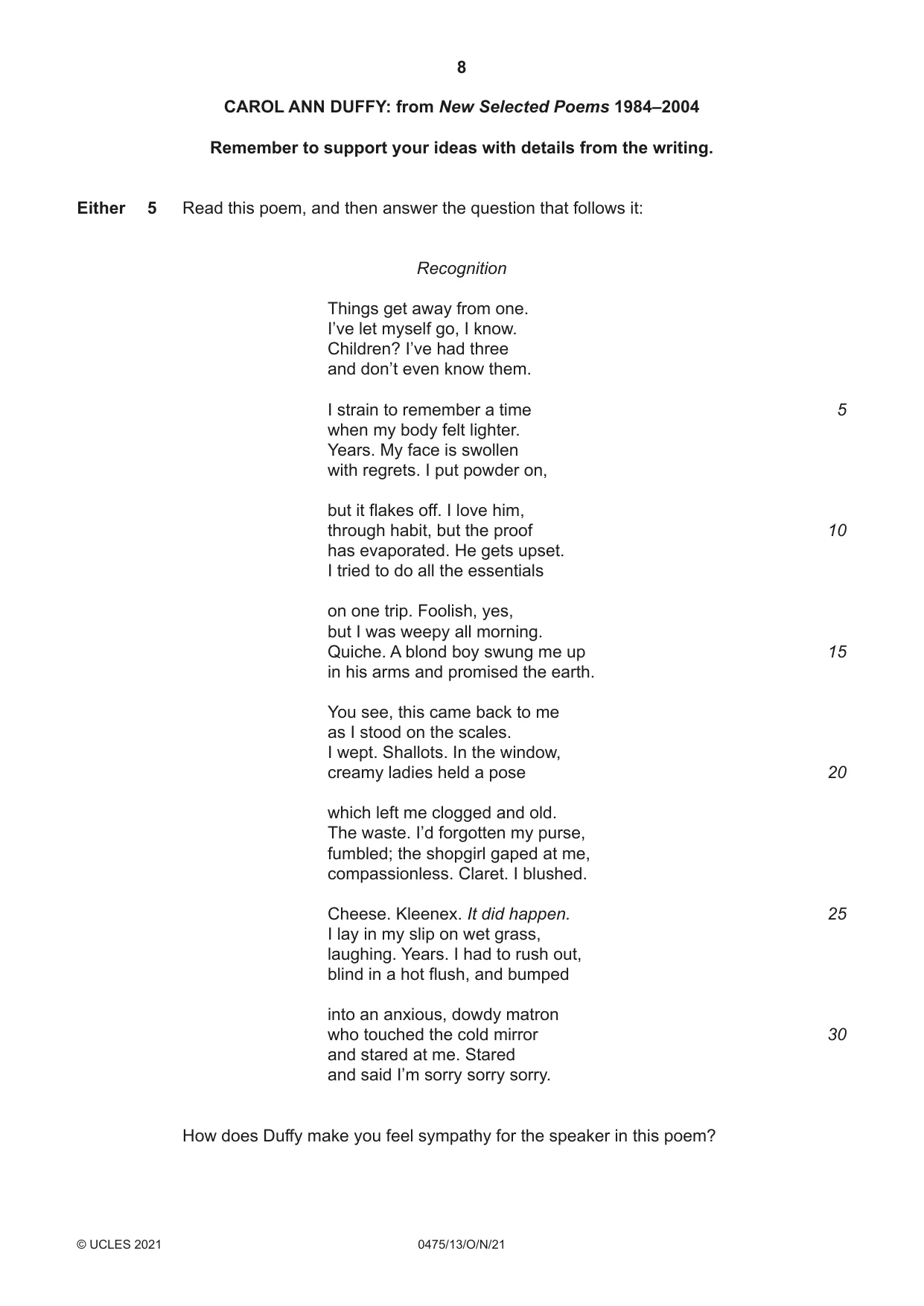
8 0475/13/O/N/21 © UCLES 2021 CAROL ANN DUFFY: from New Selected Poems 1984–2004 Remember to support your ideas with details from the writing. Either 5 Read this poem, and then answer the question that follows it: Recognition Things get away from one. I’ve let myself go, I know. Children? I’ve had three and don’t even know them. I strain to remember a time when my body felt lighter. Years. My face is swollen with regrets. I put powder on, but it flakes off. I love him, through habit, but the proof has evaporated. He gets upset. I tried to do all the essentials on one trip. Foolish, yes, but I was weepy all morning. Quiche. A blond boy swung me up in his arms and promised the earth. You see, this came back to me as I stood on the scales. I wept. Shallots. In the window, creamy ladies held a pose which left me clogged and old. The waste. I’d forgotten my purse, fumbled; the shopgirl gaped at me, compassionless. Claret. I blushed. Cheese. Kleenex. It did happen. I lay in my slip on wet grass, laughing. Years. I had to rush out, blind in a hot flush, and bumped into an anxious, dowdy matron who touched the cold mirror and stared at me. Stared and said I’m sorry sorry sorry. How does Duffy make you feel sympathy for the speaker in this poem? 5 10 15 20 25 30
Question paper, page 9
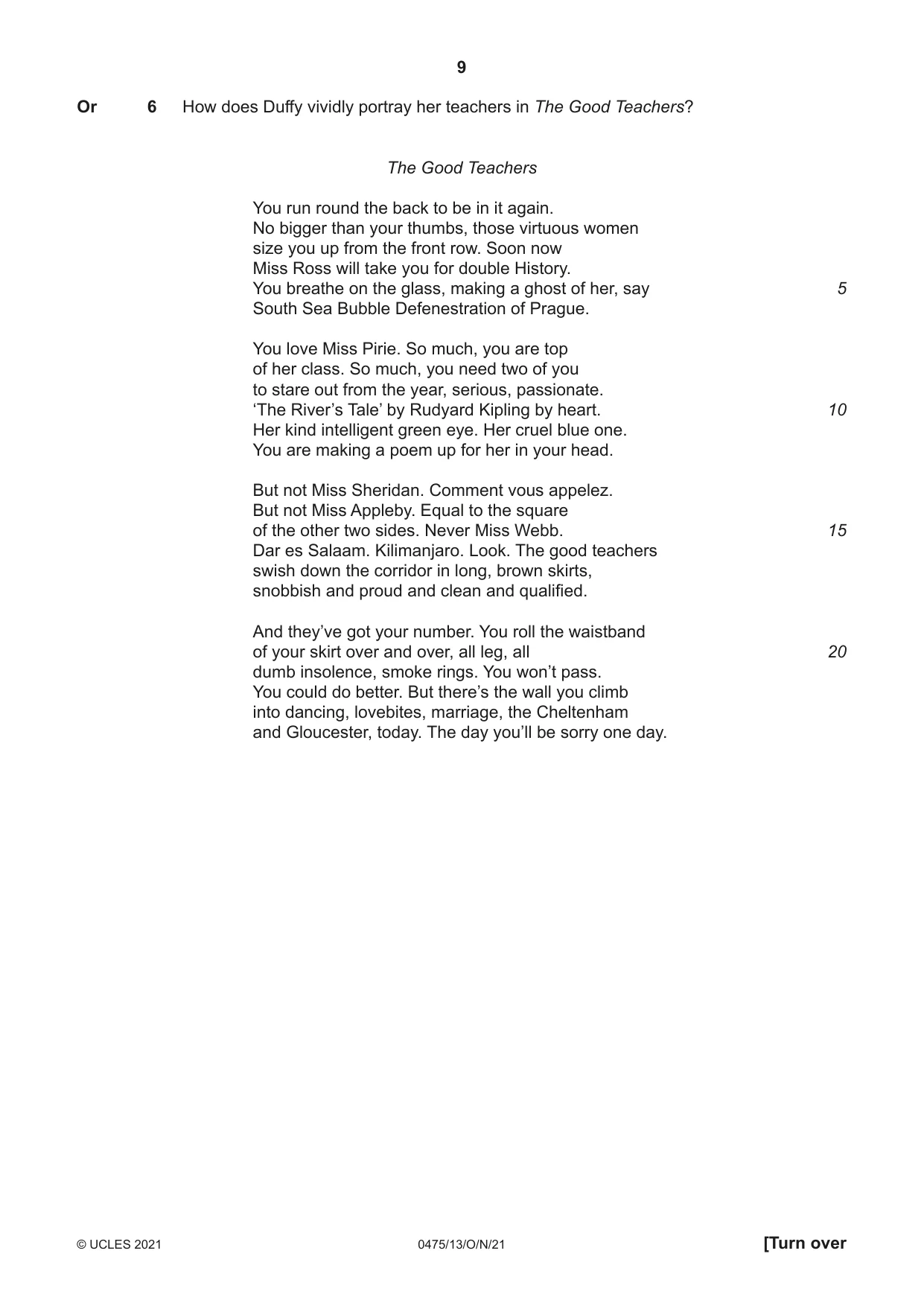
9 0475/13/O/N/21 © UCLES 2021 [Turn over Or 6 How does Duffy vividly portray her teachers in The Good Teachers? The Good Teachers You run round the back to be in it again. No bigger than your thumbs, those virtuous women size you up from the front row. Soon now Miss Ross will take you for double History. You breathe on the glass, making a ghost of her, say South Sea Bubble Defenestration of Prague. You love Miss Pirie. So much, you are top of her class. So much, you need two of you to stare out from the year, serious, passionate. ‘The River’s Tale’ by Rudyard Kipling by heart. Her kind intelligent green eye. Her cruel blue one. You are making a poem up for her in your head. But not Miss Sheridan. Comment vous appelez. But not Miss Appleby. Equal to the square of the other two sides. Never Miss Webb. Dar es Salaam. Kilimanjaro. Look. The good teachers swish down the corridor in long, brown skirts, snobbish and proud and clean and qualified. And they’ve got your number. You roll the waistband of your skirt over and over, all leg, all dumb insolence, smoke rings. You won’t pass. You could do better. But there’s the wall you climb into dancing, lovebites, marriage, the Cheltenham and Gloucester, today. The day you’ll be sorry one day. 5 10 15 20
Question paper, page 10
10 0475/13/O/N/21 © UCLES 2021 SECTION B: PROSE Answer one question from this section. CHARLOTTE BRONTË: Jane Eyre Remember to support your ideas with details from the writing. Either 7 Read this passage, and then answer the question that follows it: At last the woods rose; the rookery clustered dark; a loud cawing broke the morning stillness. Strange delight inspired me: on I hastened. Another field crossed, a lane threaded, and there were the courtyard walls, the back offices: the house itself, the rookery still hid. ‘My first view of it shall be in front,’ I determined, ‘where its bold battlements will strike the eye nobly at once, and where I can single out my master’s very window: perhaps he will be standing at it – he rises early: perhaps he is now walking in the orchard, or on the pavement in front. Could I but see him! – but a moment! Surely, in that case, I should not be so mad as to run to him? I cannot tell – I am not certain. And if I did – what then? God bless him! What then? Who would be hurt by my once more tasting the life his glance can give me? I rave: perhaps at this moment he is watching the sun rise over the Pyrenees, or on the tideless sea of the South.’ I had coasted along the lower wall of the orchard – turned its angle: there was a gate just there, opening into the meadow, between two stone pillars crowned by stone balls. From behind one pillar I could peep round quietly at the full front of the mansion. I advanced my head with precaution, desirous to ascertain if any bedroom window-blinds were yet drawn up: battlements, windows, long front – all from this sheltered station were at my command. The crows sailing overhead perhaps watched me while I took this survey. I wonder what they thought. They must have considered I was very careful and timid at first, and that gradually I grew very bold and reckless. A peep, and then a long stare; and then a departure from my niche and a straying out into the meadow; and a sudden stop full in front of the great mansion, and a protracted, hardy gaze towards it. ‘What affectation of diffidence was this at first?’ they might have demanded; ‘what stupid regardlessness now?’ Hear an illustration, reader. A lover finds his mistress asleep on a mossy bank; he wishes to catch a glimpse of her fair face without waking her. He steals softly over the grass, careful to make no sound; he pauses – fancying she has stirred: he withdraws: not for worlds would he be seen. All is still: he again advances: he bends above her; a light veil rests on her features: he lifts it, bends lower; now his eyes anticipate the vision of beauty – warm, and blooming, and lovely, in rest. How hurried was their first glance! But how they fix! How he starts! How he suddenly and vehemently clasps in both arms the form he dared not, a moment since, touch with his finger! How he calls aloud a name, and drops his burden, and gazes on it wildly! He thus grasps and cries, and gazes, because he no longer fears to waken by any sound he can utter – by any movement he can make. He thought his love slept sweetly: he finds she is stone dead. I looked with timorous joy towards a stately house; I saw a blackened ruin. 5 10 15 20 25 30 35 40
Question paper, page 11
11 0475/13/O/N/21 © UCLES 2021 [Turn over No need to cower behind a gate-post, indeed! – to peep up at chamber lattices, fearing life was astir behind them! No need to listen for doors opening – to fancy steps on the pavement or the gravel-walk! The lawn, the grounds were trodden and waste: the portal yawned void. The front was, as I had once seen it in a dream, but a shell-like wall, very high and very fragile-looking, perforated with paneless windows: no roof, no battlements, no chimneys – all had crashed in. (from Chapter 36) How does Brontë powerfully convey Jane’s shock at this moment in the novel? Or 8 Explore the ways in which Brontë memorably conveys conflict between Jane and one other character. 45 50
Question paper, page 12
12 0475/13/O/N/21 © UCLES 2021 ANITA DESAI: In Custody Remember to support your ideas with details from the writing. Either 9 Read this passage, and then answer the question that follows it: Deven did not go to Delhi for a long time after that. Content removed due to copyright restrictions.
Question paper, page 13
13 0475/13/O/N/21 © UCLES 2021 [Turn over Deven would not have known how to answer her. (from Chapter 8) What memorable impressions of Deven and Sarla does Desai create at this moment in the novel? Or 10 Explore the ways in which Desai makes Imtiaz such a compelling character. Content removed due to copyright restrictions.
Question paper, page 14
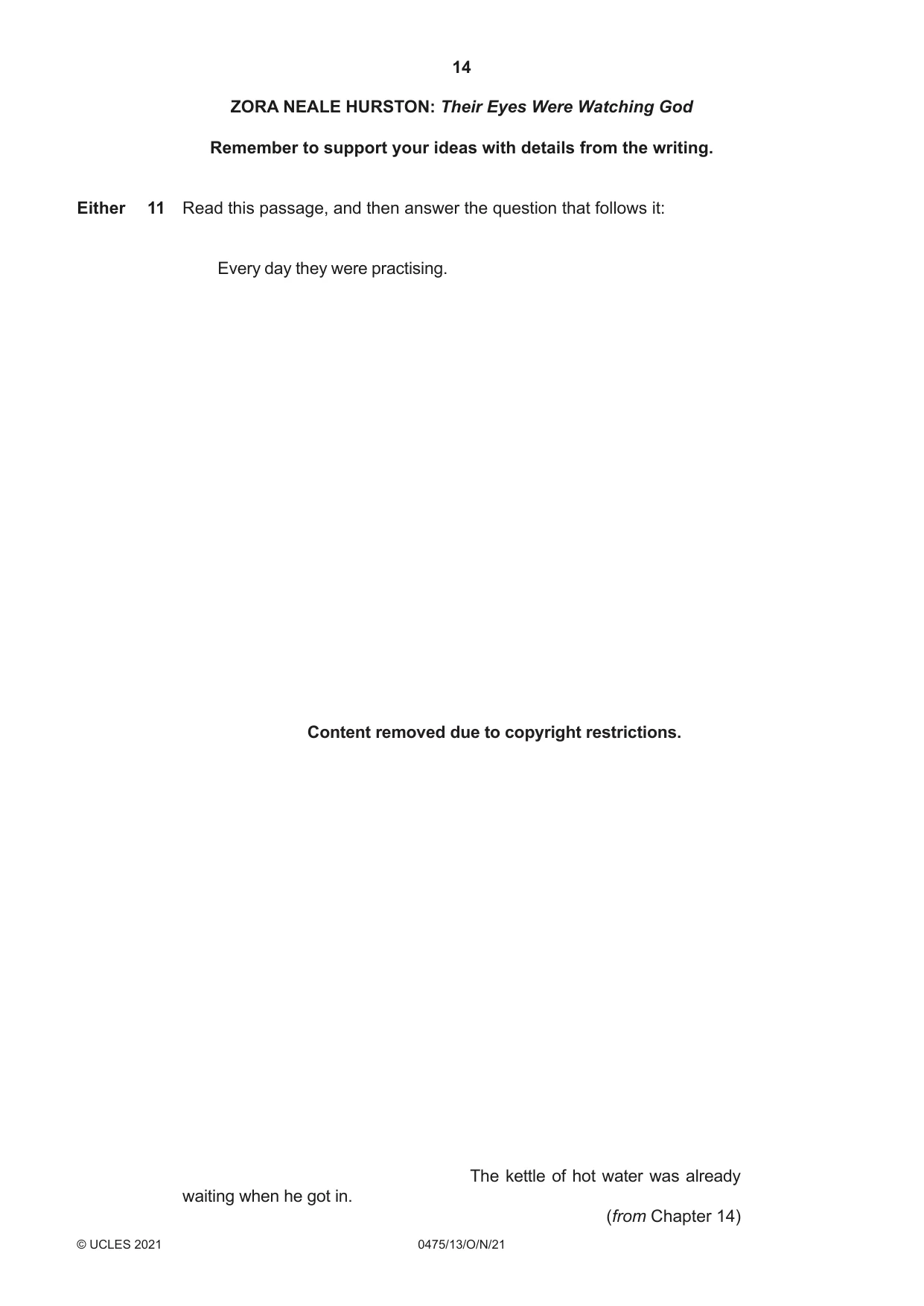
14 0475/13/O/N/21 © UCLES 2021 ZORA NEALE HURSTON: Their Eyes Were Watching God Remember to support your ideas with details from the writing. Either 11 Read this passage, and then answer the question that follows it: Every day they were practising. The kettle of hot water was already waiting when he got in. (from Chapter 14) Content removed due to copyright restrictions.
Question paper, page 15
15 0475/13/O/N/21 © UCLES 2021 [Turn over In what ways does Hurston make this such a vivid and significant moment in the novel? Or 12 Explore how Hurston makes two moments in the novel particularly shocking for you.
Question paper, page 16
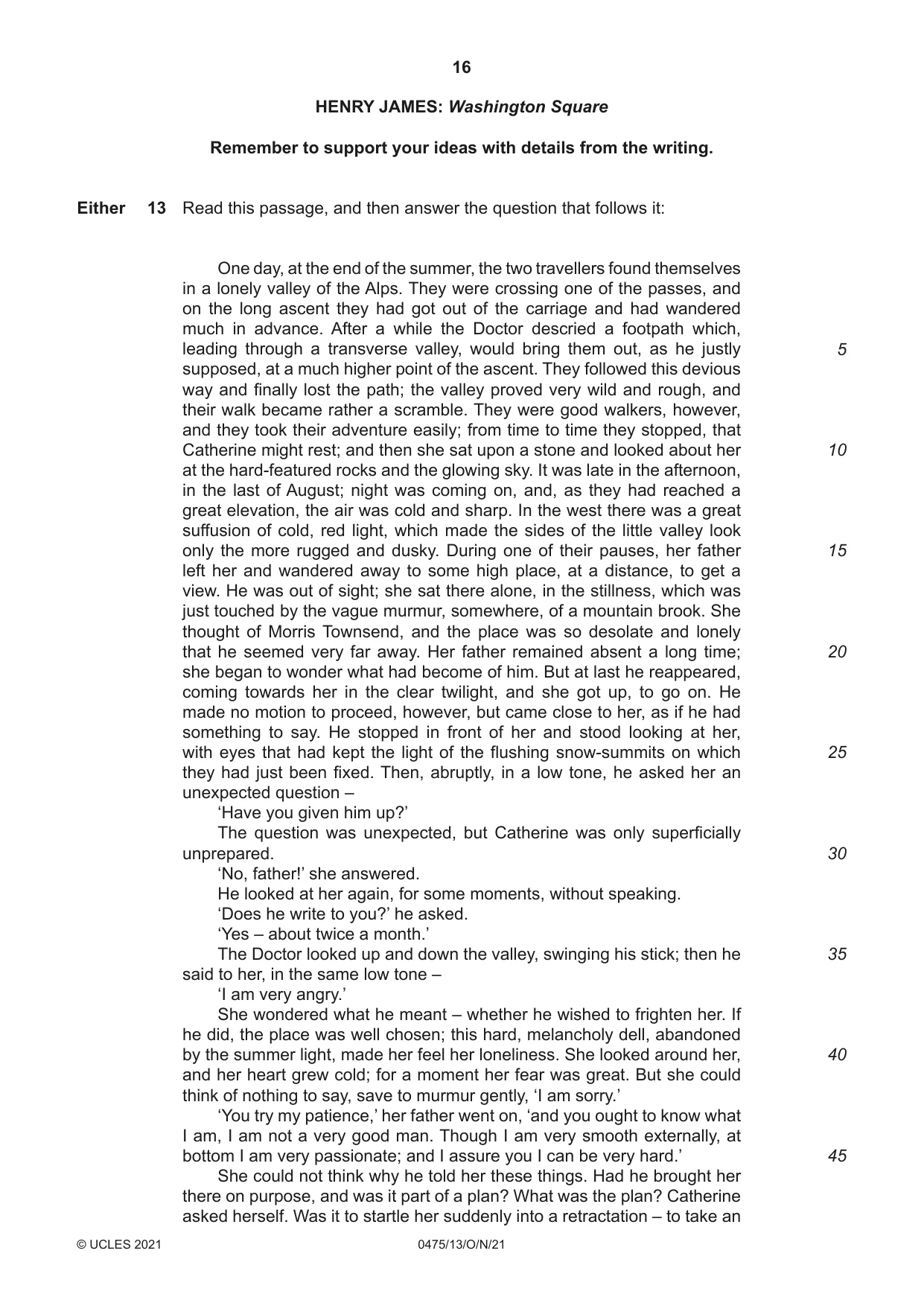
16 0475/13/O/N/21 © UCLES 2021 HENRY JAMES: Washington Square Remember to support your ideas with details from the writing. Either 13 Read this passage, and then answer the question that follows it: One day, at the end of the summer, the two travellers found themselves in a lonely valley of the Alps. They were crossing one of the passes, and on the long ascent they had got out of the carriage and had wandered much in advance. After a while the Doctor descried a footpath which, leading through a transverse valley, would bring them out, as he justly supposed, at a much higher point of the ascent. They followed this devious way and finally lost the path; the valley proved very wild and rough, and their walk became rather a scramble. They were good walkers, however, and they took their adventure easily; from time to time they stopped, that Catherine might rest; and then she sat upon a stone and looked about her at the hard-featured rocks and the glowing sky. It was late in the afternoon, in the last of August; night was coming on, and, as they had reached a great elevation, the air was cold and sharp. In the west there was a great suffusion of cold, red light, which made the sides of the little valley look only the more rugged and dusky. During one of their pauses, her father left her and wandered away to some high place, at a distance, to get a view. He was out of sight; she sat there alone, in the stillness, which was just touched by the vague murmur, somewhere, of a mountain brook. She thought of Morris Townsend, and the place was so desolate and lonely that he seemed very far away. Her father remained absent a long time; she began to wonder what had become of him. But at last he reappeared, coming towards her in the clear twilight, and she got up, to go on. He made no motion to proceed, however, but came close to her, as if he had something to say. He stopped in front of her and stood looking at her, with eyes that had kept the light of the flushing snow-summits on which they had just been fixed. Then, abruptly, in a low tone, he asked her an unexpected question – ‘Have you given him up?’ The question was unexpected, but Catherine was only superficially unprepared. ‘No, father!’ she answered. He looked at her again, for some moments, without speaking. ‘Does he write to you?’ he asked. ‘Yes – about twice a month.’ The Doctor looked up and down the valley, swinging his stick; then he said to her, in the same low tone – ‘I am very angry.’ She wondered what he meant – whether he wished to frighten her. If he did, the place was well chosen; this hard, melancholy dell, abandoned by the summer light, made her feel her loneliness. She looked around her, and her heart grew cold; for a moment her fear was great. But she could think of nothing to say, save to murmur gently, ‘I am sorry.’ ‘You try my patience,’ her father went on, ‘and you ought to know what I am, I am not a very good man. Though I am very smooth externally, at bottom I am very passionate; and I assure you I can be very hard.’ She could not think why he told her these things. Had he brought her there on purpose, and was it part of a plan? What was the plan? Catherine asked herself. Was it to startle her suddenly into a retractation – to take an 5 10 15 20 25 30 35 40 45
Question paper, page 17
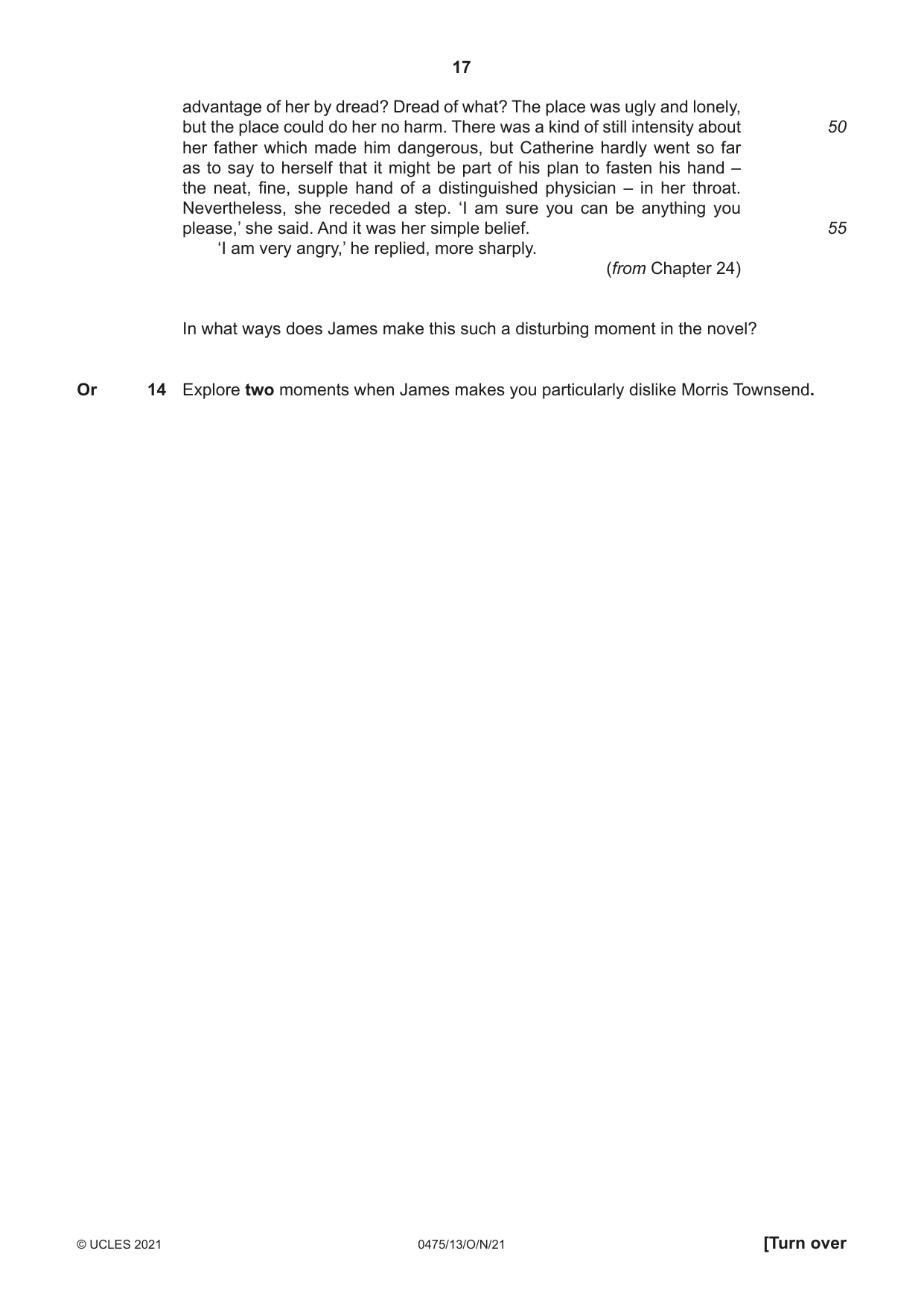
17 0475/13/O/N/21 © UCLES 2021 [Turn over advantage of her by dread? Dread of what? The place was ugly and lonely, but the place could do her no harm. There was a kind of still intensity about her father which made him dangerous, but Catherine hardly went so far as to say to herself that it might be part of his plan to fasten his hand – the neat, fine, supple hand of a distinguished physician – in her throat. Nevertheless, she receded a step. ‘I am sure you can be anything you please,’ she said. And it was her simple belief. ‘I am very angry,’ he replied, more sharply. (from Chapter 24) In what ways does James make this such a disturbing moment in the novel? Or 14 Explore two moments when James makes you particularly dislike Morris Townsend. 50 55
Question paper, page 18
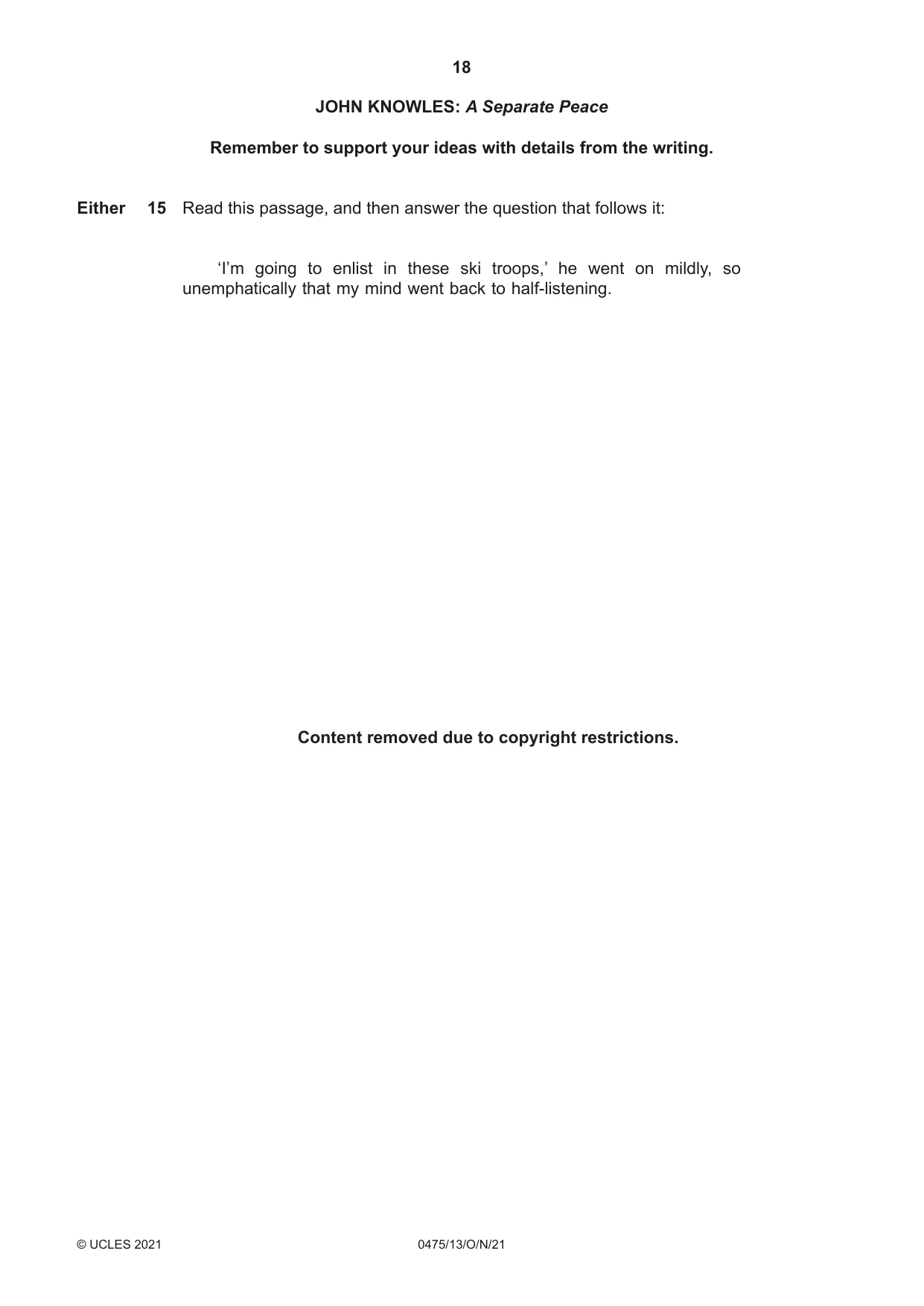
18 0475/13/O/N/21 © UCLES 2021 JOHN KNOWLES: A Separate Peace Remember to support your ideas with details from the writing. Either 15 Read this passage, and then answer the question that follows it: ‘I’m going to enlist in these ski troops,’ he went on mildly, so unemphatically that my mind went back to half-listening. Content removed due to copyright restrictions.
Question paper, page 19
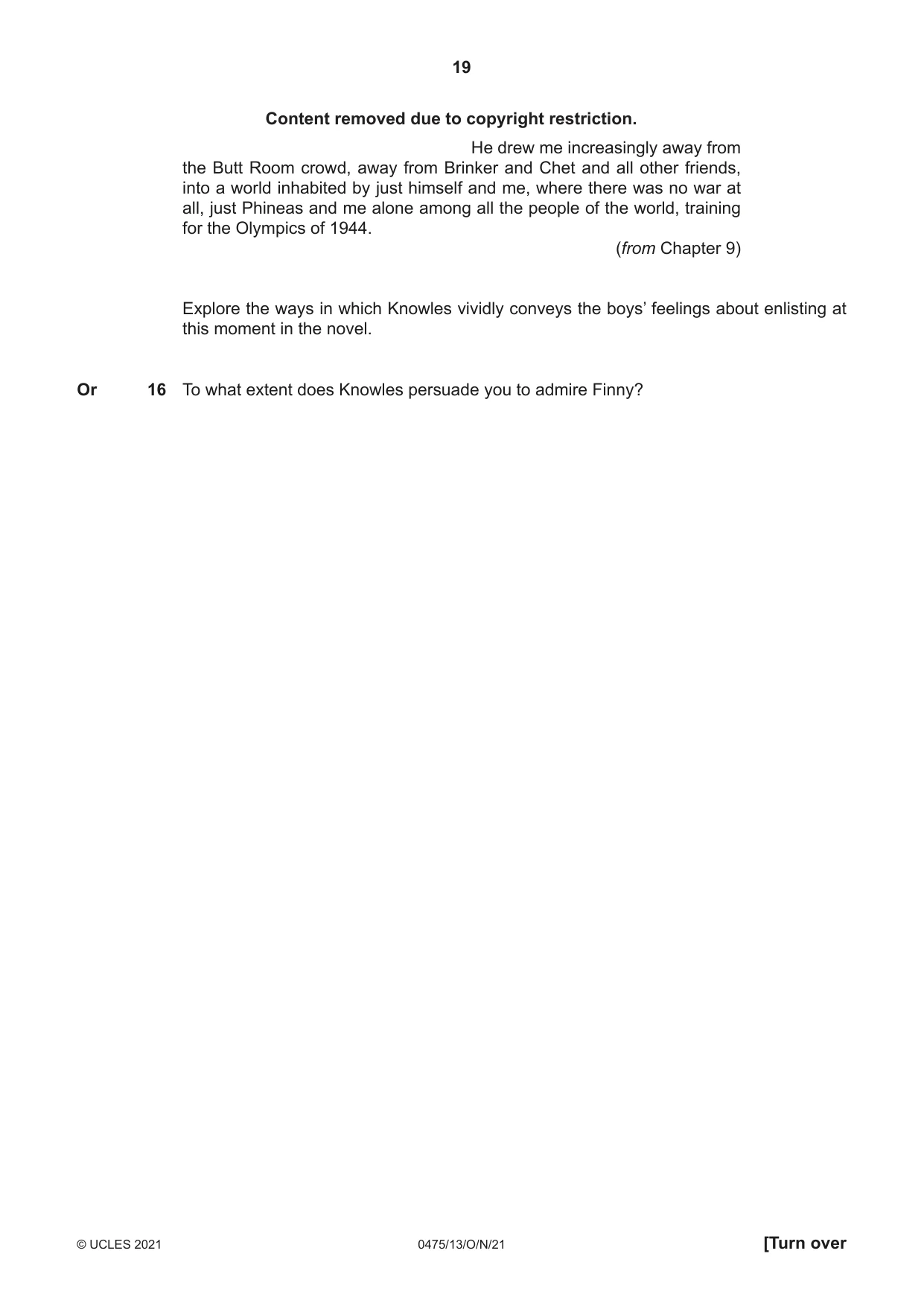
19 0475/13/O/N/21 © UCLES 2021 [Turn over He drew me increasingly away from the Butt Room crowd, away from Brinker and Chet and all other friends, into a world inhabited by just himself and me, where there was no war at all, just Phineas and me alone among all the people of the world, training for the Olympics of 1944. (from Chapter 9) Explore the ways in which Knowles vividly conveys the boys’ feelings about enlisting at this moment in the novel. Or 16 To what extent does Knowles persuade you to admire Finny? Content removed due to copyright restriction.
Question paper, page 20
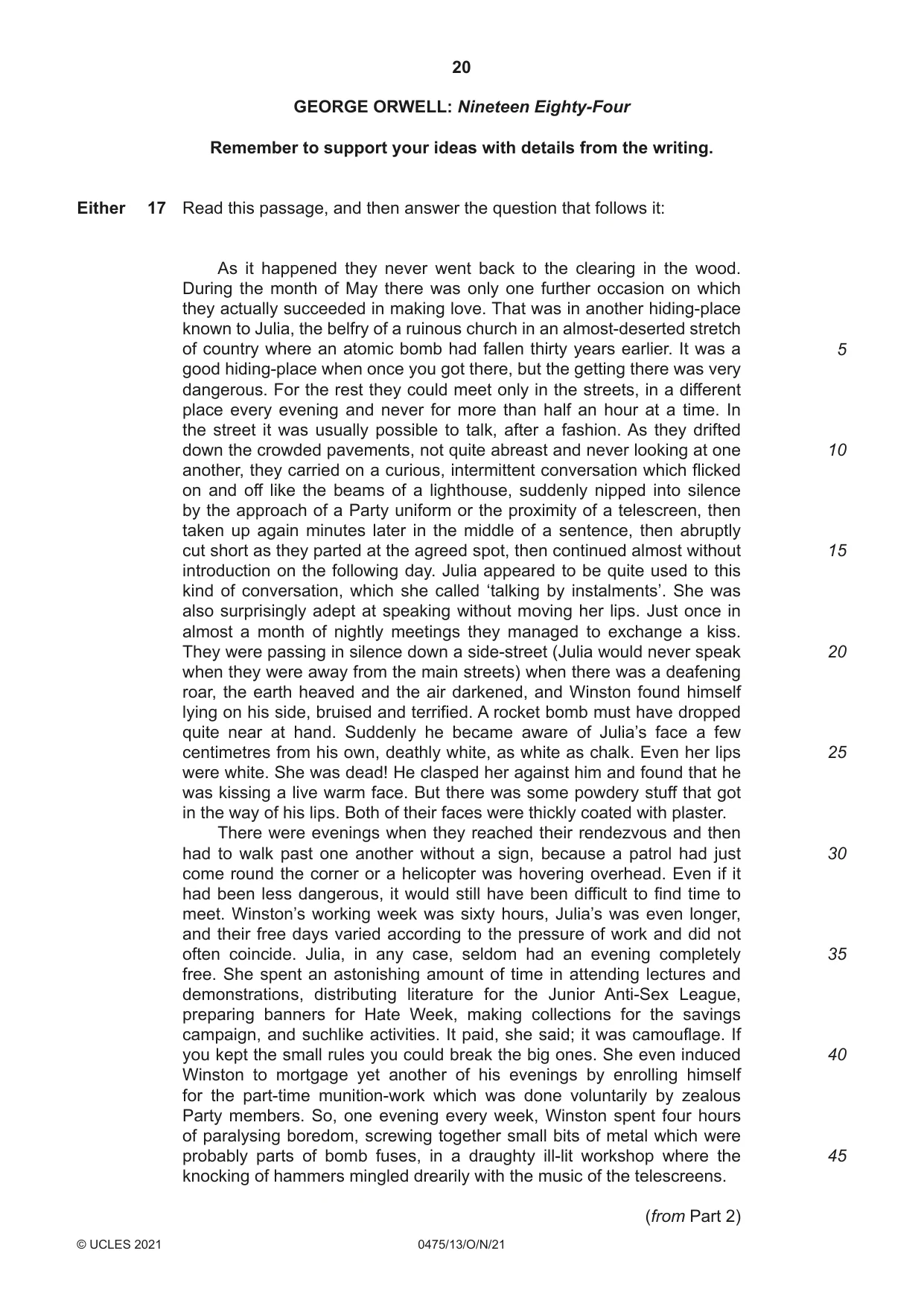
20 0475/13/O/N/21 © UCLES 2021 GEORGE ORWELL: Nineteen Eighty-Four Remember to support your ideas with details from the writing. Either 17 Read this passage, and then answer the question that follows it: As it happened they never went back to the clearing in the wood. During the month of May there was only one further occasion on which they actually succeeded in making love. That was in another hiding-place known to Julia, the belfry of a ruinous church in an almost-deserted stretch of country where an atomic bomb had fallen thirty years earlier. It was a good hiding-place when once you got there, but the getting there was very dangerous. For the rest they could meet only in the streets, in a different place every evening and never for more than half an hour at a time. In the street it was usually possible to talk, after a fashion. As they drifted down the crowded pavements, not quite abreast and never looking at one another, they carried on a curious, intermittent conversation which flicked on and off like the beams of a lighthouse, suddenly nipped into silence by the approach of a Party uniform or the proximity of a telescreen, then taken up again minutes later in the middle of a sentence, then abruptly cut short as they parted at the agreed spot, then continued almost without introduction on the following day. Julia appeared to be quite used to this kind of conversation, which she called ‘talking by instalments’. She was also surprisingly adept at speaking without moving her lips. Just once in almost a month of nightly meetings they managed to exchange a kiss. They were passing in silence down a side-street (Julia would never speak when they were away from the main streets) when there was a deafening roar, the earth heaved and the air darkened, and Winston found himself lying on his side, bruised and terrified. A rocket bomb must have dropped quite near at hand. Suddenly he became aware of Julia’s face a few centimetres from his own, deathly white, as white as chalk. Even her lips were white. She was dead! He clasped her against him and found that he was kissing a live warm face. But there was some powdery stuff that got in the way of his lips. Both of their faces were thickly coated with plaster. There were evenings when they reached their rendezvous and then had to walk past one another without a sign, because a patrol had just come round the corner or a helicopter was hovering overhead. Even if it had been less dangerous, it would still have been difficult to find time to meet. Winston’s working week was sixty hours, Julia’s was even longer, and their free days varied according to the pressure of work and did not often coincide. Julia, in any case, seldom had an evening completely free. She spent an astonishing amount of time in attending lectures and demonstrations, distributing literature for the Junior Anti-Sex League, preparing banners for Hate Week, making collections for the savings campaign, and suchlike activities. It paid, she said; it was camouflage. If you kept the small rules you could break the big ones. She even induced Winston to mortgage yet another of his evenings by enrolling himself for the part-time munition-work which was done voluntarily by zealous Party members. So, one evening every week, Winston spent four hours of paralysing boredom, screwing together small bits of metal which were probably parts of bomb fuses, in a draughty ill-lit workshop where the knocking of hammers mingled drearily with the music of the telescreens. (from Part 2) 5 10 15 20 25 30 35 40 45
Question paper, page 21
21 0475/13/O/N/21 © UCLES 2021 [Turn over How does Orwell strikingly convey the relationship between Winston and Julia at this moment in the novel? Or 18 Explore how Orwell vividly conveys the horror of Room 101.
Question paper, page 22
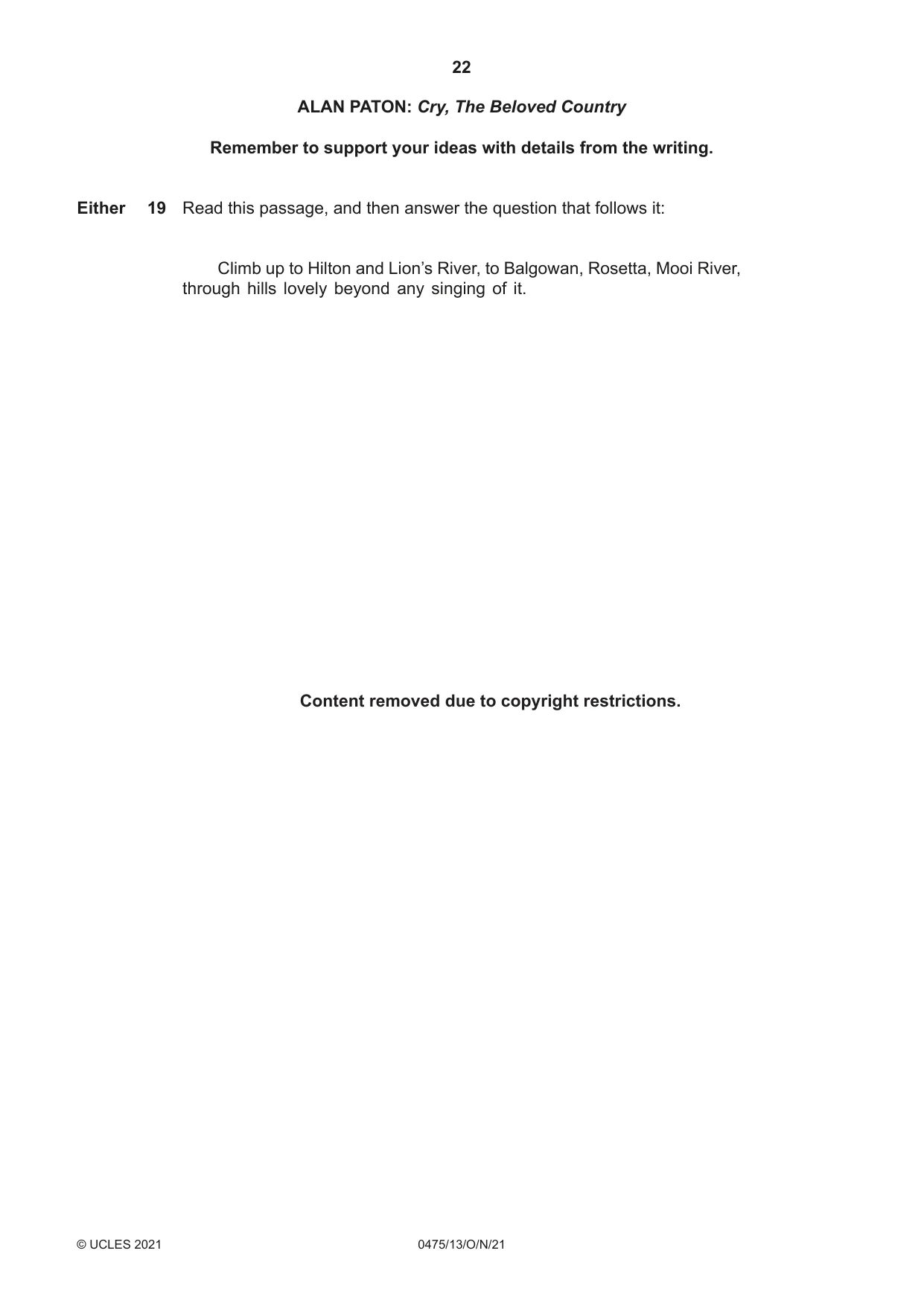
22 0475/13/O/N/21 © UCLES 2021 ALAN PATON: Cry, The Beloved Country Remember to support your ideas with details from the writing. Either 19 Read this passage, and then answer the question that follows it: Climb up to Hilton and Lion’s River, to Balgowan, Rosetta, Mooi River, through hills lovely beyond any singing of it. Content removed due to copyright restrictions.
Question paper, page 23
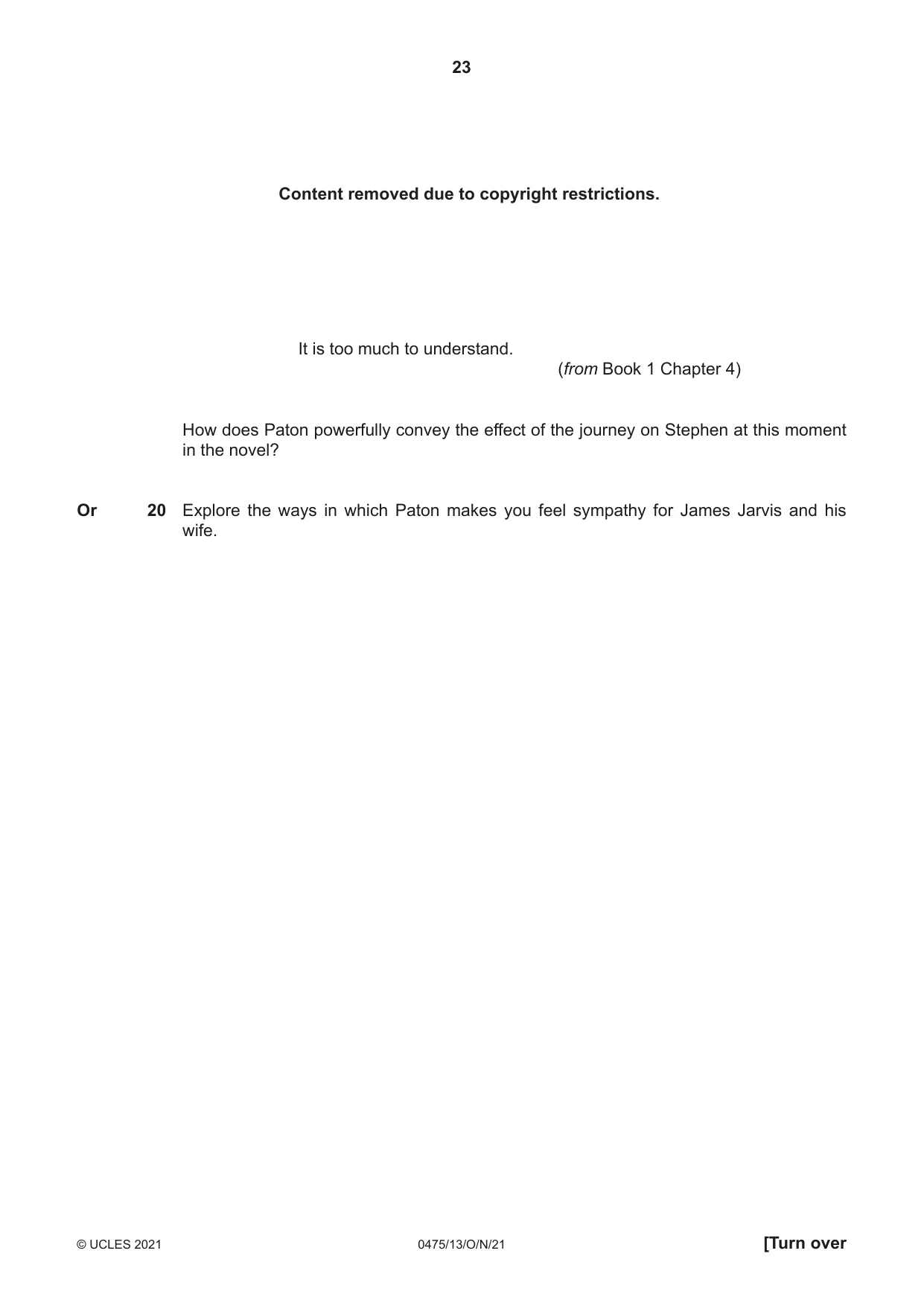
23 0475/13/O/N/21 © UCLES 2021 [Turn over It is too much to understand. (from Book 1 Chapter 4) How does Paton powerfully convey the effect of the journey on Stephen at this moment in the novel? Or 20 Explore the ways in which Paton makes you feel sympathy for James Jarvis and his wife. Content removed due to copyright restrictions.
Question paper, page 24
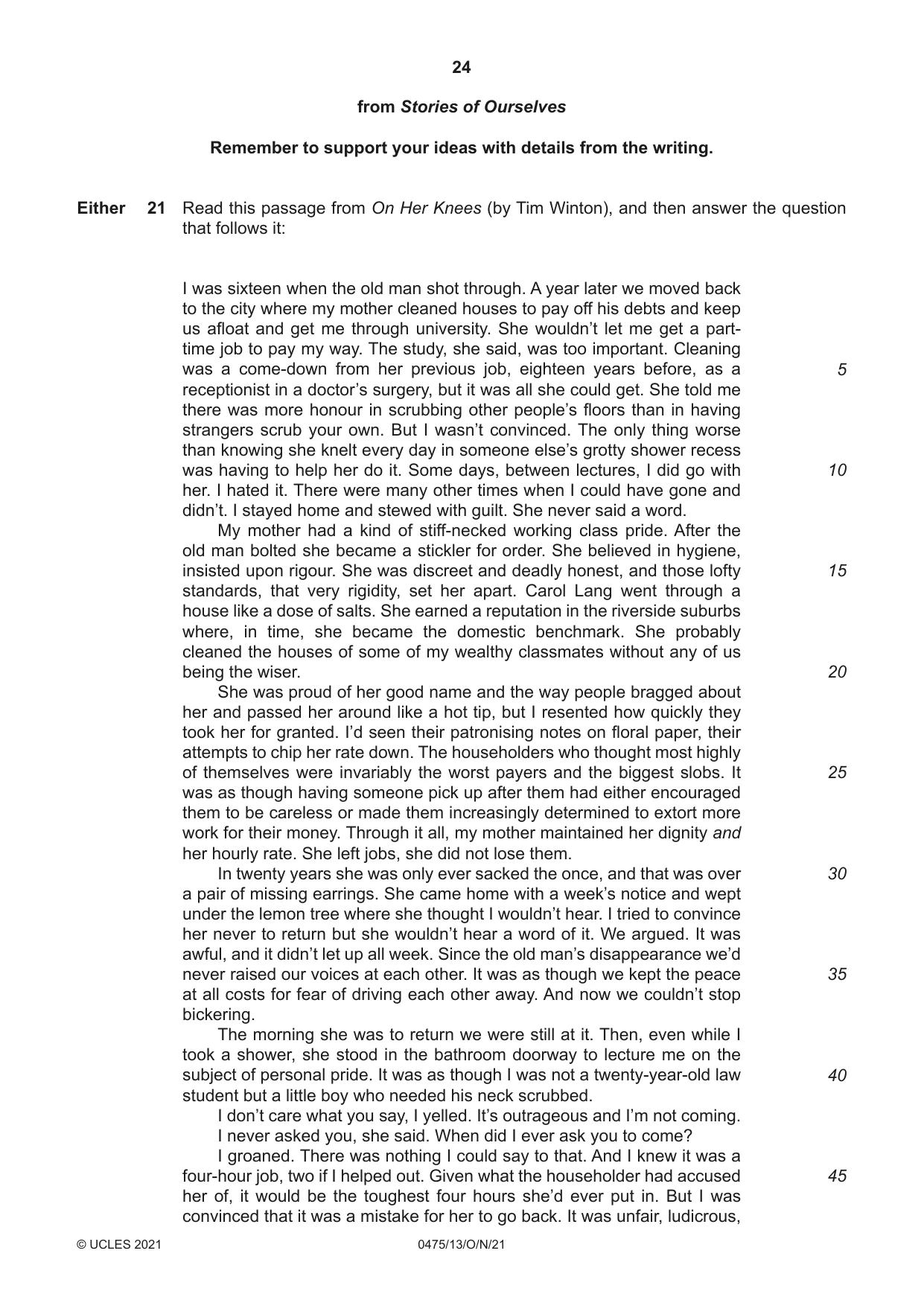
24 0475/13/O/N/21 © UCLES 2021 from Stories of Ourselves Remember to support your ideas with details from the writing. Either 21 Read this passage from On Her Knees (by Tim Winton), and then answer the question that follows it: I was sixteen when the old man shot through. A year later we moved back to the city where my mother cleaned houses to pay off his debts and keep us afloat and get me through university. She wouldn’t let me get a part- time job to pay my way. The study, she said, was too important. Cleaning was a come-down from her previous job, eighteen years before, as a receptionist in a doctor’s surgery, but it was all she could get. She told me there was more honour in scrubbing other people’s floors than in having strangers scrub your own. But I wasn’t convinced. The only thing worse than knowing she knelt every day in someone else’s grotty shower recess was having to help her do it. Some days, between lectures, I did go with her. I hated it. There were many other times when I could have gone and didn’t. I stayed home and stewed with guilt. She never said a word. My mother had a kind of stiff-necked working class pride. After the old man bolted she became a stickler for order. She believed in hygiene, insisted upon rigour. She was discreet and deadly honest, and those lofty standards, that very rigidity, set her apart. Carol Lang went through a house like a dose of salts. She earned a reputation in the riverside suburbs where, in time, she became the domestic benchmark. She probably cleaned the houses of some of my wealthy classmates without any of us being the wiser. She was proud of her good name and the way people bragged about her and passed her around like a hot tip, but I resented how quickly they took her for granted. I’d seen their patronising notes on floral paper, their attempts to chip her rate down. The householders who thought most highly of themselves were invariably the worst payers and the biggest slobs. It was as though having someone pick up after them had either encouraged them to be careless or made them increasingly determined to extort more work for their money. Through it all, my mother maintained her dignity and her hourly rate. She left jobs, she did not lose them. In twenty years she was only ever sacked the once, and that was over a pair of missing earrings. She came home with a week’s notice and wept under the lemon tree where she thought I wouldn’t hear. I tried to convince her never to return but she wouldn’t hear a word of it. We argued. It was awful, and it didn’t let up all week. Since the old man’s disappearance we’d never raised our voices at each other. It was as though we kept the peace at all costs for fear of driving each other away. And now we couldn’t stop bickering. The morning she was to return we were still at it. Then, even while I took a shower, she stood in the bathroom doorway to lecture me on the subject of personal pride. It was as though I was not a twenty-year-old law student but a little boy who needed his neck scrubbed. I don’t care what you say, I yelled. It’s outrageous and I’m not coming. I never asked you, she said. When did I ever ask you to come? I groaned. There was nothing I could say to that. And I knew it was a four-hour job, two if I helped out. Given what the householder had accused her of, it would be the toughest four hours she’d ever put in. But I was convinced that it was a mistake for her to go back. It was unfair, ludicrous, 5 10 15 20 25 30 35 40 45
Question paper, page 25
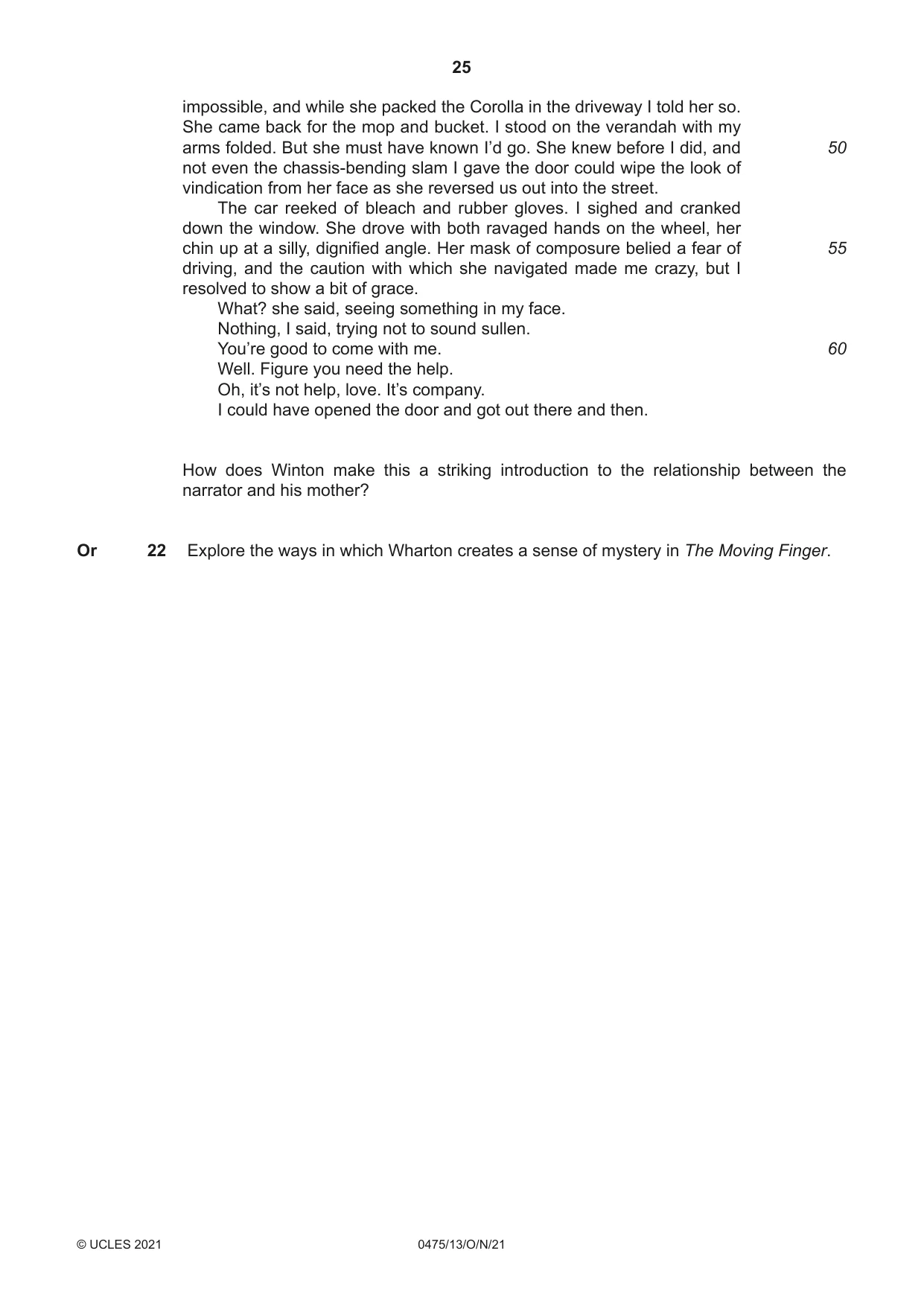
25 0475/13/O/N/21 © UCLES 2021 impossible, and while she packed the Corolla in the driveway I told her so. She came back for the mop and bucket. I stood on the verandah with my arms folded. But she must have known I’d go. She knew before I did, and not even the chassis-bending slam I gave the door could wipe the look of vindication from her face as she reversed us out into the street. The car reeked of bleach and rubber gloves. I sighed and cranked down the window. She drove with both ravaged hands on the wheel, her chin up at a silly, dignified angle. Her mask of composure belied a fear of driving, and the caution with which she navigated made me crazy, but I resolved to show a bit of grace. What? she said, seeing something in my face. Nothing, I said, trying not to sound sullen. You’re good to come with me. Well. Figure you need the help. Oh, it’s not help, love. It’s company. I could have opened the door and got out there and then. How does Winton make this a striking introduction to the relationship between the narrator and his mother? Or 22 Explore the ways in which Wharton creates a sense of mystery in The Moving Finger. 50 55 60
Question paper, page 26
26 0475/13/O/N/21 © UCLES 2021 BLANK PAGE
Question paper, page 27
27 0475/13/O/N/21 © UCLES 2021 BLANK PAGE
Question paper, page 28
28 0475/13/O/N/21 © UCLES 2021 Permission to reproduce items where third-party owned material protected by copyright is included has been sought and cleared where possible. Every reasonable effort has been made by the publisher (UCLES) to trace copyright holders, but if any items requiring clearance have unwittingly been included, the publisher will be pleased to make amends at the earliest possible opportunity. To avoid the issue of disclosure of answer-related information to candidates, all copyright acknowledgements are reproduced online in the Cambridge Assessment International Education Copyright Acknowledgements Booklet. This is produced for each series of examinations and is freely available to download at www.cambridgeinternational.org after the live examination series. Cambridge Assessment International Education is part of the Cambridge Assessment Group. Cambridge Assessment is the brand name of the University of Cambridge Local Examinations Syndicate (UCLES), which itself is a department of the University of Cambridge. BLANK PAGE
Mark scheme, page 1
This document consists of 4 printed pages. © UCLES 2021 [Turn over Cambridge IGCSE™ LITERATURE IN ENGLISH 0475/13 Paper 1 Poetry and Prose 13 October/November 2021 MARK SCHEME Maximum Mark: 50 Published This mark scheme is published as an aid to teachers and candidates, to indicate the requirements of the examination. It shows the basis on which Examiners were instructed to award marks. It does not indicate the details of the discussions that took place at an Examiners’ meeting before marking began, which would have considered the acceptability of alternative answers. Mark schemes should be read in conjunction with the question paper and the Principal Examiner Report for Teachers. Cambridge International will not enter into discussions about these mark schemes. Cambridge International is publishing the mark schemes for the October/November 2021 series for most Cambridge IGCSE™, Cambridge International A and AS Level components and some Cambridge O Level components.
Mark scheme, page 2
0475/13 Cambridge IGCSE – Mark Scheme PUBLISHED October/November 2021 © UCLES 2021 Page 2 of 4 Generic Marking Principles These general marking principles must be applied by all examiners when marking candidate answers. They should be applied alongside the specific content of the mark scheme or generic level descriptors for a question. Each question paper and mark scheme will also comply with these marking principles. GENERIC MARKING PRINCIPLE 1: Marks must be awarded in line with: • the specific content of the mark scheme or the generic level descriptors for the question • the specific skills defined in the mark scheme or in the generic level descriptors for the question • the standard of response required by a candidate as exemplified by the standardisation scripts. GENERIC MARKING PRINCIPLE 2: Marks awarded are always whole marks (not half marks, or other fractions). GENERIC MARKING PRINCIPLE 3: Marks must be awarded positively: • marks are awarded for correct/valid answers, as defined in the mark scheme. However, credit is given for valid answers which go beyond the scope of the syllabus and mark scheme, referring to your Team Leader as appropriate • marks are awarded when candidates clearly demonstrate what they know and can do • marks are not deducted for errors • marks are not deducted for omissions • answers should only be judged on the quality of spelling, punctuation and grammar when these features are specifically assessed by the question as indicated by the mark scheme. The meaning, however, should be unambiguous. GENERIC MARKING PRINCIPLE 4: Rules must be applied consistently, e.g. in situations where candidates have not followed instructions or in the application of generic level descriptors. GENERIC MARKING PRINCIPLE 5: Marks should be awarded using the full range of marks defined in the mark scheme for the question (however; the use of the full mark range may be limited according to the quality of the candidate responses seen). GENERIC MARKING PRINCIPLE 6: Marks awarded are based solely on the requirements as defined in the mark scheme. Marks should not be awarded with grade thresholds or grade descriptors in mind.
Mark scheme, page 3
0475/13 Cambridge IGCSE – Mark Scheme PUBLISHED October/November 2021 © UCLES 2021 Page 3 of 4 English & Media subject specific general marking principles (To be read in conjunction with the Generic Marking Principles (and requiring further guidance on how to place marks within levels)) Components using level descriptors: • We use level descriptors as a guide to broad understanding of the qualities normally expected of, or typical of, work in a level. • Level descriptors are a means of general guidance, and should not be interpreted as hurdle statements. • Where indicative content notes are supplied for a question, these are not a prescription of required content, and must not be treated as such. Alternative correct points and unexpected answers in candidates’ scripts must be given marks that fairly reflect the knowledge and skills demonstrated. • While we may have legitimate expectations as to the ground most answers may occupy, we must at all times be prepared to meet candidates on their chosen ground, provided it is relevant ground (e.g. clearly related to and derived from a relevant passage/text and meeting the mark scheme requirements for the question). Components using point-based marking: Point marking is often used to reward knowledge, understanding and application of skills. We give credit where the candidate’s answer shows relevant knowledge, understanding and application of skills in answering the question. We do not give credit where the answer shows confusion. From this it follows that we: a DO credit answers which are worded differently from the mark scheme if they clearly convey the same meaning (unless the mark scheme requires a specific term). b DO credit alternative answers/examples which are not written in the mark scheme if they are correct. c DO credit answers where candidates give more than one correct answer in one prompt/numbered/scaffolded space where extended writing is required rather than list-type answers. For example, questions that require n reasons (e.g. State two reasons…). d DO NOT credit answers simply for using a ‘key term’ unless that is all that is required. (Check for evidence it is understood and not used wrongly.). e DO NOT credit answers which are obviously self-contradicting or trying to cover all possibilities. f DO NOT give further credit for what is effectively repetition of a correct point already credited unless the language itself is being tested. This applies equally to ‘mirror statements’ (i.e. polluted/not polluted). g DO NOT require spellings to be correct, unless this is part of the test. However spellings of syllabus terms must allow for clear and unambiguous separation from other syllabus terms with which they may be confused (e.g. Corrasion/Corrosion).
Mark scheme, page 4
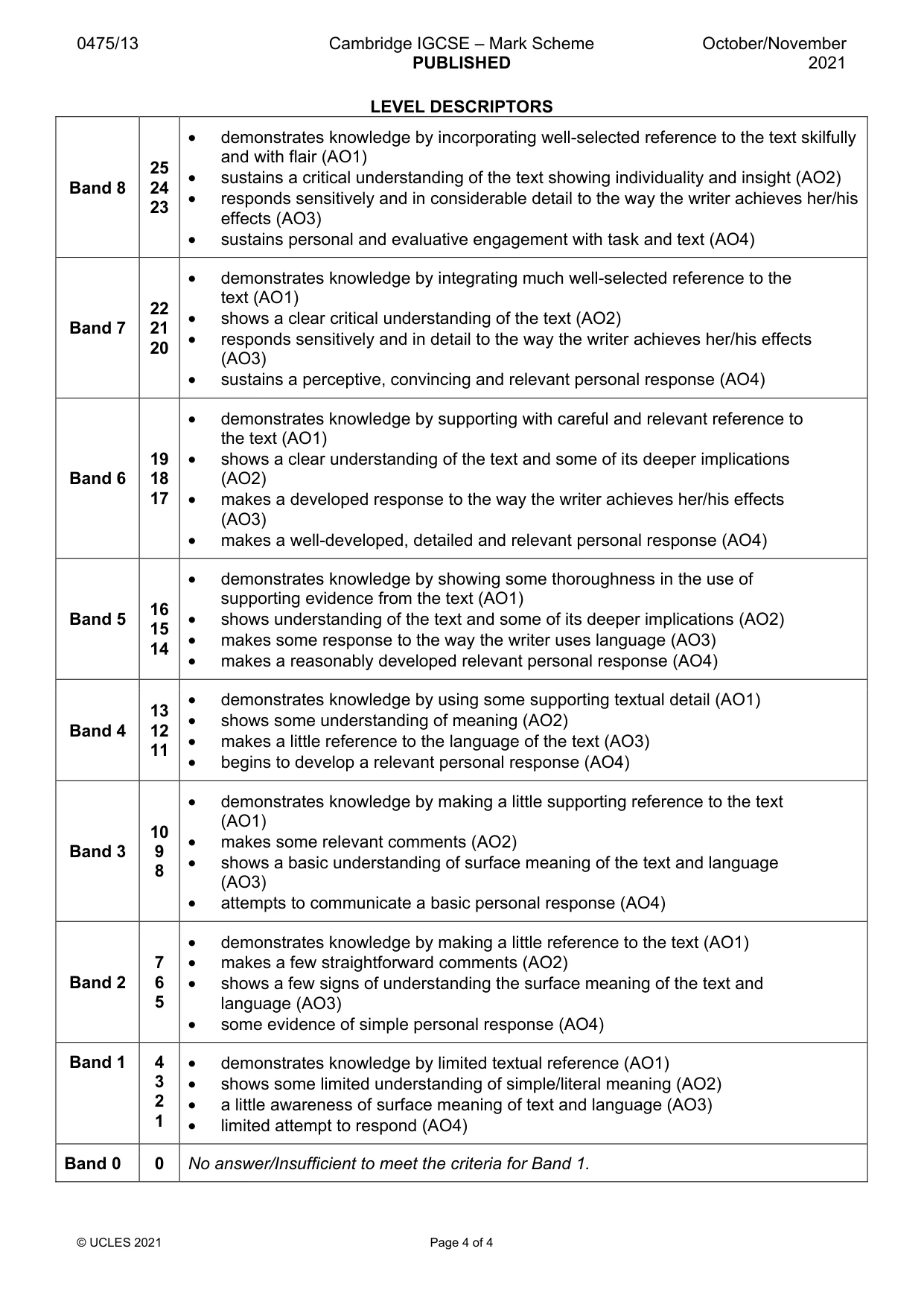
0475/13 Cambridge IGCSE – Mark Scheme PUBLISHED October/November 2021 © UCLES 2021 Page 4 of 4 LEVEL DESCRIPTORS Band 8 25 24 23 • demonstrates knowledge by incorporating well-selected reference to the text skilfully and with flair (AO1) • sustains a critical understanding of the text showing individuality and insight (AO2) • responds sensitively and in considerable detail to the way the writer achieves her/his effects (AO3) • sustains personal and evaluative engagement with task and text (AO4) Band 7 22 21 20 • demonstrates knowledge by integrating much well-selected reference to the text (AO1) • shows a clear critical understanding of the text (AO2) • responds sensitively and in detail to the way the writer achieves her/his effects (AO3) • sustains a perceptive, convincing and relevant personal response (AO4) Band 6 19 18 17 • demonstrates knowledge by supporting with careful and relevant reference to the text (AO1) • shows a clear understanding of the text and some of its deeper implications (AO2) • makes a developed response to the way the writer achieves her/his effects (AO3) • makes a well-developed, detailed and relevant personal response (AO4) Band 5 16 15 14 • demonstrates knowledge by showing some thoroughness in the use of supporting evidence from the text (AO1) • shows understanding of the text and some of its deeper implications (AO2) • makes some response to the way the writer uses language (AO3) • makes a reasonably developed relevant personal response (AO4) Band 4 13 12 11 • demonstrates knowledge by using some supporting textual detail (AO1) • shows some understanding of meaning (AO2) • makes a little reference to the language of the text (AO3) • begins to develop a relevant personal response (AO4) Band 3 10 9 8 • demonstrates knowledge by making a little supporting reference to the text (AO1) • makes some relevant comments (AO2) • shows a basic understanding of surface meaning of the text and language (AO3) • attempts to communicate a basic personal response (AO4) Band 2 7 6 5 • demonstrates knowledge by making a little reference to the text (AO1) • makes a few straightforward comments (AO2) • shows a few signs of understanding the surface meaning of the text and language (AO3) • some evidence of simple personal response (AO4) Band 1 4 3 2 1 • demonstrates knowledge by limited textual reference (AO1) • shows some limited understanding of simple/literal meaning (AO2) • a little awareness of surface meaning of text and language (AO3) • limited attempt to respond (AO4) Band 0 0 No answer/Insufficient to meet the criteria for Band 1.
What you needed in this session
Cambridge’s own grade thresholds for 2021 Oct/Nov, Paper 1 · Variant 3. A higher threshold means an easier paper — the bar moves with how the cohort did.