Cambridge IGCSE English - Literature in English 0475 — 2021 Oct/Nov Paper 1 · Variant 1
0475/11/O/N/21 · 50 marks · ≈56 min
The question paper and its mark scheme, free to read here and free to download. This is Cambridge’s own paper, exactly as it was sat.
Question paper28 pages





Mark scheme4 pages
Answers below. Sit the paper first if you are practising.
Paper as text
Question paper, page 1
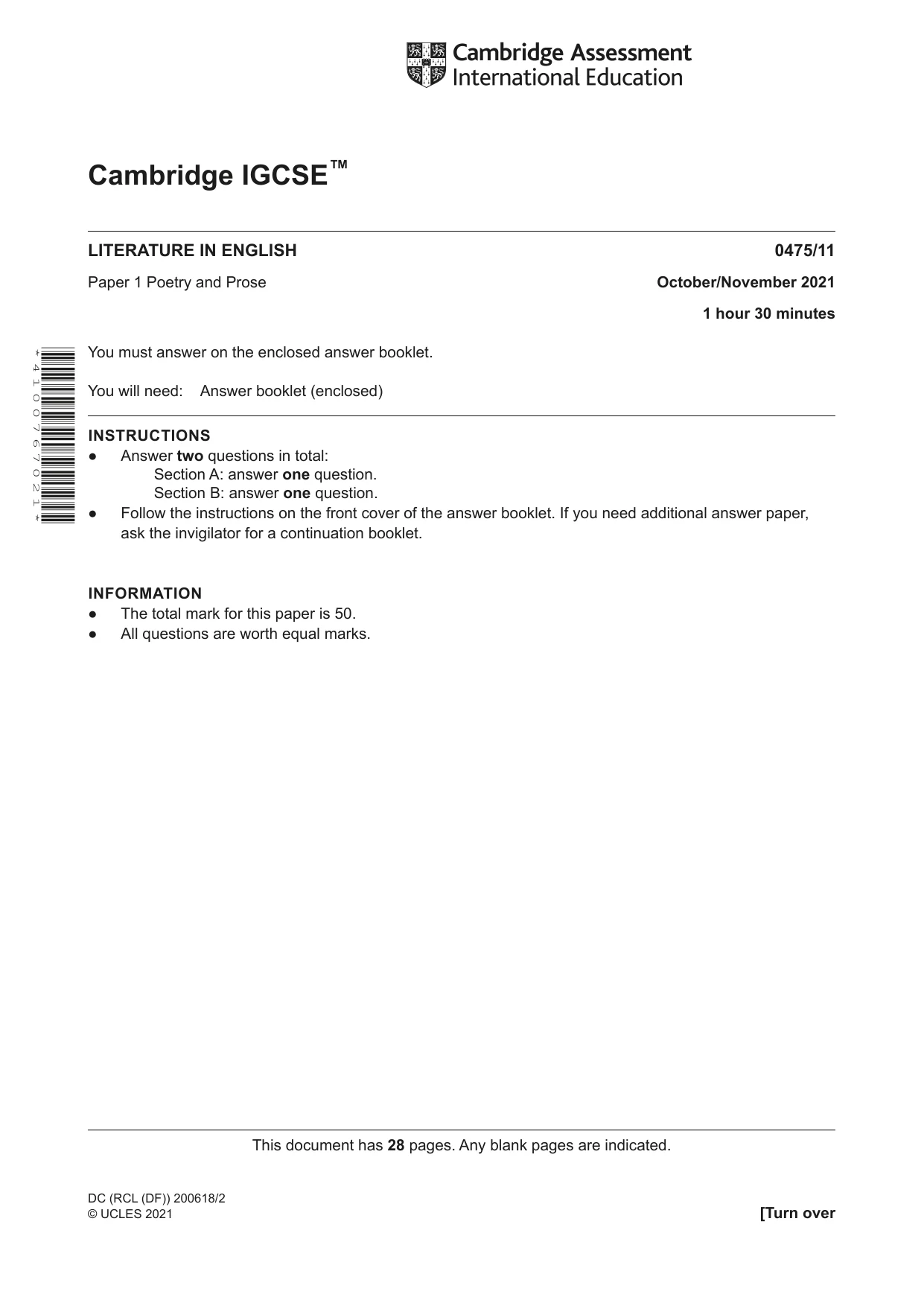
This document has 28 pages. Any blank pages are indicated. DC (RCL (DF)) 200618/2 © UCLES 2021 [Turn over * 4 1 0 0 7 6 7 0 2 1 * Cambridge IGCSE™ LITERATURE IN ENGLISH 0475/11 Paper 1 Poetry and Prose October/November 2021 1 hour 30 minutes You must answer on the enclosed answer booklet. You will need: Answer booklet (enclosed) INSTRUCTIONS ● Answer two questions in total: Section A: answer one question. Section B: answer one question. ● Follow the instructions on the front cover of the answer booklet. If you need additional answer paper, ask the invigilator for a continuation booklet. INFORMATION ● The total mark for this paper is 50. ● All questions are worth equal marks.
Question paper, page 2
2 0475/11/O/N/21 © UCLES 2021 BLANK PAGE
Question paper, page 3
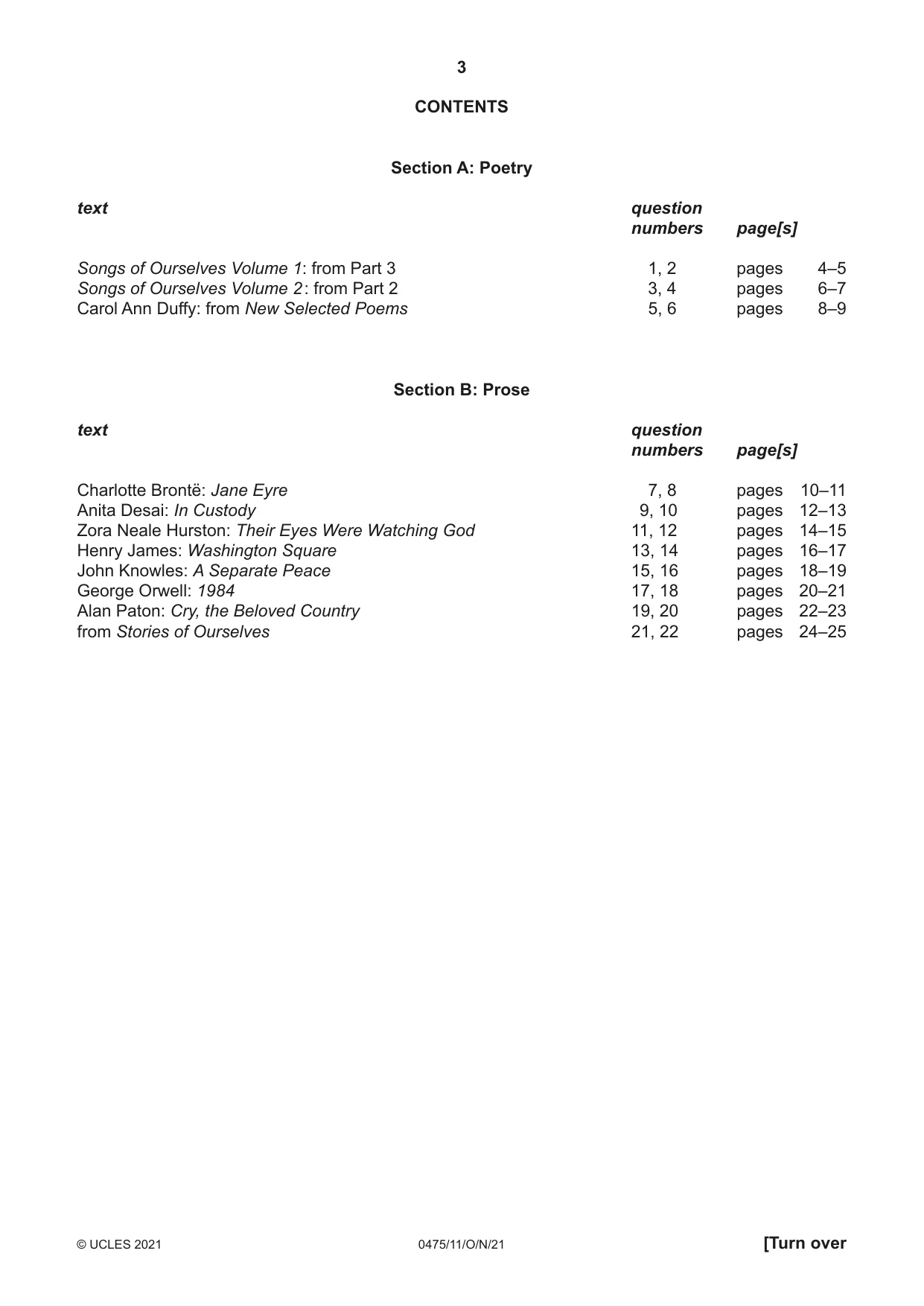
3 0475/11/O/N/21 © UCLES 2021 [Turn over CONTENTS Section A: Poetry text question numbers page[s] Songs of Ourselves Volume 1: from Part 3 1, 2 pages 4–5 Songs of Ourselves Volume 2 : from Part 2 3, 4 pages 6–7 Carol Ann Duffy: from New Selected Poems 5, 6 pages 8–9 Section B: Prose text question numbers page[s] Charlotte Brontë: Jane Eyre 7, 8 pages 10–11 Anita Desai: In Custody 9, 10 pages 12–13 Zora Neale Hurston: Their Eyes Were Watching God 11, 12 pages 14–15 Henry James: Washington Square 13, 14 pages 16–17 John Knowles: A Separate Peace 15, 16 pages 18–19 George Orwell: 1984 17, 18 pages 20–21 Alan Paton: Cry, the Beloved Country 19, 20 pages 22–23 from Stories of Ourselves 21, 22 pages 24–25
Question paper, page 4
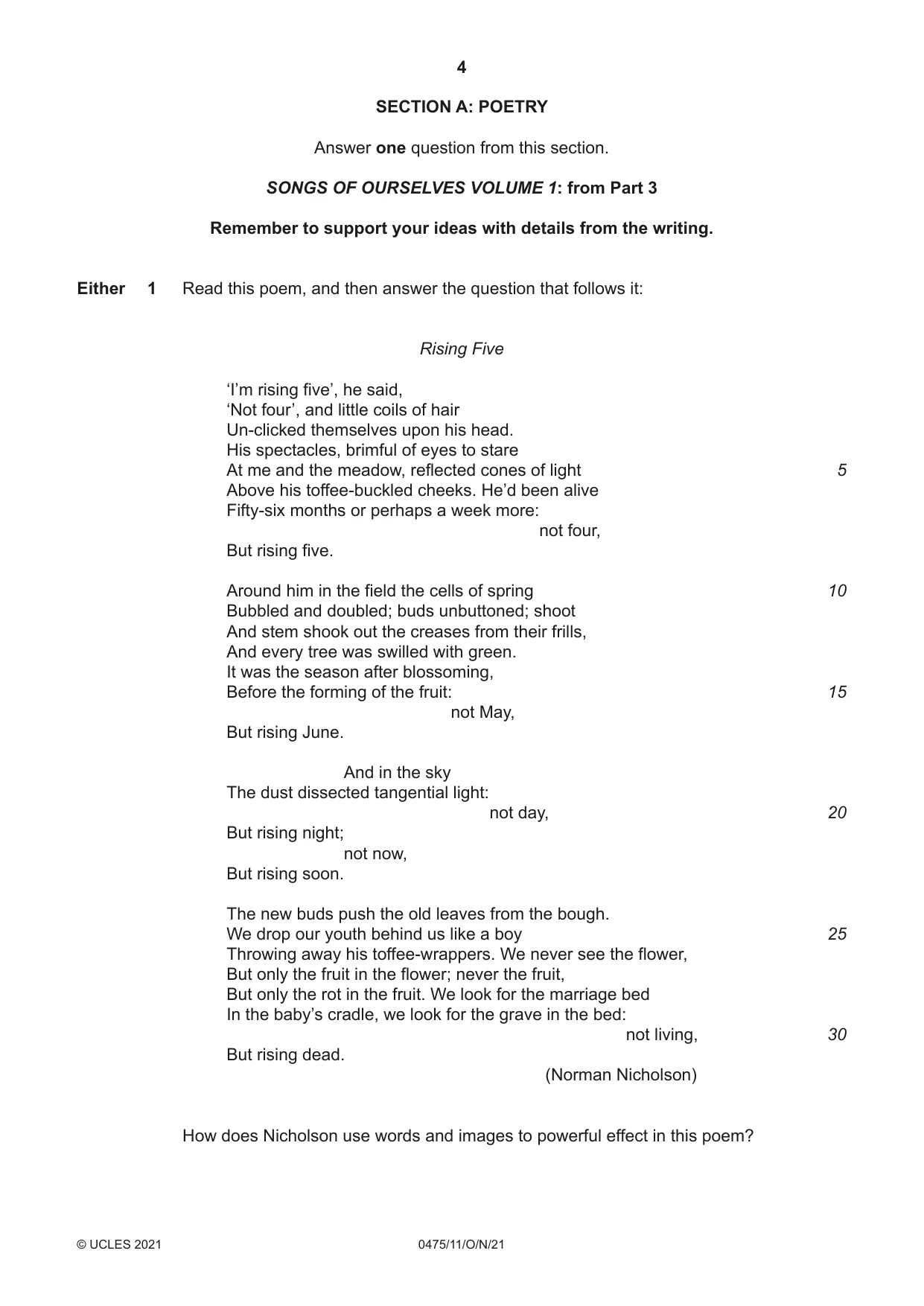
4 0475/11/O/N/21 © UCLES 2021 SECTION A: POETRY Answer one question from this section. SONGS OF OURSELVES VOLUME 1: from Part 3 Remember to support your ideas with details from the writing. Either 1 Read this poem, and then answer the question that follows it: Rising Five ‘I’m rising five’, he said, ‘Not four’, and little coils of hair Un-clicked themselves upon his head. His spectacles, brimful of eyes to stare At me and the meadow, reflected cones of light Above his toffee-buckled cheeks. He’d been alive Fifty-six months or perhaps a week more: not four, But rising five. Around him in the field the cells of spring Bubbled and doubled; buds unbuttoned; shoot And stem shook out the creases from their frills, And every tree was swilled with green. It was the season after blossoming, Before the forming of the fruit: not May, But rising June. And in the sky The dust dissected tangential light: not day, But rising night; not now, But rising soon. The new buds push the old leaves from the bough. We drop our youth behind us like a boy Throwing away his toffee-wrappers. We never see the flower, But only the fruit in the flower; never the fruit, But only the rot in the fruit. We look for the marriage bed In the baby’s cradle, we look for the grave in the bed: not living, But rising dead. (Norman Nicholson) How does Nicholson use words and images to powerful effect in this poem? 5 10 15 20 25 30
Question paper, page 5
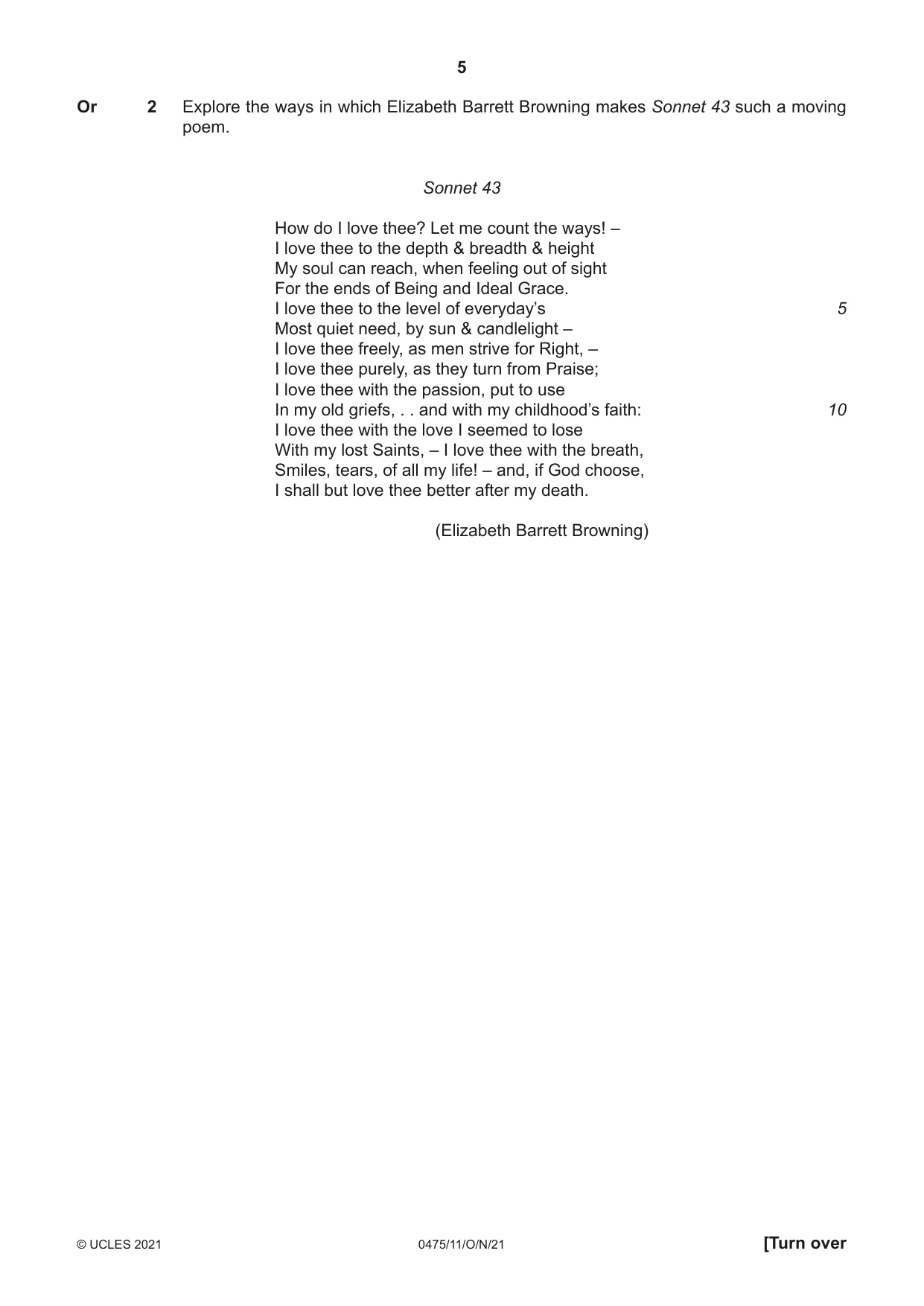
5 0475/11/O/N/21 © UCLES 2021 [Turn over Or 2 Explore the ways in which Elizabeth Barrett Browning makes Sonnet 43 such a moving poem. Sonnet 43 How do I love thee? Let me count the ways! – I love thee to the depth & breadth & height My soul can reach, when feeling out of sight For the ends of Being and Ideal Grace. I love thee to the level of everyday’s Most quiet need, by sun & candlelight – I love thee freely, as men strive for Right, – I love thee purely, as they turn from Praise; I love thee with the passion, put to use In my old griefs, . . and with my childhood’s faith: I love thee with the love I seemed to lose With my lost Saints, – I love thee with the breath, Smiles, tears, of all my life! – and, if God choose, I shall but love thee better after my death. (Elizabeth Barrett Browning) 5 10
Question paper, page 6
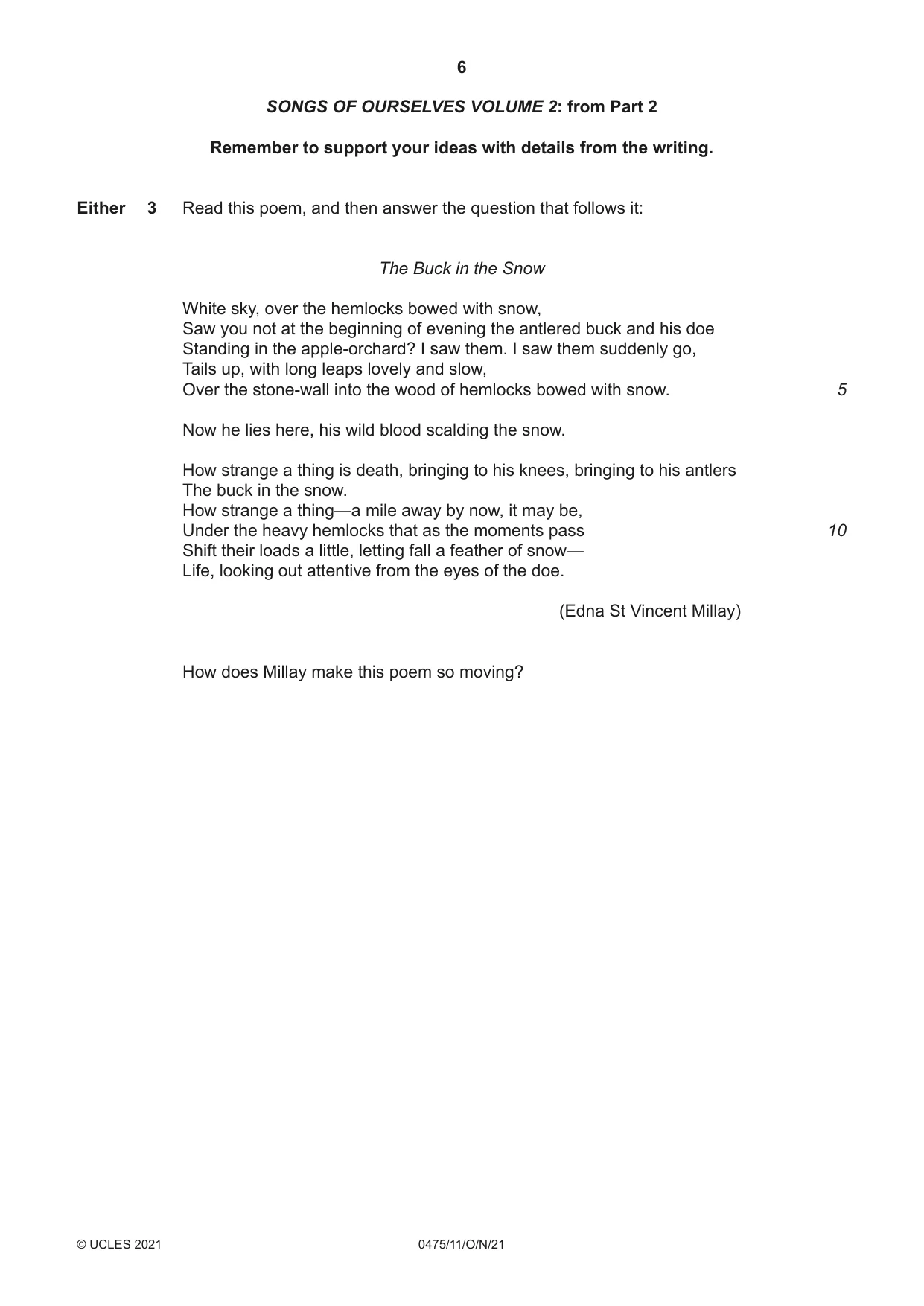
6 0475/11/O/N/21 © UCLES 2021 SONGS OF OURSELVES VOLUME 2: from Part 2 Remember to support your ideas with details from the writing. Either 3 Read this poem, and then answer the question that follows it: The Buck in the Snow White sky, over the hemlocks bowed with snow, Saw you not at the beginning of evening the antlered buck and his doe Standing in the apple-orchard? I saw them. I saw them suddenly go, Tails up, with long leaps lovely and slow, Over the stone-wall into the wood of hemlocks bowed with snow. Now he lies here, his wild blood scalding the snow. How strange a thing is death, bringing to his knees, bringing to his antlers The buck in the snow. How strange a thing—a mile away by now, it may be, Under the heavy hemlocks that as the moments pass Shift their loads a little, letting fall a feather of snow— Life, looking out attentive from the eyes of the doe. (Edna St Vincent Millay) How does Millay make this poem so moving? 5 10
Question paper, page 7
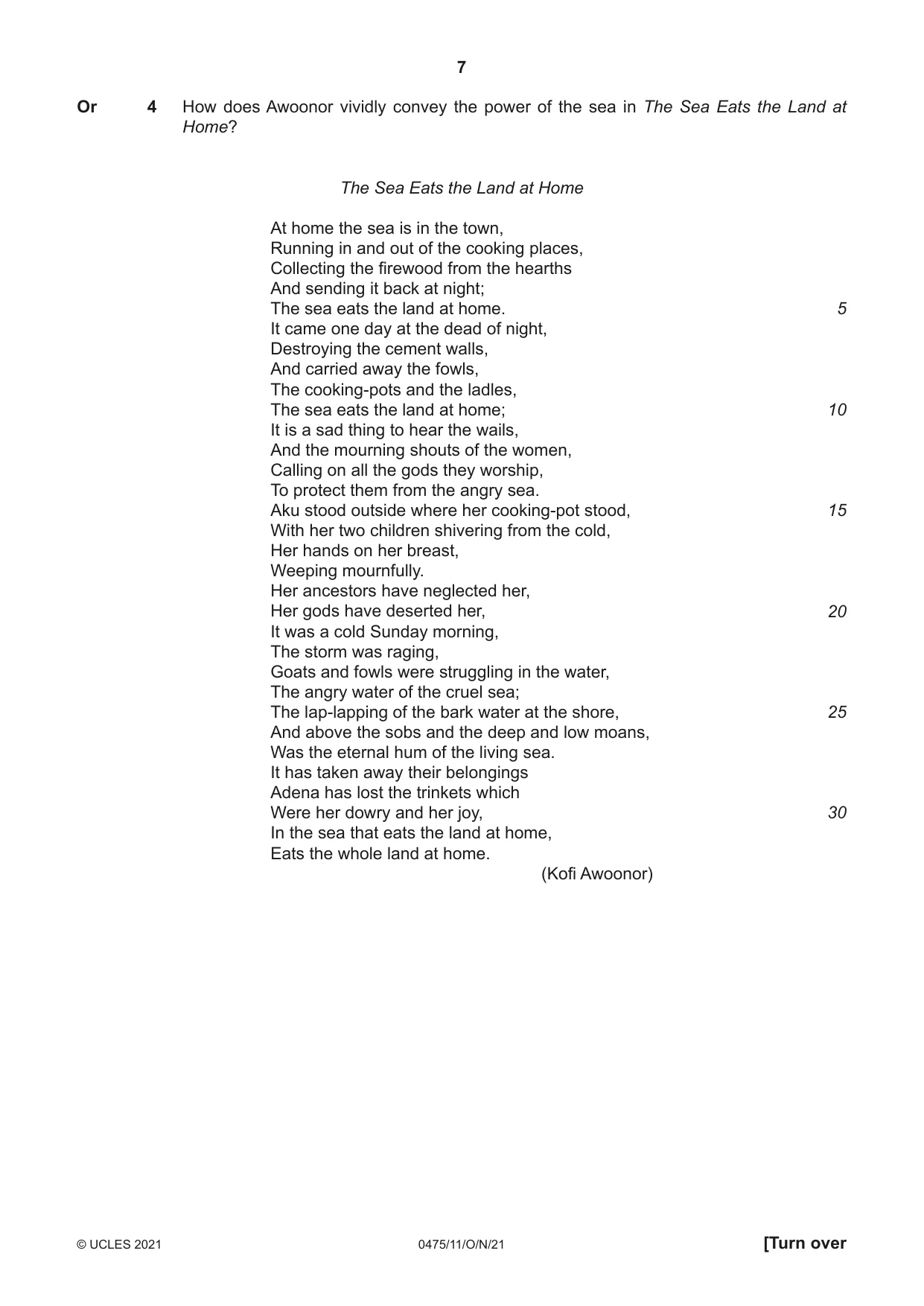
7 0475/11/O/N/21 © UCLES 2021 [Turn over Or 4 How does Awoonor vividly convey the power of the sea in The Sea Eats the Land at Home? The Sea Eats the Land at Home At home the sea is in the town, Running in and out of the cooking places, Collecting the firewood from the hearths And sending it back at night; The sea eats the land at home. It came one day at the dead of night, Destroying the cement walls, And carried away the fowls, The cooking-pots and the ladles, The sea eats the land at home; It is a sad thing to hear the wails, And the mourning shouts of the women, Calling on all the gods they worship, To protect them from the angry sea. Aku stood outside where her cooking-pot stood, With her two children shivering from the cold, Her hands on her breast, Weeping mournfully. Her ancestors have neglected her, Her gods have deserted her, It was a cold Sunday morning, The storm was raging, Goats and fowls were struggling in the water, The angry water of the cruel sea; The lap-lapping of the bark water at the shore, And above the sobs and the deep and low moans, Was the eternal hum of the living sea. It has taken away their belongings Adena has lost the trinkets which Were her dowry and her joy, In the sea that eats the land at home, Eats the whole land at home. (Kofi Awoonor) 5 10 15 20 25 30
Question paper, page 8
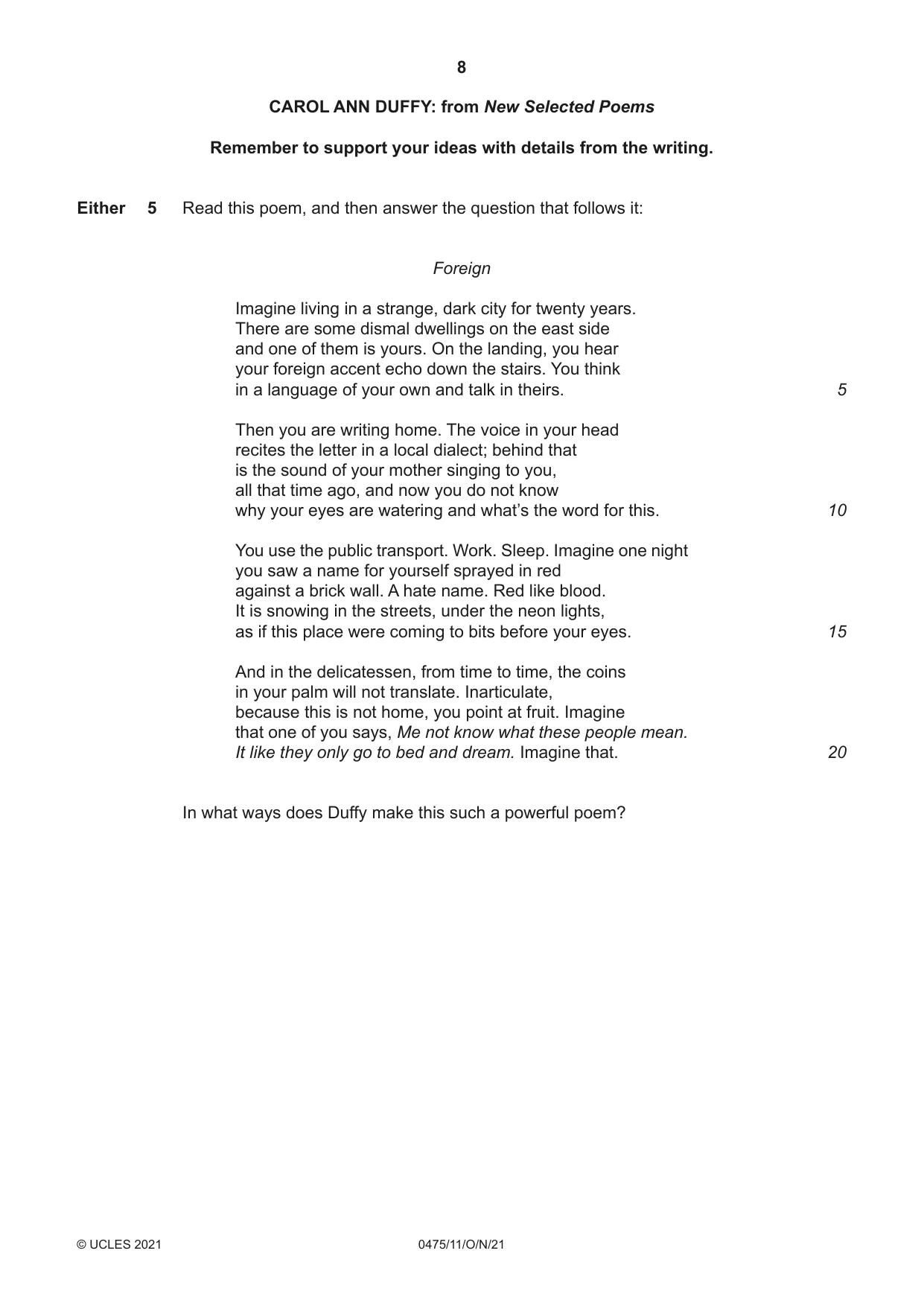
8 0475/11/O/N/21 © UCLES 2021 CAROL ANN DUFFY: from New Selected Poems Remember to support your ideas with details from the writing. Either 5 Read this poem, and then answer the question that follows it: Foreign Imagine living in a strange, dark city for twenty years. There are some dismal dwellings on the east side and one of them is yours. On the landing, you hear your foreign accent echo down the stairs. You think in a language of your own and talk in theirs. Then you are writing home. The voice in your head recites the letter in a local dialect; behind that is the sound of your mother singing to you, all that time ago, and now you do not know why your eyes are watering and what’s the word for this. You use the public transport. Work. Sleep. Imagine one night you saw a name for yourself sprayed in red against a brick wall. A hate name. Red like blood. It is snowing in the streets, under the neon lights, as if this place were coming to bits before your eyes. And in the delicatessen, from time to time, the coins in your palm will not translate. Inarticulate, because this is not home, you point at fruit. Imagine that one of you says, Me not know what these people mean. It like they only go to bed and dream. Imagine that. In what ways does Duffy make this such a powerful poem? 5 10 15 20
Question paper, page 9
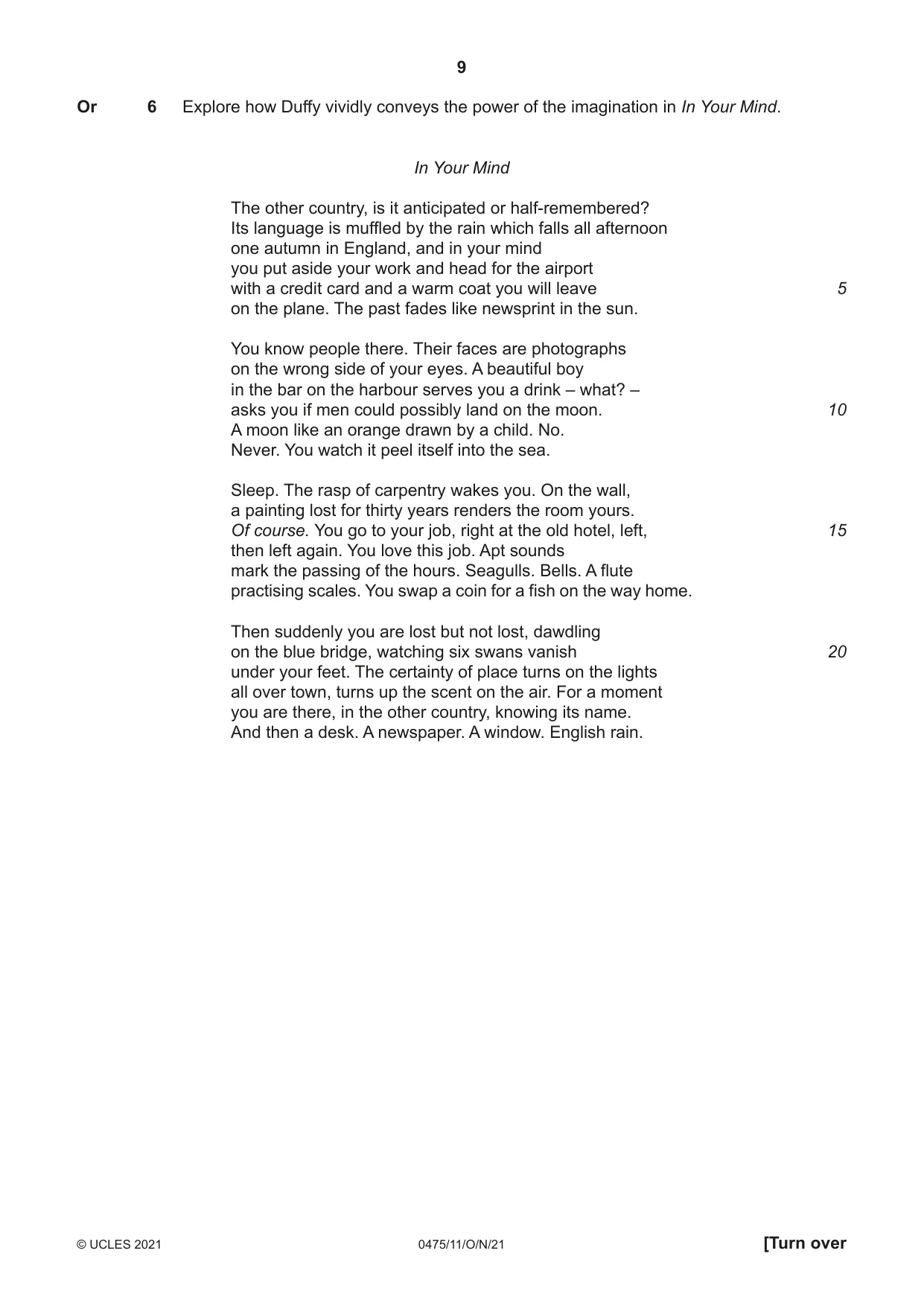
9 0475/11/O/N/21 © UCLES 2021 [Turn over Or 6 Explore how Duffy vividly conveys the power of the imagination in In Your Mind. In Your Mind The other country, is it anticipated or half-remembered? Its language is muffled by the rain which falls all afternoon one autumn in England, and in your mind you put aside your work and head for the airport with a credit card and a warm coat you will leave on the plane. The past fades like newsprint in the sun. You know people there. Their faces are photographs on the wrong side of your eyes. A beautiful boy in the bar on the harbour serves you a drink – what? – asks you if men could possibly land on the moon. A moon like an orange drawn by a child. No. Never. You watch it peel itself into the sea. Sleep. The rasp of carpentry wakes you. On the wall, a painting lost for thirty years renders the room yours. Of course. You go to your job, right at the old hotel, left, then left again. You love this job. Apt sounds mark the passing of the hours. Seagulls. Bells. A flute practising scales. You swap a coin for a fish on the way home. Then suddenly you are lost but not lost, dawdling on the blue bridge, watching six swans vanish under your feet. The certainty of place turns on the lights all over town, turns up the scent on the air. For a moment you are there, in the other country, knowing its name. And then a desk. A newspaper. A window. English rain. 5 10 15 20
Question paper, page 10
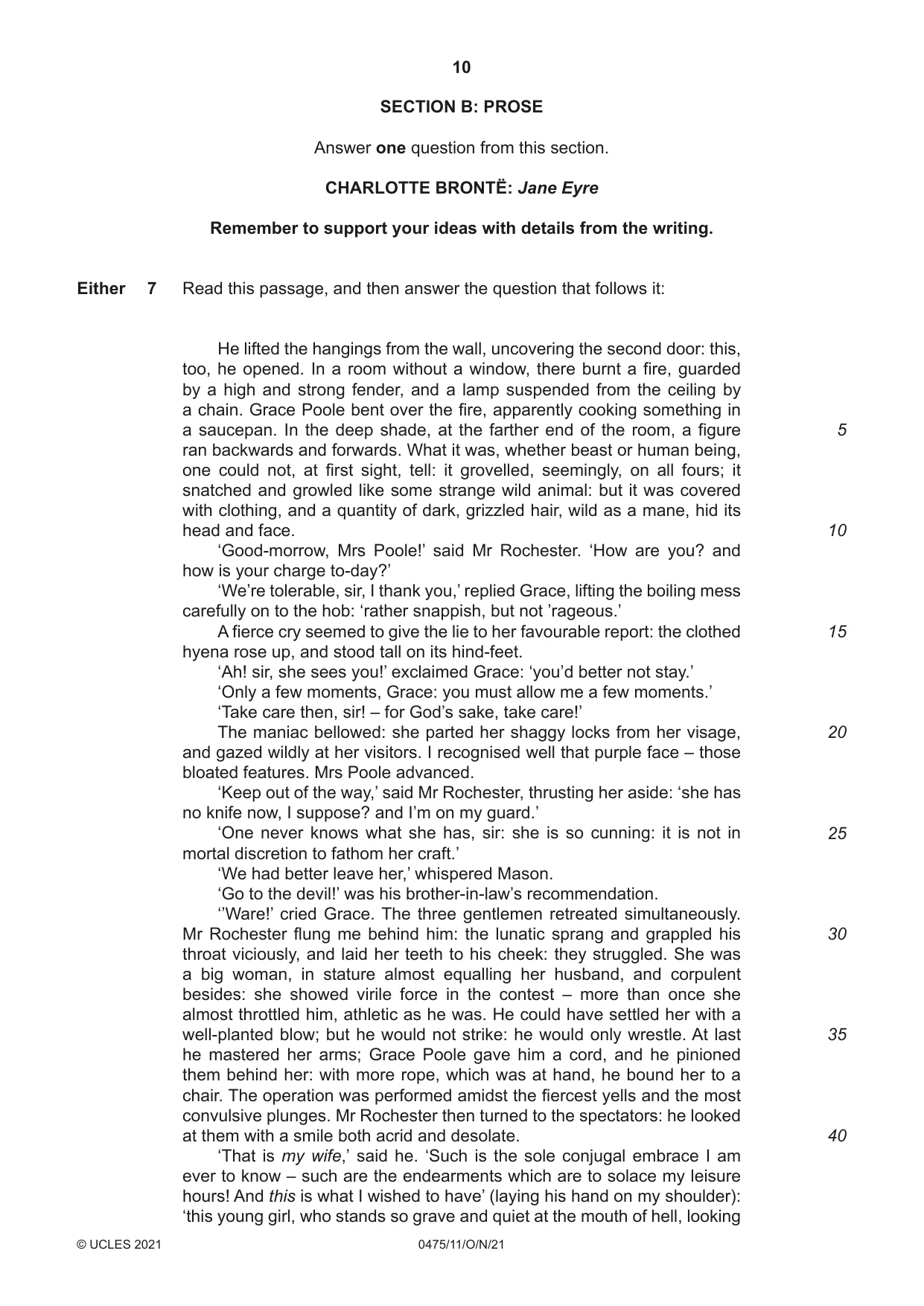
10 0475/11/O/N/21 © UCLES 2021 SECTION B: PROSE Answer one question from this section. CHARLOTTE BRONTË: Jane Eyre Remember to support your ideas with details from the writing. Either 7 Read this passage, and then answer the question that follows it: He lifted the hangings from the wall, uncovering the second door: this, too, he opened. In a room without a window, there burnt a fire, guarded by a high and strong fender, and a lamp suspended from the ceiling by a chain. Grace Poole bent over the fire, apparently cooking something in a saucepan. In the deep shade, at the farther end of the room, a figure ran backwards and forwards. What it was, whether beast or human being, one could not, at first sight, tell: it grovelled, seemingly, on all fours; it snatched and growled like some strange wild animal: but it was covered with clothing, and a quantity of dark, grizzled hair, wild as a mane, hid its head and face. ‘Good-morrow, Mrs Poole!’ said Mr Rochester. ‘How are you? and how is your charge to-day?’ ‘We’re tolerable, sir, I thank you,’ replied Grace, lifting the boiling mess carefully on to the hob: ‘rather snappish, but not ’rageous.’ A fierce cry seemed to give the lie to her favourable report: the clothed hyena rose up, and stood tall on its hind-feet. ‘Ah! sir, she sees you!’ exclaimed Grace: ‘you’d better not stay.’ ‘Only a few moments, Grace: you must allow me a few moments.’ ‘Take care then, sir! – for God’s sake, take care!’ The maniac bellowed: she parted her shaggy locks from her visage, and gazed wildly at her visitors. I recognised well that purple face – those bloated features. Mrs Poole advanced. ‘Keep out of the way,’ said Mr Rochester, thrusting her aside: ‘she has no knife now, I suppose? and I’m on my guard.’ ‘One never knows what she has, sir: she is so cunning: it is not in mortal discretion to fathom her craft.’ ‘We had better leave her,’ whispered Mason. ‘Go to the devil!’ was his brother-in-law’s recommendation. ‘’Ware!’ cried Grace. The three gentlemen retreated simultaneously. Mr Rochester flung me behind him: the lunatic sprang and grappled his throat viciously, and laid her teeth to his cheek: they struggled. She was a big woman, in stature almost equalling her husband, and corpulent besides: she showed virile force in the contest – more than once she almost throttled him, athletic as he was. He could have settled her with a well-planted blow; but he would not strike: he would only wrestle. At last he mastered her arms; Grace Poole gave him a cord, and he pinioned them behind her: with more rope, which was at hand, he bound her to a chair. The operation was performed amidst the fiercest yells and the most convulsive plunges. Mr Rochester then turned to the spectators: he looked at them with a smile both acrid and desolate. ‘That is my wife,’ said he. ‘Such is the sole conjugal embrace I am ever to know – such are the endearments which are to solace my leisure hours! And this is what I wished to have’ (laying his hand on my shoulder): ‘this young girl, who stands so grave and quiet at the mouth of hell, looking 5 10 15 20 25 30 35 40
Question paper, page 11
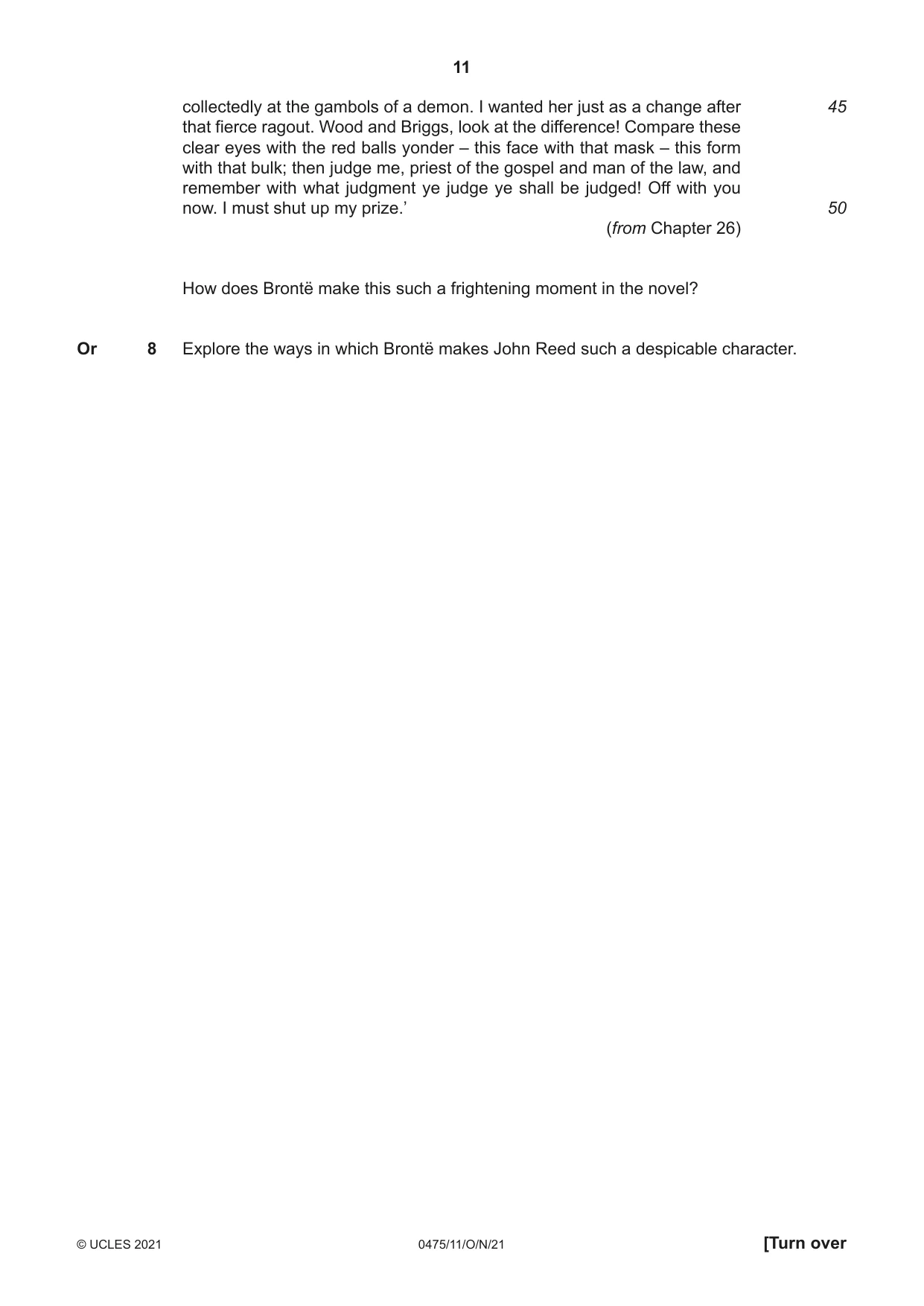
11 0475/11/O/N/21 © UCLES 2021 [Turn over collectedly at the gambols of a demon. I wanted her just as a change after that fierce ragout. Wood and Briggs, look at the difference! Compare these clear eyes with the red balls yonder – this face with that mask – this form with that bulk; then judge me, priest of the gospel and man of the law, and remember with what judgment ye judge ye shall be judged! Off with you now. I must shut up my prize.’ (from Chapter 26) How does Brontë make this such a frightening moment in the novel? Or 8 Explore the ways in which Brontë makes John Reed such a despicable character. 45 50
Question paper, page 12
12 0475/11/O/N/21 © UCLES 2021 ANITA DESAI: In Custody Remember to support your ideas with details from the writing. Either 9 Read this passage, and then answer the question that follows it: ‘I had to catch the bus,’ he explained. Content removed due to copyright restrictions.
Question paper, page 13
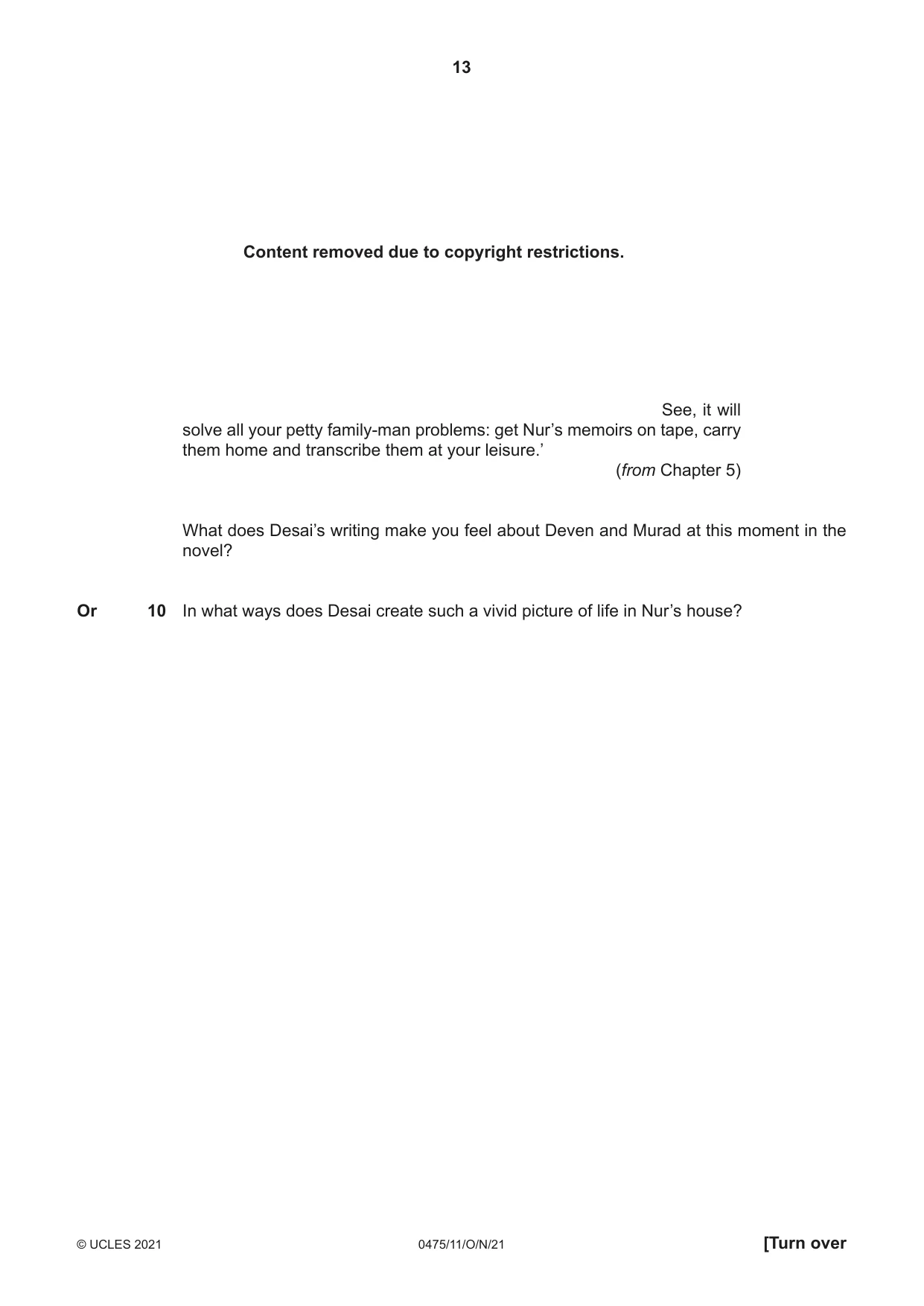
13 0475/11/O/N/21 © UCLES 2021 [Turn over See, it will solve all your petty family-man problems: get Nur’s memoirs on tape, carry them home and transcribe them at your leisure.’ (from Chapter 5) What does Desai’s writing make you feel about Deven and Murad at this moment in the novel? Or 10 In what ways does Desai create such a vivid picture of life in Nur’s house? Content removed due to copyright restrictions.
Question paper, page 14
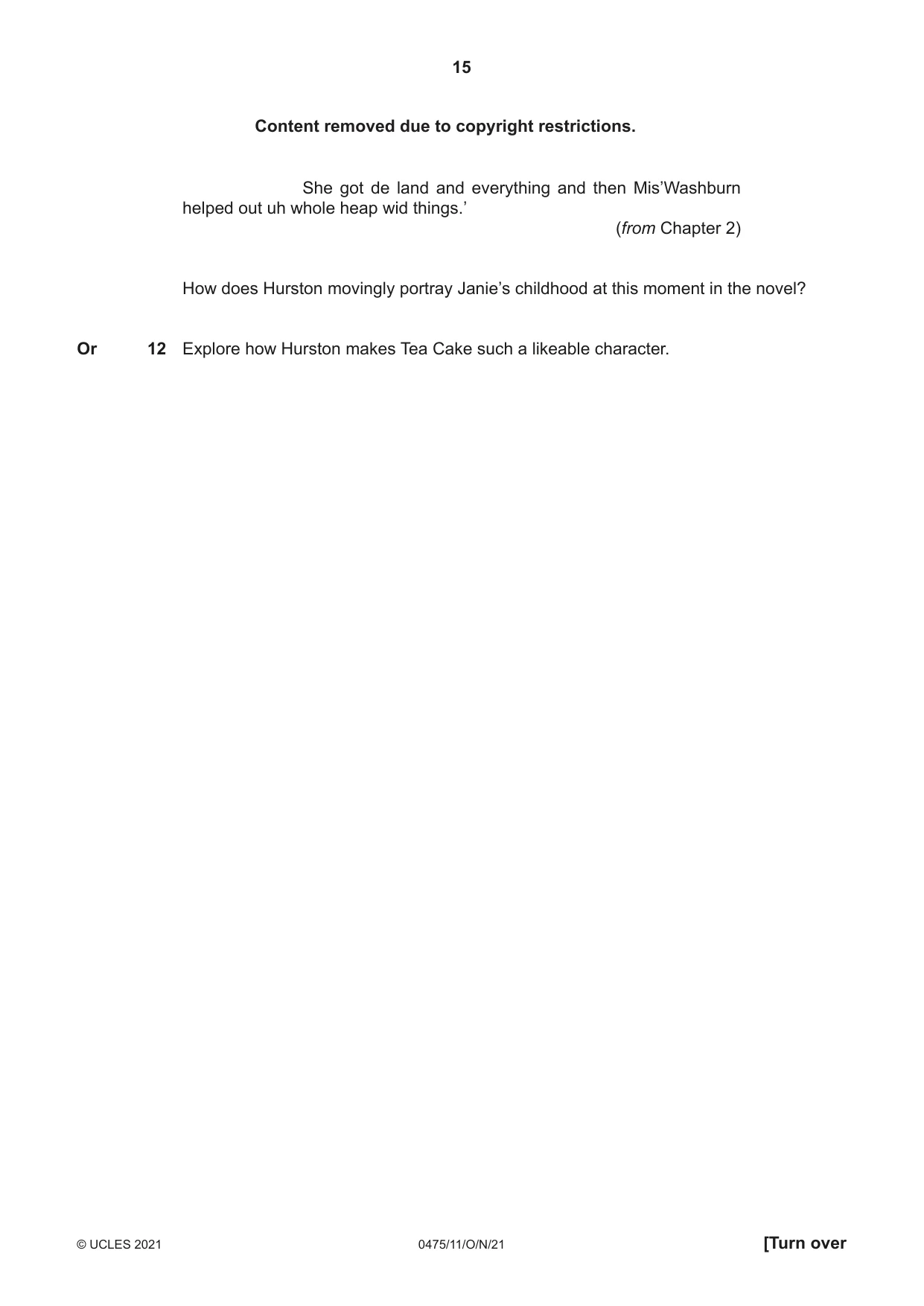
14 0475/11/O/N/21 © UCLES 2021 ZORA NEALE HURSTON: Their Eyes Were Watching God Remember to support your ideas with details from the writing. Either 11 Read this passage, and then answer the question that follows it: Janie saw her life like a great tree in leaf with the things suffered, things enjoyed, things done and undone. Content removed due to copyright restrictions.
Question paper, page 15
15 0475/11/O/N/21 © UCLES 2021 [Turn over She got de land and everything and then Mis’Washburn helped out uh whole heap wid things.’ (from Chapter 2) How does Hurston movingly portray Janie’s childhood at this moment in the novel? Or 12 Explore how Hurston makes Tea Cake such a likeable character. Content removed due to copyright restrictions.
Question paper, page 16
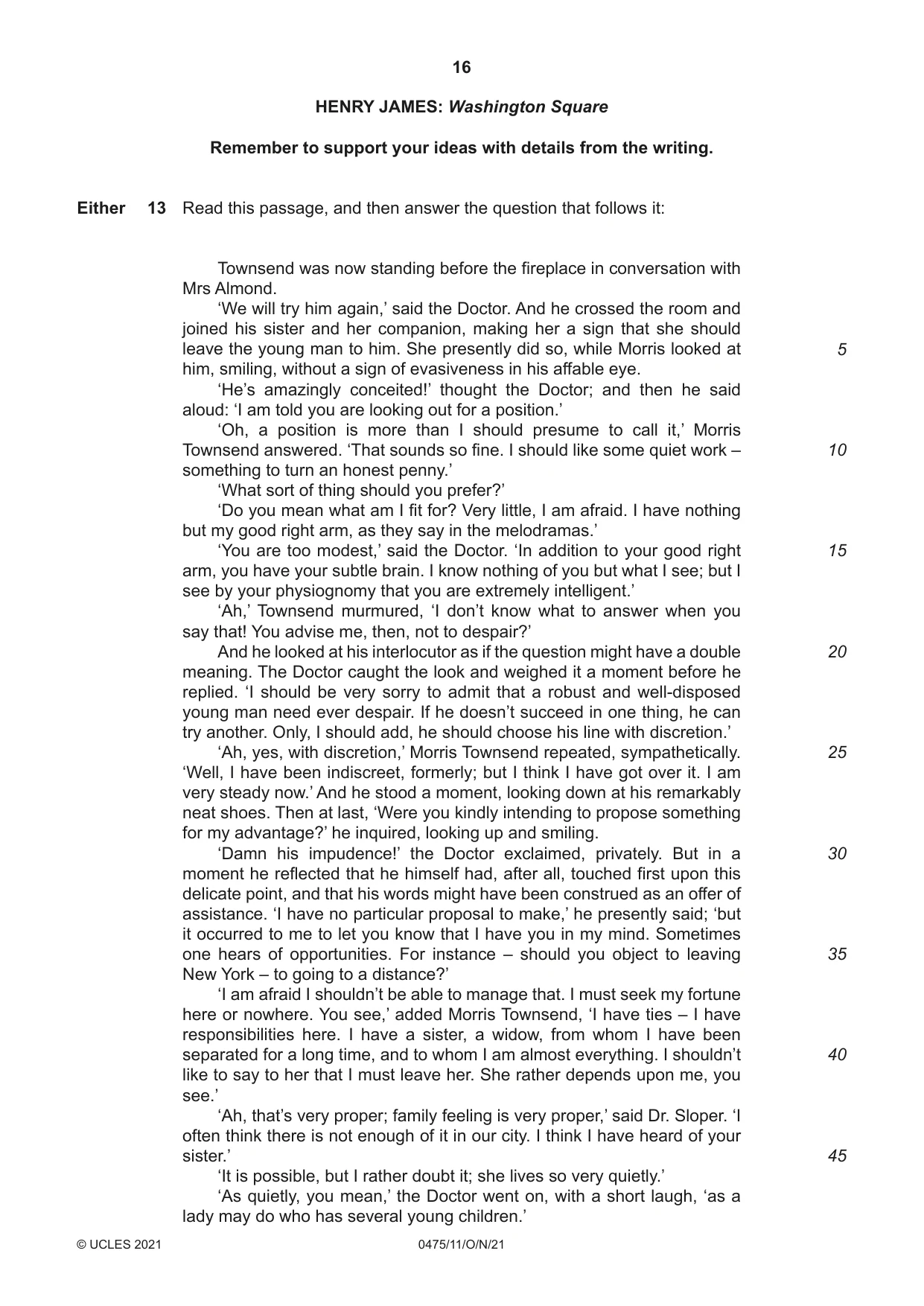
16 0475/11/O/N/21 © UCLES 2021 HENRY JAMES: Washington Square Remember to support your ideas with details from the writing. Either 13 Read this passage, and then answer the question that follows it: Townsend was now standing before the fireplace in conversation with Mrs Almond. ‘We will try him again,’ said the Doctor. And he crossed the room and joined his sister and her companion, making her a sign that she should leave the young man to him. She presently did so, while Morris looked at him, smiling, without a sign of evasiveness in his affable eye. ‘He’s amazingly conceited!’ thought the Doctor; and then he said aloud: ‘I am told you are looking out for a position.’ ‘Oh, a position is more than I should presume to call it,’ Morris Townsend answered. ‘That sounds so fine. I should like some quiet work – something to turn an honest penny.’ ‘What sort of thing should you prefer?’ ‘Do you mean what am I fit for? Very little, I am afraid. I have nothing but my good right arm, as they say in the melodramas.’ ‘You are too modest,’ said the Doctor. ‘In addition to your good right arm, you have your subtle brain. I know nothing of you but what I see; but I see by your physiognomy that you are extremely intelligent.’ ‘Ah,’ Townsend murmured, ‘I don’t know what to answer when you say that! You advise me, then, not to despair?’ And he looked at his interlocutor as if the question might have a double meaning. The Doctor caught the look and weighed it a moment before he replied. ‘I should be very sorry to admit that a robust and well-disposed young man need ever despair. If he doesn’t succeed in one thing, he can try another. Only, I should add, he should choose his line with discretion.’ ‘Ah, yes, with discretion,’ Morris Townsend repeated, sympathetically. ‘Well, I have been indiscreet, formerly; but I think I have got over it. I am very steady now.’ And he stood a moment, looking down at his remarkably neat shoes. Then at last, ‘Were you kindly intending to propose something for my advantage?’ he inquired, looking up and smiling. ‘Damn his impudence!’ the Doctor exclaimed, privately. But in a moment he reflected that he himself had, after all, touched first upon this delicate point, and that his words might have been construed as an offer of assistance. ‘I have no particular proposal to make,’ he presently said; ‘but it occurred to me to let you know that I have you in my mind. Sometimes one hears of opportunities. For instance – should you object to leaving New York – to going to a distance?’ ‘I am afraid I shouldn’t be able to manage that. I must seek my fortune here or nowhere. You see,’ added Morris Townsend, ‘I have ties – I have responsibilities here. I have a sister, a widow, from whom I have been separated for a long time, and to whom I am almost everything. I shouldn’t like to say to her that I must leave her. She rather depends upon me, you see.’ ‘Ah, that’s very proper; family feeling is very proper,’ said Dr. Sloper. ‘I often think there is not enough of it in our city. I think I have heard of your sister.’ ‘It is possible, but I rather doubt it; she lives so very quietly.’ ‘As quietly, you mean,’ the Doctor went on, with a short laugh, ‘as a lady may do who has several young children.’ 5 10 15 20 25 30 35 40 45
Question paper, page 17
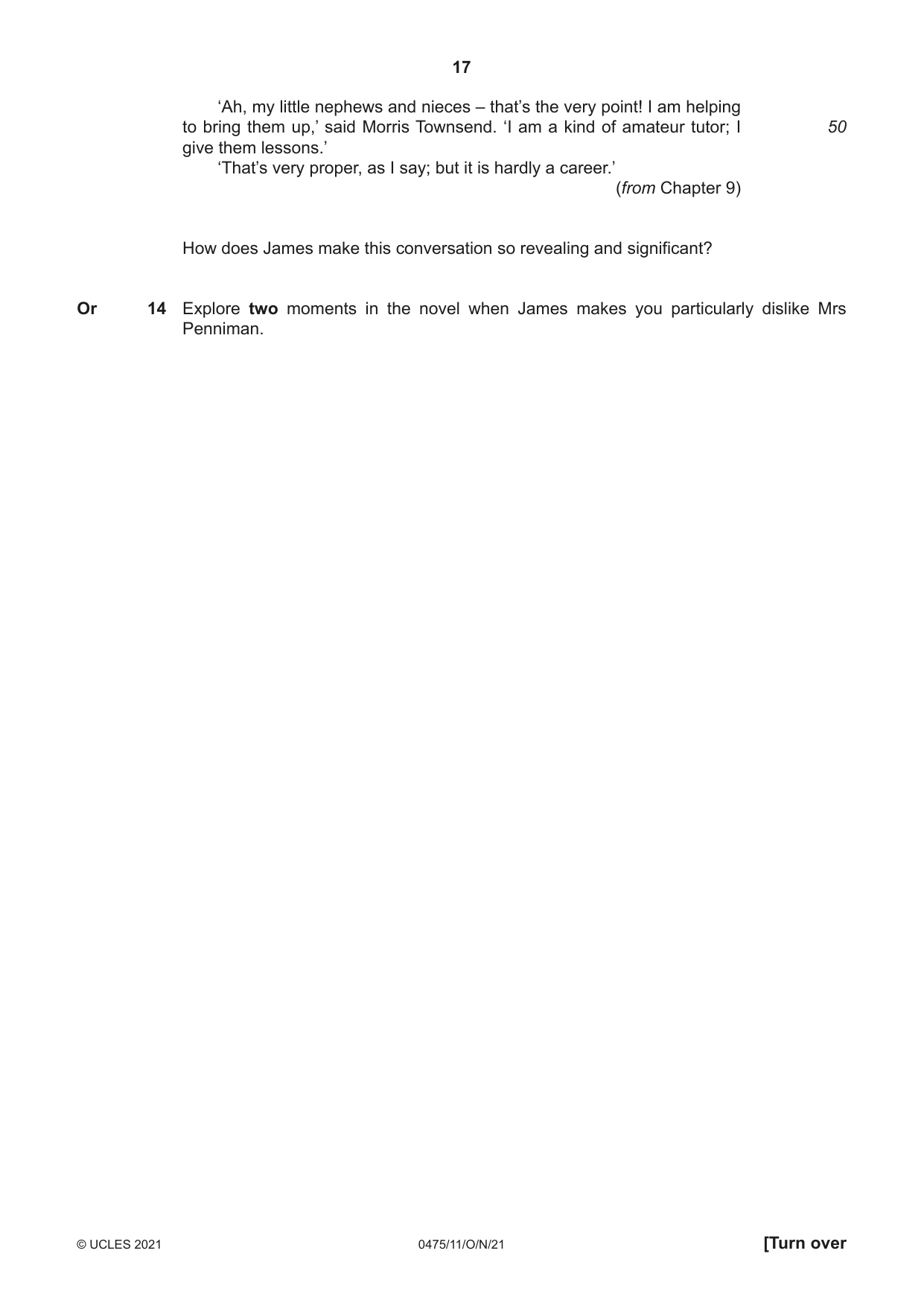
17 0475/11/O/N/21 © UCLES 2021 [Turn over ‘Ah, my little nephews and nieces – that’s the very point! I am helping to bring them up,’ said Morris Townsend. ‘I am a kind of amateur tutor; I give them lessons.’ ‘That’s very proper, as I say; but it is hardly a career.’ (from Chapter 9) How does James make this conversation so revealing and significant? Or 14 Explore two moments in the novel when James makes you particularly dislike Mrs Penniman. 50
Question paper, page 18
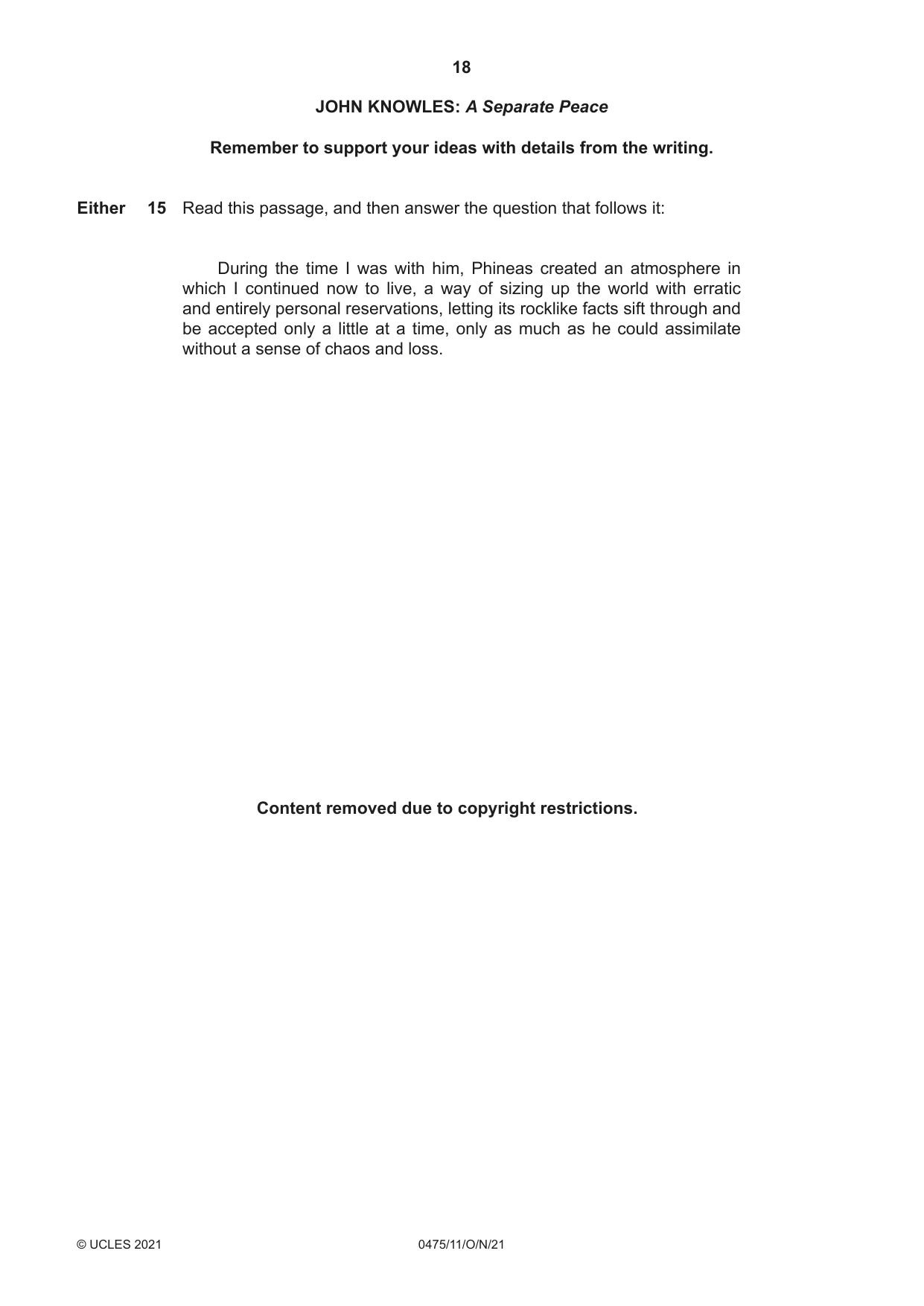
18 0475/11/O/N/21 © UCLES 2021 JOHN KNOWLES: A Separate Peace Remember to support your ideas with details from the writing. Either 15 Read this passage, and then answer the question that follows it: During the time I was with him, Phineas created an atmosphere in which I continued now to live, a way of sizing up the world with erratic and entirely personal reservations, letting its rocklike facts sift through and be accepted only a little at a time, only as much as he could assimilate without a sense of chaos and loss. Content removed due to copyright restrictions.
Question paper, page 19
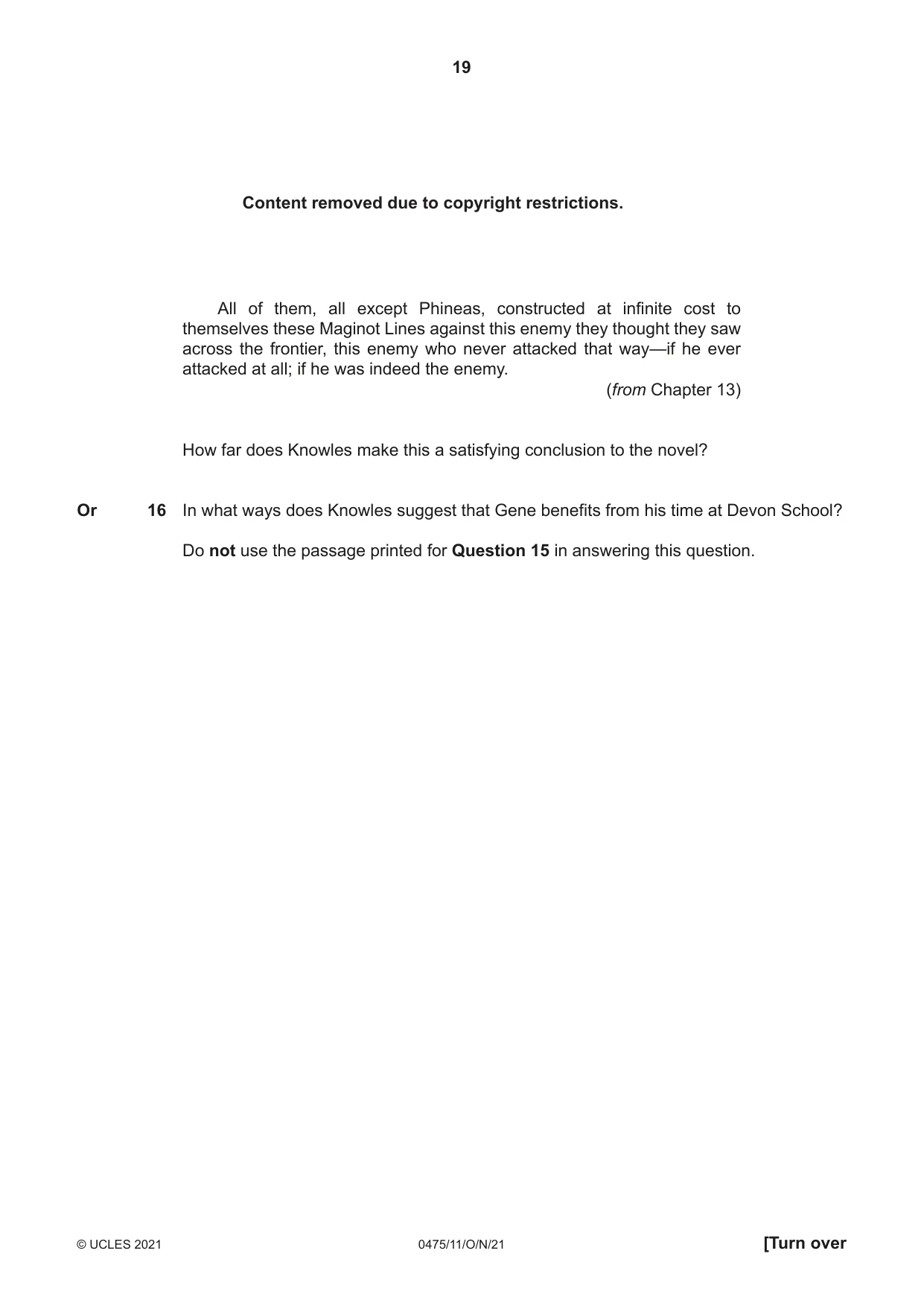
19 0475/11/O/N/21 © UCLES 2021 [Turn over All of them, all except Phineas, constructed at infinite cost to themselves these Maginot Lines against this enemy they thought they saw across the frontier, this enemy who never attacked that way—if he ever attacked at all; if he was indeed the enemy. (from Chapter 13) How far does Knowles make this a satisfying conclusion to the novel? Or 16 In what ways does Knowles suggest that Gene benefits from his time at Devon School? Do not use the passage printed for Question 15 in answering this question. Content removed due to copyright restrictions.
Question paper, page 20
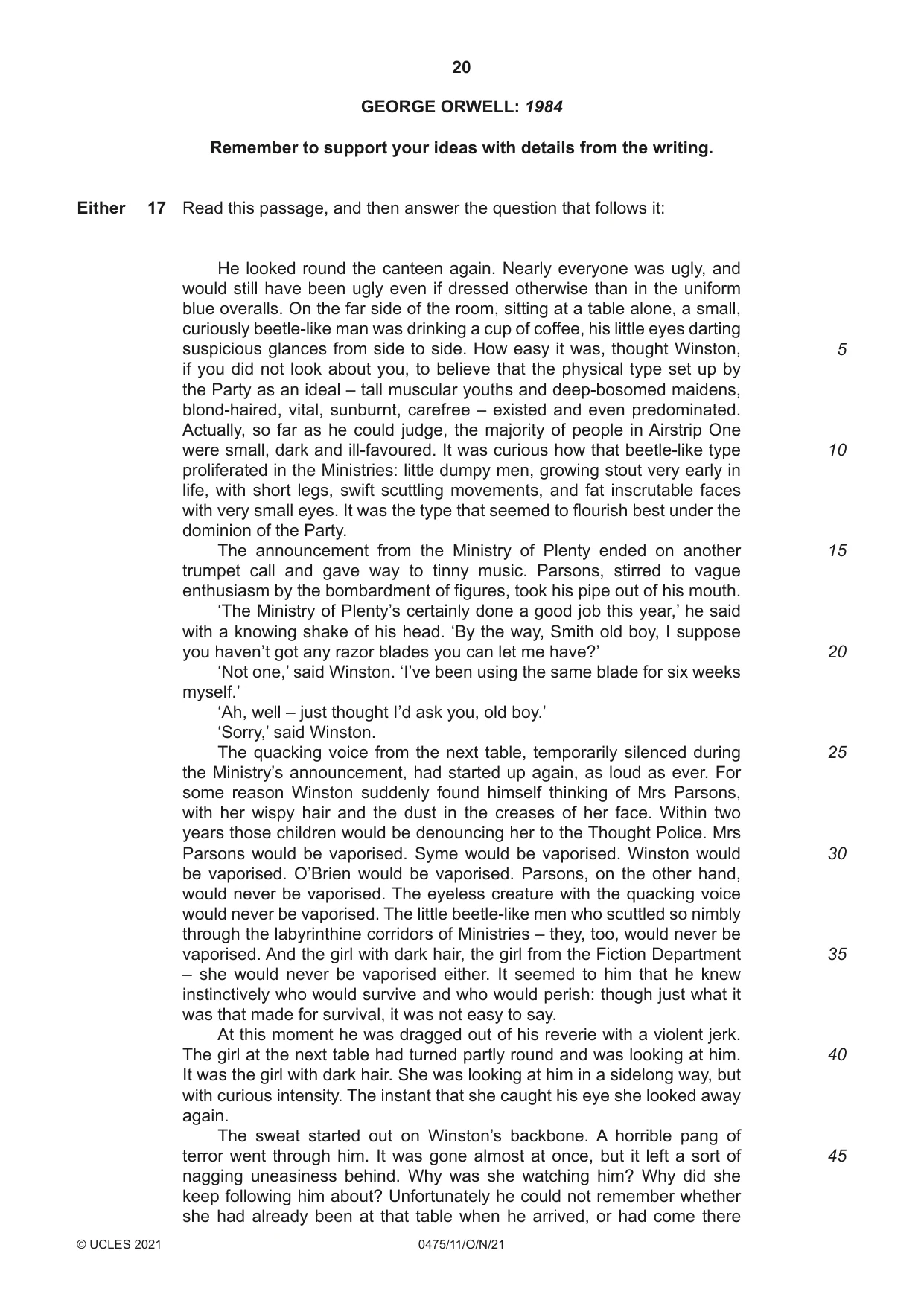
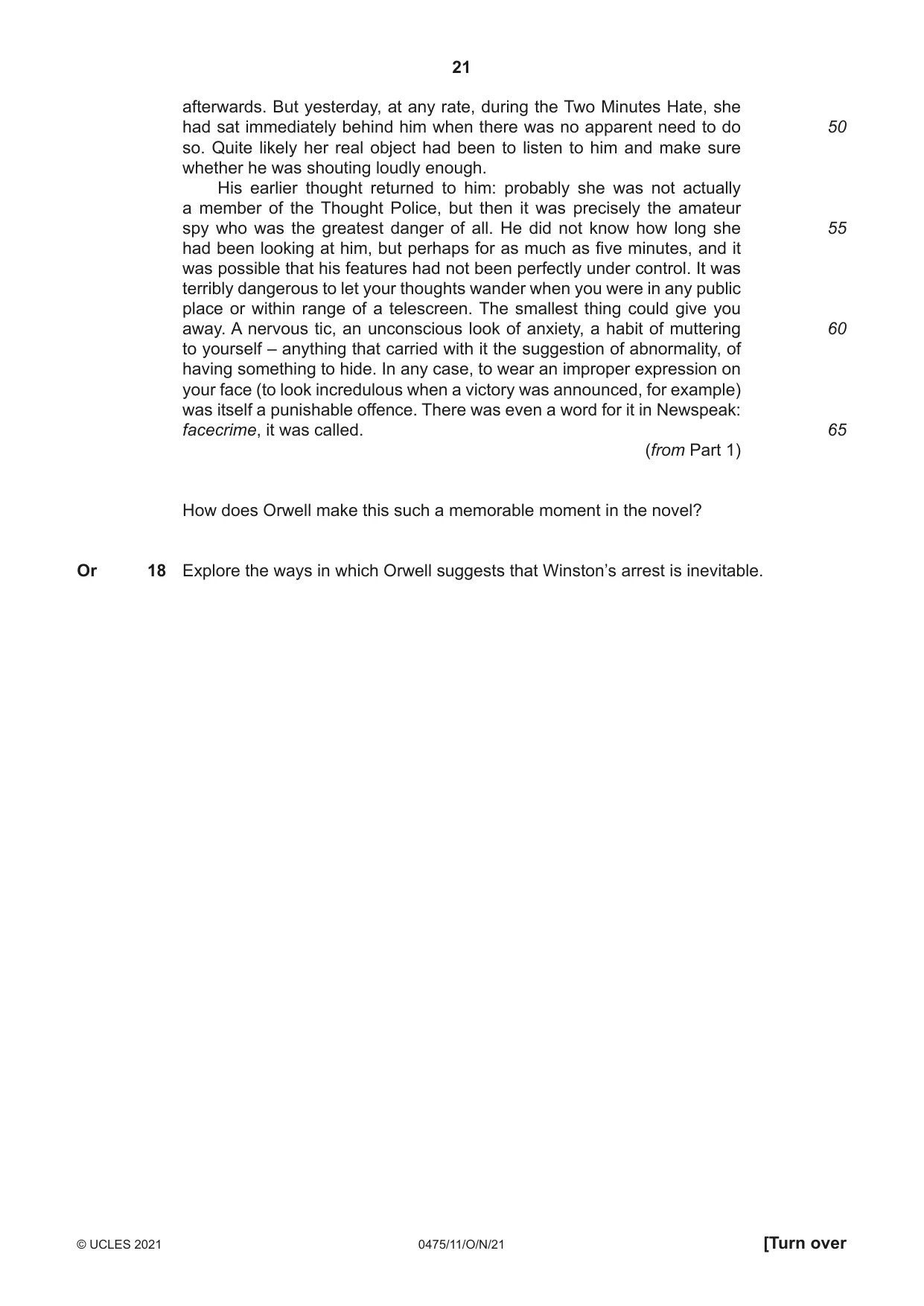
20 0475/11/O/N/21 © UCLES 2021 GEORGE ORWELL: 1984 Remember to support your ideas with details from the writing. Either 17 Read this passage, and then answer the question that follows it: He looked round the canteen again. Nearly everyone was ugly, and would still have been ugly even if dressed otherwise than in the uniform blue overalls. On the far side of the room, sitting at a table alone, a small, curiously beetle-like man was drinking a cup of coffee, his little eyes darting suspicious glances from side to side. How easy it was, thought Winston, if you did not look about you, to believe that the physical type set up by the Party as an ideal – tall muscular youths and deep-bosomed maidens, blond-haired, vital, sunburnt, carefree – existed and even predominated. Actually, so far as he could judge, the majority of people in Airstrip One were small, dark and ill-favoured. It was curious how that beetle-like type proliferated in the Ministries: little dumpy men, growing stout very early in life, with short legs, swift scuttling movements, and fat inscrutable faces with very small eyes. It was the type that seemed to flourish best under the dominion of the Party. The announcement from the Ministry of Plenty ended on another trumpet call and gave way to tinny music. Parsons, stirred to vague enthusiasm by the bombardment of figures, took his pipe out of his mouth. ‘The Ministry of Plenty’s certainly done a good job this year,’ he said with a knowing shake of his head. ‘By the way, Smith old boy, I suppose you haven’t got any razor blades you can let me have?’ ‘Not one,’ said Winston. ‘I’ve been using the same blade for six weeks myself.’ ‘Ah, well – just thought I’d ask you, old boy.’ ‘Sorry,’ said Winston. The quacking voice from the next table, temporarily silenced during the Ministry’s announcement, had started up again, as loud as ever. For some reason Winston suddenly found himself thinking of Mrs Parsons, with her wispy hair and the dust in the creases of her face. Within two years those children would be denouncing her to the Thought Police. Mrs Parsons would be vaporised. Syme would be vaporised. Winston would be vaporised. O’Brien would be vaporised. Parsons, on the other hand, would never be vaporised. The eyeless creature with the quacking voice would never be vaporised. The little beetle-like men who scuttled so nimbly through the labyrinthine corridors of Ministries – they, too, would never be vaporised. And the girl with dark hair, the girl from the Fiction Department – she would never be vaporised either. It seemed to him that he knew instinctively who would survive and who would perish: though just what it was that made for survival, it was not easy to say. At this moment he was dragged out of his reverie with a violent jerk. The girl at the next table had turned partly round and was looking at him. It was the girl with dark hair. She was looking at him in a sidelong way, but with curious intensity. The instant that she caught his eye she looked away again. The sweat started out on Winston’s backbone. A horrible pang of terror went through him. It was gone almost at once, but it left a sort of nagging uneasiness behind. Why was she watching him? Why did she keep following him about? Unfortunately he could not remember whether she had already been at that table when he arrived, or had come there 5 10 15 20 25 30 35 40 45
Question paper, page 21
21 0475/11/O/N/21 © UCLES 2021 [Turn over afterwards. But yesterday, at any rate, during the Two Minutes Hate, she had sat immediately behind him when there was no apparent need to do so. Quite likely her real object had been to listen to him and make sure whether he was shouting loudly enough. His earlier thought returned to him: probably she was not actually a member of the Thought Police, but then it was precisely the amateur spy who was the greatest danger of all. He did not know how long she had been looking at him, but perhaps for as much as five minutes, and it was possible that his features had not been perfectly under control. It was terribly dangerous to let your thoughts wander when you were in any public place or within range of a telescreen. The smallest thing could give you away. A nervous tic, an unconscious look of anxiety, a habit of muttering to yourself – anything that carried with it the suggestion of abnormality, of having something to hide. In any case, to wear an improper expression on your face (to look incredulous when a victory was announced, for example) was itself a punishable offence. There was even a word for it in Newspeak: facecrime, it was called. (from Part 1) How does Orwell make this such a memorable moment in the novel? Or 18 Explore the ways in which Orwell suggests that Winston’s arrest is inevitable. 50 55 60 65
Question paper, page 22
22 0475/11/O/N/21 © UCLES 2021 ALAN PATON: Cry, the Beloved Country Remember to support your ideas with details from the writing. Either 19 Read this passage, and then answer the question that follows it: Content removed due to copyright restrictions. – And this Pafuri, said Kumalo bitterly.
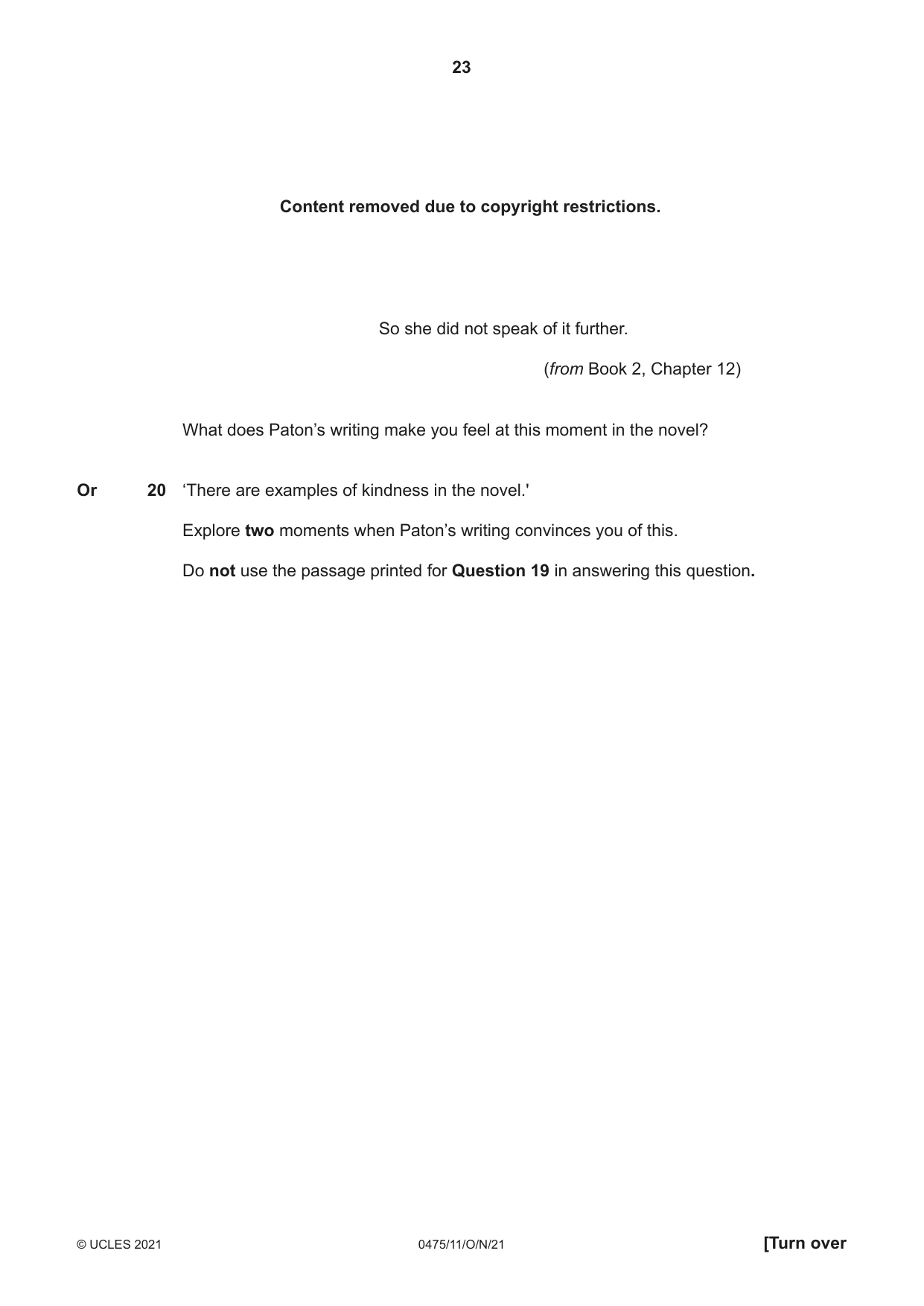
Question paper, page 23
23 0475/11/O/N/21 © UCLES 2021 [Turn over So she did not speak of it further. (from Book 2, Chapter 12) What does Paton’s writing make you feel at this moment in the novel? Or 20 ‘There are examples of kindness in the novel.' Explore two moments when Paton’s writing convinces you of this. Do not use the passage printed for Question 19 in answering this question. Content removed due to copyright restrictions.
Question paper, page 24
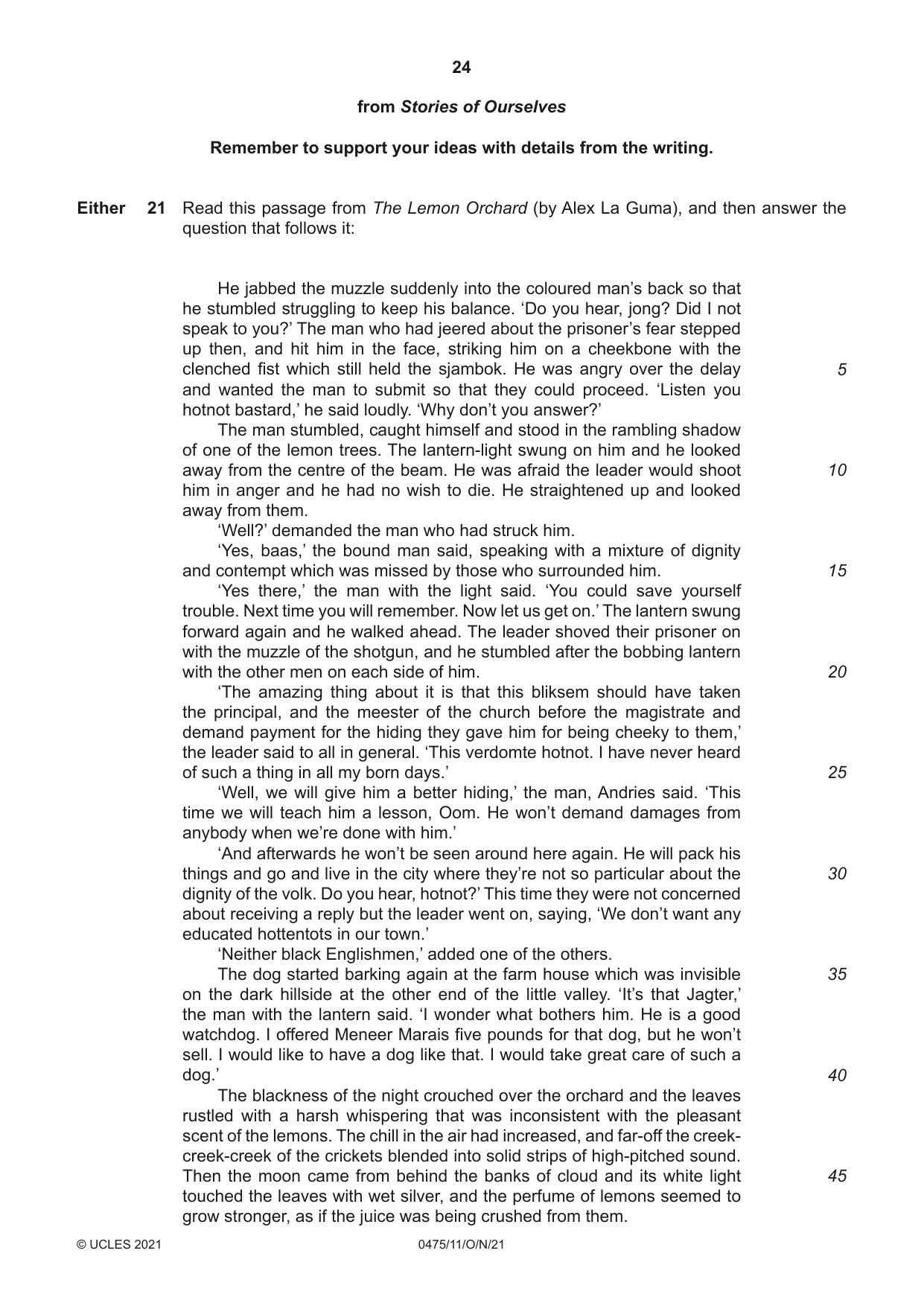
24 0475/11/O/N/21 © UCLES 2021 from Stories of Ourselves Remember to support your ideas with details from the writing. Either 21 Read this passage from The Lemon Orchard (by Alex La Guma), and then answer the question that follows it: He jabbed the muzzle suddenly into the coloured man’s back so that he stumbled struggling to keep his balance. ‘Do you hear, jong? Did I not speak to you?’ The man who had jeered about the prisoner’s fear stepped up then, and hit him in the face, striking him on a cheekbone with the clenched fist which still held the sjambok. He was angry over the delay and wanted the man to submit so that they could proceed. ‘Listen you hotnot bastard,’ he said loudly. ‘Why don’t you answer?’ The man stumbled, caught himself and stood in the rambling shadow of one of the lemon trees. The lantern-light swung on him and he looked away from the centre of the beam. He was afraid the leader would shoot him in anger and he had no wish to die. He straightened up and looked away from them. ‘Well?’ demanded the man who had struck him. ‘Yes, baas,’ the bound man said, speaking with a mixture of dignity and contempt which was missed by those who surrounded him. ‘Yes there,’ the man with the light said. ‘You could save yourself trouble. Next time you will remember. Now let us get on.’ The lantern swung forward again and he walked ahead. The leader shoved their prisoner on with the muzzle of the shotgun, and he stumbled after the bobbing lantern with the other men on each side of him. ‘The amazing thing about it is that this bliksem should have taken the principal, and the meester of the church before the magistrate and demand payment for the hiding they gave him for being cheeky to them,’ the leader said to all in general. ‘This verdomte hotnot. I have never heard of such a thing in all my born days.’ ‘Well, we will give him a better hiding,’ the man, Andries said. ‘This time we will teach him a lesson, Oom. He won’t demand damages from anybody when we’re done with him.’ ‘And afterwards he won’t be seen around here again. He will pack his things and go and live in the city where they’re not so particular about the dignity of the volk. Do you hear, hotnot?’ This time they were not concerned about receiving a reply but the leader went on, saying, ‘We don’t want any educated hottentots in our town.’ ‘Neither black Englishmen,’ added one of the others. The dog started barking again at the farm house which was invisible on the dark hillside at the other end of the little valley. ‘It’s that Jagter,’ the man with the lantern said. ‘I wonder what bothers him. He is a good watchdog. I offered Meneer Marais five pounds for that dog, but he won’t sell. I would like to have a dog like that. I would take great care of such a dog.’ The blackness of the night crouched over the orchard and the leaves rustled with a harsh whispering that was inconsistent with the pleasant scent of the lemons. The chill in the air had increased, and far-off the creek- creek-creek of the crickets blended into solid strips of high-pitched sound. Then the moon came from behind the banks of cloud and its white light touched the leaves with wet silver, and the perfume of lemons seemed to grow stronger, as if the juice was being crushed from them. 5 10 15 20 25 30 35 40 45
Question paper, page 25
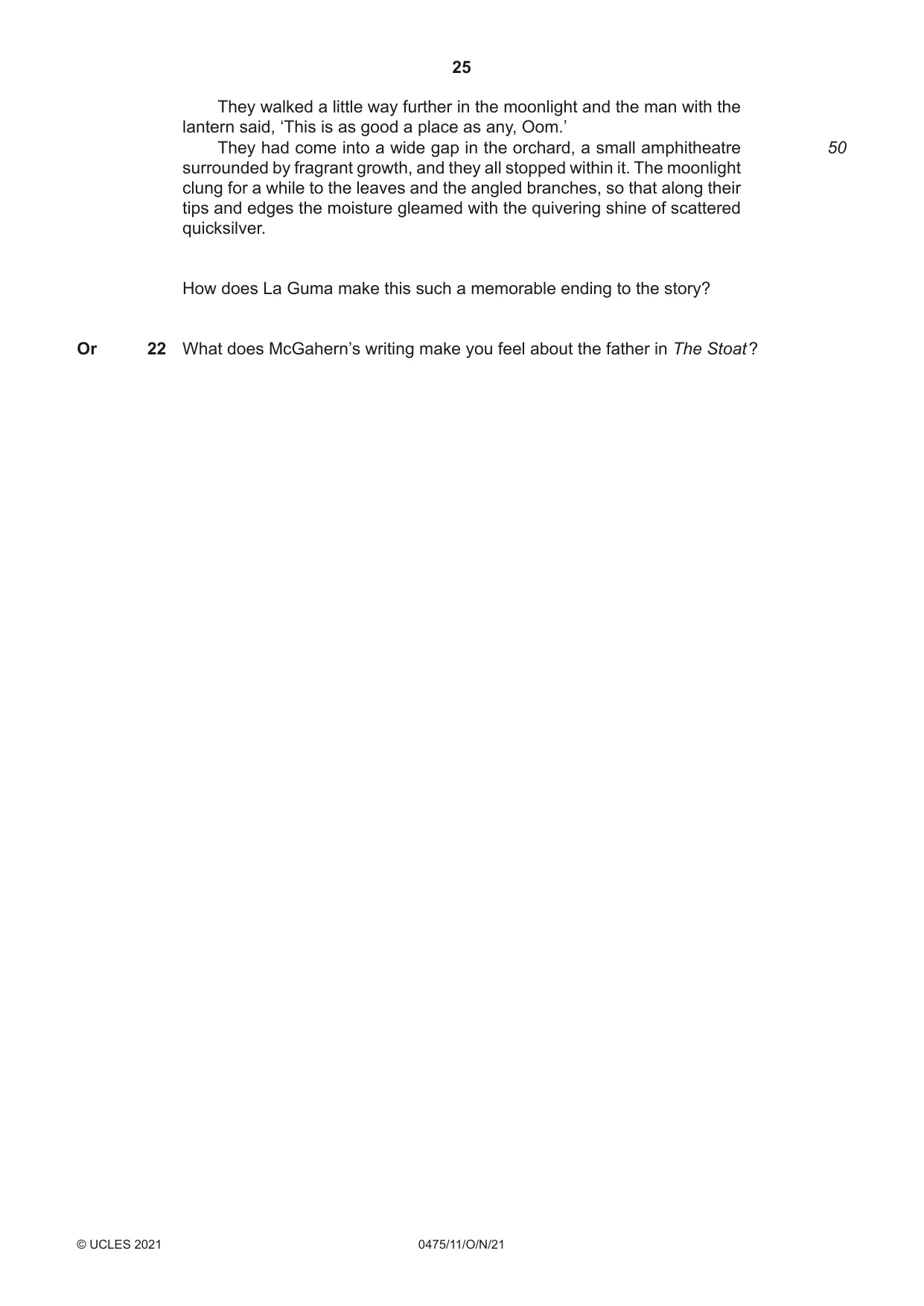
25 0475/11/O/N/21 © UCLES 2021 They walked a little way further in the moonlight and the man with the lantern said, ‘This is as good a place as any, Oom.’ They had come into a wide gap in the orchard, a small amphitheatre surrounded by fragrant growth, and they all stopped within it. The moonlight clung for a while to the leaves and the angled branches, so that along their tips and edges the moisture gleamed with the quivering shine of scattered quicksilver. How does La Guma make this such a memorable ending to the story? Or 22 What does McGahern’s writing make you feel about the father in The Stoat ? 50
Question paper, page 26
26 0475/11/O/N/21 © UCLES 2021 BLANK PAGE
Question paper, page 27
27 0475/11/O/N/21 © UCLES 2021 BLANK PAGE
Question paper, page 28
28 0475/11/O/N/21 © UCLES 2021 Permission to reproduce items where third-party owned material protected by copyright is included has been sought and cleared where possible. Every reasonable effort has been made by the publisher (UCLES) to trace copyright holders, but if any items requiring clearance have unwittingly been included, the publisher will be pleased to make amends at the earliest possible opportunity. To avoid the issue of disclosure of answer-related information to candidates, all copyright acknowledgements are reproduced online in the Cambridge Assessment International Education Copyright Acknowledgements Booklet. This is produced for each series of examinations and is freely available to download at www.cambridgeinternational.org after the live examination series. Cambridge Assessment International Education is part of the Cambridge Assessment Group. Cambridge Assessment is the brand name of the University of Cambridge Local Examinations Syndicate (UCLES), which itself is a department of the University of Cambridge. BLANK PAGE
Mark scheme, page 1
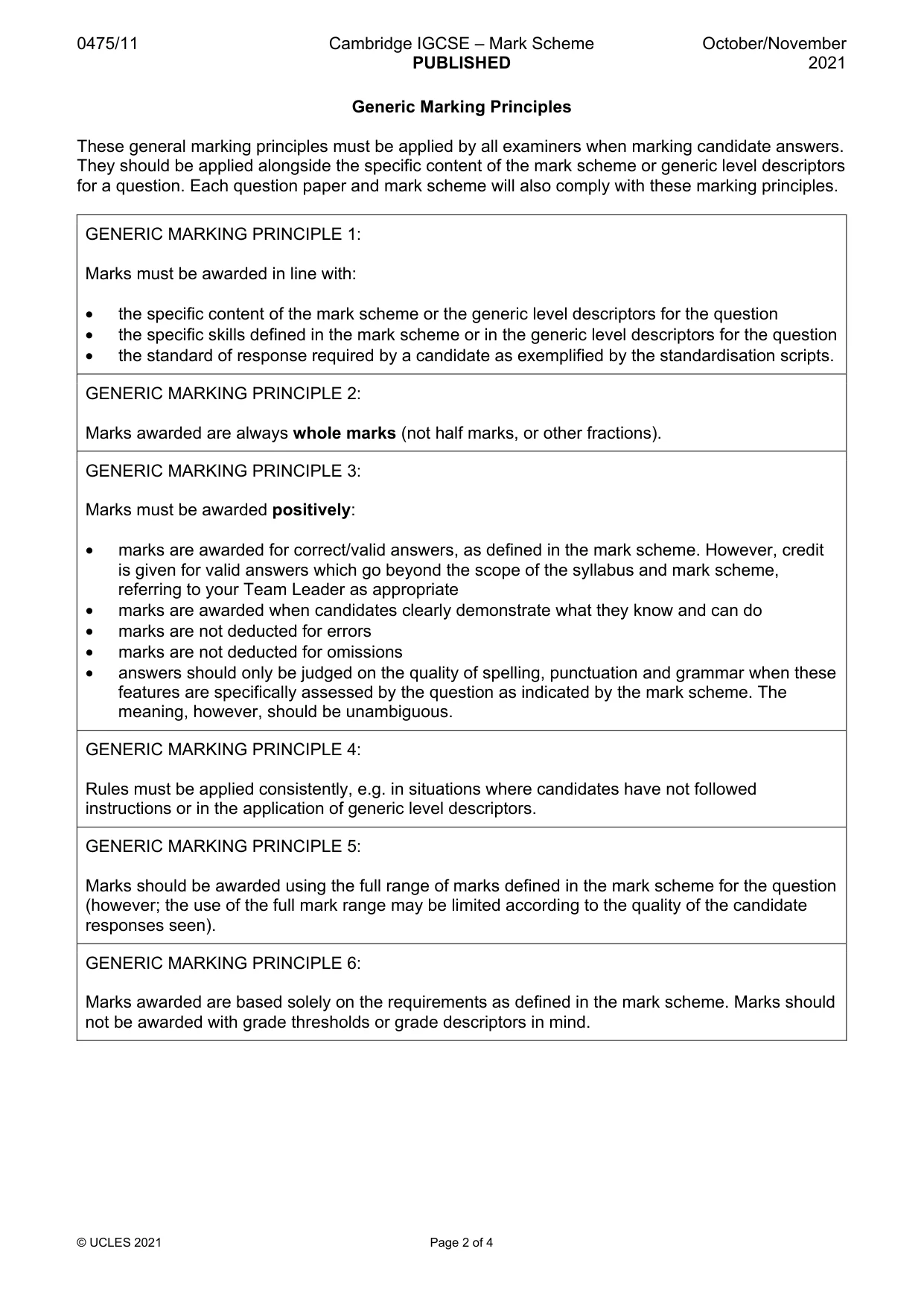
This document consists of 4 printed pages. © UCLES 2021 [Turn over Cambridge IGCSE™ LITERATURE IN ENGLISH 0475/11 Paper 1 Poetry and Prose 11 October/November 2021 MARK SCHEME Maximum Mark: 50 Published This mark scheme is published as an aid to teachers and candidates, to indicate the requirements of the examination. It shows the basis on which Examiners were instructed to award marks. It does not indicate the details of the discussions that took place at an Examiners’ meeting before marking began, which would have considered the acceptability of alternative answers. Mark schemes should be read in conjunction with the question paper and the Principal Examiner Report for Teachers. Cambridge International will not enter into discussions about these mark schemes. Cambridge International is publishing the mark schemes for the October/November 2021 series for most Cambridge IGCSE™, Cambridge International A and AS Level components and some Cambridge O Level components.
Mark scheme, page 2
0475/11 Cambridge IGCSE – Mark Scheme PUBLISHED October/November 2021 © UCLES 2021 Page 2 of 4 Generic Marking Principles These general marking principles must be applied by all examiners when marking candidate answers. They should be applied alongside the specific content of the mark scheme or generic level descriptors for a question. Each question paper and mark scheme will also comply with these marking principles. GENERIC MARKING PRINCIPLE 1: Marks must be awarded in line with: • the specific content of the mark scheme or the generic level descriptors for the question • the specific skills defined in the mark scheme or in the generic level descriptors for the question • the standard of response required by a candidate as exemplified by the standardisation scripts. GENERIC MARKING PRINCIPLE 2: Marks awarded are always whole marks (not half marks, or other fractions). GENERIC MARKING PRINCIPLE 3: Marks must be awarded positively: • marks are awarded for correct/valid answers, as defined in the mark scheme. However, credit is given for valid answers which go beyond the scope of the syllabus and mark scheme, referring to your Team Leader as appropriate • marks are awarded when candidates clearly demonstrate what they know and can do • marks are not deducted for errors • marks are not deducted for omissions • answers should only be judged on the quality of spelling, punctuation and grammar when these features are specifically assessed by the question as indicated by the mark scheme. The meaning, however, should be unambiguous. GENERIC MARKING PRINCIPLE 4: Rules must be applied consistently, e.g. in situations where candidates have not followed instructions or in the application of generic level descriptors. GENERIC MARKING PRINCIPLE 5: Marks should be awarded using the full range of marks defined in the mark scheme for the question (however; the use of the full mark range may be limited according to the quality of the candidate responses seen). GENERIC MARKING PRINCIPLE 6: Marks awarded are based solely on the requirements as defined in the mark scheme. Marks should not be awarded with grade thresholds or grade descriptors in mind.
Mark scheme, page 3
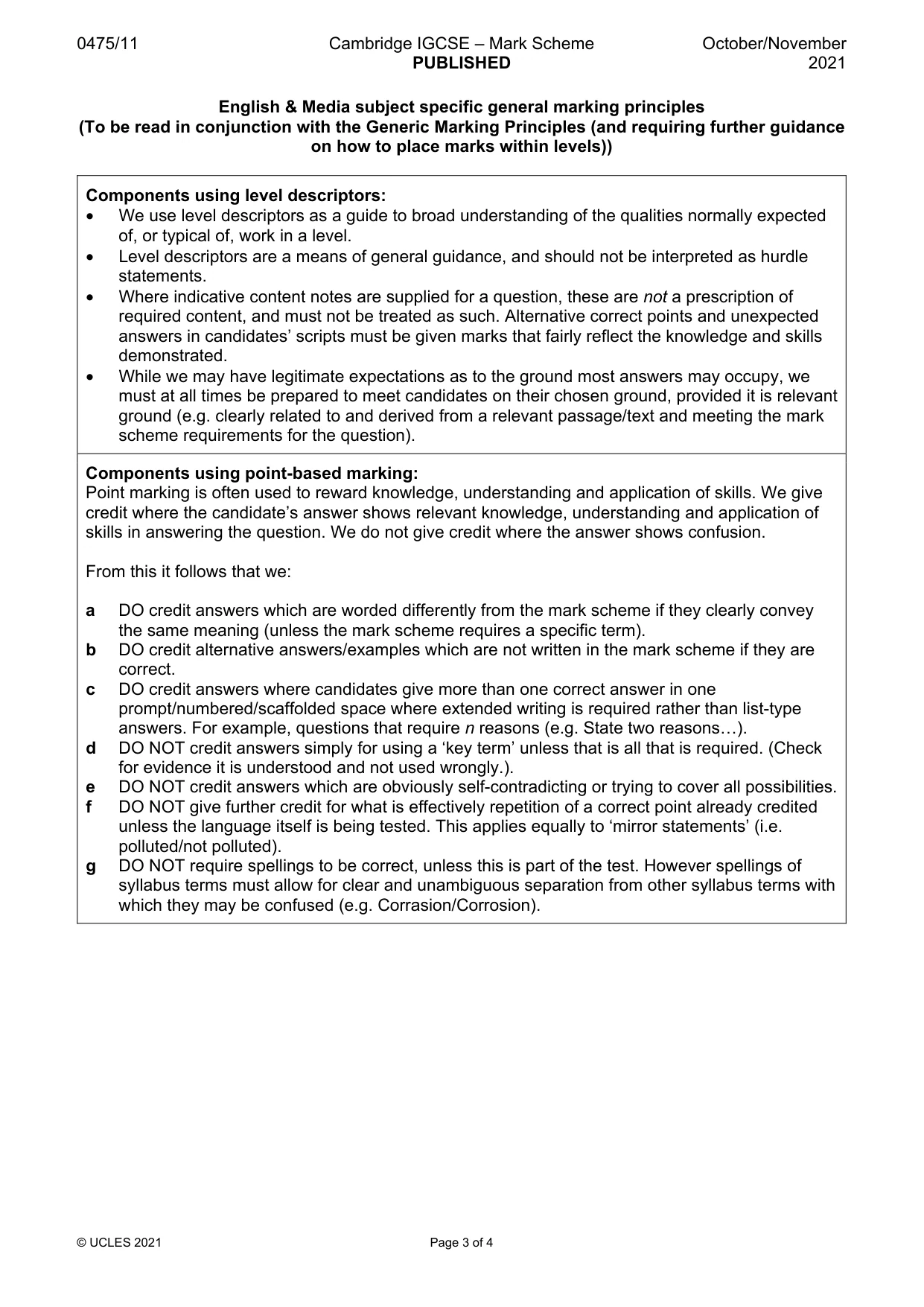
0475/11 Cambridge IGCSE – Mark Scheme PUBLISHED October/November 2021 © UCLES 2021 Page 3 of 4 English & Media subject specific general marking principles (To be read in conjunction with the Generic Marking Principles (and requiring further guidance on how to place marks within levels)) Components using level descriptors: • We use level descriptors as a guide to broad understanding of the qualities normally expected of, or typical of, work in a level. • Level descriptors are a means of general guidance, and should not be interpreted as hurdle statements. • Where indicative content notes are supplied for a question, these are not a prescription of required content, and must not be treated as such. Alternative correct points and unexpected answers in candidates’ scripts must be given marks that fairly reflect the knowledge and skills demonstrated. • While we may have legitimate expectations as to the ground most answers may occupy, we must at all times be prepared to meet candidates on their chosen ground, provided it is relevant ground (e.g. clearly related to and derived from a relevant passage/text and meeting the mark scheme requirements for the question). Components using point-based marking: Point marking is often used to reward knowledge, understanding and application of skills. We give credit where the candidate’s answer shows relevant knowledge, understanding and application of skills in answering the question. We do not give credit where the answer shows confusion. From this it follows that we: a DO credit answers which are worded differently from the mark scheme if they clearly convey the same meaning (unless the mark scheme requires a specific term). b DO credit alternative answers/examples which are not written in the mark scheme if they are correct. c DO credit answers where candidates give more than one correct answer in one prompt/numbered/scaffolded space where extended writing is required rather than list-type answers. For example, questions that require n reasons (e.g. State two reasons…). d DO NOT credit answers simply for using a ‘key term’ unless that is all that is required. (Check for evidence it is understood and not used wrongly.). e DO NOT credit answers which are obviously self-contradicting or trying to cover all possibilities. f DO NOT give further credit for what is effectively repetition of a correct point already credited unless the language itself is being tested. This applies equally to ‘mirror statements’ (i.e. polluted/not polluted). g DO NOT require spellings to be correct, unless this is part of the test. However spellings of syllabus terms must allow for clear and unambiguous separation from other syllabus terms with which they may be confused (e.g. Corrasion/Corrosion).
Mark scheme, page 4
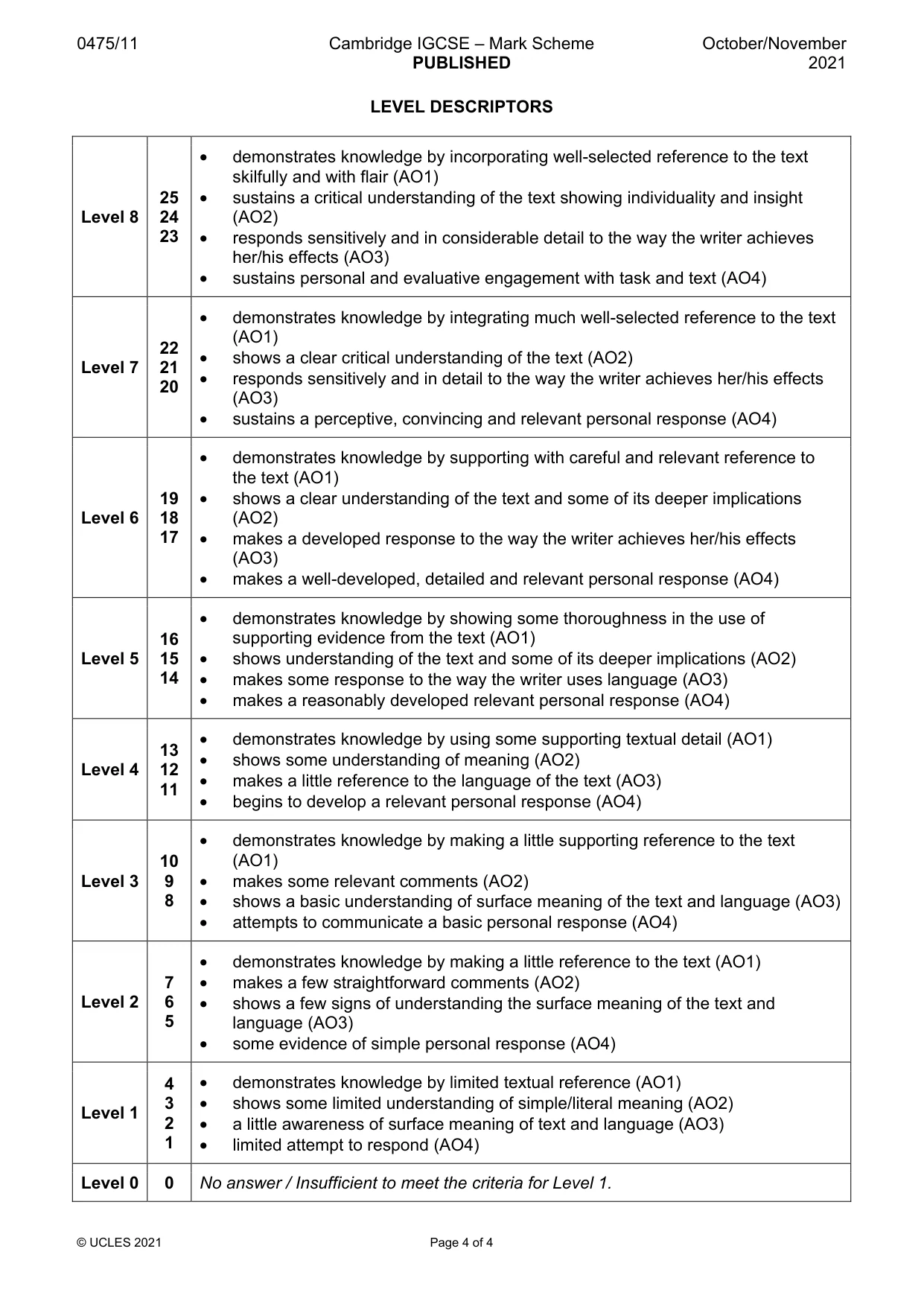
0475/11 Cambridge IGCSE – Mark Scheme PUBLISHED October/November 2021 © UCLES 2021 Page 4 of 4 LEVEL DESCRIPTORS Level 8 25 24 23 • demonstrates knowledge by incorporating well-selected reference to the text skilfully and with flair (AO1) • sustains a critical understanding of the text showing individuality and insight (AO2) • responds sensitively and in considerable detail to the way the writer achieves her/his effects (AO3) • sustains personal and evaluative engagement with task and text (AO4) Level 7 22 21 20 • demonstrates knowledge by integrating much well-selected reference to the text (AO1) • shows a clear critical understanding of the text (AO2) • responds sensitively and in detail to the way the writer achieves her/his effects (AO3) • sustains a perceptive, convincing and relevant personal response (AO4) Level 6 19 18 17 • demonstrates knowledge by supporting with careful and relevant reference to the text (AO1) • shows a clear understanding of the text and some of its deeper implications (AO2) • makes a developed response to the way the writer achieves her/his effects (AO3) • makes a well-developed, detailed and relevant personal response (AO4) Level 5 16 15 14 • demonstrates knowledge by showing some thoroughness in the use of supporting evidence from the text (AO1) • shows understanding of the text and some of its deeper implications (AO2) • makes some response to the way the writer uses language (AO3) • makes a reasonably developed relevant personal response (AO4) Level 4 13 12 11 • demonstrates knowledge by using some supporting textual detail (AO1) • shows some understanding of meaning (AO2) • makes a little reference to the language of the text (AO3) • begins to develop a relevant personal response (AO4) Level 3 10 9 8 • demonstrates knowledge by making a little supporting reference to the text (AO1) • makes some relevant comments (AO2) • shows a basic understanding of surface meaning of the text and language (AO3) • attempts to communicate a basic personal response (AO4) Level 2 7 6 5 • demonstrates knowledge by making a little reference to the text (AO1) • makes a few straightforward comments (AO2) • shows a few signs of understanding the surface meaning of the text and language (AO3) • some evidence of simple personal response (AO4) Level 1 4 3 2 1 • demonstrates knowledge by limited textual reference (AO1) • shows some limited understanding of simple/literal meaning (AO2) • a little awareness of surface meaning of text and language (AO3) • limited attempt to respond (AO4) Level 0 0 No answer / Insufficient to meet the criteria for Level 1.
What you needed in this session
Cambridge’s own grade thresholds for 2021 Oct/Nov, Paper 1 · Variant 1. A higher threshold means an easier paper — the bar moves with how the cohort did.