Cambridge IGCSE English - Literature in English 0475 — 2021 Oct/Nov Paper 1 · Variant 2
0475/12/O/N/21 · 50 marks · ≈56 min
The question paper and its mark scheme, free to read here and free to download. This is Cambridge’s own paper, exactly as it was sat.
Question paper28 pages





Mark scheme4 pages
Answers below. Sit the paper first if you are practising.
Paper as text
Question paper, page 1
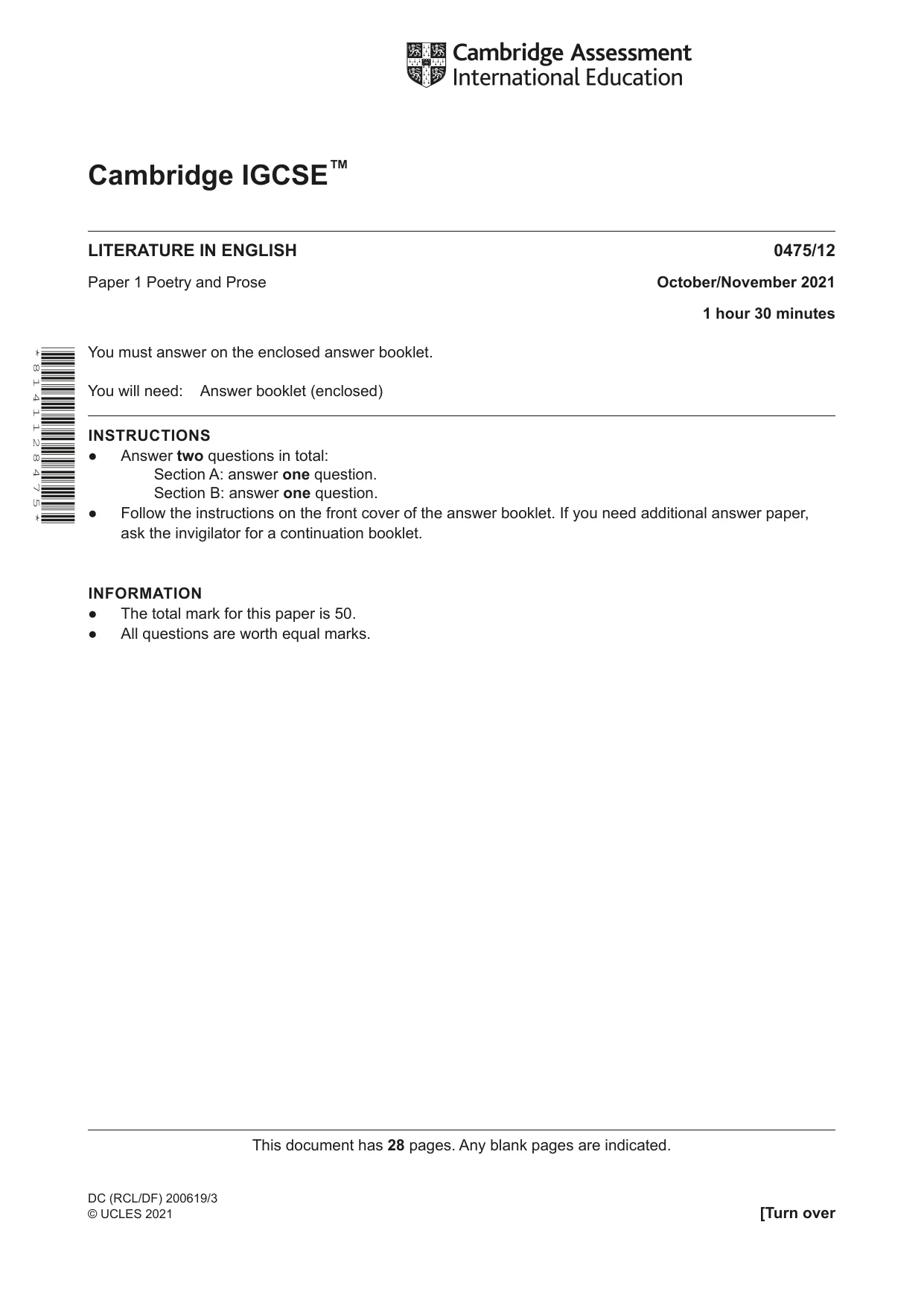
This document has 28 pages. Any blank pages are indicated. DC (RCL/DF) 200619/3 © UCLES 2021 [Turn over * 8 1 4 1 1 2 8 4 7 5 * Cambridge IGCSE™ LITERATURE IN ENGLISH 0475/12 Paper 1 Poetry and Prose October/November 2021 1 hour 30 minutes You must answer on the enclosed answer booklet. You will need: Answer booklet (enclosed) INSTRUCTIONS ● Answer two questions in total: Section A: answer one question. Section B: answer one question. ● Follow the instructions on the front cover of the answer booklet. If you need additional answer paper, ask the invigilator for a continuation booklet. INFORMATION ● The total mark for this paper is 50. ● All questions are worth equal marks.
Question paper, page 2
2 0475/12/O/N/21 © UCLES 2021 BLANK PAGE
Question paper, page 3
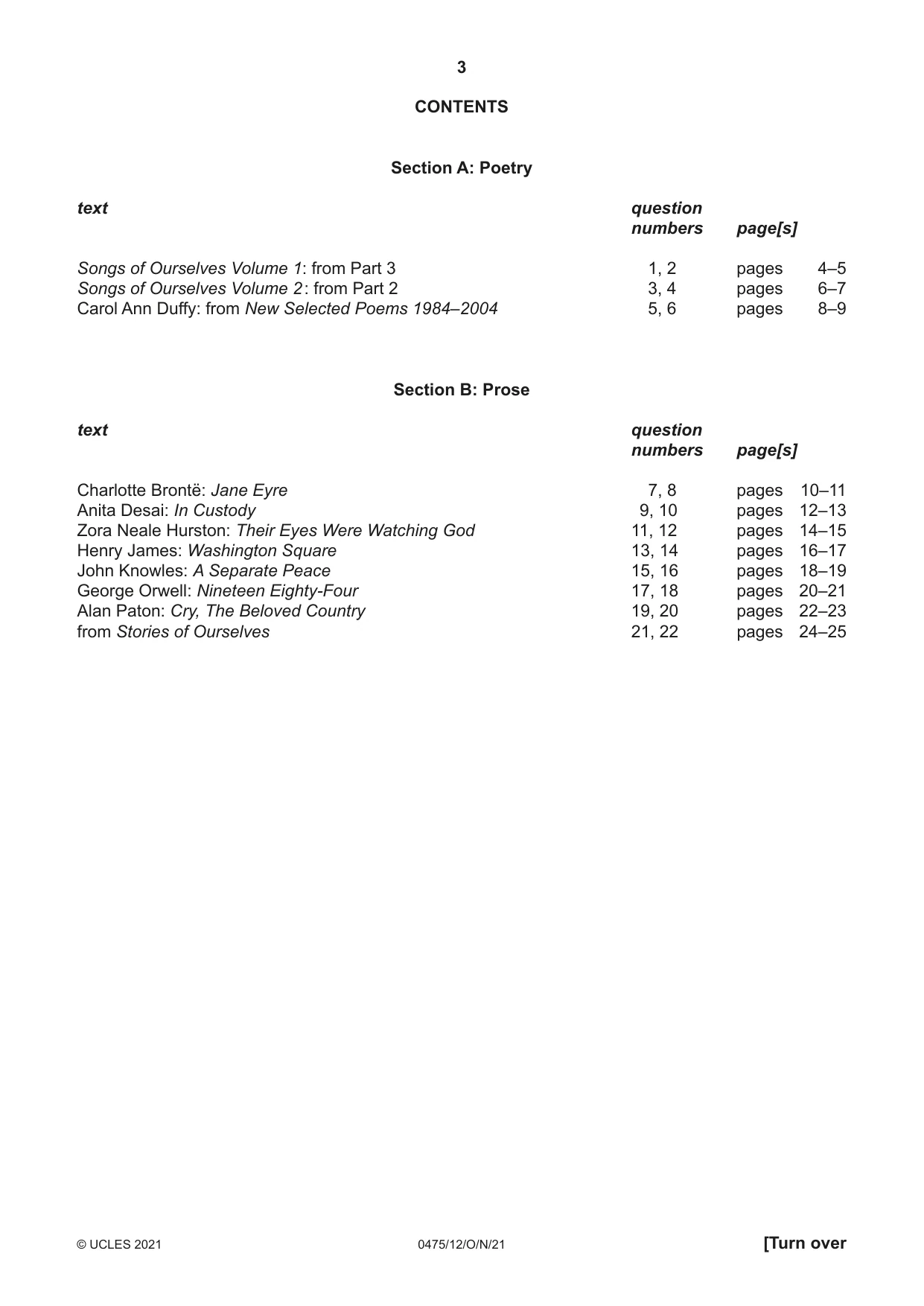
3 0475/12/O/N/21 © UCLES 2021 [Turn over CONTENTS Section A: Poetry text question numbers page[s] Songs of Ourselves Volume 1: from Part 3 1, 2 pages 4–5 Songs of Ourselves Volume 2 : from Part 2 3, 4 pages 6–7 Carol Ann Duffy: from New Selected Poems 1984–2004 5, 6 pages 8–9 Section B: Prose text question numbers page[s] Charlotte Brontë: Jane Eyre 7, 8 pages 10–11 Anita Desai: In Custody 9, 10 pages 12–13 Zora Neale Hurston: Their Eyes Were Watching God 11, 12 pages 14–15 Henry James: Washington Square 13, 14 pages 16–17 John Knowles: A Separate Peace 15, 16 pages 18–19 George Orwell: Nineteen Eighty-Four 17, 18 pages 20–21 Alan Paton: Cry, The Beloved Country 19, 20 pages 22–23 from Stories of Ourselves 21, 22 pages 24–25
Question paper, page 4
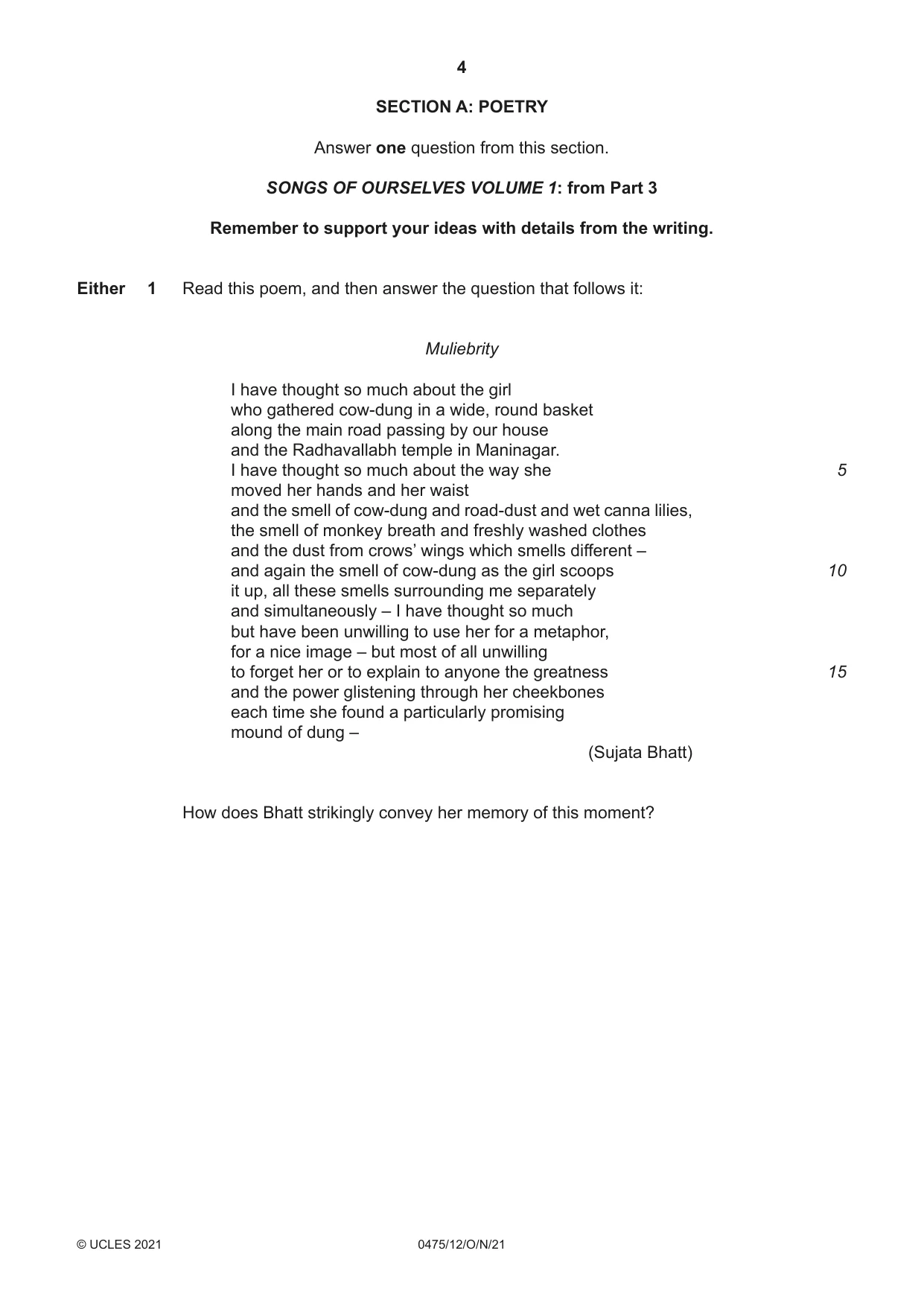
4 0475/12/O/N/21 © UCLES 2021 SECTION A: POETRY Answer one question from this section. SONGS OF OURSELVES VOLUME 1: from Part 3 Remember to support your ideas with details from the writing. Either 1 Read this poem, and then answer the question that follows it: Muliebrity I have thought so much about the girl who gathered cow-dung in a wide, round basket along the main road passing by our house and the Radhavallabh temple in Maninagar. I have thought so much about the way she moved her hands and her waist and the smell of cow-dung and road-dust and wet canna lilies, the smell of monkey breath and freshly washed clothes and the dust from crows’ wings which smells different – and again the smell of cow-dung as the girl scoops it up, all these smells surrounding me separately and simultaneously – I have thought so much but have been unwilling to use her for a metaphor, for a nice image – but most of all unwilling to forget her or to explain to anyone the greatness and the power glistening through her cheekbones each time she found a particularly promising mound of dung – (Sujata Bhatt) How does Bhatt strikingly convey her memory of this moment? 5 10 15
Question paper, page 5
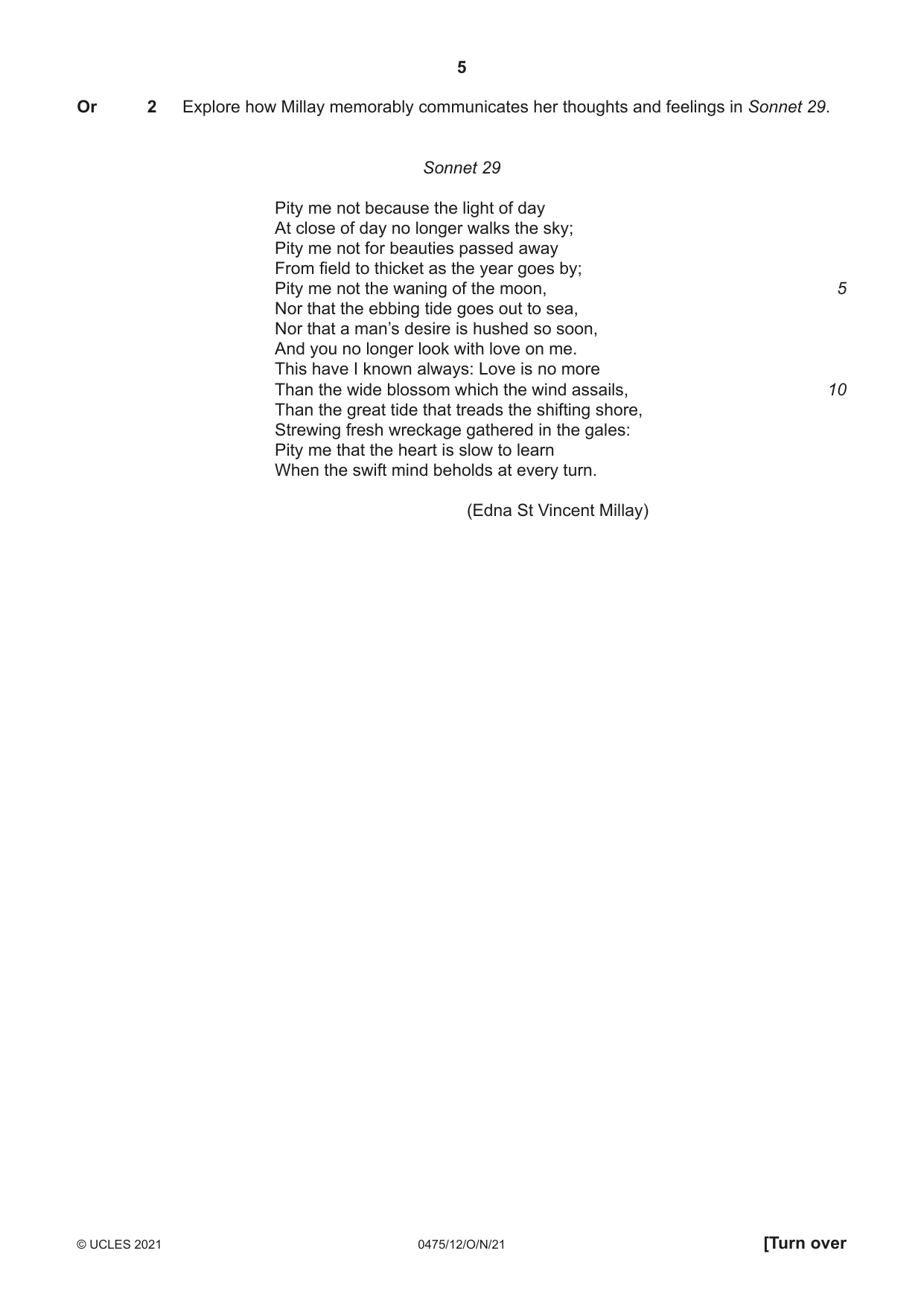
5 0475/12/O/N/21 © UCLES 2021 [Turn over Or 2 Explore how Millay memorably communicates her thoughts and feelings in Sonnet 29. Sonnet 29 Pity me not because the light of day At close of day no longer walks the sky; Pity me not for beauties passed away From field to thicket as the year goes by; Pity me not the waning of the moon, Nor that the ebbing tide goes out to sea, Nor that a man’s desire is hushed so soon, And you no longer look with love on me. This have I known always: Love is no more Than the wide blossom which the wind assails, Than the great tide that treads the shifting shore, Strewing fresh wreckage gathered in the gales: Pity me that the heart is slow to learn When the swift mind beholds at every turn. (Edna St Vincent Millay) 5 10
Question paper, page 6
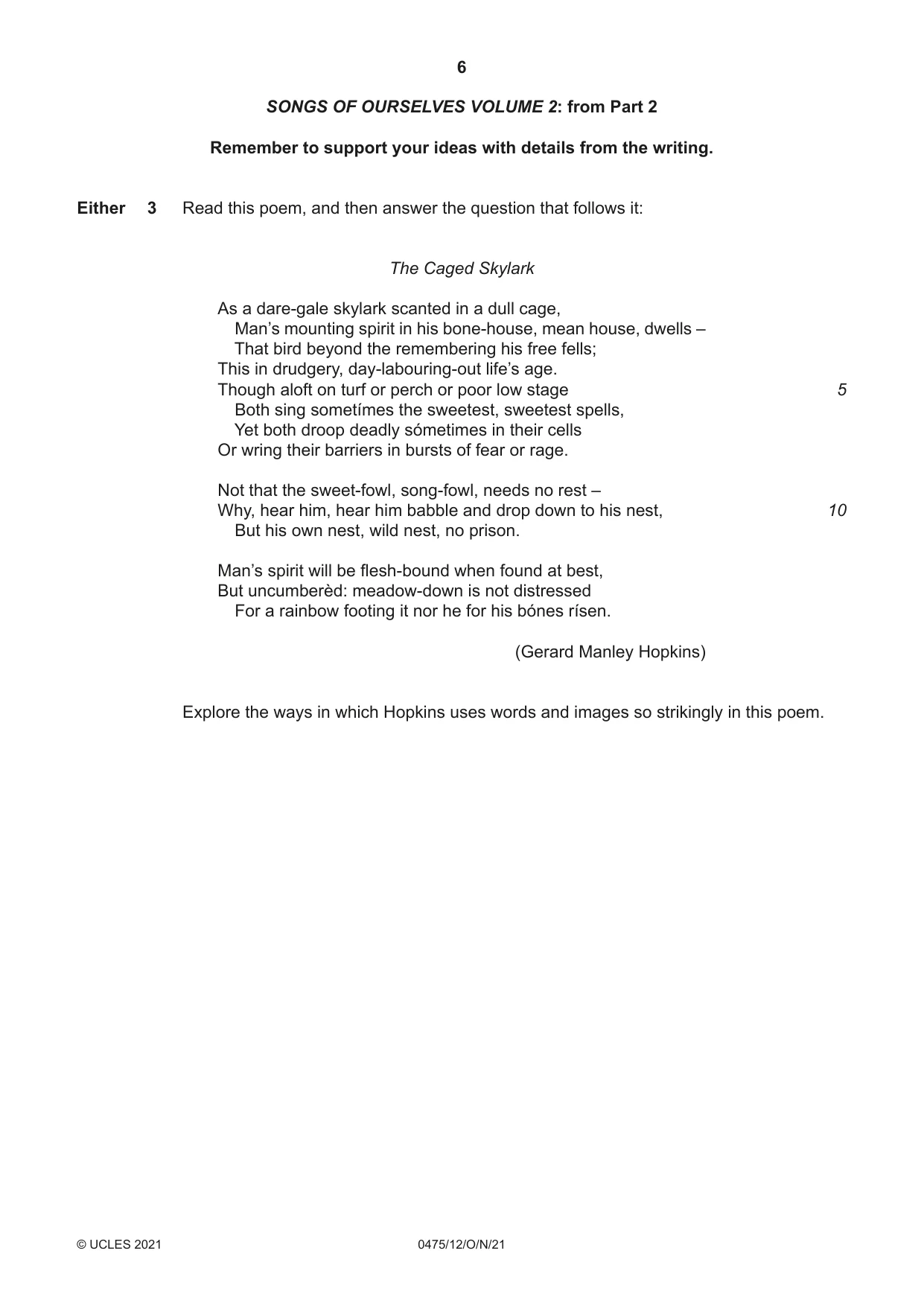
6 0475/12/O/N/21 © UCLES 2021 SONGS OF OURSELVES VOLUME 2: from Part 2 Remember to support your ideas with details from the writing. Either 3 Read this poem, and then answer the question that follows it: The Caged Skylark As a dare-gale skylark scanted in a dull cage, Man’s mounting spirit in his bone-house, mean house, dwells – That bird beyond the remembering his free fells; This in drudgery, day-labouring-out life’s age. Though aloft on turf or perch or poor low stage Both sing sometímes the sweetest, sweetest spells, Yet both droop deadly sómetimes in their cells Or wring their barriers in bursts of fear or rage. Not that the sweet-fowl, song-fowl, needs no rest – Why, hear him, hear him babble and drop down to his nest, But his own nest, wild nest, no prison. Man’s spirit will be flesh-bound when found at best, But uncumberèd: meadow-down is not distressed For a rainbow footing it nor he for his bónes rísen. (Gerard Manley Hopkins) Explore the ways in which Hopkins uses words and images so strikingly in this poem. 5 10
Question paper, page 7
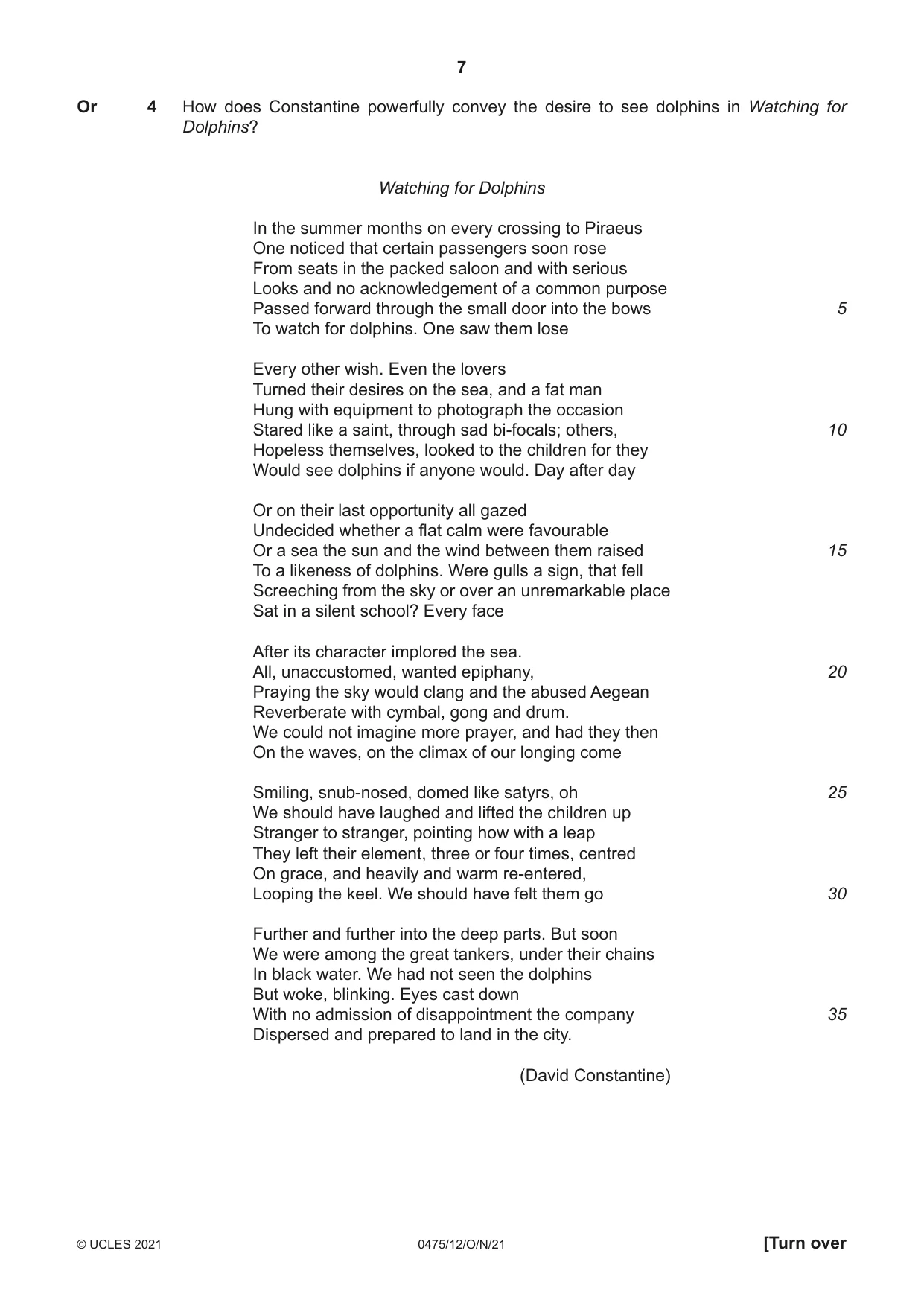
7 0475/12/O/N/21 © UCLES 2021 [Turn over Or 4 How does Constantine powerfully convey the desire to see dolphins in Watching for Dolphins? Watching for Dolphins In the summer months on every crossing to Piraeus One noticed that certain passengers soon rose From seats in the packed saloon and with serious Looks and no acknowledgement of a common purpose Passed forward through the small door into the bows To watch for dolphins. One saw them lose Every other wish. Even the lovers Turned their desires on the sea, and a fat man Hung with equipment to photograph the occasion Stared like a saint, through sad bi-focals; others, Hopeless themselves, looked to the children for they Would see dolphins if anyone would. Day after day Or on their last opportunity all gazed Undecided whether a flat calm were favourable Or a sea the sun and the wind between them raised To a likeness of dolphins. Were gulls a sign, that fell Screeching from the sky or over an unremarkable place Sat in a silent school? Every face After its character implored the sea. All, unaccustomed, wanted epiphany, Praying the sky would clang and the abused Aegean Reverberate with cymbal, gong and drum. We could not imagine more prayer, and had they then On the waves, on the climax of our longing come Smiling, snub-nosed, domed like satyrs, oh We should have laughed and lifted the children up Stranger to stranger, pointing how with a leap They left their element, three or four times, centred On grace, and heavily and warm re-entered, Looping the keel. We should have felt them go Further and further into the deep parts. But soon We were among the great tankers, under their chains In black water. We had not seen the dolphins But woke, blinking. Eyes cast down With no admission of disappointment the company Dispersed and prepared to land in the city. (David Constantine) 5 10 15 20 25 30 35
Question paper, page 8
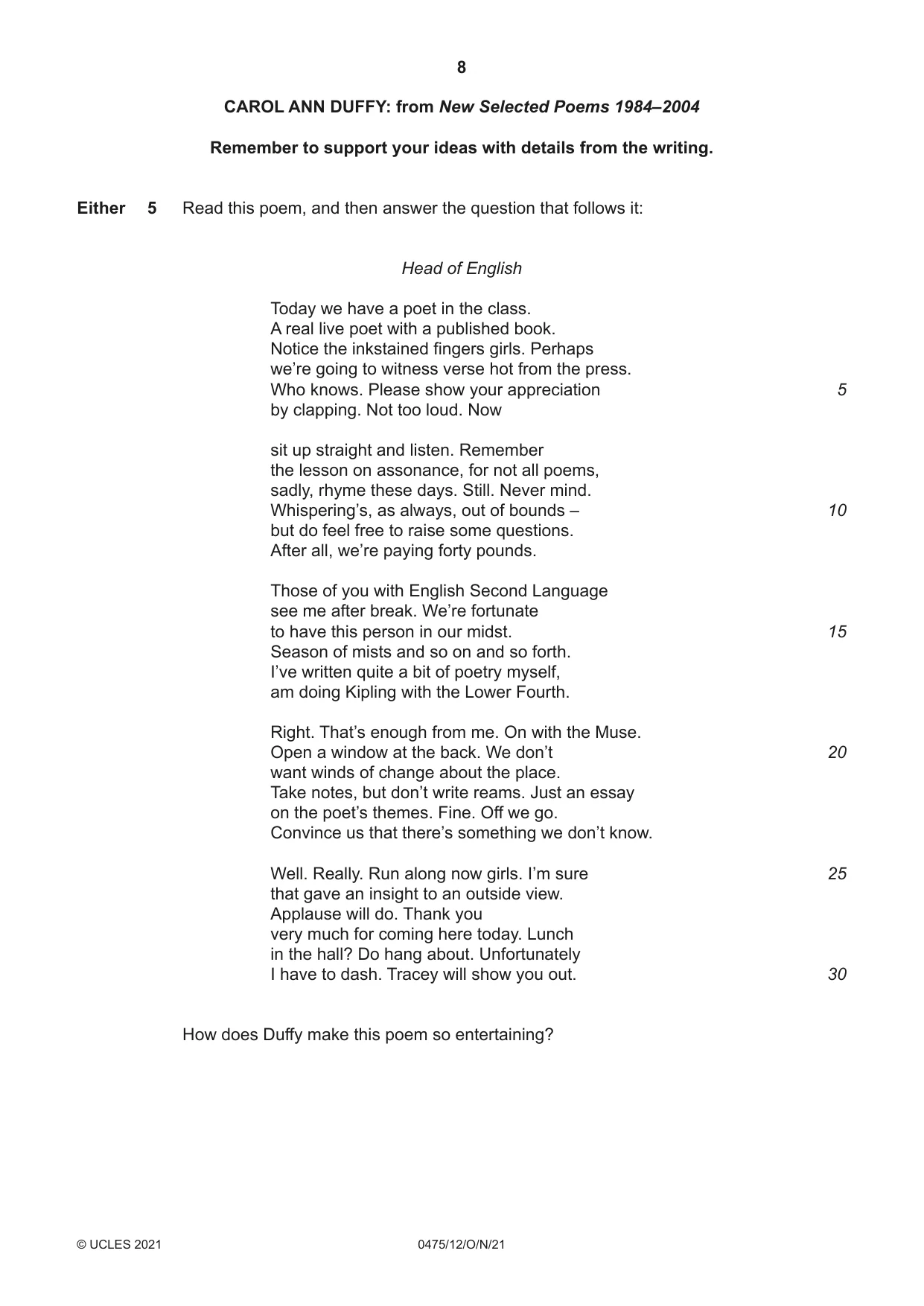
8 0475/12/O/N/21 © UCLES 2021 CAROL ANN DUFFY: from New Selected Poems 1984–2004 Remember to support your ideas with details from the writing. Either 5 Read this poem, and then answer the question that follows it: Head of English Today we have a poet in the class. A real live poet with a published book. Notice the inkstained fingers girls. Perhaps we’re going to witness verse hot from the press. Who knows. Please show your appreciation by clapping. Not too loud. Now sit up straight and listen. Remember the lesson on assonance, for not all poems, sadly, rhyme these days. Still. Never mind. Whispering’s, as always, out of bounds – but do feel free to raise some questions. After all, we’re paying forty pounds. Those of you with English Second Language see me after break. We’re fortunate to have this person in our midst. Season of mists and so on and so forth. I’ve written quite a bit of poetry myself, am doing Kipling with the Lower Fourth. Right. That’s enough from me. On with the Muse. Open a window at the back. We don’t want winds of change about the place. Take notes, but don’t write reams. Just an essay on the poet’s themes. Fine. Off we go. Convince us that there’s something we don’t know. Well. Really. Run along now girls. I’m sure that gave an insight to an outside view. Applause will do. Thank you very much for coming here today. Lunch in the hall? Do hang about. Unfortunately I have to dash. Tracey will show you out. How does Duffy make this poem so entertaining? 5 10 15 20 25 30
Question paper, page 9
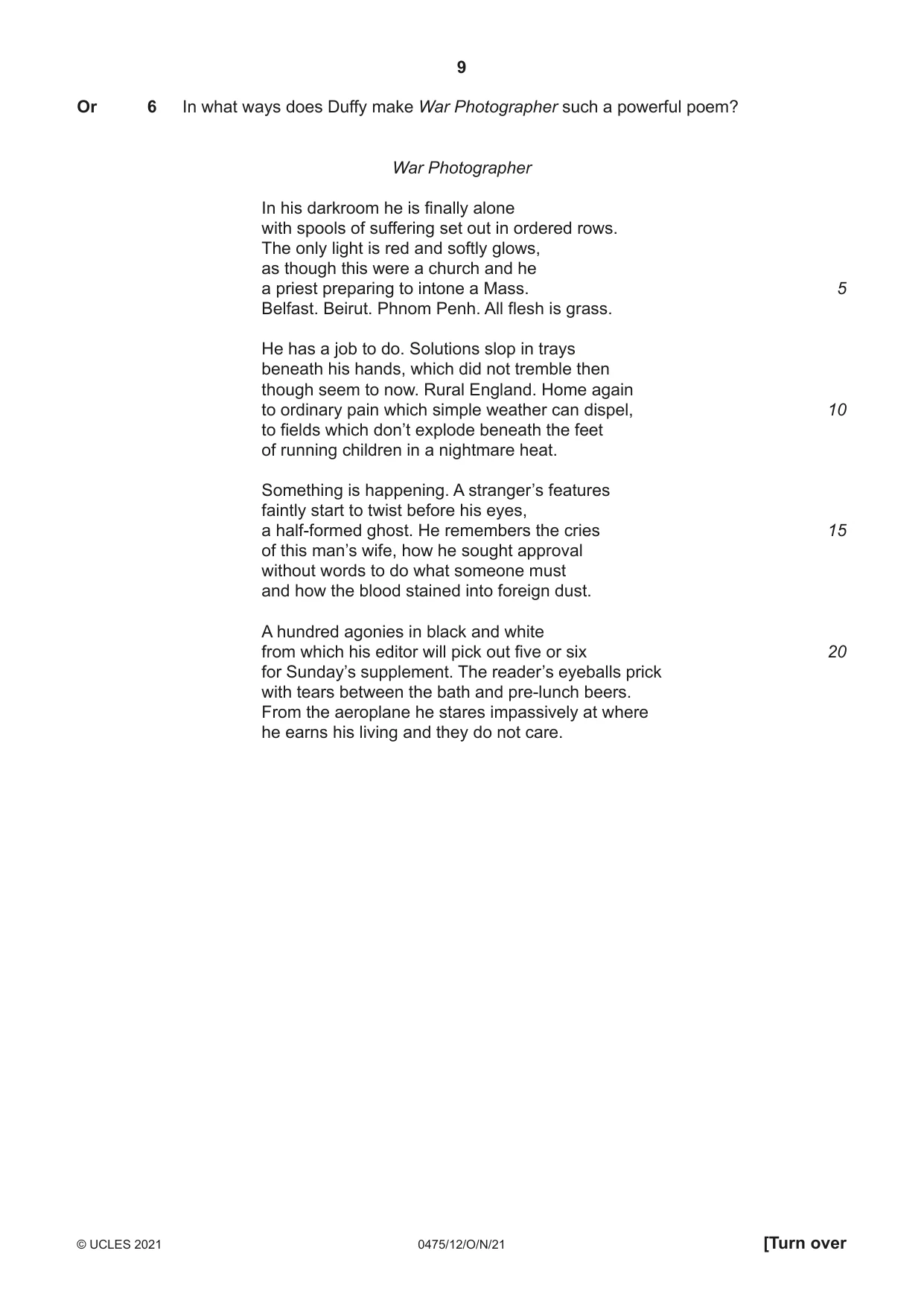
9 0475/12/O/N/21 © UCLES 2021 [Turn over Or 6 In what ways does Duffy make War Photographer such a powerful poem? War Photographer In his darkroom he is finally alone with spools of suffering set out in ordered rows. The only light is red and softly glows, as though this were a church and he a priest preparing to intone a Mass. Belfast. Beirut. Phnom Penh. All flesh is grass. He has a job to do. Solutions slop in trays beneath his hands, which did not tremble then though seem to now. Rural England. Home again to ordinary pain which simple weather can dispel, to fields which don’t explode beneath the feet of running children in a nightmare heat. Something is happening. A stranger’s features faintly start to twist before his eyes, a half-formed ghost. He remembers the cries of this man’s wife, how he sought approval without words to do what someone must and how the blood stained into foreign dust. A hundred agonies in black and white from which his editor will pick out five or six for Sunday’s supplement. The reader’s eyeballs prick with tears between the bath and pre-lunch beers. From the aeroplane he stares impassively at where he earns his living and they do not care. 5 10 15 20
Question paper, page 10
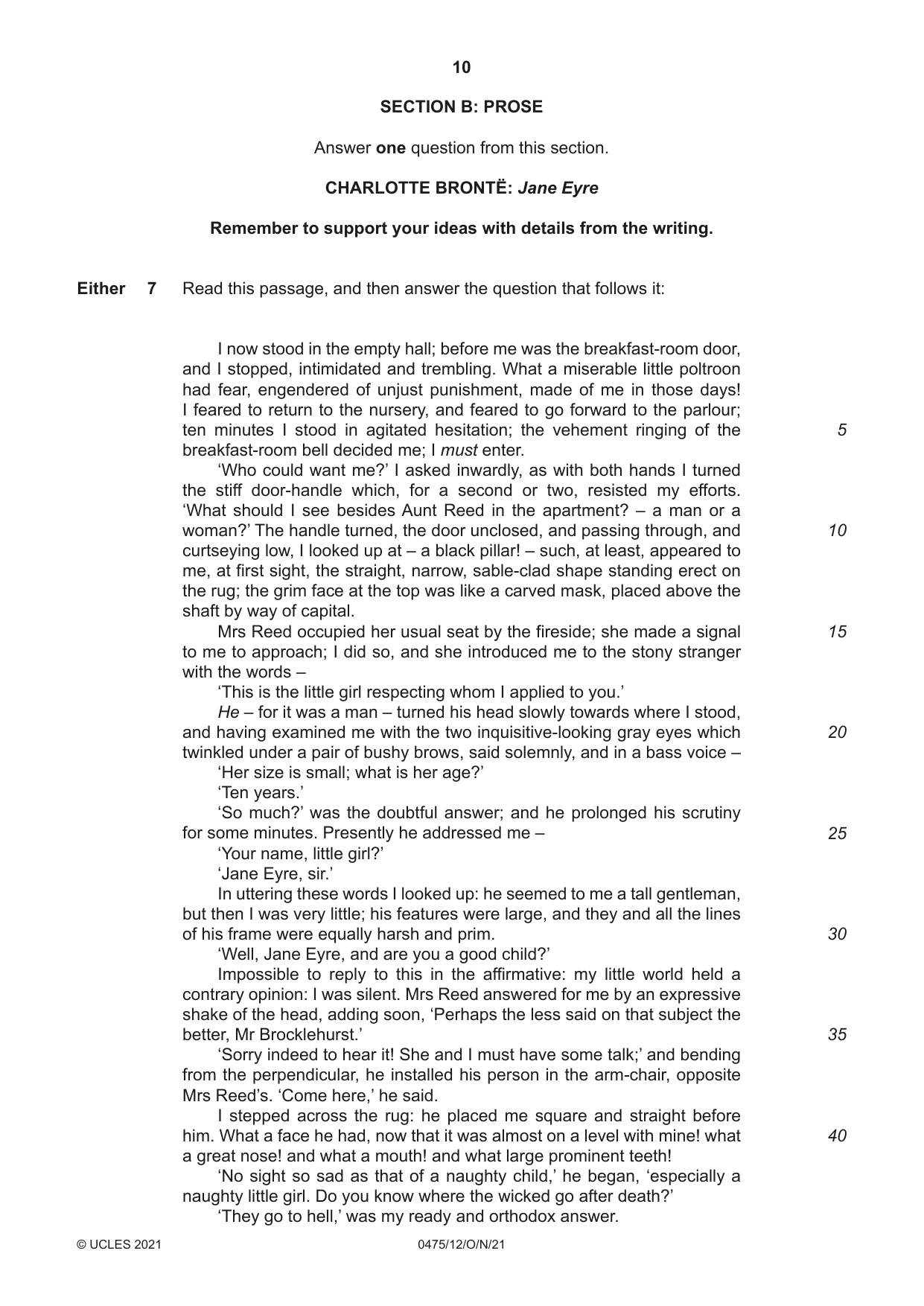
10 0475/12/O/N/21 © UCLES 2021 SECTION B: PROSE Answer one question from this section. CHARLOTTE BRONTË: Jane Eyre Remember to support your ideas with details from the writing. Either 7 Read this passage, and then answer the question that follows it: I now stood in the empty hall; before me was the breakfast-room door, and I stopped, intimidated and trembling. What a miserable little poltroon had fear, engendered of unjust punishment, made of me in those days! I feared to return to the nursery, and feared to go forward to the parlour; ten minutes I stood in agitated hesitation; the vehement ringing of the breakfast-room bell decided me; I must enter. ‘Who could want me?’ I asked inwardly, as with both hands I turned the stiff door-handle which, for a second or two, resisted my efforts. ‘What should I see besides Aunt Reed in the apartment? – a man or a woman?’ The handle turned, the door unclosed, and passing through, and curtseying low, I looked up at – a black pillar! – such, at least, appeared to me, at first sight, the straight, narrow, sable-clad shape standing erect on the rug; the grim face at the top was like a carved mask, placed above the shaft by way of capital. Mrs Reed occupied her usual seat by the fireside; she made a signal to me to approach; I did so, and she introduced me to the stony stranger with the words – ‘This is the little girl respecting whom I applied to you.’ He – for it was a man – turned his head slowly towards where I stood, and having examined me with the two inquisitive-looking gray eyes which twinkled under a pair of bushy brows, said solemnly, and in a bass voice – ‘Her size is small; what is her age?’ ‘Ten years.’ ‘So much?’ was the doubtful answer; and he prolonged his scrutiny for some minutes. Presently he addressed me – ‘Your name, little girl?’ ‘Jane Eyre, sir.’ In uttering these words I looked up: he seemed to me a tall gentleman, but then I was very little; his features were large, and they and all the lines of his frame were equally harsh and prim. ‘Well, Jane Eyre, and are you a good child?’ Impossible to reply to this in the affirmative: my little world held a contrary opinion: I was silent. Mrs Reed answered for me by an expressive shake of the head, adding soon, ‘Perhaps the less said on that subject the better, Mr Brocklehurst.’ ‘Sorry indeed to hear it! She and I must have some talk;’ and bending from the perpendicular, he installed his person in the arm-chair, opposite Mrs Reed’s. ‘Come here,’ he said. I stepped across the rug: he placed me square and straight before him. What a face he had, now that it was almost on a level with mine! what a great nose! and what a mouth! and what large prominent teeth! ‘No sight so sad as that of a naughty child,’ he began, ‘especially a naughty little girl. Do you know where the wicked go after death?’ ‘They go to hell,’ was my ready and orthodox answer. 5 10 15 20 25 30 35 40
Question paper, page 11
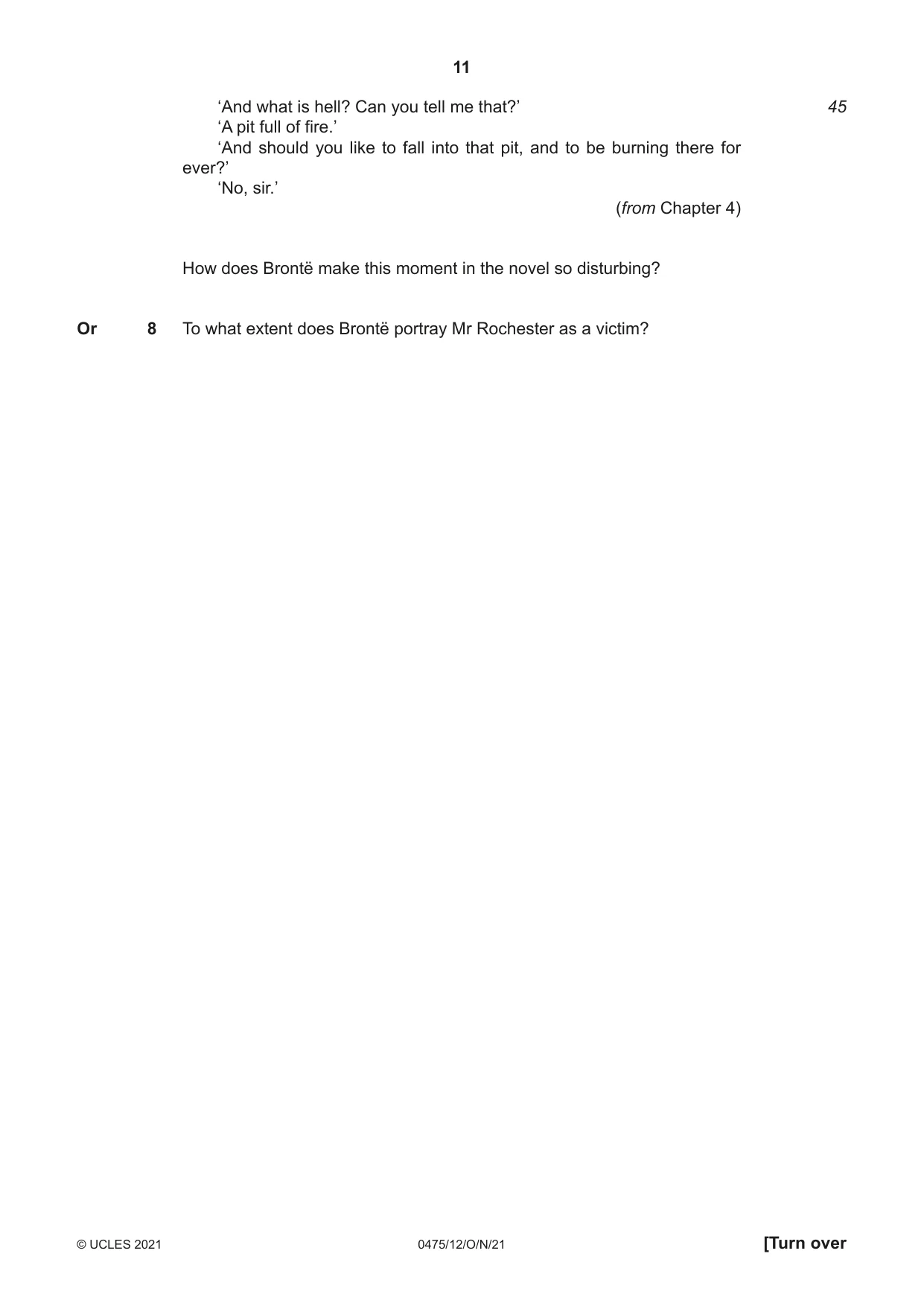
11 0475/12/O/N/21 © UCLES 2021 [Turn over ‘And what is hell? Can you tell me that?’ ‘A pit full of fire.’ ‘And should you like to fall into that pit, and to be burning there for ever?’ ‘No, sir.’ (from Chapter 4) How does Brontë make this moment in the novel so disturbing? Or 8 To what extent does Brontë portray Mr Rochester as a victim? 45
Question paper, page 12
12 0475/12/O/N/21 © UCLES 2021 ANITA DESAI: In Custody Remember to support your ideas with details from the writing. Either 9 Read this passage, and then answer the question that follows it: Doors opened on to the unlit verandas all around the silent well of the courtyard where one bare electric bulb burned. Content removed due to copyright restrictions.
Question paper, page 13
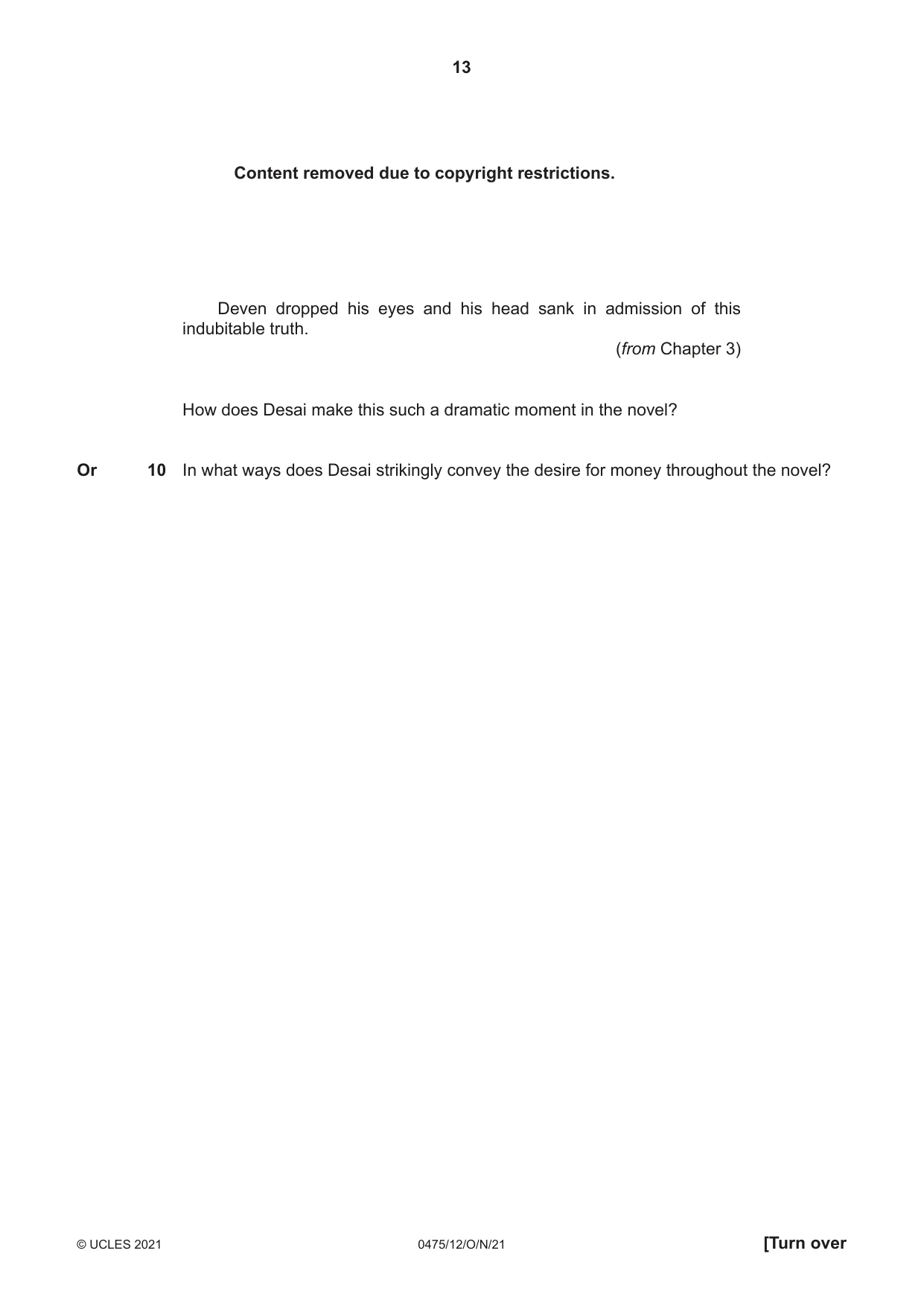
13 0475/12/O/N/21 © UCLES 2021 [Turn over Deven dropped his eyes and his head sank in admission of this indubitable truth. (from Chapter 3) How does Desai make this such a dramatic moment in the novel? Or 10 In what ways does Desai strikingly convey the desire for money throughout the novel? Content removed due to copyright restrictions.
Question paper, page 14
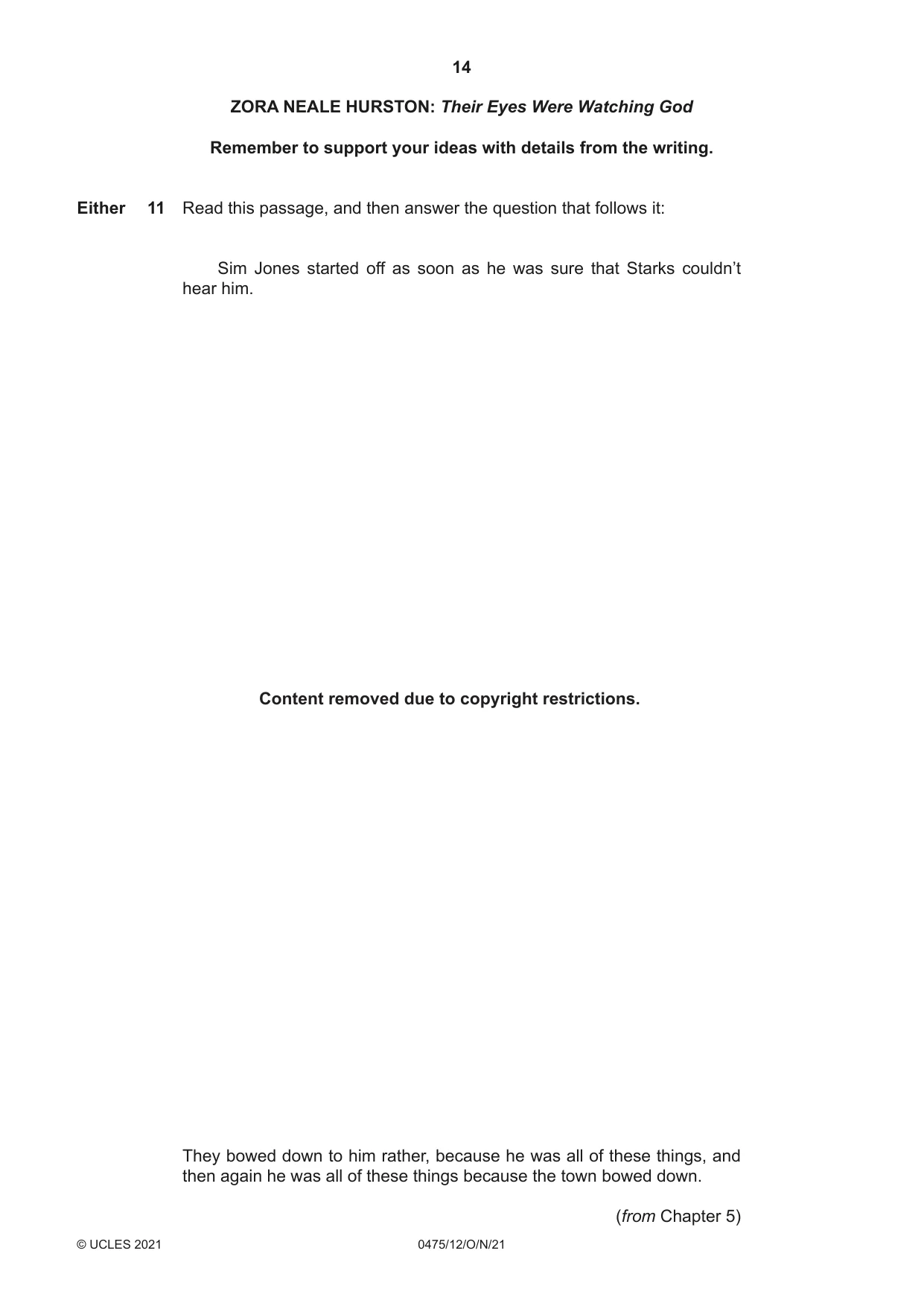
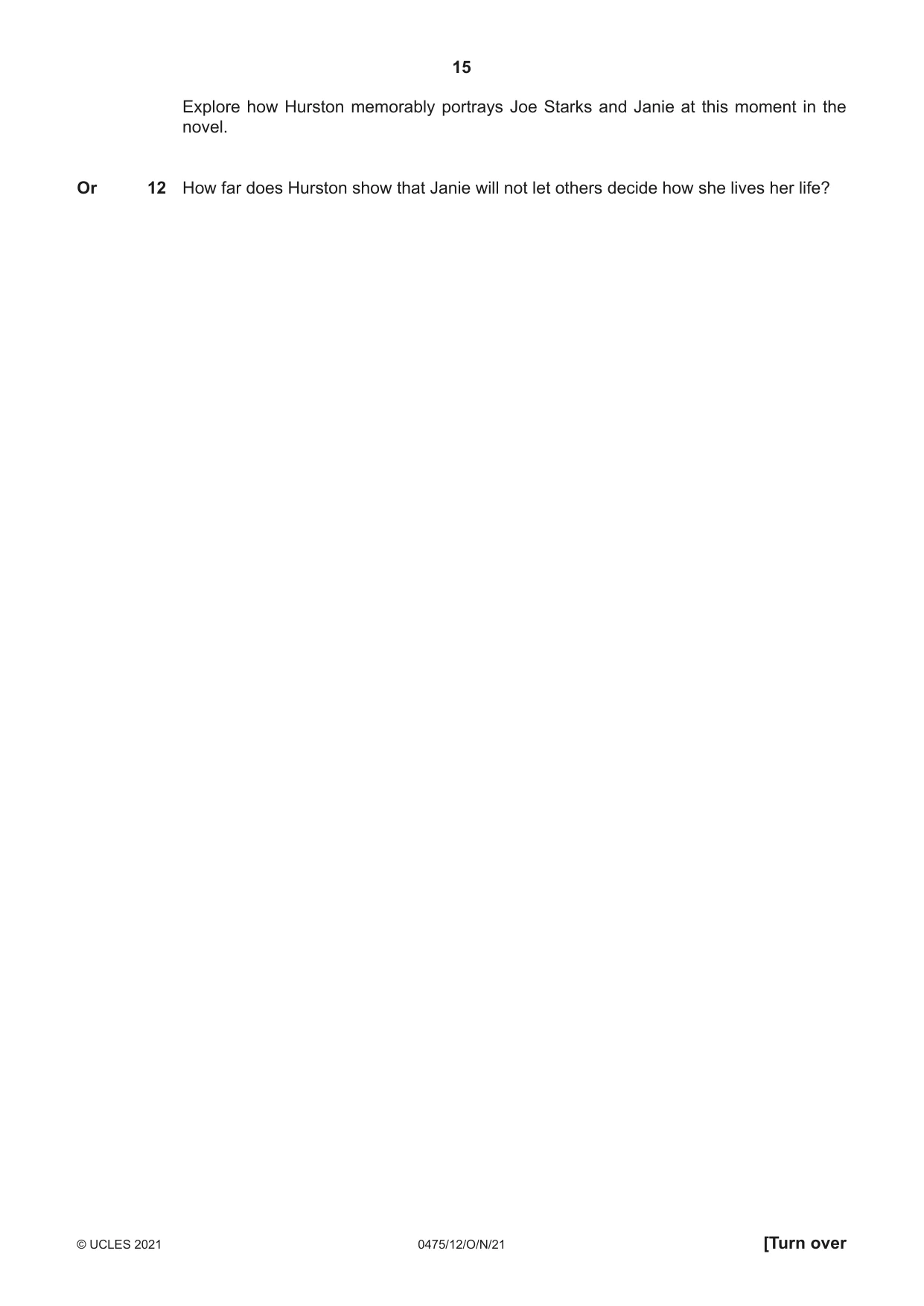
14 0475/12/O/N/21 © UCLES 2021 ZORA NEALE HURSTON: Their Eyes Were Watching God Remember to support your ideas with details from the writing. Either 11 Read this passage, and then answer the question that follows it: Sim Jones started off as soon as he was sure that Starks couldn’t hear him. They bowed down to him rather, because he was all of these things, and then again he was all of these things because the town bowed down. (from Chapter 5) Content removed due to copyright restrictions.
Question paper, page 15
15 0475/12/O/N/21 © UCLES 2021 [Turn over Explore how Hurston memorably portrays Joe Starks and Janie at this moment in the novel. Or 12 How far does Hurston show that Janie will not let others decide how she lives her life?
Question paper, page 16
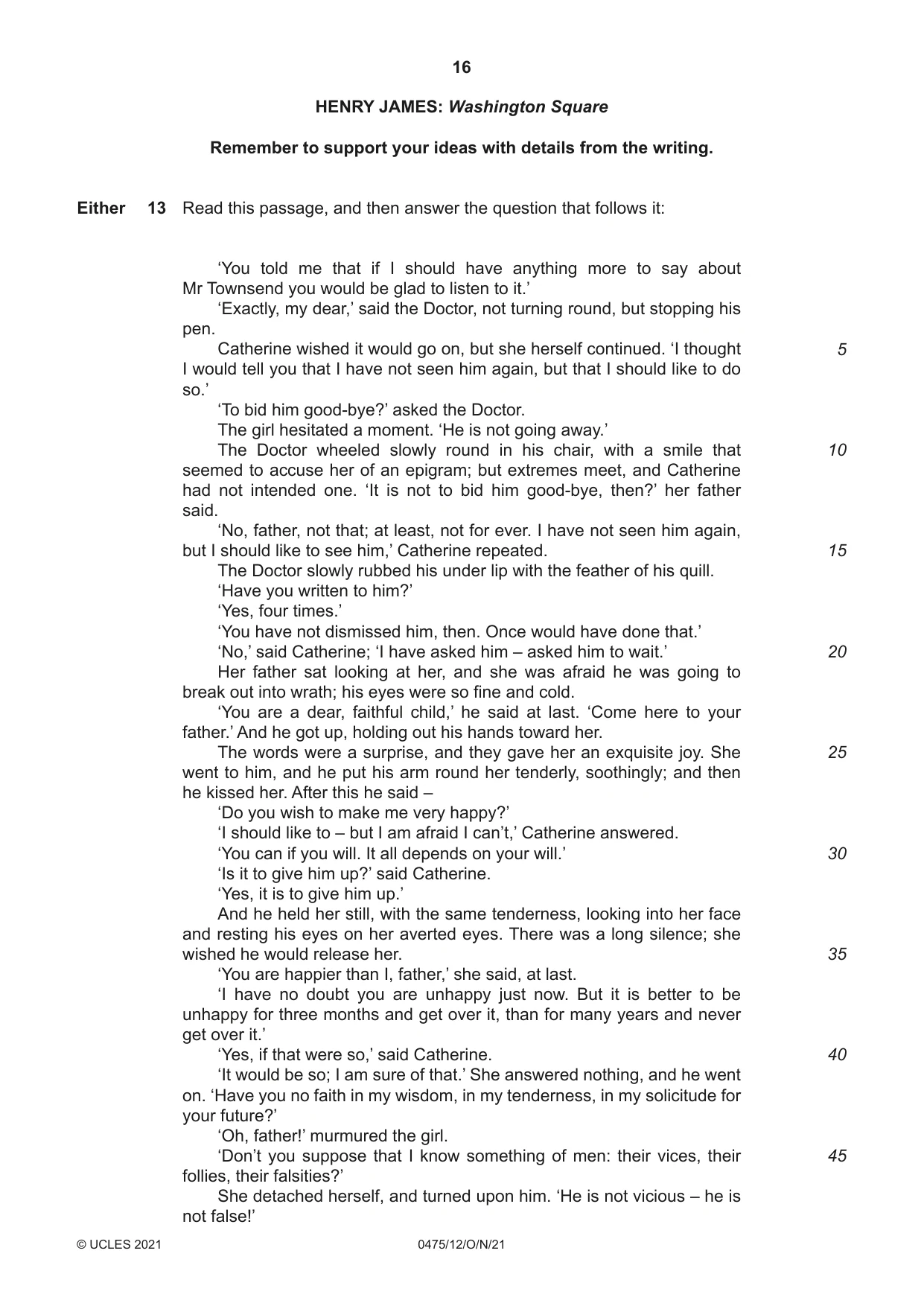
16 0475/12/O/N/21 © UCLES 2021 HENRY JAMES: Washington Square Remember to support your ideas with details from the writing. Either 13 Read this passage, and then answer the question that follows it: ‘You told me that if I should have anything more to say about Mr Townsend you would be glad to listen to it.’ ‘Exactly, my dear,’ said the Doctor, not turning round, but stopping his pen. Catherine wished it would go on, but she herself continued. ‘I thought I would tell you that I have not seen him again, but that I should like to do so.’ ‘To bid him good-bye?’ asked the Doctor. The girl hesitated a moment. ‘He is not going away.’ The Doctor wheeled slowly round in his chair, with a smile that seemed to accuse her of an epigram; but extremes meet, and Catherine had not intended one. ‘It is not to bid him good-bye, then?’ her father said. ‘No, father, not that; at least, not for ever. I have not seen him again, but I should like to see him,’ Catherine repeated. The Doctor slowly rubbed his under lip with the feather of his quill. ‘Have you written to him?’ ‘Yes, four times.’ ‘You have not dismissed him, then. Once would have done that.’ ‘No,’ said Catherine; ‘I have asked him – asked him to wait.’ Her father sat looking at her, and she was afraid he was going to break out into wrath; his eyes were so fine and cold. ‘You are a dear, faithful child,’ he said at last. ‘Come here to your father.’ And he got up, holding out his hands toward her. The words were a surprise, and they gave her an exquisite joy. She went to him, and he put his arm round her tenderly, soothingly; and then he kissed her. After this he said – ‘Do you wish to make me very happy?’ ‘I should like to – but I am afraid I can’t,’ Catherine answered. ‘You can if you will. It all depends on your will.’ ‘Is it to give him up?’ said Catherine. ‘Yes, it is to give him up.’ And he held her still, with the same tenderness, looking into her face and resting his eyes on her averted eyes. There was a long silence; she wished he would release her. ‘You are happier than I, father,’ she said, at last. ‘I have no doubt you are unhappy just now. But it is better to be unhappy for three months and get over it, than for many years and never get over it.’ ‘Yes, if that were so,’ said Catherine. ‘It would be so; I am sure of that.’ She answered nothing, and he went on. ‘Have you no faith in my wisdom, in my tenderness, in my solicitude for your future?’ ‘Oh, father!’ murmured the girl. ‘Don’t you suppose that I know something of men: their vices, their follies, their falsities?’ She detached herself, and turned upon him. ‘He is not vicious – he is not false!’ 5 10 15 20 25 30 35 40 45
Question paper, page 17
17 0475/12/O/N/21 © UCLES 2021 [Turn over Her father kept looking at her with his sharp, pure eye. ‘You make nothing of my judgment, then?’ ‘I can’t believe that!’ ‘I don’t ask you to believe it, but to take it on trust.’ Catherine was far from saying to herself that this was an ingenious sophism; but she met the appeal none the less squarely. ‘What has he done – what do you know?’ ‘He has never done anything – he is a selfish idler.’ ‘Oh, father, don’t abuse him!’ she exclaimed, pleadingly. ‘I don’t mean to abuse him; it would be a great mistake. You may do as you choose,’ he added, turning away. ‘I may see him again?’ ‘Just as you choose.’ ‘Will you forgive me?’ ‘By no means.’ (from Chapter 18) How does James make this conversation so memorable and significant? Or 14 In what ways does James suggest that Morris never really loved Catherine? 50 55 60
Question paper, page 18
18 0475/12/O/N/21 © UCLES 2021 JOHN KNOWLES: A Separate Peace Remember to support your ideas with details from the writing. Either 15 Read this passage, and then answer the question that follows it: Our absence from dinner had been noticed. Content removed due to copyright restrictions.
Question paper, page 19
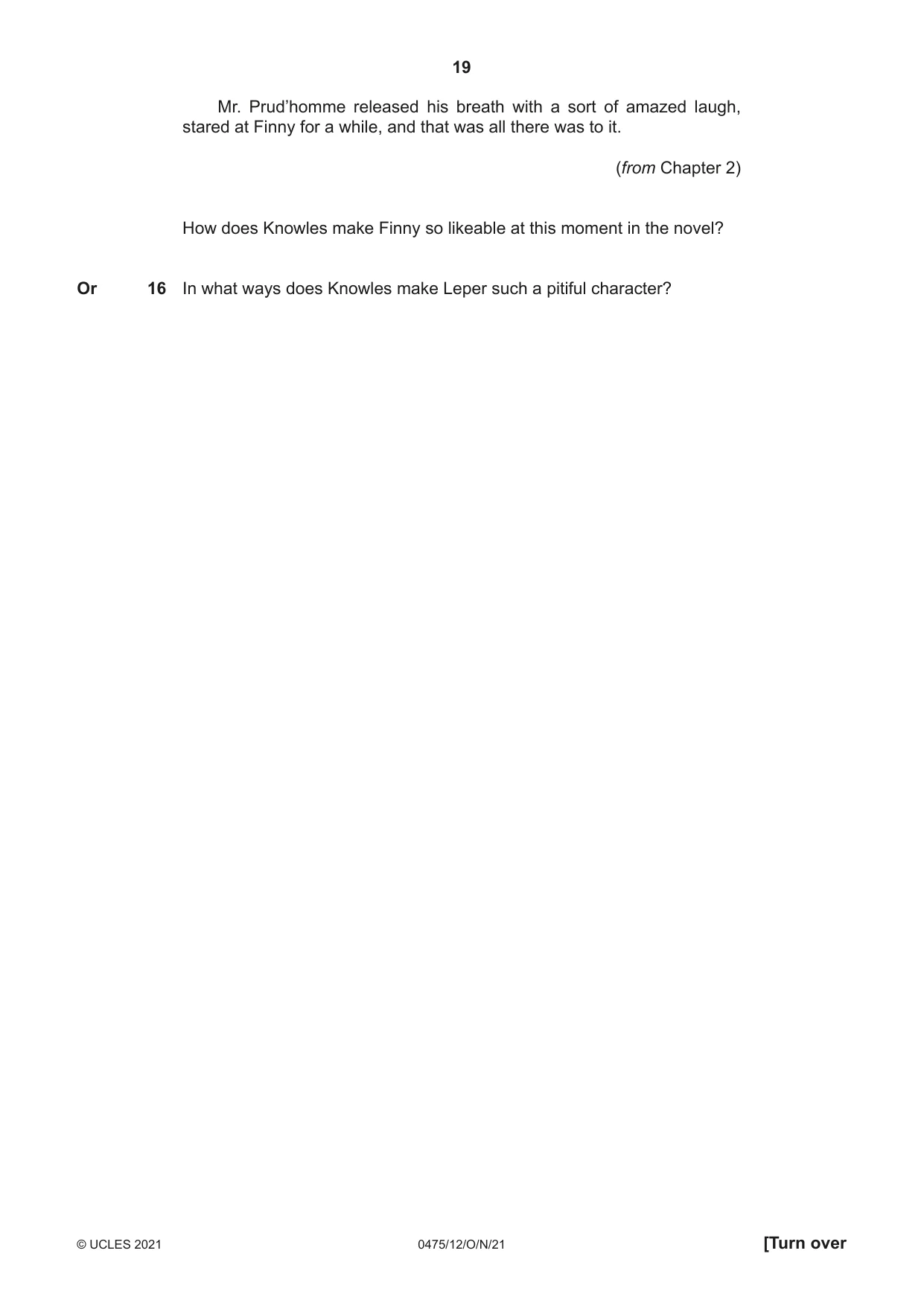
19 0475/12/O/N/21 © UCLES 2021 [Turn over Mr. Prud’homme released his breath with a sort of amazed laugh, stared at Finny for a while, and that was all there was to it. (from Chapter 2) How does Knowles make Finny so likeable at this moment in the novel? Or 16 In what ways does Knowles make Leper such a pitiful character?
Question paper, page 20
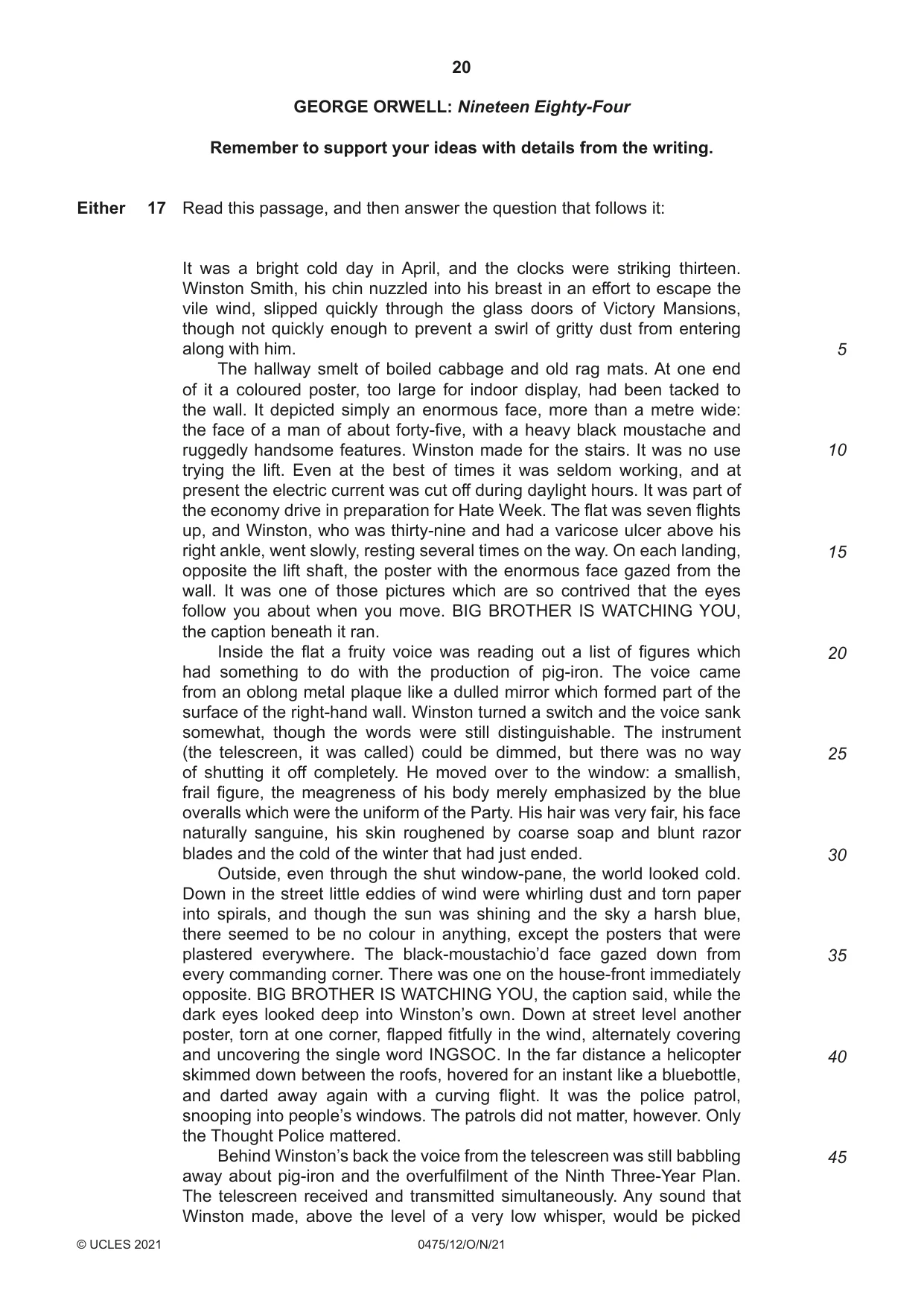
20 0475/12/O/N/21 © UCLES 2021 GEORGE ORWELL: Nineteen Eighty-Four Remember to support your ideas with details from the writing. Either 17 Read this passage, and then answer the question that follows it: It was a bright cold day in April, and the clocks were striking thirteen. Winston Smith, his chin nuzzled into his breast in an effort to escape the vile wind, slipped quickly through the glass doors of Victory Mansions, though not quickly enough to prevent a swirl of gritty dust from entering along with him. The hallway smelt of boiled cabbage and old rag mats. At one end of it a coloured poster, too large for indoor display, had been tacked to the wall. It depicted simply an enormous face, more than a metre wide: the face of a man of about forty-five, with a heavy black moustache and ruggedly handsome features. Winston made for the stairs. It was no use trying the lift. Even at the best of times it was seldom working, and at present the electric current was cut off during daylight hours. It was part of the economy drive in preparation for Hate Week. The flat was seven flights up, and Winston, who was thirty-nine and had a varicose ulcer above his right ankle, went slowly, resting several times on the way. On each landing, opposite the lift shaft, the poster with the enormous face gazed from the wall. It was one of those pictures which are so contrived that the eyes follow you about when you move. BIG BROTHER IS WATCHING YOU, the caption beneath it ran. Inside the flat a fruity voice was reading out a list of figures which had something to do with the production of pig-iron. The voice came from an oblong metal plaque like a dulled mirror which formed part of the surface of the right-hand wall. Winston turned a switch and the voice sank somewhat, though the words were still distinguishable. The instrument (the telescreen, it was called) could be dimmed, but there was no way of shutting it off completely. He moved over to the window: a smallish, frail figure, the meagreness of his body merely emphasized by the blue overalls which were the uniform of the Party. His hair was very fair, his face naturally sanguine, his skin roughened by coarse soap and blunt razor blades and the cold of the winter that had just ended. Outside, even through the shut window-pane, the world looked cold. Down in the street little eddies of wind were whirling dust and torn paper into spirals, and though the sun was shining and the sky a harsh blue, there seemed to be no colour in anything, except the posters that were plastered everywhere. The black-moustachio’d face gazed down from every commanding corner. There was one on the house-front immediately opposite. BIG BROTHER IS WATCHING YOU, the caption said, while the dark eyes looked deep into Winston’s own. Down at street level another poster, torn at one corner, flapped fitfully in the wind, alternately covering and uncovering the single word INGSOC. In the far distance a helicopter skimmed down between the roofs, hovered for an instant like a bluebottle, and darted away again with a curving flight. It was the police patrol, snooping into people’s windows. The patrols did not matter, however. Only the Thought Police mattered. Behind Winston’s back the voice from the telescreen was still babbling away about pig-iron and the overfulfilment of the Ninth Three-Year Plan. The telescreen received and transmitted simultaneously. Any sound that Winston made, above the level of a very low whisper, would be picked 5 10 15 20 25 30 35 40 45
Question paper, page 21
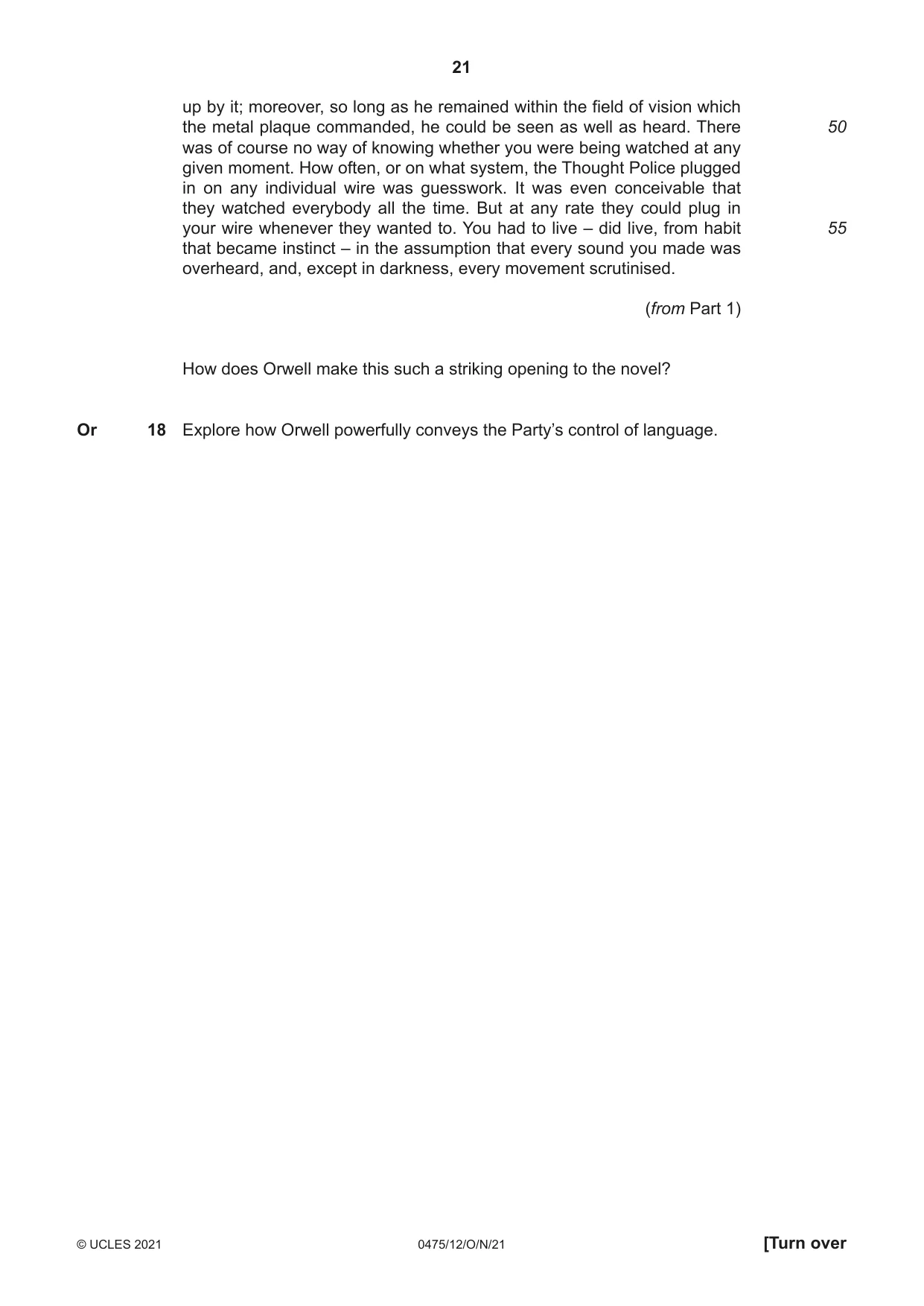
21 0475/12/O/N/21 © UCLES 2021 [Turn over up by it; moreover, so long as he remained within the field of vision which the metal plaque commanded, he could be seen as well as heard. There was of course no way of knowing whether you were being watched at any given moment. How often, or on what system, the Thought Police plugged in on any individual wire was guesswork. It was even conceivable that they watched everybody all the time. But at any rate they could plug in your wire whenever they wanted to. You had to live – did live, from habit that became instinct – in the assumption that every sound you made was overheard, and, except in darkness, every movement scrutinised. (from Part 1) How does Orwell make this such a striking opening to the novel? Or 18 Explore how Orwell powerfully conveys the Party’s control of language. 50 55
Question paper, page 22
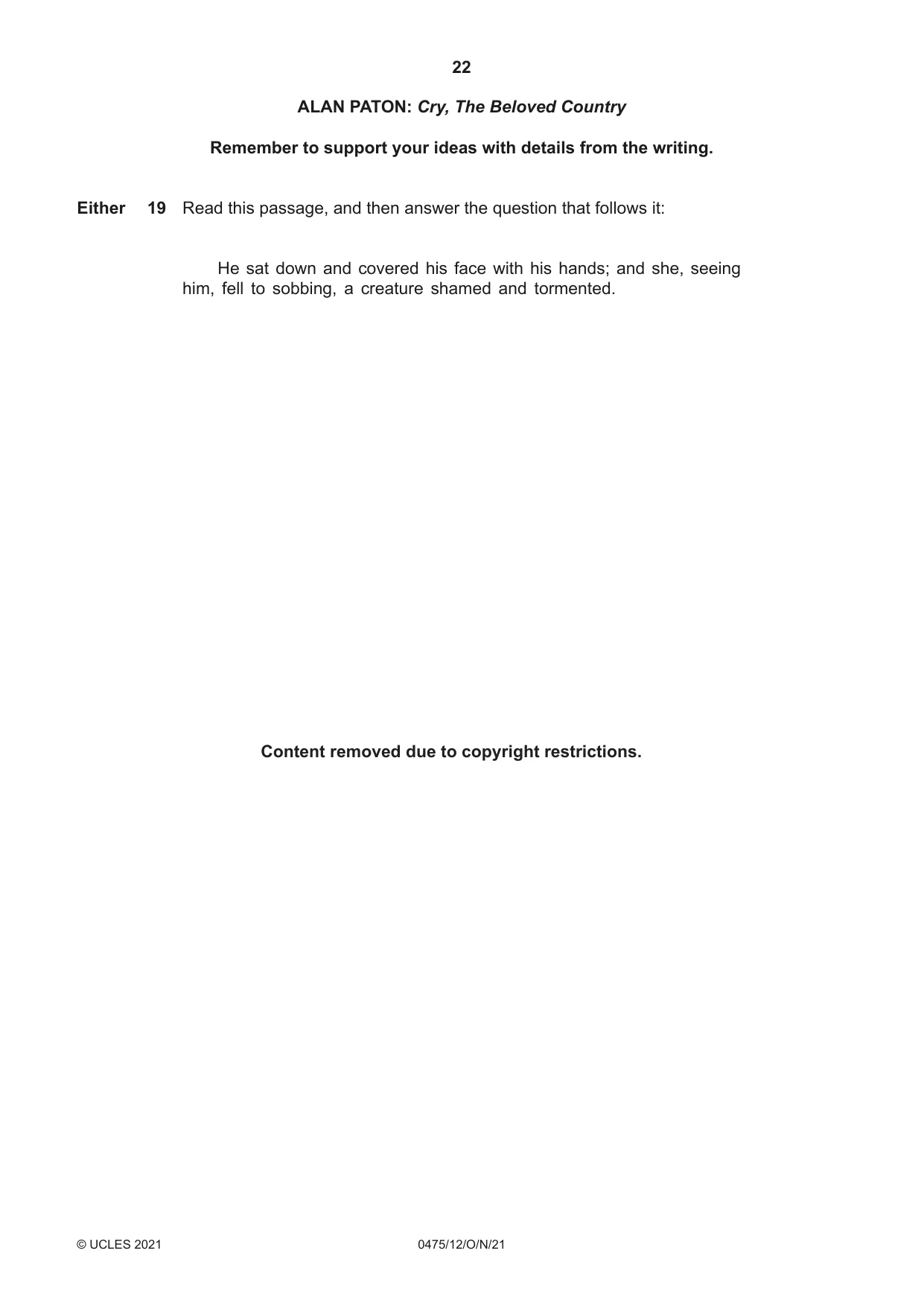
22 0475/12/O/N/21 © UCLES 2021 ALAN PATON: Cry, The Beloved Country Remember to support your ideas with details from the writing. Either 19 Read this passage, and then answer the question that follows it: He sat down and covered his face with his hands; and she, seeing him, fell to sobbing, a creature shamed and tormented. Content removed due to copyright restrictions.
Question paper, page 23
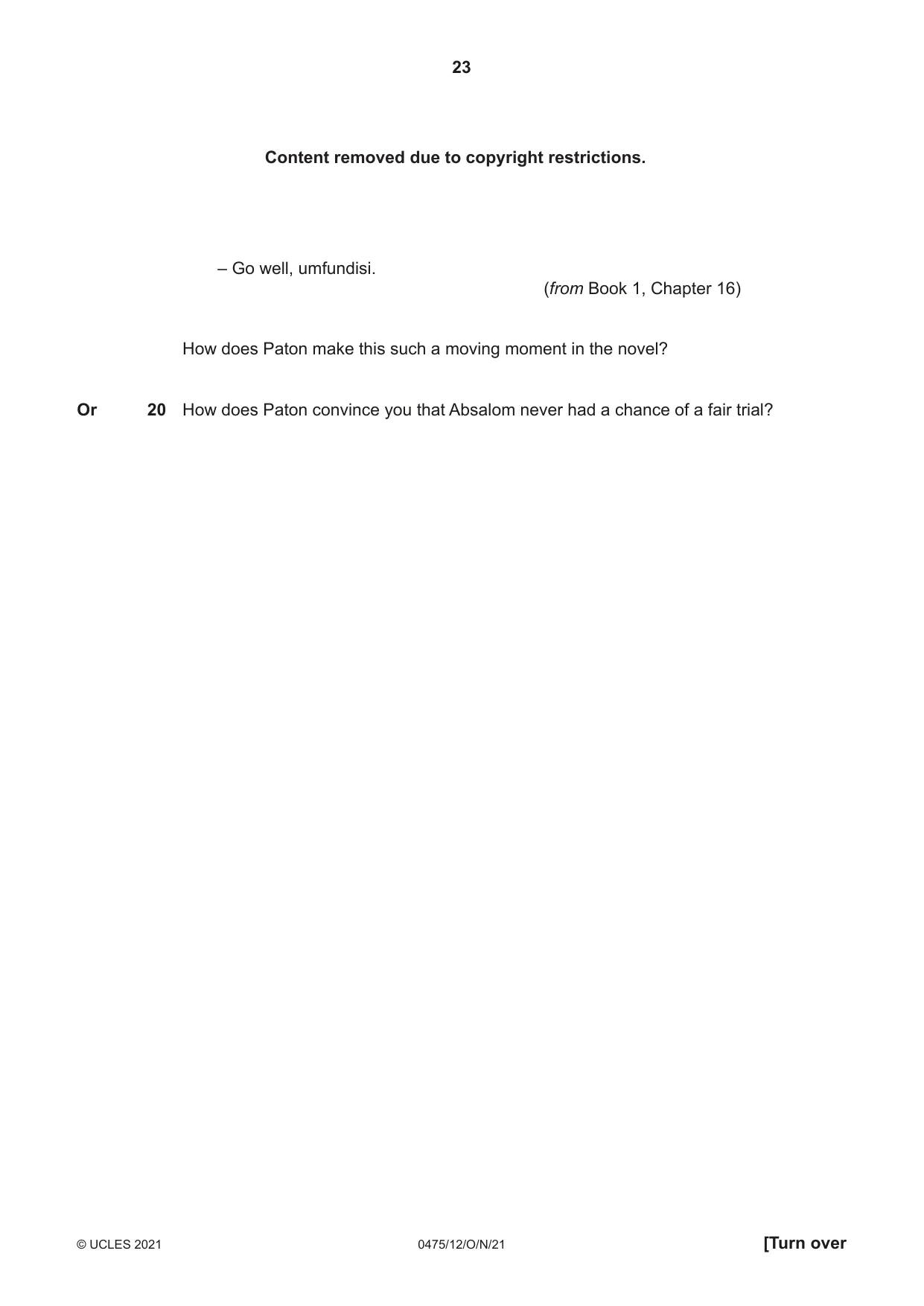
23 0475/12/O/N/21 © UCLES 2021 [Turn over – Go well, umfundisi. (from Book 1, Chapter 16) How does Paton make this such a moving moment in the novel? Or 20 How does Paton convince you that Absalom never had a chance of a fair trial? Content removed due to copyright restrictions.
Question paper, page 24
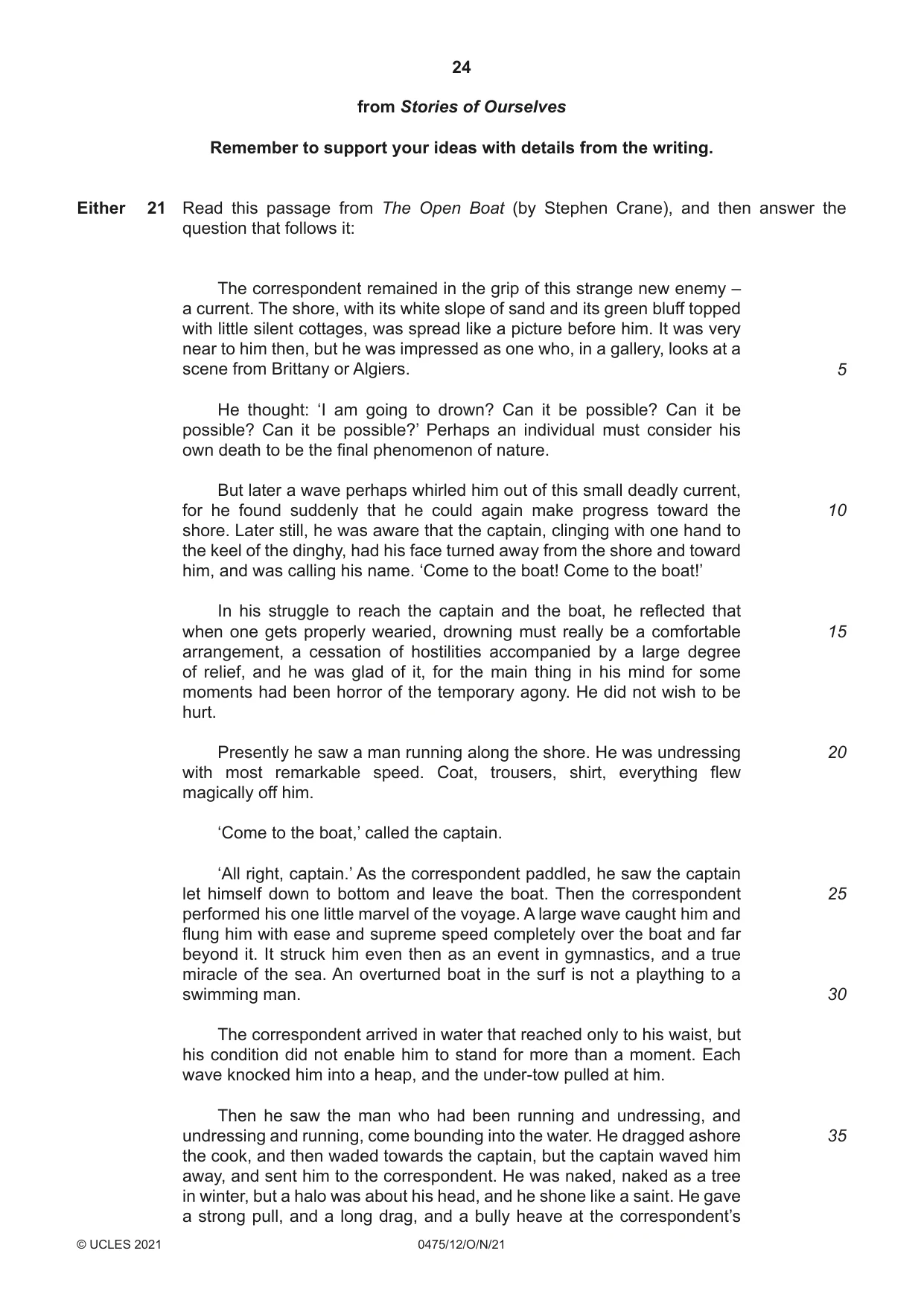
24 0475/12/O/N/21 © UCLES 2021 from Stories of Ourselves Remember to support your ideas with details from the writing. Either 21 Read this passage from The Open Boat (by Stephen Crane), and then answer the question that follows it: The correspondent remained in the grip of this strange new enemy – a current. The shore, with its white slope of sand and its green bluff topped with little silent cottages, was spread like a picture before him. It was very near to him then, but he was impressed as one who, in a gallery, looks at a scene from Brittany or Algiers. He thought: ‘I am going to drown? Can it be possible? Can it be possible? Can it be possible?’ Perhaps an individual must consider his own death to be the final phenomenon of nature. But later a wave perhaps whirled him out of this small deadly current, for he found suddenly that he could again make progress toward the shore. Later still, he was aware that the captain, clinging with one hand to the keel of the dinghy, had his face turned away from the shore and toward him, and was calling his name. ‘Come to the boat! Come to the boat!’ In his struggle to reach the captain and the boat, he reflected that when one gets properly wearied, drowning must really be a comfortable arrangement, a cessation of hostilities accompanied by a large degree of relief, and he was glad of it, for the main thing in his mind for some moments had been horror of the temporary agony. He did not wish to be hurt. Presently he saw a man running along the shore. He was undressing with most remarkable speed. Coat, trousers, shirt, everything flew magically off him. ‘Come to the boat,’ called the captain. ‘All right, captain.’ As the correspondent paddled, he saw the captain let himself down to bottom and leave the boat. Then the correspondent performed his one little marvel of the voyage. A large wave caught him and flung him with ease and supreme speed completely over the boat and far beyond it. It struck him even then as an event in gymnastics, and a true miracle of the sea. An overturned boat in the surf is not a plaything to a swimming man. The correspondent arrived in water that reached only to his waist, but his condition did not enable him to stand for more than a moment. Each wave knocked him into a heap, and the under-tow pulled at him. Then he saw the man who had been running and undressing, and undressing and running, come bounding into the water. He dragged ashore the cook, and then waded towards the captain, but the captain waved him away, and sent him to the correspondent. He was naked, naked as a tree in winter, but a halo was about his head, and he shone like a saint. He gave a strong pull, and a long drag, and a bully heave at the correspondent’s 5 10 15 20 25 30 35
Question paper, page 25
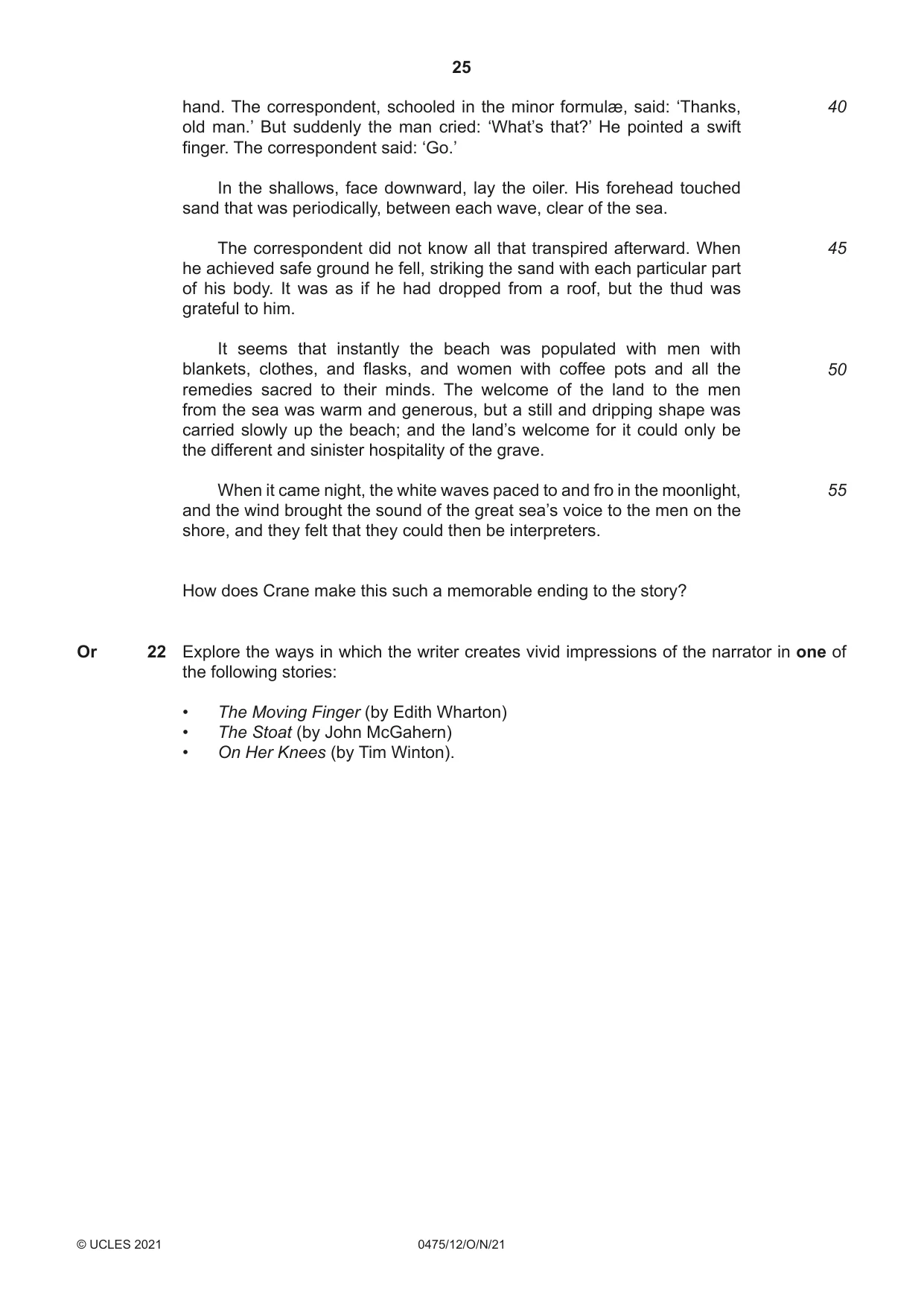
25 0475/12/O/N/21 © UCLES 2021 hand. The correspondent, schooled in the minor formulæ, said: ‘Thanks, old man.’ But suddenly the man cried: ‘What’s that?’ He pointed a swift finger. The correspondent said: ‘Go.’ In the shallows, face downward, lay the oiler. His forehead touched sand that was periodically, between each wave, clear of the sea. The correspondent did not know all that transpired afterward. When he achieved safe ground he fell, striking the sand with each particular part of his body. It was as if he had dropped from a roof, but the thud was grateful to him. It seems that instantly the beach was populated with men with blankets, clothes, and flasks, and women with coffee pots and all the remedies sacred to their minds. The welcome of the land to the men from the sea was warm and generous, but a still and dripping shape was carried slowly up the beach; and the land’s welcome for it could only be the different and sinister hospitality of the grave. When it came night, the white waves paced to and fro in the moonlight, and the wind brought the sound of the great sea’s voice to the men on the shore, and they felt that they could then be interpreters. How does Crane make this such a memorable ending to the story? Or 22 Explore the ways in which the writer creates vivid impressions of the narrator in one of the following stories: • The Moving Finger (by Edith Wharton) • The Stoat (by John McGahern) • On Her Knees (by Tim Winton). 40 45 50 55
Question paper, page 26
26 0475/12/O/N/21 © UCLES 2021 BLANK PAGE
Question paper, page 27
27 0475/12/O/N/21 © UCLES 2021 BLANK PAGE
Question paper, page 28
28 0475/12/O/N/21 © UCLES 2021 Permission to reproduce items where third-party owned material protected by copyright is included has been sought and cleared where possible. Every reasonable effort has been made by the publisher (UCLES) to trace copyright holders, but if any items requiring clearance have unwittingly been included, the publisher will be pleased to make amends at the earliest possible opportunity. To avoid the issue of disclosure of answer-related information to candidates, all copyright acknowledgements are reproduced online in the Cambridge Assessment International Education Copyright Acknowledgements Booklet. This is produced for each series of examinations and is freely available to download at www.cambridgeinternational.org after the live examination series. Cambridge Assessment International Education is part of the Cambridge Assessment Group. Cambridge Assessment is the brand name of the University of Cambridge Local Examinations Syndicate (UCLES), which itself is a department of the University of Cambridge. BLANK PAGE
Mark scheme, page 1
This document consists of 4 printed pages. © UCLES 2021 [Turn over Cambridge IGCSE™ LITERATURE IN ENGLISH 0475/12 Paper 1 Poetry and Prose 12 October/November 2021 MARK SCHEME Maximum Mark: 50 Published This mark scheme is published as an aid to teachers and candidates, to indicate the requirements of the examination. It shows the basis on which Examiners were instructed to award marks. It does not indicate the details of the discussions that took place at an Examiners’ meeting before marking began, which would have considered the acceptability of alternative answers. Mark schemes should be read in conjunction with the question paper and the Principal Examiner Report for Teachers. Cambridge International will not enter into discussions about these mark schemes. Cambridge International is publishing the mark schemes for the October/November 2021 series for most Cambridge IGCSE™, Cambridge International A and AS Level components and some Cambridge O Level components.
Mark scheme, page 2
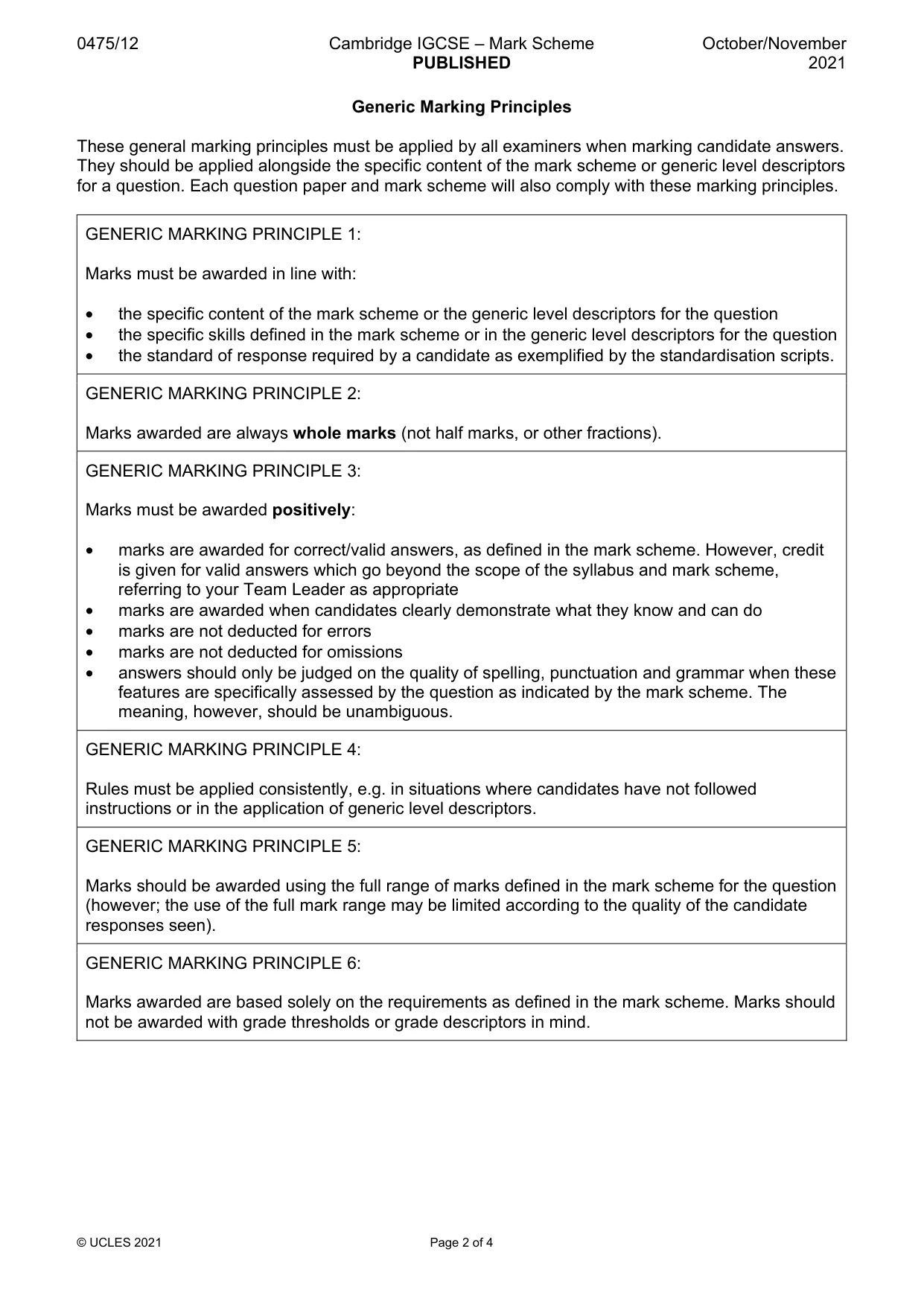
0475/12 Cambridge IGCSE – Mark Scheme PUBLISHED October/November 2021 © UCLES 2021 Page 2 of 4 Generic Marking Principles These general marking principles must be applied by all examiners when marking candidate answers. They should be applied alongside the specific content of the mark scheme or generic level descriptors for a question. Each question paper and mark scheme will also comply with these marking principles. GENERIC MARKING PRINCIPLE 1: Marks must be awarded in line with: • the specific content of the mark scheme or the generic level descriptors for the question • the specific skills defined in the mark scheme or in the generic level descriptors for the question • the standard of response required by a candidate as exemplified by the standardisation scripts. GENERIC MARKING PRINCIPLE 2: Marks awarded are always whole marks (not half marks, or other fractions). GENERIC MARKING PRINCIPLE 3: Marks must be awarded positively: • marks are awarded for correct/valid answers, as defined in the mark scheme. However, credit is given for valid answers which go beyond the scope of the syllabus and mark scheme, referring to your Team Leader as appropriate • marks are awarded when candidates clearly demonstrate what they know and can do • marks are not deducted for errors • marks are not deducted for omissions • answers should only be judged on the quality of spelling, punctuation and grammar when these features are specifically assessed by the question as indicated by the mark scheme. The meaning, however, should be unambiguous. GENERIC MARKING PRINCIPLE 4: Rules must be applied consistently, e.g. in situations where candidates have not followed instructions or in the application of generic level descriptors. GENERIC MARKING PRINCIPLE 5: Marks should be awarded using the full range of marks defined in the mark scheme for the question (however; the use of the full mark range may be limited according to the quality of the candidate responses seen). GENERIC MARKING PRINCIPLE 6: Marks awarded are based solely on the requirements as defined in the mark scheme. Marks should not be awarded with grade thresholds or grade descriptors in mind.
Mark scheme, page 3
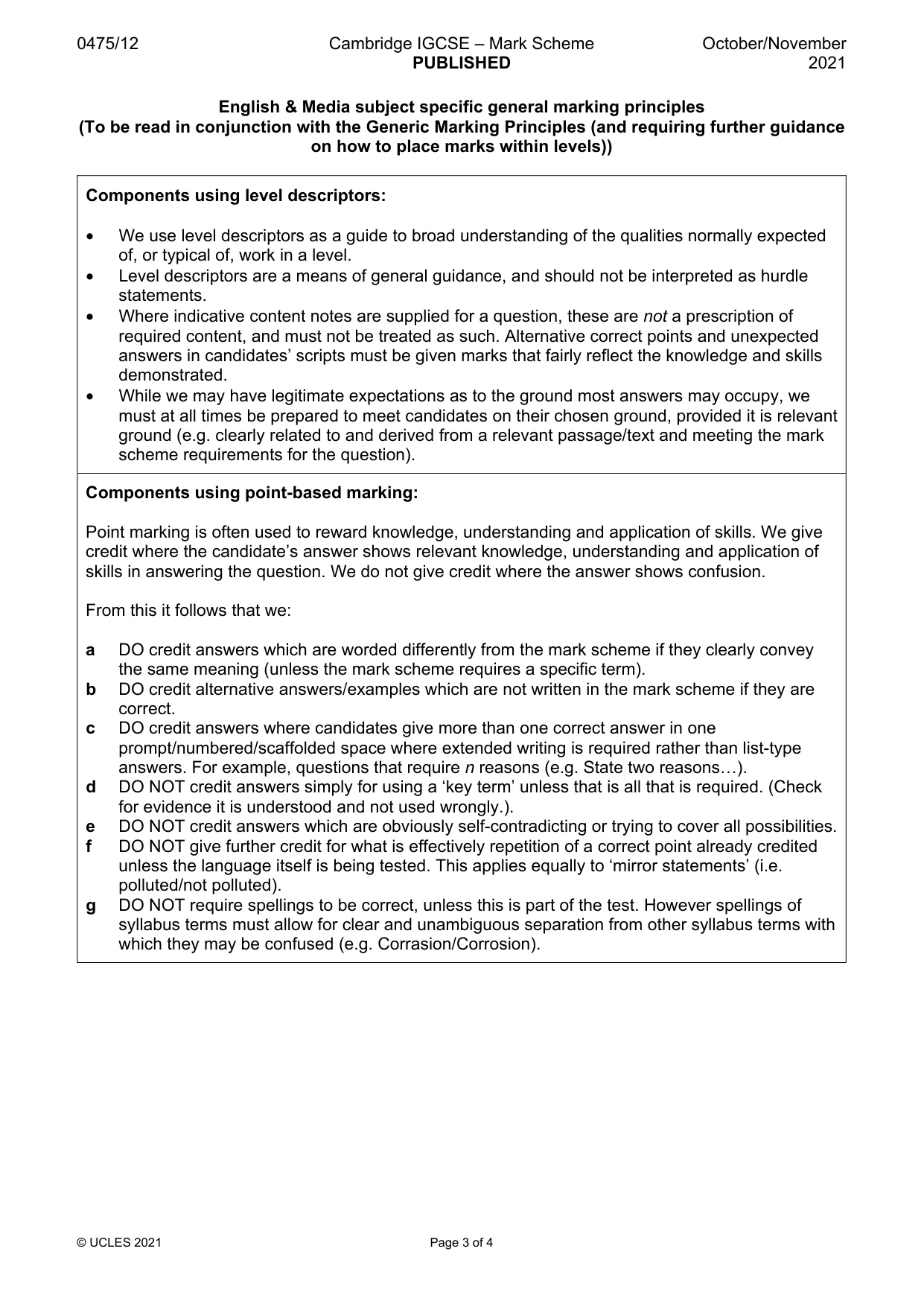
0475/12 Cambridge IGCSE – Mark Scheme PUBLISHED October/November 2021 © UCLES 2021 Page 3 of 4 English & Media subject specific general marking principles (To be read in conjunction with the Generic Marking Principles (and requiring further guidance on how to place marks within levels)) Components using level descriptors: • We use level descriptors as a guide to broad understanding of the qualities normally expected of, or typical of, work in a level. • Level descriptors are a means of general guidance, and should not be interpreted as hurdle statements. • Where indicative content notes are supplied for a question, these are not a prescription of required content, and must not be treated as such. Alternative correct points and unexpected answers in candidates’ scripts must be given marks that fairly reflect the knowledge and skills demonstrated. • While we may have legitimate expectations as to the ground most answers may occupy, we must at all times be prepared to meet candidates on their chosen ground, provided it is relevant ground (e.g. clearly related to and derived from a relevant passage/text and meeting the mark scheme requirements for the question). Components using point-based marking: Point marking is often used to reward knowledge, understanding and application of skills. We give credit where the candidate’s answer shows relevant knowledge, understanding and application of skills in answering the question. We do not give credit where the answer shows confusion. From this it follows that we: a DO credit answers which are worded differently from the mark scheme if they clearly convey the same meaning (unless the mark scheme requires a specific term). b DO credit alternative answers/examples which are not written in the mark scheme if they are correct. c DO credit answers where candidates give more than one correct answer in one prompt/numbered/scaffolded space where extended writing is required rather than list-type answers. For example, questions that require n reasons (e.g. State two reasons…). d DO NOT credit answers simply for using a ‘key term’ unless that is all that is required. (Check for evidence it is understood and not used wrongly.). e DO NOT credit answers which are obviously self-contradicting or trying to cover all possibilities. f DO NOT give further credit for what is effectively repetition of a correct point already credited unless the language itself is being tested. This applies equally to ‘mirror statements’ (i.e. polluted/not polluted). g DO NOT require spellings to be correct, unless this is part of the test. However spellings of syllabus terms must allow for clear and unambiguous separation from other syllabus terms with which they may be confused (e.g. Corrasion/Corrosion).
Mark scheme, page 4
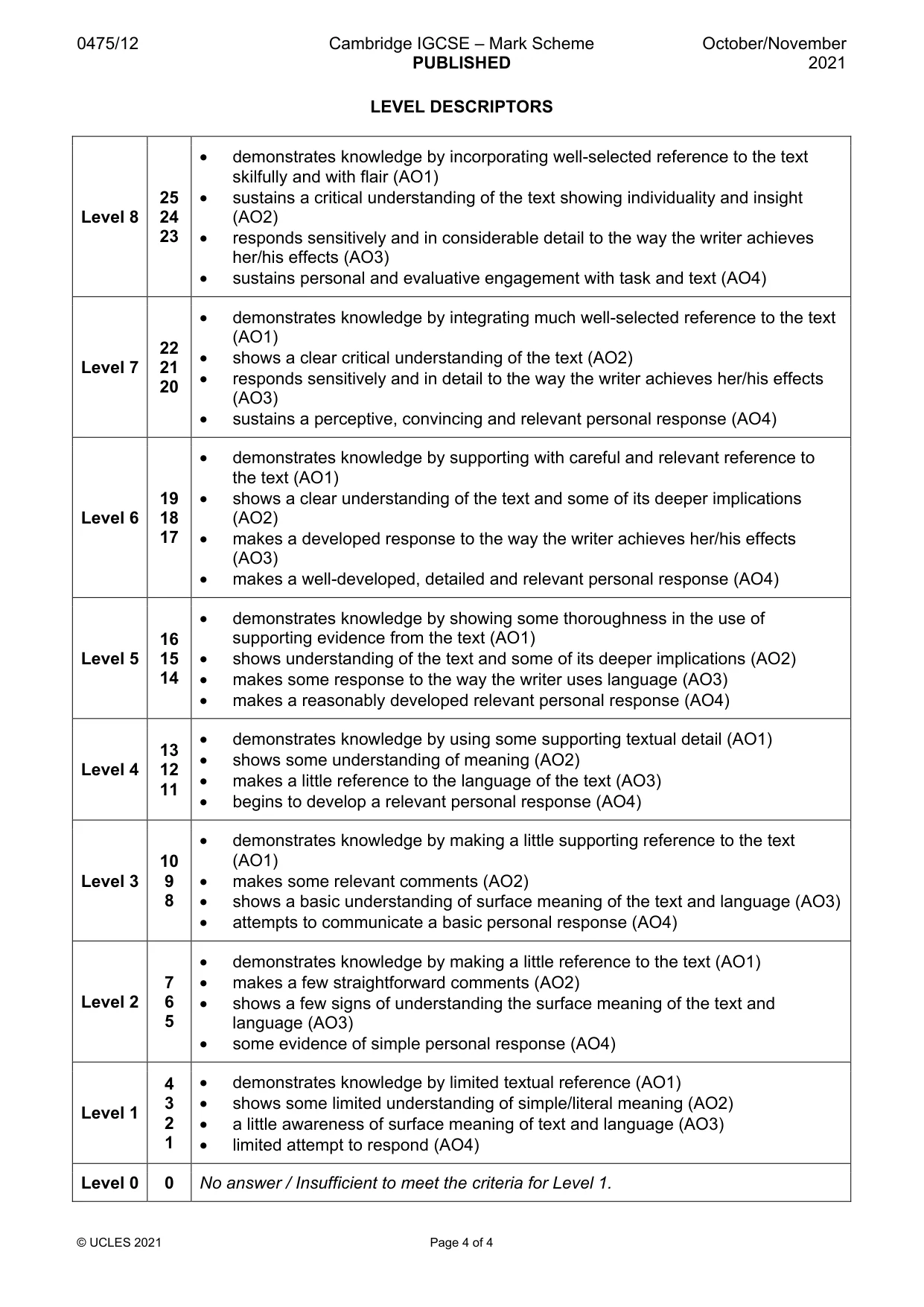
0475/12 Cambridge IGCSE – Mark Scheme PUBLISHED October/November 2021 © UCLES 2021 Page 4 of 4 LEVEL DESCRIPTORS Level 8 25 24 23 • demonstrates knowledge by incorporating well-selected reference to the text skilfully and with flair (AO1) • sustains a critical understanding of the text showing individuality and insight (AO2) • responds sensitively and in considerable detail to the way the writer achieves her/his effects (AO3) • sustains personal and evaluative engagement with task and text (AO4) Level 7 22 21 20 • demonstrates knowledge by integrating much well-selected reference to the text (AO1) • shows a clear critical understanding of the text (AO2) • responds sensitively and in detail to the way the writer achieves her/his effects (AO3) • sustains a perceptive, convincing and relevant personal response (AO4) Level 6 19 18 17 • demonstrates knowledge by supporting with careful and relevant reference to the text (AO1) • shows a clear understanding of the text and some of its deeper implications (AO2) • makes a developed response to the way the writer achieves her/his effects (AO3) • makes a well-developed, detailed and relevant personal response (AO4) Level 5 16 15 14 • demonstrates knowledge by showing some thoroughness in the use of supporting evidence from the text (AO1) • shows understanding of the text and some of its deeper implications (AO2) • makes some response to the way the writer uses language (AO3) • makes a reasonably developed relevant personal response (AO4) Level 4 13 12 11 • demonstrates knowledge by using some supporting textual detail (AO1) • shows some understanding of meaning (AO2) • makes a little reference to the language of the text (AO3) • begins to develop a relevant personal response (AO4) Level 3 10 9 8 • demonstrates knowledge by making a little supporting reference to the text (AO1) • makes some relevant comments (AO2) • shows a basic understanding of surface meaning of the text and language (AO3) • attempts to communicate a basic personal response (AO4) Level 2 7 6 5 • demonstrates knowledge by making a little reference to the text (AO1) • makes a few straightforward comments (AO2) • shows a few signs of understanding the surface meaning of the text and language (AO3) • some evidence of simple personal response (AO4) Level 1 4 3 2 1 • demonstrates knowledge by limited textual reference (AO1) • shows some limited understanding of simple/literal meaning (AO2) • a little awareness of surface meaning of text and language (AO3) • limited attempt to respond (AO4) Level 0 0 No answer / Insufficient to meet the criteria for Level 1.
What you needed in this session
Cambridge’s own grade thresholds for 2021 Oct/Nov, Paper 1 · Variant 2. A higher threshold means an easier paper — the bar moves with how the cohort did.