Cambridge IGCSE English - Literature in English 0475 — 2020 Oct/Nov Paper 1 · Variant 3
0475/13/O/N/20 · 50 marks · ≈56 min
The question paper and its mark scheme, free to read here and free to download. This is Cambridge’s own paper, exactly as it was sat.
Question paper28 pages






Mark scheme5 pages
Answers below. Sit the paper first if you are practising.
Paper as text
Question paper, page 1
Cambridge IGCSE™ DC (RCL/GO) 185447/2 © UCLES 2020 [Turn over This document has 28 pages. Blank pages are indicated. LITERATURE IN ENGLISH 0475/13 Paper 1 Poetry and Prose October/November 2020 1 hour 30 minutes You must answer on the enclosed answer booklet. You will need: Answer booklet (enclosed) INSTRUCTIONS ● Answer two questions in total: Section A: answer one question. Section B: answer one question. ● Follow the instructions on the front cover of the answer booklet. If you need additional answer paper, ask the invigilator for a continuation booklet. INFORMATION ● The total mark for this paper is 50. ● All questions are worth equal marks. * 2 3 4 2 8 4 6 7 3 4 * Cambridge IGCSE™
Question paper, page 2
2 0475/13/O/N/20 © UCLES 2020 BLANK PAGE
Question paper, page 3
3 0475/13/O/N/20 © UCLES 2020 [Turn over CONTENTS Section A: Poetry text question numbers page[s] Songs of Ourselves Volume 1: from Part 3 1, 2 pages 4–5 Songs of Ourselves Volume 2 : from Part 2 3, 4 pages 6–7 Carol Ann Duffy: from New Selected Poems 5, 6 pages 8–9 Section B: Prose text question numbers page[s] Charlotte Brontë: Jane Eyre 7, 8 pages 10–11 Anita Desai: In Custody 9, 10 pages 12–13 Charles Dickens: Hard Times 11, 12 pages 14–15 Zora Neale Hurston: Their Eyes Were Watching God 13, 14 pages 16–17 John Knowles: A Separate Peace 15, 16 pages 18–19 George Orwell: 1984 17, 18 pages 20–21 Alan Paton: Cry, the Beloved Country 19, 20 pages 22–23 from Stories of Ourselves 21, 22 pages 24–25
Question paper, page 4
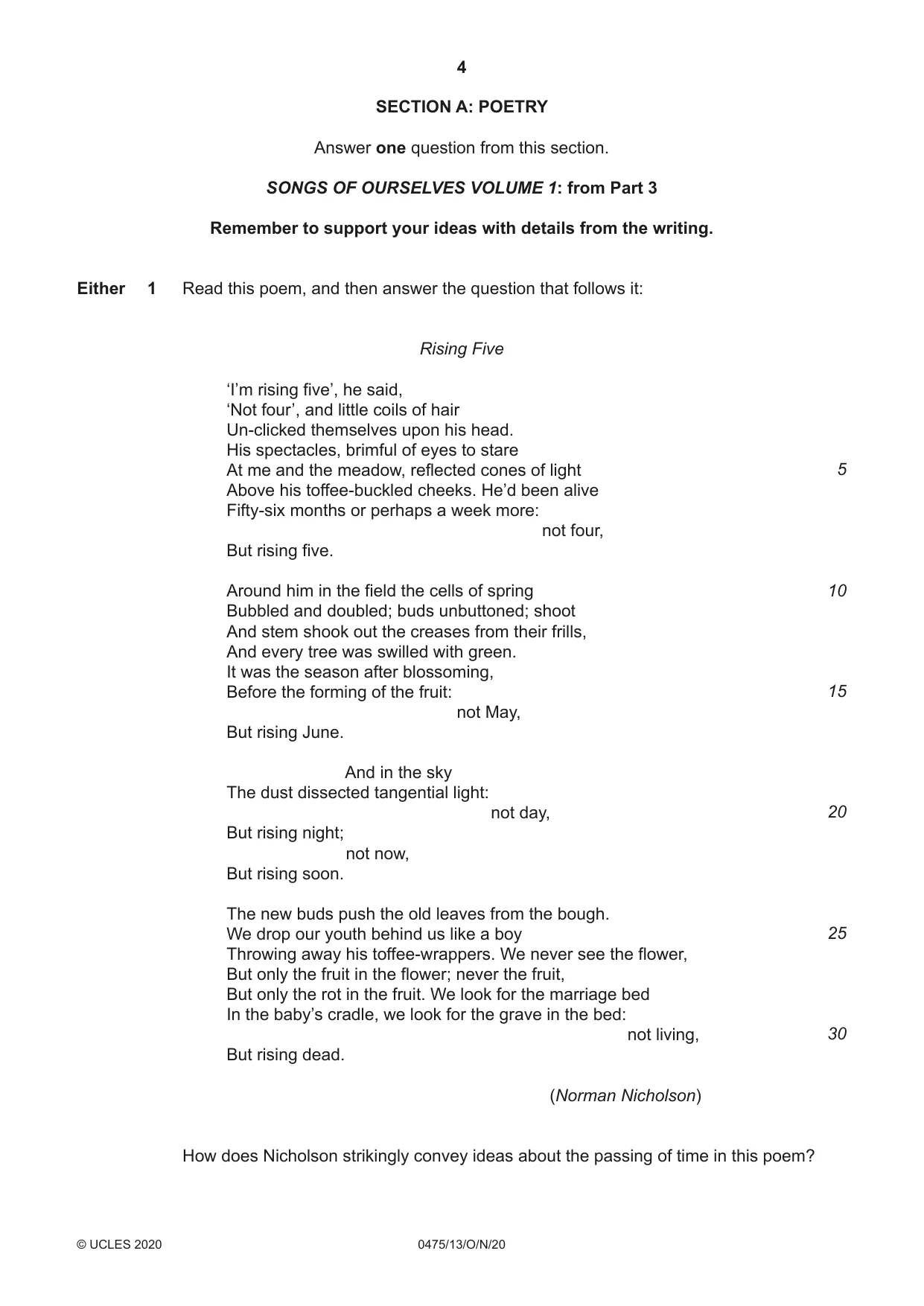
4 0475/13/O/N/20 © UCLES 2020 SECTION A: POETRY Answer one question from this section. SONGS OF OURSELVES VOLUME 1: from Part 3 Remember to support your ideas with details from the writing. Either 1 Read this poem, and then answer the question that follows it: Rising Five ‘I’m rising five’, he said, ‘Not four’, and little coils of hair Un-clicked themselves upon his head. His spectacles, brimful of eyes to stare At me and the meadow, reflected cones of light Above his toffee-buckled cheeks. He’d been alive Fifty-six months or perhaps a week more: not four, But rising five. Around him in the field the cells of spring Bubbled and doubled; buds unbuttoned; shoot And stem shook out the creases from their frills, And every tree was swilled with green. It was the season after blossoming, Before the forming of the fruit: not May, But rising June. And in the sky The dust dissected tangential light: not day, But rising night; not now, But rising soon. The new buds push the old leaves from the bough. We drop our youth behind us like a boy Throwing away his toffee-wrappers. We never see the flower, But only the fruit in the flower; never the fruit, But only the rot in the fruit. We look for the marriage bed In the baby’s cradle, we look for the grave in the bed: not living, But rising dead. (Norman Nicholson) How does Nicholson strikingly convey ideas about the passing of time in this poem? 5 10 15 20 25 30
Question paper, page 5
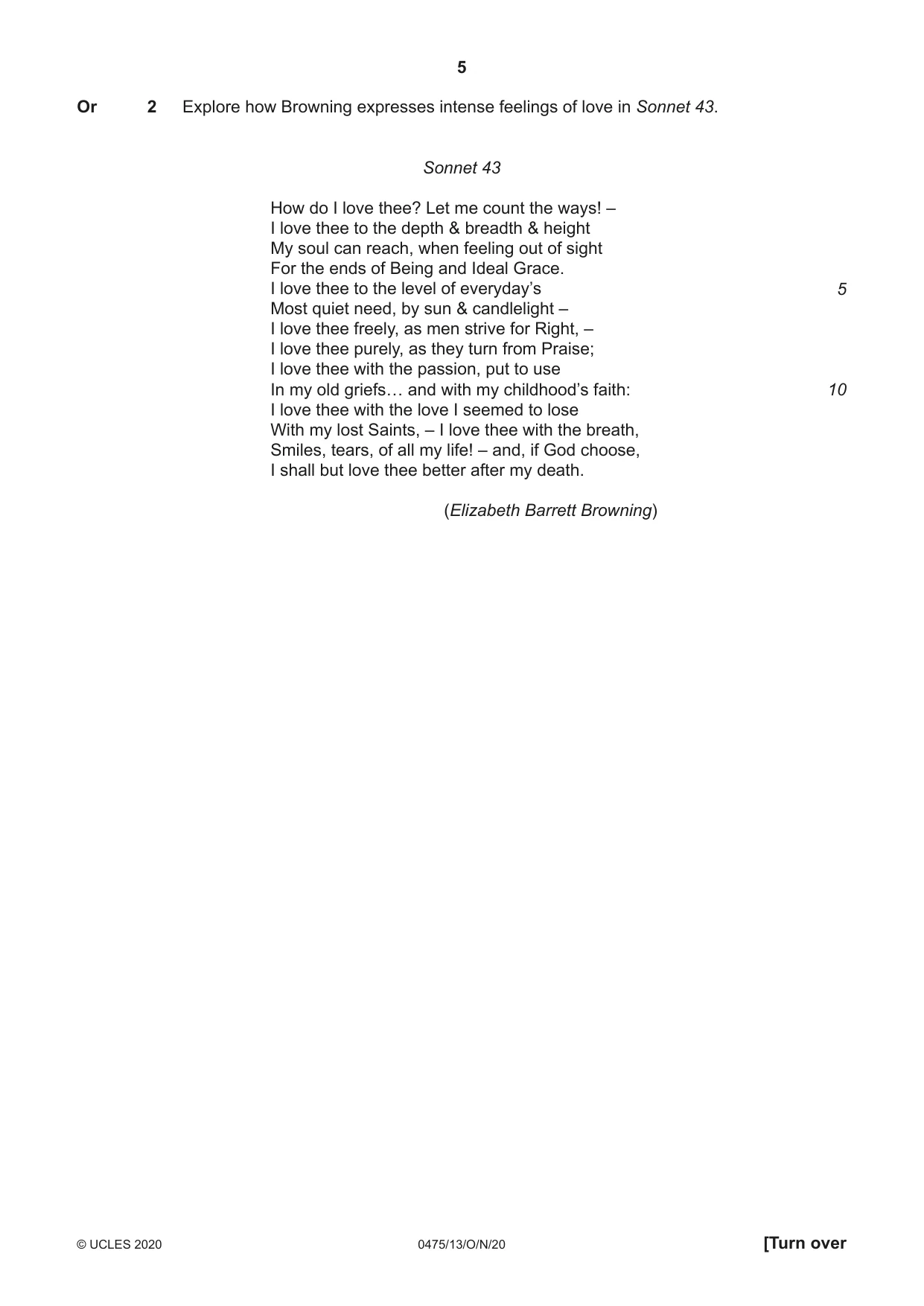
5 0475/13/O/N/20 © UCLES 2020 [Turn over Or 2 Explore how Browning expresses intense feelings of love in Sonnet 43. Sonnet 43 How do I love thee? Let me count the ways! – I love thee to the depth & breadth & height My soul can reach, when feeling out of sight For the ends of Being and Ideal Grace. I love thee to the level of everyday’s Most quiet need, by sun & candlelight – I love thee freely, as men strive for Right, – I love thee purely, as they turn from Praise; I love thee with the passion, put to use In my old griefs… and with my childhood’s faith: I love thee with the love I seemed to lose With my lost Saints, – I love thee with the breath, Smiles, tears, of all my life! – and, if God choose, I shall but love thee better after my death. (Elizabeth Barrett Browning) 5 10
Question paper, page 6
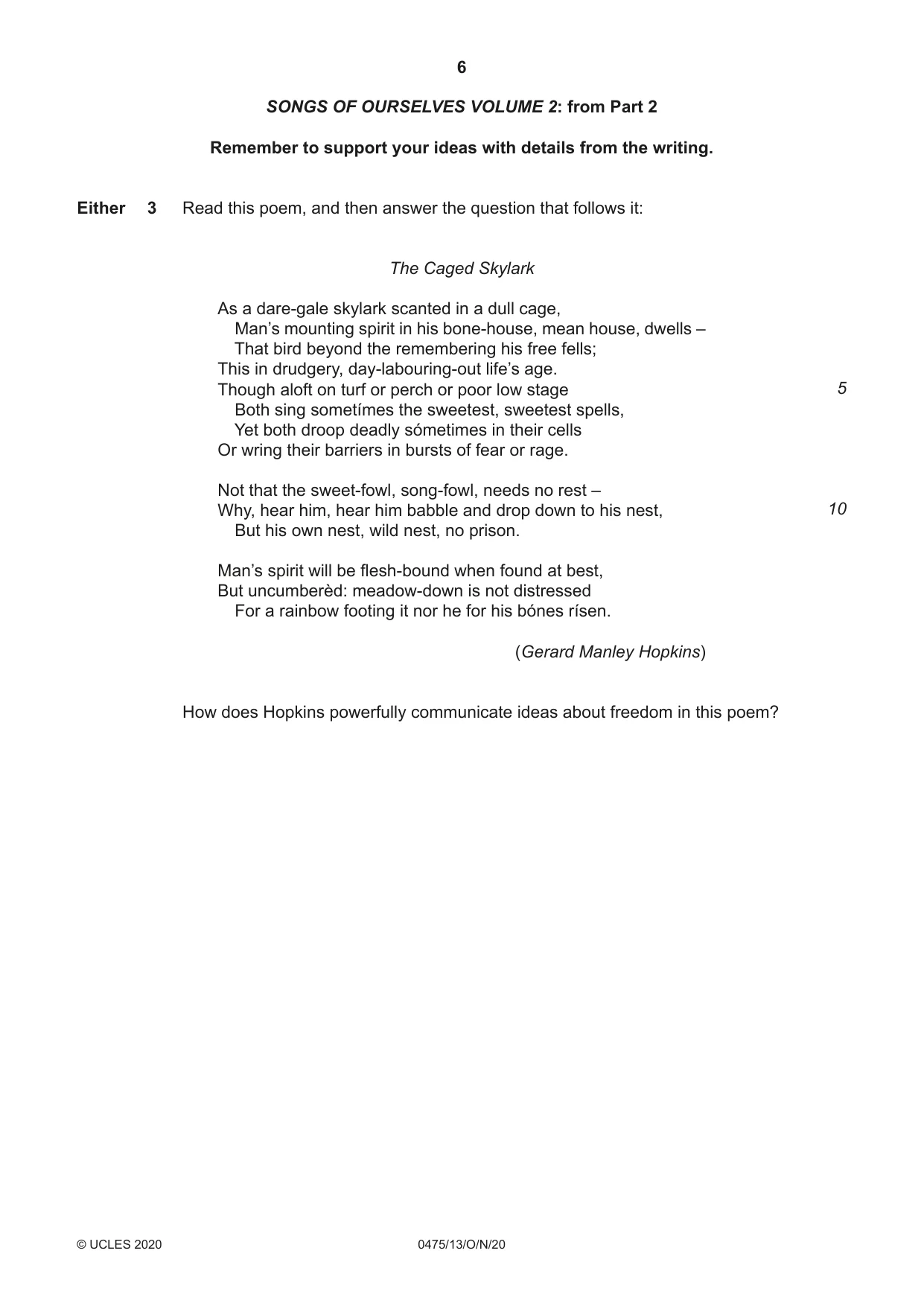
6 0475/13/O/N/20 © UCLES 2020 SONGS OF OURSELVES VOLUME 2: from Part 2 Remember to support your ideas with details from the writing. Either 3 Read this poem, and then answer the question that follows it: The Caged Skylark As a dare-gale skylark scanted in a dull cage, Man’s mounting spirit in his bone-house, mean house, dwells – That bird beyond the remembering his free fells; This in drudgery, day-labouring-out life’s age. Though aloft on turf or perch or poor low stage Both sing sometímes the sweetest, sweetest spells, Yet both droop deadly sómetimes in their cells Or wring their barriers in bursts of fear or rage. Not that the sweet-fowl, song-fowl, needs no rest – Why, hear him, hear him babble and drop down to his nest, But his own nest, wild nest, no prison. Man’s spirit will be flesh-bound when found at best, But uncumberèd: meadow-down is not distressed For a rainbow footing it nor he for his bónes rísen. (Gerard Manley Hopkins) How does Hopkins powerfully communicate ideas about freedom in this poem? 5 10
Question paper, page 7
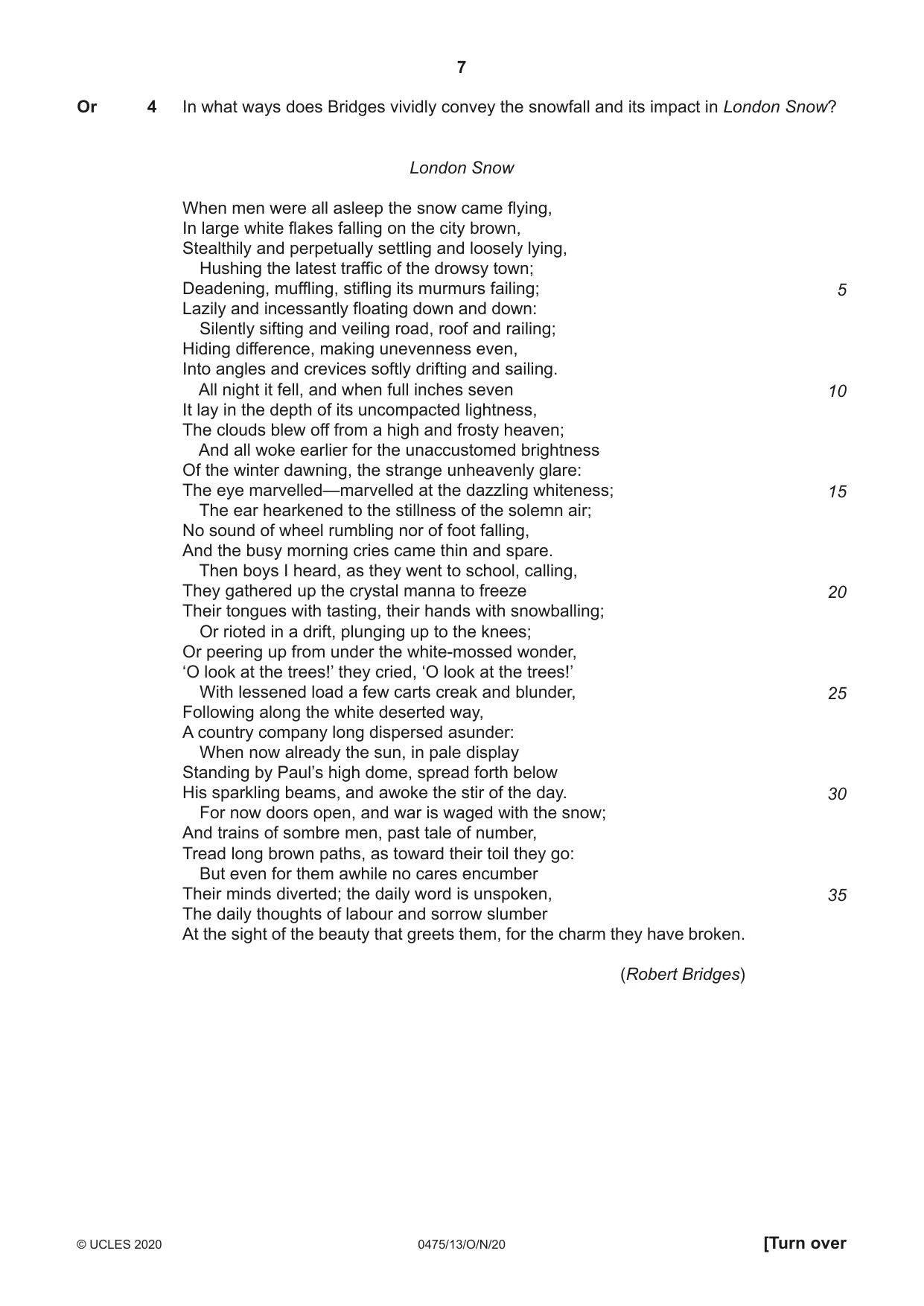
7 0475/13/O/N/20 © UCLES 2020 [Turn over Or 4 In what ways does Bridges vividly convey the snowfall and its impact in London Snow? London Snow When men were all asleep the snow came flying, In large white flakes falling on the city brown, Stealthily and perpetually settling and loosely lying, Hushing the latest traffic of the drowsy town; Deadening, muffling, stifling its murmurs failing; Lazily and incessantly floating down and down: Silently sifting and veiling road, roof and railing; Hiding difference, making unevenness even, Into angles and crevices softly drifting and sailing. All night it fell, and when full inches seven It lay in the depth of its uncompacted lightness, The clouds blew off from a high and frosty heaven; And all woke earlier for the unaccustomed brightness Of the winter dawning, the strange unheavenly glare: The eye marvelled—marvelled at the dazzling whiteness; The ear hearkened to the stillness of the solemn air; No sound of wheel rumbling nor of foot falling, And the busy morning cries came thin and spare. Then boys I heard, as they went to school, calling, They gathered up the crystal manna to freeze Their tongues with tasting, their hands with snowballing; Or rioted in a drift, plunging up to the knees; Or peering up from under the white-mossed wonder, ‘O look at the trees!’ they cried, ‘O look at the trees!’ With lessened load a few carts creak and blunder, Following along the white deserted way, A country company long dispersed asunder: When now already the sun, in pale display Standing by Paul’s high dome, spread forth below His sparkling beams, and awoke the stir of the day. For now doors open, and war is waged with the snow; And trains of sombre men, past tale of number, Tread long brown paths, as toward their toil they go: But even for them awhile no cares encumber Their minds diverted; the daily word is unspoken, The daily thoughts of labour and sorrow slumber At the sight of the beauty that greets them, for the charm they have broken. (Robert Bridges) 5 10 15 20 25 30 35
Question paper, page 8
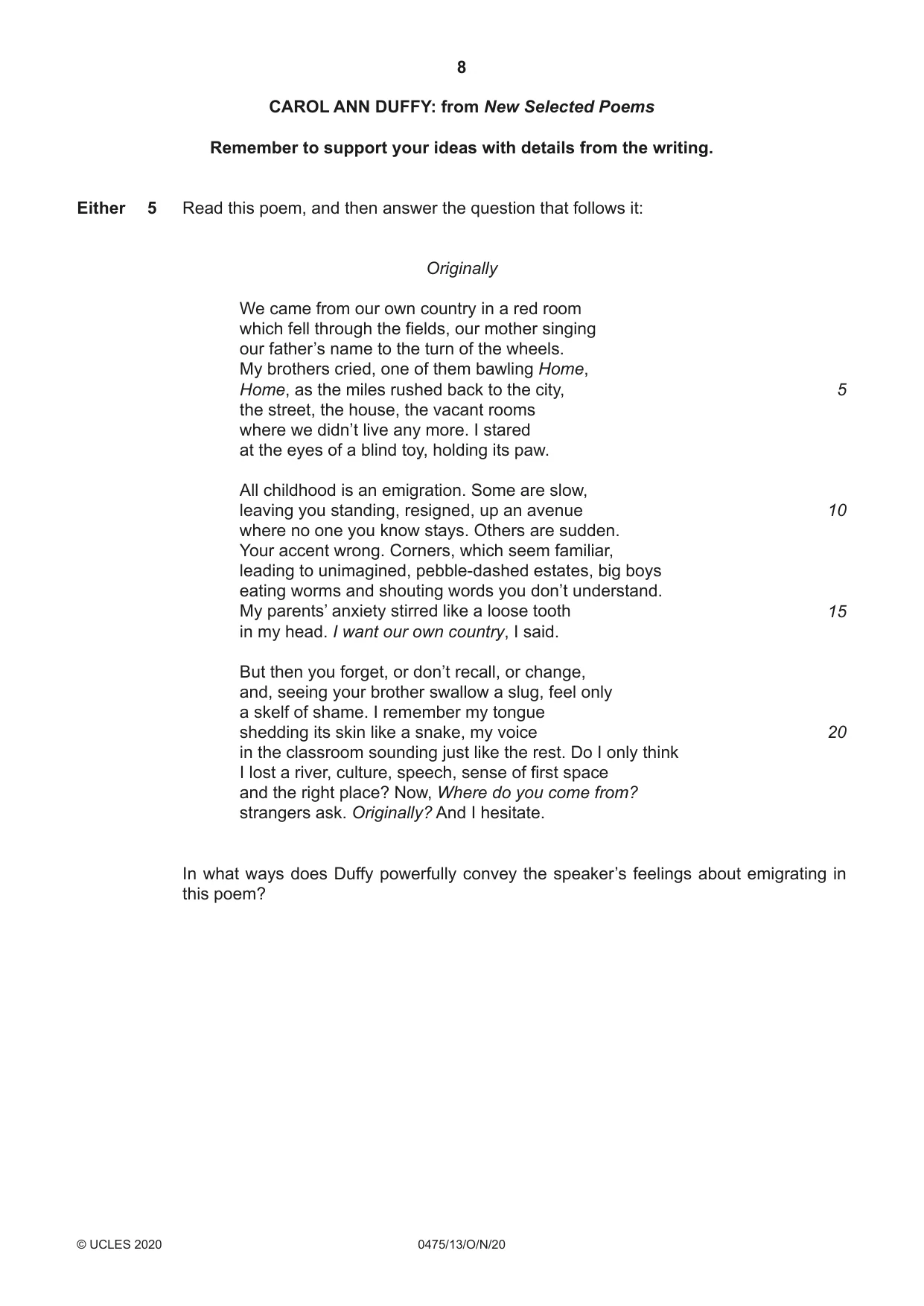
8 0475/13/O/N/20 © UCLES 2020 CAROL ANN DUFFY: from New Selected Poems Remember to support your ideas with details from the writing. Either 5 Read this poem, and then answer the question that follows it: Originally We came from our own country in a red room which fell through the fields, our mother singing our father’s name to the turn of the wheels. My brothers cried, one of them bawling Home, Home, as the miles rushed back to the city, the street, the house, the vacant rooms where we didn’t live any more. I stared at the eyes of a blind toy, holding its paw. All childhood is an emigration. Some are slow, leaving you standing, resigned, up an avenue where no one you know stays. Others are sudden. Your accent wrong. Corners, which seem familiar, leading to unimagined, pebble-dashed estates, big boys eating worms and shouting words you don’t understand. My parents’ anxiety stirred like a loose tooth in my head. I want our own country, I said. But then you forget, or don’t recall, or change, and, seeing your brother swallow a slug, feel only a skelf of shame. I remember my tongue shedding its skin like a snake, my voice in the classroom sounding just like the rest. Do I only think I lost a river, culture, speech, sense of first space and the right place? Now, Where do you come from? strangers ask. Originally? And I hesitate. In what ways does Duffy powerfully convey the speaker’s feelings about emigrating in this poem? 5 10 15 20
Question paper, page 9
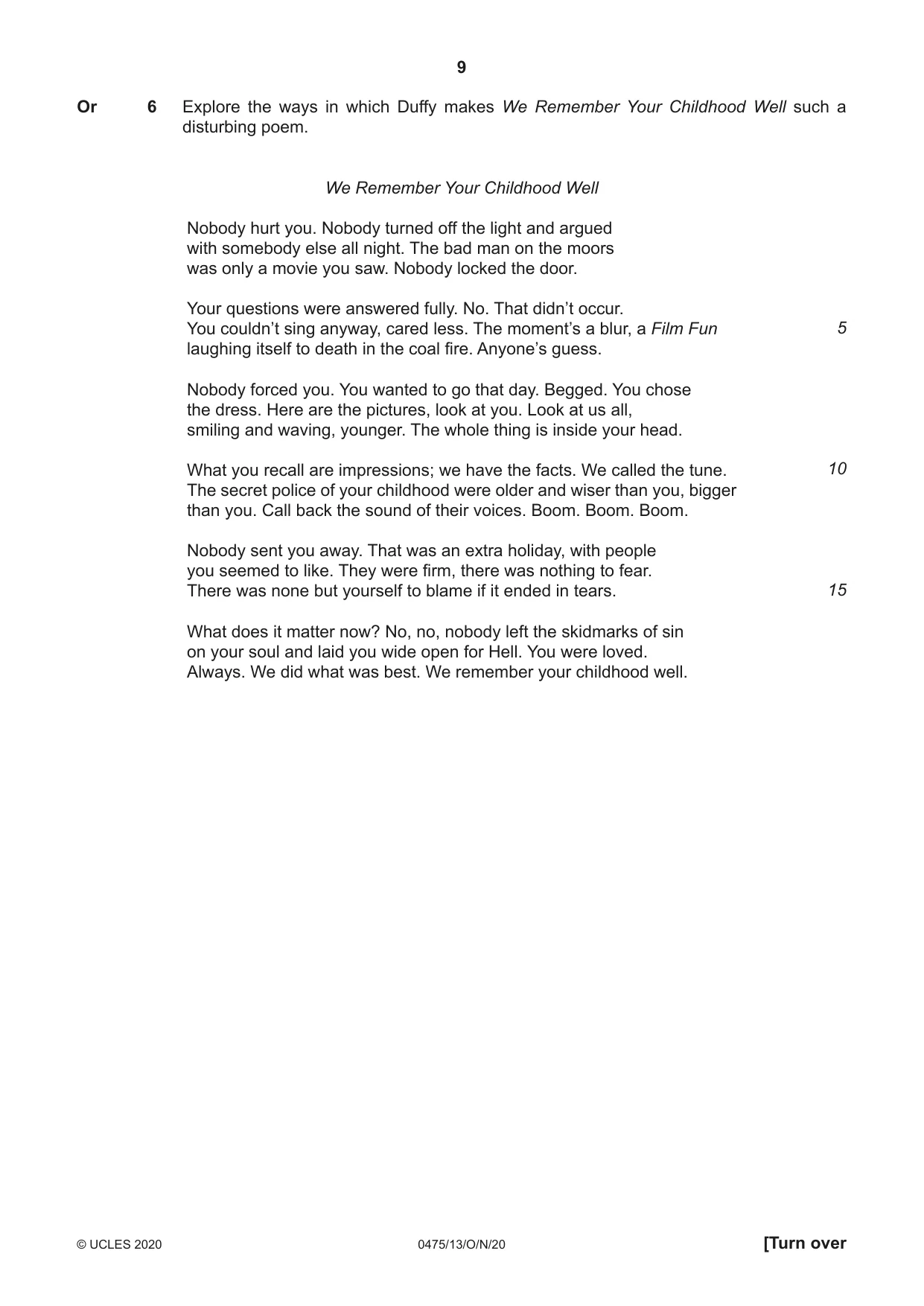
9 0475/13/O/N/20 © UCLES 2020 [Turn over Or 6 Explore the ways in which Duffy makes We Remember Your Childhood Well such a disturbing poem. We Remember Your Childhood Well Nobody hurt you. Nobody turned off the light and argued with somebody else all night. The bad man on the moors was only a movie you saw. Nobody locked the door. Your questions were answered fully. No. That didn’t occur. You couldn’t sing anyway, cared less. The moment’s a blur, a Film Fun laughing itself to death in the coal fire. Anyone’s guess. Nobody forced you. You wanted to go that day. Begged. You chose the dress. Here are the pictures, look at you. Look at us all, smiling and waving, younger. The whole thing is inside your head. What you recall are impressions; we have the facts. We called the tune. The secret police of your childhood were older and wiser than you, bigger than you. Call back the sound of their voices. Boom. Boom. Boom. Nobody sent you away. That was an extra holiday, with people you seemed to like. They were firm, there was nothing to fear. There was none but yourself to blame if it ended in tears. What does it matter now? No, no, nobody left the skidmarks of sin on your soul and laid you wide open for Hell. You were loved. Always. We did what was best. We remember your childhood well. 5 10 15
Question paper, page 10
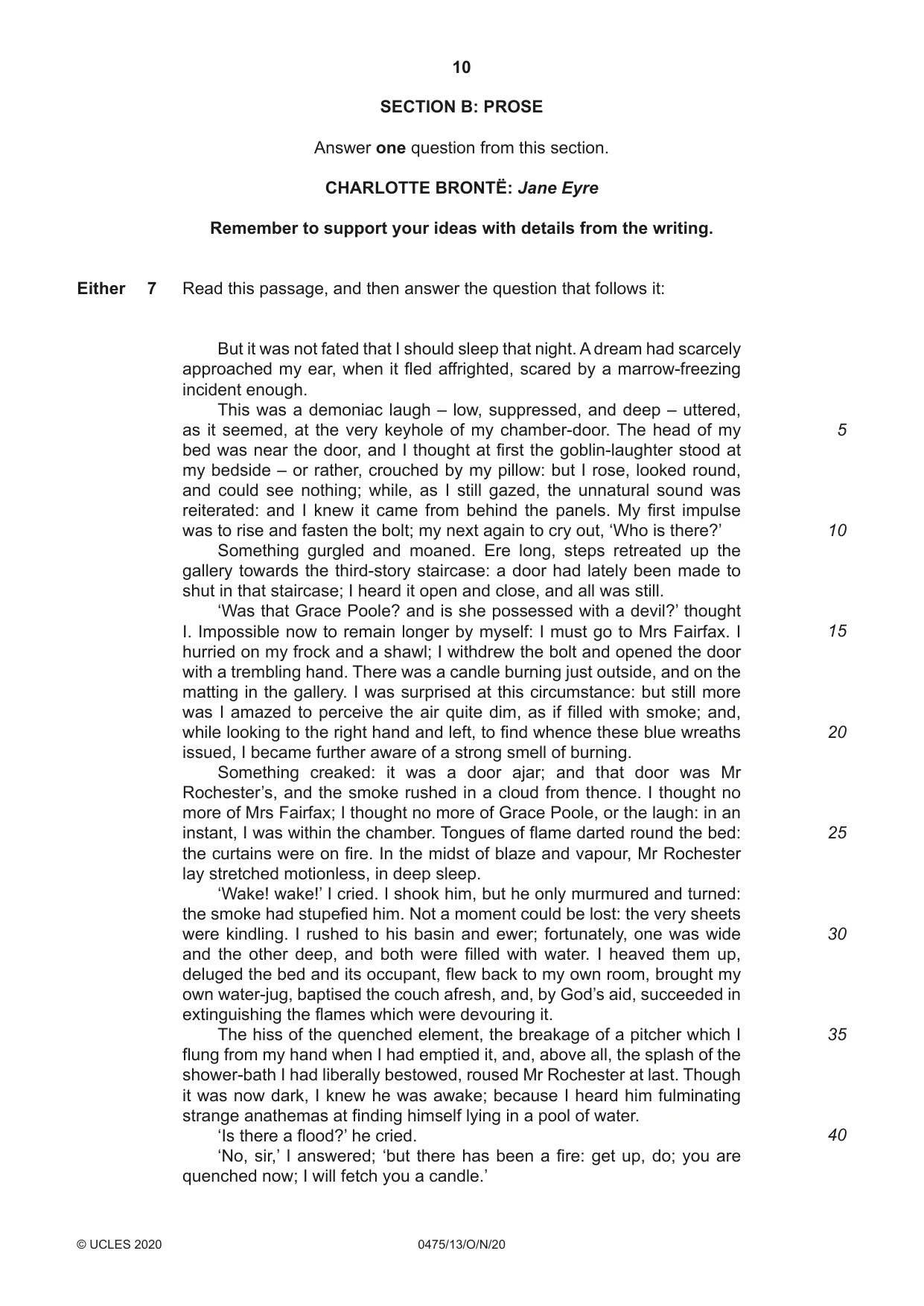
10 0475/13/O/N/20 © UCLES 2020 SECTION B: PROSE Answer one question from this section. CHARLOTTE BRONTË: Jane Eyre Remember to support your ideas with details from the writing. Either 7 Read this passage, and then answer the question that follows it: But it was not fated that I should sleep that night. A dream had scarcely approached my ear, when it fled affrighted, scared by a marrow-freezing incident enough. This was a demoniac laugh – low, suppressed, and deep – uttered, as it seemed, at the very keyhole of my chamber-door. The head of my bed was near the door, and I thought at first the goblin-laughter stood at my bedside – or rather, crouched by my pillow: but I rose, looked round, and could see nothing; while, as I still gazed, the unnatural sound was reiterated: and I knew it came from behind the panels. My first impulse was to rise and fasten the bolt; my next again to cry out, ‘Who is there?’ Something gurgled and moaned. Ere long, steps retreated up the gallery towards the third-story staircase: a door had lately been made to shut in that staircase; I heard it open and close, and all was still. ‘Was that Grace Poole? and is she possessed with a devil?’ thought I. Impossible now to remain longer by myself: I must go to Mrs Fairfax. I hurried on my frock and a shawl; I withdrew the bolt and opened the door with a trembling hand. There was a candle burning just outside, and on the matting in the gallery. I was surprised at this circumstance: but still more was I amazed to perceive the air quite dim, as if filled with smoke; and, while looking to the right hand and left, to find whence these blue wreaths issued, I became further aware of a strong smell of burning. Something creaked: it was a door ajar; and that door was Mr Rochester’s, and the smoke rushed in a cloud from thence. I thought no more of Mrs Fairfax; I thought no more of Grace Poole, or the laugh: in an instant, I was within the chamber. Tongues of flame darted round the bed: the curtains were on fire. In the midst of blaze and vapour, Mr Rochester lay stretched motionless, in deep sleep. ‘Wake! wake!’ I cried. I shook him, but he only murmured and turned: the smoke had stupefied him. Not a moment could be lost: the very sheets were kindling. I rushed to his basin and ewer; fortunately, one was wide and the other deep, and both were filled with water. I heaved them up, deluged the bed and its occupant, flew back to my own room, brought my own water-jug, baptised the couch afresh, and, by God’s aid, succeeded in extinguishing the flames which were devouring it. The hiss of the quenched element, the breakage of a pitcher which I flung from my hand when I had emptied it, and, above all, the splash of the shower-bath I had liberally bestowed, roused Mr Rochester at last. Though it was now dark, I knew he was awake; because I heard him fulminating strange anathemas at finding himself lying in a pool of water. ‘Is there a flood?’ he cried. ‘No, sir,’ I answered; ‘but there has been a fire: get up, do; you are quenched now; I will fetch you a candle.’ 5 10 15 20 25 30 35 40
Question paper, page 11
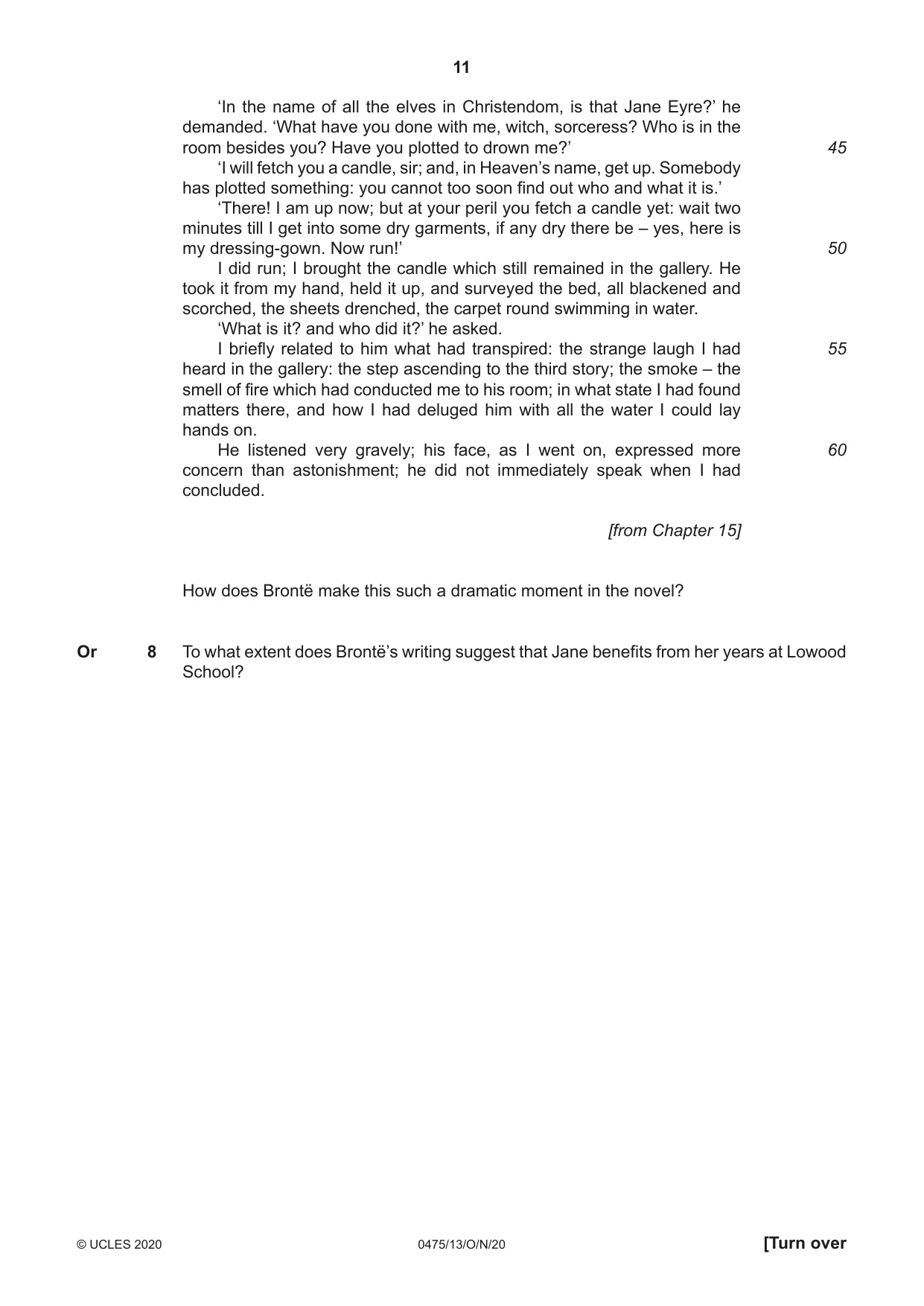
11 0475/13/O/N/20 © UCLES 2020 [Turn over ‘In the name of all the elves in Christendom, is that Jane Eyre?’ he demanded. ‘What have you done with me, witch, sorceress? Who is in the room besides you? Have you plotted to drown me?’ ‘I will fetch you a candle, sir; and, in Heaven’s name, get up. Somebody has plotted something: you cannot too soon find out who and what it is.’ ‘There! I am up now; but at your peril you fetch a candle yet: wait two minutes till I get into some dry garments, if any dry there be – yes, here is my dressing-gown. Now run!’ I did run; I brought the candle which still remained in the gallery. He took it from my hand, held it up, and surveyed the bed, all blackened and scorched, the sheets drenched, the carpet round swimming in water. ‘What is it? and who did it?’ he asked. I briefly related to him what had transpired: the strange laugh I had heard in the gallery: the step ascending to the third story; the smoke – the smell of fire which had conducted me to his room; in what state I had found matters there, and how I had deluged him with all the water I could lay hands on. He listened very gravely; his face, as I went on, expressed more concern than astonishment; he did not immediately speak when I had concluded. [from Chapter 15] How does Brontë make this such a dramatic moment in the novel? Or 8 To what extent does Brontë’s writing suggest that Jane benefits from her years at Lowood School? 45 50 55 60
Question paper, page 12
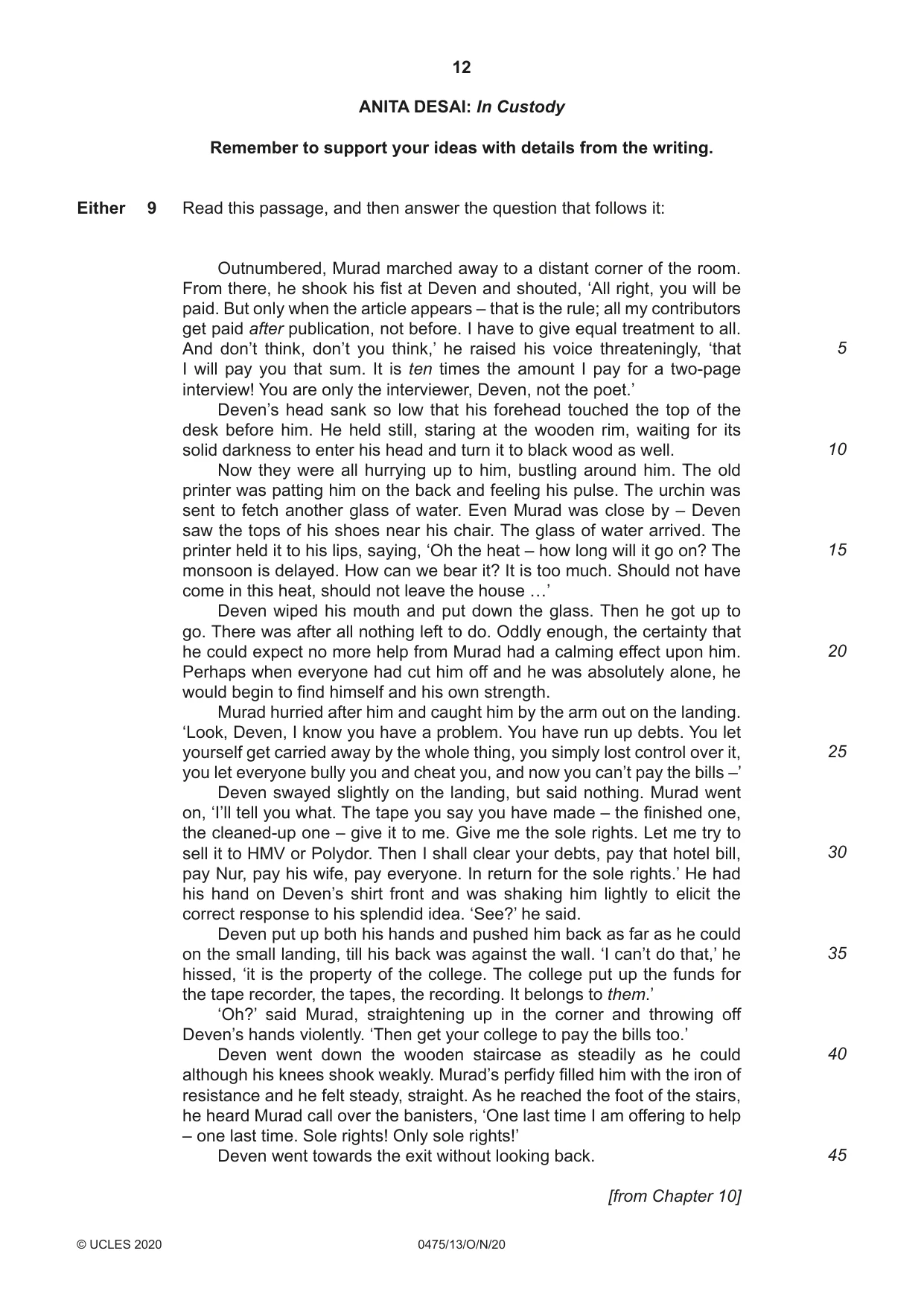
12 0475/13/O/N/20 © UCLES 2020 ANITA DESAI: In Custody Remember to support your ideas with details from the writing. Either 9 Read this passage, and then answer the question that follows it: Outnumbered, Murad marched away to a distant corner of the room. From there, he shook his fist at Deven and shouted, ‘All right, you will be paid. But only when the article appears – that is the rule; all my contributors get paid after publication, not before. I have to give equal treatment to all. And don’t think, don’t you think,’ he raised his voice threateningly, ‘that I will pay you that sum. It is ten times the amount I pay for a two-page interview! You are only the interviewer, Deven, not the poet.’ Deven’s head sank so low that his forehead touched the top of the desk before him. He held still, staring at the wooden rim, waiting for its solid darkness to enter his head and turn it to black wood as well. Now they were all hurrying up to him, bustling around him. The old printer was patting him on the back and feeling his pulse. The urchin was sent to fetch another glass of water. Even Murad was close by – Deven saw the tops of his shoes near his chair. The glass of water arrived. The printer held it to his lips, saying, ‘Oh the heat – how long will it go on? The monsoon is delayed. How can we bear it? It is too much. Should not have come in this heat, should not leave the house …’ Deven wiped his mouth and put down the glass. Then he got up to go. There was after all nothing left to do. Oddly enough, the certainty that he could expect no more help from Murad had a calming effect upon him. Perhaps when everyone had cut him off and he was absolutely alone, he would begin to find himself and his own strength. Murad hurried after him and caught him by the arm out on the landing. ‘Look, Deven, I know you have a problem. You have run up debts. You let yourself get carried away by the whole thing, you simply lost control over it, you let everyone bully you and cheat you, and now you can’t pay the bills –’ Deven swayed slightly on the landing, but said nothing. Murad went on, ‘I’ll tell you what. The tape you say you have made – the finished one, the cleaned-up one – give it to me. Give me the sole rights. Let me try to sell it to HMV or Polydor. Then I shall clear your debts, pay that hotel bill, pay Nur, pay his wife, pay everyone. In return for the sole rights.’ He had his hand on Deven’s shirt front and was shaking him lightly to elicit the correct response to his splendid idea. ‘See?’ he said. Deven put up both his hands and pushed him back as far as he could on the small landing, till his back was against the wall. ‘I can’t do that,’ he hissed, ‘it is the property of the college. The college put up the funds for the tape recorder, the tapes, the recording. It belongs to them.’ ‘Oh?’ said Murad, straightening up in the corner and throwing off Deven’s hands violently. ‘Then get your college to pay the bills too.’ Deven went down the wooden staircase as steadily as he could although his knees shook weakly. Murad’s perfidy filled him with the iron of resistance and he felt steady, straight. As he reached the foot of the stairs, he heard Murad call over the banisters, ‘One last time I am offering to help – one last time. Sole rights! Only sole rights!’ Deven went towards the exit without looking back. [from Chapter 10] 5 10 15 20 25 30 35 40 45
Question paper, page 13
13 0475/13/O/N/20 © UCLES 2020 [Turn over How does Desai make this such a tense moment in the novel? Or 10 How far does Desai persuade you that Deven is foolish?
Question paper, page 14
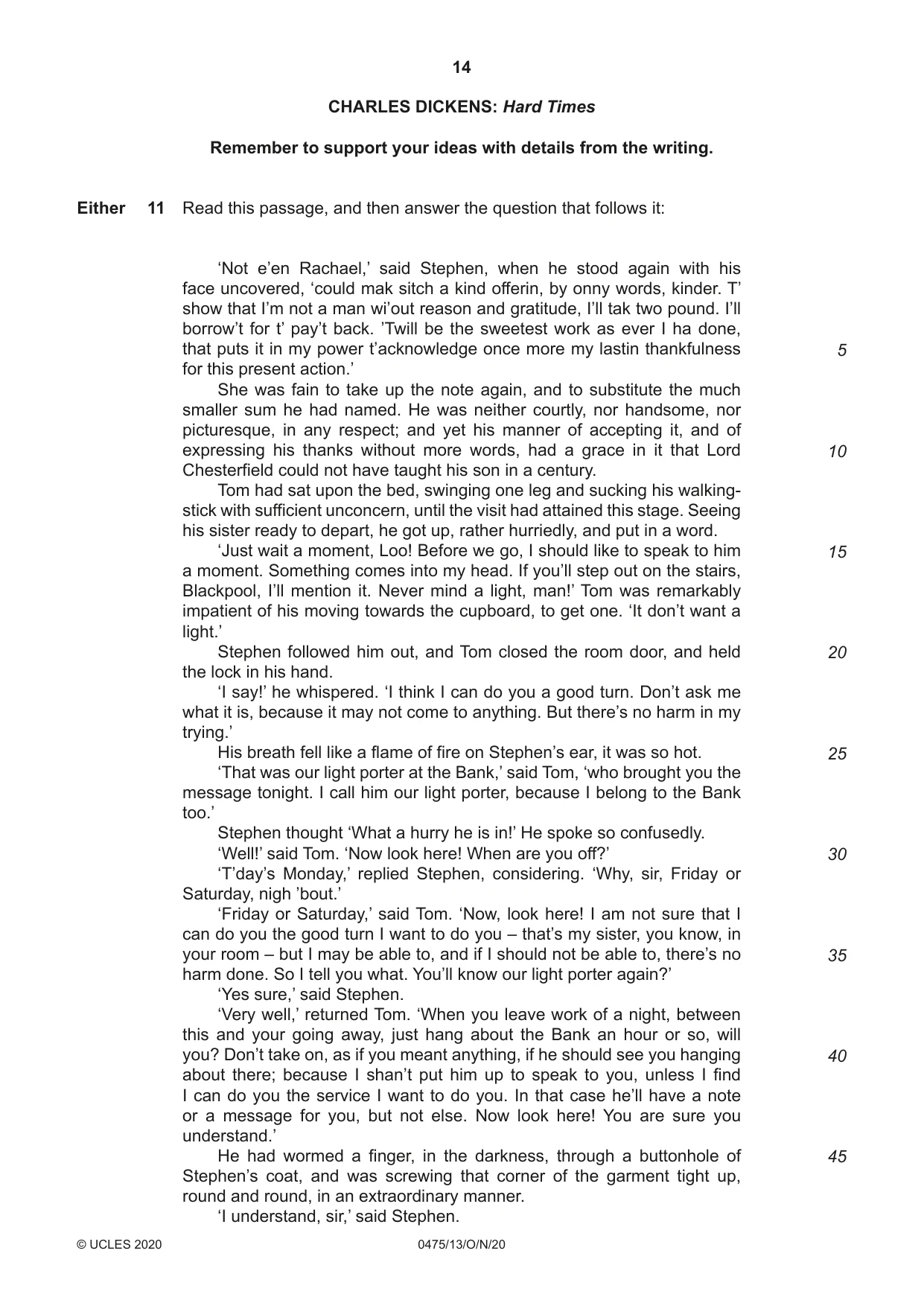
14 0475/13/O/N/20 © UCLES 2020 CHARLES DICKENS: Hard Times Remember to support your ideas with details from the writing. Either 11 Read this passage, and then answer the question that follows it: ‘Not e’en Rachael,’ said Stephen, when he stood again with his face uncovered, ‘could mak sitch a kind offerin, by onny words, kinder. T’ show that I’m not a man wi’out reason and gratitude, I’ll tak two pound. I’ll borrow’t for t’ pay’t back. ’Twill be the sweetest work as ever I ha done, that puts it in my power t’acknowledge once more my lastin thankfulness for this present action.’ She was fain to take up the note again, and to substitute the much smaller sum he had named. He was neither courtly, nor handsome, nor picturesque, in any respect; and yet his manner of accepting it, and of expressing his thanks without more words, had a grace in it that Lord Chesterfield could not have taught his son in a century. Tom had sat upon the bed, swinging one leg and sucking his walking- stick with sufficient unconcern, until the visit had attained this stage. Seeing his sister ready to depart, he got up, rather hurriedly, and put in a word. ‘Just wait a moment, Loo! Before we go, I should like to speak to him a moment. Something comes into my head. If you’ll step out on the stairs, Blackpool, I’ll mention it. Never mind a light, man!’ Tom was remarkably impatient of his moving towards the cupboard, to get one. ‘It don’t want a light.’ Stephen followed him out, and Tom closed the room door, and held the lock in his hand. ‘I say!’ he whispered. ‘I think I can do you a good turn. Don’t ask me what it is, because it may not come to anything. But there’s no harm in my trying.’ His breath fell like a flame of fire on Stephen’s ear, it was so hot. ‘That was our light porter at the Bank,’ said Tom, ‘who brought you the message tonight. I call him our light porter, because I belong to the Bank too.’ Stephen thought ‘What a hurry he is in!’ He spoke so confusedly. ‘Well!’ said Tom. ‘Now look here! When are you off?’ ‘T’day’s Monday,’ replied Stephen, considering. ‘Why, sir, Friday or Saturday, nigh ’bout.’ ‘Friday or Saturday,’ said Tom. ‘Now, look here! I am not sure that I can do you the good turn I want to do you – that’s my sister, you know, in your room – but I may be able to, and if I should not be able to, there’s no harm done. So I tell you what. You’ll know our light porter again?’ ‘Yes sure,’ said Stephen. ‘Very well,’ returned Tom. ‘When you leave work of a night, between this and your going away, just hang about the Bank an hour or so, will you? Don’t take on, as if you meant anything, if he should see you hanging about there; because I shan’t put him up to speak to you, unless I find I can do you the service I want to do you. In that case he’ll have a note or a message for you, but not else. Now look here! You are sure you understand.’ He had wormed a finger, in the darkness, through a buttonhole of Stephen’s coat, and was screwing that corner of the garment tight up, round and round, in an extraordinary manner. ‘I understand, sir,’ said Stephen. 5 10 15 20 25 30 35 40 45
Question paper, page 15
15 0475/13/O/N/20 © UCLES 2020 [Turn over ‘Now look here!’ repeated Tom. ‘Be sure you don’t make any mistake then, and don’t forget. I shall tell my sister as we go home, what I have in view, and she’ll approve, I know. Now look here! You’re all right, are you? You understand all about it? Very well then. Come along Loo!’ [from Book 2, Chapter 6] In what ways does Dickens make this a dramatic and significant moment in the novel? Or 12 How does Dickens make Bitzer such an unpleasant character? 50
Question paper, page 16
16 0475/13/O/N/20 © UCLES 2020 ZORA NEALE HURSTON: Their Eyes Were Watching God Remember to support your ideas with details from the writing. Either 13 Read this passage, and then answer the question that follows it: Long before the year was up, Janie noticed that her husband had stopped talking in rhymes to her. Content removed due to copyright restrictions.
Question paper, page 17
17 0475/13/O/N/20 © UCLES 2020 [Turn over He talked friendly while he drank. [from Chapter 4] How does Hurston make this such a memorable and significant moment in the novel? Or 14 Explore how Hurston vividly conveys Janie’s changing attitude to marriage.
Question paper, page 18
18 0475/13/O/N/20 © UCLES 2020 JOHN KNOWLES: A Separate Peace Remember to support your ideas with details from the writing. Either 15 Read this passage, and then answer the question that follows it: ‘We’ll call it blitzkrieg ball,’ said Bobby. ‘Or just blitzball,’ reflected Finny. ‘Yes, blitzball.’ Then, with an expectant glance around, ‘Well, let’s get started,’ he threw the big, heavy ball at me. I grasped it against my chest with both arms. ‘Well, run!’ ordered Finny. ‘No, not that way! Toward the river! Run!’ I headed toward the river surrounded by the others in a hesitant herd; they sensed that in all probability they were my adversaries in blitzball. ‘Don’t hog it!’ Finny yelled. ‘Throw it to somebody else. Otherwise, naturally,’ he talked steadily as he ran along beside me, ‘now that we’ve got you surrounded, one of us will knock you down.’ ‘Do what!’ I veered away from him, hanging on to the clumsy ball. ‘What kind of a game is that?’ ‘Blitzball!’ Chet Douglass shouted, throwing himself around my legs, knocking me down. ‘That naturally was completely illegal,’ said Finny. ‘You don’t use your arms when you knock the ball carrier down.’ ‘You don’t?’ mumbled Chet from on top of me. ‘No. You keep your arms crossed like this on your chest, and you just butt the ball carrier. No elbowing allowed either. All right, Gene, start again.’ I began quickly, ‘Wouldn’t somebody else have possession of the ball after—’ ‘Not when you’ve been knocked down illegally. The ball carrier retains possession in a case like that. So it’s perfectly okay, you still have the ball. Go ahead.’ There was nothing to do but start running again, with the others trampling with stronger will around me. ‘Throw it!’ ordered Phineas. Bobby Zane was more or less in the clear and so I threw it at him; it was so heavy that he had to scoop my throw up from the ground. ‘Perfectly okay,’ commented Finny, running forward at top speed, ‘perfectly okay for the ball to touch the ground when it is being passed.’ Bobby doubled back closer to me for protection. ‘Knock him down,’ Finny yelled at me. ‘Knock him down! Are you crazy? He’s on my team!’ ‘There aren’t any teams in blitzball,’ he yelled somewhat irritably, ‘we’re all enemies. Knock him down!’ I knocked him down. ‘All right,’ said Finny as he disentangled us. ‘Now you have possession again.’ He handed the leaden ball to me. ‘I would have thought that possession passed—’ ‘Naturally you gained possession of the ball when you knocked him down. Run.’ So I began running again. Leper Lepellier was loping along outside my perimeter, not noticing the game, tagging along without reason, like a porpoise escorting a passing ship. ‘Leper!’ I threw the ball past a few heads at him. Taken by surprise, Leper looked up in anguish, shrank away from the ball, and voiced his first thought, a typical one. ‘I don’t want it!’ ‘Stop, stop!’ cried Finny in a referee’s tone. Everybody halted, and Finny retrieved the ball; he talked better holding it. ‘Now Leper has just 5 10 15 20 25 30 35 40 45
Question paper, page 19
19 0475/13/O/N/20 © UCLES 2020 [Turn over brought out a really important fine point of the game. The receiver can refuse a pass if he happens to choose to. Since we’re all enemies, we can and will turn on each other all the time. We call that the Lepellier Refusal.’ We all nodded without speaking. ‘Here, Gene, the ball is of course still yours.’ ‘Still mine? Nobody else has had the ball but me, for God sakes!’ ‘They’ll get their chance. Now if you are refused three times in the course of running from the tower to the river, you go all the way back to the tower and start over. Naturally.’ Blitzball was the surprise of the summer. Everybody played it; I believe a form of it is still popular at Devon. But nobody can be playing it as it was played by Phineas. He had unconsciously invented a game which brought his own athletic gifts to their highest pitch. The odds were tremendously against the ball carrier, so that Phineas was driven to exceed himself practically every day when he carried the ball. To escape the wolf pack which all the other players became he created reverses and deceptions and acts of sheer mass hypnotism which were so extraordinary that they surprised even him; after some of these plays I would notice him chuckling quietly to himself, in a kind of happy disbelief. In such a nonstop game he also had the natural advantage of a flow of energy which I never saw interrupted. I never saw him tired, never really winded, never overcharged and never restless. At dawn, all day long, and at midnight, Phineas always had a steady and formidable flow of usable energy. Right from the start, it was clear that no one had ever been better adapted to a sport than Finny was to blitzball. I saw that right away. Why not? He had made it up, hadn’t he? It needn’t be surprising that he was sensationally good at it, and that the rest of us were more or less bumblers in our different ways. [from Chapter 3] How does Knowles vividly portray Phineas/Finny as a leader at this moment in the novel? Or 16 How far does Knowles persuade you that Gene is ‘a good guy’? 50 55 60 65 70 75
Question paper, page 20
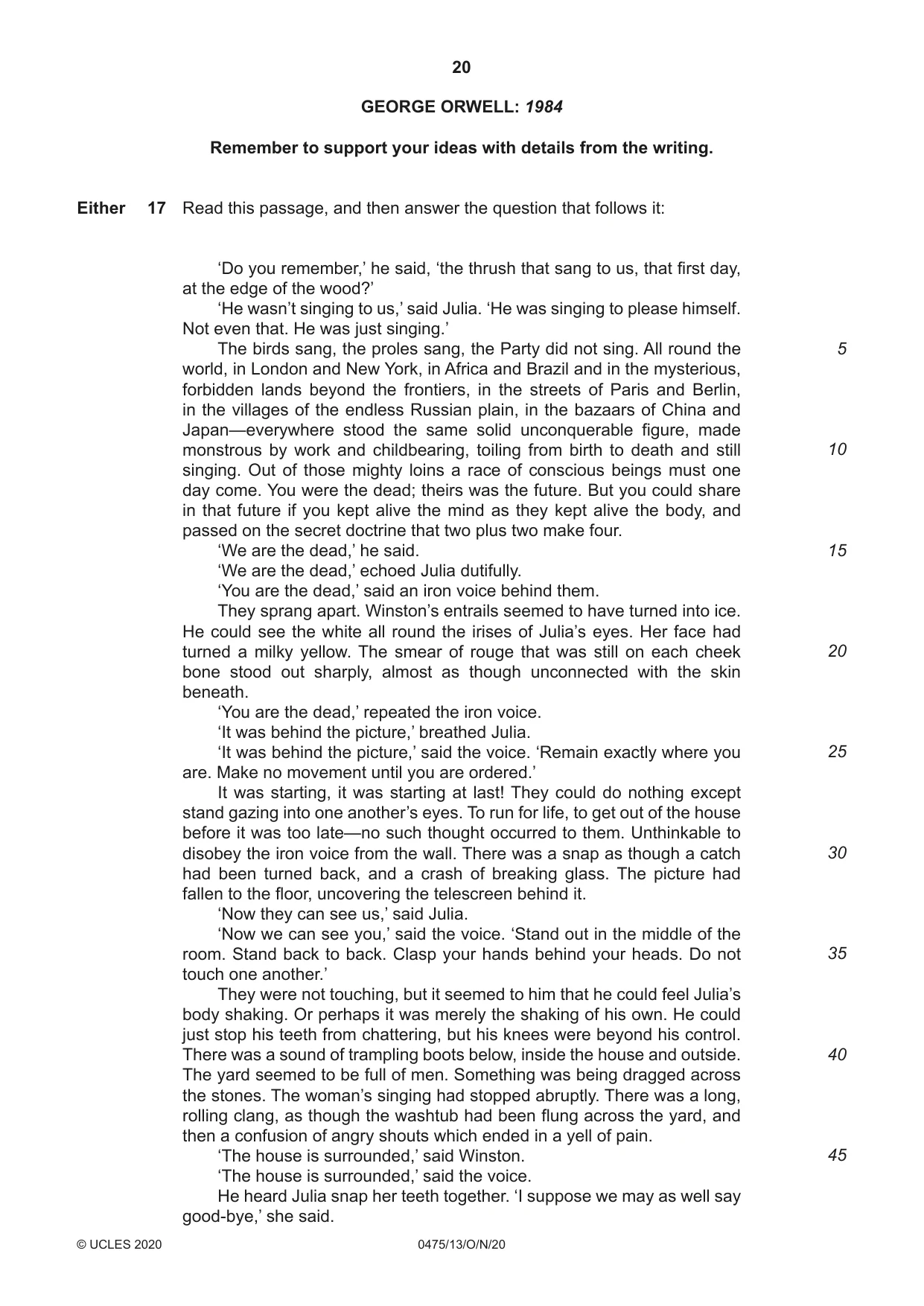
20 0475/13/O/N/20 © UCLES 2020 GEORGE ORWELL: 1984 Remember to support your ideas with details from the writing. Either 17 Read this passage, and then answer the question that follows it: ‘Do you remember,’ he said, ‘the thrush that sang to us, that first day, at the edge of the wood?’ ‘He wasn’t singing to us,’ said Julia. ‘He was singing to please himself. Not even that. He was just singing.’ The birds sang, the proles sang, the Party did not sing. All round the world, in London and New York, in Africa and Brazil and in the mysterious, forbidden lands beyond the frontiers, in the streets of Paris and Berlin, in the villages of the endless Russian plain, in the bazaars of China and Japan—everywhere stood the same solid unconquerable figure, made monstrous by work and childbearing, toiling from birth to death and still singing. Out of those mighty loins a race of conscious beings must one day come. You were the dead; theirs was the future. But you could share in that future if you kept alive the mind as they kept alive the body, and passed on the secret doctrine that two plus two make four. ‘We are the dead,’ he said. ‘We are the dead,’ echoed Julia dutifully. ‘You are the dead,’ said an iron voice behind them. They sprang apart. Winston’s entrails seemed to have turned into ice. He could see the white all round the irises of Julia’s eyes. Her face had turned a milky yellow. The smear of rouge that was still on each cheek bone stood out sharply, almost as though unconnected with the skin beneath. ‘You are the dead,’ repeated the iron voice. ‘It was behind the picture,’ breathed Julia. ‘It was behind the picture,’ said the voice. ‘Remain exactly where you are. Make no movement until you are ordered.’ It was starting, it was starting at last! They could do nothing except stand gazing into one another’s eyes. To run for life, to get out of the house before it was too late—no such thought occurred to them. Unthinkable to disobey the iron voice from the wall. There was a snap as though a catch had been turned back, and a crash of breaking glass. The picture had fallen to the floor, uncovering the telescreen behind it. ‘Now they can see us,’ said Julia. ‘Now we can see you,’ said the voice. ‘Stand out in the middle of the room. Stand back to back. Clasp your hands behind your heads. Do not touch one another.’ They were not touching, but it seemed to him that he could feel Julia’s body shaking. Or perhaps it was merely the shaking of his own. He could just stop his teeth from chattering, but his knees were beyond his control. There was a sound of trampling boots below, inside the house and outside. The yard seemed to be full of men. Something was being dragged across the stones. The woman’s singing had stopped abruptly. There was a long, rolling clang, as though the washtub had been flung across the yard, and then a confusion of angry shouts which ended in a yell of pain. ‘The house is surrounded,’ said Winston. ‘The house is surrounded,’ said the voice. He heard Julia snap her teeth together. ‘I suppose we may as well say good-bye,’ she said. 5 10 15 20 25 30 35 40 45
Question paper, page 21
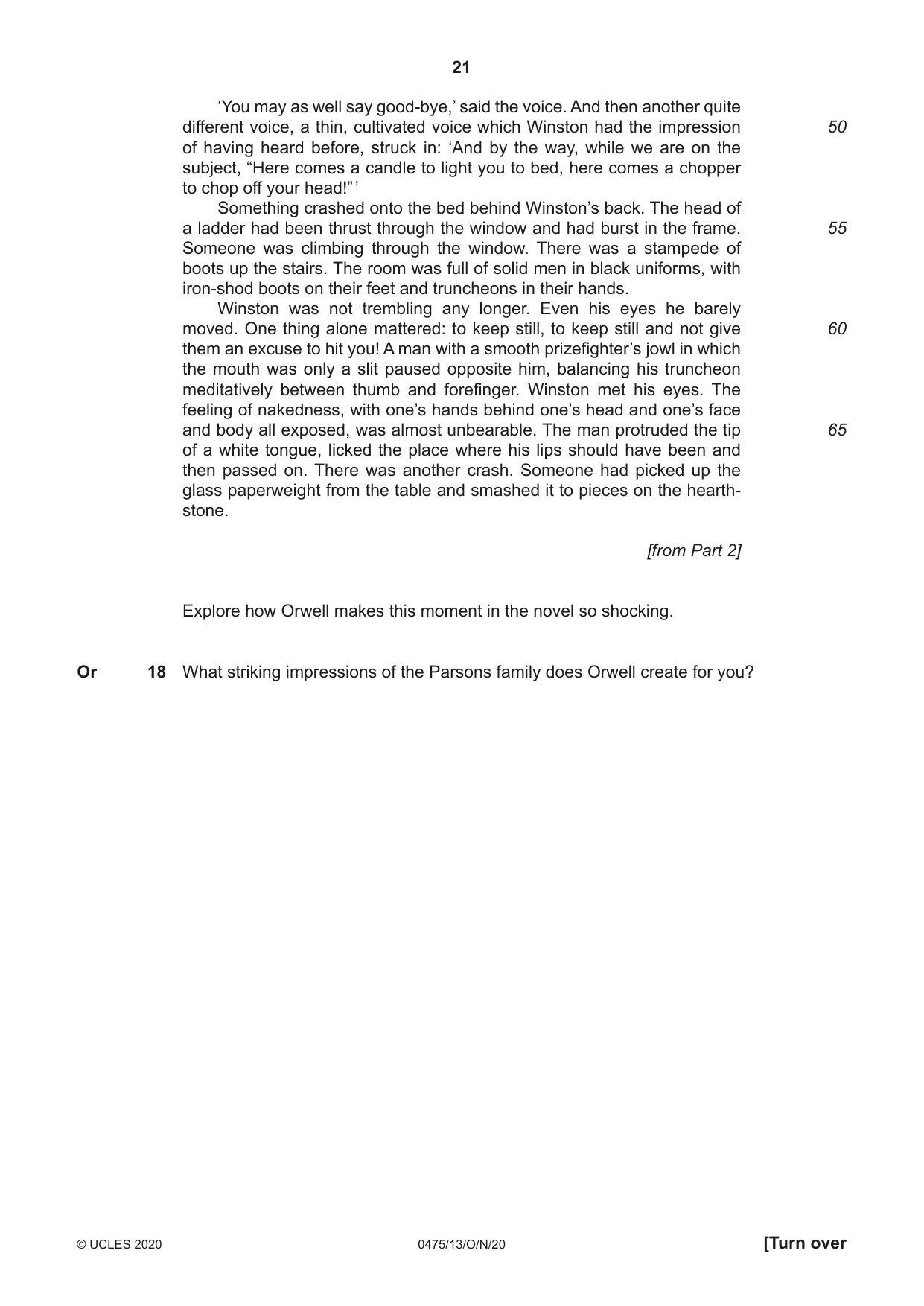
21 0475/13/O/N/20 © UCLES 2020 [Turn over ‘You may as well say good-bye,’ said the voice. And then another quite different voice, a thin, cultivated voice which Winston had the impression of having heard before, struck in: ‘And by the way, while we are on the subject, “Here comes a candle to light you to bed, here comes a chopper to chop off your head!” ’ Something crashed onto the bed behind Winston’s back. The head of a ladder had been thrust through the window and had burst in the frame. Someone was climbing through the window. There was a stampede of boots up the stairs. The room was full of solid men in black uniforms, with iron-shod boots on their feet and truncheons in their hands. Winston was not trembling any longer. Even his eyes he barely moved. One thing alone mattered: to keep still, to keep still and not give them an excuse to hit you! A man with a smooth prizefighter’s jowl in which the mouth was only a slit paused opposite him, balancing his truncheon meditatively between thumb and forefinger. Winston met his eyes. The feeling of nakedness, with one’s hands behind one’s head and one’s face and body all exposed, was almost unbearable. The man protruded the tip of a white tongue, licked the place where his lips should have been and then passed on. There was another crash. Someone had picked up the glass paperweight from the table and smashed it to pieces on the hearth- stone. [from Part 2] Explore how Orwell makes this moment in the novel so shocking. Or 18 What striking impressions of the Parsons family does Orwell create for you? 50 55 60 65
Question paper, page 22
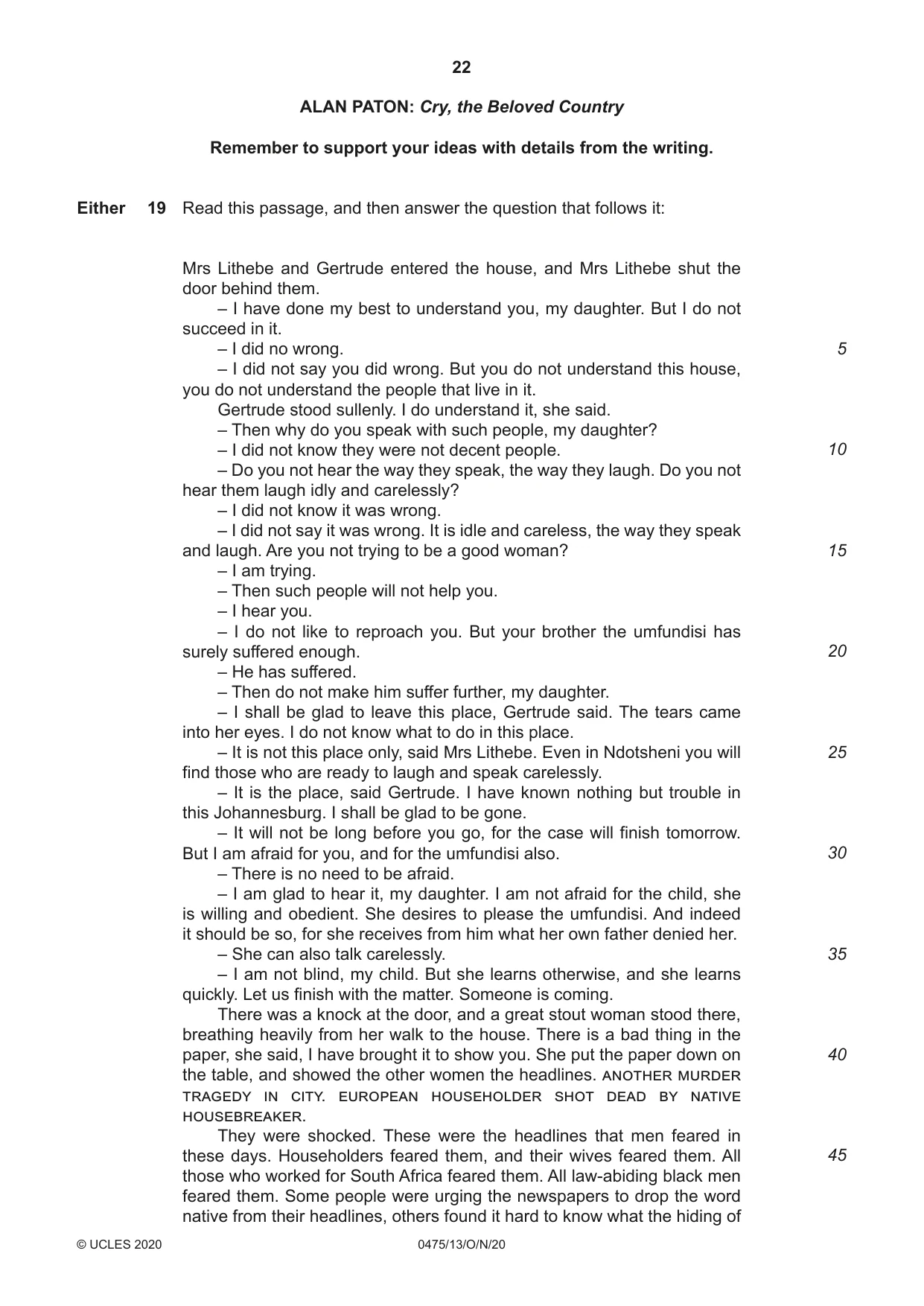
22 0475/13/O/N/20 © UCLES 2020 ALAN PATON: Cry, the Beloved Country Remember to support your ideas with details from the writing. Either 19 Read this passage, and then answer the question that follows it: Mrs Lithebe and Gertrude entered the house, and Mrs Lithebe shut the door behind them. – I have done my best to understand you, my daughter. But I do not succeed in it. – I did no wrong. – I did not say you did wrong. But you do not understand this house, you do not understand the people that live in it. Gertrude stood sullenly. I do understand it, she said. – Then why do you speak with such people, my daughter? – I did not know they were not decent people. – Do you not hear the way they speak, the way they laugh. Do you not hear them laugh idly and carelessly? – I did not know it was wrong. – I did not say it was wrong. It is idle and careless, the way they speak and laugh. Are you not trying to be a good woman? – I am trying. – Then such people will not help you. – I hear you. – I do not like to reproach you. But your brother the umfundisi has surely suffered enough. – He has suffered. – Then do not make him suffer further, my daughter. – I shall be glad to leave this place, Gertrude said. The tears came into her eyes. I do not know what to do in this place. – It is not this place only, said Mrs Lithebe. Even in Ndotsheni you will find those who are ready to laugh and speak carelessly. – It is the place, said Gertrude. I have known nothing but trouble in this Johannesburg. I shall be glad to be gone. – It will not be long before you go, for the case will finish tomorrow. But I am afraid for you, and for the umfundisi also. – There is no need to be afraid. – I am glad to hear it, my daughter. I am not afraid for the child, she is willing and obedient. She desires to please the umfundisi. And indeed it should be so, for she receives from him what her own father denied her. – She can also talk carelessly. – I am not blind, my child. But she learns otherwise, and she learns quickly. Let us finish with the matter. Someone is coming. There was a knock at the door, and a great stout woman stood there, breathing heavily from her walk to the house. There is a bad thing in the paper, she said, I have brought it to show you. She put the paper down on the table, and showed the other women the headlines. another murder tragedy in city. european householder shot dead by native housebreaker. They were shocked. These were the headlines that men feared in these days. Householders feared them, and their wives feared them. All those who worked for South Africa feared them. All law-abiding black men feared them. Some people were urging the newspapers to drop the word native from their headlines, others found it hard to know what the hiding of 5 10 15 20 25 30 35 40 45
Question paper, page 23
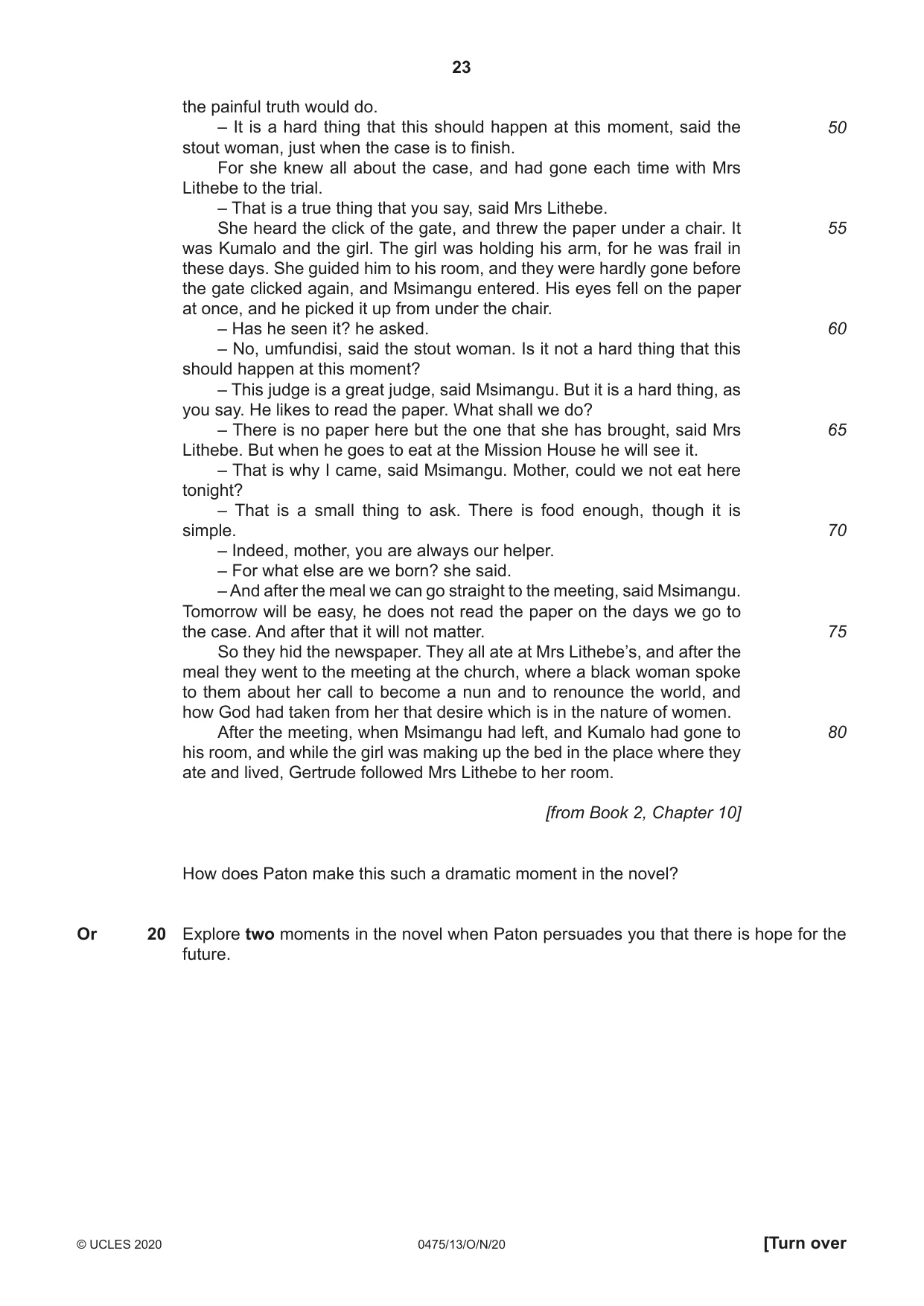
23 0475/13/O/N/20 © UCLES 2020 [Turn over the painful truth would do. – It is a hard thing that this should happen at this moment, said the stout woman, just when the case is to finish. For she knew all about the case, and had gone each time with Mrs Lithebe to the trial. – That is a true thing that you say, said Mrs Lithebe. She heard the click of the gate, and threw the paper under a chair. It was Kumalo and the girl. The girl was holding his arm, for he was frail in these days. She guided him to his room, and they were hardly gone before the gate clicked again, and Msimangu entered. His eyes fell on the paper at once, and he picked it up from under the chair. – Has he seen it? he asked. – No, umfundisi, said the stout woman. Is it not a hard thing that this should happen at this moment? – This judge is a great judge, said Msimangu. But it is a hard thing, as you say. He likes to read the paper. What shall we do? – There is no paper here but the one that she has brought, said Mrs Lithebe. But when he goes to eat at the Mission House he will see it. – That is why I came, said Msimangu. Mother, could we not eat here tonight? – That is a small thing to ask. There is food enough, though it is simple. – Indeed, mother, you are always our helper. – For what else are we born? she said. – And after the meal we can go straight to the meeting, said Msimangu. Tomorrow will be easy, he does not read the paper on the days we go to the case. And after that it will not matter. So they hid the newspaper. They all ate at Mrs Lithebe’s, and after the meal they went to the meeting at the church, where a black woman spoke to them about her call to become a nun and to renounce the world, and how God had taken from her that desire which is in the nature of women. After the meeting, when Msimangu had left, and Kumalo had gone to his room, and while the girl was making up the bed in the place where they ate and lived, Gertrude followed Mrs Lithebe to her room. [from Book 2, Chapter 10] How does Paton make this such a dramatic moment in the novel? Or 20 Explore two moments in the novel when Paton persuades you that there is hope for the future. 50 55 60 65 70 75 80
Question paper, page 24
24 0475/13/O/N/20 © UCLES 2020 from Stories of Ourselves Remember to support your ideas with details from the writing. Either 21 Read this passage from The Bath (by Janet Frame), and then answer the question that follows it: In all her years of visiting the cemetery she had never known the wind so mild. On an arm of the peninsula exposed to the winds from two stretches of sea, the cemetery had always been a place to crouch shivering in overcoat and scarf while the flowers were set on the grave and the narrow garden cleared of weeds. Today, everything was different. After all the frosts of the past month there was not a trace of chill in the air. The mildness and warmth were scarcely to be believed. The sea lay, violet-coloured, hush- hushing, turning and heaving, not breaking into foamy waves; it was one sinuous ripple from shore to horizon and its sound was the muted sound of distant forests of peace. Picking up the rusted garden fork that she knew lay always in the grass of the next grave, long neglected, she set to work to clear away the twitch and other weeds, exposing the first bunch of dark blue primroses with yellow centres, a clump of autumn lilies, and the shoots, six inches high, of daffodils. Then removing the green-slimed jam jars from their grooves on each side of the tombstone she walked slowly, stiff from her crouching, to the ever-dripping tap at the end of the lawn path where, filling the jars with pebbles and water she rattled them up and down to try to clean them of slime. Then she ran the sparkling ice-cold water into the jars and balancing them carefully one in each hand she walked back to the grave where she shook the daffodils, anemones, red leaves from their waxed paper and dividing them put half in one jar, half in the other. The dark blue of the anemones swelled with a sea-colour as their heads rested against the red leaves. The daffodils were short-stemmed with big ragged rather than delicate trumpets – the type for blowing; and their scent was strong. Finally, remembering the winds that raged from the sea she stuffed small pieces of the screwed-up waxed paper into the top of each jar so the flowers would not be carried away by the wind. Then with a feeling of satisfaction – I look after my husband’s grave after seventeen years. The tombstone is not cracked or blown over, the garden has not sunk into a pool of clay. I look after my husband’s grave – she began to walk away, between the rows of graves, noting which were and were not cared for. Her father and mother had been buried here. She stood now before their grave. It was a roomy grave made in the days when there was space for the dead and for the dead with money, like her parents, extra space should they need it. Their tombstone was elaborate though the writing was now faded; in death they kept the elaborate station of their life. There were no flowers on the grave, only the feathery sea-grass soft to the touch, lit with gold in the sun. There was no sound but the sound of the sea and the one row of fir trees on the brow of the hill. She felt the peace inside her; the nightmare of the evening before seemed far away, seemed not to have happened; the senseless terrifying struggle to get out of a bath! She sat on the concrete edge of her parents’ grave. She did not want to go home. She felt content to sit here quietly with the warm soft wind flowing around her and the sigh of the sea rising to mingle with the sighing of the firs and the whisper of the thin gold grass. She was grateful 5 10 15 20 25 30 35 40 45
Question paper, page 25
25 0475/13/O/N/20 © UCLES 2020 for the money, the time and the forethought that had made her parents’ grave so much bigger than the others near by. Her husband, cremated, had been allowed only a narrow eighteen inches by two feet, room only for the flecked grey tombstone In Memory of My Husband John Edward Harraway died August 6th 1948, and the narrow garden of spring flowers, whereas her parents’ grave was so wide, and its concrete wall was a foot high; it was, in death, the equivalent of a quarter-acre section before there were too many people in the world. Why when the world was wider and wider was there no space left? Or was the world narrower? She did not know; she could not think; she knew only that she did not want to go home, she wanted to sit here on the edge of the grave, never catching any more buses, crossing streets, walking on icy footpaths, turning mattresses, trying to reach jam from the top shelf of the cupboard, filling coal buckets, getting in and out of the bath. Only to get in somewhere and stay in; to get out and stay out; to stay now, always, in one place. Ten minutes later she was waiting at the bus stop; anxiously studying the destination of each bus as it passed, clutching her money since concession tickets were not allowed in the weekend, thinking of the cup of tea she would make when she got home, of her evening meal – the remainder of the liver and bacon – of her nephew in Christchurch who was coming with his wife and children for the school holidays, of her niece in the home expecting her third baby. Cars and buses surged by, horns tooted, a plane droned, near and far, near and far, children cried out, dogs barked; the sea, in competition, made a harsher sound as if its waves were now breaking in foam. For a moment, confused after the peace of the cemetery, she shut her eyes, trying to recapture the image of her husband’s grave, now bright with spring flowers, and her parents’ grave, wide, spacious, with room should the dead desire it to turn and sigh and move in dreams as if the two slept together in a big soft grass double-bed. She waited, trying to capture the image of peace. She saw only her husband’s grave, made narrower, the spring garden whittled to a thin strip; then it vanished and she was left with the image of the bathroom, of the narrow confining bath grass-yellow as old baths are, not frost-white, waiting, waiting, for one moment of inattention, weakness, pain, to claim her for ever. How does Frame make this such a moving ending to the story? Or 22 In what ways does MacLaverty make Secrets such a sad story? 50 55 60 65 70 75 80
Question paper, page 26
26 0475/13/O/N/20 © UCLES 2020 BLANK PAGE
Question paper, page 27
27 0475/13/O/N/20 © UCLES 2020 BLANK PAGE
Question paper, page 28
28 0475/13/O/N/20 © UCLES 2020 Permission to reproduce items where third-party owned material protected by copyright is included has been sought and cleared where possible. Every reasonable effort has been made by the publisher (UCLES) to trace copyright holders, but if any items requiring clearance have unwittingly been included, the publisher will be pleased to make amends at the earliest possible opportunity. To avoid the issue of disclosure of answer-related information to candidates, all copyright acknowledgements are reproduced online in the Cambridge Assessment International Education Copyright Acknowledgements Booklet. This is produced for each series of examinations and is freely available to download at www.cambridgeinternational.org after the live examination series. Cambridge Assessment International Education is part of the Cambridge Assessment Group. Cambridge Assessment is the brand name of the University of Cambridge Local Examinations Syndicate (UCLES), which itself is a department of the University of Cambridge. BLANK PAGE
Mark scheme, page 1
This document consists of 5 printed pages. © UCLES 2020 [Turn over Cambridge IGCSE™ LITERATURE IN ENGLISH 0475/13 Paper 1 Poetry and Prose 13 October/November 2020 MARK SCHEME Maximum Mark: 50 Published This mark scheme is published as an aid to teachers and candidates, to indicate the requirements of the examination. It shows the basis on which Examiners were instructed to award marks. It does not indicate the details of the discussions that took place at an Examiners’ meeting before marking began, which would have considered the acceptability of alternative answers. Mark schemes should be read in conjunction with the question paper and the Principal Examiner Report for Teachers. Cambridge International will not enter into discussions about these mark schemes. Cambridge International is publishing the mark schemes for the October/November 2020 series for most Cambridge IGCSE™, Cambridge International A and AS Level and Cambridge Pre-U components, and some Cambridge O Level components.
Mark scheme, page 2
0475/13 Cambridge IGCSE – Mark Scheme PUBLISHED October/November 2020 © UCLES 2020 Page 2 of 5 Generic Marking Principles These general marking principles must be applied by all examiners when marking candidate answers. They should be applied alongside the specific content of the mark scheme or generic level descriptors for a question. Each question paper and mark scheme will also comply with these marking principles. GENERIC MARKING PRINCIPLE 1: Marks must be awarded in line with: • the specific content of the mark scheme or the generic level descriptors for the question • the specific skills defined in the mark scheme or in the generic level descriptors for the question • the standard of response required by a candidate as exemplified by the standardisation scripts. GENERIC MARKING PRINCIPLE 2: Marks awarded are always whole marks (not half marks, or other fractions). GENERIC MARKING PRINCIPLE 3: Marks must be awarded positively: • marks are awarded for correct/valid answers, as defined in the mark scheme. However, credit is given for valid answers which go beyond the scope of the syllabus and mark scheme, referring to your Team Leader as appropriate • marks are awarded when candidates clearly demonstrate what they know and can do • marks are not deducted for errors • marks are not deducted for omissions • answers should only be judged on the quality of spelling, punctuation and grammar when these features are specifically assessed by the question as indicated by the mark scheme. The meaning, however, should be unambiguous. GENERIC MARKING PRINCIPLE 4: Rules must be applied consistently, e.g. in situations where candidates have not followed instructions or in the application of generic level descriptors. GENERIC MARKING PRINCIPLE 5: Marks should be awarded using the full range of marks defined in the mark scheme for the question (however; the use of the full mark range may be limited according to the quality of the candidate responses seen). GENERIC MARKING PRINCIPLE 6: Marks awarded are based solely on the requirements as defined in the mark scheme. Marks should not be awarded with grade thresholds or grade descriptors in mind.
Mark scheme, page 3
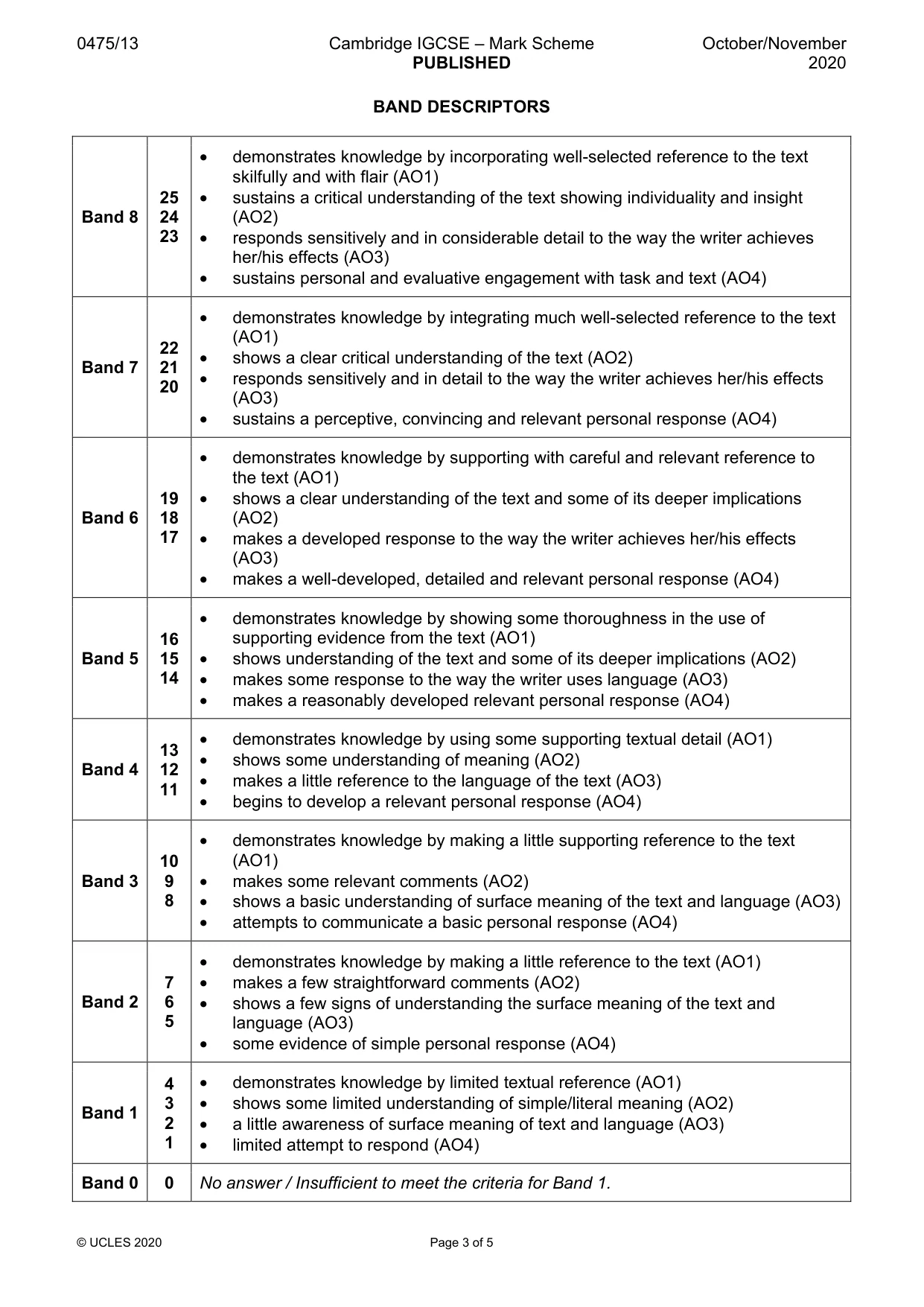
0475/13 Cambridge IGCSE – Mark Scheme PUBLISHED October/November 2020 © UCLES 2020 Page 3 of 5 BAND DESCRIPTORS Band 8 25 24 23 • demonstrates knowledge by incorporating well-selected reference to the text skilfully and with flair (AO1) • sustains a critical understanding of the text showing individuality and insight (AO2) • responds sensitively and in considerable detail to the way the writer achieves her/his effects (AO3) • sustains personal and evaluative engagement with task and text (AO4) Band 7 22 21 20 • demonstrates knowledge by integrating much well-selected reference to the text (AO1) • shows a clear critical understanding of the text (AO2) • responds sensitively and in detail to the way the writer achieves her/his effects (AO3) • sustains a perceptive, convincing and relevant personal response (AO4) Band 6 19 18 17 • demonstrates knowledge by supporting with careful and relevant reference to the text (AO1) • shows a clear understanding of the text and some of its deeper implications (AO2) • makes a developed response to the way the writer achieves her/his effects (AO3) • makes a well-developed, detailed and relevant personal response (AO4) Band 5 16 15 14 • demonstrates knowledge by showing some thoroughness in the use of supporting evidence from the text (AO1) • shows understanding of the text and some of its deeper implications (AO2) • makes some response to the way the writer uses language (AO3) • makes a reasonably developed relevant personal response (AO4) Band 4 13 12 11 • demonstrates knowledge by using some supporting textual detail (AO1) • shows some understanding of meaning (AO2) • makes a little reference to the language of the text (AO3) • begins to develop a relevant personal response (AO4) Band 3 10 9 8 • demonstrates knowledge by making a little supporting reference to the text (AO1) • makes some relevant comments (AO2) • shows a basic understanding of surface meaning of the text and language (AO3) • attempts to communicate a basic personal response (AO4) Band 2 7 6 5 • demonstrates knowledge by making a little reference to the text (AO1) • makes a few straightforward comments (AO2) • shows a few signs of understanding the surface meaning of the text and language (AO3) • some evidence of simple personal response (AO4) Band 1 4 3 2 1 • demonstrates knowledge by limited textual reference (AO1) • shows some limited understanding of simple/literal meaning (AO2) • a little awareness of surface meaning of text and language (AO3) • limited attempt to respond (AO4) Band 0 0 No answer / Insufficient to meet the criteria for Band 1.
Mark scheme, page 4
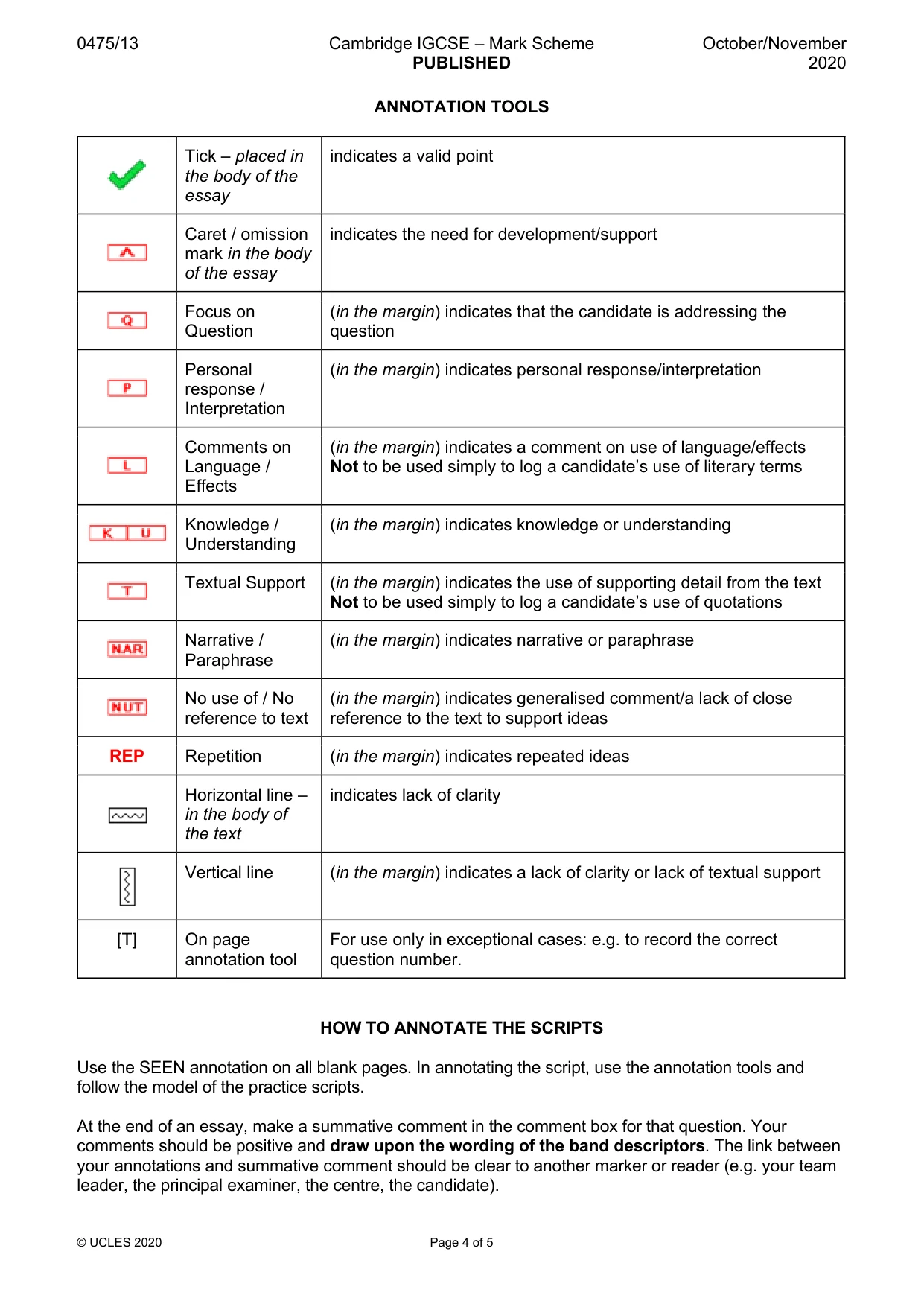
0475/13 Cambridge IGCSE – Mark Scheme PUBLISHED October/November 2020 © UCLES 2020 Page 4 of 5 ANNOTATION TOOLS Tick – placed in the body of the essay indicates a valid point Caret / omission mark in the body of the essay indicates the need for development/support Focus on Question (in the margin) indicates that the candidate is addressing the question Personal response / Interpretation (in the margin) indicates personal response/interpretation Comments on Language / Effects (in the margin) indicates a comment on use of language/effects Not to be used simply to log a candidate’s use of literary terms Knowledge / Understanding (in the margin) indicates knowledge or understanding Textual Support (in the margin) indicates the use of supporting detail from the text Not to be used simply to log a candidate’s use of quotations Narrative / Paraphrase (in the margin) indicates narrative or paraphrase No use of / No reference to text (in the margin) indicates generalised comment/a lack of close reference to the text to support ideas REP Repetition (in the margin) indicates repeated ideas Horizontal line – in the body of the text indicates lack of clarity Vertical line (in the margin) indicates a lack of clarity or lack of textual support [T] On page annotation tool For use only in exceptional cases: e.g. to record the correct question number. HOW TO ANNOTATE THE SCRIPTS Use the SEEN annotation on all blank pages. In annotating the script, use the annotation tools and follow the model of the practice scripts. At the end of an essay, make a summative comment in the comment box for that question. Your comments should be positive and draw upon the wording of the band descriptors. The link between your annotations and summative comment should be clear to another marker or reader (e.g. your team leader, the principal examiner, the centre, the candidate).
Mark scheme, page 5
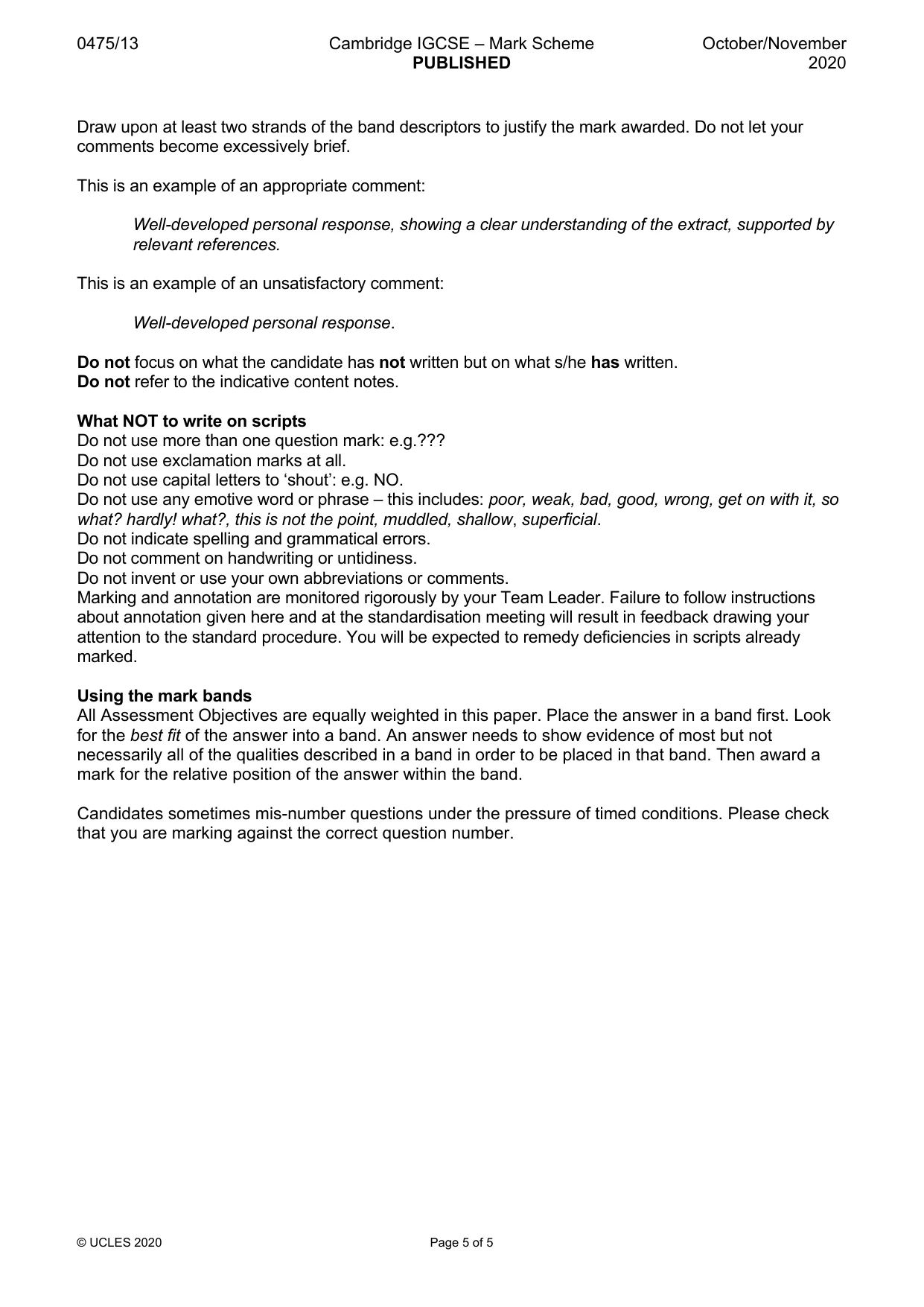
0475/13 Cambridge IGCSE – Mark Scheme PUBLISHED October/November 2020 © UCLES 2020 Page 5 of 5 Draw upon at least two strands of the band descriptors to justify the mark awarded. Do not let your comments become excessively brief. This is an example of an appropriate comment: Well-developed personal response, showing a clear understanding of the extract, supported by relevant references. This is an example of an unsatisfactory comment: Well-developed personal response. Do not focus on what the candidate has not written but on what s/he has written. Do not refer to the indicative content notes. What NOT to write on scripts Do not use more than one question mark: e.g.??? Do not use exclamation marks at all. Do not use capital letters to ‘shout’: e.g. NO. Do not use any emotive word or phrase – this includes: poor, weak, bad, good, wrong, get on with it, so what? hardly! what?, this is not the point, muddled, shallow, superficial. Do not indicate spelling and grammatical errors. Do not comment on handwriting or untidiness. Do not invent or use your own abbreviations or comments. Marking and annotation are monitored rigorously by your Team Leader. Failure to follow instructions about annotation given here and at the standardisation meeting will result in feedback drawing your attention to the standard procedure. You will be expected to remedy deficiencies in scripts already marked. Using the mark bands All Assessment Objectives are equally weighted in this paper. Place the answer in a band first. Look for the best fit of the answer into a band. An answer needs to show evidence of most but not necessarily all of the qualities described in a band in order to be placed in that band. Then award a mark for the relative position of the answer within the band. Candidates sometimes mis-number questions under the pressure of timed conditions. Please check that you are marking against the correct question number.
What you needed in this session
Cambridge’s own grade thresholds for 2020 Oct/Nov, Paper 1 · Variant 3. A higher threshold means an easier paper — the bar moves with how the cohort did.