Cambridge IGCSE English - Literature in English 0475 — 2020 Oct/Nov Paper 1 · Variant 1
0475/11/O/N/20 · 50 marks · ≈56 min
The question paper and its mark scheme, free to read here and free to download. This is Cambridge’s own paper, exactly as it was sat.
Question paper28 pages







Mark scheme5 pages
Answers below. Sit the paper first if you are practising.
Paper as text
Question paper, page 1
Cambridge IGCSE™ DC (RCL/GO) 185449/2 © UCLES 2020 [Turn over This document has 28 pages. Blank pages are indicated. LITERATURE IN ENGLISH 0475/11 Paper 1 Poetry and Prose October/November 2020 1 hour 30 minutes You must answer on the enclosed answer booklet. You will need: Answer booklet (enclosed) INSTRUCTIONS ● Answer two questions in total: Section A: answer one question. Section B: answer one question. ● Follow the instructions on the front cover of the answer booklet. If you need additional answer paper, ask the invigilator for a continuation booklet. INFORMATION ● The total mark for this paper is 50. ● All questions are worth equal marks. * 5 8 2 2 0 4 8 5 8 7 * Cambridge IGCSE™
Question paper, page 2
2 0475/11/O/N/20 © UCLES 2020 BLANK PAGE
Question paper, page 3
3 0475/11/O/N/20 © UCLES 2020 [Turn over CONTENTS Section A: Poetry text question numbers page[s] Songs of Ourselves Volume 1: from Part 3 1, 2 pages 4–5 Songs of Ourselves Volume 2 : from Part 2 3, 4 pages 6–7 Carol Ann Duffy: from New Selected Poems 5, 6 pages 8–9 Section B: Prose text question numbers page[s] Charlotte Brontë: Jane Eyre 7, 8 pages 10–11 Anita Desai: In Custody 9, 10 pages 12–13 Charles Dickens: Hard Times 11, 12 pages 14–15 Zora Neale Hurston: Their Eyes Were Watching God 13, 14 pages 16–17 John Knowles: A Separate Peace 15, 16 pages 18–19 George Orwell: 1984 17, 18 pages 20–21 Alan Paton: Cry, the Beloved Country 19, 20 pages 22–23 from Stories of Ourselves 21, 22 pages 24–25
Question paper, page 4
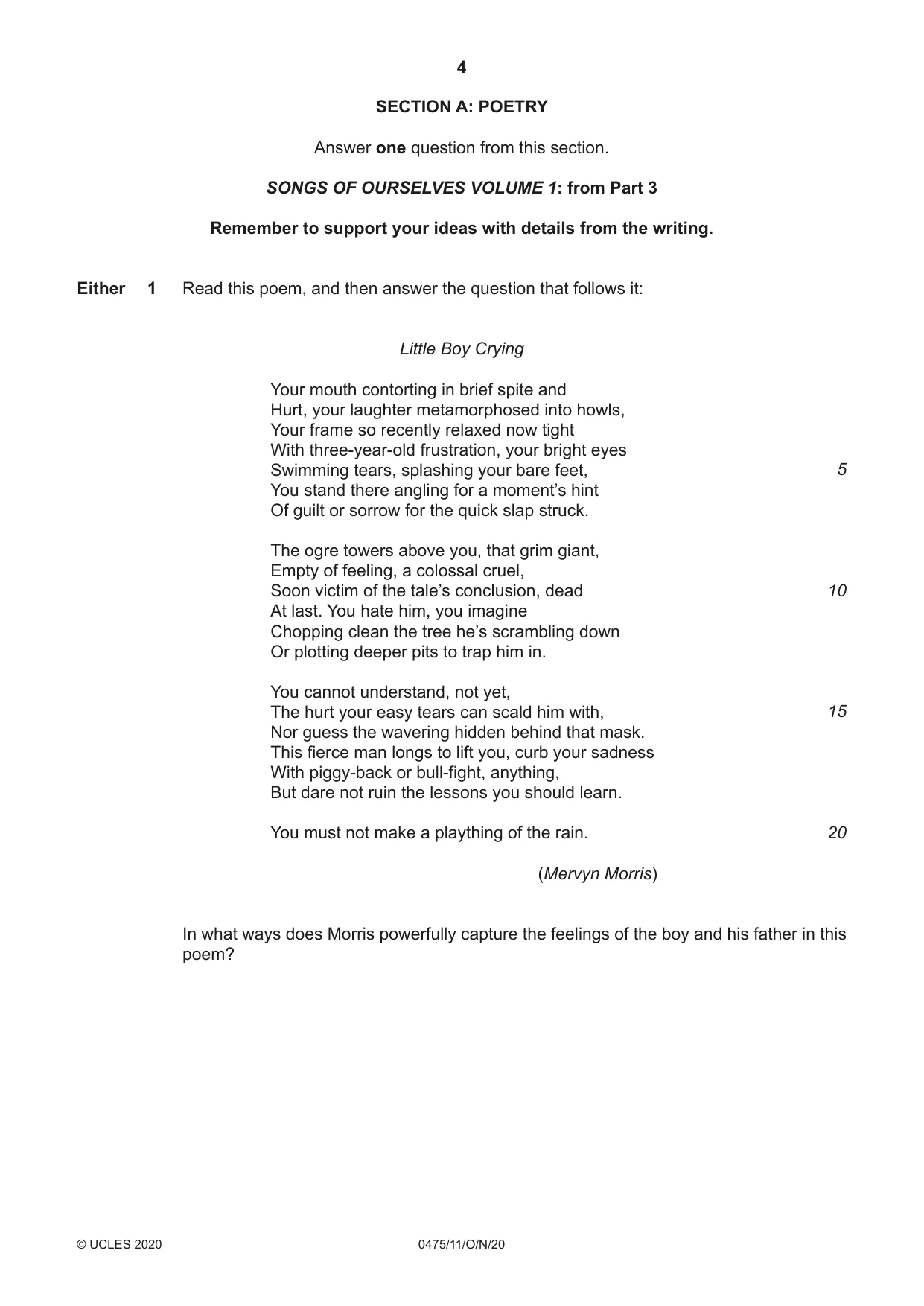
4 0475/11/O/N/20 © UCLES 2020 SECTION A: POETRY Answer one question from this section. SONGS OF OURSELVES VOLUME 1: from Part 3 Remember to support your ideas with details from the writing. Either 1 Read this poem, and then answer the question that follows it: Little Boy Crying Your mouth contorting in brief spite and Hurt, your laughter metamorphosed into howls, Your frame so recently relaxed now tight With three-year-old frustration, your bright eyes Swimming tears, splashing your bare feet, You stand there angling for a moment’s hint Of guilt or sorrow for the quick slap struck. The ogre towers above you, that grim giant, Empty of feeling, a colossal cruel, Soon victim of the tale’s conclusion, dead At last. You hate him, you imagine Chopping clean the tree he’s scrambling down Or plotting deeper pits to trap him in. You cannot understand, not yet, The hurt your easy tears can scald him with, Nor guess the wavering hidden behind that mask. This fierce man longs to lift you, curb your sadness With piggy-back or bull-fight, anything, But dare not ruin the lessons you should learn. You must not make a plaything of the rain. (Mervyn Morris) In what ways does Morris powerfully capture the feelings of the boy and his father in this poem? 5 10 15 20
Question paper, page 5
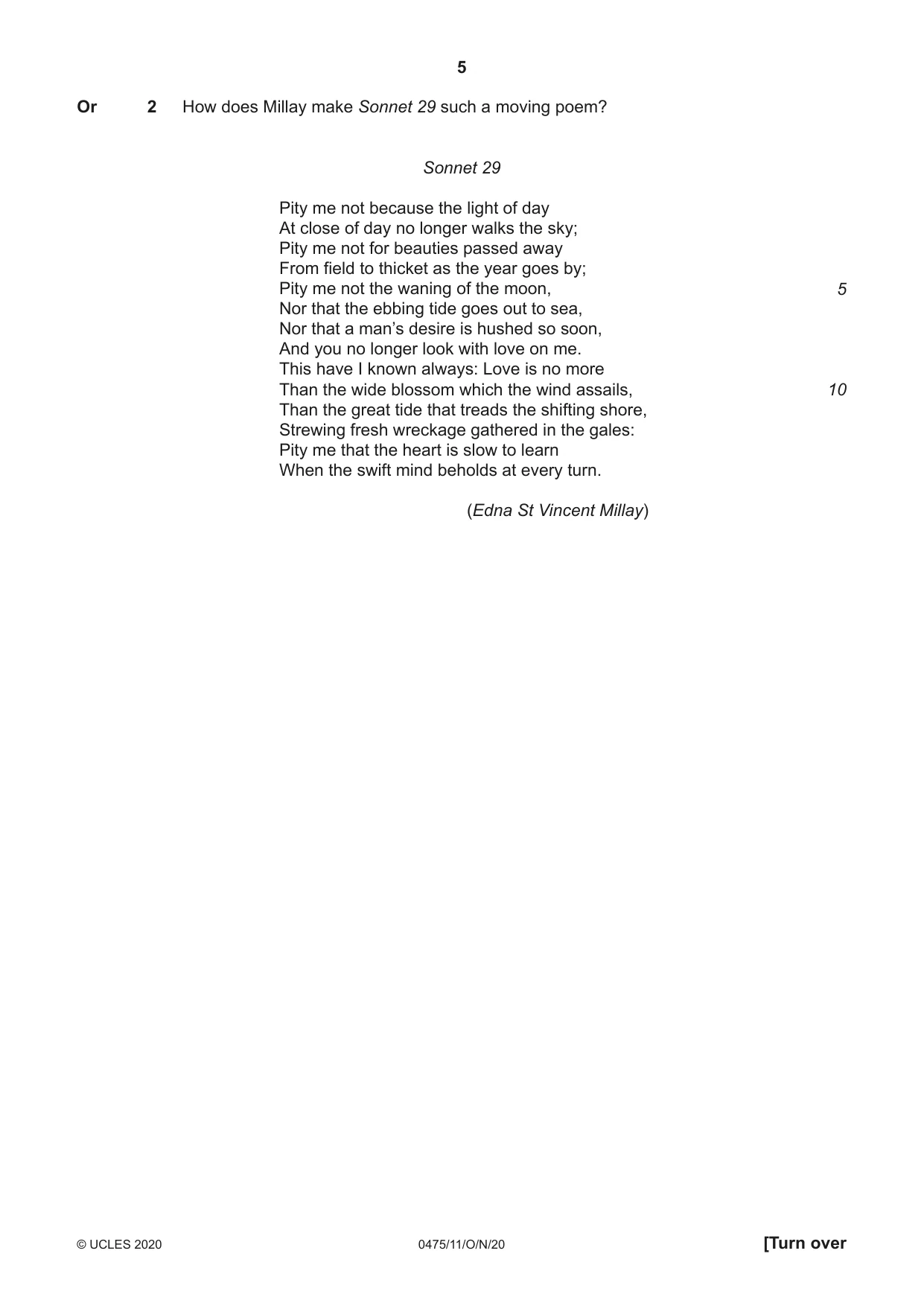
5 0475/11/O/N/20 © UCLES 2020 [Turn over Or 2 How does Millay make Sonnet 29 such a moving poem? Sonnet 29 Pity me not because the light of day At close of day no longer walks the sky; Pity me not for beauties passed away From field to thicket as the year goes by; Pity me not the waning of the moon, Nor that the ebbing tide goes out to sea, Nor that a man’s desire is hushed so soon, And you no longer look with love on me. This have I known always: Love is no more Than the wide blossom which the wind assails, Than the great tide that treads the shifting shore, Strewing fresh wreckage gathered in the gales: Pity me that the heart is slow to learn When the swift mind beholds at every turn. (Edna St Vincent Millay) 5 10
Question paper, page 6
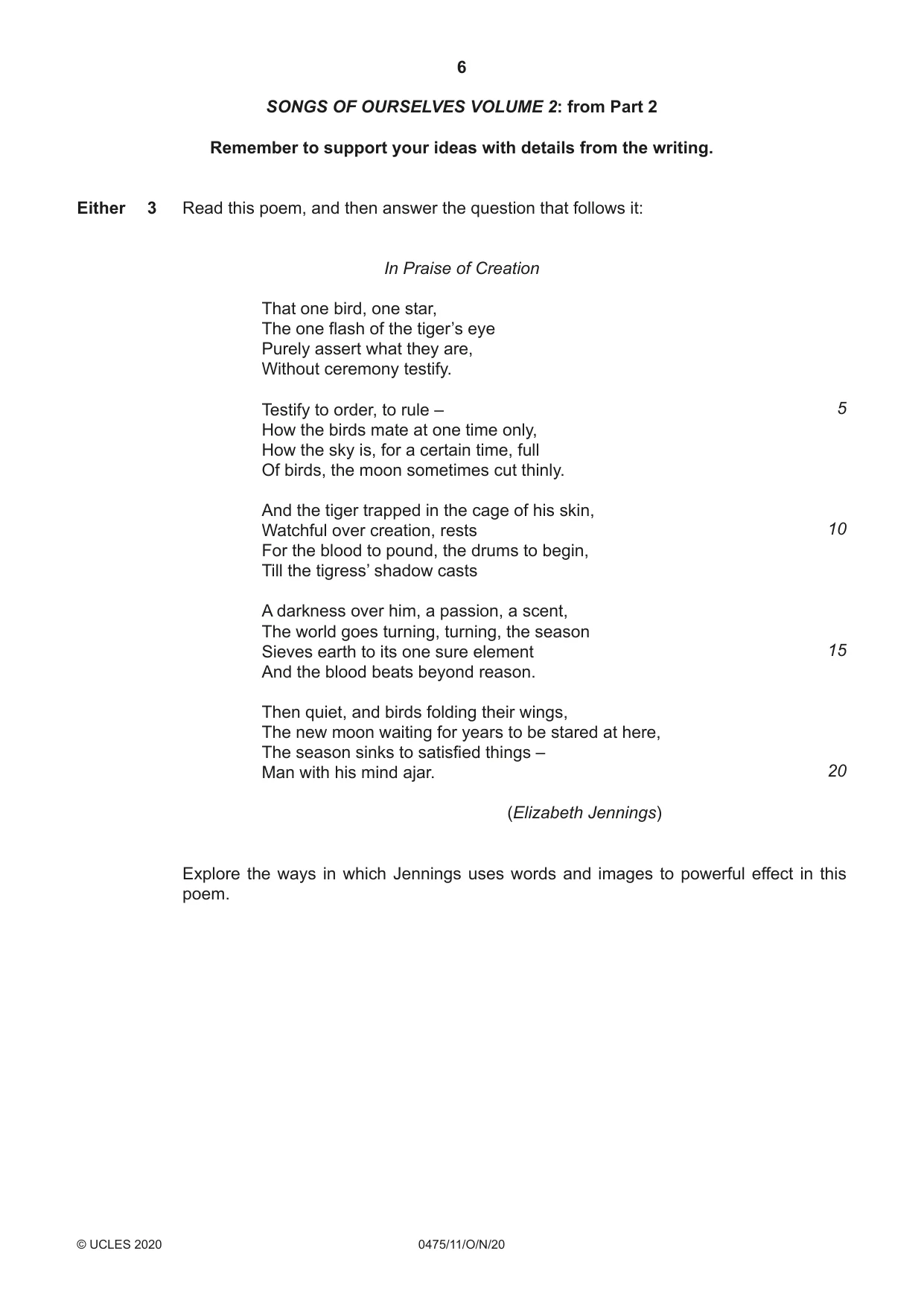
6 0475/11/O/N/20 © UCLES 2020 SONGS OF OURSELVES VOLUME 2: from Part 2 Remember to support your ideas with details from the writing. Either 3 Read this poem, and then answer the question that follows it: In Praise of Creation That one bird, one star, The one flash of the tiger’s eye Purely assert what they are, Without ceremony testify. Testify to order, to rule – How the birds mate at one time only, How the sky is, for a certain time, full Of birds, the moon sometimes cut thinly. And the tiger trapped in the cage of his skin, Watchful over creation, rests For the blood to pound, the drums to begin, Till the tigress’ shadow casts A darkness over him, a passion, a scent, The world goes turning, turning, the season Sieves earth to its one sure element And the blood beats beyond reason. Then quiet, and birds folding their wings, The new moon waiting for years to be stared at here, The season sinks to satisfied things – Man with his mind ajar. (Elizabeth Jennings) Explore the ways in which Jennings uses words and images to powerful effect in this poem. 5 10 15 20
Question paper, page 7
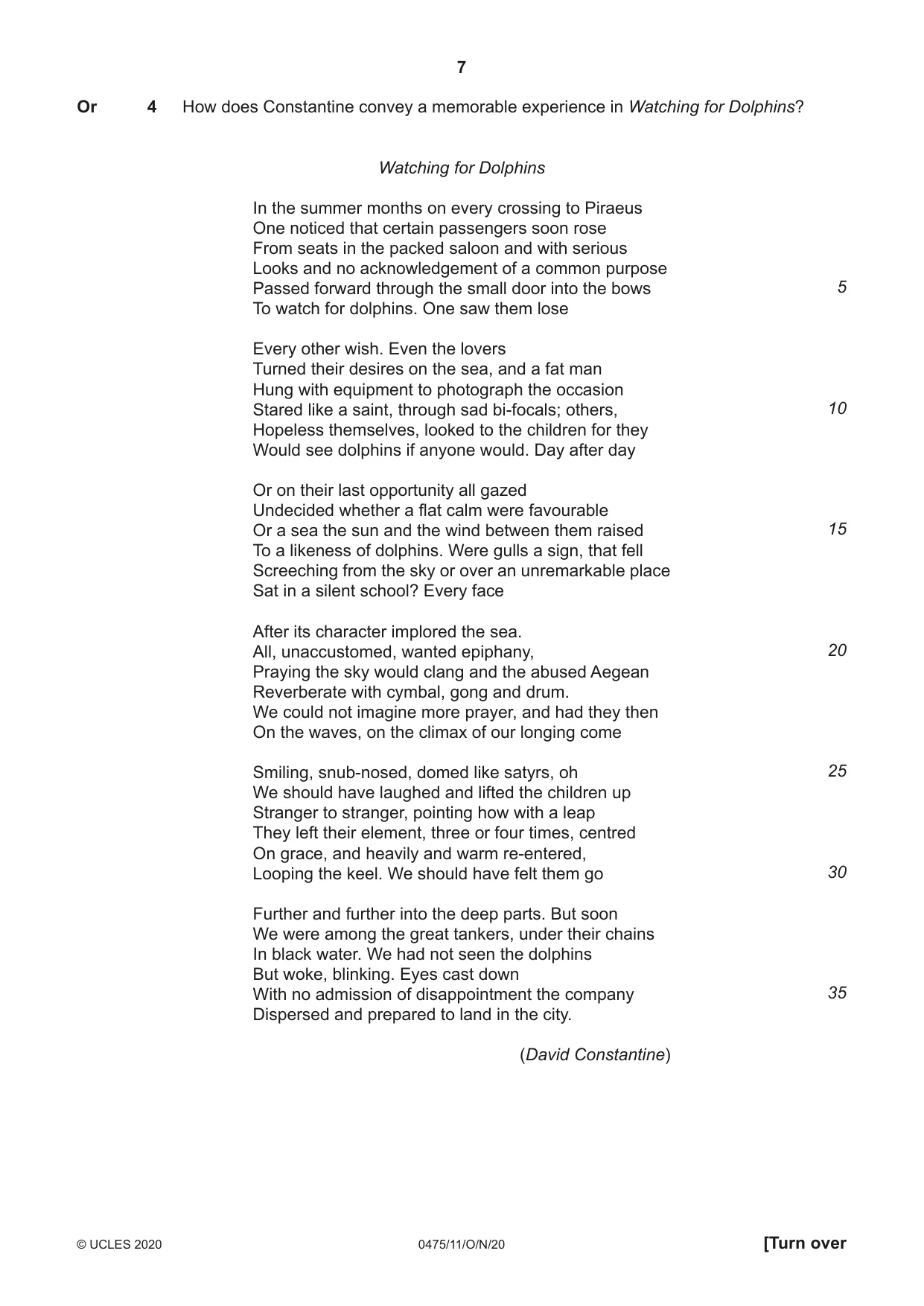
7 0475/11/O/N/20 © UCLES 2020 [Turn over Or 4 How does Constantine convey a memorable experience in Watching for Dolphins? Watching for Dolphins In the summer months on every crossing to Piraeus One noticed that certain passengers soon rose From seats in the packed saloon and with serious Looks and no acknowledgement of a common purpose Passed forward through the small door into the bows To watch for dolphins. One saw them lose Every other wish. Even the lovers Turned their desires on the sea, and a fat man Hung with equipment to photograph the occasion Stared like a saint, through sad bi-focals; others, Hopeless themselves, looked to the children for they Would see dolphins if anyone would. Day after day Or on their last opportunity all gazed Undecided whether a flat calm were favourable Or a sea the sun and the wind between them raised To a likeness of dolphins. Were gulls a sign, that fell Screeching from the sky or over an unremarkable place Sat in a silent school? Every face After its character implored the sea. All, unaccustomed, wanted epiphany, Praying the sky would clang and the abused Aegean Reverberate with cymbal, gong and drum. We could not imagine more prayer, and had they then On the waves, on the climax of our longing come Smiling, snub-nosed, domed like satyrs, oh We should have laughed and lifted the children up Stranger to stranger, pointing how with a leap They left their element, three or four times, centred On grace, and heavily and warm re-entered, Looping the keel. We should have felt them go Further and further into the deep parts. But soon We were among the great tankers, under their chains In black water. We had not seen the dolphins But woke, blinking. Eyes cast down With no admission of disappointment the company Dispersed and prepared to land in the city. (David Constantine) 5 10 15 20 25 30 35
Question paper, page 8
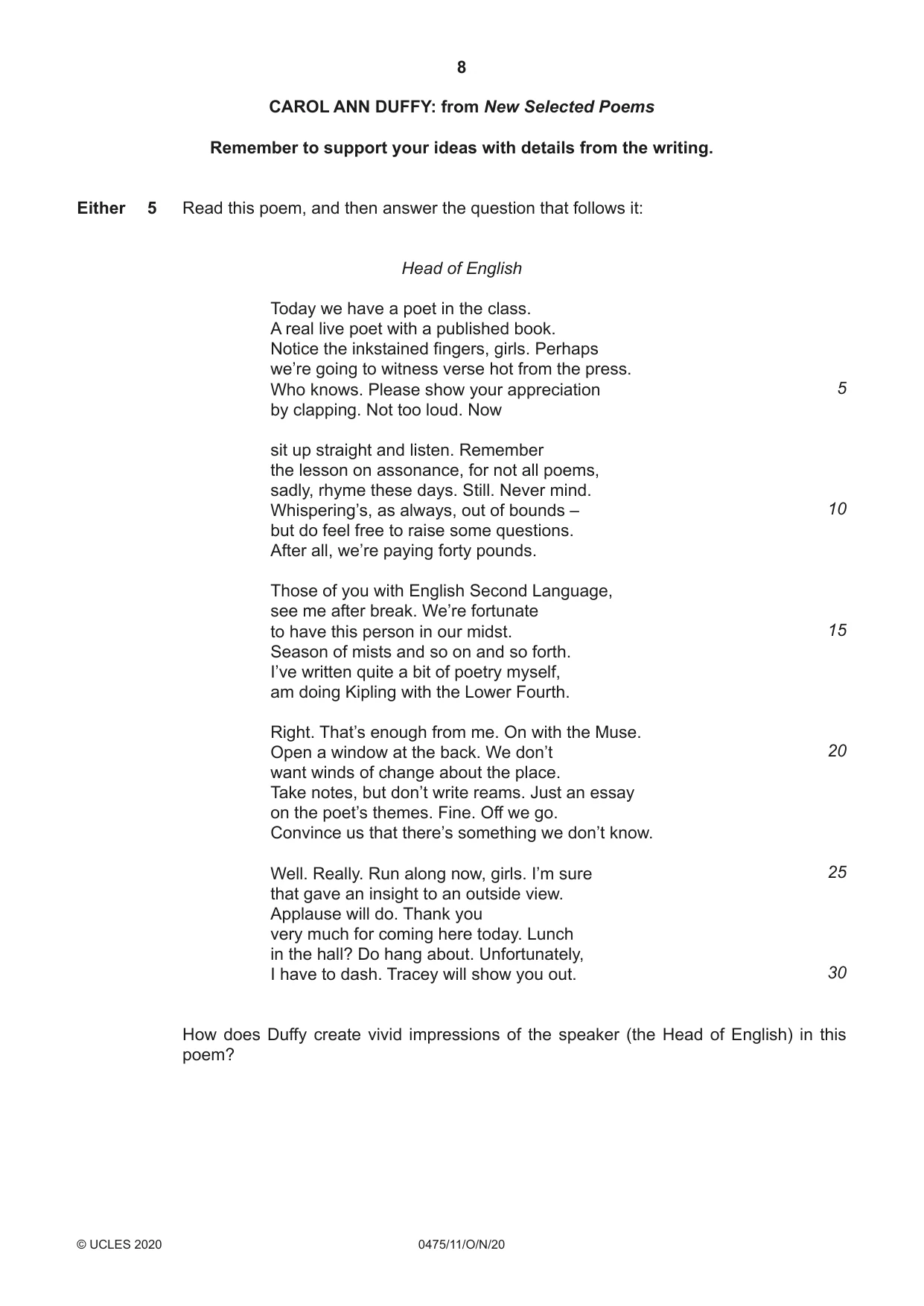
8 0475/11/O/N/20 © UCLES 2020 CAROL ANN DUFFY: from New Selected Poems Remember to support your ideas with details from the writing. Either 5 Read this poem, and then answer the question that follows it: Head of English Today we have a poet in the class. A real live poet with a published book. Notice the inkstained fingers, girls. Perhaps we’re going to witness verse hot from the press. Who knows. Please show your appreciation by clapping. Not too loud. Now sit up straight and listen. Remember the lesson on assonance, for not all poems, sadly, rhyme these days. Still. Never mind. Whispering’s, as always, out of bounds – but do feel free to raise some questions. After all, we’re paying forty pounds. Those of you with English Second Language, see me after break. We’re fortunate to have this person in our midst. Season of mists and so on and so forth. I’ve written quite a bit of poetry myself, am doing Kipling with the Lower Fourth. Right. That’s enough from me. On with the Muse. Open a window at the back. We don’t want winds of change about the place. Take notes, but don’t write reams. Just an essay on the poet’s themes. Fine. Off we go. Convince us that there’s something we don’t know. Well. Really. Run along now, girls. I’m sure that gave an insight to an outside view. Applause will do. Thank you very much for coming here today. Lunch in the hall? Do hang about. Unfortunately, I have to dash. Tracey will show you out. How does Duffy create vivid impressions of the speaker (the Head of English) in this poem? 5 10 15 20 25 30
Question paper, page 9
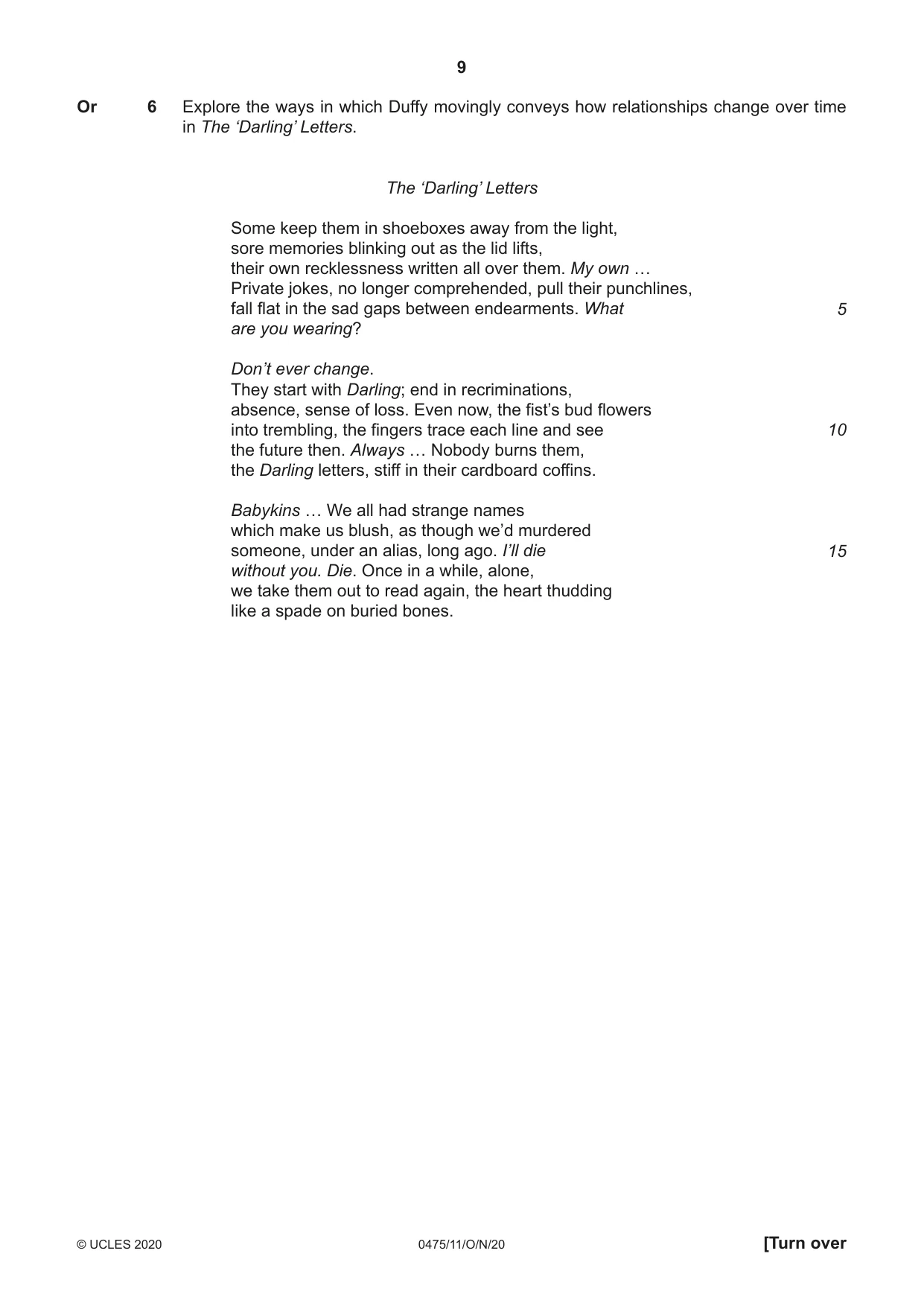
9 0475/11/O/N/20 © UCLES 2020 [Turn over Or 6 Explore the ways in which Duffy movingly conveys how relationships change over time in The ‘Darling’ Letters. The ‘Darling’ Letters Some keep them in shoeboxes away from the light, sore memories blinking out as the lid lifts, their own recklessness written all over them. My own … Private jokes, no longer comprehended, pull their punchlines, fall flat in the sad gaps between endearments. What are you wearing? Don’t ever change. They start with Darling; end in recriminations, absence, sense of loss. Even now, the fist’s bud flowers into trembling, the fingers trace each line and see the future then. Always … Nobody burns them, the Darling letters, stiff in their cardboard coffins. Babykins … We all had strange names which make us blush, as though we’d murdered someone, under an alias, long ago. I’ll die without you. Die. Once in a while, alone, we take them out to read again, the heart thudding like a spade on buried bones. 5 10 15
Question paper, page 10
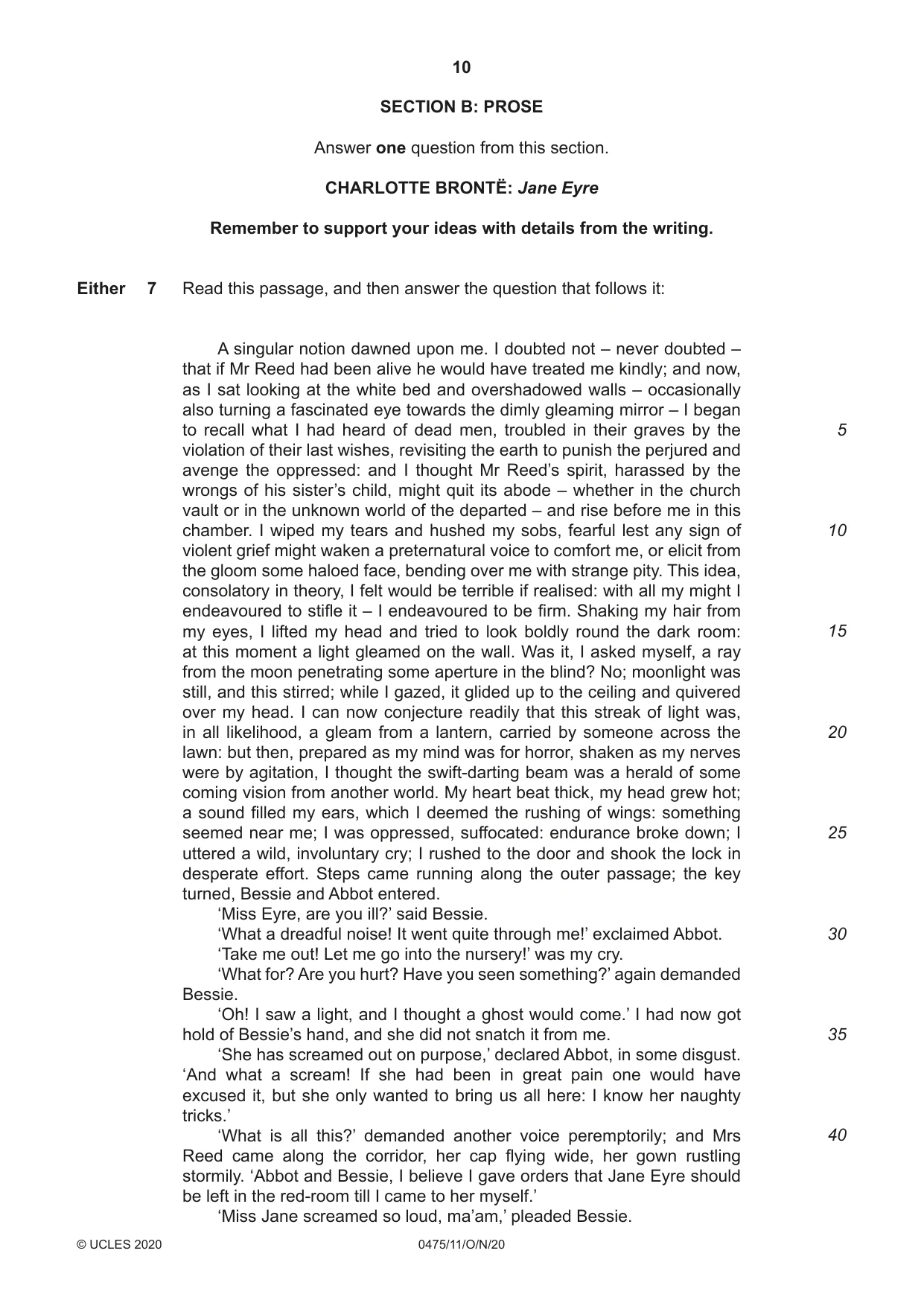
10 0475/11/O/N/20 © UCLES 2020 SECTION B: PROSE Answer one question from this section. CHARLOTTE BRONTË: Jane Eyre Remember to support your ideas with details from the writing. Either 7 Read this passage, and then answer the question that follows it: A singular notion dawned upon me. I doubted not – never doubted – that if Mr Reed had been alive he would have treated me kindly; and now, as I sat looking at the white bed and overshadowed walls – occasionally also turning a fascinated eye towards the dimly gleaming mirror – I began to recall what I had heard of dead men, troubled in their graves by the violation of their last wishes, revisiting the earth to punish the perjured and avenge the oppressed: and I thought Mr Reed’s spirit, harassed by the wrongs of his sister’s child, might quit its abode – whether in the church vault or in the unknown world of the departed – and rise before me in this chamber. I wiped my tears and hushed my sobs, fearful lest any sign of violent grief might waken a preternatural voice to comfort me, or elicit from the gloom some haloed face, bending over me with strange pity. This idea, consolatory in theory, I felt would be terrible if realised: with all my might I endeavoured to stifle it – I endeavoured to be firm. Shaking my hair from my eyes, I lifted my head and tried to look boldly round the dark room: at this moment a light gleamed on the wall. Was it, I asked myself, a ray from the moon penetrating some aperture in the blind? No; moonlight was still, and this stirred; while I gazed, it glided up to the ceiling and quivered over my head. I can now conjecture readily that this streak of light was, in all likelihood, a gleam from a lantern, carried by someone across the lawn: but then, prepared as my mind was for horror, shaken as my nerves were by agitation, I thought the swift-darting beam was a herald of some coming vision from another world. My heart beat thick, my head grew hot; a sound filled my ears, which I deemed the rushing of wings: something seemed near me; I was oppressed, suffocated: endurance broke down; I uttered a wild, involuntary cry; I rushed to the door and shook the lock in desperate effort. Steps came running along the outer passage; the key turned, Bessie and Abbot entered. ‘Miss Eyre, are you ill?’ said Bessie. ‘What a dreadful noise! It went quite through me!’ exclaimed Abbot. ‘Take me out! Let me go into the nursery!’ was my cry. ‘What for? Are you hurt? Have you seen something?’ again demanded Bessie. ‘Oh! I saw a light, and I thought a ghost would come.’ I had now got hold of Bessie’s hand, and she did not snatch it from me. ‘She has screamed out on purpose,’ declared Abbot, in some disgust. ‘And what a scream! If she had been in great pain one would have excused it, but she only wanted to bring us all here: I know her naughty tricks.’ ‘What is all this?’ demanded another voice peremptorily; and Mrs Reed came along the corridor, her cap flying wide, her gown rustling stormily. ‘Abbot and Bessie, I believe I gave orders that Jane Eyre should be left in the red-room till I came to her myself.’ ‘Miss Jane screamed so loud, ma’am,’ pleaded Bessie. 5 10 15 20 25 30 35 40
Question paper, page 11
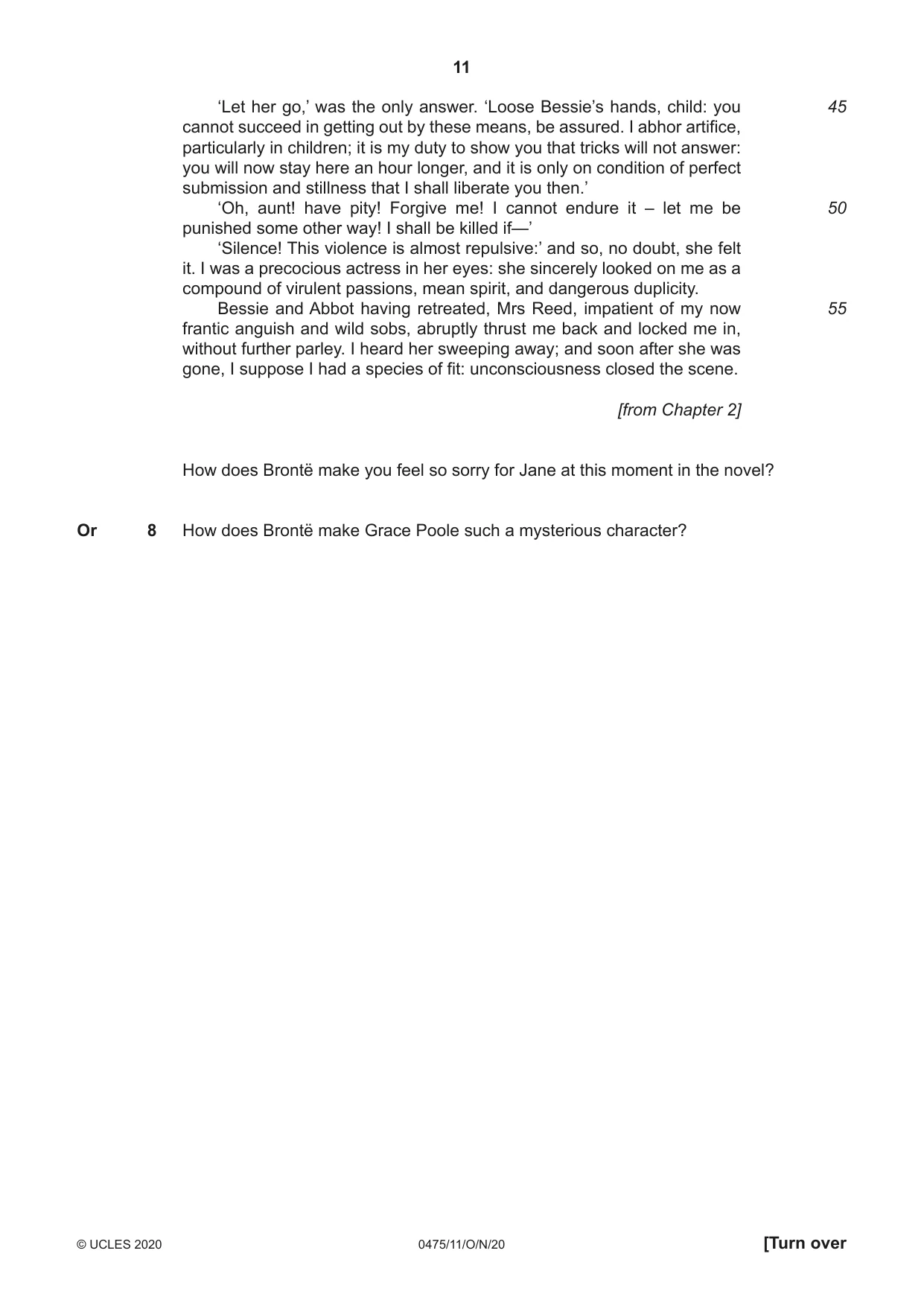
11 0475/11/O/N/20 © UCLES 2020 [Turn over ‘Let her go,’ was the only answer. ‘Loose Bessie’s hands, child: you cannot succeed in getting out by these means, be assured. I abhor artifice, particularly in children; it is my duty to show you that tricks will not answer: you will now stay here an hour longer, and it is only on condition of perfect submission and stillness that I shall liberate you then.’ ‘Oh, aunt! have pity! Forgive me! I cannot endure it – let me be punished some other way! I shall be killed if—’ ‘Silence! This violence is almost repulsive:’ and so, no doubt, she felt it. I was a precocious actress in her eyes: she sincerely looked on me as a compound of virulent passions, mean spirit, and dangerous duplicity. Bessie and Abbot having retreated, Mrs Reed, impatient of my now frantic anguish and wild sobs, abruptly thrust me back and locked me in, without further parley. I heard her sweeping away; and soon after she was gone, I suppose I had a species of fit: unconsciousness closed the scene. [from Chapter 2] How does Brontë make you feel so sorry for Jane at this moment in the novel? Or 8 How does Brontë make Grace Poole such a mysterious character? 45 50 55
Question paper, page 12
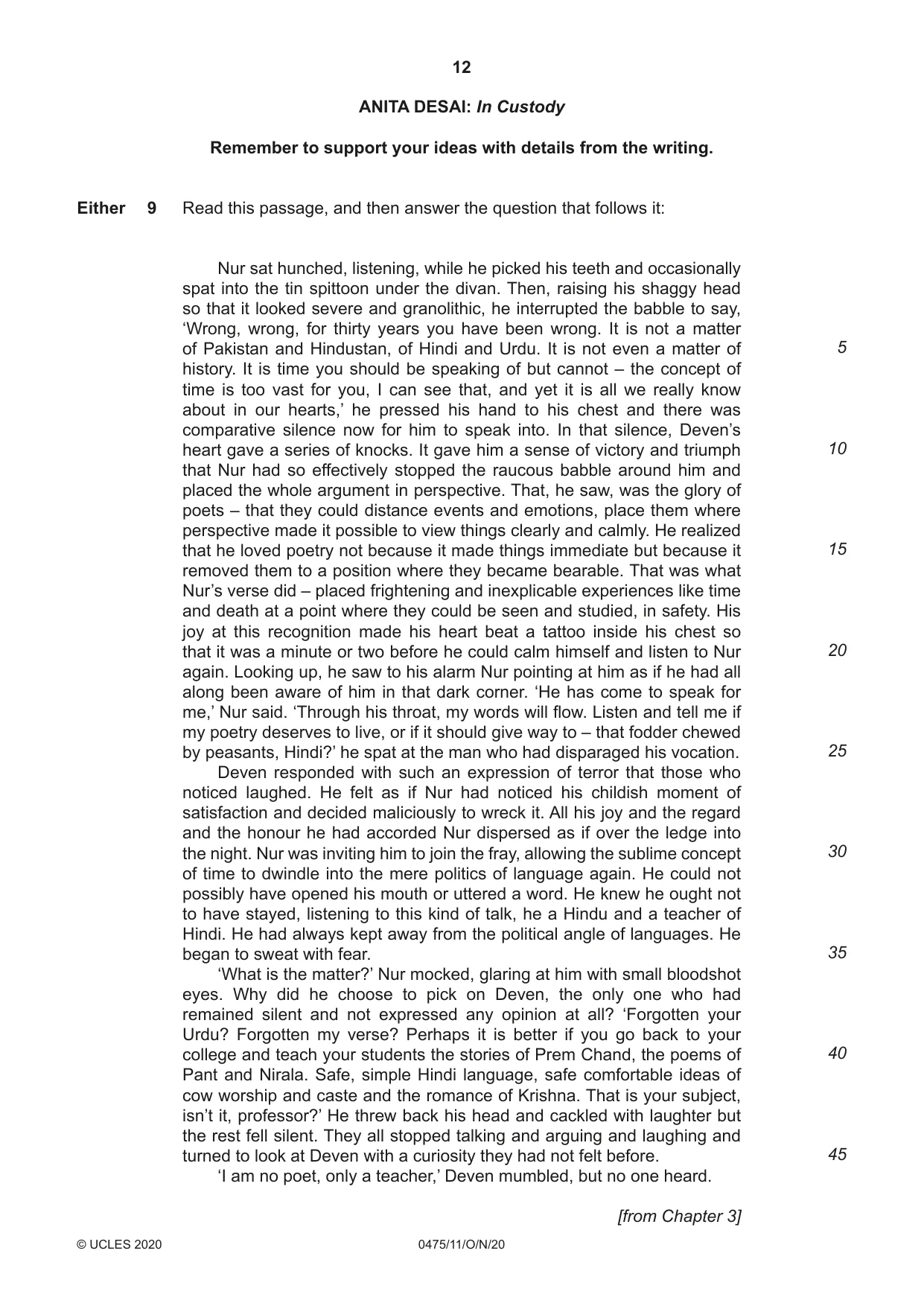
12 0475/11/O/N/20 © UCLES 2020 ANITA DESAI: In Custody Remember to support your ideas with details from the writing. Either 9 Read this passage, and then answer the question that follows it: Nur sat hunched, listening, while he picked his teeth and occasionally spat into the tin spittoon under the divan. Then, raising his shaggy head so that it looked severe and granolithic, he interrupted the babble to say, ‘Wrong, wrong, for thirty years you have been wrong. It is not a matter of Pakistan and Hindustan, of Hindi and Urdu. It is not even a matter of history. It is time you should be speaking of but cannot – the concept of time is too vast for you, I can see that, and yet it is all we really know about in our hearts,’ he pressed his hand to his chest and there was comparative silence now for him to speak into. In that silence, Deven’s heart gave a series of knocks. It gave him a sense of victory and triumph that Nur had so effectively stopped the raucous babble around him and placed the whole argument in perspective. That, he saw, was the glory of poets – that they could distance events and emotions, place them where perspective made it possible to view things clearly and calmly. He realized that he loved poetry not because it made things immediate but because it removed them to a position where they became bearable. That was what Nur’s verse did – placed frightening and inexplicable experiences like time and death at a point where they could be seen and studied, in safety. His joy at this recognition made his heart beat a tattoo inside his chest so that it was a minute or two before he could calm himself and listen to Nur again. Looking up, he saw to his alarm Nur pointing at him as if he had all along been aware of him in that dark corner. ‘He has come to speak for me,’ Nur said. ‘Through his throat, my words will flow. Listen and tell me if my poetry deserves to live, or if it should give way to – that fodder chewed by peasants, Hindi?’ he spat at the man who had disparaged his vocation. Deven responded with such an expression of terror that those who noticed laughed. He felt as if Nur had noticed his childish moment of satisfaction and decided maliciously to wreck it. All his joy and the regard and the honour he had accorded Nur dispersed as if over the ledge into the night. Nur was inviting him to join the fray, allowing the sublime concept of time to dwindle into the mere politics of language again. He could not possibly have opened his mouth or uttered a word. He knew he ought not to have stayed, listening to this kind of talk, he a Hindu and a teacher of Hindi. He had always kept away from the political angle of languages. He began to sweat with fear. ‘What is the matter?’ Nur mocked, glaring at him with small bloodshot eyes. Why did he choose to pick on Deven, the only one who had remained silent and not expressed any opinion at all? ‘Forgotten your Urdu? Forgotten my verse? Perhaps it is better if you go back to your college and teach your students the stories of Prem Chand, the poems of Pant and Nirala. Safe, simple Hindi language, safe comfortable ideas of cow worship and caste and the romance of Krishna. That is your subject, isn’t it, professor?’ He threw back his head and cackled with laughter but the rest fell silent. They all stopped talking and arguing and laughing and turned to look at Deven with a curiosity they had not felt before. ‘I am no poet, only a teacher,’ Deven mumbled, but no one heard. [from Chapter 3] 5 10 15 20 25 30 35 40 45
Question paper, page 13
13 0475/11/O/N/20 © UCLES 2020 [Turn over How does Desai vividly reveal Deven’s thoughts and feelings at this moment in the novel? Or 10 How far does Desai make it possible for you to have any sympathy for Imtiaz Begum?
Question paper, page 14
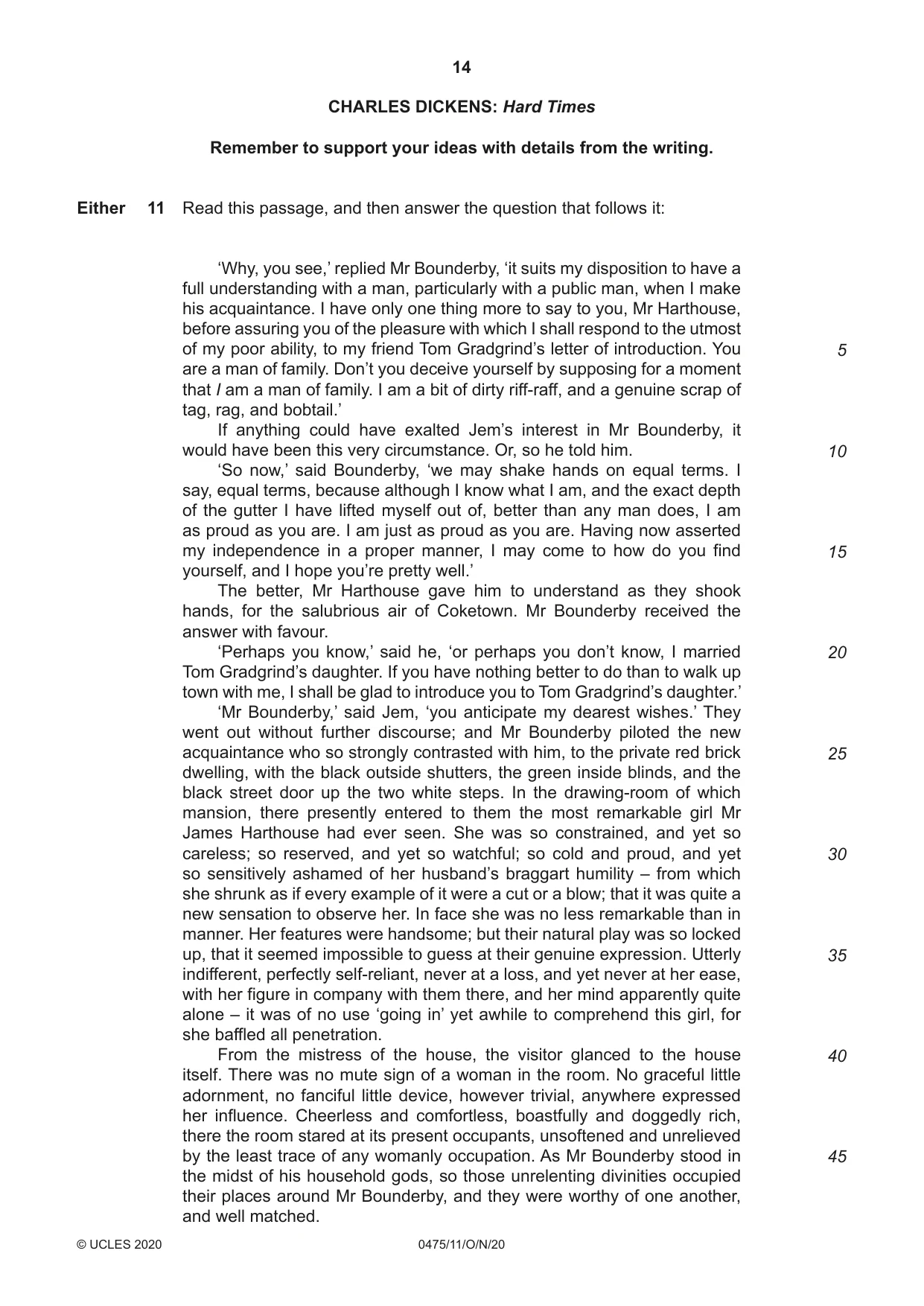
14 0475/11/O/N/20 © UCLES 2020 CHARLES DICKENS: Hard Times Remember to support your ideas with details from the writing. Either 11 Read this passage, and then answer the question that follows it: ‘Why, you see,’ replied Mr Bounderby, ‘it suits my disposition to have a full understanding with a man, particularly with a public man, when I make his acquaintance. I have only one thing more to say to you, Mr Harthouse, before assuring you of the pleasure with which I shall respond to the utmost of my poor ability, to my friend Tom Gradgrind’s letter of introduction. You are a man of family. Don’t you deceive yourself by supposing for a moment that I am a man of family. I am a bit of dirty riff-raff, and a genuine scrap of tag, rag, and bobtail.’ If anything could have exalted Jem’s interest in Mr Bounderby, it would have been this very circumstance. Or, so he told him. ‘So now,’ said Bounderby, ‘we may shake hands on equal terms. I say, equal terms, because although I know what I am, and the exact depth of the gutter I have lifted myself out of, better than any man does, I am as proud as you are. I am just as proud as you are. Having now asserted my independence in a proper manner, I may come to how do you find yourself, and I hope you’re pretty well.’ The better, Mr Harthouse gave him to understand as they shook hands, for the salubrious air of Coketown. Mr Bounderby received the answer with favour. ‘Perhaps you know,’ said he, ‘or perhaps you don’t know, I married Tom Gradgrind’s daughter. If you have nothing better to do than to walk up town with me, I shall be glad to introduce you to Tom Gradgrind’s daughter.’ ‘Mr Bounderby,’ said Jem, ‘you anticipate my dearest wishes.’ They went out without further discourse; and Mr Bounderby piloted the new acquaintance who so strongly contrasted with him, to the private red brick dwelling, with the black outside shutters, the green inside blinds, and the black street door up the two white steps. In the drawing-room of which mansion, there presently entered to them the most remarkable girl Mr James Harthouse had ever seen. She was so constrained, and yet so careless; so reserved, and yet so watchful; so cold and proud, and yet so sensitively ashamed of her husband’s braggart humility – from which she shrunk as if every example of it were a cut or a blow; that it was quite a new sensation to observe her. In face she was no less remarkable than in manner. Her features were handsome; but their natural play was so locked up, that it seemed impossible to guess at their genuine expression. Utterly indifferent, perfectly self-reliant, never at a loss, and yet never at her ease, with her figure in company with them there, and her mind apparently quite alone – it was of no use ‘going in’ yet awhile to comprehend this girl, for she baffled all penetration. From the mistress of the house, the visitor glanced to the house itself. There was no mute sign of a woman in the room. No graceful little adornment, no fanciful little device, however trivial, anywhere expressed her influence. Cheerless and comfortless, boastfully and doggedly rich, there the room stared at its present occupants, unsoftened and unrelieved by the least trace of any womanly occupation. As Mr Bounderby stood in the midst of his household gods, so those unrelenting divinities occupied their places around Mr Bounderby, and they were worthy of one another, and well matched. 5 10 15 20 25 30 35 40 45
Question paper, page 15
15 0475/11/O/N/20 © UCLES 2020 [Turn over ‘This, sir,’ said Bounderby, ‘is my wife, Mrs Bounderby: Tom Gradgrind’s eldest daughter. Loo, Mr James Harthouse. Mr Harthouse has joined your father’s muster-roll. If he is not Tom Gradgrind’s colleague before long, I believe we shall at least hear of him in connexion with one of our neighbouring towns. You observe, Mr Harthouse, that my wife is my junior. I don’t know what she saw in me to marry me, but she saw something in me, I suppose, or she wouldn’t have married me. She has lots of expensive knowledge, sir, political and otherwise. If you want to cram for anything, I should be troubled to recommend you to a better adviser than Loo Bounderby.’ To a more agreeable adviser, or one from whom he would be more likely to learn, Mr Harthouse could never be recommended. [from Book 2, Chapter 2] In what ways does Dickens make this first meeting between Bounderby and Harthouse so memorable? Or 12 Explore the ways in which Dickens makes the relationship between Louisa and Sissy so moving. 50 55 60
Question paper, page 16
16 0475/11/O/N/20 © UCLES 2020 ZORA NEALE HURSTON: Their Eyes Were Watching God Remember to support your ideas with details from the writing. Either 13 Read this passage, and then answer the question that follows it: He was lying on his side facing the door like he was expecting somebody or something. Content removed due to copyright restrictions.
Question paper, page 17
17 0475/11/O/N/20 © UCLES 2020 [Turn over Janie gave them peace on his breast, then she studied his dead face for a long time. [from Chapter 8] How does Hurston make this such a powerful moment in the novel? Or 14 What striking impressions does Hurston create of life ‘on the muck’ in the Everglades? Content removed due to copyright restrictions.
Question paper, page 18
18 0475/11/O/N/20 © UCLES 2020 JOHN KNOWLES: A Separate Peace Remember to support your ideas with details from the writing. Either 15 Read this passage, and then answer the question that follows it: ‘I don’t really hate Brinker, I don’t really hate him, not any more than anybody else.’ Leper’s swimming eyes cautiously explored me. The wind lifted a sail of snow and billowed it past us. ‘It was only—’ he drew in his breath so sharply that it made a whistling sound—‘the idea of his face on a woman’s body. That’s what made me psycho. Ideas like that. I don’t know. I guess they must be right. I guess I am psycho. I guess I must be. I must be. Did you ever have ideas like that?’ ‘No.’ ‘Would they bother you if you did, if you happened to keep imagining a man’s head on a woman’s body, or if sometimes the arm of a chair turned into a human arm if you looked at it too long, things like that? Would they bother you?’ I didn’t say anything. ‘Maybe everybody imagines things like that when they’re away from home, really far away, for the first time. Do you think so? The camp I went to first, they called it a ‘Reception center,’ got us up every morning when it was pitch black, and there was food like the kind we throw out here, and all my clothes were gone and I got this uniform that didn’t even smell familiar. All day I wanted to sleep, after we got to Basic Training. I kept falling asleep, all day long, at the lectures we went to, and on the firing range, and everywhere else. But not at night. Next to me there was a man who had a cough that sounded like his stomach was going to come up, one of these times, it sounded like it would come up through his mouth and land with a splatter on the floor. He always faced my way. We did sleep head to foot, but I knew it would land near me. I never slept at night. During the day I couldn’t eat this food that should have been thrown away, so I was always hungry except in the Mess Hall. The Mess Hall. The army has the perfect word for everything, did you ever think of that?’ I imperceptibly nodded and shook my head, yes-and-no. ‘And the perfect word for me,’ he added in a distorted voice, as though his tongue had swollen, ‘psycho. I guess I am. I must be. Am I, though, or is the army? Because they turned everything inside out. I couldn’t sleep in bed, I had to sleep everywhere else. I couldn’t eat in the Mess Hall, I had to eat everywhere else. Everything began to be inside out. And the man next to me at night, coughing himself inside out. That was when things began to change. One day I couldn’t make out what was happening to the corporal’s face. It kept changing into faces I knew from somewhere else, and then I began to think he looked like me, and then he …’ Leper’s voice had thickened unrecognizably, ‘he changed into a woman, I was looking at him as close as I’m looking at you and his face turned into a woman’s face and I started to yell for everybody, I began to yell so that everyone would see it too, I didn’t want to be the only one to see a thing like that, I yelled louder and louder to make sure everyone within reach of my voice would hear—you can see there wasn’t anything crazy in the way I was thinking, can’t you, I had a good reason for everything I did, didn’t I—but I couldn’t yell soon enough, or loud enough, and when somebody did finally come up to me, it was this man with the cough who slept in the next cot, and he was holding a broom because we had been sweeping out the barracks, 5 10 15 20 25 30 35 40 45
Question paper, page 19
19 0475/11/O/N/20 © UCLES 2020 [Turn over but I saw right away that it wasn’t a broom, it was a man’s leg which had been cut off. I remember thinking that he must have been at the hospital helping with an amputation when he heard my yell. You can see there’s logic in that.’ The crust beneath us continued to crack and as we reached the border of the field the frigid trees also were cracking with the cold. The two sharp groups of noises sounded to my ears like rifles being fired in the distance. I said nothing, and Leper, having said so much, went on to say more, to speak above the wind and crackings as though his story would never be finished. ‘Then they grabbed me and there were arms and legs and heads everywhere and I couldn’t tell when any minute—’ ‘Shut up! ’ Softer, more timidly, ‘—when any minute—’ ‘Do you think I want to hear every gory detail! Shut up! I don’t care! I don’t care what happened to you, Leper. I don’t give a damn! Do you understand that? This has nothing to do with me! Nothing at all! I don’t care!’ I turned around and began a clumsy run across the field in a line which avoided his house and aimed toward the road leading back into the town. I left Leper telling his story into the wind. He might tell it forever, I didn’t care. I didn’t want to hear any more of it. I had already heard too much. What did he mean by telling me a story like that! I didn’t want to hear any more of it. Not now or ever. I didn’t care because it had nothing to do with me. And I didn’t want to hear any more of it. Ever. [from Chapter 10] How does Knowles make this conversation between Leper and Gene so disturbing? Or 16 Gene describes Finny as ‘noble’. How far does Knowles persuade you that this judgement is fair? 50 55 60 65 70
Question paper, page 20
20 0475/11/O/N/20 © UCLES 2020 GEORGE ORWELL: 1984 Remember to support your ideas with details from the writing. Either 17 Read this passage, and then answer the question that follows it: It was nearly eleven hundred, and in the Records Department, where Winston worked, they were dragging the chairs out of the cubicles and grouping them in the centre of the hall, opposite the big telescreen, in preparation for the Two Minutes Hate. Winston was just taking his place in one of the middle rows when two people whom he knew by sight, but had never spoken to, came unexpectedly into the room. One of them was a girl whom he often passed in the corridors. He did not know her name, but he knew that she worked in the Fiction Department. Presumably – since he had sometimes seen her with oily hands and carrying a spanner – she had some mechanical job on one of the novel-writing machines. She was a bold-looking girl, of about twenty-seven, with thick dark hair, a freckled face and swift, athletic movements. A narrow scarlet sash, emblem of the Junior Anti-Sex League, was wound several times round the waist of her overalls, just tightly enough to bring out the shapeliness of her hips. Winston had disliked her from the very first moment of seeing her. He knew the reason. It was because of the atmosphere of hockey-fields and cold baths and community hikes and general clean-mindedness which she managed to carry about with her. He disliked nearly all women, and especially the young and pretty ones. It was always the women, and above all the young ones, who were the most bigoted adherents of the Party, the swallowers of slogans, the amateur spies and nosers-out of unorthodoxy. But this particular girl gave him the impression of being more dangerous than most. Once when they passed in the corridor she had given him a quick sidelong glance which seemed to pierce right into him and for a moment had filled him with black terror. The idea had even crossed his mind that she might be an agent of the Thought Police. That, it was true, was very unlikely. Still, he continued to feel a peculiar uneasiness, which had fear mixed up in it as well as hostility, whenever she was anywhere near him. The other person was a man named O’Brien, a member of the Inner Party and holder of some post so important and remote that Winston had only a dim idea of its nature. A momentary hush passed over the group of people round the chairs as they saw the black overalls of an Inner Party member approaching. O’Brien was a large, burly man with a thick neck and a coarse, humorous, brutal face. In spite of his formidable appearance he had a certain charm of manner. He had a trick of re-settling his spectacles on his nose which was curiously disarming – in some indefinable way, curiously civilised. It was a gesture which, if anyone had still thought in such terms, might have recalled an eighteenth-century nobleman offering his snuff-box. Winston had seen O’Brien perhaps a dozen times in almost as many years. He felt deeply drawn to him, and not solely because he was intrigued by the contrast between O’Brien’s urbane manner and his prizefighter’s physique. Much more it was because of a secretly-held belief – or perhaps not even a belief, merely a hope – that O’Brien’s political orthodoxy was not perfect. Something in his face suggested it irresistibly. And again, perhaps it was not even unorthodoxy that was written in his face, but simply intelligence. But at any rate he had the appearance of being a person that you could talk to, if somehow you could cheat the 5 10 15 20 25 30 35 40 45
Question paper, page 21
21 0475/11/O/N/20 © UCLES 2020 [Turn over telescreen and get him alone. Winston had never made the smallest effort to verify this guess: indeed, there was no way of doing so. At this moment O’Brien glanced at his wristwatch, saw that it was nearly eleven hundred and evidently decided to stay in the Records Department until the Two Minutes Hate was over. He took a chair in the same row as Winston, a couple of places away. A small, sandy-haired woman who worked in the next cubicle to Winston was between them. The girl with dark hair was sitting immediately behind. The next moment a hideous, grinding screech, as of some monstrous machine running without oil, burst from the big telescreen at the end of the room. It was a noise that set one’s teeth on edge and bristled the hair at the back of one’s neck. The Hate had started. [from Part 1] How does Orwell create striking impressions of Julia and O’Brien at this moment in the novel? Or 18 In what ways does Orwell make Mr Charrington and his shop such a memorable part of the novel? 50 55 60
Question paper, page 22
22 0475/11/O/N/20 © UCLES 2020 ALAN PATON: Cry, the Beloved Country Remember to support your ideas with details from the writing. Either 19 Read this passage, and then answer the question that follows it: The next morning, after they had eaten at the Mission House, Msimangu and Kumalo set off for the great wide road where the buses run. – Every bus is here the right bus, said Msimangu. Kumalo smiled at that, for it was a joke against him and his fear of catching the wrong bus. – All these buses go to Johannesburg, said Msimangu. You need not fear to take a wrong bus here. So they took the first bus that came, and it set them down at the place where Kumalo had lost his pound. And then they walked, through many streets full of cars and buses and people, till they reached the bus rank for Alexandra. But here they met an unexpected obstacle, for a man came up to them and said to Msimangu, Are you going to Alexandra, umfundisi? – Yes, my friend. – We are here to stop you, umfundisi. Not by force, you see – he pointed – the police are there to prevent that. But by persuasion. If you use this bus you are weakening the cause of the black people. We have determined not to use these buses until the fare is brought back again to fourpence. – Yes, indeed, I have heard of it He turned to Kumalo. – I was very foolish, my friend. I had forgotten that there were no buses; at least I had forgotten the boycott of the buses. – Our business is very urgent, said Kumalo humbly. – This boycott is also urgent, said the man politely. They want us to pay sixpence, that is one shilling a day. Six shillings a week, and some of us only get thirty-five or forty shillings. – Is it far to walk? asked Kumalo. – It is a long way, umfundisi. Eleven miles. – That is a long way, for an old man. – Men as old as you are doing it everyday, umfundisi. And women, and some that are sick, and some crippled, and children. They start walking at four in the morning, and they do not get back till eight at night. They have a bite of food, and their eyes are hardly closed on the pillow before they must stand up again, sometimes to start off with nothing but hot water in their stomachs. I cannot stop you taking a bus, umfundisi, but this is a cause to fight for. If we lose it, then they will have to pay more in Sophiatown and Claremont and Kliptown and Pimville. – I understand you well. We shall not use the bus. The man thanked them and went to another would-be traveller. – That man has a silver tongue, said Kumalo. – That is the famous Dubula, said Msimangu quietly. A friend of your brother John. But they say – excuse me, my friend – that Tomlinson has the brains, and your brother the voice, but that this man has the heart. He is the one the Government is afraid of, because he himself is not afraid. He seeks nothing for himself. They say he has given up his own work to do this picketing of the buses, and his wife pickets the other bus rank at Alexandra. 5 10 15 20 25 30 35 40 45
Question paper, page 23
23 0475/11/O/N/20 © UCLES 2020 [Turn over – That is something to be proud of. Johannesburg is a place of wonders. – They were church people, said Msimangu regretfully, but are so no longer. Like your brother, they say the church has a fine voice, but no deeds. Well, my friend, what do we do now? – I am willing to walk. – Eleven miles, and eleven miles back. It is a long journey. – I am willing. You understand I am anxious, my friend. This Johannesburg – it is no place for a boy to be alone. – Good. Let us begin then. So they walked many miles through the European city, up Twist Street to the Clarendon Circle, and down Louis Botha towards Orange Grove. And the cars and the lorries never ceased, going one way or the other. After a long time a car stopped and a white man spoke to them. – Where are you two going? he asked. – To Alexandra, sir, said Msimangu, taking off his hat. – I thought you might be. Climb in. That was a great help to them, and at the turn-off to Alexandra they expressed their thanks. – It is a long journey, said the white man. And I know that you have no buses. They stood to watch him go on, but he did not go on. He swung round, and was soon on the road back to Johannesburg. – Huh, said Msimangu, that is something to marvel at. It was still a long way to Twenty-Third Avenue, and as they passed one avenue after the other, Msimangu explained that Alexandra was outside the boundaries of Johannesburg, and was a place where a black man could buy land and own a house. But the streets were not cared for, and there were no lights, and so great was the demand for accommodation that every man if he could, built rooms in his yard and sub-let them to others. Many of these rooms were the hide-outs for thieves and robbers, and there was much prostitution and brewing of illicit liquor. [from Book 1, Chapter 8] In what ways does Paton make this conversation between Stephen and Msimangu so revealing? Or 20 How does Paton make Absalom’s trial so compelling? 50 55 60 65 70 75 80
Question paper, page 24
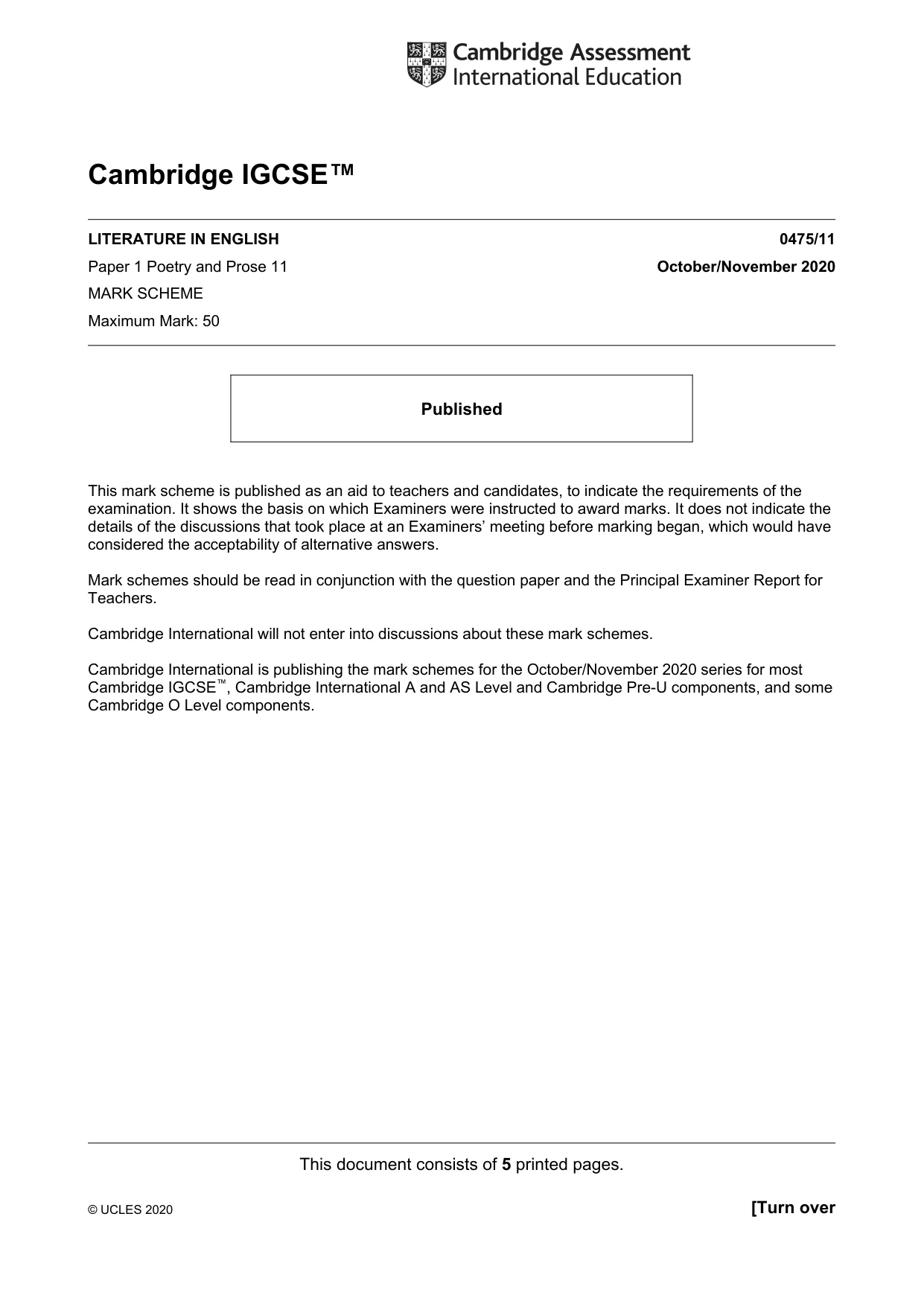
24 0475/11/O/N/20 © UCLES 2020 from Stories of Ourselves Remember to support your ideas with details from the writing. Either 21 Read this passage from Secrets (by Bernard MacLaverty), and then answer the question that follows it: He could hear his aunt’s familiar puffing on the short stairs to her room. He spread the elastic band wide with his fingers. It snapped and the letters scattered. He pushed them into their pigeon hole and quickly closed the desk flap. The brass screeched loudly and clicked shut. At that moment his aunt came into the room. ‘What are you doing, boy?’ she snapped. ‘Nothing.’ He stood with the keys in his hand. She walked to the bureau and opened it. The letters sprung out in an untidy heap. ‘You have been reading my letters,’ she said quietly. Her mouth was tight with the words and her eyes blazed. The boy could say nothing. She struck him across the side of the face. ‘Get out,’ she said. ‘Get out of my room.’ The boy, the side of his face stinging and red, put the keys on the table on his way out. When he reached the door she called him. He stopped, his hand on the handle. ‘You are dirt,’ she hissed, ‘and always will be dirt. I shall remember this till the day I die.’ Even though it was a warm evening there was a fire in the large fireplace. His mother had asked him to light it so that she could clear out Aunt Mary’s stuff. The room could then be his study, she said. She came in and seeing him at the table said, ‘I hope I’m not disturbing you.’ ‘No.’ She took the keys from her pocket, opened the bureau and began burning papers and cards. She glanced quickly at each one before she flicked it onto the fire. ‘Who was Brother Benignus?’ he asked. His mother stopped sorting and said, ‘I don’t know. Your aunt kept herself very much to herself. She got books from him through the post occasionally. That much I do know.’ She went on burning the cards. They built into strata, glowing red and black. Now and again she broke up the pile with the poker, sending showers of sparks up the chimney. He saw her come to the letters. She took off the elastic band and put it to one side with the useful things and began dealing the envelopes into the fire. She opened one and read quickly through it, then threw it on top of the burning pile. ‘Mama,’ he said. ‘Yes?’ ‘Did Aunt Mary say anything about me?’ ‘What do you mean?’ ‘Before she died – did she say anything?’ ‘Not that I know of – the poor thing was too far gone to speak, God rest her.’ She went on burning, lifting the corners of the letters with the poker to let the flames underneath them. When he felt a hardness in his throat he put his head down on his books. Tears came into his eyes for the first time since she had died and he cried 5 10 15 20 25 30 35 40 45
Question paper, page 25
25 0475/11/O/N/20 © UCLES 2020 silently into the crook of his arm for the woman who had been his maiden aunt, his teller of tales, that she might forgive him. What does MacLaverty’s writing make you feel as you read the ending to the story? Or 22 Explore the ways in which Bradbury powerfully builds tension in There Will Come Soft Rains.
Question paper, page 26
26 0475/11/O/N/20 © UCLES 2020 BLANK PAGE
Question paper, page 27
27 0475/11/O/N/20 © UCLES 2020 BLANK PAGE
Question paper, page 28
28 0475/11/O/N/20 © UCLES 2020 Permission to reproduce items where third-party owned material protected by copyright is included has been sought and cleared where possible. Every reasonable effort has been made by the publisher (UCLES) to trace copyright holders, but if any items requiring clearance have unwittingly been included, the publisher will be pleased to make amends at the earliest possible opportunity. To avoid the issue of disclosure of answer-related information to candidates, all copyright acknowledgements are reproduced online in the Cambridge Assessment International Education Copyright Acknowledgements Booklet. This is produced for each series of examinations and is freely available to download at www.cambridgeinternational.org after the live examination series. Cambridge Assessment International Education is part of the Cambridge Assessment Group. Cambridge Assessment is the brand name of the University of Cambridge Local Examinations Syndicate (UCLES), which itself is a department of the University of Cambridge. BLANK PAGE
Mark scheme, page 1
This document consists of 5 printed pages. © UCLES 2020 [Turn over Cambridge IGCSE™ LITERATURE IN ENGLISH 0475/11 Paper 1 Poetry and Prose 11 October/November 2020 MARK SCHEME Maximum Mark: 50 Published This mark scheme is published as an aid to teachers and candidates, to indicate the requirements of the examination. It shows the basis on which Examiners were instructed to award marks. It does not indicate the details of the discussions that took place at an Examiners’ meeting before marking began, which would have considered the acceptability of alternative answers. Mark schemes should be read in conjunction with the question paper and the Principal Examiner Report for Teachers. Cambridge International will not enter into discussions about these mark schemes. Cambridge International is publishing the mark schemes for the October/November 2020 series for most Cambridge IGCSE™, Cambridge International A and AS Level and Cambridge Pre-U components, and some Cambridge O Level components.
Mark scheme, page 2
0475/11 Cambridge IGCSE – Mark Scheme PUBLISHED October/November 2020 © UCLES 2020 Page 2 of 5 Generic Marking Principles These general marking principles must be applied by all examiners when marking candidate answers. They should be applied alongside the specific content of the mark scheme or generic level descriptors for a question. Each question paper and mark scheme will also comply with these marking principles. GENERIC MARKING PRINCIPLE 1: Marks must be awarded in line with: • the specific content of the mark scheme or the generic level descriptors for the question • the specific skills defined in the mark scheme or in the generic level descriptors for the question • the standard of response required by a candidate as exemplified by the standardisation scripts. GENERIC MARKING PRINCIPLE 2: Marks awarded are always whole marks (not half marks, or other fractions). GENERIC MARKING PRINCIPLE 3: Marks must be awarded positively: • marks are awarded for correct/valid answers, as defined in the mark scheme. However, credit is given for valid answers which go beyond the scope of the syllabus and mark scheme, referring to your Team Leader as appropriate • marks are awarded when candidates clearly demonstrate what they know and can do • marks are not deducted for errors • marks are not deducted for omissions • answers should only be judged on the quality of spelling, punctuation and grammar when these features are specifically assessed by the question as indicated by the mark scheme. The meaning, however, should be unambiguous. GENERIC MARKING PRINCIPLE 4: Rules must be applied consistently, e.g. in situations where candidates have not followed instructions or in the application of generic level descriptors. GENERIC MARKING PRINCIPLE 5: Marks should be awarded using the full range of marks defined in the mark scheme for the question (however; the use of the full mark range may be limited according to the quality of the candidate responses seen). GENERIC MARKING PRINCIPLE 6: Marks awarded are based solely on the requirements as defined in the mark scheme. Marks should not be awarded with grade thresholds or grade descriptors in mind.
Mark scheme, page 3
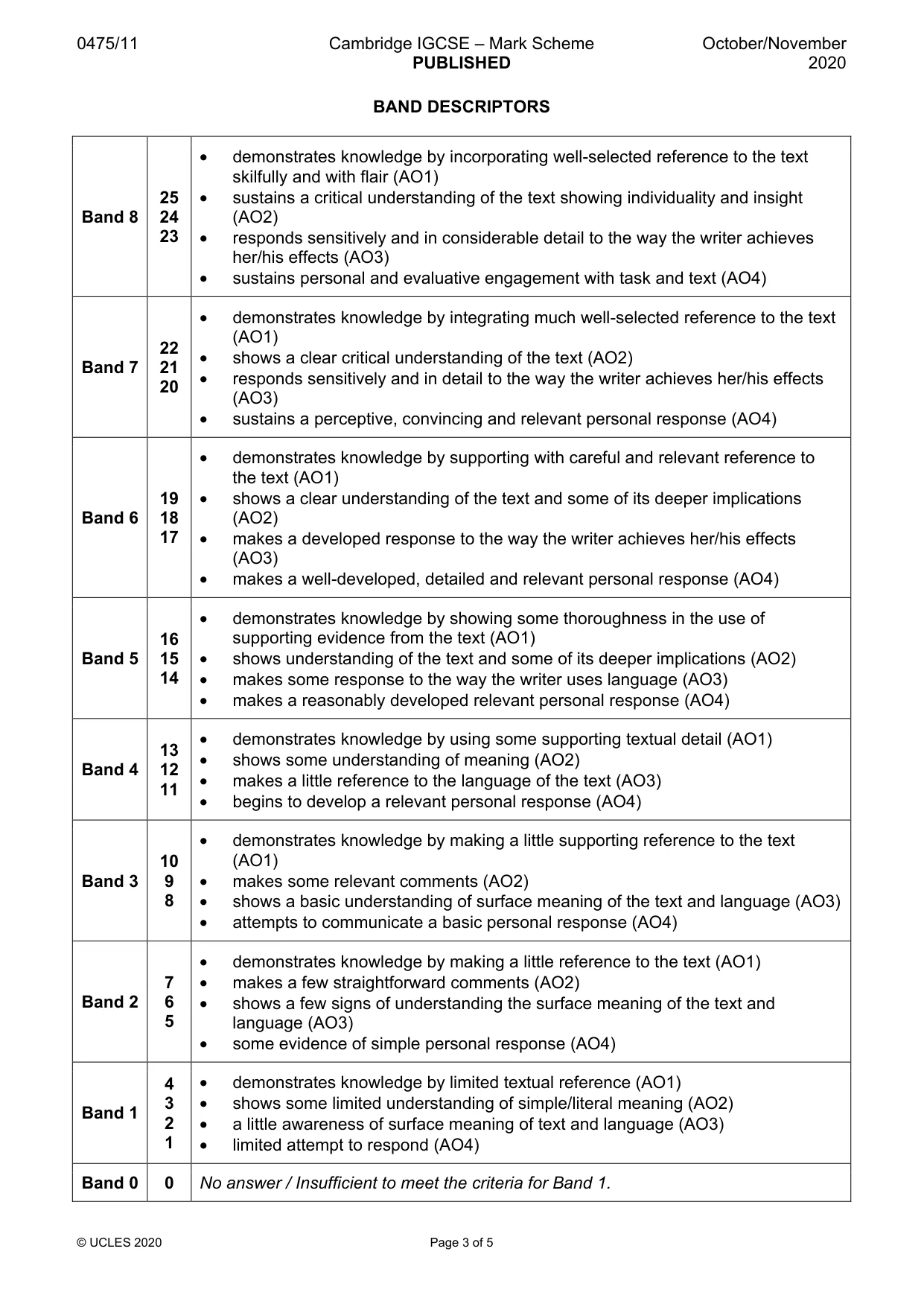
0475/11 Cambridge IGCSE – Mark Scheme PUBLISHED October/November 2020 © UCLES 2020 Page 3 of 5 BAND DESCRIPTORS Band 8 25 24 23 • demonstrates knowledge by incorporating well-selected reference to the text skilfully and with flair (AO1) • sustains a critical understanding of the text showing individuality and insight (AO2) • responds sensitively and in considerable detail to the way the writer achieves her/his effects (AO3) • sustains personal and evaluative engagement with task and text (AO4) Band 7 22 21 20 • demonstrates knowledge by integrating much well-selected reference to the text (AO1) • shows a clear critical understanding of the text (AO2) • responds sensitively and in detail to the way the writer achieves her/his effects (AO3) • sustains a perceptive, convincing and relevant personal response (AO4) Band 6 19 18 17 • demonstrates knowledge by supporting with careful and relevant reference to the text (AO1) • shows a clear understanding of the text and some of its deeper implications (AO2) • makes a developed response to the way the writer achieves her/his effects (AO3) • makes a well-developed, detailed and relevant personal response (AO4) Band 5 16 15 14 • demonstrates knowledge by showing some thoroughness in the use of supporting evidence from the text (AO1) • shows understanding of the text and some of its deeper implications (AO2) • makes some response to the way the writer uses language (AO3) • makes a reasonably developed relevant personal response (AO4) Band 4 13 12 11 • demonstrates knowledge by using some supporting textual detail (AO1) • shows some understanding of meaning (AO2) • makes a little reference to the language of the text (AO3) • begins to develop a relevant personal response (AO4) Band 3 10 9 8 • demonstrates knowledge by making a little supporting reference to the text (AO1) • makes some relevant comments (AO2) • shows a basic understanding of surface meaning of the text and language (AO3) • attempts to communicate a basic personal response (AO4) Band 2 7 6 5 • demonstrates knowledge by making a little reference to the text (AO1) • makes a few straightforward comments (AO2) • shows a few signs of understanding the surface meaning of the text and language (AO3) • some evidence of simple personal response (AO4) Band 1 4 3 2 1 • demonstrates knowledge by limited textual reference (AO1) • shows some limited understanding of simple/literal meaning (AO2) • a little awareness of surface meaning of text and language (AO3) • limited attempt to respond (AO4) Band 0 0 No answer / Insufficient to meet the criteria for Band 1.
Mark scheme, page 4
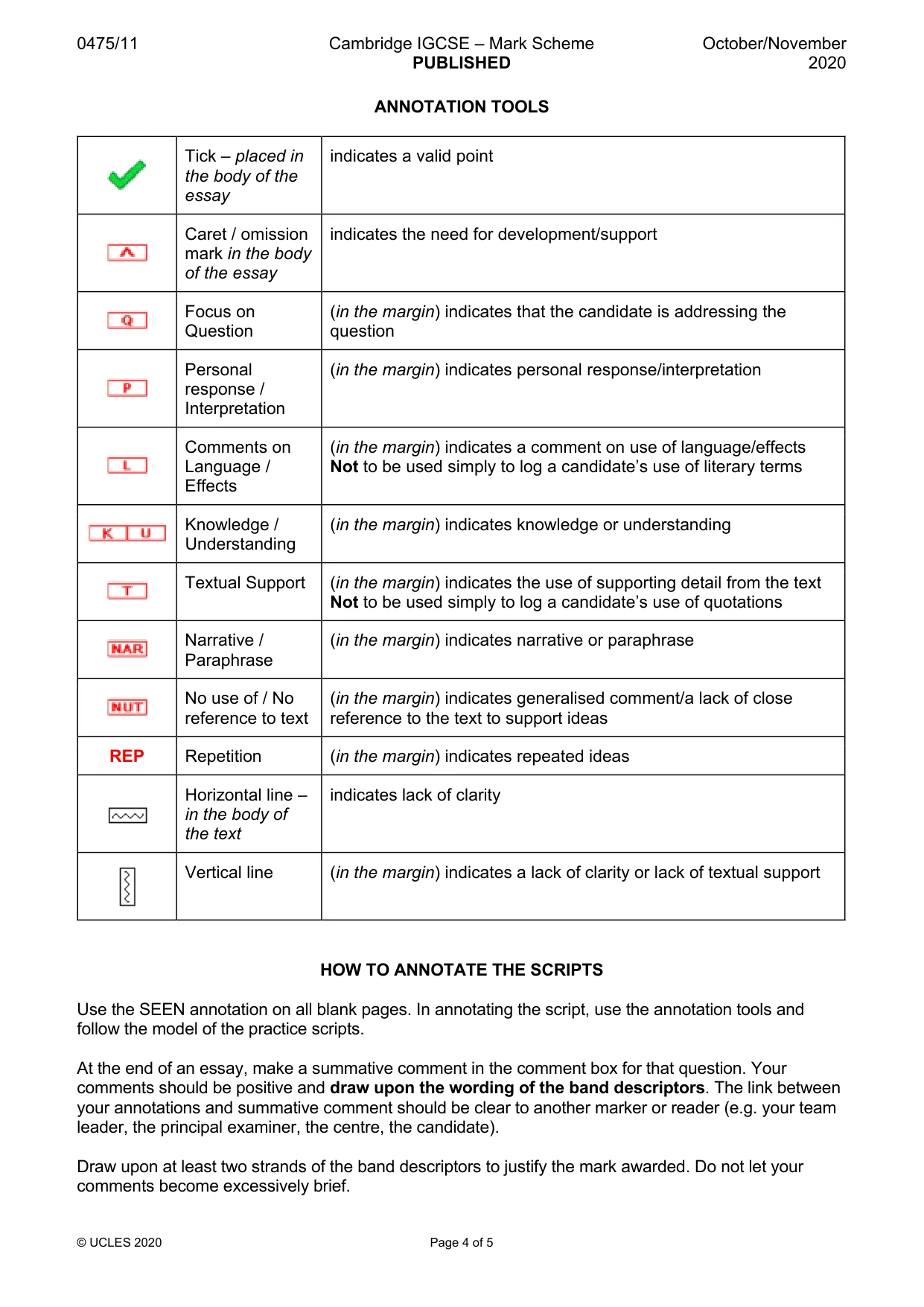
0475/11 Cambridge IGCSE – Mark Scheme PUBLISHED October/November 2020 © UCLES 2020 Page 4 of 5 ANNOTATION TOOLS Tick – placed in the body of the essay indicates a valid point Caret / omission mark in the body of the essay indicates the need for development/support Focus on Question (in the margin) indicates that the candidate is addressing the question Personal response / Interpretation (in the margin) indicates personal response/interpretation Comments on Language / Effects (in the margin) indicates a comment on use of language/effects Not to be used simply to log a candidate’s use of literary terms Knowledge / Understanding (in the margin) indicates knowledge or understanding Textual Support (in the margin) indicates the use of supporting detail from the text Not to be used simply to log a candidate’s use of quotations Narrative / Paraphrase (in the margin) indicates narrative or paraphrase No use of / No reference to text (in the margin) indicates generalised comment/a lack of close reference to the text to support ideas REP Repetition (in the margin) indicates repeated ideas Horizontal line – in the body of the text indicates lack of clarity Vertical line (in the margin) indicates a lack of clarity or lack of textual support HOW TO ANNOTATE THE SCRIPTS Use the SEEN annotation on all blank pages. In annotating the script, use the annotation tools and follow the model of the practice scripts. At the end of an essay, make a summative comment in the comment box for that question. Your comments should be positive and draw upon the wording of the band descriptors. The link between your annotations and summative comment should be clear to another marker or reader (e.g. your team leader, the principal examiner, the centre, the candidate). Draw upon at least two strands of the band descriptors to justify the mark awarded. Do not let your comments become excessively brief.
Mark scheme, page 5
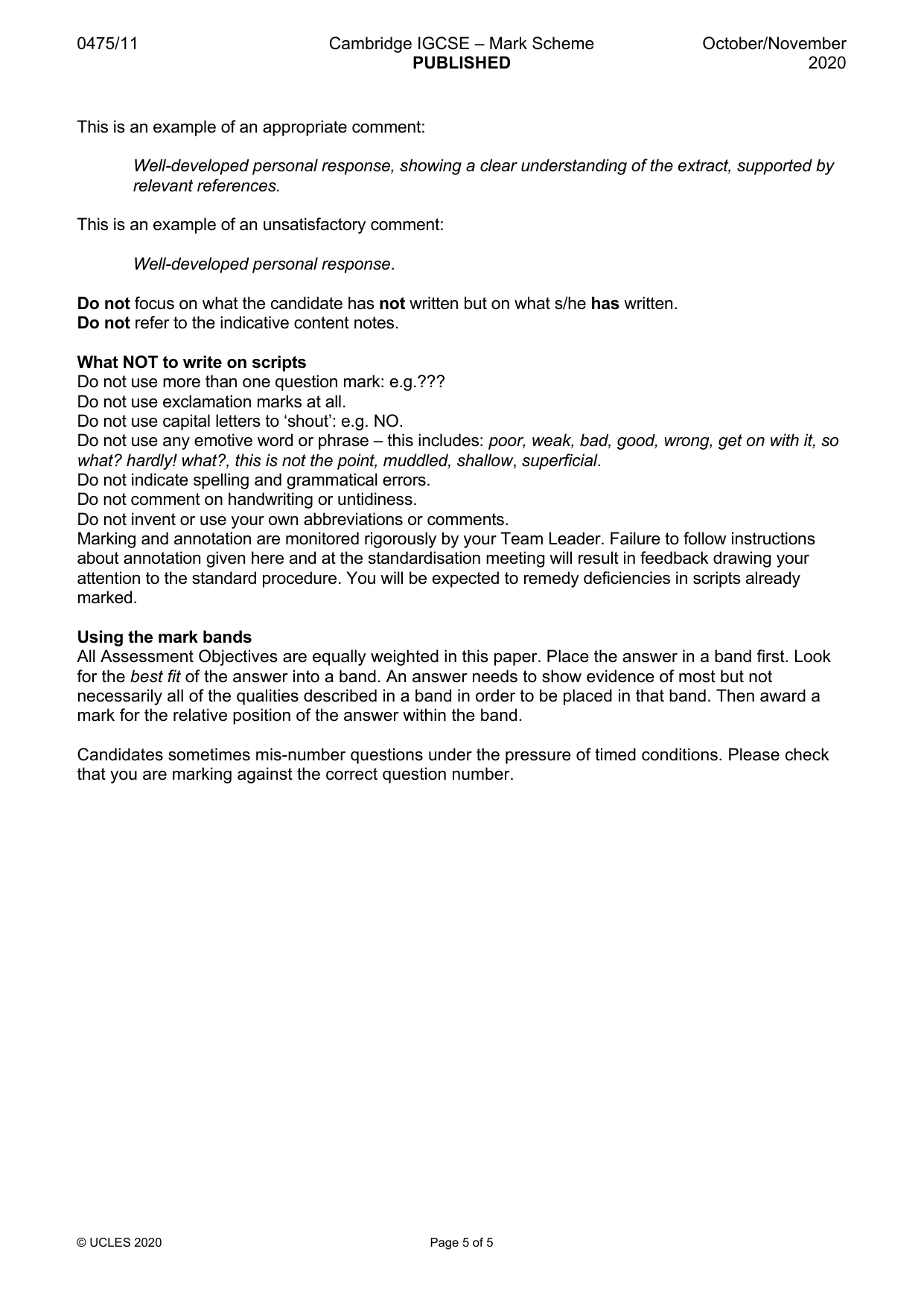
0475/11 Cambridge IGCSE – Mark Scheme PUBLISHED October/November 2020 © UCLES 2020 Page 5 of 5 This is an example of an appropriate comment: Well-developed personal response, showing a clear understanding of the extract, supported by relevant references. This is an example of an unsatisfactory comment: Well-developed personal response. Do not focus on what the candidate has not written but on what s/he has written. Do not refer to the indicative content notes. What NOT to write on scripts Do not use more than one question mark: e.g.??? Do not use exclamation marks at all. Do not use capital letters to ‘shout’: e.g. NO. Do not use any emotive word or phrase – this includes: poor, weak, bad, good, wrong, get on with it, so what? hardly! what?, this is not the point, muddled, shallow, superficial. Do not indicate spelling and grammatical errors. Do not comment on handwriting or untidiness. Do not invent or use your own abbreviations or comments. Marking and annotation are monitored rigorously by your Team Leader. Failure to follow instructions about annotation given here and at the standardisation meeting will result in feedback drawing your attention to the standard procedure. You will be expected to remedy deficiencies in scripts already marked. Using the mark bands All Assessment Objectives are equally weighted in this paper. Place the answer in a band first. Look for the best fit of the answer into a band. An answer needs to show evidence of most but not necessarily all of the qualities described in a band in order to be placed in that band. Then award a mark for the relative position of the answer within the band. Candidates sometimes mis-number questions under the pressure of timed conditions. Please check that you are marking against the correct question number.
What you needed in this session
Cambridge’s own grade thresholds for 2020 Oct/Nov, Paper 1 · Variant 1. A higher threshold means an easier paper — the bar moves with how the cohort did.