Cambridge IGCSE English - Literature in English 0475 — 2020 Oct/Nov Paper 1 · Variant 2
0475/12/O/N/20 · 50 marks · ≈56 min
The question paper and its mark scheme, free to read here and free to download. This is Cambridge’s own paper, exactly as it was sat.
Question paper28 pages





Mark scheme5 pages
Answers below. Sit the paper first if you are practising.
Paper as text
Question paper, page 1
Cambridge IGCSE™ * 6 4 9 0 0 1 2 9 2 2 * DC (RCL/GO) 185448/4 © UCLES 2020 [Turn over This document has 28 pages. Blank pages are indicated. LITERATURE IN ENGLISH 0475/12 Paper 1 Poetry and Prose October/November 2020 1 hour 30 minutes You must answer on the enclosed answer booklet. You will need: Answer booklet (enclosed) INSTRUCTIONS ● Answer two questions in total: Section A: answer one question. Section B: answer one question. ● Follow the instructions on the front cover of the answer booklet. If you need additional answer paper, ask the invigilator for a continuation booklet. INFORMATION ● The total mark for this paper is 50. ● All questions are worth equal marks. Cambridge IGCSE™
Question paper, page 2
2 0475/12/O/N/20 © UCLES 2020 BLANK PAGE
Question paper, page 3
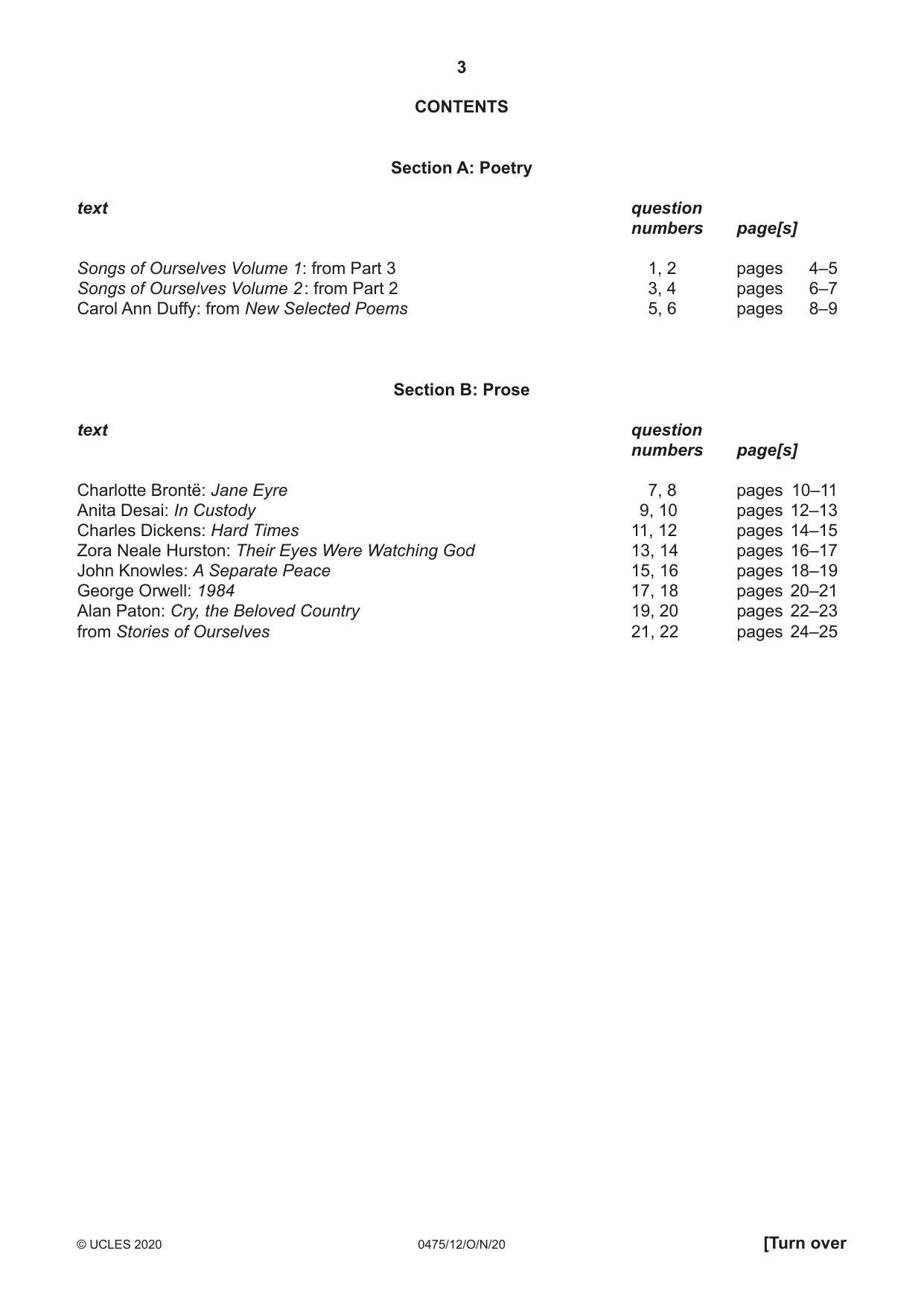
3 0475/12/O/N/20 © UCLES 2020 [Turn over CONTENTS Section A: Poetry text question numbers page[s] Songs of Ourselves Volume 1: from Part 3 1, 2 pages 4–5 Songs of Ourselves Volume 2 : from Part 2 3, 4 pages 6–7 Carol Ann Duffy: from New Selected Poems 5, 6 pages 8–9 Section B: Prose text question numbers page[s] Charlotte Brontë: Jane Eyre 7, 8 pages 10–11 Anita Desai: In Custody 9, 10 pages 12–13 Charles Dickens: Hard Times 11, 12 pages 14–15 Zora Neale Hurston: Their Eyes Were Watching God 13, 14 pages 16–17 John Knowles: A Separate Peace 15, 16 pages 18–19 George Orwell: 1984 17, 18 pages 20–21 Alan Paton: Cry, the Beloved Country 19, 20 pages 22–23 from Stories of Ourselves 21, 22 pages 24–25
Question paper, page 4
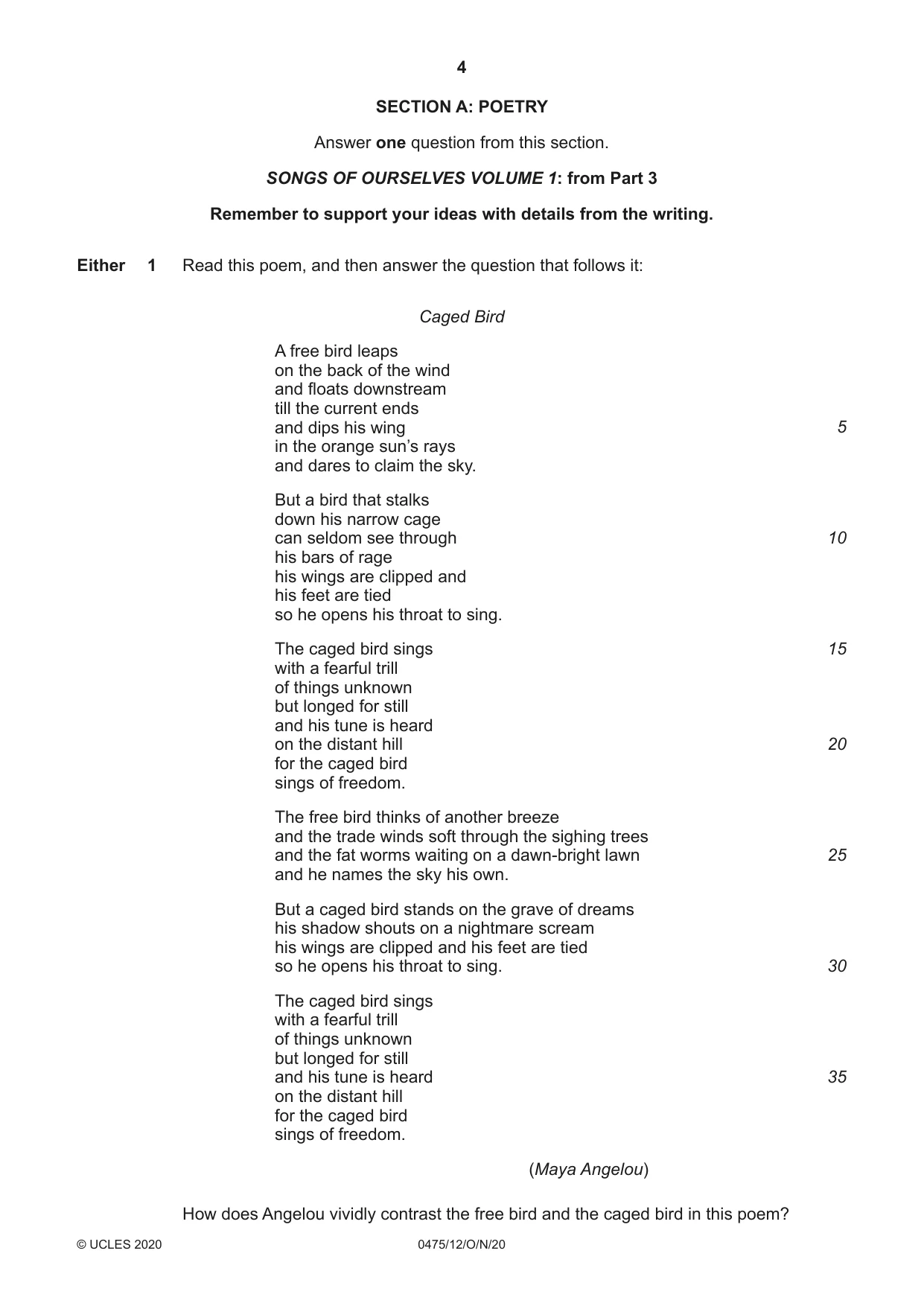
4 0475/12/O/N/20 © UCLES 2020 SECTION A: POETRY Answer one question from this section. SONGS OF OURSELVES VOLUME 1: from Part 3 Remember to support your ideas with details from the writing. Either 1 Read this poem, and then answer the question that follows it: Caged Bird A free bird leaps on the back of the wind and floats downstream till the current ends and dips his wing in the orange sun’s rays and dares to claim the sky. But a bird that stalks down his narrow cage can seldom see through his bars of rage his wings are clipped and his feet are tied so he opens his throat to sing. The caged bird sings with a fearful trill of things unknown but longed for still and his tune is heard on the distant hill for the caged bird sings of freedom. The free bird thinks of another breeze and the trade winds soft through the sighing trees and the fat worms waiting on a dawn-bright lawn and he names the sky his own. But a caged bird stands on the grave of dreams his shadow shouts on a nightmare scream his wings are clipped and his feet are tied so he opens his throat to sing. The caged bird sings with a fearful trill of things unknown but longed for still and his tune is heard on the distant hill for the caged bird sings of freedom. (Maya Angelou) How does Angelou vividly contrast the free bird and the caged bird in this poem? 5 10 15 20 25 30 35
Question paper, page 5
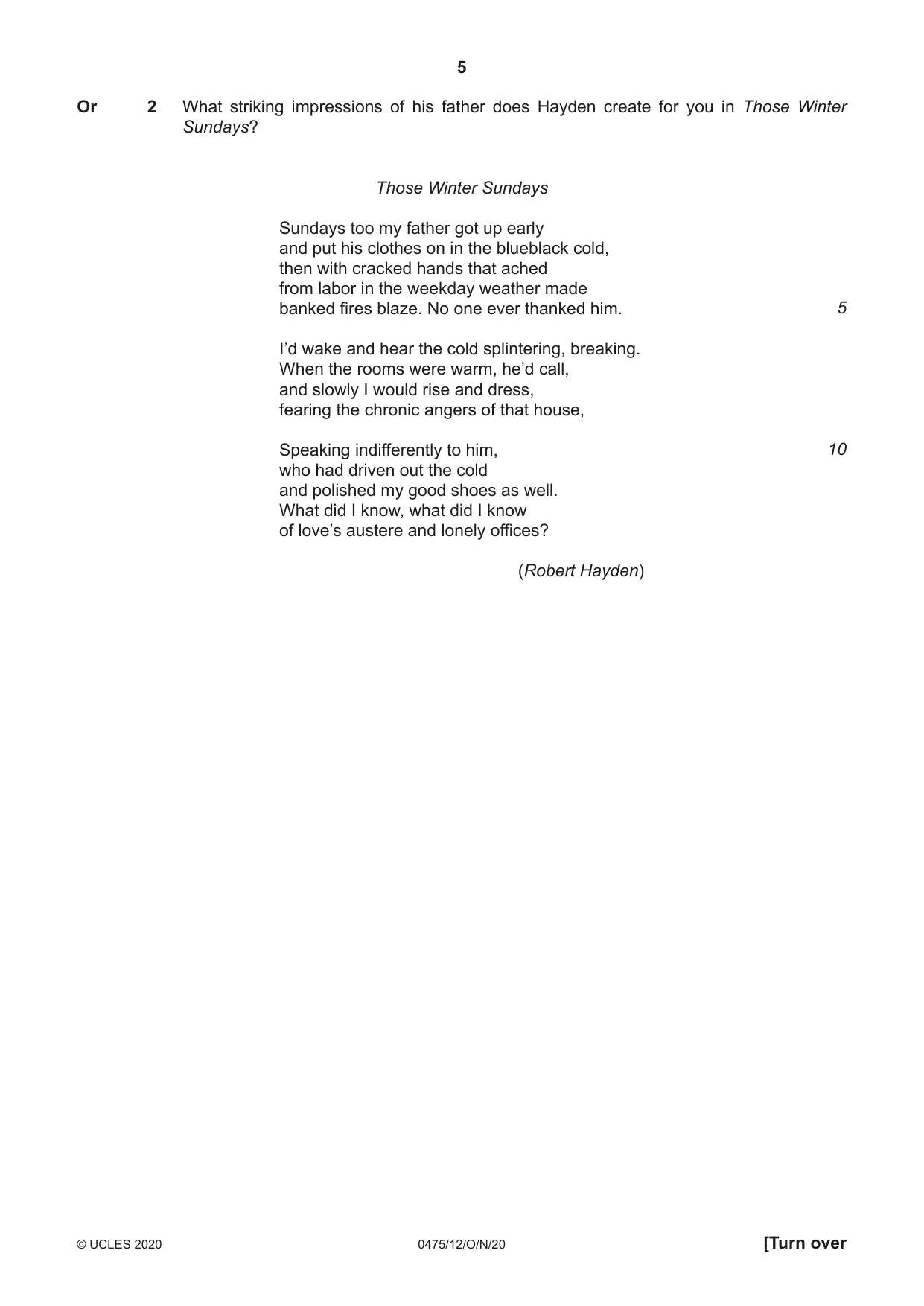
5 0475/12/O/N/20 © UCLES 2020 [Turn over Or 2 What striking impressions of his father does Hayden create for you in Those Winter Sundays? Those Winter Sundays Sundays too my father got up early and put his clothes on in the blueblack cold, then with cracked hands that ached from labor in the weekday weather made banked fires blaze. No one ever thanked him. I’d wake and hear the cold splintering, breaking. When the rooms were warm, he’d call, and slowly I would rise and dress, fearing the chronic angers of that house, Speaking indifferently to him, who had driven out the cold and polished my good shoes as well. What did I know, what did I know of love’s austere and lonely offices? (Robert Hayden) 5 10
Question paper, page 6
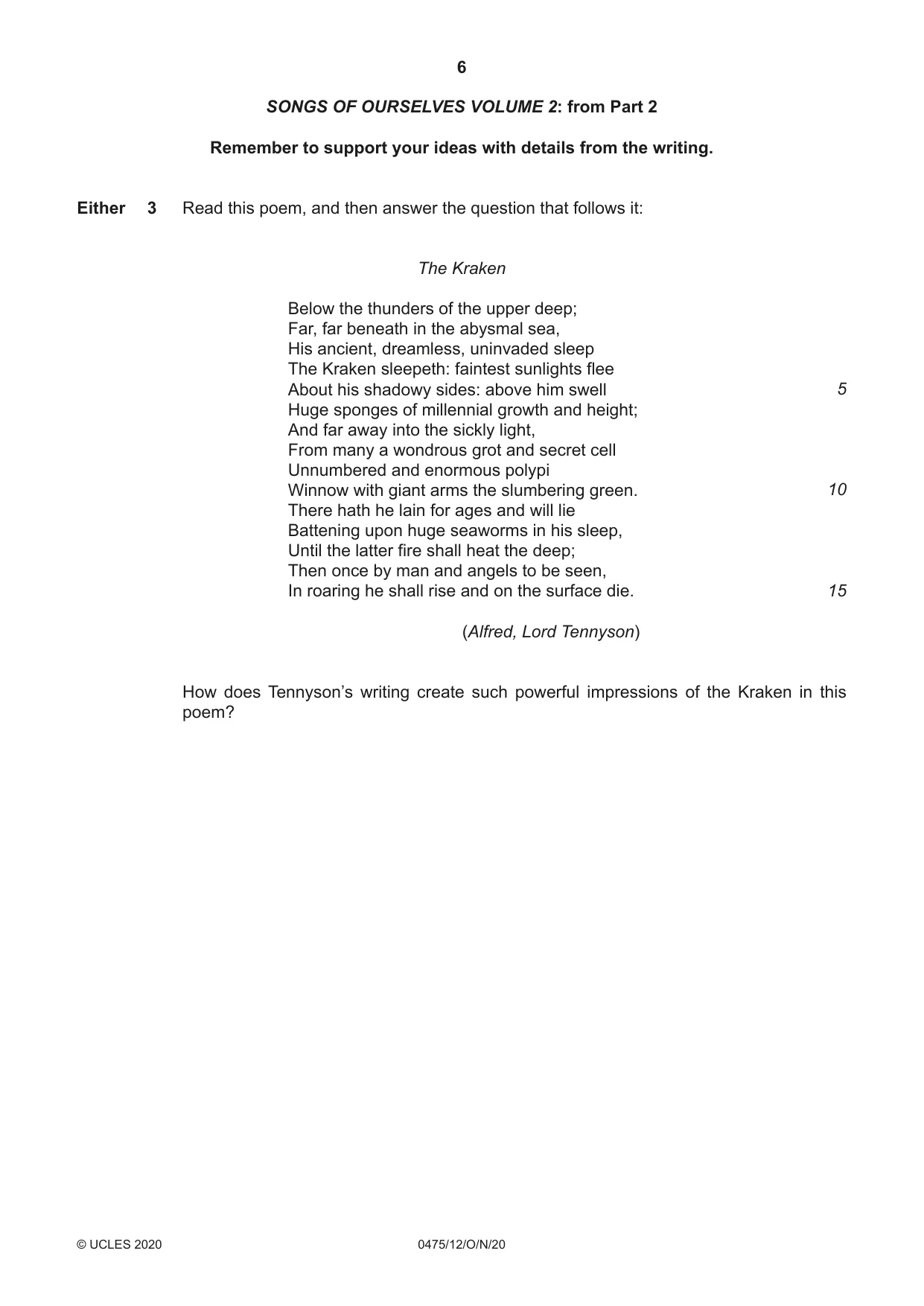
6 0475/12/O/N/20 © UCLES 2020 SONGS OF OURSELVES VOLUME 2: from Part 2 Remember to support your ideas with details from the writing. Either 3 Read this poem, and then answer the question that follows it: The Kraken Below the thunders of the upper deep; Far, far beneath in the abysmal sea, His ancient, dreamless, uninvaded sleep The Kraken sleepeth: faintest sunlights flee About his shadowy sides: above him swell Huge sponges of millennial growth and height; And far away into the sickly light, From many a wondrous grot and secret cell Unnumbered and enormous polypi Winnow with giant arms the slumbering green. There hath he lain for ages and will lie Battening upon huge seaworms in his sleep, Until the latter fire shall heat the deep; Then once by man and angels to be seen, In roaring he shall rise and on the surface die. (Alfred, Lord Tennyson) How does Tennyson’s writing create such powerful impressions of the Kraken in this poem? 5 10 15
Question paper, page 7
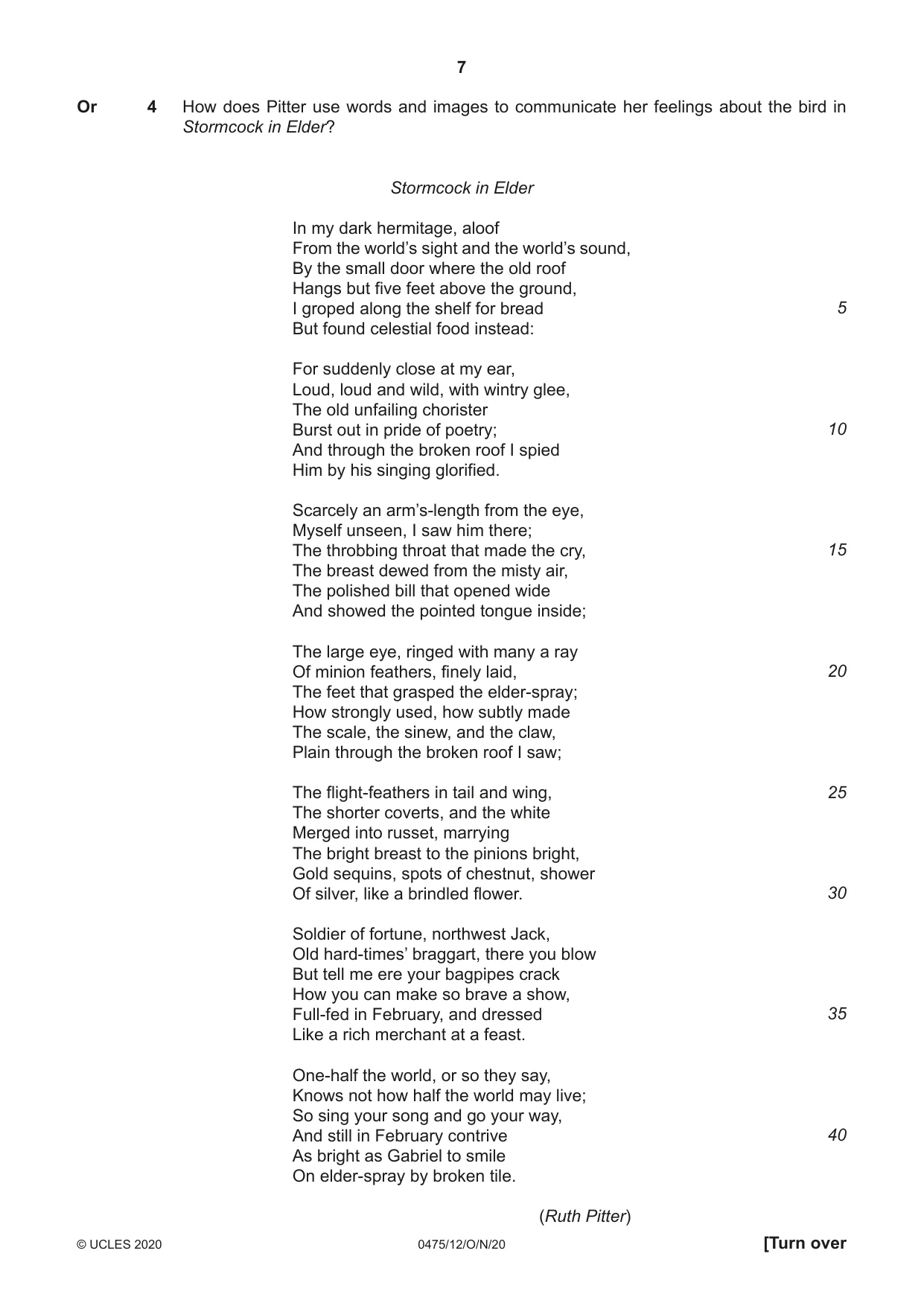
7 0475/12/O/N/20 © UCLES 2020 [Turn over Or 4 How does Pitter use words and images to communicate her feelings about the bird in Stormcock in Elder? Stormcock in Elder In my dark hermitage, aloof From the world’s sight and the world’s sound, By the small door where the old roof Hangs but five feet above the ground, I groped along the shelf for bread But found celestial food instead: For suddenly close at my ear, Loud, loud and wild, with wintry glee, The old unfailing chorister Burst out in pride of poetry; And through the broken roof I spied Him by his singing glorified. Scarcely an arm’s-length from the eye, Myself unseen, I saw him there; The throbbing throat that made the cry, The breast dewed from the misty air, The polished bill that opened wide And showed the pointed tongue inside; The large eye, ringed with many a ray Of minion feathers, finely laid, The feet that grasped the elder-spray; How strongly used, how subtly made The scale, the sinew, and the claw, Plain through the broken roof I saw; The flight-feathers in tail and wing, The shorter coverts, and the white Merged into russet, marrying The bright breast to the pinions bright, Gold sequins, spots of chestnut, shower Of silver, like a brindled flower. Soldier of fortune, northwest Jack, Old hard-times’ braggart, there you blow But tell me ere your bagpipes crack How you can make so brave a show, Full-fed in February, and dressed Like a rich merchant at a feast. One-half the world, or so they say, Knows not how half the world may live; So sing your song and go your way, And still in February contrive As bright as Gabriel to smile On elder-spray by broken tile. (Ruth Pitter) 5 10 15 20 25 30 35 40
Question paper, page 8
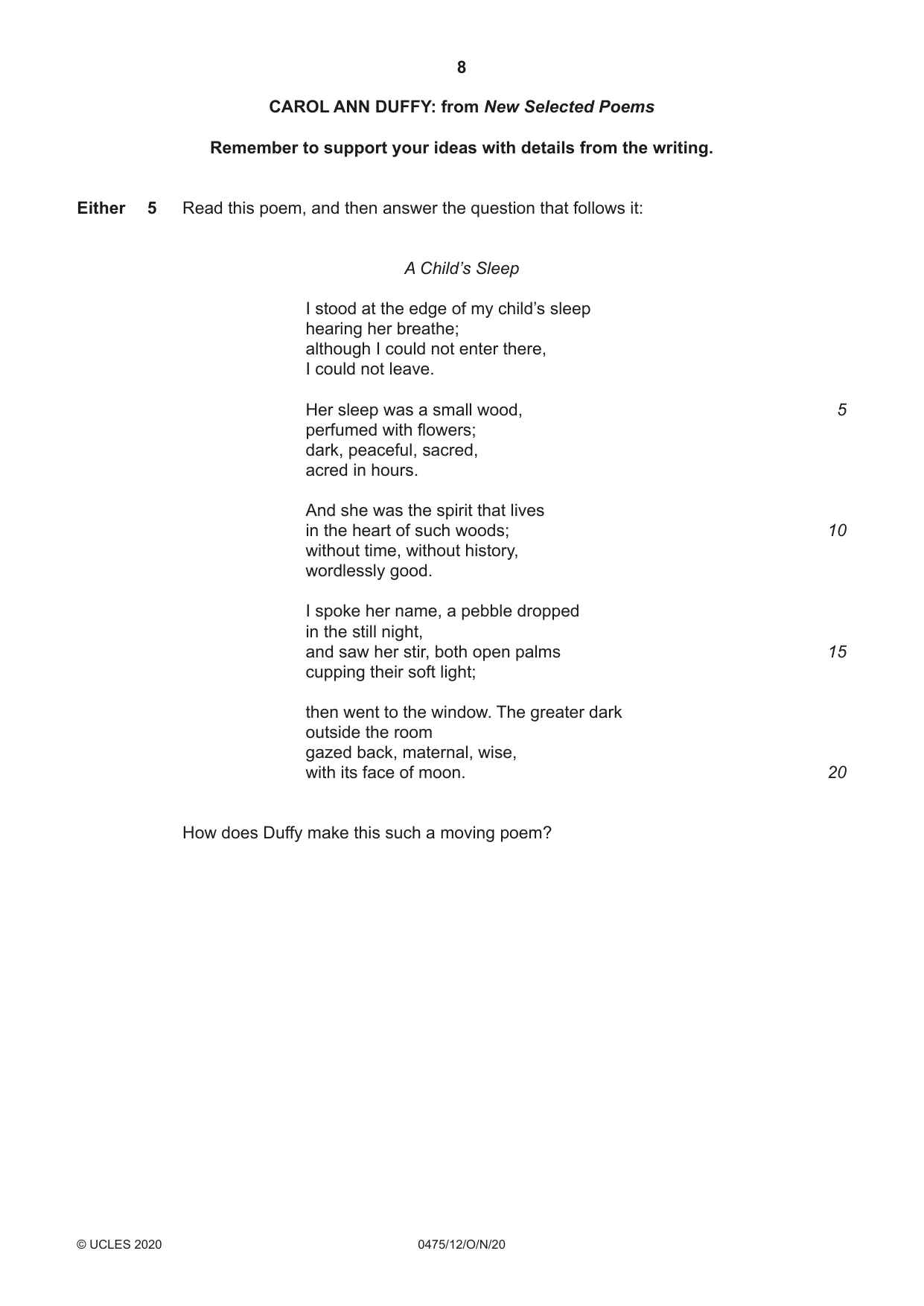
8 0475/12/O/N/20 © UCLES 2020 CAROL ANN DUFFY: from New Selected Poems Remember to support your ideas with details from the writing. Either 5 Read this poem, and then answer the question that follows it: A Child’s Sleep I stood at the edge of my child’s sleep hearing her breathe; although I could not enter there, I could not leave. Her sleep was a small wood, perfumed with flowers; dark, peaceful, sacred, acred in hours. And she was the spirit that lives in the heart of such woods; without time, without history, wordlessly good. I spoke her name, a pebble dropped in the still night, and saw her stir, both open palms cupping their soft light; then went to the window. The greater dark outside the room gazed back, maternal, wise, with its face of moon. How does Duffy make this such a moving poem? 5 10 15 20
Question paper, page 9
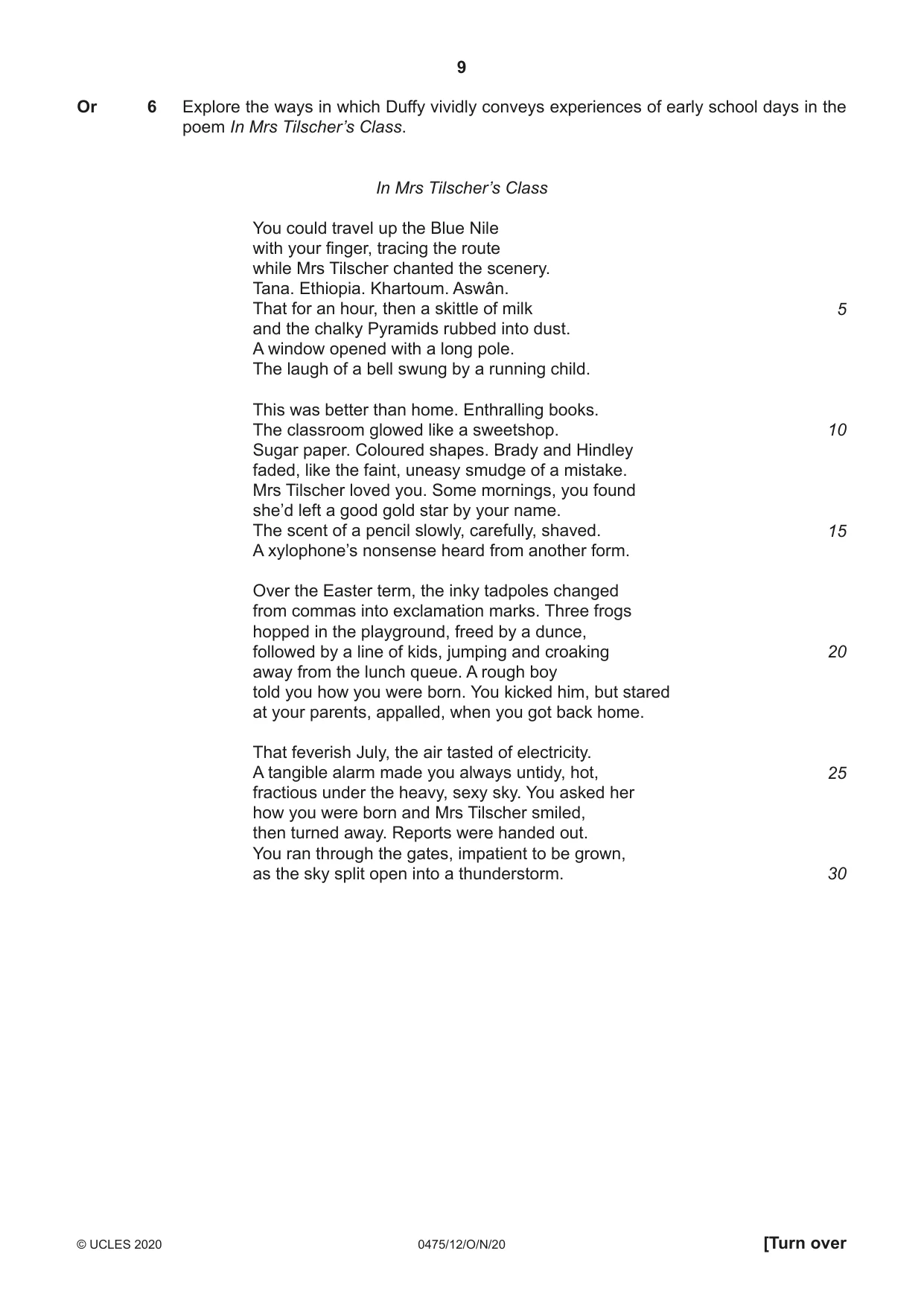
9 0475/12/O/N/20 © UCLES 2020 [Turn over Or 6 Explore the ways in which Duffy vividly conveys experiences of early school days in the poem In Mrs Tilscher’s Class. In Mrs Tilscher’s Class You could travel up the Blue Nile with your finger, tracing the route while Mrs Tilscher chanted the scenery. Tana. Ethiopia. Khartoum. Aswân. That for an hour, then a skittle of milk and the chalky Pyramids rubbed into dust. A window opened with a long pole. The laugh of a bell swung by a running child. This was better than home. Enthralling books. The classroom glowed like a sweetshop. Sugar paper. Coloured shapes. Brady and Hindley faded, like the faint, uneasy smudge of a mistake. Mrs Tilscher loved you. Some mornings, you found she’d left a good gold star by your name. The scent of a pencil slowly, carefully, shaved. A xylophone’s nonsense heard from another form. Over the Easter term, the inky tadpoles changed from commas into exclamation marks. Three frogs hopped in the playground, freed by a dunce, followed by a line of kids, jumping and croaking away from the lunch queue. A rough boy told you how you were born. You kicked him, but stared at your parents, appalled, when you got back home. That feverish July, the air tasted of electricity. A tangible alarm made you always untidy, hot, fractious under the heavy, sexy sky. You asked her how you were born and Mrs Tilscher smiled, then turned away. Reports were handed out. You ran through the gates, impatient to be grown, as the sky split open into a thunderstorm. 5 10 15 20 25 30
Question paper, page 10
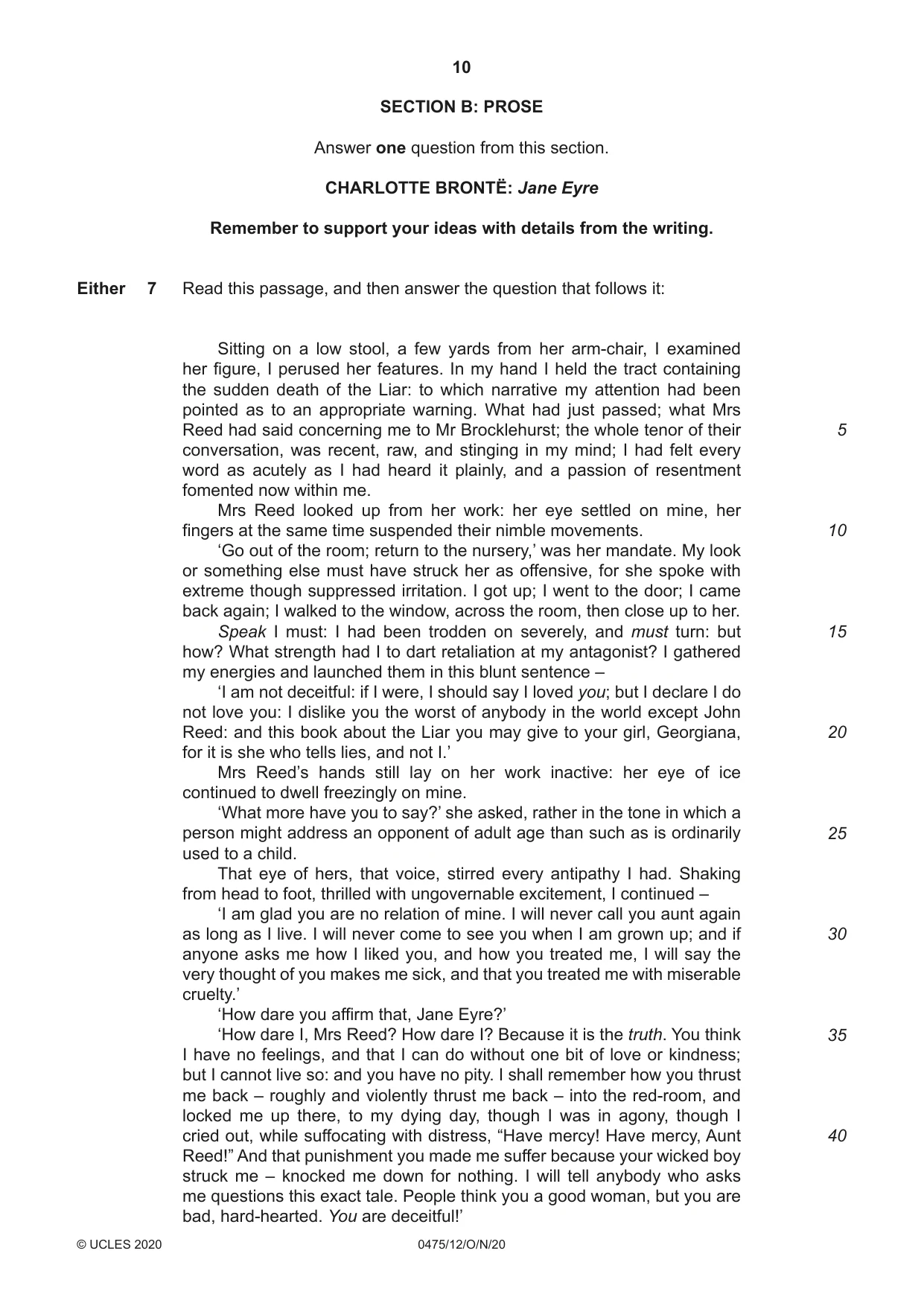
10 0475/12/O/N/20 © UCLES 2020 SECTION B: PROSE Answer one question from this section. CHARLOTTE BRONTË: Jane Eyre Remember to support your ideas with details from the writing. Either 7 Read this passage, and then answer the question that follows it: Sitting on a low stool, a few yards from her arm-chair, I examined her figure, I perused her features. In my hand I held the tract containing the sudden death of the Liar: to which narrative my attention had been pointed as to an appropriate warning. What had just passed; what Mrs Reed had said concerning me to Mr Brocklehurst; the whole tenor of their conversation, was recent, raw, and stinging in my mind; I had felt every word as acutely as I had heard it plainly, and a passion of resentment fomented now within me. Mrs Reed looked up from her work: her eye settled on mine, her fingers at the same time suspended their nimble movements. ‘Go out of the room; return to the nursery,’ was her mandate. My look or something else must have struck her as offensive, for she spoke with extreme though suppressed irritation. I got up; I went to the door; I came back again; I walked to the window, across the room, then close up to her. Speak I must: I had been trodden on severely, and must turn: but how? What strength had I to dart retaliation at my antagonist? I gathered my energies and launched them in this blunt sentence – ‘I am not deceitful: if I were, I should say I loved you; but I declare I do not love you: I dislike you the worst of anybody in the world except John Reed: and this book about the Liar you may give to your girl, Georgiana, for it is she who tells lies, and not I.’ Mrs Reed’s hands still lay on her work inactive: her eye of ice continued to dwell freezingly on mine. ‘What more have you to say?’ she asked, rather in the tone in which a person might address an opponent of adult age than such as is ordinarily used to a child. That eye of hers, that voice, stirred every antipathy I had. Shaking from head to foot, thrilled with ungovernable excitement, I continued – ‘I am glad you are no relation of mine. I will never call you aunt again as long as I live. I will never come to see you when I am grown up; and if anyone asks me how I liked you, and how you treated me, I will say the very thought of you makes me sick, and that you treated me with miserable cruelty.’ ‘How dare you affirm that, Jane Eyre?’ ‘How dare I, Mrs Reed? How dare I? Because it is the truth. You think I have no feelings, and that I can do without one bit of love or kindness; but I cannot live so: and you have no pity. I shall remember how you thrust me back – roughly and violently thrust me back – into the red-room, and locked me up there, to my dying day, though I was in agony, though I cried out, while suffocating with distress, “Have mercy! Have mercy, Aunt Reed!” And that punishment you made me suffer because your wicked boy struck me – knocked me down for nothing. I will tell anybody who asks me questions this exact tale. People think you a good woman, but you are bad, hard-hearted. You are deceitful!’ 5 10 15 20 25 30 35 40
Question paper, page 11
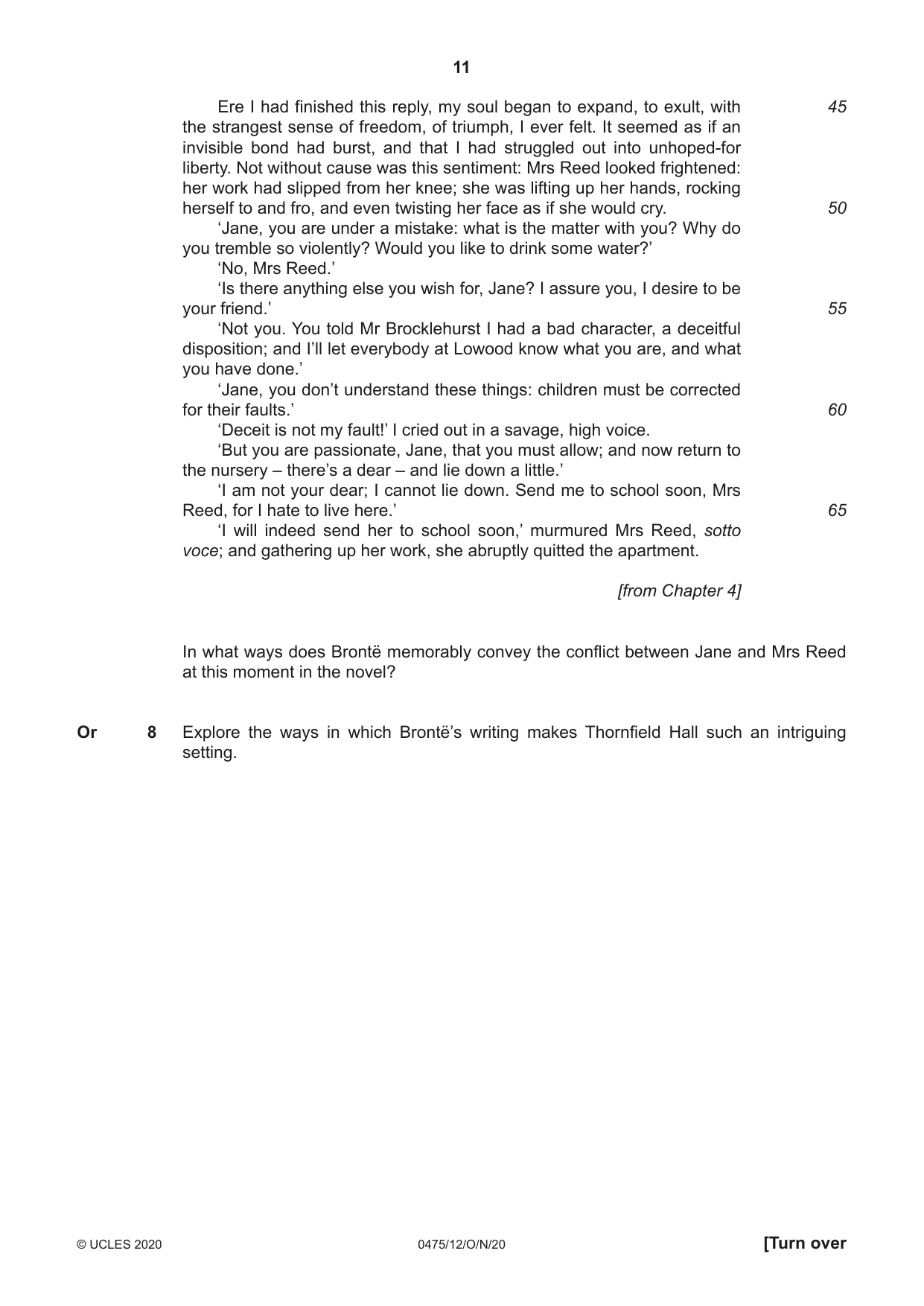
11 0475/12/O/N/20 © UCLES 2020 [Turn over Ere I had finished this reply, my soul began to expand, to exult, with the strangest sense of freedom, of triumph, I ever felt. It seemed as if an invisible bond had burst, and that I had struggled out into unhoped-for liberty. Not without cause was this sentiment: Mrs Reed looked frightened: her work had slipped from her knee; she was lifting up her hands, rocking herself to and fro, and even twisting her face as if she would cry. ‘Jane, you are under a mistake: what is the matter with you? Why do you tremble so violently? Would you like to drink some water?’ ‘No, Mrs Reed.’ ‘Is there anything else you wish for, Jane? I assure you, I desire to be your friend.’ ‘Not you. You told Mr Brocklehurst I had a bad character, a deceitful disposition; and I’ll let everybody at Lowood know what you are, and what you have done.’ ‘Jane, you don’t understand these things: children must be corrected for their faults.’ ‘Deceit is not my fault!’ I cried out in a savage, high voice. ‘But you are passionate, Jane, that you must allow; and now return to the nursery – there’s a dear – and lie down a little.’ ‘I am not your dear; I cannot lie down. Send me to school soon, Mrs Reed, for I hate to live here.’ ‘I will indeed send her to school soon,’ murmured Mrs Reed, sotto voce; and gathering up her work, she abruptly quitted the apartment. [from Chapter 4] In what ways does Brontë memorably convey the conflict between Jane and Mrs Reed at this moment in the novel? Or 8 Explore the ways in which Brontë’s writing makes Thornfield Hall such an intriguing setting. 45 50 55 60 65
Question paper, page 12
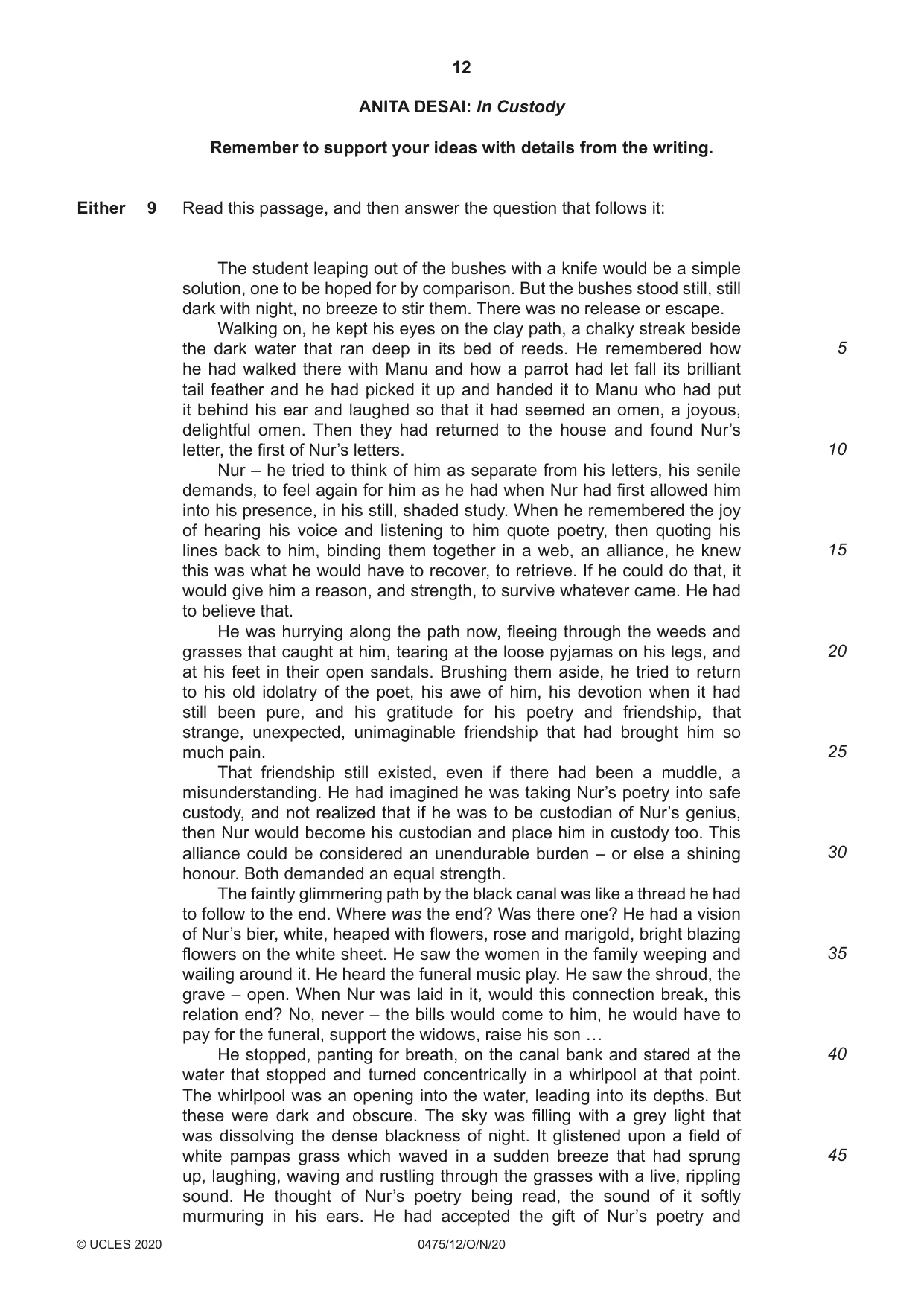
12 0475/12/O/N/20 © UCLES 2020 ANITA DESAI: In Custody Remember to support your ideas with details from the writing. Either 9 Read this passage, and then answer the question that follows it: The student leaping out of the bushes with a knife would be a simple solution, one to be hoped for by comparison. But the bushes stood still, still dark with night, no breeze to stir them. There was no release or escape. Walking on, he kept his eyes on the clay path, a chalky streak beside the dark water that ran deep in its bed of reeds. He remembered how he had walked there with Manu and how a parrot had let fall its brilliant tail feather and he had picked it up and handed it to Manu who had put it behind his ear and laughed so that it had seemed an omen, a joyous, delightful omen. Then they had returned to the house and found Nur’s letter, the first of Nur’s letters. Nur – he tried to think of him as separate from his letters, his senile demands, to feel again for him as he had when Nur had first allowed him into his presence, in his still, shaded study. When he remembered the joy of hearing his voice and listening to him quote poetry, then quoting his lines back to him, binding them together in a web, an alliance, he knew this was what he would have to recover, to retrieve. If he could do that, it would give him a reason, and strength, to survive whatever came. He had to believe that. He was hurrying along the path now, fleeing through the weeds and grasses that caught at him, tearing at the loose pyjamas on his legs, and at his feet in their open sandals. Brushing them aside, he tried to return to his old idolatry of the poet, his awe of him, his devotion when it had still been pure, and his gratitude for his poetry and friendship, that strange, unexpected, unimaginable friendship that had brought him so much pain. That friendship still existed, even if there had been a muddle, a misunderstanding. He had imagined he was taking Nur’s poetry into safe custody, and not realized that if he was to be custodian of Nur’s genius, then Nur would become his custodian and place him in custody too. This alliance could be considered an unendurable burden – or else a shining honour. Both demanded an equal strength. The faintly glimmering path by the black canal was like a thread he had to follow to the end. Where was the end? Was there one? He had a vision of Nur’s bier, white, heaped with flowers, rose and marigold, bright blazing flowers on the white sheet. He saw the women in the family weeping and wailing around it. He heard the funeral music play. He saw the shroud, the grave – open. When Nur was laid in it, would this connection break, this relation end? No, never – the bills would come to him, he would have to pay for the funeral, support the widows, raise his son … He stopped, panting for breath, on the canal bank and stared at the water that stopped and turned concentrically in a whirlpool at that point. The whirlpool was an opening into the water, leading into its depths. But these were dark and obscure. The sky was filling with a grey light that was dissolving the dense blackness of night. It glistened upon a field of white pampas grass which waved in a sudden breeze that had sprung up, laughing, waving and rustling through the grasses with a live, rippling sound. He thought of Nur’s poetry being read, the sound of it softly murmuring in his ears. He had accepted the gift of Nur’s poetry and 5 10 15 20 25 30 35 40 45
Question paper, page 13
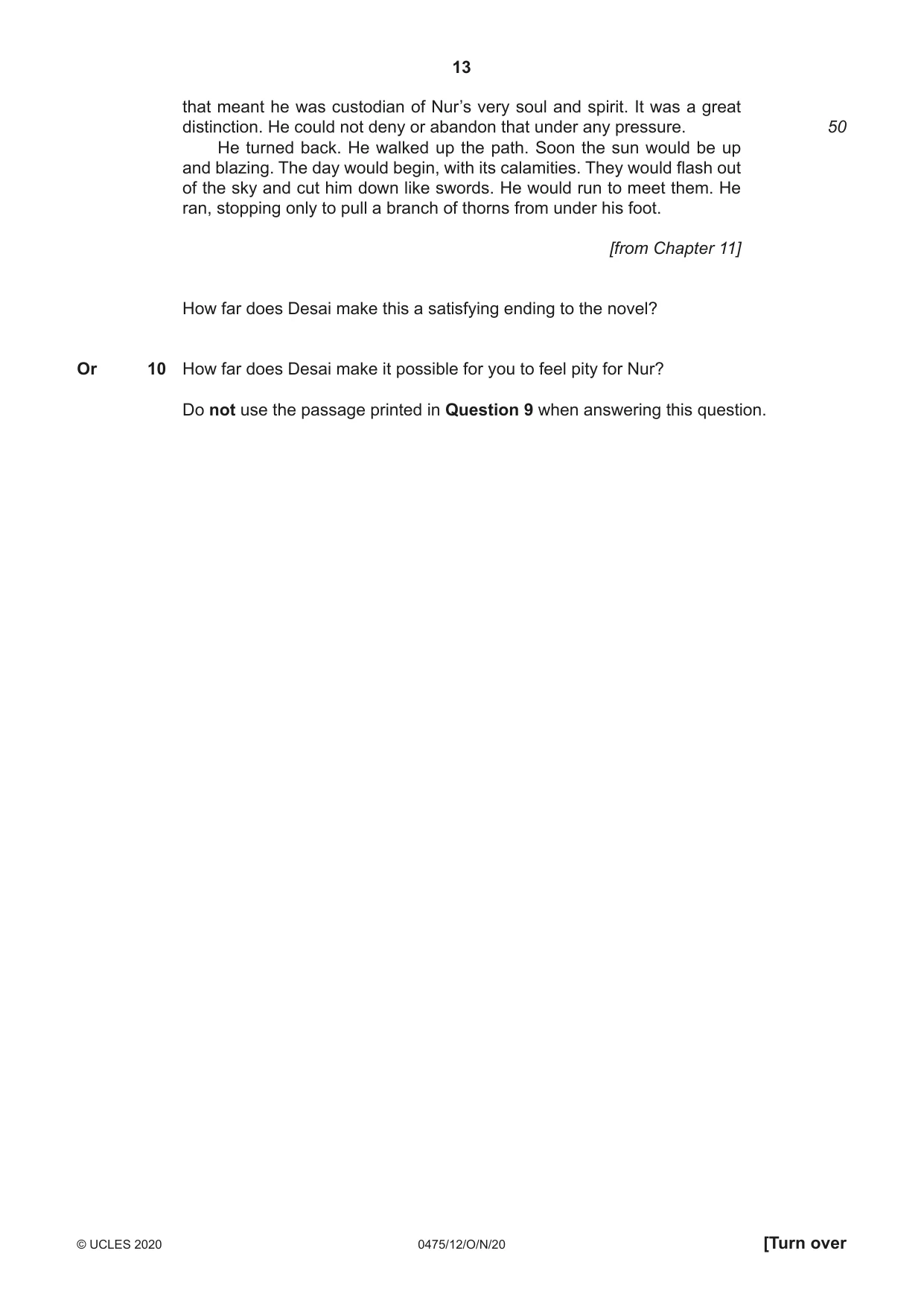
13 0475/12/O/N/20 © UCLES 2020 [Turn over that meant he was custodian of Nur’s very soul and spirit. It was a great distinction. He could not deny or abandon that under any pressure. He turned back. He walked up the path. Soon the sun would be up and blazing. The day would begin, with its calamities. They would flash out of the sky and cut him down like swords. He would run to meet them. He ran, stopping only to pull a branch of thorns from under his foot. [from Chapter 11] How far does Desai make this a satisfying ending to the novel? Or 10 How far does Desai make it possible for you to feel pity for Nur? Do not use the passage printed in Question 9 when answering this question. 50
Question paper, page 14
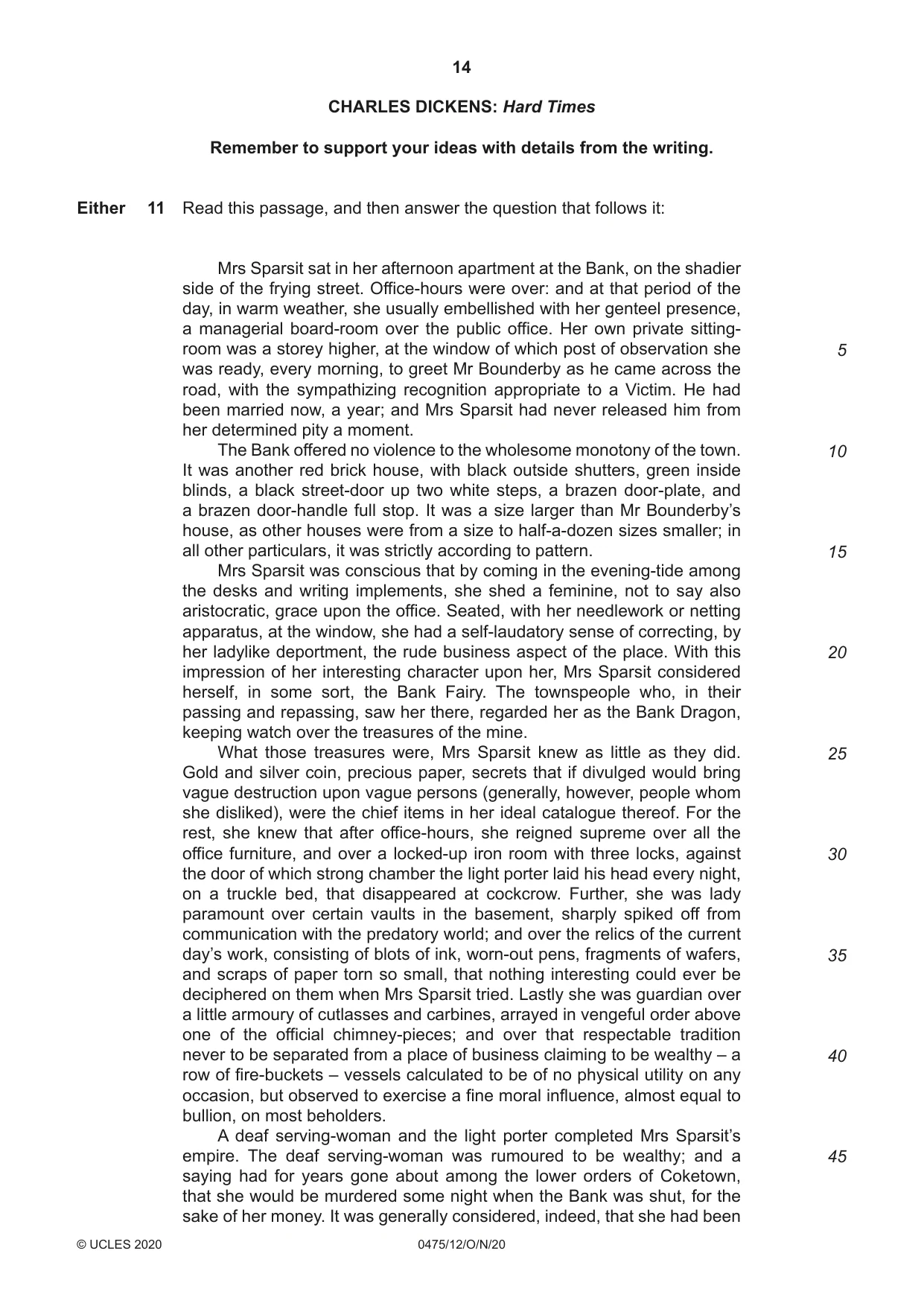
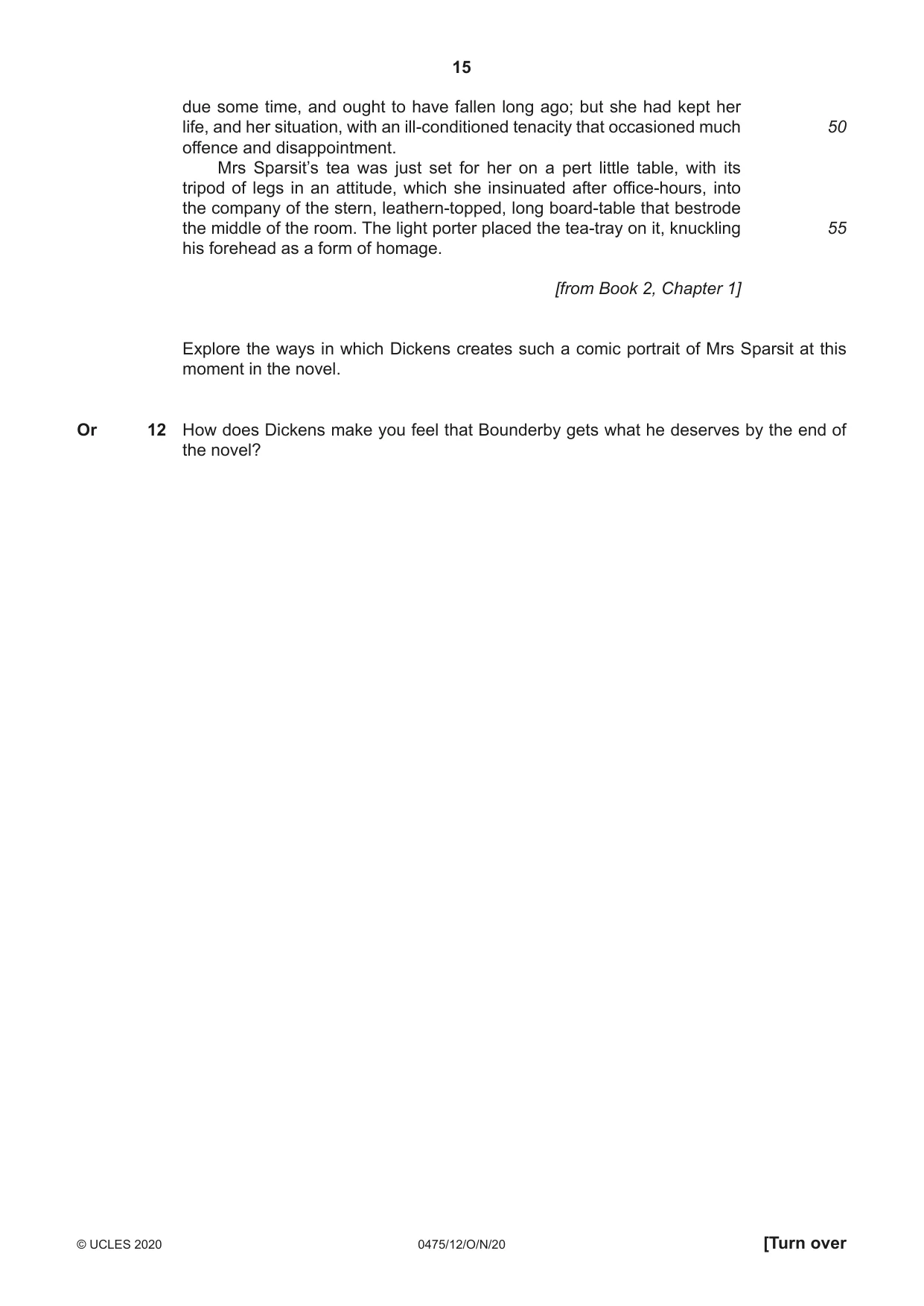
14 0475/12/O/N/20 © UCLES 2020 CHARLES DICKENS: Hard Times Remember to support your ideas with details from the writing. Either 11 Read this passage, and then answer the question that follows it: Mrs Sparsit sat in her afternoon apartment at the Bank, on the shadier side of the frying street. Office-hours were over: and at that period of the day, in warm weather, she usually embellished with her genteel presence, a managerial board-room over the public office. Her own private sitting- room was a storey higher, at the window of which post of observation she was ready, every morning, to greet Mr Bounderby as he came across the road, with the sympathizing recognition appropriate to a Victim. He had been married now, a year; and Mrs Sparsit had never released him from her determined pity a moment. The Bank offered no violence to the wholesome monotony of the town. It was another red brick house, with black outside shutters, green inside blinds, a black street-door up two white steps, a brazen door-plate, and a brazen door-handle full stop. It was a size larger than Mr Bounderby’s house, as other houses were from a size to half-a-dozen sizes smaller; in all other particulars, it was strictly according to pattern. Mrs Sparsit was conscious that by coming in the evening-tide among the desks and writing implements, she shed a feminine, not to say also aristocratic, grace upon the office. Seated, with her needlework or netting apparatus, at the window, she had a self-laudatory sense of correcting, by her ladylike deportment, the rude business aspect of the place. With this impression of her interesting character upon her, Mrs Sparsit considered herself, in some sort, the Bank Fairy. The townspeople who, in their passing and repassing, saw her there, regarded her as the Bank Dragon, keeping watch over the treasures of the mine. What those treasures were, Mrs Sparsit knew as little as they did. Gold and silver coin, precious paper, secrets that if divulged would bring vague destruction upon vague persons (generally, however, people whom she disliked), were the chief items in her ideal catalogue thereof. For the rest, she knew that after office-hours, she reigned supreme over all the office furniture, and over a locked-up iron room with three locks, against the door of which strong chamber the light porter laid his head every night, on a truckle bed, that disappeared at cockcrow. Further, she was lady paramount over certain vaults in the basement, sharply spiked off from communication with the predatory world; and over the relics of the current day’s work, consisting of blots of ink, worn-out pens, fragments of wafers, and scraps of paper torn so small, that nothing interesting could ever be deciphered on them when Mrs Sparsit tried. Lastly she was guardian over a little armoury of cutlasses and carbines, arrayed in vengeful order above one of the official chimney-pieces; and over that respectable tradition never to be separated from a place of business claiming to be wealthy – a row of fire-buckets – vessels calculated to be of no physical utility on any occasion, but observed to exercise a fine moral influence, almost equal to bullion, on most beholders. A deaf serving-woman and the light porter completed Mrs Sparsit’s empire. The deaf serving-woman was rumoured to be wealthy; and a saying had for years gone about among the lower orders of Coketown, that she would be murdered some night when the Bank was shut, for the sake of her money. It was generally considered, indeed, that she had been 5 10 15 20 25 30 35 40 45
Question paper, page 15
15 0475/12/O/N/20 © UCLES 2020 [Turn over due some time, and ought to have fallen long ago; but she had kept her life, and her situation, with an ill-conditioned tenacity that occasioned much offence and disappointment. Mrs Sparsit’s tea was just set for her on a pert little table, with its tripod of legs in an attitude, which she insinuated after office-hours, into the company of the stern, leathern-topped, long board-table that bestrode the middle of the room. The light porter placed the tea-tray on it, knuckling his forehead as a form of homage. [from Book 2, Chapter 1] Explore the ways in which Dickens creates such a comic portrait of Mrs Sparsit at this moment in the novel. Or 12 How does Dickens make you feel that Bounderby gets what he deserves by the end of the novel? 50 55
Question paper, page 16
16 0475/12/O/N/20 © UCLES 2020 ZORA NEALE HURSTON: Their Eyes Were Watching God Remember to support your ideas with details from the writing. Either 13 Read this passage, and then answer the question that follows it: Pheoby hurried on off with a covered bowl in her hands. Content removed due to copyright restrictions.
Question paper, page 17
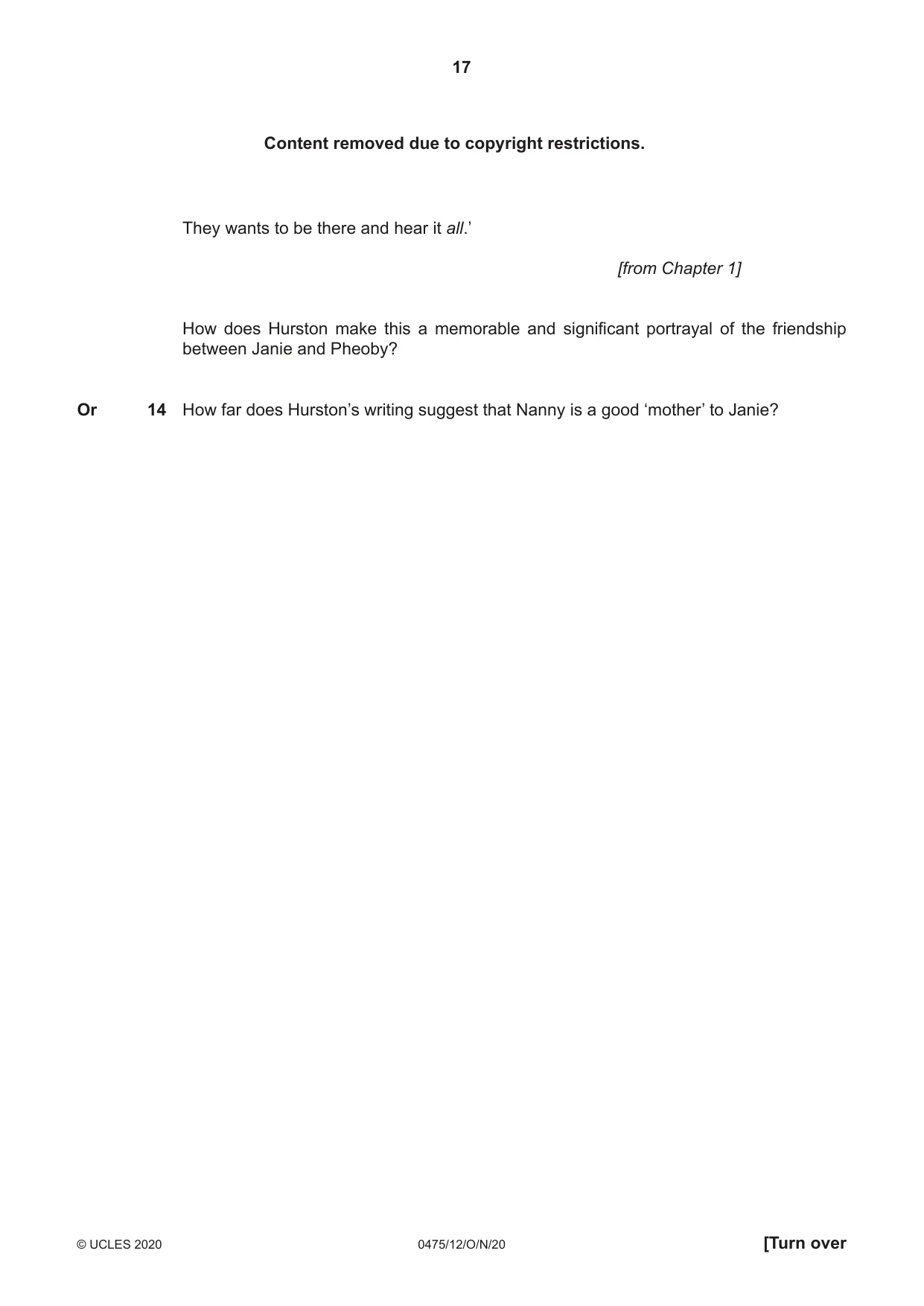
17 0475/12/O/N/20 © UCLES 2020 [Turn over They wants to be there and hear it all.’ [from Chapter 1] How does Hurston make this a memorable and significant portrayal of the friendship between Janie and Pheoby? Or 14 How far does Hurston’s writing suggest that Nanny is a good ‘mother’ to Janie? Content removed due to copyright restrictions.
Question paper, page 18
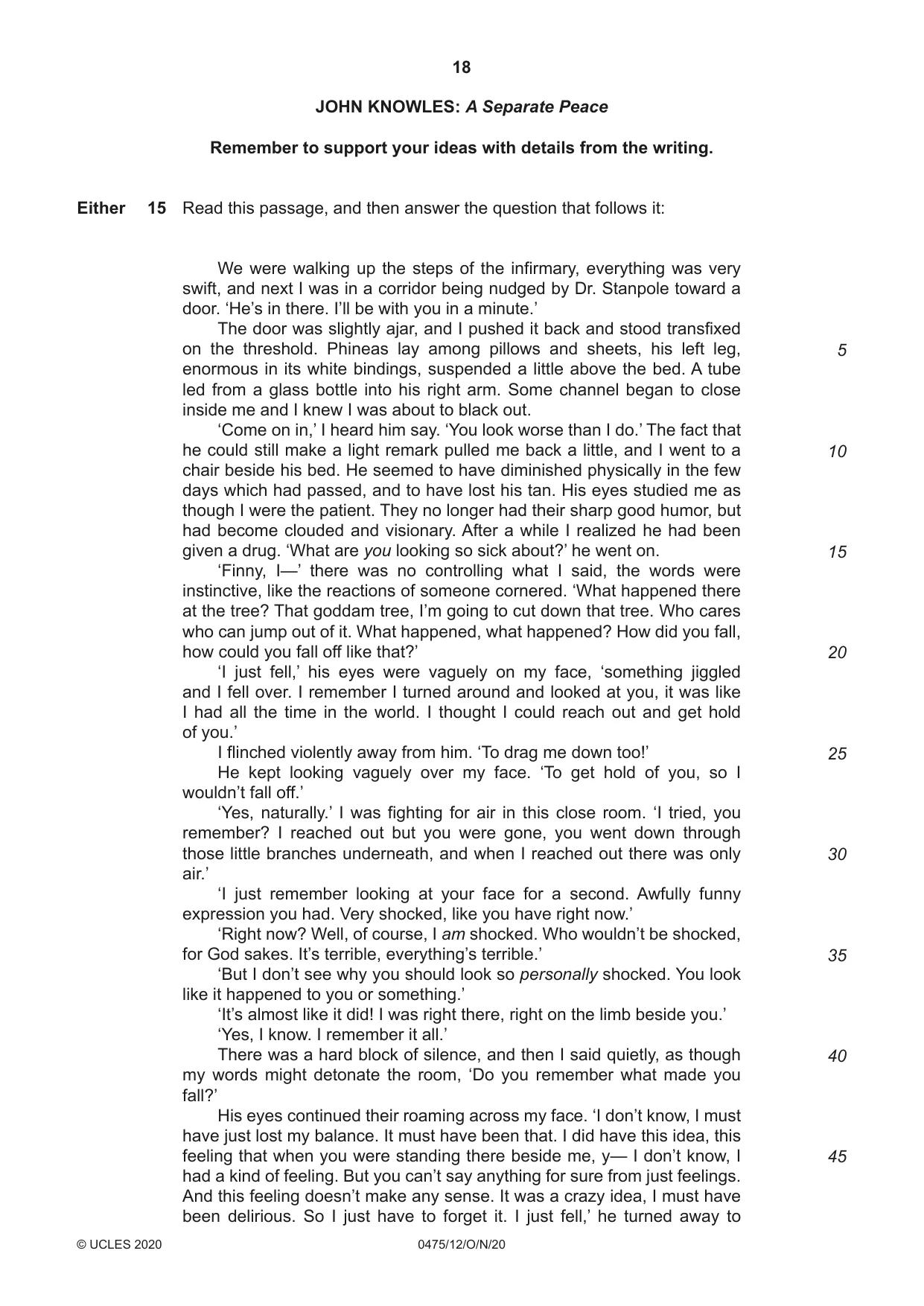
18 0475/12/O/N/20 © UCLES 2020 JOHN KNOWLES: A Separate Peace Remember to support your ideas with details from the writing. Either 15 Read this passage, and then answer the question that follows it: We were walking up the steps of the infirmary, everything was very swift, and next I was in a corridor being nudged by Dr. Stanpole toward a door. ‘He’s in there. I’ll be with you in a minute.’ The door was slightly ajar, and I pushed it back and stood transfixed on the threshold. Phineas lay among pillows and sheets, his left leg, enormous in its white bindings, suspended a little above the bed. A tube led from a glass bottle into his right arm. Some channel began to close inside me and I knew I was about to black out. ‘Come on in,’ I heard him say. ‘You look worse than I do.’ The fact that he could still make a light remark pulled me back a little, and I went to a chair beside his bed. He seemed to have diminished physically in the few days which had passed, and to have lost his tan. His eyes studied me as though I were the patient. They no longer had their sharp good humor, but had become clouded and visionary. After a while I realized he had been given a drug. ‘What are you looking so sick about?’ he went on. ‘Finny, I—’ there was no controlling what I said, the words were instinctive, like the reactions of someone cornered. ‘What happened there at the tree? That goddam tree, I’m going to cut down that tree. Who cares who can jump out of it. What happened, what happened? How did you fall, how could you fall off like that?’ ‘I just fell,’ his eyes were vaguely on my face, ‘something jiggled and I fell over. I remember I turned around and looked at you, it was like I had all the time in the world. I thought I could reach out and get hold of you.’ I flinched violently away from him. ‘To drag me down too!’ He kept looking vaguely over my face. ‘To get hold of you, so I wouldn’t fall off.’ ‘Yes, naturally.’ I was fighting for air in this close room. ‘I tried, you remember? I reached out but you were gone, you went down through those little branches underneath, and when I reached out there was only air.’ ‘I just remember looking at your face for a second. Awfully funny expression you had. Very shocked, like you have right now.’ ‘Right now? Well, of course, I am shocked. Who wouldn’t be shocked, for God sakes. It’s terrible, everything’s terrible.’ ‘But I don’t see why you should look so personally shocked. You look like it happened to you or something.’ ‘It’s almost like it did! I was right there, right on the limb beside you.’ ‘Yes, I know. I remember it all.’ There was a hard block of silence, and then I said quietly, as though my words might detonate the room, ‘Do you remember what made you fall?’ His eyes continued their roaming across my face. ‘I don’t know, I must have just lost my balance. It must have been that. I did have this idea, this feeling that when you were standing there beside me, y— I don’t know, I had a kind of feeling. But you can’t say anything for sure from just feelings. And this feeling doesn’t make any sense. It was a crazy idea, I must have been delirious. So I just have to forget it. I just fell,’ he turned away to 5 10 15 20 25 30 35 40 45
Question paper, page 19
19 0475/12/O/N/20 © UCLES 2020 [Turn over grope for something among the pillows, ‘that’s all.’ Then he glanced back at me, ‘I’m sorry about that feeling I had.’ I couldn’t say anything to this sincere, drugged apology for having suspected the truth. He was never going to accuse me. It was only a feeling he had, and at this moment he must have been formulating a new commandment in his personal decalogue: Never accuse a friend of a crime if you only have a feeling he did it. And I thought we were competitors! It was so ludicrous I wanted to cry. [from Chapter 5] How does Knowles make this such a memorable moment in the novel? Or 16 Explore the ways in which Knowles conveys different attitudes to war in the novel. 50 55
Question paper, page 20
20 0475/12/O/N/20 © UCLES 2020 GEORGE ORWELL: 1984 Remember to support your ideas with details from the writing. Either 17 Read this passage, and then answer the question that follows it: But if there was hope, it lay in the proles. You had to cling on to that. When you put it in words it sounded reasonable: it was when you looked at the human beings passing you on the pavement that it became an act of faith. The street into which he had turned ran downhill. He had a feeling that he had been in this neighbourhood before, and that there was a main thoroughfare not far away. From somewhere ahead there came a din of shouting voices. The street took a sharp turn and then ended in a flight of steps which led down into a sunken alley where a few stall-keepers were selling tired-looking vegetables. At this moment Winston remembered where he was. The alley led out into the main street, and down the next turning, not five minutes away, was the junk shop where he had bought the blank book which was now his diary. And in a small stationer’s shop not far away he had bought his penholder and his bottle of ink. He paused for a moment at the top of the steps. On the opposite side of the alley there was a dingy little pub whose windows appeared to be frosted over but in reality were merely coated with dust. A very old man, bent but active, with white moustaches that bristled forward like those of a prawn, pushed open the swing door and went in. As Winston stood watching it occurred to him that the old man, who must be eighty at the least, had already been middle-aged when the Revolution happened. He and a few others like him were the last links that now existed with the vanished world of capitalism. In the Party itself there were not many people left whose ideas had been formed before the Revolution. The older generation had mostly been wiped out in the great purges of the ’fifties and ’sixties, and the few who survived had long ago been terrified into complete intellectual surrender. If there was anyone still alive who could give you a truthful account of conditions in the early part of the century, it could only be a prole. Suddenly the passage from the history book that he had copied into his diary came back into Winston’s mind, and a lunatic impulse took hold of him. He would go into the pub, he would scrape acquaintance with that old man and question him. He would say to him: ‘Tell me about your life when you were a boy. What was it like in those days? Were things better than they are now, or were they worse?’ Hurriedly, lest he should have time to become frightened, he descended the steps and crossed the narrow street. It was madness, of course. As usual, there was no definite rule against talking to proles and frequenting their pubs, but it was far too unusual an action to pass unnoticed. If the patrols appeared he might plead an attack of faintness, but it was not likely that they would believe him. He pushed open the door, and a hideous cheesy smell of sour beer hit him in the face. As he entered the din of voices dropped to about half its volume. Behind his back he could feel everyone eyeing his blue overalls. A game of darts which was going on at the other end of the room interrupted itself for perhaps as much as thirty seconds. The old man whom he had followed was standing at the bar, having some kind of altercation with the barman, a large, stout, hook- nosed young man with enormous forearms. A knot of others, standing round with glasses in their hands, were watching the scene. ‘I arst you civil enough, didn’t I?’ said the old man, straightening his 5 10 15 20 25 30 35 40 45
Question paper, page 21
21 0475/12/O/N/20 © UCLES 2020 [Turn over shoulders pugnaciously. ‘You telling me you ain’t got a pint mug in the ’ole bleeding boozer?’ ‘And what in hell’s name is a pint?’ said the barman, leaning forward with the tips of his fingers on the counter. ‘ ’Ark at ’im! Calls ’isself a barman and don’t know what a pint is! Why, a pint’s the ’alf of a quart, and there’s four quarts to the gallon. ’Ave to teach you the A, B, C next.’ ‘Never heard of ’em,’ said the barman shortly. ‘Litre and half-litre— that’s all we serve. There’s the glasses on the shelf in front of you.’ ‘I likes a pint,’ persisted the old man. ‘You could’a drawed me off a pint easy enough. We didn’t ’ave these bleeding litres when I was a young man.’ ‘When you were a young man we were all living in the treetops,’ said the barman, with a glance at the other customers. There was a shout of laughter, and the uneasiness caused by Winston’s entry seemed to disappear. The old man’s white-stubbled face had flushed pink. He turned away, muttering to himself, and bumped into Winston. Winston caught him gently by the arm. [from Part 1] How does Orwell make this such a memorable and significant experience for Winston? Or 18 How far does Orwell’s portrayal of Winston Smith make you see him as a hero? 50 55 60 65
Question paper, page 22
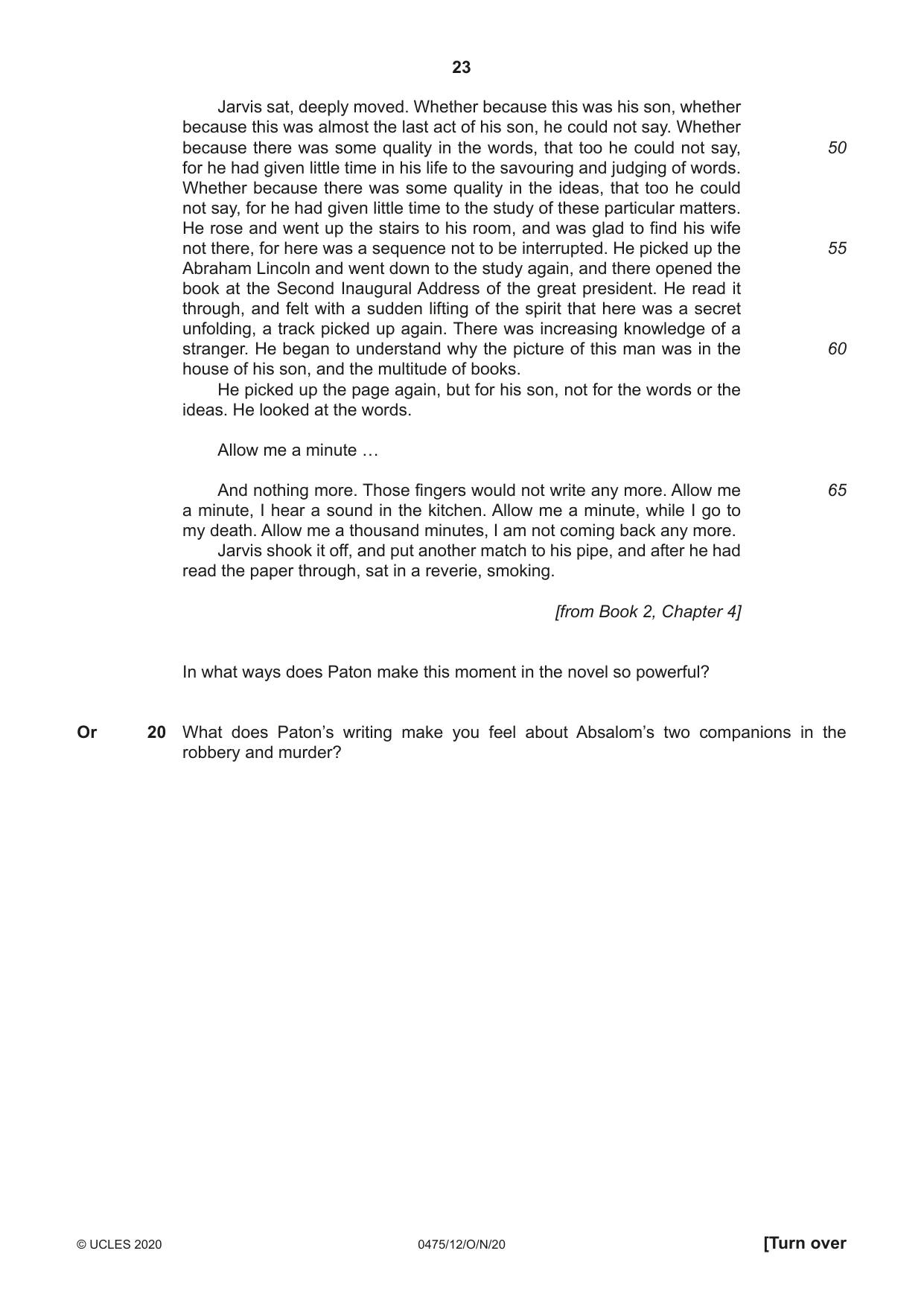
22 0475/12/O/N/20 © UCLES 2020 ALAN PATON: Cry, the Beloved Country Remember to support your ideas with details from the writing. Either 19 Read this passage, and then answer the question that follows it: After breakfast, Jarvis returned to his host’s study, and began to read his son’s manuscript. He turned first to the last page of it, and read with pain the last unfinished paragraph. This was almost the last thing that his son had done. When this was done he had been alive. Then at this moment, at this very word that hung in the air, he had got up and gone down the stairs to his death. If one could have cried then, don’t go down! If one could have cried, stop, there is danger! But there was no one to cry. No one knew then what so many knew now. But these thoughts were unprofitable; it was not his habit to dwell on what might have been but what could never be. There was no point in imagining that if one had been there, one could have prevented a thing that had happened only because it had not been prevented. It was the pain that did that, that compelled one to these unprofitable thoughts. He wanted to understand his son, not to desire what was no more accessible to desire. So he compelled himself to read the last paragraph slowly – with his head, not his heart, so that he could understand it. The truth is that our Christian civilization is riddled through and through with dilemma. We believe in the brotherhood of man, but we do not want it in South Africa. We believe that God endows men with diverse gifts, and that human life depends for its fullness on their employment and enjoyment, but we are afraid to explore this belief too deeply. We believe in help for the underdog, but we want him to stay under. And we are therefore compelled, in order to preserve our belief that we are Christian, to ascribe to Almighty God, Creator of Heaven and Earth, our own human intentions, and to say that because He created white and black, He gives the Divine Approval to any human action that is designed to keep black men from advancement. We go so far as to credit Almighty God with having created black men to hew wood and draw water for white men. We go so far as to assume that He blesses any action that is designed to prevent black men from the full employment of the gifts He gave them. Alongside of these very arguments we use others totally inconsistent, so that the accusation of repression may be refuted. We say we withhold education because the black child has not the intelligence to profit by it; we withhold opportunity to develop gifts because black people have no gifts; we justify our action by saying that it took us thousands of years to achieve our own advancement, and it would be foolish to suppose that it will take the black man any lesser time, and that therefore there is no need for hurry. We shift our ground again when a black man does achieve something remarkable, and feel deep pity for a man who is condemned to the loneliness of being remarkable, and decide that it is a Christian kindness not to let black men become remarkable. Thus even our God becomes a confused and inconsistent creature, giving gifts and denying them employment. Is it strange then that our civilization is riddled through and through with dilemma? The truth is that our civilization is not Christian; it is a tragic compound of great ideal and fearful practice, of high assurance and desperate anxiety, of loving charity and fearful clutching of possessions. Allow me a minute … 5 10 15 20 25 30 35 40 45
Question paper, page 23
23 0475/12/O/N/20 © UCLES 2020 [Turn over Jarvis sat, deeply moved. Whether because this was his son, whether because this was almost the last act of his son, he could not say. Whether because there was some quality in the words, that too he could not say, for he had given little time in his life to the savouring and judging of words. Whether because there was some quality in the ideas, that too he could not say, for he had given little time to the study of these particular matters. He rose and went up the stairs to his room, and was glad to find his wife not there, for here was a sequence not to be interrupted. He picked up the Abraham Lincoln and went down to the study again, and there opened the book at the Second Inaugural Address of the great president. He read it through, and felt with a sudden lifting of the spirit that here was a secret unfolding, a track picked up again. There was increasing knowledge of a stranger. He began to understand why the picture of this man was in the house of his son, and the multitude of books. He picked up the page again, but for his son, not for the words or the ideas. He looked at the words. Allow me a minute … And nothing more. Those fingers would not write any more. Allow me a minute, I hear a sound in the kitchen. Allow me a minute, while I go to my death. Allow me a thousand minutes, I am not coming back any more. Jarvis shook it off, and put another match to his pipe, and after he had read the paper through, sat in a reverie, smoking. [from Book 2, Chapter 4] In what ways does Paton make this moment in the novel so powerful? Or 20 What does Paton’s writing make you feel about Absalom’s two companions in the robbery and murder? 50 55 60 65
Question paper, page 24
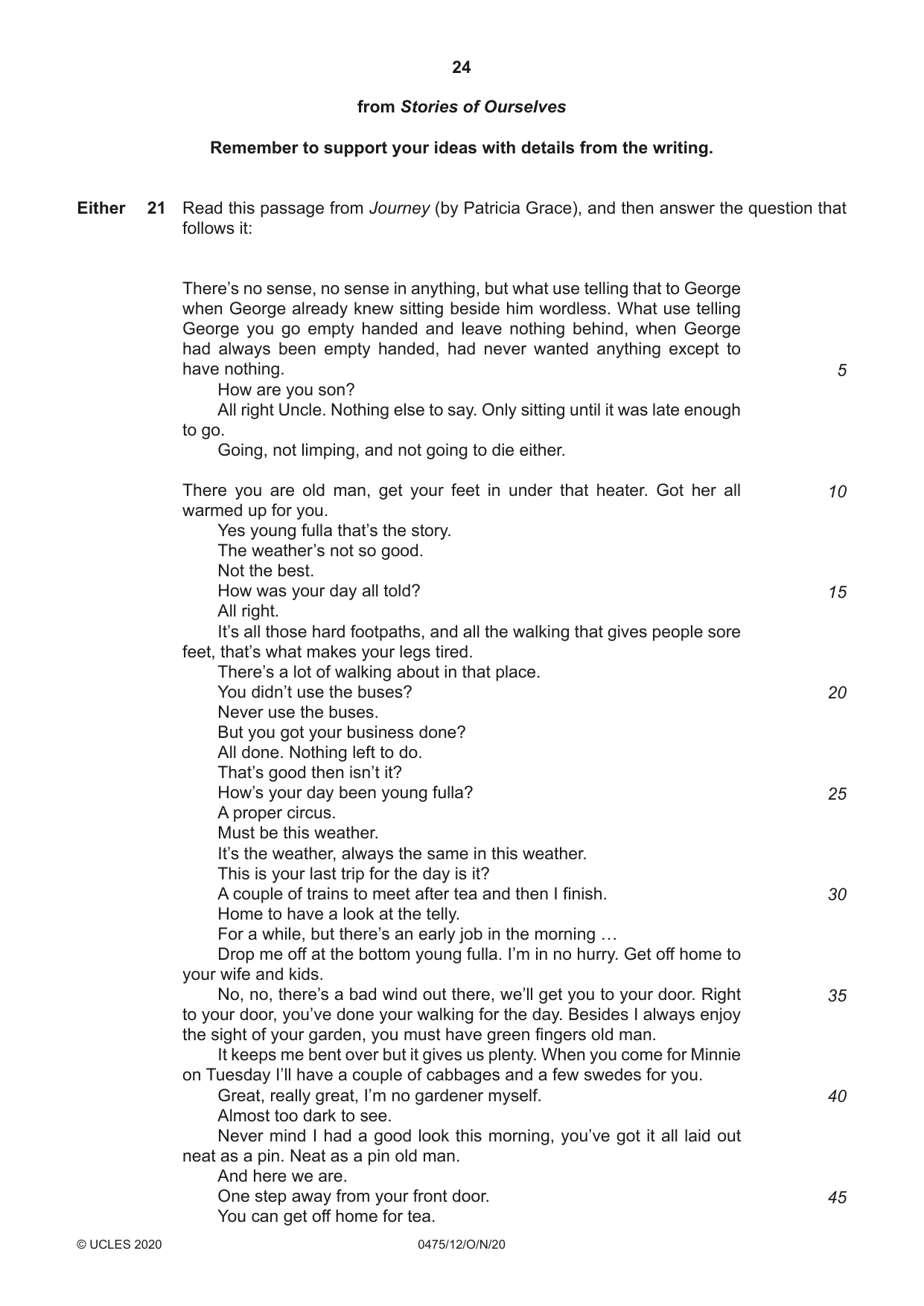
24 0475/12/O/N/20 © UCLES 2020 from Stories of Ourselves Remember to support your ideas with details from the writing. Either 21 Read this passage from Journey (by Patricia Grace), and then answer the question that follows it: There’s no sense, no sense in anything, but what use telling that to George when George already knew sitting beside him wordless. What use telling George you go empty handed and leave nothing behind, when George had always been empty handed, had never wanted anything except to have nothing. How are you son? All right Uncle. Nothing else to say. Only sitting until it was late enough to go. Going, not limping, and not going to die either. There you are old man, get your feet in under that heater. Got her all warmed up for you. Yes young fulla that’s the story. The weather’s not so good. Not the best. How was your day all told? All right. It’s all those hard footpaths, and all the walking that gives people sore feet, that’s what makes your legs tired. There’s a lot of walking about in that place. You didn’t use the buses? Never use the buses. But you got your business done? All done. Nothing left to do. That’s good then isn’t it? How’s your day been young fulla? A proper circus. Must be this weather. It’s the weather, always the same in this weather. This is your last trip for the day is it? A couple of trains to meet after tea and then I finish. Home to have a look at the telly. For a while, but there’s an early job in the morning … Drop me off at the bottom young fulla. I’m in no hurry. Get off home to your wife and kids. No, no, there’s a bad wind out there, we’ll get you to your door. Right to your door, you’ve done your walking for the day. Besides I always enjoy the sight of your garden, you must have green fingers old man. It keeps me bent over but it gives us plenty. When you come for Minnie on Tuesday I’ll have a couple of cabbages and a few swedes for you. Great, really great, I’m no gardener myself. Almost too dark to see. Never mind I had a good look this morning, you’ve got it all laid out neat as a pin. Neat as a pin old man. And here we are. One step away from your front door. You can get off home for tea. 5 10 15 20 25 30 35 40 45
Question paper, page 25
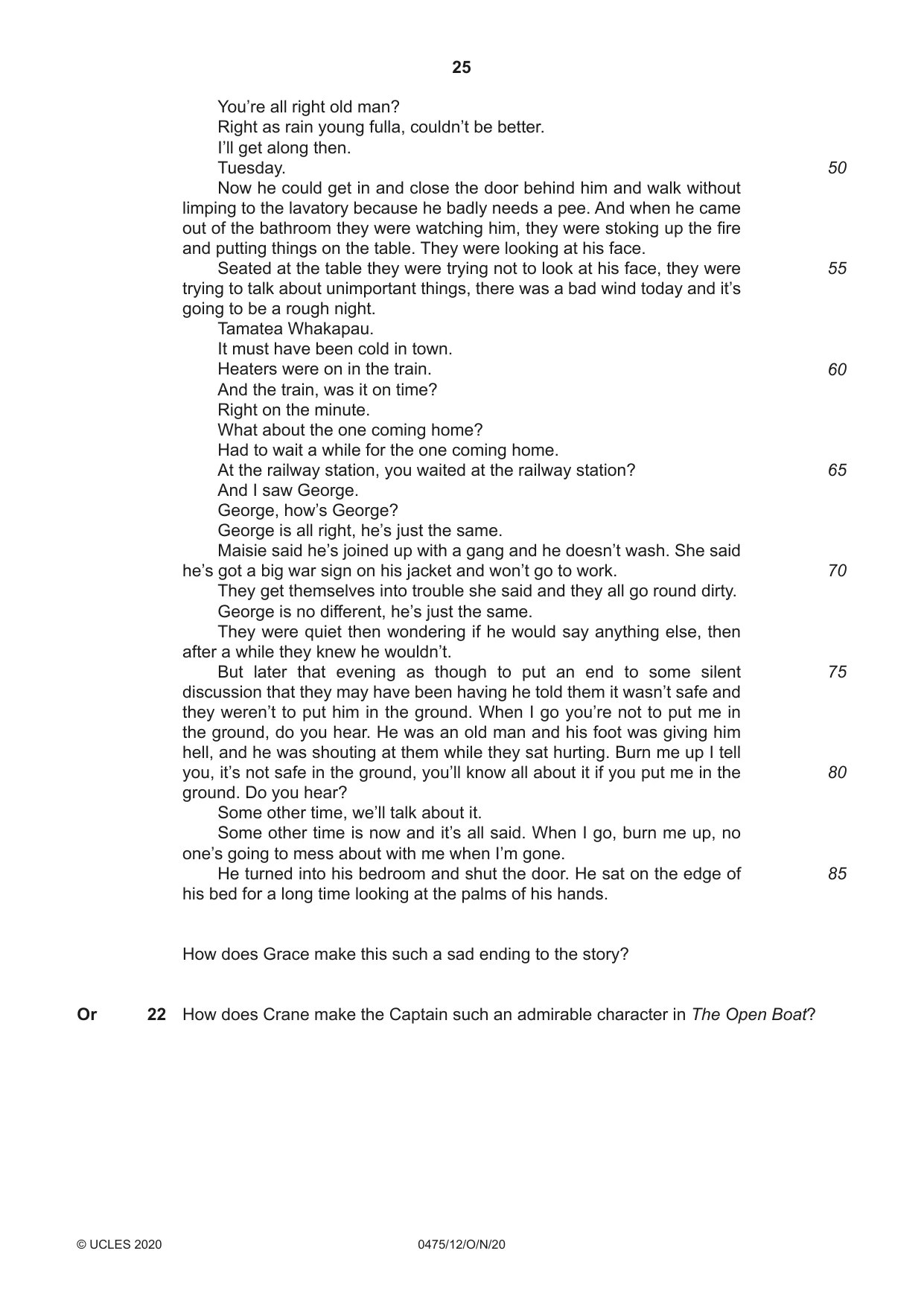
25 0475/12/O/N/20 © UCLES 2020 You’re all right old man? Right as rain young fulla, couldn’t be better. I’ll get along then. Tuesday. Now he could get in and close the door behind him and walk without limping to the lavatory because he badly needs a pee. And when he came out of the bathroom they were watching him, they were stoking up the fire and putting things on the table. They were looking at his face. Seated at the table they were trying not to look at his face, they were trying to talk about unimportant things, there was a bad wind today and it’s going to be a rough night. Tamatea Whakapau. It must have been cold in town. Heaters were on in the train. And the train, was it on time? Right on the minute. What about the one coming home? Had to wait a while for the one coming home. At the railway station, you waited at the railway station? And I saw George. George, how’s George? George is all right, he’s just the same. Maisie said he’s joined up with a gang and he doesn’t wash. She said he’s got a big war sign on his jacket and won’t go to work. They get themselves into trouble she said and they all go round dirty. George is no different, he’s just the same. They were quiet then wondering if he would say anything else, then after a while they knew he wouldn’t. But later that evening as though to put an end to some silent discussion that they may have been having he told them it wasn’t safe and they weren’t to put him in the ground. When I go you’re not to put me in the ground, do you hear. He was an old man and his foot was giving him hell, and he was shouting at them while they sat hurting. Burn me up I tell you, it’s not safe in the ground, you’ll know all about it if you put me in the ground. Do you hear? Some other time, we’ll talk about it. Some other time is now and it’s all said. When I go, burn me up, no one’s going to mess about with me when I’m gone. He turned into his bedroom and shut the door. He sat on the edge of his bed for a long time looking at the palms of his hands. How does Grace make this such a sad ending to the story? Or 22 How does Crane make the Captain such an admirable character in The Open Boat? 50 55 60 65 70 75 80 85
Question paper, page 26
26 0475/12/O/N/20 © UCLES 2020 BLANK PAGE
Question paper, page 27
27 0475/12/O/N/20 © UCLES 2020 BLANK PAGE
Question paper, page 28
28 0475/12/O/N/20 © UCLES 2020 Permission to reproduce items where third-party owned material protected by copyright is included has been sought and cleared where possible. Every reasonable effort has been made by the publisher (UCLES) to trace copyright holders, but if any items requiring clearance have unwittingly been included, the publisher will be pleased to make amends at the earliest possible opportunity. To avoid the issue of disclosure of answer-related information to candidates, all copyright acknowledgements are reproduced online in the Cambridge Assessment International Education Copyright Acknowledgements Booklet. This is produced for each series of examinations and is freely available to download at www.cambridgeinternational.org after the live examination series. Cambridge Assessment International Education is part of the Cambridge Assessment Group. Cambridge Assessment is the brand name of the University of Cambridge Local Examinations Syndicate (UCLES), which itself is a department of the University of Cambridge. BLANK PAGE
Mark scheme, page 1
This document consists of 5 printed pages. © UCLES 2020 [Turn over Cambridge IGCSE™ LITERATURE IN ENGLISH 0475/12 Paper 1 Poetry and Prose 12 October/November 2020 MARK SCHEME Maximum Mark: 50 Published This mark scheme is published as an aid to teachers and candidates, to indicate the requirements of the examination. It shows the basis on which Examiners were instructed to award marks. It does not indicate the details of the discussions that took place at an Examiners’ meeting before marking began, which would have considered the acceptability of alternative answers. Mark schemes should be read in conjunction with the question paper and the Principal Examiner Report for Teachers. Cambridge International will not enter into discussions about these mark schemes. Cambridge International is publishing the mark schemes for the October/November 2020 series for most Cambridge IGCSE™, Cambridge International A and AS Level and Cambridge Pre-U components, and some Cambridge O Level components.
Mark scheme, page 2
0475/12 Cambridge IGCSE – Mark Scheme PUBLISHED October/November 2020 © UCLES 2020 Page 2 of 5 Generic Marking Principles These general marking principles must be applied by all examiners when marking candidate answers. They should be applied alongside the specific content of the mark scheme or generic level descriptors for a question. Each question paper and mark scheme will also comply with these marking principles. GENERIC MARKING PRINCIPLE 1: Marks must be awarded in line with: • the specific content of the mark scheme or the generic level descriptors for the question • the specific skills defined in the mark scheme or in the generic level descriptors for the question • the standard of response required by a candidate as exemplified by the standardisation scripts. GENERIC MARKING PRINCIPLE 2: Marks awarded are always whole marks (not half marks, or other fractions). GENERIC MARKING PRINCIPLE 3: Marks must be awarded positively: • marks are awarded for correct/valid answers, as defined in the mark scheme. However, credit is given for valid answers which go beyond the scope of the syllabus and mark scheme, referring to your Team Leader as appropriate • marks are awarded when candidates clearly demonstrate what they know and can do • marks are not deducted for errors • marks are not deducted for omissions • answers should only be judged on the quality of spelling, punctuation and grammar when these features are specifically assessed by the question as indicated by the mark scheme. The meaning, however, should be unambiguous. GENERIC MARKING PRINCIPLE 4: Rules must be applied consistently, e.g. in situations where candidates have not followed instructions or in the application of generic level descriptors. GENERIC MARKING PRINCIPLE 5: Marks should be awarded using the full range of marks defined in the mark scheme for the question (however; the use of the full mark range may be limited according to the quality of the candidate responses seen). GENERIC MARKING PRINCIPLE 6: Marks awarded are based solely on the requirements as defined in the mark scheme. Marks should not be awarded with grade thresholds or grade descriptors in mind.
Mark scheme, page 3
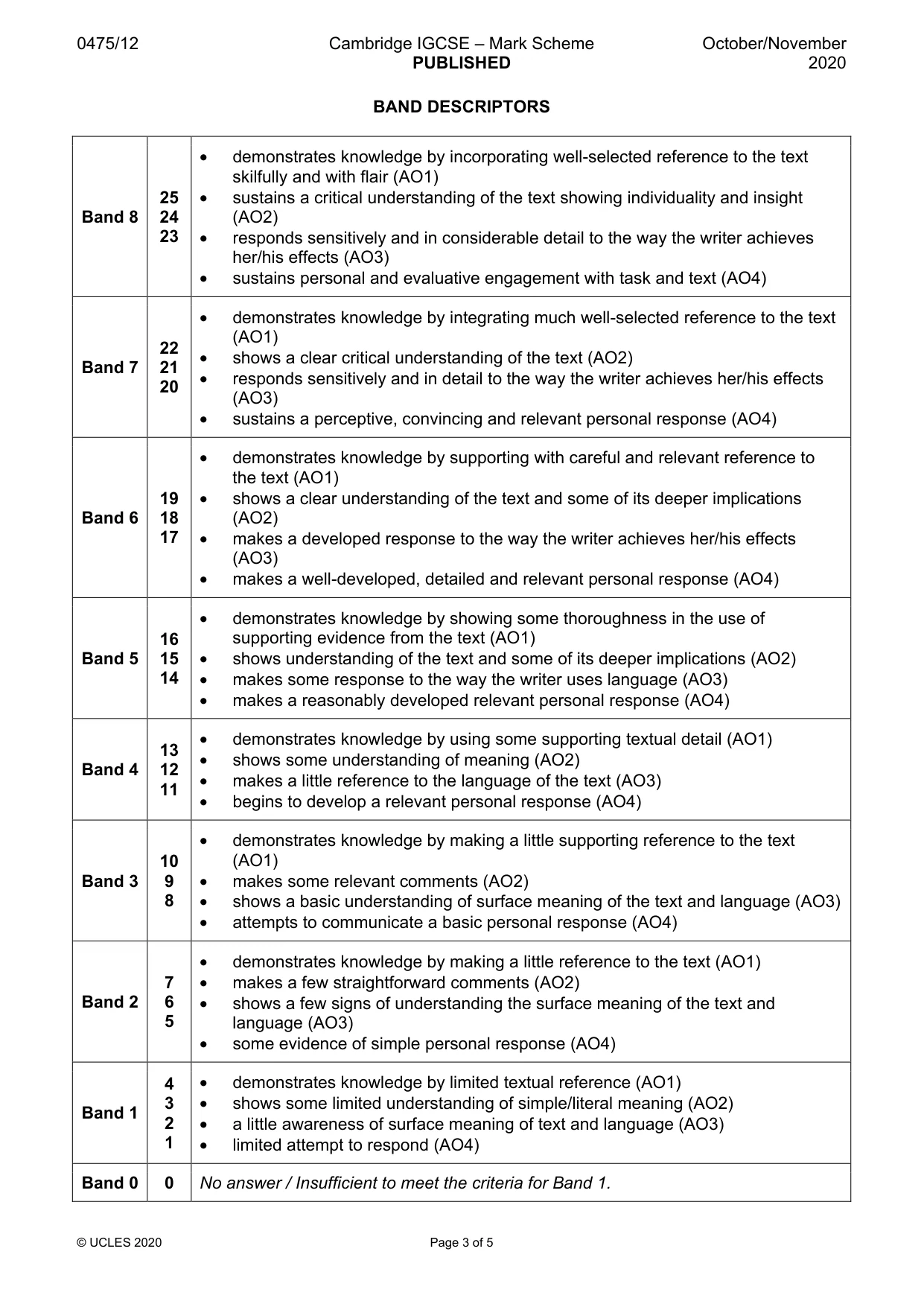
0475/12 Cambridge IGCSE – Mark Scheme PUBLISHED October/November 2020 © UCLES 2020 Page 3 of 5 BAND DESCRIPTORS Band 8 25 24 23 • demonstrates knowledge by incorporating well-selected reference to the text skilfully and with flair (AO1) • sustains a critical understanding of the text showing individuality and insight (AO2) • responds sensitively and in considerable detail to the way the writer achieves her/his effects (AO3) • sustains personal and evaluative engagement with task and text (AO4) Band 7 22 21 20 • demonstrates knowledge by integrating much well-selected reference to the text (AO1) • shows a clear critical understanding of the text (AO2) • responds sensitively and in detail to the way the writer achieves her/his effects (AO3) • sustains a perceptive, convincing and relevant personal response (AO4) Band 6 19 18 17 • demonstrates knowledge by supporting with careful and relevant reference to the text (AO1) • shows a clear understanding of the text and some of its deeper implications (AO2) • makes a developed response to the way the writer achieves her/his effects (AO3) • makes a well-developed, detailed and relevant personal response (AO4) Band 5 16 15 14 • demonstrates knowledge by showing some thoroughness in the use of supporting evidence from the text (AO1) • shows understanding of the text and some of its deeper implications (AO2) • makes some response to the way the writer uses language (AO3) • makes a reasonably developed relevant personal response (AO4) Band 4 13 12 11 • demonstrates knowledge by using some supporting textual detail (AO1) • shows some understanding of meaning (AO2) • makes a little reference to the language of the text (AO3) • begins to develop a relevant personal response (AO4) Band 3 10 9 8 • demonstrates knowledge by making a little supporting reference to the text (AO1) • makes some relevant comments (AO2) • shows a basic understanding of surface meaning of the text and language (AO3) • attempts to communicate a basic personal response (AO4) Band 2 7 6 5 • demonstrates knowledge by making a little reference to the text (AO1) • makes a few straightforward comments (AO2) • shows a few signs of understanding the surface meaning of the text and language (AO3) • some evidence of simple personal response (AO4) Band 1 4 3 2 1 • demonstrates knowledge by limited textual reference (AO1) • shows some limited understanding of simple/literal meaning (AO2) • a little awareness of surface meaning of text and language (AO3) • limited attempt to respond (AO4) Band 0 0 No answer / Insufficient to meet the criteria for Band 1.
Mark scheme, page 4
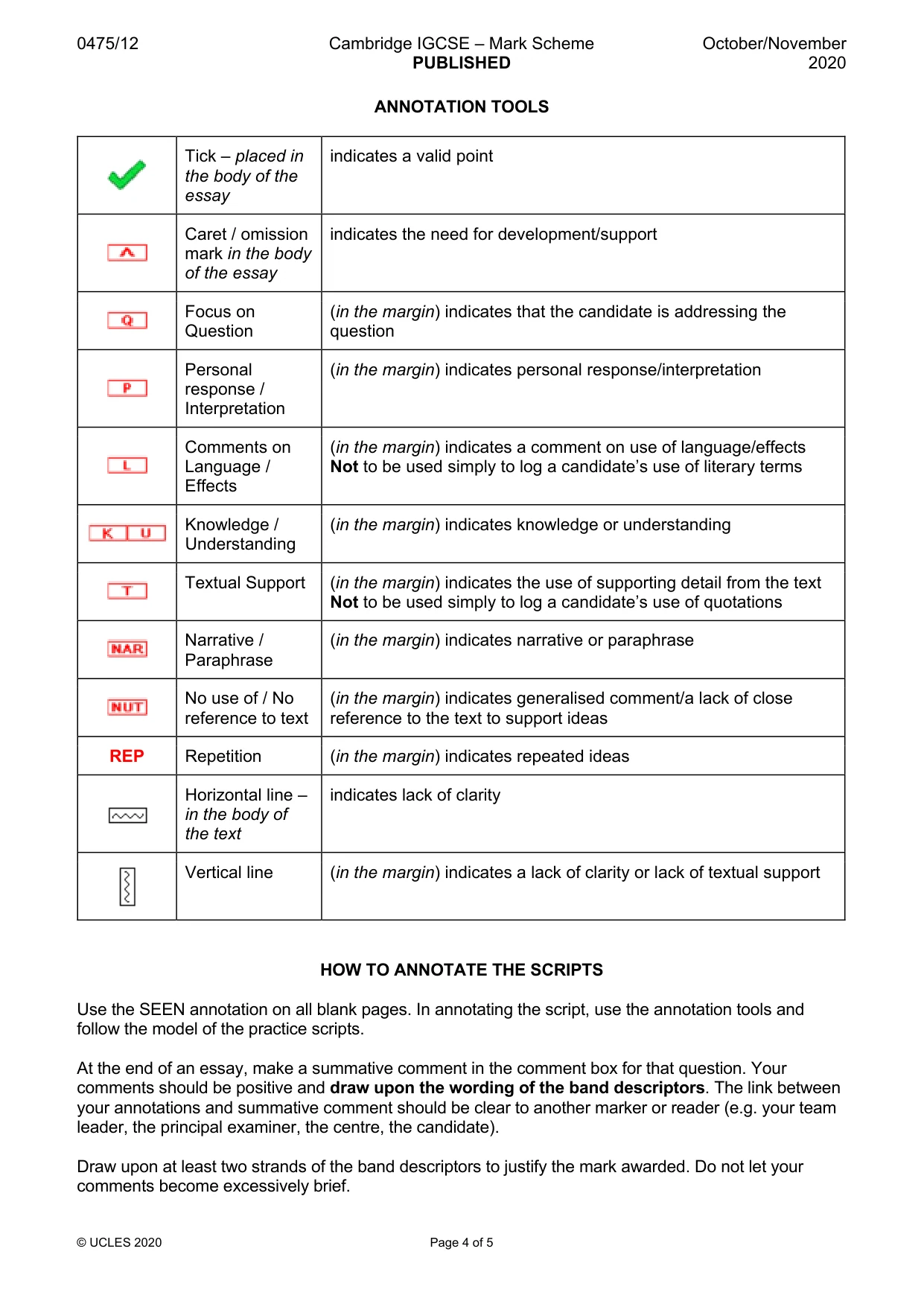
0475/12 Cambridge IGCSE – Mark Scheme PUBLISHED October/November 2020 © UCLES 2020 Page 4 of 5 ANNOTATION TOOLS Tick – placed in the body of the essay indicates a valid point Caret / omission mark in the body of the essay indicates the need for development/support Focus on Question (in the margin) indicates that the candidate is addressing the question Personal response / Interpretation (in the margin) indicates personal response/interpretation Comments on Language / Effects (in the margin) indicates a comment on use of language/effects Not to be used simply to log a candidate’s use of literary terms Knowledge / Understanding (in the margin) indicates knowledge or understanding Textual Support (in the margin) indicates the use of supporting detail from the text Not to be used simply to log a candidate’s use of quotations Narrative / Paraphrase (in the margin) indicates narrative or paraphrase No use of / No reference to text (in the margin) indicates generalised comment/a lack of close reference to the text to support ideas REP Repetition (in the margin) indicates repeated ideas Horizontal line – in the body of the text indicates lack of clarity Vertical line (in the margin) indicates a lack of clarity or lack of textual support HOW TO ANNOTATE THE SCRIPTS Use the SEEN annotation on all blank pages. In annotating the script, use the annotation tools and follow the model of the practice scripts. At the end of an essay, make a summative comment in the comment box for that question. Your comments should be positive and draw upon the wording of the band descriptors. The link between your annotations and summative comment should be clear to another marker or reader (e.g. your team leader, the principal examiner, the centre, the candidate). Draw upon at least two strands of the band descriptors to justify the mark awarded. Do not let your comments become excessively brief.
Mark scheme, page 5
0475/12 Cambridge IGCSE – Mark Scheme PUBLISHED October/November 2020 © UCLES 2020 Page 5 of 5 This is an example of an appropriate comment: Well-developed personal response, showing a clear understanding of the extract, supported by relevant references. This is an example of an unsatisfactory comment: Well-developed personal response. Do not focus on what the candidate has not written but on what s/he has written. Do not refer to the indicative content notes. What NOT to write on scripts Do not use more than one question mark: e.g.??? Do not use exclamation marks at all. Do not use capital letters to ‘shout’: e.g. NO. Do not use any emotive word or phrase – this includes: poor, weak, bad, good, wrong, get on with it, so what? hardly! what?, this is not the point, muddled, shallow, superficial. Do not indicate spelling and grammatical errors. Do not comment on handwriting or untidiness. Do not invent or use your own abbreviations or comments. Marking and annotation are monitored rigorously by your Team Leader. Failure to follow instructions about annotation given here and at the standardisation meeting will result in feedback drawing your attention to the standard procedure. You will be expected to remedy deficiencies in scripts already marked. Using the mark bands All Assessment Objectives are equally weighted in this paper. Place the answer in a band first. Look for the best fit of the answer into a band. An answer needs to show evidence of most but not necessarily all of the qualities described in a band in order to be placed in that band. Then award a mark for the relative position of the answer within the band. Candidates sometimes mis-number questions under the pressure of timed conditions. Please check that you are marking against the correct question number.
What you needed in this session
Cambridge’s own grade thresholds for 2020 Oct/Nov, Paper 1 · Variant 2. A higher threshold means an easier paper — the bar moves with how the cohort did.