Cambridge IGCSE English - Literature 0486 — 2018 Oct/Nov Paper 4 · Variant 3
0486/43/O/N/18 · 25 marks · ≈28 min
The question paper and its mark scheme, free to read here and free to download. This is Cambridge’s own paper, exactly as it was sat.
Question paper8 pages



Mark scheme4 pages
Answers below. Sit the paper first if you are practising.
Paper as text
Question paper, page 1
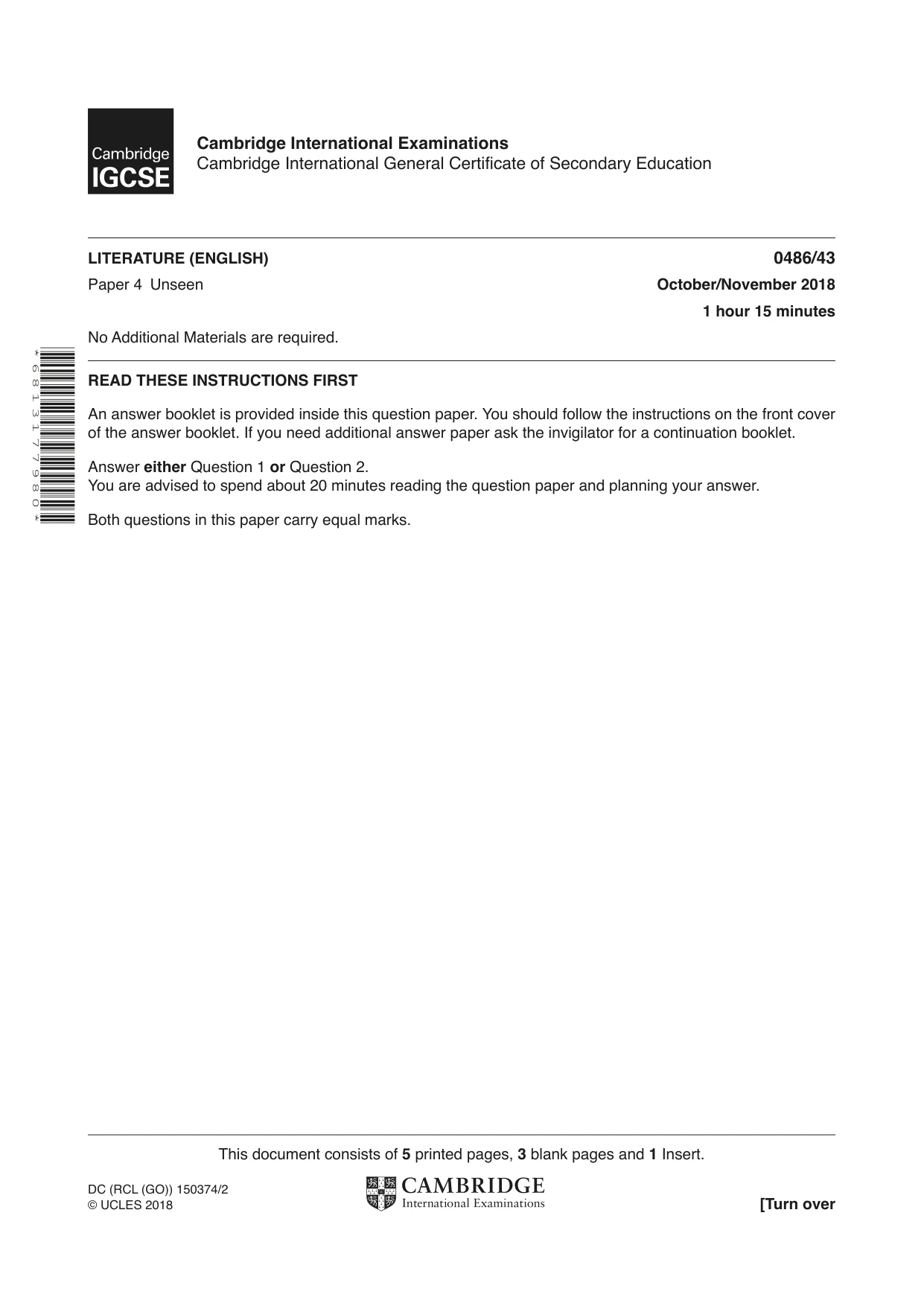
This document consists of 5 printed pages, 3 blank pages and 1 Insert. DC (RCL (GO)) 150374/2 © UCLES 2018 [Turn over Cambridge International Examinations Cambridge International General Certificate of Secondary Education * 6 8 1 3 1 7 7 9 8 0 * LITERATURE (ENGLISH) 0486/43 Paper 4 Unseen October/November 2018 1 hour 15 minutes No Additional Materials are required. READ THESE INSTRUCTIONS FIRST An answer booklet is provided inside this question paper. You should follow the instructions on the front cover of the answer booklet. If you need additional answer paper ask the invigilator for a continuation booklet. Answer either Question 1 or Question 2. You are advised to spend about 20 minutes reading the question paper and planning your answer. Both questions in this paper carry equal marks.
Question paper, page 2
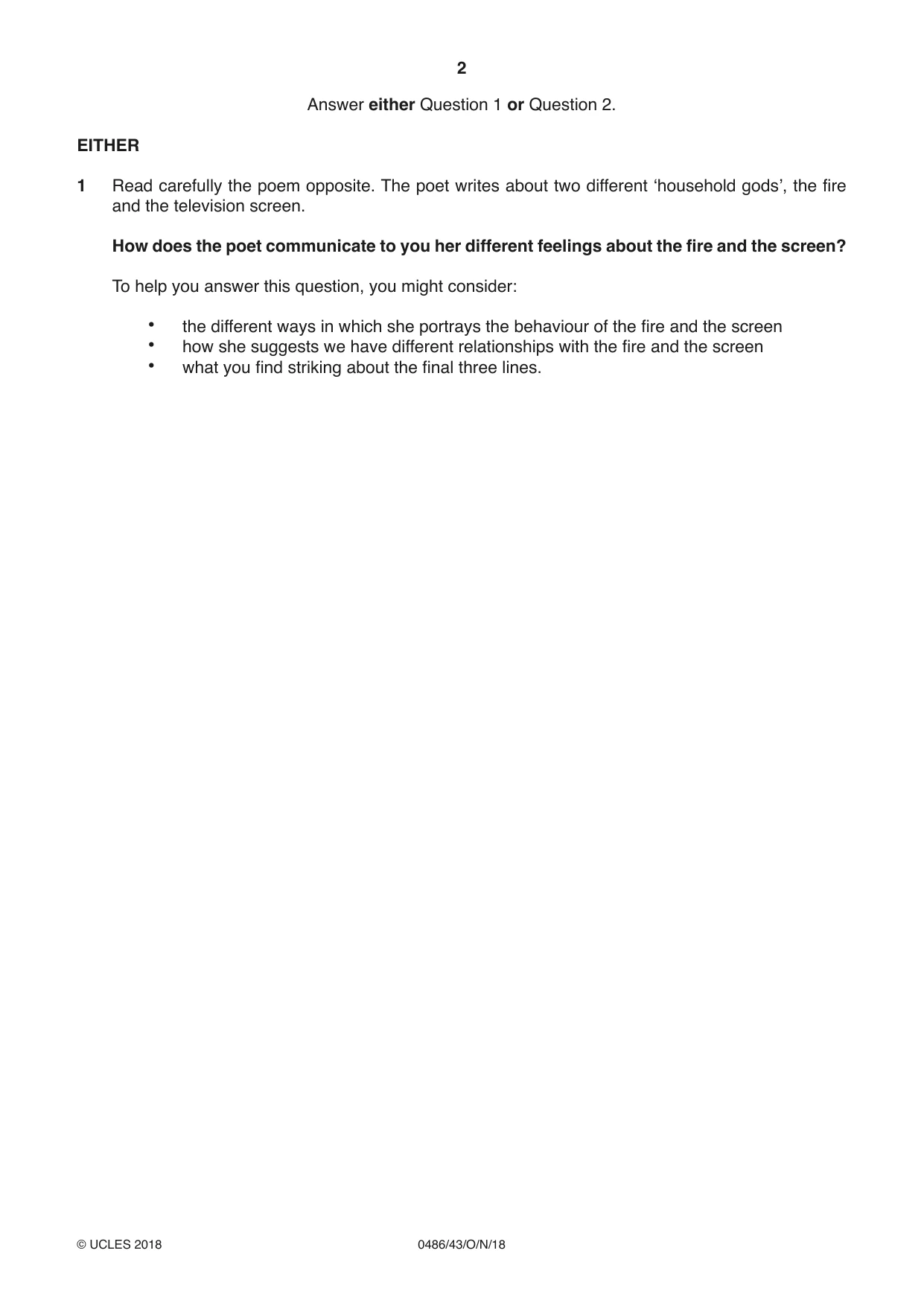
2 0486/43/O/N/18 © UCLES 2018 Answer either Question 1 or Question 2. EITHER 1 Read carefully the poem opposite. The poet writes about two different ‘household gods’, the fire and the television screen. How does the poet communicate to you her different feelings about the fire and the screen? To help you answer this question, you might consider: • the different ways in which she portrays the behaviour of the fire and the screen • how she suggests we have different relationships with the fire and the screen • what you find striking about the final three lines.
Question paper, page 3
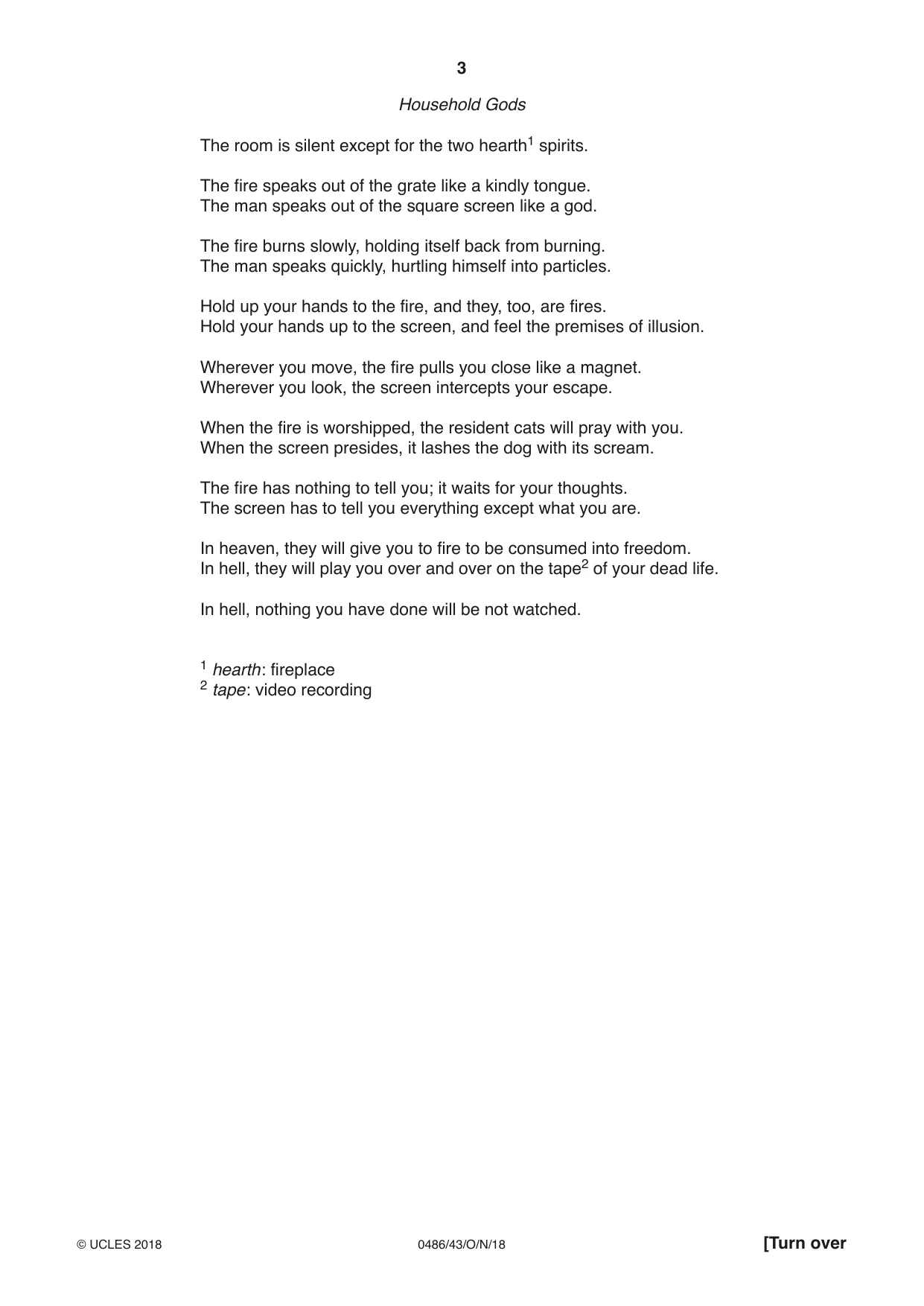
3 0486/43/O/N/18 © UCLES 2018 [Turn over Household Gods The room is silent except for the two hearth1 spirits. The fire speaks out of the grate like a kindly tongue. The man speaks out of the square screen like a god. The fire burns slowly, holding itself back from burning. The man speaks quickly, hurtling himself into particles. Hold up your hands to the fire, and they, too, are fires. Hold your hands up to the screen, and feel the premises of illusion. Wherever you move, the fire pulls you close like a magnet. Wherever you look, the screen intercepts your escape. When the fire is worshipped, the resident cats will pray with you. When the screen presides, it lashes the dog with its scream. The fire has nothing to tell you; it waits for your thoughts. The screen has to tell you everything except what you are. In heaven, they will give you to fire to be consumed into freedom. In hell, they will play you over and over on the tape2 of your dead life. In hell, nothing you have done will be not watched. 1 hearth: fireplace 2 tape: video recording
Question paper, page 4
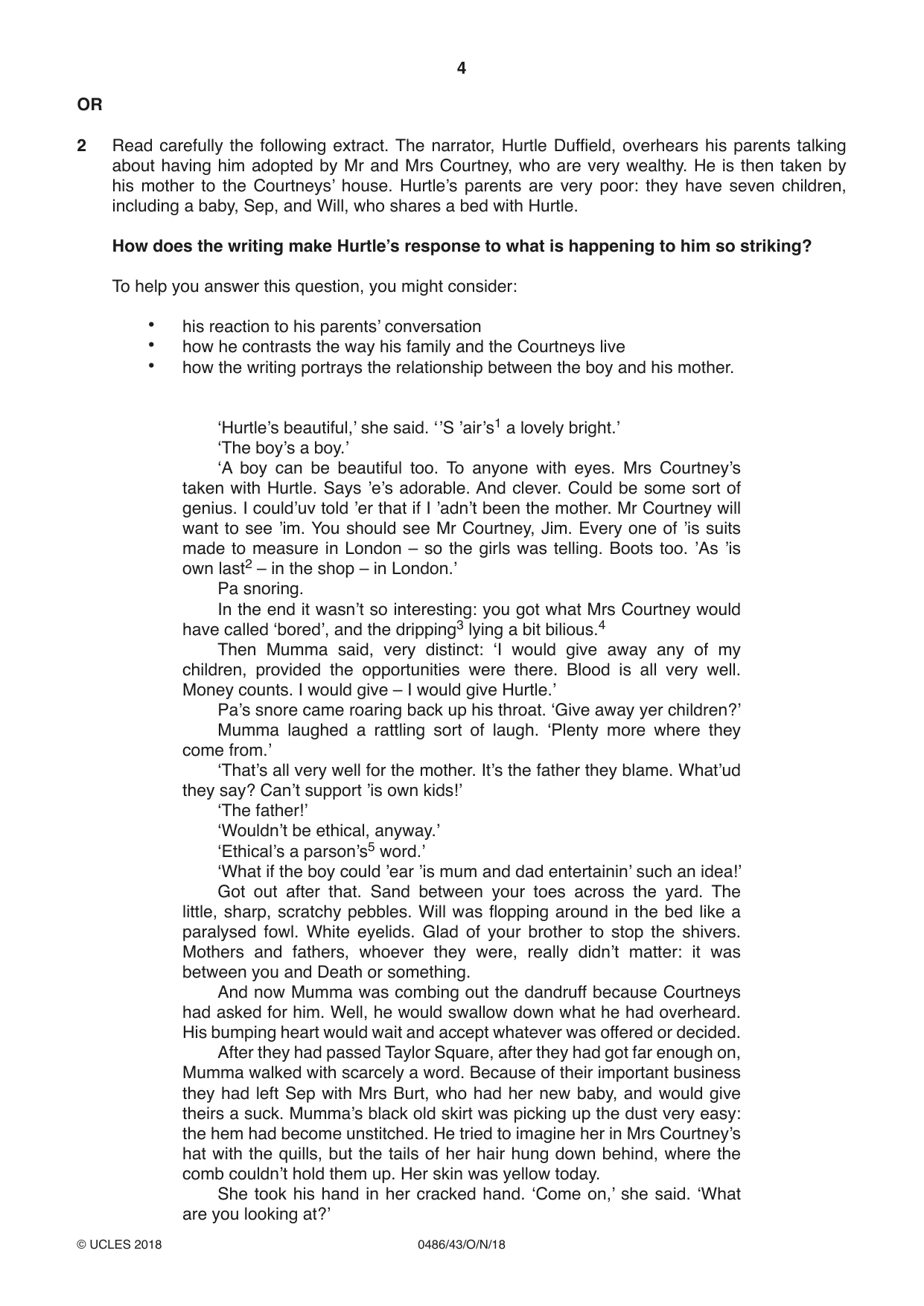
4 0486/43/O/N/18 © UCLES 2018 OR 2 Read carefully the following extract. The narrator, Hurtle Duffield, overhears his parents talking about having him adopted by Mr and Mrs Courtney, who are very wealthy. He is then taken by his mother to the Courtneys’ house. Hurtle’s parents are very poor: they have seven children, including a baby, Sep, and Will, who shares a bed with Hurtle. How does the writing make Hurtle’s response to what is happening to him so striking? To help you answer this question, you might consider: • his reaction to his parents’ conversation • how he contrasts the way his family and the Courtneys live • how the writing portrays the relationship between the boy and his mother. ‘Hurtle’s beautiful,’ she said. ‘’S ’air’s1 a lovely bright.’ ‘The boy’s a boy.’ ‘A boy can be beautiful too. To anyone with eyes. Mrs Courtney’s taken with Hurtle. Says ’e’s adorable. And clever. Could be some sort of genius. I could’uv told ’er that if I ’adn’t been the mother. Mr Courtney will want to see ’im. You should see Mr Courtney, Jim. Every one of ’is suits made to measure in London – so the girls was telling. Boots too. ’As ’is own last2 – in the shop – in London.’ Pa snoring. In the end it wasn’t so interesting: you got what Mrs Courtney would have called ‘bored’, and the dripping3 lying a bit bilious.4 Then Mumma said, very distinct: ‘I would give away any of my children, provided the opportunities were there. Blood is all very well. Money counts. I would give – I would give Hurtle.’ Pa’s snore came roaring back up his throat. ‘Give away yer children?’ Mumma laughed a rattling sort of laugh. ‘Plenty more where they come from.’ ‘That’s all very well for the mother. It’s the father they blame. What’ud they say? Can’t support ’is own kids!’ ‘The father!’ ‘Wouldn’t be ethical, anyway.’ ‘Ethical’s a parson’s5 word.’ ‘What if the boy could ’ear ’is mum and dad entertainin’ such an idea!’ Got out after that. Sand between your toes across the yard. The little, sharp, scratchy pebbles. Will was flopping around in the bed like a paralysed fowl. White eyelids. Glad of your brother to stop the shivers. Mothers and fathers, whoever they were, really didn’t matter: it was between you and Death or something. And now Mumma was combing out the dandruff because Courtneys had asked for him. Well, he would swallow down what he had overheard. His bumping heart would wait and accept whatever was offered or decided. After they had passed Taylor Square, after they had got far enough on, Mumma walked with scarcely a word. Because of their important business they had left Sep with Mrs Burt, who had her new baby, and would give theirs a suck. Mumma’s black old skirt was picking up the dust very easy: the hem had become unstitched. He tried to imagine her in Mrs Courtney’s hat with the quills, but the tails of her hair hung down behind, where the comb couldn’t hold them up. Her skin was yellow today. She took his hand in her cracked hand. ‘Come on,’ she said. ‘What are you looking at?’
Question paper, page 5
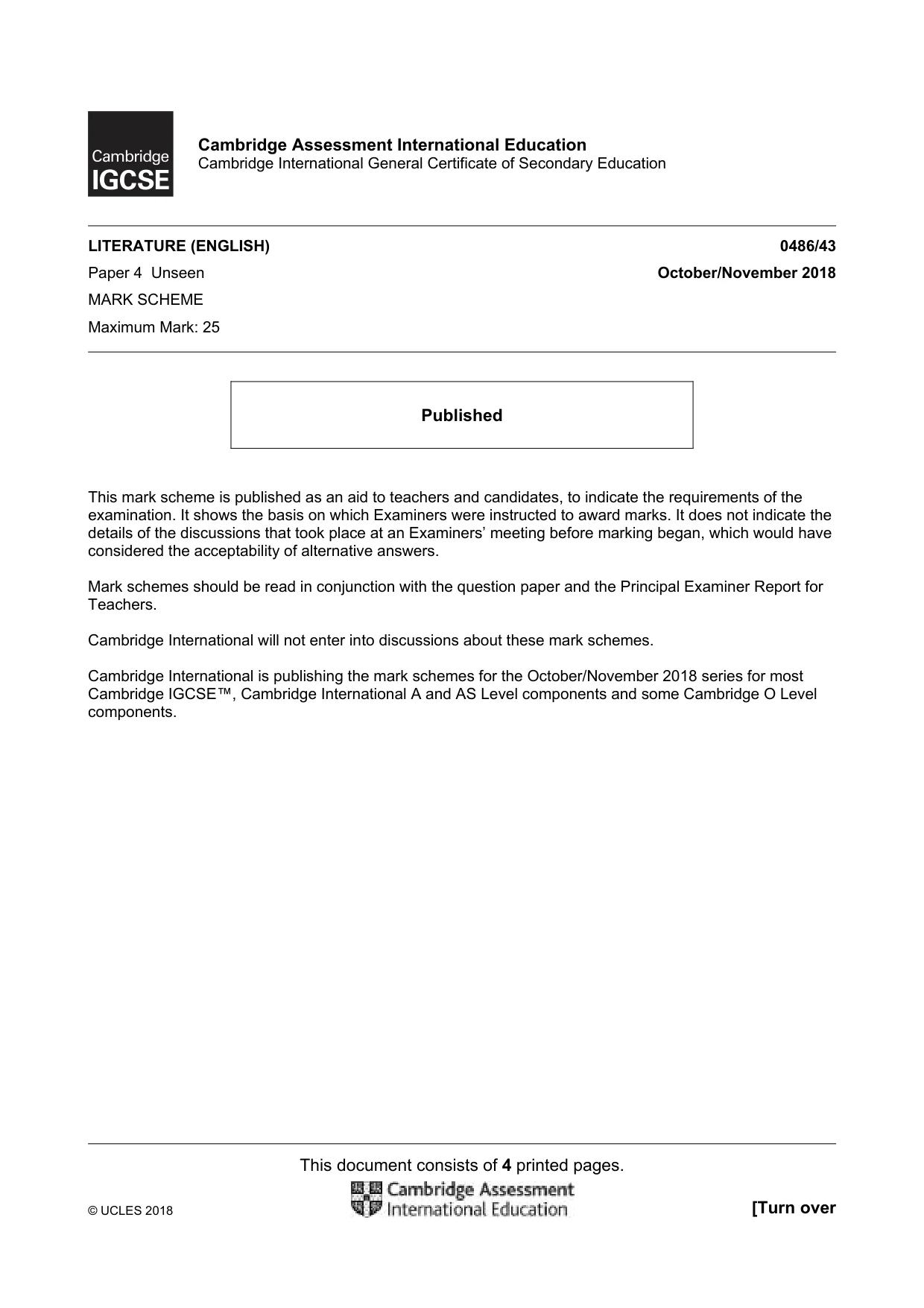
5 0486/43/O/N/18 © UCLES 2018 He began walking as he would, he felt, in a London suit, holding hands with Mrs Courtney, and it seemed as though the maid they passed polishing a doctor’s plate was already looking different at him. Mumma brightened, though one corner of her mouth was twitching. ‘Are you hungry, love? You’ll feel better for a bite of something.’ He ought to love poor Mumma for looking at him like that. He did, too: nothing else was real. There was nothing wrong in imagining a thing or two about himself and Courtneys. Mumma saw he was having trouble with his boot. ‘If your sole’s coming off, Hurtle, slide your foot along the carpet when you go inside, then nobody’ll notice.’ Her hand tightened as they began to clatter down the steep asphalt towards the ‘Tradesmen’s Entrance’6. Once or twice his sole flapped. 1 ’S ’air’s: (colloquial) his hair is 2 last: cobbler’s pattern for making handmade shoes 3 dripping: a meal of fat from meat 4 bilious: making someone feel sick 5 parson: priest or minister 6 Tradesmen’s Entrance: back-door entrance for servants and deliveries
Question paper, page 6
6 0486/43/O/N/18 © UCLES 2018 BLANK PAGE
Question paper, page 7
7 0486/43/O/N/18 © UCLES 2018 BLANK PAGE
Question paper, page 8
8 0486/43/O/N/18 © UCLES 2018 BLANK PAGE Permission to reproduce items where third-party owned material protected by copyright is included has been sought and cleared where possible. Every reasonable effort has been made by the publisher (UCLES) to trace copyright holders, but if any items requiring clearance have unwittingly been included, the publisher will be pleased to make amends at the earliest possible opportunity. To avoid the issue of disclosure of answer-related information to candidates, all copyright acknowledgements are reproduced online in the Cambridge International Examinations Copyright Acknowledgements Booklet. This is produced for each series of examinations and is freely available to download at www.cie.org.uk after the live examination series. Cambridge International Examinations is part of the Cambridge Assessment Group. Cambridge Assessment is the brand name of University of Cambridge Local Examinations Syndicate (UCLES), which is itself a department of the University of Cambridge.
Mark scheme, page 1
This document consists of 4 printed pages. © UCLES 2018 [Turn over Cambridge Assessment International Education Cambridge International General Certificate of Secondary Education LITERATURE (ENGLISH) 0486/43 Paper 4 Unseen October/November 2018 MARK SCHEME Maximum Mark: 25 Published This mark scheme is published as an aid to teachers and candidates, to indicate the requirements of the examination. It shows the basis on which Examiners were instructed to award marks. It does not indicate the details of the discussions that took place at an Examiners’ meeting before marking began, which would have considered the acceptability of alternative answers. Mark schemes should be read in conjunction with the question paper and the Principal Examiner Report for Teachers. Cambridge International will not enter into discussions about these mark schemes. Cambridge International is publishing the mark schemes for the October/November 2018 series for most Cambridge IGCSE™, Cambridge International A and AS Level components and some Cambridge O Level components.
Mark scheme, page 2
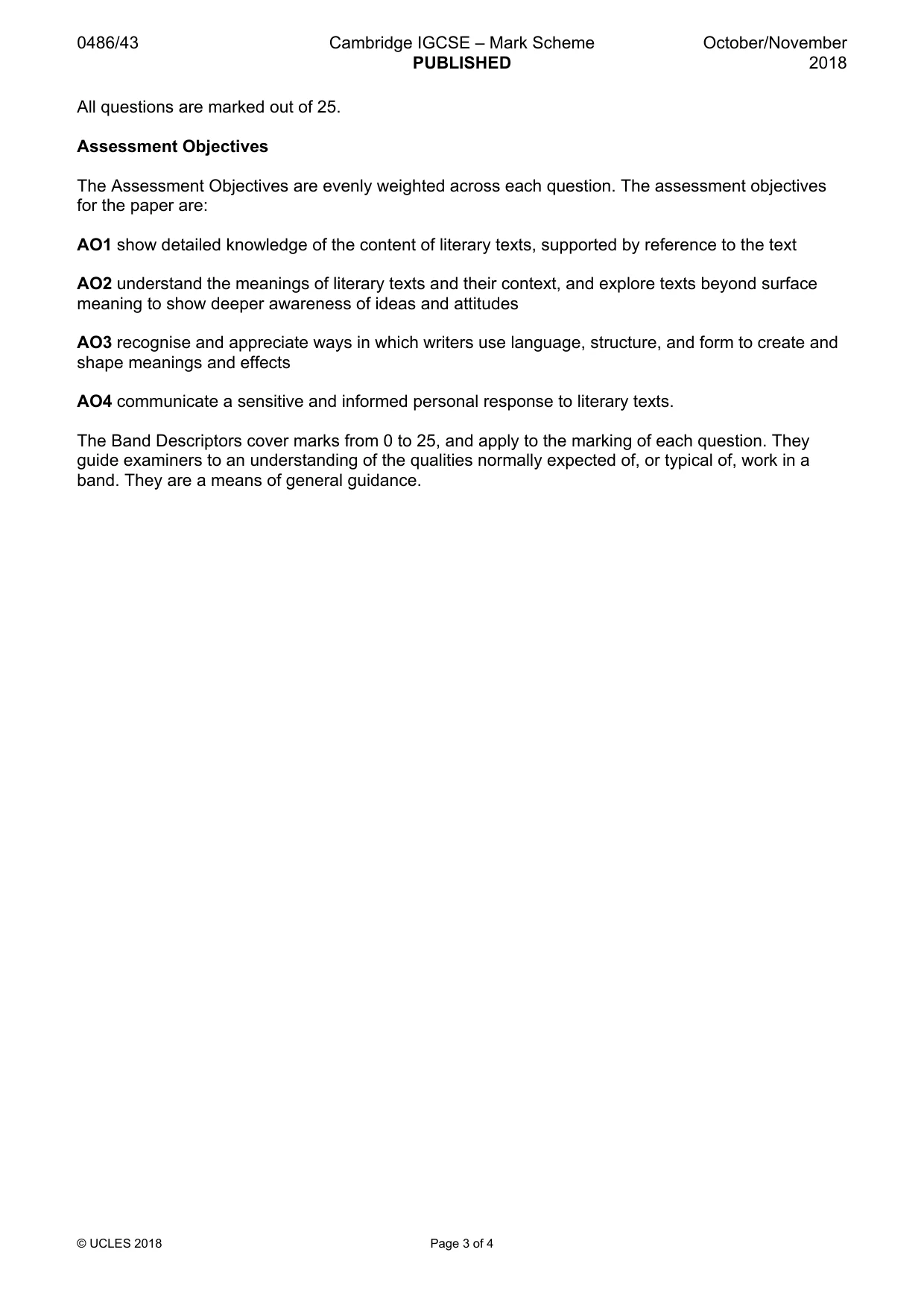
0486/43 Cambridge IGCSE – Mark Scheme PUBLISHED October/November 2018 © UCLES 2018 Page 2 of 4 Generic Marking Principles These general marking principles must be applied by all examiners when marking candidate answers. They should be applied alongside the specific content of the mark scheme or generic level descriptors for a question. Each question paper and mark scheme will also comply with these marking principles. GENERIC MARKING PRINCIPLE 1: Marks must be awarded in line with: • the specific content of the mark scheme or the generic level descriptors for the question • the specific skills defined in the mark scheme or in the generic level descriptors for the question • the standard of response required by a candidate as exemplified by the standardisation scripts. GENERIC MARKING PRINCIPLE 2: Marks awarded are always whole marks (not half marks, or other fractions). GENERIC MARKING PRINCIPLE 3: Marks must be awarded positively: • marks are awarded for correct/valid answers, as defined in the mark scheme. However, credit is given for valid answers which go beyond the scope of the syllabus and mark scheme, referring to your Team Leader as appropriate • marks are awarded when candidates clearly demonstrate what they know and can do • marks are not deducted for errors • marks are not deducted for omissions • answers should only be judged on the quality of spelling, punctuation and grammar when these features are specifically assessed by the question as indicated by the mark scheme. The meaning, however, should be unambiguous. GENERIC MARKING PRINCIPLE 4: Rules must be applied consistently e.g. in situations where candidates have not followed instructions or in the application of generic level descriptors. GENERIC MARKING PRINCIPLE 5: Marks should be awarded using the full range of marks defined in the mark scheme for the question (however; the use of the full mark range may be limited according to the quality of the candidate responses seen). GENERIC MARKING PRINCIPLE 6: Marks awarded are based solely on the requirements as defined in the mark scheme. Marks should not be awarded with grade thresholds or grade descriptors in mind.
Mark scheme, page 3
0486/43 Cambridge IGCSE – Mark Scheme PUBLISHED October/November 2018 © UCLES 2018 Page 3 of 4 All questions are marked out of 25. Assessment Objectives The Assessment Objectives are evenly weighted across each question. The assessment objectives for the paper are: AO1 show detailed knowledge of the content of literary texts, supported by reference to the text AO2 understand the meanings of literary texts and their context, and explore texts beyond surface meaning to show deeper awareness of ideas and attitudes AO3 recognise and appreciate ways in which writers use language, structure, and form to create and shape meanings and effects AO4 communicate a sensitive and informed personal response to literary texts. The Band Descriptors cover marks from 0 to 25, and apply to the marking of each question. They guide examiners to an understanding of the qualities normally expected of, or typical of, work in a band. They are a means of general guidance.
Mark scheme, page 4
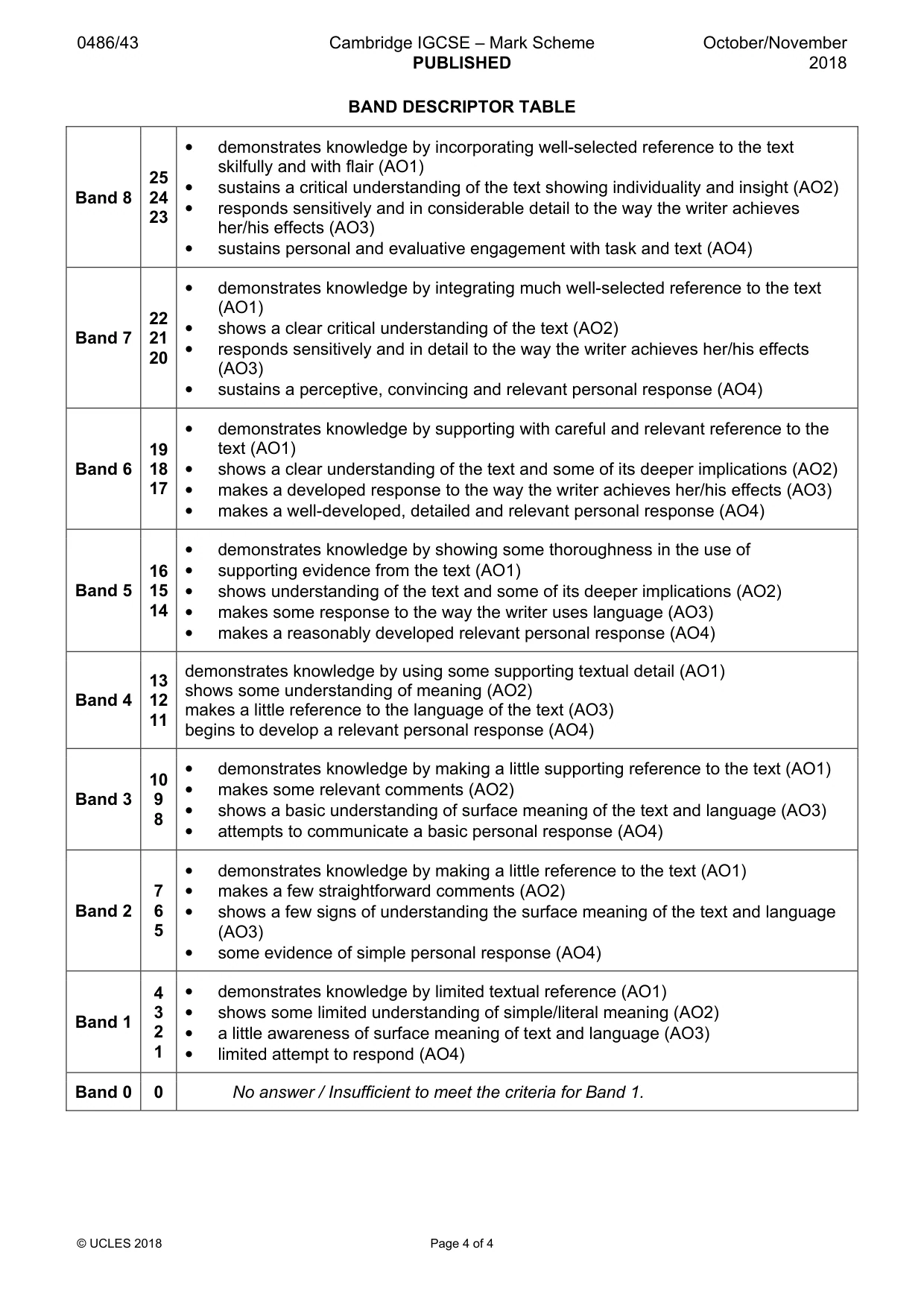
0486/43 Cambridge IGCSE – Mark Scheme PUBLISHED October/November 2018 © UCLES 2018 Page 4 of 4 BAND DESCRIPTOR TABLE Band 8 25 24 23 • demonstrates knowledge by incorporating well-selected reference to the text skilfully and with flair (AO1) • sustains a critical understanding of the text showing individuality and insight (AO2) • responds sensitively and in considerable detail to the way the writer achieves her/his effects (AO3) • sustains personal and evaluative engagement with task and text (AO4) Band 7 22 21 20 • demonstrates knowledge by integrating much well-selected reference to the text (AO1) • shows a clear critical understanding of the text (AO2) • responds sensitively and in detail to the way the writer achieves her/his effects (AO3) • sustains a perceptive, convincing and relevant personal response (AO4) Band 6 19 18 17 • demonstrates knowledge by supporting with careful and relevant reference to the text (AO1) • shows a clear understanding of the text and some of its deeper implications (AO2) • makes a developed response to the way the writer achieves her/his effects (AO3) • makes a well-developed, detailed and relevant personal response (AO4) Band 5 16 15 14 • demonstrates knowledge by showing some thoroughness in the use of • supporting evidence from the text (AO1) • shows understanding of the text and some of its deeper implications (AO2) • makes some response to the way the writer uses language (AO3) • makes a reasonably developed relevant personal response (AO4) Band 4 13 12 11 demonstrates knowledge by using some supporting textual detail (AO1) shows some understanding of meaning (AO2) makes a little reference to the language of the text (AO3) begins to develop a relevant personal response (AO4) Band 3 10 9 8 • demonstrates knowledge by making a little supporting reference to the text (AO1) • makes some relevant comments (AO2) • shows a basic understanding of surface meaning of the text and language (AO3) • attempts to communicate a basic personal response (AO4) Band 2 7 6 5 • demonstrates knowledge by making a little reference to the text (AO1) • makes a few straightforward comments (AO2) • shows a few signs of understanding the surface meaning of the text and language (AO3) • some evidence of simple personal response (AO4) Band 1 4 3 2 1 • demonstrates knowledge by limited textual reference (AO1) • shows some limited understanding of simple/literal meaning (AO2) • a little awareness of surface meaning of text and language (AO3) • limited attempt to respond (AO4) Band 0 0 No answer / Insufficient to meet the criteria for Band 1.
What you needed in this session
Cambridge’s own grade thresholds for 2018 Oct/Nov, Paper 4 · Variant 3. A higher threshold means an easier paper — the bar moves with how the cohort did.