Cambridge IGCSE English - Literature 0486 — 2019 May/June Paper 4 · Variant 3
0486/43/M/J/19 · 25 marks · ≈28 min
The question paper and its mark scheme, free to read here and free to download. This is Cambridge’s own paper, exactly as it was sat.
Question paper8 pages


Mark scheme4 pages
Answers below. Sit the paper first if you are practising.
Paper as text
Question paper, page 1
This document consists of 5 printed pages, 3 blank pages and 1 Insert. DC (RCL (GO)) 165186/2 © UCLES 2019 [Turn over Cambridge Assessment International Education Cambridge International General Certificate of Secondary Education * 5 6 9 4 8 2 5 5 9 3 * LITERATURE (ENGLISH) 0486/43 Paper 4 Unseen May/June 2019 1 hour 15 minutes No Additional Materials are required. READ THESE INSTRUCTIONS FIRST An answer booklet is provided inside this question paper. You should follow the instructions on the front cover of the answer booklet. If you need additional answer paper ask the invigilator for a continuation booklet. Answer either Question 1 or Question 2. You are advised to spend about 20 minutes reading the question paper and planning your answer. Both questions in this paper carry equal marks.
Question paper, page 2
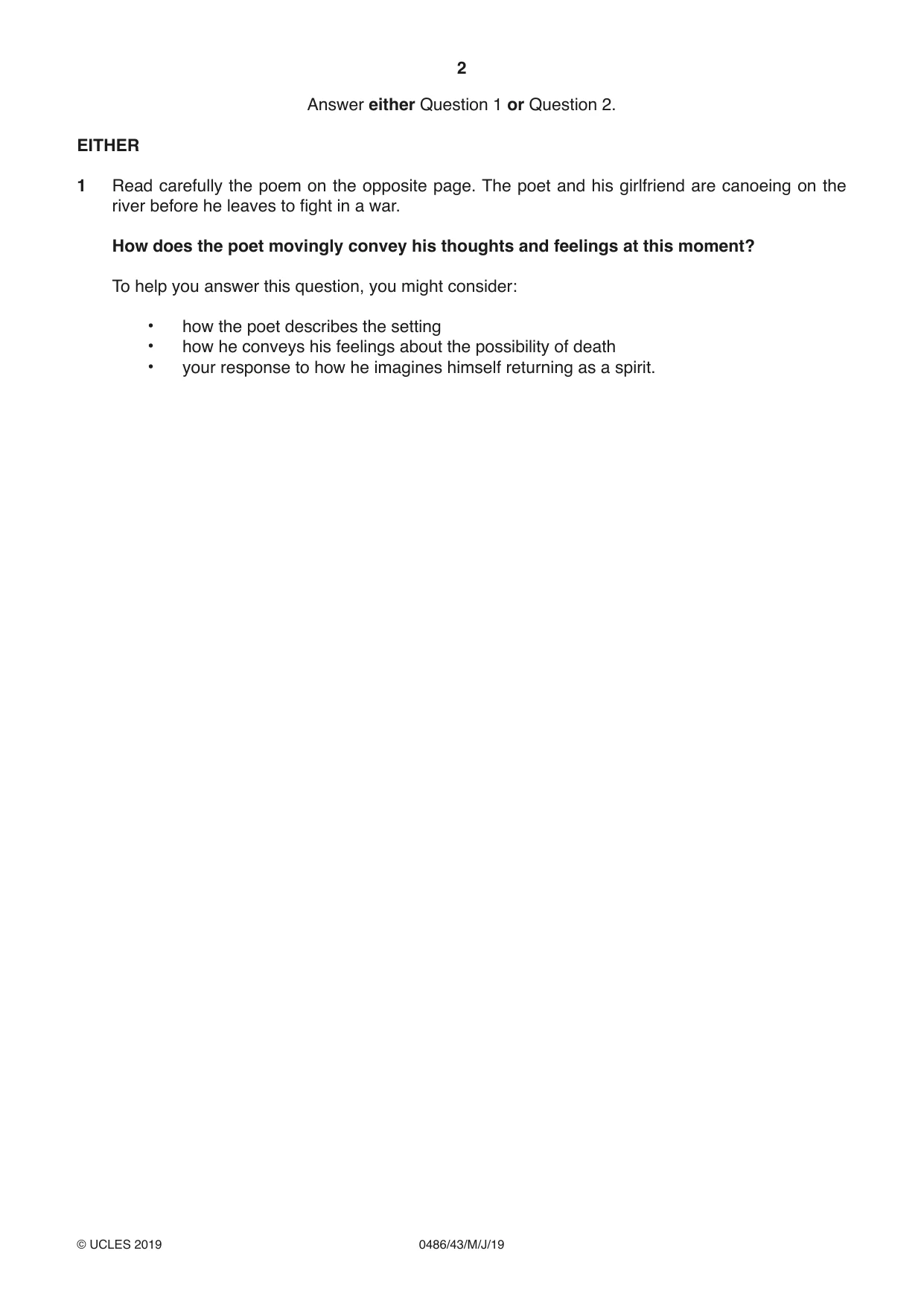
2 0486/43/M/J/19 © UCLES 2019 Answer either Question 1 or Question 2. EITHER 1 Read carefully the poem on the opposite page. The poet and his girlfriend are canoeing on the river before he leaves to fight in a war. How does the poet movingly convey his thoughts and feelings at this moment? To help you answer this question, you might consider: • how the poet describes the setting • how he conveys his feelings about the possibility of death • your response to how he imagines himself returning as a spirit.
Question paper, page 3
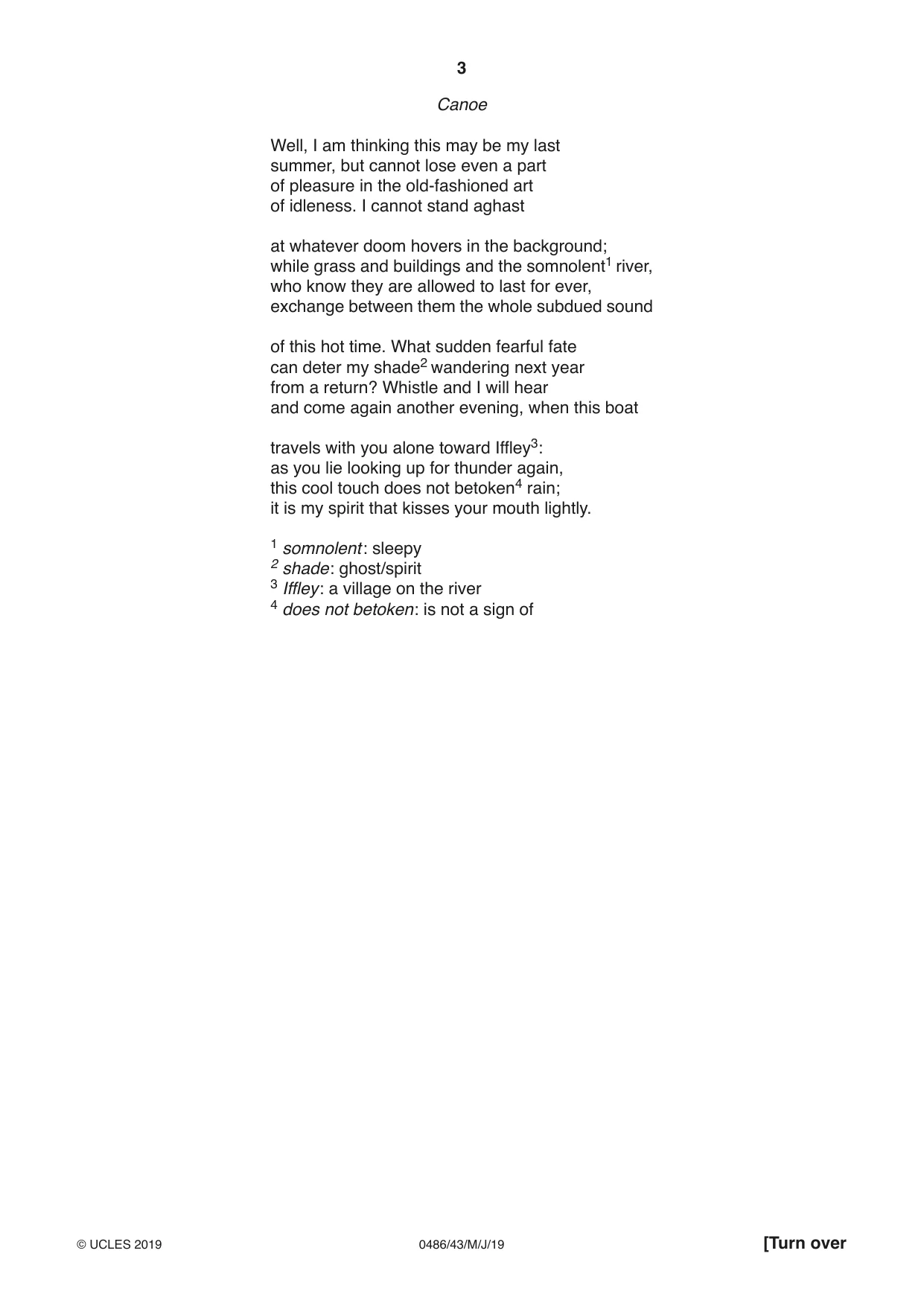
3 0486/43/M/J/19 © UCLES 2019 [Turn over Canoe Well, I am thinking this may be my last summer, but cannot lose even a part of pleasure in the old-fashioned art of idleness. I cannot stand aghast at whatever doom hovers in the background; while grass and buildings and the somnolent1 river, who know they are allowed to last for ever, exchange between them the whole subdued sound of this hot time. What sudden fearful fate can deter my shade2 wandering next year from a return? Whistle and I will hear and come again another evening, when this boat travels with you alone toward Iffley3: as you lie looking up for thunder again, this cool touch does not betoken4 rain; it is my spirit that kisses your mouth lightly. 1 somnolent: sleepy 2 shade: ghost/spirit 3 Iffley: a village on the river 4 does not betoken: is not a sign of
Question paper, page 4
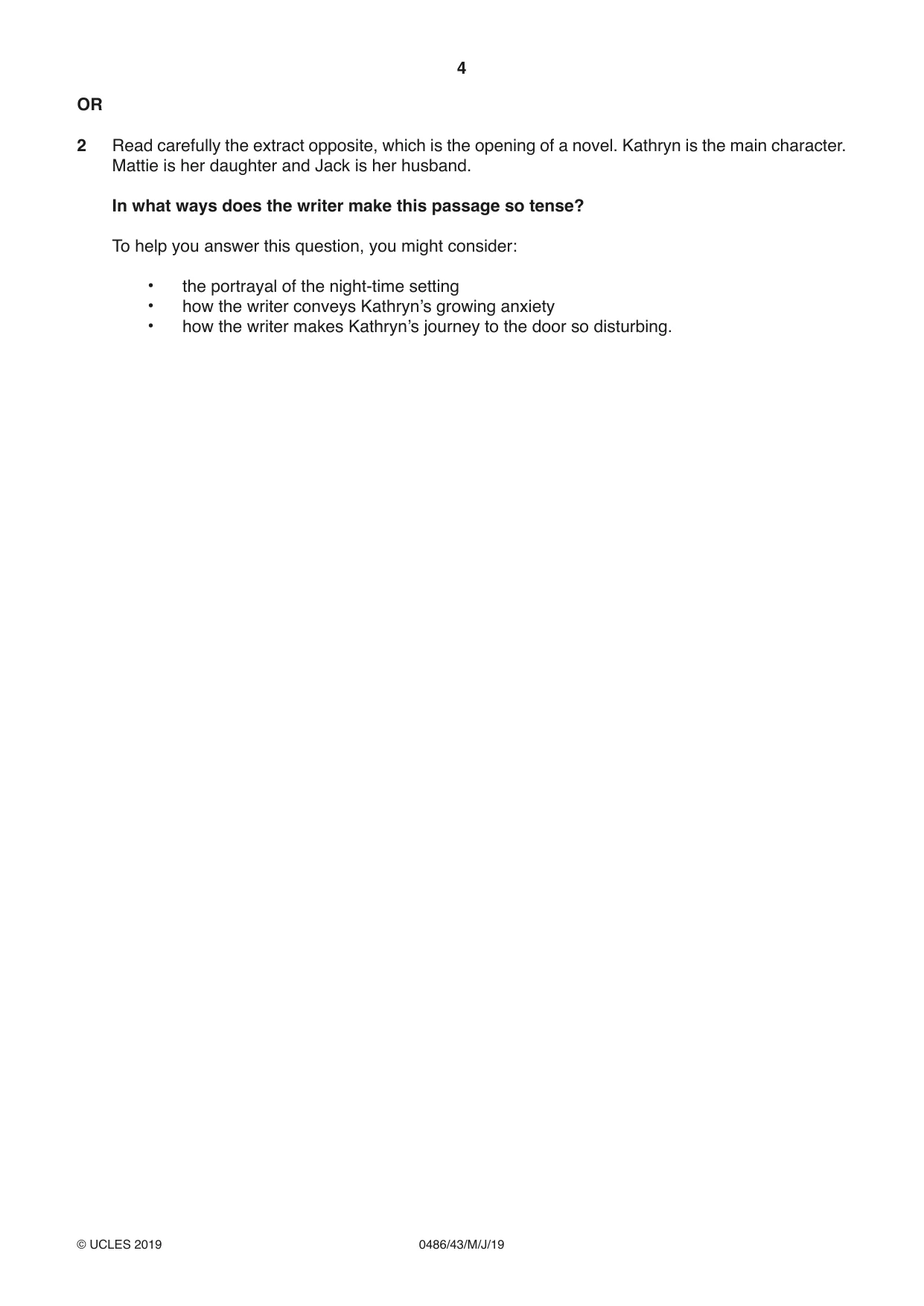
4 0486/43/M/J/19 © UCLES 2019 OR 2 Read carefully the extract opposite, which is the opening of a novel. Kathryn is the main character. Mattie is her daughter and Jack is her husband. In what ways does the writer make this passage so tense? To help you answer this question, you might consider: • the portrayal of the night-time setting • how the writer conveys Kathryn’s growing anxiety • how the writer makes Kathryn’s journey to the door so disturbing.
Question paper, page 5
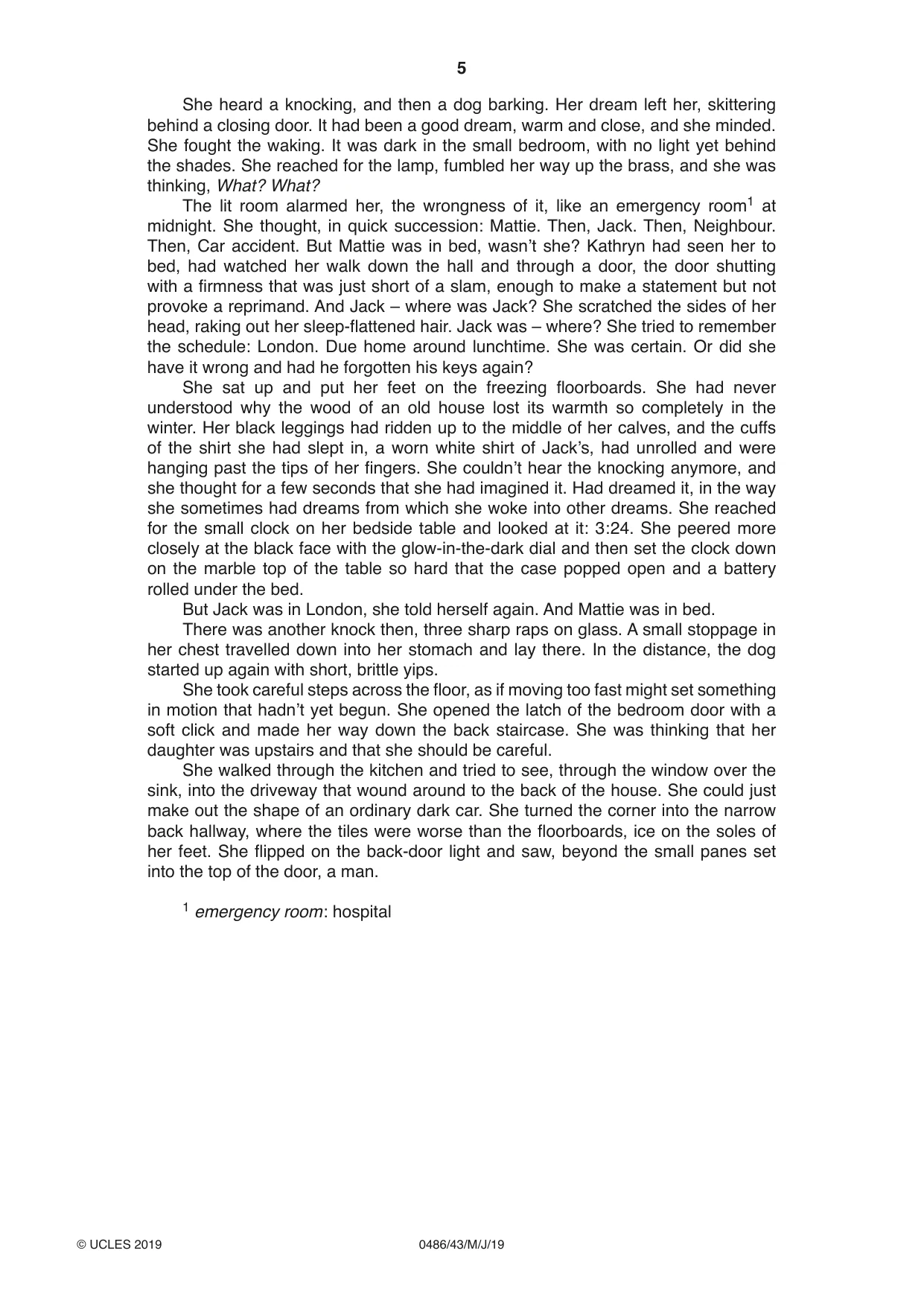
5 0486/43/M/J/19 © UCLES 2019 She heard a knocking, and then a dog barking. Her dream left her, skittering behind a closing door. It had been a good dream, warm and close, and she minded. She fought the waking. It was dark in the small bedroom, with no light yet behind the shades. She reached for the lamp, fumbled her way up the brass, and she was thinking, What? What? The lit room alarmed her, the wrongness of it, like an emergency room1 at midnight. She thought, in quick succession: Mattie. Then, Jack. Then, Neighbour. Then, Car accident. But Mattie was in bed, wasn’t she? Kathryn had seen her to bed, had watched her walk down the hall and through a door, the door shutting with a firmness that was just short of a slam, enough to make a statement but not provoke a reprimand. And Jack – where was Jack? She scratched the sides of her head, raking out her sleep-flattened hair. Jack was – where? She tried to remember the schedule: London. Due home around lunchtime. She was certain. Or did she have it wrong and had he forgotten his keys again? She sat up and put her feet on the freezing floorboards. She had never understood why the wood of an old house lost its warmth so completely in the winter. Her black leggings had ridden up to the middle of her calves, and the cuffs of the shirt she had slept in, a worn white shirt of Jack’s, had unrolled and were hanging past the tips of her fingers. She couldn’t hear the knocking anymore, and she thought for a few seconds that she had imagined it. Had dreamed it, in the way she sometimes had dreams from which she woke into other dreams. She reached for the small clock on her bedside table and looked at it: 3:24. She peered more closely at the black face with the glow-in-the-dark dial and then set the clock down on the marble top of the table so hard that the case popped open and a battery rolled under the bed. But Jack was in London, she told herself again. And Mattie was in bed. There was another knock then, three sharp raps on glass. A small stoppage in her chest travelled down into her stomach and lay there. In the distance, the dog started up again with short, brittle yips. She took careful steps across the floor, as if moving too fast might set something in motion that hadn’t yet begun. She opened the latch of the bedroom door with a soft click and made her way down the back staircase. She was thinking that her daughter was upstairs and that she should be careful. She walked through the kitchen and tried to see, through the window over the sink, into the driveway that wound around to the back of the house. She could just make out the shape of an ordinary dark car. She turned the corner into the narrow back hallway, where the tiles were worse than the floorboards, ice on the soles of her feet. She flipped on the back-door light and saw, beyond the small panes set into the top of the door, a man. 1 emergency room: hospital
Question paper, page 6
6 0486/43/M/J/19 © UCLES 2019 BLANK PAGE
Question paper, page 7
7 0486/43/M/J/19 © UCLES 2019 BLANK PAGE
Question paper, page 8
8 0486/43/M/J/19 © UCLES 2019 BLANK PAGE Permission to reproduce items where third-party owned material protected by copyright is included has been sought and cleared where possible. Every reasonable effort has been made by the publisher (UCLES) to trace copyright holders, but if any items requiring clearance have unwittingly been included, the publisher will be pleased to make amends at the earliest possible opportunity. To avoid the issue of disclosure of answer-related information to candidates, all copyright acknowledgements are reproduced online in the Cambridge Assessment International Education Copyright Acknowledgements Booklet. This is produced for each series of examinations and is freely available to download at www.cambridgeinternational.org after the live examination series. Cambridge Assessment International Education is part of the Cambridge Assessment Group. Cambridge Assessment is the brand name of the University of Cambridge Local Examinations Syndicate (UCLES), which itself is a department of the University of Cambridge.
Mark scheme, page 1
This document consists of 4 printed pages. © UCLES 2019 [Turn over Cambridge Assessment International Education Cambridge International General Certificate of Secondary Education LITERATURE (ENGLISH) 0486/43 Paper 4 Unseen 43 May/June 2019 MARK SCHEME Maximum Mark: 25 Published This mark scheme is published as an aid to teachers and candidates, to indicate the requirements of the examination. It shows the basis on which Examiners were instructed to award marks. It does not indicate the details of the discussions that took place at an Examiners’ meeting before marking began, which would have considered the acceptability of alternative answers. Mark schemes should be read in conjunction with the question paper and the Principal Examiner Report for Teachers. Cambridge International will not enter into discussions about these mark schemes. Cambridge International is publishing the mark schemes for the May/June 2019 series for most Cambridge IGCSE™, Cambridge International A and AS Level and Cambridge Pre-U components, and some Cambridge O Level components.
Mark scheme, page 2
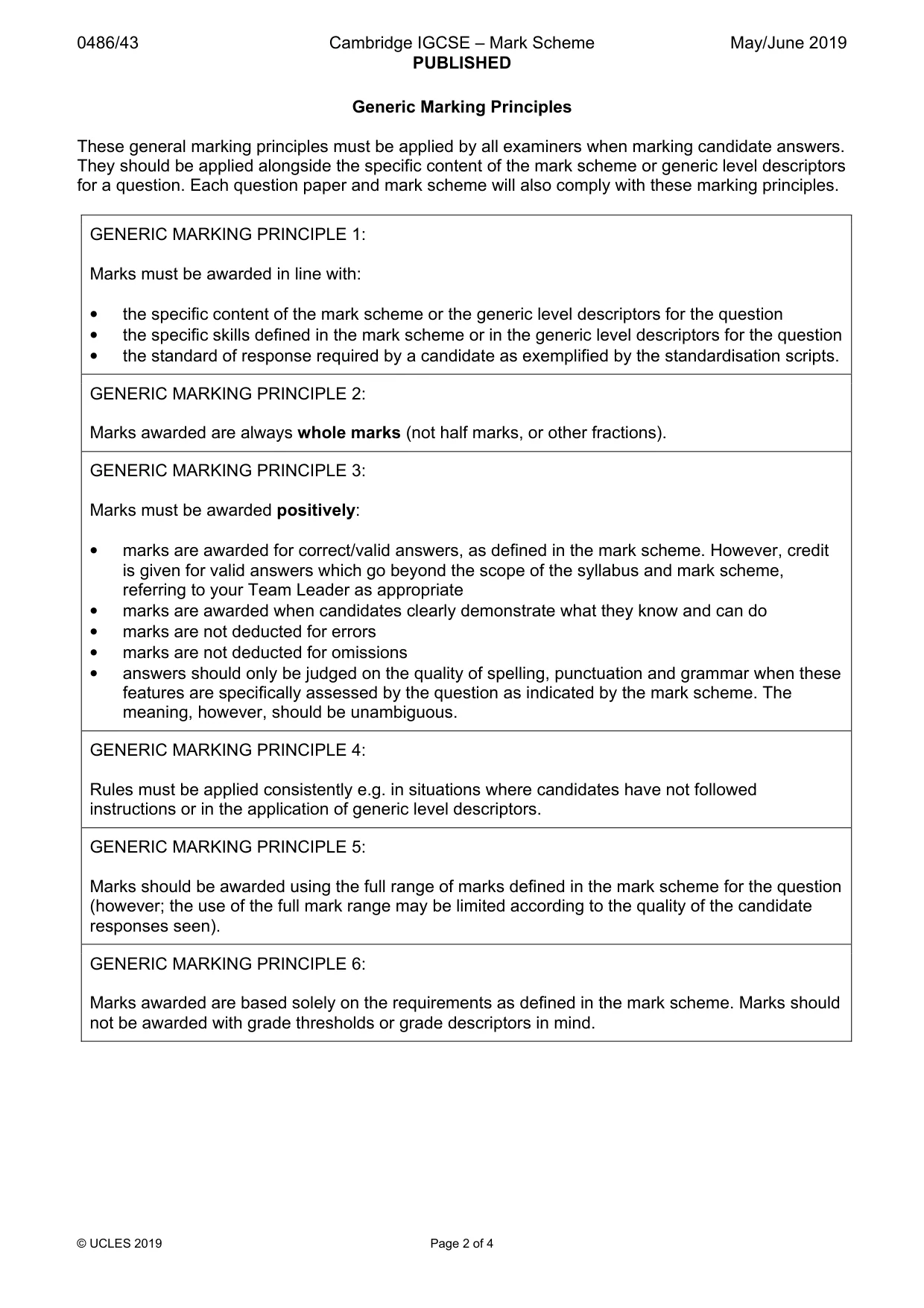
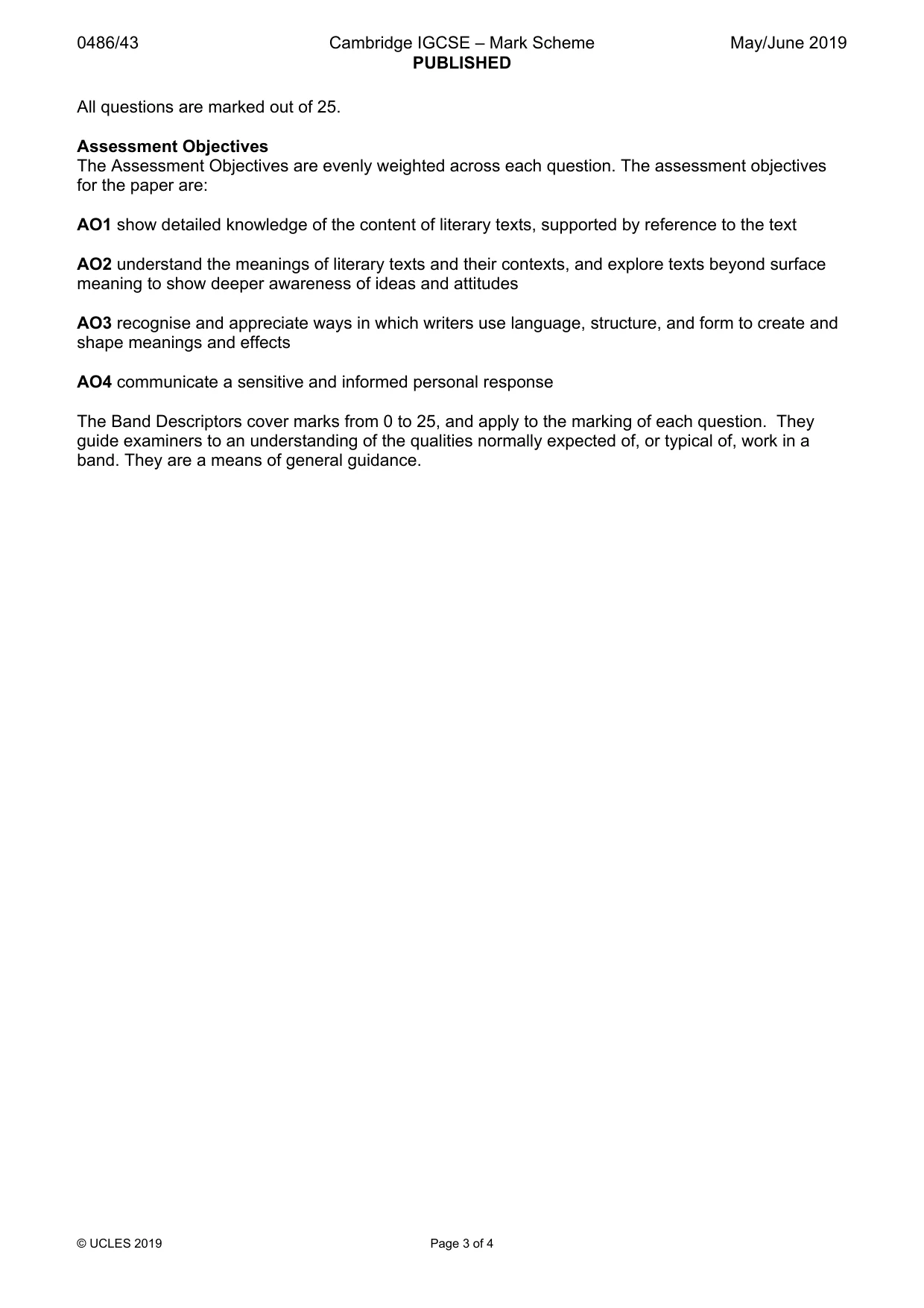
0486/43 Cambridge IGCSE – Mark Scheme PUBLISHED May/June 2019 © UCLES 2019 Page 2 of 4 Generic Marking Principles These general marking principles must be applied by all examiners when marking candidate answers. They should be applied alongside the specific content of the mark scheme or generic level descriptors for a question. Each question paper and mark scheme will also comply with these marking principles. GENERIC MARKING PRINCIPLE 1: Marks must be awarded in line with: • the specific content of the mark scheme or the generic level descriptors for the question • the specific skills defined in the mark scheme or in the generic level descriptors for the question • the standard of response required by a candidate as exemplified by the standardisation scripts. GENERIC MARKING PRINCIPLE 2: Marks awarded are always whole marks (not half marks, or other fractions). GENERIC MARKING PRINCIPLE 3: Marks must be awarded positively: • marks are awarded for correct/valid answers, as defined in the mark scheme. However, credit is given for valid answers which go beyond the scope of the syllabus and mark scheme, referring to your Team Leader as appropriate • marks are awarded when candidates clearly demonstrate what they know and can do • marks are not deducted for errors • marks are not deducted for omissions • answers should only be judged on the quality of spelling, punctuation and grammar when these features are specifically assessed by the question as indicated by the mark scheme. The meaning, however, should be unambiguous. GENERIC MARKING PRINCIPLE 4: Rules must be applied consistently e.g. in situations where candidates have not followed instructions or in the application of generic level descriptors. GENERIC MARKING PRINCIPLE 5: Marks should be awarded using the full range of marks defined in the mark scheme for the question (however; the use of the full mark range may be limited according to the quality of the candidate responses seen). GENERIC MARKING PRINCIPLE 6: Marks awarded are based solely on the requirements as defined in the mark scheme. Marks should not be awarded with grade thresholds or grade descriptors in mind.
Mark scheme, page 3
0486/43 Cambridge IGCSE – Mark Scheme PUBLISHED May/June 2019 © UCLES 2019 Page 3 of 4 All questions are marked out of 25. Assessment Objectives The Assessment Objectives are evenly weighted across each question. The assessment objectives for the paper are: AO1 show detailed knowledge of the content of literary texts, supported by reference to the text AO2 understand the meanings of literary texts and their contexts, and explore texts beyond surface meaning to show deeper awareness of ideas and attitudes AO3 recognise and appreciate ways in which writers use language, structure, and form to create and shape meanings and effects AO4 communicate a sensitive and informed personal response The Band Descriptors cover marks from 0 to 25, and apply to the marking of each question. They guide examiners to an understanding of the qualities normally expected of, or typical of, work in a band. They are a means of general guidance.
Mark scheme, page 4
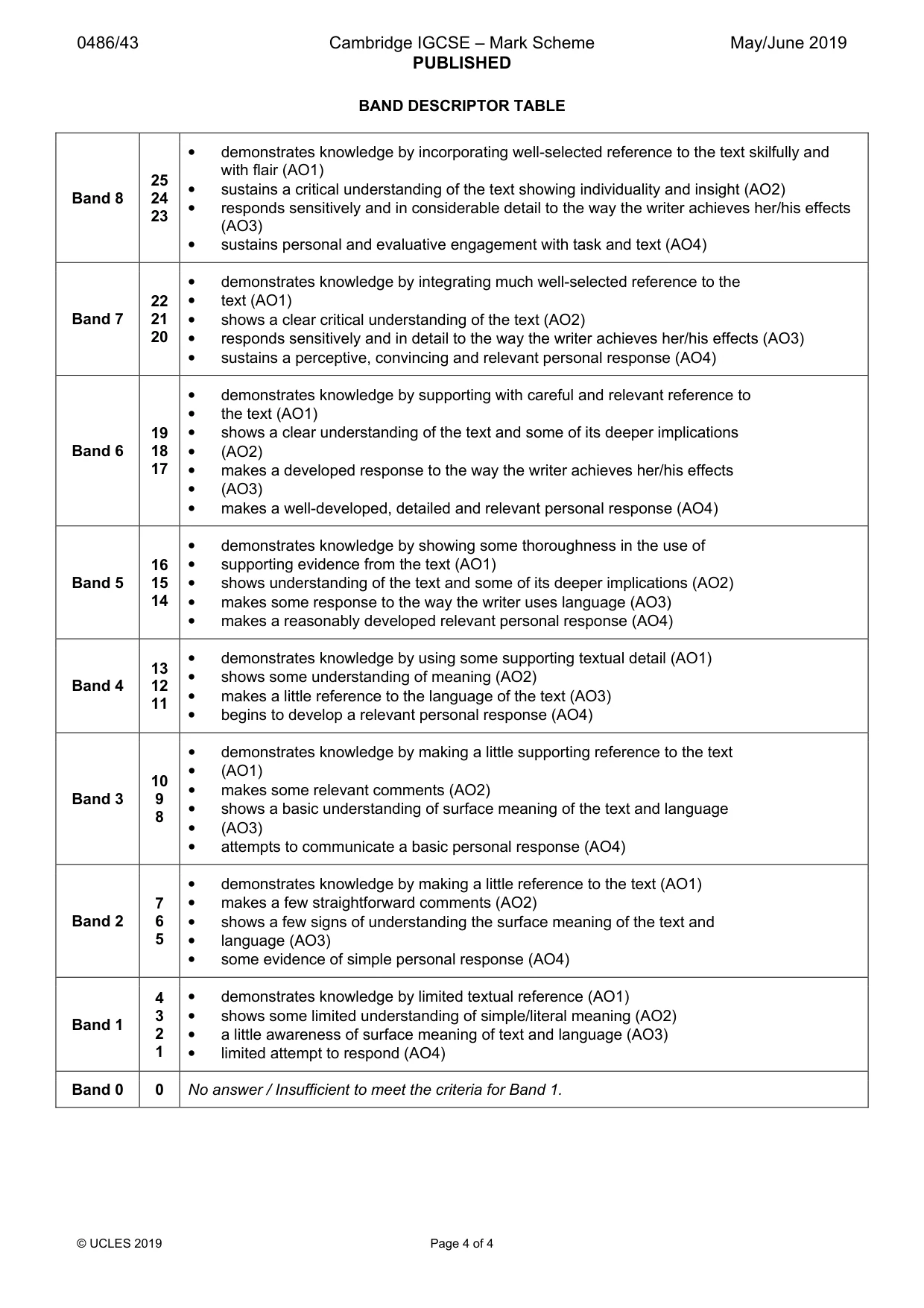
0486/43 Cambridge IGCSE – Mark Scheme PUBLISHED May/June 2019 © UCLES 2019 Page 4 of 4 BAND DESCRIPTOR TABLE Band 8 25 24 23 • demonstrates knowledge by incorporating well-selected reference to the text skilfully and with flair (AO1) • sustains a critical understanding of the text showing individuality and insight (AO2) • responds sensitively and in considerable detail to the way the writer achieves her/his effects (AO3) • sustains personal and evaluative engagement with task and text (AO4) Band 7 22 21 20 • demonstrates knowledge by integrating much well-selected reference to the • text (AO1) • shows a clear critical understanding of the text (AO2) • responds sensitively and in detail to the way the writer achieves her/his effects (AO3) • sustains a perceptive, convincing and relevant personal response (AO4) Band 6 19 18 17 • demonstrates knowledge by supporting with careful and relevant reference to • the text (AO1) • shows a clear understanding of the text and some of its deeper implications • (AO2) • makes a developed response to the way the writer achieves her/his effects • (AO3) • makes a well-developed, detailed and relevant personal response (AO4) Band 5 16 15 14 • demonstrates knowledge by showing some thoroughness in the use of • supporting evidence from the text (AO1) • shows understanding of the text and some of its deeper implications (AO2) • makes some response to the way the writer uses language (AO3) • makes a reasonably developed relevant personal response (AO4) Band 4 13 12 11 • demonstrates knowledge by using some supporting textual detail (AO1) • shows some understanding of meaning (AO2) • makes a little reference to the language of the text (AO3) • begins to develop a relevant personal response (AO4) Band 3 10 9 8 • demonstrates knowledge by making a little supporting reference to the text • (AO1) • makes some relevant comments (AO2) • shows a basic understanding of surface meaning of the text and language • (AO3) • attempts to communicate a basic personal response (AO4) Band 2 7 6 5 • demonstrates knowledge by making a little reference to the text (AO1) • makes a few straightforward comments (AO2) • shows a few signs of understanding the surface meaning of the text and • language (AO3) • some evidence of simple personal response (AO4) Band 1 4 3 2 1 • demonstrates knowledge by limited textual reference (AO1) • shows some limited understanding of simple/literal meaning (AO2) • a little awareness of surface meaning of text and language (AO3) • limited attempt to respond (AO4) Band 0 0 No answer / Insufficient to meet the criteria for Band 1.
What you needed in this session
Cambridge’s own grade thresholds for 2019 May/June, Paper 4 · Variant 3. A higher threshold means an easier paper — the bar moves with how the cohort did.