Cambridge IGCSE English - Literature 0486 — 2019 Oct/Nov Paper 4 · Variant 3
0486/43/O/N/19 · 25 marks · ≈28 min
The question paper and its mark scheme, free to read here and free to download. This is Cambridge’s own paper, exactly as it was sat.
Question paper8 pages


Mark scheme4 pages
Answers below. Sit the paper first if you are practising.
Paper as text
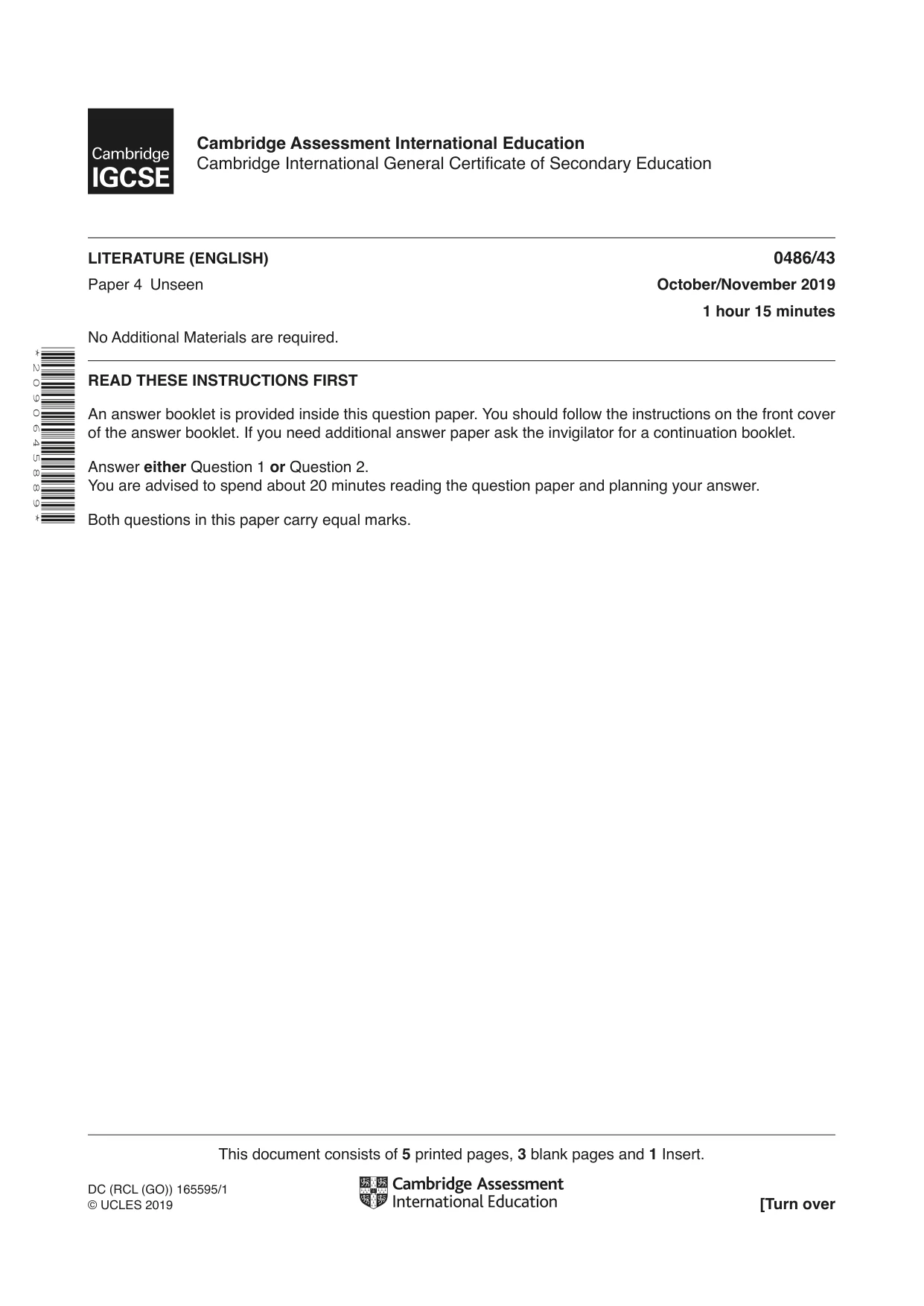
Question paper, page 1
This document consists of 5 printed pages, 3 blank pages and 1 Insert. DC (RCL (GO)) 165595/1 © UCLES 2019 [Turn over Cambridge Assessment International Education Cambridge International General Certificate of Secondary Education * 2 0 9 0 6 4 5 8 8 9 * LITERATURE (ENGLISH) 0486/43 Paper 4 Unseen October/November 2019 1 hour 15 minutes No Additional Materials are required. READ THESE INSTRUCTIONS FIRST An answer booklet is provided inside this question paper. You should follow the instructions on the front cover of the answer booklet. If you need additional answer paper ask the invigilator for a continuation booklet. Answer either Question 1 or Question 2. You are advised to spend about 20 minutes reading the question paper and planning your answer. Both questions in this paper carry equal marks.
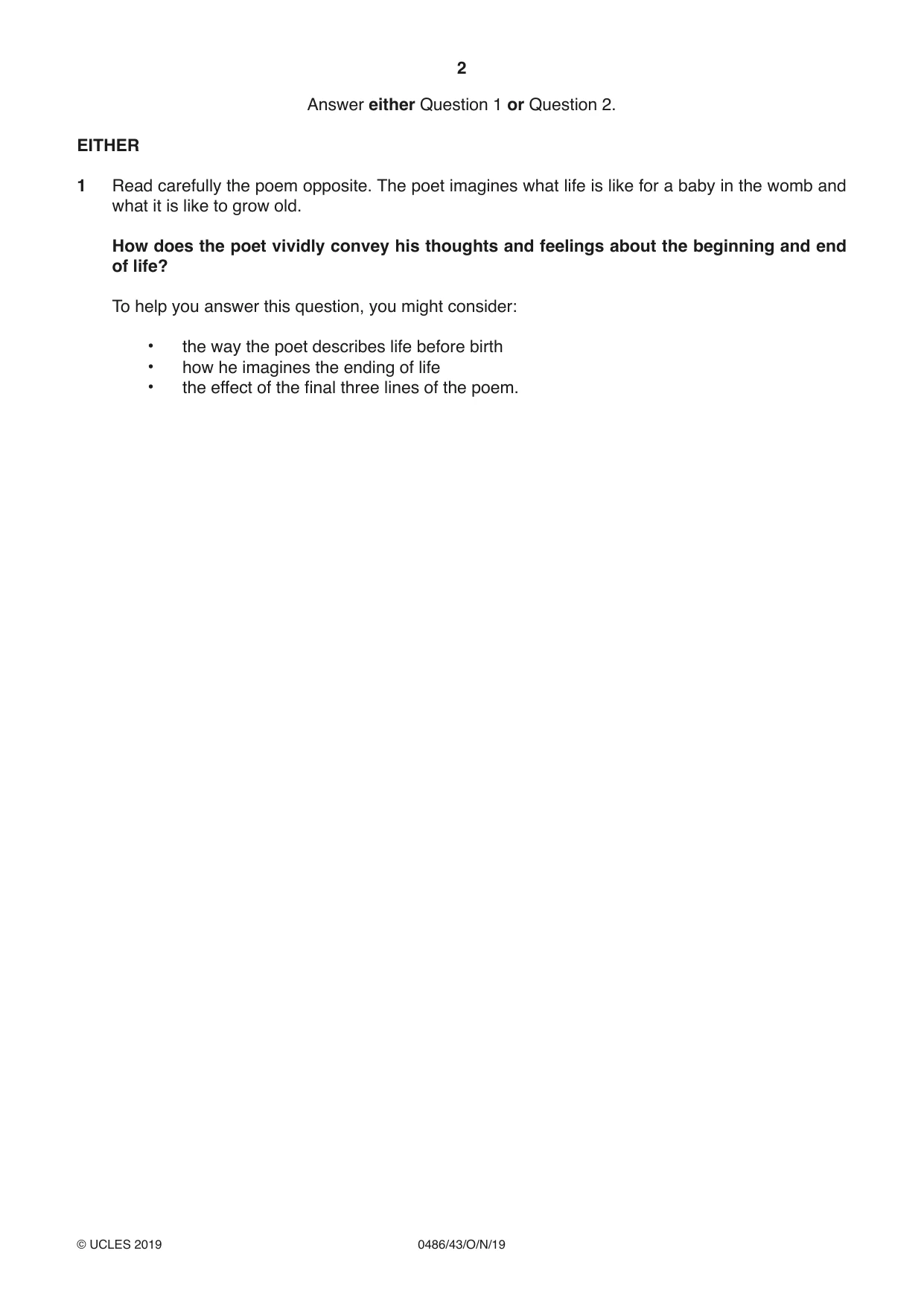
Question paper, page 2
2 0486/43/O/N/19 © UCLES 2019 Answer either Question 1 or Question 2. EITHER 1 Read carefully the poem opposite. The poet imagines what life is like for a baby in the womb and what it is like to grow old. How does the poet vividly convey his thoughts and feelings about the beginning and end of life? To help you answer this question, you might consider: • the way the poet describes life before birth • how he imagines the ending of life • the effect of the final three lines of the poem.
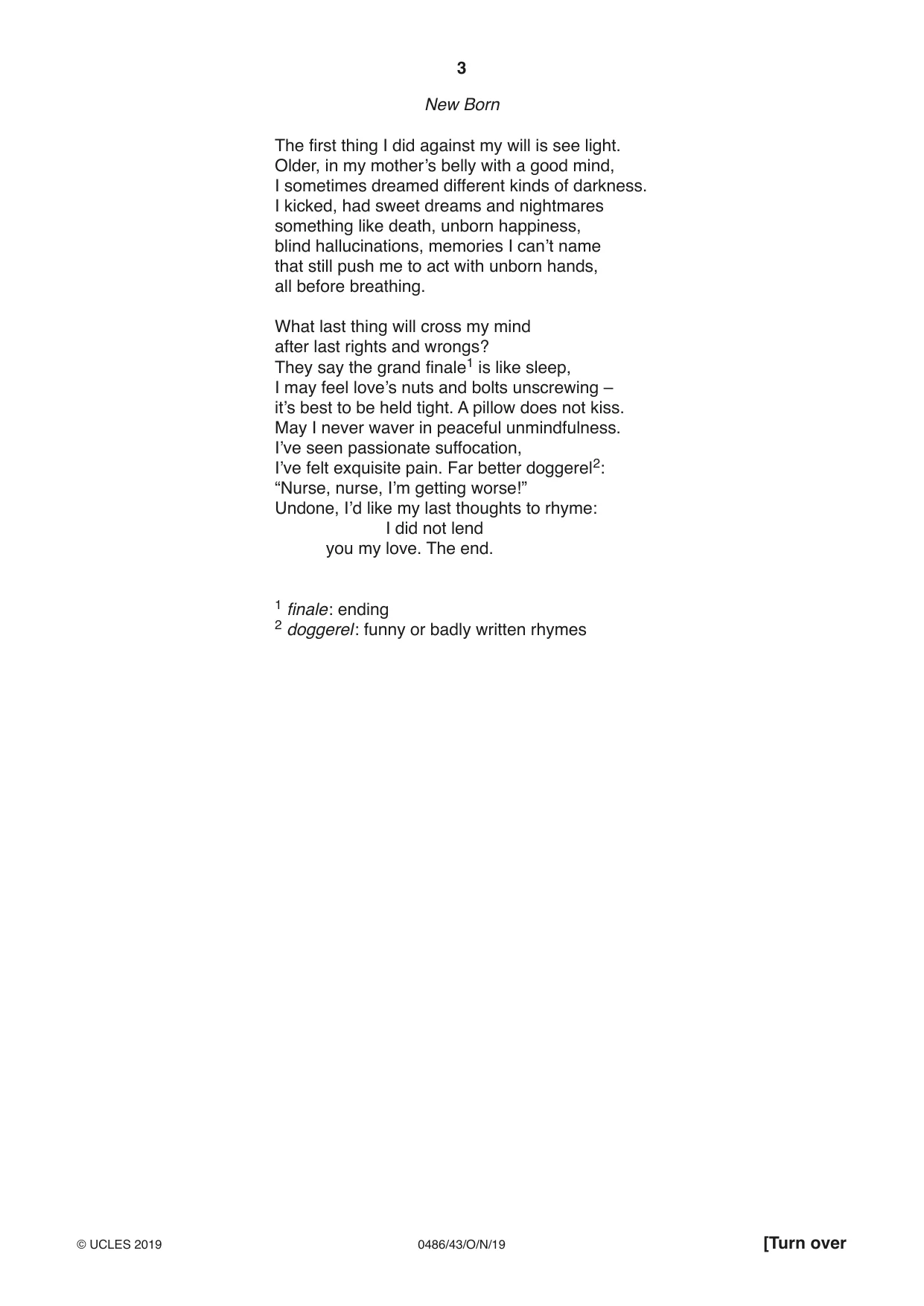
Question paper, page 3
3 0486/43/O/N/19 © UCLES 2019 [Turn over New Born The first thing I did against my will is see light. Older, in my mother’s belly with a good mind, I sometimes dreamed different kinds of darkness. I kicked, had sweet dreams and nightmares something like death, unborn happiness, blind hallucinations, memories I can’t name that still push me to act with unborn hands, all before breathing. What last thing will cross my mind after last rights and wrongs? They say the grand finale1 is like sleep, I may feel love’s nuts and bolts unscrewing – it’s best to be held tight. A pillow does not kiss. May I never waver in peaceful unmindfulness. I’ve seen passionate suffocation, I’ve felt exquisite pain. Far better doggerel2: “Nurse, nurse, I’m getting worse!” Undone, I’d like my last thoughts to rhyme: I did not lend you my love. The end. 1 finale: ending 2 doggerel: funny or badly written rhymes
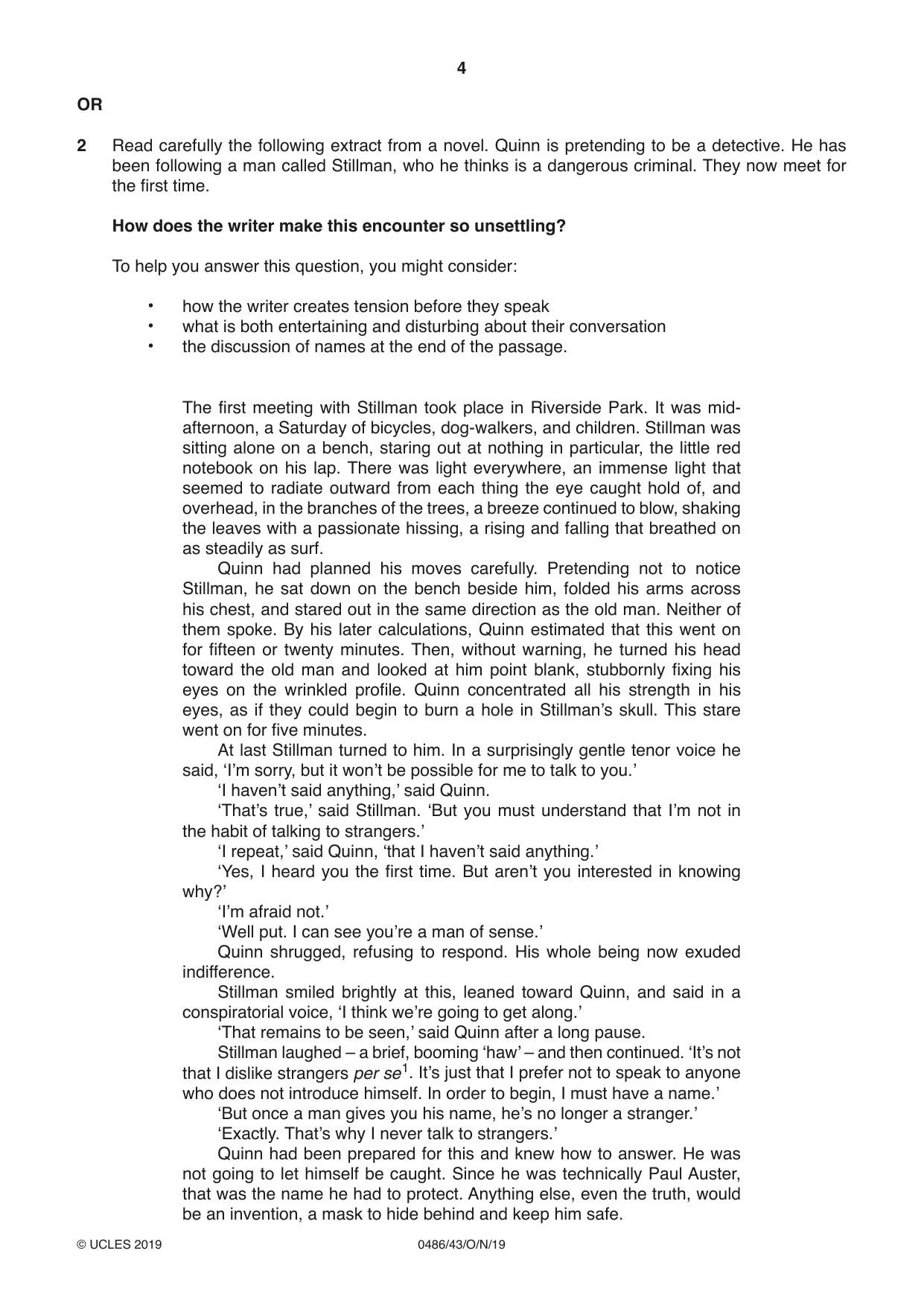
Question paper, page 4
4 0486/43/O/N/19 © UCLES 2019 OR 2 Read carefully the following extract from a novel. Quinn is pretending to be a detective. He has been following a man called Stillman, who he thinks is a dangerous criminal. They now meet for the first time. How does the writer make this encounter so unsettling? To help you answer this question, you might consider: • how the writer creates tension before they speak • what is both entertaining and disturbing about their conversation • the discussion of names at the end of the passage. The first meeting with Stillman took place in Riverside Park. It was mid- afternoon, a Saturday of bicycles, dog-walkers, and children. Stillman was sitting alone on a bench, staring out at nothing in particular, the little red notebook on his lap. There was light everywhere, an immense light that seemed to radiate outward from each thing the eye caught hold of, and overhead, in the branches of the trees, a breeze continued to blow, shaking the leaves with a passionate hissing, a rising and falling that breathed on as steadily as surf. Quinn had planned his moves carefully. Pretending not to notice Stillman, he sat down on the bench beside him, folded his arms across his chest, and stared out in the same direction as the old man. Neither of them spoke. By his later calculations, Quinn estimated that this went on for fifteen or twenty minutes. Then, without warning, he turned his head toward the old man and looked at him point blank, stubbornly fixing his eyes on the wrinkled profile. Quinn concentrated all his strength in his eyes, as if they could begin to burn a hole in Stillman’s skull. This stare went on for five minutes. At last Stillman turned to him. In a surprisingly gentle tenor voice he said, ‘I’m sorry, but it won’t be possible for me to talk to you.’ ‘I haven’t said anything,’ said Quinn. ‘That’s true,’ said Stillman. ‘But you must understand that I’m not in the habit of talking to strangers.’ ‘I repeat,’ said Quinn, ‘that I haven’t said anything.’ ‘Yes, I heard you the first time. But aren’t you interested in knowing why?’ ‘I’m afraid not.’ ‘Well put. I can see you’re a man of sense.’ Quinn shrugged, refusing to respond. His whole being now exuded indifference. Stillman smiled brightly at this, leaned toward Quinn, and said in a conspiratorial voice, ‘I think we’re going to get along.’ ‘That remains to be seen,’ said Quinn after a long pause. Stillman laughed – a brief, booming ‘haw’ – and then continued. ‘It’s not that I dislike strangers per se1. It’s just that I prefer not to speak to anyone who does not introduce himself. In order to begin, I must have a name.’ ‘But once a man gives you his name, he’s no longer a stranger.’ ‘Exactly. That’s why I never talk to strangers.’ Quinn had been prepared for this and knew how to answer. He was not going to let himself be caught. Since he was technically Paul Auster, that was the name he had to protect. Anything else, even the truth, would be an invention, a mask to hide behind and keep him safe.
Question paper, page 5
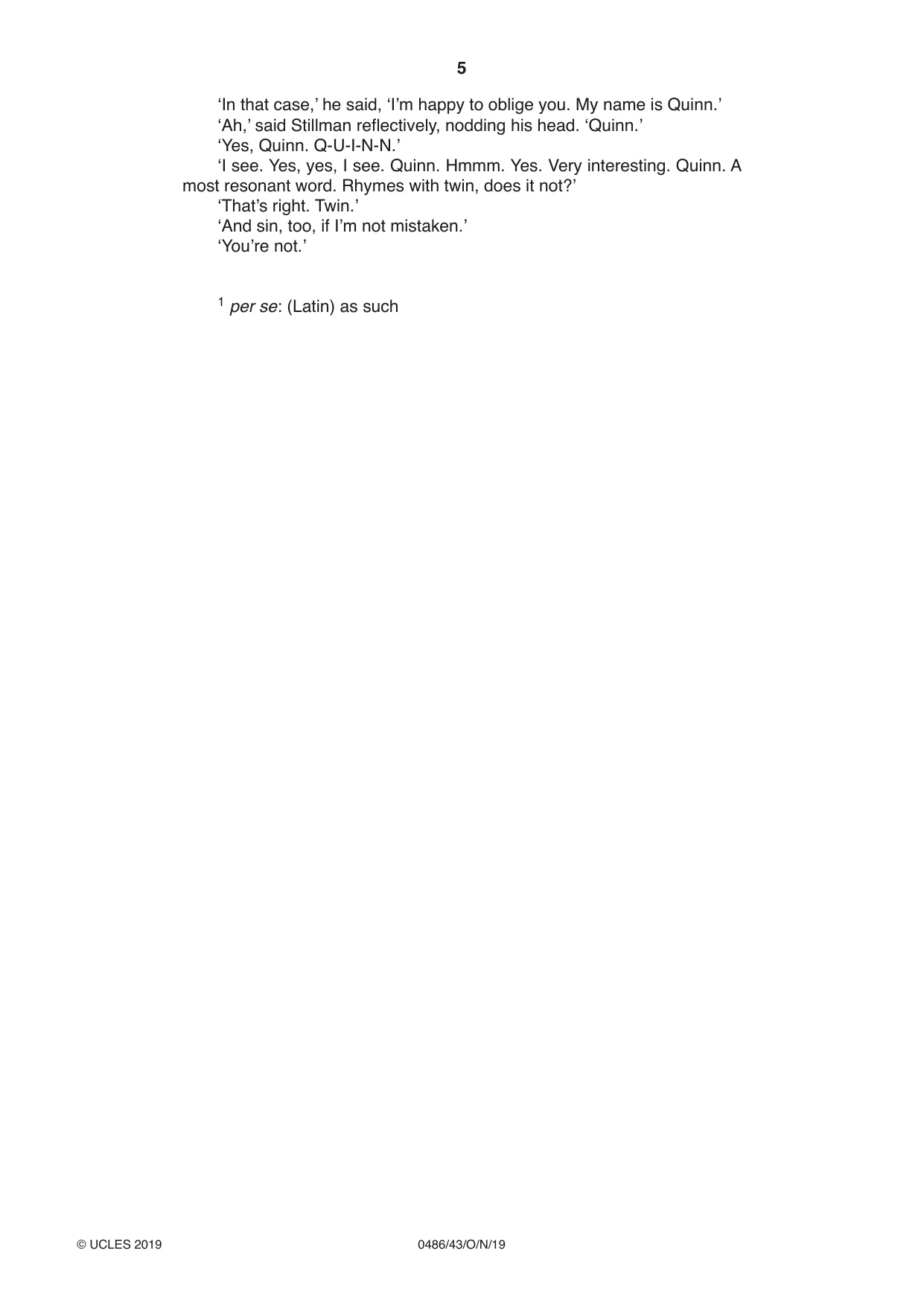
5 0486/43/O/N/19 © UCLES 2019 ‘In that case,’ he said, ‘I’m happy to oblige you. My name is Quinn.’ ‘Ah,’ said Stillman reflectively, nodding his head. ‘Quinn.’ ‘Yes, Quinn. Q-U-I-N-N.’ ‘I see. Yes, yes, I see. Quinn. Hmmm. Yes. Very interesting. Quinn. A most resonant word. Rhymes with twin, does it not?’ ‘That’s right. Twin.’ ‘And sin, too, if I’m not mistaken.’ ‘You’re not.’ 1 per se: (Latin) as such
Question paper, page 6
6 0486/43/O/N/19 © UCLES 2019 BLANK PAGE
Question paper, page 7
7 0486/43/O/N/19 © UCLES 2019 BLANK PAGE
Question paper, page 8
8 0486/43/O/N/19 © UCLES 2019 BLANK PAGE Permission to reproduce items where third-party owned material protected by copyright is included has been sought and cleared where possible. Every reasonable effort has been made by the publisher (UCLES) to trace copyright holders, but if any items requiring clearance have unwittingly been included, the publisher will be pleased to make amends at the earliest possible opportunity. To avoid the issue of disclosure of answer-related information to candidates, all copyright acknowledgements are reproduced online in the Cambridge Assessment International Education Copyright Acknowledgements Booklet. This is produced for each series of examinations and is freely available to download at www.cambridgeinternational.org after the live examination series. Cambridge Assessment International Education is part of the Cambridge Assessment Group. Cambridge Assessment is the brand name of the University of Cambridge Local Examinations Syndicate (UCLES), which itself is a department of the University of Cambridge.
Mark scheme, page 1
This document consists of 4 printed pages. © UCLES 2019 [Turn over Cambridge Assessment International Education Cambridge International General Certificate of Secondary Education LITERATURE (ENGLISH) 0486/43 Paper 4 Unseen October/November 2019 MARK SCHEME Maximum Mark: 25 Published This mark scheme is published as an aid to teachers and candidates, to indicate the requirements of the examination. It shows the basis on which Examiners were instructed to award marks. It does not indicate the details of the discussions that took place at an Examiners’ meeting before marking began, which would have considered the acceptability of alternative answers. Mark schemes should be read in conjunction with the question paper and the Principal Examiner Report for Teachers. Cambridge International will not enter into discussions about these mark schemes. Cambridge International is publishing the mark schemes for the October/November 2019 series for most Cambridge IGCSE™, Cambridge International A and AS Level components and some Cambridge O Level components.
Mark scheme, page 2
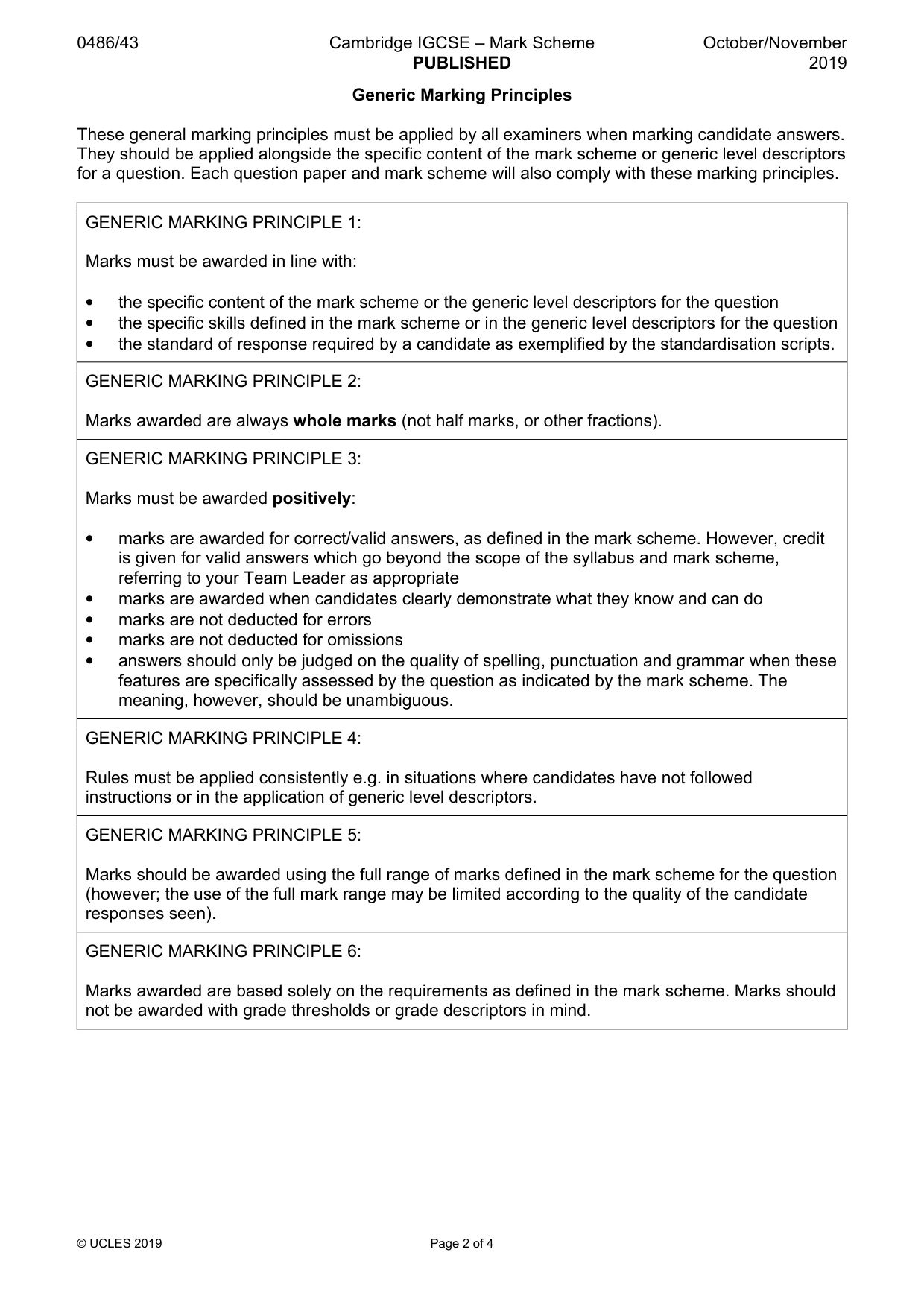
0486/43 Cambridge IGCSE – Mark Scheme PUBLISHED October/November 2019 © UCLES 2019 Page 2 of 4 Generic Marking Principles These general marking principles must be applied by all examiners when marking candidate answers. They should be applied alongside the specific content of the mark scheme or generic level descriptors for a question. Each question paper and mark scheme will also comply with these marking principles. GENERIC MARKING PRINCIPLE 1: Marks must be awarded in line with: • the specific content of the mark scheme or the generic level descriptors for the question • the specific skills defined in the mark scheme or in the generic level descriptors for the question • the standard of response required by a candidate as exemplified by the standardisation scripts. GENERIC MARKING PRINCIPLE 2: Marks awarded are always whole marks (not half marks, or other fractions). GENERIC MARKING PRINCIPLE 3: Marks must be awarded positively: • marks are awarded for correct/valid answers, as defined in the mark scheme. However, credit is given for valid answers which go beyond the scope of the syllabus and mark scheme, referring to your Team Leader as appropriate • marks are awarded when candidates clearly demonstrate what they know and can do • marks are not deducted for errors • marks are not deducted for omissions • answers should only be judged on the quality of spelling, punctuation and grammar when these features are specifically assessed by the question as indicated by the mark scheme. The meaning, however, should be unambiguous. GENERIC MARKING PRINCIPLE 4: Rules must be applied consistently e.g. in situations where candidates have not followed instructions or in the application of generic level descriptors. GENERIC MARKING PRINCIPLE 5: Marks should be awarded using the full range of marks defined in the mark scheme for the question (however; the use of the full mark range may be limited according to the quality of the candidate responses seen). GENERIC MARKING PRINCIPLE 6: Marks awarded are based solely on the requirements as defined in the mark scheme. Marks should not be awarded with grade thresholds or grade descriptors in mind.
Mark scheme, page 3
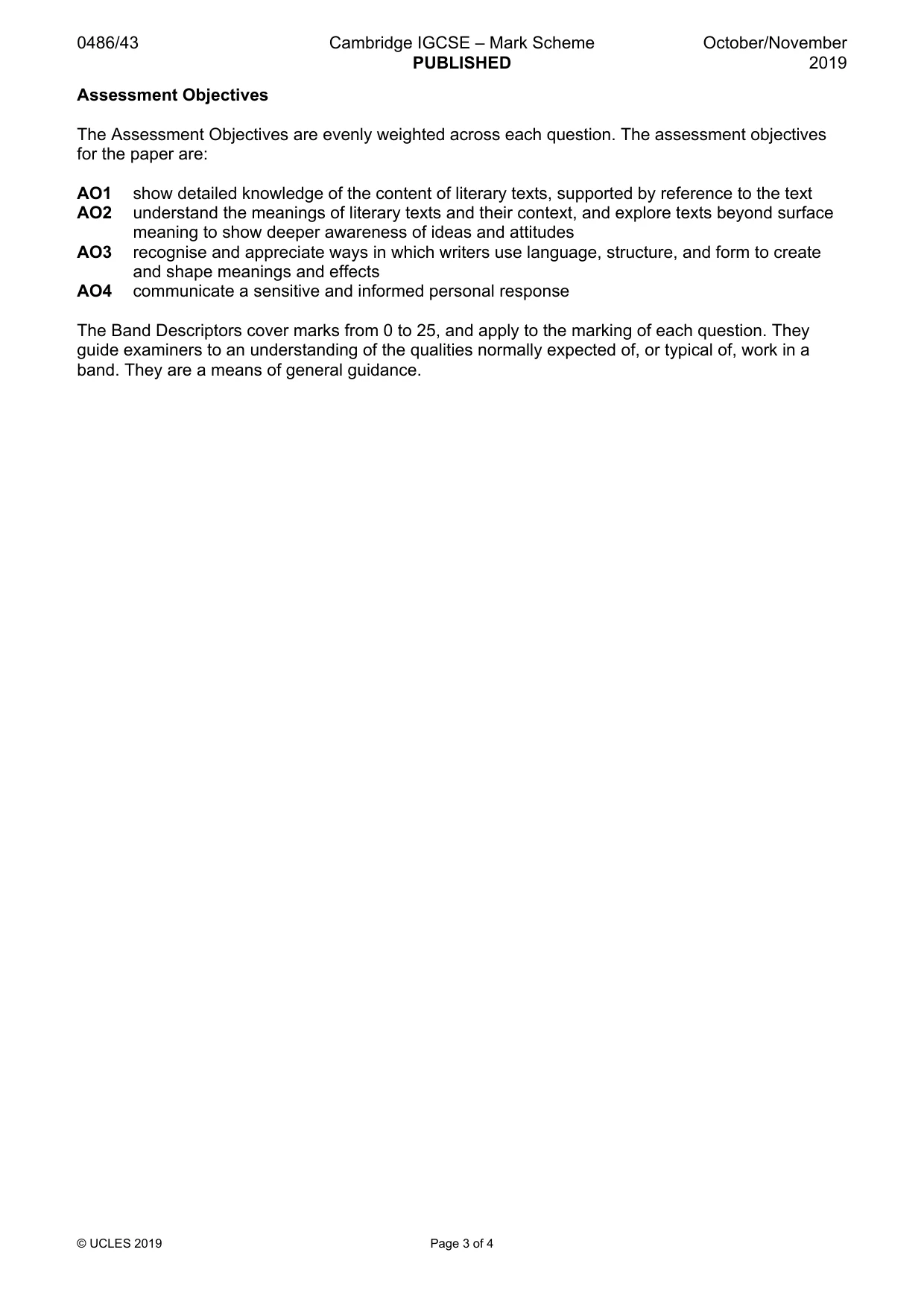
0486/43 Cambridge IGCSE – Mark Scheme PUBLISHED October/November 2019 © UCLES 2019 Page 3 of 4 Assessment Objectives The Assessment Objectives are evenly weighted across each question. The assessment objectives for the paper are: AO1 show detailed knowledge of the content of literary texts, supported by reference to the text AO2 understand the meanings of literary texts and their context, and explore texts beyond surface meaning to show deeper awareness of ideas and attitudes AO3 recognise and appreciate ways in which writers use language, structure, and form to create and shape meanings and effects AO4 communicate a sensitive and informed personal response The Band Descriptors cover marks from 0 to 25, and apply to the marking of each question. They guide examiners to an understanding of the qualities normally expected of, or typical of, work in a band. They are a means of general guidance.
Mark scheme, page 4
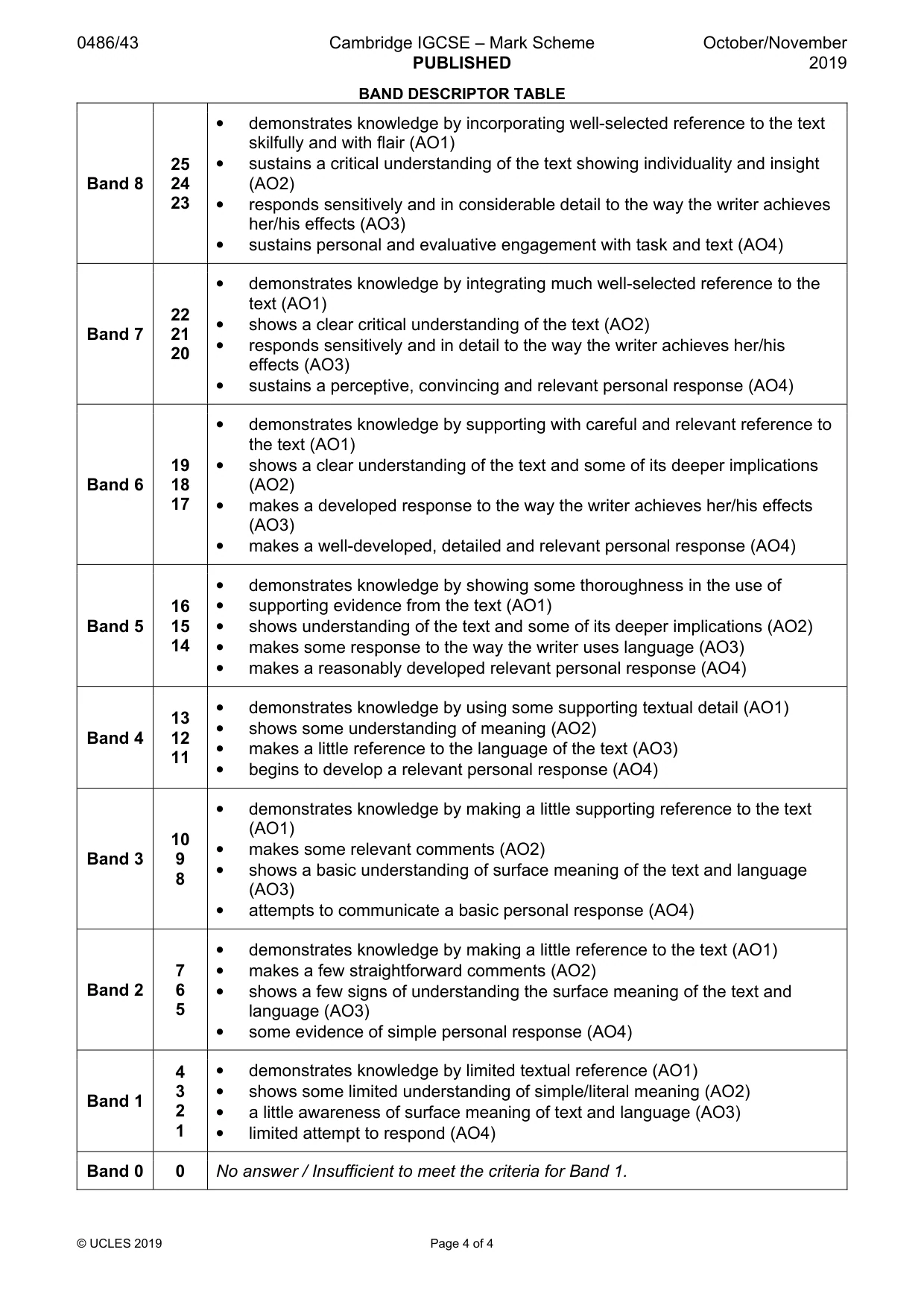
0486/43 Cambridge IGCSE – Mark Scheme PUBLISHED October/November 2019 © UCLES 2019 Page 4 of 4 BAND DESCRIPTOR TABLE Band 8 25 24 23 • demonstrates knowledge by incorporating well-selected reference to the text skilfully and with flair (AO1) • sustains a critical understanding of the text showing individuality and insight (AO2) • responds sensitively and in considerable detail to the way the writer achieves her/his effects (AO3) • sustains personal and evaluative engagement with task and text (AO4) Band 7 22 21 20 • demonstrates knowledge by integrating much well-selected reference to the text (AO1) • shows a clear critical understanding of the text (AO2) • responds sensitively and in detail to the way the writer achieves her/his effects (AO3) • sustains a perceptive, convincing and relevant personal response (AO4) Band 6 19 18 17 • demonstrates knowledge by supporting with careful and relevant reference to the text (AO1) • shows a clear understanding of the text and some of its deeper implications (AO2) • makes a developed response to the way the writer achieves her/his effects (AO3) • makes a well-developed, detailed and relevant personal response (AO4) Band 5 16 15 14 • demonstrates knowledge by showing some thoroughness in the use of • supporting evidence from the text (AO1) • shows understanding of the text and some of its deeper implications (AO2) • makes some response to the way the writer uses language (AO3) • makes a reasonably developed relevant personal response (AO4) Band 4 13 12 11 • demonstrates knowledge by using some supporting textual detail (AO1) • shows some understanding of meaning (AO2) • makes a little reference to the language of the text (AO3) • begins to develop a relevant personal response (AO4) Band 3 10 9 8 • demonstrates knowledge by making a little supporting reference to the text (AO1) • makes some relevant comments (AO2) • shows a basic understanding of surface meaning of the text and language (AO3) • attempts to communicate a basic personal response (AO4) Band 2 7 6 5 • demonstrates knowledge by making a little reference to the text (AO1) • makes a few straightforward comments (AO2) • shows a few signs of understanding the surface meaning of the text and language (AO3) • some evidence of simple personal response (AO4) Band 1 4 3 2 1 • demonstrates knowledge by limited textual reference (AO1) • shows some limited understanding of simple/literal meaning (AO2) • a little awareness of surface meaning of text and language (AO3) • limited attempt to respond (AO4) Band 0 0 No answer / Insufficient to meet the criteria for Band 1.
What you needed in this session
Cambridge’s own grade thresholds for 2019 Oct/Nov, Paper 4 · Variant 3. A higher threshold means an easier paper — the bar moves with how the cohort did.