Cambridge IGCSE English - Literature 0486 — 2018 May/June Paper 4 · Variant 3
0486/43/M/J/18 · 25 marks · ≈28 min
The question paper and its mark scheme, free to read here and free to download. This is Cambridge’s own paper, exactly as it was sat.
Question paper8 pages



Mark scheme4 pages
Answers below. Sit the paper first if you are practising.
Paper as text
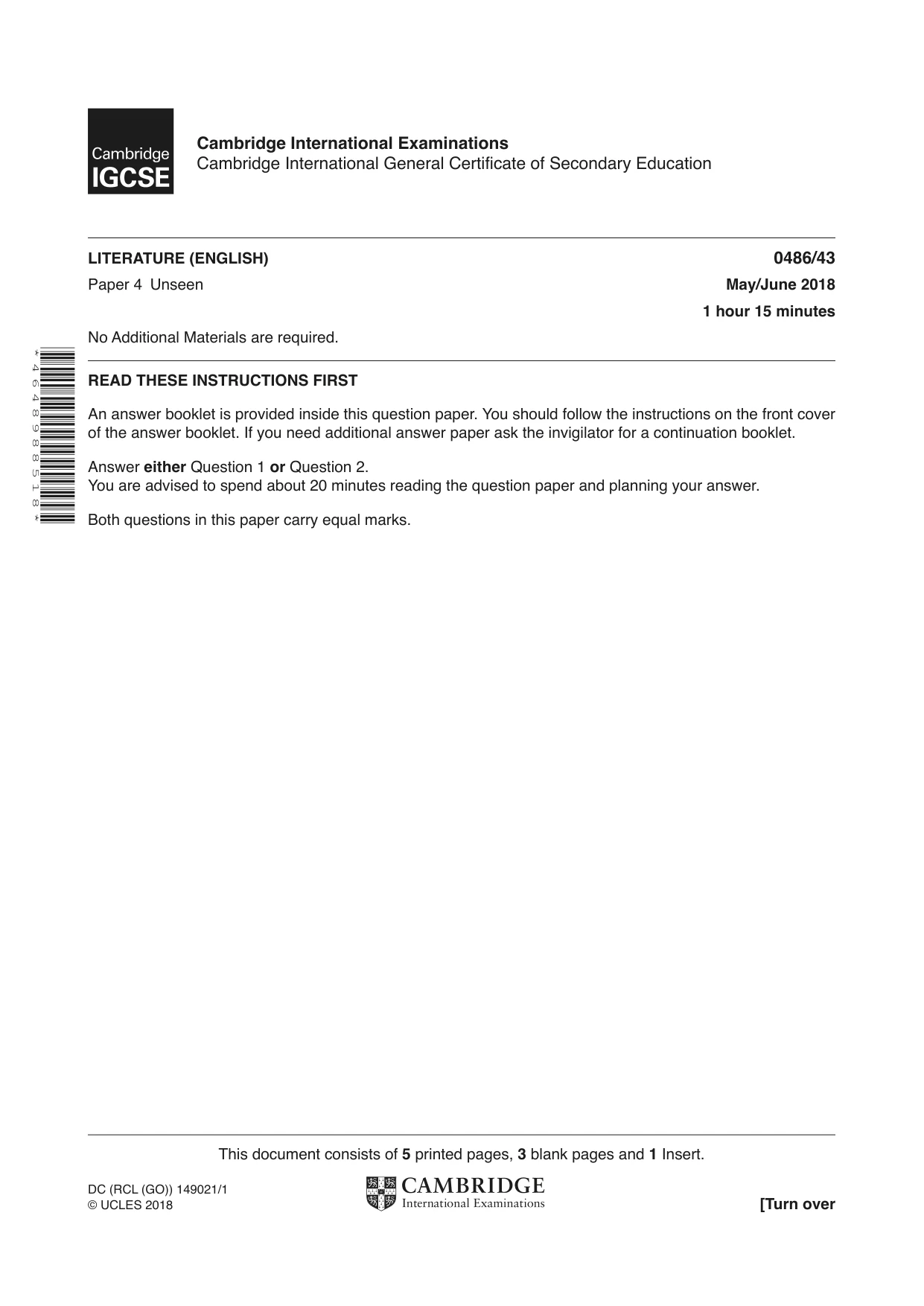
Question paper, page 1
This document consists of 5 printed pages, 3 blank pages and 1 Insert. DC (RCL (GO)) 149021/1 © UCLES 2018 [Turn over Cambridge International Examinations Cambridge International General Certificate of Secondary Education * 4 6 4 8 9 8 8 5 1 8 * LITERATURE (ENGLISH) 0486/43 Paper 4 Unseen May/June 2018 1 hour 15 minutes No Additional Materials are required. READ THESE INSTRUCTIONS FIRST An answer booklet is provided inside this question paper. You should follow the instructions on the front cover of the answer booklet. If you need additional answer paper ask the invigilator for a continuation booklet. Answer either Question 1 or Question 2. You are advised to spend about 20 minutes reading the question paper and planning your answer. Both questions in this paper carry equal marks.
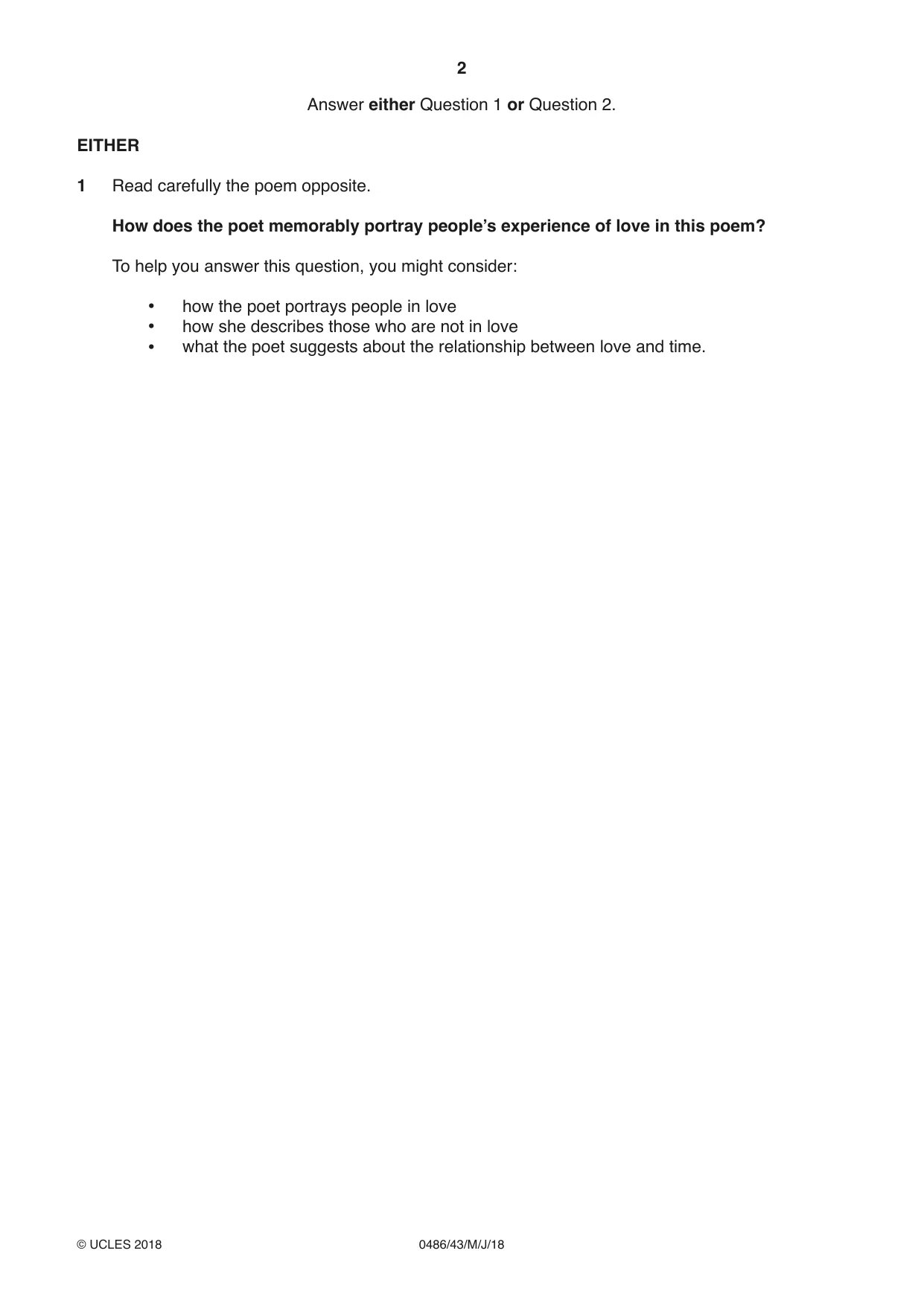
Question paper, page 2
2 0486/43/M/J/18 © UCLES 2018 Answer either Question 1 or Question 2. EITHER 1 Read carefully the poem opposite. How does the poet memorably portray people’s experience of love in this poem? To help you answer this question, you might consider: • how the poet portrays people in love • how she describes those who are not in love • what the poet suggests about the relationship between love and time.
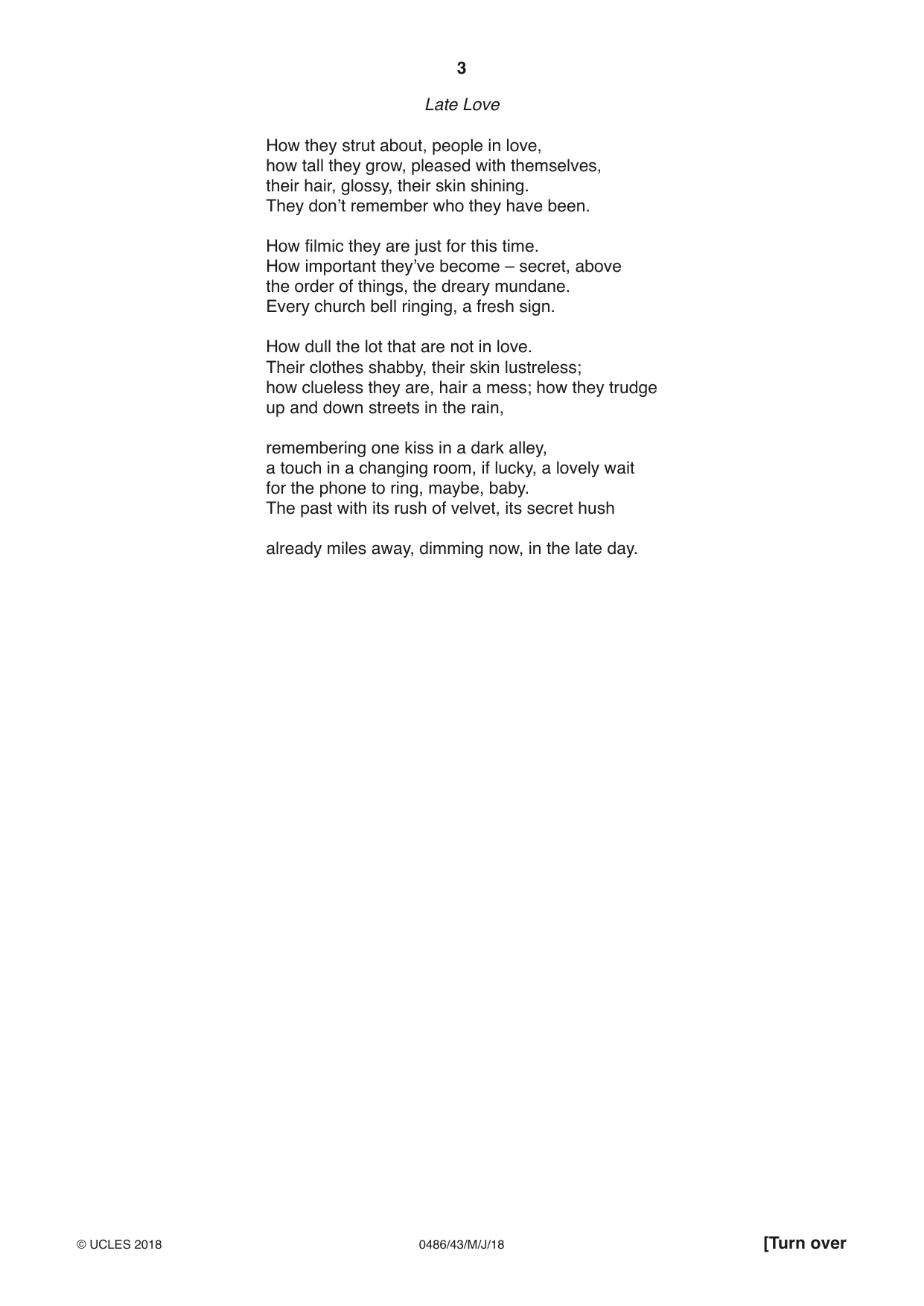
Question paper, page 3
3 0486/43/M/J/18 © UCLES 2018 [Turn over Late Love How they strut about, people in love, how tall they grow, pleased with themselves, their hair, glossy, their skin shining. They don’t remember who they have been. How filmic they are just for this time. How important they’ve become – secret, above the order of things, the dreary mundane. Every church bell ringing, a fresh sign. How dull the lot that are not in love. Their clothes shabby, their skin lustreless; how clueless they are, hair a mess; how they trudge up and down streets in the rain, remembering one kiss in a dark alley, a touch in a changing room, if lucky, a lovely wait for the phone to ring, maybe, baby. The past with its rush of velvet, its secret hush already miles away, dimming now, in the late day.
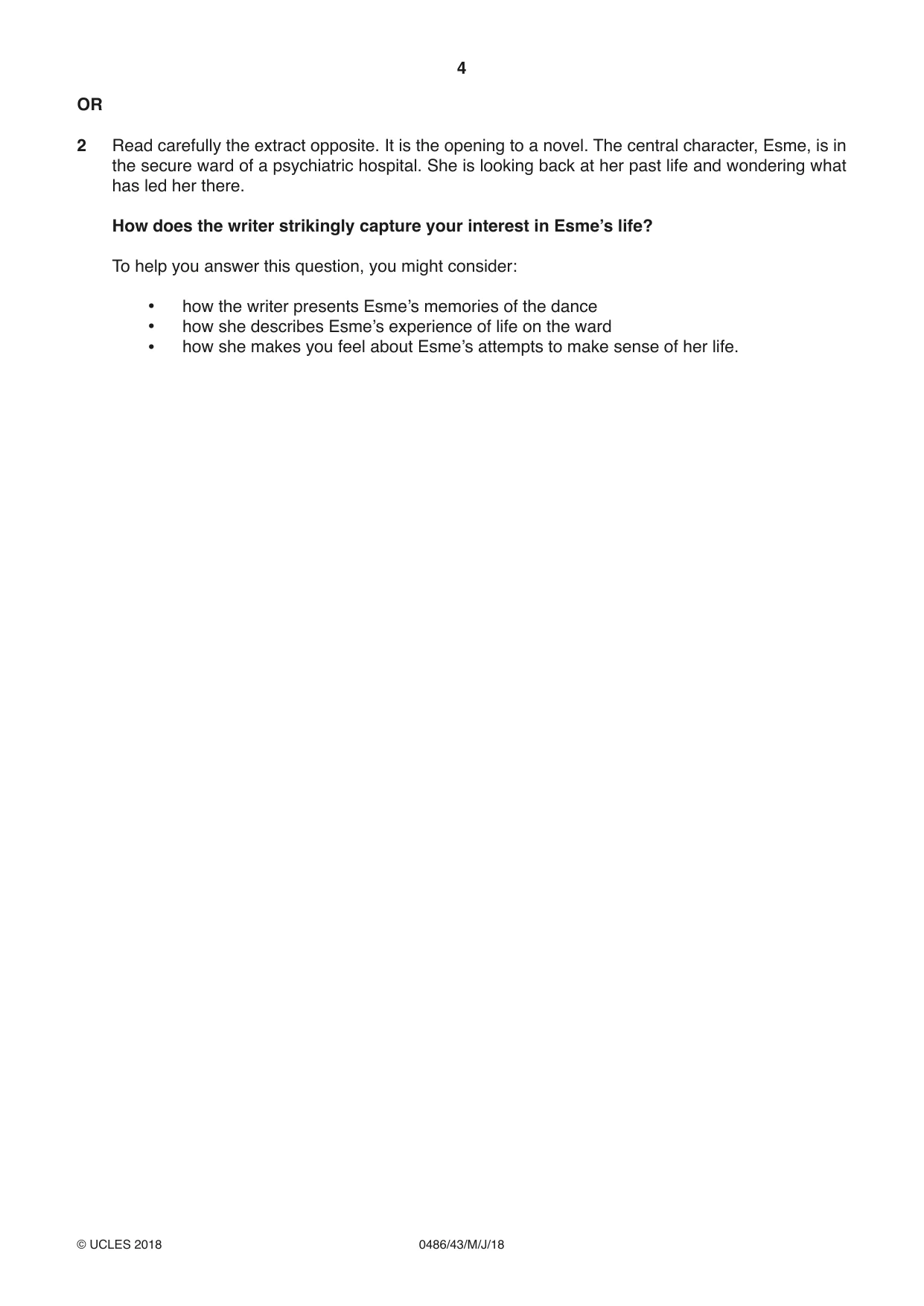
Question paper, page 4
4 0486/43/M/J/18 © UCLES 2018 OR 2 Read carefully the extract opposite. It is the opening to a novel. The central character, Esme, is in the secure ward of a psychiatric hospital. She is looking back at her past life and wondering what has led her there. How does the writer strikingly capture your interest in Esme’s life? To help you answer this question, you might consider: • how the writer presents Esme’s memories of the dance • how she describes Esme’s experience of life on the ward • how she makes you feel about Esme’s attempts to make sense of her life.
Question paper, page 5
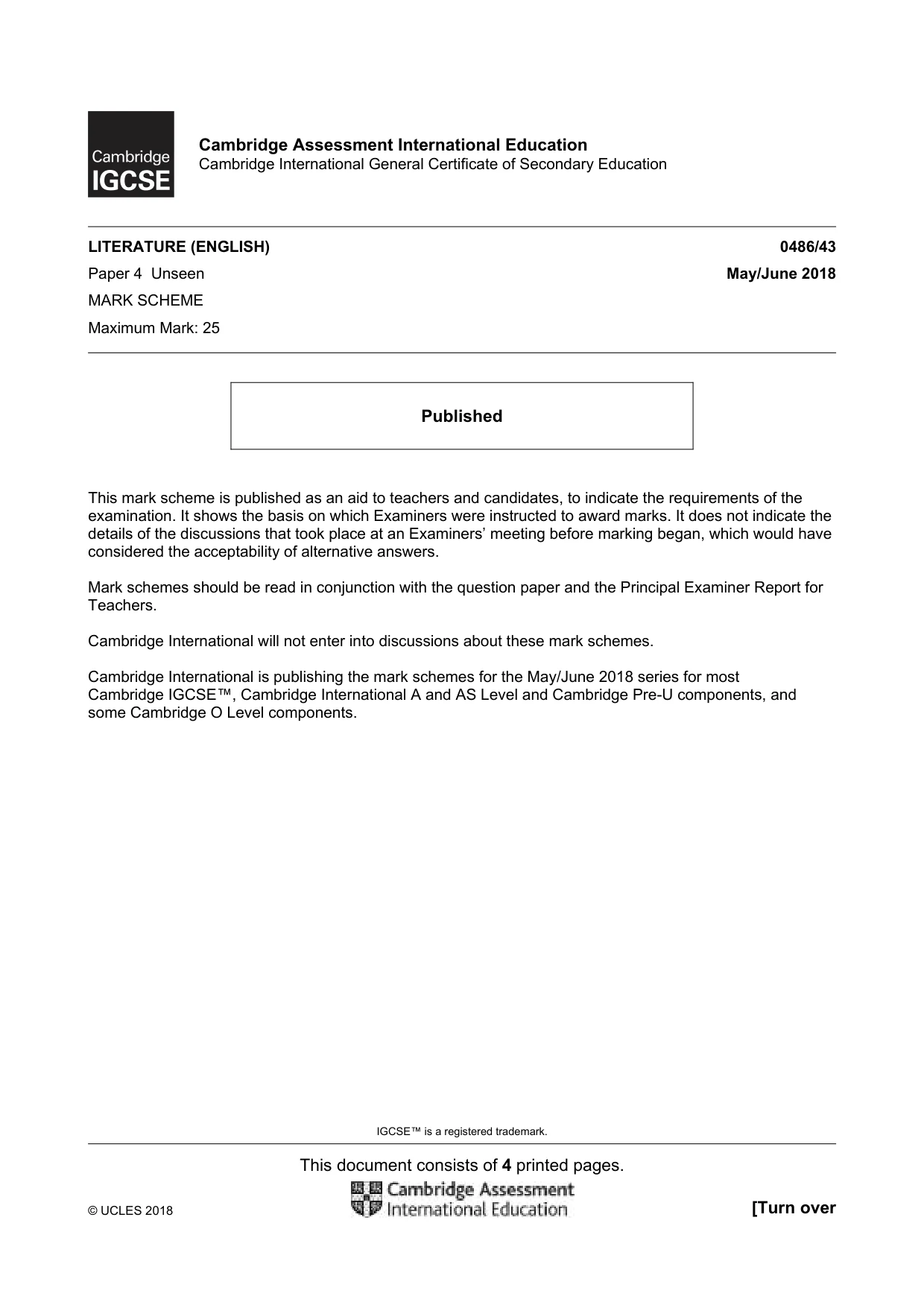
5 0486/43/M/J/18 © UCLES 2018 Let us begin with two girls at a dance. They are at the edge of the room. One sits on a chair, opening and shutting a dance-card1 with gloved fingers. Esme stands beside her, watching the dance unfold: the circling couples, the clasped hands, the drumming shoes, the whirling skirts, the bounce of the floor. It is the last hour of the year and the windows behind them are blank with night. The seated girl is dressed in something pale, Esme forgets what. Esme is in a dark red frock that doesn’t suit her. She has lost her gloves. It begins here. Or perhaps not. Perhaps it begins earlier, before the party, before they dressed in their new finery, before the candles were lit, before the sand was sprinkled on the boards, before the year whose end they are celebrating began. Who knows? Either way it ends at a grille2 covering a window with each square exactly two thumbnails wide. If Esme cares to gaze into the distance – that is to say, at what lies beyond the metal grille – she finds that, after a while, something happens to the focusing mechanism of her eyes. The squares of the grille will blur and, if she concentrates long enough, vanish. There is always a moment before her body reasserts itself, readjusting her eyes to the proper reality of the world, when it is just her and the trees, the road, the beyond. Nothing in between. The squares at the bottom are worn free of paint and you can see the different layers of colour inside each other, like rings in a tree. Esme is taller than most so can reach the part where the paint is new and thick as tar. Behind her, a woman makes tea for her dead husband. Is he dead? Or just run off? Esme doesn’t recall. Another woman is searching for water to pour on flowers that perished long ago in a seaside town not far from here. It is always the meaningless tasks that endure: the washing, the cooking, the clearing, the cleaning. Never anything majestic or significant, just the tiny rituals that hold together the seams of human life. The girl obsessed with cigarettes has had two warnings already and everyone is thinking she is about to get a third. And Esme is thinking, where does it begin – is it there, is it here, at the dance, in India, before? She speaks to no one, these days. She wants to concentrate, she doesn’t like to muddy things with the distraction of speech. There is a zoetrope3 inside her head and she doesn’t like to be caught out when it stops. Whir, whir. Stop. In India, then. The garden. Herself aged about four, standing on the back step. Above her, mimosa trees are shaking their heads at her, powdering the lawn with yellow dust. If she walked across it, she’d leave a trail behind. She wants something. She wants something but she doesn’t know what. It’s like an itch she can’t reach to scratch. A drink? Her ayah4? A sliver of mango? She rubs at an insect bite on her arm and pokes at the yellow dust with her bare toe. In the distance somewhere she can hear her sister’s skipping-rope hitting the ground and the short shuffle of feet in between. Slap shunt slap shunt slap shunt. 1 dance-card: list of dance partners 2 grille: a frame of metal bars used to cover a window 3 zoetrope: a spinning toy which creates the illusion of motion 4 ayah: a nursemaid
Question paper, page 6
6 0486/43/M/J/18 © UCLES 2018 BLANK PAGE
Question paper, page 7
7 0486/43/M/J/18 © UCLES 2018 BLANK PAGE
Question paper, page 8
8 0486/43/M/J/18 © UCLES 2018 BLANK PAGE Permission to reproduce items where third-party owned material protected by copyright is included has been sought and cleared where possible. Every reasonable effort has been made by the publisher (UCLES) to trace copyright holders, but if any items requiring clearance have unwittingly been included, the publisher will be pleased to make amends at the earliest possible opportunity. To avoid the issue of disclosure of answer-related information to candidates, all copyright acknowledgements are reproduced online in the Cambridge International Examinations Copyright Acknowledgements Booklet. This is produced for each series of examinations and is freely available to download at www.cie.org.uk after the live examination series. Cambridge International Examinations is part of the Cambridge Assessment Group. Cambridge Assessment is the brand name of University of Cambridge Local Examinations Syndicate (UCLES), which is itself a department of the University of Cambridge.
Mark scheme, page 1
IGCSE™ is a registered trademark. This document consists of 4 printed pages. © UCLES 2018 [Turn over Cambridge Assessment International Education Cambridge International General Certificate of Secondary Education LITERATURE (ENGLISH) 0486/43 Paper 4 Unseen May/June 2018 MARK SCHEME Maximum Mark: 25 Published This mark scheme is published as an aid to teachers and candidates, to indicate the requirements of the examination. It shows the basis on which Examiners were instructed to award marks. It does not indicate the details of the discussions that took place at an Examiners’ meeting before marking began, which would have considered the acceptability of alternative answers. Mark schemes should be read in conjunction with the question paper and the Principal Examiner Report for Teachers. Cambridge International will not enter into discussions about these mark schemes. Cambridge International is publishing the mark schemes for the May/June 2018 series for most Cambridge IGCSE™, Cambridge International A and AS Level and Cambridge Pre-U components, and some Cambridge O Level components.
Mark scheme, page 2
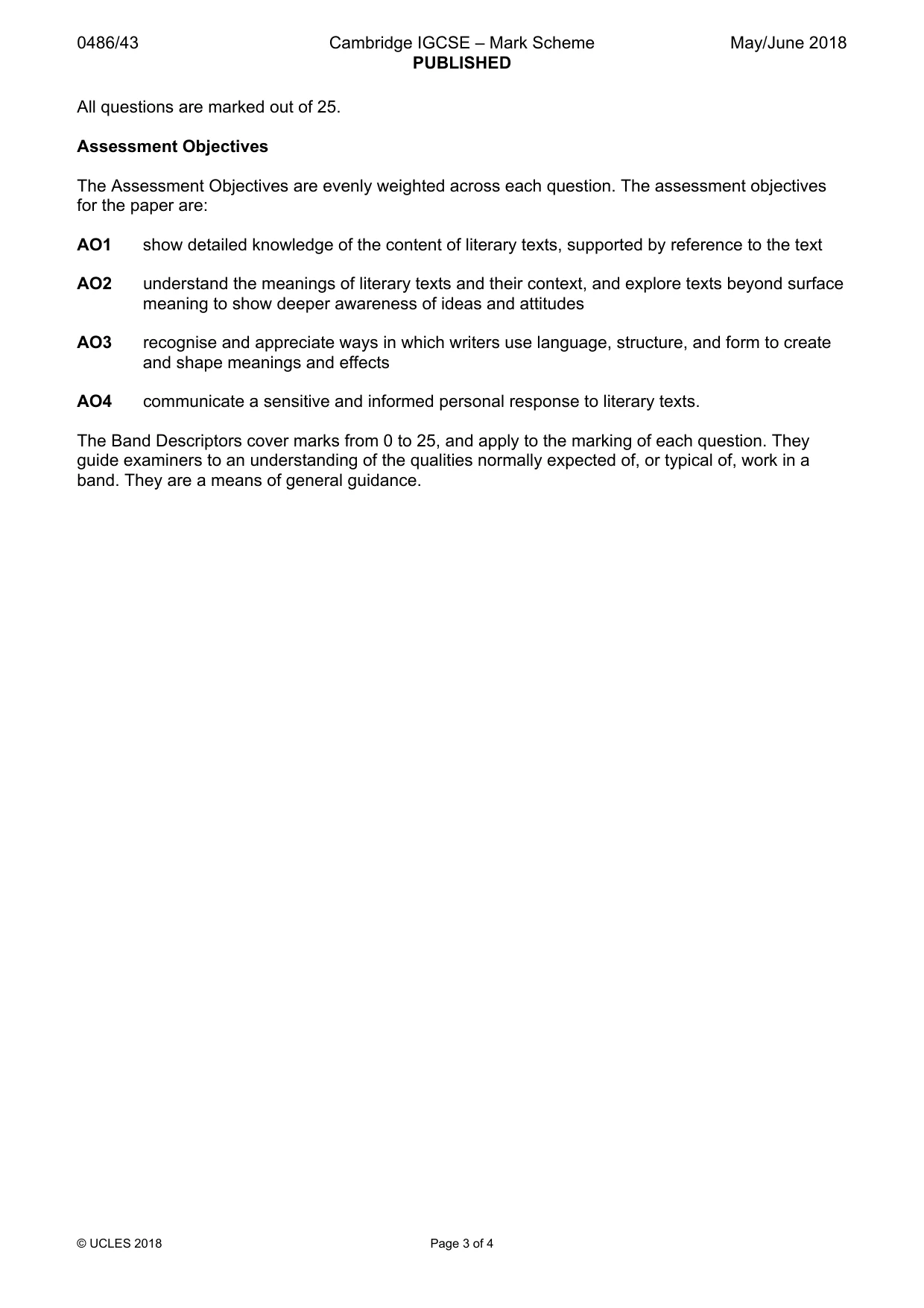
0486/43 Cambridge IGCSE – Mark Scheme PUBLISHED May/June 2018 © UCLES 2018 Page 2 of 4 Generic Marking Principles These general marking principles must be applied by all examiners when marking candidate answers. They should be applied alongside the specific content of the mark scheme or generic level descriptors for a question. Each question paper and mark scheme will also comply with these marking principles. GENERIC MARKING PRINCIPLE 1: Marks must be awarded in line with: • the specific content of the mark scheme or the generic level descriptors for the question • the specific skills defined in the mark scheme or in the generic level descriptors for the question • the standard of response required by a candidate as exemplified by the standardisation scripts. GENERIC MARKING PRINCIPLE 2: Marks awarded are always whole marks (not half marks, or other fractions). GENERIC MARKING PRINCIPLE 3: Marks must be awarded positively: • marks are awarded for correct/valid answers, as defined in the mark scheme. However, credit is given for valid answers which go beyond the scope of the syllabus and mark scheme, referring to your Team Leader as appropriate • marks are awarded when candidates clearly demonstrate what they know and can do • marks are not deducted for errors • marks are not deducted for omissions • answers should only be judged on the quality of spelling, punctuation and grammar when these features are specifically assessed by the question as indicated by the mark scheme. The meaning, however, should be unambiguous. GENERIC MARKING PRINCIPLE 4: Rules must be applied consistently e.g. in situations where candidates have not followed instructions or in the application of generic level descriptors. GENERIC MARKING PRINCIPLE 5: Marks should be awarded using the full range of marks defined in the mark scheme for the question (however; the use of the full mark range may be limited according to the quality of the candidate responses seen). GENERIC MARKING PRINCIPLE 6: Marks awarded are based solely on the requirements as defined in the mark scheme. Marks should not be awarded with grade thresholds or grade descriptors in mind.
Mark scheme, page 3
0486/43 Cambridge IGCSE – Mark Scheme PUBLISHED May/June 2018 © UCLES 2018 Page 3 of 4 All questions are marked out of 25. Assessment Objectives The Assessment Objectives are evenly weighted across each question. The assessment objectives for the paper are: AO1 show detailed knowledge of the content of literary texts, supported by reference to the text AO2 understand the meanings of literary texts and their context, and explore texts beyond surface meaning to show deeper awareness of ideas and attitudes AO3 recognise and appreciate ways in which writers use language, structure, and form to create and shape meanings and effects AO4 communicate a sensitive and informed personal response to literary texts. The Band Descriptors cover marks from 0 to 25, and apply to the marking of each question. They guide examiners to an understanding of the qualities normally expected of, or typical of, work in a band. They are a means of general guidance.
Mark scheme, page 4
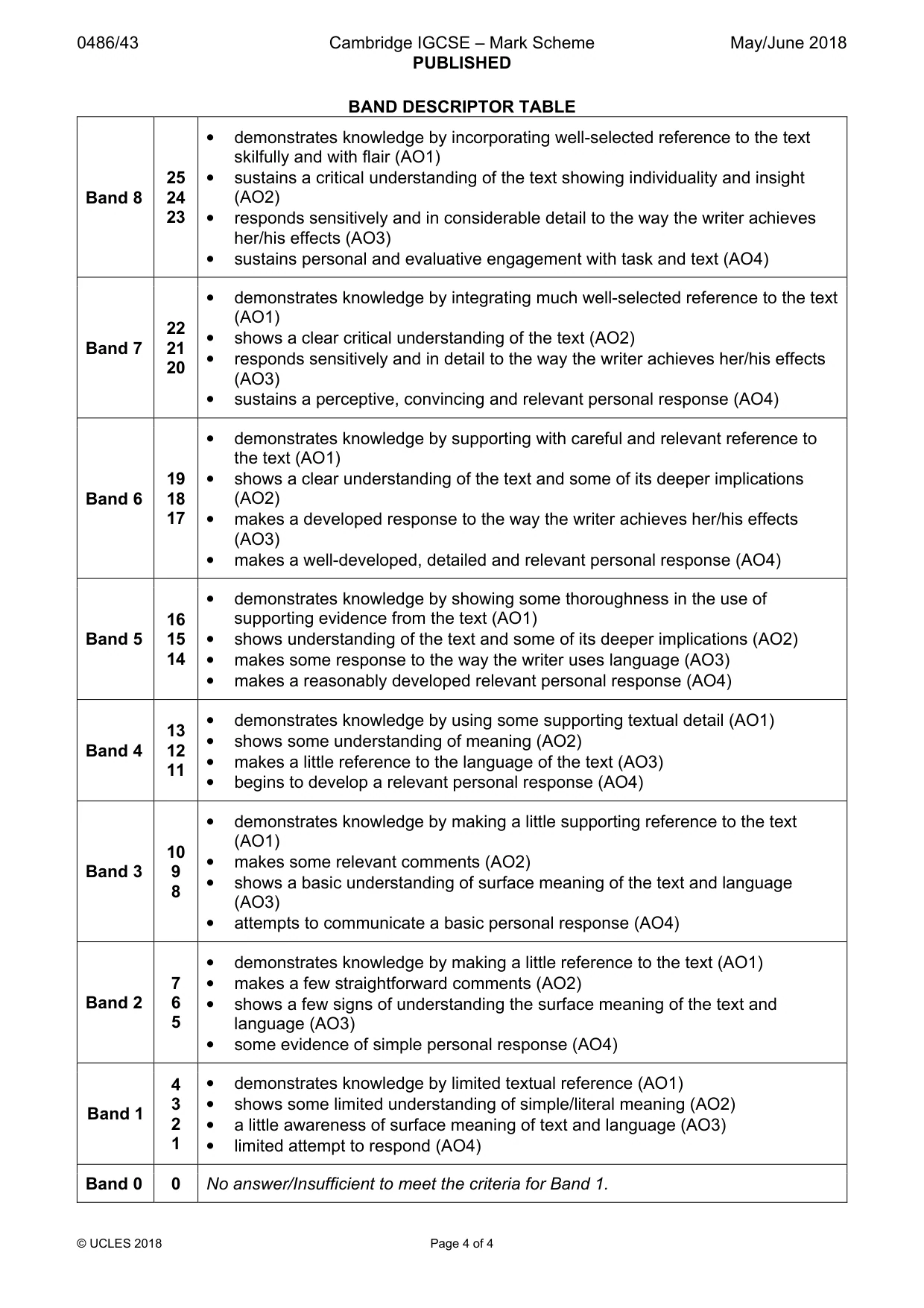
0486/43 Cambridge IGCSE – Mark Scheme PUBLISHED May/June 2018 © UCLES 2018 Page 4 of 4 BAND DESCRIPTOR TABLE Band 8 25 24 23 • demonstrates knowledge by incorporating well-selected reference to the text skilfully and with flair (AO1) • sustains a critical understanding of the text showing individuality and insight (AO2) • responds sensitively and in considerable detail to the way the writer achieves her/his effects (AO3) • sustains personal and evaluative engagement with task and text (AO4) Band 7 22 21 20 • demonstrates knowledge by integrating much well-selected reference to the text (AO1) • shows a clear critical understanding of the text (AO2) • responds sensitively and in detail to the way the writer achieves her/his effects (AO3) • sustains a perceptive, convincing and relevant personal response (AO4) Band 6 19 18 17 • demonstrates knowledge by supporting with careful and relevant reference to the text (AO1) • shows a clear understanding of the text and some of its deeper implications (AO2) • makes a developed response to the way the writer achieves her/his effects (AO3) • makes a well-developed, detailed and relevant personal response (AO4) Band 5 16 15 14 • demonstrates knowledge by showing some thoroughness in the use of supporting evidence from the text (AO1) • shows understanding of the text and some of its deeper implications (AO2) • makes some response to the way the writer uses language (AO3) • makes a reasonably developed relevant personal response (AO4) Band 4 13 12 11 • demonstrates knowledge by using some supporting textual detail (AO1) • shows some understanding of meaning (AO2) • makes a little reference to the language of the text (AO3) • begins to develop a relevant personal response (AO4) Band 3 10 9 8 • demonstrates knowledge by making a little supporting reference to the text (AO1) • makes some relevant comments (AO2) • shows a basic understanding of surface meaning of the text and language (AO3) • attempts to communicate a basic personal response (AO4) Band 2 7 6 5 • demonstrates knowledge by making a little reference to the text (AO1) • makes a few straightforward comments (AO2) • shows a few signs of understanding the surface meaning of the text and language (AO3) • some evidence of simple personal response (AO4) Band 1 4 3 2 1 • demonstrates knowledge by limited textual reference (AO1) • shows some limited understanding of simple/literal meaning (AO2) • a little awareness of surface meaning of text and language (AO3) • limited attempt to respond (AO4) Band 0 0 No answer/Insufficient to meet the criteria for Band 1.
What you needed in this session
Cambridge’s own grade thresholds for 2018 May/June, Paper 4 · Variant 3. A higher threshold means an easier paper — the bar moves with how the cohort did.